MAT 104Overview of Fractions
Overview of FractionsIn order to be successful in Algebra and higher mathematics, it is very important to have a good background in basic mathematics.  Each new topic in mathematics builds upon skills you have previously learned.  Fractions are often a stumbling block to many students.  For that reason, we begin this course with a review of basic operations with fractions.
Overview of FractionsThis presentation consists of a quick overview of the operations with fractions.  If you need additional help on any of the topics covered here, make a note of the terms and concepts that cause you problems.  Additional presentations are available to provide further help on each of these topics.
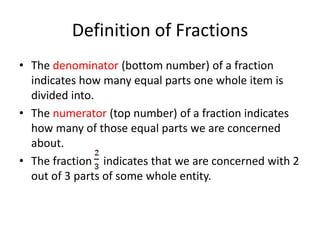
Definition of FractionsThe denominator (bottom number) of a fraction indicates how many equal parts one whole item is divided into.The numerator (top number) of a fraction indicates how many of those equal parts we are concerned about.The fraction    indicates that we are concerned with 2 out of 3 parts of some whole entity.
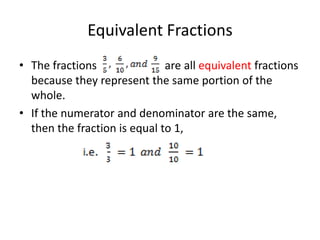
Equivalent FractionsThe fractions                        are all equivalent fractions because they represent the same portion of the whole.If the numerator and denominator are the same, then the fraction is equal to 1,
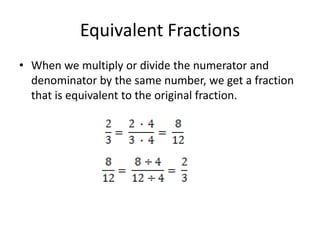
Equivalent FractionsWhen we multiply or divide the numerator and denominator by the same number, we get a fraction that is equivalent to the original fraction.
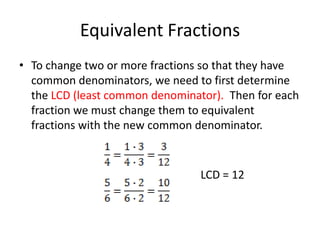
Equivalent FractionsTo change two or more fractions so that they have common denominators, we need to first determine the LCD (least common denominator).  Then for each fraction we must change them to equivalent fractions with the new common denominator.LCD = 12
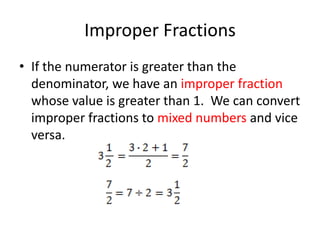
Improper FractionsIf the numerator is greater than the denominator, we have an improper fraction whose value is greater than 1.  We can convert improper fractions to mixed numbers and vice versa.
Factors and Prime FactorizationTo perform operations with fractions it is important to understand how to express a number as the product of its factorsWe need to understand prime and composite numbers and to be able to write a number as a product of its prime factorsWe need to be able to determine all factors of a given numberWe need to be able to determine the GCF (greatest common factor) of a group of numbers.
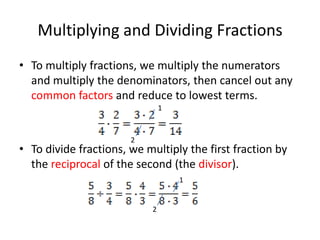
Multiplying and Dividing FractionsTo multiply fractions, we multiply the numerators and multiply the denominators, then cancel out any common factors and reduce to lowest terms.To divide fractions, we multiply the first fraction by the reciprocal of the second (the divisor).1212
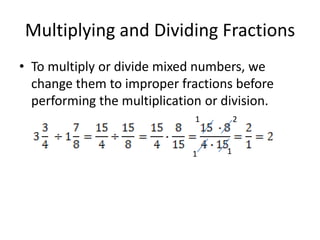
Multiplying and Dividing FractionsTo multiply or divide mixed numbers, we change them to improper fractions before performing the multiplication or division.1211
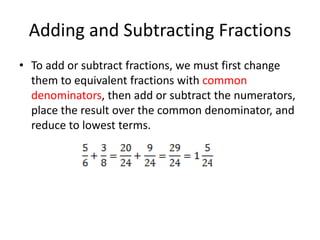
Adding and Subtracting FractionsTo add or subtract fractions, we must first change them to equivalent fractions with common denominators, then add or subtract the numerators, place the result over the common denominator, and reduce to lowest terms.
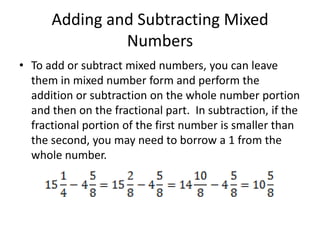
Adding and Subtracting Mixed NumbersTo add or subtract mixed numbers, you can leave them in mixed number form and perform the addition or subtraction on the whole number portion and then on the fractional part.  In subtraction, if the fractional portion of the first number is smaller than the second, you may need to borrow a 1 from the whole number.
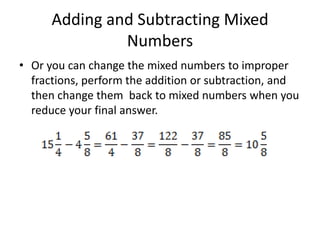
Adding and Subtracting Mixed NumbersOr you can change the mixed numbers to improper fractions, perform the addition or subtraction, and then change them  back to mixed numbers when you reduce your final answer.
SummaryAdditional presentations are available with detailed information on all of the topics covered here.  Your textbook contains detailed explanations on all of these concepts as well.Use all of these resources until you fully understand all of these concepts and can easily complete the assigned exercises.

Fraction Overview

  • 1.
  • 2.
    Overview of FractionsInorder to be successful in Algebra and higher mathematics, it is very important to have a good background in basic mathematics. Each new topic in mathematics builds upon skills you have previously learned. Fractions are often a stumbling block to many students. For that reason, we begin this course with a review of basic operations with fractions.
  • 3.
    Overview of FractionsThispresentation consists of a quick overview of the operations with fractions. If you need additional help on any of the topics covered here, make a note of the terms and concepts that cause you problems. Additional presentations are available to provide further help on each of these topics.
  • 4.
    Definition of FractionsThedenominator (bottom number) of a fraction indicates how many equal parts one whole item is divided into.The numerator (top number) of a fraction indicates how many of those equal parts we are concerned about.The fraction indicates that we are concerned with 2 out of 3 parts of some whole entity.
  • 5.
    Equivalent FractionsThe fractions are all equivalent fractions because they represent the same portion of the whole.If the numerator and denominator are the same, then the fraction is equal to 1,
  • 6.
    Equivalent FractionsWhen wemultiply or divide the numerator and denominator by the same number, we get a fraction that is equivalent to the original fraction.
  • 7.
    Equivalent FractionsTo changetwo or more fractions so that they have common denominators, we need to first determine the LCD (least common denominator). Then for each fraction we must change them to equivalent fractions with the new common denominator.LCD = 12
  • 8.
    Improper FractionsIf thenumerator is greater than the denominator, we have an improper fraction whose value is greater than 1. We can convert improper fractions to mixed numbers and vice versa.
  • 9.
    Factors and PrimeFactorizationTo perform operations with fractions it is important to understand how to express a number as the product of its factorsWe need to understand prime and composite numbers and to be able to write a number as a product of its prime factorsWe need to be able to determine all factors of a given numberWe need to be able to determine the GCF (greatest common factor) of a group of numbers.
  • 10.
    Multiplying and DividingFractionsTo multiply fractions, we multiply the numerators and multiply the denominators, then cancel out any common factors and reduce to lowest terms.To divide fractions, we multiply the first fraction by the reciprocal of the second (the divisor).1212
  • 11.
    Multiplying and DividingFractionsTo multiply or divide mixed numbers, we change them to improper fractions before performing the multiplication or division.1211
  • 12.
    Adding and SubtractingFractionsTo add or subtract fractions, we must first change them to equivalent fractions with common denominators, then add or subtract the numerators, place the result over the common denominator, and reduce to lowest terms.
  • 13.
    Adding and SubtractingMixed NumbersTo add or subtract mixed numbers, you can leave them in mixed number form and perform the addition or subtraction on the whole number portion and then on the fractional part. In subtraction, if the fractional portion of the first number is smaller than the second, you may need to borrow a 1 from the whole number.
  • 14.
    Adding and SubtractingMixed NumbersOr you can change the mixed numbers to improper fractions, perform the addition or subtraction, and then change them back to mixed numbers when you reduce your final answer.
  • 15.
    SummaryAdditional presentations areavailable with detailed information on all of the topics covered here. Your textbook contains detailed explanations on all of these concepts as well.Use all of these resources until you fully understand all of these concepts and can easily complete the assigned exercises.