By
Mr. / Mohammed D. Ata
Mr. Mohammed Deushy Ata Secondary Three2
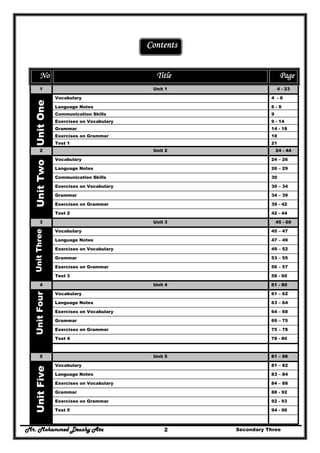
Contents
No Title Page
1 Unit 1 4 - 23
Vocabulary 4 - 6
Language Notes 6 - 9
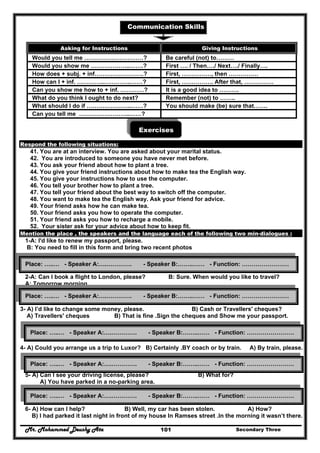
Communication Skills 9
Exercises on Vocabulary 9 - 14
Grammar 14 - 18
Exercises on Grammar 18
UnitOne
Test 1 21
2 Unit 2 24 - 44
Vocabulary 24 – 26
Language Notes 26 – 29
Communication Skills 30
Exercises on Vocabulary 30 – 34
Grammar 34 – 39
Exercises on Grammar 39 - 42
UnitTwo
Test 2 42 - 44
3 Unit 3 45 - 60
Vocabulary 45 – 47
Language Notes 47 – 49
Exercises on Vocabulary 49 – 52
Grammar 53 – 55
Exercises on Grammar 56 – 57
UnitThree
Test 3 58 - 60
4 Unit 4 61 - 80
Vocabulary 61 – 62
Language Notes 63 – 64
Exercises on Vocabulary 64 – 68
Grammar 69 – 75
Exercises on Grammar 75 – 78
UnitFour
Test 4 78 - 80
5 Unit 5 81 – 96
Vocabulary 81 – 82
Language Notes 83 – 84
Exercises on Vocabulary 84 – 88
Grammar 88 - 92
Exercises on Grammar 92 - 93
Test 5 94 - 96
UnitFive
Mr. Mohammed Deushy Ata Secondary Three3
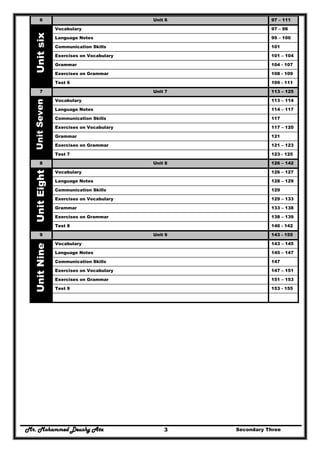
6 Unit 6 97 – 111
Vocabulary 97 – 98
Language Notes 99 – 100
Communication Skills 101
Exercises on Vocabulary 101 – 104
Grammar 104 - 107
Exercises on Grammar 108 - 109
Unitsix
Test 6 109 - 111
7 Unit 7 113 – 125
Vocabulary 113 – 114
Language Notes 114 – 117
Communication Skills 117
Exercises on Vocabulary 117 – 120
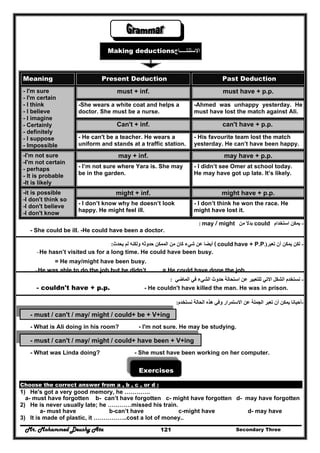
Grammar 121
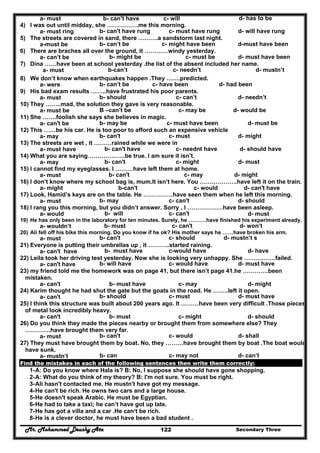
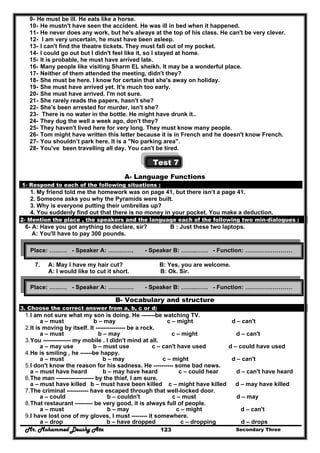
Exercises on Grammar 121 – 123
UnitSeven
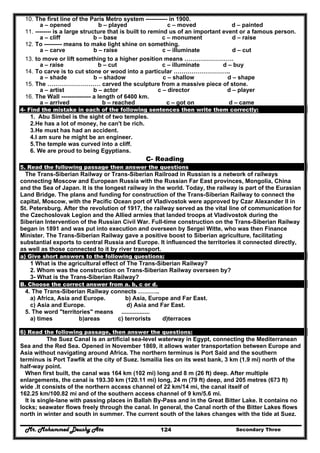
Test 7 123 - 125
8 Unit 8 126 – 142
Vocabulary 126 – 127
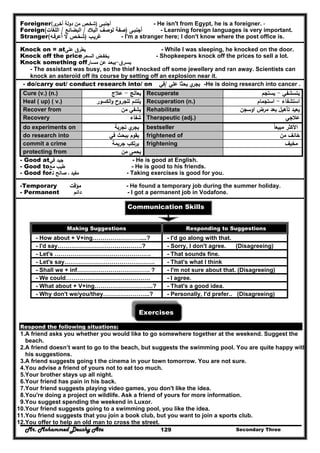
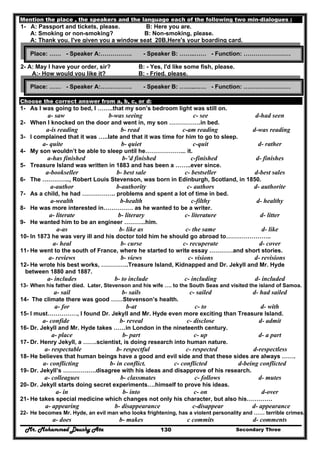
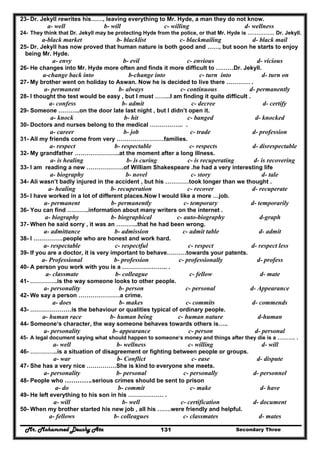
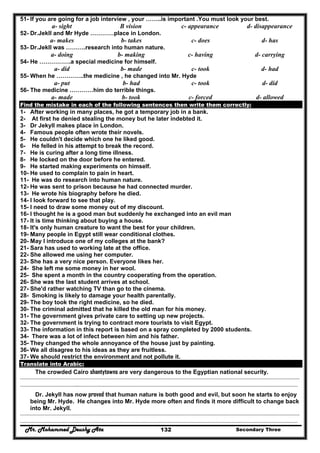
Language Notes 128 – 129
Communication Skills 129
Exercises on Vocabulary 129 – 133
Grammar 133 – 138
Exercises on Grammar 138 – 139
UnitEight
Test 8 140 - 142
9 Unit 9 143 - 155
Vocabulary 143 – 145
Language Notes 145 – 147
Communication Skills 147
Exercises on Vocabulary 147 – 151
Exercises on Grammar 151 – 153
Test 9 153 - 155
UnitNine
Mr. Mohammed Deushy Ata Secondary Three4
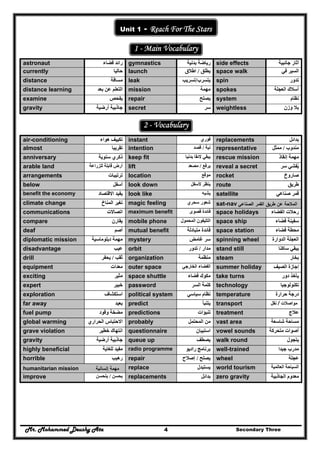
Unit 1 - Reach For The Stars
1 - Main Vocabulary
astronaut ‫فضاء‬ ‫رائد‬ gymnastics ‫بدنية‬ ‫رياضة‬ side effects ‫أثار‬‫جانبية‬
currently ‫حاليا‬ launch ‫يطلق‬/‫اطالق‬
‫ق‬
space walk ‫في‬ ‫السير‬
distance ‫مسافة‬ leak ‫يتسرب‬/‫تسريب‬ spin ‫تدور‬
distance learning ‫بعد‬ ‫عن‬ ‫التعلم‬ mission ‫مھمة‬ spokes ‫العج‬ ‫أسالك‬‫لة‬
examine ‫يفحص‬ repair ‫يصلح‬ system ‫نظام‬
gravity ‫أرضية‬ ‫جاذبية‬ secret ‫سر‬ weightless ‫وزن‬ ‫بال‬
2 - Vocabulary
air-conditioning ‫تكييف‬‫ھواء‬ instant ‫فوري‬ replacements ‫بدائل‬
almost ‫تقريبا‬ intention ‫نية‬/‫قصد‬ representative ‫مندوب‬/‫ممثل‬
anniversary ‫سنوي‬ ‫ذكري‬‫ة‬ keep fit ‫بدنيا‬ ‫الئقا‬ ‫يبقي‬ rescue mission ‫إنقاذ‬ ‫مھمة‬
arable land ‫للزراعة‬ ‫قابلة‬ ‫أرض‬ lift ‫يرفع‬/‫مصعد‬ reveal a secret ‫سر‬ ‫يفشي‬ُ
arrangements ‫ترتيبات‬ location ‫موقع‬ rocket ‫صاروخ‬
below ‫أسفل‬ look down ‫ينظر‬‫ألسفل‬ route ‫طريق‬
benefit the economy ‫االقتصاد‬ ‫يفيد‬ look like ‫يشبه‬ satellite ‫صناعي‬ ‫قمر‬
climate change ‫المناخ‬ ‫تغير‬ magic feeling ‫سحري‬ ‫شعور‬ sat-nav ‫اﻟﺻﻧﺎﻋﻲ‬ ‫اﻟﻘﻣر‬ ‫طرﻳق‬ ‫ﻋن‬ ‫اﻟﻣﻼﺣﺔ‬
communications ‫اتصاالت‬ maximum benefit ‫قصوى‬ ‫فائدة‬ space holidays ‫الفضاء‬ ‫رحالت‬
compare ‫يقارن‬ mobile phone ‫التليفون‬‫المحمول‬
‫ال‬‫ل‬
space ship ‫فضاء‬ ‫سفينة‬
deaf ‫أصم‬ mutual benefit ‫متبادلة‬ ‫فائدة‬ space station ‫فضاء‬ ‫محطة‬
diplomatic mission ‫دبلوماسية‬ ‫مھمة‬ mystery ‫سر‬‫غامض‬ spinning wheel ‫الدوارة‬ ‫العجلة‬
disadvantage ‫عيب‬ orbit ‫مدار‬/‫تدور‬ stand still ‫ساكن‬ ‫يبقي‬‫ا‬
drill ‫ثقب‬/‫ي‬‫حفر‬ organization ‫منظمة‬ steam ‫بخار‬
equipment ‫معدات‬ outer space ‫الخارجي‬ ‫الفضاء‬ summer holiday ‫الصيف‬ ‫إجازة‬
exciting ‫مثير‬ space shuttle ‫فضاء‬ ‫مكوك‬ take turns ‫دور‬ ‫يأخذ‬
expert ‫خبير‬ password ‫السر‬ ‫كلمة‬ technology ‫تكنولوجيا‬
exploration ‫استكشاف‬ political system ‫سياسي‬ ‫نظام‬ temperature ‫حرارة‬ ‫درجة‬
far away ‫بعيد‬ predict ‫يتنبأ‬ transport ‫نقل‬ / ‫مواصالت‬
fuel pump ‫وقود‬ ‫مضخة‬ predictions ‫تنب‬‫ؤا‬‫ت‬ treatment ‫عالج‬
global warming ‫الحراري‬ ‫االحتباس‬ probably ‫المحتمل‬ ‫من‬ vast area ‫شاسعة‬ ‫مساحة‬
grave violation ‫خطير‬ ‫انتھاك‬ questionnaire ‫استبيا‬‫ن‬ vowel sounds ‫متحركة‬ ‫أصوات‬
gravity ‫جاذبية‬‫أرضية‬ queue up ‫يصطف‬ walk round ‫يتجول‬
highly beneficial ‫للغاية‬ ‫مفيد‬ radio programme ‫راديو‬ ‫برنامج‬ well-trained ‫جيدا‬ ‫مدرب‬
horrible ‫رھيب‬ repair ‫يصلح‬/‫إصالح‬ wheel ‫عجلة‬
humanitarian mission ‫إﻧﺳﺎﻧﻳﺔ‬ ‫ﻣﻬﻣﺔ‬ replace ‫يستبدل‬ world tourism ‫العالمية‬ ‫السياحة‬
improve ‫يحسن‬/‫يتحسن‬ replacements ‫بدائل‬ zero gravity ‫الجاذبية‬ ‫معدوم‬
Der
Mr. Mohammed Deushy Ata Secondary Three5
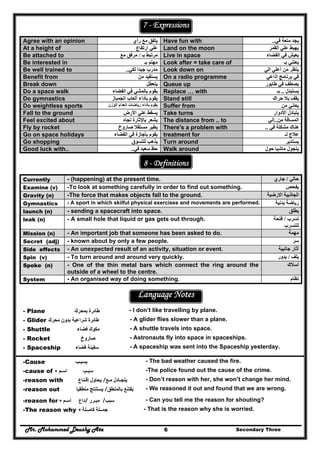
3 - Derivatives
Verb Noun Adjective
Affect ‫يؤثر‬‫علي‬ Effect ‫تأثير‬/‫أثر‬ Effective ‫مؤثر‬
Cost ‫يكلف‬ Cost ‫تكلفة‬ Costly ‫مكلف‬/‫غالي‬‫الثمن‬
Expect ‫يتوقع‬ Expectation ‫توقع‬ Expected ‫متوقع‬
Leak ‫يتسرب‬ Leak / Leakage ‫تسرب‬ Leaky ‫به‬‫تسريب‬
Systematize ‫ي‬ُ‫ضبط‬‫وفق‬‫نظام‬‫معين‬ System ‫نظام‬ Systematic ‫منظم‬
Weigh ‫يزن‬ Weight ‫الوزن‬ Weighty
Weightless
‫ثقيل‬/‫ھام‬
‫الوزن‬ ‫منعدم‬
4 - Important phrases
achieve prosperity and welfare
‫يحقق‬‫الرخاء‬
‫والرفاھية‬
Every branch of knowledge ‫المعرفة‬ ‫فروع‬ ‫كل‬
achieve self-sufficiency ‫الذاتي‬ ‫االكتفاء‬ ‫لتحقيق‬ In the course of the last years ‫األ‬ ‫غضون‬ ‫في‬‫األخيرة‬ ‫عوام‬
Achieving safety for citizens ‫األمن‬ ‫تحقيق‬‫للمواطنين‬ Right habits and moralities ‫الصحيحة‬ ‫واألخالق‬ ‫العادات‬
develop individual awareness ‫الفردي‬ ‫الوعي‬ ‫لتنمية‬ We have to stand firmly against ‫ضد‬ ‫بحزم‬ ‫نقف‬ ‫أن‬ ‫علينا‬
5 - Important Vocabulary
Arab solidarity ‫العربي‬ ‫التضامن‬ limited ‫محدوده‬
artificial lake ‫صناعية‬ ‫بحيرة‬ make contributions to ‫إسھامات‬ ‫يقدم‬‫لـ‬
Benefit the economy ‫االقتصاد‬ ‫يفيد‬ Maximum benefit ‫قصوى‬ ‫فائدة‬
catch up with ‫يساير‬=‫يواكب‬ Nervous system ‫العصبي‬ ‫الجھاز‬
Circulatory system ‫الدوري‬ ‫الجھاز‬ Pay attention to ‫إلي‬ ‫ينتبه‬
cover our needs ‫احتياجاتنا‬ ‫يغطي‬ peace loving country ‫للسالم‬ ‫محبة‬ ‫دولة‬
Digestive system ‫الھضمي‬ ‫الجھاز‬ political system ‫سياسي‬ ‫نظام‬
diplomatic mission ‫دبلوماسية‬ ‫مھمة‬ rescue mission ‫إنقاذ‬ ‫مھمة‬
Distance learning ‫بعد‬ ‫عن‬ ‫التعلم‬ Respiratory system ‫التنفسي‬ ‫الجھاز‬
exert great efforts ‫عظيمة‬ ‫جھودا‬ ‫يبذل‬ Reveal a secret ‫سر‬ ‫يفشي‬ ‫أو‬ ‫عن‬ ‫يكشف‬ُ
expenses ‫مصاريف‬ space invasion (conquering) ‫الفضاء‬ ‫غزو‬
grave violation ‫خطير‬ ‫انتھاك‬ space shuttle ‫فضاء‬ ‫مكوك‬
Improve living conditions ‫المعيشة‬ ‫ظروف‬ ‫يحسن‬ُ step by step ‫بخطوة‬ ‫خطوة‬
in favour of ‫لصالح‬/‫لـ‬ ‫مؤيد‬ the corner stone ‫الزاوية‬ ‫حجر‬
Launch a campaign ‫حملة‬ ‫يشن‬ the effective means ‫الفعالة‬ ‫الوسيلة‬
Launch a satellite ‫صناعي‬ ‫قمر‬ ‫يطلق‬ُ with all means ‫السبل‬ ‫بكل‬-‫الوسائل‬
6 - Words & antonyms ‫و‬ ‫ﻛﻠﻣﺎت‬‫ﻋﻛﺳﻬﺎ‬
Current ‫الحالي‬/‫الجاري‬ Past ‫الماضي‬
Thick ‫سميك‬ Thin ‫نحيف‬/‫رفيع‬/‫رقيق‬
Agreement ‫اتفاق‬ Disagreement ‫اتفاق‬ ‫عدم‬
Weighty = heavy ‫ثقيل‬ Light ‫خفيف‬
Weighty = important ‫ھام‬ Unimportant , trivial ‫تافه‬/‫ھام‬ ‫غير‬
Improve ‫يتحسن‬ Worsen/deteriorate ‫يسوء‬/‫يتدھور‬
Go down ‫ينخفض‬ Go up ‫يرتفع‬
Take off ‫تقلع‬ُ)‫الطائرة‬( Land ‫تھبط‬
Secret ‫ســر‬ Known ‫معروف‬
Dangerous ‫خطير‬ Safe ‫آمن‬
Mr. Mohammed Deushy Ata Secondary Three6
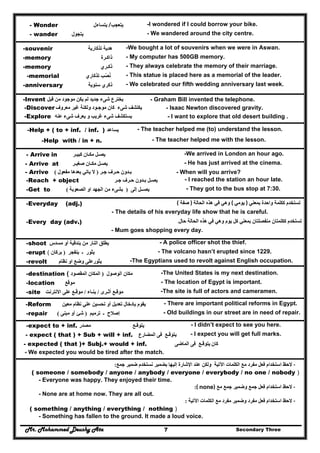
7 - Expressions
Agree with an opinion ‫رأي‬ ‫مع‬ ‫يتفق‬ Have fun with ‫في‬ ‫متعة‬ ‫يجد‬..
At a height of ‫ارتفاع‬ ‫علي‬ Land on the moon ‫القمر‬ ‫علي‬ ‫يھبط‬
Be attached to ‫بـ‬ ‫مرتبط‬/‫مع‬ ‫مرفق‬ Live in space ‫الفضاء‬ ‫في‬ ‫يعيش‬
Be interested in ‫بـ‬ ‫مھتم‬ Look after = take care of ‫بـ‬ ‫يعتني‬
Be well trained to ‫لكي‬ ‫جيدا‬ ‫مدرب‬.. Look down on ‫الي‬ ‫أعلي‬ ‫من‬ ‫ينظر‬
Benefit from ‫من‬ ‫يستفيد‬ On a radio programme ‫إذاعي‬ ‫برنامج‬ ‫في‬
Break down ‫يتعطل‬ Queue up ‫طابور‬ ‫في‬ ‫يصطف‬
Do a space walk ‫الفضاء‬ ‫في‬ ‫بالمشي‬ ‫يقوم‬ Replace … with ‫يستبدل‬..‫بـ‬
Do gymnastics ‫الجمباز‬ ‫ألعاب‬ ‫بأداء‬ ‫يقوم‬ Stand still ‫حراك‬ ‫بال‬ ‫يقف‬
Do weightless sports ‫الوزن‬ ‫انعدام‬ ‫رياضات‬ ‫بأداء‬ ‫يقوم‬ Suffer from ‫من‬ ‫يعاني‬
Fall to the ground ‫األرض‬ ‫علي‬ ‫يسقط‬ Take turns ‫األدوار‬ ‫يتبادل‬
Feel excited about ‫تجاه‬ ‫باإلثارة‬ ‫يشعر‬ The distance from .. to ‫من‬ ‫المسافة‬..‫إلي‬
Fly by rocket ‫صاروخ‬ ‫مستقال‬ ‫يطير‬ There's a problem with ‫في‬ ‫مشكلة‬ ‫ھناك‬..
Go on space holidays ‫يقوم‬‫الفضاء‬ ‫في‬ ‫بأجازة‬ treatment for ‫لـ‬ ‫عالج‬
Go shopping ‫للتسوق‬ ‫يذھب‬ Turn around ‫يستدير‬
Good luck with.. ‫في‬ ‫سعيد‬ ‫حظ‬.. Walk around ‫حول‬ ‫ماشيا‬ ‫يتجول‬
8 - Definitions
Currently - (happening) at the present time. ‫حالي‬/‫جاري‬
Examine (v) -To look at something carefully in order to find out something. ‫يفحص‬
Gravity (n) -The force that makes objects fall to the ground. ‫االرضية‬ ‫الجاذبية‬
Gymnastics - A sport in which skilful physical exercises and movements are performed. ‫بدنية‬ ‫رياضة‬
launch (n) - sending a spacecraft into space. ‫يطلق‬
leak (n) - A small hole that liquid or gas gets out through. ‫تسرب‬/‫فتحة‬
‫للتسرب‬
Mission (n) - An important job that someone has been asked to do. ‫مھمة‬
Secret (adj) - known about by only a few people. ‫سر‬
Side effects - An unexpected result of an activity, situation or event. ‫جانبية‬ ‫آثار‬
Spin (v) - To turn around and around very quickly. ‫يلف‬/‫يدور‬
Spoke (n) - One of the thin metal bars which connect the ring around the
outside of a wheel to the centre.
‫أسالك‬
System - An organised way of doing something. ‫نظام‬
Language Notes
- Plane ‫طائرة‬‫ب‬‫محرك‬ - I don’t like travelling by plane.
- Glider ‫محرك‬ ‫بدون‬ ‫شراعية‬ ‫طائرة‬ - A glider flies slower than a plane.
- Shuttle ‫فضاء‬ ‫مكوك‬ - A shuttle travels into space.
- Rocket ‫صاروخ‬ - Astronauts fly into space in spaceships.
- Spaceship ‫فضاء‬ ‫سفينة‬ - A spaceship was sent into the Spaceship yesterday.
-Cause ‫يسبـب‬ - The bad weather caused the fire.
-cause of + ‫اسـم‬ ‫سبـب‬ -The police found out the cause of the crime.
-reason with ‫إقـناع‬ ‫يحاول‬ /‫مـع‬ ‫يتجـادل‬ - Don’t reason with her, she won’t change her mind.
-reason out ‫منطقيا‬ ‫يستنتج‬ /‫بالمنطق‬ ‫يقتنع‬ - We reasoned it out and found that we are wrong.
-reason for + ‫اسـم‬ ‫داع‬/ ‫مبـرر‬ /‫سبب‬ - Can you tell me the reason for shouting?
-The reason why + ‫كامــلة‬ ‫جمــلة‬ - That is the reason why she is worried.
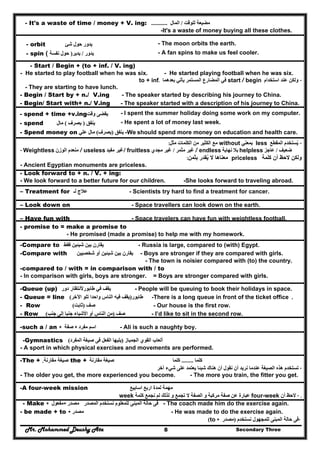
Mr. Mohammed Deushy Ata Secondary Three7
- Wonder ‫يتساءل‬ /‫يتعجب‬ -I wondered if I could borrow your bike.
- wander ‫يتجول‬ - We wandered around the city centre.
-souvenir ‫تذكارية‬ ‫ھدية‬ -We bought a lot of souvenirs when we were in Aswan.
-memory ‫ذاكـرة‬ - My computer has 500GB memory.
-memory ‫ذكـري‬ - They always celebrate the memory of their marriage.
-memorial ‫تذكاري‬ ‫نصب‬ُ ُ - This statue is placed here as a memorial of the leader.
-anniversary ‫سنوية‬ ‫ذكري‬ - We celebrated our fifth wedding anniversary last week.
-Invent ‫يخترع‬‫قبل‬ ‫من‬ ‫موجود‬ ‫يكن‬ ‫لم‬ ‫جديد‬ ‫شىء‬ - Graham Bill invented the telephone.
-Discover ‫يكتشف‬‫كا‬ ‫شىء‬‫معروف‬ ‫غير‬ ‫ولكنة‬ ‫موجـود‬ ‫ن‬ - Isaac Newton discovered gravity.
-Explore ‫عنه‬ ‫شىء‬ ‫يعرف‬ ‫و‬ ‫غريب‬ ‫شىء‬ ‫يستكشف‬ - I want to explore that old desert building .
-Help + ( to + inf. / inf. ) ‫يساعد‬ - The teacher helped me (to) understand the lesson.
-Help with / in + n. - The teacher helped me with the lesson.
- Arrive in ‫كبيـر‬ ‫مكـان‬ ‫يصـل‬ -We arrived in London an hour ago.
- Arrive at ‫صغيـر‬ ‫مكـان‬ ‫يصـل‬ - He has just arrived at the cinema.
- Arrive ‫جـر‬ ‫حـرف‬ ‫بـدون‬)‫مفعول‬ ‫بعدھا‬ ‫ياتي‬ ‫ال‬( - When will you arrive?
-Reach + object ‫جـر‬ ‫حـرف‬ ‫بـدون‬ ‫يصـل‬ - I reached the station an hour late.
-Get to ‫إلى‬ ‫يصــل‬)‫الصعوبة‬ ‫او‬ ‫الجھد‬ ‫من‬ ‫بشىء‬( - They got to the bus stop at 7:30.
-Everyday (adj.) ‫بمعني‬ ‫واحدة‬ ‫ككلمة‬ ‫تستخدم‬)‫يومي‬(‫الحالة‬ ‫ھذه‬ ‫في‬ ‫وھي‬)‫صفة‬(
- The details of his everyday life show that he is careful.
-Every day (adv.) ‫حال‬ ‫الحالة‬ ‫ھذه‬ ‫في‬ ‫وھي‬ ‫يوم‬ ‫كل‬ ‫بمعني‬ ‫منفصلتان‬ ‫ككلمتان‬ ‫تستخدم‬.
- Mum goes shopping every day.
-shoot ‫من‬ ‫النار‬ ‫يطلق‬‫مسدس‬ ‫أو‬ ‫بندقية‬ - A police officer shot the thief.
-erupt ‫يث‬‫ينفجر‬ ‫ـ‬ ‫ور‬)‫بركان‬( - The volcano hasn’t erupted since 1229.
-revolt ‫وضع‬ ‫يثورعلى‬‫او‬‫نظا‬‫م‬ -The Egyptians used to revolt against English occupation.
-destination ‫الوصول‬ ‫مكان‬)‫المقصود‬ ‫المكان‬( -The United States is my next destination.
-location ‫موقع‬ - The location of Egypt is important.
-site ‫أثـرى‬ ‫موقـع‬/‫بنـاء‬/‫موقـع‬‫االنترنت‬ ‫على‬ -The site is full of actors and cameramen.
-Reform ‫معين‬ ‫نظام‬ ‫علي‬ ‫تحسين‬ ‫أو‬ ‫تعديل‬ ‫بإدخال‬ ‫يقوم‬ - There are important political reforms in Egypt.
-repair ‫ترميم‬ ‫ـ‬ ‫إصالح‬)‫مبنى‬ ‫أو‬ ‫شئ‬( - Old buildings in our street are in need of repair.
-expect to + inf. ‫مصدر‬ ‫يتوقـع‬ - I didn’t expect to see you here.
- expect ( that ) + Sub + will + inf. ‫المضارع‬ ‫فى‬ ‫يتوقـع‬ - I expect you will get full marks.
- expected ( that )+ Subj.+ would + inf. ‫الماضى‬ ‫فى‬ ‫يتوقـع‬ ‫كان‬
- We expected you would be tired after the match.
-‫الحظ‬‫عند‬ ‫ولكن‬ ‫اآلتية‬ ‫الكلمات‬ ‫مع‬ ‫مفرد‬ ‫فعل‬ ‫استخدام‬‫جمع‬ ‫ضمير‬ ‫نستخدم‬ ‫بضمير‬ ‫إليھا‬ ‫اإلشارة‬:
( someone / somebody / anyone / anybody / everyone / everybody / no one / nobody )
- Everyone was happy. They enjoyed their time.
-‫الحظ‬‫فعل‬ ‫استخدام‬‫جمع‬‫و‬‫مع‬ ‫جمع‬ ‫ضمير‬( none):
- None are at home now. They are all out.
-‫الحظ‬‫مفرد‬ ‫فعل‬ ‫استخدام‬‫و‬‫ضمي‬‫ر‬‫مفرد‬‫اآلتية‬ ‫الكلمات‬ ‫مع‬:
( something / anything / everything / nothing )
- Something has fallen to the ground. It made a loud voice.
Mr. Mohammed Deushy Ata Secondary Three8
- It's a waste of time / money + V. ing: ‫للوقت‬ ‫مضيعة‬/‫المال‬...........
-It's a waste of money buying all these clothes.
- orbit ‫شئ‬ ‫حول‬ ‫يدور‬ - The moon orbits the earth.
- spin ‫يدور‬/‫يدير‬)‫نفسة‬ ‫حول‬( - A fan spins to make us feel cooler.
- Start / Begin + (to + inf. / V. ing)
- He started to play football when he was six. - He started playing football when he was six.
-‫استخدام‬ ‫عند‬ ‫ولكن‬start / begin‫بعدھما‬ ‫يأتي‬ ‫المستمر‬ ‫المضارع‬ ‫في‬to + inf.
- They are starting to have lunch.
- Begin / Start by + n./ V.ing - The speaker started by describing his journey to China.
- Begin/ Start with+ n./ V.ing - The speaker started with a description of his journey to China.
- spend + time +v.ing ‫يقضى‬‫وقت‬ - I spent the summer holiday doing some work on my computer.
- spend ‫ينفق‬)‫يصرف‬(‫مال‬ - He spent a lot of money last week.
- Spend money on ‫ينفق‬)‫يصرف‬(‫مال‬‫علي‬ -We should spend more money on education and health care.
-‫يستخدم‬ُ‫المقطع‬less‫بمعني‬without‫مثل‬ ‫الكلمات‬ ‫من‬ ‫الكثير‬ ‫مع‬:
- Weightless ‫الوزن‬ ‫منعدم‬ / useless ‫مفيد‬ ‫غير‬/ fruitless ‫غير‬‫مثمر‬/‫غير‬‫مجدي‬ / endless ‫بال‬‫نھاية‬ helpless ‫ضعيف‬/‫عاجز‬
‫كلمة‬ ‫أن‬ ‫الحظ‬ ‫ولكن‬priceless‫بثمن‬ ‫يقدر‬ ‫ال‬ ‫معناھا‬ُ:
- Ancient Egyptian monuments are priceless.
- Look forward to + n. / V. + ing:
- We look forward to a better future for our children. -She looks forward to traveling abroad.
– Treatment for ‫لـ‬ ‫عالج‬ - Scientists try hard to find a treatment for cancer.
– Look down on - Space travellers can look down on the earth.
– Have fun with - Space travelers can have fun with weightless football.
- promise to = make a promise to
- He promised (made a promise) to help me with my homework.
-Compare to ‫فقط‬ ‫شيئين‬ ‫بين‬ ‫يقارن‬ - Russia is large, compared to (with) Egypt.
-Compare with ‫شخصيين‬ ‫أو‬ ‫شيئين‬ ‫بين‬ ‫يقارن‬ - Boys are stronger if they are compared with girls.
- The town is noisier compared with (to) the country.
-compared to / with = in comparison with / to
- In comparison with girls, boys are stronger. = Boys are stronger compared with girls.
-Queue (up) ‫يقف‬‫في‬‫طابور‬‫دور‬ ‫ألنتظار‬ - People will be queuing to book their holidays in space.
- Queue = line ‫طابور‬)‫اآلخر‬ ‫تلو‬ ‫واحدا‬ ‫الناس‬ ‫فيه‬ ‫يقف‬( -There is a long queue in front of the ticket office .
- Row ‫صف‬)‫ثابت‬( - Our house is the first row.
- Row ‫صف‬)‫الناس‬ ‫من‬‫جنب‬ ‫إلى‬ ‫جنبا‬ ‫األشياء‬ ‫أو‬( - I’d like to sit in the second row.
-such a / an + ‫صفة‬ + ‫مفرد‬ ‫اسم‬ - Ali is such a naughty boy.
-Gymnastics ‫ألعاب‬‫القوي‬‫الجمباز‬)‫المفرد‬ ‫صيغة‬ ‫فى‬ ‫الفعل‬ ‫يليھا‬(
- A sport in which physical exercises and movements are performed.
-The + ‫ص‬‫يغ‬‫ة‬‫مقارنة‬, the + ‫ص‬‫يغ‬‫مقارنة‬ ‫ة‬ ‫كلما‬........‫كلما‬
‫الصيغة‬ ‫ھذه‬ ‫تستخدم‬‫آخر‬ ‫شيء‬ ‫على‬ ‫يعتمد‬ ‫شيئا‬ ‫ھناك‬ ‫أن‬ ‫نقول‬ ‫أن‬ ‫نريد‬ ‫عندما‬ -
- The older you get, the more experienced you become. - The more you train, the fitter you get.
-A four-week mission ‫لمدة‬ ‫مھمة‬‫ا‬ ‫اربع‬‫سابيع‬
.-‫أن‬ ‫الحظ‬four-week‫كلمة‬ ‫نجمع‬ ‫لم‬ ‫لذلك‬ ‫و‬ ‫تجمع‬ ‫ال‬ ‫الصفة‬ ‫و‬ ‫مركبة‬ ‫صفة‬ ‫عن‬ ‫عبارة‬week
- Make + ‫+مفعول‬ ‫مصدر‬ ‫المصدر‬ ‫نستخدم‬ ‫للمعلوم‬ ‫المبنى‬ ‫حالة‬ ‫فى‬ - The coach made him do the exercise again.
- be made + to + ‫مصدر‬ - He was made to do the exercise again.
-‫للمجھول‬ ‫المبنى‬ ‫حالة‬ ‫فى‬‫نستخدم‬)‫مصدر‬to +(
Mr. Mohammed Deushy Ata Secondary Three9
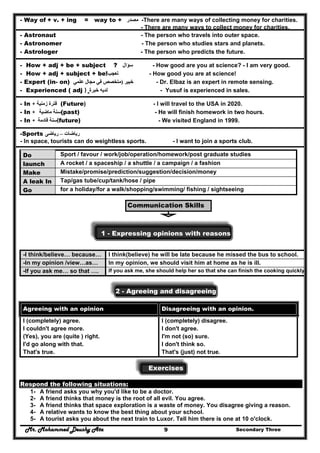
- Way of + v. + ing = way to + ‫مصدر‬ -There are many ways of collecting money for charities.
- There are many ways to collect money for charities.
- Astronaut - The person who travels into outer space.
- Astronomer - The person who studies stars and planets.
- Astrologer - The person who predicts the future.
- How + adj + be + subject ? ‫سؤال‬ - How good are you at science? - I am very good.
- How + adj + subject + be! ‫تعج‬‫ب‬ - How good you are at science!
- Expert (in- on) ‫خبير‬)‫متخصص‬‫علمي‬ ‫مجال‬ ‫في‬ - Dr. Elbaz is an expert in remote sensing.
- Experienced ( adj ) ‫خبرة‬ ‫لديه‬ - Yusuf is experienced in sales.
- In + ‫زمنية‬ ‫فترة‬ (Future) - I will travel to the USA in 2020.
- In + ‫سنة‬‫ماضية‬ (past) - He will finish homework in two hours.
- In + ‫سنة‬‫قادمة‬ (future) - We visited England in 1999.
-Sports ‫رياضات‬–‫رياضى‬
- In space, tourists can do weightless sports. - I want to join a sports club.
Do Sport / favour / work/job/operation/homework/post graduate studies
launch A rocket / a spaceship / a shuttle / a campaign / a fashion
Make Mistake/promise/prediction/suggestion/decision/money
A leak In Tap/gas tube/cup/tank/hose / pipe
Go for a holiday/for a walk/shopping/swimming/ fishing / sightseeing
Communication Skills
1 - Expressing opinions with reasons
-I think/believe… because… I think(believe) he will be late because he missed the bus to school.
-In my opinion /view…as… In my opinion, we should visit him at home as he is ill.
-If you ask me… so that …. If you ask me, she should help her so that she can finish the cooking quickly
2 - Agreeing and disagreeing
Agreeing with an opinion Disagreeing with an opinion.
I (completely) agree. I (completely) disagree.
I couldn't agree more. I don't agree.
(Yes), you are (quite ) right. I'm not (so) sure.
I'd go along with that. I don't think so.
That's true. That's (just) not true.
Exercises
Respond the following situations:
1- A friend asks you why you'd like to be a doctor.
2- A friend thinks that money is the root of all evil. You agree.
3- A friend thinks that space exploration is a waste of money. You disagree giving a reason.
4- A relative wants to know the best thing about your school.
5- A tourist asks you about the next train to Luxor. Tell him there is one at 10 o'clock.
Mr. Mohammed Deushy Ata Secondary Three10
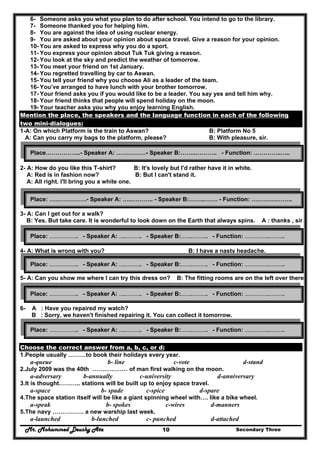
6- Someone asks you what you plan to do after school. You intend to go to the library.
7- Someone thanked you for helping him.
8- You are against the idea of using nuclear energy.
9- You are asked about your opinion about space travel. Give a reason for your opinion.
10- You are asked to express why you do a sport.
11- You express your opinion about Tuk Tuk giving a reason.
12- You look at the sky and predict the weather of tomorrow.
13- You meet your friend on 1st January.
14- You regretted travelling by car to Aswan.
15- You tell your friend why you choose Ali as a leader of the team.
16- You’ve arranged to have lunch with your brother tomorrow.
17- Your friend asks you if you would like to be a leader. You say yes and tell him why.
18- Your friend thinks that people will spend holiday on the moon.
19- Your teacher asks you why you enjoy learning English.
Mention the place, the speakers and the language function in each of the following
two mini-dialogues:
1-A: On which Platform is the train to Aswan? B: Platform No 5
A: Can you carry my bags to the platform, please? B: With pleasure, sir.
2- A: How do you like this T-shirt? B: It's lovely but I'd rather have it in white.
A: Red is in fashion now? B: But I can't stand it.
A: All right. I'll bring you a white one.
3- A: Can I get out for a walk?
B: Yes. But take care. It is wonderful to look down on the Earth that always spins. A : thanks , sir
4- A: What is wrong with you? B: I have a nasty headache.
A : how long have you been suffering from it? B : Two days.
5- A: Can you show me where I can try this dress on? B: The fitting rooms are on the left over there.
6- A : Have you repaired my watch?
B : Sorry, we haven't finished repairing it. You can collect it tomorrow.
Choose the correct answer from a, b, c, or d:
1.People usually ………to book their holidays every year.
a-queue b- line c-vote d-stand
2.July 2009 was the 40th ……………… of man first walking on the moon.
a-adversary b-annually c-university d-anniversary
3.It is thought……….. stations will be built up to enjoy space travel.
a-space b- spade c-spice d-spare
4.The space station itself will be like a giant spinning wheel with…. like a bike wheel.
a-speak b- spokes c-wires d-manners
5.The navy ……………. a new warship last week.
a-launched b-lunched c- punched d-attached
Place……………...- Speaker A: ……………- Speaker B:……..……….. - Function: …………..…..
Place: ……………….- Speaker A: …..……….. - Speaker B:……..……. - Function: ………….……..
Place: ……………….. - Speaker A: …..……….. - Speaker B:……..……….. - Function: ……………..………..
Mr. Mohammed Deushy Ata Secondary Three11
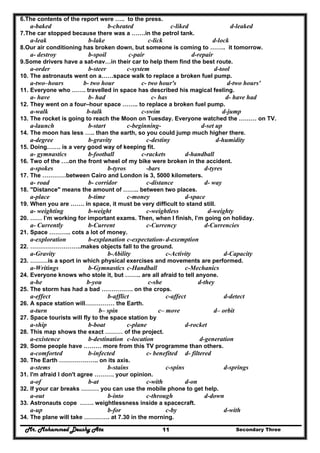
6.The contents of the report were ….. to the press.
a-baked b-cheated c-liked d-leaked
7.The car stopped because there was a …….in the petrol tank.
a-leak b-lake c-lick d-lock
8.Our air conditioning has broken down, but someone is coming to …….. it tomorrow.
a- destroy b-spoil c-pair d-repair
9.Some drivers have a sat-nav…in their car to help them find the best route.
a-order b-steer c-system d-tool
10. The astronauts went on a……space walk to replace a broken fuel pump.
a-two–hours b- two hour c- two hour's d-two hours'
11. Everyone who ……. travelled in space has described his magical feeling.
a- have b- had c- has d- have had
12. They went on a four–hour space …….. to replace a broken fuel pump.
a-walk b-talk c-swim d-jump
13. The rocket is going to reach the Moon on Tuesday. Everyone watched the ……… on TV.
a-launch b-start c-beginning- d-set up
14. The moon has less ….. than the earth, so you could jump much higher there.
a-degree b-gravity c-destiny d-humidity
15. Doing……. is a very good way of keeping fit.
a- gymnastics b-football c-rackets d-handball
16. Two of the ….on the front wheel of my bike were broken in the accident.
a-spokes b-tyros -bars d-tyres
17. The …………between Cairo and London is 3, 5000 kilometers.
a- road b- corridor c-distance d- way
18. "Distance" means the amount of …….. between two places.
a-place b-time c-money d-space
19. When you are ……. in space, it must be very difficult to stand still.
a- weighting b-weight c-weightless d-weighty
20. …… I’m working for important exams. Then, when I finish, I’m going on holiday.
a- Currently b-Current c-Currency d-Currencies
21. Space ……….. cots a lot of money.
a-exploration b-explanation c-expectation- d-exemption
22. ……………………..makes objects fall to the ground.
a-Gravity b-Ability c-Activity d-Capacity
23. ………is a sport in which physical exercises and movements are performed.
a-Writings b-Gymnastics c-Handball c-Mechanics
24. Everyone knows who stole it, but …….. are all afraid to tell anyone.
a-he b-you c-she d-they
25. The storm has had a bad ……………. on the crops.
a-effect b-afflict c-affect d-detect
26. A space station will…………… the Earth.
a-turn b– spin c– move d– orbit
27. Space tourists will fly to the space station by
a-ship b-boat c-plane d-rocket
28. This map shows the exact ……… of the project.
a-existence b-destination c-location d-generation
29. Some people have ……… more from this TV programme than others.
a-comforted b-infected c- benefited d- filtered
30. The Earth ……………….. on its axis.
a-stems b-stains c-spins d-springs
31. I'm afraid I don't agree ………. your opinion.
a-of b-at c-with d-on
32. If your car breaks ……… you can use the mobile phone to get help.
a-out b-into c-through d-down
33. Astronauts cope ……. weightlessness inside a spacecraft.
a-up b-for c-by d-with
34. The plane will take …………. at 7.30 in the morning.
Mr. Mohammed Deushy Ata Secondary Three12
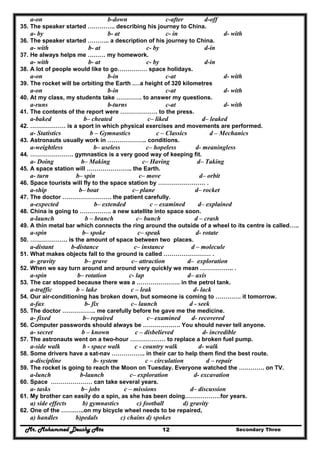
a-on b-down c-after d-off
35. The speaker started ………….. describing his journey to China.
a- by b- at c- in d- with
36. The speaker started ……….. a description of his journey to China.
a- with b- at c- by d-in
37. He always helps me ……… my homework.
a- with b- at c- by d-in
38. A lot of people would like to go…………… space holidays.
a-on b-in c-at d- with
39. The rocket will be orbiting the Earth .…a height of 320 kilometres
a-on b-in c-at d- with
40. At my class, my students take …………. to answer my questions.
a-runs b-turns c-at d- with
41. The contents of the report were ………………. to the press.
a-baked b– cheated c– liked d– leaked
42. ……………… is a sport in which physical exercises and movements are performed.
a- Statistics b – Gymnastics c – Classics d – Mechanics
43. Astronauts usually work in ……………….. conditions.
a-weightless b– useless c– hopeless d- meaningless
44. …………………. gymnastics is a very good way of keeping fit.
a- Doing b– Making c– Having d– Taking
45. A space station will ………………….. the Earth.
a- turn b– spin c– move d– orbit
46. Space tourists will fly to the space station by …………………… .
a-ship b– boat c– plane d– rocket
47. The doctor ……………………. the patient carefully.
a-expected b– extended c – examined d– explained
48. China is going to ……………. a new satellite into space soon.
a-launch b – branch c– bunch d – crash
49. A thin metal bar which connects the ring around the outside of a wheel to its centre is called…..
a-spin b– spoke c– speak d- rotate
50. ………………. is the amount of space between two places.
a-distant b-distance c– instance d – molecule
51. What makes objects fall to the ground is called …………………… .
a- gravity b– grave c– attraction d– exploration
52. When we say turn around and around very quickly we mean …………….. .
a-spin b– rotation c- lap d– axis
53. The car stopped because there was a …………………. in the petrol tank.
a-traffic b – lake c – leak d- lack
54. Our air-conditioning has broken down, but someone is coming to …………. it tomorrow.
a-fax b- fix c– launch d - seek
55. The doctor …………….. me carefully before he gave me the medicine.
a- fixed b– repaired c– examined d- recovered
56. Computer passwords should always be ………………. You should never tell anyone.
a- secret b – known c – disbelieved d- incredible
57. The astronauts went on a two-hour ……………… to replace a broken fuel pump.
a-side walk b - space walk c - country walk d- walk
58. Some drivers have a sat-nav …………….. in their car to help them find the best route.
a-discipline b- system c – circulation d – repair
59. The rocket is going to reach the Moon on Tuesday. Everyone watched the …………. on TV.
a-lunch b-launch c– exploration d- excavation
60. Space ………………… can take several years.
a- tasks b– jobs c – missions d– discussion
61. My brother can easily do a spin, as she has been doing………………for years.
a) side effects b) gymnastics c) football d) gravity
62. One of the …….…..on my bicycle wheel needs to be repaired,
a) handles b)pedals c) chains d) spokes
Mr. Mohammed Deushy Ata Secondary Three13
63. The rain was so heavy that the water wheel………….for three days.
a) launched b) leaked c) spun d) washed
64. ………….is the force that keeps objects on earth.
a) Gravity b) Gymnastics c) Spoke d) Gravy
65. The doctor assured us that there would be no…………….from the medicine.
a) systems b) feeling c) side effects d) fashioning
66. The fashion house is now ………………some new winter dresses.
a) launching b) lunching c) condemning d) coaching
Find the mistake in each of the following sentences then write them correctly:
1- Activity is the force that makes things fall to the ground.
2- After the storm, they had to compare the roof.
3- Am I ask you about your name?
4- An astronomer is the person who has been trained for travelling in spacecraft.
5- At our school, there are a lot of students who are interested on English.
6- At the moment, the main advantage of a space holiday is its cost. It is very expensive.
7- Aya looks forward to be a doctor?
8- Because of its height and width, the container had plenty of place for storage.
9- Concurrently, the cost of a space holiday is very high.
10- Currency, the cost of a holiday is very high.
11- Doctors must test patients before giving medicine.
12- Egypt is the first Arab Country to launder a satellite.
13- Even if we aren't scientists, many of us are interested in space explanation.
14- Everyone travelled in space described the magical feeling of looking down on the Earth.
15- Her mansion in life is to help the poor.
16- Hind arrived Cairo airport.
17- How much does the suit coast?
18- I have never be to Aswan.
19- I'm looking forward to travel to space.
20- In space, you can have fun with weighty football and gymnastics.
21- In the future people will go for space holidays.
22- In the next ten years, people will be queuing to lock their holidays in space.
23- In the Past, people uses to go into their banks.
24- It is wonderful to see the Earth spinning under you.
25- July 1969 was when people first laundered on the moon.
26- July 2009 was the fortieth memorial of man first walking on the moon.
27- Local warming is changing the weather in many parts of the world.
28- Marwa looks forward to visit Rome.
29- My father has has a bank account since he was 18.
30- My father helped me doing the homework.
31- My father learns to drive a car four years ago.
32- People will be rowing to book space holidays.
33- Scientists are testing the new drug to find out if it has any outside effects.
34- Smoking has bad side affects.
35- Space tourists can make weightless sports in space.
36- Space tourists will fly to the space station by racket.
37- Surgeons wear private uniforms.
38- The content of the report was leak to the press.
39- The distant between Cairo and Asyut is 375 km.
40- The feeling of looking down on the Earth from space is described as logical.
41- The flywheel orbits when the power is turned on.
42- The space station will be ordering the Earth at a height of 320 km.
43- The students were inspected on ancient Egyptian history.
44- The sun is a planet.
45- The will be weightloss sports in the future.
46- They had a party to celebrate their silver wedding party
47- They will fly by rocks to space station.
48- Two sparks in the wheel of my bicycle were broken.
49- We always meet in Sunday.
50- We really need to spend more money in education.
Mr. Mohammed Deushy Ata Secondary Three14
51- Would you like being an astronaut?
52- Yara's sister helped her doing the homework.
53- Yesterday at this time, I have watching TV.
-Translate into Arabic:
For most people, the main disadvantage at the moment is the cost of space holidays. Currently,
the cost of a holiday is very high. But like everything else, the more people want to do something,
the cheaper it will become. So, if you are interested, start saving now.
……………..………………….......................................................................................................................
..............................................………………………………………………………………………………………
………………………………………………………………………………………………………………………...
Since its inauguration, the Suez Canal has been one of Egypt’s outstanding geographical,
historical and cultural landmarks. With its central location, it links the east to the west .It is
considered a major artery of world trade.
……………..………………….......................................................................................................................
..............................................………………………………………………………………………………………
Space Technology is helping us to understand what is beyond Earth. It has already helped us a
great deal and we are always discovering more because of it. If we didn't have space technology we
might still think that the Earth is flat.
……………..………………….......................................................................................................................
..............................................………………………………………………………………………………………
-Translate into English:
-‫المال‬ ‫و‬ ‫للوقت‬ ‫مضيعة‬ ‫الفضاء‬ ‫استكشاف‬ ‫ان‬ ‫يعتقدوا‬ ‫عندما‬ ‫الناس‬ ‫من‬ ‫كثير‬ ‫يخطيء‬.
...........................................................................................................................................................................
-‫تزال‬ ‫ال‬‫فقط‬ ‫االغنياء‬ ‫علي‬ ‫قاصرة‬ ‫الفضاء‬ ‫سياحة‬.
...........................................................................................................................................................................
-‫و‬ ‫لالتصاالت‬ ‫الفضاء‬ ‫في‬ ‫الصناعية‬ ‫االقمار‬ ‫تستخدم‬‫الطقس‬ ‫احوال‬ ‫عن‬ ‫التنبؤ‬.
...........................................................................................................................................................................
-‫لجمع‬ ‫فضائية‬ ‫محطات‬ ‫واقامة‬ ‫الفضاء‬ ‫لغزو‬ ‫المتقدمة‬ ‫الدول‬ ‫تسعي‬‫الفسيح‬ ‫الكون‬ ‫ھذا‬ ‫في‬ ‫االخري‬ ‫المجرات‬ ‫و‬ ‫الكواكب‬ ‫عن‬ ‫المعلومات‬.
...........................................................................................................................................................................
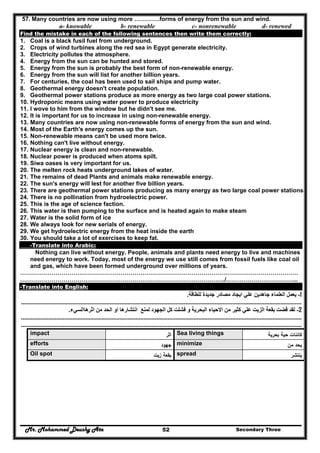
Expressing The Future
1-The Simple Future Tense
--‫البسيط‬ ‫المستقبل‬ ‫يتكون‬‫للمعلوم‬ ‫المبني‬‫من‬:
Form - Subj. ‫فاعل‬ +will / shall + inf………………………………. .
-‫استخدام‬ ‫الحظ‬will‫و‬ ‫الضمائر‬ ‫كل‬ ‫مع‬‫يمكن‬‫استخدام‬(shall)‫مع‬I / we)(‫فقط‬:
- I will (shall) wait for you at the airport. - Ali will buy a camera tomorrow.
NEGATION - Subj. ‫فاعل‬ +Will not(won't)/ shall not (shan't)+ inf. …
- We won't be ready at six. - Amira won't attend the party.
Yes/No Q. Will / shall + Subj. ‫فاعل‬ + inf………………………. ?
- Will you wait for the bus ?
- Yes. I will (wait for the bus). No, I won't(wait for the bus).
' Wh.' Q. - Q.W. ‫اداة‬‫االستفھام‬ + Will / shall + Subj. ‫فاعل‬ + inf……. ?
- When will they move to their new house? - Where will the meeting be held ?
-‫البسيط‬ ‫المستقبل‬ ‫يتكون‬‫للمجھول‬ ‫المبني‬‫من‬:
Passive Obj. +‫المفعول‬ Will / shall +be + P.P.……………………...
- A camera will be bought (by Ali) tomorrow.
Mr. Mohammed Deushy Ata Secondary Three15
‫مثل‬ ‫كلمات‬ ‫مع‬ ‫البسيط‬ ‫المستقبل‬ ‫يستخدم‬:
Next ( year / month / week / Friday….. ) / in the future / soon / tomorrow / this time( next
week / tomorrow…….. ) / in (a year, month, week…..…. )
-‫مع‬ ‫البسيط‬ ‫المستقبل‬ ‫ويستخدم‬If )(‫األولي‬ ‫الحالة‬ ‫في‬:
- If you win the race, I'll be very happy for you.
Uses of Will
1-‫عن‬ ‫التعبير‬‫ال‬‫حقائق‬‫المستقبلية‬:–
-She'll be sixteen tomorrow. – My mum will be very old in twenty years.
2-‫ب‬ ‫التنبؤ‬‫ي‬ ‫قد‬ ‫ما‬‫حدث‬‫مستقبال‬‫دليل‬ ‫وجود‬ ‫عدم‬ ‫حالة‬ ‫في‬‫مع‬ ‫غالبا‬:
I expect …/I'm sure …/I feel sure …/ I think…/I don't think… /I believe.. / Perhaps/I wonder… /
probably / I suppose… /I hope …..
- I expect she will get married soon. -She'll probably leave early today.
- We don't think they will help us. - I wonder when you will buy the computer.
3-‫قرار‬ ‫اتخاذ‬‫سريع‬‫شيء‬ ‫بعمل‬‫ما‬:-
- We'll have a cold drink. – I'll buy this CD.
4-‫عند‬‫عرض‬‫ما‬ ‫خدمة‬ ‫تقديم‬ ‫او‬ ‫شيء‬ ‫عمل‬:
- I'll wash the dishes. – I'll fix the car for you.
5-‫نطلب‬ ‫عندما‬‫شيء‬ ‫عمل‬ ‫شخص‬ ‫من‬:-
- Will you help me carry this bag, please? - I hope you will look after the baby.
6-‫شيء‬ ‫لعمل‬ ‫الترتيب‬‫مسبق‬ ‫تخطيط‬ ‫دون‬ ‫الحديث‬ ‫وقت‬:
-I and you will meet this evening.
7-‫والتھديدات‬ ‫الوعود‬ ‫عمل‬:
- I'll buy you a computer when you pass the final exam. - You won't get your prize if you come late.
Uses of Shall
: ‫البسيط‬ ‫المستقبل‬ ‫عن‬ ‫للتعبير‬ ( I /We )‫(مع‬ will )‫من‬ ‫(بدال‬ shall ) 1–‫استخدام‬ ‫يمكن‬
- I / We shall go shopping this afternoon. - I / We shall spend the weekend in the country.
: (‫ايضا‬‫تكوين‬ ‫في‬‫االقتراح‬ shall ‫تستخدم‬) -2
- Shall we meet you at the corner?
: ‫ف‬‫ي‬‫تقديم‬‫عرض‬ ( shall ) –‫استخدام‬ ‫يمكن‬ 3
- Shall I help you with the cooking? - Shall we clean the kitchen for you?
(‫المذيل‬ ‫السؤال‬ ‫-)في‬ 4
- will not won't - Shall not shan't
- We shall spend the weekend in the country, shan't we?
2 - Be + going to + inf.
Form - Subj.‫الفاعل‬ +am / is / are + going to + inf……………….
- We are going to play tennis. - I'm going to make some coffee.
Negation - Subj.‫الفاعل‬ +am not / is not (isn't)/ are not (aren't) + going to + inf….
- They aren't going to watch my wedding video.
Yes/No Q. - Am/ Is/ Are+ Subj.‫الفاعل‬ + going to + inf……………?
- Is she going to attend the meeting? -Yes, she is (going to attend the meeting).
- No, she isn't (going to attend the meeting).
'Wh-'Q. - Q.W. ‫اداة‬‫االستفھام‬ + am / is / are + Subj.‫ـﺎﻋﻞ‬‫ﻔ‬‫+اﻟ‬ going to + inf……..… ?
- Where are you going to spend the summer holiday?
Passive - Obj. +‫المفعول‬ am/ is/ are + going to +be + P.P.…….
- Tennis is going to be played (by us).
Mr. Mohammed Deushy Ata Secondary Three16
-‫الصيغة‬ ‫ھذه‬ ‫تستخدم‬‫الحديث‬ ‫لحظة‬ ‫قبل‬ ‫له‬ ‫مخطط‬ ‫عمل‬ ‫أو‬ ‫نية‬ ‫عن‬ ‫للتعبير‬‫مثل‬ ‫كلمات‬ ‫ذلك‬ ‫علي‬ ‫ويدل‬:
Intend / intention / plan / have … in mind
- We have plans to replace our old car with a new one.
= We are going to replace our old car with a new one.
-‫ب‬ ‫التنبؤ‬‫ي‬ ‫قد‬ ‫ما‬‫حدث‬‫مستقبال‬‫دليل‬ ‫وجود‬ ‫حالة‬ ‫في‬‫مع‬ ‫غالبا‬:
I expect …/I'm sure …/I feel sure …/ I think…/I don't think… /I believe.. / Perhaps/I wonder… / I
suppose…
- I think it’s going to rain as the sky seems very cloudy.
-‫ايضا‬ ‫تستخدم‬ ‫و‬‫سيحدث‬ ‫عما‬ ‫للتعبير‬‫المستقبل‬ ‫في‬‫مسبق‬ ‫قرار‬ ‫ھناك‬ ‫كان‬ ‫اذا‬‫مثل‬ ‫كلمات‬ ‫ذلك‬ ‫علي‬ ‫ويدل‬:
decided / have decided / made a decision / made up … mind
- They are going to go shopping. They have decided.
-‫ايضا‬ ‫تستخدم‬ ‫و‬‫الحدوث‬ ‫وشك‬ ‫علي‬ ‫أشياء‬ ‫عن‬ ‫للتعبير‬:
- Watch out! You are going to fall.
-‫لعمل‬ ‫موجودة‬ ‫كانت‬ ‫نية‬ ‫عن‬ ‫للتعبير‬ ‫الصيغة‬ ‫ھذه‬ ‫من‬ ‫الماضي‬ ‫يستخدم‬ ‫كما‬‫الماضي‬ ‫في‬ ‫يحدث‬ ‫لـم‬ ‫شيء‬:
- I was going to take the six o'clock train, but I got up late.
- -‫الحظ‬‫االحوال‬ ‫كل‬ ‫ليس‬ ‫و‬ ‫بعض‬ ‫في‬ ‫التالية‬ ‫الصيغ‬ ‫تساوي‬:
- Subj.‫الفاعل‬ +am / is / are + going to + inf………………………..………….
= Subj.‫الفاعل‬ + intend / plan to + inf….…………………….………………….
= Subj.‫الفاعل‬ + have the intention to + inf….……………………………….
= Subj.‫الفاعل‬ + be about to + inf….……………………………………..……….
- We are going to play tennis. = We intend to play tennis.
= we have the intention to play tennis.
- Be careful! You are going to fall. - - Be careful! You are about to fall.
3- The present Continuous for Future Arrangements
‫عن‬ ‫نتحدث‬ ‫عندما‬ ‫مستقبل‬ ‫عن‬ ‫للتعبير‬ ‫المستمر‬ ‫المضارع‬ ‫نستخدم‬‫ترتيبات‬‫المستقبل‬ ‫في‬ ‫معين‬ ‫لوقت‬‫ن‬‫م‬ ‫د‬‫والب‬ ‫عاقل‬ ‫الفاعل‬ ‫يكون‬ ‫أن‬ ‫والبد‬
‫المستقبل‬ ‫علي‬ ‫يدل‬ ‫زمني‬ ‫تعبير‬ ‫وجود‬:
1-‫ي‬‫ستخدا‬‫المستقبل‬ ‫عن‬ ‫للتعبير‬ ‫المستمر‬ ‫المضارع‬ ‫م‬‫وجود‬ ‫حالة‬ ‫في‬‫مسبقة‬ ‫ترتيبات‬‫مثل‬ ‫كلمات‬ ‫ذلك‬ ‫علي‬ ‫يدل‬ ‫و‬ ،:
arranged / have arranged / made arrangements / prepared / have prepared / made preparations
- He has arranged everything. He’s spending his holiday in Paris.
- I have booked two tickets. I’m traveling to Spain with my sister tomorrow.
2-‫ي‬‫ستخدام‬‫ترتيبات‬ ‫لوصف‬ ‫المستمر‬ ‫المضارع‬‫اإلجتماعية‬ ‫األنشطة‬ ‫مثل‬ ‫شخصية‬:
- I'm arriving at Luxor next week. - We're flying to France in three weeks.
-‫مستقبل‬ ‫المستمر‬ ‫المضارع‬ ‫نجعل‬ ‫لكي‬ ‫زمنية‬ ‫كلمة‬ ‫استخدام‬ ‫يجب‬ ‫أنه‬ ‫الحظ‬.
- I'm meeting him for lunch tomorrow.
- Where are you traveling next summer? - I’m traveling to London.
-‫مع‬ ‫الصيغة‬ ‫ھذه‬ ‫نستخدم‬ ‫ما‬ ‫كثيرا‬come‫و‬go‫مثل‬ ‫أفعال‬ ‫ومع‬see - stay - visit - meet
- I'm meeting them on Saturday. - They're going tomorrow.
-‫نقول‬ ‫أن‬ ‫الممكن‬ ‫من‬ ‫ولكن‬ ‫قريب‬ ‫مستقبل‬ ‫فقط‬ ‫ليس‬ ‫الحالة‬ ‫ھذه‬ ‫في‬ ‫المستقبل‬ ‫أن‬ ‫الحظ‬:
- He's coming back in ten years. - We're going back to the states in three years.
-‫أن‬ ‫الحظ‬‫لمستمر‬ ‫المضارعا‬ ‫معھا‬ ‫يستخدم‬ ‫لذا‬ ، ‫ترتيبات‬ ‫تستلزم‬ ‫وغيرھا‬ ‫ميالد‬ ‫واعياد‬ ‫حفالت‬ ‫من‬ ‫االجتماعية‬ ‫المناسبات‬:
- He's getting married next Friday. - We're going back to the states in three years.
-‫ال‬‫حظ‬‫كذلك‬‫أن‬‫لمستمر‬ ‫المضارعا‬ ‫معھا‬ ‫يستخدم‬ ‫لذا‬ ، ‫ترتيبات‬ ‫تستلزم‬ ‫المؤسسات‬ ‫بھا‬ ‫تقوم‬ ‫التي‬ ‫االنشطة‬:
- Our school is taking part in the sports competition next year.
- This company is sending a delegation to the conference next week.
-‫المستمر‬ ‫المضارع‬ ‫في‬ ‫تستخدم‬ ‫ال‬ ‫المستمرة‬ ‫األزمنة‬ ‫في‬ ‫تستخدم‬ ‫ال‬ ‫التي‬ ‫األفعال‬‫كمستقبل‬
-‫ما‬ ‫الحظ‬‫يلي‬:
- Are you doing anything tonight? - Yes, I'm playing tennis.
- Are you taking a holiday this year? - Yes, we have just arranged a holiday.
- We're spending ten days in Spain.
Mr. Mohammed Deushy Ata Secondary Three17
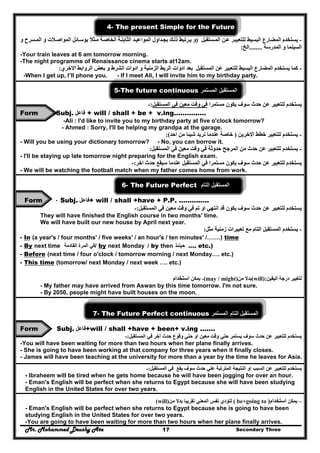
4- The present Simple for the Future
-‫ي‬‫للت‬ ‫البسيط‬ ‫المضارع‬ ‫ستخدم‬‫ع‬‫ستقبل‬‫الم‬ ‫ن‬‫ع‬ ‫ر‬‫بي‬)‫د‬‫المواعي‬ ‫داول‬‫بج‬ ‫ك‬‫ذل‬ ‫رتبط‬‫ي‬ ‫و‬‫ة‬‫الخاص‬ ‫ة‬‫الثابت‬‫و‬ ‫سرح‬‫الم‬ ‫و‬ ‫الت‬‫المواص‬ ‫ائل‬‫بوس‬ ‫ثال‬‫م‬
‫المدرسة‬ ‫و‬ ‫السينما‬........‫الخ‬:
-Your train leaves at 6 am tomorrow morning.
-The night programme of Renaissance cinema starts at12am.
-‫ي‬ ‫كما‬‫للت‬ ‫البسيط‬ ‫المضارع‬ ‫ستخدم‬‫ع‬‫المستقبل‬ ‫عن‬ ‫بير‬‫االخري‬ ‫الروابط‬ ‫بعض‬ ‫و‬ ‫الشرط‬ ‫ادوات‬ ‫و‬ ‫الزمنية‬ ‫الربط‬ ‫ادوات‬ ‫بعد‬:
-When I get up, I’ll phone you. - If I meet Ali, I will invite him to my birthday party.
5-The future continuous ‫المستمر‬ ‫المستقبل‬
‫مستمرا‬ ‫يكون‬ ‫سوف‬ ‫حدث‬ ‫عن‬ ‫للتعبير‬ ‫يستخدم‬‫المستقبل‬ ‫في‬ ‫معين‬ ‫وقت‬ ‫في‬:-
Form - Subj. ‫فاعل‬ + will / shall + be + v.ing……………
-Ali : I'd like to invite you to my birthday party at five o'clock tomorrow?
- Ahmed : Sorry, I'll be helping my grandpa at the garage.
-‫للتعبير‬ ‫يستخدم‬‫االخرين‬ ‫خطط‬)‫احد‬ ‫من‬ ‫شيئا‬ ‫نريد‬ ‫عندما‬ ‫خاصة‬(:
- Will you be using your dictionary tomorrow? - No, you can borrow it.
-‫حدث‬ ‫عن‬ ‫للتعبير‬ ‫يستخدم‬‫حدوثة‬ ‫المرجح‬ ‫من‬‫المستقبل‬ ‫في‬ ‫معين‬ ‫وقت‬ ‫في‬:
- I'll be staying up late tomorrow night preparing for the English exam.
‫حدث‬ ‫عن‬ ‫للتعبير‬ ‫يستخدم‬‫مستمرا‬ ‫يكون‬ ‫سوف‬‫المستقبل‬ ‫في‬‫اخر‬ ‫حدث‬ ‫سيقع‬ ‫عندما‬:-
- We will be watching the football match when my father comes home from work.
6- The Future Perfect ‫التام‬ ‫المستقبل‬
Form - Subj. ‫فاعل‬+ will / shall +have + P.P. …………..
‫حدث‬ ‫عن‬ ‫للتعبير‬ ‫يستخدم‬‫المستقبل‬ ‫في‬ ‫معين‬ ‫وقت‬ ‫في‬ ‫تم‬ ‫او‬ ‫انتھي‬ ‫قد‬ ‫يكون‬ ‫سوف‬:-
They will have finished the English course in two months' time.
We will have built our new house by April next year.
-‫مثل‬ ‫زمنية‬ ‫تعبيرات‬ ‫مع‬ ‫التام‬ ‫المستقبل‬ ‫يستخدم‬:
- In (a year's / four months' / five weeks' / an hour's / ten minutes' /…….) time
- By next time ‫في‬‫المرة‬‫القادمة‬ / by next Monday / by then ‫حينئذ‬ …. etc.)
- Before (next time / four o'clock / tomorrow morning / next Monday…. etc.)
- This time (tomorrow/ next Monday / next week …. etc.)
‫اليقين‬ ‫درجة‬ ‫لتغيير‬:(will)‫من‬ ‫بدال‬(may / might)-‫يمكن‬‫استخدام‬
- My father may have arrived from Aswan by this time tomorrow. I'm not sure.
- By 2050, people might have built houses on the moon.
7- The Future Perfect continuous ‫المستمر‬ ‫المستقبل‬‫التام‬
Form Subj. ‫فاعل‬+will / shall +have + been+ v.ing …….
‫حدث‬ ‫عن‬ ‫للتعبير‬ ‫يستخدم‬‫وق‬ ‫حتي‬ ‫يستمر‬ ‫سوف‬‫المستقبل‬ ‫في‬ ‫آخر‬ ‫حدث‬ ‫وقوع‬ ‫حتي‬ ‫او‬ ‫معين‬ ‫ت‬:-
-You will have been waiting for more than two hours when her plane finally arrives.
- She is going to have been working at that company for three years when it finally closes.
- James will have been teaching at the university for more than a year by the time he leaves for Asia.
‫عن‬ ‫للتعبير‬ ‫يستخدم‬‫المستقبل‬ ‫في‬ ‫يقع‬ ‫سوف‬ ‫حدث‬ ‫علي‬ ‫المترتبة‬ ‫النتيجة‬ ‫او‬ ‫السبب‬:-
- Ibraheem will be tired when he gets home because he will have been jogging for over an hour.
- Eman's English will be perfect when she returns to Egypt because she will have been studying
English in the United States for over two years.
–‫يمكن‬‫استخدام‬( be+going to )‫تقريبا‬ ‫المعني‬ ‫نفس‬ ‫لتؤدي‬‫ب‬‫من‬ ‫دال‬)(will
- Eman's English will be perfect when she returns to Egypt because she is going to have been
studying English in the United States for over two years.
-You are going to have been waiting for more than two hours when her plane finally arrives.
Mr. Mohammed Deushy Ata Secondary Three18
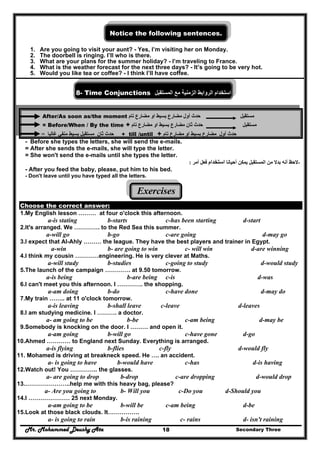
Notice the following sentences.
1. Are you going to visit your aunt? - Yes, I’m visiting her on Monday.
2. The doorbell is ringing. I’ll who is there.
3. What are your plans for the summer holiday? - I’m traveling to France.
4. What is the weather forecast for the next three days? - It’s going to be very hot.
5. Would you like tea or coffee? - I think I’ll have coffee.
8- Time Conjunctions ‫استخدام‬‫الروابط‬‫الزمنية‬‫مع‬‫المستقبل‬
After/As soon as/the moment ‫حدث‬‫أول‬‫مضارع‬‫تام‬ ‫مضارع‬ ‫او‬ ‫بسيط‬ ‫مستقبل‬
= Before/When / By the time + ‫حدث‬‫ثان‬‫مضارع‬‫م‬ ‫او‬ ‫بسيط‬‫تام‬ ‫ضارع‬ ‫مستقبل‬
‫ثان‬ ‫حدث‬‫مستقبل‬‫بسيط‬‫غالبا‬ ‫منفي‬= + till /until + ‫أول‬ ‫حدث‬‫تام‬ ‫مضارع‬ ‫او‬ ‫بسيط‬ ‫مضارع‬
- Before she types the letters, she will send the e-mails.
= After she sends the e-mails, she will type the letter.
= She won't send the e-mails until she types the letter.
-‫أحيانا‬ ‫يمكن‬ ‫المستقبل‬ ‫من‬ ‫بدال‬ ‫أنه‬ ‫الحظ‬‫استخدام‬‫أمر‬ ‫فعل‬:
- After you feed the baby, please, put him to his bed.
- Don't leave until you have typed all the letters.
Exercises
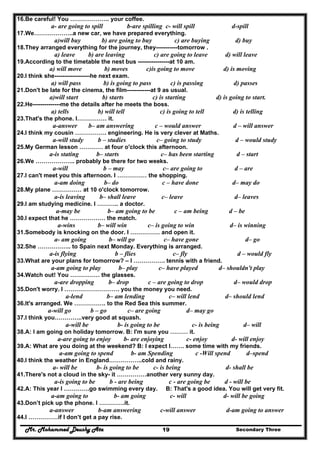
Choose the correct answer:
1.My English lesson ……… at four o'clock this afternoon.
a-is stating b-starts c-has been starting d-start
2.It's arranged. We …………. to the Red Sea this summer.
a-will go b-go c-are going d-may go
3.I expect that Al-Ahly ……… the league. They have the best players and trainer in Egypt.
a-win b- are going to win c- will win d-are winning
4.I think my cousin …………engineering. He is very clever at Maths.
a-will study b-studies c-going to study d-would study
5.The launch of the campaign …………. at 9.50 tomorrow.
a-is being b-are being c-is d-was
6.I can't meet you this afternoon. I …………. the shopping.
a-am doing b-do c-have done d-may do
7.My train …….. at 11 o'clock tomorrow.
a-is leaving b-shall leave c-leave d-leaves
8.I am studying medicine. I ………. a doctor.
a- am going to be b-be c-am being d-may be
9.Somebody is knocking on the door. I ……… and open it.
a-am going b-will go c-have gone d-go
10.Ahmed ………… to England next Sunday. Everything is arranged.
a-is flying b-flies c-fly d-would fly
11. Mohamed is driving at breakneck speed. He …. an accident.
a- is going to have b-would have c-has d-is having
12.Watch out! You ………….. the glasses.
a- are going to drop b-drop c-are dropping d-would drop
13.…………………..help me with this heavy bag, please?
a- Are you going to b- Will you c-Do you d-Should you
14.I ………………… 25 next Monday.
a-am going to be b-will be c-am being d-be
15.Look at those black clouds. It…………….
a- is going to rain b-is raining c- rains d- isn't raining
Mr. Mohammed Deushy Ata Secondary Three19
16.Be careful! You ……………….. your coffee.
a- are going to spill b-are spilling c- will spill d-spill
17.We………………..a new car, we have prepared everything.
a)will buy b) are going to buy c) are buying d) buy
18.They arranged everything for the journey, they-----------tomorrow .
a) leave b) are leaving c) are going to leave d) will leave
19.According to the timetable the nest bus ----------------at 10 am.
a) will move b) moves c)is going to move d) is moving
20.I think she------------------he next exam.
a) will pass b) is going to pass c) is passing d) passes
21.Don't be late for the cinema, the film------------at 9 as usual.
a)will start b) starts c) is starting d) is going to start.
22.He--------------me the details after he meets the boss.
a) tells b) will tell c) is going to tell d) is telling
23.That's the phone. I…………… it.
a-answer b– am answering c – would answer d – will answer
24.I think my cousin ……………. engineering. He is very clever at Maths.
a-will study b – studies c– going to study d – would study
25.My German lesson ………… at four o'clock this afternoon.
a-is stating b– starts c– has been starting d – start
26.We ……………….. probably be there for two weeks.
a-will b – may c– are going to d – are
27.I can't meet you this afternoon. I …………… the shopping.
a-am doing b– do c – have done d– may do
28.My plane …………… at 10 o'clock tomorrow.
a-is leaving b– shall leave c– leave d– leaves
29.I am studying medicine. I ……….. a doctor.
a-may be b– am going to be c – am being d – be
30.I expect that he ……………… the match.
a-wins b– will win c– is going to win d– is winning
31.Somebody is knocking on the door. I …………… and open it.
a- am going b– will go c– have gone d– go
32.She …………….. to Spain next Monday. Everything is arranged.
a-is flying b – flies c– fly d – would fly
33.What are your plans for tomorrow? – I ……………. tennis with a friend.
a-am going to play b– play c– have played d– shouldn't play
34.Watch out! You …………… the glasses.
a-are dropping b– drop c – are going to drop d– would drop
35.Don't worry. I ………………………. you the money you need.
a-lend b– am lending c– will lend d– should lend
36.It's arranged. We ……………. to the Red Sea this summer.
a-will go b – go c– are going d– may go
37.I think you…………..very good at squash.
a-will be b- is going to be c- is being d– will
38.A: I am going on holiday tomorrow. B: I'm sure you ……… it.
a-are going to enjoy b- are enjoying c- enjoy d- will enjoy
39.A: What are you doing at the weekend? B: I expect I……. some time with my friends.
a-am going to spend b- am Spending c -Will spend d–spend
40.I think the weather in England……………..cold and rainy.
a- will be b- is going to be c- is being d- shall be
41.There's not a cloud in the sky- it ……………another very sunny day.
a-is going to be b - are being c - are going be d - will be
42.A: This year I ………….go swimming every day. B: That's a good idea. You will get very fit.
a-am going to b- am going c- will d- will be going
43.Don’t pick up the phone. I ………….it.
a-answer b-am answering c-will answer d-am going to answer
44.I ……………if I don’t get a pay rise.
Mr. Mohammed Deushy Ata Secondary Three20
a-’ll resign b – resign c - am resigning d- would resign
45.After I have studied, I …………….. TV.
a- am going to watch b- will watch c– watch d- am watching
46.The film ……………at 7.30.
a- would start b- starts c- is starting d- is started
47.We won’t start the meeting until you………..
a-arrive b- had arrived c- will arrive d– arrives .
48.He…………….. to Aswan tomorrow. He’s got his ticket
a-’s traveling b–travels c -'d travel d -'ll travel
49.I…………… the car for you.
a-clean b- am cleaning c- have been cleaning d- ’ll clean
50.I…………..to the airport at 4 o’clock tomorrow.
a-will have driven b–am going to drive c-’ll be driving d–will drive
51.Would you like fish or chicken? - I think I……. chicken.
a-’ll have b-am having c- am going to have d- have
52.Are you……………….tennis after school today?
a-plays b– played c- playing d-play
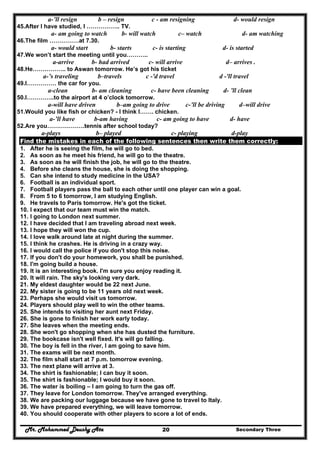
Find the mistakes in each of the following sentences then write them correctly:
1. After he is seeing the film, he will go to bed.
2. As soon as he meet his friend, he will go to the theatre.
3. As soon as he will finish the job, he will go to the theatre.
4. Before she cleans the house, she is doing the shopping.
5. Can she intend to study medicine in the USA?
6. Football is an individual sport.
7. Football players pass the ball to each other until one player can win a goal.
8. From 5 to 6 tomorrow, I am studying English.
9. He travels to Paris tomorrow. He's got the ticket.
10. I expect that our team must win the match.
11. I going to London next summer.
12. I have decided that I am traveling abroad next week.
13. I hope they will won the cup.
14. I love walk around late at night during the summer.
15. I think he crashes. He is driving in a crazy way.
16. I would call the police if you don't stop this noise.
17. If you don't do your homework, you shall be punished.
18. I'm going build a house.
19. It is an interesting book. I'm sure you enjoy reading it.
20. It will rain. The sky's looking very dark.
21. My eldest daughter would be 22 next June.
22. My sister is going to be 11 years old next week.
23. Perhaps she would visit us tomorrow.
24. Players should play well to win the other teams.
25. She intends to visiting her aunt next Friday.
26. She is gone to finish her work early today.
27. She leaves when the meeting ends.
28. She won't go shopping when she has dusted the furniture.
29. The bookcase isn't well fixed. It's will go falling.
30. The boy is fell in the river, I am going to save him.
31. The exams will be next month.
32. The film shall start at 7 p.m. tomorrow evening.
33. The next plane will arrive at 3.
34. The shirt is fashionable; I can buy it soon.
35. The shirt is fashionable; I would buy it soon.
36. The water is boiling – I am going to turn the gas off.
37. They leave for London tomorrow. They've arranged everything.
38. We are packing our luggage because we have gone to travel to Italy.
39. We have prepared everything, we will leave tomorrow.
40. You should cooperate with other players to score a lot of ends.
Mr. Mohammed Deushy Ata Secondary Three21
Test 1
A- Language Functions
1- Respond to the following situations:
1) Someone says that computers are bad thing .you don’t have the same opinion.
2) Someone says that space exploration is too expensive .You agree.
3) One of your friends says he thinks walking in space would be very frightening .You think he
is right.
4) You hear someone say that all astronauts are very rich .You know that is not true .
2-Mention the place, the speakers and the language function in each of the following
two mini-dialogues:
1- A: Can you show me where I can try this dress on?
B: The fitting rooms are on the left over there
2- A: How long have you been feeling unwell? B.: Since Sunday
A: Well, you need to take one of these tablets 3 times a day.
B- Vocabulary and Structure
3- Choose the correct answer from a, b, c or d
1. These plans must be kept …………… from the enemy.
a- known b- regret c- secret d- open
2. I don't think you understand the …………… of the situation.
a- ambiguity b- anxiety c- gravity d- authority
3. The Earth ……………………. on its axis.
a- stains b- stems c- spins d- springs
4. I'm afraid I don't agree …………………….. your opinion.
a- at b- of c- with d- on
5. He did a lot to ………………….. conditions for factory workers.
a- approve b- move c- improve d- destroy
6. Buying this old car is a ………………….. of money.
a- waste b- waist c- wisdom d- failure
7. The crew are planning a four-hour space ………………. to carry out the necessary repair work
on the shuttle.
a- run b- jump c- walk d- talk
8. The storm has had a bad …………………..on the crops.
a- effect b- afflict c- affect d- detect
9. We always celebrate our wedding …………… with dinner in an expensive restaurant.
a- memory b- failure c- anniversary d- memorial
10. Everyone knows who stole it, but ……. are all afraid to tell anyone.
a- he b- you c- she d- they
11. It's arranged. We ……………. to the Red Sea this summer.
a- will go b- go c- are going d- may go
12. I can't talk at the moment. I ………………. my homework.
a- do b- will do c- am doing d- have done
13. I am studying law. I ……………………… a lawyer.
a- may be b- am going to be c- am being d- be
14. Somebody is knocking on the door. I …………… and open it.
a- am going b- will go c- have gone d- go
15. The phone is ringing . I …………..it
a- will answer b- am going to answer c- am answering d- answer
16. The plane ………at 8.30 tomorrow.
a- arrives b- will arrive c- is going to arrive d- is arriving
Place: ……………….. - Speaker A: …..……….. - Speaker B:……..……….. - Function: ……………..………..
Mr. Mohammed Deushy Ata Secondary Three22
4- Find the mistake in each of the following sentences then write them correctly:
1.He applied for three universities and was accepted by all.
2.I think he is going to be a famous engineer.
3.It is expected he is going to arrive tomorrow.
4.I will be flying to Paris later this morning.
5.The space station will be orbiting around the Earth
6.We celebrate the memory of the revolution on 23rd July.
C- Reading Comprehension
5- Read the following passage and then answer the questions: (June, 2009)
Eat healthy food and have a healthy body. Now, we know that there is also healthy food for your
brain. Eat healthy food and have a healthy mind. New research clearly shows the link between diet
and mental health.
There has been a campaign to improve school meals. A head teacher of a school banned junk
food and started serving healthy food. This research shows that the students' behaviour in class
has been a lot better. They became calmer and they learn and concentrate more.
A mental health foundation (M.H.F) has started a campaign "Feeding Minds" to publicize its own
research. This research shows that our diets have changed a lot and the level of mental illness has
increased, unhealthy diet can cause depression and insomnia.
The last part of the research concerns the Mediterranean diet. Scientists knew that this diet (fruit,
vegetables, fish and olive oil) helps you live longer. It also prevents a serious mental disease
"Alzheimer" that affects the elderly.
So, what does this research suggest to you? To improve your memory, eat salmon. To fight
insomnia, eat nuts. If depression is a problem, eat brown rice. If you worry about your later years,
cook with olive oil.
A. Answer the following questions:
1- What is the main idea of the passage?
2- Mention the campaigns' targets of the school and the MHF?
3- What does the underlined word "they" refer to/
B. Choose the correct answer:
5- The following diseases are all mental except ……………… .
a) Alzheimer b) Depression c) Insomnia d) Blood Pressure
6- The Mediterranean diet includes………………
a) junk food b) meat and rice c) fast food d) fish and olive oil
6- Read the following passage, then answer the questions:
My advice about learning to drive would be to have proper lessons from a qualified instructor and
never to let a friend or family member try to teach you. It's a guaranteed way to spoil a good
relationship. Every Sunday, when the traffic was quieter, my father would pick me up and take me
for a drive along the streets of our hometown and give me a lecture on how to drive, explaining
everything he was doing and why. Eventually it was my turn to have a go. My dad was so nervous
that he panicked before I'd even started up the engine. He used to shout at the slightest mistake,
and when the lesson was finally over he'd come home and have a large glass of whisky to calm
down.
Answer the following questions:
1-According to the writer, who is the best person to teach you how to drive?
2-What do you think about the writer's father?
3-Find words in the passage which mean:
a) felt very frightened b) having suitable knowledge, experience or skills
Choose the correct answer:
4-The underlined word he refers to ………………
a) the writer b) the instructor c) the writer's father d) the writer's friend
5-The writer's father used to teach him how to drive ………………
a) once a week b) every Monday c) twice a month d) every day
Mr. Mohammed Deushy Ata Secondary Three23
D- The Novel
7) (A) Answer the following questions:
1- Why doesn't Rudolf Rassendyll work?
2- What kind of work does Rose suggest Rudolf should do?
3- Why has the Rassendyll family been interested in the Elphberg family?
4- Where does Rassendyll decide to travel to? What does he tell his family about his plans?
B) Read the following quotation. then answer the questions
"To a man like me, opportunities are responsibilities.
1- Who says this and when?
2- What does the person mean by this?
3- Do you think a person like this is very serious about work or life?
C) Find the mistake in each of the following sentences and write them correctly:
1- George Featherly works at the embassy in Ruritania.
2- Rudolf sits with Antoinette on the train.
D- Writing
8- Write a paragraph of about 100 words about: (June, 2009)
"How space technology affects our everyday life"
E- Translation
9- A) Translate into Arabic: (June, 2009)
Scientists think that the world temperature will increase due to many reasons .Global warming is
the major reason for that . as well as gases from green houses .Cutting forests make the matter
worse .All governments and green colour lovers must co operate to protect our planet.
…………………………………………………………………………………………………………………………
……………………………………………………………………………………………………………………………
……………………………………………………………………………………………………………………………
B) Translate into English:
-‫صغير‬ ‫نووى‬ ‫مفاعل‬ ‫يمثل‬ ‫و‬ ‫جدا‬ ‫خطر‬ ‫المحمول‬ ‫بجوار‬ ‫النوم‬.
........................................................................................................................................................................
....................................................................................................................................................................................
-‫الحراري‬ ‫واالحتباس‬ ‫المناخي‬ ‫التغير‬ ‫مثل‬ ‫المشكالت‬ ‫من‬ ‫الكثير‬ ‫حل‬ ‫في‬ ‫تساعدنا‬ ‫لكي‬ ‫الحديثة‬ ‫التكنولوجيا‬ ‫الي‬ ‫نحتاج‬.
........................................................................................................................................................................
....................................................................................................................................................................................
Mr. Mohammed Deushy Ata Secondary Three24
Unit 2 - The Prisoner of Zenda
Main Vocabulary
alike ‫مشابه‬ couple ‫زوج‬ occasion ‫مناسبة‬
attend ‫يحضر‬ debate (n) ‫مناظرة‬ publication ‫طبع‬/‫نشر‬
castle ‫قل‬‫عـ‬‫ة‬ escapism ‫الواقع‬ ‫من‬ ‫ھروب‬ wealthy ‫غنى‬/‫ثري‬
Classics ‫دراسة‬‫االدب‬‫اليوناني‬‫الروماتي‬ ‫و‬‫القديم‬ well-educated ‫جيد‬ ‫متعلم‬
coronation ‫تتويج‬/‫حفلة‬ fictional ‫خيالى‬
Vocabulary
activities ‫أنشطة‬ for ever ‫لألبد‬ popular ‫محبوب‬/‫شعبى‬
adventure stories ‫مغامرة‬ ‫قصص‬ forest ‫غابة‬ pound ‫جنيه‬
Ambitious(adj.) ‫طموح‬ forget ‫ينسي‬ print ‫يطبع‬
architecture ‫المعمارية‬ ‫الھندسة‬ formal ‫رسم‬‫ى‬ prisoner ‫سجين‬
area ‫منطقة‬ guilty ‫مذنب‬ُ protect ‫يحمي‬
as planned ‫مخطط‬ ‫ھو‬ ‫كما‬ have much success in ‫ا‬‫ر‬‫ﻛﺑﻳ‬ ‫ﻧﺟﺎﺣﺎ‬ ‫ﻳﻼﻗﻲ‬ public debate ‫مناقشة‬ ‫أو‬ ‫مناظرة‬
‫ة‬at least ‫األقل‬ ‫علي‬ heroes ‫أبطال‬ public library ‫عامة‬ ‫مكتبة‬
at most ‫األكثر‬ ‫علي‬ heroic deeds ‫بطو‬ ‫أعمال‬‫لية‬ publish ‫ينشر‬
athletics ‫الرياضية‬ ‫األلعاب‬ heroic efforts ‫خارقة‬ ‫جھود‬ published ‫منشور‬
attackers ‫المھاجمون‬ historic occasion ‫تاريخية‬ ‫مناسبة‬ publisher ‫ناشر‬
attend a conference ‫مؤتمر‬ ‫يحضر‬َ history ‫تاريخ‬ ready for ‫ل‬ ‫مستعد‬‫ـ‬
attend a meeting ‫اجتماع‬ ‫يحضر‬ُ hold a debate ‫مناظرة‬ ‫يعقد‬ realise ‫يدرك‬
believe ‫يعتقد‬ identical ‫متطابق‬/‫متماثل‬ realism ‫اﻗﻌﻳﺔ‬‫و‬‫اﻟ‬
candidates ‫المرشحون‬ immediately ‫فورا‬ regular visits ‫منتظمة‬ ‫زيارات‬
castle ‫قل‬‫عـ‬‫ة‬ immense ‫ھائل‬ remain ‫يبقي‬
central ‫مركزى‬ innocent ‫بريء‬ replace ‫محل‬ ‫يحل‬/‫يستبدل‬
ceremony ‫احتفال‬ interest ‫اھتمام‬/‫تشويق‬ rescue ‫ينقذ‬
classical music ‫الكالسيكية‬ ‫الموسيقي‬ kidnapped ‫اختطف‬‫شخص‬ short stories ‫قصيرة‬ ‫قصص‬
compulsory education‫التعليم‬‫اإللزامي‬ lawyer ‫محامى‬ sign ‫ة‬‫إﺷﺎر‬
cruel ‫قاسي‬ leader ‫القائد‬ solve the problem ‫يح‬‫المشكلة‬ ‫ل‬
die ‫يموت‬ local ‫محلي‬ sort of / kind of ‫من‬ ‫نوع‬
discover ‫يكتشف‬ locked in ‫في‬ ‫حجز‬ُ speaker ‫متحدث‬
double efforts ‫الجھود‬ ‫يضاعف‬ُ look alike ‫جدا‬ ‫متشابه‬ ‫يبدوا‬ successful ‫ناجح‬
early life ‫المبكرة‬ ‫الحياة‬ married ‫متزوج‬ surprise ‫مفاجئة‬
educate ‫يتعلم‬ modern languages ‫اﻟﻠﻐﺎت‬ preventive measures‫وﻗﺎﺋﻳﺔ‬ ‫اءات‬‫ر‬‫إﺟ‬
educated ‫متعلم‬ morally ‫أخالقيا‬/‫افتراضيا‬ teaching job ‫التدريس‬ ‫وظيفة‬
education ‫تعليم‬ neighbour ‫جار‬ the public ‫الجمھور‬
Englishman ‫إنجليزي‬ ‫رجل‬ news coverage ‫إخبارية‬ ‫تغطية‬ public ‫العام‬ ‫الرأي‬
entertainment ‫وترفية‬ ‫تسلية‬ news headlines ‫األخبار‬ ‫عناوين‬ the right ‫الحق‬
escape ‫يھرب‬ novel ‫رواية‬ the vast majority ‫العظمي‬ ‫الغالبية‬
escapist ‫انھزامي‬ novelist ‫روائي‬ tiny ‫ضئيل‬
excitedly ‫مثار‬ ‫بشكل‬ُ organised discussion ‫ﻣﻧﺎﻗﺷﺔ‬ tour ‫جو‬‫لة‬
fiction ‫خيال‬ pharaoh ‫فرعون‬ under debate ‫مناقشة‬ ‫محل‬
finally ‫أخيرا‬ plenty ‫وفرة‬ university ‫جامعة‬
finance ‫المالية‬ poet ‫شاعر‬ walk through ‫خالل‬ ‫يمشي‬
find out ‫يكتشف‬ politics ‫السياسة‬ writer ‫كاتب‬
Mr. Mohammed Deushy Ata Secondary Three25
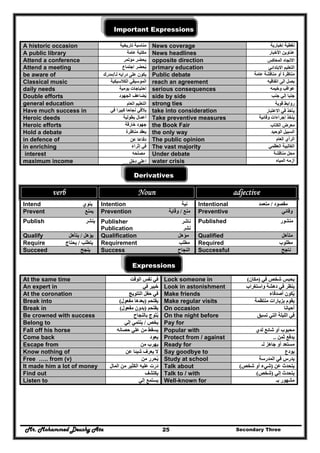
Important Expressions
A historic occasion ‫تاريخية‬ ‫مناسبة‬ News coverage ‫إخبارية‬ ‫تغطية‬
A public library ‫عامة‬ ‫مكتبة‬ News headlines ‫األخبار‬ ‫عناوين‬
Attend a conference ‫مؤتمر‬ ‫يحضر‬َ opposite direction ‫المعاكس‬ ‫االتجاه‬
Attend a meeting ‫اجتماع‬ ‫يحضر‬ُ primary education ‫االبتدائي‬ ‫التعليم‬
be aware of ‫لـ‬ ‫درايه‬ ‫على‬ ‫يكون‬/‫م‬‫درك‬ Public debate ‫عامة‬ ‫مناقشة‬ ‫أو‬ ‫مناظرة‬
Classical music ‫الكالسيكية‬ ‫الموسيقي‬ reach an agreement ‫ب‬‫اتفاقيه‬ ‫الى‬ ‫صل‬
daily needs ‫يومية‬ ‫احتياجات‬ serious consequences ‫وخيمه‬ ‫عواقب‬
Double efforts ‫الجھود‬ ‫يضاعف‬ُ side by side ‫جنب‬ ‫إلي‬ ‫جنبا‬
general education ‫التعل‬‫العام‬ ‫يم‬ strong ties ‫قوية‬ ‫روابط‬
Have much success in ‫في‬ ‫كبيرا‬ ‫نجاحا‬ ‫يالقي‬ take into consideration ‫االعتبار‬ ‫في‬ ‫يأخذ‬
Heroic deeds ‫بطولية‬ ‫أعمال‬ Take preventive measures ‫وقائية‬ ‫إجراءات‬ ‫يتخذ‬
Heroic efforts ‫خارقة‬ ‫جھود‬ the Book Fair ‫الكتاب‬ ‫معرض‬
Hold a debate ‫مناظرة‬ ‫يعقد‬ the only way ‫الوحيد‬ ‫السبيل‬
in defence of ‫عن‬ ‫دفاعا‬ The public opinion ‫العام‬ ‫الرأي‬
in enriching ‫إثراء‬ ‫في‬ The vast majority ‫العظمي‬ ‫الغالبية‬
interest ‫مصلحه‬ Under debate ‫مناقشة‬ ‫محل‬
maximum income ‫دخل‬ ‫اعلي‬ water crisis ‫المياه‬ ‫أزمه‬
Derivatives
verb Noun adjective
Intend ‫ينوي‬ Intention ‫نية‬ Intentional ‫مقصود‬/‫متعمد‬
Prevent ‫يمنع‬ Prevention ‫منع‬/‫وقاية‬ Preventive ‫وقائي‬
Publish ‫ينشر‬ Publisher ‫ناشر‬
Publication ‫نشر‬
Published ‫منشور‬
Qualify ‫يؤھل‬/‫يتأھل‬ Qualification ‫مؤھل‬ Qualified ‫متأھل‬
Require ‫يتطلب‬/‫يحتاج‬ Requirement ‫مطلب‬ Required ‫مطلوب‬
Succeed ‫ينجح‬ Success ‫النجاح‬ Successful ‫ناجح‬
Expressions
At the same time ‫الوقت‬ ‫نفس‬ ‫في‬ Lock someone in ‫في‬ ‫شخص‬ ‫يحبس‬)‫مكان‬(
An expert in ‫في‬ ‫خبير‬ Look in astonishment ‫واستغراب‬ ‫دھشة‬ ‫في‬ ‫ينظر‬
At the coronation ‫التتويج‬ ‫حفل‬ ‫في‬ Make friends ‫أصدقاء‬ ‫يكون‬ُ
Break into ‫يقتحم‬)‫مفعول‬ ‫بعدھا‬( Make regular visits ‫منتظمة‬ ‫بزيارات‬ ‫يقوم‬
Break in ‫يقتحم‬)‫مفعول‬ ‫بدون‬( On occasion ‫أحيانا‬
Be crowned with success ‫بالنجاح‬ ‫يتوج‬َ ُ On the night before ‫تسبق‬ ‫التي‬ ‫الليلة‬ ‫في‬
Belong to ‫يخص‬/‫إلي‬ ‫ينتمي‬ Pay for
Fall off his horse ‫حصانه‬ ‫علي‬ ‫من‬ ‫يسقط‬ Popular with ‫لدي‬ ‫شائع‬ ‫أو‬ ‫محبوب‬
Come back ‫يعود‬ Protect from / against ‫ثمن‬ ‫يدفع‬..
Escape from ‫من‬ ‫يھرب‬ Ready for ‫لـ‬ ‫جاھز‬ ‫أو‬ ‫مستعد‬
Know nothing of ‫عن‬ ‫شيئا‬ ‫يعرف‬ ‫ال‬ Say goodbye to ‫يودع‬
Free ….. from (v) ‫من‬ ‫يحرر‬ُ Study at school ‫المدرسة‬ ‫في‬ ‫يدرس‬
It made him a lot of money ‫المال‬ ‫من‬ ‫الكثير‬ ‫عليه‬ ‫درت‬َ َ Talk about ‫عن‬ ‫يتحدث‬)‫شخص‬ ‫أو‬ ‫شيء‬(
Find out ‫يكتشف‬ Talk to / with ‫إلي‬ ‫يتحدث‬)‫شخص‬(
Listen to ‫إلي‬ ‫يستمع‬ Well-known for ‫بـ‬ ‫مشھور‬
Mr. Mohammed Deushy Ata Secondary Three26
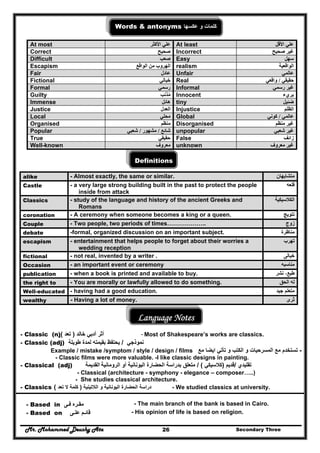
Words & antonyms ‫عكسھا‬ ‫و‬ ‫كلمات‬
At most ‫علي‬‫األكثر‬ At least ‫األقل‬ ‫علي‬
Correct ‫صحيح‬ Incorrect ‫صحيح‬ ‫غير‬
Difficult ‫صعب‬ Easy ‫سھل‬
Escapism ‫الواقع‬ ‫من‬ ‫الھروب‬ realism ‫الواقعية‬
Fair ‫عادل‬ Unfair ‫عالمي‬
Fictional ‫خيالي‬ Real ‫حقيقي‬/‫واقعي‬
Formal ‫رسمي‬ Informal ‫رسمي‬ ‫غير‬
Guilty ‫مذنب‬ُ Innocent ‫بريء‬
Immense ‫ھائل‬ tiny ‫ضئيل‬
Justice ‫العدل‬ Injustice ‫الظلم‬
Local ‫محلي‬ Global ‫عالمي‬/‫كوني‬
Organised ‫منظم‬ Disorganised ‫منظم‬ ‫غير‬
Popular ‫شائع‬/‫مشھور‬/‫شعبي‬ unpopular ‫شعبي‬ ‫غير‬
True ‫حقيقي‬ False ‫زائف‬
Well-known ‫معروف‬ unknown ‫معروف‬ ‫غير‬
Definitions
alike - Almost exactly, the same or similar. ‫متشابھان‬
Castle - a very large strong building built in the past to protect the people
inside from attack
‫قلعه‬
Classics - study of the language and history of the ancient Greeks and
Romans
‫الكالسيكية‬
coronation - A ceremony when someone becomes a king or a queen. ‫تتويج‬
Couple - Two people, two periods of times……………….. ‫زوج‬
debate -formal, organized discussion on an important subject. ‫مناظرة‬
escapism - entertainment that helps people to forget about their worries a
wedding reception
‫تھرب‬
fictional - not real, invented by a writer . ‫خيالى‬
Occasion - an important event or ceremony ‫مناسبه‬
publication - when a book is printed and available to buy. ‫نشر‬ ،‫طبع‬
the right to - You are morally or lawfully allowed to do something. ‫الحق‬ ‫له‬
Well-educated - having had a good education. ‫جيد‬ ‫متعلم‬
wealthy - Having a lot of money. ‫ثرى‬
Language Notes
- Classic (n) ‫أثر‬‫أدبي‬‫خالد‬)‫تعد‬( - Most of Shakespeare’s works are classics.
- Classic (adj) ‫نموذجي‬/‫طويلة‬ ‫لمدة‬ ‫بقيمته‬ ‫يحتفظ‬
Example / mistake /symptom / style / design / films -‫تأتي‬ ‫و‬ ‫الكتب‬ ‫و‬ ‫المسرحيات‬ ‫مع‬ ‫تستخدم‬‫ايضا‬‫مع‬
- Classic films were more valuable. -I like classic designs in painting.
- Classical (adj) ‫القديمة‬ ‫تقليدي‬/‫قديم‬)‫كالسيكي‬/ (‫بدراسة‬ ‫متعلق‬‫الحضارة‬‫اليونانية‬‫أو‬‫ال‬‫روما‬‫نية‬
- Classical (architecture - symphony - elegance – composer…..)
- She studies classical architecture.
- Classics ‫دراسة‬‫الحضارة‬‫و‬ ‫اليونانية‬‫الالتينية‬)‫تعد‬ ‫ال‬ ‫كلمة‬( - We studied classics at university.
- Based in ‫مقـره‬‫فـى‬ - The main branch of the bank is based in Cairo.
- Based on ‫قائـم‬‫علـى‬ - His opinion of life is based on religion.
Mr. Mohammed Deushy Ata Secondary Three27
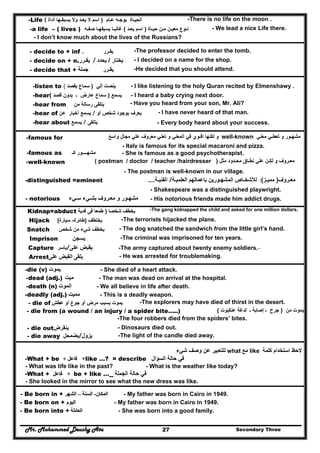
-Life ( ‫عـام‬ ‫بوجـه‬ ‫الحيـاة‬)‫يعـ‬ ‫ال‬ ‫اسم‬‫أداة‬ ‫يسبقـھا‬ ‫وال‬ ‫د‬ -There is no life on the moon .
-a life – ( lives ) ‫حيـاة‬ ‫مـن‬ ‫معيـن‬ ‫نـوع‬)‫يعـد‬ ‫اسم‬(‫صفـه‬ ‫يسبقھـا‬ ‫غالبـا‬ - We lead a nice Life there.
- I don’t know much about the lives of the Russians?
- decide to + inf ‫يقـرر‬. -The professor decided to enter the tomb.
- decide on + n.‫يقـرر‬ / ‫يختار‬/‫يحدد‬ - I decided on a name for the shop.
- decide that + ‫جملة‬ ‫يقـرر‬ -He decided that you should attend.
-listen to ‫إلي‬ ‫ينصت‬)‫بقصد‬ ‫سماع‬( - I like listening to the holy Quran recited by Elmenshawy .
-hear ‫يسمع‬)‫قصد‬ ‫بدون‬ ‫ـ‬ ‫عارض‬ ‫سماع‬( - I heard a baby crying next door.
-hear from ‫من‬ ‫رسالة‬ ‫يتلقى‬ - Have you heard from your son, Mr. Ali?
-hear of ‫أخبار‬ ‫يسمع‬‫عن‬ / ‫أو‬ ‫شخص‬ ‫بوجود‬ ‫يعرف‬ - I have never heard of that man.
-hear about ‫يسمع‬ / ‫يتلقى‬ - Every body heard about your success.
-famous for ‫مشھ‬‫ـ‬‫تعط‬ ‫و‬ ‫ور‬‫ـ‬‫معني‬ ‫ي‬well-known‫اق‬ ‫لكنھا‬ ‫و‬‫ـ‬‫واسع‬ ‫مجال‬ ‫علي‬ ‫معروف‬ ‫تعني‬ ‫و‬ ‫المعني‬ ‫في‬ ‫وي‬
- Italy is famous for its special macaroni and pizza.
-famous as ‫مشھ‬‫ـــ‬‫ك‬ ‫ـور‬‫ـ‬ - She is famous as a good psychotherapist.
-well-known ‫مع‬‫ـ‬‫لك‬ ‫و‬ ‫روف‬‫ـ‬‫نط‬ ‫علي‬ ‫ن‬‫ـ‬‫مح‬ ‫اق‬‫ـ‬‫دود‬‫مثل‬)( postman / doctor / teacher /hairdresser
- The postman is well-known in our village.
-distinguished =eminent ‫مع‬‫ـ‬‫روف‬)‫ممي‬‫ـ‬‫ز‬(:‫لألشخ‬‫ـ‬‫المشھ‬ ‫اص‬‫ـ‬‫العلمي‬ ‫باعمالھم‬ ‫ورين‬‫ـة‬/‫الفني‬‫ـة‬……
- Shakespeare was a distinguished playwright.
- notorious ‫مشھ‬‫ـ‬‫مع‬ ‫و‬ ‫ور‬‫ـ‬‫روف‬‫ب‬‫ش‬‫ـ‬‫س‬ ‫يء‬‫ـ‬‫يء‬ - His notorious friends made him addict drugs.
Kidnap=abduct ‫شخصا‬ ‫يخطف‬)‫فدية‬ ‫فى‬ ‫طمعا‬ -The gang kidnapped the child and asked for one million dollars.
Hijack ‫يختطف‬)‫طائرة‬-‫سيارة‬( -The terrorists hijacked the plane.
Snatch ‫شخص‬ ‫من‬ ‫شيء‬ ‫يخطف‬ - The dog snatched the sandwich from the little girl’s hand.
Imprison ‫يسجن‬ -The criminal was imprisoned for ten years.
Capture ‫يأسر‬/‫على‬ ‫يقبض‬ -The army captured about twenty enemy soldiers.-
Arrest‫على‬ ‫القبض‬ ‫يلقى‬ - He was arrested for troublemaking.
-die (v) ‫يموت‬ - She died of a heart attack.
-dead (adj.) ‫ميت‬ - The man was dead on arrival at the hospital.
-death (n) ‫الموت‬ - We all believe in life after death.
-deadly (adj.) ‫مميت‬ - This is a deadly weapon.
- die of ‫عطش‬ ‫أو‬ ‫جوع‬ ‫أو‬ ‫مرض‬ ‫بسبب‬ ‫يموت‬ -The explorers may have died of thirst in the desert.
- die from (a wound / an injury / a spider bite…..) ‫من‬ ‫يموت‬)‫جرح‬‫ـ‬‫إصابة‬‫ـ‬‫عنكبوت‬ ‫لدغة‬(
-The four robbers died from the spiders’ bites.
- die out‫ينقرض‬ - Dinosaurs died out.
- die away ‫يزول/يضمحل‬ -The light of the candle died away.
‫استخدام‬ ‫الحظ‬‫كلمة‬like‫مع‬what‫شيء‬ ‫وصف‬ ‫عن‬ ‫للتعبير‬
-What + be +‫فاعل‬‫فاعل‬++ like …? = describe ‫السؤال‬ ‫حالة‬ ‫في‬
- What was life like in the past? - What is the weather like today?
-What + +‫فاعل‬‫فاعل‬ be + like … ‫الجملة‬ ‫حالة‬ ‫في‬
- She looked in the mirror to see what the new dress was like.
- Be born in + ‫المكان‬‫المكان‬--‫السنة‬‫السنة‬––‫الشھر‬‫الشھر‬ - My father was born in Cairo in 1949.
- Be born on + ‫اليوم‬‫اليوم‬ - My father was born in Cairo in 1949.
- Be born into + ‫العائلة‬‫العائلة‬ - She was born into a good family.
Mr. Mohammed Deushy Ata Secondary Three28
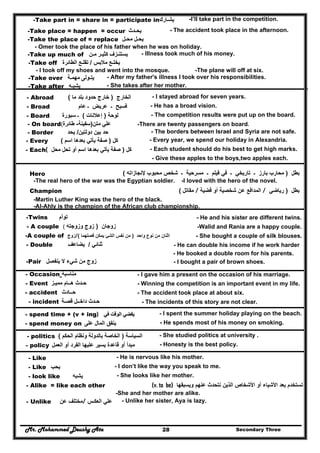
-Take part in = share in = participate in‫يشـارك‬ -I’ll take part in the competition.
-Take place = happen = occur ‫يحـدث‬ - The accident took place in the afternoon.
-Take the place of = replace ‫يحـل‬‫محـل‬
- Omer took the place of his father when he was on holiday.
-Take up much of ‫يستن‬‫ـ‬‫زف‬‫كثي‬‫ـ‬‫ر‬‫م‬‫ـ‬‫ن‬ - Illness took much of his money.
-Take off ‫يخلـع‬‫مالبس‬/‫تقلـع‬‫الطائرة‬
- I took off my shoes and went into the mosque. -The plane will off at six.
-Take over ‫يتـولى‬‫مھمـة‬ - After my father's illness I took over his responsibilities.
-Take after ‫يشبـه‬ - She takes after her mother.
- Abroad ‫الخارج‬)‫ما‬ ‫بلد‬ ‫حدود‬ ‫خارج‬( - I stayed abroad for seven years.
- Broad ‫ـ‬ ‫فسيح‬‫ـ‬ ‫عريض‬‫عام‬ - He has a broad vision.
- Board ‫لوحة‬)‫إعالنات‬(‫سبورة‬ ‫ـ‬ - The competition results were put up on the board.
-There are twenty passengers on board.‫علي‬‫متن‬)‫سفينة‬-‫طائرة‬(- On board
- Border ‫دولتين‬ ‫بين‬ ‫حد‬/‫يحد‬ - The borders between Israel and Syria are not safe.
- Every ‫كل‬)‫اسم‬ ‫بعدھا‬ ‫يأتي‬ ‫صفة‬( - Every year, we spend our holiday in Alexandria.
- Each( ‫كل‬)‫محل‬ ‫تحل‬ ‫أو‬ ‫اسم‬ ‫بعدھا‬ ‫يأتي‬ ‫صفة‬ - Each student should do his best to get high marks.
- Give these apples to the boys,two apples each.
Hero ‫بطل‬)‫إلنجازاته‬ ‫محبوب‬ ‫شخص‬ ‫ـ‬ ‫مسرحية‬ ‫ـ‬ ‫فيلم‬ ‫في‬ ‫ـ‬ ‫تاريخي‬ ‫ـ‬ ‫بارز‬ ‫محارب‬(
-The real hero of the war was the Egyptian soldier. -I loved with the hero of the novel.
Champion ‫بطل‬)‫رياضي‬/‫قضية‬ ‫أو‬ ‫شخصية‬ ‫عن‬ ‫المدافع‬/‫مقاتل‬(
-Martin Luther King was the hero of the black.
-Al-Ahly is the champion of the African club championship.
-Twins ‫توأم‬ - He and his sister are different twins.
- A couple ‫زوجان‬)‫وزوجته‬ ‫زوج‬( -Walid and Rania are a happy couple.
-A couple of ‫زوج‬/ ‫واحد‬ ‫نوع‬ ‫من‬ ‫اثنان‬)‫الشئ‬ ‫نفس‬ ‫من‬‫فصلھما‬ ‫يمكن‬( - She bought a couple of silk blouses.
- Double ‫ثنائي‬/‫يضاعف‬ - He can double his income if he work harder
- He booked a double room for his parents.
-Pair ‫من‬ ‫زوج‬‫شيء‬‫ينفصل‬ ‫ال‬ - I bought a pair of brown shoes.
- Occasion ‫مناسبة‬ - I gave him a present on the occasion of his marriage.
- Event ‫ح‬‫ـ‬‫ھ‬ ‫دث‬‫ــ‬‫ممي‬ ‫ام‬‫ـ‬‫ز‬ - Winning the competition is an important event in my life.
- accident ‫ح‬‫ـ‬‫ـادث‬ - The accident took place at about six.
- incident ‫داخ‬ ‫حـدث‬‫ــ‬‫قص‬ ‫ل‬‫ـ‬‫ة‬ - The incidents of this story are not clear.
- spend time + (v + ing)) ‫في‬ ‫الوقت‬ ‫يقضي‬‫في‬ ‫الوقت‬ ‫يقضي‬ - I spent the summer holiday playing on the beach.
- spend money on ‫على‬ ‫المال‬ ‫ينفق‬ - He spends most of his money on smoking.
- politics ‫السياسة‬)‫الحكم‬ ‫ونظام‬ ‫بالدولة‬ ‫الخاصة‬( - She studied politics at university .
- policy ‫العمل‬ ‫أو‬ ‫الفرد‬ ‫عليھا‬ ‫يسير‬ ‫قاعدة‬ ‫أو‬ ‫مبدأ‬ - Honesty is the best policy.
- Like
‫ث‬
- He is nervous like his mother.
- Like ‫يحب‬ - I don’t like the way you speak to me.
- look like ‫يشبه‬ - She looks like her mother.
- Alike = like each other ‫تستخدم‬‫ويسبقھا‬ ‫عنھم‬ ‫نتحدث‬ ‫الذين‬ ‫األشخاص‬ ‫أو‬ ‫األشياء‬ ‫بعد‬(v. to be)
-She and her mother are alike.
- Unlike ‫عن‬ ‫مختلف‬/ ‫س‬‫العك‬ ‫علي‬ - Unlike her sister, Aya is lazy.
Mr. Mohammed Deushy Ata Secondary Three29
-‫عند‬‫إضافة‬‫حرف‬s‫إلي‬‫عقد‬ ‫أي‬ ‫سنوات‬ ‫عشر‬ ‫فترة‬ ‫بھا‬ ‫نقصد‬ ‫السنة‬decade:
- In the 1960s = from 1960 to 1969.
- decade = 10 years -Century = 100 years - millennium = 1000 years
--‫استخدام‬ ‫الحظ‬take‫بعدھا‬ ‫ويأتي‬ ‫يستغرق‬ ‫بمعني‬ ‫للزمن‬to+inf.
-The Prisoner of Zenda took Hope a few months to write.
- How long does it take to do this job?
-Do you mind if I use your dictionary? -Not in the least = not at all ‫كال‬‫/كال‬/ ‫االطالق‬ ‫علي‬‫االطالق‬ ‫علي‬
-Train as a/an + job: - He trained as a teacher.
--‫بعد‬ ‫الثالث‬ ‫التصريف‬ ‫استخدام‬ ‫الحظ‬‫بعد‬ ‫الثالث‬ ‫التصريف‬ ‫استخدام‬ ‫الحظ‬aass‫للمجھول‬ ‫مبنية‬ ‫كانت‬ ‫لجملة‬ ‫اختصار‬ ‫ھنا‬ ‫وھو‬ ‫أحيانا‬‫للمجھول‬ ‫مبنية‬ ‫كانت‬ ‫لجملة‬ ‫اختصار‬ ‫ھنا‬ ‫وھو‬ ‫أحيانا‬
-As + PP.
- The coronation took place as planned. = The coronation took place as it has been planned.
- Fiction ‫خيال‬‫خيال‬‫قصصى‬‫قصصى‬ - Novels and plays are usually works of fiction.
- Fictional (hero/country) ‫خيالى‬‫خيالى‬ - Abu Zeid Elhelaly is mostly a fictional hero .
- He borrowed some money from the bank.‫يستلف‬‫يستلف‬//‫يستعير‬‫يستعير‬- Borrow
- This library loans books, CDs and videotapes.‫يسلف‬‫يسلف‬//‫يقرض‬‫يقرض‬- Loan
- The bank lent the businessman 500000 pounds.‫يسلف‬‫يسلف‬//‫يقرض‬‫يقرض‬- Lend
- I owe you ten pounds.‫يدين‬‫يدين‬- Owe
-The company has published all his books.‫ينشر‬‫ينشر‬))‫كتاب‬‫كتاب‬‫أو‬‫أو‬‫صحيفة‬‫صحيفة‬‫مثال‬‫مثال‬((-Publish
- If you want to sell your product, you must advertise it.
‫عن‬ ‫يعلن‬‫عن‬ ‫يعلن‬))‫خدمات‬ ‫أو‬ ‫سلع‬‫خدمات‬ ‫أو‬ ‫سلع‬((-Advertise
‫يستغرق‬‫يستغرق‬‫مصدر‬‫مصدر‬++ ttoo ++‫زمنية‬ ‫مدة‬‫زمنية‬ ‫مدة‬++‫مفعول‬ ‫ضمير‬ ‫أو‬ ‫اسم‬‫مفعول‬ ‫ضمير‬ ‫أو‬ ‫اسم‬- It takes / took /has taken/ will take…. +
- It took me two hours to do my homework. - How long does it take you to do this job?
-He was about to leave the house when the phone rang.‫تقريبا‬ً‫تقريبا‬ً//‫وشك‬ ‫على‬‫وشك‬ ‫على‬‫مصدر‬‫مصدر‬- be about to +
It + be+ ‫صفة‬‫صفة‬ +to + ‫مصدر‬‫مصدر‬
-It was easy to answer all the questions. - He was shocked to see the homeless poor people.
- Debate ‫مناظرة‬‫مناظرة‬ -The candidates made debates on TV.
- Conference ‫مؤتمر‬‫مؤتمر‬ -The minister met all teachers through video conference.
- Seminar ‫ندوة‬‫ندوة‬ - Huda attended a religious seminar at the school library.
- Forum ‫منتدى‬‫منتدى‬ - We all like cultural forums.
-Put down ‫يضع‬‫يضع‬‫جانبا‬‫جانبا‬ - Put down your problems and study for your exams.
- Put off ‫يؤجل‬‫يؤجل‬ - Don’t put off until tomorrow what you should do today.
- Put out ‫يطفئ‬‫يطفئ‬ -Firemen putout Fire.
-Put on ‫يرتدى‬‫يرتدى‬ - Put on your jacket before you go out.
-Put forward ‫يقترح‬‫يقترح‬ - Ali always puts forward new ideas.
- Put away ‫يسجن‬‫يسجن‬ - Police put criminals away.
- Put up with ‫يتحمل‬‫يتحمل‬ - I can’t put up with his bad behaviour.
Mr. Mohammed Deushy Ata Secondary Three30
Communication Skills
Expressing Interest & Surprise
‫الدھشة‬ ‫عن‬ ‫التعبير‬‫الدھشة‬ ‫عن‬ ‫التعبير‬Expressing surprise ‫االھتمام‬ ‫عن‬ ‫التعبير‬‫االھتمام‬ ‫عن‬ ‫التعبير‬Expressing interest
- How amazing! - How interesting!
- That’s very surprising - Is that right?
- Really? I didn’t know that. - That’s very interesting
- Good heavens! - Really?
- That’s unbelievable! - Are you? - Is he? Are they?
lack of surprise ‫عن‬ ‫التعبير‬‫عن‬ ‫التعبير‬‫عدم‬‫عدم‬‫الدھشة‬‫الدھشة‬ lack of interest ‫عن‬ ‫التعبير‬‫عن‬ ‫التعبير‬‫عدم‬‫عدم‬‫االھتمام‬‫االھتمام‬
That’s hardly surprising. - I'm not interested in….
I'm not surprised. - …….leaves me cold.
Exercises
Respond the following situations:
1.Someone tells you that he has won two Olympic gold medals. You are very surprised.
2.You want to know if you can watch the DVD when he or she has watched it.
3.You want to know your friend's opinion of the DVD.
4.Your friend bought a new DVD last week. You want to know if he or she has watched it.
5.Your friend says yes. You are very pleased.
6.Your friend says," Tutankhamen became Pharaoh when he was only nine years old."
7.Your friend tells you that he is going to travel to space.
8.Your mother tells you that the prices of food will go down. You are interested.
9.Your sister tells you that the sun is millions of miles away from the Earth. Express how you feel
about this.
2- Mention the place, the speakers and the language each of the following two min-
dialogues:
1- A: why are you late? B: the metro has broken down.
A: but you are always late for the first lesson. B: I am really sorry, sir.
2- A: Excuse me. How can I go to the pyramids?
B: You can take the bus No.41 A: thank you very much, sir.
3- A: May I see your ticket, please? B: Here you are.
A: Seat 23A. That’s this row here. B: Thank you .What time does it start?
A: The programme starts at 9.00. The film is at 9.15.
4- A: Hello! Can I help you, sir? B: Yes, I would like to have a single room.
A : with or without a bathroom? B: with a bathroom, please.
Place: ………… - Speaker A: …………… - Speaker B: ……..…… - Function: ……………………
Mr. Mohammed Deushy Ata Secondary Three31
Choose the correct answer from a , b , c , or d :
1.The terrorists ……………. the wealthy businessman.
a- snatched b- kidnapped c- hijacked d- snatches
2.He was happy as he was crowned …………. Success
a- at b- by c- from d- with
3.Our factory is based ……………. Alexandria.
a- at b- by c- from d- in
4.The Prisoner of Zenda was ready for ……a few months after Anthony Hope thought of the idea.
a-application b– classification c- publication d-clarification
5.The government does its best to help young …… to buy their own homes.
a- pairs b-couples c- doubles d- a pair
6.The story is not true , it is -------------------
a – real b – fictional c – right d – famous
7.………………. means the study of the language and history of the ancient Greeks and Romans.
a - Classic b - classical c - classify d - classics
8.My Sister is --------- she had a good education.
a - good- educated b – well-educated c - will - educated d - well-education
9.The book will be --------------next week.
a – publication b – publisher c – publish d - published
10. We had a formal, organized discussion, that means ---------------
a – conflict b – debate c - forum d - fight
11. Escapism is a kind of ---------- that helps people to forget their worries.
a - fight b – discussion c - information d - entertainment
12. He is the main character, he is the ------- of the film.
a – heroine b – hero c - herb d - director
13. Antony Hope's story was ------- in 1890.
a – published b - bought c - stolen d - mended
14. Films and books can sometimes help people to ------ from their worries.
a - escape b – suffer c - wait d - sell
15. You can still see a lot of ------ architecture in Greece and Rome.
a - classical b - professional c - classics d - classes
16. He has a lot of money, he is a --------man.
a - wealth b - poor c - healthy d - wealthy
17. The --------- of Queen Elizabeth took place in 1952.
a - colonial b - organization c - permission d - coronation
18. He doesn't have the right --------- vote in the coming elections.
a - with b - in c- of d - to
19. He was interested in--------- and was a good speaker.
a - political b- politician c – politics d-policy
20. …………... the night before the meeting, the president cancelled it.
a- at b- on c- in d-off
21. Tutankhamun died after he fell ------------- his horse.
a - of b- at c - in d-off
22. Because the two brothers look so …, nobody realizes who kills the king.
a- like b- alike c- likes d-likes
23. They are having a ….. at school next week about developing education
a-disagreement b- conflict c- debate d- negotiation
24. They are not a …… family, although everyone works very hard.
a-worthy b-wealthy c-healthy d- filthy
25. Children in Egypt ….. primary school between the ages of 6 and 11.
a-attend b- intend c- tend d- pretend
26. The ………..of Queen Elizabeth II took place in 1952.
a-collaboration b- coronation c- corporation d- combination
27. In Egypt, all people have the …….. to vote
a-left b- wrong c- right d- sight
28. ……… is a very large strong building built in the past to protect the people inside from attack
a- Castle b- Flat c- House d- Villa
Mr. Mohammed Deushy Ata Secondary Three32
29. The characters here are ……... They are not real.
a-fictional b-intentional c- additional d- conventional
30. 30-The story takes ……….. in 19th century Europe.
a-space b- part c- place d- the place
31. He was locked……… the castle at Zenda.
a- on b- in c- at d-of
32. Our army can protect us ……. any enemy.
a-of b- with c- from d- at
33. Yara is going to study ………… at university.
a-classics b- classic c- classical d- classification
34. Winning the cup is a great …….
a-admission b- collision c- occasion d- concession
35. The Egyptian monuments are very popular …………..tourists.
a-of b- to c- with d- on
36. ………….…is a kind of entertainment that helps people to forget about their worries.
a-Capitalism b- Colonialism c- Globalism d- Escapism
37. The story is not true , it is ……………….
a- real b– fictional c– right d– famous
38. ---------- means the study of the language and history of the ancient Greeks and Romans.
a-Classic b– classical c– classify d– classics
39. My Sister is --------- she had a good education.
a-good educated b– well educated c – will educated d– well education
40. The book will be --------------next week.
a-publication b– publisher c– publish d– published
41. We had a formal, organized discussion, that means ---------------
a- conflict b – debate c – forum d– fight
42. Escapism is a kind of ---------- that helps people to forget their worries.
a-fight b– discussion c – information d– entertainment
43. He is the main character , he is the ------- of the film.
a- heroine b– hero c– herb d– director
44. He killed the girl and went to ----------------and spent 20 years.
a-jail b – forum c – castle d – museum
45. Antony Hope's story was ------- in 1890.
a- published b – bought c– stolen d– mended
46. Films and books can sometimes help people to ------ from their worries.
a-escape b – suffer c– wait d– sell
47. You can still see a lot of ------ architecture in Greece and Rome.
a-classical b– professional c– classics d– classes
48. He has a lot of money, he is a -------- man.
a-wealth b– poor c – healthy d – wealthy
49. The --------- of Queen Elizabeth took place in 1952.
a-colonial b– organization c– permission d– coronation
50. He doesn't have the right --------- vote in the coming elections.
a- with b– in c– of d– to
51. 50-After finishing school , he went to Oxford University-------- he studied classics.
a- who b – which c– when d– where
52. The --------------- were married later that year.
a- pair b– double c– two d– couple
53. He was interested in--------- and was a good speaker.
a- political b – politician c– politics d- policy
54. The police ---------- chased the suspect.
a- are b– is c – were d– have
55. Mathematics -------------- a very difficult subject for me.
a- is b– are c – have been d– were
56. Tutankhamun died after he fell ------------- his horse.
a- of b– at c– in d– off
57. My brother is very ………. . he went to Cairo University and then Oxford.
Mr. Mohammed Deushy Ata Secondary Three33
a- well-known b- ignorant c- well-educated d– illiterate
58. We’re having a ….... At school next week about ways of reducing global warming.
a-debit b- debate c - debt d– debase
59. For some people, reading and watching films are forms of ……….
a-escape b- escaping c– escapist d – escapism
60. In the past, English children studied …… at school. Now most schools teach modern languages.
a-classic b- classics c- class d– classical
61. Oliver Twist is the ……….... hero of one of Charles Dickens’ most famous novels.
a-fictional b- fiction c- fictions d - fictionalize
Find the mistake in each of the following sentences then write them correctly:
1.A defeat is a formal organised discussion.
2.Before she did research on new treatments, she works as a surgeon.
3.Both my parents are tired. They no longer work.
4.Can you tell me what the thief was alike?
5.Escaping is entertainment that helps people to forget about their.
6.He had to pay to his first novel.
7.He was a good education man who went to Oxford University.
8.He was fond of listening to the classical of Mozart and Beethoven.
9.I hadn’t heard from Anthony Hope until last week.
10. I want to be a doctor since I was ten.
11. It took him five hours finishing the report.
12. Many people went to London to watch the corony of Queen Elizabeth.
13. My brother has a difficult decision to do next week.
14. Over two thousand people pretended the meeting.
15. People over 18 have the tight to vote in elections.
16. Rudolf Elphberg is hijacked by his younger brother Michael.
17. She is very popular for a lot of people here.
18. She went to London a pair of years ago.
19. The book was publicated so many could know about it.
20. The ceremony of the coordination of the queen was attended by millions of people.
21. The children intend school from the ages of 6 to 12 in Egypt.
22. The combination of the king took place in the royal palace.
23. The gang hijacked the boy and asked for a lot of money to let him go.
24. The newly married pair are very happy.
25. The president pretended the final match.
26. These two sisters are so like.
27. They did the right to know about this crucial issue.
28. This novel is intentional. It's not real.
29. We all have the tight to vote in elections.
30. What did you do since the weekend?
31. When I was eight. I have seen a programme about a famous doctor on TV.
32. When the company needs people to speak for it at a meeting, it can send a relation.
33. When would you start to learn English? – Two years ago.
34. While he does his homework, his friend arrived.
-Translate into Arabic:
Everyone who has travelled in space has described the magic feeling of looking down on
the Earth as it spins. It is impossible to go for a walk. However, you can do exercises.
………………………………………………………………………………………………………………………
………………………………………………………………………………………………………………………...
Anthony Hope wrote thirty-two works of fiction, but The Prisoner of Zenda was always his
most popular story. It made him a lot of money. A lot of firms have been based on the story,
and the public still enjoy reading it today.
………………………………………………………………………………………………………………………
………………………………………………………………………………………………………………………...
Modern societies need enormous amounts of power for heating, lighting and industry. Most of
this power comes from coal and oil. Experts say that this type of fuel will soon be used up.
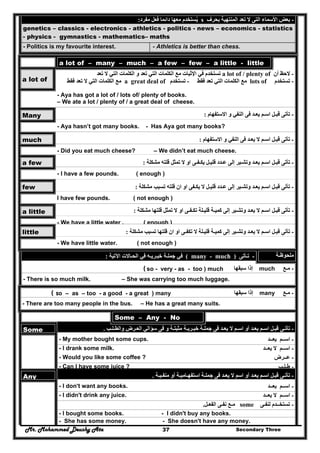
Scientists will have to search for alternative sources of energy.
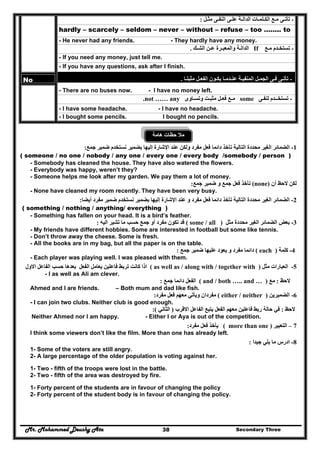
………………………………………………………………………………………………………………………
………………………………………………………………………………………………………………………...
Mr. Mohammed Deushy Ata Secondary Three34
-Translate into English:
‫الغرفة؟‬ ‫خارج‬ ‫تكون‬ ‫حينما‬ ‫االنوار‬ ‫تطفئ‬ ‫ھل‬
………………………………………………………………………………………………………………………
‫القاھرة‬ ‫بجامعة‬ ‫داليا‬ ‫التحقت‬ ‫المدرسية‬ ‫دراستھا‬ ‫أنھت‬ ‫بعدما‬.
………………………………………………………………………………………………………………………
………………………………………………………………………………………………………………………...
‫مب‬ ‫جنيه‬ ‫مليون‬ ‫اثنان‬‫المال‬ ‫من‬ ‫كبير‬ ‫لغ‬
………………………………………………………………………………………………………………………
‫االخري‬ ‫المواصالت‬ ‫وسائل‬ ‫و‬ ‫للسيارات‬ ‫الوقود‬ ‫صناعة‬ ‫في‬ ‫االماكن‬ ‫بعض‬ ‫في‬ ‫السكر‬ ‫قصب‬ ‫يستخدم‬.
………………………………………………………………………………………………………………………
………………………………………………………………………………………………………………………...
‫الجماعي‬ ‫العمل‬ ‫إن‬‫الناس‬ ‫بين‬ ‫اإلنسانية‬ ‫القيم‬ ‫و‬ ‫الروابط‬ ‫يقوي‬.
………………………………………………………………………………………………………………………
………………………………………………………………………………………………………………………...
‫القومي‬ ‫االقتصاد‬ ‫تحسين‬ ‫أجل‬ ‫من‬ ‫مصر‬ ‫في‬ ‫األجنبية‬ ‫االستثمارات‬ ‫نشجع‬ ‫أن‬ ‫البد‬.
………………………………………………………………………………………………………………………
………………………………………………………………………………………………………………………...
Countable and uncountable nouns
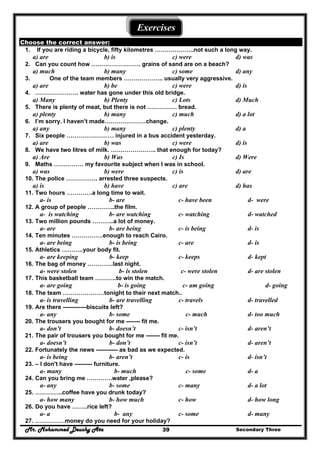
Countable nouns ‫تعــد‬ ‫التى‬ ‫األسمـاء‬
1–‫جمع‬ ‫و‬ ‫مفرد‬ ‫لھا‬ ‫يكون‬ ‫تعد‬ ‫التي‬ ‫األسماء‬:
- a car cars - a dog dogs - an apple apples
‫باضافة‬ ‫تجمع‬ ‫ال‬ ‫شاذة‬ ‫اسماء‬ ‫وھناك‬)s/es/ies(‫مثل‬:
- Man men - child children - mouse mice
2–‫اآلتي‬ ‫نستخدم‬ ‫أن‬ ‫يمكن‬ ‫يعد‬ ‫الذي‬ ‫المفرد‬ ‫األسم‬ ‫قبل‬:
a / an - I've just seen a train/an accident.
The - Where's the book I lent you?
One - There are 60 seconds in one minute.
3–‫األتي‬ ‫نستخدم‬ ‫أن‬ ‫ممكن‬ ‫الجمع‬ ‫األسماء‬ ‫قبل‬:
Some Many The Several
any How many? Two, three etc Few
-‫ا‬ ‫بعض‬‫والجمع‬ ‫المفرد‬ ‫في‬ ‫التكوين‬ ‫نفس‬ ‫لھا‬ ‫لكلمات‬:
‫ا‬(‫مثل‬ ‫الحيوانات‬ ‫انواع‬ ‫بعض‬:( sheep / deer / fish / salmon )
- A sheep was grazing in the field. - Some sheep were grazing in the field.
‫ب‬(‫مثل‬ ‫االسماء‬ ‫بعض‬:( aircraft / spacecraft )
- One craft is going to take off. - Two aircraft are going to take off.
‫ج‬(‫ب‬ ‫تنتھي‬ ‫التي‬ ‫االسماء‬ ‫بعض‬)s(‫مثل‬ ‫واالجمع‬ ‫المفرد‬ ‫في‬:
( crossroads / means / series / species / works ‫أدبية‬ ‫أعمال‬ )
- A car is a means of transport. - Cars are a means of transport.
Uncountable nouns ‫تعــد‬ ‫ال‬ ‫التي‬ ‫األسمـاء‬
-‫يأخـذ‬ ‫وال‬ ‫عـده‬ ‫يمكـن‬ ‫ال‬ ‫يعـد‬ ‫ال‬ ‫الذى‬ ‫ھواالسـم‬)- onea - an(‫المفـرد‬ ‫معاملة‬ ‫يعامل‬ ‫و‬:
news - information - oil- advice -water - money - music - bread - luggage - baggage - cloth….
-‫يعـ‬ ‫ال‬ ‫الذي‬ ‫االسـم‬ ‫مـع‬ ‫الكلمـات‬ ‫ھـذه‬ ‫استخدام‬ ‫ويمكـن‬‫د‬.
( a lot of – much – little – some – any )
A lot of wisdom – some knowledge – little juice – much water – any information………
Mr. Mohammed Deushy Ata Secondary Three35
‫تشمـل‬ ‫تعـد‬ ‫ال‬ ‫التي‬ ‫واألسمـاء‬:
1 - Abstract nouns -‫المجـردة‬ ‫األسمـاء‬
honesty ‫-امانة‬ hope - beauty - help- love – hatred ‫كراھية‬- confidence ‫ث‬‫قة‬ – courage ‫شجاعة‬ –
experience ‫خبرة‬ - progress ‫تقدم‬ – evidence ‫دليل‬ – patience ‫صبر‬– peace ‫سالم‬ – poverty ‫فقر‬ - ….. etc.
2 - Materials -‫عـام‬ ‫بوجـه‬ ‫تستخـدم‬ ‫عنـدما‬ ‫المـواد‬ ‫أسمـاء‬
coffee - glass - gold - iron - lime – paper - stone – sand –soil - sugar- tea - wood …..… etc.
3 - School subjects history - psychology- mathematics- physics - biology …… etc.
4 - Fluids ‫السوائل‬ water – coffee – oil - milk – soup – blood……. etc.
5 - Sports‫الرياضات‬ football - volleyball –basketball – swimming….etc.
6 - Gases ‫الغازات‬‫الغازات‬ oxygen – hydrogen – nitrogen-ammonia - carbon dioxide… etc.
7 - Languages ‫اللغات‬‫اللغات‬ English – Arabic – French – Italian – Spanish - German
8 - Different activities
‫األنشطة‬‫األنشطة‬‫المختلفة‬‫المختلفة‬
reading – smoking - writing - studying - shopping – eating –
painting - fishing
9 - Natural phenomena ‫الطبيعية‬ ‫الظواھر‬‫الطبيعية‬ ‫الظواھر‬ lightning – heat – snow – thunder – light - rain
10- Meals ‫الوجبات‬‫الوجبات‬ Breakfast – lunch – dinner – supper
11 - Other nouns
jewellery ‫مجوھرات‬ – money - laughter ‫ضحك‬ - rubbish - equipment ‫معدات‬ –
furniture ‫اثاث‬ – cash ‫نقدية‬ – work – clothing ‫الملبس‬ – electricity - traffic ‫مرور‬ -
baggage ‫حقائب‬ - luggage ‫امتعة‬ - machinery …….
-‫األداة‬ ‫تسبقھا‬ ‫أن‬ ‫يمكن‬ ‫تعد‬ ‫ال‬ ‫التي‬ ‫الكلمات‬ ‫بعض‬ُa/an‫الصفة‬ ‫قبلھا‬ ‫جاءت‬ ‫إذا‬:
- We had a nice breakfast. – I spent a nice time on the beach.
‫مفـرد‬ ‫لھـا‬ ‫وليس‬ ‫جمـع‬ ‫ودائمـا‬ ‫تعـد‬ ‫ال‬ ‫اآلتيـة‬ ‫األسمـاء‬
–‫ال‬ ‫بعض‬‫ومنھا‬ ‫الجمع‬ ‫معاملة‬ ‫وتعامل‬ ‫مفرد‬ ‫لھا‬ ‫ليس‬ ‫كلمات‬:
1-‫مثل‬ ‫نصفين‬ ‫من‬ ‫تتكون‬ ‫التي‬ ‫االشياء‬:
Trousers / glasses / scales / gloves /shorts /spectacles / pyjamas / pliers
2-‫ب‬ ‫المنتھية‬ ‫االسماء‬ ‫بعض‬)ings(‫مثل‬
savings‫مدخرات‬ / lodgings ‫حجرة‬‫لاليجار‬ / surroundings ‫المحيطة‬ ‫األشياء‬
3-‫أخري‬ ‫سماء‬ ‫أ‬:
Police/ people / youth/clothes/ wages/ goods ‫لع‬‫س‬ / troops ‫وات‬‫ق‬ / arms ‫لحة‬‫أس‬ / remains ‫ا‬‫بقاي‬ /
cattle ‫ال‬‫ماشية‬ / contents ‫محتويات‬ / memoirs ‫مذكرات‬‫حياة‬ / cards ‫كوتشينة‬ / billiards ‫البلياردو‬… etc.
- Our yyoouutthh are the power of development. – The police have arrested the thieves.
‫كاآلتي‬ ‫تـعـد‬ ‫أسمـاء‬ ‫إلى‬ ‫تـعـد‬ ‫ال‬ ‫التي‬ ‫األسمـاء‬ ‫تحــويــل‬ ‫يمكـن‬: ‫ملحوظـة‬
1-‫استخــدام‬)bit - piece(‫الجمـع‬ ‫وفى‬ ‫المفرد‬ ‫عـامـھفي‬ ‫تجـزئـة‬ ‫كـألفـاظ‬)bits - pieces(:
-I gave her a piece ( a bit ) advice. - She knew pieces of information about the competition.
2-‫تجـزئـة‬ ‫ألفاظ‬ ‫استخـدام‬‫مثـل‬ ‫غيـرھـا‬ ‫مـع‬ ‫تستخـدم‬ ‫وال‬ ‫الكلمـات‬ ‫بعـض‬ ‫مـع‬ ‫وتستخـدم‬ ‫محددة‬ ‫كميـات‬ ‫إلى‬ ‫تشيـر‬:
A tube of toothpaste ‫اسنان‬ ‫معجون‬ ‫انبوبة‬ A bag of flour ‫دقيق‬ ‫كيس‬
A box of matches ‫كبريت‬ ‫علبة‬ A lump of sugar ‫سكر‬ ‫مكعب‬
A packet of cigarettes ‫سجائر‬ ‫علبة‬ A spoonful of sugar ‫شاي‬ ‫ملعقة‬ ‫ملئ‬
A sheet of paper ‫ورق‬ ‫فرخ‬ A slice of meat ‫لحم‬ ‫شريحة‬
A reel of cotton ‫قطن‬ ‫بكرة‬ A loaf of bread ‫خبز‬ ‫رغيف‬
A packet of needles ‫ابر‬ ‫علبة‬ A grain of sand ‫رمل‬ ‫حبة‬
A drop of water ‫ماء‬ ‫قطرة‬ A speck of dust ‫ذرة‬‫غبار‬
A glass of lemonade ‫ليموناده‬ ‫كوب‬ A bottle of milk ‫حليب‬ ‫زجاجة‬
A jar of jam ‫مربه‬ ‫برطمان‬ A bar of soup ‫صابون‬ ‫قطعة‬
Mr. Mohammed Deushy Ata Secondary Three36
-‫جزأي‬ ‫من‬ ‫المكونة‬ ‫األشياء‬ ‫أسماء‬‫مثل‬ ‫ن‬gloves / scissors / trousers / shoes / socks glasses‫كلمة‬ ‫معھا‬ ‫نستخدم‬pair
‫كلمة‬ ‫وبدون‬pair‫جمع‬ ‫الكلمات‬ ‫ھذه‬ ‫تعتبر‬ُ:
- His trousers are dirty. - A pair of socks doesn't cost much money.
3-‫المـاد‬ ‫اسـم‬ ‫نجمـع‬ ‫وال‬ ‫التجـزئـة‬ ‫لفـظ‬ ‫نجمـع‬ ‫الجمـع‬ ‫وعنـد‬‫ة‬.
- four sheets of paper - five pairs of shoes – six jars of jam – two loaves of bread
- two slices of meat – six bars of chocolate – five cups of coffee……….
‫ال‬ ‫حسـب‬ ‫تعـد‬ ‫ال‬ ‫أو‬ ‫تعـد‬ ‫أن‬ ‫يمكـن‬ ‫األسمـاء‬ ‫بعـض‬‫مثـل‬ ‫معـنى‬. ‫ملحوظـ‬‫ة‬
paper – glass – coffee – time - cold - orange - light - iron - hair - chicken
- I bought some writing paper. -)‫الكتابة‬ ‫ورق‬/‫يعد‬ ‫ال‬(
- I’ll buy a paper. (= a newspaper) -‫جريدة‬)‫تعد‬(
- The shop window is made of glass. -)‫الزجاج‬/‫يعد‬ ‫ال‬(
- She drank a glass of orange juice . -‫كوب‬‫زجاجي‬
- Have you prepared the coffee? -‫قھوة‬)‫مشروب‬(
- Could we have two black coffees? = (cups of coffee) -‫القھوة‬ ‫من‬ ‫كوب‬ ‫أو‬ ‫فنجان‬
- There’s plenty of time before the match starts. -‫الوقت‬
- Run along the track ten times. -‫مرات‬
-The cold is unbearable this winter. -‫عموما‬ ‫البرد‬
- She has had a bad cold since Friday. -‫برد‬ ‫نزلة‬
- Mariam ate two oranges. -‫برتقال‬
-‫البرتقالى‬ ‫اللون‬- She is wearing an orange blouse.
- Hospital beds are made of iron. ‫الحديد‬)‫يعد‬ ‫ال‬(
- I bought an iron yesterday. -‫مكواة‬
- I had chicken, rice and salad. ( = chicken meat ) -‫الدجاج‬ ‫لحم‬
- The fox scared the chickens. -‫دجاجة‬
- The sun gives us light and heat. -‫الضوء‬/‫تعد‬ ‫ال‬ُ
-There are four lights in our classroom. -‫كھربي‬ ‫مصباح‬
- Her hair is long. -‫الشعر‬
-There are four hairs on your jacket. -‫شعرة‬
-‫االسما‬ ‫تعامل‬‫ء‬‫كمفرد‬ ‫الكلية‬)‫مفرد‬ ‫فعل‬ ‫وتأخذ‬(‫كجمع‬ ‫وتعامل‬ ‫واحدة‬ ‫كوحدة‬ ‫تصرفت‬ ‫اذا‬)‫جمع‬ ‫فعل‬ ‫وتأخذ‬(‫ستقلة‬‫م‬ ‫ة‬‫بطريق‬ ‫رد‬‫ف‬ ‫ل‬‫ك‬ ‫تصرف‬ ‫اذا‬
:
Army ‫جيش‬ - government ‫حكومة‬ - company- class ‫فصل‬/‫فصيلة‬ - couple ‫زوج‬ -crew ‫طائرة‬ ‫أو‬ ‫سفينة‬ ‫طاقم‬ -
crowd ‫جمع‬ ‫أو‬ ‫حشد‬ -gang ‫عصابة‬ -group -navy ‫البحرية‬ ‫القوات‬ -team-committee ‫لجنة‬ - staff‫عمل‬ ‫ھيئة‬ -
union ‫اتحاد‬ – council ‫مستشارين‬ ‫ھيئة‬ - audience ‫جمھور‬ – majority ‫األغلبية‬ – minority ‫االقلية‬ - press‫الصحافة‬
- university - family- population ‫سكان‬ - the public ‫العامة‬ ‫أو‬ ‫الجمھور‬ - cast ‫او‬ ‫فيلم‬ ‫في‬ ‫ممثلين‬
-The Egyptian Team is playing well. -‫واحدة‬ ‫كوحدة‬ ‫الفريق‬ ‫عن‬ ‫الكالم‬ ‫ھنا‬
- The team are leaving the pitch. -‫كأفراد‬ ‫الفريق‬ ‫نقصد‬ ‫ھنا‬
-‫كلمة‬school‫يتعلم‬ ‫الذي‬ ‫المكان‬ ‫بمعني‬‫تعد‬ ‫فھي‬ ‫كمبني‬ ‫المدرسة‬ ‫قصدنا‬ ‫إذا‬ ‫أما‬ ‫تعد‬ ‫ال‬ ‫الطالب‬ ‫فيه‬ُ ُ:
- She drives the kids to school every morning. - They're building a new school in the village.
-‫الجمع‬ ‫و‬ ‫المفرد‬ ‫صيغة‬ ‫نفس‬ ‫لھا‬ ‫اآلتية‬ ‫الكلمات‬:
crossroads ‫طرق‬ ‫تقاطع‬ / means ‫وسيلة‬ / series ‫س‬‫لسلة‬ / species ‫نوع‬
- A means of transport is…-Means of transport are…
-‫الفعل‬ ‫مع‬ ‫المفرد‬ ‫معاملة‬ ‫تعامل‬ ‫الحرارة‬ ‫ودرجات‬ ‫الوزن‬ ‫و‬ ‫المسافة‬ ‫و‬ ‫الثمن‬ ‫و‬ ‫والزمن‬ ‫المالية‬ ‫المبالغ‬ ‫و‬ ‫الكمية‬ ‫علي‬ ‫الدالة‬ ‫العبارات‬ُ:
- Fifty litres of water fills a camel’s hump. -Two billion pounds is a lot of money.
- Ten hours is a long time to sleep. -Twenty kilometres is a long distance to walk.
- Twenty degrees out of a hundred is a very bad mark.
‫الحظ‬ ‫ولكن‬:-
- Three one-pound coins are on the desk. -‫الجنيه‬ ‫فئة‬ ‫من‬ ‫معدنية‬ ‫عمالت‬ ‫ثالث‬
Mr. Mohammed Deushy Ata Secondary Three37
-‫األسماء‬ ‫بعض‬‫تعد‬ ‫ال‬ ‫التى‬‫بحرف‬ ‫المنتھية‬s‫مفرد‬ ‫فعل‬ ‫دائما‬ ‫معھا‬ ‫يستخدم‬ُ:
genetics – classics - electronics - athletics - politics - news – economics - statistics
- physics - gymnastics - mathematics– maths
- Politics is my favourite interest. - Athletics is better than chess.
a lot of – many – much – a few – few – a little - little
-‫أن‬ ‫الحظ‬a lot of / plenty of‫تعد‬ ‫ال‬ ‫التي‬ ‫الكلمات‬ ‫و‬ ‫تعد‬ ‫التي‬ ‫الكلمات‬ ‫مع‬ ‫اإلثبات‬ ‫في‬ ‫تستخدم‬
-‫تستخدم‬lots of‫فقط‬ ‫تعد‬ ‫التي‬ ‫الكلمات‬ ‫مع‬-‫تستخدم‬a great deal of‫فقط‬ ‫تعد‬ ‫ال‬ ‫التي‬ ‫الكلمات‬ ‫مع‬a lot of
- Aya has got a lot of / lots of/ plenty of books.
– We ate a lot / plenty of / a great deal of cheese.
-‫االست‬ ‫و‬ ‫النفي‬ ‫فى‬ ‫يعـد‬ ‫اسـم‬ ‫قبـل‬ ‫تأتى‬‫فھام‬:Many
- Aya hasn’t got many books. - Has Aya got many books?
-‫االستفھام‬ ‫و‬ ‫النفي‬ ‫فى‬ ‫يعـد‬ ‫ال‬ ‫اسـم‬ ‫قبـل‬ ‫تأتى‬:much
- Did you eat much cheese? – We didn’t eat much cheese.
-‫م‬ ‫قلته‬ ‫تمثل‬ ‫ال‬ ‫او‬ ‫يكـفـى‬ ‫قليـل‬ ‫عـدد‬ ‫إلى‬ ‫وتشـير‬ ‫يعـد‬ ‫اسـم‬ ‫قبـل‬ ‫تأتى‬‫شكلة‬:a few
- I have a few pounds. ( enough )
-‫مشكلة‬ ‫تسبب‬ ‫قلته‬ ‫ان‬ ‫او‬ ‫يكـفى‬ ‫ال‬ ‫قليـل‬ ‫عـدد‬ ‫إلى‬ ‫وتشـير‬ ‫يعـد‬ ‫اسـم‬ ‫قبـل‬ ‫تأتى‬:few
I have few pounds. ( not enough )
-‫تأتى‬‫ق‬ ‫تمثل‬ ‫ال‬ ‫او‬ ‫تكـفـى‬ ‫قليـلة‬ ‫كميـة‬ ‫إلى‬ ‫وتشـير‬ ‫يعـد‬ ‫ال‬ ‫اسـم‬ ‫قبـل‬‫مشكلة‬ ‫لتھا‬:a little
- We have a little water . ( enough )
-‫مشكلة‬ ‫تسبب‬ ‫قلتھا‬ ‫ان‬ ‫او‬ ‫تكفـى‬ ‫ال‬ ‫قليـلة‬ ‫كميـة‬ ‫إلى‬ ‫وتشـير‬ ‫يعـد‬ ‫ال‬ ‫اسـم‬ ‫قبـل‬ ‫تأتى‬:little
- We have little water. ( not enough )
‫ملحوظـة‬-‫تـأتى‬)many - much(‫اآلتية‬ ‫الحـاالت‬ ‫في‬ ‫خبـريـه‬ ‫جملـة‬ ‫في‬:
-‫مـع‬much‫سبقھا‬ ‫إذا‬(( so - very - as - too ) much
- There is so much milk. – She was carrying too much luggage.
-‫مـع‬many‫سبقھا‬ ‫إذا‬(( sso – as – too - a good - a great ) many
- There are too many people in the bus. – He has a great many suits.
Some – Any - No
-‫والطـلـب‬ ‫العـرض‬ ‫سؤالي‬ ‫فى‬ ‫و‬ ‫مثبتـة‬ ‫خبـريـة‬ ‫جملـة‬ ‫فى‬ ‫يعـد‬ ‫ال‬ ‫اسـم‬ ‫أو‬ ‫يعـد‬ ‫اسـم‬ ‫قبـل‬ ‫تأتـى‬.Some
-‫يعــد‬ ‫اســم‬- My mother bought some cups.
-‫اســم‬‫يعــد‬ ‫ال‬- I drank some milk.
-‫عــرض‬- Would you like some coffee ?
-‫طـلـب‬- Can I have some juice ?
-‫منفـيـة‬ ‫أو‬ ‫استفھـاميـة‬ ‫جملـة‬ ‫فى‬ ‫يعـد‬ ‫ال‬ ‫اسم‬ ‫أو‬ ‫يعـد‬ ‫اسـم‬ ‫قبـل‬ ‫تأتـى‬.Any
-‫يعــد‬ ‫اســم‬- I don't want any books.
-‫يعــد‬ ‫ال‬ ‫اســم‬- I didn't drink any juice.
-‫لنفـى‬ ‫تستخــدم‬some‫الفعـ‬ ‫نفـى‬ ‫مـع‬‫ل‬.
- I bought some books. - I didn't buy any books.
- She has some money. - She doesn't have any money.
Mr. Mohammed Deushy Ata Secondary Three38
-‫علـى‬ ‫الدالـة‬ ‫الكـلمـات‬ ‫مـع‬ ‫تأتـى‬‫مثـل‬ ‫النفـى‬:
hardly – scarcely – seldom – never – without – refuse – too …….. to
- He never had any friends. - They hardly have any money.
-‫مـع‬ ‫تستخـدم‬If‫الشـك‬ ‫عـن‬ ‫والمعبـرة‬ ‫الدالـة‬.
- If you need any money, just tell me.
- If you have any questions, ask after I finish.
-‫مثبتـا‬ ‫الفعـل‬ ‫يكـون‬ ‫عنـدمـا‬ ‫المنفيـة‬ ‫الجمـل‬ ‫فـى‬ ‫تأتـى‬.No
- There are no buses now. - I have no money left.
-‫لنفـى‬ ‫تستخــدم‬some‫وتسـاوى‬ ‫مثبـت‬ ‫فعـل‬ ‫مـع‬not …… any.
- I have some headache. - I have no headache.
- I bought some pencils. I bought no pencils.
‫ھامة‬ ‫حظات‬ ‫مال‬
1-‫محددة‬ ‫الغير‬ ‫الضمائر‬‫تأخذ‬ ‫التالية‬‫دائما‬‫فعل‬‫ضمي‬ ‫نستخدم‬ ‫بضمير‬ ‫إليھا‬ ‫اإلشارة‬ ‫عند‬ ‫ولكن‬ ‫مفرد‬‫جمع‬ ‫ر‬:
( someone / no one / nobody / any one / every one / every body /somebody / person )
- Somebody has cleaned the house. They have also watered the flowers.
- Everybody was happy, weren’t they?
- Someone helps me look after my garden. We pay them a lot of money.
‫أن‬ ‫الحظ‬ ‫لكن‬(none)‫جمع‬ ‫ضمير‬ ‫و‬ ‫جمع‬ ‫فعل‬ ‫تأخذ‬:
- None have cleaned my room recently. They have been very busy.
2-‫محددة‬ ‫الغير‬ ‫الضمائر‬‫تأخذ‬ ‫التالية‬‫دائما‬‫فعل‬‫إليھا‬ ‫اإلشارة‬ ‫عند‬ ‫و‬ ‫مفرد‬‫ضمير‬ ‫نستخدم‬ ‫بضمير‬‫أيضا‬ ‫مفرد‬:
( something / nothing / anything/ everything )
- Something has fallen on your head. It is a bird’s feather.
3-‫مثل‬ ‫محددة‬ ‫الغير‬ ‫الضمائر‬ ‫بعض‬)some / all(‫اليه‬ ‫تشير‬ ‫ما‬ ‫حسب‬ ‫جمع‬ ‫أو‬ ‫مفرد‬ ‫تكون‬ ‫قد‬:
- My friends have different hobbies. Some are interested in football but some like tennis.
- Don’t throw away the cheese. Some is fresh.
- All the books are in my bag, but all the paper is on the table.
4-‫كلمة‬)each(‫مفرد‬ ‫دائما‬‫جمع‬ ‫ضمير‬ ‫عليھا‬ ‫يعود‬ ‫و‬:
- Each player was playing well. I was pleased with them.
5-‫مثل‬ ‫العبارات‬)as well as / along with / together with(‫فاعلين‬ ‫تربط‬ ‫كانت‬ ‫اذا‬‫الفعل‬ ‫يعامل‬‫بعدھا‬‫االول‬ ‫الفاعل‬ ‫حسب‬
- I as well as Ali am clever.
‫الحظ‬:‫مع‬)and / both ….. and …(‫جمع‬ ‫دائما‬ ‫الفعل‬:
Ahmed and I are friends. – Both mum and dad like fish.
6-‫الضميرين‬)either / neither(‫مفرد‬ ‫فعل‬ ‫معھم‬ ‫ويأتي‬ ‫مفردان‬:
- I can join two clubs. Neither club is good enough.
‫الح‬‫ظ‬:‫االقرب‬ ‫الفاعل‬ ‫يتبع‬ ‫الفعل‬ ‫معھم‬ ‫فاعلين‬ ‫ربط‬ ‫حالة‬ ‫في‬)‫الثاني‬:(
Neither Ahmed nor I am happy. - Either I or Aya is out of the competition.
7–‫التعبير‬)more than one(‫فعل‬ ‫يأخذ‬‫مفرد‬:
I think some viewers don’t like the film. More than one has already left.
8-‫ادرس‬‫جيدا‬ ‫يلي‬ ‫ما‬:
1- Some of the voters are still angry.
2- A large percentage of the older population is voting against her.
1- Two - fifth of the troops were lost in the battle.
2- Two - fifth of the area was destroyed by fire.
1- Forty percent of the students are in favour of changing the policy
2- Forty percent of the student body is in favour of changing the policy.
Mr. Mohammed Deushy Ata Secondary Three39
Exercises
Choose the correct answer:
1. If you are riding a bicycle, fifty kilometres ………………..not such a long way.
a) are b) is c) were d) was
2. Can you count how ……………………. grains of sand are on a beach?
a) much b) many c) some d) any
3. One of the team members ……………….. usually very aggressive.
a) are b) be c) were d) is
4. …………………. water has gone under this old bridge.
a) Many b) Plenty c) Lots d) Much
5. There is plenty of meat, but there is not …………… bread.
a) plenty b) many c) much d) a lot
6. I’m sorry. I haven’t made…………………change.
a) any b) many c) plenty d) a
7. Six people …………………… injured in a bus accident yesterday.
a) are b) was c) were d) is
8. We have two litres of milk. ………………….. that enough for today?
a) Are b) Was c) Is d) Were
9. Maths …………… my favourite subject when I was in school.
a) was b) were c) is d) are
10. The police ……………. arrested three suspects.
a) is b) have c) are d) has
11. Two hours ………….a long time to wait.
a- is b- are c- have been d- were
12. A group of people …………..the film.
a- is watching b- are watching c- watching d- watched
13. Two million pounds ………..a lot of money.
a- are b- are being c- is being d- is
14. Ten minutes …………….enough to reach Cairo.
a- are being b- is being c- are d- is
15. Athletics ………..your body fit.
a- are keeping b- keep c- keeps d- kept
16. The bag of money ………….last night.
a- were stolen b- is stolen c- were stolen d- are stolen
17. This basketball team ………..to win the match.
a- are going b- is going c- am going d- going
18. The team …………………tonight to their next match..
a- is travelling b- are travelling c- travels d- travelled
19. Are there ------------biscuits left?
a- any b- some c- much d- too much
20. The trousers you bought for me ------- fit me.
a- don’t b- doesn’t c- isn’t d- aren’t
21. The pair of trousers you bought for me ------- fit me.
a- doesn’t b- don’t c- isn’t d- aren’t
22. Fortunately the news ----------- as bad as we expected.
a- is being b- aren’t c- is d- isn’t
23. – I don't have --------- furniture.
a- many b- much c- some d- a
24. Can you bring me ………….water ,please?
a- any b- some c- many d- a lot
25. …………..coffee have you drunk today?
a- how many b- how much c- how d- how long
26. Do you have ……..rice left?
a- a b- any c- some d- many
27. ……………money do you need for your holiday?
Mr. Mohammed Deushy Ata Secondary Three40
a- how far b- how many c- how much d- how long
28. Fifty degrees ………….a very high temperature.
a- are b- is being c- were d- is
29. Athletics ……..my father’ s favourite sport.
a- is b- are c- were d- have been
30. .The team usually ………..very well.
a- plays b- has played c- have played d- plays
31. How ……….seconds are there in an hour?
a-much b- long c- high d- many
32. Ten kilometres …………… a long way to run.
a- are b- have been c- is d- be
33. Would you like ……….cup of tea?
a- a b- any c- some d- an
34. One of the players in the blue team …………very tall.
a- are b- is c- be d- is being
35. One of the players in the blue team ............. very tall.
a-is b-are c- were d- be
36. How ................ people are there in the team?
a-much b- many c- long d- little
37. We didn't take ................ photographs yesterday.
a-some b- many c- much d- little
38. Eman was listening to.............. music.
a-a b- many c- one d- some
39. They didn't do .................. shopping last week.
a-a b- much c- many d- some
40. I still have.................... things to do.
a-a little b- much c- one d- a few
41. I am going to buy.............. bread.
a-some b- a few c- two d- one
42. If you want to know the news, you can read................
a-much paper b- many paper c- a paper d- paper
43. I bought ................ to print my documents.
a-papers b- paper c- a paper d- many papers
44. Twenty pounds --------- a lot of money for a five – year – old wallet.
a – is b – are c – were d – have been
45. Four days ---------- long enough for a good holiday.
a – weren't b – aren't c – haven't been d – isn't
46. The news ----------- as bad as we expected.
a – wasn't b – weren't c - haven't been d - don't
47. I think the people --------- happy with the government.
a – are b – was c – is d – has been
48. Could you give me....................... advice?
a-an b-some c- many d- one
49. I don't have ............. luggage.
a-many b - some c- much d- a lot
50. They spend ......... money on travel.
a-a lot of b- many c- a few d- a
51. I hope you will have ............ good time.
a-a b- many c- a few d- any
52. She has .................. problem. Can you help her?
a-a b- a few c- any d- a lot
53. How......... girls are there in your school?
a-much b- many c- few d- little
54. He has......... English name, but in fact he's French.
a-the b- an c- a d- many
55. He is going away for.................... month in July.
a-some b- many c- much d- a
Mr. Mohammed Deushy Ata Secondary Three41
56. I drink a …………. of water every morning.
a-glass b– bag c– tube d- packet
57. I have ……….. pens. I don't need any more.
a-a little b – little c - a few d – few
58. I don't have ………………. time left.
a-many b- some c- much d– few
59. Will you bring me …………. sugar?
a- any b - some c- few d - a lot
60. Egypt has……………. natural resources.
a- little b – few c - a lot of d - a little
61. I take a……………….. of honey every morning .
a-jar b- tube c– glass d- spoonful
62. He hasn't got ……………furniture in his house.
a-a lot of b – some c– any d– many
63. There are …………….. books on the shelf . They are not enough.
a- many b- few c- a lot of d - any
64. He needs ……………. bread to make a sandwich.
a-a few b- a lot of c- a loaf of d– many
65. All the news ………….good .
a- are b– were c - have been d – is
66. I have…………… CDs . I need some more.
a-little b- a little c- a few d- few
67. The luggage …………..labelled.
a-are b- is c- are being d- have been
68. She eats just one …………… of meat everyday.
a-slice b- lump c - kilo d- packet
69. My brother has ………………..experience, so he didn't get the job.
a-a little b- a few c- little d- few
70. The attack on the shop caused ……….damage
a-a few b- many c - a lot of d- few
71. Are there ………………. biscuits left?
a-some b– an c- any d- a
72. How ……………… people are there in the team?
a-many b– much c – little d- more
73. The police ……………… to interview two men about the robbery .
a- want b – wants c - has wanted d - is wanted
74. Can I borrow you scissors? Mine ………………….. sharp enough.
a- isn't b - aren't c- doesn't d - don't
75. I have ……………….. money. However I can buy my needs.
a- little b- a little c- few d- many
76. He has …………….. pens, he can give me one of them.
a- much b- a little c- a few d- few
77. Are there ……………. biscuits left?
a- an b- any c- little d- much
Find the mistakes in each of the following sentences then write them correctly:
1. After left university, he worked as a lawyer.
2. Athletics are important.
3. Athletics were my father's favourite sport.
4. Do we have a rice left?
5. Fifty degrees are a very high temperature
6. He went to a schools in the village.
7. How many money do you need for your holiday?
8. How much clothes have you bought?
9. How much coffees have you drunk today?
10. Hurry! There is not many time left.
11. Money are the root of all evil.
12. Much people don't have enough to eat.
13. Our luggage are searched carefully.
Mr. Mohammed Deushy Ata Secondary Three42
14. She has got a little books.
15. She likes oranges but I like green.
16. The Egyptian teams is very clever.
17. The people in our group was watching the film.
18. The police is chasing the suspect.
19. The team usually plays very well.
20. They are nice person.
21. This socks are fine.
22. Two five-pound notes is on the table.
Test 2
A- Language Functions
1- Respond to the following situations:
1.Someone tells you that Anthony Hope wrote 37 works of fiction altogether .You are interested but
not surprised by this.
2.Someone tells you that Anthony Hope wrote The Prisoner of Zenda. You are very surprised by this.
3.You are told that Anthony Hope paid for the publication of his first novel himself .You are
interested in this information.
4. Your friend has joined a reading group .You want to know the number of people in the group.
2 - Mention the place, the speakers and the language function in each of the following
two mini-dialogues:
1. A : Can I help you? B : Yes, please I want to buy a new suit.
A : Please, have a look at the shop window to choose the style you like.
2. A : Have you repaired my watch?
B : Sorry, we haven't finished repairing it. You can collect it tomorrow.
B- Vocabulary and Structure
3- Choose the correct answer from a, b, c or d
1. How ---------- people are there in the team?
a- many b- much c- often d- long
2.Thirty pounds --------- a lot of money for a five – year – old wallet.
a- are b- is c- were d- have been
3.– Can I borrow your scissors ? Mine ------ sharp enough.
a- isn't b- aren’t c- don’t d- doesn’t
4.– I can't find my binoculars ‫ﺗﻠﺴﻜﻮب‬ . Do you know where -------?
a- it is b- they are c- was it d- it was
5.There are too ------------ people on the ship , it is going to sink.
a- few b- much c- many d- little
6.Do you think the people --------- happy with the government?.
a- is b- was c- are d- have been
7.Money ----------- the root of all evils.
a- is b- are c- have been d- has be
8.I have a new ------------------ of shoes.
a- couple b- peer c- double d- pair
9. The story is not true , it is -------------------
a- real b- fiction c- fictional d- factious
10.Escapism is a kind of ----- that helps people to forget their worries.
a- fight b- discussion c- information d- entertainment
11.He went to ………as he committed a crime.
a- jail b- castle c- citadel d- station
Place: ……… - Speaker A: .……………. - Speaker B: …..…… - Function: ……………………
Mr. Mohammed Deushy Ata Secondary Three43
12.You can still see a lot of ------ architecture in Greece and Rome.
a- classic b- classics c- classified d- classes
13.After finishing school , he went to Oxford University-------- he studied classics.
a- when b- which c- where d- that
14.He was interested in--------- and was a good speaker.
a- policy b- political c- politics d- politiciana
15.The police ---------- chased the suspect …
a- has b- were c- are d- have
16.He died after he fell ------------- his horse.
a- in b- for c- of d- off
4- Find the mistake in each of the following sentences then write them correctly:
1. Athletics keep us fit.
2. Fifty litres of petrol fill my car.
3. How many money do you need?
4. How much coffees have you drunk today?
5. My pair of glasses were lost yesterday.
6. Rice are very little.
C- Reading Comprehension
5- Read the following passage and then answer the questions: (June, 2009)
In the winter, many animals and birds travel hundreds of kilometres to places with a warmer
climate and more food. This incredible journey takes place every year at about the same time. It is
common to see birds sitting on walls or telephone wires waiting to travel the long distance between
the places where they spend their summers and their winters.
Scientists do not know exactly how they find their way to and from their winter homes. It is
thought that there are different ways, for example, using the sun and stars for navigation.
Some people believe that birds depend on their senses, including their sense of smell, to help
them find the way. Some animals and birds travel thousands of kilometres. Blue whales have been
known to travel up to 20,000 kilometres.
A-Answer the following questions:
1.Why do some birds and animals spend their winters and summers in different places?
2.How do birds and animals use the sun and stars?
3.What is surprising about the blue whale?
B- choose the correct answer from a , b , c ,or d
4. Why are the journeys birds and animals make incredible?
a- They take place at exactly the same time every year. b- They are very long.
c- The birds and animals do not know where they are going d- they take place in winter.
5. Who does the word they refer to in the phrase they find their way?
a- scientists b- Winter homes c- Birds and animals d- The sun and stars
6- Read the following passage and then answer the questions: (June, 2009)
Mexico is one of the most beautiful and diverse countries in the world with a wide
variety of landscapes and ecosystems – groups of plants and living creatures interacting with each
other and with their surroundings. Mexico has it all: deserts, swamps, snow-capped mountains,
volcanoes, tropical forests and even deserted beaches. The traditions of dozens of cultures still
remain in Mexico making it an exciting holiday destination.
There is something for everyone from ancient ruins to luxury hotels. Mexico is pleasant at any
time of the year, but the most popular time to visit is between May and October. Whatever time of
year you decide to visit, get ready to enjoy one of the most memorable holidays of your life.
The tour begins in Mexico City. It is the capital and was built on the ruins of Tenochtitlan, dating
back to Aztec times. In the center of the city lies the “Plaza de la Constitution”, which was built from
stones taken from this ancient city. A short walk will take you to the Alameda, one of the largest
parks in Mexico City. If you want a quick bite to eat, street vendors can be found everywhere selling
good food at reasonable prices. If you are ready for a night out of the town, you can enjoy lively
performances of traditional music and dance.
Puerto Vallarta is situated at the foot of the Sierra Madre Mountains. This romantic city is little
more than an hour’s flight away from the capital. You will fall in love with the charm of the Mexico
village atmosphere, fine old buildings and beautiful squares. Puerto Vallarta’s white sandy beaches
stretch for over a hundred miles of unspoiled coastline, so you’ll certainly find a peaceful spot to
relax.
Mr. Mohammed Deushy Ata Secondary Three44
A. Answer the following questions;
1. Why is Mexico an exciting holiday destination?
2. When was Tenochtichian built?
3.What is the capital of Mexico?
B. Choose the correct answer from a, b, c, or d ;
4.The prices of food sold by street vendors in the Alameda are …. .
a- expensive b- too expensive c- rather cheap d- extremely cheap
5.Puerto Vallarta is …………………
a- a valley b- a capital c- an inland village d- a coastal village
D- The Mask of Gold
7. Answer the following questions :
1. Where does Rassendyll decide to travel to? What does he tell his family about his plans?
2. What does the owner of the inn think of Michael Duke of Strelsau?
3. Why does Rassendyll decide to walk through the forest the next day?
4. Who does Rassendyll meet in the forest? Why are they surprised to see him?
B) Read the following quotation. then answer the questions
2-"He's always lived in Ruritania and he cares about the people, so people like him."
I. Who says this to whom?
2. Who is the person talking about?
3. What more does the speaker think about the person?
C) Find the mistake in each of the following sentences then write them correctly:
1. A moat goes around the Duke's mansion and his castle. (F)
2. Colonel Sapt recognises the name of Rassendyll. (F)
E - Writing
8. Write a paragraph about 100 words about
"The importance of the role young people can play in eradicating illiteracy."
F - Translation
9. a) Translate into Arabic :
Gesture is a form of non-verbal communication in which visible bodily actions communicate
particular messages, either in place of speech or together and in parallel with spoken words.
Gestures include movement of the hands, face, or other parts of the body. Gestures allow
individuals to communicate a variety of feelings and thoughts, from contempt and hostility to
hostility and affection, often together with body language in addition to words when they speak.
…………………………………………………………………………………………………………………………
……………………………………………………………………………………………………………………………
……………………………………………………………………………………………………………………………
……………………………………………………………………………………………………………………………
b) Translate into English :
1-‫الكراھية‬ ‫و‬ ‫العنف‬ ‫نبذ‬ ‫و‬ ‫الشعوب‬ ‫تقارب‬ ‫علي‬ ‫الرياضية‬ ‫المنافسات‬ ‫تساعد‬.
........................................................................................................................................................................
........................................................................................................................................................................
2-‫سيئا‬ ‫تأثيرا‬ ‫البحرية‬ ‫الحياة‬ ‫علي‬ ‫البترولي‬ ‫التسرب‬ ‫أثر‬.
........................................................................................................................................................................
........................................................................................................................................................................
‫ي‬‫از‬‫و‬‫ﻣ‬parallel‫ﺷﻔﻬﻲ‬ ‫ﻏﻳر‬non-verbal
‫اد‬‫ر‬‫اﻓ‬individuals‫ﻣرﺋﻲ‬visible
‫ﻋداء‬hostility‫رﺿﺎ‬contempt
‫اﻟﺑﺗروﻟﻲ‬ ‫اﻟﺗﺳرب‬Oil leak‫ﻋﺎطﻔﺔ‬affection
‫ﺗﻘﺎرب‬Approach‫ﻧﺑذ‬Discard
‫اﻟﻌﻧف‬Violence‫اﻫﻳﺔ‬‫ر‬‫اﻟﻛ‬Hatred
Mr. Mohammed Deushy Ata Secondary Three45
Unit 3- Energy
Main Vocabulary
atom ‫الذرة‬ geothermal ‫أرضى‬ ‫حرارى‬ pipe ‫أنبوبة‬/‫باألنابيب‬ ‫ينقل‬
atomic ‫ذرى‬ hydroelectric power ‫كھرومائية‬ ‫طاقة‬ power station ‫طاقة‬ ‫محطة‬
coal ‫الفحم‬ liquid ‫سائل‬ pressure ‫ضغط‬
fossil fuels ‫حفري‬ ‫وقود‬ molten ‫منصھر‬ renewable ‫متجدد‬
generate ‫يولد‬ non-renewable ‫غي‬‫متجدد‬ ‫ر‬ waste ‫نفايات‬/‫فضالت‬
generation ‫توليد‬/‫جيل‬ nuclear ‫نووى‬ wind turbines ‫بقوة‬ ‫يعمل‬ ‫محرك‬
‫ا‬ ‫ال‬
Vocabulary
alternative ‫ﺑد‬‫ﻳ‬‫ﻝ‬ electric bulb ‫ﻛﻬرﺑﻲ‬ ‫ﻣﺻﺑﺎح‬ pollute ‫ﻳﻠوث‬
amount = quantity ‫ﻛﻣﻳﺔ‬ environmentalists ‫اﻟﺑﻳﺋﺔ‬ ‫اء‬‫ر‬‫ﺧﺑ‬ press agency ‫وﻛﺎﻟ‬‫أﻧﺑﺎء‬ ‫ﺔ‬
atomic = nuclear ‫ي‬‫ذر‬/‫ﻧووي‬ extremely ‫ﻟﻠﻐﺎﻳﺔ‬ press conference
‫ﺻﺣﻔﻲ‬ ‫ﻣؤﺗﻣر‬
beans ‫اﻟﻔوﻝ‬/‫اﻟﺑﻘوﻝ‬ fine ‫اﻣﺔ‬‫ر‬‫ﻏ‬/‫ﻳﻐرم‬ُ
public transport
‫اﺻﻼت‬‫و‬‫اﻟﻣ‬
become extinct ‫ﻣﻧﻘرﺿﺎ‬ ‫ﻳﺻﺑﺢ‬َ forms of energy ‫اﻟطﺎﻗﺔ‬ ‫أﺷﻛﺎﻝ‬ push ‫ﻳدﻓﻊ‬/‫ﻳﺿﻐط‬
blade ‫اﻟﻣروﺣﺔ‬ ‫رﻳﺷﺔ‬/‫ﻧﺻ‬‫ﻝ‬ geo- = earth ‫اﻷرض‬ ‫ﺑﻣﻌﻧﻲ‬ ‫ﻣﻘطﻊ‬ recycling ‫اﻻﺳﺗﺧدام‬ ‫إﻋﺎدة‬
boiling point ‫اﻟﻐﻠﻳﺎن‬ ‫ﻧﻘطﺔ‬ harness ‫ﻳﺳﺧر‬ُ/‫ﻳﺳﺗﺧدم‬/‫ﻳﺳﺗﻐﻝ‬ reduce pollution
‫اﻟﺗﻠوث‬ ‫ﻳﻘﻠﻝ‬ُ
capture ‫ﻋﻠﻲ‬ ‫ﻳﺣﺻﻝ‬/ impressed ‫ﻣﻧﺑﻬر‬/‫ﻣﺗﺄﺛر‬ safe ‫آﻣن‬
central heating ‫اﻟ‬ ‫اﻟﺗدﻓﺋﺔ‬‫ﻣرﻛزﻳﺔ‬ incredible ‫ﻳﺻدق‬ ‫ﻻ‬ً ُ
sail ‫ﻳﺑﺣر‬
clean energy ‫اﻟﻧظﻳﻔﺔ‬ ‫اﻟطﺎﻗﺔ‬ industry ‫اﻟﺻﻧﺎﻋﺔ‬ save energy ‫اﻟطﺎﻗﺔ‬ ‫ﻳوﻓر‬
company = firm ‫ﺷرﻛـﺔ‬ introduce ‫ﻳﻘدم‬ُ
science fiction ‫اﻟﻌﻠﻣﻲ‬ ‫اﻟﺧﻳﺎﻝ‬
conclude ‫ﻳﺳﺗﻧﺗﺞ‬/‫ﻳﺧﺗم‬ introduction ‫ﻣ‬‫ﻘدﻣ‬‫ﺔ‬ smart car ‫ذﻛﻳﺔ‬ ‫ة‬‫ﺳﻳﺎر‬
conclusion ‫اﺳﺗ‬‫ﻧﺗﺎج‬/‫ﺧﺎﺗﻣﺔ‬ job opportunities ‫ﻋﻣﻝ‬ ‫ﻓرص‬ speed bump ‫ﻋﺔ‬‫اﻟﺳر‬ ‫ﻟﺗﺧﻔﻳف‬ ‫ﻣطب‬
corn ‫اﻟﺣﺑوب‬/‫ة‬‫اﻟذر‬ lake Nasser ‫ﻧﺎﺻر‬ ‫ة‬‫ﺑﺣﻳر‬ split ‫ﻳﻧﺷطر‬
countdown ‫ﻟﻲ‬‫ز‬‫ﺗﻧﺎ‬ ‫ﻋد‬ lighting ‫اﻹﺿﺎءة‬ springs ‫ﻣﻳﺎﻩ‬ ‫ﻳﻧﺎﺑﻳﻊ‬
create pollution ‫ﺗﻠوث‬ ‫ﻳﺳﺑب‬ lightning ‫اﻟﺑرق‬ steam ‫اﻟﺑﺧﺎر‬
cyclist ‫در‬ ‫اﻛب‬‫ر‬‫اﺟﺔ‬ nuclear weapons ‫ﻧووﻳﺔ‬ ‫أﺳﻠﺣﺔ‬ store ‫ﻳﺧزن‬ُ
device ‫ﺟﻬﺎز‬/‫أداة‬ palm trees ‫اﻟﻧﺧﻳﻝ‬ ‫أﺷﺟﺎر‬ tower ‫ﺑرج‬
disrupt traffic ‫اﻟﻣرور‬ ‫ﻳﻌطﻝ‬ُ make achievements‫ات‬‫ز‬‫اﻧﺟﺎ‬ ‫ﻳﺣﻘق‬ straight ‫ﻣﺳﺗﻘﻳم‬/‫ﻣﻌﺗدﻝ‬
extensively ‫اﺳﻊ‬‫و‬ ‫ﻧطﺎق‬ ‫ﻋﻠﻲ‬ mass media ‫اﻹﻋﻼم‬ ‫وﺳﺎﺋﻝ‬ straighten ‫ﻳﺳوي‬/‫ﻳﻣﻬد‬
extinction ‫اض‬‫ر‬‫اﻻﻧﻘ‬ materials ‫اد‬‫و‬‫ﻣ‬ sugar cane ‫اﻟﺳﻛر‬ ‫ﻗﺻب‬
desert reclamation ‫اء‬‫ر‬‫اﻟﺻﺣ‬ ‫اﺳﺗﺻﻼح‬ melting point ‫اﻻﻧﺻﻬﺎر‬ ‫ﻧﻘطﺔ‬ supply and demand ‫و‬ ‫اﻟﻌرض‬
destination ‫اﻟوﺻوﻝ‬ ‫ﺟﻬﺔ‬/‫ﻣﻘﺻد‬ natural gas ‫اﻟطﺑﻳﻌﻲ‬ ‫اﻟﻐﺎز‬ thermal =heat ‫ة‬‫ار‬‫ر‬‫ﺣ‬
developed countries ‫ة‬‫اﻟﻣﺗطور‬ ‫اﻟدوﻝ‬ natural resources ‫طﺑﻳﻌﻳﺔ‬ ‫ارد‬‫و‬‫ﻣ‬ thunder ‫ﻋد‬‫اﻟر‬
developing countries ‫اﻟﻧﺎﻣﻳﺔ‬ ‫اﻟدوﻝ‬ nuclear disarmament‫اﻟﻧووي‬ ‫اﻟﺳﻼح‬ ‫ﻧزع‬ traditional ‫ﺗﻘﻠﻳدي‬
diesel ‫اﻟدﻳزﻝ‬ ‫زﻳت‬ nuclear fission ‫ﻧووي‬ ‫اﻧﺷطﺎر‬ types = sorts = kinds‫اع‬‫و‬‫أﻧ‬
directions ‫اﺗﺟﺎﻫﺎت‬/‫ﺗﻌﻠ‬‫ﻳﻣﺎت‬ nuclear power ‫اﻟﻧووﻳﺔ‬ ‫اﻟطﺎﻗﺔ‬ under pressure ‫ﺿﻐط‬ ‫ﺗﺣت‬
drill ‫ﻳﺣﻔر‬ nuclear power station‫اﻟﻧووﻳﺔ‬ ‫ﻟﻠطﺎﻗﺔ‬ ‫ﻣﺣطﺔ‬ urgent solution to ‫ﻋﺎﺟﻝ‬ ‫ﺣﻝ‬
drive machines ‫اﻵﻻت‬ ‫ﻳﺷﻐﻝ‬ُ
nuclear reactor ‫ﻧووي‬ ‫ﻣﻔﺎﻋﻝ‬ vegetables ‫ات‬‫و‬‫ﺧﺿر‬
economic problems ‫اﻗﺗﺻﺎدﻳﺔ‬ ‫ﻣﺷﻛﻼت‬ nuclear waste ‫اﻟﻧووﻳﺔ‬ ‫اﻟﻧﻔﺎﻳﺎت‬ vehicles ‫ﻣرﻛﺑﺎت‬
Mr. Mohammed Deushy Ata Secondary Three46
Expressions
afford to + inf. ‫لـ‬ ‫المال‬ ‫من‬ ‫يكفي‬ ‫ما‬ ‫لديه‬ generate electricity ‫الكھرباء‬ ‫يولد‬ُ
all over the world ‫العالم‬ ‫انحاء‬ ‫كل‬ ‫في‬ go through ‫خالل‬ ‫من‬ ‫يمر‬
along the motorway ‫السريع‬ ‫الطريق‬ ‫طول‬ ‫علي‬ in molten form ‫منصھر‬ ‫شكل‬ ‫في‬
along the red sea ‫األحمر‬ ‫البحر‬ ‫بمحاذاة‬ in other ways ‫أخري‬ ‫بطرق‬
at a high speed ‫عالية‬ ‫بسرعة‬ in this way ‫الطريقة‬ ‫وبھذه‬
at the weekend ‫األسبوع‬ ‫نھاية‬ ‫عطلة‬ ‫في‬ instead of ‫من‬ ‫بدال‬
be connected to ‫بـ‬ ‫متصل‬ last for ‫لمدة‬ ‫يستمر‬
be produced from ‫من‬ ‫ينتج‬ً ُ make use of ‫من‬ ‫يستفيد‬/‫يستغل‬
below the earth's surface ‫األرض‬ ‫سطح‬ ‫تحت‬ on the earth's surface ‫األرض‬ ‫سطح‬ ‫علي‬
come up ‫ألعلي‬ ‫يصعد‬ pump to the surface ‫السطح‬ ‫إلي‬ ‫يضخ‬
connect to the internet ‫باالنترنت‬ ‫يتصل‬ rely on = depend on ‫علي‬ ‫يعتمد‬
dangerous to ‫علي‬ ‫خطير‬ sail ships ‫السفن‬ ‫يسير‬ ‫أو‬ ‫يوجه‬ُ ُ
develop new forms of ‫من‬ ‫جديدة‬ ‫أشكاال‬ ‫يطور‬َ something goes wrong with ‫في‬ ‫يحدث‬ ‫عطل‬ ‫أو‬ ‫خطأ‬
do a survey into ‫رأي‬ ‫استطالع‬ ‫أو‬ ‫بدراسة‬ ‫يقوم‬
‫ف‬
Supply... with ‫يزود‬ُ..‫بـ‬
do without = dispense with ‫عن‬ ‫يستغني‬ take part in ‫في‬ ‫يشارك‬
drive on the road ‫الطريق‬ ‫علي‬ ‫السيارة‬ ‫يقود‬ turn into ‫إلي‬ ‫يتحول‬
forward ‫لألمام‬/‫يرسل‬ُ useful for drivers ‫للسائقين‬ ‫مفيد‬
Words & antonyms ‫عكسھا‬ ‫و‬ ‫كلمات‬
Active ‫نشيط‬ Inactive ‫نشيط‬ ‫غير‬
Clockwise ‫الساعة‬ ‫عقارب‬ ‫اتجاه‬ ‫في‬ anticlockwise ‫ع‬ ‫اتجاه‬ ‫عكس‬‫الساعة‬ ‫قارب‬
Deep ‫عميق‬ Shallow ‫ضحل‬
Full ‫ممتلئ‬ Empty ‫فارغ‬
Import ‫يستورد‬ Export ‫يصدر‬ُ
Include ‫يشمل‬ Exclude ‫يستبعد‬
Increase ‫زيادة‬/‫يزداد‬ Decrease ‫نقص‬/‫ينقص‬
Renewable ‫متجدد‬ Non-renewable ‫متجدد‬ ‫غير‬
Turn on ‫يشغل‬ُ Turn off ‫يوقف‬
Derivatives
Depend ‫ﻳ‬‫ﻌﺗﻣد‬ Dependence ‫اﻋﺗﻣﺎد‬ Dependent ‫ﻣﻌﺗﻣد‬/‫ﻋﺎﻟﺔ‬/‫ﺗﺎﺑﻊ‬
Endanger ‫ﻟﻠﺧطر‬ ‫ﻳﻌرض‬ُ Danger ‫ﺧطر‬ Dangerous ‫ﺧطﻳر‬
Energize ‫طﺎﻗﺔ‬ ‫ﻳﻣﻧﺢ‬ Energy ‫اﻟطﺎﻗﺔ‬ Energetic ‫ﻧﺷﻳط‬/‫ﺑﺎﻟطﺎﻗﺔ‬ ‫ﻣﻠﻲء‬
Know ‫ﻳﻌرف‬ Knowledge ‫اﻟﻣﻌرﻓﺔ‬ Knowledgeable ‫اطﻼع‬‫و‬ ‫ﻣﻌرﻓﺔ‬ ‫ﻟدﻳﻪ‬
Liquefy ‫ﻟﺳﺎﺋﻝ‬ ‫ﻳﺣوﻝ‬ُ Liquid ‫اﻟﺳﺎﺋﻝ‬ Liquid ‫ﺳﺎﺋﻝ‬ ‫ﺷﻛﻝ‬ ‫ﻓﻲ‬
Melt ‫ﻳذوب‬/‫ﻳﻧﺻﻬر‬ Melting ‫اﻧﺻﻬﺎر‬/‫ذوﺑﺎن‬ Molten ‫ﻣﻧﺻﻬر‬
Produce ‫ﻳﻧﺗﺞ‬ُ Production ‫إﻧﺗﺎج‬ Productive ‫ﻣﻧﺗﺞ‬/‫إﻧﺗﺎﺟﻲ‬
Reduce ‫ﻳﻘﻠﻝ‬ُ Reduction ‫ﺧﻔض‬/‫ﺗﻘﻠﻳﻝ‬ Reduced ‫ﻣﺧﻔض‬ُ
Renew ‫ﻳﺟدد‬ُ Renewal ‫ﺗﺟدﻳد‬ Renewable ‫ﻣﺗﺟدد‬
Definitions
Atom The smallest unit that an element can be divided into. ‫ذرة‬
Fossil fuel A fuel such as coal or oil that is obtained from under the ground. ‫حفري‬ ‫وقود‬
Generate To produce energy or to cause something to exist. ‫يولد‬
Mr. Mohammed Deushy Ata Secondary Three47
Geothermal energy The heat produced inside the earth ‫االرض‬ ‫باطن‬ ‫من‬ ‫منبعثة‬ ‫طاقة‬
Hydroelectric(adj.) Using the force of water to create electricity. ‫كھرومائي‬
Liquid (n.) (adj) A substance that is not solid and that can be poured easily. ‫سائل‬
Molten (adj.) Being Liquid because of extreme heat. ‫منصھر‬
Nuclear (adj.) Relating to the energy released when atoms are divided. ‫نووي‬
Pipe A long tube which liquid or gas can move through. ‫ماسورة‬
Power station/plant A place where electricity is produced. ‫طاقة‬ ‫محطة‬
Pressure The force that a gas or liquid has when it is inside a
container or place.
‫ضغط‬
Renewable (adj.) Can be produced as quickly as it is used. ‫متجدد‬
Waste (n.) Things that are not wanted, especially what remains after
you have used something.
‫اسراف‬
Wind turbine A machine with long parts at the top that are turned by the
wind, used to make electricity.
‫رياح‬ ‫توربين‬
Language Notes
‫اﻟﺑﺎدﺋﺎت‬Prefixes
-‫بادئة‬ ‫تضاف‬ ‫الكلمات‬ ‫بعض‬ ‫فى‬prefix‫مثل‬ ‫عكسى‬ ‫معنى‬ ‫لتعطى‬:
- Non-
Alcoholic Non-alcoholic Renewable Non-renewabl Verbal Non-verbal
Polluting Non-polluting Smoker Non-smoker Violent Non-violent
- Un-
Dress undress Happy Unhappy Lucky Unlucky
Fortunate Unfortunate Lock Unlock Usual Unusual
- In-
Complete incomplete Effective Ineffective Expensive Inexpensive
Convenient Inconvenient Efficient Inefficient Sensitive Insensitive
-‫كلمة‬ ‫أن‬ ‫الحظ‬invaluable‫معناھا‬very valuable‫العكس‬ ‫وليس‬
-‫كلمة‬ ‫وأن‬flammable‫و‬inflammable‫وھو‬ ‫المعني‬ ‫نفس‬ ‫لھما‬"‫لالشتعال‬ ‫قابل‬"‫فھو‬ ‫العكس‬ ‫أما‬non-flammable
- Dis-
Agree Disagree Approve Disapprove Honest Dishonest
Appear Disappear Connect Disconnect Like dislike
- il-
Legitimate Illegitimate Logical Illogical Legible Illegible
Legal Illegal Literate Illiterate
- Ir-
Responsible Irresponsible Regular Irregular Resistible Irresistible
Relevant Irrelevant Rational Irrational
Sub =Lower thanSubmarine/ subzero Pre = Before Prehistory
Bio = Life Biography / biology / bio-chemistry Re = Again Recycle / rewrite / retry
Mono = One Monopoly-monosyllabic Multi = Many Multi-system / multinational
Bi = Two Bilingual / bicycle Anti = Against Antibiotic / antibodies
Tri = Three Triangle – triple Ante = Before Antenatal
Under = Below Underground / understand
- power ‫قوة‬-‫سلطة‬‫ـ‬‫نفوذ‬‫ـ‬‫طاقة‬‫ـ‬‫قوة‬ - Obama came into power ‫السلطة‬ ‫استلم‬ in the year 2009.
- The ship was destroyed by the power of the storm.
- force ‫قوة‬‫ـ‬‫عسكرية‬ ‫قوة‬ - The force of the explosion knocked them to the ground.
- An international force is keeping peace in the Darfur.
- Force + Obj. + to + inf. ‫يرغم‬‫ـ‬ - The hot weather forced people to stay in their homes.
- Energy ‫طاقة‬ - Oil, wind and the sun are sources of energy.
Mr. Mohammed Deushy Ata Secondary Three48
other ‫جمـع‬ ‫يتبعھـا‬ ‫صفـة‬)‫يعد‬ ‫ال‬ ‫اسم‬ ‫أحيانا‬ ‫و‬(
- I like helping other people . - He didn’t ask for other information.
-‫اآلتية‬ ‫الكلمات‬ ‫أحد‬ ‫وجود‬ ‫حالة‬ ‫في‬the / some / every / each / many / any / no / (two, three,..)‫بعدھا‬ ‫يستخدم‬other
- You can put the other boxes here. - I love my mum like any other daughter.
others ‫م‬ ‫تحل‬‫مفعول‬ ‫أو‬ ‫فاعل‬ ‫ضمير‬ ‫حل‬
- Some people are rich; others ‫األخر‬ ‫البعض‬ are poor. -Some writers are greater than others ‫اآلخرين‬
another ‫مفـرد‬ ‫اسـم‬ ‫يتبعھـا‬ ‫صفـة‬
- I will buy another book . – She ordered another sandwich .
another ( = one more / a different one )
- This T-shirt is nice. I’ll buy another one. - She lost her job. she’s trying to find
another + (few / number: two, three,….
- The guest stayed for another ten days. - I’d like to stay here for another few weeks.
one of ‫أحد‬)‫مفـرد‬ ‫والفعل‬ ‫جمع‬ ‫اسم‬ ‫بعـدھا‬ ‫يقـع‬( - One of my uncles is a businessman.
other than ‫بخــالف‬/‫غيــر‬ - We should use several sources of energy other than fossil fuels.
rather than /‫مــن‬ ‫أفضــل‬/‫مــن‬ ‫أكثــر‬ ‫من‬ ‫بدال‬ - You should study your lessons rather than playing with children.
find / found / found ‫يجد‬ - Scientists try hard to find a cure for cancer.
found / founded / founded‫يؤسس‬ - The High Dam was founded by President Gamal Abd El-Nasser.
provide …… with ……‫بـ‬ ‫يزود‬ ، ‫بـ‬ ‫يمد‬ - My parents provide me with money.
provide ……for …… ‫يوفر‬ -He is kind because he provides money for his poor neighbours
lie - lied - lied ‫يقــع‬ - Egypt lies in north-east Africa.
lie to‫شخص‬ ‫علـى‬ ‫يكـذب‬ - She lied to us about her job.
lie about ‫يكـذب‬‫شـئ‬ ‫بخصوص‬ - He lies about doing his homework.
lie - lay - lain ‫ين‬‫ـ‬‫ام‬‫ـ‬‫يرق‬‫ـ‬‫د‬ - I lay on my bed for an hour.
lay - laid - laid ‫تض‬‫ـ‬‫البي‬ ‫ع‬‫ـ‬‫يليھ‬ ‫ض‬‫ـ‬‫مفع‬ ‫ا‬‫ـ‬‫ح‬ ‫بدون‬ ‫ول‬‫ـ‬‫ج‬ ‫رف‬‫ـ‬‫ر‬ - Hens lay eggs.
spell –spelled/ Spelt ‫يتھ‬‫ـ‬‫جـى‬ - Spell your name, please.
spill – spelled / spilt ‫يسكـ‬‫ـ‬‫ب‬ - Never cry over spilt milk.
split - split ‫ينشط‬‫ـ‬‫ـر‬ - Nuclear energy is made by splitting atoms.
made in ‫صنـع‬‫في‬ - This car is made in Korea.
made into = turned into ‫ا‬ ‫تحول‬‫لي‬ - Sand is made into glass.
made of( ‫مـن‬ ‫صنـع‬)‫منھا‬ ‫المصنـوع‬ ‫المادة‬‫طبيعتھا‬ ‫تتغير‬ ‫لم‬ - The bag is made of leather.
made from( ‫مـن‬ ‫صنـع‬)‫المصنـوع‬ ‫المادة‬‫طبيعتھا‬ ‫تغيرت‬ - The cake is made from flour.
made by‫الي‬ ‫يتحول‬ - Flour is made into bread in bakeries.
melt ‫ينصھر‬ ‫ـ‬ ‫يصھر‬)‫بالحرارة‬( - The heat has melted the snow.
dissolve ‫يذيب‬ ‫ـ‬ ‫يذوب‬)‫سائل‬ ‫فى‬( - Dissolve these pills in water.
molten ( glass - lava – rocks – metals ) ‫مثال‬ ‫والمعادن‬ ‫الصخور‬ ‫مثل‬ ‫جدا‬ ‫عالية‬ ‫حرارة‬ ‫في‬ ‫منصھر‬
- Molten rocks rushed out of the well.
melted ( ice - snow - chocolate) ‫عادية‬ ‫حرارة‬ ‫في‬ ‫منصھر‬)‫يذوب‬(‫الشيكوالت‬ ‫مثل‬‫ه‬‫مثال‬ ‫والثلج‬
- The sun melts the snow and ice.
smelt ‫يستخرج‬‫المعدن‬‫من‬‫الخام‬ - Iron ore is smelted in Helwan factory.
run out ‫ينفذ‬-‫ينقرض‬-‫يبنتھي‬)‫مفعول‬ ‫بعدھا‬ ‫ياتي‬ ‫ال‬( - Fossil fuels are going to run out in a few years.
run out of = finish = use up ‫ينفذ‬‫من‬‫ـ‬‫ينت‬‫ھى‬‫ـ‬‫يستھلك‬)‫مفعول‬ ‫بعدھا‬ ‫يأتى‬(
- We can't drink tea because we ran out of sugar.
- run on ‫يعمل‬ ‫بــ‬‫ـ‬‫يدار‬ - This engine runs on diesel.
let + ‫مفعــول‬+ ‫المصــدر‬ ‫يسمـح‬ - I let him go out.
allow ( permit ) +‫مفعــول‬+ to +‫مصـــدر‬ ‫يسمـح‬ - I allowed him to go out.
allow + ( v + ing )‫يسمـح‬ - My father doesn't allow staying up late.
Mr. Mohammed Deushy Ata Secondary Three49
keep a record of = record ‫يسجـــل‬ - We need to keep a record of our bills.
keep + object + ( v + ing ) - adjective ‫على‬ ‫يحافظ‬ - The new blouse kept Aya room attractive.
- She kept us waiting for half an hours.
Use + object + to + inf. ‫يستخـدم‬ - We use wood to make furniture.
use + object + for + ( v + ing ) ‫يستخـدم‬ - We use wood for making furniture.
-Nuclear fission (n.) ‫نووي‬ ‫انشطار‬
-nuclear weapons / wastes ‫اسلحة‬–‫نفايات‬
-Nuclear fusion ( n. ) ‫نووي‬ ‫اندماج‬
- Nuclear reactor (n.) ‫نووي‬ ‫مفاعل‬
- pressure (n.) ‫ضغط‬–‫صع‬ ‫موقف‬ -Teachers are under increasing pressure to work longer hours.
- pressure (v.) ‫يجبر‬-‫يرغم‬-‫يضغط‬ - The president was pressured to resign.
-pressure groups‫الضغط‬ ‫جماعات‬ -The pressure groups influence the government' s decision to
open the road to Gaza.
- renew (v.) ‫يجدد‬-‫اخري‬ ‫مرة‬ ‫يستأنف‬ -I have decided not to renew my driving licence this year.
- The next morning the Israeli war planes renewed their bombing on Gaza.
- renewal (n.) ‫تجديد‬ - Our educational system needs renewal.
- renewable (adj.) ‫متجدد‬ - We should depend on the renewable sources of energy.
- renewables (n.) ‫طاقات‬‫متجددة‬ - The sun and the wind are renewables.
- non renewable ‫غير‬‫متجدد‬ - Oil and gas are non renewable sources of energy.
-connected to ‫طاقة‬ ‫بمصدر‬ ‫متصل‬ ‫او‬ ‫مرتبط‬ - The computer is connected to a printer.
- connected with ‫ب‬ ‫متعلق‬–‫صلة‬ ‫علي‬‫ب‬‫ـ‬ - He is connected with some important persons in Cairo.
- There was no evidence that the man was connected with the crime.
- turn on / switch on the lights - turn off / switch off the lights
- turn into = converted into ‫الي‬ ‫يتحول‬ - Energy from the flowing water is turned into electricity.
- Rubbish is burnt and converted into energy.
-Solar-powered vehicles ‫مركبات‬‫الشمسية‬ ‫بالطاقة‬ ‫تعمل‬
Exercises
Respond the following situations:
7.Someone asks you how you usually travel to school every day. How do you reply?
8.You are doing a survey about energy use in your town .You would like to ask someone some
questions. Explain the situation.
9.You hear someone use a word you do not understand. The word is hydroelectric. What do you ask?
10.You want to know about a friend’s energy saving habits.
2 - Mention the place, the speakers and the language function in each of the
following two mini-dialogues:
1-A: What sort of petrol do you prefer, sir? B: Super, lead-free, please.
A : Do you need servicing, sir? B:Thank you, no need.
2- A: May I have five loaves of bread, please? B: Most willingly. A: thank you very much.
3- A: What is the matter with you? B: I have insomnia.
A: Will you have exams soon? B: Yes, I will.
4- A: Are you good at English& using computers?
B: yes, I’ m. I have worked in Micro-tech Company for three years.
A: ok. We will call you in two days.
Place: ………… - Speaker A: …………. - Speaker B: ……….…… - Function: …………………
Mr. Mohammed Deushy Ata Secondary Three50
Choose the correct answer from a , b , c , or d :
1. ………….….energy is a non-renewable energy.
a-sun b-water c-coal d-geothermal
2. Geothermal energy is better………….… the environment.
a-than b-to c-for d-at
3. Which picture show energy…………….… from the following?
a-produced b-is produced c-being produced d-produces
4. Hedroelectric power is ……………...
a-renewable b-non-renewable c-recycled d-finished
5. Electricity is produced in a …………….… station .
a-geothermal b-power c-sun d-wind
6. …………..…..is the force produced when two things push against each other.
a-energy b-power c-pressure d-geothermal
7. ………..…..is a black fossil fuel from underground
a-oil b-coal c-geothermal d-pressure
8. When atoms are ……………….., nuclear energy is produced.
a-spelt b-split c-spilt d-spoiled
9. If you make rock or metal very hot , it becomes ………….……
a-heat b-molten c-cool d-boil
10. ………………. is oil or alcohol made from plants .
a-fossil fuels b-bio fuels c-natural gas d-chemical fuels
11. ……………..…is used in homes and to generate electricity.
a-coal b-petrol c-natural gas d-bio fuels .
12. A…………….is a part of a word that goes before a word to change its meaning.
a-prefix b-suffix c-proverb d-complement
13. What types of energy are used …………….… in Egypt ?
a-few b-most c-many d-the most
14. In the wind turbines there are underground ………..… to transport electricity.
a-motors b-wires c-blades d-towers
15. When ……………. is expensive , everyone has to pay more for food , heating and transport.
a-housing b-energy c-salaries d-water
16. Countries need to cooperate to develop new ……………. of energy .
a-farms b-flowers c-forms d-forces
17. Some countries cannot afford to ……………….…. fuels from other countries .
a-port b-export c-sell d-import
18. people, animals and plants need energy to ……………….
a-eat b-walk c-live d-multiply19-Most
19. Most of our sources of energy today depend on …………..…
a-solar power b-bio fuels c-fossil fuels d-nuclear power
20. …………..isn't an example of fossil fuels.
a-oil b-natural gas c-wind d-kerosene
21. Traditional fuels were formed underground …………....millions of years
a-for b-in c-over d-from
22. Energy from the sun , wind or geothermal energy isn't ……………....
a-renewable b-traditional c-clean d-
useful
23. In the past wind was used for …………….…..
a-fanning b-sewing c-sailing d-fighting
24. The High Dam in Aswan supplies Egypt ……………… a lot of its electricity.
a-for b-to c-with d-from
25. As well as …………….…expensive, fossil fuels pollutes air.
a-be b-being c-making d-having
26. The injured footballers………………..slowly off the field.
a-jumped b-climbed c-limped d-timed
27. We can ……………..…waterfalls as a source of energy.
a-make b-use up c-harness d-generate
28. He's been …………..…as Assistant Secretary to the Minister of Education.
Mr. Mohammed Deushy Ata Secondary Three51
a-said b-know c-appointed d-same
29. Saving energy stops it from ……………..…
a-going out b-running out c-using up d-wearing away
30. Water passing through a dam produces ……………...power.
a-geothermal b-hydroelectric c-solar d-non-renewable
31. The knife has a sharp……………….
a-handles b-blade c-fan d-back
32. ………………. energy is the energy we get from the heat inside the earth
a- Nuclear b – Solar c – Hydroelectric d - Geothermal
33. Molten metal or rock is ………………. because it is very hot.
a-solid b - renewable c- hard d– liquid
34. Please time how long I will take to do 5 ………………. around the playground.
a-taps b- laps c – tops d- lips
35. He had a swim and lay on the sand to ………………. himself.
a-sun b- fuel c– moon d– hot
36. The ……………….of dead plants and animals make fossils.
a-returns b- remains c – resources d- recycles
37. I begged her to speak, she ……………….………………. silent.
a- remained b- reminded c - removed d- remembered
38. Our boat was ………………. by high waves.
a-fueled b- watered c- rocked d- recharged
39. The energy for ………………. powered vehicles comes from the sun.
a-petrol b – solar c - gas d– oil
40. Scientists are now working ………………. ways to use solar power instead of petrol vehicles.
a- for b- at c - in d- on
41. "Wind farm" in Egypt are used to produce electric ……………. .
a-force b - power c- strength d- ability
42. I decided to spend the summer holiday in Port Said ………….. spending it abroad.
a- rather than b- or rather c - rather d - would rather
43. Geothermal energy is better than that…...by traditional power stations.
a- Producing b- produced c- produce d- product
44. We are going to …….a survey into people’s use of energy.
a- have b- do c- make d- produce
45. How ………….do you travel by car? Twice a week.
a- long b- far c- many d- often
46. …………is the black fossil fuel from underground.
a- coal b- cool c- gas d- oil
47. When atoms are split . ……………..energy is produced.
a- solar b- nuclear c- geothermal d- fossil
48. If you make rock or metal very hot , it becomes………………
a- dissolved b- molten c- smelt d- melt
49. ………………..is made from animals or plants that lived millions of years ago
a- nuclear fuel b- fossil fuel c- solar energy d- wind
50. To ………….is to make electricity.
a- generate b- refrigerate c- energize d- produce
51. ….…………..means can be replaced at the same speed it is used.
a- nuclear b- renewable c- nonrenewable d- fossil
52. ……………..means materials left after you have used something , which you do not need.
a- waste b- fossil c- paste d- rest
53. ……………..is a building with parts that turn with the wind , which is used to make power
a- gas station b- power station c- wind turbine d- reactor
54. Water passing through a dam produces …………power.
a- nuclear b- geothermal c- heat d- hydroelectric
55. Burying …………..in the ground can damage the environment.
a- oil b- waste c- waist d- west
56. Modern …are tall towers that are built where thee is a lot of wind..
a- factories b- turbines c- plants d- stations
Mr. Mohammed Deushy Ata Secondary Three52
57. Many countries are now using more ………….forms of energy from the sun and wind.
a- knowable b- renewable c- nonrenewable d- renewed
Find the mistake in each of the following sentences then write them correctly:
1. Coal is a black fusil fuel from underground.
2. Crops of wind turbines along the red sea in Egypt generate electricity.
3. Electricity pollutes the atmosphere.
4. Energy from the sun can be hunted and stored.
5. Energy from the sun is probably the best form of non-renewable energy.
6. Energy from the sun will list for another billion years.
7. For centuries, the coal has been used to sail ships and pump water.
8. Geothermal energy doesn't create population.
9. Geothermal power stations produce as more energy as two large coal power stations.
10. Hydroponic means using water power to produce electricity
11. I wove to him from the window but he didn't see me.
12. It is important for us to increase in using non-renewable energy.
13. Many countries are now using non-renewable forms of energy from the sun and wind.
14. Most of the Earth's energy comes up the sun.
15. Non-renewable means can't be used more twice.
16. Nothing can't live without energy.
17. Nuclear energy is clean and non-renewable.
18. Nuclear power is produced when atoms spilt.
19. Siwa oases is very important for us.
20. The melten rock heats underground lakes of water.
21. The remains of dead Plants and animals make renewable energy.
22. The sun's energy will lest for another five billion years.
23. There are geothermal power stations producing as many energy as two large coal power stations.
24. There is no pollination from hydroelectric power.
25. This is the age of science faction.
26. This water is then pumping to the surface and is heated again to make steam
27. Water is the solid form of ice
28. We always look for new serials of energy.
29. We get hydroelectric energy from the heat inside the earth
30. You should take a lot of exercises to keep fat.
-Translate into Arabic:
Nothing can live without energy. People, animals and plants need energy to live and machines
need energy to work. Today, most of the energy we use still comes from fossil fuels like coal oil
and gas, which have been formed underground over millions of years.
……………………………………………………………………………………………………………………………
…………………………………………………………………………………………../.……………………………...
-Translate into English:
1-‫للطاقة‬ ‫جديدة‬ ‫مصادر‬ ‫ايجاد‬ ‫علي‬ ‫جاھدين‬ ‫العلماء‬ ‫يعمل‬.
..............................................................................................................................................................................
2-‫كث‬ ‫علي‬ ‫الزيت‬ ‫بقعة‬ ‫قضت‬ ‫لقد‬‫اثرھاالسيء‬ ‫من‬ ‫الحد‬ ‫او‬ ‫انتشارھا‬ ‫لمنع‬ ‫الجھود‬ ‫كل‬ ‫فشلت‬ ‫و‬ ‫البحرية‬ ‫االحياء‬ ‫من‬ ‫ير‬.
..............................................................................................................................................................................
..............................................................................................................................................................................
‫ﻛﺎ‬‫ﺋ‬‫ﺑﺣرﻳﺔ‬ ‫ﺣﻳﺔ‬ ‫ﻧﺎت‬Sea living things‫اﺛر‬impact
‫ﻣن‬ ‫ﻳﺣد‬minimize‫ﺟﻬود‬efforts
‫ﻳﻧﺗﺷر‬spread‫زﻳت‬ ‫ﺑﻘﻌﺔ‬Oil spot
Mr. Mohammed Deushy Ata Secondary Three53
The present simple tense ‫المضارع‬‫البسيط‬
Form Subj.‫فاعل‬ +inf. ‫المصدر‬ + …………………………….. .
- I get up at six o’clock every morning. - They sometimes go for a walk on Fridays.
-‫للفعل‬ ‫يضاف‬(s)‫مع‬‫الغائب‬ ‫المفرد‬ ‫الفاعل‬he/ she /it )(:
-Kareem (he) likes football very much.
-‫للفعل‬ ‫ويضاف‬(es)‫الغائب‬ ‫المفرد‬ ‫الفاعل‬ ‫مع‬he/ she /it )(‫بـ‬ ‫منتھيا‬ ‫المصدر‬ ‫كان‬ ‫اذا‬)(ch-sh-ss-o-x:
- Aya (she) watches action films.
-‫للفعل‬ ‫ويضاف‬(ies)‫م‬‫الغائب‬ ‫المفرد‬ ‫الفاعل‬ ‫ع‬he/ she /it )(‫منتھيا‬ ‫المصدر‬ ‫كان‬ ‫اذا‬‫بـ‬)y(‫ساكن‬ ‫بحرف‬ ‫مسبوقا‬‫وي‬‫حرف‬ ‫حذف‬y)(:
- Eman (she) studies English for an hour everyday.
Negation Subj.‫فاعل‬ +don’t / doesn’t + inf. ‫المصدر‬ + ………
: ‫الغائب‬ ‫المفرد‬ ‫مع‬ doesn’t ‫تستخدم‬ ‫-ألحظ‬
-I don’t get up at six o’clock every morning. - Kareem (he) doesn’t like football very much.
- Aya (she) doesn’t watch action films. - Eman (she) doesn’t study English for an hour everyday.
-‫و‬‫نستخدم‬(never)‫ايضال‬‫لنفي‬:
-He doesn't help the poor. = He never helps the poor.
-They don't come early. = they never come early.
Yes / No Q. Do / Does + Subj.‫فاعل‬ + inf. ‫المصدر‬ + ………… ?
- Do you get up at six o’clock every morning?
-Yes, I do. – Yes, I get up at six o’clock every morning.
- No, I don’t. – No, I don’t get up at six o’clock every morning.
- Does Aya (she) watch action films?
-Yes, she does. - Yes, she watches action films.
-No, she doesn’t. - No, she doesn’t watch action films.
-‫المنفي‬ ‫المساعد‬ ‫بالفعل‬ ‫السؤال‬ ‫ألحظ‬ ‫و‬:
- Doesn’t Mostafa enjoy playing tennis? - Yes, he doesn’t. – No, he does.
‘ Wh..’ Q. Q.W. ‫استفھام‬ ‫اداة‬+ do / does + Subj.‫فاعل‬ + inf. ‫المصدر‬ + … ?
-What do you eat for dessert? -How often does Reham go to the club?
: ( who ) ‫بـ‬ ‫السؤال‬ ‫الحظ‬ -
-Aya waits for her friends at the school gate.
-Who (does) wait for her friends at the school gate?
- Who does Aya wait for at the school gate?
‫تس‬ ‫عندما‬‫للتأكيد‬ ‫اال‬ ‫الفاعل‬ ‫عن‬ ‫ال‬ (who) ‫(بعد‬ do / does )‫استخدام‬ ‫عدم‬ ‫يفضل‬ -
. .………….p.p+are/is/am+‫المفعول‬ObjPassive
- Farmers grow plants. - Plants are grown by farmers.
- Some people don’t eat meat at all. – Meat isn’t eaten at all by some people.
‫المفعول‬ ‫تكرار‬ ‫حالة‬ ‫في‬ ‫اال‬ ‫المساعد‬ ‫الفعل‬ ‫استخدام‬ ‫يتكرر‬ ‫ال‬ ‫آخر‬ ‫علي‬ ‫للمجھول‬ ‫مبني‬ ‫فعل‬ ‫عطف‬ ‫عند‬: -
– They pump water to the surface and heat it to make steam.
- Water is pumped to the surface and heated to make steam.
Mr. Mohammed Deushy Ata Secondary Three54
Verb to ( have ) with the present simple
Form Subj.‫فاعل‬ +have / has + …………………………….. .
-‫تستخدم‬(has)‫مع‬‫الغائب‬ ‫المفرد‬ ‫الفاعل‬:
-‫تستخدم‬(have / has)‫يمتلك‬ ‫بمعني‬/‫عنده‬/‫لديه‬:
- I have a house with a small garden. - Aya has a lot of jewellery.
-‫تستخدم‬(have / has)‫يأكل‬ ‫مثل‬ ‫أخري‬ ‫بمعاني‬/‫يري‬.........‫الخ‬:
- They have lunch at three o’clock. – Ahmed has bad dreams every night.
-‫كانت‬ ‫اذا‬(have / has)‫يمتلك‬ ‫بمعني‬/‫عنده‬/‫التاليتين‬ ‫الطريقتين‬ ‫باحدي‬ ‫النفي‬ ‫يكون‬ ‫لديه‬:
1- Subj.‫فاعل‬ +haven’t / hasn’t + …………………………….. .
- I haven’t a house with a small garden. - Aya hasn’t much jewellery.
2- Subj.‫فاعل‬ +don’t / doesn’t + have + …………………………….. .
- I don’t have a house with a small garden. - Aya doesn’t have much jewellery.
-‫كانت‬ ‫اذا‬(have / has)‫يأكل‬ ‫مثل‬ ‫أخري‬ ‫بمعاني‬/‫يري‬.........‫الخ‬‫كالتالي‬ ‫واحدة‬ ‫بطريقة‬ ‫النفي‬ ‫يكون‬:
- Subj.‫فاعل‬ +don’t / doesn’t + have + …………………………….. .
- They don’t have lunch at three o’clock. – Ahmed doesn’t have bad dreams every night.
-‫كانت‬ ‫اذا‬(have / has)‫يمتلك‬ ‫بمعني‬/‫عنده‬/‫ال‬ ‫يكون‬ ‫لديه‬‫بـ‬ ‫سؤال‬"‫ھل‬"‫التاليتين‬ ‫الطريقتين‬ ‫باحدي‬:
1- Have / Has +Subj.‫فاعل‬ + …………………………….. ?
- Have you a house with a small garden?
- Yes, I have (a house with a small garden.) - No, I haven’t (a house with a small garden.)
- Has Aya much jewellery?
- Yes, she has (much jewellery). - No, she hasn’t (much jewellery).
2- Do /Does + Subj.‫ـﺎﻋﻞ‬‫ﻓ‬ + have + …………………………….. .
- Do you have a house with a small garden? - Yes, I do. / - No, I don’t.
- Does Aya have much jewellery? - Yes, she does. / - No, she doesn’t.
-‫كانت‬ ‫اذا‬(have / has)‫يأكل‬ ‫مثل‬ ‫أخري‬ ‫بمعاني‬/‫يري‬.........‫بـ‬ ‫السؤال‬ ‫يكون‬ ‫الخ‬"‫ھل‬"‫واحدة‬ ‫بطريقة‬‫كالتالي‬:
- Do /Does + Subj.‫ـﺎﻋﻞ‬‫ﻓ‬ + have + …………………………….. .
- Do they have lunch at three o’clock? - Yes, they do. / - No, they don’t.
- Does Ahmed have bad dreams every night? - Yes, he does. / - No, they doesn’t.
-‫للتكرار‬ ‫داعي‬ ‫ال‬ ‫و‬ ‫استفھام‬ ‫باداة‬ ‫السؤال‬ ‫علي‬ ‫الكالم‬ ‫نفس‬ ‫ينطبق‬ ‫و‬
‫يستخدم‬ ‫ال‬(have / has)‫المعني‬ ‫حسب‬ ‫آخر‬ ‫بفعل‬ ‫ويستبدل‬ ‫للمجھول‬ ‫المبني‬ ‫في‬:
Have = own – possess – belong to – suffer – eat – buy – spend – take ……
- I have a car. - A car is (possessed – owned) by me.
- She has lunch at two o’clock. – Lunch is eaten at two o’clock by her.
Verb to ( be ) with the present simple
Form Subj.‫فاعل‬ +am / is / are + …………………………….. .
-‫تستخدم‬(am / is / are)‫كف‬‫بمعني‬ ‫البسيط‬ ‫المضارع‬ ‫في‬ ‫أساسي‬ ‫عل‬)‫يوجد‬ ‫أو‬ ‫يكون‬(:
- I am eighteen years old. – Ali is at home now. – We are happy to see you here.
-‫تستخدم‬(am / is / are)‫للمجھول‬ ‫جملتھا‬ ‫تبني‬ ‫وال‬ ‫السؤال‬ ‫و‬ ‫للنفي‬
Mr. Mohammed Deushy Ata Secondary Three55
Uses of the present simple
1 - to express facts: ‫حقائق‬ ‫عن‬ ‫التعبير‬ -The moon goes round the Earth.
2 - to express habits: ‫عادات‬ ‫عن‬ ‫التعبير‬ -He always comes late.
- Subj.‫فاعل‬ + usually……. ………… = It+ is +someone’s habit to + inf…
= Subj.‫فاعل‬ + be + in the habit of + v.ing… = Subj.‫فاعل‬ + be + used to + v.ing / n. ……..
- Ali usually eats fruit for dessert. ‫الحلو‬‫بعد‬‫االكل‬ = It is Ali’s (his) habit to eats fruit for dessert .
= Ali is in the habit of eating fruit for dessert. = Ali is used to eating fruit for dessert.
‫عامة‬ ‫مالحظات‬
-‫يستخدم‬‫البسيط‬ ‫المضارع‬‫مع‬‫التكرار‬ ‫ظروف‬‫األساسي‬ ‫الفعل‬ ‫قبل‬ ‫وتأتي‬ ‫اآلتية‬‫او‬‫بعد‬verb to be )(‫الجملة‬ ‫نھاية‬ ‫او‬ ‫بداية‬ ‫في‬ ‫تاتي‬ ‫احيانا‬ ‫و‬:
-He always comes late. -He is always late.
- I sometimes go fishing. = Sometimes, I go fishing. =I go fishing sometimes.
-‫بـ‬ ‫تنفـى‬ ‫عام‬ ‫بوجه‬ ‫السابقة‬ ‫الكلمـات‬ ‫ألحظ‬never/rarely/ scarcely / seldom:
-I always get up early. - I never get up early.
-She usually watches TV at night. -She rarely watches TV at night.
-‫الجملة‬ ‫نھاية‬ ‫أو‬ ‫بداية‬ ‫في‬ ‫اآلتية‬ ‫الكلمات‬ ‫مع‬ ‫ويستخدم‬:
-We watch TV every night. - Every night, he watches TV .
‫البسيط‬ ‫للمضارع‬ ‫أخري‬ ‫استخدامات‬
1-‫واالدراك‬ ‫والحواس‬ ‫الشعور‬ ‫أفعال‬ ‫مع‬ ‫يستخدم‬‫المستمر‬ ‫المضارع‬ ‫من‬ ‫بدال‬ ‫والتفكير‬ ‫والعاطفة‬:
like, dislike, love, think, seem, look, know, feel, understand, want, need, hate, see, remember,
forget, prefer, believe, mean, taste, hear, have, possess, own, belong,………… etc.
-I prefer his way in thinking. –He enjoys reading romantic novels.
2-‫من‬ ‫األولى‬ ‫الحالة‬ ‫مع‬ ‫يستخدم‬(if)‫المستقبل‬ ‫علي‬ ‫يدل‬ ‫و‬:
-If you play well, you will win.
3-‫المستقبل‬ ‫علي‬ ‫يدل‬ ‫و‬ ‫الزمنية‬ ‫الروابط‬ ‫مع‬ ‫يستخدم‬:
-After he arrives, we will eat. -They will not go until he gives them money.
4-‫لفترة‬ ‫تدوم‬ ‫التي‬ ‫الحقائق‬ ‫عن‬ ‫يعبر‬:
- I work in a bank .
5--‫مع‬ ‫يستخدم‬‫المواعيد‬ ‫جداول‬:
- The train arrives at 10:15 pm. - We have English at ten every Sunday.
6-‫االتجاھات‬ ‫و‬ ‫التعليمات‬ ‫إعطاء‬ ‫أو‬ ‫طلب‬ ‫حالة‬ ‫في‬ ‫البسيط‬ ‫المضارع‬ ‫يستخدم‬:
-How do I get to the station? -You go straight on, and then you turn left.
Always- sometimes- usually- often-occasionally- rarely-
scarcely-seldom-regularly- frequently - generally - monthly –
Every (day/night/ Monday/ week/ month/year…….etc.
at night/in the morning/at noon/in the evening……etc.
Mr. Mohammed Deushy Ata Secondary Three56
Exercises
Choose the correct answer:
1.In many parts of the word , wood …………….. to heat people's homes.
a – burn b – burns c – is burnt d – are burnt
2.Sugar cane ………………… and used to make fuel.
a – grow b – grows c – grown d – is grown
3.We ………………water to the surface and heat it again.
a – pump b – pumps c – are pumped d – is pumped
4.Water ……………..to the surface and heated again.
a – pumps b – is pumped c – pump d – are pumped
5.The tower …………..in an open place.
a – build b – builds c – is building d – is built
6.…………… means using water power to produce electricity.
a – Wind b – Solar c – Hydroelectric d - Atomic
7.The Pyramids were……………..by the ancient Egyptians.
a – building b – built c – builds d – build
8.My father always ………….. to work on time.
a – go b – goes c – gone d – was going
9.They …………. late for school.
a – never are b – are never c – never is d – can never
10. My sister ……………. the newspaper every morning.
a – read b – reads c – has read d – is reading
11. The moon ……………….. round the earth.
a – will move b – moved c – moves d – has moved
12. Mr. Salem……………… comes to work late.
a – doesn't b – never c – didn't d – won't
13. We ………………in Allah.
a – believe b – believes c – are believing d – is believing
14. English …………. all over the world.
a – is spoken b – will speak c – is speaking d – has spoken
15. The house …………….. by the sun.
a – heated b – heats c – is heated d – are heated
16. ………………..the letter written?
a – Do b – Does c – Is d – Are
17. Ahmed ……………. a cup of tea every morning.
a-always has b-has always c-always had d-had always
18. Rubbish ………………..and burnt.
a-collects b-collected c-are collected d-is collected
19. We prefer coffee………………tea.
a-on b-to c-at d-than
20. The road ……………….used.
a-isn’t b-doesn’t c-didn’t d-can’t
21. When …………………… this house erected?
a-did b-does c-was d-will
22. Heba ………………………… sad.
a-is often b-often is c-was often d-often was
23. Kidnappers made hostages ………….on the ground.
a-sleep c-to sleep c-sleeping d-sleeps
24. These letters ………………..now.
a-are typing b-were typing c-is being typed d-are being typed
25. He gave annual party, This means he gave it every………………………
a-day b-month c-year d-week
26. Pre means ……………………..
a-before b-after c-during d-against
Mr. Mohammed Deushy Ata Secondary Three57
27. The high dam ……………….longer brings silt.
a-not b-no c-non d-none
28. Hady played football ………………..2004.
a-in b-since c-for d-ago
29. He …………………..playing tennis.
a-used to b-use to c- is used to d-used
30. Landfills are the place …………….. rubbish is dumped.
a-which b-where c-who d-that
31. It took millions of years ………………. oil.
a-form b-to form c-forming d-forms
32. My aunt does not allow ……………….. in front of her house.
a-parking b-to park c-parks d-park
33. People pump water to the surface and …………..…again
a-heat b-heats c-heating d-heated
34. ………….…..verbs can't be changed into passive.
a-Transitive b-Intransitive c-Modal d-Helping
35. Hot water comes ……………...through the earth's surface.
a-on b-to c-up d-into
36. Wood ……………in many parts of the world causes pollution.
a-burning b-is burnt c-burns d-burnt
37. People ………….….much fossil fuels.
a-use b-uses c-is used d–using
38. the motor in the wind tower ………………..to make blades turn
a-use b-used c-is used d-using
39. When oil ………………..,it is pumped to the surface.
a-find b-found c-is found d-founded
40. We always …………..…up before we leave.
a-is locked b-lock c-locking d-is locking
41. …………..your homework checked?
a-Is b-Does c-Was d-Do
42. I can't leave as I ……..
a-examine b-examines c-am examined d-'m not examined
Find the mistakes in each of the following sentences then write them correctly:
1.Are you wanting to speak to him now?
2.He can't speak to you just now. He has a shower.
3.He is except to win the race.
4.Holes is drilled into the Earth to find hot water.
5.How often is she going to the club?
6.I am owing him 50 pounds. I'll pay it back next week.
7.I'm thinking he is English.
8.Is this watch belonging to Ahmed?
9.My office cleans every day.
10.Non-renewable forms of energy can use many times
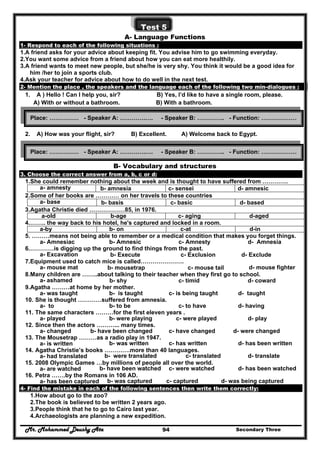
11.Oil company is searched for oil everywhere
12.Oil finds far beneath the earth.
13.The molten rock heat underground lakes of water.
14.Things aren't always what they are appeared to be.
15.This place rarely visits by anyone.
16.This water is then pumping to the surface of the earth.
17.Water is boiling at 100 °C.
18.What is your father doing? –He's an engineer.
19.When she is meeting him, she will tell him the truth.
20.Where is he coming from? – England.
21.Wood uses to make paper.
Mr. Mohammed Deushy Ata Secondary Three58
Test 3
A- Language Functions
1- Respond to the following situations:
1. Someone asks you what types of energy are used most in Egypt today.
2. You tell your friend what types of energy will be used in the future.
3. Your friend asks you about the problems of the nuclear power.
4. Your friend asks you what sorts of energy.
5.
2 - Mention the place, the speakers and the language function in each of the
following two mini-dialogues:
1. A: I need some pills and medicine for curing cough. B : With pleasure.
A: How much will I have to pay? B : 7pounds. I wish you speedy recovery.
2. A : Why is Khalid absent today? B: His brother told me that he is sick.
A: Is he at home now? B: No, they say he is in the hospital.
3- Choose the correct answer from a, b, c or d
1.………….energy is produced by hot rocks below the earth's surface.
a- Hydroelectric b- Nuclear c- Geothermal d- Atomic
2.Hot water comes ………….through a hole in the earth's surface.
a- up b- over c- down d- in
3.Nothing ………….live without energy.
.a- can b- can't c- won't d- couldn't
4.Most of the energy we use still comes from………….
a- fossil fuels b- the sun c- water d- surface
5.Coal, oil and gas are all forms of ………….
a- Atomic energy b- nuclear energy c- hydroelectric d- fossil fuels
6.- ………….forms of energy can only be used once..
a- Renewable b- non renewable c- lasting d- continuous
7. Hydroelectric power supplies Egypt ………….a lot of electricity.
a- for b- to c- with d- by
8.Sugar cane ………….and used to make fuel..
a- grows b- grew c- is growing d- is grown
9.Water ………….to the surface and heated again..
a- pumps b- is pumping c- is pumped d- pumped
10. The earth ………….the sun every year.
a- is orbiting b- orbit c- orbits d- orbited
11. The internet ………….by millions of people all over the world.
a- used b- are used c- is used d- is use
12. ……………………..power supplies Egypt with a lot of its electricity
a- hydroelectric b- mechanical c- nuclear d- fossil
13. When atoms ………,a huge amount of power is produced.
a- spill b- spell c- spilt d- split
14. As well as being ………., electricity is clean.
a- expensive b- unexpensive c- disexpensive d- inexpensive
15. He ………late for work.
a- never is b- is ever c- is never d- ever is
16. The steam ……………… to a power station
a- pipes b- is piped c- is piping d- piped
4- Find the mistake in each of the following sentences then write them correctly:
1. Enormous amounts of energy are released when atoms spilt.
2. Fossil fuels are made of the decayed remains of dead plants and animals.
3. Non-renewable sources of energy will last forever.
Place: ………… - Speaker A: …………. - Speaker B: ………..… - Function: ……………………
Mr. Mohammed Deushy Ata Secondary Three59
4. The computer is connected with a printer.
5. The ship was helpless against the energy of the storm.
6. This oil is put straight into vehicles or turn into diesel.
7.
C- Reading Comprehension
5- Read the following passage and then answer the questions: (June, 2009)
Climate change experts studying hurricanes documented a 35-year warming trend in ocean
surface temperature and linked it to larger hurricanes. The increase has been 1 degree Fahrenheit,
resulting in four percent more atmospheric water vapor and six to eight percent more rainfall.
Though global warming does not guarantee that each year will see record-strength hurricanes, the
long-term ocean warming should raise the baseline of hurricane activity. According to new
research, hurricanes in the North Atlantic are stronger and larger than ever before. Scientists now
say they know what's to blame. Since about 1970, there has been a warming of the global oceans
including the areas where the hurricanes form due to increases in carbon dioxide and greenhouse
gases in the atmosphere. Over the past 35 years, the Atlantic's sea surface temperature has
increased one degree Fahrenheit. The result is a four-percent increase of atmospheric water vapor
and a six to eight-percent increase in rainfall.
A hurricane is a type of tropical cyclone, a low-pressure system that usually forms in the tropics
and has winds that circulate counterclockwise near the earth's surface.
A-Answer the following questions:
1- What is a hurricane?
2- How does global warming leads to hurricanes ?
3- What does the underline word " linked " mean?
B- choose the correct answer from a , b , c ,or d
4- The increase in The Atlantic’s sea surface temperature with one degree leads to ………….
a- a four-percent increase of atmospheric water vapor
b- a six to eight-percent increase in rainfall.
c- a four-percent increase of atmospheric water vapour and a six to eight-percent increase in rainfall.
d- a four-percent decrease of atmospheric water vapor and a six to eight-percent increase in rainfall
5- The long-term ocean warming should raise the …….of hurricane activity.
a- ice line b- baseline c- border line d- net line
6- Read the following passage and then answer the questions: (June, 2009)
Alternative Fuel Vehicle refers to a vehicle that runs on a fuel other than traditional gasoline or
diesel; any method of powering an engine that does not involve petroleum. Due to a combination of
heavy taxes on fuel, particularly in Europe, tightening environmental laws. Current research and
development is largely centered on "hybrid" vehicles that use both electric power and internal
combustion.
Efforts in alternative forms of power focus on developing fuel cells, alternative forms of
combustion and even the stored energy of compressed air. The use of alcohol as a fuel for internal
combustion engines, either alone or in combination with other fuels, has been given much attention
mostly because of its possible environmental and long-term economical advantages over fossil
fuel. Both ethanol and methanol have been considered for this purpose.
While both can be obtained from petroleum or natural gas, ethanol may be the most interesting
because many believe it to be a renewable resource, easily obtained from sugar or starch in crops
and other agricultural produce such as grain, sugarcane or even lactose.
The hydrogen cars generally use the hydrogen in one of two methods: combustion or fuel-cell
conversion.
In combustion, the hydrogen is "burned" in engines in fundamentally the same method as
traditional gasoline cars.
In fuel-cell conversion, the hydrogen is turned into electricity through fuel cells which then
powers electric motors.
A solar car is an electric vehicle powered by solar energy obtained from solar panels on the car.
Solar cars are not a practical form of transportation; insufficient power falls on the roof of a
practically sized and shaped vehicle to provide adequate performance.
A. Answer the following questions;
1. How do the hydrogen cars work?
2. Why is the solar car impractical?
3. What is the Alternative Fuel Vehicle?
Mr. Mohammed Deushy Ata Secondary Three60
B. Choose the correct answer from a, b, c, or d ;
4. Ethanol is a …….form of energy.
a- renewable b- traditional c- non renewable d- new
5. The underlined word refers to ..................
a- a car using petrol b- a car using petrol and electricity
c- a car using electricity d- a bio-fuel car
D- The Novel
7. Answer the following questions :
1- Why do you think Fritz says that it is not a good time for Rassendyll to visit Strelsau? How does
the King react to Fritz's suggestion, and what does that tell you about the King?
2- Why don't Fritz and Sapt eat very much? What advice do they give the King? Does he listen to
them?
3- What happens at the end of the meal? What is the result the next day?
4- Why does the Duke poison the King?
B) Read the following quotation and answer the questions:
"Meanwhile, I'll have some breakfast! The King is hungry!"
1- Who says this to whom?
2- Where and when does he say this?
3- What does this show you about the speaker?
C) Find the mistake in each of the following sentences then write them correctly:
1- The King invites Rassendyll to eat with him in Strelsau.
2- It is Rassendyll's idea to pretend to be the King for the coronation.
3-
E - Writing
8. Write a paragraph about 100 words about
"Vehicles of the future"
F - Translation
9. a) Translate into Arabic :
There are many different forms of natural energy that give us light and power in our homes
and work. One of these forms is hydroelectric power, which is a renewable source of energy. It's
cheap to produce and doesn’t pollute the atmosphere.
……………………………………………………………………………………………………………………………
……………………………………………………………………………………………………………………………
………………………………………….…………………………………………………………………………………
b) Translate into English :
-‫قريبا‬ ‫ينفذ‬ ‫سوف‬ ‫االخر‬ ‫البعض‬ ‫و‬ ‫الحباة‬ ‫مدي‬ ‫الطاقة‬ ‫مصادر‬ ‫بعض‬ ‫ستدوم‬.
……………………………………………………………………………………………………………………………
…………………………………………………………………………………………………………………………...
-‫تخخ‬ ‫حتي‬ ‫النووية‬ ‫الطاقة‬ ‫باستخدام‬ ‫الكھرباء‬ ‫لتوليد‬ ‫مصر‬ ‫تتجه‬‫النفاذ‬ ‫علي‬ ‫اوشك‬ ‫الذي‬ ‫الحفري‬ ‫الوقود‬ ‫علي‬ ‫اعتمادھا‬ ‫ف‬.
……………………………………………………………………………………………………………………………
…………………………………………………………………………………………………………………………...
Mr. Mohammed Deushy Ata Secondary Three61
Un
Unit 4 – Writers and Stories
abroad ‫الوطن‬ ‫خارج‬ establish ‫يؤسس‬/‫يرسخ‬ poem ‫قصي‬‫دة‬
affect ‫فى‬ ‫يؤثر‬ European ‫أوروبي‬ power ‫قوة‬
area ‫مساحة‬/‫منطقة‬ excellent ‫ممتاز‬ product ‫ي‬‫نتج‬
attachments ‫ملحقات‬/‫مرفـقات‬ experience ‫خبرة‬ production ‫إنتاج‬
average of ‫المتوسط‬ expert on ‫خبير‬ publisher ‫الناشر‬
Be published = come out ‫ﺗﻧﺷر‬ fashionable ‫ﻣطﺎﺑق‬ ‫الموضة‬ ‫على‬ reports ‫تقارير‬
behave ‫يتصرف‬ fixed ‫ثابت‬ respect ‫يحترم‬/‫احترام‬
behavior ‫سلوك‬ full of ‫ب‬ ‫ملئ‬‫ـ‬ retired ‫متقاعد‬
believe in ‫يؤمن‬ graduate of ‫من‬ ‫خريج‬ routine ‫يومي‬ ‫روتين‬
biography ‫الذاتية‬ ‫السيرة‬ graduated from ‫من‬ ‫تخرج‬ Russian ‫روسي‬
break ‫يكسر‬/‫راحة‬
‫ق‬
habits ‫متكرر‬ ‫فردية‬ ‫عادات‬‫ة‬ sailor ‫بحار‬
career ‫المھنية‬ ‫الحياة‬ headache ‫صداع‬ short stories ‫قصيرة‬ ‫قصص‬
check ‫مراجعة‬/‫يفحص‬ heart transplant ‫قلب‬ ‫وزراعة‬ ‫عملية‬ social justice ‫االجتماعية‬ ‫العدالة‬
collection of ‫من‬ ‫مجموعة‬ hotel ‫فندق‬ society /community ‫كبير‬ ‫مجتمع‬
competition ‫منافسة‬ human ‫البشرية‬ ‫الموارد‬ style ‫طريقة‬/‫أسلوب‬
confusing ‫مشوش‬/‫مربك‬ insist on ‫على‬ ‫يصر‬ stylish ‫الموضة‬ ‫على‬/‫أنيق‬
culture ‫ثقافة‬ interviewer ‫مذيع‬/‫محا‬‫ور‬ summary ‫م‬‫و‬‫جز‬/‫ملخص‬
custom ‫عاد‬‫ة‬/‫جمرك‬ journalism ‫صحافة‬ support ‫تأييد‬/‫يؤيد‬
cut down ‫يقلل‬ journalist ‫صحفي‬ surgeon ‫الجراح‬ ‫الطبيب‬
deliver ‫يسلم‬/‫يوصل‬ law ‫القانون‬ the poor ‫الفقراء‬
delivery ‫ت‬‫وص‬‫ي‬‫ل‬ lawyer ‫المحامى‬ traditional ‫تقليدي‬
develop ‫يطور‬ literature ‫األدب‬ traditions ‫التقاليد‬
development ‫ت‬‫طور‬ massive ‫ضخم‬ translate into ‫يترجم‬
diplomat ‫الدبلوماسى‬ midnight university ‫جامعة‬
disabled ‫معاق‬ midday ‫النھار‬ ‫منتصف‬ used to + inf ‫اعتاد‬‫أن‬
district ‫منطقة‬/‫مقاطع‬‫ة‬ old-fashioned ‫قديمة‬ ‫موضة‬ village ‫القرية‬
earthquake ‫زلزال‬ papers ‫الجرائد‬ widen horizons ‫اآلفاق‬ ‫يوسع‬
education ‫تربية‬ pay ‫يدفع‬ won a prize ‫بجائزة‬ ‫يفوز‬
effect ‫تأثير‬ penname ‫مستعار‬ ‫اسم‬ work as ‫يعمل‬‫كـ‬
eliminate illiteracy ‫األمية‬ ‫يمحو‬ pioneer ‫رائد‬ work for ‫ل‬ ‫يعمل‬‫حساب‬
enforce the law ‫ينفذ‬ ‫أو‬ ‫يطبق‬ُ playwright ‫مسرحى‬ ‫كاتب‬ writer ‫الكاتب‬
Words & antonyms
considerate ‫اآلخرين‬ ‫لمشاعر‬ ‫مراع‬ inconsiderate ‫اآلخرين‬ ‫لمشاعر‬ ‫مراع‬ ‫غير‬
customary ‫تقليدي‬/‫معتاد‬ unusual ‫معتاد‬ ‫غير‬
detest ‫يكره‬ love ‫يحب‬
experienced ‫خبرة‬ ‫ذو‬ inexperienced ‫خبرة‬ ‫بال‬
familiar ‫مألوف‬ unfamiliar ‫مألوف‬ ‫غير‬
flexible ‫مرن‬ inflexible ‫مرن‬ ‫غير‬
lawful ‫قانوني‬/‫شرعي‬ unlawful ‫قانوني‬ ‫غير‬/‫شرعي‬ ‫غير‬
old-fashioned ‫قديم‬/‫للموضة‬ ‫مساير‬ ‫غير‬ modern / fashionable ‫حديث‬/‫للموضة‬ ‫مساير‬
simple ‫بسيط‬ complicated ‫معقد‬
support ‫يؤيد‬ oppose ‫يعارض‬
thoughtful ‫اآلخرين‬ ‫لمشاعر‬ ‫مراع‬ thoughtless ‫اآلخرين‬ ‫لمشاعر‬ ‫مراع‬ ‫غير‬
Mr. Mohammed Deushy Ata Secondary Three62
Derivatives
Verb Noun Adj.
affect ‫علي‬ ‫يؤثر‬ effect ‫تأثير‬ effective ‫مؤثر‬/‫فعال‬ً
believe ‫يعتقد‬ belief ‫اعتقاد‬ believable ‫تصديقه‬ ‫يمكن‬
collect ‫يجمع‬ collection ‫مجموعة‬ collective ‫جماعي‬
compete ‫ينافس‬/‫يتنافس‬ competition ‫مسابقة‬/‫منافسة‬ competitive ‫تنافسي‬
confuse ‫يربك‬ُ/‫يحير‬ُ confusion ‫ارتباك‬/‫حيرة‬ confusing ‫محير‬/‫مربك‬ُ
fashion ‫موضة‬ fashionable ‫ال‬ ‫علي‬‫موضة‬
law ‫قانون‬ - lawyer ‫محامي‬ Lawful ‫قانوني‬
pioneer ‫الريادة‬ ‫له‬ ‫تكون‬ pioneer ‫رائد‬ pioneering )‫انجاز‬(‫رائد‬
retire ‫يتقاعد‬ retirement ‫التقاعد‬ retired ‫متقاعد‬
Write ‫يكتب‬ writer ‫كاتب‬ -writing ‫الكتابة‬
Expressions
at midday ‫اليوم‬ ‫منتصف‬ ‫في‬ have a routine ‫معين‬ ‫روتين‬ ‫لديه‬
adjust to ‫علي‬ ‫يتأقلم‬ ‫أو‬ ‫ستكيف‬ have lunch ‫الغداء‬ ‫يتناول‬
against the law ‫القانون‬ ‫ضد‬ human resources ‫البشرية‬ ‫الموارد‬
believer in ‫بـ‬ ‫مؤمن‬ multicultural society ‫الثقافات‬ ‫متعدد‬ ‫مجتمع‬
break the law ‫القانون‬ ‫يخالف‬ natural disasters ‫طبيعية‬ ‫كوارث‬
civilized society ‫متحضر‬ ‫مجتمع‬ provide a model for ‫لـ‬ ‫قدوة‬ ‫أو‬ ‫نموذج‬ ‫يقدم‬
eliminate illiteracy ‫األمية‬ ‫يمحو‬ social justice ‫االجتماعية‬ ‫العدالة‬
e-mail attachments ‫بااليميل‬ ‫مرفقات‬ strict laws ‫صا‬ ‫قوانين‬‫رمة‬
empathic ‫مشاعرھم‬ ‫لآلخرين‬ ‫مشارك‬ the father of the modern novel ‫الحديثة‬ ‫الرواية‬ ‫رائد‬
enforce the law ‫القانون‬ ‫ينفذ‬ ‫أو‬ ‫يطبق‬ُ tolerant of/towards ‫تجاه‬ ‫متسامح‬
enter a competition ‫مسابقة‬ ‫يدخل‬ translate into ‫إلي‬ ‫يترجم‬ُ
establish himself as ‫مكان‬ ‫لنفسه‬ ‫يحقق‬‫كـ‬ ‫ة‬ type something onto a computer ‫الكمبيوتر‬ ‫علي‬ ‫شيء‬ ‫يكتب‬
happy with ‫بـ‬ ‫سعيد‬ widen horizons ‫اآلفاق‬ ‫يوسع‬
Definitions
attachments -A feeling of love or strong connection to some one or something.
-A computer file that is sent together with an email message.
-An extra piece of equipment.
‫باالميل‬ ‫يرسل‬ ‫ملف‬–
‫اضافي‬ ‫جھاز‬
Collection Group of objects of the same type that have been collected by
one person in one place.
‫مجموعة‬
competition a situation in which people or organisations compete with each other ‫منافسة‬/‫مسابقة‬
custom something that people do in a society because it is traditional ‫عادة‬
develop to make a new product or idea successful ‫يطور‬/‫ينمي‬
district an area of a city or country ‫اقليم‬/‫مقاطعة‬
establish to achieve or give someone a respected position in society or in
an organisation
‫يحقق‬/‫ينجز‬
law the system of rules that people in a country or place must obey ‫قانون‬
midday Twelve o'clock in the middle of the day. ‫النھار‬ ‫منتصف‬
old-fashioned not modern and not fashionable any more ‫قديم‬/‫الزمن‬ ‫عليه‬ ‫عفا‬
pioneer one of the first people to do something that other people will
continue to develop
‫رائد‬
publisher person or company that produces books, magazines, etc., and
makes them available for people to buy
‫ناشر‬
routine (n) the usual way in which you do things ‫روتين‬
style a way of doing or making something that is typical of a particular
person, group or period
‫نمط‬/‫اسلوب‬
Mr. Mohammed Deushy Ata Secondary Three63
Language Notes
- habit ‫شخـص‬ ‫عـادة‬ - Watching video clips is a bad habit.
- custom ‫شعب‬ ‫عـادة‬ - Colouring eggs on Sham El-Nesseem is an Ancient Egyptian custom.
- traditions ‫تقاليد‬ - Some traditions are out of date .‫الزمن‬ ‫عليھا‬ ‫عفا‬
award( ‫جائـزة‬ ‫ـ‬ ‫منحـة‬ ‫ـ‬ ‫يمنـح‬)‫بإجادة‬ ‫شـئ‬ ‫عمـل‬ ‫مقابـل‬ - He won the school award last year.
reward ‫مكـافـأة‬ ‫ـ‬ ‫يكافـئ‬)‫جيـد‬ ‫عمـل‬ ‫أو‬ ‫حسـن‬ ‫سلـوك‬ ‫مقابـل‬(‫للمجتمع‬ ‫خدمـة‬ ‫تقديـم‬ ‫أو‬
- My father gives us chocolate as a reward when we do well.
present = gift ‫مقابل‬ ‫بدون‬ ‫ھدية‬ - My uncle gave me a present on my birthday party.
a ward ‫مستشفى‬ ‫فى‬ ‫عنبر‬ ‫ـ‬ ‫جناح‬ - Take this patient to a ward three.
Prize ‫نقدية‬ ‫جائزة‬)‫مثال‬ ‫رحلة‬ ‫او‬(‫شيء‬ ‫في‬ ‫نجح‬ ‫لشخص‬ ‫تمنح‬ - She won the third prize in the competition.
- biography ‫شخـ‬ ‫يكتبھـا‬ ‫لشخـص‬ ‫ذاتيـة‬ ‫سيـرة‬‫ص‬ - I want to write a biography of my great grandfather.
- autobiography ‫الشخـص‬ ‫يكتبھـا‬ ‫لشخـص‬ ‫ذاتيـة‬ ‫سيـرة‬ - The leader will publish his autobiography soon.
- win ‫يف‬‫ـ‬‫وز‬‫ــ‬‫يكسب‬)‫انتخابات‬ ‫ـ‬ ‫مبـاراة‬ ‫ـ‬ ‫كأس‬ - Egypt won the match against Australia.
- beat ‫يھ‬‫ـ‬‫زم‬‫ـ‬‫على‬ ‫يتغـلب‬)‫فـريق‬ ‫أو‬ ‫شخـص‬( - Egypt could beat Israel.
- gain ‫مفيد‬ ‫معنوى‬ ‫شىء‬ ‫على‬ ‫يحصل‬ ‫ـــ‬ ‫يكتسب‬)‫شھرة‬ ‫ـ‬ ‫معلـومات‬ ‫معـرفة‬ ‫ـ‬ ‫خبـرة‬(
- I gained a lot of information during the discussion.
‫الكمية‬ ‫ـ‬ ‫السرعة‬ ‫ـ‬ ‫الوزن‬ ‫فى‬ ‫زيادة‬ ‫إلى‬ ‫تشير‬ ‫كما‬
- People usually gain weight during holidays.
- earn ‫يكسب‬)‫رزق‬ ‫أو‬ ‫قوت‬(‫عمل‬ ‫مقابل‬ - Most people don’t earn enough money.
- routine ‫روتين‬)‫يوم‬ ‫كل‬ ‫الوقت‬ ‫نفس‬ ‫في‬ ‫الشئ‬ ‫نفس‬ ‫عمل‬( - My daily routine has become more boring.
- red tape ( ‫حكومي‬ ‫روتين‬ ) ‫حكومية‬ ‫تعقيدات‬ - I had a lot of red tape to get my passport.
Retire ‫للمعـاش‬ ‫يحـال‬)‫يتقـاعـد‬( - When an employee is 60, he retires and lives on his pension.‫ﻣﻌﺎش‬
Resign ‫العمـ‬ ‫من‬ ‫يستقيـل‬‫ل‬ - The manager resigned as a result of the accident.
Politician ‫السياسة‬ ‫رجل‬ -Yesterday's interview was a debate between two politicians.
Diplomat ‫دبلوماسي‬)‫الخارجية‬ ‫وزارة‬ ‫في‬ ‫أو‬ ‫سفارة‬ ‫في‬ -Ahmed works as a diplomat in the Ministry of Foreign Affairs.
- on board ( ‫متن‬ ‫على‬)‫طائرة‬ ‫ـ‬ ‫سفينة‬ - I climbed on board of the ship.
- broad ‫عريض‬ - Ali has broad shoulders.
- abroad ‫الخارج‬ - My uncle travelled abroad.
graduate from‫مـن‬ ‫يتخـرج‬ - He graduated from the Faculty of Medicine.
a graduate of ‫خـريـج‬ - He is a graduate of the Faculty of Medicine.
graduate with a degree in ‫فـى‬ ‫بشھـادة‬ ‫يتخـرج‬ - He graduated with a degree in history.
publish ‫ينشر‬ ‫ـ‬ ‫يعلن‬)‫كتاب‬( -He works for a company that publishes reference books.
spread‫ينتشر‬ ‫ـ‬ ‫ينشر‬ -Terrorism spreads panic among all classes of society.
prevail‫يعم‬ ‫ـ‬ ‫يسود‬ -Justice will prevail over tyranny.
disabled ‫جسـدية‬ ‫إعاقـة‬ ‫ذو‬ We take disabled children on trips at the weekends.
retarded‫عقليـة‬ ‫إعاقـة‬ ‫ذو‬ Retarded children go to special school where they get special care.
backward ‫الطبيعى‬ ‫النمـو‬ ‫عن‬ ‫متخلف‬)‫دولة‬ ‫ـ‬ ‫شخـص‬(
Backward children learn more slowly than others. - The UN helps backward countries.
work ‫عمـل‬‫العمـل‬ ‫مكـان‬ ‫ـ‬)‫يعـد‬ ‫ال‬ ‫اسم‬( I have got a lot of work to do. Mr Ahmed leaves work at two o'clock
job ( ‫مھنـه‬ ‫ـ‬ ‫وظيفة‬)‫يعـد‬ ‫اسم‬ -He has got a job as a teacher. I have got a lot of jobs to do.
career‫للفـرد‬ ‫العملية‬ ‫الحياة‬ ‫مھنـه‬ -He started his career five years ago.
profession ‫مھنـه‬)‫وتـدريـب‬ ‫مؤھـالت‬ ‫إلى‬ ‫تحتـاج‬( -Teaching is a profession.
Mr. Mohammed Deushy Ata Secondary Three64
experience ‫الخبرة‬)‫معين‬ ‫عمل‬ ‫خالل‬ ‫من‬ ‫ومھارات‬ ‫معرفة‬ ‫من‬ ‫الشخص‬ ‫يكتسبه‬ ‫ما‬–‫تجمع‬ ‫ال‬ُ(
They offered me the job because I had a lot of experience.
Experience(s) ‫الحياة‬ ‫في‬ ‫خبرات‬ ‫أو‬ ‫تجارب‬ ‫أو‬ ‫مواقف‬–‫تجمع‬ُ
I had some interesting experiences while I was travelling. (= things that happened to me)
experiment ‫معينة‬ ‫لنتائج‬ ‫التوصل‬ ‫أو‬ ‫ما‬ ‫شيء‬ ‫صحة‬ ‫إلثبات‬ ‫علمية‬ ‫تجربة‬
Teachers usually carry out simple experiments in the laboratory.
‫اسم‬ ‫وبعدھا‬ ‫عدد‬ ‫قبلھا‬ ‫جاء‬ ‫إذا‬ ‫اآلتية‬ ‫الكلمات‬ ‫جمع‬ ‫عدم‬ ‫الحظ‬:
I usually have a ten-minute break for coffee at midday.
‫نقول‬ ‫ولكننا‬:
The trip took three days. The meeting lasted for five hours.
‫كلمة‬ ‫وجود‬ ‫حالة‬ ‫في‬time‫نستخدم‬ ‫السابقة‬ ‫الكلمات‬ ‫بعد‬'s)(‫و‬ ‫المفرد‬ ‫حالة‬ ‫في‬(s')‫الجمع‬ ‫حالة‬ ‫في‬:
in a week's time in two years' time
mend ‫الح‬ ‫بإص‬ ‫وم‬ ‫يق‬)‫ال‬ ‫أو‬ ‫الف‬ ‫ت‬ ‫يء‬ ‫ش‬ The plumber came to mend the burst pipe.
amend ‫أو‬ ‫نص‬ ‫في‬ ‫تغيير‬ ‫أو‬ ‫تعديل‬ ‫بإجراء‬ ‫يقوم‬‫قانون‬ The constitution was amended some time ago.
other than = except The form cannot be signed by anyone other than you.
rather than = in preference to / instead of ‫من‬ ‫بدال‬‫ـ‬‫آخر‬ ‫علي‬ ‫شيء‬ ‫مفضال‬
- I think I'd like to stay at home this evening rather than go out.
otherwise = except‫وإال‬ - You'll have to go now, otherwise you'll miss your bus.
Law (n.) ‫قانون‬ -It is against the law not to wear a safety belt.
lawful (adj.) ‫شرعي‬-‫قانوني‬ -He is going to start his lawful job as a journalist.
Lawyer (n.) ‫محامي‬ -His first job was a lawyer.
Customs (n.) ‫عرف‬-‫عادات‬‫جماعية‬ -I am not familiar with the customs of the European society.
traditions ‫موروث‬ ‫فكر‬ ‫او‬ ‫تقاليد‬ - It is a tradition that players exchange T-shirts after the match.
habit (n.) ‫عا‬‫د‬‫ة‬‫فردية‬ -Smoking is a bad habit.
- believe in (v.) ‫ب‬ ‫يؤمن‬‫ـ‬ -We all believe in Allah.
- believer (n) ‫مؤمن‬-‫معتقد‬ -He was a very strong believer in the power of mind.
-belief ‫اعتقاد‬ -She married him in the belief that he would change.
-district(n.) ‫حي‬–‫منطقة‬ -Yehia Haqqi was born in 1905 in Sayyida Zeinab district of Cairo.
-Distract (v.) ‫يشوش‬‫انتباة‬ -She is distracting me. I'm trying to finish my essay.
- Distort (v.) ‫يشوه‬ -It is a bad recording –The microphone distorted our voices.
Insist on +n. v.ing ‫علي‬ ‫يصر‬ -I have insisted on getting the first prize.
Insist that + ‫جملة‬ ‫علي‬ ‫يصر‬ -Have you insisted that you are innocent?
Persist in + v-ing ‫يصر‬‫علي‬ - He persisted in studying alone.
Exercises
Respond the following situations:
8. A friend asks for your opinion about modern novels.
9. A friend asks you what you used to read when you were five.
10. Someone asks you what you think the best thing is about short stories. Give your opinion.
11. Someone asks you what you were doing at six o'clock yesterday evening,
12. You suggest going to the zoo.
13. You think Egypt has the best football team in Africa.
14. Your friend asks you what you think of Yehia Haqqi.
15. Your friend thinks English is easy. You agree.
- Mention the place, the speakers and the language function in each of the following
two mini-dialogues:
1- A: I'd like an extension of stay, please. B: How long have you been here?
A: Six months. B: How long would you like to extend your stay? A: 3 months.
Mr. Mohammed Deushy Ata Secondary Three65
2) A: I'd like to get a visa to England, please? B: How long would you like to stay there?
A: Six months.
3-A: Good evening. I have a complaint. B: What is wrong?
A: My radio doesn’t work. B: Don’t worry; I'll repair it for you.
4- A: How much is it? B: it s 600 pounds. A: ok. I will need a blue one.
5- A: What is wrong with you? B: my tooth hurts.
A : open your mouth , please. Don't worry. I will pull it out.
6- A: Why didn’t you do your homework? B: sorry, sir .I was too tired to do it.
A : ok , next time I see it .
Choose the correct answer from a , b , c , or d :
1. My friend and I are going to enter an athletics ……………….. .
a-competition b– composition c– recognition d-champion
2. Professor Jones gave Ayman a camera and all its ……………………….. .
a-attacks b– attachments c– mails d– letters
3. Leila sent an e-mail to Samira and ……………….. an image.
a-attended b– attacked c– attracted d – attached
4. Al –Ahram Weekly,…………………. my article.
a-wrote b– translated c – published d – did
5. Midday is 12 o'clock in the day, but midnight is 12 o'clock at ……………………… .
a-night b – noon c– day d– knight
6. It is not ………………….. , it is old-fashioned.
a- modern b- ancient v – dirty d- clean
7. To ……………………. means to make a new product or idea successful.
a-divide b – develop c - retire d- recite
8. Al Sydia Zainab is a famous ……………………….. of Cairo.
a-restrict b – governorate c– system d– district
9. Naguib Mahfouz used simple ……………….. in his novels.
a- style b– draft c– styles d– symbol
10. Hassna is a ………………………… girl.
a- fashion b– fashioned c– fascism d– fashionable
11. Yehia Haqqi studied ………………… at university to be a lawyer.
a- low b- law c- medicine d- art
12. Haqqi worked as a ………………. in different countries.
a-ambassador b– diplomat c– writer d– translator
13. Yehia Haqqi wrote a ……………………… of short stories.
a-group b– school c– pack d– collection
14. As well as ………………. two books , he wrote short stories.
a- write b– wrote c – writing d– writes
15. He is an expert …………………. Arab culture.
a- with b- to c- on d- by
Place: …………… - Speaker A: ……. - Speaker B………..…… - Function: ……………………
Mr. Mohammed Deushy Ata Secondary Three66
16. His story, the post man , was …………………. into a film.
a-make b– made c – makes d– making
17. This shop sells goods at ……………………… prices.
a- limited b– fix c – fixed d– fox
18. She is a graduate ……………… Oxford University.
a- in b- of c– from d– at
19. He is a publisher his work is to ………………..stories and novels.
a-write b– translate c– publish d– public
20. Al Gamalya is a famous ……………… of Cairo.
a- restrict b – governorate c– system d– district
21. I really enjoyed that book , it is written in a very simple ------------
a-style b – road c– draft d– styles
22. My sister loves clothes and buys ------------ dresses.
a- very old b– traditional c– fashionable d– old-fashioned
23. He won a prize for one of the --------------- of his short stories.
a- pack b– school c– collect d– collection
24. He worked -------------- for more than 20 years.
a- aboard b– above c- abroad d– ashore
25. He has a ---------------- routine in writing.
a-fixed b– fixing c– fax d– mix
26. As -------------------------- as I am concerned , this is an interesting book.
a-long b– soon c– tall d– far
27. He cannot work because of his …………………….. .
a-ability b – facility c– flexibility d - disability
28. A …………….. is one of the first people to do something that others will continue.
a-biologist b – beginner c – pioneer d- bystander
29. All people must ………………. the law.
a-obey b– break c– destroy d – damage
30. Some people believe that ……………… on animals should be banned.
a-experiments b– experience c – experiences d– examples
31. There was nobody in the house ……………………….. Ali.
a-rather than b – other than c– otherwise d– other
32. I had several bad ……………… during my last trip.
a-experiences b– experience c– experiments d– extensions
33. I haven't had a steady ……………. since last March.
a-career b– job c– work d– profession
34. Which team do you …………………?
a- export b– import c– support d– report
35. He is regarded as one of the …………….. of modern science.
a-heads b– bosses c- supervisors d– pioneers
36. The verb of the word " attachment " is ………………..
a-attend b– attack c– attract d– attach
37. Midday is 12 in the day, but ……………….is 12 at night.
a-mid year b– midnight c– mid evening d– good night
38. It is not modern , it is ………………………
a-stylish b– modern c– new-fashioned d – old-fashioned
39. The person who does something that others will continue is…………
a- pioneer b–engineer c–journalist d–chemist
40. They still wear …………….. clothes in siwa Oasis.
a- habits b– traditional c – customs d– tradition
41. We always take a three …………. holiday at the end of the year.
a-months b– month's c – month d– months'
42. Ali is ……………….of Ain Shams University.
a-graduated b– graduate c– graduating d – a graduate
43. My father is a / an …………... He is interested in politics.
a-engineer b– diplomat c– politician d– political
Mr. Mohammed Deushy Ata Secondary Three67
44. When I was seven, I wrote a poem which won 2nd prize in a national competition …….. school
children.
a- for b-to c- with d-by
45. When I was at university I ……………. short stories for student magazine.
a-write b-writes c-wrote d-was writing
46. While I was finishing one story, I …………….. of the next one.
a-thought b-thinking c-was thinking d- an thinking
47. I used to write very quickly- I finished most short stories …………… two or three days.
a- in b- for c- since d-to
48. I haven’t written any short stories …………. over 20 years.
a- for b-since c-till d- in
49. I write from nine in the morning till three in the afternoon, with …….. break for coffee at midday.
a-ten-minutes b- ten minutes’ c- ten minute’s d- ten minute
50. I’m ……………I use a pencil and paper. I’ve tried using a computer, but it gave me a headache.
a-fashionable b- fashioned c-old-fashioned d-fashionably
51. When I’m happy ……………… what I’ve written, my secretary types it onto the computer.
a- to . b- for . c-by . d-with
55. My publisher ………. that I send everything as an e-mail attachment.
a-persists b- assists c- insists d- resists
56. I spend two or three days ……. the week’s work until I’m completely happy with what I’ve written.
a- to check b- checking c-check d- to checking
57. Yehia Haqqi was born in the Sayyida Zeinab …………… of Cairo.
a- distinction b- district c-distract d- distort
58. He graduated in ……. and worked for a short time as a lawyer.
a- dew b- law c-low d- sew
59. In 1929, he began his …………….. as a diplomat
a- job b- profession c- career d- life
60. The time he spent in France, Italy, Turkey and Libya gave him ………………...
A- experiencing b- experienced c- Expert d - experiences
61. His first short story, published in 1925, ………………. him as one of the greatest short story
writers of the Arab world.
a- set up b- establish c- established d- establishing
62. Haqqi wrote in a new way about Arab society and …………….. in the twentieth century.
a- costumes b- consumes c- customs d- castes
63. Haqqi was also interested in the Arabic language and he ………. a new style of writing which is
respected today.
a- develop b- developed c- developing d- promoting
64. As well as writing his own novels and stories, Haqqi also translated Russian, French, Italian and
Turkish …………………into Arabic.
a- literature b- literary c- litter d- letter
65. He was a very strong ……………… in the power of education and supported many young
Egyptian writers.
a- belief b-believe c- believer d-believers
66. Haqqi died in 1992, but is still thought of as the ………of the modern short story and the novel.
a- son b- father c- father-in-law d- Mum
67. Early black and white photos show people in ………………..clothes.
a- fashionable b- old-fashioned c- fashionably d- newly fashionable
68. The sun is at its strongest at …………..
a- midnight b- day c- afternoon d- midday
69. I don’t really have a ……..…….during the holidays.
a- red tape b- routine c- system d- rest
70. My friend and I are going to enter an athletics …….……..We all hope to win something.
a- game b- tour c- course d- competition
71. Yehia Haqqi came from a poor ……………of Cairo.
a- distract b- district c- distort d- distinct
72. My brother wants to be a lawyer when he graduates, so he is studying ………..at university.
a- law b- low c- dew d- lewd
Find the mistake in each of the following sentences then write them correctly:
1- A publicizer is someone who produces books, newspapers ,etc
2- Before he left the country, he has paid all his debts.
3- Haqqi was born in 1905 in the Sayyida Zeinab distract of Cairo.
Mr. Mohammed Deushy Ata Secondary Three68
4- He broaded the ship to Greece.
5- He developed a new stile of writing.
6- He graduated from law.
7- He is a graduate in Assuit University.
8- He is going to enter a reading commission and he is hoping to win it.
9- He spent a three days holiday in Acapulco.
10- He wanted to help the poor and the disability.
11- He worked aboard for more than 20 years.
12- He writes by a very simple style.
13- He wrote two collisions of short stories.
14- His novels were made of films.
15- His training as a law affected the way he wrote his novels.
16- I have a collocation of English books.
17- I have insisted in getting the first prize.
18- It is very hard for me to be used to the Europeans consumes.
19- She doesn't receive the prize yet.
20- She sent me her photograph as an e-mail detachment.
21- The guide offered tourists information on local customary.
22- This price reduction is due to complexion among suppliers.
23- While he is being in London, he went shopping.
24- Yehia Haqqi developed a new steel of writing which is respected today.
25- Yehia Haqqi is a writer of children's infection.
26- Yehia Haqqi is still thought of as the mother of the modern short story and the novel in Egypt.
27- Yehia Haqqi was a strong belief in the power of education.
28- Yehia Haqqi was interested in the Arabic language and he developed a new steel of writing.
29- Yehia Haqqi was one of the pioneers of modern Egyptian literary.
30- Yehia Haqqi worked like a diplomat.
-Translate into Arabic:
Sports and games play an important role in building up the body and the character. Through
sports, young people find an outlet to their energies. So, the government spares no effort to
encourage sports.
………………………………………………………………………………………………………………………
………………………………………………………………………………………………………………………
As well as writing his own novels and stories, Haqqi also translated Russian, French, Italian and
Turkish literature into Arabic. He was a very strong believer in the power of education and
supported many young Egyptian writers. He died in 1992, but is still thought of as the father of the
modern short story and the novel in Egypt.
………………………………………………………………………………………………………………………
………………………………………………………………………………………………………………………
Some Egyptian writers have written books and articles advocating the rights of women. They
have called for women's equality with men. Now women have the same rights as men and even
hold important positions in the society.
………………………………………………………………………………………………………………………
………………………………………………………………………………………………………………………
Translate into English:
1-‫بأمان‬ ‫الحياة‬ ‫رحلة‬ ‫ليواصلوا‬ ‫أبنائھم‬ ‫ورعاية‬ ‫توجيه‬ ‫الوالدين‬ ‫علي‬ ‫يجب‬.
………………………………………………………………………………………………………………………
2-‫المستقبل‬ ‫في‬ ‫الدول‬ ‫بين‬ ‫الحروب‬ ‫اندالع‬ ‫في‬ ‫سببا‬ ‫تكون‬ ‫قد‬ ‫المياه‬ ‫ندرة‬.
………………………………………………………………………………………………………………………
3-‫العظ‬ ‫بكتابھا‬ ‫مصر‬ ‫تفخر‬‫االدب‬ ‫في‬ ‫نوبل‬ ‫جائزة‬ ‫علي‬ ‫الحائز‬ ‫محفوظ‬ ‫نجيب‬ ‫امثال‬ ‫ماء‬.
………………………………………………………………………………………………………………………
4-‫حقي‬ ‫يحي‬ ‫ميز‬ ‫ما‬ ‫اھم‬ ‫سھولته‬ ‫و‬ ‫االسلوب‬ ‫بساطة‬.
………………………………………………………………………………………………………………………
5–‫الرحمن‬ ‫عبد‬ ‫عائشة‬ ‫كانت‬)‫الشاطئ‬ ‫بنت‬(‫التق‬ ‫بسبب‬ ‫مستعار‬ ‫باسم‬ ‫تكتب‬‫المجتمع‬ ‫في‬ ‫اليد‬.
………………………………………………………………………………………………………………………
6–‫بنفسة‬ ‫الشخص‬ ‫يكتبھا‬ ‫الشخصية‬ ‫الذاتية‬ ‫السيرة‬
………………………………………………………………………………………………………………………
Mr. Mohammed Deushy Ata Secondary Three69
The present perfect tense
Form Subj. ‫الفاعل‬ + have/has + P.P. ………………. .
:(He/she/it) ‫الغائب‬ ‫المفرد‬ ‫الفاعل‬ ‫مع‬ has –‫تستخدم‬
-I have tidied my bedroom. –Ali (He) has played tennis for an hour.
Negation Subject + hasn’t / haven’t + p.p.+…………. .
-They haven’t watched the match yet. -The student hasn’t done his homework yet.
Yes / No Q. Have /Has + Subj. ‫الفاعل‬ + + P.P. ……….. ?
- Have you tidied your room? - Yes, I have (tidied my room).
- Has the student done his homework? - No, he hasn't (done his homework yet).
‘ Wh-’ Q. Q.W.‫استفھام‬ ‫اداة‬ +have/has+ subject+ P.P…………?
- Where have you played the match? -How long have you stayed here?
. .………….p.p+been+has/have+‫المفعول‬ObjPassive
- I have tidied my bedroom. - My room has been tidied ( by me).
-Ali (He) has played tennis for an hour. - Tennis has been played for an hour.
Uses ‫األستخدامات‬
-1‫وآث‬ ‫الماضي‬ ‫في‬ ‫تم‬ ‫حدث‬ ‫عن‬ ‫للتعبير‬ ‫التام‬ ‫المضارع‬ ‫يستخدم‬‫موجود‬ ‫مازال‬ ‫رة‬.
-She has cleaned the kitchen. (The kitchen is clean now)
- He has broken his leg. (He can't walk easily)
2–‫الماضي‬ ‫في‬ ‫محدد‬ ‫غير‬ ‫وقت‬ ‫في‬ ‫انتھي‬ ‫حدث‬:
- She has polished her shoes. - He has fed the sheep.
-‫نست‬ ‫الحدوث‬ ‫وقت‬ ‫تحديد‬ ‫عند‬ ‫لكن‬‫البسيط‬ ‫الماضي‬ ‫خدم‬:
-She cleaned the kitchen yesterday. – He fed the sheep in the afternoon.
3-‫متكرر‬ ‫حدث‬ ‫علي‬ ‫التام‬ ‫المضارع‬ ‫يدل‬)‫أخري‬ ‫مرة‬ ‫للحدوث‬ ‫قابل‬ ‫الحدث‬ ‫ذلك‬ ‫أن‬ ‫أي‬: (
-Abu Terika has scored a hundred goals. (He can score more)
-‫توقف‬ ‫الحدث‬ ‫أن‬ ‫ذلك‬ ‫فمعني‬ ‫متكرر‬ ‫حدث‬ ‫مع‬ ‫البسيط‬ ‫الماضي‬ ‫منا‬ ‫استخد‬ ‫ا‬ ‫اذ‬ ‫لكن‬.:
- He wrote 46 novels. (He stopped writing)
4-‫عن‬ ‫التام‬ ‫المضارع‬ ‫يعبر‬‫أ‬‫حد‬‫ا‬‫تم‬ ‫ث‬‫ت‬‫حديثا‬.
- I've just finished reading this book.
5-‫بعد‬ ‫تحدث‬ ‫لم‬ ‫أحداث‬ ‫عن‬ ‫التام‬ ‫المضارع‬ ‫يعبر‬.
- She's never played tennis.
6-‫حدوثھا‬ ‫وقت‬ ‫تحديد‬ ‫دون‬ ‫سابقة‬ ‫خبرات‬ ‫عن‬ ‫للسؤال‬ ‫التام‬ ‫المضارع‬ ‫يستخدم‬.
- Have you ever met anyone famous?
- She's never met anyone famous yet, but she hopes to one day.
7-‫م‬ ‫نستخد‬(has /have been to)‫ذھب‬ ‫بمعنى‬‫أما‬ ‫وعاد‬ ‫لمكان‬(has /have gone to)‫ھناك‬ ‫ومازال‬ ‫لمكان‬ ‫ذھب‬)‫يعد‬ ‫لم‬(
- My sister has gone to school. (She is still at school now.)
- My sister has been to the cinema. (She isn't there now).
-‫اآلتية‬ ‫الكلمات‬ ‫مع‬ ‫التام‬ ‫المضارع‬ ‫يستخدم‬:
Just/already/yet/so far ‫ح‬‫تي‬‫االن‬ /ever/never/lately/recently/since/for / so far /up till now
- He has typed five letters so far.
-‫كما‬‫يستخدم‬‫التام‬ ‫المضارع‬‫إذا‬‫وجدنا‬‫يلـي‬ ‫بمـا‬ ‫الجملة‬:
- It’s/This is the first (second…) time...
- It’s the first time I have been to this place.
- It’s (This) is the only…
- This is the only play I have seen.
Mr. Mohammed Deushy Ata Secondary Three70
- In the last few years/months…….
- Egypt has changed a lot in the last few years.
- In recent years
- It has not rained in the Western Desert in recent years.
- Over the ages / over the years….
- The earth has become more crowded over the ages.
‫مالحظات‬:
1-‫أن‬ ‫الحظ‬ever/never/just/ already‫بين‬ ‫تأتي‬have/has‫الثالث‬ ‫والتصريف‬: PP.
- I have just written the letter. - He has never done karate.
2-‫بعد‬ ‫يأتى‬since‫أما‬ ‫الحدث‬ ‫بداية‬ ‫يحدد‬ ‫زمن‬for‫الحدث‬ ‫ھذا‬ ‫مدة‬ ‫بعدھا‬ ‫يأتى‬.
Since For
‫ساعة‬ 12 o’clock a moment
Since
‫اسم‬‫شھر‬ October
‫اسم‬‫يوم‬ Friday
‫اسم‬‫فصل‬ summer For
two seconds / three minutes
four hours / five days
six nights / seven weeks
‫يوم‬ ‫تاريخ‬ 7th August eight months/ one season
‫تاريخ‬‫سنة‬ 2000 nine years
‫جملة‬‫ماضي‬‫بسيط‬ I arrived ages
Then ‫ذلك‬‫الحين‬ /yesterday a long time
last ……………... the last …………..
- We have owned this house since 1988 - He has known the same friends for three years.
-‫كما‬‫بعد‬ ‫يأتى‬since‫مثل‬ ‫معلوم‬ ‫وقت‬ ‫علي‬ ‫يدل‬ ‫اسم‬ ‫أيضا‬:
- lunch / lunchtime / his childhood / her wedding / their arrival…….
- She has stayed her since her marriage. - He has known the same friends since his childhood.
3-‫بعد‬ ‫تأتي‬ ‫التي‬ ‫الجملة‬since‫ت‬‫بسيط‬ ‫ماضي‬ ‫كون‬:
- I haven’t seen him since he left for Cairo.
‫القاطع‬ ‫للنفي‬: (never)‫تستخدم‬ ‫بينما‬ ‫السؤال‬ ‫في‬ ‫غالبا‬ (ever ) -‫تستخدم‬ 4
-Have you ever met the manager in person? - I have never seen such a strange person.
-‫نستخدم‬ever‫بـ‬ ‫تبدأ‬ ‫التى‬ ‫الجمل‬ ‫فى‬No
- Nothing like this has ever happened to us. - No student has ever answered this question.
-‫استخدام‬ ‫يمكن‬ever‫صيغة‬ ‫تتضمن‬ ‫التى‬ ‫الجمل‬ ‫فى‬‫تفضيل‬:
‫صفة‬‫تفضيل‬ …….. + subject+ have/has+ ever +P.P. ……. .
- This is the strangest match I have ever watched.
- The most exciting novel I have ever seen was “Oliver Twist".
-‫الحظ‬‫أنه‬‫استخدام‬ ‫عند‬never‫من‬ ‫بدال‬ever‫نستخدم‬such (a/an) adj. + n.:
- This is the worst luck I have ever had. = I have never had such bad luck.
-‫استخدام‬ ‫حالة‬ ‫فى‬ever‫بھا‬ ‫جمله‬ ‫فى‬never/before‫بــ‬ ‫نبدأ‬This is the first time
- I have never seen a lion before. = - This is the first time I have ever seen a lion.
5-‫تستخدم‬yet‫و‬ ‫األسئلة‬ ‫نھاية‬ ‫فى‬‫المنفية‬ ‫الجمل‬.
- Has he arrived yet? - They haven't eaten yet.
-‫تستخدم‬yet‫بھـ‬ ‫جمــلة‬ ‫نفي‬ ‫في‬‫ا‬just / already
- He has just arrived. - He hasn’t arrived yet.
-‫استخدام‬ ‫حالة‬ ‫في‬yet‫بدال‬‫من‬still‫نستخدم‬‫المستمر‬ ‫المضارع‬ ‫من‬ ‫بدال‬ ‫منفى‬ ‫تام‬ ‫مضارع‬:
- He is still writing the report. = - He hasn’t finished writing the report
6-‫نستخدم‬already‫المثبتة‬ ‫الجمل‬ ‫و‬ ‫األسئلة‬ ‫فى‬.
- Have you already written to John? - He has already had dinner.
-‫عندإستخدام‬before now‫مكان‬already‫البسيط‬ ‫للماضي‬ ‫الجملة‬ ‫زمن‬ ‫يحول‬
- He has already finished. = - He finished before now.
7-‫استخدام‬ ‫عند‬since / for‫من‬ ‫بدال‬the last time / last / when / ago‫الماضى‬ ‫نحول‬‫مضارع‬ ‫إلى‬ ‫البسيط‬‫منفى‬ ‫تام‬.
- I last ate fish when I was in Alex. = - I haven’t eaten fish since I was in Alex.
Mr. Mohammed Deushy Ata Secondary Three71
8-‫بــ‬ ‫بدأنا‬ ‫و‬ ‫منفى‬ ‫تام‬ ‫مضارع‬ ‫الجملة‬ ‫كانت‬ ‫إذا‬It’s‫التالى‬ ‫التركيب‬ ‫نستخدم‬
It’s + ‫زمنية‬ ‫مدة‬ + since + ‫فاعل‬ + last + ‫مثبت‬ ‫بسيط‬ ‫ماضى‬
- I haven’t seen him for ages. = - It’s ages since I last saw him.
‫االثبات‬ ‫في‬ ‫غالبا‬‫السؤال‬ ‫و‬: (just) -‫تستخدم‬ 9
-What has he just said ? -She has just turned on the computer.
–‫استخدمنا‬ ‫إذا‬just‫من‬ ‫بدال‬a moment ago / a short time ago‫نح‬‫تام‬ ‫مضارع‬ ‫إلى‬ ‫البسيط‬ ‫الماضى‬ ‫ول‬‫مثبت‬.
- The train left a moment ago. = - The train has just left.
10-‫استخدام‬ ‫عند‬ago‫من‬ ‫بدال‬since / for‫التام‬ ‫المضارع‬ ‫نحول‬‫المثبت‬‫الى‬
began / started + to + inf.
- It has rained for two hours. = - It began to rain two hours ago.
-‫استخدام‬ ‫يمكن‬ ‫أنه‬ ‫الحظ‬ago‫مـع‬since:
- I haven't seen him since three years ago.
‫السؤال‬ ‫في‬ ‫الطريقة‬ ‫بنفس‬: (recently/lately) 11–‫كل‬ ‫تستخدم‬‫من‬
-Has Barakat scored goals lately/recently?
‫النفي‬ ‫في‬: (lately) ‫و‬ ‫االثبات‬ ‫(في‬ recently ) -‫استخدام‬ ‫يفضل‬
-She has moved to a new house recently. -He hasn't phoned me lately.
The last time+‫بسيط‬ ‫ماضي‬ ‫+جملة‬was in/ when ……. .
=‫فاعل‬ + last……… in/when…………………. .
= ‫+فاعل‬ haven't/hasn't + P.P. since.............................
-The last time I saw Ali was in 2009. =I last saw Ali in 2009. =I haven't played football since 2009.
-‫اذا‬‫من‬ ‫التحويل‬ ‫كان‬(for)‫الي‬(since)‫صعب‬)‫انة‬ ‫اي‬‫تاريخ‬ ‫الي‬ ‫تحويلھا‬ ‫يمكن‬ ‫ال‬ ‫المدة‬ ‫كانت‬ ‫لو‬(‫الطريقة‬ ‫نستخدم‬ ‫التركيبة‬ ‫نستخدم‬
‫التالية‬:
It ( is – was – has been ) ‫مدة‬ since ‫بسيط‬ ‫ماضي‬
- He hasn't travelled for ages. (since) - It is ages since he travelled.
He hasn’t studied for along time. ( since ) - It is along time since he studied.
‫االفعال‬ ‫تصريفات‬Conjugation of Verbs
‫االفعال‬‫المنتظمة‬Regular Verbs
1-‫بصفة‬‫باضافة‬ ‫المنتظمة‬ ‫االفعال‬ ‫تصريف‬ ‫يتم‬ ‫عامة‬(ed)‫مصدرالفعل‬ ‫لنھاية‬:
-visit/ visited - watch/watched - land / landed
2-‫بحرف‬ ‫المصدر‬ ‫انتھي‬ ‫اذا‬(e)‫حرف‬ ‫له‬ ‫يضاف‬ ‫الينطق‬(d)‫فقط‬:
-like /liked - change / changed - bake / baked
3-‫أن‬ ‫بشرط‬ ‫اكثر‬ ‫او‬ ‫واحد‬ ‫مقطع‬ ‫من‬ ‫يتكون‬ ‫الفعل‬ ‫كان‬ ‫و‬ ‫واحد‬ ‫متحرك‬ ‫بحرف‬ ‫مسبوق‬ ‫واحد‬ ‫ساكن‬ ‫بحرف‬ ‫الفعل‬ ‫انتھي‬ ‫اذا‬
: (ed) ‫اضافة‬ ‫قبل‬ ‫االخير‬ ‫الحرف‬ ‫يضاعف‬ ‫(فانه‬stressed) ‫قويا‬ ‫االخير‬ ‫المقطع‬ ‫يكون‬‫النطق‬ ‫في‬
- stop / stopped - travel / travelled - ban / banned
:(ed)‫اضافة‬ ‫قبل‬ (ie) ‫الي‬ ‫يتحول‬ ‫فانه‬ (y)‫بالحرف‬ ‫الفعل‬ ‫انتھي‬ ‫اذا‬ – 4
- study / studied - dry / dried - try / tried
: (ed)‫اضافة‬ ‫قبل‬ ( k ) ‫يضا‬‫حرف‬ ‫بعده‬ ‫ف‬ ( c ) ‫بحرف‬ ‫الفعل‬ ‫انتھي‬ ‫اذا‬ -5
- panic panicked - picnic picnicked
Mr. Mohammed Deushy Ata Secondary Three72
‫المنتظمة‬ ‫الغير‬ ‫االفعال‬Irregular Verbs
-‫ي‬ ‫و‬ ، ‫تحفظ‬ ‫ان‬ ‫يجب‬ ‫و‬ ‫للتصريف‬ ‫قواعد‬ ‫لھا‬ ‫توجد‬ ‫ال‬ ‫منتظمة‬ ‫الغير‬ ‫االفعال‬‫انواع‬ ‫ثالثة‬ ‫الي‬ ‫تقسيمھا‬ ‫مكن‬:
-‫مثـل‬ ‫واحـدة‬ ‫الثـالثـة‬ ‫تصـريفاتھـا‬ ‫أفعـال‬:
infinitive Past simple Past Participle ( P.P.)
put put put
shut shut shut
hit hit hit
let let let
-‫مثـل‬ ‫واحـد‬ ‫تغيـر‬ ‫ذات‬ ‫أفعـال‬:
buy bought bought
think thought thought
build built built
sleep slept slept
hear heard heard
-‫مثـل‬ ‫مختـلفــة‬ ‫الثـالثـة‬ ‫تصـريفاتھـا‬ ‫أفعـال‬:
drink drank drunk
swim swam swum
write wrote written
speak spoke spoken
The past simple tense
Form Subj. ‫الفاعل‬ + S.C. ‫للفعل‬ ‫الثاني‬ ‫التصريف‬ ………………. .
-He visited his friends. -They watched a film.
Negation Subject + didn’t + inf.…………. .
-They didn’t watch the match yesterday. -The student didn’t do his homework.
Yes / No Q. Did + Subj. ‫الفاعل‬ + + inf. ……….. ?
- Did you tidy your room? - Yes, I did. – Yes, I tidied my room.
- Did the student do his homework? - No, he didn't (do his homework).
‘ Wh-’ Q. Q.W.‫استفھام‬ ‫اداة‬ +did / didn't+ subject+ inf…………?
- Where did you watch the match? -Why didn't you stay at a hotel?
. .………….p.p+were/was+‫المفعول‬ObjPassive
-They watched a film. – A film was watched ( by them ).
Uses ‫األستخدامات‬
1–‫الماضي‬ ‫في‬ ‫انتھى‬ ‫حدث‬ ‫عن‬ ‫البسيط‬ ‫الماضي‬ ‫يعبر‬
-I studied French when I was in secondary school.
2-‫الماضي‬ ‫في‬ ‫عادة‬ ‫عن‬ ‫يعبر‬
-Aya used to play tennis, when she was young.
3–‫قصة‬ ‫سرد‬ ‫في‬ ‫أحداث‬ ‫وصف‬
-Ali found a bag ,then he went to the police station.
4–‫الشرط‬ ‫اسلوب‬ ‫من‬ ‫الثانية‬ ‫الحاله‬ ‫في‬(If)
-If he helped us, we would win.
5–‫حقيقي‬ ‫غير‬ ‫ماضي‬ ‫ويعتبر‬ ‫اآلتية‬ ‫ت‬ ‫التعبيرا‬ ‫مع‬ ‫يستخدم‬‫الواقع‬ ‫ليس‬ ‫و‬ ‫المفترض‬ ‫عن‬ ‫يعبر‬:
1 – I wish +subj. ‫فاعل‬ + ‫بسيط‬ ‫ماضي‬
- I wish mum wasn't ill. – I wish the Egyptian team played well.
2-It's time +subj. ‫فاعل‬ + ‫بسيط‬ ‫ماضي‬
-It's time he paid the bill. – It is time father arrived.
2-I 'd rather +subj. ‫فاعل‬ + ‫بسيط‬ ‫ماضي‬
-I would rather she helped him. – I'd rather Ali didn't come.
Mr. Mohammed Deushy Ata Secondary Three73
6–‫اآلتية‬ ‫التعبيرات‬ ‫مع‬ ‫البسيط‬ ‫الماضي‬ ‫يستخدم‬:
Yesterday – ago – last – once – in the past .....etc.
- Last week, I went to Alexandria. - Two months ago, we flew to London.
5-The Past Continuous Tense
-‫من‬ ‫للمعلوم‬ ‫المبني‬ ‫المستمر‬ ‫الماضي‬ ‫جملة‬ ‫تتكون‬:-
Form Subj. ‫فاعل‬ + was / were + V. ing………. .
- Ali (he) was reading a story. - Aya and Heba (They) were cooking lunch.
Negative Subj. ‫فاعل‬ + was not(wasn't)/ were not(weren't)+ V. ing .
- Ali (he) was not (wasn't) reading a story. -I was not (wasn't) running fast.
- Aya and Heba (They) were not (weren't) cooking lunch.
Yes / No Q. Was / Were + Subj. ‫فاعل‬ + V. ing………….. ?
- Was Ali (he) reading a story? - Yes, he was (reading a story).
- Were you running fast? - No, I was not. = No, I was not running fast.
‘ Wh-’ Q . Q.W.‫استفھام‬ ‫اداة‬ + was / were + Subj. ‫فاعل‬ + V. ing…. ?
- What was Ali doing (reading)? - Who was running fast?
. .………….p.p+being+were/was+‫المفعول‬ObjPassive
- A story was being read by Ali.
Uses ‫األستخدامات‬
-‫حدث‬ ‫عن‬ ‫للتعبير‬‫كان‬‫الماضي‬ ‫في‬ ‫معين‬ ‫وقت‬ ‫أثناء‬ ‫مستمر‬:
-Between six and half past six this morning, I was having breakfast.
-‫مستمر‬ ‫حدث‬ ‫عن‬ ‫للتعبير‬‫في‬‫الماضي‬‫آخر‬ ‫حدث‬ ‫قطعه‬:
-I was having a shower when the phone rang.
-‫يأتي‬‫الماضي‬ ‫في‬ ‫موقف‬ ‫أو‬ ‫قصة‬ ‫سياق‬ ‫في‬:
-I was studying Chemistry when I met Jane.
-He was doing research when they arrested him.
-‫الم‬ ‫يستخدم‬‫مثل‬ ‫كلمات‬ ‫مع‬ ‫غالبا‬ ‫المستمر‬ ‫اضي‬)(While / when / As / Just as‫مستمرا‬ ‫كان‬ ‫حدث‬ ‫عن‬ ‫للتعبير‬‫في‬‫الماضي‬‫آخر‬ ‫حدث‬ ‫قطعه‬:
(While / when / As / Just as) + past con. + , + past simple
-I was having a shower when the phone rang.
- While she was walking in the street, she met one of her old friends.
- It started to rain as we were doing the homework.
-‫أن‬ ‫الحظ‬when‫بعدھا‬ ‫يأتي‬ ‫أن‬ ‫يمكن‬‫ماضي‬‫بسيط‬:
-We were doing the homework when it started to rain.
-‫مع‬ ‫الحدثين‬ ‫يكون‬ ‫أن‬ ‫يمكن‬when‫البسيط‬ ‫الماضي‬ ‫في‬‫متتابعين‬ ‫كانا‬ ‫اذا‬‫اآلخر‬ ‫احدھما‬ ‫يقطع‬ ‫لم‬ ‫و‬:
-When he arrived, he found the door locked.
-‫استخدام‬ ‫يمكن‬On‫من‬ ‫بدال‬when‫يعدھا‬ ‫يأتي‬ ‫و‬: V. ing
= On arriving, he found the door locked.
-‫مثل‬ ‫كلمات‬ ‫مع‬ ‫غالبا‬ ‫المستمر‬ ‫الماضي‬ ‫يستخدم‬)(While / when / As / Just as‫ع‬ ‫للتعبير‬‫مستمرين‬ ‫كانا‬ ‫حدثين‬ ‫ن‬‫في‬‫في‬ ‫الوقت‬ ‫نفس‬‫الماضي‬:
(While / when / As / Just as) + past con. + , + pasr con.
-While I was studying, my father was reading.
–‫بعد‬ ‫ياتي‬ ‫لم‬ ‫اذا‬while‫بعدھا‬ ‫ياتي‬ ‫فاعل‬(v .ing )
-While playing, I fell down.
-‫استخدام‬ ‫يمكن‬during‫بد‬‫من‬ ‫ال‬while‫يعدھا‬ ‫يأتي‬ ‫و‬noun / V. ing:
-While he was playing the game, he got hurt.
- During the game, he got hurt. = - He got hurt during the game.
-‫بعد‬ ‫الفعل‬and‫يسبقھا‬ ‫الذي‬ ‫الفعل‬ ‫شكل‬ ‫نفس‬ ‫يأخذ‬:
-He was writing a letter and listening to some music.
-‫استخدام‬ ‫عدم‬ ‫الحظ‬)( be‫المستمر‬ ‫الماضي‬ ‫في‬:
- While I was at school, I felt a headache.
Mr. Mohammed Deushy Ata Secondary Three74
The Past Perfect Tense
Form Subj. ‫الفاعل‬ + had + P.P. ………………. .
- I had studied English before I travelled to New York.
Negation Subject + hadn't + p.p.+…………. .
-They hadn’t watched the match before they went shopping.
Yes / No Q. Had + Subj. ‫الفاعل‬ + P.P. ……….. ?
-Had Soha tidied her room by the time she went to school?
-Yes ,she had. -No ,she hadn't.
‘ Wh-’ Q. Q.W.‫استفھام‬ ‫اداة‬ +had+ subject+ P.P…………?
-What had happened before you phoned the police?
. .………….p.p+been+had+‫المفعول‬ObjPassive
English had been studied by me before I travelled to New York.
Uses ‫األستخدامات‬
–‫الماضي‬ ‫في‬ ‫اخر‬ ‫حدث‬ ‫قبل‬ ‫وقع‬ ‫حدث‬ ‫عن‬ ‫التام‬ ‫الماضي‬ ‫يعبر‬:
- I had never seen such a beautiful beach before I went to Hurghada.
- I did not have any money because I had lost my wallet.
-‫حدث‬ ‫عن‬ ‫التام‬ ‫الماضي‬ ‫يعبر‬‫الماضي‬ ‫في‬ ‫معين‬ ‫وقت‬ ‫قبل‬ ‫وقع‬:
-Rania had never been to the theatre before last night. -I had passed the exam before July.
-‫اعتقده‬ ‫او‬ ‫الشخص‬ ‫قاله‬ ‫عما‬ ‫للتعبير‬ ‫التام‬ ‫الماضي‬ ‫يستخدم‬ ‫كما‬:
- He told me that they had already paid the bill. - He said that he believed that Ali had moved to Luxor.
- I thought that we had already decided on a name for the baby.
‫االستفھام‬ ‫في‬ ‫الفاعل‬ ‫بعد‬ ‫و‬ ‫الخبرية‬ ‫الجملة‬ ‫في‬: (had) ‫بعد‬ (adverb) -‫الحال‬ ‫او‬ ‫الظرف‬ ‫يوضع‬
- I had previously studied English before I travelled to New York.
- Had Soha really tidied her room by the time she went to school?
- He had already started to make breakfast before his wife woke up.
‫التام‬ ‫الماضي‬ ‫علي‬ ‫عامة‬ ‫مالحظات‬
After/as soon as/before/by the time/when/till/until
- After + ‫ماضي‬‫تام‬)‫أول‬ ‫حدث‬( + ‫ماضي‬‫بسيط‬)‫ثان‬ ‫حدث‬( = After + v.ing………+ ‫ماضي‬‫بسيط‬)‫ثان‬ ‫حدث‬( .
= Having + p.p. ……. + ‫ماضي‬‫بسيط‬)‫ثان‬ ‫حدث‬(
- After she had done the shopping, she stopped a taxi to take her home.
- After doing the shopping, she stopped a taxi to take her home.
- Having done the shopping, she stopped a taxi to take her home.
- as soon as + ‫ماضي‬‫تام‬)‫أول‬ ‫حدث‬( + ‫ماضي‬‫بسيط‬)‫ثان‬ ‫حدث‬( = Immediately after(on) + v.ing…+ ‫ماضي‬‫بسيط‬)‫ثان‬ ‫حدث‬(
= Having + p.p. ……. + ‫ماضي‬‫بسيط‬)‫ثان‬ ‫حدث‬(
- He told me as soon as he had heard the news. - He told me immediately after hearing the news.
- Having heard the news, he told me.
- After/as soon as + ‫ماضي‬‫بسيط‬ + ‫ماضي‬‫بسيط‬)‫ثان‬ ‫حدث‬(
-After I finished my lunch, I began to revise my lessons.
- My mum asked me to answer the phone as soon as it rang.
-Before/by the time + ‫ماضي‬‫بسيط‬)‫ثان‬ ‫حدث‬( + ‫ماضي‬‫تام‬)‫أول‬ ‫حدث‬(
-Before she phoned, she had had tried to send an e-mail.
-By the time I reached the station, the train had left.
Before+ v.ing …………. + ‫ماضي‬‫تام‬)‫أول‬ ‫حدث‬(
-Before phoning, she had had tried to send an e-mail.
-Before/by the time + ‫ماضي‬‫بسيط‬)‫ثان‬ ‫حدث‬( + ‫ماضي‬‫بسيط‬
- By the time I arrived home, my sister finished the cooking.
- I put my bag on the floor before I opened the door.
Mr. Mohammed Deushy Ata Secondary Three75
- When + ‫ماضي‬‫بسيط‬ + ‫ماضي‬‫تام‬ - When I arrived at the station, the train had left.
- When + ‫ماضي‬‫تام‬ + ‫ماضي‬‫بسيط‬ - When I had arrived at the station, the train left.
=The moment + ‫ماضي‬‫تام‬ + ‫ماضي‬‫ب‬‫سيط‬ - - The moment I had arrived at the station, the train left.
= On + n. ‫اسـم‬ / v.ing + ‫ماضى‬‫بسيــط‬ - On my arrival at the station, the train left.
- When + ‫ماضي‬‫بسيط‬ + ‫ماضي‬‫بسيط‬ -When I arrived, the train left.
‫ماضي‬‫بسيط‬)‫ثان‬ ‫حدث‬(‫غالبا‬‫منفى‬ + till/until + ‫ماضي‬‫تام‬)‫أول‬ ‫حدث‬(
-I didn't go to school till/until I had had my breakfast.
-They didn't start the game until I had arrived.
‫ماضي‬‫بسيط‬)‫ثان‬ ‫حدث‬(‫غالبا‬‫منفى‬ + till – until (n. ‫اسـم‬ ) / ( v. ing )
-I didn't go to school till/until having my breakfast. -They didn't start the game until my arrival.
‫التالية‬ ‫بالطرق‬ ‫البسيط‬ ‫الماضي‬ ‫و‬ ‫التام‬ ‫الماضي‬ ‫استخدام‬ ‫ايضا‬ ‫الحظ‬: -
- It was only when + ‫ماضي‬‫تام‬)‫أول‬ ‫حدث‬( + (that / , ) + ‫ماضي‬‫بسيط‬)‫ثان‬ ‫حدث‬( .
= It wasn't until + ‫ماضي‬‫تام‬)‫أول‬ ‫حدث‬( (that/ , ) + ‫ماضي‬‫بسيط‬)‫ثان‬ ‫حدث‬( …….. .
- It was only when I had switched on the light that he entered the room.
=It wasn't until I had switched on the light that he entered the room.
–‫البسي‬ ‫والماضي‬ ‫التام‬ ‫الماضي‬ ‫يأتي‬‫وم‬ ‫اآلتية‬ ‫التعبيرات‬ ‫مع‬ ‫ط‬‫عناھا‬)‫يكد‬ ‫لم‬........‫حتى‬( ........
- Subj. + had +no sooner+ p.p. ………. Than+ ‫ماضي‬‫بسيط‬)‫ثان‬ ‫حدث‬( .
= Subj. + had +hardly+ p.p. ……………… when + ‫ماضي‬‫بسيط‬)‫ثان‬ ‫حدث‬( .
= Subj. + had + scarcely+ p.p. ………..… when + ‫ماضي‬‫بسيط‬)‫ثان‬ ‫حدث‬( .
- She had hardly left when her friends arrived.
- She had no sooner left than her friends arrived.
-She had scarcely left when her friends arrived.
‫الجملة‬ ‫اول‬ ‫في‬ ‫الروابط‬ ‫ھذه‬ ‫تاتي‬ ‫عندما‬ ‫الحظ‬: -
- No sooner had + ‫فاعل‬ + p.p…..than + ‫فاعل‬ + ‫ماضي‬‫بسيط‬)‫ح‬‫ثان‬ ‫دث‬( ……
= Hardly had + ‫فاعل‬ + p.p…..when ‫فاعل‬+ + ‫ماضي‬‫بسيط‬)‫ثان‬ ‫حدث‬( ….
= Scarcely had+ ‫فاعل‬ + p.p…...when ‫فاعل‬+ + ‫ماضي‬‫بسيط‬)‫ثان‬ ‫حدث‬( ……. .
- No sooner had she left than her friends arrived.
- Hardly had she left when her friends arrived.
- Scarcely had she left when her friends arrived.
Exercises
Choose the correct answer :
1.I …………………………..stories for as long as can remember .
a- was writing b- am writing c- have written d- written
2.When l was seven, l ……………. a poem which won a prize.
a- is writing b- wrote c- have written d- written
3.While I was finishing one story, I ……..of the next one.
a- thinking b- was thinking c- thought d- have thought
4.I used to …………………very quickly.
a- be written b- write c- writing d- be writing
5.As soon as I …………..a story, I sent it to the magazine editor.
a-'d finished b- have finished c- finished d- finish
6.My last novel …………………six times.
a- was changed b- changed c- changing d- changes
7.This book …………………by a famous writer.
a- was written b- written c- wrote d- was writing
8.I ............. reading novels since l was a young child.
a- enjoy b- enjoyed c- have enjoyed d- had enjoyed
9.Yesterday, my sister gave, me a book she .........reading the day before.
a- finished b- has finished c- had finished d- finishes
10.It ………..while I was reading the newspaper..
a- delivered b- delivers c- was delivered d- was being delivered
11.I....... at least one book a week, but now I don't read so many..
a- have read b- didn’t read c- was reading d- read
12.I …………football for three years.
Mr. Mohammed Deushy Ata Secondary Three76
a- play b- have played c- was playing d- had played
13.I …………………a car accident while coming to school.
a- was seeing b- saw c- see d- have seen
14.I …………..at six o'clock yesterday evening.
a- slept b- was sleeping c- have slept d- sleep
15.I ……..the newspaper everyday .Now I don’t have the time.
a- used to read b- was reading c- had read d- have read
16.As soon as we arrived at school , the first lesson ……………..
a- had begun b- began c- begins d- has begun
17.I …………the film before I read the book.
a- already saw b- have already seen c- had already seen d- has already seen
18.What …………..when I called you? You seemed very busy.
a- did you do b- were you doing c- are you doing d- have you been doing
19.I ………..my computer for three years now.
a- have been having b- was having c- had d- have had
20.While she ………..her homework, she was listening to music.
a- were doing b- was doing c- did d- doing
21.He-------the tree when he suddenly fell down.
a – climbed b-climbs c-was climbing d-will climb
22.They -----------for England an hour ago.
a- leave b-left c-were leaving d-will leave
23.On--------------the film, Ali came.
a – watch b-watches c-watched d-watching
24.They saw the fighting people while-----------------home.
a- were driving b-drove c-driving d-drive
25.How did he--------------to Aswan yesterday?
a- go b-went c-going d-goes
26.My sister------------the room while I was making tea.
a- cleaned b-was cleaning c-is cleaning d-cleans
27.The first map------------------- ----by El_idrissi .
a -was drawn b-drew c-is drawn d-draws
28.She cut herself while-----------------------
a – cook b-cooked c-was cooking d-cooking
29.What were you doing when I ------------you last night.
a – phoned b-was phoning c-had phoned d-would phone
30.He-------------the guitar, when I saw him.
a – play b – played c – was playing d – had played.
31.They saw the accident while----------------home.
a – were driving b – drove c – driving d – drive
32.They ------out of the bank when the policeman caught them.
a – ran b – were running c – had run d – are running
33.The Pyramids were-----------------by the ancient Egyptians.
a – building b – built c – builds d – build
34.While she was cooking , her sister -------------homework.
a – was doing b – did c – does d – had done
35.As he was carrying the vase, he ------------------it on the floor.
a – drops b – dropped c – had dropped d – was dropping
36.They--------since last year.
a - hadn't met b-haven't met c-didn't meet d-won't me
37.We -----------some difficulty recently with Maths.
a – had b- have had c- are having d -were having
38.I haven't written a letter since I ---------to England.
a – travelled b -will travel c -have travelled d -travel
39.Shakespeare----------------37 plays.
a - has written b-wrote c-had written d-was written
40.The e-mails---------------------by Ayman.
a - have written b-has written c-have been written d-has been written
41.Don't tell him. He has---------------known.
a – already b-yet c-since d-recent
42.He was born -----------------2006.
a – in b-since c-at d-for
43.My brother---------to Paris, he came back last week.
a - is going b-will go c -has gone d-has been
44.They haven't visited us-----------------the last two years.
a – since b –for c-recently d-already
Mr. Mohammed Deushy Ata Secondary Three77
45.He hasn't studied English-------------------------
a – recently b-lately c-ago d-just
46.Since I graduated, I ----------------------in this company.
a – worked b-had worked c-have been working d-will work
47.He -------------------the bike for an hour but he hasn't finished yet.
a - has been mending b-has mended c-will mend d-mended
48.I prefer swimming----------------skating.
a – on b –to c-than d-over
49.last-------------my friend was last week.
a – see b-saw c-has seen d-have seen
50.-It is ages since we-------------------some good news.
a - have heard b-had heard c-heard d-was hearing
51.-Have you done your homework----------------? That is too fast.
a – yet b-so far c-since d-already
52.----------------I was out shopping, I saw three of my friends.
a – Because b –While c-If d-Although
53.At 7.15 yesterday I (will have – have had – am having – was having) dinner with my family.
54.(Because – While – If – Although) I was out shopping, I saw three of my friends from school.
55.By the time she reached the harbour ‫,اﻟﻤﻴﻨﺎء‬ the ferry ‫ﻣﻌﺪﻳﺔ‬ (had left – leaves – would leave – was left).
56.For more information about our product, you can visit our (website -web cam – web design –
spider's web) .
57.Have you ever (meet – met – meeting – meets) a famous person?
58.I (was drawing - am drawing – am drawn – has drawn) a picture right now.
59.I (don't see – am seeing – haven't seen – has seen) him for two years.
60.I (sent – have sent – had sent – will send) you an e-mail earlier this morning.
61.I (never be – have never been – am never – was never) to Acapulco before.
62.I (don't finish – have to finish – haven't finished – didn't finish) my project yet.
63.I paid the money into my (accounting – accountant – count – account) this morning.
64.I'm sure your sister will love the present you (have bought – buy – buying – may have bought) her.
65.In June, 2008, I (would visit – visited – had visited – was visited) my uncle in Canberra.
66.It (is – was – had been – has been) so cold since yesterday.
67.It is easy to change foreign (currency – currents – curtains – courts) into Egyptian money.
68.I've just (been seen – being seen – saw – seen) my friend Peter. He is going shopping.
69.John (paints – will paint -is painting – has painted) the garage at the moment.
70.Last night, while I (surf – was surfing – was being surfed – am surfing) the internet, 11- I found the
camera was much cheaper to buy online.
71.Look at this camera I (was buying – buy – bought – have bought) for my sister yesterday.
72.Many people order goods online and have them (delayed – delighted – devoted– delivered) to their
homes.
Find the mistakes in each of the following sentences then write them correctly:
1.A lot of people are thinking that life will be better in the future.
2.Alaa has been to France, he is still there.
3.Alexandria was the last place I was spending a holiday.
4.By the time my father was 18, he has been at work for two years.
5.Gamal Abd El Nasr has built the High Dam.
6.Have you ever play computer games.
7.He didn't helped me last week.
8.He has been watching the film since the last hour.
9.He has gone to Italy. Now he is in Cairo.
10. He hasn't written letters recently.
11. He leaves school and worked in a bookshop.
12. He preferred read books to selling them.
13. He realized that he has been robbed of his money.
14. He thinks he wanted to be a scientist .
15. He would give me back my money a few hours ago.
16. I am understanding this math problem very well.
17. I didn't eat hamburger since last October.
18. I don't have any cash on me, so could I pay by click?
19. I don't speak to him since Christmas.
20. I had just seen my friend Mona.
Mr. Mohammed Deushy Ata Secondary Three78
21. I have attended this school for five years.
22. I have studied at 4 o'clock yesterday.
23. I will see a good film recently.
24. In 1999, I have visited my uncle in Alexandria.
25. In the past, people thought that the earth has been flat.
26. It's time he comes to school
27. Just walking to school, I saw an accident
28. My parents use to live in a small flat in the city centre.
29. My sister is really happy. She is just winning the first prize.
30. My sister wants to open a bank deposit.
31. Our block built five years ago.
32. Our school was opening exactly 25 years ago today.
33. She has been mopping ‫تمسح‬ the floor when she heard the bad news on the radio.
34. She is having a new car .
35. She played the piano since the age of six and she still plays every day.
36. She slipped on a banana skin and breaks her leg.
37. The currency of The USA is the Euro.
38. There has been a real grow in the number of people .
39. They have been reading six books.
40. Twenty million people saw the new film already.
41. We have been taken exams before the holiday began.
42. What were you doing when I am calling you?
43. When my father come home, I was finishing my homework.
44. While was returning home, he saw the accident.
45. Yesterday evening we revised for our English test when all the lights went out.
Test 4
A- Language Functions
1- Respond to the following situations:
1.A friend asks you what you used to read when you were five .
2.Someone asks you what you think the best thing is about short stories.
3.Someone asks you what you were doing at six o'clock yesterday evening.
4.Your friend asks for your opinion about modern novels.
2- Mention the place , 2 - Mention the place, the speakers and the language function in
each of the following two mini-dialogues:
1. A: Smoking is very dangerous for your health. B : I have tried to stop it, but I couldn’t.
A: if you go on smoking, you will be seriously ill.
2. A : I have come to report a theft of my briefcase.
B : Don’t worry. we will do our best to find it.
B- Vocabulary and structure
3. Choose the correct answer from a, b, c or d:
1.My friend and I are going to enter athletics …… we hope to win.
a – competition b – composition c – recognition d cognition
2.I sent an e-mail with two ….. . They were the photos of my son.
a – attacks b – attachments c – contacts d – e-mails
3.The verb of the word " attachment " is ………………..
a – attend b – attack c – attracts d – attach
4.To ………….. means to make a new product or idea successful.
a – develop b – divide c – revolve d – involve
5. One of the first people to do something that others will continue is …………….
a – pioneer b – engineer c – journalist d – chemist
Place: …………… - Speaker A: ……. - Speaker B………..…… - Function: ……………………
Mr. Mohammed Deushy Ata Secondary Three79
6.Haqqi word as a …………………… in different countries.
a – ambassador b – diplomat c – writer d – translator
7.He is an expert ……………………. Arab culture.
a – with b – on c – that d – by
8.As ………….. as I am concerned , this is an interesting book.
a – long b – soon c – tall d – far
9.When l was seven, l ……………. a poem which won a prize.
a- is writing b- wrote c- have written d- written
10.While I was finishing one story, I ……..of the next one.
a- thinking c- thought
b- was thinking d- have thought
11.I used to …………………very quickly.
a- be written b- write c- writing d- be writing
12.As soon as I ……..a story, I sent it to the magazine editor.
a-'d finished b- have finished c- finished d- finish
13.My last novel …………………six times.
a- was changed b- changed c- changing d- changes
14.I …………the film before I read the book.
a- already saw b- have already seen c- had already seen d- has already seen
15.What …………..when I called you? You seemed very busy.
a- did you do b- were you doing c- are you doing d- have you been doing
16.I ………..my computer for three years now.
a- have been having b- was having c- had d- have had
4- Find the mistake in each of the following sentences then write them correctly:
1.He collects old-fashion bicycles.
2.He is studying medicine. He is going to be a lawyer.
3.The book is written two years ago.
4.The new factory was opening by the president last week.
5.They have lived here since two years.
6.They were born in a poor distract of Alex.
C- Reading
5. Read the following passage then answer the questions
The Taj Mahal, which is outside the city of Agra in India, was built by the Emperor Shah Jahan. It
is a tomb for his favourite wife, Mumtaz Mahal. Her body is buried under the building. The Taj Mahal
was started in 1633 and took 22 years to build. Today, it is one of the most popular buildings in the
world for tourists.
The Taj Mahal is built of white stone which is covered with beautiful designs. The highest part of
the roof of the Taj Mahal is shaped like an onion. In front of the building is a lake. At night! in the
light of the moon, you can see the Taj Mahal in this lake - it is a beautiful sight.
a) Give short answers to the following questions:
1) Who was Mumtaz Mahal?
2) In what year did they finish building the Taj Mahal?
3) Describe the Taj Mahal.
b) Choose the cormct answer from a, b, c or d:
4) Why was the Taj Mahal built?
a) in memory of Shah Jahan. b) to attract tourists
c) in memory of Shah Jahan's wife d) as a castle.
5) Why can visitors sometimes see the Taj Mahal in the lake?
a) The water is like a mirror b) The building is in the middle of a lake.
c) The Taj Mahal is on an island. d )The city is often flooded
6) Read the following passage, then answer the questions:
People suddenly started seeing the strange plants in their gardens last spring. No one had ever
seen anything like them before, and no one knew where they had some from: At first Some people
pulled them out and burned them because they thought they looked horrible
But most people left them where they were, without touching them. The next summer, people
enjoyed the big purple-coloured flowers that the plants produced.
It was not until August that people read in their newspapers the first reports that the plants could
walk and run and even catch people and kill them. There is never much interesting news in august
Mr. Mohammed Deushy Ata Secondary Three80
so people thought that journalists had made up these stories about waling plants to sell a few more
newspapers and make money. Then in September, there was terrible news……….
a) Give short answers to the following questions:
1 Why did some people destroy the plants?
2 How were the plants dangerous to people?
3 What did people think when they read the newspaper stories for the first time?
b) Choose the correct answer from a, b, c or d:
4) Where is this text from?
a- a newspaper b- a science fiction story
c- a detective story d- a book on gardening
5) What does them refer to in the plants could walk and run and even catch people and kill them?
a- the plants b- the journalists c- the newspapers d- the people
D- The Novel
7. Answer the following questions :
1- Is Rassendyll also poisoned? Why isn't he as sick as the King?
2- Rassendyll tells himself that he has no choice but to pretend to be the King. Do you think he has
a choice? Is there something else they can do?
3- How and when will they get the King to Strelsau?
4- Who overhears their plan? What do they do with the person?
B) Read the following quotation and answer the questions:
"God save both Kings."
1. Who said this and where was he?
2. What did the people say just before this?
3. Why does the speaker say "both Kings"? Who is he talking about?
C) Find the mistake in each of the following sentences then write them correctly:
1- Marshal Strakencz realises that Rassendyll is not the King.
2- Antoinette de Mauban calls out, "That is not the real King!"
E - Writing
8. Write a paragraph about 100 words about
How reading literature improves your education.
F- Translation
9. a) Translate into Arabic :
Many studies have shown that it is better to wear your seat belt when you are driving a car .Seat
belts greatly reduce the risk of death or injury in accidents .This fact is widely recognized and many
governments have passed laws requiring seatbelts use .
b) Translate into English :
1-‫القراءة‬ ‫علي‬ ‫األسرة‬ ‫أفراد‬ ‫لتشجيع‬ ‫مكان‬ ‫كل‬ ‫في‬ ‫العامة‬ ‫المكتبات‬ ‫تنشأ‬.
......................................................................................................................................................................................
........................................................................................................................................................................
2-‫الشامل‬ ‫المار‬ ‫اسلحة‬ ‫من‬ ‫العالم‬ ‫الخالء‬ ‫مصر‬ ‫رأسھا‬ ‫علي‬ ‫و‬ ‫للسالم‬ ‫المحبة‬ ‫الدول‬ ‫تسعي‬.
......................................................................................................................................................................................
........................................................................................................................................................................
Encourage ‫يشجع‬ Peace loving nations ‫للسالم‬ ‫محبه‬ ‫دول‬
Headed by ‫يرأسھا‬ Public libraries ‫عامة‬ ‫كتبات‬
intention ‫ﻧﻳﺔ‬ Risk ‫مخاطرة‬
Massive destruction weapons ‫شامل‬ ‫دمار‬ ‫أسلحة‬ seatbelts ‫االمان‬ ‫أحزمة‬
Mr. Mohammed Deushy Ata Secondary Three81
Unit 5 – Agatha Christie
actor ‫ممثل‬ headquarters ‫مركز‬‫القيادة‬ qualities ‫صفات‬/‫سمات‬
actress ‫ممثلة‬ identify ‫على‬ ‫يتعرف‬/‫يحدد‬ queen ‫ملك‬‫ة‬
aged 85 ‫ال‬ ‫من‬ ‫بالغ‬‫عمر‬85 identity ‫ھوية‬‫شخص‬ radio ‫الالسلكي‬
amnesia ‫الذاكرة‬ ‫فقدان‬ identity card ‫بطاقة‬ radio signals ‫سلكية‬ ‫ال‬ ‫إشارات‬
archaeologist ‫ع‬‫ا‬‫لم‬‫آثار‬ imminent danger ‫الحدوث‬ ‫وشيك‬ ‫خطر‬ recommendation ‫توصيه‬
arrest = catch ‫على‬ ‫يقبض‬ include ‫يشمل‬/‫يتضمن‬ secret agent ‫سرى‬ ‫عميل‬
bang ‫بقوة‬ ‫يضرب‬ innocence ‫ب‬‫رائه‬ set free ‫سراح‬ ‫يطلق‬
be based on ‫قائم‬/‫على‬ ‫مؤسس‬ innocent ‫برئ‬ shy ‫بطبعه‬ ‫خجول‬
betray his home ‫وطنه‬ ‫يخون‬ invade ‫يغزو‬ signals ‫إشارات‬
busy with ‫بـ‬ ‫مشغول‬ invasion ‫غزو‬ solution to ‫حل‬
captured ‫يأسر‬ leader ‫قائد‬ solve ‫يحل‬
city centre ‫البلد‬ ‫وسط‬/‫مركز‬‫المدينة‬ looming disaster ‫الوقوع‬ ‫وشيكة‬ ‫كارثة‬ spy – spy on ‫جاسوس‬/‫يت‬‫ج‬‫سس‬
close to ‫من‬ ‫قريب‬ medical condition ‫حاله‬‫طبية‬ substance ‫ماده‬
commit / do a crime ‫يرتكب‬‫جريمة‬ military action ‫عسكرى‬ ‫عمل‬ sure about ‫من‬ ‫متأكد‬
crime fiction ‫الجرائم‬ ‫قصص‬
‫ة‬
military force ‫عسكريه‬ ‫قوه‬ ‫يشك‬‫في‬-‫به‬ ‫المشتبه‬suspect
cultural identity ‫الثقافية‬ ‫الھوية‬ mouse / mice ‫ف‬‫أ‬‫ر‬/‫فئران‬ take control ‫يسيطر‬-
deeply affected ‫بعمق‬ ‫يتأثر‬ mousetrap ‫فئران‬ ‫مصيدة‬ take place ‫يحدث‬
Deliberate killing ‫متعمد‬ ‫قتل‬ murder ‫قتل‬ ‫جريمة‬/‫يقتل‬ take responsibility
for
‫يتحمل‬
‫ة‬dig up ‫يحفر‬ murderer ‫ق‬‫ا‬‫تل‬ the free market ‫السو‬‫الحر‬ ‫ق‬
embarrassed about ‫محرج‬ national duty ‫وطني‬ ‫واجب‬ the underground ‫المترو‬
enclose ‫بـ‬ ‫يحيط‬/‫بـ‬ ‫يرفق‬ on the coast of ‫ساحل‬ ‫على‬ the orient train ‫ال‬ ‫قطار‬‫شرق‬
enemy ‫عدو‬ on the way back ‫طريقه‬ ‫فى‬‫العودة‬ theatre plays ‫مسرحيات‬
enmity ‫عداوة‬ overlook ‫على‬ ‫يطل‬ transmit message to ‫يبث‬‫رسالة‬‫لـ‬
especially ‫وخاصة‬ performed ‫يجرى‬/‫يؤدى‬ transmitter ‫جھاز‬‫إرسال‬
excavate ‫يحفر‬‫ـ‬‫ينقب‬ plan for ‫أجل‬ ‫من‬ ‫يخطط‬ travel agent ‫السفر‬ ‫مندوب‬
excavation ‫حفر‬‫ـ‬‫تنقيب‬ play golf ‫جولف‬ ‫يلعب‬ two- part word ‫من‬ ‫مكونه‬ ‫كلمه‬‫جزأين‬
exceed expectations ‫التوقعات‬ ‫يفوق‬ poison ‫سم‬/‫يسمم‬ vital role ‫حيوي‬ ‫دور‬
freedom of press ‫الصحافة‬ ‫حرية‬ poisonous ‫سام‬ welcome to ‫فى‬ ‫بك‬ ‫مرحبا‬
guilty ‫مذنب‬ prove his
i
‫يثبت‬‫براءته‬ wounded soldier ‫مصاب‬ ‫جندى‬
Expressions
at a young age ‫صغير‬ ‫سن‬ ‫في‬ make a plan ‫خطة‬ ‫يعد‬
at any time ‫وقت‬ ‫أي‬ ‫في‬ make changes to ‫علي‬ ‫تغييرات‬ ‫يجري‬ُ
be deeply affected by ‫بـ‬ ‫عميقا‬ ‫تأثرا‬ ‫يتأثر‬ on (his) way to ‫إلي‬ ‫طريقه‬ ‫في‬
bring about ‫يسبب‬/‫يحدث‬ُ on his first journey ‫األولي‬ ‫رحلته‬ ‫في‬
catch up with ‫يساير‬/‫يواكب‬ on the coast ‫الساحل‬ ‫علي‬
close to ‫من‬ ‫قريب‬ on the sides of hills ‫التالل‬ ‫جوانب‬ ‫علي‬
come about ‫يحدث‬ً over a hundred ‫مائة‬ ‫من‬ ‫أكثر‬
deprive of ‫من‬ ‫يحرم‬ pass on information ‫معلومات‬ ‫ينقل‬
different from / than / to ‫عن‬ ‫مختلف‬ point down ‫ألسفل‬ ‫يميل‬
discover something about ‫يكتش‬‫عن‬ ‫شيء‬ ‫ف‬ Save... from ‫ينقذ‬..‫من‬
get information about ‫عن‬ ‫معلومات‬ ‫علي‬ ‫يحصل‬ suffer from ‫من‬ ‫يعاني‬
get off ‫مواصالت‬ ‫وسيلة‬ ‫من‬ ‫ينزل‬ ‫أو‬ ‫يغادر‬ the longest-running play ‫فترة‬ ‫ألطول‬ ‫تعرض‬ ‫مسرحية‬ُ
get on ‫يركب‬)‫مواصالت‬ ‫وسيلة‬( to everyone's surprise ‫الجميع‬ ‫لدھشة‬
in his forties ‫عمره‬ ‫من‬ ‫األربعينيات‬ ‫في‬ welcome to ‫مرحبا‬َ)‫بكم‬(‫في‬
instead (of) ‫من‬ ‫بدال‬ with the help of ‫بمساعدة‬
keep up with ‫يساير‬/‫يواكب‬ work on a crime ‫الجريمة‬ ‫حل‬ ‫علي‬ ‫يعمل‬
look right for the part ‫للدور‬ ‫مناسبا‬ ‫يبدو‬ work on excavation ‫التنقيب‬ ‫في‬ ‫يعمل‬
Mr. Mohammed Deushy Ata Secondary Three82
Words & antonyms
apparent ‫واضح‬ unclear ‫واضح‬ ‫غير‬
arrest ‫علي‬ ‫يقبض‬ release ‫سراح‬ ‫يطلق‬
attack ‫يھاجم‬ defend ‫يدافع‬
brave ‫شجاع‬ Cowardly (adj.) ‫جبان‬
harmful ‫ضار‬ harmless ‫ضار‬ ‫غير‬
peace ‫السالم‬ war ‫الحرب‬
innocent ‫بريء‬ guilty ‫مذنب‬
refuse ‫يرفض‬ accept ‫يقبل‬
shy ‫خجول‬ bold ‫جريء‬
temporary ‫مؤقت‬ permanent ‫دائم‬
the beginning ‫البداية‬ the end ‫النھاية‬
the present ‫الحاضر‬ the past ‫الماضي‬
Derivatives
verb noun adj.
complete ‫يكمل‬ُ completion ‫إكمال‬ complete ‫كامل‬/‫تام‬
correct ‫يصحح‬ correction ‫تصحيح‬ correct ‫صحيح‬
differ ‫يختلف‬ difference ‫فرق‬/‫اختالف‬ different ‫مختلف‬
include ‫يشمل‬ inclusion ‫اشتمال‬/‫ضم‬ inclusive ‫شامل‬
introduce ‫يقدم‬ُ introduction ‫مقدمة‬ introductory ‫تقديمي‬
poison ‫يسمم‬ُ poison ‫السم‬ poisonous ‫سام‬
suspect ‫في‬ ‫يشك‬/‫في‬ ‫يشتبه‬ suspicion ‫شك‬ suspicious ‫مرتاب‬/‫متشكك‬
Definitions
Amnesia Not being able to remember , a medical condition that makes you
forget things
‫ﻫﺎن‬‫ز‬
Excavation Digging up the ground to find things from the past. Excavate (v.) ‫اﻻﺛﺎر‬ ‫ﻋن‬ ‫اﻟﺗﻧﻘﻳب‬
Mousetrap Equipment for catching or killing mice. ‫ﻣﺻﻳدة‬
Murder(n) The crime of intentionally killing someone ‫ﻗﺗﻝ‬ ‫ﺟرﻳﻣﺔ‬
Poison (n) A substance that may kill or harm you if you eat/drink it ‫ﺳم‬
Shy -Nervous and embarrassed about talking to people
-Not confident , especially about meeting or talking to new people.
‫ﺧﺟوﻝ‬
Headquarters The place from where an organization or a company is
controlled. e.g. police headquarters,
‫ﻣﻛﺎﺗب‬
Identity - Who someone is e.g. They promised to keep her identity secret.
- The things that make one person or group of people different from
others e.g. identity card. Cultural identity.
‫ﺷﺧﺻﻳﺔ‬-‫ﻫوﻳﺔ‬
Innocent (adj.) - Not guilty of committing a crime- not having experience of life.
ex. He claims to be innocent of the crime. (Innocence)
‫يء‬‫ﺑر‬
Invasion - When an army enters a country by force to take control of it. ‫ﻏزو‬–‫ﻫﺟوم‬
Secret agent - Someone who tries to find out secret information about another
country.
‫ي‬‫ﺳر‬ ‫ﻋﻣﻳﻝ‬
Spy - Someone who secretly tries to discover information about a
person , country , etc. .
‫ﺟﺎﺳوس‬
Suspect (n) (v.) - Someone who may have committed a crime
- To think that someone may have committed a crime.
‫ﻓﻲ‬ ‫ﻳﺷﺗﻳﻪ‬–‫ﻣﺷﺗﺑﻪ‬
Transmitter - Equipment that sends radio messages.(transmit) (v.) ‫ارﺳﺎﻝ‬ ‫ﺟﻬﺎز‬
Mr. Mohammed Deushy Ata Secondary Three83
Language Notes
-‫اﻟﻣﻘطﻊ‬ ‫اﺳﺗﺧدام‬ ‫ﻻﺣظ‬en‫اﻟﻔﻌ‬ ‫ﻟﺗﻛوﻳن‬ ‫اﻟﻛﻠﻣﺎت‬ ‫ﺑﻌض‬ ‫ﻧﻬﺎﻳﺔ‬ ‫أو‬ ‫ﺑداﻳﺔ‬ ‫ﻓﻲ‬‫ﻝ‬:
able ‫ﻗﺎدر‬ enable ‫ﻳﻣﻛن‬ hard ‫ﺻﻠب‬ harden ‫ﺻﻠﺑﺎ‬ ‫ﻳﺟﻌﻠﻪ‬
courage ‫ﺷﺟﺎﻋﺔ‬ encourage ‫ﻳﺷﺟﻊ‬ length ‫طوﻝ‬ lengthen ‫ﻳطوﻝ‬
danger ‫ﺧطر‬ endanger ‫ﻟﻠﺧطر‬ ‫ﻳﻌرض‬ ripe ‫ﻧﺎﺿﺞ‬ ripen ‫ﻳﻧﺿﺞ‬
large ‫ﻛﺑﻳر‬ enlarge ‫ﻳﻛﺑر‬‫ـ‬‫ﻳﺿﺧم‬ short ‫ﻗﺻﻳر‬ shorten ‫ﻳﻘﺻر‬
rich ‫ي‬‫ﺛر‬‫ـ‬‫ﻏﻧﻲ‬ enrich ‫ي‬‫ﻳﺛر‬ strong ‫ﻗ‬‫وى‬ strengthen ‫ﻳﻘوى‬
broad ‫اﺳﻊ‬‫و‬ broaden ‫ﻳوﺳﻊ‬ threat ‫ﺗﻬدﻳد‬ threaten ‫ﻳﻬدد‬
cheap ‫رﺧﻳص‬ cheapen ‫اﻟﺳﻌر‬ ‫ﻳﺧﻔض‬ weak ‫ﺿﻌﻳف‬ weaken ‫ﻳﺿﻌف‬ُ
deep ‫ﻋﻣﻳق‬ deepen ‫ﻳﻌﻣق‬ُ wide ‫ﻣﺗﺳﻊ‬ widen ‫ﻳوﺳﻊ‬
- ashamed of ‫ﻣن‬ ‫ﺑﺎﻟﺧﺟﻝ‬ ‫ﻳﺷﻌر‬)‫ﻓﻌﻠﻪ‬ ‫ي‬‫ﻣﺧز‬ ‫ﺷﺊ‬( -You must be a shamed of what you have done.
- shy‫ﺑطﺑﻌﻪ‬ ‫ﺧﺟوﻝ‬ - She is always shy in front of strangers.
- alone ‫بمفرده‬)‫شـئ‬‫مـادى‬( - He carried the stone alone.
- lonely ‫وﺣﻳدا‬)‫ﺑﺎﻟوﺣـدة‬ ‫ﻳﺷﻌـر‬) (‫شـئ‬‫ﻣﻌﻧـوى‬( - Despite his friends, he feels lonely.
‫اﻟﺟ‬ ‫ﺣرف‬ ‫ﺑﻌد‬ ‫اﻻﺳم‬ ‫اﺳﺗﺧدام‬ ‫ﻻﺣظ‬‫ـ‬‫ر‬in‫ﻳﻠﻲ‬ ‫ﻓﻳﻣﺎ‬
- 3 metres in height - 5 inches in length - 5 centimetres in depth
‫وﺟ‬ ‫ﻋدم‬ ‫ﺣﺎﻟﺔ‬ ‫وﻓﻲ‬‫ـ‬‫ﻧﺳﺗﺧ‬ ‫ﺟر‬ ‫ﺣرف‬ ‫ود‬‫ـ‬‫اﻟﺻﻔﺔ‬ ‫دم‬
- 3 metres high - 5 inches long - 5 centimetres deep
based in ‫ﻓـﻰ‬ ‫ﻩ‬‫ﻣﻘـر‬ - His work is based in Egypt.
based on ‫ﻋﻠـﻰ‬ ‫ﻗﺎﺋـم‬ - It is a revision based on unit 1.
a spy (n) ‫جاسوس‬)‫أسرار‬ ‫يعرف‬( - Rafaat El Hagan was an Egyptian spy.
spy on ( v) ‫ﻳ‬‫ﺗ‬‫ﺟﺳس‬‫على‬ - Don't spy on others' affairs.
- coast ‫ﺳــﺎﺣﻝ‬ - Alex. is located on the north coast of Egypt.
- shore ‫البحـر‬ ‫شـاطئ‬( ) ‫البحـيرة‬ - I saw some boats on the shore of the sea.
- beach ‫البـالج‬)‫الجـزء‬‫الرملي‬‫عنـد‬‫حافـة‬‫البحـر‬( - We sat on the beach and ate ice cream.
- bank ‫اﻟﻘﻧــﺎة‬ ‫أو‬ ‫اﻟﻧﻬــر‬ ‫ﺿﻔـﺔ‬ - Trees grow along the bank of rivers.
include ‫ﻳﺣﺗ‬‫ـ‬‫وى‬‫ﻋﻠ‬‫ـ‬‫ﻰ‬‫ﻣـ‬ ‫أﻛﺛـر‬ ‫أو‬ ‫ء‬‫ﺟـز‬‫اء‬‫ز‬‫اﻷﺟـ‬ ‫ن‬)‫اﻟﻣﻛوﻧﺎت‬(‫اﻟﻣﻛـوﻧﺎت‬ ‫ﻛـﻝ‬ ‫ﻟﻳس‬ ‫و‬.
- The pair of glasses in
contain ‫يحت‬‫ـ‬‫عل‬ ‫وى‬‫ـ‬‫ش‬ ‫ى‬‫ـ‬‫بداخ‬ ‫ئ‬‫ـ‬‫ل‬‫ه‬)‫كـل‬ ‫علـى‬( - CD-ROMs can contain words, music and pictures.
comprise / consist of / is composed ‫اﻟﻣﻛـ‬ ‫ﻛـﻝ‬ ‫ﻣـن‬ ‫ﻳﺗﻛـون‬‫اﻷﺳﺎﺳﻳـﺔ‬ ‫وﻧﺎت‬
- The United Kingdom consists of / is composed of/ comprises England, Wales, Scotland, and Northern Ireland.
Enclose ‫يـرفـق‬ /‫يحيـط‬ He enclosed a photo with his letter. My house is enclosed by a high fence.-
Affect = have an effect on ‫يؤثـر‬‫علـى‬ - Smoking affects health badly.
effect‫تأثيـر‬ - Smoking has a bad effect on health badly.
-‫يسبب‬ ‫أو‬ ‫يحدث‬ ‫بمعني‬ ‫كفعل‬ ‫تستخدم‬ ‫أحيانا‬ُ ُ
- He effected several changes in the company.
remember to + ‫اﻟﻣﺻـدر‬ ‫ﻳﺗذﻛـر‬‫اﻟﺷـﺊ‬ ‫ﻳﻔﻌـﻝ‬ ‫ﺛم‬
I remembered to post the letter.
remember + (v + ing) ‫أﻧ‬ ‫ﻳﺗذﻛـر‬‫ﻪ‬‫اﻟﺷـﺊ‬ ‫ﻓﻌـﻝ‬ - I remembered posting the letter .
retire ‫ﻟﻠﻣﻌـﺎش‬ ‫ﻳﺣـﺎﻝ‬)‫ﻳﺗﻘـﺎﻋـد‬(
- When the employee is 60, he retires and can live on his pension.
resign‫اﻟﻌﻣـﻝ‬ ‫ﻣن‬ ‫ﻳﺳﺗﻘﻳـﻝ‬ - Mr Ahmed resigned his position last week.
Mr. Mohammed Deushy Ata Secondary Three84
trip‫ة‬‫ﻗﺻﻳـر‬ ‫رﺣﻠـﺔ‬ - He is in a business trip in London.
Journey‫طوﻳﻠـﺔ‬ ‫رﺣﻠـﺔ‬ - How long is the journey to the coast ?
voyage‫ﺑﺣرﻳـﺔ‬ ‫رﺣﻠـﺔ‬ - We went on a voyage by ship.
flight ‫ﺟوﻳـ‬ ‫رﺣﻠـﺔ‬‫ﺔ‬ - The flight to Saudi Arabia took two hours.
capture ‫ﻋﻠﻰ‬ ‫ﻳﻘﺑض‬ ‫ـ‬ ‫ﻳﺄﺳر‬
- The town was captured by enemy troops. - She was captured at the airport.
arrest‫ﻋﻠﻰ‬ ‫اﻟﻘﺑض‬ ‫ﻳﻠﻘﻰ‬ ‫اﻟﻣﻌروﺿﺎت‬ ‫ﺳرﻗﺔ‬He was arrested for shoplifting.
play ( football, basketball, tennis, squash … ) ‫ﻩ‬‫ﺑﺎﻟﻛـر‬ ‫اﻟﻣﺗﺻﻠـﺔ‬ ‫اﻷﻟﻌـﺎب‬ ‫ﻣـﻊ‬ ‫ﺗﺳﺗﺧـدم‬.
go ( fishing, sailing, swimming, running …) ‫ﺗﺳﺗﺧـدم‬‫ﺑــ‬ ‫اﻟﻣﻧﺗﻬﻳـﺔ‬ ‫اﻷﻟﻌـﺎب‬ ‫ﻣـﻊ‬ing
do ( karate, hockey, high jump, judo … ) ‫اﻷﻟﻌ‬ ‫ﻣـﻊ‬ ‫ﺗﺳﺗﺧـدم‬‫ـ‬‫اﻷﺧ‬ ‫ﺎب‬‫ـ‬‫ى‬‫ر‬.
Murder ‫ﺟرﻳﻣﺔ‬‫ﻗﺗﻝ‬ - She was charged with attempted murder.
murder(v.) ‫ﻳﻘﺗﻝ‬ - She was accused / convicted of murdering her husband.
Murderer (n.) ‫ﻣﺟرم‬‫ﻗﺎﺗ‬‫ﻝ‬ - He was a professional murderer.
Crime (n.) ‫ﺟرﻳﻣﺔ‬ -Violent crime is on the increase.
Criminal (n.) (adj.)‫-ﻣﺟرم‬ ‫اﻣﻲ‬‫ر‬‫اﺟ‬ -He has a criminal record. – He is a dangerous criminal.
Criminologist (n.) ‫ﻋﺎﻟم‬‫ﻓﻲ‬‫ﻋﻠم‬‫اﻟﺟرﻳﻣﺔ‬ - He studied criminology an now works as a criminologist.
Poison (n /v ) ‫ﺳم‬-‫ﻳﺳﻣم‬ - She poisoned the mice.
Poisonous /poisoning (adj.) ‫ﺳﺎم‬ - Ten people died of poisonous gas yesterday.
poisoned (adj.) ‫ﻣﺳﻣم‬ - He looks as if he is poisoned.
by - on - in -‫اﻟﺗﺎﻟﻳﺔ‬ ‫اﻟﺟر‬ ‫ﺣروف‬ ‫اﺳﺗﺧدام‬ ‫ﻻﺣظ‬‫ﻣ‬‫ـ‬‫وﺳﺎﺋ‬ ‫ﻊ‬‫ـ‬‫اﺻ‬‫و‬‫اﻟﻣ‬ ‫ﻝ‬‫ـ‬‫ﻼت‬
by -‫ﻓـﺎﺻـﻝ‬ ‫ﺑـدون‬ ‫اﺻـﻼت‬‫و‬‫اﻟﻣـ‬ ‫وﺳـﺎﺋـﻝ‬ ‫ﻛـﻝ‬ ‫ﻣـﻊ‬)‫ﻣﻠﻛﻳـﺔ‬ ‫ﺻﻔـﺔ‬ ‫أو‬ ‫أداة‬‫ة‬‫اﺷﺎر‬ ‫اوﺻﻔﺔ‬(
- By (plane – train – ship – boat – car – taxi ……….)
- I travelled abroad by plane. - He went to work by car.
(on foot ) ‫ﻛﻠﻣـﺔ‬ ‫ﻋـدا‬ ‫ﻣـﺎ‬foot‫ﻣﻌﻬـﺎ‬ ‫ﺗـﺄﺧـذ‬ ‫اﻟﺗﻲ‬on
on -‫اﺻـﻼت‬‫و‬‫اﻟﻣـ‬ ‫وﺳـﺎﺋـﻝ‬ ‫ﻛـﻝ‬ ‫ﻣـﻊ‬‫ﻓـﺎﺻـﻝ‬ ‫وﺟـود‬ ‫ﻣـﻊ‬)‫ﻣﻠﻛﻳـﺔ‬ ‫ﺻﻔـﺔ‬ ‫أو‬ ‫أداة‬‫ة‬‫اﺷﺎر‬ ‫اوﺻﻔﺔ‬(
on a ( ship – plane – bus – train ……. )
- I went to Alex. on a train. - I go to school on foot.
in ‫ﻛﻠﻣﺗﻲ‬ ‫ﻋـدا‬ ‫ﻣـﺎ‬( car – taxi )‫ﻣ‬‫ـ‬‫ﻊ‬‫وﺟ‬‫ـ‬‫ود‬‫ﻓ‬‫ـ‬‫ﺎﺻ‬‫ـ‬‫ﻝ‬)‫ﻣﻠﻛﻳـ‬ ‫ﺻﻔـﺔ‬ ‫أو‬ ‫أداة‬‫ﺔ‬‫ة‬‫اﺷﺎر‬ ‫اوﺻﻔﺔ‬(‫ﻓﺗﺎﺧذ‬
I go to school in my car. - She goes to school in a taxi.
Exercises
Respond the following situations:
1. A friend asks for your advice about keeping fit. Advise him.
2. A friend wants to meet new people, but he/she is very shy. Make a recommendation.
3. Ask your teacher for advice about how to do well in the next English test.
4. You advise your friend who spends all night studying for the exam.
5. You want some advice from a friend about how you can eat more healthily. What do you ask?
6. Your friend advises you to have rest.
7. Your friend feels tired.
8. Your friend says that you shouldn't stop smoking.
9. Your friend asks your advice about what he would do on the holiday to help other people.
10. Your wants to spend his holiday in a coastal town. Give him advice.
11. You ask your friend about the best way to study English.
12. Your father advises you to sleep early to keep fit.
Mention the place , the speakers and the language each of the following two min-dialogues :
1-A: Show me the names of customers who phoned. B: Here they are.
A: O.K. Type this letter and send it now. B: O.K sir.
Mr. Mohammed Deushy Ata Secondary Three85
2- A: I would like to read a book about the 6th October war.
B: you can find it on the third shelf, on the right.
3- A: How would you like to pay for it, sir? B: By credit card.
A: Well .Shall I put it in a bag for you? B: Yes, please.
4- A: Where to?
B: The airport, please. Terminal 2 .Could you hurry up, please? My Plane leaves in half an hour.
A: I will do my best, but as you see the traffic is very heavy today.
5- A: I'd like to know what is on today. B: It's an action film
A: When does the last performance start? B: At 12 p.m.
A: OK. Book me a seat, please.
6 - A: Please fasten your seat belt, sir. B: OK. Can I have a drink, please?
A: Sorry, sir. You'll have to wait until we take off.
Choose the correct answer from a , b , c , or d :
1. Working as a secret ……………… in a foreign country can be a very dangerous job.
a-doctor b– guide c– engineer d– agent
2. In many countries, people have to carry an identity ………………. to prove who they are.
a-card b– letter c– message d– postcard
3. The Romans …………… Britain in 43 BCE.
a- faded b– deviated c – applied d– invaded
4. We saw a lot of photographs, but we couldn't ……………… the man we'd met.
a-qualify b– solidify c– liquefy d – identify
5. How did the man ………….. his innocence?
a-deprive b – improve c- prove d– devote
6. The enemy used radios to ………………. messages to their ships.
a- transmit b– spend c– try d– develop
7. They …………. that the driver had been going very fast at the time of the accident.
a-inspected b– respected c- suspected d– exerted
8. A …………… is a person you think may have done a crime.
a- suspect b– detective c– survivor d– surgeon
9. A ………… is equipment that sends radio signals.
a- counter b– interpreter c– thermometer d– transmitter
10. ………. means entering another country to take control.
a- Deviation b– Confusion c – Aviation d– Invasion
11. …………. is the place from which a company is controlled.
a- Headquarters b– Headbands c– Headlights d– Headmast
12. A …………. is a person who finds out information about another country or organisation.
a-director b – producer c– consumer d– spy
13. ………………….. is being unable to remember things.
Place: ………… - Speaker A: ……………. - Speaker B: ……………… - Function: ……………
Mr. Mohammed Deushy Ata Secondary Three86
a-Depression b– Amnesia c– Fever d– Anaemia
14. A ………….. is equipment for catching and killing mice.
a- trap b– trick c – truck d– mousetrap
15. The crime of killing someone is called …………………. .
a-blender b– border c– murder d– boiler
16. In his later life, he suffered from ……………… . He was unable to remember things.
a- paralysis b– amnesia c– cancer d – rheumatism
17. He tried to kill himself by taking …………………. .
a- vegetable b– fruit c– poison d– protein
18. When the children met the queen, they were too …………………….. to speak.
a-active b– shy c– lazy d– helpful
19. He had lost his ……………………….. card and was being questioned by the police.
a- honesty b – enmity c– identity d– legality
20. She never went to school. ……………………….. she was taught at home.
a- Included b– Instead c– Installed d– Indebted
21. The man's strange behaviour made the police ………………………… of him.
a- envious b– jealous c– suspicious d– fabulous
22. If you …………………… a crime, you must expect to be punished.
a- do b– make c– have d– act
23. He was seriously ………………… by an enemy bullet.
a-wounded b– buried c – handed d– rammed
24. The prisoner will be …………………… free next week.
a- stay b– set c– sit d– slip
25. She's always ………………….. on her neighbours.
a- trying b– dying c– crying d – spying
26. The police found the radio transmitter …………………. in the bathroom.
a- hide b – hiding c– hidden d-to hide
27. He stayed in a small hotel ………………… the coast.
a-on b– of c– with d– in
28. He lives in a house …………………… the city centre.
a-overlooking b– looks c– like d– is overlooking
29. He used to …………………… golf with his friends when he was young.
a-do b– do c– play d– played
30. Agatha Christie was the …………………… of English crime fiction.
a-king b– prince c– princess d– queen
31. I remember …………………… the pyramids when I was 10 .
a- to visit b – visiting c– visit d– visits
32. The actors were excellent at …………………… the new play.
a-perform b– performing c– writing d– write
33. She is …………………… because she is always nervous and embarrassed.
a- shy b– ashamed c– innocent d– guilty
34. How about …………………… the internet?
a-surf b – surfs c– to surf d– surfing
35. He is a ………… he tries to find out information about another country or organization.
a-diplomat b– ambassador c– president d– spy
36. I and Mona cleaned the house by ……………………
a- alone b– myself c– herself d– ourselves
37. He was found ……………….. and set free.
a-clever b– guilty c– innocent d– innocence
38. My grandfather suffers ………………. amnesia .
a-by b– with c– from d– in
39. The actors were excellent at ……………. the new play.
a- perform b– performing c– writing d– write
Mr. Mohammed Deushy Ata Secondary Three87
40. ………. means having no ability to remember.
a-Insomnia b–Architecture c –Tiredness d–Amnesia
41. A crime of killing a person refers to……………………..
a- murder b– saving c– photographing d– cycling
42. We used a …………… to catch and kill mice.
a- mouse b– mouth c– board d– mousetrap
43. Many children are …………….. about talking to their teachers
a-shy b - ashamed c– shyness d -Chinese
44. All the fish in the river died , someone must have put ………… in water.
a-salt b- poison c- food d- seeds
45. A man was found dead in the road, the police think it was………………..
a-murder b–death c–chance d– digging
46. After seeing the mouse , they put a …………… in the kitchen.
a-cupboard b-teapot c-bin d-mousetrap
47. He is a……………….he has done a crime.
a-crime b– murder c– criminal d – officer
48. He is a……………….he tries to find information about another country
a- diplomat b–ambassador c–president d–spy
49. People have to carry an………………card to prove who they are.
a-identity b– credit c– debit d – hobby
Find the mistake in each of the following sentences then write them correctly:
1. All the hostages were finally split free.
2. Finding the spies will help to save the country from indication.
3. Excavation means to dig up the ground to find things from the present.
4. He consisted milk and butter on his shopping list.
5. He fell in the river but his friend deceived him from drowning.
6. He is ashamed he is always nervous and embarrassed.
7. He travelled by his brothers' car.
8. He was set free after being proved that he was guilty.
9. Her stories were made to films.
10. I remember to visit the pyramids when I was 10.
11. In the way back to his hotel, he was arrested by the police.
12. Insomnia means having no ability to remember.
13. Murder is the crime of hurting people.
14. She died aging 80.
15. She lives in a big house over locking the sea.
16. She was the younger of three children..
17. She was too spy to ask anyone for help.
18. Since tiring from the company, she has done voluntary work for a charity.
19. Some of the books are basing on her travels.
20. The government employed two secret accountants to get information about other countries.
21. The police are trying to discover the density of a baby found by the side of a road.
22. The price contains breakfast and accommodation.
23. The room was 3 metres width.
24. The site has been executed by archaeologists.
25. This new evidence will prove the old man's innocent.
26. We went to school by his car.
27. With everyone's surprise, the young girl won the competition.
Translate into Arabic :
Some of the most important aims of education are to build the Egyptian citizen who is able to face
the future and create a productive society .Education also aims at preparing a generation of
scientists able to stand up the monopoly of science and technology by some countries .
..........................................................................................................................................................................................................................................
..................................................................................................................................................................................................................................
Agatha Christie is the best-selling author of all time. She has sold over two billion books
worldwide and has been translated into over 45 languages. She also wrote over a dozen plays,
including The Mousetrap, which is now the longest running play in theatrical history.
Mr. Mohammed Deushy Ata Secondary Three88
..........................................................................................................................................................................................................................................
..................................................................................................................................................................................................................................
A wise educational policy directs education towards fulfilling the needs of society. It also deals
with its current and future problems. This leads to the welfare of both the individual and the society.
..........................................................................................................................................................................................................................................
..................................................................................................................................................................................................................................
In some poor countries , over twenty percent of the children die in their first year of life . The
reason for this is the lack of medical care and medicine. Another cause is food and water shortage .
..........................................................................................................................................................................................................................................
..................................................................................................................................................................................................................................
Translate into English :
‫المصابة‬ ‫الخنازير‬ ‫مع‬ ‫المباشر‬ ‫االتصال‬ ‫من‬ ‫الخنازير‬ ‫بانفلونزا‬ ‫االصابة‬ ‫تنشأ‬
..........................................................................................................................................................................................................................................
..................................................................................................................................................................................................................................
‫الجاد‬ ‫والعمل‬ ‫الصبر‬ ‫على‬ ‫الحياة‬ ‫فى‬ ‫النجاح‬ ‫يعتمد‬
..........................................................................................................................................................................................................................................
..................................................................................................................................................................................................................................
-‫ال‬‫اكتسبھا‬ ‫التي‬ ‫بالخبرات‬ ‫لكن‬ ‫و‬ ‫عاشھا‬ ‫التي‬ ‫بالسنين‬ ‫المرء‬ ‫حياة‬ ‫تقاس‬.
..........................................................................................................................................................................................................................................
..................................................................................................................................................................................................................................
-‫نومه‬ ‫غرفة‬ ‫في‬ ‫االرسال‬ ‫جھاز‬ ‫علي‬ ‫عثروا‬ ‫بعدما‬ ‫الجاسوس‬ ‫علي‬ ‫الفبض‬ ‫من‬ ‫السلطات‬ ‫تمكنت‬.
..........................................................................................................................................................................................................................................
..................................................................................................................................................................................................................................
-‫اآلخرين‬ ‫تحترم‬ ‫أن‬ ‫يجب‬ ‫ولكن‬ ‫بحرية‬ ‫رأيك‬ ‫عن‬ ‫تعبر‬ ‫أن‬ ‫حقك‬ ‫من‬.
..........................................................................................................................................................................................................................................
..................................................................................................................................................................................................................................
-‫العالم‬ ‫أنحاء‬ ‫كل‬ ‫في‬ ‫البشر‬ ‫من‬ ‫الماليين‬ ‫حياة‬ ‫يھدد‬ ‫الغذاء‬ ‫نقص‬..
..........................................................................................................................................................................................................................................
..................................................................................................................................................................................................................................
-‫ما‬ ‫يوما‬ ‫تنكشف‬ ‫سوف‬ ‫اختفائھا‬ ‫طال‬ ‫مھما‬ ‫جريمة‬ ‫أي‬.
..........................................................................................................................................................................................................................................
..................................................................................................................................................................................................................................
-‫كان‬‫الحادث‬ ‫من‬ ‫الوحيد‬ ‫الناجي‬ ‫ھو‬ ‫صديقي‬.
..........................................................................................................................................................................................................................................
..................................................................................................................................................................................................................................
‫اﻟﻣﺑﻧﻲ‬‫ﻟﻠ‬‫ﻣﺟﻬوﻝ‬The Passive Voice
1-The passive present simple
‫ﻟﻠﻣﺟﻬوﻝ‬ ‫اﻟﻣﺑﻧﻲ‬ ‫اﻟﺑﺳﻳط‬ ‫اﻟﻣﺿﺎرع‬
Object ‫ﻣﻔﻌوﻝ‬+ am / is / are + p.p. ………….
-He plays table tennis. = Table tennis is played (by him).
-They don't watch films. = Films aren't watched (by them).
2-The passive present continuous
‫ﻟﻠﻣﺟﻬوﻝ‬ ‫اﻟﻣﺑﻧﻲ‬ ‫اﻟﻣﺳﺗﻣر‬ ‫اﻟﻣﺿﺎرع‬
Object ‫ﻣﻔﻌوﻝ‬ + am / is /are + being + p.p.....
-She isn't eating a sandwich. = A sandwich isn't being eaten (by her).
- Ali is watering the plants. = The plants are being watered (by Ali).
Mr. Mohammed Deushy Ata Secondary Three89
‫اﻟﻣﺑﻧﻲ‬ ‫اﻟﺗﺎم‬ ‫اﻟﻣﺿﺎرع‬‫ﻟﻠﻣﺟﻬوﻝ‬3-The passive present Perfect
Object ‫ﻣﻔﻌوﻝ‬+ has / have + been + p.p............. .
-I have fed the baby. = The baby has been fed (by me).
- Mum has washed the dishes. = The dishes have been washed (by mum).
‫ﻟﻠﻣﺟﻬوﻝ‬ ‫اﻟﻣﺑﻧﻲ‬ ‫اﻟﺑﺳﻳط‬ ‫اﻟﻣﺎﺿﻲ‬4-The passive past simple
Object ‫ﻣﻔﻌوﻝ‬ + was / were + p.p................ .
-They built this house long ago. =This house was built long ago (by them).
- I didn't eat fish for lunch. = Fish wasn't eaten (for lunch) by me.
‫ﻟﻠﻣﺟﻬوﻝ‬ ‫اﻟﻣﺑﻧﻲ‬ ‫اﻟﻣﺳﺗﻣر‬ ‫اﻟﻣﺎﺿﻲ‬5-The passive past continuous
Object ‫ﻣﻔﻌوﻝ‬+ was / were + being + p.p. ……………………….
-Aya wasn't studying English. = English wasn't being studied (by Aya).
- We were doing homework. = Homework was being done (by us).
‫ﻟﻠﻣﺟﻬوﻝ‬ ‫اﻟﻣﺑﻧﻲ‬ ‫اﻟﺗﺎم‬ ‫اﻟﻣﺎﺿﻲ‬6-The passive past Perfect
Object ‫ﻣ‬‫ﻔﻌوﻝ‬ + had + been + p.p.............. .
- She had sold the goat. = The goat hadn't been sold (by her).
- Omer hadn't seen a wolf before. = A wolf hadn't been seen (by Omer) before.
7-The passive with simple modals and semi-modals
‫اﻟﻧﺎﻗﺻﺔ‬ ‫ﻧﺻف‬ ‫و‬ ‫اﻟﺑﺳﻳطﺔ‬ ‫اﻟﻧﺎﻗﺻﺔ‬ ‫اﻻﻓﻌﺎﻝ‬ ‫ﻣﻊ‬ ‫ﻟﻠﻣﺟﻬوﻝ‬ ‫اﻟﻣﺑﻧﻲ‬
Object ‫ﻣﻔﻌوﻝ‬ + ( will-would-can-could-may-might-shall-should-must-have to- has to-
had to- will have to-ought to-need to- needn't-used to- be used to- be going to- be to- seem
to - appear to- be about to-be supposed to-would rather - had better )+ be +p.p…….. .
-He will feed the camel. = The camel will be fed.
- I can carry this bag. = This bag can be carried.
-He should use a spoon. = A spoon should be used.
- He used to help his mother. = His mother used to be helped.
- He needs to see a doctor. = A doctor needs to be seen.
-He is going to buy a mobile. = A mobile is going to be bought.
- He has to pay a fine. = A fine has to be paid.
8-The passive with perfect modals and semi-modals
‫اﻟﻧﺎﻗﺻﺔ‬ ‫ﻧﺻف‬ ‫و‬ ‫اﻟﺗﺎﻣﺔ‬ ‫اﻟﻧﺎﻗﺻﺔ‬ ‫اﻻﻓﻌﺎﻝ‬ ‫ﻣﻊ‬ ‫ﻟﻠﻣﺟﻬوﻝ‬ ‫اﻟﻣﺑﻧﻲ‬
Object ‫ﻣﻔﻌوﻝ‬ + (will-would-can-could-may-might- should-must- ought to-need
to- needn't..) +have + been + p.p......... .
- She will have saved enough money. -Enough money will have been saved.
- He should have done the job. -The job should have been done.
- He could have paid the bill. -The bill could have been paid.
- He must have lost his money. - His money must have been lost.
- She needn't have made the cake. - The cake needn't have been made.
Mr. Mohammed Deushy Ata Secondary Three90
‫ﻟﻠﻣﺟﻬوﻝ‬ ‫اﻟﻣﺑﻧﻲ‬ ‫ﻋﻠﻲ‬ ‫ﻋﺎﻣﺔ‬ ‫ﻣﻼﺣظﺎت‬
People /They ( think – say – believe – know – suppose – expect – allege.. )
= It + is +( thought-said-believed-known- supposed-expected....etc.)
= ‫اﻻﺳم‬/‫اﻟﺿﻣﻳر‬ (am / is are) + p.p + to + + inf. ‫ﻣﺻد‬‫ر‬ ………
= Object ‫ﻣﻔﻌوﻝ‬ + am / is / are +( thought-said-believed-....etc.) + to + inf. ………
- People believe that Ali is able to win the cup. - I t is believed that Ali is able to win the cup.
- Ali is believed to be able to win the cup. - The cup is believed to be able to be won by Ali.
People /They ( thought – said – believed – knew – supposee – expected – alleged.. )
= It + was +( thought-said-believed-known- supposed-expected....etc.)
= ‫اﻻﺳم‬/‫اﻟﺿﻣﻳر‬ (was / were) + p.p + to + inf.‫ﻣﺻدر‬ ……. /to have + p.p........
=Object ‫ﻣﻔﻌوﻝ‬ +(was / were) +( thought-said-believed-....etc.)+ to + inf.‫ﻣﺻدر‬ ………
I thought that Omer opened the front door. – It was thought that Omer opened the front door.
- Omer was thought to have opened the front door. – Omer was thought to open the front door.
- The front door was thought to have been opened by omer.
-‫نستخدم‬ ‫مستمر‬ ‫مضارع‬ ‫وجود‬ ‫حالة‬ ‫في‬to be + ing):(
-I think he is making a plan. - It is thought that he is making a plan.- He is thought to be making a plan.
-‫وجود‬ ‫حالة‬ ‫في‬‫ماضي‬‫نستخدم‬ ‫مستمر‬to( be +V- ing )‫أو‬)to have been +V- ing(
-I think she was making a cake. - It is thought that she was making a cake.
- She is thought to be making/ to have been making a cake.
-‫الفاعل‬ ‫كان‬ ‫اذا‬)No one- Nobody(‫ف‬‫أ‬ ‫يمكن‬‫نضع‬ ‫ال‬(by)‫الجملة‬ ‫وننفي‬
-No one wrote the passage. -The passage was written by no one. -The passage was not written.
–‫كلمة‬(all)‫أن‬ ‫يمكن‬‫الى‬ ‫تحول‬(Not all)‫وكلمة‬(any)‫أن‬ ‫يمكن‬‫الى‬ ‫تحول‬(No):
-He didn't eat all the sweets. – All the sweets weren't eaten by him. -Not all the sweets were eaten.
-She didn't buy any books. - Any books weren't boyght by her.
- No books were bought by her.
–‫عاقل‬ ‫غير‬ ‫واألخر‬ ‫عاقل‬ ‫احدھما‬ ‫مفعولين‬ ‫الجملة‬ ‫في‬ ‫جاء‬ ‫اذا‬:
-He sent me a letter. -A letter was sent to me. - I was sent a letter.
-‫الجر‬ ‫حرف‬ ‫يستخدم‬for‫أف‬ ‫مع‬‫مثل‬ ‫معينة‬ ‫عال‬:
buy / build / find / order / make / leave / save / get / keep....
- He bought his mother a present. - A present was bought for my mother by me.
- The woman kept the cat hungry. – The cat was kept hungry.
-‫يستخ‬‫الجر‬ ‫حرف‬ ‫دم‬to‫مثل‬ ‫معينة‬ ‫أفعال‬ ‫مع‬:
give / bring / lend / offer / pass / read / sell / show / write........
- He passed me the ball. - The ball was passed to me.
- The offered her some juice. – Some juice were offered to her.
–‫نستخدم‬ ‫لمجھول‬ ‫التحويل‬ ‫عند‬ ‫األمر‬ ‫صيغة‬:
Let + ‫ﻣﻔﻌوﻝ‬ + be + p.p
-Finish your homework. -Let your homework be finished
-Don't open the door. -Don't let the door be opened.
-‫األفعال‬ ‫مع‬make / see / help / hear / notice / watch‫نستخدم‬inf.‫نستخدم‬ ‫و‬ ‫المعلوم‬ ‫فى‬to + inf.‫المجھول‬ ‫فى‬:
- I saw him steal the money. - He was seen to steal the money.
-I heard him say so. -He was heard to say so.
-We made her study hard. -She was made to study hard.
Mr. Mohammed Deushy Ata Secondary Three91
-‫السابقة‬ ‫األفعال‬ ‫بعد‬ ‫جاء‬ ‫إذا‬ing‫نستخدم‬ ، ‫المعلوم‬ ‫في‬ing‫أيضا‬ ‫المجھول‬ ‫في‬:
- I saw him playing tennis. He was seen playing tennis.
‫استخدام‬ ‫يمكن‬(get)‫من‬ ‫بدال‬(be)‫مثل‬ ‫األفعال‬ ‫بعض‬ ‫مع‬:
get arrested / get killed/ get married / get divorced ‫ي‬‫ق‬‫طل‬ / get caught ‫ي‬‫عل‬ ‫بض‬‫يق‬ / get elected ‫ب‬‫ينتخ‬ /
get lost / get hurt / get beaten ‫زم‬‫يھ‬ / get delayed ‫أخر‬‫يت‬ / get confused ‫ك‬‫يرتب‬ / get burnt / get
damaged / get fired ‫يفصل‬‫من‬‫العمل‬ / get run over ‫يصـدم‬...........
-The police caught him. -He was caught by the police. = He got caught by the police.
-She beat me at chess. -I was beaten at chess. = I got beaten at chess.
–‫الفعل‬ ‫يتحول‬ ‫غالبا‬(let)‫باستخدام‬ ‫للمجھول‬)‫مصدر‬:( be allowed to +
-My father let us go out. -We were allowed to go out.
–‫مثل‬ ‫األفعال‬(like/hate/ love/ dislike)‫بعدھا‬ ‫يأتى‬ ‫أن‬ ‫ممكن‬)‫مصدر‬(to +‫أو‬( v.ing)‫المجھول‬ ‫صيغة‬ ‫فتختلف‬:
-I don't like people cheating me. -I don't like being cheated.
-I don't like people to cheat me. -I don't like to be cheated.
–‫التالية‬ ‫الخطوات‬ ‫نتبع‬ ‫مجھول‬ ‫الى‬ ‫السؤال‬ ‫تحويل‬ ‫عند‬:
1–‫جملة‬ ‫الى‬ ‫السؤال‬ ‫نحول‬2–‫مجھول‬ ‫الى‬ ‫الجملة‬ ‫نحول‬3–‫سؤال‬ ‫الى‬ ‫الجملة‬ ‫نحول‬
-When does he drink milk?
1 - He drinks milk. 2 – Milk is drunk(by him). 3 - When is milk drunk (by him)?
Did you buy a car ?
1-You bought a car. 2- A car was bought ( by you ). 3-Was a car bought ( by you).
‫احيانا‬‫استخدام‬ ‫من‬ ‫بد‬ ‫ال‬)‫الفاعل‬+by(‫مثل‬ ‫معينة‬ ‫أفعال‬ ‫مع‬:
build / invent / discover / design / write / damage / compose / destroy
- Naguib Mahfouz wrote' The Thief and the Dogs'.
- ' The Thief and the Dogs' was written by Naguib Mahfouz.
‫ھذ‬ ‫الحظ‬‫ال‬ ‫التغييرات‬ ‫ه‬‫للمجھول‬ ‫المبني‬ ‫الي‬ ‫التحويل‬ ‫عند‬ ‫تالية‬:
Active Passive
It is possible = can be + PP
It’s impossible = can’t be + PP
It’s necessary = must be + PP
It’s unnecessary = needn’t be + PP
It’s probable = may be + PP
It’s improbable = might be + PP
It’s advisable = should be + PP
It’s inadvisable = shouldn’t be + PP
- It’s necessary to wash vegetables before eating.
-Vegetables must be washed before eating.
- It is impossible to drink petrol. - Petrol can't be drunk.
‫اآلتـى‬ ‫نتبـع‬ ‫للمعلوم‬ ‫مبني‬ ‫إلـى‬ ‫الخبـريـة‬ ‫الجمـلة‬ ‫تحويـل‬ ‫عنـد‬:‫ـ‬
-‫بعـد‬ ‫الفاعـل‬ ‫نضـع‬by‫استنتـا‬ ‫يمكـن‬ ‫محـذوفـا‬ ‫كـان‬ ‫وإذا‬ ‫الجمــلة‬ ‫أول‬ ‫فـى‬ً‫جـه‬.
-‫نحــذف‬)v. to be(‫الجمـلة‬ ‫فاعـل‬ ‫و‬ ‫زمـن‬ ‫يناسب‬ ‫الثالـث‬ ‫التصـريـف‬ ‫فعــل‬ ‫ونضــع‬.
-‫نحــذف‬v. to be )(،by‫وجــدت‬ ‫إن‬.-‫مباشرة‬ ‫الفعل‬ ‫بعد‬ ‫ونضعـه‬ ‫الجملة‬ ‫أول‬ ‫من‬ ‫بالمفعول‬ ‫نأتى‬.
- The lesson is prepared by me. - I prepare the lesson.
- The match will be played by him. - He will play the match.
-‫الفع‬‫ـ‬‫ـل‬have‫للمجھـ‬ ‫يبنـى‬ ‫ال‬‫ــ‬‫ويحـ‬ ‫ول‬‫ــ‬‫يس‬ ‫ما‬ ‫إلـى‬ ‫ول‬‫ـ‬‫ـاوي‬‫ـ‬‫المعن‬ ‫فـى‬ ‫ـه‬‫ـ‬‫ـى‬.
Have = own – possess – belong to – suffer – eat – buy – spend – take ……
- I have a car. - A car is (possessed – owned) by me.
- I had a new shirt yesterday. - A new shirt was bought by me yesterday.
Mr. Mohammed Deushy Ata Secondary Three92
Exercises
Choose the correct answer from a , b , c , or d :
1.Agatha ………at home by her mother.
a- was taught b- is taught c- is being taught d- taught
2.She is thought …………suffered from amnesia.
a- to b- to be c- to have d- having
3.It …..that she cleaned and repaired some of the things that were found..
a- thinking b- was thinking c- thought d- was thought
4.Some of her stories ……..on her travels to these countries.
a- be based b- base c- are based d- have based
5.The play ………..performed without a break.
a-'d performed b- have been performed c- has been performed d-performed
6.Her best books ……………..in over a hundred years.
a- was published b- have been published c- published d- publish
7.The mousetrap ……………in 1947 by Agatha Christie.
a- was written b- is written c- wrote d- was writing
8.It was written as a radio play ……Three Blind Mice.
a- is called b- calling c- was called d- called
9.The same characters ………for the first eleven years .
a- played b- were playing c- were played d- play
10. Since then the actors ………... many times.
a- changed b- have been changed c- have changed d- were changed
11. It is now known that last month was ……….for two years.
a- hot b- hotter c- the hotter d- the hottest
12. Egypt is believed to ………….the best tourist attractions .
a- has b- have c- having d- be having
13. It has been reported that foreign tourism ……..by 20% last year.
a- is increasing b- has increased c- increase d- increased
14. The Mousetrap ………as a radio play in 1947.
a- is written b- was written c- has written d- has been written
15. Agatha Christie’s books ………….more than 40 languages.
a- had translated b- were translated c- translated d- translate
16. 2008 Olympic Games …by millions of people all over the world.
a- are watched b- have been watched c- were watched d- has been watched
17. Petra …….by the Romans in 106 AD.
a- has been captured b- was captured c- captured d- was being captured
18. The Eiffel Tower ………….by Gustave Eiffel in 1889.
a- have been designed b- was designed c- had designed d- have designed
19. The Cairo Metro is used to …….about 10 million passengers every day.
a- be carrying b- was carrying c- carrying d- carry
20. Many of Agatha Christie’s stories ……….into films .
a-’ve been made b-had made c-were making d-made
21. This year’s prize for crime fiction ………by a 78-year-old man.
a – was won b-has been won c-was winning d-will be won
22. The last World Cup Final ……on TV by three hundred million people.
a- saw b-is seen c-was seen d-will be seen
23. English and Arabic ………….in most tourist offices.
a – speak b-spoken c-is spoken d-are spoken
24. One of the classroom windows………………
a- were broken b-broken c-has been broken d-are broken
25. A famous tennis player is believed …….after a city centre road accident.
a- to hurt b-to be hurt c-to have hurt d-hurt
26. It is now known that Egypt …………….by increasing numbers of tourists last year.
a- visited b-was visited c-is visited d-has been visited
27. it is believed that languages …….to younger children at schools.
a –taught b-are teaching c-is taught d-are taught
28. It ……that archaeologists have found a new pyramid at Saqqara
Mr. Mohammed Deushy Ata Secondary Three93
a – reports b-reported c-was reporting d- has been reported
29. He is ---------------- to have suffered from amnesia.
a – think b – thinking c – to think d – thought
30. A famous tennis player ------------- to be hurt in the accident.
a – is believed b – are believed c – is believing d – are believing
31. Money ---------to bring happiness.
a – thought b – will think c – has thought d – is thought
32. It was reported ----------- cancelled.
a – that the match b – that the match was c – to have d – have been
33. They are expected -------------- the cup.
a – to have won b – that they will win c – to win d – to have been won
34. My son ------------------ to get full marks.
a – believes b – believed c – is believing d – is believed
35. It -----------that money is very important.
a – can't deny b – can't have denied c – denied d – can't be denied
36. We don't know where he lives . ------------ believed to live in Tanta.
a – It is b – It was c – He is d – He has
37. He --------- to be one of the most intelligent pupils.
a – considers b – is considered c – has considered d – is considering
38. ------------ is known that smoking is harmful to health.
a – Everyone b – It c – No one d – He
39. It has ----------- reported that he the criminal.
a – be b – been c – being d – is
40. -------- thought that he will take part in the race.
a – It is b – It has c – He is d - He was
41. It was -------------that he killed the old woman.
a – suppose b – supposing c – supposes d – supposed
42. It is reported --------- she cleaned her room.
a – to b – that c – be d – been
Find the mistakes in each of the following sentences then write them correctly:
1. A 78-year old man has been won this year's prize for crime fiction.
2. A famous tennis player is believed to be hurting after a city centre road accident.
3. A new pyramid at Saqqara has found by archaeologists.
4. A terrible thing was happened yesterday.
5. He is said too be a thief.
6. He is thought to have making a plan.
7. Her best books have published in over a hundred countries.
8. It believes that the terrorists escaped.
9. It has been reporting that foreign tourism increased by 20% last year.
10. It has known that smoking causes serious diseases.
11. It is been reported that he took the money.
12. It is believed that young children can be teaching languages at school.
13. It is fear that there are no survivors of the crash.
14. It is know that he can help us.
15. It is now being known that last month was the hottest for two years.
16. It said that the Wall of China is the greatest building on Earth.
17. It thought that he is making a plan.
18. It was believed that he stole the bank.
19. It was reported that the team to lose the game.
20. Many of Agatha Christie's stories have made into films and TV programmes.
21. Nobody saw near the crime scene.
22. She is believed to have steal the documents
23. She was believed to have steal the car.
24. She was teaching at home by her mother.
25. Since then, the actors have been changing several times.
26. Since then, the play performs without a break.
27. The crime has solved.
28. The night will spend in a hotel because of heavy snow.
29. The same characters were playing by the same actors.
30. The story is about a group of people who are not knowing to each other.
31. The sun is risen in the east.
Mr. Mohammed Deushy Ata Secondary Three94
Test 5
A- Language Functions
1- Respond to each of the following situations :
1.A friend asks for your advice about keeping fit. You advise him to go swimming everyday.
2.You want some advice from a friend about how you can eat more healthily.
3.A friend wants to meet new people, but she/he is very shy. You think it would be a good idea for
him /her to join a sports club.
4.Ask your teacher for advice about how to do well in the next test.
2- Mention the place , the speakers and the language each of the following two min-dialogues :
1. A ) Hello ! Can I help you, sir? B) Yes, I’d like to have a single room, please.
A) With or without a bathroom. B) With a bathroom.
2. A) How was your flight, sir? B) Excellent. A) Welcome back to Egypt.
B- Vocabulary and structures
3. Choose the correct answer from a, b, c or d:
1.She could remember nothing about the week and is thought to have suffered from ………….
a- amnesty b- amnesia c- sensei d- amnesic
2.Some of her books are ………… on her travels to these countries
a- base b- basis c- basic d- based
3.Agatha Christie died ………………85, in 1976.
d-agedc- agingb-agea-old
4.…….. the way back to his hotel, he's captured and locked in a room.
d-inc-atb- ona-by
5. ………means not being able to remember or a medical condition that makes you forget things.
a- Amnesiac b- Amnesic c- Amnesty d- Amnesia
6.…………is digging up the ground to find things from the past.
a- Excavation b- Execute c- Exclusion d- Exclude
7.Equipment used to catch mice is called………………….
a- mouse mat b- mousetrap c- mouse tail d- mouse fighter
8.Many children are ……..about talking to their teacher when they first go to school.
a- ashamed b- shy c- timid d- coward
9.Agatha ………at home by her mother.
a- was taught b- is taught c- is being taught d- taught
10. She is thought …………suffered from amnesia.
a- to b- to be c- to have d- having
11. The same characters ………for the first eleven years .
a- played b- were playing c- were played d- play
12. Since then the actors ………... many times.
a- changed b- have been changed c- have changed d- were changed
13. The Mousetrap ………as a radio play in 1947.
a- is written b- was written c- has written d- has been written
14. Agatha Christie’s books ………….more than 40 languages.
a- had translated b- were translated c- translated d- translate
15. 2008 Olympic Games …by millions of people all over the world.
a- are watched b- have been watched c- were watched d- has been watched
16. Petra …….by the Romans in 106 AD.
a- has been captured b- was captured c- captured d- was being captured
4- Find the mistake in each of the following sentences then write them correctly:
1.How about go to the zoo?
2.The book is believed to be written 2 years ago.
3.People think that he to go to Cairo last year.
4.Archaeologists are planning a new expedition.
Place: …………… - Speaker A: ………….…. - Speaker B: ………….. - Function: ………………
Mr. Mohammed Deushy Ata Secondary Three95
5.She tried to prove her innocent.
6.He can't remember any thing .He suffers from amnesty.
C- Reading
5. Read the following passage then answer the questions
Psychologists have been coming up with lots of theories about motivation. They have been busy
answering questions on what it is, where it comes from and why some people suffer from a lack of
it while others have too much of it .
The most obvious place one needs to be motivated is the workplace. Most of us are motivated to
succeed at work. Professor Cooper found that a large percentage of successful people had lost a
parent, been left by a parent or suffered other tragic loss before the age of eighteen. Cooper
claimed that the reason for seeking success is not to achieve power over others, but to gain control
over what is happening in their lives.
Here are some tips to help boost your motivation Firstly, eat well and exercise. A fat stomach is
not going to make you very energetic Secondly; it is useful to define your goals by writing them
down. Thirdly, hang around positive people if the people you spend your free time with are
constantly complaining about life, maybe it's better you looked for new companions. Sleep well and
take breaks and holidays. By putting these ideas into practice, you will enjoy higher levels of
motivation and a better quality of life.
a) Give short answers to the following questions:
1- Do people according to psychologists have similar levels of motivation for success? Explain.
2- According to the text, where do people most likely want to achieve success?
3- Why do people who suffered in their childhood seek success?
B. Choose the correct answer from a. b, c or d.
4. According to research by Professor Cooper, a huge number of successful people...........
a) had good parents b) had suffered the loss of a loved one in childhood
c) were orphans d) wanted to have power over other people .
5. The word "boost" means .................
a) make greater b)make smaller c) make older d) make thinner
6) Read the following passage, then answer the questions:
The act of dialogue among cultures and civilizations faces multiple theoretical and
practical questions. Fundamental questions regarding civilization and culture, and the intellectual
and scientific preoccupations in this regard should not be underestimated. I would like, however, to
emphasize that the main objective for this initiative of dialogue among cultures and civilizations is
in fact to initiate a new paradigm in international relations and those among human beings in our
contemporary world. This necessity will be clearer when we compare it with the other paradigms
which currently form the basis of international relations.
We cannot invite people and governments to the paradigm of dialogue of cultures and
civilizations without learning lessons from history, without thoroughly investigating the reasons
behind major world disasters in the twentieth century and their continuation in the current one, and
without passing judgment on the existing dominant paradigm which is based on a dialogue of
power and glorification of might.
Dialogue among civilizations, viewed from an ethical perspective, is in fact an invitation to discard
what might be termed the power oriented will, in favour of a love oriented one. In this case, the
result of dialogue will be empathy and compassion. And the interlocutors will primarily be thinkers,
leaders, artists and all benevolent intellectuals who are the true representatives of their respective
cultures and civilizations.
Relying on shared principles, objectives, and threats in order to find shared solutions is a major
step towards changing the existing situation and isolating the extremists who, by sanctifying
violence and force, have spoilt the world for all its inhabitants regardless of their culture or
civilization.
a) Give short answers to the following questions:
1 What is the main purpose of dialogue among civilizations?
2 What should be done before inviting people to dialogue among cultures??
3 What is the major step to change the existing situation?
b) Choose the correct answer from a, b, c or d:
4) Where is this text from?
a- a newspaper b- a science fiction story
c- a detective story d- a book on gardening
Mr. Mohammed Deushy Ata Secondary Three96
5) What does "extremists" mean?
a- the thinkers b- the fundamentalists c- the moderates d- the people
D- The Novel
7) (A) Answer the following questions:
1. What kind of people lives in the old part of the city? What does Rasscndyll do when the Marshal
wants him to ride through the old part of town?
2. Why is Sapt so anxious about Rassendyll's decision to ride alone through the old town?
3. Why does Duke Michael's face turn white when he sees "the King" (Rassendyll)?
4. Does Michael realise that this is not the real King? How do you know?
B) Read following quotation and answer the questions:
"Tell your soldiers to ride ahead of me. I don't need them or you. You can wait here until I've
continued through the old town alone. "
1. Who says this to whom?
2. Where are they and when is this?
3. Why does the speaker say this? -
C) Find the mistake in each of the following sentences then write them correctly:
1. It is Marshal Strakencz's idea for the King to ride through the old part of town alone.
2. All the people smile and cheer the King.
E - Writing
8. Write a paragraph about 100 words about
A famous writer you would like to be like him or her
F- Translation
9. a) Translate into Arabic :
The great divisions among humankind and the dominating source of conflict will be cultural.
Nation states will remain the most powerful actors in world affairs, but the principal conflicts of
global politics will occur between nations and groups of different civilizations. The clash of
civilizations will dominate global politics.
……………………………………………………………………………………………………………………………………………………………………………………………………………………
……………………………………………………………………………………………………………………………………………………………………………………………………………………
……………….…………………………………………………………………………………………………………………………………………………………………………………………………..
b) Translate into English :
-‫السياحية‬ ‫و‬ ‫الصناعية‬ ‫و‬ ‫الزراعية‬ ‫المجاالت‬ ‫في‬ ‫االستثمار‬ ‫نشجع‬ ‫أن‬ ‫علينا‬ ‫ينبغي‬.
……………………………………………………………………………………………………………………………………………………………………………………………………………………
……………………………………………………………………………………………………………………………………………………………………………………………………………………
-‫االسعار‬ ‫ارتفاع‬ ‫ان‬‫الكمالية‬ ‫السلع‬ ‫من‬ ‫كثير‬ ‫عن‬ ‫نتخلي‬ ‫ويجعلنا‬ ‫المصرية‬ ‫البيوت‬ ‫ميزانية‬ ‫يرھق‬ ‫الجنوني‬.
……………………………………………………………………………………………………………………………………………………………………………………………………………………
…………………………………………………………………………………………………………………………………………………………………………………………………………………..
Budget ‫ميزانية‬ Exhaust ‫يرھق‬
clash ‫تصادم‬ global politics ‫العالمية‬ ‫السياسات‬
conflict ‫صراع‬ Luxury goods ‫كمالية‬ ‫سلع‬
divisions ‫فوارق‬–‫فواصل‬ occur ‫يحدث‬
Do without ‫عن‬ ‫يتخلي‬ principal ‫رئيسي‬
dominating ‫مسيطر‬ world affairs ‫العالم‬ ‫شئون‬
Mr. Mohammed Deushy Ata Secondary Three97
Unit 6 –The Importance of Trees
absorb = take in ‫يمتص‬ fill ‫يمأل‬ protect from ‫يحمى‬
absorption ‫امتصاص‬ forest clearance ‫الغابات‬ ‫إزالة‬ queue ‫طابور‬
add to ‫إلى‬ ‫يضيف‬ fuel ‫وقود‬ queue up ‫طابور‬ ‫فى‬ ‫يقف‬ ‫ـ‬ ‫يصطف‬
alleviate suffering ‫المعاناة‬ ‫يخفف‬ furniture ‫أثاث‬ rain forests ‫ال‬‫المطيرة‬ ‫غابات‬
annual festival ‫سنوي‬ ‫مھرجان‬ global warming ‫الحرارى‬ ‫االحتباس‬ reason for ‫سبب‬
balance ‫تو‬‫ا‬‫زن‬ gloves ‫قفازات‬ recharge ‫شحن‬ ‫يعيد‬
bark ‫الشجر‬ ‫لحاء‬ goats ‫ماعز‬ reclaim the desert ‫يستصلح‬
branches ‫فروع‬ great shift ‫كبيرا‬ ‫تحوال‬ rely on ‫يع‬‫على‬ ‫تمد‬
breath ‫تنفس‬ hammer ‫المطرقة‬ remove ‫يزيل‬
breathe ‫يتنفس‬ harden ‫صالبة‬ ‫أشد‬ ‫يصبح‬ rings ‫حلقات‬-‫دوائر‬
bridge ‫كوبرى‬/‫جسر‬ incredible ‫يصدق‬ ‫ال‬ roots ‫جذور‬
brush teeth ‫ينظف‬‫األسنان‬ instead of ‫من‬ ‫بدل‬ rubber ‫مطاط‬/‫استيكة‬
building houses ‫بناء‬‫المن‬‫ازل‬ instruments ‫آالت‬ Sap ‫النسغ‬/‫النبات‬ ‫عصارة‬
calculate ‫يحسب‬ international community ‫الدولي‬ ‫المجتمع‬ serious ‫جاد‬-‫خطير‬
carbon dioxide ‫الكربون‬ ‫أكسيد‬ ‫ثانى‬ keep --- away ‫يبعد‬ set regulations ‫اللوائح‬ ‫يضع‬
cardboard ‫مقوى‬ ‫ورق‬ leaves ‫شجر‬ ‫أوراق‬ set rules ‫القواعد‬ ‫يضع‬
chemicals ‫كيميائية‬ ‫مواد‬ length ‫الطول‬ soil ‫تربة‬
chlorophyll ‫الكلوروفيل‬ lengthen ‫يطول‬ solve the crisis ‫األزمة‬ ‫يحل‬
close together ‫بعض‬ ‫من‬ ‫بالقرب‬ list ‫قائمة‬ spread awareness ‫الوعي‬ ‫ينشر‬
cut down ‫يقطع‬ local x global ‫محلى‬x‫عالمى‬ stake ‫نبات‬ ‫دعامة‬
deep ‫عميق‬ make medicines ‫الدواء‬ ‫يصنع‬ strength ‫قوة‬
deepen ‫يعمق‬ manage to ‫من‬ ‫يتمكن‬ strengthen ‫يقوي‬
demerits ‫عيوب‬ materials ‫مواد‬‫خ‬‫ام‬ surprise ‫مفاجأة‬-‫يفاجئ‬
depend on ‫على‬ ‫يعتمد‬ merits ‫مميزات‬ the United Nations ‫المتحدة‬ ‫األمم‬
depth ‫عمق‬ musical instrument ‫م‬ ‫آلة‬‫وسيق‬‫ية‬ toothpaste ‫األسنان‬ ‫معجون‬
dig ‫يحفر‬ noise pollution ‫الضوضائي‬ ‫التلوث‬ tube ‫أنبوب‬‫ة‬
do damage ‫تلف‬ ‫يسبب‬ nuts ‫بندق‬-‫مكسرات‬ turn into ‫إلى‬ ‫يتحول‬
drill into the tree ‫يحفر‬ oxygen ‫أكسجين‬ turpentine ‫ال‬ ‫إلزالة‬ ‫سائل‬‫طالء‬
equipment ‫معدات‬ paint remover ‫طالء‬ ‫مزيل‬ tyre ‫مطاطى‬ ‫إطار‬
exert efforts ‫الجھود‬ ‫يبذل‬ palm trees ‫النخل‬ valuable ‫قيمة‬ ‫ذو‬ ‫شئ‬
extract ‫يستخرج‬/‫يستخلص‬ photosynthesis ‫البناء‬‫الضوئي‬ value ‫قيمة‬‫يقيم‬ ‫ـ‬
fall over ‫على‬ ‫من‬ ‫يقع‬ play the piano ‫ي‬‫البيانو‬ ‫على‬ ‫عزف‬ violin ‫كمان‬
fertilizers ‫األسمدة‬ products ‫ت‬ ‫منتجا‬ wooden stick ‫عصا‬‫خشبية‬
Derivatives
Verb Noun Adj.
add ‫يضيف‬ُ addition ‫إضافة‬ additional ‫إضافي‬
close ‫يغلق‬ُ closure ‫إغالق‬ closed ‫مغلق‬
construct ‫يبني‬ construction ‫بناء‬ِ constructive ‫بناء‬َ َ
destroy ‫يدمر‬ُ destruction ‫تدمير‬ destructive ‫مدمر‬ِ َ ُ/‫ھدام‬
harden ‫صلبا‬ ‫يجعله‬ hardness ‫الصالبة‬ hard ‫صلب‬
lengthen ‫يطول‬ِ َ ُ/‫يطيل‬ length ‫الطول‬ long ‫طويل‬
measure ‫يقيس‬ measurement ‫قياس‬ measurable ‫قياسه‬ ‫يمكن‬
mix ‫يخلط‬ mixture ‫خليط‬ mixed ‫مختلط‬
remove ‫يزيل‬ُ
remover ‫مزيل‬
removal ‫إزالة‬
removable ‫إزالته‬ ‫يمكن‬
Sharpen ‫يسن‬/‫يحد‬ Sharpness ‫حدة‬ Sharp ‫حاد‬
Shorten ‫يقصر‬ Shortage ‫ن‬‫قص‬ Short ‫قصير‬
widen ‫يوسع‬ُ width ‫عرض‬/‫اتساع‬ wide ‫واسع‬
Mr. Mohammed Deushy Ata Secondary Three98
Expressions
abide by the law ‫بالقانون‬ ‫يلتزم‬ keep .. away from ‫يبعد‬ُ..‫عن‬
along the sides of the street ‫الشارع‬ ‫جانبي‬ ‫علي‬ leave out ‫يستبعد‬
believe it or not ‫تصدق‬ ‫ال‬ ‫أو‬ ‫صدق‬ make paper out of wood ‫الخشب‬ ‫من‬ ‫الورق‬ ‫يصنع‬
break the rules ‫القواعد‬ ‫يخالف‬ُ make up ‫يشكل‬ِ ُ/‫يكون‬ِ َ ُ/‫قصة‬ ‫يخترع‬
cubic centimeter ‫مكعب‬ ‫سنتيمتر‬ point downwards ‫ألسفل‬ ‫يتجه‬ ‫أو‬ ‫يمتد‬
develop new techniques ‫جديدة‬ ‫أساليب‬ ‫يطور‬َ ُ put down roots ‫يستقر‬)‫معين‬ ‫مكان‬ ‫في‬(
do a favour ‫معروف‬ ‫أو‬ ‫خدمة‬ ‫يقدم‬ put out fire ‫النيران‬ ‫يطفئ‬ُ
do damage to ‫يضر‬ُ/‫بـ‬ ‫ضررا‬ ‫يلحق‬ُ reduce noise pollution ‫الت‬ ‫يقلل‬‫الضوضائي‬ ‫لوث‬
do good to ‫علي‬ ‫بالفائدة‬ ‫يعود‬ resolve / solve the crisis ‫األزمة‬ ‫يحل‬
get better at ‫في‬ ‫يتحسن‬ set of instructions ‫تعليمات‬ ‫مجموعة‬
get in the team ‫للفريق‬ ‫ينضم‬ set rules and regulations ‫واللوائح‬ ‫القواعد‬ ‫يضع‬
give out ‫يخرج‬ُ/‫يطلق‬ُ sports equipment ‫رياضية‬ ‫أجھزة‬
in the shape of a circle ‫دائرة‬ ‫شكل‬ ‫علي‬ spread awareness ‫الوعي‬ ‫ينشر‬
international community ‫الدولي‬ ‫المجتمع‬ take in ‫يمتص‬/‫يفھم‬/‫يخدع‬
Words & antonyms
about ‫تقريبا‬/‫حوالي‬ exactly ‫بالضبط‬
attached ‫متصل‬ detached ‫منفصل‬
better ‫أفضل‬ worse ‫أ‬‫سوأ‬
fertile ‫خصب‬ infertile ‫خصب‬ ‫غير‬
health ‫الصحة‬ illness ‫المرض‬
initial ‫أولي‬ final ‫نھائي‬
minor ‫ثانوي‬ major ‫رئيسي‬
negative ‫سلبي‬ positive ‫ايجابي‬
punishment ‫العقاب‬ reward ‫الثواب‬/‫المكافأة‬
upwards ‫ألعلي‬ ‫متجه‬ downwards ‫ألسفل‬ ‫متجه‬
valuable ‫قيم‬ valueless ‫ب‬‫قيمة‬ ‫ال‬
wealth ‫الغني‬/‫الثروة‬ poverty ‫الفقر‬
Definitions
bark The material that forms the surface of the wood of a tree ‫الشجر‬ ‫لحاء‬
calculate To find out something or measure something by using numbers ‫يحسب‬
cardboard Very stiff thick paper, used especially for making boxes ‫مقوي‬ ‫ورق‬
extract To remove something ‫يستخرج‬/‫يستخلص‬
harden To become firm or stiff. ‫صالبة‬ ‫أشد‬ ‫يصبح‬
instrument Something such as a piano or violin used for producing musical sounds ‫أداة‬/‫جھاز‬
products Things that are made or grown to be sold ‫منتجات‬
ring An object in the shape of a circle ‫حلقة‬
roots The parts of trees that grow under the ground and find water. ‫جذور‬
rubber A substance used for making tyres, boots, etc. ‫مطاط‬
sap The liquid that carries food through plants and trees ‫النسغ‬/‫العصارة‬
toothpaste Substance used for cleaning your teeth ‫اسنان‬ ‫معجون‬
tube A pipe that liquids or gases go through. ‫أنبوب‬‫ة‬
turpentine A strong-smelling liquid used for removing paint ‫إلزالة‬ ‫سائل‬‫الطالء‬
width The distance from one side of something to the other ‫عرض‬/‫اتساع‬
Mr. Mohammed Deushy Ata Secondary Three99
Language Notes
- manage to +‫اﻟﻣﺻـدر‬ ‫ﻳﺗﻣﻛـن‬‫ﻣ‬‫ـ‬‫ن‬ - He managed to answer the test.
- succeed in + (v + ing) ‫ﻳﻧﺟـﺢ‬‫ﻓـﻰ‬ - He succeeded in answering the test.
- hear ‫ﻳﺳﻣﻊ‬)‫ﻗﺻد‬ ‫ﺑدون‬ ‫ـ‬ ‫ﻋﺎرض‬ ‫ﺳﻣﺎع‬( -When I was walking in the street I heard someone crying.
- hear from ‫ﻳﺗﻠﻘﻰ‬‫رﺳﺎﻟﺔ‬‫ﻣن‬ - Have you heard from Ahmed?
- hear of ‫ﻋن‬ ‫أﺧﺑﺎر‬ ‫ﻳﺳﻣﻊ‬/‫ﺷﺧص‬ ‫ﺑوﺟود‬ ‫ﻳﻌرف‬‫أو‬‫ﺷﺊ‬ - She disappeared and was never heard of again.
- hear about ‫ـ‬ ‫ﻳﺳﻣﻊ‬‫ﻳﺗﻠﻘﻰ‬‫ﻣﻌﻠوﻣﺎت‬‫ﻋن‬ -You will hear about this later.
- weather ‫اﻟطـﻘس‬:‫ـ‬‫و‬ ‫ﻣطـر‬ ‫ﻣـن‬ ‫اﻟﺟـو‬ ‫ﺣﺎﻟـﺔ‬‫ﻣﻌﻳﻧــﺔ‬ ‫ة‬‫ﻓﺗـر‬ ‫ﻓﻲ‬ ‫ﺛﻠـوج‬ ‫و‬ ‫رﻳـﺎح‬
-What will the weather be like tomorrow ? -What was the weather like yesterday?
- climate ‫اﻟﻣﻧـﺎخ‬:‫ـ‬‫ﻣﺣـدد‬ ‫ﻣﻛـﺎن‬ ‫ﻓﻲ‬ ‫اﻟطﻘـس‬ ‫ﺣﺎﻟـﺔ‬
- The climate of Egypt is fine all the year round.
atmosphere ‫اﻟﻐـﻼف‬‫اﻟﺟـوي‬:‫ـ‬‫اﻟﻣﻛـﺎن‬ ‫أو‬ ‫اﻷرض‬ ‫ﻳﺣﻳـط‬ ‫ﻣـﺎ‬
- Atmosphere is the mixture of gases that surrounds the Earth.
- use + object + to + inf ‫ﻳﺳﺗﺧـدم‬‫ﻟـ‬ - We use wood to make furniture.
- use + object + for + ( v + ing ) ‫ﻳﺳﺗﺧـدم‬‫ﻟـ‬ - We use wood for making furniture.
- use as ‫ﻳﺳﺗﺧدم‬‫ﻛ‬‫ـ‬ - Wood is used as a fuel.
everyday (adj.) ‫ﺻﻔﺔ‬ ‫اﻟﺣﺎﻟﺔ‬ ‫ﻫذﻩ‬ ‫ﻓﻲ‬ ‫وﻫﻲ‬ ‫ﻳوﻣﻲ‬ ‫ﺑﻣﻌﻧﻲ‬ ‫اﺣدة‬‫و‬ ‫ﻛﻛﻠﻣﺔ‬ ‫ﺗﺳﺗﺧدم‬
-I meet a lot of people in my everyday life.
every day (adj.) ‫ﻣﻧﻔ‬ ‫ﻛﻛﻠﻣﺗﺎن‬ ‫ﺗﺳﺗﺧدم‬‫ﺣﺎﻝ‬ ‫اﻟﺣﺎﻟﺔ‬ ‫ﻫذﻩ‬ ‫ﻓﻲ‬ ‫وﻫﻲ‬ ‫ﻳوم‬ ‫ﻛﻝ‬ ‫ﺑﻣﻌﻧﻲ‬ ‫ﺻﻠﺗﺎن‬.
- I go to school every day.
else ‫ﺑـ‬ ‫ﺗﺑدأ‬ ‫اﻟﺗﻲ‬ ‫اﻟﻛﻠﻣﺎت‬ ‫ﺑﻌد‬ ‫ﺗﺳﺗﺧدم‬)( some – every – no – some‫ﻣﺛ‬‫ـ‬‫ﻝ‬
- Someone else / everyone else.
else ‫ﺗﺳﺗﺧدم‬‫ﺑﻌد‬‫اﻟﻛﻠﻣﺎت‬‫اﻟﺗﻲ‬‫ﺗﻧﺗﻬﻲ‬( one / thing / body )‫ﻣﺛ‬‫ـ‬‫ﻝ‬
- Something else / nothing else.
else ‫و‬‫أ‬ ‫ﺑﻌد‬ ‫ﺗﺳﺗﺧدم‬‫اﻻﺳﺗﻔﻬﺎم‬ ‫ات‬‫و‬‫د‬)( what / who / why / where
- What else do you need? - Who else attended the meeting?
connect something to something ‫ﻳوﺻﻝ‬‫ﺑﺟﻬﺎز‬ - First connect the printer to the compute
connect someone / thing with something ‫ﻳوﺻﻝ‬/‫ﺑـ‬ ‫ﻳرﺗﺑط‬
- There was nothing to connect him with the crim
contact ‫ﻳﺗﺻﻝ‬‫ﺑـ‬ - Please do not hesitate to contact me if you need anything
breathe in = inhale ‫ﻳﺳﺗﻧﺷـق‬ - Plants breathe in carbon dioxide
breathe out = exhale ‫ﻳـزﻓـر‬ - Plants breathe out oxygen.
made in ‫ﺻﻧـﻊ‬‫ﻓﻲ‬ -This car is made in Japan .
made of ‫ﻣـن‬ ‫ﺻﻧـﻊ‬)‫ﻣﺎ‬ ‫ﻣﻧﻬﺎ‬ ‫ع‬‫اﻟﻣﺻﻧـو‬ ‫اﻟﻣﺎدة‬‫اﻟت‬‫ز‬‫ﻣوﺟـودة‬( - The bag is made of leather .
made from ‫ﻣـن‬ ‫ﺻﻧـﻊ‬)‫ﻣوﺟـودة‬ ‫ﺗﻌـ‬ ‫ﻟم‬ ‫ﻣﻧﻬﺎ‬ ‫ع‬‫اﻟﻣﺻﻧـو‬ ‫اﻟﻣﺎدة‬( - The cake is made from flour.
help to + inf. ( to ) ‫ﺑﻌدﻫﺎ‬ ‫ﻳﺄﺗﻰ‬ ‫ﻳﺳﺎﻋد‬‫اﻟﻣﺻدر‬‫ﺑـ‬ ‫ﻣﺳﺑوﻗﺎ‬ - He helped me to do the job.
help + inf. ( to ) ‫ﻳﺳﺎﻋد‬‫ﻳﺄﺗﻲ‬‫ﺑﻌدﻫﺎ‬‫اﻟﻣﺻدر‬‫ﺑـدون‬ - He helped me do the job.
help with + n. ( with – in ) ‫ﻳﺳﺎﻋد‬‫ﻳﺄﺗﻲ‬‫ﺑﻌدﻫﺎ‬‫اﻻﺳم‬‫ﻣﺳﺑوﻗﺎ‬‫ﺑـ‬ - He helped me with the job.
hold / held / held ‫ﻳﻘﻳم‬/‫ﻳﻣﺳك‬ - He held the chair.
hold an opinion / belief / view ‫ﻳؤﻣ‬‫ـ‬‫ﺑ‬ ‫ن‬‫ـ‬‫أي‬‫ر‬/‫اﻋﺗﻘ‬‫ـ‬‫ﺎد‬/‫ﻧـظر‬ ‫وﺟﻬﺔ‬
- She holds the opinion that the world will end soon.
hold a meeting / a conference hold a position / a post hold an opinion
hold (500) people hold (him) responsible for hold the line = hold on
Mr. Mohammed Deushy Ata Secondary Three100
hold back ‫ﻳﻣﻧ‬‫ـ‬‫ﻊ‬/‫ﻳﻌ‬‫ـ‬‫وق‬ - The police couldn't hold back the crowds.
hold up ‫ﻳﻌطﻝ‬ - Sorry, I didn't mean to hold everybody up.
catch ‫ﻳﻣﺳـك‬ - The cat caught the fish with its mouth.
catch ‫ﻳﺻطـﺎد‬‫ان‬‫و‬‫ﺣﻳـ‬ - Cats like to catch mice. - The police caught the thief.
catch ‫ﻳﻠﺣـق‬‫ﺑـ‬ - We have to get up early to catch the first bus.
catch ‫ﻳﺻـﺎب‬‫ﺑـ‬ - It's easy to catch Bird Flu if you are not careful.
catch ‫ـ‬ ‫ﺑـ‬ ‫ﻳﻌـﻠق‬‫ﻳﺷﺑـك‬‫ﻓﻲ‬ - I caught my new T-shirt in a nail.
count ‫ﻳﻌـ‬‫ـ‬‫د‬‫ﻋﻠـﻰ‬‫أﺻﺎﺑﻌﻪ‬ - Scientists are able to calculate the speed of sound.
Calculate ‫ﻳﺣﺳـب‬‫ﺑﺎﻵﻟـﺔ‬ - Some tribes can’t count up to nine.
similar to ‫ﻣﺷﺎﺑ‬‫ـ‬‫ﻪ‬‫ﻟـ‬)‫اﺧﺗ‬‫ـ‬‫ﻼف‬( - The two books are similar but this one is new.
the same as ‫ﻧﻔس‬‫اﻟﺷﺊ‬‫ﺑ‬‫ـ‬‫دون‬‫اﺧﺗ‬‫ـ‬‫ﻼف‬ - He wears the same suit every day. -
the same + (noun) - They have the same nationality.
-‫اﻟﺗرﻛﻳب‬ ‫ﻫذا‬ ‫ﻓﻲ‬ ‫اﻟﺻﻔﺔ‬ ‫اﺳﺗﺧدام‬ ‫ﻻﺣظ‬:
- It ( be ) + adj. + of + someone +(not) to do something
(nice / kind / stupid / silly / clever / polite / careless)
-It is kind of you to help me. -It was careless of Jack not to lock the door.
-‫اﻟﻣﻘطﻊ‬ ‫ﻳﺿﺎف‬ُth‫اﻻﺳم‬ ‫ﻟﺗﻛوﻳن‬ ‫اﻟﻛﻠﻣﺎت‬ ‫ﺑﻌض‬ ‫اﻟﻲ‬:
wide width long length strong strength
deep depth grow growth heal health
-‫ﺑﻌدﻫﺎ‬ ‫اﻻﺳم‬ ‫وﺗﺻف‬ ‫ﻛﻠﻣﺗﻳن‬ ‫ﻣن‬ ‫ﻋﺎدة‬ ‫ﺗﺗﻛون‬ ‫اﻟﻣرﻛﺑﺔ‬ ‫اﻟﺻﻔﺔ‬:
-Adj. / Adv. + P.P./- Adj. / Adv. / n. + V + ing:
old-fashioned densely-populated kind-hearted
deeply-rooted open-minded absent-minded
brightly-coloured widely-used strong-minded
far-reaching long-lasting mouth-watering
never-ending labour-saving fast-growing
-‫ﺗﺄﺗﻲ‬catch‫ﻣﺧﺗﻠﻔﺔ‬ ‫ﺑﻣﻌﺎﻧﻲ‬:
catch the ball catch a thief catch fire
catch a disease catch fish catch a train /a bus
catch up with catch someone's attention catch sight of
- Wander ‫يتجول‬ -He wandered around the mall for half an hour.
- wonder ‫يتساءل‬/‫يستغ‬‫رب‬/‫يتعجب‬
-I wonder if I could borrow your car. Sometimes I wonder about his behaviour.
- Quiet ‫ھاديء‬ -You should be quiet so as not to wake the baby.
- Quite ‫تماما‬/‫ما‬ ‫حد‬ ‫الي‬ -The food you cook is quite good. -That's quite a different situation.
- Quit ‫يترك‬/‫يغادر‬/‫عن‬ ‫يتوقف‬ -She's going to quit her job.
- Root (n.) ‫نبات‬ ‫جذر‬/‫شعر‬/‫اسنان‬–‫اصل‬ -Money is the root of all evils.
- Rooted (adj.) ‫متأصل‬ -Most crimes are rooted in ignorance.
- Root out (v.)‫يستأصل‬ -It is our aim to root out corruption.
- Damage (n /v) ‫تلف‬-‫يتلف‬ -The storm did a lot of damage.
-He suffered brain damage in the car crash. - Smoking damages health.
- Damaging (adj.) ‫متلف‬ - The world suffers from the damaging effects of pollution.
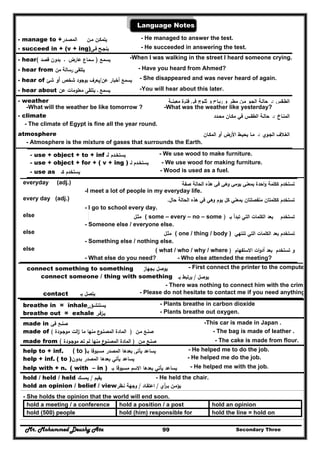
- Damaged (adj.) ‫تالف‬ - It will cost a fortune to repair the damage to the roof.
Mr. Mohammed Deushy Ata Secondary Three101
Communication Skills
Exercises
Respond the following situations:
41. You are at an interview. You are asked about your marital status.
42. You are introduced to someone you have never met before.
43. You ask your friend about how to plant a tree.
44. You give your friend instructions about how to make tea the English way.
45. You give your instructions how to use the computer.
46. You tell your brother how to plant a tree.
47. You tell your friend about the best way to switch off the computer.
48. You want to make tea the English way. Ask your friend for advice.
49. Your friend asks how he can make tea.
50. Your friend asks you how to operate the computer.
51. Your friend asks you how to recharge a mobile.
52. Your sister ask for your advice about how to keep fit.
Mention the place , the speakers and the language each of the following two min-dialogues :
1-A: I'd like to renew my passport, please.
B: You need to fill in this form and bring two recent photos
.
2-A: Can I book a flight to London, please? B: Sure. When would you like to travel?
A: Tomorrow morning.
3- A) I’d like to change some money, please. B) Cash or Travellers' cheques?
A) Travellers' cheques B) That is fine .Sign the cheques and Show me your passport.
4- A) Could you arrange us a trip to Luxor? B) Certainly .BY coach or by train. A) By train, please.
5- A) Can I see your driving license, please? B) What for?
A) You have parked in a no-parking area.
6- A) How can I help? B) Well, my car has been stolen. A) How?
B) I had parked it last night in front of my house In Ramses street .In the morning it wasn’t there.
Asking for Instructions Giving Instructions
Would you tell me …………………………? Be careful (not) to………
Would you show me ………………..…….? First …. / Then…./ Next…./ Finally….
How does + subj. + inf…………………….? First, ……………, then ……………
How can I + inf. …………..…………..……? First, ……………. After that, ……………
Can you show me how to + inf. …………? It is a good idea to ……….
What do you think I ought to do next? Remember (not) to ……..
What should I do if …………………..……? You should make (be) sure that…….
Can you tell me ……………………..……?
Place: …..… - Speaker A:….…………. - Speaker B:……..…… - Function: ……………………
Mr. Mohammed Deushy Ata Secondary Three102
A) What make is it? B) BMW.
Choose the correct answer from a , b , c , or d :
1.The tallest tree in the world is a giant Sequoia and 83.8 meters…….
a- tall b-high c- long d- wide
2.A tree’s leaves help it to ……light from the sun.
a- take in b- take out c- take off d- take to
3.The ……….is like our skin - it protects the living part of the tree on top of the Land.
a- Park b- parking c- bark d- barking
4.The tubes carry water from a tree’s …………….to its leaves.
a-rots b-roots c-bark d- stem
5.If the bark is ……………. damaged, the tree dies.
a-well b- good c- badly d-worse
6.Animals such as goats, love eating…………, so it’s especially important to keep animals away from
young trees.
a-leaves b-stem c-roots d- bark
7.it is possible to calculate the age of a tree by counting its ………, without cutting the tree down.
a- rounds b-circles c- rings d-barks
8.The ……….. Of the ring depends on the climate and the amount of rain.
a- length b-width c- weight d-thickness
9.If it’s a ……….. year, the rings are narrower.
a-stormy b-rainy c-windy d-dry
10. We make paper ……… wood from trees.
a-of b- into c- out of d- out
11. We can use wood as a ……….. for cooking and heating.
a- oil b- fuel c-fool d- full
12. Trees help the earth to breathe and they ………… us from global warming.
a- protect b- prevent c-keep d-protective
13. In addition to these uses, trees also give us ……………. chemicals.
a- valueless b- value c-valuable d-valuate
14. Turpentine, which is used as painted remover, is made from the ……….. of trees.
a- seed b-sap c- sop d-soap
15. Sap can also be used to make ……………..
a- robber b-rubber c-razor d-robbery
16. If wood is ………………, chemicals are produced which can be used to make medicines and some
kinds of plastic.
a- cooled b- boiled c- vapourized d- heated
17. Wood products can also be ………….. paper, cardboard and materials from which clothes can be
made.
a- turned b- turned into c-turned off d- turned out to
18. Wood …… are also used in some types of ice cream and other foods.
a-production b- products c- produces d- producing
19. The width of the ring depends on the ………………...
a- weather b- climate c- water d- sun
20. The ………….are the parts of trees that grow under the ground and find water.
a- roots b- rots c- reeds d- leaves
21. The hard outside part of a tree is called the ………….. ..
a- park b- bark c- brake d- break
22. …………..are the flat green parts at the ends of the branches of a tree.
a- loaves b- seeds c- leaves d- fruits
23. A…………………..grows on a plant or tree and has seeds inside.
a- fruit b- leaf c- bark d- branch
24. Every year , trees grow extra ………of new wood.
a- root b- ring c- seed d- bark
25. The noun of "wide" is ……………….
Place: …..… - Speaker A:….…………. - Speaker B:……..…… - Function: ……………………
Mr. Mohammed Deushy Ata Secondary Three103
a- widen b- wider c- width d- widest
26. "long" is an adjective ,but ……………..is the noun.
a- lung b- longest c- longer d- length
27. "high" is an adjective but …………is a noun.
a- height b- highness c- highest d- hire
28. "deep" is an adjective but ……………is a noun.
a- depth b- deepen c- deepest d- deepening
29. Strong is an adjective but ……………is a noun.
a- strength b- strongest c- stronger d- stream
30. Every year, the cells under the bark of a tree .......and become new wood.
a- hard b- harder c- hardly d- harden
31. This road is narrow for all today's traffic, so they are going to ……it.
a- wide b- widen c- width d- wider
32. That old bridge is very weak. They will have to……………..it soon
a- strong b- strengthen c- strength d- strongen
33. My new trousers are too long , so my mother is going to …….them.
a- shorten b- shortage c- shorts d- short
34. This knife doesn’t cut very well. I need to ……it.
a- sharp b- sharpness c- sharpen d- sharper
35. That film is so popular that the queues to see it ………everyday.
a- long b- length c- lengthen d- lengther
36. …………is the liquid that carries food in trees .
a- sap b- soap c- sob d- sop
37. The………….is a large wooden musical instrument with strings inside and black and white bars
that produce sounds when you press them.
a- violet b- guitar c- piano d- sax
38. We use …………..to remove paint.
a- corrector b- gas c- Turpentine d- kerosene
39. Car tyres and the bottoms of some shoes are made of ………………
a- rubber b- plastic c- synthetic d- gum
40. People put ………on their brush to clean their teeth.
a- tooth varnish b- nail varnish c- tooth brush d- toothpaste
41. Coal, gas and oil are kinds of ……………….. .
a- materials b- wood c- furniture d- fuel
42. Beds, chairs and cupboards are ………………
a- materials b- wood c- furniture d- fuel
Find the mistake in each of the following sentences then write them correctly:
1. Car tyres and the bottoms of some shoes are made from rubber.
2. Goats and other animals can die trees by damaging the bark.
3. He is capable to reading and writing English..
4. It is possible to inculcate the age of a tree.
5. It is ten metres longly.
6. Park is the hard outside part of the tree.
7. Sap is used to making rubber.
8. Some poor countries suffer from food shortness.
9. The cells below the bark firm new wood every year.
10. The climate today is so cold. I can't go out.
11. The more air there is in a year, the wider the tree rings are.
12. The storm made a lot of damage.
13. The tallest tree is among two and three thousand years old.
14. The tree is 120 metres high.
15. The tree's leaves help it to take off light from the sun.
16. There are many things that are made of trees.
17. They can exact a very thin piece of wood.
18. This cream contains expands from several plants.
19. This road contacts Assiut with Fayoum.
20. Trees can protect us from local warming.
21. Trees help to increase pollution.
Mr. Mohammed Deushy Ata Secondary Three104
22. Tubes carry water from the bark to the leaves.
23. Turpentine is used as a paint mover.
24. We can make paper down of wood.
25. We need wood from trees for demolishing houses.
26. What do you refer for?
27. Wood can be used as a feel for cooking and heating.
Translate into Arabic:
Poverty and social problems may lead some children to end up living in the streets. Sooner or
later, street children will turn to a life of crime. The whole society should help these children grow
up to become good citizens.
………………………………………………………………………………………………………………………………………………………………………………………….………………………
…………………………………………………………………………………………………………………………………………………………………………………………………………………..
Every year Egypt celebrates the international Child's Day in November .Prizes are given to
children who successfully take part in the "Reading for All" competition. Creative children in the
different branches oh knowledge are honoured.
………………………………………………………………………………………………………………………………………………………………………………………….………………………
…………………………………………………………………………………………………………………………………………………………………………………………………………………..
Hospital patients have been shown to recover from surgery more quickly when their hospital
room offered a view of trees. The strong ties between people and trees are most evident in the
resistance of community residents to removing trees to widen streets.
………………………………………………………………………………………………………………………………………………………………………………………….………………………
…………………………………………………………………………………………………………………………………………………………………………………………………………………..
Translate into English:
-‫التكنولوجيا‬ ‫و‬ ‫الصناعة‬ ‫في‬ ‫اآلخرين‬ ‫تجارب‬ ‫من‬ ‫نستفيد‬ ‫أن‬ ‫يجب‬.
………………………………………………………………………………………………………………………………………………………………………………………….………………………
-‫الحراري‬ ‫لالحتباس‬ ‫الرئيسي‬ ‫السبب‬ ‫ھي‬ ‫الجوي‬ ‫الغالف‬ ‫في‬ ‫الكربون‬ ‫أكسيد‬ ‫ثاني‬ ‫زيادة‬.
………………………………………………………………………………………………………………………………………………………………………………………….………………………
-‫سطح‬ ‫علي‬ ‫البشري‬ ‫الجنس‬ ‫حياة‬ ‫التلوث‬ ‫يھدد‬‫االرضية‬ ‫الكرة‬.
………………………………………………………………………………………………………………………………………………………………………………………….………………………
-‫االرض‬ ‫علي‬ ‫النباتات‬ ‫اضخم‬ ‫و‬ ‫اقدم‬ ‫االشجار‬ ‫تعتبر‬.
………………………………………………………………………………………………………………………………………………………………………………………….………………………
-‫ع‬ ‫خطير‬ ‫اثر‬ ‫ذو‬ ‫الغابات‬ ‫قطع‬ ‫ان‬‫البيئة‬ ‫لي‬.
………………………………………………………………………………………………………………………………………………………………………………………….………………………
-‫الطبيعية‬ ‫للموارد‬ ‫استغالل‬ ‫سوء‬ ‫بسبب‬ ‫عديدة‬ ‫مخاطر‬ ‫البيئة‬ ‫تواجه‬.
………………………………………………………………………………………………………………………………………………………………………………………….………………………
1-Zero Conditional
If + present simple + , + present simple
present simple + If + present simple
-‫حقيقة‬ ‫عن‬ ‫الحالة‬ ‫ھذه‬ ‫تعبر‬‫بھا‬ ‫المسلم‬ ‫االخري‬ ‫الحقائق‬ ‫و‬ ‫العلمية‬ ‫الحقائق‬ ‫مثل‬ ‫معين‬ ‫بزمن‬ ‫ترتبط‬ ‫وال‬ ‫تتغير‬ ‫ال‬ ‫ثابتة‬:
- If you heat ice, it melts. – Streets become wet if it rains.
- If water is frozen, it turns into ice. - If we mix red and green, we get orange.
-‫االولي‬ ‫الحالة‬ ‫نستخدم‬ ‫خاصة‬ ‫الحقيقة‬ ‫كانت‬ ‫واذا‬ ‫خاصة‬ ‫ليست‬ ‫و‬ ‫عامة‬ ‫الحقيقة‬ ‫تكون‬ ‫ان‬ ‫البد‬:
- If you heat the ice in this pan, it will melt. – Streets will become wet if it rains tonight.
-‫استخدام‬ ‫يمكن‬(when )‫من‬ ‫بدال‬(if)‫الصفرية‬ ‫الحالة‬ ‫في‬:
- When you heat ice, it melts. – Streets become wet when it rains.
Mr. Mohammed Deushy Ata Secondary Three105
2-First Conditional
If + present simple , +subj.+ will/may/ can/ must/should/ might+inf……
subj.+ will/may/ can/ must/should/ might+inf…. If + present simple
-‫ا‬ ‫تعبر‬‫حدوثه‬ ‫شروط‬ ‫تـتوفر‬ ‫المستقبل‬ ‫في‬ ‫شىء‬ ‫لحدوث‬ ‫حقيقية‬ ‫امكانية‬ ‫االولي‬ ‫االشرطية‬ ‫لحالة‬:
IF Condition ‫الشرط‬ Result ‫النتيجة‬ Possibility ‫الموقف/االمكانية‬
If Ola gets good marks, she will go to university. =If the condition is met, then she
definitely will go.
If Ola gets good marks, she may go to university. =The speaker is not sure .
If Ola gets good marks, she should go to university. =The speaker is expressing his or her
opinion, giving advice.
If Ola gets good marks, she can go to university. =This means that it is possible.
If Ola gets good marks, she could go to university. =This means that it is possible, but
not that likely.
If Ola gets good marks, she might go to university. =This means that it is possible, but
not that likely.
If Ola gets good marks, she must go to university. =The speaker is expressing his or her
strong opinion, giving strong advice.
-‫المضارع‬ ‫في‬ ‫حقيقي‬ ‫يكون‬ ‫ربما‬ ‫موقف‬ ‫عن‬ ‫الحالة‬ ‫ھذه‬ ‫تعبر‬ ‫وقد‬:
- If you are hungry, I'll get you a sandwich.
-‫الع‬ ‫االمر‬ ‫صيغة‬ ‫في‬ ‫الشرط‬ ‫جواب‬ ‫جملة‬ ‫تكون‬ ‫ان‬ ‫يمكن‬‫المشروط‬ ‫االمر‬ ‫طاء‬:
-If Ali phones, tell him to meet me at the cinema.
- If you meet the big boss, ask him for higher salaries.
-‫استخدام‬ ‫يمكن‬ ‫انه‬ ‫الحظ‬)it is + adj. + to + inf.(‫في‬‫الشرط‬ ‫جواب‬ ‫جملة‬:
- If I find a good flat, it is easy to get married. - It is difficult to breathe if you climb Mount Everest.
(If) ‫الشرط‬ ‫أداة‬ ‫بدائل‬
-‫أوال‬:‫من‬ ‫بدال‬ ‫اآلتية‬ ‫الكلمات‬ ‫استخدام‬ ‫يمكن‬If )(‫اداة‬ ‫كل‬ ‫معني‬ ‫مراعاة‬ ‫مع‬ ‫جملة‬ ‫ويليھا‬:
- only if ‫فقط‬‫لو‬ - in case ‫في‬‫حالة‬ - in the event(that) ‫في‬‫ح‬‫الة‬‫حدوث‬ - providing(that) ‫بشرط‬‫أن‬
- provided(that) ‫بشرط‬‫أن‬ - As long as ‫طالما‬ - Whether…….or not ‫سواء‬.......‫ال‬ ‫أو‬.....
- I'll attend the party provided that he invites me.
- I'll lend you the money as long as you promise to pay it back soon.
- He will travel abroad in case he gets the passport.
- She will pass the test only if she studies hard.
-‫ثانيا‬:‫من‬ ‫بدال‬ ‫اآلتية‬ ‫الكلمات‬ ‫استخدام‬ ‫يمكن‬If )(‫ويليھا‬n. / v.ing ): (
In case of ‫في‬‫حالة‬ / With ‫بـ‬ / By ‫بـ‬ + noun/ v. ing………….
- In case of getting his passport, he will travel abroad.
- She will pass the test with / by studying hard.
Unless = Except if = If not + ‫جملة‬
- You will be late if you don't hurry. = You will be late unless you hurry.
= You will be late except if you hurry.
Without ( But for ) + noun/ v. ing………….
- Without (But for) hurrying, you will be late.
- It is difficult to breathe if you climb Mount Everest.
Mr. Mohammed Deushy Ata Secondary Three106
‫االولي‬ ‫الحالة‬ ‫في‬ (If) ‫حذف‬‫الشرط‬ ‫أداة‬
-‫استخدام‬ ‫يمكن‬(should)‫من‬ ‫بدال‬If )(‫كالتالي‬ ‫االولي‬ ‫الشرطية‬ ‫الحالة‬ ‫في‬:
Should + subj. + inf……., subj.+ will+inf……….
- Should she study hard, she will pass the test.
- Should he get his passport, he will travel abroad.
3-Second Conditional
If + Past simple, subj. + would/could/might + inf….
subj. + would/could/might + inf... If + Past simple
-‫شيء‬ ‫أو‬ ‫محتمل‬ ‫غير‬ ‫موقف‬ ‫عن‬ ‫الثانية‬ ‫الحالة‬ ‫تعبر‬‫تخيلي‬‫المضارع‬ ‫في‬:
- If I had a million dollars, I would buy a big house.
= I would buy a big house if I had a million dollars.
- If he liked milk, he would drink this glass. – If I were a bird, I could fly.
-‫مستحيل‬ ‫شيء‬ ‫عن‬ ‫أحيانا‬ ‫الثانية‬ ‫الحالة‬ ‫تعبر‬ ‫أن‬ ‫يمكن‬:
- If dogs had wings, they would be able to fly.
-‫استخدام‬ ‫يمكن‬(was/were)‫مع‬‫المفرد‬:
- If I (was/were) a millionaire, I’d build a big hospital.
- If she (was/were) healthy, she could help her mum.
- It is difficult to breathe if you climb Mount Everest.
-‫الحالة‬ ‫تستخدم‬‫ايضا‬ ‫الثانية‬‫النصيحة‬ ‫عن‬ ‫للتعبير‬:
- If I were you, I’d help poor people. – If I were you, I wouldn't waste my time.
-‫للتخيل‬ ‫ايضا‬ ‫تستخدم‬ ‫السابقة‬ ‫الصيغة‬ ‫ان‬ ‫الحظ‬:
- If I were a car , I'd like to be a Mercedes. - If she were a boy, she wouldn't be more brave.
(If) ‫الشرط‬ ‫أداة‬ ‫بدائل‬
-‫أوال‬:‫من‬ ‫بدال‬ ‫اآلتية‬ ‫الكلمات‬ ‫استخدام‬ ‫يمكن‬If )(‫اداة‬ ‫كل‬ ‫معني‬ ‫مراعاة‬ ‫مع‬ ‫جملة‬ ‫ويليھا‬:
- only if ‫فقط‬‫لو‬ - in case ‫في‬‫حالة‬ - in the event(that) ‫في‬‫حالة‬‫حدوث‬ - providing(that) ‫بشرط‬‫أن‬
- provided(that) ‫بشرط‬‫أن‬ - Whether…….or not ‫سواء‬.......‫ال‬ ‫أو‬.....
- I'd attend the party only if he invited me.
- He would travel abroad in the event(that) he got the passport.
- She would pass the test in case she studied hard.
-‫ثانيا‬:‫من‬ ‫بدال‬ ‫اآلتية‬ ‫الكلمات‬ ‫استخدام‬ ‫يمكن‬If )(‫ويليھا‬n. / v.ing ): (
In case of ‫في‬‫حالة‬ / With ‫بـ‬ / By ‫بـ‬ + noun/ v. ing………….
- In case of getting his passport, he would travel abroad.
- She would pass the test with / by studying hard.
Unless = Except if = If not + ‫جملة‬
- You would be late if you didn't hurry. = You would be late unless you hurried.
= You would be late except if you hurried.
Without / But for / If it weren’t for + noun/ v. ing………….
- Without (But for) hurrying, you would be late.
Mr. Mohammed Deushy Ata Secondary Three107
-‫تح‬‫ــ‬‫ـل‬)V. ing /n.+( If it were not for‫محـ‬‫ــ‬‫ل‬)But for - without(‫الحال‬ ‫فى‬‫ـ‬‫الثاني‬ ‫ة‬‫ـ‬‫ة‬:
If it were not for + v.ing/n… subj.+ Would + inf. ….
- But for (Without) her cleverness, she would get low marks.
= If it weren't for her cleverness, she would get low marks.
‫الحالة‬ ‫في‬‫الثانية‬ (If) ‫حذف‬‫الشرط‬ ‫أداة‬
1-‫تحذف‬ ‫ان‬ ‫يمكن‬(if)‫و‬‫بـ‬ ‫الجملة‬ ‫تبدأ‬)were(‫بعدھا‬ ‫يأتي‬: (to + inf.)
Were+ subj. / obj. + to+ inf……., subj. / obj. + would+inf……….
- If he worked hard, he would succeed. = Were he to worked hard, he would succeed.
2-‫كانت‬ ‫وإذا‬were )(‫أساسي‬ ‫فعل‬‫مكان‬ ‫تأتي‬ ‫الجملة‬ ‫في‬)(if:
Were+ subj. / obj. ……., subj. / obj. + would+inf……….
- If I were tall, I would play basketball. = Were I tall, I would play basketball.
3‫ـ‬‫تح‬‫ــ‬‫ـل‬Had‫محـ‬‫ــ‬‫ل‬If‫الح‬ ‫فـى‬‫ــ‬‫ال‬‫ــ‬‫الث‬ ‫ة‬‫ـ‬‫اني‬‫ـ‬‫ويليـھ‬ ‫ة‬‫ـ‬‫ا‬‫ا‬‫س‬‫ـ‬‫ـم‬‫للجملة‬ ‫اساسي‬ ‫فعال‬ ‫تكون‬ ‫أن‬ ‫بشرط‬:
Had+ subj. ……., subj. / obj. + would+inf……….
- If I had a million dollars, I would buy a big house.
= Had I a million dollars, I would buy a big house.
4-‫استخدام‬ ‫يمكن‬(should)‫من‬ ‫بدال‬If )(‫كالتالي‬ ‫االولي‬ ‫الشرطية‬ ‫الحالة‬ ‫في‬:
Should + subj. + inf……., subj.+ would+inf……….
- Should I have a million dollars, I would buy a big house.
3-Third Conditional
If + Past perfect subj. + (would/could/might) have + PP…
subj. + (would/could/might) have + PP… If + Past perfect
-‫الحال‬ ‫تستخدم‬‫الثالثة‬ ‫ة‬‫الندم‬ ‫عن‬ ‫التعبير‬ ‫او‬ ‫لالنتقاد‬ ‫تستخدم‬ ‫و‬ ‫الحدوث‬ ‫مستحيل‬ ‫شرط‬ ‫فھي‬ ‫بالتالي‬ ‫و‬ ‫الماضي‬ ‫في‬ ‫وقعت‬ ‫احداث‬ ‫عن‬ ‫للتعبير‬:
- If you had driven more carefully, you would not have had an accident.
- If we had played a little better, we could have won the game.
- You could have bought a computer If you had saved your money.
-‫تأتي‬ ‫أن‬ ‫يمكن‬)Had(‫من‬ ‫بدال‬( if ):
- Had you driven more carefully, you would not have had an accident.
- Had you played a little better, we could have won the game.
-‫تح‬‫ــ‬‫ـل‬)V. ing /n.+( If it hadn't been for‫محـ‬‫ــ‬‫ل‬)But for - without(‫الحال‬ ‫فى‬‫ـ‬‫الثا‬ ‫ة‬‫لثـ‬‫ة‬:
If it hadn't been for + v.ing/n… subj.+ Would + inf.
- Without (But for) his help, I would have failed.
= If it hadn’t been for his help, I would have failed.
‫م‬‫الشرطية‬ ‫الجمل‬ ‫علي‬ ‫الحظات‬
2-‫السؤال‬ ‫منھا‬ ‫يتكون‬ ‫التي‬ ‫ھي‬ ‫و‬ ‫الرئيسية‬ ‫الجملة‬ ‫ھي‬ ‫الشرط‬ ‫جواب‬ ‫جملة‬ ‫ان‬ ‫الحظ‬:
- If she wins the prize, she will buy a camera.
- Will she buy a camera if she wins the prize? - What will she do if she wins the prize?
Mr. Mohammed Deushy Ata Secondary Three108
Exercises
Choose the correct answer from a , b , c , or d :
7.If the bark is badly damaged , the tree ………………
a- die b- will die c- dies d- shall die
8.You …………see the rings if you cut the tree down.
a- could b- can c- would d- should
9.If there’s a lot of rain during the year, the rings ………. quiet wide.
a- are b- would be c- will be d- shall be
10. If it’s a dry year, the rings ………narrower.
a- be b- will be c- are d- have been
11. ……….water is boiled , it turns into vapour.
a-While b- Because c- When d-Although
12. If those goats …………………..the bark on my trees, the trees will die.
a- had eaten b- are eating c- ate d- eat
13. If water freezes , It ………….into ice.
a- will turn b- is turning c- turns d- turned
14. If people don’t get enough food , they ………………..ill.
a- will become b- would become c- become d- would have become
15. If it ………….raining for much longer , the will flood.
a- goes on b- went on c- had gone on d- will go on
16. If the farmer's fields get very dry this summer , he …….them.
a- irrigates b- will irrigate c- would irrigate d- irrigated
17. If the wind is very strong, it ………….a lot of damage .
a- would do b- will do c- would have done d- did
18. If there is a sandstorm tonight, all buildings ……….dusty .
a- would be b- are c- will be d- be
19. If you mix yellow and blue , you …………..green.
a- will get b- get c- would get d- got
20. If you don’t water these plants soon, they …………. .
a- will die b- die c- would die d- would have died
21. If you heat ice, it ………… .
a- will melt b- would melt c- melts d- would have melted
22. If scientists study the rings of trees, they ……..information about our climate in the past.
a- could find b- can find c- would find d- would have found
23. If you pick those apples now, they ………taste very sweet.
a- won't b- don’t c- wouldn't d- didn't
24. If you leave now , you ………….catch the train.
a- would b- will c- ought to d- should
25. If a tree has deep roots, it …………….over in strong winds.
a- wouldn’t have fallen b- doesn’t fall c- wouldn’t fall d- won’t fall
26. water ……….if the temperature is zero or below.
a- freezes b- freeze c- will freeze d- would freeze
27. If you throw that stone , you …………a window.
a- break b- will break c-would break d- have broken
28. I will get a headache if I ………too long the computer.
a- spend b- will spend c- would spend d- spent
29. If she trains hard , she ………..next week's race.
a- wins b- will win c- would win d- won
30. If you will mix red and white , you ……..pink.
a- get b- will get c- would get d- got
31. If you practise a sport, you ….......in the sports team.
a- gets b- will get c- would get d- got
If you work hard , you …………the first.
a- will be b- are c- would be d- shall be
32. I want to make tea the English way .what …………I do ?
Mr. Mohammed Deushy Ata Secondary Three109
a- will b- can c- would d- should
33. It is a good ……….to wait for three or four minutes-the tea tastes better if you wait.
a- thought b- thinking c- idea d- way
Find the mistakes in each of the following sentences then write them correctly:
1. Don't worry if I was late tonight.
2. He can stay with me provided he agreed to help with the housework.
3. Hurry up! If we don't hurry, we'd be late
4. I will tell you if I saw anything unusual.
5. I would have been angry if it happens again.
6. If he arrive early, he will catch the bus.
7. If he will be sick, he had better go to bed.
8. If I felt tired, I will go to bed.
9. If I found any money at school, I will take it to the teacher.
10. If metals heat, they expand.
11. If she ran all the way, she'll get there in time.
12. If she trains hard, she wins next week's race.
13. If she works hard, she earns more money.
14. If the bark of the tree was badly damaged, the tree dies.
15. If there was a lot of rain during the year, the rings are quite wide.
16. If they didn't come soon, I'm not going to wait.
17. If you heat ice, it freezes.
18. If you throw that stone, you break a window.
19. If you will mix red and white, you get pink.
20. It's raining hard. We get wet if we go out.
21. Metal floats if it puts in water.
22. The dog doesn't attack you if you sit quite still.
23. Unless you don't wear boots, you may get bitten by snakes.
24. Water will freeze if the temperature is zero or below.
25. We see the whole match if we leave now.
26.
Test 6
A- Language Functions
1- Respond to each of the following situations:
1.A friend asks you how to switch on TV.
2.A friend wants to know the best way to keep fit.
3.Ask your teacher for how to study English vocabulary.
4.You want some instructions from a friend about how you can use the internet.
5.
2- Mention the place, the speakers and the language each of the following two min-dialogues:
1. A: Can I get some information about restaurants where I can have my meals?
B: Certainly sir. What kind of restaurants? A: Not expensive ones. But not cheap either.
2 A: Can I help you, sir? B: Yes, please, I want lead – free petrol.
A: How many liters, Sir? B: 20, please
B- Vocabulary and structures
3. Choose the correct answer from a, b, c or d:
1. The bark protects the tubes which carry water and salts from the.........underground to the leaves.
a- branches b- trunks c- roots d- seeds
2. He went to the dentist to ………..the bad tooth that caused the pain.
a- extract b- plant c- set d- push
Place: …..… - Speaker A:….…………. - Speaker B:……..…… - Function: ……………………
Mr. Mohammed Deushy Ata Secondary Three110
3. The inner ……of the wheel must be filled with air.
d-pipec- vesselb-tubea-cylinder
4. Parents do their best to …….their children from dangers.
d-toc-fromb- ona-by
5. He depends ………..his brother's help to get his needs.
a- to b- on c- for d- in
6. ………….you tell me how to switch on the TV set, please?
a- Would b- Should c- shall d- Must
7. The earthquake …………a lot of old houses last week.
a- supported b- mended c- repaired d- damaged
8. He didn’t obey the ……….,so he was punished.
a- instruction b- instructions c- construction d- constructions
9. ………water boils , it becomes steam
a- while b- when c- Because d- even if
10. If a piece of metal ………in water, it sinks .
a- put b- is put c- puts d- has put
11. You will be late for work ………you don’t take a taxi.
a- unless b- if c- so d- while
12. If a volcano erupts, it …….dust into atmosphere.
a- will send b- sent c- would send d- sends
13. If it rains tomorrow, I ……to the library.
a- go b- will go c- won’t go d- would go
14. ………….you work hard, you won’t pass the exam.
a- if b- unless c- providing d- as long as
15. If the ice caps melt , the sea level …………….. .
a- will rise b- would rise c- has risen d- rose
16. If metal is heated , it …………. .
a- will expand b- expand c- has expanded d- expands
4- Find the mistake in each of the following sentences then write them correctly:
1.He works hardly.
2.If people don’t get enough food , they will become ill.
3.If you go to Sharm El sheikh, you spend a wonderful holiday.
4.In short we need more money.
5.We make paper into wood from trees.
6.What do you think I ought do next?
7.
C- Reading
5. Read the following passage then answer the questions
Trees alter the environment in which we live by moderating climate, improving air quality,
conserving water, and harboring wildlife. Climate control is obtained by moderating the effects of
sun, wind, and rain. Radiant energy from the sun is absorbed or deflected by leaves on deciduous
trees in the summer and is only filtered by branches of deciduous trees in winter. We are cooler
when we stand in the shade of trees and are not exposed to direct sunlight. In winter, we value the
sun’s radiant energy. Therefore, we should plant only small or deciduous trees on the south side of
homes.
Wind speed and direction can be affected by trees. The more compact the foliage on the tree or
group of trees, the greater the influence of the windbreak. The downward fall of rain, sleet, and hail
is initially absorbed or deflected by trees, which provides some protection for people, pets, and
buildings. Trees intercept water, store some of it, and reduce storm runoff and the possibility of
flooding.
Dew and frost are less common under trees because less radiant energy is released from the soil
in those areas at night.
Temperature in the vicinity of trees is cooler than that away from trees. The larger the tree, the
greater the cooling. By using trees in the cities, we are able to moderate the heat-island effect
caused by pavement and buildings in commercial areas.
Air quality can be improved through the use of trees, shrubs, and turf. Leaves filter the air we
breathe by removing dust and other particulates. Rain then washes the pollutants to the ground.
Leaves absorb carbon dioxide from the air to form carbohydrates that are used in the plant’s
structure and function. In this process, leaves also absorb other air pollutants—such as ozone,
carbon monoxide, and sulfur dioxide—and give off oxygen.
Mr. Mohammed Deushy Ata Secondary Three111
By planting trees and shrubs, we return to a more natural, less artificial environment. Birds and
other wildlife are attracted to the area. The natural cycles of plant growth, reproduction, and
decomposition are again present, both above and below ground. Natural harmony is restored to the
urban environment.
a) Give short answers to the following questions:
1 How can trees improve the environment?
2. What is the effect of trees on air?
3- What is the relation between the size of tree and temperature?
B. Choose the correct answer from a. b, c or d.
4. Dew and frost are less common under trees as ………..
a) heat is released from the sun. b) Energy is released from the soil.
c) energy released at night d) energy released from soil at night .
5. The word "deciduous" means .................
a) losing leaves in autumn b)evergreen c) takes decisions d) small
6) Read the following passage, then answer the questions:
Many experts believe there are too many people in the world. Unless there are big changes
in the way people think about the number of children they should have, the world's population will
double in 25 years .there will be more than 20 cities with populations greater than 20 million. Now
there is only one. Some people- who do not understand what' overpopulation ' means point to
countries such as Australia-and say, "There is plenty of room there." Although most of Australia is
unpopulated, and much of it is thinly populated; there are reasons for this. Firstly, much of the land
is desert and waterless, and secondly, even the land that is not desert is not suitable for anything,
not even growing grass. Another major problem We shall have to face as the world's population
grows, is a shortage of energy. We are using up coal and oil and when they have been used up, we
shall have to find something to take their place. It is true that we can make electricity from the heat
of the sun and moving water, but we do not yet have the technology to do this in a big way.
Perhaps, the biggest problem we shall have when the world's population doubles will be pollution.
The air we breathe is already badly polluted.
a) Give short answers to the following questions:
1- How many present cities have a population of over 20 million?
2- According to the passage, why is a great area of Australia unpopulated?
3- Mention two problems we will face as a result of overpopulation.
b) Choose the correct answer from a, b, c or d:
4) The underlined word "they" refers to………………….
a- coal and oil b- the world's population
c- experts d- population in Australia
5) We do not make electricity from the heat of the sun on a large scale because..........
a) We don't have the required money. b) it is harmful.
c) We don't have the technology needed for that. d) it is just impossible.
D- The Novel
7) (A) Answer the following questions:
1- Does the Princess know that this is not the real King? What does she say about him?
2- Why do Rassendyll and Sapt need a permit to leave the city?
3- How do they get a permit from the King?
4- What does Fritz do while Sapt and Rassendyll go to Zenda?
5-
B)Read following quotation and answer the questions:
"You mustn't try too hard. I'm not sure it was a good idea to ride alone through the old town.
Duke Michael won't like it if you become too popular with his people, you know."
1- Who says this to whom?
2- Where and when is this said?
3- Why did the person ride alone through the old town and why won't Duke Michael like
it if the person becomes too popular?
C) Find the mistake in each of the following sentences then write them correctly:
1- Fritz thinks it is a good idea for Rassendyll "the King" to become popular with the people.
2- Sapt tells Fritz that he may let Michael into the King's bedroom.
Mr. Mohammed Deushy Ata Secondary Three112
E - Writing
8. Write a paragraph about 100 words about
Trees are important for man and environment .
F- Translation
9. a) Translate into Arabic :
One of the environmental problems is the slight rise in the temperature of the earth .As the world
becomes hotter, there could be serious changes in weather and widespread flooding as water level
in seas and oceans rises .The heavy rains in various parts of the world this winter may be
considered a warning to man to stop polluting the atmosphere.
……………………………………………………………………………………………………………………………………………………………………………………………………………………
……………………………………………………………………………………………………………………………………………………………………………………………………………..……
…………………………………………………………………………………………………………………………………………………………………………………………………………………..
b) Translate into English:
1-‫الدخل‬ ‫محدودى‬ ‫وخاصة‬ ‫الكثيرين‬ ‫حياة‬ ‫على‬ ‫مباشرا‬ ‫تأثيرا‬ ‫تؤثر‬ ‫المستمر‬ ‫األسعار‬ ‫زيادة‬.
…………………………………………………………………………………………………………………………………………………………………………………………………………
…………………………………………………………………………………………………………………………………………………………………………………………………………
……………..……2-‫الحكوم‬ ‫تشجع‬‫صعبة‬ ‫عملية‬ ‫الى‬ ‫تحتاج‬ ‫التي‬ ‫الواردات‬ ‫من‬ ‫كثير‬ ‫عن‬ ‫تستغني‬ ‫أن‬ ‫تستطيع‬ ‫حتى‬ ‫المحلية‬ ‫الصناعات‬ ‫ة‬
……………………………………………………………………………………………………………………………………………………………………………………………………………………
………………….………………………………………………………………………………………………………………………………………………………………………………………………..
Continuous rising prices ‫المستمر‬ ‫االسعار‬ ‫ارتفاع‬ Level ‫مستوي‬
Do without ‫عن‬ ‫يستغني‬ Local industries ‫محلية‬ ‫صناعات‬
Fixed / limited income ‫محدود‬ ‫دخل‬ Serious changes ‫خطيرة‬ ‫تغيرات‬
Flooding ‫فيضان‬ Slight rise ‫طفيف‬ ‫ارتفاع‬
Hard currency ‫صعبة‬ ‫عمله‬ Warning ‫تحذير‬
Have a direct effect ‫مباشر‬ ‫تأثير‬ ‫له‬ Widespread ‫اإلنتشار‬ ‫واسع‬
Mr. Mohammed Deushy Ata Secondary Three113
Un
Unit 7 – Great Engineering
a lot newer ‫كثيرا‬ ‫أجدد‬ eventually ‫أخيرا‬ raise ‫يرفع‬
amazing ‫مذھل‬ finish ‫ينھى‬ rays ‫أشعة‬
amazing works ‫مذھلة‬ ‫أعمال‬ flood ‫يفيض‬ reconstruction ‫البناء‬ ‫إعادة‬
ancient ‫قديم‬ giant ‫عمالق‬ re-open ‫افتتاح‬ ‫يعيد‬
attack ‫يھاجم‬/‫ھجوم‬ government ‫الحكومة‬ rescue ‫ينقذ‬
base ‫قاعدة‬/‫سفح‬ great ‫عظيم‬ rescue operation ‫إنقاذ‬ ‫عملية‬
carry ‫يحمل‬ great wall of china ‫العظيم‬ ‫الصين‬ ‫سور‬ ride ‫يركب‬/‫يمت‬‫طى‬
carve ‫ينحت‬ hold ‫يمسك‬ rise ‫يرتفع‬
certain times ‫معينة‬ ‫أوقات‬ illuminate ‫ينير‬ rising sun ‫المشرقة‬ ‫الشمس‬
cheap ‫رخيص‬ illumination ‫إنارة‬ safe ‫يوفر‬
city centre ‫المدينة‬ ‫وسط‬ improve ‫يحسن‬ save money ‫مال‬ ‫يوفر‬
cliff ‫صخري‬ ‫جرف‬ invest ‫يستثمر‬ site ‫موقع‬
combination ‫خليط‬‫ـ‬‫مزيج‬ investment ‫استثمار‬ sound like ‫يشبه‬
commuter ‫العمل‬ ‫إلى‬ ‫يوميا‬ ‫المسافر‬ investor ‫مستثمر‬ station ‫محطة‬
complete ‫يكمل‬ lift ‫يرفع‬ statue ‫تمثال‬
concrete base ‫خرسانية‬ ‫قاعدة‬ line ‫خط‬ stop attackers ‫المھاجمين‬ ‫يمنع‬
consider ‫يعتبر‬ make a plan ‫خطة‬ ‫يدبر‬ structure ‫بناء‬
construction ‫بناء‬ massive ‫ضخم‬ temple ‫معبد‬
cost ‫يتكلف‬/‫تكلفة‬ modern ‫حديث‬ the middle east ‫األوسط‬ ‫الشرق‬
diameter ‫قطر‬ monuments ‫آثار‬ the way to ‫إلى‬ ‫الطريق‬
dig ‫يحفر‬ Nile valley ‫النيل‬ ‫وادي‬ the whole thing ‫بأكمله‬ ‫الشيء‬
draw up a plan ‫خطة‬ ‫يرسم‬ on horse backs ‫الخيل‬ ‫ظھر‬ ‫على‬ tourism ‫السياحة‬
drilling machine ‫حفر‬ ‫آله‬ Open (v / adj. ) ‫يفتح‬‫ـ‬‫مفتوح‬ tourist ‫سائح‬
emperor ‫إمبراطور‬ pick ‫يلتقط‬ tunnel ‫نفق‬/‫نفق‬ ‫يحفر‬
empire ‫إمبراطورية‬ plan ‫خطة‬ underground ‫األنفاق‬ ‫مترو‬
engine ‫محرك‬‫ـ‬‫موتور‬ position ‫موقع‬‫ـ‬‫يقع‬ unthinkable ‫معقول‬ ‫غير‬
engineer ‫مھندس‬ progress ‫تقدم‬‫ـ‬‫تطور‬ weigh ‫يزن‬
engineering ‫الھندسة‬ project ‫مشروع‬ weight ‫الوزن‬
engineering project ‫ھندسي‬ ‫مشروع‬ railway ‫حديد‬ ‫سكة‬ ‫نظام‬ whether ---- or ‫سواء‬....‫أو‬
Expressions
a journey on the underground ‫بالمترو‬ ‫رحلة‬ foreign investment ‫األجنبي‬ ‫االستثمار‬
a massive project ‫ھائل‬ ‫مشروع‬ geographical location ‫جغرافي‬ ‫موقع‬
a work of engineering ‫ھندسي‬ ‫عمل‬ get to ‫إلي‬ ‫يصل‬
accessible to ‫لـ‬ ‫متاح‬ in the same position ‫الموقع‬ ‫أو‬ ‫المكان‬ ‫نفس‬ ‫في‬
attractive to ‫جذاب‬‫لـ‬ infrared rays ‫الحمراء‬ ‫تحت‬ ‫األشعة‬
be attached to ‫بـ‬ ‫متصل‬ investment opportunities ‫االستثمار‬ ‫فرص‬
be made out of ‫من‬ ‫مصنوع‬ keep the attackers out ‫المھاجمين‬ ‫يبعد‬ُ
building construction ‫المباني‬ ‫إنشاء‬ light up ‫ينير‬/‫يضيء‬
building materials ‫بناء‬ ‫مواد‬ make a plan ‫خطة‬ ‫يضع‬
building site ‫البناء‬ ‫موقع‬ massive efforts ‫ھائلة‬ ‫جھود‬
ceramic tiles ‫سيراميك‬ ‫بالط‬ provide water for agriculture ‫للزراعة‬ ‫الماء‬ ‫يوفر‬
Connect... with ‫يوصل‬..‫بـ‬ reach a length of ‫الي‬ ‫طوله‬ ‫يصل‬
cut into a particular shape ‫معين‬ ‫شكل‬ ‫في‬ ‫يقطع‬ related to ‫بـ‬ ‫مرتبط‬
cut into pieces ‫صغيرة‬ ‫قطع‬ ‫إلي‬ ‫يقطع‬ remove obstacles ‫العقبات‬ ‫يزيل‬
cut into rock ‫الصخر‬ ‫في‬ ‫يحفر‬ road construction ‫الطرق‬ ‫إنشاء‬
Divide... into ‫إلي‬ ‫يقسم‬ُ save them a lot of money ‫المال‬ ‫من‬ ‫كثير‬ ‫لھم‬ ‫يوفر‬
dominate the headlines ‫األخ‬ ‫عناوين‬ ‫تتصدر‬‫بار‬ take pride in ‫بـ‬ ‫يفخر‬
encourage investments ‫االستثمارات‬ ‫يشجع‬ ultraviolet rays ‫البنفسجية‬ ‫فوق‬ ‫األشعة‬
environmental pollution ‫البيئي‬ ‫التلوث‬ with a diameter of ‫يبلغ‬ ‫بقطر‬
Mr. Mohammed Deushy Ata Secondary Three114
Words & antonyms
ancient ‫قديم‬ modern ‫حديث‬
build ‫يبني‬ demolish ‫يھدم‬
catch (the train) ‫بـ‬ ‫يلحق‬ miss (the train) ‫يفوته‬
different ‫مختلف‬ the same ‫الشيء‬ ‫نفس‬
hesitant ‫متردد‬ confident ‫واثق‬
illuminate ‫يضيء‬ darken ‫يظلم‬ُ
massive ‫ھائل‬ tiny ‫الحجم‬ ‫ضئيل‬
maximum ‫أقصي‬/‫األقصي‬ ‫الحد‬ minimum ‫أدني‬/‫األدني‬ ‫الحد‬
merits ‫مزايا‬ demerits ‫عيوب‬
raise ‫ي‬‫رفع‬ lower ‫يخفض‬
save ‫يوفر‬ waste ‫يبدد‬
unthinkable ‫محتمل‬ ‫غير‬/‫مستحيل‬ likely ‫محتمل‬
Derivatives
Verb Noun Adj.
attract ‫يجذب‬ attraction ‫جذب‬ attractive ‫جذاب‬
deduce ‫يست‬‫نتج‬ deduction ‫استنتاج‬ deductive ‫استنتاجي‬
forget ‫ينسي‬ forgetfulness ‫النسيان‬ forgetful ‫النسيان‬ ‫كثير‬
illuminate ‫يضيء‬ illumination ‫إضاءة‬ illuminating ‫مضيء‬
repeat ‫يكرر‬ repetition ‫تكرار‬ repetitive ‫متكرر‬
tour ‫يقوم‬‫سياحية‬ ‫بجولة‬ tourism ‫السياحة‬
tourist ‫سائح‬
tourist ‫سياحي‬
Definitions
commuter someone who regularly travels to work, especially a long distance ‫اﻟﻌﻣﻝ‬ ‫إﻟﻰ‬ ‫ﻳوﻣﻳﺎ‬ ‫اﻟﻣﺳﺎﻓر‬
diameter a line that goes from one side of a circle to the other and passes
through the centre
‫ﻗطر‬ُ
engineering the work of designing the way roads, bridges, machines, etc. are built ‫اﻟﻬﻧدﺳﺔ‬
investment something that you buy because it will be valuable or useful later ‫اﺳﺗﺛﻣﺎر‬
base a low hard surface on which other things can be built/the lowest part
or surface of something
‫ﻗﺎﻋدة‬/‫أﺳﺎس‬
carve to cut something, especially stone or wood, into a particular shape ‫ﻳﻧﺣت‬
cliff a high steep rock or piece of land ‫ي‬‫ﺻﺧر‬ ‫ﺟرف‬
illuminate to make light shine on something ‫ﻳﻧﻳر‬/‫ﻳﺿﻲء‬
monument a large structure that is built to remind people of an important event
or famous person
‫أﺛر‬
position put something or someone in a place ‫ﻣوﻗﻊ‬‫ـ‬‫ﻳﻘﻊ‬
raise to move or lift something to a higher position ‫ﻳرﻓﻊ‬
rays narrow beams‫شعاع‬of light or energy from the sun ‫آﺷﻌﺔ‬
unthinkable impossible to imagine or accept ‫ﻣﻌﻘوﻝ‬ ‫ﻏﻳر‬
Language Notes
carved into ‫ﻣﻧﺣـــوت‬‫ﻓـﻰ‬ - The temple was carved into cliff.
carved out of ‫ﻣﻧﺣـــوت‬‫ﻣـن‬ -The statue is carved out of wood.
- commute from .. to .. / commute between .. and …‫وﻣﻧﻪ‬ ‫اﻟﻌﻣﻝ‬ ‫ﻣﻛﺎن‬ ‫اﻟﻲ‬ ‫ﻳوﻣﻳﺎ‬ ‫ﻳﺳﺎﻓر‬
- She commutes from Banha to Cairo.
-commute ‫ﻳﺧﻔف‬ُ‫اﻟﻌﻘوﺑﺔ‬ - The judge commuted the fine to 2,000 dollars.
Mr. Mohammed Deushy Ata Secondary Three115
decide to + inf ‫ﻳﻘـرر‬ - She decided to go out.
decide on + noun‫ﻳﻘـرر‬ ‫ـ‬ ‫ﻳﺣدد‬ - You have to decide on your goal in life.
decide that + sentence‫ﻳﻘـرر‬ - He decided that you should attend.
site ‫ى‬‫أﺛـر‬ ‫ﻣوﻗـﻊ‬/‫ﺑﻧـﺎء‬ - Abu Simble is the site of two temples south of Aswan.
site ‫اﻹﻧﺗرﻧت‬ ‫ﺷﺑﻛﺔ‬ ‫ﻋﻠﻰ‬ ‫ﻣوﻗﻊ‬ -You can apply for the job on our website.
raise ( d ) + ‫ﻣﻔﻌـ‬‫وﻝ‬ ‫اﻧـﺎت‬‫و‬‫ﺣﻳ‬ ‫ﻳـرﺑﻰ‬/‫ﻣـﺎﻝ‬ ‫ﻳﺟﻣـﻊ‬/‫ﻳرﻓـﻊ‬
- Raise your hand if you want to answer. - He raised a lot of money a broad.
- His uncle raises cattle and sheep.
rise - rose - risen ‫ﻳرﺗﻔـﻊ‬/‫ﺗﺷـرق‬/‫ﻳﻧﻬـض‬‫ﺷﺧص‬ ‫ﻟﻳﺣﻳﻰ‬/‫ﻳﺳﺗﻳﻘظ‬)‫ﻣﻔﻌـوﻝ‬ ‫ﺑـدون‬(
- The sun rises in the east. - I rise at 6.00 in the morning.
- When the visitor entered, all students rose. - Taxis fare have risen
arise arose arisen ‫اﻟﺣـد‬ ‫ﻋن‬ ‫ﻳـزﻳد‬/‫ﻳﺣﺗـدم‬/‫ﻳﻧﺷـﺄ‬)‫ﺑ‬‫ـ‬‫ﻣﻔﻌـوﻝ‬ ‫دون‬(
- A lot of problems arise because of misunderstanding.
arouse ( ‫ﻣﻔﻌـوﻝ‬ ) aroused ‫ﻳﺛﻳـر‬/‫ﻳوﻗـظ‬
- His behaviour aroused the suspicion of the police. - Don’t arouse the baby.
conquer ‫ﻳﻐزو‬)‫ﺑﻠد‬ ‫أو‬ ‫ﻋدو‬( -The Normans conquered England in 1066.
occupy ‫ﻳﺣﺗﻝ‬)‫ﺑﻠد‬ ‫أو‬ ‫ﻣﻛﺎن‬( - The capital has been occupied by the rebel army.
Raid ‫ﻳﺷن‬)‫ة‬‫ﻏﺎر‬( -Villages along the border are regularly raided.
‫ﺑـ‬ ‫اﻟﻣﻧﺗﻬﻳـﺔ‬ ‫اﻟﺻﻔـﺎت‬ed‫أﺷﺧـﺎص‬ ‫ﻋن‬ ‫ﻏﺎﻟﺑﺎ‬‫ﺗﻌﺑـر‬
- I'm very tired today. - I'm interested in reading books.
‫ﺑـ‬ ‫اﻟﻣﻧﺗﻬﻳـﺔ‬ ‫اﻟﺻﻔـﺎت‬ ‫أﻣـﺎ‬ing‫أﺷﻳـﺎء‬ ‫ﻋـن‬ ‫ﻏﺎﻟﺑﺎ‬‫ﺗﻌﺑـر‬
- Shopping is very tiring. - I watched a very interesting film yesterday.
adjectives (ing) ‫ﺑــ‬ ‫اﻟﻣﻧﺗﻬﻳـﺔ‬ ‫اﻟﺻﻔـﺔ‬ ‫ﺗﺄﺗﻰ‬ ‫أن‬ ‫وﻳﻣﻛن‬(ing)‫اﻟﺻﻔﺔ‬ ‫ﻫذﻩ‬ ‫ﻳﺳﺑب‬ ‫اﻟذي‬ ‫ﻫو‬ ‫اﻟﺷﺧص‬ ‫ﻛﺎن‬ ‫إذا‬ ‫اﻟﻌﺎﻗﻝ‬ ‫ﻣـﻊ‬.
- He is boring. ( It means that he causes boredom )
‫ﺟﻣﻌﺎ‬ ‫ﺗﻛون‬ ‫ة‬‫ﻛﺑﻳر‬ ‫ﻟﻛﻣﻳﺎت‬ ‫وﺗﺷﻳر‬ ‫ﻣﺣدد‬ ‫ﻋدد‬ ‫ﻳﺳﺑﻘﻬﺎ‬ ‫ﻟم‬ ‫إذا‬ ‫أﻣﺎ‬ ‫ﻣﻔردا‬ ‫ﺗﻛون‬ ‫ﻣﺣدد‬ ‫ﻋدد‬ ‫ﻗﺑﻠﻬﺎ‬ ‫ﺟﺎء‬ ‫إذا‬ ‫اﻟﻛﻠﻣﺎت‬ ‫ﻫذﻩ‬.
Hundred – thousand – million – billion - trillion
- His salary is 500 hundred pounds a month.
- Thousands of people watched the match on TV yesterday.
realize ‫ﻳدرك‬ - I'm sorry, I didn't realize that it was so late.
achieve ‫ﻳﺣﻘق‬ - He achieved most of his ambitions.
reach ( goal – aim – target ) ‫ﻳﺻﻝ‬‫إﻟﻰ‬ -‫ﻳﺣﻘق‬ - He reached his goal after long hours of hard work
lose ‫ﻳﺧﺳـر‬‫ـ‬‫ﺷـﺊ‬ ‫ﻳﻔﻘـد‬ - Our national team lost the last match.
Miss ‫ﺷﺧـص‬ ‫ﻳﻔﺗﻘـد‬‫ـ‬‫اﺻـﻼت‬‫و‬‫ﻣ‬ ‫ﻳﻔـوﺗﻪ‬ - I missed my uncle very much.
- He missed the train as he got up late.
proud of (something / someone ) ‫ﻓﺧ‬‫ــ‬‫ور‬‫ﺑـ‬ - Her parents are very proud of her.
proud to do something ‫ﻓﺧ‬‫ــ‬‫ور‬‫أن‬ - I am proud to receive this award.
take pride in ‫ﻳﻔﺗﺧر‬‫ﺑـ‬ - She takes a great pride in her work.
keep
keep ‫ﻋﻠﻲ‬ ‫ﻳﺣﺎﻓظ‬/‫ﻳرﺑﻲ‬/‫ﻳظﻝ‬ keep off ‫ﺗﻘﺗـرب‬ ‫ﻻ‬/‫ﻳﺑﻌد‬
keep at ‫ﻋﻠـﻰ‬ ‫اظـب‬‫و‬‫ﻳ‬ keep out ‫ﻳﺣﺟـز‬ ‫ـ‬ ‫ﻳﺗﺟﻧـب‬
keep away from ‫ﻋـن‬ ‫ﻳﺑﻌـد‬ keep pace with ‫اﻛـب‬‫و‬‫ﻳـ‬ ‫ـ‬ ‫ﻳﺳـﺎﻳـر‬
Keep back ‫ﻳﻌـوق‬ keep to ‫ﻳـﻼزم‬
keep down ‫ﻋﻠـﻰ‬ ‫ﻳﺳﻳطـر‬ keep up ‫ﻳﺳﺗﻣـر‬
keep in ‫ﻳﺣﺑـس‬ keep up with ‫اﻛـب‬‫و‬‫ﻳـ‬ ‫ـ‬ ‫ﻳﺳـﺎﻳـر‬
Mr. Mohammed Deushy Ata Secondary Three116
cut
cut ‫ﻳﻘطـﻊ‬ cut out ‫آﻟـﺔ‬ ‫ﺗﺗـوﻗـف‬
cut down ‫ة‬‫ﺷﺟر‬ ‫ﻳﻘطﻊ‬ ‫ـ‬ ‫ﻳﺧﺗﺻر‬ ‫ـ‬ ‫ﻳﻘﻠﻝ‬ cut to size ‫اﻟﻣﻘـﺎس‬ ‫ﺣﺳـب‬ ‫ﻳﻘطـﻊ‬
cut off ‫إﻣداد‬ ‫ﻳـوﻗـف‬ cut up ‫ﻳﻣـزق‬
work
work against ‫ﺿد‬ ‫ﻳﻌﻣﻝ‬ work on (someone) ‫اﻟﺷﺧـص‬ ‫ﻳﻘﻧـﻊ‬ ‫أن‬ ‫ﻳﺣﺎوﻝ‬
work for ‫ﻟﺣﺳـﺎب‬ ‫ﻳﻌﻣـﻝ‬ work on (something) ‫اﻟﺷـﺊ‬ ‫ﻳﺣﺳـن‬ ‫أو‬ ‫ﻳﺻﻠـﺢ‬ ‫أو‬ ‫ﻳﺻﻧـﻊ‬
work ( himself ) up ‫ﺷـﺊ‬ ‫ﻣـن‬ ‫ﻳﻐﺿـب‬ ‫أو‬ ‫ﻳﺗﺿـﺎﻳق‬ work out ‫ﻳﺣﻝ‬-‫ﻳﺣﺳـب‬-‫ﺑﺎﻧﺗظـﺎم‬ ‫ﻳﺗدرب‬
work in  into ‫ﻳﻣـزج‬ work up ‫ﻳﻧﻣـﻰ‬ ‫أو‬ ‫ﻳطـور‬ ‫أو‬ ‫ﻳﺣﺳـن‬
work in someone's favour ‫ﻟﺻﺎﻟﺣـﻪ‬ ‫ﻳﻌﻣـﻝ‬-‫ﻳﻔﻳـد‬ work with ‫ﻣﻊ‬ ‫ﻳﻌﻣﻝ‬‫ـ‬‫ﻳﺳﺎﻋد‬
‫اﻟﺟر‬ ‫ﺣرف‬ ‫ﺑﻌد‬ ‫اﻻﺳم‬ ‫اﺳﺗﺧدام‬ ‫ﻻﺣظ‬in‫ﻳﻠﻲ‬ ‫ﻓﻳﻣﺎ‬:
- 7 metres in height -5 inches in length - 3 centimetres in depth
‫اﻟﺻﻔﺔ‬ ‫ﻧﺳﺗﺧدم‬ ‫ﺟر‬ ‫ﺣرف‬ ‫وﺟود‬ ‫ﻋدم‬ ‫ﺣﺎﻟﺔ‬ ‫وﻓﻲ‬
- 7 metres high - 5 inches long - 3 centimetres deep
-‫اﻵﺗﻳﺔ‬ ‫ات‬‫ر‬‫اﻻﺧﺗﺻﺎ‬ ‫ﻻﺣظ‬:
-BCE = Before the Christian Era. = BC (Before Christ) ‫اﻟﻣﺳﻳﺣﻲ‬ ‫اﻟﻌﺻر‬ ‫ﻗﺑﻝ‬)‫اﻟﻣﻳﻼد‬ ‫ﻗﺑﻝ‬(
-CE = Common Era / the Christian Era = AD (Anno Domini) ‫ﺑ‬‫ﻌ‬‫د‬‫اﻟﻣﻳﻼد‬
-‫أن‬ ‫ﻻﺣظ‬BC‫ﻟﻛن‬ ‫اﻟﺗﺎرﻳﺦ‬ ‫ﺑﻌد‬ ‫ﺗﻛﺗب‬AD‫ﻗﺑﻠﻪ‬ ‫ﺗﻛﺗب‬:
- This mummy dates back to 3500 BC. – The roman invasion took place in AD 340.
mass (n.) ‫ﻛﺗﻠﺔ‬-‫ﺣﺟم‬–‫ﺷﺎﻣﻝ‬– -One litre of water has a mass of one kilogram.
massive (adj.) ‫ﺿﺧم‬ -A massive block of rock fell down yhe mountain.
The masses (n.) ‫اﻟﺟﻣ‬‫ﺎﻫﻳر‬ -He failed to win the support of the masses.
Mess (n.) ‫ﻓوﺿﻲ‬ -Don’t make a mess in the kitchen.
Base (n.) ‫ﻗﺎﻋدة‬–‫اﻗﺎﻣﺔ‬ ‫ﻣﻛﺎن‬ -It is easy to fasten the monitor onto the base.
basis (n.) bases (pl.) ‫اﺳﺎس‬–‫ﺳﺑب‬ - There is no legal basis for his claims.
Basic (adj.) ‫اﺳﺎﺳﻲ‬-‫رﻳﺋﺳﻲ‬ -The basic problem is very simple.
Nearly = approximately = about = roughly (adv.) ‫ﺗﻘرﻳﺑﺎ‬–‫اﻟﻲ‬‫و‬‫ﺣ‬
- The underground carries nearly three million people every day.
-‫ﺑﺎﺿﺎﻓﺔ‬ ‫اﺛﻧﻳن‬ ‫ﺑﻳن‬ ‫اﻟﻣﻘﺎرﻧﺔ‬ ‫ﺻﻔﺔ‬ ‫ﺗﺄﻛﻳد‬ ‫ﻳﻣﻛن‬.
(Much – slightly – a bit- a lot – greatly – a little ...)
- My car is much faster than yours. –This flat is slightly more expensive than our new flat.
-‫ﻳﻠﻲ‬ ‫ﻣﺎ‬ ‫ﻻﺣظ‬
The first line opened in 1982 = the first line was opened in 1982.
-lose (v) ‫ﻳﻔﻘد‬/‫ﻳﺿﻳﻊ‬/‫ﻳﺧﺳر‬ -loss ‫ﻓﻘدان‬/‫ة‬‫ﺧﺳﺎر‬ -loose ‫ﻣﺣﻛم‬ ‫ﻏﻳر‬/‫ﺟﻳدا‬ ‫ﻣﺛﺑت‬ ‫ﻏﻳر‬/‫ﻣﻔﻛوك‬
-illuminate ‫ﻳﺿﻲء‬/‫ﻳﻧﻳر‬ - The streets were illuminated with coloured lights.
-eliminate ‫ﻳﻣﺣو‬/‫ﻳزﻳﻝ‬/‫ﻳﺳﺗﺑﻌد‬/‫ﻳﻬزم‬
- Our team was eliminated in the first round. - We should try to eliminate illiteracy in Egypt.
-Size ‫ﺣﺟم‬ - I was amazed at the size of their garden.
-Diameter ‫ﻗطر‬ُ - The diameter of the Earth is about 13,000 km.
-Know = have information about something ‫ﻳﻌرف‬
- There are instructions telling you everything you need to know. - I have known him for years.
-recognize ‫ﻋﻠﻲ‬ ‫ﻳﺗﻌرف‬/‫ﺑـ‬ ‫ﻳﻌﺗرف‬)‫رﺳﻣﻳﺎ‬ً(
- I didn't recognize you in your uniform. - British medical qualifications are recognized in Canada.
Mr. Mohammed Deushy Ata Secondary Three117
- Listen to ‫أو‬ ‫ﻳﺳﺗﻣﻊ‬‫ﻳﺻﻐﻲ‬‫ﺑﺎﻧﺗﺑﺎﻩ‬ -He listened to the news on the radio.
- Hear ‫ﻳﺳﻣﻊ‬‫ﻗﺻد‬ ‫ﺑدون‬ -She heard some noise outside. -Raise your voice, please. I can't hear you.
- Cost ‫ﻳﻛﻠف‬ - How much does a house like that cost in America?
- Pay ‫ﻳدﻓﻊ‬ - Can I pay by credit card?
- Charge ‫أو‬ ‫ﻳﻔرض‬‫ﺛﻣﻧﺎ‬ ‫ﻳطﻠب‬- -The restaurant charged us 40 pounds for the meal.
- historic ‫اﻟﻧﺎﺣﻳﺔ‬ ‫ﻣن‬ ‫ﻫﺎم‬‫اﻟﺗﺎرﻳﺧﻳﺔ‬
- historical ‫التاريخية‬ ‫الناحية‬ ‫من‬ ‫ھام‬/‫التاريخ‬ ‫بدراسة‬ ‫مرتبط‬
Historic / historical monuments ‫تاريخية‬ ‫آثار‬ Historical research ‫التاريخ‬ ‫في‬ ‫أبحاث‬
Communication Skills
Exercises
Respond the following situations:
1. Karim thought he had shut the gate to the field, but now the goats are all in the road.
2. Leila took her driving test yesterday .Now she is looking unhappy.
3. My friend told me the homework was on page 41, but there isn’t a page 41.
4. Someone asks you why the Pyramids were built.
5. Why is everyone putting their umbrellas up?
6. You suddenly find out that there is no money in your pocket. You make a deduction.
7. Your brother asks you how they built the Great Wall of China.
8. Your friend asks you why the table mountain cable car was built.
9. Your friend phoned you several times, but you didn't answer.
10. Your friend seems happy. He took the exam result yesterday.
11. Your friend tells you thatThe Trans-Siberian Railway is the longest railroad in the world.
12. Your teacher told you the Suez Canal took thousands of workers to dig it.
Mention the place , the speakers and the language each of the following two min-dialogues :
1- A: Excuse me. I need to find out about modern farming in Egypt for a university project.
B: All the information on agriculture is on the second floor.
A: Thank you. Can I take any of the books out?
B: Yes. Just bring them to the desk near the entrance.
2 A: Do you remember what happened? B: No, I just remember waking up in the road.
A: How do you fell now? B: Not too bad. Will I have to stay here tonight?
A: We are not sure yet. We will have to check you have no broken bones.
3 - A: My parents would like me to apply here. Would you recommend it? B: yes, definitely.
4- A: Could you tell us why you would like to study here?
B: Your biology department has a very good reputation.
A: And if we accept you,What do you hope to do when you graduate?
B: Well, I would like to work for a food company.
Language to deduce information
- Why do you think (they built the Suez Canal)? - I think they must have (built it to make travelling by
sea easier).
- How do you think (they built the Suez Canal)? - Well, they might have used (thousands of workers).
- What problems and difficulties do you think
there were in (building...)?
- I'm sure it can't have been easy.
- Surely, it must have cost a lot of money.
Place: ………… - Speaker A: …………. - Speaker B: ……….. - Function: ……………………
Mr. Mohammed Deushy Ata Secondary Three118
5- A: Your ticket and passport, please. B: Here you are.
A: Would you like a window seat or an aisle seat? B: A window seat, please.
6 - A : Can I help you madam? B : Two kilos of meat , please. A : It is 135 pounds.
Choose the correct answer from a, b, c, or d:
1.The …………… way from here is to take an underground train.
a- long b- short c- expensive d- quickest
2.Cairo Metro is the ………. underground railway system in Africa or the Middle East.
a- lonely B-alone c- only d- solo
3.It’s …………………………..newer than London or Paris System.
a- more b- a lot c- less d- most
4.The first line …… in 1989. It’s about 44 kilometres long and goes from the Helwan to New El Marg.
a-was opened b- is opened c- opening d-opens
5.Cairo Metro must have made travelling around Cairo easier for…..
a- commuters b- commutes c- communicators d-compensators
6.The metro must have ………… people a lot of money and improved the journeys to work.
a- rescued B saved c- provided d- supplied
7.There are two lines in the metro system at the moment, but there are …….. for six lines.
a- plans b- works c- hopes d- wishes
8.…………. under the Nile can’t have been easy.
a- Diving b- Sailing c- Swimming d- Tunnelling
9.They used a massive drilling machine called Nefertiti. It dug a tunnel with a …… of over eight
meters.
a- monometer b- diameter c- trimetric d- hemi meter
10. The whole thing sounds like a ……….engineering project. It can’t have been cheap.
a- mass b- masses c- misses d- massive
11. We’re very ……….the underground, and it's considered to be one of the most modern
underground systems in the world.
a- pride of b- ashamed of c- proud of d- shy of
12. The underground is an ……….. in Egypt’s future as a centre for tourism and business.
a- investor b- investing c- investment d- investments
13. Egypt has many amazing ... of engineering, both ancient and modern.
a- works b- work c- establishments d- sites
14. Abu Simbel is the site of two temples which were ……………..a cliff in about 1250 BC.
a- built into b- made into c- carved into d- curved
15. The larger temple was ………so that at certain times of the year, the rays of the rising sun would
illuminate the statues.
a- put b- positioned c- built d- constructed
16. The government decided to build Aswan High Dam. Thus, the Nile Valley would be ………. and
that Abu Simbel itself would be under water.
a- flooded b- watered c- dried d- dug
17. It was ………….that Egypt should lose one of its most important monuments, so plans were made
to rescue it.
a- thinkable b- unthinkable c- thoughtful d- thoughtless
18. The massive statues were into pieces which ….over 30 tonnes each.
a- weighed b- weighted c-weigh d- weightless
19. These pieces were raised over 60 metres up the cliff, where they were ……..to a concrete base.
a- cut d- tied c- attached d- connected
20. Today, the temples, which were ………….. in 1968, are an amazing combination of ancient and
modern engineering.
a- opened b- re-opening c- re-opened d- opening
Place: ………… - Speaker A: …………. - Speaker B: ……….. - Function: ……………………
Mr. Mohammed Deushy Ata Secondary Three119
21. Enemies were………………. the rich towns of northern China.
a- attack b- attacking c- provoking d- retaking
22. The emperor decided to …..the attacks out, so work on the Great Wall of China began in 220 BC .
a- preserving b- consecrating c- Leap d- keep
23. Eventually, the wall reached a length of 6400 km. It is the longest ………..ever built and was all
made without machines.
a- super structure b- structure c- infrastructure d- inner structure
24. Its five-meter width is …………..enough for soldiers to ride along on horses to stop attackers
from climbing over the wall.
a- wide b- long c- high d- deep
25. My father studied ……at university and has designed many important bridges
a- engineer b-engineering c- engine d- mechanism
26. Education is an / a …..in the future of a country and its young people
a- aim b- wish c- hope d- investment
27. Nearly four million ………..travel to and from London every day.
a- travelers b- passengers c- commuters d-workers
28. The Great Wall of china was a/an ………project which took hundreds of years to complete.
a- investment b- mass c- massive d- masses
29. That tunnel has a …………of 7.6 metres.
a- size b- volume c- width d- diameter
30. The verb of "engineering" is ……………….
a- engine b-engineer c- eugenics d- engines
31. "Massive" is an adjective, but ……………..is the noun.
a- masses b-mass c-miss d- mess
32. "Commuter" is a noun but …………is a verb.
a- communicate b- commute c- commit d- commutate
33. "Investment" is a noun but ……………is a verb.
a- investigate b- invest c- insist d- persist
34. The quickest way to get to the city centre is to ……….an underground train.
a- come b- have c- take d- ride
35. A journey on the underground …………..one pound.
a- costs b-pays c-worth d- takes up
36. People can ……………money by travelling on the underground.
a- keep b- rescue c- safe d-save
37. The first line of the Paris Metro system …………..in 1900.
a- started b- opened c- ended d- finished
38. …………….is a hard surface on which other things can be built.
a- basic b- bases c- base d- basis
39. To ……..is to cut stone or wood in a particular shape.
a- crave B carve c- curve d- carver
40. To ………….is to make light shine on something.
a- roommate b- illumine c- illuminate d- terminate
41. A large structure that is built to remind us of an important event or a famous person is a ………..
a- manumit Monument c- memorial d- memory
The height of the ………….is 25 metres.
a- way b- tunnel c-cliff d- route
42. The artist ……………the structure from a massive piece of stone.
a- curved b- craved c- carved d- covered
43. At night, bright lights always ……………..in front of the palace.
a- lighten b-Light c- illuminate d- ammoniate
44. if you want to ask the teacher a question , you should …..your hand.
a- rise b- arise c- arouse d- raise
45. The sphinx is ………….near the Pyramids of Giza.
a- Put b- positioned c- laid d- lie
46. The statue of the pharaoh is a famous ancient…………. .
a- memorial b- souvenir c- memory d- monument
47. The statue is built on a hard ……….made of concrete.
a- basis b- basic c- base d- bases
Find the mistake in each of the following sentences then write them correctly:
1- A strong economy depends on a healthy manufacturing basic.
Mr. Mohammed Deushy Ata Secondary Three120
2- A transporter is someone who travels a long distance to work every day..
3- Egypt has many amazed works of engineering.
4- He infected his life savings in his daughter’s business.
5- It was thinkable that Egypt should lose one of its most important monuments.
6- It was unthinking that she could be dead.
7- It’s the only grounded railway system in Africa or the Middle East..
8- Keep away from the edge of the stiff - you might fall.
9- The Cairo underground line is 44 km length.
10- The earth is discriminated by the sun.
11- The emperor decided to keep the attacks away.
12- The explosion made a passive hole in the ground.
13- The funnel goes under the Nile.
14- The government has made a plan to rise taxes.
15- The Great Pyramid is about 150 metres height.
16- The Great Wall of China is 6,400 Km wide.
17- The Great Wall of china is the longest structure never built .
18- The Great Wall of China was built to keep the attackers of.
19- The statue was possessed at the entrance of the castle.
20- The street is 50 metres length.
21- The top of the wall is 5 m long.
22- The width of the tunnel is eight metres.
23- There are a lot of history monuments in Egypt.
24- They used a massive drill machine called Nefertiti.
25- This statue is built on a hard basis of concrete.
26- Trains carry near two million people every day.
27- We should stop people pollute the environment.
Translate into Arabic:
You can never live in isolation from others, so you have to be careful when you choose a home
for the future. You will certainly be lucky to have good co-operative neighbours, but it is misery to
live next door to neighbours from hell.
……………………………………………………………………………………………………………………………………………………………………………………………………………………
…………………………………………………………………………………………………………………………………………………………………………………………………………………..
In 1954, the government decided to build Aswan High Dam. This meant that the Nile Valley
would be flooded and that Abu Simbel itself would be under water. It was unthinkable that Egypt
should lose one of its most important monuments, so plans were made to rescue it.
……………………………………………………………………………………………………………………………………………………………………………………………………………………
…………………………………………………………………………………………………………………………………………………………………………………………………………………..
Translate into English:
-‫وفر‬ ‫و‬ ‫القاھرة‬ ‫في‬ ‫المروري‬ ‫االختناق‬ ‫علي‬ ‫قضي‬ ‫انه‬ ‫في‬ ‫القاھرة‬ ‫مترو‬ ‫اھمية‬ ‫تكمن‬‫الجھد‬ ‫و‬ ‫المال‬ ‫و‬ ‫الوقت‬.
……………………………………………………………………………………………………………………………………………………………………………………………………………………
…………………………………………………………………………………………………………………………………………………………………………………………………………………..
-‫التاريخ‬ ‫مر‬ ‫علي‬ ‫مقبرة‬ ‫اطول‬ ‫العظيم‬ ‫الصين‬ ‫سور‬ ‫يعتبر‬.
……………………………………………………………………………………………………………………………………………………………………………………………………………………
-‫ثالث‬ ‫األفريقية‬ ‫األمم‬ ‫كأس‬ ‫علي‬ ‫مصر‬ ‫حصلت‬‫مرات‬‫عظيما‬ ‫إنجازا‬ ‫بذلك‬ ‫محققة‬ ،‫متتالية‬.
……………………………………………………………………………………………………………………………………………………………………………………………………………………
…………………………………………………………………………………………………………………………………………………………………………………………………………………..
-‫الجديدة‬ ‫المدن‬ ‫إلي‬ ‫االنتقال‬ ‫علي‬ ‫الناس‬ ‫ونشجع‬ ‫لمصر‬ ‫السكانية‬ ‫الخريطة‬ ‫في‬ ‫النظر‬ ‫نعيد‬ ‫أن‬ ‫البد‬.
……………………………………………………………………………………………………………………………………………………………………………………………………………………
…………………………………………………………………………………………………………………………………………………………………………………………………………………..
-‫الحميدة‬ ‫االخالق‬ ‫و‬ ‫القيم‬ ‫علي‬ ‫النشء‬ ‫بتربية‬ ‫نھتم‬ ‫ان‬ ‫بد‬ ‫ال‬.
……………………………………………………………………………………………………………………………………………………………………………………………………………………
…………………………………………………………………………………………………………………………………………………………………………………………………………………..
-‫العمل‬ ‫سوق‬ ‫يخدم‬ ‫حتي‬ ‫التعليم‬ ‫تطوير‬ ‫الي‬ ‫الحكومة‬ ‫تسعي‬.
……………………………………………………………………………………………………………………………………………………………………………………………………………………
…………………………………………………………………………………………………………………………………………………………………………………………………………………..
Mr. Mohammed Deushy Ata Secondary Three121
Making deductions ‫االستن‬‫تـــــاج‬
Meaning Present Deduction Past Deduction
must + inf. must have + p.p.
-She wears a white coat and helps a
doctor. She must be a nurse.
-Ahmed was unhappy yesterday. He
must have lost the match against Ali.
Can't + inf. can't have + p.p.
- I'm sure
- I'm certain
- I think
- I believe
- I imagine
- Certainly
- definitely
- I suppose
- Impossible
- He can't be a teacher. He wears a
uniform and stands at a traffic station.
- His favourite team lost the match
yesterday. He can’t have been happy.
may + inf. may have + p.p.-I'm not sure
-I'm not certain
- perhaps
- It is probable
-It is likely
- I’m not sure where Yara is. She may
be in the garden.
- I didn’t see Omer at school today.
He may have got up late. It’s likely.
might + inf. might have + p.p.-it is possible
-I don't think so
-I don't believe
-I don't know
- I don’t know why he doesn’t look
happy. He might feel ill.
- I don’t think he won the race. He
might have lost it.
-‫استخدام‬ ‫يمكن‬could‫من‬ ‫بدال‬may / might:
- She could be ill. -He could have been a doctor.
-‫لكن‬‫تعبر‬ ‫أن‬ ‫يمكن‬)( could have + P.P.‫يحدث‬ ‫لم‬ ‫ولكنه‬ ‫حدوثه‬ ‫الممكن‬ ‫من‬ ‫كان‬ ‫شيء‬ ‫عن‬ ‫أيضا‬:
-He hasn’t visited us for a long time. He could have been busy.
= He may/might have been busy.
-He was able to do the job but he didn’t. = He could have done the job.
-‫الماضي‬ ‫في‬ ‫الشيء‬ ‫حدوث‬ ‫استحالة‬ ‫عن‬ ‫للتعبير‬ ‫االتي‬ ‫الشكل‬ ‫نستخدم‬:
- couldn't have + p.p. - He couldn't have killed the man. He was in prison.
-‫أ‬‫الحالة‬ ‫ھذه‬ ‫وفي‬ ‫االستمرار‬ ‫عن‬ ‫الجملة‬ ‫تعبر‬ ‫أن‬ ‫يمكن‬ ‫حيانا‬‫نستخدم‬:
- must / can't / may/ might / could+ be + V+ing
- What is Ali doing in his room? - I'm not sure. He may be studying.
- must / can't / may/ might / could+ have been + V+ing
- What was Linda doing? - She must have been working on her computer.
Exercises
Choose the correct answer from a , b , c , or d :
1) He's got a very good memory, he ………….
a- must have forgotten b- can’t have forgotten c- might have forgotten d- may have forgotten
2) He is never usually late; he …………missed his train.
a- must have b-can’t have c-might have d- may have
3) It is made of plastic, it ……………..cost a lot of money..
Mr. Mohammed Deushy Ata Secondary Three122
a- must b- can’t have c- will d- has to be
4) I was out until midday, she …………….me this morning.
a- must ring b- can't have rung c- must have rung d- will have rung
5) The streets are covered in sand, there ……….a sandstorm last night.
a-must be b- can’t be c- might have been d-must have been
6) There are braches all over the ground, it …………windy yesterday.
a- can’t be b- might be c- must be d- must have been
7) Dina ……have been at school yesterday .the list of the absent included her name.
a- must b-can’t c- needn’t d- mustn’t
8) We don’t know when earthquakes happen .They …….predicted.
a- were b- can’t be c- have been d- had been
9) His bad exam results ……..have frustrated his poor parents.
a- must b- should c- can’t d- needn’t
10) They ……..mad, the solution they gave is very reasonable.
a- must be B –can’t be c- may be d- would be
11) She …….foolish she says she believes in magic.
a- can't be b- may be c- must have been d- must be
12) This ……be his car. He is too poor to afford such an expensive vehicle
a- may b- can't c- must d- might
13) The streets are wet , it ………rained while we were in
a- must have b- can't have c- neednt have d- should have
14) What you are saying……………….be true. I am sure it isn’t.
a- may b- can't c- might d- must
15) I cannot find my eyeglasses. I ………have left them at home.
a- must b- can't c- may d- might
16) I don’t know where my school bag is, mum.It isn’t here. You ……………….have left it on the train.
a- might b-can't c- would d- can't have
17) Look, Hamid’s keys are on the table. He ……………have seen them when he left this morning.
a- must b- may c- can't d- should
18) I rang you this morning, but you didn’t answer. Sorry , I ………………have been asleep.
a- would b- will c- can't d- must
19) He has only been in the laboratory for ten minutes. Surely, he ……….have finished his experiment already.
a- wouldn’t b- must c- can't d- won’t
20) Ali fell off his bike this morning. Do you know if he ok? His mother says he ……have broken his arm.
a- must b- can't c- should d- mustn’t s
21) Everyone is putting their umbrellas up , it ………..started raining.
a- can't have b- must have c-would have d- have
22) Leila took her driving test yesterday. Now she is looking very unhappy. She …………….failed.
a- can't have b- will have c- would have d- must have
23) my friend told me the homework was on page 41, but there isn’t page 41.he ………….been
mistaken.
a- can't b- must have c- may d- might
24) Karim thought he had shut the gate but the goats in the road. He ……..left it open.
a- can't b- should c- must d- must have
25) I think this structure was built about 200 years ago. It ………have been very difficult .Those pieces
of metal look incredibly heavy.
a- can't b- must c- might d- should
26) Do you think they made the pieces nearby or brought them from somewhere else? They
………….have brought them very far.
a- must b- can't c- would d- shall
27) They must have brought them by boat. No, they ………have brought them by boat .The boat would
have sunk.
a- mustn’t b- can c- may not d- can’t
Find the mistakes in each of the following sentences then write them correctly:
1-A: Do you know where Hala is? B: No, I suppose she should have gone shopping.
2-A: What do you think of my theory? B: I'm not sure. You must be right.
3-Ali hasn't contacted me. He mustn't have got my message.
4-He can't be rich. He owns two cars and a large house.
5-He doesn't speak Arabic. He must be Egyptian.
6-He had to take a taxi; he can’t have got up late.
7-He has got a villa and a car .He can‘t be rich.
8-He is a clever doctor, he must have been a bad student .
Mr. Mohammed Deushy Ata Secondary Three123
9- He must be ill. He eats like a horse.
10- He mustn't have seen the accident. He was ill in bed when it happened.
11- He never does any work, but he's always at the top of his class. He can't be very clever.
12- I am very uncertain, he must have been asleep.
13- I can't find the theatre tickets. They must fall out of my pocket.
14- I could go out but I didn't feel like it, so I stayed at home.
15- It is probable, he must have arrived late.
16- Many people like visiting Sharm EL sheikh. It may be a wonderful place.
17- Neither of them attended the meeting, didn't they?
18- She must be here. I know for certain that she's away on holiday.
19- She must have arrived yet. It's much too early.
20- She must have arrived. I'm not sure.
21- She rarely reads the papers, hasn't she?
22- She's been arrested for murder, isn't she?
23- There is no water in the bottle. He might have drunk it..
24- They dug the well a week ago, don't they?
25- They haven't lived here for very long. They must know many people.
26- Tom might have written this letter because it is in French and he doesn't know French.
27- You shouldn’t park here. It is a "No parking area".
28- You've been travelling all day. You can't be tired.
Test 7
A- Language Functions
1- Respond to each of the following situations :
1. My friend told me the homework was on page 41, but there isn’t a page 41.
2. Someone asks you why the Pyramids were built.
3. Why is everyone putting their umbrellas up?
4. You suddenly find out that there is no money in your pocket. You make a deduction.
2- Mention the place , the speakers and the language each of the following two min-dialogues :
6- A: Have you got anything to declare, sir? B : Just these two laptops.
A: You'll have to pay 300 pounds.
7. A: May I have my hair cut? B: Yes, you are welcome.
A: I would like to cut it short. B: Ok. Sir.
B- Vocabulary and structure
3. Choose the correct answer from a, b, c or d:
1.I am not sure what my son is doing. He -------be watching TV.
a – must b – may c – might d – can't
2.It is moving by itself. It --------------- be a rock.
a – must b – may c – might d – can't
3.You -------------- my mobile . I didn't mind at all.
a – may use b – must use c – can't have used d – could have used
4.He is smiling , he ------be happy.
a – must b – may c – might d – can't
5.I don't know the reason for his sadness. He ---------- some bad news.
a – must have heard b – may have heard c – could hear d – can't have heard
6.The man ------------------- by the thief, I am sure.
a – must have killed b – must have been killed c – might have killed d – may have killed
7.The criminal ----------- have escaped through that well-locked door.
a – could b – couldn't c – must d – may
8.That restaurant --------- be very good, it is always full of people.
a – must b – may c – might d – can't
9.I have lost one of my gloves, I must -------- it somewhere.
a – drop b – have dropped c – dropping d – drops
Place: ……… - Speaker A: …………. - Speaker B: ……..…… - Function: ……………………
Mr. Mohammed Deushy Ata Secondary Three124
10. The first line of the Paris Metro system ----------- in 1900.
a – opened b – played c – moved d – painted
11. -------- is a large structure that is built to remind us of an important event or a famous person.
a – cliff b – base c – monument d – raise
12. To --------- means to make light shine on something.
a – carve b – raise c – illuminate d – cut
13. to move or lift something to a higher position means …………………….
a – raise b – cut c – illuminate d – buy
14. To carve is to cut stone or wood into a particular ………………………..
a – shade b – shadow c – shallow d – shape
15. The ……………………… carved the sculpture from a massive piece of stone.
a – artist b – actor c – director d – player
16. The Wall --------------- a length of 6400 km.
a – arrived b – reached c – got on d – came
4- Find the mistake in each of the following sentences then write them correctly:
1. Abu Simbel is the sight of two temples.
2.He has a lot of money, he can't be rich.
3.He must has had an accident.
4.I am sure he might be an engineer.
5.The temple was curved into a cliff.
6. We are proud to being Egyptians.
C- Reading
5. Read the following passage then answer the questions
The Trans-Siberian Railway or Trans-Siberian Railroad in Russian is a network of railways
connecting Moscow and European Russia with the Russian Far East provinces, Mongolia, China
and the Sea of Japan. It is the longest railway in the world. Today, the railway is part of the Eurasian
Land Bridge. The plans and funding for construction of the Trans-Siberian Railway to connect the
capital, Moscow, with the Pacific Ocean port of Vladivostok were approved by Czar Alexander II in
St. Petersburg. After the revolution of 1917, the railway served as the vital line of communication for
the Czechoslovak Legion and the Allied armies that landed troops at Vladivostok during the
Siberian Intervention of the Russian Civil War. Full-time construction on the Trans-Siberian Railway
began in 1891 and was put into execution and overseen by Sergei Witte, who was then Finance
Minister. The Trans-Siberian Railway gave a positive boost to Siberian agriculture, facilitating
substantial exports to central Russia and Europe. It influenced the territories it connected directly,
as well as those connected to it by river transport.
a) Give short answers to the following questions:
1 What is the agricultural effect of The Trans-Siberian Railway?
2. Whom was the construction on Trans-Siberian Railway overseen by?
3- What is the Trans-Siberian Railway?
B. Choose the correct answer from a. b, c or d.
4. The Trans-Siberian Railway connects ………..
a) Africa, Asia and Europe. b) Asia, Europe and Far East.
c) Asia and Europe. d) Asia and Far East.
5. The word "territories" means .................
a) times b)areas c) terrorists d)terraces
6) Read the following passage, then answer the questions:
The Suez Canal is an artificial sea-level waterway in Egypt, connecting the Mediterranean
Sea and the Red Sea. Opened in November 1869, it allows water transportation between Europe and
Asia without navigating around Africa. The northern terminus is Port Said and the southern
terminus is Port Tawfik at the city of Suez. Ismailia lies on its west bank, 3 km (1.9 mi) north of the
half-way point.
When first built, the canal was 164 km (102 mi) long and 8 m (26 ft) deep. After multiple
enlargements, the canal is 193.30 km (120.11 mi) long, 24 m (79 ft) deep, and 205 metres (673 ft)
wide .It consists of the northern access channel of 22 km/14 mi, the canal itself of
162.25 km/100.82 mi and of the southern access channel of 9 km/5.6 mi.
It is single-lane with passing places in Ballah By-Pass and in the Great Bitter Lake. It contains no
locks; seawater flows freely through the canal. In general, the Canal north of the Bitter Lakes flows
north in winter and south in summer. The current south of the lakes changes with the tide at Suez.
Mr. Mohammed Deushy Ata Secondary Three125
The canal is owned and maintained by the Suez Canal Authority (SCA) of the Arab Republic of
Egypt. Under international treaty, it may be used "in time of war as in time of peace, by every vessel
of commerce or of war, without distinction of flag.
The main alternative is travelling around Cape Agulhas at the south of the African continent. This
was the only route before the canal was constructed, and—more recently—when the canal was
closed. It is still the only route for ships which are too large for the canal. In the early twenty-first
century the long route has enjoyed increased popularity because of increasing piracy in Somalia
and high canal tolls.[
a) Give short answers to the following questions:
1- What is the only alternative of the Suez Canal?
2- What does SAC stand for??
3- Is Egypt completely free to use the canal?
b) Choose the correct answer from a, b, c or d:
4) The underlined word "it" refers to………………….
a- Egypt b- the Suez Canal c- The Suez Canal Authority d- International treaty
5) The Suez Canal is …………the route of the Cape Agulhas.
a) shorter and safer than b) shorter than c) safer than d) as safe and long as
D- The Mask of Gold
7. Answer the following questions :
1.Who else is riding to Zenda? Which way do they go at the fork in the road? Which way do Sapt
and Rassendyll go?
2.What do you think the message "all is well" means?
3.What do Sapt and Rassendyll find inside the lodge?
4.What does Sapt want Rassendyll to do?
B)Read following quotation and answer the questions:
"We'll go back to Strelsau. The King will be back in the capital again tomorrow!"
1. Who says this to whom?
2. Where are they and what has happened?
3. How will the King be back in the capital tomorrow?
C) Find the mistake in each of the following sentences then write them correctly:
1.They find Josef and Johann's mother killed in the cellar.
2.Sapt wants Rassendyll to leave Ruritania immediately.
E - Writing
8. Write a paragraph about 100 words about
A famous engineering project
9. a) Translate into Arabic :
The government has set up a number of new cities in the desert to solve the problem of housing.
Great efforts are also made to reclaim the desert and turn it into green fields. Our deserts are rich in
minerals which are necessary to industry.
……………………………………………………………………………………………………………………………………………………………………………………………………………………
……………………………………………………………………………………………………………………………………………………………………………………………………………………
…………………………………………………………………………………………………………………………………………………………………………………………………………………..
b) Translate into English :
-‫الحديثة‬ ‫و‬ ‫؛القديمة‬ ‫الرائعة‬ ‫الھندسية‬ ‫االعمال‬ ‫من‬ ‫الكثير‬ ‫مصر‬ ‫تمتلك‬.
……………………………………………………………………………………………………………………………………………………………………………………………………………………
……………………………………………………………………………………………………………………………………………………………………………………………………………………
‫زھيدة‬ ‫باسعار‬ ‫الكھرباء‬ ‫توليد‬ ‫و‬ ‫الفيضان‬ ‫من‬ ‫مصر‬ ‫حماية‬ ‫علي‬ ‫العالي‬ ‫السد‬ ‫ساعد‬.
……………………………………………………………………………………………………………………………………………………………………………………………………………………
……………………………………………………………………………………………………………………………………………………………………………………………………………………
Mr. Mohammed Deushy Ata Secondary Three126
Un
Unit 8– Dr Jeckyll and Mr. Hyde
admit ‫يعترف‬ engineering ‫الھندس‬‫ة‬ permanent ‫دائم‬
appear ‫يظھر‬ eventually ‫أخيرا‬ permanently ‫دائمة‬ ‫بطريقة‬
appearance ‫مظھر‬/‫ظھور‬ evil ‫الشر‬ personal ‫شخصى‬
approve of ‫يوافق‬ fight ‫يقاتل‬ personality ‫شخصية‬ ‫ذو‬
author ‫مؤلف‬ freighted ‫خائف‬ personnel manager ‫العاملين‬ ‫شئون‬ ‫مدير‬
autobiography ‫سيرة‬‫الكاتب‬ ‫بواسطة‬ frightening ‫مخيف‬ playwright ‫مسرحى‬ ‫كاتب‬
badly ‫بطريقة‬‫سيئة‬ frustrated ‫محبط‬ post operation ‫النقاھة‬ ‫فترة‬
bestseller ‫ا‬‫أل‬‫مبيعا‬ ‫كثر‬ frustration ‫إحباط‬ present ‫يقدم‬/‫ھدية‬/‫حاضر‬
biography ‫ذاتية‬ ‫سيرة‬ good ‫الخير‬ presentation ‫تقديم‬/‫عرض‬
blackmail ‫ابتزاز‬/‫يبتز‬ guest ‫ضيف‬ Profession ‫برنامج‬ ‫مقدم‬
bribe ‫رشوة‬ health ‫الصحة‬ recuperate ‫يستشفى‬
camp ‫معسكر‬ healthy ‫صحى‬ recuperation ‫ال‬‫نقاھة‬
campaign ‫حملة‬ host ‫مضيف‬ respected ‫محترم‬
character ‫شخصية‬ hostess ‫مضيفة‬ respectable ‫باالحترام‬ ‫جدير‬
colleague ‫زميل‬ human ‫البشرية‬ sale ‫مبيعات‬-‫اوكازيو‬‫ن‬
comment ‫على‬ ‫يعلق‬ human nature ‫البشرية‬ ‫الطبيعة‬ science ‫العلم‬
commit ‫يرتكب‬ humanity ‫البشرية‬ scientist ‫عالم‬
complain ‫يشكو‬ island ‫جزيرة‬ secret ‫سرى‬
complaint ‫شكوى‬ isle ‫جزيرة‬ strife ‫يناضل‬
confess ‫يعترف‬ kick ‫يركل‬ struggle ‫يكافح‬
conflict ‫صراع‬ kidnapped ‫مخطوف‬ supernatural ‫للطبيعة‬ ‫خارق‬
cure ‫العالج‬ kidnappers ‫مختطفون‬ Take ‫دواء‬ ‫يأخذ‬
denial ‫إ‬‫نكار‬ knock ‫يطرق‬ temporary ‫مؤقت‬
deny ‫ينكر‬ literature ‫األدب‬ violence ‫العنف‬
disappointed ‫خائب‬‫األمل‬/‫محبط‬ living things ‫الحية‬ ‫الكائنات‬ violent ‫عنيف‬
disappointment ‫خيبة‬‫األمل‬ make medicine ‫دواء‬ ‫يصنع‬ well ‫بئر‬
disapprove of ‫ال‬‫يوافق‬ own up ‫يعترف‬ will ‫وصيه‬
Expressions
a charismatic personality ‫مؤثرة‬ ‫شخصية‬)‫كاريزمي‬‫ة‬( indomitable will ‫تقھـر‬ ‫ال‬ ‫إرادة‬ُ
a conflict of interests ‫المصالح‬ ‫تعارض‬ kind to ‫علي‬ ‫عطوف‬
a crisis of conscience ‫ضمير‬ ‫أزمة‬ knock on (at) the door ‫الباب‬ ‫علي‬ ‫يطرق‬
a matter of conscience ‫مسألة‬‫ضمير‬ live on the island ‫الجزيرة‬ ‫علي‬ ‫يعيش‬
a respectable profession ‫باالحترام‬ ‫جديرة‬ ‫مھنة‬ look for = search for ‫عن‬ ‫يبحث‬
at the least ‫األقل‬ ‫علي‬ look your best ‫صورة‬ ‫أفضل‬ ‫علي‬ ‫تبدو‬
at the same time ‫الوقت‬ ‫نفس‬ ‫في‬ of his own free will ‫الحرة‬ ‫بإرادته‬
be committed to ‫بـ‬ ‫ملتزم‬ once a month ‫الشھر‬ ‫في‬ ‫مرة‬
be wrong about ‫بشأن‬ ‫مخطئي‬ personal appearance ‫الشخصي‬ ‫المظھر‬
behave towards others ‫اآلخرين‬ ‫تجاه‬ ‫يتصرف‬ personality traits ‫الشخصية‬ ‫سمات‬
belong to ‫يخص‬/‫إلي‬ ‫ينتمي‬ take medicine ‫الدواء‬ ‫يتناول‬
commit a crime ‫جريمة‬ ‫يرتكب‬ take place ‫يحدث‬
commit suicide ‫ينتحر‬/‫االنتحار‬ ‫علي‬ ‫يقدم‬ُ take the place of ‫محل‬ ‫يحل‬
conflicting results ‫متضاربة‬ ‫نتائج‬ the black market ‫السوداء‬ ‫السوق‬
do experiments on ‫علي‬ ‫تجارب‬ ‫يجري‬ the conflict between good and evil ‫والشر‬ ‫الخير‬ ‫بين‬ ‫الصراع‬
do research on / into ‫علي‬ ‫أبحاث‬ ‫يجري‬ the human race ‫البشري‬ ‫الجنس‬
Do terrible things ‫فظيعة‬ ‫أشياء‬ ‫يفعل‬ the light is off ‫مضاء‬ ‫غير‬ ‫النور‬
have health problems ‫صحية‬ ‫مشكالت‬ ‫لديه‬ the light is on ‫مضاء‬ ‫النور‬
have interest in ‫بـ‬ ‫اھتمام‬ ‫لديه‬ under control ‫السيطرة‬ ‫تحت‬
human rights ‫اإلنسان‬ ‫حقوق‬ willful murder ‫عمد‬ ‫قتل‬ ‫جريمة‬
in different directions ‫مختلفة‬ ‫اتجاھات‬ ‫في‬ worn out ‫مرھق‬
Mr. Mohammed Deushy Ata Secondary Three127
Words & antonyms
abundance ‫وفرة‬ lack ‫نقص‬
adequate ‫كاف‬ inadequate ‫كاف‬ ‫غير‬
admit ‫يعترف‬ deny ‫ينكر‬
approve (of) ‫علي‬ ‫يوافق‬/‫يستحسن‬ disapprove (of) ‫ال‬‫علي‬ ‫يوافق‬
evil ‫الشر‬ good ‫الخير‬
former ‫السابق‬ latter ‫الالحق‬
natural ‫طبيعي‬ artificial ‫صناعي‬
permanently ‫دائمة‬ ‫بصفة‬ temporarily ‫مؤقتة‬ ‫بصفة‬
pessimism ‫التشاؤم‬ optimism ‫التفاؤل‬
respect ‫احترام‬ disrespect ‫احترام‬ ‫عدم‬
right ‫يمين‬ left ‫يسار‬
right ‫صواب‬ wrong ‫خ‬‫طأ‬
sufficient ‫كاف‬ insufficient ‫كاف‬ ‫غير‬
Derivatives
Verb Noun Adj.
amaze ‫يدھش‬ُ amazement ‫دھشة‬ amazing ‫مدھش‬
Admit ‫بـ‬ ‫يقر‬/‫بدخول‬ ‫يسمح‬ Admittance ‫سما‬‫بدخول‬ ‫ح‬
Admission ‫ا‬‫قرار‬/‫اعتراف‬
behave ‫يتصرف‬/‫يسلك‬ behaviour ‫تصرف‬/‫سلوك‬ behavioural ‫سلوكي‬
Biography ‫سير‬‫ذاتية‬ ‫ة‬ Biographical ‫بالسي‬ ‫خاص‬‫الذاتية‬ ‫رة‬
conflict ‫يتضارب‬/‫يتعارض‬ conflict ‫تضارب‬/‫تعارض‬/‫صراع‬ conflicting ‫متعارض‬/‫متضارب‬
decide ‫يقرر‬ decision ‫قرار‬ decisive ‫حاسم‬
express ‫عن‬ ‫يعبر‬ expression ‫تعبير‬ expressive ‫معبر‬
injure ‫يصيب‬ injury ‫إصابة‬ injured ‫مصاب‬
Permanence ‫دو‬‫ام‬ Permanent ‫دائم‬ permanently(adv
Profession ‫مھ‬‫نة‬/‫حرفة‬
Professional ‫محترف‬ ‫شخص‬
Professionalism ‫االحترافية‬
Professor ‫اس‬‫ت‬‫جامعة‬ ‫اذ‬
Professional ‫محترف‬
recover ‫يشفي‬ُ/‫يسترد‬ recovery ‫شفاء‬/‫استرداد‬ recoverable ‫استرداده‬ ‫يمكن‬
Respect ‫يحترم‬ Respect ‫احترام‬ Respected ‫م‬‫النجازاته‬ ‫حترم‬
Respectable ‫باالحترام‬ ‫جدير‬
Respectful ‫باحترام‬ ‫يتصرف‬
Recuperate ‫يستجم‬/‫مرض‬ ‫من‬ ‫يتعافي‬ Recuperation ‫استجمام‬/‫مرض‬ ‫من‬ ‫تعافي‬
wound ‫يجرح‬ wound ‫جرح‬ wounded ‫مجروح‬/‫مصاب‬
Definitions
admit agree or say that something is true, although you do not want to ‫يقر‬/‫يقبل‬
appearance the way that someone or something looks or seems to other people ‫مظھر‬
biography a book about a person's life ‫ذاتية‬ ‫سيرة‬
blackmail
to make someone pay you money or do what you want by
threatening to tell secrets about them
‫يبتز‬
colleague Someone you work with. ‫زميل‬
commit a crime do something illegal ‫جريمة‬ ‫يرتكب‬
human nature behaviour, faults qualities. etc. that are typical of ordinary people ‫البشرية‬ ‫الطبيعة‬
in conflict a situation of disagreement or fighting between people or groups or ideas ‫صراع‬ ‫في‬
knock (v) hit a door with your hand in order to attract someone's attention ‫الباب‬ ‫يطرق‬
permanently for all future time, or for a very long time ‫لألبد‬/‫دائم‬ ‫بشكل‬
personality someone's character, especially the way they behave towards other people ‫شخصية‬
profession a job that needs special education and training ‫حرفة‬
Mr. Mohammed Deushy Ata Secondary Three128
recuperate to spend time getting better after an illness, injury, etc. ‫يشفي‬
respectable behaving in a way that people think is socially acceptable or morally right ‫محترم‬
Will (n.)
a legal document in which you say who you want to give your
money and property to after you die
‫وصية‬
Language Notes
- relation ‫ﻋﻼﻗﺔ‬‫رﺳﻣﻳﺔ‬ - Relations between the two countries have improved recently.
- relationship ‫أﺳرﻳﺔ‬ ‫أو‬ ‫ﺷﺧﺻﻳﺔ‬ ‫ﻋﻼﻗﺔ‬ - I have a good relationship with my parents.
- Make + someone + inf. ‫ﺷﻲء‬ ‫ﻋﻣﻝ‬ ‫ﻋﻠﻲ‬ ‫ﺷﺧص‬ ‫ﻳﺟﺑر‬ُ -They made her sign the cheque.
- Make + Obj. + adj. ‫ﻳﺟﻌﻝ‬ - He did everything he could to make us happy.
- Make = be / become - I don't think he will ever make a good doctor.
- Respected (adj.) ‫ﺑﺳﺑب‬ ‫اﻹﻋﺟﺎب‬‫و‬ ‫ام‬‫ر‬‫ﺑﺎﻻﺣﺗ‬ ‫ﻳﺣظﻲ‬‫اﺗﻪ‬‫ز‬‫اﻧﺟﺎ‬ ‫أو‬ ‫ﻋﻣﻠﻪ‬ - He is one of the most respected managers.
- Respectable (adj.) ‫ﻣﺣﺗرم‬)‫أﺧﻼﻗﻳﺎ‬‫و‬ ‫اﺟﺗﻣﺎﻋﻳﺎ‬ ‫ﻣﻘﺑوﻟﺔ‬ ‫ﺑطرﻳﻘﺔ‬ ‫ﻳﺗﺻرف‬( - He comes from a respectable family.
- Respectful (adj.) ‫ﻳظﻬر‬ُ‫ام‬‫ر‬‫اﻻﺣﺗ‬‫ﻟـ‬ - We should be respectful towards elderly people.
- Would rather + inf. = would prefer + to + inf. ‫ﺗﻔﻳد‬‫اﻟﺗﻔﺿﻳﻝ‬
- I'd rather stay at home. = - I'd prefer to stay at home.
- Would rather + inf. ………….than + inf. ‫ﻳﻔﺿﻝ‬ - We’d rather go to the park than watch TV.
- Would rather + inf. +n. …….. than + n. ‫ﻳﻔﺿﻝ‬ - I’d rather have coffee than tea.
- rather + adj. / adv. = fairly / to some degree ‫إﻟﻲ‬‫ﺣد‬‫ﻣﺎ‬ - It's rather hot today, isn't it?
- Prefer + to + inf. / V+ing. ‫ﻳﻔﺿﻝ‬ - He prefers to play tennis. - He prefers playing tennis.
- would prefer to + inf. ‫ﻳﻔﺿ‬‫ﻝ‬ - I'd prefer not to discuss this issue.
- Prefer + V+ing. + to + V+ing - He prefers watching football to playing it.
- It is time to + inf. ‫ﻟﻘد‬‫ﺣﺎن‬‫وﻗت‬ - It is time to go home.
- It is time for + n. ‫ﻟﻘد‬‫ﺣﺎن‬‫وﻗت‬ - It is time for dinner.
- It is time + ‫ﻓﺎﻋﻝ‬. + Past simple ‫ﻛﺎن‬‫ﻳﻔﺗرض‬‫أن‬ - It is time she went home.
- Fault ‫ﺧطﺄ‬ - I'm very sorry. It's my fault.
- Foul ‫ﺧطﺄ‬‫ﻓﻲ‬‫اﻟرﻳﺎﺿﺔ‬ - He had committed 3 fouls in the match.
- fall / fell / fallen ‫ﻳﺳﻘط‬ - The book fell from his hands.
- fail ‫ﻳﻔﺷﻝ‬/‫ﻳرﺳب‬ - He failed the English exam.
- fell ‫ﻳﻘطﻊ‬)‫ة‬‫ﺷﺟر‬( - A lot of trees along the road were felled.
- human (adj.) ‫ي‬‫ﺑﺷر‬/‫إﻧﺳﺎﻧﻲ‬ - The accident was the result of human error .
- humane (adj.) ‫ﻋطوف‬ - The refugees ‫اﻟﻼﺟﺋون‬ receive humane treatment .
- Find + obj. + adj. - I find it easy to study English.
- Fend for (yourself) ‫ﻳﻌﺗﻧﻲ‬)‫ﺑﻧﻔﺳﻪ‬( - We had to fend for ourselves while our parents were away.
- defend (yourself) ‫ﻳداﻓﻊ‬‫ﻋن‬‫ﻧﻔﺳﻪ‬ - You should be able to defend yourself in dangerous situations.
- admit + v. + ing ‫ﻳﻌﺗرف‬/‫ﻳﻘر‬/‫ﻳﻘﺑﻝ‬ - They admitted stealing the money.
- admit that + ‫ﺟﻣﻠﺔ‬ ‫ﻳﻌﺗرف‬/‫ﻳﻘر‬/‫ﻳﻘﺑﻝ‬ - They admitted that they had stolen the money.
- Confess (v.) ‫ﻳﻌﺗرف‬‫رﺳﻣﻳﺎ‬ -He confessed the murder.
-- suggest + v. + ing ‫ﻳﻘﺗرح‬ - Ali suggested going to the club.
-- suggest + ‫ﻓﺎﻋﻝ‬+ ‫ﻣﺻدر‬ / should + ‫ﻣﺻدر‬ ‫ﻳﻘﺗرح‬
- Ali suggested we go to the club. - Ali suggested we should go to the club.
- Temporary ‫ﻣؤﻗت‬ - He tries to find a temporary job during the summer holiday.
- Permanent ‫داﺋم‬ - Their stay is not temporary, it is permanent.
Agree to + (inf. - N) ‫اﻓق‬‫و‬‫ﻳ‬ - He agreed to sign the papers. - He agreed to our plan.
Agree with someone ‫ﻳﺗﻔق‬‫ﻣﻊ‬ - I'm afraid I don't agree with you.
Agree on (something) ‫ﻣﺟﻣوﻋﺔ‬‫ﺗﺗﻔق‬‫ﻋﻠﻲ‬‫ﺷﻲء‬ - We agreed on a price for the car.
Agree that (sentence‫اﻓق‬‫و‬‫ﻳ‬ ) - It was agreed that he was the thief.
Accept ( invitation / apology / condolences / bribes) ‫ﻳﻘﺑ‬‫ــ‬‫ﻝ‬)‫دﻋوة‬‫ـ‬‫اﻋﺗذار‬‫ـ‬‫ي‬‫ﺗﻌﺎز‬‫ـ‬‫رﺷوة‬(
- He didn't accept her apology.
- Quite – fairly ‫إﻟﻰ‬‫ﻣﺎ‬ ‫ﺣد‬ + ‫ﺣﺳﻧـﺔ‬ ‫ﺻﻔـﺔ‬ - He is quite ( fairly ) good at English.
- Rather ‫إﻟﻰ‬‫ﻣﺎ‬ ‫ﺣد‬ + ‫ﺣﺳﻧـﺔ‬ ‫ﻏﻳـر‬ ‫ﺻﻔـﺔ‬ - He is rather bad at English.
- complain to +‫ﺷﺧص‬ ‫ﻳﺷﻛو‬‫ﻟـ‬ - She complained to her father about her money.
- Complain about +‫ﺷ‬‫ـ‬‫ﺊ‬ ‫ﻳﺷﻛو‬‫ﻣن‬ - He complained about his work.
- Complain of + ‫ﻣـرض‬ ‫ﻳﺷﻛو‬‫ﻣن‬ - He complained of headache.
- Complain that + ‫ﺟﻣ‬‫ـ‬‫ﻛﺎﻣ‬ ‫ﻠﺔ‬‫ـ‬‫ﻠﺔ‬ ‫ﻣن‬ ‫ﻳﺷﻛو‬ - He complained that he didn't get his salary.
Mr. Mohammed Deushy Ata Secondary Three129
Foreigner ‫أﺟﻧﺑـﻰ‬)‫ﺷﺧـص‬‫ﻣن‬‫دوﻟﺔ‬‫ى‬‫أﺧـر‬( - He isn't from Egypt, he is a foreigner. -
Foreign ‫أﺟﻧﺑـﻰ‬)‫اﻟﺑﻼد‬ ‫ﻟوﺻف‬ ‫ﺻﻔﺔ‬/‫اﻟﺑﺿﺎﺋﻊ‬/‫اﻟﻠﻐﺎت‬( - Learning foreign languages is very important.
Stranger ‫ﻏرﻳـب‬)‫أﻋرﻓـﻪ‬ ‫ﻻ‬ ‫ﺷﺧـص‬( - I'm a stranger here; I don't know where the post office is.
Knock on = at ‫ﻳطرق‬‫ﻋﻠﻰ‬ - While I was sleeping, he knocked on the door.
Knock off the price ‫ﻳﺧﻔـض‬‫اﻟﺳﻌـر‬ - Shopkeepers knock off the prices to sell a lot.
Knock something off ‫ﻳﺳـرق‬-‫ﻳﺑﻌـد‬‫ﻋن‬‫ﻣﺳـﺎر‬
- The assistant was busy, so the thief knocked off some jewellery and ran away. Scientists can
knock an asteroid off its course by setting off an explosion near it.
- do/carry out/ conduct research into/ on ‫ي‬‫ﻳﺟر‬‫ﺑﺣﺛﺎ‬‫ﻋﻠﻲ‬/‫ﻓﻲ‬ -He is doing research into cancer .
Cure (v.) (n.) ‫ﻳﻌﺎﻟﺞ‬-‫ﻋﻼج‬ Recuperate ‫ﻳﺗﺳﺷﻔﻲ‬-‫ﻳﺳﺗﺟم‬
Heal ( up) ( v.) ‫اﻟﻛﺳور‬‫و‬ ‫ﻟﻠﺟروح‬ ‫ﻳﻠﺗﺋم‬ Recuperation (n.) ‫اﺳﺗﺷﻔﺎء‬-‫اﺳﺗﺟﻣﺎم‬
Recover from ‫ﻣن‬ ‫ﻳﺷﻔﻲ‬ Rehabilitate ‫اوﺳﺟن‬ ‫ﻣرض‬ ‫ﺑﻌد‬ ‫ﺗﺄﻫﻳﻝ‬ ‫ﻳﻌﻳد‬
Recovery ‫ﺷﻔﺎء‬ Therapeutic (adj.) ‫ﻋﻼﺟ‬‫ﻲ‬
do experiments on ‫ﺗﺟرﺑﺔ‬ ‫ي‬‫ﻳﺟر‬ bestseller ‫ﻣﺑﻳﻌﺎ‬ ‫اﻷﻛﺛر‬ُ
do research into ‫ﻓﻲ‬ ‫ﺑﺑﺣث‬ ‫ﻳﻘوم‬ frightened of ‫ﻣن‬ ‫ﺧﺎﺋف‬
commit a crime ‫ﺟرﻳﻣﺔ‬ ‫ﻳرﺗﻛب‬ frightening ‫ﻣﺧﻳف‬
protecting from ‫ﻣن‬ ‫ﻳﺣﻣﻰ‬
- Good at‫ﻓﻲ‬ ‫ﺟﻳد‬ - He is good at English.
- Good to ‫طﻳب‬‫ﻣﻊ‬ - He is good to his friends.
- Good for‫ﻟـ‬ ‫ﺻﺎﻟﺢ‬ ‫ـ‬ ‫ﻣﻔﻳد‬ - Taking exercises is good for you.
-Temporary ‫ﻣؤﻗت‬ - He found a temporary job during the summer holiday.
- Permanent ‫داﺋم‬ - I got a permanent job in Vodafone.
Communication Skills
Exercises
Respond the following situations:
1.A friend asks you whether you would like to go somewhere together at the weekend. Suggest the
beach.
2.A friend doesn’t want to go to the beach, but suggests the swimming pool. You are quite happy with
his suggestions.
3.A friend suggests going t the cinema in your town tomorrow. You are not sure.
4.You advise a friend of yours not to eat too much.
5.Your brother stays up all night.
6.Your friend has pain in his back.
7.Your friend suggests playing video games, you don't like the idea.
8.You're doing a project on wildlife. Ask a friend of yours for more information.
9.You suggest spending the weekend in Luxor.
10.Your friend suggests going to a swimming pool, you like the idea.
11.You friend suggests that you join a book club, but you want to join a sports club.
12.You offer to help an old man to cross the street.
Making Suggestions Responding to Suggestions
- How about + V+ing……………………....? - I'd go along with that.
- I'd say…………………………………….? - Sorry, I don't agree. (Disagreeing)
- Let's …………………………………………. - That sounds fine.
- Let's say………………………………………. - That's what I think
- Shall we + inf………………………………. ? - I'm not sure about that. (Disagreeing)
- We could……………………………………. - I agree.
- What about + V+ing………………………...? - That's a good idea.
- Why don't we/you/they…………………...? - Personally, I'd prefer.. (Disagreeing)
Mr. Mohammed Deushy Ata Secondary Three130
Mention the place , the speakers and the language each of the following two min-dialogues :
1- A: Passport and tickets, please. B: Here you are.
A: Smoking or non-smoking? B: Non-smoking, please.
A: Thank you. I've given you a window seat 20B,Here's your boarding card.
2- A: May I have your order, sir? B: - Yes, I'd like some fish, please.
A:- How would you like it? B: - Fried, please.
Choose the correct answer from a, b, c, or d:
1- As I was going to bed, I ……..that my son’s bedroom light was still on.
a- saw b-was seeing c- see d-had seen
2- When I knocked on the door and went in, my son …………….in bed.
a-is reading b- read c-am reading d-was reading
3- I complained that it was …..late and that it was time for him to go to sleep.
a- quite b- quiet c-quit d- rather
4- My son wouldn’t be able to sleep until he………………... it.
a-has finished b-’d finished c-finished d- finishes
5- Treasure Island was written in 1883 and has been a ……..ever since.
a-bookseller b- best sale c- bestseller d-best sales
6- The ………….., Robert Louis Stevenson, was born in Edinburgh, Scotland, in 1850.
a-author b-authority c- authors d- authorite
7- As a child, he had …………….. problems and spent a lot of time in bed.
a-wealth b-health c-filthy d- healthy
8- He was more interested in…………… as he wanted to be a writer.
a- literate b- literary c- literature d- litter
9- He wanted him to be an engineer ………..him.
a-as b- like as c- the same d- like
10- In 1873 he was very ill and his doctor told him he should go abroad to…………………..
a- heal b- curse c- recuperate d- cover
11- He went to the south of France, where he started to write essay …………and short stories.
a- reviews b- views c- visions d- revisions
12- He wrote his best works, …………..Treasure Island, Kidnapped and Dr. Jekyll and Mr. Hyde
between 1880 and 1887.
a- includes b- to include c- including d- included
13- When his father died. Later, Stevenson and his wife …. to the South Seas and visited the island of Samoa.
a- sail b- sails c- sailed d- had sailed
14- The climate there was good ……Stevenson’s health.
a- for b-at c- to d- with
15- I must……………, I found Dr. Jekyll and Mr. Hyde even more exciting than Treasure Island.
a- confide b- reveal c- disclose d- admit
16- Dr. Jekyll and Mr. Hyde takes ……in London in the nineteenth century.
a- place b- part c- up d- a part
17- Dr. Henry Jekyll, a …….scientist, is doing research into human nature.
a- respectable b- respectful c- respected d-respectless
18- He believes that human beings have a good and evil side and that these sides are always …….
a- conflicting b- in conflict. c- conflicted d-being conflicted
19- Dr. Jekyll’s ………….….disagree with his ideas and disapprove of his research.
a- colleagues b- classmates c- follows d- mutes
20- Dr. Jekyll starts doing secret experiments….himself to prove his ideas.
a- in b- into c- on d-over
21- He takes special medicine which changes not only his character, but also his………….
a- appearing b- disappearance c-disappear d- appearance
22- He becomes Mr. Hyde, an evil man who looks frightening, has a violent personality and …… terrible crimes.
a- does b- makes c commits d- comments
Place: …… - Speaker A:……………. - Speaker B: ……..…… - Function: ……………………
Mr. Mohammed Deushy Ata Secondary Three131
23- Dr. Jekyll rewrites his……, leaving everything to Mr. Hyde, a man they do not know.
a- well b- will c- willing d- wellness
24- They think that Dr. Jekyll may be protecting Hyde from the police, or that Mr. Hyde is …………… Dr. Jekyll.
a-black market b- blacklist c- blackmailing d- black mail
25- Dr. Jekyll has now proved that human nature is both good and ……, but soon he starts to enjoy
being Mr. Hyde.
a- envy b- evil c- envious d- vicious
26- He changes into Mr. Hyde more often and finds it more difficult to ………Dr. Jekyll.
a-change back into b-change into c- turn into d- turn on
27- My brother went on holiday to Aswan. Now he is decided to live there ………… .
a- permanent b- always c- continuous d- permanently
28- I thought the test would be easy , but I must ……..I am finding it quite difficult .
a- confess b- admit c- decree d- certify
29- Someone ………..on the door late last night , but I didn’t open it.
a- knock b- hit c- banged d- knocked
30- Doctors and nurses belong to the medical …………….. .
a- career b- job c- trade d- profession
31- All my friends come from very ……………………families.
a- respect b- respectable c- respects d- disrespectable
32- My grandfather …………………..at the moment after a long illness.
a- is healing b- is curing c- is recuperating d- is recovering
33- I am reading a new ……………….of William Shakespeare .he had a very interesting life
a- biography b- novel c- story d- tale
34- Ali wasn’t badly injured in the accident , but his …………took longer than we thought .
a- healing b- recuperation c- recover d- recuperate
35- I have worked in a lot of different places.Now I would like a more …job.
a- permanent b- permanently c- temporary d- temporarily
36- You can find ………..information about many writers on the internet .
a- biography b- biographical c- auto-biography d-graph
37- When he said sorry , it was an ………..that he had been wrong.
a- admittance b- admission c- admit table d- admit
38- I ……………people who are honest and work hard.
a- respectable c- respectful c- respect d- respect less
39- If you are a doctor, it is very important to behave……….towards your patents.
a- Professional b- profession c- professionally d- profess
40- A person you work with you is a ………………….. .
a- classmate b- colleague c- fellow d- mate
41- …………..is the way someone looks to other people.
a- personality b- person c- personal d- Appearance
42- We say a person …………………a crime.
a- does b- makes c- commits d- commends
43- …………………is the behaviour or qualities typical of ordinary people.
a- human race b- human being c- human nature d-human
44- Someone‘s character, the way someone behaves towards others is…..
a- personality b- appearance c- person d- personal
45- A legal document saying what should happen to someone‘s money and things after they die is a ………. .
a- well b- wellness c- willing d- will
46- …………..is a situation of disagreement or fighting between people or groups.
a- war b- Conflict c- ease d- dispute
47- She has a very nice ……………She is kind to everyone she meets.
a- personality b- personal c- personally d- personnel
48- People who ………….serious crimes should be sent to prison
a- do b- commit c- make d- have
49- He left everything to his son in his ……………… .
a- will b- well c- certification d- document
50- When my brother started his new job , all his …….were friendly and helpful.
a- fellows b- colleagues c- classmates d- mates
Mr. Mohammed Deushy Ata Secondary Three132
51- If you are going for a job interview , your ……..is important .You must look your best.
a- sight B vision c- appearance d- disappearance
52- Dr.Jekll and Mr Hyde …………place in London.
a- makes b- takes c- does d- has
53- Dr.Jekll was ……….research into human nature.
a- doing b- making c- having d- carrying
54- He …………….a special medicine for himself.
a- did b- made c- took d- had
55- When he …………..the medicine , he changed into Mr. Hyde
a- put b- had c- took d- did
56- The medicine …………him do terrible things.
a- made b- took c- forced d- allowed
Find the mistake in each of the following sentences then write them correctly:
1- After working in many places, he got a temporary job in a bank.
2- At first he denied stealing the money but he later indebted it.
3- Dr Jekyll makes place in London.
4- Famous people often wrote their novels.
5- He couldn't decide which one he liked good.
6- He felled in his attempt to break the record.
7- He is curing after a long time illness.
8- He locked on the door before he entered.
9- He started making experiments on himself.
10- He used to complain to pain in heart.
11- He was do research into human nature.
12- He was sent to prison because he had connected murder.
13- He wrote his biography before he died.
14- I look forward to see that play.
15- I need to draw some money out of my discount.
16- I thought he is a good man but suddenly he exchanged into an evil man
17- It is time thinking about buying a house.
18- It's only human creature to want the best for your children.
19- Many people in Egypt still wear conditional clothes.
20- May I introduce one of my colleges at the bank?
21- Sara has used to working late at the office.
22- She allowed me using her computer.
23- She has a very nice person. Everyone likes her.
24- She left me some money in her wool.
25- She spent a month in the country cooperating from the operation.
26- She was the last student arrives at school.
27- She'd rather watching TV than go to the cinema.
28- Smoking is likely to damage your health parentally.
29- The boy took the right medicine, so he died.
30- The criminal admitted that he killed the old man for his money.
31- The government gives private care to setting up new projects.
32- The government is trying to contract more tourists to visit Egypt.
33- The information in this report is based on a spray completed by 2000 students.
34- There was a lot of infect between him and his father.
35- They changed the whole annoyance of the house just by painting.
36- We all disagree to his ideas as they are fruitless.
37- We should restrict the environment and not pollute it.
Translate into Arabic:
The crowded Cairo shantytowns are very dangerous to the Egyptian national security.
……………………………………………………………………………………………………………………………………………………………………………
…………………………………..………………………………………………………………………………………………………………………………………
Dr. Jekyll has now proved that human nature is both good and evil, but soon he starts to enjoy
being Mr. Hyde. He changes into Mr. Hyde more often and finds it more difficult to change back
into Mr. Jekyll.
……………………………………………………………………………………………………………………………………………………………………………
…………………………………..………………………………………………………………………………………………………………………………………
Mr. Mohammed Deushy Ata Secondary Three133
Water will have become one of our most serious problems. Demand for water will increase ten
times between now and 2050, and there could be serious shortages. Water could be the cause
of war if we do not act now.
……………………………………………………………………………………………………………………………………………………………………………
…………………………………..………………………………………………………………………………………………………………………………………
Translate into English:
-‫اإلبداع‬ ‫على‬ ‫القدرة‬ ‫لديه‬ ‫يكون‬ ‫لكى‬ ‫مواھبه‬ ‫وتنمية‬ ‫بالطفل‬ ‫النھوض‬ ‫على‬ ‫القراءة‬ ‫تعمل‬.
……………………………………………………………………………………………………………………………………………………………………………
…………………………………..………………………………………………………………………………………………………………………………………
-‫؟‬ ‫سري‬ ‫كعميل‬ ‫تعمل‬ ‫أن‬ ‫تحب‬ ‫ھل‬
……………………………………………………………………………………………………………………………………………………………………………
-ً ‫وصبورا‬ ‫متعاونا‬ ‫تكون‬ ‫وأن‬ ‫اآلخرين‬ ‫مشاعر‬ ‫تحترم‬ ‫أن‬ ‫يجب‬.
……………………………………………………………………………………………………………………………………………………………………………
…………………………………..………………………………………………………………………………………………………………………………………
-‫مصر‬ ‫تقدم‬ ‫في‬ ‫العظيم‬ ‫أثره‬ ‫لذلك‬ ‫وسيكون‬ ‫مدارسھم‬ ‫في‬ ‫الكمبيوتر‬ ‫أجھزة‬ ‫المصريون‬ ‫الطالب‬ ‫يستخدم‬.
……………………………………………………………………………………………………………………………………………………………………………
…………………………………..………………………………………………………………………………………………………………………………………
-‫يعت‬‫النامية‬ ‫الدول‬ ‫في‬ ‫الغذاء‬ ‫نقص‬ ‫لمشكلة‬ ‫الوحيد‬ ‫الحل‬ ‫ھو‬ ‫وراثيا‬ ‫المعدل‬ ‫الطعام‬ ‫أن‬ ‫العلماء‬ ‫بعض‬ ‫قد‬.
……………………………………………………………………………………………………………………………………………………………………………
…………………………………..………………………………………………………………………………………………………………………………………
-‫جانبان‬ ‫له‬ ‫االنسان‬ ‫أن‬ ‫اعتقد‬,‫طيب‬‫دائم‬ ‫صراع‬ ‫في‬ ‫الجانبان‬ ‫ھذان‬ ‫أن‬ ‫و‬ ‫شرير‬ ‫و‬.
……………………………………………………………………………………………………………………………………………………………………………
…………………………………..………………………………………………………………………………………………………………………………………
-‫البشرية‬ ‫الطبيعة‬ ‫في‬ ‫ابحاثا‬ ‫يجري‬ ‫محترما‬ ‫عالما‬ ‫جيكل‬ ‫ھنري‬ ‫دكتور‬ ‫كان‬.
……………………………………………………………………………………………………………………………………………………………………………
…………………………………..………………………………………………………………………………………………………………………………………
Reported Statements
‫مباشر‬ ‫الغير‬ ‫الكالم‬ ‫في‬ ‫الخبرية‬ ‫الجملة‬
Reported Statements
‫مباشر‬ ‫الغير‬ ‫الكالم‬ ‫في‬ ‫الخبرية‬ ‫الجملة‬
-‫يأ‬ ‫و‬ ‫بالمتحدث‬ ‫نبدأ‬‫مثل‬ ‫قول‬ ‫فعل‬ ‫فعل‬ ‫بعده‬ ‫تي‬( said / told / reported / answered /declared)‫ان‬ ‫والحظ‬( told )‫بعدھا‬ ‫ياتي‬ ‫ان‬ ‫البد‬
‫المخاطب‬
-‫نستخدم‬ ‫و‬ ‫التنصيص‬ ‫عالمات‬ ‫تحذف‬(that)‫تحذف‬ ‫أن‬ ‫يمكن‬ ‫و‬-‫المخاطب‬ ‫و‬ ‫المتكلم‬ ‫حسب‬ ‫الضمائر‬ ‫تتحول‬-‫يلي‬ ‫كما‬ ‫األزمنة‬ ‫تتغير‬:
Direct Indirect Direct Indirect
Cook / cooks cooked
Cooked cooked/had cooked
is / are cooking was/were cooking
have / has cooked had cooked
has / have been cooking had been cooking
Will would
Shall would
May might
Can could
Must (had to)
-‫يلي‬ ‫كما‬ ‫المباشر‬ ‫غير‬ ‫في‬ ‫تتغير‬ ‫معينة‬ ‫كلمات‬ ‫ھناك‬:
Direct Indirect Direct Indirect
now then tonight that night
this that today that day
these those yet by then
here there tomorrow the day after
(two days) ago (two days)before next week the following week
last week the week before / the previous week the day before yesterday two days before
yesterday the day before the day after tomorrow in two days’ time
-She said, “I shall write a letter tomorrow.” - She said (that) she would write a letter the day after.
Mr. Mohammed Deushy Ata Secondary Three134
-He said to me, “I can’t do it now.” - He told me (that) he couldn’t do it then.
- He said, "I have bought a mobile." - He said (that) he had bought a mobile.
-‫ال‬‫األزمنة‬ ‫تتغير‬‫التالية‬ ‫الحاالت‬ ‫في‬:
1-‫ال‬‫األزمنة‬ ‫تتغير‬‫كان‬ ‫إذا‬‫القول‬ ‫فعل‬‫في‬‫المضارع‬‫المستقبل‬ ‫أو‬:
-She says, “I don’t believe this story.” - She says she doesn’t believe that story.
-2‫إذ‬ ‫األزمنة‬ ‫تتغير‬ ‫ال‬‫حقيقة‬ ‫عن‬ ‫تعبر‬ ‫الجملة‬ ‫كانت‬ ‫ا‬:
-She said, “If water freezes, it changes into ice.
- She said that if water freezes, it changes into ice.
-3‫وجيزة‬ ‫فترة‬ ‫منذ‬ ‫قيلت‬ ‫الجملة‬ ‫كانت‬ ‫إذا‬ ‫األزمنة‬ ‫تتغير‬ ‫ال‬‫مثل‬ ‫كلمات‬ ‫ذلك‬ ‫علي‬ ‫ويدل‬:
( now / just now / a moment ago / a minute ago / a short time ago / recently …. )
-He said just now, “I have already done my work.” - He said just now he has already done his work.
- 4‫حالة‬ ‫في‬‫وجود‬if‫فقط‬ ‫األولى‬ ‫الحالة‬ ‫في‬ ‫الزمن‬ ‫يتغير‬:
-He said, “If it is fine, I’ll go for a swim.” - He said if it were fine, he would go for a swim.
- 5‫في‬‫حالة‬‫وجود‬only / I wishif:
- He said,” I wish I got the prize.” - He said he wished he got the prize.
-‫أولھا‬ ‫فى‬ ‫يوضع‬ ‫وسطھا‬ ‫أو‬ ‫الجملة‬ ‫نھاية‬ ‫فى‬ ‫القول‬ ‫فعل‬ ‫و‬ ‫المتكلم‬ ‫جاء‬ ‫إذا‬.
- "I visited the zoo last week." said Ali. - Ali said that she had visited the zoo the week before.
-‫القول‬ ‫فعل‬ ‫بعد‬ ‫خارجھا‬ ‫يوضع‬ ‫األقواس‬ ‫داخل‬ ‫المخاطب‬ ‫كان‬ ‫إذا‬.
- Samir said "I want to work with you, Nabil." - Samir told Nabil that he wanted to work with him.
-‫نستخدم‬ ‫جملتين‬ ‫وجود‬ ‫حالة‬ ‫في‬)(and that‫أو‬)(and added that:
-He said to me, “I didn’t post the letter. I’ll ask Ali to post it for me.”
- He told me he hadn’t posted the letter and that he would ask Ali to post it for him.
-‫استخدام‬ ‫يمكن‬‫من‬ ‫بدال‬ ‫اآلتية‬ ‫األفعال‬)said to(‫ويأت‬ ‫المباشر‬ ‫غير‬ ‫إلى‬ ‫الجملة‬ ‫نقل‬ ‫عند‬‫ي‬‫بعدھا‬)(v.ing:
Suggested/admitted ‫أقر‬/‫قبل‬ /denied ‫/أنكر‬apologised for/objected to ‫اعترض‬‫علي‬ /insisted on ‫أصر‬‫علي‬
-He said, “Let’s discuss this question now.” -He suggested discussing that question then.
-‫و‬‫استخدام‬ ‫حالة‬ ‫في‬that‫بعد‬‫بعض‬‫االفعال‬ ‫ھذه‬‫السابقة‬ ‫القواعد‬ ‫بنفس‬ ‫الجملة‬ ‫تحول‬:
-He said, “I wasn’t there when the crime happened.”
- He denied being there when the crime happened.
- He denied that he had been there when the crime happened.
-‫من‬ ‫بدال‬ ‫اآلتية‬ ‫األفعال‬ ‫استخدام‬ ‫يمكن‬)said to(‫ويأت‬ ‫المباشر‬ ‫غير‬ ‫إلى‬ ‫الجملة‬ ‫نقل‬ ‫عند‬‫ي‬‫بعدھا‬)(to + inf.:
Promised / offered / advised / agreed / threatened ‫ھدد‬ / reminded/decided / Refused
-He said, “I’ll give you all the money you need.”
- He promised to give me all the money I needed.
-‫و‬‫استخدام‬ ‫حالة‬ ‫في‬that‫بعد‬‫بعض‬‫االفعال‬ ‫ھذه‬‫السابقة‬ ‫القواعد‬ ‫بنفس‬ ‫الجملة‬ ‫تحول‬:
- He promised that he would give me all the money I needed.
‫بـ‬ ‫المباشر‬ ‫الكالم‬ ‫جملة‬ ‫بدأت‬ ‫اذا‬Yes / sure / of course / certainly / okay ….)(‫الي‬ ‫تتحول‬ ‫و‬ ‫تحذف‬ ‫فانھا‬:
answered in affirmative / agreed / admitted / acknowledged
- He said, "Yes, it is my coat". - He acknowledged that it was his coat.
-‫بـ‬ ‫المباشر‬ ‫الكالم‬ ‫جملة‬ ‫بدأت‬ ‫اذا‬No / sorry / never …….)(‫الي‬ ‫تتحول‬ ‫و‬ ‫تحذف‬ ‫فانھا‬:
answered in negative / refused /denied
- She said, "No, I can't swim". - She denied that she could swim.
-‫مثل‬ ‫تحية‬ ‫كلمة‬ ‫علي‬ ‫تحتوي‬ ‫المباشر‬ ‫الحديث‬ ‫جملة‬ ‫كانت‬ ‫اذا‬(good morning)‫الق‬ ‫فعل‬ ‫ن‬ ‫يكو‬‫ول‬(wished):
- He said to me, "Good morning. It is a nice day".
- He wished me good morning and added that it was a fine day
-‫مثل‬ ‫وداع‬ ‫كلمة‬ ‫علي‬ ‫تحتوي‬ ‫المباشر‬ ‫الحديث‬ ‫جملة‬ ‫كانت‬ ‫اذا‬(good bye)‫القول‬ ‫فعل‬ ‫يكون‬(bade):
- "Good bye, Omer", she said. - She bade Omer good bye.
-‫القول‬ ‫فعل‬ ‫يكون‬ ‫شكر‬ ‫كلمة‬ ‫علي‬ ‫تحتوي‬ ‫المباشر‬ ‫الحديث‬ ‫جملة‬ ‫كانت‬ ‫اذا‬(thanked):
- He said to Heba," Thank you very much". - He thanked Heba very much.
-‫مثل‬ ‫اعتذار‬ ‫كلمة‬ ‫جاءت‬ ‫اذا‬(I'm sorry )‫الي‬ ‫تتحول‬ ‫قد‬ ‫فھي‬( He apologized)
Mr. Mohammed Deushy Ata Secondary Three135
-‫جاءت‬ ‫اذا‬(must/needn't )‫الي‬ ‫تتحول‬ ‫فانھا‬ ‫المضارع‬ ‫في‬ ‫ضرورة‬ ‫عن‬ ‫للتعبير‬(had to)
- He said," I must go now." – He said that he had to go then.
- She said," I needn't buy a camera." - She said that she didn't have to buy a camera.
-‫جاءت‬ ‫اذا‬ ‫أما‬‫كالتالي‬ ‫فتتحول‬ ‫المستقبل‬ ‫علي‬ ‫للدالله‬ ‫االفعال‬ ‫ھذه‬:
- must would have to - needn't wouldn't have to
- He said, "I must go tomorrow." - He said that he would have to go the day after.
- She said," We needn't move in next week."
- She said that they wouldn't have to move in the following week.
-‫جاءت‬ ‫اذا‬ ‫لكن‬(must)‫تتحول‬ ‫فال‬ ‫االستنتاج‬ ‫عن‬ ‫للتعبير‬:
- Ali said,"this man must be a pilot". - Ali said that that man must have been a pilot.
-‫كذلك‬ ‫و‬( mustn't )‫تتحول‬ ‫فال‬:
- The policeman said, "You mustn't park your car here."
- The policeman said that I mustn't park my car there.
-‫مباشر‬ ‫غير‬ ‫الي‬ ‫مباشر‬ ‫من‬ ‫التحويل‬ ‫عند‬ ‫التالية‬ ‫التعبيرات‬ ‫تتغير‬ ‫ال‬:
Would like - should like - had better
- The teacher said, "You'd better study hard."
- The teacher said (advised me) that I'd better study hard."
-‫بـ‬ ‫تبدأ‬ ‫عادية‬ ‫جملة‬ ‫إلي‬ ‫يتحول‬ ‫المباشر‬ ‫غير‬ ‫في‬ ‫التعجب‬ ‫أسلوب‬It was..:
- Heba said, “What a nice weather!” = Heba said that it was a nice weather.
‫األسئلة‬Reported Questions
-‫في‬ ‫ونجد‬ ‫ناقص‬ ‫أو‬ ‫مساعد‬ ‫بفعل‬ ‫أو‬ ‫استفھام‬ ‫بأداة‬ ‫تبدأ‬ ‫التي‬ ‫ھي‬ ‫االستفھامية‬ ‫الجملة‬‫نھايتھا‬‫االستفھام‬ ‫عالمة‬.
‫يلي‬ ‫كما‬ ‫مباشر‬ ‫الغير‬ ‫إلي‬ ‫المباشر‬ ‫من‬ ‫االستفھامية‬ ‫الجملة‬ ‫تتحول‬:
1-‫تحول‬said‫أو‬said to‫إلي‬asked/saysasks/ask say
2-‫تحويل‬ ‫يمكن‬ ‫أنه‬ ‫الحـظ‬said‫إلي‬inquired / wanted to know / wondered‫مع‬‫بعد‬ ‫مفعول‬ ‫ضمير‬ ‫استخدام‬ ‫عدم‬‫ھم‬.
3-‫تحذف‬‫التنصيص‬ ‫عالمات‬
4-‫عند‬‫وجود‬Does–Do‫وجود‬ ‫وعند‬ ‫بسيط‬ ‫ماضي‬ ‫الفعل‬ ‫ويضع‬ ‫تحذف‬Did‫تام‬ ‫ماضي‬ ‫يصبح‬ ‫والفعل‬ ‫تحذف‬.
5-‫تحول‬‫صيغة‬‫الفاعل‬ ‫أي‬ ‫إثبات‬ ‫إلي‬ ‫السؤال‬+‫الفعل‬.
-Ali said to Ahmed,” why do you go to school late? “
- Ali asked Ahmed why he went to school late.
- He said, “Have you ever been abroad?” - He wondered if I had ever been abroad.
-‫بـ‬ ‫عنھا‬ ‫يجاب‬ ‫التي‬ ‫األسئلة‬ ‫حالة‬ ‫في‬yes / no‫بكلمة‬ ‫نربط‬if‫بكلمة‬ ‫أو‬whether‫بمعني‬ ‫وھما‬"‫إذا‬ ‫فيما‬"
- She said, “ Do you speak French?” = She asked if I spoke French.
-‫ف‬‫ربط‬ ‫كأداة‬ ‫االستفھام‬ ‫أداة‬ ‫نفس‬ ‫تستخدم‬ ، ‫استفھام‬ ‫بأداة‬ ‫تبدأ‬ ‫التي‬ ‫األسئلة‬ ‫حالة‬ ‫ي‬:
- He said, “Where did you spend your summer holiday?”
= He wanted to know where I had spent my summer holiday.
- He said, “ What are you doing now?” = He asked what I was doing then.
-‫ال‬‫األزمنة‬ ‫تتغير‬‫التالية‬ ‫الحاالت‬ ‫في‬:
1-‫ال‬‫تتغيـر‬‫األزمنة‬‫إذا‬‫كان‬‫القول‬ ‫فعل‬‫في‬‫المضارع‬:
-"How much do you earn?” He says. - He wonders how much I earn.
- “How much do you earn?” He said. - He wondered how much I earned.
2-‫ال‬‫تتغيـر‬‫األزمنة‬‫إذا‬‫كان‬‫السؤال‬‫حقيقة‬ ‫عن‬:
-"How much does a litre of water weigh?” He says. - He wonders how much a litre of water
weighs.
-3‫إذا‬ ‫األزمنة‬ ‫تتغير‬ ‫ال‬‫كان‬‫السؤال‬‫قيل‬ ‫قد‬‫وجيزة‬ ‫فترة‬ ‫منذ‬‫مثل‬ ‫كلمات‬ ‫ذلك‬ ‫علي‬ ‫ويدل‬:
( now / just now / a moment ago / a minute ago / a short time ago / recently …. )
-He said just now, “Have you met the manager?” - He asked just now if I has met the manager.
Mr. Mohammed Deushy Ata Secondary Three136
-‫نستخدم‬ ‫مباشر‬ ‫غير‬ ‫إلى‬ ‫سـؤالين‬ ‫تحـويل‬ ‫حـالة‬ ‫في‬)( and if‫أو‬)‫أداة‬‫ـﺎم‬‫ـ‬‫ﻬ‬‫اﺳﺘﻔ‬and +(
- He said, “Why are you late? Did you miss the bus?”
He wondered why I was late and if I had missed the bus.
-He said, “Where did you buy the trousers. How much did they cost you?”
= He wanted to know where I had bought the trousers and how much they had cost me.
-‫العــرض‬ ‫حـالة‬ ‫في‬:offer
- He said, “Shall I get you some tea?” (He offered …)
He offered me some tea. ‫أو‬ He offered to get me some tea.
-‫الطلب‬ ‫حالة‬ ‫في‬request:
- He said, “Could you open the window, please?” (He asked…)
-He asked me to open the window. ‫أو‬ - He asked if I could open the window.
‫جيـدا‬ ‫يلي‬ ‫ما‬ ‫الحــظ‬ً
1-‫قاعدة‬ ‫كانت‬ ‫إذا‬if‫كالتالي‬ ‫التحويل‬ ‫يكون‬ ‫السؤال‬ ‫في‬:-
-“If you see Samy, will you ask him? “Hassan said.
- Hassan asked whether if I saw Samy I’d ask him.
2-Yes‫أو‬No‫الجملة‬ ‫إلي‬ ‫التعبيرات‬ ‫ھذه‬ ‫نرد‬ ‫مباشر‬ ‫غير‬ ‫إلي‬ ‫التحويل‬ ‫عند‬ ‫واإلثبات‬ ‫بالنفي‬ ‫سؤال‬ ‫علي‬ ‫ردا‬ ‫المباشر‬ ‫الكالم‬ ‫في‬ ‫توجد‬
‫الخبرية‬‫ذلك‬ ‫مثال‬ ‫تمثلھا‬ ‫التي‬:-
- Mona said to Mai," Did you answer this question?" She replied, “Yes. “
- Mona asked Mai if she had answered that question. She replied that she had answered it / or
she replied that she had not answered it. "‫النفي‬ ‫في‬"
3-‫السؤال‬ ‫بدأ‬ ‫إذا‬ ‫بالنسبة‬Shall‫كالتالي‬ ‫تحول‬ ‫عرض‬ ‫عن‬ ‫تعبر‬ ‫وكانت‬:-
-Omer said, “Shall I bring you some tea?" = Omer offered to bring me some tea.
-‫كالتالي‬ ‫تحول‬ ‫اقتراح‬ ‫عن‬ ‫تعبر‬ ‫كانت‬ ‫إذا‬ ‫أمــا‬:-
-Amr said, “Shall we meet at the theater?" = Amr suggested meeting at the theater.
4-‫لـ‬ ‫بالنسبة‬ ‫أما‬Will‫كالتالي‬ ‫تحول‬ ‫طلب‬ ‫أو‬ ‫أمر‬ ‫عن‬ ‫تعبر‬ ‫كانت‬ ‫إذا‬:-
- Ahmed said to me, "Will you help me?" - Ahmed asked me to help him.
- Mohamed said, “Will you have lunch with me tomorrow? “
- Mohamed invited (asked) me to have lunch with him the following day.
‫يلي‬ ‫ما‬ ‫أيضا‬ ‫الحــظ‬ً
1-‫كان‬ ‫إذا‬‫بـ‬ ‫يبدأ‬ ‫السؤال‬]would you mind + v.ing[‫إلي‬ ‫تحول‬:
‫مصدر‬+to+‫مفعول‬+asked+‫متحدث‬Speaker-
‫مصدر‬+to+‫مفعول‬wanted+‫متحدث‬- Speaker
–Heba said to Salma, “would you mind studying English?"
-Heba asked (wanted) Salma to study English.
2-‫بـ‬ ‫يبدأ‬ ‫السؤال‬ ‫كان‬ ‫إذا‬]‫المصدر‬+would you like to[‫إلي‬ ‫تحول‬
suggested +v+ ing+‫متحدث‬Speaker
-Amal said, “Would you like to watch this film?" - Amal suggested watching that film.
3-‫إذا‬‫بـ‬ ‫يبدأ‬ ‫السؤال‬ ‫كان‬)‫اسم‬+would you like(‫إلي‬ ‫تحول‬
/ v.ing‫اسم‬+‫مفعول‬+offered+‫متحدث‬Speaker
-Eman said, “would you like tea?" - Eman offered me tea.
4-‫بـ‬ ‫يبدأ‬ ‫السؤال‬ ‫كان‬ ‫إذا‬What about‫إلي‬ ‫تحول‬
/ v.ing‫اسم‬+suggested+‫متحدث‬Speaker
-"What about tea?" Mustafa said - Mustafa suggested tea.
- Sally said “What about going to the cinema tonight?"
- Sally suggested going to the cinema that night.
Mr. Mohammed Deushy Ata Secondary Three137
5-‫بـ‬ ‫يبدأ‬ ‫السؤال‬ ‫كان‬ ‫إذا‬"Why don't you"‫إلي‬ ‫المعني‬ ‫حسب‬ ‫علي‬ ‫تحول‬:-
Speaker ‫متحدث‬ +suggested +v. ing
Speaker ‫متحدث‬ + advised + to ‫مصدر‬+
-Mum said, "Why don’t you study? “ - Mum advised me to study.
-Ali said, “Why don’t you ask the teacher? “ - Ali suggested asking the teacher.
6-‫بـ‬ ‫يبدأ‬ ‫السؤال‬ ‫كان‬ ‫إذا‬]could I have[‫إلي‬ ‫تحول‬]asked... for. [
"Could I have a cup of coffee?" Aya said - Aya asked me for a cup of tea .
7-‫بـ‬ ‫يبـدأ‬ ‫السؤال‬ ‫كان‬ ‫إذا‬]could you[‫إلي‬ ‫تحول‬ ‫الطلب‬ ‫عن‬ ‫للتعبير‬]‫مصدر‬+to+‫مفعول‬+asked[
-"Could you answer this question, please" Asmaa said to Mai.
- Asmaa asked Mai to answer that question.
8-‫كانت‬ ‫إذا‬ ‫أما‬]could you[‫رجاء‬ ‫وليست‬ ‫قدرة‬ ‫عن‬ ‫سؤال‬ ‫مجرد‬‫وتحول‬ ‫تغير‬ ‫بدون‬ ‫ھي‬ ‫كما‬ ‫تبقي‬said‫إلي‬asked if
-"Could you live a lone ?"Ahmed said. - Ahmed asked me if I could live alone.
Commands and Requests
‫الطلـــب‬ ‫و‬ ‫األمــر‬
-‫األمرية‬ ‫الجملة‬:‫بفعل‬ ‫تبدأ‬ ‫التي‬ ‫ھي‬‫المصدر‬ ‫في‬‫بالن‬ ‫تنتھي‬ ‫و‬‫قطة‬.
-‫الجملة‬ ‫ولتحويل‬‫األمرية‬‫يلي‬ ‫ما‬ ‫اتبع‬ ‫مباشر‬ ‫الغير‬ ‫إلي‬ ‫مباشر‬ ‫من‬:-‫نحول‬said‫أو‬said to‫األتي‬ ‫الجدول‬ ‫حسب‬:
Direct Indirect
1 Said / said to Ordered / commanded -‫لخادمة‬ ‫السيد‬ ‫من‬/‫لجندي‬ ‫ضابط‬ ‫من‬
2 Said / said to Advised -‫مريض‬ ‫إلي‬ ‫طبيب‬ ‫من‬ ‫نصحية‬/‫أبنه‬ ‫أب‬ ‫من‬/‫لتلميذه‬ ‫مدرس‬ ‫من‬
3 Said / said to Begged-prayed “please” -‫كلمة‬ ‫حذف‬ ‫مراعاة‬ ‫مع‬ ‫للرجاء‬.
4 Said / said to Asked / told / requested -‫لصديقه‬ ‫صديق‬ ‫من‬
5 Said / said to Warned -‫خطر‬ ‫من‬ ‫للتحذير‬)‫نھي‬(
6 Said / said to Reminded “ remember “ -‫كلمة‬ ‫حذف‬ ‫مراعاة‬ ‫مع‬ ‫للتذكير‬
7 Said / said to Wanted / wished -‫للرغبة‬.
8 Said / said to Threatened -‫لتھديد‬.
-‫بكلمة‬ ‫ونربط‬ ‫األقواس‬ ‫نحذف‬"to"‫نربط‬ ‫النفي‬ ‫حالة‬ ‫وفي‬ ‫اإلثبات‬ ‫حالة‬ ‫في‬)not to(‫و‬‫ن‬‫النفي‬ ‫حذف‬.
-Mr.Ahmed said to us “study physics carefully.” - Mr. Ahmed advised us to study physics carefully.
-Heba said to Mr. Ahmed, “please explain chapter three again."
= Heba prayed Mr. Ahmed to explain chapter three again.
‫يلي‬ ‫ما‬ ‫الحظ‬
1-‫نحول‬Said‫في‬‫إلي‬ ‫المثبت‬ ‫األمر‬suggested‫أو‬insisted‫اآلتية‬ ‫القاعدة‬ ‫حسب‬
‫مصدر‬+should+‫المخاطب‬+suggested/insisted+‫متحدث‬Speaker
-Asmaa said, “Ask Mr. Khaled this question again. “
-Asmaa suggested that I should ask Mr. Khaled that question again.”
2-‫النھي‬ ‫حالة‬ ‫في‬)‫النفي‬ ‫األمر‬(
‫مصدر‬+shouldn't+‫المخاطب‬+suggested + that+‫متحدث‬Speaker
-Heba said to Abeer “Don’t make so much noise.”
- Heba suggested that Abeer shouldn’t make so much noise.
Mr. Mohammed Deushy Ata Secondary Three138
‫يلي‬ ‫ما‬ ‫الحــظ‬‫جيدا‬ً
- let's , let him / them .
1-let's)(‫إلي‬ ‫تحول‬ ‫اقتراح‬ ‫عن‬ ‫تعبر‬ ‫عندما‬suggested +v+ ing+‫فاعل‬
‫مصدر‬+should+‫فاعل‬+suggested that+‫متحدث‬Speaker
- Heba said, “Let’s study English." - Heba suggested that they should study English.
- Heba suggested studying English.
2-‫نستعمل‬ ‫أحيانا‬let's)(‫نستعمل‬ ‫التحويل‬ ‫وعند‬ ‫مثبت‬ ‫اقتراح‬ ‫علي‬ ‫ردا‬:-
Opposed the idea,‫أو‬- was against it .
-" Let’s go to Aswan “said Hend." Let's not "said Mai
-Asmaa suggested going to Aswan but Mai was against it.
3-‫نستعمل‬ ‫أحيانا‬let him / them‫أيضا‬ ‫لالقتراح‬.
-Ahmed said, “Let them go shopping" - Ahmed suggested their going shopping.
- Ahmed suggested that they should go shopping.
4-‫جاءت‬ ‫إذا‬Let‫السماح‬ ‫بمعني‬)allow(‫تحول‬said‫إلي‬asked
"Let Ahmed come with us, mother, I’ll take care of him “Heba said.
- Heba asked her mother to let Ahmed come with them and promised to take care of him.
Exercises
Choose the correct answer:
1) I complained that it …….rather late and that it was time for him to go to sleep.
a- is b -was c- will be d- is going to be
2) I said he ………..be tired the next day.
a- will b- would c- is going to d- can
3) My son explained that his book ………really exciting.
a- will be b- would c- is d- was
4) He said he wouldn't be able to sleep until he ……………it.
a- has finished b- finished c- had finished d- Have finished
5) I asked him what……………………..
a- he was reading b- he is reading c- was he reading d- is he reading
6) He said that he ……………………..to be a writer..
a- was wanting b- wants c- wanted d- will want
7) l will ask him if he………...
a- agrees b- agree c- would agree d- could agree
8) She promised that she……………….. home the next morning.
a- shall be b- is going to be c- will be d- would be
9) He asked me where ………………….
a- have you been b- you had been c- I had been d- you had been
10) She admitted that her brother…..her withher homework that afternoon.
a- is helping b- was helping c- helps d- help
11) He asked me if I …….reading the book he‘d lent you the week before.
a- had finished b- have finished c- finish d- will finish
12) She said they ……….them there the following Saturday.
a- were meeting b- will meet c- are going to meet d- met
13) I asked Leila what she……………… to study at the university.
a- is going to hope b- hopes c- was hoping d- will hope
14) I asked a shop assistant if I ………………..try the shirt on.
a- will b- could c- can d- ought to
15) The assistant said I could and ……..me where the changing rooms were.
a- told b- tells c- tell d- will tell
16) She complained that she ………….for more than an hour for her appointment.
Mr. Mohammed Deushy Ata Secondary Three139
a- had waited b- waited c- has waited d- would wait
17) They promised that they ……………..us as soon as they arrived.
a- is going to phone b- would phone c- will phone d- will be phoning
18) He admitted that he had arrived late the night…………...
a- next b- then c- after d- before
19) She explained that she ………to come and see me the following week.
a- hopes b- was hoping c- hope d- will hope
20) He agreed he would not tell anyone what I………………...
a- say b- had said c- have said d- will say
21) He asked me if I …………….that his sister had been ill.
a- knew b- know c- will know d- have known
22) We wanted to know what they ……………..of his idea.
a-think b- thought c- is thinking d- would think
23) Karim ------------Nour if there was sugar in the cup.
a – asked b – told c – said d – talked
24) Samy asked Ali where ----------- that precious stone.
a – had she found b – she had found c – did she find d – she finds
25) I told the professor I --------------- the following lecture.
a – didn't attend b – wouldn't attend c – won't attend d – hadn't attended
26) 26-
a – if I played b – did I play c – do I play d – that I play
27) He said just now that he -------- a new car next month.
a – would buy b – will buy c – has bought d – buys.
28) She asked me where I -------------- then .
a – stay b – did stay c – was staying d – am staying
29) The interviewer asked the professor ------ he had worked at any foreign universities.
a – whether b – unless c – that d – whatever
30) Can you kindly tell me where -----------------------------?
a – is the manager b – the manager c – the manager is d – is
Find the mistake in each of the following sentences then write them correctly:
1.He admitted that he robs the house the night before.
2.He advised me looking for another job.
3.He apologized not to do the job well.
4.He asked me why didn't I lock the door the night before.
5.He denied to forge the cheque.
6.He denied to help the spy.
7.He explained that he loses his way in the desert a few weeks earlier.
8.He said metals are contacting when they are cooled.
9.He said that she is going to learn to drive.
10. He said," Where do you go to school? " by bus.
11. He says that he was taking his brother to the airport.
12. He says water evaporated if it is boiled.
13. He told that it was a busy day.
14. He wondered how long did I stay in Paris the previous year.
15. I asked him what he is doing.
16. John asked where did I buy my shirt from.
17. Nadia asks Nahla if she can phone her to tell her what she said.
18. Nadia wanted to know if I am doing something interesting at the weekend.
19. Nadia wanted to know if I would like to come shopping with him.
20. Nahla explained that she will have to ask her mother.
21. Nahla promised that she would phone her this evening.
22. She admitted that she didn’t had any plans.
23. She asked me weather I had watched the DVD.
24. She promised that she will help me soon.
25. She said just now that he had watched TV.
26. She told me to have closed the window.
27. They complained that they are treated badly by the shop owner the previous day.
Mr. Mohammed Deushy Ata Secondary Three140
Test 8
A- Language Functions
1- Respond to each of the following situations :
1.A friend suggests that you join a book club together. You don't want to join a book club, but you
like to join a sports club.
2.Reham eats food with too much salt in it.
3.Salem believes that fresh fruit and vegetables are good for health. Express your opinion.
4.Someone suggests watching a film but you have an exam.
2- Mention the place , the speakers and the language each of the following tw min-dialogues :
1 A: are you in your first year? B: yes, I am studying English, but it is not only my third week.
A: my parents would like me to apply here. Would you recommend it? B: yes, definitely.
2. A: well, your application has been successful. B: that not great! When do I start?
A: at the beginning of next month.You will be working at our Cairo branch.
B: I am looking forward to starting.
B- Vocabulary and structure
3. Choose the correct answer from a, b, c or d:
1- My uncle visited Aswan buy now he has decided to live there …………………
a – temporarily b – permanently c – by chance d – fantastically
2- Someone ------------- on our door last night, but I didn't open it.
a – broke b – knocked c – took d – booked
3- Doctors and nurses belong to medical -------------------
a – confession b – decision c – transition d – profession
4- All my friends come from very --------------- families.
a – respectable b – evil c – devil d – unrespectable
5- My grandfather is ----------------- at the moment after along illness.
a – recuperating b – recuperate c – recuperates d – recuperated
6- I am reading the -------------- of Shakespeare, he had a very interesting life.
a – geography b – autograph c – biology d – biography
7- He has worked in different places. Now, he would like a more ----- job.
a – permanent b – temporary c – enjoyable d – profitable
8- I -------------- people who are honest and work hard.
a – hate b – respect c – respectable d – respectful
9- He ----------------- Dina that he was writing a letter.
a – said b – told c – asked d – talked
10- Samir --------- that the helicopter was flying high.
a – told b – said to c – asked d – said
11- Lila said that she -----------------------TV then.
a – is watching b – watched c – was watching d – had watched
12- He said that he ------ his friend the following day.
a – will visit b – would visit c – is visiting d – visited
13- He said that he ------------------ her playing the piano.
a – had seen b – has seen c – will see d – can see
14- I asked her if -------- use the new camera.
a – I could b – could I c – can I d – are I
15- Farouk asked Osman why --------- late.
a – was he b – are you c – is he d – he was
16- The teacher said, " Where -------------, Hazim?"
a – your book is b – your books were c – the books are d – is your book
4- Find the mistake in each of the following sentences then write them correctly:
Place: …… - Speaker A: …………… - Speaker B: …………… - Function: ……………………
Mr. Mohammed Deushy Ata Secondary Three141
1. Treasure Island as written in 1883 and has been a bestsell.
2. He tells Ali that Ahmad would arrive at 4 o'clock.
3. He wanted his son to have a respect profession. .
4. The climate there was good to his health.
5. She told me that I have to study hard.
6. He asked me where you were born.
C- Reading
5. Read the following passage then answer the questions
Man's life has been subject to a lot of change during the last hundred years particularly in what is
connected to his consuming habits. Sixty years ago, before the start of the consumer societies of
today's world, people did not throw away so many of the things they used. They used and re-used
bottles, jars, cardboard boxes, paper bags, etc. much more carefully than we do today. Now, more
than fifty years later, we are returning to the same good idea which we now call" recycling".
We are again thinking about what we throw out. Why do we throw away so much food packaging,
so many plastic supermarket bags, old newspapers, old books, bottles and cans ? What is all this
rubbish doing to our environment, to the world we live in ? Can't we use some of it again? The
answer is: Yes, we can. New industries - recycling industries are starting to re-use some of our
rubbish. For example, the island of Taiwan now buys tonnes of waste paper from the USA and
recycles it to make newspapers, and for use in offices and homes. Japan takes scrap metal from the
USA and makes some parts of new cars with it Most European and American cities now have
"recycling centres" for people's old bottles and newspapers.
All this recycling is not only good for the environment but it is good business, too. For instance, a
recycled aluminum container is 20% cheaper to make than a new one. For both the environment and
the economy, recycling makes very good sense.
A -Answer the following questions:
1- What" change "does the writer refer to in the first paragraph?
2- Mention two industries that make use of rubbish.
3- Why is recycling economically good?
B- choose the correct answer from a , b , c ,or d
4-Our grandparents were........ than we are today
a) less careful c) more economic b) more wasteful d) less wise
5- When we recycle rubbish, we …..our environment
a) Pollute b) protect c) destroy d) consume
6. Read the following passage then answer the questions
Egypt is a country with an area of about one million square kilometers. Most of the land is desert.
The amount of rain each year is very small. Only 3% of Egypt - the land watered by the River Nile -
can be used for farming. Over 90% of the Egyptians live and work in this small part of the country.
In the past Egypt grew its own food. But now, it has to import more than half the wheat it needs to
feed its people. In 1989, the population of Egypt was already around 55 million. With 2 new
babiesbornevery minute rid people living linger lives, the population is growing fast - one and a half
million new people every year as half of all Egyptians are under 20 years of age, the population will
continue to grow.
Recently an Egyptian newspaper, wrote a report on what life would be like in the year 3010 if the
population continues to grow as fast as it is doing now In Cairo people would have to live in tents and
travelling from one side of the city to another would take hours With classes of 100 pupils, schools
would have to be open all day to teach everybody
To prevent such problems, the government wants people to have smaller families on television it
show the ideal family -father, mother and two children. The average family now has a bigger number
of children. Families will have to get smaller if the report in that newspaper is not to come true
A. Answer the following questions;
1-Why do most Egyptians live and work in a very small area?
2-What are the two elements that make population grow at a high rate?
3-Mention two problems that result from over - population?
B. Choose the correct answer from a, b, c, or d ;
4In the past Egypt produced ....... the wheat it needed.
a) Some of b) all c) none of d) a great deal of
5- If families are. … classrooms will be over - crowded with pupils
a) big b) small c) old d) new
Mr. Mohammed Deushy Ata Secondary Three142
D- The Novel
7- a)Answer the following questions :
1- What does Sapt plan to do if the real King is dead?
2- Why do Michael's men have spades? What does it mean that they were going to "hide
their evil work"?
3- What does Rassendyll mean that some of those evil men should join Josef?
4- Why does Sapt say to the servant at the secret door "All young men like to ride their
horses now and then, so why not the King?"
B)Read following quotation and answer the questions:
"You're mad! The plan's too dangerous!"
1- Who says this to whom?
2- Where are they
3- What is the dangerous plan?
C) Find the mistake in each of the following sentences then write them correctly:
1- The Duke's men come to the hunting lodge to kill Sapt and Rassendyll.
2- Rassendyll fmds the work of being a King easy.
E - Writing
8- Write an email to your friend Ahned
Tell him About the book club you have joined at school -How you heard about it - When and where
the club will meet - how many members there will be.What kind of books people will read. - Why you
like the idea of the book club – invite her to join it.
Your email address is mohammed.34075@yahoo.com
Your friend‘s email is Ahmed 2011@yahoo.com
9- a) Translate into Arabic :
Some people prefer the healthy and simple life of the country. there , they avoid the smoke
of factories , the speed of the city life and the crowded means of transport .They also enjoy the
fresh country air and the beauty of the nature .
b) Translate into English :
1-‫تدع‬ ‫أن‬ ‫مصر‬ ‫علي‬ ‫لزاما‬ ‫كان‬‫اإلرھاب‬ ‫مكافحة‬ ‫و‬ ‫السالم‬ ‫عملية‬ ‫في‬ ‫االستمرار‬ ‫إلى‬ ‫يھدف‬ ‫عالمي‬ ‫لمؤتمر‬ ‫و‬.
2–‫لھم‬ ‫مساكن‬ ‫بناء‬ ‫و‬ ‫للشباب‬ ‫عمل‬ ‫فرص‬ ‫إليجاد‬ ‫جھدھا‬ ‫أقصى‬ ‫الحكومة‬ ‫تبذل‬.
Mr. Mohammed Deushy Ata Secondary Three143
Un
Unit 9 – The Power of Nature
Main Vocabulary
absorb ‫يمتص‬ harmful ‫ضار‬ rainfall ‫االمطار‬ ‫سقوط‬
drought ‫الجفاف‬ lightning ‫البرق‬ sight ‫منظر‬/‫البصر‬
eclipse ‫كسوف‬/‫خسوف‬ northern ‫شمالى‬ southern ‫جنوبى‬
electric storm ‫كھربية‬ ‫عاصفة‬ occur ‫يحدث‬/‫يقع‬ ultraviolet ‫بنفسجية‬ ‫فوق‬ ‫أشعة‬
geyser ‫حار‬ ‫ماء‬ ‫نبع‬ phenomenon ‫ظاھرة‬ volcano ‫بركان‬
Vocabulary
absorb in ‫تم‬‫امتصاصه‬ floods ‫فيضانات‬ predictions ‫تنبؤات‬
area ‫منطقة‬ follow ‫يتبع‬ protective ‫واقى‬
as far as ‫ما‬ ‫بقدر‬/‫لغاية‬/‫حتي‬ force ‫إرغام‬ rays ‫أشعة‬
atmosphere ‫الجوى‬ ‫الغالف‬ forecast ‫يتنبأ‬‫بالطقس‬ recent years ‫األخيرة‬ ‫السنوات‬
ball ‫كرة‬/‫راقصة‬ ‫حفلة‬ forecast ‫النش‬‫الجوية‬ ‫رة‬ rivers ‫أنھار‬
beneath ‫تحت‬ freeze ‫يجمد‬/‫يتجمد‬ roughly ‫تقربيا‬
cause ‫يسبب‬/‫سبب‬ geothermal ‫باطن‬ ‫حرارة‬
‫أل‬
safely ‫بأمان‬
clear night ‫صافية‬ ‫ليلة‬ giant ‫عمالق‬ sandstorm ‫عاصفة‬
clips ‫مشبك‬ go rise ‫يرتفع‬ skin ‫جلد‬
clouds ‫سحب‬ heat waves ‫حا‬ ‫موجة‬‫رة‬ soak up ‫يمتص‬
common ‫عام‬/‫شائع‬/‫منتشر‬ ice age ‫الجليدى‬ ‫العصر‬ solar eclipse ‫الشمس‬ ‫كسوف‬
damage ‫تلف‬/‫خسارة‬/‫يتلف‬ infrared rays ‫أشعة‬‫تحت‬ storm chasers ‫متتبع‬‫و‬‫العواصف‬
definitely ‫بالتأكيد‬ inhale ‫يستنشق‬ strength ‫القوة‬
degree centigrade ‫م‬ ‫درجة‬‫ئوي‬‫ة‬ landscape ‫طبيعى‬ ‫منظر‬ sunglasses ‫شمس‬ ‫نظارة‬
depend on ‫على‬ ‫يعتمد‬ look straight ‫مباشرة‬ ‫ينظر‬ surface ‫سطح‬
distance ‫مسافة‬ lunar eclipse ‫القمر‬ ‫خسوف‬ take in ‫يمتص‬
drown ‫يغرق‬ natural ‫طبيعى‬ temperature ‫حرارة‬ ‫درجة‬
earthquake ‫زلزال‬ nature ‫الطبيعة‬ thunder ‫الرعد‬
economy ‫اقتصاد‬ period ‫فترة‬ tide ‫الجزر‬ ‫و‬ ‫المد‬
erupt ‫يثور‬/‫ي‬‫نفجر‬ permanently ‫دائمة‬ ‫بطريقة‬ tornado ‫زوبعة‬
experts ‫خبراء‬ planet ‫كوكب‬ violent ‫عنيف‬
explanation ‫تفسير‬/‫شرح‬ port ‫ميناء‬ waves ‫أمواج‬
float ‫يطفو‬ power ‫قوة‬ weather ‫الطقس‬
flood ‫فيضان‬/‫ب‬ ‫يغمر‬‫المياه‬ powerful ‫قوى‬ wind blow ‫للرياح‬ ‫تھب‬
Words & antonyms
accept ‫يقبل‬ reject ‫يرفض‬
afraid ‫خائف‬ unafraid / brave ‫خائف‬ ‫غير‬/‫شجاع‬
extreme ‫متطرف‬ mild / moderate ‫معتدل‬
failure ‫الفشل‬ success ‫النجاح‬
forbid ‫يمنع‬ allow ‫يسمح‬
incredible ‫يصدق‬ ‫ال‬َ ُ believable ‫تصديقه‬ ‫يمكن‬
precise ‫دقيق‬ imprecise ‫دقيق‬ ‫غير‬
productive ‫منتج‬ unproductive ‫منتج‬ ‫غير‬
proud ‫متكبر‬ humble / modest ‫متواضع‬
puzzling ‫محير‬َ ُ clear ‫واضح‬
rare ‫نادر‬ common ‫شائع‬
specific ‫محدد‬ general ‫عام‬
strange ‫غريب‬ ordinary / familiar ‫عادي‬/‫مألوف‬
Mr. Mohammed Deushy Ata Secondary Three144
Expressions
at the sight of ‫رؤية‬ ‫عند‬ in a northerly direction ‫الشمال‬ ‫اتجاه‬ ‫في‬
absorbed in the atmosphere ‫الجوي‬ ‫الغالف‬ ‫في‬ ‫امتصاصھا‬ ‫يتم‬ in a southerly direction ‫الجنوب‬ ‫اتجاه‬ ‫في‬
active volcano ‫نشط‬ ‫بركان‬ِ in a westerly direction ‫الغرب‬ ‫اتجاه‬ ‫في‬
ask for trouble ‫للمتاعب‬ ‫نفسه‬ ‫يعرض‬ُ in an easterly direction ‫الشرق‬ ‫اتجاه‬ ‫في‬
be out for ‫شيء‬ ‫لعمل‬ ‫النية‬ ‫لديه‬ life on earth ‫األرض‬ ‫علي‬ ‫الحياة‬
block out/off the light ‫الضوء‬ ‫يحجب‬ lift people off their feet
‫األرض‬ ‫علي‬ ‫من‬ ‫الناس‬ ‫ترفع‬)‫نتيجة‬
‫الشديدة‬ ‫الرياح‬(
catch sight of ‫يل‬‫مح‬ look straight at ‫إلي‬ ‫مباشرة‬ ‫ينظر‬
cause / do damage ‫يسبب‬‫ضرر‬ lunar eclipse ‫القمر‬ ‫خسوف‬
cause addiction ‫اإلدمان‬ ‫يسبب‬ natural aptitude ‫طبيعي‬ ‫استعداد‬
celestial body ‫سماوي‬ ‫جرم‬ُ natural phenomenon ‫طبيعية‬ ‫ظاھرة‬
clap of thunder ‫الرعد‬ ‫قصف‬ open to the public ‫للجمھور‬ ‫مفتوح‬
come into sight ‫يظھر‬ planetary motion ‫الكواكب‬ ‫حركة‬
cost of living ‫المعيشة‬ ‫تكلفة‬ put their lives in danger ‫خطر‬ ‫في‬ ‫حياتھم‬ ‫تضع‬
damage sight ‫البصر‬ ‫يدمر‬ rough sea ‫ھائج‬ ‫بحر‬
definitely not ‫ال‬ ‫بالتأكيد‬ scientific progress ‫العلمي‬ ‫التقدم‬
detrimental effect ‫ضار‬ ‫أثر‬ scientific revolution ‫علمية‬ ‫ثورة‬
disappear beneath the sea ‫البحر‬ ‫تحت‬ ‫يختفي‬ social phenomenon ‫اجتماعية‬ ‫ظاھرة‬
dormant volcano ‫الثوران‬ ‫متقطع‬ ‫أو‬ ‫ساكن‬ ‫بركان‬ social problems ‫اجتماعية‬ ‫مشكالت‬
elderly people ‫السن‬ ‫كبار‬ solar eclipse ‫كشوف‬‫الشمس‬
enormous damage ‫ھائلة‬ ‫أضرار‬ source of relief ‫ارتياح‬ ‫مصدر‬
export to ‫إلي‬ ‫يصدر‬ُ southern = in the south of ‫جنوب‬
extinct volcano ‫خامد‬ ‫بركان‬ stay on the surface ‫السطح‬ ‫علي‬ ‫يظل‬
fall on the earth ‫األرض‬ ‫كوكب‬ ‫علي‬ ‫يسقط‬ storms hit ‫تضرب‬ ‫العواصف‬
family budget ‫األسرة‬ ‫ميزانية‬ strong wind ‫عاتية‬ ‫رياح‬
flash of lightning ‫البرق‬ ‫وميض‬ swim against the tide ‫التيار‬ ‫عكس‬ ‫يسير‬
from time to time ‫أحيانا‬/‫آلخر‬ ‫حين‬ ‫من‬ take in ‫ي‬‫متص‬
get heat from ‫من‬ ‫حرارة‬ ‫على‬ ‫يحصل‬ take in liquid ‫السائل‬ ‫يمتص‬
get light from ‫عل‬ ‫يحصل‬‫من‬ ‫ضوء‬ ‫ى‬ take the temperature ‫الحرارة‬ ‫درجة‬ ‫يقيس‬
get too near to ‫من‬ ‫الالزم‬ ‫من‬ ‫أكثر‬ ‫يقترب‬ talented person ‫موھوب‬ ‫شخص‬
hard currency ‫الصعبة‬ ‫العملة‬ there's nothing wrong with ‫في‬ ‫مشكلة‬ ‫ھناك‬ ‫ليست‬
harmful emissions ‫ضارة‬ ‫انبعاثات‬ violent storm ‫عنيفة‬ ‫عاصفة‬
have a temperature ‫مرتفعة‬ ‫حرارته‬ vitamin deficiency ‫الفيتامينات‬ ‫نقص‬
have priority over ‫علي‬ ‫األولوية‬ ‫له‬ warn of / about ‫من‬ ‫يحذر‬
have problems with ‫في‬ ‫مشاكل‬ ‫لديه‬ weapons of mass destruction ‫الشامل‬ ‫الدمار‬ ‫أسلحة‬
have problems with ‫عنده‬‫مشاكل‬ widespread phenomenon ‫منتشرة‬ ‫ظاھرة‬
heavy rain ‫غزير‬ ‫مطر‬ with high temperatures ‫عالية‬ ‫حرارة‬ ‫بدرجات‬
high waves ‫عالية‬ ‫أمواج‬ with lightning speed ‫البرق‬ ‫بسرعة‬
historical phenomenon ‫تاريخية‬ ‫ظاھرة‬ with low temperatures ‫منخفضة‬ ‫حرارة‬ ‫بدرجات‬
import from ‫من‬ ‫يستورد‬ withstand drought ‫الجفاف‬ ‫يتحمل‬
Derivatives
Verb Noun Adj.
absorb ‫يمتص‬ absorption ‫امتصاص‬ absorbent ‫ماص‬
develop ‫يطور‬ُ/‫ينمي‬ development ‫تطور‬/‫تنمية‬ developed ‫متطور‬/‫متقدم‬
economize ‫يقتصد‬ economy ‫االقتصاد‬ economic ‫اقتصادي‬
economical ‫موفر‬
enable ‫يمكن‬ِ َ ُ ability ‫قدرة‬/‫استطاعة‬ able ‫قادر‬
forecast ‫بـ‬ ‫يتنبأ‬ forecast ‫تنبؤ‬
harm ‫يضر‬ harm ‫ضرر‬ harmful ‫ضار‬
reduce ‫يقلل‬ reduction ‫تخفيض‬/‫تقليل‬ reduced ‫مخفض‬َ َ ُ
see ‫يري‬ sight ‫البصر‬
volcano ‫بركان‬ volcanic ‫بركاني‬
Mr. Mohammed Deushy Ata Secondary Three145
Definitions
absorb if something absorbs liquid, heat, etc., it takes in the liquid, heat,
etc., through its surface
‫يمتص‬
eclipse (n) when the sun or the moon seems to disappear, because one of
them is passing between the other one and the Earth
‫خسوف‬/
‫كسوف‬
harmful causing harm ‫ضار‬
geyser a hole in the earth from which hot water and steam can suddenly rise ‫ساخنة‬ ‫مياة‬ ‫عين‬
sight (n) the ability to see ‫البصر‬
ultraviolet rays light which can make people's skin become darker ‫الحمراء‬ ‫تحت‬ ‫اآلشعة‬
cause (v) to make something happen ‫يسبب‬
drought a long period of dry weather when there is not enough water ‫الجفاف‬
lightning (n) a bright flash of electrical light in the sky during a storm ‫البرق‬
northern in or from the north part of a country or area ‫شمالي‬
occur to happen, especially without being planned first ‫يحدث‬
phenomenon something that happens or exists, especially something that is
unusual or difficult to understand
‫ظاھرة‬
rainfall the amount of rain that falls on an area in a particular period of time ‫االمطار‬ ‫سقوط‬
southern in or from the south part of a country or area ‫جنوبي‬
Language Notes
- economic ‫اﻗﺗﺻﺎدي‬ - Economic growth in Egypt is slow.
- economical ‫ﻣوﻓر‬ - A small car is more economical than a big one.
- Lighting ‫اﻹﺿﺎءة‬ - Street lighting will reduce crime.
- Lightning ‫اﻟﺑرق‬ - Our farm was struck by lightning.
- Sight ‫اﻟﺑﺻر‬ - He lost his sight when he was 5 years old.
- Sight (v) ‫ﻳﺗﻣﻛن‬‫ﻣن‬‫رؤﻳﺔ‬‫ﺷﻲء‬‫ﻣن‬‫ﺑﻌﻳد‬ - After four days at sea, we sighted land.
- Sights ‫اﻟﻣﻌﺎﻟم‬‫اﻟﻬﺎﻣﺔ‬‫اﻟﺗﻲ‬‫ﺗﺳﺗﺣق‬‫ة‬‫اﻟزﻳﺎر‬ - If you come to Aswan, I'll show you its sights.
- The reason why + ‫ﺟﻣﻠﺔ‬ - The reason why I was late was that I missed the bus.
- The reason for + n. / V+ ing - The reason for his absence was that he was ill.
- cause + n. ‫ﻳﺳﺑب‬ - The fire caused a lot of damage.
- cause + to +inf ‫ﻳﺳﺑب‬ - What caused you to change your mind?
- cause of + n. ‫ﺳﺑب‬ - The cause of the fire is still unknown.
- Appear + Adj. ‫ﻳﺑدو‬ - The right colours can make a small room appear much bigger.
- Appear + Adv. ‫ﻳظﻬ‬‫ر‬ - A man appeared suddenly from behind a tree.
- wear ‫ﻳﻠﺑس‬/‫ﻳﻛون‬‫ﻣرﺗدﻳﺎ‬.. ( + ‫ﻣﻔﻌوﻝ‬. )
- He was wearing his best suit at the party. - Policemen usually wear a uniform.
- wear ‫ﺗﺳﺗﺧد‬‫م‬‫ﻟوﺻف‬‫ﻣظﻬ‬ ‫أو‬ ‫ﻋﺎدة‬‫ر‬‫اﻟﺷﺧص‬ - We wear light clothes in summer.
- Put on ..( + ‫ﻣﻔﻌوﻝ‬. ) ‫ﻳﻘوم‬‫ﺑﺎرﺗداء‬ - Put on your coat . It’s cold.
- dress ‫ﻳﻠﺑس‬ (I) = get dressed ( ‫ﻣﻔﻌوﻝ‬ ‫)ﺑدون‬ - She always dresses fashionably.
-‫ﺑﻌد‬ ‫ﻣﻔﻌوﻝ‬ ‫وﺟود‬ ‫ﺣﺎﻟﺔ‬ ‫ﻓﻲ‬ ‫اﻧﻪ‬ ‫ﻻﺣظ‬dress‫اﻟﻣﻌﻧﻲ‬ ‫ﻳﺧﺗﻠف‬:
- Can you dress the kids for me? ‫ﻣﻼﺑﺳﻪ‬ ‫ارﺗداء‬ ‫ﻋﻠﻲ‬ ‫ﺷﺧص‬ ‫ﻳﺳﺎﻋد‬
- be dressed in ‫ﻳﻛون‬‫ﻣرﺗدﻳﺎ‬ )‫ﻣﻔﻌوﻝ‬ ‫ﺑﻌدﻫﺎ‬( = be wearing
- He was dressed in a black suit. = - He was wearing a black suit.
- Go + Adj. = become + Adj. - go dark/mad/blind/deaf/dumb….etc.
- If anything goes wrong, just call me.
- listen / see / watch / hear + inf. / V+ing
- Giant pieces of ice have been seen falling from the sky. - I watched him go, then went home.
-‫ﻻﺣظ‬‫اﻟﻣﺳﺎﻋد‬ ‫اﻟﻔﻌﻝ‬ ‫اﺳﺗﺧدام‬do‫ﻓﻘط‬ ‫اﻟﺑﺳﻳط‬ ‫اﻟﻣﺎﺿﻲ‬‫و‬ ‫اﻟﺑﺳﻳط‬ ‫اﻟﻣﺿﺎرع‬ ‫ﻓﻲ‬ ‫وﻳﺳﺗﺧدم‬ ‫اﻟﻔﻌﻝ‬ ‫ﺣدوث‬ ‫ﻋﻠﻲ‬ ‫ﻟﻠﺗﺄﻛﻳد‬ ‫اﻟﺟﻣﻠﺔ‬ ‫ﻓﻌﻝ‬ ‫ﻗﺑﻝ‬:
- We do have a lot of information about the sun. - He did ask me for money.
-‫ﻻﺣظ‬‫اﺳﺗﺧدام‬on earth‫اﻟﻐﺿب‬ ‫أو‬ ‫اﻟدﻫﺷﺔ‬ ‫ﻋن‬ ‫ﻋﺎدة‬ ‫ﻟﺗﻌﺑر‬ ‫اﻻﺳﺗﻔﻬﺎم‬ ‫ات‬‫و‬‫أد‬ ‫ﺑﻌض‬ ‫ﺑﻌد‬:
- What on earth did you do that for? - How on earth can the moon block out the sun's light?
Mr. Mohammed Deushy Ata Secondary Three146
-‫اﻟﻛﻠﻣﺎت‬ ‫ﺗﺳﺗﺧدم‬northern / southern / eastern / western‫اﺳ‬ ‫ﻗﺑﻝ‬‫اﻟﻣﻧطﻘﺔ‬ ‫أو‬ ‫اﻟدوﻟﺔ‬ ‫م‬:
- This city is located in northern Spain. = in the north of
- He lived for a few years in southern France. = in the south of
-‫اﻟﻛﻠﻣﺎت‬ ‫ﺗﺳﺗﺧدم‬westerly / southerly / northerly / easterly‫ﻛﻠﻣﺔ‬ ‫ﻗﺑﻝ‬direction‫اﻟرﻳﺎح‬ ‫اﺗﺟﺎﻩ‬ ‫ﻋﻠﻲ‬ ‫ﻟﺗدﻝ‬ ‫أو‬:
- They walked in a southerly direction. - A westerly wind comes from the west.
-‫ﻻﺣظ‬‫اﻟﺗﻔﺿﻳﻝ‬ ‫و‬ ‫اﻟﻣﻘﺎرﻧﺔ‬ ‫ﻓﻲ‬ ‫اﻟﺗﺎﻟﻳﺔ‬ ‫اﻟﺻﻔﺎت‬ ‫ﺷﻛﻝ‬:
- Windy / windier / windiest - stormy / stormier / stormiest
- Sunny / sunnier / sunniest - rainy / rainier / rainiest
-‫اﺑﻊ‬‫ر‬‫اﻟ‬ ‫اﻝ‬‫ؤ‬‫اﻟﺳ‬ ‫ﻓﻰ‬ ‫اﻟﻬﺎﻣﺔ‬ ‫و‬ ‫اﻟﻣﺗﺷﺎﺑﻬﺔ‬ ‫اﻟﻛﻠﻣﺎت‬ ‫ﺑﻌض‬ ‫ﻻﺣظ‬:
Light – right ‫ﺿوء‬–‫ﻳﻣﻳن‬)‫ﺻﺣﻳﺢ‬( Power – pour ‫طﺎﻗﺔ‬–‫ﻳﺻب‬ Sun – son ‫ﺷﻣس‬–‫اﺑن‬
phenomenon – phenomena
‫ة‬‫ظﺎﻫر‬–‫اﻫر‬‫و‬‫ظ‬ Sea – see ‫ﺑﺣر‬–‫ى‬‫ﻳر‬ violent – violence ‫ﻋﻧﻳف‬–‫اﻟﻌﻧف‬
piece – peace ‫ﻗطﻌﺔ‬–‫اﻟﺳﻼم‬ sight – site ‫ﺑﺻر‬–‫م‬‫و‬‫قع‬ Warn – worn ‫ﻳﺣذر‬–‫ﻳرﺗدى‬)‫ﺗﺻرﻳف‬‫ﺛﺎﻟث‬(
Port – part ‫ﻣﻳﻧﺎء‬–‫ء‬‫ﺟز‬ straight – street ‫ﻣﺳﺗﻘﻳم‬–‫ﺷﺎرع‬ weather – whether ‫طﻘس‬–‫اذا‬)‫ﻟو‬(
- Lunar eclipse ……… the eclipse of the moon (the Earth is between the moon and the sun) .
- Total eclipse ……… the sun or the moon disappears completely.
- Partial eclipse ……. the sun or the moon disappears in part.
- How + (adjective)‫اﻟﺻﻔـﺔ‬ ‫ﺑﻌدﻫﺎ‬ ‫ﻳﺄﺗﻰ‬ - How old is the tree?
- What + ( noun ) ‫ﻳﺄﺗﻰ‬‫ﺑﻌدﻫﺎ‬‫اﻻﺳم‬ - What age is the tree?
- any more ‫يعد‬ ‫لم‬)‫النفى‬ ‫فى‬ ‫معھا‬ ‫الفعل‬ ‫يأتى‬( - He no longer smokes .
- no longer ‫اإلثبات‬ ‫فى‬ ‫معھا‬ ‫الفعل‬ ‫يأتى‬( ) ‫يعد‬ ‫لم‬ - He doesn't smoke any more.
- soak in ‫ينقــــع‬ - To get these stains out of you shirt, you have to soak it in hot water
- soak up = absorb in ‫يشـــرب‬ ‫ـ‬ ‫يمتـــص‬ -Mother put a cloth on the floor to soak up water.
- afraid of (N or (v + ing) ‫خائف‬‫من‬‫ش‬‫ئ‬ - He is afraid of snakes. - He is afraid of arriving late.
- afraid for (N) ‫شخص‬ ‫على‬ ‫خائف‬ - She is afraid for her children.
- afraid to +( inf) ‫خائف‬‫أن‬‫مصدر‬ ‫بعدھا‬ - He is afraid to swim in the rough sea.
- afraid that + sentence ‫خائف‬‫أن‬‫بعدھا‬‫جملة‬‫كاملة‬
- People are afraid that the light from the sun might go out.
- Once ‫الماضي‬ ‫في‬ ‫ما‬ ‫وقت‬ ‫في‬‫ـ‬‫ذات‬‫مرة‬ - Once, people were hunters. Their food came from animals.
- Once ‫بمجرد‬‫أ‬‫ن‬ - Once I get the news, I'll phone you.
- Once ‫مرة‬‫واحدة‬ - She visits her grandparents once every six months.
- Harbour ( ‫مرفـأ‬)‫السفن‬ ‫لرسـو‬ - The ship tried to reach the harbour in the storm.
- Port ‫مينـاء‬ ‫مدينـه‬)‫والتفـريـغ‬ ‫للشحـن‬ ‫السفـن‬ ‫إليھـا‬ ‫تصـل‬ ‫مدينـه‬( - Alexandria is a big port in Egypt.
- Wind ‫الريـاح‬ - There was a strong wind yesterday.
- Rain ‫المطـر‬ - There is no rain in the desert.
- Drought ‫الجفاف‬ - All of Africans die of drought.
- Draught ‫تيار‬‫ھواء‬‫بارد‬ - There is a terrible draught coming from under the door .
- A storm ‫عاصفـ‬‫ة‬ -There is a storm outside. It's raining heavily and there is thunder and lightening.
- a blizzard ‫عاصفـة‬‫ثلجيـة‬ - A blizzard is a severe snowstorm.
- a hurricane ‫إعصار‬ - The hurricane caused destruction.
- Flood ‫فيضا‬‫ن‬ - The village was destroyed by the flood.
- Under ‫اسفل‬‫بشكل‬‫مباشر‬ - The pen is under the book.
- Below ‫في‬‫مستوي‬‫ادني‬ - There are a few huts below the mountain.
- Beneath ‫في‬‫االسفل‬ - She hid the money beneath the pile of clothes
- Right = correct - They are right to think positively.
- a / the right (n.) - The public has the right to know about this.
- Blow – blew – blown (v.) ‫تھب‬‫الرياح‬
Blow up ‫ينفخ‬–‫يفجر‬–‫يغضب‬
- He blew up the balloon. -The terrorists blew up an office building in the city centre.
- My father blew up at me when I told him what had happened.
Blow down ‫تقتلع‬ - The wind blew the trees down.
Blow out ‫يطفيء‬ - Emma blew out the candle .
Blow over = stop – end - The storm has blown over .
Mr. Mohammed Deushy Ata Secondary Three147
- Sink – sank – sunk/sunken ‫يغوص‬–‫يغرق‬‫لالشياء‬ - The titanic sank after hitting an iceberg.
- drown ‫يغرق‬‫لالنسان‬ - The people drowned in a boat accident yesterday.
- Float ‫يطفو‬ - A plastic bag floated in the water.
Communication Skills
Exercises
Respond the following situations:
1. A friend asks why the sun disappears during the solar eclipse.
2. A friend asks you what the sun is.
3. A friend asks you what you think about the last football World Cup matches.
4. You tell your friend about the bad effects of electrical storms.
5. Your friend asks you about the benefits of volcanoes.
6. Someone says that reading books is a waste of time. Disagree, giving a reason.
7. You ask your friend why the solar eclipse happens.
8. Your brother asks you what the word" nature" means.
9. Your friend asks you why ultraviolet rays don’t harm us.
10. Your friend says that the sun is a giant ball of hot gasses; it is 150 million km from the Earth
11. Your friend thinks that the sun rays aren’t harmful to our sight.
Mention the place , the speakers and the language each of the following two min-dialogues :
1- A: How often should I water this plant?
B: This is a house plant. It should be watered every 2 weeks.
A: How much is it? B: Twenty pounds.
2 - A: Drop me off here, please. How much do you want?
B: It's seven pounds on the meter. A: Here you are.
3- A: What's wrong with this television?
B: I spilled a cup of tea on it and it went up in smoke. Then it stopped working.
A: I think it will need a lot of repair. Let me check it first.
4- A: Do you remember what happened? B: No, I just remember waking up in the road.
A: How do you fell now? B: Not too bad. Will I have to stay here tonight?
A: We are not sure yet. We will have to check you have no broken bones.
5- A: are you in your first year? B: yes, I am studying English, but it is not only my third week.
A: my parents would like me to apply here. Would you recommend it? B: yes, definitely.
Asking for an explanation Giving an explanation
Can you explain why…? Let me explain.
Do you know how…? I'll try and explain.
I'd like to know how…? Here's what happens.
How on earth…? What happens is that..
Could you tell me how/why…? I'll explain that to you.
Place: …… - Speaker A: …….………. - Speaker B: ….…… - Function: ……………………
Mr. Mohammed Deushy Ata Secondary Three148
6- A: Could you tell us why you would like to study here?
B: Your biology department has a very good reputation.
A: And if we accept you, what do you hope to do when you graduate?
A: Well, I would like to work for a food company.
Choose the correct answer from a, b, c, or d:
1. Some people are afraid that the light from the sun might go out ….. during an eclipse.
a- permanent b-permanently c- temporary d- temporarily
2. People …………. right to think that the sun is very important.
a- have b- do c- had c- are
3. If we didn't get heat and light from the sun, there ………..… be no life on Earth.
a- will b- will have c- would have d- would
4. The sun is a giant ball of hot ………….. Which is 150 million kilometres from the Earth.
a- air b- gasses c- gas d- oxygen
5. How ………. is the sun? The surface of the sun is about 6,000 degrees centigrade
a-hot b- heat c- much d- far
6. The sun gives us heat and light, but it also gives out x-rays and ultraviolet rays, which can be very
harmful………….. life.
a- to b- for c- with d- by
7. Most of these rays are ……………..in the atmosphere, so they aren't able to affect us.
a- absorbent b- indulged c- absorbed d- taken
8. I ought to warn you ……… one very important thing.
a- about b- to c- for d- by
9. The sun is incredibly strong and you should never look ………..at it. If you look at the sun, you'll
damage your sight.
a- straight b-straightly c- deeply d- straighten
10. He now has problems ……… his eyes as he has looked at the sun.
a- in b- by c- with d- of
11. If he hadn’t looked at the sun, he wouldn’t have damaged his…..….
a- site b- insight c- sight d-slightness
12. If you live in …… Europe or Africa, temperatures are high and there is little rain .
a- south b- southerly c- southern d- southerner
13. It is unusual for a weather ……. to surprise us.
a- foretell b- foresee c- forecast d- prophecy
14. People have seen giant pieces of ice ….. from the sky.
a- fall b- to fall c- fell d- falling
15. Some storms are very …….and may cause terrible damage.
a- unusual b-usual c- usually d- unusually
16. Dunwich was once an important port, but in the 14th century, most of the town disappeared ….the
sea.
a-below b- under c- beneath d-behind
17. The …………. storm in Britain killed more than 8,000 people in 1703.
a- worse b- bad c- worst d- best
18. The worst flood in history was in 1887 in China when the Yellow River …….. and killed around a
million people.
a- flooded b- raised c- rose d- increased
19. Unusual weather is becoming more……., with very high or low temperatures and very heavy
rainfall all over the world.
a- usual b- normal c- ordinary d- common
20. In Europe in the eighteenth century, there was a Little Ice Age when rivers like the River Thames
in England ……………… ..
a- freeze b- froze c- dried d- vaporized
21. Life on Earth depends on heat and light from the sun.
a- sun b- moon c- planets d- universe
22. If something …………..liquid, heat, etc., it takes in the liquid, heat, etc., through its surface
Place: …… - Speaker A: …….………. - Speaker B: ….…… - Function: ……………………
Mr. Mohammed Deushy Ata Secondary Three149
a- dries b- vaporizes c- solidifies d- absorbs
23. ……….is all the plants, creatures, substances and forces that exist in the universe, which aren’t
made by people.
a- Nature b- Environment c- Atmosphere d- Surroundings
24. ……………occurs when the sun or moon seems to disappear, because one of them is passing
between the other and the Earth.
a- Solar eclipse b- Lunar eclipse c- Total eclipse d- Eclipse
25. ………is a hole in the Earth from which hot water can rise.
a- Well b- Spring c- Geyser d- Fountain
26. He is blind as he has lost his …………..
a- hearing b- sight c- smell d- sense
27. People's skin goes darker because of………………
a- infrared rays b- ultraviolet rays c- sun rays d- beams
28. …….is a long period when there is no rain and people don’t have enough water.
a- Hurricane b- Rainfall c- Drought d- Starvation
29. A sudden flash of light in the sky during a storm is called …………
a- lightning b- thunder c- storm d- tornado
30. The north part of a country or area is called…………………
a- north b- northern c- northerly d- northerner
31. A …..wind comes from the north.
a- north b- northern c- northerly d- northerner
32. The south part of a country is called ……………..
a- south b- southern c- southerly d- southerner
33. A ……….wind comes from the south.
a- south b- southern c- southerly d- southerner
34. Volcanoes, drought and rainfall are all ………………..
a- phenomenon b- demonstrations c- Phenomena d- features
35. The …………….place in the world is Port Martin in Antarctica.
a- windy b- windier c- windiest d- winy
36. The ………………wind speed is 64 km an hour.
a- central b- medium c- average d- normal
37. The wind is so strong that it can lift people off their ……………….
a- bodies b- hands c- feet d- heads
38. The best thing about our holiday to Iceland was our visit to the see the ... …. ………… .
a- well b- spring c- geyser d- streams
39. If it rains so hard that the soil cannot. …….water quickly enough, there are floods.
a- drink b- soak c- absorb d- take
40. When there is an/a ………. of the sun, everything goes dark and the birds stop singing..
a- eclipse b- disappearance c- missing d- loss
41. You cannot see ..................... but they can still damage your skin.
a- rays b- sun rays c- ultraviolet rays d- sun beams
42. She does not need to wear glasses. There is nothing wrong withher. …
a- hearing b- sight c- insight d- sights
43. Scientists are not sure what …………………volcanoes to erupt.
a- makes b- lets c- causes d- encourages
44. An eclipse of the sun is a strange natural.......................
a- disaster b- dilemma c- phenomenon d- catastrophe
45. Storms can ...................... at any time and in any place..
a- occur b- take part c- take the place of d- incur
46. It has not rained here for five months. It is the longest.............. anyone can remember.
a- draught b- drought c- draft d- drift
47. When I was a child, I used to be afraid of storms. I covered my eyes so that I could not see 'the ................ ..
a- light b- thunder c- lightning d- lights
48. Alexandria is in the………....... of Egypt..
a- northerly b- northerner c- northern d- north
49. Electrical storms are a common ............. in our part of the country..
a- occur b- occurring c- occurrence d- incur
Mr. Mohammed Deushy Ata Secondary Three150
50. Those trees have grown ...................... tall in the last two years.
a- phenomenon b- phenomenal c- phenomena d- phenomenally
51. Where we live, the wind usually blows in a ...................... direction.
a- south b- southern c- southerner d- southerly
52. Very…………………. temperatures can make people ill.
a- big b- great c- gross d- high
53. Dunwich was destroyed by ……… waves and …………….. storms.
a- high b- tall c- long d- deep
a- cruel b- violent c- hard d- stiff
54. Storms can cause…………………… damage..
a- serious b- strong c- high d- lot
55. ……….rain and …….. winds destroyed buildings allover the country.
a- Heavy b- Strong c- hard d- high
56. Denmark is in ……………………… Europe.
a- north b- northern c- northerly d- northerner
Find the mistakes in each of the following sentences then write them correctly:
1. Alexandria is in the northern of Egypt.
2. Droughts and heavy rainfall are not a modern phenomena
3. Extremely weather conditions affect people badly.
4. His illness caused him missing the meeting.
5. If your site is poor, you should not drive a car.
6. It has not rained here for five months. It is the longest draught
7. On Wednesday, there will be a partial clips of the sun.
8. Some African countries are suffering from starvation and draught.
9. Storm eaters are people who find and follow storms.
10. Strange weather can occurrence all over the world.
11. Strong rain caused a lot of damage.
12. The atmosphere doesn’t absorb most of the sun's harmful rays.
13. The boat was damaged by tall waves.
14. The city disappeared above the sea.
15. The distance between the sun and the Earth is 50 million kilometres.
16. The most windy place in the world is Port Martin in Antarctica.
17. The north part of a country or area is called northerly.
18. The play had excellent lightning effects.
19. The plural of phenomenon is phenomenons.
20. The river floated and killed thousands of people.
21. The sun is made of hot rock.
22. The temperature at the surface of the sun is 15 million degrees.
23. The wind comes from western direction.
24. The wind was so strong that it lifted people on their feet.
25. When there is heavy rain, the earth cannot disturb all the water.
26. Why on land did you leave the gate open?
27. You can look at the sun safely if you are wearing sunglasses
Translate into Arabic:
Some scientists have found that people are more likely to catch a cold when they are unhappy
or under stress. This is because the immune system is less efficient when we are worried.
Doctors have also found out that people with mild colds get better if the doctor is kind.
……………………………………………………………………………………………………………………………
……………………………………………………….……………………………………………………………………
The worst storm in Britain killed more than 8,000 people in 1703. The worst flood in history
was in 1887 in China when the Yellow River flooded and killed around a million people.
……………………………………………………………………………………………………………………………
……………………………………………………….……………………………………………………………………
Lack of water is a thorny problem facing all countries. Thus, all states try hard to look for
urgent solutions to save it. Some experts predict that wars will break out to control sources of
water and rivers.It is better for all nations to cooperate not to fight for water.
……………………………………………………………………………………………………………………………
……………………………………………………….……………………………………………………………………
Mr. Mohammed Deushy Ata Secondary Three151
Translate into English:
-‫األ‬ ‫أفراد‬ ‫لتشجيع‬ ‫مكان‬ ‫كل‬ ‫في‬ ‫العامة‬ ‫المكتبات‬ ‫تنشأ‬ُ‫القراءة‬ ‫علي‬ ‫سرة‬.
……………………………………………………………………………………………………………………………
-‫أنواعھا‬ ‫مختلف‬ ‫علي‬ ‫البيئة‬ ‫بقضايا‬ ‫اھتمامھا‬ ‫بمدي‬ ‫األمم‬ ‫تقدم‬ ‫يقاس‬.
……………………………………………………………………………………………………………………………
……………………………………………………….……………………………………………………………………
-‫االنسان‬ ‫و‬ ‫الطبيعة‬ ‫بين‬ ‫الصراع‬‫الطبيعة‬ ‫الظواھر‬ ‫بعض‬ ‫علي‬ ‫تغلب‬ ‫قد‬ ‫االنسان‬ ‫كان‬ ‫ان‬ ‫و‬ ‫ينتھي‬ ‫لن‬.
……………………………………………………………………………………………………………………………
……………………………………………………….……………………………………………………………………
-‫البراكين‬ ‫او‬ ‫بالزالزل‬ ‫التنبؤ‬ ‫العلماء‬ ‫يستطيع‬ ‫ال‬.
……………………………………………………………………………………………………………………………
-‫ترويضه‬ ‫اليستطيع‬ ‫لالنسان‬ ‫لدودا‬ ‫عدوا‬ ‫الطبيعية‬ ‫الظواھر‬ ‫تمثل‬.
……………………………………………………………………………………………………………………………
-‫الخالق‬ ‫بقدرة‬ ‫تشھد‬ ‫كونية‬ ‫معجزة‬ ‫القمر‬ ‫خسوف‬ ‫و‬ ‫الشمس‬ ‫كسوف‬ ‫ان‬.
……………………………………………………………………………………………………………………………
Exercises
Choose the correct answer:
1- If we didn't get heat and light from the sun, there….. no life on Earth.
a- would be b- will be c- is d- would have been
2- If you……. the temperature at its centre, you'd find it was 15 million degrees.
a- take c- took d- had taken d- ‘d take
3- If you look at the sun, you……….your sight.
a- damage b- ‘d damage c- ‘ll damage d- would have damage
4- ………….. OK if you look at the sun wearing sunglasses?
a- was it b- will it be c- would it be d- Is it
5- If he …………….at the sun, he wouldn't have damaged his sight.
d-wouldn’t lookc- doesn’t lookb- didn’t looka- hadn't looked
6- If it hadn't rained so heavily, we ……….floods.
d- hadn’t hadc- wouldn’t have hadb- won’t havea- wouldn’t have
7- I …………….. to the moon if I were asked.
d- would have gonec- will gob- would goa- go
8- If it is very hot tomorrow, we …………….. to the beach.
a- don’t go b- wouldn’t go c- won’t go d- wouldn’t have gone
9- People who live near volcanoes leave home if they……….….
a- erupt b- erupted c- had erupted d- will erupt
10- If I were you, I........ to the weather forecast before deciding where to go tomorrow.
a- will listen b- would listen c- would have listened d- listen
11- If the storm had reached the city, houses and shops ................
d- would have been destroyedc- would have destroyedb- would be destroyeda- will be destroyed
12- What would happen if a huge storm …………….. the coast of Egypt?
a- hits b- hit c- would hit d- would have hit
13- If we didn't get heat and light from the sun, there would be no life on Earth, …………………..?
a- will they b- did we c- did there d- would there
14- If you took the temperature at the centre of the sun, you…. it was more like 15 million degrees.
a- 'd find b- will find c- would have found d- can find
15- If he hadn’t looked at the sun, he wouldn’t have damaged his Sight.
a- would damage b- would have damaged c- wouldn’t damage d- wouldn’t have damaged
16- If you ………at the sun, you will damage your sight.
a- look b- looked c- had looked d- are looking
17- If there are clouds in the sky tonight, you ………………..able to see the moon.
a- aren’t b- wouldn’t be c- wouldn’t have been d- will not be
18- If it ……………an eclipse, the sky would have gone dark .
a- were b- was c- had been d- is
19- If I discovered a new planet, I …………..it my mother's name.
a- would give b- will give c- give d- would have given
Mr. Mohammed Deushy Ata Secondary Three152
20- If there was an eclipse of the sun in my country, I …………..definitely watch it.
a- will b- would c- can d- would have
21- If you watch the sky on a clear night, you ……………….see stars and planets.
a- can b- would c- could d- might have
22- If the sun didn't give light and heat, there ……………….any life on Earth.
a-won’t be b-wouldn’t have been c- wouldn't be d- didn’t have
23- If you wear a hat, your face…………… burnt.
a- won't get b- wouldn’t get c- don’t get d- can get
24- It ……… better for your eyes if you wear sunglasses.
a- will be b- is c- would be d- can be
25- If you …………. so long in the sun, you wouldn't have got burnt.
a- didn’t spend b- don’t spend c- haven’t spent d- hadn’t spent
26- If it………… warm and sunny tomorrow, I'll go swimming
a- is b- was c- be d- will be
27- If the storm reaches our area, trees will be blown down and houses…………………….
a-will damage b- will be damaged c- damaged d- would be damaged
28- If the volcano …………, I'd be very surprised/we would leave quickly.
a- erupts b- erupt c- erupted d- was erupted
29- If the flood had been here, houses would have been damaged.
a- would have damaged b- would have been damaged
c- had been damaged d- will be damaged
30- (Unless – If – Without – But for) I had gone to England, I would have met my pen friend.
31- (If – Unless – In case of – Without) we didn't get heat and light from the sun, there would be no life
on Earth.
32- (Would it be – Could it be – Is it – Was it) OK if you look at the sun wearing sunglasses?
33- (Unless – Without – If – In case of) there was an eclipse of the sun in my country, I would definitely
watch it.
34- (If – Unless – Should – Had) you hadn't spent so long in the sun, you wouldn't have got burnt.
35- I would go to the moon if I (am asked – were asked – have been asked – had been asked).
36- If he hadn't looked at the sun, he (won't have – will have – wouldn't have – would have) damaged his
sight.
37- If I (had discovered – discovered – discover – have discovered) a planet, I would give it my aunt's
name.
38- If I were you, I (shall – would – can – may) listen to the weather forecast before deciding where to
go tomorrow.
39- If it (is – were – had been – was) very hot tomorrow, we will not go to the beach.
40- If it had been an eclipse, the sky (would have gone – will go – might go – should go) dark.
41- If it hadn't rained so heavily, we (would have – have – have had – wouldn't have had) floods.
42- If it's warm and sunny tomorrow, I (go – might go – would have gone – will go) swimming.
43- If the storm (reach – reached – had reached – reaches) our area, trees will be blown down and
houses will be damaged.
44- If the storm had reached the city, houses and shops (would have destroyed – would be destroyed –
would have been destroyed – will be destroyed).
45- If you look at the sun, you (would – will – would have – might have) damage your sight.
46- It is better for your eyes (without – in case of – were – if) you wear glasses.
47- What (will happen – would happen – might have happened – happened) if the volcano erupted?
48- What would have happened if there (was – were – have been – had been) a flood here?
Find the mistake in each of the following sentences then write them correctly:
1.Had he been there, he would meet her.
2.Had he seen the signal, he wouldn't make that accident.
3.If he were a lawyer, he helps me.
4.If his father hadn't help him, his business will fail.
5.If I haven't taken those photos, I wouldn't have remembered our holiday.
6.If I realize it was such a long way, I would have taken a taxi.
7.If I went to England, I would have met my pen friend.
8.If it has been an eclipse, the sky would have gone dark.
9.If it would have continued raining, the town would have flooded.
Mr. Mohammed Deushy Ata Secondary Three153
10. If she were honest, she will do her job well.
11. If the film hadn't been funny, I wouldn't laugh.
12. If the volcano erupted yesterday, most people would have left their homes.
13. If there hadn't been a doctor on the train yesterday, the man would die.
14. If there is an eclipse of the sun in my country, I would definitely watch it.
15. If water is heated. it will evaporate.
16. If you didn't like this shirt, I'll bring you another.
17. If you heat ice, it would turn to water.
18. If you look at the sun, you would damage your sight.
19. If you walked all the way, it will take about three hours.
20. I'll call you if I needed any help.
21. In case of I find your passport, I'll telephone you at once.
22. In case of the flood had been here, houses would have been damaged.
23. Unless I had had a quiet room, I won't be able to do any work.
24. Unless she had been absent from school last week, she will understand the lesson.
25. Were he to arrives early, he would see us.
Test 9
A- Language Functions
1- Respond to each of the following situations :
1.A friend asks you why the moon disappears during the lunar eclipse.
2.A friend suggests that you go on a picnic together. Suggest something else.
3.Someone asks you where your friend Ali is. You are almost certain he is on holiday.
4.You are visiting a place with a volcano nearby. you are a little worried.
2- Mention the place , the speakers and the language each of the following two min-dialogues :
1- A: At last we are here. What time does our flight leave, dad?
B: At midday. We have still got lost of time.
A: Are you sure we have everything we need? B: Yes, I am sure .please stop worrying, Ali!
2- A: So, for your homework, I want you all to make a list of all the plants growing in your neighbourdhood.
B: Shall we just write the names of the plants? A: No, write the names and a short description.
B: When is the homework for? A: Next Thursday, please.
B- Vocabulary and structure
3. Choose the correct answer from a, b, c or d:
1.------ him today, she would know what happened.
a – If she meets b – Has she met
c – Were she to meet d – Will she meet
2.Should he --------early , he will catch the bus.
a – comes b – come c – came d – had come
3.If you ------all the way , it would take about three hours.
a – walk b – walks c – had walked d- walked
4.I would go to the beach if it -------- summer.
a – is b – were c – has d – will be
5.-------- having enough money, I can buy a car.
a – Without b – for c – In case of d – should
6.I wouldn't have succeeded ------------ his help.
a – without b – In case c- because d- in case of
7.Had I had good memory , I ---------- his name.
a – would remember b – will remember
c – remembered d – would have remembered .
8.If the Arctic glaciers -------, the sea level will rise.
a – freeze b – melt c raise d-smelt
9.An/ A --------- occurs when the light of the sun or the moon disappears.
a – eclipse b – sandstorm c- earthquake d- volcano
Place: ……… - Speaker A: …………. - Speaker B: …………… - Function: ……………………
Mr. Mohammed Deushy Ata Secondary Three154
10. ---------- occurs when the moon is between the sun and the earth.
a – lunar eclipse b – solar eclipse c – moon eclipse d – sun eclipse
11. Lunar eclipse occurs when the earth is between the --------
a – sun and moon b – sun and earth
c – moon and earth d – earth and sky
12. We are afraid ------------ he will lose his job.
a – of b – off c- that d- at
13. He looks for a ---------------- place not temporary.
a – temporary b – easy c- permanent d- difficult
14. We get ------------- from the sun.
a – heat and right b – heat and night
c – heat and might d – heat and light
15. ----------- is a long period of dry weather without enough water.
a – drought b – draught c – flood d – flight
16. 16 – When ------------- occur everything goes dark.
a – floods b – eclipses c – rain d – earthquakes
4. Correct the underlined mistakes in the following sentences:
1.If I went to England, I would have met my pen friend.
2.If the film hadn't been funny, I wouldn't laugh.
3.If you look at the sun, you would damage your sight.
4.Italy is in south Europe.
5.Life on Earth depends on the heat and light from the sky.
6.The sun is made of hot rock.
C- Reading
5. Read the following passage then answer the questions
The men who first tried to fly faced many difficulties, and one of the greatest difficulties was how
to find a suitable engine. Steam engines were the first to be tried in aero planes, but they were too
heavy to be of any real use. One such machine, made in 1884, was driven by a steam engine. It is
said to have risen for a moment off the ground. Another rose, but fell and was damaged.
When the petrol engine was invented, real success was obtained because it was very light
for the power it developed.
Orville Wright, and his brother Wilbur, two Americans, had made a lot of experiments and had
taken great trouble to study the art of flying in gliders before they tried to fly their planes. A glider is
like an aero plane without an engine.
On December 17, 1903, Orville Wright flew safely in a heavier-than-air machine for twelve
seconds. Orville came down safely after the first short flight, and on the same day the experiment
was repeated three times. The longest of these flights covered a distance of 852 feet and lasted
fifty-nine seconds. The two brothers continued their experiments after their first success.
Other people followed the Wright brothers in their footsteps. Louis Bleriot, a Frenchman, flew
across the English Channel from Calais to Dover in 1909. In 1919 Sir John Alcock and Sir Arthur
Brown made the first flight across the Atlantic Ocean and in the same year an aeroplane flew from
England to Australia. The era of air travel had arrived..
Answer the following questions:
1-What was the biggest problem that faced the men who tried to fly?
2-Why was the steam engine not suitable for use in aeroplanes?
3-In what way is a glider different from an aeroplane?
B- Choose the right answer:
4-The underlined word "it" in the second paragraph refers to.........
a) the steam engine c) the glider
b) the aeroplane d) the petrol engine
5-The underlined word era means the ..............
a) number b) year c) ocean d) age
6. Read the following passage then answer the questions
Walking along the colourful street market, I realized it would be impossible to leave this place
empty-and Dozens of Brightly-dressed traders were selling various goods. There were imported fruits
and vegetables, handmade clothes, beautifully Grafted jewellery and much more. Cafes offered
freshly ground coffee and were playing loud music. After I had finished my shopping for the day, I
had to drag myself away-carrying lots of heavy bags but feeling quite pleased with myself. Should
you ever find yourself in Amsterdam, make sure you visit this fantastic European market. The
combination of a lively atmosphere, delicious food and traditional goods makes this an experience
Mr. Mohammed Deushy Ata Secondary Three155
not to be missed. When I arrived in the early morning, the market had just opened, but the hustle and
bustle of shoppers, tourists and street musicians had already started, The place was jumping with
life. The fragrance of freshly cut flowers made the place look bright and festive. As I wandered along,
looking at the freshly baked cakes and smelling the mouth-watering aromas of the different pies, I
suddenly realized how hungry I was. When I tried one, it tasted delicious. One hour later, I discovered
an amazing traditional market, the Albert Culp market. With its huge variety of goods and its lively
atmosphere, it stands out from all the other street marked.
A) Answer the following questions:
1- Why is shopping in the street market a unique experience, according to the writer?
2- How many days did the writer spend in the street market ?
3- What advice did the writer give his readers ?
B) Choose the best answer from a . b , c . or d :
4-The writer of the passage was in ......... .
a) Canada b) Holland c) Somalia d) Syria
5-The expression( hustle and bustle ' means .........
a) energetic movement c) terrible smell
b) awful quarrels d) good foods
D- The NOVEL
7- Answer the following questions :
1. Why does Rassendyll use a new servant who has never met the real King? Who is the servant
replacing?
2. Who are the Six Men? Where are they from? Why are only three in Strelsau?
3. Rassendyll decides to keep some of his plans secret from Sapt and Fritz. What are those plans?
4. Why does he visit the Princess? What does he do on the way? How do these things make him
more popular?
B) Read following quotation and answer the questions:
"Now remember, say nothing about this. All young men like to ride their horses now and then, so
why not the King?"
1. Who says this to whom? 2. Where is the speaker coming from and who is with him?
3. Why does the speaker say this?
C) Complete the following sentences :
1. Rassendyll wants to make Michael angry by not asking him to enter the room.
2. Rassendyll's hand is hurt because he was bitten by an animal.
E - Writing
8- Write a paragraph of about 100 words about
"The merits and demerits about volcanoes , floods and other phenomena"
9 - a) Translate into Arabic :
Weather forecasting enables us to make plans based on probable changes in the weather.
Everyday, millions of people check the weather reports broadcast on radio and TV stations
and published in newspapers. Forecasts help us to decide what clothes to wear.
b) Translate into English :
-‫الشعوب‬ ‫تعاني‬‫المياه‬ ‫ندرة‬ ‫بسسب‬ ‫المجاعة‬ ‫و‬ ‫الجفاف‬ ‫خطر‬ ‫من‬ ‫الفقيرة‬.
–‫االرض‬ ‫عن‬ ‫الشمش‬ ‫ضوء‬ ‫فيحب‬ ‫الشمس‬ ‫و‬ ‫االرض‬ ‫بين‬ ‫القمر‬ ‫يقع‬ ‫عندما‬ ‫الشمس‬ ‫كسوف‬ ‫يحدث‬.

وحدات ثالثة ثانوي

  • 1.
  • 2.
    Mr. Mohammed DeushyAta Secondary Three2 Contents No Title Page 1 Unit 1 4 - 23 Vocabulary 4 - 6 Language Notes 6 - 9 Communication Skills 9 Exercises on Vocabulary 9 - 14 Grammar 14 - 18 Exercises on Grammar 18 UnitOne Test 1 21 2 Unit 2 24 - 44 Vocabulary 24 – 26 Language Notes 26 – 29 Communication Skills 30 Exercises on Vocabulary 30 – 34 Grammar 34 – 39 Exercises on Grammar 39 - 42 UnitTwo Test 2 42 - 44 3 Unit 3 45 - 60 Vocabulary 45 – 47 Language Notes 47 – 49 Exercises on Vocabulary 49 – 52 Grammar 53 – 55 Exercises on Grammar 56 – 57 UnitThree Test 3 58 - 60 4 Unit 4 61 - 80 Vocabulary 61 – 62 Language Notes 63 – 64 Exercises on Vocabulary 64 – 68 Grammar 69 – 75 Exercises on Grammar 75 – 78 UnitFour Test 4 78 - 80 5 Unit 5 81 – 96 Vocabulary 81 – 82 Language Notes 83 – 84 Exercises on Vocabulary 84 – 88 Grammar 88 - 92 Exercises on Grammar 92 - 93 Test 5 94 - 96 UnitFive
  • 3.
    Mr. Mohammed DeushyAta Secondary Three3 6 Unit 6 97 – 111 Vocabulary 97 – 98 Language Notes 99 – 100 Communication Skills 101 Exercises on Vocabulary 101 – 104 Grammar 104 - 107 Exercises on Grammar 108 - 109 Unitsix Test 6 109 - 111 7 Unit 7 113 – 125 Vocabulary 113 – 114 Language Notes 114 – 117 Communication Skills 117 Exercises on Vocabulary 117 – 120 Grammar 121 Exercises on Grammar 121 – 123 UnitSeven Test 7 123 - 125 8 Unit 8 126 – 142 Vocabulary 126 – 127 Language Notes 128 – 129 Communication Skills 129 Exercises on Vocabulary 129 – 133 Grammar 133 – 138 Exercises on Grammar 138 – 139 UnitEight Test 8 140 - 142 9 Unit 9 143 - 155 Vocabulary 143 – 145 Language Notes 145 – 147 Communication Skills 147 Exercises on Vocabulary 147 – 151 Exercises on Grammar 151 – 153 Test 9 153 - 155 UnitNine
  • 4.
    Mr. Mohammed DeushyAta Secondary Three4 Unit 1 - Reach For The Stars 1 - Main Vocabulary astronaut ‫فضاء‬ ‫رائد‬ gymnastics ‫بدنية‬ ‫رياضة‬ side effects ‫أثار‬‫جانبية‬ currently ‫حاليا‬ launch ‫يطلق‬/‫اطالق‬ ‫ق‬ space walk ‫في‬ ‫السير‬ distance ‫مسافة‬ leak ‫يتسرب‬/‫تسريب‬ spin ‫تدور‬ distance learning ‫بعد‬ ‫عن‬ ‫التعلم‬ mission ‫مھمة‬ spokes ‫العج‬ ‫أسالك‬‫لة‬ examine ‫يفحص‬ repair ‫يصلح‬ system ‫نظام‬ gravity ‫أرضية‬ ‫جاذبية‬ secret ‫سر‬ weightless ‫وزن‬ ‫بال‬ 2 - Vocabulary air-conditioning ‫تكييف‬‫ھواء‬ instant ‫فوري‬ replacements ‫بدائل‬ almost ‫تقريبا‬ intention ‫نية‬/‫قصد‬ representative ‫مندوب‬/‫ممثل‬ anniversary ‫سنوي‬ ‫ذكري‬‫ة‬ keep fit ‫بدنيا‬ ‫الئقا‬ ‫يبقي‬ rescue mission ‫إنقاذ‬ ‫مھمة‬ arable land ‫للزراعة‬ ‫قابلة‬ ‫أرض‬ lift ‫يرفع‬/‫مصعد‬ reveal a secret ‫سر‬ ‫يفشي‬ُ arrangements ‫ترتيبات‬ location ‫موقع‬ rocket ‫صاروخ‬ below ‫أسفل‬ look down ‫ينظر‬‫ألسفل‬ route ‫طريق‬ benefit the economy ‫االقتصاد‬ ‫يفيد‬ look like ‫يشبه‬ satellite ‫صناعي‬ ‫قمر‬ climate change ‫المناخ‬ ‫تغير‬ magic feeling ‫سحري‬ ‫شعور‬ sat-nav ‫اﻟﺻﻧﺎﻋﻲ‬ ‫اﻟﻘﻣر‬ ‫طرﻳق‬ ‫ﻋن‬ ‫اﻟﻣﻼﺣﺔ‬ communications ‫اتصاالت‬ maximum benefit ‫قصوى‬ ‫فائدة‬ space holidays ‫الفضاء‬ ‫رحالت‬ compare ‫يقارن‬ mobile phone ‫التليفون‬‫المحمول‬ ‫ال‬‫ل‬ space ship ‫فضاء‬ ‫سفينة‬ deaf ‫أصم‬ mutual benefit ‫متبادلة‬ ‫فائدة‬ space station ‫فضاء‬ ‫محطة‬ diplomatic mission ‫دبلوماسية‬ ‫مھمة‬ mystery ‫سر‬‫غامض‬ spinning wheel ‫الدوارة‬ ‫العجلة‬ disadvantage ‫عيب‬ orbit ‫مدار‬/‫تدور‬ stand still ‫ساكن‬ ‫يبقي‬‫ا‬ drill ‫ثقب‬/‫ي‬‫حفر‬ organization ‫منظمة‬ steam ‫بخار‬ equipment ‫معدات‬ outer space ‫الخارجي‬ ‫الفضاء‬ summer holiday ‫الصيف‬ ‫إجازة‬ exciting ‫مثير‬ space shuttle ‫فضاء‬ ‫مكوك‬ take turns ‫دور‬ ‫يأخذ‬ expert ‫خبير‬ password ‫السر‬ ‫كلمة‬ technology ‫تكنولوجيا‬ exploration ‫استكشاف‬ political system ‫سياسي‬ ‫نظام‬ temperature ‫حرارة‬ ‫درجة‬ far away ‫بعيد‬ predict ‫يتنبأ‬ transport ‫نقل‬ / ‫مواصالت‬ fuel pump ‫وقود‬ ‫مضخة‬ predictions ‫تنب‬‫ؤا‬‫ت‬ treatment ‫عالج‬ global warming ‫الحراري‬ ‫االحتباس‬ probably ‫المحتمل‬ ‫من‬ vast area ‫شاسعة‬ ‫مساحة‬ grave violation ‫خطير‬ ‫انتھاك‬ questionnaire ‫استبيا‬‫ن‬ vowel sounds ‫متحركة‬ ‫أصوات‬ gravity ‫جاذبية‬‫أرضية‬ queue up ‫يصطف‬ walk round ‫يتجول‬ highly beneficial ‫للغاية‬ ‫مفيد‬ radio programme ‫راديو‬ ‫برنامج‬ well-trained ‫جيدا‬ ‫مدرب‬ horrible ‫رھيب‬ repair ‫يصلح‬/‫إصالح‬ wheel ‫عجلة‬ humanitarian mission ‫إﻧﺳﺎﻧﻳﺔ‬ ‫ﻣﻬﻣﺔ‬ replace ‫يستبدل‬ world tourism ‫العالمية‬ ‫السياحة‬ improve ‫يحسن‬/‫يتحسن‬ replacements ‫بدائل‬ zero gravity ‫الجاذبية‬ ‫معدوم‬ Der
  • 5.
    Mr. Mohammed DeushyAta Secondary Three5 3 - Derivatives Verb Noun Adjective Affect ‫يؤثر‬‫علي‬ Effect ‫تأثير‬/‫أثر‬ Effective ‫مؤثر‬ Cost ‫يكلف‬ Cost ‫تكلفة‬ Costly ‫مكلف‬/‫غالي‬‫الثمن‬ Expect ‫يتوقع‬ Expectation ‫توقع‬ Expected ‫متوقع‬ Leak ‫يتسرب‬ Leak / Leakage ‫تسرب‬ Leaky ‫به‬‫تسريب‬ Systematize ‫ي‬ُ‫ضبط‬‫وفق‬‫نظام‬‫معين‬ System ‫نظام‬ Systematic ‫منظم‬ Weigh ‫يزن‬ Weight ‫الوزن‬ Weighty Weightless ‫ثقيل‬/‫ھام‬ ‫الوزن‬ ‫منعدم‬ 4 - Important phrases achieve prosperity and welfare ‫يحقق‬‫الرخاء‬ ‫والرفاھية‬ Every branch of knowledge ‫المعرفة‬ ‫فروع‬ ‫كل‬ achieve self-sufficiency ‫الذاتي‬ ‫االكتفاء‬ ‫لتحقيق‬ In the course of the last years ‫األ‬ ‫غضون‬ ‫في‬‫األخيرة‬ ‫عوام‬ Achieving safety for citizens ‫األمن‬ ‫تحقيق‬‫للمواطنين‬ Right habits and moralities ‫الصحيحة‬ ‫واألخالق‬ ‫العادات‬ develop individual awareness ‫الفردي‬ ‫الوعي‬ ‫لتنمية‬ We have to stand firmly against ‫ضد‬ ‫بحزم‬ ‫نقف‬ ‫أن‬ ‫علينا‬ 5 - Important Vocabulary Arab solidarity ‫العربي‬ ‫التضامن‬ limited ‫محدوده‬ artificial lake ‫صناعية‬ ‫بحيرة‬ make contributions to ‫إسھامات‬ ‫يقدم‬‫لـ‬ Benefit the economy ‫االقتصاد‬ ‫يفيد‬ Maximum benefit ‫قصوى‬ ‫فائدة‬ catch up with ‫يساير‬=‫يواكب‬ Nervous system ‫العصبي‬ ‫الجھاز‬ Circulatory system ‫الدوري‬ ‫الجھاز‬ Pay attention to ‫إلي‬ ‫ينتبه‬ cover our needs ‫احتياجاتنا‬ ‫يغطي‬ peace loving country ‫للسالم‬ ‫محبة‬ ‫دولة‬ Digestive system ‫الھضمي‬ ‫الجھاز‬ political system ‫سياسي‬ ‫نظام‬ diplomatic mission ‫دبلوماسية‬ ‫مھمة‬ rescue mission ‫إنقاذ‬ ‫مھمة‬ Distance learning ‫بعد‬ ‫عن‬ ‫التعلم‬ Respiratory system ‫التنفسي‬ ‫الجھاز‬ exert great efforts ‫عظيمة‬ ‫جھودا‬ ‫يبذل‬ Reveal a secret ‫سر‬ ‫يفشي‬ ‫أو‬ ‫عن‬ ‫يكشف‬ُ expenses ‫مصاريف‬ space invasion (conquering) ‫الفضاء‬ ‫غزو‬ grave violation ‫خطير‬ ‫انتھاك‬ space shuttle ‫فضاء‬ ‫مكوك‬ Improve living conditions ‫المعيشة‬ ‫ظروف‬ ‫يحسن‬ُ step by step ‫بخطوة‬ ‫خطوة‬ in favour of ‫لصالح‬/‫لـ‬ ‫مؤيد‬ the corner stone ‫الزاوية‬ ‫حجر‬ Launch a campaign ‫حملة‬ ‫يشن‬ the effective means ‫الفعالة‬ ‫الوسيلة‬ Launch a satellite ‫صناعي‬ ‫قمر‬ ‫يطلق‬ُ with all means ‫السبل‬ ‫بكل‬-‫الوسائل‬ 6 - Words & antonyms ‫و‬ ‫ﻛﻠﻣﺎت‬‫ﻋﻛﺳﻬﺎ‬ Current ‫الحالي‬/‫الجاري‬ Past ‫الماضي‬ Thick ‫سميك‬ Thin ‫نحيف‬/‫رفيع‬/‫رقيق‬ Agreement ‫اتفاق‬ Disagreement ‫اتفاق‬ ‫عدم‬ Weighty = heavy ‫ثقيل‬ Light ‫خفيف‬ Weighty = important ‫ھام‬ Unimportant , trivial ‫تافه‬/‫ھام‬ ‫غير‬ Improve ‫يتحسن‬ Worsen/deteriorate ‫يسوء‬/‫يتدھور‬ Go down ‫ينخفض‬ Go up ‫يرتفع‬ Take off ‫تقلع‬ُ)‫الطائرة‬( Land ‫تھبط‬ Secret ‫ســر‬ Known ‫معروف‬ Dangerous ‫خطير‬ Safe ‫آمن‬
  • 6.
    Mr. Mohammed DeushyAta Secondary Three6 7 - Expressions Agree with an opinion ‫رأي‬ ‫مع‬ ‫يتفق‬ Have fun with ‫في‬ ‫متعة‬ ‫يجد‬.. At a height of ‫ارتفاع‬ ‫علي‬ Land on the moon ‫القمر‬ ‫علي‬ ‫يھبط‬ Be attached to ‫بـ‬ ‫مرتبط‬/‫مع‬ ‫مرفق‬ Live in space ‫الفضاء‬ ‫في‬ ‫يعيش‬ Be interested in ‫بـ‬ ‫مھتم‬ Look after = take care of ‫بـ‬ ‫يعتني‬ Be well trained to ‫لكي‬ ‫جيدا‬ ‫مدرب‬.. Look down on ‫الي‬ ‫أعلي‬ ‫من‬ ‫ينظر‬ Benefit from ‫من‬ ‫يستفيد‬ On a radio programme ‫إذاعي‬ ‫برنامج‬ ‫في‬ Break down ‫يتعطل‬ Queue up ‫طابور‬ ‫في‬ ‫يصطف‬ Do a space walk ‫الفضاء‬ ‫في‬ ‫بالمشي‬ ‫يقوم‬ Replace … with ‫يستبدل‬..‫بـ‬ Do gymnastics ‫الجمباز‬ ‫ألعاب‬ ‫بأداء‬ ‫يقوم‬ Stand still ‫حراك‬ ‫بال‬ ‫يقف‬ Do weightless sports ‫الوزن‬ ‫انعدام‬ ‫رياضات‬ ‫بأداء‬ ‫يقوم‬ Suffer from ‫من‬ ‫يعاني‬ Fall to the ground ‫األرض‬ ‫علي‬ ‫يسقط‬ Take turns ‫األدوار‬ ‫يتبادل‬ Feel excited about ‫تجاه‬ ‫باإلثارة‬ ‫يشعر‬ The distance from .. to ‫من‬ ‫المسافة‬..‫إلي‬ Fly by rocket ‫صاروخ‬ ‫مستقال‬ ‫يطير‬ There's a problem with ‫في‬ ‫مشكلة‬ ‫ھناك‬.. Go on space holidays ‫يقوم‬‫الفضاء‬ ‫في‬ ‫بأجازة‬ treatment for ‫لـ‬ ‫عالج‬ Go shopping ‫للتسوق‬ ‫يذھب‬ Turn around ‫يستدير‬ Good luck with.. ‫في‬ ‫سعيد‬ ‫حظ‬.. Walk around ‫حول‬ ‫ماشيا‬ ‫يتجول‬ 8 - Definitions Currently - (happening) at the present time. ‫حالي‬/‫جاري‬ Examine (v) -To look at something carefully in order to find out something. ‫يفحص‬ Gravity (n) -The force that makes objects fall to the ground. ‫االرضية‬ ‫الجاذبية‬ Gymnastics - A sport in which skilful physical exercises and movements are performed. ‫بدنية‬ ‫رياضة‬ launch (n) - sending a spacecraft into space. ‫يطلق‬ leak (n) - A small hole that liquid or gas gets out through. ‫تسرب‬/‫فتحة‬ ‫للتسرب‬ Mission (n) - An important job that someone has been asked to do. ‫مھمة‬ Secret (adj) - known about by only a few people. ‫سر‬ Side effects - An unexpected result of an activity, situation or event. ‫جانبية‬ ‫آثار‬ Spin (v) - To turn around and around very quickly. ‫يلف‬/‫يدور‬ Spoke (n) - One of the thin metal bars which connect the ring around the outside of a wheel to the centre. ‫أسالك‬ System - An organised way of doing something. ‫نظام‬ Language Notes - Plane ‫طائرة‬‫ب‬‫محرك‬ - I don’t like travelling by plane. - Glider ‫محرك‬ ‫بدون‬ ‫شراعية‬ ‫طائرة‬ - A glider flies slower than a plane. - Shuttle ‫فضاء‬ ‫مكوك‬ - A shuttle travels into space. - Rocket ‫صاروخ‬ - Astronauts fly into space in spaceships. - Spaceship ‫فضاء‬ ‫سفينة‬ - A spaceship was sent into the Spaceship yesterday. -Cause ‫يسبـب‬ - The bad weather caused the fire. -cause of + ‫اسـم‬ ‫سبـب‬ -The police found out the cause of the crime. -reason with ‫إقـناع‬ ‫يحاول‬ /‫مـع‬ ‫يتجـادل‬ - Don’t reason with her, she won’t change her mind. -reason out ‫منطقيا‬ ‫يستنتج‬ /‫بالمنطق‬ ‫يقتنع‬ - We reasoned it out and found that we are wrong. -reason for + ‫اسـم‬ ‫داع‬/ ‫مبـرر‬ /‫سبب‬ - Can you tell me the reason for shouting? -The reason why + ‫كامــلة‬ ‫جمــلة‬ - That is the reason why she is worried.
  • 7.
    Mr. Mohammed DeushyAta Secondary Three7 - Wonder ‫يتساءل‬ /‫يتعجب‬ -I wondered if I could borrow your bike. - wander ‫يتجول‬ - We wandered around the city centre. -souvenir ‫تذكارية‬ ‫ھدية‬ -We bought a lot of souvenirs when we were in Aswan. -memory ‫ذاكـرة‬ - My computer has 500GB memory. -memory ‫ذكـري‬ - They always celebrate the memory of their marriage. -memorial ‫تذكاري‬ ‫نصب‬ُ ُ - This statue is placed here as a memorial of the leader. -anniversary ‫سنوية‬ ‫ذكري‬ - We celebrated our fifth wedding anniversary last week. -Invent ‫يخترع‬‫قبل‬ ‫من‬ ‫موجود‬ ‫يكن‬ ‫لم‬ ‫جديد‬ ‫شىء‬ - Graham Bill invented the telephone. -Discover ‫يكتشف‬‫كا‬ ‫شىء‬‫معروف‬ ‫غير‬ ‫ولكنة‬ ‫موجـود‬ ‫ن‬ - Isaac Newton discovered gravity. -Explore ‫عنه‬ ‫شىء‬ ‫يعرف‬ ‫و‬ ‫غريب‬ ‫شىء‬ ‫يستكشف‬ - I want to explore that old desert building . -Help + ( to + inf. / inf. ) ‫يساعد‬ - The teacher helped me (to) understand the lesson. -Help with / in + n. - The teacher helped me with the lesson. - Arrive in ‫كبيـر‬ ‫مكـان‬ ‫يصـل‬ -We arrived in London an hour ago. - Arrive at ‫صغيـر‬ ‫مكـان‬ ‫يصـل‬ - He has just arrived at the cinema. - Arrive ‫جـر‬ ‫حـرف‬ ‫بـدون‬)‫مفعول‬ ‫بعدھا‬ ‫ياتي‬ ‫ال‬( - When will you arrive? -Reach + object ‫جـر‬ ‫حـرف‬ ‫بـدون‬ ‫يصـل‬ - I reached the station an hour late. -Get to ‫إلى‬ ‫يصــل‬)‫الصعوبة‬ ‫او‬ ‫الجھد‬ ‫من‬ ‫بشىء‬( - They got to the bus stop at 7:30. -Everyday (adj.) ‫بمعني‬ ‫واحدة‬ ‫ككلمة‬ ‫تستخدم‬)‫يومي‬(‫الحالة‬ ‫ھذه‬ ‫في‬ ‫وھي‬)‫صفة‬( - The details of his everyday life show that he is careful. -Every day (adv.) ‫حال‬ ‫الحالة‬ ‫ھذه‬ ‫في‬ ‫وھي‬ ‫يوم‬ ‫كل‬ ‫بمعني‬ ‫منفصلتان‬ ‫ككلمتان‬ ‫تستخدم‬. - Mum goes shopping every day. -shoot ‫من‬ ‫النار‬ ‫يطلق‬‫مسدس‬ ‫أو‬ ‫بندقية‬ - A police officer shot the thief. -erupt ‫يث‬‫ينفجر‬ ‫ـ‬ ‫ور‬)‫بركان‬( - The volcano hasn’t erupted since 1229. -revolt ‫وضع‬ ‫يثورعلى‬‫او‬‫نظا‬‫م‬ -The Egyptians used to revolt against English occupation. -destination ‫الوصول‬ ‫مكان‬)‫المقصود‬ ‫المكان‬( -The United States is my next destination. -location ‫موقع‬ - The location of Egypt is important. -site ‫أثـرى‬ ‫موقـع‬/‫بنـاء‬/‫موقـع‬‫االنترنت‬ ‫على‬ -The site is full of actors and cameramen. -Reform ‫معين‬ ‫نظام‬ ‫علي‬ ‫تحسين‬ ‫أو‬ ‫تعديل‬ ‫بإدخال‬ ‫يقوم‬ - There are important political reforms in Egypt. -repair ‫ترميم‬ ‫ـ‬ ‫إصالح‬)‫مبنى‬ ‫أو‬ ‫شئ‬( - Old buildings in our street are in need of repair. -expect to + inf. ‫مصدر‬ ‫يتوقـع‬ - I didn’t expect to see you here. - expect ( that ) + Sub + will + inf. ‫المضارع‬ ‫فى‬ ‫يتوقـع‬ - I expect you will get full marks. - expected ( that )+ Subj.+ would + inf. ‫الماضى‬ ‫فى‬ ‫يتوقـع‬ ‫كان‬ - We expected you would be tired after the match. -‫الحظ‬‫عند‬ ‫ولكن‬ ‫اآلتية‬ ‫الكلمات‬ ‫مع‬ ‫مفرد‬ ‫فعل‬ ‫استخدام‬‫جمع‬ ‫ضمير‬ ‫نستخدم‬ ‫بضمير‬ ‫إليھا‬ ‫اإلشارة‬: ( someone / somebody / anyone / anybody / everyone / everybody / no one / nobody ) - Everyone was happy. They enjoyed their time. -‫الحظ‬‫فعل‬ ‫استخدام‬‫جمع‬‫و‬‫مع‬ ‫جمع‬ ‫ضمير‬( none): - None are at home now. They are all out. -‫الحظ‬‫مفرد‬ ‫فعل‬ ‫استخدام‬‫و‬‫ضمي‬‫ر‬‫مفرد‬‫اآلتية‬ ‫الكلمات‬ ‫مع‬: ( something / anything / everything / nothing ) - Something has fallen to the ground. It made a loud voice.
  • 8.
    Mr. Mohammed DeushyAta Secondary Three8 - It's a waste of time / money + V. ing: ‫للوقت‬ ‫مضيعة‬/‫المال‬........... -It's a waste of money buying all these clothes. - orbit ‫شئ‬ ‫حول‬ ‫يدور‬ - The moon orbits the earth. - spin ‫يدور‬/‫يدير‬)‫نفسة‬ ‫حول‬( - A fan spins to make us feel cooler. - Start / Begin + (to + inf. / V. ing) - He started to play football when he was six. - He started playing football when he was six. -‫استخدام‬ ‫عند‬ ‫ولكن‬start / begin‫بعدھما‬ ‫يأتي‬ ‫المستمر‬ ‫المضارع‬ ‫في‬to + inf. - They are starting to have lunch. - Begin / Start by + n./ V.ing - The speaker started by describing his journey to China. - Begin/ Start with+ n./ V.ing - The speaker started with a description of his journey to China. - spend + time +v.ing ‫يقضى‬‫وقت‬ - I spent the summer holiday doing some work on my computer. - spend ‫ينفق‬)‫يصرف‬(‫مال‬ - He spent a lot of money last week. - Spend money on ‫ينفق‬)‫يصرف‬(‫مال‬‫علي‬ -We should spend more money on education and health care. -‫يستخدم‬ُ‫المقطع‬less‫بمعني‬without‫مثل‬ ‫الكلمات‬ ‫من‬ ‫الكثير‬ ‫مع‬: - Weightless ‫الوزن‬ ‫منعدم‬ / useless ‫مفيد‬ ‫غير‬/ fruitless ‫غير‬‫مثمر‬/‫غير‬‫مجدي‬ / endless ‫بال‬‫نھاية‬ helpless ‫ضعيف‬/‫عاجز‬ ‫كلمة‬ ‫أن‬ ‫الحظ‬ ‫ولكن‬priceless‫بثمن‬ ‫يقدر‬ ‫ال‬ ‫معناھا‬ُ: - Ancient Egyptian monuments are priceless. - Look forward to + n. / V. + ing: - We look forward to a better future for our children. -She looks forward to traveling abroad. – Treatment for ‫لـ‬ ‫عالج‬ - Scientists try hard to find a treatment for cancer. – Look down on - Space travellers can look down on the earth. – Have fun with - Space travelers can have fun with weightless football. - promise to = make a promise to - He promised (made a promise) to help me with my homework. -Compare to ‫فقط‬ ‫شيئين‬ ‫بين‬ ‫يقارن‬ - Russia is large, compared to (with) Egypt. -Compare with ‫شخصيين‬ ‫أو‬ ‫شيئين‬ ‫بين‬ ‫يقارن‬ - Boys are stronger if they are compared with girls. - The town is noisier compared with (to) the country. -compared to / with = in comparison with / to - In comparison with girls, boys are stronger. = Boys are stronger compared with girls. -Queue (up) ‫يقف‬‫في‬‫طابور‬‫دور‬ ‫ألنتظار‬ - People will be queuing to book their holidays in space. - Queue = line ‫طابور‬)‫اآلخر‬ ‫تلو‬ ‫واحدا‬ ‫الناس‬ ‫فيه‬ ‫يقف‬( -There is a long queue in front of the ticket office . - Row ‫صف‬)‫ثابت‬( - Our house is the first row. - Row ‫صف‬)‫الناس‬ ‫من‬‫جنب‬ ‫إلى‬ ‫جنبا‬ ‫األشياء‬ ‫أو‬( - I’d like to sit in the second row. -such a / an + ‫صفة‬ + ‫مفرد‬ ‫اسم‬ - Ali is such a naughty boy. -Gymnastics ‫ألعاب‬‫القوي‬‫الجمباز‬)‫المفرد‬ ‫صيغة‬ ‫فى‬ ‫الفعل‬ ‫يليھا‬( - A sport in which physical exercises and movements are performed. -The + ‫ص‬‫يغ‬‫ة‬‫مقارنة‬, the + ‫ص‬‫يغ‬‫مقارنة‬ ‫ة‬ ‫كلما‬........‫كلما‬ ‫الصيغة‬ ‫ھذه‬ ‫تستخدم‬‫آخر‬ ‫شيء‬ ‫على‬ ‫يعتمد‬ ‫شيئا‬ ‫ھناك‬ ‫أن‬ ‫نقول‬ ‫أن‬ ‫نريد‬ ‫عندما‬ - - The older you get, the more experienced you become. - The more you train, the fitter you get. -A four-week mission ‫لمدة‬ ‫مھمة‬‫ا‬ ‫اربع‬‫سابيع‬ .-‫أن‬ ‫الحظ‬four-week‫كلمة‬ ‫نجمع‬ ‫لم‬ ‫لذلك‬ ‫و‬ ‫تجمع‬ ‫ال‬ ‫الصفة‬ ‫و‬ ‫مركبة‬ ‫صفة‬ ‫عن‬ ‫عبارة‬week - Make + ‫+مفعول‬ ‫مصدر‬ ‫المصدر‬ ‫نستخدم‬ ‫للمعلوم‬ ‫المبنى‬ ‫حالة‬ ‫فى‬ - The coach made him do the exercise again. - be made + to + ‫مصدر‬ - He was made to do the exercise again. -‫للمجھول‬ ‫المبنى‬ ‫حالة‬ ‫فى‬‫نستخدم‬)‫مصدر‬to +(
  • 9.
    Mr. Mohammed DeushyAta Secondary Three9 - Way of + v. + ing = way to + ‫مصدر‬ -There are many ways of collecting money for charities. - There are many ways to collect money for charities. - Astronaut - The person who travels into outer space. - Astronomer - The person who studies stars and planets. - Astrologer - The person who predicts the future. - How + adj + be + subject ? ‫سؤال‬ - How good are you at science? - I am very good. - How + adj + subject + be! ‫تعج‬‫ب‬ - How good you are at science! - Expert (in- on) ‫خبير‬)‫متخصص‬‫علمي‬ ‫مجال‬ ‫في‬ - Dr. Elbaz is an expert in remote sensing. - Experienced ( adj ) ‫خبرة‬ ‫لديه‬ - Yusuf is experienced in sales. - In + ‫زمنية‬ ‫فترة‬ (Future) - I will travel to the USA in 2020. - In + ‫سنة‬‫ماضية‬ (past) - He will finish homework in two hours. - In + ‫سنة‬‫قادمة‬ (future) - We visited England in 1999. -Sports ‫رياضات‬–‫رياضى‬ - In space, tourists can do weightless sports. - I want to join a sports club. Do Sport / favour / work/job/operation/homework/post graduate studies launch A rocket / a spaceship / a shuttle / a campaign / a fashion Make Mistake/promise/prediction/suggestion/decision/money A leak In Tap/gas tube/cup/tank/hose / pipe Go for a holiday/for a walk/shopping/swimming/ fishing / sightseeing Communication Skills 1 - Expressing opinions with reasons -I think/believe… because… I think(believe) he will be late because he missed the bus to school. -In my opinion /view…as… In my opinion, we should visit him at home as he is ill. -If you ask me… so that …. If you ask me, she should help her so that she can finish the cooking quickly 2 - Agreeing and disagreeing Agreeing with an opinion Disagreeing with an opinion. I (completely) agree. I (completely) disagree. I couldn't agree more. I don't agree. (Yes), you are (quite ) right. I'm not (so) sure. I'd go along with that. I don't think so. That's true. That's (just) not true. Exercises Respond the following situations: 1- A friend asks you why you'd like to be a doctor. 2- A friend thinks that money is the root of all evil. You agree. 3- A friend thinks that space exploration is a waste of money. You disagree giving a reason. 4- A relative wants to know the best thing about your school. 5- A tourist asks you about the next train to Luxor. Tell him there is one at 10 o'clock.
  • 10.
    Mr. Mohammed DeushyAta Secondary Three10 6- Someone asks you what you plan to do after school. You intend to go to the library. 7- Someone thanked you for helping him. 8- You are against the idea of using nuclear energy. 9- You are asked about your opinion about space travel. Give a reason for your opinion. 10- You are asked to express why you do a sport. 11- You express your opinion about Tuk Tuk giving a reason. 12- You look at the sky and predict the weather of tomorrow. 13- You meet your friend on 1st January. 14- You regretted travelling by car to Aswan. 15- You tell your friend why you choose Ali as a leader of the team. 16- You’ve arranged to have lunch with your brother tomorrow. 17- Your friend asks you if you would like to be a leader. You say yes and tell him why. 18- Your friend thinks that people will spend holiday on the moon. 19- Your teacher asks you why you enjoy learning English. Mention the place, the speakers and the language function in each of the following two mini-dialogues: 1-A: On which Platform is the train to Aswan? B: Platform No 5 A: Can you carry my bags to the platform, please? B: With pleasure, sir. 2- A: How do you like this T-shirt? B: It's lovely but I'd rather have it in white. A: Red is in fashion now? B: But I can't stand it. A: All right. I'll bring you a white one. 3- A: Can I get out for a walk? B: Yes. But take care. It is wonderful to look down on the Earth that always spins. A : thanks , sir 4- A: What is wrong with you? B: I have a nasty headache. A : how long have you been suffering from it? B : Two days. 5- A: Can you show me where I can try this dress on? B: The fitting rooms are on the left over there. 6- A : Have you repaired my watch? B : Sorry, we haven't finished repairing it. You can collect it tomorrow. Choose the correct answer from a, b, c, or d: 1.People usually ………to book their holidays every year. a-queue b- line c-vote d-stand 2.July 2009 was the 40th ……………… of man first walking on the moon. a-adversary b-annually c-university d-anniversary 3.It is thought……….. stations will be built up to enjoy space travel. a-space b- spade c-spice d-spare 4.The space station itself will be like a giant spinning wheel with…. like a bike wheel. a-speak b- spokes c-wires d-manners 5.The navy ……………. a new warship last week. a-launched b-lunched c- punched d-attached Place……………...- Speaker A: ……………- Speaker B:……..……….. - Function: …………..….. Place: ……………….- Speaker A: …..……….. - Speaker B:……..……. - Function: ………….…….. Place: ……………….. - Speaker A: …..……….. - Speaker B:……..……….. - Function: ……………..……….. Place: ……………….. - Speaker A: …..……….. - Speaker B:……..……….. - Function: ……………..……….. Place: ……………….. - Speaker A: …..……….. - Speaker B:……..……….. - Function: ……………..……….. Place: ……………….. - Speaker A: …..……….. - Speaker B:……..……….. - Function: ……………..………..
  • 11.
    Mr. Mohammed DeushyAta Secondary Three11 6.The contents of the report were ….. to the press. a-baked b-cheated c-liked d-leaked 7.The car stopped because there was a …….in the petrol tank. a-leak b-lake c-lick d-lock 8.Our air conditioning has broken down, but someone is coming to …….. it tomorrow. a- destroy b-spoil c-pair d-repair 9.Some drivers have a sat-nav…in their car to help them find the best route. a-order b-steer c-system d-tool 10. The astronauts went on a……space walk to replace a broken fuel pump. a-two–hours b- two hour c- two hour's d-two hours' 11. Everyone who ……. travelled in space has described his magical feeling. a- have b- had c- has d- have had 12. They went on a four–hour space …….. to replace a broken fuel pump. a-walk b-talk c-swim d-jump 13. The rocket is going to reach the Moon on Tuesday. Everyone watched the ……… on TV. a-launch b-start c-beginning- d-set up 14. The moon has less ….. than the earth, so you could jump much higher there. a-degree b-gravity c-destiny d-humidity 15. Doing……. is a very good way of keeping fit. a- gymnastics b-football c-rackets d-handball 16. Two of the ….on the front wheel of my bike were broken in the accident. a-spokes b-tyros -bars d-tyres 17. The …………between Cairo and London is 3, 5000 kilometers. a- road b- corridor c-distance d- way 18. "Distance" means the amount of …….. between two places. a-place b-time c-money d-space 19. When you are ……. in space, it must be very difficult to stand still. a- weighting b-weight c-weightless d-weighty 20. …… I’m working for important exams. Then, when I finish, I’m going on holiday. a- Currently b-Current c-Currency d-Currencies 21. Space ……….. cots a lot of money. a-exploration b-explanation c-expectation- d-exemption 22. ……………………..makes objects fall to the ground. a-Gravity b-Ability c-Activity d-Capacity 23. ………is a sport in which physical exercises and movements are performed. a-Writings b-Gymnastics c-Handball c-Mechanics 24. Everyone knows who stole it, but …….. are all afraid to tell anyone. a-he b-you c-she d-they 25. The storm has had a bad ……………. on the crops. a-effect b-afflict c-affect d-detect 26. A space station will…………… the Earth. a-turn b– spin c– move d– orbit 27. Space tourists will fly to the space station by a-ship b-boat c-plane d-rocket 28. This map shows the exact ……… of the project. a-existence b-destination c-location d-generation 29. Some people have ……… more from this TV programme than others. a-comforted b-infected c- benefited d- filtered 30. The Earth ……………….. on its axis. a-stems b-stains c-spins d-springs 31. I'm afraid I don't agree ………. your opinion. a-of b-at c-with d-on 32. If your car breaks ……… you can use the mobile phone to get help. a-out b-into c-through d-down 33. Astronauts cope ……. weightlessness inside a spacecraft. a-up b-for c-by d-with 34. The plane will take …………. at 7.30 in the morning.
  • 12.
    Mr. Mohammed DeushyAta Secondary Three12 a-on b-down c-after d-off 35. The speaker started ………….. describing his journey to China. a- by b- at c- in d- with 36. The speaker started ……….. a description of his journey to China. a- with b- at c- by d-in 37. He always helps me ……… my homework. a- with b- at c- by d-in 38. A lot of people would like to go…………… space holidays. a-on b-in c-at d- with 39. The rocket will be orbiting the Earth .…a height of 320 kilometres a-on b-in c-at d- with 40. At my class, my students take …………. to answer my questions. a-runs b-turns c-at d- with 41. The contents of the report were ………………. to the press. a-baked b– cheated c– liked d– leaked 42. ……………… is a sport in which physical exercises and movements are performed. a- Statistics b – Gymnastics c – Classics d – Mechanics 43. Astronauts usually work in ……………….. conditions. a-weightless b– useless c– hopeless d- meaningless 44. …………………. gymnastics is a very good way of keeping fit. a- Doing b– Making c– Having d– Taking 45. A space station will ………………….. the Earth. a- turn b– spin c– move d– orbit 46. Space tourists will fly to the space station by …………………… . a-ship b– boat c– plane d– rocket 47. The doctor ……………………. the patient carefully. a-expected b– extended c – examined d– explained 48. China is going to ……………. a new satellite into space soon. a-launch b – branch c– bunch d – crash 49. A thin metal bar which connects the ring around the outside of a wheel to its centre is called….. a-spin b– spoke c– speak d- rotate 50. ………………. is the amount of space between two places. a-distant b-distance c– instance d – molecule 51. What makes objects fall to the ground is called …………………… . a- gravity b– grave c– attraction d– exploration 52. When we say turn around and around very quickly we mean …………….. . a-spin b– rotation c- lap d– axis 53. The car stopped because there was a …………………. in the petrol tank. a-traffic b – lake c – leak d- lack 54. Our air-conditioning has broken down, but someone is coming to …………. it tomorrow. a-fax b- fix c– launch d - seek 55. The doctor …………….. me carefully before he gave me the medicine. a- fixed b– repaired c– examined d- recovered 56. Computer passwords should always be ………………. You should never tell anyone. a- secret b – known c – disbelieved d- incredible 57. The astronauts went on a two-hour ……………… to replace a broken fuel pump. a-side walk b - space walk c - country walk d- walk 58. Some drivers have a sat-nav …………….. in their car to help them find the best route. a-discipline b- system c – circulation d – repair 59. The rocket is going to reach the Moon on Tuesday. Everyone watched the …………. on TV. a-lunch b-launch c– exploration d- excavation 60. Space ………………… can take several years. a- tasks b– jobs c – missions d– discussion 61. My brother can easily do a spin, as she has been doing………………for years. a) side effects b) gymnastics c) football d) gravity 62. One of the …….…..on my bicycle wheel needs to be repaired, a) handles b)pedals c) chains d) spokes
  • 13.
    Mr. Mohammed DeushyAta Secondary Three13 63. The rain was so heavy that the water wheel………….for three days. a) launched b) leaked c) spun d) washed 64. ………….is the force that keeps objects on earth. a) Gravity b) Gymnastics c) Spoke d) Gravy 65. The doctor assured us that there would be no…………….from the medicine. a) systems b) feeling c) side effects d) fashioning 66. The fashion house is now ………………some new winter dresses. a) launching b) lunching c) condemning d) coaching Find the mistake in each of the following sentences then write them correctly: 1- Activity is the force that makes things fall to the ground. 2- After the storm, they had to compare the roof. 3- Am I ask you about your name? 4- An astronomer is the person who has been trained for travelling in spacecraft. 5- At our school, there are a lot of students who are interested on English. 6- At the moment, the main advantage of a space holiday is its cost. It is very expensive. 7- Aya looks forward to be a doctor? 8- Because of its height and width, the container had plenty of place for storage. 9- Concurrently, the cost of a space holiday is very high. 10- Currency, the cost of a holiday is very high. 11- Doctors must test patients before giving medicine. 12- Egypt is the first Arab Country to launder a satellite. 13- Even if we aren't scientists, many of us are interested in space explanation. 14- Everyone travelled in space described the magical feeling of looking down on the Earth. 15- Her mansion in life is to help the poor. 16- Hind arrived Cairo airport. 17- How much does the suit coast? 18- I have never be to Aswan. 19- I'm looking forward to travel to space. 20- In space, you can have fun with weighty football and gymnastics. 21- In the future people will go for space holidays. 22- In the next ten years, people will be queuing to lock their holidays in space. 23- In the Past, people uses to go into their banks. 24- It is wonderful to see the Earth spinning under you. 25- July 1969 was when people first laundered on the moon. 26- July 2009 was the fortieth memorial of man first walking on the moon. 27- Local warming is changing the weather in many parts of the world. 28- Marwa looks forward to visit Rome. 29- My father has has a bank account since he was 18. 30- My father helped me doing the homework. 31- My father learns to drive a car four years ago. 32- People will be rowing to book space holidays. 33- Scientists are testing the new drug to find out if it has any outside effects. 34- Smoking has bad side affects. 35- Space tourists can make weightless sports in space. 36- Space tourists will fly to the space station by racket. 37- Surgeons wear private uniforms. 38- The content of the report was leak to the press. 39- The distant between Cairo and Asyut is 375 km. 40- The feeling of looking down on the Earth from space is described as logical. 41- The flywheel orbits when the power is turned on. 42- The space station will be ordering the Earth at a height of 320 km. 43- The students were inspected on ancient Egyptian history. 44- The sun is a planet. 45- The will be weightloss sports in the future. 46- They had a party to celebrate their silver wedding party 47- They will fly by rocks to space station. 48- Two sparks in the wheel of my bicycle were broken. 49- We always meet in Sunday. 50- We really need to spend more money in education.
  • 14.
    Mr. Mohammed DeushyAta Secondary Three14 51- Would you like being an astronaut? 52- Yara's sister helped her doing the homework. 53- Yesterday at this time, I have watching TV. -Translate into Arabic: For most people, the main disadvantage at the moment is the cost of space holidays. Currently, the cost of a holiday is very high. But like everything else, the more people want to do something, the cheaper it will become. So, if you are interested, start saving now. ……………..…………………....................................................................................................................... ..............................................……………………………………………………………………………………… ………………………………………………………………………………………………………………………... Since its inauguration, the Suez Canal has been one of Egypt’s outstanding geographical, historical and cultural landmarks. With its central location, it links the east to the west .It is considered a major artery of world trade. ……………..…………………....................................................................................................................... ..............................................……………………………………………………………………………………… Space Technology is helping us to understand what is beyond Earth. It has already helped us a great deal and we are always discovering more because of it. If we didn't have space technology we might still think that the Earth is flat. ……………..…………………....................................................................................................................... ..............................................……………………………………………………………………………………… -Translate into English: -‫المال‬ ‫و‬ ‫للوقت‬ ‫مضيعة‬ ‫الفضاء‬ ‫استكشاف‬ ‫ان‬ ‫يعتقدوا‬ ‫عندما‬ ‫الناس‬ ‫من‬ ‫كثير‬ ‫يخطيء‬. ........................................................................................................................................................................... -‫تزال‬ ‫ال‬‫فقط‬ ‫االغنياء‬ ‫علي‬ ‫قاصرة‬ ‫الفضاء‬ ‫سياحة‬. ........................................................................................................................................................................... -‫و‬ ‫لالتصاالت‬ ‫الفضاء‬ ‫في‬ ‫الصناعية‬ ‫االقمار‬ ‫تستخدم‬‫الطقس‬ ‫احوال‬ ‫عن‬ ‫التنبؤ‬. ........................................................................................................................................................................... -‫لجمع‬ ‫فضائية‬ ‫محطات‬ ‫واقامة‬ ‫الفضاء‬ ‫لغزو‬ ‫المتقدمة‬ ‫الدول‬ ‫تسعي‬‫الفسيح‬ ‫الكون‬ ‫ھذا‬ ‫في‬ ‫االخري‬ ‫المجرات‬ ‫و‬ ‫الكواكب‬ ‫عن‬ ‫المعلومات‬. ........................................................................................................................................................................... Expressing The Future 1-The Simple Future Tense --‫البسيط‬ ‫المستقبل‬ ‫يتكون‬‫للمعلوم‬ ‫المبني‬‫من‬: Form - Subj. ‫فاعل‬ +will / shall + inf………………………………. . -‫استخدام‬ ‫الحظ‬will‫و‬ ‫الضمائر‬ ‫كل‬ ‫مع‬‫يمكن‬‫استخدام‬(shall)‫مع‬I / we)(‫فقط‬: - I will (shall) wait for you at the airport. - Ali will buy a camera tomorrow. NEGATION - Subj. ‫فاعل‬ +Will not(won't)/ shall not (shan't)+ inf. … - We won't be ready at six. - Amira won't attend the party. Yes/No Q. Will / shall + Subj. ‫فاعل‬ + inf………………………. ? - Will you wait for the bus ? - Yes. I will (wait for the bus). No, I won't(wait for the bus). ' Wh.' Q. - Q.W. ‫اداة‬‫االستفھام‬ + Will / shall + Subj. ‫فاعل‬ + inf……. ? - When will they move to their new house? - Where will the meeting be held ? -‫البسيط‬ ‫المستقبل‬ ‫يتكون‬‫للمجھول‬ ‫المبني‬‫من‬: Passive Obj. +‫المفعول‬ Will / shall +be + P.P.……………………... - A camera will be bought (by Ali) tomorrow.
  • 15.
    Mr. Mohammed DeushyAta Secondary Three15 ‫مثل‬ ‫كلمات‬ ‫مع‬ ‫البسيط‬ ‫المستقبل‬ ‫يستخدم‬: Next ( year / month / week / Friday….. ) / in the future / soon / tomorrow / this time( next week / tomorrow…….. ) / in (a year, month, week…..…. ) -‫مع‬ ‫البسيط‬ ‫المستقبل‬ ‫ويستخدم‬If )(‫األولي‬ ‫الحالة‬ ‫في‬: - If you win the race, I'll be very happy for you. Uses of Will 1-‫عن‬ ‫التعبير‬‫ال‬‫حقائق‬‫المستقبلية‬:– -She'll be sixteen tomorrow. – My mum will be very old in twenty years. 2-‫ب‬ ‫التنبؤ‬‫ي‬ ‫قد‬ ‫ما‬‫حدث‬‫مستقبال‬‫دليل‬ ‫وجود‬ ‫عدم‬ ‫حالة‬ ‫في‬‫مع‬ ‫غالبا‬: I expect …/I'm sure …/I feel sure …/ I think…/I don't think… /I believe.. / Perhaps/I wonder… / probably / I suppose… /I hope ….. - I expect she will get married soon. -She'll probably leave early today. - We don't think they will help us. - I wonder when you will buy the computer. 3-‫قرار‬ ‫اتخاذ‬‫سريع‬‫شيء‬ ‫بعمل‬‫ما‬:- - We'll have a cold drink. – I'll buy this CD. 4-‫عند‬‫عرض‬‫ما‬ ‫خدمة‬ ‫تقديم‬ ‫او‬ ‫شيء‬ ‫عمل‬: - I'll wash the dishes. – I'll fix the car for you. 5-‫نطلب‬ ‫عندما‬‫شيء‬ ‫عمل‬ ‫شخص‬ ‫من‬:- - Will you help me carry this bag, please? - I hope you will look after the baby. 6-‫شيء‬ ‫لعمل‬ ‫الترتيب‬‫مسبق‬ ‫تخطيط‬ ‫دون‬ ‫الحديث‬ ‫وقت‬: -I and you will meet this evening. 7-‫والتھديدات‬ ‫الوعود‬ ‫عمل‬: - I'll buy you a computer when you pass the final exam. - You won't get your prize if you come late. Uses of Shall : ‫البسيط‬ ‫المستقبل‬ ‫عن‬ ‫للتعبير‬ ( I /We )‫(مع‬ will )‫من‬ ‫(بدال‬ shall ) 1–‫استخدام‬ ‫يمكن‬ - I / We shall go shopping this afternoon. - I / We shall spend the weekend in the country. : (‫ايضا‬‫تكوين‬ ‫في‬‫االقتراح‬ shall ‫تستخدم‬) -2 - Shall we meet you at the corner? : ‫ف‬‫ي‬‫تقديم‬‫عرض‬ ( shall ) –‫استخدام‬ ‫يمكن‬ 3 - Shall I help you with the cooking? - Shall we clean the kitchen for you? (‫المذيل‬ ‫السؤال‬ ‫-)في‬ 4 - will not won't - Shall not shan't - We shall spend the weekend in the country, shan't we? 2 - Be + going to + inf. Form - Subj.‫الفاعل‬ +am / is / are + going to + inf………………. - We are going to play tennis. - I'm going to make some coffee. Negation - Subj.‫الفاعل‬ +am not / is not (isn't)/ are not (aren't) + going to + inf…. - They aren't going to watch my wedding video. Yes/No Q. - Am/ Is/ Are+ Subj.‫الفاعل‬ + going to + inf……………? - Is she going to attend the meeting? -Yes, she is (going to attend the meeting). - No, she isn't (going to attend the meeting). 'Wh-'Q. - Q.W. ‫اداة‬‫االستفھام‬ + am / is / are + Subj.‫ـﺎﻋﻞ‬‫ﻔ‬‫+اﻟ‬ going to + inf……..… ? - Where are you going to spend the summer holiday? Passive - Obj. +‫المفعول‬ am/ is/ are + going to +be + P.P.……. - Tennis is going to be played (by us).
  • 16.
    Mr. Mohammed DeushyAta Secondary Three16 -‫الصيغة‬ ‫ھذه‬ ‫تستخدم‬‫الحديث‬ ‫لحظة‬ ‫قبل‬ ‫له‬ ‫مخطط‬ ‫عمل‬ ‫أو‬ ‫نية‬ ‫عن‬ ‫للتعبير‬‫مثل‬ ‫كلمات‬ ‫ذلك‬ ‫علي‬ ‫ويدل‬: Intend / intention / plan / have … in mind - We have plans to replace our old car with a new one. = We are going to replace our old car with a new one. -‫ب‬ ‫التنبؤ‬‫ي‬ ‫قد‬ ‫ما‬‫حدث‬‫مستقبال‬‫دليل‬ ‫وجود‬ ‫حالة‬ ‫في‬‫مع‬ ‫غالبا‬: I expect …/I'm sure …/I feel sure …/ I think…/I don't think… /I believe.. / Perhaps/I wonder… / I suppose… - I think it’s going to rain as the sky seems very cloudy. -‫ايضا‬ ‫تستخدم‬ ‫و‬‫سيحدث‬ ‫عما‬ ‫للتعبير‬‫المستقبل‬ ‫في‬‫مسبق‬ ‫قرار‬ ‫ھناك‬ ‫كان‬ ‫اذا‬‫مثل‬ ‫كلمات‬ ‫ذلك‬ ‫علي‬ ‫ويدل‬: decided / have decided / made a decision / made up … mind - They are going to go shopping. They have decided. -‫ايضا‬ ‫تستخدم‬ ‫و‬‫الحدوث‬ ‫وشك‬ ‫علي‬ ‫أشياء‬ ‫عن‬ ‫للتعبير‬: - Watch out! You are going to fall. -‫لعمل‬ ‫موجودة‬ ‫كانت‬ ‫نية‬ ‫عن‬ ‫للتعبير‬ ‫الصيغة‬ ‫ھذه‬ ‫من‬ ‫الماضي‬ ‫يستخدم‬ ‫كما‬‫الماضي‬ ‫في‬ ‫يحدث‬ ‫لـم‬ ‫شيء‬: - I was going to take the six o'clock train, but I got up late. - -‫الحظ‬‫االحوال‬ ‫كل‬ ‫ليس‬ ‫و‬ ‫بعض‬ ‫في‬ ‫التالية‬ ‫الصيغ‬ ‫تساوي‬: - Subj.‫الفاعل‬ +am / is / are + going to + inf………………………..…………. = Subj.‫الفاعل‬ + intend / plan to + inf….…………………….…………………. = Subj.‫الفاعل‬ + have the intention to + inf….………………………………. = Subj.‫الفاعل‬ + be about to + inf….……………………………………..………. - We are going to play tennis. = We intend to play tennis. = we have the intention to play tennis. - Be careful! You are going to fall. - - Be careful! You are about to fall. 3- The present Continuous for Future Arrangements ‫عن‬ ‫نتحدث‬ ‫عندما‬ ‫مستقبل‬ ‫عن‬ ‫للتعبير‬ ‫المستمر‬ ‫المضارع‬ ‫نستخدم‬‫ترتيبات‬‫المستقبل‬ ‫في‬ ‫معين‬ ‫لوقت‬‫ن‬‫م‬ ‫د‬‫والب‬ ‫عاقل‬ ‫الفاعل‬ ‫يكون‬ ‫أن‬ ‫والبد‬ ‫المستقبل‬ ‫علي‬ ‫يدل‬ ‫زمني‬ ‫تعبير‬ ‫وجود‬: 1-‫ي‬‫ستخدا‬‫المستقبل‬ ‫عن‬ ‫للتعبير‬ ‫المستمر‬ ‫المضارع‬ ‫م‬‫وجود‬ ‫حالة‬ ‫في‬‫مسبقة‬ ‫ترتيبات‬‫مثل‬ ‫كلمات‬ ‫ذلك‬ ‫علي‬ ‫يدل‬ ‫و‬ ،: arranged / have arranged / made arrangements / prepared / have prepared / made preparations - He has arranged everything. He’s spending his holiday in Paris. - I have booked two tickets. I’m traveling to Spain with my sister tomorrow. 2-‫ي‬‫ستخدام‬‫ترتيبات‬ ‫لوصف‬ ‫المستمر‬ ‫المضارع‬‫اإلجتماعية‬ ‫األنشطة‬ ‫مثل‬ ‫شخصية‬: - I'm arriving at Luxor next week. - We're flying to France in three weeks. -‫مستقبل‬ ‫المستمر‬ ‫المضارع‬ ‫نجعل‬ ‫لكي‬ ‫زمنية‬ ‫كلمة‬ ‫استخدام‬ ‫يجب‬ ‫أنه‬ ‫الحظ‬. - I'm meeting him for lunch tomorrow. - Where are you traveling next summer? - I’m traveling to London. -‫مع‬ ‫الصيغة‬ ‫ھذه‬ ‫نستخدم‬ ‫ما‬ ‫كثيرا‬come‫و‬go‫مثل‬ ‫أفعال‬ ‫ومع‬see - stay - visit - meet - I'm meeting them on Saturday. - They're going tomorrow. -‫نقول‬ ‫أن‬ ‫الممكن‬ ‫من‬ ‫ولكن‬ ‫قريب‬ ‫مستقبل‬ ‫فقط‬ ‫ليس‬ ‫الحالة‬ ‫ھذه‬ ‫في‬ ‫المستقبل‬ ‫أن‬ ‫الحظ‬: - He's coming back in ten years. - We're going back to the states in three years. -‫أن‬ ‫الحظ‬‫لمستمر‬ ‫المضارعا‬ ‫معھا‬ ‫يستخدم‬ ‫لذا‬ ، ‫ترتيبات‬ ‫تستلزم‬ ‫وغيرھا‬ ‫ميالد‬ ‫واعياد‬ ‫حفالت‬ ‫من‬ ‫االجتماعية‬ ‫المناسبات‬: - He's getting married next Friday. - We're going back to the states in three years. -‫ال‬‫حظ‬‫كذلك‬‫أن‬‫لمستمر‬ ‫المضارعا‬ ‫معھا‬ ‫يستخدم‬ ‫لذا‬ ، ‫ترتيبات‬ ‫تستلزم‬ ‫المؤسسات‬ ‫بھا‬ ‫تقوم‬ ‫التي‬ ‫االنشطة‬: - Our school is taking part in the sports competition next year. - This company is sending a delegation to the conference next week. -‫المستمر‬ ‫المضارع‬ ‫في‬ ‫تستخدم‬ ‫ال‬ ‫المستمرة‬ ‫األزمنة‬ ‫في‬ ‫تستخدم‬ ‫ال‬ ‫التي‬ ‫األفعال‬‫كمستقبل‬ -‫ما‬ ‫الحظ‬‫يلي‬: - Are you doing anything tonight? - Yes, I'm playing tennis. - Are you taking a holiday this year? - Yes, we have just arranged a holiday. - We're spending ten days in Spain.
  • 17.
    Mr. Mohammed DeushyAta Secondary Three17 4- The present Simple for the Future -‫ي‬‫للت‬ ‫البسيط‬ ‫المضارع‬ ‫ستخدم‬‫ع‬‫ستقبل‬‫الم‬ ‫ن‬‫ع‬ ‫ر‬‫بي‬)‫د‬‫المواعي‬ ‫داول‬‫بج‬ ‫ك‬‫ذل‬ ‫رتبط‬‫ي‬ ‫و‬‫ة‬‫الخاص‬ ‫ة‬‫الثابت‬‫و‬ ‫سرح‬‫الم‬ ‫و‬ ‫الت‬‫المواص‬ ‫ائل‬‫بوس‬ ‫ثال‬‫م‬ ‫المدرسة‬ ‫و‬ ‫السينما‬........‫الخ‬: -Your train leaves at 6 am tomorrow morning. -The night programme of Renaissance cinema starts at12am. -‫ي‬ ‫كما‬‫للت‬ ‫البسيط‬ ‫المضارع‬ ‫ستخدم‬‫ع‬‫المستقبل‬ ‫عن‬ ‫بير‬‫االخري‬ ‫الروابط‬ ‫بعض‬ ‫و‬ ‫الشرط‬ ‫ادوات‬ ‫و‬ ‫الزمنية‬ ‫الربط‬ ‫ادوات‬ ‫بعد‬: -When I get up, I’ll phone you. - If I meet Ali, I will invite him to my birthday party. 5-The future continuous ‫المستمر‬ ‫المستقبل‬ ‫مستمرا‬ ‫يكون‬ ‫سوف‬ ‫حدث‬ ‫عن‬ ‫للتعبير‬ ‫يستخدم‬‫المستقبل‬ ‫في‬ ‫معين‬ ‫وقت‬ ‫في‬:- Form - Subj. ‫فاعل‬ + will / shall + be + v.ing…………… -Ali : I'd like to invite you to my birthday party at five o'clock tomorrow? - Ahmed : Sorry, I'll be helping my grandpa at the garage. -‫للتعبير‬ ‫يستخدم‬‫االخرين‬ ‫خطط‬)‫احد‬ ‫من‬ ‫شيئا‬ ‫نريد‬ ‫عندما‬ ‫خاصة‬(: - Will you be using your dictionary tomorrow? - No, you can borrow it. -‫حدث‬ ‫عن‬ ‫للتعبير‬ ‫يستخدم‬‫حدوثة‬ ‫المرجح‬ ‫من‬‫المستقبل‬ ‫في‬ ‫معين‬ ‫وقت‬ ‫في‬: - I'll be staying up late tomorrow night preparing for the English exam. ‫حدث‬ ‫عن‬ ‫للتعبير‬ ‫يستخدم‬‫مستمرا‬ ‫يكون‬ ‫سوف‬‫المستقبل‬ ‫في‬‫اخر‬ ‫حدث‬ ‫سيقع‬ ‫عندما‬:- - We will be watching the football match when my father comes home from work. 6- The Future Perfect ‫التام‬ ‫المستقبل‬ Form - Subj. ‫فاعل‬+ will / shall +have + P.P. ………….. ‫حدث‬ ‫عن‬ ‫للتعبير‬ ‫يستخدم‬‫المستقبل‬ ‫في‬ ‫معين‬ ‫وقت‬ ‫في‬ ‫تم‬ ‫او‬ ‫انتھي‬ ‫قد‬ ‫يكون‬ ‫سوف‬:- They will have finished the English course in two months' time. We will have built our new house by April next year. -‫مثل‬ ‫زمنية‬ ‫تعبيرات‬ ‫مع‬ ‫التام‬ ‫المستقبل‬ ‫يستخدم‬: - In (a year's / four months' / five weeks' / an hour's / ten minutes' /…….) time - By next time ‫في‬‫المرة‬‫القادمة‬ / by next Monday / by then ‫حينئذ‬ …. etc.) - Before (next time / four o'clock / tomorrow morning / next Monday…. etc.) - This time (tomorrow/ next Monday / next week …. etc.) ‫اليقين‬ ‫درجة‬ ‫لتغيير‬:(will)‫من‬ ‫بدال‬(may / might)-‫يمكن‬‫استخدام‬ - My father may have arrived from Aswan by this time tomorrow. I'm not sure. - By 2050, people might have built houses on the moon. 7- The Future Perfect continuous ‫المستمر‬ ‫المستقبل‬‫التام‬ Form Subj. ‫فاعل‬+will / shall +have + been+ v.ing ……. ‫حدث‬ ‫عن‬ ‫للتعبير‬ ‫يستخدم‬‫وق‬ ‫حتي‬ ‫يستمر‬ ‫سوف‬‫المستقبل‬ ‫في‬ ‫آخر‬ ‫حدث‬ ‫وقوع‬ ‫حتي‬ ‫او‬ ‫معين‬ ‫ت‬:- -You will have been waiting for more than two hours when her plane finally arrives. - She is going to have been working at that company for three years when it finally closes. - James will have been teaching at the university for more than a year by the time he leaves for Asia. ‫عن‬ ‫للتعبير‬ ‫يستخدم‬‫المستقبل‬ ‫في‬ ‫يقع‬ ‫سوف‬ ‫حدث‬ ‫علي‬ ‫المترتبة‬ ‫النتيجة‬ ‫او‬ ‫السبب‬:- - Ibraheem will be tired when he gets home because he will have been jogging for over an hour. - Eman's English will be perfect when she returns to Egypt because she will have been studying English in the United States for over two years. –‫يمكن‬‫استخدام‬( be+going to )‫تقريبا‬ ‫المعني‬ ‫نفس‬ ‫لتؤدي‬‫ب‬‫من‬ ‫دال‬)(will - Eman's English will be perfect when she returns to Egypt because she is going to have been studying English in the United States for over two years. -You are going to have been waiting for more than two hours when her plane finally arrives.
  • 18.
    Mr. Mohammed DeushyAta Secondary Three18 Notice the following sentences. 1. Are you going to visit your aunt? - Yes, I’m visiting her on Monday. 2. The doorbell is ringing. I’ll who is there. 3. What are your plans for the summer holiday? - I’m traveling to France. 4. What is the weather forecast for the next three days? - It’s going to be very hot. 5. Would you like tea or coffee? - I think I’ll have coffee. 8- Time Conjunctions ‫استخدام‬‫الروابط‬‫الزمنية‬‫مع‬‫المستقبل‬ After/As soon as/the moment ‫حدث‬‫أول‬‫مضارع‬‫تام‬ ‫مضارع‬ ‫او‬ ‫بسيط‬ ‫مستقبل‬ = Before/When / By the time + ‫حدث‬‫ثان‬‫مضارع‬‫م‬ ‫او‬ ‫بسيط‬‫تام‬ ‫ضارع‬ ‫مستقبل‬ ‫ثان‬ ‫حدث‬‫مستقبل‬‫بسيط‬‫غالبا‬ ‫منفي‬= + till /until + ‫أول‬ ‫حدث‬‫تام‬ ‫مضارع‬ ‫او‬ ‫بسيط‬ ‫مضارع‬ - Before she types the letters, she will send the e-mails. = After she sends the e-mails, she will type the letter. = She won't send the e-mails until she types the letter. -‫أحيانا‬ ‫يمكن‬ ‫المستقبل‬ ‫من‬ ‫بدال‬ ‫أنه‬ ‫الحظ‬‫استخدام‬‫أمر‬ ‫فعل‬: - After you feed the baby, please, put him to his bed. - Don't leave until you have typed all the letters. Exercises Choose the correct answer: 1.My English lesson ……… at four o'clock this afternoon. a-is stating b-starts c-has been starting d-start 2.It's arranged. We …………. to the Red Sea this summer. a-will go b-go c-are going d-may go 3.I expect that Al-Ahly ……… the league. They have the best players and trainer in Egypt. a-win b- are going to win c- will win d-are winning 4.I think my cousin …………engineering. He is very clever at Maths. a-will study b-studies c-going to study d-would study 5.The launch of the campaign …………. at 9.50 tomorrow. a-is being b-are being c-is d-was 6.I can't meet you this afternoon. I …………. the shopping. a-am doing b-do c-have done d-may do 7.My train …….. at 11 o'clock tomorrow. a-is leaving b-shall leave c-leave d-leaves 8.I am studying medicine. I ………. a doctor. a- am going to be b-be c-am being d-may be 9.Somebody is knocking on the door. I ……… and open it. a-am going b-will go c-have gone d-go 10.Ahmed ………… to England next Sunday. Everything is arranged. a-is flying b-flies c-fly d-would fly 11. Mohamed is driving at breakneck speed. He …. an accident. a- is going to have b-would have c-has d-is having 12.Watch out! You ………….. the glasses. a- are going to drop b-drop c-are dropping d-would drop 13.…………………..help me with this heavy bag, please? a- Are you going to b- Will you c-Do you d-Should you 14.I ………………… 25 next Monday. a-am going to be b-will be c-am being d-be 15.Look at those black clouds. It……………. a- is going to rain b-is raining c- rains d- isn't raining
  • 19.
    Mr. Mohammed DeushyAta Secondary Three19 16.Be careful! You ……………….. your coffee. a- are going to spill b-are spilling c- will spill d-spill 17.We………………..a new car, we have prepared everything. a)will buy b) are going to buy c) are buying d) buy 18.They arranged everything for the journey, they-----------tomorrow . a) leave b) are leaving c) are going to leave d) will leave 19.According to the timetable the nest bus ----------------at 10 am. a) will move b) moves c)is going to move d) is moving 20.I think she------------------he next exam. a) will pass b) is going to pass c) is passing d) passes 21.Don't be late for the cinema, the film------------at 9 as usual. a)will start b) starts c) is starting d) is going to start. 22.He--------------me the details after he meets the boss. a) tells b) will tell c) is going to tell d) is telling 23.That's the phone. I…………… it. a-answer b– am answering c – would answer d – will answer 24.I think my cousin ……………. engineering. He is very clever at Maths. a-will study b – studies c– going to study d – would study 25.My German lesson ………… at four o'clock this afternoon. a-is stating b– starts c– has been starting d – start 26.We ……………….. probably be there for two weeks. a-will b – may c– are going to d – are 27.I can't meet you this afternoon. I …………… the shopping. a-am doing b– do c – have done d– may do 28.My plane …………… at 10 o'clock tomorrow. a-is leaving b– shall leave c– leave d– leaves 29.I am studying medicine. I ……….. a doctor. a-may be b– am going to be c – am being d – be 30.I expect that he ……………… the match. a-wins b– will win c– is going to win d– is winning 31.Somebody is knocking on the door. I …………… and open it. a- am going b– will go c– have gone d– go 32.She …………….. to Spain next Monday. Everything is arranged. a-is flying b – flies c– fly d – would fly 33.What are your plans for tomorrow? – I ……………. tennis with a friend. a-am going to play b– play c– have played d– shouldn't play 34.Watch out! You …………… the glasses. a-are dropping b– drop c – are going to drop d– would drop 35.Don't worry. I ………………………. you the money you need. a-lend b– am lending c– will lend d– should lend 36.It's arranged. We ……………. to the Red Sea this summer. a-will go b – go c– are going d– may go 37.I think you…………..very good at squash. a-will be b- is going to be c- is being d– will 38.A: I am going on holiday tomorrow. B: I'm sure you ……… it. a-are going to enjoy b- are enjoying c- enjoy d- will enjoy 39.A: What are you doing at the weekend? B: I expect I……. some time with my friends. a-am going to spend b- am Spending c -Will spend d–spend 40.I think the weather in England……………..cold and rainy. a- will be b- is going to be c- is being d- shall be 41.There's not a cloud in the sky- it ……………another very sunny day. a-is going to be b - are being c - are going be d - will be 42.A: This year I ………….go swimming every day. B: That's a good idea. You will get very fit. a-am going to b- am going c- will d- will be going 43.Don’t pick up the phone. I ………….it. a-answer b-am answering c-will answer d-am going to answer 44.I ……………if I don’t get a pay rise.
  • 20.
    Mr. Mohammed DeushyAta Secondary Three20 a-’ll resign b – resign c - am resigning d- would resign 45.After I have studied, I …………….. TV. a- am going to watch b- will watch c– watch d- am watching 46.The film ……………at 7.30. a- would start b- starts c- is starting d- is started 47.We won’t start the meeting until you……….. a-arrive b- had arrived c- will arrive d– arrives . 48.He…………….. to Aswan tomorrow. He’s got his ticket a-’s traveling b–travels c -'d travel d -'ll travel 49.I…………… the car for you. a-clean b- am cleaning c- have been cleaning d- ’ll clean 50.I…………..to the airport at 4 o’clock tomorrow. a-will have driven b–am going to drive c-’ll be driving d–will drive 51.Would you like fish or chicken? - I think I……. chicken. a-’ll have b-am having c- am going to have d- have 52.Are you……………….tennis after school today? a-plays b– played c- playing d-play Find the mistakes in each of the following sentences then write them correctly: 1. After he is seeing the film, he will go to bed. 2. As soon as he meet his friend, he will go to the theatre. 3. As soon as he will finish the job, he will go to the theatre. 4. Before she cleans the house, she is doing the shopping. 5. Can she intend to study medicine in the USA? 6. Football is an individual sport. 7. Football players pass the ball to each other until one player can win a goal. 8. From 5 to 6 tomorrow, I am studying English. 9. He travels to Paris tomorrow. He's got the ticket. 10. I expect that our team must win the match. 11. I going to London next summer. 12. I have decided that I am traveling abroad next week. 13. I hope they will won the cup. 14. I love walk around late at night during the summer. 15. I think he crashes. He is driving in a crazy way. 16. I would call the police if you don't stop this noise. 17. If you don't do your homework, you shall be punished. 18. I'm going build a house. 19. It is an interesting book. I'm sure you enjoy reading it. 20. It will rain. The sky's looking very dark. 21. My eldest daughter would be 22 next June. 22. My sister is going to be 11 years old next week. 23. Perhaps she would visit us tomorrow. 24. Players should play well to win the other teams. 25. She intends to visiting her aunt next Friday. 26. She is gone to finish her work early today. 27. She leaves when the meeting ends. 28. She won't go shopping when she has dusted the furniture. 29. The bookcase isn't well fixed. It's will go falling. 30. The boy is fell in the river, I am going to save him. 31. The exams will be next month. 32. The film shall start at 7 p.m. tomorrow evening. 33. The next plane will arrive at 3. 34. The shirt is fashionable; I can buy it soon. 35. The shirt is fashionable; I would buy it soon. 36. The water is boiling – I am going to turn the gas off. 37. They leave for London tomorrow. They've arranged everything. 38. We are packing our luggage because we have gone to travel to Italy. 39. We have prepared everything, we will leave tomorrow. 40. You should cooperate with other players to score a lot of ends.
  • 21.
    Mr. Mohammed DeushyAta Secondary Three21 Test 1 A- Language Functions 1- Respond to the following situations: 1) Someone says that computers are bad thing .you don’t have the same opinion. 2) Someone says that space exploration is too expensive .You agree. 3) One of your friends says he thinks walking in space would be very frightening .You think he is right. 4) You hear someone say that all astronauts are very rich .You know that is not true . 2-Mention the place, the speakers and the language function in each of the following two mini-dialogues: 1- A: Can you show me where I can try this dress on? B: The fitting rooms are on the left over there 2- A: How long have you been feeling unwell? B.: Since Sunday A: Well, you need to take one of these tablets 3 times a day. B- Vocabulary and Structure 3- Choose the correct answer from a, b, c or d 1. These plans must be kept …………… from the enemy. a- known b- regret c- secret d- open 2. I don't think you understand the …………… of the situation. a- ambiguity b- anxiety c- gravity d- authority 3. The Earth ……………………. on its axis. a- stains b- stems c- spins d- springs 4. I'm afraid I don't agree …………………….. your opinion. a- at b- of c- with d- on 5. He did a lot to ………………….. conditions for factory workers. a- approve b- move c- improve d- destroy 6. Buying this old car is a ………………….. of money. a- waste b- waist c- wisdom d- failure 7. The crew are planning a four-hour space ………………. to carry out the necessary repair work on the shuttle. a- run b- jump c- walk d- talk 8. The storm has had a bad …………………..on the crops. a- effect b- afflict c- affect d- detect 9. We always celebrate our wedding …………… with dinner in an expensive restaurant. a- memory b- failure c- anniversary d- memorial 10. Everyone knows who stole it, but ……. are all afraid to tell anyone. a- he b- you c- she d- they 11. It's arranged. We ……………. to the Red Sea this summer. a- will go b- go c- are going d- may go 12. I can't talk at the moment. I ………………. my homework. a- do b- will do c- am doing d- have done 13. I am studying law. I ……………………… a lawyer. a- may be b- am going to be c- am being d- be 14. Somebody is knocking on the door. I …………… and open it. a- am going b- will go c- have gone d- go 15. The phone is ringing . I …………..it a- will answer b- am going to answer c- am answering d- answer 16. The plane ………at 8.30 tomorrow. a- arrives b- will arrive c- is going to arrive d- is arriving Place: ……………….. - Speaker A: …..……….. - Speaker B:……..……….. - Function: ……………..……….. Place: ……………….. - Speaker A: …..……….. - Speaker B:……..……….. - Function: ……………..………..
  • 22.
    Mr. Mohammed DeushyAta Secondary Three22 4- Find the mistake in each of the following sentences then write them correctly: 1.He applied for three universities and was accepted by all. 2.I think he is going to be a famous engineer. 3.It is expected he is going to arrive tomorrow. 4.I will be flying to Paris later this morning. 5.The space station will be orbiting around the Earth 6.We celebrate the memory of the revolution on 23rd July. C- Reading Comprehension 5- Read the following passage and then answer the questions: (June, 2009) Eat healthy food and have a healthy body. Now, we know that there is also healthy food for your brain. Eat healthy food and have a healthy mind. New research clearly shows the link between diet and mental health. There has been a campaign to improve school meals. A head teacher of a school banned junk food and started serving healthy food. This research shows that the students' behaviour in class has been a lot better. They became calmer and they learn and concentrate more. A mental health foundation (M.H.F) has started a campaign "Feeding Minds" to publicize its own research. This research shows that our diets have changed a lot and the level of mental illness has increased, unhealthy diet can cause depression and insomnia. The last part of the research concerns the Mediterranean diet. Scientists knew that this diet (fruit, vegetables, fish and olive oil) helps you live longer. It also prevents a serious mental disease "Alzheimer" that affects the elderly. So, what does this research suggest to you? To improve your memory, eat salmon. To fight insomnia, eat nuts. If depression is a problem, eat brown rice. If you worry about your later years, cook with olive oil. A. Answer the following questions: 1- What is the main idea of the passage? 2- Mention the campaigns' targets of the school and the MHF? 3- What does the underlined word "they" refer to/ B. Choose the correct answer: 5- The following diseases are all mental except ……………… . a) Alzheimer b) Depression c) Insomnia d) Blood Pressure 6- The Mediterranean diet includes……………… a) junk food b) meat and rice c) fast food d) fish and olive oil 6- Read the following passage, then answer the questions: My advice about learning to drive would be to have proper lessons from a qualified instructor and never to let a friend or family member try to teach you. It's a guaranteed way to spoil a good relationship. Every Sunday, when the traffic was quieter, my father would pick me up and take me for a drive along the streets of our hometown and give me a lecture on how to drive, explaining everything he was doing and why. Eventually it was my turn to have a go. My dad was so nervous that he panicked before I'd even started up the engine. He used to shout at the slightest mistake, and when the lesson was finally over he'd come home and have a large glass of whisky to calm down. Answer the following questions: 1-According to the writer, who is the best person to teach you how to drive? 2-What do you think about the writer's father? 3-Find words in the passage which mean: a) felt very frightened b) having suitable knowledge, experience or skills Choose the correct answer: 4-The underlined word he refers to ……………… a) the writer b) the instructor c) the writer's father d) the writer's friend 5-The writer's father used to teach him how to drive ……………… a) once a week b) every Monday c) twice a month d) every day
  • 23.
    Mr. Mohammed DeushyAta Secondary Three23 D- The Novel 7) (A) Answer the following questions: 1- Why doesn't Rudolf Rassendyll work? 2- What kind of work does Rose suggest Rudolf should do? 3- Why has the Rassendyll family been interested in the Elphberg family? 4- Where does Rassendyll decide to travel to? What does he tell his family about his plans? B) Read the following quotation. then answer the questions "To a man like me, opportunities are responsibilities. 1- Who says this and when? 2- What does the person mean by this? 3- Do you think a person like this is very serious about work or life? C) Find the mistake in each of the following sentences and write them correctly: 1- George Featherly works at the embassy in Ruritania. 2- Rudolf sits with Antoinette on the train. D- Writing 8- Write a paragraph of about 100 words about: (June, 2009) "How space technology affects our everyday life" E- Translation 9- A) Translate into Arabic: (June, 2009) Scientists think that the world temperature will increase due to many reasons .Global warming is the major reason for that . as well as gases from green houses .Cutting forests make the matter worse .All governments and green colour lovers must co operate to protect our planet. ………………………………………………………………………………………………………………………… …………………………………………………………………………………………………………………………… …………………………………………………………………………………………………………………………… B) Translate into English: -‫صغير‬ ‫نووى‬ ‫مفاعل‬ ‫يمثل‬ ‫و‬ ‫جدا‬ ‫خطر‬ ‫المحمول‬ ‫بجوار‬ ‫النوم‬. ........................................................................................................................................................................ .................................................................................................................................................................................... -‫الحراري‬ ‫واالحتباس‬ ‫المناخي‬ ‫التغير‬ ‫مثل‬ ‫المشكالت‬ ‫من‬ ‫الكثير‬ ‫حل‬ ‫في‬ ‫تساعدنا‬ ‫لكي‬ ‫الحديثة‬ ‫التكنولوجيا‬ ‫الي‬ ‫نحتاج‬. ........................................................................................................................................................................ ....................................................................................................................................................................................
  • 24.
    Mr. Mohammed DeushyAta Secondary Three24 Unit 2 - The Prisoner of Zenda Main Vocabulary alike ‫مشابه‬ couple ‫زوج‬ occasion ‫مناسبة‬ attend ‫يحضر‬ debate (n) ‫مناظرة‬ publication ‫طبع‬/‫نشر‬ castle ‫قل‬‫عـ‬‫ة‬ escapism ‫الواقع‬ ‫من‬ ‫ھروب‬ wealthy ‫غنى‬/‫ثري‬ Classics ‫دراسة‬‫االدب‬‫اليوناني‬‫الروماتي‬ ‫و‬‫القديم‬ well-educated ‫جيد‬ ‫متعلم‬ coronation ‫تتويج‬/‫حفلة‬ fictional ‫خيالى‬ Vocabulary activities ‫أنشطة‬ for ever ‫لألبد‬ popular ‫محبوب‬/‫شعبى‬ adventure stories ‫مغامرة‬ ‫قصص‬ forest ‫غابة‬ pound ‫جنيه‬ Ambitious(adj.) ‫طموح‬ forget ‫ينسي‬ print ‫يطبع‬ architecture ‫المعمارية‬ ‫الھندسة‬ formal ‫رسم‬‫ى‬ prisoner ‫سجين‬ area ‫منطقة‬ guilty ‫مذنب‬ُ protect ‫يحمي‬ as planned ‫مخطط‬ ‫ھو‬ ‫كما‬ have much success in ‫ا‬‫ر‬‫ﻛﺑﻳ‬ ‫ﻧﺟﺎﺣﺎ‬ ‫ﻳﻼﻗﻲ‬ public debate ‫مناقشة‬ ‫أو‬ ‫مناظرة‬ ‫ة‬at least ‫األقل‬ ‫علي‬ heroes ‫أبطال‬ public library ‫عامة‬ ‫مكتبة‬ at most ‫األكثر‬ ‫علي‬ heroic deeds ‫بطو‬ ‫أعمال‬‫لية‬ publish ‫ينشر‬ athletics ‫الرياضية‬ ‫األلعاب‬ heroic efforts ‫خارقة‬ ‫جھود‬ published ‫منشور‬ attackers ‫المھاجمون‬ historic occasion ‫تاريخية‬ ‫مناسبة‬ publisher ‫ناشر‬ attend a conference ‫مؤتمر‬ ‫يحضر‬َ history ‫تاريخ‬ ready for ‫ل‬ ‫مستعد‬‫ـ‬ attend a meeting ‫اجتماع‬ ‫يحضر‬ُ hold a debate ‫مناظرة‬ ‫يعقد‬ realise ‫يدرك‬ believe ‫يعتقد‬ identical ‫متطابق‬/‫متماثل‬ realism ‫اﻗﻌﻳﺔ‬‫و‬‫اﻟ‬ candidates ‫المرشحون‬ immediately ‫فورا‬ regular visits ‫منتظمة‬ ‫زيارات‬ castle ‫قل‬‫عـ‬‫ة‬ immense ‫ھائل‬ remain ‫يبقي‬ central ‫مركزى‬ innocent ‫بريء‬ replace ‫محل‬ ‫يحل‬/‫يستبدل‬ ceremony ‫احتفال‬ interest ‫اھتمام‬/‫تشويق‬ rescue ‫ينقذ‬ classical music ‫الكالسيكية‬ ‫الموسيقي‬ kidnapped ‫اختطف‬‫شخص‬ short stories ‫قصيرة‬ ‫قصص‬ compulsory education‫التعليم‬‫اإللزامي‬ lawyer ‫محامى‬ sign ‫ة‬‫إﺷﺎر‬ cruel ‫قاسي‬ leader ‫القائد‬ solve the problem ‫يح‬‫المشكلة‬ ‫ل‬ die ‫يموت‬ local ‫محلي‬ sort of / kind of ‫من‬ ‫نوع‬ discover ‫يكتشف‬ locked in ‫في‬ ‫حجز‬ُ speaker ‫متحدث‬ double efforts ‫الجھود‬ ‫يضاعف‬ُ look alike ‫جدا‬ ‫متشابه‬ ‫يبدوا‬ successful ‫ناجح‬ early life ‫المبكرة‬ ‫الحياة‬ married ‫متزوج‬ surprise ‫مفاجئة‬ educate ‫يتعلم‬ modern languages ‫اﻟﻠﻐﺎت‬ preventive measures‫وﻗﺎﺋﻳﺔ‬ ‫اءات‬‫ر‬‫إﺟ‬ educated ‫متعلم‬ morally ‫أخالقيا‬/‫افتراضيا‬ teaching job ‫التدريس‬ ‫وظيفة‬ education ‫تعليم‬ neighbour ‫جار‬ the public ‫الجمھور‬ Englishman ‫إنجليزي‬ ‫رجل‬ news coverage ‫إخبارية‬ ‫تغطية‬ public ‫العام‬ ‫الرأي‬ entertainment ‫وترفية‬ ‫تسلية‬ news headlines ‫األخبار‬ ‫عناوين‬ the right ‫الحق‬ escape ‫يھرب‬ novel ‫رواية‬ the vast majority ‫العظمي‬ ‫الغالبية‬ escapist ‫انھزامي‬ novelist ‫روائي‬ tiny ‫ضئيل‬ excitedly ‫مثار‬ ‫بشكل‬ُ organised discussion ‫ﻣﻧﺎﻗﺷﺔ‬ tour ‫جو‬‫لة‬ fiction ‫خيال‬ pharaoh ‫فرعون‬ under debate ‫مناقشة‬ ‫محل‬ finally ‫أخيرا‬ plenty ‫وفرة‬ university ‫جامعة‬ finance ‫المالية‬ poet ‫شاعر‬ walk through ‫خالل‬ ‫يمشي‬ find out ‫يكتشف‬ politics ‫السياسة‬ writer ‫كاتب‬
  • 25.
    Mr. Mohammed DeushyAta Secondary Three25 Important Expressions A historic occasion ‫تاريخية‬ ‫مناسبة‬ News coverage ‫إخبارية‬ ‫تغطية‬ A public library ‫عامة‬ ‫مكتبة‬ News headlines ‫األخبار‬ ‫عناوين‬ Attend a conference ‫مؤتمر‬ ‫يحضر‬َ opposite direction ‫المعاكس‬ ‫االتجاه‬ Attend a meeting ‫اجتماع‬ ‫يحضر‬ُ primary education ‫االبتدائي‬ ‫التعليم‬ be aware of ‫لـ‬ ‫درايه‬ ‫على‬ ‫يكون‬/‫م‬‫درك‬ Public debate ‫عامة‬ ‫مناقشة‬ ‫أو‬ ‫مناظرة‬ Classical music ‫الكالسيكية‬ ‫الموسيقي‬ reach an agreement ‫ب‬‫اتفاقيه‬ ‫الى‬ ‫صل‬ daily needs ‫يومية‬ ‫احتياجات‬ serious consequences ‫وخيمه‬ ‫عواقب‬ Double efforts ‫الجھود‬ ‫يضاعف‬ُ side by side ‫جنب‬ ‫إلي‬ ‫جنبا‬ general education ‫التعل‬‫العام‬ ‫يم‬ strong ties ‫قوية‬ ‫روابط‬ Have much success in ‫في‬ ‫كبيرا‬ ‫نجاحا‬ ‫يالقي‬ take into consideration ‫االعتبار‬ ‫في‬ ‫يأخذ‬ Heroic deeds ‫بطولية‬ ‫أعمال‬ Take preventive measures ‫وقائية‬ ‫إجراءات‬ ‫يتخذ‬ Heroic efforts ‫خارقة‬ ‫جھود‬ the Book Fair ‫الكتاب‬ ‫معرض‬ Hold a debate ‫مناظرة‬ ‫يعقد‬ the only way ‫الوحيد‬ ‫السبيل‬ in defence of ‫عن‬ ‫دفاعا‬ The public opinion ‫العام‬ ‫الرأي‬ in enriching ‫إثراء‬ ‫في‬ The vast majority ‫العظمي‬ ‫الغالبية‬ interest ‫مصلحه‬ Under debate ‫مناقشة‬ ‫محل‬ maximum income ‫دخل‬ ‫اعلي‬ water crisis ‫المياه‬ ‫أزمه‬ Derivatives verb Noun adjective Intend ‫ينوي‬ Intention ‫نية‬ Intentional ‫مقصود‬/‫متعمد‬ Prevent ‫يمنع‬ Prevention ‫منع‬/‫وقاية‬ Preventive ‫وقائي‬ Publish ‫ينشر‬ Publisher ‫ناشر‬ Publication ‫نشر‬ Published ‫منشور‬ Qualify ‫يؤھل‬/‫يتأھل‬ Qualification ‫مؤھل‬ Qualified ‫متأھل‬ Require ‫يتطلب‬/‫يحتاج‬ Requirement ‫مطلب‬ Required ‫مطلوب‬ Succeed ‫ينجح‬ Success ‫النجاح‬ Successful ‫ناجح‬ Expressions At the same time ‫الوقت‬ ‫نفس‬ ‫في‬ Lock someone in ‫في‬ ‫شخص‬ ‫يحبس‬)‫مكان‬( An expert in ‫في‬ ‫خبير‬ Look in astonishment ‫واستغراب‬ ‫دھشة‬ ‫في‬ ‫ينظر‬ At the coronation ‫التتويج‬ ‫حفل‬ ‫في‬ Make friends ‫أصدقاء‬ ‫يكون‬ُ Break into ‫يقتحم‬)‫مفعول‬ ‫بعدھا‬( Make regular visits ‫منتظمة‬ ‫بزيارات‬ ‫يقوم‬ Break in ‫يقتحم‬)‫مفعول‬ ‫بدون‬( On occasion ‫أحيانا‬ Be crowned with success ‫بالنجاح‬ ‫يتوج‬َ ُ On the night before ‫تسبق‬ ‫التي‬ ‫الليلة‬ ‫في‬ Belong to ‫يخص‬/‫إلي‬ ‫ينتمي‬ Pay for Fall off his horse ‫حصانه‬ ‫علي‬ ‫من‬ ‫يسقط‬ Popular with ‫لدي‬ ‫شائع‬ ‫أو‬ ‫محبوب‬ Come back ‫يعود‬ Protect from / against ‫ثمن‬ ‫يدفع‬.. Escape from ‫من‬ ‫يھرب‬ Ready for ‫لـ‬ ‫جاھز‬ ‫أو‬ ‫مستعد‬ Know nothing of ‫عن‬ ‫شيئا‬ ‫يعرف‬ ‫ال‬ Say goodbye to ‫يودع‬ Free ….. from (v) ‫من‬ ‫يحرر‬ُ Study at school ‫المدرسة‬ ‫في‬ ‫يدرس‬ It made him a lot of money ‫المال‬ ‫من‬ ‫الكثير‬ ‫عليه‬ ‫درت‬َ َ Talk about ‫عن‬ ‫يتحدث‬)‫شخص‬ ‫أو‬ ‫شيء‬( Find out ‫يكتشف‬ Talk to / with ‫إلي‬ ‫يتحدث‬)‫شخص‬( Listen to ‫إلي‬ ‫يستمع‬ Well-known for ‫بـ‬ ‫مشھور‬
  • 26.
    Mr. Mohammed DeushyAta Secondary Three26 Words & antonyms ‫عكسھا‬ ‫و‬ ‫كلمات‬ At most ‫علي‬‫األكثر‬ At least ‫األقل‬ ‫علي‬ Correct ‫صحيح‬ Incorrect ‫صحيح‬ ‫غير‬ Difficult ‫صعب‬ Easy ‫سھل‬ Escapism ‫الواقع‬ ‫من‬ ‫الھروب‬ realism ‫الواقعية‬ Fair ‫عادل‬ Unfair ‫عالمي‬ Fictional ‫خيالي‬ Real ‫حقيقي‬/‫واقعي‬ Formal ‫رسمي‬ Informal ‫رسمي‬ ‫غير‬ Guilty ‫مذنب‬ُ Innocent ‫بريء‬ Immense ‫ھائل‬ tiny ‫ضئيل‬ Justice ‫العدل‬ Injustice ‫الظلم‬ Local ‫محلي‬ Global ‫عالمي‬/‫كوني‬ Organised ‫منظم‬ Disorganised ‫منظم‬ ‫غير‬ Popular ‫شائع‬/‫مشھور‬/‫شعبي‬ unpopular ‫شعبي‬ ‫غير‬ True ‫حقيقي‬ False ‫زائف‬ Well-known ‫معروف‬ unknown ‫معروف‬ ‫غير‬ Definitions alike - Almost exactly, the same or similar. ‫متشابھان‬ Castle - a very large strong building built in the past to protect the people inside from attack ‫قلعه‬ Classics - study of the language and history of the ancient Greeks and Romans ‫الكالسيكية‬ coronation - A ceremony when someone becomes a king or a queen. ‫تتويج‬ Couple - Two people, two periods of times……………….. ‫زوج‬ debate -formal, organized discussion on an important subject. ‫مناظرة‬ escapism - entertainment that helps people to forget about their worries a wedding reception ‫تھرب‬ fictional - not real, invented by a writer . ‫خيالى‬ Occasion - an important event or ceremony ‫مناسبه‬ publication - when a book is printed and available to buy. ‫نشر‬ ،‫طبع‬ the right to - You are morally or lawfully allowed to do something. ‫الحق‬ ‫له‬ Well-educated - having had a good education. ‫جيد‬ ‫متعلم‬ wealthy - Having a lot of money. ‫ثرى‬ Language Notes - Classic (n) ‫أثر‬‫أدبي‬‫خالد‬)‫تعد‬( - Most of Shakespeare’s works are classics. - Classic (adj) ‫نموذجي‬/‫طويلة‬ ‫لمدة‬ ‫بقيمته‬ ‫يحتفظ‬ Example / mistake /symptom / style / design / films -‫تأتي‬ ‫و‬ ‫الكتب‬ ‫و‬ ‫المسرحيات‬ ‫مع‬ ‫تستخدم‬‫ايضا‬‫مع‬ - Classic films were more valuable. -I like classic designs in painting. - Classical (adj) ‫القديمة‬ ‫تقليدي‬/‫قديم‬)‫كالسيكي‬/ (‫بدراسة‬ ‫متعلق‬‫الحضارة‬‫اليونانية‬‫أو‬‫ال‬‫روما‬‫نية‬ - Classical (architecture - symphony - elegance – composer…..) - She studies classical architecture. - Classics ‫دراسة‬‫الحضارة‬‫و‬ ‫اليونانية‬‫الالتينية‬)‫تعد‬ ‫ال‬ ‫كلمة‬( - We studied classics at university. - Based in ‫مقـره‬‫فـى‬ - The main branch of the bank is based in Cairo. - Based on ‫قائـم‬‫علـى‬ - His opinion of life is based on religion.
  • 27.
    Mr. Mohammed DeushyAta Secondary Three27 -Life ( ‫عـام‬ ‫بوجـه‬ ‫الحيـاة‬)‫يعـ‬ ‫ال‬ ‫اسم‬‫أداة‬ ‫يسبقـھا‬ ‫وال‬ ‫د‬ -There is no life on the moon . -a life – ( lives ) ‫حيـاة‬ ‫مـن‬ ‫معيـن‬ ‫نـوع‬)‫يعـد‬ ‫اسم‬(‫صفـه‬ ‫يسبقھـا‬ ‫غالبـا‬ - We lead a nice Life there. - I don’t know much about the lives of the Russians? - decide to + inf ‫يقـرر‬. -The professor decided to enter the tomb. - decide on + n.‫يقـرر‬ / ‫يختار‬/‫يحدد‬ - I decided on a name for the shop. - decide that + ‫جملة‬ ‫يقـرر‬ -He decided that you should attend. -listen to ‫إلي‬ ‫ينصت‬)‫بقصد‬ ‫سماع‬( - I like listening to the holy Quran recited by Elmenshawy . -hear ‫يسمع‬)‫قصد‬ ‫بدون‬ ‫ـ‬ ‫عارض‬ ‫سماع‬( - I heard a baby crying next door. -hear from ‫من‬ ‫رسالة‬ ‫يتلقى‬ - Have you heard from your son, Mr. Ali? -hear of ‫أخبار‬ ‫يسمع‬‫عن‬ / ‫أو‬ ‫شخص‬ ‫بوجود‬ ‫يعرف‬ - I have never heard of that man. -hear about ‫يسمع‬ / ‫يتلقى‬ - Every body heard about your success. -famous for ‫مشھ‬‫ـ‬‫تعط‬ ‫و‬ ‫ور‬‫ـ‬‫معني‬ ‫ي‬well-known‫اق‬ ‫لكنھا‬ ‫و‬‫ـ‬‫واسع‬ ‫مجال‬ ‫علي‬ ‫معروف‬ ‫تعني‬ ‫و‬ ‫المعني‬ ‫في‬ ‫وي‬ - Italy is famous for its special macaroni and pizza. -famous as ‫مشھ‬‫ـــ‬‫ك‬ ‫ـور‬‫ـ‬ - She is famous as a good psychotherapist. -well-known ‫مع‬‫ـ‬‫لك‬ ‫و‬ ‫روف‬‫ـ‬‫نط‬ ‫علي‬ ‫ن‬‫ـ‬‫مح‬ ‫اق‬‫ـ‬‫دود‬‫مثل‬)( postman / doctor / teacher /hairdresser - The postman is well-known in our village. -distinguished =eminent ‫مع‬‫ـ‬‫روف‬)‫ممي‬‫ـ‬‫ز‬(:‫لألشخ‬‫ـ‬‫المشھ‬ ‫اص‬‫ـ‬‫العلمي‬ ‫باعمالھم‬ ‫ورين‬‫ـة‬/‫الفني‬‫ـة‬…… - Shakespeare was a distinguished playwright. - notorious ‫مشھ‬‫ـ‬‫مع‬ ‫و‬ ‫ور‬‫ـ‬‫روف‬‫ب‬‫ش‬‫ـ‬‫س‬ ‫يء‬‫ـ‬‫يء‬ - His notorious friends made him addict drugs. Kidnap=abduct ‫شخصا‬ ‫يخطف‬)‫فدية‬ ‫فى‬ ‫طمعا‬ -The gang kidnapped the child and asked for one million dollars. Hijack ‫يختطف‬)‫طائرة‬-‫سيارة‬( -The terrorists hijacked the plane. Snatch ‫شخص‬ ‫من‬ ‫شيء‬ ‫يخطف‬ - The dog snatched the sandwich from the little girl’s hand. Imprison ‫يسجن‬ -The criminal was imprisoned for ten years. Capture ‫يأسر‬/‫على‬ ‫يقبض‬ -The army captured about twenty enemy soldiers.- Arrest‫على‬ ‫القبض‬ ‫يلقى‬ - He was arrested for troublemaking. -die (v) ‫يموت‬ - She died of a heart attack. -dead (adj.) ‫ميت‬ - The man was dead on arrival at the hospital. -death (n) ‫الموت‬ - We all believe in life after death. -deadly (adj.) ‫مميت‬ - This is a deadly weapon. - die of ‫عطش‬ ‫أو‬ ‫جوع‬ ‫أو‬ ‫مرض‬ ‫بسبب‬ ‫يموت‬ -The explorers may have died of thirst in the desert. - die from (a wound / an injury / a spider bite…..) ‫من‬ ‫يموت‬)‫جرح‬‫ـ‬‫إصابة‬‫ـ‬‫عنكبوت‬ ‫لدغة‬( -The four robbers died from the spiders’ bites. - die out‫ينقرض‬ - Dinosaurs died out. - die away ‫يزول/يضمحل‬ -The light of the candle died away. ‫استخدام‬ ‫الحظ‬‫كلمة‬like‫مع‬what‫شيء‬ ‫وصف‬ ‫عن‬ ‫للتعبير‬ -What + be +‫فاعل‬‫فاعل‬++ like …? = describe ‫السؤال‬ ‫حالة‬ ‫في‬ - What was life like in the past? - What is the weather like today? -What + +‫فاعل‬‫فاعل‬ be + like … ‫الجملة‬ ‫حالة‬ ‫في‬ - She looked in the mirror to see what the new dress was like. - Be born in + ‫المكان‬‫المكان‬--‫السنة‬‫السنة‬––‫الشھر‬‫الشھر‬ - My father was born in Cairo in 1949. - Be born on + ‫اليوم‬‫اليوم‬ - My father was born in Cairo in 1949. - Be born into + ‫العائلة‬‫العائلة‬ - She was born into a good family.
  • 28.
    Mr. Mohammed DeushyAta Secondary Three28 -Take part in = share in = participate in‫يشـارك‬ -I’ll take part in the competition. -Take place = happen = occur ‫يحـدث‬ - The accident took place in the afternoon. -Take the place of = replace ‫يحـل‬‫محـل‬ - Omer took the place of his father when he was on holiday. -Take up much of ‫يستن‬‫ـ‬‫زف‬‫كثي‬‫ـ‬‫ر‬‫م‬‫ـ‬‫ن‬ - Illness took much of his money. -Take off ‫يخلـع‬‫مالبس‬/‫تقلـع‬‫الطائرة‬ - I took off my shoes and went into the mosque. -The plane will off at six. -Take over ‫يتـولى‬‫مھمـة‬ - After my father's illness I took over his responsibilities. -Take after ‫يشبـه‬ - She takes after her mother. - Abroad ‫الخارج‬)‫ما‬ ‫بلد‬ ‫حدود‬ ‫خارج‬( - I stayed abroad for seven years. - Broad ‫ـ‬ ‫فسيح‬‫ـ‬ ‫عريض‬‫عام‬ - He has a broad vision. - Board ‫لوحة‬)‫إعالنات‬(‫سبورة‬ ‫ـ‬ - The competition results were put up on the board. -There are twenty passengers on board.‫علي‬‫متن‬)‫سفينة‬-‫طائرة‬(- On board - Border ‫دولتين‬ ‫بين‬ ‫حد‬/‫يحد‬ - The borders between Israel and Syria are not safe. - Every ‫كل‬)‫اسم‬ ‫بعدھا‬ ‫يأتي‬ ‫صفة‬( - Every year, we spend our holiday in Alexandria. - Each( ‫كل‬)‫محل‬ ‫تحل‬ ‫أو‬ ‫اسم‬ ‫بعدھا‬ ‫يأتي‬ ‫صفة‬ - Each student should do his best to get high marks. - Give these apples to the boys,two apples each. Hero ‫بطل‬)‫إلنجازاته‬ ‫محبوب‬ ‫شخص‬ ‫ـ‬ ‫مسرحية‬ ‫ـ‬ ‫فيلم‬ ‫في‬ ‫ـ‬ ‫تاريخي‬ ‫ـ‬ ‫بارز‬ ‫محارب‬( -The real hero of the war was the Egyptian soldier. -I loved with the hero of the novel. Champion ‫بطل‬)‫رياضي‬/‫قضية‬ ‫أو‬ ‫شخصية‬ ‫عن‬ ‫المدافع‬/‫مقاتل‬( -Martin Luther King was the hero of the black. -Al-Ahly is the champion of the African club championship. -Twins ‫توأم‬ - He and his sister are different twins. - A couple ‫زوجان‬)‫وزوجته‬ ‫زوج‬( -Walid and Rania are a happy couple. -A couple of ‫زوج‬/ ‫واحد‬ ‫نوع‬ ‫من‬ ‫اثنان‬)‫الشئ‬ ‫نفس‬ ‫من‬‫فصلھما‬ ‫يمكن‬( - She bought a couple of silk blouses. - Double ‫ثنائي‬/‫يضاعف‬ - He can double his income if he work harder - He booked a double room for his parents. -Pair ‫من‬ ‫زوج‬‫شيء‬‫ينفصل‬ ‫ال‬ - I bought a pair of brown shoes. - Occasion ‫مناسبة‬ - I gave him a present on the occasion of his marriage. - Event ‫ح‬‫ـ‬‫ھ‬ ‫دث‬‫ــ‬‫ممي‬ ‫ام‬‫ـ‬‫ز‬ - Winning the competition is an important event in my life. - accident ‫ح‬‫ـ‬‫ـادث‬ - The accident took place at about six. - incident ‫داخ‬ ‫حـدث‬‫ــ‬‫قص‬ ‫ل‬‫ـ‬‫ة‬ - The incidents of this story are not clear. - spend time + (v + ing)) ‫في‬ ‫الوقت‬ ‫يقضي‬‫في‬ ‫الوقت‬ ‫يقضي‬ - I spent the summer holiday playing on the beach. - spend money on ‫على‬ ‫المال‬ ‫ينفق‬ - He spends most of his money on smoking. - politics ‫السياسة‬)‫الحكم‬ ‫ونظام‬ ‫بالدولة‬ ‫الخاصة‬( - She studied politics at university . - policy ‫العمل‬ ‫أو‬ ‫الفرد‬ ‫عليھا‬ ‫يسير‬ ‫قاعدة‬ ‫أو‬ ‫مبدأ‬ - Honesty is the best policy. - Like ‫ث‬ - He is nervous like his mother. - Like ‫يحب‬ - I don’t like the way you speak to me. - look like ‫يشبه‬ - She looks like her mother. - Alike = like each other ‫تستخدم‬‫ويسبقھا‬ ‫عنھم‬ ‫نتحدث‬ ‫الذين‬ ‫األشخاص‬ ‫أو‬ ‫األشياء‬ ‫بعد‬(v. to be) -She and her mother are alike. - Unlike ‫عن‬ ‫مختلف‬/ ‫س‬‫العك‬ ‫علي‬ - Unlike her sister, Aya is lazy.
  • 29.
    Mr. Mohammed DeushyAta Secondary Three29 -‫عند‬‫إضافة‬‫حرف‬s‫إلي‬‫عقد‬ ‫أي‬ ‫سنوات‬ ‫عشر‬ ‫فترة‬ ‫بھا‬ ‫نقصد‬ ‫السنة‬decade: - In the 1960s = from 1960 to 1969. - decade = 10 years -Century = 100 years - millennium = 1000 years --‫استخدام‬ ‫الحظ‬take‫بعدھا‬ ‫ويأتي‬ ‫يستغرق‬ ‫بمعني‬ ‫للزمن‬to+inf. -The Prisoner of Zenda took Hope a few months to write. - How long does it take to do this job? -Do you mind if I use your dictionary? -Not in the least = not at all ‫كال‬‫/كال‬/ ‫االطالق‬ ‫علي‬‫االطالق‬ ‫علي‬ -Train as a/an + job: - He trained as a teacher. --‫بعد‬ ‫الثالث‬ ‫التصريف‬ ‫استخدام‬ ‫الحظ‬‫بعد‬ ‫الثالث‬ ‫التصريف‬ ‫استخدام‬ ‫الحظ‬aass‫للمجھول‬ ‫مبنية‬ ‫كانت‬ ‫لجملة‬ ‫اختصار‬ ‫ھنا‬ ‫وھو‬ ‫أحيانا‬‫للمجھول‬ ‫مبنية‬ ‫كانت‬ ‫لجملة‬ ‫اختصار‬ ‫ھنا‬ ‫وھو‬ ‫أحيانا‬ -As + PP. - The coronation took place as planned. = The coronation took place as it has been planned. - Fiction ‫خيال‬‫خيال‬‫قصصى‬‫قصصى‬ - Novels and plays are usually works of fiction. - Fictional (hero/country) ‫خيالى‬‫خيالى‬ - Abu Zeid Elhelaly is mostly a fictional hero . - He borrowed some money from the bank.‫يستلف‬‫يستلف‬//‫يستعير‬‫يستعير‬- Borrow - This library loans books, CDs and videotapes.‫يسلف‬‫يسلف‬//‫يقرض‬‫يقرض‬- Loan - The bank lent the businessman 500000 pounds.‫يسلف‬‫يسلف‬//‫يقرض‬‫يقرض‬- Lend - I owe you ten pounds.‫يدين‬‫يدين‬- Owe -The company has published all his books.‫ينشر‬‫ينشر‬))‫كتاب‬‫كتاب‬‫أو‬‫أو‬‫صحيفة‬‫صحيفة‬‫مثال‬‫مثال‬((-Publish - If you want to sell your product, you must advertise it. ‫عن‬ ‫يعلن‬‫عن‬ ‫يعلن‬))‫خدمات‬ ‫أو‬ ‫سلع‬‫خدمات‬ ‫أو‬ ‫سلع‬((-Advertise ‫يستغرق‬‫يستغرق‬‫مصدر‬‫مصدر‬++ ttoo ++‫زمنية‬ ‫مدة‬‫زمنية‬ ‫مدة‬++‫مفعول‬ ‫ضمير‬ ‫أو‬ ‫اسم‬‫مفعول‬ ‫ضمير‬ ‫أو‬ ‫اسم‬- It takes / took /has taken/ will take…. + - It took me two hours to do my homework. - How long does it take you to do this job? -He was about to leave the house when the phone rang.‫تقريبا‬ً‫تقريبا‬ً//‫وشك‬ ‫على‬‫وشك‬ ‫على‬‫مصدر‬‫مصدر‬- be about to + It + be+ ‫صفة‬‫صفة‬ +to + ‫مصدر‬‫مصدر‬ -It was easy to answer all the questions. - He was shocked to see the homeless poor people. - Debate ‫مناظرة‬‫مناظرة‬ -The candidates made debates on TV. - Conference ‫مؤتمر‬‫مؤتمر‬ -The minister met all teachers through video conference. - Seminar ‫ندوة‬‫ندوة‬ - Huda attended a religious seminar at the school library. - Forum ‫منتدى‬‫منتدى‬ - We all like cultural forums. -Put down ‫يضع‬‫يضع‬‫جانبا‬‫جانبا‬ - Put down your problems and study for your exams. - Put off ‫يؤجل‬‫يؤجل‬ - Don’t put off until tomorrow what you should do today. - Put out ‫يطفئ‬‫يطفئ‬ -Firemen putout Fire. -Put on ‫يرتدى‬‫يرتدى‬ - Put on your jacket before you go out. -Put forward ‫يقترح‬‫يقترح‬ - Ali always puts forward new ideas. - Put away ‫يسجن‬‫يسجن‬ - Police put criminals away. - Put up with ‫يتحمل‬‫يتحمل‬ - I can’t put up with his bad behaviour.
  • 30.
    Mr. Mohammed DeushyAta Secondary Three30 Communication Skills Expressing Interest & Surprise ‫الدھشة‬ ‫عن‬ ‫التعبير‬‫الدھشة‬ ‫عن‬ ‫التعبير‬Expressing surprise ‫االھتمام‬ ‫عن‬ ‫التعبير‬‫االھتمام‬ ‫عن‬ ‫التعبير‬Expressing interest - How amazing! - How interesting! - That’s very surprising - Is that right? - Really? I didn’t know that. - That’s very interesting - Good heavens! - Really? - That’s unbelievable! - Are you? - Is he? Are they? lack of surprise ‫عن‬ ‫التعبير‬‫عن‬ ‫التعبير‬‫عدم‬‫عدم‬‫الدھشة‬‫الدھشة‬ lack of interest ‫عن‬ ‫التعبير‬‫عن‬ ‫التعبير‬‫عدم‬‫عدم‬‫االھتمام‬‫االھتمام‬ That’s hardly surprising. - I'm not interested in…. I'm not surprised. - …….leaves me cold. Exercises Respond the following situations: 1.Someone tells you that he has won two Olympic gold medals. You are very surprised. 2.You want to know if you can watch the DVD when he or she has watched it. 3.You want to know your friend's opinion of the DVD. 4.Your friend bought a new DVD last week. You want to know if he or she has watched it. 5.Your friend says yes. You are very pleased. 6.Your friend says," Tutankhamen became Pharaoh when he was only nine years old." 7.Your friend tells you that he is going to travel to space. 8.Your mother tells you that the prices of food will go down. You are interested. 9.Your sister tells you that the sun is millions of miles away from the Earth. Express how you feel about this. 2- Mention the place, the speakers and the language each of the following two min- dialogues: 1- A: why are you late? B: the metro has broken down. A: but you are always late for the first lesson. B: I am really sorry, sir. 2- A: Excuse me. How can I go to the pyramids? B: You can take the bus No.41 A: thank you very much, sir. 3- A: May I see your ticket, please? B: Here you are. A: Seat 23A. That’s this row here. B: Thank you .What time does it start? A: The programme starts at 9.00. The film is at 9.15. 4- A: Hello! Can I help you, sir? B: Yes, I would like to have a single room. A : with or without a bathroom? B: with a bathroom, please. Place: ………… - Speaker A: …………… - Speaker B: ……..…… - Function: …………………… Place: ………… - Speaker A: …………… - Speaker B: ……..…… - Function: …………………… Place: ………… - Speaker A: …………… - Speaker B: ……..…… - Function: …………………… Place: ………… - Speaker A: …………… - Speaker B: ……..…… - Function: ……………………
  • 31.
    Mr. Mohammed DeushyAta Secondary Three31 Choose the correct answer from a , b , c , or d : 1.The terrorists ……………. the wealthy businessman. a- snatched b- kidnapped c- hijacked d- snatches 2.He was happy as he was crowned …………. Success a- at b- by c- from d- with 3.Our factory is based ……………. Alexandria. a- at b- by c- from d- in 4.The Prisoner of Zenda was ready for ……a few months after Anthony Hope thought of the idea. a-application b– classification c- publication d-clarification 5.The government does its best to help young …… to buy their own homes. a- pairs b-couples c- doubles d- a pair 6.The story is not true , it is ------------------- a – real b – fictional c – right d – famous 7.………………. means the study of the language and history of the ancient Greeks and Romans. a - Classic b - classical c - classify d - classics 8.My Sister is --------- she had a good education. a - good- educated b – well-educated c - will - educated d - well-education 9.The book will be --------------next week. a – publication b – publisher c – publish d - published 10. We had a formal, organized discussion, that means --------------- a – conflict b – debate c - forum d - fight 11. Escapism is a kind of ---------- that helps people to forget their worries. a - fight b – discussion c - information d - entertainment 12. He is the main character, he is the ------- of the film. a – heroine b – hero c - herb d - director 13. Antony Hope's story was ------- in 1890. a – published b - bought c - stolen d - mended 14. Films and books can sometimes help people to ------ from their worries. a - escape b – suffer c - wait d - sell 15. You can still see a lot of ------ architecture in Greece and Rome. a - classical b - professional c - classics d - classes 16. He has a lot of money, he is a --------man. a - wealth b - poor c - healthy d - wealthy 17. The --------- of Queen Elizabeth took place in 1952. a - colonial b - organization c - permission d - coronation 18. He doesn't have the right --------- vote in the coming elections. a - with b - in c- of d - to 19. He was interested in--------- and was a good speaker. a - political b- politician c – politics d-policy 20. …………... the night before the meeting, the president cancelled it. a- at b- on c- in d-off 21. Tutankhamun died after he fell ------------- his horse. a - of b- at c - in d-off 22. Because the two brothers look so …, nobody realizes who kills the king. a- like b- alike c- likes d-likes 23. They are having a ….. at school next week about developing education a-disagreement b- conflict c- debate d- negotiation 24. They are not a …… family, although everyone works very hard. a-worthy b-wealthy c-healthy d- filthy 25. Children in Egypt ….. primary school between the ages of 6 and 11. a-attend b- intend c- tend d- pretend 26. The ………..of Queen Elizabeth II took place in 1952. a-collaboration b- coronation c- corporation d- combination 27. In Egypt, all people have the …….. to vote a-left b- wrong c- right d- sight 28. ……… is a very large strong building built in the past to protect the people inside from attack a- Castle b- Flat c- House d- Villa
  • 32.
    Mr. Mohammed DeushyAta Secondary Three32 29. The characters here are ……... They are not real. a-fictional b-intentional c- additional d- conventional 30. 30-The story takes ……….. in 19th century Europe. a-space b- part c- place d- the place 31. He was locked……… the castle at Zenda. a- on b- in c- at d-of 32. Our army can protect us ……. any enemy. a-of b- with c- from d- at 33. Yara is going to study ………… at university. a-classics b- classic c- classical d- classification 34. Winning the cup is a great ……. a-admission b- collision c- occasion d- concession 35. The Egyptian monuments are very popular …………..tourists. a-of b- to c- with d- on 36. ………….…is a kind of entertainment that helps people to forget about their worries. a-Capitalism b- Colonialism c- Globalism d- Escapism 37. The story is not true , it is ………………. a- real b– fictional c– right d– famous 38. ---------- means the study of the language and history of the ancient Greeks and Romans. a-Classic b– classical c– classify d– classics 39. My Sister is --------- she had a good education. a-good educated b– well educated c – will educated d– well education 40. The book will be --------------next week. a-publication b– publisher c– publish d– published 41. We had a formal, organized discussion, that means --------------- a- conflict b – debate c – forum d– fight 42. Escapism is a kind of ---------- that helps people to forget their worries. a-fight b– discussion c – information d– entertainment 43. He is the main character , he is the ------- of the film. a- heroine b– hero c– herb d– director 44. He killed the girl and went to ----------------and spent 20 years. a-jail b – forum c – castle d – museum 45. Antony Hope's story was ------- in 1890. a- published b – bought c– stolen d– mended 46. Films and books can sometimes help people to ------ from their worries. a-escape b – suffer c– wait d– sell 47. You can still see a lot of ------ architecture in Greece and Rome. a-classical b– professional c– classics d– classes 48. He has a lot of money, he is a -------- man. a-wealth b– poor c – healthy d – wealthy 49. The --------- of Queen Elizabeth took place in 1952. a-colonial b– organization c– permission d– coronation 50. He doesn't have the right --------- vote in the coming elections. a- with b– in c– of d– to 51. 50-After finishing school , he went to Oxford University-------- he studied classics. a- who b – which c– when d– where 52. The --------------- were married later that year. a- pair b– double c– two d– couple 53. He was interested in--------- and was a good speaker. a- political b – politician c– politics d- policy 54. The police ---------- chased the suspect. a- are b– is c – were d– have 55. Mathematics -------------- a very difficult subject for me. a- is b– are c – have been d– were 56. Tutankhamun died after he fell ------------- his horse. a- of b– at c– in d– off 57. My brother is very ………. . he went to Cairo University and then Oxford.
  • 33.
    Mr. Mohammed DeushyAta Secondary Three33 a- well-known b- ignorant c- well-educated d– illiterate 58. We’re having a ….... At school next week about ways of reducing global warming. a-debit b- debate c - debt d– debase 59. For some people, reading and watching films are forms of ………. a-escape b- escaping c– escapist d – escapism 60. In the past, English children studied …… at school. Now most schools teach modern languages. a-classic b- classics c- class d– classical 61. Oliver Twist is the ……….... hero of one of Charles Dickens’ most famous novels. a-fictional b- fiction c- fictions d - fictionalize Find the mistake in each of the following sentences then write them correctly: 1.A defeat is a formal organised discussion. 2.Before she did research on new treatments, she works as a surgeon. 3.Both my parents are tired. They no longer work. 4.Can you tell me what the thief was alike? 5.Escaping is entertainment that helps people to forget about their. 6.He had to pay to his first novel. 7.He was a good education man who went to Oxford University. 8.He was fond of listening to the classical of Mozart and Beethoven. 9.I hadn’t heard from Anthony Hope until last week. 10. I want to be a doctor since I was ten. 11. It took him five hours finishing the report. 12. Many people went to London to watch the corony of Queen Elizabeth. 13. My brother has a difficult decision to do next week. 14. Over two thousand people pretended the meeting. 15. People over 18 have the tight to vote in elections. 16. Rudolf Elphberg is hijacked by his younger brother Michael. 17. She is very popular for a lot of people here. 18. She went to London a pair of years ago. 19. The book was publicated so many could know about it. 20. The ceremony of the coordination of the queen was attended by millions of people. 21. The children intend school from the ages of 6 to 12 in Egypt. 22. The combination of the king took place in the royal palace. 23. The gang hijacked the boy and asked for a lot of money to let him go. 24. The newly married pair are very happy. 25. The president pretended the final match. 26. These two sisters are so like. 27. They did the right to know about this crucial issue. 28. This novel is intentional. It's not real. 29. We all have the tight to vote in elections. 30. What did you do since the weekend? 31. When I was eight. I have seen a programme about a famous doctor on TV. 32. When the company needs people to speak for it at a meeting, it can send a relation. 33. When would you start to learn English? – Two years ago. 34. While he does his homework, his friend arrived. -Translate into Arabic: Everyone who has travelled in space has described the magic feeling of looking down on the Earth as it spins. It is impossible to go for a walk. However, you can do exercises. ……………………………………………………………………………………………………………………… ………………………………………………………………………………………………………………………... Anthony Hope wrote thirty-two works of fiction, but The Prisoner of Zenda was always his most popular story. It made him a lot of money. A lot of firms have been based on the story, and the public still enjoy reading it today. ……………………………………………………………………………………………………………………… ………………………………………………………………………………………………………………………... Modern societies need enormous amounts of power for heating, lighting and industry. Most of this power comes from coal and oil. Experts say that this type of fuel will soon be used up. Scientists will have to search for alternative sources of energy. ……………………………………………………………………………………………………………………… ………………………………………………………………………………………………………………………...
  • 34.
    Mr. Mohammed DeushyAta Secondary Three34 -Translate into English: ‫الغرفة؟‬ ‫خارج‬ ‫تكون‬ ‫حينما‬ ‫االنوار‬ ‫تطفئ‬ ‫ھل‬ ……………………………………………………………………………………………………………………… ‫القاھرة‬ ‫بجامعة‬ ‫داليا‬ ‫التحقت‬ ‫المدرسية‬ ‫دراستھا‬ ‫أنھت‬ ‫بعدما‬. ……………………………………………………………………………………………………………………… ………………………………………………………………………………………………………………………... ‫مب‬ ‫جنيه‬ ‫مليون‬ ‫اثنان‬‫المال‬ ‫من‬ ‫كبير‬ ‫لغ‬ ……………………………………………………………………………………………………………………… ‫االخري‬ ‫المواصالت‬ ‫وسائل‬ ‫و‬ ‫للسيارات‬ ‫الوقود‬ ‫صناعة‬ ‫في‬ ‫االماكن‬ ‫بعض‬ ‫في‬ ‫السكر‬ ‫قصب‬ ‫يستخدم‬. ……………………………………………………………………………………………………………………… ………………………………………………………………………………………………………………………... ‫الجماعي‬ ‫العمل‬ ‫إن‬‫الناس‬ ‫بين‬ ‫اإلنسانية‬ ‫القيم‬ ‫و‬ ‫الروابط‬ ‫يقوي‬. ……………………………………………………………………………………………………………………… ………………………………………………………………………………………………………………………... ‫القومي‬ ‫االقتصاد‬ ‫تحسين‬ ‫أجل‬ ‫من‬ ‫مصر‬ ‫في‬ ‫األجنبية‬ ‫االستثمارات‬ ‫نشجع‬ ‫أن‬ ‫البد‬. ……………………………………………………………………………………………………………………… ………………………………………………………………………………………………………………………... Countable and uncountable nouns Countable nouns ‫تعــد‬ ‫التى‬ ‫األسمـاء‬ 1–‫جمع‬ ‫و‬ ‫مفرد‬ ‫لھا‬ ‫يكون‬ ‫تعد‬ ‫التي‬ ‫األسماء‬: - a car cars - a dog dogs - an apple apples ‫باضافة‬ ‫تجمع‬ ‫ال‬ ‫شاذة‬ ‫اسماء‬ ‫وھناك‬)s/es/ies(‫مثل‬: - Man men - child children - mouse mice 2–‫اآلتي‬ ‫نستخدم‬ ‫أن‬ ‫يمكن‬ ‫يعد‬ ‫الذي‬ ‫المفرد‬ ‫األسم‬ ‫قبل‬: a / an - I've just seen a train/an accident. The - Where's the book I lent you? One - There are 60 seconds in one minute. 3–‫األتي‬ ‫نستخدم‬ ‫أن‬ ‫ممكن‬ ‫الجمع‬ ‫األسماء‬ ‫قبل‬: Some Many The Several any How many? Two, three etc Few -‫ا‬ ‫بعض‬‫والجمع‬ ‫المفرد‬ ‫في‬ ‫التكوين‬ ‫نفس‬ ‫لھا‬ ‫لكلمات‬: ‫ا‬(‫مثل‬ ‫الحيوانات‬ ‫انواع‬ ‫بعض‬:( sheep / deer / fish / salmon ) - A sheep was grazing in the field. - Some sheep were grazing in the field. ‫ب‬(‫مثل‬ ‫االسماء‬ ‫بعض‬:( aircraft / spacecraft ) - One craft is going to take off. - Two aircraft are going to take off. ‫ج‬(‫ب‬ ‫تنتھي‬ ‫التي‬ ‫االسماء‬ ‫بعض‬)s(‫مثل‬ ‫واالجمع‬ ‫المفرد‬ ‫في‬: ( crossroads / means / series / species / works ‫أدبية‬ ‫أعمال‬ ) - A car is a means of transport. - Cars are a means of transport. Uncountable nouns ‫تعــد‬ ‫ال‬ ‫التي‬ ‫األسمـاء‬ -‫يأخـذ‬ ‫وال‬ ‫عـده‬ ‫يمكـن‬ ‫ال‬ ‫يعـد‬ ‫ال‬ ‫الذى‬ ‫ھواالسـم‬)- onea - an(‫المفـرد‬ ‫معاملة‬ ‫يعامل‬ ‫و‬: news - information - oil- advice -water - money - music - bread - luggage - baggage - cloth…. -‫يعـ‬ ‫ال‬ ‫الذي‬ ‫االسـم‬ ‫مـع‬ ‫الكلمـات‬ ‫ھـذه‬ ‫استخدام‬ ‫ويمكـن‬‫د‬. ( a lot of – much – little – some – any ) A lot of wisdom – some knowledge – little juice – much water – any information………
  • 35.
    Mr. Mohammed DeushyAta Secondary Three35 ‫تشمـل‬ ‫تعـد‬ ‫ال‬ ‫التي‬ ‫واألسمـاء‬: 1 - Abstract nouns -‫المجـردة‬ ‫األسمـاء‬ honesty ‫-امانة‬ hope - beauty - help- love – hatred ‫كراھية‬- confidence ‫ث‬‫قة‬ – courage ‫شجاعة‬ – experience ‫خبرة‬ - progress ‫تقدم‬ – evidence ‫دليل‬ – patience ‫صبر‬– peace ‫سالم‬ – poverty ‫فقر‬ - ….. etc. 2 - Materials -‫عـام‬ ‫بوجـه‬ ‫تستخـدم‬ ‫عنـدما‬ ‫المـواد‬ ‫أسمـاء‬ coffee - glass - gold - iron - lime – paper - stone – sand –soil - sugar- tea - wood …..… etc. 3 - School subjects history - psychology- mathematics- physics - biology …… etc. 4 - Fluids ‫السوائل‬ water – coffee – oil - milk – soup – blood……. etc. 5 - Sports‫الرياضات‬ football - volleyball –basketball – swimming….etc. 6 - Gases ‫الغازات‬‫الغازات‬ oxygen – hydrogen – nitrogen-ammonia - carbon dioxide… etc. 7 - Languages ‫اللغات‬‫اللغات‬ English – Arabic – French – Italian – Spanish - German 8 - Different activities ‫األنشطة‬‫األنشطة‬‫المختلفة‬‫المختلفة‬ reading – smoking - writing - studying - shopping – eating – painting - fishing 9 - Natural phenomena ‫الطبيعية‬ ‫الظواھر‬‫الطبيعية‬ ‫الظواھر‬ lightning – heat – snow – thunder – light - rain 10- Meals ‫الوجبات‬‫الوجبات‬ Breakfast – lunch – dinner – supper 11 - Other nouns jewellery ‫مجوھرات‬ – money - laughter ‫ضحك‬ - rubbish - equipment ‫معدات‬ – furniture ‫اثاث‬ – cash ‫نقدية‬ – work – clothing ‫الملبس‬ – electricity - traffic ‫مرور‬ - baggage ‫حقائب‬ - luggage ‫امتعة‬ - machinery ……. -‫األداة‬ ‫تسبقھا‬ ‫أن‬ ‫يمكن‬ ‫تعد‬ ‫ال‬ ‫التي‬ ‫الكلمات‬ ‫بعض‬ُa/an‫الصفة‬ ‫قبلھا‬ ‫جاءت‬ ‫إذا‬: - We had a nice breakfast. – I spent a nice time on the beach. ‫مفـرد‬ ‫لھـا‬ ‫وليس‬ ‫جمـع‬ ‫ودائمـا‬ ‫تعـد‬ ‫ال‬ ‫اآلتيـة‬ ‫األسمـاء‬ –‫ال‬ ‫بعض‬‫ومنھا‬ ‫الجمع‬ ‫معاملة‬ ‫وتعامل‬ ‫مفرد‬ ‫لھا‬ ‫ليس‬ ‫كلمات‬: 1-‫مثل‬ ‫نصفين‬ ‫من‬ ‫تتكون‬ ‫التي‬ ‫االشياء‬: Trousers / glasses / scales / gloves /shorts /spectacles / pyjamas / pliers 2-‫ب‬ ‫المنتھية‬ ‫االسماء‬ ‫بعض‬)ings(‫مثل‬ savings‫مدخرات‬ / lodgings ‫حجرة‬‫لاليجار‬ / surroundings ‫المحيطة‬ ‫األشياء‬ 3-‫أخري‬ ‫سماء‬ ‫أ‬: Police/ people / youth/clothes/ wages/ goods ‫لع‬‫س‬ / troops ‫وات‬‫ق‬ / arms ‫لحة‬‫أس‬ / remains ‫ا‬‫بقاي‬ / cattle ‫ال‬‫ماشية‬ / contents ‫محتويات‬ / memoirs ‫مذكرات‬‫حياة‬ / cards ‫كوتشينة‬ / billiards ‫البلياردو‬… etc. - Our yyoouutthh are the power of development. – The police have arrested the thieves. ‫كاآلتي‬ ‫تـعـد‬ ‫أسمـاء‬ ‫إلى‬ ‫تـعـد‬ ‫ال‬ ‫التي‬ ‫األسمـاء‬ ‫تحــويــل‬ ‫يمكـن‬: ‫ملحوظـة‬ 1-‫استخــدام‬)bit - piece(‫الجمـع‬ ‫وفى‬ ‫المفرد‬ ‫عـامـھفي‬ ‫تجـزئـة‬ ‫كـألفـاظ‬)bits - pieces(: -I gave her a piece ( a bit ) advice. - She knew pieces of information about the competition. 2-‫تجـزئـة‬ ‫ألفاظ‬ ‫استخـدام‬‫مثـل‬ ‫غيـرھـا‬ ‫مـع‬ ‫تستخـدم‬ ‫وال‬ ‫الكلمـات‬ ‫بعـض‬ ‫مـع‬ ‫وتستخـدم‬ ‫محددة‬ ‫كميـات‬ ‫إلى‬ ‫تشيـر‬: A tube of toothpaste ‫اسنان‬ ‫معجون‬ ‫انبوبة‬ A bag of flour ‫دقيق‬ ‫كيس‬ A box of matches ‫كبريت‬ ‫علبة‬ A lump of sugar ‫سكر‬ ‫مكعب‬ A packet of cigarettes ‫سجائر‬ ‫علبة‬ A spoonful of sugar ‫شاي‬ ‫ملعقة‬ ‫ملئ‬ A sheet of paper ‫ورق‬ ‫فرخ‬ A slice of meat ‫لحم‬ ‫شريحة‬ A reel of cotton ‫قطن‬ ‫بكرة‬ A loaf of bread ‫خبز‬ ‫رغيف‬ A packet of needles ‫ابر‬ ‫علبة‬ A grain of sand ‫رمل‬ ‫حبة‬ A drop of water ‫ماء‬ ‫قطرة‬ A speck of dust ‫ذرة‬‫غبار‬ A glass of lemonade ‫ليموناده‬ ‫كوب‬ A bottle of milk ‫حليب‬ ‫زجاجة‬ A jar of jam ‫مربه‬ ‫برطمان‬ A bar of soup ‫صابون‬ ‫قطعة‬
  • 36.
    Mr. Mohammed DeushyAta Secondary Three36 -‫جزأي‬ ‫من‬ ‫المكونة‬ ‫األشياء‬ ‫أسماء‬‫مثل‬ ‫ن‬gloves / scissors / trousers / shoes / socks glasses‫كلمة‬ ‫معھا‬ ‫نستخدم‬pair ‫كلمة‬ ‫وبدون‬pair‫جمع‬ ‫الكلمات‬ ‫ھذه‬ ‫تعتبر‬ُ: - His trousers are dirty. - A pair of socks doesn't cost much money. 3-‫المـاد‬ ‫اسـم‬ ‫نجمـع‬ ‫وال‬ ‫التجـزئـة‬ ‫لفـظ‬ ‫نجمـع‬ ‫الجمـع‬ ‫وعنـد‬‫ة‬. - four sheets of paper - five pairs of shoes – six jars of jam – two loaves of bread - two slices of meat – six bars of chocolate – five cups of coffee………. ‫ال‬ ‫حسـب‬ ‫تعـد‬ ‫ال‬ ‫أو‬ ‫تعـد‬ ‫أن‬ ‫يمكـن‬ ‫األسمـاء‬ ‫بعـض‬‫مثـل‬ ‫معـنى‬. ‫ملحوظـ‬‫ة‬ paper – glass – coffee – time - cold - orange - light - iron - hair - chicken - I bought some writing paper. -)‫الكتابة‬ ‫ورق‬/‫يعد‬ ‫ال‬( - I’ll buy a paper. (= a newspaper) -‫جريدة‬)‫تعد‬( - The shop window is made of glass. -)‫الزجاج‬/‫يعد‬ ‫ال‬( - She drank a glass of orange juice . -‫كوب‬‫زجاجي‬ - Have you prepared the coffee? -‫قھوة‬)‫مشروب‬( - Could we have two black coffees? = (cups of coffee) -‫القھوة‬ ‫من‬ ‫كوب‬ ‫أو‬ ‫فنجان‬ - There’s plenty of time before the match starts. -‫الوقت‬ - Run along the track ten times. -‫مرات‬ -The cold is unbearable this winter. -‫عموما‬ ‫البرد‬ - She has had a bad cold since Friday. -‫برد‬ ‫نزلة‬ - Mariam ate two oranges. -‫برتقال‬ -‫البرتقالى‬ ‫اللون‬- She is wearing an orange blouse. - Hospital beds are made of iron. ‫الحديد‬)‫يعد‬ ‫ال‬( - I bought an iron yesterday. -‫مكواة‬ - I had chicken, rice and salad. ( = chicken meat ) -‫الدجاج‬ ‫لحم‬ - The fox scared the chickens. -‫دجاجة‬ - The sun gives us light and heat. -‫الضوء‬/‫تعد‬ ‫ال‬ُ -There are four lights in our classroom. -‫كھربي‬ ‫مصباح‬ - Her hair is long. -‫الشعر‬ -There are four hairs on your jacket. -‫شعرة‬ -‫االسما‬ ‫تعامل‬‫ء‬‫كمفرد‬ ‫الكلية‬)‫مفرد‬ ‫فعل‬ ‫وتأخذ‬(‫كجمع‬ ‫وتعامل‬ ‫واحدة‬ ‫كوحدة‬ ‫تصرفت‬ ‫اذا‬)‫جمع‬ ‫فعل‬ ‫وتأخذ‬(‫ستقلة‬‫م‬ ‫ة‬‫بطريق‬ ‫رد‬‫ف‬ ‫ل‬‫ك‬ ‫تصرف‬ ‫اذا‬ : Army ‫جيش‬ - government ‫حكومة‬ - company- class ‫فصل‬/‫فصيلة‬ - couple ‫زوج‬ -crew ‫طائرة‬ ‫أو‬ ‫سفينة‬ ‫طاقم‬ - crowd ‫جمع‬ ‫أو‬ ‫حشد‬ -gang ‫عصابة‬ -group -navy ‫البحرية‬ ‫القوات‬ -team-committee ‫لجنة‬ - staff‫عمل‬ ‫ھيئة‬ - union ‫اتحاد‬ – council ‫مستشارين‬ ‫ھيئة‬ - audience ‫جمھور‬ – majority ‫األغلبية‬ – minority ‫االقلية‬ - press‫الصحافة‬ - university - family- population ‫سكان‬ - the public ‫العامة‬ ‫أو‬ ‫الجمھور‬ - cast ‫او‬ ‫فيلم‬ ‫في‬ ‫ممثلين‬ -The Egyptian Team is playing well. -‫واحدة‬ ‫كوحدة‬ ‫الفريق‬ ‫عن‬ ‫الكالم‬ ‫ھنا‬ - The team are leaving the pitch. -‫كأفراد‬ ‫الفريق‬ ‫نقصد‬ ‫ھنا‬ -‫كلمة‬school‫يتعلم‬ ‫الذي‬ ‫المكان‬ ‫بمعني‬‫تعد‬ ‫فھي‬ ‫كمبني‬ ‫المدرسة‬ ‫قصدنا‬ ‫إذا‬ ‫أما‬ ‫تعد‬ ‫ال‬ ‫الطالب‬ ‫فيه‬ُ ُ: - She drives the kids to school every morning. - They're building a new school in the village. -‫الجمع‬ ‫و‬ ‫المفرد‬ ‫صيغة‬ ‫نفس‬ ‫لھا‬ ‫اآلتية‬ ‫الكلمات‬: crossroads ‫طرق‬ ‫تقاطع‬ / means ‫وسيلة‬ / series ‫س‬‫لسلة‬ / species ‫نوع‬ - A means of transport is…-Means of transport are… -‫الفعل‬ ‫مع‬ ‫المفرد‬ ‫معاملة‬ ‫تعامل‬ ‫الحرارة‬ ‫ودرجات‬ ‫الوزن‬ ‫و‬ ‫المسافة‬ ‫و‬ ‫الثمن‬ ‫و‬ ‫والزمن‬ ‫المالية‬ ‫المبالغ‬ ‫و‬ ‫الكمية‬ ‫علي‬ ‫الدالة‬ ‫العبارات‬ُ: - Fifty litres of water fills a camel’s hump. -Two billion pounds is a lot of money. - Ten hours is a long time to sleep. -Twenty kilometres is a long distance to walk. - Twenty degrees out of a hundred is a very bad mark. ‫الحظ‬ ‫ولكن‬:- - Three one-pound coins are on the desk. -‫الجنيه‬ ‫فئة‬ ‫من‬ ‫معدنية‬ ‫عمالت‬ ‫ثالث‬
  • 37.
    Mr. Mohammed DeushyAta Secondary Three37 -‫األسماء‬ ‫بعض‬‫تعد‬ ‫ال‬ ‫التى‬‫بحرف‬ ‫المنتھية‬s‫مفرد‬ ‫فعل‬ ‫دائما‬ ‫معھا‬ ‫يستخدم‬ُ: genetics – classics - electronics - athletics - politics - news – economics - statistics - physics - gymnastics - mathematics– maths - Politics is my favourite interest. - Athletics is better than chess. a lot of – many – much – a few – few – a little - little -‫أن‬ ‫الحظ‬a lot of / plenty of‫تعد‬ ‫ال‬ ‫التي‬ ‫الكلمات‬ ‫و‬ ‫تعد‬ ‫التي‬ ‫الكلمات‬ ‫مع‬ ‫اإلثبات‬ ‫في‬ ‫تستخدم‬ -‫تستخدم‬lots of‫فقط‬ ‫تعد‬ ‫التي‬ ‫الكلمات‬ ‫مع‬-‫تستخدم‬a great deal of‫فقط‬ ‫تعد‬ ‫ال‬ ‫التي‬ ‫الكلمات‬ ‫مع‬a lot of - Aya has got a lot of / lots of/ plenty of books. – We ate a lot / plenty of / a great deal of cheese. -‫االست‬ ‫و‬ ‫النفي‬ ‫فى‬ ‫يعـد‬ ‫اسـم‬ ‫قبـل‬ ‫تأتى‬‫فھام‬:Many - Aya hasn’t got many books. - Has Aya got many books? -‫االستفھام‬ ‫و‬ ‫النفي‬ ‫فى‬ ‫يعـد‬ ‫ال‬ ‫اسـم‬ ‫قبـل‬ ‫تأتى‬:much - Did you eat much cheese? – We didn’t eat much cheese. -‫م‬ ‫قلته‬ ‫تمثل‬ ‫ال‬ ‫او‬ ‫يكـفـى‬ ‫قليـل‬ ‫عـدد‬ ‫إلى‬ ‫وتشـير‬ ‫يعـد‬ ‫اسـم‬ ‫قبـل‬ ‫تأتى‬‫شكلة‬:a few - I have a few pounds. ( enough ) -‫مشكلة‬ ‫تسبب‬ ‫قلته‬ ‫ان‬ ‫او‬ ‫يكـفى‬ ‫ال‬ ‫قليـل‬ ‫عـدد‬ ‫إلى‬ ‫وتشـير‬ ‫يعـد‬ ‫اسـم‬ ‫قبـل‬ ‫تأتى‬:few I have few pounds. ( not enough ) -‫تأتى‬‫ق‬ ‫تمثل‬ ‫ال‬ ‫او‬ ‫تكـفـى‬ ‫قليـلة‬ ‫كميـة‬ ‫إلى‬ ‫وتشـير‬ ‫يعـد‬ ‫ال‬ ‫اسـم‬ ‫قبـل‬‫مشكلة‬ ‫لتھا‬:a little - We have a little water . ( enough ) -‫مشكلة‬ ‫تسبب‬ ‫قلتھا‬ ‫ان‬ ‫او‬ ‫تكفـى‬ ‫ال‬ ‫قليـلة‬ ‫كميـة‬ ‫إلى‬ ‫وتشـير‬ ‫يعـد‬ ‫ال‬ ‫اسـم‬ ‫قبـل‬ ‫تأتى‬:little - We have little water. ( not enough ) ‫ملحوظـة‬-‫تـأتى‬)many - much(‫اآلتية‬ ‫الحـاالت‬ ‫في‬ ‫خبـريـه‬ ‫جملـة‬ ‫في‬: -‫مـع‬much‫سبقھا‬ ‫إذا‬(( so - very - as - too ) much - There is so much milk. – She was carrying too much luggage. -‫مـع‬many‫سبقھا‬ ‫إذا‬(( sso – as – too - a good - a great ) many - There are too many people in the bus. – He has a great many suits. Some – Any - No -‫والطـلـب‬ ‫العـرض‬ ‫سؤالي‬ ‫فى‬ ‫و‬ ‫مثبتـة‬ ‫خبـريـة‬ ‫جملـة‬ ‫فى‬ ‫يعـد‬ ‫ال‬ ‫اسـم‬ ‫أو‬ ‫يعـد‬ ‫اسـم‬ ‫قبـل‬ ‫تأتـى‬.Some -‫يعــد‬ ‫اســم‬- My mother bought some cups. -‫اســم‬‫يعــد‬ ‫ال‬- I drank some milk. -‫عــرض‬- Would you like some coffee ? -‫طـلـب‬- Can I have some juice ? -‫منفـيـة‬ ‫أو‬ ‫استفھـاميـة‬ ‫جملـة‬ ‫فى‬ ‫يعـد‬ ‫ال‬ ‫اسم‬ ‫أو‬ ‫يعـد‬ ‫اسـم‬ ‫قبـل‬ ‫تأتـى‬.Any -‫يعــد‬ ‫اســم‬- I don't want any books. -‫يعــد‬ ‫ال‬ ‫اســم‬- I didn't drink any juice. -‫لنفـى‬ ‫تستخــدم‬some‫الفعـ‬ ‫نفـى‬ ‫مـع‬‫ل‬. - I bought some books. - I didn't buy any books. - She has some money. - She doesn't have any money.
  • 38.
    Mr. Mohammed DeushyAta Secondary Three38 -‫علـى‬ ‫الدالـة‬ ‫الكـلمـات‬ ‫مـع‬ ‫تأتـى‬‫مثـل‬ ‫النفـى‬: hardly – scarcely – seldom – never – without – refuse – too …….. to - He never had any friends. - They hardly have any money. -‫مـع‬ ‫تستخـدم‬If‫الشـك‬ ‫عـن‬ ‫والمعبـرة‬ ‫الدالـة‬. - If you need any money, just tell me. - If you have any questions, ask after I finish. -‫مثبتـا‬ ‫الفعـل‬ ‫يكـون‬ ‫عنـدمـا‬ ‫المنفيـة‬ ‫الجمـل‬ ‫فـى‬ ‫تأتـى‬.No - There are no buses now. - I have no money left. -‫لنفـى‬ ‫تستخــدم‬some‫وتسـاوى‬ ‫مثبـت‬ ‫فعـل‬ ‫مـع‬not …… any. - I have some headache. - I have no headache. - I bought some pencils. I bought no pencils. ‫ھامة‬ ‫حظات‬ ‫مال‬ 1-‫محددة‬ ‫الغير‬ ‫الضمائر‬‫تأخذ‬ ‫التالية‬‫دائما‬‫فعل‬‫ضمي‬ ‫نستخدم‬ ‫بضمير‬ ‫إليھا‬ ‫اإلشارة‬ ‫عند‬ ‫ولكن‬ ‫مفرد‬‫جمع‬ ‫ر‬: ( someone / no one / nobody / any one / every one / every body /somebody / person ) - Somebody has cleaned the house. They have also watered the flowers. - Everybody was happy, weren’t they? - Someone helps me look after my garden. We pay them a lot of money. ‫أن‬ ‫الحظ‬ ‫لكن‬(none)‫جمع‬ ‫ضمير‬ ‫و‬ ‫جمع‬ ‫فعل‬ ‫تأخذ‬: - None have cleaned my room recently. They have been very busy. 2-‫محددة‬ ‫الغير‬ ‫الضمائر‬‫تأخذ‬ ‫التالية‬‫دائما‬‫فعل‬‫إليھا‬ ‫اإلشارة‬ ‫عند‬ ‫و‬ ‫مفرد‬‫ضمير‬ ‫نستخدم‬ ‫بضمير‬‫أيضا‬ ‫مفرد‬: ( something / nothing / anything/ everything ) - Something has fallen on your head. It is a bird’s feather. 3-‫مثل‬ ‫محددة‬ ‫الغير‬ ‫الضمائر‬ ‫بعض‬)some / all(‫اليه‬ ‫تشير‬ ‫ما‬ ‫حسب‬ ‫جمع‬ ‫أو‬ ‫مفرد‬ ‫تكون‬ ‫قد‬: - My friends have different hobbies. Some are interested in football but some like tennis. - Don’t throw away the cheese. Some is fresh. - All the books are in my bag, but all the paper is on the table. 4-‫كلمة‬)each(‫مفرد‬ ‫دائما‬‫جمع‬ ‫ضمير‬ ‫عليھا‬ ‫يعود‬ ‫و‬: - Each player was playing well. I was pleased with them. 5-‫مثل‬ ‫العبارات‬)as well as / along with / together with(‫فاعلين‬ ‫تربط‬ ‫كانت‬ ‫اذا‬‫الفعل‬ ‫يعامل‬‫بعدھا‬‫االول‬ ‫الفاعل‬ ‫حسب‬ - I as well as Ali am clever. ‫الحظ‬:‫مع‬)and / both ….. and …(‫جمع‬ ‫دائما‬ ‫الفعل‬: Ahmed and I are friends. – Both mum and dad like fish. 6-‫الضميرين‬)either / neither(‫مفرد‬ ‫فعل‬ ‫معھم‬ ‫ويأتي‬ ‫مفردان‬: - I can join two clubs. Neither club is good enough. ‫الح‬‫ظ‬:‫االقرب‬ ‫الفاعل‬ ‫يتبع‬ ‫الفعل‬ ‫معھم‬ ‫فاعلين‬ ‫ربط‬ ‫حالة‬ ‫في‬)‫الثاني‬:( Neither Ahmed nor I am happy. - Either I or Aya is out of the competition. 7–‫التعبير‬)more than one(‫فعل‬ ‫يأخذ‬‫مفرد‬: I think some viewers don’t like the film. More than one has already left. 8-‫ادرس‬‫جيدا‬ ‫يلي‬ ‫ما‬: 1- Some of the voters are still angry. 2- A large percentage of the older population is voting against her. 1- Two - fifth of the troops were lost in the battle. 2- Two - fifth of the area was destroyed by fire. 1- Forty percent of the students are in favour of changing the policy 2- Forty percent of the student body is in favour of changing the policy.
  • 39.
    Mr. Mohammed DeushyAta Secondary Three39 Exercises Choose the correct answer: 1. If you are riding a bicycle, fifty kilometres ………………..not such a long way. a) are b) is c) were d) was 2. Can you count how ……………………. grains of sand are on a beach? a) much b) many c) some d) any 3. One of the team members ……………….. usually very aggressive. a) are b) be c) were d) is 4. …………………. water has gone under this old bridge. a) Many b) Plenty c) Lots d) Much 5. There is plenty of meat, but there is not …………… bread. a) plenty b) many c) much d) a lot 6. I’m sorry. I haven’t made…………………change. a) any b) many c) plenty d) a 7. Six people …………………… injured in a bus accident yesterday. a) are b) was c) were d) is 8. We have two litres of milk. ………………….. that enough for today? a) Are b) Was c) Is d) Were 9. Maths …………… my favourite subject when I was in school. a) was b) were c) is d) are 10. The police ……………. arrested three suspects. a) is b) have c) are d) has 11. Two hours ………….a long time to wait. a- is b- are c- have been d- were 12. A group of people …………..the film. a- is watching b- are watching c- watching d- watched 13. Two million pounds ………..a lot of money. a- are b- are being c- is being d- is 14. Ten minutes …………….enough to reach Cairo. a- are being b- is being c- are d- is 15. Athletics ………..your body fit. a- are keeping b- keep c- keeps d- kept 16. The bag of money ………….last night. a- were stolen b- is stolen c- were stolen d- are stolen 17. This basketball team ………..to win the match. a- are going b- is going c- am going d- going 18. The team …………………tonight to their next match.. a- is travelling b- are travelling c- travels d- travelled 19. Are there ------------biscuits left? a- any b- some c- much d- too much 20. The trousers you bought for me ------- fit me. a- don’t b- doesn’t c- isn’t d- aren’t 21. The pair of trousers you bought for me ------- fit me. a- doesn’t b- don’t c- isn’t d- aren’t 22. Fortunately the news ----------- as bad as we expected. a- is being b- aren’t c- is d- isn’t 23. – I don't have --------- furniture. a- many b- much c- some d- a 24. Can you bring me ………….water ,please? a- any b- some c- many d- a lot 25. …………..coffee have you drunk today? a- how many b- how much c- how d- how long 26. Do you have ……..rice left? a- a b- any c- some d- many 27. ……………money do you need for your holiday?
  • 40.
    Mr. Mohammed DeushyAta Secondary Three40 a- how far b- how many c- how much d- how long 28. Fifty degrees ………….a very high temperature. a- are b- is being c- were d- is 29. Athletics ……..my father’ s favourite sport. a- is b- are c- were d- have been 30. .The team usually ………..very well. a- plays b- has played c- have played d- plays 31. How ……….seconds are there in an hour? a-much b- long c- high d- many 32. Ten kilometres …………… a long way to run. a- are b- have been c- is d- be 33. Would you like ……….cup of tea? a- a b- any c- some d- an 34. One of the players in the blue team …………very tall. a- are b- is c- be d- is being 35. One of the players in the blue team ............. very tall. a-is b-are c- were d- be 36. How ................ people are there in the team? a-much b- many c- long d- little 37. We didn't take ................ photographs yesterday. a-some b- many c- much d- little 38. Eman was listening to.............. music. a-a b- many c- one d- some 39. They didn't do .................. shopping last week. a-a b- much c- many d- some 40. I still have.................... things to do. a-a little b- much c- one d- a few 41. I am going to buy.............. bread. a-some b- a few c- two d- one 42. If you want to know the news, you can read................ a-much paper b- many paper c- a paper d- paper 43. I bought ................ to print my documents. a-papers b- paper c- a paper d- many papers 44. Twenty pounds --------- a lot of money for a five – year – old wallet. a – is b – are c – were d – have been 45. Four days ---------- long enough for a good holiday. a – weren't b – aren't c – haven't been d – isn't 46. The news ----------- as bad as we expected. a – wasn't b – weren't c - haven't been d - don't 47. I think the people --------- happy with the government. a – are b – was c – is d – has been 48. Could you give me....................... advice? a-an b-some c- many d- one 49. I don't have ............. luggage. a-many b - some c- much d- a lot 50. They spend ......... money on travel. a-a lot of b- many c- a few d- a 51. I hope you will have ............ good time. a-a b- many c- a few d- any 52. She has .................. problem. Can you help her? a-a b- a few c- any d- a lot 53. How......... girls are there in your school? a-much b- many c- few d- little 54. He has......... English name, but in fact he's French. a-the b- an c- a d- many 55. He is going away for.................... month in July. a-some b- many c- much d- a
  • 41.
    Mr. Mohammed DeushyAta Secondary Three41 56. I drink a …………. of water every morning. a-glass b– bag c– tube d- packet 57. I have ……….. pens. I don't need any more. a-a little b – little c - a few d – few 58. I don't have ………………. time left. a-many b- some c- much d– few 59. Will you bring me …………. sugar? a- any b - some c- few d - a lot 60. Egypt has……………. natural resources. a- little b – few c - a lot of d - a little 61. I take a……………….. of honey every morning . a-jar b- tube c– glass d- spoonful 62. He hasn't got ……………furniture in his house. a-a lot of b – some c– any d– many 63. There are …………….. books on the shelf . They are not enough. a- many b- few c- a lot of d - any 64. He needs ……………. bread to make a sandwich. a-a few b- a lot of c- a loaf of d– many 65. All the news ………….good . a- are b– were c - have been d – is 66. I have…………… CDs . I need some more. a-little b- a little c- a few d- few 67. The luggage …………..labelled. a-are b- is c- are being d- have been 68. She eats just one …………… of meat everyday. a-slice b- lump c - kilo d- packet 69. My brother has ………………..experience, so he didn't get the job. a-a little b- a few c- little d- few 70. The attack on the shop caused ……….damage a-a few b- many c - a lot of d- few 71. Are there ………………. biscuits left? a-some b– an c- any d- a 72. How ……………… people are there in the team? a-many b– much c – little d- more 73. The police ……………… to interview two men about the robbery . a- want b – wants c - has wanted d - is wanted 74. Can I borrow you scissors? Mine ………………….. sharp enough. a- isn't b - aren't c- doesn't d - don't 75. I have ……………….. money. However I can buy my needs. a- little b- a little c- few d- many 76. He has …………….. pens, he can give me one of them. a- much b- a little c- a few d- few 77. Are there ……………. biscuits left? a- an b- any c- little d- much Find the mistakes in each of the following sentences then write them correctly: 1. After left university, he worked as a lawyer. 2. Athletics are important. 3. Athletics were my father's favourite sport. 4. Do we have a rice left? 5. Fifty degrees are a very high temperature 6. He went to a schools in the village. 7. How many money do you need for your holiday? 8. How much clothes have you bought? 9. How much coffees have you drunk today? 10. Hurry! There is not many time left. 11. Money are the root of all evil. 12. Much people don't have enough to eat. 13. Our luggage are searched carefully.
  • 42.
    Mr. Mohammed DeushyAta Secondary Three42 14. She has got a little books. 15. She likes oranges but I like green. 16. The Egyptian teams is very clever. 17. The people in our group was watching the film. 18. The police is chasing the suspect. 19. The team usually plays very well. 20. They are nice person. 21. This socks are fine. 22. Two five-pound notes is on the table. Test 2 A- Language Functions 1- Respond to the following situations: 1.Someone tells you that Anthony Hope wrote 37 works of fiction altogether .You are interested but not surprised by this. 2.Someone tells you that Anthony Hope wrote The Prisoner of Zenda. You are very surprised by this. 3.You are told that Anthony Hope paid for the publication of his first novel himself .You are interested in this information. 4. Your friend has joined a reading group .You want to know the number of people in the group. 2 - Mention the place, the speakers and the language function in each of the following two mini-dialogues: 1. A : Can I help you? B : Yes, please I want to buy a new suit. A : Please, have a look at the shop window to choose the style you like. 2. A : Have you repaired my watch? B : Sorry, we haven't finished repairing it. You can collect it tomorrow. B- Vocabulary and Structure 3- Choose the correct answer from a, b, c or d 1. How ---------- people are there in the team? a- many b- much c- often d- long 2.Thirty pounds --------- a lot of money for a five – year – old wallet. a- are b- is c- were d- have been 3.– Can I borrow your scissors ? Mine ------ sharp enough. a- isn't b- aren’t c- don’t d- doesn’t 4.– I can't find my binoculars ‫ﺗﻠﺴﻜﻮب‬ . Do you know where -------? a- it is b- they are c- was it d- it was 5.There are too ------------ people on the ship , it is going to sink. a- few b- much c- many d- little 6.Do you think the people --------- happy with the government?. a- is b- was c- are d- have been 7.Money ----------- the root of all evils. a- is b- are c- have been d- has be 8.I have a new ------------------ of shoes. a- couple b- peer c- double d- pair 9. The story is not true , it is ------------------- a- real b- fiction c- fictional d- factious 10.Escapism is a kind of ----- that helps people to forget their worries. a- fight b- discussion c- information d- entertainment 11.He went to ………as he committed a crime. a- jail b- castle c- citadel d- station Place: ……… - Speaker A: .……………. - Speaker B: …..…… - Function: …………………… Place: ……… - Speaker A: .……………. - Speaker B: …..…… - Function: ……………………
  • 43.
    Mr. Mohammed DeushyAta Secondary Three43 12.You can still see a lot of ------ architecture in Greece and Rome. a- classic b- classics c- classified d- classes 13.After finishing school , he went to Oxford University-------- he studied classics. a- when b- which c- where d- that 14.He was interested in--------- and was a good speaker. a- policy b- political c- politics d- politiciana 15.The police ---------- chased the suspect … a- has b- were c- are d- have 16.He died after he fell ------------- his horse. a- in b- for c- of d- off 4- Find the mistake in each of the following sentences then write them correctly: 1. Athletics keep us fit. 2. Fifty litres of petrol fill my car. 3. How many money do you need? 4. How much coffees have you drunk today? 5. My pair of glasses were lost yesterday. 6. Rice are very little. C- Reading Comprehension 5- Read the following passage and then answer the questions: (June, 2009) In the winter, many animals and birds travel hundreds of kilometres to places with a warmer climate and more food. This incredible journey takes place every year at about the same time. It is common to see birds sitting on walls or telephone wires waiting to travel the long distance between the places where they spend their summers and their winters. Scientists do not know exactly how they find their way to and from their winter homes. It is thought that there are different ways, for example, using the sun and stars for navigation. Some people believe that birds depend on their senses, including their sense of smell, to help them find the way. Some animals and birds travel thousands of kilometres. Blue whales have been known to travel up to 20,000 kilometres. A-Answer the following questions: 1.Why do some birds and animals spend their winters and summers in different places? 2.How do birds and animals use the sun and stars? 3.What is surprising about the blue whale? B- choose the correct answer from a , b , c ,or d 4. Why are the journeys birds and animals make incredible? a- They take place at exactly the same time every year. b- They are very long. c- The birds and animals do not know where they are going d- they take place in winter. 5. Who does the word they refer to in the phrase they find their way? a- scientists b- Winter homes c- Birds and animals d- The sun and stars 6- Read the following passage and then answer the questions: (June, 2009) Mexico is one of the most beautiful and diverse countries in the world with a wide variety of landscapes and ecosystems – groups of plants and living creatures interacting with each other and with their surroundings. Mexico has it all: deserts, swamps, snow-capped mountains, volcanoes, tropical forests and even deserted beaches. The traditions of dozens of cultures still remain in Mexico making it an exciting holiday destination. There is something for everyone from ancient ruins to luxury hotels. Mexico is pleasant at any time of the year, but the most popular time to visit is between May and October. Whatever time of year you decide to visit, get ready to enjoy one of the most memorable holidays of your life. The tour begins in Mexico City. It is the capital and was built on the ruins of Tenochtitlan, dating back to Aztec times. In the center of the city lies the “Plaza de la Constitution”, which was built from stones taken from this ancient city. A short walk will take you to the Alameda, one of the largest parks in Mexico City. If you want a quick bite to eat, street vendors can be found everywhere selling good food at reasonable prices. If you are ready for a night out of the town, you can enjoy lively performances of traditional music and dance. Puerto Vallarta is situated at the foot of the Sierra Madre Mountains. This romantic city is little more than an hour’s flight away from the capital. You will fall in love with the charm of the Mexico village atmosphere, fine old buildings and beautiful squares. Puerto Vallarta’s white sandy beaches stretch for over a hundred miles of unspoiled coastline, so you’ll certainly find a peaceful spot to relax.
  • 44.
    Mr. Mohammed DeushyAta Secondary Three44 A. Answer the following questions; 1. Why is Mexico an exciting holiday destination? 2. When was Tenochtichian built? 3.What is the capital of Mexico? B. Choose the correct answer from a, b, c, or d ; 4.The prices of food sold by street vendors in the Alameda are …. . a- expensive b- too expensive c- rather cheap d- extremely cheap 5.Puerto Vallarta is ………………… a- a valley b- a capital c- an inland village d- a coastal village D- The Mask of Gold 7. Answer the following questions : 1. Where does Rassendyll decide to travel to? What does he tell his family about his plans? 2. What does the owner of the inn think of Michael Duke of Strelsau? 3. Why does Rassendyll decide to walk through the forest the next day? 4. Who does Rassendyll meet in the forest? Why are they surprised to see him? B) Read the following quotation. then answer the questions 2-"He's always lived in Ruritania and he cares about the people, so people like him." I. Who says this to whom? 2. Who is the person talking about? 3. What more does the speaker think about the person? C) Find the mistake in each of the following sentences then write them correctly: 1. A moat goes around the Duke's mansion and his castle. (F) 2. Colonel Sapt recognises the name of Rassendyll. (F) E - Writing 8. Write a paragraph about 100 words about "The importance of the role young people can play in eradicating illiteracy." F - Translation 9. a) Translate into Arabic : Gesture is a form of non-verbal communication in which visible bodily actions communicate particular messages, either in place of speech or together and in parallel with spoken words. Gestures include movement of the hands, face, or other parts of the body. Gestures allow individuals to communicate a variety of feelings and thoughts, from contempt and hostility to hostility and affection, often together with body language in addition to words when they speak. ………………………………………………………………………………………………………………………… …………………………………………………………………………………………………………………………… …………………………………………………………………………………………………………………………… …………………………………………………………………………………………………………………………… b) Translate into English : 1-‫الكراھية‬ ‫و‬ ‫العنف‬ ‫نبذ‬ ‫و‬ ‫الشعوب‬ ‫تقارب‬ ‫علي‬ ‫الرياضية‬ ‫المنافسات‬ ‫تساعد‬. ........................................................................................................................................................................ ........................................................................................................................................................................ 2-‫سيئا‬ ‫تأثيرا‬ ‫البحرية‬ ‫الحياة‬ ‫علي‬ ‫البترولي‬ ‫التسرب‬ ‫أثر‬. ........................................................................................................................................................................ ........................................................................................................................................................................ ‫ي‬‫از‬‫و‬‫ﻣ‬parallel‫ﺷﻔﻬﻲ‬ ‫ﻏﻳر‬non-verbal ‫اد‬‫ر‬‫اﻓ‬individuals‫ﻣرﺋﻲ‬visible ‫ﻋداء‬hostility‫رﺿﺎ‬contempt ‫اﻟﺑﺗروﻟﻲ‬ ‫اﻟﺗﺳرب‬Oil leak‫ﻋﺎطﻔﺔ‬affection ‫ﺗﻘﺎرب‬Approach‫ﻧﺑذ‬Discard ‫اﻟﻌﻧف‬Violence‫اﻫﻳﺔ‬‫ر‬‫اﻟﻛ‬Hatred
  • 45.
    Mr. Mohammed DeushyAta Secondary Three45 Unit 3- Energy Main Vocabulary atom ‫الذرة‬ geothermal ‫أرضى‬ ‫حرارى‬ pipe ‫أنبوبة‬/‫باألنابيب‬ ‫ينقل‬ atomic ‫ذرى‬ hydroelectric power ‫كھرومائية‬ ‫طاقة‬ power station ‫طاقة‬ ‫محطة‬ coal ‫الفحم‬ liquid ‫سائل‬ pressure ‫ضغط‬ fossil fuels ‫حفري‬ ‫وقود‬ molten ‫منصھر‬ renewable ‫متجدد‬ generate ‫يولد‬ non-renewable ‫غي‬‫متجدد‬ ‫ر‬ waste ‫نفايات‬/‫فضالت‬ generation ‫توليد‬/‫جيل‬ nuclear ‫نووى‬ wind turbines ‫بقوة‬ ‫يعمل‬ ‫محرك‬ ‫ا‬ ‫ال‬ Vocabulary alternative ‫ﺑد‬‫ﻳ‬‫ﻝ‬ electric bulb ‫ﻛﻬرﺑﻲ‬ ‫ﻣﺻﺑﺎح‬ pollute ‫ﻳﻠوث‬ amount = quantity ‫ﻛﻣﻳﺔ‬ environmentalists ‫اﻟﺑﻳﺋﺔ‬ ‫اء‬‫ر‬‫ﺧﺑ‬ press agency ‫وﻛﺎﻟ‬‫أﻧﺑﺎء‬ ‫ﺔ‬ atomic = nuclear ‫ي‬‫ذر‬/‫ﻧووي‬ extremely ‫ﻟﻠﻐﺎﻳﺔ‬ press conference ‫ﺻﺣﻔﻲ‬ ‫ﻣؤﺗﻣر‬ beans ‫اﻟﻔوﻝ‬/‫اﻟﺑﻘوﻝ‬ fine ‫اﻣﺔ‬‫ر‬‫ﻏ‬/‫ﻳﻐرم‬ُ public transport ‫اﺻﻼت‬‫و‬‫اﻟﻣ‬ become extinct ‫ﻣﻧﻘرﺿﺎ‬ ‫ﻳﺻﺑﺢ‬َ forms of energy ‫اﻟطﺎﻗﺔ‬ ‫أﺷﻛﺎﻝ‬ push ‫ﻳدﻓﻊ‬/‫ﻳﺿﻐط‬ blade ‫اﻟﻣروﺣﺔ‬ ‫رﻳﺷﺔ‬/‫ﻧﺻ‬‫ﻝ‬ geo- = earth ‫اﻷرض‬ ‫ﺑﻣﻌﻧﻲ‬ ‫ﻣﻘطﻊ‬ recycling ‫اﻻﺳﺗﺧدام‬ ‫إﻋﺎدة‬ boiling point ‫اﻟﻐﻠﻳﺎن‬ ‫ﻧﻘطﺔ‬ harness ‫ﻳﺳﺧر‬ُ/‫ﻳﺳﺗﺧدم‬/‫ﻳﺳﺗﻐﻝ‬ reduce pollution ‫اﻟﺗﻠوث‬ ‫ﻳﻘﻠﻝ‬ُ capture ‫ﻋﻠﻲ‬ ‫ﻳﺣﺻﻝ‬/ impressed ‫ﻣﻧﺑﻬر‬/‫ﻣﺗﺄﺛر‬ safe ‫آﻣن‬ central heating ‫اﻟ‬ ‫اﻟﺗدﻓﺋﺔ‬‫ﻣرﻛزﻳﺔ‬ incredible ‫ﻳﺻدق‬ ‫ﻻ‬ً ُ sail ‫ﻳﺑﺣر‬ clean energy ‫اﻟﻧظﻳﻔﺔ‬ ‫اﻟطﺎﻗﺔ‬ industry ‫اﻟﺻﻧﺎﻋﺔ‬ save energy ‫اﻟطﺎﻗﺔ‬ ‫ﻳوﻓر‬ company = firm ‫ﺷرﻛـﺔ‬ introduce ‫ﻳﻘدم‬ُ science fiction ‫اﻟﻌﻠﻣﻲ‬ ‫اﻟﺧﻳﺎﻝ‬ conclude ‫ﻳﺳﺗﻧﺗﺞ‬/‫ﻳﺧﺗم‬ introduction ‫ﻣ‬‫ﻘدﻣ‬‫ﺔ‬ smart car ‫ذﻛﻳﺔ‬ ‫ة‬‫ﺳﻳﺎر‬ conclusion ‫اﺳﺗ‬‫ﻧﺗﺎج‬/‫ﺧﺎﺗﻣﺔ‬ job opportunities ‫ﻋﻣﻝ‬ ‫ﻓرص‬ speed bump ‫ﻋﺔ‬‫اﻟﺳر‬ ‫ﻟﺗﺧﻔﻳف‬ ‫ﻣطب‬ corn ‫اﻟﺣﺑوب‬/‫ة‬‫اﻟذر‬ lake Nasser ‫ﻧﺎﺻر‬ ‫ة‬‫ﺑﺣﻳر‬ split ‫ﻳﻧﺷطر‬ countdown ‫ﻟﻲ‬‫ز‬‫ﺗﻧﺎ‬ ‫ﻋد‬ lighting ‫اﻹﺿﺎءة‬ springs ‫ﻣﻳﺎﻩ‬ ‫ﻳﻧﺎﺑﻳﻊ‬ create pollution ‫ﺗﻠوث‬ ‫ﻳﺳﺑب‬ lightning ‫اﻟﺑرق‬ steam ‫اﻟﺑﺧﺎر‬ cyclist ‫در‬ ‫اﻛب‬‫ر‬‫اﺟﺔ‬ nuclear weapons ‫ﻧووﻳﺔ‬ ‫أﺳﻠﺣﺔ‬ store ‫ﻳﺧزن‬ُ device ‫ﺟﻬﺎز‬/‫أداة‬ palm trees ‫اﻟﻧﺧﻳﻝ‬ ‫أﺷﺟﺎر‬ tower ‫ﺑرج‬ disrupt traffic ‫اﻟﻣرور‬ ‫ﻳﻌطﻝ‬ُ make achievements‫ات‬‫ز‬‫اﻧﺟﺎ‬ ‫ﻳﺣﻘق‬ straight ‫ﻣﺳﺗﻘﻳم‬/‫ﻣﻌﺗدﻝ‬ extensively ‫اﺳﻊ‬‫و‬ ‫ﻧطﺎق‬ ‫ﻋﻠﻲ‬ mass media ‫اﻹﻋﻼم‬ ‫وﺳﺎﺋﻝ‬ straighten ‫ﻳﺳوي‬/‫ﻳﻣﻬد‬ extinction ‫اض‬‫ر‬‫اﻻﻧﻘ‬ materials ‫اد‬‫و‬‫ﻣ‬ sugar cane ‫اﻟﺳﻛر‬ ‫ﻗﺻب‬ desert reclamation ‫اء‬‫ر‬‫اﻟﺻﺣ‬ ‫اﺳﺗﺻﻼح‬ melting point ‫اﻻﻧﺻﻬﺎر‬ ‫ﻧﻘطﺔ‬ supply and demand ‫و‬ ‫اﻟﻌرض‬ destination ‫اﻟوﺻوﻝ‬ ‫ﺟﻬﺔ‬/‫ﻣﻘﺻد‬ natural gas ‫اﻟطﺑﻳﻌﻲ‬ ‫اﻟﻐﺎز‬ thermal =heat ‫ة‬‫ار‬‫ر‬‫ﺣ‬ developed countries ‫ة‬‫اﻟﻣﺗطور‬ ‫اﻟدوﻝ‬ natural resources ‫طﺑﻳﻌﻳﺔ‬ ‫ارد‬‫و‬‫ﻣ‬ thunder ‫ﻋد‬‫اﻟر‬ developing countries ‫اﻟﻧﺎﻣﻳﺔ‬ ‫اﻟدوﻝ‬ nuclear disarmament‫اﻟﻧووي‬ ‫اﻟﺳﻼح‬ ‫ﻧزع‬ traditional ‫ﺗﻘﻠﻳدي‬ diesel ‫اﻟدﻳزﻝ‬ ‫زﻳت‬ nuclear fission ‫ﻧووي‬ ‫اﻧﺷطﺎر‬ types = sorts = kinds‫اع‬‫و‬‫أﻧ‬ directions ‫اﺗﺟﺎﻫﺎت‬/‫ﺗﻌﻠ‬‫ﻳﻣﺎت‬ nuclear power ‫اﻟﻧووﻳﺔ‬ ‫اﻟطﺎﻗﺔ‬ under pressure ‫ﺿﻐط‬ ‫ﺗﺣت‬ drill ‫ﻳﺣﻔر‬ nuclear power station‫اﻟﻧووﻳﺔ‬ ‫ﻟﻠطﺎﻗﺔ‬ ‫ﻣﺣطﺔ‬ urgent solution to ‫ﻋﺎﺟﻝ‬ ‫ﺣﻝ‬ drive machines ‫اﻵﻻت‬ ‫ﻳﺷﻐﻝ‬ُ nuclear reactor ‫ﻧووي‬ ‫ﻣﻔﺎﻋﻝ‬ vegetables ‫ات‬‫و‬‫ﺧﺿر‬ economic problems ‫اﻗﺗﺻﺎدﻳﺔ‬ ‫ﻣﺷﻛﻼت‬ nuclear waste ‫اﻟﻧووﻳﺔ‬ ‫اﻟﻧﻔﺎﻳﺎت‬ vehicles ‫ﻣرﻛﺑﺎت‬
  • 46.
    Mr. Mohammed DeushyAta Secondary Three46 Expressions afford to + inf. ‫لـ‬ ‫المال‬ ‫من‬ ‫يكفي‬ ‫ما‬ ‫لديه‬ generate electricity ‫الكھرباء‬ ‫يولد‬ُ all over the world ‫العالم‬ ‫انحاء‬ ‫كل‬ ‫في‬ go through ‫خالل‬ ‫من‬ ‫يمر‬ along the motorway ‫السريع‬ ‫الطريق‬ ‫طول‬ ‫علي‬ in molten form ‫منصھر‬ ‫شكل‬ ‫في‬ along the red sea ‫األحمر‬ ‫البحر‬ ‫بمحاذاة‬ in other ways ‫أخري‬ ‫بطرق‬ at a high speed ‫عالية‬ ‫بسرعة‬ in this way ‫الطريقة‬ ‫وبھذه‬ at the weekend ‫األسبوع‬ ‫نھاية‬ ‫عطلة‬ ‫في‬ instead of ‫من‬ ‫بدال‬ be connected to ‫بـ‬ ‫متصل‬ last for ‫لمدة‬ ‫يستمر‬ be produced from ‫من‬ ‫ينتج‬ً ُ make use of ‫من‬ ‫يستفيد‬/‫يستغل‬ below the earth's surface ‫األرض‬ ‫سطح‬ ‫تحت‬ on the earth's surface ‫األرض‬ ‫سطح‬ ‫علي‬ come up ‫ألعلي‬ ‫يصعد‬ pump to the surface ‫السطح‬ ‫إلي‬ ‫يضخ‬ connect to the internet ‫باالنترنت‬ ‫يتصل‬ rely on = depend on ‫علي‬ ‫يعتمد‬ dangerous to ‫علي‬ ‫خطير‬ sail ships ‫السفن‬ ‫يسير‬ ‫أو‬ ‫يوجه‬ُ ُ develop new forms of ‫من‬ ‫جديدة‬ ‫أشكاال‬ ‫يطور‬َ something goes wrong with ‫في‬ ‫يحدث‬ ‫عطل‬ ‫أو‬ ‫خطأ‬ do a survey into ‫رأي‬ ‫استطالع‬ ‫أو‬ ‫بدراسة‬ ‫يقوم‬ ‫ف‬ Supply... with ‫يزود‬ُ..‫بـ‬ do without = dispense with ‫عن‬ ‫يستغني‬ take part in ‫في‬ ‫يشارك‬ drive on the road ‫الطريق‬ ‫علي‬ ‫السيارة‬ ‫يقود‬ turn into ‫إلي‬ ‫يتحول‬ forward ‫لألمام‬/‫يرسل‬ُ useful for drivers ‫للسائقين‬ ‫مفيد‬ Words & antonyms ‫عكسھا‬ ‫و‬ ‫كلمات‬ Active ‫نشيط‬ Inactive ‫نشيط‬ ‫غير‬ Clockwise ‫الساعة‬ ‫عقارب‬ ‫اتجاه‬ ‫في‬ anticlockwise ‫ع‬ ‫اتجاه‬ ‫عكس‬‫الساعة‬ ‫قارب‬ Deep ‫عميق‬ Shallow ‫ضحل‬ Full ‫ممتلئ‬ Empty ‫فارغ‬ Import ‫يستورد‬ Export ‫يصدر‬ُ Include ‫يشمل‬ Exclude ‫يستبعد‬ Increase ‫زيادة‬/‫يزداد‬ Decrease ‫نقص‬/‫ينقص‬ Renewable ‫متجدد‬ Non-renewable ‫متجدد‬ ‫غير‬ Turn on ‫يشغل‬ُ Turn off ‫يوقف‬ Derivatives Depend ‫ﻳ‬‫ﻌﺗﻣد‬ Dependence ‫اﻋﺗﻣﺎد‬ Dependent ‫ﻣﻌﺗﻣد‬/‫ﻋﺎﻟﺔ‬/‫ﺗﺎﺑﻊ‬ Endanger ‫ﻟﻠﺧطر‬ ‫ﻳﻌرض‬ُ Danger ‫ﺧطر‬ Dangerous ‫ﺧطﻳر‬ Energize ‫طﺎﻗﺔ‬ ‫ﻳﻣﻧﺢ‬ Energy ‫اﻟطﺎﻗﺔ‬ Energetic ‫ﻧﺷﻳط‬/‫ﺑﺎﻟطﺎﻗﺔ‬ ‫ﻣﻠﻲء‬ Know ‫ﻳﻌرف‬ Knowledge ‫اﻟﻣﻌرﻓﺔ‬ Knowledgeable ‫اطﻼع‬‫و‬ ‫ﻣﻌرﻓﺔ‬ ‫ﻟدﻳﻪ‬ Liquefy ‫ﻟﺳﺎﺋﻝ‬ ‫ﻳﺣوﻝ‬ُ Liquid ‫اﻟﺳﺎﺋﻝ‬ Liquid ‫ﺳﺎﺋﻝ‬ ‫ﺷﻛﻝ‬ ‫ﻓﻲ‬ Melt ‫ﻳذوب‬/‫ﻳﻧﺻﻬر‬ Melting ‫اﻧﺻﻬﺎر‬/‫ذوﺑﺎن‬ Molten ‫ﻣﻧﺻﻬر‬ Produce ‫ﻳﻧﺗﺞ‬ُ Production ‫إﻧﺗﺎج‬ Productive ‫ﻣﻧﺗﺞ‬/‫إﻧﺗﺎﺟﻲ‬ Reduce ‫ﻳﻘﻠﻝ‬ُ Reduction ‫ﺧﻔض‬/‫ﺗﻘﻠﻳﻝ‬ Reduced ‫ﻣﺧﻔض‬ُ Renew ‫ﻳﺟدد‬ُ Renewal ‫ﺗﺟدﻳد‬ Renewable ‫ﻣﺗﺟدد‬ Definitions Atom The smallest unit that an element can be divided into. ‫ذرة‬ Fossil fuel A fuel such as coal or oil that is obtained from under the ground. ‫حفري‬ ‫وقود‬ Generate To produce energy or to cause something to exist. ‫يولد‬
  • 47.
    Mr. Mohammed DeushyAta Secondary Three47 Geothermal energy The heat produced inside the earth ‫االرض‬ ‫باطن‬ ‫من‬ ‫منبعثة‬ ‫طاقة‬ Hydroelectric(adj.) Using the force of water to create electricity. ‫كھرومائي‬ Liquid (n.) (adj) A substance that is not solid and that can be poured easily. ‫سائل‬ Molten (adj.) Being Liquid because of extreme heat. ‫منصھر‬ Nuclear (adj.) Relating to the energy released when atoms are divided. ‫نووي‬ Pipe A long tube which liquid or gas can move through. ‫ماسورة‬ Power station/plant A place where electricity is produced. ‫طاقة‬ ‫محطة‬ Pressure The force that a gas or liquid has when it is inside a container or place. ‫ضغط‬ Renewable (adj.) Can be produced as quickly as it is used. ‫متجدد‬ Waste (n.) Things that are not wanted, especially what remains after you have used something. ‫اسراف‬ Wind turbine A machine with long parts at the top that are turned by the wind, used to make electricity. ‫رياح‬ ‫توربين‬ Language Notes ‫اﻟﺑﺎدﺋﺎت‬Prefixes -‫بادئة‬ ‫تضاف‬ ‫الكلمات‬ ‫بعض‬ ‫فى‬prefix‫مثل‬ ‫عكسى‬ ‫معنى‬ ‫لتعطى‬: - Non- Alcoholic Non-alcoholic Renewable Non-renewabl Verbal Non-verbal Polluting Non-polluting Smoker Non-smoker Violent Non-violent - Un- Dress undress Happy Unhappy Lucky Unlucky Fortunate Unfortunate Lock Unlock Usual Unusual - In- Complete incomplete Effective Ineffective Expensive Inexpensive Convenient Inconvenient Efficient Inefficient Sensitive Insensitive -‫كلمة‬ ‫أن‬ ‫الحظ‬invaluable‫معناھا‬very valuable‫العكس‬ ‫وليس‬ -‫كلمة‬ ‫وأن‬flammable‫و‬inflammable‫وھو‬ ‫المعني‬ ‫نفس‬ ‫لھما‬"‫لالشتعال‬ ‫قابل‬"‫فھو‬ ‫العكس‬ ‫أما‬non-flammable - Dis- Agree Disagree Approve Disapprove Honest Dishonest Appear Disappear Connect Disconnect Like dislike - il- Legitimate Illegitimate Logical Illogical Legible Illegible Legal Illegal Literate Illiterate - Ir- Responsible Irresponsible Regular Irregular Resistible Irresistible Relevant Irrelevant Rational Irrational Sub =Lower thanSubmarine/ subzero Pre = Before Prehistory Bio = Life Biography / biology / bio-chemistry Re = Again Recycle / rewrite / retry Mono = One Monopoly-monosyllabic Multi = Many Multi-system / multinational Bi = Two Bilingual / bicycle Anti = Against Antibiotic / antibodies Tri = Three Triangle – triple Ante = Before Antenatal Under = Below Underground / understand - power ‫قوة‬-‫سلطة‬‫ـ‬‫نفوذ‬‫ـ‬‫طاقة‬‫ـ‬‫قوة‬ - Obama came into power ‫السلطة‬ ‫استلم‬ in the year 2009. - The ship was destroyed by the power of the storm. - force ‫قوة‬‫ـ‬‫عسكرية‬ ‫قوة‬ - The force of the explosion knocked them to the ground. - An international force is keeping peace in the Darfur. - Force + Obj. + to + inf. ‫يرغم‬‫ـ‬ - The hot weather forced people to stay in their homes. - Energy ‫طاقة‬ - Oil, wind and the sun are sources of energy.
  • 48.
    Mr. Mohammed DeushyAta Secondary Three48 other ‫جمـع‬ ‫يتبعھـا‬ ‫صفـة‬)‫يعد‬ ‫ال‬ ‫اسم‬ ‫أحيانا‬ ‫و‬( - I like helping other people . - He didn’t ask for other information. -‫اآلتية‬ ‫الكلمات‬ ‫أحد‬ ‫وجود‬ ‫حالة‬ ‫في‬the / some / every / each / many / any / no / (two, three,..)‫بعدھا‬ ‫يستخدم‬other - You can put the other boxes here. - I love my mum like any other daughter. others ‫م‬ ‫تحل‬‫مفعول‬ ‫أو‬ ‫فاعل‬ ‫ضمير‬ ‫حل‬ - Some people are rich; others ‫األخر‬ ‫البعض‬ are poor. -Some writers are greater than others ‫اآلخرين‬ another ‫مفـرد‬ ‫اسـم‬ ‫يتبعھـا‬ ‫صفـة‬ - I will buy another book . – She ordered another sandwich . another ( = one more / a different one ) - This T-shirt is nice. I’ll buy another one. - She lost her job. she’s trying to find another + (few / number: two, three,…. - The guest stayed for another ten days. - I’d like to stay here for another few weeks. one of ‫أحد‬)‫مفـرد‬ ‫والفعل‬ ‫جمع‬ ‫اسم‬ ‫بعـدھا‬ ‫يقـع‬( - One of my uncles is a businessman. other than ‫بخــالف‬/‫غيــر‬ - We should use several sources of energy other than fossil fuels. rather than /‫مــن‬ ‫أفضــل‬/‫مــن‬ ‫أكثــر‬ ‫من‬ ‫بدال‬ - You should study your lessons rather than playing with children. find / found / found ‫يجد‬ - Scientists try hard to find a cure for cancer. found / founded / founded‫يؤسس‬ - The High Dam was founded by President Gamal Abd El-Nasser. provide …… with ……‫بـ‬ ‫يزود‬ ، ‫بـ‬ ‫يمد‬ - My parents provide me with money. provide ……for …… ‫يوفر‬ -He is kind because he provides money for his poor neighbours lie - lied - lied ‫يقــع‬ - Egypt lies in north-east Africa. lie to‫شخص‬ ‫علـى‬ ‫يكـذب‬ - She lied to us about her job. lie about ‫يكـذب‬‫شـئ‬ ‫بخصوص‬ - He lies about doing his homework. lie - lay - lain ‫ين‬‫ـ‬‫ام‬‫ـ‬‫يرق‬‫ـ‬‫د‬ - I lay on my bed for an hour. lay - laid - laid ‫تض‬‫ـ‬‫البي‬ ‫ع‬‫ـ‬‫يليھ‬ ‫ض‬‫ـ‬‫مفع‬ ‫ا‬‫ـ‬‫ح‬ ‫بدون‬ ‫ول‬‫ـ‬‫ج‬ ‫رف‬‫ـ‬‫ر‬ - Hens lay eggs. spell –spelled/ Spelt ‫يتھ‬‫ـ‬‫جـى‬ - Spell your name, please. spill – spelled / spilt ‫يسكـ‬‫ـ‬‫ب‬ - Never cry over spilt milk. split - split ‫ينشط‬‫ـ‬‫ـر‬ - Nuclear energy is made by splitting atoms. made in ‫صنـع‬‫في‬ - This car is made in Korea. made into = turned into ‫ا‬ ‫تحول‬‫لي‬ - Sand is made into glass. made of( ‫مـن‬ ‫صنـع‬)‫منھا‬ ‫المصنـوع‬ ‫المادة‬‫طبيعتھا‬ ‫تتغير‬ ‫لم‬ - The bag is made of leather. made from( ‫مـن‬ ‫صنـع‬)‫المصنـوع‬ ‫المادة‬‫طبيعتھا‬ ‫تغيرت‬ - The cake is made from flour. made by‫الي‬ ‫يتحول‬ - Flour is made into bread in bakeries. melt ‫ينصھر‬ ‫ـ‬ ‫يصھر‬)‫بالحرارة‬( - The heat has melted the snow. dissolve ‫يذيب‬ ‫ـ‬ ‫يذوب‬)‫سائل‬ ‫فى‬( - Dissolve these pills in water. molten ( glass - lava – rocks – metals ) ‫مثال‬ ‫والمعادن‬ ‫الصخور‬ ‫مثل‬ ‫جدا‬ ‫عالية‬ ‫حرارة‬ ‫في‬ ‫منصھر‬ - Molten rocks rushed out of the well. melted ( ice - snow - chocolate) ‫عادية‬ ‫حرارة‬ ‫في‬ ‫منصھر‬)‫يذوب‬(‫الشيكوالت‬ ‫مثل‬‫ه‬‫مثال‬ ‫والثلج‬ - The sun melts the snow and ice. smelt ‫يستخرج‬‫المعدن‬‫من‬‫الخام‬ - Iron ore is smelted in Helwan factory. run out ‫ينفذ‬-‫ينقرض‬-‫يبنتھي‬)‫مفعول‬ ‫بعدھا‬ ‫ياتي‬ ‫ال‬( - Fossil fuels are going to run out in a few years. run out of = finish = use up ‫ينفذ‬‫من‬‫ـ‬‫ينت‬‫ھى‬‫ـ‬‫يستھلك‬)‫مفعول‬ ‫بعدھا‬ ‫يأتى‬( - We can't drink tea because we ran out of sugar. - run on ‫يعمل‬ ‫بــ‬‫ـ‬‫يدار‬ - This engine runs on diesel. let + ‫مفعــول‬+ ‫المصــدر‬ ‫يسمـح‬ - I let him go out. allow ( permit ) +‫مفعــول‬+ to +‫مصـــدر‬ ‫يسمـح‬ - I allowed him to go out. allow + ( v + ing )‫يسمـح‬ - My father doesn't allow staying up late.
  • 49.
    Mr. Mohammed DeushyAta Secondary Three49 keep a record of = record ‫يسجـــل‬ - We need to keep a record of our bills. keep + object + ( v + ing ) - adjective ‫على‬ ‫يحافظ‬ - The new blouse kept Aya room attractive. - She kept us waiting for half an hours. Use + object + to + inf. ‫يستخـدم‬ - We use wood to make furniture. use + object + for + ( v + ing ) ‫يستخـدم‬ - We use wood for making furniture. -Nuclear fission (n.) ‫نووي‬ ‫انشطار‬ -nuclear weapons / wastes ‫اسلحة‬–‫نفايات‬ -Nuclear fusion ( n. ) ‫نووي‬ ‫اندماج‬ - Nuclear reactor (n.) ‫نووي‬ ‫مفاعل‬ - pressure (n.) ‫ضغط‬–‫صع‬ ‫موقف‬ -Teachers are under increasing pressure to work longer hours. - pressure (v.) ‫يجبر‬-‫يرغم‬-‫يضغط‬ - The president was pressured to resign. -pressure groups‫الضغط‬ ‫جماعات‬ -The pressure groups influence the government' s decision to open the road to Gaza. - renew (v.) ‫يجدد‬-‫اخري‬ ‫مرة‬ ‫يستأنف‬ -I have decided not to renew my driving licence this year. - The next morning the Israeli war planes renewed their bombing on Gaza. - renewal (n.) ‫تجديد‬ - Our educational system needs renewal. - renewable (adj.) ‫متجدد‬ - We should depend on the renewable sources of energy. - renewables (n.) ‫طاقات‬‫متجددة‬ - The sun and the wind are renewables. - non renewable ‫غير‬‫متجدد‬ - Oil and gas are non renewable sources of energy. -connected to ‫طاقة‬ ‫بمصدر‬ ‫متصل‬ ‫او‬ ‫مرتبط‬ - The computer is connected to a printer. - connected with ‫ب‬ ‫متعلق‬–‫صلة‬ ‫علي‬‫ب‬‫ـ‬ - He is connected with some important persons in Cairo. - There was no evidence that the man was connected with the crime. - turn on / switch on the lights - turn off / switch off the lights - turn into = converted into ‫الي‬ ‫يتحول‬ - Energy from the flowing water is turned into electricity. - Rubbish is burnt and converted into energy. -Solar-powered vehicles ‫مركبات‬‫الشمسية‬ ‫بالطاقة‬ ‫تعمل‬ Exercises Respond the following situations: 7.Someone asks you how you usually travel to school every day. How do you reply? 8.You are doing a survey about energy use in your town .You would like to ask someone some questions. Explain the situation. 9.You hear someone use a word you do not understand. The word is hydroelectric. What do you ask? 10.You want to know about a friend’s energy saving habits. 2 - Mention the place, the speakers and the language function in each of the following two mini-dialogues: 1-A: What sort of petrol do you prefer, sir? B: Super, lead-free, please. A : Do you need servicing, sir? B:Thank you, no need. 2- A: May I have five loaves of bread, please? B: Most willingly. A: thank you very much. 3- A: What is the matter with you? B: I have insomnia. A: Will you have exams soon? B: Yes, I will. 4- A: Are you good at English& using computers? B: yes, I’ m. I have worked in Micro-tech Company for three years. A: ok. We will call you in two days. Place: ………… - Speaker A: …………. - Speaker B: ……….…… - Function: ………………… Place: ………… - Speaker A: …………. - Speaker B: ……….…… - Function: ………………… Place: ………… - Speaker A: …………. - Speaker B: ……….…… - Function: ………………… Place: ………… - Speaker A: …………. - Speaker B: ……….…… - Function: …………………
  • 50.
    Mr. Mohammed DeushyAta Secondary Three50 Choose the correct answer from a , b , c , or d : 1. ………….….energy is a non-renewable energy. a-sun b-water c-coal d-geothermal 2. Geothermal energy is better………….… the environment. a-than b-to c-for d-at 3. Which picture show energy…………….… from the following? a-produced b-is produced c-being produced d-produces 4. Hedroelectric power is ……………... a-renewable b-non-renewable c-recycled d-finished 5. Electricity is produced in a …………….… station . a-geothermal b-power c-sun d-wind 6. …………..…..is the force produced when two things push against each other. a-energy b-power c-pressure d-geothermal 7. ………..…..is a black fossil fuel from underground a-oil b-coal c-geothermal d-pressure 8. When atoms are ……………….., nuclear energy is produced. a-spelt b-split c-spilt d-spoiled 9. If you make rock or metal very hot , it becomes ………….…… a-heat b-molten c-cool d-boil 10. ………………. is oil or alcohol made from plants . a-fossil fuels b-bio fuels c-natural gas d-chemical fuels 11. ……………..…is used in homes and to generate electricity. a-coal b-petrol c-natural gas d-bio fuels . 12. A…………….is a part of a word that goes before a word to change its meaning. a-prefix b-suffix c-proverb d-complement 13. What types of energy are used …………….… in Egypt ? a-few b-most c-many d-the most 14. In the wind turbines there are underground ………..… to transport electricity. a-motors b-wires c-blades d-towers 15. When ……………. is expensive , everyone has to pay more for food , heating and transport. a-housing b-energy c-salaries d-water 16. Countries need to cooperate to develop new ……………. of energy . a-farms b-flowers c-forms d-forces 17. Some countries cannot afford to ……………….…. fuels from other countries . a-port b-export c-sell d-import 18. people, animals and plants need energy to ………………. a-eat b-walk c-live d-multiply19-Most 19. Most of our sources of energy today depend on …………..… a-solar power b-bio fuels c-fossil fuels d-nuclear power 20. …………..isn't an example of fossil fuels. a-oil b-natural gas c-wind d-kerosene 21. Traditional fuels were formed underground …………....millions of years a-for b-in c-over d-from 22. Energy from the sun , wind or geothermal energy isn't …………….... a-renewable b-traditional c-clean d- useful 23. In the past wind was used for …………….….. a-fanning b-sewing c-sailing d-fighting 24. The High Dam in Aswan supplies Egypt ……………… a lot of its electricity. a-for b-to c-with d-from 25. As well as …………….…expensive, fossil fuels pollutes air. a-be b-being c-making d-having 26. The injured footballers………………..slowly off the field. a-jumped b-climbed c-limped d-timed 27. We can ……………..…waterfalls as a source of energy. a-make b-use up c-harness d-generate 28. He's been …………..…as Assistant Secretary to the Minister of Education.
  • 51.
    Mr. Mohammed DeushyAta Secondary Three51 a-said b-know c-appointed d-same 29. Saving energy stops it from ……………..… a-going out b-running out c-using up d-wearing away 30. Water passing through a dam produces ……………...power. a-geothermal b-hydroelectric c-solar d-non-renewable 31. The knife has a sharp………………. a-handles b-blade c-fan d-back 32. ………………. energy is the energy we get from the heat inside the earth a- Nuclear b – Solar c – Hydroelectric d - Geothermal 33. Molten metal or rock is ………………. because it is very hot. a-solid b - renewable c- hard d– liquid 34. Please time how long I will take to do 5 ………………. around the playground. a-taps b- laps c – tops d- lips 35. He had a swim and lay on the sand to ………………. himself. a-sun b- fuel c– moon d– hot 36. The ……………….of dead plants and animals make fossils. a-returns b- remains c – resources d- recycles 37. I begged her to speak, she ……………….………………. silent. a- remained b- reminded c - removed d- remembered 38. Our boat was ………………. by high waves. a-fueled b- watered c- rocked d- recharged 39. The energy for ………………. powered vehicles comes from the sun. a-petrol b – solar c - gas d– oil 40. Scientists are now working ………………. ways to use solar power instead of petrol vehicles. a- for b- at c - in d- on 41. "Wind farm" in Egypt are used to produce electric ……………. . a-force b - power c- strength d- ability 42. I decided to spend the summer holiday in Port Said ………….. spending it abroad. a- rather than b- or rather c - rather d - would rather 43. Geothermal energy is better than that…...by traditional power stations. a- Producing b- produced c- produce d- product 44. We are going to …….a survey into people’s use of energy. a- have b- do c- make d- produce 45. How ………….do you travel by car? Twice a week. a- long b- far c- many d- often 46. …………is the black fossil fuel from underground. a- coal b- cool c- gas d- oil 47. When atoms are split . ……………..energy is produced. a- solar b- nuclear c- geothermal d- fossil 48. If you make rock or metal very hot , it becomes……………… a- dissolved b- molten c- smelt d- melt 49. ………………..is made from animals or plants that lived millions of years ago a- nuclear fuel b- fossil fuel c- solar energy d- wind 50. To ………….is to make electricity. a- generate b- refrigerate c- energize d- produce 51. ….…………..means can be replaced at the same speed it is used. a- nuclear b- renewable c- nonrenewable d- fossil 52. ……………..means materials left after you have used something , which you do not need. a- waste b- fossil c- paste d- rest 53. ……………..is a building with parts that turn with the wind , which is used to make power a- gas station b- power station c- wind turbine d- reactor 54. Water passing through a dam produces …………power. a- nuclear b- geothermal c- heat d- hydroelectric 55. Burying …………..in the ground can damage the environment. a- oil b- waste c- waist d- west 56. Modern …are tall towers that are built where thee is a lot of wind.. a- factories b- turbines c- plants d- stations
  • 52.
    Mr. Mohammed DeushyAta Secondary Three52 57. Many countries are now using more ………….forms of energy from the sun and wind. a- knowable b- renewable c- nonrenewable d- renewed Find the mistake in each of the following sentences then write them correctly: 1. Coal is a black fusil fuel from underground. 2. Crops of wind turbines along the red sea in Egypt generate electricity. 3. Electricity pollutes the atmosphere. 4. Energy from the sun can be hunted and stored. 5. Energy from the sun is probably the best form of non-renewable energy. 6. Energy from the sun will list for another billion years. 7. For centuries, the coal has been used to sail ships and pump water. 8. Geothermal energy doesn't create population. 9. Geothermal power stations produce as more energy as two large coal power stations. 10. Hydroponic means using water power to produce electricity 11. I wove to him from the window but he didn't see me. 12. It is important for us to increase in using non-renewable energy. 13. Many countries are now using non-renewable forms of energy from the sun and wind. 14. Most of the Earth's energy comes up the sun. 15. Non-renewable means can't be used more twice. 16. Nothing can't live without energy. 17. Nuclear energy is clean and non-renewable. 18. Nuclear power is produced when atoms spilt. 19. Siwa oases is very important for us. 20. The melten rock heats underground lakes of water. 21. The remains of dead Plants and animals make renewable energy. 22. The sun's energy will lest for another five billion years. 23. There are geothermal power stations producing as many energy as two large coal power stations. 24. There is no pollination from hydroelectric power. 25. This is the age of science faction. 26. This water is then pumping to the surface and is heated again to make steam 27. Water is the solid form of ice 28. We always look for new serials of energy. 29. We get hydroelectric energy from the heat inside the earth 30. You should take a lot of exercises to keep fat. -Translate into Arabic: Nothing can live without energy. People, animals and plants need energy to live and machines need energy to work. Today, most of the energy we use still comes from fossil fuels like coal oil and gas, which have been formed underground over millions of years. …………………………………………………………………………………………………………………………… …………………………………………………………………………………………../.……………………………... -Translate into English: 1-‫للطاقة‬ ‫جديدة‬ ‫مصادر‬ ‫ايجاد‬ ‫علي‬ ‫جاھدين‬ ‫العلماء‬ ‫يعمل‬. .............................................................................................................................................................................. 2-‫كث‬ ‫علي‬ ‫الزيت‬ ‫بقعة‬ ‫قضت‬ ‫لقد‬‫اثرھاالسيء‬ ‫من‬ ‫الحد‬ ‫او‬ ‫انتشارھا‬ ‫لمنع‬ ‫الجھود‬ ‫كل‬ ‫فشلت‬ ‫و‬ ‫البحرية‬ ‫االحياء‬ ‫من‬ ‫ير‬. .............................................................................................................................................................................. .............................................................................................................................................................................. ‫ﻛﺎ‬‫ﺋ‬‫ﺑﺣرﻳﺔ‬ ‫ﺣﻳﺔ‬ ‫ﻧﺎت‬Sea living things‫اﺛر‬impact ‫ﻣن‬ ‫ﻳﺣد‬minimize‫ﺟﻬود‬efforts ‫ﻳﻧﺗﺷر‬spread‫زﻳت‬ ‫ﺑﻘﻌﺔ‬Oil spot
  • 53.
    Mr. Mohammed DeushyAta Secondary Three53 The present simple tense ‫المضارع‬‫البسيط‬ Form Subj.‫فاعل‬ +inf. ‫المصدر‬ + …………………………….. . - I get up at six o’clock every morning. - They sometimes go for a walk on Fridays. -‫للفعل‬ ‫يضاف‬(s)‫مع‬‫الغائب‬ ‫المفرد‬ ‫الفاعل‬he/ she /it )(: -Kareem (he) likes football very much. -‫للفعل‬ ‫ويضاف‬(es)‫الغائب‬ ‫المفرد‬ ‫الفاعل‬ ‫مع‬he/ she /it )(‫بـ‬ ‫منتھيا‬ ‫المصدر‬ ‫كان‬ ‫اذا‬)(ch-sh-ss-o-x: - Aya (she) watches action films. -‫للفعل‬ ‫ويضاف‬(ies)‫م‬‫الغائب‬ ‫المفرد‬ ‫الفاعل‬ ‫ع‬he/ she /it )(‫منتھيا‬ ‫المصدر‬ ‫كان‬ ‫اذا‬‫بـ‬)y(‫ساكن‬ ‫بحرف‬ ‫مسبوقا‬‫وي‬‫حرف‬ ‫حذف‬y)(: - Eman (she) studies English for an hour everyday. Negation Subj.‫فاعل‬ +don’t / doesn’t + inf. ‫المصدر‬ + ……… : ‫الغائب‬ ‫المفرد‬ ‫مع‬ doesn’t ‫تستخدم‬ ‫-ألحظ‬ -I don’t get up at six o’clock every morning. - Kareem (he) doesn’t like football very much. - Aya (she) doesn’t watch action films. - Eman (she) doesn’t study English for an hour everyday. -‫و‬‫نستخدم‬(never)‫ايضال‬‫لنفي‬: -He doesn't help the poor. = He never helps the poor. -They don't come early. = they never come early. Yes / No Q. Do / Does + Subj.‫فاعل‬ + inf. ‫المصدر‬ + ………… ? - Do you get up at six o’clock every morning? -Yes, I do. – Yes, I get up at six o’clock every morning. - No, I don’t. – No, I don’t get up at six o’clock every morning. - Does Aya (she) watch action films? -Yes, she does. - Yes, she watches action films. -No, she doesn’t. - No, she doesn’t watch action films. -‫المنفي‬ ‫المساعد‬ ‫بالفعل‬ ‫السؤال‬ ‫ألحظ‬ ‫و‬: - Doesn’t Mostafa enjoy playing tennis? - Yes, he doesn’t. – No, he does. ‘ Wh..’ Q. Q.W. ‫استفھام‬ ‫اداة‬+ do / does + Subj.‫فاعل‬ + inf. ‫المصدر‬ + … ? -What do you eat for dessert? -How often does Reham go to the club? : ( who ) ‫بـ‬ ‫السؤال‬ ‫الحظ‬ - -Aya waits for her friends at the school gate. -Who (does) wait for her friends at the school gate? - Who does Aya wait for at the school gate? ‫تس‬ ‫عندما‬‫للتأكيد‬ ‫اال‬ ‫الفاعل‬ ‫عن‬ ‫ال‬ (who) ‫(بعد‬ do / does )‫استخدام‬ ‫عدم‬ ‫يفضل‬ - . .………….p.p+are/is/am+‫المفعول‬ObjPassive - Farmers grow plants. - Plants are grown by farmers. - Some people don’t eat meat at all. – Meat isn’t eaten at all by some people. ‫المفعول‬ ‫تكرار‬ ‫حالة‬ ‫في‬ ‫اال‬ ‫المساعد‬ ‫الفعل‬ ‫استخدام‬ ‫يتكرر‬ ‫ال‬ ‫آخر‬ ‫علي‬ ‫للمجھول‬ ‫مبني‬ ‫فعل‬ ‫عطف‬ ‫عند‬: - – They pump water to the surface and heat it to make steam. - Water is pumped to the surface and heated to make steam.
  • 54.
    Mr. Mohammed DeushyAta Secondary Three54 Verb to ( have ) with the present simple Form Subj.‫فاعل‬ +have / has + …………………………….. . -‫تستخدم‬(has)‫مع‬‫الغائب‬ ‫المفرد‬ ‫الفاعل‬: -‫تستخدم‬(have / has)‫يمتلك‬ ‫بمعني‬/‫عنده‬/‫لديه‬: - I have a house with a small garden. - Aya has a lot of jewellery. -‫تستخدم‬(have / has)‫يأكل‬ ‫مثل‬ ‫أخري‬ ‫بمعاني‬/‫يري‬.........‫الخ‬: - They have lunch at three o’clock. – Ahmed has bad dreams every night. -‫كانت‬ ‫اذا‬(have / has)‫يمتلك‬ ‫بمعني‬/‫عنده‬/‫التاليتين‬ ‫الطريقتين‬ ‫باحدي‬ ‫النفي‬ ‫يكون‬ ‫لديه‬: 1- Subj.‫فاعل‬ +haven’t / hasn’t + …………………………….. . - I haven’t a house with a small garden. - Aya hasn’t much jewellery. 2- Subj.‫فاعل‬ +don’t / doesn’t + have + …………………………….. . - I don’t have a house with a small garden. - Aya doesn’t have much jewellery. -‫كانت‬ ‫اذا‬(have / has)‫يأكل‬ ‫مثل‬ ‫أخري‬ ‫بمعاني‬/‫يري‬.........‫الخ‬‫كالتالي‬ ‫واحدة‬ ‫بطريقة‬ ‫النفي‬ ‫يكون‬: - Subj.‫فاعل‬ +don’t / doesn’t + have + …………………………….. . - They don’t have lunch at three o’clock. – Ahmed doesn’t have bad dreams every night. -‫كانت‬ ‫اذا‬(have / has)‫يمتلك‬ ‫بمعني‬/‫عنده‬/‫ال‬ ‫يكون‬ ‫لديه‬‫بـ‬ ‫سؤال‬"‫ھل‬"‫التاليتين‬ ‫الطريقتين‬ ‫باحدي‬: 1- Have / Has +Subj.‫فاعل‬ + …………………………….. ? - Have you a house with a small garden? - Yes, I have (a house with a small garden.) - No, I haven’t (a house with a small garden.) - Has Aya much jewellery? - Yes, she has (much jewellery). - No, she hasn’t (much jewellery). 2- Do /Does + Subj.‫ـﺎﻋﻞ‬‫ﻓ‬ + have + …………………………….. . - Do you have a house with a small garden? - Yes, I do. / - No, I don’t. - Does Aya have much jewellery? - Yes, she does. / - No, she doesn’t. -‫كانت‬ ‫اذا‬(have / has)‫يأكل‬ ‫مثل‬ ‫أخري‬ ‫بمعاني‬/‫يري‬.........‫بـ‬ ‫السؤال‬ ‫يكون‬ ‫الخ‬"‫ھل‬"‫واحدة‬ ‫بطريقة‬‫كالتالي‬: - Do /Does + Subj.‫ـﺎﻋﻞ‬‫ﻓ‬ + have + …………………………….. . - Do they have lunch at three o’clock? - Yes, they do. / - No, they don’t. - Does Ahmed have bad dreams every night? - Yes, he does. / - No, they doesn’t. -‫للتكرار‬ ‫داعي‬ ‫ال‬ ‫و‬ ‫استفھام‬ ‫باداة‬ ‫السؤال‬ ‫علي‬ ‫الكالم‬ ‫نفس‬ ‫ينطبق‬ ‫و‬ ‫يستخدم‬ ‫ال‬(have / has)‫المعني‬ ‫حسب‬ ‫آخر‬ ‫بفعل‬ ‫ويستبدل‬ ‫للمجھول‬ ‫المبني‬ ‫في‬: Have = own – possess – belong to – suffer – eat – buy – spend – take …… - I have a car. - A car is (possessed – owned) by me. - She has lunch at two o’clock. – Lunch is eaten at two o’clock by her. Verb to ( be ) with the present simple Form Subj.‫فاعل‬ +am / is / are + …………………………….. . -‫تستخدم‬(am / is / are)‫كف‬‫بمعني‬ ‫البسيط‬ ‫المضارع‬ ‫في‬ ‫أساسي‬ ‫عل‬)‫يوجد‬ ‫أو‬ ‫يكون‬(: - I am eighteen years old. – Ali is at home now. – We are happy to see you here. -‫تستخدم‬(am / is / are)‫للمجھول‬ ‫جملتھا‬ ‫تبني‬ ‫وال‬ ‫السؤال‬ ‫و‬ ‫للنفي‬
  • 55.
    Mr. Mohammed DeushyAta Secondary Three55 Uses of the present simple 1 - to express facts: ‫حقائق‬ ‫عن‬ ‫التعبير‬ -The moon goes round the Earth. 2 - to express habits: ‫عادات‬ ‫عن‬ ‫التعبير‬ -He always comes late. - Subj.‫فاعل‬ + usually……. ………… = It+ is +someone’s habit to + inf… = Subj.‫فاعل‬ + be + in the habit of + v.ing… = Subj.‫فاعل‬ + be + used to + v.ing / n. …….. - Ali usually eats fruit for dessert. ‫الحلو‬‫بعد‬‫االكل‬ = It is Ali’s (his) habit to eats fruit for dessert . = Ali is in the habit of eating fruit for dessert. = Ali is used to eating fruit for dessert. ‫عامة‬ ‫مالحظات‬ -‫يستخدم‬‫البسيط‬ ‫المضارع‬‫مع‬‫التكرار‬ ‫ظروف‬‫األساسي‬ ‫الفعل‬ ‫قبل‬ ‫وتأتي‬ ‫اآلتية‬‫او‬‫بعد‬verb to be )(‫الجملة‬ ‫نھاية‬ ‫او‬ ‫بداية‬ ‫في‬ ‫تاتي‬ ‫احيانا‬ ‫و‬: -He always comes late. -He is always late. - I sometimes go fishing. = Sometimes, I go fishing. =I go fishing sometimes. -‫بـ‬ ‫تنفـى‬ ‫عام‬ ‫بوجه‬ ‫السابقة‬ ‫الكلمـات‬ ‫ألحظ‬never/rarely/ scarcely / seldom: -I always get up early. - I never get up early. -She usually watches TV at night. -She rarely watches TV at night. -‫الجملة‬ ‫نھاية‬ ‫أو‬ ‫بداية‬ ‫في‬ ‫اآلتية‬ ‫الكلمات‬ ‫مع‬ ‫ويستخدم‬: -We watch TV every night. - Every night, he watches TV . ‫البسيط‬ ‫للمضارع‬ ‫أخري‬ ‫استخدامات‬ 1-‫واالدراك‬ ‫والحواس‬ ‫الشعور‬ ‫أفعال‬ ‫مع‬ ‫يستخدم‬‫المستمر‬ ‫المضارع‬ ‫من‬ ‫بدال‬ ‫والتفكير‬ ‫والعاطفة‬: like, dislike, love, think, seem, look, know, feel, understand, want, need, hate, see, remember, forget, prefer, believe, mean, taste, hear, have, possess, own, belong,………… etc. -I prefer his way in thinking. –He enjoys reading romantic novels. 2-‫من‬ ‫األولى‬ ‫الحالة‬ ‫مع‬ ‫يستخدم‬(if)‫المستقبل‬ ‫علي‬ ‫يدل‬ ‫و‬: -If you play well, you will win. 3-‫المستقبل‬ ‫علي‬ ‫يدل‬ ‫و‬ ‫الزمنية‬ ‫الروابط‬ ‫مع‬ ‫يستخدم‬: -After he arrives, we will eat. -They will not go until he gives them money. 4-‫لفترة‬ ‫تدوم‬ ‫التي‬ ‫الحقائق‬ ‫عن‬ ‫يعبر‬: - I work in a bank . 5--‫مع‬ ‫يستخدم‬‫المواعيد‬ ‫جداول‬: - The train arrives at 10:15 pm. - We have English at ten every Sunday. 6-‫االتجاھات‬ ‫و‬ ‫التعليمات‬ ‫إعطاء‬ ‫أو‬ ‫طلب‬ ‫حالة‬ ‫في‬ ‫البسيط‬ ‫المضارع‬ ‫يستخدم‬: -How do I get to the station? -You go straight on, and then you turn left. Always- sometimes- usually- often-occasionally- rarely- scarcely-seldom-regularly- frequently - generally - monthly – Every (day/night/ Monday/ week/ month/year…….etc. at night/in the morning/at noon/in the evening……etc.
  • 56.
    Mr. Mohammed DeushyAta Secondary Three56 Exercises Choose the correct answer: 1.In many parts of the word , wood …………….. to heat people's homes. a – burn b – burns c – is burnt d – are burnt 2.Sugar cane ………………… and used to make fuel. a – grow b – grows c – grown d – is grown 3.We ………………water to the surface and heat it again. a – pump b – pumps c – are pumped d – is pumped 4.Water ……………..to the surface and heated again. a – pumps b – is pumped c – pump d – are pumped 5.The tower …………..in an open place. a – build b – builds c – is building d – is built 6.…………… means using water power to produce electricity. a – Wind b – Solar c – Hydroelectric d - Atomic 7.The Pyramids were……………..by the ancient Egyptians. a – building b – built c – builds d – build 8.My father always ………….. to work on time. a – go b – goes c – gone d – was going 9.They …………. late for school. a – never are b – are never c – never is d – can never 10. My sister ……………. the newspaper every morning. a – read b – reads c – has read d – is reading 11. The moon ……………….. round the earth. a – will move b – moved c – moves d – has moved 12. Mr. Salem……………… comes to work late. a – doesn't b – never c – didn't d – won't 13. We ………………in Allah. a – believe b – believes c – are believing d – is believing 14. English …………. all over the world. a – is spoken b – will speak c – is speaking d – has spoken 15. The house …………….. by the sun. a – heated b – heats c – is heated d – are heated 16. ………………..the letter written? a – Do b – Does c – Is d – Are 17. Ahmed ……………. a cup of tea every morning. a-always has b-has always c-always had d-had always 18. Rubbish ………………..and burnt. a-collects b-collected c-are collected d-is collected 19. We prefer coffee………………tea. a-on b-to c-at d-than 20. The road ……………….used. a-isn’t b-doesn’t c-didn’t d-can’t 21. When …………………… this house erected? a-did b-does c-was d-will 22. Heba ………………………… sad. a-is often b-often is c-was often d-often was 23. Kidnappers made hostages ………….on the ground. a-sleep c-to sleep c-sleeping d-sleeps 24. These letters ………………..now. a-are typing b-were typing c-is being typed d-are being typed 25. He gave annual party, This means he gave it every……………………… a-day b-month c-year d-week 26. Pre means …………………….. a-before b-after c-during d-against
  • 57.
    Mr. Mohammed DeushyAta Secondary Three57 27. The high dam ……………….longer brings silt. a-not b-no c-non d-none 28. Hady played football ………………..2004. a-in b-since c-for d-ago 29. He …………………..playing tennis. a-used to b-use to c- is used to d-used 30. Landfills are the place …………….. rubbish is dumped. a-which b-where c-who d-that 31. It took millions of years ………………. oil. a-form b-to form c-forming d-forms 32. My aunt does not allow ……………….. in front of her house. a-parking b-to park c-parks d-park 33. People pump water to the surface and …………..…again a-heat b-heats c-heating d-heated 34. ………….…..verbs can't be changed into passive. a-Transitive b-Intransitive c-Modal d-Helping 35. Hot water comes ……………...through the earth's surface. a-on b-to c-up d-into 36. Wood ……………in many parts of the world causes pollution. a-burning b-is burnt c-burns d-burnt 37. People ………….….much fossil fuels. a-use b-uses c-is used d–using 38. the motor in the wind tower ………………..to make blades turn a-use b-used c-is used d-using 39. When oil ………………..,it is pumped to the surface. a-find b-found c-is found d-founded 40. We always …………..…up before we leave. a-is locked b-lock c-locking d-is locking 41. …………..your homework checked? a-Is b-Does c-Was d-Do 42. I can't leave as I …….. a-examine b-examines c-am examined d-'m not examined Find the mistakes in each of the following sentences then write them correctly: 1.Are you wanting to speak to him now? 2.He can't speak to you just now. He has a shower. 3.He is except to win the race. 4.Holes is drilled into the Earth to find hot water. 5.How often is she going to the club? 6.I am owing him 50 pounds. I'll pay it back next week. 7.I'm thinking he is English. 8.Is this watch belonging to Ahmed? 9.My office cleans every day. 10.Non-renewable forms of energy can use many times 11.Oil company is searched for oil everywhere 12.Oil finds far beneath the earth. 13.The molten rock heat underground lakes of water. 14.Things aren't always what they are appeared to be. 15.This place rarely visits by anyone. 16.This water is then pumping to the surface of the earth. 17.Water is boiling at 100 °C. 18.What is your father doing? –He's an engineer. 19.When she is meeting him, she will tell him the truth. 20.Where is he coming from? – England. 21.Wood uses to make paper.
  • 58.
    Mr. Mohammed DeushyAta Secondary Three58 Test 3 A- Language Functions 1- Respond to the following situations: 1. Someone asks you what types of energy are used most in Egypt today. 2. You tell your friend what types of energy will be used in the future. 3. Your friend asks you about the problems of the nuclear power. 4. Your friend asks you what sorts of energy. 5. 2 - Mention the place, the speakers and the language function in each of the following two mini-dialogues: 1. A: I need some pills and medicine for curing cough. B : With pleasure. A: How much will I have to pay? B : 7pounds. I wish you speedy recovery. 2. A : Why is Khalid absent today? B: His brother told me that he is sick. A: Is he at home now? B: No, they say he is in the hospital. 3- Choose the correct answer from a, b, c or d 1.………….energy is produced by hot rocks below the earth's surface. a- Hydroelectric b- Nuclear c- Geothermal d- Atomic 2.Hot water comes ………….through a hole in the earth's surface. a- up b- over c- down d- in 3.Nothing ………….live without energy. .a- can b- can't c- won't d- couldn't 4.Most of the energy we use still comes from…………. a- fossil fuels b- the sun c- water d- surface 5.Coal, oil and gas are all forms of …………. a- Atomic energy b- nuclear energy c- hydroelectric d- fossil fuels 6.- ………….forms of energy can only be used once.. a- Renewable b- non renewable c- lasting d- continuous 7. Hydroelectric power supplies Egypt ………….a lot of electricity. a- for b- to c- with d- by 8.Sugar cane ………….and used to make fuel.. a- grows b- grew c- is growing d- is grown 9.Water ………….to the surface and heated again.. a- pumps b- is pumping c- is pumped d- pumped 10. The earth ………….the sun every year. a- is orbiting b- orbit c- orbits d- orbited 11. The internet ………….by millions of people all over the world. a- used b- are used c- is used d- is use 12. ……………………..power supplies Egypt with a lot of its electricity a- hydroelectric b- mechanical c- nuclear d- fossil 13. When atoms ………,a huge amount of power is produced. a- spill b- spell c- spilt d- split 14. As well as being ………., electricity is clean. a- expensive b- unexpensive c- disexpensive d- inexpensive 15. He ………late for work. a- never is b- is ever c- is never d- ever is 16. The steam ……………… to a power station a- pipes b- is piped c- is piping d- piped 4- Find the mistake in each of the following sentences then write them correctly: 1. Enormous amounts of energy are released when atoms spilt. 2. Fossil fuels are made of the decayed remains of dead plants and animals. 3. Non-renewable sources of energy will last forever. Place: ………… - Speaker A: …………. - Speaker B: ………..… - Function: …………………… Place: ………… - Speaker A: …………. - Speaker B: ………..… - Function: ……………………
  • 59.
    Mr. Mohammed DeushyAta Secondary Three59 4. The computer is connected with a printer. 5. The ship was helpless against the energy of the storm. 6. This oil is put straight into vehicles or turn into diesel. 7. C- Reading Comprehension 5- Read the following passage and then answer the questions: (June, 2009) Climate change experts studying hurricanes documented a 35-year warming trend in ocean surface temperature and linked it to larger hurricanes. The increase has been 1 degree Fahrenheit, resulting in four percent more atmospheric water vapor and six to eight percent more rainfall. Though global warming does not guarantee that each year will see record-strength hurricanes, the long-term ocean warming should raise the baseline of hurricane activity. According to new research, hurricanes in the North Atlantic are stronger and larger than ever before. Scientists now say they know what's to blame. Since about 1970, there has been a warming of the global oceans including the areas where the hurricanes form due to increases in carbon dioxide and greenhouse gases in the atmosphere. Over the past 35 years, the Atlantic's sea surface temperature has increased one degree Fahrenheit. The result is a four-percent increase of atmospheric water vapor and a six to eight-percent increase in rainfall. A hurricane is a type of tropical cyclone, a low-pressure system that usually forms in the tropics and has winds that circulate counterclockwise near the earth's surface. A-Answer the following questions: 1- What is a hurricane? 2- How does global warming leads to hurricanes ? 3- What does the underline word " linked " mean? B- choose the correct answer from a , b , c ,or d 4- The increase in The Atlantic’s sea surface temperature with one degree leads to …………. a- a four-percent increase of atmospheric water vapor b- a six to eight-percent increase in rainfall. c- a four-percent increase of atmospheric water vapour and a six to eight-percent increase in rainfall. d- a four-percent decrease of atmospheric water vapor and a six to eight-percent increase in rainfall 5- The long-term ocean warming should raise the …….of hurricane activity. a- ice line b- baseline c- border line d- net line 6- Read the following passage and then answer the questions: (June, 2009) Alternative Fuel Vehicle refers to a vehicle that runs on a fuel other than traditional gasoline or diesel; any method of powering an engine that does not involve petroleum. Due to a combination of heavy taxes on fuel, particularly in Europe, tightening environmental laws. Current research and development is largely centered on "hybrid" vehicles that use both electric power and internal combustion. Efforts in alternative forms of power focus on developing fuel cells, alternative forms of combustion and even the stored energy of compressed air. The use of alcohol as a fuel for internal combustion engines, either alone or in combination with other fuels, has been given much attention mostly because of its possible environmental and long-term economical advantages over fossil fuel. Both ethanol and methanol have been considered for this purpose. While both can be obtained from petroleum or natural gas, ethanol may be the most interesting because many believe it to be a renewable resource, easily obtained from sugar or starch in crops and other agricultural produce such as grain, sugarcane or even lactose. The hydrogen cars generally use the hydrogen in one of two methods: combustion or fuel-cell conversion. In combustion, the hydrogen is "burned" in engines in fundamentally the same method as traditional gasoline cars. In fuel-cell conversion, the hydrogen is turned into electricity through fuel cells which then powers electric motors. A solar car is an electric vehicle powered by solar energy obtained from solar panels on the car. Solar cars are not a practical form of transportation; insufficient power falls on the roof of a practically sized and shaped vehicle to provide adequate performance. A. Answer the following questions; 1. How do the hydrogen cars work? 2. Why is the solar car impractical? 3. What is the Alternative Fuel Vehicle?
  • 60.
    Mr. Mohammed DeushyAta Secondary Three60 B. Choose the correct answer from a, b, c, or d ; 4. Ethanol is a …….form of energy. a- renewable b- traditional c- non renewable d- new 5. The underlined word refers to .................. a- a car using petrol b- a car using petrol and electricity c- a car using electricity d- a bio-fuel car D- The Novel 7. Answer the following questions : 1- Why do you think Fritz says that it is not a good time for Rassendyll to visit Strelsau? How does the King react to Fritz's suggestion, and what does that tell you about the King? 2- Why don't Fritz and Sapt eat very much? What advice do they give the King? Does he listen to them? 3- What happens at the end of the meal? What is the result the next day? 4- Why does the Duke poison the King? B) Read the following quotation and answer the questions: "Meanwhile, I'll have some breakfast! The King is hungry!" 1- Who says this to whom? 2- Where and when does he say this? 3- What does this show you about the speaker? C) Find the mistake in each of the following sentences then write them correctly: 1- The King invites Rassendyll to eat with him in Strelsau. 2- It is Rassendyll's idea to pretend to be the King for the coronation. 3- E - Writing 8. Write a paragraph about 100 words about "Vehicles of the future" F - Translation 9. a) Translate into Arabic : There are many different forms of natural energy that give us light and power in our homes and work. One of these forms is hydroelectric power, which is a renewable source of energy. It's cheap to produce and doesn’t pollute the atmosphere. …………………………………………………………………………………………………………………………… …………………………………………………………………………………………………………………………… ………………………………………….………………………………………………………………………………… b) Translate into English : -‫قريبا‬ ‫ينفذ‬ ‫سوف‬ ‫االخر‬ ‫البعض‬ ‫و‬ ‫الحباة‬ ‫مدي‬ ‫الطاقة‬ ‫مصادر‬ ‫بعض‬ ‫ستدوم‬. …………………………………………………………………………………………………………………………… …………………………………………………………………………………………………………………………... -‫تخخ‬ ‫حتي‬ ‫النووية‬ ‫الطاقة‬ ‫باستخدام‬ ‫الكھرباء‬ ‫لتوليد‬ ‫مصر‬ ‫تتجه‬‫النفاذ‬ ‫علي‬ ‫اوشك‬ ‫الذي‬ ‫الحفري‬ ‫الوقود‬ ‫علي‬ ‫اعتمادھا‬ ‫ف‬. …………………………………………………………………………………………………………………………… …………………………………………………………………………………………………………………………...
  • 61.
    Mr. Mohammed DeushyAta Secondary Three61 Un Unit 4 – Writers and Stories abroad ‫الوطن‬ ‫خارج‬ establish ‫يؤسس‬/‫يرسخ‬ poem ‫قصي‬‫دة‬ affect ‫فى‬ ‫يؤثر‬ European ‫أوروبي‬ power ‫قوة‬ area ‫مساحة‬/‫منطقة‬ excellent ‫ممتاز‬ product ‫ي‬‫نتج‬ attachments ‫ملحقات‬/‫مرفـقات‬ experience ‫خبرة‬ production ‫إنتاج‬ average of ‫المتوسط‬ expert on ‫خبير‬ publisher ‫الناشر‬ Be published = come out ‫ﺗﻧﺷر‬ fashionable ‫ﻣطﺎﺑق‬ ‫الموضة‬ ‫على‬ reports ‫تقارير‬ behave ‫يتصرف‬ fixed ‫ثابت‬ respect ‫يحترم‬/‫احترام‬ behavior ‫سلوك‬ full of ‫ب‬ ‫ملئ‬‫ـ‬ retired ‫متقاعد‬ believe in ‫يؤمن‬ graduate of ‫من‬ ‫خريج‬ routine ‫يومي‬ ‫روتين‬ biography ‫الذاتية‬ ‫السيرة‬ graduated from ‫من‬ ‫تخرج‬ Russian ‫روسي‬ break ‫يكسر‬/‫راحة‬ ‫ق‬ habits ‫متكرر‬ ‫فردية‬ ‫عادات‬‫ة‬ sailor ‫بحار‬ career ‫المھنية‬ ‫الحياة‬ headache ‫صداع‬ short stories ‫قصيرة‬ ‫قصص‬ check ‫مراجعة‬/‫يفحص‬ heart transplant ‫قلب‬ ‫وزراعة‬ ‫عملية‬ social justice ‫االجتماعية‬ ‫العدالة‬ collection of ‫من‬ ‫مجموعة‬ hotel ‫فندق‬ society /community ‫كبير‬ ‫مجتمع‬ competition ‫منافسة‬ human ‫البشرية‬ ‫الموارد‬ style ‫طريقة‬/‫أسلوب‬ confusing ‫مشوش‬/‫مربك‬ insist on ‫على‬ ‫يصر‬ stylish ‫الموضة‬ ‫على‬/‫أنيق‬ culture ‫ثقافة‬ interviewer ‫مذيع‬/‫محا‬‫ور‬ summary ‫م‬‫و‬‫جز‬/‫ملخص‬ custom ‫عاد‬‫ة‬/‫جمرك‬ journalism ‫صحافة‬ support ‫تأييد‬/‫يؤيد‬ cut down ‫يقلل‬ journalist ‫صحفي‬ surgeon ‫الجراح‬ ‫الطبيب‬ deliver ‫يسلم‬/‫يوصل‬ law ‫القانون‬ the poor ‫الفقراء‬ delivery ‫ت‬‫وص‬‫ي‬‫ل‬ lawyer ‫المحامى‬ traditional ‫تقليدي‬ develop ‫يطور‬ literature ‫األدب‬ traditions ‫التقاليد‬ development ‫ت‬‫طور‬ massive ‫ضخم‬ translate into ‫يترجم‬ diplomat ‫الدبلوماسى‬ midnight university ‫جامعة‬ disabled ‫معاق‬ midday ‫النھار‬ ‫منتصف‬ used to + inf ‫اعتاد‬‫أن‬ district ‫منطقة‬/‫مقاطع‬‫ة‬ old-fashioned ‫قديمة‬ ‫موضة‬ village ‫القرية‬ earthquake ‫زلزال‬ papers ‫الجرائد‬ widen horizons ‫اآلفاق‬ ‫يوسع‬ education ‫تربية‬ pay ‫يدفع‬ won a prize ‫بجائزة‬ ‫يفوز‬ effect ‫تأثير‬ penname ‫مستعار‬ ‫اسم‬ work as ‫يعمل‬‫كـ‬ eliminate illiteracy ‫األمية‬ ‫يمحو‬ pioneer ‫رائد‬ work for ‫ل‬ ‫يعمل‬‫حساب‬ enforce the law ‫ينفذ‬ ‫أو‬ ‫يطبق‬ُ playwright ‫مسرحى‬ ‫كاتب‬ writer ‫الكاتب‬ Words & antonyms considerate ‫اآلخرين‬ ‫لمشاعر‬ ‫مراع‬ inconsiderate ‫اآلخرين‬ ‫لمشاعر‬ ‫مراع‬ ‫غير‬ customary ‫تقليدي‬/‫معتاد‬ unusual ‫معتاد‬ ‫غير‬ detest ‫يكره‬ love ‫يحب‬ experienced ‫خبرة‬ ‫ذو‬ inexperienced ‫خبرة‬ ‫بال‬ familiar ‫مألوف‬ unfamiliar ‫مألوف‬ ‫غير‬ flexible ‫مرن‬ inflexible ‫مرن‬ ‫غير‬ lawful ‫قانوني‬/‫شرعي‬ unlawful ‫قانوني‬ ‫غير‬/‫شرعي‬ ‫غير‬ old-fashioned ‫قديم‬/‫للموضة‬ ‫مساير‬ ‫غير‬ modern / fashionable ‫حديث‬/‫للموضة‬ ‫مساير‬ simple ‫بسيط‬ complicated ‫معقد‬ support ‫يؤيد‬ oppose ‫يعارض‬ thoughtful ‫اآلخرين‬ ‫لمشاعر‬ ‫مراع‬ thoughtless ‫اآلخرين‬ ‫لمشاعر‬ ‫مراع‬ ‫غير‬
  • 62.
    Mr. Mohammed DeushyAta Secondary Three62 Derivatives Verb Noun Adj. affect ‫علي‬ ‫يؤثر‬ effect ‫تأثير‬ effective ‫مؤثر‬/‫فعال‬ً believe ‫يعتقد‬ belief ‫اعتقاد‬ believable ‫تصديقه‬ ‫يمكن‬ collect ‫يجمع‬ collection ‫مجموعة‬ collective ‫جماعي‬ compete ‫ينافس‬/‫يتنافس‬ competition ‫مسابقة‬/‫منافسة‬ competitive ‫تنافسي‬ confuse ‫يربك‬ُ/‫يحير‬ُ confusion ‫ارتباك‬/‫حيرة‬ confusing ‫محير‬/‫مربك‬ُ fashion ‫موضة‬ fashionable ‫ال‬ ‫علي‬‫موضة‬ law ‫قانون‬ - lawyer ‫محامي‬ Lawful ‫قانوني‬ pioneer ‫الريادة‬ ‫له‬ ‫تكون‬ pioneer ‫رائد‬ pioneering )‫انجاز‬(‫رائد‬ retire ‫يتقاعد‬ retirement ‫التقاعد‬ retired ‫متقاعد‬ Write ‫يكتب‬ writer ‫كاتب‬ -writing ‫الكتابة‬ Expressions at midday ‫اليوم‬ ‫منتصف‬ ‫في‬ have a routine ‫معين‬ ‫روتين‬ ‫لديه‬ adjust to ‫علي‬ ‫يتأقلم‬ ‫أو‬ ‫ستكيف‬ have lunch ‫الغداء‬ ‫يتناول‬ against the law ‫القانون‬ ‫ضد‬ human resources ‫البشرية‬ ‫الموارد‬ believer in ‫بـ‬ ‫مؤمن‬ multicultural society ‫الثقافات‬ ‫متعدد‬ ‫مجتمع‬ break the law ‫القانون‬ ‫يخالف‬ natural disasters ‫طبيعية‬ ‫كوارث‬ civilized society ‫متحضر‬ ‫مجتمع‬ provide a model for ‫لـ‬ ‫قدوة‬ ‫أو‬ ‫نموذج‬ ‫يقدم‬ eliminate illiteracy ‫األمية‬ ‫يمحو‬ social justice ‫االجتماعية‬ ‫العدالة‬ e-mail attachments ‫بااليميل‬ ‫مرفقات‬ strict laws ‫صا‬ ‫قوانين‬‫رمة‬ empathic ‫مشاعرھم‬ ‫لآلخرين‬ ‫مشارك‬ the father of the modern novel ‫الحديثة‬ ‫الرواية‬ ‫رائد‬ enforce the law ‫القانون‬ ‫ينفذ‬ ‫أو‬ ‫يطبق‬ُ tolerant of/towards ‫تجاه‬ ‫متسامح‬ enter a competition ‫مسابقة‬ ‫يدخل‬ translate into ‫إلي‬ ‫يترجم‬ُ establish himself as ‫مكان‬ ‫لنفسه‬ ‫يحقق‬‫كـ‬ ‫ة‬ type something onto a computer ‫الكمبيوتر‬ ‫علي‬ ‫شيء‬ ‫يكتب‬ happy with ‫بـ‬ ‫سعيد‬ widen horizons ‫اآلفاق‬ ‫يوسع‬ Definitions attachments -A feeling of love or strong connection to some one or something. -A computer file that is sent together with an email message. -An extra piece of equipment. ‫باالميل‬ ‫يرسل‬ ‫ملف‬– ‫اضافي‬ ‫جھاز‬ Collection Group of objects of the same type that have been collected by one person in one place. ‫مجموعة‬ competition a situation in which people or organisations compete with each other ‫منافسة‬/‫مسابقة‬ custom something that people do in a society because it is traditional ‫عادة‬ develop to make a new product or idea successful ‫يطور‬/‫ينمي‬ district an area of a city or country ‫اقليم‬/‫مقاطعة‬ establish to achieve or give someone a respected position in society or in an organisation ‫يحقق‬/‫ينجز‬ law the system of rules that people in a country or place must obey ‫قانون‬ midday Twelve o'clock in the middle of the day. ‫النھار‬ ‫منتصف‬ old-fashioned not modern and not fashionable any more ‫قديم‬/‫الزمن‬ ‫عليه‬ ‫عفا‬ pioneer one of the first people to do something that other people will continue to develop ‫رائد‬ publisher person or company that produces books, magazines, etc., and makes them available for people to buy ‫ناشر‬ routine (n) the usual way in which you do things ‫روتين‬ style a way of doing or making something that is typical of a particular person, group or period ‫نمط‬/‫اسلوب‬
  • 63.
    Mr. Mohammed DeushyAta Secondary Three63 Language Notes - habit ‫شخـص‬ ‫عـادة‬ - Watching video clips is a bad habit. - custom ‫شعب‬ ‫عـادة‬ - Colouring eggs on Sham El-Nesseem is an Ancient Egyptian custom. - traditions ‫تقاليد‬ - Some traditions are out of date .‫الزمن‬ ‫عليھا‬ ‫عفا‬ award( ‫جائـزة‬ ‫ـ‬ ‫منحـة‬ ‫ـ‬ ‫يمنـح‬)‫بإجادة‬ ‫شـئ‬ ‫عمـل‬ ‫مقابـل‬ - He won the school award last year. reward ‫مكـافـأة‬ ‫ـ‬ ‫يكافـئ‬)‫جيـد‬ ‫عمـل‬ ‫أو‬ ‫حسـن‬ ‫سلـوك‬ ‫مقابـل‬(‫للمجتمع‬ ‫خدمـة‬ ‫تقديـم‬ ‫أو‬ - My father gives us chocolate as a reward when we do well. present = gift ‫مقابل‬ ‫بدون‬ ‫ھدية‬ - My uncle gave me a present on my birthday party. a ward ‫مستشفى‬ ‫فى‬ ‫عنبر‬ ‫ـ‬ ‫جناح‬ - Take this patient to a ward three. Prize ‫نقدية‬ ‫جائزة‬)‫مثال‬ ‫رحلة‬ ‫او‬(‫شيء‬ ‫في‬ ‫نجح‬ ‫لشخص‬ ‫تمنح‬ - She won the third prize in the competition. - biography ‫شخـ‬ ‫يكتبھـا‬ ‫لشخـص‬ ‫ذاتيـة‬ ‫سيـرة‬‫ص‬ - I want to write a biography of my great grandfather. - autobiography ‫الشخـص‬ ‫يكتبھـا‬ ‫لشخـص‬ ‫ذاتيـة‬ ‫سيـرة‬ - The leader will publish his autobiography soon. - win ‫يف‬‫ـ‬‫وز‬‫ــ‬‫يكسب‬)‫انتخابات‬ ‫ـ‬ ‫مبـاراة‬ ‫ـ‬ ‫كأس‬ - Egypt won the match against Australia. - beat ‫يھ‬‫ـ‬‫زم‬‫ـ‬‫على‬ ‫يتغـلب‬)‫فـريق‬ ‫أو‬ ‫شخـص‬( - Egypt could beat Israel. - gain ‫مفيد‬ ‫معنوى‬ ‫شىء‬ ‫على‬ ‫يحصل‬ ‫ـــ‬ ‫يكتسب‬)‫شھرة‬ ‫ـ‬ ‫معلـومات‬ ‫معـرفة‬ ‫ـ‬ ‫خبـرة‬( - I gained a lot of information during the discussion. ‫الكمية‬ ‫ـ‬ ‫السرعة‬ ‫ـ‬ ‫الوزن‬ ‫فى‬ ‫زيادة‬ ‫إلى‬ ‫تشير‬ ‫كما‬ - People usually gain weight during holidays. - earn ‫يكسب‬)‫رزق‬ ‫أو‬ ‫قوت‬(‫عمل‬ ‫مقابل‬ - Most people don’t earn enough money. - routine ‫روتين‬)‫يوم‬ ‫كل‬ ‫الوقت‬ ‫نفس‬ ‫في‬ ‫الشئ‬ ‫نفس‬ ‫عمل‬( - My daily routine has become more boring. - red tape ( ‫حكومي‬ ‫روتين‬ ) ‫حكومية‬ ‫تعقيدات‬ - I had a lot of red tape to get my passport. Retire ‫للمعـاش‬ ‫يحـال‬)‫يتقـاعـد‬( - When an employee is 60, he retires and lives on his pension.‫ﻣﻌﺎش‬ Resign ‫العمـ‬ ‫من‬ ‫يستقيـل‬‫ل‬ - The manager resigned as a result of the accident. Politician ‫السياسة‬ ‫رجل‬ -Yesterday's interview was a debate between two politicians. Diplomat ‫دبلوماسي‬)‫الخارجية‬ ‫وزارة‬ ‫في‬ ‫أو‬ ‫سفارة‬ ‫في‬ -Ahmed works as a diplomat in the Ministry of Foreign Affairs. - on board ( ‫متن‬ ‫على‬)‫طائرة‬ ‫ـ‬ ‫سفينة‬ - I climbed on board of the ship. - broad ‫عريض‬ - Ali has broad shoulders. - abroad ‫الخارج‬ - My uncle travelled abroad. graduate from‫مـن‬ ‫يتخـرج‬ - He graduated from the Faculty of Medicine. a graduate of ‫خـريـج‬ - He is a graduate of the Faculty of Medicine. graduate with a degree in ‫فـى‬ ‫بشھـادة‬ ‫يتخـرج‬ - He graduated with a degree in history. publish ‫ينشر‬ ‫ـ‬ ‫يعلن‬)‫كتاب‬( -He works for a company that publishes reference books. spread‫ينتشر‬ ‫ـ‬ ‫ينشر‬ -Terrorism spreads panic among all classes of society. prevail‫يعم‬ ‫ـ‬ ‫يسود‬ -Justice will prevail over tyranny. disabled ‫جسـدية‬ ‫إعاقـة‬ ‫ذو‬ We take disabled children on trips at the weekends. retarded‫عقليـة‬ ‫إعاقـة‬ ‫ذو‬ Retarded children go to special school where they get special care. backward ‫الطبيعى‬ ‫النمـو‬ ‫عن‬ ‫متخلف‬)‫دولة‬ ‫ـ‬ ‫شخـص‬( Backward children learn more slowly than others. - The UN helps backward countries. work ‫عمـل‬‫العمـل‬ ‫مكـان‬ ‫ـ‬)‫يعـد‬ ‫ال‬ ‫اسم‬( I have got a lot of work to do. Mr Ahmed leaves work at two o'clock job ( ‫مھنـه‬ ‫ـ‬ ‫وظيفة‬)‫يعـد‬ ‫اسم‬ -He has got a job as a teacher. I have got a lot of jobs to do. career‫للفـرد‬ ‫العملية‬ ‫الحياة‬ ‫مھنـه‬ -He started his career five years ago. profession ‫مھنـه‬)‫وتـدريـب‬ ‫مؤھـالت‬ ‫إلى‬ ‫تحتـاج‬( -Teaching is a profession.
  • 64.
    Mr. Mohammed DeushyAta Secondary Three64 experience ‫الخبرة‬)‫معين‬ ‫عمل‬ ‫خالل‬ ‫من‬ ‫ومھارات‬ ‫معرفة‬ ‫من‬ ‫الشخص‬ ‫يكتسبه‬ ‫ما‬–‫تجمع‬ ‫ال‬ُ( They offered me the job because I had a lot of experience. Experience(s) ‫الحياة‬ ‫في‬ ‫خبرات‬ ‫أو‬ ‫تجارب‬ ‫أو‬ ‫مواقف‬–‫تجمع‬ُ I had some interesting experiences while I was travelling. (= things that happened to me) experiment ‫معينة‬ ‫لنتائج‬ ‫التوصل‬ ‫أو‬ ‫ما‬ ‫شيء‬ ‫صحة‬ ‫إلثبات‬ ‫علمية‬ ‫تجربة‬ Teachers usually carry out simple experiments in the laboratory. ‫اسم‬ ‫وبعدھا‬ ‫عدد‬ ‫قبلھا‬ ‫جاء‬ ‫إذا‬ ‫اآلتية‬ ‫الكلمات‬ ‫جمع‬ ‫عدم‬ ‫الحظ‬: I usually have a ten-minute break for coffee at midday. ‫نقول‬ ‫ولكننا‬: The trip took three days. The meeting lasted for five hours. ‫كلمة‬ ‫وجود‬ ‫حالة‬ ‫في‬time‫نستخدم‬ ‫السابقة‬ ‫الكلمات‬ ‫بعد‬'s)(‫و‬ ‫المفرد‬ ‫حالة‬ ‫في‬(s')‫الجمع‬ ‫حالة‬ ‫في‬: in a week's time in two years' time mend ‫الح‬ ‫بإص‬ ‫وم‬ ‫يق‬)‫ال‬ ‫أو‬ ‫الف‬ ‫ت‬ ‫يء‬ ‫ش‬ The plumber came to mend the burst pipe. amend ‫أو‬ ‫نص‬ ‫في‬ ‫تغيير‬ ‫أو‬ ‫تعديل‬ ‫بإجراء‬ ‫يقوم‬‫قانون‬ The constitution was amended some time ago. other than = except The form cannot be signed by anyone other than you. rather than = in preference to / instead of ‫من‬ ‫بدال‬‫ـ‬‫آخر‬ ‫علي‬ ‫شيء‬ ‫مفضال‬ - I think I'd like to stay at home this evening rather than go out. otherwise = except‫وإال‬ - You'll have to go now, otherwise you'll miss your bus. Law (n.) ‫قانون‬ -It is against the law not to wear a safety belt. lawful (adj.) ‫شرعي‬-‫قانوني‬ -He is going to start his lawful job as a journalist. Lawyer (n.) ‫محامي‬ -His first job was a lawyer. Customs (n.) ‫عرف‬-‫عادات‬‫جماعية‬ -I am not familiar with the customs of the European society. traditions ‫موروث‬ ‫فكر‬ ‫او‬ ‫تقاليد‬ - It is a tradition that players exchange T-shirts after the match. habit (n.) ‫عا‬‫د‬‫ة‬‫فردية‬ -Smoking is a bad habit. - believe in (v.) ‫ب‬ ‫يؤمن‬‫ـ‬ -We all believe in Allah. - believer (n) ‫مؤمن‬-‫معتقد‬ -He was a very strong believer in the power of mind. -belief ‫اعتقاد‬ -She married him in the belief that he would change. -district(n.) ‫حي‬–‫منطقة‬ -Yehia Haqqi was born in 1905 in Sayyida Zeinab district of Cairo. -Distract (v.) ‫يشوش‬‫انتباة‬ -She is distracting me. I'm trying to finish my essay. - Distort (v.) ‫يشوه‬ -It is a bad recording –The microphone distorted our voices. Insist on +n. v.ing ‫علي‬ ‫يصر‬ -I have insisted on getting the first prize. Insist that + ‫جملة‬ ‫علي‬ ‫يصر‬ -Have you insisted that you are innocent? Persist in + v-ing ‫يصر‬‫علي‬ - He persisted in studying alone. Exercises Respond the following situations: 8. A friend asks for your opinion about modern novels. 9. A friend asks you what you used to read when you were five. 10. Someone asks you what you think the best thing is about short stories. Give your opinion. 11. Someone asks you what you were doing at six o'clock yesterday evening, 12. You suggest going to the zoo. 13. You think Egypt has the best football team in Africa. 14. Your friend asks you what you think of Yehia Haqqi. 15. Your friend thinks English is easy. You agree. - Mention the place, the speakers and the language function in each of the following two mini-dialogues: 1- A: I'd like an extension of stay, please. B: How long have you been here? A: Six months. B: How long would you like to extend your stay? A: 3 months.
  • 65.
    Mr. Mohammed DeushyAta Secondary Three65 2) A: I'd like to get a visa to England, please? B: How long would you like to stay there? A: Six months. 3-A: Good evening. I have a complaint. B: What is wrong? A: My radio doesn’t work. B: Don’t worry; I'll repair it for you. 4- A: How much is it? B: it s 600 pounds. A: ok. I will need a blue one. 5- A: What is wrong with you? B: my tooth hurts. A : open your mouth , please. Don't worry. I will pull it out. 6- A: Why didn’t you do your homework? B: sorry, sir .I was too tired to do it. A : ok , next time I see it . Choose the correct answer from a , b , c , or d : 1. My friend and I are going to enter an athletics ……………….. . a-competition b– composition c– recognition d-champion 2. Professor Jones gave Ayman a camera and all its ……………………….. . a-attacks b– attachments c– mails d– letters 3. Leila sent an e-mail to Samira and ……………….. an image. a-attended b– attacked c– attracted d – attached 4. Al –Ahram Weekly,…………………. my article. a-wrote b– translated c – published d – did 5. Midday is 12 o'clock in the day, but midnight is 12 o'clock at ……………………… . a-night b – noon c– day d– knight 6. It is not ………………….. , it is old-fashioned. a- modern b- ancient v – dirty d- clean 7. To ……………………. means to make a new product or idea successful. a-divide b – develop c - retire d- recite 8. Al Sydia Zainab is a famous ……………………….. of Cairo. a-restrict b – governorate c– system d– district 9. Naguib Mahfouz used simple ……………….. in his novels. a- style b– draft c– styles d– symbol 10. Hassna is a ………………………… girl. a- fashion b– fashioned c– fascism d– fashionable 11. Yehia Haqqi studied ………………… at university to be a lawyer. a- low b- law c- medicine d- art 12. Haqqi worked as a ………………. in different countries. a-ambassador b– diplomat c– writer d– translator 13. Yehia Haqqi wrote a ……………………… of short stories. a-group b– school c– pack d– collection 14. As well as ………………. two books , he wrote short stories. a- write b– wrote c – writing d– writes 15. He is an expert …………………. Arab culture. a- with b- to c- on d- by Place: …………… - Speaker A: ……. - Speaker B………..…… - Function: …………………… Place: …………… - Speaker A: ……. - Speaker B………..…… - Function: …………………… Place: …………… - Speaker A: ……. - Speaker B………..…… - Function: …………………… Place: …………… - Speaker A: ……. - Speaker B………..…… - Function: …………………… Place: …………… - Speaker A: ……. - Speaker B………..…… - Function: …………………… Place: …………… - Speaker A: ……. - Speaker B………..…… - Function: ……………………
  • 66.
    Mr. Mohammed DeushyAta Secondary Three66 16. His story, the post man , was …………………. into a film. a-make b– made c – makes d– making 17. This shop sells goods at ……………………… prices. a- limited b– fix c – fixed d– fox 18. She is a graduate ……………… Oxford University. a- in b- of c– from d– at 19. He is a publisher his work is to ………………..stories and novels. a-write b– translate c– publish d– public 20. Al Gamalya is a famous ……………… of Cairo. a- restrict b – governorate c– system d– district 21. I really enjoyed that book , it is written in a very simple ------------ a-style b – road c– draft d– styles 22. My sister loves clothes and buys ------------ dresses. a- very old b– traditional c– fashionable d– old-fashioned 23. He won a prize for one of the --------------- of his short stories. a- pack b– school c– collect d– collection 24. He worked -------------- for more than 20 years. a- aboard b– above c- abroad d– ashore 25. He has a ---------------- routine in writing. a-fixed b– fixing c– fax d– mix 26. As -------------------------- as I am concerned , this is an interesting book. a-long b– soon c– tall d– far 27. He cannot work because of his …………………….. . a-ability b – facility c– flexibility d - disability 28. A …………….. is one of the first people to do something that others will continue. a-biologist b – beginner c – pioneer d- bystander 29. All people must ………………. the law. a-obey b– break c– destroy d – damage 30. Some people believe that ……………… on animals should be banned. a-experiments b– experience c – experiences d– examples 31. There was nobody in the house ……………………….. Ali. a-rather than b – other than c– otherwise d– other 32. I had several bad ……………… during my last trip. a-experiences b– experience c– experiments d– extensions 33. I haven't had a steady ……………. since last March. a-career b– job c– work d– profession 34. Which team do you …………………? a- export b– import c– support d– report 35. He is regarded as one of the …………….. of modern science. a-heads b– bosses c- supervisors d– pioneers 36. The verb of the word " attachment " is ……………….. a-attend b– attack c– attract d– attach 37. Midday is 12 in the day, but ……………….is 12 at night. a-mid year b– midnight c– mid evening d– good night 38. It is not modern , it is ……………………… a-stylish b– modern c– new-fashioned d – old-fashioned 39. The person who does something that others will continue is………… a- pioneer b–engineer c–journalist d–chemist 40. They still wear …………….. clothes in siwa Oasis. a- habits b– traditional c – customs d– tradition 41. We always take a three …………. holiday at the end of the year. a-months b– month's c – month d– months' 42. Ali is ……………….of Ain Shams University. a-graduated b– graduate c– graduating d – a graduate 43. My father is a / an …………... He is interested in politics. a-engineer b– diplomat c– politician d– political
  • 67.
    Mr. Mohammed DeushyAta Secondary Three67 44. When I was seven, I wrote a poem which won 2nd prize in a national competition …….. school children. a- for b-to c- with d-by 45. When I was at university I ……………. short stories for student magazine. a-write b-writes c-wrote d-was writing 46. While I was finishing one story, I …………….. of the next one. a-thought b-thinking c-was thinking d- an thinking 47. I used to write very quickly- I finished most short stories …………… two or three days. a- in b- for c- since d-to 48. I haven’t written any short stories …………. over 20 years. a- for b-since c-till d- in 49. I write from nine in the morning till three in the afternoon, with …….. break for coffee at midday. a-ten-minutes b- ten minutes’ c- ten minute’s d- ten minute 50. I’m ……………I use a pencil and paper. I’ve tried using a computer, but it gave me a headache. a-fashionable b- fashioned c-old-fashioned d-fashionably 51. When I’m happy ……………… what I’ve written, my secretary types it onto the computer. a- to . b- for . c-by . d-with 55. My publisher ………. that I send everything as an e-mail attachment. a-persists b- assists c- insists d- resists 56. I spend two or three days ……. the week’s work until I’m completely happy with what I’ve written. a- to check b- checking c-check d- to checking 57. Yehia Haqqi was born in the Sayyida Zeinab …………… of Cairo. a- distinction b- district c-distract d- distort 58. He graduated in ……. and worked for a short time as a lawyer. a- dew b- law c-low d- sew 59. In 1929, he began his …………….. as a diplomat a- job b- profession c- career d- life 60. The time he spent in France, Italy, Turkey and Libya gave him ………………... A- experiencing b- experienced c- Expert d - experiences 61. His first short story, published in 1925, ………………. him as one of the greatest short story writers of the Arab world. a- set up b- establish c- established d- establishing 62. Haqqi wrote in a new way about Arab society and …………….. in the twentieth century. a- costumes b- consumes c- customs d- castes 63. Haqqi was also interested in the Arabic language and he ………. a new style of writing which is respected today. a- develop b- developed c- developing d- promoting 64. As well as writing his own novels and stories, Haqqi also translated Russian, French, Italian and Turkish …………………into Arabic. a- literature b- literary c- litter d- letter 65. He was a very strong ……………… in the power of education and supported many young Egyptian writers. a- belief b-believe c- believer d-believers 66. Haqqi died in 1992, but is still thought of as the ………of the modern short story and the novel. a- son b- father c- father-in-law d- Mum 67. Early black and white photos show people in ………………..clothes. a- fashionable b- old-fashioned c- fashionably d- newly fashionable 68. The sun is at its strongest at ………….. a- midnight b- day c- afternoon d- midday 69. I don’t really have a ……..…….during the holidays. a- red tape b- routine c- system d- rest 70. My friend and I are going to enter an athletics …….……..We all hope to win something. a- game b- tour c- course d- competition 71. Yehia Haqqi came from a poor ……………of Cairo. a- distract b- district c- distort d- distinct 72. My brother wants to be a lawyer when he graduates, so he is studying ………..at university. a- law b- low c- dew d- lewd Find the mistake in each of the following sentences then write them correctly: 1- A publicizer is someone who produces books, newspapers ,etc 2- Before he left the country, he has paid all his debts. 3- Haqqi was born in 1905 in the Sayyida Zeinab distract of Cairo.
  • 68.
    Mr. Mohammed DeushyAta Secondary Three68 4- He broaded the ship to Greece. 5- He developed a new stile of writing. 6- He graduated from law. 7- He is a graduate in Assuit University. 8- He is going to enter a reading commission and he is hoping to win it. 9- He spent a three days holiday in Acapulco. 10- He wanted to help the poor and the disability. 11- He worked aboard for more than 20 years. 12- He writes by a very simple style. 13- He wrote two collisions of short stories. 14- His novels were made of films. 15- His training as a law affected the way he wrote his novels. 16- I have a collocation of English books. 17- I have insisted in getting the first prize. 18- It is very hard for me to be used to the Europeans consumes. 19- She doesn't receive the prize yet. 20- She sent me her photograph as an e-mail detachment. 21- The guide offered tourists information on local customary. 22- This price reduction is due to complexion among suppliers. 23- While he is being in London, he went shopping. 24- Yehia Haqqi developed a new steel of writing which is respected today. 25- Yehia Haqqi is a writer of children's infection. 26- Yehia Haqqi is still thought of as the mother of the modern short story and the novel in Egypt. 27- Yehia Haqqi was a strong belief in the power of education. 28- Yehia Haqqi was interested in the Arabic language and he developed a new steel of writing. 29- Yehia Haqqi was one of the pioneers of modern Egyptian literary. 30- Yehia Haqqi worked like a diplomat. -Translate into Arabic: Sports and games play an important role in building up the body and the character. Through sports, young people find an outlet to their energies. So, the government spares no effort to encourage sports. ……………………………………………………………………………………………………………………… ……………………………………………………………………………………………………………………… As well as writing his own novels and stories, Haqqi also translated Russian, French, Italian and Turkish literature into Arabic. He was a very strong believer in the power of education and supported many young Egyptian writers. He died in 1992, but is still thought of as the father of the modern short story and the novel in Egypt. ……………………………………………………………………………………………………………………… ……………………………………………………………………………………………………………………… Some Egyptian writers have written books and articles advocating the rights of women. They have called for women's equality with men. Now women have the same rights as men and even hold important positions in the society. ……………………………………………………………………………………………………………………… ……………………………………………………………………………………………………………………… Translate into English: 1-‫بأمان‬ ‫الحياة‬ ‫رحلة‬ ‫ليواصلوا‬ ‫أبنائھم‬ ‫ورعاية‬ ‫توجيه‬ ‫الوالدين‬ ‫علي‬ ‫يجب‬. ……………………………………………………………………………………………………………………… 2-‫المستقبل‬ ‫في‬ ‫الدول‬ ‫بين‬ ‫الحروب‬ ‫اندالع‬ ‫في‬ ‫سببا‬ ‫تكون‬ ‫قد‬ ‫المياه‬ ‫ندرة‬. ……………………………………………………………………………………………………………………… 3-‫العظ‬ ‫بكتابھا‬ ‫مصر‬ ‫تفخر‬‫االدب‬ ‫في‬ ‫نوبل‬ ‫جائزة‬ ‫علي‬ ‫الحائز‬ ‫محفوظ‬ ‫نجيب‬ ‫امثال‬ ‫ماء‬. ……………………………………………………………………………………………………………………… 4-‫حقي‬ ‫يحي‬ ‫ميز‬ ‫ما‬ ‫اھم‬ ‫سھولته‬ ‫و‬ ‫االسلوب‬ ‫بساطة‬. ……………………………………………………………………………………………………………………… 5–‫الرحمن‬ ‫عبد‬ ‫عائشة‬ ‫كانت‬)‫الشاطئ‬ ‫بنت‬(‫التق‬ ‫بسبب‬ ‫مستعار‬ ‫باسم‬ ‫تكتب‬‫المجتمع‬ ‫في‬ ‫اليد‬. ……………………………………………………………………………………………………………………… 6–‫بنفسة‬ ‫الشخص‬ ‫يكتبھا‬ ‫الشخصية‬ ‫الذاتية‬ ‫السيرة‬ ………………………………………………………………………………………………………………………
  • 69.
    Mr. Mohammed DeushyAta Secondary Three69 The present perfect tense Form Subj. ‫الفاعل‬ + have/has + P.P. ………………. . :(He/she/it) ‫الغائب‬ ‫المفرد‬ ‫الفاعل‬ ‫مع‬ has –‫تستخدم‬ -I have tidied my bedroom. –Ali (He) has played tennis for an hour. Negation Subject + hasn’t / haven’t + p.p.+…………. . -They haven’t watched the match yet. -The student hasn’t done his homework yet. Yes / No Q. Have /Has + Subj. ‫الفاعل‬ + + P.P. ……….. ? - Have you tidied your room? - Yes, I have (tidied my room). - Has the student done his homework? - No, he hasn't (done his homework yet). ‘ Wh-’ Q. Q.W.‫استفھام‬ ‫اداة‬ +have/has+ subject+ P.P…………? - Where have you played the match? -How long have you stayed here? . .………….p.p+been+has/have+‫المفعول‬ObjPassive - I have tidied my bedroom. - My room has been tidied ( by me). -Ali (He) has played tennis for an hour. - Tennis has been played for an hour. Uses ‫األستخدامات‬ -1‫وآث‬ ‫الماضي‬ ‫في‬ ‫تم‬ ‫حدث‬ ‫عن‬ ‫للتعبير‬ ‫التام‬ ‫المضارع‬ ‫يستخدم‬‫موجود‬ ‫مازال‬ ‫رة‬. -She has cleaned the kitchen. (The kitchen is clean now) - He has broken his leg. (He can't walk easily) 2–‫الماضي‬ ‫في‬ ‫محدد‬ ‫غير‬ ‫وقت‬ ‫في‬ ‫انتھي‬ ‫حدث‬: - She has polished her shoes. - He has fed the sheep. -‫نست‬ ‫الحدوث‬ ‫وقت‬ ‫تحديد‬ ‫عند‬ ‫لكن‬‫البسيط‬ ‫الماضي‬ ‫خدم‬: -She cleaned the kitchen yesterday. – He fed the sheep in the afternoon. 3-‫متكرر‬ ‫حدث‬ ‫علي‬ ‫التام‬ ‫المضارع‬ ‫يدل‬)‫أخري‬ ‫مرة‬ ‫للحدوث‬ ‫قابل‬ ‫الحدث‬ ‫ذلك‬ ‫أن‬ ‫أي‬: ( -Abu Terika has scored a hundred goals. (He can score more) -‫توقف‬ ‫الحدث‬ ‫أن‬ ‫ذلك‬ ‫فمعني‬ ‫متكرر‬ ‫حدث‬ ‫مع‬ ‫البسيط‬ ‫الماضي‬ ‫منا‬ ‫استخد‬ ‫ا‬ ‫اذ‬ ‫لكن‬.: - He wrote 46 novels. (He stopped writing) 4-‫عن‬ ‫التام‬ ‫المضارع‬ ‫يعبر‬‫أ‬‫حد‬‫ا‬‫تم‬ ‫ث‬‫ت‬‫حديثا‬. - I've just finished reading this book. 5-‫بعد‬ ‫تحدث‬ ‫لم‬ ‫أحداث‬ ‫عن‬ ‫التام‬ ‫المضارع‬ ‫يعبر‬. - She's never played tennis. 6-‫حدوثھا‬ ‫وقت‬ ‫تحديد‬ ‫دون‬ ‫سابقة‬ ‫خبرات‬ ‫عن‬ ‫للسؤال‬ ‫التام‬ ‫المضارع‬ ‫يستخدم‬. - Have you ever met anyone famous? - She's never met anyone famous yet, but she hopes to one day. 7-‫م‬ ‫نستخد‬(has /have been to)‫ذھب‬ ‫بمعنى‬‫أما‬ ‫وعاد‬ ‫لمكان‬(has /have gone to)‫ھناك‬ ‫ومازال‬ ‫لمكان‬ ‫ذھب‬)‫يعد‬ ‫لم‬( - My sister has gone to school. (She is still at school now.) - My sister has been to the cinema. (She isn't there now). -‫اآلتية‬ ‫الكلمات‬ ‫مع‬ ‫التام‬ ‫المضارع‬ ‫يستخدم‬: Just/already/yet/so far ‫ح‬‫تي‬‫االن‬ /ever/never/lately/recently/since/for / so far /up till now - He has typed five letters so far. -‫كما‬‫يستخدم‬‫التام‬ ‫المضارع‬‫إذا‬‫وجدنا‬‫يلـي‬ ‫بمـا‬ ‫الجملة‬: - It’s/This is the first (second…) time... - It’s the first time I have been to this place. - It’s (This) is the only… - This is the only play I have seen.
  • 70.
    Mr. Mohammed DeushyAta Secondary Three70 - In the last few years/months……. - Egypt has changed a lot in the last few years. - In recent years - It has not rained in the Western Desert in recent years. - Over the ages / over the years…. - The earth has become more crowded over the ages. ‫مالحظات‬: 1-‫أن‬ ‫الحظ‬ever/never/just/ already‫بين‬ ‫تأتي‬have/has‫الثالث‬ ‫والتصريف‬: PP. - I have just written the letter. - He has never done karate. 2-‫بعد‬ ‫يأتى‬since‫أما‬ ‫الحدث‬ ‫بداية‬ ‫يحدد‬ ‫زمن‬for‫الحدث‬ ‫ھذا‬ ‫مدة‬ ‫بعدھا‬ ‫يأتى‬. Since For ‫ساعة‬ 12 o’clock a moment Since ‫اسم‬‫شھر‬ October ‫اسم‬‫يوم‬ Friday ‫اسم‬‫فصل‬ summer For two seconds / three minutes four hours / five days six nights / seven weeks ‫يوم‬ ‫تاريخ‬ 7th August eight months/ one season ‫تاريخ‬‫سنة‬ 2000 nine years ‫جملة‬‫ماضي‬‫بسيط‬ I arrived ages Then ‫ذلك‬‫الحين‬ /yesterday a long time last ……………... the last ………….. - We have owned this house since 1988 - He has known the same friends for three years. -‫كما‬‫بعد‬ ‫يأتى‬since‫مثل‬ ‫معلوم‬ ‫وقت‬ ‫علي‬ ‫يدل‬ ‫اسم‬ ‫أيضا‬: - lunch / lunchtime / his childhood / her wedding / their arrival……. - She has stayed her since her marriage. - He has known the same friends since his childhood. 3-‫بعد‬ ‫تأتي‬ ‫التي‬ ‫الجملة‬since‫ت‬‫بسيط‬ ‫ماضي‬ ‫كون‬: - I haven’t seen him since he left for Cairo. ‫القاطع‬ ‫للنفي‬: (never)‫تستخدم‬ ‫بينما‬ ‫السؤال‬ ‫في‬ ‫غالبا‬ (ever ) -‫تستخدم‬ 4 -Have you ever met the manager in person? - I have never seen such a strange person. -‫نستخدم‬ever‫بـ‬ ‫تبدأ‬ ‫التى‬ ‫الجمل‬ ‫فى‬No - Nothing like this has ever happened to us. - No student has ever answered this question. -‫استخدام‬ ‫يمكن‬ever‫صيغة‬ ‫تتضمن‬ ‫التى‬ ‫الجمل‬ ‫فى‬‫تفضيل‬: ‫صفة‬‫تفضيل‬ …….. + subject+ have/has+ ever +P.P. ……. . - This is the strangest match I have ever watched. - The most exciting novel I have ever seen was “Oliver Twist". -‫الحظ‬‫أنه‬‫استخدام‬ ‫عند‬never‫من‬ ‫بدال‬ever‫نستخدم‬such (a/an) adj. + n.: - This is the worst luck I have ever had. = I have never had such bad luck. -‫استخدام‬ ‫حالة‬ ‫فى‬ever‫بھا‬ ‫جمله‬ ‫فى‬never/before‫بــ‬ ‫نبدأ‬This is the first time - I have never seen a lion before. = - This is the first time I have ever seen a lion. 5-‫تستخدم‬yet‫و‬ ‫األسئلة‬ ‫نھاية‬ ‫فى‬‫المنفية‬ ‫الجمل‬. - Has he arrived yet? - They haven't eaten yet. -‫تستخدم‬yet‫بھـ‬ ‫جمــلة‬ ‫نفي‬ ‫في‬‫ا‬just / already - He has just arrived. - He hasn’t arrived yet. -‫استخدام‬ ‫حالة‬ ‫في‬yet‫بدال‬‫من‬still‫نستخدم‬‫المستمر‬ ‫المضارع‬ ‫من‬ ‫بدال‬ ‫منفى‬ ‫تام‬ ‫مضارع‬: - He is still writing the report. = - He hasn’t finished writing the report 6-‫نستخدم‬already‫المثبتة‬ ‫الجمل‬ ‫و‬ ‫األسئلة‬ ‫فى‬. - Have you already written to John? - He has already had dinner. -‫عندإستخدام‬before now‫مكان‬already‫البسيط‬ ‫للماضي‬ ‫الجملة‬ ‫زمن‬ ‫يحول‬ - He has already finished. = - He finished before now. 7-‫استخدام‬ ‫عند‬since / for‫من‬ ‫بدال‬the last time / last / when / ago‫الماضى‬ ‫نحول‬‫مضارع‬ ‫إلى‬ ‫البسيط‬‫منفى‬ ‫تام‬. - I last ate fish when I was in Alex. = - I haven’t eaten fish since I was in Alex.
  • 71.
    Mr. Mohammed DeushyAta Secondary Three71 8-‫بــ‬ ‫بدأنا‬ ‫و‬ ‫منفى‬ ‫تام‬ ‫مضارع‬ ‫الجملة‬ ‫كانت‬ ‫إذا‬It’s‫التالى‬ ‫التركيب‬ ‫نستخدم‬ It’s + ‫زمنية‬ ‫مدة‬ + since + ‫فاعل‬ + last + ‫مثبت‬ ‫بسيط‬ ‫ماضى‬ - I haven’t seen him for ages. = - It’s ages since I last saw him. ‫االثبات‬ ‫في‬ ‫غالبا‬‫السؤال‬ ‫و‬: (just) -‫تستخدم‬ 9 -What has he just said ? -She has just turned on the computer. –‫استخدمنا‬ ‫إذا‬just‫من‬ ‫بدال‬a moment ago / a short time ago‫نح‬‫تام‬ ‫مضارع‬ ‫إلى‬ ‫البسيط‬ ‫الماضى‬ ‫ول‬‫مثبت‬. - The train left a moment ago. = - The train has just left. 10-‫استخدام‬ ‫عند‬ago‫من‬ ‫بدال‬since / for‫التام‬ ‫المضارع‬ ‫نحول‬‫المثبت‬‫الى‬ began / started + to + inf. - It has rained for two hours. = - It began to rain two hours ago. -‫استخدام‬ ‫يمكن‬ ‫أنه‬ ‫الحظ‬ago‫مـع‬since: - I haven't seen him since three years ago. ‫السؤال‬ ‫في‬ ‫الطريقة‬ ‫بنفس‬: (recently/lately) 11–‫كل‬ ‫تستخدم‬‫من‬ -Has Barakat scored goals lately/recently? ‫النفي‬ ‫في‬: (lately) ‫و‬ ‫االثبات‬ ‫(في‬ recently ) -‫استخدام‬ ‫يفضل‬ -She has moved to a new house recently. -He hasn't phoned me lately. The last time+‫بسيط‬ ‫ماضي‬ ‫+جملة‬was in/ when ……. . =‫فاعل‬ + last……… in/when…………………. . = ‫+فاعل‬ haven't/hasn't + P.P. since............................. -The last time I saw Ali was in 2009. =I last saw Ali in 2009. =I haven't played football since 2009. -‫اذا‬‫من‬ ‫التحويل‬ ‫كان‬(for)‫الي‬(since)‫صعب‬)‫انة‬ ‫اي‬‫تاريخ‬ ‫الي‬ ‫تحويلھا‬ ‫يمكن‬ ‫ال‬ ‫المدة‬ ‫كانت‬ ‫لو‬(‫الطريقة‬ ‫نستخدم‬ ‫التركيبة‬ ‫نستخدم‬ ‫التالية‬: It ( is – was – has been ) ‫مدة‬ since ‫بسيط‬ ‫ماضي‬ - He hasn't travelled for ages. (since) - It is ages since he travelled. He hasn’t studied for along time. ( since ) - It is along time since he studied. ‫االفعال‬ ‫تصريفات‬Conjugation of Verbs ‫االفعال‬‫المنتظمة‬Regular Verbs 1-‫بصفة‬‫باضافة‬ ‫المنتظمة‬ ‫االفعال‬ ‫تصريف‬ ‫يتم‬ ‫عامة‬(ed)‫مصدرالفعل‬ ‫لنھاية‬: -visit/ visited - watch/watched - land / landed 2-‫بحرف‬ ‫المصدر‬ ‫انتھي‬ ‫اذا‬(e)‫حرف‬ ‫له‬ ‫يضاف‬ ‫الينطق‬(d)‫فقط‬: -like /liked - change / changed - bake / baked 3-‫أن‬ ‫بشرط‬ ‫اكثر‬ ‫او‬ ‫واحد‬ ‫مقطع‬ ‫من‬ ‫يتكون‬ ‫الفعل‬ ‫كان‬ ‫و‬ ‫واحد‬ ‫متحرك‬ ‫بحرف‬ ‫مسبوق‬ ‫واحد‬ ‫ساكن‬ ‫بحرف‬ ‫الفعل‬ ‫انتھي‬ ‫اذا‬ : (ed) ‫اضافة‬ ‫قبل‬ ‫االخير‬ ‫الحرف‬ ‫يضاعف‬ ‫(فانه‬stressed) ‫قويا‬ ‫االخير‬ ‫المقطع‬ ‫يكون‬‫النطق‬ ‫في‬ - stop / stopped - travel / travelled - ban / banned :(ed)‫اضافة‬ ‫قبل‬ (ie) ‫الي‬ ‫يتحول‬ ‫فانه‬ (y)‫بالحرف‬ ‫الفعل‬ ‫انتھي‬ ‫اذا‬ – 4 - study / studied - dry / dried - try / tried : (ed)‫اضافة‬ ‫قبل‬ ( k ) ‫يضا‬‫حرف‬ ‫بعده‬ ‫ف‬ ( c ) ‫بحرف‬ ‫الفعل‬ ‫انتھي‬ ‫اذا‬ -5 - panic panicked - picnic picnicked
  • 72.
    Mr. Mohammed DeushyAta Secondary Three72 ‫المنتظمة‬ ‫الغير‬ ‫االفعال‬Irregular Verbs -‫ي‬ ‫و‬ ، ‫تحفظ‬ ‫ان‬ ‫يجب‬ ‫و‬ ‫للتصريف‬ ‫قواعد‬ ‫لھا‬ ‫توجد‬ ‫ال‬ ‫منتظمة‬ ‫الغير‬ ‫االفعال‬‫انواع‬ ‫ثالثة‬ ‫الي‬ ‫تقسيمھا‬ ‫مكن‬: -‫مثـل‬ ‫واحـدة‬ ‫الثـالثـة‬ ‫تصـريفاتھـا‬ ‫أفعـال‬: infinitive Past simple Past Participle ( P.P.) put put put shut shut shut hit hit hit let let let -‫مثـل‬ ‫واحـد‬ ‫تغيـر‬ ‫ذات‬ ‫أفعـال‬: buy bought bought think thought thought build built built sleep slept slept hear heard heard -‫مثـل‬ ‫مختـلفــة‬ ‫الثـالثـة‬ ‫تصـريفاتھـا‬ ‫أفعـال‬: drink drank drunk swim swam swum write wrote written speak spoke spoken The past simple tense Form Subj. ‫الفاعل‬ + S.C. ‫للفعل‬ ‫الثاني‬ ‫التصريف‬ ………………. . -He visited his friends. -They watched a film. Negation Subject + didn’t + inf.…………. . -They didn’t watch the match yesterday. -The student didn’t do his homework. Yes / No Q. Did + Subj. ‫الفاعل‬ + + inf. ……….. ? - Did you tidy your room? - Yes, I did. – Yes, I tidied my room. - Did the student do his homework? - No, he didn't (do his homework). ‘ Wh-’ Q. Q.W.‫استفھام‬ ‫اداة‬ +did / didn't+ subject+ inf…………? - Where did you watch the match? -Why didn't you stay at a hotel? . .………….p.p+were/was+‫المفعول‬ObjPassive -They watched a film. – A film was watched ( by them ). Uses ‫األستخدامات‬ 1–‫الماضي‬ ‫في‬ ‫انتھى‬ ‫حدث‬ ‫عن‬ ‫البسيط‬ ‫الماضي‬ ‫يعبر‬ -I studied French when I was in secondary school. 2-‫الماضي‬ ‫في‬ ‫عادة‬ ‫عن‬ ‫يعبر‬ -Aya used to play tennis, when she was young. 3–‫قصة‬ ‫سرد‬ ‫في‬ ‫أحداث‬ ‫وصف‬ -Ali found a bag ,then he went to the police station. 4–‫الشرط‬ ‫اسلوب‬ ‫من‬ ‫الثانية‬ ‫الحاله‬ ‫في‬(If) -If he helped us, we would win. 5–‫حقيقي‬ ‫غير‬ ‫ماضي‬ ‫ويعتبر‬ ‫اآلتية‬ ‫ت‬ ‫التعبيرا‬ ‫مع‬ ‫يستخدم‬‫الواقع‬ ‫ليس‬ ‫و‬ ‫المفترض‬ ‫عن‬ ‫يعبر‬: 1 – I wish +subj. ‫فاعل‬ + ‫بسيط‬ ‫ماضي‬ - I wish mum wasn't ill. – I wish the Egyptian team played well. 2-It's time +subj. ‫فاعل‬ + ‫بسيط‬ ‫ماضي‬ -It's time he paid the bill. – It is time father arrived. 2-I 'd rather +subj. ‫فاعل‬ + ‫بسيط‬ ‫ماضي‬ -I would rather she helped him. – I'd rather Ali didn't come.
  • 73.
    Mr. Mohammed DeushyAta Secondary Three73 6–‫اآلتية‬ ‫التعبيرات‬ ‫مع‬ ‫البسيط‬ ‫الماضي‬ ‫يستخدم‬: Yesterday – ago – last – once – in the past .....etc. - Last week, I went to Alexandria. - Two months ago, we flew to London. 5-The Past Continuous Tense -‫من‬ ‫للمعلوم‬ ‫المبني‬ ‫المستمر‬ ‫الماضي‬ ‫جملة‬ ‫تتكون‬:- Form Subj. ‫فاعل‬ + was / were + V. ing………. . - Ali (he) was reading a story. - Aya and Heba (They) were cooking lunch. Negative Subj. ‫فاعل‬ + was not(wasn't)/ were not(weren't)+ V. ing . - Ali (he) was not (wasn't) reading a story. -I was not (wasn't) running fast. - Aya and Heba (They) were not (weren't) cooking lunch. Yes / No Q. Was / Were + Subj. ‫فاعل‬ + V. ing………….. ? - Was Ali (he) reading a story? - Yes, he was (reading a story). - Were you running fast? - No, I was not. = No, I was not running fast. ‘ Wh-’ Q . Q.W.‫استفھام‬ ‫اداة‬ + was / were + Subj. ‫فاعل‬ + V. ing…. ? - What was Ali doing (reading)? - Who was running fast? . .………….p.p+being+were/was+‫المفعول‬ObjPassive - A story was being read by Ali. Uses ‫األستخدامات‬ -‫حدث‬ ‫عن‬ ‫للتعبير‬‫كان‬‫الماضي‬ ‫في‬ ‫معين‬ ‫وقت‬ ‫أثناء‬ ‫مستمر‬: -Between six and half past six this morning, I was having breakfast. -‫مستمر‬ ‫حدث‬ ‫عن‬ ‫للتعبير‬‫في‬‫الماضي‬‫آخر‬ ‫حدث‬ ‫قطعه‬: -I was having a shower when the phone rang. -‫يأتي‬‫الماضي‬ ‫في‬ ‫موقف‬ ‫أو‬ ‫قصة‬ ‫سياق‬ ‫في‬: -I was studying Chemistry when I met Jane. -He was doing research when they arrested him. -‫الم‬ ‫يستخدم‬‫مثل‬ ‫كلمات‬ ‫مع‬ ‫غالبا‬ ‫المستمر‬ ‫اضي‬)(While / when / As / Just as‫مستمرا‬ ‫كان‬ ‫حدث‬ ‫عن‬ ‫للتعبير‬‫في‬‫الماضي‬‫آخر‬ ‫حدث‬ ‫قطعه‬: (While / when / As / Just as) + past con. + , + past simple -I was having a shower when the phone rang. - While she was walking in the street, she met one of her old friends. - It started to rain as we were doing the homework. -‫أن‬ ‫الحظ‬when‫بعدھا‬ ‫يأتي‬ ‫أن‬ ‫يمكن‬‫ماضي‬‫بسيط‬: -We were doing the homework when it started to rain. -‫مع‬ ‫الحدثين‬ ‫يكون‬ ‫أن‬ ‫يمكن‬when‫البسيط‬ ‫الماضي‬ ‫في‬‫متتابعين‬ ‫كانا‬ ‫اذا‬‫اآلخر‬ ‫احدھما‬ ‫يقطع‬ ‫لم‬ ‫و‬: -When he arrived, he found the door locked. -‫استخدام‬ ‫يمكن‬On‫من‬ ‫بدال‬when‫يعدھا‬ ‫يأتي‬ ‫و‬: V. ing = On arriving, he found the door locked. -‫مثل‬ ‫كلمات‬ ‫مع‬ ‫غالبا‬ ‫المستمر‬ ‫الماضي‬ ‫يستخدم‬)(While / when / As / Just as‫ع‬ ‫للتعبير‬‫مستمرين‬ ‫كانا‬ ‫حدثين‬ ‫ن‬‫في‬‫في‬ ‫الوقت‬ ‫نفس‬‫الماضي‬: (While / when / As / Just as) + past con. + , + pasr con. -While I was studying, my father was reading. –‫بعد‬ ‫ياتي‬ ‫لم‬ ‫اذا‬while‫بعدھا‬ ‫ياتي‬ ‫فاعل‬(v .ing ) -While playing, I fell down. -‫استخدام‬ ‫يمكن‬during‫بد‬‫من‬ ‫ال‬while‫يعدھا‬ ‫يأتي‬ ‫و‬noun / V. ing: -While he was playing the game, he got hurt. - During the game, he got hurt. = - He got hurt during the game. -‫بعد‬ ‫الفعل‬and‫يسبقھا‬ ‫الذي‬ ‫الفعل‬ ‫شكل‬ ‫نفس‬ ‫يأخذ‬: -He was writing a letter and listening to some music. -‫استخدام‬ ‫عدم‬ ‫الحظ‬)( be‫المستمر‬ ‫الماضي‬ ‫في‬: - While I was at school, I felt a headache.
  • 74.
    Mr. Mohammed DeushyAta Secondary Three74 The Past Perfect Tense Form Subj. ‫الفاعل‬ + had + P.P. ………………. . - I had studied English before I travelled to New York. Negation Subject + hadn't + p.p.+…………. . -They hadn’t watched the match before they went shopping. Yes / No Q. Had + Subj. ‫الفاعل‬ + P.P. ……….. ? -Had Soha tidied her room by the time she went to school? -Yes ,she had. -No ,she hadn't. ‘ Wh-’ Q. Q.W.‫استفھام‬ ‫اداة‬ +had+ subject+ P.P…………? -What had happened before you phoned the police? . .………….p.p+been+had+‫المفعول‬ObjPassive English had been studied by me before I travelled to New York. Uses ‫األستخدامات‬ –‫الماضي‬ ‫في‬ ‫اخر‬ ‫حدث‬ ‫قبل‬ ‫وقع‬ ‫حدث‬ ‫عن‬ ‫التام‬ ‫الماضي‬ ‫يعبر‬: - I had never seen such a beautiful beach before I went to Hurghada. - I did not have any money because I had lost my wallet. -‫حدث‬ ‫عن‬ ‫التام‬ ‫الماضي‬ ‫يعبر‬‫الماضي‬ ‫في‬ ‫معين‬ ‫وقت‬ ‫قبل‬ ‫وقع‬: -Rania had never been to the theatre before last night. -I had passed the exam before July. -‫اعتقده‬ ‫او‬ ‫الشخص‬ ‫قاله‬ ‫عما‬ ‫للتعبير‬ ‫التام‬ ‫الماضي‬ ‫يستخدم‬ ‫كما‬: - He told me that they had already paid the bill. - He said that he believed that Ali had moved to Luxor. - I thought that we had already decided on a name for the baby. ‫االستفھام‬ ‫في‬ ‫الفاعل‬ ‫بعد‬ ‫و‬ ‫الخبرية‬ ‫الجملة‬ ‫في‬: (had) ‫بعد‬ (adverb) -‫الحال‬ ‫او‬ ‫الظرف‬ ‫يوضع‬ - I had previously studied English before I travelled to New York. - Had Soha really tidied her room by the time she went to school? - He had already started to make breakfast before his wife woke up. ‫التام‬ ‫الماضي‬ ‫علي‬ ‫عامة‬ ‫مالحظات‬ After/as soon as/before/by the time/when/till/until - After + ‫ماضي‬‫تام‬)‫أول‬ ‫حدث‬( + ‫ماضي‬‫بسيط‬)‫ثان‬ ‫حدث‬( = After + v.ing………+ ‫ماضي‬‫بسيط‬)‫ثان‬ ‫حدث‬( . = Having + p.p. ……. + ‫ماضي‬‫بسيط‬)‫ثان‬ ‫حدث‬( - After she had done the shopping, she stopped a taxi to take her home. - After doing the shopping, she stopped a taxi to take her home. - Having done the shopping, she stopped a taxi to take her home. - as soon as + ‫ماضي‬‫تام‬)‫أول‬ ‫حدث‬( + ‫ماضي‬‫بسيط‬)‫ثان‬ ‫حدث‬( = Immediately after(on) + v.ing…+ ‫ماضي‬‫بسيط‬)‫ثان‬ ‫حدث‬( = Having + p.p. ……. + ‫ماضي‬‫بسيط‬)‫ثان‬ ‫حدث‬( - He told me as soon as he had heard the news. - He told me immediately after hearing the news. - Having heard the news, he told me. - After/as soon as + ‫ماضي‬‫بسيط‬ + ‫ماضي‬‫بسيط‬)‫ثان‬ ‫حدث‬( -After I finished my lunch, I began to revise my lessons. - My mum asked me to answer the phone as soon as it rang. -Before/by the time + ‫ماضي‬‫بسيط‬)‫ثان‬ ‫حدث‬( + ‫ماضي‬‫تام‬)‫أول‬ ‫حدث‬( -Before she phoned, she had had tried to send an e-mail. -By the time I reached the station, the train had left. Before+ v.ing …………. + ‫ماضي‬‫تام‬)‫أول‬ ‫حدث‬( -Before phoning, she had had tried to send an e-mail. -Before/by the time + ‫ماضي‬‫بسيط‬)‫ثان‬ ‫حدث‬( + ‫ماضي‬‫بسيط‬ - By the time I arrived home, my sister finished the cooking. - I put my bag on the floor before I opened the door.
  • 75.
    Mr. Mohammed DeushyAta Secondary Three75 - When + ‫ماضي‬‫بسيط‬ + ‫ماضي‬‫تام‬ - When I arrived at the station, the train had left. - When + ‫ماضي‬‫تام‬ + ‫ماضي‬‫بسيط‬ - When I had arrived at the station, the train left. =The moment + ‫ماضي‬‫تام‬ + ‫ماضي‬‫ب‬‫سيط‬ - - The moment I had arrived at the station, the train left. = On + n. ‫اسـم‬ / v.ing + ‫ماضى‬‫بسيــط‬ - On my arrival at the station, the train left. - When + ‫ماضي‬‫بسيط‬ + ‫ماضي‬‫بسيط‬ -When I arrived, the train left. ‫ماضي‬‫بسيط‬)‫ثان‬ ‫حدث‬(‫غالبا‬‫منفى‬ + till/until + ‫ماضي‬‫تام‬)‫أول‬ ‫حدث‬( -I didn't go to school till/until I had had my breakfast. -They didn't start the game until I had arrived. ‫ماضي‬‫بسيط‬)‫ثان‬ ‫حدث‬(‫غالبا‬‫منفى‬ + till – until (n. ‫اسـم‬ ) / ( v. ing ) -I didn't go to school till/until having my breakfast. -They didn't start the game until my arrival. ‫التالية‬ ‫بالطرق‬ ‫البسيط‬ ‫الماضي‬ ‫و‬ ‫التام‬ ‫الماضي‬ ‫استخدام‬ ‫ايضا‬ ‫الحظ‬: - - It was only when + ‫ماضي‬‫تام‬)‫أول‬ ‫حدث‬( + (that / , ) + ‫ماضي‬‫بسيط‬)‫ثان‬ ‫حدث‬( . = It wasn't until + ‫ماضي‬‫تام‬)‫أول‬ ‫حدث‬( (that/ , ) + ‫ماضي‬‫بسيط‬)‫ثان‬ ‫حدث‬( …….. . - It was only when I had switched on the light that he entered the room. =It wasn't until I had switched on the light that he entered the room. –‫البسي‬ ‫والماضي‬ ‫التام‬ ‫الماضي‬ ‫يأتي‬‫وم‬ ‫اآلتية‬ ‫التعبيرات‬ ‫مع‬ ‫ط‬‫عناھا‬)‫يكد‬ ‫لم‬........‫حتى‬( ........ - Subj. + had +no sooner+ p.p. ………. Than+ ‫ماضي‬‫بسيط‬)‫ثان‬ ‫حدث‬( . = Subj. + had +hardly+ p.p. ……………… when + ‫ماضي‬‫بسيط‬)‫ثان‬ ‫حدث‬( . = Subj. + had + scarcely+ p.p. ………..… when + ‫ماضي‬‫بسيط‬)‫ثان‬ ‫حدث‬( . - She had hardly left when her friends arrived. - She had no sooner left than her friends arrived. -She had scarcely left when her friends arrived. ‫الجملة‬ ‫اول‬ ‫في‬ ‫الروابط‬ ‫ھذه‬ ‫تاتي‬ ‫عندما‬ ‫الحظ‬: - - No sooner had + ‫فاعل‬ + p.p…..than + ‫فاعل‬ + ‫ماضي‬‫بسيط‬)‫ح‬‫ثان‬ ‫دث‬( …… = Hardly had + ‫فاعل‬ + p.p…..when ‫فاعل‬+ + ‫ماضي‬‫بسيط‬)‫ثان‬ ‫حدث‬( …. = Scarcely had+ ‫فاعل‬ + p.p…...when ‫فاعل‬+ + ‫ماضي‬‫بسيط‬)‫ثان‬ ‫حدث‬( ……. . - No sooner had she left than her friends arrived. - Hardly had she left when her friends arrived. - Scarcely had she left when her friends arrived. Exercises Choose the correct answer : 1.I …………………………..stories for as long as can remember . a- was writing b- am writing c- have written d- written 2.When l was seven, l ……………. a poem which won a prize. a- is writing b- wrote c- have written d- written 3.While I was finishing one story, I ……..of the next one. a- thinking b- was thinking c- thought d- have thought 4.I used to …………………very quickly. a- be written b- write c- writing d- be writing 5.As soon as I …………..a story, I sent it to the magazine editor. a-'d finished b- have finished c- finished d- finish 6.My last novel …………………six times. a- was changed b- changed c- changing d- changes 7.This book …………………by a famous writer. a- was written b- written c- wrote d- was writing 8.I ............. reading novels since l was a young child. a- enjoy b- enjoyed c- have enjoyed d- had enjoyed 9.Yesterday, my sister gave, me a book she .........reading the day before. a- finished b- has finished c- had finished d- finishes 10.It ………..while I was reading the newspaper.. a- delivered b- delivers c- was delivered d- was being delivered 11.I....... at least one book a week, but now I don't read so many.. a- have read b- didn’t read c- was reading d- read 12.I …………football for three years.
  • 76.
    Mr. Mohammed DeushyAta Secondary Three76 a- play b- have played c- was playing d- had played 13.I …………………a car accident while coming to school. a- was seeing b- saw c- see d- have seen 14.I …………..at six o'clock yesterday evening. a- slept b- was sleeping c- have slept d- sleep 15.I ……..the newspaper everyday .Now I don’t have the time. a- used to read b- was reading c- had read d- have read 16.As soon as we arrived at school , the first lesson …………….. a- had begun b- began c- begins d- has begun 17.I …………the film before I read the book. a- already saw b- have already seen c- had already seen d- has already seen 18.What …………..when I called you? You seemed very busy. a- did you do b- were you doing c- are you doing d- have you been doing 19.I ………..my computer for three years now. a- have been having b- was having c- had d- have had 20.While she ………..her homework, she was listening to music. a- were doing b- was doing c- did d- doing 21.He-------the tree when he suddenly fell down. a – climbed b-climbs c-was climbing d-will climb 22.They -----------for England an hour ago. a- leave b-left c-were leaving d-will leave 23.On--------------the film, Ali came. a – watch b-watches c-watched d-watching 24.They saw the fighting people while-----------------home. a- were driving b-drove c-driving d-drive 25.How did he--------------to Aswan yesterday? a- go b-went c-going d-goes 26.My sister------------the room while I was making tea. a- cleaned b-was cleaning c-is cleaning d-cleans 27.The first map------------------- ----by El_idrissi . a -was drawn b-drew c-is drawn d-draws 28.She cut herself while----------------------- a – cook b-cooked c-was cooking d-cooking 29.What were you doing when I ------------you last night. a – phoned b-was phoning c-had phoned d-would phone 30.He-------------the guitar, when I saw him. a – play b – played c – was playing d – had played. 31.They saw the accident while----------------home. a – were driving b – drove c – driving d – drive 32.They ------out of the bank when the policeman caught them. a – ran b – were running c – had run d – are running 33.The Pyramids were-----------------by the ancient Egyptians. a – building b – built c – builds d – build 34.While she was cooking , her sister -------------homework. a – was doing b – did c – does d – had done 35.As he was carrying the vase, he ------------------it on the floor. a – drops b – dropped c – had dropped d – was dropping 36.They--------since last year. a - hadn't met b-haven't met c-didn't meet d-won't me 37.We -----------some difficulty recently with Maths. a – had b- have had c- are having d -were having 38.I haven't written a letter since I ---------to England. a – travelled b -will travel c -have travelled d -travel 39.Shakespeare----------------37 plays. a - has written b-wrote c-had written d-was written 40.The e-mails---------------------by Ayman. a - have written b-has written c-have been written d-has been written 41.Don't tell him. He has---------------known. a – already b-yet c-since d-recent 42.He was born -----------------2006. a – in b-since c-at d-for 43.My brother---------to Paris, he came back last week. a - is going b-will go c -has gone d-has been 44.They haven't visited us-----------------the last two years. a – since b –for c-recently d-already
  • 77.
    Mr. Mohammed DeushyAta Secondary Three77 45.He hasn't studied English------------------------- a – recently b-lately c-ago d-just 46.Since I graduated, I ----------------------in this company. a – worked b-had worked c-have been working d-will work 47.He -------------------the bike for an hour but he hasn't finished yet. a - has been mending b-has mended c-will mend d-mended 48.I prefer swimming----------------skating. a – on b –to c-than d-over 49.last-------------my friend was last week. a – see b-saw c-has seen d-have seen 50.-It is ages since we-------------------some good news. a - have heard b-had heard c-heard d-was hearing 51.-Have you done your homework----------------? That is too fast. a – yet b-so far c-since d-already 52.----------------I was out shopping, I saw three of my friends. a – Because b –While c-If d-Although 53.At 7.15 yesterday I (will have – have had – am having – was having) dinner with my family. 54.(Because – While – If – Although) I was out shopping, I saw three of my friends from school. 55.By the time she reached the harbour ‫,اﻟﻤﻴﻨﺎء‬ the ferry ‫ﻣﻌﺪﻳﺔ‬ (had left – leaves – would leave – was left). 56.For more information about our product, you can visit our (website -web cam – web design – spider's web) . 57.Have you ever (meet – met – meeting – meets) a famous person? 58.I (was drawing - am drawing – am drawn – has drawn) a picture right now. 59.I (don't see – am seeing – haven't seen – has seen) him for two years. 60.I (sent – have sent – had sent – will send) you an e-mail earlier this morning. 61.I (never be – have never been – am never – was never) to Acapulco before. 62.I (don't finish – have to finish – haven't finished – didn't finish) my project yet. 63.I paid the money into my (accounting – accountant – count – account) this morning. 64.I'm sure your sister will love the present you (have bought – buy – buying – may have bought) her. 65.In June, 2008, I (would visit – visited – had visited – was visited) my uncle in Canberra. 66.It (is – was – had been – has been) so cold since yesterday. 67.It is easy to change foreign (currency – currents – curtains – courts) into Egyptian money. 68.I've just (been seen – being seen – saw – seen) my friend Peter. He is going shopping. 69.John (paints – will paint -is painting – has painted) the garage at the moment. 70.Last night, while I (surf – was surfing – was being surfed – am surfing) the internet, 11- I found the camera was much cheaper to buy online. 71.Look at this camera I (was buying – buy – bought – have bought) for my sister yesterday. 72.Many people order goods online and have them (delayed – delighted – devoted– delivered) to their homes. Find the mistakes in each of the following sentences then write them correctly: 1.A lot of people are thinking that life will be better in the future. 2.Alaa has been to France, he is still there. 3.Alexandria was the last place I was spending a holiday. 4.By the time my father was 18, he has been at work for two years. 5.Gamal Abd El Nasr has built the High Dam. 6.Have you ever play computer games. 7.He didn't helped me last week. 8.He has been watching the film since the last hour. 9.He has gone to Italy. Now he is in Cairo. 10. He hasn't written letters recently. 11. He leaves school and worked in a bookshop. 12. He preferred read books to selling them. 13. He realized that he has been robbed of his money. 14. He thinks he wanted to be a scientist . 15. He would give me back my money a few hours ago. 16. I am understanding this math problem very well. 17. I didn't eat hamburger since last October. 18. I don't have any cash on me, so could I pay by click? 19. I don't speak to him since Christmas. 20. I had just seen my friend Mona.
  • 78.
    Mr. Mohammed DeushyAta Secondary Three78 21. I have attended this school for five years. 22. I have studied at 4 o'clock yesterday. 23. I will see a good film recently. 24. In 1999, I have visited my uncle in Alexandria. 25. In the past, people thought that the earth has been flat. 26. It's time he comes to school 27. Just walking to school, I saw an accident 28. My parents use to live in a small flat in the city centre. 29. My sister is really happy. She is just winning the first prize. 30. My sister wants to open a bank deposit. 31. Our block built five years ago. 32. Our school was opening exactly 25 years ago today. 33. She has been mopping ‫تمسح‬ the floor when she heard the bad news on the radio. 34. She is having a new car . 35. She played the piano since the age of six and she still plays every day. 36. She slipped on a banana skin and breaks her leg. 37. The currency of The USA is the Euro. 38. There has been a real grow in the number of people . 39. They have been reading six books. 40. Twenty million people saw the new film already. 41. We have been taken exams before the holiday began. 42. What were you doing when I am calling you? 43. When my father come home, I was finishing my homework. 44. While was returning home, he saw the accident. 45. Yesterday evening we revised for our English test when all the lights went out. Test 4 A- Language Functions 1- Respond to the following situations: 1.A friend asks you what you used to read when you were five . 2.Someone asks you what you think the best thing is about short stories. 3.Someone asks you what you were doing at six o'clock yesterday evening. 4.Your friend asks for your opinion about modern novels. 2- Mention the place , 2 - Mention the place, the speakers and the language function in each of the following two mini-dialogues: 1. A: Smoking is very dangerous for your health. B : I have tried to stop it, but I couldn’t. A: if you go on smoking, you will be seriously ill. 2. A : I have come to report a theft of my briefcase. B : Don’t worry. we will do our best to find it. B- Vocabulary and structure 3. Choose the correct answer from a, b, c or d: 1.My friend and I are going to enter athletics …… we hope to win. a – competition b – composition c – recognition d cognition 2.I sent an e-mail with two ….. . They were the photos of my son. a – attacks b – attachments c – contacts d – e-mails 3.The verb of the word " attachment " is ……………….. a – attend b – attack c – attracts d – attach 4.To ………….. means to make a new product or idea successful. a – develop b – divide c – revolve d – involve 5. One of the first people to do something that others will continue is ……………. a – pioneer b – engineer c – journalist d – chemist Place: …………… - Speaker A: ……. - Speaker B………..…… - Function: …………………… Place: …………… - Speaker A: ……. - Speaker B………..…… - Function: ……………………
  • 79.
    Mr. Mohammed DeushyAta Secondary Three79 6.Haqqi word as a …………………… in different countries. a – ambassador b – diplomat c – writer d – translator 7.He is an expert ……………………. Arab culture. a – with b – on c – that d – by 8.As ………….. as I am concerned , this is an interesting book. a – long b – soon c – tall d – far 9.When l was seven, l ……………. a poem which won a prize. a- is writing b- wrote c- have written d- written 10.While I was finishing one story, I ……..of the next one. a- thinking c- thought b- was thinking d- have thought 11.I used to …………………very quickly. a- be written b- write c- writing d- be writing 12.As soon as I ……..a story, I sent it to the magazine editor. a-'d finished b- have finished c- finished d- finish 13.My last novel …………………six times. a- was changed b- changed c- changing d- changes 14.I …………the film before I read the book. a- already saw b- have already seen c- had already seen d- has already seen 15.What …………..when I called you? You seemed very busy. a- did you do b- were you doing c- are you doing d- have you been doing 16.I ………..my computer for three years now. a- have been having b- was having c- had d- have had 4- Find the mistake in each of the following sentences then write them correctly: 1.He collects old-fashion bicycles. 2.He is studying medicine. He is going to be a lawyer. 3.The book is written two years ago. 4.The new factory was opening by the president last week. 5.They have lived here since two years. 6.They were born in a poor distract of Alex. C- Reading 5. Read the following passage then answer the questions The Taj Mahal, which is outside the city of Agra in India, was built by the Emperor Shah Jahan. It is a tomb for his favourite wife, Mumtaz Mahal. Her body is buried under the building. The Taj Mahal was started in 1633 and took 22 years to build. Today, it is one of the most popular buildings in the world for tourists. The Taj Mahal is built of white stone which is covered with beautiful designs. The highest part of the roof of the Taj Mahal is shaped like an onion. In front of the building is a lake. At night! in the light of the moon, you can see the Taj Mahal in this lake - it is a beautiful sight. a) Give short answers to the following questions: 1) Who was Mumtaz Mahal? 2) In what year did they finish building the Taj Mahal? 3) Describe the Taj Mahal. b) Choose the cormct answer from a, b, c or d: 4) Why was the Taj Mahal built? a) in memory of Shah Jahan. b) to attract tourists c) in memory of Shah Jahan's wife d) as a castle. 5) Why can visitors sometimes see the Taj Mahal in the lake? a) The water is like a mirror b) The building is in the middle of a lake. c) The Taj Mahal is on an island. d )The city is often flooded 6) Read the following passage, then answer the questions: People suddenly started seeing the strange plants in their gardens last spring. No one had ever seen anything like them before, and no one knew where they had some from: At first Some people pulled them out and burned them because they thought they looked horrible But most people left them where they were, without touching them. The next summer, people enjoyed the big purple-coloured flowers that the plants produced. It was not until August that people read in their newspapers the first reports that the plants could walk and run and even catch people and kill them. There is never much interesting news in august
  • 80.
    Mr. Mohammed DeushyAta Secondary Three80 so people thought that journalists had made up these stories about waling plants to sell a few more newspapers and make money. Then in September, there was terrible news………. a) Give short answers to the following questions: 1 Why did some people destroy the plants? 2 How were the plants dangerous to people? 3 What did people think when they read the newspaper stories for the first time? b) Choose the correct answer from a, b, c or d: 4) Where is this text from? a- a newspaper b- a science fiction story c- a detective story d- a book on gardening 5) What does them refer to in the plants could walk and run and even catch people and kill them? a- the plants b- the journalists c- the newspapers d- the people D- The Novel 7. Answer the following questions : 1- Is Rassendyll also poisoned? Why isn't he as sick as the King? 2- Rassendyll tells himself that he has no choice but to pretend to be the King. Do you think he has a choice? Is there something else they can do? 3- How and when will they get the King to Strelsau? 4- Who overhears their plan? What do they do with the person? B) Read the following quotation and answer the questions: "God save both Kings." 1. Who said this and where was he? 2. What did the people say just before this? 3. Why does the speaker say "both Kings"? Who is he talking about? C) Find the mistake in each of the following sentences then write them correctly: 1- Marshal Strakencz realises that Rassendyll is not the King. 2- Antoinette de Mauban calls out, "That is not the real King!" E - Writing 8. Write a paragraph about 100 words about How reading literature improves your education. F- Translation 9. a) Translate into Arabic : Many studies have shown that it is better to wear your seat belt when you are driving a car .Seat belts greatly reduce the risk of death or injury in accidents .This fact is widely recognized and many governments have passed laws requiring seatbelts use . b) Translate into English : 1-‫القراءة‬ ‫علي‬ ‫األسرة‬ ‫أفراد‬ ‫لتشجيع‬ ‫مكان‬ ‫كل‬ ‫في‬ ‫العامة‬ ‫المكتبات‬ ‫تنشأ‬. ...................................................................................................................................................................................... ........................................................................................................................................................................ 2-‫الشامل‬ ‫المار‬ ‫اسلحة‬ ‫من‬ ‫العالم‬ ‫الخالء‬ ‫مصر‬ ‫رأسھا‬ ‫علي‬ ‫و‬ ‫للسالم‬ ‫المحبة‬ ‫الدول‬ ‫تسعي‬. ...................................................................................................................................................................................... ........................................................................................................................................................................ Encourage ‫يشجع‬ Peace loving nations ‫للسالم‬ ‫محبه‬ ‫دول‬ Headed by ‫يرأسھا‬ Public libraries ‫عامة‬ ‫كتبات‬ intention ‫ﻧﻳﺔ‬ Risk ‫مخاطرة‬ Massive destruction weapons ‫شامل‬ ‫دمار‬ ‫أسلحة‬ seatbelts ‫االمان‬ ‫أحزمة‬
  • 81.
    Mr. Mohammed DeushyAta Secondary Three81 Unit 5 – Agatha Christie actor ‫ممثل‬ headquarters ‫مركز‬‫القيادة‬ qualities ‫صفات‬/‫سمات‬ actress ‫ممثلة‬ identify ‫على‬ ‫يتعرف‬/‫يحدد‬ queen ‫ملك‬‫ة‬ aged 85 ‫ال‬ ‫من‬ ‫بالغ‬‫عمر‬85 identity ‫ھوية‬‫شخص‬ radio ‫الالسلكي‬ amnesia ‫الذاكرة‬ ‫فقدان‬ identity card ‫بطاقة‬ radio signals ‫سلكية‬ ‫ال‬ ‫إشارات‬ archaeologist ‫ع‬‫ا‬‫لم‬‫آثار‬ imminent danger ‫الحدوث‬ ‫وشيك‬ ‫خطر‬ recommendation ‫توصيه‬ arrest = catch ‫على‬ ‫يقبض‬ include ‫يشمل‬/‫يتضمن‬ secret agent ‫سرى‬ ‫عميل‬ bang ‫بقوة‬ ‫يضرب‬ innocence ‫ب‬‫رائه‬ set free ‫سراح‬ ‫يطلق‬ be based on ‫قائم‬/‫على‬ ‫مؤسس‬ innocent ‫برئ‬ shy ‫بطبعه‬ ‫خجول‬ betray his home ‫وطنه‬ ‫يخون‬ invade ‫يغزو‬ signals ‫إشارات‬ busy with ‫بـ‬ ‫مشغول‬ invasion ‫غزو‬ solution to ‫حل‬ captured ‫يأسر‬ leader ‫قائد‬ solve ‫يحل‬ city centre ‫البلد‬ ‫وسط‬/‫مركز‬‫المدينة‬ looming disaster ‫الوقوع‬ ‫وشيكة‬ ‫كارثة‬ spy – spy on ‫جاسوس‬/‫يت‬‫ج‬‫سس‬ close to ‫من‬ ‫قريب‬ medical condition ‫حاله‬‫طبية‬ substance ‫ماده‬ commit / do a crime ‫يرتكب‬‫جريمة‬ military action ‫عسكرى‬ ‫عمل‬ sure about ‫من‬ ‫متأكد‬ crime fiction ‫الجرائم‬ ‫قصص‬ ‫ة‬ military force ‫عسكريه‬ ‫قوه‬ ‫يشك‬‫في‬-‫به‬ ‫المشتبه‬suspect cultural identity ‫الثقافية‬ ‫الھوية‬ mouse / mice ‫ف‬‫أ‬‫ر‬/‫فئران‬ take control ‫يسيطر‬- deeply affected ‫بعمق‬ ‫يتأثر‬ mousetrap ‫فئران‬ ‫مصيدة‬ take place ‫يحدث‬ Deliberate killing ‫متعمد‬ ‫قتل‬ murder ‫قتل‬ ‫جريمة‬/‫يقتل‬ take responsibility for ‫يتحمل‬ ‫ة‬dig up ‫يحفر‬ murderer ‫ق‬‫ا‬‫تل‬ the free market ‫السو‬‫الحر‬ ‫ق‬ embarrassed about ‫محرج‬ national duty ‫وطني‬ ‫واجب‬ the underground ‫المترو‬ enclose ‫بـ‬ ‫يحيط‬/‫بـ‬ ‫يرفق‬ on the coast of ‫ساحل‬ ‫على‬ the orient train ‫ال‬ ‫قطار‬‫شرق‬ enemy ‫عدو‬ on the way back ‫طريقه‬ ‫فى‬‫العودة‬ theatre plays ‫مسرحيات‬ enmity ‫عداوة‬ overlook ‫على‬ ‫يطل‬ transmit message to ‫يبث‬‫رسالة‬‫لـ‬ especially ‫وخاصة‬ performed ‫يجرى‬/‫يؤدى‬ transmitter ‫جھاز‬‫إرسال‬ excavate ‫يحفر‬‫ـ‬‫ينقب‬ plan for ‫أجل‬ ‫من‬ ‫يخطط‬ travel agent ‫السفر‬ ‫مندوب‬ excavation ‫حفر‬‫ـ‬‫تنقيب‬ play golf ‫جولف‬ ‫يلعب‬ two- part word ‫من‬ ‫مكونه‬ ‫كلمه‬‫جزأين‬ exceed expectations ‫التوقعات‬ ‫يفوق‬ poison ‫سم‬/‫يسمم‬ vital role ‫حيوي‬ ‫دور‬ freedom of press ‫الصحافة‬ ‫حرية‬ poisonous ‫سام‬ welcome to ‫فى‬ ‫بك‬ ‫مرحبا‬ guilty ‫مذنب‬ prove his i ‫يثبت‬‫براءته‬ wounded soldier ‫مصاب‬ ‫جندى‬ Expressions at a young age ‫صغير‬ ‫سن‬ ‫في‬ make a plan ‫خطة‬ ‫يعد‬ at any time ‫وقت‬ ‫أي‬ ‫في‬ make changes to ‫علي‬ ‫تغييرات‬ ‫يجري‬ُ be deeply affected by ‫بـ‬ ‫عميقا‬ ‫تأثرا‬ ‫يتأثر‬ on (his) way to ‫إلي‬ ‫طريقه‬ ‫في‬ bring about ‫يسبب‬/‫يحدث‬ُ on his first journey ‫األولي‬ ‫رحلته‬ ‫في‬ catch up with ‫يساير‬/‫يواكب‬ on the coast ‫الساحل‬ ‫علي‬ close to ‫من‬ ‫قريب‬ on the sides of hills ‫التالل‬ ‫جوانب‬ ‫علي‬ come about ‫يحدث‬ً over a hundred ‫مائة‬ ‫من‬ ‫أكثر‬ deprive of ‫من‬ ‫يحرم‬ pass on information ‫معلومات‬ ‫ينقل‬ different from / than / to ‫عن‬ ‫مختلف‬ point down ‫ألسفل‬ ‫يميل‬ discover something about ‫يكتش‬‫عن‬ ‫شيء‬ ‫ف‬ Save... from ‫ينقذ‬..‫من‬ get information about ‫عن‬ ‫معلومات‬ ‫علي‬ ‫يحصل‬ suffer from ‫من‬ ‫يعاني‬ get off ‫مواصالت‬ ‫وسيلة‬ ‫من‬ ‫ينزل‬ ‫أو‬ ‫يغادر‬ the longest-running play ‫فترة‬ ‫ألطول‬ ‫تعرض‬ ‫مسرحية‬ُ get on ‫يركب‬)‫مواصالت‬ ‫وسيلة‬( to everyone's surprise ‫الجميع‬ ‫لدھشة‬ in his forties ‫عمره‬ ‫من‬ ‫األربعينيات‬ ‫في‬ welcome to ‫مرحبا‬َ)‫بكم‬(‫في‬ instead (of) ‫من‬ ‫بدال‬ with the help of ‫بمساعدة‬ keep up with ‫يساير‬/‫يواكب‬ work on a crime ‫الجريمة‬ ‫حل‬ ‫علي‬ ‫يعمل‬ look right for the part ‫للدور‬ ‫مناسبا‬ ‫يبدو‬ work on excavation ‫التنقيب‬ ‫في‬ ‫يعمل‬
  • 82.
    Mr. Mohammed DeushyAta Secondary Three82 Words & antonyms apparent ‫واضح‬ unclear ‫واضح‬ ‫غير‬ arrest ‫علي‬ ‫يقبض‬ release ‫سراح‬ ‫يطلق‬ attack ‫يھاجم‬ defend ‫يدافع‬ brave ‫شجاع‬ Cowardly (adj.) ‫جبان‬ harmful ‫ضار‬ harmless ‫ضار‬ ‫غير‬ peace ‫السالم‬ war ‫الحرب‬ innocent ‫بريء‬ guilty ‫مذنب‬ refuse ‫يرفض‬ accept ‫يقبل‬ shy ‫خجول‬ bold ‫جريء‬ temporary ‫مؤقت‬ permanent ‫دائم‬ the beginning ‫البداية‬ the end ‫النھاية‬ the present ‫الحاضر‬ the past ‫الماضي‬ Derivatives verb noun adj. complete ‫يكمل‬ُ completion ‫إكمال‬ complete ‫كامل‬/‫تام‬ correct ‫يصحح‬ correction ‫تصحيح‬ correct ‫صحيح‬ differ ‫يختلف‬ difference ‫فرق‬/‫اختالف‬ different ‫مختلف‬ include ‫يشمل‬ inclusion ‫اشتمال‬/‫ضم‬ inclusive ‫شامل‬ introduce ‫يقدم‬ُ introduction ‫مقدمة‬ introductory ‫تقديمي‬ poison ‫يسمم‬ُ poison ‫السم‬ poisonous ‫سام‬ suspect ‫في‬ ‫يشك‬/‫في‬ ‫يشتبه‬ suspicion ‫شك‬ suspicious ‫مرتاب‬/‫متشكك‬ Definitions Amnesia Not being able to remember , a medical condition that makes you forget things ‫ﻫﺎن‬‫ز‬ Excavation Digging up the ground to find things from the past. Excavate (v.) ‫اﻻﺛﺎر‬ ‫ﻋن‬ ‫اﻟﺗﻧﻘﻳب‬ Mousetrap Equipment for catching or killing mice. ‫ﻣﺻﻳدة‬ Murder(n) The crime of intentionally killing someone ‫ﻗﺗﻝ‬ ‫ﺟرﻳﻣﺔ‬ Poison (n) A substance that may kill or harm you if you eat/drink it ‫ﺳم‬ Shy -Nervous and embarrassed about talking to people -Not confident , especially about meeting or talking to new people. ‫ﺧﺟوﻝ‬ Headquarters The place from where an organization or a company is controlled. e.g. police headquarters, ‫ﻣﻛﺎﺗب‬ Identity - Who someone is e.g. They promised to keep her identity secret. - The things that make one person or group of people different from others e.g. identity card. Cultural identity. ‫ﺷﺧﺻﻳﺔ‬-‫ﻫوﻳﺔ‬ Innocent (adj.) - Not guilty of committing a crime- not having experience of life. ex. He claims to be innocent of the crime. (Innocence) ‫يء‬‫ﺑر‬ Invasion - When an army enters a country by force to take control of it. ‫ﻏزو‬–‫ﻫﺟوم‬ Secret agent - Someone who tries to find out secret information about another country. ‫ي‬‫ﺳر‬ ‫ﻋﻣﻳﻝ‬ Spy - Someone who secretly tries to discover information about a person , country , etc. . ‫ﺟﺎﺳوس‬ Suspect (n) (v.) - Someone who may have committed a crime - To think that someone may have committed a crime. ‫ﻓﻲ‬ ‫ﻳﺷﺗﻳﻪ‬–‫ﻣﺷﺗﺑﻪ‬ Transmitter - Equipment that sends radio messages.(transmit) (v.) ‫ارﺳﺎﻝ‬ ‫ﺟﻬﺎز‬
  • 83.
    Mr. Mohammed DeushyAta Secondary Three83 Language Notes -‫اﻟﻣﻘطﻊ‬ ‫اﺳﺗﺧدام‬ ‫ﻻﺣظ‬en‫اﻟﻔﻌ‬ ‫ﻟﺗﻛوﻳن‬ ‫اﻟﻛﻠﻣﺎت‬ ‫ﺑﻌض‬ ‫ﻧﻬﺎﻳﺔ‬ ‫أو‬ ‫ﺑداﻳﺔ‬ ‫ﻓﻲ‬‫ﻝ‬: able ‫ﻗﺎدر‬ enable ‫ﻳﻣﻛن‬ hard ‫ﺻﻠب‬ harden ‫ﺻﻠﺑﺎ‬ ‫ﻳﺟﻌﻠﻪ‬ courage ‫ﺷﺟﺎﻋﺔ‬ encourage ‫ﻳﺷﺟﻊ‬ length ‫طوﻝ‬ lengthen ‫ﻳطوﻝ‬ danger ‫ﺧطر‬ endanger ‫ﻟﻠﺧطر‬ ‫ﻳﻌرض‬ ripe ‫ﻧﺎﺿﺞ‬ ripen ‫ﻳﻧﺿﺞ‬ large ‫ﻛﺑﻳر‬ enlarge ‫ﻳﻛﺑر‬‫ـ‬‫ﻳﺿﺧم‬ short ‫ﻗﺻﻳر‬ shorten ‫ﻳﻘﺻر‬ rich ‫ي‬‫ﺛر‬‫ـ‬‫ﻏﻧﻲ‬ enrich ‫ي‬‫ﻳﺛر‬ strong ‫ﻗ‬‫وى‬ strengthen ‫ﻳﻘوى‬ broad ‫اﺳﻊ‬‫و‬ broaden ‫ﻳوﺳﻊ‬ threat ‫ﺗﻬدﻳد‬ threaten ‫ﻳﻬدد‬ cheap ‫رﺧﻳص‬ cheapen ‫اﻟﺳﻌر‬ ‫ﻳﺧﻔض‬ weak ‫ﺿﻌﻳف‬ weaken ‫ﻳﺿﻌف‬ُ deep ‫ﻋﻣﻳق‬ deepen ‫ﻳﻌﻣق‬ُ wide ‫ﻣﺗﺳﻊ‬ widen ‫ﻳوﺳﻊ‬ - ashamed of ‫ﻣن‬ ‫ﺑﺎﻟﺧﺟﻝ‬ ‫ﻳﺷﻌر‬)‫ﻓﻌﻠﻪ‬ ‫ي‬‫ﻣﺧز‬ ‫ﺷﺊ‬( -You must be a shamed of what you have done. - shy‫ﺑطﺑﻌﻪ‬ ‫ﺧﺟوﻝ‬ - She is always shy in front of strangers. - alone ‫بمفرده‬)‫شـئ‬‫مـادى‬( - He carried the stone alone. - lonely ‫وﺣﻳدا‬)‫ﺑﺎﻟوﺣـدة‬ ‫ﻳﺷﻌـر‬) (‫شـئ‬‫ﻣﻌﻧـوى‬( - Despite his friends, he feels lonely. ‫اﻟﺟ‬ ‫ﺣرف‬ ‫ﺑﻌد‬ ‫اﻻﺳم‬ ‫اﺳﺗﺧدام‬ ‫ﻻﺣظ‬‫ـ‬‫ر‬in‫ﻳﻠﻲ‬ ‫ﻓﻳﻣﺎ‬ - 3 metres in height - 5 inches in length - 5 centimetres in depth ‫وﺟ‬ ‫ﻋدم‬ ‫ﺣﺎﻟﺔ‬ ‫وﻓﻲ‬‫ـ‬‫ﻧﺳﺗﺧ‬ ‫ﺟر‬ ‫ﺣرف‬ ‫ود‬‫ـ‬‫اﻟﺻﻔﺔ‬ ‫دم‬ - 3 metres high - 5 inches long - 5 centimetres deep based in ‫ﻓـﻰ‬ ‫ﻩ‬‫ﻣﻘـر‬ - His work is based in Egypt. based on ‫ﻋﻠـﻰ‬ ‫ﻗﺎﺋـم‬ - It is a revision based on unit 1. a spy (n) ‫جاسوس‬)‫أسرار‬ ‫يعرف‬( - Rafaat El Hagan was an Egyptian spy. spy on ( v) ‫ﻳ‬‫ﺗ‬‫ﺟﺳس‬‫على‬ - Don't spy on others' affairs. - coast ‫ﺳــﺎﺣﻝ‬ - Alex. is located on the north coast of Egypt. - shore ‫البحـر‬ ‫شـاطئ‬( ) ‫البحـيرة‬ - I saw some boats on the shore of the sea. - beach ‫البـالج‬)‫الجـزء‬‫الرملي‬‫عنـد‬‫حافـة‬‫البحـر‬( - We sat on the beach and ate ice cream. - bank ‫اﻟﻘﻧــﺎة‬ ‫أو‬ ‫اﻟﻧﻬــر‬ ‫ﺿﻔـﺔ‬ - Trees grow along the bank of rivers. include ‫ﻳﺣﺗ‬‫ـ‬‫وى‬‫ﻋﻠ‬‫ـ‬‫ﻰ‬‫ﻣـ‬ ‫أﻛﺛـر‬ ‫أو‬ ‫ء‬‫ﺟـز‬‫اء‬‫ز‬‫اﻷﺟـ‬ ‫ن‬)‫اﻟﻣﻛوﻧﺎت‬(‫اﻟﻣﻛـوﻧﺎت‬ ‫ﻛـﻝ‬ ‫ﻟﻳس‬ ‫و‬. - The pair of glasses in contain ‫يحت‬‫ـ‬‫عل‬ ‫وى‬‫ـ‬‫ش‬ ‫ى‬‫ـ‬‫بداخ‬ ‫ئ‬‫ـ‬‫ل‬‫ه‬)‫كـل‬ ‫علـى‬( - CD-ROMs can contain words, music and pictures. comprise / consist of / is composed ‫اﻟﻣﻛـ‬ ‫ﻛـﻝ‬ ‫ﻣـن‬ ‫ﻳﺗﻛـون‬‫اﻷﺳﺎﺳﻳـﺔ‬ ‫وﻧﺎت‬ - The United Kingdom consists of / is composed of/ comprises England, Wales, Scotland, and Northern Ireland. Enclose ‫يـرفـق‬ /‫يحيـط‬ He enclosed a photo with his letter. My house is enclosed by a high fence.- Affect = have an effect on ‫يؤثـر‬‫علـى‬ - Smoking affects health badly. effect‫تأثيـر‬ - Smoking has a bad effect on health badly. -‫يسبب‬ ‫أو‬ ‫يحدث‬ ‫بمعني‬ ‫كفعل‬ ‫تستخدم‬ ‫أحيانا‬ُ ُ - He effected several changes in the company. remember to + ‫اﻟﻣﺻـدر‬ ‫ﻳﺗذﻛـر‬‫اﻟﺷـﺊ‬ ‫ﻳﻔﻌـﻝ‬ ‫ﺛم‬ I remembered to post the letter. remember + (v + ing) ‫أﻧ‬ ‫ﻳﺗذﻛـر‬‫ﻪ‬‫اﻟﺷـﺊ‬ ‫ﻓﻌـﻝ‬ - I remembered posting the letter . retire ‫ﻟﻠﻣﻌـﺎش‬ ‫ﻳﺣـﺎﻝ‬)‫ﻳﺗﻘـﺎﻋـد‬( - When the employee is 60, he retires and can live on his pension. resign‫اﻟﻌﻣـﻝ‬ ‫ﻣن‬ ‫ﻳﺳﺗﻘﻳـﻝ‬ - Mr Ahmed resigned his position last week.
  • 84.
    Mr. Mohammed DeushyAta Secondary Three84 trip‫ة‬‫ﻗﺻﻳـر‬ ‫رﺣﻠـﺔ‬ - He is in a business trip in London. Journey‫طوﻳﻠـﺔ‬ ‫رﺣﻠـﺔ‬ - How long is the journey to the coast ? voyage‫ﺑﺣرﻳـﺔ‬ ‫رﺣﻠـﺔ‬ - We went on a voyage by ship. flight ‫ﺟوﻳـ‬ ‫رﺣﻠـﺔ‬‫ﺔ‬ - The flight to Saudi Arabia took two hours. capture ‫ﻋﻠﻰ‬ ‫ﻳﻘﺑض‬ ‫ـ‬ ‫ﻳﺄﺳر‬ - The town was captured by enemy troops. - She was captured at the airport. arrest‫ﻋﻠﻰ‬ ‫اﻟﻘﺑض‬ ‫ﻳﻠﻘﻰ‬ ‫اﻟﻣﻌروﺿﺎت‬ ‫ﺳرﻗﺔ‬He was arrested for shoplifting. play ( football, basketball, tennis, squash … ) ‫ﻩ‬‫ﺑﺎﻟﻛـر‬ ‫اﻟﻣﺗﺻﻠـﺔ‬ ‫اﻷﻟﻌـﺎب‬ ‫ﻣـﻊ‬ ‫ﺗﺳﺗﺧـدم‬. go ( fishing, sailing, swimming, running …) ‫ﺗﺳﺗﺧـدم‬‫ﺑــ‬ ‫اﻟﻣﻧﺗﻬﻳـﺔ‬ ‫اﻷﻟﻌـﺎب‬ ‫ﻣـﻊ‬ing do ( karate, hockey, high jump, judo … ) ‫اﻷﻟﻌ‬ ‫ﻣـﻊ‬ ‫ﺗﺳﺗﺧـدم‬‫ـ‬‫اﻷﺧ‬ ‫ﺎب‬‫ـ‬‫ى‬‫ر‬. Murder ‫ﺟرﻳﻣﺔ‬‫ﻗﺗﻝ‬ - She was charged with attempted murder. murder(v.) ‫ﻳﻘﺗﻝ‬ - She was accused / convicted of murdering her husband. Murderer (n.) ‫ﻣﺟرم‬‫ﻗﺎﺗ‬‫ﻝ‬ - He was a professional murderer. Crime (n.) ‫ﺟرﻳﻣﺔ‬ -Violent crime is on the increase. Criminal (n.) (adj.)‫-ﻣﺟرم‬ ‫اﻣﻲ‬‫ر‬‫اﺟ‬ -He has a criminal record. – He is a dangerous criminal. Criminologist (n.) ‫ﻋﺎﻟم‬‫ﻓﻲ‬‫ﻋﻠم‬‫اﻟﺟرﻳﻣﺔ‬ - He studied criminology an now works as a criminologist. Poison (n /v ) ‫ﺳم‬-‫ﻳﺳﻣم‬ - She poisoned the mice. Poisonous /poisoning (adj.) ‫ﺳﺎم‬ - Ten people died of poisonous gas yesterday. poisoned (adj.) ‫ﻣﺳﻣم‬ - He looks as if he is poisoned. by - on - in -‫اﻟﺗﺎﻟﻳﺔ‬ ‫اﻟﺟر‬ ‫ﺣروف‬ ‫اﺳﺗﺧدام‬ ‫ﻻﺣظ‬‫ﻣ‬‫ـ‬‫وﺳﺎﺋ‬ ‫ﻊ‬‫ـ‬‫اﺻ‬‫و‬‫اﻟﻣ‬ ‫ﻝ‬‫ـ‬‫ﻼت‬ by -‫ﻓـﺎﺻـﻝ‬ ‫ﺑـدون‬ ‫اﺻـﻼت‬‫و‬‫اﻟﻣـ‬ ‫وﺳـﺎﺋـﻝ‬ ‫ﻛـﻝ‬ ‫ﻣـﻊ‬)‫ﻣﻠﻛﻳـﺔ‬ ‫ﺻﻔـﺔ‬ ‫أو‬ ‫أداة‬‫ة‬‫اﺷﺎر‬ ‫اوﺻﻔﺔ‬( - By (plane – train – ship – boat – car – taxi ……….) - I travelled abroad by plane. - He went to work by car. (on foot ) ‫ﻛﻠﻣـﺔ‬ ‫ﻋـدا‬ ‫ﻣـﺎ‬foot‫ﻣﻌﻬـﺎ‬ ‫ﺗـﺄﺧـذ‬ ‫اﻟﺗﻲ‬on on -‫اﺻـﻼت‬‫و‬‫اﻟﻣـ‬ ‫وﺳـﺎﺋـﻝ‬ ‫ﻛـﻝ‬ ‫ﻣـﻊ‬‫ﻓـﺎﺻـﻝ‬ ‫وﺟـود‬ ‫ﻣـﻊ‬)‫ﻣﻠﻛﻳـﺔ‬ ‫ﺻﻔـﺔ‬ ‫أو‬ ‫أداة‬‫ة‬‫اﺷﺎر‬ ‫اوﺻﻔﺔ‬( on a ( ship – plane – bus – train ……. ) - I went to Alex. on a train. - I go to school on foot. in ‫ﻛﻠﻣﺗﻲ‬ ‫ﻋـدا‬ ‫ﻣـﺎ‬( car – taxi )‫ﻣ‬‫ـ‬‫ﻊ‬‫وﺟ‬‫ـ‬‫ود‬‫ﻓ‬‫ـ‬‫ﺎﺻ‬‫ـ‬‫ﻝ‬)‫ﻣﻠﻛﻳـ‬ ‫ﺻﻔـﺔ‬ ‫أو‬ ‫أداة‬‫ﺔ‬‫ة‬‫اﺷﺎر‬ ‫اوﺻﻔﺔ‬(‫ﻓﺗﺎﺧذ‬ I go to school in my car. - She goes to school in a taxi. Exercises Respond the following situations: 1. A friend asks for your advice about keeping fit. Advise him. 2. A friend wants to meet new people, but he/she is very shy. Make a recommendation. 3. Ask your teacher for advice about how to do well in the next English test. 4. You advise your friend who spends all night studying for the exam. 5. You want some advice from a friend about how you can eat more healthily. What do you ask? 6. Your friend advises you to have rest. 7. Your friend feels tired. 8. Your friend says that you shouldn't stop smoking. 9. Your friend asks your advice about what he would do on the holiday to help other people. 10. Your wants to spend his holiday in a coastal town. Give him advice. 11. You ask your friend about the best way to study English. 12. Your father advises you to sleep early to keep fit. Mention the place , the speakers and the language each of the following two min-dialogues : 1-A: Show me the names of customers who phoned. B: Here they are. A: O.K. Type this letter and send it now. B: O.K sir.
  • 85.
    Mr. Mohammed DeushyAta Secondary Three85 2- A: I would like to read a book about the 6th October war. B: you can find it on the third shelf, on the right. 3- A: How would you like to pay for it, sir? B: By credit card. A: Well .Shall I put it in a bag for you? B: Yes, please. 4- A: Where to? B: The airport, please. Terminal 2 .Could you hurry up, please? My Plane leaves in half an hour. A: I will do my best, but as you see the traffic is very heavy today. 5- A: I'd like to know what is on today. B: It's an action film A: When does the last performance start? B: At 12 p.m. A: OK. Book me a seat, please. 6 - A: Please fasten your seat belt, sir. B: OK. Can I have a drink, please? A: Sorry, sir. You'll have to wait until we take off. Choose the correct answer from a , b , c , or d : 1. Working as a secret ……………… in a foreign country can be a very dangerous job. a-doctor b– guide c– engineer d– agent 2. In many countries, people have to carry an identity ………………. to prove who they are. a-card b– letter c– message d– postcard 3. The Romans …………… Britain in 43 BCE. a- faded b– deviated c – applied d– invaded 4. We saw a lot of photographs, but we couldn't ……………… the man we'd met. a-qualify b– solidify c– liquefy d – identify 5. How did the man ………….. his innocence? a-deprive b – improve c- prove d– devote 6. The enemy used radios to ………………. messages to their ships. a- transmit b– spend c– try d– develop 7. They …………. that the driver had been going very fast at the time of the accident. a-inspected b– respected c- suspected d– exerted 8. A …………… is a person you think may have done a crime. a- suspect b– detective c– survivor d– surgeon 9. A ………… is equipment that sends radio signals. a- counter b– interpreter c– thermometer d– transmitter 10. ………. means entering another country to take control. a- Deviation b– Confusion c – Aviation d– Invasion 11. …………. is the place from which a company is controlled. a- Headquarters b– Headbands c– Headlights d– Headmast 12. A …………. is a person who finds out information about another country or organisation. a-director b – producer c– consumer d– spy 13. ………………….. is being unable to remember things. Place: ………… - Speaker A: ……………. - Speaker B: ……………… - Function: …………… Place: ………… - Speaker A: ……………. - Speaker B: ……………… - Function: …………… Place: ………… - Speaker A: ……………. - Speaker B: ……………… - Function: …………… Place: ………… - Speaker A: ……………. - Speaker B: ……………… - Function: …………… Place: ………… - Speaker A: ……………. - Speaker B: ……………… - Function: …………… Place: ………… - Speaker A: ……………. - Speaker B: ……………… - Function: ……………
  • 86.
    Mr. Mohammed DeushyAta Secondary Three86 a-Depression b– Amnesia c– Fever d– Anaemia 14. A ………….. is equipment for catching and killing mice. a- trap b– trick c – truck d– mousetrap 15. The crime of killing someone is called …………………. . a-blender b– border c– murder d– boiler 16. In his later life, he suffered from ……………… . He was unable to remember things. a- paralysis b– amnesia c– cancer d – rheumatism 17. He tried to kill himself by taking …………………. . a- vegetable b– fruit c– poison d– protein 18. When the children met the queen, they were too …………………….. to speak. a-active b– shy c– lazy d– helpful 19. He had lost his ……………………….. card and was being questioned by the police. a- honesty b – enmity c– identity d– legality 20. She never went to school. ……………………….. she was taught at home. a- Included b– Instead c– Installed d– Indebted 21. The man's strange behaviour made the police ………………………… of him. a- envious b– jealous c– suspicious d– fabulous 22. If you …………………… a crime, you must expect to be punished. a- do b– make c– have d– act 23. He was seriously ………………… by an enemy bullet. a-wounded b– buried c – handed d– rammed 24. The prisoner will be …………………… free next week. a- stay b– set c– sit d– slip 25. She's always ………………….. on her neighbours. a- trying b– dying c– crying d – spying 26. The police found the radio transmitter …………………. in the bathroom. a- hide b – hiding c– hidden d-to hide 27. He stayed in a small hotel ………………… the coast. a-on b– of c– with d– in 28. He lives in a house …………………… the city centre. a-overlooking b– looks c– like d– is overlooking 29. He used to …………………… golf with his friends when he was young. a-do b– do c– play d– played 30. Agatha Christie was the …………………… of English crime fiction. a-king b– prince c– princess d– queen 31. I remember …………………… the pyramids when I was 10 . a- to visit b – visiting c– visit d– visits 32. The actors were excellent at …………………… the new play. a-perform b– performing c– writing d– write 33. She is …………………… because she is always nervous and embarrassed. a- shy b– ashamed c– innocent d– guilty 34. How about …………………… the internet? a-surf b – surfs c– to surf d– surfing 35. He is a ………… he tries to find out information about another country or organization. a-diplomat b– ambassador c– president d– spy 36. I and Mona cleaned the house by …………………… a- alone b– myself c– herself d– ourselves 37. He was found ……………….. and set free. a-clever b– guilty c– innocent d– innocence 38. My grandfather suffers ………………. amnesia . a-by b– with c– from d– in 39. The actors were excellent at ……………. the new play. a- perform b– performing c– writing d– write
  • 87.
    Mr. Mohammed DeushyAta Secondary Three87 40. ………. means having no ability to remember. a-Insomnia b–Architecture c –Tiredness d–Amnesia 41. A crime of killing a person refers to…………………….. a- murder b– saving c– photographing d– cycling 42. We used a …………… to catch and kill mice. a- mouse b– mouth c– board d– mousetrap 43. Many children are …………….. about talking to their teachers a-shy b - ashamed c– shyness d -Chinese 44. All the fish in the river died , someone must have put ………… in water. a-salt b- poison c- food d- seeds 45. A man was found dead in the road, the police think it was……………….. a-murder b–death c–chance d– digging 46. After seeing the mouse , they put a …………… in the kitchen. a-cupboard b-teapot c-bin d-mousetrap 47. He is a……………….he has done a crime. a-crime b– murder c– criminal d – officer 48. He is a……………….he tries to find information about another country a- diplomat b–ambassador c–president d–spy 49. People have to carry an………………card to prove who they are. a-identity b– credit c– debit d – hobby Find the mistake in each of the following sentences then write them correctly: 1. All the hostages were finally split free. 2. Finding the spies will help to save the country from indication. 3. Excavation means to dig up the ground to find things from the present. 4. He consisted milk and butter on his shopping list. 5. He fell in the river but his friend deceived him from drowning. 6. He is ashamed he is always nervous and embarrassed. 7. He travelled by his brothers' car. 8. He was set free after being proved that he was guilty. 9. Her stories were made to films. 10. I remember to visit the pyramids when I was 10. 11. In the way back to his hotel, he was arrested by the police. 12. Insomnia means having no ability to remember. 13. Murder is the crime of hurting people. 14. She died aging 80. 15. She lives in a big house over locking the sea. 16. She was the younger of three children.. 17. She was too spy to ask anyone for help. 18. Since tiring from the company, she has done voluntary work for a charity. 19. Some of the books are basing on her travels. 20. The government employed two secret accountants to get information about other countries. 21. The police are trying to discover the density of a baby found by the side of a road. 22. The price contains breakfast and accommodation. 23. The room was 3 metres width. 24. The site has been executed by archaeologists. 25. This new evidence will prove the old man's innocent. 26. We went to school by his car. 27. With everyone's surprise, the young girl won the competition. Translate into Arabic : Some of the most important aims of education are to build the Egyptian citizen who is able to face the future and create a productive society .Education also aims at preparing a generation of scientists able to stand up the monopoly of science and technology by some countries . .......................................................................................................................................................................................................................................... .................................................................................................................................................................................................................................. Agatha Christie is the best-selling author of all time. She has sold over two billion books worldwide and has been translated into over 45 languages. She also wrote over a dozen plays, including The Mousetrap, which is now the longest running play in theatrical history.
  • 88.
    Mr. Mohammed DeushyAta Secondary Three88 .......................................................................................................................................................................................................................................... .................................................................................................................................................................................................................................. A wise educational policy directs education towards fulfilling the needs of society. It also deals with its current and future problems. This leads to the welfare of both the individual and the society. .......................................................................................................................................................................................................................................... .................................................................................................................................................................................................................................. In some poor countries , over twenty percent of the children die in their first year of life . The reason for this is the lack of medical care and medicine. Another cause is food and water shortage . .......................................................................................................................................................................................................................................... .................................................................................................................................................................................................................................. Translate into English : ‫المصابة‬ ‫الخنازير‬ ‫مع‬ ‫المباشر‬ ‫االتصال‬ ‫من‬ ‫الخنازير‬ ‫بانفلونزا‬ ‫االصابة‬ ‫تنشأ‬ .......................................................................................................................................................................................................................................... .................................................................................................................................................................................................................................. ‫الجاد‬ ‫والعمل‬ ‫الصبر‬ ‫على‬ ‫الحياة‬ ‫فى‬ ‫النجاح‬ ‫يعتمد‬ .......................................................................................................................................................................................................................................... .................................................................................................................................................................................................................................. -‫ال‬‫اكتسبھا‬ ‫التي‬ ‫بالخبرات‬ ‫لكن‬ ‫و‬ ‫عاشھا‬ ‫التي‬ ‫بالسنين‬ ‫المرء‬ ‫حياة‬ ‫تقاس‬. .......................................................................................................................................................................................................................................... .................................................................................................................................................................................................................................. -‫نومه‬ ‫غرفة‬ ‫في‬ ‫االرسال‬ ‫جھاز‬ ‫علي‬ ‫عثروا‬ ‫بعدما‬ ‫الجاسوس‬ ‫علي‬ ‫الفبض‬ ‫من‬ ‫السلطات‬ ‫تمكنت‬. .......................................................................................................................................................................................................................................... .................................................................................................................................................................................................................................. -‫اآلخرين‬ ‫تحترم‬ ‫أن‬ ‫يجب‬ ‫ولكن‬ ‫بحرية‬ ‫رأيك‬ ‫عن‬ ‫تعبر‬ ‫أن‬ ‫حقك‬ ‫من‬. .......................................................................................................................................................................................................................................... .................................................................................................................................................................................................................................. -‫العالم‬ ‫أنحاء‬ ‫كل‬ ‫في‬ ‫البشر‬ ‫من‬ ‫الماليين‬ ‫حياة‬ ‫يھدد‬ ‫الغذاء‬ ‫نقص‬.. .......................................................................................................................................................................................................................................... .................................................................................................................................................................................................................................. -‫ما‬ ‫يوما‬ ‫تنكشف‬ ‫سوف‬ ‫اختفائھا‬ ‫طال‬ ‫مھما‬ ‫جريمة‬ ‫أي‬. .......................................................................................................................................................................................................................................... .................................................................................................................................................................................................................................. -‫كان‬‫الحادث‬ ‫من‬ ‫الوحيد‬ ‫الناجي‬ ‫ھو‬ ‫صديقي‬. .......................................................................................................................................................................................................................................... .................................................................................................................................................................................................................................. ‫اﻟﻣﺑﻧﻲ‬‫ﻟﻠ‬‫ﻣﺟﻬوﻝ‬The Passive Voice 1-The passive present simple ‫ﻟﻠﻣﺟﻬوﻝ‬ ‫اﻟﻣﺑﻧﻲ‬ ‫اﻟﺑﺳﻳط‬ ‫اﻟﻣﺿﺎرع‬ Object ‫ﻣﻔﻌوﻝ‬+ am / is / are + p.p. …………. -He plays table tennis. = Table tennis is played (by him). -They don't watch films. = Films aren't watched (by them). 2-The passive present continuous ‫ﻟﻠﻣﺟﻬوﻝ‬ ‫اﻟﻣﺑﻧﻲ‬ ‫اﻟﻣﺳﺗﻣر‬ ‫اﻟﻣﺿﺎرع‬ Object ‫ﻣﻔﻌوﻝ‬ + am / is /are + being + p.p..... -She isn't eating a sandwich. = A sandwich isn't being eaten (by her). - Ali is watering the plants. = The plants are being watered (by Ali).
  • 89.
    Mr. Mohammed DeushyAta Secondary Three89 ‫اﻟﻣﺑﻧﻲ‬ ‫اﻟﺗﺎم‬ ‫اﻟﻣﺿﺎرع‬‫ﻟﻠﻣﺟﻬوﻝ‬3-The passive present Perfect Object ‫ﻣﻔﻌوﻝ‬+ has / have + been + p.p............. . -I have fed the baby. = The baby has been fed (by me). - Mum has washed the dishes. = The dishes have been washed (by mum). ‫ﻟﻠﻣﺟﻬوﻝ‬ ‫اﻟﻣﺑﻧﻲ‬ ‫اﻟﺑﺳﻳط‬ ‫اﻟﻣﺎﺿﻲ‬4-The passive past simple Object ‫ﻣﻔﻌوﻝ‬ + was / were + p.p................ . -They built this house long ago. =This house was built long ago (by them). - I didn't eat fish for lunch. = Fish wasn't eaten (for lunch) by me. ‫ﻟﻠﻣﺟﻬوﻝ‬ ‫اﻟﻣﺑﻧﻲ‬ ‫اﻟﻣﺳﺗﻣر‬ ‫اﻟﻣﺎﺿﻲ‬5-The passive past continuous Object ‫ﻣﻔﻌوﻝ‬+ was / were + being + p.p. ………………………. -Aya wasn't studying English. = English wasn't being studied (by Aya). - We were doing homework. = Homework was being done (by us). ‫ﻟﻠﻣﺟﻬوﻝ‬ ‫اﻟﻣﺑﻧﻲ‬ ‫اﻟﺗﺎم‬ ‫اﻟﻣﺎﺿﻲ‬6-The passive past Perfect Object ‫ﻣ‬‫ﻔﻌوﻝ‬ + had + been + p.p.............. . - She had sold the goat. = The goat hadn't been sold (by her). - Omer hadn't seen a wolf before. = A wolf hadn't been seen (by Omer) before. 7-The passive with simple modals and semi-modals ‫اﻟﻧﺎﻗﺻﺔ‬ ‫ﻧﺻف‬ ‫و‬ ‫اﻟﺑﺳﻳطﺔ‬ ‫اﻟﻧﺎﻗﺻﺔ‬ ‫اﻻﻓﻌﺎﻝ‬ ‫ﻣﻊ‬ ‫ﻟﻠﻣﺟﻬوﻝ‬ ‫اﻟﻣﺑﻧﻲ‬ Object ‫ﻣﻔﻌوﻝ‬ + ( will-would-can-could-may-might-shall-should-must-have to- has to- had to- will have to-ought to-need to- needn't-used to- be used to- be going to- be to- seem to - appear to- be about to-be supposed to-would rather - had better )+ be +p.p…….. . -He will feed the camel. = The camel will be fed. - I can carry this bag. = This bag can be carried. -He should use a spoon. = A spoon should be used. - He used to help his mother. = His mother used to be helped. - He needs to see a doctor. = A doctor needs to be seen. -He is going to buy a mobile. = A mobile is going to be bought. - He has to pay a fine. = A fine has to be paid. 8-The passive with perfect modals and semi-modals ‫اﻟﻧﺎﻗﺻﺔ‬ ‫ﻧﺻف‬ ‫و‬ ‫اﻟﺗﺎﻣﺔ‬ ‫اﻟﻧﺎﻗﺻﺔ‬ ‫اﻻﻓﻌﺎﻝ‬ ‫ﻣﻊ‬ ‫ﻟﻠﻣﺟﻬوﻝ‬ ‫اﻟﻣﺑﻧﻲ‬ Object ‫ﻣﻔﻌوﻝ‬ + (will-would-can-could-may-might- should-must- ought to-need to- needn't..) +have + been + p.p......... . - She will have saved enough money. -Enough money will have been saved. - He should have done the job. -The job should have been done. - He could have paid the bill. -The bill could have been paid. - He must have lost his money. - His money must have been lost. - She needn't have made the cake. - The cake needn't have been made.
  • 90.
    Mr. Mohammed DeushyAta Secondary Three90 ‫ﻟﻠﻣﺟﻬوﻝ‬ ‫اﻟﻣﺑﻧﻲ‬ ‫ﻋﻠﻲ‬ ‫ﻋﺎﻣﺔ‬ ‫ﻣﻼﺣظﺎت‬ People /They ( think – say – believe – know – suppose – expect – allege.. ) = It + is +( thought-said-believed-known- supposed-expected....etc.) = ‫اﻻﺳم‬/‫اﻟﺿﻣﻳر‬ (am / is are) + p.p + to + + inf. ‫ﻣﺻد‬‫ر‬ ……… = Object ‫ﻣﻔﻌوﻝ‬ + am / is / are +( thought-said-believed-....etc.) + to + inf. ……… - People believe that Ali is able to win the cup. - I t is believed that Ali is able to win the cup. - Ali is believed to be able to win the cup. - The cup is believed to be able to be won by Ali. People /They ( thought – said – believed – knew – supposee – expected – alleged.. ) = It + was +( thought-said-believed-known- supposed-expected....etc.) = ‫اﻻﺳم‬/‫اﻟﺿﻣﻳر‬ (was / were) + p.p + to + inf.‫ﻣﺻدر‬ ……. /to have + p.p........ =Object ‫ﻣﻔﻌوﻝ‬ +(was / were) +( thought-said-believed-....etc.)+ to + inf.‫ﻣﺻدر‬ ……… I thought that Omer opened the front door. – It was thought that Omer opened the front door. - Omer was thought to have opened the front door. – Omer was thought to open the front door. - The front door was thought to have been opened by omer. -‫نستخدم‬ ‫مستمر‬ ‫مضارع‬ ‫وجود‬ ‫حالة‬ ‫في‬to be + ing):( -I think he is making a plan. - It is thought that he is making a plan.- He is thought to be making a plan. -‫وجود‬ ‫حالة‬ ‫في‬‫ماضي‬‫نستخدم‬ ‫مستمر‬to( be +V- ing )‫أو‬)to have been +V- ing( -I think she was making a cake. - It is thought that she was making a cake. - She is thought to be making/ to have been making a cake. -‫الفاعل‬ ‫كان‬ ‫اذا‬)No one- Nobody(‫ف‬‫أ‬ ‫يمكن‬‫نضع‬ ‫ال‬(by)‫الجملة‬ ‫وننفي‬ -No one wrote the passage. -The passage was written by no one. -The passage was not written. –‫كلمة‬(all)‫أن‬ ‫يمكن‬‫الى‬ ‫تحول‬(Not all)‫وكلمة‬(any)‫أن‬ ‫يمكن‬‫الى‬ ‫تحول‬(No): -He didn't eat all the sweets. – All the sweets weren't eaten by him. -Not all the sweets were eaten. -She didn't buy any books. - Any books weren't boyght by her. - No books were bought by her. –‫عاقل‬ ‫غير‬ ‫واألخر‬ ‫عاقل‬ ‫احدھما‬ ‫مفعولين‬ ‫الجملة‬ ‫في‬ ‫جاء‬ ‫اذا‬: -He sent me a letter. -A letter was sent to me. - I was sent a letter. -‫الجر‬ ‫حرف‬ ‫يستخدم‬for‫أف‬ ‫مع‬‫مثل‬ ‫معينة‬ ‫عال‬: buy / build / find / order / make / leave / save / get / keep.... - He bought his mother a present. - A present was bought for my mother by me. - The woman kept the cat hungry. – The cat was kept hungry. -‫يستخ‬‫الجر‬ ‫حرف‬ ‫دم‬to‫مثل‬ ‫معينة‬ ‫أفعال‬ ‫مع‬: give / bring / lend / offer / pass / read / sell / show / write........ - He passed me the ball. - The ball was passed to me. - The offered her some juice. – Some juice were offered to her. –‫نستخدم‬ ‫لمجھول‬ ‫التحويل‬ ‫عند‬ ‫األمر‬ ‫صيغة‬: Let + ‫ﻣﻔﻌوﻝ‬ + be + p.p -Finish your homework. -Let your homework be finished -Don't open the door. -Don't let the door be opened. -‫األفعال‬ ‫مع‬make / see / help / hear / notice / watch‫نستخدم‬inf.‫نستخدم‬ ‫و‬ ‫المعلوم‬ ‫فى‬to + inf.‫المجھول‬ ‫فى‬: - I saw him steal the money. - He was seen to steal the money. -I heard him say so. -He was heard to say so. -We made her study hard. -She was made to study hard.
  • 91.
    Mr. Mohammed DeushyAta Secondary Three91 -‫السابقة‬ ‫األفعال‬ ‫بعد‬ ‫جاء‬ ‫إذا‬ing‫نستخدم‬ ، ‫المعلوم‬ ‫في‬ing‫أيضا‬ ‫المجھول‬ ‫في‬: - I saw him playing tennis. He was seen playing tennis. ‫استخدام‬ ‫يمكن‬(get)‫من‬ ‫بدال‬(be)‫مثل‬ ‫األفعال‬ ‫بعض‬ ‫مع‬: get arrested / get killed/ get married / get divorced ‫ي‬‫ق‬‫طل‬ / get caught ‫ي‬‫عل‬ ‫بض‬‫يق‬ / get elected ‫ب‬‫ينتخ‬ / get lost / get hurt / get beaten ‫زم‬‫يھ‬ / get delayed ‫أخر‬‫يت‬ / get confused ‫ك‬‫يرتب‬ / get burnt / get damaged / get fired ‫يفصل‬‫من‬‫العمل‬ / get run over ‫يصـدم‬........... -The police caught him. -He was caught by the police. = He got caught by the police. -She beat me at chess. -I was beaten at chess. = I got beaten at chess. –‫الفعل‬ ‫يتحول‬ ‫غالبا‬(let)‫باستخدام‬ ‫للمجھول‬)‫مصدر‬:( be allowed to + -My father let us go out. -We were allowed to go out. –‫مثل‬ ‫األفعال‬(like/hate/ love/ dislike)‫بعدھا‬ ‫يأتى‬ ‫أن‬ ‫ممكن‬)‫مصدر‬(to +‫أو‬( v.ing)‫المجھول‬ ‫صيغة‬ ‫فتختلف‬: -I don't like people cheating me. -I don't like being cheated. -I don't like people to cheat me. -I don't like to be cheated. –‫التالية‬ ‫الخطوات‬ ‫نتبع‬ ‫مجھول‬ ‫الى‬ ‫السؤال‬ ‫تحويل‬ ‫عند‬: 1–‫جملة‬ ‫الى‬ ‫السؤال‬ ‫نحول‬2–‫مجھول‬ ‫الى‬ ‫الجملة‬ ‫نحول‬3–‫سؤال‬ ‫الى‬ ‫الجملة‬ ‫نحول‬ -When does he drink milk? 1 - He drinks milk. 2 – Milk is drunk(by him). 3 - When is milk drunk (by him)? Did you buy a car ? 1-You bought a car. 2- A car was bought ( by you ). 3-Was a car bought ( by you). ‫احيانا‬‫استخدام‬ ‫من‬ ‫بد‬ ‫ال‬)‫الفاعل‬+by(‫مثل‬ ‫معينة‬ ‫أفعال‬ ‫مع‬: build / invent / discover / design / write / damage / compose / destroy - Naguib Mahfouz wrote' The Thief and the Dogs'. - ' The Thief and the Dogs' was written by Naguib Mahfouz. ‫ھذ‬ ‫الحظ‬‫ال‬ ‫التغييرات‬ ‫ه‬‫للمجھول‬ ‫المبني‬ ‫الي‬ ‫التحويل‬ ‫عند‬ ‫تالية‬: Active Passive It is possible = can be + PP It’s impossible = can’t be + PP It’s necessary = must be + PP It’s unnecessary = needn’t be + PP It’s probable = may be + PP It’s improbable = might be + PP It’s advisable = should be + PP It’s inadvisable = shouldn’t be + PP - It’s necessary to wash vegetables before eating. -Vegetables must be washed before eating. - It is impossible to drink petrol. - Petrol can't be drunk. ‫اآلتـى‬ ‫نتبـع‬ ‫للمعلوم‬ ‫مبني‬ ‫إلـى‬ ‫الخبـريـة‬ ‫الجمـلة‬ ‫تحويـل‬ ‫عنـد‬:‫ـ‬ -‫بعـد‬ ‫الفاعـل‬ ‫نضـع‬by‫استنتـا‬ ‫يمكـن‬ ‫محـذوفـا‬ ‫كـان‬ ‫وإذا‬ ‫الجمــلة‬ ‫أول‬ ‫فـى‬ً‫جـه‬. -‫نحــذف‬)v. to be(‫الجمـلة‬ ‫فاعـل‬ ‫و‬ ‫زمـن‬ ‫يناسب‬ ‫الثالـث‬ ‫التصـريـف‬ ‫فعــل‬ ‫ونضــع‬. -‫نحــذف‬v. to be )(،by‫وجــدت‬ ‫إن‬.-‫مباشرة‬ ‫الفعل‬ ‫بعد‬ ‫ونضعـه‬ ‫الجملة‬ ‫أول‬ ‫من‬ ‫بالمفعول‬ ‫نأتى‬. - The lesson is prepared by me. - I prepare the lesson. - The match will be played by him. - He will play the match. -‫الفع‬‫ـ‬‫ـل‬have‫للمجھـ‬ ‫يبنـى‬ ‫ال‬‫ــ‬‫ويحـ‬ ‫ول‬‫ــ‬‫يس‬ ‫ما‬ ‫إلـى‬ ‫ول‬‫ـ‬‫ـاوي‬‫ـ‬‫المعن‬ ‫فـى‬ ‫ـه‬‫ـ‬‫ـى‬. Have = own – possess – belong to – suffer – eat – buy – spend – take …… - I have a car. - A car is (possessed – owned) by me. - I had a new shirt yesterday. - A new shirt was bought by me yesterday.
  • 92.
    Mr. Mohammed DeushyAta Secondary Three92 Exercises Choose the correct answer from a , b , c , or d : 1.Agatha ………at home by her mother. a- was taught b- is taught c- is being taught d- taught 2.She is thought …………suffered from amnesia. a- to b- to be c- to have d- having 3.It …..that she cleaned and repaired some of the things that were found.. a- thinking b- was thinking c- thought d- was thought 4.Some of her stories ……..on her travels to these countries. a- be based b- base c- are based d- have based 5.The play ………..performed without a break. a-'d performed b- have been performed c- has been performed d-performed 6.Her best books ……………..in over a hundred years. a- was published b- have been published c- published d- publish 7.The mousetrap ……………in 1947 by Agatha Christie. a- was written b- is written c- wrote d- was writing 8.It was written as a radio play ……Three Blind Mice. a- is called b- calling c- was called d- called 9.The same characters ………for the first eleven years . a- played b- were playing c- were played d- play 10. Since then the actors ………... many times. a- changed b- have been changed c- have changed d- were changed 11. It is now known that last month was ……….for two years. a- hot b- hotter c- the hotter d- the hottest 12. Egypt is believed to ………….the best tourist attractions . a- has b- have c- having d- be having 13. It has been reported that foreign tourism ……..by 20% last year. a- is increasing b- has increased c- increase d- increased 14. The Mousetrap ………as a radio play in 1947. a- is written b- was written c- has written d- has been written 15. Agatha Christie’s books ………….more than 40 languages. a- had translated b- were translated c- translated d- translate 16. 2008 Olympic Games …by millions of people all over the world. a- are watched b- have been watched c- were watched d- has been watched 17. Petra …….by the Romans in 106 AD. a- has been captured b- was captured c- captured d- was being captured 18. The Eiffel Tower ………….by Gustave Eiffel in 1889. a- have been designed b- was designed c- had designed d- have designed 19. The Cairo Metro is used to …….about 10 million passengers every day. a- be carrying b- was carrying c- carrying d- carry 20. Many of Agatha Christie’s stories ……….into films . a-’ve been made b-had made c-were making d-made 21. This year’s prize for crime fiction ………by a 78-year-old man. a – was won b-has been won c-was winning d-will be won 22. The last World Cup Final ……on TV by three hundred million people. a- saw b-is seen c-was seen d-will be seen 23. English and Arabic ………….in most tourist offices. a – speak b-spoken c-is spoken d-are spoken 24. One of the classroom windows……………… a- were broken b-broken c-has been broken d-are broken 25. A famous tennis player is believed …….after a city centre road accident. a- to hurt b-to be hurt c-to have hurt d-hurt 26. It is now known that Egypt …………….by increasing numbers of tourists last year. a- visited b-was visited c-is visited d-has been visited 27. it is believed that languages …….to younger children at schools. a –taught b-are teaching c-is taught d-are taught 28. It ……that archaeologists have found a new pyramid at Saqqara
  • 93.
    Mr. Mohammed DeushyAta Secondary Three93 a – reports b-reported c-was reporting d- has been reported 29. He is ---------------- to have suffered from amnesia. a – think b – thinking c – to think d – thought 30. A famous tennis player ------------- to be hurt in the accident. a – is believed b – are believed c – is believing d – are believing 31. Money ---------to bring happiness. a – thought b – will think c – has thought d – is thought 32. It was reported ----------- cancelled. a – that the match b – that the match was c – to have d – have been 33. They are expected -------------- the cup. a – to have won b – that they will win c – to win d – to have been won 34. My son ------------------ to get full marks. a – believes b – believed c – is believing d – is believed 35. It -----------that money is very important. a – can't deny b – can't have denied c – denied d – can't be denied 36. We don't know where he lives . ------------ believed to live in Tanta. a – It is b – It was c – He is d – He has 37. He --------- to be one of the most intelligent pupils. a – considers b – is considered c – has considered d – is considering 38. ------------ is known that smoking is harmful to health. a – Everyone b – It c – No one d – He 39. It has ----------- reported that he the criminal. a – be b – been c – being d – is 40. -------- thought that he will take part in the race. a – It is b – It has c – He is d - He was 41. It was -------------that he killed the old woman. a – suppose b – supposing c – supposes d – supposed 42. It is reported --------- she cleaned her room. a – to b – that c – be d – been Find the mistakes in each of the following sentences then write them correctly: 1. A 78-year old man has been won this year's prize for crime fiction. 2. A famous tennis player is believed to be hurting after a city centre road accident. 3. A new pyramid at Saqqara has found by archaeologists. 4. A terrible thing was happened yesterday. 5. He is said too be a thief. 6. He is thought to have making a plan. 7. Her best books have published in over a hundred countries. 8. It believes that the terrorists escaped. 9. It has been reporting that foreign tourism increased by 20% last year. 10. It has known that smoking causes serious diseases. 11. It is been reported that he took the money. 12. It is believed that young children can be teaching languages at school. 13. It is fear that there are no survivors of the crash. 14. It is know that he can help us. 15. It is now being known that last month was the hottest for two years. 16. It said that the Wall of China is the greatest building on Earth. 17. It thought that he is making a plan. 18. It was believed that he stole the bank. 19. It was reported that the team to lose the game. 20. Many of Agatha Christie's stories have made into films and TV programmes. 21. Nobody saw near the crime scene. 22. She is believed to have steal the documents 23. She was believed to have steal the car. 24. She was teaching at home by her mother. 25. Since then, the actors have been changing several times. 26. Since then, the play performs without a break. 27. The crime has solved. 28. The night will spend in a hotel because of heavy snow. 29. The same characters were playing by the same actors. 30. The story is about a group of people who are not knowing to each other. 31. The sun is risen in the east.
  • 94.
    Mr. Mohammed DeushyAta Secondary Three94 Test 5 A- Language Functions 1- Respond to each of the following situations : 1.A friend asks for your advice about keeping fit. You advise him to go swimming everyday. 2.You want some advice from a friend about how you can eat more healthily. 3.A friend wants to meet new people, but she/he is very shy. You think it would be a good idea for him /her to join a sports club. 4.Ask your teacher for advice about how to do well in the next test. 2- Mention the place , the speakers and the language each of the following two min-dialogues : 1. A ) Hello ! Can I help you, sir? B) Yes, I’d like to have a single room, please. A) With or without a bathroom. B) With a bathroom. 2. A) How was your flight, sir? B) Excellent. A) Welcome back to Egypt. B- Vocabulary and structures 3. Choose the correct answer from a, b, c or d: 1.She could remember nothing about the week and is thought to have suffered from …………. a- amnesty b- amnesia c- sensei d- amnesic 2.Some of her books are ………… on her travels to these countries a- base b- basis c- basic d- based 3.Agatha Christie died ………………85, in 1976. d-agedc- agingb-agea-old 4.…….. the way back to his hotel, he's captured and locked in a room. d-inc-atb- ona-by 5. ………means not being able to remember or a medical condition that makes you forget things. a- Amnesiac b- Amnesic c- Amnesty d- Amnesia 6.…………is digging up the ground to find things from the past. a- Excavation b- Execute c- Exclusion d- Exclude 7.Equipment used to catch mice is called…………………. a- mouse mat b- mousetrap c- mouse tail d- mouse fighter 8.Many children are ……..about talking to their teacher when they first go to school. a- ashamed b- shy c- timid d- coward 9.Agatha ………at home by her mother. a- was taught b- is taught c- is being taught d- taught 10. She is thought …………suffered from amnesia. a- to b- to be c- to have d- having 11. The same characters ………for the first eleven years . a- played b- were playing c- were played d- play 12. Since then the actors ………... many times. a- changed b- have been changed c- have changed d- were changed 13. The Mousetrap ………as a radio play in 1947. a- is written b- was written c- has written d- has been written 14. Agatha Christie’s books ………….more than 40 languages. a- had translated b- were translated c- translated d- translate 15. 2008 Olympic Games …by millions of people all over the world. a- are watched b- have been watched c- were watched d- has been watched 16. Petra …….by the Romans in 106 AD. a- has been captured b- was captured c- captured d- was being captured 4- Find the mistake in each of the following sentences then write them correctly: 1.How about go to the zoo? 2.The book is believed to be written 2 years ago. 3.People think that he to go to Cairo last year. 4.Archaeologists are planning a new expedition. Place: …………… - Speaker A: ………….…. - Speaker B: ………….. - Function: ……………… Place: …………… - Speaker A: ………….…. - Speaker B: ………….. - Function: ………………
  • 95.
    Mr. Mohammed DeushyAta Secondary Three95 5.She tried to prove her innocent. 6.He can't remember any thing .He suffers from amnesty. C- Reading 5. Read the following passage then answer the questions Psychologists have been coming up with lots of theories about motivation. They have been busy answering questions on what it is, where it comes from and why some people suffer from a lack of it while others have too much of it . The most obvious place one needs to be motivated is the workplace. Most of us are motivated to succeed at work. Professor Cooper found that a large percentage of successful people had lost a parent, been left by a parent or suffered other tragic loss before the age of eighteen. Cooper claimed that the reason for seeking success is not to achieve power over others, but to gain control over what is happening in their lives. Here are some tips to help boost your motivation Firstly, eat well and exercise. A fat stomach is not going to make you very energetic Secondly; it is useful to define your goals by writing them down. Thirdly, hang around positive people if the people you spend your free time with are constantly complaining about life, maybe it's better you looked for new companions. Sleep well and take breaks and holidays. By putting these ideas into practice, you will enjoy higher levels of motivation and a better quality of life. a) Give short answers to the following questions: 1- Do people according to psychologists have similar levels of motivation for success? Explain. 2- According to the text, where do people most likely want to achieve success? 3- Why do people who suffered in their childhood seek success? B. Choose the correct answer from a. b, c or d. 4. According to research by Professor Cooper, a huge number of successful people........... a) had good parents b) had suffered the loss of a loved one in childhood c) were orphans d) wanted to have power over other people . 5. The word "boost" means ................. a) make greater b)make smaller c) make older d) make thinner 6) Read the following passage, then answer the questions: The act of dialogue among cultures and civilizations faces multiple theoretical and practical questions. Fundamental questions regarding civilization and culture, and the intellectual and scientific preoccupations in this regard should not be underestimated. I would like, however, to emphasize that the main objective for this initiative of dialogue among cultures and civilizations is in fact to initiate a new paradigm in international relations and those among human beings in our contemporary world. This necessity will be clearer when we compare it with the other paradigms which currently form the basis of international relations. We cannot invite people and governments to the paradigm of dialogue of cultures and civilizations without learning lessons from history, without thoroughly investigating the reasons behind major world disasters in the twentieth century and their continuation in the current one, and without passing judgment on the existing dominant paradigm which is based on a dialogue of power and glorification of might. Dialogue among civilizations, viewed from an ethical perspective, is in fact an invitation to discard what might be termed the power oriented will, in favour of a love oriented one. In this case, the result of dialogue will be empathy and compassion. And the interlocutors will primarily be thinkers, leaders, artists and all benevolent intellectuals who are the true representatives of their respective cultures and civilizations. Relying on shared principles, objectives, and threats in order to find shared solutions is a major step towards changing the existing situation and isolating the extremists who, by sanctifying violence and force, have spoilt the world for all its inhabitants regardless of their culture or civilization. a) Give short answers to the following questions: 1 What is the main purpose of dialogue among civilizations? 2 What should be done before inviting people to dialogue among cultures?? 3 What is the major step to change the existing situation? b) Choose the correct answer from a, b, c or d: 4) Where is this text from? a- a newspaper b- a science fiction story c- a detective story d- a book on gardening
  • 96.
    Mr. Mohammed DeushyAta Secondary Three96 5) What does "extremists" mean? a- the thinkers b- the fundamentalists c- the moderates d- the people D- The Novel 7) (A) Answer the following questions: 1. What kind of people lives in the old part of the city? What does Rasscndyll do when the Marshal wants him to ride through the old part of town? 2. Why is Sapt so anxious about Rassendyll's decision to ride alone through the old town? 3. Why does Duke Michael's face turn white when he sees "the King" (Rassendyll)? 4. Does Michael realise that this is not the real King? How do you know? B) Read following quotation and answer the questions: "Tell your soldiers to ride ahead of me. I don't need them or you. You can wait here until I've continued through the old town alone. " 1. Who says this to whom? 2. Where are they and when is this? 3. Why does the speaker say this? - C) Find the mistake in each of the following sentences then write them correctly: 1. It is Marshal Strakencz's idea for the King to ride through the old part of town alone. 2. All the people smile and cheer the King. E - Writing 8. Write a paragraph about 100 words about A famous writer you would like to be like him or her F- Translation 9. a) Translate into Arabic : The great divisions among humankind and the dominating source of conflict will be cultural. Nation states will remain the most powerful actors in world affairs, but the principal conflicts of global politics will occur between nations and groups of different civilizations. The clash of civilizations will dominate global politics. …………………………………………………………………………………………………………………………………………………………………………………………………………………… …………………………………………………………………………………………………………………………………………………………………………………………………………………… ……………….………………………………………………………………………………………………………………………………………………………………………………………………….. b) Translate into English : -‫السياحية‬ ‫و‬ ‫الصناعية‬ ‫و‬ ‫الزراعية‬ ‫المجاالت‬ ‫في‬ ‫االستثمار‬ ‫نشجع‬ ‫أن‬ ‫علينا‬ ‫ينبغي‬. …………………………………………………………………………………………………………………………………………………………………………………………………………………… …………………………………………………………………………………………………………………………………………………………………………………………………………………… -‫االسعار‬ ‫ارتفاع‬ ‫ان‬‫الكمالية‬ ‫السلع‬ ‫من‬ ‫كثير‬ ‫عن‬ ‫نتخلي‬ ‫ويجعلنا‬ ‫المصرية‬ ‫البيوت‬ ‫ميزانية‬ ‫يرھق‬ ‫الجنوني‬. …………………………………………………………………………………………………………………………………………………………………………………………………………………… ………………………………………………………………………………………………………………………………………………………………………………………………………………….. Budget ‫ميزانية‬ Exhaust ‫يرھق‬ clash ‫تصادم‬ global politics ‫العالمية‬ ‫السياسات‬ conflict ‫صراع‬ Luxury goods ‫كمالية‬ ‫سلع‬ divisions ‫فوارق‬–‫فواصل‬ occur ‫يحدث‬ Do without ‫عن‬ ‫يتخلي‬ principal ‫رئيسي‬ dominating ‫مسيطر‬ world affairs ‫العالم‬ ‫شئون‬
  • 97.
    Mr. Mohammed DeushyAta Secondary Three97 Unit 6 –The Importance of Trees absorb = take in ‫يمتص‬ fill ‫يمأل‬ protect from ‫يحمى‬ absorption ‫امتصاص‬ forest clearance ‫الغابات‬ ‫إزالة‬ queue ‫طابور‬ add to ‫إلى‬ ‫يضيف‬ fuel ‫وقود‬ queue up ‫طابور‬ ‫فى‬ ‫يقف‬ ‫ـ‬ ‫يصطف‬ alleviate suffering ‫المعاناة‬ ‫يخفف‬ furniture ‫أثاث‬ rain forests ‫ال‬‫المطيرة‬ ‫غابات‬ annual festival ‫سنوي‬ ‫مھرجان‬ global warming ‫الحرارى‬ ‫االحتباس‬ reason for ‫سبب‬ balance ‫تو‬‫ا‬‫زن‬ gloves ‫قفازات‬ recharge ‫شحن‬ ‫يعيد‬ bark ‫الشجر‬ ‫لحاء‬ goats ‫ماعز‬ reclaim the desert ‫يستصلح‬ branches ‫فروع‬ great shift ‫كبيرا‬ ‫تحوال‬ rely on ‫يع‬‫على‬ ‫تمد‬ breath ‫تنفس‬ hammer ‫المطرقة‬ remove ‫يزيل‬ breathe ‫يتنفس‬ harden ‫صالبة‬ ‫أشد‬ ‫يصبح‬ rings ‫حلقات‬-‫دوائر‬ bridge ‫كوبرى‬/‫جسر‬ incredible ‫يصدق‬ ‫ال‬ roots ‫جذور‬ brush teeth ‫ينظف‬‫األسنان‬ instead of ‫من‬ ‫بدل‬ rubber ‫مطاط‬/‫استيكة‬ building houses ‫بناء‬‫المن‬‫ازل‬ instruments ‫آالت‬ Sap ‫النسغ‬/‫النبات‬ ‫عصارة‬ calculate ‫يحسب‬ international community ‫الدولي‬ ‫المجتمع‬ serious ‫جاد‬-‫خطير‬ carbon dioxide ‫الكربون‬ ‫أكسيد‬ ‫ثانى‬ keep --- away ‫يبعد‬ set regulations ‫اللوائح‬ ‫يضع‬ cardboard ‫مقوى‬ ‫ورق‬ leaves ‫شجر‬ ‫أوراق‬ set rules ‫القواعد‬ ‫يضع‬ chemicals ‫كيميائية‬ ‫مواد‬ length ‫الطول‬ soil ‫تربة‬ chlorophyll ‫الكلوروفيل‬ lengthen ‫يطول‬ solve the crisis ‫األزمة‬ ‫يحل‬ close together ‫بعض‬ ‫من‬ ‫بالقرب‬ list ‫قائمة‬ spread awareness ‫الوعي‬ ‫ينشر‬ cut down ‫يقطع‬ local x global ‫محلى‬x‫عالمى‬ stake ‫نبات‬ ‫دعامة‬ deep ‫عميق‬ make medicines ‫الدواء‬ ‫يصنع‬ strength ‫قوة‬ deepen ‫يعمق‬ manage to ‫من‬ ‫يتمكن‬ strengthen ‫يقوي‬ demerits ‫عيوب‬ materials ‫مواد‬‫خ‬‫ام‬ surprise ‫مفاجأة‬-‫يفاجئ‬ depend on ‫على‬ ‫يعتمد‬ merits ‫مميزات‬ the United Nations ‫المتحدة‬ ‫األمم‬ depth ‫عمق‬ musical instrument ‫م‬ ‫آلة‬‫وسيق‬‫ية‬ toothpaste ‫األسنان‬ ‫معجون‬ dig ‫يحفر‬ noise pollution ‫الضوضائي‬ ‫التلوث‬ tube ‫أنبوب‬‫ة‬ do damage ‫تلف‬ ‫يسبب‬ nuts ‫بندق‬-‫مكسرات‬ turn into ‫إلى‬ ‫يتحول‬ drill into the tree ‫يحفر‬ oxygen ‫أكسجين‬ turpentine ‫ال‬ ‫إلزالة‬ ‫سائل‬‫طالء‬ equipment ‫معدات‬ paint remover ‫طالء‬ ‫مزيل‬ tyre ‫مطاطى‬ ‫إطار‬ exert efforts ‫الجھود‬ ‫يبذل‬ palm trees ‫النخل‬ valuable ‫قيمة‬ ‫ذو‬ ‫شئ‬ extract ‫يستخرج‬/‫يستخلص‬ photosynthesis ‫البناء‬‫الضوئي‬ value ‫قيمة‬‫يقيم‬ ‫ـ‬ fall over ‫على‬ ‫من‬ ‫يقع‬ play the piano ‫ي‬‫البيانو‬ ‫على‬ ‫عزف‬ violin ‫كمان‬ fertilizers ‫األسمدة‬ products ‫ت‬ ‫منتجا‬ wooden stick ‫عصا‬‫خشبية‬ Derivatives Verb Noun Adj. add ‫يضيف‬ُ addition ‫إضافة‬ additional ‫إضافي‬ close ‫يغلق‬ُ closure ‫إغالق‬ closed ‫مغلق‬ construct ‫يبني‬ construction ‫بناء‬ِ constructive ‫بناء‬َ َ destroy ‫يدمر‬ُ destruction ‫تدمير‬ destructive ‫مدمر‬ِ َ ُ/‫ھدام‬ harden ‫صلبا‬ ‫يجعله‬ hardness ‫الصالبة‬ hard ‫صلب‬ lengthen ‫يطول‬ِ َ ُ/‫يطيل‬ length ‫الطول‬ long ‫طويل‬ measure ‫يقيس‬ measurement ‫قياس‬ measurable ‫قياسه‬ ‫يمكن‬ mix ‫يخلط‬ mixture ‫خليط‬ mixed ‫مختلط‬ remove ‫يزيل‬ُ remover ‫مزيل‬ removal ‫إزالة‬ removable ‫إزالته‬ ‫يمكن‬ Sharpen ‫يسن‬/‫يحد‬ Sharpness ‫حدة‬ Sharp ‫حاد‬ Shorten ‫يقصر‬ Shortage ‫ن‬‫قص‬ Short ‫قصير‬ widen ‫يوسع‬ُ width ‫عرض‬/‫اتساع‬ wide ‫واسع‬
  • 98.
    Mr. Mohammed DeushyAta Secondary Three98 Expressions abide by the law ‫بالقانون‬ ‫يلتزم‬ keep .. away from ‫يبعد‬ُ..‫عن‬ along the sides of the street ‫الشارع‬ ‫جانبي‬ ‫علي‬ leave out ‫يستبعد‬ believe it or not ‫تصدق‬ ‫ال‬ ‫أو‬ ‫صدق‬ make paper out of wood ‫الخشب‬ ‫من‬ ‫الورق‬ ‫يصنع‬ break the rules ‫القواعد‬ ‫يخالف‬ُ make up ‫يشكل‬ِ ُ/‫يكون‬ِ َ ُ/‫قصة‬ ‫يخترع‬ cubic centimeter ‫مكعب‬ ‫سنتيمتر‬ point downwards ‫ألسفل‬ ‫يتجه‬ ‫أو‬ ‫يمتد‬ develop new techniques ‫جديدة‬ ‫أساليب‬ ‫يطور‬َ ُ put down roots ‫يستقر‬)‫معين‬ ‫مكان‬ ‫في‬( do a favour ‫معروف‬ ‫أو‬ ‫خدمة‬ ‫يقدم‬ put out fire ‫النيران‬ ‫يطفئ‬ُ do damage to ‫يضر‬ُ/‫بـ‬ ‫ضررا‬ ‫يلحق‬ُ reduce noise pollution ‫الت‬ ‫يقلل‬‫الضوضائي‬ ‫لوث‬ do good to ‫علي‬ ‫بالفائدة‬ ‫يعود‬ resolve / solve the crisis ‫األزمة‬ ‫يحل‬ get better at ‫في‬ ‫يتحسن‬ set of instructions ‫تعليمات‬ ‫مجموعة‬ get in the team ‫للفريق‬ ‫ينضم‬ set rules and regulations ‫واللوائح‬ ‫القواعد‬ ‫يضع‬ give out ‫يخرج‬ُ/‫يطلق‬ُ sports equipment ‫رياضية‬ ‫أجھزة‬ in the shape of a circle ‫دائرة‬ ‫شكل‬ ‫علي‬ spread awareness ‫الوعي‬ ‫ينشر‬ international community ‫الدولي‬ ‫المجتمع‬ take in ‫يمتص‬/‫يفھم‬/‫يخدع‬ Words & antonyms about ‫تقريبا‬/‫حوالي‬ exactly ‫بالضبط‬ attached ‫متصل‬ detached ‫منفصل‬ better ‫أفضل‬ worse ‫أ‬‫سوأ‬ fertile ‫خصب‬ infertile ‫خصب‬ ‫غير‬ health ‫الصحة‬ illness ‫المرض‬ initial ‫أولي‬ final ‫نھائي‬ minor ‫ثانوي‬ major ‫رئيسي‬ negative ‫سلبي‬ positive ‫ايجابي‬ punishment ‫العقاب‬ reward ‫الثواب‬/‫المكافأة‬ upwards ‫ألعلي‬ ‫متجه‬ downwards ‫ألسفل‬ ‫متجه‬ valuable ‫قيم‬ valueless ‫ب‬‫قيمة‬ ‫ال‬ wealth ‫الغني‬/‫الثروة‬ poverty ‫الفقر‬ Definitions bark The material that forms the surface of the wood of a tree ‫الشجر‬ ‫لحاء‬ calculate To find out something or measure something by using numbers ‫يحسب‬ cardboard Very stiff thick paper, used especially for making boxes ‫مقوي‬ ‫ورق‬ extract To remove something ‫يستخرج‬/‫يستخلص‬ harden To become firm or stiff. ‫صالبة‬ ‫أشد‬ ‫يصبح‬ instrument Something such as a piano or violin used for producing musical sounds ‫أداة‬/‫جھاز‬ products Things that are made or grown to be sold ‫منتجات‬ ring An object in the shape of a circle ‫حلقة‬ roots The parts of trees that grow under the ground and find water. ‫جذور‬ rubber A substance used for making tyres, boots, etc. ‫مطاط‬ sap The liquid that carries food through plants and trees ‫النسغ‬/‫العصارة‬ toothpaste Substance used for cleaning your teeth ‫اسنان‬ ‫معجون‬ tube A pipe that liquids or gases go through. ‫أنبوب‬‫ة‬ turpentine A strong-smelling liquid used for removing paint ‫إلزالة‬ ‫سائل‬‫الطالء‬ width The distance from one side of something to the other ‫عرض‬/‫اتساع‬
  • 99.
    Mr. Mohammed DeushyAta Secondary Three99 Language Notes - manage to +‫اﻟﻣﺻـدر‬ ‫ﻳﺗﻣﻛـن‬‫ﻣ‬‫ـ‬‫ن‬ - He managed to answer the test. - succeed in + (v + ing) ‫ﻳﻧﺟـﺢ‬‫ﻓـﻰ‬ - He succeeded in answering the test. - hear ‫ﻳﺳﻣﻊ‬)‫ﻗﺻد‬ ‫ﺑدون‬ ‫ـ‬ ‫ﻋﺎرض‬ ‫ﺳﻣﺎع‬( -When I was walking in the street I heard someone crying. - hear from ‫ﻳﺗﻠﻘﻰ‬‫رﺳﺎﻟﺔ‬‫ﻣن‬ - Have you heard from Ahmed? - hear of ‫ﻋن‬ ‫أﺧﺑﺎر‬ ‫ﻳﺳﻣﻊ‬/‫ﺷﺧص‬ ‫ﺑوﺟود‬ ‫ﻳﻌرف‬‫أو‬‫ﺷﺊ‬ - She disappeared and was never heard of again. - hear about ‫ـ‬ ‫ﻳﺳﻣﻊ‬‫ﻳﺗﻠﻘﻰ‬‫ﻣﻌﻠوﻣﺎت‬‫ﻋن‬ -You will hear about this later. - weather ‫اﻟطـﻘس‬:‫ـ‬‫و‬ ‫ﻣطـر‬ ‫ﻣـن‬ ‫اﻟﺟـو‬ ‫ﺣﺎﻟـﺔ‬‫ﻣﻌﻳﻧــﺔ‬ ‫ة‬‫ﻓﺗـر‬ ‫ﻓﻲ‬ ‫ﺛﻠـوج‬ ‫و‬ ‫رﻳـﺎح‬ -What will the weather be like tomorrow ? -What was the weather like yesterday? - climate ‫اﻟﻣﻧـﺎخ‬:‫ـ‬‫ﻣﺣـدد‬ ‫ﻣﻛـﺎن‬ ‫ﻓﻲ‬ ‫اﻟطﻘـس‬ ‫ﺣﺎﻟـﺔ‬ - The climate of Egypt is fine all the year round. atmosphere ‫اﻟﻐـﻼف‬‫اﻟﺟـوي‬:‫ـ‬‫اﻟﻣﻛـﺎن‬ ‫أو‬ ‫اﻷرض‬ ‫ﻳﺣﻳـط‬ ‫ﻣـﺎ‬ - Atmosphere is the mixture of gases that surrounds the Earth. - use + object + to + inf ‫ﻳﺳﺗﺧـدم‬‫ﻟـ‬ - We use wood to make furniture. - use + object + for + ( v + ing ) ‫ﻳﺳﺗﺧـدم‬‫ﻟـ‬ - We use wood for making furniture. - use as ‫ﻳﺳﺗﺧدم‬‫ﻛ‬‫ـ‬ - Wood is used as a fuel. everyday (adj.) ‫ﺻﻔﺔ‬ ‫اﻟﺣﺎﻟﺔ‬ ‫ﻫذﻩ‬ ‫ﻓﻲ‬ ‫وﻫﻲ‬ ‫ﻳوﻣﻲ‬ ‫ﺑﻣﻌﻧﻲ‬ ‫اﺣدة‬‫و‬ ‫ﻛﻛﻠﻣﺔ‬ ‫ﺗﺳﺗﺧدم‬ -I meet a lot of people in my everyday life. every day (adj.) ‫ﻣﻧﻔ‬ ‫ﻛﻛﻠﻣﺗﺎن‬ ‫ﺗﺳﺗﺧدم‬‫ﺣﺎﻝ‬ ‫اﻟﺣﺎﻟﺔ‬ ‫ﻫذﻩ‬ ‫ﻓﻲ‬ ‫وﻫﻲ‬ ‫ﻳوم‬ ‫ﻛﻝ‬ ‫ﺑﻣﻌﻧﻲ‬ ‫ﺻﻠﺗﺎن‬. - I go to school every day. else ‫ﺑـ‬ ‫ﺗﺑدأ‬ ‫اﻟﺗﻲ‬ ‫اﻟﻛﻠﻣﺎت‬ ‫ﺑﻌد‬ ‫ﺗﺳﺗﺧدم‬)( some – every – no – some‫ﻣﺛ‬‫ـ‬‫ﻝ‬ - Someone else / everyone else. else ‫ﺗﺳﺗﺧدم‬‫ﺑﻌد‬‫اﻟﻛﻠﻣﺎت‬‫اﻟﺗﻲ‬‫ﺗﻧﺗﻬﻲ‬( one / thing / body )‫ﻣﺛ‬‫ـ‬‫ﻝ‬ - Something else / nothing else. else ‫و‬‫أ‬ ‫ﺑﻌد‬ ‫ﺗﺳﺗﺧدم‬‫اﻻﺳﺗﻔﻬﺎم‬ ‫ات‬‫و‬‫د‬)( what / who / why / where - What else do you need? - Who else attended the meeting? connect something to something ‫ﻳوﺻﻝ‬‫ﺑﺟﻬﺎز‬ - First connect the printer to the compute connect someone / thing with something ‫ﻳوﺻﻝ‬/‫ﺑـ‬ ‫ﻳرﺗﺑط‬ - There was nothing to connect him with the crim contact ‫ﻳﺗﺻﻝ‬‫ﺑـ‬ - Please do not hesitate to contact me if you need anything breathe in = inhale ‫ﻳﺳﺗﻧﺷـق‬ - Plants breathe in carbon dioxide breathe out = exhale ‫ﻳـزﻓـر‬ - Plants breathe out oxygen. made in ‫ﺻﻧـﻊ‬‫ﻓﻲ‬ -This car is made in Japan . made of ‫ﻣـن‬ ‫ﺻﻧـﻊ‬)‫ﻣﺎ‬ ‫ﻣﻧﻬﺎ‬ ‫ع‬‫اﻟﻣﺻﻧـو‬ ‫اﻟﻣﺎدة‬‫اﻟت‬‫ز‬‫ﻣوﺟـودة‬( - The bag is made of leather . made from ‫ﻣـن‬ ‫ﺻﻧـﻊ‬)‫ﻣوﺟـودة‬ ‫ﺗﻌـ‬ ‫ﻟم‬ ‫ﻣﻧﻬﺎ‬ ‫ع‬‫اﻟﻣﺻﻧـو‬ ‫اﻟﻣﺎدة‬( - The cake is made from flour. help to + inf. ( to ) ‫ﺑﻌدﻫﺎ‬ ‫ﻳﺄﺗﻰ‬ ‫ﻳﺳﺎﻋد‬‫اﻟﻣﺻدر‬‫ﺑـ‬ ‫ﻣﺳﺑوﻗﺎ‬ - He helped me to do the job. help + inf. ( to ) ‫ﻳﺳﺎﻋد‬‫ﻳﺄﺗﻲ‬‫ﺑﻌدﻫﺎ‬‫اﻟﻣﺻدر‬‫ﺑـدون‬ - He helped me do the job. help with + n. ( with – in ) ‫ﻳﺳﺎﻋد‬‫ﻳﺄﺗﻲ‬‫ﺑﻌدﻫﺎ‬‫اﻻﺳم‬‫ﻣﺳﺑوﻗﺎ‬‫ﺑـ‬ - He helped me with the job. hold / held / held ‫ﻳﻘﻳم‬/‫ﻳﻣﺳك‬ - He held the chair. hold an opinion / belief / view ‫ﻳؤﻣ‬‫ـ‬‫ﺑ‬ ‫ن‬‫ـ‬‫أي‬‫ر‬/‫اﻋﺗﻘ‬‫ـ‬‫ﺎد‬/‫ﻧـظر‬ ‫وﺟﻬﺔ‬ - She holds the opinion that the world will end soon. hold a meeting / a conference hold a position / a post hold an opinion hold (500) people hold (him) responsible for hold the line = hold on
  • 100.
    Mr. Mohammed DeushyAta Secondary Three100 hold back ‫ﻳﻣﻧ‬‫ـ‬‫ﻊ‬/‫ﻳﻌ‬‫ـ‬‫وق‬ - The police couldn't hold back the crowds. hold up ‫ﻳﻌطﻝ‬ - Sorry, I didn't mean to hold everybody up. catch ‫ﻳﻣﺳـك‬ - The cat caught the fish with its mouth. catch ‫ﻳﺻطـﺎد‬‫ان‬‫و‬‫ﺣﻳـ‬ - Cats like to catch mice. - The police caught the thief. catch ‫ﻳﻠﺣـق‬‫ﺑـ‬ - We have to get up early to catch the first bus. catch ‫ﻳﺻـﺎب‬‫ﺑـ‬ - It's easy to catch Bird Flu if you are not careful. catch ‫ـ‬ ‫ﺑـ‬ ‫ﻳﻌـﻠق‬‫ﻳﺷﺑـك‬‫ﻓﻲ‬ - I caught my new T-shirt in a nail. count ‫ﻳﻌـ‬‫ـ‬‫د‬‫ﻋﻠـﻰ‬‫أﺻﺎﺑﻌﻪ‬ - Scientists are able to calculate the speed of sound. Calculate ‫ﻳﺣﺳـب‬‫ﺑﺎﻵﻟـﺔ‬ - Some tribes can’t count up to nine. similar to ‫ﻣﺷﺎﺑ‬‫ـ‬‫ﻪ‬‫ﻟـ‬)‫اﺧﺗ‬‫ـ‬‫ﻼف‬( - The two books are similar but this one is new. the same as ‫ﻧﻔس‬‫اﻟﺷﺊ‬‫ﺑ‬‫ـ‬‫دون‬‫اﺧﺗ‬‫ـ‬‫ﻼف‬ - He wears the same suit every day. - the same + (noun) - They have the same nationality. -‫اﻟﺗرﻛﻳب‬ ‫ﻫذا‬ ‫ﻓﻲ‬ ‫اﻟﺻﻔﺔ‬ ‫اﺳﺗﺧدام‬ ‫ﻻﺣظ‬: - It ( be ) + adj. + of + someone +(not) to do something (nice / kind / stupid / silly / clever / polite / careless) -It is kind of you to help me. -It was careless of Jack not to lock the door. -‫اﻟﻣﻘطﻊ‬ ‫ﻳﺿﺎف‬ُth‫اﻻﺳم‬ ‫ﻟﺗﻛوﻳن‬ ‫اﻟﻛﻠﻣﺎت‬ ‫ﺑﻌض‬ ‫اﻟﻲ‬: wide width long length strong strength deep depth grow growth heal health -‫ﺑﻌدﻫﺎ‬ ‫اﻻﺳم‬ ‫وﺗﺻف‬ ‫ﻛﻠﻣﺗﻳن‬ ‫ﻣن‬ ‫ﻋﺎدة‬ ‫ﺗﺗﻛون‬ ‫اﻟﻣرﻛﺑﺔ‬ ‫اﻟﺻﻔﺔ‬: -Adj. / Adv. + P.P./- Adj. / Adv. / n. + V + ing: old-fashioned densely-populated kind-hearted deeply-rooted open-minded absent-minded brightly-coloured widely-used strong-minded far-reaching long-lasting mouth-watering never-ending labour-saving fast-growing -‫ﺗﺄﺗﻲ‬catch‫ﻣﺧﺗﻠﻔﺔ‬ ‫ﺑﻣﻌﺎﻧﻲ‬: catch the ball catch a thief catch fire catch a disease catch fish catch a train /a bus catch up with catch someone's attention catch sight of - Wander ‫يتجول‬ -He wandered around the mall for half an hour. - wonder ‫يتساءل‬/‫يستغ‬‫رب‬/‫يتعجب‬ -I wonder if I could borrow your car. Sometimes I wonder about his behaviour. - Quiet ‫ھاديء‬ -You should be quiet so as not to wake the baby. - Quite ‫تماما‬/‫ما‬ ‫حد‬ ‫الي‬ -The food you cook is quite good. -That's quite a different situation. - Quit ‫يترك‬/‫يغادر‬/‫عن‬ ‫يتوقف‬ -She's going to quit her job. - Root (n.) ‫نبات‬ ‫جذر‬/‫شعر‬/‫اسنان‬–‫اصل‬ -Money is the root of all evils. - Rooted (adj.) ‫متأصل‬ -Most crimes are rooted in ignorance. - Root out (v.)‫يستأصل‬ -It is our aim to root out corruption. - Damage (n /v) ‫تلف‬-‫يتلف‬ -The storm did a lot of damage. -He suffered brain damage in the car crash. - Smoking damages health. - Damaging (adj.) ‫متلف‬ - The world suffers from the damaging effects of pollution. - Damaged (adj.) ‫تالف‬ - It will cost a fortune to repair the damage to the roof.
  • 101.
    Mr. Mohammed DeushyAta Secondary Three101 Communication Skills Exercises Respond the following situations: 41. You are at an interview. You are asked about your marital status. 42. You are introduced to someone you have never met before. 43. You ask your friend about how to plant a tree. 44. You give your friend instructions about how to make tea the English way. 45. You give your instructions how to use the computer. 46. You tell your brother how to plant a tree. 47. You tell your friend about the best way to switch off the computer. 48. You want to make tea the English way. Ask your friend for advice. 49. Your friend asks how he can make tea. 50. Your friend asks you how to operate the computer. 51. Your friend asks you how to recharge a mobile. 52. Your sister ask for your advice about how to keep fit. Mention the place , the speakers and the language each of the following two min-dialogues : 1-A: I'd like to renew my passport, please. B: You need to fill in this form and bring two recent photos . 2-A: Can I book a flight to London, please? B: Sure. When would you like to travel? A: Tomorrow morning. 3- A) I’d like to change some money, please. B) Cash or Travellers' cheques? A) Travellers' cheques B) That is fine .Sign the cheques and Show me your passport. 4- A) Could you arrange us a trip to Luxor? B) Certainly .BY coach or by train. A) By train, please. 5- A) Can I see your driving license, please? B) What for? A) You have parked in a no-parking area. 6- A) How can I help? B) Well, my car has been stolen. A) How? B) I had parked it last night in front of my house In Ramses street .In the morning it wasn’t there. Asking for Instructions Giving Instructions Would you tell me …………………………? Be careful (not) to……… Would you show me ………………..…….? First …. / Then…./ Next…./ Finally…. How does + subj. + inf…………………….? First, ……………, then …………… How can I + inf. …………..…………..……? First, ……………. After that, …………… Can you show me how to + inf. …………? It is a good idea to ………. What do you think I ought to do next? Remember (not) to …….. What should I do if …………………..……? You should make (be) sure that……. Can you tell me ……………………..……? Place: …..… - Speaker A:….…………. - Speaker B:……..…… - Function: …………………… Place: …..… - Speaker A:….…………. - Speaker B:……..…… - Function: …………………… Place: …..… - Speaker A:….…………. - Speaker B:……..…… - Function: …………………… Place: …..… - Speaker A:….…………. - Speaker B:……..…… - Function: …………………… Place: …..… - Speaker A:….…………. - Speaker B:……..…… - Function: ……………………
  • 102.
    Mr. Mohammed DeushyAta Secondary Three102 A) What make is it? B) BMW. Choose the correct answer from a , b , c , or d : 1.The tallest tree in the world is a giant Sequoia and 83.8 meters……. a- tall b-high c- long d- wide 2.A tree’s leaves help it to ……light from the sun. a- take in b- take out c- take off d- take to 3.The ……….is like our skin - it protects the living part of the tree on top of the Land. a- Park b- parking c- bark d- barking 4.The tubes carry water from a tree’s …………….to its leaves. a-rots b-roots c-bark d- stem 5.If the bark is ……………. damaged, the tree dies. a-well b- good c- badly d-worse 6.Animals such as goats, love eating…………, so it’s especially important to keep animals away from young trees. a-leaves b-stem c-roots d- bark 7.it is possible to calculate the age of a tree by counting its ………, without cutting the tree down. a- rounds b-circles c- rings d-barks 8.The ……….. Of the ring depends on the climate and the amount of rain. a- length b-width c- weight d-thickness 9.If it’s a ……….. year, the rings are narrower. a-stormy b-rainy c-windy d-dry 10. We make paper ……… wood from trees. a-of b- into c- out of d- out 11. We can use wood as a ……….. for cooking and heating. a- oil b- fuel c-fool d- full 12. Trees help the earth to breathe and they ………… us from global warming. a- protect b- prevent c-keep d-protective 13. In addition to these uses, trees also give us ……………. chemicals. a- valueless b- value c-valuable d-valuate 14. Turpentine, which is used as painted remover, is made from the ……….. of trees. a- seed b-sap c- sop d-soap 15. Sap can also be used to make …………….. a- robber b-rubber c-razor d-robbery 16. If wood is ………………, chemicals are produced which can be used to make medicines and some kinds of plastic. a- cooled b- boiled c- vapourized d- heated 17. Wood products can also be ………….. paper, cardboard and materials from which clothes can be made. a- turned b- turned into c-turned off d- turned out to 18. Wood …… are also used in some types of ice cream and other foods. a-production b- products c- produces d- producing 19. The width of the ring depends on the ………………... a- weather b- climate c- water d- sun 20. The ………….are the parts of trees that grow under the ground and find water. a- roots b- rots c- reeds d- leaves 21. The hard outside part of a tree is called the ………….. .. a- park b- bark c- brake d- break 22. …………..are the flat green parts at the ends of the branches of a tree. a- loaves b- seeds c- leaves d- fruits 23. A…………………..grows on a plant or tree and has seeds inside. a- fruit b- leaf c- bark d- branch 24. Every year , trees grow extra ………of new wood. a- root b- ring c- seed d- bark 25. The noun of "wide" is ………………. Place: …..… - Speaker A:….…………. - Speaker B:……..…… - Function: ……………………
  • 103.
    Mr. Mohammed DeushyAta Secondary Three103 a- widen b- wider c- width d- widest 26. "long" is an adjective ,but ……………..is the noun. a- lung b- longest c- longer d- length 27. "high" is an adjective but …………is a noun. a- height b- highness c- highest d- hire 28. "deep" is an adjective but ……………is a noun. a- depth b- deepen c- deepest d- deepening 29. Strong is an adjective but ……………is a noun. a- strength b- strongest c- stronger d- stream 30. Every year, the cells under the bark of a tree .......and become new wood. a- hard b- harder c- hardly d- harden 31. This road is narrow for all today's traffic, so they are going to ……it. a- wide b- widen c- width d- wider 32. That old bridge is very weak. They will have to……………..it soon a- strong b- strengthen c- strength d- strongen 33. My new trousers are too long , so my mother is going to …….them. a- shorten b- shortage c- shorts d- short 34. This knife doesn’t cut very well. I need to ……it. a- sharp b- sharpness c- sharpen d- sharper 35. That film is so popular that the queues to see it ………everyday. a- long b- length c- lengthen d- lengther 36. …………is the liquid that carries food in trees . a- sap b- soap c- sob d- sop 37. The………….is a large wooden musical instrument with strings inside and black and white bars that produce sounds when you press them. a- violet b- guitar c- piano d- sax 38. We use …………..to remove paint. a- corrector b- gas c- Turpentine d- kerosene 39. Car tyres and the bottoms of some shoes are made of ……………… a- rubber b- plastic c- synthetic d- gum 40. People put ………on their brush to clean their teeth. a- tooth varnish b- nail varnish c- tooth brush d- toothpaste 41. Coal, gas and oil are kinds of ……………….. . a- materials b- wood c- furniture d- fuel 42. Beds, chairs and cupboards are ……………… a- materials b- wood c- furniture d- fuel Find the mistake in each of the following sentences then write them correctly: 1. Car tyres and the bottoms of some shoes are made from rubber. 2. Goats and other animals can die trees by damaging the bark. 3. He is capable to reading and writing English.. 4. It is possible to inculcate the age of a tree. 5. It is ten metres longly. 6. Park is the hard outside part of the tree. 7. Sap is used to making rubber. 8. Some poor countries suffer from food shortness. 9. The cells below the bark firm new wood every year. 10. The climate today is so cold. I can't go out. 11. The more air there is in a year, the wider the tree rings are. 12. The storm made a lot of damage. 13. The tallest tree is among two and three thousand years old. 14. The tree is 120 metres high. 15. The tree's leaves help it to take off light from the sun. 16. There are many things that are made of trees. 17. They can exact a very thin piece of wood. 18. This cream contains expands from several plants. 19. This road contacts Assiut with Fayoum. 20. Trees can protect us from local warming. 21. Trees help to increase pollution.
  • 104.
    Mr. Mohammed DeushyAta Secondary Three104 22. Tubes carry water from the bark to the leaves. 23. Turpentine is used as a paint mover. 24. We can make paper down of wood. 25. We need wood from trees for demolishing houses. 26. What do you refer for? 27. Wood can be used as a feel for cooking and heating. Translate into Arabic: Poverty and social problems may lead some children to end up living in the streets. Sooner or later, street children will turn to a life of crime. The whole society should help these children grow up to become good citizens. ………………………………………………………………………………………………………………………………………………………………………………………….……………………… ………………………………………………………………………………………………………………………………………………………………………………………………………………….. Every year Egypt celebrates the international Child's Day in November .Prizes are given to children who successfully take part in the "Reading for All" competition. Creative children in the different branches oh knowledge are honoured. ………………………………………………………………………………………………………………………………………………………………………………………….……………………… ………………………………………………………………………………………………………………………………………………………………………………………………………………….. Hospital patients have been shown to recover from surgery more quickly when their hospital room offered a view of trees. The strong ties between people and trees are most evident in the resistance of community residents to removing trees to widen streets. ………………………………………………………………………………………………………………………………………………………………………………………….……………………… ………………………………………………………………………………………………………………………………………………………………………………………………………………….. Translate into English: -‫التكنولوجيا‬ ‫و‬ ‫الصناعة‬ ‫في‬ ‫اآلخرين‬ ‫تجارب‬ ‫من‬ ‫نستفيد‬ ‫أن‬ ‫يجب‬. ………………………………………………………………………………………………………………………………………………………………………………………….……………………… -‫الحراري‬ ‫لالحتباس‬ ‫الرئيسي‬ ‫السبب‬ ‫ھي‬ ‫الجوي‬ ‫الغالف‬ ‫في‬ ‫الكربون‬ ‫أكسيد‬ ‫ثاني‬ ‫زيادة‬. ………………………………………………………………………………………………………………………………………………………………………………………….……………………… -‫سطح‬ ‫علي‬ ‫البشري‬ ‫الجنس‬ ‫حياة‬ ‫التلوث‬ ‫يھدد‬‫االرضية‬ ‫الكرة‬. ………………………………………………………………………………………………………………………………………………………………………………………….……………………… -‫االرض‬ ‫علي‬ ‫النباتات‬ ‫اضخم‬ ‫و‬ ‫اقدم‬ ‫االشجار‬ ‫تعتبر‬. ………………………………………………………………………………………………………………………………………………………………………………………….……………………… -‫ع‬ ‫خطير‬ ‫اثر‬ ‫ذو‬ ‫الغابات‬ ‫قطع‬ ‫ان‬‫البيئة‬ ‫لي‬. ………………………………………………………………………………………………………………………………………………………………………………………….……………………… -‫الطبيعية‬ ‫للموارد‬ ‫استغالل‬ ‫سوء‬ ‫بسبب‬ ‫عديدة‬ ‫مخاطر‬ ‫البيئة‬ ‫تواجه‬. ………………………………………………………………………………………………………………………………………………………………………………………….……………………… 1-Zero Conditional If + present simple + , + present simple present simple + If + present simple -‫حقيقة‬ ‫عن‬ ‫الحالة‬ ‫ھذه‬ ‫تعبر‬‫بھا‬ ‫المسلم‬ ‫االخري‬ ‫الحقائق‬ ‫و‬ ‫العلمية‬ ‫الحقائق‬ ‫مثل‬ ‫معين‬ ‫بزمن‬ ‫ترتبط‬ ‫وال‬ ‫تتغير‬ ‫ال‬ ‫ثابتة‬: - If you heat ice, it melts. – Streets become wet if it rains. - If water is frozen, it turns into ice. - If we mix red and green, we get orange. -‫االولي‬ ‫الحالة‬ ‫نستخدم‬ ‫خاصة‬ ‫الحقيقة‬ ‫كانت‬ ‫واذا‬ ‫خاصة‬ ‫ليست‬ ‫و‬ ‫عامة‬ ‫الحقيقة‬ ‫تكون‬ ‫ان‬ ‫البد‬: - If you heat the ice in this pan, it will melt. – Streets will become wet if it rains tonight. -‫استخدام‬ ‫يمكن‬(when )‫من‬ ‫بدال‬(if)‫الصفرية‬ ‫الحالة‬ ‫في‬: - When you heat ice, it melts. – Streets become wet when it rains.
  • 105.
    Mr. Mohammed DeushyAta Secondary Three105 2-First Conditional If + present simple , +subj.+ will/may/ can/ must/should/ might+inf…… subj.+ will/may/ can/ must/should/ might+inf…. If + present simple -‫ا‬ ‫تعبر‬‫حدوثه‬ ‫شروط‬ ‫تـتوفر‬ ‫المستقبل‬ ‫في‬ ‫شىء‬ ‫لحدوث‬ ‫حقيقية‬ ‫امكانية‬ ‫االولي‬ ‫االشرطية‬ ‫لحالة‬: IF Condition ‫الشرط‬ Result ‫النتيجة‬ Possibility ‫الموقف/االمكانية‬ If Ola gets good marks, she will go to university. =If the condition is met, then she definitely will go. If Ola gets good marks, she may go to university. =The speaker is not sure . If Ola gets good marks, she should go to university. =The speaker is expressing his or her opinion, giving advice. If Ola gets good marks, she can go to university. =This means that it is possible. If Ola gets good marks, she could go to university. =This means that it is possible, but not that likely. If Ola gets good marks, she might go to university. =This means that it is possible, but not that likely. If Ola gets good marks, she must go to university. =The speaker is expressing his or her strong opinion, giving strong advice. -‫المضارع‬ ‫في‬ ‫حقيقي‬ ‫يكون‬ ‫ربما‬ ‫موقف‬ ‫عن‬ ‫الحالة‬ ‫ھذه‬ ‫تعبر‬ ‫وقد‬: - If you are hungry, I'll get you a sandwich. -‫الع‬ ‫االمر‬ ‫صيغة‬ ‫في‬ ‫الشرط‬ ‫جواب‬ ‫جملة‬ ‫تكون‬ ‫ان‬ ‫يمكن‬‫المشروط‬ ‫االمر‬ ‫طاء‬: -If Ali phones, tell him to meet me at the cinema. - If you meet the big boss, ask him for higher salaries. -‫استخدام‬ ‫يمكن‬ ‫انه‬ ‫الحظ‬)it is + adj. + to + inf.(‫في‬‫الشرط‬ ‫جواب‬ ‫جملة‬: - If I find a good flat, it is easy to get married. - It is difficult to breathe if you climb Mount Everest. (If) ‫الشرط‬ ‫أداة‬ ‫بدائل‬ -‫أوال‬:‫من‬ ‫بدال‬ ‫اآلتية‬ ‫الكلمات‬ ‫استخدام‬ ‫يمكن‬If )(‫اداة‬ ‫كل‬ ‫معني‬ ‫مراعاة‬ ‫مع‬ ‫جملة‬ ‫ويليھا‬: - only if ‫فقط‬‫لو‬ - in case ‫في‬‫حالة‬ - in the event(that) ‫في‬‫ح‬‫الة‬‫حدوث‬ - providing(that) ‫بشرط‬‫أن‬ - provided(that) ‫بشرط‬‫أن‬ - As long as ‫طالما‬ - Whether…….or not ‫سواء‬.......‫ال‬ ‫أو‬..... - I'll attend the party provided that he invites me. - I'll lend you the money as long as you promise to pay it back soon. - He will travel abroad in case he gets the passport. - She will pass the test only if she studies hard. -‫ثانيا‬:‫من‬ ‫بدال‬ ‫اآلتية‬ ‫الكلمات‬ ‫استخدام‬ ‫يمكن‬If )(‫ويليھا‬n. / v.ing ): ( In case of ‫في‬‫حالة‬ / With ‫بـ‬ / By ‫بـ‬ + noun/ v. ing…………. - In case of getting his passport, he will travel abroad. - She will pass the test with / by studying hard. Unless = Except if = If not + ‫جملة‬ - You will be late if you don't hurry. = You will be late unless you hurry. = You will be late except if you hurry. Without ( But for ) + noun/ v. ing…………. - Without (But for) hurrying, you will be late. - It is difficult to breathe if you climb Mount Everest.
  • 106.
    Mr. Mohammed DeushyAta Secondary Three106 ‫االولي‬ ‫الحالة‬ ‫في‬ (If) ‫حذف‬‫الشرط‬ ‫أداة‬ -‫استخدام‬ ‫يمكن‬(should)‫من‬ ‫بدال‬If )(‫كالتالي‬ ‫االولي‬ ‫الشرطية‬ ‫الحالة‬ ‫في‬: Should + subj. + inf……., subj.+ will+inf………. - Should she study hard, she will pass the test. - Should he get his passport, he will travel abroad. 3-Second Conditional If + Past simple, subj. + would/could/might + inf…. subj. + would/could/might + inf... If + Past simple -‫شيء‬ ‫أو‬ ‫محتمل‬ ‫غير‬ ‫موقف‬ ‫عن‬ ‫الثانية‬ ‫الحالة‬ ‫تعبر‬‫تخيلي‬‫المضارع‬ ‫في‬: - If I had a million dollars, I would buy a big house. = I would buy a big house if I had a million dollars. - If he liked milk, he would drink this glass. – If I were a bird, I could fly. -‫مستحيل‬ ‫شيء‬ ‫عن‬ ‫أحيانا‬ ‫الثانية‬ ‫الحالة‬ ‫تعبر‬ ‫أن‬ ‫يمكن‬: - If dogs had wings, they would be able to fly. -‫استخدام‬ ‫يمكن‬(was/were)‫مع‬‫المفرد‬: - If I (was/were) a millionaire, I’d build a big hospital. - If she (was/were) healthy, she could help her mum. - It is difficult to breathe if you climb Mount Everest. -‫الحالة‬ ‫تستخدم‬‫ايضا‬ ‫الثانية‬‫النصيحة‬ ‫عن‬ ‫للتعبير‬: - If I were you, I’d help poor people. – If I were you, I wouldn't waste my time. -‫للتخيل‬ ‫ايضا‬ ‫تستخدم‬ ‫السابقة‬ ‫الصيغة‬ ‫ان‬ ‫الحظ‬: - If I were a car , I'd like to be a Mercedes. - If she were a boy, she wouldn't be more brave. (If) ‫الشرط‬ ‫أداة‬ ‫بدائل‬ -‫أوال‬:‫من‬ ‫بدال‬ ‫اآلتية‬ ‫الكلمات‬ ‫استخدام‬ ‫يمكن‬If )(‫اداة‬ ‫كل‬ ‫معني‬ ‫مراعاة‬ ‫مع‬ ‫جملة‬ ‫ويليھا‬: - only if ‫فقط‬‫لو‬ - in case ‫في‬‫حالة‬ - in the event(that) ‫في‬‫حالة‬‫حدوث‬ - providing(that) ‫بشرط‬‫أن‬ - provided(that) ‫بشرط‬‫أن‬ - Whether…….or not ‫سواء‬.......‫ال‬ ‫أو‬..... - I'd attend the party only if he invited me. - He would travel abroad in the event(that) he got the passport. - She would pass the test in case she studied hard. -‫ثانيا‬:‫من‬ ‫بدال‬ ‫اآلتية‬ ‫الكلمات‬ ‫استخدام‬ ‫يمكن‬If )(‫ويليھا‬n. / v.ing ): ( In case of ‫في‬‫حالة‬ / With ‫بـ‬ / By ‫بـ‬ + noun/ v. ing…………. - In case of getting his passport, he would travel abroad. - She would pass the test with / by studying hard. Unless = Except if = If not + ‫جملة‬ - You would be late if you didn't hurry. = You would be late unless you hurried. = You would be late except if you hurried. Without / But for / If it weren’t for + noun/ v. ing…………. - Without (But for) hurrying, you would be late.
  • 107.
    Mr. Mohammed DeushyAta Secondary Three107 -‫تح‬‫ــ‬‫ـل‬)V. ing /n.+( If it were not for‫محـ‬‫ــ‬‫ل‬)But for - without(‫الحال‬ ‫فى‬‫ـ‬‫الثاني‬ ‫ة‬‫ـ‬‫ة‬: If it were not for + v.ing/n… subj.+ Would + inf. …. - But for (Without) her cleverness, she would get low marks. = If it weren't for her cleverness, she would get low marks. ‫الحالة‬ ‫في‬‫الثانية‬ (If) ‫حذف‬‫الشرط‬ ‫أداة‬ 1-‫تحذف‬ ‫ان‬ ‫يمكن‬(if)‫و‬‫بـ‬ ‫الجملة‬ ‫تبدأ‬)were(‫بعدھا‬ ‫يأتي‬: (to + inf.) Were+ subj. / obj. + to+ inf……., subj. / obj. + would+inf………. - If he worked hard, he would succeed. = Were he to worked hard, he would succeed. 2-‫كانت‬ ‫وإذا‬were )(‫أساسي‬ ‫فعل‬‫مكان‬ ‫تأتي‬ ‫الجملة‬ ‫في‬)(if: Were+ subj. / obj. ……., subj. / obj. + would+inf………. - If I were tall, I would play basketball. = Were I tall, I would play basketball. 3‫ـ‬‫تح‬‫ــ‬‫ـل‬Had‫محـ‬‫ــ‬‫ل‬If‫الح‬ ‫فـى‬‫ــ‬‫ال‬‫ــ‬‫الث‬ ‫ة‬‫ـ‬‫اني‬‫ـ‬‫ويليـھ‬ ‫ة‬‫ـ‬‫ا‬‫ا‬‫س‬‫ـ‬‫ـم‬‫للجملة‬ ‫اساسي‬ ‫فعال‬ ‫تكون‬ ‫أن‬ ‫بشرط‬: Had+ subj. ……., subj. / obj. + would+inf………. - If I had a million dollars, I would buy a big house. = Had I a million dollars, I would buy a big house. 4-‫استخدام‬ ‫يمكن‬(should)‫من‬ ‫بدال‬If )(‫كالتالي‬ ‫االولي‬ ‫الشرطية‬ ‫الحالة‬ ‫في‬: Should + subj. + inf……., subj.+ would+inf………. - Should I have a million dollars, I would buy a big house. 3-Third Conditional If + Past perfect subj. + (would/could/might) have + PP… subj. + (would/could/might) have + PP… If + Past perfect -‫الحال‬ ‫تستخدم‬‫الثالثة‬ ‫ة‬‫الندم‬ ‫عن‬ ‫التعبير‬ ‫او‬ ‫لالنتقاد‬ ‫تستخدم‬ ‫و‬ ‫الحدوث‬ ‫مستحيل‬ ‫شرط‬ ‫فھي‬ ‫بالتالي‬ ‫و‬ ‫الماضي‬ ‫في‬ ‫وقعت‬ ‫احداث‬ ‫عن‬ ‫للتعبير‬: - If you had driven more carefully, you would not have had an accident. - If we had played a little better, we could have won the game. - You could have bought a computer If you had saved your money. -‫تأتي‬ ‫أن‬ ‫يمكن‬)Had(‫من‬ ‫بدال‬( if ): - Had you driven more carefully, you would not have had an accident. - Had you played a little better, we could have won the game. -‫تح‬‫ــ‬‫ـل‬)V. ing /n.+( If it hadn't been for‫محـ‬‫ــ‬‫ل‬)But for - without(‫الحال‬ ‫فى‬‫ـ‬‫الثا‬ ‫ة‬‫لثـ‬‫ة‬: If it hadn't been for + v.ing/n… subj.+ Would + inf. - Without (But for) his help, I would have failed. = If it hadn’t been for his help, I would have failed. ‫م‬‫الشرطية‬ ‫الجمل‬ ‫علي‬ ‫الحظات‬ 2-‫السؤال‬ ‫منھا‬ ‫يتكون‬ ‫التي‬ ‫ھي‬ ‫و‬ ‫الرئيسية‬ ‫الجملة‬ ‫ھي‬ ‫الشرط‬ ‫جواب‬ ‫جملة‬ ‫ان‬ ‫الحظ‬: - If she wins the prize, she will buy a camera. - Will she buy a camera if she wins the prize? - What will she do if she wins the prize?
  • 108.
    Mr. Mohammed DeushyAta Secondary Three108 Exercises Choose the correct answer from a , b , c , or d : 7.If the bark is badly damaged , the tree ……………… a- die b- will die c- dies d- shall die 8.You …………see the rings if you cut the tree down. a- could b- can c- would d- should 9.If there’s a lot of rain during the year, the rings ………. quiet wide. a- are b- would be c- will be d- shall be 10. If it’s a dry year, the rings ………narrower. a- be b- will be c- are d- have been 11. ……….water is boiled , it turns into vapour. a-While b- Because c- When d-Although 12. If those goats …………………..the bark on my trees, the trees will die. a- had eaten b- are eating c- ate d- eat 13. If water freezes , It ………….into ice. a- will turn b- is turning c- turns d- turned 14. If people don’t get enough food , they ………………..ill. a- will become b- would become c- become d- would have become 15. If it ………….raining for much longer , the will flood. a- goes on b- went on c- had gone on d- will go on 16. If the farmer's fields get very dry this summer , he …….them. a- irrigates b- will irrigate c- would irrigate d- irrigated 17. If the wind is very strong, it ………….a lot of damage . a- would do b- will do c- would have done d- did 18. If there is a sandstorm tonight, all buildings ……….dusty . a- would be b- are c- will be d- be 19. If you mix yellow and blue , you …………..green. a- will get b- get c- would get d- got 20. If you don’t water these plants soon, they …………. . a- will die b- die c- would die d- would have died 21. If you heat ice, it ………… . a- will melt b- would melt c- melts d- would have melted 22. If scientists study the rings of trees, they ……..information about our climate in the past. a- could find b- can find c- would find d- would have found 23. If you pick those apples now, they ………taste very sweet. a- won't b- don’t c- wouldn't d- didn't 24. If you leave now , you ………….catch the train. a- would b- will c- ought to d- should 25. If a tree has deep roots, it …………….over in strong winds. a- wouldn’t have fallen b- doesn’t fall c- wouldn’t fall d- won’t fall 26. water ……….if the temperature is zero or below. a- freezes b- freeze c- will freeze d- would freeze 27. If you throw that stone , you …………a window. a- break b- will break c-would break d- have broken 28. I will get a headache if I ………too long the computer. a- spend b- will spend c- would spend d- spent 29. If she trains hard , she ………..next week's race. a- wins b- will win c- would win d- won 30. If you will mix red and white , you ……..pink. a- get b- will get c- would get d- got 31. If you practise a sport, you ….......in the sports team. a- gets b- will get c- would get d- got If you work hard , you …………the first. a- will be b- are c- would be d- shall be 32. I want to make tea the English way .what …………I do ?
  • 109.
    Mr. Mohammed DeushyAta Secondary Three109 a- will b- can c- would d- should 33. It is a good ……….to wait for three or four minutes-the tea tastes better if you wait. a- thought b- thinking c- idea d- way Find the mistakes in each of the following sentences then write them correctly: 1. Don't worry if I was late tonight. 2. He can stay with me provided he agreed to help with the housework. 3. Hurry up! If we don't hurry, we'd be late 4. I will tell you if I saw anything unusual. 5. I would have been angry if it happens again. 6. If he arrive early, he will catch the bus. 7. If he will be sick, he had better go to bed. 8. If I felt tired, I will go to bed. 9. If I found any money at school, I will take it to the teacher. 10. If metals heat, they expand. 11. If she ran all the way, she'll get there in time. 12. If she trains hard, she wins next week's race. 13. If she works hard, she earns more money. 14. If the bark of the tree was badly damaged, the tree dies. 15. If there was a lot of rain during the year, the rings are quite wide. 16. If they didn't come soon, I'm not going to wait. 17. If you heat ice, it freezes. 18. If you throw that stone, you break a window. 19. If you will mix red and white, you get pink. 20. It's raining hard. We get wet if we go out. 21. Metal floats if it puts in water. 22. The dog doesn't attack you if you sit quite still. 23. Unless you don't wear boots, you may get bitten by snakes. 24. Water will freeze if the temperature is zero or below. 25. We see the whole match if we leave now. 26. Test 6 A- Language Functions 1- Respond to each of the following situations: 1.A friend asks you how to switch on TV. 2.A friend wants to know the best way to keep fit. 3.Ask your teacher for how to study English vocabulary. 4.You want some instructions from a friend about how you can use the internet. 5. 2- Mention the place, the speakers and the language each of the following two min-dialogues: 1. A: Can I get some information about restaurants where I can have my meals? B: Certainly sir. What kind of restaurants? A: Not expensive ones. But not cheap either. 2 A: Can I help you, sir? B: Yes, please, I want lead – free petrol. A: How many liters, Sir? B: 20, please B- Vocabulary and structures 3. Choose the correct answer from a, b, c or d: 1. The bark protects the tubes which carry water and salts from the.........underground to the leaves. a- branches b- trunks c- roots d- seeds 2. He went to the dentist to ………..the bad tooth that caused the pain. a- extract b- plant c- set d- push Place: …..… - Speaker A:….…………. - Speaker B:……..…… - Function: …………………… Place: …..… - Speaker A:….…………. - Speaker B:……..…… - Function: ……………………
  • 110.
    Mr. Mohammed DeushyAta Secondary Three110 3. The inner ……of the wheel must be filled with air. d-pipec- vesselb-tubea-cylinder 4. Parents do their best to …….their children from dangers. d-toc-fromb- ona-by 5. He depends ………..his brother's help to get his needs. a- to b- on c- for d- in 6. ………….you tell me how to switch on the TV set, please? a- Would b- Should c- shall d- Must 7. The earthquake …………a lot of old houses last week. a- supported b- mended c- repaired d- damaged 8. He didn’t obey the ……….,so he was punished. a- instruction b- instructions c- construction d- constructions 9. ………water boils , it becomes steam a- while b- when c- Because d- even if 10. If a piece of metal ………in water, it sinks . a- put b- is put c- puts d- has put 11. You will be late for work ………you don’t take a taxi. a- unless b- if c- so d- while 12. If a volcano erupts, it …….dust into atmosphere. a- will send b- sent c- would send d- sends 13. If it rains tomorrow, I ……to the library. a- go b- will go c- won’t go d- would go 14. ………….you work hard, you won’t pass the exam. a- if b- unless c- providing d- as long as 15. If the ice caps melt , the sea level …………….. . a- will rise b- would rise c- has risen d- rose 16. If metal is heated , it …………. . a- will expand b- expand c- has expanded d- expands 4- Find the mistake in each of the following sentences then write them correctly: 1.He works hardly. 2.If people don’t get enough food , they will become ill. 3.If you go to Sharm El sheikh, you spend a wonderful holiday. 4.In short we need more money. 5.We make paper into wood from trees. 6.What do you think I ought do next? 7. C- Reading 5. Read the following passage then answer the questions Trees alter the environment in which we live by moderating climate, improving air quality, conserving water, and harboring wildlife. Climate control is obtained by moderating the effects of sun, wind, and rain. Radiant energy from the sun is absorbed or deflected by leaves on deciduous trees in the summer and is only filtered by branches of deciduous trees in winter. We are cooler when we stand in the shade of trees and are not exposed to direct sunlight. In winter, we value the sun’s radiant energy. Therefore, we should plant only small or deciduous trees on the south side of homes. Wind speed and direction can be affected by trees. The more compact the foliage on the tree or group of trees, the greater the influence of the windbreak. The downward fall of rain, sleet, and hail is initially absorbed or deflected by trees, which provides some protection for people, pets, and buildings. Trees intercept water, store some of it, and reduce storm runoff and the possibility of flooding. Dew and frost are less common under trees because less radiant energy is released from the soil in those areas at night. Temperature in the vicinity of trees is cooler than that away from trees. The larger the tree, the greater the cooling. By using trees in the cities, we are able to moderate the heat-island effect caused by pavement and buildings in commercial areas. Air quality can be improved through the use of trees, shrubs, and turf. Leaves filter the air we breathe by removing dust and other particulates. Rain then washes the pollutants to the ground. Leaves absorb carbon dioxide from the air to form carbohydrates that are used in the plant’s structure and function. In this process, leaves also absorb other air pollutants—such as ozone, carbon monoxide, and sulfur dioxide—and give off oxygen.
  • 111.
    Mr. Mohammed DeushyAta Secondary Three111 By planting trees and shrubs, we return to a more natural, less artificial environment. Birds and other wildlife are attracted to the area. The natural cycles of plant growth, reproduction, and decomposition are again present, both above and below ground. Natural harmony is restored to the urban environment. a) Give short answers to the following questions: 1 How can trees improve the environment? 2. What is the effect of trees on air? 3- What is the relation between the size of tree and temperature? B. Choose the correct answer from a. b, c or d. 4. Dew and frost are less common under trees as ……….. a) heat is released from the sun. b) Energy is released from the soil. c) energy released at night d) energy released from soil at night . 5. The word "deciduous" means ................. a) losing leaves in autumn b)evergreen c) takes decisions d) small 6) Read the following passage, then answer the questions: Many experts believe there are too many people in the world. Unless there are big changes in the way people think about the number of children they should have, the world's population will double in 25 years .there will be more than 20 cities with populations greater than 20 million. Now there is only one. Some people- who do not understand what' overpopulation ' means point to countries such as Australia-and say, "There is plenty of room there." Although most of Australia is unpopulated, and much of it is thinly populated; there are reasons for this. Firstly, much of the land is desert and waterless, and secondly, even the land that is not desert is not suitable for anything, not even growing grass. Another major problem We shall have to face as the world's population grows, is a shortage of energy. We are using up coal and oil and when they have been used up, we shall have to find something to take their place. It is true that we can make electricity from the heat of the sun and moving water, but we do not yet have the technology to do this in a big way. Perhaps, the biggest problem we shall have when the world's population doubles will be pollution. The air we breathe is already badly polluted. a) Give short answers to the following questions: 1- How many present cities have a population of over 20 million? 2- According to the passage, why is a great area of Australia unpopulated? 3- Mention two problems we will face as a result of overpopulation. b) Choose the correct answer from a, b, c or d: 4) The underlined word "they" refers to…………………. a- coal and oil b- the world's population c- experts d- population in Australia 5) We do not make electricity from the heat of the sun on a large scale because.......... a) We don't have the required money. b) it is harmful. c) We don't have the technology needed for that. d) it is just impossible. D- The Novel 7) (A) Answer the following questions: 1- Does the Princess know that this is not the real King? What does she say about him? 2- Why do Rassendyll and Sapt need a permit to leave the city? 3- How do they get a permit from the King? 4- What does Fritz do while Sapt and Rassendyll go to Zenda? 5- B)Read following quotation and answer the questions: "You mustn't try too hard. I'm not sure it was a good idea to ride alone through the old town. Duke Michael won't like it if you become too popular with his people, you know." 1- Who says this to whom? 2- Where and when is this said? 3- Why did the person ride alone through the old town and why won't Duke Michael like it if the person becomes too popular? C) Find the mistake in each of the following sentences then write them correctly: 1- Fritz thinks it is a good idea for Rassendyll "the King" to become popular with the people. 2- Sapt tells Fritz that he may let Michael into the King's bedroom.
  • 112.
    Mr. Mohammed DeushyAta Secondary Three112 E - Writing 8. Write a paragraph about 100 words about Trees are important for man and environment . F- Translation 9. a) Translate into Arabic : One of the environmental problems is the slight rise in the temperature of the earth .As the world becomes hotter, there could be serious changes in weather and widespread flooding as water level in seas and oceans rises .The heavy rains in various parts of the world this winter may be considered a warning to man to stop polluting the atmosphere. …………………………………………………………………………………………………………………………………………………………………………………………………………………… ……………………………………………………………………………………………………………………………………………………………………………………………………………..…… ………………………………………………………………………………………………………………………………………………………………………………………………………………….. b) Translate into English: 1-‫الدخل‬ ‫محدودى‬ ‫وخاصة‬ ‫الكثيرين‬ ‫حياة‬ ‫على‬ ‫مباشرا‬ ‫تأثيرا‬ ‫تؤثر‬ ‫المستمر‬ ‫األسعار‬ ‫زيادة‬. ………………………………………………………………………………………………………………………………………………………………………………………………………… ………………………………………………………………………………………………………………………………………………………………………………………………………… ……………..……2-‫الحكوم‬ ‫تشجع‬‫صعبة‬ ‫عملية‬ ‫الى‬ ‫تحتاج‬ ‫التي‬ ‫الواردات‬ ‫من‬ ‫كثير‬ ‫عن‬ ‫تستغني‬ ‫أن‬ ‫تستطيع‬ ‫حتى‬ ‫المحلية‬ ‫الصناعات‬ ‫ة‬ …………………………………………………………………………………………………………………………………………………………………………………………………………………… ………………….……………………………………………………………………………………………………………………………………………………………………………………………….. Continuous rising prices ‫المستمر‬ ‫االسعار‬ ‫ارتفاع‬ Level ‫مستوي‬ Do without ‫عن‬ ‫يستغني‬ Local industries ‫محلية‬ ‫صناعات‬ Fixed / limited income ‫محدود‬ ‫دخل‬ Serious changes ‫خطيرة‬ ‫تغيرات‬ Flooding ‫فيضان‬ Slight rise ‫طفيف‬ ‫ارتفاع‬ Hard currency ‫صعبة‬ ‫عمله‬ Warning ‫تحذير‬ Have a direct effect ‫مباشر‬ ‫تأثير‬ ‫له‬ Widespread ‫اإلنتشار‬ ‫واسع‬
  • 113.
    Mr. Mohammed DeushyAta Secondary Three113 Un Unit 7 – Great Engineering a lot newer ‫كثيرا‬ ‫أجدد‬ eventually ‫أخيرا‬ raise ‫يرفع‬ amazing ‫مذھل‬ finish ‫ينھى‬ rays ‫أشعة‬ amazing works ‫مذھلة‬ ‫أعمال‬ flood ‫يفيض‬ reconstruction ‫البناء‬ ‫إعادة‬ ancient ‫قديم‬ giant ‫عمالق‬ re-open ‫افتتاح‬ ‫يعيد‬ attack ‫يھاجم‬/‫ھجوم‬ government ‫الحكومة‬ rescue ‫ينقذ‬ base ‫قاعدة‬/‫سفح‬ great ‫عظيم‬ rescue operation ‫إنقاذ‬ ‫عملية‬ carry ‫يحمل‬ great wall of china ‫العظيم‬ ‫الصين‬ ‫سور‬ ride ‫يركب‬/‫يمت‬‫طى‬ carve ‫ينحت‬ hold ‫يمسك‬ rise ‫يرتفع‬ certain times ‫معينة‬ ‫أوقات‬ illuminate ‫ينير‬ rising sun ‫المشرقة‬ ‫الشمس‬ cheap ‫رخيص‬ illumination ‫إنارة‬ safe ‫يوفر‬ city centre ‫المدينة‬ ‫وسط‬ improve ‫يحسن‬ save money ‫مال‬ ‫يوفر‬ cliff ‫صخري‬ ‫جرف‬ invest ‫يستثمر‬ site ‫موقع‬ combination ‫خليط‬‫ـ‬‫مزيج‬ investment ‫استثمار‬ sound like ‫يشبه‬ commuter ‫العمل‬ ‫إلى‬ ‫يوميا‬ ‫المسافر‬ investor ‫مستثمر‬ station ‫محطة‬ complete ‫يكمل‬ lift ‫يرفع‬ statue ‫تمثال‬ concrete base ‫خرسانية‬ ‫قاعدة‬ line ‫خط‬ stop attackers ‫المھاجمين‬ ‫يمنع‬ consider ‫يعتبر‬ make a plan ‫خطة‬ ‫يدبر‬ structure ‫بناء‬ construction ‫بناء‬ massive ‫ضخم‬ temple ‫معبد‬ cost ‫يتكلف‬/‫تكلفة‬ modern ‫حديث‬ the middle east ‫األوسط‬ ‫الشرق‬ diameter ‫قطر‬ monuments ‫آثار‬ the way to ‫إلى‬ ‫الطريق‬ dig ‫يحفر‬ Nile valley ‫النيل‬ ‫وادي‬ the whole thing ‫بأكمله‬ ‫الشيء‬ draw up a plan ‫خطة‬ ‫يرسم‬ on horse backs ‫الخيل‬ ‫ظھر‬ ‫على‬ tourism ‫السياحة‬ drilling machine ‫حفر‬ ‫آله‬ Open (v / adj. ) ‫يفتح‬‫ـ‬‫مفتوح‬ tourist ‫سائح‬ emperor ‫إمبراطور‬ pick ‫يلتقط‬ tunnel ‫نفق‬/‫نفق‬ ‫يحفر‬ empire ‫إمبراطورية‬ plan ‫خطة‬ underground ‫األنفاق‬ ‫مترو‬ engine ‫محرك‬‫ـ‬‫موتور‬ position ‫موقع‬‫ـ‬‫يقع‬ unthinkable ‫معقول‬ ‫غير‬ engineer ‫مھندس‬ progress ‫تقدم‬‫ـ‬‫تطور‬ weigh ‫يزن‬ engineering ‫الھندسة‬ project ‫مشروع‬ weight ‫الوزن‬ engineering project ‫ھندسي‬ ‫مشروع‬ railway ‫حديد‬ ‫سكة‬ ‫نظام‬ whether ---- or ‫سواء‬....‫أو‬ Expressions a journey on the underground ‫بالمترو‬ ‫رحلة‬ foreign investment ‫األجنبي‬ ‫االستثمار‬ a massive project ‫ھائل‬ ‫مشروع‬ geographical location ‫جغرافي‬ ‫موقع‬ a work of engineering ‫ھندسي‬ ‫عمل‬ get to ‫إلي‬ ‫يصل‬ accessible to ‫لـ‬ ‫متاح‬ in the same position ‫الموقع‬ ‫أو‬ ‫المكان‬ ‫نفس‬ ‫في‬ attractive to ‫جذاب‬‫لـ‬ infrared rays ‫الحمراء‬ ‫تحت‬ ‫األشعة‬ be attached to ‫بـ‬ ‫متصل‬ investment opportunities ‫االستثمار‬ ‫فرص‬ be made out of ‫من‬ ‫مصنوع‬ keep the attackers out ‫المھاجمين‬ ‫يبعد‬ُ building construction ‫المباني‬ ‫إنشاء‬ light up ‫ينير‬/‫يضيء‬ building materials ‫بناء‬ ‫مواد‬ make a plan ‫خطة‬ ‫يضع‬ building site ‫البناء‬ ‫موقع‬ massive efforts ‫ھائلة‬ ‫جھود‬ ceramic tiles ‫سيراميك‬ ‫بالط‬ provide water for agriculture ‫للزراعة‬ ‫الماء‬ ‫يوفر‬ Connect... with ‫يوصل‬..‫بـ‬ reach a length of ‫الي‬ ‫طوله‬ ‫يصل‬ cut into a particular shape ‫معين‬ ‫شكل‬ ‫في‬ ‫يقطع‬ related to ‫بـ‬ ‫مرتبط‬ cut into pieces ‫صغيرة‬ ‫قطع‬ ‫إلي‬ ‫يقطع‬ remove obstacles ‫العقبات‬ ‫يزيل‬ cut into rock ‫الصخر‬ ‫في‬ ‫يحفر‬ road construction ‫الطرق‬ ‫إنشاء‬ Divide... into ‫إلي‬ ‫يقسم‬ُ save them a lot of money ‫المال‬ ‫من‬ ‫كثير‬ ‫لھم‬ ‫يوفر‬ dominate the headlines ‫األخ‬ ‫عناوين‬ ‫تتصدر‬‫بار‬ take pride in ‫بـ‬ ‫يفخر‬ encourage investments ‫االستثمارات‬ ‫يشجع‬ ultraviolet rays ‫البنفسجية‬ ‫فوق‬ ‫األشعة‬ environmental pollution ‫البيئي‬ ‫التلوث‬ with a diameter of ‫يبلغ‬ ‫بقطر‬
  • 114.
    Mr. Mohammed DeushyAta Secondary Three114 Words & antonyms ancient ‫قديم‬ modern ‫حديث‬ build ‫يبني‬ demolish ‫يھدم‬ catch (the train) ‫بـ‬ ‫يلحق‬ miss (the train) ‫يفوته‬ different ‫مختلف‬ the same ‫الشيء‬ ‫نفس‬ hesitant ‫متردد‬ confident ‫واثق‬ illuminate ‫يضيء‬ darken ‫يظلم‬ُ massive ‫ھائل‬ tiny ‫الحجم‬ ‫ضئيل‬ maximum ‫أقصي‬/‫األقصي‬ ‫الحد‬ minimum ‫أدني‬/‫األدني‬ ‫الحد‬ merits ‫مزايا‬ demerits ‫عيوب‬ raise ‫ي‬‫رفع‬ lower ‫يخفض‬ save ‫يوفر‬ waste ‫يبدد‬ unthinkable ‫محتمل‬ ‫غير‬/‫مستحيل‬ likely ‫محتمل‬ Derivatives Verb Noun Adj. attract ‫يجذب‬ attraction ‫جذب‬ attractive ‫جذاب‬ deduce ‫يست‬‫نتج‬ deduction ‫استنتاج‬ deductive ‫استنتاجي‬ forget ‫ينسي‬ forgetfulness ‫النسيان‬ forgetful ‫النسيان‬ ‫كثير‬ illuminate ‫يضيء‬ illumination ‫إضاءة‬ illuminating ‫مضيء‬ repeat ‫يكرر‬ repetition ‫تكرار‬ repetitive ‫متكرر‬ tour ‫يقوم‬‫سياحية‬ ‫بجولة‬ tourism ‫السياحة‬ tourist ‫سائح‬ tourist ‫سياحي‬ Definitions commuter someone who regularly travels to work, especially a long distance ‫اﻟﻌﻣﻝ‬ ‫إﻟﻰ‬ ‫ﻳوﻣﻳﺎ‬ ‫اﻟﻣﺳﺎﻓر‬ diameter a line that goes from one side of a circle to the other and passes through the centre ‫ﻗطر‬ُ engineering the work of designing the way roads, bridges, machines, etc. are built ‫اﻟﻬﻧدﺳﺔ‬ investment something that you buy because it will be valuable or useful later ‫اﺳﺗﺛﻣﺎر‬ base a low hard surface on which other things can be built/the lowest part or surface of something ‫ﻗﺎﻋدة‬/‫أﺳﺎس‬ carve to cut something, especially stone or wood, into a particular shape ‫ﻳﻧﺣت‬ cliff a high steep rock or piece of land ‫ي‬‫ﺻﺧر‬ ‫ﺟرف‬ illuminate to make light shine on something ‫ﻳﻧﻳر‬/‫ﻳﺿﻲء‬ monument a large structure that is built to remind people of an important event or famous person ‫أﺛر‬ position put something or someone in a place ‫ﻣوﻗﻊ‬‫ـ‬‫ﻳﻘﻊ‬ raise to move or lift something to a higher position ‫ﻳرﻓﻊ‬ rays narrow beams‫شعاع‬of light or energy from the sun ‫آﺷﻌﺔ‬ unthinkable impossible to imagine or accept ‫ﻣﻌﻘوﻝ‬ ‫ﻏﻳر‬ Language Notes carved into ‫ﻣﻧﺣـــوت‬‫ﻓـﻰ‬ - The temple was carved into cliff. carved out of ‫ﻣﻧﺣـــوت‬‫ﻣـن‬ -The statue is carved out of wood. - commute from .. to .. / commute between .. and …‫وﻣﻧﻪ‬ ‫اﻟﻌﻣﻝ‬ ‫ﻣﻛﺎن‬ ‫اﻟﻲ‬ ‫ﻳوﻣﻳﺎ‬ ‫ﻳﺳﺎﻓر‬ - She commutes from Banha to Cairo. -commute ‫ﻳﺧﻔف‬ُ‫اﻟﻌﻘوﺑﺔ‬ - The judge commuted the fine to 2,000 dollars.
  • 115.
    Mr. Mohammed DeushyAta Secondary Three115 decide to + inf ‫ﻳﻘـرر‬ - She decided to go out. decide on + noun‫ﻳﻘـرر‬ ‫ـ‬ ‫ﻳﺣدد‬ - You have to decide on your goal in life. decide that + sentence‫ﻳﻘـرر‬ - He decided that you should attend. site ‫ى‬‫أﺛـر‬ ‫ﻣوﻗـﻊ‬/‫ﺑﻧـﺎء‬ - Abu Simble is the site of two temples south of Aswan. site ‫اﻹﻧﺗرﻧت‬ ‫ﺷﺑﻛﺔ‬ ‫ﻋﻠﻰ‬ ‫ﻣوﻗﻊ‬ -You can apply for the job on our website. raise ( d ) + ‫ﻣﻔﻌـ‬‫وﻝ‬ ‫اﻧـﺎت‬‫و‬‫ﺣﻳ‬ ‫ﻳـرﺑﻰ‬/‫ﻣـﺎﻝ‬ ‫ﻳﺟﻣـﻊ‬/‫ﻳرﻓـﻊ‬ - Raise your hand if you want to answer. - He raised a lot of money a broad. - His uncle raises cattle and sheep. rise - rose - risen ‫ﻳرﺗﻔـﻊ‬/‫ﺗﺷـرق‬/‫ﻳﻧﻬـض‬‫ﺷﺧص‬ ‫ﻟﻳﺣﻳﻰ‬/‫ﻳﺳﺗﻳﻘظ‬)‫ﻣﻔﻌـوﻝ‬ ‫ﺑـدون‬( - The sun rises in the east. - I rise at 6.00 in the morning. - When the visitor entered, all students rose. - Taxis fare have risen arise arose arisen ‫اﻟﺣـد‬ ‫ﻋن‬ ‫ﻳـزﻳد‬/‫ﻳﺣﺗـدم‬/‫ﻳﻧﺷـﺄ‬)‫ﺑ‬‫ـ‬‫ﻣﻔﻌـوﻝ‬ ‫دون‬( - A lot of problems arise because of misunderstanding. arouse ( ‫ﻣﻔﻌـوﻝ‬ ) aroused ‫ﻳﺛﻳـر‬/‫ﻳوﻗـظ‬ - His behaviour aroused the suspicion of the police. - Don’t arouse the baby. conquer ‫ﻳﻐزو‬)‫ﺑﻠد‬ ‫أو‬ ‫ﻋدو‬( -The Normans conquered England in 1066. occupy ‫ﻳﺣﺗﻝ‬)‫ﺑﻠد‬ ‫أو‬ ‫ﻣﻛﺎن‬( - The capital has been occupied by the rebel army. Raid ‫ﻳﺷن‬)‫ة‬‫ﻏﺎر‬( -Villages along the border are regularly raided. ‫ﺑـ‬ ‫اﻟﻣﻧﺗﻬﻳـﺔ‬ ‫اﻟﺻﻔـﺎت‬ed‫أﺷﺧـﺎص‬ ‫ﻋن‬ ‫ﻏﺎﻟﺑﺎ‬‫ﺗﻌﺑـر‬ - I'm very tired today. - I'm interested in reading books. ‫ﺑـ‬ ‫اﻟﻣﻧﺗﻬﻳـﺔ‬ ‫اﻟﺻﻔـﺎت‬ ‫أﻣـﺎ‬ing‫أﺷﻳـﺎء‬ ‫ﻋـن‬ ‫ﻏﺎﻟﺑﺎ‬‫ﺗﻌﺑـر‬ - Shopping is very tiring. - I watched a very interesting film yesterday. adjectives (ing) ‫ﺑــ‬ ‫اﻟﻣﻧﺗﻬﻳـﺔ‬ ‫اﻟﺻﻔـﺔ‬ ‫ﺗﺄﺗﻰ‬ ‫أن‬ ‫وﻳﻣﻛن‬(ing)‫اﻟﺻﻔﺔ‬ ‫ﻫذﻩ‬ ‫ﻳﺳﺑب‬ ‫اﻟذي‬ ‫ﻫو‬ ‫اﻟﺷﺧص‬ ‫ﻛﺎن‬ ‫إذا‬ ‫اﻟﻌﺎﻗﻝ‬ ‫ﻣـﻊ‬. - He is boring. ( It means that he causes boredom ) ‫ﺟﻣﻌﺎ‬ ‫ﺗﻛون‬ ‫ة‬‫ﻛﺑﻳر‬ ‫ﻟﻛﻣﻳﺎت‬ ‫وﺗﺷﻳر‬ ‫ﻣﺣدد‬ ‫ﻋدد‬ ‫ﻳﺳﺑﻘﻬﺎ‬ ‫ﻟم‬ ‫إذا‬ ‫أﻣﺎ‬ ‫ﻣﻔردا‬ ‫ﺗﻛون‬ ‫ﻣﺣدد‬ ‫ﻋدد‬ ‫ﻗﺑﻠﻬﺎ‬ ‫ﺟﺎء‬ ‫إذا‬ ‫اﻟﻛﻠﻣﺎت‬ ‫ﻫذﻩ‬. Hundred – thousand – million – billion - trillion - His salary is 500 hundred pounds a month. - Thousands of people watched the match on TV yesterday. realize ‫ﻳدرك‬ - I'm sorry, I didn't realize that it was so late. achieve ‫ﻳﺣﻘق‬ - He achieved most of his ambitions. reach ( goal – aim – target ) ‫ﻳﺻﻝ‬‫إﻟﻰ‬ -‫ﻳﺣﻘق‬ - He reached his goal after long hours of hard work lose ‫ﻳﺧﺳـر‬‫ـ‬‫ﺷـﺊ‬ ‫ﻳﻔﻘـد‬ - Our national team lost the last match. Miss ‫ﺷﺧـص‬ ‫ﻳﻔﺗﻘـد‬‫ـ‬‫اﺻـﻼت‬‫و‬‫ﻣ‬ ‫ﻳﻔـوﺗﻪ‬ - I missed my uncle very much. - He missed the train as he got up late. proud of (something / someone ) ‫ﻓﺧ‬‫ــ‬‫ور‬‫ﺑـ‬ - Her parents are very proud of her. proud to do something ‫ﻓﺧ‬‫ــ‬‫ور‬‫أن‬ - I am proud to receive this award. take pride in ‫ﻳﻔﺗﺧر‬‫ﺑـ‬ - She takes a great pride in her work. keep keep ‫ﻋﻠﻲ‬ ‫ﻳﺣﺎﻓظ‬/‫ﻳرﺑﻲ‬/‫ﻳظﻝ‬ keep off ‫ﺗﻘﺗـرب‬ ‫ﻻ‬/‫ﻳﺑﻌد‬ keep at ‫ﻋﻠـﻰ‬ ‫اظـب‬‫و‬‫ﻳ‬ keep out ‫ﻳﺣﺟـز‬ ‫ـ‬ ‫ﻳﺗﺟﻧـب‬ keep away from ‫ﻋـن‬ ‫ﻳﺑﻌـد‬ keep pace with ‫اﻛـب‬‫و‬‫ﻳـ‬ ‫ـ‬ ‫ﻳﺳـﺎﻳـر‬ Keep back ‫ﻳﻌـوق‬ keep to ‫ﻳـﻼزم‬ keep down ‫ﻋﻠـﻰ‬ ‫ﻳﺳﻳطـر‬ keep up ‫ﻳﺳﺗﻣـر‬ keep in ‫ﻳﺣﺑـس‬ keep up with ‫اﻛـب‬‫و‬‫ﻳـ‬ ‫ـ‬ ‫ﻳﺳـﺎﻳـر‬
  • 116.
    Mr. Mohammed DeushyAta Secondary Three116 cut cut ‫ﻳﻘطـﻊ‬ cut out ‫آﻟـﺔ‬ ‫ﺗﺗـوﻗـف‬ cut down ‫ة‬‫ﺷﺟر‬ ‫ﻳﻘطﻊ‬ ‫ـ‬ ‫ﻳﺧﺗﺻر‬ ‫ـ‬ ‫ﻳﻘﻠﻝ‬ cut to size ‫اﻟﻣﻘـﺎس‬ ‫ﺣﺳـب‬ ‫ﻳﻘطـﻊ‬ cut off ‫إﻣداد‬ ‫ﻳـوﻗـف‬ cut up ‫ﻳﻣـزق‬ work work against ‫ﺿد‬ ‫ﻳﻌﻣﻝ‬ work on (someone) ‫اﻟﺷﺧـص‬ ‫ﻳﻘﻧـﻊ‬ ‫أن‬ ‫ﻳﺣﺎوﻝ‬ work for ‫ﻟﺣﺳـﺎب‬ ‫ﻳﻌﻣـﻝ‬ work on (something) ‫اﻟﺷـﺊ‬ ‫ﻳﺣﺳـن‬ ‫أو‬ ‫ﻳﺻﻠـﺢ‬ ‫أو‬ ‫ﻳﺻﻧـﻊ‬ work ( himself ) up ‫ﺷـﺊ‬ ‫ﻣـن‬ ‫ﻳﻐﺿـب‬ ‫أو‬ ‫ﻳﺗﺿـﺎﻳق‬ work out ‫ﻳﺣﻝ‬-‫ﻳﺣﺳـب‬-‫ﺑﺎﻧﺗظـﺎم‬ ‫ﻳﺗدرب‬ work in into ‫ﻳﻣـزج‬ work up ‫ﻳﻧﻣـﻰ‬ ‫أو‬ ‫ﻳطـور‬ ‫أو‬ ‫ﻳﺣﺳـن‬ work in someone's favour ‫ﻟﺻﺎﻟﺣـﻪ‬ ‫ﻳﻌﻣـﻝ‬-‫ﻳﻔﻳـد‬ work with ‫ﻣﻊ‬ ‫ﻳﻌﻣﻝ‬‫ـ‬‫ﻳﺳﺎﻋد‬ ‫اﻟﺟر‬ ‫ﺣرف‬ ‫ﺑﻌد‬ ‫اﻻﺳم‬ ‫اﺳﺗﺧدام‬ ‫ﻻﺣظ‬in‫ﻳﻠﻲ‬ ‫ﻓﻳﻣﺎ‬: - 7 metres in height -5 inches in length - 3 centimetres in depth ‫اﻟﺻﻔﺔ‬ ‫ﻧﺳﺗﺧدم‬ ‫ﺟر‬ ‫ﺣرف‬ ‫وﺟود‬ ‫ﻋدم‬ ‫ﺣﺎﻟﺔ‬ ‫وﻓﻲ‬ - 7 metres high - 5 inches long - 3 centimetres deep -‫اﻵﺗﻳﺔ‬ ‫ات‬‫ر‬‫اﻻﺧﺗﺻﺎ‬ ‫ﻻﺣظ‬: -BCE = Before the Christian Era. = BC (Before Christ) ‫اﻟﻣﺳﻳﺣﻲ‬ ‫اﻟﻌﺻر‬ ‫ﻗﺑﻝ‬)‫اﻟﻣﻳﻼد‬ ‫ﻗﺑﻝ‬( -CE = Common Era / the Christian Era = AD (Anno Domini) ‫ﺑ‬‫ﻌ‬‫د‬‫اﻟﻣﻳﻼد‬ -‫أن‬ ‫ﻻﺣظ‬BC‫ﻟﻛن‬ ‫اﻟﺗﺎرﻳﺦ‬ ‫ﺑﻌد‬ ‫ﺗﻛﺗب‬AD‫ﻗﺑﻠﻪ‬ ‫ﺗﻛﺗب‬: - This mummy dates back to 3500 BC. – The roman invasion took place in AD 340. mass (n.) ‫ﻛﺗﻠﺔ‬-‫ﺣﺟم‬–‫ﺷﺎﻣﻝ‬– -One litre of water has a mass of one kilogram. massive (adj.) ‫ﺿﺧم‬ -A massive block of rock fell down yhe mountain. The masses (n.) ‫اﻟﺟﻣ‬‫ﺎﻫﻳر‬ -He failed to win the support of the masses. Mess (n.) ‫ﻓوﺿﻲ‬ -Don’t make a mess in the kitchen. Base (n.) ‫ﻗﺎﻋدة‬–‫اﻗﺎﻣﺔ‬ ‫ﻣﻛﺎن‬ -It is easy to fasten the monitor onto the base. basis (n.) bases (pl.) ‫اﺳﺎس‬–‫ﺳﺑب‬ - There is no legal basis for his claims. Basic (adj.) ‫اﺳﺎﺳﻲ‬-‫رﻳﺋﺳﻲ‬ -The basic problem is very simple. Nearly = approximately = about = roughly (adv.) ‫ﺗﻘرﻳﺑﺎ‬–‫اﻟﻲ‬‫و‬‫ﺣ‬ - The underground carries nearly three million people every day. -‫ﺑﺎﺿﺎﻓﺔ‬ ‫اﺛﻧﻳن‬ ‫ﺑﻳن‬ ‫اﻟﻣﻘﺎرﻧﺔ‬ ‫ﺻﻔﺔ‬ ‫ﺗﺄﻛﻳد‬ ‫ﻳﻣﻛن‬. (Much – slightly – a bit- a lot – greatly – a little ...) - My car is much faster than yours. –This flat is slightly more expensive than our new flat. -‫ﻳﻠﻲ‬ ‫ﻣﺎ‬ ‫ﻻﺣظ‬ The first line opened in 1982 = the first line was opened in 1982. -lose (v) ‫ﻳﻔﻘد‬/‫ﻳﺿﻳﻊ‬/‫ﻳﺧﺳر‬ -loss ‫ﻓﻘدان‬/‫ة‬‫ﺧﺳﺎر‬ -loose ‫ﻣﺣﻛم‬ ‫ﻏﻳر‬/‫ﺟﻳدا‬ ‫ﻣﺛﺑت‬ ‫ﻏﻳر‬/‫ﻣﻔﻛوك‬ -illuminate ‫ﻳﺿﻲء‬/‫ﻳﻧﻳر‬ - The streets were illuminated with coloured lights. -eliminate ‫ﻳﻣﺣو‬/‫ﻳزﻳﻝ‬/‫ﻳﺳﺗﺑﻌد‬/‫ﻳﻬزم‬ - Our team was eliminated in the first round. - We should try to eliminate illiteracy in Egypt. -Size ‫ﺣﺟم‬ - I was amazed at the size of their garden. -Diameter ‫ﻗطر‬ُ - The diameter of the Earth is about 13,000 km. -Know = have information about something ‫ﻳﻌرف‬ - There are instructions telling you everything you need to know. - I have known him for years. -recognize ‫ﻋﻠﻲ‬ ‫ﻳﺗﻌرف‬/‫ﺑـ‬ ‫ﻳﻌﺗرف‬)‫رﺳﻣﻳﺎ‬ً( - I didn't recognize you in your uniform. - British medical qualifications are recognized in Canada.
  • 117.
    Mr. Mohammed DeushyAta Secondary Three117 - Listen to ‫أو‬ ‫ﻳﺳﺗﻣﻊ‬‫ﻳﺻﻐﻲ‬‫ﺑﺎﻧﺗﺑﺎﻩ‬ -He listened to the news on the radio. - Hear ‫ﻳﺳﻣﻊ‬‫ﻗﺻد‬ ‫ﺑدون‬ -She heard some noise outside. -Raise your voice, please. I can't hear you. - Cost ‫ﻳﻛﻠف‬ - How much does a house like that cost in America? - Pay ‫ﻳدﻓﻊ‬ - Can I pay by credit card? - Charge ‫أو‬ ‫ﻳﻔرض‬‫ﺛﻣﻧﺎ‬ ‫ﻳطﻠب‬- -The restaurant charged us 40 pounds for the meal. - historic ‫اﻟﻧﺎﺣﻳﺔ‬ ‫ﻣن‬ ‫ﻫﺎم‬‫اﻟﺗﺎرﻳﺧﻳﺔ‬ - historical ‫التاريخية‬ ‫الناحية‬ ‫من‬ ‫ھام‬/‫التاريخ‬ ‫بدراسة‬ ‫مرتبط‬ Historic / historical monuments ‫تاريخية‬ ‫آثار‬ Historical research ‫التاريخ‬ ‫في‬ ‫أبحاث‬ Communication Skills Exercises Respond the following situations: 1. Karim thought he had shut the gate to the field, but now the goats are all in the road. 2. Leila took her driving test yesterday .Now she is looking unhappy. 3. My friend told me the homework was on page 41, but there isn’t a page 41. 4. Someone asks you why the Pyramids were built. 5. Why is everyone putting their umbrellas up? 6. You suddenly find out that there is no money in your pocket. You make a deduction. 7. Your brother asks you how they built the Great Wall of China. 8. Your friend asks you why the table mountain cable car was built. 9. Your friend phoned you several times, but you didn't answer. 10. Your friend seems happy. He took the exam result yesterday. 11. Your friend tells you thatThe Trans-Siberian Railway is the longest railroad in the world. 12. Your teacher told you the Suez Canal took thousands of workers to dig it. Mention the place , the speakers and the language each of the following two min-dialogues : 1- A: Excuse me. I need to find out about modern farming in Egypt for a university project. B: All the information on agriculture is on the second floor. A: Thank you. Can I take any of the books out? B: Yes. Just bring them to the desk near the entrance. 2 A: Do you remember what happened? B: No, I just remember waking up in the road. A: How do you fell now? B: Not too bad. Will I have to stay here tonight? A: We are not sure yet. We will have to check you have no broken bones. 3 - A: My parents would like me to apply here. Would you recommend it? B: yes, definitely. 4- A: Could you tell us why you would like to study here? B: Your biology department has a very good reputation. A: And if we accept you,What do you hope to do when you graduate? B: Well, I would like to work for a food company. Language to deduce information - Why do you think (they built the Suez Canal)? - I think they must have (built it to make travelling by sea easier). - How do you think (they built the Suez Canal)? - Well, they might have used (thousands of workers). - What problems and difficulties do you think there were in (building...)? - I'm sure it can't have been easy. - Surely, it must have cost a lot of money. Place: ………… - Speaker A: …………. - Speaker B: ……….. - Function: …………………… Place: ………… - Speaker A: …………. - Speaker B: ……….. - Function: …………………… Place: ………… - Speaker A: …………. - Speaker B: ……….. - Function: ……………………
  • 118.
    Mr. Mohammed DeushyAta Secondary Three118 5- A: Your ticket and passport, please. B: Here you are. A: Would you like a window seat or an aisle seat? B: A window seat, please. 6 - A : Can I help you madam? B : Two kilos of meat , please. A : It is 135 pounds. Choose the correct answer from a, b, c, or d: 1.The …………… way from here is to take an underground train. a- long b- short c- expensive d- quickest 2.Cairo Metro is the ………. underground railway system in Africa or the Middle East. a- lonely B-alone c- only d- solo 3.It’s …………………………..newer than London or Paris System. a- more b- a lot c- less d- most 4.The first line …… in 1989. It’s about 44 kilometres long and goes from the Helwan to New El Marg. a-was opened b- is opened c- opening d-opens 5.Cairo Metro must have made travelling around Cairo easier for….. a- commuters b- commutes c- communicators d-compensators 6.The metro must have ………… people a lot of money and improved the journeys to work. a- rescued B saved c- provided d- supplied 7.There are two lines in the metro system at the moment, but there are …….. for six lines. a- plans b- works c- hopes d- wishes 8.…………. under the Nile can’t have been easy. a- Diving b- Sailing c- Swimming d- Tunnelling 9.They used a massive drilling machine called Nefertiti. It dug a tunnel with a …… of over eight meters. a- monometer b- diameter c- trimetric d- hemi meter 10. The whole thing sounds like a ……….engineering project. It can’t have been cheap. a- mass b- masses c- misses d- massive 11. We’re very ……….the underground, and it's considered to be one of the most modern underground systems in the world. a- pride of b- ashamed of c- proud of d- shy of 12. The underground is an ……….. in Egypt’s future as a centre for tourism and business. a- investor b- investing c- investment d- investments 13. Egypt has many amazing ... of engineering, both ancient and modern. a- works b- work c- establishments d- sites 14. Abu Simbel is the site of two temples which were ……………..a cliff in about 1250 BC. a- built into b- made into c- carved into d- curved 15. The larger temple was ………so that at certain times of the year, the rays of the rising sun would illuminate the statues. a- put b- positioned c- built d- constructed 16. The government decided to build Aswan High Dam. Thus, the Nile Valley would be ………. and that Abu Simbel itself would be under water. a- flooded b- watered c- dried d- dug 17. It was ………….that Egypt should lose one of its most important monuments, so plans were made to rescue it. a- thinkable b- unthinkable c- thoughtful d- thoughtless 18. The massive statues were into pieces which ….over 30 tonnes each. a- weighed b- weighted c-weigh d- weightless 19. These pieces were raised over 60 metres up the cliff, where they were ……..to a concrete base. a- cut d- tied c- attached d- connected 20. Today, the temples, which were ………….. in 1968, are an amazing combination of ancient and modern engineering. a- opened b- re-opening c- re-opened d- opening Place: ………… - Speaker A: …………. - Speaker B: ……….. - Function: …………………… Place: ………… - Speaker A: …………. - Speaker B: ……….. - Function: …………………… Place: ………… - Speaker A: …………. - Speaker B: ……….. - Function: ……………………
  • 119.
    Mr. Mohammed DeushyAta Secondary Three119 21. Enemies were………………. the rich towns of northern China. a- attack b- attacking c- provoking d- retaking 22. The emperor decided to …..the attacks out, so work on the Great Wall of China began in 220 BC . a- preserving b- consecrating c- Leap d- keep 23. Eventually, the wall reached a length of 6400 km. It is the longest ………..ever built and was all made without machines. a- super structure b- structure c- infrastructure d- inner structure 24. Its five-meter width is …………..enough for soldiers to ride along on horses to stop attackers from climbing over the wall. a- wide b- long c- high d- deep 25. My father studied ……at university and has designed many important bridges a- engineer b-engineering c- engine d- mechanism 26. Education is an / a …..in the future of a country and its young people a- aim b- wish c- hope d- investment 27. Nearly four million ………..travel to and from London every day. a- travelers b- passengers c- commuters d-workers 28. The Great Wall of china was a/an ………project which took hundreds of years to complete. a- investment b- mass c- massive d- masses 29. That tunnel has a …………of 7.6 metres. a- size b- volume c- width d- diameter 30. The verb of "engineering" is ………………. a- engine b-engineer c- eugenics d- engines 31. "Massive" is an adjective, but ……………..is the noun. a- masses b-mass c-miss d- mess 32. "Commuter" is a noun but …………is a verb. a- communicate b- commute c- commit d- commutate 33. "Investment" is a noun but ……………is a verb. a- investigate b- invest c- insist d- persist 34. The quickest way to get to the city centre is to ……….an underground train. a- come b- have c- take d- ride 35. A journey on the underground …………..one pound. a- costs b-pays c-worth d- takes up 36. People can ……………money by travelling on the underground. a- keep b- rescue c- safe d-save 37. The first line of the Paris Metro system …………..in 1900. a- started b- opened c- ended d- finished 38. …………….is a hard surface on which other things can be built. a- basic b- bases c- base d- basis 39. To ……..is to cut stone or wood in a particular shape. a- crave B carve c- curve d- carver 40. To ………….is to make light shine on something. a- roommate b- illumine c- illuminate d- terminate 41. A large structure that is built to remind us of an important event or a famous person is a ……….. a- manumit Monument c- memorial d- memory The height of the ………….is 25 metres. a- way b- tunnel c-cliff d- route 42. The artist ……………the structure from a massive piece of stone. a- curved b- craved c- carved d- covered 43. At night, bright lights always ……………..in front of the palace. a- lighten b-Light c- illuminate d- ammoniate 44. if you want to ask the teacher a question , you should …..your hand. a- rise b- arise c- arouse d- raise 45. The sphinx is ………….near the Pyramids of Giza. a- Put b- positioned c- laid d- lie 46. The statue of the pharaoh is a famous ancient…………. . a- memorial b- souvenir c- memory d- monument 47. The statue is built on a hard ……….made of concrete. a- basis b- basic c- base d- bases Find the mistake in each of the following sentences then write them correctly: 1- A strong economy depends on a healthy manufacturing basic.
  • 120.
    Mr. Mohammed DeushyAta Secondary Three120 2- A transporter is someone who travels a long distance to work every day.. 3- Egypt has many amazed works of engineering. 4- He infected his life savings in his daughter’s business. 5- It was thinkable that Egypt should lose one of its most important monuments. 6- It was unthinking that she could be dead. 7- It’s the only grounded railway system in Africa or the Middle East.. 8- Keep away from the edge of the stiff - you might fall. 9- The Cairo underground line is 44 km length. 10- The earth is discriminated by the sun. 11- The emperor decided to keep the attacks away. 12- The explosion made a passive hole in the ground. 13- The funnel goes under the Nile. 14- The government has made a plan to rise taxes. 15- The Great Pyramid is about 150 metres height. 16- The Great Wall of China is 6,400 Km wide. 17- The Great Wall of china is the longest structure never built . 18- The Great Wall of China was built to keep the attackers of. 19- The statue was possessed at the entrance of the castle. 20- The street is 50 metres length. 21- The top of the wall is 5 m long. 22- The width of the tunnel is eight metres. 23- There are a lot of history monuments in Egypt. 24- They used a massive drill machine called Nefertiti. 25- This statue is built on a hard basis of concrete. 26- Trains carry near two million people every day. 27- We should stop people pollute the environment. Translate into Arabic: You can never live in isolation from others, so you have to be careful when you choose a home for the future. You will certainly be lucky to have good co-operative neighbours, but it is misery to live next door to neighbours from hell. …………………………………………………………………………………………………………………………………………………………………………………………………………………… ………………………………………………………………………………………………………………………………………………………………………………………………………………….. In 1954, the government decided to build Aswan High Dam. This meant that the Nile Valley would be flooded and that Abu Simbel itself would be under water. It was unthinkable that Egypt should lose one of its most important monuments, so plans were made to rescue it. …………………………………………………………………………………………………………………………………………………………………………………………………………………… ………………………………………………………………………………………………………………………………………………………………………………………………………………….. Translate into English: -‫وفر‬ ‫و‬ ‫القاھرة‬ ‫في‬ ‫المروري‬ ‫االختناق‬ ‫علي‬ ‫قضي‬ ‫انه‬ ‫في‬ ‫القاھرة‬ ‫مترو‬ ‫اھمية‬ ‫تكمن‬‫الجھد‬ ‫و‬ ‫المال‬ ‫و‬ ‫الوقت‬. …………………………………………………………………………………………………………………………………………………………………………………………………………………… ………………………………………………………………………………………………………………………………………………………………………………………………………………….. -‫التاريخ‬ ‫مر‬ ‫علي‬ ‫مقبرة‬ ‫اطول‬ ‫العظيم‬ ‫الصين‬ ‫سور‬ ‫يعتبر‬. …………………………………………………………………………………………………………………………………………………………………………………………………………………… -‫ثالث‬ ‫األفريقية‬ ‫األمم‬ ‫كأس‬ ‫علي‬ ‫مصر‬ ‫حصلت‬‫مرات‬‫عظيما‬ ‫إنجازا‬ ‫بذلك‬ ‫محققة‬ ،‫متتالية‬. …………………………………………………………………………………………………………………………………………………………………………………………………………………… ………………………………………………………………………………………………………………………………………………………………………………………………………………….. -‫الجديدة‬ ‫المدن‬ ‫إلي‬ ‫االنتقال‬ ‫علي‬ ‫الناس‬ ‫ونشجع‬ ‫لمصر‬ ‫السكانية‬ ‫الخريطة‬ ‫في‬ ‫النظر‬ ‫نعيد‬ ‫أن‬ ‫البد‬. …………………………………………………………………………………………………………………………………………………………………………………………………………………… ………………………………………………………………………………………………………………………………………………………………………………………………………………….. -‫الحميدة‬ ‫االخالق‬ ‫و‬ ‫القيم‬ ‫علي‬ ‫النشء‬ ‫بتربية‬ ‫نھتم‬ ‫ان‬ ‫بد‬ ‫ال‬. …………………………………………………………………………………………………………………………………………………………………………………………………………………… ………………………………………………………………………………………………………………………………………………………………………………………………………………….. -‫العمل‬ ‫سوق‬ ‫يخدم‬ ‫حتي‬ ‫التعليم‬ ‫تطوير‬ ‫الي‬ ‫الحكومة‬ ‫تسعي‬. …………………………………………………………………………………………………………………………………………………………………………………………………………………… …………………………………………………………………………………………………………………………………………………………………………………………………………………..
  • 121.
    Mr. Mohammed DeushyAta Secondary Three121 Making deductions ‫االستن‬‫تـــــاج‬ Meaning Present Deduction Past Deduction must + inf. must have + p.p. -She wears a white coat and helps a doctor. She must be a nurse. -Ahmed was unhappy yesterday. He must have lost the match against Ali. Can't + inf. can't have + p.p. - I'm sure - I'm certain - I think - I believe - I imagine - Certainly - definitely - I suppose - Impossible - He can't be a teacher. He wears a uniform and stands at a traffic station. - His favourite team lost the match yesterday. He can’t have been happy. may + inf. may have + p.p.-I'm not sure -I'm not certain - perhaps - It is probable -It is likely - I’m not sure where Yara is. She may be in the garden. - I didn’t see Omer at school today. He may have got up late. It’s likely. might + inf. might have + p.p.-it is possible -I don't think so -I don't believe -I don't know - I don’t know why he doesn’t look happy. He might feel ill. - I don’t think he won the race. He might have lost it. -‫استخدام‬ ‫يمكن‬could‫من‬ ‫بدال‬may / might: - She could be ill. -He could have been a doctor. -‫لكن‬‫تعبر‬ ‫أن‬ ‫يمكن‬)( could have + P.P.‫يحدث‬ ‫لم‬ ‫ولكنه‬ ‫حدوثه‬ ‫الممكن‬ ‫من‬ ‫كان‬ ‫شيء‬ ‫عن‬ ‫أيضا‬: -He hasn’t visited us for a long time. He could have been busy. = He may/might have been busy. -He was able to do the job but he didn’t. = He could have done the job. -‫الماضي‬ ‫في‬ ‫الشيء‬ ‫حدوث‬ ‫استحالة‬ ‫عن‬ ‫للتعبير‬ ‫االتي‬ ‫الشكل‬ ‫نستخدم‬: - couldn't have + p.p. - He couldn't have killed the man. He was in prison. -‫أ‬‫الحالة‬ ‫ھذه‬ ‫وفي‬ ‫االستمرار‬ ‫عن‬ ‫الجملة‬ ‫تعبر‬ ‫أن‬ ‫يمكن‬ ‫حيانا‬‫نستخدم‬: - must / can't / may/ might / could+ be + V+ing - What is Ali doing in his room? - I'm not sure. He may be studying. - must / can't / may/ might / could+ have been + V+ing - What was Linda doing? - She must have been working on her computer. Exercises Choose the correct answer from a , b , c , or d : 1) He's got a very good memory, he …………. a- must have forgotten b- can’t have forgotten c- might have forgotten d- may have forgotten 2) He is never usually late; he …………missed his train. a- must have b-can’t have c-might have d- may have 3) It is made of plastic, it ……………..cost a lot of money..
  • 122.
    Mr. Mohammed DeushyAta Secondary Three122 a- must b- can’t have c- will d- has to be 4) I was out until midday, she …………….me this morning. a- must ring b- can't have rung c- must have rung d- will have rung 5) The streets are covered in sand, there ……….a sandstorm last night. a-must be b- can’t be c- might have been d-must have been 6) There are braches all over the ground, it …………windy yesterday. a- can’t be b- might be c- must be d- must have been 7) Dina ……have been at school yesterday .the list of the absent included her name. a- must b-can’t c- needn’t d- mustn’t 8) We don’t know when earthquakes happen .They …….predicted. a- were b- can’t be c- have been d- had been 9) His bad exam results ……..have frustrated his poor parents. a- must b- should c- can’t d- needn’t 10) They ……..mad, the solution they gave is very reasonable. a- must be B –can’t be c- may be d- would be 11) She …….foolish she says she believes in magic. a- can't be b- may be c- must have been d- must be 12) This ……be his car. He is too poor to afford such an expensive vehicle a- may b- can't c- must d- might 13) The streets are wet , it ………rained while we were in a- must have b- can't have c- neednt have d- should have 14) What you are saying……………….be true. I am sure it isn’t. a- may b- can't c- might d- must 15) I cannot find my eyeglasses. I ………have left them at home. a- must b- can't c- may d- might 16) I don’t know where my school bag is, mum.It isn’t here. You ……………….have left it on the train. a- might b-can't c- would d- can't have 17) Look, Hamid’s keys are on the table. He ……………have seen them when he left this morning. a- must b- may c- can't d- should 18) I rang you this morning, but you didn’t answer. Sorry , I ………………have been asleep. a- would b- will c- can't d- must 19) He has only been in the laboratory for ten minutes. Surely, he ……….have finished his experiment already. a- wouldn’t b- must c- can't d- won’t 20) Ali fell off his bike this morning. Do you know if he ok? His mother says he ……have broken his arm. a- must b- can't c- should d- mustn’t s 21) Everyone is putting their umbrellas up , it ………..started raining. a- can't have b- must have c-would have d- have 22) Leila took her driving test yesterday. Now she is looking very unhappy. She …………….failed. a- can't have b- will have c- would have d- must have 23) my friend told me the homework was on page 41, but there isn’t page 41.he ………….been mistaken. a- can't b- must have c- may d- might 24) Karim thought he had shut the gate but the goats in the road. He ……..left it open. a- can't b- should c- must d- must have 25) I think this structure was built about 200 years ago. It ………have been very difficult .Those pieces of metal look incredibly heavy. a- can't b- must c- might d- should 26) Do you think they made the pieces nearby or brought them from somewhere else? They ………….have brought them very far. a- must b- can't c- would d- shall 27) They must have brought them by boat. No, they ………have brought them by boat .The boat would have sunk. a- mustn’t b- can c- may not d- can’t Find the mistakes in each of the following sentences then write them correctly: 1-A: Do you know where Hala is? B: No, I suppose she should have gone shopping. 2-A: What do you think of my theory? B: I'm not sure. You must be right. 3-Ali hasn't contacted me. He mustn't have got my message. 4-He can't be rich. He owns two cars and a large house. 5-He doesn't speak Arabic. He must be Egyptian. 6-He had to take a taxi; he can’t have got up late. 7-He has got a villa and a car .He can‘t be rich. 8-He is a clever doctor, he must have been a bad student .
  • 123.
    Mr. Mohammed DeushyAta Secondary Three123 9- He must be ill. He eats like a horse. 10- He mustn't have seen the accident. He was ill in bed when it happened. 11- He never does any work, but he's always at the top of his class. He can't be very clever. 12- I am very uncertain, he must have been asleep. 13- I can't find the theatre tickets. They must fall out of my pocket. 14- I could go out but I didn't feel like it, so I stayed at home. 15- It is probable, he must have arrived late. 16- Many people like visiting Sharm EL sheikh. It may be a wonderful place. 17- Neither of them attended the meeting, didn't they? 18- She must be here. I know for certain that she's away on holiday. 19- She must have arrived yet. It's much too early. 20- She must have arrived. I'm not sure. 21- She rarely reads the papers, hasn't she? 22- She's been arrested for murder, isn't she? 23- There is no water in the bottle. He might have drunk it.. 24- They dug the well a week ago, don't they? 25- They haven't lived here for very long. They must know many people. 26- Tom might have written this letter because it is in French and he doesn't know French. 27- You shouldn’t park here. It is a "No parking area". 28- You've been travelling all day. You can't be tired. Test 7 A- Language Functions 1- Respond to each of the following situations : 1. My friend told me the homework was on page 41, but there isn’t a page 41. 2. Someone asks you why the Pyramids were built. 3. Why is everyone putting their umbrellas up? 4. You suddenly find out that there is no money in your pocket. You make a deduction. 2- Mention the place , the speakers and the language each of the following two min-dialogues : 6- A: Have you got anything to declare, sir? B : Just these two laptops. A: You'll have to pay 300 pounds. 7. A: May I have my hair cut? B: Yes, you are welcome. A: I would like to cut it short. B: Ok. Sir. B- Vocabulary and structure 3. Choose the correct answer from a, b, c or d: 1.I am not sure what my son is doing. He -------be watching TV. a – must b – may c – might d – can't 2.It is moving by itself. It --------------- be a rock. a – must b – may c – might d – can't 3.You -------------- my mobile . I didn't mind at all. a – may use b – must use c – can't have used d – could have used 4.He is smiling , he ------be happy. a – must b – may c – might d – can't 5.I don't know the reason for his sadness. He ---------- some bad news. a – must have heard b – may have heard c – could hear d – can't have heard 6.The man ------------------- by the thief, I am sure. a – must have killed b – must have been killed c – might have killed d – may have killed 7.The criminal ----------- have escaped through that well-locked door. a – could b – couldn't c – must d – may 8.That restaurant --------- be very good, it is always full of people. a – must b – may c – might d – can't 9.I have lost one of my gloves, I must -------- it somewhere. a – drop b – have dropped c – dropping d – drops Place: ……… - Speaker A: …………. - Speaker B: ……..…… - Function: …………………… Place: ……… - Speaker A: …………. - Speaker B: ……..…… - Function: ……………………
  • 124.
    Mr. Mohammed DeushyAta Secondary Three124 10. The first line of the Paris Metro system ----------- in 1900. a – opened b – played c – moved d – painted 11. -------- is a large structure that is built to remind us of an important event or a famous person. a – cliff b – base c – monument d – raise 12. To --------- means to make light shine on something. a – carve b – raise c – illuminate d – cut 13. to move or lift something to a higher position means ……………………. a – raise b – cut c – illuminate d – buy 14. To carve is to cut stone or wood into a particular ……………………….. a – shade b – shadow c – shallow d – shape 15. The ……………………… carved the sculpture from a massive piece of stone. a – artist b – actor c – director d – player 16. The Wall --------------- a length of 6400 km. a – arrived b – reached c – got on d – came 4- Find the mistake in each of the following sentences then write them correctly: 1. Abu Simbel is the sight of two temples. 2.He has a lot of money, he can't be rich. 3.He must has had an accident. 4.I am sure he might be an engineer. 5.The temple was curved into a cliff. 6. We are proud to being Egyptians. C- Reading 5. Read the following passage then answer the questions The Trans-Siberian Railway or Trans-Siberian Railroad in Russian is a network of railways connecting Moscow and European Russia with the Russian Far East provinces, Mongolia, China and the Sea of Japan. It is the longest railway in the world. Today, the railway is part of the Eurasian Land Bridge. The plans and funding for construction of the Trans-Siberian Railway to connect the capital, Moscow, with the Pacific Ocean port of Vladivostok were approved by Czar Alexander II in St. Petersburg. After the revolution of 1917, the railway served as the vital line of communication for the Czechoslovak Legion and the Allied armies that landed troops at Vladivostok during the Siberian Intervention of the Russian Civil War. Full-time construction on the Trans-Siberian Railway began in 1891 and was put into execution and overseen by Sergei Witte, who was then Finance Minister. The Trans-Siberian Railway gave a positive boost to Siberian agriculture, facilitating substantial exports to central Russia and Europe. It influenced the territories it connected directly, as well as those connected to it by river transport. a) Give short answers to the following questions: 1 What is the agricultural effect of The Trans-Siberian Railway? 2. Whom was the construction on Trans-Siberian Railway overseen by? 3- What is the Trans-Siberian Railway? B. Choose the correct answer from a. b, c or d. 4. The Trans-Siberian Railway connects ……….. a) Africa, Asia and Europe. b) Asia, Europe and Far East. c) Asia and Europe. d) Asia and Far East. 5. The word "territories" means ................. a) times b)areas c) terrorists d)terraces 6) Read the following passage, then answer the questions: The Suez Canal is an artificial sea-level waterway in Egypt, connecting the Mediterranean Sea and the Red Sea. Opened in November 1869, it allows water transportation between Europe and Asia without navigating around Africa. The northern terminus is Port Said and the southern terminus is Port Tawfik at the city of Suez. Ismailia lies on its west bank, 3 km (1.9 mi) north of the half-way point. When first built, the canal was 164 km (102 mi) long and 8 m (26 ft) deep. After multiple enlargements, the canal is 193.30 km (120.11 mi) long, 24 m (79 ft) deep, and 205 metres (673 ft) wide .It consists of the northern access channel of 22 km/14 mi, the canal itself of 162.25 km/100.82 mi and of the southern access channel of 9 km/5.6 mi. It is single-lane with passing places in Ballah By-Pass and in the Great Bitter Lake. It contains no locks; seawater flows freely through the canal. In general, the Canal north of the Bitter Lakes flows north in winter and south in summer. The current south of the lakes changes with the tide at Suez.
  • 125.
    Mr. Mohammed DeushyAta Secondary Three125 The canal is owned and maintained by the Suez Canal Authority (SCA) of the Arab Republic of Egypt. Under international treaty, it may be used "in time of war as in time of peace, by every vessel of commerce or of war, without distinction of flag. The main alternative is travelling around Cape Agulhas at the south of the African continent. This was the only route before the canal was constructed, and—more recently—when the canal was closed. It is still the only route for ships which are too large for the canal. In the early twenty-first century the long route has enjoyed increased popularity because of increasing piracy in Somalia and high canal tolls.[ a) Give short answers to the following questions: 1- What is the only alternative of the Suez Canal? 2- What does SAC stand for?? 3- Is Egypt completely free to use the canal? b) Choose the correct answer from a, b, c or d: 4) The underlined word "it" refers to…………………. a- Egypt b- the Suez Canal c- The Suez Canal Authority d- International treaty 5) The Suez Canal is …………the route of the Cape Agulhas. a) shorter and safer than b) shorter than c) safer than d) as safe and long as D- The Mask of Gold 7. Answer the following questions : 1.Who else is riding to Zenda? Which way do they go at the fork in the road? Which way do Sapt and Rassendyll go? 2.What do you think the message "all is well" means? 3.What do Sapt and Rassendyll find inside the lodge? 4.What does Sapt want Rassendyll to do? B)Read following quotation and answer the questions: "We'll go back to Strelsau. The King will be back in the capital again tomorrow!" 1. Who says this to whom? 2. Where are they and what has happened? 3. How will the King be back in the capital tomorrow? C) Find the mistake in each of the following sentences then write them correctly: 1.They find Josef and Johann's mother killed in the cellar. 2.Sapt wants Rassendyll to leave Ruritania immediately. E - Writing 8. Write a paragraph about 100 words about A famous engineering project 9. a) Translate into Arabic : The government has set up a number of new cities in the desert to solve the problem of housing. Great efforts are also made to reclaim the desert and turn it into green fields. Our deserts are rich in minerals which are necessary to industry. …………………………………………………………………………………………………………………………………………………………………………………………………………………… …………………………………………………………………………………………………………………………………………………………………………………………………………………… ………………………………………………………………………………………………………………………………………………………………………………………………………………….. b) Translate into English : -‫الحديثة‬ ‫و‬ ‫؛القديمة‬ ‫الرائعة‬ ‫الھندسية‬ ‫االعمال‬ ‫من‬ ‫الكثير‬ ‫مصر‬ ‫تمتلك‬. …………………………………………………………………………………………………………………………………………………………………………………………………………………… …………………………………………………………………………………………………………………………………………………………………………………………………………………… ‫زھيدة‬ ‫باسعار‬ ‫الكھرباء‬ ‫توليد‬ ‫و‬ ‫الفيضان‬ ‫من‬ ‫مصر‬ ‫حماية‬ ‫علي‬ ‫العالي‬ ‫السد‬ ‫ساعد‬. …………………………………………………………………………………………………………………………………………………………………………………………………………………… ……………………………………………………………………………………………………………………………………………………………………………………………………………………
  • 126.
    Mr. Mohammed DeushyAta Secondary Three126 Un Unit 8– Dr Jeckyll and Mr. Hyde admit ‫يعترف‬ engineering ‫الھندس‬‫ة‬ permanent ‫دائم‬ appear ‫يظھر‬ eventually ‫أخيرا‬ permanently ‫دائمة‬ ‫بطريقة‬ appearance ‫مظھر‬/‫ظھور‬ evil ‫الشر‬ personal ‫شخصى‬ approve of ‫يوافق‬ fight ‫يقاتل‬ personality ‫شخصية‬ ‫ذو‬ author ‫مؤلف‬ freighted ‫خائف‬ personnel manager ‫العاملين‬ ‫شئون‬ ‫مدير‬ autobiography ‫سيرة‬‫الكاتب‬ ‫بواسطة‬ frightening ‫مخيف‬ playwright ‫مسرحى‬ ‫كاتب‬ badly ‫بطريقة‬‫سيئة‬ frustrated ‫محبط‬ post operation ‫النقاھة‬ ‫فترة‬ bestseller ‫ا‬‫أل‬‫مبيعا‬ ‫كثر‬ frustration ‫إحباط‬ present ‫يقدم‬/‫ھدية‬/‫حاضر‬ biography ‫ذاتية‬ ‫سيرة‬ good ‫الخير‬ presentation ‫تقديم‬/‫عرض‬ blackmail ‫ابتزاز‬/‫يبتز‬ guest ‫ضيف‬ Profession ‫برنامج‬ ‫مقدم‬ bribe ‫رشوة‬ health ‫الصحة‬ recuperate ‫يستشفى‬ camp ‫معسكر‬ healthy ‫صحى‬ recuperation ‫ال‬‫نقاھة‬ campaign ‫حملة‬ host ‫مضيف‬ respected ‫محترم‬ character ‫شخصية‬ hostess ‫مضيفة‬ respectable ‫باالحترام‬ ‫جدير‬ colleague ‫زميل‬ human ‫البشرية‬ sale ‫مبيعات‬-‫اوكازيو‬‫ن‬ comment ‫على‬ ‫يعلق‬ human nature ‫البشرية‬ ‫الطبيعة‬ science ‫العلم‬ commit ‫يرتكب‬ humanity ‫البشرية‬ scientist ‫عالم‬ complain ‫يشكو‬ island ‫جزيرة‬ secret ‫سرى‬ complaint ‫شكوى‬ isle ‫جزيرة‬ strife ‫يناضل‬ confess ‫يعترف‬ kick ‫يركل‬ struggle ‫يكافح‬ conflict ‫صراع‬ kidnapped ‫مخطوف‬ supernatural ‫للطبيعة‬ ‫خارق‬ cure ‫العالج‬ kidnappers ‫مختطفون‬ Take ‫دواء‬ ‫يأخذ‬ denial ‫إ‬‫نكار‬ knock ‫يطرق‬ temporary ‫مؤقت‬ deny ‫ينكر‬ literature ‫األدب‬ violence ‫العنف‬ disappointed ‫خائب‬‫األمل‬/‫محبط‬ living things ‫الحية‬ ‫الكائنات‬ violent ‫عنيف‬ disappointment ‫خيبة‬‫األمل‬ make medicine ‫دواء‬ ‫يصنع‬ well ‫بئر‬ disapprove of ‫ال‬‫يوافق‬ own up ‫يعترف‬ will ‫وصيه‬ Expressions a charismatic personality ‫مؤثرة‬ ‫شخصية‬)‫كاريزمي‬‫ة‬( indomitable will ‫تقھـر‬ ‫ال‬ ‫إرادة‬ُ a conflict of interests ‫المصالح‬ ‫تعارض‬ kind to ‫علي‬ ‫عطوف‬ a crisis of conscience ‫ضمير‬ ‫أزمة‬ knock on (at) the door ‫الباب‬ ‫علي‬ ‫يطرق‬ a matter of conscience ‫مسألة‬‫ضمير‬ live on the island ‫الجزيرة‬ ‫علي‬ ‫يعيش‬ a respectable profession ‫باالحترام‬ ‫جديرة‬ ‫مھنة‬ look for = search for ‫عن‬ ‫يبحث‬ at the least ‫األقل‬ ‫علي‬ look your best ‫صورة‬ ‫أفضل‬ ‫علي‬ ‫تبدو‬ at the same time ‫الوقت‬ ‫نفس‬ ‫في‬ of his own free will ‫الحرة‬ ‫بإرادته‬ be committed to ‫بـ‬ ‫ملتزم‬ once a month ‫الشھر‬ ‫في‬ ‫مرة‬ be wrong about ‫بشأن‬ ‫مخطئي‬ personal appearance ‫الشخصي‬ ‫المظھر‬ behave towards others ‫اآلخرين‬ ‫تجاه‬ ‫يتصرف‬ personality traits ‫الشخصية‬ ‫سمات‬ belong to ‫يخص‬/‫إلي‬ ‫ينتمي‬ take medicine ‫الدواء‬ ‫يتناول‬ commit a crime ‫جريمة‬ ‫يرتكب‬ take place ‫يحدث‬ commit suicide ‫ينتحر‬/‫االنتحار‬ ‫علي‬ ‫يقدم‬ُ take the place of ‫محل‬ ‫يحل‬ conflicting results ‫متضاربة‬ ‫نتائج‬ the black market ‫السوداء‬ ‫السوق‬ do experiments on ‫علي‬ ‫تجارب‬ ‫يجري‬ the conflict between good and evil ‫والشر‬ ‫الخير‬ ‫بين‬ ‫الصراع‬ do research on / into ‫علي‬ ‫أبحاث‬ ‫يجري‬ the human race ‫البشري‬ ‫الجنس‬ Do terrible things ‫فظيعة‬ ‫أشياء‬ ‫يفعل‬ the light is off ‫مضاء‬ ‫غير‬ ‫النور‬ have health problems ‫صحية‬ ‫مشكالت‬ ‫لديه‬ the light is on ‫مضاء‬ ‫النور‬ have interest in ‫بـ‬ ‫اھتمام‬ ‫لديه‬ under control ‫السيطرة‬ ‫تحت‬ human rights ‫اإلنسان‬ ‫حقوق‬ willful murder ‫عمد‬ ‫قتل‬ ‫جريمة‬ in different directions ‫مختلفة‬ ‫اتجاھات‬ ‫في‬ worn out ‫مرھق‬
  • 127.
    Mr. Mohammed DeushyAta Secondary Three127 Words & antonyms abundance ‫وفرة‬ lack ‫نقص‬ adequate ‫كاف‬ inadequate ‫كاف‬ ‫غير‬ admit ‫يعترف‬ deny ‫ينكر‬ approve (of) ‫علي‬ ‫يوافق‬/‫يستحسن‬ disapprove (of) ‫ال‬‫علي‬ ‫يوافق‬ evil ‫الشر‬ good ‫الخير‬ former ‫السابق‬ latter ‫الالحق‬ natural ‫طبيعي‬ artificial ‫صناعي‬ permanently ‫دائمة‬ ‫بصفة‬ temporarily ‫مؤقتة‬ ‫بصفة‬ pessimism ‫التشاؤم‬ optimism ‫التفاؤل‬ respect ‫احترام‬ disrespect ‫احترام‬ ‫عدم‬ right ‫يمين‬ left ‫يسار‬ right ‫صواب‬ wrong ‫خ‬‫طأ‬ sufficient ‫كاف‬ insufficient ‫كاف‬ ‫غير‬ Derivatives Verb Noun Adj. amaze ‫يدھش‬ُ amazement ‫دھشة‬ amazing ‫مدھش‬ Admit ‫بـ‬ ‫يقر‬/‫بدخول‬ ‫يسمح‬ Admittance ‫سما‬‫بدخول‬ ‫ح‬ Admission ‫ا‬‫قرار‬/‫اعتراف‬ behave ‫يتصرف‬/‫يسلك‬ behaviour ‫تصرف‬/‫سلوك‬ behavioural ‫سلوكي‬ Biography ‫سير‬‫ذاتية‬ ‫ة‬ Biographical ‫بالسي‬ ‫خاص‬‫الذاتية‬ ‫رة‬ conflict ‫يتضارب‬/‫يتعارض‬ conflict ‫تضارب‬/‫تعارض‬/‫صراع‬ conflicting ‫متعارض‬/‫متضارب‬ decide ‫يقرر‬ decision ‫قرار‬ decisive ‫حاسم‬ express ‫عن‬ ‫يعبر‬ expression ‫تعبير‬ expressive ‫معبر‬ injure ‫يصيب‬ injury ‫إصابة‬ injured ‫مصاب‬ Permanence ‫دو‬‫ام‬ Permanent ‫دائم‬ permanently(adv Profession ‫مھ‬‫نة‬/‫حرفة‬ Professional ‫محترف‬ ‫شخص‬ Professionalism ‫االحترافية‬ Professor ‫اس‬‫ت‬‫جامعة‬ ‫اذ‬ Professional ‫محترف‬ recover ‫يشفي‬ُ/‫يسترد‬ recovery ‫شفاء‬/‫استرداد‬ recoverable ‫استرداده‬ ‫يمكن‬ Respect ‫يحترم‬ Respect ‫احترام‬ Respected ‫م‬‫النجازاته‬ ‫حترم‬ Respectable ‫باالحترام‬ ‫جدير‬ Respectful ‫باحترام‬ ‫يتصرف‬ Recuperate ‫يستجم‬/‫مرض‬ ‫من‬ ‫يتعافي‬ Recuperation ‫استجمام‬/‫مرض‬ ‫من‬ ‫تعافي‬ wound ‫يجرح‬ wound ‫جرح‬ wounded ‫مجروح‬/‫مصاب‬ Definitions admit agree or say that something is true, although you do not want to ‫يقر‬/‫يقبل‬ appearance the way that someone or something looks or seems to other people ‫مظھر‬ biography a book about a person's life ‫ذاتية‬ ‫سيرة‬ blackmail to make someone pay you money or do what you want by threatening to tell secrets about them ‫يبتز‬ colleague Someone you work with. ‫زميل‬ commit a crime do something illegal ‫جريمة‬ ‫يرتكب‬ human nature behaviour, faults qualities. etc. that are typical of ordinary people ‫البشرية‬ ‫الطبيعة‬ in conflict a situation of disagreement or fighting between people or groups or ideas ‫صراع‬ ‫في‬ knock (v) hit a door with your hand in order to attract someone's attention ‫الباب‬ ‫يطرق‬ permanently for all future time, or for a very long time ‫لألبد‬/‫دائم‬ ‫بشكل‬ personality someone's character, especially the way they behave towards other people ‫شخصية‬ profession a job that needs special education and training ‫حرفة‬
  • 128.
    Mr. Mohammed DeushyAta Secondary Three128 recuperate to spend time getting better after an illness, injury, etc. ‫يشفي‬ respectable behaving in a way that people think is socially acceptable or morally right ‫محترم‬ Will (n.) a legal document in which you say who you want to give your money and property to after you die ‫وصية‬ Language Notes - relation ‫ﻋﻼﻗﺔ‬‫رﺳﻣﻳﺔ‬ - Relations between the two countries have improved recently. - relationship ‫أﺳرﻳﺔ‬ ‫أو‬ ‫ﺷﺧﺻﻳﺔ‬ ‫ﻋﻼﻗﺔ‬ - I have a good relationship with my parents. - Make + someone + inf. ‫ﺷﻲء‬ ‫ﻋﻣﻝ‬ ‫ﻋﻠﻲ‬ ‫ﺷﺧص‬ ‫ﻳﺟﺑر‬ُ -They made her sign the cheque. - Make + Obj. + adj. ‫ﻳﺟﻌﻝ‬ - He did everything he could to make us happy. - Make = be / become - I don't think he will ever make a good doctor. - Respected (adj.) ‫ﺑﺳﺑب‬ ‫اﻹﻋﺟﺎب‬‫و‬ ‫ام‬‫ر‬‫ﺑﺎﻻﺣﺗ‬ ‫ﻳﺣظﻲ‬‫اﺗﻪ‬‫ز‬‫اﻧﺟﺎ‬ ‫أو‬ ‫ﻋﻣﻠﻪ‬ - He is one of the most respected managers. - Respectable (adj.) ‫ﻣﺣﺗرم‬)‫أﺧﻼﻗﻳﺎ‬‫و‬ ‫اﺟﺗﻣﺎﻋﻳﺎ‬ ‫ﻣﻘﺑوﻟﺔ‬ ‫ﺑطرﻳﻘﺔ‬ ‫ﻳﺗﺻرف‬( - He comes from a respectable family. - Respectful (adj.) ‫ﻳظﻬر‬ُ‫ام‬‫ر‬‫اﻻﺣﺗ‬‫ﻟـ‬ - We should be respectful towards elderly people. - Would rather + inf. = would prefer + to + inf. ‫ﺗﻔﻳد‬‫اﻟﺗﻔﺿﻳﻝ‬ - I'd rather stay at home. = - I'd prefer to stay at home. - Would rather + inf. ………….than + inf. ‫ﻳﻔﺿﻝ‬ - We’d rather go to the park than watch TV. - Would rather + inf. +n. …….. than + n. ‫ﻳﻔﺿﻝ‬ - I’d rather have coffee than tea. - rather + adj. / adv. = fairly / to some degree ‫إﻟﻲ‬‫ﺣد‬‫ﻣﺎ‬ - It's rather hot today, isn't it? - Prefer + to + inf. / V+ing. ‫ﻳﻔﺿﻝ‬ - He prefers to play tennis. - He prefers playing tennis. - would prefer to + inf. ‫ﻳﻔﺿ‬‫ﻝ‬ - I'd prefer not to discuss this issue. - Prefer + V+ing. + to + V+ing - He prefers watching football to playing it. - It is time to + inf. ‫ﻟﻘد‬‫ﺣﺎن‬‫وﻗت‬ - It is time to go home. - It is time for + n. ‫ﻟﻘد‬‫ﺣﺎن‬‫وﻗت‬ - It is time for dinner. - It is time + ‫ﻓﺎﻋﻝ‬. + Past simple ‫ﻛﺎن‬‫ﻳﻔﺗرض‬‫أن‬ - It is time she went home. - Fault ‫ﺧطﺄ‬ - I'm very sorry. It's my fault. - Foul ‫ﺧطﺄ‬‫ﻓﻲ‬‫اﻟرﻳﺎﺿﺔ‬ - He had committed 3 fouls in the match. - fall / fell / fallen ‫ﻳﺳﻘط‬ - The book fell from his hands. - fail ‫ﻳﻔﺷﻝ‬/‫ﻳرﺳب‬ - He failed the English exam. - fell ‫ﻳﻘطﻊ‬)‫ة‬‫ﺷﺟر‬( - A lot of trees along the road were felled. - human (adj.) ‫ي‬‫ﺑﺷر‬/‫إﻧﺳﺎﻧﻲ‬ - The accident was the result of human error . - humane (adj.) ‫ﻋطوف‬ - The refugees ‫اﻟﻼﺟﺋون‬ receive humane treatment . - Find + obj. + adj. - I find it easy to study English. - Fend for (yourself) ‫ﻳﻌﺗﻧﻲ‬)‫ﺑﻧﻔﺳﻪ‬( - We had to fend for ourselves while our parents were away. - defend (yourself) ‫ﻳداﻓﻊ‬‫ﻋن‬‫ﻧﻔﺳﻪ‬ - You should be able to defend yourself in dangerous situations. - admit + v. + ing ‫ﻳﻌﺗرف‬/‫ﻳﻘر‬/‫ﻳﻘﺑﻝ‬ - They admitted stealing the money. - admit that + ‫ﺟﻣﻠﺔ‬ ‫ﻳﻌﺗرف‬/‫ﻳﻘر‬/‫ﻳﻘﺑﻝ‬ - They admitted that they had stolen the money. - Confess (v.) ‫ﻳﻌﺗرف‬‫رﺳﻣﻳﺎ‬ -He confessed the murder. -- suggest + v. + ing ‫ﻳﻘﺗرح‬ - Ali suggested going to the club. -- suggest + ‫ﻓﺎﻋﻝ‬+ ‫ﻣﺻدر‬ / should + ‫ﻣﺻدر‬ ‫ﻳﻘﺗرح‬ - Ali suggested we go to the club. - Ali suggested we should go to the club. - Temporary ‫ﻣؤﻗت‬ - He tries to find a temporary job during the summer holiday. - Permanent ‫داﺋم‬ - Their stay is not temporary, it is permanent. Agree to + (inf. - N) ‫اﻓق‬‫و‬‫ﻳ‬ - He agreed to sign the papers. - He agreed to our plan. Agree with someone ‫ﻳﺗﻔق‬‫ﻣﻊ‬ - I'm afraid I don't agree with you. Agree on (something) ‫ﻣﺟﻣوﻋﺔ‬‫ﺗﺗﻔق‬‫ﻋﻠﻲ‬‫ﺷﻲء‬ - We agreed on a price for the car. Agree that (sentence‫اﻓق‬‫و‬‫ﻳ‬ ) - It was agreed that he was the thief. Accept ( invitation / apology / condolences / bribes) ‫ﻳﻘﺑ‬‫ــ‬‫ﻝ‬)‫دﻋوة‬‫ـ‬‫اﻋﺗذار‬‫ـ‬‫ي‬‫ﺗﻌﺎز‬‫ـ‬‫رﺷوة‬( - He didn't accept her apology. - Quite – fairly ‫إﻟﻰ‬‫ﻣﺎ‬ ‫ﺣد‬ + ‫ﺣﺳﻧـﺔ‬ ‫ﺻﻔـﺔ‬ - He is quite ( fairly ) good at English. - Rather ‫إﻟﻰ‬‫ﻣﺎ‬ ‫ﺣد‬ + ‫ﺣﺳﻧـﺔ‬ ‫ﻏﻳـر‬ ‫ﺻﻔـﺔ‬ - He is rather bad at English. - complain to +‫ﺷﺧص‬ ‫ﻳﺷﻛو‬‫ﻟـ‬ - She complained to her father about her money. - Complain about +‫ﺷ‬‫ـ‬‫ﺊ‬ ‫ﻳﺷﻛو‬‫ﻣن‬ - He complained about his work. - Complain of + ‫ﻣـرض‬ ‫ﻳﺷﻛو‬‫ﻣن‬ - He complained of headache. - Complain that + ‫ﺟﻣ‬‫ـ‬‫ﻛﺎﻣ‬ ‫ﻠﺔ‬‫ـ‬‫ﻠﺔ‬ ‫ﻣن‬ ‫ﻳﺷﻛو‬ - He complained that he didn't get his salary.
  • 129.
    Mr. Mohammed DeushyAta Secondary Three129 Foreigner ‫أﺟﻧﺑـﻰ‬)‫ﺷﺧـص‬‫ﻣن‬‫دوﻟﺔ‬‫ى‬‫أﺧـر‬( - He isn't from Egypt, he is a foreigner. - Foreign ‫أﺟﻧﺑـﻰ‬)‫اﻟﺑﻼد‬ ‫ﻟوﺻف‬ ‫ﺻﻔﺔ‬/‫اﻟﺑﺿﺎﺋﻊ‬/‫اﻟﻠﻐﺎت‬( - Learning foreign languages is very important. Stranger ‫ﻏرﻳـب‬)‫أﻋرﻓـﻪ‬ ‫ﻻ‬ ‫ﺷﺧـص‬( - I'm a stranger here; I don't know where the post office is. Knock on = at ‫ﻳطرق‬‫ﻋﻠﻰ‬ - While I was sleeping, he knocked on the door. Knock off the price ‫ﻳﺧﻔـض‬‫اﻟﺳﻌـر‬ - Shopkeepers knock off the prices to sell a lot. Knock something off ‫ﻳﺳـرق‬-‫ﻳﺑﻌـد‬‫ﻋن‬‫ﻣﺳـﺎر‬ - The assistant was busy, so the thief knocked off some jewellery and ran away. Scientists can knock an asteroid off its course by setting off an explosion near it. - do/carry out/ conduct research into/ on ‫ي‬‫ﻳﺟر‬‫ﺑﺣﺛﺎ‬‫ﻋﻠﻲ‬/‫ﻓﻲ‬ -He is doing research into cancer . Cure (v.) (n.) ‫ﻳﻌﺎﻟﺞ‬-‫ﻋﻼج‬ Recuperate ‫ﻳﺗﺳﺷﻔﻲ‬-‫ﻳﺳﺗﺟم‬ Heal ( up) ( v.) ‫اﻟﻛﺳور‬‫و‬ ‫ﻟﻠﺟروح‬ ‫ﻳﻠﺗﺋم‬ Recuperation (n.) ‫اﺳﺗﺷﻔﺎء‬-‫اﺳﺗﺟﻣﺎم‬ Recover from ‫ﻣن‬ ‫ﻳﺷﻔﻲ‬ Rehabilitate ‫اوﺳﺟن‬ ‫ﻣرض‬ ‫ﺑﻌد‬ ‫ﺗﺄﻫﻳﻝ‬ ‫ﻳﻌﻳد‬ Recovery ‫ﺷﻔﺎء‬ Therapeutic (adj.) ‫ﻋﻼﺟ‬‫ﻲ‬ do experiments on ‫ﺗﺟرﺑﺔ‬ ‫ي‬‫ﻳﺟر‬ bestseller ‫ﻣﺑﻳﻌﺎ‬ ‫اﻷﻛﺛر‬ُ do research into ‫ﻓﻲ‬ ‫ﺑﺑﺣث‬ ‫ﻳﻘوم‬ frightened of ‫ﻣن‬ ‫ﺧﺎﺋف‬ commit a crime ‫ﺟرﻳﻣﺔ‬ ‫ﻳرﺗﻛب‬ frightening ‫ﻣﺧﻳف‬ protecting from ‫ﻣن‬ ‫ﻳﺣﻣﻰ‬ - Good at‫ﻓﻲ‬ ‫ﺟﻳد‬ - He is good at English. - Good to ‫طﻳب‬‫ﻣﻊ‬ - He is good to his friends. - Good for‫ﻟـ‬ ‫ﺻﺎﻟﺢ‬ ‫ـ‬ ‫ﻣﻔﻳد‬ - Taking exercises is good for you. -Temporary ‫ﻣؤﻗت‬ - He found a temporary job during the summer holiday. - Permanent ‫داﺋم‬ - I got a permanent job in Vodafone. Communication Skills Exercises Respond the following situations: 1.A friend asks you whether you would like to go somewhere together at the weekend. Suggest the beach. 2.A friend doesn’t want to go to the beach, but suggests the swimming pool. You are quite happy with his suggestions. 3.A friend suggests going t the cinema in your town tomorrow. You are not sure. 4.You advise a friend of yours not to eat too much. 5.Your brother stays up all night. 6.Your friend has pain in his back. 7.Your friend suggests playing video games, you don't like the idea. 8.You're doing a project on wildlife. Ask a friend of yours for more information. 9.You suggest spending the weekend in Luxor. 10.Your friend suggests going to a swimming pool, you like the idea. 11.You friend suggests that you join a book club, but you want to join a sports club. 12.You offer to help an old man to cross the street. Making Suggestions Responding to Suggestions - How about + V+ing……………………....? - I'd go along with that. - I'd say…………………………………….? - Sorry, I don't agree. (Disagreeing) - Let's …………………………………………. - That sounds fine. - Let's say………………………………………. - That's what I think - Shall we + inf………………………………. ? - I'm not sure about that. (Disagreeing) - We could……………………………………. - I agree. - What about + V+ing………………………...? - That's a good idea. - Why don't we/you/they…………………...? - Personally, I'd prefer.. (Disagreeing)
  • 130.
    Mr. Mohammed DeushyAta Secondary Three130 Mention the place , the speakers and the language each of the following two min-dialogues : 1- A: Passport and tickets, please. B: Here you are. A: Smoking or non-smoking? B: Non-smoking, please. A: Thank you. I've given you a window seat 20B,Here's your boarding card. 2- A: May I have your order, sir? B: - Yes, I'd like some fish, please. A:- How would you like it? B: - Fried, please. Choose the correct answer from a, b, c, or d: 1- As I was going to bed, I ……..that my son’s bedroom light was still on. a- saw b-was seeing c- see d-had seen 2- When I knocked on the door and went in, my son …………….in bed. a-is reading b- read c-am reading d-was reading 3- I complained that it was …..late and that it was time for him to go to sleep. a- quite b- quiet c-quit d- rather 4- My son wouldn’t be able to sleep until he………………... it. a-has finished b-’d finished c-finished d- finishes 5- Treasure Island was written in 1883 and has been a ……..ever since. a-bookseller b- best sale c- bestseller d-best sales 6- The ………….., Robert Louis Stevenson, was born in Edinburgh, Scotland, in 1850. a-author b-authority c- authors d- authorite 7- As a child, he had …………….. problems and spent a lot of time in bed. a-wealth b-health c-filthy d- healthy 8- He was more interested in…………… as he wanted to be a writer. a- literate b- literary c- literature d- litter 9- He wanted him to be an engineer ………..him. a-as b- like as c- the same d- like 10- In 1873 he was very ill and his doctor told him he should go abroad to………………….. a- heal b- curse c- recuperate d- cover 11- He went to the south of France, where he started to write essay …………and short stories. a- reviews b- views c- visions d- revisions 12- He wrote his best works, …………..Treasure Island, Kidnapped and Dr. Jekyll and Mr. Hyde between 1880 and 1887. a- includes b- to include c- including d- included 13- When his father died. Later, Stevenson and his wife …. to the South Seas and visited the island of Samoa. a- sail b- sails c- sailed d- had sailed 14- The climate there was good ……Stevenson’s health. a- for b-at c- to d- with 15- I must……………, I found Dr. Jekyll and Mr. Hyde even more exciting than Treasure Island. a- confide b- reveal c- disclose d- admit 16- Dr. Jekyll and Mr. Hyde takes ……in London in the nineteenth century. a- place b- part c- up d- a part 17- Dr. Henry Jekyll, a …….scientist, is doing research into human nature. a- respectable b- respectful c- respected d-respectless 18- He believes that human beings have a good and evil side and that these sides are always ……. a- conflicting b- in conflict. c- conflicted d-being conflicted 19- Dr. Jekyll’s ………….….disagree with his ideas and disapprove of his research. a- colleagues b- classmates c- follows d- mutes 20- Dr. Jekyll starts doing secret experiments….himself to prove his ideas. a- in b- into c- on d-over 21- He takes special medicine which changes not only his character, but also his…………. a- appearing b- disappearance c-disappear d- appearance 22- He becomes Mr. Hyde, an evil man who looks frightening, has a violent personality and …… terrible crimes. a- does b- makes c commits d- comments Place: …… - Speaker A:……………. - Speaker B: ……..…… - Function: …………………… Place: …… - Speaker A:……………. - Speaker B: ……..…… - Function: ……………………
  • 131.
    Mr. Mohammed DeushyAta Secondary Three131 23- Dr. Jekyll rewrites his……, leaving everything to Mr. Hyde, a man they do not know. a- well b- will c- willing d- wellness 24- They think that Dr. Jekyll may be protecting Hyde from the police, or that Mr. Hyde is …………… Dr. Jekyll. a-black market b- blacklist c- blackmailing d- black mail 25- Dr. Jekyll has now proved that human nature is both good and ……, but soon he starts to enjoy being Mr. Hyde. a- envy b- evil c- envious d- vicious 26- He changes into Mr. Hyde more often and finds it more difficult to ………Dr. Jekyll. a-change back into b-change into c- turn into d- turn on 27- My brother went on holiday to Aswan. Now he is decided to live there ………… . a- permanent b- always c- continuous d- permanently 28- I thought the test would be easy , but I must ……..I am finding it quite difficult . a- confess b- admit c- decree d- certify 29- Someone ………..on the door late last night , but I didn’t open it. a- knock b- hit c- banged d- knocked 30- Doctors and nurses belong to the medical …………….. . a- career b- job c- trade d- profession 31- All my friends come from very ……………………families. a- respect b- respectable c- respects d- disrespectable 32- My grandfather …………………..at the moment after a long illness. a- is healing b- is curing c- is recuperating d- is recovering 33- I am reading a new ……………….of William Shakespeare .he had a very interesting life a- biography b- novel c- story d- tale 34- Ali wasn’t badly injured in the accident , but his …………took longer than we thought . a- healing b- recuperation c- recover d- recuperate 35- I have worked in a lot of different places.Now I would like a more …job. a- permanent b- permanently c- temporary d- temporarily 36- You can find ………..information about many writers on the internet . a- biography b- biographical c- auto-biography d-graph 37- When he said sorry , it was an ………..that he had been wrong. a- admittance b- admission c- admit table d- admit 38- I ……………people who are honest and work hard. a- respectable c- respectful c- respect d- respect less 39- If you are a doctor, it is very important to behave……….towards your patents. a- Professional b- profession c- professionally d- profess 40- A person you work with you is a ………………….. . a- classmate b- colleague c- fellow d- mate 41- …………..is the way someone looks to other people. a- personality b- person c- personal d- Appearance 42- We say a person …………………a crime. a- does b- makes c- commits d- commends 43- …………………is the behaviour or qualities typical of ordinary people. a- human race b- human being c- human nature d-human 44- Someone‘s character, the way someone behaves towards others is….. a- personality b- appearance c- person d- personal 45- A legal document saying what should happen to someone‘s money and things after they die is a ………. . a- well b- wellness c- willing d- will 46- …………..is a situation of disagreement or fighting between people or groups. a- war b- Conflict c- ease d- dispute 47- She has a very nice ……………She is kind to everyone she meets. a- personality b- personal c- personally d- personnel 48- People who ………….serious crimes should be sent to prison a- do b- commit c- make d- have 49- He left everything to his son in his ……………… . a- will b- well c- certification d- document 50- When my brother started his new job , all his …….were friendly and helpful. a- fellows b- colleagues c- classmates d- mates
  • 132.
    Mr. Mohammed DeushyAta Secondary Three132 51- If you are going for a job interview , your ……..is important .You must look your best. a- sight B vision c- appearance d- disappearance 52- Dr.Jekll and Mr Hyde …………place in London. a- makes b- takes c- does d- has 53- Dr.Jekll was ……….research into human nature. a- doing b- making c- having d- carrying 54- He …………….a special medicine for himself. a- did b- made c- took d- had 55- When he …………..the medicine , he changed into Mr. Hyde a- put b- had c- took d- did 56- The medicine …………him do terrible things. a- made b- took c- forced d- allowed Find the mistake in each of the following sentences then write them correctly: 1- After working in many places, he got a temporary job in a bank. 2- At first he denied stealing the money but he later indebted it. 3- Dr Jekyll makes place in London. 4- Famous people often wrote their novels. 5- He couldn't decide which one he liked good. 6- He felled in his attempt to break the record. 7- He is curing after a long time illness. 8- He locked on the door before he entered. 9- He started making experiments on himself. 10- He used to complain to pain in heart. 11- He was do research into human nature. 12- He was sent to prison because he had connected murder. 13- He wrote his biography before he died. 14- I look forward to see that play. 15- I need to draw some money out of my discount. 16- I thought he is a good man but suddenly he exchanged into an evil man 17- It is time thinking about buying a house. 18- It's only human creature to want the best for your children. 19- Many people in Egypt still wear conditional clothes. 20- May I introduce one of my colleges at the bank? 21- Sara has used to working late at the office. 22- She allowed me using her computer. 23- She has a very nice person. Everyone likes her. 24- She left me some money in her wool. 25- She spent a month in the country cooperating from the operation. 26- She was the last student arrives at school. 27- She'd rather watching TV than go to the cinema. 28- Smoking is likely to damage your health parentally. 29- The boy took the right medicine, so he died. 30- The criminal admitted that he killed the old man for his money. 31- The government gives private care to setting up new projects. 32- The government is trying to contract more tourists to visit Egypt. 33- The information in this report is based on a spray completed by 2000 students. 34- There was a lot of infect between him and his father. 35- They changed the whole annoyance of the house just by painting. 36- We all disagree to his ideas as they are fruitless. 37- We should restrict the environment and not pollute it. Translate into Arabic: The crowded Cairo shantytowns are very dangerous to the Egyptian national security. …………………………………………………………………………………………………………………………………………………………………………… …………………………………..……………………………………………………………………………………………………………………………………… Dr. Jekyll has now proved that human nature is both good and evil, but soon he starts to enjoy being Mr. Hyde. He changes into Mr. Hyde more often and finds it more difficult to change back into Mr. Jekyll. …………………………………………………………………………………………………………………………………………………………………………… …………………………………..………………………………………………………………………………………………………………………………………
  • 133.
    Mr. Mohammed DeushyAta Secondary Three133 Water will have become one of our most serious problems. Demand for water will increase ten times between now and 2050, and there could be serious shortages. Water could be the cause of war if we do not act now. …………………………………………………………………………………………………………………………………………………………………………… …………………………………..……………………………………………………………………………………………………………………………………… Translate into English: -‫اإلبداع‬ ‫على‬ ‫القدرة‬ ‫لديه‬ ‫يكون‬ ‫لكى‬ ‫مواھبه‬ ‫وتنمية‬ ‫بالطفل‬ ‫النھوض‬ ‫على‬ ‫القراءة‬ ‫تعمل‬. …………………………………………………………………………………………………………………………………………………………………………… …………………………………..……………………………………………………………………………………………………………………………………… -‫؟‬ ‫سري‬ ‫كعميل‬ ‫تعمل‬ ‫أن‬ ‫تحب‬ ‫ھل‬ …………………………………………………………………………………………………………………………………………………………………………… -ً ‫وصبورا‬ ‫متعاونا‬ ‫تكون‬ ‫وأن‬ ‫اآلخرين‬ ‫مشاعر‬ ‫تحترم‬ ‫أن‬ ‫يجب‬. …………………………………………………………………………………………………………………………………………………………………………… …………………………………..……………………………………………………………………………………………………………………………………… -‫مصر‬ ‫تقدم‬ ‫في‬ ‫العظيم‬ ‫أثره‬ ‫لذلك‬ ‫وسيكون‬ ‫مدارسھم‬ ‫في‬ ‫الكمبيوتر‬ ‫أجھزة‬ ‫المصريون‬ ‫الطالب‬ ‫يستخدم‬. …………………………………………………………………………………………………………………………………………………………………………… …………………………………..……………………………………………………………………………………………………………………………………… -‫يعت‬‫النامية‬ ‫الدول‬ ‫في‬ ‫الغذاء‬ ‫نقص‬ ‫لمشكلة‬ ‫الوحيد‬ ‫الحل‬ ‫ھو‬ ‫وراثيا‬ ‫المعدل‬ ‫الطعام‬ ‫أن‬ ‫العلماء‬ ‫بعض‬ ‫قد‬. …………………………………………………………………………………………………………………………………………………………………………… …………………………………..……………………………………………………………………………………………………………………………………… -‫جانبان‬ ‫له‬ ‫االنسان‬ ‫أن‬ ‫اعتقد‬,‫طيب‬‫دائم‬ ‫صراع‬ ‫في‬ ‫الجانبان‬ ‫ھذان‬ ‫أن‬ ‫و‬ ‫شرير‬ ‫و‬. …………………………………………………………………………………………………………………………………………………………………………… …………………………………..……………………………………………………………………………………………………………………………………… -‫البشرية‬ ‫الطبيعة‬ ‫في‬ ‫ابحاثا‬ ‫يجري‬ ‫محترما‬ ‫عالما‬ ‫جيكل‬ ‫ھنري‬ ‫دكتور‬ ‫كان‬. …………………………………………………………………………………………………………………………………………………………………………… …………………………………..……………………………………………………………………………………………………………………………………… Reported Statements ‫مباشر‬ ‫الغير‬ ‫الكالم‬ ‫في‬ ‫الخبرية‬ ‫الجملة‬ Reported Statements ‫مباشر‬ ‫الغير‬ ‫الكالم‬ ‫في‬ ‫الخبرية‬ ‫الجملة‬ -‫يأ‬ ‫و‬ ‫بالمتحدث‬ ‫نبدأ‬‫مثل‬ ‫قول‬ ‫فعل‬ ‫فعل‬ ‫بعده‬ ‫تي‬( said / told / reported / answered /declared)‫ان‬ ‫والحظ‬( told )‫بعدھا‬ ‫ياتي‬ ‫ان‬ ‫البد‬ ‫المخاطب‬ -‫نستخدم‬ ‫و‬ ‫التنصيص‬ ‫عالمات‬ ‫تحذف‬(that)‫تحذف‬ ‫أن‬ ‫يمكن‬ ‫و‬-‫المخاطب‬ ‫و‬ ‫المتكلم‬ ‫حسب‬ ‫الضمائر‬ ‫تتحول‬-‫يلي‬ ‫كما‬ ‫األزمنة‬ ‫تتغير‬: Direct Indirect Direct Indirect Cook / cooks cooked Cooked cooked/had cooked is / are cooking was/were cooking have / has cooked had cooked has / have been cooking had been cooking Will would Shall would May might Can could Must (had to) -‫يلي‬ ‫كما‬ ‫المباشر‬ ‫غير‬ ‫في‬ ‫تتغير‬ ‫معينة‬ ‫كلمات‬ ‫ھناك‬: Direct Indirect Direct Indirect now then tonight that night this that today that day these those yet by then here there tomorrow the day after (two days) ago (two days)before next week the following week last week the week before / the previous week the day before yesterday two days before yesterday the day before the day after tomorrow in two days’ time -She said, “I shall write a letter tomorrow.” - She said (that) she would write a letter the day after.
  • 134.
    Mr. Mohammed DeushyAta Secondary Three134 -He said to me, “I can’t do it now.” - He told me (that) he couldn’t do it then. - He said, "I have bought a mobile." - He said (that) he had bought a mobile. -‫ال‬‫األزمنة‬ ‫تتغير‬‫التالية‬ ‫الحاالت‬ ‫في‬: 1-‫ال‬‫األزمنة‬ ‫تتغير‬‫كان‬ ‫إذا‬‫القول‬ ‫فعل‬‫في‬‫المضارع‬‫المستقبل‬ ‫أو‬: -She says, “I don’t believe this story.” - She says she doesn’t believe that story. -2‫إذ‬ ‫األزمنة‬ ‫تتغير‬ ‫ال‬‫حقيقة‬ ‫عن‬ ‫تعبر‬ ‫الجملة‬ ‫كانت‬ ‫ا‬: -She said, “If water freezes, it changes into ice. - She said that if water freezes, it changes into ice. -3‫وجيزة‬ ‫فترة‬ ‫منذ‬ ‫قيلت‬ ‫الجملة‬ ‫كانت‬ ‫إذا‬ ‫األزمنة‬ ‫تتغير‬ ‫ال‬‫مثل‬ ‫كلمات‬ ‫ذلك‬ ‫علي‬ ‫ويدل‬: ( now / just now / a moment ago / a minute ago / a short time ago / recently …. ) -He said just now, “I have already done my work.” - He said just now he has already done his work. - 4‫حالة‬ ‫في‬‫وجود‬if‫فقط‬ ‫األولى‬ ‫الحالة‬ ‫في‬ ‫الزمن‬ ‫يتغير‬: -He said, “If it is fine, I’ll go for a swim.” - He said if it were fine, he would go for a swim. - 5‫في‬‫حالة‬‫وجود‬only / I wishif: - He said,” I wish I got the prize.” - He said he wished he got the prize. -‫أولھا‬ ‫فى‬ ‫يوضع‬ ‫وسطھا‬ ‫أو‬ ‫الجملة‬ ‫نھاية‬ ‫فى‬ ‫القول‬ ‫فعل‬ ‫و‬ ‫المتكلم‬ ‫جاء‬ ‫إذا‬. - "I visited the zoo last week." said Ali. - Ali said that she had visited the zoo the week before. -‫القول‬ ‫فعل‬ ‫بعد‬ ‫خارجھا‬ ‫يوضع‬ ‫األقواس‬ ‫داخل‬ ‫المخاطب‬ ‫كان‬ ‫إذا‬. - Samir said "I want to work with you, Nabil." - Samir told Nabil that he wanted to work with him. -‫نستخدم‬ ‫جملتين‬ ‫وجود‬ ‫حالة‬ ‫في‬)(and that‫أو‬)(and added that: -He said to me, “I didn’t post the letter. I’ll ask Ali to post it for me.” - He told me he hadn’t posted the letter and that he would ask Ali to post it for him. -‫استخدام‬ ‫يمكن‬‫من‬ ‫بدال‬ ‫اآلتية‬ ‫األفعال‬)said to(‫ويأت‬ ‫المباشر‬ ‫غير‬ ‫إلى‬ ‫الجملة‬ ‫نقل‬ ‫عند‬‫ي‬‫بعدھا‬)(v.ing: Suggested/admitted ‫أقر‬/‫قبل‬ /denied ‫/أنكر‬apologised for/objected to ‫اعترض‬‫علي‬ /insisted on ‫أصر‬‫علي‬ -He said, “Let’s discuss this question now.” -He suggested discussing that question then. -‫و‬‫استخدام‬ ‫حالة‬ ‫في‬that‫بعد‬‫بعض‬‫االفعال‬ ‫ھذه‬‫السابقة‬ ‫القواعد‬ ‫بنفس‬ ‫الجملة‬ ‫تحول‬: -He said, “I wasn’t there when the crime happened.” - He denied being there when the crime happened. - He denied that he had been there when the crime happened. -‫من‬ ‫بدال‬ ‫اآلتية‬ ‫األفعال‬ ‫استخدام‬ ‫يمكن‬)said to(‫ويأت‬ ‫المباشر‬ ‫غير‬ ‫إلى‬ ‫الجملة‬ ‫نقل‬ ‫عند‬‫ي‬‫بعدھا‬)(to + inf.: Promised / offered / advised / agreed / threatened ‫ھدد‬ / reminded/decided / Refused -He said, “I’ll give you all the money you need.” - He promised to give me all the money I needed. -‫و‬‫استخدام‬ ‫حالة‬ ‫في‬that‫بعد‬‫بعض‬‫االفعال‬ ‫ھذه‬‫السابقة‬ ‫القواعد‬ ‫بنفس‬ ‫الجملة‬ ‫تحول‬: - He promised that he would give me all the money I needed. ‫بـ‬ ‫المباشر‬ ‫الكالم‬ ‫جملة‬ ‫بدأت‬ ‫اذا‬Yes / sure / of course / certainly / okay ….)(‫الي‬ ‫تتحول‬ ‫و‬ ‫تحذف‬ ‫فانھا‬: answered in affirmative / agreed / admitted / acknowledged - He said, "Yes, it is my coat". - He acknowledged that it was his coat. -‫بـ‬ ‫المباشر‬ ‫الكالم‬ ‫جملة‬ ‫بدأت‬ ‫اذا‬No / sorry / never …….)(‫الي‬ ‫تتحول‬ ‫و‬ ‫تحذف‬ ‫فانھا‬: answered in negative / refused /denied - She said, "No, I can't swim". - She denied that she could swim. -‫مثل‬ ‫تحية‬ ‫كلمة‬ ‫علي‬ ‫تحتوي‬ ‫المباشر‬ ‫الحديث‬ ‫جملة‬ ‫كانت‬ ‫اذا‬(good morning)‫الق‬ ‫فعل‬ ‫ن‬ ‫يكو‬‫ول‬(wished): - He said to me, "Good morning. It is a nice day". - He wished me good morning and added that it was a fine day -‫مثل‬ ‫وداع‬ ‫كلمة‬ ‫علي‬ ‫تحتوي‬ ‫المباشر‬ ‫الحديث‬ ‫جملة‬ ‫كانت‬ ‫اذا‬(good bye)‫القول‬ ‫فعل‬ ‫يكون‬(bade): - "Good bye, Omer", she said. - She bade Omer good bye. -‫القول‬ ‫فعل‬ ‫يكون‬ ‫شكر‬ ‫كلمة‬ ‫علي‬ ‫تحتوي‬ ‫المباشر‬ ‫الحديث‬ ‫جملة‬ ‫كانت‬ ‫اذا‬(thanked): - He said to Heba," Thank you very much". - He thanked Heba very much. -‫مثل‬ ‫اعتذار‬ ‫كلمة‬ ‫جاءت‬ ‫اذا‬(I'm sorry )‫الي‬ ‫تتحول‬ ‫قد‬ ‫فھي‬( He apologized)
  • 135.
    Mr. Mohammed DeushyAta Secondary Three135 -‫جاءت‬ ‫اذا‬(must/needn't )‫الي‬ ‫تتحول‬ ‫فانھا‬ ‫المضارع‬ ‫في‬ ‫ضرورة‬ ‫عن‬ ‫للتعبير‬(had to) - He said," I must go now." – He said that he had to go then. - She said," I needn't buy a camera." - She said that she didn't have to buy a camera. -‫جاءت‬ ‫اذا‬ ‫أما‬‫كالتالي‬ ‫فتتحول‬ ‫المستقبل‬ ‫علي‬ ‫للدالله‬ ‫االفعال‬ ‫ھذه‬: - must would have to - needn't wouldn't have to - He said, "I must go tomorrow." - He said that he would have to go the day after. - She said," We needn't move in next week." - She said that they wouldn't have to move in the following week. -‫جاءت‬ ‫اذا‬ ‫لكن‬(must)‫تتحول‬ ‫فال‬ ‫االستنتاج‬ ‫عن‬ ‫للتعبير‬: - Ali said,"this man must be a pilot". - Ali said that that man must have been a pilot. -‫كذلك‬ ‫و‬( mustn't )‫تتحول‬ ‫فال‬: - The policeman said, "You mustn't park your car here." - The policeman said that I mustn't park my car there. -‫مباشر‬ ‫غير‬ ‫الي‬ ‫مباشر‬ ‫من‬ ‫التحويل‬ ‫عند‬ ‫التالية‬ ‫التعبيرات‬ ‫تتغير‬ ‫ال‬: Would like - should like - had better - The teacher said, "You'd better study hard." - The teacher said (advised me) that I'd better study hard." -‫بـ‬ ‫تبدأ‬ ‫عادية‬ ‫جملة‬ ‫إلي‬ ‫يتحول‬ ‫المباشر‬ ‫غير‬ ‫في‬ ‫التعجب‬ ‫أسلوب‬It was..: - Heba said, “What a nice weather!” = Heba said that it was a nice weather. ‫األسئلة‬Reported Questions -‫في‬ ‫ونجد‬ ‫ناقص‬ ‫أو‬ ‫مساعد‬ ‫بفعل‬ ‫أو‬ ‫استفھام‬ ‫بأداة‬ ‫تبدأ‬ ‫التي‬ ‫ھي‬ ‫االستفھامية‬ ‫الجملة‬‫نھايتھا‬‫االستفھام‬ ‫عالمة‬. ‫يلي‬ ‫كما‬ ‫مباشر‬ ‫الغير‬ ‫إلي‬ ‫المباشر‬ ‫من‬ ‫االستفھامية‬ ‫الجملة‬ ‫تتحول‬: 1-‫تحول‬said‫أو‬said to‫إلي‬asked/saysasks/ask say 2-‫تحويل‬ ‫يمكن‬ ‫أنه‬ ‫الحـظ‬said‫إلي‬inquired / wanted to know / wondered‫مع‬‫بعد‬ ‫مفعول‬ ‫ضمير‬ ‫استخدام‬ ‫عدم‬‫ھم‬. 3-‫تحذف‬‫التنصيص‬ ‫عالمات‬ 4-‫عند‬‫وجود‬Does–Do‫وجود‬ ‫وعند‬ ‫بسيط‬ ‫ماضي‬ ‫الفعل‬ ‫ويضع‬ ‫تحذف‬Did‫تام‬ ‫ماضي‬ ‫يصبح‬ ‫والفعل‬ ‫تحذف‬. 5-‫تحول‬‫صيغة‬‫الفاعل‬ ‫أي‬ ‫إثبات‬ ‫إلي‬ ‫السؤال‬+‫الفعل‬. -Ali said to Ahmed,” why do you go to school late? “ - Ali asked Ahmed why he went to school late. - He said, “Have you ever been abroad?” - He wondered if I had ever been abroad. -‫بـ‬ ‫عنھا‬ ‫يجاب‬ ‫التي‬ ‫األسئلة‬ ‫حالة‬ ‫في‬yes / no‫بكلمة‬ ‫نربط‬if‫بكلمة‬ ‫أو‬whether‫بمعني‬ ‫وھما‬"‫إذا‬ ‫فيما‬" - She said, “ Do you speak French?” = She asked if I spoke French. -‫ف‬‫ربط‬ ‫كأداة‬ ‫االستفھام‬ ‫أداة‬ ‫نفس‬ ‫تستخدم‬ ، ‫استفھام‬ ‫بأداة‬ ‫تبدأ‬ ‫التي‬ ‫األسئلة‬ ‫حالة‬ ‫ي‬: - He said, “Where did you spend your summer holiday?” = He wanted to know where I had spent my summer holiday. - He said, “ What are you doing now?” = He asked what I was doing then. -‫ال‬‫األزمنة‬ ‫تتغير‬‫التالية‬ ‫الحاالت‬ ‫في‬: 1-‫ال‬‫تتغيـر‬‫األزمنة‬‫إذا‬‫كان‬‫القول‬ ‫فعل‬‫في‬‫المضارع‬: -"How much do you earn?” He says. - He wonders how much I earn. - “How much do you earn?” He said. - He wondered how much I earned. 2-‫ال‬‫تتغيـر‬‫األزمنة‬‫إذا‬‫كان‬‫السؤال‬‫حقيقة‬ ‫عن‬: -"How much does a litre of water weigh?” He says. - He wonders how much a litre of water weighs. -3‫إذا‬ ‫األزمنة‬ ‫تتغير‬ ‫ال‬‫كان‬‫السؤال‬‫قيل‬ ‫قد‬‫وجيزة‬ ‫فترة‬ ‫منذ‬‫مثل‬ ‫كلمات‬ ‫ذلك‬ ‫علي‬ ‫ويدل‬: ( now / just now / a moment ago / a minute ago / a short time ago / recently …. ) -He said just now, “Have you met the manager?” - He asked just now if I has met the manager.
  • 136.
    Mr. Mohammed DeushyAta Secondary Three136 -‫نستخدم‬ ‫مباشر‬ ‫غير‬ ‫إلى‬ ‫سـؤالين‬ ‫تحـويل‬ ‫حـالة‬ ‫في‬)( and if‫أو‬)‫أداة‬‫ـﺎم‬‫ـ‬‫ﻬ‬‫اﺳﺘﻔ‬and +( - He said, “Why are you late? Did you miss the bus?” He wondered why I was late and if I had missed the bus. -He said, “Where did you buy the trousers. How much did they cost you?” = He wanted to know where I had bought the trousers and how much they had cost me. -‫العــرض‬ ‫حـالة‬ ‫في‬:offer - He said, “Shall I get you some tea?” (He offered …) He offered me some tea. ‫أو‬ He offered to get me some tea. -‫الطلب‬ ‫حالة‬ ‫في‬request: - He said, “Could you open the window, please?” (He asked…) -He asked me to open the window. ‫أو‬ - He asked if I could open the window. ‫جيـدا‬ ‫يلي‬ ‫ما‬ ‫الحــظ‬ً 1-‫قاعدة‬ ‫كانت‬ ‫إذا‬if‫كالتالي‬ ‫التحويل‬ ‫يكون‬ ‫السؤال‬ ‫في‬:- -“If you see Samy, will you ask him? “Hassan said. - Hassan asked whether if I saw Samy I’d ask him. 2-Yes‫أو‬No‫الجملة‬ ‫إلي‬ ‫التعبيرات‬ ‫ھذه‬ ‫نرد‬ ‫مباشر‬ ‫غير‬ ‫إلي‬ ‫التحويل‬ ‫عند‬ ‫واإلثبات‬ ‫بالنفي‬ ‫سؤال‬ ‫علي‬ ‫ردا‬ ‫المباشر‬ ‫الكالم‬ ‫في‬ ‫توجد‬ ‫الخبرية‬‫ذلك‬ ‫مثال‬ ‫تمثلھا‬ ‫التي‬:- - Mona said to Mai," Did you answer this question?" She replied, “Yes. “ - Mona asked Mai if she had answered that question. She replied that she had answered it / or she replied that she had not answered it. "‫النفي‬ ‫في‬" 3-‫السؤال‬ ‫بدأ‬ ‫إذا‬ ‫بالنسبة‬Shall‫كالتالي‬ ‫تحول‬ ‫عرض‬ ‫عن‬ ‫تعبر‬ ‫وكانت‬:- -Omer said, “Shall I bring you some tea?" = Omer offered to bring me some tea. -‫كالتالي‬ ‫تحول‬ ‫اقتراح‬ ‫عن‬ ‫تعبر‬ ‫كانت‬ ‫إذا‬ ‫أمــا‬:- -Amr said, “Shall we meet at the theater?" = Amr suggested meeting at the theater. 4-‫لـ‬ ‫بالنسبة‬ ‫أما‬Will‫كالتالي‬ ‫تحول‬ ‫طلب‬ ‫أو‬ ‫أمر‬ ‫عن‬ ‫تعبر‬ ‫كانت‬ ‫إذا‬:- - Ahmed said to me, "Will you help me?" - Ahmed asked me to help him. - Mohamed said, “Will you have lunch with me tomorrow? “ - Mohamed invited (asked) me to have lunch with him the following day. ‫يلي‬ ‫ما‬ ‫أيضا‬ ‫الحــظ‬ً 1-‫كان‬ ‫إذا‬‫بـ‬ ‫يبدأ‬ ‫السؤال‬]would you mind + v.ing[‫إلي‬ ‫تحول‬: ‫مصدر‬+to+‫مفعول‬+asked+‫متحدث‬Speaker- ‫مصدر‬+to+‫مفعول‬wanted+‫متحدث‬- Speaker –Heba said to Salma, “would you mind studying English?" -Heba asked (wanted) Salma to study English. 2-‫بـ‬ ‫يبدأ‬ ‫السؤال‬ ‫كان‬ ‫إذا‬]‫المصدر‬+would you like to[‫إلي‬ ‫تحول‬ suggested +v+ ing+‫متحدث‬Speaker -Amal said, “Would you like to watch this film?" - Amal suggested watching that film. 3-‫إذا‬‫بـ‬ ‫يبدأ‬ ‫السؤال‬ ‫كان‬)‫اسم‬+would you like(‫إلي‬ ‫تحول‬ / v.ing‫اسم‬+‫مفعول‬+offered+‫متحدث‬Speaker -Eman said, “would you like tea?" - Eman offered me tea. 4-‫بـ‬ ‫يبدأ‬ ‫السؤال‬ ‫كان‬ ‫إذا‬What about‫إلي‬ ‫تحول‬ / v.ing‫اسم‬+suggested+‫متحدث‬Speaker -"What about tea?" Mustafa said - Mustafa suggested tea. - Sally said “What about going to the cinema tonight?" - Sally suggested going to the cinema that night.
  • 137.
    Mr. Mohammed DeushyAta Secondary Three137 5-‫بـ‬ ‫يبدأ‬ ‫السؤال‬ ‫كان‬ ‫إذا‬"Why don't you"‫إلي‬ ‫المعني‬ ‫حسب‬ ‫علي‬ ‫تحول‬:- Speaker ‫متحدث‬ +suggested +v. ing Speaker ‫متحدث‬ + advised + to ‫مصدر‬+ -Mum said, "Why don’t you study? “ - Mum advised me to study. -Ali said, “Why don’t you ask the teacher? “ - Ali suggested asking the teacher. 6-‫بـ‬ ‫يبدأ‬ ‫السؤال‬ ‫كان‬ ‫إذا‬]could I have[‫إلي‬ ‫تحول‬]asked... for. [ "Could I have a cup of coffee?" Aya said - Aya asked me for a cup of tea . 7-‫بـ‬ ‫يبـدأ‬ ‫السؤال‬ ‫كان‬ ‫إذا‬]could you[‫إلي‬ ‫تحول‬ ‫الطلب‬ ‫عن‬ ‫للتعبير‬]‫مصدر‬+to+‫مفعول‬+asked[ -"Could you answer this question, please" Asmaa said to Mai. - Asmaa asked Mai to answer that question. 8-‫كانت‬ ‫إذا‬ ‫أما‬]could you[‫رجاء‬ ‫وليست‬ ‫قدرة‬ ‫عن‬ ‫سؤال‬ ‫مجرد‬‫وتحول‬ ‫تغير‬ ‫بدون‬ ‫ھي‬ ‫كما‬ ‫تبقي‬said‫إلي‬asked if -"Could you live a lone ?"Ahmed said. - Ahmed asked me if I could live alone. Commands and Requests ‫الطلـــب‬ ‫و‬ ‫األمــر‬ -‫األمرية‬ ‫الجملة‬:‫بفعل‬ ‫تبدأ‬ ‫التي‬ ‫ھي‬‫المصدر‬ ‫في‬‫بالن‬ ‫تنتھي‬ ‫و‬‫قطة‬. -‫الجملة‬ ‫ولتحويل‬‫األمرية‬‫يلي‬ ‫ما‬ ‫اتبع‬ ‫مباشر‬ ‫الغير‬ ‫إلي‬ ‫مباشر‬ ‫من‬:-‫نحول‬said‫أو‬said to‫األتي‬ ‫الجدول‬ ‫حسب‬: Direct Indirect 1 Said / said to Ordered / commanded -‫لخادمة‬ ‫السيد‬ ‫من‬/‫لجندي‬ ‫ضابط‬ ‫من‬ 2 Said / said to Advised -‫مريض‬ ‫إلي‬ ‫طبيب‬ ‫من‬ ‫نصحية‬/‫أبنه‬ ‫أب‬ ‫من‬/‫لتلميذه‬ ‫مدرس‬ ‫من‬ 3 Said / said to Begged-prayed “please” -‫كلمة‬ ‫حذف‬ ‫مراعاة‬ ‫مع‬ ‫للرجاء‬. 4 Said / said to Asked / told / requested -‫لصديقه‬ ‫صديق‬ ‫من‬ 5 Said / said to Warned -‫خطر‬ ‫من‬ ‫للتحذير‬)‫نھي‬( 6 Said / said to Reminded “ remember “ -‫كلمة‬ ‫حذف‬ ‫مراعاة‬ ‫مع‬ ‫للتذكير‬ 7 Said / said to Wanted / wished -‫للرغبة‬. 8 Said / said to Threatened -‫لتھديد‬. -‫بكلمة‬ ‫ونربط‬ ‫األقواس‬ ‫نحذف‬"to"‫نربط‬ ‫النفي‬ ‫حالة‬ ‫وفي‬ ‫اإلثبات‬ ‫حالة‬ ‫في‬)not to(‫و‬‫ن‬‫النفي‬ ‫حذف‬. -Mr.Ahmed said to us “study physics carefully.” - Mr. Ahmed advised us to study physics carefully. -Heba said to Mr. Ahmed, “please explain chapter three again." = Heba prayed Mr. Ahmed to explain chapter three again. ‫يلي‬ ‫ما‬ ‫الحظ‬ 1-‫نحول‬Said‫في‬‫إلي‬ ‫المثبت‬ ‫األمر‬suggested‫أو‬insisted‫اآلتية‬ ‫القاعدة‬ ‫حسب‬ ‫مصدر‬+should+‫المخاطب‬+suggested/insisted+‫متحدث‬Speaker -Asmaa said, “Ask Mr. Khaled this question again. “ -Asmaa suggested that I should ask Mr. Khaled that question again.” 2-‫النھي‬ ‫حالة‬ ‫في‬)‫النفي‬ ‫األمر‬( ‫مصدر‬+shouldn't+‫المخاطب‬+suggested + that+‫متحدث‬Speaker -Heba said to Abeer “Don’t make so much noise.” - Heba suggested that Abeer shouldn’t make so much noise.
  • 138.
    Mr. Mohammed DeushyAta Secondary Three138 ‫يلي‬ ‫ما‬ ‫الحــظ‬‫جيدا‬ً - let's , let him / them . 1-let's)(‫إلي‬ ‫تحول‬ ‫اقتراح‬ ‫عن‬ ‫تعبر‬ ‫عندما‬suggested +v+ ing+‫فاعل‬ ‫مصدر‬+should+‫فاعل‬+suggested that+‫متحدث‬Speaker - Heba said, “Let’s study English." - Heba suggested that they should study English. - Heba suggested studying English. 2-‫نستعمل‬ ‫أحيانا‬let's)(‫نستعمل‬ ‫التحويل‬ ‫وعند‬ ‫مثبت‬ ‫اقتراح‬ ‫علي‬ ‫ردا‬:- Opposed the idea,‫أو‬- was against it . -" Let’s go to Aswan “said Hend." Let's not "said Mai -Asmaa suggested going to Aswan but Mai was against it. 3-‫نستعمل‬ ‫أحيانا‬let him / them‫أيضا‬ ‫لالقتراح‬. -Ahmed said, “Let them go shopping" - Ahmed suggested their going shopping. - Ahmed suggested that they should go shopping. 4-‫جاءت‬ ‫إذا‬Let‫السماح‬ ‫بمعني‬)allow(‫تحول‬said‫إلي‬asked "Let Ahmed come with us, mother, I’ll take care of him “Heba said. - Heba asked her mother to let Ahmed come with them and promised to take care of him. Exercises Choose the correct answer: 1) I complained that it …….rather late and that it was time for him to go to sleep. a- is b -was c- will be d- is going to be 2) I said he ………..be tired the next day. a- will b- would c- is going to d- can 3) My son explained that his book ………really exciting. a- will be b- would c- is d- was 4) He said he wouldn't be able to sleep until he ……………it. a- has finished b- finished c- had finished d- Have finished 5) I asked him what…………………….. a- he was reading b- he is reading c- was he reading d- is he reading 6) He said that he ……………………..to be a writer.. a- was wanting b- wants c- wanted d- will want 7) l will ask him if he………... a- agrees b- agree c- would agree d- could agree 8) She promised that she……………….. home the next morning. a- shall be b- is going to be c- will be d- would be 9) He asked me where …………………. a- have you been b- you had been c- I had been d- you had been 10) She admitted that her brother…..her withher homework that afternoon. a- is helping b- was helping c- helps d- help 11) He asked me if I …….reading the book he‘d lent you the week before. a- had finished b- have finished c- finish d- will finish 12) She said they ……….them there the following Saturday. a- were meeting b- will meet c- are going to meet d- met 13) I asked Leila what she……………… to study at the university. a- is going to hope b- hopes c- was hoping d- will hope 14) I asked a shop assistant if I ………………..try the shirt on. a- will b- could c- can d- ought to 15) The assistant said I could and ……..me where the changing rooms were. a- told b- tells c- tell d- will tell 16) She complained that she ………….for more than an hour for her appointment.
  • 139.
    Mr. Mohammed DeushyAta Secondary Three139 a- had waited b- waited c- has waited d- would wait 17) They promised that they ……………..us as soon as they arrived. a- is going to phone b- would phone c- will phone d- will be phoning 18) He admitted that he had arrived late the night…………... a- next b- then c- after d- before 19) She explained that she ………to come and see me the following week. a- hopes b- was hoping c- hope d- will hope 20) He agreed he would not tell anyone what I………………... a- say b- had said c- have said d- will say 21) He asked me if I …………….that his sister had been ill. a- knew b- know c- will know d- have known 22) We wanted to know what they ……………..of his idea. a-think b- thought c- is thinking d- would think 23) Karim ------------Nour if there was sugar in the cup. a – asked b – told c – said d – talked 24) Samy asked Ali where ----------- that precious stone. a – had she found b – she had found c – did she find d – she finds 25) I told the professor I --------------- the following lecture. a – didn't attend b – wouldn't attend c – won't attend d – hadn't attended 26) 26- a – if I played b – did I play c – do I play d – that I play 27) He said just now that he -------- a new car next month. a – would buy b – will buy c – has bought d – buys. 28) She asked me where I -------------- then . a – stay b – did stay c – was staying d – am staying 29) The interviewer asked the professor ------ he had worked at any foreign universities. a – whether b – unless c – that d – whatever 30) Can you kindly tell me where -----------------------------? a – is the manager b – the manager c – the manager is d – is Find the mistake in each of the following sentences then write them correctly: 1.He admitted that he robs the house the night before. 2.He advised me looking for another job. 3.He apologized not to do the job well. 4.He asked me why didn't I lock the door the night before. 5.He denied to forge the cheque. 6.He denied to help the spy. 7.He explained that he loses his way in the desert a few weeks earlier. 8.He said metals are contacting when they are cooled. 9.He said that she is going to learn to drive. 10. He said," Where do you go to school? " by bus. 11. He says that he was taking his brother to the airport. 12. He says water evaporated if it is boiled. 13. He told that it was a busy day. 14. He wondered how long did I stay in Paris the previous year. 15. I asked him what he is doing. 16. John asked where did I buy my shirt from. 17. Nadia asks Nahla if she can phone her to tell her what she said. 18. Nadia wanted to know if I am doing something interesting at the weekend. 19. Nadia wanted to know if I would like to come shopping with him. 20. Nahla explained that she will have to ask her mother. 21. Nahla promised that she would phone her this evening. 22. She admitted that she didn’t had any plans. 23. She asked me weather I had watched the DVD. 24. She promised that she will help me soon. 25. She said just now that he had watched TV. 26. She told me to have closed the window. 27. They complained that they are treated badly by the shop owner the previous day.
  • 140.
    Mr. Mohammed DeushyAta Secondary Three140 Test 8 A- Language Functions 1- Respond to each of the following situations : 1.A friend suggests that you join a book club together. You don't want to join a book club, but you like to join a sports club. 2.Reham eats food with too much salt in it. 3.Salem believes that fresh fruit and vegetables are good for health. Express your opinion. 4.Someone suggests watching a film but you have an exam. 2- Mention the place , the speakers and the language each of the following tw min-dialogues : 1 A: are you in your first year? B: yes, I am studying English, but it is not only my third week. A: my parents would like me to apply here. Would you recommend it? B: yes, definitely. 2. A: well, your application has been successful. B: that not great! When do I start? A: at the beginning of next month.You will be working at our Cairo branch. B: I am looking forward to starting. B- Vocabulary and structure 3. Choose the correct answer from a, b, c or d: 1- My uncle visited Aswan buy now he has decided to live there ………………… a – temporarily b – permanently c – by chance d – fantastically 2- Someone ------------- on our door last night, but I didn't open it. a – broke b – knocked c – took d – booked 3- Doctors and nurses belong to medical ------------------- a – confession b – decision c – transition d – profession 4- All my friends come from very --------------- families. a – respectable b – evil c – devil d – unrespectable 5- My grandfather is ----------------- at the moment after along illness. a – recuperating b – recuperate c – recuperates d – recuperated 6- I am reading the -------------- of Shakespeare, he had a very interesting life. a – geography b – autograph c – biology d – biography 7- He has worked in different places. Now, he would like a more ----- job. a – permanent b – temporary c – enjoyable d – profitable 8- I -------------- people who are honest and work hard. a – hate b – respect c – respectable d – respectful 9- He ----------------- Dina that he was writing a letter. a – said b – told c – asked d – talked 10- Samir --------- that the helicopter was flying high. a – told b – said to c – asked d – said 11- Lila said that she -----------------------TV then. a – is watching b – watched c – was watching d – had watched 12- He said that he ------ his friend the following day. a – will visit b – would visit c – is visiting d – visited 13- He said that he ------------------ her playing the piano. a – had seen b – has seen c – will see d – can see 14- I asked her if -------- use the new camera. a – I could b – could I c – can I d – are I 15- Farouk asked Osman why --------- late. a – was he b – are you c – is he d – he was 16- The teacher said, " Where -------------, Hazim?" a – your book is b – your books were c – the books are d – is your book 4- Find the mistake in each of the following sentences then write them correctly: Place: …… - Speaker A: …………… - Speaker B: …………… - Function: …………………… Place: …… - Speaker A: …………… - Speaker B: …………… - Function: ……………………
  • 141.
    Mr. Mohammed DeushyAta Secondary Three141 1. Treasure Island as written in 1883 and has been a bestsell. 2. He tells Ali that Ahmad would arrive at 4 o'clock. 3. He wanted his son to have a respect profession. . 4. The climate there was good to his health. 5. She told me that I have to study hard. 6. He asked me where you were born. C- Reading 5. Read the following passage then answer the questions Man's life has been subject to a lot of change during the last hundred years particularly in what is connected to his consuming habits. Sixty years ago, before the start of the consumer societies of today's world, people did not throw away so many of the things they used. They used and re-used bottles, jars, cardboard boxes, paper bags, etc. much more carefully than we do today. Now, more than fifty years later, we are returning to the same good idea which we now call" recycling". We are again thinking about what we throw out. Why do we throw away so much food packaging, so many plastic supermarket bags, old newspapers, old books, bottles and cans ? What is all this rubbish doing to our environment, to the world we live in ? Can't we use some of it again? The answer is: Yes, we can. New industries - recycling industries are starting to re-use some of our rubbish. For example, the island of Taiwan now buys tonnes of waste paper from the USA and recycles it to make newspapers, and for use in offices and homes. Japan takes scrap metal from the USA and makes some parts of new cars with it Most European and American cities now have "recycling centres" for people's old bottles and newspapers. All this recycling is not only good for the environment but it is good business, too. For instance, a recycled aluminum container is 20% cheaper to make than a new one. For both the environment and the economy, recycling makes very good sense. A -Answer the following questions: 1- What" change "does the writer refer to in the first paragraph? 2- Mention two industries that make use of rubbish. 3- Why is recycling economically good? B- choose the correct answer from a , b , c ,or d 4-Our grandparents were........ than we are today a) less careful c) more economic b) more wasteful d) less wise 5- When we recycle rubbish, we …..our environment a) Pollute b) protect c) destroy d) consume 6. Read the following passage then answer the questions Egypt is a country with an area of about one million square kilometers. Most of the land is desert. The amount of rain each year is very small. Only 3% of Egypt - the land watered by the River Nile - can be used for farming. Over 90% of the Egyptians live and work in this small part of the country. In the past Egypt grew its own food. But now, it has to import more than half the wheat it needs to feed its people. In 1989, the population of Egypt was already around 55 million. With 2 new babiesbornevery minute rid people living linger lives, the population is growing fast - one and a half million new people every year as half of all Egyptians are under 20 years of age, the population will continue to grow. Recently an Egyptian newspaper, wrote a report on what life would be like in the year 3010 if the population continues to grow as fast as it is doing now In Cairo people would have to live in tents and travelling from one side of the city to another would take hours With classes of 100 pupils, schools would have to be open all day to teach everybody To prevent such problems, the government wants people to have smaller families on television it show the ideal family -father, mother and two children. The average family now has a bigger number of children. Families will have to get smaller if the report in that newspaper is not to come true A. Answer the following questions; 1-Why do most Egyptians live and work in a very small area? 2-What are the two elements that make population grow at a high rate? 3-Mention two problems that result from over - population? B. Choose the correct answer from a, b, c, or d ; 4In the past Egypt produced ....... the wheat it needed. a) Some of b) all c) none of d) a great deal of 5- If families are. … classrooms will be over - crowded with pupils a) big b) small c) old d) new
  • 142.
    Mr. Mohammed DeushyAta Secondary Three142 D- The Novel 7- a)Answer the following questions : 1- What does Sapt plan to do if the real King is dead? 2- Why do Michael's men have spades? What does it mean that they were going to "hide their evil work"? 3- What does Rassendyll mean that some of those evil men should join Josef? 4- Why does Sapt say to the servant at the secret door "All young men like to ride their horses now and then, so why not the King?" B)Read following quotation and answer the questions: "You're mad! The plan's too dangerous!" 1- Who says this to whom? 2- Where are they 3- What is the dangerous plan? C) Find the mistake in each of the following sentences then write them correctly: 1- The Duke's men come to the hunting lodge to kill Sapt and Rassendyll. 2- Rassendyll fmds the work of being a King easy. E - Writing 8- Write an email to your friend Ahned Tell him About the book club you have joined at school -How you heard about it - When and where the club will meet - how many members there will be.What kind of books people will read. - Why you like the idea of the book club – invite her to join it. Your email address is mohammed.34075@yahoo.com Your friend‘s email is Ahmed 2011@yahoo.com 9- a) Translate into Arabic : Some people prefer the healthy and simple life of the country. there , they avoid the smoke of factories , the speed of the city life and the crowded means of transport .They also enjoy the fresh country air and the beauty of the nature . b) Translate into English : 1-‫تدع‬ ‫أن‬ ‫مصر‬ ‫علي‬ ‫لزاما‬ ‫كان‬‫اإلرھاب‬ ‫مكافحة‬ ‫و‬ ‫السالم‬ ‫عملية‬ ‫في‬ ‫االستمرار‬ ‫إلى‬ ‫يھدف‬ ‫عالمي‬ ‫لمؤتمر‬ ‫و‬. 2–‫لھم‬ ‫مساكن‬ ‫بناء‬ ‫و‬ ‫للشباب‬ ‫عمل‬ ‫فرص‬ ‫إليجاد‬ ‫جھدھا‬ ‫أقصى‬ ‫الحكومة‬ ‫تبذل‬.
  • 143.
    Mr. Mohammed DeushyAta Secondary Three143 Un Unit 9 – The Power of Nature Main Vocabulary absorb ‫يمتص‬ harmful ‫ضار‬ rainfall ‫االمطار‬ ‫سقوط‬ drought ‫الجفاف‬ lightning ‫البرق‬ sight ‫منظر‬/‫البصر‬ eclipse ‫كسوف‬/‫خسوف‬ northern ‫شمالى‬ southern ‫جنوبى‬ electric storm ‫كھربية‬ ‫عاصفة‬ occur ‫يحدث‬/‫يقع‬ ultraviolet ‫بنفسجية‬ ‫فوق‬ ‫أشعة‬ geyser ‫حار‬ ‫ماء‬ ‫نبع‬ phenomenon ‫ظاھرة‬ volcano ‫بركان‬ Vocabulary absorb in ‫تم‬‫امتصاصه‬ floods ‫فيضانات‬ predictions ‫تنبؤات‬ area ‫منطقة‬ follow ‫يتبع‬ protective ‫واقى‬ as far as ‫ما‬ ‫بقدر‬/‫لغاية‬/‫حتي‬ force ‫إرغام‬ rays ‫أشعة‬ atmosphere ‫الجوى‬ ‫الغالف‬ forecast ‫يتنبأ‬‫بالطقس‬ recent years ‫األخيرة‬ ‫السنوات‬ ball ‫كرة‬/‫راقصة‬ ‫حفلة‬ forecast ‫النش‬‫الجوية‬ ‫رة‬ rivers ‫أنھار‬ beneath ‫تحت‬ freeze ‫يجمد‬/‫يتجمد‬ roughly ‫تقربيا‬ cause ‫يسبب‬/‫سبب‬ geothermal ‫باطن‬ ‫حرارة‬ ‫أل‬ safely ‫بأمان‬ clear night ‫صافية‬ ‫ليلة‬ giant ‫عمالق‬ sandstorm ‫عاصفة‬ clips ‫مشبك‬ go rise ‫يرتفع‬ skin ‫جلد‬ clouds ‫سحب‬ heat waves ‫حا‬ ‫موجة‬‫رة‬ soak up ‫يمتص‬ common ‫عام‬/‫شائع‬/‫منتشر‬ ice age ‫الجليدى‬ ‫العصر‬ solar eclipse ‫الشمس‬ ‫كسوف‬ damage ‫تلف‬/‫خسارة‬/‫يتلف‬ infrared rays ‫أشعة‬‫تحت‬ storm chasers ‫متتبع‬‫و‬‫العواصف‬ definitely ‫بالتأكيد‬ inhale ‫يستنشق‬ strength ‫القوة‬ degree centigrade ‫م‬ ‫درجة‬‫ئوي‬‫ة‬ landscape ‫طبيعى‬ ‫منظر‬ sunglasses ‫شمس‬ ‫نظارة‬ depend on ‫على‬ ‫يعتمد‬ look straight ‫مباشرة‬ ‫ينظر‬ surface ‫سطح‬ distance ‫مسافة‬ lunar eclipse ‫القمر‬ ‫خسوف‬ take in ‫يمتص‬ drown ‫يغرق‬ natural ‫طبيعى‬ temperature ‫حرارة‬ ‫درجة‬ earthquake ‫زلزال‬ nature ‫الطبيعة‬ thunder ‫الرعد‬ economy ‫اقتصاد‬ period ‫فترة‬ tide ‫الجزر‬ ‫و‬ ‫المد‬ erupt ‫يثور‬/‫ي‬‫نفجر‬ permanently ‫دائمة‬ ‫بطريقة‬ tornado ‫زوبعة‬ experts ‫خبراء‬ planet ‫كوكب‬ violent ‫عنيف‬ explanation ‫تفسير‬/‫شرح‬ port ‫ميناء‬ waves ‫أمواج‬ float ‫يطفو‬ power ‫قوة‬ weather ‫الطقس‬ flood ‫فيضان‬/‫ب‬ ‫يغمر‬‫المياه‬ powerful ‫قوى‬ wind blow ‫للرياح‬ ‫تھب‬ Words & antonyms accept ‫يقبل‬ reject ‫يرفض‬ afraid ‫خائف‬ unafraid / brave ‫خائف‬ ‫غير‬/‫شجاع‬ extreme ‫متطرف‬ mild / moderate ‫معتدل‬ failure ‫الفشل‬ success ‫النجاح‬ forbid ‫يمنع‬ allow ‫يسمح‬ incredible ‫يصدق‬ ‫ال‬َ ُ believable ‫تصديقه‬ ‫يمكن‬ precise ‫دقيق‬ imprecise ‫دقيق‬ ‫غير‬ productive ‫منتج‬ unproductive ‫منتج‬ ‫غير‬ proud ‫متكبر‬ humble / modest ‫متواضع‬ puzzling ‫محير‬َ ُ clear ‫واضح‬ rare ‫نادر‬ common ‫شائع‬ specific ‫محدد‬ general ‫عام‬ strange ‫غريب‬ ordinary / familiar ‫عادي‬/‫مألوف‬
  • 144.
    Mr. Mohammed DeushyAta Secondary Three144 Expressions at the sight of ‫رؤية‬ ‫عند‬ in a northerly direction ‫الشمال‬ ‫اتجاه‬ ‫في‬ absorbed in the atmosphere ‫الجوي‬ ‫الغالف‬ ‫في‬ ‫امتصاصھا‬ ‫يتم‬ in a southerly direction ‫الجنوب‬ ‫اتجاه‬ ‫في‬ active volcano ‫نشط‬ ‫بركان‬ِ in a westerly direction ‫الغرب‬ ‫اتجاه‬ ‫في‬ ask for trouble ‫للمتاعب‬ ‫نفسه‬ ‫يعرض‬ُ in an easterly direction ‫الشرق‬ ‫اتجاه‬ ‫في‬ be out for ‫شيء‬ ‫لعمل‬ ‫النية‬ ‫لديه‬ life on earth ‫األرض‬ ‫علي‬ ‫الحياة‬ block out/off the light ‫الضوء‬ ‫يحجب‬ lift people off their feet ‫األرض‬ ‫علي‬ ‫من‬ ‫الناس‬ ‫ترفع‬)‫نتيجة‬ ‫الشديدة‬ ‫الرياح‬( catch sight of ‫يل‬‫مح‬ look straight at ‫إلي‬ ‫مباشرة‬ ‫ينظر‬ cause / do damage ‫يسبب‬‫ضرر‬ lunar eclipse ‫القمر‬ ‫خسوف‬ cause addiction ‫اإلدمان‬ ‫يسبب‬ natural aptitude ‫طبيعي‬ ‫استعداد‬ celestial body ‫سماوي‬ ‫جرم‬ُ natural phenomenon ‫طبيعية‬ ‫ظاھرة‬ clap of thunder ‫الرعد‬ ‫قصف‬ open to the public ‫للجمھور‬ ‫مفتوح‬ come into sight ‫يظھر‬ planetary motion ‫الكواكب‬ ‫حركة‬ cost of living ‫المعيشة‬ ‫تكلفة‬ put their lives in danger ‫خطر‬ ‫في‬ ‫حياتھم‬ ‫تضع‬ damage sight ‫البصر‬ ‫يدمر‬ rough sea ‫ھائج‬ ‫بحر‬ definitely not ‫ال‬ ‫بالتأكيد‬ scientific progress ‫العلمي‬ ‫التقدم‬ detrimental effect ‫ضار‬ ‫أثر‬ scientific revolution ‫علمية‬ ‫ثورة‬ disappear beneath the sea ‫البحر‬ ‫تحت‬ ‫يختفي‬ social phenomenon ‫اجتماعية‬ ‫ظاھرة‬ dormant volcano ‫الثوران‬ ‫متقطع‬ ‫أو‬ ‫ساكن‬ ‫بركان‬ social problems ‫اجتماعية‬ ‫مشكالت‬ elderly people ‫السن‬ ‫كبار‬ solar eclipse ‫كشوف‬‫الشمس‬ enormous damage ‫ھائلة‬ ‫أضرار‬ source of relief ‫ارتياح‬ ‫مصدر‬ export to ‫إلي‬ ‫يصدر‬ُ southern = in the south of ‫جنوب‬ extinct volcano ‫خامد‬ ‫بركان‬ stay on the surface ‫السطح‬ ‫علي‬ ‫يظل‬ fall on the earth ‫األرض‬ ‫كوكب‬ ‫علي‬ ‫يسقط‬ storms hit ‫تضرب‬ ‫العواصف‬ family budget ‫األسرة‬ ‫ميزانية‬ strong wind ‫عاتية‬ ‫رياح‬ flash of lightning ‫البرق‬ ‫وميض‬ swim against the tide ‫التيار‬ ‫عكس‬ ‫يسير‬ from time to time ‫أحيانا‬/‫آلخر‬ ‫حين‬ ‫من‬ take in ‫ي‬‫متص‬ get heat from ‫من‬ ‫حرارة‬ ‫على‬ ‫يحصل‬ take in liquid ‫السائل‬ ‫يمتص‬ get light from ‫عل‬ ‫يحصل‬‫من‬ ‫ضوء‬ ‫ى‬ take the temperature ‫الحرارة‬ ‫درجة‬ ‫يقيس‬ get too near to ‫من‬ ‫الالزم‬ ‫من‬ ‫أكثر‬ ‫يقترب‬ talented person ‫موھوب‬ ‫شخص‬ hard currency ‫الصعبة‬ ‫العملة‬ there's nothing wrong with ‫في‬ ‫مشكلة‬ ‫ھناك‬ ‫ليست‬ harmful emissions ‫ضارة‬ ‫انبعاثات‬ violent storm ‫عنيفة‬ ‫عاصفة‬ have a temperature ‫مرتفعة‬ ‫حرارته‬ vitamin deficiency ‫الفيتامينات‬ ‫نقص‬ have priority over ‫علي‬ ‫األولوية‬ ‫له‬ warn of / about ‫من‬ ‫يحذر‬ have problems with ‫في‬ ‫مشاكل‬ ‫لديه‬ weapons of mass destruction ‫الشامل‬ ‫الدمار‬ ‫أسلحة‬ have problems with ‫عنده‬‫مشاكل‬ widespread phenomenon ‫منتشرة‬ ‫ظاھرة‬ heavy rain ‫غزير‬ ‫مطر‬ with high temperatures ‫عالية‬ ‫حرارة‬ ‫بدرجات‬ high waves ‫عالية‬ ‫أمواج‬ with lightning speed ‫البرق‬ ‫بسرعة‬ historical phenomenon ‫تاريخية‬ ‫ظاھرة‬ with low temperatures ‫منخفضة‬ ‫حرارة‬ ‫بدرجات‬ import from ‫من‬ ‫يستورد‬ withstand drought ‫الجفاف‬ ‫يتحمل‬ Derivatives Verb Noun Adj. absorb ‫يمتص‬ absorption ‫امتصاص‬ absorbent ‫ماص‬ develop ‫يطور‬ُ/‫ينمي‬ development ‫تطور‬/‫تنمية‬ developed ‫متطور‬/‫متقدم‬ economize ‫يقتصد‬ economy ‫االقتصاد‬ economic ‫اقتصادي‬ economical ‫موفر‬ enable ‫يمكن‬ِ َ ُ ability ‫قدرة‬/‫استطاعة‬ able ‫قادر‬ forecast ‫بـ‬ ‫يتنبأ‬ forecast ‫تنبؤ‬ harm ‫يضر‬ harm ‫ضرر‬ harmful ‫ضار‬ reduce ‫يقلل‬ reduction ‫تخفيض‬/‫تقليل‬ reduced ‫مخفض‬َ َ ُ see ‫يري‬ sight ‫البصر‬ volcano ‫بركان‬ volcanic ‫بركاني‬
  • 145.
    Mr. Mohammed DeushyAta Secondary Three145 Definitions absorb if something absorbs liquid, heat, etc., it takes in the liquid, heat, etc., through its surface ‫يمتص‬ eclipse (n) when the sun or the moon seems to disappear, because one of them is passing between the other one and the Earth ‫خسوف‬/ ‫كسوف‬ harmful causing harm ‫ضار‬ geyser a hole in the earth from which hot water and steam can suddenly rise ‫ساخنة‬ ‫مياة‬ ‫عين‬ sight (n) the ability to see ‫البصر‬ ultraviolet rays light which can make people's skin become darker ‫الحمراء‬ ‫تحت‬ ‫اآلشعة‬ cause (v) to make something happen ‫يسبب‬ drought a long period of dry weather when there is not enough water ‫الجفاف‬ lightning (n) a bright flash of electrical light in the sky during a storm ‫البرق‬ northern in or from the north part of a country or area ‫شمالي‬ occur to happen, especially without being planned first ‫يحدث‬ phenomenon something that happens or exists, especially something that is unusual or difficult to understand ‫ظاھرة‬ rainfall the amount of rain that falls on an area in a particular period of time ‫االمطار‬ ‫سقوط‬ southern in or from the south part of a country or area ‫جنوبي‬ Language Notes - economic ‫اﻗﺗﺻﺎدي‬ - Economic growth in Egypt is slow. - economical ‫ﻣوﻓر‬ - A small car is more economical than a big one. - Lighting ‫اﻹﺿﺎءة‬ - Street lighting will reduce crime. - Lightning ‫اﻟﺑرق‬ - Our farm was struck by lightning. - Sight ‫اﻟﺑﺻر‬ - He lost his sight when he was 5 years old. - Sight (v) ‫ﻳﺗﻣﻛن‬‫ﻣن‬‫رؤﻳﺔ‬‫ﺷﻲء‬‫ﻣن‬‫ﺑﻌﻳد‬ - After four days at sea, we sighted land. - Sights ‫اﻟﻣﻌﺎﻟم‬‫اﻟﻬﺎﻣﺔ‬‫اﻟﺗﻲ‬‫ﺗﺳﺗﺣق‬‫ة‬‫اﻟزﻳﺎر‬ - If you come to Aswan, I'll show you its sights. - The reason why + ‫ﺟﻣﻠﺔ‬ - The reason why I was late was that I missed the bus. - The reason for + n. / V+ ing - The reason for his absence was that he was ill. - cause + n. ‫ﻳﺳﺑب‬ - The fire caused a lot of damage. - cause + to +inf ‫ﻳﺳﺑب‬ - What caused you to change your mind? - cause of + n. ‫ﺳﺑب‬ - The cause of the fire is still unknown. - Appear + Adj. ‫ﻳﺑدو‬ - The right colours can make a small room appear much bigger. - Appear + Adv. ‫ﻳظﻬ‬‫ر‬ - A man appeared suddenly from behind a tree. - wear ‫ﻳﻠﺑس‬/‫ﻳﻛون‬‫ﻣرﺗدﻳﺎ‬.. ( + ‫ﻣﻔﻌوﻝ‬. ) - He was wearing his best suit at the party. - Policemen usually wear a uniform. - wear ‫ﺗﺳﺗﺧد‬‫م‬‫ﻟوﺻف‬‫ﻣظﻬ‬ ‫أو‬ ‫ﻋﺎدة‬‫ر‬‫اﻟﺷﺧص‬ - We wear light clothes in summer. - Put on ..( + ‫ﻣﻔﻌوﻝ‬. ) ‫ﻳﻘوم‬‫ﺑﺎرﺗداء‬ - Put on your coat . It’s cold. - dress ‫ﻳﻠﺑس‬ (I) = get dressed ( ‫ﻣﻔﻌوﻝ‬ ‫)ﺑدون‬ - She always dresses fashionably. -‫ﺑﻌد‬ ‫ﻣﻔﻌوﻝ‬ ‫وﺟود‬ ‫ﺣﺎﻟﺔ‬ ‫ﻓﻲ‬ ‫اﻧﻪ‬ ‫ﻻﺣظ‬dress‫اﻟﻣﻌﻧﻲ‬ ‫ﻳﺧﺗﻠف‬: - Can you dress the kids for me? ‫ﻣﻼﺑﺳﻪ‬ ‫ارﺗداء‬ ‫ﻋﻠﻲ‬ ‫ﺷﺧص‬ ‫ﻳﺳﺎﻋد‬ - be dressed in ‫ﻳﻛون‬‫ﻣرﺗدﻳﺎ‬ )‫ﻣﻔﻌوﻝ‬ ‫ﺑﻌدﻫﺎ‬( = be wearing - He was dressed in a black suit. = - He was wearing a black suit. - Go + Adj. = become + Adj. - go dark/mad/blind/deaf/dumb….etc. - If anything goes wrong, just call me. - listen / see / watch / hear + inf. / V+ing - Giant pieces of ice have been seen falling from the sky. - I watched him go, then went home. -‫ﻻﺣظ‬‫اﻟﻣﺳﺎﻋد‬ ‫اﻟﻔﻌﻝ‬ ‫اﺳﺗﺧدام‬do‫ﻓﻘط‬ ‫اﻟﺑﺳﻳط‬ ‫اﻟﻣﺎﺿﻲ‬‫و‬ ‫اﻟﺑﺳﻳط‬ ‫اﻟﻣﺿﺎرع‬ ‫ﻓﻲ‬ ‫وﻳﺳﺗﺧدم‬ ‫اﻟﻔﻌﻝ‬ ‫ﺣدوث‬ ‫ﻋﻠﻲ‬ ‫ﻟﻠﺗﺄﻛﻳد‬ ‫اﻟﺟﻣﻠﺔ‬ ‫ﻓﻌﻝ‬ ‫ﻗﺑﻝ‬: - We do have a lot of information about the sun. - He did ask me for money. -‫ﻻﺣظ‬‫اﺳﺗﺧدام‬on earth‫اﻟﻐﺿب‬ ‫أو‬ ‫اﻟدﻫﺷﺔ‬ ‫ﻋن‬ ‫ﻋﺎدة‬ ‫ﻟﺗﻌﺑر‬ ‫اﻻﺳﺗﻔﻬﺎم‬ ‫ات‬‫و‬‫أد‬ ‫ﺑﻌض‬ ‫ﺑﻌد‬: - What on earth did you do that for? - How on earth can the moon block out the sun's light?
  • 146.
    Mr. Mohammed DeushyAta Secondary Three146 -‫اﻟﻛﻠﻣﺎت‬ ‫ﺗﺳﺗﺧدم‬northern / southern / eastern / western‫اﺳ‬ ‫ﻗﺑﻝ‬‫اﻟﻣﻧطﻘﺔ‬ ‫أو‬ ‫اﻟدوﻟﺔ‬ ‫م‬: - This city is located in northern Spain. = in the north of - He lived for a few years in southern France. = in the south of -‫اﻟﻛﻠﻣﺎت‬ ‫ﺗﺳﺗﺧدم‬westerly / southerly / northerly / easterly‫ﻛﻠﻣﺔ‬ ‫ﻗﺑﻝ‬direction‫اﻟرﻳﺎح‬ ‫اﺗﺟﺎﻩ‬ ‫ﻋﻠﻲ‬ ‫ﻟﺗدﻝ‬ ‫أو‬: - They walked in a southerly direction. - A westerly wind comes from the west. -‫ﻻﺣظ‬‫اﻟﺗﻔﺿﻳﻝ‬ ‫و‬ ‫اﻟﻣﻘﺎرﻧﺔ‬ ‫ﻓﻲ‬ ‫اﻟﺗﺎﻟﻳﺔ‬ ‫اﻟﺻﻔﺎت‬ ‫ﺷﻛﻝ‬: - Windy / windier / windiest - stormy / stormier / stormiest - Sunny / sunnier / sunniest - rainy / rainier / rainiest -‫اﺑﻊ‬‫ر‬‫اﻟ‬ ‫اﻝ‬‫ؤ‬‫اﻟﺳ‬ ‫ﻓﻰ‬ ‫اﻟﻬﺎﻣﺔ‬ ‫و‬ ‫اﻟﻣﺗﺷﺎﺑﻬﺔ‬ ‫اﻟﻛﻠﻣﺎت‬ ‫ﺑﻌض‬ ‫ﻻﺣظ‬: Light – right ‫ﺿوء‬–‫ﻳﻣﻳن‬)‫ﺻﺣﻳﺢ‬( Power – pour ‫طﺎﻗﺔ‬–‫ﻳﺻب‬ Sun – son ‫ﺷﻣس‬–‫اﺑن‬ phenomenon – phenomena ‫ة‬‫ظﺎﻫر‬–‫اﻫر‬‫و‬‫ظ‬ Sea – see ‫ﺑﺣر‬–‫ى‬‫ﻳر‬ violent – violence ‫ﻋﻧﻳف‬–‫اﻟﻌﻧف‬ piece – peace ‫ﻗطﻌﺔ‬–‫اﻟﺳﻼم‬ sight – site ‫ﺑﺻر‬–‫م‬‫و‬‫قع‬ Warn – worn ‫ﻳﺣذر‬–‫ﻳرﺗدى‬)‫ﺗﺻرﻳف‬‫ﺛﺎﻟث‬( Port – part ‫ﻣﻳﻧﺎء‬–‫ء‬‫ﺟز‬ straight – street ‫ﻣﺳﺗﻘﻳم‬–‫ﺷﺎرع‬ weather – whether ‫طﻘس‬–‫اذا‬)‫ﻟو‬( - Lunar eclipse ……… the eclipse of the moon (the Earth is between the moon and the sun) . - Total eclipse ……… the sun or the moon disappears completely. - Partial eclipse ……. the sun or the moon disappears in part. - How + (adjective)‫اﻟﺻﻔـﺔ‬ ‫ﺑﻌدﻫﺎ‬ ‫ﻳﺄﺗﻰ‬ - How old is the tree? - What + ( noun ) ‫ﻳﺄﺗﻰ‬‫ﺑﻌدﻫﺎ‬‫اﻻﺳم‬ - What age is the tree? - any more ‫يعد‬ ‫لم‬)‫النفى‬ ‫فى‬ ‫معھا‬ ‫الفعل‬ ‫يأتى‬( - He no longer smokes . - no longer ‫اإلثبات‬ ‫فى‬ ‫معھا‬ ‫الفعل‬ ‫يأتى‬( ) ‫يعد‬ ‫لم‬ - He doesn't smoke any more. - soak in ‫ينقــــع‬ - To get these stains out of you shirt, you have to soak it in hot water - soak up = absorb in ‫يشـــرب‬ ‫ـ‬ ‫يمتـــص‬ -Mother put a cloth on the floor to soak up water. - afraid of (N or (v + ing) ‫خائف‬‫من‬‫ش‬‫ئ‬ - He is afraid of snakes. - He is afraid of arriving late. - afraid for (N) ‫شخص‬ ‫على‬ ‫خائف‬ - She is afraid for her children. - afraid to +( inf) ‫خائف‬‫أن‬‫مصدر‬ ‫بعدھا‬ - He is afraid to swim in the rough sea. - afraid that + sentence ‫خائف‬‫أن‬‫بعدھا‬‫جملة‬‫كاملة‬ - People are afraid that the light from the sun might go out. - Once ‫الماضي‬ ‫في‬ ‫ما‬ ‫وقت‬ ‫في‬‫ـ‬‫ذات‬‫مرة‬ - Once, people were hunters. Their food came from animals. - Once ‫بمجرد‬‫أ‬‫ن‬ - Once I get the news, I'll phone you. - Once ‫مرة‬‫واحدة‬ - She visits her grandparents once every six months. - Harbour ( ‫مرفـأ‬)‫السفن‬ ‫لرسـو‬ - The ship tried to reach the harbour in the storm. - Port ‫مينـاء‬ ‫مدينـه‬)‫والتفـريـغ‬ ‫للشحـن‬ ‫السفـن‬ ‫إليھـا‬ ‫تصـل‬ ‫مدينـه‬( - Alexandria is a big port in Egypt. - Wind ‫الريـاح‬ - There was a strong wind yesterday. - Rain ‫المطـر‬ - There is no rain in the desert. - Drought ‫الجفاف‬ - All of Africans die of drought. - Draught ‫تيار‬‫ھواء‬‫بارد‬ - There is a terrible draught coming from under the door . - A storm ‫عاصفـ‬‫ة‬ -There is a storm outside. It's raining heavily and there is thunder and lightening. - a blizzard ‫عاصفـة‬‫ثلجيـة‬ - A blizzard is a severe snowstorm. - a hurricane ‫إعصار‬ - The hurricane caused destruction. - Flood ‫فيضا‬‫ن‬ - The village was destroyed by the flood. - Under ‫اسفل‬‫بشكل‬‫مباشر‬ - The pen is under the book. - Below ‫في‬‫مستوي‬‫ادني‬ - There are a few huts below the mountain. - Beneath ‫في‬‫االسفل‬ - She hid the money beneath the pile of clothes - Right = correct - They are right to think positively. - a / the right (n.) - The public has the right to know about this. - Blow – blew – blown (v.) ‫تھب‬‫الرياح‬ Blow up ‫ينفخ‬–‫يفجر‬–‫يغضب‬ - He blew up the balloon. -The terrorists blew up an office building in the city centre. - My father blew up at me when I told him what had happened. Blow down ‫تقتلع‬ - The wind blew the trees down. Blow out ‫يطفيء‬ - Emma blew out the candle . Blow over = stop – end - The storm has blown over .
  • 147.
    Mr. Mohammed DeushyAta Secondary Three147 - Sink – sank – sunk/sunken ‫يغوص‬–‫يغرق‬‫لالشياء‬ - The titanic sank after hitting an iceberg. - drown ‫يغرق‬‫لالنسان‬ - The people drowned in a boat accident yesterday. - Float ‫يطفو‬ - A plastic bag floated in the water. Communication Skills Exercises Respond the following situations: 1. A friend asks why the sun disappears during the solar eclipse. 2. A friend asks you what the sun is. 3. A friend asks you what you think about the last football World Cup matches. 4. You tell your friend about the bad effects of electrical storms. 5. Your friend asks you about the benefits of volcanoes. 6. Someone says that reading books is a waste of time. Disagree, giving a reason. 7. You ask your friend why the solar eclipse happens. 8. Your brother asks you what the word" nature" means. 9. Your friend asks you why ultraviolet rays don’t harm us. 10. Your friend says that the sun is a giant ball of hot gasses; it is 150 million km from the Earth 11. Your friend thinks that the sun rays aren’t harmful to our sight. Mention the place , the speakers and the language each of the following two min-dialogues : 1- A: How often should I water this plant? B: This is a house plant. It should be watered every 2 weeks. A: How much is it? B: Twenty pounds. 2 - A: Drop me off here, please. How much do you want? B: It's seven pounds on the meter. A: Here you are. 3- A: What's wrong with this television? B: I spilled a cup of tea on it and it went up in smoke. Then it stopped working. A: I think it will need a lot of repair. Let me check it first. 4- A: Do you remember what happened? B: No, I just remember waking up in the road. A: How do you fell now? B: Not too bad. Will I have to stay here tonight? A: We are not sure yet. We will have to check you have no broken bones. 5- A: are you in your first year? B: yes, I am studying English, but it is not only my third week. A: my parents would like me to apply here. Would you recommend it? B: yes, definitely. Asking for an explanation Giving an explanation Can you explain why…? Let me explain. Do you know how…? I'll try and explain. I'd like to know how…? Here's what happens. How on earth…? What happens is that.. Could you tell me how/why…? I'll explain that to you. Place: …… - Speaker A: …….………. - Speaker B: ….…… - Function: …………………… Place: …… - Speaker A: …….………. - Speaker B: ….…… - Function: …………………… Place: …… - Speaker A: …….………. - Speaker B: ….…… - Function: …………………… Place: …… - Speaker A: …….………. - Speaker B: ….…… - Function: …………………… Place: …… - Speaker A: …….………. - Speaker B: ….…… - Function: ……………………
  • 148.
    Mr. Mohammed DeushyAta Secondary Three148 6- A: Could you tell us why you would like to study here? B: Your biology department has a very good reputation. A: And if we accept you, what do you hope to do when you graduate? A: Well, I would like to work for a food company. Choose the correct answer from a, b, c, or d: 1. Some people are afraid that the light from the sun might go out ….. during an eclipse. a- permanent b-permanently c- temporary d- temporarily 2. People …………. right to think that the sun is very important. a- have b- do c- had c- are 3. If we didn't get heat and light from the sun, there ………..… be no life on Earth. a- will b- will have c- would have d- would 4. The sun is a giant ball of hot ………….. Which is 150 million kilometres from the Earth. a- air b- gasses c- gas d- oxygen 5. How ………. is the sun? The surface of the sun is about 6,000 degrees centigrade a-hot b- heat c- much d- far 6. The sun gives us heat and light, but it also gives out x-rays and ultraviolet rays, which can be very harmful………….. life. a- to b- for c- with d- by 7. Most of these rays are ……………..in the atmosphere, so they aren't able to affect us. a- absorbent b- indulged c- absorbed d- taken 8. I ought to warn you ……… one very important thing. a- about b- to c- for d- by 9. The sun is incredibly strong and you should never look ………..at it. If you look at the sun, you'll damage your sight. a- straight b-straightly c- deeply d- straighten 10. He now has problems ……… his eyes as he has looked at the sun. a- in b- by c- with d- of 11. If he hadn’t looked at the sun, he wouldn’t have damaged his…..…. a- site b- insight c- sight d-slightness 12. If you live in …… Europe or Africa, temperatures are high and there is little rain . a- south b- southerly c- southern d- southerner 13. It is unusual for a weather ……. to surprise us. a- foretell b- foresee c- forecast d- prophecy 14. People have seen giant pieces of ice ….. from the sky. a- fall b- to fall c- fell d- falling 15. Some storms are very …….and may cause terrible damage. a- unusual b-usual c- usually d- unusually 16. Dunwich was once an important port, but in the 14th century, most of the town disappeared ….the sea. a-below b- under c- beneath d-behind 17. The …………. storm in Britain killed more than 8,000 people in 1703. a- worse b- bad c- worst d- best 18. The worst flood in history was in 1887 in China when the Yellow River …….. and killed around a million people. a- flooded b- raised c- rose d- increased 19. Unusual weather is becoming more……., with very high or low temperatures and very heavy rainfall all over the world. a- usual b- normal c- ordinary d- common 20. In Europe in the eighteenth century, there was a Little Ice Age when rivers like the River Thames in England ……………… .. a- freeze b- froze c- dried d- vaporized 21. Life on Earth depends on heat and light from the sun. a- sun b- moon c- planets d- universe 22. If something …………..liquid, heat, etc., it takes in the liquid, heat, etc., through its surface Place: …… - Speaker A: …….………. - Speaker B: ….…… - Function: ……………………
  • 149.
    Mr. Mohammed DeushyAta Secondary Three149 a- dries b- vaporizes c- solidifies d- absorbs 23. ……….is all the plants, creatures, substances and forces that exist in the universe, which aren’t made by people. a- Nature b- Environment c- Atmosphere d- Surroundings 24. ……………occurs when the sun or moon seems to disappear, because one of them is passing between the other and the Earth. a- Solar eclipse b- Lunar eclipse c- Total eclipse d- Eclipse 25. ………is a hole in the Earth from which hot water can rise. a- Well b- Spring c- Geyser d- Fountain 26. He is blind as he has lost his ………….. a- hearing b- sight c- smell d- sense 27. People's skin goes darker because of……………… a- infrared rays b- ultraviolet rays c- sun rays d- beams 28. …….is a long period when there is no rain and people don’t have enough water. a- Hurricane b- Rainfall c- Drought d- Starvation 29. A sudden flash of light in the sky during a storm is called ………… a- lightning b- thunder c- storm d- tornado 30. The north part of a country or area is called………………… a- north b- northern c- northerly d- northerner 31. A …..wind comes from the north. a- north b- northern c- northerly d- northerner 32. The south part of a country is called …………….. a- south b- southern c- southerly d- southerner 33. A ……….wind comes from the south. a- south b- southern c- southerly d- southerner 34. Volcanoes, drought and rainfall are all ……………….. a- phenomenon b- demonstrations c- Phenomena d- features 35. The …………….place in the world is Port Martin in Antarctica. a- windy b- windier c- windiest d- winy 36. The ………………wind speed is 64 km an hour. a- central b- medium c- average d- normal 37. The wind is so strong that it can lift people off their ………………. a- bodies b- hands c- feet d- heads 38. The best thing about our holiday to Iceland was our visit to the see the ... …. ………… . a- well b- spring c- geyser d- streams 39. If it rains so hard that the soil cannot. …….water quickly enough, there are floods. a- drink b- soak c- absorb d- take 40. When there is an/a ………. of the sun, everything goes dark and the birds stop singing.. a- eclipse b- disappearance c- missing d- loss 41. You cannot see ..................... but they can still damage your skin. a- rays b- sun rays c- ultraviolet rays d- sun beams 42. She does not need to wear glasses. There is nothing wrong withher. … a- hearing b- sight c- insight d- sights 43. Scientists are not sure what …………………volcanoes to erupt. a- makes b- lets c- causes d- encourages 44. An eclipse of the sun is a strange natural....................... a- disaster b- dilemma c- phenomenon d- catastrophe 45. Storms can ...................... at any time and in any place.. a- occur b- take part c- take the place of d- incur 46. It has not rained here for five months. It is the longest.............. anyone can remember. a- draught b- drought c- draft d- drift 47. When I was a child, I used to be afraid of storms. I covered my eyes so that I could not see 'the ................ .. a- light b- thunder c- lightning d- lights 48. Alexandria is in the………....... of Egypt.. a- northerly b- northerner c- northern d- north 49. Electrical storms are a common ............. in our part of the country.. a- occur b- occurring c- occurrence d- incur
  • 150.
    Mr. Mohammed DeushyAta Secondary Three150 50. Those trees have grown ...................... tall in the last two years. a- phenomenon b- phenomenal c- phenomena d- phenomenally 51. Where we live, the wind usually blows in a ...................... direction. a- south b- southern c- southerner d- southerly 52. Very…………………. temperatures can make people ill. a- big b- great c- gross d- high 53. Dunwich was destroyed by ……… waves and …………….. storms. a- high b- tall c- long d- deep a- cruel b- violent c- hard d- stiff 54. Storms can cause…………………… damage.. a- serious b- strong c- high d- lot 55. ……….rain and …….. winds destroyed buildings allover the country. a- Heavy b- Strong c- hard d- high 56. Denmark is in ……………………… Europe. a- north b- northern c- northerly d- northerner Find the mistakes in each of the following sentences then write them correctly: 1. Alexandria is in the northern of Egypt. 2. Droughts and heavy rainfall are not a modern phenomena 3. Extremely weather conditions affect people badly. 4. His illness caused him missing the meeting. 5. If your site is poor, you should not drive a car. 6. It has not rained here for five months. It is the longest draught 7. On Wednesday, there will be a partial clips of the sun. 8. Some African countries are suffering from starvation and draught. 9. Storm eaters are people who find and follow storms. 10. Strange weather can occurrence all over the world. 11. Strong rain caused a lot of damage. 12. The atmosphere doesn’t absorb most of the sun's harmful rays. 13. The boat was damaged by tall waves. 14. The city disappeared above the sea. 15. The distance between the sun and the Earth is 50 million kilometres. 16. The most windy place in the world is Port Martin in Antarctica. 17. The north part of a country or area is called northerly. 18. The play had excellent lightning effects. 19. The plural of phenomenon is phenomenons. 20. The river floated and killed thousands of people. 21. The sun is made of hot rock. 22. The temperature at the surface of the sun is 15 million degrees. 23. The wind comes from western direction. 24. The wind was so strong that it lifted people on their feet. 25. When there is heavy rain, the earth cannot disturb all the water. 26. Why on land did you leave the gate open? 27. You can look at the sun safely if you are wearing sunglasses Translate into Arabic: Some scientists have found that people are more likely to catch a cold when they are unhappy or under stress. This is because the immune system is less efficient when we are worried. Doctors have also found out that people with mild colds get better if the doctor is kind. …………………………………………………………………………………………………………………………… ……………………………………………………….…………………………………………………………………… The worst storm in Britain killed more than 8,000 people in 1703. The worst flood in history was in 1887 in China when the Yellow River flooded and killed around a million people. …………………………………………………………………………………………………………………………… ……………………………………………………….…………………………………………………………………… Lack of water is a thorny problem facing all countries. Thus, all states try hard to look for urgent solutions to save it. Some experts predict that wars will break out to control sources of water and rivers.It is better for all nations to cooperate not to fight for water. …………………………………………………………………………………………………………………………… ……………………………………………………….……………………………………………………………………
  • 151.
    Mr. Mohammed DeushyAta Secondary Three151 Translate into English: -‫األ‬ ‫أفراد‬ ‫لتشجيع‬ ‫مكان‬ ‫كل‬ ‫في‬ ‫العامة‬ ‫المكتبات‬ ‫تنشأ‬ُ‫القراءة‬ ‫علي‬ ‫سرة‬. …………………………………………………………………………………………………………………………… -‫أنواعھا‬ ‫مختلف‬ ‫علي‬ ‫البيئة‬ ‫بقضايا‬ ‫اھتمامھا‬ ‫بمدي‬ ‫األمم‬ ‫تقدم‬ ‫يقاس‬. …………………………………………………………………………………………………………………………… ……………………………………………………….…………………………………………………………………… -‫االنسان‬ ‫و‬ ‫الطبيعة‬ ‫بين‬ ‫الصراع‬‫الطبيعة‬ ‫الظواھر‬ ‫بعض‬ ‫علي‬ ‫تغلب‬ ‫قد‬ ‫االنسان‬ ‫كان‬ ‫ان‬ ‫و‬ ‫ينتھي‬ ‫لن‬. …………………………………………………………………………………………………………………………… ……………………………………………………….…………………………………………………………………… -‫البراكين‬ ‫او‬ ‫بالزالزل‬ ‫التنبؤ‬ ‫العلماء‬ ‫يستطيع‬ ‫ال‬. …………………………………………………………………………………………………………………………… -‫ترويضه‬ ‫اليستطيع‬ ‫لالنسان‬ ‫لدودا‬ ‫عدوا‬ ‫الطبيعية‬ ‫الظواھر‬ ‫تمثل‬. …………………………………………………………………………………………………………………………… -‫الخالق‬ ‫بقدرة‬ ‫تشھد‬ ‫كونية‬ ‫معجزة‬ ‫القمر‬ ‫خسوف‬ ‫و‬ ‫الشمس‬ ‫كسوف‬ ‫ان‬. …………………………………………………………………………………………………………………………… Exercises Choose the correct answer: 1- If we didn't get heat and light from the sun, there….. no life on Earth. a- would be b- will be c- is d- would have been 2- If you……. the temperature at its centre, you'd find it was 15 million degrees. a- take c- took d- had taken d- ‘d take 3- If you look at the sun, you……….your sight. a- damage b- ‘d damage c- ‘ll damage d- would have damage 4- ………….. OK if you look at the sun wearing sunglasses? a- was it b- will it be c- would it be d- Is it 5- If he …………….at the sun, he wouldn't have damaged his sight. d-wouldn’t lookc- doesn’t lookb- didn’t looka- hadn't looked 6- If it hadn't rained so heavily, we ……….floods. d- hadn’t hadc- wouldn’t have hadb- won’t havea- wouldn’t have 7- I …………….. to the moon if I were asked. d- would have gonec- will gob- would goa- go 8- If it is very hot tomorrow, we …………….. to the beach. a- don’t go b- wouldn’t go c- won’t go d- wouldn’t have gone 9- People who live near volcanoes leave home if they……….…. a- erupt b- erupted c- had erupted d- will erupt 10- If I were you, I........ to the weather forecast before deciding where to go tomorrow. a- will listen b- would listen c- would have listened d- listen 11- If the storm had reached the city, houses and shops ................ d- would have been destroyedc- would have destroyedb- would be destroyeda- will be destroyed 12- What would happen if a huge storm …………….. the coast of Egypt? a- hits b- hit c- would hit d- would have hit 13- If we didn't get heat and light from the sun, there would be no life on Earth, …………………..? a- will they b- did we c- did there d- would there 14- If you took the temperature at the centre of the sun, you…. it was more like 15 million degrees. a- 'd find b- will find c- would have found d- can find 15- If he hadn’t looked at the sun, he wouldn’t have damaged his Sight. a- would damage b- would have damaged c- wouldn’t damage d- wouldn’t have damaged 16- If you ………at the sun, you will damage your sight. a- look b- looked c- had looked d- are looking 17- If there are clouds in the sky tonight, you ………………..able to see the moon. a- aren’t b- wouldn’t be c- wouldn’t have been d- will not be 18- If it ……………an eclipse, the sky would have gone dark . a- were b- was c- had been d- is 19- If I discovered a new planet, I …………..it my mother's name. a- would give b- will give c- give d- would have given
  • 152.
    Mr. Mohammed DeushyAta Secondary Three152 20- If there was an eclipse of the sun in my country, I …………..definitely watch it. a- will b- would c- can d- would have 21- If you watch the sky on a clear night, you ……………….see stars and planets. a- can b- would c- could d- might have 22- If the sun didn't give light and heat, there ……………….any life on Earth. a-won’t be b-wouldn’t have been c- wouldn't be d- didn’t have 23- If you wear a hat, your face…………… burnt. a- won't get b- wouldn’t get c- don’t get d- can get 24- It ……… better for your eyes if you wear sunglasses. a- will be b- is c- would be d- can be 25- If you …………. so long in the sun, you wouldn't have got burnt. a- didn’t spend b- don’t spend c- haven’t spent d- hadn’t spent 26- If it………… warm and sunny tomorrow, I'll go swimming a- is b- was c- be d- will be 27- If the storm reaches our area, trees will be blown down and houses……………………. a-will damage b- will be damaged c- damaged d- would be damaged 28- If the volcano …………, I'd be very surprised/we would leave quickly. a- erupts b- erupt c- erupted d- was erupted 29- If the flood had been here, houses would have been damaged. a- would have damaged b- would have been damaged c- had been damaged d- will be damaged 30- (Unless – If – Without – But for) I had gone to England, I would have met my pen friend. 31- (If – Unless – In case of – Without) we didn't get heat and light from the sun, there would be no life on Earth. 32- (Would it be – Could it be – Is it – Was it) OK if you look at the sun wearing sunglasses? 33- (Unless – Without – If – In case of) there was an eclipse of the sun in my country, I would definitely watch it. 34- (If – Unless – Should – Had) you hadn't spent so long in the sun, you wouldn't have got burnt. 35- I would go to the moon if I (am asked – were asked – have been asked – had been asked). 36- If he hadn't looked at the sun, he (won't have – will have – wouldn't have – would have) damaged his sight. 37- If I (had discovered – discovered – discover – have discovered) a planet, I would give it my aunt's name. 38- If I were you, I (shall – would – can – may) listen to the weather forecast before deciding where to go tomorrow. 39- If it (is – were – had been – was) very hot tomorrow, we will not go to the beach. 40- If it had been an eclipse, the sky (would have gone – will go – might go – should go) dark. 41- If it hadn't rained so heavily, we (would have – have – have had – wouldn't have had) floods. 42- If it's warm and sunny tomorrow, I (go – might go – would have gone – will go) swimming. 43- If the storm (reach – reached – had reached – reaches) our area, trees will be blown down and houses will be damaged. 44- If the storm had reached the city, houses and shops (would have destroyed – would be destroyed – would have been destroyed – will be destroyed). 45- If you look at the sun, you (would – will – would have – might have) damage your sight. 46- It is better for your eyes (without – in case of – were – if) you wear glasses. 47- What (will happen – would happen – might have happened – happened) if the volcano erupted? 48- What would have happened if there (was – were – have been – had been) a flood here? Find the mistake in each of the following sentences then write them correctly: 1.Had he been there, he would meet her. 2.Had he seen the signal, he wouldn't make that accident. 3.If he were a lawyer, he helps me. 4.If his father hadn't help him, his business will fail. 5.If I haven't taken those photos, I wouldn't have remembered our holiday. 6.If I realize it was such a long way, I would have taken a taxi. 7.If I went to England, I would have met my pen friend. 8.If it has been an eclipse, the sky would have gone dark. 9.If it would have continued raining, the town would have flooded.
  • 153.
    Mr. Mohammed DeushyAta Secondary Three153 10. If she were honest, she will do her job well. 11. If the film hadn't been funny, I wouldn't laugh. 12. If the volcano erupted yesterday, most people would have left their homes. 13. If there hadn't been a doctor on the train yesterday, the man would die. 14. If there is an eclipse of the sun in my country, I would definitely watch it. 15. If water is heated. it will evaporate. 16. If you didn't like this shirt, I'll bring you another. 17. If you heat ice, it would turn to water. 18. If you look at the sun, you would damage your sight. 19. If you walked all the way, it will take about three hours. 20. I'll call you if I needed any help. 21. In case of I find your passport, I'll telephone you at once. 22. In case of the flood had been here, houses would have been damaged. 23. Unless I had had a quiet room, I won't be able to do any work. 24. Unless she had been absent from school last week, she will understand the lesson. 25. Were he to arrives early, he would see us. Test 9 A- Language Functions 1- Respond to each of the following situations : 1.A friend asks you why the moon disappears during the lunar eclipse. 2.A friend suggests that you go on a picnic together. Suggest something else. 3.Someone asks you where your friend Ali is. You are almost certain he is on holiday. 4.You are visiting a place with a volcano nearby. you are a little worried. 2- Mention the place , the speakers and the language each of the following two min-dialogues : 1- A: At last we are here. What time does our flight leave, dad? B: At midday. We have still got lost of time. A: Are you sure we have everything we need? B: Yes, I am sure .please stop worrying, Ali! 2- A: So, for your homework, I want you all to make a list of all the plants growing in your neighbourdhood. B: Shall we just write the names of the plants? A: No, write the names and a short description. B: When is the homework for? A: Next Thursday, please. B- Vocabulary and structure 3. Choose the correct answer from a, b, c or d: 1.------ him today, she would know what happened. a – If she meets b – Has she met c – Were she to meet d – Will she meet 2.Should he --------early , he will catch the bus. a – comes b – come c – came d – had come 3.If you ------all the way , it would take about three hours. a – walk b – walks c – had walked d- walked 4.I would go to the beach if it -------- summer. a – is b – were c – has d – will be 5.-------- having enough money, I can buy a car. a – Without b – for c – In case of d – should 6.I wouldn't have succeeded ------------ his help. a – without b – In case c- because d- in case of 7.Had I had good memory , I ---------- his name. a – would remember b – will remember c – remembered d – would have remembered . 8.If the Arctic glaciers -------, the sea level will rise. a – freeze b – melt c raise d-smelt 9.An/ A --------- occurs when the light of the sun or the moon disappears. a – eclipse b – sandstorm c- earthquake d- volcano Place: ……… - Speaker A: …………. - Speaker B: …………… - Function: …………………… Place: ……… - Speaker A: …………. - Speaker B: …………… - Function: ……………………
  • 154.
    Mr. Mohammed DeushyAta Secondary Three154 10. ---------- occurs when the moon is between the sun and the earth. a – lunar eclipse b – solar eclipse c – moon eclipse d – sun eclipse 11. Lunar eclipse occurs when the earth is between the -------- a – sun and moon b – sun and earth c – moon and earth d – earth and sky 12. We are afraid ------------ he will lose his job. a – of b – off c- that d- at 13. He looks for a ---------------- place not temporary. a – temporary b – easy c- permanent d- difficult 14. We get ------------- from the sun. a – heat and right b – heat and night c – heat and might d – heat and light 15. ----------- is a long period of dry weather without enough water. a – drought b – draught c – flood d – flight 16. 16 – When ------------- occur everything goes dark. a – floods b – eclipses c – rain d – earthquakes 4. Correct the underlined mistakes in the following sentences: 1.If I went to England, I would have met my pen friend. 2.If the film hadn't been funny, I wouldn't laugh. 3.If you look at the sun, you would damage your sight. 4.Italy is in south Europe. 5.Life on Earth depends on the heat and light from the sky. 6.The sun is made of hot rock. C- Reading 5. Read the following passage then answer the questions The men who first tried to fly faced many difficulties, and one of the greatest difficulties was how to find a suitable engine. Steam engines were the first to be tried in aero planes, but they were too heavy to be of any real use. One such machine, made in 1884, was driven by a steam engine. It is said to have risen for a moment off the ground. Another rose, but fell and was damaged. When the petrol engine was invented, real success was obtained because it was very light for the power it developed. Orville Wright, and his brother Wilbur, two Americans, had made a lot of experiments and had taken great trouble to study the art of flying in gliders before they tried to fly their planes. A glider is like an aero plane without an engine. On December 17, 1903, Orville Wright flew safely in a heavier-than-air machine for twelve seconds. Orville came down safely after the first short flight, and on the same day the experiment was repeated three times. The longest of these flights covered a distance of 852 feet and lasted fifty-nine seconds. The two brothers continued their experiments after their first success. Other people followed the Wright brothers in their footsteps. Louis Bleriot, a Frenchman, flew across the English Channel from Calais to Dover in 1909. In 1919 Sir John Alcock and Sir Arthur Brown made the first flight across the Atlantic Ocean and in the same year an aeroplane flew from England to Australia. The era of air travel had arrived.. Answer the following questions: 1-What was the biggest problem that faced the men who tried to fly? 2-Why was the steam engine not suitable for use in aeroplanes? 3-In what way is a glider different from an aeroplane? B- Choose the right answer: 4-The underlined word "it" in the second paragraph refers to......... a) the steam engine c) the glider b) the aeroplane d) the petrol engine 5-The underlined word era means the .............. a) number b) year c) ocean d) age 6. Read the following passage then answer the questions Walking along the colourful street market, I realized it would be impossible to leave this place empty-and Dozens of Brightly-dressed traders were selling various goods. There were imported fruits and vegetables, handmade clothes, beautifully Grafted jewellery and much more. Cafes offered freshly ground coffee and were playing loud music. After I had finished my shopping for the day, I had to drag myself away-carrying lots of heavy bags but feeling quite pleased with myself. Should you ever find yourself in Amsterdam, make sure you visit this fantastic European market. The combination of a lively atmosphere, delicious food and traditional goods makes this an experience
  • 155.
    Mr. Mohammed DeushyAta Secondary Three155 not to be missed. When I arrived in the early morning, the market had just opened, but the hustle and bustle of shoppers, tourists and street musicians had already started, The place was jumping with life. The fragrance of freshly cut flowers made the place look bright and festive. As I wandered along, looking at the freshly baked cakes and smelling the mouth-watering aromas of the different pies, I suddenly realized how hungry I was. When I tried one, it tasted delicious. One hour later, I discovered an amazing traditional market, the Albert Culp market. With its huge variety of goods and its lively atmosphere, it stands out from all the other street marked. A) Answer the following questions: 1- Why is shopping in the street market a unique experience, according to the writer? 2- How many days did the writer spend in the street market ? 3- What advice did the writer give his readers ? B) Choose the best answer from a . b , c . or d : 4-The writer of the passage was in ......... . a) Canada b) Holland c) Somalia d) Syria 5-The expression( hustle and bustle ' means ......... a) energetic movement c) terrible smell b) awful quarrels d) good foods D- The NOVEL 7- Answer the following questions : 1. Why does Rassendyll use a new servant who has never met the real King? Who is the servant replacing? 2. Who are the Six Men? Where are they from? Why are only three in Strelsau? 3. Rassendyll decides to keep some of his plans secret from Sapt and Fritz. What are those plans? 4. Why does he visit the Princess? What does he do on the way? How do these things make him more popular? B) Read following quotation and answer the questions: "Now remember, say nothing about this. All young men like to ride their horses now and then, so why not the King?" 1. Who says this to whom? 2. Where is the speaker coming from and who is with him? 3. Why does the speaker say this? C) Complete the following sentences : 1. Rassendyll wants to make Michael angry by not asking him to enter the room. 2. Rassendyll's hand is hurt because he was bitten by an animal. E - Writing 8- Write a paragraph of about 100 words about "The merits and demerits about volcanoes , floods and other phenomena" 9 - a) Translate into Arabic : Weather forecasting enables us to make plans based on probable changes in the weather. Everyday, millions of people check the weather reports broadcast on radio and TV stations and published in newspapers. Forecasts help us to decide what clothes to wear. b) Translate into English : -‫الشعوب‬ ‫تعاني‬‫المياه‬ ‫ندرة‬ ‫بسسب‬ ‫المجاعة‬ ‫و‬ ‫الجفاف‬ ‫خطر‬ ‫من‬ ‫الفقيرة‬. –‫االرض‬ ‫عن‬ ‫الشمش‬ ‫ضوء‬ ‫فيحب‬ ‫الشمس‬ ‫و‬ ‫االرض‬ ‫بين‬ ‫القمر‬ ‫يقع‬ ‫عندما‬ ‫الشمس‬ ‫كسوف‬ ‫يحدث‬.