1
2
ٟ‫ف‬
‫اػذاد‬
‫االعزبر‬/ُ١٘‫اثشا‬ ّٓ٠‫ا‬
3
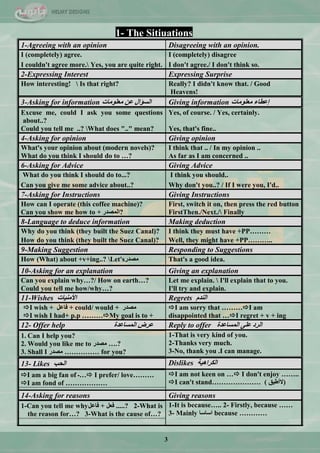
1- The Sitiuations
1-Agreeing with an opinion Disagreeing with an opinion.
I (completely) agree. I (completely) disagree
I couldn't agree more. Yes, you are quite right. I don't agree./ I don't think so.
2-Expressing Interest Expressing Surprise
How interesting!  Is that right? Really? I didn't know that. / Good
Heavens!
3-Asking for information ‫ِؼٍِٛبد‬ ٓ‫ػ‬ ‫اٌغؤاي‬ Giving information ‫ِؼٍِٛبد‬ ‫إػـبء‬
Excuse me, could I ask you some questions
about..?
Yes, of course. / Yes, certainly.
Could you tell me ..? What does ".." mean? Yes, that's fine..
4-Asking for opinion Giving opinion
What's your opinion about (modern novels)? I think that .. / In my opinion ..
What do you think I should do to …? As far as I am concerned ..
6-Asking for Advice Giving Advice
What do you think I should do to...? I think you should..
Can you give me some advice about..? Why don't you..? / If I were you, I'd..
7-Asking for Instructions Giving Instructions
How can I operate (this coffee machine)? First, switch it on, then press the red button
Can you show me how to + ‫?اٌّظذس‬ FirstThen./Next./ Finally
8-Language to deduce information Making deduction
Why do you think (they built the Suez Canal)? I think they must have +PP………
How do you think (they built the Suez Canal)? Well, they might have +PP………..
9-Making Suggestion Responding to Suggestions
How (What) about +v+ing..? Let's‫ِظذس‬ That's a good idea.
10-Asking for an explanation Giving an explanation
Can you explain why…?/ How on earth…? Let me explain.  I'll explain that to you.
Could you tell me how/why…? I'll try and explain.
11-Wishes ‫األِٕ١بد‬ Regrets َ‫إٌذ‬
I wish + ً‫فبػ‬ + could/ would + ‫ِظذس‬
I wish I had+ p.p ………My goal is to +
I am sorry that ………I am
disappointed that …I regret + v + ing
12- Offer help ‫اٌّغبػذح‬ ‫ػشع‬ Reply to offer ‫اٌّغبػذح‬ ٍٝ‫ػ‬ ‫اٌشد‬
1. Can I help you?
2. Would you like me to ‫ِظذس‬ ….?
3. Shall I ‫ِظذس‬ …………… for you?
1-That is very kind of you.
2-Thanks very much.
3-No, thank you .I can manage.
13- Likes ‫اٌؾت‬ Dislikes ‫اٌىشا٘١خ‬
I am a big fan of ‫…ـ‬ I prefer/ love………
I am fond of ………………
I am not keen on … I don't enjoy ……..
I can't stand………………… ( ‫)الأؿ١ك‬
14-Asking for reasons Giving reasons
1-Can you tell me why ...ً‫فؼ‬+ً‫فبػ‬ ..? 2-What is
the reason for…? 3-What is the cause of…?
1-It is because….. 2- Firstly, because ……
3- Mainly ‫اعبعب‬ because …………
4
15-Give warning Respond to Warning
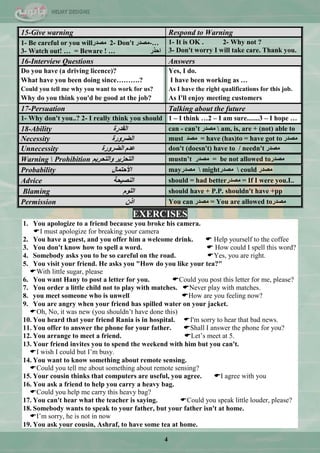
1- Be careful or you will‫ِظذس‬ 2- Don't ‫…-ِظذس‬
3- Watch out! … = Beware ! … ‫اؽزس‬
1- It is OK . 2- Why not ?
3- Don't worry I will take care. Thank you.
16-Interview Questions Answers
Do you have (a driving licence)? Yes, I do.
What have you been doing since……….? I have been working as …
Could you tell me why you want to work for us? As I have the right qualifications for this job.
Why do you think you'd be good at the job? As I'll enjoy meeting customers
17-Persuation Talking about the future
1- Why don't you..? 2- I really think you should 1 – I think …2 – I am sure.......3 – I hope …
18-Ability ‫اٌمذسح‬ can - can‟t ‫ِظذس‬  am, is, are + (not) able to
Necessity ‫اٌؼشٚسح‬ must ‫ِظذ‬ = have (has)to = have got to ‫ِظذس‬
Unnecessity ‫اٌؼشٚسح‬ َ‫ػذ‬ don't (doesn't) have to / needn't ‫ِظذس‬
Warning  Prohibition ُ٠‫ٚاٌزؾش‬ ‫اٌزؾض٠ش‬ mustn‟t ‫ِظذس‬ = be not allowed to‫ِظذس‬
Probability ‫األؽزّبي‬ may‫ِظذس‬  might‫ِظذس‬  could ‫ِظذس‬
Advice ‫إٌظ١ؾخ‬ should = had better‫ِظذس‬ = If I were you.I..
Blaming ٌٍَٛ‫ا‬ should have + P.P. shouldn't have +pp
Permission ْ‫ار‬ You can ‫ِظذس‬ = You are allowed to‫ِظذس‬
EXERCISES
1. You apologize to a friend because you broke his camera.
I must apologize for breaking your camera
2. You have a guest, and you offer him a welcome drink.  Help yourself to the coffee
3. You don't know how to spell a word.  How could I spell this word?
4. Somebody asks you to be so careful on the road. Yes, you are right.
5. You visit your friend. He asks you "How do you like your tea?"
With little sugar, please
6. You want Hany to post a letter for you. Could you post this letter for me, please?
7. You order a little child not to play with matches. Never play with matches.
8. you meet someone who is unwell How are you feeling now?
9. You are angry when your friend has spilled water on your jacket.
Oh, No, it was new (you shouldn‘t have done this)
10. You heard that your friend Rania is in hospital. I'm sorry to hear that bad news.
11. You offer to answer the phone for your father. Shall I answer the phone for you?
12. You arrange to meet a friend. Let‘s meet at 5.
13. Your friend invites you to spend the weekend with him but you can't.
I wish I could but I‘m busy.
14. You want to know something about remote sensing.
Could you tell me about something about remote sensing?
15. Your cousin thinks that computers are useful, you agree. I agree with you
16. You ask a friend to help you carry a heavy bag.
Could you help me carry this heavy bag?
17. You can't hear what the teacher is saying. Could you speak little louder, please?
18. Somebody wants to speak to your father, but your father isn't at home.
I‘m sorry, he is not in now
19. You ask your cousin, Ashraf, to have some tea at home.
5
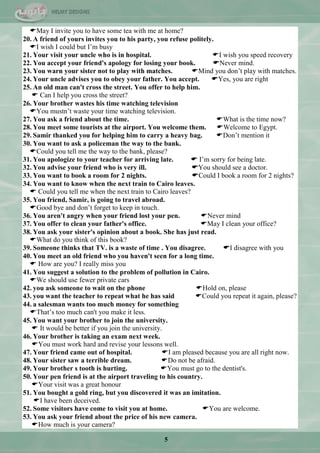
May I invite you to have some tea with me at home?
20. A friend of yours invites you to his party, you refuse politely.
I wish I could but I‘m busy
21. Your visit your uncle who is in hospital. I wish you speed recovery
22. You accept your friend's apology for losing your book. Never mind.
23. You warn your sister not to play with matches. Mind you don‘t play with matches.
24. Your uncle advises you to obey your father. You accept. Yes, you are right
25. An old man can't cross the street. You offer to help him.
 Can I help you cross the street?
26. Your brother wastes his time watching television
You mustn‘t waste your time watching television.
27. You ask a friend about the time. What is the time now?
28. You meet some tourists at the airport. You welcome them. Welcome to Egypt.
29. Samir thanked you for helping him to carry a heavy bag. Don‘t mention it
30. You want to ask a policeman the way to the bank.
Could you tell me the way to the bank, please?
31. You apologize to your teacher for arriving late.  I‘m sorry for being late.
32. You advise your friend who is very ill. You should see a doctor.
33. You want to book a room for 2 nights. Could I book a room for 2 nights?
34. You want to know when the next train to Cairo leaves.
 Could you tell me when the next train to Cairo leaves?
35. You friend, Samir, is going to travel abroad.
Good bye and don‘t forget to keep in touch.
36. You aren't angry when your friend lost your pen. Never mind
37. You offer to clean your father's office. May I clean your office?
38. You ask your sister's opinion about a book. She has just read.
What do you think of this book?
39. Someone thinks that TV. is a waste of time . You disagree. I disagree with you
40. You meet an old friend who you haven't seen for a long time.
 How are you? I really miss you
41. You suggest a solution to the problem of pollution in Cairo.
We should use fewer private cars
42. you ask someone to wait on the phone Hold on, please
43. you want the teacher to repeat what he has said Could you repeat it again, please?
44. a salesman wants too much money for something
That‘s too much can't you make it less.
45. You want your brother to join the university.
 It would be better if you join the university.
46. Your brother is taking an exam next week.
You must work hard and revise your lessons well.
47. Your friend came out of hospital. I am pleased because you are all right now.
48. Your sister saw a terrible dream. Do not be afraid.
49. Your brother s tooth is hurting. You must go to the dentist's.
50. Your pen friend is at the airport traveling to his country.
Your visit was a great honour
51. You bought a gold ring, but you discovered it was an imitation.
I have been deceived.
52. Some visitors have come to visit you at home. You are welcome.
53. You ask your friend about the price of his new camera.
How much is your camera?
6
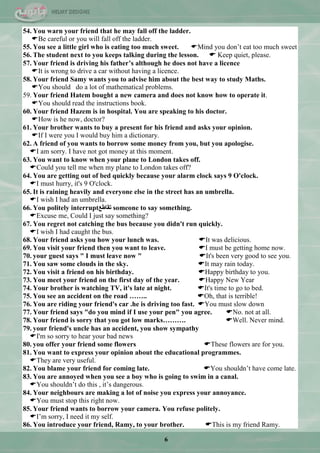
54. You warn your friend that he may fall off the ladder.
Be careful or you will fall off the ladder.
55. You see a little girl who is eating too much sweet. Mind you don‘t eat too much sweet
56. The student next to you keeps talking during the lesson.  Keep quiet, please.
57. Your friend is driving his father‟s although he does not have a licence
It is wrong to drive a car without having a licence.
58. Your friend Samy wants you to advise him about the best way to study Maths.
You should do a lot of mathematical problems.
59. Your friend Hatem bought a new camera and does not know how to operate it.
You should read the instructions book.
60. Your friend Hazem is in hospital. You are speaking to his doctor.
How is he now, doctor?
61. Your brother wants to buy a present for his friend and asks your opinion.
If I were you I would buy him a dictionary.
62. A friend of you wants to borrow some money from you, but you apologise.
I am sorry. I have not got money at this moment.
63. You want to know when your plane to London takes off.
Could you tell me when my plane to London takes off?
64. You are getting out of bed quickly because your alarm clock says 9 O'clock.
I must hurry, it's 9 O'clock.
65. It is raining heavily and everyone else in the street has an umbrella.
I wish I had an umbrella.
66. You politely interrupt‫رمبؿغ‬ someone to say something.
Excuse me, Could I just say something?
67. You regret not catching the bus because you didn't run quickly.
I wish I had caught the bus.
68. Your friend asks you how your lunch was. It was delicious.
69. You visit your friend then you want to leave. I must be getting home now.
70. your guest says " I must leave now " It's been very good to see you.
71. You saw some clouds in the sky. It may rain today.
72. You visit a friend on his birthday. Happy birthday to you.
73. You meet your friend on the first day of the year. Happy New Year
74. Your brother is watching TV, it's late at night. It's time to go to bed.
75. You see an accident on the road …….. Oh, that is terrible!
76. You are riding your friend's car .he is driving too fast. You must slow down
77. Your friend says "do you mind if I use your pen" you agree. No. not at all.
78. Your friend is sorry that you got low marks………. Well. Never mind.
79. your friend's uncle has an accident, you show sympathy
I'm so sorry to hear your bad news
80. you offer your friend some flowers These flowers are for you.
81. You want to express your opinion about the educational programmes.
They are very useful.
82. You blame your friend for coming late. You shouldn‘t have come late.
83. You are annoyed when you see a boy who is going to swim in a canal.
You shouldn‘t do this , it‘s dangerous.
84. Your neighbours are making a lot of noise you express your annoyance.
You must stop this right now.
85. Your friend wants to borrow your camera. You refuse politely.
I‘m sorry, I need it my self.
86. You introduce your friend, Ramy, to your brother. This is my friend Ramy.
7
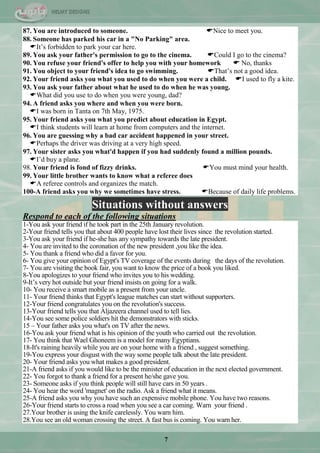
87. You are introduced to someone. Nice to meet you.
88. Someone has parked his car in a "No Parking" area.
It‘s forbidden to park your car here.
89. You ask your father's permission to go to the cinema. Could I go to the cinema?
90. You refuse your friend's offer to help you with your homework  No, thanks
91. You object to your friend's idea to go swimming. That‘s not a good idea.
92. Your friend asks you what you used to do when you were a child. I used to fly a kite.
93. You ask your father about what he used to do when he was young.
What did you use to do when you were young, dad?
94. A friend asks you where and when you were born.
I was born in Tanta on 7th May, 1975.
95. Your friend asks you what you predict about education in Egypt.
I think students will learn at home from computers and the internet.
96. You are guessing why a bad car accident happened in your street.
Perhaps the driver was driving at a very high speed.
97. Your sister asks you what'd happen if you had suddenly found a million pounds.
I‘d buy a plane.
98. Your friend is fond of fizzy drinks. You must mind your health.
99. Your little brother wants to know what a referee does
A referee controls and organizes the match.
100-A friend asks you why we sometimes have stress. Because of daily life problems.
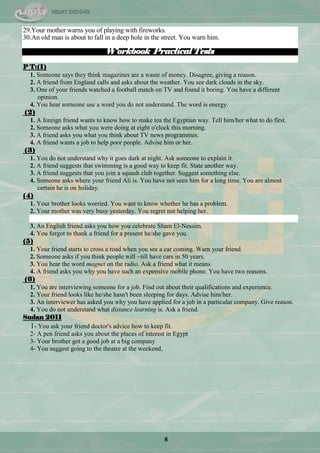
Situations without answers
Respond to each of the following situations
1-You ask your friend if he took part in the 25th January revolution.
2-Your friend tells you that about 400 people have lost their lives since the revolution started.
3-You ask your friend if he-she has any sympathy towards the late president.
4- You are invited to the coronation of the new president ,you like the idea.
5- You thank a friend who did a favor for you.
6- You give your opinion of Egypt's TV coverage of the events during the days of the revolution.
7- You are visiting the book fair, you want to know the price of a book you liked.
8-You apologizes to your friend who invites you to his wedding.
9-It‘s very hot outside but your friend insists on going for a walk.
10- You receive a smart mobile as a present from your uncle.
11- Your friend thinks that Egypt's league matches can start without supporters.
12-Your friend congratulates you on the revolution's success.
13-Your friend tells you that Aljazeera channel used to tell lies.
14-You see some police soldiers hit the demonstrators with sticks.
15 – Your father asks you what's on TV after the news.
16-You ask your friend what is his opinion of the youth who carried out the revolution.
17- You think that Wael Ghoneem is a model for many Egyptians.
18-It's raining heavily while you are on your home with a friend , suggest something.
19-You express your disgust with the way some people talk about the late president.
20- Your friend asks you what makes a good president.
21-A friend asks if you would like to be the minister of education in the next elected government.
22- You forgot to thank a friend for a present he/she gave you.
23- Someone asks if you think people will still have cars in 50 years .
24- You hear the word 'magnet' on the radio. Ask a friend what it means.
25-A friend asks you why you have such an expensive mobile phone. You have two reasons.
26-Your friend starts to cross a road when you see a car coming. Warn your friend .
27.Your brother is using the knife carelessly. You warn him.
28.You see an old woman crossing the street. A fast bus is coming. You warn her.
8
29.Your mother warns you of playing with fireworks.
30.An old man is about to fall in a deep hole in the street. You warn him.
Workbook Practical Tests
P T:(1)
1. Someone says they think magazines are a waste of money. Disagree, giving a reason.
2. A friend from England calls and asks about the weather. You see dark clouds in the sky.
3. One of your friends watched a football match on TV and found it boring. You have a different
opinion.
4. You hear someone use a word you do not understand. The word is energy.
(2)
1. A foreign friend wants to know how to make tea the Egyptian way. Tell him/her what to do first.
2. Someone asks what you were doing at eight o'clock this morning.
3. A friend asks you what you think about TV news programmes.
4. A friend wants a job to help poor people. Advise him or her.
(3)
1. You do not understand why it goes dark at night. Ask someone to explain it.
2. A friend suggests that swimming is a good way to keep fit. State another way.
3. A friend suggests that you join a squash club together. Suggest something else.
4. Someone asks where your friend Ali is. You have not seen him for a long time. You are almost
certain he is on holiday.
(4)
1. Your brother looks worried. You want to know whether he has a problem.
2. Your mother was very busy yesterday. You regret not helping her.
3. An English friend asks you how you celebrate Sham El-Nessim.
4. You forgot to thank a friend for a present he/she gave you.
(5)
1. Your friend starts to cross a road when you see a car coming. Warn your friend.
2. Someone asks if you think people will ~till have cars in 50 years.
3. You hear the word magnet on the radio. Ask a friend what it means.
4. A friend asks you why you have such an expensive mobile phone. You have two reasons.
(6)
1. You are interviewing someone for a job. Find out about their qualifications and experience.
2. Your friend looks like he/she hasn't been sleeping for days. Advise him/her.
3. An interviewer has asked you why you have applied for a job in a particular company. Give reason.
4. You do not understand what distance learning is. Ask a friend.
Sudan 2011
1- You ask your friend doctor's advice how to keep fit.
2- A pen friend asks you about the places of interest in Egypt
3- Your brother got a good job at a big company
4- You suggest going to the theatre at the weekend,
9
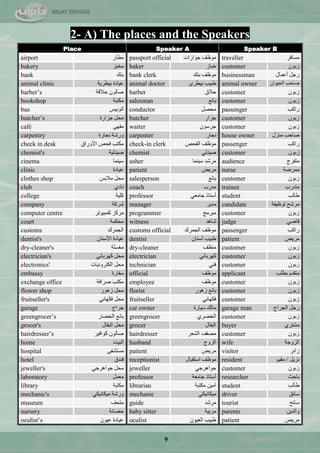
2- A) The places and the Speakers
Place Speaker A Speaker B
airport ‫ِيحس‬ passport official ‫ؾٛجصجش‬ ‫ٍِٛف‬ traveller ‫ِغحفش‬
bakery ‫ِخرض‬ baker ‫خرحص‬ customer ْٛ‫صذ‬
bank ‫ذٕه‬ bank clerk ‫ذٕه‬ ‫ٍِٛف‬ businessman ‫أّّحي‬ ً‫سؾ‬
animal clinic ‫ذ١يش٠س‬ ‫ّ١حدز‬ animal doctor ٜ‫ذ١يش‬ ‫ىر١د‬ animal owner ْ‫جٌك١ٛج‬ ‫فحقد‬
barber‘s ‫قاللس‬ ٌْٛ‫فح‬ barber ‫قالق‬ customer ْٛ‫صذ‬
bookshop ‫ِىطرس‬ salesman ِ‫ذحت‬ customer ْٛ‫صذ‬
bus ‫أضٛذ١ظ‬ conductor ً‫ِكق‬ passenger ‫سجود‬
butcher‘s ‫ؾضجسز‬ ً‫ِك‬ butcher ‫ؾضجس‬ customer ْٛ‫صذ‬
café ٝٙ‫ِم‬ waiter ْٛ‫ؾشع‬ customer ْٛ‫صذ‬
carpentry ‫ٔؿحسز‬ ‫ٚسؽس‬ carpenter ‫ٔؿحس‬ house owner ‫ِٕضي‬ ‫فحقد‬
check in desk ‫ج٤ٚسجق‬ ‫فكـ‬ ‫ِىطد‬ check-in clerk ‫جٌفكـ‬ ‫ٍِٛف‬ passenger ‫سجود‬
chemist's ‫ف١ذٌ١س‬ chemist ٌٟ‫ف١ذ‬ customer ْٛ‫صذ‬
cinema ‫ع١ّٕح‬ usher ‫ِشؽذ‬‫ع١ّٕح‬ audience ‫ِطفشؼ‬
clinic ‫ّ١حدز‬ patient ‫ِش٠ل‬ nurse ‫ِّشمس‬
clothes shop ‫ِالذظ‬ ً‫ِك‬ salesperson ِ‫ذحت‬ customer ْٛ‫صذ‬
club ٞ‫ٔحد‬ coach ‫ِذسخ‬ trainee ‫ِطذسخ‬
college ‫وٍ١س‬ professor ِْٟ‫ؾح‬ ‫أعطحر‬ student ‫ىحٌد‬
company ‫ؽشوس‬ manager ‫ِذ٠ش‬ candidate ‫ٌٍٛ١فس‬ ‫ِشؽف‬
computer centre ‫وّر١ٛضش‬ ‫ِشوض‬ programmer ‫ِرشِؽ‬ customer ْٛ‫صذ‬
court ‫ِكىّس‬ witness ‫ؽح٘ذ‬ judge ٟ‫لحم‬
customs ‫جٌؿّشن‬ customs official ‫جٌؿّشن‬ ‫ٍِٛف‬ passenger ‫سجود‬
dentist's ْ‫ج٤عٕح‬ ‫ّ١حدز‬ dentist ْ‫أعٕح‬ ‫ىر١د‬ patient ‫ِش٠ل‬
dry-cleaner's ‫ِغغٍس‬ dry-cleaner ‫َِٕف‬ customer ْٛ‫صذ‬
electrician's ٟ‫وٙشذحت‬ ً‫ِك‬ electrician ٟ‫وٙشذحت‬ customer ْٛ‫صذ‬
electronics' ‫جٌىطشٚٔ١حش‬ ً‫ِك‬ technician ٟٕ‫ف‬ customer ْٛ‫صذ‬
embassy ‫عفحسز‬ official ‫ٍِٛف‬ applicant ‫ذيٍد‬ َ‫ِطمذ‬
exchange office ‫فشجفس‬ ‫ِىطد‬ employee ‫ٍِٛف‬ customer ْٛ‫صذ‬
flower shop ‫ص٘ٛس‬ ً‫ِك‬ florist ‫ص٘ٛس‬ ِ‫ذحت‬ customer ْٛ‫صذ‬
fruitseller's ٟٔ‫فىٙح‬ ً‫ِك‬ fruitseller ٟٔ‫فىٙح‬ customer ْٛ‫صذ‬
garage ‫ؾشجؼ‬ car owner ‫ع١حسز‬ ‫ِحٌه‬ garage man ‫جٌؿشجؼ‬ ً‫سؾ‬
greengrocer‘s ‫جٌخنحس‬ ِ‫ذحت‬ greengrocer ٞ‫جٌخنش‬ customer ْٛ‫صذ‬
grocer's ‫جٌرمحي‬ ً‫ِك‬ grocer ‫جٌرمحي‬ buyer ٞ‫ِؾطش‬
hairdresser‘s ‫وٛجف١ش‬ ٌْٛ‫فح‬ hairdresser ‫ِقفف‬‫جٌؾْش‬ customer ْٛ‫صذ‬
home ‫جٌر١ص‬ husband ‫جٌضٚؼ‬ wife ‫جٌضٚؾس‬
hospital ٝ‫ِغطؾف‬ patient ‫ِش٠ل‬ visitor ‫صجتش‬
hotel ‫فٕذق‬ receptionist ‫جعطمرحي‬ ‫ٍِٛف‬ resident ً٠‫ٔض‬/ُ١‫ِم‬
jeweller's ٟ‫ؾٛج٘شؾ‬ ً‫ِك‬ jeweller ٟ‫ؾٛج٘شؾ‬ customer ْٛ‫صذ‬
laboratory ًِّْ professor ‫ؾحِْس‬ ‫أعطحر‬ researcher ‫ذحقع‬
library ‫ِىطرس‬ librarian ‫ِىطرس‬ ٓ١ِ‫أ‬ student ‫ىحٌد‬
mechanic's ٟ‫ِ١ىحٔ١ى‬ ‫ٚسؽس‬ mechanic ٟ‫ِ١ىحٔ١ى‬ driver ‫عحتك‬
museum ‫ِطكف‬ guide ‫ِشؽذ‬ tourist ‫عحتف‬
nursery ‫قنحٔس‬ baby sitter ‫ِشذ١س‬ parents ٓ٠‫ٚجٌذ‬
oculist‘s ْٛ١ّ ‫ّ١حدز‬ oculist ْٛ١ٌْ‫ج‬ ‫ىر١د‬ patient ‫ِش٠ل‬
10
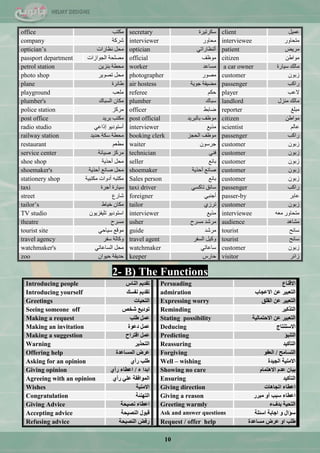
office ‫ِىطد‬ secretary ‫عىشض١شز‬ client ً١ّّ
company ‫ؽشوس‬ interviewer ‫ِكحٚس‬ interviewee ‫ِطكحٚس‬
optician‘s ‫َٔحسجش‬ ً‫ِك‬ optician ٟ‫إٌَٔحسجض‬ patient ‫ِش٠ل‬
passport department ‫جٌؿٛجصجش‬ ‫ِقٍكس‬ official ‫ٍِٛف‬ citizen ٓ‫ِٛجى‬
petrol station ٓ٠‫ذٕض‬ ‫ِكيس‬ worker ‫ِغحّذ‬ a car owner ‫ع١حسز‬ ‫ِحٌه‬
photo shop ‫ضقٛ٠ش‬ ً‫ِك‬ photographer ‫ِقٛس‬ customer ْٛ‫صذ‬
plane ‫ىحتشز‬ air hostess ‫ؾٛ٠س‬ ‫ِن١فس‬ passenger ‫سجود‬
playground ‫ٍِْد‬ referee ُ‫قى‬ player ‫الّد‬
plumber's ‫جٌغرحن‬ ْ‫ِىح‬ plumber ‫عرحن‬ landlord ‫ِٕضي‬ ‫ِحٌه‬
police station ‫ِشوض‬ officer ‫محذو‬ reporter ‫ِرٍغ‬
post office ‫ذش٠ذ‬ ‫ِىطد‬ post official ‫ذحٌرش٠ذ‬ ‫ٍِٛف‬ citizen ٓ‫ِٛجى‬
radio studio ّٟ‫ئرج‬ ٛ٠‫أعطٛد‬ interviewer ِ٠‫ِز‬ scientist ٌُ‫ّح‬
railway station ‫قذ٠ذ‬ ‫عىس‬ ‫ِكيس‬ booking clerk ‫جٌكؿض‬ ‫ٍِٛف‬ passenger ‫سجود‬
restaurant ُْ‫ِي‬ waiter ْٛ‫ؾشع‬ customer ْٛ‫صذ‬
service center ‫ف١حٔس‬ ‫ِشوض‬ technician ٟٕ‫ف‬ customer ْٛ‫صذ‬
shoe shop ً‫ِك‬‫أقز٠س‬ seller ِ‫ذحت‬ customer ْٛ‫صذ‬
shoemaker's ‫أقز٠س‬ ِٔ‫فح‬ ً‫ِك‬ shoemaker ‫أقز٠س‬ ِٔ‫فح‬ customer ْٛ‫صذ‬
stationery shop ‫ِىطر١س‬ ‫أدٚجش‬ ٗ‫ِىطر‬ Sales person ِ‫ذحت‬ customer ْٛ‫صذ‬
taxi ‫أؾشز‬ ‫ع١حسز‬ taxi driver ٟ‫ضحوغ‬ ‫عحتك‬ passenger ‫سجود‬
street ُ‫ؽحس‬ foreigner ٟ‫أؾٕر‬ passer-by ‫ّحذش‬
tailor‘s ‫خ١حه‬ ْ‫ِىح‬ tailor ٞ‫ضشص‬ customer ْٛ‫صذ‬
TV studio ْٛ٠‫ضٍ١فض‬ ٛ٠‫جعطٛد‬ interviewer ِ٠‫ِز‬ interviewee ِْٗ ‫ِطكحٚس‬
theatre ‫ِغشـ‬ usher ‫ِغشـ‬ ‫ِشؽذ‬ audience ‫ِؾح٘ذ‬
tourist site ٟ‫ع١حق‬ ِ‫ِٛل‬ guide ‫ِشؽذ‬ tourist ‫عحتف‬
travel agency ‫عفش‬ ‫ٚوحٌس‬ travel agent ‫جٌغفش‬ ً١‫ٚو‬ tourist ‫عحتف‬
watchmaker's ٟ‫جٌغحّحض‬ ً‫ِك‬ watchmaker ٟ‫عحّحض‬ customer ْٛ‫صذ‬
zoo ‫ق١ٛج‬ ‫قذ٠مس‬ْ keeper ‫قحسط‬ visitor ‫صجتش‬
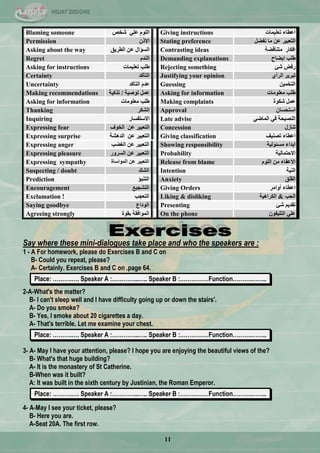
2- B) The Functions
Introducing people ‫إٌبط‬ ُ٠‫رفذ‬
Introducing yourself ‫ٔفغه‬ ُ٠‫رمذ‬
Greetings ‫اٌزؾ١بد‬
Seeing someone off ‫شخض‬ ‫رٛد٠غ‬
Making a request ‫ؿٍت‬ ًّ‫ػ‬
Making an invitation ‫دػٛح‬ ًّ‫ػ‬
Making a suggestion ‫الزشاػ‬ ًّ‫ػ‬
Warning ‫اٌزؾز٠ش‬
Offering help ‫اٌّغبػذح‬ ‫ػشع‬
Asking for an opinion ٞ‫سأ‬ ‫ؿٍت‬
Giving opinion ‫ء‬ ‫اثذا‬/ٞ‫سأ‬ ‫اػـبء‬
Agreeing with an opinion ٞ‫سأ‬ ٍٟ‫ػ‬ ‫اٌّٛافمخ‬
Wishes ‫االِٕ١خ‬
Congratulation ‫اٌزٕٙئخ‬
Giving Advice ‫ٔظ١ؾخ‬ ‫اػـبء‬
Accepting advice ‫إٌظ١ؾخ‬ ‫لجٛي‬
Refusing advice ‫إٌظ١ؾخ‬ ‫سفغ‬
Persuading ‫االلٕبع‬
admiration ‫االػغبة‬ ٓ‫ػ‬ ‫اٌزؼج١ش‬
Expressing worry ‫اٌمٍك‬ ٓ‫ػ‬ ‫اٌزؼج١ش‬
Reminding ‫اٌززو١ش‬
Stating possibility ‫االؽزّبٌ١خ‬ ٓ‫ػ‬ ‫اٌزؼج١ش‬
Deducing ‫االعزٕزبط‬
Predicting ‫اٌزٕجؤ‬
Reassuring ‫اٌزأو١ذ‬
Forgiving ‫اٌزغبِؼ‬/ٛ‫اٌؼف‬
Well – wishing ‫اٌغ١ذح‬ ‫االِٕ١خ‬
Showing no care َ‫اال٘زّب‬ َ‫ػذ‬ ْ‫ث١ب‬
Ensuring ‫اٌزأو١ذ‬
Giving direction ‫ارغب٘بد‬ ‫اػـبء‬
Giving a reason ‫ِجشس‬ ٚ‫أ‬ ‫عجت‬ ‫اػـبء‬
Greeting warmly ‫ثذفء‬ ‫اٌزؾ١خ‬
Ask and answer questions ‫اعئٍخ‬ ‫اعبثخ‬ ٚ ‫عؤاي‬
Request / offer help ‫ِغبػذح‬ ‫ػشع‬ ٚ‫ا‬ ‫ؿٍت‬
11
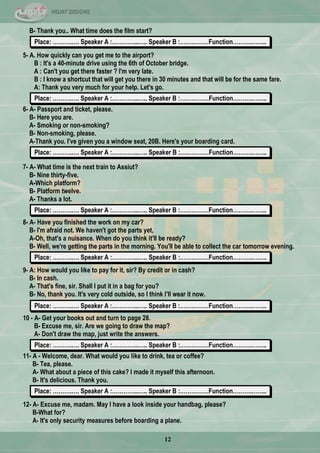
Blaming someone ‫شخض‬ ٍٟ‫ػ‬ ٌٍَٛ‫ا‬
Permission ْ‫االر‬
Asking about the way ‫اٌـش٠ك‬ ٓ‫ػ‬ ‫اٌغؤاي‬
Regret َ‫إٌذ‬
Asking for instructions ‫رؼٍ١ّبد‬ ‫ؿٍت‬
Certainty ‫اٌزأوذ‬
Uncertainty ‫اٌزأوذ‬ َ‫ػذ‬
Making recommendations ‫رٛط١خ‬ ًّ‫ػ‬/‫رزو١خ‬
Asking for information ‫ِؼٍِٛبد‬ ‫ؿٍت‬
Thanking ‫اٌشىش‬
Inquiring ‫االعزفغبس‬
Expressing fear ‫ا‬ ٓ‫ػ‬ ‫اٌزؼج١ش‬‫ٌخٛف‬
Expressing surprise ‫اٌذ٘شخ‬ ٓ‫ػ‬ ‫اٌزؼج١ش‬
Expressing anger ‫اٌغؼت‬ ٓ‫ػ‬ ‫اٌزؼج١ش‬
Expressing pleasure ‫اٌغشٚس‬ ٓ‫ػ‬ ‫اٌزؼج١ش‬
Expressing sympathy ‫اٌّٛاعبح‬ ٓ‫ػ‬ ‫اٌزؼج١ش‬
Suspecting / doubt ‫اٌشه‬
Prediction ‫اٌزٕجؤ‬
Encouragement ‫اٌزشغ١غ‬
Exclamation ! ‫اٌزؼغت‬
Saying goodbye ‫اٌٛداع‬
Agreeing strongly ‫ثمٛح‬ ‫اٌّٛافمخ‬
Giving instructions ‫رؼٍ١ّبد‬ ‫اػـبء‬
Stating preference ً‫ٔفؼ‬ ‫ِب‬ ٓ‫ػ‬ ‫اٌزؼج١ش‬
Contrasting ideas ‫ِزٕبلؼخ‬ ‫افىبس‬
Demanding explanations ‫ا٠ؼبػ‬ ‫ؿٍت‬
Rejecting something ‫شئ‬ ‫سفغ‬
Justifying your opinion ٞ‫اٌشأ‬ ‫رجش٠ش‬
Guessing ٓ١ّ‫اٌزخ‬
Asking for information ‫ِؼٍِٛبد‬ ‫ؿٍت‬
Making complaints ‫شىٛح‬ ًّ‫ػ‬
Approval ْ‫اعزؾغب‬
Late advise ٟ‫اٌّبػ‬ ٟ‫ف‬ ‫إٌظ١ؾخ‬
Concession ‫رٕبصي‬
Giving classification ‫رظٕ١ف‬ ‫اػـبء‬
Showing responsibility ‫ِغئٌٛ١خ‬ ‫اثذاء‬
Probability ‫االؽزّبٌ١خ‬
Release from blame ٌٍَٛ‫ا‬ ِٓ ‫االػفبء‬
Intention ‫إٌ١خ‬
Anxiety ‫اٌمٍك‬
Giving Orders ‫أٚاِش‬ ‫اػـبء‬
Liking & disliking ‫اٌؾت‬&‫اٌىشا٘١خ‬
Presenting ‫شئ‬ ُ٠‫رمذ‬
On the phone ْٛ‫اٌزٍ١ف‬ ٍٟ‫ػ‬
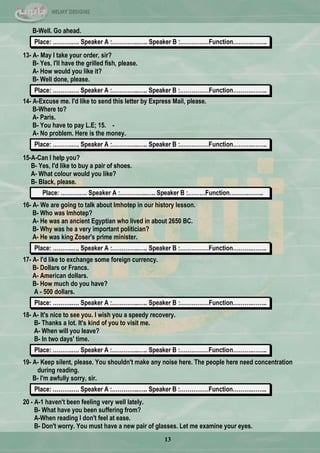
Say where these mini-dialogues take place and who the speakers are :
1 - A For homework, please do Exercises B and C on
B- Could you repeat, please?
A- Certainly. Exercises B and C on .page 64.
Place: ……….…. Speaker A :…………..….. Speaker B :……………Function……….……..
2-A-What's the matter?
B- I can't sleep well and I have difficulty going up or down the stairs'.
A- Do you smoke?
B- Yes, I smoke about 20 cigarettes a day.
A- That's terrible. Let me examine your chest.
Place: ……….…. Speaker A :…………..….. Speaker B :……………Function……….……..
3- A- May I have your attention, please? I hope you are enjoying the beautiful views of the?
B- What's that huge building?
A- It is the monastery of St Catherine.
B-When was it built?
A: It was built in the sixth century by Justinian, the Roman Emperor.
Place: ……….…. Speaker A :…………..….. Speaker B :……………Function……….……..
4- A-May I see your ticket, please?
B- Here you are.
A-Seat 20A. The first row.
12
B- Thank you.. What time does the film start?
Place: ……….…. Speaker A :…………..….. Speaker B :……………Function……….……..
5- A. How quickly can you get me to the airport?
B : It's a 40-minute drive using the 6th of October bridge.
A : Can't you get there faster ? I'm very late.
B : I know a shortcut that will get you there in 30 minutes and that will be for the same fare.
A: Thank you very much for your help. Let's go.
Place: ……….…. Speaker A :…………..….. Speaker B :……………Function……….……..
6- A- Passport and ticket, please.
B- Here you are.
A- Smoking or non-smoking?
B- Non-smoking, please.
A-Thank you. I've given you a window seat, 20B. Here's your boarding card.
Place: ……….…. Speaker A :…………..….. Speaker B :……………Function……….……..
7- A- What time is the next train to Assiut?
B- Nine thirty-five.
A-Which platform?
B- Platform twelve.
A- Thanks a lot.
Place: ……….…. Speaker A :…………..….. Speaker B :……………Function……….……..
8- A- Have you finished the work on my car?
B- I'm afraid not. We haven't got the parts yet,
A-Oh, that's a nuisance. When do you think it'll be ready?
B- Well, we're getting the parts in the morning. You'll be able to collect the car tomorrow evening.
Place: ……….…. Speaker A :…………..….. Speaker B :……………Function……….……..
9- A: How would you like to pay for it, sir? By credit or in cash?
B- In cash.
A- That's fine, sir. Shall I put it in a bag for you?
B- No, thank you. It's very cold outside, so I think I'll wear it now.
Place: ……….…. Speaker A :…………..….. Speaker B :……………Function……….……..
10 - A- Get your books out and turn to page 28.
B- Excuse me, sir. Are we going to draw the map?
A- Don't draw the map, just write the answers.
Place: ……….…. Speaker A :…………..….. Speaker B :……………Function……….……..
11- A - Welcome, dear. What would you like to drink, tea or coffee?
B- Tea, please.
A- What about a piece of this cake? I made it myself this afternoon.
B- It's delicious. Thank you.
Place: ……….…. Speaker A :…………..….. Speaker B :……………Function……….……..
12- A- Excuse me, madam. May I have a look inside your handbag, please?
B-What for?
A- It's only security measures before boarding a plane.
13
B-Well. Go ahead.
Place: ……….…. Speaker A :…………..….. Speaker B :……………Function……….……..
13- A- May I take your order, sir?
B- Yes, I'll have the grilled fish, please.
A- How would you like it?
B- Well done, please.
Place: ……….…. Speaker A :…………..….. Speaker B :……………Function……….……..
14- A-Excuse me. I'd like to send this letter by Express Mail, please.
B-Where to?
A- Paris.
B- You have to pay L.E; 15. -
A- No problem. Here is the money.
Place: ……….…. Speaker A :…………..….. Speaker B :……………Function……….……..
15-A-Can I help you?
B- Yes, I'd like to buy a pair of shoes.
A- What colour would you like?
B- Black, please.
Place: ……….…. Speaker A :…………..….. Speaker B :………Function……….……..
16- A- We are going to talk about Imhotep in our history lesson.
B- Who was Imhotep?
A- He was an ancient Egyptian who lived in about 2650 BC.
B- Why was he a very important politician?
A- He was king Zoser's prime minister.
Place: ……….…. Speaker A :…………..….. Speaker B :……………Function……….……..
17- A- I'd like to exchange some foreign currency.
B- Dollars or Francs.
A- American dollars.
B- How much do you have?
A - 500 dollars.
Place: ……….…. Speaker A :…………..….. Speaker B :……………Function……….……..
18- A- It's nice to see you. I wish you a speedy recovery.
B- Thanks a lot. It's kind of you to visit me.
A- When will you leave?
B- In two days' time.
Place: ……….…. Speaker A :…………..….. Speaker B :……………Function……….……..
19- A- Keep silent, please. You shouldn't make any noise here. The people here need concentration
during reading.
B- I'm awfully sorry, sir.
Place: ……….…. Speaker A :…………..….. Speaker B :……………Function……….……..
20 - A-1 haven't been feeling very well lately.
B- What have you been suffering from?
A-When reading I don't feel at ease.
B- Don't worry. You must have a new pair of glasses. Let me examine your eyes.
14
Place: ……….…. Speaker A :…………..….. Speaker B :……………Function……….……..
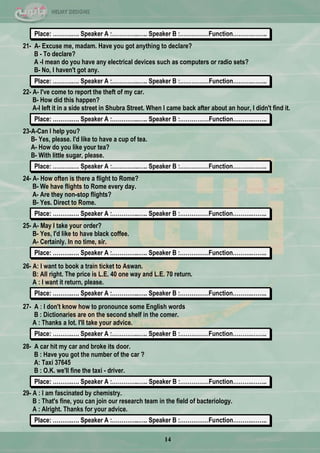
21- A- Excuse me, madam. Have you got anything to declare?
B - To declare?
A -I mean do you have any electrical devices such as computers or radio sets?
B- No, I haven't got any.
Place: ……….…. Speaker A :…………..….. Speaker B :……………Function……….……..
22- A- I've come to report the theft of my car.
B- How did this happen?
A-I left it in a side street in Shubra Street. When I came back after about an hour, I didn't find it.
Place: ……….…. Speaker A :…………..….. Speaker B :……………Function……….……..
23-A-Can I help you?
B- Yes, please. I'd like to have a cup of tea.
A- How do you like your tea?
B- With little sugar, please.
Place: ……….…. Speaker A :…………..….. Speaker B :……………Function……….……..
24- A- How often is there a flight to Rome?
B- We have flights to Rome every day.
A- Are they non-stop flights?
B- Yes. Direct to Rome.
Place: ……….…. Speaker A :…………..….. Speaker B :……………Function……….……..
25- A- May I take your order?
B- Yes, I'd like to have black coffee.
A- Certainly. In no time, sir.
Place: ……….…. Speaker A :…………..….. Speaker B :……………Function……….……..
26- A: I want to book a train ticket to Aswan.
B: All right. The price is L.E. 40 one way and L.E. 70 return.
A : I want it return, please.
Place: ……….…. Speaker A :…………..….. Speaker B :……………Function……….……..
27- A : I don't know how to pronounce some English words
B : Dictionaries are on the second shelf in the comer.
A : Thanks a lot. I'll take your advice.
Place: ……….…. Speaker A :…………..….. Speaker B :……………Function……….……..
28- A car hit my car and broke its door.
B : Have you got the number of the car ?
A: Taxi 37645
B : O.K. we'll fine the taxi - driver.
Place: ……….…. Speaker A :…………..….. Speaker B :……………Function……….……..
29- A : I am fascinated by chemistry.
B : That's fine, you can join our research team in the field of bacteriology.
A : Alright. Thanks for your advice.
Place: ……….…. Speaker A :…………..….. Speaker B :……………Function……….……..
[
15
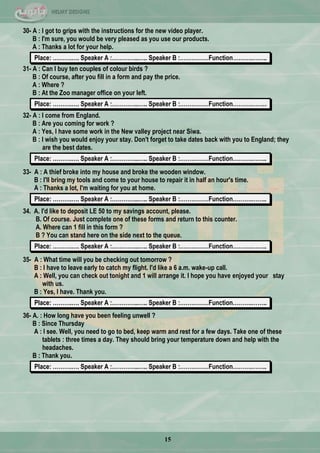
30- A : I got to grips with the instructions for the new video player.
B : I'm sure, you would be very pleased as you use our products.
A : Thanks a lot for your help.
Place: ……….…. Speaker A :…………..….. Speaker B :……………Function……….……..
31- A : Can I buy ten couples of colour birds ?
B : Of course, after you fill in a form and pay the price.
A : Where ?
B : At the Zoo manager office on your left.
Place: ……….…. Speaker A :…………..….. Speaker B :……………Function……….……..
32- A : I come from England.
B : Are you coming for work ?
A : Yes, I have some work in the New valley project near Siwa.
B : I wish you would enjoy your stay. Don't forget to take dates back with you to England; they
are the best dates.
Place: ……….…. Speaker A :…………..….. Speaker B :……………Function……….……..
33- A : A thief broke into my house and broke the wooden window.
B : I'll bring my tools and come to your house to repair it in half an hour's time.
A : Thanks a lot, I'm waiting for you at home.
Place: ……….…. Speaker A :…………..….. Speaker B :……………Function……….……..
34. A. I'd like to deposit LE 50 to my savings account, please.
B. Of course. Just complete one of these forms and return to this counter.
A. Where can 1 fill in this form ?
B ? You can stand here on the side next to the queue.
Place: ……….…. Speaker A :…………..….. Speaker B :……………Function……….……..
35- A : What time will you be checking out tomorrow ?
B : I have to leave early to catch my flight. I'd like a 6 a.m. wake-up call.
A : Well, you can check out tonight and 1 will arrange it. I hope you have enjoyed your stay
with us.
B : Yes, I have. Thank you.
Place: ……….…. Speaker A :…………..….. Speaker B :……………Function……….……..
36- A. : How long have you been feeling unwell ?
B : Since Thursday
A : I see. Well, you need to go to bed, keep warm and rest for a few days. Take one of these
tablets : three times a day. They should bring your temperature down and help with the
headaches.
B : Thank you.
Place: ……….…. Speaker A :…………..….. Speaker B :……………Function……….……..
16
Work Book Exercises
Reviews:
(A)
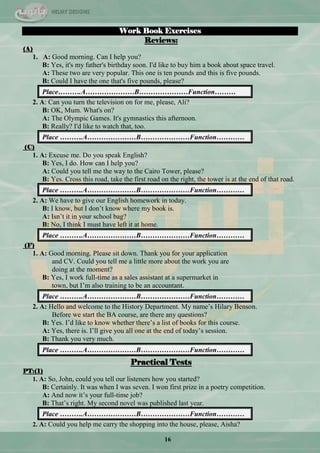
1. A: Good morning. Can I help you?
B: Yes, it's my father's birthday soon. I'd like to buy him a book about space travel.
A: These two are very popular. This one is ten pounds and this is five pounds.
B: Could I have the one that's five pounds, please?
Place……….A…………………B…………………Function………
2. A: Can you turn the television on for me, please, Ali?
B: OK, Mum. What's on?
A: The Olympic Games. It's gymnastics this afternoon.
B: Really? I'd like to watch that, too.
Place ……….A…………………B…………………Function…………
(C)
1. A: Excuse me. Do you speak English?
B: Yes, I do. How can I help you?
A: Could you tell me the way to the Cairo Tower, please?
B: Yes. Cross this road, take the first road on the right, the tower is at the end of that road.
Place ……….A…………………B…………………Function…………
2. A: We have to give our English homework in today.
B: I know, but I don‘t know where my book is.
A: Isn‘t it in your school bag?
B: No, I think I must have left it at home.
Place ……….A…………………B…………………Function…………
(F)
1. A: Good morning. Please sit down. Thank you for your application
and CV. Could you tell me a little more about the work you are
doing at the moment?
B: Yes, I work full-time as a sales assistant at a supermarket in
town, but I‘m also training to be an accountant.
Place ……….A…………………B…………………Function…………
2. A: Hello and welcome to the History Department. My name‘s Hilary Benson.
Before we start the BA course, are there any questions?
B: Yes. I‘d like to know whether there‘s a list of books for this course.
A: Yes, there is. I‘ll give you all one at the end of today‘s session.
B: Thank you very much.
Place ……….A…………………B…………………Function…………
Practical Tests
PT:(1)
1. A: So, John, could you tell our listeners how you started?
B: Certainly. It was when I was seven. I won first prize in a poetry competition.
A: And now it‘s your full-time job?
B: That‘s right. My second novel was published last year.
Place ……….A…………………B…………………Function…………
2. A: Could you help me carry the shopping into the house, please, Aisha?
17
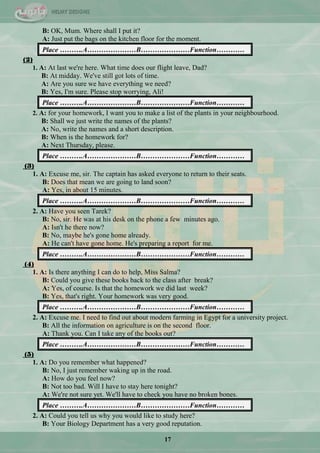
B: OK, Mum. Where shall I put it?
A: Just put the bags on the kitchen floor for the moment.
Place ……….A…………………B…………………Function…………
(2)
1. A: At last we're here. What time does our flight leave, Dad?
B: At midday. We've still got lots of time.
A: Are you sure we have everything we need?
B: Yes, I'm sure. Please stop worrying, Ali!
Place ……….A…………………B…………………Function…………
2. A: for your homework, I want you to make a list of the plants in your neighbourhood.
B: Shall we just write the names of the plants?
A: No, write the names and a short description.
B: When is the homework for?
A: Next Thursday, please.
Place ……….A…………………B…………………Function…………
(3)
1. A: Excuse me, sir. The captain has asked everyone to return to their seats.
B: Does that mean we are going to land soon?
A: Yes, in about 15 minutes.
Place ……….A…………………B…………………Function…………
2. A: Have you seen Tarek?
B: No, sir. He was at his desk on the phone a few minutes ago.
A: Isn't he there now?
B: No, maybe he's gone home already.
A: He can't have gone home. He's preparing a report for me.
Place ……….A…………………B…………………Function…………
(4)
1. A: Is there anything I can do to help, Miss Salma?
B: Could you give these books back to the class after break?
A: Yes, of course. Is that the homework we did last week?
B: Yes, that's right. Your homework was very good.
Place ……….A…………………B…………………Function…………
2. A: Excuse me. I need to find out about modern farming in Egypt for a university project.
B: All the information on agriculture is on the second floor.
A: Thank you. Can I take any of the books out?
Place ……….A…………………B…………………Function…………
(5)
1. A: Do you remember what happened?
B: No, I just remember waking up in the road.
A: How do you feel now?
B: Not too bad. Will I have to stay here tonight?
A: We're not sure yet. We'll have to check you have no broken bones.
Place ……….A…………………B…………………Function…………
2. A: Could you tell us why you would like to study here?
B: Your Biology Department has a very good reputation.
18
A: And if we accept you, what do you hope to do when you
graduate?
B: Well, I'd like to work for a food company.
Place ……….A…………………B…………………Function…………
(6)
1. A: Are you in your first year?
B: Yes. I'm studying English. but it's only my third week
A: My parents would like me to apply here. Would you recommend it?
B: Yes, definitely.
Place ……….A…………………B…………………Function…………
2. A: Well, your application has been successful.
B: That's great when do I start?
A: At the beginning of next month. You'll be working at our Cairo
branch.
B: I'm looking forward to starting.
Place ……….A…………………B…………………Function…………
With My Best Wishes
MR. Ayman M. Ebrahim
ELmahalla Secondary School For Boys
19
3-Units of Hello 8 Vocabulary and Expressions
‫إٌّٙظ‬ ‫رؼش٠فبد‬ ‫عّ١غ‬
Representative: someone who is chosen to do things, speak, vote
Launch (n): when a spacecraft is sent into space
Leak (n): a small hole that liquid or gas gets out through
Mission: an important job that someone has been given to do
Secret (adj): known about by only a few people
System: an organized way of doing something.
Astronomer: is the person who predicts the weather.
Astronaut: Is the person who travels into space.
Currently: happening at the present time
Gravity: the force that makes objects fall to the ground
Gymnastics: a sport in which skilful physical exercises and movements are performed
Side effect: an unexpected result of an activity, situation or event
Spin (v): to turn around and around very quickly
Spoke (n): one of the thin metal bars connect the ring outside of a wheel to the centre
Attach: to fasten or join one thing to another
Weightless: having no weight (especially when you are floating in space(
Debate (n): an organized discussion on an important subject
Escapism: entertainment or activity that helps you to forget about your work or
worries and think of something more enjoyable
Coronation: a ceremony in which somebody officially becomes a king or queen
Classics: the study of the language, literature and history of ancient Greece and Rome
Castle: large strong building built in the past to protect the people inside from attack
Fictional: not real, invented by a writer
Publication: when a book is printed and available to buy
Occasion: an important event or ceremony
Couple: two people who are married or have a romantic relationship
Wealthy: rich; having a lot of money, land or valuable possessions
Energy: Power used from different sources to produce heat
Geothermal energy: Heat coming out from inside the Earth
Nuclear energy: Power produced by splitting or joining atoms
Solar power: Power produced by the heat of the sun.
Renewable energy: Energy that will never run out. (last forever)
Non-renewable energy: Energy that will run out. (fossil fuel (
Hydro-electric power: Using water to generate electricity .
Waste: Materials left after using some thing which isn't needed.
Fossil fuel: Fuel from under the ground such as; oil – coal – natural gas.
Oasis: A beautiful place in the desert where plants and water are found.
Land fill: A large deep hole where rubbish is disposed or buried.
Recycling: The process of re-using materials (paper-glass) several times.
Competition: An organized event in which people or teams compete against each other.
20
Routine: The usual way in which some one does something.
Red tape: Official and unnecessary rules and prevent things from being done quickly.
Fashion: The style of clothes, hair—etc that is popular at a particular time.
Literature: Books, poems, plays etc that are considered to be very good and important.
District: An area of a city or country.
Diplomat: Someone is employed by the government to live in another country.
Politician: Someone who works in politics.
Earthquake: A sudden shaking of the Earth's surface that often causes much damage.
Society: A large group of people who live in the same country or area and share the
same laws, ways of do something, religions ---etc.
Fiction: Books and stories about imaginary people or events..
Soldier: A member of the army, especially someone who isn't an officer.
Poison: A substance that can kill or harm you if you eat or drink it.
Amnesia: The medical condition of not being able to remember anything.
Excavation: Digging up the ground in order to find things from the past..
Theater: A building with a stage where plays are performed.
Invasion: Using military forces to enter a country to take control.
Headquarter: The place from which a company, organization, is controlled.
Spy: Someone whose job is to find out secret information about a country—etc.
Transmitter: a piece of equipment that sends out radio or television signals
Natural: Not made, caused, or controlled by humans.
Cell: The smallest part of an animal or plant that can exist on its own..
Sap: The liquid that carries food through a plant.
Ring: an object in the shape of a circle.
Cardboard: very stiff thick paper, used especially for making boxes
Rubber: A substance used for making tyres, boots, etc ...
Climate: The typical weather conditions in an area.
Weather: The temperature and other conditions in a place at a particular time.
Global warming: An increase in world temperature, caused by an increase of carbon
dioxide around the Earth.
Turpentine: A strong-smelling liquid used for removing paint
Drought: A long period of dry weather when there is not enough water.
Borer: A tool used to drill into trees to calculate their age without cutting them down.
Tubes: Pipes that liquid go through.
Bark: The tough outer layer of a tree that protects its living parts on the trunk.
Trunk: The strongest part of a tree that grows wider and supports branches .
Root: The underground part of a tree that hold down the tree securely.
Leaves: The food factory of a tree.
Branches: Grow out from the trunk and support the leaves.
Fruit: Produced by some trees every year ...
Underground: A railway system under a city. (Br E) = subway (Am E )
21
Commuter: Someone who regularly travels to work, especially a long distance..
Diameter: A line that goes from one side of a circle to the other and through the centre.
Monuments: Old buildings or places that are very important and ancient.
Enemy: Someone who hates you and wants to harm you.
Tunnel: A long hole that has been dug under the ground or through a mountain.
Cliff: High steep rock or piece of land.
Base: The lowest part or surface of something.
Biography: A book about a person's life or all books like this considered as a group.
Autobiography: A book that someone writes about their own life.
Best seller: A book that a lot of people have bought.
Author: Someone who writes a book, article -------etc.
Composer: Someone who writes music.
Will: - Legal document in which you say who you want to give your money after you die
- The determination to do something.
Research: Serious and detailed study of a subject to find out new information.
Respectful: Showing respect for someone or something .ٓ٠‫ٌ٣خش‬ َ‫ِكطش‬
Respected: Admired by many people for your achievements, skills etc ٓ٠‫ج٢خش‬ ِٓ َ‫ِكطش‬
Nature: Everything that exists in the world that is not made or controlled by man .
The sun: A giant ball of hot gases, which is 150 million kilometres from the Earth
Eclipse: When the sun or the moon seems to disappear as one of them is passing
between the other one and the Earth.
X – Rays: A photograph of the inside of someone's body using Radiation.
Atmosphere: The mixture of gases that surrounds the Earth.
Storm: Very bad weather in which there is a lot of wind, rain, snow etc.
Phenomenon: Something unusual or difficult to understand that happens or exists .
Lightening : a bright flash of electrical light in the sky during a storm.
Science: 1-knowledge that is based on testing and proving facts.
2- an area of science such as biology or chemistry.
Theory: An explanation for something that has not yet been proved to be true.
Specialist: Someone who knows a lot about a particular subject or has a lot of skill in it.
Diabetes: A disease in which there is too much sugar in your blood.
Soil: The top layer of the earth in which plants grow.
Process: A series of things you do to achieve a particular result.
Cure: medicine or treatment that can make an injury or illness better
Achieve: to succeed in doing something good or getting the result you want
Count: A man who has a high social rank in Europe for the family he comes from.
Adventure: An exciting experience in which dangerous or unusual things happen.
Playwright: Someone who writes plays.
Accurate:Exactly correct.
Assistant: someone who helps someone by doing the less important jobs.
Finances: The money that a person, a company etc has.
22
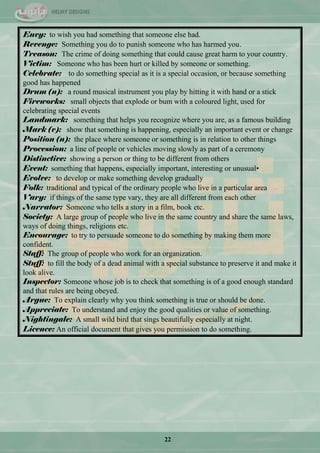
Envy: to wish you had something that someone else had.
Revenge: Something you do to punish someone who has harmed you.
Treason: The crime of doing something that could cause great harm to your country.
Victim: Someone who has been hurt or killed by someone or something.
Celebrate: to do something special as it is a special occasion, or because something
good has happened
Drum (n): a round musical instrument you play by hitting it with hand or a stick
Fireworks: small objects that explode or bum with a coloured light, used for
celebrating special events
Landmark: something that helps you recognize where you are, as a famous building
Mark (v): show that something is happening, especially an important event or change
Position (n): the place where someone or something is in relation to other things
Procession: a line of people or vehicles moving slowly as part of a ceremony
Distinctive: showing a person or thing to be different from others
Event: something that happens, especially important, interesting or unusual•
Evolve: to develop or make something develop gradually
Folk: traditional and typical of the ordinary people who live in a particular area
Vary: if things of the same type vary, they are all different from each other
Narrator: Someone who tells a story in a film, book etc.
Society: A large group of people who live in the same country and share the same laws,
ways of doing things, religions etc.
Encourage: to try to persuade someone to do something by making them more
confident.
Staff: The group of people who work for an organization.
Stuff: to fill the body of a dead animal with a special substance to preserve it and make it
look alive.
Inspector: Someone whose job is to check that something is of a good enough standard
and that rules are being obeyed.
Argue: To explain clearly why you think something is true or should be done.
Appreciate: To understand and enjoy the good qualities or value of something.
Nightingale: A small wild bird that sings beautifully especially at night.
Licence: An official document that gives you permission to do something.
23
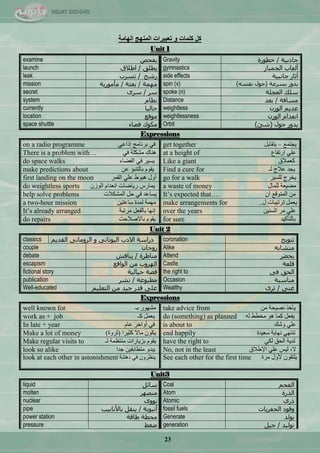
‫اٌٙبِخ‬ ‫إٌّٙظ‬ ‫رؼج١شاد‬ ٚ ‫وٍّبد‬ ً‫و‬
Unit 1
examine ‫َفسض‬ Gravity ‫خبرثُخ‬/‫خـىسح‬
launch ‫َـٍك‬/‫اؿالق‬ gymnastics ‫اٌدّجبص‬ ‫أٌؼبة‬
leak ‫سشر‬/‫رغشة‬ side effects ‫خبٔجُخ‬ ‫آثبس‬
mission ‫ِهّخ‬/‫ثؼثخ‬/‫ِأِىسَخ‬ spin (v) ‫ثغشػخ‬ ‫َذوس‬(‫ٔفغه‬ ‫زىي‬)
secret ‫عش‬/‫عشي‬ spoke (n) ‫اٌؼدٍخ‬ ‫عٍه‬
system َ‫ٔظب‬ Distance ‫ِغبفخ‬/‫ثؼذ‬
currently ‫زبٌُب‬ weightless ْ‫اٌىص‬ َُ‫ػذ‬
location ‫ِىلغ‬ weightlessness ْ‫اٌىص‬ َ‫أؼذا‬
space shuttle ‫فؼبء‬ ‫ِىىن‬ Orbit ‫زىي‬ ‫َذوس‬(‫شئ‬)
Expressions
on a radio programme ّٟ‫ئرج‬ ‫ذشٔحِؽ‬ ٟ‫ف‬ get together ِّ‫٠ؿط‬–ً‫٠طمحذ‬
There is a problem with… ٟ‫ف‬ ‫ِؾىٍس‬ ‫ٕ٘حن‬ at a height of ُ‫جسضفح‬ ٍّٟ
do space walks ‫جٌفنحء‬ ٟ‫ف‬ ‫٠غ١ش‬ Like a giant ‫وّْالق‬
make predictions about ّٓ ‫ذحٌطٕرإ‬ َٛ‫٠م‬ Find a cure for ‫ٌـ‬ ‫ّالؼ‬ ‫٠ؿذ‬
first landing on the moon ‫جٌمّش‬ ٍّٟ ‫٘رٛه‬ ‫أٚي‬ go for a walk ‫ٌٍغ١ش‬ ‫٠خشؼ‬
do weightless sports ْ‫جٌٛص‬ َ‫جْٔذج‬ ‫س٠حمحش‬ ‫٠ّحسط‬ a waste of money ‫ٌٍّحي‬ ‫ِن١ْس‬
help solve problems ‫جٌّؾىالش‬ ً‫ق‬ ٟ‫ف‬ ‫٠غحّذ‬ It‘s expected that…. ْ‫أ‬ ِ‫جٌّطٛل‬ ِٓ
a two-hour mission ٓ١‫عحّط‬ ‫ٌّذز‬ ‫ِّٙس‬ make arrangements for ‫ي‬ ‫ضشض١رحش‬ ًّْ٠..
It‘s already arranged ‫ِشضرس‬ ًْ‫ذحٌف‬ ‫ئٔٙح‬ over the years ٓ١ٕ‫جٌغ‬ ‫ِش‬ ٍّٟ
do repairs ‫ذحالفالقص‬ َٛ‫٠م‬ for sure ‫ذحٌطأو١ذ‬
Unit 2
classics َُ‫اٌمذ‬ ًٔ‫اٌشوِب‬ ‫و‬ ًٔ‫اٌُىٔب‬ ‫االدة‬ ‫دساعخ‬ coronation ‫رزىَح‬
couple ْ‫صوخب‬ Alike ‫ِزشبثه‬
debate ‫ِٕبظشح‬/‫َٕبلش‬ Attend ‫َسؼش‬
escapism ‫اٌىالغ‬ ِٓ ‫اٌهشوة‬ Castle ‫لٍؼخ‬
fictional story ‫خُبٌُخ‬ ‫لظخ‬ the right to ً‫ف‬ ‫اٌسك‬
publication ‫ِـجىػخ‬/‫ٔشش‬ Occasion ‫ِٕبعجخ‬
Well-educated ٍُُ‫اٌزؼ‬ ِٓ ‫خُذ‬ ‫لذس‬ ًٍ‫ػ‬ Wealthy ًٕ‫غ‬/‫ثشي‬
Expressions
well known for ‫ذـ‬ ‫ِؾٙٛس‬ take advice from ِٓ ‫ٔق١كس‬ ‫٠أخز‬
work as + job ‫وـ‬ ًّْ٠ do (something) as planned ٌٗ ‫ِخيو‬ ٛ٘ ‫وّح‬ ًْ‫٠ف‬
In late + year َ‫ّح‬ ‫أٚجخش‬ ٟ‫ف‬ is about to ‫ٚؽه‬ ٍّٟ
Make a lot of money ‫وػ١شج‬ ‫ِحال‬ ْٛ‫٠ى‬(‫غشٚز‬) end happily ‫عْ١ذز‬ ‫ٔٙح٠س‬ ٟٙ‫ضٕط‬
Make regular visits to ‫ٌـ‬ ‫ِٕطَّس‬ ‫ذض٠حسجش‬ َٛ‫٠م‬ have the right to ٟ‫ٌى‬ ‫جٌكك‬ ‫ٌذ٠س‬
look so alike ‫ؾذج‬ ٓ١‫ِطيحذم‬ ٚ‫٠رذ‬ No, not in the least ‫ج٦ىالق‬ ٍّٟ ‫ٌ١ظ‬ ،‫ال‬
look at each other in astonishment ‫د٘ؾس‬ ٟ‫ف‬ ْٚ‫٠َٕش‬ See each other for the first time ‫ِشز‬ ‫٤ٚي‬ ْٛ‫٠ٍطم‬
Unit3
liquid ً‫عبئ‬ Coal ُ‫اٌفس‬
molten ‫ِٕظهش‬ Atom ‫اٌزسح‬
nuclear ‫ٔىوي‬ Atomic ‫رسي‬
pipe ‫أٔجىثخ‬/‫ثبألٔبثُت‬ ً‫َٕم‬ fossil fuels ‫اٌسفشَبد‬ ‫ولىد‬
power station ‫ؿبلخ‬ ‫ِسـخ‬ Generate ‫َىٌذ‬
pressure ‫ػغؾ‬ generation ‫رىٌُذ‬/ًُ‫خ‬
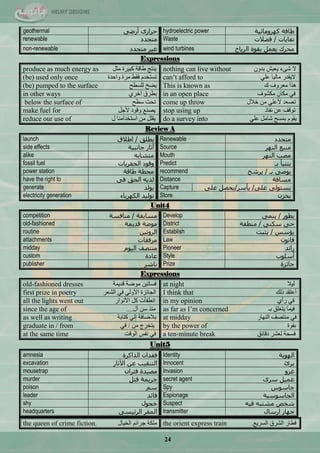
24
geothermal ً‫أسػ‬ ‫زشاسي‬ hydroelectric power ‫وهشوِبئُخ‬ ‫ؿبلخ‬
renewable ‫ِزدذد‬ Waste ‫ٔفبَبد‬/‫فؼالد‬
non-renewable ‫ِزدذد‬ ‫غُش‬ wind turbines ‫اٌشَبذ‬ ‫ثمىح‬ ًّ‫َؼ‬ ‫ِسشن‬
Expressions
produce as much energy as ً‫ِػ‬ ‫ور١شز‬ ‫ىحلس‬ ‫٠ٕطؽ‬ nothing can live without ْٚ‫ذذ‬ ‫٠ْ١ؼ‬ ‫ؽٝء‬ ‫ال‬
(be) used only once ‫ٚجقذز‬ ‫ِشز‬ ‫فمو‬ َ‫ضغطخذ‬ can‘t afford to ٍّٟ ‫ِحٌ١ح‬ ‫ال٠مذس‬
(be) pumped to the surface ‫ٌٍغيف‬ ‫٠نخ‬ This is known as ‫ن‬ ‫ِْشٚف‬ ‫٘زج‬
in other ways ٞ‫آخش‬ ‫ذيشق‬ in an open place ‫ِىؾٛف‬ ْ‫ِىح‬ ٟ‫ف‬
below the surface of ‫عيف‬ ‫ضكص‬ come up throw ‫خالي‬ ِٓ ٍّٟ٤ ‫ضقْذ‬
make fuel for ً‫٤ؾ‬ ‫ٚلٛد‬ ِٕ‫٠ق‬ stop using up ‫ٔفحر‬ ّٓ ‫ضٛلف‬
reduce our use of ‫ي‬ ‫جعطخذجِٕح‬ ِٓ ًٍ‫٠م‬ do a survey into ٍّٟ ًِ‫ؽح‬ ‫ذّغف‬ َٛ‫٠م‬
Review A
launch ‫َـٍك‬/‫اؿالق‬ Renewable ‫ِزدذد‬
side effects ‫خبٔجُخ‬ ‫آثبس‬ Source ‫إٌهش‬ ‫ِٕجغ‬
alike ‫ِزشبثه‬ Mouth ‫إٌهش‬ ‫ِظت‬
fossil fuel ‫اٌسفشَبد‬ ‫ولىد‬ Predict ‫ثـ‬ ‫َزٕجأ‬
power station ‫ؿبلخ‬ ‫ِسـخ‬ recommend ‫ثـ‬ ً‫َىط‬/‫َششر‬
have the right to ً‫ف‬ ‫اٌسك‬ ‫ٌذَه‬ Distance ‫ِغبفخ‬
generate ‫َىٌذ‬ Capture ًٍ‫ػ‬ ًٌ‫َغزى‬/‫َأعش‬/ًٍ‫ػ‬ ً‫َسظ‬
electricity generation ‫اٌىهشثبء‬ ‫رىٌُذ‬ Store ْ‫َخض‬
Unit4
competition ‫ِغبثمخ‬/‫ِٕبفغخ‬ Develop ‫َـىس‬/ًَّٕ
old-fashioned ‫لذَّخ‬ ‫ِىػخ‬ District ًٕ‫عى‬ ً‫ز‬/‫ِٕـمخ‬
routine ُٓ‫اٌشور‬ Establish ‫َؤعظ‬/‫َثجذ‬
attachments ‫ِشفمبد‬ Law ْ‫لبٔى‬
midday َ‫اٌُى‬ ‫ِٕزظف‬ Pioneer ‫سائذ‬
custom ‫ػبدح‬ Style ‫أعٍىة‬
publisher ‫ٔبشش‬ Prize ‫خبئضح‬
Expressions
old-fashioned dresses ‫لذ٠ّس‬ ‫ِٛمس‬ ٓ١‫فغحض‬ at night ‫ٌ١ال‬
first prize in poetry ‫جٌؾْش‬ ٟ‫ف‬ ٌٟٚ٤‫ج‬ ‫جٌؿحتضز‬ I think that ‫رٌه‬ ‫أّطمذ‬
all the lights went out ‫ج٤ٔٛجس‬ ً‫و‬ ‫جٔيفأش‬ in my opinion ٞ‫سأ‬ ٟ‫ف‬
since the age of ‫أي‬ ٓ‫ع‬ ‫ِٕز‬.... as far as I‘m concerned ‫ذـ‬ ‫٠طٍْك‬ ‫ف١ّح‬
as well as writing ‫وطحذس‬ ٌٟ‫ئ‬ ‫ذالمحفس‬ at midday ‫جٌٕٙحس‬ ‫ِٕطقف‬ ٟ‫ف‬
graduate in / from ِٓ ‫٠طخشؼ‬/ٟ‫ف‬ by the power of ‫ذمٛز‬
at the same time ‫جٌٛلص‬ ‫ٔفظ‬ ٟ‫ف‬ a ten-minute break ‫دلحتك‬ ‫ٌْؾش‬ ‫فغكس‬
Unit5
amnesia ‫اٌزاوشح‬ ْ‫فمذا‬ Identity ‫اٌهىَخ‬
excavation ‫اِثبس‬ ٓ‫ػ‬ ‫اٌزٕمُت‬ Innocent ‫ثشئ‬
mousetrap ْ‫فئشا‬ ‫ِظُذح‬ Invasion ‫غضو‬
murder ً‫لز‬ ‫خشَّخ‬ secret agent ‫عشي‬ ًُّ‫ػ‬
poison ُ‫ع‬ Spy ‫خبعىط‬
leader ‫لبئذ‬ Espionage ‫اٌدبعىعُخ‬
shy ‫خدىي‬ Suspect ‫فُه‬ ‫ِشزجه‬ ‫شخض‬
headquarters ً‫اٌشئُغ‬ ‫اٌّمش‬ transmitter ‫اسعبي‬ ‫خهبص‬
the orient express train .ِ٠‫جٌغش‬ ‫جٌؾشق‬ ‫ليحس‬the queen of crime fiction. ‫جٌخ١حي‬ ُ‫ؾشجت‬ ‫ٍِىس‬
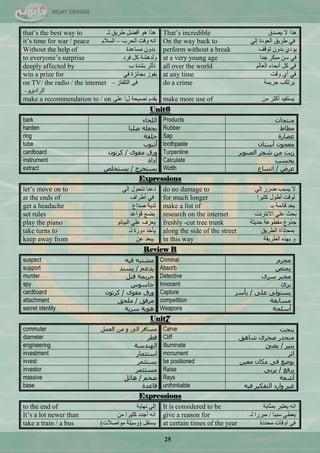
25
That‘s incredible ‫٠قذق‬ ‫ال‬ ‫٘زج‬that‘s the best way to ‫ٌـ‬ ‫ىش٠ك‬ ً‫أفن‬ ٛ٘ ‫٘زج‬
On the way back to ٌٟ‫ئ‬ ‫جٌْٛدز‬ ‫ىش٠ك‬ ٟ‫ف‬it‘s time for war / peace ‫جٌكشخ‬ ‫ٚلص‬ ٗٔ‫ج‬–َ‫جٌغال‬
perform without a break ‫ضٛلف‬ ْٚ‫ذذ‬ ٞ‫٠إد‬Without the help of ‫ِغحّذز‬ ْٚ‫ذذ‬
at a very young age ‫ؾذج‬ ‫ِرىش‬ ٓ‫ع‬ ٟ‫ف‬to everyone‘s surprise ‫فشد‬ ً‫و‬ ‫ٌٚذ٘ؾس‬
all over the world ٌُ‫جٌْح‬ ‫أٔكحء‬ ً‫و‬ ٟ‫ف‬deeply affected by ‫خ‬ ‫ذؾذز‬ ‫ضأغش‬
at any time ‫ٚلص‬ ٞ‫أ‬ ٟ‫ف‬win a prize for ٟ‫ف‬ ‫ذؿحتضز‬ ‫٠فٛص‬
do a crime ‫ؾش٠ّس‬ ‫٠شضىد‬on TV/ the radio / the internet ‫جٌطٍفحص‬ ٝ‫ف‬–
ٜٛ‫جٌشجد‬-
make more use of ِٓ ‫أوػش‬ ‫٠غطف١ذ‬make a recommendation to / on ‫ي‬ ‫ٔق١كس‬ َ‫٠مذ‬ٍّٝ
Unit6
bark ‫اٌٍسبء‬ Products ‫ِٕزدبد‬
harden ‫طٍجب‬ ‫َدؼٍه‬ Rubber ‫ِـبؽ‬
ring ‫زٍمخ‬ Sap ‫ػظبسح‬
tube ‫أٔجىة‬ toothpaste ْ‫أعٕب‬ ْ‫ِؼدى‬
cardboard ‫ِمىي‬ ‫وسق‬/ْ‫وشرى‬ Turpentine ‫اٌظٕىثش‬ ‫شدش‬ ِٓ ‫صَذ‬
instrument ‫أداح‬ Calculate ‫َسغت‬
extract ‫َغزخشج‬/‫َغزخٍض‬ Width ‫ػشع‬/‫ارغبع‬
Expressions
let‘s move on to ٌٟ‫ئ‬ ‫ٔطكٛي‬ ‫دّٕح‬ do no damage to ٌٟ‫ئ‬ ‫مشس‬ ‫٠غرد‬ ‫ال‬
at the ends of ‫أىشجف‬ ٟ‫ف‬ for much longer ‫وػ١شج‬ ‫أىٛي‬ ‫ٌٛلص‬
get a headache ُ‫فذج‬ ‫ٌذ٠س‬ make a list of ‫ذـ‬ ‫لحتّس‬ ‫٠ْذ‬
set rules ‫لٛجّذ‬ ِ‫٠ن‬ research on the internet ‫جالٔطشٔص‬ ٍّٟ ‫ذكع‬
play the piano ٛٔ‫جٌر١ح‬ ٍّٟ ‫٠ْضف‬ freshly -cut tree trunk ‫قذ٠ػس‬ ‫ِميّٛس‬ ُٚ‫ؾز‬
take turns to ‫ٌـ‬ ‫دٚسز‬ ‫٠أخز‬ along the side of the street ‫جٌيش٠ك‬ ‫ذّكحرجز‬
keep away from ّٓ ‫٠رْذ‬ in this way ‫جٌيش٠مس‬ ٖ‫ذٙز‬ ٚ
Review B
suspect ‫فُه‬ ‫ِشزجه‬ Criminal َ‫ِدش‬
support ُ‫َذػ‬/‫َغٕذ‬ Absorb ‫َّزض‬
murder ً‫لز‬ ‫خشَّخ‬ Detective ‫عشي‬ ‫ِخجش‬
spy ‫خبعىط‬ Innocent ‫ثشئ‬
cardboard ‫ِمىي‬ ‫وسق‬/ْ‫وشرى‬ Capture ًٍ‫ػ‬ ًٌ‫َغزى‬/‫َأعش‬
attachment ‫ِشفك‬/‫ٍِسك‬ competition ‫ِغبثمخ‬
secret identity ‫عشَخ‬ ‫هىَخ‬ Weapons ‫أعٍسخ‬
Unit7
commuter ‫ِغبفش‬ًّ‫اٌؼ‬ ِٓ ‫و‬ ًٌ‫ا‬ Carve ‫َٕسذ‬
diameter ‫لـش‬ Cliff ‫شبهك‬ ‫طخشي‬ ‫ِٕسذس‬
engineering ‫اٌهٕذعخ‬ Illuminate ‫َُٕش‬/‫َؼئ‬
investment ‫اعزثّبس‬ monument ‫اثش‬
invest ‫ثغزثّش‬ be positioned ُٓ‫ِؼ‬ ْ‫ِىب‬ ً‫ف‬ ‫َىػغ‬
investor ‫ِغزثّش‬ Raise ‫َشفغ‬/ً‫َشث‬
massive ُ‫ػخ‬/ً‫هبئ‬ Rays ‫أشؼخ‬
base ‫لبػذح‬ unthinkable ‫فُه‬ ‫اٌزفىُش‬ ‫واسد‬ ‫غُش‬
Expressions
to the end of ‫ٔٙح٠س‬ ٌٟ‫ئ‬ It is considered to be ‫ذّػحذس‬ ‫٠ْطرش‬ ٗٔ‫ج‬
It‘s a lot newer than ِٓ ‫وػ١شج‬ ‫أؾذد‬ ٗٔ‫ج‬ give a reason for ‫عررح‬ ٟ‫٠ْي‬/‫ٌـ‬ ‫ِرشسج‬
take a train / a bus ً‫٠غطم‬(‫ِٛجفالش‬ ‫ٚع١ٍس‬) at certain times of the year ‫ِكذدز‬ ‫جٚلحش‬ ٝ‫ف‬
26
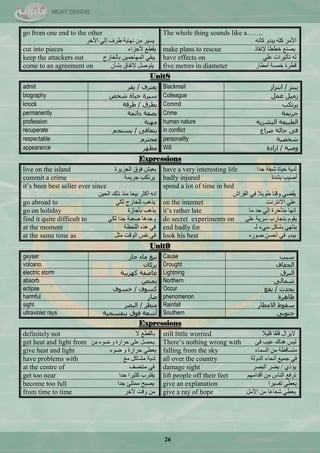
go from one end to the other
‫ج٢خش‬ ٌٟ‫ئ‬ ‫ىشف‬ ‫ٔٙح٠س‬ ِٓ ‫٠غ١ش‬
The whole thing sounds like a…….
ٗٔ‫وأ‬ ٚ‫٠رذ‬ ٍٗ‫و‬ ‫ج٤ِش‬
cut into pieces ‫٤ؾضجء‬ ِ‫٠مي‬ make plans to rescue ‫٦ٔمحر‬ ‫خييح‬ ِٕ‫٠ق‬
keep the attackers out ‫ذحٌخحسؼ‬ ٓ١ّ‫جٌّٙحؾ‬ ٟ‫٠رم‬ have effects on ٍّٟ ‫ضأغ١شجش‬ ٌٗ
come to an agreement on ْ‫ذؾأ‬ ‫الضفحق‬ ً‫٠طٛف‬ five metres in diameter ‫أِيحس‬ ‫خّغس‬ ‫ليشز‬
Unit8
admit ‫َؼزشف‬/‫َمش‬ Blackmail ‫َجزض‬/‫اثزضاص‬
biography ‫شخض‬ ‫زُبح‬ ‫عُشح‬ Colleague ًّ‫ػ‬ ًُِ‫ص‬
knock ‫َـشق‬/‫ؿشلخ‬ Commit ‫َشرىت‬
permanently ‫دائّخ‬ ‫ثظفخ‬ Crime ‫خشَّخ‬
profession ‫ِهٕخ‬ human nature ‫اٌجششَخ‬ ‫اٌـجُؼخ‬
recuperate ً‫َزؼبف‬/ُ‫َغزد‬ in conflict ‫طشاع‬ ‫زبٌخ‬ ً‫ف‬
respectable َ‫ِسزش‬ personality ‫شخظُخ‬
appearance ‫ِظهش‬ Will ‫وطُخ‬/‫اسادح‬
Expressions
live on the island ‫جٌؿض٠شز‬ ‫فٛق‬ ‫٠ْ١ؼ‬ have a very interesting life ‫ؾذج‬ ‫ؽ١مس‬ ‫ق١حز‬ ‫ٌذ٠س‬
commit a crime ‫ؾش٠ّس‬ ‫٠شضىد‬ badly injured ‫ذؾذز‬ ‫أف١د‬
it‘s been best seller ever since
ٓ١‫جٌك‬ ‫رٌه‬ ‫ِٕز‬ ‫ذ١ْح‬ ‫أوػش‬ ٗٔ‫ج‬
spend a lot of time in bed
‫جٌفشجػ‬ ٟ‫ف‬ ‫ىٛ٠ال‬ ‫ٚلطح‬ ٟ‫٠من‬
go abroad to ٟ‫ٌى‬ ‫ٌٍخحسؼ‬ ‫٠ز٘د‬ on the internet ‫جالٔطشٔص‬ ٍّٟ
go on holiday ‫ذأؾحصز‬ ‫٠ز٘د‬ it‘s rather late ‫ِح‬ ‫قذ‬ ٌٟ‫ئ‬ ‫ِطأخشز‬ ‫ئٔٙح‬
find it quite difficult to ٟ‫ٌى‬ ‫ؾذج‬ ‫فْرس‬ ‫ٚؾذ٘ح‬ do secret experiments on ٍّٝ ‫عش٠س‬ ‫ذطؿحسخ‬ َٛ‫٠م‬
at the moment ‫جٌٍكَس‬ ٖ‫٘ز‬ ٟ‫ف‬ end badly for ‫ٌـ‬ ‫عٟء‬ ً‫ذؾى‬ ٟٙ‫٠ٕط‬
at the same time as ً‫ِػ‬ ‫جٌٛلص‬ ‫ٔفظ‬ ٟ‫ف‬ look his best ٖ‫فٛس‬ ٓ‫أقغ‬ ٟ‫ف‬ ٚ‫٠رذ‬
Unit9
geyser ‫زبس‬ ‫ِبء‬ ‫ٔجغ‬ Cause ‫عجت‬
volcano ْ‫ثشوب‬ Drought ‫اٌدفبف‬
electric storm ‫وهشثُخ‬ ‫ػبطفخ‬ Lightning ‫اٌجشق‬
absorb ‫َّزض‬ Northern ًٌ‫شّب‬
eclipse ‫وغىف‬/‫خغىف‬ Occur ‫َسذس‬/‫َمغ‬
harmful ‫ػبس‬ phenomenon ‫ظبهشح‬
sight ‫ِٕظش‬/‫اٌجظش‬ Rainfall ‫االِـبس‬ ‫عمىؽ‬
ultraviolet rays ‫ثٕفغدُخ‬ ‫فىق‬ ‫أشؼخ‬ Southern ً‫خٕىث‬
Expressions
definitely not ‫ال‬ ِ‫ذحٌمي‬ still little worried ‫لٍ١ال‬ ‫لٍمح‬ ‫ال٠ضجي‬
get heat and light from ٍّٝ ً‫٠كق‬ِٓ ‫مٛء‬ ٚ ‫قشجسز‬ There‘s nothing wrong with ٝ‫ف‬ ‫ّ١د‬ ‫ٕ٘حن‬ ‫ٌ١ظ‬
give heat and light ‫مٛء‬ ٚ ‫قشجسز‬ ٟ‫٠ْي‬ falling from the sky ‫جٌغّحء‬ ِٓ ‫ِطغحليس‬
have problems with ِِ ً‫ِؾحو‬ ‫ٌذ٠س‬ all over the country ‫جٌذٌٚس‬ ‫أٔكحء‬ ِ١ّ‫ؾ‬ ٟ‫ف‬
at the centre of ‫ِٕطقف‬ ٟ‫ف‬ damage sight ٞ‫٠إر‬/‫جٌرقش‬ ‫٠نش‬
get too near ‫ؾذج‬ ‫وػ١شج‬ ‫٠مطشخ‬ lift people off their feet ُِٙ‫ألذج‬ ِٓ ‫جٌٕحط‬ ِ‫ضشف‬
become too full ‫ؾذج‬ ‫ِّطٍة‬ ‫٠قرف‬ give an explanation ‫ضفغ١شج‬ ٟ‫٠ْي‬
from time to time ‫٤خش‬ ‫ٚلص‬ ِٓ give a ray of hope ًِ٤‫ج‬ ِٓ ‫ؽْحّح‬ ٟ‫٠ْي‬
27
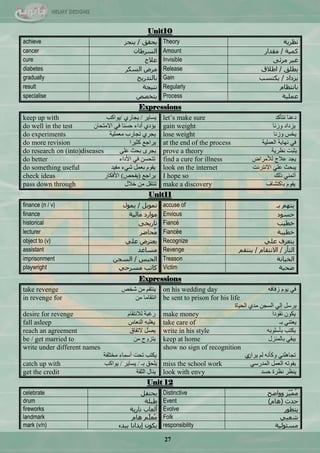
Unit10
achieve ‫َسمك‬/‫َٕدض‬ Theory ‫ٔظشَخ‬
cancer ْ‫اٌغشؿب‬ Amount ‫وُّخ‬/‫ِمذاس‬
cure ‫ػالج‬ Invisible ً‫ِشئ‬ ‫غُش‬
diabetes ‫اٌغىش‬ ‫ِشع‬ Release ‫َـٍك‬/‫اؿالق‬
gradually ‫ثبٌزذسَح‬ Gain ‫َضداد‬/‫َىزغت‬
result ‫ٔزُدخ‬ Regularly َ‫ثبٔزظب‬
specialise ‫َزخظض‬ Process ‫ػٍُّخ‬
Expressions
keep up with ‫٠غح٠ش‬/ٞ‫٠ؿحس‬/‫٠ٛجود‬ let‘s make sure ‫ٔطأوذ‬ ‫دّٕح‬
do well in the test ْ‫جالِطكح‬ ٟ‫ف‬ ‫قغٕح‬ ‫أدجء‬ ٞ‫٠إد‬ gain weight ‫ٚصٔح‬ ‫٠ضدجد‬
do experiments ‫ٍِّْ١س‬ ‫ضؿحسخ‬ ٞ‫٠ؿش‬ lose weight ‫ٚصٔح‬ ‫٠خظ‬
do more revision ‫وػ١شج‬ ِ‫٠شجؾ‬ at the end of the process ‫جٌٍّْ١س‬ ‫ٔٙح٠س‬ ٟ‫ف‬
do research on (into)diseases ٍّٝ ‫ذكع‬ ٜ‫٠ؿش‬ prove a theory ‫َٔش٠س‬ ‫٠ػرص‬
do better ‫ج٤دجء‬ ٟ‫ف‬ ٓ‫ضطكغ‬ find a cure for illness ‫ٌ٥ِشجك‬ ‫ّالؼ‬ ‫٠ؿذ‬
do something useful ‫ِف١ذ‬ ‫ؽٟء‬ ًّْ‫ذ‬ َٛ‫٠م‬ look on the internet ‫جالٔطشٔص‬ ٍّٟ ‫٠ركع‬
check ideas ِ‫٠شجؾ‬(‫٠فكـ‬)‫ج٤فىحس‬ I hope so ‫رٌه‬ ّٟٕ‫أض‬
pass down through ‫خالي‬ ِٓ ً‫ضٕطم‬ make a discovery ‫ذحوطؾحف‬ َٛ‫٠م‬
Unit11
finance (n / v) ًَ‫رّى‬/‫َّىي‬ accuse of ‫ثـ‬ ُ‫َزه‬
finance ‫ِبٌُخ‬ ‫ِىاسد‬ Envious ‫زغىد‬
historical ً‫ربسَخ‬ Fiancé ‫خـُت‬
lecturer ‫ُسبػش‬ِ Fiancée ‫خـُجخ‬
object to (v) ٍٍ‫ػ‬ ‫َؼزشع‬ Recognize ٍٍ‫ػ‬ ‫َزؼشف‬
assistant ‫ِغبػذ‬ Revenge ‫اٌثأس‬/َ‫االٔزمب‬/ُ‫َٕزم‬
imprisonment ‫اٌسجظ‬/ٓ‫اٌغد‬ Treason ‫اٌخُبٔخ‬
playwright ٍ‫ِغشز‬ ‫وبرت‬ Victim ‫ػسُخ‬
Expressions
take revenge ‫ؽخـ‬ ِٓ ُ‫٠ٕطم‬ on his wedding day ٗ‫صفحف‬ َٛ٠ ٟ‫ف‬
in revenge for ِٓ ‫جٔطمحِح‬ be sent to prison for his life
‫جٌك١حز‬ ٞ‫ِذ‬ ٓ‫جٌغؿ‬ ٌٟ‫ئ‬ ً‫٠شع‬
desire for revenge َ‫ٌالٔطمح‬ ‫سغرس‬ make money ‫ٔمٛدج‬ ْٛ‫٠ى‬
fall asleep ‫جٌْٕحط‬ ٗ‫٠غٍر‬ take care of ‫ذـ‬ ٟٕ‫٠ْط‬
reach an agreement ‫الضفحق‬ ً‫٠ق‬ write in his style ٗ‫ذأعٍٛذ‬ ‫٠ىطد‬
be / get married to ِٓ ‫٠طضٚؼ‬ keep at home ‫ذحٌّٕضي‬ ٟ‫٠رم‬
write under different names
‫ِخطٍفس‬ ‫أعّحء‬ ‫ضكص‬ ‫٠ىطد‬
show no sign of recognition
ْ‫٠شج‬ ٌُ ٗٔ‫ٚوأ‬ ٍٟٕ٘‫ضؿح‬ٞ
catch up with ‫ذـ‬ ‫٠ٍكك‬/‫٠غح٠ش‬/‫٠ٛجود‬ miss the school work ٟ‫جٌّذسع‬ ًٌّْ‫ج‬ ٗ‫٠فٛض‬
get the credit ‫جٌػمس‬ ‫٠ٕحي‬ look with envy ‫قغذ‬ ‫َٔشز‬ ‫٠َٕش‬
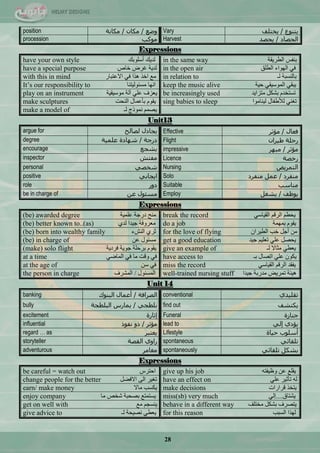
Unit 12
celebrate ً‫َسزف‬ Distinctive ‫وواػر‬ ‫ًض‬ًُُِّ
drum ‫ؿجٍخ‬ Event ‫زذس‬(َ‫هب‬)
fireworks ‫ٔبسَخ‬ ‫أٌؼبة‬ Evolve ‫َزـىس‬
landmark َ‫هب‬ ًٍُ‫ًؼ‬ِ Folk ٍ‫شؼج‬
mark (v/n) ‫ثجذء‬ ‫إَزأب‬ ْ‫َىى‬ responsibility ‫ِغئىٌُخ‬
28
position ‫وػغ‬/ْ‫ِىب‬/‫ِىبٔخ‬ Vary ‫َزٕىع‬/‫َخزٍف‬
procession ‫ِىوت‬ Harvest ‫اٌسظبد‬/‫َسظذ‬
Expressions
have your own style ‫أعٍٛذه‬ ‫ٌذ٠ه‬ in the same way ‫جٌيش٠مس‬ ‫ذٕفظ‬
have a special purpose ‫خحؿ‬ ‫غشك‬ ‫ٌذ٠س‬ in the open air ‫جٌيٍك‬ ‫جٌٙٛجء‬ ٟ‫ف‬
with this in mind ‫جالّطرحس‬ ٟ‫ف‬ ‫٘زج‬ ‫جخز‬ ِِ in relation to ‫ٌـ‬ ‫ذحٌٕغرس‬
It‘s our responsibility to ‫ِغثٌٛ١طٕح‬ ‫جٔٙح‬ keep the music alive ‫ق١س‬ ٟ‫جٌّٛع١م‬ ٟ‫٠رم‬
play on an instrument ‫ِٛع١م١س‬ ‫آٌس‬ ٍّٟ ‫٠ْضف‬ be increasingly used ‫ِطضج٠ذ‬ ً‫ذؾى‬ َ‫ضغطخذ‬
make sculptures ‫جٌٕكص‬ ‫ذأّّحي‬ َٛ‫٠م‬ sing babies to sleep ‫ٌ١ٕحِٛج‬ ‫ٌ٥ىفحي‬ ٟٕ‫ضغ‬
make a model of ‫ٌـ‬ ‫ّٔٛرؼ‬ ُّ‫٠ق‬
Unit13
argue for ‫ٌظبٌر‬ ‫َدبدي‬ Effective ‫فؼبي‬/‫ِؤثش‬
degree ‫دسخخ‬/‫ػٍُّخ‬ ‫شهبدح‬ Flight ْ‫ؿُشا‬ ‫سزٍخ‬
encourage ‫َشدغ‬ impressive ‫ِؤثش‬/‫ِجهش‬
inspector ‫ِفزش‬ Licence ‫سخظخ‬
personal ٍ‫شخظ‬ Nursing ‫اٌزّشَغ‬
positive ٍ‫اَدبث‬ Solo ‫ِٕفشد‬/‫ِٕفشد‬ ًّ‫ػ‬
role ‫دوس‬ Suitable ‫ِٕبعت‬
be in charge of ٓ‫ػ‬ ‫ِغئىي‬ Employ ‫َىظف‬/ً‫َشغ‬
Expressions
(be) awarded degree ‫ٍّّ١س‬ ‫دسؾس‬ ‫ِٕف‬ break the record ٟ‫جٌم١حع‬ ُ‫جٌشل‬ ُ‫٠كي‬
(be) better known to..(as) ٞ‫ٌذ‬ ‫ؾ١ذج‬ ‫ِْشٚفس‬ do a job ‫ذّّٙس‬ َٛ‫٠م‬
(be) born into wealthy family ‫جٌٕؼء‬ ٞ‫غش‬ for the love of flying ْ‫جٌي١شج‬ ‫خد‬ ً‫أؾ‬ ِٓ
(be) in charge of ّٓ ‫ِغثٛي‬ get a good education ‫ؾ١ذ‬ ُ١ٍْ‫ض‬ ٍّٟ ً‫٠كق‬
(make) solo flight ‫فشد٠س‬ ‫ؾٛ٠س‬ ‫ذشقٍس‬ َٛ‫٠م‬ give an example of ‫ٌـ‬ ‫ِػحال‬ ٟ‫٠ْي‬
at a time ٟ‫جٌّحم‬ ٟ‫ف‬ ‫ِح‬ ‫ٚلص‬ ٟ‫ف‬ have access to ‫ذـ‬ ‫جضقحي‬ ٍّٟ ْٛ‫٠ى‬
at the age of ٓ‫ع‬ ٟ‫ف‬ miss the record ٟ‫جٌم١حع‬ ُ‫جٌشل‬ ‫٠فمذ‬
the person in charge ٛ‫جٌّغث‬‫ي‬/‫جٌّؾشف‬ well-trained nursing stuff ‫ؾ١ذج‬ ‫ِذسذس‬ ‫ضّش٠ل‬ ‫٘١ثس‬
Unit 14
banking ‫اٌظشافخ‬/‫اٌجٕىن‬ ‫أػّبي‬ conventional ٌ‫رمٍُذ‬
bully ٍ‫ثٍـد‬/‫اٌجٍـدخ‬ ‫َّبسط‬ find out ‫َىزشف‬
excitement ‫إثبسح‬ Funeral ‫خٕبصح‬
influential ‫ِؤثش‬/‫ٔفىر‬ ‫رو‬ lead to ٌٍ‫إ‬ ٌ‫َؤد‬
regard … as ‫َؼزجش‬ Lifestyle ‫زُبح‬ ‫أعٍىة‬
storyteller ‫اٌمظخ‬ ٌ‫ساو‬ spontaneous ٍ‫رٍمبئ‬
adventurous ‫ِغبِش‬ spontaneously ٍ‫رٍمبئ‬ ً‫ثشى‬
Expressions
be careful = watch out ‫جقطشط‬ give up his job ٗ‫ٍٚ١فط‬ ّٓ ٍِ‫٠م‬
change people for the better ً‫جالفن‬ ٌٝ‫ج‬ ‫ضغ١ش‬ have an effect on ٍّٟ ‫ضأغ١ش‬ ٌٗ
earn/ make money ‫ِحال‬ ‫٠ىغد‬ make decisions ‫لشجسجش‬ ‫٠طخز‬
enjoy company ‫ِح‬ ‫ؽخـ‬ ‫ذقكرس‬ ِ‫٠غطّط‬ miss(sb) very much ‫٠ؾطحق‬....ٌٟ‫ئ‬
get on well with ِِ ُ‫٠ٕغؿ‬ behave in a different way ‫ِخطٍف‬ ً‫ذؾى‬ ‫٠طقشف‬
give advice to ‫ٌـ‬ ‫ٔق١كس‬ ٟ‫٠ْي‬ for this reason ‫جٌغرد‬ ‫ٌٙزج‬
29
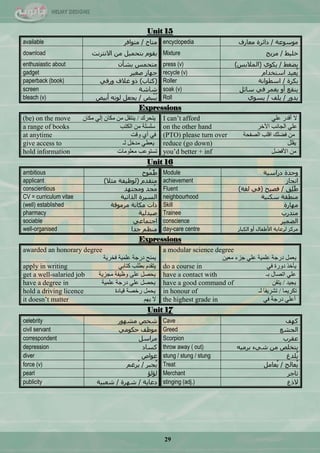
Unit 15
available ‫ِزبذ‬/‫ِزىافش‬ encyclopedia ‫ِىعىػخ‬/‫ِؼبسف‬ ‫دائشح‬
download ‫االٔزشٔذ‬ ِٓ ًُّ‫ثزس‬ َ‫َمى‬ Mixture ‫خٍُؾ‬/‫ِضَح‬
enthusiastic about ْ‫ثشأ‬ ‫ِزسّظ‬ press (v) ‫َؼغؾ‬/ٌ‫َىى‬(‫اٌّالثظ‬)
gadget ‫طغُش‬ ‫خهبص‬ recycle (v) َ‫اعزخذا‬ ‫ُؼُذ‬َ
paperback (book) (‫وزبة‬)ٍ‫وسل‬ ‫غالف‬ ‫رو‬ Roller ‫ثىشح‬/‫اعـىأخ‬
screen ‫شبشخ‬ soak (v) ً‫عبئ‬ ٍ‫ف‬ ‫َغّش‬ ‫أو‬ ‫َٕمغ‬
bleach (v) ‫ُُغ‬‫ج‬َُ/‫أثُغ‬ ‫ٌىٔه‬ ً‫َدؼ‬ Roll ‫َذوس‬/‫ٍَف‬/ٌ‫َغى‬
Expressions
(be) on the move ‫٠طكشن‬/ْ‫ِىح‬ ٌٟ‫ئ‬ ْ‫ِىح‬ ِٓ ً‫٠ٕطم‬ I can‘t afford ٍّٟ ‫ألذس‬ ‫ال‬
a range of books ‫جٌىطد‬ ِٓ ‫عٍغٍس‬ on the other hand ‫ج٢خش‬ ‫جٌؿحٔد‬ ٍّٟ
at anytime ‫ٚلص‬ ٞ‫أ‬ ٟ‫ف‬ (PTO) please turn over ‫جٌقفكس‬ ‫جلٍد‬ ‫فنٍه‬ ِٓ
give access to ‫ٌـ‬ ً‫ِذخ‬ ٟ‫٠ْي‬ reduce (go down) ًٍ‫٠م‬
hold information ‫ٍِِْٛحش‬ ‫ضغطّٛد‬ you‘d better + inf ً‫ج٤فن‬ ِٓ
Unit 16
ambitious ‫ُىذ‬ًّ‫ؿ‬ Module ‫دساعُخ‬ ‫وزذح‬
applicant َ‫ِزمذ‬(‫ِثال‬ ‫ٌىظُفخ‬) achievement ‫أدبص‬
conscientious ‫وِدزهذ‬ ‫ُدذ‬ِ Fluent ‫ِك‬ًٍ‫ؿ‬/‫فظُر‬(‫ٌغخ‬ ٍ‫ف‬)
CV = curriculum vitae ‫اٌزارُخ‬ ‫اٌغُشح‬ neighbourhood ‫عىُٕخ‬ ‫ِٕـمخ‬
(well) established ‫ِشِىلخ‬ ‫ِىبٔخ‬ ‫راد‬ Skill ‫ِهبسح‬
pharmacy ‫طُذٌُخ‬ Trainee ‫ِزذسة‬
sociable ٍ‫اخزّبػ‬ conscience ‫اٌؼُّش‬
well-organised ‫خذا‬ ُ‫ِٕظ‬ day-care centre ‫اٌىجبس‬ ‫أو‬ ‫األؿفبي‬ ‫ٌشػبَخ‬ ‫ِشوض‬
Expressions
awarded an honorary degree
‫فخش٠س‬ ‫ٍّّ١س‬ ‫دسؾس‬ ‫٠ّٕف‬
a modular science degree
ٓ١ِْ ‫ؾضء‬ ٍّٟ ‫ٍّّ١س‬ ‫دسؾس‬ ًّْ٠
apply in writing ٟ‫وطحذ‬ ‫ذيٍد‬ َ‫٠طمذ‬ do a course in ٟ‫ف‬ ‫دٚسز‬ ‫٠أخز‬
get a well-salaried job ‫ِؿض٠س‬ ‫ٍٚ١فس‬ ٍّٝ ً‫٠كق‬ have a contact with ‫ذـ‬ ‫جضقحي‬ ٍّٟ
have a degree in ‫ٍّّ١س‬ ‫دسؾس‬ ٍّٟ ً‫٠كق‬ have a good command of ‫٠ؿ١ذ‬/ٓ‫٠طم‬
hold a driving licence ‫ل١حدز‬ ‫سخقس‬ ًّ‫٠ك‬ in honour of ‫ضىش٠ّح‬/‫ٌـ‬ ‫ضؾش٠فح‬
it doesn‘t matter ُٙ٠ ‫ال‬ the highest grade in ٟ‫ف‬ ‫دسؾس‬ ٍّٟ‫أ‬
Unit 17
celebrity ‫ِشهىس‬ ‫شخض‬ Cave ‫وهف‬
civil servant ٍِ‫زىى‬ ‫ِىظف‬ Greed ‫اٌدشغ‬
correspondent ً‫ِشاع‬ Scorpion ‫ػمشة‬
depression ‫وغبد‬ throw away ( out) ‫ثشُِه‬ ‫شٍء‬ ِٓ ‫َزخٍض‬
diver ‫غىاص‬ stung / stung / stung ‫ٍُذؽ‬َ
force (v) ‫ُدجش‬َ/ُ‫ُشغ‬َ Treat ‫ُؼبٌح‬َ/ًِ‫ُؼب‬َ
pearl ‫ٌؤٌؤ‬ Merchant ‫ربخش‬
publicity ‫دػبَخ‬/‫شهشح‬/‫شؼجُخ‬ stinging (adj.) ‫الرع‬
30
Expressions
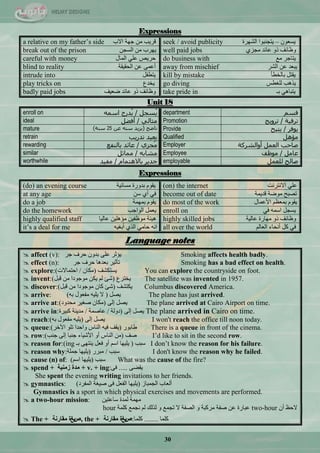
a relative on my father‘s side ‫جالخ‬ ‫ؾٙس‬ ِٓ ‫لش٠د‬ seek / avoid publicity ْْٛ‫٠غ‬–‫جٌؾٙشز‬ ‫٠طؿٕرٛج‬
break out of the prison ٓ‫جٌغؿ‬ ِٓ ‫٠ٙشخ‬ well paid jobs ٞ‫ِؿض‬ ‫ّحتذ‬ ٚ‫ر‬ ‫ٍٚحتف‬
careful with money ‫جٌّحي‬ ٍّٟ ‫قش٠ـ‬ do business with ِِ ‫٠طحؾش‬
blind to reality ‫جٌكم١مس‬ ّٓ ّّٝ‫أ‬ away from mischief ‫جٌؾش‬ ّٓ ‫٠رْذ‬
intrude into ً‫٠طيف‬ kill by mistake ‫ذحٌخيأ‬ ً‫٠مط‬
play tricks on ُ‫٠خذ‬ go diving ‫ٌٍغيظ‬ ‫٠ز٘د‬
badly paid jobs ‫مْ١ف‬ ‫ّحتذ‬ ٚ‫ر‬ ‫ٍٚحتف‬ take pride in ‫ذـ‬ ٟ٘‫٠طرح‬
Unit 18
enroll on ً‫ُغد‬َ/‫اعّه‬ ‫ُذسج‬َ department ُ‫لغ‬
ideal ٌٍ‫ِثب‬/ً‫أفؼ‬ Promotion ‫رشلُخ‬/‫رشوَح‬
mature ‫ٔبػح‬(ٓ‫ػ‬ ‫عٕه‬ ‫َضَذ‬25‫عٕخ‬) Provide ‫َىفش‬/‫َزُر‬
retrain ‫رذسَت‬ ‫َؼُذ‬ Qualified ً‫ِؤه‬
rewarding ٌ‫ُدض‬ِ/‫ثبٌٕفغ‬ ‫ػبئذ‬ Employer ‫أواٌششوخ‬ ًّ‫اٌؼ‬ ‫طبزت‬
similar ‫ِشبثه‬/ً‫ِّبث‬ Employee ًِ‫ػب‬/‫ِىظف‬
worthwhile َ‫ثبالهزّب‬ ‫خذَش‬/‫ِفُذ‬ employable ًّ‫ٌٍؼ‬ ‫طبٌر‬
Expressions
(do) an evening course ‫ِغحت١س‬ ‫ذذٚسز‬ َٛ‫٠م‬ (on) the internet ‫جالٔطشٔص‬ ٍّٟ
at any age ٓ‫ع‬ ٞ‫أ‬ ٟ‫ف‬ become out of date ‫لذ٠ّس‬ ‫ِٛمس‬ ‫ضقرف‬
do a job ‫ذّّٙس‬ َٛ‫٠م‬ do most of the work ‫ج٤ّّحي‬ َُّْ‫ذ‬ َٛ‫٠م‬
do the homework ‫جٌٛجؾد‬ ًّْ٠ enroll on ٟ‫ف‬ ّٗ‫جع‬ ً‫٠غؿ‬
highly qualified staff ‫ّحٌ١ح‬ ٓ١ٍ٘‫ِإ‬ ٓ١‫ٍِٛف‬ ‫٘١ثس‬ highly skilled jobs ‫ّحٌ١س‬ ‫ِٙحسز‬ ٚ‫ر‬ ‫ٍٚحتف‬
it‘s a deal for me ٗ١‫أذغ‬ ٞ‫جٌز‬ ِٟ‫قح‬ ٗٔ‫ج‬ all over the world ٌُ‫جٌْح‬ ‫أٔكحء‬ ً‫و‬ ٟ‫ف‬
Language notes
 affect (v): ٍّٝ ‫٠إغش‬‫ؾش‬ ‫قشف‬ ْٚ‫ذذ‬ Smoking affects health badly.
 effect (n): ‫ضأغ١ش‬‫ؾش‬ ‫قشف‬ ‫ذْذ٘ح‬ Smoking has a bad effect on health.
 explore: ‫٠غطىؾف‬(ْ‫ِىح‬/‫جقطّحالش‬) You can explore the countryside on foot.
 invent: ُ‫٠خطش‬(ً‫لر‬ ِٓ ‫ِٛؾٛدج‬ ٓ‫٠ى‬ ٌُ ‫ؽة‬) The satellite was invented in 1957.
 discover: ‫٠ىطؾف‬(ً‫لر‬ ِٓ ‫ِٛؾٛدج‬ ْ‫وح‬ ‫ؽة‬) Columbus discovered America.
 arrive: ً‫٠ق‬(ٗ‫ذ‬ ‫ِفْٛي‬ ٗ١ٍ٠ ‫ال‬) The plane has just arrived.
 arrive at: ٌٝ‫ئ‬ ً‫٠ق‬(‫ِكذٚد‬ ‫فغ١ش‬ ْ‫ِىح‬) The plane arrived at Cairo Airport on time.
 arrive in: ٌٝ‫ئ‬ ً‫٠ق‬(‫دٌٚس‬/‫ّحفّس‬/‫ور١شز‬ ‫ِذ٠ٕس‬ The plane arrived in Cairo on time.
 reach: ٌٝ‫ئ‬ ً‫٠ق‬(ٗ‫ذ‬ ‫ِفْٛي‬ ٗ١ٍ٠) I won't reach the office till noon today.
 queue: ‫ىحذٛس‬(‫ج٢خش‬ ٍٛ‫ض‬ ‫ٚجقذج‬ ‫جٌٕحط‬ ٗ١‫ف‬ ‫٠مف‬) There is a queue in front of the cinema.
 row: ‫فف‬(‫ؾٕد‬ ٌٝ‫ئ‬ ‫ؾٕرح‬ ‫ج٤ؽ١حء‬ ٚ‫أ‬ ‫جٌٕحط‬ ِٓ) I‘d like to sit in the second row.
 reason for:(ing ‫عرد‬(‫ذـ‬ ٝٙ‫٠ٕط‬ ًْ‫ف‬ ٚ‫أ‬ ُ‫جع‬ ‫٠ٍ١ٙح‬ I don‘t know the reason for his failure.
 reason why: ‫عرد‬/‫ِرشس‬(‫ؾٍّس‬ ‫٠ٍ١ٙح‬ I don't know the reason why he failed.
 cause (n) of: ( ‫عرد‬(ُ‫جع‬ ‫٠ٍ١ٙح‬ What was the cause of the fire?
 spend + ‫صِٕ١خ‬ ‫ِذح‬ + v. + ing: ٝ‫٠من‬.....ٝ‫ف‬
She spent the evening writing invitations to her friends.
 gymnastics: ‫جٌؿّرحص‬ ‫أٌْحخ‬(‫جٌّفشد‬ ‫ف١غس‬ ٝ‫ف‬ ًْ‫جٌف‬ ‫٠ٍ١ٙح‬)
Gymnastics is a sport in which physical exercises and movements are performed.
 a two-hour mission: ٓ١‫عحّط‬ ‫ٌّذز‬ ‫ِّٙس‬
ْ‫أ‬ ٌ‫الق‬two-hour‫وٍّس‬ ِّ‫ٔؿ‬ ٌُ ‫ٌزٌه‬ ٚ ِّ‫ضؿ‬ ‫ال‬ ‫جٌقفس‬ ٚ ‫ِشورس‬ ‫ففس‬ ّٓ ‫ّرحسز‬hour
 The + ‫ص‬‫٠غ‬‫ِمبسٔخ‬ ‫ح‬ , the + ‫ص‬‫٠غ‬‫ِمبسٔخ‬ ‫ح‬ : ‫وٍّح‬........‫وٍّح‬
31
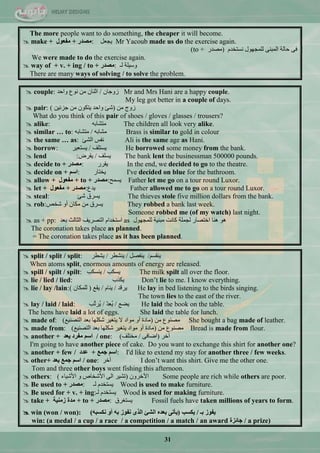
The more people want to do something, the cheaper it will become.
 make + ‫ِفؼٛي‬ + ‫:ِظذس‬ ًْ‫٠ؿ‬ Mr Yacoub made us do the exercise again.
َ‫ٔغطخذ‬ ‫ٌٍّؿٙٛي‬ ٕٝ‫جٌّر‬ ‫قحٌس‬ ٝ‫ف‬(‫ِقذس‬to +)
We were made to do the exercise again.
 way of + v. + ing / to + ‫:ِظذس‬ ‫ٌـ‬ ‫ٚع١ٍس‬
There are many ways of solving / to solve the problem.
 couple: ْ‫صٚؾح‬/‫ٚجقذ‬ ُٛٔ ِٓ ْ‫جغٕح‬ Mr and Mrs Hani are a happy couple.
My leg got better in a couple of days.
 pair: ِٓ ‫صٚؼ‬(ٓ١‫ؾضت‬ ِٓ ْٛ‫٠طى‬ ‫ٚجقذ‬ ‫ؽة‬)
What do you think of this pair of shoes / gloves / glasses / trousers?
 alike: ٗ‫ِطؾحذ‬ The children all look very alike.
 similar … to: ٗ‫ِؾحذ‬/ٗ‫ِطؾحذ‬ Brass is similar to gold in colour
 the same … as: ‫جٌؾة‬ ‫ٔفظ‬ Ali is the same age as Hani.
 borrow: ‫٠غطٍف‬/‫٠غطْ١ش‬ He borrowed some money from the bank.
 lend : ‫٠غٍف‬/‫٠مشك‬ The bank lent the businessman 500000 pounds.
 decide to + ‫:ِظذس‬ ‫٠مشس‬ In the end, we decided to go to the theatre.
 decide on + ُ‫:اع‬ ‫٠خطحس‬ I've decided on blue for the bathroom.
 allow + ‫ِفؼٛي‬ + to + ‫٠غّف:ِظذس‬ Father let me go on a tour round Luxor.
 let + ‫ِفؼٛي‬ + ‫٠ذُ:ِظذس‬ Father allowed me to go on a tour round Luxor.
 steal: ‫ؽة‬ ‫٠غشق‬ The thieves stole five million dollars from the bank.
 rob:‫ؽخـ‬ ٚ‫أ‬ ْ‫ِىح‬ ِٓ ‫٠غشق‬ They robbed a bank last week.
Someone robbed me (of my watch) last night.
 as + pp: ‫ذْذ‬ ‫جٌػحٌع‬ ‫جٌطقش٠ف‬ َ‫جعطخذج‬ as ‫ٌٍّؿٙٛي‬ ‫ِرٕ١س‬ ‫وحٔص‬ ‫ٌؿٍّس‬ ‫جخطقحس‬ ‫ٕ٘ح‬ ٛ٘
The coronation takes place as planned.
= The coronation takes place as it has been planned.
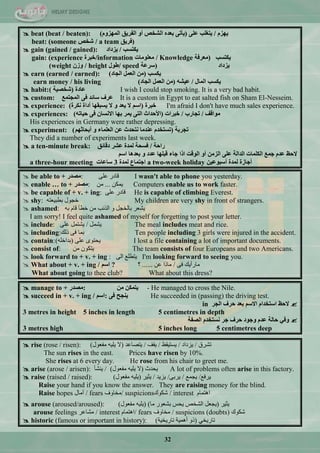
 split / split / split: ُ‫٠ٕمغ‬/ً‫٠ٕفق‬/‫٠ٕؾيش‬/‫٠ؾيش‬
When atoms split, enormous amounts of energy are released.
 spill / spilt / spilt: ‫٠غىد‬/‫٠ٕغىد‬ The milk spilt all over the floor.
 lie / lied / lied: ‫٠ىزخ‬ Don‘t lie to me. I know everything.
 lie / lay /lain: ‫٠شلذ‬/َ‫٠ٕح‬/ِ‫٠م‬(ْ‫ٌٍّىح‬) He lay in bed listening to the birds singing.
The town lies to the east of the river.
 lay / laid / laid: ِ‫٠ن‬/ّ‫ذ‬ُِْ٠/‫ِد‬‫ض‬‫ُش‬٠ He laid the book on the table.
The hens have laid a lot of eggs. She laid the table for lunch.
 made of: ِٓ ُٕٛ‫ِق‬(ِ١ٕ‫جٌطق‬ ‫ذْذ‬ ‫ؽىٍٙح‬ ‫٠طغ١ش‬ ‫ال‬ ‫ِٛجد‬ ٚ‫أ‬ ‫ِحدز‬) She bought a bag made of leather.
 made from: ِٓ ُٕٛ‫ِق‬(ِ١ٕ‫جٌطق‬ ‫ذْذ‬ ‫ؽىٍٙح‬ ‫٠طغ١ش‬ ‫ِٛجد‬ ٚ‫أ‬ ‫ِحدز‬) Bread is made from flour.
 another + ‫٠ؼذ‬ ‫ِفشد‬ ُ‫اع‬ / one: ‫آخش‬(ٝ‫جمحف‬/‫ِخطٍف‬)
I'm going to have another piece of cake. Do you want to exchange this shirt for another one?
 another + few / ‫ػذد‬ + ‫عّغ‬ ُ‫:اع‬ I'd like to extend my stay for another three / few weeks.
 other+ ‫٠ؼذ‬ ‫عّغ‬ ُ‫اع‬ / one: ‫آخش‬ I don‘t want this shirt. Give me the other one.
Tom and three other boys went fishing this afternoon.
 others: ْٚ‫ج٢خش‬(‫ج٤ؽ١حء‬ ٚ ‫ج٤ؽخحؿ‬ ٌٝ‫ج‬ ‫ضؾ١ش‬) Some people are rich while others are poor.
 Be used to + ‫:ِظذس‬ ‫ٌـ‬ َ‫٠غطخذ‬ Wood is used to make furniture.
 Be used for + v. + ing:‫ٌـ‬ َ‫٠غطخذ‬ Wood is used for making furniture.
 take + ‫صِٕ١خ‬ ‫ِذح‬ + to + ‫:ِظذس‬ ‫٠غطغشق‬ Fossil fuels have taken millions of years to form.
 win (won / won): ‫ثـ‬ ‫٠فٛص‬/‫٠ىغت‬(ٗ‫ٔىغج‬ ٚ‫أ‬ ٗ‫ث‬ ‫ٔفٛص‬ ٜ‫اٌز‬ ‫اٌشئ‬ ٖ‫ثؼذ‬ ٝ‫٠أر‬)
win: (a medal / a cup / a race / a competition / a match / an award ‫عبئضح‬ / a prize)
32
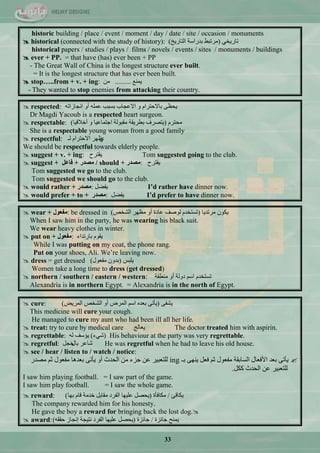
 beat (beat / beaten): َ‫٠ٙض‬/ٍٝ‫ػ‬ ‫٠زغٍت‬(َٚ‫اٌّٙض‬ ‫اٌفش٠ك‬ ٚ‫أ‬ ‫اٌشخض‬ ٖ‫ثؼذ‬ ٝ‫٠أر‬)
beat: (someone ‫شخض‬ / a team ‫)فش٠ك‬
 gain (gained / gained): ‫٠ىزغت‬/‫٠ضداد‬
gain: (experience ‫/خجشح‬information ‫ِؼٍِٛبد‬ / Knowledge ‫)ِؼشفخ‬ ‫٠ىزغت‬
(weight ْ‫ٚص‬ / height ‫/ؿٛي‬ speed ‫)عشػخ‬ ‫٠ضداد‬
 earn (earned / earned): ‫٠ىغت‬(‫اٌغبد‬ ًّ‫اٌؼ‬ ِٓ)
earn money / his living ‫اٌّبي‬ ‫٠ىغت‬/ٗ‫ػ١ش‬(‫اٌغبد‬ ًّ‫اٌؼ‬ ِٓ)
 habit: ‫ػبدح‬(‫شخظ١خ‬) I wish I could stop smoking. It is a very bad habit.
 custom: ‫اٌّغزّغ‬ ٝ‫ف‬ ‫عبئذ‬ ‫ػشف‬ It is a custom in Egypt to eat salted fish on Sham El-Nesseim.
 experience: ‫خجشح‬(‫ٔىشح‬ ‫أداح‬ ‫٠غجمٙب‬ ‫ال‬ ٚ ‫٠ؼذ‬ ‫ال‬ ُ‫اع‬) I'm afraid I don't have much sales experience.
 experiences: ‫ِٛالف‬/‫رغبسة‬/‫خجشاد‬(ٗ‫ؽ١بر‬ ٝ‫ف‬ ْ‫االٔغب‬ ‫ثٙب‬ ‫٠ّش‬ ٝ‫اٌز‬ ‫األؽذاس‬)
His experiences in Germany were rather depressing.
 experiment: ‫رغشثخ‬(ُٙ‫أثؾبص‬ ٚ ‫اٌؼٍّبء‬ ٓ‫ػ‬ ‫ٔزؾذس‬ ‫ػٕذِب‬ َ‫رغزخذ‬)
They did a number of experiments last week.
 a ten-minute break: ‫ساؽخ‬/‫دلبئك‬ ‫ػشش‬ ‫ٌّذح‬ ‫فغؾخ‬
ُ‫اع‬ ‫ثؼذ٘ب‬ ٚ ‫ػذد‬ ‫لجٍٙب‬ ‫عبء‬ ‫ارا‬ ‫اٌٛلذ‬ ٚ‫أ‬ ِٓ‫اٌض‬ ٍٝ‫ػ‬ ‫اٌذاٌخ‬ ‫اٌىٍّبد‬ ‫عّغ‬ َ‫ػذ‬ ‫الؽظ‬
a three-hour meeting ‫ٌّذح‬ ‫اعزّبع‬3‫عبػبد‬ a two-week holiday ٓ١‫أعجٛػ‬ ‫ٌّذح‬ ‫أعبصح‬
 be able to + ‫:ِظذس‬ ٍّٝ ‫لحدس‬ I wasn't able to phone you yesterday.
 enable … to + ‫:ِظذس‬ ٓ‫٠ّى‬...ِٓ Computers enable us to work faster.
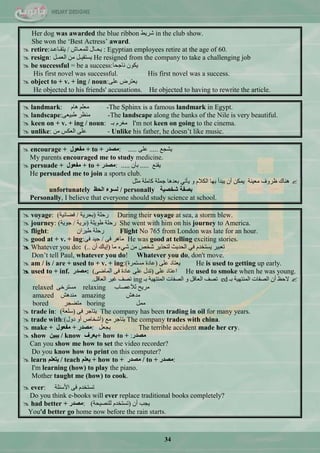
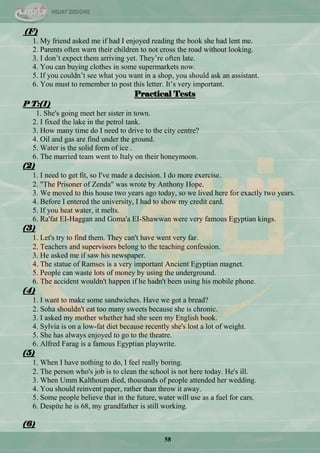
 be capable of + v. + ing: ٍّٝ ‫لحدس‬ He is capable of climbing Everest.
 shy: ٗ‫ذير١ْط‬ ‫خؿٛي‬ My children are very shy in front of strangers.
 ashamed: ٗ‫ذ‬ َ‫لح‬ ‫خيأ‬ ِٓ ‫جٌزٔد‬ ٚ ً‫ذحٌخؿ‬ ‫٠ؾْش‬
I am sorry! I feel quite ashamed of myself for forgetting to post your letter.
 include: ًّ‫٠ؾ‬/ٍّٝ ًّ‫٠ؾط‬ The meal includes meat and rice.
 including:‫رٌه‬ ٝ‫ف‬ ‫ذّح‬ Ten people including 3 girls were injured in the accident.
 contain: ٍّٝ ٜٛ‫٠كط‬(ٍٗ‫ذذجخ‬) I lost a file containing a lot of important documents.
 consist of: ِٓ ْٛ‫٠طى‬ The team consists of four Europeans and two Americans.
 look forward to + v. + ing : ٌٝ‫ج‬ ٍِ‫٠طي‬ I'm looking forward to seeing you.
 What about + v. + ing / ُ‫اع‬ ? ٝ‫ف‬ ‫ِحسأ٠ه‬/ّٓ ‫ِحرج‬......‫؟‬
What about going to thee club? What about this dress?
 manage to + ‫:ِظذس‬ ِٓ ٓ‫٠زّى‬ - He managed to cross the Nile.
 succeed in + v. + ing / ُ‫:اع‬ ٝ‫ف‬ ‫٠ٕغؼ‬ He succeeded in (passing) the driving test.
‫اٌغش‬ ‫ؽشف‬ ‫ثؼذ‬ ُ‫االع‬ َ‫اعزخذا‬ ‫الؽظ‬in
3 metres in height 5 inches in length 5 centimetres in depth
‫اٌظفخ‬ َ‫ٔغزخذ‬ ‫عش‬ ‫ؽشف‬ ‫ٚعٛد‬ َ‫ػذ‬ ‫ؽبٌخ‬ ٟ‫ٚف‬
3 metres high 5 inches long 5 centimetres deep
 rise (rose / risen): ‫ضؾشق‬/‫٠ضدجد‬/ٌ‫٠غط١م‬/‫٠مف‬/‫٠طقحّذ‬(‫ِفْٛي‬ ٗ١ٍ٠ ‫ال‬)
The sun rises in the east. Prices have risen by 10%.
She rises at 6 every day. He rose from his chair to greet me.
 arise (arose / arisen): /‫٠ٕؾأ‬ ‫٠كذظ‬(‫ِفْٛي‬ ٗ١ٍ٠ ‫ال‬) A lot of problems often arise in this factory.
 raise (raised / raised): ‫٠ض٠ذ‬/‫٠ػ١ش‬(‫ِفْٛي‬ ٗ١ٍ٠) /ٝ‫٠شذ‬ / ِّ‫٠ؿ‬ /ِ‫٠شف‬
Raise your hand if you know the answer. They are raising money for the blind.
Raise hopes ‫آِحي‬ / fears ‫/ِخحٚف‬ suspicions‫ؽىٛن‬ / interest َ‫ج٘طّح‬
 arouse (aroused/aroused): ‫٠ػ١ش‬(‫ِح‬ ‫ذؾْٛس‬ ‫٠كظ‬ ‫جٌؾخـ‬ ًْ‫٠ؿ‬)(‫ِفْٛي‬ ٗ١ٍ٠)
arouse feelings ‫ِؾحّش‬ / interest َ‫/ج٘طّح‬ fears ‫ِخحٚف‬ / suspicions (doubts) ‫ؽىٛن‬
 historic (famous or important in history): ٟ‫ضحس٠خ‬(‫ضحس٠خ١س‬ ‫أّ٘١س‬ ٚ‫ر‬)
33
historic building / place / event / moment / day / date / site / occasion / monuments
 historical (connected with the study of history): ٟ‫ضحس٠خ‬(‫جٌطحس٠خ‬ ‫ذذسجعس‬ ‫ِشضرو‬)
historical papers / studies / plays / films / novels / events / sites / monuments / buildings
 ever + PP. = that have (has) ever been + PP
- The Great Wall of China is the longest structure ever built.
= It is the longest structure that has ever been built.
 stop…..from + v. + ing: ِّٕ٠.........ِٓ
- They wanted to stop enemies from attacking their country.
 respected: ٗ‫جٔؿحصجض‬ ٚ‫أ‬ ٍّّٗ ‫ذغرد‬ ‫جالّؿحخ‬ ٚ َ‫ذحالقطشج‬ َٝ‫٠ك‬
Dr Magdi Yacoub is a respected heart surgeon.
 respectable: َ‫ِكطش‬(‫أخالل١ح‬ ٚ ‫جؾطّحّ١ح‬ ‫ِمرٌٛس‬ ‫ذيش٠مس‬ ‫٠طقشف‬)
She is a respectable young woman from a good family
 respectful: ٞ‫ٌـ‬ َ‫جالقطشج‬ ‫ٍٙش‬
We should be respectful towards elderly people.
 suggest + v. + ing: ‫٠مطشـ‬ Tom suggested going to the club.
 suggest + ً‫فبػ‬ + ‫ِظذس‬ / should + ‫:ِظذس‬ ‫٠مطشـ‬
Tom suggested we go to the club.
Tom suggested we should go to the club.
 would rather + ‫:ِظذس‬ ً‫٠فن‬ I‟d rather have dinner now.
 would prefer + to + ‫ِظذس‬: ً‫٠فن‬ I‟d prefer to have dinner now.
 wear + ‫:ِفؼٛي‬ be dressed in ‫ِشضذ٠ح‬ ْٛ‫٠ى‬(‫جٌؾخـ‬ ‫َِٙش‬ ٚ‫أ‬ ‫ّحدز‬ ‫ٌٛفف‬ َ‫ضغطخذ‬)
When I saw him in the party, he was wearing his black suit.
We wear heavy clothes in winter.
 put on + ‫:ِفؼٛي‬ ‫ذحسضذجء‬ َٛ‫٠م‬
While I was putting on my coat, the phone rang.
Put on your shoes, Ali. We‘re leaving now.
 dress = get dressed ‫٠ٍرظ‬(‫ِفْٛي‬ ْٚ‫ذذ‬)
Women take a long time to dress (get dressed)
 northern / southern / eastern / western: ‫ِٕيمس‬ ٚ‫أ‬ ‫دٌٚس‬ ُ‫جع‬ َ‫ضغطخذ‬
Alexandria is in northern Egypt. = Alexandria is in the north of Egypt.
 cure:: ٝ‫٠ؾف‬(‫جٌّش٠ل‬ ‫جٌؾخـ‬ ٚ‫أ‬ ‫جٌّشك‬ ُ‫جع‬ ٖ‫ذْذ‬ ٝ‫٠أض‬)
This medicine will cure your cough.
He managed to cure my aunt who had been ill all her life.
 treat: try to cure by medical care ‫٠ْحٌؽ‬ The doctor treated him with aspirin.
 regrettable: (‫ؽٟء‬)ٌٗ ‫٠إعف‬ His behaviour at the party was very regrettable.
 regretful: ‫ذحي‬ ‫ؽحّش‬ً‫خؿ‬ He was regretful when he had to leave his old house.
 see / hear / listen to / watch / notice:
‫ذـ‬ ٕٝٙ٠ ًْ‫ف‬ ُ‫غ‬ ‫ِفْٛي‬ ‫جٌغحذمس‬ ‫ج٤فْحي‬ ‫ذْذ‬ ٝ‫٠أض‬ing‫ِقذس‬ ُ‫غ‬ ‫ِفْٛي‬ ‫ذْذ٘ح‬ ٝ‫٠أض‬ ٚ‫أ‬ ‫جٌكذظ‬ ِٓ ‫ؾضء‬ ّٓ ‫ٌٍطْر١ش‬
ً‫وى‬ ‫جٌكذظ‬ ّٓ ‫ٌٍطْر١ش‬.
I saw him playing football. = I saw part of the game.
I saw him play football. = I saw the whole game.
 reward: ( ‫٠ىحلة‬/‫ِىحفأز‬(‫ذٙح‬ َ‫لح‬ ‫خذِس‬ ً‫ِمحذ‬ ‫جٌفشد‬ ‫ٍّ١ٙح‬ ً‫٠كق‬
The company rewarded him for his honesty.
He gave the boy a reward for bringing back the lost dog.
 award: ‫ؾحتضز‬ ‫٠ّٕف‬/‫ؾحتضز‬(ٗ‫قمم‬ ‫ئٔؿحص‬ ‫ٔط١ؿس‬ ‫جٌفشد‬ ‫ٍّ١ٙح‬ ً‫٠كق‬)
34
Her dog was awarded the blue ribbon ‫ؽش٠و‬ in the club show.
She won the ‗Best Actress‘ award.
 retire: ‫٠كـحي‬‫ٌٍّْـحػ‬/‫٠طمـحّـذ‬ : Egyptian employees retire at the age of 60.
 resign: ً‫جٌّْـ‬ ِٓ ً‫٠غطم١ـ‬ He resigned from the company to take a challenging job
 be successful = be a success:‫ٔحؾكح‬ ْٛ‫٠ى‬
His first novel was successful. His first novel was a success.
 object to + v. + ing / noun:ٍّٝ ‫٠ْطشك‬
He objected to his friends' accusations. He objected to having to rewrite the article.
 landmark: َ‫٘ح‬ ٍُِْ -The Sphinx is a famous landmark in Egypt.
 landscape:ْٝ١‫ىر‬ ‫َِٕش‬ -The landscape along the banks of the Nile is very beautiful.
 keen on + v. + ing / noun: ‫ذـ‬ َ‫ِغش‬ I'm not keen on going to the cinema.
 unlike: ِٓ ‫جٌْىظ‬ ٍّٝ - Unlike his father, he doesn‘t like music.
 encourage + ‫ِفؼٛي‬ + to + ‫:ِظذس‬ ِ‫٠ؾؿ‬.....ٍّٝ.....
My parents encouraged me to study medicine.
 persuade + ‫ِفؼٛي‬ + to + ‫:ِظذس‬ ِٕ‫٠م‬.....ْ‫ذأ‬.....
He persuaded me to join a sports club.
ً‫ِػ‬ ‫وحٍِس‬ ‫ؾٍّس‬ ‫ذْذ٘ح‬ ٟ‫٠أض‬ ٚ َ‫جٌىال‬ ‫ذٙح‬ ‫٠رذأ‬ ْ‫أ‬ ٓ‫٠ّى‬ ‫ِْ١ٕس‬ ‫ٍشٚف‬ ‫ٕ٘حن‬
unfortunately ‫اٌؾظ‬ ‫ٌغٛء‬ / personally ‫شخظ١خ‬ ‫ثظفخ‬
Personally, I believe that everyone should study science at school.
 voyage: ‫سقٍس‬(‫ذكش٠س‬/‫فنحت١س‬) During their voyage at sea, a storm blew.
 journey: ‫ىٛ٠ٍس‬ ‫سقٍس‬(‫ذش٠س‬/‫ؾٛ٠س‬) She went with him on his journey to America.
 flight: ْ‫ى١شج‬ ‫سقٍس‬ Flight No 765 from London was late for an hour.
 good at + v. + ing: ٝ‫ف‬ ‫ِح٘ش‬/ٝ‫ف‬ ‫ؾ١ذ‬ He was good at telling exciting stories.
 Whatever you do: ‫ِح‬ ‫ؽٟء‬ ِٓ ‫ؽخـ‬ ‫ٌطكز٠ش‬ ‫جٌكذ٠ع‬ ٟ‫ف‬ َ‫٠غطخذ‬ ‫ضْر١ش‬(ْ‫أ‬ ‫ئ٠حن‬..)
Don‘t tell Paul, whatever you do! Whatever you do, don't move.
 am / is / are + used to + v. + ing: ٍّٝ ‫٠ْطحد‬(‫ِغطّشز‬ ‫ّحدز‬) He is used to getting up early.
 used to + inf. ‫ِظذس‬: ٍّٝ ‫جّطحد‬(ٝ‫جٌّحم‬ ٝ‫ف‬ ‫ّحدز‬ ٍّٝ ‫ضذي‬) He used to smoke when he was young.
‫ذـ‬ ‫جٌّٕطٙ١س‬ ‫جٌقفحش‬ ْ‫أ‬ ٌ‫الق‬ed‫ذـ‬ ‫جٌّٕطٙ١س‬ ‫جٌقفحش‬ ٚ ً‫جٌْحل‬ ‫ضقف‬ingً‫جٌْحل‬ ‫غ١ش‬ ‫ضقف‬.
relaxed ٝ‫ِغطشخ‬ relaxing ‫ٌ٣ّقحخ‬ ‫ِش٠ف‬
amazed ‫ِٕذ٘ؼ‬ amazing ‫ِذ٘ؼ‬
bored ‫ِطنؿش‬ boring ًِّ
 trade in: ٝ‫ف‬ ‫٠طحؾش‬(‫عٍْس‬) The company has been trading in oil for many years.
 trade with: ِِ ‫٠طحؾش‬(‫دٚي‬ ٚ‫أ‬ ‫أؽخحؿ‬) The company trades with china.
 make + ‫ِفؼٛي‬ + ‫:ِظذس‬ ًْ‫٠ؿ‬ The terrible accident made her cry.
 show ٓ١‫٠ج‬ / know ‫+٠ؼشف‬ how to + :‫ِظذس‬
Can you show me how to set the video recorder?
Do you know how to print on this computer?
 learn ٍُ‫٠زؼ‬ / teach ٍُ‫٠ؼ‬ + how to + ‫ِظذس‬ / to + ‫:ِظذس‬
I'm learning (how) to play the piano.
Mother taught me (how) to cook.
 ever: ‫ج٤عثٍس‬ ٝ‫ف‬ َ‫ضغطخذ‬
Do you think e-books will ever replace traditional books completely?
 had better + ‫:ِظذس‬ ْ‫أ‬ ‫٠ؿد‬(‫ٌٍٕق١كس‬ َ‫ضغطخذ‬)
You'd better go home now before the rain starts.
35
 Teach / taught / taught:ٍُْ٠ My father taught me how to ride a bike.
 accept:ً‫٠مر‬ He accepted an invitation to the opening-night party.
 expect:ِ‫٠طٛل‬ He didn't expect to see me.
 except: ‫ِحّذج‬ The museum is open daily except Monday.
 sensible: ُ١‫قى‬/ً‫ّحل‬ Sara makes the right decision. She‘s a sensible woman.
 sensitive: ‫قغحط‬ Sara is very sensitive. She wouldn‘t want to hurt anyone.
 expect + ‫ِفؼٛي‬ + to + ‫:ِظذس‬ ِ‫٠طٛل‬ We expect to get full marks in English.
 expect + ً‫فبػ‬ + will + ‫٠طٛلِ:ِظذس‬ I expect he will get high marks.
 expected + ً‫فبػ‬ + would + ‫٠طٛلِ:ِظذس‬ I expected he would win the race.
ُ‫ٚوحع‬ ًْ‫وف‬ َ‫ضغطخذ‬ ‫ج٢ض١س‬ ‫جٌىٍّحش‬
present ٜ‫٠ٙذ‬/‫٘ذ٠خ‬ refuse ‫٠شفغ‬/‫لّبِخ‬ produce ‫ُٕزظ‬٠/‫ِٕزغبد‬‫صساػ١خ‬ object ‫٠ؼزشع‬/‫شئ‬/‫٘ذف‬
increase ‫٠ض٠ذ‬/‫ص٠بدح‬
‫عش٠ؼخ‬ ‫ثٕظشح‬ ‫اٌمٛاػذ‬ ‫ِشاعؼخ‬
The present simple ‫اٌجغ١ؾ‬ ‫اٌّؼبسع‬
‫اٌّظذس‬ ِٓ ‫اٌجغ١ؾ‬ ‫اٌّؼبسع‬ ٟ‫ف‬ ً‫اٌفؼ‬ ْٛ‫٠زى‬-ً‫ٌٍفؼ‬ ‫٠ؼبف‬“es / s“‫غبئت‬ ‫ِفشد‬ ً‫اٌفبػ‬ ْٛ‫٠ى‬ ‫ػٕذِب‬ ً‫ٌٍفؼ‬
‫ٌٍزؼج١ش‬ َ‫٠غزخذ‬:‫اٌؾمبئك‬‫اٌؼبداد‬ ٚfacts & habits
Always / usually / often / sometimes / rarely / never/ seldom / every / generally / daily …..etc
‫ذْذ‬ ٟ‫ضأض‬ ‫ٌىٕٙح‬ ٚ ٟ‫جٌشت١غ‬ ًْ‫جٌف‬ ً‫لر‬ ‫جٌطىشجس‬ ‫ٍشٚف‬ ٟ‫ضأض‬v. to be
he usually comes late he is usually late
‫ٔٙح٠طٙح‬ ٟ‫ف‬ ٚ‫أ‬ ‫جٌؿٍّس‬ ‫ذذج٠س‬ ٟ‫ف‬ ِ‫ضم‬ ‫ج٢ض١س‬ ‫جٌَشٚف‬:
Every day/in the morning/at moon/in the afternoon / in the evening / at night.
The past simple ‫اٌجغ١ؾ‬ ٟ‫اٌّبػ‬
ٓ٠ٛ‫جٌطى‬:ًْ‫ٌٍف‬ ٟٔ‫جٌػح‬ ‫جٌطقش٠ف‬ ِٓ ‫جٌرغ١و‬ ٟ‫جٌّحم‬ ْٛ‫٠طى‬.
‫ج٢ض١س‬ ‫جٌىٍّحش‬ ِِ ‫جٌرغ١و‬ ٟ‫جٌّحم‬ َ‫ٚ٠غطخذ‬-:‫جٌغٕس‬Yesterday , last , ago , once in the past / in +
Used to
ْ‫أ‬ ‫اػزبد‬(ْ٢‫ا‬ ٍٗ‫٠فؼ‬ ‫ال‬ ‫ٌٚىٕخ‬ ‫اٌشٟء‬ ً‫٠فؼ‬)‫اٌّظذس‬+used to +ً‫ػبل‬ ً‫فبػ‬
ً‫ػبل‬ ً‫فبػ‬ +be/get + used to + v +ing ٍٟ‫ػ‬ ‫٠ؼزبد‬(‫شٟء‬ ً‫فؼ‬)‫اٌؾبػش‬ ٟ‫ف‬
ً‫ػبل‬ ‫غ١ش‬ ً‫+فبػ‬ be + used to + ‫اٌّظذس‬
ً‫ػبل‬ ‫غ١ش‬ ً‫+فبػ‬ be + used to + for + v + ing َ‫االعزخذا‬ ٓ‫ػ‬ ‫ٌٍزؼج١ش‬ ‫اٌزشو١ج١خ‬ ٖ‫٘ز‬ ًّ‫رغزؼ‬
Future Simple Tense ‫اٌجغ١ؾ‬ ً‫اٌّغزمج‬ ِٓ‫ص‬
ِٓ ‫اٌجغُؾ‬ ً‫اٌّغزمج‬ ْ‫َزىى‬will / shall + inf.
‫ا٢ر١خ‬ ‫اٌىٍّبد‬ ‫ِغ‬ ‫اٌجغ١ؾ‬ ً‫اٌّغزمج‬ َ‫٠غزخذ‬:
Next / in the future / soon / in a year, month, week tomorrow / this time tomorrow
- I'll see him tomorrow. - We will not (won't) meet again until next week.
‫ِغ‬ ‫غبٌجب‬ ‫اٌجغ١ؾ‬ ً‫اٌّغزمج‬ َ‫اعزخذا‬ ‫الؽظ‬:
I expect / I'm sure / I think / probably /I hope / I believe / I feel sure / Perhaps
- I expect he will win the first prize. - I don't think she will get the job.
Will + infinitive
َ‫ٔغزخذ‬will + infinitive:
 For predictions: ‫ٌٍطٕرإ‬ - I think you'll enjoy your holiday.
 For future facts: ‫جٌّغطمرٍ١س‬ ‫ٌٍكمحتك‬ - I'll be 16 next week.
 For quick decisions: ‫جٌغش٠ْس‬ ‫ٌٍمشجسجش‬ - That's the phone – I'll answer it.
 For offers: ‫ٌٍْشك‬ - I'll go shopping with you if you like.
36
 for requests: ‫ٌٍيٍد‬ - Will you give me your new address?
 for arrangements: ‫ؽٟء‬ ًٌّْ ‫ٌٍطشض١د‬ - I'll see you this evening.
 for threats: ‫ٌٍطٙذ٠ذ‬ - I'll resign if I don't get a pay rise.
Shall + infinitive
َ‫ٔغزخذ‬shall + infinitive:
 for suggestions: ‫ٌاللطشجـ‬ - Shall we go out for dinner tonight?
 for offers: ‫ٌٍْشك‬ - Shall I help you with your homework?
Going to + infinitive
َ‫ٔغطخذ‬going to + infinitive‫جٌكذ٠ع‬ ‫ٌكَس‬ ً‫لر‬ ‫جٌمشجسجش‬ ٚ ‫جٌٕٛج٠ح‬ ٚ ‫جٌخيو‬ ّٓ ‫ٌٍطْر١ش‬
- I'm going to make some coffee. Do you want some?
َ‫ٔغطخذ‬going to + infinitiveً١ٌ‫د‬ ‫ٚؾٛد‬ ِِ ً‫جٌّغطمر‬ ٝ‫ف‬ ‫ذكذظ‬ ‫جٌطٕرإ‬
- There are no clouds in the sky. It's going to be another sunny day.
Present Continuous ‫اٌّغزّش‬ ‫اٌّؼبسع‬ ِٓ‫ص‬
‫جٌّغرمس‬ ‫جٌخيو‬ ٚ ‫ٌٍطشض١رحش‬ ‫ذحٌٕغرس‬ ً‫جٌّغطمر‬ ّٓ ‫ٌٍطْر١ش‬ ‫جٌّغطّش‬ ُ‫جٌّنحس‬ َ‫٠غطخذ‬
- He's travelling to Cairo tomorrow. He's got his tickets.
Present Simple ‫اٌجغ١ؾ‬ ‫اٌّؼبسع‬ ِٓ‫ص‬
ً‫اٌّغزمج‬ ٓ‫ػ‬ ‫ٌٍزؼج١ش‬ ‫اٌجغ١ؾ‬ ‫اٌّؼبسع‬ َ‫٠غزخذ‬‫ِغ‬‫اٌّذسعخ‬ ٚ ‫اٌغ١ّٕب‬ ٚ ‫اٌّغشػ‬ ٚ ‫اٌّٛاطالد‬ ً‫ثٛعبئ‬ ‫اٌّٛاػ١ذ‬ ‫عذاٚي‬..‫اٌخ‬
- The plane takes off at 10 p.m.
-‫اٌجغ١ؾ‬ ‫ثبٌّؼبسع‬ ‫اٌشٚاثؾ‬ ٖ‫٘ز‬ ‫رزجغ‬ ْ‫أ‬ ‫ثششؽ‬ ‫ا٢ر١خ‬ ‫اٌشٚاثؾ‬ ‫ِغ‬/ٟ‫٠أر‬ َ‫اٌزب‬ ‫اٌّؼبسع‬will + inf
if / when / until / unless / after / as soon as / before
we will start as soon as he arrives / has arrived
The future continuous ‫اٌّغزّش‬ ً‫اٌّغزمج‬
Will – shall +be + v-ing
ً‫جٌّغطمر‬ ٝ‫ف‬ ٓ١ِْ ‫ٚلص‬ ٝ‫ف‬ ‫ِغطّش‬ ْٛ‫٠ى‬ ‫عٛف‬ ‫قذظ‬
I will be doing my homework at 6 tomorrow.
The future perfect َ‫اٌزب‬ ً‫اٌّغزمج‬
Will have +p.p
ً‫جٌّغطمر‬ ٝ‫ف‬ ٓ١ِْ ‫ٚلص‬ ً‫لر‬ ٚ‫ج‬ ‫خالي‬ ٝ‫ف‬ ًّ‫٠ىط‬ ‫عٛف‬ ‫قذظ‬
I will have done my homework by 6o'clock tomorrow.
Conjunctions ‫اٌشٚاثؾ‬
1-Although = though/even though (S + V) ِٓ ُ‫ثبٌشغ‬(‫وبٍِخ‬ ‫عٍّخ‬ ُ٘‫ثؼذ‬ ٟ‫٠أر‬)
Although he's only 14,he's an expert at computers.
2- Despite/in spite of ( noun/ gerund ) ِٓ ُ‫ثبٌشغ‬(‫ػجبسح‬ ُ٘‫ثؼذ‬ ٟ‫٠أر‬)
* Despite his illness, he passed his exams.
3-As well as = besides + in addition to ( noun/ gerund) ٌٝ‫إ‬ ‫ثبإلػبفخ‬
* Besides cooking for 20 people, I did all the washing up.
4-But =, however =, yet
* She drove fast, however she missed the plane. However fast she drove, she missed the plane
5- Because = since = as (S + V) (‫وبٍِخ‬ ‫عٍّخ‬ ُ٘‫ثؼذ‬ ٟ‫٠أر‬) ْ‫ال‬
* Because /since we are early, I think we should wait outside.
6- Because of = owing to = due to ( noun/ gerund) ‫ثغجت‬
* Due to the bad weather, the match was cancelled.
7- As long as = provided (that ) only if (S+V) (‫وبٍِخ‬ ‫عٍّخ‬ ُ٘‫ثؼذ‬ ٟ‫٠أر‬) ‫إرا‬/ٌٛ/‫ؿبٌّب‬
* I'll go provided ( that ) ( as long as ) you come with me.
= I'll only go if you come with me. = I won't go unless you come with me.
8- Not only + ‫اعزفٙبِ١خ‬ ‫ط١غخ‬ + but + ‫وبٍِخ‬ ‫عٍّخ‬ + as well
* Not only have you got top marks but you've got a prize as well
37
9- So as to = in order to = to + inf. ٟ‫ٌى‬
* He opened the door in order to see who was there.
10- So that = in order that ( Sً‫فبػ‬ + can/may/could/might+ verb )
* He left early so that he could/ (might ) catch the train.
11- So = therefore =that's why = - Consequently
* My bike's broken, so I'll have to walk. *I missed the train, consequently I was late for school.
Conditional Sentences
‫ذغ١و‬ ُ‫ِنحس‬‫ذغ١و‬ ُ‫ِنحس‬
‫جٌّقذس‬+will‫ذغ١و‬ ُ‫ِنحس‬(1)
‫جٌّقذس‬+would‫ذغ١و‬ ٟ‫ِحم‬(2 )if
would have + PP.َ‫ضح‬ ٟ‫ِحم‬(3 )
‫اٌضبٔ١خ‬ ‫اٌششؿ١خ‬ ‫اٌؾبٌخ‬
‫اٌّظذس‬+would‫ثغ١ؾ‬ ٟ‫ِبػ‬+if
‫جٌكحمش‬ ٟ‫ف‬ ‫قم١م١س‬ ‫غ١ش‬ ٚ‫أ‬ ‫خ١حٌ١س‬ ‫ِٛجلف‬ ٚ‫أ‬ ‫جٌكذٚظ‬ ‫ِكطٍّس‬ ‫غ١ش‬ ‫ِٛجلف‬ ّٓ ‫ٌٍطْر١ش‬ ‫جٌكحٌس‬ ٖ‫٘ز‬ َ‫ضغطخذ‬:
1-‫ذغ١و‬ ٟ‫ِحم‬ ٌٟ‫ئ‬ ُ‫جٌّنحس‬ ‫٠كٛي‬-‫جٌْىظ‬ ٚ ‫ج٦غرحش‬ ٌٟ‫ئ‬ ٟ‫جٌٕف‬ ‫٠كٛي‬.
3-ٍّٟ ‫جٌؿٍّس‬ ‫جقطٛش‬ ‫ئرج‬ because / as ‫جٌػحٔ١س‬ ‫ذحٌؿٍّس‬ ‫ٔرذأ‬.
it isn‘t fine today . I can‘t go for a swim ( if ) If it were fine , I could go for a walk .
‫اٌضبٌضخ‬ ‫اٌششؿ١خ‬ ‫اٌؾبٌخ‬
1-َ‫جٌطح‬ ٟ‫جٌّحم‬ ٌٟ‫ئ‬ ‫جٌرغ١و‬ ٟ‫جٌّحم‬ ‫٠كٛي‬- .‫جٌْىظ‬ ٚ ‫ج٦غرحش‬ ٌٟ‫ئ‬ ٟ‫جٌٕف‬ ‫٠كٛي‬.
If + َ‫رب‬ ٟ‫ِبػ‬ would have + P.P
- he didn‘t try to leave the country , so he wasn‘t arrested . ( if )
If he had tried to leave the country , he would have been arrested
1-َ‫اعزخذا‬ ٓ‫٠ّى‬shouldً‫ِؾ‬ifٌٟٚ‫األ‬ ‫اٌؾبٌخ‬ ٟ‫ف‬.( should + s. + inf )
- if he fails his exam , he will be punished . ( should )
- Should he fail his exam , he will be punished .
2-َ‫اعزخذا‬ ٓ‫٠ّى‬ ٚwereً‫ِؾ‬if‫اٌضبٔ١خ‬ ‫اٌؾبٌخ‬ ٟ‫ف‬.
( were + s. + ….. ) – ( were + s. + to + inf )
- if were a fish , I‘d swim . - Were I a fish , I'd swim
- if he went to bed early , he wouldn‘t feel sleepy in the morning
Were he to go to bed early , he wouldn't feel sleepy in the morning
3-َ‫اعزخذا‬ ٓ‫٠ّى‬ ٚhadً‫ِؾ‬ifٟ‫أعبع‬ ً‫فؼ‬ ‫وبٔذ‬ ‫إرا‬ ‫اٌضبٔ١خ‬ ‫اٌؾبٌخ‬ ٟ‫ف‬ ٚ‫أ‬ ‫اٌضبٌضخ‬ ‫اٌؾبٌخ‬ ٟ‫ف‬.
if he had time ,he would go to the cinema . Had he time , he would go….
if you had studied , you would have succeeded. Had you studied , you …
َ‫اعزخذا‬ ٓ‫٠ّى‬ ٚin case ofً‫ِؾ‬ifً‫اٌفؼ‬ ٚ‫أ‬ ُ‫االع‬ ‫ثؼذ٘ب‬ ٟ‫٠أر‬ ٓ‫ٌى‬ ٚ ‫اإلصجبد‬ ٟ‫ف‬+ing
if he were clever , he would solve this problem ( in case of )
In case of being clever ( his cleverness ) , he would ……
-َ‫اعزخذا‬ ٓ‫٠ّى‬ ٚ(without-( but for-ً‫ِؾ‬ifً‫ِؾ‬ ٚ‫أ‬ ٟ‫إٌف‬ ٟ‫ف‬unlessً‫اٌفؼ‬ َ‫أ‬ ُ‫االع‬ ‫ثؼذ٘ب‬ ٟ‫٠أر‬ ٚ+ing
- if he hadn‘t behaved foolishly , we would have helped him
without + ُ‫جع‬ ……. would + ‫جٌّقذس‬ = if it weren‘t for + ُ‫جع‬ would + ‫جٌّقذس‬
without + ُ‫جع‬ … would have +p.p. = if it hadn't been for + ُ‫جع‬ would've + p.p.
38
7-َ‫اعزخذا‬ ٓ‫ٚ٠ّى‬as long asٚ‫أ‬that providedٚ‫أ‬providingً‫ِؾ‬ifٟٕ‫اٌّؼ‬ ‫ٔفظ‬ ٌُٙٚ.
10- The present perfect tense َ‫اٌزب‬ ‫اٌّؼبسع‬ ِٓ‫ص‬
have / has + P.P.
- I have bought 'a new shirt . - She has learnt English since 1996.
lately َ‫ٚجالعطفٙح‬ ٟ‫جٌٕف‬ ٟ‫ف‬ َ‫ضغطخذ‬ - I haven't seen him lately.
recently َ‫ٚجالعطفٙح‬ ‫ج٦غرحش‬ ٟ‫ف‬ َ‫ضغطخذ‬ - I have joined a music club recently
yet َ‫ٚجالعطفٙح‬ ٟ‫جٌٕف‬ ٟ‫ف‬ َ‫ضغطخذ‬ - I haven't met her yet
already َ‫ٚجالعطفٙح‬ ‫ج٦غرحش‬ ٟ‫ف‬ َ‫ضغطخذ‬ - I have already bought a new shirt.
ever َ‫ٚجالعطفٙح‬ ٟ‫ف‬ َ‫ضغطخذ‬ - Have you ever been to America?
never ٟ‫جٌٕف‬ ٟ‫ف‬ َ‫ضغطخذ‬ - I have never been to America.
since ‫ِكذد‬ ‫ضحس٠خ‬ ِِ ٟ‫ضأض‬ - He hasn't met her since last week.
For ‫ِكذدز‬ ‫ِذز‬ ِِ ٟ‫ضأض‬ - He hasn't met her for a week.
have gone ‫ٕ٘حن‬ ًَ٠ٚ ْ‫ٌّىح‬ ‫٠ز٘د‬ - He has gone to Aswan = (he is still there)
have been ‫ٚ٠ْٛد‬ ْ‫ٌّىح‬ ‫٠ز٘د‬ - He has been to Aswan = (he came back)
‫ؾذج‬ ‫٘حِس‬ ‫٤ٔٙح‬ ‫جٌطحٌ١س‬ ‫جٌطكٛ٠الش‬ ٌ‫الق‬
- I last ate fish when I visited my uncle. I haven't eaten fish since I visited my uncle
- I last ate fish was 3 weeks ago . It's 3 weeks since I ate fish .
It's + ‫صِٕ١خ‬ ‫ِذح‬ + since + ‫ثغ١ؾ‬ ٟ‫ِبػ‬ ‫عٍّخ‬
- Just /a moment ago - He left me a moment ago - He has just left me.
The Passive voice ‫ٌٍّغٙٛي‬ ٟٕ‫اٌّج‬
am / is / are + p.p. ( Spoken )1. Simple present ( speak "s" ) ‫ذغ١و‬ ُ‫ِنحس‬
am / is / are being + p.p. ( repaired2. Present cont. ( is repairing ) ُ‫ِغط‬ ُ‫ِنحس‬
was / were + p.p. (invited )3. Simple past ( invited ) ‫ذغ١و‬ ٟ‫ِحم‬
was / were being + p.p. ( watched )4. past cont. ( was watching ) ‫ِغطّش‬ ٟ‫ِحم‬
have / has been = p.p. ( paid )5. Present perfect ( has paid ) َ‫ضح‬ ُ‫ِنحس‬
had been + p.p. ( picked )6. Past perfect ( had picked ) َ‫ضح‬ ٟ‫ِحم‬
will be + pp). ( told )7. Future simple ( will tell ) ‫ذغ١و‬ ً‫ِغطمر‬
will have been + p.p. ( built )8. Future perfect ( will have built )
going to be + p.p. ( invited )9. Going to ( going to invite me )
10. People say / believe / think / suppose / cam / allege he is genius.
It is said that he is genius / He is said to be genius
3- The past perfect tense َ‫اٌزب‬ ٟ‫اٌّبػ‬ ِٓ‫ص‬ (had + P.P. )
When I got home, my mother had washed my clothes.
After, when, as soon as, , Till, until َ‫ضح‬ ٟ‫ِحم‬ ‫ذغ١و‬ ٟ‫ِحم‬
Before / by the time ‫ذغ١و‬ ٟ‫ِحم‬ َ‫ضح‬ ٟ‫ِحم‬
ٝ‫ِٕف‬ ‫ذغ١و‬ ٟ‫ِحم‬ Till / Until َ‫ضح‬ ٟ‫ِحم‬
After / As soon as I had done my homework, I slept.
I had done my homework before/by the time I slept / I didn't sleep until I had me my homework.
No sooner
Hardly
Scarcely
+ had+ s. + p.p
than
when
when
B- The Past continuous tense ‫اٌّغزّش‬ ٟ‫اٌّبػ‬ ِٓ‫ص‬
Was / were + verb + ing
*Between six and seven thin evening, I was having breakfast.
- I was having lunch when the phone rang.
While – as - just as –when ‫ِغطّش‬ ٟ‫ِحم‬ ‫ذغ١و‬ ٟ‫ِحم‬(ِ‫لحى‬)/‫ِغطّش‬ ٟ‫ِحم‬ ٚ‫أ‬
While I was having lunch the telephone rang.
+ s. + v. ‫ثغ١ؾ‬ ٟ‫ِبػ‬
39
‫ِغطّش‬ ٟ‫ِحم‬ When ‫ذغ١و‬ ٟ‫ِحم‬
I was having lunch when the telephone rang. The telephone rang while I was having lunch.
- While I was studying, my mother was cooking lunch
( While + V + Ing ) ( Gerund) ٟ‫٠أض‬ ‫ذْذ٘ح‬ ًّ‫فح‬ ٟ‫٠أض‬ ٌُ ‫ئرج‬
While having lunch my friend came
7- Relative clauses
1-Who / that ٕٝ‫ثّؼ‬ ُ٘ٚ ً‫ػبل‬ ً‫فبػ‬ ً‫ِؾ‬ ً‫رؾ‬(ٞ‫اٌز‬/ٟ‫اٌز‬/ٓ٠‫اٌز‬)
He, she, they, I ,you , we
This is the girl. She got high marks. This is the girl who / that got high marks.
2- Who /whom ٕٝ‫ثّؼ‬ ُ٘ٚ ً‫ػبل‬ ‫ِفؼٛي‬ ً‫ِؾ‬ ً‫رؾ‬(ٞ‫اٌز‬/ٟ‫اٌز‬/ٓ٠‫اٌز‬)
him, her, me, them, you, us
This is my friend. You met him on Friday. This is my friend whom you met on Friday.
3- Which /That ٕٝ‫ثّؼ‬ ُ٘ٚ ً‫ػبل‬ ‫غ١ش‬ ‫ِفؼٛي‬ ً‫ِؾ‬ ً‫رؾ‬(ٞ‫اٌز‬/ٟ‫اٌز‬/ٓ٠‫اٌز‬ they, them, it
- I drive the car. It is expensive. - I drive the car which / that is expensive^
4- Whose ‫اٌٍّى١خ‬ ‫ػّبئش‬ ً‫ِؾ‬ ً‫رؾ‬
's, his, her, your, our their, its ,my
I met Manal. Her father is a doctor. I met Manal whose father is a doctor.
5- Where ْ‫ٌٍّىب‬ This is the school. I learnt in it. This is the school where I learnt.
6- When ْ‫ٌٍضِب‬I met Tom. I was in England at that time. " I met Tom when I was in England
whom / which َ‫ٔغزخذ‬ ‫عش‬ ‫ثؾشف‬ ‫األلٛاط‬ ‫عجمذ‬ ٌٛ
I met my friends with whom I went to Alex.
where ‫اٌؾبٌخ‬ ٖ‫٘ز‬ ٝ‫ف‬ َ‫ٚالٔغزخذ‬ ‫عش‬ ‫ثؾشف‬ ‫الزشٔذ‬ ٌٛ ْ‫اٌّىب‬ ً‫ِؾ‬ Which ً‫رؾ‬
I went to the library in which I read books . I went to the library where I read books .
all ‫ثىٍّخ‬ ‫االلٛاط‬ ‫عجمذ‬ ٌٛ ‫ٚوزٌه‬ that َ‫ٔغزخذ‬ ‫اٌظفبد‬ ِٓ ‫اٌضبٌضخ‬ ‫اٌّشؽٍخ‬ ٟ‫ف‬ ‫اٌغٍّخ‬ ‫وبٔذ‬ ٌٛ
9- Countable and uncountable nouns‫رؼذ‬ ‫ٚال‬ ‫رؼذ‬ ٟ‫اٌز‬ ‫األعّبء‬
1- Countable nouns - a book, an egg, a camel books, eggs, camels -
2-Uncountable nouns light, news, behaviour , cloth , meat, soap, homework, petrol, music,
advice, oil, food , information, luggage, bread , cake - time - experience, fish,
ِّ‫ضؿ‬ ‫ٚال‬ ‫ضفشد‬ ‫ال‬ ‫أٔٙح‬ ‫ق١ع‬ ‫جٌّفشد‬ ‫ِْحٍِس‬ ًِ‫ضْح‬ ‫ضْذ‬ ‫ال‬ ٟ‫جٌط‬ ‫ج٤عّحء‬ ْ‫أ‬ ‫ِالقَس‬ ِِ ‫ؾ١ذج‬ ‫قفَح‬ ‫ضْذ‬ ‫ال‬ ٟ‫جٌط‬ ‫ج٤عّحء‬ ٌ‫قف‬ ‫٠ؿد‬
1-ٌٟ‫وحٌطح‬ ٝ٘ٚ ‫ؾ١ذج‬ ‫ِْشفطٙح‬ ‫٠ؿد‬ ‫ٌٍىّ١س‬ ‫ضْر١شجش‬ ‫ٕ٘حن‬:
some – a lot of – a few – a little -َ‫ٔغطخذ‬ ‫جٌّػرطس‬ ‫جٌؿٍّس‬ ٟ‫ف‬
some– a lot of ‫٠ْذ‬ ‫ال‬ ٞ‫ٚجٌز‬ ‫٠ْذ‬ ٞ‫جٌز‬ ُ‫جالع‬ ِِ ٟ‫ضأض‬
a few ‫٠ْذ‬ ُ‫جع‬ ِِ a little ‫٠ؼذ‬ ‫ال‬ ُ‫اع‬ ‫ِغ‬
any – many – much -َ‫ٔغطخذ‬ ‫فإٔح‬ ‫ٚجالعطفٙحِ١س‬ ‫جٌّٕف١س‬ ‫جٌؿٍّس‬ ٟ‫ف‬ ‫أِح‬
any ‫٠ْذ‬ ‫ال‬ ٞ‫ٚجٌز‬ ‫٠ْذ‬ ٞ‫جٌز‬ ُ‫جالع‬ ِِ ٟ‫ضأض‬
many ‫٠ؼذ‬ ٞ‫اٌز‬ ُ‫االع‬ ‫ِغ‬ ٟ‫رأر‬ much ‫٠ْذ‬ ‫ال‬ ٞ‫جٌز‬ ُ‫جالع‬ ِِ ٝ‫ضأض‬
‫ع١ذا‬ ‫ِشاعؼزٙب‬ ‫٠غت‬ ‫ٌٍزغضئخ‬ ‫رؼج١شاد‬ ‫ٕ٘بن‬
a bit of/ a piece of cloth / a sheet of paper / a slice of meat/ a loaf of bread / a bottle of milk / a jar
of jam / a tube of toothpaste / a bar of chocolate / a bar of soap
If only = I wish = ّٟٕ‫أر‬/ٌٛ
1-‫إِٔ١س‬ ّٓ ‫ٌٍطْر١ش‬ ‫ذغ١و‬ ٟ‫ِحم‬ ‫ذْذّ٘ح‬ ٟ‫٠أض‬/‫جٌكحمش‬ ‫جٌٛلص‬ ٟ‫ف‬ ‫ٌّٛلف‬ ‫ج٤عف‬.
2-ٟ‫جٌّحم‬ ٟ‫ف‬ ‫إِٔ١س‬ ّٓ ‫ٌٍطْر١ش‬ َ‫ضح‬ ٟ‫ِحم‬ ‫ذْذّ٘ح‬ ٟ‫٠أض‬/ٟ‫جٌّحم‬ ٟ‫ف‬ ‫ٌّٛلف‬ ‫ج٤عف‬.
3-‫ذْذ٘ح‬ ٟ‫٠أض‬couldِِwould , I / weً‫جٌّغطمر‬ ٟ‫ف‬ ‫إِٔ١س‬ ّٓ ‫ٌٍطْر١ش‬ ‫جٌنّحتش‬ ٟ‫ذحل‬ ِِ.
‫ِجبشش‬ ‫غ١ش‬ ٌٟ‫إ‬ ‫ِجبشش‬ ِٓ ‫اٌخجش٠خ‬ ‫اٌغٍّخ‬ ً٠ٛ‫رؾ‬
1-ٟ‫ذح٢ض‬ ‫جٌمٛي‬ ًْ‫ف‬ ‫٠كٛي‬-:said to - told / say to - tell / says to - tells / said - said
1-‫ذـ‬ ‫ٔشذو‬ ‫ج٤لٛجط‬ ‫ضكزف‬that‫ّٕٙح‬ ‫جالعطغٕحء‬ ٓ‫ٚ٠ّى‬.ٟ‫وح٢ض‬ ِٕٗ‫ج٤ص‬ ‫ضكٛي‬ ٟ‫جٌّحم‬ ٟ‫ف‬ ‫جٌمٛي‬ ًْ‫ف‬ ْ‫وح‬ ‫ئرج‬:
ٛ٘ ‫وّح‬ ‫جٌرغ١و‬ ٝ‫جٌّحم‬ ٝ‫٠رم‬ ٚ‫ج‬ َ‫جٌطح‬ ٝ‫جٌّحم‬ ٌٝ‫ج‬ ‫جٌرغ١و‬ ٝ‫جٌّحم‬ ِٓ ٚ ٝ‫جٌّحم‬ ٌٝ‫ج‬ ُ‫جٌّنحس‬ ِٓ.
shall , will , can may , must would , could , might must ( had to ) .
40
‫ِجبشش‬ ‫غ١ش‬ ٌٟ‫إ‬ ‫ِجبشش‬ ِٓ ‫اٌغؤاي‬ ً٠ٛ‫رؾ‬
1-‫٠كٛي‬said / said toٌٟ‫ئ‬wondered / asked / wanted to know /
2-‫ج٤لٛجط‬ ‫ضكزف‬.‫سذو‬ ‫وأدجز‬ ًّْ‫ضغط‬ َ‫جعطفٙح‬ ‫ذأدجز‬ ‫جٌغإجي‬ ‫ذذج‬ ‫ئرج‬.
3-‫ذـ‬ ‫ٔشذو‬ َ‫جعطفٙح‬ ‫ذأدجز‬ ‫جٌغإجي‬ ‫٠رذأ‬ ٌُ ‫ئرج‬ifٚ‫أ‬whether
4-‫خرش٠س‬ ‫ؾٍّس‬ ٌٟ‫ئ‬ ‫جٌغإجي‬ ‫ٔكٛي‬ ‫٤ٕٔح‬ ًْ‫جٌف‬ ٍّٟ ًّ‫جٌفح‬ َ‫ٔمذ‬.
5-‫جٌخرش٠س‬ ‫جٌؿٍّس‬ ٟ‫ف‬ ٗ‫ؽشق‬ ‫عرك‬ ‫وّح‬ ‫جٌَشٚف‬ ٚ ِٕٗ‫ج٤ص‬ ٚ ‫جٌنّحتش‬ ‫ضكٛي‬.
‫ِجبشش‬ ‫غ١ش‬ ٌٟ‫إ‬ ‫ِجبشش‬ ِٓ ‫األِش‬ ً٠ٛ‫رؾ‬
1-‫جٌمٛي‬ ًْ‫ف‬ ‫٠كٛي‬said / said toٌٟ‫ئ‬
a) ordered / commanded b) begged c) asked / told d) advised
2-‫ذـ‬ ‫ٔشذو‬ ‫ج٤لٛجط‬ ‫ضكزف‬to‫ذـ‬ ٚ ‫جٌّػرص‬ ‫ج٤ِش‬ ‫قحٌس‬ ٟ‫ف‬not to‫قزف‬ ‫ذْذ‬don‘tٟ‫جٌٕف‬ ‫قٍس‬ ٟ‫ف‬
3-‫جٌخرش٠س‬ ‫جٌؿٍّس‬ ٟ‫ف‬ ‫ؽشقس‬ ‫عرك‬ ‫وّح‬ ‫جٌَشٚف‬ ٚ ‫ج٤صِٕس‬ ٚ ‫جٌنّحتش‬ ‫ضكٛي‬.‫وٍّس‬ ‫ضكزف‬please‫ٚؾذش‬ ْ‫ئ‬.
verbs that only take to + infinitive
Agree ‫يىافك‬ Manage ‫يتحكم‬ Mean ‫يعني‬–‫يمص‬
Demand ‫يطلب‬ Refuse ‫يرفض‬ Threaten ‫يهذد‬
Long ‫يشتاق‬ Attempt ‫يحاول‬ Dare ‫يجروء‬
Promise ‫يىعذ‬ Expect ‫يتىلع‬ Hope ‫يأمم‬
Arrange ‫يرتب‬ Manage ‫يتحكم‬ Offer ‫يعرض‬
Deserve ‫يستحك‬ Decide ‫يمرر‬ Want ‫يريذ‬
Learn ‫يتعلم‬ Pretend ‫يتظاهر‬ Wish ‫يتمني‬
verbs that only take the gerund . ing + ً‫فؼ‬
Enjoy ‫يستمتع‬ Delay ‫يؤجم‬ Suggest ‫يمترح‬
Prevent ‫يمنع‬ Practise ‫يمارس‬ Put off ‫يؤجم‬
Go no ‫يستمر‬ Miss ‫يفمذ‬ Keep ‫يظم،يبمي‬
Mind ‫يمانع‬ Finish ‫ينته‬ Admit ‫يعترف‬
Avoid ‫يتجنب‬ Imagine ‫يتخيم‬ Recommend ‫يىصي‬
Give up ‫عن‬ ‫يتىلف‬ Deny ‫ينكر‬ Risk ‫يخاطر‬
Fancy ‫يتخيم‬ Dislike ‫يحب‬ ‫ال‬–‫يكرة‬ Come ‫يأتي‬
verbs that the gerund or to + infinitive, with a change in meaning
ً‫اٌفؼ‬ ‫ثؼذ٘ب‬ ٟ‫٠أر‬ ‫أفؼبي‬+ing/gerundٚ‫أ‬to‫رغ١١ش‬ ‫ِغ‬ ‫اٌّظذس‬ ٚ(‫اخزالف‬)ٟٕ‫اٌّؼ‬ ٟ‫ف‬
Like ‫يحب‬ Love ‫يحب‬
Hate ‫يكرة‬ prefer ‫يفضم‬
-‫ج٤فْحي‬ ‫٘زز‬ ‫ذْذ‬ ‫ؾحء‬ ‫ئرج‬toٌٟ‫ئ‬ ‫ضؾ١ش‬ ‫فأٔٙح‬ ‫جٌّقذس‬ ٚ‫ذْذ٘ح‬ ‫ؾحء‬ ‫جرج‬ ‫جِح‬ ٓ١ِْ ‫ٚلص‬v-ingِٗ‫ّح‬ ‫فىشز‬ ّٓ ‫ضْرش‬ ‫فحٔٙح‬:
‫٠ٍ١ٙب‬ ‫األر١خ‬ ‫األفؼبي‬to + inf. / v. + ingٕٝ‫اٌّؼ‬ ٝ‫ف‬ ‫اخزالف‬ ‫ٚعٛد‬ ‫ِغ‬
remember + to + ‫ِظذس‬ : ‫ِح‬ ‫ؽة‬ ًّْ‫ذ‬ َٛ‫٠م‬ ْ‫أ‬ ‫٠طزوش‬ - He remembered to see the man.
remember + v. + ing: ٍْٗ‫ف‬ ٗٔ‫أ‬ ‫٠طزوش‬ ُ‫غ‬ ‫ؽة‬ ًّْ‫ذ‬ َٛ‫٠م‬ - He remembered seeing the man.
forget + to + ‫ِظذس‬ : ‫ؽ١ثح‬ ًْ‫٠ف‬ ْ‫أ‬ ٝ‫٠ٕغ‬ - Nadia forgot to meet the customer.
forget + v. + ing : ٍْٗ‫ف‬ ٗٔ‫أ‬ ٝ‫٠ٕغ‬ ُ‫غ‬ ‫ؽة‬ ًْ‫٠ف‬ - Nadia forgot meeting the customer.
regret + to + ‫ِظذس‬ : ‫ؽ١ثح‬ ًْ‫٠ف‬ ْ‫أ‬ ٜ‫جٌنشٚس‬ ِٓ ٗٔ٤ ‫ذح٤عف‬ ‫٠ؾْش‬
- He regretted to say that my brother had an accident.
regret + v. + ing : ‫ؽ١ثح‬ ًْ‫ف‬ ٗٔ٤ ‫ذح٤عف‬ ‫٠ؾْش‬
- He regretted saying that my brother had an accident.
try + to + ‫ِظذس‬ : ‫٠ٕؿف‬ ‫ال‬ ‫غحٌرح‬ ٚ ‫ؽة‬ ًّّ ‫٠كحٚي‬
- He tried to climb the tree but he couldn't.
try + v. + ing : ‫٠ٕؿف‬ ‫غحٌرح‬ ٚ ‫ؽة‬ ًّّ ‫٠كحٚي‬/ٗ‫ٔط١ؿط‬ ٜ‫ٌ١ش‬ ‫ؽة‬ ًّْ‫ذ‬ َٛ‫٠م‬
- He tried climbing the tree and he did it.
stop + to + ‫ِظذس‬ : ‫ؽ١ثح‬ ًْ‫٠ف‬ ٝ‫ٌى‬ ‫٠طٛلف‬ - He stopped to read his paper.
stop + v. + ing : ‫ؽة‬ ًّّ ّٓ ‫٠طٛلف‬ - He stopped reading his paper.
41
1- Present necessity ‫اٌّؼبسع‬ ٟ‫ف‬ ‫اٌؼشٚسح‬
Must / have to / have got = it‟s necessary for …...to
1- it‘s necessary for me to get up early ( must ) I must get up early
2- Present unnecessity : ‫اٌّؼبسع‬ ٟ‫ف‬ ‫اٌؼشٚسح‬ َ‫ػذ‬
don‟t have to / don‟t need to / needn‟t = it isn‟t necessary for ……. to ……
‫أسدش‬ ‫ئرج‬ ًْ‫ضف‬ ْ‫أ‬ ٓ‫٠ّى‬ ٓ‫ٌى‬ ٚ ‫جٌؾٟء‬ ًْ‫ضف‬ ْ‫أ‬ ٞ‫جٌنشٚس‬ ِٓ ‫ٌ١ظ‬
1- it isn‘t necessary for you to write to him , I have already telephoned him ( needn‘t )
You needn't write to him, I have already telephoned him.
3- Prohibition : ُ٠‫اٌزؾش‬/‫اٌخـش‬
mustn‟t = be + not allowed to ‫اٌشٟء‬ ً‫ثفؼ‬ ‫ٌه‬ ‫٠غّؼ‬ ٌٓ ٗٔ‫أ‬ ٟٕ‫رؼ‬ ٚ
- You mustn‘t wait her ( allowed ) You aren't allowed to wait here.
- It‘s forbidden to park your car here ( mustn‘t )
4- Past necessity : ٟ‫اٌّبػ‬ ٟ‫ف‬ ‫اٌؼشٚسح‬
had to = it was necessary for …… to ……
- it was necessary for us to travel to Paris yesterday ( we )
We had to travel to Paris yesterday.
5- past Unnecessity : ٟ‫اٌّبػ‬ ٟ‫ف‬ ‫اٌؼشٚسح‬ َ‫ػذ‬
didn‟t have to = didn‟t need to = it wasn‟t necessary for …… to
‫٠فٍْس‬ ٌُ ‫ٌزٌه‬ ٞ‫جٌنشٚس‬ ِٓ ‫ٌ١ظ‬ ٗٔ‫أ‬ ْٟٕ‫ٚض‬ ٟ‫جٌّحم‬ ٟ‫ف‬ َ‫ضغطخذ‬
* needn‟t have + P.p = it wasn‟t necessary for …… to
ٍْٗ‫ف‬ ٓ‫ٌى‬ ٚ ٞ‫مشٚس‬ ‫غ١ش‬ ْ‫وح‬ ٗٔ‫أ‬ ُ‫سغ‬ ‫جٌؾٟء‬ ًْ‫ف‬ ‫جٌؾخـ‬ ْ‫أ‬ ْٟٕ‫ٚض‬ ٟ‫جٌّحم‬ ٟ‫ف‬ َ‫ضغطخذ‬.
- I bought a new camera and that was unnecessary ( needn‘t )
6- Advisability ‫إٌظؼ‬
should / ought to = it‟s advisable to/ it is a good thing to
‫جٌقٛجخ‬ ِٓ/‫جٌؾٟء‬ ًْ‫ضف‬ ْ‫أ‬ ٗ‫ذ‬ ‫جٌّٕقٛـ‬ ٚ‫أ‬.
should / ought to + have + P.P ٟ‫اٌّبػ‬ ٝ‫ف‬
ٍْٗ‫ضف‬ ٌُ ‫ٌىٕه‬ ٚ ‫جٌقٛجخ‬ ‫جٌؾٟء‬ ًْ‫ضف‬ ْ‫أ‬ ‫ٍّ١ه‬ ‫جٌٛجؾد‬ ِٓ ْ‫وح‬ ٗٔ‫أ‬ ْٟٕ‫ض‬ ٚ ٟ‫جٌّحم‬ ٟ‫ف‬ َ‫٠غخذ‬.
May / might + inf = Perhaps …… will ……../ it‟s possible …… will ….
ً‫جٌّغطمر‬ ٟ‫ف‬ ‫جٌؾٟء‬ ‫قذٚظ‬ ‫ئِىحٔ١س‬ ّٓ ‫ضْرش‬.
may / might + have + P.P =it is possible … past S… =perhaps … past S…..
ٟ‫جٌّحم‬ ٟ‫ف‬ ‫جٌؾٟء‬ ‫قذٚظ‬ ‫جقطّحي‬ ٚ‫أ‬ ‫ئِىحٔ١س‬ ّٓ ‫ضْرش‬
can = am / is / are + able to ً‫جٌّغطمر‬ ٚ‫أ‬ ‫جٌكحمش‬ ٟ‫ف‬ ‫ؽٟء‬ ًْ‫ف‬ ٍّٟ ‫جٌمذسز‬ ّٓ ‫ٌٍطْر١ش‬ ًّْ‫ضغط‬
Could = was / were + able to
‫ذقْٛذس‬ ٓ‫ٌى‬ ٚ ‫جٌؾٟء‬ ًْ‫٠ف‬ ْ‫أ‬ ُ‫جعطيح‬ ٗٔ‫أ‬ ‫ٌطْرش‬ َ‫ضغطخذ‬.
42
General Exercises
Choose the correct answer
1. We should spend the money (on – at – with – for) something that will benefit everyone.
2. How long did you spend (at – in - on – with) your homework?
3. Children spend too much time (watching – to watch – watched – watches) TV.
4. The Internet has become part of (every day – each day – another day – everyday) life.
5. Nobody is going to hand you success on a plate, (do they – is he – are they – aren't they)?
6. The college‟s aim is to help students (achieving–achieved–to achieving–achieve) their
aspirations.
7. A number of priceless (workings -works–work–worked) of art were stolen from the gallery.
8. It's a waste of time (read – to reading – reading – of reading) this silly book.
9. We are really (looking – making – giving – taking) forward to seeing you again.
10.Let‟s start (of – with – at – by) reviewing what we did last week.
11.I'd like to start (of – with – at – by) some lemon juice.
12.This ceremony marks the 50th
(memory–souvenir-anniversary–memorial) of the end of war.
13.As he aged, his (memory – souvenir - anniversary – memorial) got worse.
14.The building was in need of (form – repair – reform – inform).
15.The government encourages all parties to play a role in the (reform – repair – recreate –
reinvent) process.
16.Lack of money will have a negative (defect–affect- effect – infect) on our research
programme.
17.It was a shock to (invent - discover – develop – rely) the truth about his horrible past.
18.If you go (out – in – down – on) like this, you'll end up in prison.
19.People feel that (experimenting –extending–experiencing–expanding) on animals is wrong.
20.I was shocked (of hearing – hearing – to hear – heard) that he had resigned.
21.He failed the test as (expect – expecting – to be expected – expected).
22.The decision was based (on – in – with – at) rational thought.
23.This corporation is based (on – in – with – at) London.
24.He was treated as a (champion - hero – title – character) on his release from prison.
25.My cousin is a boxing (title – leader – champion - hero).
26.(Alike – Unlike – Look like – Liking) most systems, this one is very easy to install.
27.I‟ll be with you now. There are a (double – pair – couple – two) of things I have to do first.
28.The committee contains representatives from both the public and (ordinary–natural -
private –normal) sectors.
29.(Why – when – How – What) she did was an abuse of her position as manager.
30. Being tall gave him an advantage over (the other – another – others – otherwise) players.
31.We are always arguing with each (another – the other – others – other) about money.
32.Early warnings of rising water levels prevented (the others -another – other –others) major
catastrophe.
33.The study showed a deep fear among (old–older-the elderly–elderly) of being abandoned
to the care of strangers.
34. He's a friend of my (father - father’s – fathers – fathers').
35.He was driving at 50 miles (the – a – some – an) hour.
36.It is difficult to find (job – profession - work – position) in the present economic climate.
37.He‟s been out of a (job – work – profession – career) for six months now.
38.He gained valuable (experiences–experiments–expenses–experience) during the project.
39.We are trying to get the baby into a (custom -routine–red tape–tradition) for sleeping.
40.People wonder who will (beat– earn– win–defend) in the coming presidential elections.
41.The plane crashed killing all 157 passengers on (aboard – broad – abroad – board).
42.I think I‟ll have a cold drink (another - rather – worse – less) than coffee.
43.She travelled (on – in – by – at) boat.
44.House prices went up (by – for – with – at) 20%.
45.He prefers to be in the background and (cause–persuade–recommend–let) his assistant
talk to the press.
43
46. It is almost 2 metres (at – with - in – by) height.
47.This food smells (terribly – wonderfully – awfully – bad).
48.He used to be (shame–ashamed–shy–shameful), but now he's gone to the opposite extreme.
49.I‟m having trouble (finding –founding–existing–being) anything new to say on this subject.
50. The problem only (finds – founds – exists – brings) in your head, Jane.
51.Their marriage was (existed - founded – found – being) on love and mutual respect.
52.This drink doesn‟t (consist - contain – belong – has) any alcohol.
53.The tour (contained – consisted - included – brought) a visit to the Science Museum.
54.The committee (consists – includes – contains – has) of ten members.
55.I had a nice evening in the (accompany– organisation–corporation – company) of friends.
56.It was thoughtful (for – of – from – with) you to bring me such lovely flowers.
57. Why don‟t you just admit defeat and let someone (other – another - else – also) try?
58. I was (wandering - wondering – saying – talking) whether you‟d like to come to a party.
59.It can be (quiet – quit – quietly – quite) cold here in winter.
60.First (contact - connect – communicate – compact) the printer to the computer.
61.I will (contact - connect – communicate – compact) you later to advise you when to come.
62.Climate change is still very much a subject for (saying – talking – debate – telling).
63.The children grew up in a/an (weather - atmosphere – air – drought) of violence and
insecurity.
64.(Forget – Remember - Remind – Demand) me to phone Alan before I go out.
65.I definitely remember (to send –to sending–sent –sending) the letter. It was three days ago.
66.As far as I can (remind – remember – forget – regret), this is the third time we‟ve met.
67.My problems seem insignificant (complained –remembered–contained –compared) with
other people‟s.
68.He used his wife‟s birthday as a /an (excuse–order–complaint–sadness) for not going to the
meeting.
69.After her mother‟s death, Sara clung to her aunt more than (never – so – such – ever).
70.The closure of the factory will lead to a number of job (loose – loses – losses – bosses).
71.The earth is (eliminated – dominated – irritated – illuminated) by the sun.
72.The trunk of this tree is two metres in (kilometer – diameter – commuter – circular).
73.All I (recognize – identify – know – do) is that she used to work in a bank.
74.You can (know - recognize – wonder – inquire) the fish by the shape of their fins.
75.The meal (was paid – was charged - cost – took) us about 40 pounds.
76.I'd rather (use – to use – using – used) my money than leave it lying in the bank.
77.Do you mind if I use your computer? –Well, I'd rather you (don't –can't–didn't–might not).
78.The instructions were (other - rather – another – quiet) complicated.
79.It's time you (are cleaning – clean – cleaned – to clean) your room.
80. He was in London publicizing his new (biography –autobiography - photography -
geography) of Shakespeare.
81.(On – At - - With – In) the end, we all decided to go back home.
82.(On – At - - With – In) the end of the day, he felt exhausted.
83.She earns a (respected – respectable – respecting – respectful) salary.
84.We were brought up to be (respected – respectable - respectful – respecting) of authority.
85.His parents agreed to pay the rent for his flat but otherwise left him to (offend–defend–
find–fend) for himself.
86.The referee whistled for a (fall – file – foul – fault).
87.Why should I say sorry when it‟s not my (foul – fault – fail – fell)?
88.We seek to improve (relations–relationships–relatives –relates) between our two countries.
89.She has a very close (relation – communication - relationship – deviation) with her sister.
90.Nothing will make me (to change – changing - change – changed) my mind.
91.I watched the car until it was out of (seeing – sights – sites – sight).
92.We‟re going to Paris for the weekend to see the (sides – sights – sight – slides).
93.It is compulsory for all motorcyclists to (dress – put on - wear – get dressed) helmets.
94.(Wear – Dress – Put – Get dressed) your shoes on. We're going out.
95.She (put - dressed – wore – was putting) the children in their best clothes.
44
96.Unemployment is a major (reason – purpose - cause – suggestion) of poverty.
97.You've got to appear (calm – calmly – calmness – to calm) in an interview.
98.She was seen (ran – runs - running – run) away from the scene of the crime.
99.My cousin went (blind – blinding – blindness – to blind) when he was ten years old.
100. We (do – are doing–have done– to do) sell stamps, but we haven't got any at the moment.
101. The exercises are designed to(weaken–molten–deepen–strengthen) your stomach muscles.
102. Mothers are often who (provide–divide–invade– invite) emotional support for the family.
103. My brother (joined –enrolled – entered – exited) on a public relations course at the AUC.
104. You (may – might –need -have to) do well academically to get into medical school..
105. Children (must –shall –are going– may) learn socially acceptable behaviour. That's
really important.
106. I don't need that. You can (have – refuse – throw – waste) it away.
107. I saw a TV (amnesty – ambiguity – amenity - celebrity) at my friend's party yesterday.
108. They (faced – forced – afforded – fended) him to sign the documents.
109. I asked him whether he (has done – does - had done – doing) it all himself.
110. Parents encourage their children to be (conventional–common–confusing– conscientious).
111. My friend asked me what I (did–was doing–had been doing–have done) since we last met.
112. It was a fatal accident (which – in which – that – whose) several people were killed.
113. My partners and I meet (regularly –totally–gradually– slowly) to discuss the progress of
the project.
114. The gate is open. He (must forget–must have forgotten–can't have forgotten–can have
forgotten) to shut it.
115. She needed to break out her daily(habit–custom–way–routine)and do something exciting.
116. Enough energy (produces – are produced–is produced–producing) by this system to heat
thousands of homes.
117. You don‟t sound very (enthusiastic – interested – active – keen) about the idea.
118. The (glass – film - screen – front) will display the username in the top right-hand corner.
119. By next year, the project will (have been completed–be completing–completed–completes).
120. You can (do – download – write – downfall) these files from the internet.
121. The doctors acted quickly (although – because – so – despite) the girl's life was saved.
122. Her eyes were shinning with (procession – excitement – imprisonment – attachment).
123. On (he arrived – arrived – arriving – arrives) home I discovered they had gone.
124. She (thinks – believes – regards – looks) him as the best tennis player.
125. Have you heard? They've discovered a/an (effective–useless– cruel – hopeless) drug
against cancer.
126. Galileo‟s ideas were well in advance of the age (that – which – what - in which) he lived.
127. We promise (delivering - to deliver – deliver – delivered) the goods within 48 hours.
128. An inquiry was set up to determine the (reason – cause – purpose – component) of the
accident.
129. I wish I (don't eat – haven't eaten – hadn't eaten – can't eat) so much. I feel very ill.
130. He (must have–may have–might have–can't have) committed that crime. I'm sure he didn't.
131. In Egypt, people who are 16 or older have to carry (an individual–a personal–an
identity–an effective) card.
132. Three hundred pounds (are - is – have been – were) too much for this pair of shoes.
133. We need a new political leader (which–when–that–whose) breadth of vision can
persuade others to change.
134. Their music blends (traditional –national – historical – contemporary) and modern styles.
135. How do people (regret – have fun - celebrate – develop) the end of the year in Japan?
136. Everything went exactly as (plan – planned – planning – to plan).
137. We are planning (to spend – spending – spent – spends) the weekend in Aswan.
138. Who is this letter from? I don't (see – look - recognize – suspect) the writing.
139. Many local people (object–can't stand–argue–disagree) to the building of the new
airport.
140. He was exhausted as he (is working–has been working–had been working–working) all day.
141. This singer earns a huge (number – amount – dollars – pounds) of money.
45
142. Teamwork is required in order to (win – get – make – achieve) our aims.
143. I wish I (know – have known – knew – am knowing) where I put my glasses.
144. I'd like to get a job in the teaching (job – career –profession – occupation).
145. We'll have to hurry. The match (is starting–starts–started – was starting) in half an hour.
146. Home accidents may (take part – find – occur – plan) when children are left alone.
147. (If–Unless–When–As) you weren't always in a hurry, your work would be much better.
148. He told them they would be killed (if – provided - unless – when) they cooperated.
149. They (would have been–are–were–had been) here by now if they‟d caught the early train.
150. He has (made–acted – done – brought) extensive research into renewable energy sources.
151. Somebody was (hitting – beating - knocking – smashing) on the window.
152. You promised me you (will – can – are – would) be home early tonight.
153. The company is well (positioned –explored – raised – put) to compete in foreign markets.
154. I didn't see her this morning. She (can't leave– must leave– must have left– can't have left)
before I woke up.
155. Globalization is a (sight – response - phenomenon – action) of the 21st century.
156. I'll send you the file you need as an e-mail (post – letter – part – attachment).
157. It‟s only human (life - nature – conflict – will) to be worried about change.
158. Don't worry. I'm sure everything (will be – will have been – is going to – may be) fine.
159. In his later life he suffered periods of (amnesia–anemia–ameba–bacteria). He could
remember nothing.
160. She is (guilty – suspect – innocent – hero). The police mistook her for someone else.
161. It (is expecting – is to expect – is expected – has expected) that space holidays will be more
common.
162. After hours of questioning, the (innocent – suspect – wrong – mistake) confessed.
163. The book was written in a (style–frame–phenomenon–description) appropriate to the age
of children.
164. He (is – will be – has been – had been) in the army for 30 years. He is a colonel now.
165. When I was younger, I (usually – always – used to – often) take exercise every day.
166. Solar power is a type of (new – waste – cheap – renewable) energy.
167. They have been seen together on two separate (chances–occasions –opportunities – time).
168. I‟ve got hardly (a – some – the – any) money.
169. The goods were (examined – accepted – expected – looked) for damage on arrival.
170. The twins are so (unlike – like – look like – alike) that I can't tell which is which.
171. One hundred and sixty eight hours (have - is – are – were) equal to one week.
172. It doesn't take (many - some - lot - much) time to change the law.
173. He (will plant–is planting–is going to plant–would plant) some trees in the garden. This is
his plan.
174. What‟s the (distance – area – space – district) between New York City and Boston?
175. Children must (intend – send – go – attend) school between the ages of 5 and 16.
176. This effective drug has no (clear effects–intentional effects– side effects – good effects).
177. Teachers (prove – protect – provide – prevent) a model for children to imitate.
178. They‟re good (employers –employees –unemployed–employment). They treat the people
work for them well.
179. Nothing on earth will (try – make – let – persuade) me to lend her the money.
180. She‟s (effective-fluent–persuasive–intensive) in French and German. She also speaks a
little Italian.
181. She is very(patient–persuasive–ambitious–sociable).She enjoys spending time with others.
182. By the end of next week, all the goods (delivered–will deliver–will have been delivered– to
be delivered).
183. (Because - Although – But – however) he wasn't formally trained as an art historian, he is
widely respected for his knowledge of the period.
184. England is one of the few countries (when –which –where –whom) people drive on the
left.
185. The game was called off (because of – Despite – so – therefore) bad weather.
46
186. Her mother, in (who – that – which – whom) she confided, said she would support her
unconditionally.
187. We need three (abroad – aboard – cardboard – on board) boxes to store these clothes.
188. (Conditional – Constitutional - Conventional – conversational) power stations are those
which use oil or coal as fuel, rather than nuclear power.
189. He wishes he (told – could tell – would tell – had told) them the truth about their son. If
he had done so, the situation would have been quite different.
190. Where would be the best (proof – position – division – distinction) for the lights?
191. The article presents a new scientific (suggestion – search - theory –process) to explain
changes in the climate.
192. I couldn't (know – find – search – recognize) her because she had changed a lot.
193. He would like to (specialize – develop – appreciate - generalize) in heart surgery.
194. If she put on a heavy coat, she (won't feel – wouldn't feel – wouldn't have felt – would have
felt) cold.
195. I don't know how he went, but I think he (must have taken–might have taken–must take–
can't take) the train.
196. It was John Baird who (invent – has invented – invented – was invented) TV.
197. They arrived 10 minutes late. The play (has started–had started–started–was starting) 5
minutes earlier.
198. I thought he was (shameful–ambitious–shy-conscientious), but I discovered he was not
interested in the topic.
199. How (many – much – little – few) oil do you need? Two bottles, please.
200. The company is going to (launch – leak – break - see) a new product on to the market.
Find the mistake in each of the following sentences:
1- I think that there is wrong something with your car engine.
2- The number of people out of work has raised sharply.
3- The book arose my interest.
4- He doesn't earn as much like me.
5- The furniture in the bedroom is really tasty.
6- The basic design of the car is very same to that of earlier models.
7- I bought the similar car as yours.
8- It is regretful that the police were not informed sooner,
9- He attended a serious of lectures on William Shakespeare.
10-I didn‟t tell him anything expect that I needed the money.
11-She‟s decided not to agree the job.
12-Ideas on childcare may various considerably.
13-We had to queue down for an hour for bread.
14-Today the teacher learnt us how to use the new software.
15-After much argument, the judges finally decided given the prize to the 18-year old pianist.
16-It is not a good idea to miss meals and place them with snacks.
17-He received an award to bravery from the police service.
18-My cousin trained being an accountant.
19-Interested, hundreds of people have applied for the job.
20-I tried the dress on but it didn‟t feet.
21-He has an overview next week for the manager‟s job.
22-The minimum salary for workers was set at £3.20 an hour.
23-It was a remarkable achievement for so a young player.
24-Many people inject to experimentation on animals.
25-The bird resorted its nest. It built another one somewhere else.
26-My teachers expected me winning the poetry competition.
27-I don't know weather our team will win the game or not.
47
28-When she was 10 years old, she bit by a scorpion.
29-She went to the college to get some aspirin.
30-Despite he is over 70, he's very energetic.
31-I wish I can speak Italian.
32-All the flights to Acapulco already book.
33-We should rewrite glass instead of throwing it away.
34-When President Nasser died, thousands of people attended his birthday.
35-It's the house who's door is painted red.
36-She was good at physics despite the fact that she found it bored.
37-Eugene O'Neill was one of the most famous American playwrites.
38-He's lost a lot of weight. He needs to go on a diet.
39-I said my brother whether he had seen the movie before.
40-He is a diabolic. He shouldn't eat sweet food.
41-I want to make a cake. Have we got a flour?
42-If I were in charge, I would have done things differently.
43-People can waste money by recycling paper and glass.
44-The Karnak temple is a very important ancient Egyptian manuscript.
45-Nurses belong to the medical depression.
46-He wasn't on the train. He must have took the bus.
47-Water freezes at 0° and boil at 100°.
48-He joined this firm 5 years ago today, so he works here for exactly 5 years.
49-The Grapes of Wrath wrote by John Steinbeck.
50-I need more money, so I've made a decision. I work overtime.
51-The Married Double is a short story by Franz Kafka.
52-Ice is the liquid form of water.
53-To remove viruses from your computer, an antivirus programme must use.
54- How much times have I told you not to play football in the garden?
55-Fixing the late in my washing machine cost me 200 pounds.
56-If you don't know how using the coffee machine, ask your mother.
57-The car was much more expensive than we excepted.
58-My parents warned me to not walk alone at night.
59-Scientists believe that by 2030, a cure will have found for AIDS.
60-We haven't been telling about the possible side effects of this drug.
61-The hotel is convenient situated close to the beach.
62-He was banished to Australia, which he died five years later.
63-She‟s an artist which work I really admire.
64-I wish there is something I could do to help her.
65-If only they stop making that noise.
66- How of earth are they going to conduct their investigation?
67-He can't have been ill. He couldn't even walk.
68-I asked her what had she been doing since we last met.
69-All that driving has taken me a headache.
70-Everyone takes the right to good medical care regardless of their ability to pay.
71-My brother likes his job so much. He is working for the same employer for 10 years.
72-We are having more space if we knock down the wall between the two rooms.
73-If you want to attract more customers, trying advertising in the local paper.
74-I wish I can visit my grandparents, but I am not feeling well.
75-I wish I didn't say that to him. He was really upset.
76-I hope going to college next year.
77-I regret to listen to that boring woman. She only wasted my time.
48
78-We regret informing you that the course is full.
79-Have you arranged meeting him?
80-The kids offered doing the dishes
81-Be quiet! He hasn‟t finished spoken.
82-If you drop an apple, it is falling.
83-He was in the army since he was 20 and he hasn't retired yet.
84-She is used to water the garden herself, but now she doesn't have the time.
85-Twenty degrees are a relatively low temperature.
86-The kids are at a school until 3.30.
87-The police has arrested her in connection with the robbery.
88-Nuclear physics are the area of physics which deals with atoms and with nuclear energy.
89-Her parents died while she is still at school.
90-Although his cries, no one came to his assistance.
91-I thought he was honest because he turned out to be a thief.
92-Groups of unemployed people from marched in decision to the capital.
93-Housework has rationally been regarded as women‟s work.
94-She is a careers adviser that job is to give people advice and information about jobs.
95-She performed all her duties conscience.
96-This job involves driving a long district every day.
97-The first step in search is data collection.
98-The piano is my favourite musical monument.
99-How many petrol do you need to fill your car?
100- People who regally commit crimes and are not sorry for what they do must be hanged.
‫ثٛن‬ ‫اٌٛسن‬ ‫أعئٍخ‬ ‫ِغ‬ ْ٢‫ا‬ ٚ
Choose the correct answer from a , b, c or d:
Reviews:
(A)
1. Millions of people watched the rocket ................ on TV.
a- start b- launch c- set off d- beginning
2. The medicine I'm taking is wonderful. It has no side ................ .
a- results b- damage c- effects d- problems
3. My brother and I are not twins, but we are very ................ .
a- alike b- same c- like d- correct
4. Coal and oil are two kinds of fossil ................ .
a- petrol b- gas c- energy d- fuels
5. Electricity is produced in a/an ................ station.
a- bus b- railway c- power d- energy
6. I expect ................ you at the weekend.
a- I'm going to see b- I'll see c- I'm seeing d- is going to start
7. The film ................ at 7.30 this evening.
a- starts b- will start c- started d- l see
8. How ................ times have you seen that film?
a- many b- much c- lots d- different
9. The distance from here to Cairo ............... two kilometres.
a- are b- has been c- is d- is being
10. In some places, wood ............... to heat people's homes.
a- are burnt b- burns c- burnt d- is burnt
49
(B)
1. When I was at school I won a poetry writing ................ .
a- race b- article c- competition d- game
2. She sent me the report as an e-mail ................ .
a- attachment b- letter c- picture d- article
3. The little girl does not want to sing because she is ................ .
a- innocent b- secret c- spy d- shy
4. My favourite musical ................ is the piano.
a- player b- instrument c- tool d- equipment
5. The cover of my book is made of ................ .
a- glass b- rubber c- cardboard d- wood
6. We arrived half an hour late. The film ................ half an hour earlier.
a- began b- was beginning c- had begun d- has begun
7. Agatha Christie‟s books ................ into more than 40 languages.
a- have been translated b- have translated
c- translated d- were being translated
8. The Romans ................ Petra nearly two thousand years ago.
a- have captured b- were captured c- captured d-had captured
9. Your train leaves in ten minutes. If you hurry, you ................ it.
a- catch b- will catch c- would catch d-are catching
10. If I am thirsty, ............... water.
a- I will drink b- I would drink c- I am drinking d- I drank
(C)
1. Too much sun can be ................ .
a- respectable b- harmful c- unthinkable d- in conflict
2. We ................ on the door three times, but they did not hear us.
a- visited b- called c- hit d- knocked
3. Nurses are part of the medical ................ .
a- profession b- work c- job d- career
4. I get on well with all my .............. at work, but they are not close friends.
a- people b- workers c- colleagues d- relatives
5. The accident ....... at eight o‟clock when everyone was on their way to work.
a- occurred b- took c- came d- caused
6. They ................ left two hours ago, so they arrived by now. It is not far.
a- must b- must have c- have d- can’t have
7. No one is sure where Ali is, but we think he .............. gone to see his uncle.
a- must b- can’t have c- might have d- must have
8. She asked me whether ................ there before.
a- I had been b- I went c- I go d- had I been
9. If ................ for too long, I get a headache.
a- I’ll read b- I read c- I had read d- I would read
10. If you had come ten minutes later, I ................ .
a- would leave b- will leave c- leave d- would have left
50
(D)
1. I‟m sorry, I didn‟t ................ you. You look completely different.
a- see b- recognise c- realise d- position
2. Most secondary school teachers ................ in one or two subjects.
a- specialise b- work c- achieve d- concentrate
3. Experiments are used to test scientific ................ .
a- thoughts b- processes c- models d- theories
4. We‟re ................ my brother‟s birthday next weekend.
a- enjoying b- remembering c-celebrating d- developing
5. My favourite ................ when I play football is goalkeeper.
a- place b- point c- location d- position
6. I wish I ................ what I was doing at the weekend.
a- know b- have known c- knew d-was knowing
7. My sister wishes she ................ harder when she was at school.
a- had worked b- worked c- works d- has worked
8. The children were covered in sand when they got home. They ........ on the beach.
a- were playing b- have been playing c- played d-had been playing
9. By the time we arrived home, we ................ over 500 kilometres.
a- travelled b- had travelled c- have travelled d-are travelling
10. I expect ................ my driving test when I take it next year.
a- pass b- to pass c- passing d- to passing
(E)
1. My parents have always ................ me to keep fit by playing sports.
a- warned b- agreed c- encouraged d- argued
2. When you pass your test, you‟ll get a driving ................ .
a- permission b- licence c- paper d- certificate
3. He does not want to live a ...... life. He would prefer excitement and adventure.
a- conventional b- daily c- interesting d- exciting
4. Their television ................ is very dirty.
a- window b- glass c- gadget d- screen
5. ................ books used to be very cheap.
a- Paper b- Paperback c- Cardboard d- Hard
6. Florence Nightingale, ............ was born in Italy, went to school in England.
a- which b- where c- that d- who
7. My uncle went to a school in London, ....... he learned to speak English well.
a- which b- where c- who d- that
8. I went to the bank this morning ............. I needed to take out some money.
a- so b- although c- because d- and
9. I‟ve felt really tired today, ................ I went to bed early last night.
a- because b- so c- despite d- although
10. I hope that by the end of next week, our roof will have been ................ .
a- repair b- repairing c- repaired d- repairs
(F)
1. My cousin is very ................ . She loves meeting and talking to new people.
a- well-organised b- conscientious c- sociable d- ambitious
2. People understand what I‟m saying when I speak Spanish, but I‟m not ................ .
51
a- fluent b- ideal c- mature d- qualified
3. The girl tried to ................ me to lend her my phone, but I refused.
a- treat b- enroll c- provide d- persuade
4. One of the supermarkets in our town has 25 ................ .
a- employers b- employees c- applicants d- merchants
5. The school ......... every student with books, so you don‟t have to buy any yourself.
a- gives b- trains c- provides d- lends
6. Aisha‟s parents asked her ................ she had finished her homework.
a- weather b- where c- if d- to
7. My friend‟s parents have invited me ........... on holiday with them next year.
a- for b- go c- going d- to go
8. Ali‟s doctor advised ................ to stay at home if he was feeling ill.
a- he b- him c- it d- his
9. If it isn‟t too hot tomorrow, I ................ go swimming.
a- should b- must c- can’t d- might
10. They ................ be at school by eight o‟clock every day. School starts at eight.
a- have to b- should c- might d- can
Practical Tests
PT:(1)
1. This medicine is safe. There are no ................ .
a) top effects b) side effects c) leaks d) waste
2. I'm going to have lunch with friends tomorrow. We are ................ at the
restaurant. at 12.30.
a) going to meet b) would meet c) will meet d) meet
3. The ................ between Cairo and my town is 650 kilometres.
a) district b) area c) distance d) space
4. It is hard to walk in space because there is no ................ .
a) gravity b) waiting c) spin d) air
5. In Britain children ................ secondary school from the age of 11.
a) go b) Intend c) share d) attend
6. Most furniture ................ from wood.
a) made b) is made c) make d) makes
7. Many people ................ vegetables in their gardens.
a) growing b) are grown c) grow d)is grown
8. In very hot weather, ice cream turns to ................ .
a) water b) soft c)liquid d) solid
9. We call oil and coal ................ fuels.
a) fossil b)old c) renewable d) waste
10. She ................ an archaeologist when she leaves university. That is her plan.
a) become b) will become c) am becoming d) is going to become
11. He is flying to London at the weekend. His flight …….at 5.30 in the morning.
a) leaving b) leaves c) left d) leave
12. We don't have ................ time. We'll have to hurry.
a) many b) some c) lot d) much
13. My friend and I look very different, but our personalities are ................ .
a) alike b) same c) common d) like
52
14. Six months ................ half a year.
a) are b) is c) be d) am
15. The walls of the ................ were built to protect the town.
a) pyramid b) mission c) castle d) house
16. I am writing ................ that my teacher asked for.
a) essay b) a essay c) the essay d) that essay
(2)
1. I expect I ................ you at the weekend.
a- am going to see b- am seeing c- I'll see d- see
2. After the accident, the doctor ................ her to check she was not injured.
a- examined b- looked at c- tested d- studied
3. Do you have ................ free time this afternoon?
a- a b- the c- many d- any
4. We went to the opening of a new school last week. It was a very interesting ......... .
a- occasion b- time c- view d- situation
5. Petrol …………… from oil.
a- made b- is made c- makes d- are made
6. Wind and wave power are typos of ................ energy.
a- new b- waste c- renewable d- cheap
7. When I was younger, I ................ go swimming every day.
a- usually b- used c- use d- used to
8. My sister ................ at university for three years. She comes home every weekend.
a- is b- has been c- is being d- had been
9. The police think he did it. He is the main ................ .
a- suspect b- pioneer c- publisher d- agent
10. I really enjoy reading Agatha Christie novels. I particularly like her ...........
a- way b- style c- system d- design
11. It ............... that air travel will become more popular in the future.
a- is thought b- was thought c- thought d- thinks
12. He did nothing wrong. He's ................ .
a- suspect b- guilty c- innocent d- sensible
13. If he doesn't get eight hours sleep every night, he ..........really tired the next day.
a- will feel b- feels c- would feel d- is feeling
14. If I have any free time tomorrow, ................ for a walk in the park.
a- I went b- I go c- I'd go d- I'll go
15. The piano is our favourite musical ................ .
a- tool b- instrument c- equipment d- device
16. Her uncle can't remember his accident. The doctor thinks he may have ... .
a- a headache b- phobia c- amnesia d- injury
(3)
1. Don't worry. I'm sure ............... them again soon.
a- you see b- you're seeing c- you'll see d-you'regoingto see
2. Wanting friends is part of human ............... .
a- nature b- conflict c- will d- life
3. They have just received this photo as an e-mail ............... .
a- post b- attachment c- letter d- part
4. Lightning is a dangerous but natural ............... .
a- sight b- response c- eclipse d- phenomenon
53
5. She didn't see her brother this morning. He ............... the flat very early.
a- must have left b- must leave c- can't have left d-can't leave
6. He left his glasses at school yesterday. I'm hoping someone ............... found them.
a- must have b- might have c- can't have d- can have
7. The quickest way for Sawsan to get to school is to ............... a train.
a- go b- bring c- come d- take
8. That plant has been ............... so that it gets lots of light.
a- explored b- raised c- positioned d- put
9. Taha's mother asked him where ............... .
a- he had been b- had he been c- has he been d- he has been
10. She promised she ............... me as soon as the plane landed.
a- will phone b- phoned c- would phone d- phones
11. Is that someone ............... on our door? I'll see who it is.
a- hitting b- knocking c- smashing d- beating
12. Their uncle is a scientist. He's ............ research into new forms of energy.
a- making b- taking c- getting d- doing
13. If you ............... earlier, you wouldn't have missed your train.
a- had left b- leave c- would have left d- left
14. ............... you work harder, you'll fail your exam.
a- If b- Unless c- When d- As
15. I'm hot today. How about ............... to the beach?
a- gone b- going c- went d- go
16. Accidents ............... more frequently when the roads are busy.
a- take part b- come in c- cause d- occur
(4)
1. You'll have to hurry. Your lesson ................ in half an hour.
a) is going to start b) starts c) will start d) start
2. That tower is one of the towns most famous ................ .
a) landmarks b) marks c) events d) products
3. I'd like to get a job in the medical ................ .
a) work b) career c) occupation d) profession
4. I wish I ................ where I left my jacket.
a) know b) had known c) knew d) could know
5. Heba wishes she ................ all her money at the weekend.
a) didn't spend b) doesn't spend c) hasn't spent d)hadn't spent
6. My brother ................ his ambition when he became a doctor.
a) achieved b) won c) got d) made
7. After the storm, there was a huge ................ of water on the roads.
a) floods b) number c) amount d) lot
8. Sara felt ill all night because she ................ too much the day before.
a) had eaten b) was eating c) eats d) has eaten
9. Hamdi was very tired yesterday evening because he .........for a school test all day.
a) has revised b) had been revising c) revised d) revising
10. I really ................ to very loud music in public places.
a) disagree b) argue c) can't stand d) object
11. Ali's friends didn't ...him when he returned from abroad. He looked so different.
a) recognize b) remember c) see d) look
54
12. My friend suggested ................ for a picnic in the park.
a) go b) to go c) going d) goes
13. We're planning ................ to Europe for our holiday next year.
a) f1ying b) to fly c) fly d) to flying
14. In some countries, people ......... the end of the year on December 31st.
a) enjoy b) celebrate c) have fun d) party
15. In our town, there are musicians who play ................ music.
a) tradition b) national c) folk d) historical
16. Whose ................ is it to make sure children arrive safely at school?
a) responsible b) responsibility c) response d) respond
(5)
1. Five pounds ................ a lot for a cup of coffee.
a) are b) cost c) pay d) is
2. In some countries, people use a passport instead of ................ card.
a) an identity b) a personal c) a national d)an individual
3. Sayed ................ the train. He was at the station half an hour before the train left.
a) can't miss b) can't have missed
c) must have missed d) didn't miss
4. My friend advised me to see a doctor. I wish I ................ her advice now.
a) took b) take c) had taken d) have taken
5. Did they ever discover the ................ of the fire?
a) reason b) purpose c) explanation d) cause
6. My sister promised ................ me after school this afternoon.
a) meeting b) to meet c) met d) meet
7. I've just finished a novel ................ the main character is an 80-year-old man.
a) which b) in which c) who d) whose
8. Have you heard? They've discovered a/an ................ new treatment for flu.
a) effective b) useless c) real d) cruel
9. She ................ sport as a very important part of her life.
a) thinks b) believes c) regards d) looks
10. On ................ that he had passed his driving test, Taha was very happy.
a) heard b) he heard c) to hear d) hearing
11. There was great ................ when our team won the football match.
a) procession b) imprisonment c) excitement d) attachment
12. He wasn't getting enough exercise ................ he joined a sports club.
a) because b) although c) and d) so
13. I've seen an interesting article on the internet which I have ... onto my computer.
a) received b) done c) downloaded d) written
14. By this time next week, the exam results will ................ .
a) have been published b) have published
c) publish d) be publishing
15. I like that photograph on your computer ................ .
a) glass b) screen c) film d) front
16. Nader is really .......... about all kinds of sport. He loves playing and watching it.
a) interested b) active c) enthusiastic d) keen
55
(6)
1. In some modern homes, water ................ by energy from the sun.
a) are heated b) heat c) is heated d) is heating
2. My daily ................ starts when my alarm clock goes off at 6.30.
a) routine b) habit c)custom d) way
3. There's water all over the floor. Someone ................ to turn off the shower.
a) must forget b) must have forgotten
c) can't have forgotten d) can have forgotten
4. Her parents ................ have meetings with the teachers at her school.
a) totally b) gradually c) slowly d) regularly
5. My brother and I have just had a conversation .... we discussed our holiday plans
a) which b) in which c) what d) to which
6. At the weekend, my aunt asked me what I ................ since we last met.
a) did b) was doing c) have done d) had been doing
7. Teachers are always encouraging their students to be ............ and hard-working.
a) conventional b) common c) confusing d) conscientious
8. He wanted to know whether anyone ................ the book he was reading.
a) had1seen b) has seen c) sees d)saw
9. My sister hasn't finished her course yet. She's still ................ .
a) a trainer b) an employee c )an employer d)a trainee
10. The best writers force their readers ................ about serious questions.
a) to think b) thinking c) thought d) think
11. A new supermarket in our town was opened by a well-known ........... yesterday.
a) celebrity b) famous c) character d) somebody
12. I think someone may have ................ today's newspaper by mistake.
a) wasted b) thrown c) refused d) thrown away
13. I really ................ phone my parents to tell them I'm going to be late home today.
a) need b) must c) can d) could
14. At her first school, she ................ to wear a blue uniform.
a) had b) must c) could d) has
15. He is thinking of ........... on a Business Studies course at the local college.
a) entering b) applying c) enrolling d) beginning
16. Pupils don't have to pay for their books. The school ................ them.
a) pays b) provides c) takes d) affords
3) Choose the correct answer from a ,b ,c or d ْ‫اٌغٛدا‬2011
1-The moon has less........than the earth so you could jump much higher there
a) power b) energy c)gravity d) strength
2-..............he understand the lesson if be read the summary.
a) Will b) Did c) Can d) would
3- The prisoner of Zenda…… in the nineteenth -century .
a) took part b) took run c) took place d) took form
4- Ali ……….. travelling by sea
a) used to b) using to b) is used to d) uses to
5- Modern ……. are the tall tower which are built where there is a lot of wind.
a) waste b) wind turbine c) fossil d) hydroelectric
6- How ……… information have you got from the story?
a) many b) much c) lots d) different
7- This mice story ……. By Taha Hussein
56
a) is written b) writes c) wrote d) was written
8- Yehia Haqqi graduated in law and worked for time as a …..
a) lawyer b) diplomat c) sailor d) journalist
9- It's a month ……. Hand last visited her uncle.
a) for b) since c) of d) to
10- The …. …… are the parts of trees that grow under the ground and find water.
a) branch b) bark c) rings d) roots
11- He will catch the train ………. coming in time.
a) if b) in case of c) unless d) in spite of
12- The cover of the book is made of ……….
a) rubber b)glass c) wood d) cardboard
13- The teacher asked Ahmed …….........all the way on foot
a) if he came b) if did he come c) would he come d) if does he come
14- ………….. makes light shine on something.
a) Grass b) Cliff c) Illuminate d) Carve
15- They left two ago, so they.........arrived by now. It's not far.
a)must b) must have c) can't have d) have
16- He did nothing wrong. He's ………..
a) suspect b) guilty c) innocent d) sensible
Find the mistakes in each of the following sentences:
Units:
(1)
1. Five litres of petrol are enough for me to get to work.
2. My five-year-old sister will start a school in September.
3. The police is going to get new uniforms.
4. Fifty degrees are a very high temperature.
5. Athletics were my father‘s favourite sport.
(2)
1. Twenty million people saw the new film already.
2. My parents use to live in a small flat in the city centre.
3. Yesterday evening, we revised for our English test when all the lights went out.
4. Our school was opening exactly 25 years ago today.
5. She played the piano since the age of six and she still plays every day.
(3)
1. If you leave now, you catch your train.
2. Water will freeze if the temperature is zero or below.
3. If you throw that stone, you break a window.
4. If she trains hard, she wins next week‘s race.
5. If you‘ll mix red and white, you get pink.
(4)
1. I wish the school holidays are longer.
2. If only I haven‘t forgotten where I put my mobile phone.
3. I‘m really tired this morning. I wish I had sleep more last night.
4. Ali wishes he can come to your party, but he‘s not feeling well.
5. I wish I didn‘t lent her my dictionary. She‘s taken it home with her.
57
(5)
1. He hopes winning a prize for his school work to win.
2. I regret to go to the cinema. It was not a very good film.
3. She offered taking me to the station in her car.
4. We‘ve just finished to watch a TV programme about Egyptian history.
5. We‘ve arranged picking my brother up from the airport.
6. Their teacher agreed helping them find an English pen friend.
Reviews:
(A)
1. I've decided that I am doing more exercise in the future.
2. It's a really good film. I'm sure you enjoy it.
3. Thirty kilometres are a long way to walk in hot weather
4. Millions of cars produce by Japanese companies every year
5. In many countries, children take the right to go to school until the age of 16.
6. Electricity is produced in energy stations.
(B)
1. My father loves his job. He worked for the same company for 20 years.
2. When I was younger, I use to want to be a pilot.
3. If you kick the ball too hard, you break that window.
4. The Mousetrap written by Agatha Christie.
5. Travelling by plane sometimes makes me a headache.
6. The street where I live is only three metres width.
(C)
1. I‘m not sure how well I did in the test at school today, but I think I might pass.
2. You can‘t have been very thirsty. There‘s no orange juice left in the bottle.
3. I asked him where had he been all morning.
4. If it had been too hot, we wouldn‘t go to the beach.
5. What about go shopping this afternoon?
6. How in earth is it possible to irrigate the desert?
(D)
1. It was nearly midnight by the time he has finished his homework last night.
2. She is very hungry when the rescue team found her. She had eaten nothing for nearly
three days.
3. If only they write more quickly.
4. I wish there is something I could do to keep fit.
5. She has decided studying medicine when she goes to university.
6. My sister suggested to go to the zoo at the weekend.
(E)
1. Queen Victoria, who husband Albert died in 1861, lived until 1901.
2. The town which I was born is in the northeast of the country.
3. Mustafa was happy despite he came third in the race.
4. On hear the good news, Eman phoned her parents.
5. We won‘t be tell the results of the test until the day after tomorrow.
6. Scientists believe that by 2020, a replacement for oil will have found.
58
(F)
1. My friend asked me if had I enjoyed reading the book she had lent me.
2. Parents often warn their children to not cross the road without looking.
3. I don‘t expect them arriving yet. They‘re often late.
4. You can buying clothes in some supermarkets now.
5. If you couldn‘t see what you want in a shop, you should ask an assistant.
6. You must to remember to post this letter. It‘s very important.
Practical Tests
P T:(1)
1. She's going meet her sister in town.
2. I fixed the lake in the petrol tank.
3. How many time do I need to drive to the city centre?
4. Oil and gas are find under the ground.
5. Water is the solid form of ice .
6. The married team went to Italy on their honeymoon.
(2)
1. I need to get fit, so I've made a decision. I do more exercise.
2. "The Prisoner of Zenda" was wrote by Anthony Hope.
3. We moved to this house two years ago today, so we lived here for exactly two years.
4. Before I entered the university, I had to show my credit card.
5. If you heat water, it melts.
6. Ra'fat EI-Haggan and Goma'a EI-Shawwan were very famous Egyptian kings.
(3)
1. Let's try to find them. They can't have went very far.
2. Teachers and supervisors belong to the teaching confession.
3. He asked me if saw his newspaper.
4. The statue of Ramses is a very important Ancient Egyptian magnet.
5. People can waste lots of money by using the underground.
6. The accident wouldn't happen if he hadn't been using his mobile phone.
(4)
1. I want to make some sandwiches. Have we got a bread?
2. Soha shouldn't eat too many sweets because she is chronic.
3. I asked my mother whether had she seen my English book.
4. Sylvia is on a low-fat diet because recently she's lost a lot of weight.
5. She has always enjoyed to go to the theatre.
6. Alfred Farag is a famous Egyptian playwrite.
(5)
1. When I have nothing to do, I feel really boring.
2. The person who's job is to clean the school is not here today. He's ill.
3. When Umm Kalthoum died, thousands of people attended her wedding.
4. You should reinvent paper, rather than throw it away.
5. Some people believe that in the future, water will use as a fuel for cars.
6. Despite he is 68, my grandfather is still working.
(6)
59
1. I wish I can read more quickly.
2. She asked her friend weather she had finished her homework.
3. My parents have invited one of my friends stay for the weekend.
4. When Wagdy was five years old, he was sting by a scorpion.
5. I need to go to the university to buy some medicine.
6. A civil servant is someone who works for the army.
ْ‫جٌغٛدج‬)2011 )
1- All scientists are interested of space.
2- My brother had a good educated. He to one of the best university .
3- Despite she is clever , Mona fell in the final exam.
4-1 went to the university to buy some medicine.
5- Before you go to London, you should practice to speak English.
6- My father is a good tennis playing.
With My Best Wishes
MR. Ayman M. Ebrahim
ELmahalla Secondary School For Boys
60
‫و١ف‬ًِ‫ضطْح‬ِِ‫ليْس‬ُٙ‫جٌف‬:
‫ٌ١ظ‬‫ٕ٘حن‬‫ِحدز‬‫ٍّّ١س‬‫ِْ١ٕس‬ٓ‫٠ّى‬‫جالّطّحد‬‫ٍّ١ٙح‬ًِ‫ٌٍطْح‬ِِِ‫لي‬ُٙ‫جٌف‬ٓ‫ٌٚى‬‫جٌّّحسعس‬‫ٚجٌطذس٠د‬‫جٌّىػف‬-‫ٔح٘١ه‬ّٓ
‫جٌػشٚز‬‫جٌٍغٛ٠س‬-ًُ٘‫أفن‬ً‫جٌٛعحت‬‫ٚأٔؿكٙح‬ٓ‫ٌٍطّى‬ِٓ‫٘زج‬‫جٌغإجي‬ٗ‫ٚئؾحدض‬ٓ١ْ‫ٚجم‬ٝ‫ف‬‫جالّطرحس‬ٌٝ‫جٌطح‬:
‫ئلشأ‬‫ج٤عثٍس‬‫جٌٛجسدز‬ٍّٝ‫جٌميْس‬‫ٚ٘زج‬ٓ١‫٠ر‬‫ٌه‬‫ِح‬‫ضذٚس‬ٌٗٛ‫ق‬‫جٌميْس‬‫ٚ٠كذد‬‫ٌه‬‫جٌٍِّْٛحش‬ٝ‫جٌط‬‫عطركع‬‫ّٕٙح‬ً‫ح‬‫القم‬.
‫ئلشأ‬‫جٌميْس‬ٚ‫ال‬‫ضٕضّؽ‬‫ٚال‬ً‫ضؾغ‬‫ذحٌه‬ً‫ج‬‫وػ١ش‬‫ذحٌّفشدجش‬ٚ‫أ‬ًّ‫جٌؿ‬‫جٌقْرس‬‫ٚجٌغ١ش‬‫ٚجمكس‬‫جٌٛجسدز‬ٝ‫ف‬‫جٌميْس‬.
‫فحٌّفشدجش‬‫جٌقْرس‬‫ٚجسدز‬‫ال‬‫ِكحٌس‬……‫ِٚح‬‫٠ٍضِه‬ُٛ٘ٙ‫ف‬ٌّْٕٝ‫ج‬َ‫جٌْح‬ِ٠ٛ‫ٚضي‬‫جٌّفشدجش‬‫قغد‬ُٛ‫ِٛم‬
‫جٌميْس‬ْ٤‫جٌىٍّس‬‫٠طغ١ش‬‫ِْٕح٘ح‬‫قغد‬‫جٌغ١حق‬‫جٌٛجسدز‬ٗ١‫ف‬.َِِ‫جعطخذج‬‫جٌمذسز‬ٍّٝٓ١ّ‫جٌطخ‬.
‫ٚلذ‬‫ضؿذ‬‫ئ٠نحـ‬‫ٌىٍّس‬‫فْرس‬‫ٚجسدز‬ٝ‫ف‬‫ليْس‬‫ِح‬ٝ‫ف‬‫جٌْرحسز‬‫جٌطحٌ١س‬‫ٌٙح‬ً‫ال‬‫فّػ‬‫فمذ‬‫ٚسدش‬‫ٌفَس‬“the namaste"
ٝ٘ٚ‫ٌفَس‬‫فْرس‬‫ِْٕٚح٘ح‬‫جٌطقحفف‬‫ذحٌ١ذ‬ٝ‫ف‬ْ‫جِطكح‬2003‫ِشقٍس‬ٌٝٚ‫أ‬‫ضرْٙح‬‫ج٦٠نحـ‬ٌٝ‫جٌطح‬:
“placing your two palms together with fingers pointed upwards”
‫ٚجٌّٙحسز‬‫ٕ٘ح‬‫ِْشفس‬ٌّْٕٝ‫ج‬َ‫جٌْح‬ْٚ‫د‬‫جٌطٛلف‬‫ّٕذ‬ٌ‫ٌف‬ٕٗ١ْ‫ذ‬.
ُ‫ٚرٕمغ‬‫أعئٍخ‬‫اٌمـؼخ‬‫اٌؼبد٠خ‬comprehensionٌٝ‫إ‬ٓ١‫ٔٛػ‬:
‫األٚي‬:‫ط‬ٚ‫ط‬‫ٕٚ٘ب‬‫٠ّىٕه‬ْ‫أ‬‫رىزت‬‫اإلعبثخ‬‫ثأعٍٛة‬‫اٌمـؼخ‬ٚ‫أ‬‫أعٍٛثه‬‫اٌخبص‬ٚ‫أ‬‫اٌغّغ‬‫ث١ّٕٙب‬.
ٝٔ‫اٌضب‬:ٛ٘‫عؤاي‬ٜ‫االخز١بس‬‫ٕٚ٘ب‬‫ػٍ١ه‬ْ‫أ‬‫رىزت‬‫اإلعبثخ‬‫اٌّخزبسح‬‫فمؾ‬‫ٚرزـٍت‬‫اإلعبثخ‬‫ٕ٘ب‬‫ِٙبسح‬‫ػبٌ١خ‬ٝ‫ف‬ُٙ‫اٌف‬ٚ‫اٌزشو١ض‬
‫سعـــبء‬"ً‫لج‬‫اخز١بس‬‫اإلعبثخ‬‫اٌظؾ١ؾخ‬‫رأوذ‬ْ‫أ‬‫االخز١بساد‬ٜ‫األخش‬‫غ١ش‬‫طؾ١ؾخ‬‫ثبٌّشح‬."
ًّٙ‫ر‬ٝ‫ف‬‫اعزخالص‬‫اإلعبثخ‬ِٓ‫اٌمـؼخ‬‫فمذ‬ْٛ‫رى‬‫إعبثخ‬‫اٌغؤاي‬‫األٚي‬ٝ‫ف‬‫اٌفمشح‬‫اٌضبٔ١خ‬ٚ‫ٌ١ظ‬ً‫ب‬‫ششؿ‬ْ‫أ‬ْٛ‫رى‬ٝ‫ف‬‫اٌفمشح‬ٌٝٚ‫اال‬.
‫اوزت‬‫اإلعبثخ‬‫اٌظؾ١ؾخ‬‫فمؾ‬‫ٚال‬‫رض٠ذ‬ْ‫أل‬‫اٌض٠بداد‬‫اٌّجبٌغ‬‫ف١ٙب‬‫ٚاٌغ١ش‬‫ِـٍٛثخ‬ًٍ‫رم‬ِٓ‫اٌذسعخ‬ٝ‫اٌز‬‫٠ؼؼٙب‬‫اٌّظؾؼ‬.
َ‫اٌزض‬‫ثبٌجٕبء‬ُ١ٍ‫اٌغ‬‫ٌٍغٍّخ‬ِٓ‫ؽ١ش‬ِٓ‫اٌض‬‫ٚاٌؼّبئش‬ٖ‫ٚغ١ش‬
ً‫افظ‬ً‫و‬‫إعبثخ‬ٓ‫ػ‬ٜ‫األخش‬‫ثٛػغ‬‫خؾ‬ٍُ‫ثبٌم‬‫اٌشطبص‬
ٝٔ‫رأ‬ٝ‫ف‬ُٙ‫ف‬‫اٌغؤاي‬‫ٚال‬ً‫رزؼغ‬‫ٚرزوش‬ْ‫أ‬ُٙ‫ف‬‫اٌغؤاي‬‫٠ؼبدي‬‫ٔظف‬‫اإلعبثخ‬.
ٝ‫ساػ‬‫اٌمٛاػذ‬‫اٌؼبِخ‬ٝ‫ل‬‫اٌىزبثخ‬ِٓ‫ػالِبد‬ُ١‫رشل‬ٗ‫ٚخالف‬‫ٚاعزٙذ‬ٝ‫ف‬ٓ١‫رؾغ‬‫اٌخؾ‬.
ٍُ‫ٚاػ‬ْ‫أ‬ٝ‫لـؼز‬ُٙ‫اٌف‬ْ‫رّضال‬‫خّظ‬‫دسعخ‬ْ‫االِزؾب‬.
‫ده‬ ‫جبى‬ ‫انهى‬ ‫االسئهة‬ ‫جدول‬ ‫من‬ ‫ببنك‬ ‫خد‬ ‫و‬
1- Put a suitable title for the passage. ‫ٌٍميْس‬ ‫ِٕحعد‬ ْ‫ّٕٛج‬ ِ‫م‬.
2- What is the main idea of the passage ? ‫جٌميْس؟‬ ٝ‫ف‬ ‫جٌشت١غ١س‬ ‫جٌفىشز‬ ٝ٘‫ِح‬
3- Find in the passage words which mean a)……b)………. ْٕٝ‫ض‬ ‫جٌميْس‬ ِٓ ‫وٍّحش‬ ‫جعطخشؼ‬..
4- What does the pronoun.......refer to? ‫جٌنّ١ش‬ ‫جٌ١س‬ ‫٠ؾ١ش‬ ٜ‫ِحجٌذ‬......‫؟‬
5-What does the underlined / black typed word ...mean ? ‫؟‬ ‫خو‬ ‫أعفٍٙح‬ ‫جٌىٍّس‬ ْٕٕٝ‫ض‬ ‫ِحدج‬
7-Summarize the main idea in the passage ‫جٌميْس‬ ٝ‫ف‬ ‫جٌشت١غ١س‬ ‫جٌفىس‬ ‫ٌخـ‬
8-Show…(Indicate…) Explain ... / Discuss the reasons……. ‫ٚمف‬-‫جؽشـ‬–‫جٌغرد‬ ‫ٔحلؼ‬
9-Write down = Sumniarize …with words on your own. ‫أوطد‬-....‫ّٕذن‬ ِٓ ‫ذىٍّحش‬ ‫ٌخـ‬
10-Explain why/ What do you think ( is your opinion)of..? ‫ٌّحدج‬ ‫فغش‬/ٝ‫ف‬ ‫ِحسأ٠ه‬......‫؟‬
11- Do you agree  oppose  think …….? ‫ضْطمذ‬ ً٘(‫ِٛجفك‬)(‫ضْطشك‬)‫؟‬
12- Mention in detail ……../ in brief…………. ً١‫ذحٌطفق‬ ‫أدوش‬/.....‫ذأخطقحس‬....
13- From your point of view….. / from your opinion…… ‫َٔشن‬ ‫ٚؾٙس‬ ِٓ(‫سأ٠ه‬ ٝ‫ف‬)........
14- From the point of view of the writer(auther=narrator) ‫جٌىحضد‬ ‫َٔش‬ ‫ٚؾٙس‬ ِٓ(‫جٌّإٌف‬)..
61
‫ّٔـــــــبرط‬‫ٌمــــــــــغ‬ُ‫اٌفٙــــــــــ‬
۞ Read the passage then answer the following questions:-
(1)- People may be divided into two types: winners and losers. Because our families and
friends have a great influence on us as we grow, we are born helpless and dependent on our
environment. Winners are able to change their situation and become independent by being
responsible for their own lies. They don‘t blame others for their mistakes. They do their own
thinking, they listen to others, evaluate what they say, and then they make up their minds.
Although they may fail at times, yet they keep self-confidence. Winners overcome their bad
experiences. They enjoy work, play, food and the world of nature.They freely enjoy themselves
but they can postpone it if duty calls. Losers, on the other hand never learn to take responsibility
for their own lives. There are many causes why people can become losers: disease, poor nutrition,
cruelty, unhappy relationships and bad experiences. These can interfere with the normal progress
towards becoming a winner. But whereas winners fight theses situations, losers hang on to them,
and use them as excuses. Losers usually feel anxious, unhappy and bored. They are afraid to try
new things and often repeat their own mistakes again and again. Losers spend their lives waiting
for something wonderful to happen to save them from their problems with their lives but never
try to change .
A) Answer the following questions :
1- What determines the life of the winners ?
2- What does the underlined word ( these ) refer to ?
3- Give a suitable title to the passage ?
4- Find in the text words which mean : a) to put off until a later time b) to get in the way of
B) Choose the correct answer :
5- When winners fail at times, they ----------------------
a) are afraid to try new things b) never keep their self – confidence
c) spend their time waiting d) never repeat their own mistakes
6- Losers are people who ---------------------------
a) blame others for their mistakes b) overcome their bad experiences
c) learn to take responsibility d) try to change
7- Winners can change their own lives by ----------------------
a) blaming others for their mistakes b) using their mistakes as excuses
c) waiting for something wonderful d) being responsible for their own lives
losers ْٚ‫خبعش‬ Influence ‫رأص١ش‬ blame ٍَٛ٠
evaluate ‫-٠مذس‬ ُ١‫٠م‬ self-confidence ‫صمخ‬ ‫ثبٌٕفظ‬ postpone ً‫٠ؤع‬
nutrition ‫رغز٠خ‬ Cruelty ‫لغٛح‬ relationships ‫ػاللبد‬
(2) Did you think of money? Is it important to us or not? Aristotle, the Greek philosopher,
summed up the four chief qualities of money some 2000 years ago. It must be lasting and easy to
recognize, to divide, and to carry. This means it must be, ―durable, distinct, divisible and
portable? ―. When we think of money today, we picture it either as round, flat pieces of metal,
which we call coins or as printed paper notes. But there are still parts of the world today where
coins and notes are of no use .They will buy nothing, and a traveller might starve if he had none
of the particular local ― money ― to exchange for food . Among isolated people, who are not often
reached by traders from outside commerce usually means barter. This is a direct exchange for
pots, baskets, or other manufactured goods. For this kind of trading, money is not needed, but
there is often something that everyone wants and everybody can use, such as salt to flavour food,
shells for ornaments, or iron and copper to make into tools and vessels. These things: Salt, shells
or metals are still used as money in some primitive parts of the world today.
62
A) Answer the following questions :
1- Which of the four qualities of money, do you think, is the most essential?
2- How would you describe money at present?
3- What does the underlined word (barter) mean?
4- Give a suitable title for the passage?
B) Choose the correct answer :
5- In some isolated parts of the world money is ---------------------------
a) needed for trading b) not needed for trading
c) needed for buying thing d) wanted as coins or paper notes
6- In some parts of the world today where coins and notes are of no use we can ------------
a) exchange goods b) use local money only
c) use any other money d) buy nothing
7- According to the passage, everyone in the isolated parts needs ---------------
a) only salt to flavour food b) iron and copper to make into tools
c) salt , shells , iron and copper d) tools and vessels
Philosopher ‫ف١ٍغٛف‬ durable ٓ١‫ِط‬ distinct ‫ِطّ١ض‬
divisible ً‫لحذ‬ ‫ٌٍمغّس‬ portable ً‫لحذ‬ ًّ‫ٌٍك‬ Isolated ‫ِْٕضي‬
grain ‫رسز(قرٛخ‬ ) Manufactured ِّٕ‫ِق‬ ornaments ٍٝ‫ق‬ - ‫ضكف‬
(3) One day, I was standing outside an underground station in London waiting for a friend, when
I saw two men. One was sitting on the pavement. His clothes were old and dirty and had a hat in
front of him. As people passed by , he said, ― Can you give me some change, please ? ― A few
people tossed some coins into the hat but mist people ignored him.
The other man was wearing a suit and holding plastic petrol can. He stopped people and told
them his car had run out of petrol and he had forgotten his wallet. He asked them to lend him
some money for petrol. Most people happily gave him money. Some gave him coins, but most
gave him notes. I watched him for ten minutes. In that time he collected a lot of money. He put it
in his pocket, but he did no go to the petrol station. It became clear to me that both men were
beggars. The one in the dirty clothes needed money more than one in the suit. But the one in the
suit was much more successful. Isn‘t that strange?
A) Answer the following questions :
1- Why was the writer standing outside the station?
2- Which man collected the most money?
3- Did the man in the suit really have a car which had run out of petrol?
4- What does the pronoun ―it ―in bold refer to?
B) Choose the correct answer :
5- “Most people ignored him “means people ----------------------------
a) shouted at him b) refused to give any money
c) walked past without looking at him d) moved quickly
6- People ----------------- the second man’s story.
a) didn’t believe b) believed c) doubted d) knew
7- The man in the suit asked people to ------------------ him money.
a) take b) borrow c) spend d) lend
pavement ‫سف١ف‬ toss ‫٠مزف‬ Change ‫جٌفىس‬
ignore ً٘‫٠طؿح‬ beggar ‫ؽكحش‬ dirty ‫لزس‬
63
(4) The neighbours closest to my house are my favourite people. The man is a retired army
officer and his wife still working for the nearby university. They are very hospitable and usually
invite their friends to lunch. It is particularly enjoyable to wake up a Friday morning to the
sounds of their music playing which are really quite artistic. However, I also love to hear them
laughing when they make a mistake in their music playing. Besides music, carpentry is still man‘s
main interest, and most days he is outside in his work space in the garden, making an artistic
piece of furniture.
My neighbours are ideal to live next door, too, because they can very helpful if I need them. I
respect them as they never interfere in my private life and I behave with them in the same way.
We have helped each other with numerous emergencies such as fire and car accidents. We also
co-operate with each other in little ways such as bringing the mail, when one of us is away. We
sometimes meet when they invite me over for coffee, with some of their friends who are usually
very interesting people: poets, painters, professors and other lively persons whom I enjoy
meeting. Sometimes we go to the fireworks display. Apart from this, we simply live next door to
each other peacefully, side by side.
A) Answer the following questions :
1- Give one reason why the writer likes his neighbours.
2- What hobbies do the writer’s neighbours practice?
3- Why does the write respect his neighbours?
4- Why the writer’s are neighbours ideal?
B) Choose the correct answer :
5- The underlined word “usually “means -----------------------
a) always b) never c) seldom d) many times
6- At the neighbours’ house, the write meets ----------------------
a) interesting people b) uninteresting people
c) soldiers and artists only d) officers and professors only
7- The underlined words “little ways “refer to -------------------
a) short roads b) not long streets
c) personal business d) simple services offered
Retired ‫ِطمحّذ‬ Hospitable ‫ِن١حف‬ Artistic ٕٝ‫ف‬
Carpentry ‫ٔؿحسز‬ Ideal ٌٝ‫ِػح‬ Private ‫خحؿ‬
(5) Amal and Hassan, a newly married couple, were poor. Hassan‘s wage enough to rent only
a very small flat. But there were two things of which each was proud ! Amal had the longest and
most beautiful hair and Hassan possessed a magnificent gold pocket-watch, given to him by his
father. Amal always noticed sadly, when he looked at this watch fixed to the buttonhole of his
coat by a common old leather strap. He really needed a gold chain. Hassan often thought if only
he could buy her a jeweled comb to hold her long hair in place. Now, it was the feast, Hassan and
Amal began to think what present they could afford to give each other. Amal had a wonderful
idea. She ran down the street to the shop with the notice : ― Hair bought ― . She entered and an
hour later walked out of the shop richer by five hundred dollar but without her hair. She bought a
chain to suit Hassan‘s watch and wrapped it in a piece of coloured paper.When Hassan saw her
hair, he was speechless. Amal cried, ―It will grow again very quickly‖. I had to sell it buy your
present. She produced the parcel from behind her back. Opening it laughed until tears came into
his eyes. He had sold his watch to buy a jeweled comb for her hair. Amal smiled and said. ―Ours
are the best feast presents in the world ―.
64
A) Answer the following questions :
1- Show that Hassan and Amal led a hard life?
2- What did Amal’s sacrifice show?
3- Why was Hassan deeply moved?
4- Give a title to the passage.
B) Choose the correct answer :
5- Amal sold her hair ------------------------ the feast.
a) exactly on b) one day before c) two days d) one day after
6- When Hassan saw Amal without her long hair he felt ------------------
a) happy b) angry c) shocked d) ashamed
7- The underlined word “ It “ refers to ----------------------
a) Hassan’s watch b) Amal’s hair c) the feast d) the chain
couple ‫صٚؼ‬ Possess ‫٠ّطٍه‬ Magnificent ِ‫سجت‬
Pocket-watch ‫عحّس‬ ‫ؾ١د‬ Buttonhole ‫ّشٚز‬ ‫صسجس‬ strap ‫ىٛق‬ - ‫سذحه‬
chain ‫عٍغٍس‬ Feast ‫ّ١ذ‬ wrap ‫٠ٍف‬
comb ‫ِؾو‬ parcel ‫ٌفس‬ presents ‫٘ذج٠ح‬
(6) It was the end of the summer holiday and Nadia was worried. She had still not done her
homework. Nadia had missed the day of school because she had been ill . She had phoned her
friend Azza and asked what homework their teacher had set for the summer holiday. Azza had
told her that teacher had asked them to write a composition. Nadia had written down the title. It
was ―The best things in life are three ―
Nadia didn‘t know what to write. When she thought about the best things in life, they didn‘t
seem to be ― three ― at all . She thought about her parents. There were two of them. Her brothers
and sisters, there were four of them. She thought about happiness, love, nature. She couldn‘t
count these at all. On the first day school, Nadia‘s teacher asked her to read her composition to
the class. Nadia stood up and began. ―I don‘t think the best things in life are three at all, ―she said.
― I think they are things you can‘t count ―The other students stated to laugh. ― Nadia ―said her
teacher gently. ― The title of the composition was: The best things in life are free. ―
A) Answer the following questions :
1- Why wasn’t Nadia at school when the teacher set the homework?
2- Why did the rest of the class laugh when Nadia started to read her composition?
3- What does the word “It “in the first paragraph refers to?
4- Do you agree that the best things in life are free? Why?
B) Choose the correct answer :
5- Nadia communicated with Azza by ----------------------------
a) phone b) letter c) e-mail d) message
6- Nadia’s teacher was -------------------- with Nadia.
a) happy b) pleased c) angry d) worried
7- Nadia disagreed with the title of the composition because -------------------
a) She wrote it down wrongly
b) She couldn’t count the best things in life
c) She didn’t want to write the composition
d) She didn’t have time to write the composition.
Composition ‫فمشز‬ Nature ‫جٌير١ْس‬ free ٝٔ‫ِؿح‬
65
(7) Your goal is something that you want to do. First you should decide what that goal is. Do
you want to pass an exam? Do you want to be a doctor? Do you want to be wealthy? Think about
what you want and decide on your goal. You should write your goal on a piece of paper. Put your
goal poster on your wall and look at it everyday. Then decide what you have to do to achieve
your goal. Some people never reach their goal because they think it is impossible. You should
think positively. Don‘t think ―the exam is difficult and I will probably fail it, ―instead you should
think ―The exam is difficult, but I have worked hard and will pass it ―. People who think
negatively seldom reach their goals, so be positive! We are most successful at things we enjoy.
So you should try to enjoy your work. Look at your goal poster. Think how happy you will be
when you have reached your goal. Think about that happiness while you are working and you
will enjoy your work.
A) Answer the following questions :
1- What is a goal ?
2- What does the underlined word (it) refer to?
3- How can you learn to enjoy your work?
4- Do you agree with the advice of the writer?
B) Choose the correct answer :
5- The best title for the passage is -----------------------
a) How to be a doctor b) Three ways to reach your goal
c) The best way to pass an exam d) How to make a goal poster
6- “You should think positively “mean that you should “------------
a) realize that it is difficult to reach your goal
b) work harder
c) be confident and optimistic
d) learn to take responsibility
7- The opposite of positive is -----------------------
a) negative b) responsive c) relative d) possessive
positively ‫ذا٠ؿحذ١س‬ negatively ‫ذغٍر١س‬ Seldom ‫ٔحدسج‬
(8) Scientists believe that there is a number of reasons for climatic changes. One reason could
be the changes in the amount of heat which actually comes from the sun at different times.
Another could be volcanic dust. People have also been adding gases such as carbon dioxide to the
atmosphere. These are called greenhouses because they hang in the atmosphere around the Earth
like the roof and walls of a greenhouse. The Earth receives heat and light from the sun sends this
back into space as infrared radiation. Much of this radiation cannot pass through the greenhouse
gases and this causes increased temperatures near the Earth.
The amount of carbon dioxide in the atmosphere is increasing mainly because all countries
burn fossil fuels such as oil, natural gas and coal. The destruction of the big rain forests, which
absorb carbon dioxide and give out oxygen, makes matters worse.
What can be done to prevent this situation? Global warming is a problem that affects every
country and every person in the world. First of all, all governments must agree to stop the
destruction of the world‘s rain forests. Secondly, they must agree to reduce the amount of carbon
dioxide that transport and industries emit into the atmosphere. And we can all play a part as
individuals. We should all try to reduce the amount of carbon dioxide we emit into the
atmosphere. This can be done by driving fuel- efficient cars. The best way people can help is to
use public transport as much as possible instead of their cars. And finally, we should plant more
trees in the cities and on farms to give us back the air we need.
66
A) Answer the following questions :
1- What are the reasons for climatic changes?
2- What does the underlined word this refers to?
3- Why does the amount of carbon dioxide increase in the atmosphere?
4- Give a title to the passage?
B) Choose the correct answer :
5- If the amount of carbon dioxide doubles, the average temperature will --------
a) decrease b) reduce c) increase d) raise
6- To help, people can use ----------------
a) their private cars b) their old buses c) private cars and bicycles d) public transport
7- Trees are important because they -------------------
a) take in oxygen and produce carbon dioxide
b) absorb infrared radiation
c) absorb carbon dioxide
d) take in carbon dioxide and emit oxygen
Climatic ٝ‫ِٕحخ‬ volcanic ٝٔ‫ذشوح‬ hang ‫٠طٍْك‬
Atmosphere ‫جٌغالف‬ ٜٛ‫جٌؿ‬ Radiation ُ‫ئؽْح‬ fossil fuel ‫ٚلٛد‬ ٜٛ‫ّن‬
absorb ‫٠ّطـ‬ destruction ‫ضذِ١ش‬ public transport ً‫جٌٕم‬ َ‫جٌْح‬
(9) You have got some things that are complicated and you don‘t know much about them. Your
tongue is about 10 centimeters long. It is covered with taste buds. These are tiny nerve endings,
which enable you to taste your food. Babies are born with taste buds all over their mouths. Theses
gradually disappear as they grow older leaving only those on the tongue. An adult has about
1.000 taste buds. We can taste our food when saliva, a liquid produced by the mouth, dissolves
chemicals in the food and washes them over taste buds. There are four basic tastes: Sweet, sour,
salt and bitter. All the taste buds can detect all these tastes to some extent, but different areas of
the tongue detect different tastes best.
Sweet tastes such as sugar, are best detected by the taste buds at the tip of the tongue. Salt is
detected by those at the front sides of the tongue. The taste buds along the edges at back of the
tongue are good at detecting sour tastes, such as lemon, and those on the back of the tongue
detect bitter tastes such as coffee. There are no taste buds in the center of the tongue. The tongue
is also used in speaking. The combined action of the tongue, throat, mouth and lips changes the
sounds into words.
A) Answer the following questions :
1-Name the four taste types mentioned in the passage and give an example of each.
2- How does saliva help us to taste food?
3- What does the underlined word (those) refer to?
4- What is different about the way a baby tastes from the way an adult tastes?
B) Choose the correct answer :
5- Which one of these is not a liquid? --------------------
a) saliva b) water c) salt d) lemon juice
6- The center of the tongue ------------------------
a) tastes food b) doesn’t taste food c) is found in adult’s mouth d) tastes sour food
7- The function of the tongue is to --------------------
a) taste food only
b) taste food and change the sounds into words
c) make words only d) make sounds only
Complicated ‫ِْمذ‬ tongue ْ‫جٌٍغح‬ buds ُّ‫ذشج‬
gradually ‫ضذس٠ؿ١ح‬ adult ‫ذحٌغ‬ detect ‫٠ىطؾف‬
sour ٝ‫قّن‬ combine ‫٠طٛقذ‬ Lips ٖ‫ؽفح‬
67
(10) El-Arish is one of the most important cities in Sinai . It has always been the gateway to
Egypt and so it has been used by invading armies as far back as the Turks and Romans. These
armies have destroyed a great deal of Arishi traditional culture . For example, there are hardly
any original Arishi houses left. They used to be built around an open courtyard, but nearly all of
them have, by now, been destroyed.
Nowadays, there are plans to develop the region. There will be no industrial complexes and
huge cities. The developments will follow a ―green ―approach, and agriculture, fishing and
tourism will be the key to the region‘s development. North Sinai Bedouins have not been nomads
for some time as they could not travel because of restrictions at borders. Nowadays, many
Bedouins own farms on land which has been reclaimed from the desert. Other settled Bedouins
became fishermen in Lake Baradawil. There has been a change in the lives of many Bedouin
Women. In the old days, they were only allowed to look after the family and some of its animals.
Now, many are managing their own businesses producing traditional handcrafts, such as carpets
and cloth. Because of the absence of historic sites in the area, the planners are going to use its
unpolluted environment to attract tourists. Tourists like unpolluted areas, therefore all new
projects will protect the environment. This approach is called Ecotourism . Ecotourism will not
only be good for the economy, it will help to protect our national heritage.
A) Answer the following questions :
1- How will North Sinai be developed in the future?
2- Why have most North Sinai Bedouins become settled?
3- What changes have come to the lives of many Bedouin women?
4- What is the meaning of Ecotourism? Why is it important?
B) Choose the correct answer :
5- ------------------ destroyed most Arishi culture.
a) Turks b) Invading armies c) Romans d) The courtyard
6- Traditional houses were built around and open -----------------------
a) courtyard b) culture c) green approach d) environment
7- The planners are going to use unpolluted environments to attract tourists owing to ------
a) the absence of historic sites b) protecting the environment
c) approach the tourists d) producing traditional handcrafts
Gateway ‫ذٛجذس‬ invade ٚ‫٠غض‬ region ‫ِٕيمس‬
approach ‫٠مطشخ‬ nomads ٚ‫ذذ‬ Bedouins ٚ‫ذذ‬
handicrafts ‫قشف‬ ‫٠ذٚ٠س‬ absence ‫غ١حخ‬ ecotourism ‫ع١حقس‬ ٌُ‫جٌّْح‬
(11) In many countries today, a difficult question is being asked: Do we the right to use animals
in laboratory experiments? Using animals in medical research has many benefits. Animal
research has enabled researchers to develop treatments for diseases like smallpox without animal
research. Every drug anyone takes today was tried first on animals. Which is more important, the
life of a rat that of a three year old child? Medical research is also an excellent way of using
animals in research, any more than it can be used as a reason for experimenting on other humans.
Animals suffer a lot during these experiments. They are forced to live in small cages and they
may be unable to move. Animals have the same rights as humans do, to be able to move freely
and not to have pain or fear forced on them . We can use computer modeling instead of animals
in research laboratories to save animals‘ life.
A) Answer the following questions:
1- Why is animal research useful?
2- How do animals suffer during experiments?
3- What is the other way that can be used instead of experimenting on animals?
4- Are you with or against using animals?
68
B) Choose the correct answer:
5- According to the passage, some people support using animals in research as the think
that ……………..
a) the life of people is more important than the life of animals .
b) animals are harmful creatures .
c) many people do not like animals .
d) animals do not suffer during experiments .
6- The idea against using animals in research is that ------------------
a) the life of animals is more important than the life of humans .
b) people should help to increase the number of animals .
c) researcher have to use animals in their medical research .
d) animals have the same rights as humans do .
7- An appropriate title for this passage would be ----------------------
a) Scientific Research b) Research Laboratories
c) Animal Rights d) Human Rights
right ‫قك‬ medical ٝ‫ىر‬ researchers ٓ١‫ذحقػ‬
benefit ‫ِقٍكس‬ force ‫٠ؿرش‬ ٍّٝ pain ٌُ‫أ‬
(12) On leaving, Mrs. Madga gave last minute instructions to the new baby-sitter, a young girl
of seventeen whose main work was to look after the baby. The girl had never done this work
before and Mrs. Magda was a little bit anxious. ―Make yourself comfortable, Soha. ― Mrs. Magda
said ―I‘ve prepared a tray of food and fruit for you. It‘s on the table. You can, of course, listen to
the radio or watch the television, but don‘t have it on too loud because it might wake our little
baby. Sound moves terribly in this house. If the boy wakes up, go to his room and stay with there
until he goes back to sleep. Anyway, he‘s two years old so you shouldn‘t have any trouble. My
husband and I will than they had expected. They heard the sound of TV. A light was still on in
the living room. The little baby was crying loudly. His face was living room immediately and
came out, holding the baby who very hungry.
―What is she doing there? Where is Soha? She is fast asleep! She has eaten all the food here! ―
A) Answer the following questions :
1- Why was Mrs. Magda worried about the baby-sitter?
2- What did Mr. & Mrs. Kamal find when they returned home?
3- What instructions did Mrs. Magda give the baby-sitter?
4- Was Soha a good baby-sitter or a bad one? Why?
B) Choose the correct answer :
5- Although Mrs. Magda gave strict instructions to the baby-sister, she ---------
a) forgot them b) carried them out
c) neglected them d) followed them
6- When Mrs. Magda returned home, she was surprised because ---------------
a) the baby-sitter was awake .
b) the television was on .
c) there was a light in the living – room .
d) the baby was crying and Soha was fast asleep
7- Mrs. Magda came home --------------------------
a) before five b) after five c) at give d) at half past four
instructions ‫ضٍْ١ّحش‬ tray ‫فٕ١س‬ return ‫٠ْٛد‬
69
(13) It was believed that being overweight was healthy but nowadays few people agree to this
viewpoint. While many people are fighting the battle to reduce weight, studies are being
performed concerning appetite and how it is controlled by both emotional and biochemical
factors. Some of the conclusions of these studies may give us the ability to understand how deal
with weight problems. For example, when several people were asked about their eating habits in
times of stress, 44% said they reacted to stressful situations by eating
Further investigations of both humans and animals indicated that it is not food which relieves
tension, but rather the act of chewing. A test showed that extremely fat people have a high sense
of taste, and love more flavored food than thin people. When deprived of the variety of tastes,
extremely fat people are not satisfied and consequently eat more to fulfil this need. Exercise has
been recommended as an important part of weight-loss programmes. However, it has been found
out that mild exercise is a way of losing weight because using the stairs instead of the lift is better
in the long run than taking on a severe programme such as running slowly ( jogging ). Many
people find jogging difficult to continue over long periods of time, it also increases appetite.
A) Answer the following questions:
1-What is the main idea of the passage?
2-What is the best treatment for overweight, according to writer’s point of view?
3-What are the two kinds of exercises that help lose weight?
4-How does eating relieve tension?
B) Choose the correct answer:
5- One of the emotional factors which control appetite is -------------------------
a) jogging b) chewing c) eating d) stress
6- When fat people are deprived of the variety of taste they --------------------
a) lose weight b) practice exercises c) eat more d) use flavours
7- The word “ further “ in the passage means -----------------------
a) more b) super c) greater d) extreme
overweight ْ‫ٚص‬ ‫صجتذ‬ viewpoint ‫ٚؾٙس‬ ‫َٔش‬ stress ‫مغو‬
biochemical ٝ‫ذ١ٛو١ّ١حت‬ emotional ٝ‫ّحىف‬ investigate ‫٠طكمك‬ ِٓ
indicate ‫٠ٛمف‬ tension ‫ضٛضش‬ sense ‫قحعس‬
chewing ‫جٌّنغ‬ recommend ‫٠شؽف‬ jogging ‫ضّؾ١س‬
(14) Samer lived with his parents until he was twenty-four years old, and then he got a job in
an office of a big factory in another town, so he left home. He found a little flat and lived there on
his own. At first he cleaned it himself, but after a few weeks he asked Mrs. Leila to help him. She
promised to come to clean his flat for an hour every morning. After she had been working for
Samer for two weeks, one evening, he looked at the mirror in his bedroom and thought, ―That
mirror looks very dusty. Mrs. Leila's forgotten to clean it, I can write on the dust with my finger!
Before he left for work in the morning he wrote this message on the dust ―I cough whenever I
breathe because everything in this room is very dusty! ― When he got home that evening, he
looked at the mirror and wondered why she hadn‘t cleaned it. Then he bent down and saw a bottle
in front of the mirror. He picked the bottle up and looked at it carefully. Mrs. Leila had written
some words on it. He read the words ―Cough Medicine ―and he couldn‘t make head nor tail.
A) Answer the following questions :
1- Why did Samer leave his parents’ home?
2- What caused Samer to cough?
3- How did Samer know that Mrs. Leila had read his message?
4- What do you think Mrs. Leila? Why?
B) Choose the correct answer :
5- Samer found the mirror dirty, after Leila had been working for --------------
a) a fortnight b) a year c) a month d) fifteen days
6- To ask Mrs. Leila to clean the mirror, Samer --------------------
70
a) wrote a letter b) telephoned her c) wrote a letter d) spoke to her
7- When Samer read the words on the bottle he ------------------
a) took the medicine b) was happy c) was interested d) was confused
-------------------------------------------------------------------------------------------------------------------------------------------------------------------
(15) During a recent car trip, I pulled into a rest area and was approached by a dirty man who
asked for money to get petrol for his car. I rejected his appeal rationalizing that to give money to
beggars would be to encourage a practice already on a disturbing rise in our country. Later, I had
a change of heart. I handed the man ten pounds and wished him well, but I couldn‘t bring myself
to grasp the outstretched hand he offered in appreciation. People begin and end almost every
interaction with handshakes. Handshaking has become a thing of the past and increasingly
dangerous, too. Risks associated with handshaking have become more threatening than the mere
passing of germs from one person to anther. It is true that diseases such as hepatitis can not be
passed from one person to another through a simple handshake. But what about cold viruses?
Rather than risk our health unnecessarily, we might adopt an alternative to handshaking, The ―
namaste ― – placing your two palms together with fingers pointed upward – is used throughout
much of the world as a display of respect when greeting someone. Similarly, the military salute
would permit us to greet each other without touching. As a possible compromise between the ―
namaste ― and the salute, we might consider the familiar Japanese bow .
A) Answer the following questions :
1- Why does the writer think handshaking is a bad habit?
2- Why did the writer hesitate to give money to the man?
3- What is the advantage of a military salute?
4- Are you with or against handshaking? Why?
B) Choose the correct answer :
5- According to the writer, we ----------------- get cold viruses by handshaking.
a) can b) can never c) couldn’t d) never
6- “ I couldn’t bring myself to grasp the outstretched hand “ means that writer ------hands .
a) stretched his b) shook c) didn’t shake d) was able to shake
7- There are --------------------------- alternatives to handshaking.
a) no b) two c) three d) four
Approach ‫٠مطشخ‬ ِٓ reject ‫٠شفل‬ appeal ‫ٔذجء‬
rationalize ‫٠رشس‬ disturbing ‫ِضّؽ‬ outstretched ‫ِّذٚد‬
associated ‫ِشضرو‬ palm ‫سجقس‬ ‫جٌ١ذ‬ military salute ‫جٌطك١س‬ ‫جٌْغىش٠س‬
hepatitis ‫جٌطٙحخ‬ ‫جٌؿٍذ‬ Compromise ‫ضغٛ٠س‬ bow ٕٝ‫٠ٕك‬
(16) Video and television are responsible for the declining interest in reading among the young.
While they may be harmless in themselves, they do nothing to build up reading skills. If some of
the hours children spend watching television were devoted to reading, they population would be
better educated. Watching a story is a totally passive pastime. Someone else has made the
decisions about everything in the story. Reading a story is an active partnership between writer
and reader. Ideas are sketched and the mind of the reader creates the rest . Watching something is
easier. The problem is that many children read very slowly. They decode a page or two in a class
and about the same again for homework. It is hardly surprising that such children then declare
that they find reading boring and prefer to watch television. Their difficulty is not reading the
words-it is interpreting them. They need to be able to read fast enough to feed the mind‘s hunger
for a story. That means practice. Only by reading daily will a child become a strong and
independent reader. Parents need to be convinced of the importance of preventing their children
from wasting their hours on inert viewing. Without the television the child is likely to turn to
books for entertainment.
A) Answer the following questions:
1- What is the writer’s main objection to video and TV?
71
2- Why is watching a story easier than reading it?
3- How can children be good readers?
4- The writer Thinks visual images, as watching television, spoil the imagination. Do you agree? Why?
B) Choose the correct answer:
5- The underlined pronoun “they “refers to -----------------------
a) the young b) video & television c) children d) reading skills
6- The writer says that population would be better educated if children --------
a) do their homework b) watch TV c) read much b) read slowly
7- According to the writer’s view, TV is ------------- means of entertainment
a) not an effective b) an encouraging c) an effective d) not a cheap
declining ‫جٔٙ١حس‬ Pastime ‫ضغٍ١س‬ Interrupt ِ‫٠محى‬
Daily ‫٠ِٛ١ح‬ convince ِٕ‫٠م‬ Inert ‫ؾحِذ‬ – ‫غ١ش‬ ‫فْحي‬
(17) The ancient Greeks always asserted that a healthy mind in a healthy body is the key to a
well-balanced life. Nowadays many schools are decreasing the amount of time given to spots, and
some schools are removing it altogether. Although academic subjects are certainly a very
important part of the school curriculum, I am strongly opposed to the complete removal of sports.
Firstly, schools have a responsibility to educate children in all areas. For that reason, it is just as
important to provide sports practice for the professional sportsmen and women of the future, as it
is to provide academic training to those who will go on to university. In addition, students these
days spend long hours studying or working at their computers. Therefore, they need the
opportunity to do some physical activity during the school day. This will not help to increase their
level of fitness and make them healthier, it will also mean that they develop better social skills
and are able to concentrate on their studies for longer, and thus achieve better result. In
conclusion, I strongly believe that sports should remain a key part of the school curriculum. All
children have the right to get a balanced education, and they should not be deprived of the
opportunity to learn how to play sports.
A) Answer the following questions :
1-Does the write support or oppose the issue of increasing sport time at schools?
2-In your opinion, how could practicing sports at schools help students later in University and at work?
3-Why is it important to practise sports during the school day?
4-What should not children be deprived of?
B) Choose the correct answer :
5- Which statement is not true?
a) Sports encourage team spirit b) Sports give the chance to be physically fit.
c) Sports help students become more successful d) Sports lead to overweight
6- The ancient Greeks believe that:
a) There is a connection between intelligence and a strong boy
b) Well-balanced food is important
c) There is a negative effect of sports on the body
d) Studying is more important than sports .
7- The word “key “means ------------------------------------
a) lock b) necessary c) clue d) guide
assert ‫٠إوذ‬ academic ّٟ٠‫أوحد‬ - ‫ِطخقـ‬ Curriculum ‫ِٕٙؽ‬
removal ‫ئصجٌس‬ remain ًَ٠ deprive of َ‫٠كش‬ ِٓ
72
Practice Tests:
(1-1)
In the winter, many animals and birds travel hundreds of kilometres to places with a
warmer climate and more food. This incredible journey takes place every year at about the
same time. It is common to see birds sitting on walls or telephone wires waiting to travel the
long distance between the places where they spend their summers and their winters.
Scientists do not know exactly how they find their way to and from their winter homes.
It is thought that there are different ways, for example, using the sun and stars for navigation.
Some people believe that birds depend on their senses, including their sense of smell, to help
them find the way. Some animals and birds travel thousands of kilometres. Blue whales have
been known to travel up to 20,000 kilometres.
A- Answer the following questions:
1. Why do some birds and animals spend their winters and summers in different places?
2. How do birds and animals use the sun and stars?
3. What is surprising about the blue whale?
B- Choose the best answer from a, b, c or d:
4. Why are the journeys birds and animals make incredible?
a) They take place at exactly the same time every year.
b) They are very long.
c) The birds and animals do not know where they are going.
d) They take place in winter.
5. Who does the word they refer to in the phrase they find their way?
a) scientists b) winter homes
c) birds and animals d) the sun and stars
---------------------------------------------------------------------------------
(1-2)
The Girl Against the Jungle is the story of a girl who is flying to Brazil with her
mother. Suddenly, there is a storm m and the plane crashes. The girl wakes up to find herself
in the middle of a thick jungle. She is not badly injured, but there are parts of the plane around
her and she discovers that she is the only survivor. She realises that it will be difficult for
anyone to find her in the jungle, and she knows that if she stays where she is, she will die.
Then she remembers some advice her father had given her many years before. He had said, ―If
you are lost in a jungle, you should find a river and follow it.‖ The next day, she sets off to
find a river. After walking for seven days, she comes to a small town, where people look after
her.
A- Answer the following questions:
1. Where are the girl and her mother travelling to?
2. Where does the plane crash?
3. Where does the girl find herself after walking out of the jungle?
B- Choose the best answer from a, b, c or d:
4. What is a survivor?
a- Someone who rescues people. b- Someone who does not die in an accident.
c- Someone who dies in a plane crash. d- Someone who gets lost in a forest.
5. How long does she walk for?
a- seven weeks b- a year c- a week d- seven hours
---------------------------------------------------------------------------------
73
(2-1)
The Taj Mahal, which is outside the city of Agra in India, was built by the Emperor
Shah Jahan. It is a tomb for his favourite wife, Mumtaz Mahal. Her body is buried under the
building. The Taj Mahal was started in 1633 and took 22 years to build. Today, it is one of the
most popular buildings in the world for tourists.
The Taj Mahal is built of white stone which is covered with beautiful designs. The
highest part of the roof of the Taj Mahal is shaped like an onion. In front of the building is a
lake. At night, in the light of the moon, you can see the Taj Mahal in this lake - it is a beautiful
sight.
A- Answer the following questions:
1. Who was Mumtaz Mahal?
2. In what year did they finish building the Taj Mahal?
3. Describe the Taj Mahal.
B- Choose the best answer from a, b, c or d:
4. Why was the Taj Mahal built?
a) in memory of Shah Jahan. b) to attract tourists.
c) in memory of Shah Jahan's wife d) as a castle.
5. Why can visitors sometimes see the Taj Mahal in the lake?
a) The water is like a mirror. b) The building is in the middle of a lake.
c) The Taj Mahal is on an island. d )The city is often flooded.
---------------------------------------------------------------------------------
(2-2)
People suddenly started seeing the strange plants in their gardens last spring. No one
had ever seen anything like them before, and no one knew where they had some from. At first
Some people pulled them out and burned them because they thought they looked horrible
But most people left them where they were, without touching them. The next summer,
people enjoyed the big purple-coloured flowers that the plants produced.
It Was not until August that people read in their newspapers the first reports that the
plants could walk and run and even catch people and kill them. There is never much
interesting news in August so people thought that journalists had made up these stories about
waling plants to sell a few more newspapers and make money. Then in September, there was
terrible news ……
A- Answer the following questions:
1. Why did some people destroy the plants?
2. How were the plants dangerous to people?
3. What did people think when they read the newspaper stories for the first time?
B- Choose the best answer from a, b, c or d:
4. Where is this text from?
a- a newspaper b- a science fiction story
c- a detective story d- a book on gardening
5. What does them refer to in "the plants could walk and run and even catch people and
kill them?"
a- the plants b- the journalists c- the newspapers d- the people
---------------------------------------------------------------------------------
74
(3-1)
The Metro is the name of the underground railway system in Paris, the capital of
France. The system has 16 lines and over 300 stations. Together, the lines are about 200
kilometres long. The Paris Metro is the second busiest underground system in Europe after
Moscow, and carries about five million passengers everyday. It is said that in the centre of
Paris, you are never more than 500 metres from a Metro station.
The first line on the Metro was opened on July 19, 1900. The system grew quickly, but
stopped in 1914, at the beginning of the First World War. By the early 1920s, the central part
of the system was finished, although in the 1930s some of the lines were made longer to carry
commuters to and from the outskirts of Paris.
A- Answer the following questions:
1. Which city has the busiest underground railway system in Europe?
2. Why did work on the Metro stop in 1914?
3. Why were some of the lines made longer in the 1930s?
B- Choose the best answer from a, b, c or d:
4. In what year were the first journeys made on the Paris Metro?
a- 1930 b- 1920 c- 1914 d- 1900
5. Who or what are commuters?
a- electrical goods b- school children
c- people who regularly travel to work d- university students
---------------------------------------------------------------------------------
(3-2)
An old sailor visits the young Jim Hawkins and pays him to look out for his enemies.
Jim escapes death when sailors come looking for the old man's secret papers. Jim finds the
papers: among them is a map showing an island with buried treasure. Jim decides to look for
the treasure and gets ready to sail. Unfortunately, his crew includes long John Silver, an evil
man who also wants the treasure. Jim hears long John Silver's plan to attack his men and take
over the ship. An exciting battle takes place. Jim escapes to the island, where he discovers
Ben Gunn, an old man who has already found and hidden the treasure. At the end, long John
Silver's men are beaten and Jim returns safely to the ship with the treasure.
A- Answer the following questions:
1. Why does the old sailor give Jim Hawkins money?
2. Why does everyone want the map that Jim finds?
3. What did Ben Gunn do with the treasure after he found it?
B- Choose the best answer from a, b, c or d:
4. What kind of text do you think this is?
a- a newspaper story b- part of a novel
c- a police report d- a letter
5. What does the word them refer to in the phrase among them is a map?
a- Long John Silver's men b- the old man's enemies
c- the secret papers d- the crew of the ship
---------------------------------------------------------------------------------
(4-1)
II Polio is the name of Italy's most famous horse race. It has taken place in the main
square of the city of Siena on 2nd July and 16th August every year for hundreds of years.
Siena has 17 districts, each with its own flag. The people who live in these districts used to be
enemies who, fought each other, and though there are no longer fights, each district is still
very proud of its riders and hopes they will win the race. On the morning of the race, the
75
horses and the riders can be seen walking through the city. People wear bright clothes and
hold their district's flag. The horses have to run round the square three times and the race lasts
around 90 seconds. The winner is not always the rider: a horse can win the race even if the
rider falls off.
A- Answer the following questions:
1. Where does II Polio take place?
2. How long does the race last?
3. What do the people of Siena have in their hands when they watch the race?
B- Choose the best answer from a, b, c or d:
4. How many times a year does the race take place?
a) once b) twice c) three times d)seventeen times
5. What does the word (each) refer to in Siena has 17 districts, each with its own flag?
a) each rider b) each district c) each horse d) each race
---------------------------------------------------------------------------------
(4-2)
Scientists are very important to our future. What kinds of problems can they help us to
solve. Here are just a few of these. Scientists can help farmers to produce good quality food
for the world growing population. They can also develop new crops which do not suffer from
diseases. Scientists and engineers can work with car companies to produce cars and other
vehicles which use fuel more efficiently. At the same time, research scientists are looking for
new types of energy to replace oil and petrol. Other scientists, too, are doing research into new
treatments for serious illnesses. But perhaps the most important work scientists are doing is to
find ways of reducing global warming.
A- Answer the following questions:
1. What is the main subject of this text?
2. In what two ways are scientists helping farmers?
3. How are scientists helping the medical profession?
B- Choose the best answer from a, b, c or d:
4. Scientists are helping car companies by producing .............................. .
a) cheaper cars b) faster cars c) more efficient cars d) safer cars
5. What does these refer to in Here are just a few of these?
a) the scientists b) kinds of food c) the farmers d) the problems
---------------------------------------------------------------------------------
(5-1)
On June 16, 1963, Valentina Tereshkova became the first woman in space. She had
been chosen from more than 400 others who applied. During her three-day flight, her rocket
orbited the Earth 48 times. Valentina did tests on herself to find out how the experience
affected women's minds and bodies. She reported that she felt ill for most of the time she was
in space. Valentina Tereshkova was born in 1937 in the west of Russia. Her father worked as
a tractor driver and her mother worked in a factory. She left school at the age of 16 and went
to work in a factory. In her spare time, she enjoyed parachuting. After Valentina Tereshkova's
space flight, it was 19 years before another Russian woman was sent into space. Today,
Valentina is still a hero in Russia.
A- Answer the following questions:
1. How many women wanted to travel in space when Valentina applied for the job?
2. What does "the experience" mean in how "the experience affected women's minds and
bodies"?
76
3. What was Valentina's hobby as a young woman?
B- Choose the best answer from a, b, c or d:
4. How old was Valentina when she went into space?
a) 16 b) 19 c) 26 d) 48
5. How did Valentina feel while she was in space?
a) comfortable b) happy c) tired d) not well
---------------------------------------------------------------------------------
(5-2)
I have never been a fast reader. As a child, it took me two weeks to read a book that my
friends could read in a few days. This worried my parents, so they took me for an eye test.
The doctor said there was nothing wrong with my eyes' and, said he thought I was probably,
lazy. This was very annoying, but I was pleased to know that I did not need to wear glasses.
Now I am older, I understand my problem better. The truth is that I cannot concentrate on
what I am reading if there is any noise around me, so, for example, I cannot read in dl room
where people are talking or watching television. I sometimes read in bed where it is quiet, but
If I am tired, I fall a sleep after a few minutes and forget what I have read the next day.
A- Answer the following questions:
1. What is the writer's problem?
2. What did the writer's parents do?
3. Why is reading in bed not the answer to the writer's problems?
B- Choose the best answer from a, b, c or d:
4. The doctor said that the problem was .............................. .
a) that he needed glasses. b) he had serious eye problems.
c) he was lazy. d) he found it difficult to concentrate.
5. What does the writer think caused the problem?
a) Noises make it difficult for him to read.
b) He does not like people watching television.
c) He is usually tired.
d) He is not interested in the books he reads.
---------------------------------------------------------------------------------
(6-1)
Most students find university very different from school. One of the biggest differences
is that university students are expected to manage their time themselves. Although staff will
help, it is .the students' responsibility to be in the right place at the right time and to hand
homework in on time. The way teaching is organised is also very different from school. At
university, lecturers teach classes that may last two or three hours and can include 300-400
students. There are usually other smaller classes where students can discuss subjects they find
difficult, and from time to time lecturers spend time with individual students, talking about
work they have done. If students are not living at home while they are at university, there are
many ordinary things they may have to do for themselves, such as cooking.
A- Answer the following questions:
1. What two places does this passage compare?
2. How many students can be)n a university class?
3. Why are smaller groups sometimes necessary at university?
77
B- Choose the best answer from a, b, c or d:
4. Who does (they) refer to in talking about work they have done?
a) lecturers b) classes c) students. d) subjects
5. What does the writer suggest students should be prepared to do when they go to
university?
a) Be organised b) Read many books c) Find a job d) Discuss ideas
---------------------------------------------------------------------------------
(6-2)
Ed Hannigan has a job which few people would want. Every week he falls off horses,
he crashes cars and jumps from tall buildings. He has broken nearly every bone in his body
and has been in hospital ten times. Ed works on films and television programmes, doing the
dangerous things that make them exciting. His main work is to replace famous actors who
don‘t want to do dangerous things themselves. To do this kind of work, You need to be very
fit has to be the same, height and weight as the actors he is replacing, and his hair and clothes
also have to look exactly the same. Ed enjoys his work and does not worry about the danger
"most thing I do are quite safe," he says.
A- Answer the following questions:
1. What kind of work does Ed do?
2. Why do famous actors not want to do dangerous things?
3. Why does Ed have to look like the actors he is replacing?
B- Choose the best answer from a, b, c or d:
4. What does them refer to in the dangerous things that make them exciting?
a) the actors Ed replaces b) films and television programmes
c) the dangerous things d) the jobs Ed does
5. Which of these words describes' the work Ed does?
a) popular b) healthy c) dangerous d) boring
---------------------------------------------------------------------------------------------------------------------------------
With My Best Wishes
MR. Ayman M. Ebrahim
ELmahalla Secondary School For Boys
78
7- The Reader " The Mask Of Mask "
Chapter(1)
Leila was an Egyptian archaeologist. She was going to Peru to join Dr Hafez'steam on the
excavation there as a part of the UNESCO exchange program in archaeology. She was taking with
her a small laser dating-machine which is used to date old things like wood or cloth and some
details of a new technique developed by the department of archaeology in Cairo .Her sister, Samira,
drove her to the airport. She was a reporter on one of the Cairo newspapers. She was funny but
Leila was worried. Leila told Samira that, in ancient times, the Incas in Peru had a great empire
although they didn't have any writing. They conquered the Chimu who were famous for their gold
and Silver work. Leila promised to send e-mails to tell her every thing
Chapter(2)
Leila flew to New York and then changed planes to Lima, the capital of Peru. On the plane, she
met Martin Lander. He said he was a mining engineer. He had an American passport although he
had been horn in South Africa. She told him that she was an archaeologist working on a UNESCO
exchange programme in archaeology. .She decided to take up archaeology as she used to listen to Dr
Hafez, a friend of her family, talking about his excavations. She studied at the Italian Institute of
Archaeology in Rome as she didn't want people think that Dr Hafez gave her special treatment . She
also told him that she had worked with Dr Hafez in The Valley of Nobles in Luxor in Egypt. Lander
tried to read the papers she was taking to Dr Hafez but she didn't give him the chance. She began to
suspect him. Dr Hafez was waiting her at Lima airport. When she introduced Lander to Dr Hafez,
he said they had met before but Lander denied.
Chapter (3)
Dr Hafez and Leila took the plane from Lima to Cusco. He told her that they were digging a site
near Cusco. He spoke about the similarities and differences between the Incas and the Ancient
Egyptians in the ways they buried their dead. They both mummified their kings. They put gold and
silver objects and food and drinks in their tombs- The Incas did things that the Ancient Egyptians
never did. Every year ,they held important festivals, they put their mummified kings on litters,
dressed them in fine clothes and look them through the streets. They killed women and servants and
buried them with the kings to help them in the next world . They also sacrificed children to please
the gods .Dr Hafez told Leila that Lander got involved with some people in taking Inca treasures out
of the country. He had to leave his job with the United Mining. Dr Hafez chose Leila to be his
assistant and to be in charge of one team with three local archaeologists. Amelia a local
archaeologist, received them at Cusco airport. She seemed to be unfriendly to Leila. She droved
them to the camp.
Chapter(4)
When they reached the camp, Leila was dead tired because of the jet-lag and high altitude. Dr
Hafez went to Quenco to meet the UNESCO representative. The UNESCO would support the
excavation till the end of the year but they would stop their support the next year if something
important wasn't found. Amelia showed Leila the site. She said that Leila was in Peru because Dr
Hafez was her family's friend. Leila replied that she was experienced and she and Dr Hafez worked
together before in the tomb of Sennofer in the Valley of Nobles in Egypt. Amelia told Leila that the
Chimu sometimes built their tombs in the hillsides. The Incas conquered the Chimu but they allowed
their kings to rule and sent their sons to Cusco to make sure that they were loyal. They met Pablo
who worked for the Peruvian Ministry of Culture. He made a note of everything they found. He gave
Leila a brief account of the Inca civilization. Ramon, one of the workers, was the first to go into the
tomb through the hole in the wall because he was small. He found some human bones.
79
Chapter( 5 )
Leila complained about Amelia's unfriendly treatment. Dr Hafez advised her to make friends
with her .Dr Hafez had problems with his lap-top computer. He would go to Quenco to have it fixed.
Leila wandered in the old part of Quenco- Feeling tired, she went to a cafe to rest and to have a
drink. She saw Amelia sitting with Martin Lander. She brought Dr Hafez to the cafe but they had
gone. Dr Hafez asked her not to be so suspicious. When Leila returned to the camp, she used the
internet and called up the United Mining Website. She found out that their operations in Peru had
ended in 1999. so she discovered that Lander was a liar.
Chapter ( 6 )
Dr Hafez, Leila, Amelia and Ramon went into the tomb. They found a skeleton of a man in a
sitting position and there was a crack in the skull. Dr Hafez thought the man might have been killed
but Leila believed that the skull might have been broken by falling rocks. Dr Hafez used the laser
machine to date the pieces of cloth they found in the tomb. It was around 1400 which was the middle
of the Inca period .Leila discovered a gold figure of a llama. Leila sent an e-mail to Samira to tell her
about what had happened, They all went to the restaurant but Leila preferred to stay at the site.
Then she walked over to the tomb. She found the door slightly open and a light coming from inside
the tomb.
Chapter ( 7 )
She went down the tomb and found Martin Lander. Leila told him that he was a thief but he said
that he was a collector who appreciated fine things. He climbed the Ladder, pulled it up behind him
and closed the wooden door. He trapped her inside the tomb. Leila spent a horrible night in the
darkness and had a horrible dream in which she was attacked by the soldiers' swords . The next
morning, Dr Hafez found her and helped her get out of the tomb. Dr Hafez called the police. They
called the Immigration Department at the airport. They thought he would have a false name and a
false passport, so it wasn't easy to arrest him. Leila discovered the gold Mask and Pablo put it in the
safe. The next morning it was stolen.
Chapter ( 8)
The police examined the safe and found that it was opened with a key. They took everyone's
fingerprints and searched everyone's things. The police arrested Leila and put her into a cell because
they found a gold rabbit among her work clothes. She was set free when Amalia went to police
station and confessed that she had put the gold rabbit among Leila's clothes. She asked Leila to
forgive her. Amalia told Leila that Lander worked with her father when he was a mining engineer.
He persuaded her father to put up some money for a silver mine. There was no mine. He caused her
father to lose his money and become poor. Amalia and Leila were going to Acomayo to search for
Lander there. There was another excavation taking place there
Chapter ( 9 )
The road was dangerous. Amalia made an accident. She broke her leg. Leila had pains in her legs
and arms and there was a cut in her face, Leila got Amalia out of the car, covered her with a blanket
and made her a splint. She went to the nearest village to get help. A man and two women went with
her and carried Amalia to their house. They gave her a hot drink and some leaves to chew. The next
morning she brought a doctor who recommended taking Amalia to hospital in Cusco by helicopter.
Dr Hafez. was suspicious of Pablo. In order to make him confess, Dr Hafez told him falsely that the
police had caught Lander. Pablo confessed that he had helped Lander to steal the sold mask because
he needed money to pay for the expensive medicines for his sick child.
80
Chapter (10)
Pablo would meet Lander that night. They decided to follow Pablo and catch Lander. After
meeting Pablo , Lander drove a small truck to the far side of the airport. Dr Hafez, Roman and Leila
followed him. Lander got out of the truck to open the gate. Leila got into it and drove at Lander who
got into a small-engine plane. Leila drove hard at the plane and knocked it into its side. Lander was
knocked out. Dr Hafez called the police. After two day, the police found the gold mask and all the
stolen things, Leila and Dr Hafez went to the village people to thank them for helping Amalia. On
the way hack, Leila showed Dr Hafez. a new Inca site. A team of archaeologists was sent to the
village and they assured it was so. Dr Hafez. recommended Amalia to lead the team working on the
new site. Leila came hack to Egypt. At the airport, she was surrounded by photographers. The
newspaper headlines were full of the story of the Egyptian archaeologist who made great discoveries
in the land of the Incas, caught a thief and found a new Inca site.
‫اٌمظخ‬ ٝ‫ف‬ ‫اٌٙبِخ‬ ‫اٌزشبثٙبد‬ ‫ثؼغ‬
1-" If we discovered a king's tomb , it would be wonderful to find some of their work "
* Leila to Samira
2-" We discovered a tomb that have wonderful paintings of birds and animals on the walls”.
* Leila to Martin Lander
3- " Two days ago we found a wall in the city .We think it may be the wall of a tomb .We
are going to break through into the tomb this week "
* Dr Hafez to Leila on the plane
4- " Yes ,we think so .But we won‟t know until we make a hole in the wall and see….. "
* Amelia to Leila in the site
5 " We excavated the tomb of Sennofer together .You may have heard of it ? "
* Leila to Amelia
6 " We opened a wall of a tomb .It may be the wall of a king . We are all very excited here "
* Leila to Samira in her first e- mail .
1- " There is also a picture of a llama .That's a sign that it may be a royal tomb "
* Dr Hafez to Leila .
2-" It means that it‟s the tomb of somebody important. „ „ This gold llama makes it more
likely that it‟s a royal tomb"
* Dr Hafez to Amelia in the tomb.
3- "We need to find a gold mask to be absolutely sure "
* Amelia to Dr Hafez in the tomb.
4- " Of course , we need to find a gold mask to be sure it‟s the tomb of a king."
* Dr Hafez to Amelia
5- “It‟s hard work in the tomb, isn‟t it? Still I‟m sure we‟ll find something definite "
* Amelia to Leila.
6-" this is an important excavation both for Peru and for the world. Everything we find……”
* Leila to Martin Lander.
1-" You must be careful …, there are people who come to Peru and dig up old Inca cities "
* Dr Hafez to Leila on the plane
2-" So be careful what you say and who you speak to."
* Dr Hafez to Leila on the plane
3- " We have to be careful because there are many who come here to steal our culture and
sell them to rich collectors " " * Pablo to Leila and Amelia
4- " We must not let things fall into the hands of thieves."
* Leila to Pablo and Amelia
1-" Beautiful , so interesting and so sad " ( the small gold figure of a child )
81
* Pablo to Amelia and Leila in the site.
2-" There may be wonderful things inside the tomb "
* Pablo to Amelia and Leila in the site.
3-" I think I've found something " ( The gold figure of llama )
* Leila to Roman and Dr Hafez
4" I think I've found something interesting ". ( The mask )
* Leila to Roman and Dr Hafez
5 -" She has found something important "
* Leila to Samira in her second e- mail .
6-"I've found some help".
* Leila to Amelia
7" We have found the gold mask and the other stolen things."
* The police chief to Dr Hafez
1-" Yes, it‟s an interesting idea , because there are some similarities between the ancient
Egyptians and the ancient people of South America”
* Leila to Martin Lander.
2- " It is very interesting to discover the similarities between the ways and the Incas and the
Ancient Egyptians buried their dead "
* Dr Hafez to Leila .
1-"These things should be in museums for every one to see but the thieves sell them to rich
collectors
* Dr Hafez to Leila on the plane
2-" There are even museums that buy objects that have been stolen from Peru"
* Pablo to Leila and Amelia .
3- " Every thing we find here should go to a museum so that people can see "
* Leila to Martin
1- „‟ The Incas scarified children to please the gods „‟
* Ramon to Amelia and Leila in the site.
2- „‟. Yes a person‟s life didn‟t have much value „‟
* Ramon to Amelia and Leila in the site.
1- One of the archaeologists here obviously doesn‟t like me."
* Leila to Samira in first e- mail
2--"There is only one thing that is worrying me. "
* Leila to Samira in first e- mail
3- " She isn't very friendly towards me."" I don' think she likes me "
* Leila to Dr Hafez
1- " I am sorry, I think badly of you "
* Leila to Amelia.
2- " I 'm sorry for what happened . You must forgive me "
* Amelia said this Leila They were in the cell of the prison .
‫اٌٙبِخ‬ ‫االلزجبعبد‬ ٖ‫٘ز‬ ‫أ٠ؼب‬ ‫الؽظ‬
1-” You have come at a good time “
* Dr. Hafiz to Leila.
2-" I think we need to go . The plane to Cuzco leaves very soon ,doesn‟t it?"
* Leila to Dr. Hafez
3- " I think a younger parson is needed ” * Dr. Hafiz to Leila.
4-"I suppose that‟s why you are here in Peru ''
82
* Amelia to Leila
5- " I was right Martin Lander was lying "
* Leila to herself
6- " But I can‟t believe Amelia would do anything wrong. I trust her ”
* Dr. Hafez to Leila.
7-" He might have been killed "
* Dr Hafez to the team of the work .
8-"Right in the middle of the Inca period" "Well that's a good start".
* Pablo to Dr Hafez.
9- " I thought I recognized the man you were talking to." * Leila to Amelia .
10- " It 's a matter of life and death " * The doctor to Leila .
Practical Tests ( WB)
a) Answer the following questions:
1 What did Leila see in Quenco that worried her?
2 How did Dr Hafez know how long the skeleton had been in the tomb?
b) Complete the following to make meaningful sentences:
1- When Leila told Dr Hafez what she had seen in Quenco, Dr Hafez found it hard to believe that
Amalia ............. .
2- The archaeologists thought the man whose skeleton they found in the tomb might
c) Read the quotation and answer the questions:
"I thought I recognised the man you were talking to. I think I met him on the plane."
1 Who said this to whom? 2 Who is the man they are talking about?
a) Answer the following questions:
1- Why did Dr Hafez call the police? .....
2- What did the police find among Leila's work clothes?
b) Complete the following to make meaningful sentences:
1 They knew the tomb was a king's tomb because they......................................
2 Amalia put the little gold rabbit among Leila's clothes because..................
c) Read the quotation and answer the questions:
"I was in complete darkness. It was not a nice feeling. There was no light and no sound.
And it was cold. Time passed. I was very tired"
1- Where was Leila and why was she in complete darkness?
2- How did she get out of this uncomfortable situation?
a) Answer; the following questions:
1- How had Amalia's father lost all his money?
2- How did Leila stop Martin Lander's plane from taking off?
b) Complete the following to make meaningful sentences:
1- A helicopter came to................................ "
2- Leila and Dr Hafez discovered that the village in the mountains was…………
c) Read the quotation and answer the questions:
"He told me how hard his life was, how little money he was paid. He told me he had a sick
child and he needed to pay for medical expenses".
1- Who is Dr Hafez talking about? .................. .
2- What did this person do to get money? ........ .
a Answer the following questions:
1 Why did Dr Hafez keep looking round as he was talking to Leila on the plane?
83
2 What did the Peruvian archaeologist Ramon find?
b Complete the following to make meaningful sentences:
1) Dr Hafez told Leila that thieves sometimes .....................
2) One of the most exciting days of Leila's life was when the archaeologists broke through....
c Read the quotation and answer the questions:
"It's really quite deep. I can see some bones and some bits of pottery".
1 Where is the person who says this?;
2 What does he go on to say about the bones?..
a Answer the following questions:'
1 Where had the girl been before she woke up in Cairo?
2 What did she take with her on her trip?
b Complete the following to make meaningful sentences:
1 The girl was away from her home in Egypt for ........................................... .
2 The Incas did not have ............................................................................... .
c Read the quotation and answer the questions:
"You're going so far away," she sobbed.
1 Who said this, and who did they, say it to?
2 When and where did she say this?
a) Answer the following questions:
1) What job did the man sitting next to Leila on the plane say he did?
2) What did Dr Hafez think when Leila introduced him to Martin Lander?
b Complete the following to make meaningful sentences:
1) Although Martin Lander has an American passport, he.................................... .
2) When Dr Hafez met Leila at the airport, he asked her if ............................ .
c Read the quotation and answer the questions:
"I decided I didn't want to tell this man. He spoke easily and confidently".
1) Why do you think Leila did not want to answer any more questions?
2) Later on the journey, Leila fell asleep. What did the man do while she was sleeping?
With My Best Wishes
MR. Ayman M. Ebrahim
ELmahalla Secondary School For Boys
84
8- Writing
A) The Paragraph
A " The positive topic " "ٝ‫األعبث‬ ‫اٌّٛػٛع‬
In fact…. ْ‫.…اٌؼٕٛا‬ is ( are ) considered a topic of great importance that‟s why we should give
attention to it . We all agree that…….ْ‫اٌؼٕٛا‬ ….. Play(s) a lively role in our life because ‫األّ٘١خ‬ ‫عجت‬
..As a result of this, we can say that ‫اٌّٛػٛع‬ ْ‫ػٕٛا‬ has (have) positive effects on us and it is clear
that it may lead us to a better life. Hence, it is necessary for us to do our best to benefit from it by
all possible means and this can be done by several ways like… ‫االعزفبدح‬ ‫.……ؿش٠مخ‬and……To shed
more light on that , I can say that we should double our efforts to achieve what we want .Briefly,
we can say that if we follow these suggestions, we can enjoy our life . At last, not at least, we can
say that ْ‫ػٕٛا‬ need(s) a great interest from us.
B) The Negative topic "ٝ‫اٌغٍج‬ ‫اٌّٛػٛع‬"
It is a given fact that ْ‫اٌؼٕٛا‬ is (are) considered one of the most serious problems that we face in
our life. It is clear that ,there are many causes that lead to this problem like ‫اٌّشىٍخ‬ ‫…أعجبة‬This
problem has negative and serious effects on us because ‫اٌّشىٍخ‬ ‫رأص١ش‬ …………Therefore, we should
do our best to solve and avoid this problem by all possible means . From my point of view, this
problem can be solved easily. This can be done by several ways such as co-operation, spreading
national awareness among citizens and hard work. Briefly, if we follow these suggested solutions,
this problem will be solved sooner or later and we will be able to lead a happy life free from
problems.
C ) The advantages and disadvantages topic "‫ٚاٌؼ١ٛة‬ ‫اٌّضا٠ب‬ ‫ِٛػٛع‬"
It is known that ….is a mixed blessing because it has some advantages and some disadvantages .
First for all, I would like to start with its advantages. One of them, it is very useful when we use it
in a good way like….… It will have another advantage if it is used in… On the other hand, it will
have some disadvantages if it is used in a wrong way for example, some people use it in a wrong
way such as …...and………. This will surely have a bad effect on us .Therefore, It is advisable to do
our best to avoid its disadvantages and we should benefit from its advantages to lead a peaceful,
happy and safe life free from problems.
Another Kind of Writing the paragraph
A) ‫اٌّمذِــخ‬ - 1n fact . ْ‫اٌؼٕٛا‬ is (are) considered a topic of great importance that is why we should
direct our attention to it.*(Or)-No one can ignore that ْ‫اٌؼٕٛا‬is (are) considered one of the most
important (serious) matters which we should give due attention to.
B) ‫اٌّمذِخ‬ ‫ثؼذ‬ ًّ‫ع‬ - First of all ,I can say that ‫اٌّٛػٛع‬ ْ‫()ػٕٛا‬a)ٝ‫.األعبث‬plays a lively role in our life
because …)ٚ‫أ‬ (b)ٟ‫اٌغٍج‬ …...has a bad and serious effect on us because………) .
C) ‫االعزٕزبط‬ ًّ‫ع‬ - As a result of this , we can mention that… ‫اٌّٛػٛع‬ ْ‫…ػٕٛا‬lead (leads) us to good
(bad) effects on us and make ( makes ) us lead a happy ( bad ) life .
D) ٞ‫اٌشأ‬ ًّ‫-ؽ‬From my point of view we can say that we should do our best to benefit from (avoid)
it by all possible means and this can be done by several ways such as …..
E) ‫اإلػبفخ‬ ًّ‫-ع‬ - To shed more light on that I can say that we should double our efforts to….-In
addition to this we can say that…….  Moreover,…  on the other hand……….
F) ‫اٌخزبِ١خ‬ ً‫لج‬ ًّ‫ع‬ - Briefly, and as it was mentioned before ,we can say that if we follow these
suggestions (solutions – opinions ) ,we can (enjoy our life) ( live in progress and prosperity) ( solve
this problem and we can lead a happy life . )
G) ‫اٌخبرّخ‬ - At last not at least we can say that ْ‫اٌؼٕٛا‬ (needs) a great interest from us
85
B) The Letter Writing
"‫ٚاٌشد‬ ٜ‫اٌؼبد‬ ‫اٌخـبة‬"1- The letter
Dear ٗ١ٌ‫إ‬ ً‫اٌّشع‬ ُ‫اع‬ ,
َ‫اٌّمذ‬‫ح‬ - It gives me a great pleasure to write this letter to you. ٞ‫ػبد‬ ‫خـبة‬) )
- You can‟t imagine my happiness (sorrow) when I got your letter. (‫سد‬ ‫)خـبة‬
‫اٌغشع‬ - I send this letter ( to ‫اٌّظذس‬ ) I send this message to tell you that….
ٗ١‫األر‬ ‫اٌؼّبئش‬ ً٠ٛ‫رؾ‬ ‫ِغ‬ ‫اٌغٍّخ‬ ٟ‫ثبل‬ ‫ٚٔىزت‬ ‫ِظذس‬ ً‫اٌفؼ‬ ‫ٌ١ظجؼ‬ ‫رؾزف‬ ٟ‫اٌز‬ ing ‫ثـ‬ ٟٙ‫إٌّز‬ ً‫اٌفؼ‬ ٓ‫ػ‬ ‫ٚٔجؾش‬
{ he-she him-her-them…..you )( You ً‫فبػ‬ I ) ( you ‫ِفؼٛي‬ me ) ( your …..my ) (his……your )
(her .+ ُ‫اع‬ ……..your)}( me ….you) - I‟d like to inform you that….  thank you for…- Don‟t forget
to….. as for me I can tell you …-Accept my apology for not… please I ask you to…- Please
mention in detail some information about……)
ّٗ‫اٌخبر‬ - I‟m looking forward to hearing good news from you. With my best wishes.
Yours ,
ً‫اٌشاع‬ ُ‫اع‬
C ) Writing an e- mail
From:………. ‫ٚعذ‬ ‫ارا‬ ٝٔٚ‫األٌىزش‬ ً‫اٌشاع‬ ْ‫ٚػٕٛا‬ ُ‫اع‬
To: ………. ‫ٚعذ‬ ‫ارا‬ ٝٔٚ‫األٌىزش‬ ‫إٌ١خ‬ ً‫اٌّشع‬ ْ‫ٚػٕٛا‬ ُ‫اع‬
Date: 15th
,June , 2011 ( . (‫اٌزبس٠خ‬
Subject :.. ‫ثبخزظبس‬ ‫اٌشعبٌخ‬ ِٓ ‫اٌغشع‬ (invitation-congratulation-complaint apology- request)
Dear ‫إٌ١خ‬ ً‫اٌّشع‬ ُ‫,اع‬
How are you ? I want to tell you that ……….………………………..………..……..
‫اٌشعبٌخ‬ ‫ِٛػٛع‬............................................................ ………………………………..……….…
Best wishes
ً‫اٌشاع‬ ُ‫اع‬
Some Important Paragraphs
Space exploration
Many people believe that space exploration is a waste of money. They think that the money
we spend on space exploration should be spent on education and health or it should be used to
solve problems like global warming and climate change. Other people believe we should spend
the money on growing more food and on better transport. But space exploration is very important.
Everyone benefits from space technology in their everyday lives. For example, satellite
technology is used for mobile phones and television. Moreover, people have always explored
their world, so the next step is to explore space. In addition, space exploration is exciting. We
may need to live in space in the future, so we should explore space to find out if there is any kind
of life on other planets. In short, space exploration is really worth the money we spend on it.
What families can do to save energy
All of us can do many things to save energy. We should all use energy more wisely.
Families can recycle paper, plastic, glass and aluminium cans. They can turn the air conditioner
down. They can use energy-saving bulbs. Family members can use their cars less. Walking and
cycling are great forms of exercise. They can use energy-efficient home appliances. They should
turn off computers and televisions when they are not using them. They should not leave lights on
when there is no one in the house. They can use fans instead of air conditioners as they use less
electricity. They should buy things that can be used over and over instead of buying disposable
items that are used once and then thrown away. In fact, saving energy is very important
nowadays.
86
How reading literature improves our education
Reading literature plays a very important role in improving our education. It helps us to
enrich our vocabulary and learn the language better. It enriches our own experiences. It helps us
to benefit from other people's experiences. It enables us to get in touch with the cultures of other
nations and know about their customs and ways of life. It also helps us to understand other people
and solve our problems. It helps us to gain more knowledge about life and the world in which we
live. It helps us to do the right things in different situations. Schools should do their best to help
students to enjoy reading literature. In fact, we learn a lot from reading literature.
How to protect our historical monuments
Our historical monuments are priceless treasures and we should do our best to protect
them. They are very important for tourism which brings in a lot of hard currency. They are also
important because they are part of our history. People should recognise the importance of our
historical monuments. Therefore, we have to make great efforts to protect them. We should take
great care when we set up new projects near historical monuments. We should also protect them
from natural disasters such as earthquakes and torrential rains. We should discourage tourists
from polluting historical places. We have to repair and maintain our historical monuments
regularly. There must be strict laws to punish people who steal or destroy our historical
monuments.
Why Egypt will need more scientists in the future
Egypt will certainly need more scientists in the future. Scientists make discoveries and
advances which help us to keep with the changes in our world. Scientists will help to improve
everyday life by finding ways to grow more food for the growing population. They will also work
hard to find cures for illnesses. We need all kinds of scientists to solve all sorts of problems. We
need environmental scientists to find ways to protect our environment. We need food scientists to
test food and its nutritional value. Nuclear scientists will do their best to make nuclear power
cleaner and safer. Chemists can find new ways to use chemicals in everyday life. Medical
scientists will help people to overcome diseases and live a healthier life. Space scientists will help
us to use knowledge of space to make our life on earth better. In sort, scientists are very important
to our future.
Using modern technology to increase food production in Egypt
As the Egypt's population continues to grow and climate change makes it more difficult to
produce food in the traditional way, scientists are developing new ways of growing plants
efficiently. One of these ways is growing plants without soil. We can also grow new high yield
crops by using genetic modification technology. We can also use modern technology to grow
crops in desert areas. Technology can help us to find ways to preserve food for longer periods of
time. Modern machines can be used to irrigate fields. Modern technology can help us to find
ways to fight insects and pests without harming crops. Therefore, modern technology can play a
vital role in increasing food production in Egypt.
The financial crisis ‫انًانٛت‬ ‫األصيت‬
Most world countries are now suffering from a financial crisis. This problem has serious
effects on the economy. The prices of most goods and products have gone up. Moreover ‫ّٚالٚز‬
‫رٌه‬ ٍّٟ , the prices of houses and land have increased. Poor countries are more affected than
others. Egypt is doing its best to overcome ٍّٟ ‫ضطغٍد‬ this problem. The government is planning to
maintain ٍّٟ ٌ‫ضكحف‬ the rate of economic growth. ٞ‫جاللطقحد‬ ٌّٕٛ‫ج‬ ‫ِْذي‬ It is trying to encourage
investment ‫جالعطػّحس‬ in different fields. Banks are offering loans ‫لشٚك‬ to young men to help them
set up their own projects. We all have to work together to solve this problem. We must reduce
consumption ‫جالعطٙالن‬ ًٍ‫ٔم‬ and increase production. We should increase our exports ‫جٌقحدسجش‬ and
reduce our imports ‫.جٌٛجسدجش‬ We should encourage our local products.
87
Swine Flu (H1N1) ‫انخُاصٚش‬ ‫اَفهَٕضا‬
Swine flu (H1N1) is a serious disease. It is spreading all over the world. Thousands of
people have died of swine flu. This disease can be treated. We can avoid this disease by
following the rules of hygiene. For example, we should cover our noses and mouths when we
cough or sneeze. We should wash our hands well before and after eating. We must eat food that
contains vitamin C. We should avoid other people who appear to be sick. We should stay away
from crowded areas. The government does its best to protect all citizens from this serious disease.
A lot of people recover from this disease without any need for drugs.
Global warming / The problem of climate change
Global warming is a problem that affects every country in the world. It is the most serious
problem that human beings have to face in the twenty-first century. Global warming means that
the earth's temperature is rising. It has a very serious impact on the climate. All countries must
work together to find suitable ways to solve this problem. We should stop cutting forests. If the
forests are destroyed, this will change the world‘s climate. Temperatures will go up, sea levels
will rise and there will be changes in rain and snowfall. When you plant a tree, you are helping
the environment to solve this serious problem. Trees are vital to our life. We should also reduce
the amount of carbon dioxide in the air. Many conferences have been held to discuss this problem
and try to find an effective solution to it.
(Computers)
The computer is the most important invention in the twentieth century. Children enjoy
using computers. They help communicate with people in other countries very quickly. Computers
store a lot of information. You can work from home if you have a computer. Computers are now
used in all fields. We can now use computers to learn a new language. Doctors use computers to
help them diagnose diseases and treat patients. Banks cannot do without computers. Teachers use
computers in schools so that students can learn better and faster. But computers have some
disadvantages. Computers are different. Some of them are difficult to use. A lot of computer
games are violent . Some children spend too much time indoors playing computer games. Using
computers for too long can harm our eyes.
The importance of trees
Trees are very important to our life. They take in carbon dioxide and give us oxygen. If we
cut down too many trees, there would be more carbon dioxide. This is very harmful. Therefore,
trees protect us from global warming. Trees provide us with many useful things such as
rubber ‫جٌّيحه‬ and medicines. Some trees may provide a cure for diseases like cancer. Planting
trees is very useful. We have to plant more trees, especially in towns and cities. This helps to
reduce the amount of pollution. Trees help to keep the balance of nature. If the balance of nature
is upset, life on Earth will be impossible. We have to take great care of trees and punish those
who cut them down.
The disadvantages of modern technology
It is an undeniable fact that modern technology has greatly improved man's life
everywhere. It has made man's life easier and more comfortable. However, modern technology
has several disadvantages. One of them is pollution. Pollution is very harmful to man's life and
can cause many diseases. The great development in industry has led to an increase in the amount
of carbon dioxide which is released into the atmosphere. This has led to climate change and
global warming. Radiation from TV and computer screens may harm our eyes. Using mobile
phones for too long may be very harmful. Man now depends too much on machines. There are a
lot of people who can't find jobs because we use machines to do most of our work use machines
to do most of our work.
88
Recycling ‫انخصُٛغ‬ ‫إػادة‬
Many countries reuse materials that are thrown away. This recycling process extracts
‫ضغطخٍـ‬ the original material ‫ج٤فٍ١س‬ ‫جٌّحدز‬ and uses it in new products. In general, using recycled
materials ‫ضقٕ١ْٙح‬ ‫جٌّْحد‬ ‫جٌّٛجد‬ to make new products costs less and needs ‫٠طيٍد‬ less energy than using
new materials. The most widely recycled waste product is printed ‫جٌّيرّٛس‬ materials. Glass is a
material which is economical to recycle. The recycled glass is melted‫٠قٙش‬ and formed into new
products. Some kinds of nuclear waste ‫جٌٕٛٚ٠س‬ ‫جٌٕفح٠حش‬ can be recycled. Rare materials, such as gold
and silver, are recycled because getting new supplies is expensive. Recycling reduces pollution
because recycling a product creates less pollution than producing a new one.
-The problem of over - population
It has become clear that over population in Egypt is a serious problem. It results in other
more serious problems. Our youth can't find a flat to marry in or a suitable job to start their life.
There is also a possible shortage‫ٔمـ‬ of food. Our cities became very crowded, they lack the
needed infrastructure for living. So it has become a must that we should invade the desert. The
government does its best to encourage people to have small families through public awareness
programmes on t.v. and papers. It send campaigns to remote and small villages to offer people
information about birth control
Political Reform in Egypt
No doubt that president Mubarak is the pioneer of the recent political renaissance in Egypt.He
started the political reform since the very beginning of his ruling era. He gave orders to release
the political prisoners shortly after he had received the power. Then, he called all the Egyptians to
take part in the political life freely through any political party. In his era the freedom of press law
was issued. He called all journalists to publish facts and truth with respect to the rights of others.
Finally he called the people's assembly to issue a new law enabling others to nominate
themselves to hold the post not after him but from him if they were elected by the Egyptian
people. Now we all feel the changes that will end with free practice to democracy in Egypt.
Revolution Of The Youth
On the 25th of January, 2011 thousands of Egyptian young men and women marched
peacefully to Tahreer Square in Cairo and in many other Cities in Egypt such as Alexandria, Suez
and Ismailia. They all demanded Mubarak's overthrow and the resignation of his government.
They wanted a civilian state where peace, love, equality and standard of living and new job
opportunities for the millions of unemployed youth. Finally they succeeded in achieving some of
their demands, but after a big number of them had sacrificed their lives to create a new Egypt,
where people have the right to say their opinions freely without fear, with a new government that
acts to achieve comprehensive development and social reform. They have put an end to
Mubarak's era which included unfair treatment to the Egyptian people, social injustice, a lot of
detainees without judgment, forging the elections and corruption. The demonstrated young people
also demanded constitutional amendments and authority transition, so that peace safety and security
would prevail all over Egypt. The World will never forget this great uprising of the great Egyptian youth.
With My Best Wishes
MR. Ayman M. Ebrahim
ELmahalla Secondary School For Boys
89
9- Translation
‫اٌزشعّخ‬ ‫عؤاي‬ ً‫ؽ‬ ‫ػٕذ‬ ٌٟ‫ثبٌزب‬ ‫ػٍ١ه‬ ‫اٌـبٌت‬ ٞ‫ػض٠ض‬
1.‫ّحِس‬ ‫فىشز‬ ‫ٌطأخز‬ ‫ِشز‬ ِٓ ‫أوػش‬ ‫وحٍِس‬ ‫جٌطشؾّس‬ ‫ليْس‬ ‫ألشأ‬.
2.‫ٌٍٕٙح٠س‬ ‫جٌقْرس‬ ‫جٌىٍّحش‬ ‫ٚجضشن‬ ‫جٌميْس‬ ‫وٍّحش‬ ‫ضشؾّس‬ ٟ‫ف‬ ‫جذذأ‬.
3.ُٛ‫جٌّٛم‬ ‫ع١حق‬ ِٓ ‫جٌقْرس‬ ‫جٌىٍّحش‬ ‫جعطٕطحؼ‬ ‫ٚقحٚي‬ ًّ‫ؾ‬ ً‫ؽى‬ ٟ‫ف‬ ٗ‫ضشؾّط‬ ‫ِح‬ ‫ذق١حغس‬ ُ‫ل‬.
4.‫جٌميْس‬ ِْٟٕ ‫العطمحِس‬ ‫جٌىٍّحش‬ ‫ذْل‬ ‫ئمحفس‬ ‫ٚ٠ّىٕه‬ ‫جٌكشف١س‬ ‫جٌطشؾّس‬ ‫ضؿٕد‬.
ً‫ثبٌفبػ‬ ‫ٔجذأ‬ ‫اإلٔغٍ١ض٠خ‬ ‫اٌٍغخ‬ ٌٝ‫إ‬ ‫اٌفؼٍ١خ‬ ‫اٌغٍّخ‬ ‫رشعّخ‬ ‫ػٕذ‬.
‫لٍر١س‬ ‫أصِس‬ ‫ذغرد‬ ٗ‫ّّط‬ ‫ضٛف١ص‬ ‫ّٕذِح‬ ‫ٌٍمٍد‬ ً‫ح‬‫ؾشجق‬ ‫٠قرف‬ ْ‫ج‬ ‫٠ْمٛخ‬ ٞ‫ِؿذ‬ ‫جٌىطٛس‬ ‫لشس‬.
*Professor Magdi Yacoub decided to become a heart surgeon, when his aunt died because of a heart problem.
ٍّٟ‫ٔح‬‫ذٍذٔح‬ ‫ذٕحء‬ ٝ‫ف‬ ُ٘‫ٔغح‬ ْ‫أ‬.*We should take part in building our country.
ٓ٠‫ضذ‬ٌُ‫جٌْح‬ ‫قنحسز‬‫ٌٍْشخ‬ ‫ذحٌىػ١ش‬.*World civilization owes a great deal to the Arabs.
‫خنشجء‬ ‫أسك‬ ٌٝ‫ئ‬ ‫جٌقكشجء‬ ‫٠كٛي‬ ْ‫أ‬ ‫جٌؾرحخ‬ ِ١‫٠غطي‬.*Youth can change the desert into green land.
‫اإلٔغٍ١ض٠خ‬ ‫اٌغٍّخ‬ ٟ‫ف‬ ً‫فؼ‬ ‫ٚعٛد‬ ِٓ ‫ثذ‬ ‫ال‬ ٓ‫ٌٚى‬ ً‫اٌفؼ‬ ٓ‫ػ‬ ٟٕ‫رغزغ‬ ‫لذ‬ ‫اٌؼشث١خ‬ ‫اٌغٍّخ‬
ٓ٠‫قذ‬ ٚ‫ر‬ ‫عالـ‬ ٌٍُْ‫ج‬Science is a double-edged weapon.*
‫٠ظٙش‬ ‫ال‬v.to beٟ‫اٌّبػ‬ ٟ‫ف‬ ‫٠ظٙش‬ ٓ‫ٌٚى‬ ‫ٌٍؼشث١خ‬ ‫اٌزشعّخ‬ ‫ػٕذ‬ ‫اٌّؼبسع‬ ٟ‫ف‬
‫جٌٕحؾف‬ ٞ‫جٌّقش‬ ‫ٌٍؿشجـ‬ ‫ؾ١ذ‬ ‫ِػحي‬ ‫٠ْمٛخ‬ ٞ‫ِؿذ‬ ‫جٌذوطٛس‬
*Professor Magdi Yacoub is a good example of a successful Egyptian surgeon.
v.to be‫اٌؼشث١خ‬ ‫اٌٍغخ‬ ٟ‫ف‬ ٟ‫شخظ‬ ‫ػّ١ش‬ ٌٟ‫إ‬ ُ‫٠زشع‬ ‫لذ‬(ٟ٘/ٛ٘/‫ّ٘ب‬..)
*My favourite hobby is listening to music. ٟ‫جٌّٛع١م‬ ٌٟ‫ئ‬ ُ‫جالعطّح‬ ٟ٘ ‫جٌّفنٍس‬ ٟ‫٘ٛج٠ط‬ ْ‫ئ‬
ُ‫٠زشع‬ ‫ٚلذ‬(v.to be)‫٠ؾزف‬ ٚ‫أ‬ َ‫اٌىال‬ ‫ع١بق‬ ‫ِغ‬ ‫٠زٛافك‬ ‫ثّب‬ ‫أخش‬ ً‫فؼ‬ ٌٟ‫إ‬.
*Freedom is a main demand for all peoples.
‫جٌؾْٛخ‬ ِ١ّ‫ٌؿ‬ ٟ‫ست١غ‬ ‫ِيٍد‬ ‫جٌكش٠س‬ ً‫ضّػ‬.‫جٌؾْٛخ‬ ِ١ّ‫ٌؿ‬ ٟ‫ست١غ‬ ‫ِيٍد‬ ‫جٌكش٠س‬
- *v.to haveٌٟ‫ئ‬ ُ‫٠طشؾ‬(‫ٌـ‬/‫ّٕذ‬/‫٠ٍّه‬/ٞ‫ٌذ‬/ٟٕ‫٠مط‬)ٚ‫أ‬(‫٠طٕحٚي‬/‫٠قحخ‬/‫٠ٕحلؼ‬……
*ٌٟ‫آ‬ ‫قحعد‬ ‫ؾٙحص‬ ‫ء‬ ‫جلطٕح‬ ‫ىحٌد‬ ً‫ٌى‬ ‫ِطحقح‬ ‫أفرف‬ ‫ٌمذ‬(3‫ظ‬2005)
*It has become available for each students to have a computer set.
‫اٌؼشث١خ‬ ٝ‫ف‬ ‫اٌّغززشح‬ ‫اٌؼّبئش‬pronouns‫اإلٔغٍ١ض٠خ‬ ٌٝ‫إ‬ ‫اٌزشعّخ‬ ‫ػٕذ‬ ‫إظٙبس٘ب‬ ‫٠غت‬
ْ‫ِقش‬ ٟ‫ف‬ ‫جالٚي‬ ُٚ‫جٌّؾش‬ ٛ٘ ُ١ٍْ‫جٌط‬ ْ‫ذأ‬ ‫فخش‬(3‫ظ‬2003)
*We're proud that education is the first national project in Egypt
ٌٝ‫إ‬ ُ‫رزشع‬ ً١ٍ‫اٌزؼ‬ َ‫ال‬:‫اٌّظذس‬+In order to/so as to / to…
ٌٗ‫أّّح‬ ِ١ّ‫ؾ‬ ٕٝٙ١ٌ ً١ٌٍ‫ج‬ ‫ىٛجي‬ ‫عٙش‬*He sat up all night so as to get all his work over .
*ٌٟ‫إ‬ ُ‫٠زشع‬ ً‫فؼ‬ ٌٟ‫إ‬ ‫اٌّؼبف‬ ‫اٌؼّ١ش‬(‫ِفؼٛي‬ ‫ػّ١ش‬-herme-him-emth-us
‫جٌْحٌّ١س‬ ‫جٌقكف‬ ‫لشجءز‬ ِٓ ‫٠ّىٕٕح‬ ‫ج٤ؾٕر١س‬ ‫جٌٍغحش‬ ٍُْ‫ض‬ ْ‫ئ‬.
*Learning foreign languages enable us to read the international newspapers.
ٌٟ‫إ‬ ُ‫٠زشع‬ ُ‫اع‬ ٌٟ‫إ‬ ‫اٌّؼبف‬ ‫اٌؼّ١ش‬(‫ٍِى١خ‬ ‫طفخ‬)myher-their--his-our-its)
‫جٌمذ٠ّس‬ ‫أغحس٘ح‬ ‫ٌّؾح٘ذز‬ َ‫ّح‬ ً‫و‬ ‫جٌغ١حـ‬ ِٓ ‫وػ١ش‬ ‫ِقش‬ ‫٠ضٚس‬
*Every year, a lot of tourists visit Egypt to watch its ancient monument
‫ٚ٠غجمٙب‬ ‫اٌؼشث١خ‬ ‫اٌٍغخ‬ ‫ػىظ‬ ُ‫االع‬ ً‫لج‬ ٟ‫رأر‬ ‫اٌظفخ‬a)ٚ‫أ‬(an)‫ِفشد‬ ُ‫االع‬ ْ‫وب‬ ‫إرا‬(ٟ‫سئ١غ‬ ‫دٚس‬ea main rol)
an ambitious man ‫ىّٛـ‬ ً‫سؾ‬ a serious problem ‫خي١شز‬ ‫ِؾىٍس‬
human life ‫جٌرؾش٠س‬ ‫جٌك١حز‬ nervous breakdown ٝ‫ّقر‬ ‫جٔٙ١حس‬
hard times ‫ّق١رس‬ ‫أٚلحش‬ fascinating natures ‫عحقش‬ ‫ىر١ْس‬
a boring man ًِّ ً‫سؾ‬ an enjoyable journey ‫ِّطْس‬ ‫سقٍس‬
cold wars ‫جٌرحسدز‬ ‫جٌكشٚخ‬ a serious disease ‫خي١ش‬ ‫ِشك‬
vast areas ‫ؽحعْس‬ ‫ِٕحىك‬ peaceful ways ‫عٍّ١س‬ ‫ىشق‬
fatal diseases ‫فطحوس‬ ‫أِشجك‬ an optimistic person ً‫ِطفحت‬ ‫ؽخـ‬
‫رأخز‬ ‫ال‬ ‫اٌّؼٕٛ٠خ‬ ‫األعّبء‬ ً‫ب‬‫ٚأ٠ؼ‬the‫اإلٔغٍ١ض٠خ‬ ٌٝ‫إ‬ ‫رشعّزٙب‬ ‫ػٕذ‬
Honour ‫جٌؾشف‬ Virtue ‫جٌفن١ٍس‬ Peace َ‫جٌغال‬
Beauty ‫جٌؿّحي‬ Love ‫جٌكد‬ Friendship ‫جٌقذلس‬
truth ‫جٌقذق‬ progress َ‫جٌطمذ‬ Honesty ‫ج٤ِحٔس‬
90
‫جٌكذ٠ع‬ ٌٍُْ‫ج‬ ٌٝ‫ئ‬ ‫ٚجٌيد‬ ‫ٚجٌقٕحّس‬ ‫جٌضسجّس‬ ٝ‫ف‬ َ‫جٌطمذ‬ ِ‫٠شؾ‬
*Progress in agriculture, industry and medicine is due to modern science.
‫ٔمٛي‬ ْ‫أ‬ ‫٠قف‬ ‫فال‬ ‫ّحِس‬ ‫ذقفس‬ ‫ٚجٌضجسّس‬ ‫ٚجٌقٕحّس‬ َ‫جٌطمذ‬ ّٓ ٍُ‫ٔطى‬ ‫فٕٙح‬The progress
‫ِقش‬ ٝ‫ف‬ َ‫جٌطمذ‬ ‫ٚلٍٕح‬ ‫خققٕح‬ ‫ئرج‬ ٓ‫ٌٚى‬The progress in Egypt ………
- *‫ثـ‬ ‫اٌّغجٛلخ‬ ‫اٌظفخ‬(the)‫اٌؼشث١خ‬ ‫اٌٍغخ‬ ٟ‫ف‬ ‫عّغ‬ ُ‫اع‬ ٌٟ‫إ‬ ُ‫رزشع‬ ُ‫أع‬ ‫٠زجؼٙب‬ ‫ٚال‬
*‫ج٤غٕ١حء‬the rich–‫جٌفمشجء‬the poor-ُ‫جٌق‬the deaf-ُ‫جٌرى‬the dumb
(ِٓ+‫طفخ‬+(‫ٌـ‬/ٍٟ‫ػ‬)‫ِفؼٛي‬+ْ‫أ‬+ً‫فؼ‬)ٌٟ‫ا‬ ُ‫رزشع‬
‫ِقذس‬+to+‫جٌّفْٛي‬+for+‫جٌقفس‬+It is ‫جؾٕر١س‬ ‫ٌغس‬ ٍُْ‫ٔط‬ ْ‫ج‬ ‫ٌٕح‬ ٞ‫جٌنشٚس‬ ِٓ.
*It's necessary for us to learn foreign language.
‫رغّغ‬ ‫ال‬ ٝ‫اٌز‬ ‫األعّبء‬Uncountable Nouns‫اٌّؼشفخ‬ ‫أداح‬ ‫رأخز‬ ‫ال‬the
paper ‫جٌٛسق‬ luggage ‫ج٤ِطْس‬ baggage ‫جٌكمحتد‬
Grass ‫جٌْؾد‬ money ‫جٌّحي‬ oil ‫جٌض٠ص‬
electricity ‫جٌىٙشذحء‬ information ‫ٍِِْٛحش‬ news ‫أخرحس‬
‫رشعّخ‬ ‫ٌٙب‬ ‫ٌ١غذ‬ ‫اٌؼشث١خ‬ ‫اٌٍغخ‬ ٝ‫ف‬ ‫اٌزٛو١ذ‬ ‫وٍّبد‬:
‫جٌطّٕ١س‬ ‫أعحط‬ ٝ٘ ‫جٌقٕحّس‬ ْ‫ئ‬developmentIndustry is the basis of
-‫اٌـ‬ ‫ؽشف‬(‫ط‬)‫ٚوٍّخ‬(‫عٛف‬)‫اٌجغ١ؾ‬ ً‫اٌّغزمج‬ ِٓ‫ص‬ ٛ٘ ‫اإلٔغٍ١ض٠خ‬ ‫اٌٍغخ‬ ٝ‫ف‬ ‫ٌّٙب‬ ‫اٌّشادف‬
*The government will build a lot of schools. ‫وػ١ش‬ ‫ِذجسط‬ ‫جٌكىِٛس‬ ٕٝ‫عطر‬
‫ٌمذ‬+‫ثغ١ؾ‬ ٝ‫ِبػ‬ ٌٝ‫إ‬ ُ‫رزشع‬ ‫اٌجغ١ؾ‬ ٝ‫اٌّبػ‬ ٍٝ‫ػ‬ ‫رذي‬ ‫إشبسح‬ ‫اٌغٍّخ‬ ٝ‫ٚف‬ ٝ‫ِبػ‬ ً‫فؼ‬
* He telephoned me yesterday. ً‫ح‬١‫٘حضف‬ ‫أِظ‬ ٝ‫ذ‬ ً‫جضق‬ ‫ٌمذ‬
‫ٌمذ‬+َ‫رب‬ ‫ٌّؼبسع‬ ُ‫رزشع‬ ٝ‫اٌّبػ‬ ٍٝ‫ػ‬ ‫رذي‬ ‫إشبسح‬ ٜ‫أ‬ ْٚ‫ثذ‬ ٝ‫ِبػ‬ ً‫فؼ‬
ُ١ٍْ‫ذحٌط‬ ‫جٌذٌٚس‬ ‫ج٘طّص‬ ‫ٌمذ‬*The state has taken great interest in education .
‫ِش٠كس‬ ‫ق١حز‬ ‫٠ك١ح‬ ْ‫أ‬ ٍّٝ ْ‫ج٦ٔغح‬ ٌٍُْ‫ج‬ ‫عحّذ‬ ‫ٌمذ‬*Science has helped man to lead a comfortable life.
‫جٌْقش‬ ‫ٚذحء‬ ٛ٘ ْ‫ج٦دِح‬ ْ‫ئ‬ ‫جٌٛجمف‬ ِٓ ‫أفرف‬ ‫ٌمذ‬
*It has become clear that addiction is the plague of the age.
‫جٌّؿحالش‬ ِ١ّ‫ؾ‬ ٝ‫ف‬ ‫ور١شز‬ ‫قنحس٠س‬ ‫لفضز‬ ‫ِقش‬ ‫ؽٙذش‬ ‫ٌمذ‬
*Egypt has witnessed a great cultural leap in all fields.
‫لذ‬+َ‫ٔغزخذ‬ ٚ ‫االؽزّبي‬ ٍٝ‫ػ‬ ‫٠ذي‬ ‫رٌه‬ ْ‫فئ‬ ‫ِؼبسع‬ ً‫فؼ‬may
َ‫جٌغال‬ ٛ‫ٔك‬ ‫٘حتٍس‬ ‫ضيٛسجش‬ َ‫جٌْح‬ ‫٘زج‬ ‫٠ؾٙذ‬ ‫لذ‬
*This year may witness immense development towards peace.
ٌٓ+ٝ‫ِٕف‬ ‫ثغ١ؾ‬ ً‫ِغزمج‬ ‫اإلٔغٍ١ض٠خ‬ ٝ‫ف‬ ٍٗ‫٠مبث‬ ‫ِؼبسع‬ ً‫فؼ‬future simple:
*I won‘t do that again. ٜ‫أخش‬ ‫ِشز‬ ‫رٌه‬ ًْ‫أف‬ ٌٓ
ٌُ+‫ثغ١ؾ‬ ٝ‫ِبػ‬ ‫اإلٔغٍ١ض٠خ‬ ٝ‫ف‬ ٍٗ‫٠مبث‬ ‫ِؼبسع‬ ً‫فؼ‬:Past simple
ٜ‫ِ١الد‬ ‫ّ١ذ‬ ً‫قف‬ ‫أقّذ‬ ‫٠كنش‬ ٌُAhmed did not attend my birthday party.
ْ‫وب‬+‫ِغزّش‬ ٝ‫ِبػ‬ ‫اإلٔغٍ١ض٠خ‬ ٝ‫ف‬ ٍٗ‫٠مبث‬ ‫ِؼبسع‬ ً‫فؼ‬:
‫جٌرحخ‬ ‫ؾشط‬ ‫دق‬ ‫ّٕذِح‬ ‫جٌقك١فس‬ ‫٠مشأ‬ ٜ‫ٚجٌذ‬ ْ‫وح‬*Dad was reading the paper when the doorbell
rang
ْ‫وب‬+ٝ‫اٌّبػ‬ ٝ‫ف‬ ‫ػبدح‬ ٍٝ‫ػ‬ ‫دي‬ ‫إرا‬ ‫اٌجغ١ؾ‬ ٝ‫اٌّبػ‬ ‫اإلٔغٍ١ض٠خ‬ ٝ‫ف‬ ٍٗ‫٠مبث‬ ‫ِؼبسع‬ ً‫فؼ‬
‫جٌكؿحسز‬ ِٓ ُِٙ‫أ٘شج‬ ْٕٛ‫٠ر‬ ْٛ٠‫جٌّقش‬ ‫جٌمذِحء‬ ْ‫وح‬
*The Ancient Egyptians built their pyramids of stones.
ًْ‫جٌف‬ ‫ج٦ٔؿٍ١ض٠س‬ ٝ‫ف‬ ٍٗ‫٠محذ‬ ‫لذ‬ ‫جٌْشذ١س‬ ‫جٌٍغس‬ ٝ‫ف‬ ُ‫جٌّنحس‬ ًْ‫جٌف‬+ing:I saw him playing
ْ‫وب‬+‫لذ‬+َ‫اٌزب‬ ٟ‫اٌّبػ‬ ‫اإلٔغٍ١ض٠خ‬ ٝ‫ف‬ ٍٗ‫٠مبث‬ ٝ‫ِبػ‬ ً‫فؼ‬:
‫ذذأ‬ ‫لذ‬ ٍُ١‫جٌف‬ ْ‫وح‬ ‫جٌغ١ّٕح‬ ٌٝ‫ئ‬ ‫ٚفٍص‬ ‫ّٕذِح‬.When I arrived at the cinema the film had started.
ٕٗ‫ػ‬ ‫االعزغٕبء‬ ٓ‫٠ّى‬ ‫اٌؼشث١خ‬ ‫اٌٍغخ‬ ٝ‫ف‬ ‫اٌى١ٕٛٔخ‬ ً‫فؼ‬:
‫ٔحؾف‬ ‫ِذسط‬ ٗٔ‫ج‬He is a successful teacher .
َ‫رغزخذ‬ ٗ١ٌ‫إ‬ ‫ٚاٌّؼبف‬ ‫اٌّؼبف‬ ‫ؽبٌخ‬ ٟ‫ف‬of‫اٌّؼبف‬ ُ‫ص‬ ٗ١ٌ‫إ‬ ‫اٌّؼبف‬ ٝ‫٠أر‬ ٚ‫أ‬
book fair ‫جٌىطحخ‬ ‫ِْشك‬ Birth rate = the rate of birth ‫جٌّٛجٌ١ذ‬ ‫ِْذي‬
Pollution of environment = environment pollution
Standard of living = living stander‫جٌّْ١ؾس‬ ٜٛ‫ِغط‬
91
‫اإلٔغٍ١ض٠خ‬ ‫اٌٍغخ‬ ٝ‫ف‬ ‫ِـٍك‬ ‫ِفؼٛي‬ ‫٠ٛعذ‬ ‫ال‬(‫اٌؾبي‬ ٗ١ٍ٠ ً‫اٌفؼ‬ َ‫ٔغزخذ‬ ‫رٌه‬ ِٓ ‫ثذال‬)
developed greatly ً‫ج‬‫ور١ش‬ ً‫ج‬‫ضيٛس‬ ‫ضيٛسش‬
treat well ‫قغٕس‬ ‫ِْحٍِس‬ ًِ‫٠ْح‬
affect badly ً‫ح‬١‫عٍر‬ ً‫ج‬‫ضأغ١ش‬ ‫٠إغش‬
mproved gradually ً‫ح‬١‫ضذس٠ؿ‬ ً‫ح‬ٕ‫ضكغ‬ ‫ضكغٕص‬
punish severely ً‫ج‬‫ؽذ٠ذ‬ ‫ّمحذح‬ ‫٠ْحلد‬
ٓ١‫اٌٍغز‬ ٝ‫ف‬ ‫اٌغش‬ ‫ؽشف‬ ‫٠خزٍف‬ ‫لذ‬
contribute to ٝ‫ف‬ ُٙ‫٠غ‬
object to ٍّٝ ‫٠ْطشك‬
fond of ‫ذــ‬ َ‫ِغش‬
believe in ‫ذــ‬ ِٓ‫٠إ‬
prefer …. to … ً‫٠فن‬
‫عش‬ ‫ؽشف‬ ‫٠أخز‬ ‫ال‬ ‫اإلٔغٍ١ض٠خ‬ ‫اٌٍغخ‬ ٝ‫ف‬ ‫األفؼبي‬ ‫ثؼغ‬(‫اٌؼشث١خ‬ ‫اٌٍغخ‬ ٝ‫ف‬ ‫رأخز‬ ‫ث١ّٕب‬)
contain ٍّٟ ٞٛ‫٠كط‬ need ٌٝ‫ئ‬ ‫٠كطحؼ‬ Affect ٍّٝ ‫٠إغش‬
overcome ٍّٝ ‫٠طغٍد‬ fear ِٓ ‫٠خحف‬ enjoy ‫ذـ‬ ِ‫٠طّط‬
admire ‫خ‬ ‫٠ْؿد‬ feel ‫ذـ‬ ‫٠ؾْش‬ celebrate ‫ذـ‬ ً‫٠كطف‬
‫ٚط١غزٙب‬ ‫اٌغٍّخ‬ ِٓ‫ص‬ ٝ‫٠شاػ‬(ٍَٛ‫ٌٍّؼ‬ ٕٝ‫ِج‬ َ‫أ‬ ‫ٌٍّغٙٛي‬ ٕٝ‫ِج‬)
Tourism is considered an important source ‫ضْطرش‬‫٘حِح‬ ً‫ج‬‫ِقذس‬ ‫جٌغ١حقس‬
We consider tourism an important source ً‫ح‬ِ‫٘ح‬ ً‫ج‬‫ِقذس‬ ‫جٌغ١حقس‬ ‫ْٔطرش‬ ٓ‫ٔك‬
Some important words
Elections of People's Assembly
parliament elections ‫جٌرشٌّحٔ١س‬ ‫جالٔطخحذحش‬ make his own decision ٗ‫ذٕفغ‬ ‫لشجسز‬ ‫٠طخز‬
people's Assembly ‫جٌؾْد‬ ‫ِؿٍظ‬ democratic experience ‫جٌذ٠ّمشجى١س‬ ‫جٌطؿشذس‬
strong competition ‫لٛ٠س‬ ‫ِٕحفغس‬ trust to represent ً١‫ٌطّػ‬ ٗ‫ذ‬ ‫٠ػك‬
The recent elections have ٤‫ج‬‫ٔطخحذحش‬‫ج٤خ١شز‬ supervision of judiciary. ‫جٌمنحء‬ ‫ئؽشجف‬
candidates of parties ‫ج٤قضجخ‬ ٓ١‫ِشؽك‬ the public interest ‫جٌْحِس‬ ‫جٌّقٍكس‬
the independents ٓ١ٍ‫جٌّغطم‬ have / has the right to ْ‫أ‬ ‫جٌكك‬ ٌٗ
representation for women ‫جٌّشأز‬ ً١‫ذطّػ‬ vote ٗ‫ذقٛض‬ ٌٝ‫٠ذ‬
elections was marked ‫ضّ١ضش‬‫ج٤ٔطخحذحش‬ peaceful nuclear program ٞٚٛٔ ‫ذشٔحِؽ‬ٍّٟ‫ع‬
v to be + deprived of ِٓ ‫ِكشِٚس‬ ْٛ‫ضى‬ support ‫٠إ٠ذ‬ُّ‫٠ذ‬
a vice-president ‫جٌشت١ظ‬ ‫ٔحتد‬ the appointment of ٓ١١ْ‫ض‬
forging the elections ‫جالٔطخحذحش‬ ‫ضضٚ٠ش‬ contestations ْْٛ‫ى‬
fair (honest) elections ‫ٔض٠ٙس‬ ‫جٔطخحذحش‬ await ‫ذـ‬ ‫٠طشذـ‬
witnessed (experienced)fraud ‫ضضٚ٠ش‬ ‫ؽٙذش‬ invalid elections ‫ذحىٍس‬ ‫جٔطخحذحش‬
the National Party ‫جي‬ٕٝ‫جٌٛى‬ ‫قضخ‬ opponents ْٛ‫جٌّْحسم‬
The Nile Crisis
Nile Basin countries ً١ٌٕ‫ج‬ ‫قٛك‬ ‫دٚي‬ emergency meeting ‫ج‬‫ؼ‬‫ىحسب‬ ُ‫ضّح‬
Egypt's share ‫ِقش‬ ‫ٔق١د‬ improve our relationship with ‫ّاللحضٙح‬ ٓ‫ضكغ‬ ْ‫أ‬ِِ
upstream countries ِ‫جٌّٕر‬ ‫دٚي‬ constructive political dialogue ‫جٌرٕحء‬ ٟ‫جٌغ١حع‬ ‫قٛجس‬
downstream countries ‫جٌّقد‬ ‫دٚي‬ deal with this seriously ‫ذؿذ٠س‬ ‫٘زج‬ ِِ ًِ‫ٔطْح‬
Egypt's quota of Nile water ً١ٌٕ‫ج‬ ‫ٌّ١حز‬ ‫ِقش‬ ‫ققس‬ a matter of life or death ‫ِٛش‬ ٚ‫أ‬ ‫ق١حز‬ ‫ِغأٌس‬
lifeblood = artery of life ‫جٌك١حز‬ ْ‫ؽش٠ح‬ the main source of ٝ‫جٌشت١غ‬ ‫جٌّقذس‬
92
Different events
swine (pig) flu = H1N1 ‫جٌخٕحص٠ش‬ ‫جٔفٍٛجٔضج‬ African nations' cup ‫ج٤فش٠م١س‬ ُِ٤‫ج‬ ‫وأط‬
disaster = catastrophe ‫وحسغس‬ pioneer ‫سجتذ‬
take measures ‫جؾشجءجش‬ ‫ضطخز‬ marvels - wonders ‫ِْؿضجش‬-‫ّؿحتد‬
put an end to ‫ٌـ‬ ‫ٔٙح٠س‬ ِ‫ٔن‬ driving licence ‫ل١حدز‬ ٗ‫سخق‬
stand as a one man ‫ٚجقذ‬ ً‫وشؾ‬ ‫ٔمف‬ chase = run after ‫٠يحسد‬
symptoms ‫أّشجك‬(‫ِشك‬) great fun ‫ور١شز‬ ْٗ‫ِط‬
epidemic ‫ٚذحء‬ in favour of ‫ٌـ‬ ‫ِإ٠ذ‬
infection ٜٚ‫جٌْذ‬ food shortage ‫جٌغزجء‬ ‫ٔمـ‬
illiteracy ‫ج٤ِ١س‬ requirements ‫ِطيٍرحش‬
compete ‫ضطٕحفظ‬ ministry ‫ٚصجسز‬
loyalty and belonging ‫ٚج٤ٔطّحء‬ ‫جٌٛالء‬ take wide steps ‫ٚجعْس‬ ‫خيٛجش‬ ‫٠طخز‬
mass media َ‫ج٤ّال‬ ً‫ٚعحت‬ benefits ‫فٛجتذ‬
unemployment
influence
‫جٌريحٌس‬
‫ضإغش‬–‫ضأغ١ش‬(ِْٜٕٛ)
glorious history
reopening
‫ِؿ١ذ‬ ‫ضحس٠خ‬
‫جفططحـ‬ ‫ئّحدز‬
convince = persuade ِٕ‫٠م‬ support ‫٠غحٔذ‬-‫ضأ٠١ذ‬–‫ِغحٔذز‬
Egyptian economy ٜ‫جٌّقش‬ ‫ج٤لطقحد‬ private sector ‫جٌخحؿ‬ ُ‫جٌميح‬
possible facilities ‫جٌّّىٕس‬ ‫جٌطغٙ١الش‬ thanks to ً‫ذفن‬
tolerant ‫ِطغحِف‬ qualifications ‫ِإ٘الش‬
embassy ‫عفحسز‬ advanced technology ‫ِطمذِس‬ ‫ضىٌٕٛٛؾ١ح‬
reduce = cut down ‫٠خفل‬–ًٍ‫٠م‬ renaissance ‫جٌٕٙنس‬
launch a campaign ‫٠يٍك‬-‫قٍّس‬ ٓ‫٠ؾ‬ training centers ‫ضذس٠د‬ ‫ِشجوض‬
exist / existing ‫٠ٛؾذ‬‫جٌّٛؾٛدز‬ vocational training ٌّٟٕٙ‫ج‬ ‫جٌطذس٠د‬
manufacture ِ١ٕ‫ضق‬-ِٕ‫٠ق‬ with great speed ‫فحتمس‬ ‫ذغشّس‬
glorious history ‫ِؿ١ذ‬ ‫ضحس٠خ‬ modern technology ٗ‫جٌكذ٠ػ‬ ٗ١‫جٌطىٌٕٛٛؾ‬
social and health care ‫ٚجؾطّحّ١س‬ ‫فك١س‬ ‫سّح٠س‬ potentials ‫ئِىحٔ١حش‬
reflect ‫ضْىظ‬ revolution ‫غٛسز‬
recycle ‫جٌؾٟء‬ َ‫جعطخذج‬ ‫ئّحدز‬ information systems ‫جٌٍِّْٛحش‬ َُٔ
celebration ‫جقطفحي‬ communication ‫جالضقحالش‬
proficiency ‫وفحءز‬ comprehensive peace ًِ‫ؽح‬ َ‫عال‬
citizenship ‫جٌّٛجىٕس‬ establishments ‫ِإعغحش‬
organize = host َُٕ٠-‫ضغطن١ف‬ strong performance ‫ّشك‬–ٜٛ‫ل‬ ‫أدجء‬
base ‫أعحط‬-‫لحّذز‬ public services ‫جٌْحِس‬ ‫جٌخذِحش‬
greatness ‫َّّس‬ honour/ pride َ‫٠ىش‬–‫٠ؾشف‬‫فخش‬
deepness of civilization ‫جٌكنحسز‬ ‫ّّك‬ athletics events ‫س٠حم١س‬ ‫أقذجظ‬
a sports festival ‫س٠حك‬ ْ‫ِٙشؾح‬ intense competition ‫لٛ٠س‬ ‫ِٕحفغس‬
gain a good reputation ‫ؾ١ذز‬ ‫عّْس‬ ‫٠ىغد‬ celebrate ( with) ً‫٠كطف‬
prove ‫٠ػرص‬-ٓ٘‫٠رش‬ pleased people ‫جٌٕحط‬ ٚ‫أعْذ‬
the state - nation - home ‫جٌذٌٚس‬-‫أِس‬-ٓ‫ٚى‬ people's need ‫جٌؾْد‬ ‫جقط١حؾحش‬
flourish / refresh ‫ضضد٘ش‬‫٠ٕطْؼ‬ be + in a bad need of ٌٝ‫ئ‬ ‫ِحعس‬ ‫قحؾس‬ ٟ‫ف‬
Prosperty / welfare ‫جٌشخحء‬‫جٌشفح٘١س‬ purify air from ‫جٌٙٛجء‬ ٝ‫٠ٕم‬
civilization ‫قنحسز‬ necessity = a must ‫مشٚسز‬
humanity ‫ج٦ٔغحٔ١س‬–‫جٌرؾش٠س‬ foreign trade ‫جٌخحسؾ١س‬ ‫جٌطؿحسز‬
a peace – loving country َ‫ٌٍغال‬ ‫ِكرس‬ ‫دٌٚس‬ differ from ّٓ ‫٠خطٍف‬
the current of reform ‫ج٦فالـ‬ ‫ض١حس‬ gap ‫فؿٛز‬
medical field ٟ‫جٌير‬ ‫جٌّؿحي‬ globalization ‫جٌٌّْٛس‬
seek to = aspire ( try) to ْٝ‫ضغ‬–ً‫أؾ‬ ِٓ ٛ‫ضقر‬ dialogue ‫جٌكٛجس‬
create ‫٠خٍك‬-ُ‫٠رذ‬-‫٠غرد‬ reclamation ‫جعطقالـ‬
reclaim the desert ‫جٌقكشجء‬ ‫٠غطقٍف‬ sincere efforts ‫ِخٍقس‬ ‫ؾٙٛد‬
Proof = evidence ً١ٌ‫د‬-ْ‫ذش٘ح‬ corner stone ‫جٌضجٚ٠س‬ ٓ‫سو‬
93
evaluate ُ١‫٠م‬-‫٠مذس‬ optimism ‫جٌطفحؤي‬
assassination ‫جغط١حي‬–َ‫ئّذج‬-ً‫لط‬ pessimism َ‫جٌطؾحؤ‬
realize ‫ضذسن‬-‫٠كمك‬ huge responsibility ‫مخّس‬ ‫ِغإٌٚ١س‬
the narrow Nile Valley ‫جٌن١ك‬ ً١ٌٕ‫ج‬ ٞ‫ٚجد‬ principles ‫ِرحدب‬
world armament race ٌّٟ‫جٌْح‬ ‫جٌطغٍف‬ ‫عرحق‬ individuals ‫ج٤فشجد‬
factors ًِ‫ّٛج‬ elect – election ‫٠ٕطخد‬-‫جٔطخحخ‬
among ٓ١‫ذ‬(ٓ١ٕ‫جغ‬ ٓٔ ‫أوػش‬) deal with =treat ِِ ًِ‫٠طْح‬
spread ‫٠ٕؾش‬-‫٠ٕطؾش‬ inflation of population ٟٔ‫جٌغىح‬ ُ‫جٌطنخ‬
national awareness ِٟٛ‫جٌم‬ ٌّٟٛ‫ج‬ illiteracy ‫ج٤ِ١س‬
ambassador ‫جٌغف١ش‬ private sector ‫جٌخحؿ‬ ُ‫جٌميح‬
prevail ُْ٠–‫٠غٛد‬ improve ٓ‫٠كغ‬
housing problem ْ‫ج٦عىح‬ ‫ِؾىٍس‬ free of charge ‫ِؿحٔح‬
the only solution
bring the prices down
‫جٌٛق١ذ‬ ً‫جٌك‬
‫ج٤عْحس‬ ‫ضخف١ل‬
participate in= share in
contribute to + (v+ ing)
ٟ‫ف‬ ‫٠ؾحسن‬
ٟ‫ف‬ ُ٘‫٠غح‬
unemployment ‫جٌريحٌس‬ to a great extent ‫ور١ش‬ ‫قذ‬ ٍّٝ
infrastructure ‫ج٤عحع١س‬ ‫جٌرٕ١س‬ on equal footing ‫جٌّغحٚجز‬ َ‫لذ‬ ٍّٝ
task ‫ِّٙس‬ medical assistance ‫ىر١س‬ ‫ِغحّذز‬
double ‫٠نحّف‬ do without /live without ّٓ ٕٝ‫٠غطغ‬
carry out ‫ضٕفز‬ support ‫٠غحٔذ‬–‫ذإ٠ذ‬-ُّ‫٠ذ‬
call for ً‫أؾ‬ ِٓ ٜ‫٠ٕحد‬ disputes ‫ٔضجّحش‬-‫خالفحش‬
spare no effort ‫ٚعْح‬ ‫٠ذخش‬ ‫ال‬ revival ‫ئق١حء‬
promote ٝ‫٠شل‬-ُّ‫٠ذ‬ a graduate of ‫خش٠ؽ‬
pay (give ) attention to ‫ٌـ‬ َ‫ج٘طّح‬ ٝ‫٠ْي‬ career ‫ِٕٙ١س‬ ‫ق١ح‬
enable …to‫ِقذس‬ ٓ‫٠ّى‬ revenue = income ً‫دخ‬/‫ّحتذ‬
enrich ٜ‫٠ػش‬/‫٠خقد‬ means of entertainment ‫ضشف١س‬ ‫ٚع١ٍس‬
aspects = fields ‫ِؿحالش‬-ٟ‫ٔٛجق‬ stick to ‫ذـ‬ َ‫٠ٍطض‬-‫ذـ‬ ‫٠طّغه‬
perform = render ٜ‫٠إد‬ fruitful ‫ِػّش‬
offer َ‫٠مذ‬ Profitable ‫ِشذف‬
service ‫خذِس‬ defy = challenge ٜ‫٠طكذ‬
mass media َ‫ج٦ّال‬ ً‫ٚعحت‬ unsuitable for ‫ذـ‬ ُ‫ِالت‬ ‫غ١ش‬
convey = transport ً‫٠ٕم‬ spirit refreshing ‫جٌشٚـ‬ ‫ضٙز٠د‬
experience ‫خرشز‬–‫جٌك١حز‬ ٝ‫ف‬ ٗ‫ضؿشذ‬ a bright future ‫ِؾشق‬ ً‫ِغطمر‬
v to be + aware of ‫ذـ‬ ٍُّ ٍّٝ a means - means of ‫ٚع١ٍس‬-ً‫ٚعحت‬
public health = sanitation ‫جٌْحِس‬ ‫جٌقكس‬ prevail ‫٠غٛد‬-ُْ٠
illegal migration ٗ١ّ‫ؽش‬ ‫غ١ش‬ ٖ‫٘ؿش‬ heavenly religions ‫جٌغّحٚ٠س‬ ْ‫ج٤د٠ح‬
generation ً١‫ؾ‬ the space channels ‫جٌفنحت١س‬ ‫جٌمٕٛجش‬
propaganda ‫دّح٠س‬ on a wide scale ِ‫ٚجع‬ ‫ٔيحق‬ ٍّٝ
deepen - souls ‫٠ّْك‬–‫ٔفٛط‬ curetreat ‫ِشك‬ ‫٠ْحٌؽ‬-‫ّالؼ‬
raise the Egyptian flag ٜ‫جٌّقش‬ ٌٍُْ‫ج‬ ِ‫٠شف‬ renew ‫٠ؿذد‬
resist = withstand َٚ‫٠مح‬ out of date ُ٠‫لذ‬
moral values ‫ج٤خالل١س‬ ُ١‫جٌم‬ up to date ‫قذ٠ع‬
protect from /against ِٓ ّٝ‫٠ك‬‫مذ‬ strong relations ‫لٛ٠س‬ ‫ّاللحش‬
deviation ‫جالٔكشجف‬ benefit from ِٓ ‫٠غطف١ذ‬
advantage# disadvantage ‫ِ١ضز‬#‫ّ١د‬ respond to ‫ٌـ‬ ‫٠غطؿ١د‬
self-sacrifice ‫ذحٌزجش‬ ‫جٌطنك١س‬ strengthen ٜٛ‫٠م‬
public opinion َ‫جٌْح‬ ٞ‫جٌشأ‬ v be + exposed to danger ‫ٌٍخيش‬ ‫٠طْشك‬
make us aware of ّٝٚ ٍّٝ ‫٠ؿٍْٕح‬ refer to ٌٝ‫ج‬ ‫٠ؾ١ش‬
current events ‫جٌؿحس٠س‬ ‫ج٤قذجظ‬ relieve the burden ‫جٌْدء‬ ‫٠خفف‬
the only solution ‫جٌٛق١ذ‬ ً‫جٌك‬ giant projects ‫ّّاللس‬ ‫ِؾشّٚحش‬
the standard of living ‫جٌّْ١ؾس‬ ٜٛ‫ِغط‬ world environment day ٌّٟ‫جٌْح‬ ‫جٌر١ثس‬ َٛ٠
94
scientific methods ‫جٌٍّْ١س‬ ‫جٌيشق‬ christians ٓ١١‫ِغك‬
a threat  threaten ‫ضٙذ٠ذ‬‫٠ٙذد‬ result from ّٓ ‫٠ٕطؽ‬
a means not an end ‫غح٠س‬ ‫ال‬ ‫ٚع١ٍس‬ sacrifice ٝ‫٠نك‬–‫أمك١س‬
impose restrictions ‫ل١ٛد‬ ‫٠فشك‬ western culture ‫جٌغشذ١س‬ ‫جٌػمحفس‬
attitude ‫عٍٛن‬-‫جضؿحز‬-‫ِٛلف‬ professionals ٓ١‫ِكطشف‬
fight for  against ‫ٌقحٌف‬ ‫٠كحسخ‬‫مذ‬ mineral wealth ‫ِْذٔ١س‬ ‫غشٚز‬
remain ًَ٠–ٝ‫٠رم‬ prospect for ٍّٝ ‫٠ٕمد‬
monopoly ‫جقطىحس‬(‫عٍْس‬) react ًّ‫٠طفح‬
investment ‫جعطػّحس‬ radiation ُ‫ئؽْح‬
consume ‫٠غطٍٙه‬ nuclear power ‫جٌٕٛٚ٠س‬ ‫جٌيحلس‬
consumer ‫ِغطٍٙه‬ discipline َ‫جٌَٕح‬
rationalization of consumption ‫جالعطٙالن‬ ‫ضشؽ١ذ‬ corruption ‫جٌفغحد‬
inaugurate ‫٠فططف‬ astronauts ‫جٌفنحء‬ ‫سٚجد‬
inauguration ‫جفططحـ‬ heritage ‫جٌطشجظ‬
celebrate ً‫٠كطف‬ circumstances ‫جٌَشٚف‬
solidarity ِٓ‫جٌطنح‬ blood donors َ‫ذحٌذ‬ ٓ١ّ‫ِطرش‬
constitute / form ً‫٠ؾى‬ obstacles = hinders ‫ّٛجتك‬
constitution ‫جٌذعطٛس‬ suffer from ِٓ ٝٔ‫٠ْح‬
hinder ‫٠ْٛق‬ fly-over bridges ‫ٍّٛ٠س‬ ٞ‫ورحس‬
drought ‫جٌؿفحف‬–‫لكو‬ the underground metro ‫ج٦ٔفحق‬ ٚ‫ِطش‬
offer necessary facilities ‫جٌطغٙ١الش‬ َ‫ضمذ‬ summit conference ‫جٌمّس‬ ‫ِإضّش‬
natural resources ‫ىر١ْ١س‬ ‫ِقحدس‬ prime minister ‫جٌٛصسجء‬ ‫ست١ظ‬
as a result of ‫ٌـ‬ ‫ٔط١ؿس‬ minister ‫ٚص٠ش‬
electric sets ‫ذحت١س‬ ‫وٙش‬ ‫أؾٙضز‬ from cradle to grave ‫جٌٍكذ‬ ٌٝ‫ئ‬ ‫جٌّٙذ‬ ِٓ
provide… for ‫ذـ‬ ‫٠ٛفش‬ industrial ّٟ‫فٕح‬
economic crises ‫جلطقحد٠س‬ ‫أصِس‬ agricultural ّٟ‫صسج‬
economic integration ٞ‫جلطقحد‬ ًِ‫ضىح‬ reclaiming ‫جعطقالـ‬
saving ‫جالدخحس‬ construction ‫ضّْ١ش‬-‫ضؾ١١ذ‬
negotiations ‫ِفحٚمحش‬ narcotics = drugs ‫ِخذسز‬ ‫ِٛجد‬
deal in = trade in ٟ‫ف‬ ‫٠طحؾش‬ craftsman ٟ‫قشف‬
do without ّٓ ٕٝ‫٠غطغ‬ economic reform ٞ‫جاللطقحد‬ ‫ج٦فالـ‬
encourage ِ‫٠ؾؿ‬ take drugs ‫ِخذسجش‬ ٝ‫٠طْحى‬
doubtless ‫ؽه‬ ‫ذال‬ any progress nation َ‫ضمذ‬ ٞ‫أ‬‫أِس‬
education ُ١ٍْ‫جٌط‬ the basis of ‫أعحط‬
the core of ‫ؾٛ٘ش‬-‫ٌد‬-‫أعحط‬ be+armed with  laden with ‫٠طغٍف‬‫ذـ‬ ٍٝ‫٠طك‬
Policy ‫جٌغ١حعس‬ aim at (v+ing)( to ‫)ِقذس‬ ٌٝ‫ئ‬ ‫٠ٙذف‬
economic ‫جاللطقحد٠س‬ educational system ّٟ١ٍْ‫جٌط‬ َ‫جٌَٕح‬
owe ( to) ٓ٠‫ٔذ‬-‫ي‬ ٓ٠‫ِذ‬‫ـ‬ prove ‫٠ػرص‬-ٓ٘‫٠رش‬
development ‫جٌطّٕ١س‬ scholars and thinkers ٓ٠‫ٚجٌّفىش‬ ‫جٌٍّْحء‬
we can't deny that ْ‫أ‬ ‫ٕٔىش‬ ْ‫أ‬ ٓ‫٠ّى‬ ‫ال‬ modification ً٠‫ضْذ‬
tell the truth ‫جٌكم١مس‬ ‫٠مٛي‬ concerning ْ‫ذؾأ‬-‫ذخقٛؿ‬
exert great efforts ‫َّ١ّس‬ ‫ؾٙٛد‬ ‫ضرزي‬ presidency ‫جٌشتحعس‬
eliminate = overcome ٍّٝ ٝ‫٠من‬–ٛ‫٠ّك‬ achieving ‫ضكم١ك‬
illiteracy ‫ج٤ِ١س‬ production ‫ج٦ٔطحؼ‬
make up for ‫٠ْٛك‬ different activities ‫ِخطٍفس‬ ‫أٔؾيس‬
a good citizen ‫فحٌف‬ ٓ‫ِٛجى‬ vary - various ُٕٛ‫٠ط‬-‫ّذ٠ذ‬
95
‫مناذج‬‫حملولة‬‫من‬‫امتحانات‬‫األعوام‬‫السابقة‬
1. Learning foreign languages needs never stop. One should not learn a foreign language merely
to achieve an immediate professional or academic aim and then give it up. He should carry on
learning, as it is a valuable experience that enriches his life.
ْ‫ئ‬‫جقط١حؾه‬ٍُْ‫ٌط‬‫جٌٍغس‬‫ج٤ؾٕر١س‬‫ال‬‫٠ؿد‬ْ‫أ‬‫٠طٛلف‬‫أذذج‬.ٚ‫ال‬‫٠ؿد‬ٍّٟ‫جٌفشد‬ْ‫أ‬ٍُْ‫٠ط‬‫جٌٍغس‬‫ج٤ؾٕر١س‬‫فمو‬‫ٌ١كمك‬‫٘ذفح‬‫ِٕٙ١ح‬ٚ‫أ‬‫أوحد٠ّ١ح‬
‫ِإلطح‬ُ‫غ‬‫٠طٛلف‬ّٓ‫ضٍّْٙح‬ً‫ذ‬‫٠ؿد‬ْ‫أ‬‫٠غطّش‬ٟ‫ف‬ٍُْ‫جٌط‬‫٤ٔٙح‬‫خرشز‬‫ل١ّس‬ٞ‫ضػش‬ٗ‫ق١حض‬.
2. Celebrating the new millennium at the foot of the Pyramids of Giza was marvellous. That was
the best place from which we could pass to the new century. The celebration aimed at
combining the ancient and the modern and reviewing the history of human civilization.
ْ‫وح‬‫جالقطفحي‬‫ذح٤ٌف١س‬‫جٌؿذ٠ذز‬‫ّٕذ‬‫عفف‬‫أ٘شجِحش‬‫جٌؿ١ضز‬‫سجتْح‬ْٚ‫وح‬‫٘زج‬ً‫أفن‬ْ‫ِىح‬‫٠ّىٕٕح‬‫جٌّشٚس‬ٌِٕٗٝ‫ئ‬ْ‫جٌمش‬‫جٌؿذ٠ذ‬.ْٚ‫وح‬
‫جالقطفحي‬‫٠ٙذف‬ٌٝ‫ئ‬‫دِؽ‬ُ٠‫جٌمذ‬ٚ‫جٌكذ٠ع‬ٚ‫ِشجؾْس‬‫ضحس٠خ‬‫جٌكنحسز‬‫ج٦ٔغحٔ١س‬.
3. To be interested in something is a golden rule in life. If a person is always chained to his
office, he will grow physically and mentally weak. If such a person has a hobby, his daily
work will no longer be tiring.
‫جٌمحّذز‬‫جٌز٘ر١س‬ٟ‫ف‬‫جٌك١حز‬ْٟ٘‫أ‬ْٛ‫٠ى‬‫ٌه‬‫ؽٟء‬ُ‫ضٙط‬ٗ‫ذ‬ٌْٚٛ‫وح‬‫جٌؾخـ‬‫دجتّح‬‫ِم١ذج‬،ٗ‫ذّىطر‬ٗٔ‫فح‬‫ع١قرف‬‫مْ١ف‬ْ‫جٌرذ‬ٚٓ٘‫جٌز‬،ٚ
ٌْٛ‫أ‬‫٘زج‬‫جٌؾخـ‬ٗ٠‫ٌذ‬‫٘ٛج٠س‬،ْ‫فح‬ٍِّّٟٗٛ١ٌ‫ج‬ٌْٓٛ‫٠ى‬‫ِش٘مـح‬.
4. The government is trying to solve the transport problem by constructing new roads and
flyovers. The number of vehicles is increasing everyday. Roads are becoming too crowded for
drivers to use.
‫ضكحٚي‬‫جٌكىِٛس‬ً‫ق‬‫ِؾىٍس‬‫جٌّٛجفالش‬‫ذأؾحء‬‫ىشق‬ٚٞ‫ورحس‬‫ٍّٛ٠ـس‬،‫ؾذ٠ذز‬‫فْذد‬‫جٌّشورحش‬‫٠ضدجد‬ً‫و‬َٛ٠ٚ‫جٌيشق‬‫ضقرف‬‫ؽذ٠ذز‬
َ‫جالصدقح‬‫ذك١ع‬‫٠طْزس‬ٍّٟٓ١‫جٌغحتم‬‫جعطخذجِٙح‬.
5. It is said that television has destroyed the art of conversation and made people unhappy by
forcing them to want things they do not need. On the other hand, it helps people to update
their knowledge of the world affairs, as they can see current events in different parts of the
world the moment they occur.
‫٠محي‬ْ‫أ‬‫جٌطٍفحص‬‫لذ‬‫أفغذ‬ٓ‫ف‬‫جٌكٛجس‬ًْٚ‫ؾ‬‫جٌٕحط‬‫غ١ش‬‫عْذجء‬ُ٘‫ذاؾرحس‬ْ‫أ‬‫٠يٍرٛج‬‫أؽ١حء‬‫ال‬‫٠كطحؾٛٔٙح‬،ِٚٓ‫ٔحق١س‬ٞ‫أخش‬ٗٔ‫فح‬‫٠غحّذ‬
ٟ‫ف‬‫ضيٛ٠ش‬‫ِْشفس‬‫جٌٕحط‬ْٛ‫ذؾث‬ٌُ‫جٌْح‬،ٗٔ٤ُٕٙ‫٠ّى‬ِٓ‫ِطحذْس‬‫ج٤قذجظ‬‫جٌؿحس٠س‬ٟ‫ف‬‫أؾضجء‬‫ِخطٍفس‬ٌُِٓ‫جٌْح‬‫ٌكَس‬‫قذٚغٙح‬.
6. Cutting off trees in cities is an ill deed. Trees give us shade in summer and the green colour
makes us feel at ease. Trees also purify the air and they give off oxygen by day. That‘s why
we should do our best to spread the green colour all over our country.
ْ‫ئ‬ِ‫لي‬‫ج٤ؽؿحس‬ٟ‫ف‬ْ‫جٌّذ‬ًْ‫ف‬،‫ع١ة‬‫فح٤ؽؿحس‬‫ضْي١ٕح‬ًٌَ‫ج‬ٟ‫ف‬،‫جٌق١ف‬ٌٍْٚٛ‫ج‬‫ج٤خنش‬‫٠ؿٍْٕح‬‫ٔؾْش‬‫ذحالسض١حـ‬ٚ‫ج٤ؽؿحس‬‫أ٠نح‬
ٟ‫ضٕم‬‫جٌٙٛجء‬‫ذاخشجؼ‬ٓ١‫ج٤وغؿ‬‫ٔٙحسج‬،ٚ‫ٌٙزج‬‫جٌغرد‬‫٠ؿد‬ْ‫أ‬‫ٔرزي‬ٞ‫لقحس‬‫ؾٙذٔح‬‫ٌٕؾش‬ٌٍْٛ‫ج‬‫ج٤خنش‬ٟ‫ف‬ً‫و‬ْ‫ِىح‬‫ذٛىٕٕح‬.
7. The establishment of public libraries and school libraries contributed to improving the
learning process as a whole and helped many citizens to read freely. Public libraries play an
important role in spreading culture and awareness among people of all ages.
ْ‫ئ‬‫ئلحِس‬‫جٌّىطرحش‬‫جٌْحِس‬ٚ‫جٌّىطرحش‬‫جٌّذسع١س‬‫لذ‬ُ٘‫عح‬ٟ‫ف‬ٓ١‫ضكغ‬‫جٌٍّْ١س‬‫جٌطٍْ١ّ١س‬،ً‫وى‬ٚ‫عحّذ‬‫وػ١ش‬ِٓٓ١ٕ‫جٌّٛجى‬ٍّٟ‫جٌمشجءز‬
‫جٌكشز‬ٚ‫ضٍْد‬‫جٌّىطرحش‬‫جٌْحِس‬‫دٚسج‬‫٘حِح‬ٟ‫ف‬‫ٔؾش‬‫جٌػمحفس‬ٌّٟٚٛ‫ج‬ٓ١‫ذ‬‫جٌٕحط‬ًِٓ‫و‬‫ج٤ّّحس‬.
8. Communications satellites can transmit radio and TV programmes at great distances. Egypt‘s
satellite, Nile Sat 101, serves the whole of the Arab world. Egypt is planning to launch more
satellites in the future.
ٓ‫٠ّى‬ْ‫أ‬‫ضرع‬‫ألّحس‬‫جالضقحالش‬‫جٌقٕـحّ١س‬‫ذشجِؽ‬ْٛ٠‫جٌطٍ١فض‬ٚٛ٠‫جٌشجد‬ٍّٟ‫ِغحفحش‬‫ذْ١ذز‬َٛ‫ٚ٠م‬‫جٌمّش‬ّٟ‫جٌقٕح‬ٞ‫جٌّقش‬،ً٠‫جٌٕح‬
‫عحش‬‫ذخذِس‬ٌُ‫جٌْح‬ٟ‫جٌْشذ‬ٍٗ‫و‬ٚ‫ضخيو‬‫ِقــش‬‫ٌيالق‬‫جٌّض٠ــذ‬ِٓ‫ج٤لّــحس‬‫جٌقٕــحّ١س‬ٟ‫ف‬ً‫جٌّغطمر‬.
96
9. Some of the most important aims of education are to build up an Egyptian citizen who is able
to face the future and to create a productive society. Education also aims at preparing a
generation of scientists for the service of humanity.
ْ‫ئ‬‫ذٕــحء‬ٓ‫ِٛجى‬ٞ‫ِقش‬ْٛ‫٠ى‬‫لحدسج‬ٍّٟ‫ِٛجؾٙس‬ً‫جٌّغطمر‬ٚ‫خٍك‬ِ‫ِؿطّـ‬‫ِٕطـؽ‬ٟ٘‫ذْل‬ُ٘‫أ‬‫أ٘ذجف‬ُ١ٍْ‫جٌط‬ٚ‫٠ٙذف‬ُ١ٍْ‫جٌط‬‫أ٠نح‬
ٌٝ‫ئ‬‫ئّذجد‬ً١‫ؾ‬ِٓ‫جٌٍّْحء‬‫ٌخذِس‬‫جٌرؾش٠س‬.
10.Practising activities at school is of great importance. Teachers should encourage their students
to participate effectively in school activities. Such activities help students to learn some values
like co-operation, respect for others, self-confidence and perseverance.
ْ‫ئ‬‫ِّحسعس‬‫ج٤ٔؾيس‬ٟ‫ف‬‫جٌّذسعس‬ٌٗ‫أّ٘١س‬‫َّ١ّس‬ٚ‫٠ؿد‬ٍّٟٓ١ٌٍّّْ‫ج‬ْ‫أ‬‫٠ؾؿْٛج‬ُٙ‫ىالذ‬ٍّٟ‫جٌّؾحسوس‬‫ذقٛسز‬‫فْحٌس‬ٟ‫ف‬‫ج٤ٔؾيس‬
‫جٌّذسع١س‬ًٚ‫ِػ‬ٖ‫٘ذ‬‫ج٤ٔؾيس‬‫ضغحّذ‬‫جٌيالخ‬ٍٍُّْٟ‫ض‬‫ذْل‬ُ١‫جٌم‬ً‫ِػ‬ْٚ‫جٌطْح‬َٚ‫جقطشج‬ٓ٠‫ج٢خش‬ٚ‫جٌػمس‬‫ذحٌٕفظ‬ٚ‫جٌّػحذشز‬.
11.Over-population in Egypt has led to many other problems like illiteracy, heavy traffic and
unemployment. The government should exert more efforts to bring down the population
growth rates. It should also pay more attention to the development of human resources.
ْ‫ئ‬‫جٌطضج٠ذ‬ٟٔ‫جٌغىح‬ٟ‫ف‬‫ِقش‬‫لذ‬ٞ‫أد‬ٌٝ‫ئ‬‫جٌىػ١ش‬ِٓ‫جٌّؾىالش‬ٜ‫ج٤خش‬ً‫ِػ‬‫ج٤ِ١س‬َٚ‫جصدقح‬‫جٌّشٚس‬ٚ‫جٌريحٌس‬ٚ‫٠ؿد‬ٍّٟ‫جٌكىِٛس‬ْ‫أ‬
‫ضرزي‬‫جٌّض٠ذ‬ِٓ‫جٌؿٙٛد‬ً١ٍ‫ٌم‬‫ِْذالش‬ٌّٕٛ‫ج‬ٟٔ‫جٌغىح‬‫وّح‬‫٠ؿد‬‫ٍّ١ٙح‬‫أ٠نح‬ْ‫أ‬ٗ‫ضٛؾ‬‫ج٘طّحِح‬‫أورش‬‫ٌطيٛ٠ش‬‫جٌّٛجسد‬‫جٌرؾش٠س‬.
12.Energy is necessary for development. It is essential for all productive activities required to
achieve higher standards of living. Man‘s great progress in industry and agriculture is due to
energy.
ْ‫ئ‬‫جٌيحلس‬‫مشٚس٠س‬‫ٌٍطيٛس‬ٟٚ٘‫أعحع١س‬ً‫ٌى‬‫ج٤ٔؾيس‬‫ج٦ٔطحؾ١س‬‫جٌّيٍٛذس‬‫ٌطكم١ك‬‫ِغطٛ٠حش‬‫ِْ١ؾس‬ٍّٟ‫أ‬ْ‫ئ‬َ‫ضمذ‬ْ‫ج٦ٔغح‬ً‫جٌٙحت‬ٟ‫ف‬
‫جٌقٕحّس‬ٚ‫جٌضسجّس‬ِ‫٠شؾ‬ٌٝ‫ئ‬‫جٌيحلس‬.
13.The Egyptian woman has acquired all her rights. She is also represented in all international
organizations concerned with women‘s affairs. Moreover, services are rendered to provide
family guidance and child‘s welfare.
‫ٌمذ‬‫ققٍص‬‫جٌّشأز‬‫جٌّقش٠س‬ًٍّٟ‫و‬‫قمٛلٙح‬ٟٚ٘‫أ٠نح‬‫ِّػٍس‬ٟ‫ف‬ً‫و‬‫جٌَّّٕحش‬‫جٌذٌٚ١س‬‫جٌّْٕ١س‬ْٛ‫ذؾث‬‫جٌّشأز‬ٚ‫ّالٚز‬ٍّٟ‫رٌه‬َ‫ضمذ‬
‫ٌٙح‬‫جٌخذِحش‬ٟ‫جٌط‬‫ضٛفش‬‫ج٦سؽحد‬ٞ‫ج٤عش‬ٚ‫سّح٠س‬ً‫جٌيف‬.
14.Egypt does its best to attract Arab and foreign capital for investment in the field of industry.
We encourage the establishment of new industries as well as expanding the existing ones. Due
attention has been given to introduce software and communication industries.
‫ضرزي‬‫ِقش‬‫ِح‬‫ذٛعْٙح‬‫ٌؿزخ‬‫سؤٚط‬‫ج٤ِٛجي‬‫جٌْشذ١س‬ٚ‫ج٤ؾٕر١س‬‫ٌالعطػّحس‬ٟ‫ف‬‫ِؿحي‬‫جٌقٕحّس‬.‫ئٕٔح‬ِ‫ٔؾؿ‬‫ئلحِس‬‫فٕحّحش‬‫ؾذ٠ذز‬ٚ
‫وزٌه‬ِ‫جٌطٛع‬ٟ‫ف‬‫جٌقٕحّحش‬‫جٌمحتّس‬‫وّح‬‫قَ١ص‬‫فٕحّحش‬‫جٌرشِؿس‬ٚ‫جالضقحالش‬‫ذحٌْٕح٠س‬‫جٌالصِـس‬
15.Great achievements have been made in Egypt to move population from narrow inhabited areas
to new wider expanses. New cities near Cairo have been constructed and large areas of the
desert have been reclaimed.
‫ٌمذ‬‫ضكممص‬‫ئٔؿحصجش‬‫َّ١ّـس‬ٟ‫ف‬‫ِقش‬ً‫ٌٕم‬ْ‫جٌغىح‬ِٓ‫جٌٕحىك‬‫جٌغىٕ١س‬‫جٌن١مس‬ٌٟ‫ئ‬‫ِٕحىك‬‫ؾذ٠ذز‬‫أوػش‬‫جضغـحّح‬ٚ‫لذ‬ٓ١ٕ‫ذ‬ْ‫ِذ‬‫ؾذ٠ذز‬
‫ذحٌمشخ‬ِٓ‫جٌمح٘شز‬ُٚ‫ض‬‫جعطقالـ‬‫ِٕحىك‬‫ور١شز‬ِٓ‫جٌقكشجء‬.
16.Every year Egypt celebrates the International Child‘s Day in November. Prizes are given to
children who successfully take part in the ―Reading for All‖ competition. Creative children in
the different branches of knowledge are honoured.
ً‫ضكطف‬‫ِقش‬ً‫و‬َ‫ّح‬َٛ١ٌ‫ذح‬ٌّٟ‫جٌْح‬ً‫ٌٍيف‬ٟ‫ف‬‫ؽٙش‬‫ٔٛفّرش‬ٚ‫ضّٕف‬‫جٌؿٛجتض‬‫ٌ٥ىفحي‬ٓ٠‫جٌز‬‫ؽحسوٛج‬‫ذٕؿحـ‬ٟ‫ف‬‫ِغحذمس‬‫جٌمشجءز‬ِ١ّ‫ٌٍؿ‬ٚ
ُ‫٠ط‬‫أ٠نح‬ُ٠‫ضىش‬‫ج٤ىفحي‬ٓ١ّ‫جٌّرذ‬ٟ‫ف‬ُٚ‫فش‬‫جٌّْشفس‬‫جٌّخطٍفس‬.
17.Egypt has always been known as the ―Birthplace of Civilization‖ because of its long and rich
history. We are now keen on restoring our glories to keep pace with progress in developed
countries.
‫ّشفص‬‫ِقش‬‫دجتّح‬‫ذأٔٙح‬‫ِٙذ‬‫جٌكنحسز‬‫َٔشج‬‫ٌطحس٠خٙح‬ً٠ٛ‫جٌي‬ٚٞ‫جٌػش‬ٚٓ‫ٔك‬ْ٢‫ج‬ّْٛ‫ِٙط‬‫ذحعطْحدز‬‫أِؿحدٔح‬‫ٌّٛجورس‬َ‫جٌطمذ‬ٟ‫ف‬‫جٌذٚي‬
‫جٌّطيٛسز‬.
97
18.Health is a splendid treasure that completes our happiness. It‘s worth saying that we can‘t
really enjoy our life if we are unhealthy, however wealthy we may be. Healthy people are
always proud of what they can achieve in the fields of sports and hard work. For unhealthy
people, life is no more than pain and suffering.
ْ‫ئ‬‫جٌقكس‬‫وٕض‬ِ‫سجت‬ًّ‫٠ى‬‫عْحدضٕح‬ٚ‫جٌذ٠ش‬‫ذحٌزوش‬‫إٔٔح‬‫ال‬ِ١‫ٔغطي‬ٟ‫ف‬‫جٌكم١مس‬ُ‫جالعطّطح‬‫ذك١حضٕح‬‫ئرج‬ٌُٓ‫ٔى‬‫أفكحء‬‫ِّٙح‬‫وٕح‬‫أغش٠حء‬.ْ‫ئ‬
‫جٌٕحط‬‫ج٤فكحء‬ْٚ‫٠فخش‬‫دجتّح‬‫ذّح‬ْْٛ١‫٠غطي‬ٗ‫ضكم١م‬ٟ‫ف‬‫ِؿحالش‬‫جٌش٠حمس‬ًٌّْٚ‫ج‬‫جٌؾحق‬ٚ‫ذحٌٕغرس‬‫ٌٍٕحط‬‫غ١ش‬‫ج٤فكحء‬ْ‫فح‬‫جٌك١حز‬
‫ٌ١غص‬‫أوػش‬ِٓ‫ِؿشد‬ٌُ‫أ‬ٚ‫ِْحٔحز‬.
19.The world‘s ever increasing population means more houses, more roads, more factories, and
this means less land for animals and plants. Over-population also means more waste and
pollution, and this makes life increasingly difficult for many creatures.
ْ‫ئ‬‫جٌطضج٠ذ‬‫جٌّغطّش‬ٟ‫ف‬ْ‫عىح‬ٌُ‫جٌْح‬ْٟٕ٠‫جٌّض٠ذ‬ِٓٓ‫جٌّغحو‬ٚ‫جٌّض٠ذ‬ِٓ‫جٌيشق‬ٚ‫جٌّض٠ذ‬ِِٓٔ‫جٌّقح‬ٚ‫٘زج‬ْٟٕ٠‫أسك‬ً‫أل‬
‫ٌٍك١ٛجٔحش‬ٚ‫جٌٕرحضحش‬ٚ‫جٌطضج٠ذ‬ٟٔ‫جٌغىح‬ْٟٕ٠‫أ٠نح‬‫جٌّض٠ذ‬ِٓ‫جٌفنالش‬ٚ‫جٌطٍٛظ‬ٚ‫٘زج‬ًْ‫٠ؿ‬‫جٌك١حز‬‫فْرس‬ً‫ذؾى‬‫ِطضج٠ذ‬‫ٌىػ١ش‬ِٓ
‫جٌّخٍٛلحش‬.
20.Distance learning makes use of educational experts in the various branches of knowledge all
over the world. We can make use of distance learning in all fields including the different
branches of science.
ْ‫ئ‬ٍُْ‫جٌط‬ّٓ‫ذْذ‬‫٠غطف١ذ‬ِٓ‫خرشجء‬ُ١ٍْ‫جٌط‬ٟ‫ف‬ُٚ‫فش‬ٌٍُْ‫ج‬‫جٌّخطٍفس‬ٟ‫ف‬ً‫و‬‫أٔكحء‬ٌُ‫جٌْح‬ٓ‫ٚٔك‬ِ١‫ٔغطي‬ْ‫أ‬‫ٔغطف١ذ‬ٍُِْٓ‫جٌط‬ّٓ‫ذْذ‬ٟ‫ف‬
ً‫و‬‫جٌّؿحالش‬‫ذّح‬ٟ‫ف‬‫رٌه‬ُٚ‫فش‬ٌٍَْٛ‫ج‬‫جٌّخطٍفس‬.
21.The promotion of international co-operation and peace through education is one of
UNESCO‘s basic aims. It is the only means for the accomplishment of prosperity, real and
lasting peace among the peoples of the world.
ْ‫ئ‬‫ضْض٠ض‬ْٚ‫جٌطْح‬ٌٟٚ‫جٌذ‬َ‫جٌغال‬ِٓ‫خالي‬ُ١ٍْ‫جٌط‬ٛ٘‫أقذ‬‫ج٤٘ذجف‬‫ج٤عحع١س‬‫ٌَّّٕس‬ٛ‫جٌ١ٛٔغى‬ٖٚ‫٘ز‬ٟ٘‫جٌٛع١ٍس‬‫جٌٛق١ذز‬‫ٌطكم١ك‬
‫جٌشخحء‬َٚ‫جٌغال‬ٟ‫جٌكم١م‬ُٚ‫جٌذجت‬ٓ١‫ذ‬ً‫و‬‫ؽْٛخ‬ٌُ‫جٌْح‬.
22.The government sets up industrial projects to increase our local production. It encourages the
private sector to invest capital. It also demolishes the barriers that hinder economic progress.
َٛ‫ضم‬‫جٌكىِٛس‬‫ذأؾحء‬‫جٌّؾشّٚحش‬‫جٌقٕحّ١س‬‫ٌض٠حدز‬‫ئٔطحؾٕح‬ٍٟ‫جٌّك‬ِٟٚ٘‫ضؾؿ‬ُ‫جٌميح‬‫جٌخحؿ‬‫العطػّحس‬‫سؤٚط‬‫ج٤ِٛجي‬َٟ٘ٚٛ‫ضم‬
‫أ٠نح‬‫ذاصجٌس‬‫جٌكٛجؾض‬ٟ‫جٌط‬‫ضْٛق‬َ‫جٌطمذ‬ٞ‫جاللطقـحد‬,
23.Undoubtedly, tourism is a chief source of national income and hard currency. The government
exerts great efforts to develop the tourist industry. The aim is to attract a greater number of
tourists to visit Egypt, the land of civilization.
‫ِّح‬‫ال‬‫ؽه‬ٗ١‫ف‬ْ‫أ‬‫جٌغ١حقس‬‫ِقذس‬ٟ‫ست١غ‬ً‫ٌٍذخ‬ِٟٛ‫جٌم‬ٚ‫جٌٍّْس‬‫جٌقْرس‬ٚ‫ضرزي‬‫جٌكىِٛس‬‫ؾٙٛدج‬‫َّ١ّس‬‫ٌطيٛ٠ش‬‫فٕحّس‬‫جٌغ١حقس‬ٚ
‫جٌٙذف‬ِٓ‫رٌه‬ٛ٘‫ؾزخ‬‫ّذد‬‫أورش‬ِٓ‫جٌغ١حـ‬‫ٌض٠حسز‬‫ِقش‬‫أسك‬‫جٌكنحسز‬.
24.Arab countries must co-operate economically to achieve prosperity for the Arab world. They
should solve their problems in the Arab League. Besides, they have to encourage the Arab
scientists to make progress in the field of science.
ٟ‫٠ٕرغ‬ٍّٟ‫جٌذٚي‬‫جٌْشذ١س‬ْ‫أ‬ْٚ‫ضطْح‬‫جلطقحد٠ح‬‫ٌطكم١ك‬‫جٌشخحء‬ٌُ‫ٌٍْح‬ٟ‫جٌْشذ‬ٚ‫٠ؿد‬‫ٍّ١ٙح‬ً‫ق‬‫ِؾىالضٙح‬ٟ‫ف‬‫جٌؿحِْس‬‫جٌْشذ١س‬ٚ
‫ذح٦محفس‬‫ٌزٌه‬‫٠ؿد‬ْ‫أ‬ِ‫ضؾؿ‬‫جٌٍّْحء‬‫جٌْشخ‬‫ٌطكم١ك‬َ‫جٌطمذ‬ٟ‫ف‬‫ِؿحي‬ٌٍُْ‫ج‬.
25.Some scientists have found that people are more likely to catch a cold when they are unhappy
or under stress. This is because the immune system is less effective when we are worried.
Doctors have also found out that people with mild colds get better if the doctor is kind.
‫ٚؾذ‬‫ذْل‬‫جٌٍّْحء‬ْ‫أ‬‫جٌٕحط‬ًِّٓ‫جٌّكط‬‫أوػش‬ْ‫أ‬‫٠قحذٛج‬‫ذحٌرشد‬‫ّٕذِح‬ْٛٔٛ‫٠ى‬‫غ١ش‬‫عْذجء‬ٚ‫أ‬‫ضكص‬‫مغو‬ٚ‫٘زج‬ْ٤‫ؾٙحص‬‫جٌّٕحّس‬
ْٛ‫٠ى‬ً‫أل‬‫فْحٌ١س‬‫ّٕذِح‬‫ٔقحخ‬‫ذحٌمٍك‬ٚ‫لذ‬‫ٚؾذ‬‫ج٤ىرحء‬ْ‫أ‬‫جٌٕحط‬ْٛ‫جٌّقحذ‬‫ذٕضالش‬‫ذشد‬‫خف١فس‬ْٕٛ‫٠طكغ‬‫ئرج‬ْ‫وح‬‫جٌير١د‬‫ّيٛفح‬.
26.Many people like to collect things like stamps, for example. Some stamp collections are very
valuable. Usually the fewer the number of people who have a stamp in their collections, the
more valuable that stamp is.
98
‫وػ١ش‬ِٓ‫جٌٕحط‬‫٠كد‬ِّ‫ؾ‬‫ج٤ؽ١حء‬ً‫ِػ‬ِ‫ىٛجذ‬‫جٌرش٠ذ‬،‫ِػال‬ٚ‫ذْل‬‫ِؿّّٛحش‬ِ‫جٌيٛجذ‬ٖ‫٘ز‬‫رجش‬‫ل١ّس‬،‫ور١شز‬ٚ‫وٍّح‬ً‫ل‬‫ّذد‬‫ج٤ؽخحؿ‬
ٓ٠‫جٌز‬ْٛ‫٠ٍّى‬‫ىحذْح‬‫ِْ١ٕح‬ٟ‫ف‬،ُٙ‫ِؿّّٛحض‬‫وٍّح‬‫صجدش‬‫ل١ّس‬‫رٌه‬ِ‫جٌيحذ‬.
27.Peace gives us a golden chance to carry out useful projects. It saves the money spent on wars
and destructive weapons. In peace, this money can be used for building new factories,
improving health care and solving the problems of housing and transport.
‫٠ّٕكٕح‬َ‫جٌغال‬‫فشفس‬‫ر٘ر١س‬‫ٌطٕف١ز‬‫جٌّؾشّٚحش‬،‫جٌّف١ذز‬ٚٛ٘‫٠ٛفش‬‫جٌّحي‬ٞ‫جٌز‬‫٠ٕفك‬ٍّٟ‫جٌكشٚخ‬ٚ‫ج٤عٍكس‬،‫جٌّذِشز‬ٟٚ‫ف‬‫ٚلص‬َ‫جٌغال‬
ٓ‫٠ّى‬َ‫جعطخذج‬‫٘زج‬‫جٌّحي‬ٟ‫ف‬‫ذٕحء‬ِٔ‫جٌّقح‬‫جٌؿذ٠ذز‬ٚٓ١‫ضكغ‬‫جٌشّح٠س‬‫جٌقك١س‬ًٚ‫ق‬‫ِؾىالش‬ْ‫ج٦عىح‬ٚ‫جٌّٛجفالش‬.
28.It is important not to waste the Earth's resources; we should turn off the lights, televisions and
computers when we have finished using them. Thus we can help in saving energy.
ٌُِّٓٙ‫ج‬‫أال‬‫ٔرذد‬‫جٌّٛجسد‬‫جٌير١ْ١س‬ٝ‫ف‬ٓ‫ذحى‬‫ج٤سك‬‫ٍّٚ١ٕح‬‫ئىفحء‬‫ج٤ٔٛجس‬‫ٚأؾٙضز‬‫جٌطٍفحص‬‫ٚجٌكحعد‬ٌٟ٢‫ج‬‫ّٕذ‬‫جالٔطٙحء‬ِٓ‫جعطخذجِٙح‬
‫ٚذزٌه‬‫٠ّىٕٕح‬‫جٌّغحّذز‬ٝ‫ف‬‫ضٛف١ش‬‫جٌيحلس‬.
29.The High Dam is one of the greatest projects made by man. It serves both industry and
agriculture in Egypt. It has paved the way to constructing new factories and establishing new
industries. An artificial lake has been formed to provide fish and store water for times of need.
ْ‫ئ‬‫جٌغذ‬ٌٝ‫جٌْح‬َُِّٓ‫أ‬‫جٌّؾشّٚحش‬ٝ‫جٌط‬َ‫لح‬‫ذٙح‬ْ‫ج٦ٔغح‬.‫فمذ‬َ‫خذ‬ً‫ال‬‫و‬ِٓ‫جٌقٕحّس‬ٚ‫جٌضسجّس‬ٝ‫ف‬‫ِقش‬ٚ‫ِٙذ‬‫جٌيش٠ك‬‫ٌرٕحء‬
ِٔ‫جٌّقح‬ٚ‫ضؾ١١ذ‬‫فٕحّحش‬‫ؾذ٠ذز‬ٚ‫ئٔؾحء‬‫ذك١شز‬‫فٕحّ١س‬‫ٌطٛفش‬‫ج٤عّحن‬ٚٓ٠‫ٌطخض‬ٖ‫جٌّ١ح‬‫٤ٚلحش‬‫جٌكحؾس‬.
30.Man has to reach a balanced relation with the environment and its components. Hence,
education plays an important role in deepening environmental awareness in students and
transferring this into good modes of behaviour towards environmental preservation willingly.
ٍّْٝ‫ج٦ٔغح‬ْ‫أ‬ً‫٠ق‬ٌٝ‫ئ‬‫ّاللس‬‫ِطٛجصٔس‬ِِ‫جٌر١ثس‬‫ِٚىٛٔحضٙح‬ُِٓٚ‫غ‬‫٠ٍْد‬ُ١ٍْ‫جٌط‬‫ًج‬‫س‬ٚ‫د‬ً‫ح‬ِ‫٘ح‬ٟ‫ف‬‫ضّْ١ك‬ٌّٟٛ‫ج‬ٟ‫جٌر١ث‬‫ٌٍيالخ‬‫ٚضشؾّس‬
/ً‫ٔم‬‫٘زج‬ٌّٝٛ‫ج‬ٌٝ‫ئ‬‫أعحٌ١د‬‫عٍٛو١س‬‫ؾ١ذز‬ٖ‫ضؿح‬ً‫جٌكفح‬ٍّٝ‫جٌر١ثس‬ّٓ‫ى١د‬‫خحىش‬/‫ىٛجّ١س‬
31.Communication has become easier and the chance for individuals to obtain mass information
at a great speed has become available. This has resulted in a feverish race among nations to
obtain advanced technology.
‫ٌمذ‬‫أفرف‬‫جالضقحي‬‫أوػش‬‫عٌٙٛس‬‫ٚ٠غش‬‫ٚفشؿ‬‫ج٤فشجد‬ٟ‫ف‬‫جٌكقٛي‬ٍّٝ‫جٌٍِّْٛحش‬‫ئؾّحٌ١س‬‫ٚذغشّس‬‫فحتمس‬‫أفركص‬‫ِطحقس‬‫ٚٔطؽ‬ّٓ
‫رٌه‬‫عرحق‬َّٛ‫ِك‬ٓ١‫ذ‬ُِ٤‫ج‬‫ٌٍكقٛي‬ٍّٝ‫ضمٕ١س‬‫ِطمذِس‬.
32.There is no longer any doubt that smoking is a fatal habit In fact the number of those who
have died because of smoking-related diseases surpasses the number of victims of epidemics,
wars and accidents in our modern age.
ٌُ‫٠ْذ‬‫ٕ٘حن‬ٜ‫أ‬‫ؽه‬ْ‫أ‬ٓ١‫جٌطذخ‬‫ّحدز‬‫ٍِٙىس‬ٝ‫فف‬‫جٌكم١مس‬‫ّذد‬‫٘إالء‬ٓ٠‫جٌز‬‫ِحضٛج‬‫ذغرد‬‫أِشجك‬‫ِشضريس‬ٓ١‫ذحٌطذخ‬‫٠فٛق‬‫ّذد‬‫مكح٠ح‬
‫ج٤ٚذثس‬ٚ‫جٌكشٚخ‬‫ٚجٌكٛجدظ‬ٝ‫ف‬‫جٌْقش‬‫جٌكذ٠ع‬.
Translate into English: [answered]
1.‫رجزي‬‫اٌؾىِٛخ‬ٜ‫لظبس‬‫عٙذ٘ب‬ٓ‫ٌزّى‬ٓ‫اٌّٛاؿ‬ٜ‫اٌّظش‬ِٓ‫ِغبثٙخ‬‫اسرفبع‬‫ٔفمبد‬‫اٌّؼ١شخ‬.
 The government does its best to enable the Egyptian citizen to face the rising cost of living
2.‫رجزي‬‫اٌؾىِٛخ‬‫عٙذا‬‫ػظ١ّب‬‫العزظالػ‬‫عضءا‬ِٓ‫اٌظؾشاء‬ٍٗ٠ٛ‫ٚرؾ‬ٌٝ‫ا‬‫ؽمٛي‬‫خؼشاء‬‫ٌزٛف١ش‬ِٓ‫األ‬ٝ‫اٌغزائ‬ً‫ٌى‬ٓ‫ِٛاؿ‬.
 The government makes a great effort to reclaim part of the desert and change it into green
fields to provide food security for every citizen.
3.‫رشغغ‬‫اٌؾىِٛخ‬‫اٌظٕبػبد‬‫اٌّؾٍ١خ‬ٝ‫ؽز‬‫رغزـ١غ‬ْ‫أ‬ٕٝ‫رغزغ‬ٓ‫ػ‬‫وض١ش‬ِٓ‫اٌٛاسداد‬ٝ‫اٌز‬‫رؾزبط‬ٌٝ‫ا‬‫ػٍّ١خ‬‫طؼجخ‬.
 The government encourages local industries so that we can do without a lot of imports which
need hard currency.
4.ْٛ٠‫ٌٍزٍفض‬‫رأص١ش‬ُ١‫ػظ‬ٍٝ‫ػ‬‫األؿفبي‬‫ٌٚزا‬‫٠غت‬ْ‫أ‬‫٠ض٠ذ‬ُٙ‫صمبفز‬‫ثـش٠مخ‬‫ثغ١ـخ‬‫ٚش١مخ‬.
 Television has a great influence on children so it must increase their culture in a simple and
interesting way.
5.ٝ‫رغؼ‬‫اٌؾىِٛخ‬ٌٝ‫ا‬‫رٛف١ش‬‫اؽز١بعبد‬‫اٌشؼت‬ً‫ثى‬ً‫اٌغج‬‫ٚ٘زا‬َ‫٠غزٍض‬‫ص٠بدح‬‫االٔزبط‬ُ١‫ٚرٕظ‬ً‫إٌغ‬.
 The government is trying to provide the people with what they need in every way. This requires
the increase of production and birth control.
99
6.ْ‫ا‬‫اٌؼٛػبء‬ٝ‫اٌز‬‫رغججٙب‬‫اٌّذ٠ٕخ‬‫اٌؾذ٠ضخ‬‫رؤصش‬‫ربص١شا‬‫ع١ئب‬ٍٝ‫ػ‬‫عّؼٕب‬.
 The noise which is caused by modern civilization has a bad effect on our hearing.
7.‫ػٍ١ٕب‬‫أال‬‫ٔضػظ‬ٝ‫اٌّشػ‬ٚ‫أ‬‫اٌـٍجخ‬ٓ٠‫اٌز‬ْٚ‫٠غززوش‬ُٙ‫دسٚع‬‫ٚرٌه‬‫ثّشاػبح‬‫اٌٙذٚء‬.
 We mustn't disturb patients or students who study their lessons by keeping quiet .
8.‫ٌمذ‬‫أصجذ‬‫األؿجبء‬ْ‫أ‬ِٓ‫ال‬ْٕٛ‫٠ذخ‬‫ِـٍمب‬ْٛ‫٠ؼ١ش‬‫ؽ١بح‬‫أؿٛي‬‫ٚأوضش‬‫طؾخ‬‫ٌزا‬‫رٕبلض‬‫ػذدا‬‫وض١شا‬ِٓٓ‫٠ذخ‬.
 Doctors have proved that those who don‘t smoke at all live a longer and healthier life. So, the
number of those who smoke has greatly decreased.
9.ٍُ‫٠زغ‬‫اٌىزبة‬‫ٚاٌؼٍّبء‬‫عٛائض‬‫ل١ّخ‬ً‫و‬َ‫ػب‬ٝ‫ف‬ً‫ؽف‬‫وج١ش‬ٖ‫٠ؾؼش‬‫سئ١ظ‬‫اٌغّٙٛس٠خ‬ٍُ‫ٌ١غ‬ُ٘‫عٛائض‬.
 Writers and scientists receive valuable prize every year in a great ceremony. The president
attends it to give them their prizes.
10.‫ٌمذ‬‫أطجؼ‬َ‫اال٘زّب‬ُ١ٍ‫ثبٌزؼ‬ٍَٛ‫ٚاٌؼ‬ُِٓ٘‫أ‬‫األ٘ذاف‬ٝ‫اٌز‬ٝ‫رغؼ‬‫ٌزؾم١مٙب‬‫خّٙٛس٠خ‬‫ِظش‬‫اٌؼشث١خ‬.
 Interest in education and science has become one of the most important aims that the Arab
Republic of Egypt tries to achieve.
11.‫رٕفز‬‫اٌؾىِٛخ‬‫اٌؼذ٠ذ‬ِٓ‫اٌّششٚػبد‬ً‫ٌؾ‬‫ِشىٍخ‬ً‫إٌم‬َ‫اٌؼب‬‫ثبٌمب٘شح‬.
 The government carries out a lot of projects to solve the problem of public transport in
Cairo.
12.‫رغبػذ‬ً‫ٚعبئ‬ً‫إٌم‬‫اٌؾذ٠ضخ‬‫اٌزغبسح‬ٍٝ‫ػ‬ٌّٕٛ‫ا‬‫ٚاالصد٘بس‬.
 Modern means of transport help trade to grow and flourish.
13.ٝ‫ف‬‫اٌٛلذ‬‫اٌؾبػش‬‫ال‬‫رغزـ١غ‬ٜ‫أ‬‫دٌٚخ‬ْ‫أ‬‫رمف‬‫ثّؼضي‬ٓ‫ػ‬‫اٌذٚي‬ٜ‫األخش‬‫ٚال‬‫رغزـ١غ‬‫دٌٚخ‬ْ‫أ‬‫رٕزظ‬ً‫و‬‫ِب‬‫رؾزبط‬ٗ١ٌ‫إ‬ِٓ
َ‫ؿؼب‬.
 At present, no country can stand in isolation from other countries. No country can produce
all the food that it needs.
14.‫ػٍ١ٕب‬ْ‫أ‬ٍُ‫ٔزؼ‬‫و١ف‬‫ٔؼ١ش‬‫ِغ‬‫غ١شٔب‬ِٓ‫إٌبط‬.ْ‫إ‬ً‫و‬‫فشد‬‫٠خزٍف‬ٓ‫ػ‬ٓ٠‫األخش‬ٝ‫ف‬‫ػذح‬ٝ‫ٔٛاؽ‬.
 We have to learn how to live with other people. Every individual differs from others in
many aspects./(respects)
15.‫ٌمذ‬ٜ‫أد‬ٍُ‫اٌؼ‬‫خذِبد‬‫ل١ّخ‬‫ٌإلٔغبٔ١خ‬.‫ٌمذ‬ٓ‫رّى‬ْ‫اإلٔغب‬ِٓ‫اٌٛطٛي‬ٌٝ‫إ‬‫اٌمّش‬‫ثؼذ‬ٖٚ‫غض‬‫ٌٍفؼبء‬.
 Science has rendered valuable services to humanity. Man has been able to reach the moon
after his the space conquest.
16.َ‫رغزخذ‬‫اٌـبلخ‬‫إٌٛٚ٠خ‬ٝ‫ف‬‫ِغبالد‬‫اٌـت‬‫ٚاٌظٕبػخ‬‫ٚاٌضساػخ‬‫ٚرٌٛ١ذ‬‫اٌىٙشثبء‬.
 The nuclear power is used in the fields of medicine industry, agriculture and generating
electricity.
17.‫ٌمذ‬‫أطجؼ‬ْٛ٠‫اٌزٍفض‬‫ٚع١ٍخ‬‫ٌٕشش‬‫اٌّؼشفخ‬‫ٚ٠غزّزغ‬ٗ‫ثّشب٘ذر‬‫اٌىجبس‬‫ٚاٌظغبس‬ٍٝ‫ػ‬‫ؽذ‬‫اٌغٛاء‬.
 Television has become a means of spreading knowledge. Both the old and the young enjoy
watching it.
18.‫االٔفغبس‬ٝٔ‫اٌغىب‬‫ِشىٍخ‬ٗ‫رٛاع‬‫اٌذٚي‬‫إٌبِ١خ‬ٝ٘ٚ‫رؼٛق‬‫رمذِٙب‬‫ؽبػش٘ب‬ْٛ‫رى‬‫ِٛاسد٘ب‬‫اٌـج١ؼ١خ‬‫ِؾذٚدح‬.
 Over-population is a problem that faces all developing countries. It hampers their progress
especially when their natural resources are limited.
19.ْ‫ا‬‫ص٠بدح‬‫االٔزبط‬ٓ١‫ٚرؾغ‬ٗ‫ٔٛػ١ز‬‫ّ٘ب‬‫اٌـش٠ك‬‫ٌزؾم١ك‬ً‫دخ‬‫٠غبػذ‬ٍٝ‫ػ‬‫سفغ‬ٜٛ‫ِغز‬‫اٌّؼ١شخ‬.
 Increasing production and improving is quality are the only way to achieve an income which
helps to raise the standard of living.
20.‫رؼزجش‬‫لٕبح‬‫اٌغٛ٠ظ‬ُ‫أػظ‬‫ِّش‬ٝ‫ِبئ‬ٓ١‫ث‬‫اٌششق‬،‫ٚاٌغشة‬‫ٌٚمذ‬‫أطجؾذ‬‫ِظذسا‬‫٘بِب‬ً‫ٌٍذخ‬ِٝٛ‫اٌم‬.
 The Suez Canal is the greatest water way between East and west. It has become an
important source of national income.
21.ٝ‫رأر‬‫األِبٔخ‬ٝ‫ف‬‫لّخ‬‫اٌظفبد‬‫اٌجبسصح‬‫ألخالق‬ْ‫االٔغب‬ً‫اٌفبػ‬.
 Honesty comes at the top of the salient characteristics of a virtuous man.
22.‫رّىٕٕب‬‫اٌّخزشػبد‬‫اٌؾذ٠ضخ‬ِْٓ‫أ‬‫ٔؾ١ب‬‫ؽ١بح‬ً‫أفؼ‬‫ٚأوضش‬‫ساؽخ‬.
 Modern inventions enable use to lead a better and more comfortable life.
23.ٝ‫٠أر‬‫اٌغ١بػ‬ٌٝ‫ا‬‫ِظش‬‫ٌالعزّزبع‬‫ثّشب٘ذح‬‫اٌّؼبثذ‬‫اٌفشػٛٔ١خ‬‫اٌمذ٠ّخ‬‫ٚاٌّزبؽف‬ٓ‫ٚاألِبو‬‫اٌزبس٠خ١خ‬.
100
 Tourists come to Egypt to enjoy seeing the old Pharaonic temples, the museums and the
historic places.
24.ْ‫إ‬‫اٌؼذي‬ٝ‫االعزّبػ‬ٛ٘‫اٌششؽ‬ٝ‫األعبع‬َ‫ٌٍغال‬‫ٚاالعزمشاس‬ٜ‫أل‬‫ِغزّغ‬.
 Social justice is the basic condition for peace and stability.
25.ْ‫إ‬‫اإللالع‬ٓ‫ػ‬‫اٌؼبداد‬‫اٌغ١ئخ‬‫٠زـٍت‬‫ػض٠ّخ‬‫لٛ٠خ‬.
 Giving up bad habits needs/ requires a strong will.
26.ٜٛ‫رم‬‫األٌؼبة‬‫اٌش٠بػ١خ‬‫أعغبِٕب‬‫ٚرٕؼش‬‫ػمٌٕٛب‬‫ٚرؼٍّٕب‬ْٚ‫اٌزؼب‬‫ٚاٌظجش‬‫ٚؽت‬ٓ‫اٌٛؿ‬.
 Sports and games strengthen our bodies and refresh our minds and teach us co-operation
patience and love of our country.
27.27-ْ‫ا‬‫اٌـبلخ‬‫اٌزس٠خ‬‫ِظذس‬‫خ١ش‬ْ‫ٌإلٔغب‬‫إرا‬ٓ‫أؽغ‬‫اعزغالٌٙب‬.
 Atomic energy is a source of good to man if it is well exploited.
28.ِٟٓ‫اٌـج١ؼ‬ْ‫أ‬ْٛ‫رى‬‫ٌّظش‬‫ػاللبد‬‫لٛ٠خ‬‫ِغ‬ً‫و‬‫اٌذٚي‬‫ألٔٙب‬‫دٌٚخ‬‫سائذح‬ٟ‫ف‬ً‫و‬‫اٌّغبالد‬.
 It is normal for Egypt to have strong relations with all countries because it is a pioneering
country in all fields.
29.29-‫ِٙبساد‬‫اٌىّج١ٛرش‬‫ػشٚس٠خ‬‫ٌٍغب٠خ‬‫ٌّٛاعٙخ‬‫إٌّبفغخ‬‫اٌشذ٠ذح‬ٟ‫ف‬‫عٛق‬ًّ‫اٌؼ‬.
 Computer skills are very necessary to face the severe competition in the labour market.
30.‫٠مبط‬َ‫رمذ‬ُِ‫األ‬ٞ‫ثّذ‬‫ا٘زّبِٙب‬‫ثمؼب٠ب‬‫اٌج١ئخ‬ٍٟ‫ػ‬‫اخزالف‬‫أٔٛاػٙب‬.
 The progress of nations is measured by how much they are interested in the different kinds
of environmental issues.
31.ْ‫إ‬‫ؽفالد‬‫اٌضفبف‬‫ِٕبعجبد‬‫٘بِخ‬ٟ‫ف‬ً‫و‬‫ثٍذ‬،ٚ‫ٕ٘بن‬‫رمبٌ١ذ‬‫ٌٍضفبف‬‫رخزٍف‬‫ثبخزالف‬‫اٌجٍذ‬.
 Wedding ceremonies are important occasions in every country. Wedding traditions differ
from one country to another.
32.ْ‫إ‬‫اٌخ١بي‬ٍّٟ‫اٌؼ‬‫ػبدح‬‫ِب‬ْٛ‫٠ى‬‫ِؾبٌٚخ‬‫عبدح‬‫ٌٍىزبثخ‬ٓ‫ػ‬ً‫شى‬‫اٌؾ١بح‬ٟ‫ف‬ً‫اٌّغزمج‬ٚ‫أ‬ٟ‫ف‬ٌُ‫ػب‬‫آخش‬.
 Science fiction is usually a serious attempt to write about how life will be like in the future
or in a another world.
33.‫أؽت‬‫اٌز٘بة‬ٌٝ‫إ‬‫األٚثشا‬‫ٌالعزّزبع‬ٟ‫ثبٌّٛع١م‬‫اٌشال١خ‬.
 I like going to the opera to enjoy fine music.
34.ْ‫إ‬‫اٌغٙٛد‬ٟ‫اٌز‬‫رجزي‬ًِٓ‫أع‬ٓ١‫رؾغ‬‫اٌظؾخ‬‫ال‬ٓ‫٠ّى‬ْ‫أ‬ُ‫رز‬‫ثٕغبػ‬‫إال‬ْٚ‫ثزؼب‬‫األفشاد‬‫ِغ‬‫اٌؾىِٛخ‬.
 The efforts exerted to improve health cannot be successfully achieved unless individuals
cooperate with the government.
35.ْ‫إ‬ٟ‫٘ٛا٠ز‬‫اٌّفؼٍخ‬ٟ٘‫لشاءح‬‫اٌمظض‬‫اٌخ١بٌ١خ‬ٚ‫االعزّبع‬ٌٝ‫إ‬ٟ‫اٌّٛع١م‬.
 My favourite hobby is reading imaginary stories and listening to music.
36.َ‫٠مذ‬‫اٌؼٍّبء‬‫اٌغذ٠ذ‬ً‫و‬َٛ٠‫ٌخذِخ‬‫اٌجشش٠خ‬.
 Every day scientists offer something new for the welfare of mankind.
37.‫ع١زغ١ش‬َ‫اٌؼب‬َ‫اٌمبد‬ً‫شى‬ٚٞٛ‫ِؾز‬‫اٌىزبة‬ٟ‫اٌّذسع‬.
 Next year, the shape and content of the school book will be changed.
38.ْ‫إ‬َ‫اال٘زّب‬‫ثزـٛ٠ش‬ُ١ٍ‫اٌزؼ‬ُِٓ٘‫أ‬‫األ٘ذاف‬ٟ‫اٌز‬ٟ‫رغؼ‬‫ِظش‬‫ٌزؾم١مٙب‬.
 The interest in developing education is one of the most important goals that Egypt seeks to
achieve.
39.‫اٌؾؼبسح‬‫رضد٘ش‬ً‫أفؼ‬ٟ‫ف‬‫أٚلبد‬َ‫اٌغال‬.
 Civilization flourishes well during peace times.
40.‫رٛفش‬‫اٌؾىِٛخ‬‫فشطب‬‫ٌٍشجبة‬ًّ‫ٌٍؼ‬‫ٚوغت‬‫اٌشصق‬‫ٚرٌه‬ُ٠‫ثزمذ‬‫اٌمشٚع‬‫إللبِخ‬‫ِششٚػبد‬‫طغ١شح‬‫خبطخ‬ُٙ‫ث‬.
 The government provides young people with opportunities for work and earning their living
by offering them loans to set up their own projects.
41.‫٠غت‬ْ‫أ‬‫٠شغغ‬‫ا٢ثبء‬ٍّْٚٛ‫اٌّؼ‬‫األؿفبي‬‫اٌظغبس‬ٍٝ‫ػ‬‫اٌز٘بة‬ٌٝ‫إ‬‫اٌّىزجبد‬‫العزؼبسح‬‫اٌىزت‬ٝ‫اٌز‬‫٠ؾجٛٔٙب‬.
 Parents and teachers should encourage children to go to the libraries to borrow the books
they like.
42.ْ‫إ‬‫اٌـش٠مخ‬ٝ‫اٌز‬ٝ‫٠شث‬‫ثٙب‬ْ‫اٌٛاٌذا‬ٌُٙ‫أؿفب‬‫رؤصش‬ٍٝ‫ػ‬ُٙ‫ؽ١بر‬ٝ‫ف‬ً‫اٌّغزمج‬.
101
 The way / method by which parents bring up their children affect their life in the future.
43.‫رشغغ‬‫اٌؾىِٛخ‬‫اٌظٕبػبد‬‫اٌّؾٍ١خ‬ٝ‫ؽز‬ٟٕ‫ٔغزغ‬ٓ‫ػ‬‫وض١ش‬ِٓ‫اٌٛاسداد‬ٝ‫اٌز‬‫رؾزبط‬ٌٝ‫إ‬‫اٌىض١ش‬ِٓ‫اٌؼٍّخ‬‫اٌظؼجخ‬.
 The government encourages the local industries to dispense with a lot of imports that need a
lot of hard currency.
44.ْ‫إ‬‫اٌمشاءح‬ٝ‫٘ـ‬‫ِفزبػ‬‫اٌّؼشفخ‬ًّ‫ٚاٌؼ‬‫اٌغبد‬ٛ‫٘ـ‬‫اٌـش٠ك‬ٌٝ‫إ‬‫اٌغؼبدح‬.
 Reading is the key to knowledge and hard work is the way to happiness.
45.‫٠ؼزجش‬‫اٌّبي‬‫سِضا‬ٕٝ‫ٌٍغ‬ٕٗ‫ٌٚى‬‫ٌ١ظ‬‫ثبٌؼشٚسح‬‫سِضا‬‫ٌٍغؼبدح‬.
 Money is considered a symbol of wealth/ richness but not necessarily happiness.
46.‫٠ؼزجش‬‫إٔشبء‬‫اٌىض١ش‬ِٓ‫ِىزجبد‬‫األؿفبي‬‫خـٛح‬‫٘ـبِخ‬ٛ‫ٔؾ‬‫إصشاء‬‫صمبفخ‬ً‫اٌـف‬
 Establishing child's libraries is considered an important step towards enriching the child's culture.
47.ٍُ‫رؼ‬‫و١ف‬‫رغزف١ذ‬‫ثٛلزه‬ٚ‫إال‬ٌٓ‫رٕغؼ‬ٝ‫ف‬‫ؽ١بره‬.
 Learn how to make use of your time or / otherwise you will not succeed in life.
48.ْ‫إ‬‫اٌـبلخ‬‫اٌزس٠خ‬‫عالػ‬ٚ‫ر‬ٓ٠‫ؽذ‬ٝٙ‫ف‬‫ٔؼّخ‬ٝ‫ف‬‫ٚلذ‬ٍُ‫اٌغ‬‫ٚٔمّخ‬ٝ‫ف‬‫ٚلذ‬‫اٌؾشة‬.
 Atomic energy is a double-edged weapon as it is a blessing in time of peace and a disaster in
time of war.
49.َٛ‫٠م‬‫اٌؼٍّبء‬‫ثأثؾبس‬‫ػذ٠ذح‬‫ٌالعزفبدح‬ٜٛ‫اٌمظ‬ِٓ‫ِظبدس‬‫اٌـبلخ‬‫اٌّزغذدح‬‫وبٌّبء‬ٚ‫اٌش٠بػ‬ٚ‫اٌـبلخ‬‫إٌٛٚ٠خ‬.
 Scientists do a lot of research to make full use of renewable sources of energy such as water,
wind and nuclear energy.
50.‫ال‬‫٠غزـ١غ‬ْ‫اإلٔغب‬ٞ‫ثأ‬‫ؽبي‬ِٓ‫األؽٛاي‬ْ‫أ‬ٕٝ‫٠غزغ‬ٓ‫ػ‬‫اٌّبء‬ٚ‫اٌٙٛاء‬ٚ‫ٌٛالّ٘ب‬‫ٌٍٙىذ‬‫عّ١غ‬‫اٌىبئٕبد‬‫اٌؾ١خ‬.
 Man, by no means can't do without / dispense with water and air. Without them all living
things would perish.
Workbook Exercises
Reviews:
(A)
Currently, the cost of a holiday in space is very high. But the more people want
something, the cheaper it will become. So if you are interested, start saving now!
……………………………………………………………………………………………………
……………………………………………………………………………………………………
(B)
If wood is heated, chemicals are produced which can be used to make medicines and
some kinds of plastic. Wood products are also used in some types of ice cream.
……………………………………………………………………………………………………
……………………………………………………………………………………………………
(C)
If you live in southern Europe or Africa, you know that the temperatures are higher and
there is less rain than if you live in northern Europe or Canada. It is unusual for the weather
forecast to surprise us.
……………………………………………………………………………………………………
……………………………………………………………………………………………………
(D)
We now know that plants and trees make their own food. Their leaves are like factories
producing everything they need, so that plants can change the energy from the sun into
chemical energy.
……………………………………………………………………………………………………
……………………………………………………………………………………………………
……………………………………………………………………………………………………
102
(E)
In the eighth century, Arab travellers who traded with China learned how to make
paper. At first, paper was very expensive because it was made from cotton, but later it was
produced from wood and so became much cheaper.
……………………………………………………………………………………………………
……………………………………………………………………………………………………
……………………………………………………………………………………………………
(F)
To remain employable, individuals must be good at the jobs they are doing and predict
what skills they may need in the future. In today‘s world, lifelong learning helps people to get
these skills.
……………………………………………………………………………………………………
……………………………………………………………………………………………………
Practice Tests:
(1)
Everyone who has travelled in space has described the magical feeling of looking
down on the Earth as it spins. It is impossible to go for a walk. However, you can do
exercises.
……………………………………………………………………………………………………
……………………………………………………………………………………………………
……………………………………………………………………………………………………
(2)
Yahia Haqqi was born in 1905 in the Sayyida Zeinab district of Cairo. He graduated in
law and worked for a short time as a lawyer. In 1929, he began his career as a diplomat.
……………………………………………………………………………………………………
……………………………………………………………………………………………………
……………………………………………………………………………………………………
(3)
Egypt has many amazing works of ancient and modern engineering. At the south of
Aswan, for example, Abu Simbel is the site of two temples. These were carved into a cliff in
about 1250 BCE.
……………………………………………………………………………………………………
……………………………………………………………………………………………………
……………………………………………………………………………………………………
(4)
By the time Alexandre Dumas was 20, his mother had spent all her money. He then
went to live in Paris. There he found work as a secretary to an old friend of his father.
……………………………………………………………………………………………………
……………………………………………………………………………………………………
……………………………………………………………………………………………………
(5)
Every year, millions of trees are cut down to make new paper. Fortunately, the trees
that give us the best wood for paper grow very quickly. Old paper can also be recycled.
……………………………………………………………………………………………………
……………………………………………………………………………………………………
……………………………………………………………………………………………………
103
(6)
Thirty years ago, most university students believed that when they graduated, their
education had finished. They expected to get a job and work for one employer. They would
work in one place until they retired.
……………………………………………………………………………………………………
……………………………………………………………………………………………………
……………………………………………………………………………………………………
B) Translate into English:
Reviews:
(A)
1.‫كزنك؟‬ ‫أنٛظ‬ ، ‫انًال‬ ٍ‫ي‬ ‫كبٛش‬ ‫يبهغ‬ ُّٛ‫ج‬ ٌٕٛ‫يه‬ ‫اثُا‬
…………………..……………………………………………………………………………………………………………………
2.ٖ‫أخش‬ ‫ٔيشكباث‬ ‫نهغٛاساث‬ ‫انٕلٕد‬ ‫صُاػت‬ ٙ‫ف‬ ‫انغكش‬ ‫لصب‬ ‫ٚغخخذو‬ ٍ‫األياك‬ ‫بؼض‬ ٙ‫ف‬.
………………...……………………………………………………………………………………………………………………
(B)
1.‫انماديت‬ ‫انشٔاٚت‬ ٙ‫ف‬ ‫ٚفكش‬ ٌ‫كا‬ ، ‫انشٔاٚت‬ ٍ‫ي‬ ‫االَخٓاء‬ ٗ‫ػه‬ ‫ٕٚشك‬ ٌ‫كا‬ ‫ػُذيا‬.
………………………………………………………………………………………………………………………………………
2.‫انؼانى‬ ‫حٕل‬ ‫دٔنت‬ ‫يائت‬ ٍ‫ي‬ ‫أكثش‬ ٙ‫ف‬ ‫كخبٓا‬ ‫َشش‬ ‫حى‬.
………………………………………………………………………………………………………………………………………
(C)
1.‫كزنك؟‬ ‫أنٛظ‬ ، ‫انهٛم‬ ‫خالل‬ ‫شذٚذة‬ ‫بانمطغ‬ ‫انشٚاح‬ ‫كاَج‬
…………………….…………………………………………………………………………………………………………………
2.‫انباكش‬ ‫انصباح‬ ٙ‫ف‬ ً‫ا‬‫غذ‬ ‫ُْا‬ ‫ٚكَٕٕا‬ ٌ‫أ‬ ‫ٔػذَٔا‬ ‫ٔػال‬ ‫أحًذ‬.
………………………………..……………………………………………………………………………………………………
(D)
1.‫ػًهٓا‬ ٙ‫ف‬ ‫انٕٛو‬ ‫طٕال‬ ‫ٔالفت‬ ‫ظهج‬ ‫ألَٓا‬ ‫يشْمت‬ ‫كاَج‬.
…………………………………..…………………………………………………………………………………………………
2.‫انؼاو‬ ‫ْزا‬ ‫حماو‬ ٍ‫ن‬ ‫االحخفانٛت‬ ٌ‫أ‬ ‫َخبشكى‬ ٌ‫أ‬ ‫ٚؤعفُا‬.
………………………………………………………………………………………………………………………………………
(E)
1.‫انشخصٛت‬ ‫حٛاحٓا‬ ٍ‫ي‬ ً‫ا‬‫كبٛش‬ ً‫ا‬‫جضء‬ ‫أخز‬ ٘‫ٔانز‬ ، ‫انٕٛو‬ ً‫ا‬‫يمذس‬ ‫ػًهٓا‬ ‫الٚضال‬.
…………………………………………………..…………………………………………………………………………………
2.ً‫ا‬‫يًطش‬ ٕ‫انج‬ ‫سأث‬ ، ‫انباكش‬ ‫انصباح‬ ٙ‫ف‬ ٌ‫إًٚا‬ ‫اعخٛمظج‬ ‫ػُذيا‬.
………………………………………………..……………………………………………………………………………………
(F)
1.‫بٓا‬ ‫حذسط‬ ‫كاَج‬ ٙ‫انخ‬ ‫انجايؼت‬ ٍ‫ػ‬ ‫عأنخٓا‬.
………………………………………………………………………………………………………………………………………
2.‫انمادو‬ ‫األعبٕع‬ ‫َٓاٚت‬ ‫لبم‬ ٙ‫بأٔسال‬ ‫أحمذو‬ ٌ‫أ‬ ٗ‫فؼه‬ ، ‫انغُت‬ ِ‫ْز‬ ‫ابذأ‬ ٌ‫أ‬ ‫أسٚذ‬ ‫كُج‬ ‫إرا‬.
………………………………………………………………………………………………………………………………………
104
Practice Tests:
(1)
1.‫انغشفت‬ ‫خاسج‬ ٌٕ‫حك‬ ‫ػُذيا‬ ‫األَٕاس‬ ‫حطفئ‬ ‫ْم‬‫؟‬
………………………………………………………………………………………………………………………………………
2.‫انماْشة‬ ‫بجايؼت‬ ‫انخحمج‬ ‫انًذسعٛت‬ ‫دساعخٓا‬ ‫أَٓج‬ ‫بؼذيا‬.
………………………………………………………………………………………………………………………………………
(2)
1.‫انُصٛحت‬ ‫ٔانذٚك‬ ‫حغال‬ ٌ‫أ‬ ‫ػهٛك‬ ‫لهما‬ ‫كُج‬ ٕ‫ن‬.
………………………………………………………….……………………………………………………………………………
2.‫األعبٕع؟‬ ‫َٓاٚت‬ ‫خالل‬ ‫حًاسعٓا‬ ٌ‫أ‬ ‫ححب‬ ٙ‫انخ‬ ‫األَشطت‬ ‫َٕػٛت‬ ‫يا‬
………………………………………………………………………………………………………………………………………
(3)
1.‫انًحطت؟‬ ٗ‫إن‬ ‫نهٕصٕل‬ ‫طشٚك‬ ٍ‫أحغ‬ ٗ‫إن‬ َٙ‫حششذ‬ ٍ‫ًٚك‬ ‫ْم‬ ، ً‫ا‬ٕ‫ػف‬
………………………………………………………………………………………………………………………………………
2.ً‫ة‬‫يباشش‬ ‫إنٛٓا‬ ‫حُظش‬ ‫أال‬ ‫ٔػهٛك‬ ‫جذا‬ ‫لٕٚت‬ ‫انشًظ‬.
………………………………………………………………………………………………………………………………………
(4)
1.ً‫ا‬‫يخاح‬ ‫انٕلج‬ ٌ‫كا‬ ‫ػُذيا‬ ‫باجخٓاد‬ ‫اعخزكشث‬ ُٗ‫نٛخ‬.
………………………………………………….……………………………………………………………………………………
2.ٗ‫انًٕعٛم‬ ‫َٕػٛت‬ ‫يا‬ٙ‫انخ‬‫عًاػٓا‬ ‫ححب‬‫؟‬
………………………………………………………………………………………………………………………………………
(5)
1.‫إرا‬‫حجخٓذ‬ ‫نى‬‫أكثش‬ٙ‫ف‬‫حفشم‬ ‫عٕف‬ ‫دسٔعك‬ٙ‫ف‬‫االخخباس‬.
………………………………………………………………………………………………………………………………………
2.‫اػخمذ‬ٌ‫أ‬‫عٕف‬ ‫انُاط‬‫حغخًش‬ٙ‫ف‬‫انًخؼت‬ ‫اجم‬ ٍ‫ي‬ ‫انكخب‬ ‫لشاءة‬.
…………………………………………………………………..……………………………………………………………………
(6)
1.‫فكشث‬ ‫ْم‬ٙ‫ف‬‫بجايؼت‬ ‫االنخحاق‬ٙ‫ف‬‫انخخشج‬ ‫بؼذ‬ ‫انخاسج‬.
………………………………………………………………………………………………………………………………………
2.‫الحٕفش‬ ‫انًال‬ ‫كثشة‬‫بانضشٔس‬‫ة‬‫نهًشاكم‬ ‫حهٕال‬.
………………………………………………………………………………………………………………………………………
With My Best Wishes
MR. Ayman M. Ebrahim
ELmahalla Secondary School For Boys
105
ARABREPUBLIC OF EGYPT
Ministry of Education General Secondary Education Certificate Examination, 2011
[Second Stage - First Session]
First Foreign Language: ENGLISH (2) Time: 3 Hours
A- Language Functions
1] Respond to each of the following situations:
1- Your younger brother is very busy. You would like to help him.
2- A classmate asks you why you enjoy playing sports. Name one reason.
3- Someone asks you the time of the next train to Aswan.
4- Your sister asks you your opinion about the importance of e-books.
2)Who are the speakers and the language function in the mini-dialogues:
1- A: Well, your application has been accepted.
B: Wow! That's great! When can I start?
A: Next Sunday. You'll be working at the Garden City branch.
2- A: I'd like to deposit this sum, please.
B: Sure. Just fill in this form.
B- Vocabulary & Structure:
3) Choose the correct answer from a, b. c or d:
1- Samir has two sisters;.......................... of them are older than him.
a) neither b) none c) both d) each
2- The astronauts are going to......................... a space station in space.
a) build b) invent c) analyze d) arrest
3- Mona promised that she............................. home tomorrow.
a) be b) would have been c) will have been d) will be
4- Arab countries shouldn't be in........ as they face the same challenges.
a) condition b) confidence c) harmony d)conflict
5- If you can't dictate your conditions, you ……………. negotiate.
a) will b) should c) need d) ought
6- A/An...... is a ceremony in which somebody officially becomes a king.
a) occasion b) debate c) organization d) coronation
7- I want to buy a new villa, so I.............................. save a lot of money.
a) am going to b) will c) going to d) will be
8- The medical condition of not being able to remember anything is called ……..
a) megalomania b) insomnia c) amnesia d) phobia
9- The play is suggested to ................ because the leading actor is ill.
a) being cancelled b) cancel c) have cancelled d) be cancelled
10- All the Egyptians should co-operate to save the country from any foreign ……
a) evaluation b) invasion c) excavation d) exploration
11- For centuries, the wind has been used................................ ships.
a) to sailing b) sailed c) sailing d) to sail
12- There is a special............. in our kitchen for cutting vegetables.
Place :
Speaker A:
Speaker B:
Function:
Place :
Speaker A:
Speaker B:
Function:
106
a) budget b) bracelet c) gadget d) saw
13- Samia asked Hala..... she was doing anything the next day.
a) unless b) whether c) without d) except
14- Most creatures have some........................... features.
a) common b) comment c) complain d) insulated
15- Had it rained so heavily, we............................. floods.
a) wouldn't have had b) would have c) would have had d) may have
16- Mr. Ali is very.......... He wants to have a company of his own.
a) ambitious b) grateful c) graceful d) sociable
4)Find the mistake in each of the following sentences, then write them
correctly:
1- Peace knows to be constructive.
2- Splitting of cells produces nuclear power.
3- That's the boy which dog bit me last Friday.
4- Manufacturers reinvent paper, rather than throw it away.
5- There was a lake in the oil tank, so the car broke down.
6- Eighty kilometers is along way to travel using two liters of petrol.
C- Reading
5) Read the following passage, then answer the questions:
What is love? The writer of "The Chemistry of Love" believes that falling in love is
influenced by our brain chemistry. This connection between the way we feel and the way our
bodies function is his main concern. Falling in love gives you extra energy. Your heart beats
faster and you feel optimistic. Love meets our emotional needs, this makes everything look
possible and rosy and we work better.
The book says we are programmed at birth to produce endorphins when we are in close
relationships. It is nature's way of keeping us together. When the relationship ends - or we are
afraid it might end - production of endorphins stops.
What is remarkable in a relationship is the newness. You need newness, sharing and growth.
The brain has to experience a change which creates excitement. That is why the great romances
of literature are never between people who stay together.
A) Give short answers to the following questions:
1- Mention briefly the main idea of the passage.
2- Why does the world look rosy when you are in love?
3- What does the underlined word refer to?
Choose the correct answer from a. b. c or d:
4- Endorphins could be the name of a.........................................
a) love story b) chemical substance
c) part of the brain d) sort of literature
5- According to the passage, everlasting love.........................................
a) must lead to marriage b) makes you pessimistic
c) uses up a lot of your energy d) is determined by inner chemistry
6) Read the following passage, then answer the questions:
Some editors of newspapers and magazines often go to extremes to provide their readers with
unimportant facts and statistics. Once, a journalist was instructed to write an article on a new
president‘s palace. When the article arrived, the editor read the first sentence and refused to
publish it. The article began: "Hundreds of steps lead to the high wall which surrounds the
107
president's palace." The editor at once sent a telegram telling the journalist to find out the exact
number of steps and the height of the wall.
The journalist set out to obtain these important facts. But he took a long time to send them
and the editor got impatient. In another telegram he said if he didn't reply soon, he would be fired.
A week later, the editor was informed that the poor man had been arrested and sent to prison.
A) Give short answers to the following questions:
1- Who arrested the journalist?
2- Why was the editor impatient?
3- Where was the journalist asked to go?
Choose the correct answer from a. b. c or d:
4- The underlined word refers to the........................................
a) sentence b) telegram c) article d) palace
5- To be 'fired' here means to be.....................................
a) shot with a gun b) dismissed c) set on fire d) promoted
The Novel
A) Answer the following questions:
1- Leila and Amalia were helpless in the mountains. (Explain this statement)
2- Who was the mask kept by and where?
Read the following quotation and then answer the questions:
"United Mining operations in Peru ended in 1999."
1. What was 'United Mining'?
2. What did this statement show?
C. Complete the following to make meaningful sentences:
1. Ramon was chosen to get into the tomb first as................................
2. Amalia was a good archaeologist and so experienced that.................
D- Writing
Write a paragraph of about 100 words about:
How to share in the progress of our country
Translation
A. Translate into Arabic:
To enjoy the quality of being right and fair, you should have justice. It is one of the basic values
in all social systems. It is also recommended by all religions and called for by all prophets.
B. Translate into English:
- 1َٛ٠ ‫جٌكم١م١س‬ ‫جٌذ٠ّٛلشجى١س‬ ‫فشـ‬ ٝ‫ف‬ ‫ٌرٕس‬ ‫جٚي‬ ‫ِقش‬ ‫ٚمْص‬ ‫ٌمذ‬19‫ِحسط‬.
- 2‫جٌفم١شز‬ ‫جٌذٚي‬ ‫قغحخ‬ ٍّٝ ‫جٌغٕ١س‬ ‫جٌذٚي‬ َ‫ضخذ‬ ‫جٌٌّْٛس‬ ْ‫ج‬ ْٚ‫جٌىػ١ش‬ ٜ‫٠ش‬.
With My Best Wishes
MR. Ayman M. Ebrahim
ELmahalla Secondary School For Boys
108
ARAB REPUBLIC OF EGYPT
Ministry of Education
Completion of Egyptian G.S.C.E in the republic of Sudan, 2011
[Second Stage – First Session]
First Foreign Language: English (2) Time: 3 Hours
Language Functions
1- Respond to each of the following situations:
1- You ask your friend doctor's advice how to keep fit
2- A pen friend asks you about the places of interest in Egypt
3- Your brother got a good job at a big company
4- You suggest going to the theatre at the weekend,
2-Mention the place, the speakers and the language function:
1- A: I'd like to book a return ticket to Aswan.
B: Here you are. Platform No. 5. Have a good trip.
A: Thank you.
Place: ……………Speaker A :………….…… Speaker B :………..… Function……………..
2- A: I have a severe headache what should I do now?
B: Take this medicine, regularly. And you have to take some rest
A: Thank you.
Place: ……………Speaker A :………….…… Speaker B :………..… Function……………..
B: Vocabulary and structure
3) Choose the correct answer from a ,b ,c or d
1-The moon has less........than the earth so you could jump much higher there
a) power b) energy c)gravity d) strength
2-..............he understand the lesson if be read the summary.
a) Will b) Did c) Can d) would
3- The prisoner of Zenda…… in the nineteenth -century .
a) took part b) took run c) took place d) took form
4- Ali ……….. travelling by sea
a) used to b) using to b) is used to d) uses to
5- Modern ……. are the tall tower which are built where there is a lot of wind.
a) waste b) wind turbine c) fossil d) hydroelectric
6- How ……… information have you got from the story?
a) many b) much c) lots d) different
7- This mice story ……. By Taha Hussein
a) is written b) writes c) wrote d) was written
8- Yehia Haqqi graduated in law and worked for time as a …..
a) lawyer b) diplomat c) sailor d) journalist
9- It's a month ……. Hand last visited her uncle.
a) for b) since c) of d) to
10- The …. …… are the parts of trees that grow under the ground and find water.
a) branch b) bark c) rings d) roots
11- He will catch the train ………. coming in time.
a) if b) in case of c) unless d) in spite of
109
12- The cover of the book is made of ……….
a) rubber b)glass c) wood d) cardboard
13- The teacher asked Ahmed …….........all the way on foot
a) if he came b) if did he come
c) would he come d) if does he come
14- ………….. makes light shine on something.
a) Grass b) Cliff c) Illuminate d) Carve
15- They left two ago, so they.........arrived by now. It's not far.
a)must b) must have c) can't have d) have
16- He did nothing wrong. He's ………..
a) suspect b) guilty c) innocent d) sensible
4- Find the mistake in each of the following sentences, then write them
correctly
1- All scientists are interested of space.
2- My brother had a good educated. He to one of the best university .
3- Despite she is clever , Mona fell in the final exam.
4-1 went to the university to buy some medicine.
5- Before you go to London, you should practice to speak English.
6- My father is a good tennis playing.
C- Reading Comprehension
5- Read the following passage , then answer the question
Amy Tan is a Chinese American writer. She writes about the lives of second generation
Chinese American. She was born in California in 1952, several years after her mother and father
immigrated to San Francisco from China. Her father John, was an electrical engineer. When Amy
was eight, her essay, "What the Library means to me" won first prize Her father died in 1967
from brain trouble as her brother. Tan has written several novels including "The Joy Luck Club",
published in 1989, This novel has been translated into 15 languages," The Kitchen God's Wife"
and ''Saving Fish from Frowing". Theses deal with the difficulties mothers and daughters have
in truly understanding one another. She also wrote a collection of non-fiction essays entitled the
Opposite of Fate. Tan lived New York with her husband, a lawyer whom she met and married in
1973. Tan received her bachelor's and master's degrees in English and linguistics.
A) Answer the following questions
1- Where were Amy Tan's parents born?
2- What did she do when she was eight?
3-How did her father meet his end?
B) Choose the best answer from a. b, c or d
4- Amy Tan was married when she was .........
a)25 b)52 c)22 d)74
5- The underlined word (This) refers to .............
a) The joy Luck Club. b) The kitchen God's wife
c) The hundred secret senss d) Saving fish from drawing
6- Read the following passage, then answer the questions
The basic function of education is to teach children knowledge, values, and pattern of
behaviour they will need in the adult World and will move from generation to another. Education
is largely informal that occurs within the family. Family members teach children the values of
their society as well as certain basic skills. Parents may teach their children the skills of cooking,
110
food gathering, hunting and fishing. By this way Children learn the way of society by
participating in adult activities.
Formal education which involves instruction by specific trained teachers who follow
officially recognized policies, is called schooling, Schools fulfill this function through a set of
courses that include such subjects as languages and literature, history geography, mathematics,
science and foreign Languages. Also schools develop the critical thinking of students' skills that
are necessary to meet their needs in the future.
A) Answer the following questions
1- What is the aim of education?
2- How will schools achieve their goals?
3- How do children learn from societies?
B) Choose the best answer from a. b. c or d:
4- The underlined word "their" refers to....
a) members b) parents c)students d) teachers
5- This passage mentioned.......... types of education.
a) two b) three c)one d) four
The Reader (The Mask of Gold)
A)Answer the following questions
1- How did Leila communicate with her sister while she was in Peru?
2-What did Amalia do to get Leila into trouble?
B) Read the following questions and then answer the quotation:
"So we meet again, Miss El assaby"
1- Whe said this and where?
2- What happened to Leila after this conversation took place?
C) Complete the Following sentences :
1- The Incas put gold and silver objects …………
2- Mining and archaeology have ………..
D Writing
Write a paragraph of about 100 words about :
"The importance of Reading"
Translation
E- Translation into Arabic
Co-operation among nations of the world will result in spreading peace and security.
They should help each other to improve the living conditions of their people.
B) Translate into English
ٓ٠‫جٌٛجٌذ‬ َ‫ٚجقطشج‬ ٓ‫جٌٛى‬ ‫قد‬ ٍّٝ ‫ج٤ىفحي‬ ‫ٕٔؾة‬ ْ‫أ‬ ‫٠ؿد‬
111
ARAB REPUBLIC OF EGYPT
Ministry of Education
General Secondary Education Certificate Examination, 2011
[Second Stage - Second Session]
First Foreign Language: ENGLISH (2) Time: 3 Hours
Language Functions
1) Respond to each of the following situations:
1- A tourist wants to visit some places of interest in Egypt.
2- A friend asks about your plans for the next holiday.
3- Your father wants to know your opinion about the TV serials.
4- The teacher asks Samia which language skill she would like to improve.
2-Mention the place, the speakers and the language function in each of
the following two mini-dialogues:
1- A: What do you think this word means?
B: Generous?
A: Well done.
Place: ……………Speaker A :………….…… Speaker B :………..… Function……………..
2- A: How much is this cream?
B: Only LE. 12.
A: Here you are. How often should I use it?
B: Once before bedtime and once more in the morning.
Place: ……………Speaker A :………….…… Speaker B :………..… Function……………..
B- Vocabulary & Structure
3) Choose the correct answer from a. b. c or d:
1-.In 1954, the government decided…………………………. The High Dam .
a) built b) building c) to build d ) had built
2-. July 2010 was the 41st……………………. of man's first landing on the moon.
a) anniversary b) anonymous c) anomalous d) advisory
3-.Yehia Haqqi……of as the father of the Egyptian modern short story and novel.
a) still is thinking b) still is thought c) is still thought d) is still thinking
4-………….. is the entertainment that helps people to forget about their worries.
a) Euphemism b) Escapism c) Publication d) Presentation
5- Monira has just told Amira that they …………..to their friend's wedding tonight.
a) would go b) have gone c) were going d) are going
6 - A / An………….is a set of books dealing with every branch of human knowledge.
a) encyclopedia b) brochure c) literature d)anti-media
7-………………..his old age, my uncle is very energetic.
a) Although b) Despite c) Because of d)In spite of
8- Lightning is a natural, but dangerous……………..
a) sight b) view c) phenomenon d)eclipse
9- Name the actor…………..plays Salah El Deen.
a) which b) whose c) whom d)who
10- 1think that the new skills in this course will make you more……………..
a) employment b) employer c) unemployed d) employable
112
11 - I wish I ………..my time last weekend.
a) didn't waste b) hadn't wasted c) wasted d) had wasted
12 - A good director is the one who ……….. his employees' efforts.
a) neglects b) degrades c) communicates d) appreciates
13 - I traveled by train, but I…………………..by car.
a) might have travelled b) could travel
c) could have travelled d) can travel
14 - Many teenagers think that they have the ……….to understand life properly.
a) maturity b) mortality c) majority d) morality
15 - It began to rain and there were no taxis. At last I……..arrive home.
a) was able to b) couldn't c) wasn't able to d) managed
16 - Folk songs were made up to describe important ………… events.
a) historian b) historic c) history d) historical
4-Find the mistake in each of the following sentences, then write them
correctly:
1- Most girls I know like music.
2- A space job can take several years.
3- Ten minutes are not long for you to wait for the train.
4- Teachers and supervisors belong to the teaching confession.
5- He sends to prison for his crime.
6- The winners feel ashamed when they receive medals
C- Reading
5 ) Read the following passage, then answer the questions:
A scientific principle is often understood long before it is made into an invention. This was
the case with the power of steam and steam engines, but not with laser. The word laser stands for
Light Amplification by Stimulated Emission of Radiation. Simply laser is a device that produces
a very strong light called coherent light or laser beam. The light derived from electric bulbs or the
sun - incoherent light - moves in all directions. Laser beam moves in only one direction and is
much stronger. Laser uses are countless. One of its earliest uses was measuring distances and
speeds and it was amazingly accurate. For example, the exact speed of light was determined to be
186, 282. 397 miles per second. Now laser is used in the military field, surgery, factories,
supermarkets, telephone work, video disc players and so many others. The laser can truly become
the light of the 21st century.
A. Give short answers to the following questions:
1- Prove that laser is a very accurate device.
2- What does the underlined word refer to?
3- Laser light is different from the familiar light. Explain.
B. Choose the correct answer from a. b. c or d:
4- Laser is used in video disc players to ……………………
a) establish exhibitions b) show pictures on TV
c) record sound waves d) publish magazines
5- ……………is more concentrated than electric light.
a) Laser beam b) Incoherent light
c) Sun beam d) Speed of light
6) Read the following passage, then answer the questions:
113
What does it mean to be lucky? It commonly means someone who gets something valuable
without really trying, someone who is in the right place at the right time. The person who buys a
winning lottery ticket or who discovers a lost painting by a famous painter - these are lucky
people. Yet, luck does not guarantee happiness. Accepting ourselves exactly as we are at this
present moment provides the courage to move forward. Believing that all our choices in the past
were the best we could have made frees us from regret. It also reinforces our belief that we are
good as we can be now. The best preparation for the future is self-acceptance in the present. Self-
acceptance and trust in people are the foundations of confidence and courage. Added to action,
they lead to more opportunities for unexpected events - which people call luck - that can enrich
our lives.
A) Give short answers to the following questions:
1- Why is self-acceptance important?
2- How can we best prepare for the future?
3- What does the underlined word refer to?
B. Choose the correct answer from a. b. c or d:
4- Trust in people……………
a) leads to unexpected events b) reminds us of the past
c) means a good choice d) leads to confidence and courage
5- A person who………………is a lucky person.
a) passes a final exam b) breaks a record
c) runs into an old friend d) buys a car of the latest model
The Novel
7 )A. Answer the following questions:
1- Why did Leila regret going to Peru?
2- How did the workmen close the tomb entrance?
B. Read the following quotation and then answer the questions:
"Yes, a person's life did not have much value for the Incas."
1 - Who said this? To whom?
2- What horrible thing did the Incas use to do? Why?
C) Complete the following to make meaningful sentences:
1- Dr. Hafez made Amalia in charge ……………………..
2- Martin Lander had an American passport, but ………………….
D- Writing
8- Write a paragraph of about 100 words about:
A day you will never forget
Translation
9) A. Translate into Arabic:
I am busy looking after thirty distributors in my area. Therefore, I continually contact them. I also
attend conferences and do presentations to explain to clients about the industry.
B. Translate into English:
‫ِغطمرال‬ ‫جٌَّأ‬ ٗ‫عٕٛجؾ‬ ‫ٚئال‬ ‫جٌْزذس‬ ٖ‫جٌّ١ح‬ َ‫جعطخذج‬ ‫ذطشؽ١ذ‬ ‫ٍّ١ٕح‬ -1
‫ضضد٘ش‬ ٟ‫ٌى‬‫جٌغ١حقس‬ -‫ع١حق١ح‬ ‫ِشؽذج‬ ٗ‫ٔفغ‬ ٞ‫ِقش‬ ً‫و‬ ‫٠ْطرش‬ ْ‫أ‬ ‫٠ؿد‬ 2
114
Answers ( choice )
1- on 2- on 3- watching 4- everyday
5- are they 6- achieve 7- works 8- reading
9- looking 10- by 11- with 12- anniversary
13- memory 14- repair 15- reform 16- effect
17-discover 18-on 19-experimenting 20-to hear
21-expected 22-on 23-in 24-hero
25-champion 26-unlike 27-couple 28-private
29-what 30-the other 31-other 32-another
33-the elderly 34-father's 35-an 36-work
37-job 38-experience 39-routine 40-win
41-board 42-rather 43-by 44-by
45-let 46-in 47-bad 48-shy
49-finding 50-exists 51-founded 52-contain
53-included 54-consists 55-company 56-of
57-else 58-wondering 59-quite 60-connect
61-contact 62-debate 63-atmosphere 64-remind
65-sending 66-remember 67-compared 68-excuse
69-ever 70-losses 71-illuminated 72-diameter
73-know 74-recognize 75-cost 76-use
77-didn't 78-rather 79-cleaned 80-biography
81-in 82-at 83-respectable 84-respectful
85-fend 86-foul 87-fault 88-relations
89-relationship 90-change 91-sight 92-sights
93-wear 94-put 95-dressed 96-cause
97-calm 98-running 99-blind 100-do
101-strengthen 102-provide 103-enrolled 104-have to
105-must 106-throw 107-celebrity 108-forced
109-had done 110-conscientious 111-had been doing 112-in which
113-regularly 114-must have forgotten 115-routine 116-is produced
117-enthusistic 118-screen 119-have been completed 120-download
121-so 122-excitement 123-arriving 124-regards
125-effective 126-in which 127-to deliver 128-cause
129-hadn't eaten 130-can't have 131-an identity 132-is
133-whose 134-traditional 135-celebrate 136-planned
137-to spend 138-recognize 139-object 140-had been working
141-amount 142-achieve 143-knew 144-profession
145-starts 146-occur 147-if 148-unless
149-would have been 150-done 151-knocking 152-would
153-positioned 154-must have left 155-phenomenon 156-attachment
157-nature 158-will be 159-amnesia 160-innocent
161-is expected 162-suspect 163-style 164-has been
165-used to 166-renewable 167-occasions 168-any
169-examined 170-alike 171-is 172-much
173-is going to plant 174-distance 175-attend 176-side effects
177-provide 178-employers 179-persuade 180-fluent
181-sociable 182-will have been delivered 183-although 184-where
185-because of 186-whom 187-cardboard 188-conventional
189-had told 190-position 191-theory 192-recognize
193-specialize 194-wouldn't feel 195-mighthave taken 196-invented
197-had started 198-shy 199-much 200-launch
115
Answers ( Find the mistakes)
Mistake Correction Mistake Correction Mistake Correction
1-wrong
something
something
wrong
2-raised risen 3-arose aroused
4-like as 5-tasty tasteful 6-same similar
7-similar same 8-regretful regrettable 9-serious series
10-expect except 11-agree accept 12-various vary
13-down up 14-learnt taught 15-given to give
16-place replace 17-to for 18-being to be
19-interested interestingly 20-feet fit 21-overview interview
22-salary wage 23-so such 24-inject object
25-resorted deserted 26-winning to win 27-weather whether
28-bit was bitten 29-college pharmacy 30-despite although
31-can could 32-already
book
have already
been booked
33-rewrite recycle
34-birthday funeral 35-who's whose 36-bored boring
37-playwrites playwrights 38-lost gained 39-said asked
40-diabolic diabetic 41-a any 42-were had been
43-waste save 44manuscript monument 45-epression profession
46-took taken 47-boil boils 48-works has been working
49-wrote was written 50-work am going to work 51-double couple
52-liquid solid 53-use be used 54-much many
55-late leak 56-using to use 57-excepted expected
58-to not not to 59—found been found 60-telling told
61convenient conveniently 62-which where 63-which whose
64-is was/were 65-stop would stop 66-of on
67-can't must 68-had she she had 69-taken given
70-takes has 71-is working has been working 72-are having will have
73-trying try 74-can could 75-didn't say hadn't said
76-going to go 77-to listen listening 78-informing to inform
79-meeting to meet 80-doing to do 81-spoken speaking
82-is falling falls 83-was has been 84-is used to used to
85-are is 86-a school school 87-has have
88-are is 89-is was 90-although despite
91-because but 92-decision procession 93-rationally traditionally
94-that whose 95conscience conscientiously 96-district distance
97-search research 98monument instrument 99-many much
100-regally regularly
With My Best Wishes
MR. Ayman M. Ebrahim
ELmahalla Secondary School For Boys

English 3 sec

  • 1.
  • 2.
  • 3.
    3 1- The Sitiuations 1-Agreeingwith an opinion Disagreeing with an opinion. I (completely) agree. I (completely) disagree I couldn't agree more. Yes, you are quite right. I don't agree./ I don't think so. 2-Expressing Interest Expressing Surprise How interesting! Is that right? Really? I didn't know that. / Good Heavens! 3-Asking for information ‫ِؼٍِٛبد‬ ٓ‫ػ‬ ‫اٌغؤاي‬ Giving information ‫ِؼٍِٛبد‬ ‫إػـبء‬ Excuse me, could I ask you some questions about..? Yes, of course. / Yes, certainly. Could you tell me ..? What does ".." mean? Yes, that's fine.. 4-Asking for opinion Giving opinion What's your opinion about (modern novels)? I think that .. / In my opinion .. What do you think I should do to …? As far as I am concerned .. 6-Asking for Advice Giving Advice What do you think I should do to...? I think you should.. Can you give me some advice about..? Why don't you..? / If I were you, I'd.. 7-Asking for Instructions Giving Instructions How can I operate (this coffee machine)? First, switch it on, then press the red button Can you show me how to + ‫?اٌّظذس‬ FirstThen./Next./ Finally 8-Language to deduce information Making deduction Why do you think (they built the Suez Canal)? I think they must have +PP……… How do you think (they built the Suez Canal)? Well, they might have +PP……….. 9-Making Suggestion Responding to Suggestions How (What) about +v+ing..? Let's‫ِظذس‬ That's a good idea. 10-Asking for an explanation Giving an explanation Can you explain why…?/ How on earth…? Let me explain. I'll explain that to you. Could you tell me how/why…? I'll try and explain. 11-Wishes ‫األِٕ١بد‬ Regrets َ‫إٌذ‬ I wish + ً‫فبػ‬ + could/ would + ‫ِظذس‬ I wish I had+ p.p ………My goal is to + I am sorry that ………I am disappointed that …I regret + v + ing 12- Offer help ‫اٌّغبػذح‬ ‫ػشع‬ Reply to offer ‫اٌّغبػذح‬ ٍٝ‫ػ‬ ‫اٌشد‬ 1. Can I help you? 2. Would you like me to ‫ِظذس‬ ….? 3. Shall I ‫ِظذس‬ …………… for you? 1-That is very kind of you. 2-Thanks very much. 3-No, thank you .I can manage. 13- Likes ‫اٌؾت‬ Dislikes ‫اٌىشا٘١خ‬ I am a big fan of ‫…ـ‬ I prefer/ love……… I am fond of ……………… I am not keen on … I don't enjoy …….. I can't stand………………… ( ‫)الأؿ١ك‬ 14-Asking for reasons Giving reasons 1-Can you tell me why ...ً‫فؼ‬+ً‫فبػ‬ ..? 2-What is the reason for…? 3-What is the cause of…? 1-It is because….. 2- Firstly, because …… 3- Mainly ‫اعبعب‬ because …………
  • 4.
    4 15-Give warning Respondto Warning 1- Be careful or you will‫ِظذس‬ 2- Don't ‫…-ِظذس‬ 3- Watch out! … = Beware ! … ‫اؽزس‬ 1- It is OK . 2- Why not ? 3- Don't worry I will take care. Thank you. 16-Interview Questions Answers Do you have (a driving licence)? Yes, I do. What have you been doing since……….? I have been working as … Could you tell me why you want to work for us? As I have the right qualifications for this job. Why do you think you'd be good at the job? As I'll enjoy meeting customers 17-Persuation Talking about the future 1- Why don't you..? 2- I really think you should 1 – I think …2 – I am sure.......3 – I hope … 18-Ability ‫اٌمذسح‬ can - can‟t ‫ِظذس‬ am, is, are + (not) able to Necessity ‫اٌؼشٚسح‬ must ‫ِظذ‬ = have (has)to = have got to ‫ِظذس‬ Unnecessity ‫اٌؼشٚسح‬ َ‫ػذ‬ don't (doesn't) have to / needn't ‫ِظذس‬ Warning Prohibition ُ٠‫ٚاٌزؾش‬ ‫اٌزؾض٠ش‬ mustn‟t ‫ِظذس‬ = be not allowed to‫ِظذس‬ Probability ‫األؽزّبي‬ may‫ِظذس‬ might‫ِظذس‬ could ‫ِظذس‬ Advice ‫إٌظ١ؾخ‬ should = had better‫ِظذس‬ = If I were you.I.. Blaming ٌٍَٛ‫ا‬ should have + P.P. shouldn't have +pp Permission ْ‫ار‬ You can ‫ِظذس‬ = You are allowed to‫ِظذس‬ EXERCISES 1. You apologize to a friend because you broke his camera. I must apologize for breaking your camera 2. You have a guest, and you offer him a welcome drink.  Help yourself to the coffee 3. You don't know how to spell a word.  How could I spell this word? 4. Somebody asks you to be so careful on the road. Yes, you are right. 5. You visit your friend. He asks you "How do you like your tea?" With little sugar, please 6. You want Hany to post a letter for you. Could you post this letter for me, please? 7. You order a little child not to play with matches. Never play with matches. 8. you meet someone who is unwell How are you feeling now? 9. You are angry when your friend has spilled water on your jacket. Oh, No, it was new (you shouldn‘t have done this) 10. You heard that your friend Rania is in hospital. I'm sorry to hear that bad news. 11. You offer to answer the phone for your father. Shall I answer the phone for you? 12. You arrange to meet a friend. Let‘s meet at 5. 13. Your friend invites you to spend the weekend with him but you can't. I wish I could but I‘m busy. 14. You want to know something about remote sensing. Could you tell me about something about remote sensing? 15. Your cousin thinks that computers are useful, you agree. I agree with you 16. You ask a friend to help you carry a heavy bag. Could you help me carry this heavy bag? 17. You can't hear what the teacher is saying. Could you speak little louder, please? 18. Somebody wants to speak to your father, but your father isn't at home. I‘m sorry, he is not in now 19. You ask your cousin, Ashraf, to have some tea at home.
  • 5.
    5 May I inviteyou to have some tea with me at home? 20. A friend of yours invites you to his party, you refuse politely. I wish I could but I‘m busy 21. Your visit your uncle who is in hospital. I wish you speed recovery 22. You accept your friend's apology for losing your book. Never mind. 23. You warn your sister not to play with matches. Mind you don‘t play with matches. 24. Your uncle advises you to obey your father. You accept. Yes, you are right 25. An old man can't cross the street. You offer to help him.  Can I help you cross the street? 26. Your brother wastes his time watching television You mustn‘t waste your time watching television. 27. You ask a friend about the time. What is the time now? 28. You meet some tourists at the airport. You welcome them. Welcome to Egypt. 29. Samir thanked you for helping him to carry a heavy bag. Don‘t mention it 30. You want to ask a policeman the way to the bank. Could you tell me the way to the bank, please? 31. You apologize to your teacher for arriving late.  I‘m sorry for being late. 32. You advise your friend who is very ill. You should see a doctor. 33. You want to book a room for 2 nights. Could I book a room for 2 nights? 34. You want to know when the next train to Cairo leaves.  Could you tell me when the next train to Cairo leaves? 35. You friend, Samir, is going to travel abroad. Good bye and don‘t forget to keep in touch. 36. You aren't angry when your friend lost your pen. Never mind 37. You offer to clean your father's office. May I clean your office? 38. You ask your sister's opinion about a book. She has just read. What do you think of this book? 39. Someone thinks that TV. is a waste of time . You disagree. I disagree with you 40. You meet an old friend who you haven't seen for a long time.  How are you? I really miss you 41. You suggest a solution to the problem of pollution in Cairo. We should use fewer private cars 42. you ask someone to wait on the phone Hold on, please 43. you want the teacher to repeat what he has said Could you repeat it again, please? 44. a salesman wants too much money for something That‘s too much can't you make it less. 45. You want your brother to join the university.  It would be better if you join the university. 46. Your brother is taking an exam next week. You must work hard and revise your lessons well. 47. Your friend came out of hospital. I am pleased because you are all right now. 48. Your sister saw a terrible dream. Do not be afraid. 49. Your brother s tooth is hurting. You must go to the dentist's. 50. Your pen friend is at the airport traveling to his country. Your visit was a great honour 51. You bought a gold ring, but you discovered it was an imitation. I have been deceived. 52. Some visitors have come to visit you at home. You are welcome. 53. You ask your friend about the price of his new camera. How much is your camera?
  • 6.
    6 54. You warnyour friend that he may fall off the ladder. Be careful or you will fall off the ladder. 55. You see a little girl who is eating too much sweet. Mind you don‘t eat too much sweet 56. The student next to you keeps talking during the lesson.  Keep quiet, please. 57. Your friend is driving his father‟s although he does not have a licence It is wrong to drive a car without having a licence. 58. Your friend Samy wants you to advise him about the best way to study Maths. You should do a lot of mathematical problems. 59. Your friend Hatem bought a new camera and does not know how to operate it. You should read the instructions book. 60. Your friend Hazem is in hospital. You are speaking to his doctor. How is he now, doctor? 61. Your brother wants to buy a present for his friend and asks your opinion. If I were you I would buy him a dictionary. 62. A friend of you wants to borrow some money from you, but you apologise. I am sorry. I have not got money at this moment. 63. You want to know when your plane to London takes off. Could you tell me when my plane to London takes off? 64. You are getting out of bed quickly because your alarm clock says 9 O'clock. I must hurry, it's 9 O'clock. 65. It is raining heavily and everyone else in the street has an umbrella. I wish I had an umbrella. 66. You politely interrupt‫رمبؿغ‬ someone to say something. Excuse me, Could I just say something? 67. You regret not catching the bus because you didn't run quickly. I wish I had caught the bus. 68. Your friend asks you how your lunch was. It was delicious. 69. You visit your friend then you want to leave. I must be getting home now. 70. your guest says " I must leave now " It's been very good to see you. 71. You saw some clouds in the sky. It may rain today. 72. You visit a friend on his birthday. Happy birthday to you. 73. You meet your friend on the first day of the year. Happy New Year 74. Your brother is watching TV, it's late at night. It's time to go to bed. 75. You see an accident on the road …….. Oh, that is terrible! 76. You are riding your friend's car .he is driving too fast. You must slow down 77. Your friend says "do you mind if I use your pen" you agree. No. not at all. 78. Your friend is sorry that you got low marks………. Well. Never mind. 79. your friend's uncle has an accident, you show sympathy I'm so sorry to hear your bad news 80. you offer your friend some flowers These flowers are for you. 81. You want to express your opinion about the educational programmes. They are very useful. 82. You blame your friend for coming late. You shouldn‘t have come late. 83. You are annoyed when you see a boy who is going to swim in a canal. You shouldn‘t do this , it‘s dangerous. 84. Your neighbours are making a lot of noise you express your annoyance. You must stop this right now. 85. Your friend wants to borrow your camera. You refuse politely. I‘m sorry, I need it my self. 86. You introduce your friend, Ramy, to your brother. This is my friend Ramy.
  • 7.
    7 87. You areintroduced to someone. Nice to meet you. 88. Someone has parked his car in a "No Parking" area. It‘s forbidden to park your car here. 89. You ask your father's permission to go to the cinema. Could I go to the cinema? 90. You refuse your friend's offer to help you with your homework  No, thanks 91. You object to your friend's idea to go swimming. That‘s not a good idea. 92. Your friend asks you what you used to do when you were a child. I used to fly a kite. 93. You ask your father about what he used to do when he was young. What did you use to do when you were young, dad? 94. A friend asks you where and when you were born. I was born in Tanta on 7th May, 1975. 95. Your friend asks you what you predict about education in Egypt. I think students will learn at home from computers and the internet. 96. You are guessing why a bad car accident happened in your street. Perhaps the driver was driving at a very high speed. 97. Your sister asks you what'd happen if you had suddenly found a million pounds. I‘d buy a plane. 98. Your friend is fond of fizzy drinks. You must mind your health. 99. Your little brother wants to know what a referee does A referee controls and organizes the match. 100-A friend asks you why we sometimes have stress. Because of daily life problems. Situations without answers Respond to each of the following situations 1-You ask your friend if he took part in the 25th January revolution. 2-Your friend tells you that about 400 people have lost their lives since the revolution started. 3-You ask your friend if he-she has any sympathy towards the late president. 4- You are invited to the coronation of the new president ,you like the idea. 5- You thank a friend who did a favor for you. 6- You give your opinion of Egypt's TV coverage of the events during the days of the revolution. 7- You are visiting the book fair, you want to know the price of a book you liked. 8-You apologizes to your friend who invites you to his wedding. 9-It‘s very hot outside but your friend insists on going for a walk. 10- You receive a smart mobile as a present from your uncle. 11- Your friend thinks that Egypt's league matches can start without supporters. 12-Your friend congratulates you on the revolution's success. 13-Your friend tells you that Aljazeera channel used to tell lies. 14-You see some police soldiers hit the demonstrators with sticks. 15 – Your father asks you what's on TV after the news. 16-You ask your friend what is his opinion of the youth who carried out the revolution. 17- You think that Wael Ghoneem is a model for many Egyptians. 18-It's raining heavily while you are on your home with a friend , suggest something. 19-You express your disgust with the way some people talk about the late president. 20- Your friend asks you what makes a good president. 21-A friend asks if you would like to be the minister of education in the next elected government. 22- You forgot to thank a friend for a present he/she gave you. 23- Someone asks if you think people will still have cars in 50 years . 24- You hear the word 'magnet' on the radio. Ask a friend what it means. 25-A friend asks you why you have such an expensive mobile phone. You have two reasons. 26-Your friend starts to cross a road when you see a car coming. Warn your friend . 27.Your brother is using the knife carelessly. You warn him. 28.You see an old woman crossing the street. A fast bus is coming. You warn her.
  • 8.
    8 29.Your mother warnsyou of playing with fireworks. 30.An old man is about to fall in a deep hole in the street. You warn him. Workbook Practical Tests P T:(1) 1. Someone says they think magazines are a waste of money. Disagree, giving a reason. 2. A friend from England calls and asks about the weather. You see dark clouds in the sky. 3. One of your friends watched a football match on TV and found it boring. You have a different opinion. 4. You hear someone use a word you do not understand. The word is energy. (2) 1. A foreign friend wants to know how to make tea the Egyptian way. Tell him/her what to do first. 2. Someone asks what you were doing at eight o'clock this morning. 3. A friend asks you what you think about TV news programmes. 4. A friend wants a job to help poor people. Advise him or her. (3) 1. You do not understand why it goes dark at night. Ask someone to explain it. 2. A friend suggests that swimming is a good way to keep fit. State another way. 3. A friend suggests that you join a squash club together. Suggest something else. 4. Someone asks where your friend Ali is. You have not seen him for a long time. You are almost certain he is on holiday. (4) 1. Your brother looks worried. You want to know whether he has a problem. 2. Your mother was very busy yesterday. You regret not helping her. 3. An English friend asks you how you celebrate Sham El-Nessim. 4. You forgot to thank a friend for a present he/she gave you. (5) 1. Your friend starts to cross a road when you see a car coming. Warn your friend. 2. Someone asks if you think people will ~till have cars in 50 years. 3. You hear the word magnet on the radio. Ask a friend what it means. 4. A friend asks you why you have such an expensive mobile phone. You have two reasons. (6) 1. You are interviewing someone for a job. Find out about their qualifications and experience. 2. Your friend looks like he/she hasn't been sleeping for days. Advise him/her. 3. An interviewer has asked you why you have applied for a job in a particular company. Give reason. 4. You do not understand what distance learning is. Ask a friend. Sudan 2011 1- You ask your friend doctor's advice how to keep fit. 2- A pen friend asks you about the places of interest in Egypt 3- Your brother got a good job at a big company 4- You suggest going to the theatre at the weekend,
  • 9.
    9 2- A) Theplaces and the Speakers Place Speaker A Speaker B airport ‫ِيحس‬ passport official ‫ؾٛجصجش‬ ‫ٍِٛف‬ traveller ‫ِغحفش‬ bakery ‫ِخرض‬ baker ‫خرحص‬ customer ْٛ‫صذ‬ bank ‫ذٕه‬ bank clerk ‫ذٕه‬ ‫ٍِٛف‬ businessman ‫أّّحي‬ ً‫سؾ‬ animal clinic ‫ذ١يش٠س‬ ‫ّ١حدز‬ animal doctor ٜ‫ذ١يش‬ ‫ىر١د‬ animal owner ْ‫جٌك١ٛج‬ ‫فحقد‬ barber‘s ‫قاللس‬ ٌْٛ‫فح‬ barber ‫قالق‬ customer ْٛ‫صذ‬ bookshop ‫ِىطرس‬ salesman ِ‫ذحت‬ customer ْٛ‫صذ‬ bus ‫أضٛذ١ظ‬ conductor ً‫ِكق‬ passenger ‫سجود‬ butcher‘s ‫ؾضجسز‬ ً‫ِك‬ butcher ‫ؾضجس‬ customer ْٛ‫صذ‬ café ٝٙ‫ِم‬ waiter ْٛ‫ؾشع‬ customer ْٛ‫صذ‬ carpentry ‫ٔؿحسز‬ ‫ٚسؽس‬ carpenter ‫ٔؿحس‬ house owner ‫ِٕضي‬ ‫فحقد‬ check in desk ‫ج٤ٚسجق‬ ‫فكـ‬ ‫ِىطد‬ check-in clerk ‫جٌفكـ‬ ‫ٍِٛف‬ passenger ‫سجود‬ chemist's ‫ف١ذٌ١س‬ chemist ٌٟ‫ف١ذ‬ customer ْٛ‫صذ‬ cinema ‫ع١ّٕح‬ usher ‫ِشؽذ‬‫ع١ّٕح‬ audience ‫ِطفشؼ‬ clinic ‫ّ١حدز‬ patient ‫ِش٠ل‬ nurse ‫ِّشمس‬ clothes shop ‫ِالذظ‬ ً‫ِك‬ salesperson ِ‫ذحت‬ customer ْٛ‫صذ‬ club ٞ‫ٔحد‬ coach ‫ِذسخ‬ trainee ‫ِطذسخ‬ college ‫وٍ١س‬ professor ِْٟ‫ؾح‬ ‫أعطحر‬ student ‫ىحٌد‬ company ‫ؽشوس‬ manager ‫ِذ٠ش‬ candidate ‫ٌٍٛ١فس‬ ‫ِشؽف‬ computer centre ‫وّر١ٛضش‬ ‫ِشوض‬ programmer ‫ِرشِؽ‬ customer ْٛ‫صذ‬ court ‫ِكىّس‬ witness ‫ؽح٘ذ‬ judge ٟ‫لحم‬ customs ‫جٌؿّشن‬ customs official ‫جٌؿّشن‬ ‫ٍِٛف‬ passenger ‫سجود‬ dentist's ْ‫ج٤عٕح‬ ‫ّ١حدز‬ dentist ْ‫أعٕح‬ ‫ىر١د‬ patient ‫ِش٠ل‬ dry-cleaner's ‫ِغغٍس‬ dry-cleaner ‫َِٕف‬ customer ْٛ‫صذ‬ electrician's ٟ‫وٙشذحت‬ ً‫ِك‬ electrician ٟ‫وٙشذحت‬ customer ْٛ‫صذ‬ electronics' ‫جٌىطشٚٔ١حش‬ ً‫ِك‬ technician ٟٕ‫ف‬ customer ْٛ‫صذ‬ embassy ‫عفحسز‬ official ‫ٍِٛف‬ applicant ‫ذيٍد‬ َ‫ِطمذ‬ exchange office ‫فشجفس‬ ‫ِىطد‬ employee ‫ٍِٛف‬ customer ْٛ‫صذ‬ flower shop ‫ص٘ٛس‬ ً‫ِك‬ florist ‫ص٘ٛس‬ ِ‫ذحت‬ customer ْٛ‫صذ‬ fruitseller's ٟٔ‫فىٙح‬ ً‫ِك‬ fruitseller ٟٔ‫فىٙح‬ customer ْٛ‫صذ‬ garage ‫ؾشجؼ‬ car owner ‫ع١حسز‬ ‫ِحٌه‬ garage man ‫جٌؿشجؼ‬ ً‫سؾ‬ greengrocer‘s ‫جٌخنحس‬ ِ‫ذحت‬ greengrocer ٞ‫جٌخنش‬ customer ْٛ‫صذ‬ grocer's ‫جٌرمحي‬ ً‫ِك‬ grocer ‫جٌرمحي‬ buyer ٞ‫ِؾطش‬ hairdresser‘s ‫وٛجف١ش‬ ٌْٛ‫فح‬ hairdresser ‫ِقفف‬‫جٌؾْش‬ customer ْٛ‫صذ‬ home ‫جٌر١ص‬ husband ‫جٌضٚؼ‬ wife ‫جٌضٚؾس‬ hospital ٝ‫ِغطؾف‬ patient ‫ِش٠ل‬ visitor ‫صجتش‬ hotel ‫فٕذق‬ receptionist ‫جعطمرحي‬ ‫ٍِٛف‬ resident ً٠‫ٔض‬/ُ١‫ِم‬ jeweller's ٟ‫ؾٛج٘شؾ‬ ً‫ِك‬ jeweller ٟ‫ؾٛج٘شؾ‬ customer ْٛ‫صذ‬ laboratory ًِّْ professor ‫ؾحِْس‬ ‫أعطحر‬ researcher ‫ذحقع‬ library ‫ِىطرس‬ librarian ‫ِىطرس‬ ٓ١ِ‫أ‬ student ‫ىحٌد‬ mechanic's ٟ‫ِ١ىحٔ١ى‬ ‫ٚسؽس‬ mechanic ٟ‫ِ١ىحٔ١ى‬ driver ‫عحتك‬ museum ‫ِطكف‬ guide ‫ِشؽذ‬ tourist ‫عحتف‬ nursery ‫قنحٔس‬ baby sitter ‫ِشذ١س‬ parents ٓ٠‫ٚجٌذ‬ oculist‘s ْٛ١ّ ‫ّ١حدز‬ oculist ْٛ١ٌْ‫ج‬ ‫ىر١د‬ patient ‫ِش٠ل‬
  • 10.
    10 office ‫ِىطد‬ secretary‫عىشض١شز‬ client ً١ّّ company ‫ؽشوس‬ interviewer ‫ِكحٚس‬ interviewee ‫ِطكحٚس‬ optician‘s ‫َٔحسجش‬ ً‫ِك‬ optician ٟ‫إٌَٔحسجض‬ patient ‫ِش٠ل‬ passport department ‫جٌؿٛجصجش‬ ‫ِقٍكس‬ official ‫ٍِٛف‬ citizen ٓ‫ِٛجى‬ petrol station ٓ٠‫ذٕض‬ ‫ِكيس‬ worker ‫ِغحّذ‬ a car owner ‫ع١حسز‬ ‫ِحٌه‬ photo shop ‫ضقٛ٠ش‬ ً‫ِك‬ photographer ‫ِقٛس‬ customer ْٛ‫صذ‬ plane ‫ىحتشز‬ air hostess ‫ؾٛ٠س‬ ‫ِن١فس‬ passenger ‫سجود‬ playground ‫ٍِْد‬ referee ُ‫قى‬ player ‫الّد‬ plumber's ‫جٌغرحن‬ ْ‫ِىح‬ plumber ‫عرحن‬ landlord ‫ِٕضي‬ ‫ِحٌه‬ police station ‫ِشوض‬ officer ‫محذو‬ reporter ‫ِرٍغ‬ post office ‫ذش٠ذ‬ ‫ِىطد‬ post official ‫ذحٌرش٠ذ‬ ‫ٍِٛف‬ citizen ٓ‫ِٛجى‬ radio studio ّٟ‫ئرج‬ ٛ٠‫أعطٛد‬ interviewer ِ٠‫ِز‬ scientist ٌُ‫ّح‬ railway station ‫قذ٠ذ‬ ‫عىس‬ ‫ِكيس‬ booking clerk ‫جٌكؿض‬ ‫ٍِٛف‬ passenger ‫سجود‬ restaurant ُْ‫ِي‬ waiter ْٛ‫ؾشع‬ customer ْٛ‫صذ‬ service center ‫ف١حٔس‬ ‫ِشوض‬ technician ٟٕ‫ف‬ customer ْٛ‫صذ‬ shoe shop ً‫ِك‬‫أقز٠س‬ seller ِ‫ذحت‬ customer ْٛ‫صذ‬ shoemaker's ‫أقز٠س‬ ِٔ‫فح‬ ً‫ِك‬ shoemaker ‫أقز٠س‬ ِٔ‫فح‬ customer ْٛ‫صذ‬ stationery shop ‫ِىطر١س‬ ‫أدٚجش‬ ٗ‫ِىطر‬ Sales person ِ‫ذحت‬ customer ْٛ‫صذ‬ taxi ‫أؾشز‬ ‫ع١حسز‬ taxi driver ٟ‫ضحوغ‬ ‫عحتك‬ passenger ‫سجود‬ street ُ‫ؽحس‬ foreigner ٟ‫أؾٕر‬ passer-by ‫ّحذش‬ tailor‘s ‫خ١حه‬ ْ‫ِىح‬ tailor ٞ‫ضشص‬ customer ْٛ‫صذ‬ TV studio ْٛ٠‫ضٍ١فض‬ ٛ٠‫جعطٛد‬ interviewer ِ٠‫ِز‬ interviewee ِْٗ ‫ِطكحٚس‬ theatre ‫ِغشـ‬ usher ‫ِغشـ‬ ‫ِشؽذ‬ audience ‫ِؾح٘ذ‬ tourist site ٟ‫ع١حق‬ ِ‫ِٛل‬ guide ‫ِشؽذ‬ tourist ‫عحتف‬ travel agency ‫عفش‬ ‫ٚوحٌس‬ travel agent ‫جٌغفش‬ ً١‫ٚو‬ tourist ‫عحتف‬ watchmaker's ٟ‫جٌغحّحض‬ ً‫ِك‬ watchmaker ٟ‫عحّحض‬ customer ْٛ‫صذ‬ zoo ‫ق١ٛج‬ ‫قذ٠مس‬ْ keeper ‫قحسط‬ visitor ‫صجتش‬ 2- B) The Functions Introducing people ‫إٌبط‬ ُ٠‫رفذ‬ Introducing yourself ‫ٔفغه‬ ُ٠‫رمذ‬ Greetings ‫اٌزؾ١بد‬ Seeing someone off ‫شخض‬ ‫رٛد٠غ‬ Making a request ‫ؿٍت‬ ًّ‫ػ‬ Making an invitation ‫دػٛح‬ ًّ‫ػ‬ Making a suggestion ‫الزشاػ‬ ًّ‫ػ‬ Warning ‫اٌزؾز٠ش‬ Offering help ‫اٌّغبػذح‬ ‫ػشع‬ Asking for an opinion ٞ‫سأ‬ ‫ؿٍت‬ Giving opinion ‫ء‬ ‫اثذا‬/ٞ‫سأ‬ ‫اػـبء‬ Agreeing with an opinion ٞ‫سأ‬ ٍٟ‫ػ‬ ‫اٌّٛافمخ‬ Wishes ‫االِٕ١خ‬ Congratulation ‫اٌزٕٙئخ‬ Giving Advice ‫ٔظ١ؾخ‬ ‫اػـبء‬ Accepting advice ‫إٌظ١ؾخ‬ ‫لجٛي‬ Refusing advice ‫إٌظ١ؾخ‬ ‫سفغ‬ Persuading ‫االلٕبع‬ admiration ‫االػغبة‬ ٓ‫ػ‬ ‫اٌزؼج١ش‬ Expressing worry ‫اٌمٍك‬ ٓ‫ػ‬ ‫اٌزؼج١ش‬ Reminding ‫اٌززو١ش‬ Stating possibility ‫االؽزّبٌ١خ‬ ٓ‫ػ‬ ‫اٌزؼج١ش‬ Deducing ‫االعزٕزبط‬ Predicting ‫اٌزٕجؤ‬ Reassuring ‫اٌزأو١ذ‬ Forgiving ‫اٌزغبِؼ‬/ٛ‫اٌؼف‬ Well – wishing ‫اٌغ١ذح‬ ‫االِٕ١خ‬ Showing no care َ‫اال٘زّب‬ َ‫ػذ‬ ْ‫ث١ب‬ Ensuring ‫اٌزأو١ذ‬ Giving direction ‫ارغب٘بد‬ ‫اػـبء‬ Giving a reason ‫ِجشس‬ ٚ‫أ‬ ‫عجت‬ ‫اػـبء‬ Greeting warmly ‫ثذفء‬ ‫اٌزؾ١خ‬ Ask and answer questions ‫اعئٍخ‬ ‫اعبثخ‬ ٚ ‫عؤاي‬ Request / offer help ‫ِغبػذح‬ ‫ػشع‬ ٚ‫ا‬ ‫ؿٍت‬
  • 11.
    11 Blaming someone ‫شخض‬ٍٟ‫ػ‬ ٌٍَٛ‫ا‬ Permission ْ‫االر‬ Asking about the way ‫اٌـش٠ك‬ ٓ‫ػ‬ ‫اٌغؤاي‬ Regret َ‫إٌذ‬ Asking for instructions ‫رؼٍ١ّبد‬ ‫ؿٍت‬ Certainty ‫اٌزأوذ‬ Uncertainty ‫اٌزأوذ‬ َ‫ػذ‬ Making recommendations ‫رٛط١خ‬ ًّ‫ػ‬/‫رزو١خ‬ Asking for information ‫ِؼٍِٛبد‬ ‫ؿٍت‬ Thanking ‫اٌشىش‬ Inquiring ‫االعزفغبس‬ Expressing fear ‫ا‬ ٓ‫ػ‬ ‫اٌزؼج١ش‬‫ٌخٛف‬ Expressing surprise ‫اٌذ٘شخ‬ ٓ‫ػ‬ ‫اٌزؼج١ش‬ Expressing anger ‫اٌغؼت‬ ٓ‫ػ‬ ‫اٌزؼج١ش‬ Expressing pleasure ‫اٌغشٚس‬ ٓ‫ػ‬ ‫اٌزؼج١ش‬ Expressing sympathy ‫اٌّٛاعبح‬ ٓ‫ػ‬ ‫اٌزؼج١ش‬ Suspecting / doubt ‫اٌشه‬ Prediction ‫اٌزٕجؤ‬ Encouragement ‫اٌزشغ١غ‬ Exclamation ! ‫اٌزؼغت‬ Saying goodbye ‫اٌٛداع‬ Agreeing strongly ‫ثمٛح‬ ‫اٌّٛافمخ‬ Giving instructions ‫رؼٍ١ّبد‬ ‫اػـبء‬ Stating preference ً‫ٔفؼ‬ ‫ِب‬ ٓ‫ػ‬ ‫اٌزؼج١ش‬ Contrasting ideas ‫ِزٕبلؼخ‬ ‫افىبس‬ Demanding explanations ‫ا٠ؼبػ‬ ‫ؿٍت‬ Rejecting something ‫شئ‬ ‫سفغ‬ Justifying your opinion ٞ‫اٌشأ‬ ‫رجش٠ش‬ Guessing ٓ١ّ‫اٌزخ‬ Asking for information ‫ِؼٍِٛبد‬ ‫ؿٍت‬ Making complaints ‫شىٛح‬ ًّ‫ػ‬ Approval ْ‫اعزؾغب‬ Late advise ٟ‫اٌّبػ‬ ٟ‫ف‬ ‫إٌظ١ؾخ‬ Concession ‫رٕبصي‬ Giving classification ‫رظٕ١ف‬ ‫اػـبء‬ Showing responsibility ‫ِغئٌٛ١خ‬ ‫اثذاء‬ Probability ‫االؽزّبٌ١خ‬ Release from blame ٌٍَٛ‫ا‬ ِٓ ‫االػفبء‬ Intention ‫إٌ١خ‬ Anxiety ‫اٌمٍك‬ Giving Orders ‫أٚاِش‬ ‫اػـبء‬ Liking & disliking ‫اٌؾت‬&‫اٌىشا٘١خ‬ Presenting ‫شئ‬ ُ٠‫رمذ‬ On the phone ْٛ‫اٌزٍ١ف‬ ٍٟ‫ػ‬ Say where these mini-dialogues take place and who the speakers are : 1 - A For homework, please do Exercises B and C on B- Could you repeat, please? A- Certainly. Exercises B and C on .page 64. Place: ……….…. Speaker A :…………..….. Speaker B :……………Function……….…….. 2-A-What's the matter? B- I can't sleep well and I have difficulty going up or down the stairs'. A- Do you smoke? B- Yes, I smoke about 20 cigarettes a day. A- That's terrible. Let me examine your chest. Place: ……….…. Speaker A :…………..….. Speaker B :……………Function……….…….. 3- A- May I have your attention, please? I hope you are enjoying the beautiful views of the? B- What's that huge building? A- It is the monastery of St Catherine. B-When was it built? A: It was built in the sixth century by Justinian, the Roman Emperor. Place: ……….…. Speaker A :…………..….. Speaker B :……………Function……….…….. 4- A-May I see your ticket, please? B- Here you are. A-Seat 20A. The first row.
  • 12.
    12 B- Thank you..What time does the film start? Place: ……….…. Speaker A :…………..….. Speaker B :……………Function……….…….. 5- A. How quickly can you get me to the airport? B : It's a 40-minute drive using the 6th of October bridge. A : Can't you get there faster ? I'm very late. B : I know a shortcut that will get you there in 30 minutes and that will be for the same fare. A: Thank you very much for your help. Let's go. Place: ……….…. Speaker A :…………..….. Speaker B :……………Function……….…….. 6- A- Passport and ticket, please. B- Here you are. A- Smoking or non-smoking? B- Non-smoking, please. A-Thank you. I've given you a window seat, 20B. Here's your boarding card. Place: ……….…. Speaker A :…………..….. Speaker B :……………Function……….…….. 7- A- What time is the next train to Assiut? B- Nine thirty-five. A-Which platform? B- Platform twelve. A- Thanks a lot. Place: ……….…. Speaker A :…………..….. Speaker B :……………Function……….…….. 8- A- Have you finished the work on my car? B- I'm afraid not. We haven't got the parts yet, A-Oh, that's a nuisance. When do you think it'll be ready? B- Well, we're getting the parts in the morning. You'll be able to collect the car tomorrow evening. Place: ……….…. Speaker A :…………..….. Speaker B :……………Function……….…….. 9- A: How would you like to pay for it, sir? By credit or in cash? B- In cash. A- That's fine, sir. Shall I put it in a bag for you? B- No, thank you. It's very cold outside, so I think I'll wear it now. Place: ……….…. Speaker A :…………..….. Speaker B :……………Function……….…….. 10 - A- Get your books out and turn to page 28. B- Excuse me, sir. Are we going to draw the map? A- Don't draw the map, just write the answers. Place: ……….…. Speaker A :…………..….. Speaker B :……………Function……….…….. 11- A - Welcome, dear. What would you like to drink, tea or coffee? B- Tea, please. A- What about a piece of this cake? I made it myself this afternoon. B- It's delicious. Thank you. Place: ……….…. Speaker A :…………..….. Speaker B :……………Function……….…….. 12- A- Excuse me, madam. May I have a look inside your handbag, please? B-What for? A- It's only security measures before boarding a plane.
  • 13.
    13 B-Well. Go ahead. Place:……….…. Speaker A :…………..….. Speaker B :……………Function……….…….. 13- A- May I take your order, sir? B- Yes, I'll have the grilled fish, please. A- How would you like it? B- Well done, please. Place: ……….…. Speaker A :…………..….. Speaker B :……………Function……….…….. 14- A-Excuse me. I'd like to send this letter by Express Mail, please. B-Where to? A- Paris. B- You have to pay L.E; 15. - A- No problem. Here is the money. Place: ……….…. Speaker A :…………..….. Speaker B :……………Function……….…….. 15-A-Can I help you? B- Yes, I'd like to buy a pair of shoes. A- What colour would you like? B- Black, please. Place: ……….…. Speaker A :…………..….. Speaker B :………Function……….…….. 16- A- We are going to talk about Imhotep in our history lesson. B- Who was Imhotep? A- He was an ancient Egyptian who lived in about 2650 BC. B- Why was he a very important politician? A- He was king Zoser's prime minister. Place: ……….…. Speaker A :…………..….. Speaker B :……………Function……….…….. 17- A- I'd like to exchange some foreign currency. B- Dollars or Francs. A- American dollars. B- How much do you have? A - 500 dollars. Place: ……….…. Speaker A :…………..….. Speaker B :……………Function……….…….. 18- A- It's nice to see you. I wish you a speedy recovery. B- Thanks a lot. It's kind of you to visit me. A- When will you leave? B- In two days' time. Place: ……….…. Speaker A :…………..….. Speaker B :……………Function……….…….. 19- A- Keep silent, please. You shouldn't make any noise here. The people here need concentration during reading. B- I'm awfully sorry, sir. Place: ……….…. Speaker A :…………..….. Speaker B :……………Function……….…….. 20 - A-1 haven't been feeling very well lately. B- What have you been suffering from? A-When reading I don't feel at ease. B- Don't worry. You must have a new pair of glasses. Let me examine your eyes.
  • 14.
    14 Place: ……….…. SpeakerA :…………..….. Speaker B :……………Function……….…….. 21- A- Excuse me, madam. Have you got anything to declare? B - To declare? A -I mean do you have any electrical devices such as computers or radio sets? B- No, I haven't got any. Place: ……….…. Speaker A :…………..….. Speaker B :……………Function……….…….. 22- A- I've come to report the theft of my car. B- How did this happen? A-I left it in a side street in Shubra Street. When I came back after about an hour, I didn't find it. Place: ……….…. Speaker A :…………..….. Speaker B :……………Function……….…….. 23-A-Can I help you? B- Yes, please. I'd like to have a cup of tea. A- How do you like your tea? B- With little sugar, please. Place: ……….…. Speaker A :…………..….. Speaker B :……………Function……….…….. 24- A- How often is there a flight to Rome? B- We have flights to Rome every day. A- Are they non-stop flights? B- Yes. Direct to Rome. Place: ……….…. Speaker A :…………..….. Speaker B :……………Function……….…….. 25- A- May I take your order? B- Yes, I'd like to have black coffee. A- Certainly. In no time, sir. Place: ……….…. Speaker A :…………..….. Speaker B :……………Function……….…….. 26- A: I want to book a train ticket to Aswan. B: All right. The price is L.E. 40 one way and L.E. 70 return. A : I want it return, please. Place: ……….…. Speaker A :…………..….. Speaker B :……………Function……….…….. 27- A : I don't know how to pronounce some English words B : Dictionaries are on the second shelf in the comer. A : Thanks a lot. I'll take your advice. Place: ……….…. Speaker A :…………..….. Speaker B :……………Function……….…….. 28- A car hit my car and broke its door. B : Have you got the number of the car ? A: Taxi 37645 B : O.K. we'll fine the taxi - driver. Place: ……….…. Speaker A :…………..….. Speaker B :……………Function……….…….. 29- A : I am fascinated by chemistry. B : That's fine, you can join our research team in the field of bacteriology. A : Alright. Thanks for your advice. Place: ……….…. Speaker A :…………..….. Speaker B :……………Function……….…….. [
  • 15.
    15 30- A :I got to grips with the instructions for the new video player. B : I'm sure, you would be very pleased as you use our products. A : Thanks a lot for your help. Place: ……….…. Speaker A :…………..….. Speaker B :……………Function……….…….. 31- A : Can I buy ten couples of colour birds ? B : Of course, after you fill in a form and pay the price. A : Where ? B : At the Zoo manager office on your left. Place: ……….…. Speaker A :…………..….. Speaker B :……………Function……….…….. 32- A : I come from England. B : Are you coming for work ? A : Yes, I have some work in the New valley project near Siwa. B : I wish you would enjoy your stay. Don't forget to take dates back with you to England; they are the best dates. Place: ……….…. Speaker A :…………..….. Speaker B :……………Function……….…….. 33- A : A thief broke into my house and broke the wooden window. B : I'll bring my tools and come to your house to repair it in half an hour's time. A : Thanks a lot, I'm waiting for you at home. Place: ……….…. Speaker A :…………..….. Speaker B :……………Function……….…….. 34. A. I'd like to deposit LE 50 to my savings account, please. B. Of course. Just complete one of these forms and return to this counter. A. Where can 1 fill in this form ? B ? You can stand here on the side next to the queue. Place: ……….…. Speaker A :…………..….. Speaker B :……………Function……….…….. 35- A : What time will you be checking out tomorrow ? B : I have to leave early to catch my flight. I'd like a 6 a.m. wake-up call. A : Well, you can check out tonight and 1 will arrange it. I hope you have enjoyed your stay with us. B : Yes, I have. Thank you. Place: ……….…. Speaker A :…………..….. Speaker B :……………Function……….…….. 36- A. : How long have you been feeling unwell ? B : Since Thursday A : I see. Well, you need to go to bed, keep warm and rest for a few days. Take one of these tablets : three times a day. They should bring your temperature down and help with the headaches. B : Thank you. Place: ……….…. Speaker A :…………..….. Speaker B :……………Function……….……..
  • 16.
    16 Work Book Exercises Reviews: (A) 1.A: Good morning. Can I help you? B: Yes, it's my father's birthday soon. I'd like to buy him a book about space travel. A: These two are very popular. This one is ten pounds and this is five pounds. B: Could I have the one that's five pounds, please? Place……….A…………………B…………………Function……… 2. A: Can you turn the television on for me, please, Ali? B: OK, Mum. What's on? A: The Olympic Games. It's gymnastics this afternoon. B: Really? I'd like to watch that, too. Place ……….A…………………B…………………Function………… (C) 1. A: Excuse me. Do you speak English? B: Yes, I do. How can I help you? A: Could you tell me the way to the Cairo Tower, please? B: Yes. Cross this road, take the first road on the right, the tower is at the end of that road. Place ……….A…………………B…………………Function………… 2. A: We have to give our English homework in today. B: I know, but I don‘t know where my book is. A: Isn‘t it in your school bag? B: No, I think I must have left it at home. Place ……….A…………………B…………………Function………… (F) 1. A: Good morning. Please sit down. Thank you for your application and CV. Could you tell me a little more about the work you are doing at the moment? B: Yes, I work full-time as a sales assistant at a supermarket in town, but I‘m also training to be an accountant. Place ……….A…………………B…………………Function………… 2. A: Hello and welcome to the History Department. My name‘s Hilary Benson. Before we start the BA course, are there any questions? B: Yes. I‘d like to know whether there‘s a list of books for this course. A: Yes, there is. I‘ll give you all one at the end of today‘s session. B: Thank you very much. Place ……….A…………………B…………………Function………… Practical Tests PT:(1) 1. A: So, John, could you tell our listeners how you started? B: Certainly. It was when I was seven. I won first prize in a poetry competition. A: And now it‘s your full-time job? B: That‘s right. My second novel was published last year. Place ……….A…………………B…………………Function………… 2. A: Could you help me carry the shopping into the house, please, Aisha?
  • 17.
    17 B: OK, Mum.Where shall I put it? A: Just put the bags on the kitchen floor for the moment. Place ……….A…………………B…………………Function………… (2) 1. A: At last we're here. What time does our flight leave, Dad? B: At midday. We've still got lots of time. A: Are you sure we have everything we need? B: Yes, I'm sure. Please stop worrying, Ali! Place ……….A…………………B…………………Function………… 2. A: for your homework, I want you to make a list of the plants in your neighbourhood. B: Shall we just write the names of the plants? A: No, write the names and a short description. B: When is the homework for? A: Next Thursday, please. Place ……….A…………………B…………………Function………… (3) 1. A: Excuse me, sir. The captain has asked everyone to return to their seats. B: Does that mean we are going to land soon? A: Yes, in about 15 minutes. Place ……….A…………………B…………………Function………… 2. A: Have you seen Tarek? B: No, sir. He was at his desk on the phone a few minutes ago. A: Isn't he there now? B: No, maybe he's gone home already. A: He can't have gone home. He's preparing a report for me. Place ……….A…………………B…………………Function………… (4) 1. A: Is there anything I can do to help, Miss Salma? B: Could you give these books back to the class after break? A: Yes, of course. Is that the homework we did last week? B: Yes, that's right. Your homework was very good. Place ……….A…………………B…………………Function………… 2. A: Excuse me. I need to find out about modern farming in Egypt for a university project. B: All the information on agriculture is on the second floor. A: Thank you. Can I take any of the books out? Place ……….A…………………B…………………Function………… (5) 1. A: Do you remember what happened? B: No, I just remember waking up in the road. A: How do you feel now? B: Not too bad. Will I have to stay here tonight? A: We're not sure yet. We'll have to check you have no broken bones. Place ……….A…………………B…………………Function………… 2. A: Could you tell us why you would like to study here? B: Your Biology Department has a very good reputation.
  • 18.
    18 A: And ifwe accept you, what do you hope to do when you graduate? B: Well, I'd like to work for a food company. Place ……….A…………………B…………………Function………… (6) 1. A: Are you in your first year? B: Yes. I'm studying English. but it's only my third week A: My parents would like me to apply here. Would you recommend it? B: Yes, definitely. Place ……….A…………………B…………………Function………… 2. A: Well, your application has been successful. B: That's great when do I start? A: At the beginning of next month. You'll be working at our Cairo branch. B: I'm looking forward to starting. Place ……….A…………………B…………………Function………… With My Best Wishes MR. Ayman M. Ebrahim ELmahalla Secondary School For Boys
  • 19.
    19 3-Units of Hello8 Vocabulary and Expressions ‫إٌّٙظ‬ ‫رؼش٠فبد‬ ‫عّ١غ‬ Representative: someone who is chosen to do things, speak, vote Launch (n): when a spacecraft is sent into space Leak (n): a small hole that liquid or gas gets out through Mission: an important job that someone has been given to do Secret (adj): known about by only a few people System: an organized way of doing something. Astronomer: is the person who predicts the weather. Astronaut: Is the person who travels into space. Currently: happening at the present time Gravity: the force that makes objects fall to the ground Gymnastics: a sport in which skilful physical exercises and movements are performed Side effect: an unexpected result of an activity, situation or event Spin (v): to turn around and around very quickly Spoke (n): one of the thin metal bars connect the ring outside of a wheel to the centre Attach: to fasten or join one thing to another Weightless: having no weight (especially when you are floating in space( Debate (n): an organized discussion on an important subject Escapism: entertainment or activity that helps you to forget about your work or worries and think of something more enjoyable Coronation: a ceremony in which somebody officially becomes a king or queen Classics: the study of the language, literature and history of ancient Greece and Rome Castle: large strong building built in the past to protect the people inside from attack Fictional: not real, invented by a writer Publication: when a book is printed and available to buy Occasion: an important event or ceremony Couple: two people who are married or have a romantic relationship Wealthy: rich; having a lot of money, land or valuable possessions Energy: Power used from different sources to produce heat Geothermal energy: Heat coming out from inside the Earth Nuclear energy: Power produced by splitting or joining atoms Solar power: Power produced by the heat of the sun. Renewable energy: Energy that will never run out. (last forever) Non-renewable energy: Energy that will run out. (fossil fuel ( Hydro-electric power: Using water to generate electricity . Waste: Materials left after using some thing which isn't needed. Fossil fuel: Fuel from under the ground such as; oil – coal – natural gas. Oasis: A beautiful place in the desert where plants and water are found. Land fill: A large deep hole where rubbish is disposed or buried. Recycling: The process of re-using materials (paper-glass) several times. Competition: An organized event in which people or teams compete against each other.
  • 20.
    20 Routine: The usualway in which some one does something. Red tape: Official and unnecessary rules and prevent things from being done quickly. Fashion: The style of clothes, hair—etc that is popular at a particular time. Literature: Books, poems, plays etc that are considered to be very good and important. District: An area of a city or country. Diplomat: Someone is employed by the government to live in another country. Politician: Someone who works in politics. Earthquake: A sudden shaking of the Earth's surface that often causes much damage. Society: A large group of people who live in the same country or area and share the same laws, ways of do something, religions ---etc. Fiction: Books and stories about imaginary people or events.. Soldier: A member of the army, especially someone who isn't an officer. Poison: A substance that can kill or harm you if you eat or drink it. Amnesia: The medical condition of not being able to remember anything. Excavation: Digging up the ground in order to find things from the past.. Theater: A building with a stage where plays are performed. Invasion: Using military forces to enter a country to take control. Headquarter: The place from which a company, organization, is controlled. Spy: Someone whose job is to find out secret information about a country—etc. Transmitter: a piece of equipment that sends out radio or television signals Natural: Not made, caused, or controlled by humans. Cell: The smallest part of an animal or plant that can exist on its own.. Sap: The liquid that carries food through a plant. Ring: an object in the shape of a circle. Cardboard: very stiff thick paper, used especially for making boxes Rubber: A substance used for making tyres, boots, etc ... Climate: The typical weather conditions in an area. Weather: The temperature and other conditions in a place at a particular time. Global warming: An increase in world temperature, caused by an increase of carbon dioxide around the Earth. Turpentine: A strong-smelling liquid used for removing paint Drought: A long period of dry weather when there is not enough water. Borer: A tool used to drill into trees to calculate their age without cutting them down. Tubes: Pipes that liquid go through. Bark: The tough outer layer of a tree that protects its living parts on the trunk. Trunk: The strongest part of a tree that grows wider and supports branches . Root: The underground part of a tree that hold down the tree securely. Leaves: The food factory of a tree. Branches: Grow out from the trunk and support the leaves. Fruit: Produced by some trees every year ... Underground: A railway system under a city. (Br E) = subway (Am E )
  • 21.
    21 Commuter: Someone whoregularly travels to work, especially a long distance.. Diameter: A line that goes from one side of a circle to the other and through the centre. Monuments: Old buildings or places that are very important and ancient. Enemy: Someone who hates you and wants to harm you. Tunnel: A long hole that has been dug under the ground or through a mountain. Cliff: High steep rock or piece of land. Base: The lowest part or surface of something. Biography: A book about a person's life or all books like this considered as a group. Autobiography: A book that someone writes about their own life. Best seller: A book that a lot of people have bought. Author: Someone who writes a book, article -------etc. Composer: Someone who writes music. Will: - Legal document in which you say who you want to give your money after you die - The determination to do something. Research: Serious and detailed study of a subject to find out new information. Respectful: Showing respect for someone or something .ٓ٠‫ٌ٣خش‬ َ‫ِكطش‬ Respected: Admired by many people for your achievements, skills etc ٓ٠‫ج٢خش‬ ِٓ َ‫ِكطش‬ Nature: Everything that exists in the world that is not made or controlled by man . The sun: A giant ball of hot gases, which is 150 million kilometres from the Earth Eclipse: When the sun or the moon seems to disappear as one of them is passing between the other one and the Earth. X – Rays: A photograph of the inside of someone's body using Radiation. Atmosphere: The mixture of gases that surrounds the Earth. Storm: Very bad weather in which there is a lot of wind, rain, snow etc. Phenomenon: Something unusual or difficult to understand that happens or exists . Lightening : a bright flash of electrical light in the sky during a storm. Science: 1-knowledge that is based on testing and proving facts. 2- an area of science such as biology or chemistry. Theory: An explanation for something that has not yet been proved to be true. Specialist: Someone who knows a lot about a particular subject or has a lot of skill in it. Diabetes: A disease in which there is too much sugar in your blood. Soil: The top layer of the earth in which plants grow. Process: A series of things you do to achieve a particular result. Cure: medicine or treatment that can make an injury or illness better Achieve: to succeed in doing something good or getting the result you want Count: A man who has a high social rank in Europe for the family he comes from. Adventure: An exciting experience in which dangerous or unusual things happen. Playwright: Someone who writes plays. Accurate:Exactly correct. Assistant: someone who helps someone by doing the less important jobs. Finances: The money that a person, a company etc has.
  • 22.
    22 Envy: to wishyou had something that someone else had. Revenge: Something you do to punish someone who has harmed you. Treason: The crime of doing something that could cause great harm to your country. Victim: Someone who has been hurt or killed by someone or something. Celebrate: to do something special as it is a special occasion, or because something good has happened Drum (n): a round musical instrument you play by hitting it with hand or a stick Fireworks: small objects that explode or bum with a coloured light, used for celebrating special events Landmark: something that helps you recognize where you are, as a famous building Mark (v): show that something is happening, especially an important event or change Position (n): the place where someone or something is in relation to other things Procession: a line of people or vehicles moving slowly as part of a ceremony Distinctive: showing a person or thing to be different from others Event: something that happens, especially important, interesting or unusual• Evolve: to develop or make something develop gradually Folk: traditional and typical of the ordinary people who live in a particular area Vary: if things of the same type vary, they are all different from each other Narrator: Someone who tells a story in a film, book etc. Society: A large group of people who live in the same country and share the same laws, ways of doing things, religions etc. Encourage: to try to persuade someone to do something by making them more confident. Staff: The group of people who work for an organization. Stuff: to fill the body of a dead animal with a special substance to preserve it and make it look alive. Inspector: Someone whose job is to check that something is of a good enough standard and that rules are being obeyed. Argue: To explain clearly why you think something is true or should be done. Appreciate: To understand and enjoy the good qualities or value of something. Nightingale: A small wild bird that sings beautifully especially at night. Licence: An official document that gives you permission to do something.
  • 23.
    23 ‫اٌٙبِخ‬ ‫إٌّٙظ‬ ‫رؼج١شاد‬ٚ ‫وٍّبد‬ ً‫و‬ Unit 1 examine ‫َفسض‬ Gravity ‫خبرثُخ‬/‫خـىسح‬ launch ‫َـٍك‬/‫اؿالق‬ gymnastics ‫اٌدّجبص‬ ‫أٌؼبة‬ leak ‫سشر‬/‫رغشة‬ side effects ‫خبٔجُخ‬ ‫آثبس‬ mission ‫ِهّخ‬/‫ثؼثخ‬/‫ِأِىسَخ‬ spin (v) ‫ثغشػخ‬ ‫َذوس‬(‫ٔفغه‬ ‫زىي‬) secret ‫عش‬/‫عشي‬ spoke (n) ‫اٌؼدٍخ‬ ‫عٍه‬ system َ‫ٔظب‬ Distance ‫ِغبفخ‬/‫ثؼذ‬ currently ‫زبٌُب‬ weightless ْ‫اٌىص‬ َُ‫ػذ‬ location ‫ِىلغ‬ weightlessness ْ‫اٌىص‬ َ‫أؼذا‬ space shuttle ‫فؼبء‬ ‫ِىىن‬ Orbit ‫زىي‬ ‫َذوس‬(‫شئ‬) Expressions on a radio programme ّٟ‫ئرج‬ ‫ذشٔحِؽ‬ ٟ‫ف‬ get together ِّ‫٠ؿط‬–ً‫٠طمحذ‬ There is a problem with… ٟ‫ف‬ ‫ِؾىٍس‬ ‫ٕ٘حن‬ at a height of ُ‫جسضفح‬ ٍّٟ do space walks ‫جٌفنحء‬ ٟ‫ف‬ ‫٠غ١ش‬ Like a giant ‫وّْالق‬ make predictions about ّٓ ‫ذحٌطٕرإ‬ َٛ‫٠م‬ Find a cure for ‫ٌـ‬ ‫ّالؼ‬ ‫٠ؿذ‬ first landing on the moon ‫جٌمّش‬ ٍّٟ ‫٘رٛه‬ ‫أٚي‬ go for a walk ‫ٌٍغ١ش‬ ‫٠خشؼ‬ do weightless sports ْ‫جٌٛص‬ َ‫جْٔذج‬ ‫س٠حمحش‬ ‫٠ّحسط‬ a waste of money ‫ٌٍّحي‬ ‫ِن١ْس‬ help solve problems ‫جٌّؾىالش‬ ً‫ق‬ ٟ‫ف‬ ‫٠غحّذ‬ It‘s expected that…. ْ‫أ‬ ِ‫جٌّطٛل‬ ِٓ a two-hour mission ٓ١‫عحّط‬ ‫ٌّذز‬ ‫ِّٙس‬ make arrangements for ‫ي‬ ‫ضشض١رحش‬ ًّْ٠.. It‘s already arranged ‫ِشضرس‬ ًْ‫ذحٌف‬ ‫ئٔٙح‬ over the years ٓ١ٕ‫جٌغ‬ ‫ِش‬ ٍّٟ do repairs ‫ذحالفالقص‬ َٛ‫٠م‬ for sure ‫ذحٌطأو١ذ‬ Unit 2 classics َُ‫اٌمذ‬ ًٔ‫اٌشوِب‬ ‫و‬ ًٔ‫اٌُىٔب‬ ‫االدة‬ ‫دساعخ‬ coronation ‫رزىَح‬ couple ْ‫صوخب‬ Alike ‫ِزشبثه‬ debate ‫ِٕبظشح‬/‫َٕبلش‬ Attend ‫َسؼش‬ escapism ‫اٌىالغ‬ ِٓ ‫اٌهشوة‬ Castle ‫لٍؼخ‬ fictional story ‫خُبٌُخ‬ ‫لظخ‬ the right to ً‫ف‬ ‫اٌسك‬ publication ‫ِـجىػخ‬/‫ٔشش‬ Occasion ‫ِٕبعجخ‬ Well-educated ٍُُ‫اٌزؼ‬ ِٓ ‫خُذ‬ ‫لذس‬ ًٍ‫ػ‬ Wealthy ًٕ‫غ‬/‫ثشي‬ Expressions well known for ‫ذـ‬ ‫ِؾٙٛس‬ take advice from ِٓ ‫ٔق١كس‬ ‫٠أخز‬ work as + job ‫وـ‬ ًّْ٠ do (something) as planned ٌٗ ‫ِخيو‬ ٛ٘ ‫وّح‬ ًْ‫٠ف‬ In late + year َ‫ّح‬ ‫أٚجخش‬ ٟ‫ف‬ is about to ‫ٚؽه‬ ٍّٟ Make a lot of money ‫وػ١شج‬ ‫ِحال‬ ْٛ‫٠ى‬(‫غشٚز‬) end happily ‫عْ١ذز‬ ‫ٔٙح٠س‬ ٟٙ‫ضٕط‬ Make regular visits to ‫ٌـ‬ ‫ِٕطَّس‬ ‫ذض٠حسجش‬ َٛ‫٠م‬ have the right to ٟ‫ٌى‬ ‫جٌكك‬ ‫ٌذ٠س‬ look so alike ‫ؾذج‬ ٓ١‫ِطيحذم‬ ٚ‫٠رذ‬ No, not in the least ‫ج٦ىالق‬ ٍّٟ ‫ٌ١ظ‬ ،‫ال‬ look at each other in astonishment ‫د٘ؾس‬ ٟ‫ف‬ ْٚ‫٠َٕش‬ See each other for the first time ‫ِشز‬ ‫٤ٚي‬ ْٛ‫٠ٍطم‬ Unit3 liquid ً‫عبئ‬ Coal ُ‫اٌفس‬ molten ‫ِٕظهش‬ Atom ‫اٌزسح‬ nuclear ‫ٔىوي‬ Atomic ‫رسي‬ pipe ‫أٔجىثخ‬/‫ثبألٔبثُت‬ ً‫َٕم‬ fossil fuels ‫اٌسفشَبد‬ ‫ولىد‬ power station ‫ؿبلخ‬ ‫ِسـخ‬ Generate ‫َىٌذ‬ pressure ‫ػغؾ‬ generation ‫رىٌُذ‬/ًُ‫خ‬
  • 24.
    24 geothermal ً‫أسػ‬ ‫زشاسي‬hydroelectric power ‫وهشوِبئُخ‬ ‫ؿبلخ‬ renewable ‫ِزدذد‬ Waste ‫ٔفبَبد‬/‫فؼالد‬ non-renewable ‫ِزدذد‬ ‫غُش‬ wind turbines ‫اٌشَبذ‬ ‫ثمىح‬ ًّ‫َؼ‬ ‫ِسشن‬ Expressions produce as much energy as ً‫ِػ‬ ‫ور١شز‬ ‫ىحلس‬ ‫٠ٕطؽ‬ nothing can live without ْٚ‫ذذ‬ ‫٠ْ١ؼ‬ ‫ؽٝء‬ ‫ال‬ (be) used only once ‫ٚجقذز‬ ‫ِشز‬ ‫فمو‬ َ‫ضغطخذ‬ can‘t afford to ٍّٟ ‫ِحٌ١ح‬ ‫ال٠مذس‬ (be) pumped to the surface ‫ٌٍغيف‬ ‫٠نخ‬ This is known as ‫ن‬ ‫ِْشٚف‬ ‫٘زج‬ in other ways ٞ‫آخش‬ ‫ذيشق‬ in an open place ‫ِىؾٛف‬ ْ‫ِىح‬ ٟ‫ف‬ below the surface of ‫عيف‬ ‫ضكص‬ come up throw ‫خالي‬ ِٓ ٍّٟ٤ ‫ضقْذ‬ make fuel for ً‫٤ؾ‬ ‫ٚلٛد‬ ِٕ‫٠ق‬ stop using up ‫ٔفحر‬ ّٓ ‫ضٛلف‬ reduce our use of ‫ي‬ ‫جعطخذجِٕح‬ ِٓ ًٍ‫٠م‬ do a survey into ٍّٟ ًِ‫ؽح‬ ‫ذّغف‬ َٛ‫٠م‬ Review A launch ‫َـٍك‬/‫اؿالق‬ Renewable ‫ِزدذد‬ side effects ‫خبٔجُخ‬ ‫آثبس‬ Source ‫إٌهش‬ ‫ِٕجغ‬ alike ‫ِزشبثه‬ Mouth ‫إٌهش‬ ‫ِظت‬ fossil fuel ‫اٌسفشَبد‬ ‫ولىد‬ Predict ‫ثـ‬ ‫َزٕجأ‬ power station ‫ؿبلخ‬ ‫ِسـخ‬ recommend ‫ثـ‬ ً‫َىط‬/‫َششر‬ have the right to ً‫ف‬ ‫اٌسك‬ ‫ٌذَه‬ Distance ‫ِغبفخ‬ generate ‫َىٌذ‬ Capture ًٍ‫ػ‬ ًٌ‫َغزى‬/‫َأعش‬/ًٍ‫ػ‬ ً‫َسظ‬ electricity generation ‫اٌىهشثبء‬ ‫رىٌُذ‬ Store ْ‫َخض‬ Unit4 competition ‫ِغبثمخ‬/‫ِٕبفغخ‬ Develop ‫َـىس‬/ًَّٕ old-fashioned ‫لذَّخ‬ ‫ِىػخ‬ District ًٕ‫عى‬ ً‫ز‬/‫ِٕـمخ‬ routine ُٓ‫اٌشور‬ Establish ‫َؤعظ‬/‫َثجذ‬ attachments ‫ِشفمبد‬ Law ْ‫لبٔى‬ midday َ‫اٌُى‬ ‫ِٕزظف‬ Pioneer ‫سائذ‬ custom ‫ػبدح‬ Style ‫أعٍىة‬ publisher ‫ٔبشش‬ Prize ‫خبئضح‬ Expressions old-fashioned dresses ‫لذ٠ّس‬ ‫ِٛمس‬ ٓ١‫فغحض‬ at night ‫ٌ١ال‬ first prize in poetry ‫جٌؾْش‬ ٟ‫ف‬ ٌٟٚ٤‫ج‬ ‫جٌؿحتضز‬ I think that ‫رٌه‬ ‫أّطمذ‬ all the lights went out ‫ج٤ٔٛجس‬ ً‫و‬ ‫جٔيفأش‬ in my opinion ٞ‫سأ‬ ٟ‫ف‬ since the age of ‫أي‬ ٓ‫ع‬ ‫ِٕز‬.... as far as I‘m concerned ‫ذـ‬ ‫٠طٍْك‬ ‫ف١ّح‬ as well as writing ‫وطحذس‬ ٌٟ‫ئ‬ ‫ذالمحفس‬ at midday ‫جٌٕٙحس‬ ‫ِٕطقف‬ ٟ‫ف‬ graduate in / from ِٓ ‫٠طخشؼ‬/ٟ‫ف‬ by the power of ‫ذمٛز‬ at the same time ‫جٌٛلص‬ ‫ٔفظ‬ ٟ‫ف‬ a ten-minute break ‫دلحتك‬ ‫ٌْؾش‬ ‫فغكس‬ Unit5 amnesia ‫اٌزاوشح‬ ْ‫فمذا‬ Identity ‫اٌهىَخ‬ excavation ‫اِثبس‬ ٓ‫ػ‬ ‫اٌزٕمُت‬ Innocent ‫ثشئ‬ mousetrap ْ‫فئشا‬ ‫ِظُذح‬ Invasion ‫غضو‬ murder ً‫لز‬ ‫خشَّخ‬ secret agent ‫عشي‬ ًُّ‫ػ‬ poison ُ‫ع‬ Spy ‫خبعىط‬ leader ‫لبئذ‬ Espionage ‫اٌدبعىعُخ‬ shy ‫خدىي‬ Suspect ‫فُه‬ ‫ِشزجه‬ ‫شخض‬ headquarters ً‫اٌشئُغ‬ ‫اٌّمش‬ transmitter ‫اسعبي‬ ‫خهبص‬ the orient express train .ِ٠‫جٌغش‬ ‫جٌؾشق‬ ‫ليحس‬the queen of crime fiction. ‫جٌخ١حي‬ ُ‫ؾشجت‬ ‫ٍِىس‬
  • 25.
    25 That‘s incredible ‫٠قذق‬‫ال‬ ‫٘زج‬that‘s the best way to ‫ٌـ‬ ‫ىش٠ك‬ ً‫أفن‬ ٛ٘ ‫٘زج‬ On the way back to ٌٟ‫ئ‬ ‫جٌْٛدز‬ ‫ىش٠ك‬ ٟ‫ف‬it‘s time for war / peace ‫جٌكشخ‬ ‫ٚلص‬ ٗٔ‫ج‬–َ‫جٌغال‬ perform without a break ‫ضٛلف‬ ْٚ‫ذذ‬ ٞ‫٠إد‬Without the help of ‫ِغحّذز‬ ْٚ‫ذذ‬ at a very young age ‫ؾذج‬ ‫ِرىش‬ ٓ‫ع‬ ٟ‫ف‬to everyone‘s surprise ‫فشد‬ ً‫و‬ ‫ٌٚذ٘ؾس‬ all over the world ٌُ‫جٌْح‬ ‫أٔكحء‬ ً‫و‬ ٟ‫ف‬deeply affected by ‫خ‬ ‫ذؾذز‬ ‫ضأغش‬ at any time ‫ٚلص‬ ٞ‫أ‬ ٟ‫ف‬win a prize for ٟ‫ف‬ ‫ذؿحتضز‬ ‫٠فٛص‬ do a crime ‫ؾش٠ّس‬ ‫٠شضىد‬on TV/ the radio / the internet ‫جٌطٍفحص‬ ٝ‫ف‬– ٜٛ‫جٌشجد‬- make more use of ِٓ ‫أوػش‬ ‫٠غطف١ذ‬make a recommendation to / on ‫ي‬ ‫ٔق١كس‬ َ‫٠مذ‬ٍّٝ Unit6 bark ‫اٌٍسبء‬ Products ‫ِٕزدبد‬ harden ‫طٍجب‬ ‫َدؼٍه‬ Rubber ‫ِـبؽ‬ ring ‫زٍمخ‬ Sap ‫ػظبسح‬ tube ‫أٔجىة‬ toothpaste ْ‫أعٕب‬ ْ‫ِؼدى‬ cardboard ‫ِمىي‬ ‫وسق‬/ْ‫وشرى‬ Turpentine ‫اٌظٕىثش‬ ‫شدش‬ ِٓ ‫صَذ‬ instrument ‫أداح‬ Calculate ‫َسغت‬ extract ‫َغزخشج‬/‫َغزخٍض‬ Width ‫ػشع‬/‫ارغبع‬ Expressions let‘s move on to ٌٟ‫ئ‬ ‫ٔطكٛي‬ ‫دّٕح‬ do no damage to ٌٟ‫ئ‬ ‫مشس‬ ‫٠غرد‬ ‫ال‬ at the ends of ‫أىشجف‬ ٟ‫ف‬ for much longer ‫وػ١شج‬ ‫أىٛي‬ ‫ٌٛلص‬ get a headache ُ‫فذج‬ ‫ٌذ٠س‬ make a list of ‫ذـ‬ ‫لحتّس‬ ‫٠ْذ‬ set rules ‫لٛجّذ‬ ِ‫٠ن‬ research on the internet ‫جالٔطشٔص‬ ٍّٟ ‫ذكع‬ play the piano ٛٔ‫جٌر١ح‬ ٍّٟ ‫٠ْضف‬ freshly -cut tree trunk ‫قذ٠ػس‬ ‫ِميّٛس‬ ُٚ‫ؾز‬ take turns to ‫ٌـ‬ ‫دٚسز‬ ‫٠أخز‬ along the side of the street ‫جٌيش٠ك‬ ‫ذّكحرجز‬ keep away from ّٓ ‫٠رْذ‬ in this way ‫جٌيش٠مس‬ ٖ‫ذٙز‬ ٚ Review B suspect ‫فُه‬ ‫ِشزجه‬ Criminal َ‫ِدش‬ support ُ‫َذػ‬/‫َغٕذ‬ Absorb ‫َّزض‬ murder ً‫لز‬ ‫خشَّخ‬ Detective ‫عشي‬ ‫ِخجش‬ spy ‫خبعىط‬ Innocent ‫ثشئ‬ cardboard ‫ِمىي‬ ‫وسق‬/ْ‫وشرى‬ Capture ًٍ‫ػ‬ ًٌ‫َغزى‬/‫َأعش‬ attachment ‫ِشفك‬/‫ٍِسك‬ competition ‫ِغبثمخ‬ secret identity ‫عشَخ‬ ‫هىَخ‬ Weapons ‫أعٍسخ‬ Unit7 commuter ‫ِغبفش‬ًّ‫اٌؼ‬ ِٓ ‫و‬ ًٌ‫ا‬ Carve ‫َٕسذ‬ diameter ‫لـش‬ Cliff ‫شبهك‬ ‫طخشي‬ ‫ِٕسذس‬ engineering ‫اٌهٕذعخ‬ Illuminate ‫َُٕش‬/‫َؼئ‬ investment ‫اعزثّبس‬ monument ‫اثش‬ invest ‫ثغزثّش‬ be positioned ُٓ‫ِؼ‬ ْ‫ِىب‬ ً‫ف‬ ‫َىػغ‬ investor ‫ِغزثّش‬ Raise ‫َشفغ‬/ً‫َشث‬ massive ُ‫ػخ‬/ً‫هبئ‬ Rays ‫أشؼخ‬ base ‫لبػذح‬ unthinkable ‫فُه‬ ‫اٌزفىُش‬ ‫واسد‬ ‫غُش‬ Expressions to the end of ‫ٔٙح٠س‬ ٌٟ‫ئ‬ It is considered to be ‫ذّػحذس‬ ‫٠ْطرش‬ ٗٔ‫ج‬ It‘s a lot newer than ِٓ ‫وػ١شج‬ ‫أؾذد‬ ٗٔ‫ج‬ give a reason for ‫عررح‬ ٟ‫٠ْي‬/‫ٌـ‬ ‫ِرشسج‬ take a train / a bus ً‫٠غطم‬(‫ِٛجفالش‬ ‫ٚع١ٍس‬) at certain times of the year ‫ِكذدز‬ ‫جٚلحش‬ ٝ‫ف‬
  • 26.
    26 go from oneend to the other ‫ج٢خش‬ ٌٟ‫ئ‬ ‫ىشف‬ ‫ٔٙح٠س‬ ِٓ ‫٠غ١ش‬ The whole thing sounds like a……. ٗٔ‫وأ‬ ٚ‫٠رذ‬ ٍٗ‫و‬ ‫ج٤ِش‬ cut into pieces ‫٤ؾضجء‬ ِ‫٠مي‬ make plans to rescue ‫٦ٔمحر‬ ‫خييح‬ ِٕ‫٠ق‬ keep the attackers out ‫ذحٌخحسؼ‬ ٓ١ّ‫جٌّٙحؾ‬ ٟ‫٠رم‬ have effects on ٍّٟ ‫ضأغ١شجش‬ ٌٗ come to an agreement on ْ‫ذؾأ‬ ‫الضفحق‬ ً‫٠طٛف‬ five metres in diameter ‫أِيحس‬ ‫خّغس‬ ‫ليشز‬ Unit8 admit ‫َؼزشف‬/‫َمش‬ Blackmail ‫َجزض‬/‫اثزضاص‬ biography ‫شخض‬ ‫زُبح‬ ‫عُشح‬ Colleague ًّ‫ػ‬ ًُِ‫ص‬ knock ‫َـشق‬/‫ؿشلخ‬ Commit ‫َشرىت‬ permanently ‫دائّخ‬ ‫ثظفخ‬ Crime ‫خشَّخ‬ profession ‫ِهٕخ‬ human nature ‫اٌجششَخ‬ ‫اٌـجُؼخ‬ recuperate ً‫َزؼبف‬/ُ‫َغزد‬ in conflict ‫طشاع‬ ‫زبٌخ‬ ً‫ف‬ respectable َ‫ِسزش‬ personality ‫شخظُخ‬ appearance ‫ِظهش‬ Will ‫وطُخ‬/‫اسادح‬ Expressions live on the island ‫جٌؿض٠شز‬ ‫فٛق‬ ‫٠ْ١ؼ‬ have a very interesting life ‫ؾذج‬ ‫ؽ١مس‬ ‫ق١حز‬ ‫ٌذ٠س‬ commit a crime ‫ؾش٠ّس‬ ‫٠شضىد‬ badly injured ‫ذؾذز‬ ‫أف١د‬ it‘s been best seller ever since ٓ١‫جٌك‬ ‫رٌه‬ ‫ِٕز‬ ‫ذ١ْح‬ ‫أوػش‬ ٗٔ‫ج‬ spend a lot of time in bed ‫جٌفشجػ‬ ٟ‫ف‬ ‫ىٛ٠ال‬ ‫ٚلطح‬ ٟ‫٠من‬ go abroad to ٟ‫ٌى‬ ‫ٌٍخحسؼ‬ ‫٠ز٘د‬ on the internet ‫جالٔطشٔص‬ ٍّٟ go on holiday ‫ذأؾحصز‬ ‫٠ز٘د‬ it‘s rather late ‫ِح‬ ‫قذ‬ ٌٟ‫ئ‬ ‫ِطأخشز‬ ‫ئٔٙح‬ find it quite difficult to ٟ‫ٌى‬ ‫ؾذج‬ ‫فْرس‬ ‫ٚؾذ٘ح‬ do secret experiments on ٍّٝ ‫عش٠س‬ ‫ذطؿحسخ‬ َٛ‫٠م‬ at the moment ‫جٌٍكَس‬ ٖ‫٘ز‬ ٟ‫ف‬ end badly for ‫ٌـ‬ ‫عٟء‬ ً‫ذؾى‬ ٟٙ‫٠ٕط‬ at the same time as ً‫ِػ‬ ‫جٌٛلص‬ ‫ٔفظ‬ ٟ‫ف‬ look his best ٖ‫فٛس‬ ٓ‫أقغ‬ ٟ‫ف‬ ٚ‫٠رذ‬ Unit9 geyser ‫زبس‬ ‫ِبء‬ ‫ٔجغ‬ Cause ‫عجت‬ volcano ْ‫ثشوب‬ Drought ‫اٌدفبف‬ electric storm ‫وهشثُخ‬ ‫ػبطفخ‬ Lightning ‫اٌجشق‬ absorb ‫َّزض‬ Northern ًٌ‫شّب‬ eclipse ‫وغىف‬/‫خغىف‬ Occur ‫َسذس‬/‫َمغ‬ harmful ‫ػبس‬ phenomenon ‫ظبهشح‬ sight ‫ِٕظش‬/‫اٌجظش‬ Rainfall ‫االِـبس‬ ‫عمىؽ‬ ultraviolet rays ‫ثٕفغدُخ‬ ‫فىق‬ ‫أشؼخ‬ Southern ً‫خٕىث‬ Expressions definitely not ‫ال‬ ِ‫ذحٌمي‬ still little worried ‫لٍ١ال‬ ‫لٍمح‬ ‫ال٠ضجي‬ get heat and light from ٍّٝ ً‫٠كق‬ِٓ ‫مٛء‬ ٚ ‫قشجسز‬ There‘s nothing wrong with ٝ‫ف‬ ‫ّ١د‬ ‫ٕ٘حن‬ ‫ٌ١ظ‬ give heat and light ‫مٛء‬ ٚ ‫قشجسز‬ ٟ‫٠ْي‬ falling from the sky ‫جٌغّحء‬ ِٓ ‫ِطغحليس‬ have problems with ِِ ً‫ِؾحو‬ ‫ٌذ٠س‬ all over the country ‫جٌذٌٚس‬ ‫أٔكحء‬ ِ١ّ‫ؾ‬ ٟ‫ف‬ at the centre of ‫ِٕطقف‬ ٟ‫ف‬ damage sight ٞ‫٠إر‬/‫جٌرقش‬ ‫٠نش‬ get too near ‫ؾذج‬ ‫وػ١شج‬ ‫٠مطشخ‬ lift people off their feet ُِٙ‫ألذج‬ ِٓ ‫جٌٕحط‬ ِ‫ضشف‬ become too full ‫ؾذج‬ ‫ِّطٍة‬ ‫٠قرف‬ give an explanation ‫ضفغ١شج‬ ٟ‫٠ْي‬ from time to time ‫٤خش‬ ‫ٚلص‬ ِٓ give a ray of hope ًِ٤‫ج‬ ِٓ ‫ؽْحّح‬ ٟ‫٠ْي‬
  • 27.
    27 Unit10 achieve ‫َسمك‬/‫َٕدض‬ Theory‫ٔظشَخ‬ cancer ْ‫اٌغشؿب‬ Amount ‫وُّخ‬/‫ِمذاس‬ cure ‫ػالج‬ Invisible ً‫ِشئ‬ ‫غُش‬ diabetes ‫اٌغىش‬ ‫ِشع‬ Release ‫َـٍك‬/‫اؿالق‬ gradually ‫ثبٌزذسَح‬ Gain ‫َضداد‬/‫َىزغت‬ result ‫ٔزُدخ‬ Regularly َ‫ثبٔزظب‬ specialise ‫َزخظض‬ Process ‫ػٍُّخ‬ Expressions keep up with ‫٠غح٠ش‬/ٞ‫٠ؿحس‬/‫٠ٛجود‬ let‘s make sure ‫ٔطأوذ‬ ‫دّٕح‬ do well in the test ْ‫جالِطكح‬ ٟ‫ف‬ ‫قغٕح‬ ‫أدجء‬ ٞ‫٠إد‬ gain weight ‫ٚصٔح‬ ‫٠ضدجد‬ do experiments ‫ٍِّْ١س‬ ‫ضؿحسخ‬ ٞ‫٠ؿش‬ lose weight ‫ٚصٔح‬ ‫٠خظ‬ do more revision ‫وػ١شج‬ ِ‫٠شجؾ‬ at the end of the process ‫جٌٍّْ١س‬ ‫ٔٙح٠س‬ ٟ‫ف‬ do research on (into)diseases ٍّٝ ‫ذكع‬ ٜ‫٠ؿش‬ prove a theory ‫َٔش٠س‬ ‫٠ػرص‬ do better ‫ج٤دجء‬ ٟ‫ف‬ ٓ‫ضطكغ‬ find a cure for illness ‫ٌ٥ِشجك‬ ‫ّالؼ‬ ‫٠ؿذ‬ do something useful ‫ِف١ذ‬ ‫ؽٟء‬ ًّْ‫ذ‬ َٛ‫٠م‬ look on the internet ‫جالٔطشٔص‬ ٍّٟ ‫٠ركع‬ check ideas ِ‫٠شجؾ‬(‫٠فكـ‬)‫ج٤فىحس‬ I hope so ‫رٌه‬ ّٟٕ‫أض‬ pass down through ‫خالي‬ ِٓ ً‫ضٕطم‬ make a discovery ‫ذحوطؾحف‬ َٛ‫٠م‬ Unit11 finance (n / v) ًَ‫رّى‬/‫َّىي‬ accuse of ‫ثـ‬ ُ‫َزه‬ finance ‫ِبٌُخ‬ ‫ِىاسد‬ Envious ‫زغىد‬ historical ً‫ربسَخ‬ Fiancé ‫خـُت‬ lecturer ‫ُسبػش‬ِ Fiancée ‫خـُجخ‬ object to (v) ٍٍ‫ػ‬ ‫َؼزشع‬ Recognize ٍٍ‫ػ‬ ‫َزؼشف‬ assistant ‫ِغبػذ‬ Revenge ‫اٌثأس‬/َ‫االٔزمب‬/ُ‫َٕزم‬ imprisonment ‫اٌسجظ‬/ٓ‫اٌغد‬ Treason ‫اٌخُبٔخ‬ playwright ٍ‫ِغشز‬ ‫وبرت‬ Victim ‫ػسُخ‬ Expressions take revenge ‫ؽخـ‬ ِٓ ُ‫٠ٕطم‬ on his wedding day ٗ‫صفحف‬ َٛ٠ ٟ‫ف‬ in revenge for ِٓ ‫جٔطمحِح‬ be sent to prison for his life ‫جٌك١حز‬ ٞ‫ِذ‬ ٓ‫جٌغؿ‬ ٌٟ‫ئ‬ ً‫٠شع‬ desire for revenge َ‫ٌالٔطمح‬ ‫سغرس‬ make money ‫ٔمٛدج‬ ْٛ‫٠ى‬ fall asleep ‫جٌْٕحط‬ ٗ‫٠غٍر‬ take care of ‫ذـ‬ ٟٕ‫٠ْط‬ reach an agreement ‫الضفحق‬ ً‫٠ق‬ write in his style ٗ‫ذأعٍٛذ‬ ‫٠ىطد‬ be / get married to ِٓ ‫٠طضٚؼ‬ keep at home ‫ذحٌّٕضي‬ ٟ‫٠رم‬ write under different names ‫ِخطٍفس‬ ‫أعّحء‬ ‫ضكص‬ ‫٠ىطد‬ show no sign of recognition ْ‫٠شج‬ ٌُ ٗٔ‫ٚوأ‬ ٍٟٕ٘‫ضؿح‬ٞ catch up with ‫ذـ‬ ‫٠ٍكك‬/‫٠غح٠ش‬/‫٠ٛجود‬ miss the school work ٟ‫جٌّذسع‬ ًٌّْ‫ج‬ ٗ‫٠فٛض‬ get the credit ‫جٌػمس‬ ‫٠ٕحي‬ look with envy ‫قغذ‬ ‫َٔشز‬ ‫٠َٕش‬ Unit 12 celebrate ً‫َسزف‬ Distinctive ‫وواػر‬ ‫ًض‬ًُُِّ drum ‫ؿجٍخ‬ Event ‫زذس‬(َ‫هب‬) fireworks ‫ٔبسَخ‬ ‫أٌؼبة‬ Evolve ‫َزـىس‬ landmark َ‫هب‬ ًٍُ‫ًؼ‬ِ Folk ٍ‫شؼج‬ mark (v/n) ‫ثجذء‬ ‫إَزأب‬ ْ‫َىى‬ responsibility ‫ِغئىٌُخ‬
  • 28.
    28 position ‫وػغ‬/ْ‫ِىب‬/‫ِىبٔخ‬ Vary‫َزٕىع‬/‫َخزٍف‬ procession ‫ِىوت‬ Harvest ‫اٌسظبد‬/‫َسظذ‬ Expressions have your own style ‫أعٍٛذه‬ ‫ٌذ٠ه‬ in the same way ‫جٌيش٠مس‬ ‫ذٕفظ‬ have a special purpose ‫خحؿ‬ ‫غشك‬ ‫ٌذ٠س‬ in the open air ‫جٌيٍك‬ ‫جٌٙٛجء‬ ٟ‫ف‬ with this in mind ‫جالّطرحس‬ ٟ‫ف‬ ‫٘زج‬ ‫جخز‬ ِِ in relation to ‫ٌـ‬ ‫ذحٌٕغرس‬ It‘s our responsibility to ‫ِغثٌٛ١طٕح‬ ‫جٔٙح‬ keep the music alive ‫ق١س‬ ٟ‫جٌّٛع١م‬ ٟ‫٠رم‬ play on an instrument ‫ِٛع١م١س‬ ‫آٌس‬ ٍّٟ ‫٠ْضف‬ be increasingly used ‫ِطضج٠ذ‬ ً‫ذؾى‬ َ‫ضغطخذ‬ make sculptures ‫جٌٕكص‬ ‫ذأّّحي‬ َٛ‫٠م‬ sing babies to sleep ‫ٌ١ٕحِٛج‬ ‫ٌ٥ىفحي‬ ٟٕ‫ضغ‬ make a model of ‫ٌـ‬ ‫ّٔٛرؼ‬ ُّ‫٠ق‬ Unit13 argue for ‫ٌظبٌر‬ ‫َدبدي‬ Effective ‫فؼبي‬/‫ِؤثش‬ degree ‫دسخخ‬/‫ػٍُّخ‬ ‫شهبدح‬ Flight ْ‫ؿُشا‬ ‫سزٍخ‬ encourage ‫َشدغ‬ impressive ‫ِؤثش‬/‫ِجهش‬ inspector ‫ِفزش‬ Licence ‫سخظخ‬ personal ٍ‫شخظ‬ Nursing ‫اٌزّشَغ‬ positive ٍ‫اَدبث‬ Solo ‫ِٕفشد‬/‫ِٕفشد‬ ًّ‫ػ‬ role ‫دوس‬ Suitable ‫ِٕبعت‬ be in charge of ٓ‫ػ‬ ‫ِغئىي‬ Employ ‫َىظف‬/ً‫َشغ‬ Expressions (be) awarded degree ‫ٍّّ١س‬ ‫دسؾس‬ ‫ِٕف‬ break the record ٟ‫جٌم١حع‬ ُ‫جٌشل‬ ُ‫٠كي‬ (be) better known to..(as) ٞ‫ٌذ‬ ‫ؾ١ذج‬ ‫ِْشٚفس‬ do a job ‫ذّّٙس‬ َٛ‫٠م‬ (be) born into wealthy family ‫جٌٕؼء‬ ٞ‫غش‬ for the love of flying ْ‫جٌي١شج‬ ‫خد‬ ً‫أؾ‬ ِٓ (be) in charge of ّٓ ‫ِغثٛي‬ get a good education ‫ؾ١ذ‬ ُ١ٍْ‫ض‬ ٍّٟ ً‫٠كق‬ (make) solo flight ‫فشد٠س‬ ‫ؾٛ٠س‬ ‫ذشقٍس‬ َٛ‫٠م‬ give an example of ‫ٌـ‬ ‫ِػحال‬ ٟ‫٠ْي‬ at a time ٟ‫جٌّحم‬ ٟ‫ف‬ ‫ِح‬ ‫ٚلص‬ ٟ‫ف‬ have access to ‫ذـ‬ ‫جضقحي‬ ٍّٟ ْٛ‫٠ى‬ at the age of ٓ‫ع‬ ٟ‫ف‬ miss the record ٟ‫جٌم١حع‬ ُ‫جٌشل‬ ‫٠فمذ‬ the person in charge ٛ‫جٌّغث‬‫ي‬/‫جٌّؾشف‬ well-trained nursing stuff ‫ؾ١ذج‬ ‫ِذسذس‬ ‫ضّش٠ل‬ ‫٘١ثس‬ Unit 14 banking ‫اٌظشافخ‬/‫اٌجٕىن‬ ‫أػّبي‬ conventional ٌ‫رمٍُذ‬ bully ٍ‫ثٍـد‬/‫اٌجٍـدخ‬ ‫َّبسط‬ find out ‫َىزشف‬ excitement ‫إثبسح‬ Funeral ‫خٕبصح‬ influential ‫ِؤثش‬/‫ٔفىر‬ ‫رو‬ lead to ٌٍ‫إ‬ ٌ‫َؤد‬ regard … as ‫َؼزجش‬ Lifestyle ‫زُبح‬ ‫أعٍىة‬ storyteller ‫اٌمظخ‬ ٌ‫ساو‬ spontaneous ٍ‫رٍمبئ‬ adventurous ‫ِغبِش‬ spontaneously ٍ‫رٍمبئ‬ ً‫ثشى‬ Expressions be careful = watch out ‫جقطشط‬ give up his job ٗ‫ٍٚ١فط‬ ّٓ ٍِ‫٠م‬ change people for the better ً‫جالفن‬ ٌٝ‫ج‬ ‫ضغ١ش‬ have an effect on ٍّٟ ‫ضأغ١ش‬ ٌٗ earn/ make money ‫ِحال‬ ‫٠ىغد‬ make decisions ‫لشجسجش‬ ‫٠طخز‬ enjoy company ‫ِح‬ ‫ؽخـ‬ ‫ذقكرس‬ ِ‫٠غطّط‬ miss(sb) very much ‫٠ؾطحق‬....ٌٟ‫ئ‬ get on well with ِِ ُ‫٠ٕغؿ‬ behave in a different way ‫ِخطٍف‬ ً‫ذؾى‬ ‫٠طقشف‬ give advice to ‫ٌـ‬ ‫ٔق١كس‬ ٟ‫٠ْي‬ for this reason ‫جٌغرد‬ ‫ٌٙزج‬
  • 29.
    29 Unit 15 available ‫ِزبذ‬/‫ِزىافش‬encyclopedia ‫ِىعىػخ‬/‫ِؼبسف‬ ‫دائشح‬ download ‫االٔزشٔذ‬ ِٓ ًُّ‫ثزس‬ َ‫َمى‬ Mixture ‫خٍُؾ‬/‫ِضَح‬ enthusiastic about ْ‫ثشأ‬ ‫ِزسّظ‬ press (v) ‫َؼغؾ‬/ٌ‫َىى‬(‫اٌّالثظ‬) gadget ‫طغُش‬ ‫خهبص‬ recycle (v) َ‫اعزخذا‬ ‫ُؼُذ‬َ paperback (book) (‫وزبة‬)ٍ‫وسل‬ ‫غالف‬ ‫رو‬ Roller ‫ثىشح‬/‫اعـىأخ‬ screen ‫شبشخ‬ soak (v) ً‫عبئ‬ ٍ‫ف‬ ‫َغّش‬ ‫أو‬ ‫َٕمغ‬ bleach (v) ‫ُُغ‬‫ج‬َُ/‫أثُغ‬ ‫ٌىٔه‬ ً‫َدؼ‬ Roll ‫َذوس‬/‫ٍَف‬/ٌ‫َغى‬ Expressions (be) on the move ‫٠طكشن‬/ْ‫ِىح‬ ٌٟ‫ئ‬ ْ‫ِىح‬ ِٓ ً‫٠ٕطم‬ I can‘t afford ٍّٟ ‫ألذس‬ ‫ال‬ a range of books ‫جٌىطد‬ ِٓ ‫عٍغٍس‬ on the other hand ‫ج٢خش‬ ‫جٌؿحٔد‬ ٍّٟ at anytime ‫ٚلص‬ ٞ‫أ‬ ٟ‫ف‬ (PTO) please turn over ‫جٌقفكس‬ ‫جلٍد‬ ‫فنٍه‬ ِٓ give access to ‫ٌـ‬ ً‫ِذخ‬ ٟ‫٠ْي‬ reduce (go down) ًٍ‫٠م‬ hold information ‫ٍِِْٛحش‬ ‫ضغطّٛد‬ you‘d better + inf ً‫ج٤فن‬ ِٓ Unit 16 ambitious ‫ُىذ‬ًّ‫ؿ‬ Module ‫دساعُخ‬ ‫وزذح‬ applicant َ‫ِزمذ‬(‫ِثال‬ ‫ٌىظُفخ‬) achievement ‫أدبص‬ conscientious ‫وِدزهذ‬ ‫ُدذ‬ِ Fluent ‫ِك‬ًٍ‫ؿ‬/‫فظُر‬(‫ٌغخ‬ ٍ‫ف‬) CV = curriculum vitae ‫اٌزارُخ‬ ‫اٌغُشح‬ neighbourhood ‫عىُٕخ‬ ‫ِٕـمخ‬ (well) established ‫ِشِىلخ‬ ‫ِىبٔخ‬ ‫راد‬ Skill ‫ِهبسح‬ pharmacy ‫طُذٌُخ‬ Trainee ‫ِزذسة‬ sociable ٍ‫اخزّبػ‬ conscience ‫اٌؼُّش‬ well-organised ‫خذا‬ ُ‫ِٕظ‬ day-care centre ‫اٌىجبس‬ ‫أو‬ ‫األؿفبي‬ ‫ٌشػبَخ‬ ‫ِشوض‬ Expressions awarded an honorary degree ‫فخش٠س‬ ‫ٍّّ١س‬ ‫دسؾس‬ ‫٠ّٕف‬ a modular science degree ٓ١ِْ ‫ؾضء‬ ٍّٟ ‫ٍّّ١س‬ ‫دسؾس‬ ًّْ٠ apply in writing ٟ‫وطحذ‬ ‫ذيٍد‬ َ‫٠طمذ‬ do a course in ٟ‫ف‬ ‫دٚسز‬ ‫٠أخز‬ get a well-salaried job ‫ِؿض٠س‬ ‫ٍٚ١فس‬ ٍّٝ ً‫٠كق‬ have a contact with ‫ذـ‬ ‫جضقحي‬ ٍّٟ have a degree in ‫ٍّّ١س‬ ‫دسؾس‬ ٍّٟ ً‫٠كق‬ have a good command of ‫٠ؿ١ذ‬/ٓ‫٠طم‬ hold a driving licence ‫ل١حدز‬ ‫سخقس‬ ًّ‫٠ك‬ in honour of ‫ضىش٠ّح‬/‫ٌـ‬ ‫ضؾش٠فح‬ it doesn‘t matter ُٙ٠ ‫ال‬ the highest grade in ٟ‫ف‬ ‫دسؾس‬ ٍّٟ‫أ‬ Unit 17 celebrity ‫ِشهىس‬ ‫شخض‬ Cave ‫وهف‬ civil servant ٍِ‫زىى‬ ‫ِىظف‬ Greed ‫اٌدشغ‬ correspondent ً‫ِشاع‬ Scorpion ‫ػمشة‬ depression ‫وغبد‬ throw away ( out) ‫ثشُِه‬ ‫شٍء‬ ِٓ ‫َزخٍض‬ diver ‫غىاص‬ stung / stung / stung ‫ٍُذؽ‬َ force (v) ‫ُدجش‬َ/ُ‫ُشغ‬َ Treat ‫ُؼبٌح‬َ/ًِ‫ُؼب‬َ pearl ‫ٌؤٌؤ‬ Merchant ‫ربخش‬ publicity ‫دػبَخ‬/‫شهشح‬/‫شؼجُخ‬ stinging (adj.) ‫الرع‬
  • 30.
    30 Expressions a relative onmy father‘s side ‫جالخ‬ ‫ؾٙس‬ ِٓ ‫لش٠د‬ seek / avoid publicity ْْٛ‫٠غ‬–‫جٌؾٙشز‬ ‫٠طؿٕرٛج‬ break out of the prison ٓ‫جٌغؿ‬ ِٓ ‫٠ٙشخ‬ well paid jobs ٞ‫ِؿض‬ ‫ّحتذ‬ ٚ‫ر‬ ‫ٍٚحتف‬ careful with money ‫جٌّحي‬ ٍّٟ ‫قش٠ـ‬ do business with ِِ ‫٠طحؾش‬ blind to reality ‫جٌكم١مس‬ ّٓ ّّٝ‫أ‬ away from mischief ‫جٌؾش‬ ّٓ ‫٠رْذ‬ intrude into ً‫٠طيف‬ kill by mistake ‫ذحٌخيأ‬ ً‫٠مط‬ play tricks on ُ‫٠خذ‬ go diving ‫ٌٍغيظ‬ ‫٠ز٘د‬ badly paid jobs ‫مْ١ف‬ ‫ّحتذ‬ ٚ‫ر‬ ‫ٍٚحتف‬ take pride in ‫ذـ‬ ٟ٘‫٠طرح‬ Unit 18 enroll on ً‫ُغد‬َ/‫اعّه‬ ‫ُذسج‬َ department ُ‫لغ‬ ideal ٌٍ‫ِثب‬/ً‫أفؼ‬ Promotion ‫رشلُخ‬/‫رشوَح‬ mature ‫ٔبػح‬(ٓ‫ػ‬ ‫عٕه‬ ‫َضَذ‬25‫عٕخ‬) Provide ‫َىفش‬/‫َزُر‬ retrain ‫رذسَت‬ ‫َؼُذ‬ Qualified ً‫ِؤه‬ rewarding ٌ‫ُدض‬ِ/‫ثبٌٕفغ‬ ‫ػبئذ‬ Employer ‫أواٌششوخ‬ ًّ‫اٌؼ‬ ‫طبزت‬ similar ‫ِشبثه‬/ً‫ِّبث‬ Employee ًِ‫ػب‬/‫ِىظف‬ worthwhile َ‫ثبالهزّب‬ ‫خذَش‬/‫ِفُذ‬ employable ًّ‫ٌٍؼ‬ ‫طبٌر‬ Expressions (do) an evening course ‫ِغحت١س‬ ‫ذذٚسز‬ َٛ‫٠م‬ (on) the internet ‫جالٔطشٔص‬ ٍّٟ at any age ٓ‫ع‬ ٞ‫أ‬ ٟ‫ف‬ become out of date ‫لذ٠ّس‬ ‫ِٛمس‬ ‫ضقرف‬ do a job ‫ذّّٙس‬ َٛ‫٠م‬ do most of the work ‫ج٤ّّحي‬ َُّْ‫ذ‬ َٛ‫٠م‬ do the homework ‫جٌٛجؾد‬ ًّْ٠ enroll on ٟ‫ف‬ ّٗ‫جع‬ ً‫٠غؿ‬ highly qualified staff ‫ّحٌ١ح‬ ٓ١ٍ٘‫ِإ‬ ٓ١‫ٍِٛف‬ ‫٘١ثس‬ highly skilled jobs ‫ّحٌ١س‬ ‫ِٙحسز‬ ٚ‫ر‬ ‫ٍٚحتف‬ it‘s a deal for me ٗ١‫أذغ‬ ٞ‫جٌز‬ ِٟ‫قح‬ ٗٔ‫ج‬ all over the world ٌُ‫جٌْح‬ ‫أٔكحء‬ ً‫و‬ ٟ‫ف‬ Language notes  affect (v): ٍّٝ ‫٠إغش‬‫ؾش‬ ‫قشف‬ ْٚ‫ذذ‬ Smoking affects health badly.  effect (n): ‫ضأغ١ش‬‫ؾش‬ ‫قشف‬ ‫ذْذ٘ح‬ Smoking has a bad effect on health.  explore: ‫٠غطىؾف‬(ْ‫ِىح‬/‫جقطّحالش‬) You can explore the countryside on foot.  invent: ُ‫٠خطش‬(ً‫لر‬ ِٓ ‫ِٛؾٛدج‬ ٓ‫٠ى‬ ٌُ ‫ؽة‬) The satellite was invented in 1957.  discover: ‫٠ىطؾف‬(ً‫لر‬ ِٓ ‫ِٛؾٛدج‬ ْ‫وح‬ ‫ؽة‬) Columbus discovered America.  arrive: ً‫٠ق‬(ٗ‫ذ‬ ‫ِفْٛي‬ ٗ١ٍ٠ ‫ال‬) The plane has just arrived.  arrive at: ٌٝ‫ئ‬ ً‫٠ق‬(‫ِكذٚد‬ ‫فغ١ش‬ ْ‫ِىح‬) The plane arrived at Cairo Airport on time.  arrive in: ٌٝ‫ئ‬ ً‫٠ق‬(‫دٌٚس‬/‫ّحفّس‬/‫ور١شز‬ ‫ِذ٠ٕس‬ The plane arrived in Cairo on time.  reach: ٌٝ‫ئ‬ ً‫٠ق‬(ٗ‫ذ‬ ‫ِفْٛي‬ ٗ١ٍ٠) I won't reach the office till noon today.  queue: ‫ىحذٛس‬(‫ج٢خش‬ ٍٛ‫ض‬ ‫ٚجقذج‬ ‫جٌٕحط‬ ٗ١‫ف‬ ‫٠مف‬) There is a queue in front of the cinema.  row: ‫فف‬(‫ؾٕد‬ ٌٝ‫ئ‬ ‫ؾٕرح‬ ‫ج٤ؽ١حء‬ ٚ‫أ‬ ‫جٌٕحط‬ ِٓ) I‘d like to sit in the second row.  reason for:(ing ‫عرد‬(‫ذـ‬ ٝٙ‫٠ٕط‬ ًْ‫ف‬ ٚ‫أ‬ ُ‫جع‬ ‫٠ٍ١ٙح‬ I don‘t know the reason for his failure.  reason why: ‫عرد‬/‫ِرشس‬(‫ؾٍّس‬ ‫٠ٍ١ٙح‬ I don't know the reason why he failed.  cause (n) of: ( ‫عرد‬(ُ‫جع‬ ‫٠ٍ١ٙح‬ What was the cause of the fire?  spend + ‫صِٕ١خ‬ ‫ِذح‬ + v. + ing: ٝ‫٠من‬.....ٝ‫ف‬ She spent the evening writing invitations to her friends.  gymnastics: ‫جٌؿّرحص‬ ‫أٌْحخ‬(‫جٌّفشد‬ ‫ف١غس‬ ٝ‫ف‬ ًْ‫جٌف‬ ‫٠ٍ١ٙح‬) Gymnastics is a sport in which physical exercises and movements are performed.  a two-hour mission: ٓ١‫عحّط‬ ‫ٌّذز‬ ‫ِّٙس‬ ْ‫أ‬ ٌ‫الق‬two-hour‫وٍّس‬ ِّ‫ٔؿ‬ ٌُ ‫ٌزٌه‬ ٚ ِّ‫ضؿ‬ ‫ال‬ ‫جٌقفس‬ ٚ ‫ِشورس‬ ‫ففس‬ ّٓ ‫ّرحسز‬hour  The + ‫ص‬‫٠غ‬‫ِمبسٔخ‬ ‫ح‬ , the + ‫ص‬‫٠غ‬‫ِمبسٔخ‬ ‫ح‬ : ‫وٍّح‬........‫وٍّح‬
  • 31.
    31 The more peoplewant to do something, the cheaper it will become.  make + ‫ِفؼٛي‬ + ‫:ِظذس‬ ًْ‫٠ؿ‬ Mr Yacoub made us do the exercise again. َ‫ٔغطخذ‬ ‫ٌٍّؿٙٛي‬ ٕٝ‫جٌّر‬ ‫قحٌس‬ ٝ‫ف‬(‫ِقذس‬to +) We were made to do the exercise again.  way of + v. + ing / to + ‫:ِظذس‬ ‫ٌـ‬ ‫ٚع١ٍس‬ There are many ways of solving / to solve the problem.  couple: ْ‫صٚؾح‬/‫ٚجقذ‬ ُٛٔ ِٓ ْ‫جغٕح‬ Mr and Mrs Hani are a happy couple. My leg got better in a couple of days.  pair: ِٓ ‫صٚؼ‬(ٓ١‫ؾضت‬ ِٓ ْٛ‫٠طى‬ ‫ٚجقذ‬ ‫ؽة‬) What do you think of this pair of shoes / gloves / glasses / trousers?  alike: ٗ‫ِطؾحذ‬ The children all look very alike.  similar … to: ٗ‫ِؾحذ‬/ٗ‫ِطؾحذ‬ Brass is similar to gold in colour  the same … as: ‫جٌؾة‬ ‫ٔفظ‬ Ali is the same age as Hani.  borrow: ‫٠غطٍف‬/‫٠غطْ١ش‬ He borrowed some money from the bank.  lend : ‫٠غٍف‬/‫٠مشك‬ The bank lent the businessman 500000 pounds.  decide to + ‫:ِظذس‬ ‫٠مشس‬ In the end, we decided to go to the theatre.  decide on + ُ‫:اع‬ ‫٠خطحس‬ I've decided on blue for the bathroom.  allow + ‫ِفؼٛي‬ + to + ‫٠غّف:ِظذس‬ Father let me go on a tour round Luxor.  let + ‫ِفؼٛي‬ + ‫٠ذُ:ِظذس‬ Father allowed me to go on a tour round Luxor.  steal: ‫ؽة‬ ‫٠غشق‬ The thieves stole five million dollars from the bank.  rob:‫ؽخـ‬ ٚ‫أ‬ ْ‫ِىح‬ ِٓ ‫٠غشق‬ They robbed a bank last week. Someone robbed me (of my watch) last night.  as + pp: ‫ذْذ‬ ‫جٌػحٌع‬ ‫جٌطقش٠ف‬ َ‫جعطخذج‬ as ‫ٌٍّؿٙٛي‬ ‫ِرٕ١س‬ ‫وحٔص‬ ‫ٌؿٍّس‬ ‫جخطقحس‬ ‫ٕ٘ح‬ ٛ٘ The coronation takes place as planned. = The coronation takes place as it has been planned.  split / split / split: ُ‫٠ٕمغ‬/ً‫٠ٕفق‬/‫٠ٕؾيش‬/‫٠ؾيش‬ When atoms split, enormous amounts of energy are released.  spill / spilt / spilt: ‫٠غىد‬/‫٠ٕغىد‬ The milk spilt all over the floor.  lie / lied / lied: ‫٠ىزخ‬ Don‘t lie to me. I know everything.  lie / lay /lain: ‫٠شلذ‬/َ‫٠ٕح‬/ِ‫٠م‬(ْ‫ٌٍّىح‬) He lay in bed listening to the birds singing. The town lies to the east of the river.  lay / laid / laid: ِ‫٠ن‬/ّ‫ذ‬ُِْ٠/‫ِد‬‫ض‬‫ُش‬٠ He laid the book on the table. The hens have laid a lot of eggs. She laid the table for lunch.  made of: ِٓ ُٕٛ‫ِق‬(ِ١ٕ‫جٌطق‬ ‫ذْذ‬ ‫ؽىٍٙح‬ ‫٠طغ١ش‬ ‫ال‬ ‫ِٛجد‬ ٚ‫أ‬ ‫ِحدز‬) She bought a bag made of leather.  made from: ِٓ ُٕٛ‫ِق‬(ِ١ٕ‫جٌطق‬ ‫ذْذ‬ ‫ؽىٍٙح‬ ‫٠طغ١ش‬ ‫ِٛجد‬ ٚ‫أ‬ ‫ِحدز‬) Bread is made from flour.  another + ‫٠ؼذ‬ ‫ِفشد‬ ُ‫اع‬ / one: ‫آخش‬(ٝ‫جمحف‬/‫ِخطٍف‬) I'm going to have another piece of cake. Do you want to exchange this shirt for another one?  another + few / ‫ػذد‬ + ‫عّغ‬ ُ‫:اع‬ I'd like to extend my stay for another three / few weeks.  other+ ‫٠ؼذ‬ ‫عّغ‬ ُ‫اع‬ / one: ‫آخش‬ I don‘t want this shirt. Give me the other one. Tom and three other boys went fishing this afternoon.  others: ْٚ‫ج٢خش‬(‫ج٤ؽ١حء‬ ٚ ‫ج٤ؽخحؿ‬ ٌٝ‫ج‬ ‫ضؾ١ش‬) Some people are rich while others are poor.  Be used to + ‫:ِظذس‬ ‫ٌـ‬ َ‫٠غطخذ‬ Wood is used to make furniture.  Be used for + v. + ing:‫ٌـ‬ َ‫٠غطخذ‬ Wood is used for making furniture.  take + ‫صِٕ١خ‬ ‫ِذح‬ + to + ‫:ِظذس‬ ‫٠غطغشق‬ Fossil fuels have taken millions of years to form.  win (won / won): ‫ثـ‬ ‫٠فٛص‬/‫٠ىغت‬(ٗ‫ٔىغج‬ ٚ‫أ‬ ٗ‫ث‬ ‫ٔفٛص‬ ٜ‫اٌز‬ ‫اٌشئ‬ ٖ‫ثؼذ‬ ٝ‫٠أر‬) win: (a medal / a cup / a race / a competition / a match / an award ‫عبئضح‬ / a prize)
  • 32.
    32  beat (beat/ beaten): َ‫٠ٙض‬/ٍٝ‫ػ‬ ‫٠زغٍت‬(َٚ‫اٌّٙض‬ ‫اٌفش٠ك‬ ٚ‫أ‬ ‫اٌشخض‬ ٖ‫ثؼذ‬ ٝ‫٠أر‬) beat: (someone ‫شخض‬ / a team ‫)فش٠ك‬  gain (gained / gained): ‫٠ىزغت‬/‫٠ضداد‬ gain: (experience ‫/خجشح‬information ‫ِؼٍِٛبد‬ / Knowledge ‫)ِؼشفخ‬ ‫٠ىزغت‬ (weight ْ‫ٚص‬ / height ‫/ؿٛي‬ speed ‫)عشػخ‬ ‫٠ضداد‬  earn (earned / earned): ‫٠ىغت‬(‫اٌغبد‬ ًّ‫اٌؼ‬ ِٓ) earn money / his living ‫اٌّبي‬ ‫٠ىغت‬/ٗ‫ػ١ش‬(‫اٌغبد‬ ًّ‫اٌؼ‬ ِٓ)  habit: ‫ػبدح‬(‫شخظ١خ‬) I wish I could stop smoking. It is a very bad habit.  custom: ‫اٌّغزّغ‬ ٝ‫ف‬ ‫عبئذ‬ ‫ػشف‬ It is a custom in Egypt to eat salted fish on Sham El-Nesseim.  experience: ‫خجشح‬(‫ٔىشح‬ ‫أداح‬ ‫٠غجمٙب‬ ‫ال‬ ٚ ‫٠ؼذ‬ ‫ال‬ ُ‫اع‬) I'm afraid I don't have much sales experience.  experiences: ‫ِٛالف‬/‫رغبسة‬/‫خجشاد‬(ٗ‫ؽ١بر‬ ٝ‫ف‬ ْ‫االٔغب‬ ‫ثٙب‬ ‫٠ّش‬ ٝ‫اٌز‬ ‫األؽذاس‬) His experiences in Germany were rather depressing.  experiment: ‫رغشثخ‬(ُٙ‫أثؾبص‬ ٚ ‫اٌؼٍّبء‬ ٓ‫ػ‬ ‫ٔزؾذس‬ ‫ػٕذِب‬ َ‫رغزخذ‬) They did a number of experiments last week.  a ten-minute break: ‫ساؽخ‬/‫دلبئك‬ ‫ػشش‬ ‫ٌّذح‬ ‫فغؾخ‬ ُ‫اع‬ ‫ثؼذ٘ب‬ ٚ ‫ػذد‬ ‫لجٍٙب‬ ‫عبء‬ ‫ارا‬ ‫اٌٛلذ‬ ٚ‫أ‬ ِٓ‫اٌض‬ ٍٝ‫ػ‬ ‫اٌذاٌخ‬ ‫اٌىٍّبد‬ ‫عّغ‬ َ‫ػذ‬ ‫الؽظ‬ a three-hour meeting ‫ٌّذح‬ ‫اعزّبع‬3‫عبػبد‬ a two-week holiday ٓ١‫أعجٛػ‬ ‫ٌّذح‬ ‫أعبصح‬  be able to + ‫:ِظذس‬ ٍّٝ ‫لحدس‬ I wasn't able to phone you yesterday.  enable … to + ‫:ِظذس‬ ٓ‫٠ّى‬...ِٓ Computers enable us to work faster.  be capable of + v. + ing: ٍّٝ ‫لحدس‬ He is capable of climbing Everest.  shy: ٗ‫ذير١ْط‬ ‫خؿٛي‬ My children are very shy in front of strangers.  ashamed: ٗ‫ذ‬ َ‫لح‬ ‫خيأ‬ ِٓ ‫جٌزٔد‬ ٚ ً‫ذحٌخؿ‬ ‫٠ؾْش‬ I am sorry! I feel quite ashamed of myself for forgetting to post your letter.  include: ًّ‫٠ؾ‬/ٍّٝ ًّ‫٠ؾط‬ The meal includes meat and rice.  including:‫رٌه‬ ٝ‫ف‬ ‫ذّح‬ Ten people including 3 girls were injured in the accident.  contain: ٍّٝ ٜٛ‫٠كط‬(ٍٗ‫ذذجخ‬) I lost a file containing a lot of important documents.  consist of: ِٓ ْٛ‫٠طى‬ The team consists of four Europeans and two Americans.  look forward to + v. + ing : ٌٝ‫ج‬ ٍِ‫٠طي‬ I'm looking forward to seeing you.  What about + v. + ing / ُ‫اع‬ ? ٝ‫ف‬ ‫ِحسأ٠ه‬/ّٓ ‫ِحرج‬......‫؟‬ What about going to thee club? What about this dress?  manage to + ‫:ِظذس‬ ِٓ ٓ‫٠زّى‬ - He managed to cross the Nile.  succeed in + v. + ing / ُ‫:اع‬ ٝ‫ف‬ ‫٠ٕغؼ‬ He succeeded in (passing) the driving test. ‫اٌغش‬ ‫ؽشف‬ ‫ثؼذ‬ ُ‫االع‬ َ‫اعزخذا‬ ‫الؽظ‬in 3 metres in height 5 inches in length 5 centimetres in depth ‫اٌظفخ‬ َ‫ٔغزخذ‬ ‫عش‬ ‫ؽشف‬ ‫ٚعٛد‬ َ‫ػذ‬ ‫ؽبٌخ‬ ٟ‫ٚف‬ 3 metres high 5 inches long 5 centimetres deep  rise (rose / risen): ‫ضؾشق‬/‫٠ضدجد‬/ٌ‫٠غط١م‬/‫٠مف‬/‫٠طقحّذ‬(‫ِفْٛي‬ ٗ١ٍ٠ ‫ال‬) The sun rises in the east. Prices have risen by 10%. She rises at 6 every day. He rose from his chair to greet me.  arise (arose / arisen): /‫٠ٕؾأ‬ ‫٠كذظ‬(‫ِفْٛي‬ ٗ١ٍ٠ ‫ال‬) A lot of problems often arise in this factory.  raise (raised / raised): ‫٠ض٠ذ‬/‫٠ػ١ش‬(‫ِفْٛي‬ ٗ١ٍ٠) /ٝ‫٠شذ‬ / ِّ‫٠ؿ‬ /ِ‫٠شف‬ Raise your hand if you know the answer. They are raising money for the blind. Raise hopes ‫آِحي‬ / fears ‫/ِخحٚف‬ suspicions‫ؽىٛن‬ / interest َ‫ج٘طّح‬  arouse (aroused/aroused): ‫٠ػ١ش‬(‫ِح‬ ‫ذؾْٛس‬ ‫٠كظ‬ ‫جٌؾخـ‬ ًْ‫٠ؿ‬)(‫ِفْٛي‬ ٗ١ٍ٠) arouse feelings ‫ِؾحّش‬ / interest َ‫/ج٘طّح‬ fears ‫ِخحٚف‬ / suspicions (doubts) ‫ؽىٛن‬  historic (famous or important in history): ٟ‫ضحس٠خ‬(‫ضحس٠خ١س‬ ‫أّ٘١س‬ ٚ‫ر‬)
  • 33.
    33 historic building /place / event / moment / day / date / site / occasion / monuments  historical (connected with the study of history): ٟ‫ضحس٠خ‬(‫جٌطحس٠خ‬ ‫ذذسجعس‬ ‫ِشضرو‬) historical papers / studies / plays / films / novels / events / sites / monuments / buildings  ever + PP. = that have (has) ever been + PP - The Great Wall of China is the longest structure ever built. = It is the longest structure that has ever been built.  stop…..from + v. + ing: ِّٕ٠.........ِٓ - They wanted to stop enemies from attacking their country.  respected: ٗ‫جٔؿحصجض‬ ٚ‫أ‬ ٍّّٗ ‫ذغرد‬ ‫جالّؿحخ‬ ٚ َ‫ذحالقطشج‬ َٝ‫٠ك‬ Dr Magdi Yacoub is a respected heart surgeon.  respectable: َ‫ِكطش‬(‫أخالل١ح‬ ٚ ‫جؾطّحّ١ح‬ ‫ِمرٌٛس‬ ‫ذيش٠مس‬ ‫٠طقشف‬) She is a respectable young woman from a good family  respectful: ٞ‫ٌـ‬ َ‫جالقطشج‬ ‫ٍٙش‬ We should be respectful towards elderly people.  suggest + v. + ing: ‫٠مطشـ‬ Tom suggested going to the club.  suggest + ً‫فبػ‬ + ‫ِظذس‬ / should + ‫:ِظذس‬ ‫٠مطشـ‬ Tom suggested we go to the club. Tom suggested we should go to the club.  would rather + ‫:ِظذس‬ ً‫٠فن‬ I‟d rather have dinner now.  would prefer + to + ‫ِظذس‬: ً‫٠فن‬ I‟d prefer to have dinner now.  wear + ‫:ِفؼٛي‬ be dressed in ‫ِشضذ٠ح‬ ْٛ‫٠ى‬(‫جٌؾخـ‬ ‫َِٙش‬ ٚ‫أ‬ ‫ّحدز‬ ‫ٌٛفف‬ َ‫ضغطخذ‬) When I saw him in the party, he was wearing his black suit. We wear heavy clothes in winter.  put on + ‫:ِفؼٛي‬ ‫ذحسضذجء‬ َٛ‫٠م‬ While I was putting on my coat, the phone rang. Put on your shoes, Ali. We‘re leaving now.  dress = get dressed ‫٠ٍرظ‬(‫ِفْٛي‬ ْٚ‫ذذ‬) Women take a long time to dress (get dressed)  northern / southern / eastern / western: ‫ِٕيمس‬ ٚ‫أ‬ ‫دٌٚس‬ ُ‫جع‬ َ‫ضغطخذ‬ Alexandria is in northern Egypt. = Alexandria is in the north of Egypt.  cure:: ٝ‫٠ؾف‬(‫جٌّش٠ل‬ ‫جٌؾخـ‬ ٚ‫أ‬ ‫جٌّشك‬ ُ‫جع‬ ٖ‫ذْذ‬ ٝ‫٠أض‬) This medicine will cure your cough. He managed to cure my aunt who had been ill all her life.  treat: try to cure by medical care ‫٠ْحٌؽ‬ The doctor treated him with aspirin.  regrettable: (‫ؽٟء‬)ٌٗ ‫٠إعف‬ His behaviour at the party was very regrettable.  regretful: ‫ذحي‬ ‫ؽحّش‬ً‫خؿ‬ He was regretful when he had to leave his old house.  see / hear / listen to / watch / notice: ‫ذـ‬ ٕٝٙ٠ ًْ‫ف‬ ُ‫غ‬ ‫ِفْٛي‬ ‫جٌغحذمس‬ ‫ج٤فْحي‬ ‫ذْذ‬ ٝ‫٠أض‬ing‫ِقذس‬ ُ‫غ‬ ‫ِفْٛي‬ ‫ذْذ٘ح‬ ٝ‫٠أض‬ ٚ‫أ‬ ‫جٌكذظ‬ ِٓ ‫ؾضء‬ ّٓ ‫ٌٍطْر١ش‬ ً‫وى‬ ‫جٌكذظ‬ ّٓ ‫ٌٍطْر١ش‬. I saw him playing football. = I saw part of the game. I saw him play football. = I saw the whole game.  reward: ( ‫٠ىحلة‬/‫ِىحفأز‬(‫ذٙح‬ َ‫لح‬ ‫خذِس‬ ً‫ِمحذ‬ ‫جٌفشد‬ ‫ٍّ١ٙح‬ ً‫٠كق‬ The company rewarded him for his honesty. He gave the boy a reward for bringing back the lost dog.  award: ‫ؾحتضز‬ ‫٠ّٕف‬/‫ؾحتضز‬(ٗ‫قمم‬ ‫ئٔؿحص‬ ‫ٔط١ؿس‬ ‫جٌفشد‬ ‫ٍّ١ٙح‬ ً‫٠كق‬)
  • 34.
    34 Her dog wasawarded the blue ribbon ‫ؽش٠و‬ in the club show. She won the ‗Best Actress‘ award.  retire: ‫٠كـحي‬‫ٌٍّْـحػ‬/‫٠طمـحّـذ‬ : Egyptian employees retire at the age of 60.  resign: ً‫جٌّْـ‬ ِٓ ً‫٠غطم١ـ‬ He resigned from the company to take a challenging job  be successful = be a success:‫ٔحؾكح‬ ْٛ‫٠ى‬ His first novel was successful. His first novel was a success.  object to + v. + ing / noun:ٍّٝ ‫٠ْطشك‬ He objected to his friends' accusations. He objected to having to rewrite the article.  landmark: َ‫٘ح‬ ٍُِْ -The Sphinx is a famous landmark in Egypt.  landscape:ْٝ١‫ىر‬ ‫َِٕش‬ -The landscape along the banks of the Nile is very beautiful.  keen on + v. + ing / noun: ‫ذـ‬ َ‫ِغش‬ I'm not keen on going to the cinema.  unlike: ِٓ ‫جٌْىظ‬ ٍّٝ - Unlike his father, he doesn‘t like music.  encourage + ‫ِفؼٛي‬ + to + ‫:ِظذس‬ ِ‫٠ؾؿ‬.....ٍّٝ..... My parents encouraged me to study medicine.  persuade + ‫ِفؼٛي‬ + to + ‫:ِظذس‬ ِٕ‫٠م‬.....ْ‫ذأ‬..... He persuaded me to join a sports club. ً‫ِػ‬ ‫وحٍِس‬ ‫ؾٍّس‬ ‫ذْذ٘ح‬ ٟ‫٠أض‬ ٚ َ‫جٌىال‬ ‫ذٙح‬ ‫٠رذأ‬ ْ‫أ‬ ٓ‫٠ّى‬ ‫ِْ١ٕس‬ ‫ٍشٚف‬ ‫ٕ٘حن‬ unfortunately ‫اٌؾظ‬ ‫ٌغٛء‬ / personally ‫شخظ١خ‬ ‫ثظفخ‬ Personally, I believe that everyone should study science at school.  voyage: ‫سقٍس‬(‫ذكش٠س‬/‫فنحت١س‬) During their voyage at sea, a storm blew.  journey: ‫ىٛ٠ٍس‬ ‫سقٍس‬(‫ذش٠س‬/‫ؾٛ٠س‬) She went with him on his journey to America.  flight: ْ‫ى١شج‬ ‫سقٍس‬ Flight No 765 from London was late for an hour.  good at + v. + ing: ٝ‫ف‬ ‫ِح٘ش‬/ٝ‫ف‬ ‫ؾ١ذ‬ He was good at telling exciting stories.  Whatever you do: ‫ِح‬ ‫ؽٟء‬ ِٓ ‫ؽخـ‬ ‫ٌطكز٠ش‬ ‫جٌكذ٠ع‬ ٟ‫ف‬ َ‫٠غطخذ‬ ‫ضْر١ش‬(ْ‫أ‬ ‫ئ٠حن‬..) Don‘t tell Paul, whatever you do! Whatever you do, don't move.  am / is / are + used to + v. + ing: ٍّٝ ‫٠ْطحد‬(‫ِغطّشز‬ ‫ّحدز‬) He is used to getting up early.  used to + inf. ‫ِظذس‬: ٍّٝ ‫جّطحد‬(ٝ‫جٌّحم‬ ٝ‫ف‬ ‫ّحدز‬ ٍّٝ ‫ضذي‬) He used to smoke when he was young. ‫ذـ‬ ‫جٌّٕطٙ١س‬ ‫جٌقفحش‬ ْ‫أ‬ ٌ‫الق‬ed‫ذـ‬ ‫جٌّٕطٙ١س‬ ‫جٌقفحش‬ ٚ ً‫جٌْحل‬ ‫ضقف‬ingً‫جٌْحل‬ ‫غ١ش‬ ‫ضقف‬. relaxed ٝ‫ِغطشخ‬ relaxing ‫ٌ٣ّقحخ‬ ‫ِش٠ف‬ amazed ‫ِٕذ٘ؼ‬ amazing ‫ِذ٘ؼ‬ bored ‫ِطنؿش‬ boring ًِّ  trade in: ٝ‫ف‬ ‫٠طحؾش‬(‫عٍْس‬) The company has been trading in oil for many years.  trade with: ِِ ‫٠طحؾش‬(‫دٚي‬ ٚ‫أ‬ ‫أؽخحؿ‬) The company trades with china.  make + ‫ِفؼٛي‬ + ‫:ِظذس‬ ًْ‫٠ؿ‬ The terrible accident made her cry.  show ٓ١‫٠ج‬ / know ‫+٠ؼشف‬ how to + :‫ِظذس‬ Can you show me how to set the video recorder? Do you know how to print on this computer?  learn ٍُ‫٠زؼ‬ / teach ٍُ‫٠ؼ‬ + how to + ‫ِظذس‬ / to + ‫:ِظذس‬ I'm learning (how) to play the piano. Mother taught me (how) to cook.  ever: ‫ج٤عثٍس‬ ٝ‫ف‬ َ‫ضغطخذ‬ Do you think e-books will ever replace traditional books completely?  had better + ‫:ِظذس‬ ْ‫أ‬ ‫٠ؿد‬(‫ٌٍٕق١كس‬ َ‫ضغطخذ‬) You'd better go home now before the rain starts.
  • 35.
    35  Teach /taught / taught:ٍُْ٠ My father taught me how to ride a bike.  accept:ً‫٠مر‬ He accepted an invitation to the opening-night party.  expect:ِ‫٠طٛل‬ He didn't expect to see me.  except: ‫ِحّذج‬ The museum is open daily except Monday.  sensible: ُ١‫قى‬/ً‫ّحل‬ Sara makes the right decision. She‘s a sensible woman.  sensitive: ‫قغحط‬ Sara is very sensitive. She wouldn‘t want to hurt anyone.  expect + ‫ِفؼٛي‬ + to + ‫:ِظذس‬ ِ‫٠طٛل‬ We expect to get full marks in English.  expect + ً‫فبػ‬ + will + ‫٠طٛلِ:ِظذس‬ I expect he will get high marks.  expected + ً‫فبػ‬ + would + ‫٠طٛلِ:ِظذس‬ I expected he would win the race. ُ‫ٚوحع‬ ًْ‫وف‬ َ‫ضغطخذ‬ ‫ج٢ض١س‬ ‫جٌىٍّحش‬ present ٜ‫٠ٙذ‬/‫٘ذ٠خ‬ refuse ‫٠شفغ‬/‫لّبِخ‬ produce ‫ُٕزظ‬٠/‫ِٕزغبد‬‫صساػ١خ‬ object ‫٠ؼزشع‬/‫شئ‬/‫٘ذف‬ increase ‫٠ض٠ذ‬/‫ص٠بدح‬ ‫عش٠ؼخ‬ ‫ثٕظشح‬ ‫اٌمٛاػذ‬ ‫ِشاعؼخ‬ The present simple ‫اٌجغ١ؾ‬ ‫اٌّؼبسع‬ ‫اٌّظذس‬ ِٓ ‫اٌجغ١ؾ‬ ‫اٌّؼبسع‬ ٟ‫ف‬ ً‫اٌفؼ‬ ْٛ‫٠زى‬-ً‫ٌٍفؼ‬ ‫٠ؼبف‬“es / s“‫غبئت‬ ‫ِفشد‬ ً‫اٌفبػ‬ ْٛ‫٠ى‬ ‫ػٕذِب‬ ً‫ٌٍفؼ‬ ‫ٌٍزؼج١ش‬ َ‫٠غزخذ‬:‫اٌؾمبئك‬‫اٌؼبداد‬ ٚfacts & habits Always / usually / often / sometimes / rarely / never/ seldom / every / generally / daily …..etc ‫ذْذ‬ ٟ‫ضأض‬ ‫ٌىٕٙح‬ ٚ ٟ‫جٌشت١غ‬ ًْ‫جٌف‬ ً‫لر‬ ‫جٌطىشجس‬ ‫ٍشٚف‬ ٟ‫ضأض‬v. to be he usually comes late he is usually late ‫ٔٙح٠طٙح‬ ٟ‫ف‬ ٚ‫أ‬ ‫جٌؿٍّس‬ ‫ذذج٠س‬ ٟ‫ف‬ ِ‫ضم‬ ‫ج٢ض١س‬ ‫جٌَشٚف‬: Every day/in the morning/at moon/in the afternoon / in the evening / at night. The past simple ‫اٌجغ١ؾ‬ ٟ‫اٌّبػ‬ ٓ٠ٛ‫جٌطى‬:ًْ‫ٌٍف‬ ٟٔ‫جٌػح‬ ‫جٌطقش٠ف‬ ِٓ ‫جٌرغ١و‬ ٟ‫جٌّحم‬ ْٛ‫٠طى‬. ‫ج٢ض١س‬ ‫جٌىٍّحش‬ ِِ ‫جٌرغ١و‬ ٟ‫جٌّحم‬ َ‫ٚ٠غطخذ‬-:‫جٌغٕس‬Yesterday , last , ago , once in the past / in + Used to ْ‫أ‬ ‫اػزبد‬(ْ٢‫ا‬ ٍٗ‫٠فؼ‬ ‫ال‬ ‫ٌٚىٕخ‬ ‫اٌشٟء‬ ً‫٠فؼ‬)‫اٌّظذس‬+used to +ً‫ػبل‬ ً‫فبػ‬ ً‫ػبل‬ ً‫فبػ‬ +be/get + used to + v +ing ٍٟ‫ػ‬ ‫٠ؼزبد‬(‫شٟء‬ ً‫فؼ‬)‫اٌؾبػش‬ ٟ‫ف‬ ً‫ػبل‬ ‫غ١ش‬ ً‫+فبػ‬ be + used to + ‫اٌّظذس‬ ً‫ػبل‬ ‫غ١ش‬ ً‫+فبػ‬ be + used to + for + v + ing َ‫االعزخذا‬ ٓ‫ػ‬ ‫ٌٍزؼج١ش‬ ‫اٌزشو١ج١خ‬ ٖ‫٘ز‬ ًّ‫رغزؼ‬ Future Simple Tense ‫اٌجغ١ؾ‬ ً‫اٌّغزمج‬ ِٓ‫ص‬ ِٓ ‫اٌجغُؾ‬ ً‫اٌّغزمج‬ ْ‫َزىى‬will / shall + inf. ‫ا٢ر١خ‬ ‫اٌىٍّبد‬ ‫ِغ‬ ‫اٌجغ١ؾ‬ ً‫اٌّغزمج‬ َ‫٠غزخذ‬: Next / in the future / soon / in a year, month, week tomorrow / this time tomorrow - I'll see him tomorrow. - We will not (won't) meet again until next week. ‫ِغ‬ ‫غبٌجب‬ ‫اٌجغ١ؾ‬ ً‫اٌّغزمج‬ َ‫اعزخذا‬ ‫الؽظ‬: I expect / I'm sure / I think / probably /I hope / I believe / I feel sure / Perhaps - I expect he will win the first prize. - I don't think she will get the job. Will + infinitive َ‫ٔغزخذ‬will + infinitive:  For predictions: ‫ٌٍطٕرإ‬ - I think you'll enjoy your holiday.  For future facts: ‫جٌّغطمرٍ١س‬ ‫ٌٍكمحتك‬ - I'll be 16 next week.  For quick decisions: ‫جٌغش٠ْس‬ ‫ٌٍمشجسجش‬ - That's the phone – I'll answer it.  For offers: ‫ٌٍْشك‬ - I'll go shopping with you if you like.
  • 36.
    36  for requests:‫ٌٍيٍد‬ - Will you give me your new address?  for arrangements: ‫ؽٟء‬ ًٌّْ ‫ٌٍطشض١د‬ - I'll see you this evening.  for threats: ‫ٌٍطٙذ٠ذ‬ - I'll resign if I don't get a pay rise. Shall + infinitive َ‫ٔغزخذ‬shall + infinitive:  for suggestions: ‫ٌاللطشجـ‬ - Shall we go out for dinner tonight?  for offers: ‫ٌٍْشك‬ - Shall I help you with your homework? Going to + infinitive َ‫ٔغطخذ‬going to + infinitive‫جٌكذ٠ع‬ ‫ٌكَس‬ ً‫لر‬ ‫جٌمشجسجش‬ ٚ ‫جٌٕٛج٠ح‬ ٚ ‫جٌخيو‬ ّٓ ‫ٌٍطْر١ش‬ - I'm going to make some coffee. Do you want some? َ‫ٔغطخذ‬going to + infinitiveً١ٌ‫د‬ ‫ٚؾٛد‬ ِِ ً‫جٌّغطمر‬ ٝ‫ف‬ ‫ذكذظ‬ ‫جٌطٕرإ‬ - There are no clouds in the sky. It's going to be another sunny day. Present Continuous ‫اٌّغزّش‬ ‫اٌّؼبسع‬ ِٓ‫ص‬ ‫جٌّغرمس‬ ‫جٌخيو‬ ٚ ‫ٌٍطشض١رحش‬ ‫ذحٌٕغرس‬ ً‫جٌّغطمر‬ ّٓ ‫ٌٍطْر١ش‬ ‫جٌّغطّش‬ ُ‫جٌّنحس‬ َ‫٠غطخذ‬ - He's travelling to Cairo tomorrow. He's got his tickets. Present Simple ‫اٌجغ١ؾ‬ ‫اٌّؼبسع‬ ِٓ‫ص‬ ً‫اٌّغزمج‬ ٓ‫ػ‬ ‫ٌٍزؼج١ش‬ ‫اٌجغ١ؾ‬ ‫اٌّؼبسع‬ َ‫٠غزخذ‬‫ِغ‬‫اٌّذسعخ‬ ٚ ‫اٌغ١ّٕب‬ ٚ ‫اٌّغشػ‬ ٚ ‫اٌّٛاطالد‬ ً‫ثٛعبئ‬ ‫اٌّٛاػ١ذ‬ ‫عذاٚي‬..‫اٌخ‬ - The plane takes off at 10 p.m. -‫اٌجغ١ؾ‬ ‫ثبٌّؼبسع‬ ‫اٌشٚاثؾ‬ ٖ‫٘ز‬ ‫رزجغ‬ ْ‫أ‬ ‫ثششؽ‬ ‫ا٢ر١خ‬ ‫اٌشٚاثؾ‬ ‫ِغ‬/ٟ‫٠أر‬ َ‫اٌزب‬ ‫اٌّؼبسع‬will + inf if / when / until / unless / after / as soon as / before we will start as soon as he arrives / has arrived The future continuous ‫اٌّغزّش‬ ً‫اٌّغزمج‬ Will – shall +be + v-ing ً‫جٌّغطمر‬ ٝ‫ف‬ ٓ١ِْ ‫ٚلص‬ ٝ‫ف‬ ‫ِغطّش‬ ْٛ‫٠ى‬ ‫عٛف‬ ‫قذظ‬ I will be doing my homework at 6 tomorrow. The future perfect َ‫اٌزب‬ ً‫اٌّغزمج‬ Will have +p.p ً‫جٌّغطمر‬ ٝ‫ف‬ ٓ١ِْ ‫ٚلص‬ ً‫لر‬ ٚ‫ج‬ ‫خالي‬ ٝ‫ف‬ ًّ‫٠ىط‬ ‫عٛف‬ ‫قذظ‬ I will have done my homework by 6o'clock tomorrow. Conjunctions ‫اٌشٚاثؾ‬ 1-Although = though/even though (S + V) ِٓ ُ‫ثبٌشغ‬(‫وبٍِخ‬ ‫عٍّخ‬ ُ٘‫ثؼذ‬ ٟ‫٠أر‬) Although he's only 14,he's an expert at computers. 2- Despite/in spite of ( noun/ gerund ) ِٓ ُ‫ثبٌشغ‬(‫ػجبسح‬ ُ٘‫ثؼذ‬ ٟ‫٠أر‬) * Despite his illness, he passed his exams. 3-As well as = besides + in addition to ( noun/ gerund) ٌٝ‫إ‬ ‫ثبإلػبفخ‬ * Besides cooking for 20 people, I did all the washing up. 4-But =, however =, yet * She drove fast, however she missed the plane. However fast she drove, she missed the plane 5- Because = since = as (S + V) (‫وبٍِخ‬ ‫عٍّخ‬ ُ٘‫ثؼذ‬ ٟ‫٠أر‬) ْ‫ال‬ * Because /since we are early, I think we should wait outside. 6- Because of = owing to = due to ( noun/ gerund) ‫ثغجت‬ * Due to the bad weather, the match was cancelled. 7- As long as = provided (that ) only if (S+V) (‫وبٍِخ‬ ‫عٍّخ‬ ُ٘‫ثؼذ‬ ٟ‫٠أر‬) ‫إرا‬/ٌٛ/‫ؿبٌّب‬ * I'll go provided ( that ) ( as long as ) you come with me. = I'll only go if you come with me. = I won't go unless you come with me. 8- Not only + ‫اعزفٙبِ١خ‬ ‫ط١غخ‬ + but + ‫وبٍِخ‬ ‫عٍّخ‬ + as well * Not only have you got top marks but you've got a prize as well
  • 37.
    37 9- So asto = in order to = to + inf. ٟ‫ٌى‬ * He opened the door in order to see who was there. 10- So that = in order that ( Sً‫فبػ‬ + can/may/could/might+ verb ) * He left early so that he could/ (might ) catch the train. 11- So = therefore =that's why = - Consequently * My bike's broken, so I'll have to walk. *I missed the train, consequently I was late for school. Conditional Sentences ‫ذغ١و‬ ُ‫ِنحس‬‫ذغ١و‬ ُ‫ِنحس‬ ‫جٌّقذس‬+will‫ذغ١و‬ ُ‫ِنحس‬(1) ‫جٌّقذس‬+would‫ذغ١و‬ ٟ‫ِحم‬(2 )if would have + PP.َ‫ضح‬ ٟ‫ِحم‬(3 ) ‫اٌضبٔ١خ‬ ‫اٌششؿ١خ‬ ‫اٌؾبٌخ‬ ‫اٌّظذس‬+would‫ثغ١ؾ‬ ٟ‫ِبػ‬+if ‫جٌكحمش‬ ٟ‫ف‬ ‫قم١م١س‬ ‫غ١ش‬ ٚ‫أ‬ ‫خ١حٌ١س‬ ‫ِٛجلف‬ ٚ‫أ‬ ‫جٌكذٚظ‬ ‫ِكطٍّس‬ ‫غ١ش‬ ‫ِٛجلف‬ ّٓ ‫ٌٍطْر١ش‬ ‫جٌكحٌس‬ ٖ‫٘ز‬ َ‫ضغطخذ‬: 1-‫ذغ١و‬ ٟ‫ِحم‬ ٌٟ‫ئ‬ ُ‫جٌّنحس‬ ‫٠كٛي‬-‫جٌْىظ‬ ٚ ‫ج٦غرحش‬ ٌٟ‫ئ‬ ٟ‫جٌٕف‬ ‫٠كٛي‬. 3-ٍّٟ ‫جٌؿٍّس‬ ‫جقطٛش‬ ‫ئرج‬ because / as ‫جٌػحٔ١س‬ ‫ذحٌؿٍّس‬ ‫ٔرذأ‬. it isn‘t fine today . I can‘t go for a swim ( if ) If it were fine , I could go for a walk . ‫اٌضبٌضخ‬ ‫اٌششؿ١خ‬ ‫اٌؾبٌخ‬ 1-َ‫جٌطح‬ ٟ‫جٌّحم‬ ٌٟ‫ئ‬ ‫جٌرغ١و‬ ٟ‫جٌّحم‬ ‫٠كٛي‬- .‫جٌْىظ‬ ٚ ‫ج٦غرحش‬ ٌٟ‫ئ‬ ٟ‫جٌٕف‬ ‫٠كٛي‬. If + َ‫رب‬ ٟ‫ِبػ‬ would have + P.P - he didn‘t try to leave the country , so he wasn‘t arrested . ( if ) If he had tried to leave the country , he would have been arrested 1-َ‫اعزخذا‬ ٓ‫٠ّى‬shouldً‫ِؾ‬ifٌٟٚ‫األ‬ ‫اٌؾبٌخ‬ ٟ‫ف‬.( should + s. + inf ) - if he fails his exam , he will be punished . ( should ) - Should he fail his exam , he will be punished . 2-َ‫اعزخذا‬ ٓ‫٠ّى‬ ٚwereً‫ِؾ‬if‫اٌضبٔ١خ‬ ‫اٌؾبٌخ‬ ٟ‫ف‬. ( were + s. + ….. ) – ( were + s. + to + inf ) - if were a fish , I‘d swim . - Were I a fish , I'd swim - if he went to bed early , he wouldn‘t feel sleepy in the morning Were he to go to bed early , he wouldn't feel sleepy in the morning 3-َ‫اعزخذا‬ ٓ‫٠ّى‬ ٚhadً‫ِؾ‬ifٟ‫أعبع‬ ً‫فؼ‬ ‫وبٔذ‬ ‫إرا‬ ‫اٌضبٔ١خ‬ ‫اٌؾبٌخ‬ ٟ‫ف‬ ٚ‫أ‬ ‫اٌضبٌضخ‬ ‫اٌؾبٌخ‬ ٟ‫ف‬. if he had time ,he would go to the cinema . Had he time , he would go…. if you had studied , you would have succeeded. Had you studied , you … َ‫اعزخذا‬ ٓ‫٠ّى‬ ٚin case ofً‫ِؾ‬ifً‫اٌفؼ‬ ٚ‫أ‬ ُ‫االع‬ ‫ثؼذ٘ب‬ ٟ‫٠أر‬ ٓ‫ٌى‬ ٚ ‫اإلصجبد‬ ٟ‫ف‬+ing if he were clever , he would solve this problem ( in case of ) In case of being clever ( his cleverness ) , he would …… -َ‫اعزخذا‬ ٓ‫٠ّى‬ ٚ(without-( but for-ً‫ِؾ‬ifً‫ِؾ‬ ٚ‫أ‬ ٟ‫إٌف‬ ٟ‫ف‬unlessً‫اٌفؼ‬ َ‫أ‬ ُ‫االع‬ ‫ثؼذ٘ب‬ ٟ‫٠أر‬ ٚ+ing - if he hadn‘t behaved foolishly , we would have helped him without + ُ‫جع‬ ……. would + ‫جٌّقذس‬ = if it weren‘t for + ُ‫جع‬ would + ‫جٌّقذس‬ without + ُ‫جع‬ … would have +p.p. = if it hadn't been for + ُ‫جع‬ would've + p.p.
  • 38.
    38 7-َ‫اعزخذا‬ ٓ‫ٚ٠ّى‬as longasٚ‫أ‬that providedٚ‫أ‬providingً‫ِؾ‬ifٟٕ‫اٌّؼ‬ ‫ٔفظ‬ ٌُٙٚ. 10- The present perfect tense َ‫اٌزب‬ ‫اٌّؼبسع‬ ِٓ‫ص‬ have / has + P.P. - I have bought 'a new shirt . - She has learnt English since 1996. lately َ‫ٚجالعطفٙح‬ ٟ‫جٌٕف‬ ٟ‫ف‬ َ‫ضغطخذ‬ - I haven't seen him lately. recently َ‫ٚجالعطفٙح‬ ‫ج٦غرحش‬ ٟ‫ف‬ َ‫ضغطخذ‬ - I have joined a music club recently yet َ‫ٚجالعطفٙح‬ ٟ‫جٌٕف‬ ٟ‫ف‬ َ‫ضغطخذ‬ - I haven't met her yet already َ‫ٚجالعطفٙح‬ ‫ج٦غرحش‬ ٟ‫ف‬ َ‫ضغطخذ‬ - I have already bought a new shirt. ever َ‫ٚجالعطفٙح‬ ٟ‫ف‬ َ‫ضغطخذ‬ - Have you ever been to America? never ٟ‫جٌٕف‬ ٟ‫ف‬ َ‫ضغطخذ‬ - I have never been to America. since ‫ِكذد‬ ‫ضحس٠خ‬ ِِ ٟ‫ضأض‬ - He hasn't met her since last week. For ‫ِكذدز‬ ‫ِذز‬ ِِ ٟ‫ضأض‬ - He hasn't met her for a week. have gone ‫ٕ٘حن‬ ًَ٠ٚ ْ‫ٌّىح‬ ‫٠ز٘د‬ - He has gone to Aswan = (he is still there) have been ‫ٚ٠ْٛد‬ ْ‫ٌّىح‬ ‫٠ز٘د‬ - He has been to Aswan = (he came back) ‫ؾذج‬ ‫٘حِس‬ ‫٤ٔٙح‬ ‫جٌطحٌ١س‬ ‫جٌطكٛ٠الش‬ ٌ‫الق‬ - I last ate fish when I visited my uncle. I haven't eaten fish since I visited my uncle - I last ate fish was 3 weeks ago . It's 3 weeks since I ate fish . It's + ‫صِٕ١خ‬ ‫ِذح‬ + since + ‫ثغ١ؾ‬ ٟ‫ِبػ‬ ‫عٍّخ‬ - Just /a moment ago - He left me a moment ago - He has just left me. The Passive voice ‫ٌٍّغٙٛي‬ ٟٕ‫اٌّج‬ am / is / are + p.p. ( Spoken )1. Simple present ( speak "s" ) ‫ذغ١و‬ ُ‫ِنحس‬ am / is / are being + p.p. ( repaired2. Present cont. ( is repairing ) ُ‫ِغط‬ ُ‫ِنحس‬ was / were + p.p. (invited )3. Simple past ( invited ) ‫ذغ١و‬ ٟ‫ِحم‬ was / were being + p.p. ( watched )4. past cont. ( was watching ) ‫ِغطّش‬ ٟ‫ِحم‬ have / has been = p.p. ( paid )5. Present perfect ( has paid ) َ‫ضح‬ ُ‫ِنحس‬ had been + p.p. ( picked )6. Past perfect ( had picked ) َ‫ضح‬ ٟ‫ِحم‬ will be + pp). ( told )7. Future simple ( will tell ) ‫ذغ١و‬ ً‫ِغطمر‬ will have been + p.p. ( built )8. Future perfect ( will have built ) going to be + p.p. ( invited )9. Going to ( going to invite me ) 10. People say / believe / think / suppose / cam / allege he is genius. It is said that he is genius / He is said to be genius 3- The past perfect tense َ‫اٌزب‬ ٟ‫اٌّبػ‬ ِٓ‫ص‬ (had + P.P. ) When I got home, my mother had washed my clothes. After, when, as soon as, , Till, until َ‫ضح‬ ٟ‫ِحم‬ ‫ذغ١و‬ ٟ‫ِحم‬ Before / by the time ‫ذغ١و‬ ٟ‫ِحم‬ َ‫ضح‬ ٟ‫ِحم‬ ٝ‫ِٕف‬ ‫ذغ١و‬ ٟ‫ِحم‬ Till / Until َ‫ضح‬ ٟ‫ِحم‬ After / As soon as I had done my homework, I slept. I had done my homework before/by the time I slept / I didn't sleep until I had me my homework. No sooner Hardly Scarcely + had+ s. + p.p than when when B- The Past continuous tense ‫اٌّغزّش‬ ٟ‫اٌّبػ‬ ِٓ‫ص‬ Was / were + verb + ing *Between six and seven thin evening, I was having breakfast. - I was having lunch when the phone rang. While – as - just as –when ‫ِغطّش‬ ٟ‫ِحم‬ ‫ذغ١و‬ ٟ‫ِحم‬(ِ‫لحى‬)/‫ِغطّش‬ ٟ‫ِحم‬ ٚ‫أ‬ While I was having lunch the telephone rang. + s. + v. ‫ثغ١ؾ‬ ٟ‫ِبػ‬
  • 39.
    39 ‫ِغطّش‬ ٟ‫ِحم‬ When‫ذغ١و‬ ٟ‫ِحم‬ I was having lunch when the telephone rang. The telephone rang while I was having lunch. - While I was studying, my mother was cooking lunch ( While + V + Ing ) ( Gerund) ٟ‫٠أض‬ ‫ذْذ٘ح‬ ًّ‫فح‬ ٟ‫٠أض‬ ٌُ ‫ئرج‬ While having lunch my friend came 7- Relative clauses 1-Who / that ٕٝ‫ثّؼ‬ ُ٘ٚ ً‫ػبل‬ ً‫فبػ‬ ً‫ِؾ‬ ً‫رؾ‬(ٞ‫اٌز‬/ٟ‫اٌز‬/ٓ٠‫اٌز‬) He, she, they, I ,you , we This is the girl. She got high marks. This is the girl who / that got high marks. 2- Who /whom ٕٝ‫ثّؼ‬ ُ٘ٚ ً‫ػبل‬ ‫ِفؼٛي‬ ً‫ِؾ‬ ً‫رؾ‬(ٞ‫اٌز‬/ٟ‫اٌز‬/ٓ٠‫اٌز‬) him, her, me, them, you, us This is my friend. You met him on Friday. This is my friend whom you met on Friday. 3- Which /That ٕٝ‫ثّؼ‬ ُ٘ٚ ً‫ػبل‬ ‫غ١ش‬ ‫ِفؼٛي‬ ً‫ِؾ‬ ً‫رؾ‬(ٞ‫اٌز‬/ٟ‫اٌز‬/ٓ٠‫اٌز‬ they, them, it - I drive the car. It is expensive. - I drive the car which / that is expensive^ 4- Whose ‫اٌٍّى١خ‬ ‫ػّبئش‬ ً‫ِؾ‬ ً‫رؾ‬ 's, his, her, your, our their, its ,my I met Manal. Her father is a doctor. I met Manal whose father is a doctor. 5- Where ْ‫ٌٍّىب‬ This is the school. I learnt in it. This is the school where I learnt. 6- When ْ‫ٌٍضِب‬I met Tom. I was in England at that time. " I met Tom when I was in England whom / which َ‫ٔغزخذ‬ ‫عش‬ ‫ثؾشف‬ ‫األلٛاط‬ ‫عجمذ‬ ٌٛ I met my friends with whom I went to Alex. where ‫اٌؾبٌخ‬ ٖ‫٘ز‬ ٝ‫ف‬ َ‫ٚالٔغزخذ‬ ‫عش‬ ‫ثؾشف‬ ‫الزشٔذ‬ ٌٛ ْ‫اٌّىب‬ ً‫ِؾ‬ Which ً‫رؾ‬ I went to the library in which I read books . I went to the library where I read books . all ‫ثىٍّخ‬ ‫االلٛاط‬ ‫عجمذ‬ ٌٛ ‫ٚوزٌه‬ that َ‫ٔغزخذ‬ ‫اٌظفبد‬ ِٓ ‫اٌضبٌضخ‬ ‫اٌّشؽٍخ‬ ٟ‫ف‬ ‫اٌغٍّخ‬ ‫وبٔذ‬ ٌٛ 9- Countable and uncountable nouns‫رؼذ‬ ‫ٚال‬ ‫رؼذ‬ ٟ‫اٌز‬ ‫األعّبء‬ 1- Countable nouns - a book, an egg, a camel books, eggs, camels - 2-Uncountable nouns light, news, behaviour , cloth , meat, soap, homework, petrol, music, advice, oil, food , information, luggage, bread , cake - time - experience, fish, ِّ‫ضؿ‬ ‫ٚال‬ ‫ضفشد‬ ‫ال‬ ‫أٔٙح‬ ‫ق١ع‬ ‫جٌّفشد‬ ‫ِْحٍِس‬ ًِ‫ضْح‬ ‫ضْذ‬ ‫ال‬ ٟ‫جٌط‬ ‫ج٤عّحء‬ ْ‫أ‬ ‫ِالقَس‬ ِِ ‫ؾ١ذج‬ ‫قفَح‬ ‫ضْذ‬ ‫ال‬ ٟ‫جٌط‬ ‫ج٤عّحء‬ ٌ‫قف‬ ‫٠ؿد‬ 1-ٌٟ‫وحٌطح‬ ٝ٘ٚ ‫ؾ١ذج‬ ‫ِْشفطٙح‬ ‫٠ؿد‬ ‫ٌٍىّ١س‬ ‫ضْر١شجش‬ ‫ٕ٘حن‬: some – a lot of – a few – a little -َ‫ٔغطخذ‬ ‫جٌّػرطس‬ ‫جٌؿٍّس‬ ٟ‫ف‬ some– a lot of ‫٠ْذ‬ ‫ال‬ ٞ‫ٚجٌز‬ ‫٠ْذ‬ ٞ‫جٌز‬ ُ‫جالع‬ ِِ ٟ‫ضأض‬ a few ‫٠ْذ‬ ُ‫جع‬ ِِ a little ‫٠ؼذ‬ ‫ال‬ ُ‫اع‬ ‫ِغ‬ any – many – much -َ‫ٔغطخذ‬ ‫فإٔح‬ ‫ٚجالعطفٙحِ١س‬ ‫جٌّٕف١س‬ ‫جٌؿٍّس‬ ٟ‫ف‬ ‫أِح‬ any ‫٠ْذ‬ ‫ال‬ ٞ‫ٚجٌز‬ ‫٠ْذ‬ ٞ‫جٌز‬ ُ‫جالع‬ ِِ ٟ‫ضأض‬ many ‫٠ؼذ‬ ٞ‫اٌز‬ ُ‫االع‬ ‫ِغ‬ ٟ‫رأر‬ much ‫٠ْذ‬ ‫ال‬ ٞ‫جٌز‬ ُ‫جالع‬ ِِ ٝ‫ضأض‬ ‫ع١ذا‬ ‫ِشاعؼزٙب‬ ‫٠غت‬ ‫ٌٍزغضئخ‬ ‫رؼج١شاد‬ ‫ٕ٘بن‬ a bit of/ a piece of cloth / a sheet of paper / a slice of meat/ a loaf of bread / a bottle of milk / a jar of jam / a tube of toothpaste / a bar of chocolate / a bar of soap If only = I wish = ّٟٕ‫أر‬/ٌٛ 1-‫إِٔ١س‬ ّٓ ‫ٌٍطْر١ش‬ ‫ذغ١و‬ ٟ‫ِحم‬ ‫ذْذّ٘ح‬ ٟ‫٠أض‬/‫جٌكحمش‬ ‫جٌٛلص‬ ٟ‫ف‬ ‫ٌّٛلف‬ ‫ج٤عف‬. 2-ٟ‫جٌّحم‬ ٟ‫ف‬ ‫إِٔ١س‬ ّٓ ‫ٌٍطْر١ش‬ َ‫ضح‬ ٟ‫ِحم‬ ‫ذْذّ٘ح‬ ٟ‫٠أض‬/ٟ‫جٌّحم‬ ٟ‫ف‬ ‫ٌّٛلف‬ ‫ج٤عف‬. 3-‫ذْذ٘ح‬ ٟ‫٠أض‬couldِِwould , I / weً‫جٌّغطمر‬ ٟ‫ف‬ ‫إِٔ١س‬ ّٓ ‫ٌٍطْر١ش‬ ‫جٌنّحتش‬ ٟ‫ذحل‬ ِِ. ‫ِجبشش‬ ‫غ١ش‬ ٌٟ‫إ‬ ‫ِجبشش‬ ِٓ ‫اٌخجش٠خ‬ ‫اٌغٍّخ‬ ً٠ٛ‫رؾ‬ 1-ٟ‫ذح٢ض‬ ‫جٌمٛي‬ ًْ‫ف‬ ‫٠كٛي‬-:said to - told / say to - tell / says to - tells / said - said 1-‫ذـ‬ ‫ٔشذو‬ ‫ج٤لٛجط‬ ‫ضكزف‬that‫ّٕٙح‬ ‫جالعطغٕحء‬ ٓ‫ٚ٠ّى‬.ٟ‫وح٢ض‬ ِٕٗ‫ج٤ص‬ ‫ضكٛي‬ ٟ‫جٌّحم‬ ٟ‫ف‬ ‫جٌمٛي‬ ًْ‫ف‬ ْ‫وح‬ ‫ئرج‬: ٛ٘ ‫وّح‬ ‫جٌرغ١و‬ ٝ‫جٌّحم‬ ٝ‫٠رم‬ ٚ‫ج‬ َ‫جٌطح‬ ٝ‫جٌّحم‬ ٌٝ‫ج‬ ‫جٌرغ١و‬ ٝ‫جٌّحم‬ ِٓ ٚ ٝ‫جٌّحم‬ ٌٝ‫ج‬ ُ‫جٌّنحس‬ ِٓ. shall , will , can may , must would , could , might must ( had to ) .
  • 40.
    40 ‫ِجبشش‬ ‫غ١ش‬ ٌٟ‫إ‬‫ِجبشش‬ ِٓ ‫اٌغؤاي‬ ً٠ٛ‫رؾ‬ 1-‫٠كٛي‬said / said toٌٟ‫ئ‬wondered / asked / wanted to know / 2-‫ج٤لٛجط‬ ‫ضكزف‬.‫سذو‬ ‫وأدجز‬ ًّْ‫ضغط‬ َ‫جعطفٙح‬ ‫ذأدجز‬ ‫جٌغإجي‬ ‫ذذج‬ ‫ئرج‬. 3-‫ذـ‬ ‫ٔشذو‬ َ‫جعطفٙح‬ ‫ذأدجز‬ ‫جٌغإجي‬ ‫٠رذأ‬ ٌُ ‫ئرج‬ifٚ‫أ‬whether 4-‫خرش٠س‬ ‫ؾٍّس‬ ٌٟ‫ئ‬ ‫جٌغإجي‬ ‫ٔكٛي‬ ‫٤ٕٔح‬ ًْ‫جٌف‬ ٍّٟ ًّ‫جٌفح‬ َ‫ٔمذ‬. 5-‫جٌخرش٠س‬ ‫جٌؿٍّس‬ ٟ‫ف‬ ٗ‫ؽشق‬ ‫عرك‬ ‫وّح‬ ‫جٌَشٚف‬ ٚ ِٕٗ‫ج٤ص‬ ٚ ‫جٌنّحتش‬ ‫ضكٛي‬. ‫ِجبشش‬ ‫غ١ش‬ ٌٟ‫إ‬ ‫ِجبشش‬ ِٓ ‫األِش‬ ً٠ٛ‫رؾ‬ 1-‫جٌمٛي‬ ًْ‫ف‬ ‫٠كٛي‬said / said toٌٟ‫ئ‬ a) ordered / commanded b) begged c) asked / told d) advised 2-‫ذـ‬ ‫ٔشذو‬ ‫ج٤لٛجط‬ ‫ضكزف‬to‫ذـ‬ ٚ ‫جٌّػرص‬ ‫ج٤ِش‬ ‫قحٌس‬ ٟ‫ف‬not to‫قزف‬ ‫ذْذ‬don‘tٟ‫جٌٕف‬ ‫قٍس‬ ٟ‫ف‬ 3-‫جٌخرش٠س‬ ‫جٌؿٍّس‬ ٟ‫ف‬ ‫ؽشقس‬ ‫عرك‬ ‫وّح‬ ‫جٌَشٚف‬ ٚ ‫ج٤صِٕس‬ ٚ ‫جٌنّحتش‬ ‫ضكٛي‬.‫وٍّس‬ ‫ضكزف‬please‫ٚؾذش‬ ْ‫ئ‬. verbs that only take to + infinitive Agree ‫يىافك‬ Manage ‫يتحكم‬ Mean ‫يعني‬–‫يمص‬ Demand ‫يطلب‬ Refuse ‫يرفض‬ Threaten ‫يهذد‬ Long ‫يشتاق‬ Attempt ‫يحاول‬ Dare ‫يجروء‬ Promise ‫يىعذ‬ Expect ‫يتىلع‬ Hope ‫يأمم‬ Arrange ‫يرتب‬ Manage ‫يتحكم‬ Offer ‫يعرض‬ Deserve ‫يستحك‬ Decide ‫يمرر‬ Want ‫يريذ‬ Learn ‫يتعلم‬ Pretend ‫يتظاهر‬ Wish ‫يتمني‬ verbs that only take the gerund . ing + ً‫فؼ‬ Enjoy ‫يستمتع‬ Delay ‫يؤجم‬ Suggest ‫يمترح‬ Prevent ‫يمنع‬ Practise ‫يمارس‬ Put off ‫يؤجم‬ Go no ‫يستمر‬ Miss ‫يفمذ‬ Keep ‫يظم،يبمي‬ Mind ‫يمانع‬ Finish ‫ينته‬ Admit ‫يعترف‬ Avoid ‫يتجنب‬ Imagine ‫يتخيم‬ Recommend ‫يىصي‬ Give up ‫عن‬ ‫يتىلف‬ Deny ‫ينكر‬ Risk ‫يخاطر‬ Fancy ‫يتخيم‬ Dislike ‫يحب‬ ‫ال‬–‫يكرة‬ Come ‫يأتي‬ verbs that the gerund or to + infinitive, with a change in meaning ً‫اٌفؼ‬ ‫ثؼذ٘ب‬ ٟ‫٠أر‬ ‫أفؼبي‬+ing/gerundٚ‫أ‬to‫رغ١١ش‬ ‫ِغ‬ ‫اٌّظذس‬ ٚ(‫اخزالف‬)ٟٕ‫اٌّؼ‬ ٟ‫ف‬ Like ‫يحب‬ Love ‫يحب‬ Hate ‫يكرة‬ prefer ‫يفضم‬ -‫ج٤فْحي‬ ‫٘زز‬ ‫ذْذ‬ ‫ؾحء‬ ‫ئرج‬toٌٟ‫ئ‬ ‫ضؾ١ش‬ ‫فأٔٙح‬ ‫جٌّقذس‬ ٚ‫ذْذ٘ح‬ ‫ؾحء‬ ‫جرج‬ ‫جِح‬ ٓ١ِْ ‫ٚلص‬v-ingِٗ‫ّح‬ ‫فىشز‬ ّٓ ‫ضْرش‬ ‫فحٔٙح‬: ‫٠ٍ١ٙب‬ ‫األر١خ‬ ‫األفؼبي‬to + inf. / v. + ingٕٝ‫اٌّؼ‬ ٝ‫ف‬ ‫اخزالف‬ ‫ٚعٛد‬ ‫ِغ‬ remember + to + ‫ِظذس‬ : ‫ِح‬ ‫ؽة‬ ًّْ‫ذ‬ َٛ‫٠م‬ ْ‫أ‬ ‫٠طزوش‬ - He remembered to see the man. remember + v. + ing: ٍْٗ‫ف‬ ٗٔ‫أ‬ ‫٠طزوش‬ ُ‫غ‬ ‫ؽة‬ ًّْ‫ذ‬ َٛ‫٠م‬ - He remembered seeing the man. forget + to + ‫ِظذس‬ : ‫ؽ١ثح‬ ًْ‫٠ف‬ ْ‫أ‬ ٝ‫٠ٕغ‬ - Nadia forgot to meet the customer. forget + v. + ing : ٍْٗ‫ف‬ ٗٔ‫أ‬ ٝ‫٠ٕغ‬ ُ‫غ‬ ‫ؽة‬ ًْ‫٠ف‬ - Nadia forgot meeting the customer. regret + to + ‫ِظذس‬ : ‫ؽ١ثح‬ ًْ‫٠ف‬ ْ‫أ‬ ٜ‫جٌنشٚس‬ ِٓ ٗٔ٤ ‫ذح٤عف‬ ‫٠ؾْش‬ - He regretted to say that my brother had an accident. regret + v. + ing : ‫ؽ١ثح‬ ًْ‫ف‬ ٗٔ٤ ‫ذح٤عف‬ ‫٠ؾْش‬ - He regretted saying that my brother had an accident. try + to + ‫ِظذس‬ : ‫٠ٕؿف‬ ‫ال‬ ‫غحٌرح‬ ٚ ‫ؽة‬ ًّّ ‫٠كحٚي‬ - He tried to climb the tree but he couldn't. try + v. + ing : ‫٠ٕؿف‬ ‫غحٌرح‬ ٚ ‫ؽة‬ ًّّ ‫٠كحٚي‬/ٗ‫ٔط١ؿط‬ ٜ‫ٌ١ش‬ ‫ؽة‬ ًّْ‫ذ‬ َٛ‫٠م‬ - He tried climbing the tree and he did it. stop + to + ‫ِظذس‬ : ‫ؽ١ثح‬ ًْ‫٠ف‬ ٝ‫ٌى‬ ‫٠طٛلف‬ - He stopped to read his paper. stop + v. + ing : ‫ؽة‬ ًّّ ّٓ ‫٠طٛلف‬ - He stopped reading his paper.
  • 41.
    41 1- Present necessity‫اٌّؼبسع‬ ٟ‫ف‬ ‫اٌؼشٚسح‬ Must / have to / have got = it‟s necessary for …...to 1- it‘s necessary for me to get up early ( must ) I must get up early 2- Present unnecessity : ‫اٌّؼبسع‬ ٟ‫ف‬ ‫اٌؼشٚسح‬ َ‫ػذ‬ don‟t have to / don‟t need to / needn‟t = it isn‟t necessary for ……. to …… ‫أسدش‬ ‫ئرج‬ ًْ‫ضف‬ ْ‫أ‬ ٓ‫٠ّى‬ ٓ‫ٌى‬ ٚ ‫جٌؾٟء‬ ًْ‫ضف‬ ْ‫أ‬ ٞ‫جٌنشٚس‬ ِٓ ‫ٌ١ظ‬ 1- it isn‘t necessary for you to write to him , I have already telephoned him ( needn‘t ) You needn't write to him, I have already telephoned him. 3- Prohibition : ُ٠‫اٌزؾش‬/‫اٌخـش‬ mustn‟t = be + not allowed to ‫اٌشٟء‬ ً‫ثفؼ‬ ‫ٌه‬ ‫٠غّؼ‬ ٌٓ ٗٔ‫أ‬ ٟٕ‫رؼ‬ ٚ - You mustn‘t wait her ( allowed ) You aren't allowed to wait here. - It‘s forbidden to park your car here ( mustn‘t ) 4- Past necessity : ٟ‫اٌّبػ‬ ٟ‫ف‬ ‫اٌؼشٚسح‬ had to = it was necessary for …… to …… - it was necessary for us to travel to Paris yesterday ( we ) We had to travel to Paris yesterday. 5- past Unnecessity : ٟ‫اٌّبػ‬ ٟ‫ف‬ ‫اٌؼشٚسح‬ َ‫ػذ‬ didn‟t have to = didn‟t need to = it wasn‟t necessary for …… to ‫٠فٍْس‬ ٌُ ‫ٌزٌه‬ ٞ‫جٌنشٚس‬ ِٓ ‫ٌ١ظ‬ ٗٔ‫أ‬ ْٟٕ‫ٚض‬ ٟ‫جٌّحم‬ ٟ‫ف‬ َ‫ضغطخذ‬ * needn‟t have + P.p = it wasn‟t necessary for …… to ٍْٗ‫ف‬ ٓ‫ٌى‬ ٚ ٞ‫مشٚس‬ ‫غ١ش‬ ْ‫وح‬ ٗٔ‫أ‬ ُ‫سغ‬ ‫جٌؾٟء‬ ًْ‫ف‬ ‫جٌؾخـ‬ ْ‫أ‬ ْٟٕ‫ٚض‬ ٟ‫جٌّحم‬ ٟ‫ف‬ َ‫ضغطخذ‬. - I bought a new camera and that was unnecessary ( needn‘t ) 6- Advisability ‫إٌظؼ‬ should / ought to = it‟s advisable to/ it is a good thing to ‫جٌقٛجخ‬ ِٓ/‫جٌؾٟء‬ ًْ‫ضف‬ ْ‫أ‬ ٗ‫ذ‬ ‫جٌّٕقٛـ‬ ٚ‫أ‬. should / ought to + have + P.P ٟ‫اٌّبػ‬ ٝ‫ف‬ ٍْٗ‫ضف‬ ٌُ ‫ٌىٕه‬ ٚ ‫جٌقٛجخ‬ ‫جٌؾٟء‬ ًْ‫ضف‬ ْ‫أ‬ ‫ٍّ١ه‬ ‫جٌٛجؾد‬ ِٓ ْ‫وح‬ ٗٔ‫أ‬ ْٟٕ‫ض‬ ٚ ٟ‫جٌّحم‬ ٟ‫ف‬ َ‫٠غخذ‬. May / might + inf = Perhaps …… will ……../ it‟s possible …… will …. ً‫جٌّغطمر‬ ٟ‫ف‬ ‫جٌؾٟء‬ ‫قذٚظ‬ ‫ئِىحٔ١س‬ ّٓ ‫ضْرش‬. may / might + have + P.P =it is possible … past S… =perhaps … past S….. ٟ‫جٌّحم‬ ٟ‫ف‬ ‫جٌؾٟء‬ ‫قذٚظ‬ ‫جقطّحي‬ ٚ‫أ‬ ‫ئِىحٔ١س‬ ّٓ ‫ضْرش‬ can = am / is / are + able to ً‫جٌّغطمر‬ ٚ‫أ‬ ‫جٌكحمش‬ ٟ‫ف‬ ‫ؽٟء‬ ًْ‫ف‬ ٍّٟ ‫جٌمذسز‬ ّٓ ‫ٌٍطْر١ش‬ ًّْ‫ضغط‬ Could = was / were + able to ‫ذقْٛذس‬ ٓ‫ٌى‬ ٚ ‫جٌؾٟء‬ ًْ‫٠ف‬ ْ‫أ‬ ُ‫جعطيح‬ ٗٔ‫أ‬ ‫ٌطْرش‬ َ‫ضغطخذ‬.
  • 42.
    42 General Exercises Choose thecorrect answer 1. We should spend the money (on – at – with – for) something that will benefit everyone. 2. How long did you spend (at – in - on – with) your homework? 3. Children spend too much time (watching – to watch – watched – watches) TV. 4. The Internet has become part of (every day – each day – another day – everyday) life. 5. Nobody is going to hand you success on a plate, (do they – is he – are they – aren't they)? 6. The college‟s aim is to help students (achieving–achieved–to achieving–achieve) their aspirations. 7. A number of priceless (workings -works–work–worked) of art were stolen from the gallery. 8. It's a waste of time (read – to reading – reading – of reading) this silly book. 9. We are really (looking – making – giving – taking) forward to seeing you again. 10.Let‟s start (of – with – at – by) reviewing what we did last week. 11.I'd like to start (of – with – at – by) some lemon juice. 12.This ceremony marks the 50th (memory–souvenir-anniversary–memorial) of the end of war. 13.As he aged, his (memory – souvenir - anniversary – memorial) got worse. 14.The building was in need of (form – repair – reform – inform). 15.The government encourages all parties to play a role in the (reform – repair – recreate – reinvent) process. 16.Lack of money will have a negative (defect–affect- effect – infect) on our research programme. 17.It was a shock to (invent - discover – develop – rely) the truth about his horrible past. 18.If you go (out – in – down – on) like this, you'll end up in prison. 19.People feel that (experimenting –extending–experiencing–expanding) on animals is wrong. 20.I was shocked (of hearing – hearing – to hear – heard) that he had resigned. 21.He failed the test as (expect – expecting – to be expected – expected). 22.The decision was based (on – in – with – at) rational thought. 23.This corporation is based (on – in – with – at) London. 24.He was treated as a (champion - hero – title – character) on his release from prison. 25.My cousin is a boxing (title – leader – champion - hero). 26.(Alike – Unlike – Look like – Liking) most systems, this one is very easy to install. 27.I‟ll be with you now. There are a (double – pair – couple – two) of things I have to do first. 28.The committee contains representatives from both the public and (ordinary–natural - private –normal) sectors. 29.(Why – when – How – What) she did was an abuse of her position as manager. 30. Being tall gave him an advantage over (the other – another – others – otherwise) players. 31.We are always arguing with each (another – the other – others – other) about money. 32.Early warnings of rising water levels prevented (the others -another – other –others) major catastrophe. 33.The study showed a deep fear among (old–older-the elderly–elderly) of being abandoned to the care of strangers. 34. He's a friend of my (father - father’s – fathers – fathers'). 35.He was driving at 50 miles (the – a – some – an) hour. 36.It is difficult to find (job – profession - work – position) in the present economic climate. 37.He‟s been out of a (job – work – profession – career) for six months now. 38.He gained valuable (experiences–experiments–expenses–experience) during the project. 39.We are trying to get the baby into a (custom -routine–red tape–tradition) for sleeping. 40.People wonder who will (beat– earn– win–defend) in the coming presidential elections. 41.The plane crashed killing all 157 passengers on (aboard – broad – abroad – board). 42.I think I‟ll have a cold drink (another - rather – worse – less) than coffee. 43.She travelled (on – in – by – at) boat. 44.House prices went up (by – for – with – at) 20%. 45.He prefers to be in the background and (cause–persuade–recommend–let) his assistant talk to the press.
  • 43.
    43 46. It isalmost 2 metres (at – with - in – by) height. 47.This food smells (terribly – wonderfully – awfully – bad). 48.He used to be (shame–ashamed–shy–shameful), but now he's gone to the opposite extreme. 49.I‟m having trouble (finding –founding–existing–being) anything new to say on this subject. 50. The problem only (finds – founds – exists – brings) in your head, Jane. 51.Their marriage was (existed - founded – found – being) on love and mutual respect. 52.This drink doesn‟t (consist - contain – belong – has) any alcohol. 53.The tour (contained – consisted - included – brought) a visit to the Science Museum. 54.The committee (consists – includes – contains – has) of ten members. 55.I had a nice evening in the (accompany– organisation–corporation – company) of friends. 56.It was thoughtful (for – of – from – with) you to bring me such lovely flowers. 57. Why don‟t you just admit defeat and let someone (other – another - else – also) try? 58. I was (wandering - wondering – saying – talking) whether you‟d like to come to a party. 59.It can be (quiet – quit – quietly – quite) cold here in winter. 60.First (contact - connect – communicate – compact) the printer to the computer. 61.I will (contact - connect – communicate – compact) you later to advise you when to come. 62.Climate change is still very much a subject for (saying – talking – debate – telling). 63.The children grew up in a/an (weather - atmosphere – air – drought) of violence and insecurity. 64.(Forget – Remember - Remind – Demand) me to phone Alan before I go out. 65.I definitely remember (to send –to sending–sent –sending) the letter. It was three days ago. 66.As far as I can (remind – remember – forget – regret), this is the third time we‟ve met. 67.My problems seem insignificant (complained –remembered–contained –compared) with other people‟s. 68.He used his wife‟s birthday as a /an (excuse–order–complaint–sadness) for not going to the meeting. 69.After her mother‟s death, Sara clung to her aunt more than (never – so – such – ever). 70.The closure of the factory will lead to a number of job (loose – loses – losses – bosses). 71.The earth is (eliminated – dominated – irritated – illuminated) by the sun. 72.The trunk of this tree is two metres in (kilometer – diameter – commuter – circular). 73.All I (recognize – identify – know – do) is that she used to work in a bank. 74.You can (know - recognize – wonder – inquire) the fish by the shape of their fins. 75.The meal (was paid – was charged - cost – took) us about 40 pounds. 76.I'd rather (use – to use – using – used) my money than leave it lying in the bank. 77.Do you mind if I use your computer? –Well, I'd rather you (don't –can't–didn't–might not). 78.The instructions were (other - rather – another – quiet) complicated. 79.It's time you (are cleaning – clean – cleaned – to clean) your room. 80. He was in London publicizing his new (biography –autobiography - photography - geography) of Shakespeare. 81.(On – At - - With – In) the end, we all decided to go back home. 82.(On – At - - With – In) the end of the day, he felt exhausted. 83.She earns a (respected – respectable – respecting – respectful) salary. 84.We were brought up to be (respected – respectable - respectful – respecting) of authority. 85.His parents agreed to pay the rent for his flat but otherwise left him to (offend–defend– find–fend) for himself. 86.The referee whistled for a (fall – file – foul – fault). 87.Why should I say sorry when it‟s not my (foul – fault – fail – fell)? 88.We seek to improve (relations–relationships–relatives –relates) between our two countries. 89.She has a very close (relation – communication - relationship – deviation) with her sister. 90.Nothing will make me (to change – changing - change – changed) my mind. 91.I watched the car until it was out of (seeing – sights – sites – sight). 92.We‟re going to Paris for the weekend to see the (sides – sights – sight – slides). 93.It is compulsory for all motorcyclists to (dress – put on - wear – get dressed) helmets. 94.(Wear – Dress – Put – Get dressed) your shoes on. We're going out. 95.She (put - dressed – wore – was putting) the children in their best clothes.
  • 44.
    44 96.Unemployment is amajor (reason – purpose - cause – suggestion) of poverty. 97.You've got to appear (calm – calmly – calmness – to calm) in an interview. 98.She was seen (ran – runs - running – run) away from the scene of the crime. 99.My cousin went (blind – blinding – blindness – to blind) when he was ten years old. 100. We (do – are doing–have done– to do) sell stamps, but we haven't got any at the moment. 101. The exercises are designed to(weaken–molten–deepen–strengthen) your stomach muscles. 102. Mothers are often who (provide–divide–invade– invite) emotional support for the family. 103. My brother (joined –enrolled – entered – exited) on a public relations course at the AUC. 104. You (may – might –need -have to) do well academically to get into medical school.. 105. Children (must –shall –are going– may) learn socially acceptable behaviour. That's really important. 106. I don't need that. You can (have – refuse – throw – waste) it away. 107. I saw a TV (amnesty – ambiguity – amenity - celebrity) at my friend's party yesterday. 108. They (faced – forced – afforded – fended) him to sign the documents. 109. I asked him whether he (has done – does - had done – doing) it all himself. 110. Parents encourage their children to be (conventional–common–confusing– conscientious). 111. My friend asked me what I (did–was doing–had been doing–have done) since we last met. 112. It was a fatal accident (which – in which – that – whose) several people were killed. 113. My partners and I meet (regularly –totally–gradually– slowly) to discuss the progress of the project. 114. The gate is open. He (must forget–must have forgotten–can't have forgotten–can have forgotten) to shut it. 115. She needed to break out her daily(habit–custom–way–routine)and do something exciting. 116. Enough energy (produces – are produced–is produced–producing) by this system to heat thousands of homes. 117. You don‟t sound very (enthusiastic – interested – active – keen) about the idea. 118. The (glass – film - screen – front) will display the username in the top right-hand corner. 119. By next year, the project will (have been completed–be completing–completed–completes). 120. You can (do – download – write – downfall) these files from the internet. 121. The doctors acted quickly (although – because – so – despite) the girl's life was saved. 122. Her eyes were shinning with (procession – excitement – imprisonment – attachment). 123. On (he arrived – arrived – arriving – arrives) home I discovered they had gone. 124. She (thinks – believes – regards – looks) him as the best tennis player. 125. Have you heard? They've discovered a/an (effective–useless– cruel – hopeless) drug against cancer. 126. Galileo‟s ideas were well in advance of the age (that – which – what - in which) he lived. 127. We promise (delivering - to deliver – deliver – delivered) the goods within 48 hours. 128. An inquiry was set up to determine the (reason – cause – purpose – component) of the accident. 129. I wish I (don't eat – haven't eaten – hadn't eaten – can't eat) so much. I feel very ill. 130. He (must have–may have–might have–can't have) committed that crime. I'm sure he didn't. 131. In Egypt, people who are 16 or older have to carry (an individual–a personal–an identity–an effective) card. 132. Three hundred pounds (are - is – have been – were) too much for this pair of shoes. 133. We need a new political leader (which–when–that–whose) breadth of vision can persuade others to change. 134. Their music blends (traditional –national – historical – contemporary) and modern styles. 135. How do people (regret – have fun - celebrate – develop) the end of the year in Japan? 136. Everything went exactly as (plan – planned – planning – to plan). 137. We are planning (to spend – spending – spent – spends) the weekend in Aswan. 138. Who is this letter from? I don't (see – look - recognize – suspect) the writing. 139. Many local people (object–can't stand–argue–disagree) to the building of the new airport. 140. He was exhausted as he (is working–has been working–had been working–working) all day. 141. This singer earns a huge (number – amount – dollars – pounds) of money.
  • 45.
    45 142. Teamwork isrequired in order to (win – get – make – achieve) our aims. 143. I wish I (know – have known – knew – am knowing) where I put my glasses. 144. I'd like to get a job in the teaching (job – career –profession – occupation). 145. We'll have to hurry. The match (is starting–starts–started – was starting) in half an hour. 146. Home accidents may (take part – find – occur – plan) when children are left alone. 147. (If–Unless–When–As) you weren't always in a hurry, your work would be much better. 148. He told them they would be killed (if – provided - unless – when) they cooperated. 149. They (would have been–are–were–had been) here by now if they‟d caught the early train. 150. He has (made–acted – done – brought) extensive research into renewable energy sources. 151. Somebody was (hitting – beating - knocking – smashing) on the window. 152. You promised me you (will – can – are – would) be home early tonight. 153. The company is well (positioned –explored – raised – put) to compete in foreign markets. 154. I didn't see her this morning. She (can't leave– must leave– must have left– can't have left) before I woke up. 155. Globalization is a (sight – response - phenomenon – action) of the 21st century. 156. I'll send you the file you need as an e-mail (post – letter – part – attachment). 157. It‟s only human (life - nature – conflict – will) to be worried about change. 158. Don't worry. I'm sure everything (will be – will have been – is going to – may be) fine. 159. In his later life he suffered periods of (amnesia–anemia–ameba–bacteria). He could remember nothing. 160. She is (guilty – suspect – innocent – hero). The police mistook her for someone else. 161. It (is expecting – is to expect – is expected – has expected) that space holidays will be more common. 162. After hours of questioning, the (innocent – suspect – wrong – mistake) confessed. 163. The book was written in a (style–frame–phenomenon–description) appropriate to the age of children. 164. He (is – will be – has been – had been) in the army for 30 years. He is a colonel now. 165. When I was younger, I (usually – always – used to – often) take exercise every day. 166. Solar power is a type of (new – waste – cheap – renewable) energy. 167. They have been seen together on two separate (chances–occasions –opportunities – time). 168. I‟ve got hardly (a – some – the – any) money. 169. The goods were (examined – accepted – expected – looked) for damage on arrival. 170. The twins are so (unlike – like – look like – alike) that I can't tell which is which. 171. One hundred and sixty eight hours (have - is – are – were) equal to one week. 172. It doesn't take (many - some - lot - much) time to change the law. 173. He (will plant–is planting–is going to plant–would plant) some trees in the garden. This is his plan. 174. What‟s the (distance – area – space – district) between New York City and Boston? 175. Children must (intend – send – go – attend) school between the ages of 5 and 16. 176. This effective drug has no (clear effects–intentional effects– side effects – good effects). 177. Teachers (prove – protect – provide – prevent) a model for children to imitate. 178. They‟re good (employers –employees –unemployed–employment). They treat the people work for them well. 179. Nothing on earth will (try – make – let – persuade) me to lend her the money. 180. She‟s (effective-fluent–persuasive–intensive) in French and German. She also speaks a little Italian. 181. She is very(patient–persuasive–ambitious–sociable).She enjoys spending time with others. 182. By the end of next week, all the goods (delivered–will deliver–will have been delivered– to be delivered). 183. (Because - Although – But – however) he wasn't formally trained as an art historian, he is widely respected for his knowledge of the period. 184. England is one of the few countries (when –which –where –whom) people drive on the left. 185. The game was called off (because of – Despite – so – therefore) bad weather.
  • 46.
    46 186. Her mother,in (who – that – which – whom) she confided, said she would support her unconditionally. 187. We need three (abroad – aboard – cardboard – on board) boxes to store these clothes. 188. (Conditional – Constitutional - Conventional – conversational) power stations are those which use oil or coal as fuel, rather than nuclear power. 189. He wishes he (told – could tell – would tell – had told) them the truth about their son. If he had done so, the situation would have been quite different. 190. Where would be the best (proof – position – division – distinction) for the lights? 191. The article presents a new scientific (suggestion – search - theory –process) to explain changes in the climate. 192. I couldn't (know – find – search – recognize) her because she had changed a lot. 193. He would like to (specialize – develop – appreciate - generalize) in heart surgery. 194. If she put on a heavy coat, she (won't feel – wouldn't feel – wouldn't have felt – would have felt) cold. 195. I don't know how he went, but I think he (must have taken–might have taken–must take– can't take) the train. 196. It was John Baird who (invent – has invented – invented – was invented) TV. 197. They arrived 10 minutes late. The play (has started–had started–started–was starting) 5 minutes earlier. 198. I thought he was (shameful–ambitious–shy-conscientious), but I discovered he was not interested in the topic. 199. How (many – much – little – few) oil do you need? Two bottles, please. 200. The company is going to (launch – leak – break - see) a new product on to the market. Find the mistake in each of the following sentences: 1- I think that there is wrong something with your car engine. 2- The number of people out of work has raised sharply. 3- The book arose my interest. 4- He doesn't earn as much like me. 5- The furniture in the bedroom is really tasty. 6- The basic design of the car is very same to that of earlier models. 7- I bought the similar car as yours. 8- It is regretful that the police were not informed sooner, 9- He attended a serious of lectures on William Shakespeare. 10-I didn‟t tell him anything expect that I needed the money. 11-She‟s decided not to agree the job. 12-Ideas on childcare may various considerably. 13-We had to queue down for an hour for bread. 14-Today the teacher learnt us how to use the new software. 15-After much argument, the judges finally decided given the prize to the 18-year old pianist. 16-It is not a good idea to miss meals and place them with snacks. 17-He received an award to bravery from the police service. 18-My cousin trained being an accountant. 19-Interested, hundreds of people have applied for the job. 20-I tried the dress on but it didn‟t feet. 21-He has an overview next week for the manager‟s job. 22-The minimum salary for workers was set at £3.20 an hour. 23-It was a remarkable achievement for so a young player. 24-Many people inject to experimentation on animals. 25-The bird resorted its nest. It built another one somewhere else. 26-My teachers expected me winning the poetry competition. 27-I don't know weather our team will win the game or not.
  • 47.
    47 28-When she was10 years old, she bit by a scorpion. 29-She went to the college to get some aspirin. 30-Despite he is over 70, he's very energetic. 31-I wish I can speak Italian. 32-All the flights to Acapulco already book. 33-We should rewrite glass instead of throwing it away. 34-When President Nasser died, thousands of people attended his birthday. 35-It's the house who's door is painted red. 36-She was good at physics despite the fact that she found it bored. 37-Eugene O'Neill was one of the most famous American playwrites. 38-He's lost a lot of weight. He needs to go on a diet. 39-I said my brother whether he had seen the movie before. 40-He is a diabolic. He shouldn't eat sweet food. 41-I want to make a cake. Have we got a flour? 42-If I were in charge, I would have done things differently. 43-People can waste money by recycling paper and glass. 44-The Karnak temple is a very important ancient Egyptian manuscript. 45-Nurses belong to the medical depression. 46-He wasn't on the train. He must have took the bus. 47-Water freezes at 0° and boil at 100°. 48-He joined this firm 5 years ago today, so he works here for exactly 5 years. 49-The Grapes of Wrath wrote by John Steinbeck. 50-I need more money, so I've made a decision. I work overtime. 51-The Married Double is a short story by Franz Kafka. 52-Ice is the liquid form of water. 53-To remove viruses from your computer, an antivirus programme must use. 54- How much times have I told you not to play football in the garden? 55-Fixing the late in my washing machine cost me 200 pounds. 56-If you don't know how using the coffee machine, ask your mother. 57-The car was much more expensive than we excepted. 58-My parents warned me to not walk alone at night. 59-Scientists believe that by 2030, a cure will have found for AIDS. 60-We haven't been telling about the possible side effects of this drug. 61-The hotel is convenient situated close to the beach. 62-He was banished to Australia, which he died five years later. 63-She‟s an artist which work I really admire. 64-I wish there is something I could do to help her. 65-If only they stop making that noise. 66- How of earth are they going to conduct their investigation? 67-He can't have been ill. He couldn't even walk. 68-I asked her what had she been doing since we last met. 69-All that driving has taken me a headache. 70-Everyone takes the right to good medical care regardless of their ability to pay. 71-My brother likes his job so much. He is working for the same employer for 10 years. 72-We are having more space if we knock down the wall between the two rooms. 73-If you want to attract more customers, trying advertising in the local paper. 74-I wish I can visit my grandparents, but I am not feeling well. 75-I wish I didn't say that to him. He was really upset. 76-I hope going to college next year. 77-I regret to listen to that boring woman. She only wasted my time.
  • 48.
    48 78-We regret informingyou that the course is full. 79-Have you arranged meeting him? 80-The kids offered doing the dishes 81-Be quiet! He hasn‟t finished spoken. 82-If you drop an apple, it is falling. 83-He was in the army since he was 20 and he hasn't retired yet. 84-She is used to water the garden herself, but now she doesn't have the time. 85-Twenty degrees are a relatively low temperature. 86-The kids are at a school until 3.30. 87-The police has arrested her in connection with the robbery. 88-Nuclear physics are the area of physics which deals with atoms and with nuclear energy. 89-Her parents died while she is still at school. 90-Although his cries, no one came to his assistance. 91-I thought he was honest because he turned out to be a thief. 92-Groups of unemployed people from marched in decision to the capital. 93-Housework has rationally been regarded as women‟s work. 94-She is a careers adviser that job is to give people advice and information about jobs. 95-She performed all her duties conscience. 96-This job involves driving a long district every day. 97-The first step in search is data collection. 98-The piano is my favourite musical monument. 99-How many petrol do you need to fill your car? 100- People who regally commit crimes and are not sorry for what they do must be hanged. ‫ثٛن‬ ‫اٌٛسن‬ ‫أعئٍخ‬ ‫ِغ‬ ْ٢‫ا‬ ٚ Choose the correct answer from a , b, c or d: Reviews: (A) 1. Millions of people watched the rocket ................ on TV. a- start b- launch c- set off d- beginning 2. The medicine I'm taking is wonderful. It has no side ................ . a- results b- damage c- effects d- problems 3. My brother and I are not twins, but we are very ................ . a- alike b- same c- like d- correct 4. Coal and oil are two kinds of fossil ................ . a- petrol b- gas c- energy d- fuels 5. Electricity is produced in a/an ................ station. a- bus b- railway c- power d- energy 6. I expect ................ you at the weekend. a- I'm going to see b- I'll see c- I'm seeing d- is going to start 7. The film ................ at 7.30 this evening. a- starts b- will start c- started d- l see 8. How ................ times have you seen that film? a- many b- much c- lots d- different 9. The distance from here to Cairo ............... two kilometres. a- are b- has been c- is d- is being 10. In some places, wood ............... to heat people's homes. a- are burnt b- burns c- burnt d- is burnt
  • 49.
    49 (B) 1. When Iwas at school I won a poetry writing ................ . a- race b- article c- competition d- game 2. She sent me the report as an e-mail ................ . a- attachment b- letter c- picture d- article 3. The little girl does not want to sing because she is ................ . a- innocent b- secret c- spy d- shy 4. My favourite musical ................ is the piano. a- player b- instrument c- tool d- equipment 5. The cover of my book is made of ................ . a- glass b- rubber c- cardboard d- wood 6. We arrived half an hour late. The film ................ half an hour earlier. a- began b- was beginning c- had begun d- has begun 7. Agatha Christie‟s books ................ into more than 40 languages. a- have been translated b- have translated c- translated d- were being translated 8. The Romans ................ Petra nearly two thousand years ago. a- have captured b- were captured c- captured d-had captured 9. Your train leaves in ten minutes. If you hurry, you ................ it. a- catch b- will catch c- would catch d-are catching 10. If I am thirsty, ............... water. a- I will drink b- I would drink c- I am drinking d- I drank (C) 1. Too much sun can be ................ . a- respectable b- harmful c- unthinkable d- in conflict 2. We ................ on the door three times, but they did not hear us. a- visited b- called c- hit d- knocked 3. Nurses are part of the medical ................ . a- profession b- work c- job d- career 4. I get on well with all my .............. at work, but they are not close friends. a- people b- workers c- colleagues d- relatives 5. The accident ....... at eight o‟clock when everyone was on their way to work. a- occurred b- took c- came d- caused 6. They ................ left two hours ago, so they arrived by now. It is not far. a- must b- must have c- have d- can’t have 7. No one is sure where Ali is, but we think he .............. gone to see his uncle. a- must b- can’t have c- might have d- must have 8. She asked me whether ................ there before. a- I had been b- I went c- I go d- had I been 9. If ................ for too long, I get a headache. a- I’ll read b- I read c- I had read d- I would read 10. If you had come ten minutes later, I ................ . a- would leave b- will leave c- leave d- would have left
  • 50.
    50 (D) 1. I‟m sorry,I didn‟t ................ you. You look completely different. a- see b- recognise c- realise d- position 2. Most secondary school teachers ................ in one or two subjects. a- specialise b- work c- achieve d- concentrate 3. Experiments are used to test scientific ................ . a- thoughts b- processes c- models d- theories 4. We‟re ................ my brother‟s birthday next weekend. a- enjoying b- remembering c-celebrating d- developing 5. My favourite ................ when I play football is goalkeeper. a- place b- point c- location d- position 6. I wish I ................ what I was doing at the weekend. a- know b- have known c- knew d-was knowing 7. My sister wishes she ................ harder when she was at school. a- had worked b- worked c- works d- has worked 8. The children were covered in sand when they got home. They ........ on the beach. a- were playing b- have been playing c- played d-had been playing 9. By the time we arrived home, we ................ over 500 kilometres. a- travelled b- had travelled c- have travelled d-are travelling 10. I expect ................ my driving test when I take it next year. a- pass b- to pass c- passing d- to passing (E) 1. My parents have always ................ me to keep fit by playing sports. a- warned b- agreed c- encouraged d- argued 2. When you pass your test, you‟ll get a driving ................ . a- permission b- licence c- paper d- certificate 3. He does not want to live a ...... life. He would prefer excitement and adventure. a- conventional b- daily c- interesting d- exciting 4. Their television ................ is very dirty. a- window b- glass c- gadget d- screen 5. ................ books used to be very cheap. a- Paper b- Paperback c- Cardboard d- Hard 6. Florence Nightingale, ............ was born in Italy, went to school in England. a- which b- where c- that d- who 7. My uncle went to a school in London, ....... he learned to speak English well. a- which b- where c- who d- that 8. I went to the bank this morning ............. I needed to take out some money. a- so b- although c- because d- and 9. I‟ve felt really tired today, ................ I went to bed early last night. a- because b- so c- despite d- although 10. I hope that by the end of next week, our roof will have been ................ . a- repair b- repairing c- repaired d- repairs (F) 1. My cousin is very ................ . She loves meeting and talking to new people. a- well-organised b- conscientious c- sociable d- ambitious 2. People understand what I‟m saying when I speak Spanish, but I‟m not ................ .
  • 51.
    51 a- fluent b-ideal c- mature d- qualified 3. The girl tried to ................ me to lend her my phone, but I refused. a- treat b- enroll c- provide d- persuade 4. One of the supermarkets in our town has 25 ................ . a- employers b- employees c- applicants d- merchants 5. The school ......... every student with books, so you don‟t have to buy any yourself. a- gives b- trains c- provides d- lends 6. Aisha‟s parents asked her ................ she had finished her homework. a- weather b- where c- if d- to 7. My friend‟s parents have invited me ........... on holiday with them next year. a- for b- go c- going d- to go 8. Ali‟s doctor advised ................ to stay at home if he was feeling ill. a- he b- him c- it d- his 9. If it isn‟t too hot tomorrow, I ................ go swimming. a- should b- must c- can’t d- might 10. They ................ be at school by eight o‟clock every day. School starts at eight. a- have to b- should c- might d- can Practical Tests PT:(1) 1. This medicine is safe. There are no ................ . a) top effects b) side effects c) leaks d) waste 2. I'm going to have lunch with friends tomorrow. We are ................ at the restaurant. at 12.30. a) going to meet b) would meet c) will meet d) meet 3. The ................ between Cairo and my town is 650 kilometres. a) district b) area c) distance d) space 4. It is hard to walk in space because there is no ................ . a) gravity b) waiting c) spin d) air 5. In Britain children ................ secondary school from the age of 11. a) go b) Intend c) share d) attend 6. Most furniture ................ from wood. a) made b) is made c) make d) makes 7. Many people ................ vegetables in their gardens. a) growing b) are grown c) grow d)is grown 8. In very hot weather, ice cream turns to ................ . a) water b) soft c)liquid d) solid 9. We call oil and coal ................ fuels. a) fossil b)old c) renewable d) waste 10. She ................ an archaeologist when she leaves university. That is her plan. a) become b) will become c) am becoming d) is going to become 11. He is flying to London at the weekend. His flight …….at 5.30 in the morning. a) leaving b) leaves c) left d) leave 12. We don't have ................ time. We'll have to hurry. a) many b) some c) lot d) much 13. My friend and I look very different, but our personalities are ................ . a) alike b) same c) common d) like
  • 52.
    52 14. Six months................ half a year. a) are b) is c) be d) am 15. The walls of the ................ were built to protect the town. a) pyramid b) mission c) castle d) house 16. I am writing ................ that my teacher asked for. a) essay b) a essay c) the essay d) that essay (2) 1. I expect I ................ you at the weekend. a- am going to see b- am seeing c- I'll see d- see 2. After the accident, the doctor ................ her to check she was not injured. a- examined b- looked at c- tested d- studied 3. Do you have ................ free time this afternoon? a- a b- the c- many d- any 4. We went to the opening of a new school last week. It was a very interesting ......... . a- occasion b- time c- view d- situation 5. Petrol …………… from oil. a- made b- is made c- makes d- are made 6. Wind and wave power are typos of ................ energy. a- new b- waste c- renewable d- cheap 7. When I was younger, I ................ go swimming every day. a- usually b- used c- use d- used to 8. My sister ................ at university for three years. She comes home every weekend. a- is b- has been c- is being d- had been 9. The police think he did it. He is the main ................ . a- suspect b- pioneer c- publisher d- agent 10. I really enjoy reading Agatha Christie novels. I particularly like her ........... a- way b- style c- system d- design 11. It ............... that air travel will become more popular in the future. a- is thought b- was thought c- thought d- thinks 12. He did nothing wrong. He's ................ . a- suspect b- guilty c- innocent d- sensible 13. If he doesn't get eight hours sleep every night, he ..........really tired the next day. a- will feel b- feels c- would feel d- is feeling 14. If I have any free time tomorrow, ................ for a walk in the park. a- I went b- I go c- I'd go d- I'll go 15. The piano is our favourite musical ................ . a- tool b- instrument c- equipment d- device 16. Her uncle can't remember his accident. The doctor thinks he may have ... . a- a headache b- phobia c- amnesia d- injury (3) 1. Don't worry. I'm sure ............... them again soon. a- you see b- you're seeing c- you'll see d-you'regoingto see 2. Wanting friends is part of human ............... . a- nature b- conflict c- will d- life 3. They have just received this photo as an e-mail ............... . a- post b- attachment c- letter d- part 4. Lightning is a dangerous but natural ............... . a- sight b- response c- eclipse d- phenomenon
  • 53.
    53 5. She didn'tsee her brother this morning. He ............... the flat very early. a- must have left b- must leave c- can't have left d-can't leave 6. He left his glasses at school yesterday. I'm hoping someone ............... found them. a- must have b- might have c- can't have d- can have 7. The quickest way for Sawsan to get to school is to ............... a train. a- go b- bring c- come d- take 8. That plant has been ............... so that it gets lots of light. a- explored b- raised c- positioned d- put 9. Taha's mother asked him where ............... . a- he had been b- had he been c- has he been d- he has been 10. She promised she ............... me as soon as the plane landed. a- will phone b- phoned c- would phone d- phones 11. Is that someone ............... on our door? I'll see who it is. a- hitting b- knocking c- smashing d- beating 12. Their uncle is a scientist. He's ............ research into new forms of energy. a- making b- taking c- getting d- doing 13. If you ............... earlier, you wouldn't have missed your train. a- had left b- leave c- would have left d- left 14. ............... you work harder, you'll fail your exam. a- If b- Unless c- When d- As 15. I'm hot today. How about ............... to the beach? a- gone b- going c- went d- go 16. Accidents ............... more frequently when the roads are busy. a- take part b- come in c- cause d- occur (4) 1. You'll have to hurry. Your lesson ................ in half an hour. a) is going to start b) starts c) will start d) start 2. That tower is one of the towns most famous ................ . a) landmarks b) marks c) events d) products 3. I'd like to get a job in the medical ................ . a) work b) career c) occupation d) profession 4. I wish I ................ where I left my jacket. a) know b) had known c) knew d) could know 5. Heba wishes she ................ all her money at the weekend. a) didn't spend b) doesn't spend c) hasn't spent d)hadn't spent 6. My brother ................ his ambition when he became a doctor. a) achieved b) won c) got d) made 7. After the storm, there was a huge ................ of water on the roads. a) floods b) number c) amount d) lot 8. Sara felt ill all night because she ................ too much the day before. a) had eaten b) was eating c) eats d) has eaten 9. Hamdi was very tired yesterday evening because he .........for a school test all day. a) has revised b) had been revising c) revised d) revising 10. I really ................ to very loud music in public places. a) disagree b) argue c) can't stand d) object 11. Ali's friends didn't ...him when he returned from abroad. He looked so different. a) recognize b) remember c) see d) look
  • 54.
    54 12. My friendsuggested ................ for a picnic in the park. a) go b) to go c) going d) goes 13. We're planning ................ to Europe for our holiday next year. a) f1ying b) to fly c) fly d) to flying 14. In some countries, people ......... the end of the year on December 31st. a) enjoy b) celebrate c) have fun d) party 15. In our town, there are musicians who play ................ music. a) tradition b) national c) folk d) historical 16. Whose ................ is it to make sure children arrive safely at school? a) responsible b) responsibility c) response d) respond (5) 1. Five pounds ................ a lot for a cup of coffee. a) are b) cost c) pay d) is 2. In some countries, people use a passport instead of ................ card. a) an identity b) a personal c) a national d)an individual 3. Sayed ................ the train. He was at the station half an hour before the train left. a) can't miss b) can't have missed c) must have missed d) didn't miss 4. My friend advised me to see a doctor. I wish I ................ her advice now. a) took b) take c) had taken d) have taken 5. Did they ever discover the ................ of the fire? a) reason b) purpose c) explanation d) cause 6. My sister promised ................ me after school this afternoon. a) meeting b) to meet c) met d) meet 7. I've just finished a novel ................ the main character is an 80-year-old man. a) which b) in which c) who d) whose 8. Have you heard? They've discovered a/an ................ new treatment for flu. a) effective b) useless c) real d) cruel 9. She ................ sport as a very important part of her life. a) thinks b) believes c) regards d) looks 10. On ................ that he had passed his driving test, Taha was very happy. a) heard b) he heard c) to hear d) hearing 11. There was great ................ when our team won the football match. a) procession b) imprisonment c) excitement d) attachment 12. He wasn't getting enough exercise ................ he joined a sports club. a) because b) although c) and d) so 13. I've seen an interesting article on the internet which I have ... onto my computer. a) received b) done c) downloaded d) written 14. By this time next week, the exam results will ................ . a) have been published b) have published c) publish d) be publishing 15. I like that photograph on your computer ................ . a) glass b) screen c) film d) front 16. Nader is really .......... about all kinds of sport. He loves playing and watching it. a) interested b) active c) enthusiastic d) keen
  • 55.
    55 (6) 1. In somemodern homes, water ................ by energy from the sun. a) are heated b) heat c) is heated d) is heating 2. My daily ................ starts when my alarm clock goes off at 6.30. a) routine b) habit c)custom d) way 3. There's water all over the floor. Someone ................ to turn off the shower. a) must forget b) must have forgotten c) can't have forgotten d) can have forgotten 4. Her parents ................ have meetings with the teachers at her school. a) totally b) gradually c) slowly d) regularly 5. My brother and I have just had a conversation .... we discussed our holiday plans a) which b) in which c) what d) to which 6. At the weekend, my aunt asked me what I ................ since we last met. a) did b) was doing c) have done d) had been doing 7. Teachers are always encouraging their students to be ............ and hard-working. a) conventional b) common c) confusing d) conscientious 8. He wanted to know whether anyone ................ the book he was reading. a) had1seen b) has seen c) sees d)saw 9. My sister hasn't finished her course yet. She's still ................ . a) a trainer b) an employee c )an employer d)a trainee 10. The best writers force their readers ................ about serious questions. a) to think b) thinking c) thought d) think 11. A new supermarket in our town was opened by a well-known ........... yesterday. a) celebrity b) famous c) character d) somebody 12. I think someone may have ................ today's newspaper by mistake. a) wasted b) thrown c) refused d) thrown away 13. I really ................ phone my parents to tell them I'm going to be late home today. a) need b) must c) can d) could 14. At her first school, she ................ to wear a blue uniform. a) had b) must c) could d) has 15. He is thinking of ........... on a Business Studies course at the local college. a) entering b) applying c) enrolling d) beginning 16. Pupils don't have to pay for their books. The school ................ them. a) pays b) provides c) takes d) affords 3) Choose the correct answer from a ,b ,c or d ْ‫اٌغٛدا‬2011 1-The moon has less........than the earth so you could jump much higher there a) power b) energy c)gravity d) strength 2-..............he understand the lesson if be read the summary. a) Will b) Did c) Can d) would 3- The prisoner of Zenda…… in the nineteenth -century . a) took part b) took run c) took place d) took form 4- Ali ……….. travelling by sea a) used to b) using to b) is used to d) uses to 5- Modern ……. are the tall tower which are built where there is a lot of wind. a) waste b) wind turbine c) fossil d) hydroelectric 6- How ……… information have you got from the story? a) many b) much c) lots d) different 7- This mice story ……. By Taha Hussein
  • 56.
    56 a) is writtenb) writes c) wrote d) was written 8- Yehia Haqqi graduated in law and worked for time as a ….. a) lawyer b) diplomat c) sailor d) journalist 9- It's a month ……. Hand last visited her uncle. a) for b) since c) of d) to 10- The …. …… are the parts of trees that grow under the ground and find water. a) branch b) bark c) rings d) roots 11- He will catch the train ………. coming in time. a) if b) in case of c) unless d) in spite of 12- The cover of the book is made of ………. a) rubber b)glass c) wood d) cardboard 13- The teacher asked Ahmed …….........all the way on foot a) if he came b) if did he come c) would he come d) if does he come 14- ………….. makes light shine on something. a) Grass b) Cliff c) Illuminate d) Carve 15- They left two ago, so they.........arrived by now. It's not far. a)must b) must have c) can't have d) have 16- He did nothing wrong. He's ……….. a) suspect b) guilty c) innocent d) sensible Find the mistakes in each of the following sentences: Units: (1) 1. Five litres of petrol are enough for me to get to work. 2. My five-year-old sister will start a school in September. 3. The police is going to get new uniforms. 4. Fifty degrees are a very high temperature. 5. Athletics were my father‘s favourite sport. (2) 1. Twenty million people saw the new film already. 2. My parents use to live in a small flat in the city centre. 3. Yesterday evening, we revised for our English test when all the lights went out. 4. Our school was opening exactly 25 years ago today. 5. She played the piano since the age of six and she still plays every day. (3) 1. If you leave now, you catch your train. 2. Water will freeze if the temperature is zero or below. 3. If you throw that stone, you break a window. 4. If she trains hard, she wins next week‘s race. 5. If you‘ll mix red and white, you get pink. (4) 1. I wish the school holidays are longer. 2. If only I haven‘t forgotten where I put my mobile phone. 3. I‘m really tired this morning. I wish I had sleep more last night. 4. Ali wishes he can come to your party, but he‘s not feeling well. 5. I wish I didn‘t lent her my dictionary. She‘s taken it home with her.
  • 57.
    57 (5) 1. He hopeswinning a prize for his school work to win. 2. I regret to go to the cinema. It was not a very good film. 3. She offered taking me to the station in her car. 4. We‘ve just finished to watch a TV programme about Egyptian history. 5. We‘ve arranged picking my brother up from the airport. 6. Their teacher agreed helping them find an English pen friend. Reviews: (A) 1. I've decided that I am doing more exercise in the future. 2. It's a really good film. I'm sure you enjoy it. 3. Thirty kilometres are a long way to walk in hot weather 4. Millions of cars produce by Japanese companies every year 5. In many countries, children take the right to go to school until the age of 16. 6. Electricity is produced in energy stations. (B) 1. My father loves his job. He worked for the same company for 20 years. 2. When I was younger, I use to want to be a pilot. 3. If you kick the ball too hard, you break that window. 4. The Mousetrap written by Agatha Christie. 5. Travelling by plane sometimes makes me a headache. 6. The street where I live is only three metres width. (C) 1. I‘m not sure how well I did in the test at school today, but I think I might pass. 2. You can‘t have been very thirsty. There‘s no orange juice left in the bottle. 3. I asked him where had he been all morning. 4. If it had been too hot, we wouldn‘t go to the beach. 5. What about go shopping this afternoon? 6. How in earth is it possible to irrigate the desert? (D) 1. It was nearly midnight by the time he has finished his homework last night. 2. She is very hungry when the rescue team found her. She had eaten nothing for nearly three days. 3. If only they write more quickly. 4. I wish there is something I could do to keep fit. 5. She has decided studying medicine when she goes to university. 6. My sister suggested to go to the zoo at the weekend. (E) 1. Queen Victoria, who husband Albert died in 1861, lived until 1901. 2. The town which I was born is in the northeast of the country. 3. Mustafa was happy despite he came third in the race. 4. On hear the good news, Eman phoned her parents. 5. We won‘t be tell the results of the test until the day after tomorrow. 6. Scientists believe that by 2020, a replacement for oil will have found.
  • 58.
    58 (F) 1. My friendasked me if had I enjoyed reading the book she had lent me. 2. Parents often warn their children to not cross the road without looking. 3. I don‘t expect them arriving yet. They‘re often late. 4. You can buying clothes in some supermarkets now. 5. If you couldn‘t see what you want in a shop, you should ask an assistant. 6. You must to remember to post this letter. It‘s very important. Practical Tests P T:(1) 1. She's going meet her sister in town. 2. I fixed the lake in the petrol tank. 3. How many time do I need to drive to the city centre? 4. Oil and gas are find under the ground. 5. Water is the solid form of ice . 6. The married team went to Italy on their honeymoon. (2) 1. I need to get fit, so I've made a decision. I do more exercise. 2. "The Prisoner of Zenda" was wrote by Anthony Hope. 3. We moved to this house two years ago today, so we lived here for exactly two years. 4. Before I entered the university, I had to show my credit card. 5. If you heat water, it melts. 6. Ra'fat EI-Haggan and Goma'a EI-Shawwan were very famous Egyptian kings. (3) 1. Let's try to find them. They can't have went very far. 2. Teachers and supervisors belong to the teaching confession. 3. He asked me if saw his newspaper. 4. The statue of Ramses is a very important Ancient Egyptian magnet. 5. People can waste lots of money by using the underground. 6. The accident wouldn't happen if he hadn't been using his mobile phone. (4) 1. I want to make some sandwiches. Have we got a bread? 2. Soha shouldn't eat too many sweets because she is chronic. 3. I asked my mother whether had she seen my English book. 4. Sylvia is on a low-fat diet because recently she's lost a lot of weight. 5. She has always enjoyed to go to the theatre. 6. Alfred Farag is a famous Egyptian playwrite. (5) 1. When I have nothing to do, I feel really boring. 2. The person who's job is to clean the school is not here today. He's ill. 3. When Umm Kalthoum died, thousands of people attended her wedding. 4. You should reinvent paper, rather than throw it away. 5. Some people believe that in the future, water will use as a fuel for cars. 6. Despite he is 68, my grandfather is still working. (6)
  • 59.
    59 1. I wishI can read more quickly. 2. She asked her friend weather she had finished her homework. 3. My parents have invited one of my friends stay for the weekend. 4. When Wagdy was five years old, he was sting by a scorpion. 5. I need to go to the university to buy some medicine. 6. A civil servant is someone who works for the army. ْ‫جٌغٛدج‬)2011 ) 1- All scientists are interested of space. 2- My brother had a good educated. He to one of the best university . 3- Despite she is clever , Mona fell in the final exam. 4-1 went to the university to buy some medicine. 5- Before you go to London, you should practice to speak English. 6- My father is a good tennis playing. With My Best Wishes MR. Ayman M. Ebrahim ELmahalla Secondary School For Boys
  • 60.
    60 ‫و١ف‬ًِ‫ضطْح‬ِِ‫ليْس‬ُٙ‫جٌف‬: ‫ٌ١ظ‬‫ٕ٘حن‬‫ِحدز‬‫ٍّّ١س‬‫ِْ١ٕس‬ٓ‫٠ّى‬‫جالّطّحد‬‫ٍّ١ٙح‬ًِ‫ٌٍطْح‬ِِِ‫لي‬ُٙ‫جٌف‬ٓ‫ٌٚى‬‫جٌّّحسعس‬‫ٚجٌطذس٠د‬‫جٌّىػف‬-‫ٔح٘١ه‬ّٓ ‫جٌػشٚز‬‫جٌٍغٛ٠س‬-ًُ٘‫أفن‬ً‫جٌٛعحت‬‫ٚأٔؿكٙح‬ٓ‫ٌٍطّى‬ِٓ‫٘زج‬‫جٌغإجي‬ٗ‫ٚئؾحدض‬ٓ١ْ‫ٚجم‬ٝ‫ف‬‫جالّطرحس‬ٌٝ‫جٌطح‬: ‫ئلشأ‬‫ج٤عثٍس‬‫جٌٛجسدز‬ٍّٝ‫جٌميْس‬‫ٚ٘زج‬ٓ١‫٠ر‬‫ٌه‬‫ِح‬‫ضذٚس‬ٌٗٛ‫ق‬‫جٌميْس‬‫ٚ٠كذد‬‫ٌه‬‫جٌٍِّْٛحش‬ٝ‫جٌط‬‫عطركع‬‫ّٕٙح‬ً‫ح‬‫القم‬. ‫ئلشأ‬‫جٌميْس‬ٚ‫ال‬‫ضٕضّؽ‬‫ٚال‬ً‫ضؾغ‬‫ذحٌه‬ً‫ج‬‫وػ١ش‬‫ذحٌّفشدجش‬ٚ‫أ‬ًّ‫جٌؿ‬‫جٌقْرس‬‫ٚجٌغ١ش‬‫ٚجمكس‬‫جٌٛجسدز‬ٝ‫ف‬‫جٌميْس‬. ‫فحٌّفشدجش‬‫جٌقْرس‬‫ٚجسدز‬‫ال‬‫ِكحٌس‬……‫ِٚح‬‫٠ٍضِه‬ُٛ٘ٙ‫ف‬ٌّْٕٝ‫ج‬َ‫جٌْح‬ِ٠ٛ‫ٚضي‬‫جٌّفشدجش‬‫قغد‬ُٛ‫ِٛم‬ ‫جٌميْس‬ْ٤‫جٌىٍّس‬‫٠طغ١ش‬‫ِْٕح٘ح‬‫قغد‬‫جٌغ١حق‬‫جٌٛجسدز‬ٗ١‫ف‬.َِِ‫جعطخذج‬‫جٌمذسز‬ٍّٝٓ١ّ‫جٌطخ‬. ‫ٚلذ‬‫ضؿذ‬‫ئ٠نحـ‬‫ٌىٍّس‬‫فْرس‬‫ٚجسدز‬ٝ‫ف‬‫ليْس‬‫ِح‬ٝ‫ف‬‫جٌْرحسز‬‫جٌطحٌ١س‬‫ٌٙح‬ً‫ال‬‫فّػ‬‫فمذ‬‫ٚسدش‬‫ٌفَس‬“the namaste" ٝ٘ٚ‫ٌفَس‬‫فْرس‬‫ِْٕٚح٘ح‬‫جٌطقحفف‬‫ذحٌ١ذ‬ٝ‫ف‬ْ‫جِطكح‬2003‫ِشقٍس‬ٌٝٚ‫أ‬‫ضرْٙح‬‫ج٦٠نحـ‬ٌٝ‫جٌطح‬: “placing yourtwo palms together with fingers pointed upwards” ‫ٚجٌّٙحسز‬‫ٕ٘ح‬‫ِْشفس‬ٌّْٕٝ‫ج‬َ‫جٌْح‬ْٚ‫د‬‫جٌطٛلف‬‫ّٕذ‬ٌ‫ٌف‬ٕٗ١ْ‫ذ‬. ُ‫ٚرٕمغ‬‫أعئٍخ‬‫اٌمـؼخ‬‫اٌؼبد٠خ‬comprehensionٌٝ‫إ‬ٓ١‫ٔٛػ‬: ‫األٚي‬:‫ط‬ٚ‫ط‬‫ٕٚ٘ب‬‫٠ّىٕه‬ْ‫أ‬‫رىزت‬‫اإلعبثخ‬‫ثأعٍٛة‬‫اٌمـؼخ‬ٚ‫أ‬‫أعٍٛثه‬‫اٌخبص‬ٚ‫أ‬‫اٌغّغ‬‫ث١ّٕٙب‬. ٝٔ‫اٌضب‬:ٛ٘‫عؤاي‬ٜ‫االخز١بس‬‫ٕٚ٘ب‬‫ػٍ١ه‬ْ‫أ‬‫رىزت‬‫اإلعبثخ‬‫اٌّخزبسح‬‫فمؾ‬‫ٚرزـٍت‬‫اإلعبثخ‬‫ٕ٘ب‬‫ِٙبسح‬‫ػبٌ١خ‬ٝ‫ف‬ُٙ‫اٌف‬ٚ‫اٌزشو١ض‬ ‫سعـــبء‬"ً‫لج‬‫اخز١بس‬‫اإلعبثخ‬‫اٌظؾ١ؾخ‬‫رأوذ‬ْ‫أ‬‫االخز١بساد‬ٜ‫األخش‬‫غ١ش‬‫طؾ١ؾخ‬‫ثبٌّشح‬." ًّٙ‫ر‬ٝ‫ف‬‫اعزخالص‬‫اإلعبثخ‬ِٓ‫اٌمـؼخ‬‫فمذ‬ْٛ‫رى‬‫إعبثخ‬‫اٌغؤاي‬‫األٚي‬ٝ‫ف‬‫اٌفمشح‬‫اٌضبٔ١خ‬ٚ‫ٌ١ظ‬ً‫ب‬‫ششؿ‬ْ‫أ‬ْٛ‫رى‬ٝ‫ف‬‫اٌفمشح‬ٌٝٚ‫اال‬. ‫اوزت‬‫اإلعبثخ‬‫اٌظؾ١ؾخ‬‫فمؾ‬‫ٚال‬‫رض٠ذ‬ْ‫أل‬‫اٌض٠بداد‬‫اٌّجبٌغ‬‫ف١ٙب‬‫ٚاٌغ١ش‬‫ِـٍٛثخ‬ًٍ‫رم‬ِٓ‫اٌذسعخ‬ٝ‫اٌز‬‫٠ؼؼٙب‬‫اٌّظؾؼ‬. َ‫اٌزض‬‫ثبٌجٕبء‬ُ١ٍ‫اٌغ‬‫ٌٍغٍّخ‬ِٓ‫ؽ١ش‬ِٓ‫اٌض‬‫ٚاٌؼّبئش‬ٖ‫ٚغ١ش‬ ً‫افظ‬ً‫و‬‫إعبثخ‬ٓ‫ػ‬ٜ‫األخش‬‫ثٛػغ‬‫خؾ‬ٍُ‫ثبٌم‬‫اٌشطبص‬ ٝٔ‫رأ‬ٝ‫ف‬ُٙ‫ف‬‫اٌغؤاي‬‫ٚال‬ً‫رزؼغ‬‫ٚرزوش‬ْ‫أ‬ُٙ‫ف‬‫اٌغؤاي‬‫٠ؼبدي‬‫ٔظف‬‫اإلعبثخ‬. ٝ‫ساػ‬‫اٌمٛاػذ‬‫اٌؼبِخ‬ٝ‫ل‬‫اٌىزبثخ‬ِٓ‫ػالِبد‬ُ١‫رشل‬ٗ‫ٚخالف‬‫ٚاعزٙذ‬ٝ‫ف‬ٓ١‫رؾغ‬‫اٌخؾ‬. ٍُ‫ٚاػ‬ْ‫أ‬ٝ‫لـؼز‬ُٙ‫اٌف‬ْ‫رّضال‬‫خّظ‬‫دسعخ‬ْ‫االِزؾب‬. ‫ده‬ ‫جبى‬ ‫انهى‬ ‫االسئهة‬ ‫جدول‬ ‫من‬ ‫ببنك‬ ‫خد‬ ‫و‬ 1- Put a suitable title for the passage. ‫ٌٍميْس‬ ‫ِٕحعد‬ ْ‫ّٕٛج‬ ِ‫م‬. 2- What is the main idea of the passage ? ‫جٌميْس؟‬ ٝ‫ف‬ ‫جٌشت١غ١س‬ ‫جٌفىشز‬ ٝ٘‫ِح‬ 3- Find in the passage words which mean a)……b)………. ْٕٝ‫ض‬ ‫جٌميْس‬ ِٓ ‫وٍّحش‬ ‫جعطخشؼ‬.. 4- What does the pronoun.......refer to? ‫جٌنّ١ش‬ ‫جٌ١س‬ ‫٠ؾ١ش‬ ٜ‫ِحجٌذ‬......‫؟‬ 5-What does the underlined / black typed word ...mean ? ‫؟‬ ‫خو‬ ‫أعفٍٙح‬ ‫جٌىٍّس‬ ْٕٕٝ‫ض‬ ‫ِحدج‬ 7-Summarize the main idea in the passage ‫جٌميْس‬ ٝ‫ف‬ ‫جٌشت١غ١س‬ ‫جٌفىس‬ ‫ٌخـ‬ 8-Show…(Indicate…) Explain ... / Discuss the reasons……. ‫ٚمف‬-‫جؽشـ‬–‫جٌغرد‬ ‫ٔحلؼ‬ 9-Write down = Sumniarize …with words on your own. ‫أوطد‬-....‫ّٕذن‬ ِٓ ‫ذىٍّحش‬ ‫ٌخـ‬ 10-Explain why/ What do you think ( is your opinion)of..? ‫ٌّحدج‬ ‫فغش‬/ٝ‫ف‬ ‫ِحسأ٠ه‬......‫؟‬ 11- Do you agree oppose think …….? ‫ضْطمذ‬ ً٘(‫ِٛجفك‬)(‫ضْطشك‬)‫؟‬ 12- Mention in detail ……../ in brief…………. ً١‫ذحٌطفق‬ ‫أدوش‬/.....‫ذأخطقحس‬.... 13- From your point of view….. / from your opinion…… ‫َٔشن‬ ‫ٚؾٙس‬ ِٓ(‫سأ٠ه‬ ٝ‫ف‬)........ 14- From the point of view of the writer(auther=narrator) ‫جٌىحضد‬ ‫َٔش‬ ‫ٚؾٙس‬ ِٓ(‫جٌّإٌف‬)..
  • 61.
    61 ‫ّٔـــــــبرط‬‫ٌمــــــــــغ‬ُ‫اٌفٙــــــــــ‬ ۞ Read thepassage then answer the following questions:- (1)- People may be divided into two types: winners and losers. Because our families and friends have a great influence on us as we grow, we are born helpless and dependent on our environment. Winners are able to change their situation and become independent by being responsible for their own lies. They don‘t blame others for their mistakes. They do their own thinking, they listen to others, evaluate what they say, and then they make up their minds. Although they may fail at times, yet they keep self-confidence. Winners overcome their bad experiences. They enjoy work, play, food and the world of nature.They freely enjoy themselves but they can postpone it if duty calls. Losers, on the other hand never learn to take responsibility for their own lives. There are many causes why people can become losers: disease, poor nutrition, cruelty, unhappy relationships and bad experiences. These can interfere with the normal progress towards becoming a winner. But whereas winners fight theses situations, losers hang on to them, and use them as excuses. Losers usually feel anxious, unhappy and bored. They are afraid to try new things and often repeat their own mistakes again and again. Losers spend their lives waiting for something wonderful to happen to save them from their problems with their lives but never try to change . A) Answer the following questions : 1- What determines the life of the winners ? 2- What does the underlined word ( these ) refer to ? 3- Give a suitable title to the passage ? 4- Find in the text words which mean : a) to put off until a later time b) to get in the way of B) Choose the correct answer : 5- When winners fail at times, they ---------------------- a) are afraid to try new things b) never keep their self – confidence c) spend their time waiting d) never repeat their own mistakes 6- Losers are people who --------------------------- a) blame others for their mistakes b) overcome their bad experiences c) learn to take responsibility d) try to change 7- Winners can change their own lives by ---------------------- a) blaming others for their mistakes b) using their mistakes as excuses c) waiting for something wonderful d) being responsible for their own lives losers ْٚ‫خبعش‬ Influence ‫رأص١ش‬ blame ٍَٛ٠ evaluate ‫-٠مذس‬ ُ١‫٠م‬ self-confidence ‫صمخ‬ ‫ثبٌٕفظ‬ postpone ً‫٠ؤع‬ nutrition ‫رغز٠خ‬ Cruelty ‫لغٛح‬ relationships ‫ػاللبد‬ (2) Did you think of money? Is it important to us or not? Aristotle, the Greek philosopher, summed up the four chief qualities of money some 2000 years ago. It must be lasting and easy to recognize, to divide, and to carry. This means it must be, ―durable, distinct, divisible and portable? ―. When we think of money today, we picture it either as round, flat pieces of metal, which we call coins or as printed paper notes. But there are still parts of the world today where coins and notes are of no use .They will buy nothing, and a traveller might starve if he had none of the particular local ― money ― to exchange for food . Among isolated people, who are not often reached by traders from outside commerce usually means barter. This is a direct exchange for pots, baskets, or other manufactured goods. For this kind of trading, money is not needed, but there is often something that everyone wants and everybody can use, such as salt to flavour food, shells for ornaments, or iron and copper to make into tools and vessels. These things: Salt, shells or metals are still used as money in some primitive parts of the world today.
  • 62.
    62 A) Answer thefollowing questions : 1- Which of the four qualities of money, do you think, is the most essential? 2- How would you describe money at present? 3- What does the underlined word (barter) mean? 4- Give a suitable title for the passage? B) Choose the correct answer : 5- In some isolated parts of the world money is --------------------------- a) needed for trading b) not needed for trading c) needed for buying thing d) wanted as coins or paper notes 6- In some parts of the world today where coins and notes are of no use we can ------------ a) exchange goods b) use local money only c) use any other money d) buy nothing 7- According to the passage, everyone in the isolated parts needs --------------- a) only salt to flavour food b) iron and copper to make into tools c) salt , shells , iron and copper d) tools and vessels Philosopher ‫ف١ٍغٛف‬ durable ٓ١‫ِط‬ distinct ‫ِطّ١ض‬ divisible ً‫لحذ‬ ‫ٌٍمغّس‬ portable ً‫لحذ‬ ًّ‫ٌٍك‬ Isolated ‫ِْٕضي‬ grain ‫رسز(قرٛخ‬ ) Manufactured ِّٕ‫ِق‬ ornaments ٍٝ‫ق‬ - ‫ضكف‬ (3) One day, I was standing outside an underground station in London waiting for a friend, when I saw two men. One was sitting on the pavement. His clothes were old and dirty and had a hat in front of him. As people passed by , he said, ― Can you give me some change, please ? ― A few people tossed some coins into the hat but mist people ignored him. The other man was wearing a suit and holding plastic petrol can. He stopped people and told them his car had run out of petrol and he had forgotten his wallet. He asked them to lend him some money for petrol. Most people happily gave him money. Some gave him coins, but most gave him notes. I watched him for ten minutes. In that time he collected a lot of money. He put it in his pocket, but he did no go to the petrol station. It became clear to me that both men were beggars. The one in the dirty clothes needed money more than one in the suit. But the one in the suit was much more successful. Isn‘t that strange? A) Answer the following questions : 1- Why was the writer standing outside the station? 2- Which man collected the most money? 3- Did the man in the suit really have a car which had run out of petrol? 4- What does the pronoun ―it ―in bold refer to? B) Choose the correct answer : 5- “Most people ignored him “means people ---------------------------- a) shouted at him b) refused to give any money c) walked past without looking at him d) moved quickly 6- People ----------------- the second man’s story. a) didn’t believe b) believed c) doubted d) knew 7- The man in the suit asked people to ------------------ him money. a) take b) borrow c) spend d) lend pavement ‫سف١ف‬ toss ‫٠مزف‬ Change ‫جٌفىس‬ ignore ً٘‫٠طؿح‬ beggar ‫ؽكحش‬ dirty ‫لزس‬
  • 63.
    63 (4) The neighboursclosest to my house are my favourite people. The man is a retired army officer and his wife still working for the nearby university. They are very hospitable and usually invite their friends to lunch. It is particularly enjoyable to wake up a Friday morning to the sounds of their music playing which are really quite artistic. However, I also love to hear them laughing when they make a mistake in their music playing. Besides music, carpentry is still man‘s main interest, and most days he is outside in his work space in the garden, making an artistic piece of furniture. My neighbours are ideal to live next door, too, because they can very helpful if I need them. I respect them as they never interfere in my private life and I behave with them in the same way. We have helped each other with numerous emergencies such as fire and car accidents. We also co-operate with each other in little ways such as bringing the mail, when one of us is away. We sometimes meet when they invite me over for coffee, with some of their friends who are usually very interesting people: poets, painters, professors and other lively persons whom I enjoy meeting. Sometimes we go to the fireworks display. Apart from this, we simply live next door to each other peacefully, side by side. A) Answer the following questions : 1- Give one reason why the writer likes his neighbours. 2- What hobbies do the writer’s neighbours practice? 3- Why does the write respect his neighbours? 4- Why the writer’s are neighbours ideal? B) Choose the correct answer : 5- The underlined word “usually “means ----------------------- a) always b) never c) seldom d) many times 6- At the neighbours’ house, the write meets ---------------------- a) interesting people b) uninteresting people c) soldiers and artists only d) officers and professors only 7- The underlined words “little ways “refer to ------------------- a) short roads b) not long streets c) personal business d) simple services offered Retired ‫ِطمحّذ‬ Hospitable ‫ِن١حف‬ Artistic ٕٝ‫ف‬ Carpentry ‫ٔؿحسز‬ Ideal ٌٝ‫ِػح‬ Private ‫خحؿ‬ (5) Amal and Hassan, a newly married couple, were poor. Hassan‘s wage enough to rent only a very small flat. But there were two things of which each was proud ! Amal had the longest and most beautiful hair and Hassan possessed a magnificent gold pocket-watch, given to him by his father. Amal always noticed sadly, when he looked at this watch fixed to the buttonhole of his coat by a common old leather strap. He really needed a gold chain. Hassan often thought if only he could buy her a jeweled comb to hold her long hair in place. Now, it was the feast, Hassan and Amal began to think what present they could afford to give each other. Amal had a wonderful idea. She ran down the street to the shop with the notice : ― Hair bought ― . She entered and an hour later walked out of the shop richer by five hundred dollar but without her hair. She bought a chain to suit Hassan‘s watch and wrapped it in a piece of coloured paper.When Hassan saw her hair, he was speechless. Amal cried, ―It will grow again very quickly‖. I had to sell it buy your present. She produced the parcel from behind her back. Opening it laughed until tears came into his eyes. He had sold his watch to buy a jeweled comb for her hair. Amal smiled and said. ―Ours are the best feast presents in the world ―.
  • 64.
    64 A) Answer thefollowing questions : 1- Show that Hassan and Amal led a hard life? 2- What did Amal’s sacrifice show? 3- Why was Hassan deeply moved? 4- Give a title to the passage. B) Choose the correct answer : 5- Amal sold her hair ------------------------ the feast. a) exactly on b) one day before c) two days d) one day after 6- When Hassan saw Amal without her long hair he felt ------------------ a) happy b) angry c) shocked d) ashamed 7- The underlined word “ It “ refers to ---------------------- a) Hassan’s watch b) Amal’s hair c) the feast d) the chain couple ‫صٚؼ‬ Possess ‫٠ّطٍه‬ Magnificent ِ‫سجت‬ Pocket-watch ‫عحّس‬ ‫ؾ١د‬ Buttonhole ‫ّشٚز‬ ‫صسجس‬ strap ‫ىٛق‬ - ‫سذحه‬ chain ‫عٍغٍس‬ Feast ‫ّ١ذ‬ wrap ‫٠ٍف‬ comb ‫ِؾو‬ parcel ‫ٌفس‬ presents ‫٘ذج٠ح‬ (6) It was the end of the summer holiday and Nadia was worried. She had still not done her homework. Nadia had missed the day of school because she had been ill . She had phoned her friend Azza and asked what homework their teacher had set for the summer holiday. Azza had told her that teacher had asked them to write a composition. Nadia had written down the title. It was ―The best things in life are three ― Nadia didn‘t know what to write. When she thought about the best things in life, they didn‘t seem to be ― three ― at all . She thought about her parents. There were two of them. Her brothers and sisters, there were four of them. She thought about happiness, love, nature. She couldn‘t count these at all. On the first day school, Nadia‘s teacher asked her to read her composition to the class. Nadia stood up and began. ―I don‘t think the best things in life are three at all, ―she said. ― I think they are things you can‘t count ―The other students stated to laugh. ― Nadia ―said her teacher gently. ― The title of the composition was: The best things in life are free. ― A) Answer the following questions : 1- Why wasn’t Nadia at school when the teacher set the homework? 2- Why did the rest of the class laugh when Nadia started to read her composition? 3- What does the word “It “in the first paragraph refers to? 4- Do you agree that the best things in life are free? Why? B) Choose the correct answer : 5- Nadia communicated with Azza by ---------------------------- a) phone b) letter c) e-mail d) message 6- Nadia’s teacher was -------------------- with Nadia. a) happy b) pleased c) angry d) worried 7- Nadia disagreed with the title of the composition because ------------------- a) She wrote it down wrongly b) She couldn’t count the best things in life c) She didn’t want to write the composition d) She didn’t have time to write the composition. Composition ‫فمشز‬ Nature ‫جٌير١ْس‬ free ٝٔ‫ِؿح‬
  • 65.
    65 (7) Your goalis something that you want to do. First you should decide what that goal is. Do you want to pass an exam? Do you want to be a doctor? Do you want to be wealthy? Think about what you want and decide on your goal. You should write your goal on a piece of paper. Put your goal poster on your wall and look at it everyday. Then decide what you have to do to achieve your goal. Some people never reach their goal because they think it is impossible. You should think positively. Don‘t think ―the exam is difficult and I will probably fail it, ―instead you should think ―The exam is difficult, but I have worked hard and will pass it ―. People who think negatively seldom reach their goals, so be positive! We are most successful at things we enjoy. So you should try to enjoy your work. Look at your goal poster. Think how happy you will be when you have reached your goal. Think about that happiness while you are working and you will enjoy your work. A) Answer the following questions : 1- What is a goal ? 2- What does the underlined word (it) refer to? 3- How can you learn to enjoy your work? 4- Do you agree with the advice of the writer? B) Choose the correct answer : 5- The best title for the passage is ----------------------- a) How to be a doctor b) Three ways to reach your goal c) The best way to pass an exam d) How to make a goal poster 6- “You should think positively “mean that you should “------------ a) realize that it is difficult to reach your goal b) work harder c) be confident and optimistic d) learn to take responsibility 7- The opposite of positive is ----------------------- a) negative b) responsive c) relative d) possessive positively ‫ذا٠ؿحذ١س‬ negatively ‫ذغٍر١س‬ Seldom ‫ٔحدسج‬ (8) Scientists believe that there is a number of reasons for climatic changes. One reason could be the changes in the amount of heat which actually comes from the sun at different times. Another could be volcanic dust. People have also been adding gases such as carbon dioxide to the atmosphere. These are called greenhouses because they hang in the atmosphere around the Earth like the roof and walls of a greenhouse. The Earth receives heat and light from the sun sends this back into space as infrared radiation. Much of this radiation cannot pass through the greenhouse gases and this causes increased temperatures near the Earth. The amount of carbon dioxide in the atmosphere is increasing mainly because all countries burn fossil fuels such as oil, natural gas and coal. The destruction of the big rain forests, which absorb carbon dioxide and give out oxygen, makes matters worse. What can be done to prevent this situation? Global warming is a problem that affects every country and every person in the world. First of all, all governments must agree to stop the destruction of the world‘s rain forests. Secondly, they must agree to reduce the amount of carbon dioxide that transport and industries emit into the atmosphere. And we can all play a part as individuals. We should all try to reduce the amount of carbon dioxide we emit into the atmosphere. This can be done by driving fuel- efficient cars. The best way people can help is to use public transport as much as possible instead of their cars. And finally, we should plant more trees in the cities and on farms to give us back the air we need.
  • 66.
    66 A) Answer thefollowing questions : 1- What are the reasons for climatic changes? 2- What does the underlined word this refers to? 3- Why does the amount of carbon dioxide increase in the atmosphere? 4- Give a title to the passage? B) Choose the correct answer : 5- If the amount of carbon dioxide doubles, the average temperature will -------- a) decrease b) reduce c) increase d) raise 6- To help, people can use ---------------- a) their private cars b) their old buses c) private cars and bicycles d) public transport 7- Trees are important because they ------------------- a) take in oxygen and produce carbon dioxide b) absorb infrared radiation c) absorb carbon dioxide d) take in carbon dioxide and emit oxygen Climatic ٝ‫ِٕحخ‬ volcanic ٝٔ‫ذشوح‬ hang ‫٠طٍْك‬ Atmosphere ‫جٌغالف‬ ٜٛ‫جٌؿ‬ Radiation ُ‫ئؽْح‬ fossil fuel ‫ٚلٛد‬ ٜٛ‫ّن‬ absorb ‫٠ّطـ‬ destruction ‫ضذِ١ش‬ public transport ً‫جٌٕم‬ َ‫جٌْح‬ (9) You have got some things that are complicated and you don‘t know much about them. Your tongue is about 10 centimeters long. It is covered with taste buds. These are tiny nerve endings, which enable you to taste your food. Babies are born with taste buds all over their mouths. Theses gradually disappear as they grow older leaving only those on the tongue. An adult has about 1.000 taste buds. We can taste our food when saliva, a liquid produced by the mouth, dissolves chemicals in the food and washes them over taste buds. There are four basic tastes: Sweet, sour, salt and bitter. All the taste buds can detect all these tastes to some extent, but different areas of the tongue detect different tastes best. Sweet tastes such as sugar, are best detected by the taste buds at the tip of the tongue. Salt is detected by those at the front sides of the tongue. The taste buds along the edges at back of the tongue are good at detecting sour tastes, such as lemon, and those on the back of the tongue detect bitter tastes such as coffee. There are no taste buds in the center of the tongue. The tongue is also used in speaking. The combined action of the tongue, throat, mouth and lips changes the sounds into words. A) Answer the following questions : 1-Name the four taste types mentioned in the passage and give an example of each. 2- How does saliva help us to taste food? 3- What does the underlined word (those) refer to? 4- What is different about the way a baby tastes from the way an adult tastes? B) Choose the correct answer : 5- Which one of these is not a liquid? -------------------- a) saliva b) water c) salt d) lemon juice 6- The center of the tongue ------------------------ a) tastes food b) doesn’t taste food c) is found in adult’s mouth d) tastes sour food 7- The function of the tongue is to -------------------- a) taste food only b) taste food and change the sounds into words c) make words only d) make sounds only Complicated ‫ِْمذ‬ tongue ْ‫جٌٍغح‬ buds ُّ‫ذشج‬ gradually ‫ضذس٠ؿ١ح‬ adult ‫ذحٌغ‬ detect ‫٠ىطؾف‬ sour ٝ‫قّن‬ combine ‫٠طٛقذ‬ Lips ٖ‫ؽفح‬
  • 67.
    67 (10) El-Arish isone of the most important cities in Sinai . It has always been the gateway to Egypt and so it has been used by invading armies as far back as the Turks and Romans. These armies have destroyed a great deal of Arishi traditional culture . For example, there are hardly any original Arishi houses left. They used to be built around an open courtyard, but nearly all of them have, by now, been destroyed. Nowadays, there are plans to develop the region. There will be no industrial complexes and huge cities. The developments will follow a ―green ―approach, and agriculture, fishing and tourism will be the key to the region‘s development. North Sinai Bedouins have not been nomads for some time as they could not travel because of restrictions at borders. Nowadays, many Bedouins own farms on land which has been reclaimed from the desert. Other settled Bedouins became fishermen in Lake Baradawil. There has been a change in the lives of many Bedouin Women. In the old days, they were only allowed to look after the family and some of its animals. Now, many are managing their own businesses producing traditional handcrafts, such as carpets and cloth. Because of the absence of historic sites in the area, the planners are going to use its unpolluted environment to attract tourists. Tourists like unpolluted areas, therefore all new projects will protect the environment. This approach is called Ecotourism . Ecotourism will not only be good for the economy, it will help to protect our national heritage. A) Answer the following questions : 1- How will North Sinai be developed in the future? 2- Why have most North Sinai Bedouins become settled? 3- What changes have come to the lives of many Bedouin women? 4- What is the meaning of Ecotourism? Why is it important? B) Choose the correct answer : 5- ------------------ destroyed most Arishi culture. a) Turks b) Invading armies c) Romans d) The courtyard 6- Traditional houses were built around and open ----------------------- a) courtyard b) culture c) green approach d) environment 7- The planners are going to use unpolluted environments to attract tourists owing to ------ a) the absence of historic sites b) protecting the environment c) approach the tourists d) producing traditional handcrafts Gateway ‫ذٛجذس‬ invade ٚ‫٠غض‬ region ‫ِٕيمس‬ approach ‫٠مطشخ‬ nomads ٚ‫ذذ‬ Bedouins ٚ‫ذذ‬ handicrafts ‫قشف‬ ‫٠ذٚ٠س‬ absence ‫غ١حخ‬ ecotourism ‫ع١حقس‬ ٌُ‫جٌّْح‬ (11) In many countries today, a difficult question is being asked: Do we the right to use animals in laboratory experiments? Using animals in medical research has many benefits. Animal research has enabled researchers to develop treatments for diseases like smallpox without animal research. Every drug anyone takes today was tried first on animals. Which is more important, the life of a rat that of a three year old child? Medical research is also an excellent way of using animals in research, any more than it can be used as a reason for experimenting on other humans. Animals suffer a lot during these experiments. They are forced to live in small cages and they may be unable to move. Animals have the same rights as humans do, to be able to move freely and not to have pain or fear forced on them . We can use computer modeling instead of animals in research laboratories to save animals‘ life. A) Answer the following questions: 1- Why is animal research useful? 2- How do animals suffer during experiments? 3- What is the other way that can be used instead of experimenting on animals? 4- Are you with or against using animals?
  • 68.
    68 B) Choose thecorrect answer: 5- According to the passage, some people support using animals in research as the think that …………….. a) the life of people is more important than the life of animals . b) animals are harmful creatures . c) many people do not like animals . d) animals do not suffer during experiments . 6- The idea against using animals in research is that ------------------ a) the life of animals is more important than the life of humans . b) people should help to increase the number of animals . c) researcher have to use animals in their medical research . d) animals have the same rights as humans do . 7- An appropriate title for this passage would be ---------------------- a) Scientific Research b) Research Laboratories c) Animal Rights d) Human Rights right ‫قك‬ medical ٝ‫ىر‬ researchers ٓ١‫ذحقػ‬ benefit ‫ِقٍكس‬ force ‫٠ؿرش‬ ٍّٝ pain ٌُ‫أ‬ (12) On leaving, Mrs. Madga gave last minute instructions to the new baby-sitter, a young girl of seventeen whose main work was to look after the baby. The girl had never done this work before and Mrs. Magda was a little bit anxious. ―Make yourself comfortable, Soha. ― Mrs. Magda said ―I‘ve prepared a tray of food and fruit for you. It‘s on the table. You can, of course, listen to the radio or watch the television, but don‘t have it on too loud because it might wake our little baby. Sound moves terribly in this house. If the boy wakes up, go to his room and stay with there until he goes back to sleep. Anyway, he‘s two years old so you shouldn‘t have any trouble. My husband and I will than they had expected. They heard the sound of TV. A light was still on in the living room. The little baby was crying loudly. His face was living room immediately and came out, holding the baby who very hungry. ―What is she doing there? Where is Soha? She is fast asleep! She has eaten all the food here! ― A) Answer the following questions : 1- Why was Mrs. Magda worried about the baby-sitter? 2- What did Mr. & Mrs. Kamal find when they returned home? 3- What instructions did Mrs. Magda give the baby-sitter? 4- Was Soha a good baby-sitter or a bad one? Why? B) Choose the correct answer : 5- Although Mrs. Magda gave strict instructions to the baby-sister, she --------- a) forgot them b) carried them out c) neglected them d) followed them 6- When Mrs. Magda returned home, she was surprised because --------------- a) the baby-sitter was awake . b) the television was on . c) there was a light in the living – room . d) the baby was crying and Soha was fast asleep 7- Mrs. Magda came home -------------------------- a) before five b) after five c) at give d) at half past four instructions ‫ضٍْ١ّحش‬ tray ‫فٕ١س‬ return ‫٠ْٛد‬
  • 69.
    69 (13) It wasbelieved that being overweight was healthy but nowadays few people agree to this viewpoint. While many people are fighting the battle to reduce weight, studies are being performed concerning appetite and how it is controlled by both emotional and biochemical factors. Some of the conclusions of these studies may give us the ability to understand how deal with weight problems. For example, when several people were asked about their eating habits in times of stress, 44% said they reacted to stressful situations by eating Further investigations of both humans and animals indicated that it is not food which relieves tension, but rather the act of chewing. A test showed that extremely fat people have a high sense of taste, and love more flavored food than thin people. When deprived of the variety of tastes, extremely fat people are not satisfied and consequently eat more to fulfil this need. Exercise has been recommended as an important part of weight-loss programmes. However, it has been found out that mild exercise is a way of losing weight because using the stairs instead of the lift is better in the long run than taking on a severe programme such as running slowly ( jogging ). Many people find jogging difficult to continue over long periods of time, it also increases appetite. A) Answer the following questions: 1-What is the main idea of the passage? 2-What is the best treatment for overweight, according to writer’s point of view? 3-What are the two kinds of exercises that help lose weight? 4-How does eating relieve tension? B) Choose the correct answer: 5- One of the emotional factors which control appetite is ------------------------- a) jogging b) chewing c) eating d) stress 6- When fat people are deprived of the variety of taste they -------------------- a) lose weight b) practice exercises c) eat more d) use flavours 7- The word “ further “ in the passage means ----------------------- a) more b) super c) greater d) extreme overweight ْ‫ٚص‬ ‫صجتذ‬ viewpoint ‫ٚؾٙس‬ ‫َٔش‬ stress ‫مغو‬ biochemical ٝ‫ذ١ٛو١ّ١حت‬ emotional ٝ‫ّحىف‬ investigate ‫٠طكمك‬ ِٓ indicate ‫٠ٛمف‬ tension ‫ضٛضش‬ sense ‫قحعس‬ chewing ‫جٌّنغ‬ recommend ‫٠شؽف‬ jogging ‫ضّؾ١س‬ (14) Samer lived with his parents until he was twenty-four years old, and then he got a job in an office of a big factory in another town, so he left home. He found a little flat and lived there on his own. At first he cleaned it himself, but after a few weeks he asked Mrs. Leila to help him. She promised to come to clean his flat for an hour every morning. After she had been working for Samer for two weeks, one evening, he looked at the mirror in his bedroom and thought, ―That mirror looks very dusty. Mrs. Leila's forgotten to clean it, I can write on the dust with my finger! Before he left for work in the morning he wrote this message on the dust ―I cough whenever I breathe because everything in this room is very dusty! ― When he got home that evening, he looked at the mirror and wondered why she hadn‘t cleaned it. Then he bent down and saw a bottle in front of the mirror. He picked the bottle up and looked at it carefully. Mrs. Leila had written some words on it. He read the words ―Cough Medicine ―and he couldn‘t make head nor tail. A) Answer the following questions : 1- Why did Samer leave his parents’ home? 2- What caused Samer to cough? 3- How did Samer know that Mrs. Leila had read his message? 4- What do you think Mrs. Leila? Why? B) Choose the correct answer : 5- Samer found the mirror dirty, after Leila had been working for -------------- a) a fortnight b) a year c) a month d) fifteen days 6- To ask Mrs. Leila to clean the mirror, Samer --------------------
  • 70.
    70 a) wrote aletter b) telephoned her c) wrote a letter d) spoke to her 7- When Samer read the words on the bottle he ------------------ a) took the medicine b) was happy c) was interested d) was confused ------------------------------------------------------------------------------------------------------------------------------------------------------------------- (15) During a recent car trip, I pulled into a rest area and was approached by a dirty man who asked for money to get petrol for his car. I rejected his appeal rationalizing that to give money to beggars would be to encourage a practice already on a disturbing rise in our country. Later, I had a change of heart. I handed the man ten pounds and wished him well, but I couldn‘t bring myself to grasp the outstretched hand he offered in appreciation. People begin and end almost every interaction with handshakes. Handshaking has become a thing of the past and increasingly dangerous, too. Risks associated with handshaking have become more threatening than the mere passing of germs from one person to anther. It is true that diseases such as hepatitis can not be passed from one person to another through a simple handshake. But what about cold viruses? Rather than risk our health unnecessarily, we might adopt an alternative to handshaking, The ― namaste ― – placing your two palms together with fingers pointed upward – is used throughout much of the world as a display of respect when greeting someone. Similarly, the military salute would permit us to greet each other without touching. As a possible compromise between the ― namaste ― and the salute, we might consider the familiar Japanese bow . A) Answer the following questions : 1- Why does the writer think handshaking is a bad habit? 2- Why did the writer hesitate to give money to the man? 3- What is the advantage of a military salute? 4- Are you with or against handshaking? Why? B) Choose the correct answer : 5- According to the writer, we ----------------- get cold viruses by handshaking. a) can b) can never c) couldn’t d) never 6- “ I couldn’t bring myself to grasp the outstretched hand “ means that writer ------hands . a) stretched his b) shook c) didn’t shake d) was able to shake 7- There are --------------------------- alternatives to handshaking. a) no b) two c) three d) four Approach ‫٠مطشخ‬ ِٓ reject ‫٠شفل‬ appeal ‫ٔذجء‬ rationalize ‫٠رشس‬ disturbing ‫ِضّؽ‬ outstretched ‫ِّذٚد‬ associated ‫ِشضرو‬ palm ‫سجقس‬ ‫جٌ١ذ‬ military salute ‫جٌطك١س‬ ‫جٌْغىش٠س‬ hepatitis ‫جٌطٙحخ‬ ‫جٌؿٍذ‬ Compromise ‫ضغٛ٠س‬ bow ٕٝ‫٠ٕك‬ (16) Video and television are responsible for the declining interest in reading among the young. While they may be harmless in themselves, they do nothing to build up reading skills. If some of the hours children spend watching television were devoted to reading, they population would be better educated. Watching a story is a totally passive pastime. Someone else has made the decisions about everything in the story. Reading a story is an active partnership between writer and reader. Ideas are sketched and the mind of the reader creates the rest . Watching something is easier. The problem is that many children read very slowly. They decode a page or two in a class and about the same again for homework. It is hardly surprising that such children then declare that they find reading boring and prefer to watch television. Their difficulty is not reading the words-it is interpreting them. They need to be able to read fast enough to feed the mind‘s hunger for a story. That means practice. Only by reading daily will a child become a strong and independent reader. Parents need to be convinced of the importance of preventing their children from wasting their hours on inert viewing. Without the television the child is likely to turn to books for entertainment. A) Answer the following questions: 1- What is the writer’s main objection to video and TV?
  • 71.
    71 2- Why iswatching a story easier than reading it? 3- How can children be good readers? 4- The writer Thinks visual images, as watching television, spoil the imagination. Do you agree? Why? B) Choose the correct answer: 5- The underlined pronoun “they “refers to ----------------------- a) the young b) video & television c) children d) reading skills 6- The writer says that population would be better educated if children -------- a) do their homework b) watch TV c) read much b) read slowly 7- According to the writer’s view, TV is ------------- means of entertainment a) not an effective b) an encouraging c) an effective d) not a cheap declining ‫جٔٙ١حس‬ Pastime ‫ضغٍ١س‬ Interrupt ِ‫٠محى‬ Daily ‫٠ِٛ١ح‬ convince ِٕ‫٠م‬ Inert ‫ؾحِذ‬ – ‫غ١ش‬ ‫فْحي‬ (17) The ancient Greeks always asserted that a healthy mind in a healthy body is the key to a well-balanced life. Nowadays many schools are decreasing the amount of time given to spots, and some schools are removing it altogether. Although academic subjects are certainly a very important part of the school curriculum, I am strongly opposed to the complete removal of sports. Firstly, schools have a responsibility to educate children in all areas. For that reason, it is just as important to provide sports practice for the professional sportsmen and women of the future, as it is to provide academic training to those who will go on to university. In addition, students these days spend long hours studying or working at their computers. Therefore, they need the opportunity to do some physical activity during the school day. This will not help to increase their level of fitness and make them healthier, it will also mean that they develop better social skills and are able to concentrate on their studies for longer, and thus achieve better result. In conclusion, I strongly believe that sports should remain a key part of the school curriculum. All children have the right to get a balanced education, and they should not be deprived of the opportunity to learn how to play sports. A) Answer the following questions : 1-Does the write support or oppose the issue of increasing sport time at schools? 2-In your opinion, how could practicing sports at schools help students later in University and at work? 3-Why is it important to practise sports during the school day? 4-What should not children be deprived of? B) Choose the correct answer : 5- Which statement is not true? a) Sports encourage team spirit b) Sports give the chance to be physically fit. c) Sports help students become more successful d) Sports lead to overweight 6- The ancient Greeks believe that: a) There is a connection between intelligence and a strong boy b) Well-balanced food is important c) There is a negative effect of sports on the body d) Studying is more important than sports . 7- The word “key “means ------------------------------------ a) lock b) necessary c) clue d) guide assert ‫٠إوذ‬ academic ّٟ٠‫أوحد‬ - ‫ِطخقـ‬ Curriculum ‫ِٕٙؽ‬ removal ‫ئصجٌس‬ remain ًَ٠ deprive of َ‫٠كش‬ ِٓ
  • 72.
    72 Practice Tests: (1-1) In thewinter, many animals and birds travel hundreds of kilometres to places with a warmer climate and more food. This incredible journey takes place every year at about the same time. It is common to see birds sitting on walls or telephone wires waiting to travel the long distance between the places where they spend their summers and their winters. Scientists do not know exactly how they find their way to and from their winter homes. It is thought that there are different ways, for example, using the sun and stars for navigation. Some people believe that birds depend on their senses, including their sense of smell, to help them find the way. Some animals and birds travel thousands of kilometres. Blue whales have been known to travel up to 20,000 kilometres. A- Answer the following questions: 1. Why do some birds and animals spend their winters and summers in different places? 2. How do birds and animals use the sun and stars? 3. What is surprising about the blue whale? B- Choose the best answer from a, b, c or d: 4. Why are the journeys birds and animals make incredible? a) They take place at exactly the same time every year. b) They are very long. c) The birds and animals do not know where they are going. d) They take place in winter. 5. Who does the word they refer to in the phrase they find their way? a) scientists b) winter homes c) birds and animals d) the sun and stars --------------------------------------------------------------------------------- (1-2) The Girl Against the Jungle is the story of a girl who is flying to Brazil with her mother. Suddenly, there is a storm m and the plane crashes. The girl wakes up to find herself in the middle of a thick jungle. She is not badly injured, but there are parts of the plane around her and she discovers that she is the only survivor. She realises that it will be difficult for anyone to find her in the jungle, and she knows that if she stays where she is, she will die. Then she remembers some advice her father had given her many years before. He had said, ―If you are lost in a jungle, you should find a river and follow it.‖ The next day, she sets off to find a river. After walking for seven days, she comes to a small town, where people look after her. A- Answer the following questions: 1. Where are the girl and her mother travelling to? 2. Where does the plane crash? 3. Where does the girl find herself after walking out of the jungle? B- Choose the best answer from a, b, c or d: 4. What is a survivor? a- Someone who rescues people. b- Someone who does not die in an accident. c- Someone who dies in a plane crash. d- Someone who gets lost in a forest. 5. How long does she walk for? a- seven weeks b- a year c- a week d- seven hours ---------------------------------------------------------------------------------
  • 73.
    73 (2-1) The Taj Mahal,which is outside the city of Agra in India, was built by the Emperor Shah Jahan. It is a tomb for his favourite wife, Mumtaz Mahal. Her body is buried under the building. The Taj Mahal was started in 1633 and took 22 years to build. Today, it is one of the most popular buildings in the world for tourists. The Taj Mahal is built of white stone which is covered with beautiful designs. The highest part of the roof of the Taj Mahal is shaped like an onion. In front of the building is a lake. At night, in the light of the moon, you can see the Taj Mahal in this lake - it is a beautiful sight. A- Answer the following questions: 1. Who was Mumtaz Mahal? 2. In what year did they finish building the Taj Mahal? 3. Describe the Taj Mahal. B- Choose the best answer from a, b, c or d: 4. Why was the Taj Mahal built? a) in memory of Shah Jahan. b) to attract tourists. c) in memory of Shah Jahan's wife d) as a castle. 5. Why can visitors sometimes see the Taj Mahal in the lake? a) The water is like a mirror. b) The building is in the middle of a lake. c) The Taj Mahal is on an island. d )The city is often flooded. --------------------------------------------------------------------------------- (2-2) People suddenly started seeing the strange plants in their gardens last spring. No one had ever seen anything like them before, and no one knew where they had some from. At first Some people pulled them out and burned them because they thought they looked horrible But most people left them where they were, without touching them. The next summer, people enjoyed the big purple-coloured flowers that the plants produced. It Was not until August that people read in their newspapers the first reports that the plants could walk and run and even catch people and kill them. There is never much interesting news in August so people thought that journalists had made up these stories about waling plants to sell a few more newspapers and make money. Then in September, there was terrible news …… A- Answer the following questions: 1. Why did some people destroy the plants? 2. How were the plants dangerous to people? 3. What did people think when they read the newspaper stories for the first time? B- Choose the best answer from a, b, c or d: 4. Where is this text from? a- a newspaper b- a science fiction story c- a detective story d- a book on gardening 5. What does them refer to in "the plants could walk and run and even catch people and kill them?" a- the plants b- the journalists c- the newspapers d- the people ---------------------------------------------------------------------------------
  • 74.
    74 (3-1) The Metro isthe name of the underground railway system in Paris, the capital of France. The system has 16 lines and over 300 stations. Together, the lines are about 200 kilometres long. The Paris Metro is the second busiest underground system in Europe after Moscow, and carries about five million passengers everyday. It is said that in the centre of Paris, you are never more than 500 metres from a Metro station. The first line on the Metro was opened on July 19, 1900. The system grew quickly, but stopped in 1914, at the beginning of the First World War. By the early 1920s, the central part of the system was finished, although in the 1930s some of the lines were made longer to carry commuters to and from the outskirts of Paris. A- Answer the following questions: 1. Which city has the busiest underground railway system in Europe? 2. Why did work on the Metro stop in 1914? 3. Why were some of the lines made longer in the 1930s? B- Choose the best answer from a, b, c or d: 4. In what year were the first journeys made on the Paris Metro? a- 1930 b- 1920 c- 1914 d- 1900 5. Who or what are commuters? a- electrical goods b- school children c- people who regularly travel to work d- university students --------------------------------------------------------------------------------- (3-2) An old sailor visits the young Jim Hawkins and pays him to look out for his enemies. Jim escapes death when sailors come looking for the old man's secret papers. Jim finds the papers: among them is a map showing an island with buried treasure. Jim decides to look for the treasure and gets ready to sail. Unfortunately, his crew includes long John Silver, an evil man who also wants the treasure. Jim hears long John Silver's plan to attack his men and take over the ship. An exciting battle takes place. Jim escapes to the island, where he discovers Ben Gunn, an old man who has already found and hidden the treasure. At the end, long John Silver's men are beaten and Jim returns safely to the ship with the treasure. A- Answer the following questions: 1. Why does the old sailor give Jim Hawkins money? 2. Why does everyone want the map that Jim finds? 3. What did Ben Gunn do with the treasure after he found it? B- Choose the best answer from a, b, c or d: 4. What kind of text do you think this is? a- a newspaper story b- part of a novel c- a police report d- a letter 5. What does the word them refer to in the phrase among them is a map? a- Long John Silver's men b- the old man's enemies c- the secret papers d- the crew of the ship --------------------------------------------------------------------------------- (4-1) II Polio is the name of Italy's most famous horse race. It has taken place in the main square of the city of Siena on 2nd July and 16th August every year for hundreds of years. Siena has 17 districts, each with its own flag. The people who live in these districts used to be enemies who, fought each other, and though there are no longer fights, each district is still very proud of its riders and hopes they will win the race. On the morning of the race, the
  • 75.
    75 horses and theriders can be seen walking through the city. People wear bright clothes and hold their district's flag. The horses have to run round the square three times and the race lasts around 90 seconds. The winner is not always the rider: a horse can win the race even if the rider falls off. A- Answer the following questions: 1. Where does II Polio take place? 2. How long does the race last? 3. What do the people of Siena have in their hands when they watch the race? B- Choose the best answer from a, b, c or d: 4. How many times a year does the race take place? a) once b) twice c) three times d)seventeen times 5. What does the word (each) refer to in Siena has 17 districts, each with its own flag? a) each rider b) each district c) each horse d) each race --------------------------------------------------------------------------------- (4-2) Scientists are very important to our future. What kinds of problems can they help us to solve. Here are just a few of these. Scientists can help farmers to produce good quality food for the world growing population. They can also develop new crops which do not suffer from diseases. Scientists and engineers can work with car companies to produce cars and other vehicles which use fuel more efficiently. At the same time, research scientists are looking for new types of energy to replace oil and petrol. Other scientists, too, are doing research into new treatments for serious illnesses. But perhaps the most important work scientists are doing is to find ways of reducing global warming. A- Answer the following questions: 1. What is the main subject of this text? 2. In what two ways are scientists helping farmers? 3. How are scientists helping the medical profession? B- Choose the best answer from a, b, c or d: 4. Scientists are helping car companies by producing .............................. . a) cheaper cars b) faster cars c) more efficient cars d) safer cars 5. What does these refer to in Here are just a few of these? a) the scientists b) kinds of food c) the farmers d) the problems --------------------------------------------------------------------------------- (5-1) On June 16, 1963, Valentina Tereshkova became the first woman in space. She had been chosen from more than 400 others who applied. During her three-day flight, her rocket orbited the Earth 48 times. Valentina did tests on herself to find out how the experience affected women's minds and bodies. She reported that she felt ill for most of the time she was in space. Valentina Tereshkova was born in 1937 in the west of Russia. Her father worked as a tractor driver and her mother worked in a factory. She left school at the age of 16 and went to work in a factory. In her spare time, she enjoyed parachuting. After Valentina Tereshkova's space flight, it was 19 years before another Russian woman was sent into space. Today, Valentina is still a hero in Russia. A- Answer the following questions: 1. How many women wanted to travel in space when Valentina applied for the job? 2. What does "the experience" mean in how "the experience affected women's minds and bodies"?
  • 76.
    76 3. What wasValentina's hobby as a young woman? B- Choose the best answer from a, b, c or d: 4. How old was Valentina when she went into space? a) 16 b) 19 c) 26 d) 48 5. How did Valentina feel while she was in space? a) comfortable b) happy c) tired d) not well --------------------------------------------------------------------------------- (5-2) I have never been a fast reader. As a child, it took me two weeks to read a book that my friends could read in a few days. This worried my parents, so they took me for an eye test. The doctor said there was nothing wrong with my eyes' and, said he thought I was probably, lazy. This was very annoying, but I was pleased to know that I did not need to wear glasses. Now I am older, I understand my problem better. The truth is that I cannot concentrate on what I am reading if there is any noise around me, so, for example, I cannot read in dl room where people are talking or watching television. I sometimes read in bed where it is quiet, but If I am tired, I fall a sleep after a few minutes and forget what I have read the next day. A- Answer the following questions: 1. What is the writer's problem? 2. What did the writer's parents do? 3. Why is reading in bed not the answer to the writer's problems? B- Choose the best answer from a, b, c or d: 4. The doctor said that the problem was .............................. . a) that he needed glasses. b) he had serious eye problems. c) he was lazy. d) he found it difficult to concentrate. 5. What does the writer think caused the problem? a) Noises make it difficult for him to read. b) He does not like people watching television. c) He is usually tired. d) He is not interested in the books he reads. --------------------------------------------------------------------------------- (6-1) Most students find university very different from school. One of the biggest differences is that university students are expected to manage their time themselves. Although staff will help, it is .the students' responsibility to be in the right place at the right time and to hand homework in on time. The way teaching is organised is also very different from school. At university, lecturers teach classes that may last two or three hours and can include 300-400 students. There are usually other smaller classes where students can discuss subjects they find difficult, and from time to time lecturers spend time with individual students, talking about work they have done. If students are not living at home while they are at university, there are many ordinary things they may have to do for themselves, such as cooking. A- Answer the following questions: 1. What two places does this passage compare? 2. How many students can be)n a university class? 3. Why are smaller groups sometimes necessary at university?
  • 77.
    77 B- Choose thebest answer from a, b, c or d: 4. Who does (they) refer to in talking about work they have done? a) lecturers b) classes c) students. d) subjects 5. What does the writer suggest students should be prepared to do when they go to university? a) Be organised b) Read many books c) Find a job d) Discuss ideas --------------------------------------------------------------------------------- (6-2) Ed Hannigan has a job which few people would want. Every week he falls off horses, he crashes cars and jumps from tall buildings. He has broken nearly every bone in his body and has been in hospital ten times. Ed works on films and television programmes, doing the dangerous things that make them exciting. His main work is to replace famous actors who don‘t want to do dangerous things themselves. To do this kind of work, You need to be very fit has to be the same, height and weight as the actors he is replacing, and his hair and clothes also have to look exactly the same. Ed enjoys his work and does not worry about the danger "most thing I do are quite safe," he says. A- Answer the following questions: 1. What kind of work does Ed do? 2. Why do famous actors not want to do dangerous things? 3. Why does Ed have to look like the actors he is replacing? B- Choose the best answer from a, b, c or d: 4. What does them refer to in the dangerous things that make them exciting? a) the actors Ed replaces b) films and television programmes c) the dangerous things d) the jobs Ed does 5. Which of these words describes' the work Ed does? a) popular b) healthy c) dangerous d) boring --------------------------------------------------------------------------------------------------------------------------------- With My Best Wishes MR. Ayman M. Ebrahim ELmahalla Secondary School For Boys
  • 78.
    78 7- The Reader" The Mask Of Mask " Chapter(1) Leila was an Egyptian archaeologist. She was going to Peru to join Dr Hafez'steam on the excavation there as a part of the UNESCO exchange program in archaeology. She was taking with her a small laser dating-machine which is used to date old things like wood or cloth and some details of a new technique developed by the department of archaeology in Cairo .Her sister, Samira, drove her to the airport. She was a reporter on one of the Cairo newspapers. She was funny but Leila was worried. Leila told Samira that, in ancient times, the Incas in Peru had a great empire although they didn't have any writing. They conquered the Chimu who were famous for their gold and Silver work. Leila promised to send e-mails to tell her every thing Chapter(2) Leila flew to New York and then changed planes to Lima, the capital of Peru. On the plane, she met Martin Lander. He said he was a mining engineer. He had an American passport although he had been horn in South Africa. She told him that she was an archaeologist working on a UNESCO exchange programme in archaeology. .She decided to take up archaeology as she used to listen to Dr Hafez, a friend of her family, talking about his excavations. She studied at the Italian Institute of Archaeology in Rome as she didn't want people think that Dr Hafez gave her special treatment . She also told him that she had worked with Dr Hafez in The Valley of Nobles in Luxor in Egypt. Lander tried to read the papers she was taking to Dr Hafez but she didn't give him the chance. She began to suspect him. Dr Hafez was waiting her at Lima airport. When she introduced Lander to Dr Hafez, he said they had met before but Lander denied. Chapter (3) Dr Hafez and Leila took the plane from Lima to Cusco. He told her that they were digging a site near Cusco. He spoke about the similarities and differences between the Incas and the Ancient Egyptians in the ways they buried their dead. They both mummified their kings. They put gold and silver objects and food and drinks in their tombs- The Incas did things that the Ancient Egyptians never did. Every year ,they held important festivals, they put their mummified kings on litters, dressed them in fine clothes and look them through the streets. They killed women and servants and buried them with the kings to help them in the next world . They also sacrificed children to please the gods .Dr Hafez told Leila that Lander got involved with some people in taking Inca treasures out of the country. He had to leave his job with the United Mining. Dr Hafez chose Leila to be his assistant and to be in charge of one team with three local archaeologists. Amelia a local archaeologist, received them at Cusco airport. She seemed to be unfriendly to Leila. She droved them to the camp. Chapter(4) When they reached the camp, Leila was dead tired because of the jet-lag and high altitude. Dr Hafez went to Quenco to meet the UNESCO representative. The UNESCO would support the excavation till the end of the year but they would stop their support the next year if something important wasn't found. Amelia showed Leila the site. She said that Leila was in Peru because Dr Hafez was her family's friend. Leila replied that she was experienced and she and Dr Hafez worked together before in the tomb of Sennofer in the Valley of Nobles in Egypt. Amelia told Leila that the Chimu sometimes built their tombs in the hillsides. The Incas conquered the Chimu but they allowed their kings to rule and sent their sons to Cusco to make sure that they were loyal. They met Pablo who worked for the Peruvian Ministry of Culture. He made a note of everything they found. He gave Leila a brief account of the Inca civilization. Ramon, one of the workers, was the first to go into the tomb through the hole in the wall because he was small. He found some human bones.
  • 79.
    79 Chapter( 5 ) Leilacomplained about Amelia's unfriendly treatment. Dr Hafez advised her to make friends with her .Dr Hafez had problems with his lap-top computer. He would go to Quenco to have it fixed. Leila wandered in the old part of Quenco- Feeling tired, she went to a cafe to rest and to have a drink. She saw Amelia sitting with Martin Lander. She brought Dr Hafez to the cafe but they had gone. Dr Hafez asked her not to be so suspicious. When Leila returned to the camp, she used the internet and called up the United Mining Website. She found out that their operations in Peru had ended in 1999. so she discovered that Lander was a liar. Chapter ( 6 ) Dr Hafez, Leila, Amelia and Ramon went into the tomb. They found a skeleton of a man in a sitting position and there was a crack in the skull. Dr Hafez thought the man might have been killed but Leila believed that the skull might have been broken by falling rocks. Dr Hafez used the laser machine to date the pieces of cloth they found in the tomb. It was around 1400 which was the middle of the Inca period .Leila discovered a gold figure of a llama. Leila sent an e-mail to Samira to tell her about what had happened, They all went to the restaurant but Leila preferred to stay at the site. Then she walked over to the tomb. She found the door slightly open and a light coming from inside the tomb. Chapter ( 7 ) She went down the tomb and found Martin Lander. Leila told him that he was a thief but he said that he was a collector who appreciated fine things. He climbed the Ladder, pulled it up behind him and closed the wooden door. He trapped her inside the tomb. Leila spent a horrible night in the darkness and had a horrible dream in which she was attacked by the soldiers' swords . The next morning, Dr Hafez found her and helped her get out of the tomb. Dr Hafez called the police. They called the Immigration Department at the airport. They thought he would have a false name and a false passport, so it wasn't easy to arrest him. Leila discovered the gold Mask and Pablo put it in the safe. The next morning it was stolen. Chapter ( 8) The police examined the safe and found that it was opened with a key. They took everyone's fingerprints and searched everyone's things. The police arrested Leila and put her into a cell because they found a gold rabbit among her work clothes. She was set free when Amalia went to police station and confessed that she had put the gold rabbit among Leila's clothes. She asked Leila to forgive her. Amalia told Leila that Lander worked with her father when he was a mining engineer. He persuaded her father to put up some money for a silver mine. There was no mine. He caused her father to lose his money and become poor. Amalia and Leila were going to Acomayo to search for Lander there. There was another excavation taking place there Chapter ( 9 ) The road was dangerous. Amalia made an accident. She broke her leg. Leila had pains in her legs and arms and there was a cut in her face, Leila got Amalia out of the car, covered her with a blanket and made her a splint. She went to the nearest village to get help. A man and two women went with her and carried Amalia to their house. They gave her a hot drink and some leaves to chew. The next morning she brought a doctor who recommended taking Amalia to hospital in Cusco by helicopter. Dr Hafez. was suspicious of Pablo. In order to make him confess, Dr Hafez told him falsely that the police had caught Lander. Pablo confessed that he had helped Lander to steal the sold mask because he needed money to pay for the expensive medicines for his sick child.
  • 80.
    80 Chapter (10) Pablo wouldmeet Lander that night. They decided to follow Pablo and catch Lander. After meeting Pablo , Lander drove a small truck to the far side of the airport. Dr Hafez, Roman and Leila followed him. Lander got out of the truck to open the gate. Leila got into it and drove at Lander who got into a small-engine plane. Leila drove hard at the plane and knocked it into its side. Lander was knocked out. Dr Hafez called the police. After two day, the police found the gold mask and all the stolen things, Leila and Dr Hafez went to the village people to thank them for helping Amalia. On the way hack, Leila showed Dr Hafez. a new Inca site. A team of archaeologists was sent to the village and they assured it was so. Dr Hafez. recommended Amalia to lead the team working on the new site. Leila came hack to Egypt. At the airport, she was surrounded by photographers. The newspaper headlines were full of the story of the Egyptian archaeologist who made great discoveries in the land of the Incas, caught a thief and found a new Inca site. ‫اٌمظخ‬ ٝ‫ف‬ ‫اٌٙبِخ‬ ‫اٌزشبثٙبد‬ ‫ثؼغ‬ 1-" If we discovered a king's tomb , it would be wonderful to find some of their work " * Leila to Samira 2-" We discovered a tomb that have wonderful paintings of birds and animals on the walls”. * Leila to Martin Lander 3- " Two days ago we found a wall in the city .We think it may be the wall of a tomb .We are going to break through into the tomb this week " * Dr Hafez to Leila on the plane 4- " Yes ,we think so .But we won‟t know until we make a hole in the wall and see….. " * Amelia to Leila in the site 5 " We excavated the tomb of Sennofer together .You may have heard of it ? " * Leila to Amelia 6 " We opened a wall of a tomb .It may be the wall of a king . We are all very excited here " * Leila to Samira in her first e- mail . 1- " There is also a picture of a llama .That's a sign that it may be a royal tomb " * Dr Hafez to Leila . 2-" It means that it‟s the tomb of somebody important. „ „ This gold llama makes it more likely that it‟s a royal tomb" * Dr Hafez to Amelia in the tomb. 3- "We need to find a gold mask to be absolutely sure " * Amelia to Dr Hafez in the tomb. 4- " Of course , we need to find a gold mask to be sure it‟s the tomb of a king." * Dr Hafez to Amelia 5- “It‟s hard work in the tomb, isn‟t it? Still I‟m sure we‟ll find something definite " * Amelia to Leila. 6-" this is an important excavation both for Peru and for the world. Everything we find……” * Leila to Martin Lander. 1-" You must be careful …, there are people who come to Peru and dig up old Inca cities " * Dr Hafez to Leila on the plane 2-" So be careful what you say and who you speak to." * Dr Hafez to Leila on the plane 3- " We have to be careful because there are many who come here to steal our culture and sell them to rich collectors " " * Pablo to Leila and Amelia 4- " We must not let things fall into the hands of thieves." * Leila to Pablo and Amelia 1-" Beautiful , so interesting and so sad " ( the small gold figure of a child )
  • 81.
    81 * Pablo toAmelia and Leila in the site. 2-" There may be wonderful things inside the tomb " * Pablo to Amelia and Leila in the site. 3-" I think I've found something " ( The gold figure of llama ) * Leila to Roman and Dr Hafez 4" I think I've found something interesting ". ( The mask ) * Leila to Roman and Dr Hafez 5 -" She has found something important " * Leila to Samira in her second e- mail . 6-"I've found some help". * Leila to Amelia 7" We have found the gold mask and the other stolen things." * The police chief to Dr Hafez 1-" Yes, it‟s an interesting idea , because there are some similarities between the ancient Egyptians and the ancient people of South America” * Leila to Martin Lander. 2- " It is very interesting to discover the similarities between the ways and the Incas and the Ancient Egyptians buried their dead " * Dr Hafez to Leila . 1-"These things should be in museums for every one to see but the thieves sell them to rich collectors * Dr Hafez to Leila on the plane 2-" There are even museums that buy objects that have been stolen from Peru" * Pablo to Leila and Amelia . 3- " Every thing we find here should go to a museum so that people can see " * Leila to Martin 1- „‟ The Incas scarified children to please the gods „‟ * Ramon to Amelia and Leila in the site. 2- „‟. Yes a person‟s life didn‟t have much value „‟ * Ramon to Amelia and Leila in the site. 1- One of the archaeologists here obviously doesn‟t like me." * Leila to Samira in first e- mail 2--"There is only one thing that is worrying me. " * Leila to Samira in first e- mail 3- " She isn't very friendly towards me."" I don' think she likes me " * Leila to Dr Hafez 1- " I am sorry, I think badly of you " * Leila to Amelia. 2- " I 'm sorry for what happened . You must forgive me " * Amelia said this Leila They were in the cell of the prison . ‫اٌٙبِخ‬ ‫االلزجبعبد‬ ٖ‫٘ز‬ ‫أ٠ؼب‬ ‫الؽظ‬ 1-” You have come at a good time “ * Dr. Hafiz to Leila. 2-" I think we need to go . The plane to Cuzco leaves very soon ,doesn‟t it?" * Leila to Dr. Hafez 3- " I think a younger parson is needed ” * Dr. Hafiz to Leila. 4-"I suppose that‟s why you are here in Peru ''
  • 82.
    82 * Amelia toLeila 5- " I was right Martin Lander was lying " * Leila to herself 6- " But I can‟t believe Amelia would do anything wrong. I trust her ” * Dr. Hafez to Leila. 7-" He might have been killed " * Dr Hafez to the team of the work . 8-"Right in the middle of the Inca period" "Well that's a good start". * Pablo to Dr Hafez. 9- " I thought I recognized the man you were talking to." * Leila to Amelia . 10- " It 's a matter of life and death " * The doctor to Leila . Practical Tests ( WB) a) Answer the following questions: 1 What did Leila see in Quenco that worried her? 2 How did Dr Hafez know how long the skeleton had been in the tomb? b) Complete the following to make meaningful sentences: 1- When Leila told Dr Hafez what she had seen in Quenco, Dr Hafez found it hard to believe that Amalia ............. . 2- The archaeologists thought the man whose skeleton they found in the tomb might c) Read the quotation and answer the questions: "I thought I recognised the man you were talking to. I think I met him on the plane." 1 Who said this to whom? 2 Who is the man they are talking about? a) Answer the following questions: 1- Why did Dr Hafez call the police? ..... 2- What did the police find among Leila's work clothes? b) Complete the following to make meaningful sentences: 1 They knew the tomb was a king's tomb because they...................................... 2 Amalia put the little gold rabbit among Leila's clothes because.................. c) Read the quotation and answer the questions: "I was in complete darkness. It was not a nice feeling. There was no light and no sound. And it was cold. Time passed. I was very tired" 1- Where was Leila and why was she in complete darkness? 2- How did she get out of this uncomfortable situation? a) Answer; the following questions: 1- How had Amalia's father lost all his money? 2- How did Leila stop Martin Lander's plane from taking off? b) Complete the following to make meaningful sentences: 1- A helicopter came to................................ " 2- Leila and Dr Hafez discovered that the village in the mountains was………… c) Read the quotation and answer the questions: "He told me how hard his life was, how little money he was paid. He told me he had a sick child and he needed to pay for medical expenses". 1- Who is Dr Hafez talking about? .................. . 2- What did this person do to get money? ........ . a Answer the following questions: 1 Why did Dr Hafez keep looking round as he was talking to Leila on the plane?
  • 83.
    83 2 What didthe Peruvian archaeologist Ramon find? b Complete the following to make meaningful sentences: 1) Dr Hafez told Leila that thieves sometimes ..................... 2) One of the most exciting days of Leila's life was when the archaeologists broke through.... c Read the quotation and answer the questions: "It's really quite deep. I can see some bones and some bits of pottery". 1 Where is the person who says this?; 2 What does he go on to say about the bones?.. a Answer the following questions:' 1 Where had the girl been before she woke up in Cairo? 2 What did she take with her on her trip? b Complete the following to make meaningful sentences: 1 The girl was away from her home in Egypt for ........................................... . 2 The Incas did not have ............................................................................... . c Read the quotation and answer the questions: "You're going so far away," she sobbed. 1 Who said this, and who did they, say it to? 2 When and where did she say this? a) Answer the following questions: 1) What job did the man sitting next to Leila on the plane say he did? 2) What did Dr Hafez think when Leila introduced him to Martin Lander? b Complete the following to make meaningful sentences: 1) Although Martin Lander has an American passport, he.................................... . 2) When Dr Hafez met Leila at the airport, he asked her if ............................ . c Read the quotation and answer the questions: "I decided I didn't want to tell this man. He spoke easily and confidently". 1) Why do you think Leila did not want to answer any more questions? 2) Later on the journey, Leila fell asleep. What did the man do while she was sleeping? With My Best Wishes MR. Ayman M. Ebrahim ELmahalla Secondary School For Boys
  • 84.
    84 8- Writing A) TheParagraph A " The positive topic " "ٝ‫األعبث‬ ‫اٌّٛػٛع‬ In fact…. ْ‫.…اٌؼٕٛا‬ is ( are ) considered a topic of great importance that‟s why we should give attention to it . We all agree that…….ْ‫اٌؼٕٛا‬ ….. Play(s) a lively role in our life because ‫األّ٘١خ‬ ‫عجت‬ ..As a result of this, we can say that ‫اٌّٛػٛع‬ ْ‫ػٕٛا‬ has (have) positive effects on us and it is clear that it may lead us to a better life. Hence, it is necessary for us to do our best to benefit from it by all possible means and this can be done by several ways like… ‫االعزفبدح‬ ‫.……ؿش٠مخ‬and……To shed more light on that , I can say that we should double our efforts to achieve what we want .Briefly, we can say that if we follow these suggestions, we can enjoy our life . At last, not at least, we can say that ْ‫ػٕٛا‬ need(s) a great interest from us. B) The Negative topic "ٝ‫اٌغٍج‬ ‫اٌّٛػٛع‬" It is a given fact that ْ‫اٌؼٕٛا‬ is (are) considered one of the most serious problems that we face in our life. It is clear that ,there are many causes that lead to this problem like ‫اٌّشىٍخ‬ ‫…أعجبة‬This problem has negative and serious effects on us because ‫اٌّشىٍخ‬ ‫رأص١ش‬ …………Therefore, we should do our best to solve and avoid this problem by all possible means . From my point of view, this problem can be solved easily. This can be done by several ways such as co-operation, spreading national awareness among citizens and hard work. Briefly, if we follow these suggested solutions, this problem will be solved sooner or later and we will be able to lead a happy life free from problems. C ) The advantages and disadvantages topic "‫ٚاٌؼ١ٛة‬ ‫اٌّضا٠ب‬ ‫ِٛػٛع‬" It is known that ….is a mixed blessing because it has some advantages and some disadvantages . First for all, I would like to start with its advantages. One of them, it is very useful when we use it in a good way like….… It will have another advantage if it is used in… On the other hand, it will have some disadvantages if it is used in a wrong way for example, some people use it in a wrong way such as …...and………. This will surely have a bad effect on us .Therefore, It is advisable to do our best to avoid its disadvantages and we should benefit from its advantages to lead a peaceful, happy and safe life free from problems. Another Kind of Writing the paragraph A) ‫اٌّمذِــخ‬ - 1n fact . ْ‫اٌؼٕٛا‬ is (are) considered a topic of great importance that is why we should direct our attention to it.*(Or)-No one can ignore that ْ‫اٌؼٕٛا‬is (are) considered one of the most important (serious) matters which we should give due attention to. B) ‫اٌّمذِخ‬ ‫ثؼذ‬ ًّ‫ع‬ - First of all ,I can say that ‫اٌّٛػٛع‬ ْ‫()ػٕٛا‬a)ٝ‫.األعبث‬plays a lively role in our life because …)ٚ‫أ‬ (b)ٟ‫اٌغٍج‬ …...has a bad and serious effect on us because………) . C) ‫االعزٕزبط‬ ًّ‫ع‬ - As a result of this , we can mention that… ‫اٌّٛػٛع‬ ْ‫…ػٕٛا‬lead (leads) us to good (bad) effects on us and make ( makes ) us lead a happy ( bad ) life . D) ٞ‫اٌشأ‬ ًّ‫-ؽ‬From my point of view we can say that we should do our best to benefit from (avoid) it by all possible means and this can be done by several ways such as ….. E) ‫اإلػبفخ‬ ًّ‫-ع‬ - To shed more light on that I can say that we should double our efforts to….-In addition to this we can say that……. Moreover,… on the other hand………. F) ‫اٌخزبِ١خ‬ ً‫لج‬ ًّ‫ع‬ - Briefly, and as it was mentioned before ,we can say that if we follow these suggestions (solutions – opinions ) ,we can (enjoy our life) ( live in progress and prosperity) ( solve this problem and we can lead a happy life . ) G) ‫اٌخبرّخ‬ - At last not at least we can say that ْ‫اٌؼٕٛا‬ (needs) a great interest from us
  • 85.
    85 B) The LetterWriting "‫ٚاٌشد‬ ٜ‫اٌؼبد‬ ‫اٌخـبة‬"1- The letter Dear ٗ١ٌ‫إ‬ ً‫اٌّشع‬ ُ‫اع‬ , َ‫اٌّمذ‬‫ح‬ - It gives me a great pleasure to write this letter to you. ٞ‫ػبد‬ ‫خـبة‬) ) - You can‟t imagine my happiness (sorrow) when I got your letter. (‫سد‬ ‫)خـبة‬ ‫اٌغشع‬ - I send this letter ( to ‫اٌّظذس‬ ) I send this message to tell you that…. ٗ١‫األر‬ ‫اٌؼّبئش‬ ً٠ٛ‫رؾ‬ ‫ِغ‬ ‫اٌغٍّخ‬ ٟ‫ثبل‬ ‫ٚٔىزت‬ ‫ِظذس‬ ً‫اٌفؼ‬ ‫ٌ١ظجؼ‬ ‫رؾزف‬ ٟ‫اٌز‬ ing ‫ثـ‬ ٟٙ‫إٌّز‬ ً‫اٌفؼ‬ ٓ‫ػ‬ ‫ٚٔجؾش‬ { he-she him-her-them…..you )( You ً‫فبػ‬ I ) ( you ‫ِفؼٛي‬ me ) ( your …..my ) (his……your ) (her .+ ُ‫اع‬ ……..your)}( me ….you) - I‟d like to inform you that…. thank you for…- Don‟t forget to….. as for me I can tell you …-Accept my apology for not… please I ask you to…- Please mention in detail some information about……) ّٗ‫اٌخبر‬ - I‟m looking forward to hearing good news from you. With my best wishes. Yours , ً‫اٌشاع‬ ُ‫اع‬ C ) Writing an e- mail From:………. ‫ٚعذ‬ ‫ارا‬ ٝٔٚ‫األٌىزش‬ ً‫اٌشاع‬ ْ‫ٚػٕٛا‬ ُ‫اع‬ To: ………. ‫ٚعذ‬ ‫ارا‬ ٝٔٚ‫األٌىزش‬ ‫إٌ١خ‬ ً‫اٌّشع‬ ْ‫ٚػٕٛا‬ ُ‫اع‬ Date: 15th ,June , 2011 ( . (‫اٌزبس٠خ‬ Subject :.. ‫ثبخزظبس‬ ‫اٌشعبٌخ‬ ِٓ ‫اٌغشع‬ (invitation-congratulation-complaint apology- request) Dear ‫إٌ١خ‬ ً‫اٌّشع‬ ُ‫,اع‬ How are you ? I want to tell you that ……….………………………..………..…….. ‫اٌشعبٌخ‬ ‫ِٛػٛع‬............................................................ ………………………………..……….… Best wishes ً‫اٌشاع‬ ُ‫اع‬ Some Important Paragraphs Space exploration Many people believe that space exploration is a waste of money. They think that the money we spend on space exploration should be spent on education and health or it should be used to solve problems like global warming and climate change. Other people believe we should spend the money on growing more food and on better transport. But space exploration is very important. Everyone benefits from space technology in their everyday lives. For example, satellite technology is used for mobile phones and television. Moreover, people have always explored their world, so the next step is to explore space. In addition, space exploration is exciting. We may need to live in space in the future, so we should explore space to find out if there is any kind of life on other planets. In short, space exploration is really worth the money we spend on it. What families can do to save energy All of us can do many things to save energy. We should all use energy more wisely. Families can recycle paper, plastic, glass and aluminium cans. They can turn the air conditioner down. They can use energy-saving bulbs. Family members can use their cars less. Walking and cycling are great forms of exercise. They can use energy-efficient home appliances. They should turn off computers and televisions when they are not using them. They should not leave lights on when there is no one in the house. They can use fans instead of air conditioners as they use less electricity. They should buy things that can be used over and over instead of buying disposable items that are used once and then thrown away. In fact, saving energy is very important nowadays.
  • 86.
    86 How reading literatureimproves our education Reading literature plays a very important role in improving our education. It helps us to enrich our vocabulary and learn the language better. It enriches our own experiences. It helps us to benefit from other people's experiences. It enables us to get in touch with the cultures of other nations and know about their customs and ways of life. It also helps us to understand other people and solve our problems. It helps us to gain more knowledge about life and the world in which we live. It helps us to do the right things in different situations. Schools should do their best to help students to enjoy reading literature. In fact, we learn a lot from reading literature. How to protect our historical monuments Our historical monuments are priceless treasures and we should do our best to protect them. They are very important for tourism which brings in a lot of hard currency. They are also important because they are part of our history. People should recognise the importance of our historical monuments. Therefore, we have to make great efforts to protect them. We should take great care when we set up new projects near historical monuments. We should also protect them from natural disasters such as earthquakes and torrential rains. We should discourage tourists from polluting historical places. We have to repair and maintain our historical monuments regularly. There must be strict laws to punish people who steal or destroy our historical monuments. Why Egypt will need more scientists in the future Egypt will certainly need more scientists in the future. Scientists make discoveries and advances which help us to keep with the changes in our world. Scientists will help to improve everyday life by finding ways to grow more food for the growing population. They will also work hard to find cures for illnesses. We need all kinds of scientists to solve all sorts of problems. We need environmental scientists to find ways to protect our environment. We need food scientists to test food and its nutritional value. Nuclear scientists will do their best to make nuclear power cleaner and safer. Chemists can find new ways to use chemicals in everyday life. Medical scientists will help people to overcome diseases and live a healthier life. Space scientists will help us to use knowledge of space to make our life on earth better. In sort, scientists are very important to our future. Using modern technology to increase food production in Egypt As the Egypt's population continues to grow and climate change makes it more difficult to produce food in the traditional way, scientists are developing new ways of growing plants efficiently. One of these ways is growing plants without soil. We can also grow new high yield crops by using genetic modification technology. We can also use modern technology to grow crops in desert areas. Technology can help us to find ways to preserve food for longer periods of time. Modern machines can be used to irrigate fields. Modern technology can help us to find ways to fight insects and pests without harming crops. Therefore, modern technology can play a vital role in increasing food production in Egypt. The financial crisis ‫انًانٛت‬ ‫األصيت‬ Most world countries are now suffering from a financial crisis. This problem has serious effects on the economy. The prices of most goods and products have gone up. Moreover ‫ّٚالٚز‬ ‫رٌه‬ ٍّٟ , the prices of houses and land have increased. Poor countries are more affected than others. Egypt is doing its best to overcome ٍّٟ ‫ضطغٍد‬ this problem. The government is planning to maintain ٍّٟ ٌ‫ضكحف‬ the rate of economic growth. ٞ‫جاللطقحد‬ ٌّٕٛ‫ج‬ ‫ِْذي‬ It is trying to encourage investment ‫جالعطػّحس‬ in different fields. Banks are offering loans ‫لشٚك‬ to young men to help them set up their own projects. We all have to work together to solve this problem. We must reduce consumption ‫جالعطٙالن‬ ًٍ‫ٔم‬ and increase production. We should increase our exports ‫جٌقحدسجش‬ and reduce our imports ‫.جٌٛجسدجش‬ We should encourage our local products.
  • 87.
    87 Swine Flu (H1N1)‫انخُاصٚش‬ ‫اَفهَٕضا‬ Swine flu (H1N1) is a serious disease. It is spreading all over the world. Thousands of people have died of swine flu. This disease can be treated. We can avoid this disease by following the rules of hygiene. For example, we should cover our noses and mouths when we cough or sneeze. We should wash our hands well before and after eating. We must eat food that contains vitamin C. We should avoid other people who appear to be sick. We should stay away from crowded areas. The government does its best to protect all citizens from this serious disease. A lot of people recover from this disease without any need for drugs. Global warming / The problem of climate change Global warming is a problem that affects every country in the world. It is the most serious problem that human beings have to face in the twenty-first century. Global warming means that the earth's temperature is rising. It has a very serious impact on the climate. All countries must work together to find suitable ways to solve this problem. We should stop cutting forests. If the forests are destroyed, this will change the world‘s climate. Temperatures will go up, sea levels will rise and there will be changes in rain and snowfall. When you plant a tree, you are helping the environment to solve this serious problem. Trees are vital to our life. We should also reduce the amount of carbon dioxide in the air. Many conferences have been held to discuss this problem and try to find an effective solution to it. (Computers) The computer is the most important invention in the twentieth century. Children enjoy using computers. They help communicate with people in other countries very quickly. Computers store a lot of information. You can work from home if you have a computer. Computers are now used in all fields. We can now use computers to learn a new language. Doctors use computers to help them diagnose diseases and treat patients. Banks cannot do without computers. Teachers use computers in schools so that students can learn better and faster. But computers have some disadvantages. Computers are different. Some of them are difficult to use. A lot of computer games are violent . Some children spend too much time indoors playing computer games. Using computers for too long can harm our eyes. The importance of trees Trees are very important to our life. They take in carbon dioxide and give us oxygen. If we cut down too many trees, there would be more carbon dioxide. This is very harmful. Therefore, trees protect us from global warming. Trees provide us with many useful things such as rubber ‫جٌّيحه‬ and medicines. Some trees may provide a cure for diseases like cancer. Planting trees is very useful. We have to plant more trees, especially in towns and cities. This helps to reduce the amount of pollution. Trees help to keep the balance of nature. If the balance of nature is upset, life on Earth will be impossible. We have to take great care of trees and punish those who cut them down. The disadvantages of modern technology It is an undeniable fact that modern technology has greatly improved man's life everywhere. It has made man's life easier and more comfortable. However, modern technology has several disadvantages. One of them is pollution. Pollution is very harmful to man's life and can cause many diseases. The great development in industry has led to an increase in the amount of carbon dioxide which is released into the atmosphere. This has led to climate change and global warming. Radiation from TV and computer screens may harm our eyes. Using mobile phones for too long may be very harmful. Man now depends too much on machines. There are a lot of people who can't find jobs because we use machines to do most of our work use machines to do most of our work.
  • 88.
    88 Recycling ‫انخصُٛغ‬ ‫إػادة‬ Manycountries reuse materials that are thrown away. This recycling process extracts ‫ضغطخٍـ‬ the original material ‫ج٤فٍ١س‬ ‫جٌّحدز‬ and uses it in new products. In general, using recycled materials ‫ضقٕ١ْٙح‬ ‫جٌّْحد‬ ‫جٌّٛجد‬ to make new products costs less and needs ‫٠طيٍد‬ less energy than using new materials. The most widely recycled waste product is printed ‫جٌّيرّٛس‬ materials. Glass is a material which is economical to recycle. The recycled glass is melted‫٠قٙش‬ and formed into new products. Some kinds of nuclear waste ‫جٌٕٛٚ٠س‬ ‫جٌٕفح٠حش‬ can be recycled. Rare materials, such as gold and silver, are recycled because getting new supplies is expensive. Recycling reduces pollution because recycling a product creates less pollution than producing a new one. -The problem of over - population It has become clear that over population in Egypt is a serious problem. It results in other more serious problems. Our youth can't find a flat to marry in or a suitable job to start their life. There is also a possible shortage‫ٔمـ‬ of food. Our cities became very crowded, they lack the needed infrastructure for living. So it has become a must that we should invade the desert. The government does its best to encourage people to have small families through public awareness programmes on t.v. and papers. It send campaigns to remote and small villages to offer people information about birth control Political Reform in Egypt No doubt that president Mubarak is the pioneer of the recent political renaissance in Egypt.He started the political reform since the very beginning of his ruling era. He gave orders to release the political prisoners shortly after he had received the power. Then, he called all the Egyptians to take part in the political life freely through any political party. In his era the freedom of press law was issued. He called all journalists to publish facts and truth with respect to the rights of others. Finally he called the people's assembly to issue a new law enabling others to nominate themselves to hold the post not after him but from him if they were elected by the Egyptian people. Now we all feel the changes that will end with free practice to democracy in Egypt. Revolution Of The Youth On the 25th of January, 2011 thousands of Egyptian young men and women marched peacefully to Tahreer Square in Cairo and in many other Cities in Egypt such as Alexandria, Suez and Ismailia. They all demanded Mubarak's overthrow and the resignation of his government. They wanted a civilian state where peace, love, equality and standard of living and new job opportunities for the millions of unemployed youth. Finally they succeeded in achieving some of their demands, but after a big number of them had sacrificed their lives to create a new Egypt, where people have the right to say their opinions freely without fear, with a new government that acts to achieve comprehensive development and social reform. They have put an end to Mubarak's era which included unfair treatment to the Egyptian people, social injustice, a lot of detainees without judgment, forging the elections and corruption. The demonstrated young people also demanded constitutional amendments and authority transition, so that peace safety and security would prevail all over Egypt. The World will never forget this great uprising of the great Egyptian youth. With My Best Wishes MR. Ayman M. Ebrahim ELmahalla Secondary School For Boys
  • 89.
    89 9- Translation ‫اٌزشعّخ‬ ‫عؤاي‬ً‫ؽ‬ ‫ػٕذ‬ ٌٟ‫ثبٌزب‬ ‫ػٍ١ه‬ ‫اٌـبٌت‬ ٞ‫ػض٠ض‬ 1.‫ّحِس‬ ‫فىشز‬ ‫ٌطأخز‬ ‫ِشز‬ ِٓ ‫أوػش‬ ‫وحٍِس‬ ‫جٌطشؾّس‬ ‫ليْس‬ ‫ألشأ‬. 2.‫ٌٍٕٙح٠س‬ ‫جٌقْرس‬ ‫جٌىٍّحش‬ ‫ٚجضشن‬ ‫جٌميْس‬ ‫وٍّحش‬ ‫ضشؾّس‬ ٟ‫ف‬ ‫جذذأ‬. 3.ُٛ‫جٌّٛم‬ ‫ع١حق‬ ِٓ ‫جٌقْرس‬ ‫جٌىٍّحش‬ ‫جعطٕطحؼ‬ ‫ٚقحٚي‬ ًّ‫ؾ‬ ً‫ؽى‬ ٟ‫ف‬ ٗ‫ضشؾّط‬ ‫ِح‬ ‫ذق١حغس‬ ُ‫ل‬. 4.‫جٌميْس‬ ِْٟٕ ‫العطمحِس‬ ‫جٌىٍّحش‬ ‫ذْل‬ ‫ئمحفس‬ ‫ٚ٠ّىٕه‬ ‫جٌكشف١س‬ ‫جٌطشؾّس‬ ‫ضؿٕد‬. ً‫ثبٌفبػ‬ ‫ٔجذأ‬ ‫اإلٔغٍ١ض٠خ‬ ‫اٌٍغخ‬ ٌٝ‫إ‬ ‫اٌفؼٍ١خ‬ ‫اٌغٍّخ‬ ‫رشعّخ‬ ‫ػٕذ‬. ‫لٍر١س‬ ‫أصِس‬ ‫ذغرد‬ ٗ‫ّّط‬ ‫ضٛف١ص‬ ‫ّٕذِح‬ ‫ٌٍمٍد‬ ً‫ح‬‫ؾشجق‬ ‫٠قرف‬ ْ‫ج‬ ‫٠ْمٛخ‬ ٞ‫ِؿذ‬ ‫جٌىطٛس‬ ‫لشس‬. *Professor Magdi Yacoub decided to become a heart surgeon, when his aunt died because of a heart problem. ٍّٟ‫ٔح‬‫ذٍذٔح‬ ‫ذٕحء‬ ٝ‫ف‬ ُ٘‫ٔغح‬ ْ‫أ‬.*We should take part in building our country. ٓ٠‫ضذ‬ٌُ‫جٌْح‬ ‫قنحسز‬‫ٌٍْشخ‬ ‫ذحٌىػ١ش‬.*World civilization owes a great deal to the Arabs. ‫خنشجء‬ ‫أسك‬ ٌٝ‫ئ‬ ‫جٌقكشجء‬ ‫٠كٛي‬ ْ‫أ‬ ‫جٌؾرحخ‬ ِ١‫٠غطي‬.*Youth can change the desert into green land. ‫اإلٔغٍ١ض٠خ‬ ‫اٌغٍّخ‬ ٟ‫ف‬ ً‫فؼ‬ ‫ٚعٛد‬ ِٓ ‫ثذ‬ ‫ال‬ ٓ‫ٌٚى‬ ً‫اٌفؼ‬ ٓ‫ػ‬ ٟٕ‫رغزغ‬ ‫لذ‬ ‫اٌؼشث١خ‬ ‫اٌغٍّخ‬ ٓ٠‫قذ‬ ٚ‫ر‬ ‫عالـ‬ ٌٍُْ‫ج‬Science is a double-edged weapon.* ‫٠ظٙش‬ ‫ال‬v.to beٟ‫اٌّبػ‬ ٟ‫ف‬ ‫٠ظٙش‬ ٓ‫ٌٚى‬ ‫ٌٍؼشث١خ‬ ‫اٌزشعّخ‬ ‫ػٕذ‬ ‫اٌّؼبسع‬ ٟ‫ف‬ ‫جٌٕحؾف‬ ٞ‫جٌّقش‬ ‫ٌٍؿشجـ‬ ‫ؾ١ذ‬ ‫ِػحي‬ ‫٠ْمٛخ‬ ٞ‫ِؿذ‬ ‫جٌذوطٛس‬ *Professor Magdi Yacoub is a good example of a successful Egyptian surgeon. v.to be‫اٌؼشث١خ‬ ‫اٌٍغخ‬ ٟ‫ف‬ ٟ‫شخظ‬ ‫ػّ١ش‬ ٌٟ‫إ‬ ُ‫٠زشع‬ ‫لذ‬(ٟ٘/ٛ٘/‫ّ٘ب‬..) *My favourite hobby is listening to music. ٟ‫جٌّٛع١م‬ ٌٟ‫ئ‬ ُ‫جالعطّح‬ ٟ٘ ‫جٌّفنٍس‬ ٟ‫٘ٛج٠ط‬ ْ‫ئ‬ ُ‫٠زشع‬ ‫ٚلذ‬(v.to be)‫٠ؾزف‬ ٚ‫أ‬ َ‫اٌىال‬ ‫ع١بق‬ ‫ِغ‬ ‫٠زٛافك‬ ‫ثّب‬ ‫أخش‬ ً‫فؼ‬ ٌٟ‫إ‬. *Freedom is a main demand for all peoples. ‫جٌؾْٛخ‬ ِ١ّ‫ٌؿ‬ ٟ‫ست١غ‬ ‫ِيٍد‬ ‫جٌكش٠س‬ ً‫ضّػ‬.‫جٌؾْٛخ‬ ِ١ّ‫ٌؿ‬ ٟ‫ست١غ‬ ‫ِيٍد‬ ‫جٌكش٠س‬ - *v.to haveٌٟ‫ئ‬ ُ‫٠طشؾ‬(‫ٌـ‬/‫ّٕذ‬/‫٠ٍّه‬/ٞ‫ٌذ‬/ٟٕ‫٠مط‬)ٚ‫أ‬(‫٠طٕحٚي‬/‫٠قحخ‬/‫٠ٕحلؼ‬…… *ٌٟ‫آ‬ ‫قحعد‬ ‫ؾٙحص‬ ‫ء‬ ‫جلطٕح‬ ‫ىحٌد‬ ً‫ٌى‬ ‫ِطحقح‬ ‫أفرف‬ ‫ٌمذ‬(3‫ظ‬2005) *It has become available for each students to have a computer set. ‫اٌؼشث١خ‬ ٝ‫ف‬ ‫اٌّغززشح‬ ‫اٌؼّبئش‬pronouns‫اإلٔغٍ١ض٠خ‬ ٌٝ‫إ‬ ‫اٌزشعّخ‬ ‫ػٕذ‬ ‫إظٙبس٘ب‬ ‫٠غت‬ ْ‫ِقش‬ ٟ‫ف‬ ‫جالٚي‬ ُٚ‫جٌّؾش‬ ٛ٘ ُ١ٍْ‫جٌط‬ ْ‫ذأ‬ ‫فخش‬(3‫ظ‬2003) *We're proud that education is the first national project in Egypt ٌٝ‫إ‬ ُ‫رزشع‬ ً١ٍ‫اٌزؼ‬ َ‫ال‬:‫اٌّظذس‬+In order to/so as to / to… ٌٗ‫أّّح‬ ِ١ّ‫ؾ‬ ٕٝٙ١ٌ ً١ٌٍ‫ج‬ ‫ىٛجي‬ ‫عٙش‬*He sat up all night so as to get all his work over . *ٌٟ‫إ‬ ُ‫٠زشع‬ ً‫فؼ‬ ٌٟ‫إ‬ ‫اٌّؼبف‬ ‫اٌؼّ١ش‬(‫ِفؼٛي‬ ‫ػّ١ش‬-herme-him-emth-us ‫جٌْحٌّ١س‬ ‫جٌقكف‬ ‫لشجءز‬ ِٓ ‫٠ّىٕٕح‬ ‫ج٤ؾٕر١س‬ ‫جٌٍغحش‬ ٍُْ‫ض‬ ْ‫ئ‬. *Learning foreign languages enable us to read the international newspapers. ٌٟ‫إ‬ ُ‫٠زشع‬ ُ‫اع‬ ٌٟ‫إ‬ ‫اٌّؼبف‬ ‫اٌؼّ١ش‬(‫ٍِى١خ‬ ‫طفخ‬)myher-their--his-our-its) ‫جٌمذ٠ّس‬ ‫أغحس٘ح‬ ‫ٌّؾح٘ذز‬ َ‫ّح‬ ً‫و‬ ‫جٌغ١حـ‬ ِٓ ‫وػ١ش‬ ‫ِقش‬ ‫٠ضٚس‬ *Every year, a lot of tourists visit Egypt to watch its ancient monument ‫ٚ٠غجمٙب‬ ‫اٌؼشث١خ‬ ‫اٌٍغخ‬ ‫ػىظ‬ ُ‫االع‬ ً‫لج‬ ٟ‫رأر‬ ‫اٌظفخ‬a)ٚ‫أ‬(an)‫ِفشد‬ ُ‫االع‬ ْ‫وب‬ ‫إرا‬(ٟ‫سئ١غ‬ ‫دٚس‬ea main rol) an ambitious man ‫ىّٛـ‬ ً‫سؾ‬ a serious problem ‫خي١شز‬ ‫ِؾىٍس‬ human life ‫جٌرؾش٠س‬ ‫جٌك١حز‬ nervous breakdown ٝ‫ّقر‬ ‫جٔٙ١حس‬ hard times ‫ّق١رس‬ ‫أٚلحش‬ fascinating natures ‫عحقش‬ ‫ىر١ْس‬ a boring man ًِّ ً‫سؾ‬ an enjoyable journey ‫ِّطْس‬ ‫سقٍس‬ cold wars ‫جٌرحسدز‬ ‫جٌكشٚخ‬ a serious disease ‫خي١ش‬ ‫ِشك‬ vast areas ‫ؽحعْس‬ ‫ِٕحىك‬ peaceful ways ‫عٍّ١س‬ ‫ىشق‬ fatal diseases ‫فطحوس‬ ‫أِشجك‬ an optimistic person ً‫ِطفحت‬ ‫ؽخـ‬ ‫رأخز‬ ‫ال‬ ‫اٌّؼٕٛ٠خ‬ ‫األعّبء‬ ً‫ب‬‫ٚأ٠ؼ‬the‫اإلٔغٍ١ض٠خ‬ ٌٝ‫إ‬ ‫رشعّزٙب‬ ‫ػٕذ‬ Honour ‫جٌؾشف‬ Virtue ‫جٌفن١ٍس‬ Peace َ‫جٌغال‬ Beauty ‫جٌؿّحي‬ Love ‫جٌكد‬ Friendship ‫جٌقذلس‬ truth ‫جٌقذق‬ progress َ‫جٌطمذ‬ Honesty ‫ج٤ِحٔس‬
  • 90.
    90 ‫جٌكذ٠ع‬ ٌٍُْ‫ج‬ ٌٝ‫ئ‬‫ٚجٌيد‬ ‫ٚجٌقٕحّس‬ ‫جٌضسجّس‬ ٝ‫ف‬ َ‫جٌطمذ‬ ِ‫٠شؾ‬ *Progress in agriculture, industry and medicine is due to modern science. ‫ٔمٛي‬ ْ‫أ‬ ‫٠قف‬ ‫فال‬ ‫ّحِس‬ ‫ذقفس‬ ‫ٚجٌضجسّس‬ ‫ٚجٌقٕحّس‬ َ‫جٌطمذ‬ ّٓ ٍُ‫ٔطى‬ ‫فٕٙح‬The progress ‫ِقش‬ ٝ‫ف‬ َ‫جٌطمذ‬ ‫ٚلٍٕح‬ ‫خققٕح‬ ‫ئرج‬ ٓ‫ٌٚى‬The progress in Egypt ……… - *‫ثـ‬ ‫اٌّغجٛلخ‬ ‫اٌظفخ‬(the)‫اٌؼشث١خ‬ ‫اٌٍغخ‬ ٟ‫ف‬ ‫عّغ‬ ُ‫اع‬ ٌٟ‫إ‬ ُ‫رزشع‬ ُ‫أع‬ ‫٠زجؼٙب‬ ‫ٚال‬ *‫ج٤غٕ١حء‬the rich–‫جٌفمشجء‬the poor-ُ‫جٌق‬the deaf-ُ‫جٌرى‬the dumb (ِٓ+‫طفخ‬+(‫ٌـ‬/ٍٟ‫ػ‬)‫ِفؼٛي‬+ْ‫أ‬+ً‫فؼ‬)ٌٟ‫ا‬ ُ‫رزشع‬ ‫ِقذس‬+to+‫جٌّفْٛي‬+for+‫جٌقفس‬+It is ‫جؾٕر١س‬ ‫ٌغس‬ ٍُْ‫ٔط‬ ْ‫ج‬ ‫ٌٕح‬ ٞ‫جٌنشٚس‬ ِٓ. *It's necessary for us to learn foreign language. ‫رغّغ‬ ‫ال‬ ٝ‫اٌز‬ ‫األعّبء‬Uncountable Nouns‫اٌّؼشفخ‬ ‫أداح‬ ‫رأخز‬ ‫ال‬the paper ‫جٌٛسق‬ luggage ‫ج٤ِطْس‬ baggage ‫جٌكمحتد‬ Grass ‫جٌْؾد‬ money ‫جٌّحي‬ oil ‫جٌض٠ص‬ electricity ‫جٌىٙشذحء‬ information ‫ٍِِْٛحش‬ news ‫أخرحس‬ ‫رشعّخ‬ ‫ٌٙب‬ ‫ٌ١غذ‬ ‫اٌؼشث١خ‬ ‫اٌٍغخ‬ ٝ‫ف‬ ‫اٌزٛو١ذ‬ ‫وٍّبد‬: ‫جٌطّٕ١س‬ ‫أعحط‬ ٝ٘ ‫جٌقٕحّس‬ ْ‫ئ‬developmentIndustry is the basis of -‫اٌـ‬ ‫ؽشف‬(‫ط‬)‫ٚوٍّخ‬(‫عٛف‬)‫اٌجغ١ؾ‬ ً‫اٌّغزمج‬ ِٓ‫ص‬ ٛ٘ ‫اإلٔغٍ١ض٠خ‬ ‫اٌٍغخ‬ ٝ‫ف‬ ‫ٌّٙب‬ ‫اٌّشادف‬ *The government will build a lot of schools. ‫وػ١ش‬ ‫ِذجسط‬ ‫جٌكىِٛس‬ ٕٝ‫عطر‬ ‫ٌمذ‬+‫ثغ١ؾ‬ ٝ‫ِبػ‬ ٌٝ‫إ‬ ُ‫رزشع‬ ‫اٌجغ١ؾ‬ ٝ‫اٌّبػ‬ ٍٝ‫ػ‬ ‫رذي‬ ‫إشبسح‬ ‫اٌغٍّخ‬ ٝ‫ٚف‬ ٝ‫ِبػ‬ ً‫فؼ‬ * He telephoned me yesterday. ً‫ح‬١‫٘حضف‬ ‫أِظ‬ ٝ‫ذ‬ ً‫جضق‬ ‫ٌمذ‬ ‫ٌمذ‬+َ‫رب‬ ‫ٌّؼبسع‬ ُ‫رزشع‬ ٝ‫اٌّبػ‬ ٍٝ‫ػ‬ ‫رذي‬ ‫إشبسح‬ ٜ‫أ‬ ْٚ‫ثذ‬ ٝ‫ِبػ‬ ً‫فؼ‬ ُ١ٍْ‫ذحٌط‬ ‫جٌذٌٚس‬ ‫ج٘طّص‬ ‫ٌمذ‬*The state has taken great interest in education . ‫ِش٠كس‬ ‫ق١حز‬ ‫٠ك١ح‬ ْ‫أ‬ ٍّٝ ْ‫ج٦ٔغح‬ ٌٍُْ‫ج‬ ‫عحّذ‬ ‫ٌمذ‬*Science has helped man to lead a comfortable life. ‫جٌْقش‬ ‫ٚذحء‬ ٛ٘ ْ‫ج٦دِح‬ ْ‫ئ‬ ‫جٌٛجمف‬ ِٓ ‫أفرف‬ ‫ٌمذ‬ *It has become clear that addiction is the plague of the age. ‫جٌّؿحالش‬ ِ١ّ‫ؾ‬ ٝ‫ف‬ ‫ور١شز‬ ‫قنحس٠س‬ ‫لفضز‬ ‫ِقش‬ ‫ؽٙذش‬ ‫ٌمذ‬ *Egypt has witnessed a great cultural leap in all fields. ‫لذ‬+َ‫ٔغزخذ‬ ٚ ‫االؽزّبي‬ ٍٝ‫ػ‬ ‫٠ذي‬ ‫رٌه‬ ْ‫فئ‬ ‫ِؼبسع‬ ً‫فؼ‬may َ‫جٌغال‬ ٛ‫ٔك‬ ‫٘حتٍس‬ ‫ضيٛسجش‬ َ‫جٌْح‬ ‫٘زج‬ ‫٠ؾٙذ‬ ‫لذ‬ *This year may witness immense development towards peace. ٌٓ+ٝ‫ِٕف‬ ‫ثغ١ؾ‬ ً‫ِغزمج‬ ‫اإلٔغٍ١ض٠خ‬ ٝ‫ف‬ ٍٗ‫٠مبث‬ ‫ِؼبسع‬ ً‫فؼ‬future simple: *I won‘t do that again. ٜ‫أخش‬ ‫ِشز‬ ‫رٌه‬ ًْ‫أف‬ ٌٓ ٌُ+‫ثغ١ؾ‬ ٝ‫ِبػ‬ ‫اإلٔغٍ١ض٠خ‬ ٝ‫ف‬ ٍٗ‫٠مبث‬ ‫ِؼبسع‬ ً‫فؼ‬:Past simple ٜ‫ِ١الد‬ ‫ّ١ذ‬ ً‫قف‬ ‫أقّذ‬ ‫٠كنش‬ ٌُAhmed did not attend my birthday party. ْ‫وب‬+‫ِغزّش‬ ٝ‫ِبػ‬ ‫اإلٔغٍ١ض٠خ‬ ٝ‫ف‬ ٍٗ‫٠مبث‬ ‫ِؼبسع‬ ً‫فؼ‬: ‫جٌرحخ‬ ‫ؾشط‬ ‫دق‬ ‫ّٕذِح‬ ‫جٌقك١فس‬ ‫٠مشأ‬ ٜ‫ٚجٌذ‬ ْ‫وح‬*Dad was reading the paper when the doorbell rang ْ‫وب‬+ٝ‫اٌّبػ‬ ٝ‫ف‬ ‫ػبدح‬ ٍٝ‫ػ‬ ‫دي‬ ‫إرا‬ ‫اٌجغ١ؾ‬ ٝ‫اٌّبػ‬ ‫اإلٔغٍ١ض٠خ‬ ٝ‫ف‬ ٍٗ‫٠مبث‬ ‫ِؼبسع‬ ً‫فؼ‬ ‫جٌكؿحسز‬ ِٓ ُِٙ‫أ٘شج‬ ْٕٛ‫٠ر‬ ْٛ٠‫جٌّقش‬ ‫جٌمذِحء‬ ْ‫وح‬ *The Ancient Egyptians built their pyramids of stones. ًْ‫جٌف‬ ‫ج٦ٔؿٍ١ض٠س‬ ٝ‫ف‬ ٍٗ‫٠محذ‬ ‫لذ‬ ‫جٌْشذ١س‬ ‫جٌٍغس‬ ٝ‫ف‬ ُ‫جٌّنحس‬ ًْ‫جٌف‬+ing:I saw him playing ْ‫وب‬+‫لذ‬+َ‫اٌزب‬ ٟ‫اٌّبػ‬ ‫اإلٔغٍ١ض٠خ‬ ٝ‫ف‬ ٍٗ‫٠مبث‬ ٝ‫ِبػ‬ ً‫فؼ‬: ‫ذذأ‬ ‫لذ‬ ٍُ١‫جٌف‬ ْ‫وح‬ ‫جٌغ١ّٕح‬ ٌٝ‫ئ‬ ‫ٚفٍص‬ ‫ّٕذِح‬.When I arrived at the cinema the film had started. ٕٗ‫ػ‬ ‫االعزغٕبء‬ ٓ‫٠ّى‬ ‫اٌؼشث١خ‬ ‫اٌٍغخ‬ ٝ‫ف‬ ‫اٌى١ٕٛٔخ‬ ً‫فؼ‬: ‫ٔحؾف‬ ‫ِذسط‬ ٗٔ‫ج‬He is a successful teacher . َ‫رغزخذ‬ ٗ١ٌ‫إ‬ ‫ٚاٌّؼبف‬ ‫اٌّؼبف‬ ‫ؽبٌخ‬ ٟ‫ف‬of‫اٌّؼبف‬ ُ‫ص‬ ٗ١ٌ‫إ‬ ‫اٌّؼبف‬ ٝ‫٠أر‬ ٚ‫أ‬ book fair ‫جٌىطحخ‬ ‫ِْشك‬ Birth rate = the rate of birth ‫جٌّٛجٌ١ذ‬ ‫ِْذي‬ Pollution of environment = environment pollution Standard of living = living stander‫جٌّْ١ؾس‬ ٜٛ‫ِغط‬
  • 91.
    91 ‫اإلٔغٍ١ض٠خ‬ ‫اٌٍغخ‬ ٝ‫ف‬‫ِـٍك‬ ‫ِفؼٛي‬ ‫٠ٛعذ‬ ‫ال‬(‫اٌؾبي‬ ٗ١ٍ٠ ً‫اٌفؼ‬ َ‫ٔغزخذ‬ ‫رٌه‬ ِٓ ‫ثذال‬) developed greatly ً‫ج‬‫ور١ش‬ ً‫ج‬‫ضيٛس‬ ‫ضيٛسش‬ treat well ‫قغٕس‬ ‫ِْحٍِس‬ ًِ‫٠ْح‬ affect badly ً‫ح‬١‫عٍر‬ ً‫ج‬‫ضأغ١ش‬ ‫٠إغش‬ mproved gradually ً‫ح‬١‫ضذس٠ؿ‬ ً‫ح‬ٕ‫ضكغ‬ ‫ضكغٕص‬ punish severely ً‫ج‬‫ؽذ٠ذ‬ ‫ّمحذح‬ ‫٠ْحلد‬ ٓ١‫اٌٍغز‬ ٝ‫ف‬ ‫اٌغش‬ ‫ؽشف‬ ‫٠خزٍف‬ ‫لذ‬ contribute to ٝ‫ف‬ ُٙ‫٠غ‬ object to ٍّٝ ‫٠ْطشك‬ fond of ‫ذــ‬ َ‫ِغش‬ believe in ‫ذــ‬ ِٓ‫٠إ‬ prefer …. to … ً‫٠فن‬ ‫عش‬ ‫ؽشف‬ ‫٠أخز‬ ‫ال‬ ‫اإلٔغٍ١ض٠خ‬ ‫اٌٍغخ‬ ٝ‫ف‬ ‫األفؼبي‬ ‫ثؼغ‬(‫اٌؼشث١خ‬ ‫اٌٍغخ‬ ٝ‫ف‬ ‫رأخز‬ ‫ث١ّٕب‬) contain ٍّٟ ٞٛ‫٠كط‬ need ٌٝ‫ئ‬ ‫٠كطحؼ‬ Affect ٍّٝ ‫٠إغش‬ overcome ٍّٝ ‫٠طغٍد‬ fear ِٓ ‫٠خحف‬ enjoy ‫ذـ‬ ِ‫٠طّط‬ admire ‫خ‬ ‫٠ْؿد‬ feel ‫ذـ‬ ‫٠ؾْش‬ celebrate ‫ذـ‬ ً‫٠كطف‬ ‫ٚط١غزٙب‬ ‫اٌغٍّخ‬ ِٓ‫ص‬ ٝ‫٠شاػ‬(ٍَٛ‫ٌٍّؼ‬ ٕٝ‫ِج‬ َ‫أ‬ ‫ٌٍّغٙٛي‬ ٕٝ‫ِج‬) Tourism is considered an important source ‫ضْطرش‬‫٘حِح‬ ً‫ج‬‫ِقذس‬ ‫جٌغ١حقس‬ We consider tourism an important source ً‫ح‬ِ‫٘ح‬ ً‫ج‬‫ِقذس‬ ‫جٌغ١حقس‬ ‫ْٔطرش‬ ٓ‫ٔك‬ Some important words Elections of People's Assembly parliament elections ‫جٌرشٌّحٔ١س‬ ‫جالٔطخحذحش‬ make his own decision ٗ‫ذٕفغ‬ ‫لشجسز‬ ‫٠طخز‬ people's Assembly ‫جٌؾْد‬ ‫ِؿٍظ‬ democratic experience ‫جٌذ٠ّمشجى١س‬ ‫جٌطؿشذس‬ strong competition ‫لٛ٠س‬ ‫ِٕحفغس‬ trust to represent ً١‫ٌطّػ‬ ٗ‫ذ‬ ‫٠ػك‬ The recent elections have ٤‫ج‬‫ٔطخحذحش‬‫ج٤خ١شز‬ supervision of judiciary. ‫جٌمنحء‬ ‫ئؽشجف‬ candidates of parties ‫ج٤قضجخ‬ ٓ١‫ِشؽك‬ the public interest ‫جٌْحِس‬ ‫جٌّقٍكس‬ the independents ٓ١ٍ‫جٌّغطم‬ have / has the right to ْ‫أ‬ ‫جٌكك‬ ٌٗ representation for women ‫جٌّشأز‬ ً١‫ذطّػ‬ vote ٗ‫ذقٛض‬ ٌٝ‫٠ذ‬ elections was marked ‫ضّ١ضش‬‫ج٤ٔطخحذحش‬ peaceful nuclear program ٞٚٛٔ ‫ذشٔحِؽ‬ٍّٟ‫ع‬ v to be + deprived of ِٓ ‫ِكشِٚس‬ ْٛ‫ضى‬ support ‫٠إ٠ذ‬ُّ‫٠ذ‬ a vice-president ‫جٌشت١ظ‬ ‫ٔحتد‬ the appointment of ٓ١١ْ‫ض‬ forging the elections ‫جالٔطخحذحش‬ ‫ضضٚ٠ش‬ contestations ْْٛ‫ى‬ fair (honest) elections ‫ٔض٠ٙس‬ ‫جٔطخحذحش‬ await ‫ذـ‬ ‫٠طشذـ‬ witnessed (experienced)fraud ‫ضضٚ٠ش‬ ‫ؽٙذش‬ invalid elections ‫ذحىٍس‬ ‫جٔطخحذحش‬ the National Party ‫جي‬ٕٝ‫جٌٛى‬ ‫قضخ‬ opponents ْٛ‫جٌّْحسم‬ The Nile Crisis Nile Basin countries ً١ٌٕ‫ج‬ ‫قٛك‬ ‫دٚي‬ emergency meeting ‫ج‬‫ؼ‬‫ىحسب‬ ُ‫ضّح‬ Egypt's share ‫ِقش‬ ‫ٔق١د‬ improve our relationship with ‫ّاللحضٙح‬ ٓ‫ضكغ‬ ْ‫أ‬ِِ upstream countries ِ‫جٌّٕر‬ ‫دٚي‬ constructive political dialogue ‫جٌرٕحء‬ ٟ‫جٌغ١حع‬ ‫قٛجس‬ downstream countries ‫جٌّقد‬ ‫دٚي‬ deal with this seriously ‫ذؿذ٠س‬ ‫٘زج‬ ِِ ًِ‫ٔطْح‬ Egypt's quota of Nile water ً١ٌٕ‫ج‬ ‫ٌّ١حز‬ ‫ِقش‬ ‫ققس‬ a matter of life or death ‫ِٛش‬ ٚ‫أ‬ ‫ق١حز‬ ‫ِغأٌس‬ lifeblood = artery of life ‫جٌك١حز‬ ْ‫ؽش٠ح‬ the main source of ٝ‫جٌشت١غ‬ ‫جٌّقذس‬
  • 92.
    92 Different events swine (pig)flu = H1N1 ‫جٌخٕحص٠ش‬ ‫جٔفٍٛجٔضج‬ African nations' cup ‫ج٤فش٠م١س‬ ُِ٤‫ج‬ ‫وأط‬ disaster = catastrophe ‫وحسغس‬ pioneer ‫سجتذ‬ take measures ‫جؾشجءجش‬ ‫ضطخز‬ marvels - wonders ‫ِْؿضجش‬-‫ّؿحتد‬ put an end to ‫ٌـ‬ ‫ٔٙح٠س‬ ِ‫ٔن‬ driving licence ‫ل١حدز‬ ٗ‫سخق‬ stand as a one man ‫ٚجقذ‬ ً‫وشؾ‬ ‫ٔمف‬ chase = run after ‫٠يحسد‬ symptoms ‫أّشجك‬(‫ِشك‬) great fun ‫ور١شز‬ ْٗ‫ِط‬ epidemic ‫ٚذحء‬ in favour of ‫ٌـ‬ ‫ِإ٠ذ‬ infection ٜٚ‫جٌْذ‬ food shortage ‫جٌغزجء‬ ‫ٔمـ‬ illiteracy ‫ج٤ِ١س‬ requirements ‫ِطيٍرحش‬ compete ‫ضطٕحفظ‬ ministry ‫ٚصجسز‬ loyalty and belonging ‫ٚج٤ٔطّحء‬ ‫جٌٛالء‬ take wide steps ‫ٚجعْس‬ ‫خيٛجش‬ ‫٠طخز‬ mass media َ‫ج٤ّال‬ ً‫ٚعحت‬ benefits ‫فٛجتذ‬ unemployment influence ‫جٌريحٌس‬ ‫ضإغش‬–‫ضأغ١ش‬(ِْٜٕٛ) glorious history reopening ‫ِؿ١ذ‬ ‫ضحس٠خ‬ ‫جفططحـ‬ ‫ئّحدز‬ convince = persuade ِٕ‫٠م‬ support ‫٠غحٔذ‬-‫ضأ٠١ذ‬–‫ِغحٔذز‬ Egyptian economy ٜ‫جٌّقش‬ ‫ج٤لطقحد‬ private sector ‫جٌخحؿ‬ ُ‫جٌميح‬ possible facilities ‫جٌّّىٕس‬ ‫جٌطغٙ١الش‬ thanks to ً‫ذفن‬ tolerant ‫ِطغحِف‬ qualifications ‫ِإ٘الش‬ embassy ‫عفحسز‬ advanced technology ‫ِطمذِس‬ ‫ضىٌٕٛٛؾ١ح‬ reduce = cut down ‫٠خفل‬–ًٍ‫٠م‬ renaissance ‫جٌٕٙنس‬ launch a campaign ‫٠يٍك‬-‫قٍّس‬ ٓ‫٠ؾ‬ training centers ‫ضذس٠د‬ ‫ِشجوض‬ exist / existing ‫٠ٛؾذ‬‫جٌّٛؾٛدز‬ vocational training ٌّٟٕٙ‫ج‬ ‫جٌطذس٠د‬ manufacture ِ١ٕ‫ضق‬-ِٕ‫٠ق‬ with great speed ‫فحتمس‬ ‫ذغشّس‬ glorious history ‫ِؿ١ذ‬ ‫ضحس٠خ‬ modern technology ٗ‫جٌكذ٠ػ‬ ٗ١‫جٌطىٌٕٛٛؾ‬ social and health care ‫ٚجؾطّحّ١س‬ ‫فك١س‬ ‫سّح٠س‬ potentials ‫ئِىحٔ١حش‬ reflect ‫ضْىظ‬ revolution ‫غٛسز‬ recycle ‫جٌؾٟء‬ َ‫جعطخذج‬ ‫ئّحدز‬ information systems ‫جٌٍِّْٛحش‬ َُٔ celebration ‫جقطفحي‬ communication ‫جالضقحالش‬ proficiency ‫وفحءز‬ comprehensive peace ًِ‫ؽح‬ َ‫عال‬ citizenship ‫جٌّٛجىٕس‬ establishments ‫ِإعغحش‬ organize = host َُٕ٠-‫ضغطن١ف‬ strong performance ‫ّشك‬–ٜٛ‫ل‬ ‫أدجء‬ base ‫أعحط‬-‫لحّذز‬ public services ‫جٌْحِس‬ ‫جٌخذِحش‬ greatness ‫َّّس‬ honour/ pride َ‫٠ىش‬–‫٠ؾشف‬‫فخش‬ deepness of civilization ‫جٌكنحسز‬ ‫ّّك‬ athletics events ‫س٠حم١س‬ ‫أقذجظ‬ a sports festival ‫س٠حك‬ ْ‫ِٙشؾح‬ intense competition ‫لٛ٠س‬ ‫ِٕحفغس‬ gain a good reputation ‫ؾ١ذز‬ ‫عّْس‬ ‫٠ىغد‬ celebrate ( with) ً‫٠كطف‬ prove ‫٠ػرص‬-ٓ٘‫٠رش‬ pleased people ‫جٌٕحط‬ ٚ‫أعْذ‬ the state - nation - home ‫جٌذٌٚس‬-‫أِس‬-ٓ‫ٚى‬ people's need ‫جٌؾْد‬ ‫جقط١حؾحش‬ flourish / refresh ‫ضضد٘ش‬‫٠ٕطْؼ‬ be + in a bad need of ٌٝ‫ئ‬ ‫ِحعس‬ ‫قحؾس‬ ٟ‫ف‬ Prosperty / welfare ‫جٌشخحء‬‫جٌشفح٘١س‬ purify air from ‫جٌٙٛجء‬ ٝ‫٠ٕم‬ civilization ‫قنحسز‬ necessity = a must ‫مشٚسز‬ humanity ‫ج٦ٔغحٔ١س‬–‫جٌرؾش٠س‬ foreign trade ‫جٌخحسؾ١س‬ ‫جٌطؿحسز‬ a peace – loving country َ‫ٌٍغال‬ ‫ِكرس‬ ‫دٌٚس‬ differ from ّٓ ‫٠خطٍف‬ the current of reform ‫ج٦فالـ‬ ‫ض١حس‬ gap ‫فؿٛز‬ medical field ٟ‫جٌير‬ ‫جٌّؿحي‬ globalization ‫جٌٌّْٛس‬ seek to = aspire ( try) to ْٝ‫ضغ‬–ً‫أؾ‬ ِٓ ٛ‫ضقر‬ dialogue ‫جٌكٛجس‬ create ‫٠خٍك‬-ُ‫٠رذ‬-‫٠غرد‬ reclamation ‫جعطقالـ‬ reclaim the desert ‫جٌقكشجء‬ ‫٠غطقٍف‬ sincere efforts ‫ِخٍقس‬ ‫ؾٙٛد‬ Proof = evidence ً١ٌ‫د‬-ْ‫ذش٘ح‬ corner stone ‫جٌضجٚ٠س‬ ٓ‫سو‬
  • 93.
    93 evaluate ُ١‫٠م‬-‫٠مذس‬ optimism‫جٌطفحؤي‬ assassination ‫جغط١حي‬–َ‫ئّذج‬-ً‫لط‬ pessimism َ‫جٌطؾحؤ‬ realize ‫ضذسن‬-‫٠كمك‬ huge responsibility ‫مخّس‬ ‫ِغإٌٚ١س‬ the narrow Nile Valley ‫جٌن١ك‬ ً١ٌٕ‫ج‬ ٞ‫ٚجد‬ principles ‫ِرحدب‬ world armament race ٌّٟ‫جٌْح‬ ‫جٌطغٍف‬ ‫عرحق‬ individuals ‫ج٤فشجد‬ factors ًِ‫ّٛج‬ elect – election ‫٠ٕطخد‬-‫جٔطخحخ‬ among ٓ١‫ذ‬(ٓ١ٕ‫جغ‬ ٓٔ ‫أوػش‬) deal with =treat ِِ ًِ‫٠طْح‬ spread ‫٠ٕؾش‬-‫٠ٕطؾش‬ inflation of population ٟٔ‫جٌغىح‬ ُ‫جٌطنخ‬ national awareness ِٟٛ‫جٌم‬ ٌّٟٛ‫ج‬ illiteracy ‫ج٤ِ١س‬ ambassador ‫جٌغف١ش‬ private sector ‫جٌخحؿ‬ ُ‫جٌميح‬ prevail ُْ٠–‫٠غٛد‬ improve ٓ‫٠كغ‬ housing problem ْ‫ج٦عىح‬ ‫ِؾىٍس‬ free of charge ‫ِؿحٔح‬ the only solution bring the prices down ‫جٌٛق١ذ‬ ً‫جٌك‬ ‫ج٤عْحس‬ ‫ضخف١ل‬ participate in= share in contribute to + (v+ ing) ٟ‫ف‬ ‫٠ؾحسن‬ ٟ‫ف‬ ُ٘‫٠غح‬ unemployment ‫جٌريحٌس‬ to a great extent ‫ور١ش‬ ‫قذ‬ ٍّٝ infrastructure ‫ج٤عحع١س‬ ‫جٌرٕ١س‬ on equal footing ‫جٌّغحٚجز‬ َ‫لذ‬ ٍّٝ task ‫ِّٙس‬ medical assistance ‫ىر١س‬ ‫ِغحّذز‬ double ‫٠نحّف‬ do without /live without ّٓ ٕٝ‫٠غطغ‬ carry out ‫ضٕفز‬ support ‫٠غحٔذ‬–‫ذإ٠ذ‬-ُّ‫٠ذ‬ call for ً‫أؾ‬ ِٓ ٜ‫٠ٕحد‬ disputes ‫ٔضجّحش‬-‫خالفحش‬ spare no effort ‫ٚعْح‬ ‫٠ذخش‬ ‫ال‬ revival ‫ئق١حء‬ promote ٝ‫٠شل‬-ُّ‫٠ذ‬ a graduate of ‫خش٠ؽ‬ pay (give ) attention to ‫ٌـ‬ َ‫ج٘طّح‬ ٝ‫٠ْي‬ career ‫ِٕٙ١س‬ ‫ق١ح‬ enable …to‫ِقذس‬ ٓ‫٠ّى‬ revenue = income ً‫دخ‬/‫ّحتذ‬ enrich ٜ‫٠ػش‬/‫٠خقد‬ means of entertainment ‫ضشف١س‬ ‫ٚع١ٍس‬ aspects = fields ‫ِؿحالش‬-ٟ‫ٔٛجق‬ stick to ‫ذـ‬ َ‫٠ٍطض‬-‫ذـ‬ ‫٠طّغه‬ perform = render ٜ‫٠إد‬ fruitful ‫ِػّش‬ offer َ‫٠مذ‬ Profitable ‫ِشذف‬ service ‫خذِس‬ defy = challenge ٜ‫٠طكذ‬ mass media َ‫ج٦ّال‬ ً‫ٚعحت‬ unsuitable for ‫ذـ‬ ُ‫ِالت‬ ‫غ١ش‬ convey = transport ً‫٠ٕم‬ spirit refreshing ‫جٌشٚـ‬ ‫ضٙز٠د‬ experience ‫خرشز‬–‫جٌك١حز‬ ٝ‫ف‬ ٗ‫ضؿشذ‬ a bright future ‫ِؾشق‬ ً‫ِغطمر‬ v to be + aware of ‫ذـ‬ ٍُّ ٍّٝ a means - means of ‫ٚع١ٍس‬-ً‫ٚعحت‬ public health = sanitation ‫جٌْحِس‬ ‫جٌقكس‬ prevail ‫٠غٛد‬-ُْ٠ illegal migration ٗ١ّ‫ؽش‬ ‫غ١ش‬ ٖ‫٘ؿش‬ heavenly religions ‫جٌغّحٚ٠س‬ ْ‫ج٤د٠ح‬ generation ً١‫ؾ‬ the space channels ‫جٌفنحت١س‬ ‫جٌمٕٛجش‬ propaganda ‫دّح٠س‬ on a wide scale ِ‫ٚجع‬ ‫ٔيحق‬ ٍّٝ deepen - souls ‫٠ّْك‬–‫ٔفٛط‬ curetreat ‫ِشك‬ ‫٠ْحٌؽ‬-‫ّالؼ‬ raise the Egyptian flag ٜ‫جٌّقش‬ ٌٍُْ‫ج‬ ِ‫٠شف‬ renew ‫٠ؿذد‬ resist = withstand َٚ‫٠مح‬ out of date ُ٠‫لذ‬ moral values ‫ج٤خالل١س‬ ُ١‫جٌم‬ up to date ‫قذ٠ع‬ protect from /against ِٓ ّٝ‫٠ك‬‫مذ‬ strong relations ‫لٛ٠س‬ ‫ّاللحش‬ deviation ‫جالٔكشجف‬ benefit from ِٓ ‫٠غطف١ذ‬ advantage# disadvantage ‫ِ١ضز‬#‫ّ١د‬ respond to ‫ٌـ‬ ‫٠غطؿ١د‬ self-sacrifice ‫ذحٌزجش‬ ‫جٌطنك١س‬ strengthen ٜٛ‫٠م‬ public opinion َ‫جٌْح‬ ٞ‫جٌشأ‬ v be + exposed to danger ‫ٌٍخيش‬ ‫٠طْشك‬ make us aware of ّٝٚ ٍّٝ ‫٠ؿٍْٕح‬ refer to ٌٝ‫ج‬ ‫٠ؾ١ش‬ current events ‫جٌؿحس٠س‬ ‫ج٤قذجظ‬ relieve the burden ‫جٌْدء‬ ‫٠خفف‬ the only solution ‫جٌٛق١ذ‬ ً‫جٌك‬ giant projects ‫ّّاللس‬ ‫ِؾشّٚحش‬ the standard of living ‫جٌّْ١ؾس‬ ٜٛ‫ِغط‬ world environment day ٌّٟ‫جٌْح‬ ‫جٌر١ثس‬ َٛ٠
  • 94.
    94 scientific methods ‫جٌٍّْ١س‬‫جٌيشق‬ christians ٓ١١‫ِغك‬ a threat threaten ‫ضٙذ٠ذ‬‫٠ٙذد‬ result from ّٓ ‫٠ٕطؽ‬ a means not an end ‫غح٠س‬ ‫ال‬ ‫ٚع١ٍس‬ sacrifice ٝ‫٠نك‬–‫أمك١س‬ impose restrictions ‫ل١ٛد‬ ‫٠فشك‬ western culture ‫جٌغشذ١س‬ ‫جٌػمحفس‬ attitude ‫عٍٛن‬-‫جضؿحز‬-‫ِٛلف‬ professionals ٓ١‫ِكطشف‬ fight for against ‫ٌقحٌف‬ ‫٠كحسخ‬‫مذ‬ mineral wealth ‫ِْذٔ١س‬ ‫غشٚز‬ remain ًَ٠–ٝ‫٠رم‬ prospect for ٍّٝ ‫٠ٕمد‬ monopoly ‫جقطىحس‬(‫عٍْس‬) react ًّ‫٠طفح‬ investment ‫جعطػّحس‬ radiation ُ‫ئؽْح‬ consume ‫٠غطٍٙه‬ nuclear power ‫جٌٕٛٚ٠س‬ ‫جٌيحلس‬ consumer ‫ِغطٍٙه‬ discipline َ‫جٌَٕح‬ rationalization of consumption ‫جالعطٙالن‬ ‫ضشؽ١ذ‬ corruption ‫جٌفغحد‬ inaugurate ‫٠فططف‬ astronauts ‫جٌفنحء‬ ‫سٚجد‬ inauguration ‫جفططحـ‬ heritage ‫جٌطشجظ‬ celebrate ً‫٠كطف‬ circumstances ‫جٌَشٚف‬ solidarity ِٓ‫جٌطنح‬ blood donors َ‫ذحٌذ‬ ٓ١ّ‫ِطرش‬ constitute / form ً‫٠ؾى‬ obstacles = hinders ‫ّٛجتك‬ constitution ‫جٌذعطٛس‬ suffer from ِٓ ٝٔ‫٠ْح‬ hinder ‫٠ْٛق‬ fly-over bridges ‫ٍّٛ٠س‬ ٞ‫ورحس‬ drought ‫جٌؿفحف‬–‫لكو‬ the underground metro ‫ج٦ٔفحق‬ ٚ‫ِطش‬ offer necessary facilities ‫جٌطغٙ١الش‬ َ‫ضمذ‬ summit conference ‫جٌمّس‬ ‫ِإضّش‬ natural resources ‫ىر١ْ١س‬ ‫ِقحدس‬ prime minister ‫جٌٛصسجء‬ ‫ست١ظ‬ as a result of ‫ٌـ‬ ‫ٔط١ؿس‬ minister ‫ٚص٠ش‬ electric sets ‫ذحت١س‬ ‫وٙش‬ ‫أؾٙضز‬ from cradle to grave ‫جٌٍكذ‬ ٌٝ‫ئ‬ ‫جٌّٙذ‬ ِٓ provide… for ‫ذـ‬ ‫٠ٛفش‬ industrial ّٟ‫فٕح‬ economic crises ‫جلطقحد٠س‬ ‫أصِس‬ agricultural ّٟ‫صسج‬ economic integration ٞ‫جلطقحد‬ ًِ‫ضىح‬ reclaiming ‫جعطقالـ‬ saving ‫جالدخحس‬ construction ‫ضّْ١ش‬-‫ضؾ١١ذ‬ negotiations ‫ِفحٚمحش‬ narcotics = drugs ‫ِخذسز‬ ‫ِٛجد‬ deal in = trade in ٟ‫ف‬ ‫٠طحؾش‬ craftsman ٟ‫قشف‬ do without ّٓ ٕٝ‫٠غطغ‬ economic reform ٞ‫جاللطقحد‬ ‫ج٦فالـ‬ encourage ِ‫٠ؾؿ‬ take drugs ‫ِخذسجش‬ ٝ‫٠طْحى‬ doubtless ‫ؽه‬ ‫ذال‬ any progress nation َ‫ضمذ‬ ٞ‫أ‬‫أِس‬ education ُ١ٍْ‫جٌط‬ the basis of ‫أعحط‬ the core of ‫ؾٛ٘ش‬-‫ٌد‬-‫أعحط‬ be+armed with laden with ‫٠طغٍف‬‫ذـ‬ ٍٝ‫٠طك‬ Policy ‫جٌغ١حعس‬ aim at (v+ing)( to ‫)ِقذس‬ ٌٝ‫ئ‬ ‫٠ٙذف‬ economic ‫جاللطقحد٠س‬ educational system ّٟ١ٍْ‫جٌط‬ َ‫جٌَٕح‬ owe ( to) ٓ٠‫ٔذ‬-‫ي‬ ٓ٠‫ِذ‬‫ـ‬ prove ‫٠ػرص‬-ٓ٘‫٠رش‬ development ‫جٌطّٕ١س‬ scholars and thinkers ٓ٠‫ٚجٌّفىش‬ ‫جٌٍّْحء‬ we can't deny that ْ‫أ‬ ‫ٕٔىش‬ ْ‫أ‬ ٓ‫٠ّى‬ ‫ال‬ modification ً٠‫ضْذ‬ tell the truth ‫جٌكم١مس‬ ‫٠مٛي‬ concerning ْ‫ذؾأ‬-‫ذخقٛؿ‬ exert great efforts ‫َّ١ّس‬ ‫ؾٙٛد‬ ‫ضرزي‬ presidency ‫جٌشتحعس‬ eliminate = overcome ٍّٝ ٝ‫٠من‬–ٛ‫٠ّك‬ achieving ‫ضكم١ك‬ illiteracy ‫ج٤ِ١س‬ production ‫ج٦ٔطحؼ‬ make up for ‫٠ْٛك‬ different activities ‫ِخطٍفس‬ ‫أٔؾيس‬ a good citizen ‫فحٌف‬ ٓ‫ِٛجى‬ vary - various ُٕٛ‫٠ط‬-‫ّذ٠ذ‬
  • 95.
    95 ‫مناذج‬‫حملولة‬‫من‬‫امتحانات‬‫األعوام‬‫السابقة‬ 1. Learning foreignlanguages needs never stop. One should not learn a foreign language merely to achieve an immediate professional or academic aim and then give it up. He should carry on learning, as it is a valuable experience that enriches his life. ْ‫ئ‬‫جقط١حؾه‬ٍُْ‫ٌط‬‫جٌٍغس‬‫ج٤ؾٕر١س‬‫ال‬‫٠ؿد‬ْ‫أ‬‫٠طٛلف‬‫أذذج‬.ٚ‫ال‬‫٠ؿد‬ٍّٟ‫جٌفشد‬ْ‫أ‬ٍُْ‫٠ط‬‫جٌٍغس‬‫ج٤ؾٕر١س‬‫فمو‬‫ٌ١كمك‬‫٘ذفح‬‫ِٕٙ١ح‬ٚ‫أ‬‫أوحد٠ّ١ح‬ ‫ِإلطح‬ُ‫غ‬‫٠طٛلف‬ّٓ‫ضٍّْٙح‬ً‫ذ‬‫٠ؿد‬ْ‫أ‬‫٠غطّش‬ٟ‫ف‬ٍُْ‫جٌط‬‫٤ٔٙح‬‫خرشز‬‫ل١ّس‬ٞ‫ضػش‬ٗ‫ق١حض‬. 2. Celebrating the new millennium at the foot of the Pyramids of Giza was marvellous. That was the best place from which we could pass to the new century. The celebration aimed at combining the ancient and the modern and reviewing the history of human civilization. ْ‫وح‬‫جالقطفحي‬‫ذح٤ٌف١س‬‫جٌؿذ٠ذز‬‫ّٕذ‬‫عفف‬‫أ٘شجِحش‬‫جٌؿ١ضز‬‫سجتْح‬ْٚ‫وح‬‫٘زج‬ً‫أفن‬ْ‫ِىح‬‫٠ّىٕٕح‬‫جٌّشٚس‬ٌِٕٗٝ‫ئ‬ْ‫جٌمش‬‫جٌؿذ٠ذ‬.ْٚ‫وح‬ ‫جالقطفحي‬‫٠ٙذف‬ٌٝ‫ئ‬‫دِؽ‬ُ٠‫جٌمذ‬ٚ‫جٌكذ٠ع‬ٚ‫ِشجؾْس‬‫ضحس٠خ‬‫جٌكنحسز‬‫ج٦ٔغحٔ١س‬. 3. To be interested in something is a golden rule in life. If a person is always chained to his office, he will grow physically and mentally weak. If such a person has a hobby, his daily work will no longer be tiring. ‫جٌمحّذز‬‫جٌز٘ر١س‬ٟ‫ف‬‫جٌك١حز‬ْٟ٘‫أ‬ْٛ‫٠ى‬‫ٌه‬‫ؽٟء‬ُ‫ضٙط‬ٗ‫ذ‬ٌْٚٛ‫وح‬‫جٌؾخـ‬‫دجتّح‬‫ِم١ذج‬،ٗ‫ذّىطر‬ٗٔ‫فح‬‫ع١قرف‬‫مْ١ف‬ْ‫جٌرذ‬ٚٓ٘‫جٌز‬،ٚ ٌْٛ‫أ‬‫٘زج‬‫جٌؾخـ‬ٗ٠‫ٌذ‬‫٘ٛج٠س‬،ْ‫فح‬ٍِّّٟٗٛ١ٌ‫ج‬ٌْٓٛ‫٠ى‬‫ِش٘مـح‬. 4. The government is trying to solve the transport problem by constructing new roads and flyovers. The number of vehicles is increasing everyday. Roads are becoming too crowded for drivers to use. ‫ضكحٚي‬‫جٌكىِٛس‬ً‫ق‬‫ِؾىٍس‬‫جٌّٛجفالش‬‫ذأؾحء‬‫ىشق‬ٚٞ‫ورحس‬‫ٍّٛ٠ـس‬،‫ؾذ٠ذز‬‫فْذد‬‫جٌّشورحش‬‫٠ضدجد‬ً‫و‬َٛ٠ٚ‫جٌيشق‬‫ضقرف‬‫ؽذ٠ذز‬ َ‫جالصدقح‬‫ذك١ع‬‫٠طْزس‬ٍّٟٓ١‫جٌغحتم‬‫جعطخذجِٙح‬. 5. It is said that television has destroyed the art of conversation and made people unhappy by forcing them to want things they do not need. On the other hand, it helps people to update their knowledge of the world affairs, as they can see current events in different parts of the world the moment they occur. ‫٠محي‬ْ‫أ‬‫جٌطٍفحص‬‫لذ‬‫أفغذ‬ٓ‫ف‬‫جٌكٛجس‬ًْٚ‫ؾ‬‫جٌٕحط‬‫غ١ش‬‫عْذجء‬ُ٘‫ذاؾرحس‬ْ‫أ‬‫٠يٍرٛج‬‫أؽ١حء‬‫ال‬‫٠كطحؾٛٔٙح‬،ِٚٓ‫ٔحق١س‬ٞ‫أخش‬ٗٔ‫فح‬‫٠غحّذ‬ ٟ‫ف‬‫ضيٛ٠ش‬‫ِْشفس‬‫جٌٕحط‬ْٛ‫ذؾث‬ٌُ‫جٌْح‬،ٗٔ٤ُٕٙ‫٠ّى‬ِٓ‫ِطحذْس‬‫ج٤قذجظ‬‫جٌؿحس٠س‬ٟ‫ف‬‫أؾضجء‬‫ِخطٍفس‬ٌُِٓ‫جٌْح‬‫ٌكَس‬‫قذٚغٙح‬. 6. Cutting off trees in cities is an ill deed. Trees give us shade in summer and the green colour makes us feel at ease. Trees also purify the air and they give off oxygen by day. That‘s why we should do our best to spread the green colour all over our country. ْ‫ئ‬ِ‫لي‬‫ج٤ؽؿحس‬ٟ‫ف‬ْ‫جٌّذ‬ًْ‫ف‬،‫ع١ة‬‫فح٤ؽؿحس‬‫ضْي١ٕح‬ًٌَ‫ج‬ٟ‫ف‬،‫جٌق١ف‬ٌٍْٚٛ‫ج‬‫ج٤خنش‬‫٠ؿٍْٕح‬‫ٔؾْش‬‫ذحالسض١حـ‬ٚ‫ج٤ؽؿحس‬‫أ٠نح‬ ٟ‫ضٕم‬‫جٌٙٛجء‬‫ذاخشجؼ‬ٓ١‫ج٤وغؿ‬‫ٔٙحسج‬،ٚ‫ٌٙزج‬‫جٌغرد‬‫٠ؿد‬ْ‫أ‬‫ٔرزي‬ٞ‫لقحس‬‫ؾٙذٔح‬‫ٌٕؾش‬ٌٍْٛ‫ج‬‫ج٤خنش‬ٟ‫ف‬ً‫و‬ْ‫ِىح‬‫ذٛىٕٕح‬. 7. The establishment of public libraries and school libraries contributed to improving the learning process as a whole and helped many citizens to read freely. Public libraries play an important role in spreading culture and awareness among people of all ages. ْ‫ئ‬‫ئلحِس‬‫جٌّىطرحش‬‫جٌْحِس‬ٚ‫جٌّىطرحش‬‫جٌّذسع١س‬‫لذ‬ُ٘‫عح‬ٟ‫ف‬ٓ١‫ضكغ‬‫جٌٍّْ١س‬‫جٌطٍْ١ّ١س‬،ً‫وى‬ٚ‫عحّذ‬‫وػ١ش‬ِٓٓ١ٕ‫جٌّٛجى‬ٍّٟ‫جٌمشجءز‬ ‫جٌكشز‬ٚ‫ضٍْد‬‫جٌّىطرحش‬‫جٌْحِس‬‫دٚسج‬‫٘حِح‬ٟ‫ف‬‫ٔؾش‬‫جٌػمحفس‬ٌّٟٚٛ‫ج‬ٓ١‫ذ‬‫جٌٕحط‬ًِٓ‫و‬‫ج٤ّّحس‬. 8. Communications satellites can transmit radio and TV programmes at great distances. Egypt‘s satellite, Nile Sat 101, serves the whole of the Arab world. Egypt is planning to launch more satellites in the future. ٓ‫٠ّى‬ْ‫أ‬‫ضرع‬‫ألّحس‬‫جالضقحالش‬‫جٌقٕـحّ١س‬‫ذشجِؽ‬ْٛ٠‫جٌطٍ١فض‬ٚٛ٠‫جٌشجد‬ٍّٟ‫ِغحفحش‬‫ذْ١ذز‬َٛ‫ٚ٠م‬‫جٌمّش‬ّٟ‫جٌقٕح‬ٞ‫جٌّقش‬،ً٠‫جٌٕح‬ ‫عحش‬‫ذخذِس‬ٌُ‫جٌْح‬ٟ‫جٌْشذ‬ٍٗ‫و‬ٚ‫ضخيو‬‫ِقــش‬‫ٌيالق‬‫جٌّض٠ــذ‬ِٓ‫ج٤لّــحس‬‫جٌقٕــحّ١س‬ٟ‫ف‬ً‫جٌّغطمر‬.
  • 96.
    96 9. Some ofthe most important aims of education are to build up an Egyptian citizen who is able to face the future and to create a productive society. Education also aims at preparing a generation of scientists for the service of humanity. ْ‫ئ‬‫ذٕــحء‬ٓ‫ِٛجى‬ٞ‫ِقش‬ْٛ‫٠ى‬‫لحدسج‬ٍّٟ‫ِٛجؾٙس‬ً‫جٌّغطمر‬ٚ‫خٍك‬ِ‫ِؿطّـ‬‫ِٕطـؽ‬ٟ٘‫ذْل‬ُ٘‫أ‬‫أ٘ذجف‬ُ١ٍْ‫جٌط‬ٚ‫٠ٙذف‬ُ١ٍْ‫جٌط‬‫أ٠نح‬ ٌٝ‫ئ‬‫ئّذجد‬ً١‫ؾ‬ِٓ‫جٌٍّْحء‬‫ٌخذِس‬‫جٌرؾش٠س‬. 10.Practising activities at school is of great importance. Teachers should encourage their students to participate effectively in school activities. Such activities help students to learn some values like co-operation, respect for others, self-confidence and perseverance. ْ‫ئ‬‫ِّحسعس‬‫ج٤ٔؾيس‬ٟ‫ف‬‫جٌّذسعس‬ٌٗ‫أّ٘١س‬‫َّ١ّس‬ٚ‫٠ؿد‬ٍّٟٓ١ٌٍّّْ‫ج‬ْ‫أ‬‫٠ؾؿْٛج‬ُٙ‫ىالذ‬ٍّٟ‫جٌّؾحسوس‬‫ذقٛسز‬‫فْحٌس‬ٟ‫ف‬‫ج٤ٔؾيس‬ ‫جٌّذسع١س‬ًٚ‫ِػ‬ٖ‫٘ذ‬‫ج٤ٔؾيس‬‫ضغحّذ‬‫جٌيالخ‬ٍٍُّْٟ‫ض‬‫ذْل‬ُ١‫جٌم‬ً‫ِػ‬ْٚ‫جٌطْح‬َٚ‫جقطشج‬ٓ٠‫ج٢خش‬ٚ‫جٌػمس‬‫ذحٌٕفظ‬ٚ‫جٌّػحذشز‬. 11.Over-population in Egypt has led to many other problems like illiteracy, heavy traffic and unemployment. The government should exert more efforts to bring down the population growth rates. It should also pay more attention to the development of human resources. ْ‫ئ‬‫جٌطضج٠ذ‬ٟٔ‫جٌغىح‬ٟ‫ف‬‫ِقش‬‫لذ‬ٞ‫أد‬ٌٝ‫ئ‬‫جٌىػ١ش‬ِٓ‫جٌّؾىالش‬ٜ‫ج٤خش‬ً‫ِػ‬‫ج٤ِ١س‬َٚ‫جصدقح‬‫جٌّشٚس‬ٚ‫جٌريحٌس‬ٚ‫٠ؿد‬ٍّٟ‫جٌكىِٛس‬ْ‫أ‬ ‫ضرزي‬‫جٌّض٠ذ‬ِٓ‫جٌؿٙٛد‬ً١ٍ‫ٌم‬‫ِْذالش‬ٌّٕٛ‫ج‬ٟٔ‫جٌغىح‬‫وّح‬‫٠ؿد‬‫ٍّ١ٙح‬‫أ٠نح‬ْ‫أ‬ٗ‫ضٛؾ‬‫ج٘طّحِح‬‫أورش‬‫ٌطيٛ٠ش‬‫جٌّٛجسد‬‫جٌرؾش٠س‬. 12.Energy is necessary for development. It is essential for all productive activities required to achieve higher standards of living. Man‘s great progress in industry and agriculture is due to energy. ْ‫ئ‬‫جٌيحلس‬‫مشٚس٠س‬‫ٌٍطيٛس‬ٟٚ٘‫أعحع١س‬ً‫ٌى‬‫ج٤ٔؾيس‬‫ج٦ٔطحؾ١س‬‫جٌّيٍٛذس‬‫ٌطكم١ك‬‫ِغطٛ٠حش‬‫ِْ١ؾس‬ٍّٟ‫أ‬ْ‫ئ‬َ‫ضمذ‬ْ‫ج٦ٔغح‬ً‫جٌٙحت‬ٟ‫ف‬ ‫جٌقٕحّس‬ٚ‫جٌضسجّس‬ِ‫٠شؾ‬ٌٝ‫ئ‬‫جٌيحلس‬. 13.The Egyptian woman has acquired all her rights. She is also represented in all international organizations concerned with women‘s affairs. Moreover, services are rendered to provide family guidance and child‘s welfare. ‫ٌمذ‬‫ققٍص‬‫جٌّشأز‬‫جٌّقش٠س‬ًٍّٟ‫و‬‫قمٛلٙح‬ٟٚ٘‫أ٠نح‬‫ِّػٍس‬ٟ‫ف‬ً‫و‬‫جٌَّّٕحش‬‫جٌذٌٚ١س‬‫جٌّْٕ١س‬ْٛ‫ذؾث‬‫جٌّشأز‬ٚ‫ّالٚز‬ٍّٟ‫رٌه‬َ‫ضمذ‬ ‫ٌٙح‬‫جٌخذِحش‬ٟ‫جٌط‬‫ضٛفش‬‫ج٦سؽحد‬ٞ‫ج٤عش‬ٚ‫سّح٠س‬ً‫جٌيف‬. 14.Egypt does its best to attract Arab and foreign capital for investment in the field of industry. We encourage the establishment of new industries as well as expanding the existing ones. Due attention has been given to introduce software and communication industries. ‫ضرزي‬‫ِقش‬‫ِح‬‫ذٛعْٙح‬‫ٌؿزخ‬‫سؤٚط‬‫ج٤ِٛجي‬‫جٌْشذ١س‬ٚ‫ج٤ؾٕر١س‬‫ٌالعطػّحس‬ٟ‫ف‬‫ِؿحي‬‫جٌقٕحّس‬.‫ئٕٔح‬ِ‫ٔؾؿ‬‫ئلحِس‬‫فٕحّحش‬‫ؾذ٠ذز‬ٚ ‫وزٌه‬ِ‫جٌطٛع‬ٟ‫ف‬‫جٌقٕحّحش‬‫جٌمحتّس‬‫وّح‬‫قَ١ص‬‫فٕحّحش‬‫جٌرشِؿس‬ٚ‫جالضقحالش‬‫ذحٌْٕح٠س‬‫جٌالصِـس‬ 15.Great achievements have been made in Egypt to move population from narrow inhabited areas to new wider expanses. New cities near Cairo have been constructed and large areas of the desert have been reclaimed. ‫ٌمذ‬‫ضكممص‬‫ئٔؿحصجش‬‫َّ١ّـس‬ٟ‫ف‬‫ِقش‬ً‫ٌٕم‬ْ‫جٌغىح‬ِٓ‫جٌٕحىك‬‫جٌغىٕ١س‬‫جٌن١مس‬ٌٟ‫ئ‬‫ِٕحىك‬‫ؾذ٠ذز‬‫أوػش‬‫جضغـحّح‬ٚ‫لذ‬ٓ١ٕ‫ذ‬ْ‫ِذ‬‫ؾذ٠ذز‬ ‫ذحٌمشخ‬ِٓ‫جٌمح٘شز‬ُٚ‫ض‬‫جعطقالـ‬‫ِٕحىك‬‫ور١شز‬ِٓ‫جٌقكشجء‬. 16.Every year Egypt celebrates the International Child‘s Day in November. Prizes are given to children who successfully take part in the ―Reading for All‖ competition. Creative children in the different branches of knowledge are honoured. ً‫ضكطف‬‫ِقش‬ً‫و‬َ‫ّح‬َٛ١ٌ‫ذح‬ٌّٟ‫جٌْح‬ً‫ٌٍيف‬ٟ‫ف‬‫ؽٙش‬‫ٔٛفّرش‬ٚ‫ضّٕف‬‫جٌؿٛجتض‬‫ٌ٥ىفحي‬ٓ٠‫جٌز‬‫ؽحسوٛج‬‫ذٕؿحـ‬ٟ‫ف‬‫ِغحذمس‬‫جٌمشجءز‬ِ١ّ‫ٌٍؿ‬ٚ ُ‫٠ط‬‫أ٠نح‬ُ٠‫ضىش‬‫ج٤ىفحي‬ٓ١ّ‫جٌّرذ‬ٟ‫ف‬ُٚ‫فش‬‫جٌّْشفس‬‫جٌّخطٍفس‬. 17.Egypt has always been known as the ―Birthplace of Civilization‖ because of its long and rich history. We are now keen on restoring our glories to keep pace with progress in developed countries. ‫ّشفص‬‫ِقش‬‫دجتّح‬‫ذأٔٙح‬‫ِٙذ‬‫جٌكنحسز‬‫َٔشج‬‫ٌطحس٠خٙح‬ً٠ٛ‫جٌي‬ٚٞ‫جٌػش‬ٚٓ‫ٔك‬ْ٢‫ج‬ّْٛ‫ِٙط‬‫ذحعطْحدز‬‫أِؿحدٔح‬‫ٌّٛجورس‬َ‫جٌطمذ‬ٟ‫ف‬‫جٌذٚي‬ ‫جٌّطيٛسز‬.
  • 97.
    97 18.Health is asplendid treasure that completes our happiness. It‘s worth saying that we can‘t really enjoy our life if we are unhealthy, however wealthy we may be. Healthy people are always proud of what they can achieve in the fields of sports and hard work. For unhealthy people, life is no more than pain and suffering. ْ‫ئ‬‫جٌقكس‬‫وٕض‬ِ‫سجت‬ًّ‫٠ى‬‫عْحدضٕح‬ٚ‫جٌذ٠ش‬‫ذحٌزوش‬‫إٔٔح‬‫ال‬ِ١‫ٔغطي‬ٟ‫ف‬‫جٌكم١مس‬ُ‫جالعطّطح‬‫ذك١حضٕح‬‫ئرج‬ٌُٓ‫ٔى‬‫أفكحء‬‫ِّٙح‬‫وٕح‬‫أغش٠حء‬.ْ‫ئ‬ ‫جٌٕحط‬‫ج٤فكحء‬ْٚ‫٠فخش‬‫دجتّح‬‫ذّح‬ْْٛ١‫٠غطي‬ٗ‫ضكم١م‬ٟ‫ف‬‫ِؿحالش‬‫جٌش٠حمس‬ًٌّْٚ‫ج‬‫جٌؾحق‬ٚ‫ذحٌٕغرس‬‫ٌٍٕحط‬‫غ١ش‬‫ج٤فكحء‬ْ‫فح‬‫جٌك١حز‬ ‫ٌ١غص‬‫أوػش‬ِٓ‫ِؿشد‬ٌُ‫أ‬ٚ‫ِْحٔحز‬. 19.The world‘s ever increasing population means more houses, more roads, more factories, and this means less land for animals and plants. Over-population also means more waste and pollution, and this makes life increasingly difficult for many creatures. ْ‫ئ‬‫جٌطضج٠ذ‬‫جٌّغطّش‬ٟ‫ف‬ْ‫عىح‬ٌُ‫جٌْح‬ْٟٕ٠‫جٌّض٠ذ‬ِٓٓ‫جٌّغحو‬ٚ‫جٌّض٠ذ‬ِٓ‫جٌيشق‬ٚ‫جٌّض٠ذ‬ِِٓٔ‫جٌّقح‬ٚ‫٘زج‬ْٟٕ٠‫أسك‬ً‫أل‬ ‫ٌٍك١ٛجٔحش‬ٚ‫جٌٕرحضحش‬ٚ‫جٌطضج٠ذ‬ٟٔ‫جٌغىح‬ْٟٕ٠‫أ٠نح‬‫جٌّض٠ذ‬ِٓ‫جٌفنالش‬ٚ‫جٌطٍٛظ‬ٚ‫٘زج‬ًْ‫٠ؿ‬‫جٌك١حز‬‫فْرس‬ً‫ذؾى‬‫ِطضج٠ذ‬‫ٌىػ١ش‬ِٓ ‫جٌّخٍٛلحش‬. 20.Distance learning makes use of educational experts in the various branches of knowledge all over the world. We can make use of distance learning in all fields including the different branches of science. ْ‫ئ‬ٍُْ‫جٌط‬ّٓ‫ذْذ‬‫٠غطف١ذ‬ِٓ‫خرشجء‬ُ١ٍْ‫جٌط‬ٟ‫ف‬ُٚ‫فش‬ٌٍُْ‫ج‬‫جٌّخطٍفس‬ٟ‫ف‬ً‫و‬‫أٔكحء‬ٌُ‫جٌْح‬ٓ‫ٚٔك‬ِ١‫ٔغطي‬ْ‫أ‬‫ٔغطف١ذ‬ٍُِْٓ‫جٌط‬ّٓ‫ذْذ‬ٟ‫ف‬ ً‫و‬‫جٌّؿحالش‬‫ذّح‬ٟ‫ف‬‫رٌه‬ُٚ‫فش‬ٌٍَْٛ‫ج‬‫جٌّخطٍفس‬. 21.The promotion of international co-operation and peace through education is one of UNESCO‘s basic aims. It is the only means for the accomplishment of prosperity, real and lasting peace among the peoples of the world. ْ‫ئ‬‫ضْض٠ض‬ْٚ‫جٌطْح‬ٌٟٚ‫جٌذ‬َ‫جٌغال‬ِٓ‫خالي‬ُ١ٍْ‫جٌط‬ٛ٘‫أقذ‬‫ج٤٘ذجف‬‫ج٤عحع١س‬‫ٌَّّٕس‬ٛ‫جٌ١ٛٔغى‬ٖٚ‫٘ز‬ٟ٘‫جٌٛع١ٍس‬‫جٌٛق١ذز‬‫ٌطكم١ك‬ ‫جٌشخحء‬َٚ‫جٌغال‬ٟ‫جٌكم١م‬ُٚ‫جٌذجت‬ٓ١‫ذ‬ً‫و‬‫ؽْٛخ‬ٌُ‫جٌْح‬. 22.The government sets up industrial projects to increase our local production. It encourages the private sector to invest capital. It also demolishes the barriers that hinder economic progress. َٛ‫ضم‬‫جٌكىِٛس‬‫ذأؾحء‬‫جٌّؾشّٚحش‬‫جٌقٕحّ١س‬‫ٌض٠حدز‬‫ئٔطحؾٕح‬ٍٟ‫جٌّك‬ِٟٚ٘‫ضؾؿ‬ُ‫جٌميح‬‫جٌخحؿ‬‫العطػّحس‬‫سؤٚط‬‫ج٤ِٛجي‬َٟ٘ٚٛ‫ضم‬ ‫أ٠نح‬‫ذاصجٌس‬‫جٌكٛجؾض‬ٟ‫جٌط‬‫ضْٛق‬َ‫جٌطمذ‬ٞ‫جاللطقـحد‬, 23.Undoubtedly, tourism is a chief source of national income and hard currency. The government exerts great efforts to develop the tourist industry. The aim is to attract a greater number of tourists to visit Egypt, the land of civilization. ‫ِّح‬‫ال‬‫ؽه‬ٗ١‫ف‬ْ‫أ‬‫جٌغ١حقس‬‫ِقذس‬ٟ‫ست١غ‬ً‫ٌٍذخ‬ِٟٛ‫جٌم‬ٚ‫جٌٍّْس‬‫جٌقْرس‬ٚ‫ضرزي‬‫جٌكىِٛس‬‫ؾٙٛدج‬‫َّ١ّس‬‫ٌطيٛ٠ش‬‫فٕحّس‬‫جٌغ١حقس‬ٚ ‫جٌٙذف‬ِٓ‫رٌه‬ٛ٘‫ؾزخ‬‫ّذد‬‫أورش‬ِٓ‫جٌغ١حـ‬‫ٌض٠حسز‬‫ِقش‬‫أسك‬‫جٌكنحسز‬. 24.Arab countries must co-operate economically to achieve prosperity for the Arab world. They should solve their problems in the Arab League. Besides, they have to encourage the Arab scientists to make progress in the field of science. ٟ‫٠ٕرغ‬ٍّٟ‫جٌذٚي‬‫جٌْشذ١س‬ْ‫أ‬ْٚ‫ضطْح‬‫جلطقحد٠ح‬‫ٌطكم١ك‬‫جٌشخحء‬ٌُ‫ٌٍْح‬ٟ‫جٌْشذ‬ٚ‫٠ؿد‬‫ٍّ١ٙح‬ً‫ق‬‫ِؾىالضٙح‬ٟ‫ف‬‫جٌؿحِْس‬‫جٌْشذ١س‬ٚ ‫ذح٦محفس‬‫ٌزٌه‬‫٠ؿد‬ْ‫أ‬ِ‫ضؾؿ‬‫جٌٍّْحء‬‫جٌْشخ‬‫ٌطكم١ك‬َ‫جٌطمذ‬ٟ‫ف‬‫ِؿحي‬ٌٍُْ‫ج‬. 25.Some scientists have found that people are more likely to catch a cold when they are unhappy or under stress. This is because the immune system is less effective when we are worried. Doctors have also found out that people with mild colds get better if the doctor is kind. ‫ٚؾذ‬‫ذْل‬‫جٌٍّْحء‬ْ‫أ‬‫جٌٕحط‬ًِّٓ‫جٌّكط‬‫أوػش‬ْ‫أ‬‫٠قحذٛج‬‫ذحٌرشد‬‫ّٕذِح‬ْٛٔٛ‫٠ى‬‫غ١ش‬‫عْذجء‬ٚ‫أ‬‫ضكص‬‫مغو‬ٚ‫٘زج‬ْ٤‫ؾٙحص‬‫جٌّٕحّس‬ ْٛ‫٠ى‬ً‫أل‬‫فْحٌ١س‬‫ّٕذِح‬‫ٔقحخ‬‫ذحٌمٍك‬ٚ‫لذ‬‫ٚؾذ‬‫ج٤ىرحء‬ْ‫أ‬‫جٌٕحط‬ْٛ‫جٌّقحذ‬‫ذٕضالش‬‫ذشد‬‫خف١فس‬ْٕٛ‫٠طكغ‬‫ئرج‬ْ‫وح‬‫جٌير١د‬‫ّيٛفح‬. 26.Many people like to collect things like stamps, for example. Some stamp collections are very valuable. Usually the fewer the number of people who have a stamp in their collections, the more valuable that stamp is.
  • 98.
    98 ‫وػ١ش‬ِٓ‫جٌٕحط‬‫٠كد‬ِّ‫ؾ‬‫ج٤ؽ١حء‬ً‫ِػ‬ِ‫ىٛجذ‬‫جٌرش٠ذ‬،‫ِػال‬ٚ‫ذْل‬‫ِؿّّٛحش‬ِ‫جٌيٛجذ‬ٖ‫٘ز‬‫رجش‬‫ل١ّس‬،‫ور١شز‬ٚ‫وٍّح‬ً‫ل‬‫ّذد‬‫ج٤ؽخحؿ‬ ٓ٠‫جٌز‬ْٛ‫٠ٍّى‬‫ىحذْح‬‫ِْ١ٕح‬ٟ‫ف‬،ُٙ‫ِؿّّٛحض‬‫وٍّح‬‫صجدش‬‫ل١ّس‬‫رٌه‬ِ‫جٌيحذ‬. 27.Peace gives usa golden chance to carry out useful projects. It saves the money spent on wars and destructive weapons. In peace, this money can be used for building new factories, improving health care and solving the problems of housing and transport. ‫٠ّٕكٕح‬َ‫جٌغال‬‫فشفس‬‫ر٘ر١س‬‫ٌطٕف١ز‬‫جٌّؾشّٚحش‬،‫جٌّف١ذز‬ٚٛ٘‫٠ٛفش‬‫جٌّحي‬ٞ‫جٌز‬‫٠ٕفك‬ٍّٟ‫جٌكشٚخ‬ٚ‫ج٤عٍكس‬،‫جٌّذِشز‬ٟٚ‫ف‬‫ٚلص‬َ‫جٌغال‬ ٓ‫٠ّى‬َ‫جعطخذج‬‫٘زج‬‫جٌّحي‬ٟ‫ف‬‫ذٕحء‬ِٔ‫جٌّقح‬‫جٌؿذ٠ذز‬ٚٓ١‫ضكغ‬‫جٌشّح٠س‬‫جٌقك١س‬ًٚ‫ق‬‫ِؾىالش‬ْ‫ج٦عىح‬ٚ‫جٌّٛجفالش‬. 28.It is important not to waste the Earth's resources; we should turn off the lights, televisions and computers when we have finished using them. Thus we can help in saving energy. ٌُِّٓٙ‫ج‬‫أال‬‫ٔرذد‬‫جٌّٛجسد‬‫جٌير١ْ١س‬ٝ‫ف‬ٓ‫ذحى‬‫ج٤سك‬‫ٍّٚ١ٕح‬‫ئىفحء‬‫ج٤ٔٛجس‬‫ٚأؾٙضز‬‫جٌطٍفحص‬‫ٚجٌكحعد‬ٌٟ٢‫ج‬‫ّٕذ‬‫جالٔطٙحء‬ِٓ‫جعطخذجِٙح‬ ‫ٚذزٌه‬‫٠ّىٕٕح‬‫جٌّغحّذز‬ٝ‫ف‬‫ضٛف١ش‬‫جٌيحلس‬. 29.The High Dam is one of the greatest projects made by man. It serves both industry and agriculture in Egypt. It has paved the way to constructing new factories and establishing new industries. An artificial lake has been formed to provide fish and store water for times of need. ْ‫ئ‬‫جٌغذ‬ٌٝ‫جٌْح‬َُِّٓ‫أ‬‫جٌّؾشّٚحش‬ٝ‫جٌط‬َ‫لح‬‫ذٙح‬ْ‫ج٦ٔغح‬.‫فمذ‬َ‫خذ‬ً‫ال‬‫و‬ِٓ‫جٌقٕحّس‬ٚ‫جٌضسجّس‬ٝ‫ف‬‫ِقش‬ٚ‫ِٙذ‬‫جٌيش٠ك‬‫ٌرٕحء‬ ِٔ‫جٌّقح‬ٚ‫ضؾ١١ذ‬‫فٕحّحش‬‫ؾذ٠ذز‬ٚ‫ئٔؾحء‬‫ذك١شز‬‫فٕحّ١س‬‫ٌطٛفش‬‫ج٤عّحن‬ٚٓ٠‫ٌطخض‬ٖ‫جٌّ١ح‬‫٤ٚلحش‬‫جٌكحؾس‬. 30.Man has to reach a balanced relation with the environment and its components. Hence, education plays an important role in deepening environmental awareness in students and transferring this into good modes of behaviour towards environmental preservation willingly. ٍّْٝ‫ج٦ٔغح‬ْ‫أ‬ً‫٠ق‬ٌٝ‫ئ‬‫ّاللس‬‫ِطٛجصٔس‬ِِ‫جٌر١ثس‬‫ِٚىٛٔحضٙح‬ُِٓٚ‫غ‬‫٠ٍْد‬ُ١ٍْ‫جٌط‬‫ًج‬‫س‬ٚ‫د‬ً‫ح‬ِ‫٘ح‬ٟ‫ف‬‫ضّْ١ك‬ٌّٟٛ‫ج‬ٟ‫جٌر١ث‬‫ٌٍيالخ‬‫ٚضشؾّس‬ /ً‫ٔم‬‫٘زج‬ٌّٝٛ‫ج‬ٌٝ‫ئ‬‫أعحٌ١د‬‫عٍٛو١س‬‫ؾ١ذز‬ٖ‫ضؿح‬ً‫جٌكفح‬ٍّٝ‫جٌر١ثس‬ّٓ‫ى١د‬‫خحىش‬/‫ىٛجّ١س‬ 31.Communication has become easier and the chance for individuals to obtain mass information at a great speed has become available. This has resulted in a feverish race among nations to obtain advanced technology. ‫ٌمذ‬‫أفرف‬‫جالضقحي‬‫أوػش‬‫عٌٙٛس‬‫ٚ٠غش‬‫ٚفشؿ‬‫ج٤فشجد‬ٟ‫ف‬‫جٌكقٛي‬ٍّٝ‫جٌٍِّْٛحش‬‫ئؾّحٌ١س‬‫ٚذغشّس‬‫فحتمس‬‫أفركص‬‫ِطحقس‬‫ٚٔطؽ‬ّٓ ‫رٌه‬‫عرحق‬َّٛ‫ِك‬ٓ١‫ذ‬ُِ٤‫ج‬‫ٌٍكقٛي‬ٍّٝ‫ضمٕ١س‬‫ِطمذِس‬. 32.There is no longer any doubt that smoking is a fatal habit In fact the number of those who have died because of smoking-related diseases surpasses the number of victims of epidemics, wars and accidents in our modern age. ٌُ‫٠ْذ‬‫ٕ٘حن‬ٜ‫أ‬‫ؽه‬ْ‫أ‬ٓ١‫جٌطذخ‬‫ّحدز‬‫ٍِٙىس‬ٝ‫فف‬‫جٌكم١مس‬‫ّذد‬‫٘إالء‬ٓ٠‫جٌز‬‫ِحضٛج‬‫ذغرد‬‫أِشجك‬‫ِشضريس‬ٓ١‫ذحٌطذخ‬‫٠فٛق‬‫ّذد‬‫مكح٠ح‬ ‫ج٤ٚذثس‬ٚ‫جٌكشٚخ‬‫ٚجٌكٛجدظ‬ٝ‫ف‬‫جٌْقش‬‫جٌكذ٠ع‬. Translate into English: [answered] 1.‫رجزي‬‫اٌؾىِٛخ‬ٜ‫لظبس‬‫عٙذ٘ب‬ٓ‫ٌزّى‬ٓ‫اٌّٛاؿ‬ٜ‫اٌّظش‬ِٓ‫ِغبثٙخ‬‫اسرفبع‬‫ٔفمبد‬‫اٌّؼ١شخ‬.  The government does its best to enable the Egyptian citizen to face the rising cost of living 2.‫رجزي‬‫اٌؾىِٛخ‬‫عٙذا‬‫ػظ١ّب‬‫العزظالػ‬‫عضءا‬ِٓ‫اٌظؾشاء‬ٍٗ٠ٛ‫ٚرؾ‬ٌٝ‫ا‬‫ؽمٛي‬‫خؼشاء‬‫ٌزٛف١ش‬ِٓ‫األ‬ٝ‫اٌغزائ‬ً‫ٌى‬ٓ‫ِٛاؿ‬.  The government makes a great effort to reclaim part of the desert and change it into green fields to provide food security for every citizen. 3.‫رشغغ‬‫اٌؾىِٛخ‬‫اٌظٕبػبد‬‫اٌّؾٍ١خ‬ٝ‫ؽز‬‫رغزـ١غ‬ْ‫أ‬ٕٝ‫رغزغ‬ٓ‫ػ‬‫وض١ش‬ِٓ‫اٌٛاسداد‬ٝ‫اٌز‬‫رؾزبط‬ٌٝ‫ا‬‫ػٍّ١خ‬‫طؼجخ‬.  The government encourages local industries so that we can do without a lot of imports which need hard currency. 4.ْٛ٠‫ٌٍزٍفض‬‫رأص١ش‬ُ١‫ػظ‬ٍٝ‫ػ‬‫األؿفبي‬‫ٌٚزا‬‫٠غت‬ْ‫أ‬‫٠ض٠ذ‬ُٙ‫صمبفز‬‫ثـش٠مخ‬‫ثغ١ـخ‬‫ٚش١مخ‬.  Television has a great influence on children so it must increase their culture in a simple and interesting way. 5.ٝ‫رغؼ‬‫اٌؾىِٛخ‬ٌٝ‫ا‬‫رٛف١ش‬‫اؽز١بعبد‬‫اٌشؼت‬ً‫ثى‬ً‫اٌغج‬‫ٚ٘زا‬َ‫٠غزٍض‬‫ص٠بدح‬‫االٔزبط‬ُ١‫ٚرٕظ‬ً‫إٌغ‬.  The government is trying to provide the people with what they need in every way. This requires the increase of production and birth control.
  • 99.
    99 6.ْ‫ا‬‫اٌؼٛػبء‬ٝ‫اٌز‬‫رغججٙب‬‫اٌّذ٠ٕخ‬‫اٌؾذ٠ضخ‬‫رؤصش‬‫ربص١شا‬‫ع١ئب‬ٍٝ‫ػ‬‫عّؼٕب‬.  The noisewhich is caused by modern civilization has a bad effect on our hearing. 7.‫ػٍ١ٕب‬‫أال‬‫ٔضػظ‬ٝ‫اٌّشػ‬ٚ‫أ‬‫اٌـٍجخ‬ٓ٠‫اٌز‬ْٚ‫٠غززوش‬ُٙ‫دسٚع‬‫ٚرٌه‬‫ثّشاػبح‬‫اٌٙذٚء‬.  We mustn't disturb patients or students who study their lessons by keeping quiet . 8.‫ٌمذ‬‫أصجذ‬‫األؿجبء‬ْ‫أ‬ِٓ‫ال‬ْٕٛ‫٠ذخ‬‫ِـٍمب‬ْٛ‫٠ؼ١ش‬‫ؽ١بح‬‫أؿٛي‬‫ٚأوضش‬‫طؾخ‬‫ٌزا‬‫رٕبلض‬‫ػذدا‬‫وض١شا‬ِٓٓ‫٠ذخ‬.  Doctors have proved that those who don‘t smoke at all live a longer and healthier life. So, the number of those who smoke has greatly decreased. 9.ٍُ‫٠زغ‬‫اٌىزبة‬‫ٚاٌؼٍّبء‬‫عٛائض‬‫ل١ّخ‬ً‫و‬َ‫ػب‬ٝ‫ف‬ً‫ؽف‬‫وج١ش‬ٖ‫٠ؾؼش‬‫سئ١ظ‬‫اٌغّٙٛس٠خ‬ٍُ‫ٌ١غ‬ُ٘‫عٛائض‬.  Writers and scientists receive valuable prize every year in a great ceremony. The president attends it to give them their prizes. 10.‫ٌمذ‬‫أطجؼ‬َ‫اال٘زّب‬ُ١ٍ‫ثبٌزؼ‬ٍَٛ‫ٚاٌؼ‬ُِٓ٘‫أ‬‫األ٘ذاف‬ٝ‫اٌز‬ٝ‫رغؼ‬‫ٌزؾم١مٙب‬‫خّٙٛس٠خ‬‫ِظش‬‫اٌؼشث١خ‬.  Interest in education and science has become one of the most important aims that the Arab Republic of Egypt tries to achieve. 11.‫رٕفز‬‫اٌؾىِٛخ‬‫اٌؼذ٠ذ‬ِٓ‫اٌّششٚػبد‬ً‫ٌؾ‬‫ِشىٍخ‬ً‫إٌم‬َ‫اٌؼب‬‫ثبٌمب٘شح‬.  The government carries out a lot of projects to solve the problem of public transport in Cairo. 12.‫رغبػذ‬ً‫ٚعبئ‬ً‫إٌم‬‫اٌؾذ٠ضخ‬‫اٌزغبسح‬ٍٝ‫ػ‬ٌّٕٛ‫ا‬‫ٚاالصد٘بس‬.  Modern means of transport help trade to grow and flourish. 13.ٝ‫ف‬‫اٌٛلذ‬‫اٌؾبػش‬‫ال‬‫رغزـ١غ‬ٜ‫أ‬‫دٌٚخ‬ْ‫أ‬‫رمف‬‫ثّؼضي‬ٓ‫ػ‬‫اٌذٚي‬ٜ‫األخش‬‫ٚال‬‫رغزـ١غ‬‫دٌٚخ‬ْ‫أ‬‫رٕزظ‬ً‫و‬‫ِب‬‫رؾزبط‬ٗ١ٌ‫إ‬ِٓ َ‫ؿؼب‬.  At present, no country can stand in isolation from other countries. No country can produce all the food that it needs. 14.‫ػٍ١ٕب‬ْ‫أ‬ٍُ‫ٔزؼ‬‫و١ف‬‫ٔؼ١ش‬‫ِغ‬‫غ١شٔب‬ِٓ‫إٌبط‬.ْ‫إ‬ً‫و‬‫فشد‬‫٠خزٍف‬ٓ‫ػ‬ٓ٠‫األخش‬ٝ‫ف‬‫ػذح‬ٝ‫ٔٛاؽ‬.  We have to learn how to live with other people. Every individual differs from others in many aspects./(respects) 15.‫ٌمذ‬ٜ‫أد‬ٍُ‫اٌؼ‬‫خذِبد‬‫ل١ّخ‬‫ٌإلٔغبٔ١خ‬.‫ٌمذ‬ٓ‫رّى‬ْ‫اإلٔغب‬ِٓ‫اٌٛطٛي‬ٌٝ‫إ‬‫اٌمّش‬‫ثؼذ‬ٖٚ‫غض‬‫ٌٍفؼبء‬.  Science has rendered valuable services to humanity. Man has been able to reach the moon after his the space conquest. 16.َ‫رغزخذ‬‫اٌـبلخ‬‫إٌٛٚ٠خ‬ٝ‫ف‬‫ِغبالد‬‫اٌـت‬‫ٚاٌظٕبػخ‬‫ٚاٌضساػخ‬‫ٚرٌٛ١ذ‬‫اٌىٙشثبء‬.  The nuclear power is used in the fields of medicine industry, agriculture and generating electricity. 17.‫ٌمذ‬‫أطجؼ‬ْٛ٠‫اٌزٍفض‬‫ٚع١ٍخ‬‫ٌٕشش‬‫اٌّؼشفخ‬‫ٚ٠غزّزغ‬ٗ‫ثّشب٘ذر‬‫اٌىجبس‬‫ٚاٌظغبس‬ٍٝ‫ػ‬‫ؽذ‬‫اٌغٛاء‬.  Television has become a means of spreading knowledge. Both the old and the young enjoy watching it. 18.‫االٔفغبس‬ٝٔ‫اٌغىب‬‫ِشىٍخ‬ٗ‫رٛاع‬‫اٌذٚي‬‫إٌبِ١خ‬ٝ٘ٚ‫رؼٛق‬‫رمذِٙب‬‫ؽبػش٘ب‬ْٛ‫رى‬‫ِٛاسد٘ب‬‫اٌـج١ؼ١خ‬‫ِؾذٚدح‬.  Over-population is a problem that faces all developing countries. It hampers their progress especially when their natural resources are limited. 19.ْ‫ا‬‫ص٠بدح‬‫االٔزبط‬ٓ١‫ٚرؾغ‬ٗ‫ٔٛػ١ز‬‫ّ٘ب‬‫اٌـش٠ك‬‫ٌزؾم١ك‬ً‫دخ‬‫٠غبػذ‬ٍٝ‫ػ‬‫سفغ‬ٜٛ‫ِغز‬‫اٌّؼ١شخ‬.  Increasing production and improving is quality are the only way to achieve an income which helps to raise the standard of living. 20.‫رؼزجش‬‫لٕبح‬‫اٌغٛ٠ظ‬ُ‫أػظ‬‫ِّش‬ٝ‫ِبئ‬ٓ١‫ث‬‫اٌششق‬،‫ٚاٌغشة‬‫ٌٚمذ‬‫أطجؾذ‬‫ِظذسا‬‫٘بِب‬ً‫ٌٍذخ‬ِٝٛ‫اٌم‬.  The Suez Canal is the greatest water way between East and west. It has become an important source of national income. 21.ٝ‫رأر‬‫األِبٔخ‬ٝ‫ف‬‫لّخ‬‫اٌظفبد‬‫اٌجبسصح‬‫ألخالق‬ْ‫االٔغب‬ً‫اٌفبػ‬.  Honesty comes at the top of the salient characteristics of a virtuous man. 22.‫رّىٕٕب‬‫اٌّخزشػبد‬‫اٌؾذ٠ضخ‬ِْٓ‫أ‬‫ٔؾ١ب‬‫ؽ١بح‬ً‫أفؼ‬‫ٚأوضش‬‫ساؽخ‬.  Modern inventions enable use to lead a better and more comfortable life. 23.ٝ‫٠أر‬‫اٌغ١بػ‬ٌٝ‫ا‬‫ِظش‬‫ٌالعزّزبع‬‫ثّشب٘ذح‬‫اٌّؼبثذ‬‫اٌفشػٛٔ١خ‬‫اٌمذ٠ّخ‬‫ٚاٌّزبؽف‬ٓ‫ٚاألِبو‬‫اٌزبس٠خ١خ‬.
  • 100.
    100  Tourists cometo Egypt to enjoy seeing the old Pharaonic temples, the museums and the historic places. 24.ْ‫إ‬‫اٌؼذي‬ٝ‫االعزّبػ‬ٛ٘‫اٌششؽ‬ٝ‫األعبع‬َ‫ٌٍغال‬‫ٚاالعزمشاس‬ٜ‫أل‬‫ِغزّغ‬.  Social justice is the basic condition for peace and stability. 25.ْ‫إ‬‫اإللالع‬ٓ‫ػ‬‫اٌؼبداد‬‫اٌغ١ئخ‬‫٠زـٍت‬‫ػض٠ّخ‬‫لٛ٠خ‬.  Giving up bad habits needs/ requires a strong will. 26.ٜٛ‫رم‬‫األٌؼبة‬‫اٌش٠بػ١خ‬‫أعغبِٕب‬‫ٚرٕؼش‬‫ػمٌٕٛب‬‫ٚرؼٍّٕب‬ْٚ‫اٌزؼب‬‫ٚاٌظجش‬‫ٚؽت‬ٓ‫اٌٛؿ‬.  Sports and games strengthen our bodies and refresh our minds and teach us co-operation patience and love of our country. 27.27-ْ‫ا‬‫اٌـبلخ‬‫اٌزس٠خ‬‫ِظذس‬‫خ١ش‬ْ‫ٌإلٔغب‬‫إرا‬ٓ‫أؽغ‬‫اعزغالٌٙب‬.  Atomic energy is a source of good to man if it is well exploited. 28.ِٟٓ‫اٌـج١ؼ‬ْ‫أ‬ْٛ‫رى‬‫ٌّظش‬‫ػاللبد‬‫لٛ٠خ‬‫ِغ‬ً‫و‬‫اٌذٚي‬‫ألٔٙب‬‫دٌٚخ‬‫سائذح‬ٟ‫ف‬ً‫و‬‫اٌّغبالد‬.  It is normal for Egypt to have strong relations with all countries because it is a pioneering country in all fields. 29.29-‫ِٙبساد‬‫اٌىّج١ٛرش‬‫ػشٚس٠خ‬‫ٌٍغب٠خ‬‫ٌّٛاعٙخ‬‫إٌّبفغخ‬‫اٌشذ٠ذح‬ٟ‫ف‬‫عٛق‬ًّ‫اٌؼ‬.  Computer skills are very necessary to face the severe competition in the labour market. 30.‫٠مبط‬َ‫رمذ‬ُِ‫األ‬ٞ‫ثّذ‬‫ا٘زّبِٙب‬‫ثمؼب٠ب‬‫اٌج١ئخ‬ٍٟ‫ػ‬‫اخزالف‬‫أٔٛاػٙب‬.  The progress of nations is measured by how much they are interested in the different kinds of environmental issues. 31.ْ‫إ‬‫ؽفالد‬‫اٌضفبف‬‫ِٕبعجبد‬‫٘بِخ‬ٟ‫ف‬ً‫و‬‫ثٍذ‬،ٚ‫ٕ٘بن‬‫رمبٌ١ذ‬‫ٌٍضفبف‬‫رخزٍف‬‫ثبخزالف‬‫اٌجٍذ‬.  Wedding ceremonies are important occasions in every country. Wedding traditions differ from one country to another. 32.ْ‫إ‬‫اٌخ١بي‬ٍّٟ‫اٌؼ‬‫ػبدح‬‫ِب‬ْٛ‫٠ى‬‫ِؾبٌٚخ‬‫عبدح‬‫ٌٍىزبثخ‬ٓ‫ػ‬ً‫شى‬‫اٌؾ١بح‬ٟ‫ف‬ً‫اٌّغزمج‬ٚ‫أ‬ٟ‫ف‬ٌُ‫ػب‬‫آخش‬.  Science fiction is usually a serious attempt to write about how life will be like in the future or in a another world. 33.‫أؽت‬‫اٌز٘بة‬ٌٝ‫إ‬‫األٚثشا‬‫ٌالعزّزبع‬ٟ‫ثبٌّٛع١م‬‫اٌشال١خ‬.  I like going to the opera to enjoy fine music. 34.ْ‫إ‬‫اٌغٙٛد‬ٟ‫اٌز‬‫رجزي‬ًِٓ‫أع‬ٓ١‫رؾغ‬‫اٌظؾخ‬‫ال‬ٓ‫٠ّى‬ْ‫أ‬ُ‫رز‬‫ثٕغبػ‬‫إال‬ْٚ‫ثزؼب‬‫األفشاد‬‫ِغ‬‫اٌؾىِٛخ‬.  The efforts exerted to improve health cannot be successfully achieved unless individuals cooperate with the government. 35.ْ‫إ‬ٟ‫٘ٛا٠ز‬‫اٌّفؼٍخ‬ٟ٘‫لشاءح‬‫اٌمظض‬‫اٌخ١بٌ١خ‬ٚ‫االعزّبع‬ٌٝ‫إ‬ٟ‫اٌّٛع١م‬.  My favourite hobby is reading imaginary stories and listening to music. 36.َ‫٠مذ‬‫اٌؼٍّبء‬‫اٌغذ٠ذ‬ً‫و‬َٛ٠‫ٌخذِخ‬‫اٌجشش٠خ‬.  Every day scientists offer something new for the welfare of mankind. 37.‫ع١زغ١ش‬َ‫اٌؼب‬َ‫اٌمبد‬ً‫شى‬ٚٞٛ‫ِؾز‬‫اٌىزبة‬ٟ‫اٌّذسع‬.  Next year, the shape and content of the school book will be changed. 38.ْ‫إ‬َ‫اال٘زّب‬‫ثزـٛ٠ش‬ُ١ٍ‫اٌزؼ‬ُِٓ٘‫أ‬‫األ٘ذاف‬ٟ‫اٌز‬ٟ‫رغؼ‬‫ِظش‬‫ٌزؾم١مٙب‬.  The interest in developing education is one of the most important goals that Egypt seeks to achieve. 39.‫اٌؾؼبسح‬‫رضد٘ش‬ً‫أفؼ‬ٟ‫ف‬‫أٚلبد‬َ‫اٌغال‬.  Civilization flourishes well during peace times. 40.‫رٛفش‬‫اٌؾىِٛخ‬‫فشطب‬‫ٌٍشجبة‬ًّ‫ٌٍؼ‬‫ٚوغت‬‫اٌشصق‬‫ٚرٌه‬ُ٠‫ثزمذ‬‫اٌمشٚع‬‫إللبِخ‬‫ِششٚػبد‬‫طغ١شح‬‫خبطخ‬ُٙ‫ث‬.  The government provides young people with opportunities for work and earning their living by offering them loans to set up their own projects. 41.‫٠غت‬ْ‫أ‬‫٠شغغ‬‫ا٢ثبء‬ٍّْٚٛ‫اٌّؼ‬‫األؿفبي‬‫اٌظغبس‬ٍٝ‫ػ‬‫اٌز٘بة‬ٌٝ‫إ‬‫اٌّىزجبد‬‫العزؼبسح‬‫اٌىزت‬ٝ‫اٌز‬‫٠ؾجٛٔٙب‬.  Parents and teachers should encourage children to go to the libraries to borrow the books they like. 42.ْ‫إ‬‫اٌـش٠مخ‬ٝ‫اٌز‬ٝ‫٠شث‬‫ثٙب‬ْ‫اٌٛاٌذا‬ٌُٙ‫أؿفب‬‫رؤصش‬ٍٝ‫ػ‬ُٙ‫ؽ١بر‬ٝ‫ف‬ً‫اٌّغزمج‬.
  • 101.
    101  The way/ method by which parents bring up their children affect their life in the future. 43.‫رشغغ‬‫اٌؾىِٛخ‬‫اٌظٕبػبد‬‫اٌّؾٍ١خ‬ٝ‫ؽز‬ٟٕ‫ٔغزغ‬ٓ‫ػ‬‫وض١ش‬ِٓ‫اٌٛاسداد‬ٝ‫اٌز‬‫رؾزبط‬ٌٝ‫إ‬‫اٌىض١ش‬ِٓ‫اٌؼٍّخ‬‫اٌظؼجخ‬.  The government encourages the local industries to dispense with a lot of imports that need a lot of hard currency. 44.ْ‫إ‬‫اٌمشاءح‬ٝ‫٘ـ‬‫ِفزبػ‬‫اٌّؼشفخ‬ًّ‫ٚاٌؼ‬‫اٌغبد‬ٛ‫٘ـ‬‫اٌـش٠ك‬ٌٝ‫إ‬‫اٌغؼبدح‬.  Reading is the key to knowledge and hard work is the way to happiness. 45.‫٠ؼزجش‬‫اٌّبي‬‫سِضا‬ٕٝ‫ٌٍغ‬ٕٗ‫ٌٚى‬‫ٌ١ظ‬‫ثبٌؼشٚسح‬‫سِضا‬‫ٌٍغؼبدح‬.  Money is considered a symbol of wealth/ richness but not necessarily happiness. 46.‫٠ؼزجش‬‫إٔشبء‬‫اٌىض١ش‬ِٓ‫ِىزجبد‬‫األؿفبي‬‫خـٛح‬‫٘ـبِخ‬ٛ‫ٔؾ‬‫إصشاء‬‫صمبفخ‬ً‫اٌـف‬  Establishing child's libraries is considered an important step towards enriching the child's culture. 47.ٍُ‫رؼ‬‫و١ف‬‫رغزف١ذ‬‫ثٛلزه‬ٚ‫إال‬ٌٓ‫رٕغؼ‬ٝ‫ف‬‫ؽ١بره‬.  Learn how to make use of your time or / otherwise you will not succeed in life. 48.ْ‫إ‬‫اٌـبلخ‬‫اٌزس٠خ‬‫عالػ‬ٚ‫ر‬ٓ٠‫ؽذ‬ٝٙ‫ف‬‫ٔؼّخ‬ٝ‫ف‬‫ٚلذ‬ٍُ‫اٌغ‬‫ٚٔمّخ‬ٝ‫ف‬‫ٚلذ‬‫اٌؾشة‬.  Atomic energy is a double-edged weapon as it is a blessing in time of peace and a disaster in time of war. 49.َٛ‫٠م‬‫اٌؼٍّبء‬‫ثأثؾبس‬‫ػذ٠ذح‬‫ٌالعزفبدح‬ٜٛ‫اٌمظ‬ِٓ‫ِظبدس‬‫اٌـبلخ‬‫اٌّزغذدح‬‫وبٌّبء‬ٚ‫اٌش٠بػ‬ٚ‫اٌـبلخ‬‫إٌٛٚ٠خ‬.  Scientists do a lot of research to make full use of renewable sources of energy such as water, wind and nuclear energy. 50.‫ال‬‫٠غزـ١غ‬ْ‫اإلٔغب‬ٞ‫ثأ‬‫ؽبي‬ِٓ‫األؽٛاي‬ْ‫أ‬ٕٝ‫٠غزغ‬ٓ‫ػ‬‫اٌّبء‬ٚ‫اٌٙٛاء‬ٚ‫ٌٛالّ٘ب‬‫ٌٍٙىذ‬‫عّ١غ‬‫اٌىبئٕبد‬‫اٌؾ١خ‬.  Man, by no means can't do without / dispense with water and air. Without them all living things would perish. Workbook Exercises Reviews: (A) Currently, the cost of a holiday in space is very high. But the more people want something, the cheaper it will become. So if you are interested, start saving now! …………………………………………………………………………………………………… …………………………………………………………………………………………………… (B) If wood is heated, chemicals are produced which can be used to make medicines and some kinds of plastic. Wood products are also used in some types of ice cream. …………………………………………………………………………………………………… …………………………………………………………………………………………………… (C) If you live in southern Europe or Africa, you know that the temperatures are higher and there is less rain than if you live in northern Europe or Canada. It is unusual for the weather forecast to surprise us. …………………………………………………………………………………………………… …………………………………………………………………………………………………… (D) We now know that plants and trees make their own food. Their leaves are like factories producing everything they need, so that plants can change the energy from the sun into chemical energy. …………………………………………………………………………………………………… …………………………………………………………………………………………………… ……………………………………………………………………………………………………
  • 102.
    102 (E) In the eighthcentury, Arab travellers who traded with China learned how to make paper. At first, paper was very expensive because it was made from cotton, but later it was produced from wood and so became much cheaper. …………………………………………………………………………………………………… …………………………………………………………………………………………………… …………………………………………………………………………………………………… (F) To remain employable, individuals must be good at the jobs they are doing and predict what skills they may need in the future. In today‘s world, lifelong learning helps people to get these skills. …………………………………………………………………………………………………… …………………………………………………………………………………………………… Practice Tests: (1) Everyone who has travelled in space has described the magical feeling of looking down on the Earth as it spins. It is impossible to go for a walk. However, you can do exercises. …………………………………………………………………………………………………… …………………………………………………………………………………………………… …………………………………………………………………………………………………… (2) Yahia Haqqi was born in 1905 in the Sayyida Zeinab district of Cairo. He graduated in law and worked for a short time as a lawyer. In 1929, he began his career as a diplomat. …………………………………………………………………………………………………… …………………………………………………………………………………………………… …………………………………………………………………………………………………… (3) Egypt has many amazing works of ancient and modern engineering. At the south of Aswan, for example, Abu Simbel is the site of two temples. These were carved into a cliff in about 1250 BCE. …………………………………………………………………………………………………… …………………………………………………………………………………………………… …………………………………………………………………………………………………… (4) By the time Alexandre Dumas was 20, his mother had spent all her money. He then went to live in Paris. There he found work as a secretary to an old friend of his father. …………………………………………………………………………………………………… …………………………………………………………………………………………………… …………………………………………………………………………………………………… (5) Every year, millions of trees are cut down to make new paper. Fortunately, the trees that give us the best wood for paper grow very quickly. Old paper can also be recycled. …………………………………………………………………………………………………… …………………………………………………………………………………………………… ……………………………………………………………………………………………………
  • 103.
    103 (6) Thirty years ago,most university students believed that when they graduated, their education had finished. They expected to get a job and work for one employer. They would work in one place until they retired. …………………………………………………………………………………………………… …………………………………………………………………………………………………… …………………………………………………………………………………………………… B) Translate into English: Reviews: (A) 1.‫كزنك؟‬ ‫أنٛظ‬ ، ‫انًال‬ ٍ‫ي‬ ‫كبٛش‬ ‫يبهغ‬ ُّٛ‫ج‬ ٌٕٛ‫يه‬ ‫اثُا‬ …………………..…………………………………………………………………………………………………………………… 2.ٖ‫أخش‬ ‫ٔيشكباث‬ ‫نهغٛاساث‬ ‫انٕلٕد‬ ‫صُاػت‬ ٙ‫ف‬ ‫انغكش‬ ‫لصب‬ ‫ٚغخخذو‬ ٍ‫األياك‬ ‫بؼض‬ ٙ‫ف‬. ………………...…………………………………………………………………………………………………………………… (B) 1.‫انماديت‬ ‫انشٔاٚت‬ ٙ‫ف‬ ‫ٚفكش‬ ٌ‫كا‬ ، ‫انشٔاٚت‬ ٍ‫ي‬ ‫االَخٓاء‬ ٗ‫ػه‬ ‫ٕٚشك‬ ٌ‫كا‬ ‫ػُذيا‬. ……………………………………………………………………………………………………………………………………… 2.‫انؼانى‬ ‫حٕل‬ ‫دٔنت‬ ‫يائت‬ ٍ‫ي‬ ‫أكثش‬ ٙ‫ف‬ ‫كخبٓا‬ ‫َشش‬ ‫حى‬. ……………………………………………………………………………………………………………………………………… (C) 1.‫كزنك؟‬ ‫أنٛظ‬ ، ‫انهٛم‬ ‫خالل‬ ‫شذٚذة‬ ‫بانمطغ‬ ‫انشٚاح‬ ‫كاَج‬ …………………….………………………………………………………………………………………………………………… 2.‫انباكش‬ ‫انصباح‬ ٙ‫ف‬ ً‫ا‬‫غذ‬ ‫ُْا‬ ‫ٚكَٕٕا‬ ٌ‫أ‬ ‫ٔػذَٔا‬ ‫ٔػال‬ ‫أحًذ‬. ………………………………..…………………………………………………………………………………………………… (D) 1.‫ػًهٓا‬ ٙ‫ف‬ ‫انٕٛو‬ ‫طٕال‬ ‫ٔالفت‬ ‫ظهج‬ ‫ألَٓا‬ ‫يشْمت‬ ‫كاَج‬. …………………………………..………………………………………………………………………………………………… 2.‫انؼاو‬ ‫ْزا‬ ‫حماو‬ ٍ‫ن‬ ‫االحخفانٛت‬ ٌ‫أ‬ ‫َخبشكى‬ ٌ‫أ‬ ‫ٚؤعفُا‬. ……………………………………………………………………………………………………………………………………… (E) 1.‫انشخصٛت‬ ‫حٛاحٓا‬ ٍ‫ي‬ ً‫ا‬‫كبٛش‬ ً‫ا‬‫جضء‬ ‫أخز‬ ٘‫ٔانز‬ ، ‫انٕٛو‬ ً‫ا‬‫يمذس‬ ‫ػًهٓا‬ ‫الٚضال‬. …………………………………………………..………………………………………………………………………………… 2.ً‫ا‬‫يًطش‬ ٕ‫انج‬ ‫سأث‬ ، ‫انباكش‬ ‫انصباح‬ ٙ‫ف‬ ٌ‫إًٚا‬ ‫اعخٛمظج‬ ‫ػُذيا‬. ………………………………………………..…………………………………………………………………………………… (F) 1.‫بٓا‬ ‫حذسط‬ ‫كاَج‬ ٙ‫انخ‬ ‫انجايؼت‬ ٍ‫ػ‬ ‫عأنخٓا‬. ……………………………………………………………………………………………………………………………………… 2.‫انمادو‬ ‫األعبٕع‬ ‫َٓاٚت‬ ‫لبم‬ ٙ‫بأٔسال‬ ‫أحمذو‬ ٌ‫أ‬ ٗ‫فؼه‬ ، ‫انغُت‬ ِ‫ْز‬ ‫ابذأ‬ ٌ‫أ‬ ‫أسٚذ‬ ‫كُج‬ ‫إرا‬. ………………………………………………………………………………………………………………………………………
  • 104.
    104 Practice Tests: (1) 1.‫انغشفت‬ ‫خاسج‬ٌٕ‫حك‬ ‫ػُذيا‬ ‫األَٕاس‬ ‫حطفئ‬ ‫ْم‬‫؟‬ ……………………………………………………………………………………………………………………………………… 2.‫انماْشة‬ ‫بجايؼت‬ ‫انخحمج‬ ‫انًذسعٛت‬ ‫دساعخٓا‬ ‫أَٓج‬ ‫بؼذيا‬. ……………………………………………………………………………………………………………………………………… (2) 1.‫انُصٛحت‬ ‫ٔانذٚك‬ ‫حغال‬ ٌ‫أ‬ ‫ػهٛك‬ ‫لهما‬ ‫كُج‬ ٕ‫ن‬. ………………………………………………………….…………………………………………………………………………… 2.‫األعبٕع؟‬ ‫َٓاٚت‬ ‫خالل‬ ‫حًاسعٓا‬ ٌ‫أ‬ ‫ححب‬ ٙ‫انخ‬ ‫األَشطت‬ ‫َٕػٛت‬ ‫يا‬ ……………………………………………………………………………………………………………………………………… (3) 1.‫انًحطت؟‬ ٗ‫إن‬ ‫نهٕصٕل‬ ‫طشٚك‬ ٍ‫أحغ‬ ٗ‫إن‬ َٙ‫حششذ‬ ٍ‫ًٚك‬ ‫ْم‬ ، ً‫ا‬ٕ‫ػف‬ ……………………………………………………………………………………………………………………………………… 2.ً‫ة‬‫يباشش‬ ‫إنٛٓا‬ ‫حُظش‬ ‫أال‬ ‫ٔػهٛك‬ ‫جذا‬ ‫لٕٚت‬ ‫انشًظ‬. ……………………………………………………………………………………………………………………………………… (4) 1.ً‫ا‬‫يخاح‬ ‫انٕلج‬ ٌ‫كا‬ ‫ػُذيا‬ ‫باجخٓاد‬ ‫اعخزكشث‬ ُٗ‫نٛخ‬. ………………………………………………….…………………………………………………………………………………… 2.ٗ‫انًٕعٛم‬ ‫َٕػٛت‬ ‫يا‬ٙ‫انخ‬‫عًاػٓا‬ ‫ححب‬‫؟‬ ……………………………………………………………………………………………………………………………………… (5) 1.‫إرا‬‫حجخٓذ‬ ‫نى‬‫أكثش‬ٙ‫ف‬‫حفشم‬ ‫عٕف‬ ‫دسٔعك‬ٙ‫ف‬‫االخخباس‬. ……………………………………………………………………………………………………………………………………… 2.‫اػخمذ‬ٌ‫أ‬‫عٕف‬ ‫انُاط‬‫حغخًش‬ٙ‫ف‬‫انًخؼت‬ ‫اجم‬ ٍ‫ي‬ ‫انكخب‬ ‫لشاءة‬. …………………………………………………………………..…………………………………………………………………… (6) 1.‫فكشث‬ ‫ْم‬ٙ‫ف‬‫بجايؼت‬ ‫االنخحاق‬ٙ‫ف‬‫انخخشج‬ ‫بؼذ‬ ‫انخاسج‬. ……………………………………………………………………………………………………………………………………… 2.‫الحٕفش‬ ‫انًال‬ ‫كثشة‬‫بانضشٔس‬‫ة‬‫نهًشاكم‬ ‫حهٕال‬. ……………………………………………………………………………………………………………………………………… With My Best Wishes MR. Ayman M. Ebrahim ELmahalla Secondary School For Boys
  • 105.
    105 ARABREPUBLIC OF EGYPT Ministryof Education General Secondary Education Certificate Examination, 2011 [Second Stage - First Session] First Foreign Language: ENGLISH (2) Time: 3 Hours A- Language Functions 1] Respond to each of the following situations: 1- Your younger brother is very busy. You would like to help him. 2- A classmate asks you why you enjoy playing sports. Name one reason. 3- Someone asks you the time of the next train to Aswan. 4- Your sister asks you your opinion about the importance of e-books. 2)Who are the speakers and the language function in the mini-dialogues: 1- A: Well, your application has been accepted. B: Wow! That's great! When can I start? A: Next Sunday. You'll be working at the Garden City branch. 2- A: I'd like to deposit this sum, please. B: Sure. Just fill in this form. B- Vocabulary & Structure: 3) Choose the correct answer from a, b. c or d: 1- Samir has two sisters;.......................... of them are older than him. a) neither b) none c) both d) each 2- The astronauts are going to......................... a space station in space. a) build b) invent c) analyze d) arrest 3- Mona promised that she............................. home tomorrow. a) be b) would have been c) will have been d) will be 4- Arab countries shouldn't be in........ as they face the same challenges. a) condition b) confidence c) harmony d)conflict 5- If you can't dictate your conditions, you ……………. negotiate. a) will b) should c) need d) ought 6- A/An...... is a ceremony in which somebody officially becomes a king. a) occasion b) debate c) organization d) coronation 7- I want to buy a new villa, so I.............................. save a lot of money. a) am going to b) will c) going to d) will be 8- The medical condition of not being able to remember anything is called …….. a) megalomania b) insomnia c) amnesia d) phobia 9- The play is suggested to ................ because the leading actor is ill. a) being cancelled b) cancel c) have cancelled d) be cancelled 10- All the Egyptians should co-operate to save the country from any foreign …… a) evaluation b) invasion c) excavation d) exploration 11- For centuries, the wind has been used................................ ships. a) to sailing b) sailed c) sailing d) to sail 12- There is a special............. in our kitchen for cutting vegetables. Place : Speaker A: Speaker B: Function: Place : Speaker A: Speaker B: Function:
  • 106.
    106 a) budget b)bracelet c) gadget d) saw 13- Samia asked Hala..... she was doing anything the next day. a) unless b) whether c) without d) except 14- Most creatures have some........................... features. a) common b) comment c) complain d) insulated 15- Had it rained so heavily, we............................. floods. a) wouldn't have had b) would have c) would have had d) may have 16- Mr. Ali is very.......... He wants to have a company of his own. a) ambitious b) grateful c) graceful d) sociable 4)Find the mistake in each of the following sentences, then write them correctly: 1- Peace knows to be constructive. 2- Splitting of cells produces nuclear power. 3- That's the boy which dog bit me last Friday. 4- Manufacturers reinvent paper, rather than throw it away. 5- There was a lake in the oil tank, so the car broke down. 6- Eighty kilometers is along way to travel using two liters of petrol. C- Reading 5) Read the following passage, then answer the questions: What is love? The writer of "The Chemistry of Love" believes that falling in love is influenced by our brain chemistry. This connection between the way we feel and the way our bodies function is his main concern. Falling in love gives you extra energy. Your heart beats faster and you feel optimistic. Love meets our emotional needs, this makes everything look possible and rosy and we work better. The book says we are programmed at birth to produce endorphins when we are in close relationships. It is nature's way of keeping us together. When the relationship ends - or we are afraid it might end - production of endorphins stops. What is remarkable in a relationship is the newness. You need newness, sharing and growth. The brain has to experience a change which creates excitement. That is why the great romances of literature are never between people who stay together. A) Give short answers to the following questions: 1- Mention briefly the main idea of the passage. 2- Why does the world look rosy when you are in love? 3- What does the underlined word refer to? Choose the correct answer from a. b. c or d: 4- Endorphins could be the name of a......................................... a) love story b) chemical substance c) part of the brain d) sort of literature 5- According to the passage, everlasting love......................................... a) must lead to marriage b) makes you pessimistic c) uses up a lot of your energy d) is determined by inner chemistry 6) Read the following passage, then answer the questions: Some editors of newspapers and magazines often go to extremes to provide their readers with unimportant facts and statistics. Once, a journalist was instructed to write an article on a new president‘s palace. When the article arrived, the editor read the first sentence and refused to publish it. The article began: "Hundreds of steps lead to the high wall which surrounds the
  • 107.
    107 president's palace." Theeditor at once sent a telegram telling the journalist to find out the exact number of steps and the height of the wall. The journalist set out to obtain these important facts. But he took a long time to send them and the editor got impatient. In another telegram he said if he didn't reply soon, he would be fired. A week later, the editor was informed that the poor man had been arrested and sent to prison. A) Give short answers to the following questions: 1- Who arrested the journalist? 2- Why was the editor impatient? 3- Where was the journalist asked to go? Choose the correct answer from a. b. c or d: 4- The underlined word refers to the........................................ a) sentence b) telegram c) article d) palace 5- To be 'fired' here means to be..................................... a) shot with a gun b) dismissed c) set on fire d) promoted The Novel A) Answer the following questions: 1- Leila and Amalia were helpless in the mountains. (Explain this statement) 2- Who was the mask kept by and where? Read the following quotation and then answer the questions: "United Mining operations in Peru ended in 1999." 1. What was 'United Mining'? 2. What did this statement show? C. Complete the following to make meaningful sentences: 1. Ramon was chosen to get into the tomb first as................................ 2. Amalia was a good archaeologist and so experienced that................. D- Writing Write a paragraph of about 100 words about: How to share in the progress of our country Translation A. Translate into Arabic: To enjoy the quality of being right and fair, you should have justice. It is one of the basic values in all social systems. It is also recommended by all religions and called for by all prophets. B. Translate into English: - 1َٛ٠ ‫جٌكم١م١س‬ ‫جٌذ٠ّٛلشجى١س‬ ‫فشـ‬ ٝ‫ف‬ ‫ٌرٕس‬ ‫جٚي‬ ‫ِقش‬ ‫ٚمْص‬ ‫ٌمذ‬19‫ِحسط‬. - 2‫جٌفم١شز‬ ‫جٌذٚي‬ ‫قغحخ‬ ٍّٝ ‫جٌغٕ١س‬ ‫جٌذٚي‬ َ‫ضخذ‬ ‫جٌٌّْٛس‬ ْ‫ج‬ ْٚ‫جٌىػ١ش‬ ٜ‫٠ش‬. With My Best Wishes MR. Ayman M. Ebrahim ELmahalla Secondary School For Boys
  • 108.
    108 ARAB REPUBLIC OFEGYPT Ministry of Education Completion of Egyptian G.S.C.E in the republic of Sudan, 2011 [Second Stage – First Session] First Foreign Language: English (2) Time: 3 Hours Language Functions 1- Respond to each of the following situations: 1- You ask your friend doctor's advice how to keep fit 2- A pen friend asks you about the places of interest in Egypt 3- Your brother got a good job at a big company 4- You suggest going to the theatre at the weekend, 2-Mention the place, the speakers and the language function: 1- A: I'd like to book a return ticket to Aswan. B: Here you are. Platform No. 5. Have a good trip. A: Thank you. Place: ……………Speaker A :………….…… Speaker B :………..… Function…………….. 2- A: I have a severe headache what should I do now? B: Take this medicine, regularly. And you have to take some rest A: Thank you. Place: ……………Speaker A :………….…… Speaker B :………..… Function…………….. B: Vocabulary and structure 3) Choose the correct answer from a ,b ,c or d 1-The moon has less........than the earth so you could jump much higher there a) power b) energy c)gravity d) strength 2-..............he understand the lesson if be read the summary. a) Will b) Did c) Can d) would 3- The prisoner of Zenda…… in the nineteenth -century . a) took part b) took run c) took place d) took form 4- Ali ……….. travelling by sea a) used to b) using to b) is used to d) uses to 5- Modern ……. are the tall tower which are built where there is a lot of wind. a) waste b) wind turbine c) fossil d) hydroelectric 6- How ……… information have you got from the story? a) many b) much c) lots d) different 7- This mice story ……. By Taha Hussein a) is written b) writes c) wrote d) was written 8- Yehia Haqqi graduated in law and worked for time as a ….. a) lawyer b) diplomat c) sailor d) journalist 9- It's a month ……. Hand last visited her uncle. a) for b) since c) of d) to 10- The …. …… are the parts of trees that grow under the ground and find water. a) branch b) bark c) rings d) roots 11- He will catch the train ………. coming in time. a) if b) in case of c) unless d) in spite of
  • 109.
    109 12- The coverof the book is made of ………. a) rubber b)glass c) wood d) cardboard 13- The teacher asked Ahmed …….........all the way on foot a) if he came b) if did he come c) would he come d) if does he come 14- ………….. makes light shine on something. a) Grass b) Cliff c) Illuminate d) Carve 15- They left two ago, so they.........arrived by now. It's not far. a)must b) must have c) can't have d) have 16- He did nothing wrong. He's ……….. a) suspect b) guilty c) innocent d) sensible 4- Find the mistake in each of the following sentences, then write them correctly 1- All scientists are interested of space. 2- My brother had a good educated. He to one of the best university . 3- Despite she is clever , Mona fell in the final exam. 4-1 went to the university to buy some medicine. 5- Before you go to London, you should practice to speak English. 6- My father is a good tennis playing. C- Reading Comprehension 5- Read the following passage , then answer the question Amy Tan is a Chinese American writer. She writes about the lives of second generation Chinese American. She was born in California in 1952, several years after her mother and father immigrated to San Francisco from China. Her father John, was an electrical engineer. When Amy was eight, her essay, "What the Library means to me" won first prize Her father died in 1967 from brain trouble as her brother. Tan has written several novels including "The Joy Luck Club", published in 1989, This novel has been translated into 15 languages," The Kitchen God's Wife" and ''Saving Fish from Frowing". Theses deal with the difficulties mothers and daughters have in truly understanding one another. She also wrote a collection of non-fiction essays entitled the Opposite of Fate. Tan lived New York with her husband, a lawyer whom she met and married in 1973. Tan received her bachelor's and master's degrees in English and linguistics. A) Answer the following questions 1- Where were Amy Tan's parents born? 2- What did she do when she was eight? 3-How did her father meet his end? B) Choose the best answer from a. b, c or d 4- Amy Tan was married when she was ......... a)25 b)52 c)22 d)74 5- The underlined word (This) refers to ............. a) The joy Luck Club. b) The kitchen God's wife c) The hundred secret senss d) Saving fish from drawing 6- Read the following passage, then answer the questions The basic function of education is to teach children knowledge, values, and pattern of behaviour they will need in the adult World and will move from generation to another. Education is largely informal that occurs within the family. Family members teach children the values of their society as well as certain basic skills. Parents may teach their children the skills of cooking,
  • 110.
    110 food gathering, huntingand fishing. By this way Children learn the way of society by participating in adult activities. Formal education which involves instruction by specific trained teachers who follow officially recognized policies, is called schooling, Schools fulfill this function through a set of courses that include such subjects as languages and literature, history geography, mathematics, science and foreign Languages. Also schools develop the critical thinking of students' skills that are necessary to meet their needs in the future. A) Answer the following questions 1- What is the aim of education? 2- How will schools achieve their goals? 3- How do children learn from societies? B) Choose the best answer from a. b. c or d: 4- The underlined word "their" refers to.... a) members b) parents c)students d) teachers 5- This passage mentioned.......... types of education. a) two b) three c)one d) four The Reader (The Mask of Gold) A)Answer the following questions 1- How did Leila communicate with her sister while she was in Peru? 2-What did Amalia do to get Leila into trouble? B) Read the following questions and then answer the quotation: "So we meet again, Miss El assaby" 1- Whe said this and where? 2- What happened to Leila after this conversation took place? C) Complete the Following sentences : 1- The Incas put gold and silver objects ………… 2- Mining and archaeology have ……….. D Writing Write a paragraph of about 100 words about : "The importance of Reading" Translation E- Translation into Arabic Co-operation among nations of the world will result in spreading peace and security. They should help each other to improve the living conditions of their people. B) Translate into English ٓ٠‫جٌٛجٌذ‬ َ‫ٚجقطشج‬ ٓ‫جٌٛى‬ ‫قد‬ ٍّٝ ‫ج٤ىفحي‬ ‫ٕٔؾة‬ ْ‫أ‬ ‫٠ؿد‬
  • 111.
    111 ARAB REPUBLIC OFEGYPT Ministry of Education General Secondary Education Certificate Examination, 2011 [Second Stage - Second Session] First Foreign Language: ENGLISH (2) Time: 3 Hours Language Functions 1) Respond to each of the following situations: 1- A tourist wants to visit some places of interest in Egypt. 2- A friend asks about your plans for the next holiday. 3- Your father wants to know your opinion about the TV serials. 4- The teacher asks Samia which language skill she would like to improve. 2-Mention the place, the speakers and the language function in each of the following two mini-dialogues: 1- A: What do you think this word means? B: Generous? A: Well done. Place: ……………Speaker A :………….…… Speaker B :………..… Function…………….. 2- A: How much is this cream? B: Only LE. 12. A: Here you are. How often should I use it? B: Once before bedtime and once more in the morning. Place: ……………Speaker A :………….…… Speaker B :………..… Function…………….. B- Vocabulary & Structure 3) Choose the correct answer from a. b. c or d: 1-.In 1954, the government decided…………………………. The High Dam . a) built b) building c) to build d ) had built 2-. July 2010 was the 41st……………………. of man's first landing on the moon. a) anniversary b) anonymous c) anomalous d) advisory 3-.Yehia Haqqi……of as the father of the Egyptian modern short story and novel. a) still is thinking b) still is thought c) is still thought d) is still thinking 4-………….. is the entertainment that helps people to forget about their worries. a) Euphemism b) Escapism c) Publication d) Presentation 5- Monira has just told Amira that they …………..to their friend's wedding tonight. a) would go b) have gone c) were going d) are going 6 - A / An………….is a set of books dealing with every branch of human knowledge. a) encyclopedia b) brochure c) literature d)anti-media 7-………………..his old age, my uncle is very energetic. a) Although b) Despite c) Because of d)In spite of 8- Lightning is a natural, but dangerous…………….. a) sight b) view c) phenomenon d)eclipse 9- Name the actor…………..plays Salah El Deen. a) which b) whose c) whom d)who 10- 1think that the new skills in this course will make you more…………….. a) employment b) employer c) unemployed d) employable
  • 112.
    112 11 - Iwish I ………..my time last weekend. a) didn't waste b) hadn't wasted c) wasted d) had wasted 12 - A good director is the one who ……….. his employees' efforts. a) neglects b) degrades c) communicates d) appreciates 13 - I traveled by train, but I…………………..by car. a) might have travelled b) could travel c) could have travelled d) can travel 14 - Many teenagers think that they have the ……….to understand life properly. a) maturity b) mortality c) majority d) morality 15 - It began to rain and there were no taxis. At last I……..arrive home. a) was able to b) couldn't c) wasn't able to d) managed 16 - Folk songs were made up to describe important ………… events. a) historian b) historic c) history d) historical 4-Find the mistake in each of the following sentences, then write them correctly: 1- Most girls I know like music. 2- A space job can take several years. 3- Ten minutes are not long for you to wait for the train. 4- Teachers and supervisors belong to the teaching confession. 5- He sends to prison for his crime. 6- The winners feel ashamed when they receive medals C- Reading 5 ) Read the following passage, then answer the questions: A scientific principle is often understood long before it is made into an invention. This was the case with the power of steam and steam engines, but not with laser. The word laser stands for Light Amplification by Stimulated Emission of Radiation. Simply laser is a device that produces a very strong light called coherent light or laser beam. The light derived from electric bulbs or the sun - incoherent light - moves in all directions. Laser beam moves in only one direction and is much stronger. Laser uses are countless. One of its earliest uses was measuring distances and speeds and it was amazingly accurate. For example, the exact speed of light was determined to be 186, 282. 397 miles per second. Now laser is used in the military field, surgery, factories, supermarkets, telephone work, video disc players and so many others. The laser can truly become the light of the 21st century. A. Give short answers to the following questions: 1- Prove that laser is a very accurate device. 2- What does the underlined word refer to? 3- Laser light is different from the familiar light. Explain. B. Choose the correct answer from a. b. c or d: 4- Laser is used in video disc players to …………………… a) establish exhibitions b) show pictures on TV c) record sound waves d) publish magazines 5- ……………is more concentrated than electric light. a) Laser beam b) Incoherent light c) Sun beam d) Speed of light 6) Read the following passage, then answer the questions:
  • 113.
    113 What does itmean to be lucky? It commonly means someone who gets something valuable without really trying, someone who is in the right place at the right time. The person who buys a winning lottery ticket or who discovers a lost painting by a famous painter - these are lucky people. Yet, luck does not guarantee happiness. Accepting ourselves exactly as we are at this present moment provides the courage to move forward. Believing that all our choices in the past were the best we could have made frees us from regret. It also reinforces our belief that we are good as we can be now. The best preparation for the future is self-acceptance in the present. Self- acceptance and trust in people are the foundations of confidence and courage. Added to action, they lead to more opportunities for unexpected events - which people call luck - that can enrich our lives. A) Give short answers to the following questions: 1- Why is self-acceptance important? 2- How can we best prepare for the future? 3- What does the underlined word refer to? B. Choose the correct answer from a. b. c or d: 4- Trust in people…………… a) leads to unexpected events b) reminds us of the past c) means a good choice d) leads to confidence and courage 5- A person who………………is a lucky person. a) passes a final exam b) breaks a record c) runs into an old friend d) buys a car of the latest model The Novel 7 )A. Answer the following questions: 1- Why did Leila regret going to Peru? 2- How did the workmen close the tomb entrance? B. Read the following quotation and then answer the questions: "Yes, a person's life did not have much value for the Incas." 1 - Who said this? To whom? 2- What horrible thing did the Incas use to do? Why? C) Complete the following to make meaningful sentences: 1- Dr. Hafez made Amalia in charge …………………….. 2- Martin Lander had an American passport, but …………………. D- Writing 8- Write a paragraph of about 100 words about: A day you will never forget Translation 9) A. Translate into Arabic: I am busy looking after thirty distributors in my area. Therefore, I continually contact them. I also attend conferences and do presentations to explain to clients about the industry. B. Translate into English: ‫ِغطمرال‬ ‫جٌَّأ‬ ٗ‫عٕٛجؾ‬ ‫ٚئال‬ ‫جٌْزذس‬ ٖ‫جٌّ١ح‬ َ‫جعطخذج‬ ‫ذطشؽ١ذ‬ ‫ٍّ١ٕح‬ -1 ‫ضضد٘ش‬ ٟ‫ٌى‬‫جٌغ١حقس‬ -‫ع١حق١ح‬ ‫ِشؽذج‬ ٗ‫ٔفغ‬ ٞ‫ِقش‬ ً‫و‬ ‫٠ْطرش‬ ْ‫أ‬ ‫٠ؿد‬ 2
  • 114.
    114 Answers ( choice) 1- on 2- on 3- watching 4- everyday 5- are they 6- achieve 7- works 8- reading 9- looking 10- by 11- with 12- anniversary 13- memory 14- repair 15- reform 16- effect 17-discover 18-on 19-experimenting 20-to hear 21-expected 22-on 23-in 24-hero 25-champion 26-unlike 27-couple 28-private 29-what 30-the other 31-other 32-another 33-the elderly 34-father's 35-an 36-work 37-job 38-experience 39-routine 40-win 41-board 42-rather 43-by 44-by 45-let 46-in 47-bad 48-shy 49-finding 50-exists 51-founded 52-contain 53-included 54-consists 55-company 56-of 57-else 58-wondering 59-quite 60-connect 61-contact 62-debate 63-atmosphere 64-remind 65-sending 66-remember 67-compared 68-excuse 69-ever 70-losses 71-illuminated 72-diameter 73-know 74-recognize 75-cost 76-use 77-didn't 78-rather 79-cleaned 80-biography 81-in 82-at 83-respectable 84-respectful 85-fend 86-foul 87-fault 88-relations 89-relationship 90-change 91-sight 92-sights 93-wear 94-put 95-dressed 96-cause 97-calm 98-running 99-blind 100-do 101-strengthen 102-provide 103-enrolled 104-have to 105-must 106-throw 107-celebrity 108-forced 109-had done 110-conscientious 111-had been doing 112-in which 113-regularly 114-must have forgotten 115-routine 116-is produced 117-enthusistic 118-screen 119-have been completed 120-download 121-so 122-excitement 123-arriving 124-regards 125-effective 126-in which 127-to deliver 128-cause 129-hadn't eaten 130-can't have 131-an identity 132-is 133-whose 134-traditional 135-celebrate 136-planned 137-to spend 138-recognize 139-object 140-had been working 141-amount 142-achieve 143-knew 144-profession 145-starts 146-occur 147-if 148-unless 149-would have been 150-done 151-knocking 152-would 153-positioned 154-must have left 155-phenomenon 156-attachment 157-nature 158-will be 159-amnesia 160-innocent 161-is expected 162-suspect 163-style 164-has been 165-used to 166-renewable 167-occasions 168-any 169-examined 170-alike 171-is 172-much 173-is going to plant 174-distance 175-attend 176-side effects 177-provide 178-employers 179-persuade 180-fluent 181-sociable 182-will have been delivered 183-although 184-where 185-because of 186-whom 187-cardboard 188-conventional 189-had told 190-position 191-theory 192-recognize 193-specialize 194-wouldn't feel 195-mighthave taken 196-invented 197-had started 198-shy 199-much 200-launch
  • 115.
    115 Answers ( Findthe mistakes) Mistake Correction Mistake Correction Mistake Correction 1-wrong something something wrong 2-raised risen 3-arose aroused 4-like as 5-tasty tasteful 6-same similar 7-similar same 8-regretful regrettable 9-serious series 10-expect except 11-agree accept 12-various vary 13-down up 14-learnt taught 15-given to give 16-place replace 17-to for 18-being to be 19-interested interestingly 20-feet fit 21-overview interview 22-salary wage 23-so such 24-inject object 25-resorted deserted 26-winning to win 27-weather whether 28-bit was bitten 29-college pharmacy 30-despite although 31-can could 32-already book have already been booked 33-rewrite recycle 34-birthday funeral 35-who's whose 36-bored boring 37-playwrites playwrights 38-lost gained 39-said asked 40-diabolic diabetic 41-a any 42-were had been 43-waste save 44manuscript monument 45-epression profession 46-took taken 47-boil boils 48-works has been working 49-wrote was written 50-work am going to work 51-double couple 52-liquid solid 53-use be used 54-much many 55-late leak 56-using to use 57-excepted expected 58-to not not to 59—found been found 60-telling told 61convenient conveniently 62-which where 63-which whose 64-is was/were 65-stop would stop 66-of on 67-can't must 68-had she she had 69-taken given 70-takes has 71-is working has been working 72-are having will have 73-trying try 74-can could 75-didn't say hadn't said 76-going to go 77-to listen listening 78-informing to inform 79-meeting to meet 80-doing to do 81-spoken speaking 82-is falling falls 83-was has been 84-is used to used to 85-are is 86-a school school 87-has have 88-are is 89-is was 90-although despite 91-because but 92-decision procession 93-rationally traditionally 94-that whose 95conscience conscientiously 96-district distance 97-search research 98monument instrument 99-many much 100-regally regularly With My Best Wishes MR. Ayman M. Ebrahim ELmahalla Secondary School For Boys