Classification of Fractures 
& 
Management of Compound 
Fractures 
By Kevin J Ambadan
CLASSIFICATION 
• Based on Relationship with the Environment 
• Based on Displacement 
• Based on Fracture Pattern 
• Based on Etiology
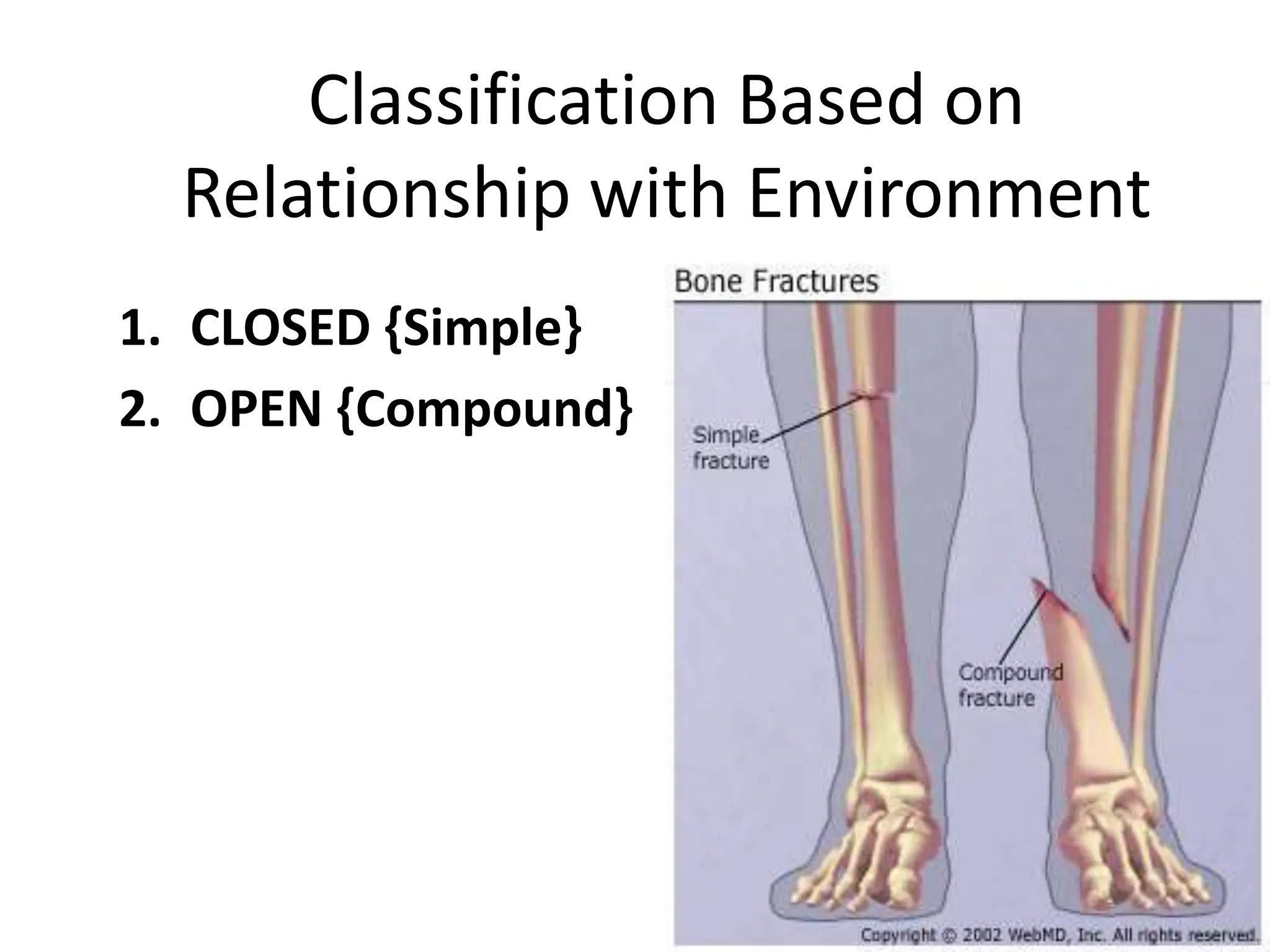
Classification Based on 
Relationship with Environment 
1. CLOSED {Simple} 
2. OPEN {Compound}
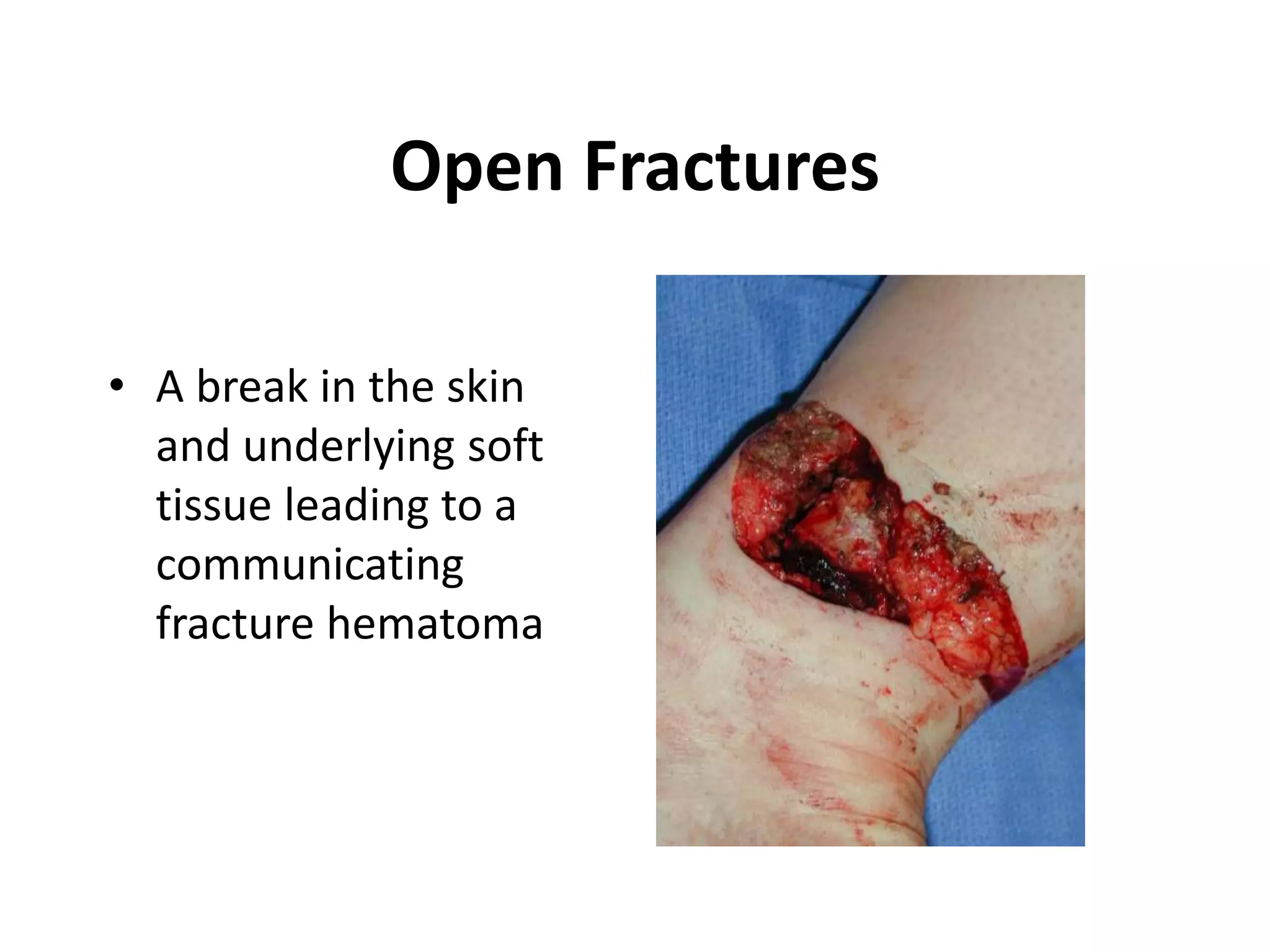
Open Fractures 
• A break in the skin 
and underlying soft 
tissue leading to a 
communicating 
fracture hematoma
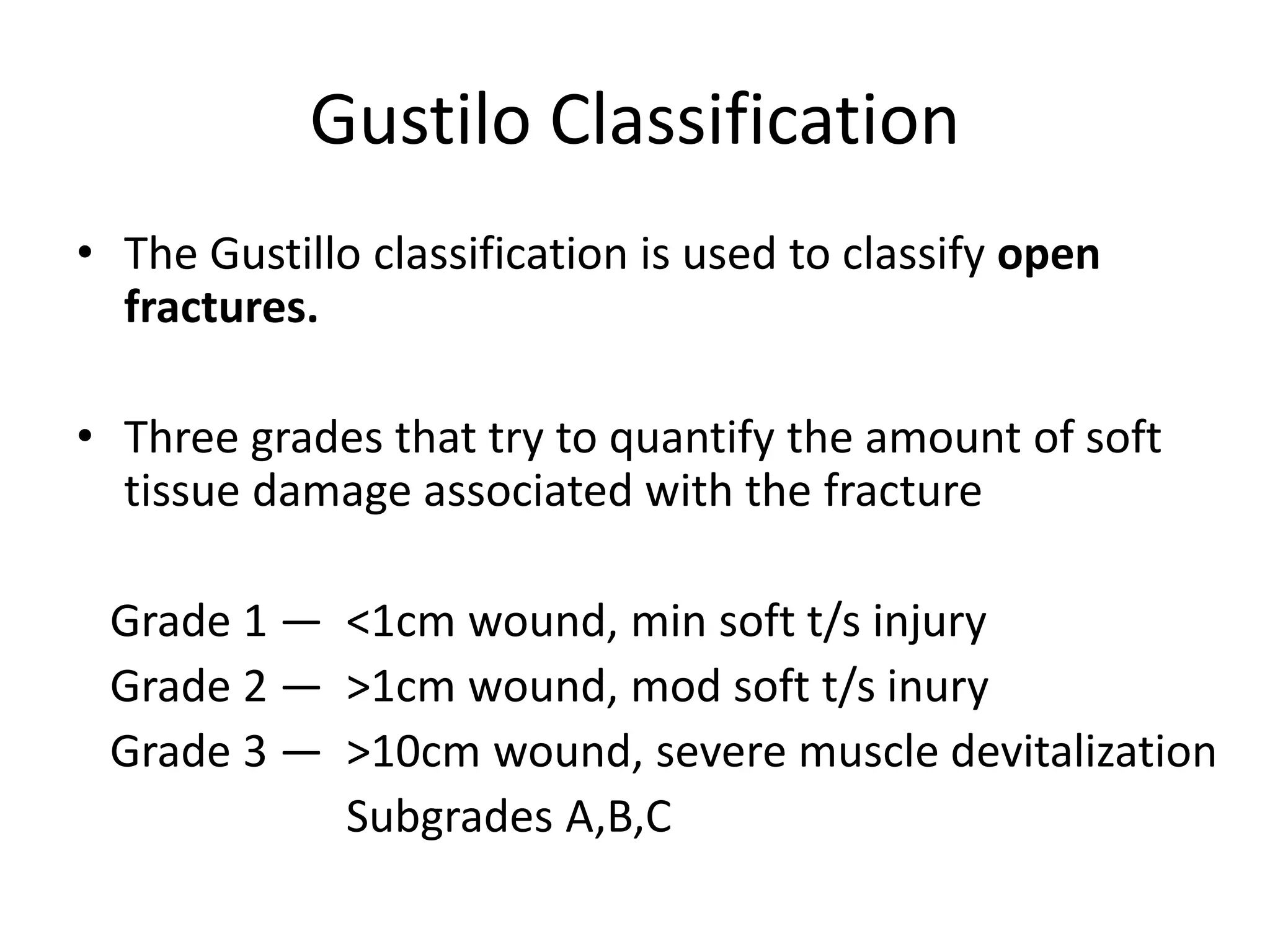
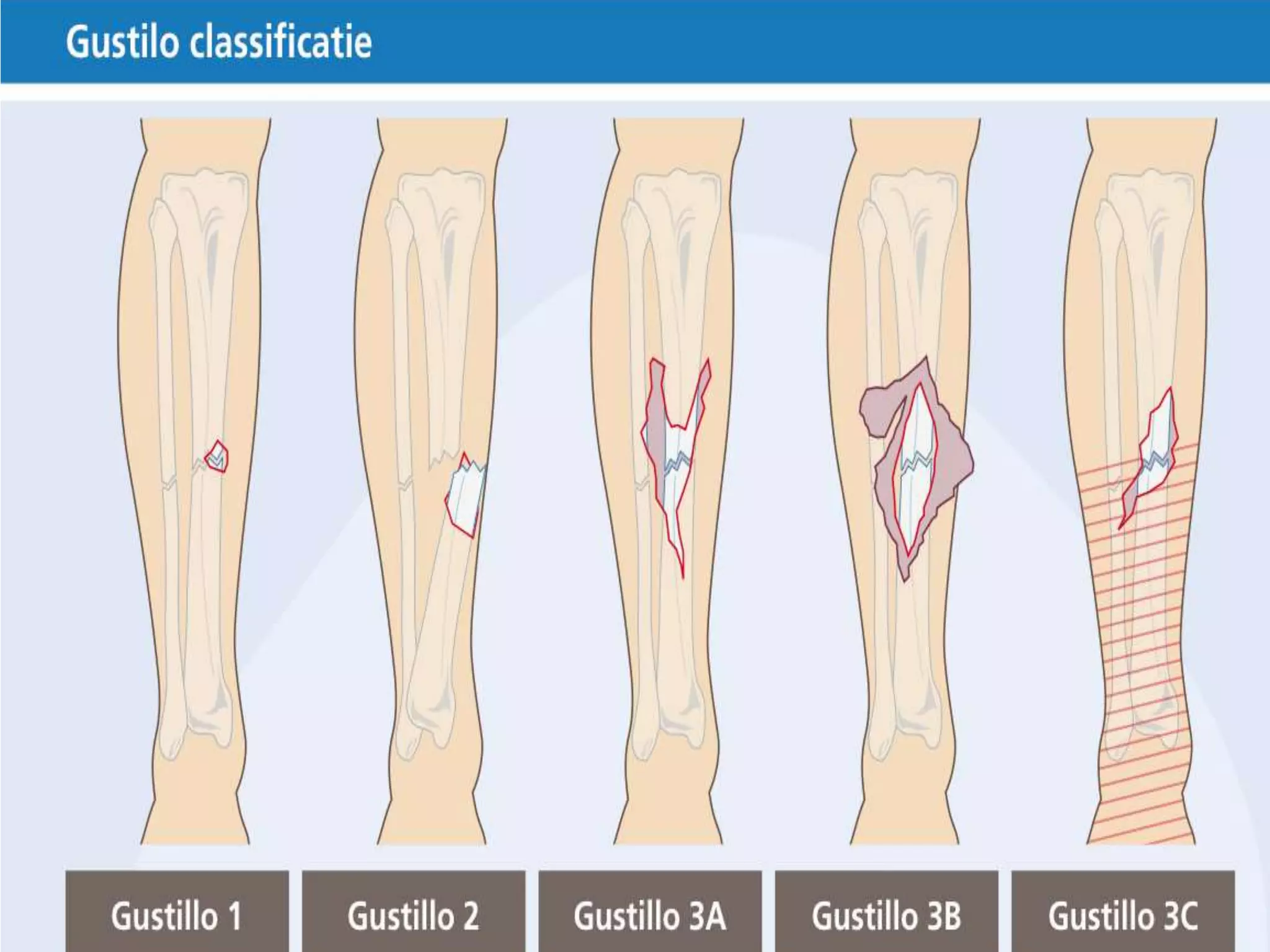
Gustilo Classification 
• The Gustillo classification is used to classify open 
fractures. 
• Three grades that try to quantify the amount of soft 
tissue damage associated with the fracture 
Grade 1 — <1cm wound, min soft t/s injury 
Grade 2 — >1cm wound, mod soft t/s inury 
Grade 3 — >10cm wound, severe muscle devitalization 
Subgrades A,B,C
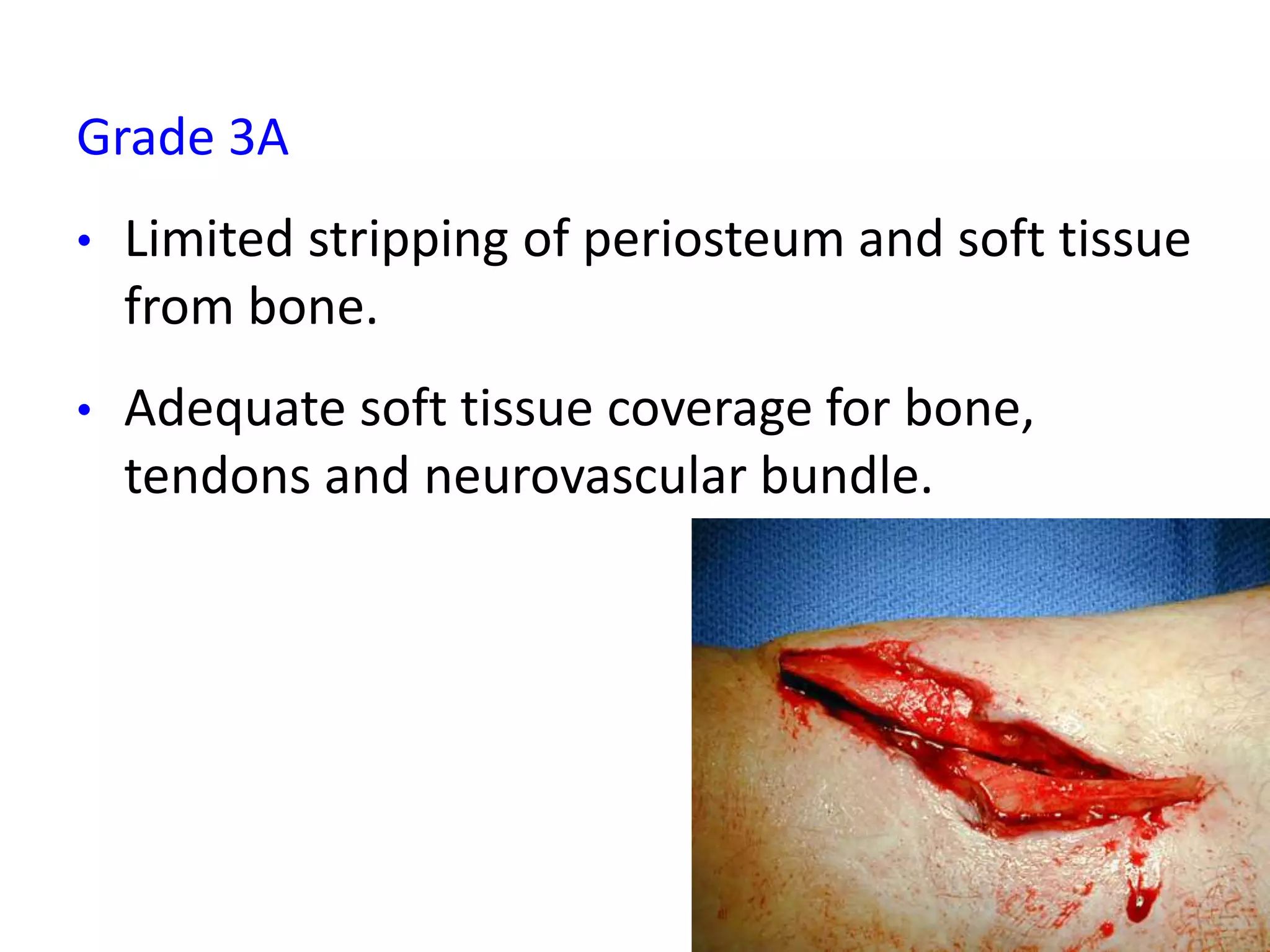
Grade 3A 
• Limited stripping of periosteum and soft tissue 
from bone. 
• Adequate soft tissue coverage for bone, 
tendons and neurovascular bundle.
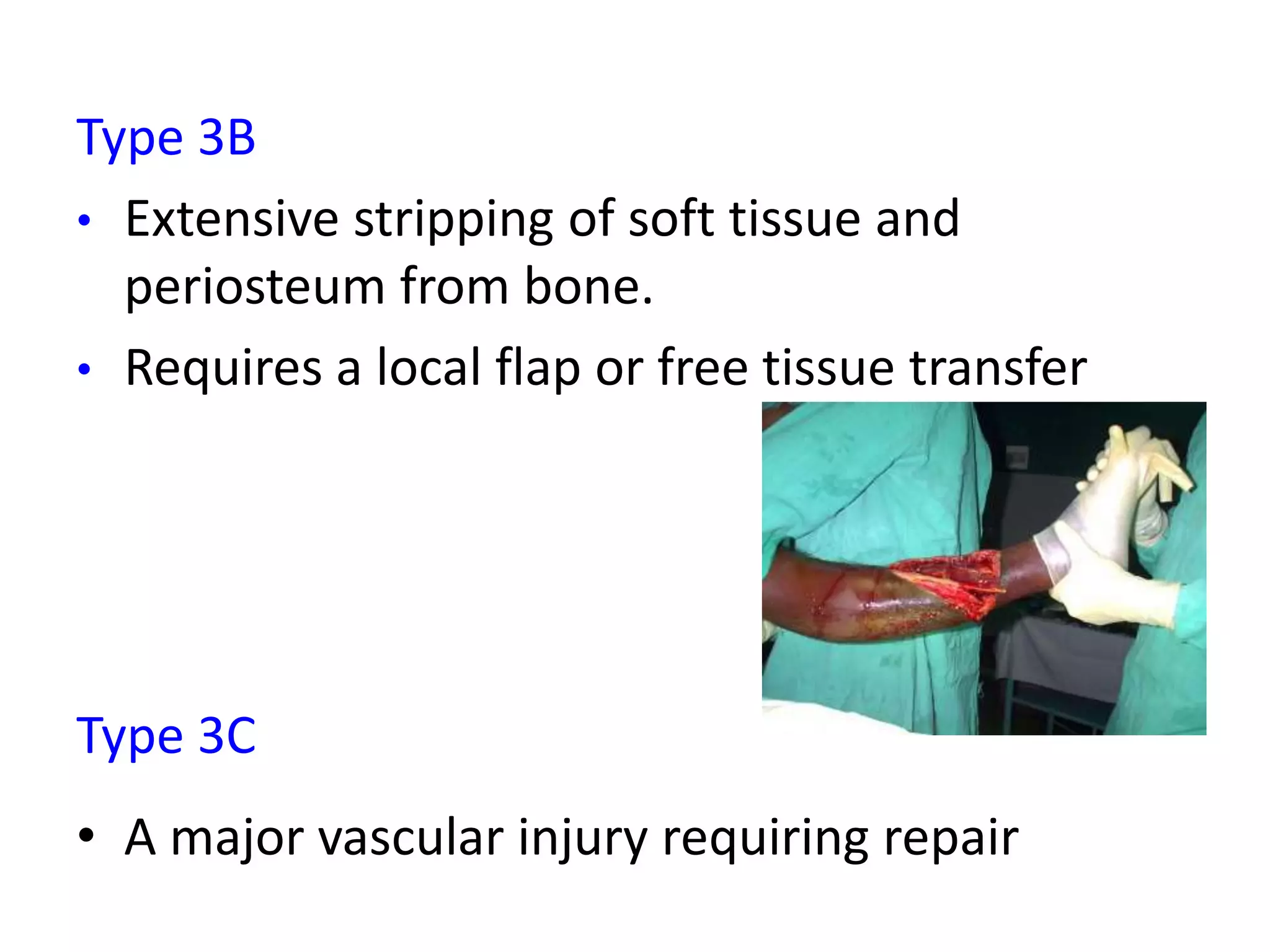
Type 3B 
• Extensive stripping of soft tissue and 
periosteum from bone. 
• Requires a local flap or free tissue transfer 
Type 3C 
• A major vascular injury requiring repair
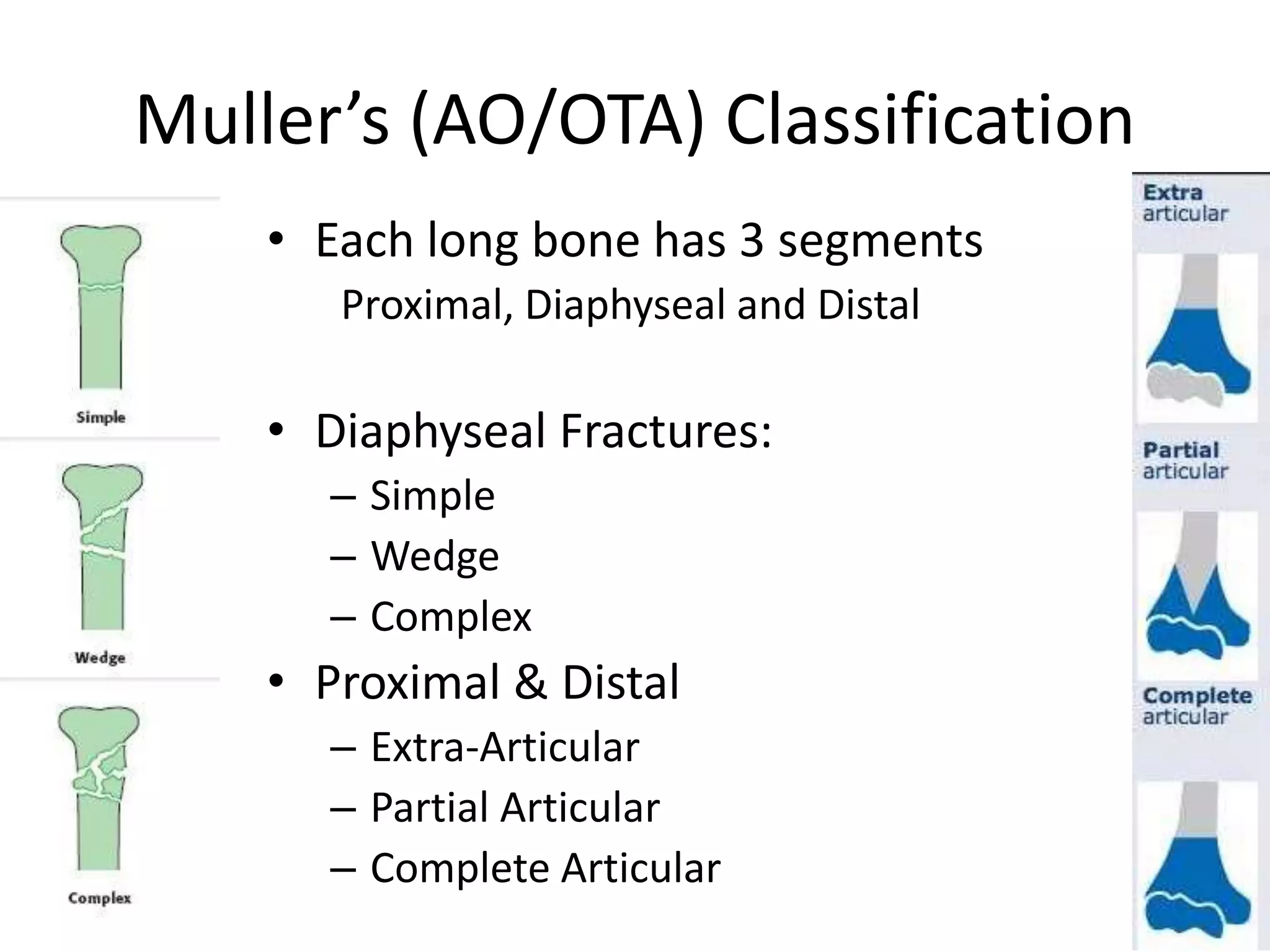
Muller’s (AO/OTA) Classification 
• Each long bone has 3 segments 
Proximal, Diaphyseal and Distal 
• Diaphyseal Fractures: 
– Simple 
– Wedge 
– Complex 
• Proximal & Distal 
– Extra-Articular 
– Partial Articular 
– Complete Articular
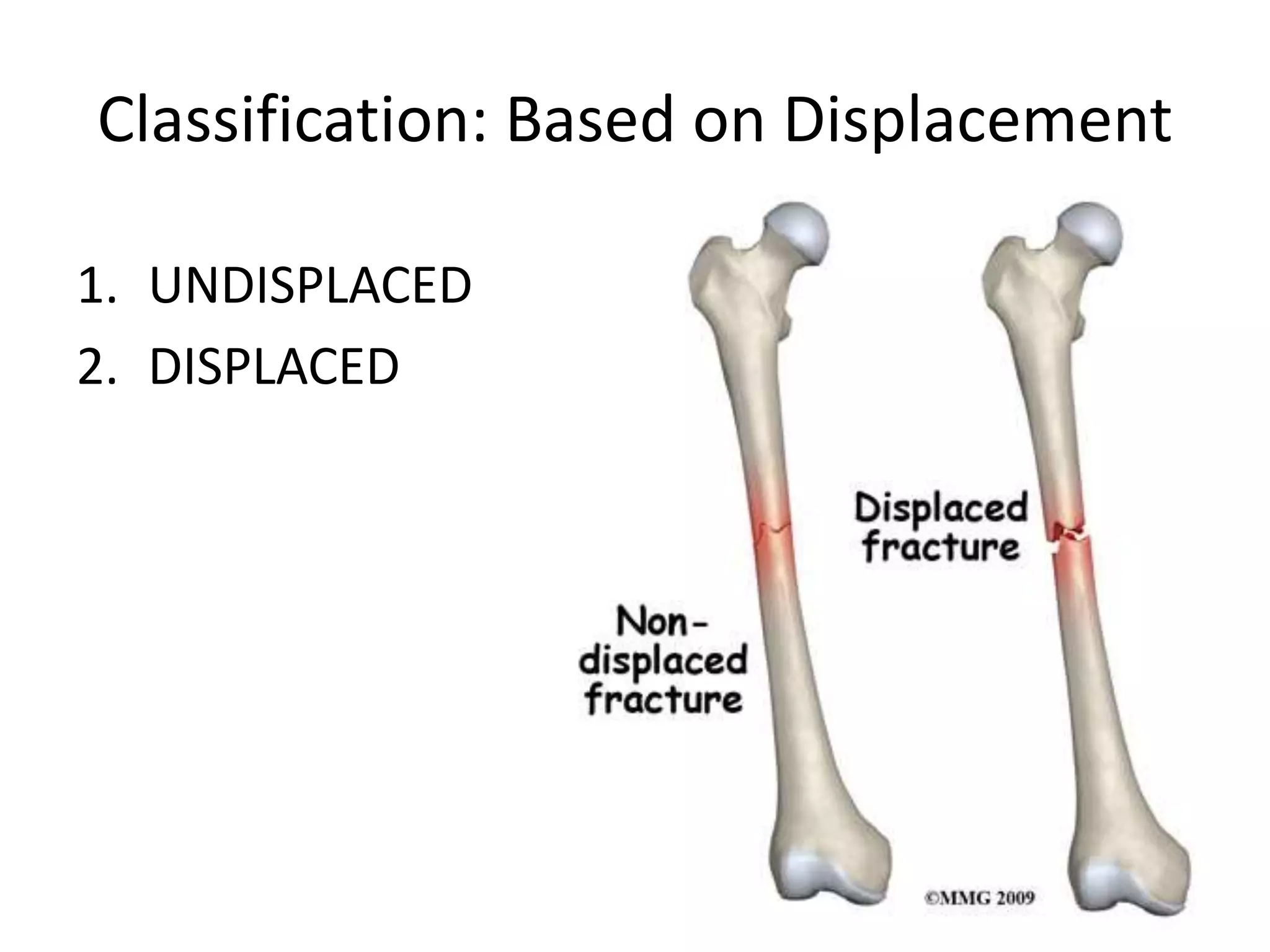
Classification: Based on Displacement 
1. UNDISPLACED 
2. DISPLACED
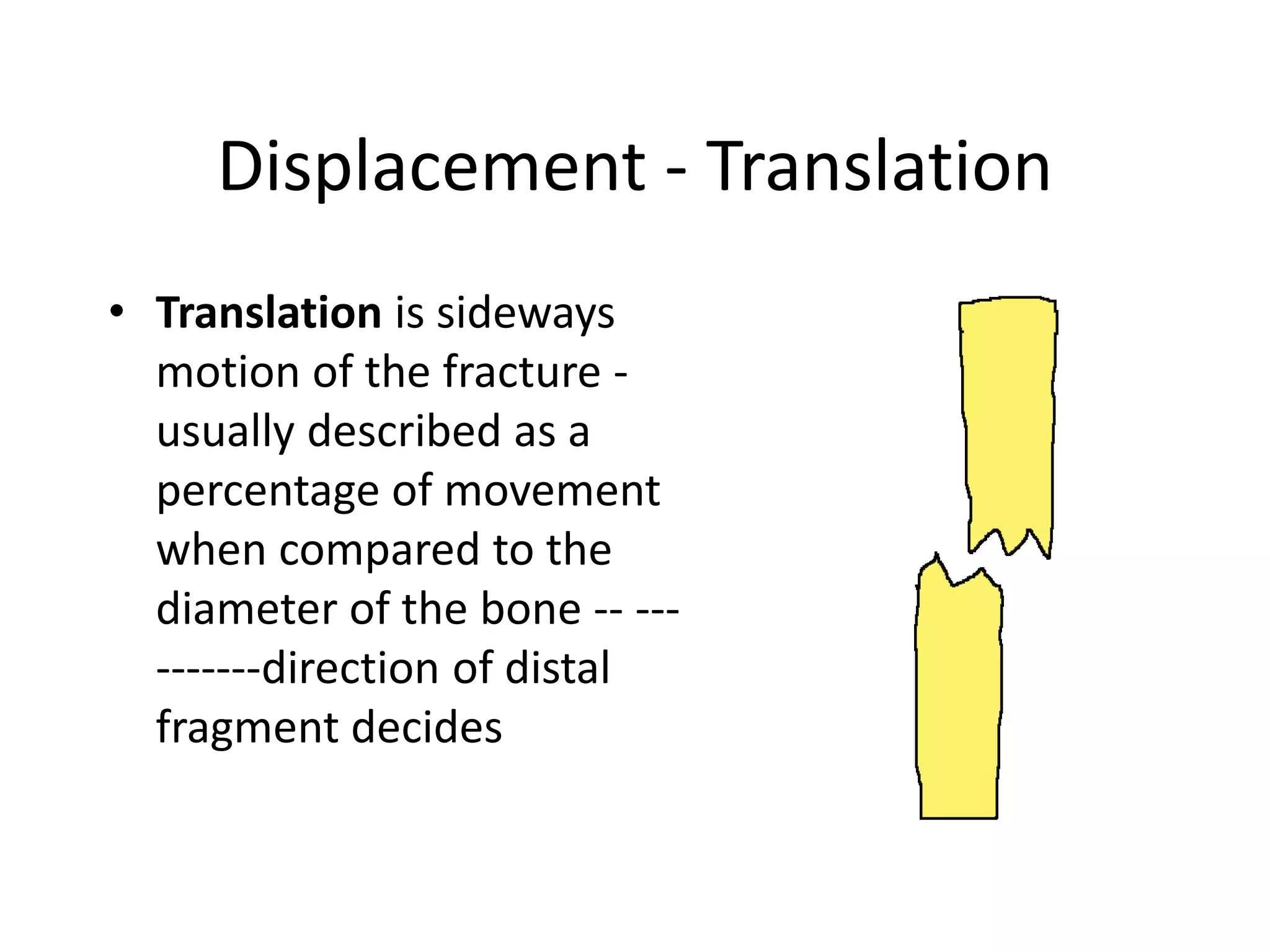
Displacement - Translation 
• Translation is sideways 
motion of the fracture - 
usually described as a 
percentage of movement 
when compared to the 
diameter of the bone -- --- 
-------direction of distal 
fragment decides
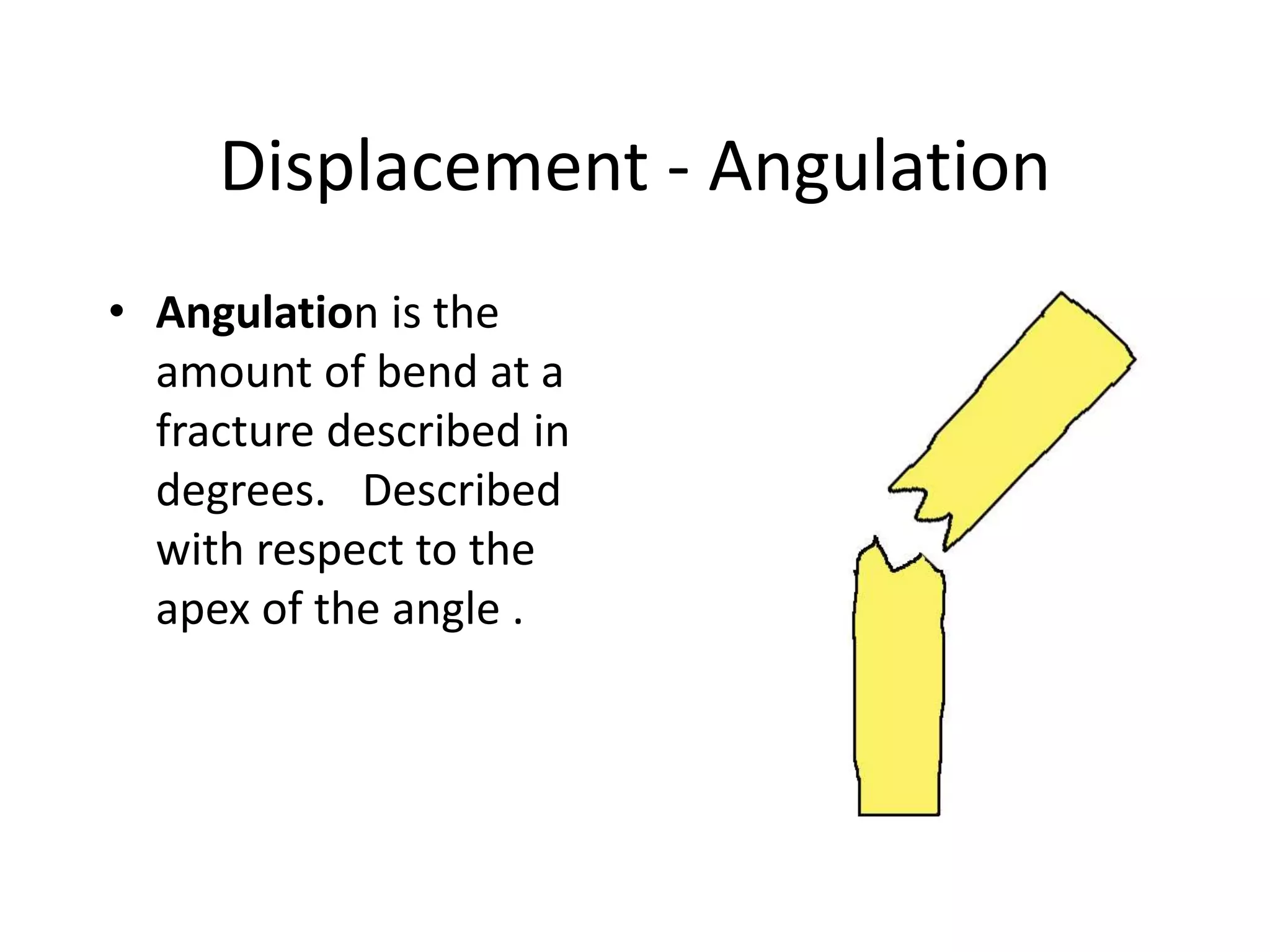
Displacement - Angulation 
• Angulation is the 
amount of bend at a 
fracture described in 
degrees. Described 
with respect to the 
apex of the angle .
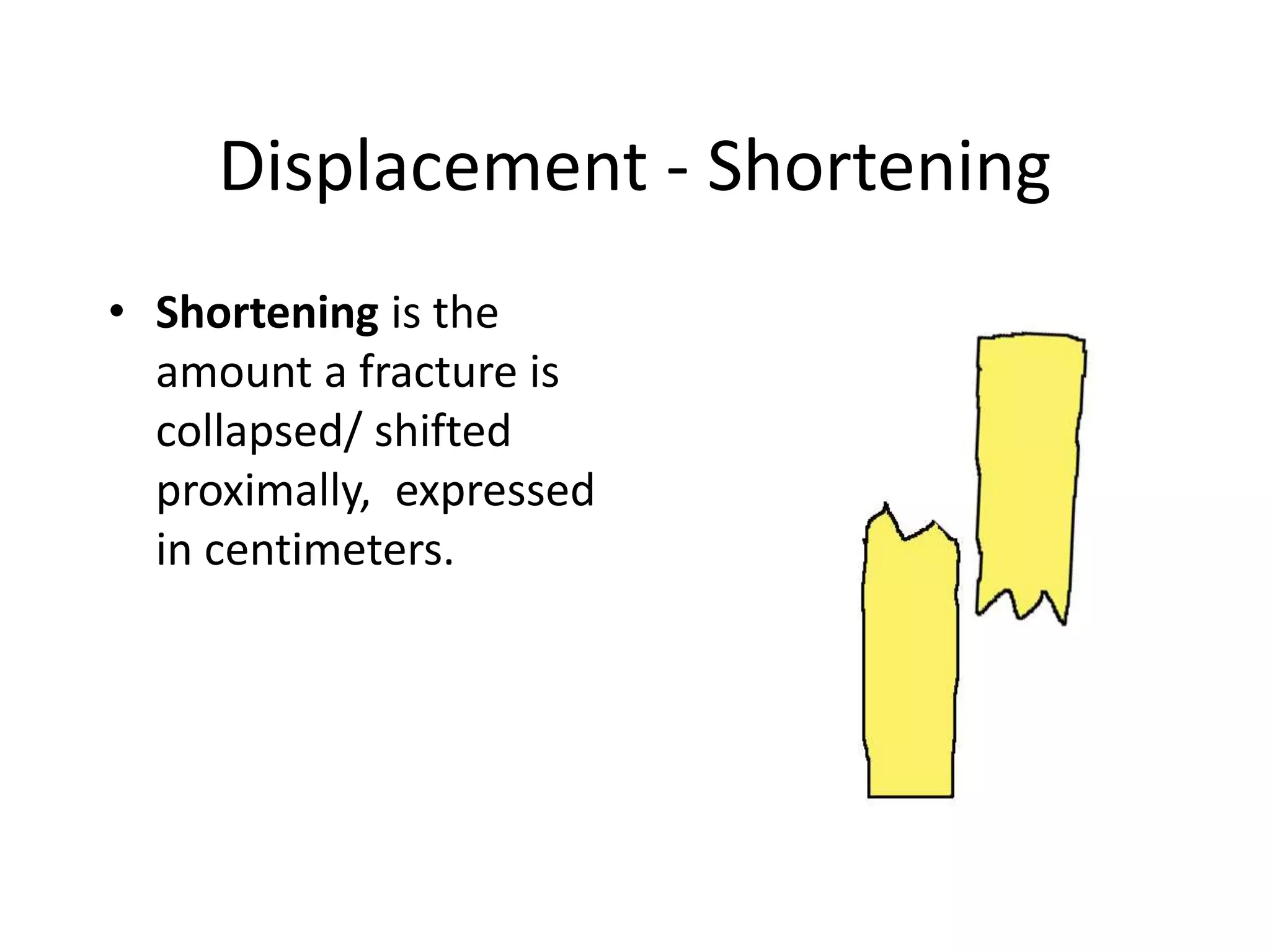
Displacement - Shortening 
• Shortening is the 
amount a fracture is 
collapsed/ shifted 
proximally, expressed 
in centimeters.
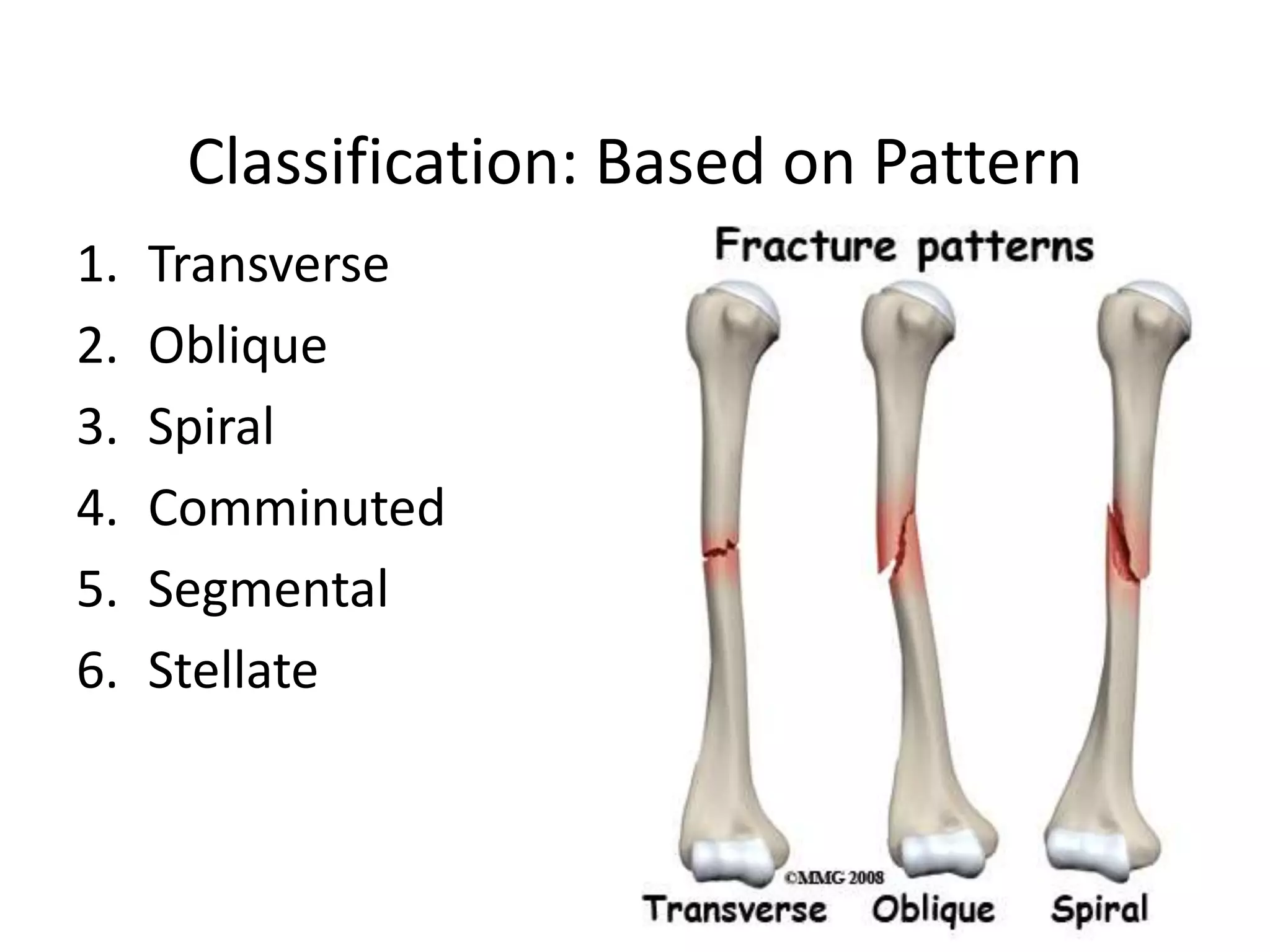
Classification: Based on Pattern 
1. Transverse 
2. Oblique 
3. Spiral 
4. Comminuted 
5. Segmental 
6. Stellate
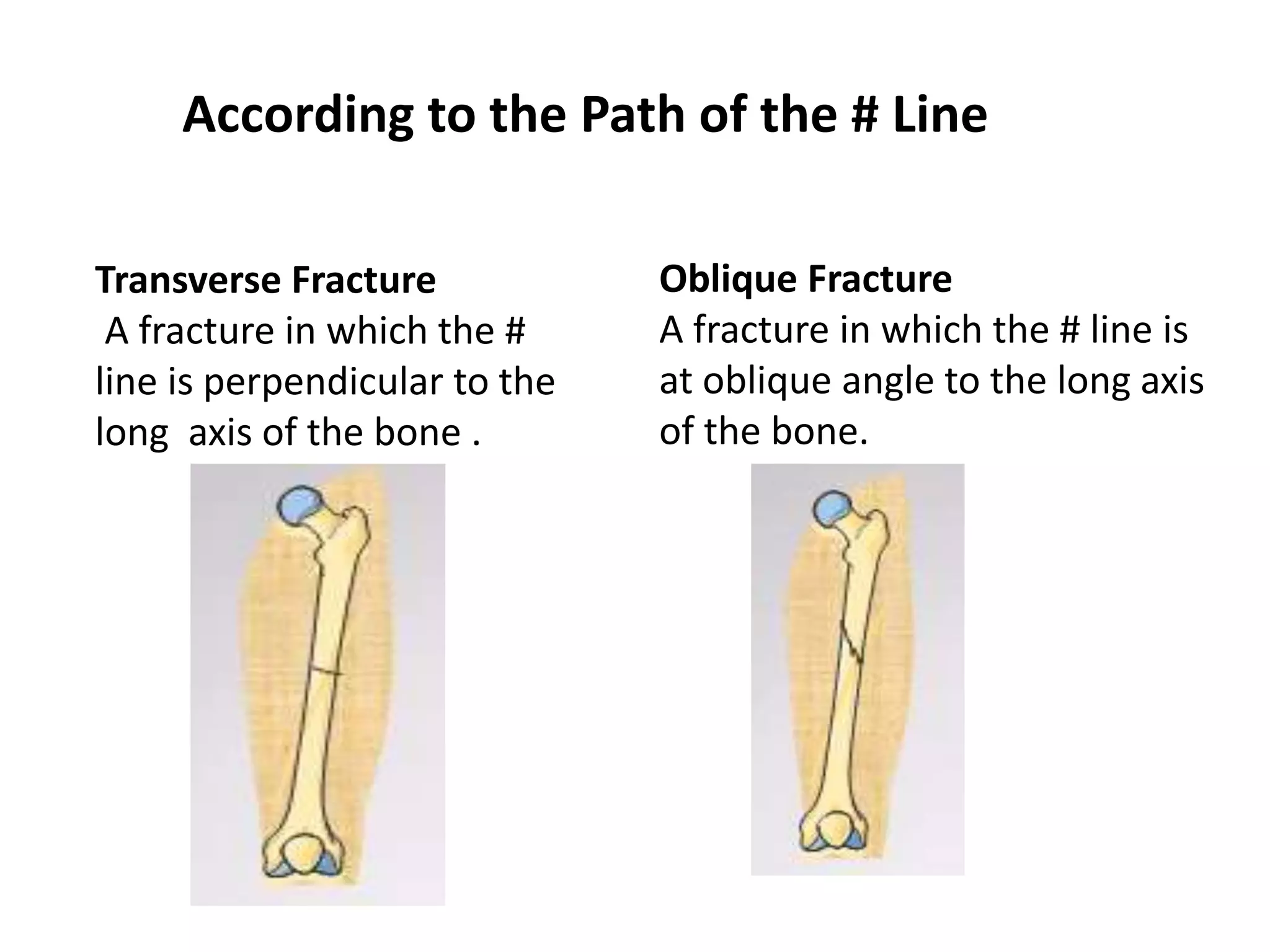
According to the Path of the # Line 
Transverse Fracture 
A fracture in which the # 
line is perpendicular to the 
long axis of the bone . 
Oblique Fracture 
A fracture in which the # line is 
at oblique angle to the long axis 
of the bone.
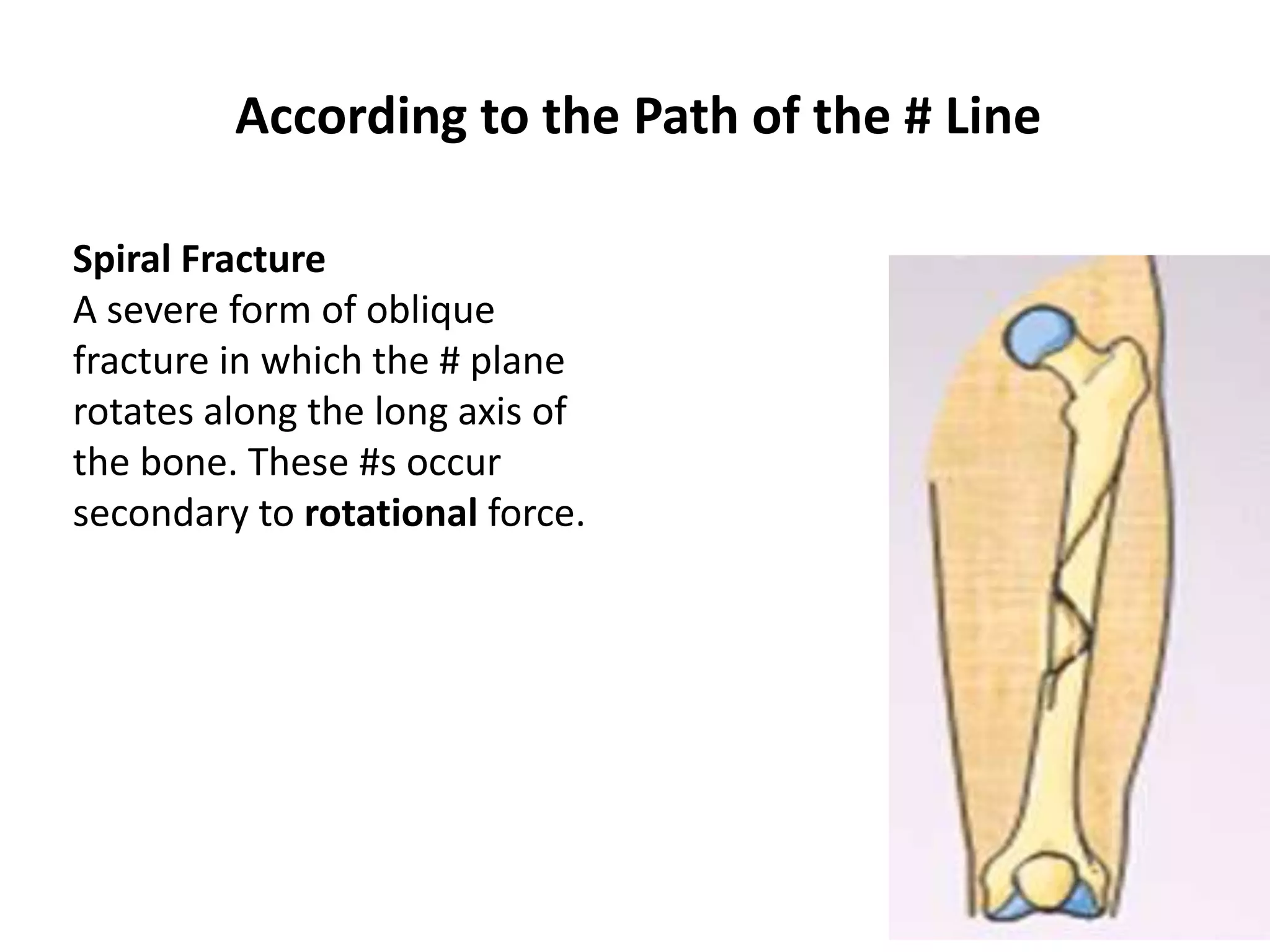
According to the Path of the # Line 
Spiral Fracture 
A severe form of oblique 
fracture in which the # plane 
rotates along the long axis of 
the bone. These #s occur 
secondary to rotational force.
Anatomical Classification of Fractures 
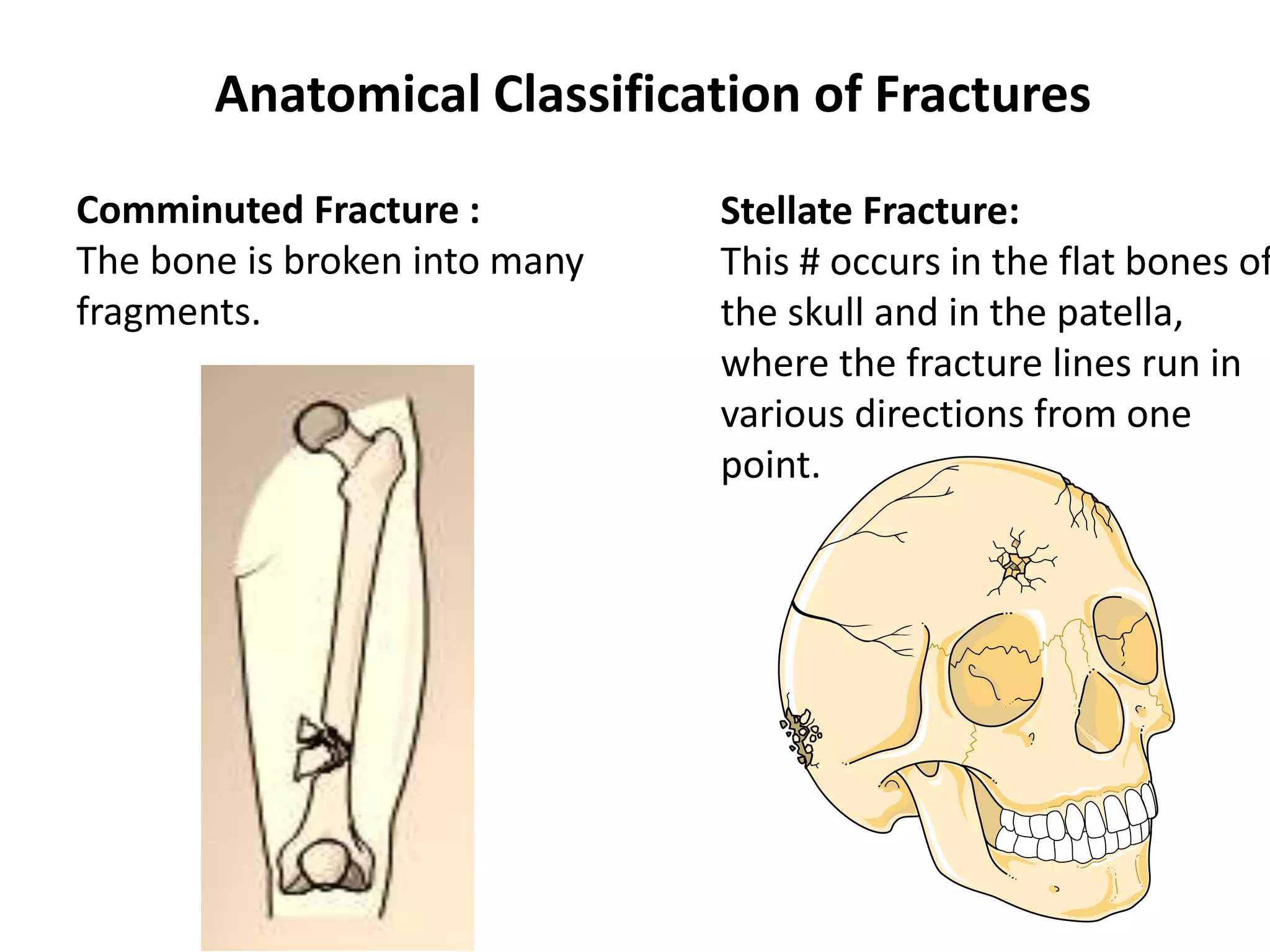
Comminuted Fracture : 
The bone is broken into many 
fragments. 
Stellate Fracture: 
This # occurs in the flat bones of 
the skull and in the patella, 
where the fracture lines run in 
various directions from one 
point.
Anatomical Classification of Fractures 
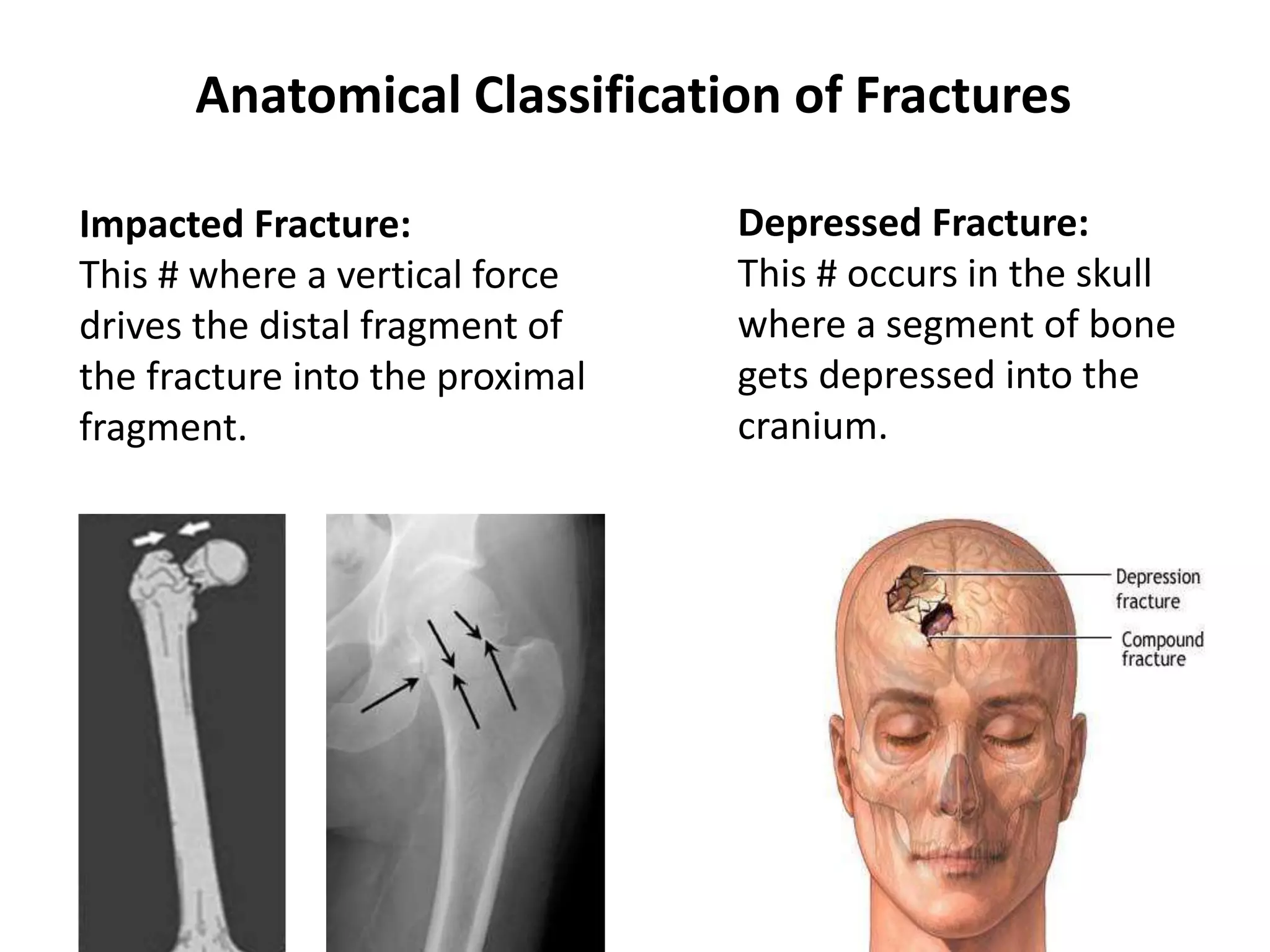
Impacted Fracture: 
This # where a vertical force 
drives the distal fragment of 
the fracture into the proximal 
fragment. 
Depressed Fracture: 
This # occurs in the skull 
where a segment of bone 
gets depressed into the 
cranium.
Anatomical Classification of Fractures 
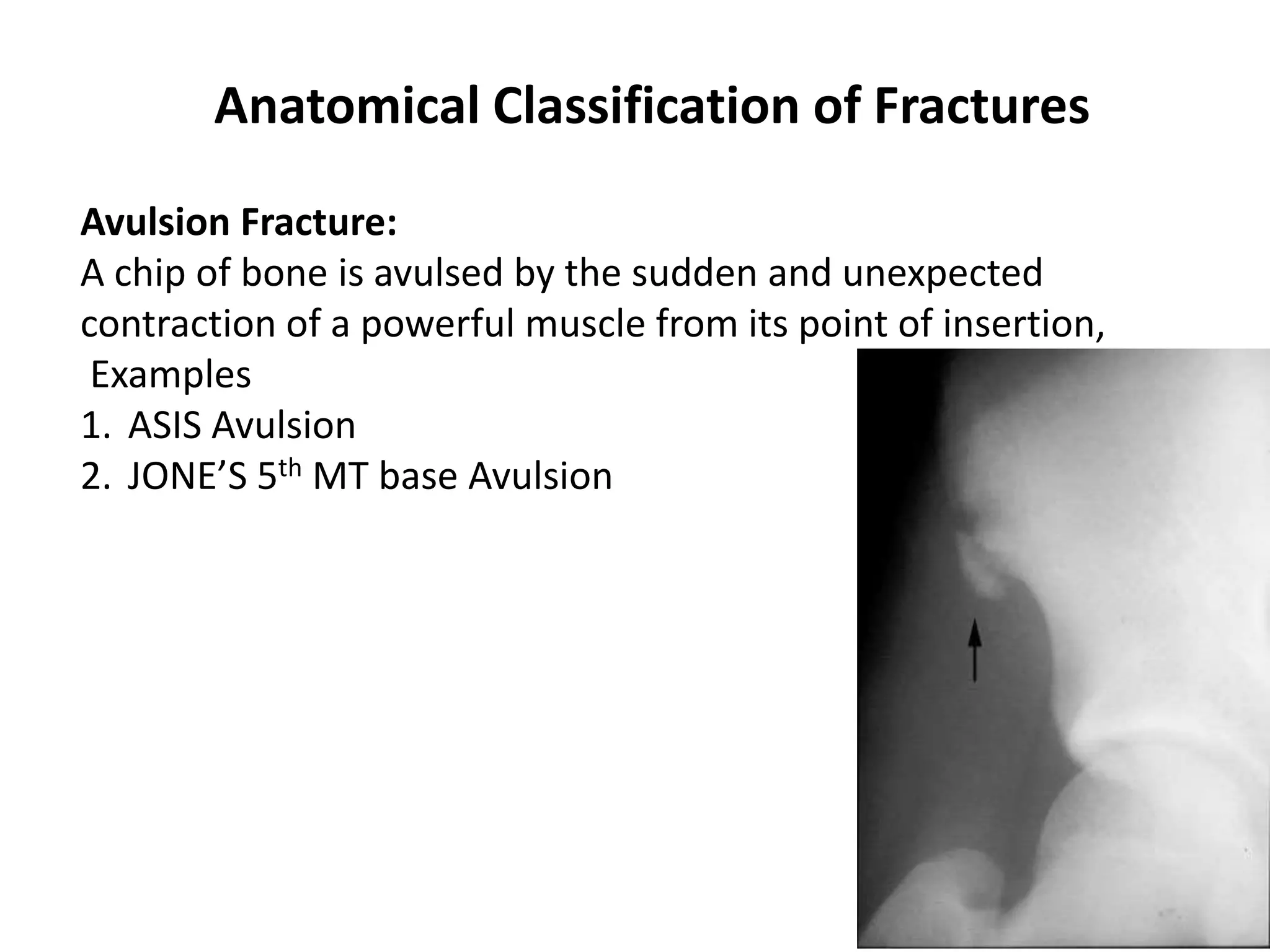
Avulsion Fracture: 
A chip of bone is avulsed by the sudden and unexpected 
contraction of a powerful muscle from its point of insertion, 
Examples 
1. ASIS Avulsion 
2. JONE’S 5th MT base Avulsion
Anatomical Classification of Fractures 
Stress Fracture : 
• It is a fracture occurring at a site in the bone subject to 
repeated minor stresses over a period of time. 
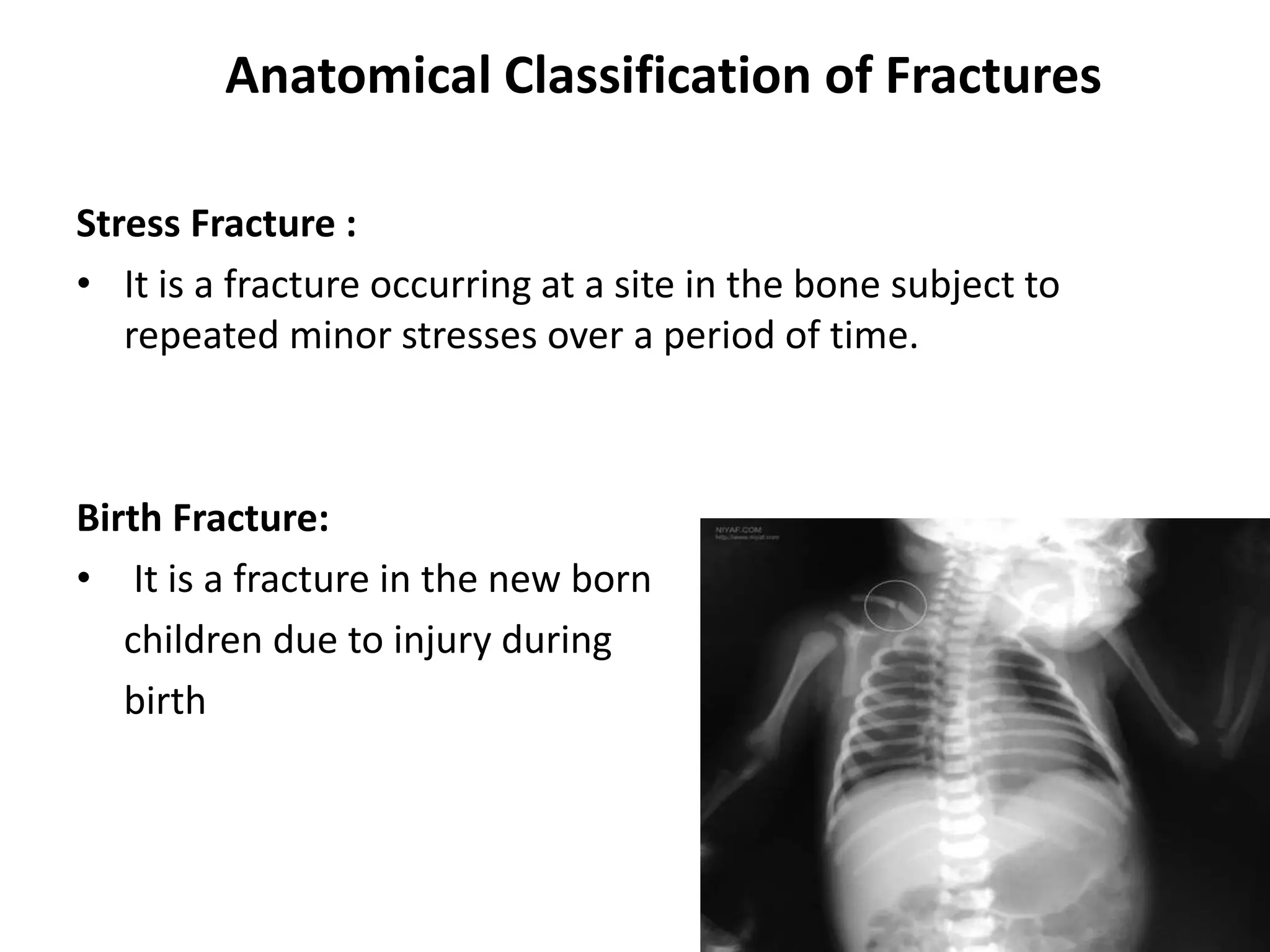
Birth Fracture: 
• It is a fracture in the new born 
children due to injury during 
birth
Classification: Based on Etiology 
1. TRAUMATIC 
2. PATHOLOGICAL 
– Tumors 
– Bone cysts 
– Osteomyelitis 
– Osteoporosis 
– Osteogenesis imperfecta 
– Rickets
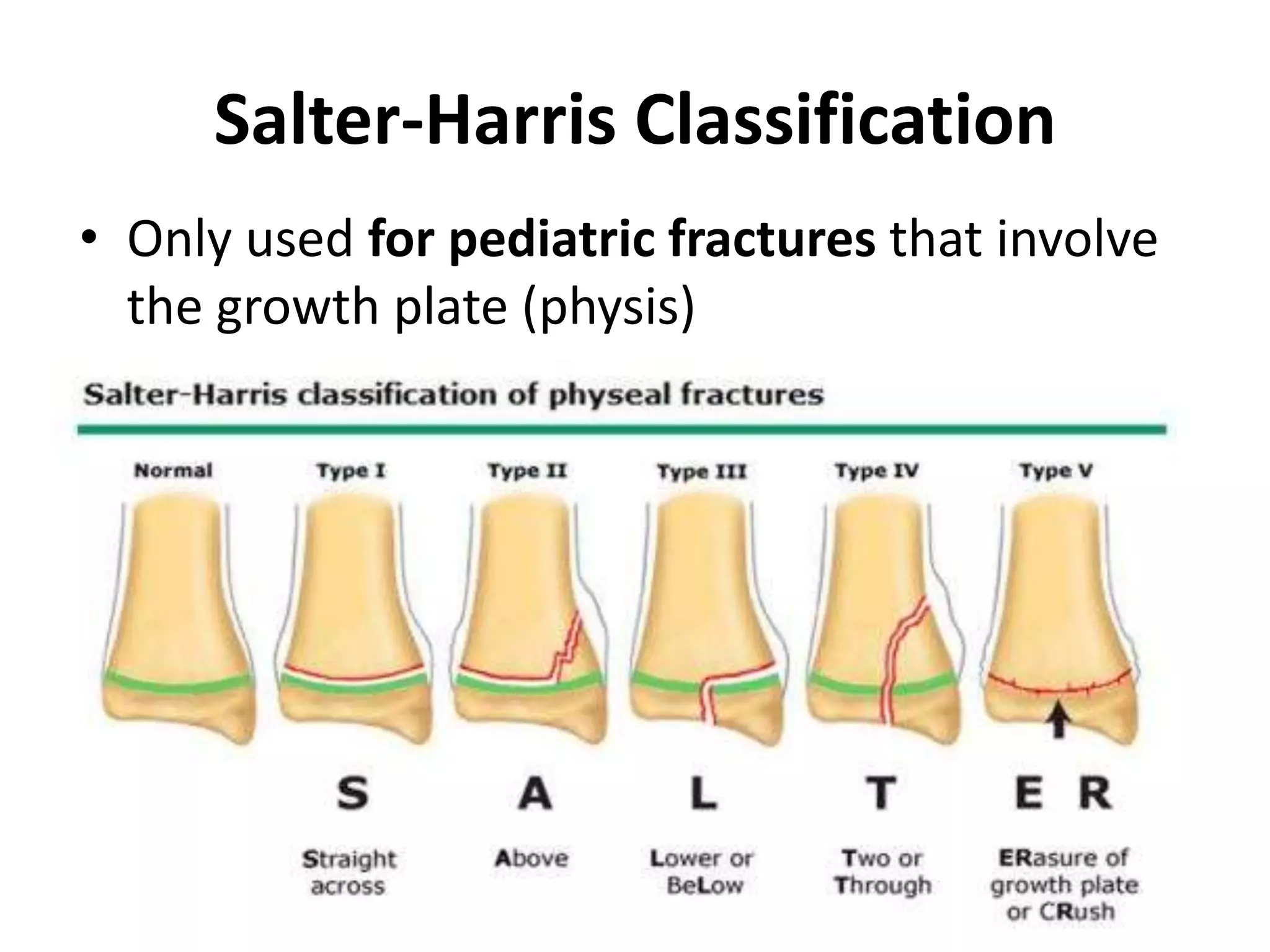
Salter-Harris Classification 
• Only used for pediatric fractures that involve 
the growth plate (physis)
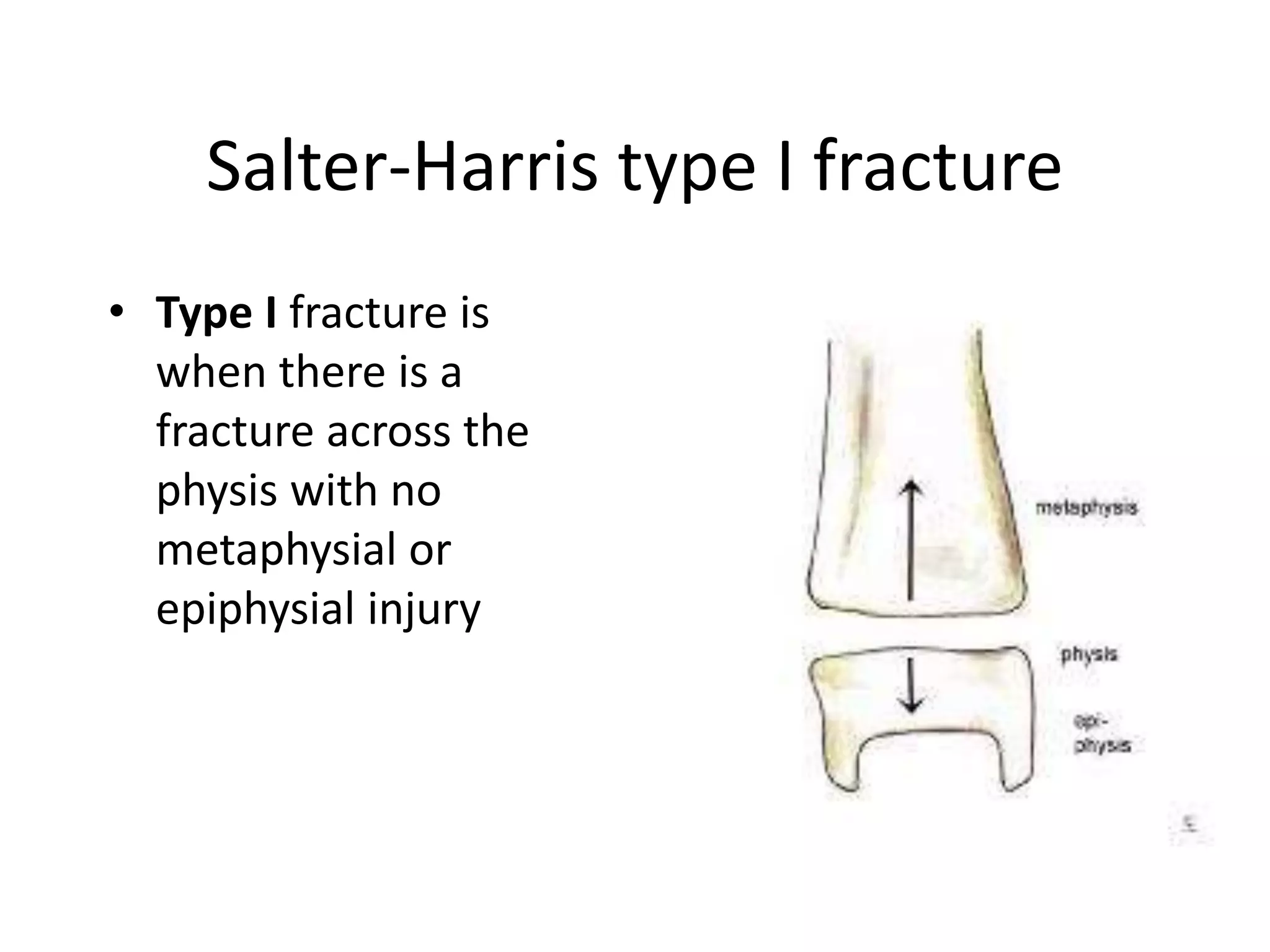
Salter-Harris type I fracture 
• Type I fracture is 
when there is a 
fracture across the 
physis with no 
metaphysial or 
epiphysial injury
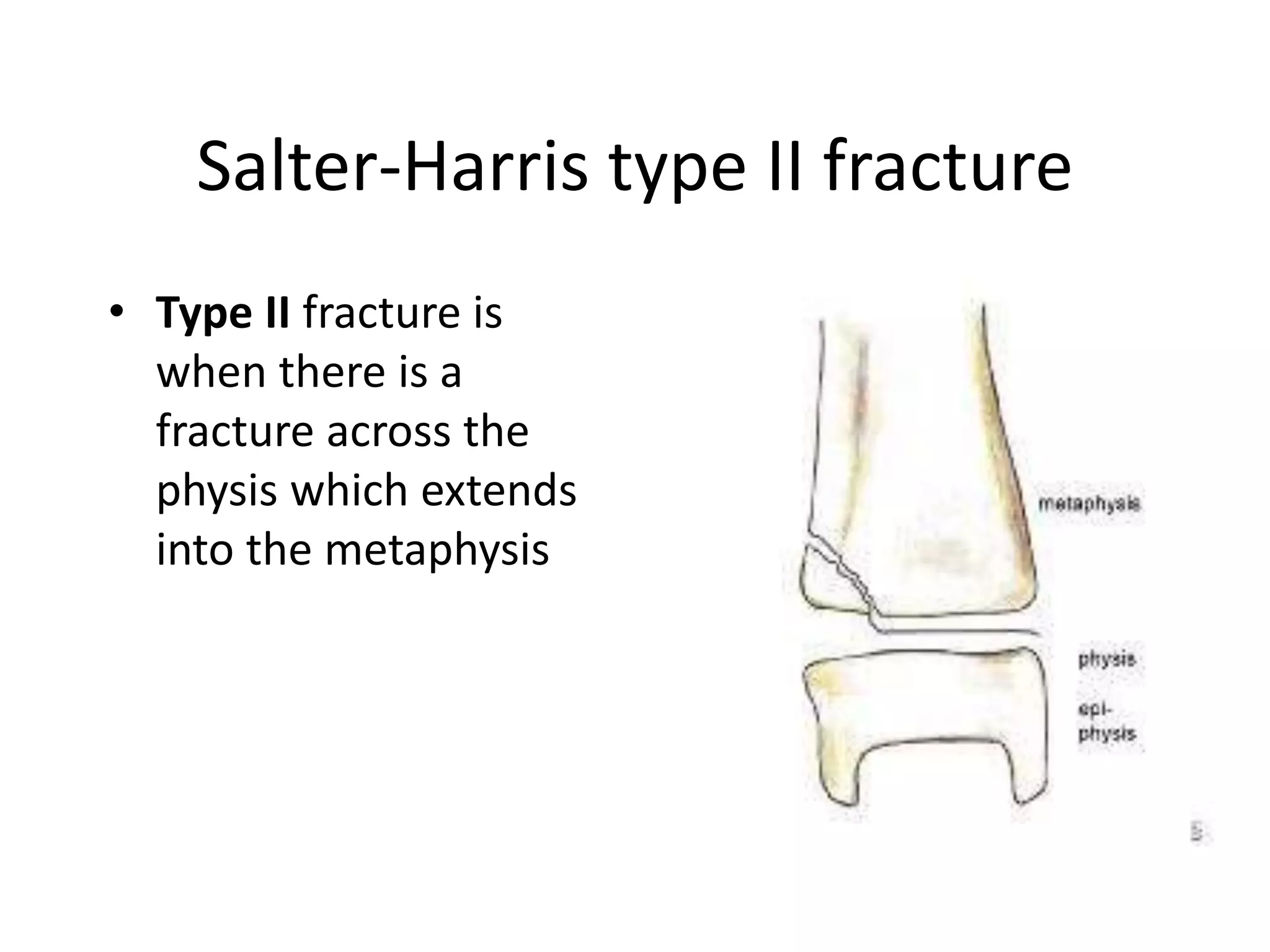
Salter-Harris type II fracture 
• Type II fracture is 
when there is a 
fracture across the 
physis which extends 
into the metaphysis
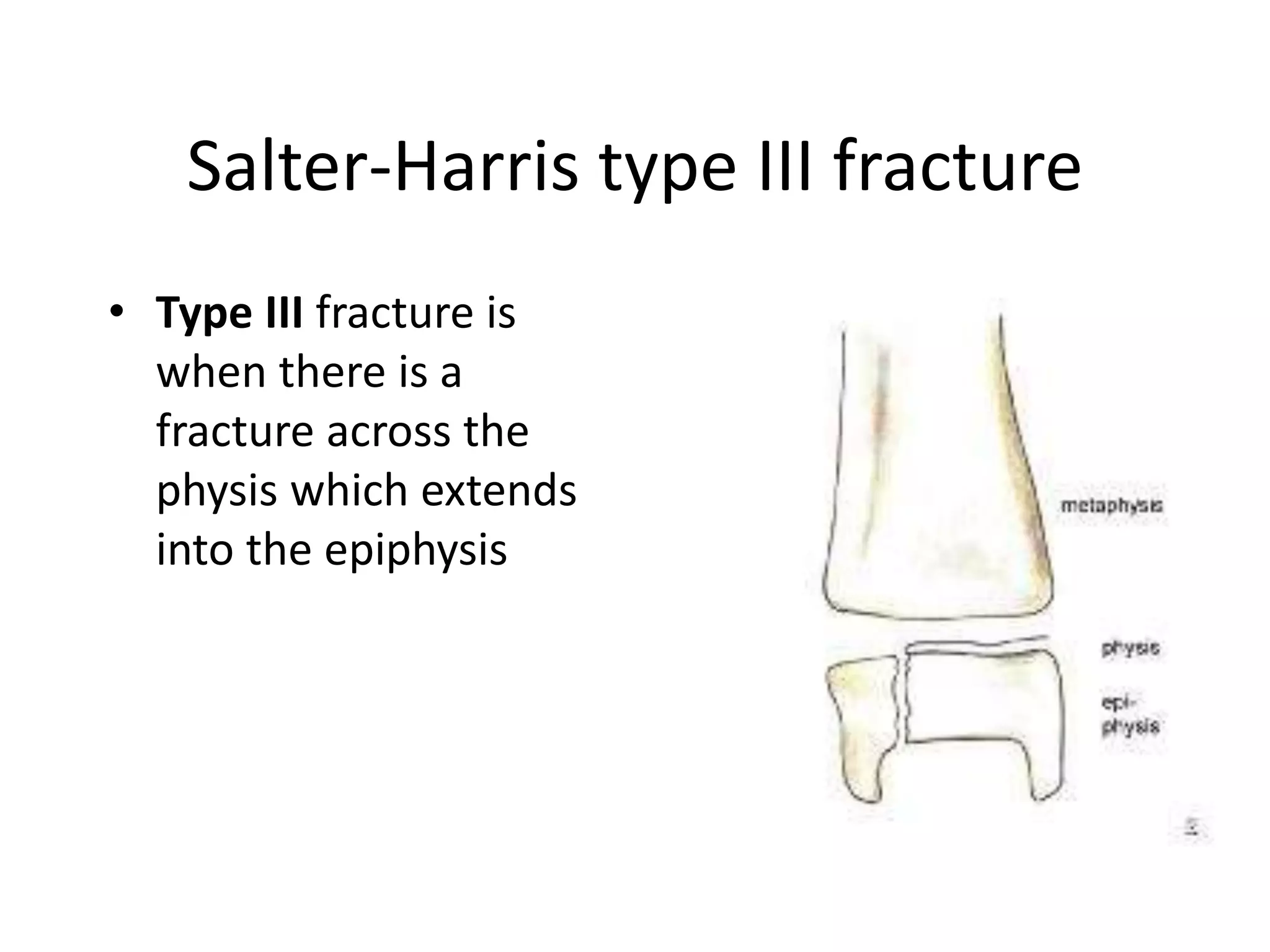
Salter-Harris type III fracture 
• Type III fracture is 
when there is a 
fracture across the 
physis which extends 
into the epiphysis
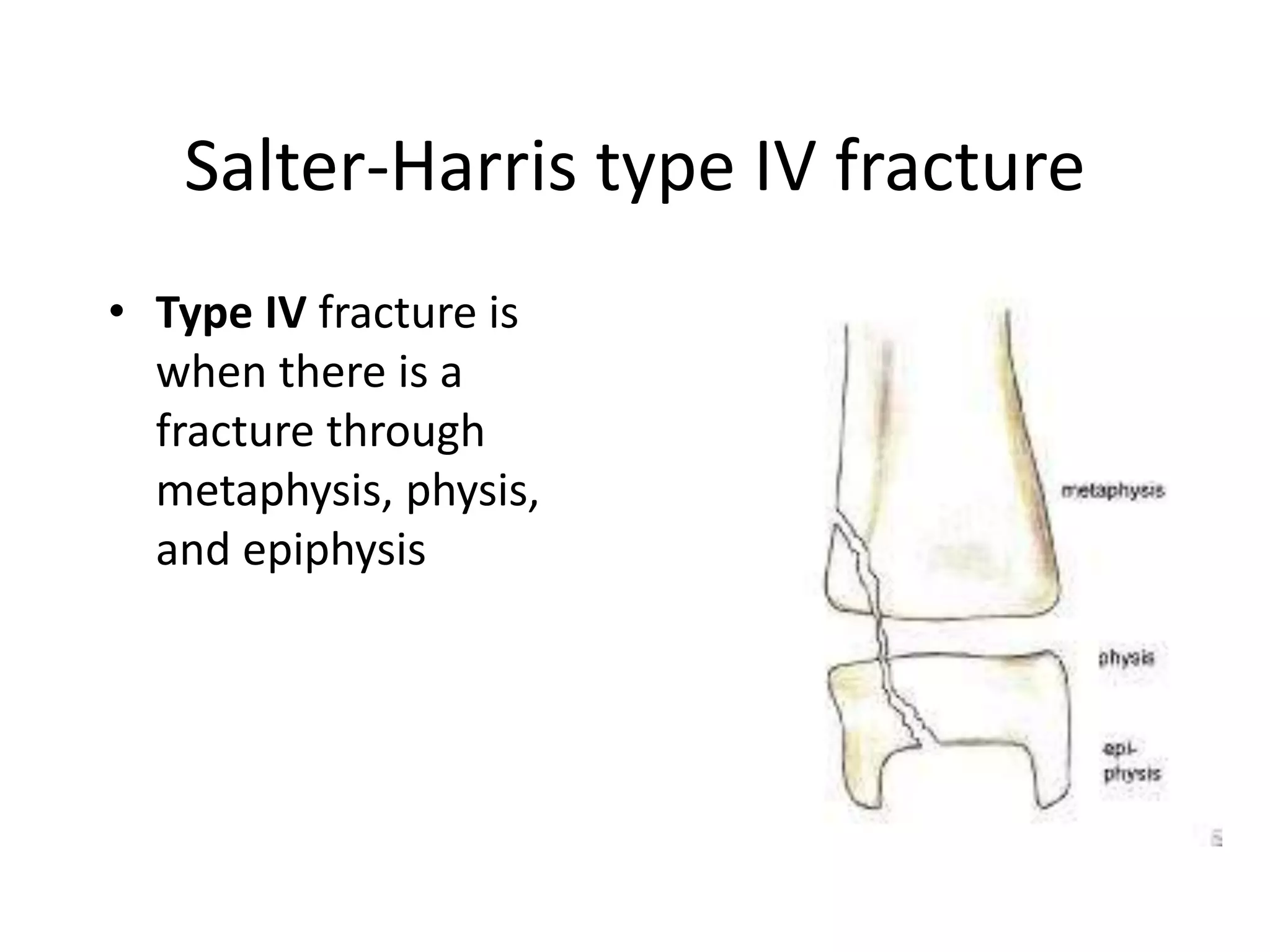
Salter-Harris type IV fracture 
• Type IV fracture is 
when there is a 
fracture through 
metaphysis, physis, 
and epiphysis
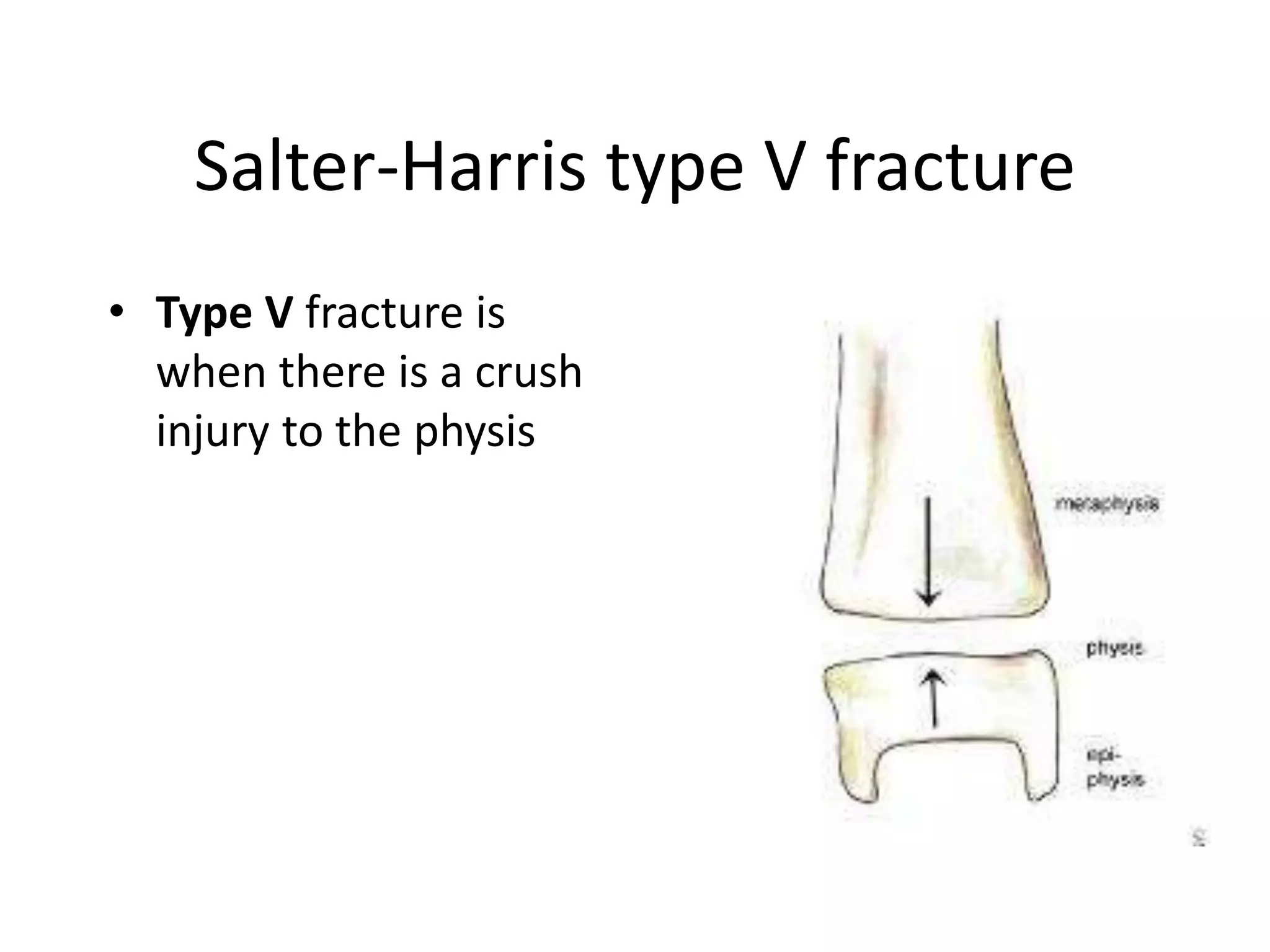
Salter-Harris type V fracture 
• Type V fracture is 
when there is a crush 
injury to the physis
Treatment of Compound 
Fracture
Aim 
• To convert contaminated wound into clean wound 
• To convert the open # into a closed one. 
• To establish a union in a good position 
• To prevent pyogenic and clostridial infection. 
Order of Priority 
• Patient 
• Limb 
• Wound 
• Fracture
4 Essentials of Treatment 
• Antibiotic Prophylaxis 
• Urgent Wound and Fracture Debridement 
• Stabilization of the Fracture 
• Early Debridement Wound Cover
Sterility and Antibiotic Cover 
• In most cases, Co-amoxiclav or Cefuroxime (or 
Clindamycin in case of penicillin allergy) is 
given ASAP 
• At time of debridement, Gentamycin is added 
to a second dose of the 1st antibiotic given 
• Wounds of Gustilo Grade 1 fractures can be 
closed at time of debridement; Antibiotic 
prophylaxis for up to 24hrs
• Grade 2 and 3A fractures, delayed closure 
after ‘second look’ is sometimes preferred 
• Grade 3B & C, delayed cover is usually 
practiced. 
• Total period of antibiotics is up to 72hrs.
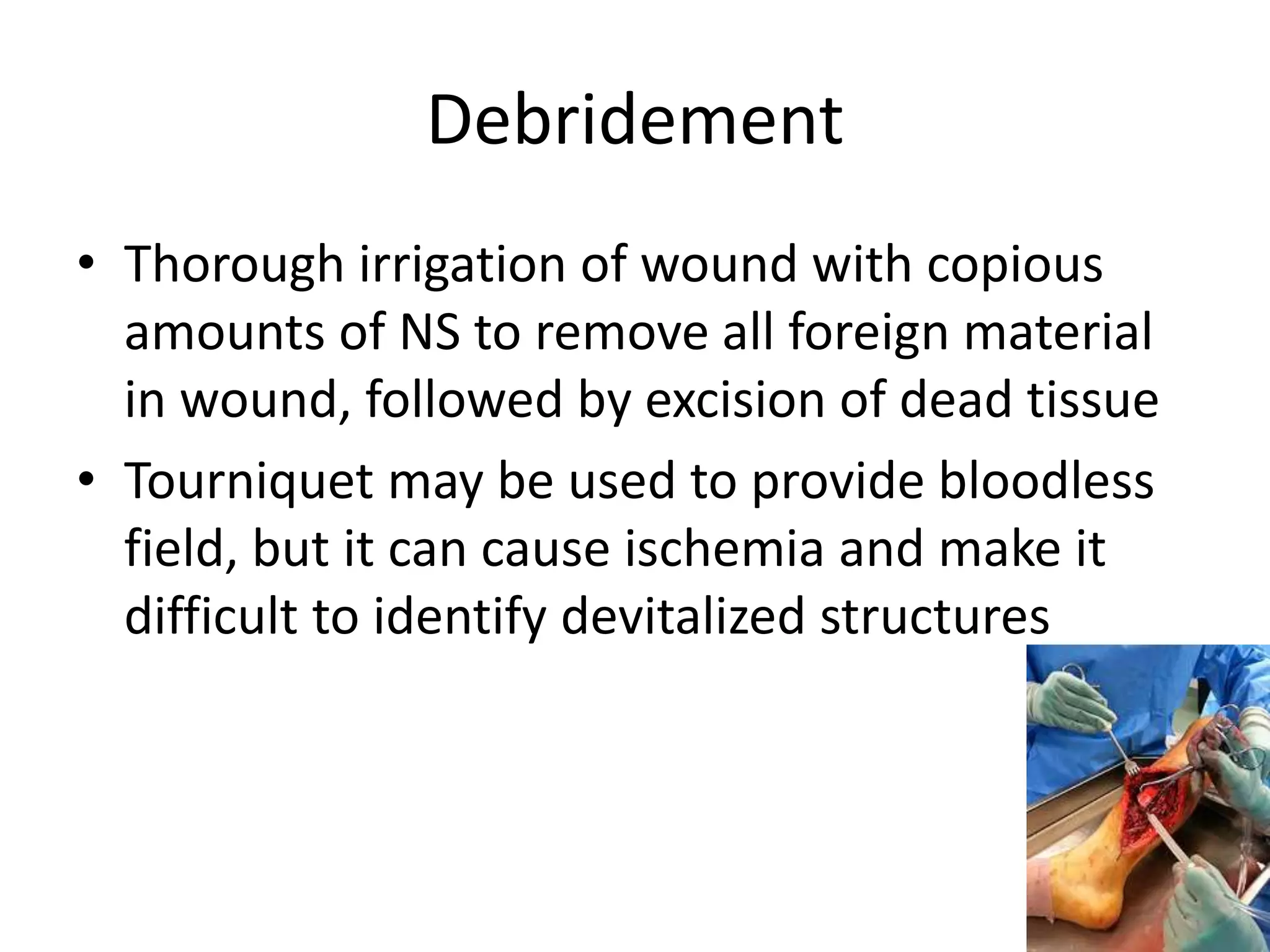
Debridement 
• Thorough irrigation of wound with copious 
amounts of NS to remove all foreign material 
in wound, followed by excision of dead tissue 
• Tourniquet may be used to provide bloodless 
field, but it can cause ischemia and make it 
difficult to identify devitalized structures
• Principles observed during debridement: 
– Wound margin excision 
– Wound extension 
– Delivery of fracture 
– Removal of devitalized tissue 
– Wound cleansing 
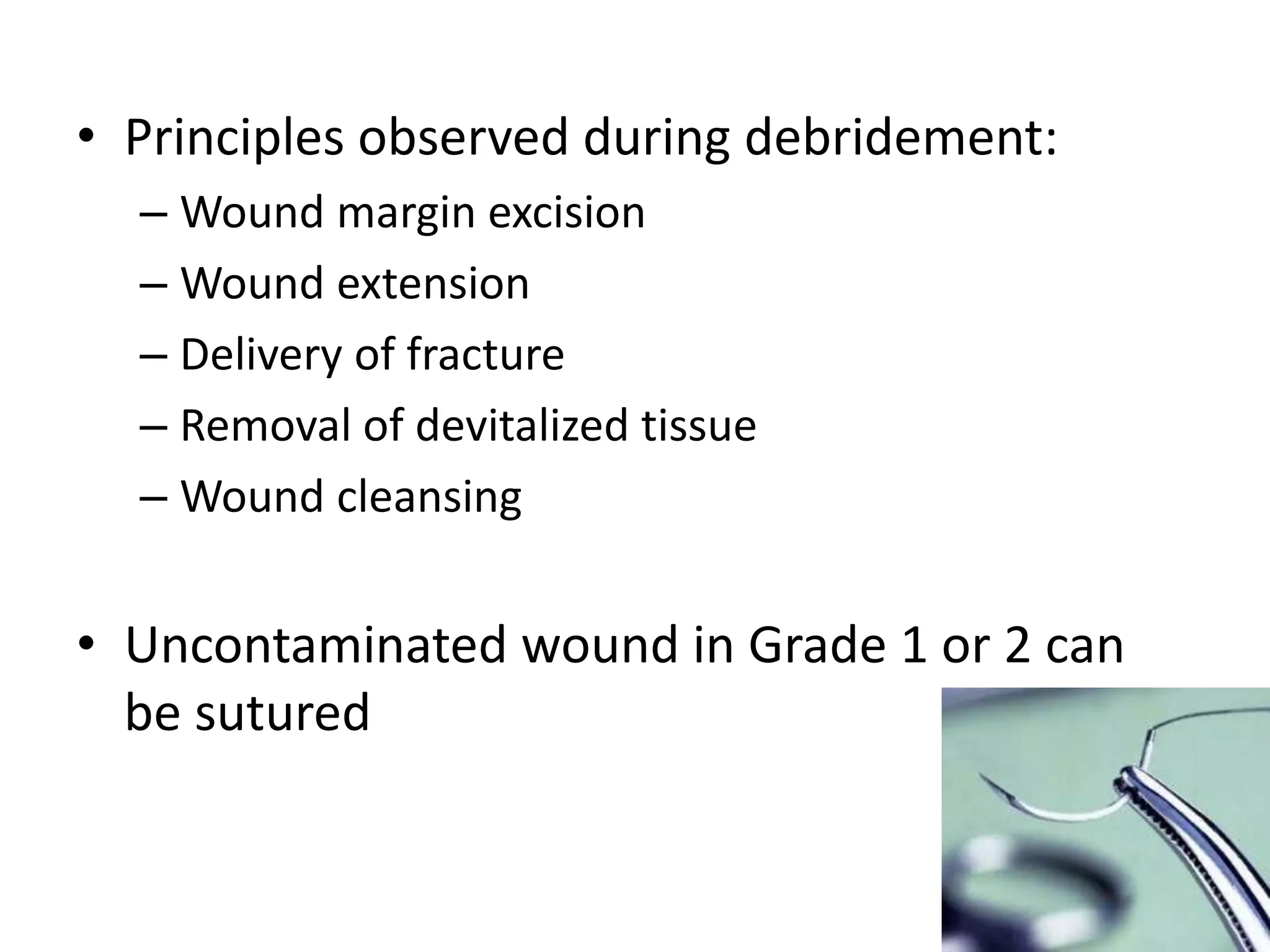
• Uncontaminated wound in Grade 1 or 2 can 
be sutured
Fracture Stabilization 
• Important in reducing risk of infection and 
assisting recovery of soft tissues 
• Method of fixation depends on 
– Degree of contamination 
– Length of time from injury to operation 
– Extent of soft tissue damage 
• If there is no contamination and definitive 
wound cover can be achieved at time of 
debridement, all open #s can be treated as 
closed injury
• Internal or external fixation may be 
appropriate depending on individual 
characteristics of fracture and wound. 
• If wound cover is delayed, then external 
fixation is safer; however fixator pins should 
be inserted away from potential flaps 
• Internal fixation can be used at time of 
definitive wound cover as long as 
– delay to wound cover is < 7 days 
– No visible wound contamination 
– Internal fixation can control the # as well as 
external fixator
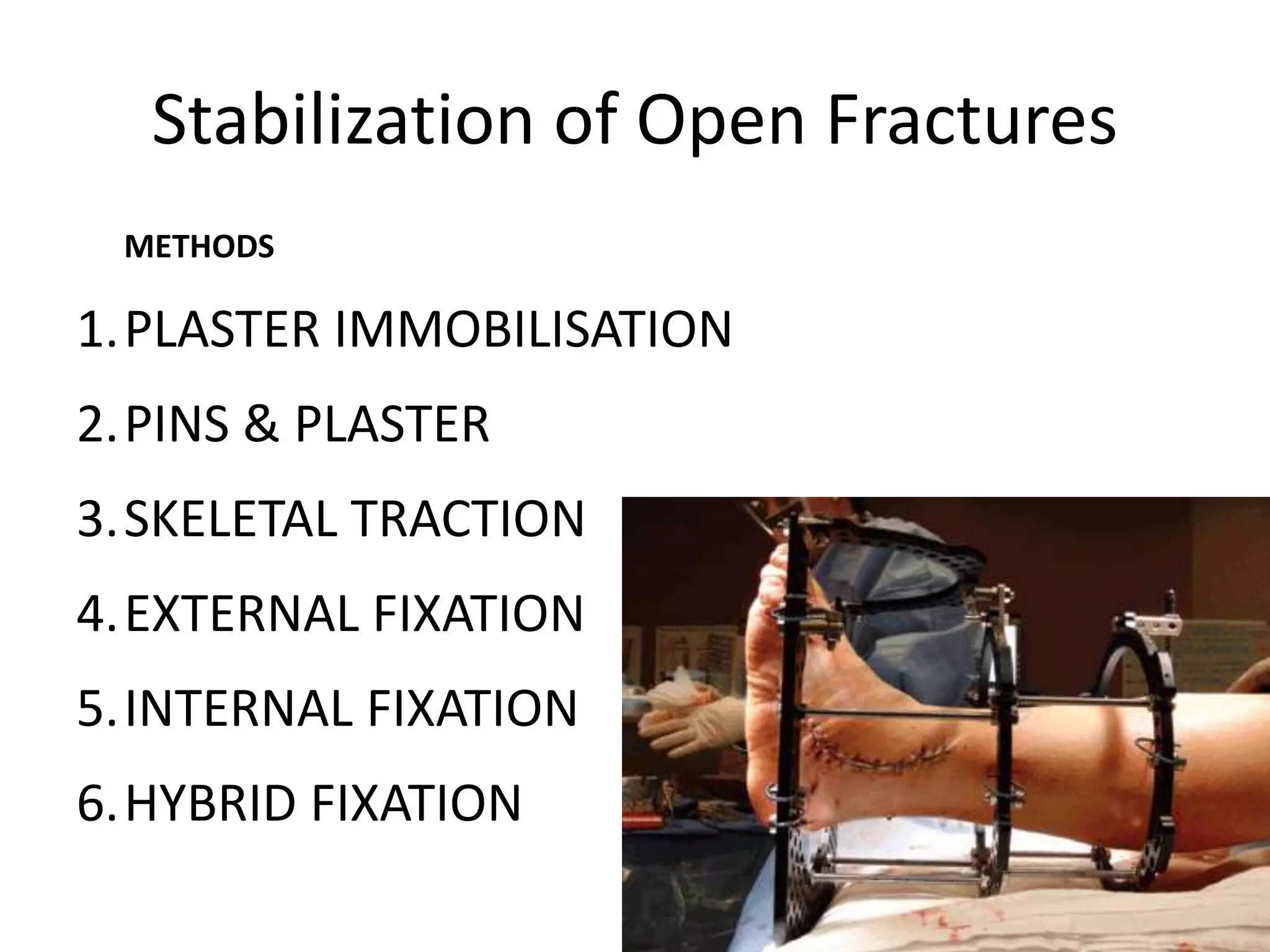
Stabilization of Open Fractures 
METHODS 
1.PLASTER IMMOBILISATION 
2.PINS & PLASTER 
3.SKELETAL TRACTION 
4.EXTERNAL FIXATION 
5.INTERNAL FIXATION 
6.HYBRID FIXATION
External Fixators 
Method of choice in most open fractures 
Advantages: 
• Easily applied 
• Good skeletal & soft tissue stability 
• Anatomical reduction. 
• No additional trauma 
• Risk of infection is comparatively less. 
• Allows wound inspection & wound dressing. 
• Assist in restoring the limb to length until definitive 
fixation 
• Allows transportation 
• Better nursing care
Amputation 
Indications: 
• Vascular injury – no repair possible 
• Functional outcome better with prosthesis 
• Life saving to arrest bleeding 
• Associated diseases (DM)
Thank You

Classification of Fractures & Compound Fracture Managment

  • 1.
    Classification of Fractures & Management of Compound Fractures By Kevin J Ambadan
  • 2.
    CLASSIFICATION • Basedon Relationship with the Environment • Based on Displacement • Based on Fracture Pattern • Based on Etiology
  • 3.
    Classification Based on Relationship with Environment 1. CLOSED {Simple} 2. OPEN {Compound}
  • 4.
    Open Fractures •A break in the skin and underlying soft tissue leading to a communicating fracture hematoma
  • 5.
    Gustilo Classification •The Gustillo classification is used to classify open fractures. • Three grades that try to quantify the amount of soft tissue damage associated with the fracture Grade 1 — <1cm wound, min soft t/s injury Grade 2 — >1cm wound, mod soft t/s inury Grade 3 — >10cm wound, severe muscle devitalization Subgrades A,B,C
  • 7.
    Grade 3A •Limited stripping of periosteum and soft tissue from bone. • Adequate soft tissue coverage for bone, tendons and neurovascular bundle.
  • 8.
    Type 3B •Extensive stripping of soft tissue and periosteum from bone. • Requires a local flap or free tissue transfer Type 3C • A major vascular injury requiring repair
  • 9.
    Muller’s (AO/OTA) Classification • Each long bone has 3 segments Proximal, Diaphyseal and Distal • Diaphyseal Fractures: – Simple – Wedge – Complex • Proximal & Distal – Extra-Articular – Partial Articular – Complete Articular
  • 10.
    Classification: Based onDisplacement 1. UNDISPLACED 2. DISPLACED
  • 11.
    Displacement - Translation • Translation is sideways motion of the fracture - usually described as a percentage of movement when compared to the diameter of the bone -- --- -------direction of distal fragment decides
  • 12.
    Displacement - Angulation • Angulation is the amount of bend at a fracture described in degrees. Described with respect to the apex of the angle .
  • 13.
    Displacement - Shortening • Shortening is the amount a fracture is collapsed/ shifted proximally, expressed in centimeters.
  • 14.
    Classification: Based onPattern 1. Transverse 2. Oblique 3. Spiral 4. Comminuted 5. Segmental 6. Stellate
  • 15.
    According to thePath of the # Line Transverse Fracture A fracture in which the # line is perpendicular to the long axis of the bone . Oblique Fracture A fracture in which the # line is at oblique angle to the long axis of the bone.
  • 16.
    According to thePath of the # Line Spiral Fracture A severe form of oblique fracture in which the # plane rotates along the long axis of the bone. These #s occur secondary to rotational force.
  • 17.
    Anatomical Classification ofFractures Comminuted Fracture : The bone is broken into many fragments. Stellate Fracture: This # occurs in the flat bones of the skull and in the patella, where the fracture lines run in various directions from one point.
  • 18.
    Anatomical Classification ofFractures Impacted Fracture: This # where a vertical force drives the distal fragment of the fracture into the proximal fragment. Depressed Fracture: This # occurs in the skull where a segment of bone gets depressed into the cranium.
  • 19.
    Anatomical Classification ofFractures Avulsion Fracture: A chip of bone is avulsed by the sudden and unexpected contraction of a powerful muscle from its point of insertion, Examples 1. ASIS Avulsion 2. JONE’S 5th MT base Avulsion
  • 20.
    Anatomical Classification ofFractures Stress Fracture : • It is a fracture occurring at a site in the bone subject to repeated minor stresses over a period of time. Birth Fracture: • It is a fracture in the new born children due to injury during birth
  • 21.
    Classification: Based onEtiology 1. TRAUMATIC 2. PATHOLOGICAL – Tumors – Bone cysts – Osteomyelitis – Osteoporosis – Osteogenesis imperfecta – Rickets
  • 22.
    Salter-Harris Classification •Only used for pediatric fractures that involve the growth plate (physis)
  • 23.
    Salter-Harris type Ifracture • Type I fracture is when there is a fracture across the physis with no metaphysial or epiphysial injury
  • 24.
    Salter-Harris type IIfracture • Type II fracture is when there is a fracture across the physis which extends into the metaphysis
  • 25.
    Salter-Harris type IIIfracture • Type III fracture is when there is a fracture across the physis which extends into the epiphysis
  • 26.
    Salter-Harris type IVfracture • Type IV fracture is when there is a fracture through metaphysis, physis, and epiphysis
  • 27.
    Salter-Harris type Vfracture • Type V fracture is when there is a crush injury to the physis
  • 28.
  • 29.
    Aim • Toconvert contaminated wound into clean wound • To convert the open # into a closed one. • To establish a union in a good position • To prevent pyogenic and clostridial infection. Order of Priority • Patient • Limb • Wound • Fracture
  • 30.
    4 Essentials ofTreatment • Antibiotic Prophylaxis • Urgent Wound and Fracture Debridement • Stabilization of the Fracture • Early Debridement Wound Cover
  • 31.
    Sterility and AntibioticCover • In most cases, Co-amoxiclav or Cefuroxime (or Clindamycin in case of penicillin allergy) is given ASAP • At time of debridement, Gentamycin is added to a second dose of the 1st antibiotic given • Wounds of Gustilo Grade 1 fractures can be closed at time of debridement; Antibiotic prophylaxis for up to 24hrs
  • 32.
    • Grade 2and 3A fractures, delayed closure after ‘second look’ is sometimes preferred • Grade 3B & C, delayed cover is usually practiced. • Total period of antibiotics is up to 72hrs.
  • 33.
    Debridement • Thoroughirrigation of wound with copious amounts of NS to remove all foreign material in wound, followed by excision of dead tissue • Tourniquet may be used to provide bloodless field, but it can cause ischemia and make it difficult to identify devitalized structures
  • 34.
    • Principles observedduring debridement: – Wound margin excision – Wound extension – Delivery of fracture – Removal of devitalized tissue – Wound cleansing • Uncontaminated wound in Grade 1 or 2 can be sutured
  • 35.
    Fracture Stabilization •Important in reducing risk of infection and assisting recovery of soft tissues • Method of fixation depends on – Degree of contamination – Length of time from injury to operation – Extent of soft tissue damage • If there is no contamination and definitive wound cover can be achieved at time of debridement, all open #s can be treated as closed injury
  • 36.
    • Internal orexternal fixation may be appropriate depending on individual characteristics of fracture and wound. • If wound cover is delayed, then external fixation is safer; however fixator pins should be inserted away from potential flaps • Internal fixation can be used at time of definitive wound cover as long as – delay to wound cover is < 7 days – No visible wound contamination – Internal fixation can control the # as well as external fixator
  • 37.
    Stabilization of OpenFractures METHODS 1.PLASTER IMMOBILISATION 2.PINS & PLASTER 3.SKELETAL TRACTION 4.EXTERNAL FIXATION 5.INTERNAL FIXATION 6.HYBRID FIXATION
  • 38.
    External Fixators Methodof choice in most open fractures Advantages: • Easily applied • Good skeletal & soft tissue stability • Anatomical reduction. • No additional trauma • Risk of infection is comparatively less. • Allows wound inspection & wound dressing. • Assist in restoring the limb to length until definitive fixation • Allows transportation • Better nursing care
  • 39.
    Amputation Indications: •Vascular injury – no repair possible • Functional outcome better with prosthesis • Life saving to arrest bleeding • Associated diseases (DM)
  • 40.