1Jill_HW • p. 1
Jill Hurst-Wahl
Hurst@HurstAssociates.com
@Jill_HW
ASSESSMENT, YOUR LIBRARY,
AND YOUR COLLECTIONS
Jill
Hurst-Wahl
Author,
speaker,
consultant,
instructor.
ASSESSMENT:
WHAT DOES THIS WORD MEAN
TO YOU??
4Jill_HW • p. 4
Why Assessment?
• Moves your library in the right direction
• Aligns your services with your plans, goals, and
desired outcomes
• Provides evidence for improvements in services
• Increased productivity
• Lower costs
• Better customer service
• Demonstrates the library value to its stakeholders
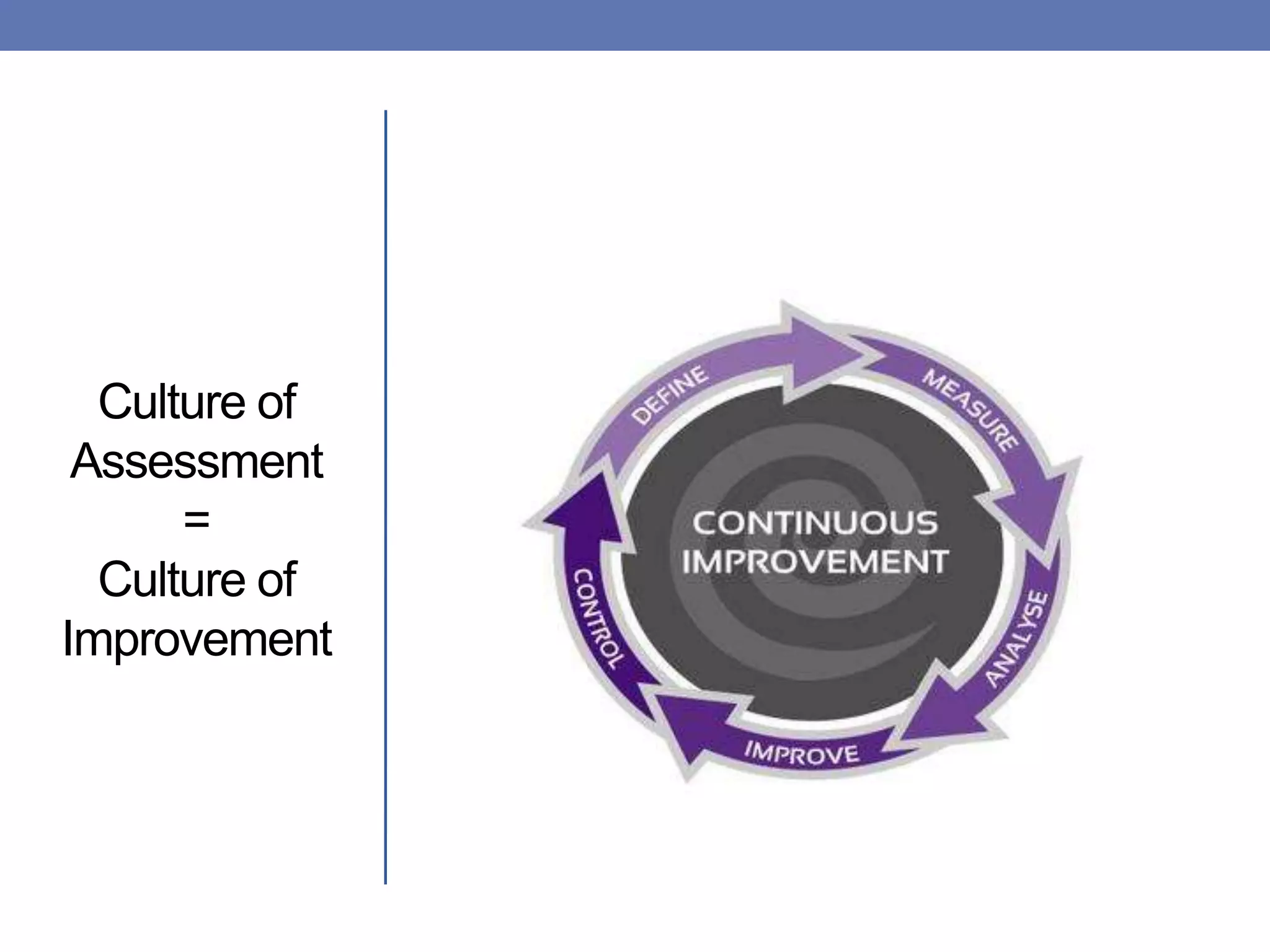
Culture of
Assessment
=
Culture of
Improvement
This will work in YOUR library!
7Jill_HW • p. 7
Culture of Assessment
• Evidence-based decisions
• Decisions are based on facts, research, and
analysis
8Jill_HW • p. 8
Assessment data allow libraries to…
• Monitor progress toward achieving:
• Goals:
• An observable and measurable end result.
• An ideal state that the library is stretching
towards.
• Outcomes:
• The situation that exists at the end of an
activity of process.
• The measurable impact on the user.
9Jill_HW • p. 9
And…
• Measure effectiveness for different target
audiences
• Define problems accurately
• Reveal areas that require more study
10Jill_HW • p. 10
Types of Assessment
• Diagnostic: Conducted before the proposed action to
determine the current status, the needs of patrons, the
context, and attitudes toward the proposed change
• Formative: Conducted throughout the project to
assess the ongoing alignment with goals and
outcomes, any gaps and problem areas, suggested
areas for revision and refocusing
• Summative: Conducted at the conclusion of the
project to determine effectiveness and quality
ASSESSING YOUR
COMMUNITY
12Jill_HW • p. 12
• Background
• Interests
• Capabilities
• Areas for growth
• What else?
Community: What do you need to know?
• Checklists
• Voting using colored
strips of paper
• “Posters” where
agreement can be
registered (and notes
made)
More Creative
• Review existing
information
• Surveys
• Interviews
• Structured
• Semi-structured
• Patrons or other staff
• Self-report
Standard
Community: Sample Methods to Consider
ASSESSING LIBRARY
SERVICES
15Jill_HW • p. 15
Services: What do you need to know?
• What services are being used
• Any that aren’t obvious?
• How the library space is being used
• Which services are perceived as useful
• Which services are perceived as frustrating
• What new services are desired
• Library heat map
• Vote for favorite
services
• Interview each other
• Card sort activities
More Creative
• Review of existing
records
• Surveys
• Interviews
• Observation
• Formal
• Informal
• Peer
• Self-reports
Standard
Services: Methods to Consider
ASSESSING LIBRARY
COLLECTIONS
18Jill_HW • p. 18
Collections: What do you need to know?
• Is the collection meeting the needs of the
community
• What needs to change
• Show me…
• Tell me…
More Creative
• Analyze circulation data
• Look at similar libraries
& their holdings
• Many other methods…
Standard
Collections: Methods to Consider
DATA COLLECTION TIPS
21Jill_HW • p. 21
Collecting Data – A Few Golden Rules
• Explain everything clearly. Don’t assume.
• Arrange questions in logical sequence.
• Avoid leading questions.
• Always run pilot and revise.
• Analyze all the results.
• Do not make claims data do not support.
• Acknowledge your sources and assistants.
22Jill_HW • p. 22
What Goes Wrong?
• Data are not collected.
• Data that are collected aren’t useful.
• Too many data points are collected, preventing
timely analysis.
• Data are collected…but no actions are taken.
• Evaluation is done by accident.
• The belief that there is only one right way to
conduct evaluation.
• Are the data and results defensible?
COMMUNICATING
RESULTS
24Jill_HW • p. 24
• Communicate your message in a way that others
understand it.
• Communicate
• Why you did the assessment
• What you wanted to learn
• What you did learn
• Which method(s) you used
• Any limitations to the data
• Use text and visuals
• What’s in it for them (institution)?
• How does this connect with the institution’s goals?
Communicating Assessment Results
25Jill_HW • p. 25
• If you had 30 seconds to communicate about this
project, what would you say?
• If you could use 10 words, what would you say?
• If you could use 3 words, what would you say?
• Who would you deliver this message to?
What if time is an issue?
26Jill_HW • p. 26
Q&A

Assessment, Your Library, and Your Collections

  • 1.
    1Jill_HW • p.1 Jill Hurst-Wahl Hurst@HurstAssociates.com @Jill_HW ASSESSMENT, YOUR LIBRARY, AND YOUR COLLECTIONS
  • 2.
  • 3.
    ASSESSMENT: WHAT DOES THISWORD MEAN TO YOU??
  • 4.
    4Jill_HW • p.4 Why Assessment? • Moves your library in the right direction • Aligns your services with your plans, goals, and desired outcomes • Provides evidence for improvements in services • Increased productivity • Lower costs • Better customer service • Demonstrates the library value to its stakeholders
  • 5.
  • 6.
    This will workin YOUR library!
  • 7.
    7Jill_HW • p.7 Culture of Assessment • Evidence-based decisions • Decisions are based on facts, research, and analysis
  • 8.
    8Jill_HW • p.8 Assessment data allow libraries to… • Monitor progress toward achieving: • Goals: • An observable and measurable end result. • An ideal state that the library is stretching towards. • Outcomes: • The situation that exists at the end of an activity of process. • The measurable impact on the user.
  • 9.
    9Jill_HW • p.9 And… • Measure effectiveness for different target audiences • Define problems accurately • Reveal areas that require more study
  • 10.
    10Jill_HW • p.10 Types of Assessment • Diagnostic: Conducted before the proposed action to determine the current status, the needs of patrons, the context, and attitudes toward the proposed change • Formative: Conducted throughout the project to assess the ongoing alignment with goals and outcomes, any gaps and problem areas, suggested areas for revision and refocusing • Summative: Conducted at the conclusion of the project to determine effectiveness and quality
  • 11.
  • 12.
    12Jill_HW • p.12 • Background • Interests • Capabilities • Areas for growth • What else? Community: What do you need to know?
  • 13.
    • Checklists • Votingusing colored strips of paper • “Posters” where agreement can be registered (and notes made) More Creative • Review existing information • Surveys • Interviews • Structured • Semi-structured • Patrons or other staff • Self-report Standard Community: Sample Methods to Consider
  • 14.
  • 15.
    15Jill_HW • p.15 Services: What do you need to know? • What services are being used • Any that aren’t obvious? • How the library space is being used • Which services are perceived as useful • Which services are perceived as frustrating • What new services are desired
  • 16.
    • Library heatmap • Vote for favorite services • Interview each other • Card sort activities More Creative • Review of existing records • Surveys • Interviews • Observation • Formal • Informal • Peer • Self-reports Standard Services: Methods to Consider
  • 17.
  • 18.
    18Jill_HW • p.18 Collections: What do you need to know? • Is the collection meeting the needs of the community • What needs to change
  • 19.
    • Show me… •Tell me… More Creative • Analyze circulation data • Look at similar libraries & their holdings • Many other methods… Standard Collections: Methods to Consider
  • 20.
  • 21.
    21Jill_HW • p.21 Collecting Data – A Few Golden Rules • Explain everything clearly. Don’t assume. • Arrange questions in logical sequence. • Avoid leading questions. • Always run pilot and revise. • Analyze all the results. • Do not make claims data do not support. • Acknowledge your sources and assistants.
  • 22.
    22Jill_HW • p.22 What Goes Wrong? • Data are not collected. • Data that are collected aren’t useful. • Too many data points are collected, preventing timely analysis. • Data are collected…but no actions are taken. • Evaluation is done by accident. • The belief that there is only one right way to conduct evaluation. • Are the data and results defensible?
  • 23.
  • 24.
    24Jill_HW • p.24 • Communicate your message in a way that others understand it. • Communicate • Why you did the assessment • What you wanted to learn • What you did learn • Which method(s) you used • Any limitations to the data • Use text and visuals • What’s in it for them (institution)? • How does this connect with the institution’s goals? Communicating Assessment Results
  • 25.
    25Jill_HW • p.25 • If you had 30 seconds to communicate about this project, what would you say? • If you could use 10 words, what would you say? • If you could use 3 words, what would you say? • Who would you deliver this message to? What if time is an issue?
  • 26.

Editor's Notes

  • #2 Expanding on Ranganathan’s five laws, we know that libraries are for use and that every library has its community (users). In order to ensure that a library is meeting the needs of its users, the library must be able to assess its services, including its collections, and understand how those are meeting the requirements of its community. This webinar will investigate the assessment activities that a library can utilize to determine the needs of its community, as well as those assessments which can help a library assure that a service is meeting its community’s desires. Specific assessments, which can be completed in any type of environment, will be discussed and examples given. June 6, 2:30-4:00 p.m. ET