Classification of Igneous Rocks
Textures:
Aphanitic- crystals too small to see by eye
Phaneritic- can see the constituent minerals
Fine grained- < 1 mm diameter
Medium grained- 1-5 mm diameter
Coarse grained- 5-50 mm diameter
Very coarse grained- > 50 mm diameter
Porphyritic- bimodal grain size distribution
Glassy- no crystals formed
Classification of Igneous Rocks
Figure 2.1a. Method #1 for plotting a point with the components: 70% X, 20% Y, and 10% Z on
triangular diagrams. An Introduction to Igneous and Metamorphic Petrology, John Winter, Prentice Hall.
Classification of Igneous Rocks
Figure 2.1b. Method #2 for plotting a point with the components: 70% X, 20% Y, and 10% Z on triangular
diagrams. An Introduction to Igneous and Metamorphic Petrology, John Winter, Prentice Hall.
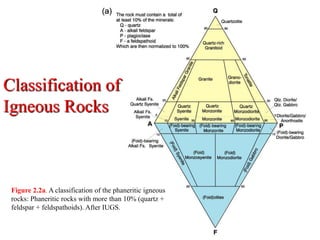
Classification of
Igneous Rocks
Figure 2.2a. A classification of the phaneritic igneous
rocks: Phaneritic rocks with more than 10% (quartz +
feldspar + feldspathoids). After IUGS.
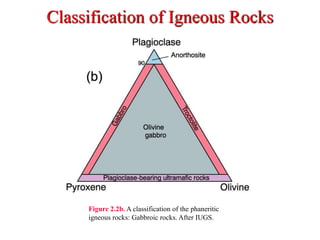
Classification of Igneous Rocks
Figure 2.2b. A classification of the phaneritic
igneous rocks: Gabbroic rocks. After IUGS.
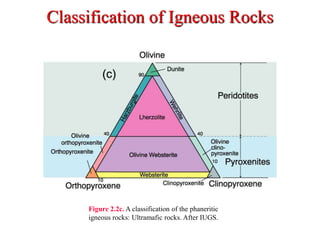
Classification of Igneous Rocks
Figure 2.2c. A classification of the phaneritic
igneous rocks: Ultramafic rocks. After IUGS.
Classification of
Igneous Rocks
Figure 2.3. A classification and nomenclature
of volcanic rocks. After IUGS.
Classification of Igneous Rocks
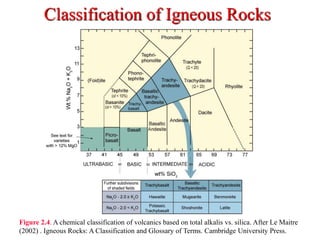
Figure 2.4. A chemical classification of volcanics based on total alkalis vs. silica. After Le Maitre
(2002) . Igneous Rocks: A Classification and Glossary of Terms. Cambridge University Press.
Classification of Igneous Rocks
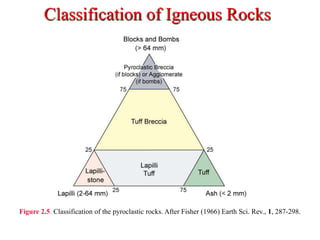
Figure 2.5. Classification of the pyroclastic rocks. After Fisher (1966) Earth Sci. Rev., 1, 287-298.

Ch 02 Igneous Classification.ppt

  • 1.
    Classification of IgneousRocks Textures: Aphanitic- crystals too small to see by eye Phaneritic- can see the constituent minerals Fine grained- < 1 mm diameter Medium grained- 1-5 mm diameter Coarse grained- 5-50 mm diameter Very coarse grained- > 50 mm diameter Porphyritic- bimodal grain size distribution Glassy- no crystals formed
  • 2.
    Classification of IgneousRocks Figure 2.1a. Method #1 for plotting a point with the components: 70% X, 20% Y, and 10% Z on triangular diagrams. An Introduction to Igneous and Metamorphic Petrology, John Winter, Prentice Hall.
  • 3.
    Classification of IgneousRocks Figure 2.1b. Method #2 for plotting a point with the components: 70% X, 20% Y, and 10% Z on triangular diagrams. An Introduction to Igneous and Metamorphic Petrology, John Winter, Prentice Hall.
  • 4.
    Classification of Igneous Rocks Figure2.2a. A classification of the phaneritic igneous rocks: Phaneritic rocks with more than 10% (quartz + feldspar + feldspathoids). After IUGS.
  • 5.
    Classification of IgneousRocks Figure 2.2b. A classification of the phaneritic igneous rocks: Gabbroic rocks. After IUGS.
  • 6.
    Classification of IgneousRocks Figure 2.2c. A classification of the phaneritic igneous rocks: Ultramafic rocks. After IUGS.
  • 7.
    Classification of Igneous Rocks Figure2.3. A classification and nomenclature of volcanic rocks. After IUGS.
  • 8.
    Classification of IgneousRocks Figure 2.4. A chemical classification of volcanics based on total alkalis vs. silica. After Le Maitre (2002) . Igneous Rocks: A Classification and Glossary of Terms. Cambridge University Press.
  • 9.
    Classification of IgneousRocks Figure 2.5. Classification of the pyroclastic rocks. After Fisher (1966) Earth Sci. Rev., 1, 287-298.