Concept
analysis
A u g u s t i n e N d a i m a n i
D P h i L S t u d e n t
U Z C H S
CONCEPT ANALYSIS
19/05/2017 a ndaimani
OBJECTIVES
1. Define concept analysis
2. Discuss the steps in concept analysis
3. Outline the structure of a CA article
4. Apply CA to a nursing phenomenon
19/05/2017 a ndaimani
DEFINITION
• Concept – word which describes mental images of phenomena
• Abstraction expressed in some form
• Can be verbs, adjectives, nouns….
• Dynamic – new knowledge can change interpretation of concepts
19/05/2017 a ndaimani
MENTAL IMAGES
19/05/2017 a ndaimani
CONCEPTS
19/05/2017 a ndaimani
EXAMPLES
• Comfort
• Surgical nursing
• Seclusion
• Maternal health
• Patient satisfaction
• Self care
• Quality nursing care
19/05/2017 a ndaimani
CONCEPT ANALYSIS
• An activity where concepts, their characteristics and relations to other concepts are
clarified.
• Method for looking at the state of a discipline
• Enlightens on what is known and unknown about a concept
• Enables development of a theoretical definition.
• Then operational definitions can be derived from theoretical definitions
• Goal = all nurses use the same language for the same concept
19/05/2017 a ndaimani
PURPOSES
• To distinguish between the defining attributes of a concept and its irrelevant structure
• To determine its internal structure by breaking it into simpler elements
19/05/2017 a ndaimani
REASONS FOR DOING CA
• Vague terminology
• Ambiguous definition of terms
• Inconsistencies among theories
• To classify nursing phenomena
• Need to accurately describe a nursing or health care situation
• Need to expand traditional analysis using qualitative methods
19/05/2017 a ndaimani
SIGNIFICANCE
• First step in developing a study
• Develop a common language for communication
• Define terms theoretically (improves construct validity)
• Construct measurement tools
• Develop concepts which can build theory
• Acknowledge change
• Build nursing knowledge
19/05/2017 a ndaimani
METHODS OF CA
• Methods = step by step process to analyse the concepts and provide a theoretical
definition
– Rodgers (evolutionary paradigm)
– Walker and Avant (strategic method)
– Wilson (ordinary language philosophy)
– Meleis (concept clarification)
– Schwartz-Barcott & Kim (Hybrid Model)
19/05/2017 a ndaimani
WILSONIAN METHOD
• Analyses concepts through rigorous scientific inquiry to clarify, identify and establish
meanings of terms – key to update knowledge (EBP)
1. Identify a concept
2. Determine questions about a concept
3. Examine definitions
4. Construct cases [model, contrary, borderline, invented]
5. Identify the social context of the concept
6. Enhance language [meaning of the concept]
19/05/2017 a ndaimani
WALKER AND AVANT
• Derived from Wilsonian but dos not emphasize social context
• Focuses on [justified/explained] attributes of a concept
– Select a concept (area of research interest)
– Determine the purposes of analysis [clarify, develop operational definition, distinguish
concept from ordinary language, personal interest)
– Identify all uses of the concept (dictionary, thesaurus, colleagues, literature, other disciplines)
– Determine attributes/characteristics of the concept
19/05/2017 a ndaimani
WALKER/AVANT CONT.
• Develop a model case – a real life example which includes all the critical attributes
• Construct additional cases
– Model case
– Borderline case
– Related case
– Contrary case
– Invented case
– Illegitimate case
19/05/2017 a ndaimani
WALKER AND AVANT
• Identify antecedents – events/situations which must occur before the concept
• Identify consequences – events/situations which result from occurrence of the concept
• Determine empirical referents/diagnostic criteria for the concept to occur
– Critical attributes which by their existence/presence demonstrate occurrence of the concept
19/05/2017 a ndaimani
TYPES OF CASES
• Model case – real life example; contains all the attributes
• Borderline – contains some attributes but not all
• Related – contain related concepts but not critical attributes [e.g.
conflict/negotiation/freedom or grief/mourning/loss]
• Contrary case – what something is not - example is not the concept [birth/death]
• Invented case - a fictional case which does not exist in real life & which does not
contain any critical attribute [death/paused animation]
• Illegitimate case – used out of context/improperly and the meaning is opposite to
concept being examined[nursing – breast feeding]
19/05/2017 a ndaimani
RODGERS EVOLUTIONARY CA
• Concepts are viewed as dynamic entities which depend on context - “ words get their
meaning from use”
• Concept should be understood in the context of discipline [mouse –
veterinary/electronics]
• Concept depend on their significance, use and application
19/05/2017 a ndaimani
RODGERS STEPS
• Identify the concept
• Identify the surrogate terms
• Select an appropriate sample/realm for data collection
• Collect data to identify attributes of the concept (interdisciplinary or socio-cultural
concept)
• Analyse the data regarding the characteristics of the concept
• Identify an exemplar of the concept
• Identify hypotheses and implications for further concept development
19/05/2017 a ndaimani
PRESENTATION
• Abstract (problem, purpose/objective, methodology, results, conclusion/way forward)
• Introduction- - identify and give significance
• Methodology – method used, reasons for using the method. Steps in the method
• Results – literature used, attributes, antecedents, consequences
• Discussion – cases and analysis/implications, conclusion [so what/way forward]
19/05/2017 a ndaimani
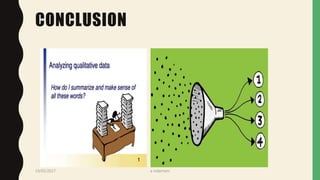
CONCLUSION
19/05/2017 a ndaimani
REFERENCES
Rodgers, B.L., & Knafl, K.A. (1993). Concept Development in Nursing: Foundations,
Techniques and Applications. London: W.B. Saunders.
Ndaimani, A., Haruzivishe, C., Chitsike, I., & Stray-Pedersen, B. (2016). Retention in
elimination of mother-to-child transmis-sion of HIV [eMTCT] care: an evolutionary
concept analysis. Annals of British Medical Sciences, 2 (1): 3-7.

Concept analysis an

  • 1.
    Concept analysis A u gu s t i n e N d a i m a n i D P h i L S t u d e n t U Z C H S
  • 2.
  • 3.
    OBJECTIVES 1. Define conceptanalysis 2. Discuss the steps in concept analysis 3. Outline the structure of a CA article 4. Apply CA to a nursing phenomenon 19/05/2017 a ndaimani
  • 4.
    DEFINITION • Concept –word which describes mental images of phenomena • Abstraction expressed in some form • Can be verbs, adjectives, nouns…. • Dynamic – new knowledge can change interpretation of concepts 19/05/2017 a ndaimani
  • 5.
  • 6.
  • 7.
    EXAMPLES • Comfort • Surgicalnursing • Seclusion • Maternal health • Patient satisfaction • Self care • Quality nursing care 19/05/2017 a ndaimani
  • 8.
    CONCEPT ANALYSIS • Anactivity where concepts, their characteristics and relations to other concepts are clarified. • Method for looking at the state of a discipline • Enlightens on what is known and unknown about a concept • Enables development of a theoretical definition. • Then operational definitions can be derived from theoretical definitions • Goal = all nurses use the same language for the same concept 19/05/2017 a ndaimani
  • 9.
    PURPOSES • To distinguishbetween the defining attributes of a concept and its irrelevant structure • To determine its internal structure by breaking it into simpler elements 19/05/2017 a ndaimani
  • 10.
    REASONS FOR DOINGCA • Vague terminology • Ambiguous definition of terms • Inconsistencies among theories • To classify nursing phenomena • Need to accurately describe a nursing or health care situation • Need to expand traditional analysis using qualitative methods 19/05/2017 a ndaimani
  • 11.
    SIGNIFICANCE • First stepin developing a study • Develop a common language for communication • Define terms theoretically (improves construct validity) • Construct measurement tools • Develop concepts which can build theory • Acknowledge change • Build nursing knowledge 19/05/2017 a ndaimani
  • 12.
    METHODS OF CA •Methods = step by step process to analyse the concepts and provide a theoretical definition – Rodgers (evolutionary paradigm) – Walker and Avant (strategic method) – Wilson (ordinary language philosophy) – Meleis (concept clarification) – Schwartz-Barcott & Kim (Hybrid Model) 19/05/2017 a ndaimani
  • 13.
    WILSONIAN METHOD • Analysesconcepts through rigorous scientific inquiry to clarify, identify and establish meanings of terms – key to update knowledge (EBP) 1. Identify a concept 2. Determine questions about a concept 3. Examine definitions 4. Construct cases [model, contrary, borderline, invented] 5. Identify the social context of the concept 6. Enhance language [meaning of the concept] 19/05/2017 a ndaimani
  • 14.
    WALKER AND AVANT •Derived from Wilsonian but dos not emphasize social context • Focuses on [justified/explained] attributes of a concept – Select a concept (area of research interest) – Determine the purposes of analysis [clarify, develop operational definition, distinguish concept from ordinary language, personal interest) – Identify all uses of the concept (dictionary, thesaurus, colleagues, literature, other disciplines) – Determine attributes/characteristics of the concept 19/05/2017 a ndaimani
  • 15.
    WALKER/AVANT CONT. • Developa model case – a real life example which includes all the critical attributes • Construct additional cases – Model case – Borderline case – Related case – Contrary case – Invented case – Illegitimate case 19/05/2017 a ndaimani
  • 16.
    WALKER AND AVANT •Identify antecedents – events/situations which must occur before the concept • Identify consequences – events/situations which result from occurrence of the concept • Determine empirical referents/diagnostic criteria for the concept to occur – Critical attributes which by their existence/presence demonstrate occurrence of the concept 19/05/2017 a ndaimani
  • 17.
    TYPES OF CASES •Model case – real life example; contains all the attributes • Borderline – contains some attributes but not all • Related – contain related concepts but not critical attributes [e.g. conflict/negotiation/freedom or grief/mourning/loss] • Contrary case – what something is not - example is not the concept [birth/death] • Invented case - a fictional case which does not exist in real life & which does not contain any critical attribute [death/paused animation] • Illegitimate case – used out of context/improperly and the meaning is opposite to concept being examined[nursing – breast feeding] 19/05/2017 a ndaimani
  • 18.
    RODGERS EVOLUTIONARY CA •Concepts are viewed as dynamic entities which depend on context - “ words get their meaning from use” • Concept should be understood in the context of discipline [mouse – veterinary/electronics] • Concept depend on their significance, use and application 19/05/2017 a ndaimani
  • 19.
    RODGERS STEPS • Identifythe concept • Identify the surrogate terms • Select an appropriate sample/realm for data collection • Collect data to identify attributes of the concept (interdisciplinary or socio-cultural concept) • Analyse the data regarding the characteristics of the concept • Identify an exemplar of the concept • Identify hypotheses and implications for further concept development 19/05/2017 a ndaimani
  • 20.
    PRESENTATION • Abstract (problem,purpose/objective, methodology, results, conclusion/way forward) • Introduction- - identify and give significance • Methodology – method used, reasons for using the method. Steps in the method • Results – literature used, attributes, antecedents, consequences • Discussion – cases and analysis/implications, conclusion [so what/way forward] 19/05/2017 a ndaimani
  • 21.
  • 22.
    REFERENCES Rodgers, B.L., &Knafl, K.A. (1993). Concept Development in Nursing: Foundations, Techniques and Applications. London: W.B. Saunders. Ndaimani, A., Haruzivishe, C., Chitsike, I., & Stray-Pedersen, B. (2016). Retention in elimination of mother-to-child transmis-sion of HIV [eMTCT] care: an evolutionary concept analysis. Annals of British Medical Sciences, 2 (1): 3-7.