International Research Journal of Engineering and Technology (IRJET) e-ISSN: 2395-0056
Volume: 06 Issue: 05 | May 2019 www.irjet.net p-ISSN: 2395-0072
© 2019, IRJET | Impact Factor value: 7.211 | ISO 9001:2008 Certified Journal | Page 2307
Recommendation in E-Commerce using Collaborative Filtering
Daniya Rukiya1, Tahani Africa2, Shweta Nayak3, Sayed Nooreain4
1,2,3Anjuman Institute of Technology and Management, Bhatkal
4(Professor of Computer Science and Engineering, Dept. of Computer Science, AITM, Bhatkal)
----------------------------------------------------------------------***---------------------------------------------------------------------
Abstract - Collaborative filtering (CF) algorithms have been
widely used to build recommender systems since they have
distinguishing capability of sharing collective wisdoms and
experiences. Recommendation algorithms typically work by
suggesting items that are similar to the ones that a user likes,
or items that similar users like. Most of the items in the
recommendation list are already familiar to users. To address
this issue, this paper performs clusteringofstocksbasedonthe
transaction history of the product purchases and then divides
the products into high, medium, low selling stock using K-
Means clustering algorithm. Furthermore customers are
divided into high, medium and low loyal customer using RFM
(Recency, Frequency, Monetary) classification.
Key Words: Collaborative, Recommender, K-Means
Clustering, RFM Classification, Recommender System,
Collaborative Filtering.
1. INTRODUCTION
To realize services that provide serendipity, this paper
assesses the surprise of each user when presented
recommendations. Weproposearecommendationalgorithm
that focuses on the search time that, in the absence of any
recommendation, each user would need to find a desirable
and novel item by himself. Moreover, the degree of user's
surprise is proportional to the estimated search time, we
consider both innovators' preferences and trends for
identifyingitemswithlongestimatedsearchtimes.Topredict
which items the target user is likely to purchase in the near
future, the candidateitems,RFMalgorithmweightseachitem
that innovators have purchased and that reflect one or more
current trends; it then lists them in order of decreasing
weight. Moreover, normal users can hardly discover these
items by themselves due to the limited time spent on online
shopping. As a result, it is necessary to develop a
recommender system that can discover popular items and
less popular items. Since new items may have extremely
short time-to-live, e.g., some garments appeared in newly
released movies, it is necessary for the recommendersystem
to be real-time, i.e., react rapidly. Besides, many of the less
popular items in the long tail are extremely special which
means they may only serve the interests of a small group of
users. To fetch the attention from users and to discover their
personalized needs, it is necessary to introduce serendipity
into recommender systems..
1.1 Problem Statement
Recommendation in e-commerce has an urgent
problem for users to choose demanded and interesteditems
immediately and completely. This application will
recommend the products to the customers by classifyingthe
customers into high loyal customer, medium loyal customer
and low loyal customer. Once they are classified, it then
recommends the product based on loyalty. The products are
categorized into high selling stock, mediumsellingstock and
low selling stock. Whereas, high loyal customers are
recommended medium selling stock and medium loyal
customers are recommended low selling stock to gain the
revenue in their environment.
1.2 Objectives
Recommenders system are the desire to improve users
satisfaction and to increase economic success of the
platform. In Ecommerce a recommender may either
recommend a top recommendation based on the best price
performance ratio for the customer but it may also show the
products that are likely to lead to the highest revenueforthe
business.
2. METHODOLOGY
2.1 Architecture Overview
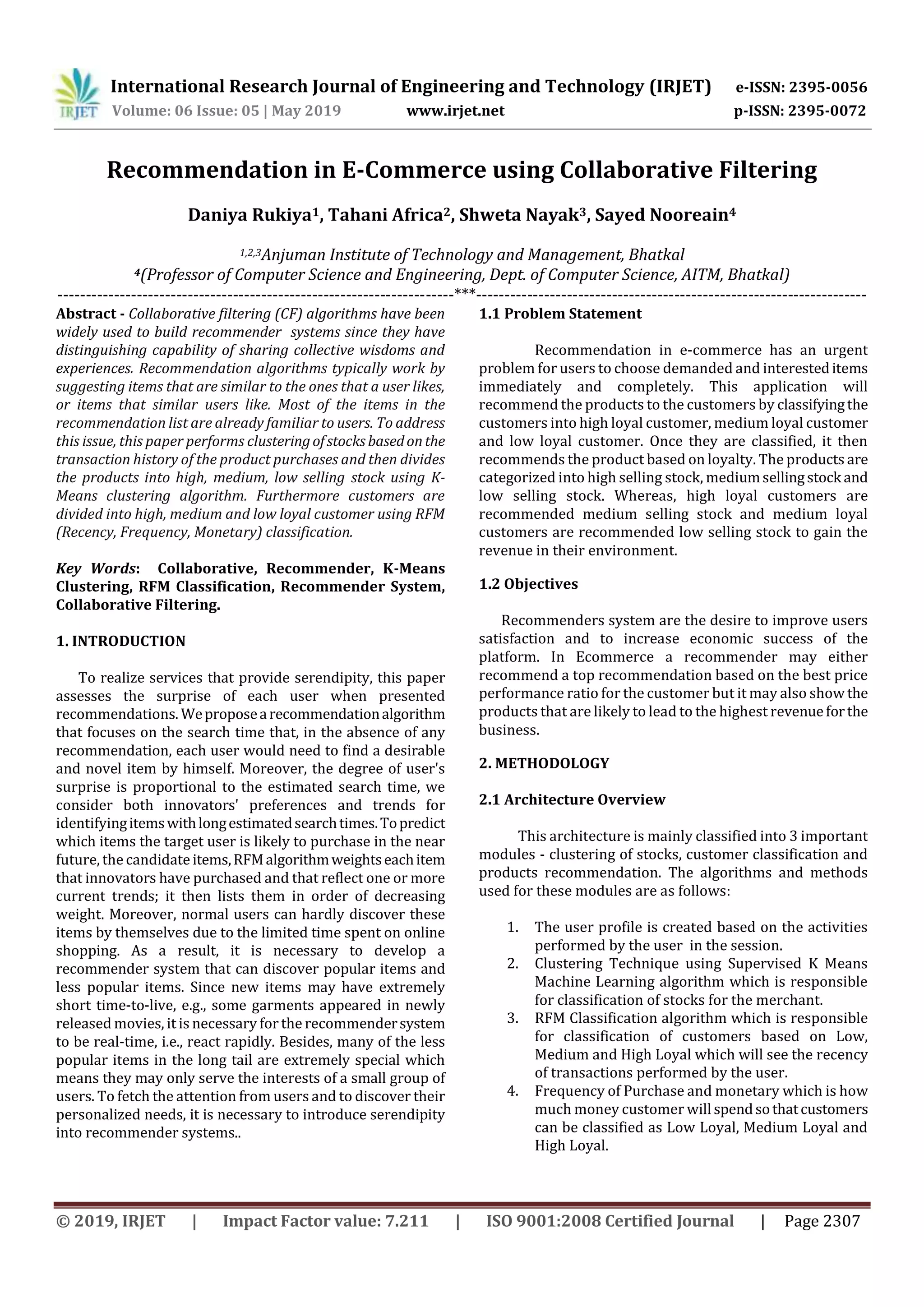
This architecture is mainly classified into 3 important
modules - clustering of stocks, customer classification and
products recommendation. The algorithms and methods
used for these modules are as follows:
1. The user profile is created based on the activities
performed by the user in the session.
2. Clustering Technique using Supervised K Means
Machine Learning algorithm which is responsible
for classification of stocks for the merchant.
3. RFM Classification algorithm which is responsible
for classification of customers based on Low,
Medium and High Loyal which will see the recency
of transactions performed by the user.
4. Frequency of Purchase and monetary which is how
much money customer will spendsothatcustomers
can be classified as Low Loyal, Medium Loyal and
High Loyal.
International Research Journal of Engineering and Technology (IRJET) e-ISSN: 2395-0056
Volume: 06 Issue: 05 | May 2019 www.irjet.net p-ISSN: 2395-0072
© 2019, IRJET | Impact Factor value: 7.211 | ISO 9001:2008 Certified Journal | Page 2308
5. Graph based page rank algorithm which is the best
page where the Stock can be pushed to the customer
which will depend on recursive weight function.
Fig -1: Architecture Overview
2.2 K-Means Clustering
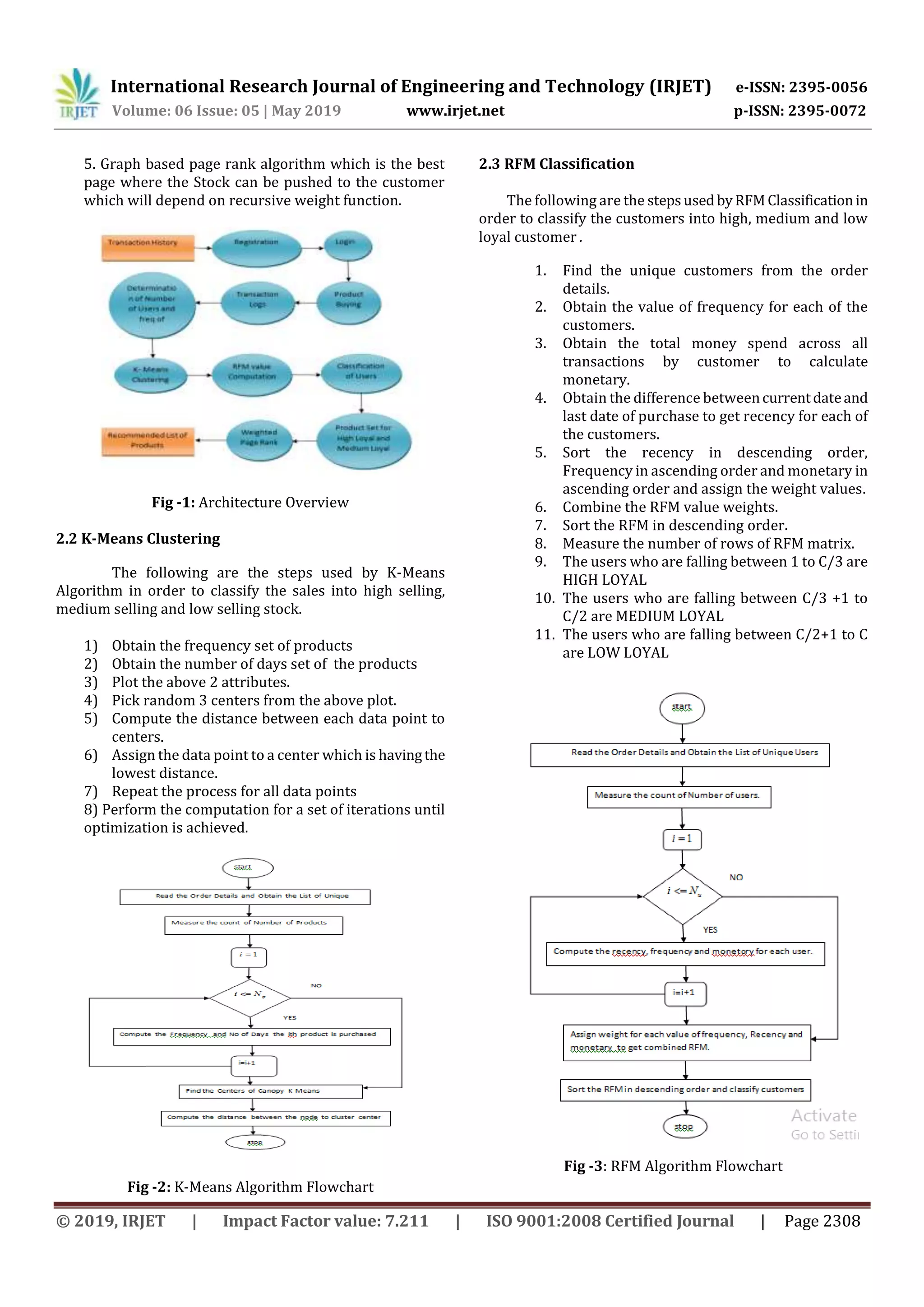
The following are the steps used by K-Means
Algorithm in order to classify the sales into high selling,
medium selling and low selling stock.
1) Obtain the frequency set of products
2) Obtain the number of days set of the products
3) Plot the above 2 attributes.
4) Pick random 3 centers from the above plot.
5) Compute the distance between each data point to
centers.
6) Assign the data point to a center which is havingthe
lowest distance.
7) Repeat the process for all data points
8) Perform the computation for a set of iterations until
optimization is achieved.
Fig -2: K-Means Algorithm Flowchart
2.3 RFM Classification
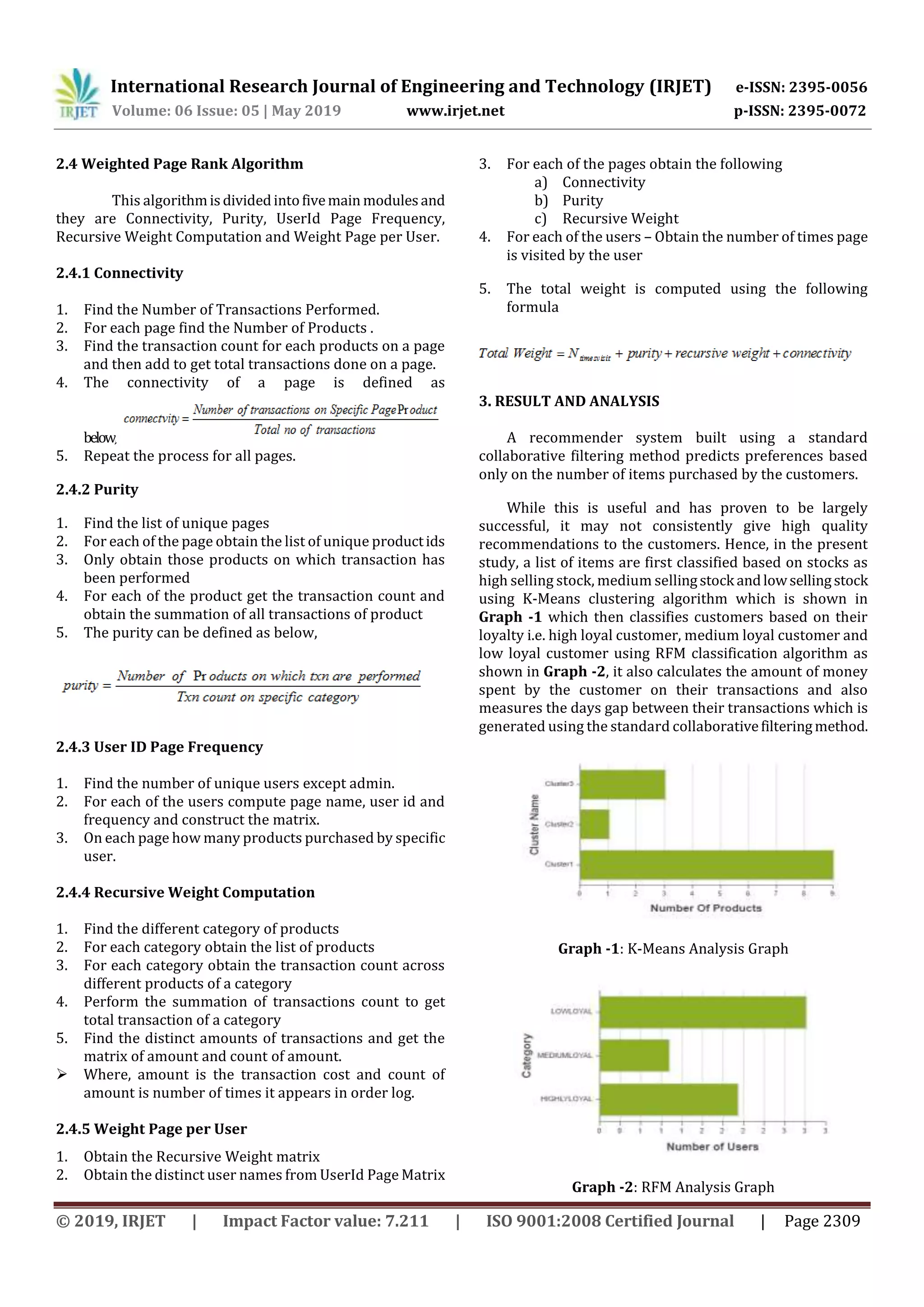
The following are the stepsusedbyRFMClassificationin
order to classify the customers into high, medium and low
loyal customer .
1. Find the unique customers from the order
details.
2. Obtain the value of frequency for each of the
customers.
3. Obtain the total money spend across all
transactions by customer to calculate
monetary.
4. Obtain the difference betweencurrentdateand
last date of purchase to get recency for each of
the customers.
5. Sort the recency in descending order,
Frequency in ascending order and monetary in
ascending order and assign the weight values.
6. Combine the RFM value weights.
7. Sort the RFM in descending order.
8. Measure the number of rows of RFM matrix.
9. The users who are falling between 1 to C/3 are
HIGH LOYAL
10. The users who are falling between C/3 +1 to
C/2 are MEDIUM LOYAL
11. The users who are falling between C/2+1 to C
are LOW LOYAL
Fig -3: RFM Algorithm Flowchart
International Research Journal of Engineering and Technology (IRJET) e-ISSN: 2395-0056
Volume: 06 Issue: 05 | May 2019 www.irjet.net p-ISSN: 2395-0072
© 2019, IRJET | Impact Factor value: 7.211 | ISO 9001:2008 Certified Journal | Page 2309
2.4 Weighted Page Rank Algorithm
This algorithmisdividedintofivemain modulesand
they are Connectivity, Purity, UserId Page Frequency,
Recursive Weight Computation and Weight Page per User.
2.4.1 Connectivity
1. Find the Number of Transactions Performed.
2. For each page find the Number of Products .
3. Find the transaction count for each products on a page
and then add to get total transactions done on a page.
4. The connectivity of a page is defined as
below,
5. Repeat the process for all pages.
2.4.2 Purity
1. Find the list of unique pages
2. For each of the page obtain the list of unique productids
3. Only obtain those products on which transaction has
been performed
4. For each of the product get the transaction count and
obtain the summation of all transactions of product
5. The purity can be defined as below,
2.4.3 User ID Page Frequency
1. Find the number of unique users except admin.
2. For each of the users compute page name, user id and
frequency and construct the matrix.
3. On each page how many products purchased by specific
user.
2.4.4 Recursive Weight Computation
1. Find the different category of products
2. For each category obtain the list of products
3. For each category obtain the transaction count across
different products of a category
4. Perform the summation of transactions count to get
total transaction of a category
5. Find the distinct amounts of transactions and get the
matrix of amount and count of amount.
 Where, amount is the transaction cost and count of
amount is number of times it appears in order log.
2.4.5 Weight Page per User
1. Obtain the Recursive Weight matrix
2. Obtain the distinct user names from UserId Page Matrix
3. For each of the pages obtain the following
a) Connectivity
b) Purity
c) Recursive Weight
4. For each of the users – Obtain the number of times page
is visited by the user
5. The total weight is computed using the following
formula
3. RESULT AND ANALYSIS
A recommender system built using a standard
collaborative filtering method predicts preferences based
only on the number of items purchased by the customers.
While this is useful and has proven to be largely
successful, it may not consistently give high quality
recommendations to the customers. Hence, in the present
study, a list of items are first classified based on stocks as
high selling stock, medium sellingstock andlowsellingstock
using K-Means clustering algorithm which is shown in
Graph -1 which then classifies customers based on their
loyalty i.e. high loyal customer, medium loyal customer and
low loyal customer using RFM classification algorithm as
shown in Graph -2, it also calculates the amount of money
spent by the customer on their transactions and also
measures the days gap between their transactions which is
generated using the standard collaborativefilteringmethod.
Graph -1: K-Means Analysis Graph
Graph -2: RFM Analysis Graph
International Research Journal of Engineering and Technology (IRJET) e-ISSN: 2395-0056
Volume: 06 Issue: 05 | May 2019 www.irjet.net p-ISSN: 2395-0072
© 2019, IRJET | Impact Factor value: 7.211 | ISO 9001:2008 Certified Journal | Page 2310
4. LIMITATIONS
Since our recommender engine is primarily based
on collaborative filtering techniques, it suffers from the
following problems:
1. New UserProblem:Whena newuserisintroduced,
recommendations cannot be produced for them since the
person may not have rated any products. This limitation
could however be addressed using content-based filtering
using parameters such as age, occupation, gender etc.,
2. New Item Problem: If an new item has not been
rated, it will not participate in the recommendation list
generation.
3. Homogeneity of contents: The in-house code is
based on a single-content analysis which for the Movie Lens
dataset is its genre. Because of the homogeneous nature of
the contents, the present code is not amenable to using
multiple contents.
4. Lack of experimental validation: A rigorous
validation of the proposedalgorithmispossibleonlythrough
real-user experiments and thequalityoftheratingsobtained
from these experiments. Such a validation will further
improve the quality of the serendipitousitemsbyidentifying
the bounds on the difference in the ratings to be used in our
computational algorithm.
5. CONCLUSIONS
Recommendation algorithms provide an effective
form of targeted marketing by creating a personalized
shopping experience for each customer. The ecommerce
system is using the entire modern way of shopping in the
consumer market. There are lot of well established
companies and new startups which provide the ecommerce
services. Lot of products comingintothemarketandaresold
online with good strategies.
The Product Buying is performed by the user and
the log of product buying is maintained in the format of
order details and order log. For large retailers, a good
recommendation algorithm is scalable over very large
customer bases and product catalogs, requires only sub
second processing time to generate online
recommendations, is able to react immediatelytochangesin
a user’s data, and makescompellingrecommendationsfor all
users regardless of the number of purchases and ratings.
Unlike other algorithms, collaborative filtering is able to
meet this challenge.
REFERENCES
[1] G. Linden, B. Smith, and J. York, “Amazon.com
recommendations: Item-to-item collaborativefiltering,”
IEEE Internet Comput., vol. 7, no. 1, pp. 76–80, Jan./Feb.
2003.
[2] S. Deng et al., “A recommendation system to facilitate
business process modeling,” IEEETrans.Cybern.,vol.47,
no. 6, pp. 1380–1394, Jun. 2017.
[3] S. Pyo, E. Kim, and M. Kim, “LDA-based unified topic
modeling for similar TV user grouping and TV program
recommendation,” IEEE Trans. Cybern.,vol.45, no.8,pp.
1476–1490, Aug. 2015.
[4] Y. Zhu et al., “What to do next: Modeling user behaviors
by time-LSTM,” in Proc. 26th Int. Joint Conf. Artif. Intell.,
2017, pp. 3602–3608.
[5] E. H.-C. Lu, W.-C. Lee, and V. S.-M. Tseng, “A framework
for personal mobile commerce pattern mining and
prediction,” IEEE Trans. Knowl. Data Eng., vol. 24, no. 5,
pp. 769–782, May 2012.
[6] M. Mao, J. Lu, G. Zhang, and J. Zhang, “Multirelational
social recommendations via multigraph ranking,” IEEE
Trans. Cybern., vol. 47, no. 12, pp. 4049–4061, Dec.
2017.
[7] J. Bu et al., “Improving collaborative recommendation
via user-item subgroups,” IEEE Trans. Knowl. DataEng.,
vol. 28, no. 9, pp. 2363–2375, Sep. 2016.
[8] Y. Zhu et al., “Heterogeneous hypergraph embeddingfor
document recommendation,” Neurocomputing,vol.216,
pp. 150–162, Dec. 2016.
[9] R. K. Merton et al., “The Matthew effect in science,”
Science, vol. 159, no. 3810, pp. 56–63, 1968.
[10] M. A. Hitt and C. Anderson, The Long Tail: Why the
Future of Business Is Selling Less ofMore.NewYork,NY,
USA: Hyperion, 2007.
[11] Y. C. Zhang, D. Ó. Séaghdha, D. Quercia, and T. Jambor,
“Auralist: Introducing serendipity into music
recommendation,” in Proc. 5th Int. Conf. Web Search
Web Data Min., 2012, pp. 13–22.
[12] M. Schedl and D. Hauger, “Tailoring music
recommendations to user by considering diversity,
mainstreaminess, and novelty,” in Proc. 38th Int. ACM
SIGIR Conf. Res. Develop. Inf. Retrieval, ACM, 2015, pp.
947–950.
[13] N. Kawamae, “Serendipitous recommendations via
innovators,” in Proc. 33rd Int. ACM SIGIR Conf. Res.
Develop. Inf. Retrieval, ACM, 2010, pp. 218–225.
International Research Journal of Engineering and Technology (IRJET) e-ISSN: 2395-0056
Volume: 06 Issue: 05 | May 2019 www.irjet.net p-ISSN: 2395-0072
© 2019, IRJET | Impact Factor value: 7.211 | ISO 9001:2008 Certified Journal | Page 2311
[14] D. Cosley, S. Lawrence,andD. M.Pennock,“REFEREE:An
open framework for practical testing of recommender
systems using research index,” in Proc. 28th Int. Conf.
Very Large Data Bases, 2002, pp. 35–46.
[15] C.-N. Ziegler, S. M. McNee, J. A. Konstan, and G. Lausen,
“Improving recommendation lists through topic
diversification,” in Proc.14th Int.Conf. WorldWideWeb,
ACM, 2005, pp. 22–32.
[16] H. Yu, Y. Wang, Y. Fan, S. Meng, and R. Huang, “Accuracy
is not enough: Serendipity.
BIOGRAPHIES
DANIYA RUKIYA
Dept. of Computer Science Engineering,
AITM, Bhatkal.
TAHANI AFRICA
Dept. of Computer Science Engineering,
AITM, Bhatkal.
SHWETA NAYAK
Dept. of Computer Science Engineering,
AITM, Bhatkal.

IRJET-Recommendation in E-Commerce using Collaborative Filtering

  • 1.
    International Research Journalof Engineering and Technology (IRJET) e-ISSN: 2395-0056 Volume: 06 Issue: 05 | May 2019 www.irjet.net p-ISSN: 2395-0072 © 2019, IRJET | Impact Factor value: 7.211 | ISO 9001:2008 Certified Journal | Page 2307 Recommendation in E-Commerce using Collaborative Filtering Daniya Rukiya1, Tahani Africa2, Shweta Nayak3, Sayed Nooreain4 1,2,3Anjuman Institute of Technology and Management, Bhatkal 4(Professor of Computer Science and Engineering, Dept. of Computer Science, AITM, Bhatkal) ----------------------------------------------------------------------***--------------------------------------------------------------------- Abstract - Collaborative filtering (CF) algorithms have been widely used to build recommender systems since they have distinguishing capability of sharing collective wisdoms and experiences. Recommendation algorithms typically work by suggesting items that are similar to the ones that a user likes, or items that similar users like. Most of the items in the recommendation list are already familiar to users. To address this issue, this paper performs clusteringofstocksbasedonthe transaction history of the product purchases and then divides the products into high, medium, low selling stock using K- Means clustering algorithm. Furthermore customers are divided into high, medium and low loyal customer using RFM (Recency, Frequency, Monetary) classification. Key Words: Collaborative, Recommender, K-Means Clustering, RFM Classification, Recommender System, Collaborative Filtering. 1. INTRODUCTION To realize services that provide serendipity, this paper assesses the surprise of each user when presented recommendations. Weproposearecommendationalgorithm that focuses on the search time that, in the absence of any recommendation, each user would need to find a desirable and novel item by himself. Moreover, the degree of user's surprise is proportional to the estimated search time, we consider both innovators' preferences and trends for identifyingitemswithlongestimatedsearchtimes.Topredict which items the target user is likely to purchase in the near future, the candidateitems,RFMalgorithmweightseachitem that innovators have purchased and that reflect one or more current trends; it then lists them in order of decreasing weight. Moreover, normal users can hardly discover these items by themselves due to the limited time spent on online shopping. As a result, it is necessary to develop a recommender system that can discover popular items and less popular items. Since new items may have extremely short time-to-live, e.g., some garments appeared in newly released movies, it is necessary for the recommendersystem to be real-time, i.e., react rapidly. Besides, many of the less popular items in the long tail are extremely special which means they may only serve the interests of a small group of users. To fetch the attention from users and to discover their personalized needs, it is necessary to introduce serendipity into recommender systems.. 1.1 Problem Statement Recommendation in e-commerce has an urgent problem for users to choose demanded and interesteditems immediately and completely. This application will recommend the products to the customers by classifyingthe customers into high loyal customer, medium loyal customer and low loyal customer. Once they are classified, it then recommends the product based on loyalty. The products are categorized into high selling stock, mediumsellingstock and low selling stock. Whereas, high loyal customers are recommended medium selling stock and medium loyal customers are recommended low selling stock to gain the revenue in their environment. 1.2 Objectives Recommenders system are the desire to improve users satisfaction and to increase economic success of the platform. In Ecommerce a recommender may either recommend a top recommendation based on the best price performance ratio for the customer but it may also show the products that are likely to lead to the highest revenueforthe business. 2. METHODOLOGY 2.1 Architecture Overview This architecture is mainly classified into 3 important modules - clustering of stocks, customer classification and products recommendation. The algorithms and methods used for these modules are as follows: 1. The user profile is created based on the activities performed by the user in the session. 2. Clustering Technique using Supervised K Means Machine Learning algorithm which is responsible for classification of stocks for the merchant. 3. RFM Classification algorithm which is responsible for classification of customers based on Low, Medium and High Loyal which will see the recency of transactions performed by the user. 4. Frequency of Purchase and monetary which is how much money customer will spendsothatcustomers can be classified as Low Loyal, Medium Loyal and High Loyal.
  • 2.
    International Research Journalof Engineering and Technology (IRJET) e-ISSN: 2395-0056 Volume: 06 Issue: 05 | May 2019 www.irjet.net p-ISSN: 2395-0072 © 2019, IRJET | Impact Factor value: 7.211 | ISO 9001:2008 Certified Journal | Page 2308 5. Graph based page rank algorithm which is the best page where the Stock can be pushed to the customer which will depend on recursive weight function. Fig -1: Architecture Overview 2.2 K-Means Clustering The following are the steps used by K-Means Algorithm in order to classify the sales into high selling, medium selling and low selling stock. 1) Obtain the frequency set of products 2) Obtain the number of days set of the products 3) Plot the above 2 attributes. 4) Pick random 3 centers from the above plot. 5) Compute the distance between each data point to centers. 6) Assign the data point to a center which is havingthe lowest distance. 7) Repeat the process for all data points 8) Perform the computation for a set of iterations until optimization is achieved. Fig -2: K-Means Algorithm Flowchart 2.3 RFM Classification The following are the stepsusedbyRFMClassificationin order to classify the customers into high, medium and low loyal customer . 1. Find the unique customers from the order details. 2. Obtain the value of frequency for each of the customers. 3. Obtain the total money spend across all transactions by customer to calculate monetary. 4. Obtain the difference betweencurrentdateand last date of purchase to get recency for each of the customers. 5. Sort the recency in descending order, Frequency in ascending order and monetary in ascending order and assign the weight values. 6. Combine the RFM value weights. 7. Sort the RFM in descending order. 8. Measure the number of rows of RFM matrix. 9. The users who are falling between 1 to C/3 are HIGH LOYAL 10. The users who are falling between C/3 +1 to C/2 are MEDIUM LOYAL 11. The users who are falling between C/2+1 to C are LOW LOYAL Fig -3: RFM Algorithm Flowchart
  • 3.
    International Research Journalof Engineering and Technology (IRJET) e-ISSN: 2395-0056 Volume: 06 Issue: 05 | May 2019 www.irjet.net p-ISSN: 2395-0072 © 2019, IRJET | Impact Factor value: 7.211 | ISO 9001:2008 Certified Journal | Page 2309 2.4 Weighted Page Rank Algorithm This algorithmisdividedintofivemain modulesand they are Connectivity, Purity, UserId Page Frequency, Recursive Weight Computation and Weight Page per User. 2.4.1 Connectivity 1. Find the Number of Transactions Performed. 2. For each page find the Number of Products . 3. Find the transaction count for each products on a page and then add to get total transactions done on a page. 4. The connectivity of a page is defined as below, 5. Repeat the process for all pages. 2.4.2 Purity 1. Find the list of unique pages 2. For each of the page obtain the list of unique productids 3. Only obtain those products on which transaction has been performed 4. For each of the product get the transaction count and obtain the summation of all transactions of product 5. The purity can be defined as below, 2.4.3 User ID Page Frequency 1. Find the number of unique users except admin. 2. For each of the users compute page name, user id and frequency and construct the matrix. 3. On each page how many products purchased by specific user. 2.4.4 Recursive Weight Computation 1. Find the different category of products 2. For each category obtain the list of products 3. For each category obtain the transaction count across different products of a category 4. Perform the summation of transactions count to get total transaction of a category 5. Find the distinct amounts of transactions and get the matrix of amount and count of amount.  Where, amount is the transaction cost and count of amount is number of times it appears in order log. 2.4.5 Weight Page per User 1. Obtain the Recursive Weight matrix 2. Obtain the distinct user names from UserId Page Matrix 3. For each of the pages obtain the following a) Connectivity b) Purity c) Recursive Weight 4. For each of the users – Obtain the number of times page is visited by the user 5. The total weight is computed using the following formula 3. RESULT AND ANALYSIS A recommender system built using a standard collaborative filtering method predicts preferences based only on the number of items purchased by the customers. While this is useful and has proven to be largely successful, it may not consistently give high quality recommendations to the customers. Hence, in the present study, a list of items are first classified based on stocks as high selling stock, medium sellingstock andlowsellingstock using K-Means clustering algorithm which is shown in Graph -1 which then classifies customers based on their loyalty i.e. high loyal customer, medium loyal customer and low loyal customer using RFM classification algorithm as shown in Graph -2, it also calculates the amount of money spent by the customer on their transactions and also measures the days gap between their transactions which is generated using the standard collaborativefilteringmethod. Graph -1: K-Means Analysis Graph Graph -2: RFM Analysis Graph
  • 4.
    International Research Journalof Engineering and Technology (IRJET) e-ISSN: 2395-0056 Volume: 06 Issue: 05 | May 2019 www.irjet.net p-ISSN: 2395-0072 © 2019, IRJET | Impact Factor value: 7.211 | ISO 9001:2008 Certified Journal | Page 2310 4. LIMITATIONS Since our recommender engine is primarily based on collaborative filtering techniques, it suffers from the following problems: 1. New UserProblem:Whena newuserisintroduced, recommendations cannot be produced for them since the person may not have rated any products. This limitation could however be addressed using content-based filtering using parameters such as age, occupation, gender etc., 2. New Item Problem: If an new item has not been rated, it will not participate in the recommendation list generation. 3. Homogeneity of contents: The in-house code is based on a single-content analysis which for the Movie Lens dataset is its genre. Because of the homogeneous nature of the contents, the present code is not amenable to using multiple contents. 4. Lack of experimental validation: A rigorous validation of the proposedalgorithmispossibleonlythrough real-user experiments and thequalityoftheratingsobtained from these experiments. Such a validation will further improve the quality of the serendipitousitemsbyidentifying the bounds on the difference in the ratings to be used in our computational algorithm. 5. CONCLUSIONS Recommendation algorithms provide an effective form of targeted marketing by creating a personalized shopping experience for each customer. The ecommerce system is using the entire modern way of shopping in the consumer market. There are lot of well established companies and new startups which provide the ecommerce services. Lot of products comingintothemarketandaresold online with good strategies. The Product Buying is performed by the user and the log of product buying is maintained in the format of order details and order log. For large retailers, a good recommendation algorithm is scalable over very large customer bases and product catalogs, requires only sub second processing time to generate online recommendations, is able to react immediatelytochangesin a user’s data, and makescompellingrecommendationsfor all users regardless of the number of purchases and ratings. Unlike other algorithms, collaborative filtering is able to meet this challenge. REFERENCES [1] G. Linden, B. Smith, and J. York, “Amazon.com recommendations: Item-to-item collaborativefiltering,” IEEE Internet Comput., vol. 7, no. 1, pp. 76–80, Jan./Feb. 2003. [2] S. Deng et al., “A recommendation system to facilitate business process modeling,” IEEETrans.Cybern.,vol.47, no. 6, pp. 1380–1394, Jun. 2017. [3] S. Pyo, E. Kim, and M. Kim, “LDA-based unified topic modeling for similar TV user grouping and TV program recommendation,” IEEE Trans. Cybern.,vol.45, no.8,pp. 1476–1490, Aug. 2015. [4] Y. Zhu et al., “What to do next: Modeling user behaviors by time-LSTM,” in Proc. 26th Int. Joint Conf. Artif. Intell., 2017, pp. 3602–3608. [5] E. H.-C. Lu, W.-C. Lee, and V. S.-M. Tseng, “A framework for personal mobile commerce pattern mining and prediction,” IEEE Trans. Knowl. Data Eng., vol. 24, no. 5, pp. 769–782, May 2012. [6] M. Mao, J. Lu, G. Zhang, and J. Zhang, “Multirelational social recommendations via multigraph ranking,” IEEE Trans. Cybern., vol. 47, no. 12, pp. 4049–4061, Dec. 2017. [7] J. Bu et al., “Improving collaborative recommendation via user-item subgroups,” IEEE Trans. Knowl. DataEng., vol. 28, no. 9, pp. 2363–2375, Sep. 2016. [8] Y. Zhu et al., “Heterogeneous hypergraph embeddingfor document recommendation,” Neurocomputing,vol.216, pp. 150–162, Dec. 2016. [9] R. K. Merton et al., “The Matthew effect in science,” Science, vol. 159, no. 3810, pp. 56–63, 1968. [10] M. A. Hitt and C. Anderson, The Long Tail: Why the Future of Business Is Selling Less ofMore.NewYork,NY, USA: Hyperion, 2007. [11] Y. C. Zhang, D. Ó. Séaghdha, D. Quercia, and T. Jambor, “Auralist: Introducing serendipity into music recommendation,” in Proc. 5th Int. Conf. Web Search Web Data Min., 2012, pp. 13–22. [12] M. Schedl and D. Hauger, “Tailoring music recommendations to user by considering diversity, mainstreaminess, and novelty,” in Proc. 38th Int. ACM SIGIR Conf. Res. Develop. Inf. Retrieval, ACM, 2015, pp. 947–950. [13] N. Kawamae, “Serendipitous recommendations via innovators,” in Proc. 33rd Int. ACM SIGIR Conf. Res. Develop. Inf. Retrieval, ACM, 2010, pp. 218–225.
  • 5.
    International Research Journalof Engineering and Technology (IRJET) e-ISSN: 2395-0056 Volume: 06 Issue: 05 | May 2019 www.irjet.net p-ISSN: 2395-0072 © 2019, IRJET | Impact Factor value: 7.211 | ISO 9001:2008 Certified Journal | Page 2311 [14] D. Cosley, S. Lawrence,andD. M.Pennock,“REFEREE:An open framework for practical testing of recommender systems using research index,” in Proc. 28th Int. Conf. Very Large Data Bases, 2002, pp. 35–46. [15] C.-N. Ziegler, S. M. McNee, J. A. Konstan, and G. Lausen, “Improving recommendation lists through topic diversification,” in Proc.14th Int.Conf. WorldWideWeb, ACM, 2005, pp. 22–32. [16] H. Yu, Y. Wang, Y. Fan, S. Meng, and R. Huang, “Accuracy is not enough: Serendipity. BIOGRAPHIES DANIYA RUKIYA Dept. of Computer Science Engineering, AITM, Bhatkal. TAHANI AFRICA Dept. of Computer Science Engineering, AITM, Bhatkal. SHWETA NAYAK Dept. of Computer Science Engineering, AITM, Bhatkal.