








Dr.  Ronald  Sanchez – Magbitang EDUCATIONAL ATTAINMENT NEHS UST – B.S. Biology (Pre-Med) SLU – Doctor of Medicine (“Emeritus”) TRAININGS Dr. PJGMRMC – Internal Medicine Children's Medical Center – Hematology RITM – 1 st  In-Country Training in HIV/AIDS CONVENTIONS/SYMPOSIA Philippine College of Physicians Philippine Association of Hospital Administrators Philippine Hospital Association PRESENT POSITION Chief of Hospital Gov. Eduardo L. Joson Memorial Hospital Daan Sarile, Cabanatuan City
... was born on the 28th of July, year nineteen hundred and sixty-six, 10am at the Galang's Maternity Clinic in Batangas St., Santa Cruz, Manila, Philippines with a twin sister, Ruby, and they are the youngest among the four siblings. Dr. Magbitang is from Brgy. Bonifacio, San Leonardo, Nueva Ecija, Philippines, where presently he is living with his wonderful and loving family. He had his primary education from San Leonardo Central School where he graduated with honor. Then, had his secondary education from Nueva Ecija High School at Cabanatuan City. Thereafter, finished his Bachelor in Science, Biology from the University of Santo Tomas as preparatory course and subsequently obtained his Doctor of Medicine from the Saint Louis University in Baguio City and graduated "Emeritus". Subsequently, after his Internship at PJGMRMC he passed the Medical Board Examination on the following year. He had his Residency Training in the Department of Internal Medicine from Dr. Paulino J. Garcia Memorial and Research Center in Cabanatuan City, where he was the Chief Resident for the last 2 years of his training. And, became an Associate Fellow of The Philippine College of Physicians and member of the Philippine Association of Medical Specialists, Philippine Association of Hospital Administrators, and Philippine Hospital Association He had numerous positions in different prestigious medical and non-medical, and NGO's local and national associations and societies. He was once the Medical Section Head and the Chief of Clinics, and presently the Chief of Hospital of Eduardo L. Joson Memorial Hospital at Daan Sarile, Cabanatuan City. Dr. Ronald S. Magbitang Internal Medicine Chief of Hospital Gov. Eduardo L. Joson Memorial Hospital


BASIC INTRAVENOUS THERAPY TRAINING PROGRAM FLUIDS AND ELECTROLYTES: Problems/Imbalances Common IV Solutions
?
 
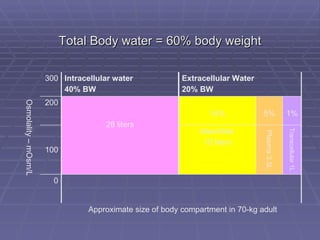
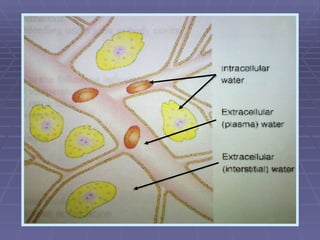
FLUIDS AND ELECTROLYTES BODY FLUIDS Refers to the body water in which electrolytes are dissolved Described as “a sea within” Water – is the largest single constituent of the body, representing 45% - 74% of the body weight, depending on age, gender and body fat
 
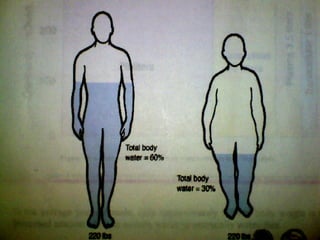
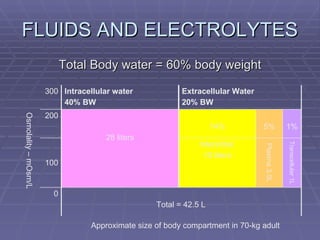
FLUIDS AND ELECTROLYTES In the newborn infant – almost ¾ of the body weight is water, with the greatest percentage found in extracellular compartment By adulthood the young male’s body water is only 60% and 2/3 of this is in the intracellular compartment In the average young female – only approximately 50% of body weight (due to increased amount of fat in women which is essentially water-free
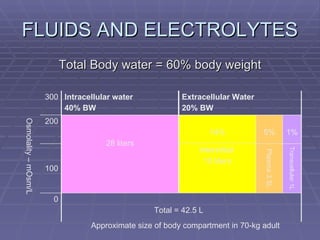
FLUIDS AND ELECTROLYTES Total Body water = 60% body weight Approximate size of body compartment in 70-kg adult Total = 42.5 L 0 100 200 300 1% 5% 14% 28 liters Transcellular 1L Plasma 3.5L Interstitial  10 liters Extracellular Water  20% BW Intracellular water 40% BW Osmolality – mOsm/L
 
FLUIDS AND ELECTROLYTES Functions of Body Fluids: Transport nutrients to the cells and carries waste products away from the cells Maintains blood volume Regulates body temperature Serves as aqueous medium for cellular metabolism Assists in digestion of food through hydrolysis Acts as solvents in which solutes are available for cell function Serves as medium for the excretion of waste products
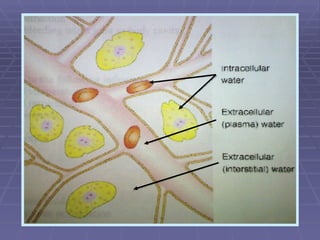
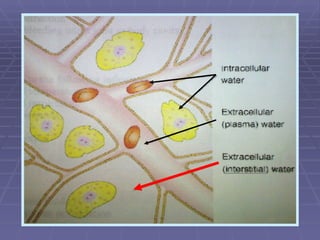
FLUIDS AND ELECTROLYTES Body Fluids are distributed in the body in 2 compartments: Intracellular (ICF)  – within the cell, approximately 2/3 of the body fluid; located primarily in the skeletal muscle mass, provides the aqueous medium for cellular function
2. Extracellular (ECF)  – outside the cell, maintains blood volume & serves as the transport system & from the cells a.  Interstitial fluid  – between the cells, fills spaces between most cells and comprises 15% of BW, e.g. lymph FLUIDS AND ELECTROLYTES
FLUIDS AND ELECTROLYTES 2. Extracellular (ECF)  – outside the cell, maintains blood volume & serves as the transport system & from the cells b.  Intravascular fluid  – in the blood vessels, the PLASMA (i.e. watery colorless fluid of lymph and blood in which RBC, WBC and platelets are suspended) comprises 5% of BW, approximately 3L of the average 6L of blood volume is made up of plasma and the remaining 3L is made up of other blood components
FLUIDS AND ELECTROLYTES 2. Extracellular (ECF)  – outside the cell, maintains blood volume & serves as the transport system & from the cells c.  Transcellular  – 1% to 3% of BW, the smallest division of the ECF compartment and contains approximately 1 – 2 L of fluid in any given time (e.g. CSF, pericardial, synovial, intraocular, pleural fluids, sweats, and digestive secretions
 
FLUIDS AND ELECTROLYTES Total Body water = 60% body weight Approximate size of body compartment in 70-kg adult Total = 42.5 L 0 100 200 300 1% 5% 14% 28 liters Transcellular 1L Plasma 3.5L Interstitial  10 liters Extracellular Water  20% BW Intracellular water 40% BW Osmolality – mOsm/L
FLUIDS AND ELECTROLYTES There is a  continuous exchange of fluid between the fluid compartment , of these spaces only the plasma is directly influenced by the intake or elimination of fluid from the body There is also the so called third space fluid shift or  “third spacing”  where there is a loss of ECF into a space that does not contribute to the equilibrium between ICF & ECF
FLUIDS AND ELECTROLYTES “ Third spacing”  occurs in: Ascites Burns Peritonitis Bowel obstruction Massive bleeding into body cavity or joints
FLUIDS AND ELECTROLYTES Pathophysiology: The decrease in urine output despite adequate fluid intake (due to fluid shifts out of the intravascular space) + kidneys receive less blood and compensate by decreasing the urine output
FLUIDS AND ELECTROLYTES Signs and Symptoms of Intravascular Fluid Volume Deficit are: Increased heart rate Decreased blood pressure Decreased CVP Edema Decreased BW Imbalances in fluid I & O
FLUIDS AND ELECTROLYTES Output of Fluid  – vary due to following: Increased temperature Increased respiration Draining wounds Ostomies Gastric suction
FLUIDS AND ELECTROLYTES Sources of water: Liquids Water-containing foods Metabolic activities or oxidation
FLUIDS AND ELECTROLYTES Elimination of Fluid: Sensible loss (measurable) Insensible (not measurable, e.g. skin, lungs, feces) INSENSIBLE  WATER LOSS ?
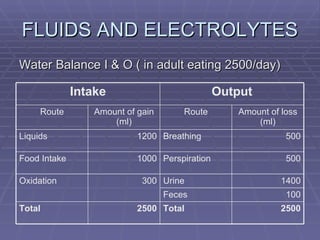
FLUIDS AND ELECTROLYTES Water Balance I & O ( in adult eating 2500/day) Output 100 Feces 2500 Total 2500 Total 1400 Urine 300 Oxidation 500 Perspiration 1000 Food Intake 500 Breathing 1200 Liquids Amount of loss (ml) Route Amount of gain (ml) Route Intake
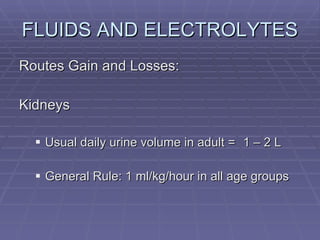
FLUIDS AND ELECTROLYTES Routes Gain and Losses: Kidneys Usual daily urine volume in adult =  1 – 2 L General Rule: 1 ml/kg/hour in all age groups
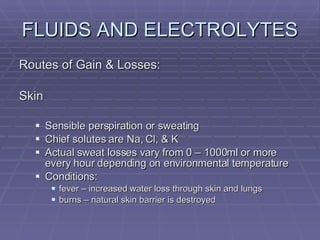
FLUIDS AND ELECTROLYTES Routes of Gain & Losses: Skin Sensible perspiration or sweating Chief solutes are Na, Cl, & K Actual sweat losses vary from 0 – 1000ml or more every hour depending on environmental temperature Conditions: fever – increased water loss through skin and lungs burns – natural skin barrier is destroyed
FLUIDS AND ELECTROLYTES Routes of Gain & Losses: Lungs Normally eliminate water vapor (insensible loss) Rate is at 300 – 400ml/day Loss is greater with increased respiratory rate or depth
FLUIDS AND ELECTROLYTES Routes of Gain & Losses: Gastrointestinal Tract Loss is at 100 – 200ml /day Because the bulk of fluid is reabsorbed in the small intestine diarrhea and fistulae are associated with large losses
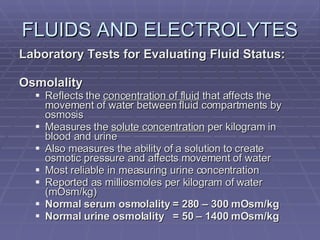
FLUIDS AND ELECTROLYTES Laboratory Tests for Evaluating Fluid Status: Osmolality Reflects the  concentration of fluid  that affects the movement of water between fluid compartments by osmosis Measures the  solute concentration  per kilogram in blood and urine Also measures the ability of a solution to create osmotic pressure and affects movement of water Most reliable in measuring urine concentration Reported as milliosmoles per kilogram of water (mOsm/kg) Normal serum osmolality = 280 – 300 mOsm/kg Normal urine osmolality  = 50 – 1400 mOsm/kg
FLUIDS AND ELECTROLYTES Laboratory Tests for Evaluating Fluid Status: Osmolarity Reflects the  concentration of the solutions Measured in milliosmoles per liter (mOsm/L)
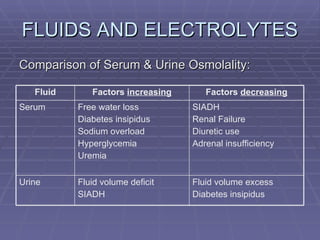
FLUIDS AND ELECTROLYTES Comparison of Serum & Urine Osmolality: Fluid volume excess Diabetes insipidus Fluid volume deficit SIADH Urine SIADH Renal Failure Diuretic use Adrenal insufficiency Free water loss Diabetes insipidus Sodium overload Hyperglycemia Uremia Serum Factors  decreasing Factors  increasing Fluid
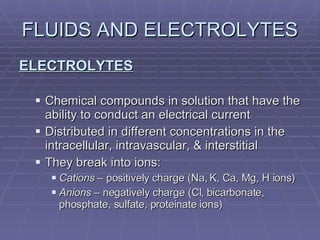
FLUIDS AND ELECTROLYTES ELECTROLYTES Chemical compounds in solution that have the ability to conduct an electrical current Distributed in different concentrations in the intracellular, intravascular, & interstitial They break into ions: Cations  – positively charge (Na, K, Ca, Mg, H ions) Anions  – negatively charge (Cl, bicarbonate, phosphate, sulfate, proteinate ions)
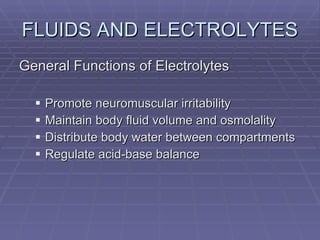
FLUIDS AND ELECTROLYTES General Functions of Electrolytes Promote neuromuscular irritability Maintain body fluid volume and osmolality Distribute body water between compartments Regulate acid-base balance
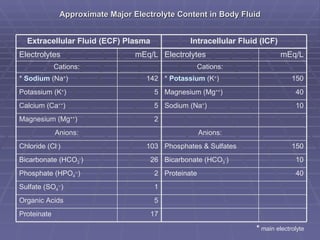
Approximate Major Electrolyte Content in Body Fluid *  main electrolyte Cations: Cations: 17 Proteinate 5 Organic Acids 1 Sulfate (SO 4 -- ) 40 Proteinate 2 Phosphate (HPO 4 -- ) 10 Bicarbonate (HCO 3 - ) 26 Bicarbonate (HCO 3 - ) 150 Phosphates & Sulfates 103 Chloride (Cl - ) Anions: Anions: 2 Magnesium (Mg ++ ) 10 Sodium (Na + ) 5 Calcium (Ca ++ ) 40 Magnesium (Mg ++ ) 5 Potassium (K + ) 150 *  Potassium  (K + ) 142 *  Sodium  (Na + ) mEq/L Electrolytes mEq/L Electrolytes Intracellular Fluid (ICF) Extracellular Fluid (ECF) Plasma
FLUIDS AND ELECTROLYTES The Electrolytes: Cations: Sodium Potassium Calcium Magnesium Anions: Chloride Bicarbonate Phosphate
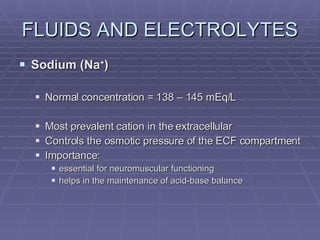
FLUIDS AND ELECTROLYTES Sodium (Na + ) Normal concentration = 138 – 145 mEq/L Most prevalent cation in the extracellular Controls the osmotic pressure of the ECF compartment Importance: essential for neuromuscular functioning helps in the maintenance of acid-base balance
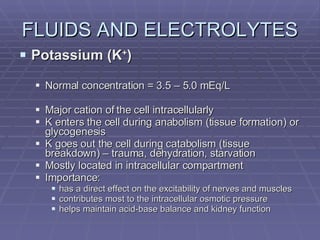
FLUIDS AND ELECTROLYTES Potassium (K + ) Normal concentration = 3.5 – 5.0 mEq/L Major cation of the cell intracellularly K enters the cell during anabolism (tissue formation) or glycogenesis K goes out the cell during catabolism (tissue breakdown) – trauma, dehydration, starvation Mostly located in intracellular compartment Importance: has a direct effect on the excitability of nerves and muscles contributes most to the intracellular osmotic pressure helps maintain acid-base balance and kidney function
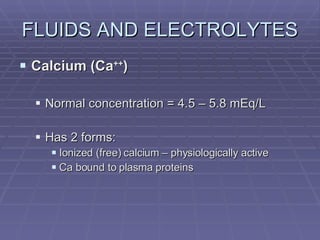
FLUIDS AND ELECTROLYTES Calcium (Ca ++ ) Normal concentration = 4.5 – 5.8 mEq/L Has 2 forms: Ionized (free) calcium – physiologically active Ca bound to plasma proteins
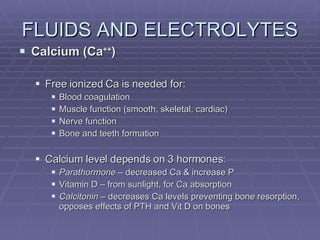
FLUIDS AND ELECTROLYTES Calcium (Ca ++ ) Free ionized Ca is needed for: Blood coagulation Muscle function (smooth, skeletal, cardiac) Nerve function Bone and teeth formation Calcium level depends on 3 hormones: Parathormone  – decreased Ca & increase P Vitamin D – from sunlight, for Ca absorption Calcitonin  – decreases Ca levels preventing bone resorption, opposes effects of PTH and Vit D on bones
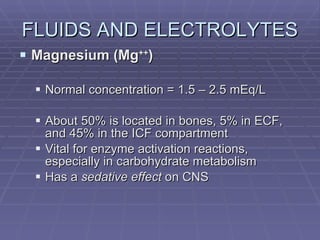
FLUIDS AND ELECTROLYTES Magnesium (Mg ++ ) Normal concentration = 1.5 – 2.5 mEq/L About 50% is located in bones, 5% in ECF, and 45% in the ICF compartment Vital for enzyme activation reactions, especially in carbohydrate metabolism Has a  sedative effect  on CNS
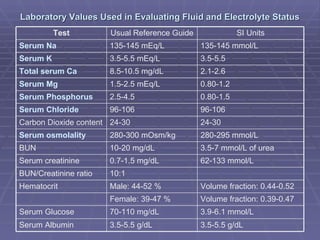
Laboratory Values Used in Evaluating Fluid and Electrolyte Status 3.5-5.5 g/dL 3.5-5.5 g/dL Serum Albumin 3.9-6.1 mmol/L 70-110 mg/dL Serum Glucose Volume fraction: 0.39-0.47 Female: 39-47 % Volume fraction: 0.44-0.52 Male: 44-52 % Hematocrit 10:1 BUN/Creatinine ratio 62-133 mmol/L 0.7-1.5 mg/dL Serum creatinine 3.5-7 mmol/L of urea 10-20 mg/dL BUN 280-295 mmol/L 280-300 mOsm/kg Serum osmolality 24-30 24-30 Carbon Dioxide content 96-106 96-106 Serum Chloride 0.80-1.5 2.5-4.5 Serum Phosphorus 0.80-1.2 1.5-2.5 mEq/L Serum Mg 2.1-2.6 8.5-10.5 mg/dL Total serum Ca 3.5-5.5 3.5-5.5 mEq/L Serum K 135-145 mmol/L 135-145 mEq/L Serum Na SI Units Usual Reference Guide Test
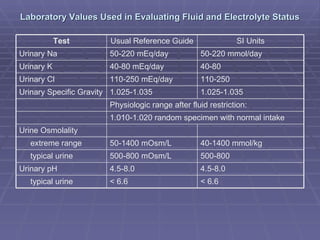
Laboratory Values Used in Evaluating Fluid and Electrolyte Status < 6.6 < 6.6 typical urine 4.5-8.0 4.5-8.0 Urinary pH 500-800 500-800 mOsm/L typical urine 40-1400 mmol/kg 50-1400 mOsm/L extreme range Urine Osmolality 1.010-1.020 random specimen with normal intake Physiologic range after fluid restriction: 1.025-1.035 1.025-1.035 Urinary Specific Gravity 110-250 110-250 mEq/day Urinary Cl 40-80 40-80 mEq/day Urinary K 50-220 mmol/day 50-220 mEq/day Urinary Na SI Units Usual Reference Guide Test
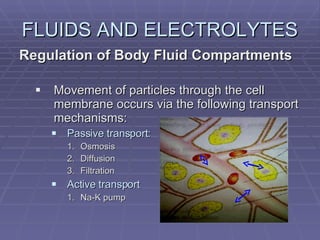
FLUIDS AND ELECTROLYTES Regulation of Body Fluid Compartments Movement of particles through the cell membrane occurs via the following transport mechanisms: Passive transport: Osmosis Diffusion Filtration Active transport Na-K pump
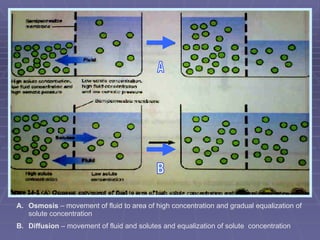
Osmosis  – movement of fluid to area of high concentration and gradual equalization of solute concentration Diffusion  – movement of fluid and solutes and equalization of solute  concentration A B
FLUIDS AND ELECTROLYTES OSMOSIS The movement of water through a semipermeable membrane from a solution that has a low concentration of particles towards a solution that has a high concentration of particles Normal serum osmolality = 280-300 mOsm/kg Osmolality of ECF and ICF is always equal
FLUIDS AND ELECTROLYTES DIFFUSION Is the natural tendency of substance to move from an area of higher concentration to one of lower concentration Occurs through the random movement of ions and molecules Particles will distribute themselves evenly Example: exchange of O 2  and CO 2  between pulmonary capillaries and alveoli
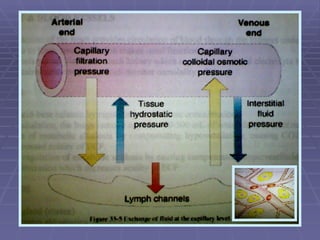
FLUIDS AND ELECTROLYTES FILTRATION The process by which water and diffusible substances move together in response to fluid pressure This process is active in capillary beds Example:  Passage of water and electrolytes from the arterial capillary bed to the interstitial fluid
 
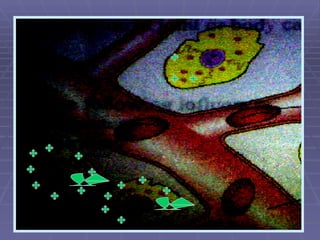
FLUIDS AND ELECTROLYTES ACTIVE TRANSPORT The movement of substances across the cell membrane by chemical activity or energy expenditure, that allows cells to admit larger molecules Example: sodium-potassium pump  – Na is pumped out of the cell, K is pumped in against pressure gradient
 
FLUIDS AND ELECTROLYTES Regulation of Body Fluids Homeostatic mechanism responsible for the balance of fluid and electrolytes within the body are: Kidneys Heart and Blood vessels Lungs Glands Other Mechanisms
FLUIDS AND ELECTROLYTES Regulation of Body Fluids Homeostatic mechanism responsible for the balance of fluid and electrolytes within the body are: Other mechanisms: Baroreceptors Renin-Angiotensin-Aldosterone System ADH and thirst Osmoreceptors Release of Atrial Natriuretic Peptide
Types of Fluid Balance And Imbalance
FLUIDS AND ELECTROLYTES Types of Fluid Balance and Imbalance: Saline ECF, reflects the volume of water and salt Water Osmolar proportion of water and salt (concentration)
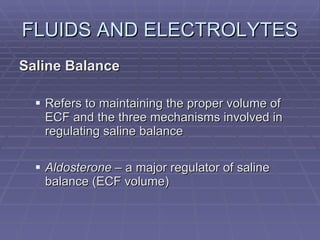
FLUIDS AND ELECTROLYTES Saline Balance Refers to maintaining the proper volume of ECF and the three mechanisms involved in regulating saline balance Aldosterone  – a major regulator of saline balance (ECF volume)
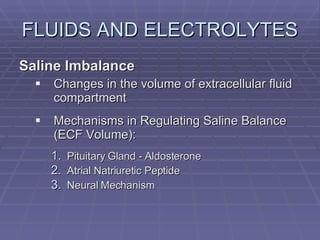
FLUIDS AND ELECTROLYTES Saline Imbalance Changes in the volume of extracellular fluid compartment Mechanisms in Regulating Saline Balance (ECF Volume): Pituitary Gland - Aldosterone Atrial Natriuretic Peptide Neural Mechanism
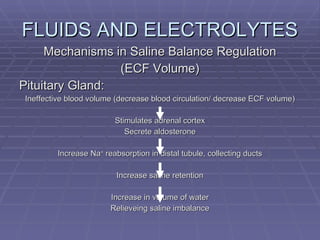
FLUIDS AND ELECTROLYTES Mechanisms in Saline Balance Regulation (ECF Volume) Pituitary Gland: Ineffective blood volume (decrease blood circulation/ decrease ECF volume) Stimulates adrenal cortex Secrete aldosterone Increase Na +  reabsorption in distal tubule, collecting ducts Increase saline retention Increase in volume of water Relieveing saline imbalance
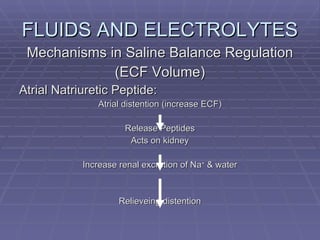
FLUIDS AND ELECTROLYTES Mechanisms in Saline Balance Regulation (ECF Volume) Atrial Natriuretic Peptide: Atrial distention (increase ECF) Release Peptides Acts on kidney Increase renal excretion of Na +  & water Relieveing distention
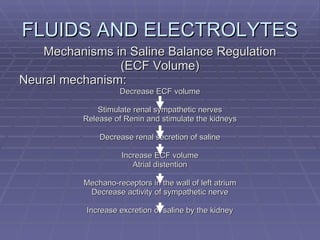
FLUIDS AND ELECTROLYTES Mechanisms in Saline Balance Regulation (ECF Volume) Neural mechanism: Decrease ECF volume Stimulate renal sympathetic nerves Release of Renin and stimulate the kidneys Decrease renal secretion of saline Increase ECF volume Atrial distention Mechano-receptors in the wall of left atrium Decrease activity of sympathetic nerve Increase excretion of saline by the kidney
FLUIDS AND ELECTROLYTES Saline Imbalance: Saline Deficit ECF volume deficit Isotonic contraction Isosmotic dehydration Hypovolemia Extracellular volume depletion
FLUIDS AND ELECTROLYTES Saline balance: Saline Deficit Causes: Vomiting Diarrhea Extreme diaphoresis Blood loss through hemorrhage Burns Bed rest Fistula drainage Salt wasting disorder Third-space fluid accumulation NGT suctioning Excessive diuretic use Intestinal decompression
FLUIDS AND ELECTROLYTES Saline balance: Saline Deficit Clinical Manifestations: - dehydration Weight loss Postural BP drop Increased small vein filling time Neck vein flat or collapsing with inspiration Dizziness, syncope Oliguria or anuria Decreased CVP Decreased skin turgor Longitudinal furrow in the tongue Dry mucous membrane Hard, dry stools Decreased tears and sweat Sunken eyeballs Hypovolemic shock
FLUIDS AND ELECTROLYTES Saline balance: Saline Deficit Laboratory Values: Urinalysis – increased Cl Blood studies – increased BUN, increased Hct, increased plasma protein, increased Na Medical Therapy: Saline replacement  through IV related to complication of medical therapy Dx – potential for injury related to complication
FLUIDS AND ELECTROLYTES Saline Imbalance: Saline Excess ECF volume excess Isotonic expansion Hypervolemia Circulatory overload
FLUIDS AND ELECTROLYTES Saline balance: Saline Excess Causes: Endocrine imbalance Hyperaldosteronism Cushing’s syndrome Glucocorticoid therapy Secondary to disease process Chronic renal failure CHF Cirrhosis Excess IV infusion of saline solutions (0.9% saline, Ringer’s)
FLUIDS AND ELECTROLYTES Saline balance: Saline Excess Clinical Manifestations: Weight gain (0.5kg/day) – sign of volume expansion Edema Vascular expansion Crackles or rales in lungs – fluid accumulation Dyspnea, orthopnea due to volume overload Increased CVP (5 – 10 cmH 2 0) – right atrium
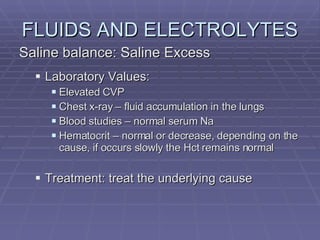
FLUIDS AND ELECTROLYTES Saline balance: Saline Excess Laboratory Values: Elevated CVP Chest x-ray – fluid accumulation in the lungs Blood studies – normal serum Na Hematocrit – normal or decrease, depending on the cause, if occurs slowly the Hct remains normal Treatment: treat the underlying cause
 
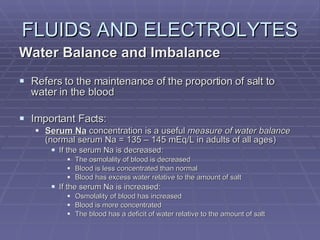
FLUIDS AND ELECTROLYTES Water Balance and Imbalance Refers to the maintenance of the proportion of salt to water in the blood Important Facts: Serum Na  concentration is a useful  measure of water balance  (normal serum Na = 135 – 145 mEq/L in adults of all ages) If the serum Na is decreased: The osmolality of blood is decreased Blood is less concentrated than normal Blood has excess water relative to the amount of salt If the serum Na is increased: Osmolality of blood has increased Blood is more concentrated The blood has a deficit of water relative to the amount of salt
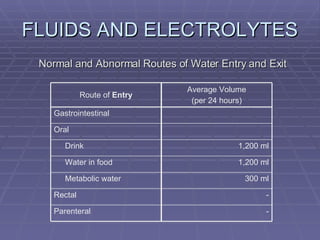
FLUIDS AND ELECTROLYTES Normal and Abnormal Routes of Water Entry and Exit - Parenteral - Rectal 300 ml Metabolic water 1,200 ml Water in food 1,200 ml Drink Oral Gastrointestinal Average Volume (per 24 hours) Route of  Entry
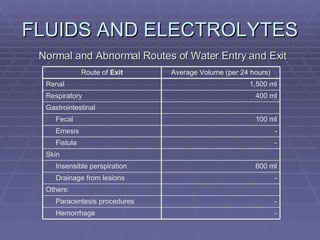
FLUIDS AND ELECTROLYTES Normal and Abnormal Routes of Water Entry and Exit - Hemorrhage - Paracentesis procedures Others: - Drainage from lesions 600 ml Insensible perspiration  Skin - Fistula - Emesis 100 ml Fecal Gastrointestinal 400 ml Respiratory 1,500 ml Renal Average Volume (per 24 hours) Route of  Exit
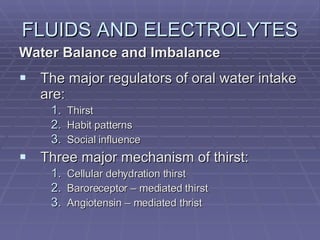
FLUIDS AND ELECTROLYTES Water Balance and Imbalance The major regulators of oral water intake are: Thirst Habit patterns Social influence Three major mechanism of thirst: Cellular dehydration thirst Baroreceptor – mediated thirst Angiotensin – mediated thrist
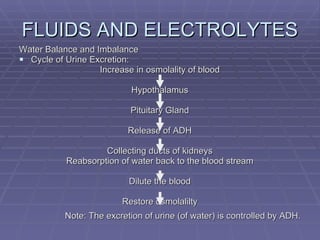
FLUIDS AND ELECTROLYTES Water Balance and Imbalance Cycle of Urine Excretion: Increase in osmolality of blood Hypothalamus Pituitary Gland Release of ADH Collecting ducts of kidneys Reabsorption of water back to the blood stream Dilute the blood Restore osmolalilty Note: The excretion of urine (of water) is controlled by ADH.
FLUIDS AND ELECTROLYTES TYPES OF WATER IMBALANCE WATER DEFICIT: Hypernatremia Water depletion Hypertonicity Hyperosmolar balance
FLUIDS AND ELECTROLYTES WATER DEFICIT Causes: 1. Loss of water relative to salt Renal Dibetes insipidus (salt gain due to polyuria) Osmotic diuresis (polyuria) Renal concentrating disorder Renal failure Other sources: Prolonged diarrhea without water replacement Excessive sweating without water replacement Dysfunctional humidifier of mechanical ventilators (dry air inhalation)
FLUIDS AND ELECTROLYTES WATER DEFICIT Causes: 2. Gain of salt relative to water Decrease water intake No access to water Prolonged nausea Difficulty swallowing fluid (Parkinson’s disease) Inability to respond to thirst Increase salt intake By means of tube feeding Half and half for ulcer diet Excess hypertonic NaCl or NaHCO 3
FLUIDS AND ELECTROLYTES WATER DEFICIT Clinical Manifestations: Serum Na is above normal (blood is concentrated) Thirst (due to lack of water) Oliguria Confusion Lethargy Mild muscle weakness Seizures Coma (varies in severity)
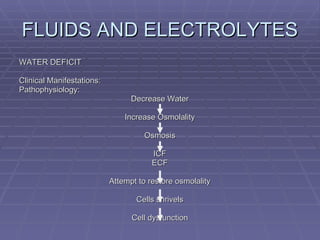
FLUIDS AND ELECTROLYTES WATER DEFICIT Clinical Manifestations: Pathophysiology: Decrease Water Increase Osmolality Osmosis ICF ECF Attempt to restore osmolality Cells shrivels Cell dysfunction
FLUIDS AND ELECTROLYTES WATER DEFICIT Laboratory Values: Urinalysis Increase in specific gravity of urine > 1.030 (normal urine sp.gr. = 1.010 – 1.030) Blood studies Increase serum Na Decrease serum protein Decrease Hct
FLUIDS AND ELECTROLYTES WATER DEFICIT Medical Therapy: Replacement of fluid loss by IVF or oral route Institute or encourage oral fluid intake Administer in small amount Help patient in taking his I & O measurement Complications: Cerebral edema (therapy too rapid) Rebound fluid excess (therapy excessive) Infection Infiltration Because of IV therapy
FLUIDS AND ELECTROLYTES TYPES OF WATER IMBALANCE WATER EXCESS: Hyponatremia (decrease serum Na - < 135mEq/L) Water intoxication Hypotonicity
FLUIDS AND ELECTROLYTES WATER EXCESS Causes: I. General etiology: Gain or water relative to salt A. Endocrine: Stimulation of ADH Stressors Post-surgical state Nausea Pain Ectopic production of ADH
FLUIDS AND ELECTROLYTES WATER EXCESS Causes: I.General etiology: Gain or water relative to salt B. Iatrogenic – caused by medical therapy Excessive tap water enema Excessive infusion of D5W Excessive use of ultrasonic nebulizer Hypotonic irrigating solution (by process of osmosis) Excessive water ingestion after poisoning Excessive water ingestion before an UTZ examination
FLUIDS AND ELECTROLYTES WATER EXCESS Causes: I. General etiology: Gain or water relative to salt A. Others Psychogenic polydipsia – excessive thrist Excessive beer drinking Near drowning in fresh water Overdose of Barbiturates
FLUIDS AND ELECTROLYTES WATER EXCESS Causes: II. General Etiology: Lost of salt related to water A. Renal Salt wasting renal disease Use of many types of diuretics (Thiazides)
FLUIDS AND ELECTROLYTES WATER EXCESS Causes: II. General Etiology: Lost of salt related to water B. Gastrointestinal – due to water replacement not by salt Nasogastric suction Vomiting Diarrhea Hypotonic irrigation solutions
FLUIDS AND ELECTROLYTES WATER EXCESS Causes: II. General Etiology: Lost of salt related to water C. Others Burns Excessive sweating
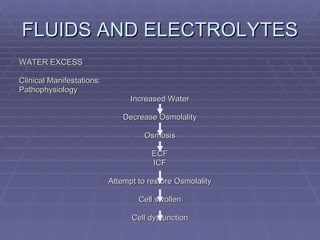
FLUIDS AND ELECTROLYTES WATER EXCESS Clinical Manifestations: Pathophysiology Increased Water Decrease Osmolality Osmosis ECF ICF Attempt to restore Osmolality Cell swollen Cell dysfunction
FLUIDS AND ELECTROLYTES WATER EXCESS Clinical Manifestations: Decrease serum Na Malaise Headache Confusion Lethargy Seizures Coma
FLUIDS AND ELECTROLYTES WATER EXCESS Medical Therapy/ Management: Restrict water intake below the daily insensible losses (1,000 ml) The kidney will excrete the excess water Administration of diuretic ( Furosemide ) Administration of ADH-blocking agent  Demeclocycline  or  LiCO 3 )
 
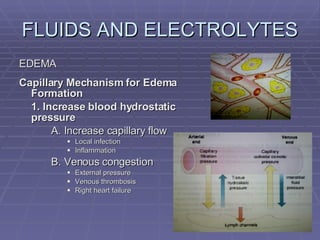
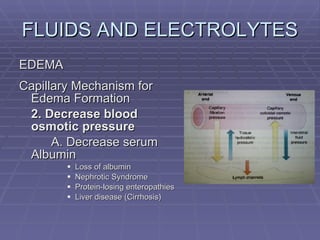
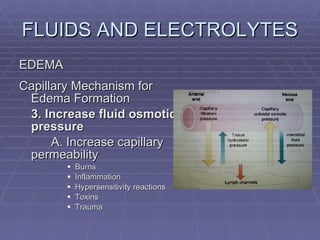
FLUIDS AND ELECTROLYTES EDEMA Fluid accumulation of the interstitial space Maybe a sign of saline excess Governed by the net result of the ff: Blood hydrostatic pressure Interstitial fluid hydrostatic pressure Blood colloid osmotic and oncotic pressure Interstitial fluid osmotic pressure
 
FLUIDS AND ELECTROLYTES EDEMA Capillary Mechanism for Edema Formation 1. Increase blood hydrostatic pressure A. Increase capillary flow Local infection Inflammation B. Venous congestion External pressure Venous thrombosis Right heart failure
FLUIDS AND ELECTROLYTES EDEMA Capillary Mechanism for Edema Formation 2. Decrease blood osmotic pressure A. Decrease serum Albumin Loss of albumin Nephrotic Syndrome Protein-losing enteropathies Liver disease (Cirrhosis)
FLUIDS AND ELECTROLYTES EDEMA Capillary Mechanism for Edema Formation 3. Increase fluid osmotic pressure A. Increase capillary permeability Burns Inflammation Hypersensitivity reactions Toxins Trauma
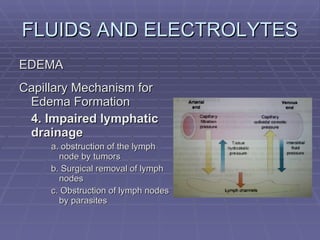
FLUIDS AND ELECTROLYTES EDEMA Capillary Mechanism for Edema Formation 4. Impaired lymphatic drainage a. obstruction of the lymph node by tumors b. Surgical removal of lymph nodes c. Obstruction of lymph nodes by parasites
FLUIDS AND ELECTROLYTES EDEMA Medical Therapy and Interventions: Use of elastic stockings to enhance venous return Administration of diuretics or a Na-restricted diet
ELECTROLYTE BALANCE AND ELECTROLYTE IMBALANCES
FLUIDS AND ELECTROLYTES ELECTROLYTE BALANCE AND IMBALANCES Electrolytes: Salts found in every body fluids K, Ca, PO 3 , Mg (major electrolytes) Enter the body primarily in the diet then enter the ECF and distributed to some other body electrolyte pool (bones/ inside cells)
FLUIDS AND ELECTROLYTES Electrolytes: Normal Routes of Exit: Urine Feces Sweat Abnormal Route: Fistula drainage Emesis Gastric or intestinal suction Paracentesis Exudates
FLUIDS AND ELECTROLYTES POTASSIUM BALANCE AND IMBALANCES Normal range = 3.5 – 5.0 mEq/L “ Kalium”  – Latin word for potassium Potassium Homeostasis: Enters the cells through an active transport mechanism Both insulin and epinephrine cause K to enter cells Exercise causes K to exit cells initially pH of ECF also affect the distribution
FLUIDS AND ELECTROLYTES POTASSIUM BALANCE AND IMBALANCES Normal range = 3.5 – 5.0 mEq/L “ Kalium”  – Latin word for potassium Factors that causes K shift A. Accumulation of carbonic acid May cause a mild ECF shift B. Accumulation of mineral acids Causes significant extracellular K shift C. Accumulation of organic acids Does not in itself cause a K shift
FLUIDS AND ELECTROLYTES HYPOKALEMIA Serum K < 3.5 mEq/L Causes: Decrease K intake Non-iatrogenic Anorexia Fad diets Fasting Iatrogenic NPO orders Prolonged IV therapy without K Entry of K into cells Increased K excretion K loss by abnormal route
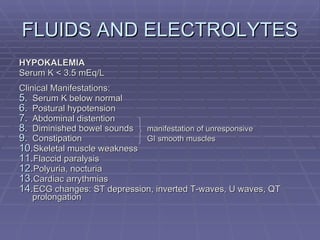
FLUIDS AND ELECTROLYTES HYPOKALEMIA Serum K < 3.5 mEq/L Clinical Manifestations: Serum K below normal Postural hypotension Abdominal distention Diminished bowel sounds manifestation of unresponsive Constipation GI smooth muscles Skeletal muscle weakness Flaccid paralysis Polyuria, nocturia Cardiac arrythmias ECG changes: ST depression, inverted T-waves, U waves, QT prolongation
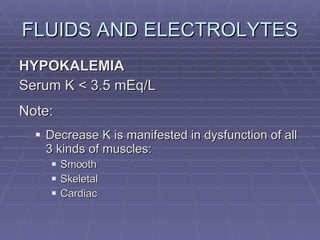
FLUIDS AND ELECTROLYTES HYPOKALEMIA Serum K < 3.5 mEq/L Note: Decrease K is manifested in dysfunction of all 3 kinds of muscles: Smooth Skeletal Cardiac
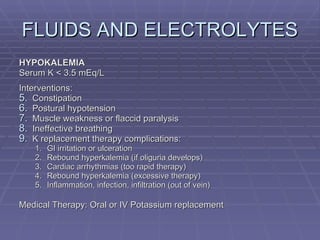
FLUIDS AND ELECTROLYTES HYPOKALEMIA Serum K < 3.5 mEq/L Interventions: Constipation Postural hypotension Muscle weakness or flaccid paralysis Ineffective breathing K replacement therapy complications: GI irritation or ulceration Rebound hyperkalemia (if oliguria develops) Cardiac arrhythmias (too rapid therapy) Rebound hyperkalemia (excessive therapy) Inflammation, infection, infiltration (out of vein) Medical Therapy: Oral or IV Potassium replacement
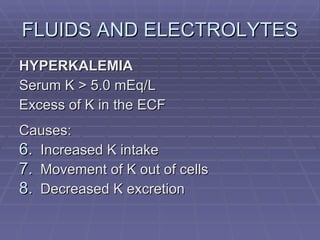
FLUIDS AND ELECTROLYTES HYPERKALEMIA Serum K > 5.0 mEq/L Excess of K in the ECF Causes: Increased K intake Movement of K out of cells Decreased K excretion
FLUIDS AND ELECTROLYTES HYPERKALEMIA Serum K > 5.0 mEq/L Clinical Manifestations: Serum K above normal Intestinal cramping Diarrhea Skeletal muscle weakness Flaccid paralysis Cardiac arrhythmias Cardiac arrest ECG changes: peaked narrow T-waves, shortened QT intervals, widened QRS, sine wave Laboratory values: acidosis
FLUIDS AND ELECTROLYTES HYPERKALEMIA Serum K > 5.0 mEq/L Interventions: Diarrhea Muscle weakness or flaccid paralysis Decrease ability to function Ineffective breathing Decreased cardiac output
FLUIDS AND ELECTROLYTES HYPERKALEMIA Serum K > 5.0 mEq/L Medical Therapy: To move K into cells (insulin, glucose, HCO 3  infusion) To counteract the cardiac effects of hyperkalemia (IV Ca gluconate) Remove K from the body (dialysis, diuretics, ion-exchange resins [Na polysterene sulfonate])
FLUIDS AND ELECTROLYTES HYPERKALEMIA Serum K > 5.0 mEq/L Complications of Medical Therapy: Hypoglycemia (insulin, glucose) Hypercalcemia (Ca gluconate) Metabolic alkalosis (IV HCO 3 ) Rebound hypokalemia (excessive therapy) Inflammation, infection, or infiltration (IV therapy) Aspiration pneumonitis (oral ion-exchange resin) Constipation (oral ion-exchange resin without sorbitol) Kayexalate – ion-exchange resin (Na polysterene sulfonate)
FLUIDS AND ELECTROLYTES CALCIUM BALANCE & IMBALANCES Facts: Calcium ions in the body are mostly located in the bones and teeth Small amount in cells of soft tissue Normal concentration = 4.5 – 5.5 mEq/L Calcium Homeostasis: Major source of calcium intake: Milk Dairy products (cheese, cream, yogurt, ice cream) Sea foods (clams) Calcium is absorbed from the GIT by active transport mechanism requiring Vitamin D Parathyroid hormone (PTH) increases activation of Vitamin D
FLUIDS AND ELECTROLYTES HYPOCALCEMIA Occurs if the serum Ca < 4.5 mEq/L or if the ionized portion of the serum Ca is diminished Ionized hypocalcemia: total serum Ca maybe normal but ionized Ca concentration will be < normal Causes: Decreased Calcium intake or absorption Decreased physiological availability of Calcium Increased Calcium excretion Calcium loss by abnormal route
FLUIDS AND ELECTROLYTES HYPOCALCEMIA Serum Ca < 4.5 mEq/L or if the ionized portion of the serum Ca is diminished Clinical Manifestations: Decreased serum Ca (or decreased ionized Ca & normal total Ca) Paresthesias (digital or perioral) – numbness or tingling sensation *Chvostek ’s sign – tapping the Facial N. in front of the ear cause the mouth to draws up in a grimace, due to increased neuromuscular irritability *Trousseau ’s sign – carpal spasm after occluding the arterial flow to the hand with sphygmomanometer for about 3 mins Grimacing, muscle twitching, cramping Hyperactive reflexes Carpal, pedal spasm Tetany – increased irritability Laryngospasm (sudden involuntary muscular contraction of larynx) Seizures Cardiac arrhythmias
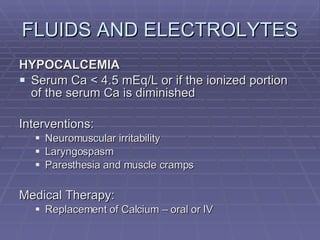
FLUIDS AND ELECTROLYTES HYPOCALCEMIA Serum Ca < 4.5 mEq/L or if the ionized portion of the serum Ca is diminished Interventions: Neuromuscular irritability Laryngospasm Paresthesia and muscle cramps Medical Therapy: Replacement of Calcium – oral or IV
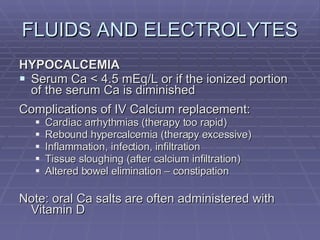
FLUIDS AND ELECTROLYTES HYPOCALCEMIA Serum Ca < 4.5 mEq/L or if the ionized portion of the serum Ca is diminished Complications of IV Calcium replacement: Cardiac arrhythmias (therapy too rapid) Rebound hypercalcemia (therapy excessive) Inflammation, infection, infiltration Tissue sloughing (after calcium infiltration) Altered bowel elimination – constipation Note: oral Ca salts are often administered with Vitamin D
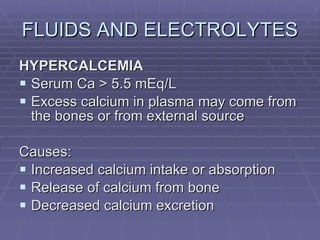
FLUIDS AND ELECTROLYTES HYPERCALCEMIA Serum Ca > 5.5 mEq/L Excess calcium in plasma may come from the bones or from external source Causes: Increased calcium intake or absorption Release of calcium from bone Decreased calcium excretion
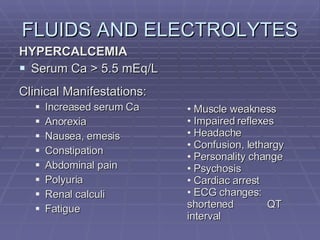
FLUIDS AND ELECTROLYTES HYPERCALCEMIA Serum Ca > 5.5 mEq/L Clinical Manifestations: Increased serum Ca Anorexia Nausea, emesis Constipation Abdominal pain Polyuria Renal calculi Fatigue Muscle weakness Impaired reflexes Headache Confusion, lethargy Personality change Psychosis Cardiac arrest ECG changes:  shortened  QT interval
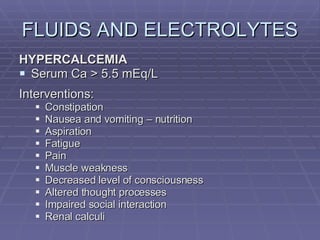
FLUIDS AND ELECTROLYTES HYPERCALCEMIA Serum Ca > 5.5 mEq/L Interventions: Constipation Nausea and vomiting – nutrition Aspiration Fatigue Pain Muscle weakness Decreased level of consciousness Altered thought processes Impaired social interaction Renal calculi
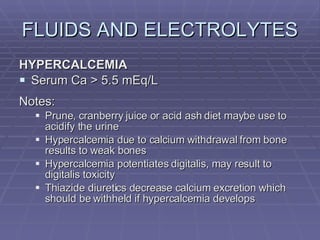
FLUIDS AND ELECTROLYTES HYPERCALCEMIA Serum Ca > 5.5 mEq/L Notes: Prune, cranberry juice or acid ash diet maybe use to acidify the urine Hypercalcemia due to calcium withdrawal from bone results to weak bones Hypercalcemia potentiates digitalis, may result to digitalis toxicity Thiazide diuretics decrease calcium excretion which should be withheld if hypercalcemia develops
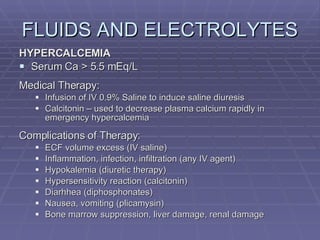
FLUIDS AND ELECTROLYTES HYPERCALCEMIA Serum Ca > 5.5 mEq/L Medical Therapy: Infusion of IV 0.9% Saline to induce saline diuresis Calcitonin – used to decrease plasma calcium rapidly in emergency hypercalcemia Complications of Therapy: ECF volume excess (IV saline) Inflammation, infection, infiltration (any IV agent) Hypokalemia (diuretic therapy) Hypersensitivity reaction (calcitonin) Diarhhea (diphosphonates) Nausea, vomiting (plicamysin) Bone marrow suppression, liver damage, renal damage
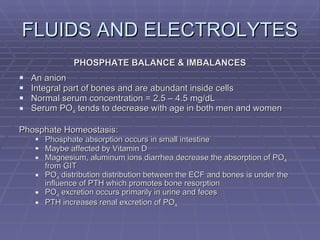
FLUIDS AND ELECTROLYTES PHOSPHATE BALANCE & IMBALANCES An anion Integral part of bones and are abundant inside cells Normal serum concentration = 2.5 – 4.5 mg/dL Serum PO 4  tends to decrease with age in both men and women Phosphate Homeostasis: Phosphate absorption occurs in small intestine Maybe affected by Vitamin D Magnesium, aluminum ions diarrhea decrease the absorption of PO 4  from GIT PO 4  distribution distribution between the ECF and bones is under the influence of PTH which promotes bone resorption PO 4  excretion occurs primarily in urine and feces PTH increases renal excretion of PO 4
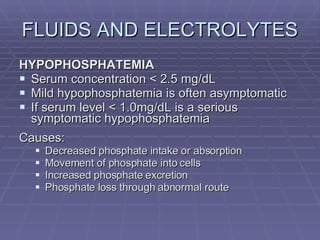
FLUIDS AND ELECTROLYTES HYPOPHOSPHATEMIA Serum concentration < 2.5 mg/dL Mild hypophosphatemia is often asymptomatic If serum level < 1.0mg/dL is a serious symptomatic hypophosphatemia Causes: Decreased phosphate intake or absorption Movement of phosphate into cells Increased phosphate excretion Phosphate loss through abnormal route
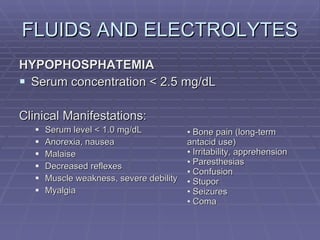
FLUIDS AND ELECTROLYTES HYPOPHOSPHATEMIA Serum concentration < 2.5 mg/dL Clinical Manifestations: Serum level < 1.0 mg/dL Anorexia, nausea Malaise Decreased reflexes Muscle weakness, severe debility Myalgia Bone pain (long-term antacid use) Irritability, apprehension Paresthesias Confusion Stupor Seizures Coma
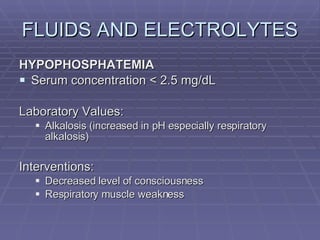
FLUIDS AND ELECTROLYTES HYPOPHOSPHATEMIA Serum concentration < 2.5 mg/dL Laboratory Values: Alkalosis (increased in pH especially respiratory alkalosis) Interventions: Decreased level of consciousness Respiratory muscle weakness
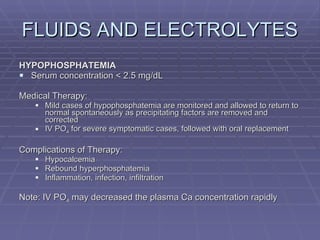
FLUIDS AND ELECTROLYTES HYPOPHOSPHATEMIA Serum concentration < 2.5 mg/dL Medical Therapy: Mild cases of hypophosphatemia are monitored and allowed to return to normal spontaneously as precipitating factors are removed and corrected IV PO 4  for severe symptomatic cases, followed with oral replacement Complications of Therapy: Hypocalcemia Rebound hyperphosphatemia Inflammation, infection, infiltration Note: IV PO 4  may decreased the plasma Ca concentration rapidly
FLUIDS AND ELECTROLYTES HYPERPHOSPHATEMIA Serum concentration > 4.5 mg/dL Major problem with excess phosphate in the blood is its interaction with calcium Causes: Increased phosphate intake Release of phosphate from cells Decreased phosphate excretion
FLUIDS AND ELECTROLYTES HYPERPHOSPHATEMIA Serum concentration > 4.5 mg/dL Clinical Manifestations: Serum Ca decrease as serum phosphate increases Increased neuromuscular excitability Conjunctivitis Band keratopathy Pruritus Acute renal failure Arthritis The serum calcium does not fall resulting to precipitation of CaPO 4  salts in soft tissues of the body
FLUIDS AND ELECTROLYTES HYPERPHOSPHATEMIA Serum concentration > 4.5 mg/dL Laboratory Values: Plasma calcium decreases Hyperkalemia Hypermagnesemia Metabolic acidosis Increase BUN Increase creatinine Interventions: CaPO 4  precipitation in urinary tract Pruritus
FLUIDS AND ELECTROLYTES HYPERPHOSPHATEMIA Serum concentration > 4.5 mg/dL Medical Therapy: Restrict dietary PO 4 Fluid administration to increase urinary PO 4  excretion PO 4  binder therapy – aluminum ions in antacids bind PO 4  in GI preventing its absorption, antacid to be taken during not after meals MgAl antacid not to be used in renal failure, Mg is contraindicated
FLUIDS AND ELECTROLYTES MAGNESIUM BALANCE & IMBALANCES Most of Mg ions in the body are located in the bones Rest of Mg is intracellular especially in the liver and skeletal muscles Small amount of Mg in the blood Normal Concentration = 1.5 – 2.5 mEq/L Foods high in Mg content: whole grain cereals, dark green vegetables, dried beans and peas, soy products, nuts (except cashew and almonds), peanut butter, cocoa, chocolate, bananas, egg yolk, sea salt
FLUIDS AND ELECTROLYTES HYPOMAGNESEMIA Serum Mg < 1.5 mEq/L Causes: Decreased Mg intake or absorption Decreased physiological availability of Mg Increased Mg excretion Mg loss by abnormal route
FLUIDS AND ELECTROLYTES HYPOMAGNESEMIA Serum Mg < 1.5 mEq/L Clinical Manifestations: Serum Mg < normal Insomnia Hyperreflexia Chvostek ’s sign Trosseau ’s sign Leg and foot cramps Grimacing Dysphagia Ataxia Nystagmus Tetany Seizures and decrease level of consciousness Cardiac arrhythmias ECG changes: ST & T wave abnormalities
FLUIDS AND ELECTROLYTES HYPOMAGNESEMIA Serum Mg < 1.5 mEq/L Laboratory Values: Abnormal plasma concentration of other electrolytes Hypokalemia Hypocalcemia Hypophosphatemia Hyponatremia Medical Therapy: Mg replacement (oral or IV) IV SO4 must be carefully administered Check for adequate renal function and patellar reflexes before Mg administration (decreased or diminished reflexes may need to recheck if may have elevated)
FLUIDS AND ELECTROLYTES HYPERMAGNESEMIA Serum Mg > 2.5 mEq/L Causes: Increased Mg intake or absorption Shift of Mg from bones to blood Decreased Mg excretion
FLUIDS AND ELECTROLYTES HYPERMAGNESEMIA Serum Mg > 2.5 mEq/L Clinical Manifestations: Decreased neuromuscular excitability Increased serum Mg Hypotension Flushing, diaphoresis Drowsiness, lethargy Diminished deep tendon reflexes Flaccid paralysis Respiratory depression Bradycardia Cardiac arrhythmias Cardiac arrest ECG changes
FLUIDS AND ELECTROLYTES HYPERMAGNESEMIA Serum Mg > 2.5 mEq/L Medical Therapy: Removal of excess Mg from plasma With normal renal function, administer large amount of fluid to increased renal Mg excretion In renal failure, hemodialysis maybe use In severe hypermagnesemia, calcium salts maybe administered IV to counteract the cardiotoxicity of excess extracellular Mg Complications: Hypercalcemia Tissue sloughing (infiltration) Digitalis toxicity
ACID – BASE BALANCE
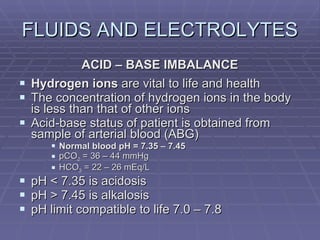
FLUIDS AND ELECTROLYTES ACID – BASE IMBALANCE Hydrogen ions  are vital to life and health The concentration of hydrogen ions in the body is less than that of other ions Acid-base status of patient is obtained from sample of arterial blood (ABG) Normal blood pH = 7.35 – 7.45 pCO 2  = 36 – 44 mmHg HCO 3  = 22 – 26 mEq/L pH < 7.35 is acidosis pH > 7.45 is alkalosis pH limit compatible to life 7.0 – 7.8
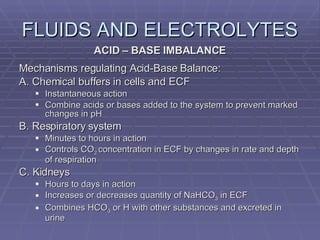
FLUIDS AND ELECTROLYTES ACID – BASE IMBALANCE Mechanisms regulating Acid-Base Balance: A. Chemical buffers in cells and ECF Instantaneous action Combine acids or bases added to the system to prevent marked changes in pH B. Respiratory system Minutes to hours in action Controls CO 2  concentration in ECF by changes in rate and depth of respiration C. Kidneys Hours to days in action Increases or decreases quantity of NaHCO 3  in ECF Combines HCO 3  or H with other substances and excreted in urine
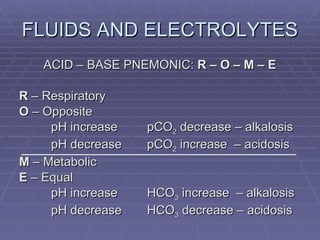
FLUIDS AND ELECTROLYTES ACID – BASE PNEMONIC:  R – O – M – E R  – Respiratory O  – Opposite pH increase  pCO 2  decrease – alkalosis pH decrease  pCO 2  increase  – acidosis M  – Metabolic E  – Equal pH increase  HCO 3  increase  – alkalosis pH decrease  HCO 3  decrease – acidosis
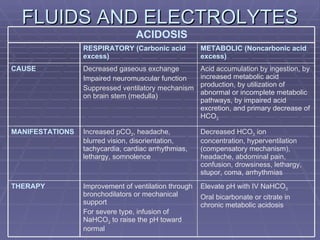
FLUIDS AND ELECTROLYTES Elevate pH with IV NaHCO 3 Oral bicarbonate or citrate in chronic metabolic acidosis Improvement of ventilation through bronchodilators or mechanical support For severe type, infusion of NaHCO 3  to raise the pH toward normal THERAPY Decreased HCO 3  ion concentration, hyperventilation (compensatory mechanism), headache, abdominal pain, confusion, drowsiness, lethargy, stupor, coma, arrhythmias Increased pCO 2 , headache, blurred vision, disorientation, tachycardia, cardiac arrhythmias, lethargy, somnolence MANIFESTATIONS Acid accumulation by ingestion, by increased metabolic acid production, by utilization of abnormal or incomplete metabolic pathways, by impaired acid excretion, and primary decrease of HCO 3   Decreased gaseous exchange Impaired neuromuscular function Suppressed ventilatory mechanism on brain stem (medulla) CAUSE METABOLIC (Noncarbonic acid excess) RESPIRATORY (Carbonic acid excess) ACIDOSIS
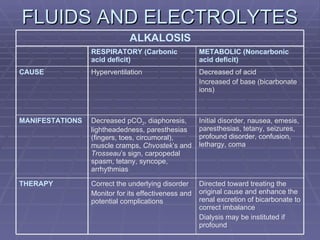
FLUIDS AND ELECTROLYTES Directed toward treating the original cause and enhance the renal excretion of bicarbonate to correct imbalance Dialysis may be instituted if profound Correct the underlying disorder Monitor for its effectiveness and potential complications THERAPY Initial disorder, nausea, emesis, paresthesias, tetany, seizures, profound disorder, confusion, lethargy, coma Decreased pCO 2 , diaphoresis, lightheadedness, paresthesias (fingers, toes, circumoral), muscle cramps,  Chvostek ’s and  Trosseau ’s sign, carpopedal spasm, tetany, syncope, arrhythmias MANIFESTATIONS Decreased of acid Increased of base (bicarbonate ions) Hyperventilation CAUSE METABOLIC (Noncarbonic acid deficit) RESPIRATORY (Carbonic acid deficit) ALKALOSIS
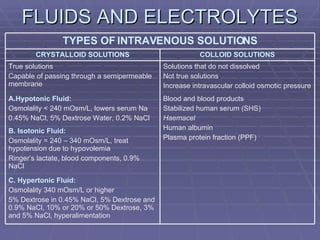
FLUIDS AND ELECTROLYTES B. Isotonic Fluid: Osmolality = 240 – 340 mOsm/L, treat hypotension due to hypovolemia Ringer’s lactate, blood components, 0.9% NaCl C. Hypertonic Fluid: Osmolality 340 mOsm/L or higher 5% Dextrose in 0.45% NaCl, 5% Dextrose and 0.9% NaCl, 10% or 20% or 50% Dextrose, 3% and 5% NaCl, hyperalimentation Blood and blood products Stabilized human serum (SHS) Haemacel Human albumin Plasma protein fraction (PPF) A.Hypotonic Fluid: Osmolality < 240 mOsm/L, lowers serum Na 0.45% NaCl, 5% Dextrose Water, 0.2% NaCl Solutions that do not dissolved Not true solutions Increase intravascular colloid osmotic pressure True solutions Capable of passing through a semipermeable membrane COLLOID SOLUTIONS CRYSTALLOID SOLUTIONS TYPES OF INTRAVENOUS SOLUTIONS
Osmosis. Erythrocytes undergo no change in size in Isotonic solutions (A). There is increase in size in Hypotonic solutions (B) and decrease in size [shrink/crenate] in Hypertonic solution (C).
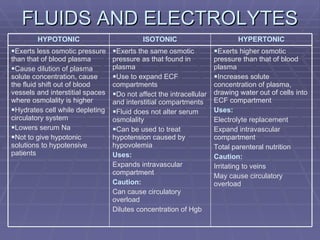
FLUIDS AND ELECTROLYTES Exerts higher osmotic pressure than that of blood plasma Increases solute concentration of plasma, drawing water out of cells into ECF compartment Uses: Electrolyte replacement Expand intravascular compartment Total parenteral nutrition Caution: Irritating to veins May cause circulatory overload Exerts the same osmotic pressure as that found in plasma Use to expand ECF compartments Do not affect the intracellular and interstitial compartments Fluid does not alter serum osmolality Can be used to treat hypotension caused by hypovolemia Uses: Expands intravascular compartment Caution: Can cause circulatory overload Dilutes concentration of Hgb Exerts less osmotic pressure than that of blood plasma Cause dilution of plasma solute concentration, cause the fluid shift out of blood vessels and interstitial spaces where osmolality is higher Hydrates cell while depleting circulatory system Lowers serum Na Not to give hypotonic solutions to hypotensive patients HYPERTONIC ISOTONIC HYPOTONIC
 
 
Thank You ! Dr. Ronald Sanchez -  Magbitang
BASIC INTRAVENOUS THERAPY TRAINING PROGRAM TOTAL PARENTERAL NUTRITION (TPN) Solutions Used in TPN
?
 
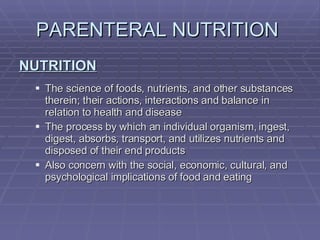
PARENTERAL NUTRITION  NUTRITION The science of foods, nutrients, and other substances therein; their actions, interactions and balance in relation to health and disease The process by which an individual organism, ingest, digest, absorbs, transport, and utilizes nutrients and disposed of their end products Also concern with the social, economic, cultural, and psychological implications of food and eating
 
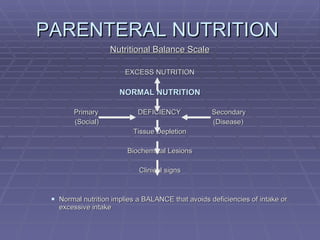
PARENTERAL NUTRITION  Nutritional Balance Scale EXCESS NUTRITION NORMAL NUTRITION Primary DEFICIENCY   Secondary   (Social)  (Disease) Tissue Depletion Biochemical Lesions Clinical signs Normal nutrition implies a BALANCE that avoids deficiencies of intake or excessive intake
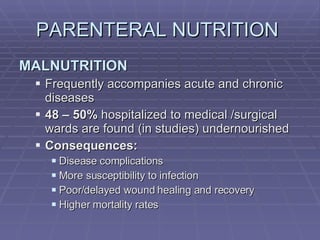
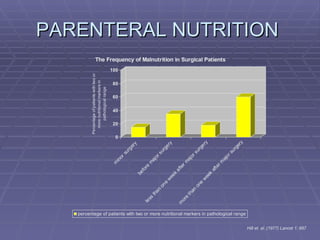
PARENTERAL NUTRITION  MALNUTRITION Frequently accompanies acute and chronic diseases 48 – 50%  hospitalized to medical /surgical wards are found (in studies) undernourished Consequences: Disease complications More susceptibility to infection Poor/delayed wound healing and recovery Higher mortality rates
PARENTERAL NUTRITION  Malnutrition in hospital is surprisingly common Up to 50% of patients admitted to medical and surgical wards are undernourished or become so during their stay They are more likely to suffer from complications, they are more susceptible to infection and they experience poor or delayed wound healing Their mortality rates are higher and their stays in hospital longer Mortality and morbidity are reduced when nutritional status is improved Intravenous nutrition has now become the accepted method for the prevention or correction of malnutrition in patients who cannot be provided with adequate nutrition by the gastrointestinal route
PARENTERAL NUTRITION  Intravenous nutrition  has now become the accepted method for the prevention or correction of malnutrition in patients who cannot be provided with adequate nutrition by the gastrointestinal route
PARENTERAL NUTRITION  Hill et. al. (1977) Lancet 1: 687
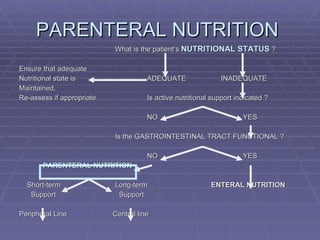
PARENTERAL NUTRITION  DIETARY ADVICE AND DECISION TO IMPROVE NUTRITIONAL SUPPORT “ IS THE GASTROINTESTINAL TRACT… FUNCTIONAL…?”
PARENTERAL NUTRITION  What is the patient’s  NUTRITIONAL STATUS  ? Ensure that adequate Nutritional state is   ADEQUATE   INADEQUATE Maintained. Re-assess if appropriate Is active nutritional support indicated ? NO   YES Is the GASTROINTESTINAL TRACT FUNCTIONAL ? NO YES   PARENTERAL NUTRITION Short-term Long-term ENTERAL NUTRITION Support   Support Peripheral Line   Central line
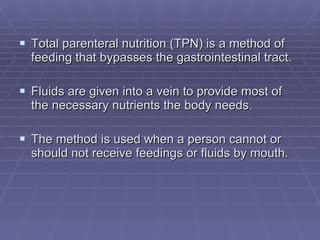
Total parenteral nutrition (TPN) is a method of feeding that bypasses the gastrointestinal tract. Fluids are given into a vein to provide most of the necessary nutrients the body needs.  The method is used when a person cannot or should not receive feedings or fluids by mouth.
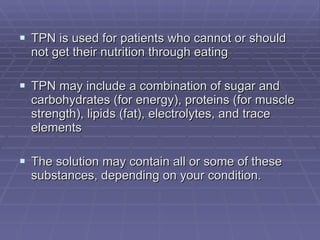
TPN is used for patients who cannot or should not get their nutrition through eating TPN may include a combination of sugar and carbohydrates (for energy), proteins (for muscle strength), lipids (fat), electrolytes, and trace elements The solution may contain all or some of these substances, depending on your condition.
Even though TPN often includes lipids, it will not make you fat Everyone needs calories, protein, and fat, in addition to other substances, to stay healthy Electrolytes include sodium, potassium, chloride, phosphate, calcium, and magnesium Trace elements include zinc, copper, manganese, and chromium Electrolytes are important for maintaining almost every organ in your body They help your heart, muscles, and nerves to work properly and keep you from becoming dehydrated.
Total parenteral nutrition (TPN) is sometimes called central parenteral nutrition (CPN) or &quot;hyperal&quot; (hyperalimentation). The term  &quot;hyperalimentation&quot;  is a misnomer because it incorrectly implies that nutrients are supplied in excess of needs.
PARENTERAL NUTRITION  NUTRITIONAL THERAPY Objectives: To prevent or treat malnutrition Control diet related manifestation or disease Delay progression of chronic disease Provide support for other medical or surgical treatment
PARENTERAL NUTRITION  NUTRITIONAL THERAPY Guiding Principles to Sound Diet Therapy: Nutrition-related problem must be present Diet therapy must be based on solid scientific rationale Patient must be able and willing to eat and have a functional gastrointestinal system Patient must adhere to the diet
PARENTERAL NUTRITION  NUTRITIONAL THERAPY Decision Process for Using PARENTERAL OR ENTERAL NUTRITION: Knowledge of the potential benefits and risks of nutritional support The ability to communicate the benefits and risks to the patient and family Awareness of legal requirements pertinent to the issue
PARENTERAL NUTRITION  NUTRITIONAL THERAPY Risk and Benefits of Nutrition Support: The body’s need for continued existence must be met by EXOGENOUS foodstuffs or tissue catabolism Adequate nutrient supply is necessary to avoid catabolism, BUT nutrient excess can be expensive and toxic, causing hypermetabolism, fatty liver, uremia, and encephalopathy
PARENTERAL NUTRITION  NUTRITIONAL THERAPY Planning Diet Therapy: Assessment Prescription Care Plan
PARENTERAL NUTRITION  FUNDAMENTALS OF NUTRITIONAL THERAPY: Clinical history Dietary history Physical examination findings Anthropometric measurements Muscle function test Biochemical data Immunological test
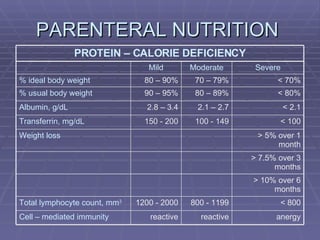
PARENTERAL NUTRITION  < 70% 70 – 79% 80 – 90% % ideal body weight anergy reactive reactive Cell – mediated immunity < 800 800 - 1199 1200 - 2000 Total lymphocyte count, mm 3 > 10% over 6 months > 7.5% over 3 months > 5% over 1 month Weight loss < 100 100 - 149 150 - 200 Transferrin, mg/dL < 2.1 2.1 – 2.7 2.8 – 3.4 Albumin, g/dL < 80% 80 – 89% 90 – 95% % usual body weight Severe Moderate Mild PROTEIN – CALORIE DEFICIENCY
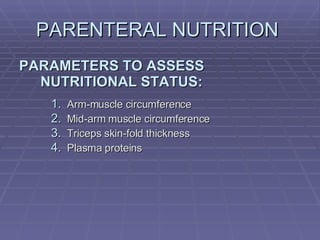
PARENTERAL NUTRITION  PARAMETERS TO ASSESS NUTRITIONAL STATUS: Arm-muscle circumference Mid-arm muscle circumference Triceps skin-fold thickness Plasma proteins
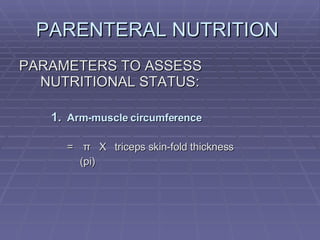
PARENTERAL NUTRITION  PARAMETERS TO ASSESS NUTRITIONAL STATUS: Arm-muscle circumference =  π   X  triceps skin-fold thickness (pi)
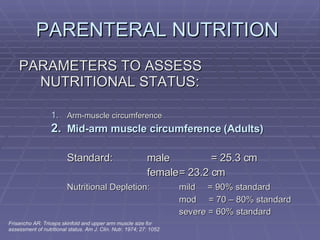
PARENTERAL NUTRITION  PARAMETERS TO ASSESS NUTRITIONAL STATUS: Arm-muscle circumference Mid-arm muscle circumference (Adults) Standard: male  = 25.3 cm female = 23.2 cm Nutritional Depletion: mild  = 90% standard mod  = 70 – 80% standard severe = 60% standard Frisancho AR. Triceps skinfold and upper arm muscle size for assessment of nutritional status. Am J. Clin. Nutr. 1974; 27: 1052
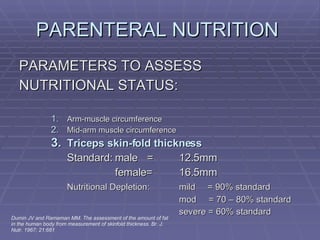
PARENTERAL NUTRITION  PARAMETERS TO ASSESS NUTRITIONAL STATUS: Arm-muscle circumference Mid-arm muscle circumference Triceps skin-fold thickness Standard: male = 12.5mm female= 16.5mm Nutritional Depletion: mild  = 90% standard mod  = 70 – 80% standard severe = 60% standard Dumin JV and Ramaman MM. The assessment of the amount of fat in the human body from measurement of skinfold thickness. Br. J. Nutr. 1967; 21:681
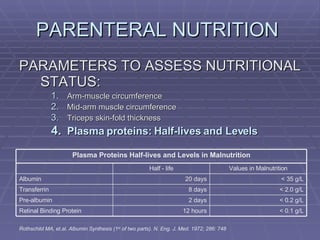
PARENTERAL NUTRITION  PARAMETERS TO ASSESS NUTRITIONAL STATUS: Arm-muscle circumference Mid-arm muscle circumference Triceps skin-fold thickness Plasma proteins: Half-lives and Levels Rothschild MA, et.al. Albumin Synthesis (1 st  of two parts). N. Eng. J. Med. 1972; 286: 748 < 0.1 g/L 12 hours Retinal Binding Protein < 0.2 g/L 2 days Pre-albumin < 2.0 g/L 8 days Transferrin < 35 g/L 20 days Albumin Values in Malnutrition Half - life Plasma Proteins Half-lives and Levels in Malnutrition
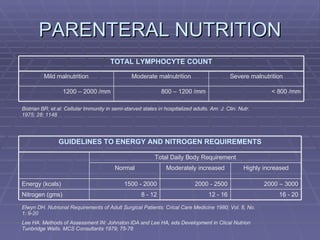
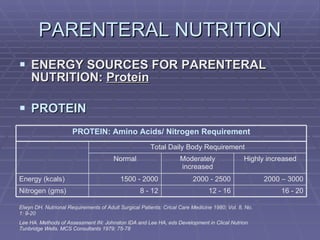
PARENTERAL NUTRITION Bistrian BR, et.al. Cellular Immunity in semi-starved states in hospitalized adults. Am. J. Clin. Nutr. 1975; 28: 1148 Elwyn DH. Nutrional Requirements of Adult Surgical Patients: Crical Care Medicine 1980; Vol. 8, No. 1: 9-20 Lee HA. Methods of Assessment IN: Johnston IDA and Lee HA, eds Development in Clical Nutrion Tunbridge Wells. MCS Consultants 1979; 75-78 800 – 1200 /mm Moderate malnutrition < 800 /mm 1200 – 2000 /mm Severe malnutrition Mild malnutrition TOTAL LYMPHOCYTE COUNT 16 - 20 12 - 16 8 - 12 Nitrogen (gms) 2000 – 3000 2000 - 2500 1500 - 2000 Energy (kcals) Highly increased Moderately increased Normal Total Daily Body Requirement GUIDELINES TO ENERGY AND NITROGEN REQUIREMENTS
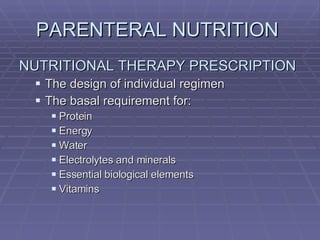
PARENTERAL NUTRITION  NUTRITIONAL THERAPY PRESCRIPTION The design of individual regimen The basal requirement for: Protein Energy Water Electrolytes and minerals Essential biological elements Vitamins
PARENTERAL NUTRITION  THE DESIGN OF INDIVIDUAL REGIMEN BODY WEIGHT Usual Body Weight (UBW) Ideal or Desirable Body Weight (IBW / DBW)
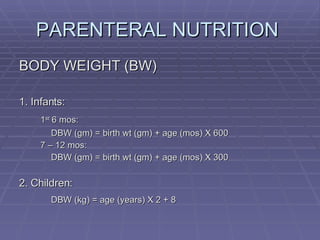
PARENTERAL NUTRITION  BODY WEIGHT (BW) 1. Infants: 1 st  6 mos: DBW (gm) = birth wt (gm) + age (mos) X 600 7 – 12 mos: DBW (gm) = birth wt (gm) + age (mos) X 300 2. Children: DBW (kg) = age (years) X 2 + 8
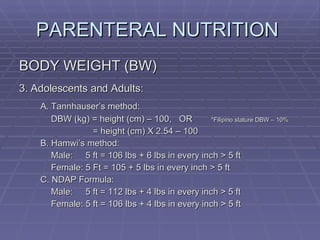
PARENTERAL NUTRITION  BODY WEIGHT (BW) 3. Adolescents and Adults: A. Tannhauser’s method: DBW (kg) = height (cm) – 100,  OR *Filipino stature DBW – 10%    = height (cm) X 2.54 – 100 B. Hamwi’s method: Male:   5 ft = 106 lbs + 6 lbs in every inch > 5 ft Female: 5 Ft = 105 + 5 lbs in every inch > 5 ft C. NDAP Formula: Male:  5 ft = 112 lbs + 4 lbs in every inch > 5 ft Female: 5 ft = 106 lbs + 4 lbs in every inch > 5 ft
PARENTERAL NUTRITION  BODY WEIGHT (BW) Adjusted Weight   =  IBW + (Actual body wt – IBW) X 0.25 The following  Prescription Plan  will be derived from the estimated BW: Basal Energy Expenditure (BEE) Total Energy Expenditure (TEE)/ Total Caloric Requirement (TER) Energy Sources Requirements Water / Fluid Requirements or Replacements AND … Basal Daily Requirement of Micronutrients, Vitamins, Minerals
PARENTERAL NUTRITION  BASAL ENERGY EXPENDITURE (BEE) Harris – Benedict Equation: Male:   66 + (13.7 x weight, kg) + (5 x height, cm) – 6.8 x age Female: 635 + (9.6 x weight, kg) + (1.85 x height, cm) – 4.7 x age TOTAL ENERGY EXPENDITURE (TEE) = BEE x  activity factor  x  stress factor TOTAL ENERGY REQUIREMENT (TER) or TOTAL CALORIC REQUIREMENT/day   = DBW x  activity factor   (kcals  / kgDBW / day)
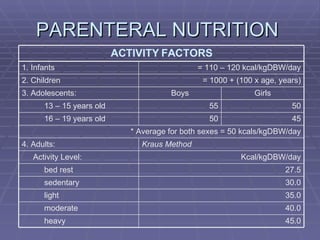
PARENTERAL NUTRITION  = 110 – 120 kcal/kgDBW/day 1. Infants 45.0 heavy 40.0 moderate 35.0 light 30.0 sedentary 27.5 bed rest Kcal/kgDBW/day Activity Level: Kraus Method 4. Adults: * Average for both sexes = 50 kcals/kgDBW/day 45 50 16 – 19 years old 50 55 13 – 15 years old Girls Boys 3. Adolescents: = 1000 + (100 x age, years) 2. Children ACTIVITY FACTORS
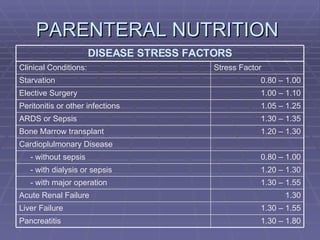
PARENTERAL NUTRITION  1.30 – 1.80 Pancreatitis 1.30 – 1.55 Liver Failure 1.30 Acute Renal Failure 1.30 – 1.55 - with major operation 1.20 – 1.30 - with dialysis or sepsis 0.80 – 1.00 - without sepsis Cardioplulmonary Disease 1.20 – 1.30 Bone Marrow transplant 1.30 – 1.35 ARDS or Sepsis 1.05 – 1.25 Peritonitis or other infections 1.00 – 1.10 Elective Surgery 0.80 – 1.00 Starvation Stress Factor Clinical Conditions: DISEASE STRESS FACTORS
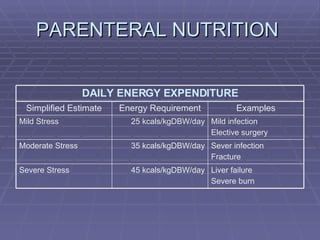
PARENTERAL NUTRITION  Liver failure Severe burn 45 kcals/kgDBW/day Severe Stress Sever infection Fracture 35 kcals/kgDBW/day Moderate Stress Mild infection Elective surgery 25 kcals/kgDBW/day Mild Stress Examples Energy Requirement Simplified Estimate DAILY ENERGY EXPENDITURE
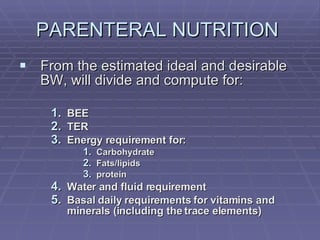
PARENTERAL NUTRITION  From the estimated ideal and desirable BW, will divide and compute for: BEE TER Energy requirement for: Carbohydrate Fats/lipids protein Water and fluid requirement Basal daily requirements for vitamins and minerals (including the trace elements)
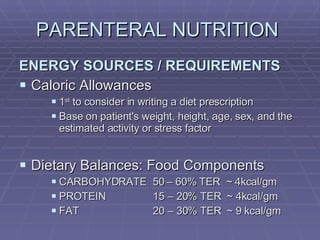
PARENTERAL NUTRITION  ENERGY SOURCES / REQUIREMENTS Caloric Allowances 1 st  to consider in writing a diet prescription Base on patient's weight, height, age, sex, and the estimated activity or stress factor Dietary Balances: Food Components CARBOHYDRATE  50 – 60% TER  ~ 4kcal/gm PROTEIN   15 – 20% TER  ~ 4kcal/gm FAT   20 – 30% TER  ~ 9 kcal/gm
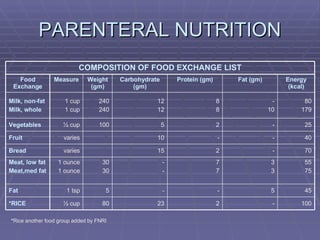
PARENTERAL NUTRITION THE FOOD EXCHANGE SYSTEM: Grouped together different foods but containing the same amount of carbohydrates, proteins, and fat Consist of 6 food groups ( by the American  Dietetic Association, ADA, and US Public Health Service), or 7 food groups (by the Food and Nutrition Research Institute, FNRI)
PARENTERAL NUTRITION * Rice another food group added by FNRI 100 - 2 23 80 ½ cup *RICE 45 5 - - 5 1 tsp Fat 55 75 3 3 7 7 - - 30 30 1 ounce 1 ounce Meat, low fat Meat,med fat 70 - 2 15 varies Bread 40 - - 10 varies Fruit 25 - 2 5 100 ½ cup Vegetables 80 179 - 10 8 8 12 12 240 240 1 cup 1 cup Milk, non-fat Milk, whole Energy (kcal) Fat (gm) Protein (gm) Carbohydrate (gm) Weight (gm) Measure Food Exchange COMPOSITION OF FOOD EXCHANGE LIST
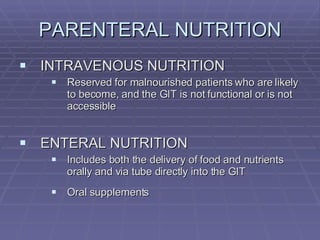
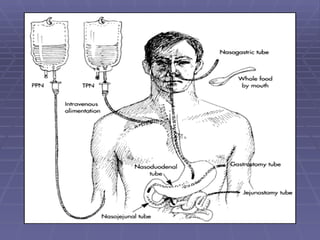
PARENTERAL NUTRITION INTRAVENOUS NUTRITION Reserved for malnourished patients who are likely to become, and the GIT is not functional or is not accessible ENTERAL NUTRITION Includes both the delivery of food and nutrients orally and via tube directly into the GIT Oral supplements
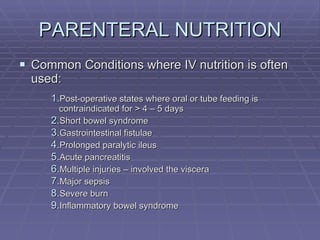
PARENTERAL NUTRITION Common Conditions where IV nutrition is often used: Post-operative states where oral or tube feeding is contraindicated for > 4 – 5 days Short bowel syndrome Gastrointestinal fistulae Prolonged paralytic ileus Acute pancreatitis Multiple injuries – involved the viscera Major sepsis Severe burn Inflammatory bowel syndrome
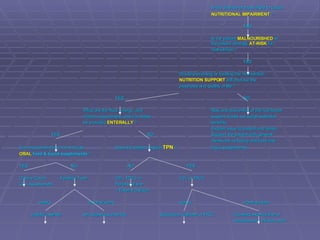
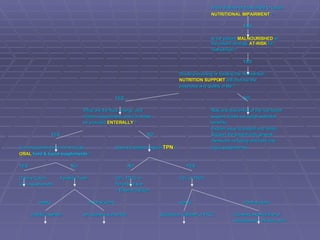
Is the disease process likely to cause   NUTRITIONAL IMPAIRMENT  ? YES Is the patient  MALNOURISHED  or  the patient strongly  AT-RISK  for malnutrition ? YES Would preventing or treating the malnutrition NUTRITION SUPPORT  will improve the prognosis and quality of life ? YES NO What are the fluid, energy, and Risk and discomfort of the nutritional vitamin requirement; and can these support would out-weigh potential be provided  ENTERALLY  ? benefits. Explain issue to patient and family. YES NO Support the patient with general measures including oral food and Can requirements be met through Does the patient require  TPN  ? liquid supplements. ORAL  food & liquid supplements  ? YES   NO     NO   YES Calorie Count  Feeding Tube CVL, PICC or CVL or PICC Clin. Assessment  Peripheral line + Enteral nutrition   weeks    months/years weeks months/years nasally inserted percutaneous inserted   Subclavian catheter or PICC  Tunneled external line or   subcutaneous infusion port
PARENTERAL NUTRITION ENERGY SOURCES FOR PARENTERAL NUTRITION:  Protein PROTEIN Elwyn DH. Nutrional Requirements of Adult Surgical Patients: Crical Care Medicine 1980; Vol. 8, No. 1: 9-20 Lee HA. Methods of Assessment IN: Johnston IDA and Lee HA, eds Development in Clical Nutrion Tunbridge Wells. MCS Consultants 1979; 75-78 16 - 20 12 - 16 8 - 12 Nitrogen (gms) 2000 – 3000 2000 - 2500 1500 - 2000 Energy (kcals) Highly increased Moderately increased Normal Total Daily Body Requirement PROTEIN: Amino Acids/ Nitrogen Requirement
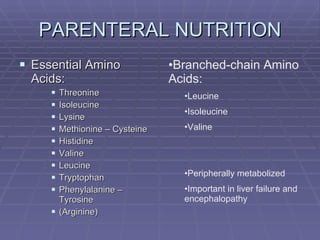
PARENTERAL NUTRITION Essential Amino Acids: Threonine Isoleucine Lysine Methionine – Cysteine Histidine Valine Leucine Tryptophan Phenylalanine – Tyrosine (Arginine) Branched-chain Amino Acids: Leucine Isoleucine Valine Peripherally metabolized Important in liver failure and encephalopathy
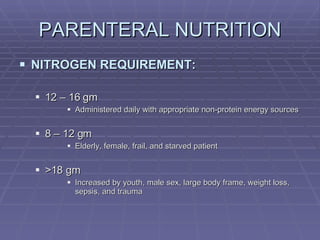
PARENTERAL NUTRITION NITROGEN REQUIREMENT: 12 – 16 gm Administered daily with appropriate non-protein energy sources 8 – 12 gm Elderly, female, frail, and starved patient >18 gm Increased by youth, male sex, large body frame, weight loss, sepsis, and trauma
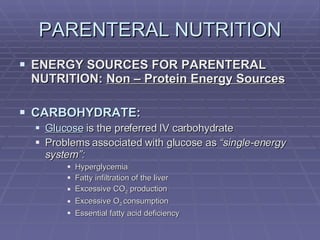
PARENTERAL NUTRITION ENERGY SOURCES FOR PARENTERAL NUTRITION:  Non – Protein Energy Sources CARBOHYDRATE: Glucose  is the preferred IV carbohydrate Problems associated with glucose as  “single-energy system”: Hyperglycemia Fatty infiltration of the liver Excessive CO 2  production Excessive O 2  consumption Essential fatty acid deficiency
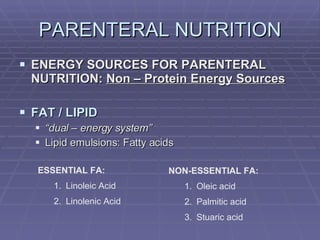
PARENTERAL NUTRITION ENERGY SOURCES FOR PARENTERAL NUTRITION:  Non – Protein Energy Sources FAT / LIPID “ dual – energy system” Lipid emulsions: Fatty acids ESSENTIAL FA: Linoleic Acid Linolenic Acid NON-ESSENTIAL FA: Oleic acid Palmitic acid Stuaric acid
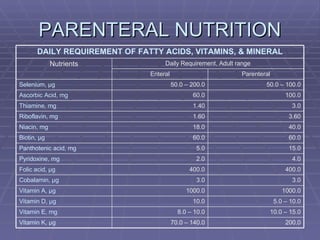
PARENTERAL NUTRITION 20.0 – 120.0 150.0 – 300.0 Molybdenum,  μ g 15.0 – 30.0 50.0 – 200.0 Chromium,  μ g 2.0 – 5.0 2.0 – 5.0 Manganese, mg 0.15 0.15 Iodine, mg 0.3 – 0.5 2.0 – 3.0 Copper, mg 3.0 – 12.0 15.0 Zinc, mg 1.0 – 2.0 10 Iron, mg 0.3 0.3 Magnesium, gm 3.0 – 4.0 2.0 – 3.0 Chloride, gm 1.0 – 3.0 1.0 – 3.0 Sodium, gm 3.0 – 4.0 2.0 – 5.0 Potassium, gm 0.4 – 0.8 0.8 – 1.2 Phosphorus, gm 0.2 – 0.4 0.8 – 1.2 Calcium, gm 2.0 – 4.0 1.0 – 2.0 Essential fatty acids, % kcal Parenteral Enteral Daily Requirement, Adult range Nutrients DAILY REQUIREMENT OF FATTY ACIDS, VITAMINS, & MINERAL
PARENTERAL NUTRITION 200.0 70.0 – 140.0 Vitamin K,  μ g  10.0 – 15.0 8.0 – 10.0 Vitamin E, mg 5.0 – 10.0 10.0 Vitamin D,  μ g 1000.0 1000.0 Vitamin A,  μ g 3.0 3.0 Cobalamin,  μ g 400.0 400.0 Folic acid,  μ g 4.0 2.0 Pyridoxine, mg 15.0 5.0 Panthotenic acid, mg 60.0 60.0 Biotin,  μ g 40.0 18.0 Niacin, mg 3.60 1.60 Riboflavin, mg 3.0 1.40 Thiamine, mg 100.0 60.0 Ascorbic Acid, mg 50.0 – 100.0 50.0 – 200.0 Selenium,  μ g Parenteral Enteral Daily Requirement, Adult range Nutrients DAILY REQUIREMENT OF FATTY ACIDS, VITAMINS, & MINERAL
?
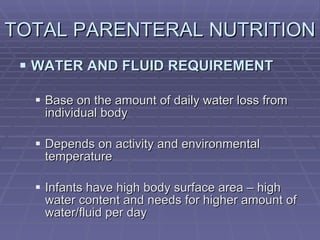
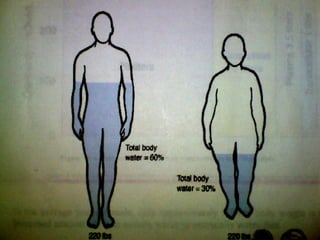
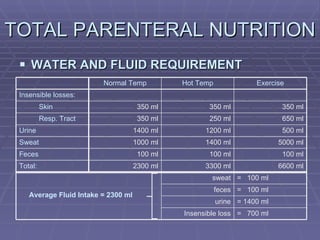
TOTAL PARENTERAL NUTRITION  WATER AND FLUID REQUIREMENT Base on the amount of daily water loss from individual body Depends on activity and environmental temperature Infants have high body surface area – high water content and needs for higher amount of water/fluid per day
 
Total Body water = 60% body weight Approximate size of body compartment in 70-kg adult 0 100 200 300 1% 5% 14% 28 liters Transcellular 1L Plasma 3.5L Interstitial  10 liters Extracellular Water  20% BW Intracellular water 40% BW Osmolality – mOsm/L
TOTAL PARENTERAL NUTRITION  WATER AND FLUID REQUIREMENT =  700 ml Insensible loss = 1400 ml urine =  100 ml feces Average Fluid Intake = 2300 ml =  100 ml sweat 6600 ml 3300 ml 2300 ml Total: 100 ml 100 ml 100 ml Feces 5000 ml 1400 ml 1000 ml Sweat 500 ml 1200 ml 1400 ml Urine 650 ml 250 ml 350 ml Resp. Tract 350 ml 350 ml 350 ml Skin Insensible losses: Exercise Hot Temp Normal Temp
?
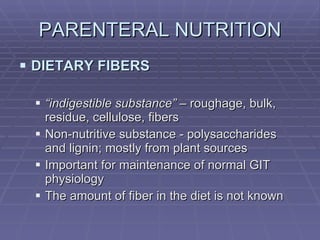
PARENTERAL NUTRITION DIETARY FIBERS “ indigestible substance”  – roughage, bulk, residue, cellulose, fibers Non-nutritive substance - polysaccharides and lignin; mostly from plant sources Important for maintenance of normal GIT physiology The amount of fiber in the diet is not known
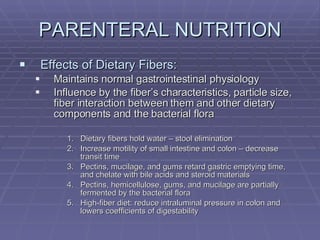
PARENTERAL NUTRITION Effects of Dietary Fibers: Maintains normal gastrointestinal physiology Influence by the fiber’s characteristics, particle size, fiber interaction between them and other dietary components and the bacterial flora Dietary fibers hold water – stool elimination Increase motility of small intestine and colon – decrease transit time Pectins, mucilage, and gums retard gastric emptying time, and chelate with bile acids and steroid materials Pectins, hemicellulose, gums, and mucilage are partially fermented by the bacterial flora High-fiber diet: reduce intraluminal pressure in colon and lowers coefficients of digestability
 
PARENTERAL NUTRITION CARE PLANNING Involves the provision of specialized nutritional support need Knowledge of the problem needing a scientific and rational nutritional therapy Risks and benefits, including legal requirements A  continuous regular monitoring  of the patient’s status to ensure that prescribed regimen meet the patient’s need, and avoid the possible toxicity and its complications
Is the disease process likely to cause   NUTRITIONAL IMPAIRMENT  ? YES Is the patient  MALNOURISHED  or  the patient strongly  AT-RISK  for malnutrition ? YES Would preventing or treating the malnutrition NUTRITION SUPPORT  will improve the prognosis and quality of life ? YES NO What are the fluid, energy, and Risk and discomfort of the nutritional vitamin requirement; and can these support would out-weigh potential be provided  ENTERALLY  ? benefits. Explain issue to patient and family. YES NO Support the patient with general measures including oral food and Can requirements be met through Does the patient require  TPN  ? liquid supplements. ORAL  food & liquid supplements  ? YES   NO     NO   YES Calorie Count  Feeding Tube CVL, PICC or CVL or PICC Clin. Assessment  Peripheral line + Enteral nutrition   weeks    months/years weeks months/years nasally inserted percutaneous inserted   Subclavian catheter or PICC  Tunneled external line or   subcutaneous infusion port
PARENTERAL NUTRITION  MONITORING The need to re-assess the status of individual patient to have assurance of adequate specialized nutritional supportive regimen Meets the benefits and needs of patient, and avoid or prevent occurrence of any toxicity and complication
PARENTERAL NUTRITION  MONITORING General Parameters: Clinical history Dietary history PE findings, includes V/S and anthropometric measurements Standard Laboratory Test: Albumin Pre-albumin Lymphocytic counts Cell-mediated immunity Special Studies: Nitrogen balance determination 24 o  urine Urea Nitrogen   (Protein intake/ 6.25) – UUN / 0.8 + 2
PARENTERAL NUTRITION PROBLEMS RELATED TO NUTRITION OF CRITICALLY ILL PATIENTS Complications of Catheterization Catheter-related Complications Metabolic Complications associated with Nutrients: Glucose Metabolic Complications associated with Nutrients: Fat Metabolic Complications associated with Nutrients: Amino Acid Metabolic Complications associated with Fluid and Electrolyte Imbalance Other Complications
PARENTERAL NUTRITION PROBLEMS RELATED TO NUTRITION OF CRITICALLY ILL PATIENTS Complications of Catheterization Pneumothorax Hydrothorax Air embolism Nerve injury Central venous thrombosis arrhythmias Partial catheterization
PARENTERAL NUTRITION PROBLEMS RELATED TO NUTRITION OF CRITICALLY ILL PATIENTS Complications of Catheterization Catheter-related Complications Sepsis Catheter blockage Air embolism
PARENTERAL NUTRITION PROBLEMS RELATED TO NUTRITION OF CRITICALLY ILL PATIENTS Complications of Catheterization Catheter-related Complications Metabolic Complications associated with Nutrients: Glucose Hyperglycemia Hypoglycemia Respiratory distress
PARENTERAL NUTRITION PROBLEMS RELATED TO NUTRITION OF CRITICALLY ILL PATIENTS Complications of Catheterization Catheter-related Complications Metabolic Complications associated with Nutrients: Glucose Metabolic Complications associated with Nutrients: Fat Hyperlipidemia Essential fatty acid deficiency
PARENTERAL NUTRITION PROBLEMS RELATED TO NUTRITION OF CRITICALLY ILL PATIENTS Complications of Catheterization Catheter-related Complications Metabolic Complications associated with Nutrients: Glucose Metabolic Complications associated with Nutrients: Fat Metabolic Complications associated with Nutrients: Amino Acid Hyperammonemia Metabolic acidosis
PARENTERAL NUTRITION PROBLEMS RELATED TO NUTRITION OF CRITICALLY ILL PATIENTS Complications of Catheterization Catheter-related Complications Metabolic Complications associated with Nutrients: Glucose Metabolic Complications associated with Nutrients: Fat Metabolic Complications associated with Nutrients: Amino Acid Metabolic Complications associated with Fluid and Electrolyte Imbalance Dehydration and overhydration Sodium imbalance Potassium imbalance
PARENTERAL NUTRITION PROBLEMS RELATED TO NUTRITION OF CRITICALLY ILL PATIENTS Complications of Catheterization Catheter-related Complications Metabolic Complications associated with Nutrients: Glucose Metabolic Complications associated with Nutrients: Fat Metabolic Complications associated with Nutrients: Amino Acid Metabolic Complications associated with Fluid and Electrolyte Imbalance Other Complications Hypocalcemia Hypophosphatemia Hypomagnesemia Trace elements deficiency Liver enzeyme elevation
PARENTERAL NUTRITION  ENDING PARENTERAL NUTRITION Decrease appetite Lactase deficiency “ sip” feeding …  in the past , parenteral nutrition involved a complicated infusion arrangement with at least 2 IV bottles with catheter for each administration lines …  recent advances , now provide a single stable admixture that supply all nutrients prepared in a 500 ml to 4-liter bag
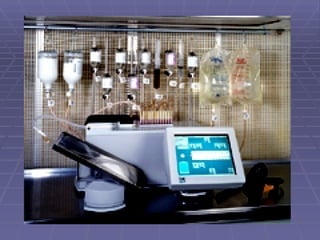
TPN will drip through a needle or catheter placed in your vein for 10-12 hours, once a day or five times a week.
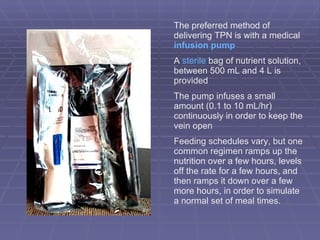
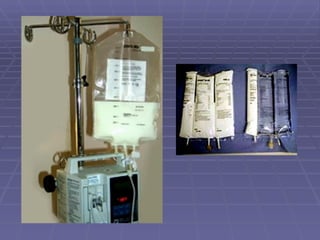
The preferred method of delivering TPN is with a medical  infusion pump A  sterile  bag of nutrient solution, between 500 mL and 4 L is provided The pump infuses a small amount (0.1 to 10 mL/hr) continuously in order to keep the vein open Feeding schedules vary, but one common regimen ramps up the nutrition over a few hours, levels off the rate for a few hours, and then ramps it down over a few more hours, in order to simulate a normal set of meal times.
 
 
Storing your medication   Your health care provider probably will give you a several-day supply of total parenteral nutrition at a time. You will be told to store it in the refrigerator or freezer.  Take your next dose from the refrigerator 4-6 hours before using it; place it in a clean, dry area to allow it to warm to room temperature.  If you are told to store additional total parenteral nutrition in the freezer, always move a 24-hour supply to the refrigerator for the next day's use.  Do not refreeze medications.
 
 
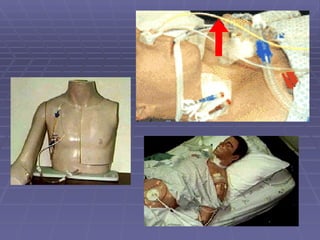
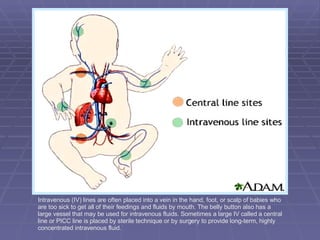
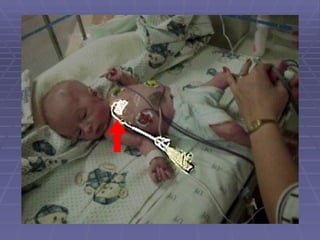
Intravenous (IV) lines are often placed into a vein in the hand, foot, or scalp of babies who are too sick to get all of their feedings and fluids by mouth. The belly button also has a large vessel that may be used for intravenous fluids. Sometimes a large IV called a central line or PICC line is placed by sterile technique or by surgery to provide long-term, highly concentrated intravenous fluid.
 
Sample Regimen for Parenteral Nutrition
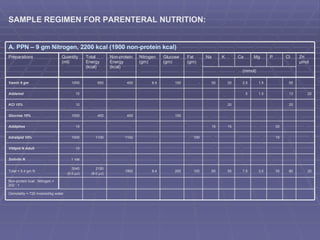
SAMPLE REGIMEN FOR PARENTERAL NUTRITION: Osmolality = 720 mosmol/kg water (mmol) Non-protein kcal : Nitrogen = 202 : 1 20 80 35 3.0 7.5 55 65 100 200 9.4 1900 2150 (8.0  μ J) 3040 (9.0  μ J) Total = 9.4 gm N 1 vial Solivito N 10 Vitlipid N Adult 15 100 1100 1100 1000 Intralipid 10% 20 15 15 10 Addiphos 100 400 400 1000 Glucose 10% 20 20 10 KCl 15% 20 13 1.5 5 10 Addamel 55 1.5 2.5 20 50 - 100 9.4 400 650 1000 Vamin 9 gm Zn  μ mol Cl P Mg Ca K Na  Fat (gm) Glucose (gm) Nitrogen (gm) Non-protein Energy (kcal) Total Energy (kcal) Quantity (ml) Preparations A. PPN – 9 gm Nitrogen, 2200 kcal (1900 non-protein kcal)
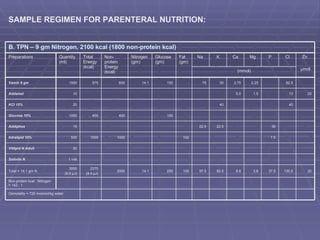
SAMPLE REGIMEN FOR PARENTERAL NUTRITION: Osmolality = 720 mosmol/kg water (mmol) Non-protein kcal : Nitrogen = 142 : 1 20 135.5 37.5 3.8 8.8 92.5 97.5 100 250 14.1 2000 2375 (8.4  μ J) 3055 (9.9  μ J) Total = 14.1 gm N 1 vial Solivito N 20 Vitlipid N Adult 7.5 100 1000 1000 500 Intralipid 10% 30 22.5 22.5 15 Addiphos 100 400 400 1000 Glucose 10% 40 40 20 KCl 15% 20 13 1.5 5.0 10 Addamel 82.5 2.25 3.75 30 75 - 150 14.1 600 975 1500 Vamin 9 gm Zn  μ mol Cl P Mg Ca K Na  Fat (gm) Glucose (gm) Nitrogen (gm) Non-protein Energy (kcal) Total Energy (kcal) Quantity (ml) Preparations B. TPN – 9 gm Nitrogen, 2100 kcal (1800 non-protein kcal)
 
 
Thank You ! Dr. Ronald Sanchez -  Magbitang

Intravenous Therapy: IVF, Electrolytes, TPN

  • 1.
    Dr. Ronald Sanchez – Magbitang EDUCATIONAL ATTAINMENT NEHS UST – B.S. Biology (Pre-Med) SLU – Doctor of Medicine (“Emeritus”) TRAININGS Dr. PJGMRMC – Internal Medicine Children's Medical Center – Hematology RITM – 1 st In-Country Training in HIV/AIDS CONVENTIONS/SYMPOSIA Philippine College of Physicians Philippine Association of Hospital Administrators Philippine Hospital Association PRESENT POSITION Chief of Hospital Gov. Eduardo L. Joson Memorial Hospital Daan Sarile, Cabanatuan City
  • 2.
    ... was bornon the 28th of July, year nineteen hundred and sixty-six, 10am at the Galang's Maternity Clinic in Batangas St., Santa Cruz, Manila, Philippines with a twin sister, Ruby, and they are the youngest among the four siblings. Dr. Magbitang is from Brgy. Bonifacio, San Leonardo, Nueva Ecija, Philippines, where presently he is living with his wonderful and loving family. He had his primary education from San Leonardo Central School where he graduated with honor. Then, had his secondary education from Nueva Ecija High School at Cabanatuan City. Thereafter, finished his Bachelor in Science, Biology from the University of Santo Tomas as preparatory course and subsequently obtained his Doctor of Medicine from the Saint Louis University in Baguio City and graduated &quot;Emeritus&quot;. Subsequently, after his Internship at PJGMRMC he passed the Medical Board Examination on the following year. He had his Residency Training in the Department of Internal Medicine from Dr. Paulino J. Garcia Memorial and Research Center in Cabanatuan City, where he was the Chief Resident for the last 2 years of his training. And, became an Associate Fellow of The Philippine College of Physicians and member of the Philippine Association of Medical Specialists, Philippine Association of Hospital Administrators, and Philippine Hospital Association He had numerous positions in different prestigious medical and non-medical, and NGO's local and national associations and societies. He was once the Medical Section Head and the Chief of Clinics, and presently the Chief of Hospital of Eduardo L. Joson Memorial Hospital at Daan Sarile, Cabanatuan City. Dr. Ronald S. Magbitang Internal Medicine Chief of Hospital Gov. Eduardo L. Joson Memorial Hospital
  • 3.
  • 4.
  • 5.
  • 6.
    BASIC INTRAVENOUS THERAPYTRAINING PROGRAM FLUIDS AND ELECTROLYTES: Problems/Imbalances Common IV Solutions
  • 7.
  • 8.
  • 9.
    FLUIDS AND ELECTROLYTESBODY FLUIDS Refers to the body water in which electrolytes are dissolved Described as “a sea within” Water – is the largest single constituent of the body, representing 45% - 74% of the body weight, depending on age, gender and body fat
  • 10.
  • 11.
    FLUIDS AND ELECTROLYTESIn the newborn infant – almost ¾ of the body weight is water, with the greatest percentage found in extracellular compartment By adulthood the young male’s body water is only 60% and 2/3 of this is in the intracellular compartment In the average young female – only approximately 50% of body weight (due to increased amount of fat in women which is essentially water-free
  • 12.
    FLUIDS AND ELECTROLYTESTotal Body water = 60% body weight Approximate size of body compartment in 70-kg adult Total = 42.5 L 0 100 200 300 1% 5% 14% 28 liters Transcellular 1L Plasma 3.5L Interstitial 10 liters Extracellular Water 20% BW Intracellular water 40% BW Osmolality – mOsm/L
  • 13.
  • 14.
    FLUIDS AND ELECTROLYTESFunctions of Body Fluids: Transport nutrients to the cells and carries waste products away from the cells Maintains blood volume Regulates body temperature Serves as aqueous medium for cellular metabolism Assists in digestion of food through hydrolysis Acts as solvents in which solutes are available for cell function Serves as medium for the excretion of waste products
  • 15.
    FLUIDS AND ELECTROLYTESBody Fluids are distributed in the body in 2 compartments: Intracellular (ICF) – within the cell, approximately 2/3 of the body fluid; located primarily in the skeletal muscle mass, provides the aqueous medium for cellular function
  • 16.
    2. Extracellular (ECF) – outside the cell, maintains blood volume & serves as the transport system & from the cells a. Interstitial fluid – between the cells, fills spaces between most cells and comprises 15% of BW, e.g. lymph FLUIDS AND ELECTROLYTES
  • 17.
    FLUIDS AND ELECTROLYTES2. Extracellular (ECF) – outside the cell, maintains blood volume & serves as the transport system & from the cells b. Intravascular fluid – in the blood vessels, the PLASMA (i.e. watery colorless fluid of lymph and blood in which RBC, WBC and platelets are suspended) comprises 5% of BW, approximately 3L of the average 6L of blood volume is made up of plasma and the remaining 3L is made up of other blood components
  • 18.
    FLUIDS AND ELECTROLYTES2. Extracellular (ECF) – outside the cell, maintains blood volume & serves as the transport system & from the cells c. Transcellular – 1% to 3% of BW, the smallest division of the ECF compartment and contains approximately 1 – 2 L of fluid in any given time (e.g. CSF, pericardial, synovial, intraocular, pleural fluids, sweats, and digestive secretions
  • 19.
  • 20.
    FLUIDS AND ELECTROLYTESTotal Body water = 60% body weight Approximate size of body compartment in 70-kg adult Total = 42.5 L 0 100 200 300 1% 5% 14% 28 liters Transcellular 1L Plasma 3.5L Interstitial 10 liters Extracellular Water 20% BW Intracellular water 40% BW Osmolality – mOsm/L
  • 21.
    FLUIDS AND ELECTROLYTESThere is a continuous exchange of fluid between the fluid compartment , of these spaces only the plasma is directly influenced by the intake or elimination of fluid from the body There is also the so called third space fluid shift or “third spacing” where there is a loss of ECF into a space that does not contribute to the equilibrium between ICF & ECF
  • 22.
    FLUIDS AND ELECTROLYTES“ Third spacing” occurs in: Ascites Burns Peritonitis Bowel obstruction Massive bleeding into body cavity or joints
  • 23.
    FLUIDS AND ELECTROLYTESPathophysiology: The decrease in urine output despite adequate fluid intake (due to fluid shifts out of the intravascular space) + kidneys receive less blood and compensate by decreasing the urine output
  • 24.
    FLUIDS AND ELECTROLYTESSigns and Symptoms of Intravascular Fluid Volume Deficit are: Increased heart rate Decreased blood pressure Decreased CVP Edema Decreased BW Imbalances in fluid I & O
  • 25.
    FLUIDS AND ELECTROLYTESOutput of Fluid – vary due to following: Increased temperature Increased respiration Draining wounds Ostomies Gastric suction
  • 26.
    FLUIDS AND ELECTROLYTESSources of water: Liquids Water-containing foods Metabolic activities or oxidation
  • 27.
    FLUIDS AND ELECTROLYTESElimination of Fluid: Sensible loss (measurable) Insensible (not measurable, e.g. skin, lungs, feces) INSENSIBLE WATER LOSS ?
  • 28.
    FLUIDS AND ELECTROLYTESWater Balance I & O ( in adult eating 2500/day) Output 100 Feces 2500 Total 2500 Total 1400 Urine 300 Oxidation 500 Perspiration 1000 Food Intake 500 Breathing 1200 Liquids Amount of loss (ml) Route Amount of gain (ml) Route Intake
  • 29.
    FLUIDS AND ELECTROLYTESRoutes Gain and Losses: Kidneys Usual daily urine volume in adult = 1 – 2 L General Rule: 1 ml/kg/hour in all age groups
  • 30.
    FLUIDS AND ELECTROLYTESRoutes of Gain & Losses: Skin Sensible perspiration or sweating Chief solutes are Na, Cl, & K Actual sweat losses vary from 0 – 1000ml or more every hour depending on environmental temperature Conditions: fever – increased water loss through skin and lungs burns – natural skin barrier is destroyed
  • 31.
    FLUIDS AND ELECTROLYTESRoutes of Gain & Losses: Lungs Normally eliminate water vapor (insensible loss) Rate is at 300 – 400ml/day Loss is greater with increased respiratory rate or depth
  • 32.
    FLUIDS AND ELECTROLYTESRoutes of Gain & Losses: Gastrointestinal Tract Loss is at 100 – 200ml /day Because the bulk of fluid is reabsorbed in the small intestine diarrhea and fistulae are associated with large losses
  • 33.
    FLUIDS AND ELECTROLYTESLaboratory Tests for Evaluating Fluid Status: Osmolality Reflects the concentration of fluid that affects the movement of water between fluid compartments by osmosis Measures the solute concentration per kilogram in blood and urine Also measures the ability of a solution to create osmotic pressure and affects movement of water Most reliable in measuring urine concentration Reported as milliosmoles per kilogram of water (mOsm/kg) Normal serum osmolality = 280 – 300 mOsm/kg Normal urine osmolality = 50 – 1400 mOsm/kg
  • 34.
    FLUIDS AND ELECTROLYTESLaboratory Tests for Evaluating Fluid Status: Osmolarity Reflects the concentration of the solutions Measured in milliosmoles per liter (mOsm/L)
  • 35.
    FLUIDS AND ELECTROLYTESComparison of Serum & Urine Osmolality: Fluid volume excess Diabetes insipidus Fluid volume deficit SIADH Urine SIADH Renal Failure Diuretic use Adrenal insufficiency Free water loss Diabetes insipidus Sodium overload Hyperglycemia Uremia Serum Factors decreasing Factors increasing Fluid
  • 36.
    FLUIDS AND ELECTROLYTESELECTROLYTES Chemical compounds in solution that have the ability to conduct an electrical current Distributed in different concentrations in the intracellular, intravascular, & interstitial They break into ions: Cations – positively charge (Na, K, Ca, Mg, H ions) Anions – negatively charge (Cl, bicarbonate, phosphate, sulfate, proteinate ions)
  • 37.
    FLUIDS AND ELECTROLYTESGeneral Functions of Electrolytes Promote neuromuscular irritability Maintain body fluid volume and osmolality Distribute body water between compartments Regulate acid-base balance
  • 38.
    Approximate Major ElectrolyteContent in Body Fluid * main electrolyte Cations: Cations: 17 Proteinate 5 Organic Acids 1 Sulfate (SO 4 -- ) 40 Proteinate 2 Phosphate (HPO 4 -- ) 10 Bicarbonate (HCO 3 - ) 26 Bicarbonate (HCO 3 - ) 150 Phosphates & Sulfates 103 Chloride (Cl - ) Anions: Anions: 2 Magnesium (Mg ++ ) 10 Sodium (Na + ) 5 Calcium (Ca ++ ) 40 Magnesium (Mg ++ ) 5 Potassium (K + ) 150 * Potassium (K + ) 142 * Sodium (Na + ) mEq/L Electrolytes mEq/L Electrolytes Intracellular Fluid (ICF) Extracellular Fluid (ECF) Plasma
  • 39.
    FLUIDS AND ELECTROLYTESThe Electrolytes: Cations: Sodium Potassium Calcium Magnesium Anions: Chloride Bicarbonate Phosphate
  • 40.
    FLUIDS AND ELECTROLYTESSodium (Na + ) Normal concentration = 138 – 145 mEq/L Most prevalent cation in the extracellular Controls the osmotic pressure of the ECF compartment Importance: essential for neuromuscular functioning helps in the maintenance of acid-base balance
  • 41.
    FLUIDS AND ELECTROLYTESPotassium (K + ) Normal concentration = 3.5 – 5.0 mEq/L Major cation of the cell intracellularly K enters the cell during anabolism (tissue formation) or glycogenesis K goes out the cell during catabolism (tissue breakdown) – trauma, dehydration, starvation Mostly located in intracellular compartment Importance: has a direct effect on the excitability of nerves and muscles contributes most to the intracellular osmotic pressure helps maintain acid-base balance and kidney function
  • 42.
    FLUIDS AND ELECTROLYTESCalcium (Ca ++ ) Normal concentration = 4.5 – 5.8 mEq/L Has 2 forms: Ionized (free) calcium – physiologically active Ca bound to plasma proteins
  • 43.
    FLUIDS AND ELECTROLYTESCalcium (Ca ++ ) Free ionized Ca is needed for: Blood coagulation Muscle function (smooth, skeletal, cardiac) Nerve function Bone and teeth formation Calcium level depends on 3 hormones: Parathormone – decreased Ca & increase P Vitamin D – from sunlight, for Ca absorption Calcitonin – decreases Ca levels preventing bone resorption, opposes effects of PTH and Vit D on bones
  • 44.
    FLUIDS AND ELECTROLYTESMagnesium (Mg ++ ) Normal concentration = 1.5 – 2.5 mEq/L About 50% is located in bones, 5% in ECF, and 45% in the ICF compartment Vital for enzyme activation reactions, especially in carbohydrate metabolism Has a sedative effect on CNS
  • 45.
    Laboratory Values Usedin Evaluating Fluid and Electrolyte Status 3.5-5.5 g/dL 3.5-5.5 g/dL Serum Albumin 3.9-6.1 mmol/L 70-110 mg/dL Serum Glucose Volume fraction: 0.39-0.47 Female: 39-47 % Volume fraction: 0.44-0.52 Male: 44-52 % Hematocrit 10:1 BUN/Creatinine ratio 62-133 mmol/L 0.7-1.5 mg/dL Serum creatinine 3.5-7 mmol/L of urea 10-20 mg/dL BUN 280-295 mmol/L 280-300 mOsm/kg Serum osmolality 24-30 24-30 Carbon Dioxide content 96-106 96-106 Serum Chloride 0.80-1.5 2.5-4.5 Serum Phosphorus 0.80-1.2 1.5-2.5 mEq/L Serum Mg 2.1-2.6 8.5-10.5 mg/dL Total serum Ca 3.5-5.5 3.5-5.5 mEq/L Serum K 135-145 mmol/L 135-145 mEq/L Serum Na SI Units Usual Reference Guide Test
  • 46.
    Laboratory Values Usedin Evaluating Fluid and Electrolyte Status < 6.6 < 6.6 typical urine 4.5-8.0 4.5-8.0 Urinary pH 500-800 500-800 mOsm/L typical urine 40-1400 mmol/kg 50-1400 mOsm/L extreme range Urine Osmolality 1.010-1.020 random specimen with normal intake Physiologic range after fluid restriction: 1.025-1.035 1.025-1.035 Urinary Specific Gravity 110-250 110-250 mEq/day Urinary Cl 40-80 40-80 mEq/day Urinary K 50-220 mmol/day 50-220 mEq/day Urinary Na SI Units Usual Reference Guide Test
  • 47.
    FLUIDS AND ELECTROLYTESRegulation of Body Fluid Compartments Movement of particles through the cell membrane occurs via the following transport mechanisms: Passive transport: Osmosis Diffusion Filtration Active transport Na-K pump
  • 48.
    Osmosis –movement of fluid to area of high concentration and gradual equalization of solute concentration Diffusion – movement of fluid and solutes and equalization of solute concentration A B
  • 49.
    FLUIDS AND ELECTROLYTESOSMOSIS The movement of water through a semipermeable membrane from a solution that has a low concentration of particles towards a solution that has a high concentration of particles Normal serum osmolality = 280-300 mOsm/kg Osmolality of ECF and ICF is always equal
  • 50.
    FLUIDS AND ELECTROLYTESDIFFUSION Is the natural tendency of substance to move from an area of higher concentration to one of lower concentration Occurs through the random movement of ions and molecules Particles will distribute themselves evenly Example: exchange of O 2 and CO 2 between pulmonary capillaries and alveoli
  • 51.
    FLUIDS AND ELECTROLYTESFILTRATION The process by which water and diffusible substances move together in response to fluid pressure This process is active in capillary beds Example: Passage of water and electrolytes from the arterial capillary bed to the interstitial fluid
  • 52.
  • 53.
    FLUIDS AND ELECTROLYTESACTIVE TRANSPORT The movement of substances across the cell membrane by chemical activity or energy expenditure, that allows cells to admit larger molecules Example: sodium-potassium pump – Na is pumped out of the cell, K is pumped in against pressure gradient
  • 54.
  • 55.
    FLUIDS AND ELECTROLYTESRegulation of Body Fluids Homeostatic mechanism responsible for the balance of fluid and electrolytes within the body are: Kidneys Heart and Blood vessels Lungs Glands Other Mechanisms
  • 56.
    FLUIDS AND ELECTROLYTESRegulation of Body Fluids Homeostatic mechanism responsible for the balance of fluid and electrolytes within the body are: Other mechanisms: Baroreceptors Renin-Angiotensin-Aldosterone System ADH and thirst Osmoreceptors Release of Atrial Natriuretic Peptide
  • 57.
    Types of FluidBalance And Imbalance
  • 58.
    FLUIDS AND ELECTROLYTESTypes of Fluid Balance and Imbalance: Saline ECF, reflects the volume of water and salt Water Osmolar proportion of water and salt (concentration)
  • 59.
    FLUIDS AND ELECTROLYTESSaline Balance Refers to maintaining the proper volume of ECF and the three mechanisms involved in regulating saline balance Aldosterone – a major regulator of saline balance (ECF volume)
  • 60.
    FLUIDS AND ELECTROLYTESSaline Imbalance Changes in the volume of extracellular fluid compartment Mechanisms in Regulating Saline Balance (ECF Volume): Pituitary Gland - Aldosterone Atrial Natriuretic Peptide Neural Mechanism
  • 61.
    FLUIDS AND ELECTROLYTESMechanisms in Saline Balance Regulation (ECF Volume) Pituitary Gland: Ineffective blood volume (decrease blood circulation/ decrease ECF volume) Stimulates adrenal cortex Secrete aldosterone Increase Na + reabsorption in distal tubule, collecting ducts Increase saline retention Increase in volume of water Relieveing saline imbalance
  • 62.
    FLUIDS AND ELECTROLYTESMechanisms in Saline Balance Regulation (ECF Volume) Atrial Natriuretic Peptide: Atrial distention (increase ECF) Release Peptides Acts on kidney Increase renal excretion of Na + & water Relieveing distention
  • 63.
    FLUIDS AND ELECTROLYTESMechanisms in Saline Balance Regulation (ECF Volume) Neural mechanism: Decrease ECF volume Stimulate renal sympathetic nerves Release of Renin and stimulate the kidneys Decrease renal secretion of saline Increase ECF volume Atrial distention Mechano-receptors in the wall of left atrium Decrease activity of sympathetic nerve Increase excretion of saline by the kidney
  • 64.
    FLUIDS AND ELECTROLYTESSaline Imbalance: Saline Deficit ECF volume deficit Isotonic contraction Isosmotic dehydration Hypovolemia Extracellular volume depletion
  • 65.
    FLUIDS AND ELECTROLYTESSaline balance: Saline Deficit Causes: Vomiting Diarrhea Extreme diaphoresis Blood loss through hemorrhage Burns Bed rest Fistula drainage Salt wasting disorder Third-space fluid accumulation NGT suctioning Excessive diuretic use Intestinal decompression
  • 66.
    FLUIDS AND ELECTROLYTESSaline balance: Saline Deficit Clinical Manifestations: - dehydration Weight loss Postural BP drop Increased small vein filling time Neck vein flat or collapsing with inspiration Dizziness, syncope Oliguria or anuria Decreased CVP Decreased skin turgor Longitudinal furrow in the tongue Dry mucous membrane Hard, dry stools Decreased tears and sweat Sunken eyeballs Hypovolemic shock
  • 67.
    FLUIDS AND ELECTROLYTESSaline balance: Saline Deficit Laboratory Values: Urinalysis – increased Cl Blood studies – increased BUN, increased Hct, increased plasma protein, increased Na Medical Therapy: Saline replacement through IV related to complication of medical therapy Dx – potential for injury related to complication
  • 68.
    FLUIDS AND ELECTROLYTESSaline Imbalance: Saline Excess ECF volume excess Isotonic expansion Hypervolemia Circulatory overload
  • 69.
    FLUIDS AND ELECTROLYTESSaline balance: Saline Excess Causes: Endocrine imbalance Hyperaldosteronism Cushing’s syndrome Glucocorticoid therapy Secondary to disease process Chronic renal failure CHF Cirrhosis Excess IV infusion of saline solutions (0.9% saline, Ringer’s)
  • 70.
    FLUIDS AND ELECTROLYTESSaline balance: Saline Excess Clinical Manifestations: Weight gain (0.5kg/day) – sign of volume expansion Edema Vascular expansion Crackles or rales in lungs – fluid accumulation Dyspnea, orthopnea due to volume overload Increased CVP (5 – 10 cmH 2 0) – right atrium
  • 71.
    FLUIDS AND ELECTROLYTESSaline balance: Saline Excess Laboratory Values: Elevated CVP Chest x-ray – fluid accumulation in the lungs Blood studies – normal serum Na Hematocrit – normal or decrease, depending on the cause, if occurs slowly the Hct remains normal Treatment: treat the underlying cause
  • 72.
  • 73.
    FLUIDS AND ELECTROLYTESWater Balance and Imbalance Refers to the maintenance of the proportion of salt to water in the blood Important Facts: Serum Na concentration is a useful measure of water balance (normal serum Na = 135 – 145 mEq/L in adults of all ages) If the serum Na is decreased: The osmolality of blood is decreased Blood is less concentrated than normal Blood has excess water relative to the amount of salt If the serum Na is increased: Osmolality of blood has increased Blood is more concentrated The blood has a deficit of water relative to the amount of salt
  • 74.
    FLUIDS AND ELECTROLYTESNormal and Abnormal Routes of Water Entry and Exit - Parenteral - Rectal 300 ml Metabolic water 1,200 ml Water in food 1,200 ml Drink Oral Gastrointestinal Average Volume (per 24 hours) Route of Entry
  • 75.
    FLUIDS AND ELECTROLYTESNormal and Abnormal Routes of Water Entry and Exit - Hemorrhage - Paracentesis procedures Others: - Drainage from lesions 600 ml Insensible perspiration Skin - Fistula - Emesis 100 ml Fecal Gastrointestinal 400 ml Respiratory 1,500 ml Renal Average Volume (per 24 hours) Route of Exit
  • 76.
    FLUIDS AND ELECTROLYTESWater Balance and Imbalance The major regulators of oral water intake are: Thirst Habit patterns Social influence Three major mechanism of thirst: Cellular dehydration thirst Baroreceptor – mediated thirst Angiotensin – mediated thrist
  • 77.
    FLUIDS AND ELECTROLYTESWater Balance and Imbalance Cycle of Urine Excretion: Increase in osmolality of blood Hypothalamus Pituitary Gland Release of ADH Collecting ducts of kidneys Reabsorption of water back to the blood stream Dilute the blood Restore osmolalilty Note: The excretion of urine (of water) is controlled by ADH.
  • 78.
    FLUIDS AND ELECTROLYTESTYPES OF WATER IMBALANCE WATER DEFICIT: Hypernatremia Water depletion Hypertonicity Hyperosmolar balance
  • 79.
    FLUIDS AND ELECTROLYTESWATER DEFICIT Causes: 1. Loss of water relative to salt Renal Dibetes insipidus (salt gain due to polyuria) Osmotic diuresis (polyuria) Renal concentrating disorder Renal failure Other sources: Prolonged diarrhea without water replacement Excessive sweating without water replacement Dysfunctional humidifier of mechanical ventilators (dry air inhalation)
  • 80.
    FLUIDS AND ELECTROLYTESWATER DEFICIT Causes: 2. Gain of salt relative to water Decrease water intake No access to water Prolonged nausea Difficulty swallowing fluid (Parkinson’s disease) Inability to respond to thirst Increase salt intake By means of tube feeding Half and half for ulcer diet Excess hypertonic NaCl or NaHCO 3
  • 81.
    FLUIDS AND ELECTROLYTESWATER DEFICIT Clinical Manifestations: Serum Na is above normal (blood is concentrated) Thirst (due to lack of water) Oliguria Confusion Lethargy Mild muscle weakness Seizures Coma (varies in severity)
  • 82.
    FLUIDS AND ELECTROLYTESWATER DEFICIT Clinical Manifestations: Pathophysiology: Decrease Water Increase Osmolality Osmosis ICF ECF Attempt to restore osmolality Cells shrivels Cell dysfunction
  • 83.
    FLUIDS AND ELECTROLYTESWATER DEFICIT Laboratory Values: Urinalysis Increase in specific gravity of urine > 1.030 (normal urine sp.gr. = 1.010 – 1.030) Blood studies Increase serum Na Decrease serum protein Decrease Hct
  • 84.
    FLUIDS AND ELECTROLYTESWATER DEFICIT Medical Therapy: Replacement of fluid loss by IVF or oral route Institute or encourage oral fluid intake Administer in small amount Help patient in taking his I & O measurement Complications: Cerebral edema (therapy too rapid) Rebound fluid excess (therapy excessive) Infection Infiltration Because of IV therapy
  • 85.
    FLUIDS AND ELECTROLYTESTYPES OF WATER IMBALANCE WATER EXCESS: Hyponatremia (decrease serum Na - < 135mEq/L) Water intoxication Hypotonicity
  • 86.
    FLUIDS AND ELECTROLYTESWATER EXCESS Causes: I. General etiology: Gain or water relative to salt A. Endocrine: Stimulation of ADH Stressors Post-surgical state Nausea Pain Ectopic production of ADH
  • 87.
    FLUIDS AND ELECTROLYTESWATER EXCESS Causes: I.General etiology: Gain or water relative to salt B. Iatrogenic – caused by medical therapy Excessive tap water enema Excessive infusion of D5W Excessive use of ultrasonic nebulizer Hypotonic irrigating solution (by process of osmosis) Excessive water ingestion after poisoning Excessive water ingestion before an UTZ examination
  • 88.
    FLUIDS AND ELECTROLYTESWATER EXCESS Causes: I. General etiology: Gain or water relative to salt A. Others Psychogenic polydipsia – excessive thrist Excessive beer drinking Near drowning in fresh water Overdose of Barbiturates
  • 89.
    FLUIDS AND ELECTROLYTESWATER EXCESS Causes: II. General Etiology: Lost of salt related to water A. Renal Salt wasting renal disease Use of many types of diuretics (Thiazides)
  • 90.
    FLUIDS AND ELECTROLYTESWATER EXCESS Causes: II. General Etiology: Lost of salt related to water B. Gastrointestinal – due to water replacement not by salt Nasogastric suction Vomiting Diarrhea Hypotonic irrigation solutions
  • 91.
    FLUIDS AND ELECTROLYTESWATER EXCESS Causes: II. General Etiology: Lost of salt related to water C. Others Burns Excessive sweating
  • 92.
    FLUIDS AND ELECTROLYTESWATER EXCESS Clinical Manifestations: Pathophysiology Increased Water Decrease Osmolality Osmosis ECF ICF Attempt to restore Osmolality Cell swollen Cell dysfunction
  • 93.
    FLUIDS AND ELECTROLYTESWATER EXCESS Clinical Manifestations: Decrease serum Na Malaise Headache Confusion Lethargy Seizures Coma
  • 94.
    FLUIDS AND ELECTROLYTESWATER EXCESS Medical Therapy/ Management: Restrict water intake below the daily insensible losses (1,000 ml) The kidney will excrete the excess water Administration of diuretic ( Furosemide ) Administration of ADH-blocking agent Demeclocycline or LiCO 3 )
  • 95.
  • 96.
    FLUIDS AND ELECTROLYTESEDEMA Fluid accumulation of the interstitial space Maybe a sign of saline excess Governed by the net result of the ff: Blood hydrostatic pressure Interstitial fluid hydrostatic pressure Blood colloid osmotic and oncotic pressure Interstitial fluid osmotic pressure
  • 97.
  • 98.
    FLUIDS AND ELECTROLYTESEDEMA Capillary Mechanism for Edema Formation 1. Increase blood hydrostatic pressure A. Increase capillary flow Local infection Inflammation B. Venous congestion External pressure Venous thrombosis Right heart failure
  • 99.
    FLUIDS AND ELECTROLYTESEDEMA Capillary Mechanism for Edema Formation 2. Decrease blood osmotic pressure A. Decrease serum Albumin Loss of albumin Nephrotic Syndrome Protein-losing enteropathies Liver disease (Cirrhosis)
  • 100.
    FLUIDS AND ELECTROLYTESEDEMA Capillary Mechanism for Edema Formation 3. Increase fluid osmotic pressure A. Increase capillary permeability Burns Inflammation Hypersensitivity reactions Toxins Trauma
  • 101.
    FLUIDS AND ELECTROLYTESEDEMA Capillary Mechanism for Edema Formation 4. Impaired lymphatic drainage a. obstruction of the lymph node by tumors b. Surgical removal of lymph nodes c. Obstruction of lymph nodes by parasites
  • 102.
    FLUIDS AND ELECTROLYTESEDEMA Medical Therapy and Interventions: Use of elastic stockings to enhance venous return Administration of diuretics or a Na-restricted diet
  • 103.
    ELECTROLYTE BALANCE ANDELECTROLYTE IMBALANCES
  • 104.
    FLUIDS AND ELECTROLYTESELECTROLYTE BALANCE AND IMBALANCES Electrolytes: Salts found in every body fluids K, Ca, PO 3 , Mg (major electrolytes) Enter the body primarily in the diet then enter the ECF and distributed to some other body electrolyte pool (bones/ inside cells)
  • 105.
    FLUIDS AND ELECTROLYTESElectrolytes: Normal Routes of Exit: Urine Feces Sweat Abnormal Route: Fistula drainage Emesis Gastric or intestinal suction Paracentesis Exudates
  • 106.
    FLUIDS AND ELECTROLYTESPOTASSIUM BALANCE AND IMBALANCES Normal range = 3.5 – 5.0 mEq/L “ Kalium” – Latin word for potassium Potassium Homeostasis: Enters the cells through an active transport mechanism Both insulin and epinephrine cause K to enter cells Exercise causes K to exit cells initially pH of ECF also affect the distribution
  • 107.
    FLUIDS AND ELECTROLYTESPOTASSIUM BALANCE AND IMBALANCES Normal range = 3.5 – 5.0 mEq/L “ Kalium” – Latin word for potassium Factors that causes K shift A. Accumulation of carbonic acid May cause a mild ECF shift B. Accumulation of mineral acids Causes significant extracellular K shift C. Accumulation of organic acids Does not in itself cause a K shift
  • 108.
    FLUIDS AND ELECTROLYTESHYPOKALEMIA Serum K < 3.5 mEq/L Causes: Decrease K intake Non-iatrogenic Anorexia Fad diets Fasting Iatrogenic NPO orders Prolonged IV therapy without K Entry of K into cells Increased K excretion K loss by abnormal route
  • 109.
    FLUIDS AND ELECTROLYTESHYPOKALEMIA Serum K < 3.5 mEq/L Clinical Manifestations: Serum K below normal Postural hypotension Abdominal distention Diminished bowel sounds manifestation of unresponsive Constipation GI smooth muscles Skeletal muscle weakness Flaccid paralysis Polyuria, nocturia Cardiac arrythmias ECG changes: ST depression, inverted T-waves, U waves, QT prolongation
  • 110.
    FLUIDS AND ELECTROLYTESHYPOKALEMIA Serum K < 3.5 mEq/L Note: Decrease K is manifested in dysfunction of all 3 kinds of muscles: Smooth Skeletal Cardiac
  • 111.
    FLUIDS AND ELECTROLYTESHYPOKALEMIA Serum K < 3.5 mEq/L Interventions: Constipation Postural hypotension Muscle weakness or flaccid paralysis Ineffective breathing K replacement therapy complications: GI irritation or ulceration Rebound hyperkalemia (if oliguria develops) Cardiac arrhythmias (too rapid therapy) Rebound hyperkalemia (excessive therapy) Inflammation, infection, infiltration (out of vein) Medical Therapy: Oral or IV Potassium replacement
  • 112.
    FLUIDS AND ELECTROLYTESHYPERKALEMIA Serum K > 5.0 mEq/L Excess of K in the ECF Causes: Increased K intake Movement of K out of cells Decreased K excretion
  • 113.
    FLUIDS AND ELECTROLYTESHYPERKALEMIA Serum K > 5.0 mEq/L Clinical Manifestations: Serum K above normal Intestinal cramping Diarrhea Skeletal muscle weakness Flaccid paralysis Cardiac arrhythmias Cardiac arrest ECG changes: peaked narrow T-waves, shortened QT intervals, widened QRS, sine wave Laboratory values: acidosis
  • 114.
    FLUIDS AND ELECTROLYTESHYPERKALEMIA Serum K > 5.0 mEq/L Interventions: Diarrhea Muscle weakness or flaccid paralysis Decrease ability to function Ineffective breathing Decreased cardiac output
  • 115.
    FLUIDS AND ELECTROLYTESHYPERKALEMIA Serum K > 5.0 mEq/L Medical Therapy: To move K into cells (insulin, glucose, HCO 3 infusion) To counteract the cardiac effects of hyperkalemia (IV Ca gluconate) Remove K from the body (dialysis, diuretics, ion-exchange resins [Na polysterene sulfonate])
  • 116.
    FLUIDS AND ELECTROLYTESHYPERKALEMIA Serum K > 5.0 mEq/L Complications of Medical Therapy: Hypoglycemia (insulin, glucose) Hypercalcemia (Ca gluconate) Metabolic alkalosis (IV HCO 3 ) Rebound hypokalemia (excessive therapy) Inflammation, infection, or infiltration (IV therapy) Aspiration pneumonitis (oral ion-exchange resin) Constipation (oral ion-exchange resin without sorbitol) Kayexalate – ion-exchange resin (Na polysterene sulfonate)
  • 117.
    FLUIDS AND ELECTROLYTESCALCIUM BALANCE & IMBALANCES Facts: Calcium ions in the body are mostly located in the bones and teeth Small amount in cells of soft tissue Normal concentration = 4.5 – 5.5 mEq/L Calcium Homeostasis: Major source of calcium intake: Milk Dairy products (cheese, cream, yogurt, ice cream) Sea foods (clams) Calcium is absorbed from the GIT by active transport mechanism requiring Vitamin D Parathyroid hormone (PTH) increases activation of Vitamin D
  • 118.
    FLUIDS AND ELECTROLYTESHYPOCALCEMIA Occurs if the serum Ca < 4.5 mEq/L or if the ionized portion of the serum Ca is diminished Ionized hypocalcemia: total serum Ca maybe normal but ionized Ca concentration will be < normal Causes: Decreased Calcium intake or absorption Decreased physiological availability of Calcium Increased Calcium excretion Calcium loss by abnormal route
  • 119.
    FLUIDS AND ELECTROLYTESHYPOCALCEMIA Serum Ca < 4.5 mEq/L or if the ionized portion of the serum Ca is diminished Clinical Manifestations: Decreased serum Ca (or decreased ionized Ca & normal total Ca) Paresthesias (digital or perioral) – numbness or tingling sensation *Chvostek ’s sign – tapping the Facial N. in front of the ear cause the mouth to draws up in a grimace, due to increased neuromuscular irritability *Trousseau ’s sign – carpal spasm after occluding the arterial flow to the hand with sphygmomanometer for about 3 mins Grimacing, muscle twitching, cramping Hyperactive reflexes Carpal, pedal spasm Tetany – increased irritability Laryngospasm (sudden involuntary muscular contraction of larynx) Seizures Cardiac arrhythmias
  • 120.
    FLUIDS AND ELECTROLYTESHYPOCALCEMIA Serum Ca < 4.5 mEq/L or if the ionized portion of the serum Ca is diminished Interventions: Neuromuscular irritability Laryngospasm Paresthesia and muscle cramps Medical Therapy: Replacement of Calcium – oral or IV
  • 121.
    FLUIDS AND ELECTROLYTESHYPOCALCEMIA Serum Ca < 4.5 mEq/L or if the ionized portion of the serum Ca is diminished Complications of IV Calcium replacement: Cardiac arrhythmias (therapy too rapid) Rebound hypercalcemia (therapy excessive) Inflammation, infection, infiltration Tissue sloughing (after calcium infiltration) Altered bowel elimination – constipation Note: oral Ca salts are often administered with Vitamin D
  • 122.
    FLUIDS AND ELECTROLYTESHYPERCALCEMIA Serum Ca > 5.5 mEq/L Excess calcium in plasma may come from the bones or from external source Causes: Increased calcium intake or absorption Release of calcium from bone Decreased calcium excretion
  • 123.
    FLUIDS AND ELECTROLYTESHYPERCALCEMIA Serum Ca > 5.5 mEq/L Clinical Manifestations: Increased serum Ca Anorexia Nausea, emesis Constipation Abdominal pain Polyuria Renal calculi Fatigue Muscle weakness Impaired reflexes Headache Confusion, lethargy Personality change Psychosis Cardiac arrest ECG changes: shortened QT interval
  • 124.
    FLUIDS AND ELECTROLYTESHYPERCALCEMIA Serum Ca > 5.5 mEq/L Interventions: Constipation Nausea and vomiting – nutrition Aspiration Fatigue Pain Muscle weakness Decreased level of consciousness Altered thought processes Impaired social interaction Renal calculi
  • 125.
    FLUIDS AND ELECTROLYTESHYPERCALCEMIA Serum Ca > 5.5 mEq/L Notes: Prune, cranberry juice or acid ash diet maybe use to acidify the urine Hypercalcemia due to calcium withdrawal from bone results to weak bones Hypercalcemia potentiates digitalis, may result to digitalis toxicity Thiazide diuretics decrease calcium excretion which should be withheld if hypercalcemia develops
  • 126.
    FLUIDS AND ELECTROLYTESHYPERCALCEMIA Serum Ca > 5.5 mEq/L Medical Therapy: Infusion of IV 0.9% Saline to induce saline diuresis Calcitonin – used to decrease plasma calcium rapidly in emergency hypercalcemia Complications of Therapy: ECF volume excess (IV saline) Inflammation, infection, infiltration (any IV agent) Hypokalemia (diuretic therapy) Hypersensitivity reaction (calcitonin) Diarhhea (diphosphonates) Nausea, vomiting (plicamysin) Bone marrow suppression, liver damage, renal damage
  • 127.
    FLUIDS AND ELECTROLYTESPHOSPHATE BALANCE & IMBALANCES An anion Integral part of bones and are abundant inside cells Normal serum concentration = 2.5 – 4.5 mg/dL Serum PO 4 tends to decrease with age in both men and women Phosphate Homeostasis: Phosphate absorption occurs in small intestine Maybe affected by Vitamin D Magnesium, aluminum ions diarrhea decrease the absorption of PO 4 from GIT PO 4 distribution distribution between the ECF and bones is under the influence of PTH which promotes bone resorption PO 4 excretion occurs primarily in urine and feces PTH increases renal excretion of PO 4
  • 128.
    FLUIDS AND ELECTROLYTESHYPOPHOSPHATEMIA Serum concentration < 2.5 mg/dL Mild hypophosphatemia is often asymptomatic If serum level < 1.0mg/dL is a serious symptomatic hypophosphatemia Causes: Decreased phosphate intake or absorption Movement of phosphate into cells Increased phosphate excretion Phosphate loss through abnormal route
  • 129.
    FLUIDS AND ELECTROLYTESHYPOPHOSPHATEMIA Serum concentration < 2.5 mg/dL Clinical Manifestations: Serum level < 1.0 mg/dL Anorexia, nausea Malaise Decreased reflexes Muscle weakness, severe debility Myalgia Bone pain (long-term antacid use) Irritability, apprehension Paresthesias Confusion Stupor Seizures Coma
  • 130.
    FLUIDS AND ELECTROLYTESHYPOPHOSPHATEMIA Serum concentration < 2.5 mg/dL Laboratory Values: Alkalosis (increased in pH especially respiratory alkalosis) Interventions: Decreased level of consciousness Respiratory muscle weakness
  • 131.
    FLUIDS AND ELECTROLYTESHYPOPHOSPHATEMIA Serum concentration < 2.5 mg/dL Medical Therapy: Mild cases of hypophosphatemia are monitored and allowed to return to normal spontaneously as precipitating factors are removed and corrected IV PO 4 for severe symptomatic cases, followed with oral replacement Complications of Therapy: Hypocalcemia Rebound hyperphosphatemia Inflammation, infection, infiltration Note: IV PO 4 may decreased the plasma Ca concentration rapidly
  • 132.
    FLUIDS AND ELECTROLYTESHYPERPHOSPHATEMIA Serum concentration > 4.5 mg/dL Major problem with excess phosphate in the blood is its interaction with calcium Causes: Increased phosphate intake Release of phosphate from cells Decreased phosphate excretion
  • 133.
    FLUIDS AND ELECTROLYTESHYPERPHOSPHATEMIA Serum concentration > 4.5 mg/dL Clinical Manifestations: Serum Ca decrease as serum phosphate increases Increased neuromuscular excitability Conjunctivitis Band keratopathy Pruritus Acute renal failure Arthritis The serum calcium does not fall resulting to precipitation of CaPO 4 salts in soft tissues of the body
  • 134.
    FLUIDS AND ELECTROLYTESHYPERPHOSPHATEMIA Serum concentration > 4.5 mg/dL Laboratory Values: Plasma calcium decreases Hyperkalemia Hypermagnesemia Metabolic acidosis Increase BUN Increase creatinine Interventions: CaPO 4 precipitation in urinary tract Pruritus
  • 135.
    FLUIDS AND ELECTROLYTESHYPERPHOSPHATEMIA Serum concentration > 4.5 mg/dL Medical Therapy: Restrict dietary PO 4 Fluid administration to increase urinary PO 4 excretion PO 4 binder therapy – aluminum ions in antacids bind PO 4 in GI preventing its absorption, antacid to be taken during not after meals MgAl antacid not to be used in renal failure, Mg is contraindicated
  • 136.
    FLUIDS AND ELECTROLYTESMAGNESIUM BALANCE & IMBALANCES Most of Mg ions in the body are located in the bones Rest of Mg is intracellular especially in the liver and skeletal muscles Small amount of Mg in the blood Normal Concentration = 1.5 – 2.5 mEq/L Foods high in Mg content: whole grain cereals, dark green vegetables, dried beans and peas, soy products, nuts (except cashew and almonds), peanut butter, cocoa, chocolate, bananas, egg yolk, sea salt
  • 137.
    FLUIDS AND ELECTROLYTESHYPOMAGNESEMIA Serum Mg < 1.5 mEq/L Causes: Decreased Mg intake or absorption Decreased physiological availability of Mg Increased Mg excretion Mg loss by abnormal route
  • 138.
    FLUIDS AND ELECTROLYTESHYPOMAGNESEMIA Serum Mg < 1.5 mEq/L Clinical Manifestations: Serum Mg < normal Insomnia Hyperreflexia Chvostek ’s sign Trosseau ’s sign Leg and foot cramps Grimacing Dysphagia Ataxia Nystagmus Tetany Seizures and decrease level of consciousness Cardiac arrhythmias ECG changes: ST & T wave abnormalities
  • 139.
    FLUIDS AND ELECTROLYTESHYPOMAGNESEMIA Serum Mg < 1.5 mEq/L Laboratory Values: Abnormal plasma concentration of other electrolytes Hypokalemia Hypocalcemia Hypophosphatemia Hyponatremia Medical Therapy: Mg replacement (oral or IV) IV SO4 must be carefully administered Check for adequate renal function and patellar reflexes before Mg administration (decreased or diminished reflexes may need to recheck if may have elevated)
  • 140.
    FLUIDS AND ELECTROLYTESHYPERMAGNESEMIA Serum Mg > 2.5 mEq/L Causes: Increased Mg intake or absorption Shift of Mg from bones to blood Decreased Mg excretion
  • 141.
    FLUIDS AND ELECTROLYTESHYPERMAGNESEMIA Serum Mg > 2.5 mEq/L Clinical Manifestations: Decreased neuromuscular excitability Increased serum Mg Hypotension Flushing, diaphoresis Drowsiness, lethargy Diminished deep tendon reflexes Flaccid paralysis Respiratory depression Bradycardia Cardiac arrhythmias Cardiac arrest ECG changes
  • 142.
    FLUIDS AND ELECTROLYTESHYPERMAGNESEMIA Serum Mg > 2.5 mEq/L Medical Therapy: Removal of excess Mg from plasma With normal renal function, administer large amount of fluid to increased renal Mg excretion In renal failure, hemodialysis maybe use In severe hypermagnesemia, calcium salts maybe administered IV to counteract the cardiotoxicity of excess extracellular Mg Complications: Hypercalcemia Tissue sloughing (infiltration) Digitalis toxicity
  • 143.
  • 144.
    FLUIDS AND ELECTROLYTESACID – BASE IMBALANCE Hydrogen ions are vital to life and health The concentration of hydrogen ions in the body is less than that of other ions Acid-base status of patient is obtained from sample of arterial blood (ABG) Normal blood pH = 7.35 – 7.45 pCO 2 = 36 – 44 mmHg HCO 3 = 22 – 26 mEq/L pH < 7.35 is acidosis pH > 7.45 is alkalosis pH limit compatible to life 7.0 – 7.8
  • 145.
    FLUIDS AND ELECTROLYTESACID – BASE IMBALANCE Mechanisms regulating Acid-Base Balance: A. Chemical buffers in cells and ECF Instantaneous action Combine acids or bases added to the system to prevent marked changes in pH B. Respiratory system Minutes to hours in action Controls CO 2 concentration in ECF by changes in rate and depth of respiration C. Kidneys Hours to days in action Increases or decreases quantity of NaHCO 3 in ECF Combines HCO 3 or H with other substances and excreted in urine
  • 146.
    FLUIDS AND ELECTROLYTESACID – BASE PNEMONIC: R – O – M – E R – Respiratory O – Opposite pH increase pCO 2 decrease – alkalosis pH decrease pCO 2 increase – acidosis M – Metabolic E – Equal pH increase HCO 3 increase – alkalosis pH decrease HCO 3 decrease – acidosis
  • 147.
    FLUIDS AND ELECTROLYTESElevate pH with IV NaHCO 3 Oral bicarbonate or citrate in chronic metabolic acidosis Improvement of ventilation through bronchodilators or mechanical support For severe type, infusion of NaHCO 3 to raise the pH toward normal THERAPY Decreased HCO 3 ion concentration, hyperventilation (compensatory mechanism), headache, abdominal pain, confusion, drowsiness, lethargy, stupor, coma, arrhythmias Increased pCO 2 , headache, blurred vision, disorientation, tachycardia, cardiac arrhythmias, lethargy, somnolence MANIFESTATIONS Acid accumulation by ingestion, by increased metabolic acid production, by utilization of abnormal or incomplete metabolic pathways, by impaired acid excretion, and primary decrease of HCO 3 Decreased gaseous exchange Impaired neuromuscular function Suppressed ventilatory mechanism on brain stem (medulla) CAUSE METABOLIC (Noncarbonic acid excess) RESPIRATORY (Carbonic acid excess) ACIDOSIS
  • 148.
    FLUIDS AND ELECTROLYTESDirected toward treating the original cause and enhance the renal excretion of bicarbonate to correct imbalance Dialysis may be instituted if profound Correct the underlying disorder Monitor for its effectiveness and potential complications THERAPY Initial disorder, nausea, emesis, paresthesias, tetany, seizures, profound disorder, confusion, lethargy, coma Decreased pCO 2 , diaphoresis, lightheadedness, paresthesias (fingers, toes, circumoral), muscle cramps, Chvostek ’s and Trosseau ’s sign, carpopedal spasm, tetany, syncope, arrhythmias MANIFESTATIONS Decreased of acid Increased of base (bicarbonate ions) Hyperventilation CAUSE METABOLIC (Noncarbonic acid deficit) RESPIRATORY (Carbonic acid deficit) ALKALOSIS
  • 149.
    FLUIDS AND ELECTROLYTESB. Isotonic Fluid: Osmolality = 240 – 340 mOsm/L, treat hypotension due to hypovolemia Ringer’s lactate, blood components, 0.9% NaCl C. Hypertonic Fluid: Osmolality 340 mOsm/L or higher 5% Dextrose in 0.45% NaCl, 5% Dextrose and 0.9% NaCl, 10% or 20% or 50% Dextrose, 3% and 5% NaCl, hyperalimentation Blood and blood products Stabilized human serum (SHS) Haemacel Human albumin Plasma protein fraction (PPF) A.Hypotonic Fluid: Osmolality < 240 mOsm/L, lowers serum Na 0.45% NaCl, 5% Dextrose Water, 0.2% NaCl Solutions that do not dissolved Not true solutions Increase intravascular colloid osmotic pressure True solutions Capable of passing through a semipermeable membrane COLLOID SOLUTIONS CRYSTALLOID SOLUTIONS TYPES OF INTRAVENOUS SOLUTIONS
  • 150.
    Osmosis. Erythrocytes undergono change in size in Isotonic solutions (A). There is increase in size in Hypotonic solutions (B) and decrease in size [shrink/crenate] in Hypertonic solution (C).
  • 151.
    FLUIDS AND ELECTROLYTESExerts higher osmotic pressure than that of blood plasma Increases solute concentration of plasma, drawing water out of cells into ECF compartment Uses: Electrolyte replacement Expand intravascular compartment Total parenteral nutrition Caution: Irritating to veins May cause circulatory overload Exerts the same osmotic pressure as that found in plasma Use to expand ECF compartments Do not affect the intracellular and interstitial compartments Fluid does not alter serum osmolality Can be used to treat hypotension caused by hypovolemia Uses: Expands intravascular compartment Caution: Can cause circulatory overload Dilutes concentration of Hgb Exerts less osmotic pressure than that of blood plasma Cause dilution of plasma solute concentration, cause the fluid shift out of blood vessels and interstitial spaces where osmolality is higher Hydrates cell while depleting circulatory system Lowers serum Na Not to give hypotonic solutions to hypotensive patients HYPERTONIC ISOTONIC HYPOTONIC
  • 152.
  • 153.
  • 154.
    Thank You !Dr. Ronald Sanchez - Magbitang
  • 155.
    BASIC INTRAVENOUS THERAPYTRAINING PROGRAM TOTAL PARENTERAL NUTRITION (TPN) Solutions Used in TPN
  • 156.
  • 157.
  • 158.
    PARENTERAL NUTRITION NUTRITION The science of foods, nutrients, and other substances therein; their actions, interactions and balance in relation to health and disease The process by which an individual organism, ingest, digest, absorbs, transport, and utilizes nutrients and disposed of their end products Also concern with the social, economic, cultural, and psychological implications of food and eating
  • 159.
  • 160.
    PARENTERAL NUTRITION Nutritional Balance Scale EXCESS NUTRITION NORMAL NUTRITION Primary DEFICIENCY Secondary (Social) (Disease) Tissue Depletion Biochemical Lesions Clinical signs Normal nutrition implies a BALANCE that avoids deficiencies of intake or excessive intake
  • 161.
    PARENTERAL NUTRITION MALNUTRITION Frequently accompanies acute and chronic diseases 48 – 50% hospitalized to medical /surgical wards are found (in studies) undernourished Consequences: Disease complications More susceptibility to infection Poor/delayed wound healing and recovery Higher mortality rates
  • 162.
    PARENTERAL NUTRITION Malnutrition in hospital is surprisingly common Up to 50% of patients admitted to medical and surgical wards are undernourished or become so during their stay They are more likely to suffer from complications, they are more susceptible to infection and they experience poor or delayed wound healing Their mortality rates are higher and their stays in hospital longer Mortality and morbidity are reduced when nutritional status is improved Intravenous nutrition has now become the accepted method for the prevention or correction of malnutrition in patients who cannot be provided with adequate nutrition by the gastrointestinal route
  • 163.
    PARENTERAL NUTRITION Intravenous nutrition has now become the accepted method for the prevention or correction of malnutrition in patients who cannot be provided with adequate nutrition by the gastrointestinal route
  • 164.
    PARENTERAL NUTRITION Hill et. al. (1977) Lancet 1: 687
  • 165.
    PARENTERAL NUTRITION DIETARY ADVICE AND DECISION TO IMPROVE NUTRITIONAL SUPPORT “ IS THE GASTROINTESTINAL TRACT… FUNCTIONAL…?”
  • 166.
    PARENTERAL NUTRITION What is the patient’s NUTRITIONAL STATUS ? Ensure that adequate Nutritional state is ADEQUATE INADEQUATE Maintained. Re-assess if appropriate Is active nutritional support indicated ? NO YES Is the GASTROINTESTINAL TRACT FUNCTIONAL ? NO YES PARENTERAL NUTRITION Short-term Long-term ENTERAL NUTRITION Support Support Peripheral Line Central line
  • 167.
    Total parenteral nutrition(TPN) is a method of feeding that bypasses the gastrointestinal tract. Fluids are given into a vein to provide most of the necessary nutrients the body needs. The method is used when a person cannot or should not receive feedings or fluids by mouth.
  • 168.
    TPN is usedfor patients who cannot or should not get their nutrition through eating TPN may include a combination of sugar and carbohydrates (for energy), proteins (for muscle strength), lipids (fat), electrolytes, and trace elements The solution may contain all or some of these substances, depending on your condition.
  • 169.
    Even though TPNoften includes lipids, it will not make you fat Everyone needs calories, protein, and fat, in addition to other substances, to stay healthy Electrolytes include sodium, potassium, chloride, phosphate, calcium, and magnesium Trace elements include zinc, copper, manganese, and chromium Electrolytes are important for maintaining almost every organ in your body They help your heart, muscles, and nerves to work properly and keep you from becoming dehydrated.
  • 170.
    Total parenteral nutrition(TPN) is sometimes called central parenteral nutrition (CPN) or &quot;hyperal&quot; (hyperalimentation). The term &quot;hyperalimentation&quot; is a misnomer because it incorrectly implies that nutrients are supplied in excess of needs.
  • 171.
    PARENTERAL NUTRITION NUTRITIONAL THERAPY Objectives: To prevent or treat malnutrition Control diet related manifestation or disease Delay progression of chronic disease Provide support for other medical or surgical treatment
  • 172.
    PARENTERAL NUTRITION NUTRITIONAL THERAPY Guiding Principles to Sound Diet Therapy: Nutrition-related problem must be present Diet therapy must be based on solid scientific rationale Patient must be able and willing to eat and have a functional gastrointestinal system Patient must adhere to the diet
  • 173.
    PARENTERAL NUTRITION NUTRITIONAL THERAPY Decision Process for Using PARENTERAL OR ENTERAL NUTRITION: Knowledge of the potential benefits and risks of nutritional support The ability to communicate the benefits and risks to the patient and family Awareness of legal requirements pertinent to the issue
  • 174.
    PARENTERAL NUTRITION NUTRITIONAL THERAPY Risk and Benefits of Nutrition Support: The body’s need for continued existence must be met by EXOGENOUS foodstuffs or tissue catabolism Adequate nutrient supply is necessary to avoid catabolism, BUT nutrient excess can be expensive and toxic, causing hypermetabolism, fatty liver, uremia, and encephalopathy
  • 175.
    PARENTERAL NUTRITION NUTRITIONAL THERAPY Planning Diet Therapy: Assessment Prescription Care Plan
  • 176.
    PARENTERAL NUTRITION FUNDAMENTALS OF NUTRITIONAL THERAPY: Clinical history Dietary history Physical examination findings Anthropometric measurements Muscle function test Biochemical data Immunological test
  • 177.
    PARENTERAL NUTRITION < 70% 70 – 79% 80 – 90% % ideal body weight anergy reactive reactive Cell – mediated immunity < 800 800 - 1199 1200 - 2000 Total lymphocyte count, mm 3 > 10% over 6 months > 7.5% over 3 months > 5% over 1 month Weight loss < 100 100 - 149 150 - 200 Transferrin, mg/dL < 2.1 2.1 – 2.7 2.8 – 3.4 Albumin, g/dL < 80% 80 – 89% 90 – 95% % usual body weight Severe Moderate Mild PROTEIN – CALORIE DEFICIENCY
  • 178.
    PARENTERAL NUTRITION PARAMETERS TO ASSESS NUTRITIONAL STATUS: Arm-muscle circumference Mid-arm muscle circumference Triceps skin-fold thickness Plasma proteins
  • 179.
    PARENTERAL NUTRITION PARAMETERS TO ASSESS NUTRITIONAL STATUS: Arm-muscle circumference = π X triceps skin-fold thickness (pi)
  • 180.
    PARENTERAL NUTRITION PARAMETERS TO ASSESS NUTRITIONAL STATUS: Arm-muscle circumference Mid-arm muscle circumference (Adults) Standard: male = 25.3 cm female = 23.2 cm Nutritional Depletion: mild = 90% standard mod = 70 – 80% standard severe = 60% standard Frisancho AR. Triceps skinfold and upper arm muscle size for assessment of nutritional status. Am J. Clin. Nutr. 1974; 27: 1052
  • 181.
    PARENTERAL NUTRITION PARAMETERS TO ASSESS NUTRITIONAL STATUS: Arm-muscle circumference Mid-arm muscle circumference Triceps skin-fold thickness Standard: male = 12.5mm female= 16.5mm Nutritional Depletion: mild = 90% standard mod = 70 – 80% standard severe = 60% standard Dumin JV and Ramaman MM. The assessment of the amount of fat in the human body from measurement of skinfold thickness. Br. J. Nutr. 1967; 21:681
  • 182.
    PARENTERAL NUTRITION PARAMETERS TO ASSESS NUTRITIONAL STATUS: Arm-muscle circumference Mid-arm muscle circumference Triceps skin-fold thickness Plasma proteins: Half-lives and Levels Rothschild MA, et.al. Albumin Synthesis (1 st of two parts). N. Eng. J. Med. 1972; 286: 748 < 0.1 g/L 12 hours Retinal Binding Protein < 0.2 g/L 2 days Pre-albumin < 2.0 g/L 8 days Transferrin < 35 g/L 20 days Albumin Values in Malnutrition Half - life Plasma Proteins Half-lives and Levels in Malnutrition
  • 183.
    PARENTERAL NUTRITION BistrianBR, et.al. Cellular Immunity in semi-starved states in hospitalized adults. Am. J. Clin. Nutr. 1975; 28: 1148 Elwyn DH. Nutrional Requirements of Adult Surgical Patients: Crical Care Medicine 1980; Vol. 8, No. 1: 9-20 Lee HA. Methods of Assessment IN: Johnston IDA and Lee HA, eds Development in Clical Nutrion Tunbridge Wells. MCS Consultants 1979; 75-78 800 – 1200 /mm Moderate malnutrition < 800 /mm 1200 – 2000 /mm Severe malnutrition Mild malnutrition TOTAL LYMPHOCYTE COUNT 16 - 20 12 - 16 8 - 12 Nitrogen (gms) 2000 – 3000 2000 - 2500 1500 - 2000 Energy (kcals) Highly increased Moderately increased Normal Total Daily Body Requirement GUIDELINES TO ENERGY AND NITROGEN REQUIREMENTS
  • 184.
    PARENTERAL NUTRITION NUTRITIONAL THERAPY PRESCRIPTION The design of individual regimen The basal requirement for: Protein Energy Water Electrolytes and minerals Essential biological elements Vitamins
  • 185.
    PARENTERAL NUTRITION THE DESIGN OF INDIVIDUAL REGIMEN BODY WEIGHT Usual Body Weight (UBW) Ideal or Desirable Body Weight (IBW / DBW)
  • 186.
    PARENTERAL NUTRITION BODY WEIGHT (BW) 1. Infants: 1 st 6 mos: DBW (gm) = birth wt (gm) + age (mos) X 600 7 – 12 mos: DBW (gm) = birth wt (gm) + age (mos) X 300 2. Children: DBW (kg) = age (years) X 2 + 8
  • 187.
    PARENTERAL NUTRITION BODY WEIGHT (BW) 3. Adolescents and Adults: A. Tannhauser’s method: DBW (kg) = height (cm) – 100, OR *Filipino stature DBW – 10% = height (cm) X 2.54 – 100 B. Hamwi’s method: Male: 5 ft = 106 lbs + 6 lbs in every inch > 5 ft Female: 5 Ft = 105 + 5 lbs in every inch > 5 ft C. NDAP Formula: Male: 5 ft = 112 lbs + 4 lbs in every inch > 5 ft Female: 5 ft = 106 lbs + 4 lbs in every inch > 5 ft
  • 188.
    PARENTERAL NUTRITION BODY WEIGHT (BW) Adjusted Weight = IBW + (Actual body wt – IBW) X 0.25 The following Prescription Plan will be derived from the estimated BW: Basal Energy Expenditure (BEE) Total Energy Expenditure (TEE)/ Total Caloric Requirement (TER) Energy Sources Requirements Water / Fluid Requirements or Replacements AND … Basal Daily Requirement of Micronutrients, Vitamins, Minerals
  • 189.
    PARENTERAL NUTRITION BASAL ENERGY EXPENDITURE (BEE) Harris – Benedict Equation: Male: 66 + (13.7 x weight, kg) + (5 x height, cm) – 6.8 x age Female: 635 + (9.6 x weight, kg) + (1.85 x height, cm) – 4.7 x age TOTAL ENERGY EXPENDITURE (TEE) = BEE x activity factor x stress factor TOTAL ENERGY REQUIREMENT (TER) or TOTAL CALORIC REQUIREMENT/day = DBW x activity factor (kcals / kgDBW / day)
  • 190.
    PARENTERAL NUTRITION = 110 – 120 kcal/kgDBW/day 1. Infants 45.0 heavy 40.0 moderate 35.0 light 30.0 sedentary 27.5 bed rest Kcal/kgDBW/day Activity Level: Kraus Method 4. Adults: * Average for both sexes = 50 kcals/kgDBW/day 45 50 16 – 19 years old 50 55 13 – 15 years old Girls Boys 3. Adolescents: = 1000 + (100 x age, years) 2. Children ACTIVITY FACTORS
  • 191.
    PARENTERAL NUTRITION 1.30 – 1.80 Pancreatitis 1.30 – 1.55 Liver Failure 1.30 Acute Renal Failure 1.30 – 1.55 - with major operation 1.20 – 1.30 - with dialysis or sepsis 0.80 – 1.00 - without sepsis Cardioplulmonary Disease 1.20 – 1.30 Bone Marrow transplant 1.30 – 1.35 ARDS or Sepsis 1.05 – 1.25 Peritonitis or other infections 1.00 – 1.10 Elective Surgery 0.80 – 1.00 Starvation Stress Factor Clinical Conditions: DISEASE STRESS FACTORS
  • 192.
    PARENTERAL NUTRITION Liver failure Severe burn 45 kcals/kgDBW/day Severe Stress Sever infection Fracture 35 kcals/kgDBW/day Moderate Stress Mild infection Elective surgery 25 kcals/kgDBW/day Mild Stress Examples Energy Requirement Simplified Estimate DAILY ENERGY EXPENDITURE
  • 193.
    PARENTERAL NUTRITION From the estimated ideal and desirable BW, will divide and compute for: BEE TER Energy requirement for: Carbohydrate Fats/lipids protein Water and fluid requirement Basal daily requirements for vitamins and minerals (including the trace elements)
  • 194.
    PARENTERAL NUTRITION ENERGY SOURCES / REQUIREMENTS Caloric Allowances 1 st to consider in writing a diet prescription Base on patient's weight, height, age, sex, and the estimated activity or stress factor Dietary Balances: Food Components CARBOHYDRATE 50 – 60% TER ~ 4kcal/gm PROTEIN 15 – 20% TER ~ 4kcal/gm FAT 20 – 30% TER ~ 9 kcal/gm
  • 195.
    PARENTERAL NUTRITION THEFOOD EXCHANGE SYSTEM: Grouped together different foods but containing the same amount of carbohydrates, proteins, and fat Consist of 6 food groups ( by the American Dietetic Association, ADA, and US Public Health Service), or 7 food groups (by the Food and Nutrition Research Institute, FNRI)
  • 196.
    PARENTERAL NUTRITION *Rice another food group added by FNRI 100 - 2 23 80 ½ cup *RICE 45 5 - - 5 1 tsp Fat 55 75 3 3 7 7 - - 30 30 1 ounce 1 ounce Meat, low fat Meat,med fat 70 - 2 15 varies Bread 40 - - 10 varies Fruit 25 - 2 5 100 ½ cup Vegetables 80 179 - 10 8 8 12 12 240 240 1 cup 1 cup Milk, non-fat Milk, whole Energy (kcal) Fat (gm) Protein (gm) Carbohydrate (gm) Weight (gm) Measure Food Exchange COMPOSITION OF FOOD EXCHANGE LIST
  • 197.
    PARENTERAL NUTRITION INTRAVENOUSNUTRITION Reserved for malnourished patients who are likely to become, and the GIT is not functional or is not accessible ENTERAL NUTRITION Includes both the delivery of food and nutrients orally and via tube directly into the GIT Oral supplements
  • 198.
    PARENTERAL NUTRITION CommonConditions where IV nutrition is often used: Post-operative states where oral or tube feeding is contraindicated for > 4 – 5 days Short bowel syndrome Gastrointestinal fistulae Prolonged paralytic ileus Acute pancreatitis Multiple injuries – involved the viscera Major sepsis Severe burn Inflammatory bowel syndrome
  • 199.
    Is the diseaseprocess likely to cause NUTRITIONAL IMPAIRMENT ? YES Is the patient MALNOURISHED or the patient strongly AT-RISK for malnutrition ? YES Would preventing or treating the malnutrition NUTRITION SUPPORT will improve the prognosis and quality of life ? YES NO What are the fluid, energy, and Risk and discomfort of the nutritional vitamin requirement; and can these support would out-weigh potential be provided ENTERALLY ? benefits. Explain issue to patient and family. YES NO Support the patient with general measures including oral food and Can requirements be met through Does the patient require TPN ? liquid supplements. ORAL food & liquid supplements ? YES NO NO YES Calorie Count Feeding Tube CVL, PICC or CVL or PICC Clin. Assessment Peripheral line + Enteral nutrition weeks months/years weeks months/years nasally inserted percutaneous inserted Subclavian catheter or PICC Tunneled external line or subcutaneous infusion port
  • 200.
    PARENTERAL NUTRITION ENERGYSOURCES FOR PARENTERAL NUTRITION: Protein PROTEIN Elwyn DH. Nutrional Requirements of Adult Surgical Patients: Crical Care Medicine 1980; Vol. 8, No. 1: 9-20 Lee HA. Methods of Assessment IN: Johnston IDA and Lee HA, eds Development in Clical Nutrion Tunbridge Wells. MCS Consultants 1979; 75-78 16 - 20 12 - 16 8 - 12 Nitrogen (gms) 2000 – 3000 2000 - 2500 1500 - 2000 Energy (kcals) Highly increased Moderately increased Normal Total Daily Body Requirement PROTEIN: Amino Acids/ Nitrogen Requirement
  • 201.
    PARENTERAL NUTRITION EssentialAmino Acids: Threonine Isoleucine Lysine Methionine – Cysteine Histidine Valine Leucine Tryptophan Phenylalanine – Tyrosine (Arginine) Branched-chain Amino Acids: Leucine Isoleucine Valine Peripherally metabolized Important in liver failure and encephalopathy
  • 202.
    PARENTERAL NUTRITION NITROGENREQUIREMENT: 12 – 16 gm Administered daily with appropriate non-protein energy sources 8 – 12 gm Elderly, female, frail, and starved patient >18 gm Increased by youth, male sex, large body frame, weight loss, sepsis, and trauma
  • 203.
    PARENTERAL NUTRITION ENERGYSOURCES FOR PARENTERAL NUTRITION: Non – Protein Energy Sources CARBOHYDRATE: Glucose is the preferred IV carbohydrate Problems associated with glucose as “single-energy system”: Hyperglycemia Fatty infiltration of the liver Excessive CO 2 production Excessive O 2 consumption Essential fatty acid deficiency
  • 204.
    PARENTERAL NUTRITION ENERGYSOURCES FOR PARENTERAL NUTRITION: Non – Protein Energy Sources FAT / LIPID “ dual – energy system” Lipid emulsions: Fatty acids ESSENTIAL FA: Linoleic Acid Linolenic Acid NON-ESSENTIAL FA: Oleic acid Palmitic acid Stuaric acid
  • 205.
    PARENTERAL NUTRITION 20.0– 120.0 150.0 – 300.0 Molybdenum, μ g 15.0 – 30.0 50.0 – 200.0 Chromium, μ g 2.0 – 5.0 2.0 – 5.0 Manganese, mg 0.15 0.15 Iodine, mg 0.3 – 0.5 2.0 – 3.0 Copper, mg 3.0 – 12.0 15.0 Zinc, mg 1.0 – 2.0 10 Iron, mg 0.3 0.3 Magnesium, gm 3.0 – 4.0 2.0 – 3.0 Chloride, gm 1.0 – 3.0 1.0 – 3.0 Sodium, gm 3.0 – 4.0 2.0 – 5.0 Potassium, gm 0.4 – 0.8 0.8 – 1.2 Phosphorus, gm 0.2 – 0.4 0.8 – 1.2 Calcium, gm 2.0 – 4.0 1.0 – 2.0 Essential fatty acids, % kcal Parenteral Enteral Daily Requirement, Adult range Nutrients DAILY REQUIREMENT OF FATTY ACIDS, VITAMINS, & MINERAL
  • 206.
    PARENTERAL NUTRITION 200.070.0 – 140.0 Vitamin K, μ g 10.0 – 15.0 8.0 – 10.0 Vitamin E, mg 5.0 – 10.0 10.0 Vitamin D, μ g 1000.0 1000.0 Vitamin A, μ g 3.0 3.0 Cobalamin, μ g 400.0 400.0 Folic acid, μ g 4.0 2.0 Pyridoxine, mg 15.0 5.0 Panthotenic acid, mg 60.0 60.0 Biotin, μ g 40.0 18.0 Niacin, mg 3.60 1.60 Riboflavin, mg 3.0 1.40 Thiamine, mg 100.0 60.0 Ascorbic Acid, mg 50.0 – 100.0 50.0 – 200.0 Selenium, μ g Parenteral Enteral Daily Requirement, Adult range Nutrients DAILY REQUIREMENT OF FATTY ACIDS, VITAMINS, & MINERAL
  • 207.
  • 208.
    TOTAL PARENTERAL NUTRITION WATER AND FLUID REQUIREMENT Base on the amount of daily water loss from individual body Depends on activity and environmental temperature Infants have high body surface area – high water content and needs for higher amount of water/fluid per day
  • 209.
  • 210.
    Total Body water= 60% body weight Approximate size of body compartment in 70-kg adult 0 100 200 300 1% 5% 14% 28 liters Transcellular 1L Plasma 3.5L Interstitial 10 liters Extracellular Water 20% BW Intracellular water 40% BW Osmolality – mOsm/L
  • 211.
    TOTAL PARENTERAL NUTRITION WATER AND FLUID REQUIREMENT = 700 ml Insensible loss = 1400 ml urine = 100 ml feces Average Fluid Intake = 2300 ml = 100 ml sweat 6600 ml 3300 ml 2300 ml Total: 100 ml 100 ml 100 ml Feces 5000 ml 1400 ml 1000 ml Sweat 500 ml 1200 ml 1400 ml Urine 650 ml 250 ml 350 ml Resp. Tract 350 ml 350 ml 350 ml Skin Insensible losses: Exercise Hot Temp Normal Temp
  • 212.
  • 213.
    PARENTERAL NUTRITION DIETARYFIBERS “ indigestible substance” – roughage, bulk, residue, cellulose, fibers Non-nutritive substance - polysaccharides and lignin; mostly from plant sources Important for maintenance of normal GIT physiology The amount of fiber in the diet is not known
  • 214.
    PARENTERAL NUTRITION Effectsof Dietary Fibers: Maintains normal gastrointestinal physiology Influence by the fiber’s characteristics, particle size, fiber interaction between them and other dietary components and the bacterial flora Dietary fibers hold water – stool elimination Increase motility of small intestine and colon – decrease transit time Pectins, mucilage, and gums retard gastric emptying time, and chelate with bile acids and steroid materials Pectins, hemicellulose, gums, and mucilage are partially fermented by the bacterial flora High-fiber diet: reduce intraluminal pressure in colon and lowers coefficients of digestability
  • 215.
  • 216.
    PARENTERAL NUTRITION CAREPLANNING Involves the provision of specialized nutritional support need Knowledge of the problem needing a scientific and rational nutritional therapy Risks and benefits, including legal requirements A continuous regular monitoring of the patient’s status to ensure that prescribed regimen meet the patient’s need, and avoid the possible toxicity and its complications
  • 217.
    Is the diseaseprocess likely to cause NUTRITIONAL IMPAIRMENT ? YES Is the patient MALNOURISHED or the patient strongly AT-RISK for malnutrition ? YES Would preventing or treating the malnutrition NUTRITION SUPPORT will improve the prognosis and quality of life ? YES NO What are the fluid, energy, and Risk and discomfort of the nutritional vitamin requirement; and can these support would out-weigh potential be provided ENTERALLY ? benefits. Explain issue to patient and family. YES NO Support the patient with general measures including oral food and Can requirements be met through Does the patient require TPN ? liquid supplements. ORAL food & liquid supplements ? YES NO NO YES Calorie Count Feeding Tube CVL, PICC or CVL or PICC Clin. Assessment Peripheral line + Enteral nutrition weeks months/years weeks months/years nasally inserted percutaneous inserted Subclavian catheter or PICC Tunneled external line or subcutaneous infusion port
  • 218.
    PARENTERAL NUTRITION MONITORING The need to re-assess the status of individual patient to have assurance of adequate specialized nutritional supportive regimen Meets the benefits and needs of patient, and avoid or prevent occurrence of any toxicity and complication
  • 219.
    PARENTERAL NUTRITION MONITORING General Parameters: Clinical history Dietary history PE findings, includes V/S and anthropometric measurements Standard Laboratory Test: Albumin Pre-albumin Lymphocytic counts Cell-mediated immunity Special Studies: Nitrogen balance determination 24 o urine Urea Nitrogen (Protein intake/ 6.25) – UUN / 0.8 + 2
  • 220.
    PARENTERAL NUTRITION PROBLEMSRELATED TO NUTRITION OF CRITICALLY ILL PATIENTS Complications of Catheterization Catheter-related Complications Metabolic Complications associated with Nutrients: Glucose Metabolic Complications associated with Nutrients: Fat Metabolic Complications associated with Nutrients: Amino Acid Metabolic Complications associated with Fluid and Electrolyte Imbalance Other Complications
  • 221.
    PARENTERAL NUTRITION PROBLEMSRELATED TO NUTRITION OF CRITICALLY ILL PATIENTS Complications of Catheterization Pneumothorax Hydrothorax Air embolism Nerve injury Central venous thrombosis arrhythmias Partial catheterization
  • 222.
    PARENTERAL NUTRITION PROBLEMSRELATED TO NUTRITION OF CRITICALLY ILL PATIENTS Complications of Catheterization Catheter-related Complications Sepsis Catheter blockage Air embolism
  • 223.
    PARENTERAL NUTRITION PROBLEMSRELATED TO NUTRITION OF CRITICALLY ILL PATIENTS Complications of Catheterization Catheter-related Complications Metabolic Complications associated with Nutrients: Glucose Hyperglycemia Hypoglycemia Respiratory distress
  • 224.
    PARENTERAL NUTRITION PROBLEMSRELATED TO NUTRITION OF CRITICALLY ILL PATIENTS Complications of Catheterization Catheter-related Complications Metabolic Complications associated with Nutrients: Glucose Metabolic Complications associated with Nutrients: Fat Hyperlipidemia Essential fatty acid deficiency
  • 225.
    PARENTERAL NUTRITION PROBLEMSRELATED TO NUTRITION OF CRITICALLY ILL PATIENTS Complications of Catheterization Catheter-related Complications Metabolic Complications associated with Nutrients: Glucose Metabolic Complications associated with Nutrients: Fat Metabolic Complications associated with Nutrients: Amino Acid Hyperammonemia Metabolic acidosis
  • 226.
    PARENTERAL NUTRITION PROBLEMSRELATED TO NUTRITION OF CRITICALLY ILL PATIENTS Complications of Catheterization Catheter-related Complications Metabolic Complications associated with Nutrients: Glucose Metabolic Complications associated with Nutrients: Fat Metabolic Complications associated with Nutrients: Amino Acid Metabolic Complications associated with Fluid and Electrolyte Imbalance Dehydration and overhydration Sodium imbalance Potassium imbalance
  • 227.
    PARENTERAL NUTRITION PROBLEMSRELATED TO NUTRITION OF CRITICALLY ILL PATIENTS Complications of Catheterization Catheter-related Complications Metabolic Complications associated with Nutrients: Glucose Metabolic Complications associated with Nutrients: Fat Metabolic Complications associated with Nutrients: Amino Acid Metabolic Complications associated with Fluid and Electrolyte Imbalance Other Complications Hypocalcemia Hypophosphatemia Hypomagnesemia Trace elements deficiency Liver enzeyme elevation
  • 228.
    PARENTERAL NUTRITION ENDING PARENTERAL NUTRITION Decrease appetite Lactase deficiency “ sip” feeding … in the past , parenteral nutrition involved a complicated infusion arrangement with at least 2 IV bottles with catheter for each administration lines … recent advances , now provide a single stable admixture that supply all nutrients prepared in a 500 ml to 4-liter bag
  • 229.
    TPN will dripthrough a needle or catheter placed in your vein for 10-12 hours, once a day or five times a week.
  • 230.
    The preferred methodof delivering TPN is with a medical infusion pump A sterile bag of nutrient solution, between 500 mL and 4 L is provided The pump infuses a small amount (0.1 to 10 mL/hr) continuously in order to keep the vein open Feeding schedules vary, but one common regimen ramps up the nutrition over a few hours, levels off the rate for a few hours, and then ramps it down over a few more hours, in order to simulate a normal set of meal times.
  • 231.
  • 232.
  • 233.
    Storing your medication Your health care provider probably will give you a several-day supply of total parenteral nutrition at a time. You will be told to store it in the refrigerator or freezer. Take your next dose from the refrigerator 4-6 hours before using it; place it in a clean, dry area to allow it to warm to room temperature. If you are told to store additional total parenteral nutrition in the freezer, always move a 24-hour supply to the refrigerator for the next day's use. Do not refreeze medications.
  • 234.
  • 235.
  • 236.
    Intravenous (IV) linesare often placed into a vein in the hand, foot, or scalp of babies who are too sick to get all of their feedings and fluids by mouth. The belly button also has a large vessel that may be used for intravenous fluids. Sometimes a large IV called a central line or PICC line is placed by sterile technique or by surgery to provide long-term, highly concentrated intravenous fluid.
  • 237.
  • 238.
    Sample Regimen forParenteral Nutrition
  • 239.
    SAMPLE REGIMEN FORPARENTERAL NUTRITION: Osmolality = 720 mosmol/kg water (mmol) Non-protein kcal : Nitrogen = 202 : 1 20 80 35 3.0 7.5 55 65 100 200 9.4 1900 2150 (8.0 μ J) 3040 (9.0 μ J) Total = 9.4 gm N 1 vial Solivito N 10 Vitlipid N Adult 15 100 1100 1100 1000 Intralipid 10% 20 15 15 10 Addiphos 100 400 400 1000 Glucose 10% 20 20 10 KCl 15% 20 13 1.5 5 10 Addamel 55 1.5 2.5 20 50 - 100 9.4 400 650 1000 Vamin 9 gm Zn μ mol Cl P Mg Ca K Na Fat (gm) Glucose (gm) Nitrogen (gm) Non-protein Energy (kcal) Total Energy (kcal) Quantity (ml) Preparations A. PPN – 9 gm Nitrogen, 2200 kcal (1900 non-protein kcal)
  • 240.
    SAMPLE REGIMEN FORPARENTERAL NUTRITION: Osmolality = 720 mosmol/kg water (mmol) Non-protein kcal : Nitrogen = 142 : 1 20 135.5 37.5 3.8 8.8 92.5 97.5 100 250 14.1 2000 2375 (8.4 μ J) 3055 (9.9 μ J) Total = 14.1 gm N 1 vial Solivito N 20 Vitlipid N Adult 7.5 100 1000 1000 500 Intralipid 10% 30 22.5 22.5 15 Addiphos 100 400 400 1000 Glucose 10% 40 40 20 KCl 15% 20 13 1.5 5.0 10 Addamel 82.5 2.25 3.75 30 75 - 150 14.1 600 975 1500 Vamin 9 gm Zn μ mol Cl P Mg Ca K Na Fat (gm) Glucose (gm) Nitrogen (gm) Non-protein Energy (kcal) Total Energy (kcal) Quantity (ml) Preparations B. TPN – 9 gm Nitrogen, 2100 kcal (1800 non-protein kcal)
  • 241.
  • 242.
  • 243.
    Thank You !Dr. Ronald Sanchez - Magbitang