REGIONAL IDENTITY


To understand regional identity
   To identify some regional
         stereotypes
 To analyse these stereotypes
  through the micro elements
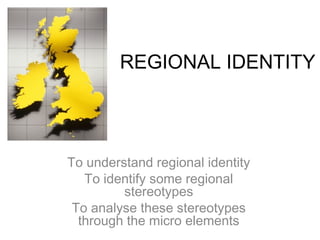
Regional Identity refers to the part of the
United Kingdom someone is from. It could
refer to a general area such a north or south
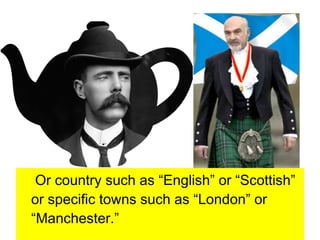
Or country such as “English” or “Scottish”
or specific towns such as “London” or
“Manchester.”
Regional identity is the notion that part of
a person's identity is rooted not only in the
country but also in the region they live in.
Regional identity is a sense of belonging
similar to that of national identity but on a
smaller scale or level.
Activity
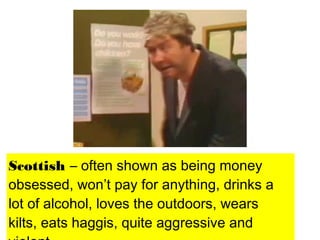
Scottish – often shown as being money
obsessed, won’t pay for anything, drinks a
lot of alcohol, loves the outdoors, wears
kilts, eats haggis, quite aggressive and
Welsh – Often shown as living in the middle
of the countryside, comically simplistic and
rugby fans. Symbols such as a leek, dragon
or daffodils are associated with the country.
Irish – often shown as living in the
countryside, working in rural areas such as
farms, being very religious, being good at
dancing and singing, very friendly but less
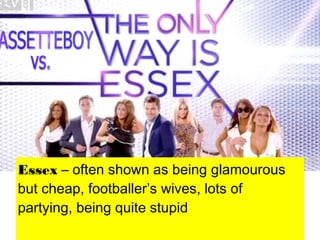
Essex – often shown as being glamourous
but cheap, footballer’s wives, lots of
partying, being quite stupid
Yorkshire – Often shown as living in rural
countryside, with rolling hills and cobbled
streets, being quite old fashioned
Cornwall / Somerset – Often shown as
being “backwards”, living in rural areas,
working on farms
Manchester / Newcastle / Liverpool –
Often shown as being “chavs”, wearing fake
designer labels, or tracksuits, drinking a lot,
being aggressive, uneducated, criminals
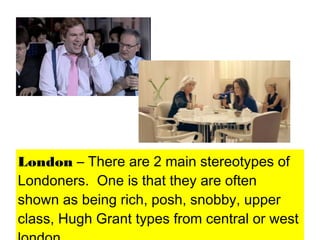
London – There are 2 main stereotypes of
Londoners. One is that they are often
shown as being rich, posh, snobby, upper
class, Hugh Grant types from central or west
The other is that they often shown as being from
north, east or south London, poor, common, lower
class, criminalistic, violent “Kidulthood” style
                                        15
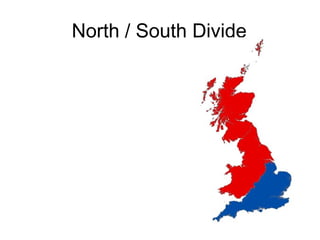
North / South Divide
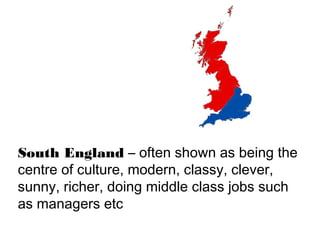
South England – often shown as being the
centre of culture, modern, classy, clever,
sunny, richer, doing middle class jobs such
as managers etc
North England – often shown as being
poorer, bad weather, lower class,
aggressive, less culture, less clever, doing
working class jobs such as builders etc
Where do these images
       belong?
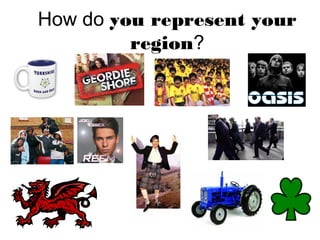
How do you represent your
         region?
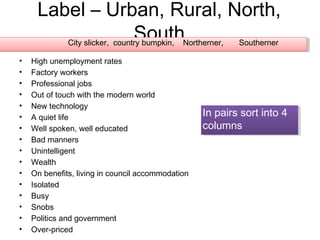
Label – Urban, Rural, North,
                           South Northerner, Southerner
        City slicker, country bumpkin, Northerner,
        City slicker, country bumpkin,             Southerner

•   High unemployment rates
•   Factory workers
•   Professional jobs
•   Out of touch with the modern world
•   New technology
•   A quiet life                                   In pairs sort into 4
                                                    In pairs sort into 4
•   Well spoken, well educated                     columns
                                                    columns
•   Bad manners
•   Unintelligent
•   Wealth
•   On benefits, living in council accommodation
•   Isolated
•   Busy
•   Snobs
•   Politics and government
•   Over-priced
Can you think of anymore regional
            stereotypes?

How can you identify regional identity?

Setting
Accents
Dialogue
Props
Make up
Class of characters
Costumes
Why do we Stereotype?
A stereotype is “...a fixed, over generalized belief about a particular group or class
of people.” (Cardwell, 1996). 

For example, someone who lives in the country side is uneducated.

One advantage of a stereotype is that it enables us to respond rapidly to situations
because we may have had a similar experience before.

One disadvantage is that it makes us ignore differences between individuals;
therefore we think things about people that might not be true (i.e. make
generalisations).

                              Smash a stereotype.
                              1.Think of an individual you know from
                              one of the regions we have discussed
                              2.Write down the stereotype
                              3.Then how they subvert it.


                                                                             23
Fill in the grid - you have 2 mins (30 seconds a micro
element)


                                                  24
North / Divide
• Our Friends in the North Extract
  – http://www.youtube.com/watch?v=Nu2Mu6_trho
Rural / Urban
• Doc Martin
  – http://www.youtube.com/watch?v=4gfYWZzaTBI&f
North / Divide
• North and South
  – http://www.youtube.com/watch?
    v=pvBKdaY8Y3w
  – Set in Victorian Britain
  – Could refer to class also
  – Focus just on North & South

05 regional identity

  • 1.
    REGIONAL IDENTITY To understandregional identity To identify some regional stereotypes To analyse these stereotypes through the micro elements
  • 2.
    Regional Identity refersto the part of the United Kingdom someone is from. It could refer to a general area such a north or south
  • 3.
    Or country suchas “English” or “Scottish” or specific towns such as “London” or “Manchester.”
  • 4.
    Regional identity isthe notion that part of a person's identity is rooted not only in the country but also in the region they live in.
  • 5.
    Regional identity isa sense of belonging similar to that of national identity but on a smaller scale or level.
  • 6.
  • 7.
    Scottish – oftenshown as being money obsessed, won’t pay for anything, drinks a lot of alcohol, loves the outdoors, wears kilts, eats haggis, quite aggressive and
  • 8.
    Welsh – Oftenshown as living in the middle of the countryside, comically simplistic and rugby fans. Symbols such as a leek, dragon or daffodils are associated with the country.
  • 9.
    Irish – oftenshown as living in the countryside, working in rural areas such as farms, being very religious, being good at dancing and singing, very friendly but less
  • 10.
    Essex – oftenshown as being glamourous but cheap, footballer’s wives, lots of partying, being quite stupid
  • 11.
    Yorkshire – Oftenshown as living in rural countryside, with rolling hills and cobbled streets, being quite old fashioned
  • 12.
    Cornwall / Somerset– Often shown as being “backwards”, living in rural areas, working on farms
  • 13.
    Manchester / Newcastle/ Liverpool – Often shown as being “chavs”, wearing fake designer labels, or tracksuits, drinking a lot, being aggressive, uneducated, criminals
  • 14.
    London – Thereare 2 main stereotypes of Londoners. One is that they are often shown as being rich, posh, snobby, upper class, Hugh Grant types from central or west
  • 15.
    The other isthat they often shown as being from north, east or south London, poor, common, lower class, criminalistic, violent “Kidulthood” style 15
  • 16.
  • 17.
    South England –often shown as being the centre of culture, modern, classy, clever, sunny, richer, doing middle class jobs such as managers etc
  • 18.
    North England –often shown as being poorer, bad weather, lower class, aggressive, less culture, less clever, doing working class jobs such as builders etc
  • 19.
    Where do theseimages belong?
  • 20.
    How do yourepresent your region?
  • 21.
    Label – Urban,Rural, North, South Northerner, Southerner City slicker, country bumpkin, Northerner, City slicker, country bumpkin, Southerner • High unemployment rates • Factory workers • Professional jobs • Out of touch with the modern world • New technology • A quiet life In pairs sort into 4 In pairs sort into 4 • Well spoken, well educated columns columns • Bad manners • Unintelligent • Wealth • On benefits, living in council accommodation • Isolated • Busy • Snobs • Politics and government • Over-priced
  • 22.
    Can you thinkof anymore regional stereotypes? How can you identify regional identity? Setting Accents Dialogue Props Make up Class of characters Costumes
  • 23.
    Why do weStereotype? A stereotype is “...a fixed, over generalized belief about a particular group or class of people.” (Cardwell, 1996).  For example, someone who lives in the country side is uneducated. One advantage of a stereotype is that it enables us to respond rapidly to situations because we may have had a similar experience before. One disadvantage is that it makes us ignore differences between individuals; therefore we think things about people that might not be true (i.e. make generalisations). Smash a stereotype. 1.Think of an individual you know from one of the regions we have discussed 2.Write down the stereotype 3.Then how they subvert it. 23
  • 24.
    Fill in thegrid - you have 2 mins (30 seconds a micro element) 24
  • 25.
    North / Divide •Our Friends in the North Extract – http://www.youtube.com/watch?v=Nu2Mu6_trho
  • 26.
    Rural / Urban •Doc Martin – http://www.youtube.com/watch?v=4gfYWZzaTBI&f
  • 27.
    North / Divide •North and South – http://www.youtube.com/watch? v=pvBKdaY8Y3w – Set in Victorian Britain – Could refer to class also – Focus just on North & South