Resource-Oriented
Architecture (ROA)
and REST


         <div id=”author”>Scott Davis</div>
                                              1
2
Scott Davis


              3
Web Services


               4
5
6
Web Services


               7
8
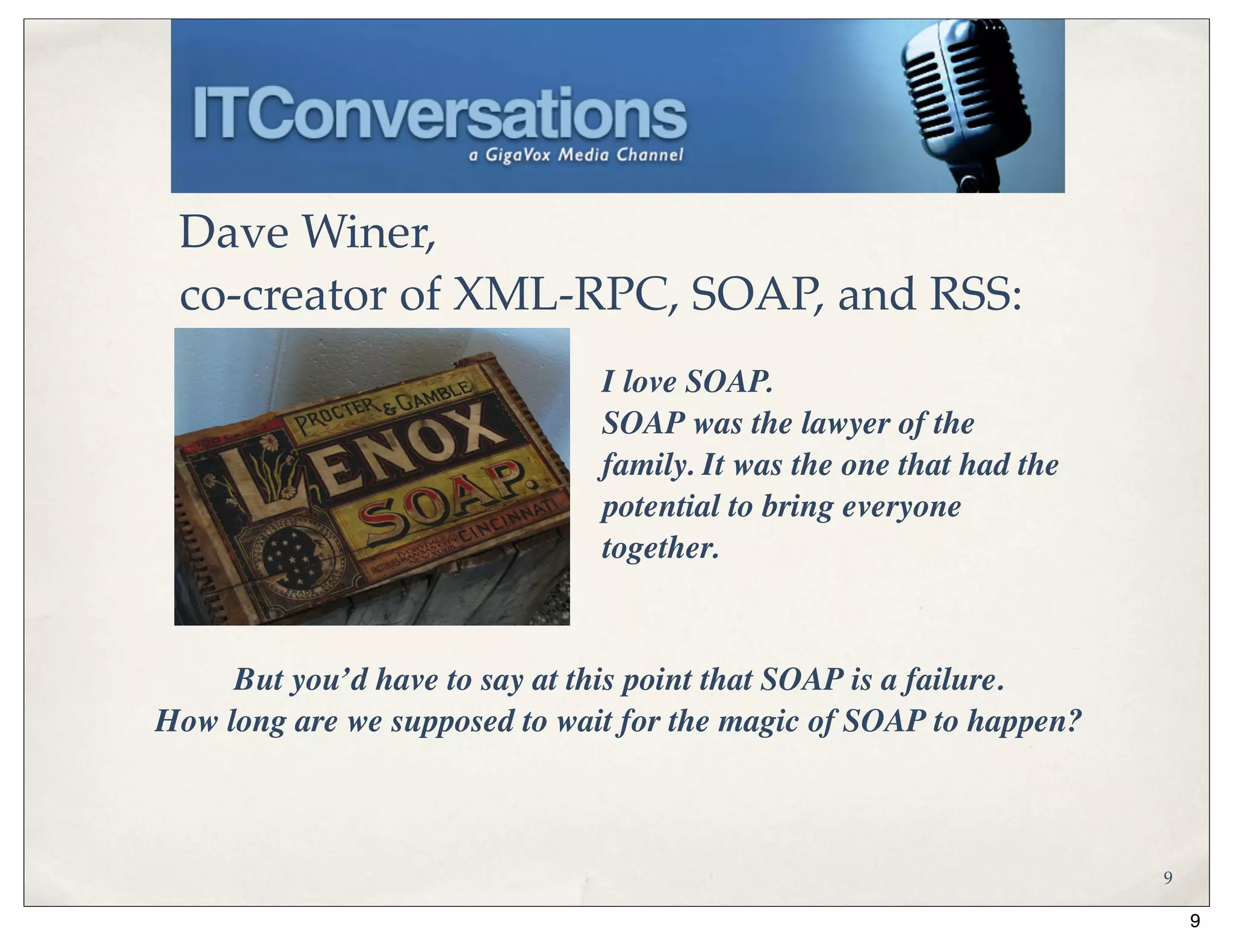
Dave Winer,
 co-creator of XML-RPC, SOAP, and RSS:
                               I love SOAP.
                               SOAP was the lawyer of the
                               family. It was the one that had the
                               potential to bring everyone
                               together.


     But you’d have to say at this point that SOAP is a failure.
How long are we supposed to wait for the magic of SOAP to happen?


                                                                     9

                                                                         9
“[With SOAP] we tried really
 hard to create a level playing
field for small developers and
      large developers.”


                                  10
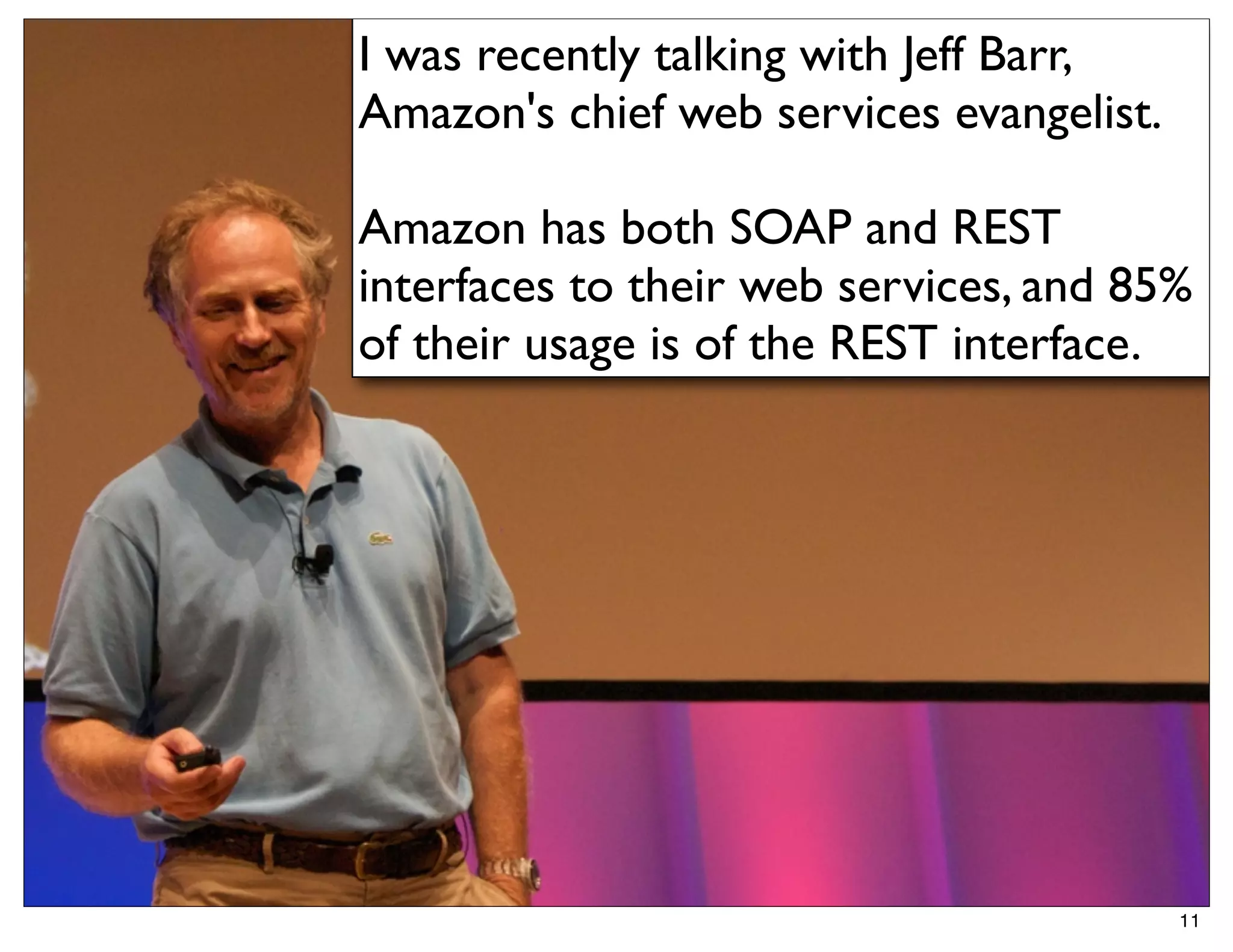
I was recently talking with Jeff Barr,
Amazon's chief web services evangelist.

Amazon has both SOAP and REST
interfaces to their web services, and 85%
of their usage is of the REST interface.


                                          11
Despite all of the corporate hype over
    the SOAP stack, this is pretty compelling
    evidence that developers like the simpler
                 REST approach.


I've always liked technologies that have low barriers
 to entry and grassroots adoption, and simple XML
  over HTTP approach seems to have that winning
                     combination.
                                                        12
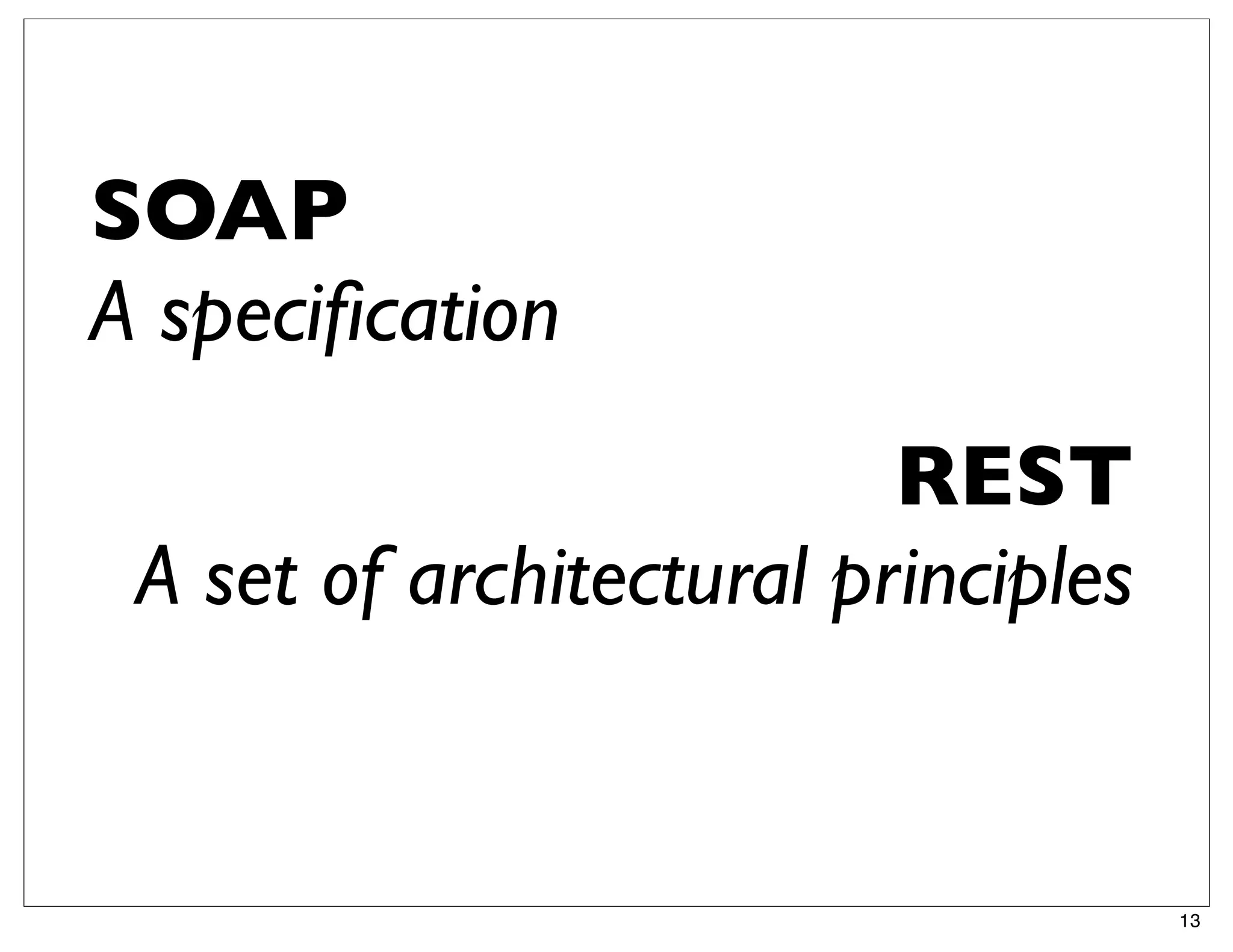
SOAP
A specification
                          REST
 A set of architectural principles


                                     13
REST is...


REpresentational State Transfer


                                  14
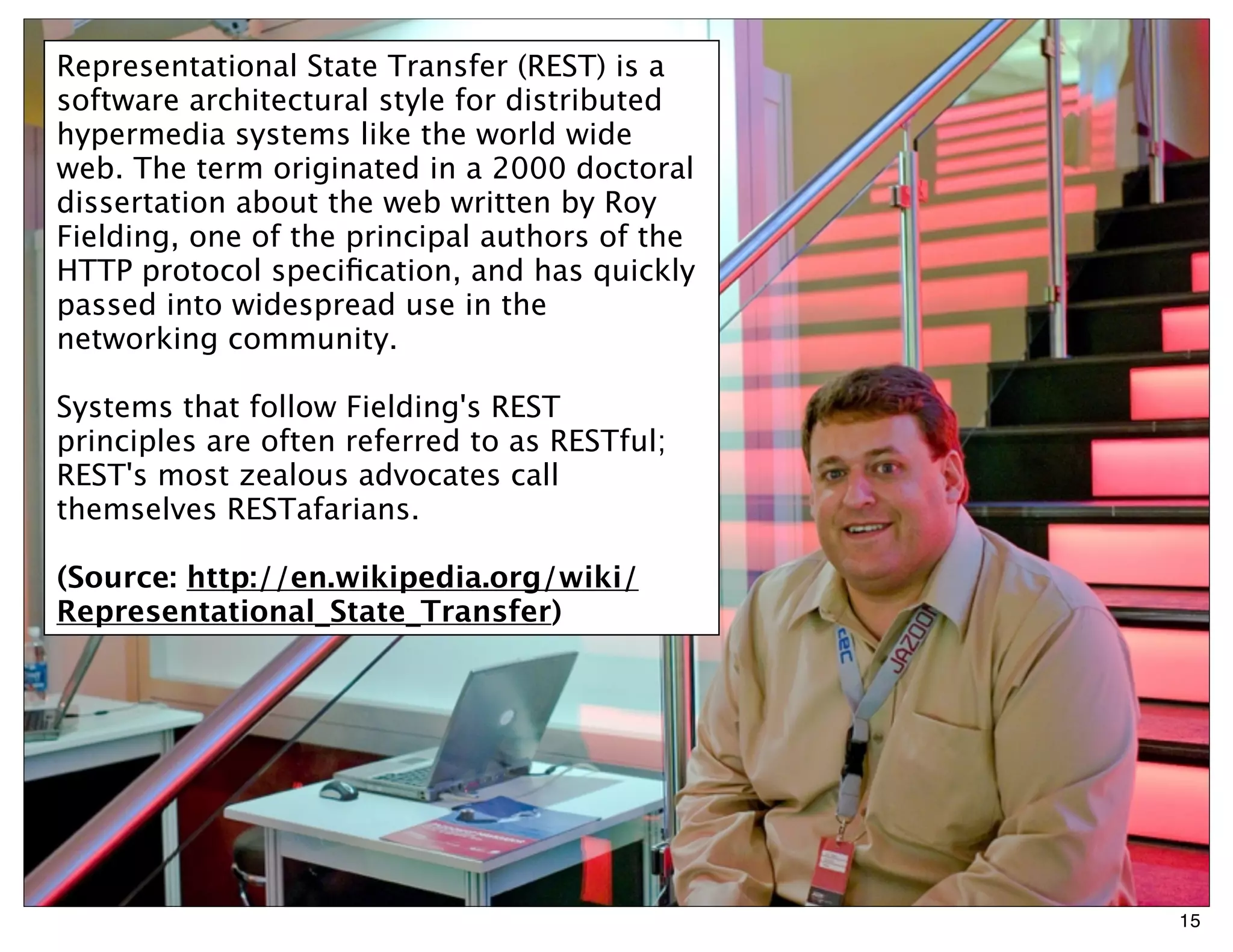
Representational State Transfer (REST) is a
software architectural style for distributed
hypermedia systems like the world wide
web. The term originated in a 2000 doctoral
dissertation about the web written by Roy
Fielding, one of the principal authors of the
HTTP protocol specification, and has quickly
passed into widespread use in the
networking community.

Systems that follow Fielding's REST
principles are often referred to as RESTful;
REST's most zealous advocates call
themselves RESTafarians.

(Source: http://en.wikipedia.org/wiki/
Representational_State_Transfer)


                                                15
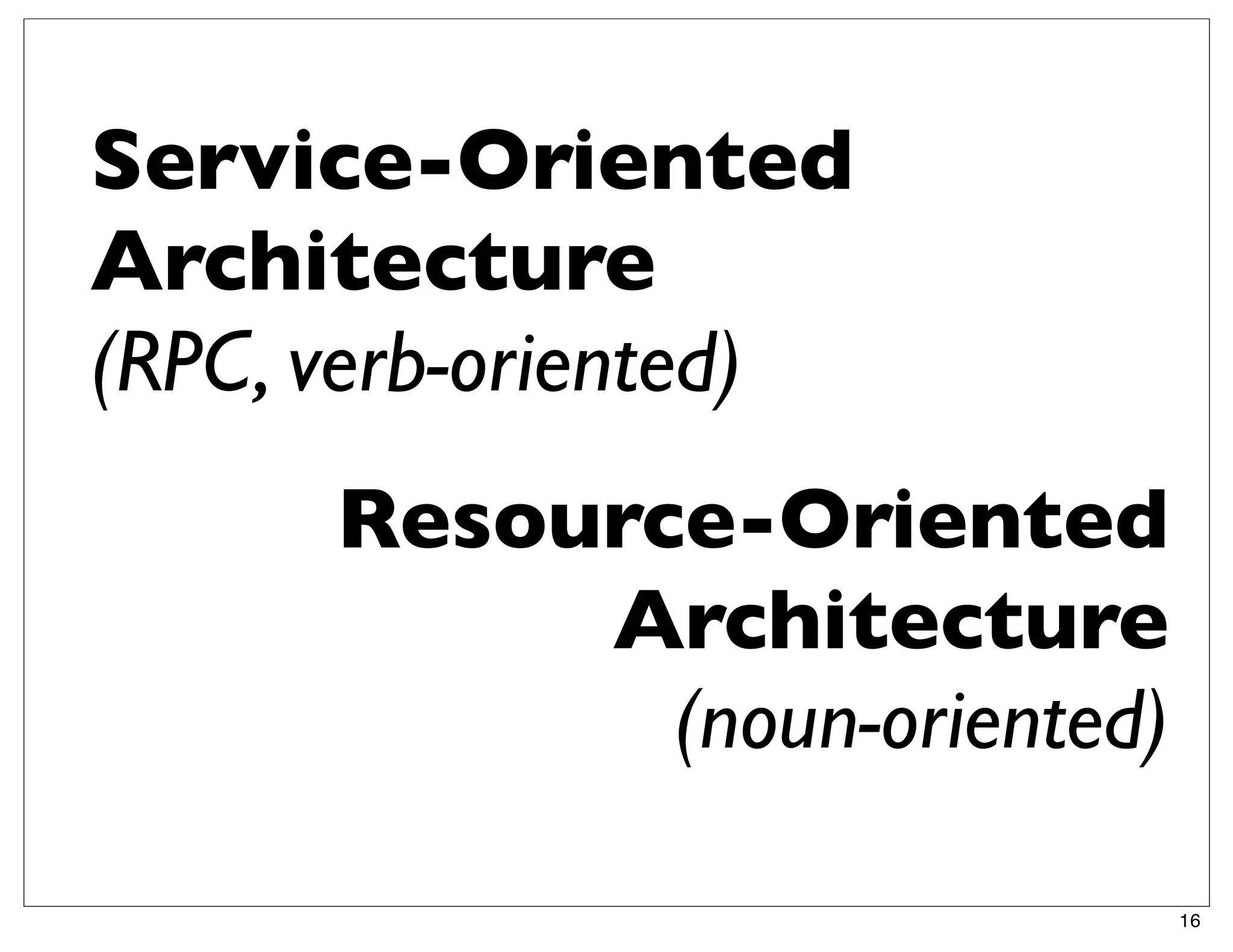
Service-Oriented
Architecture
(RPC, verb-oriented)
      Resource-Oriented
           Architecture
             (noun-oriented)

                               16
17
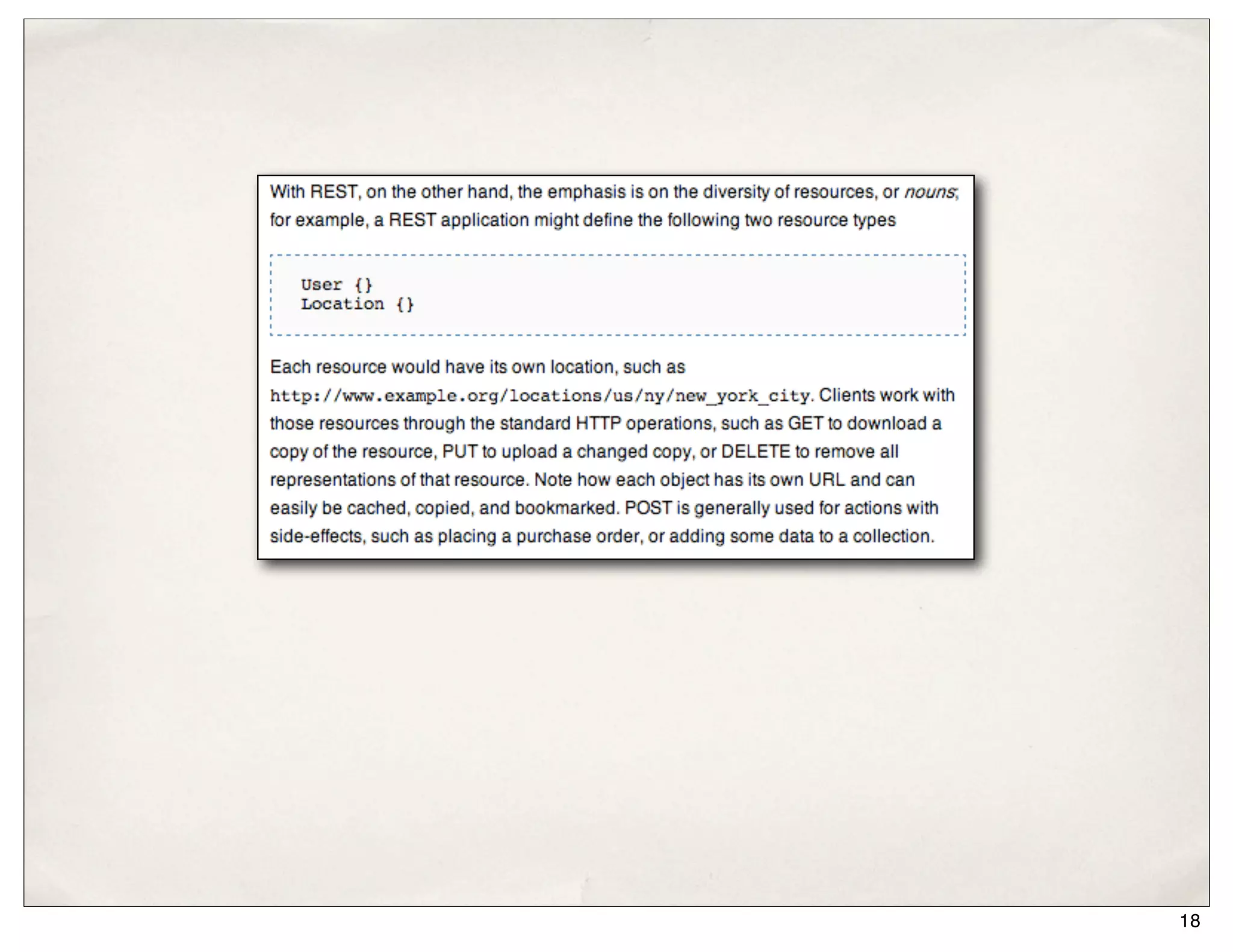
18
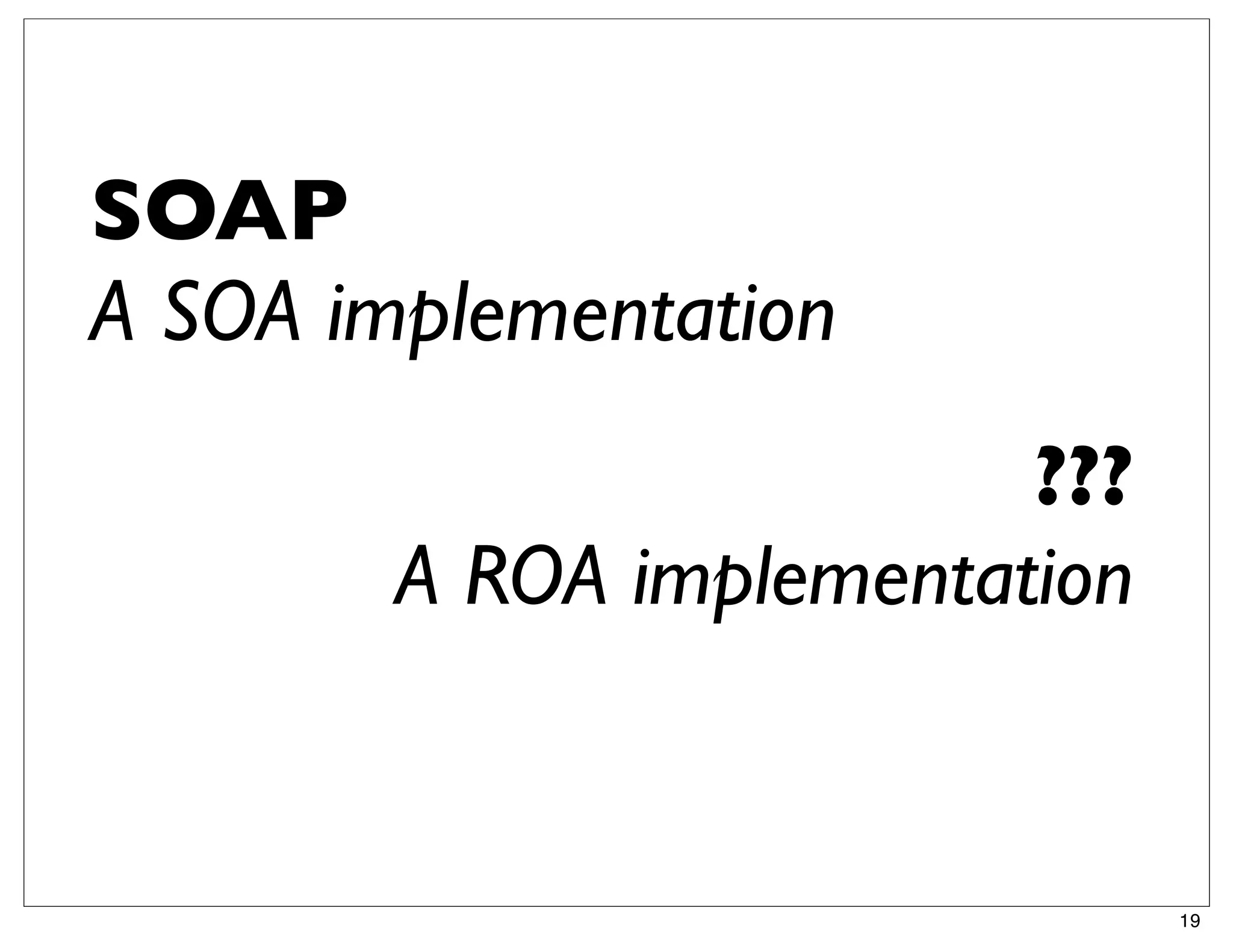
SOAP
A SOA implementation
                         ???
        A ROA implementation


                               19
Syndication


              20
21
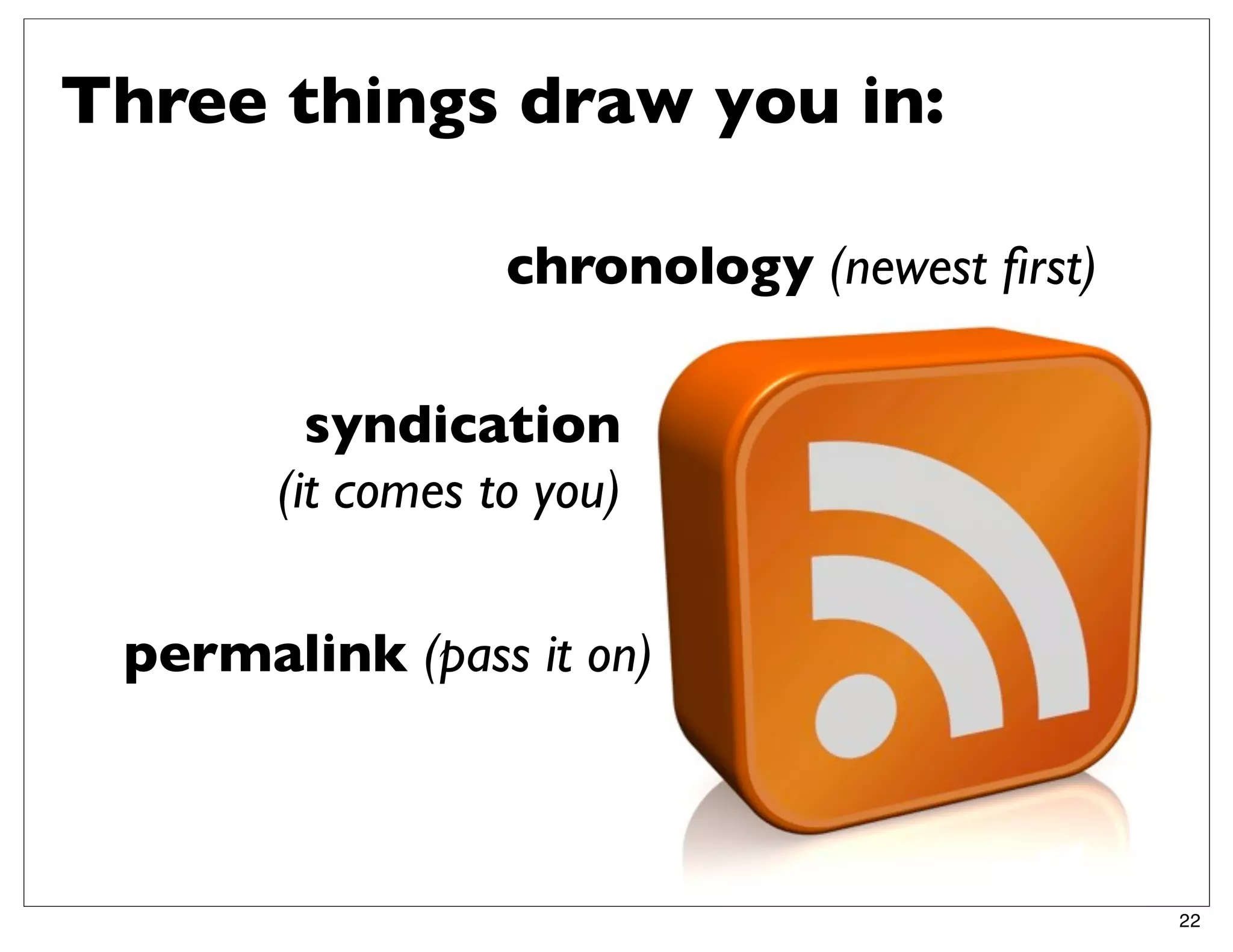
Three things draw you in:

                  chronology (newest first)

         syndication
       (it comes to you)

 permalink (pass it on)


                                             22
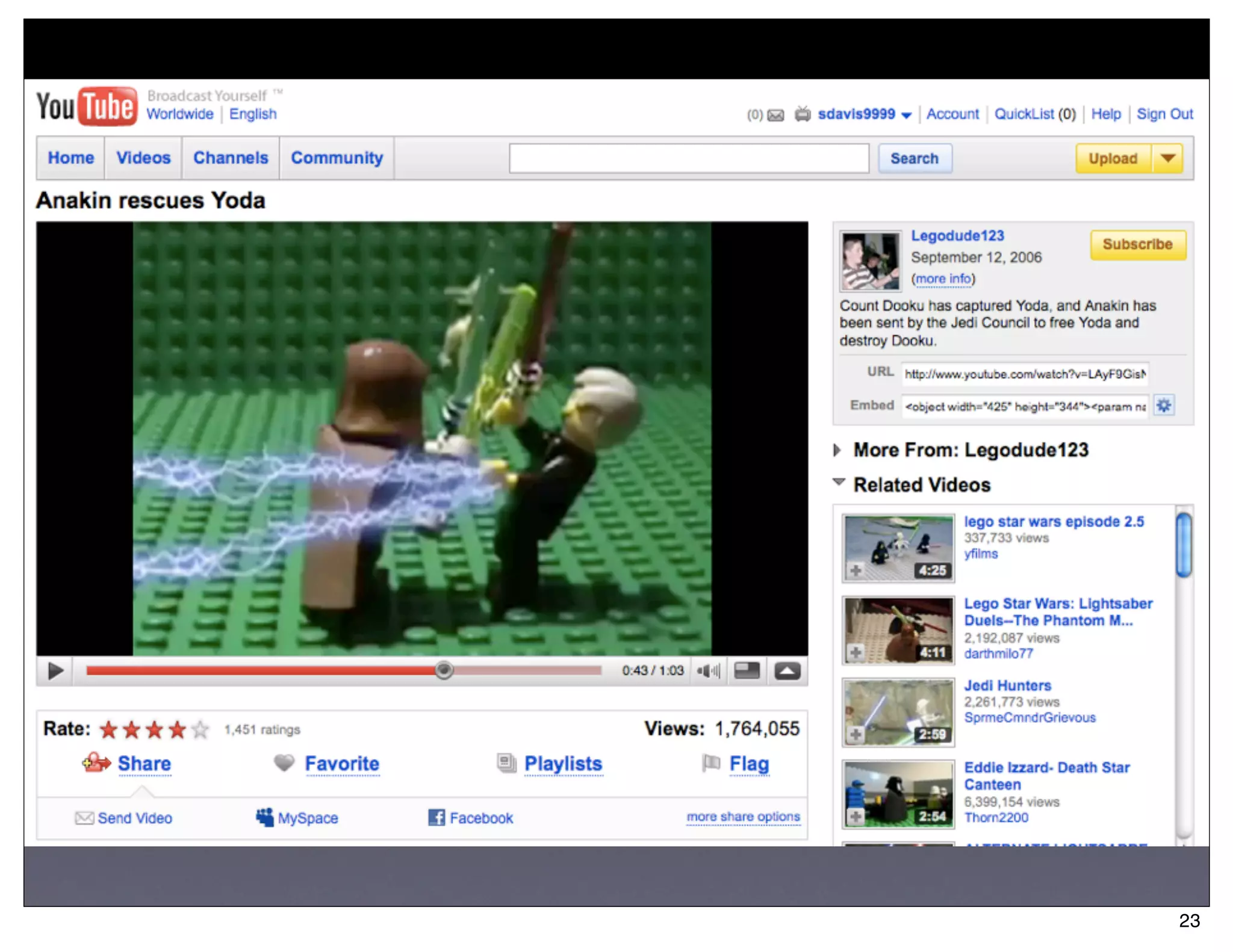
23
24
     24
25
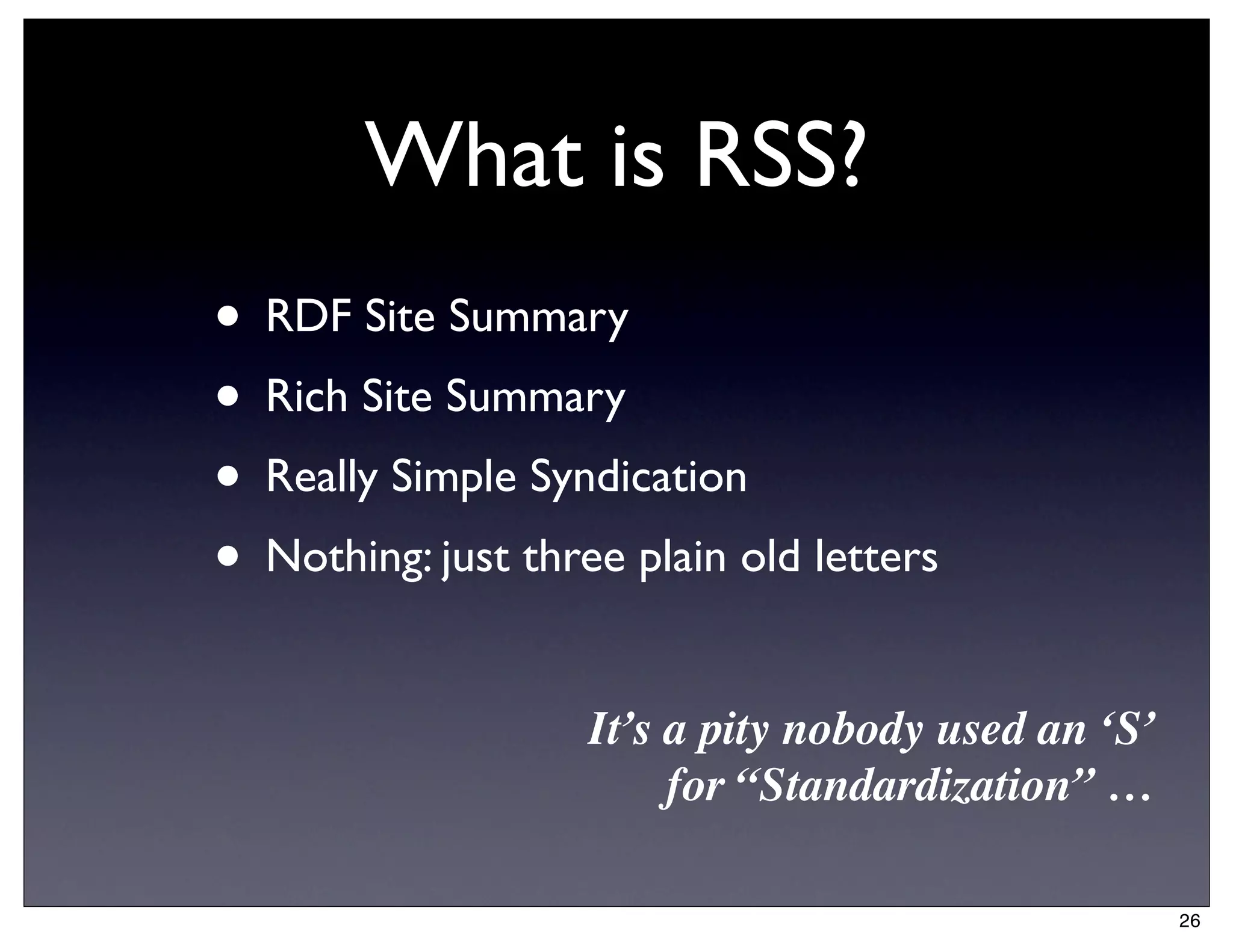
What is RSS?
• RDF Site Summary
• Rich Site Summary
• Really Simple Syndication
• Nothing: just three plain old letters
                    It’s a pity nobody used an ‘S’
                         for “Standardization” …

                                                     26
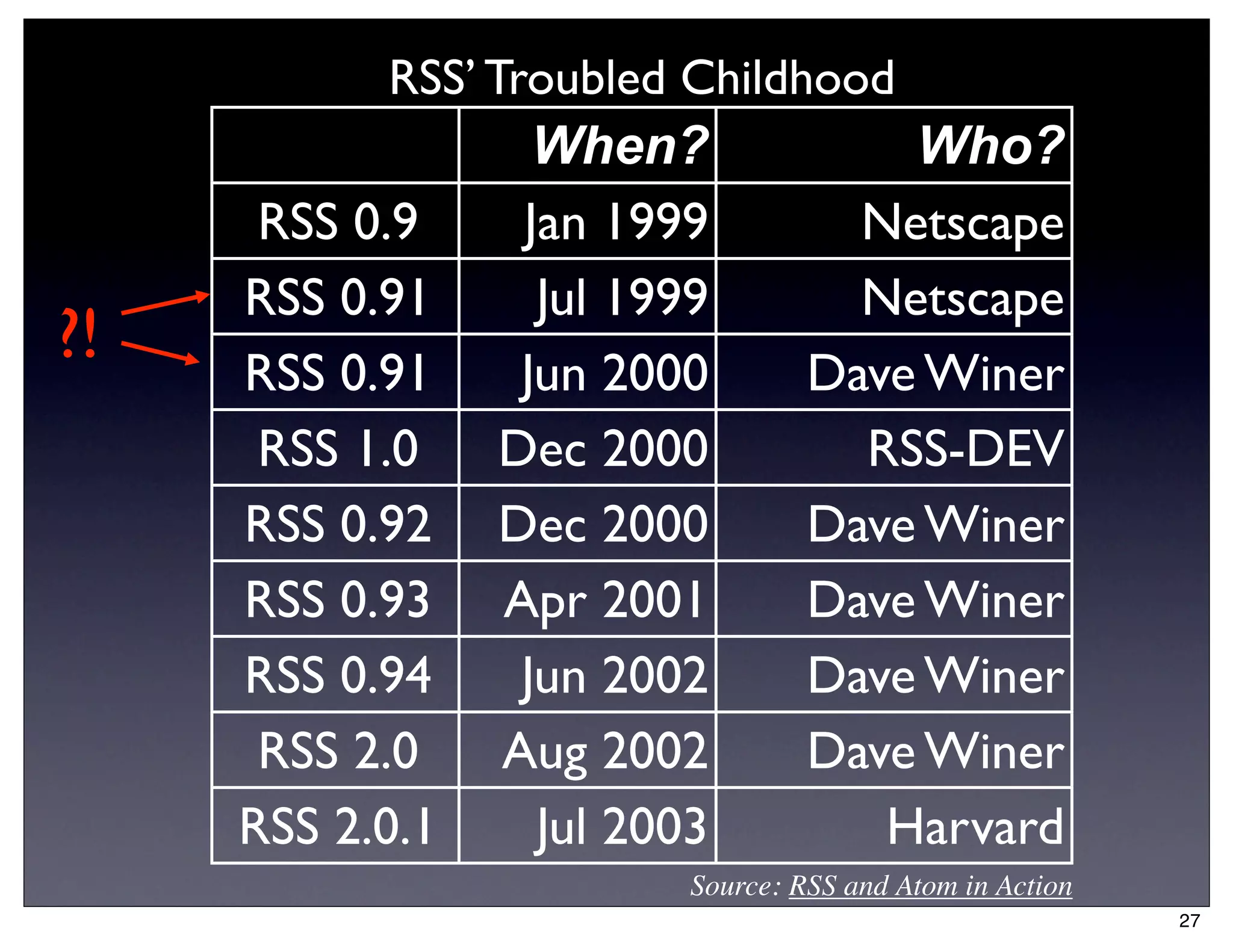
RSS’ Troubled Childhood
                   When?               Who?
      RSS 0.9     Jan 1999           Netscape
     RSS 0.91      Jul 1999          Netscape
?!   RSS 0.91     Jun 2000         Dave Winer
      RSS 1.0    Dec 2000            RSS-DEV
     RSS 0.92    Dec 2000          Dave Winer
     RSS 0.93    Apr 2001          Dave Winer
     RSS 0.94     Jun 2002         Dave Winer
      RSS 2.0    Aug 2002          Dave Winer
     RSS 2.0.1     Jul 2003           Harvard
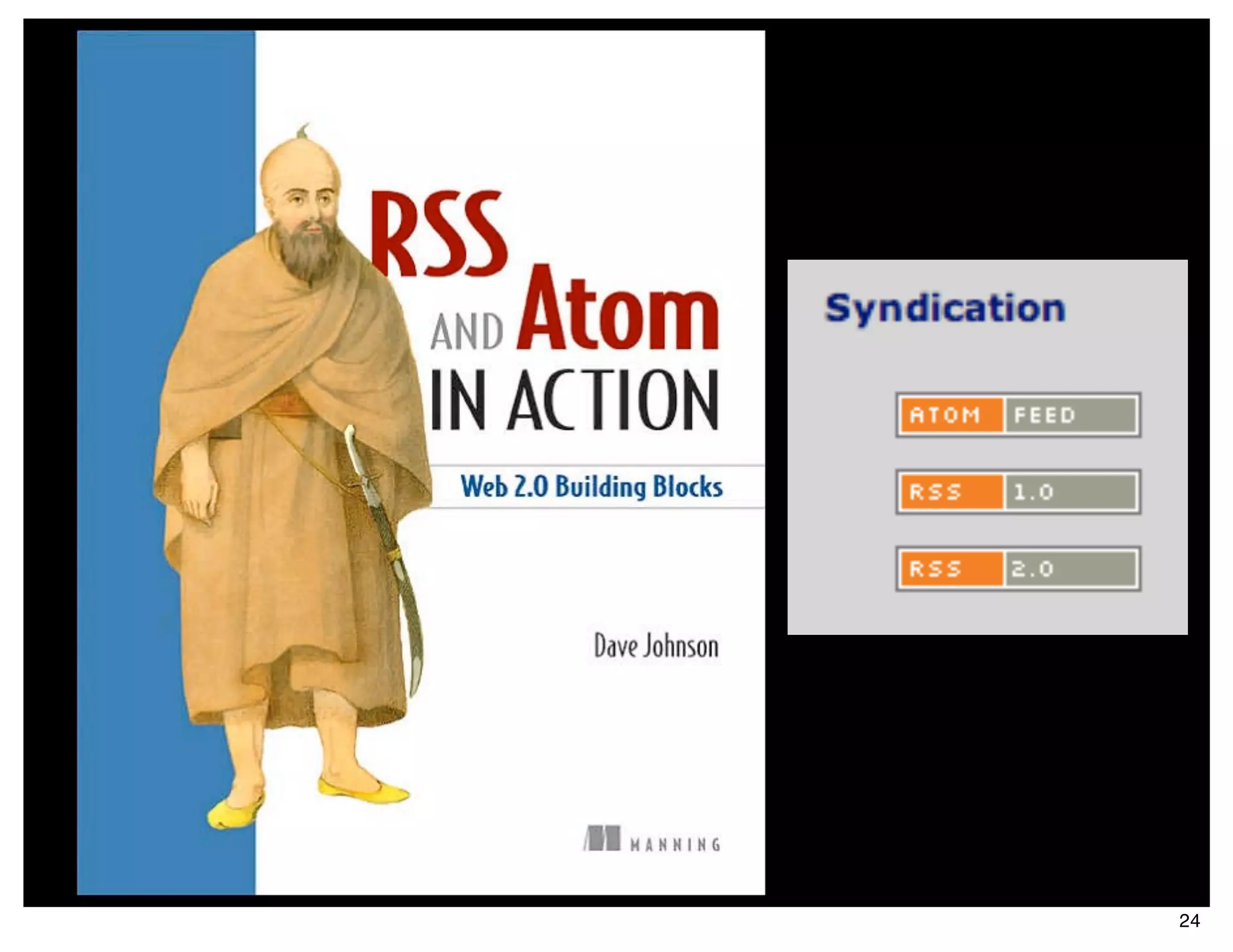
                          Source: RSS and Atom in Action
                                                           27
When Atom emerged as a format
intended to rival or replace RSS,
CNET described the motivation of
its creators as follows: "Winer's
opponents are seeking a new format
that would clarify RSS ambiguities,
consolidate its multiple versions,
expand its capabilities, and fall under
the auspices of a traditional
standards organization."

A brief description of some of the
ways Atom 1.0 differs from RSS 2.0
has been given by Tim Bray, who
played a major role in the creation of
Atom:


                                          28
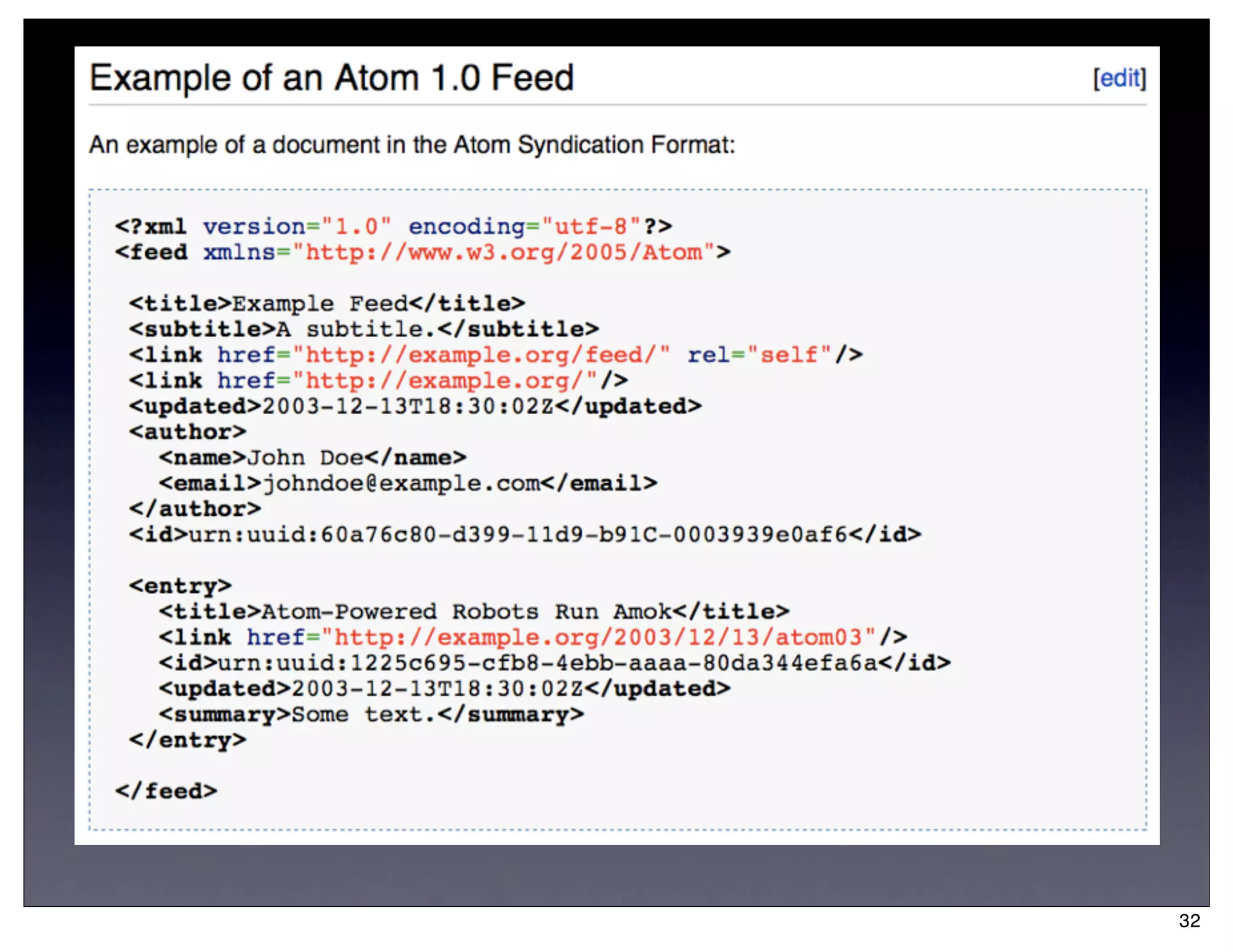
The Atom syndication format was published
as an IETF proposed standard in RFC 4287

The Atom Publishing Protocol was published
as RFC 5023.
                                             29
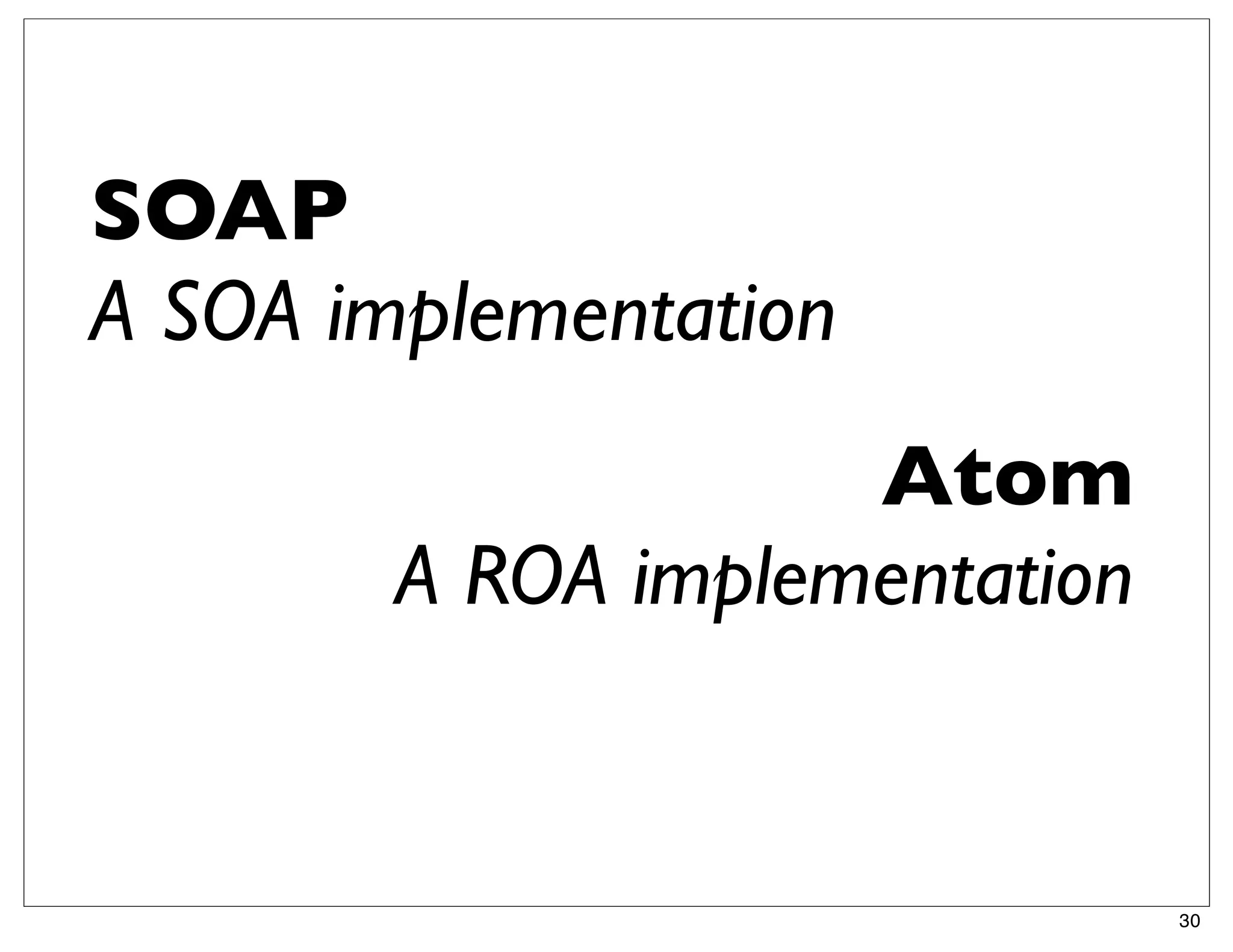
SOAP
A SOA implementation
                    Atom
        A ROA implementation


                               30
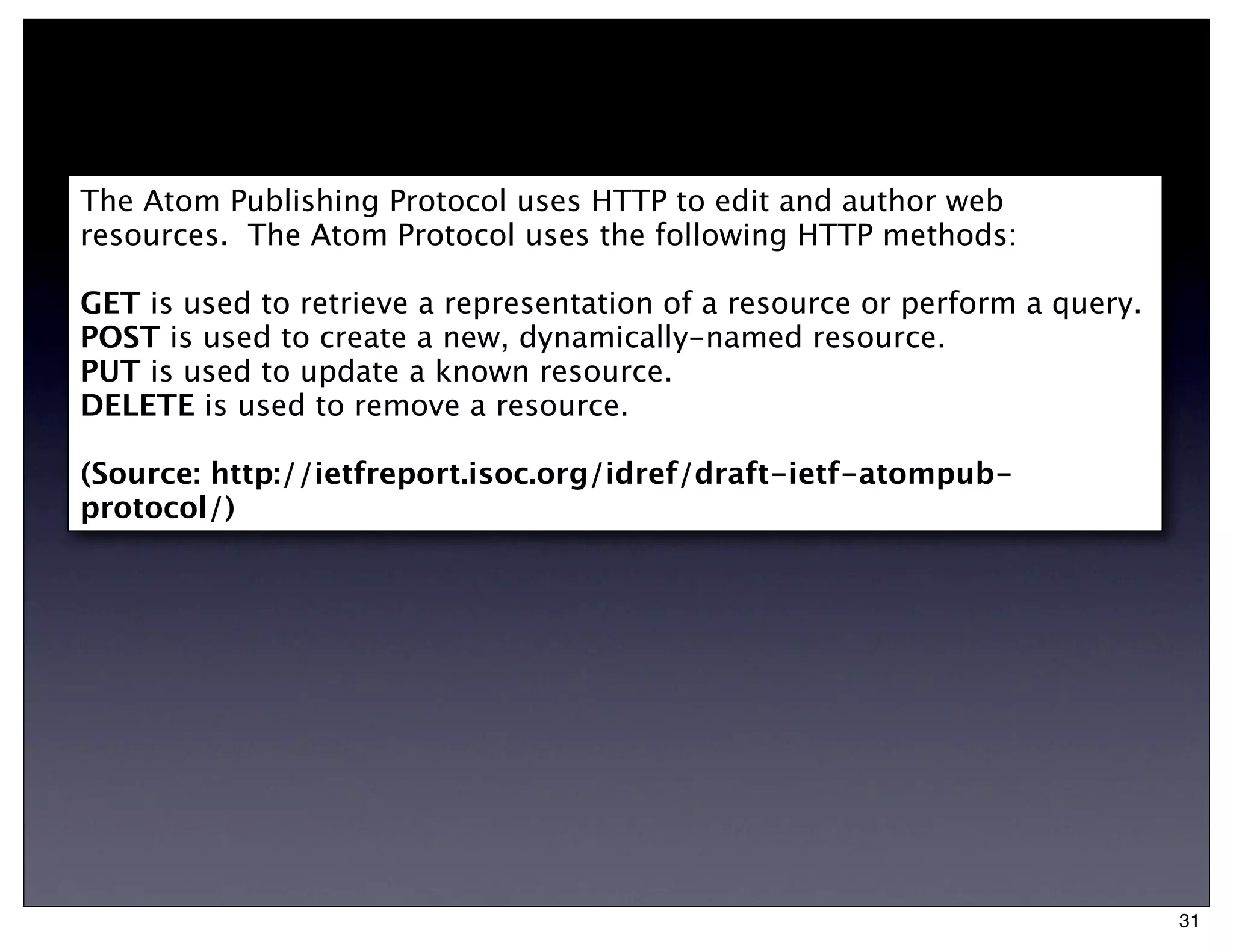
The Atom Publishing Protocol uses HTTP to edit and author web
resources. The Atom Protocol uses the following HTTP methods:

GET is used to retrieve a representation of a resource or perform a query.
POST is used to create a new, dynamically-named resource.
PUT is used to update a known resource.
DELETE is used to remove a resource.

(Source: http://ietfreport.isoc.org/idref/draft-ietf-atompub-
protocol/)


                                                                             31
32
Who is using Atom?


                     33
34
35
36
37
Atom is...


        An IETF Standard
             RESTful
       A syndication format


                              38
Resource-Oriented
Architecture (ROA)
and REST


         <div id=”author”>Scott Davis</div>
                                              39
Scott Davis
                scott@thirstyhead.com

Questions?
Thanks for your time.

                                        40
Photo Credits
http://upload.wikimedia.org/wikipedia/commons/thumb/b/b9/Atom_of_Atheism-Zanaq.svg/709px-Atom_of_Atheism-
Zanaq.svg.png
http://www.flickr.com/photos/bmcirillo/422538824/
http://www.flickr.com/photos/jrnoded/179322085/
http://www.flickr.com/photos/adders/2961984289/
http://www.flickr.com/photos/weaselmcfee/2858311819/
http://www.flickr.com/photos/bblfish/637617442/
http://www.flickr.com/photos/louspringer/504705017/


                                                                                                            41

Resource-Oriented Architecture (ROA) and REST