Reviewing
RESTful Web Apps
Takuto Wada (a.k.a id:t-wada or @t_wada)
Apr 12, 2014 @ RESTful Meetup
Takuto Wada
id: t-wada
@t_wada
github: twada
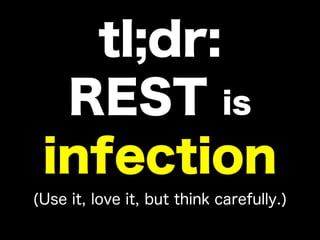
tl;dr:
REST is
infection
(Use it, love it, but think carefully.)
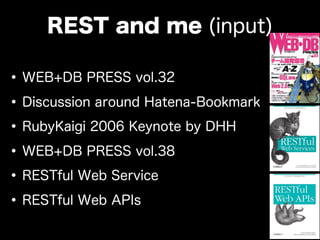
•WEB+DB PRESS vol.32
•Discussion around Hatena-Bookmark
•RubyKaigi 2006 Keynote by DHH
•WEB+DB PRESS vol.38
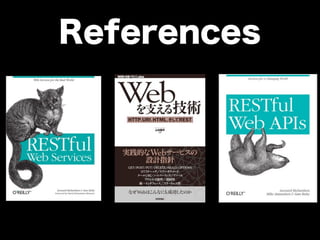
•RESTful Web Service
•RESTful Web APIs
REST and me (input)
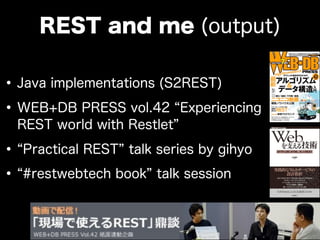
•Java implementations (S2REST)
•WEB+DB PRESS vol.42 Experiencing
REST world with Restlet
• Practical REST talk series by gihyo
• #restwebtech book talk session
REST and me (output)
•Large Rails Project
•+1000 routes
•Tools for reviewing
•White board
•Chat (IRC, Skype, ...)
•Wiki
•diff
Target Project
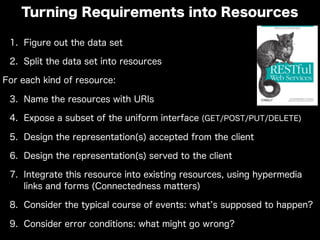
1. Figure out the data set
2. Split the data set into resources
For each kind of resource:
3. Name the resources with URIs
4. Expose a subset of the uniform interface (GET/POST/PUT/DELETE)
5. Design the representation(s) accepted from the client
6. Design the representation(s) served to the client
7. Integrate this resource into existing resources, using hypermedia
links and forms (Connectedness matters)
8. Consider the typical course of events: what s supposed to happen?
9. Consider error conditions: what might go wrong?
Turning Requirements into Resources
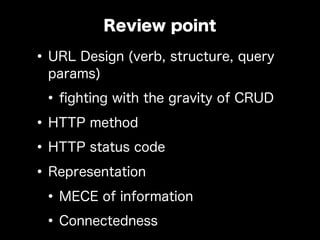
•URL Design (verb, structure, query
params)
•fighting with the gravity of CRUD
•HTTP method
•HTTP status code
•Representation
•MECE of information
•Connectedness
Review point
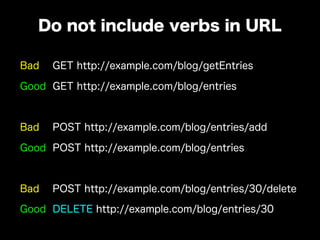
Bad GET http://example.com/blog/getEntries
Good GET http://example.com/blog/entries
Bad POST http://example.com/blog/entries/add
Good POST http://example.com/blog/entries
Bad POST http://example.com/blog/entries/30/delete
Good DELETE http://example.com/blog/entries/30
Do not include verbs in URL
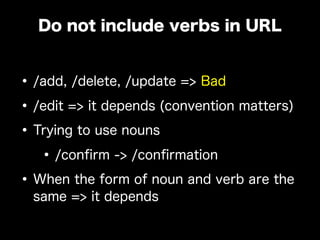
•/add, /delete, /update => Bad
•/edit => it depends (convention matters)
•Trying to use nouns
•/confirm -> /confirmation
•When the form of noun and verb are the
same => it depends
Do not include verbs in URL
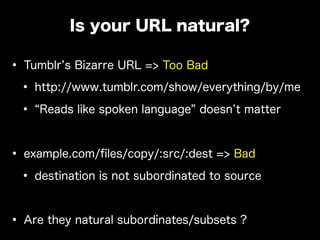
• Tumblr s Bizarre URL => Too Bad
• http://www.tumblr.com/show/everything/by/me
• Reads like spoken language doesn t matter
• example.com/files/copy/:src/:dest => Bad
• destination is not subordinated to source
• Are they natural subordinates/subsets ?
Is your URL natural?
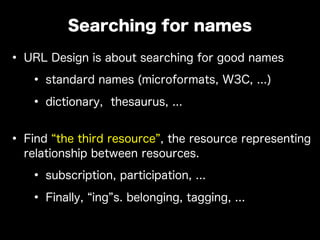
• URL Design is about searching for good names
• standard names (microformats, W3C, ...)
• dictionary, thesaurus, ...
• Find the third resource , the resource representing
relationship between resources.
• subscription, participation, ...
• Finally, ing s. belonging, tagging, ...
Searching for names
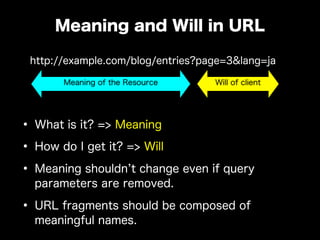
• What is it? => Meaning
• How do I get it? => Will
• Meaning shouldn t change even if query
parameters are removed.
• URL fragments should be composed of
meaningful names.
Meaning and Will in URL
http://example.com/blog/entries?page=3&lang=ja
Meaning of the Resource Will of client
• Resources are not only Database Records.
• Transactions
• Calculation Results
• Search Results
Resources ≠ Database Records
•Simple and automatic mapping looks nice
•GET/POST/PUT/DELETE
•SELECT/INSERT/UPDATE/DELETE
•It s a trap!
The Gravity of CRUD
•Why trap?
•Importance of models/tables varies.
•Core Domain Models tend to have many
more meanings and representations.
•In contrast, some tables are just
dependent tables. So they don t have
their own representations.
The Gravity of CRUD
•Don t just map 3NF tables to resources
•Some of them are too fine-grained
•N+1 Problem appears!
•Routes and Controllers should:
•Fill the gap of granularity and viewpoint
between Resources and Tables.
•Map them if and only if it is meaningful.
The Gravity of CRUD
•What do you want to do to the Resource?
•get it => GET
•create new one => POST
•modify it => UPDATE / PATCH
•delete it => DELETE
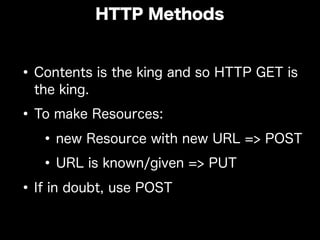
HTTP Methods
•Contents is the king and so HTTP GET is
the king.
•To make Resources:
•new Resource with new URL => POST
•URL is known/given => PUT
•If in doubt, use POST
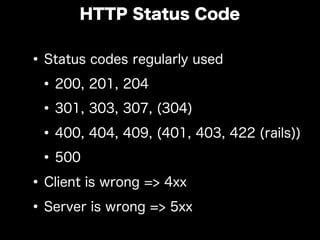
HTTP Methods
•Status codes regularly used
•200, 201, 204
•301, 303, 307, (304)
•400, 404, 409, (401, 403, 422 (rails))
•500
•Client is wrong => 4xx
•Server is wrong => 5xx
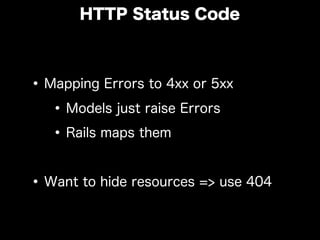
HTTP Status Code
•Mapping Errors to 4xx or 5xx
•Models just raise Errors
•Rails maps them
•Want to hide resources => use 404
HTTP Status Code
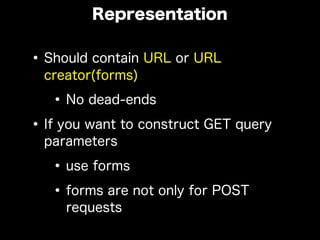
•Should contain URL or URL
creator(forms)
•No dead-ends
•If you want to construct GET query
parameters
•use forms
•forms are not only for POST
requests
Representation
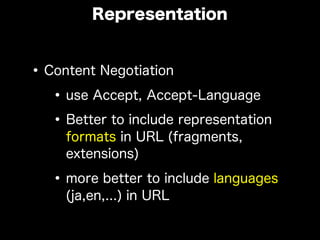
•Content Negotiation
•use Accept, Accept-Language
•Better to include representation
formats in URL (fragments,
extensions)
•more better to include languages
(ja,en,...) in URL
Representation
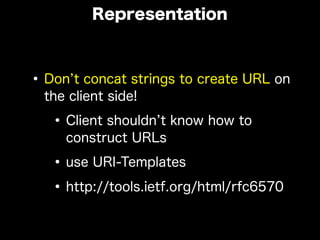
•Don t concat strings to create URL on
the client side!
•Client shouldn t know how to
construct URLs
•use URI-Templates
•http://tools.ietf.org/html/rfc6570
Representation
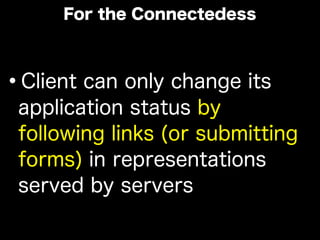
•Client can only change its
application status by
following links (or submitting
forms) in representations
served by servers
For the Connectedess
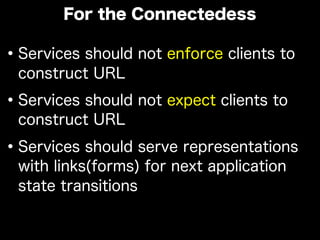
•Services should not enforce clients to
construct URL
•Services should not expect clients to
construct URL
•Services should serve representations
with links(forms) for next application
state transitions
For the Connectedess
References
tl;dr:
REST is
infection
(Use it, love it, but think carefully.)
Thanks!
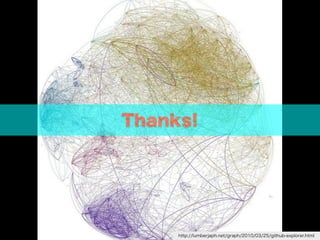
http://lumberjaph.net/graph/2010/03/25/github-explorer.html

Reviewing RESTful Web Apps

  • 1.
    Reviewing RESTful Web Apps TakutoWada (a.k.a id:t-wada or @t_wada) Apr 12, 2014 @ RESTful Meetup
  • 2.
  • 3.
    tl;dr: REST is infection (Use it,love it, but think carefully.)
  • 4.
    •WEB+DB PRESS vol.32 •Discussionaround Hatena-Bookmark •RubyKaigi 2006 Keynote by DHH •WEB+DB PRESS vol.38 •RESTful Web Service •RESTful Web APIs REST and me (input)
  • 5.
    •Java implementations (S2REST) •WEB+DBPRESS vol.42 Experiencing REST world with Restlet • Practical REST talk series by gihyo • #restwebtech book talk session REST and me (output)
  • 6.
    •Large Rails Project •+1000routes •Tools for reviewing •White board •Chat (IRC, Skype, ...) •Wiki •diff Target Project
  • 7.
    1. Figure outthe data set 2. Split the data set into resources For each kind of resource: 3. Name the resources with URIs 4. Expose a subset of the uniform interface (GET/POST/PUT/DELETE) 5. Design the representation(s) accepted from the client 6. Design the representation(s) served to the client 7. Integrate this resource into existing resources, using hypermedia links and forms (Connectedness matters) 8. Consider the typical course of events: what s supposed to happen? 9. Consider error conditions: what might go wrong? Turning Requirements into Resources
  • 8.
    •URL Design (verb,structure, query params) •fighting with the gravity of CRUD •HTTP method •HTTP status code •Representation •MECE of information •Connectedness Review point
  • 9.
    Bad GET http://example.com/blog/getEntries GoodGET http://example.com/blog/entries Bad POST http://example.com/blog/entries/add Good POST http://example.com/blog/entries Bad POST http://example.com/blog/entries/30/delete Good DELETE http://example.com/blog/entries/30 Do not include verbs in URL
  • 10.
    •/add, /delete, /update=> Bad •/edit => it depends (convention matters) •Trying to use nouns •/confirm -> /confirmation •When the form of noun and verb are the same => it depends Do not include verbs in URL
  • 11.
    • Tumblr sBizarre URL => Too Bad • http://www.tumblr.com/show/everything/by/me • Reads like spoken language doesn t matter • example.com/files/copy/:src/:dest => Bad • destination is not subordinated to source • Are they natural subordinates/subsets ? Is your URL natural?
  • 12.
    • URL Designis about searching for good names • standard names (microformats, W3C, ...) • dictionary, thesaurus, ... • Find the third resource , the resource representing relationship between resources. • subscription, participation, ... • Finally, ing s. belonging, tagging, ... Searching for names
  • 13.
    • What isit? => Meaning • How do I get it? => Will • Meaning shouldn t change even if query parameters are removed. • URL fragments should be composed of meaningful names. Meaning and Will in URL http://example.com/blog/entries?page=3&lang=ja Meaning of the Resource Will of client
  • 14.
    • Resources arenot only Database Records. • Transactions • Calculation Results • Search Results Resources ≠ Database Records
  • 15.
    •Simple and automaticmapping looks nice •GET/POST/PUT/DELETE •SELECT/INSERT/UPDATE/DELETE •It s a trap! The Gravity of CRUD
  • 16.
    •Why trap? •Importance ofmodels/tables varies. •Core Domain Models tend to have many more meanings and representations. •In contrast, some tables are just dependent tables. So they don t have their own representations. The Gravity of CRUD
  • 17.
    •Don t justmap 3NF tables to resources •Some of them are too fine-grained •N+1 Problem appears! •Routes and Controllers should: •Fill the gap of granularity and viewpoint between Resources and Tables. •Map them if and only if it is meaningful. The Gravity of CRUD
  • 18.
    •What do youwant to do to the Resource? •get it => GET •create new one => POST •modify it => UPDATE / PATCH •delete it => DELETE HTTP Methods
  • 19.
    •Contents is theking and so HTTP GET is the king. •To make Resources: •new Resource with new URL => POST •URL is known/given => PUT •If in doubt, use POST HTTP Methods
  • 20.
    •Status codes regularlyused •200, 201, 204 •301, 303, 307, (304) •400, 404, 409, (401, 403, 422 (rails)) •500 •Client is wrong => 4xx •Server is wrong => 5xx HTTP Status Code
  • 21.
    •Mapping Errors to4xx or 5xx •Models just raise Errors •Rails maps them •Want to hide resources => use 404 HTTP Status Code
  • 22.
    •Should contain URLor URL creator(forms) •No dead-ends •If you want to construct GET query parameters •use forms •forms are not only for POST requests Representation
  • 23.
    •Content Negotiation •use Accept,Accept-Language •Better to include representation formats in URL (fragments, extensions) •more better to include languages (ja,en,...) in URL Representation
  • 24.
    •Don t concatstrings to create URL on the client side! •Client shouldn t know how to construct URLs •use URI-Templates •http://tools.ietf.org/html/rfc6570 Representation
  • 25.
    •Client can onlychange its application status by following links (or submitting forms) in representations served by servers For the Connectedess
  • 26.
    •Services should notenforce clients to construct URL •Services should not expect clients to construct URL •Services should serve representations with links(forms) for next application state transitions For the Connectedess
  • 27.
  • 28.
    tl;dr: REST is infection (Use it,love it, but think carefully.)
  • 29.