Get Homework/Assignment Done
Homeworkping.com
Homework Help
https://www.homeworkping.com/
Research Paper help
https://www.homeworkping.com/
Online Tutoring
https://www.homeworkping.com/
click here for freelancing tutoring sites
ADVERTISING.
*CHAPTER 1*
1.1 Origin of advertising
The origin of advertising does not lie in the modern industrial age, but it has
its roots in the remote past. Thousand of years ago most people were engaged in
hunting, farming, or handicraft related activities. They used to barter products among
themselves. Distribution was limited to how far the vendor could walk and distribute,
advertising was limited to how loud they could shout. Perhaps the earliest form of
advertising was simply the trader shouting out the fact that he existed and naming
what he had to sell in the local market place.
As an instrument of marketing, advertising was an effective through multiple sales
people reaching many people at one time. Then it had used the media as a tool.
The American marketing association defines advertising as “any paid form of
non-personal presentation and promotion of ideas, goods or services by an identified
sponsor”.
1
Advertising doesn’t change the physical properties of the product but than also it is
the most compulsory expense for creating demand for the product.
1.2 Impact of advertising
Advertising plays an important role in today’s competitive business world. It
provides benefits to Manufacturers, Retailers, Customers, Salesman and Society as
well.
2
 Introduces a New Product:
Advertising is used to introduce a new product in the market. It helps to
compete with establish brands and, thereby, ensures the survival and success of new
product.
 Creates Demand for Product:
Advertising creates demand for the product. Advertising spread information
about the product or services and makes consumers aware about it through various
mass media which makes positive effect on the mind of the people and create demand
for the product.
 Expand Market:
It helps in expanding local markets, to national level and even to international
level. Trading at national and international level is impossible without advertising
 Assists Personal Selling:
Advertising reaches a prospect before a salesman could. The prospect is well
informed through advertising. Makes the salesman’s job easier.
 Building Brand Image:
The purpose of repeat advertisings is to make people more brands conscious.
Once good brand image is developed, buyers generally become brand loyal. Money
spent on advertising is a long term investment to build brand and company image.
Reduces the cost of goods:
Advertising generates more demand, which leads to large scale production
and distribution. This results in economies in large scale which in turn reduces cost
of goods.
 Persuades prospects:
3
Every competitor makes superior claims of his product. Therefore, a prospect
needs to persuade to buy products. So, the role of Advertising is not only to inform
but also to persuade.
 Employment:
Advertising provides employment in the field of advertising to copywriters,
models, etc. It provides indirect employment in society due to large scale production
and distribution.
1.3 Role of advertising in marketing mix.
Marketing mix refers to advertising combination of four elements of
marketing useful for large-scale marketing. Such elements are: Production, Price,
Place, and Promotion (4 Ps).
According to W.J. Stanton “Marketing mix is the term used to describe the
combination of the four inputs which constitute the core of advertising company’s
marketing system: the product, the price structure, the promotional activities and the
distribution system”
Advertising and elements of marketing mix:
 Advertising and product:
Product is the core element in the marketing mix. The market demand finally
depends on the popularity and utility of the product. Popularity again depends on the
Quality, benefits and uses of the product. It is necessary to give publicity to physical
and other features of the product. Such information needs to be communicated to the
prospects through advertising.
 Advertising and price:
Buyers are always sensitive about the market price. They shift from one
product to the other due to quality or price. Price charged should be reasonable. This
is necessary for the support and co-operation of consumers.
4
 Advertising and Place:
Place relates to physical distribution which is possible through various
channels of distribution. Advertiser has to decide whether to adopt direct or indirect
channels of also useful for large-scale distribution. Advertising plays a crucial role to
ensure smooth distribution of goods and keep the consumers well-informed.
Advertising and Promotion:
Promotion is perhaps the most important element in the marketing mix.
Companies introduce sales promotion campaigns for capturing market. Price
discounts and schemes like buy one, get one free are also offered as sales promotion.
Various sales promotion techniques are introduced at the consumer and dealer levels.
Window display, provision of after sales services and coordinal public relations also
facilitate sales promotion. Massive advertising is useful to support the sales promotion
campaigns.
1.4 AIDA Formula in Advertising
The AIDA formula in advertising was suggested by E.K. Strong in his book
“the psychology of selling.” This formula suggests the steps in the process of
advertising. The term AIDA is a short form derived from the four words:
A à ATTENTION
I à INTEREST
D à DESIRE
A à ACTION
 A = Attracting Attention:
It involves attention element of an advertisement which ‘catches the eye’ and
attract attention. A person is likely to be attracted to advertisements which concerns
him and will be useful for him. In order to attract the attention of reader, it is
necessary to provide relevant information.
5
6
 I = Moving Interest:
This is the second step to consumer’s response. It is called “from eye to mind”
or “from attention to interest”. As attention should be favorable, interest also should
be favorable. All good advertisements start with consumer’s point of interest. An
advertiser’s approach should be to establish with the consumer, who is advertising
prospective buyer for the advertised product
 D = Creating Desire:
The main job of advertising is the transformation of an interest into advertising
desire in the consumer’s mind for possessing that product.
Some methods for creating advertising desire which turn product interest into
a buying desire.
à Present benefits that the consumer will gain.
à How to use or operate the product?
à Show the troubles that can be avoided by product purchase.
à Use prestige, pleasure and social approval angles.
 A = Securing Action:
This is the last stage in response to the advertisements. It prompts action and
turns prospects into buyers of the product. It is very important stage because it decides
the success and failure of advertisement. Complete information including price of the
product, quantity, etc., should be given to help the person to make a purchase
decision. Similarly, expected action can be secured by adopting various techniques
such as, gifts, samples, installment facilities, free demonstration etc. by using phrases
“Don’t delay”, “Buy now”, “sale”, “Limited Stock”…etc. action is generated.
7
*CHAPTER 2*
ADVERTISING CAMPAIGN:
2.1 What does it mean?
Planning Advertising Campaign is not common in the case of all
manufacturing companies particularly companies marketing consumer item and
facing cut – Throat market competition. Advertising Campaign has been defined as
series of Advertisement having the same thing and published within specific period.
Though the campaign is conveyed through different media, it has a single theme and
its unified approach.
All though advertisement are depended but they are deliberately made similar
to one another. The physical continuity is indicated by similarity of visual and orals.
Introduction of advertising campaign need long term planning with specific objective,
budgetary provision and arrangement for extensive advertising with advertisement
specific period. Involvement of various marketing executive is also essential for the
introduction of such advertising campaign.
During the campaign period, series of advertisements with identical
message are published through different media in order to have positive impact on the
people. The purpose of advertising campaign is to solve marketing problems with the
help of extensive advertising. It may be treated as outcome of overall marketing
strategy. Advertising efforts through well planned campaign gives better results than
regular advertising on advertisement small scale. This is because buyers are forgetful
of erratically appearing advertisements. However, repeated advertisements on the
same theme give better response from the consumers.
Coverage:-
1. Advertising Campaign may be organized at the national, regional or local levels.
2. Sometimes, they may be necessary for facing market competition.
8
3. Direct mail, radio, TV and press are used for the execution of advertising
campaign.
4. Advertising campaigns are costly due to increasing media rates.
2.2 Requirement of advertising campaign:
Advertising campaign is always desirable because:
1. Consumers are forgetful.
2. Consumers get confused with advertising messages.
3. Consumers sometime overlook advertisements.
4. New prospects emerge over advertisement period of time.
5. A part of advertising effort goes waste because some buyers are not real
prospects when advertisement appears.
6. Continuity in message as reminder.
2.3 Factor influencing planning of an advertising campaign:
1. The organization:
The position of the company undertaking advertisement campaign needs
proper consideration while planning advertising campaign. The production capacity of
the organization, its financial position, the sales force available, he product to be
marketed are some factors which need proper consideration.
2. Advertising budget:
Planning of advertising campaign depend on the budget provision made by the
company for such campaign. For advertising, agency, the main consideration is how
much I campaign, media used, frequency of advertisements in media, etc depend on
the budget provided for the campaign.
3. The product:
Product or service is the base of entire advertising campaign. Such product
may be consumer or industrial, direct usable or durable, high or low priced and finally
9
facing high or low market competition. The planning of advertising campaign should
be as per the features of the product.
4. Consumers:
While planning ad campaign, it is important to take in to account composition
of consumers, their buying habits, purchasing power, location etc. This will help the
advertiser to select suitable advertising theme, media and frequency of
advertisements.
5. Language:
Most of the ads are initially conceived in English. Hindi and regional
languages are better understood by the people. Bilingual advertising will be more
effective.
6. Competitors:
Advertisement is normally influenced by the extent of market competition and
the strong and weak points of competitors. Experts can plan the campaign properly
after studying the position of market competition and the policies of competitors.
7. The media:
Advertising campaign is influenced by the media available for advertising
purpose. It is necessary to select media which are suitable for the product, target
consumers, budget allocation and so on.
8. Sales promotion efforts:
Advertising campaign should be properly adjusted with the plans of other
departments of the company. It should be adjusted with the production schedule and
the sales promotion plan prepared by the sales department.
9. Identification of Current Problems:
Advertising campaign is basically for dealing with the current marketing
problems of the company. The possible problems may be: sales are reducing, merits
of the product are not brought to the notice of target consumers, the product fails to
face market competition effectively, etc. it is necessary to give attention to such
current problems while planning advertising campaign.
10
10. Government Regulations:
In our country, government exercises control over media. Advertisement
numbers of restrictions have been imposed by the government. In order to plan an
effective advertising campaign it is desirable that the advertiser is well-informed
about government regulations and controls in various media.
11. Advertising Objectives:
An advertising campaign is well executed when its advertising objective is
well defined. The campaign must use such headlines, slogans, illustrations which help
to achieve the advertising objectives.
2.4 Procedure for planning advertising campaign:
Planning advertising campaign is advertisement’s lengthy process but is
essential for successful execution of the campaign. Large companies prefer to hand
over the entire work of planning advertising campaign and its execution to advertising
agencies. During the planning process, the agency has to do lot of research and
finalize various details of the advertising campaign. In general, the following broad
steps are involved in the process of planning of advertising campaign:
1. Review of Company’s Marketing Position:
A company which desires to introduce advertising campaign may appoint an
advertising agency for planning and execution of advertising campaign. In this case, a
joint meeting of executives of the company and advertising agency is arranged to
review the present marketing position of the company, with reference to:
 The product.
 The Consumers.
 The Market Analysis.
 The Competitive situation.
In addition, special marketing problems faced by the company will be reviewed. This
type of joint study prepares faced background for planning advertising campaign
11
which is likely to give promising results. Detailed discussion on such items guides the
agency experts in planning the advertising campaign.
2. Defining target market:
While planning advertising campaign, it is important to workout who are the potential
buyers and where are they located. The common criteria used to segment target
markets are demographic, geographical, psychographic etc.
3. Determining the objectives of Advertising Campaign:
The objectives of advertising campaign need to be decided before finalizing other
details. The objectives guide the entire planning process.
The objectives of advertising campaign include:
 Sales promotion,
 Attracting customers of competitors,
 Developing consumers loyalty,
 Motivating dealers to take active interest in the sales promotion,
 Making the brand image popular and
 Motivating target customers to buy regularly and in larger quantities.
4. Budget allocation:
Budget allocation is advertising limiting factor in the advertising campaign. The
selection of advertising media, frequency of the advertising message, attractiveness in
advertising, etc. depend on the budget provided. The advertiser will provide
substantial budget, if he feels that such campaign is likely to give substantial benefits.
5. Deciding the Theme/Message:
For advertising campaign, the advertising theme should be decided. Theme denotes
the central idea around which advertising message will be given so as to make the
theme known and popular among the consumers. Advertising campaign relating to
12
soaps, detergent powders, cosmetics, cold drinks, tooth pastes, etc. is based on certain
novel theme. Thus, the message to be communicated should be decided during the
planning process of advertising campaign.
6. Co-ordination with other marketing activities:
Advertising campaign is for the whole organization and not for the advertising
department alone. Naturally, proper co-ordination between advertising campaign,
production programmed, sales and finance department is necessary for the successful
execution of the advertising campaign.
7. Media selection:
It is necessary to decide the media to be used for communicating the message. Along
with the media selection, the media schedule for actual advertising should be decided
for the convenience of media owner and also expected effect of repletion of
advertisement. In addition, the language to be used for communicating the message
should be decided.
8. Media schedule:
The advertising agency in consultation with the advertiser has to prepare a schedule
for each media and insertion of each advertisement in the media. Media schedule will
include time and frequency of each advertising in the selected media.
9. Execution of Advertising Campaign:
After the planning of advertising campaign, the next step is the execution of
advertising plan in actual practice. This includes,
a. Preparation of advertising copy,
b. Arrangements with media for publication,
c. Booking time and space in media etc.
It is also possible to introduce the campaign on advertising small scale in the test
market and thereafter at the regional or national level.
10. Monitoring of the Advertising campaign:
13
Proper supervision on the execution of advertising campaign is necessary in order to
make it successful. It deficiencies are noticed suitable remedial steps should be taken
so as to have orderly execution of the whole campaign. By conducting post campaign
tests, it is possible to know the effectiveness of advertising campaign.
14
*CHAPTER 3*
CREATIVITY IN ADVERTISING
“Creativity is seeing something new when you look at something old; it is
all heart of civilization and is the driving force of revolution.” - David Ogilvy. It is
an accepted fact that there should be an element of creativity in an advertisement.
This creativity is something new, unique, extreme attractive and appealing to the
consumers. In fact, advertising itself is advertisement creative process. It is the
outcome of long term planning and hard work on the part of the copy writer or artist
who prepares the final copy of the advertisement. This is natural as creative ideas do
not come over night. They are required to be developed through systematic thinking
process.
3.1 Facts of creativity in advertising
Creative advertising needs to imaginative, intelligent, sharp, to the point
and extremely catchy. It must motive people to purchase advertisement product. The
message and appeal made should be able to make positive impact on the consumers.
According to Albert Wesley, “Creativity is the ability to develop new useful ideas that
produce desired results.”
Creativity should focus the attention of the reader on the product and he must
feel the urge to have that product for same benefit. This suggests that creative
15
advertising should be able to create demand for the product when it is introduced for
the first time.
Significance of creativity in advertising:
In their attempt to win their customers, a number of Advertising campaign
during 2001 failed to cash creativity in advertising. Every promotional campaign was
offered gold. Some offered gold coins, while others offered kilos of gold. These
campaigns were all running simultaneously. No matter what product the customer
bought, he would be sure of the gold offer. Such campaigns failed to generate brand
loyalty. A good promotion is one that ensures repeated purchases by customers.
Creativity makes advertisement popular among the consumers and
motivates them to purchase advertisement specific product. The advertising message
is received well by the target audience for follow-up action. Naturally, creative
advertising facilities sales promotion.
3.2 Impact of Creative advertising:
It creates quick demand for a newly introduced product.
It creates awareness about the product in the mind of prospects.
Creative advertising creates desire and motivates consumers to purchase the
product.
Creative advertising quickly draws the attention of people towards the strong
points of the product and promotes its sale. Many products such as colour TV,
Computers, Washing machine, etc. get popular support from consumers due to
their advertising.
Creative advertising makes consumers conscious of their needs.
3.3 Process of creativity
The creativity process has interested all people in the field of advertising.
Creativity process depends on imagination of copywriters and artists. The raw
16
material for creativity process is information. The creativity process must include
factual information about the company, the product, competition and target audience.
Fact-finding is the basis of creativity process.
Steps to be follow in Creativity process:
1. Define the Problem:
Introduction of creativity in an advertisement should be treated as a problem
which is to be solved by finding out good idea and its effective execution. For this,
various alternative solutions are available. Such solutions may be:
 Developing rational support in the proposed advertisement.
 Overcoming consumer resistance to the product.
 Securing popularity to the brand name of the product.
 Demonstrating special benefit in advertisement unique manner.
 Indicating utility of the product to target consumers.
2. Detailed study of the problem:
Developing creative advertisement needs long period. For this, which of the
alternative solutions is convenient should be studied constantly. After selecting one
specific alternative, the whole attention should be concentrated on that alternative so
as to develop advertisement new creative advertisement. Detailed study of the
product, market environment, advertising by the competitors, etc. is required to be
made in order to select one area in which creativity can be introduced effectively.
3. Verification of new idea:
After deciding the manner in which creativity is to be introduced, the same
idea should be given more attention for the verification of its use in the final
advertisement. For this, various questions can be raised by the copy writer and artists
to find out the effectiveness of the idea accepted for introducing creativity. It is also
possible to prepare copy of the advertisement as per the new idea for collecting
reactions from limited audience. This will gave a little wider exposure to the new idea
and its verification will get better validity.
17
4. Concrete follow-up actions:
Follow-up actions are rather easy to introduce once the idea to be used for
raising creativity is finalized. This idea selected will be treated as the “focus” point
and the follow-up actions will be taken using “focus” point of the base. The advertiser
himself may decide the idea to be used for creativity purpose. He may hand over the
idea to the advertising agency for follow-up actions. The entire responsibility of
creativity in advertising may be given to an advertising agency which will develop
new idea and take follow-up steps after consulting the advertiser.
3.4 Creative strategy
Apparently put by David Ogilvy “We must sell or else” – a simple word
“perish” can be added to complete the statement. This sentence emphasizes the need
for selling one’s product or service or idea, which is not possible unless there is some
creative strategy behind it. Advertising is an art and hence it is creative. It should
trigger advertisement dream and aspiration in the mind of consumer. Creative strategy
is smooth and free from crowding. It provides advertisement theme to every
advertising campaign. Creativity in advertising must be discipline creativity. By
translating ideas and impressions into pleasant advertising message, each advertising
man gains personal satisfaction and creates enjoyment for those who come in contact
with the results.
The act of using creative strategy is not so simple. Creative does not just
happen. It requires hard work and advertisement keen mind. Although all persons are
gifted with some degree of creative ability but some are more superior in this respect.
Creative strategy is used in conceiving, writing, designing and producing advertising
messages.
18
Aspects of Creative strategy:
1. Advertising objective:
Although the function of marketing is to sell, the purpose of advertising is
to help the selling process through communication with prospective customers.
Most advertisements inform as well as persuade. Some are designed to help
established attitudes and buying behaviors. Others try to reinforce or change
existing shopping habits, brand images and usage patterns. The advertising
objective expresses the desired positioning of the product or service advertised by
describing the image the advertiser desired to communicate to consumers.
2. Target audience:
It is importance to accurate description of the demographic and
psychographic composition of target audience for whom the advertisement is being
created. Quantitative data such as age, sex, marital status, occupation income,
education, residence etc. must be supplemented by information about consumer
attitude relating to advertised products, competitors as well as the type of creative
claims being considered for the message. Similarly, information on media, shopping
and buying habits and on product usage must also be gathered.
3. Creative promises:
Next comes advertisement statement of the exact product value that the
advertiser will communicate to potential consumers. The main creative message
should centre on brand advantage to the target audience.
4. Supportive claim:
In order to maintain credibility for his promise the advertiser must use factual
information. No promise would be accepted or believed by the target audience unless
it
Spells out the specific gains consumers would get by purchasing the product
service.
19
5. Creative style:
Every copy must describe the mood of the forthcoming advertisement or
commercial such as cheerful, dramatic or business like. Creative message give
distinct personalities that are expressed through copy (printed or spoken words) and
through graphics and aural effects (printed, visual, sound and music effects)
20
*CHAPTER 4*
INNOVATION IN ADVERTISING
In AXN the show “30 second of fame” which is the reality show of America
where the amateur performer got the stage for 30 seconds to performs what they
wanted. The half hour program was an endless and almost uninterrupted series of 30
second, solo and group performance ranging from dance to singing to any activity.
They have to show all their possibilities creativity to impress the audiences; otherwise
they are out of the show. Voting right is given to the audiences for selecting or
rejecting them.
This is similar to today’s day to days advertising, which also has limited
time to impress their targeted consumer and its success or failure is in the hand of the
customer. Therefore to attract the customer toward the product it is necessary that the
advertising should be creative.
Today advertising is not stick to heavy television alone, I had seen how ads and
brands are popular all around us. Notice how any space from taxis to school bags,
painted trains, sweat-shirts, glasses at bars, lunch-boxes, credit card bills, cutlery,
postcard, trees and back-lit vans are being decorated with colorful advertising
messages these days? Venues like malls, multiplexes, campuses, railways stations,
restaurants, etc. are also offering a host of creative advertising hang-outs.
This is the rapid world of innovative media vehicles, which is long on
imagination and sure to grab eyeballs. Take motor-bike brand Royal Enfield. It
cornered elevators on the public places and flanked each lift with pictures of rival
bikes. As people leave the lift, they see larger than life Royal Enfield cut-out before
them. The message is that the Roadside Romeos please make ways for divine one.
It is just a part of the innovative media vehicles, look out the Fa Fresh Zone
which targeted multiplexes down south. Fa dispensers let scented air flow through the
air-conditioning pipe in the “cooling areas.” Meanwhile, rival Rexona has put up
painted people on sliding doors move, we get the illusion that people are actually
21
turning away from us, thanks to body odour. The trick to building a fun brand is to
devise fun ways of speaking to the consumer. The Rexona deodorant sliding doors
innovation was a truly creative exercise.
Cellular operator Airtel has branded charging booths in metros, where user can
go and charge their handsets. Smirnoff brands itself around glasses at bars, while
Lipton took up its own special place on credit card bills. When everyone’s at it, why
should Pepsi or Coke be far behind? Both the brands offer plenty of free merchandise
like sweats shirts, bags, wristbands, etc. at their sponsored events, concerts, and
certain fast food outlets where they also brand everything from foot mats to tablemats.
We can call these advertising vehicles fantastic or imaginative. Point is
everyone is doing it. More and more marketing budgets are being moved from mass
media to targeted, direct response media such as creativity in advertising or
interactive marketing. The more integrated the customer get, the more integrated the
brands needs to become. Also, media fragmentation makes it more and more difficult
to effectively deliver mass message, so brands have no other logical choice than to get
interactive.
Nerolac has run “touch and feel” counter in various malls and multiplexes,
which also gives free Nerolac merchandise like mugs, bags and cutlery. McDonald
advertising on the attractive and branded glasses, with string attached, For home
delivery … call the McDonalds number.” Interestingly, so-called staid categories like
bank can also get some zing with innovative branding. Shoe boxes branded with SBI
logos and the pitch line: “Car loans from SBI- No more battered shoes”.
Creativity in advertising generates activity and results quickly. Ads can be
hung on trees or in rural setting too. Idea cellular has been branding dhabas on the
Delhi-Agra and Delhi–Chandigarh highways and allowing passer by to charge their
mobile phones via charging outlets. The brand has also imprinted its logo on articles
such as diaries, bags, coffee mugs, cutlery, trolleys and key-chain. Beside this logic is
that the consumers reach a point, where they get tired of regular every day
advertising, something that’s clichéd and predictable.
Conventional media starts getting on their nerves. Again, expect mirror on
market places where people can catch their reflection…..courtesy Asahi mirrors.
22
These efforts come at a soft price, but add a lot of life and fizz to the brand.
Ultimately all of advertising and brand building is about passion and it should fall in
unique ways and it can be shown in the following case:-
Airtel plays a street smart.
A busy crowd going about its daily business in a provincial town. Suddenly,
someone on the mobile phone goes … hallo aloo ka aloo ka …is laaloo ka nahin
aaloo ka daam kya hai… idhar ka bhav? Kya paav…yeh signal bakwaas hai.
Now, someone else from the crowd begins to talk to his girlfriend about his
marriage. Loud enough for others to hear. Another call the doctors for help. Then
these people on the, scattered in the crowd, start to walk to an unspecified spot and
make a circle.
When the group gets together, and each enacts its part, the chorus concludes
the play with a song about the benefit of a having an Airtel mobile. This play was
organized by Airtel in three rural towns situated close to hugli, lucknow and pune.
Though VSNL is already popular with the rural elite, Airtel has exposed the weakness
of the competitor and its benefit.
Art of placing customer thrill over product
Bajaj auto test-marketed its pro-biking centre in Pune last year. Neoteric infomatique
has launched Xplore, the first digital experience lounge in the country. It does not sell
products but only lets consumer’s experience product of its clients.
23
Hey, monster! Leave them kids alone
Creating a connect between Pepsodent and hygiene among kids, Mudra’s Kidstuff
Promo & Events held a school-contact programme for the Hindustan Lever’s
toothpaste brand, Pepsodent. Germs were referred to as bhoot (monster). The promo
was organized across 25 cities and 1565 school in the country.
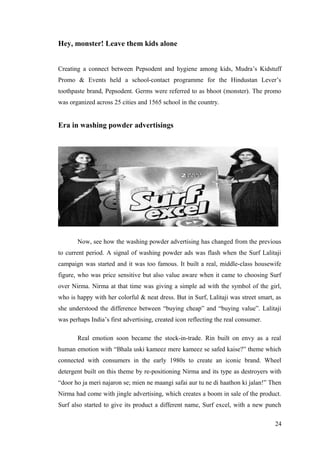
Era in washing powder advertisings
Now, see how the washing powder advertising has changed from the previous
to current period. A signal of washing powder ads was flash when the Surf Lalitaji
campaign was started and it was too famous. It built a real, middle-class housewife
figure, who was price sensitive but also value aware when it came to choosing Surf
over Nirma. Nirma at that time was giving a simple ad with the symbol of the girl,
who is happy with her colorful & neat dress. But in Surf, Lalitaji was street smart, as
she understood the difference between “buying cheap” and “buying value”. Lalitaji
was perhaps India’s first advertising, created icon reflecting the real consumer.
Real emotion soon became the stock-in-trade. Rin built on envy as a real
human emotion with “Bhala uski kameez mere kameez se safed kaise?” theme which
connected with consumers in the early 1980s to create an iconic brand. Wheel
detergent built on this theme by re-positioning Nirma and its type as destroyers with
“door ho ja meri najaron se; mien ne maangi safai aur tu ne di haathon ki jalan!” Then
Nirma had come with jingle advertising, which creates a boom in sale of the product.
Surf also started to give its product a different name, Surf excel, with a new punch
24
line “Surf excel hain na”. There were also many new product came like Sasa, Ghadi,
Eco-friendly, Ariel etc. but because of lack of competitive advertising they fail to
succeed in the market.
Introduction of tide in the advertising market creates a fear for all other
washing powder. Nirma had also renewed its advertising but with the same jingle.
Surf tried to compare its product with Tide but failed. Tide had used the ‘Shekhar
suman’ that’s time favourite (because of ‘Movers and Shaker’) and tried to give
advertising of door to door
Challenge, which again proved successful. Their after Surf excel include the reality
of Indian in the ad i.e. ‘sirf do bucket paani’, ‘paani ki bachat’, etc. Tide then used the
interactive medium of film, e.g. Baghban, Prem (south film), etc.
Now Surf excel and Rin are using kids in their advertising, and are also
successful. Tide is using bets formula in the advertising. These three are touching a
big height because of flexibility & innovation in their advertising.
4.1 ONLINE ADVERTISING
Online advertising blazes a new trail. It is fast making deep inroads into
Europe, where the growth was sluggish. Online advertising already account for some
40% of total advertising worldwide. They accounted for 56% of online advertising
spending in Britain last year. Internets advertisings already make up abut 10% of
British advertising spending. Let’s see some creative online advertising by different
company.
Adidas online
The alternate reality offered by Adidas comes in the forms of The Impossible
Team, a free online soccer game styled after the popular new generation of
multiplayer games that have millions of real people around the world simultaneously
competing against one another across the Internet. For advertisers, a major attraction
25
of the massive multiplayer online game, in which interaction among players is
integral to winning, is that it holds the full attention of players over long period of
time. Ticket to the final World Cup games will be awarded to top players of the game
in some countries.
The cost of investing in the game is much cheaper than a television ad-
especially during the World Cup-and it has other unique advantage.
4.2 CINEMAS AS A TOOL OF ADVERTISING
A year ago when I entered a movie hall, I strolled past movie posters and headed
straight to the food counter. Now when I step into hall, I literally have to watch my
step. There is a DHL cutout there; a Hero Honda bike parked there, a promotion for
Brylcreem, hall seats sporting the Signature whisky brand, poster of Airtel advertising
telling viewers to download the Fanna songs, Nestle milk on the break fast table in the
movie Fanna….. Whether it is the hall premises, intervals breaks during films, or the
film itself, advertisers see merit in the medium.
Compared with TV, advertisings on the big screen escape the clutter and the TV
remote that that dishonestly jumps to another programme the minutes TV serial
breaks for a commercial. Cinema is an opportunity to grab attention of the captive
audience. Though, the cinema’s reach is lower than TV, in terms of impact it is
around “five times higher”.
And with the multiplex experience emerging as an alternative form of
entertainment, reach is going to get better. Currently, there are 100-120 Cineplex’s.
According to the Yes Bank report dated 2005, by the end of 2006, 135 multiplexes
will house more than 1.6 lakh seats spread across over 500 screens. In fact, India’s
largest cinema exhibition company, PVR Cinemas, recently opened the biggest
multiplex in the Mumbai with 6 screens and 1851 seats.
Besides, the moviegoer population is on the rise. Most frequent cinemagoers belong
to the age group of 15 to 34. The urban population belonging to this age group is
estimated to increase by 30% and the money they are expected to spend on films is
26
likely to be Rs 138 million in 2011. Also, with the emergence of multiplex culture,
cinema is going to be the key medium to reach out to the youth. While Dilwale
dulhaniya le jayenge is estimated to have collected Rs 20 crore abroad in 1994-95,
Rang de basanti collected Rs 24 crore abroad in just six weeks.
Marketers are viewing movies has a great merchandise opportunity. Raymond
has just tied-up with Warner Brother to market the complete range of Superman
merchandise in India. Pantaloon has an arrangement with Krrish. Aamir khan
productions and indiatimes.com had tied up with Archies to market products
associated with Lagaan. Maruti’s Swift was launched in Bunty aur babli. Clearly,
with the many uses of cinema, soon it would become a fairground for brands.
MARKETER + FILM MAKER =WINNING UNION
The moment a brand is placed in a movie, both stands to benefit-much more
than ever before. The director of KRRISH, Rakesh Roshan, was able to cover 20% of
the cost of the movie through in-film brand placements and merchandise. Animation
characters are a popular group that marketers could profit from in the future as
viewers tune out during usual commercial breaks.
Giving that filmy glint to Tanishq jewellery collection
The range of jewellery was promoted as the ‘Tanishq-Paheli collection’. The
idea was to use the association with the movie to the Tanishq brand. The movie turned
to be a hit; the cash registers at Tanishq outlets kept pace with the box office
collection of Paheli.
27
*CHAPTER 5*
INFLUENCE OF FAMILY IN ADVERTISING
The Indian family is changing in real and advertising settings. The patriarchal
order is shifting: approval of elders is no longer priority. The emphasis now is on
youth, and there is freedom from old family ties and rituals.
The standard family advertising may have husband, wife, two children (always
a boy and a girl) and usually the happy grandpa on a swing alongside a prancing dog,
things are changing. They seem nuclear family, more single women and men, and
even within families, there are younger childless working couples.
Now let’s see how Advertising agency used the different people of family in
the advertisings
5.1 Changing role of woman in advertising
There was a time when ladies in advertisings are being shown as a props and
objects. Ladies were shown slaving over her husband’s shirt, or cooking delicious
food or soothing her child’s forehead? They always showed as a good and so boring.
But now ladies are used as assertive and arrogant. Importance of ladies in the
advertisings is increasing day by day. Ladies are put in advertisings where they are
not required at all like in the advertisings of shaving cream, man’s clothes, gent’s
watch, etc. but than also they are put because of change in the perception of the
people.
28
In fact in advertisings nowadays women are given more importance than man.
Aishwarya “giving it back” to the guys, and in fact, whistling better than them.
Chased out of a girls hostel for wanting to be fair and handsome. There are girls out
there in marriage market who treat a man like a dog on a leash, her husband talk when
she say talk and walk when she say to walk. So don’t let it happen to you, do register
at jeevansaathi.com. If she wins an innocent bet, she may go to the extent of getting
the men to roll out endless papads, so be careful before shooting mouth off on some
inconsequential detail about SBI. The Ariel husband obliged us by washing the sheet.
The advertisings of prestige cooker with a punch line “jo biwi se kare pyaar woh
prestige ko kaise kare inkaar”. At last it can be said that “why should boys have all
fun?”
5.2 Kids rock the advertising world
Kids had plays a great role in the advertising right from the Polio advertising
on the Doordarshan. Kids with a cutesy cap on backwards with spiky hair cut are
always there behind a creative advertising. Their naughty antics and lack of respectful
interaction with the elders in the advertisings show their growing influence and
changing role within the family circle.
If parents tells the kids that buying a 1500Rs football is not just possible for a
middleclass people than they tell to their family ‘Nothing is Impossible’. Complain
about
their dirty clothes they tell ‘Daag Achche Hain’. The Alpenlibe cream fills advertising
has a child making people laugh by imitating his father’s antic in public. Holi or no
holi, if they want Alpenlibe, they will go to any uncle and put out their hand.
In the soap advertising lifebuoy they give us guidance how they are safe in the
dirt. They play hide and seek with Amitabh and shows that their clothes are whiter
than him because of Rin. They show that at such age also they are saving their money
in the piggy bank and for security they deposit it in the Bank of India. They can even
throw our mobile if their photo is capture without permission. If he is sad then he
29
might left out the house and then only Jalebi of Dhara oil can make him happy. They
know how to tell their taste with the colour of wall.
So don’t treat these kids as a weak because they are now taller, sharper and
stronger.
5.3 Men’s role in advertising
Men are getting more different role in the advertisings. The origin of men in
Indian advertising was as a hardworking man with hardworking brand. Clad in his
banyaan the Indian men ploughed the fields and then washed himself with his
Lifebuoy soap and didn’t about how he really look. Now, we often see a softer, metro-
boy within the family fold. Now, Men are in a Lux bath tub with rose petals.
There was a time when male was a dominant in an advertising. But now
female has a more value in advertising. Only bollywood and cricket star are given a
more important. Now, Male are used as a supplementary to female. But there are
some advertisings in which men are compulsorily required, like bike, shaving cream,
creams for men, matrimonial advertisings, etc. there importance in advertising is less
as compare to ladies, but then also it can be said that without them the advertising is
incomplete. Please don’t ask any male any question, who knows when they will scold
you and say ‘Doobaara mat poochna’.
5.4 Animation in advertisings
Nowadays animations in advertisings are increased due to its favourable
response from the viewers side and are cheaper as compare to brand advertising.
JERRY ‘ALL OUT’ the TOM
As the Tom & Jerry show is one of the famous show in the cartoon network, it
was the great idea to use it in advertising. All Out had done the same, but was
ineffective to produce it in a right manner. There was proper starting but not so was
the ending of the advertising. Children always had habit to see the Jerry to win at the
last or Tom & Jerry becomes friend, but this was also not shown. In spite of all this
negative point it’s sales has been increased after the advertising has been introduced.
30
Energizer
Talk about going and going. Energizer’s drum-beating rabbit has been the
brand’s icon, on and off, for 17 years (since 1989). Question asked: ‘how long wills
this battery last?’ Answer: ‘so long that one commercial can’t show it.’ It was one of
the longest running and most recognized campaign. The fuzzy icon for Energizer
Batteries has been banging his drum and twirling his stick through over 115
commercials since 1989. This sunglass-wearing pink bunny has been ranked among
the top 5 advertising icons of all time and can still be seen, 13 year later.
31
*CHAPTER 6*
6.1 Creativity in rural advertising
The advertising agencies have to adapt different strategies to advertise it’s
product in rural areas. Because the people in the rural areas have different languages,
values, cultures, tradition, etc. many companies failed in rural market because they
had adopted the same strategy in the rural as urban.
Villages are too scattered. A single communication to target the rural rich
scattered all over is impractical. With every district, language and culture change and
so, does the challenge of connecting with them. There are much advertising which are
created by taking in view of the rural people. Like the one that shows a truck driver
and his assistant Rajpal yadav. Or, eSys laptop advertising where a farmer’s assistant
uses a laptop to find out the international rates of chilies, or the Voltas advertising,
where an air conditioner cools off the sweat of a farmer.
Rural makes perfect sense since 70% of India’s population resides in rural.
The communication should touch the heart of the consumer, that’s it. The language
and emotion is understood and felt by everyone. Here are the examples of the
different company which had advertised it’s product in special way in rural areas
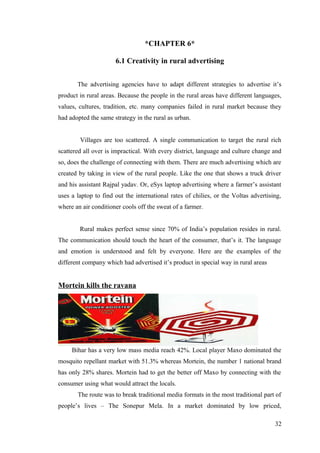
Mortein kills the ravana
Bihar has a very low mass media reach 42%. Local player Maxo dominated the
mosquito repellant market with 51.3% whereas Mortein, the number 1 national brand
has only 28% shares. Mortein had to get the better off Maxo by connecting with the
consumer using what would attract the locals.
The route was to break traditional media formats in the most traditional part of
people’s lives – The Sonepur Mela. In a market dominated by low priced,
32
unorganized local players, Mortein strategically choose its higher end “ten hours”
variant to demonstrate it powerful protection platform.
Sonepur Fair is the largest cattle fair in Asia. More than 1 million people visit
the mela every year. The month – long fair also coincides with Dussehra. They chose
an adaptation of the great Indian epic- Ramayana, which is enacted at the Dussehra
Fair. Ramayan is a classic story of the victory of god (Lord Ram) over evil (Ravana).
This fitted in well with brand platform of the Strength of the Mortein (the savior) over
Mosquitoes (the evil).
A 50 feet high image of louie (the king of pests) was created. For the entire
month, a huge publicity stunt was done in the form of a ‘Rath Yatra’ (chariot
procession) taken through the mela. On the D-day (Dussehra), Mortein hexagonal coil
(the protector against the menace of pests) shot lasers to burn down the effigy of
Louie, in the same way that the image of Ravana is burnt by the arrows of Rama in
Ramayana. This year, in place of the traditional Ravana, Louis the Mosquitoes was
the cynosure of all eyes.
An emotional chord was established through the use of an epic legend with
more than the one million people who visited the fair. The support media of radio,
poster, cinema and Rath Yatra kept the momentum going, paving the way for the
grand finale of the burning of the Louie Ravana image.
The value share of Mortein 10-hour coil in Bihar showed a huge jump post the
activity. The usage of this innovation targeted medium ensured a growth of 49%,
moving its share from 28% in September2005 to average 46% during December
2005-2006. Maxo dropped to 40% in the same period. The halo effect also resulted in
8% increase in share value of other Mortein variant.
The positive brand connect generated among the audience was, of course,
immense, and well continued to reap benefit for the brand to the brand long - term.
33
Glucon-D joins the Olympic
The challenges with this innovation was to reach out to key markets of Bihar
and Punjab, areas that are media-dark and Hindi speaking, where the best way to
relate to the consumer is on the ground. They tapped the consumer in the summer, a
time when their body needs glucose most. Since the aerated soft drink market is
growing, encouraging people to drink glucose was the main aim of their innovation.
To do this, in Punjab they tied with the annual kila Raipur rural Olympics.
Glucon D come in has a co-sponsor of the event and participated by refreshing the
4500 athletes and 400000 viewers. Relay, the sport and CEM practice of SMG
(Stardoms Media Vest Group) handle the entire project.
The insight was simple-Punjabis enjoys their sports and love to sweat it out, so
with Glucon D, they tried to show them that they too understood the value of their
energy. Also, co-sponsorship of kila Raipur games is relatively unexplored by other
brands, this created a singular connect with the rural folk to whom he games are very
important.
In Bihar, apart from creating awareness about the goodness of the Glucose,
the main issue was an increase in of poor look-alike of Glucon D in the market that
was being bought by people. Thus, they tied up with the Rotary International to
provide mobiles pyaoos (drinking water station) that not only serves water to the
passer bys, but also Glucon D.
34
This helped to show the difference the real and fakes, while also giving
them a taste of glucose. Initiated in four towns and based on the success in the first
month, the pyaoos were extended to others.
With a trusted organization like Rotary International, They had more
credibility then any marketing organization could have given them on- ground.
Through these innovations, in both Punjab and Bihar, more then 4 lakh people had
sampled the genuine Glucon D.
Finally, to make people aware of the summer heat and the importance of
glucose, they had used soap-actress Smiti Irani who, in a non-commercial way
encouraged people to drink glucose. Since people tend to trust soap-actors more and
ADVERTISING less, she had tout the message without emphasizing the brand name.
An effort that had begun during April/May, it had created awareness about the
importance of glucose in the summer, while also creating a connect with Glucon D.
OTHER ASPECT OF ADVERTISING
There are many other aspects of advertising which enhances its creativeness which
includes brand icon, colours, creativity on particular occasion, modes of advertising
the agency uses, its audio, etc. let see some of these in brief with example.
6.2 CREATIVE AUDIO ADVERTISING
I had seen many advertisings on the media like TV, internet, etc which are the
combination of the visual + audio or only visual advertisings. Visual advertising has
good action on our mind because we can see the overall procedure and can understand
it better and faster than the audio advertisings. But there are such advertisings in the
radio and as well as in the television which were successful due to the effective audio
work i.e. jingle or signature tune.
For example:-
1. BAJAJ TWO WHEELERS- Buland Bharat Ki Buland Tasveer…Hamaara Bajaj
2. National Integration- Mile Sur Mera Tumhara
3. Zandu Balm- Zandu Balm, Zandu Balm, Pida Haari Balm.
35
4. Pan Parag- Pan Parag, Pan Masala, Pan Parag.
5. Lijjat Papad- Karram Kurram, Majedar Lijjatar, Saat Swaad Mein Lijjat, Lijjat
Papad.
6. Nerolac- Jab Ghar Ki Raunak Badhani Ho
7. Nirma- Doodh Si……Washing Powder Nirma, Nirma.
8. Titan- Signature tune
9. Airtel- Signature tune.
10. Cadbury’s Dairy Milk-Kya Swaad Hai Zindagi Mein
11. Operation flood- Doodh Doodh Doodh.
Giving importance to the jingle many company prefer to have the same for
their product also. The Close-up advertising with the Sehgal voice was given a huge
feedback to the company. After the success of the Airtel signature tune the Reliance
communication had also advertise its product with the signature tune. Normally in
rural areas people remember the advertisings which has jingle in it and hence buy the
same. Because of the increasing importance of jingle and signature tunes many
company had not changed their jingle and signature tunes for many year.
6.3 COLOURS IN ADVERTISING
The advertisings agency had also focus on the colour theme. It had a
psychological effect on the mind of the viewers. Every colour had its own meaning in
itself and viewers too agree with it. From childhood we are taught that white is a
colour of peace, saffron is a colour of sacrifice, red is a colour of violence or anger,
etc. and we adopt it in our day to day life. Nowadays, advertisings are also using the
colour theme.
Pepsi had come with the campaign of blue and it had compare it with the
Indian cricket team, because our Indian team’s dressing colour is also blue and Pepsi
had also launch its product in blue colour. It was to symbolize the Pepsi as a cool
guy’s drink and with a tag line ‘Men in blue just keep looking cute’. Blue is the colour
which is famous and the most liked by the Indian male and female. Pink is the colour
famous among the female, therefore ‘Scooty Pep Pink’ the lady scooty had come with
the theme of “pink se panga nahin lene ka’.
36
Let’s talk about the black colour which is more popular in the advertisings
market. In the west, black is the most elegant way to present beauty products.
Products that thrive on their ‘Black’ advertising positioning here include the Bajaj
Pulsar Black (fear the black), HSBC Advantage Fund- which strides on “Man in
Black’. Shopper’s Stop and the ICICI Pru have both use black in branding and
advertisings. Then, there are brands that use dark-overtones in their advertisings,
whether it’s Samsonite, Mont Blanc or the truly mysterious Nakshatra.
Products like anti-dandruff shampoos and shoe polish (Cherry Blossom)
intrinsically need black. The Onida Devil wears black clothes, in order to add that rare
mix of mystery and poise. Bajaj used Fear the Black positioning, in order to convey
personality and an adventurous spirit. The liquor clients that have truly embraced the
hue in branding be Old Black Orange, Vintage Black Label Beer, Johnny Walker
Black label, AC Black, etc.
Therefore it can be said, ‘yes, Black rules on the advertising highway’.
6.4 CREATIVITY ON THE PARTICULAR DAY
India is at number one position for having most number of holidays occasion
because of its culture. On an average there is 6 to 7 occasion of different cultured
person and also there are other activities like friendship day, April fool day, world
aids day, father and mother days, making friend day, etc. on which holiday is not
given but it is celebrated all over the India. On these particular days there are number
of product and services are advertised in a simple way. But some of them add
creativity in their advertising for attracting more customers towards their product and
service
For example:
 GO AIR airline’s advertisement on 1st
April 2006, wishing April
fool day to all those still flying other airlines and continuing its explanation
that, why not fly an airline with a 96% on-time record, state-of-the-art
A320aircraft and impeccable services. So much so that, we at Go Air,
37
challenges you to find a better flight at a better fare. And if you are still flying
any other airline, don’t be a fool. Just fly smart. Fly Go Air.
38
*CHAPTER 7*
WHY IS THE PERFECT ADVERTISING NEEDED?
After doing the study on advertising, I think that the perfect advertising is the
advertising which should atleast contains the following things after planning and
doing research on the customer preference:-
1. Jingle and signature tune: -
Jingles are like a song therefore it is more likeable by Indians. It is easy to remember
the product which has jingle in its advertising and it sounds nice. Most of advertisings
that have signature tunes are successful in the market so it is useful. And also
signature tunes are now used as a ring tones which makes other people also aware
about the product. (Jingle-Cadbury and signature tune-Airtel)
2. Use different modes of advertising: -
Using different modes of advertising makes chances of aware of products in a large
scale. Modes like online, TV serials and show, billboards, standard newspaper,
magazines, word of mouth, etc give a desired publicity to a product. More use of
modes may increase initial cost but it gives good return to new product.
3. Location:-
If advertising has to be made within the home than its condition should well enough
because its reflect the company image. Its environment should look comfortable. If
the advertising has to shoots at outdoor then city or foreign frames is a good option
because it gives advertising a rich business culture and in many country it is cheap to
do advertising because of tax break (Bangkok, Prague, Dubai, etc).
4. Advertising in sports:-
The FIFA and the Cricket are the medium through which the millions of people are
connected to the advertising. The advertising shown at the time of India and Australia
match has a same effect as the advertising shown during FIFA. In India cricket is
39
much liked as compared to other sports so it is to be used for promotion. (Ford fiesta-
MOM, Nike, etc.
5. Brand ambassador:-
Shahrukh, Amitabh, Aishwarya, Aamir, Sachin, Dravid, Sania, Dhoni and John are
the brand ambassadors who are popular and make the product sale through their
advertising. The personality other than this had not make good effect on their own.
The survey by TAM Media says that this above mentioned personality has a good
effect not only on men but also on women and kids. In the Promo Survey 2006, which
analysed buying behaviour, said 52% of respondents or consumers think that
celebrities make brands popular. 40% changed their buying behaviour based on the
celebrity endorsement. 52% customers believe that a brand should always have a
brand ambassador.
6. Innovation in advertising:-
Advertising should also be published through innovative media like outdoor
campaign, advertisings in the serials and show (Kit Kat), use of that product in a
movie (Virudh-Calcium Sandoz, Bournvita-Koi mil gaya, Motorola-Don, etc), streets
play (Airtel), give advertising on the another product (‘rang de basanti’ printed on the
coke bottles), advertise through SMS or Free Promos, neon, etc because it attract the
target people at cheaper cost.
7. Different advertising for rural areas:-
Rural people are more attentive towards the advertisings which are non-traditional.
The word of mouth particularly by the main person in that particular area is one of the
best methods in rural areas. Many company had use different strategies for expanding
their market in rural (Mortein, Asian paints, Fevicol, Cadbury, etc)
8. Animation or icon:-
Animation in advertisings has given a positive response to an advertising industry.
Many advertising with an animation character or icon are known on the basis of
animation character or icon (Eveready- ‘billi chaap’, Energizer-‘bunny’, Scrat in
Horlicks etc.)
40
9. Colour theme:-
A particular colour should be used as a theme for the product so that whenever a
person see that colour he get a click in his mind about the product feature (scooty -
pink, bike-black fear, etc.).
10. Different advertisings for different regions:-
The advertising shown in south and west should be with their culture and with rocking
sound, whereas the advertising in north and east should be of soft theme. In south
their local hero should be used and in north and west bollywood star should be used
and in east tellywood star should be taken.
41
*CHAPTER 8*
ADVERTISING AGENCY.
8.1 What advertising agency represent?
An independent business organization.
Composed of creative people.
Who develop, prepare and place ads in advertising media;
For seller seeking to find customers for their goods and services.
Advertising agency offers specialized services to its clients by charging
certain fees. An advertiser prefers to transfer the entire responsibility of advertising to
such agency rather than looking after all details regarding the entire advertising work.
Advertising agency is a service organization. Large companies prefer to use the
services of such skilled, professional agencies for extensive and effective advertising.
Similarly, large majority of advertisements and effective advertising. In fact,
advertising agencies represent the core of the advertising profession.
The agency has writers, artists, media experts, researchers, television
producers, account executives and other experts. Agency specialists works together to
analyse the clients business and prescribe advertising course of action to keep the
business healthy.
The American association of Advertising Agencies, (AAAA) defines
advertising agency as “An independent business organization, composed of creative
and business people, who develop, prepare and place advertising in advertising media
for sellers seeking too find customers for their goods and services.”
42
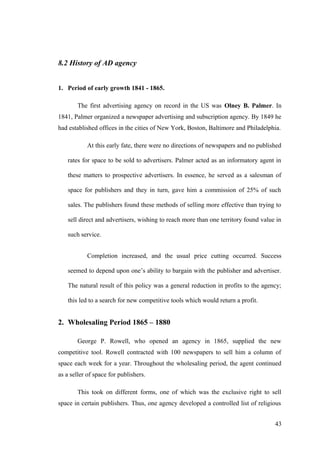
8.2 History of AD agency
1. Period of early growth 1841 - 1865.
The first advertising agency on record in the US was Olney B. Palmer. In
1841, Palmer organized a newspaper advertising and subscription agency. By 1849 he
had established offices in the cities of New York, Boston, Baltimore and Philadelphia.
At this early fate, there were no directions of newspapers and no published
rates for space to be sold to advertisers. Palmer acted as an informatory agent in
these matters to prospective advertisers. In essence, he served as a salesman of
space for publishers and they in turn, gave him a commission of 25% of such
sales. The publishers found these methods of selling more effective than trying to
sell direct and advertisers, wishing to reach more than one territory found value in
such service.
Completion increased, and the usual price cutting occurred. Success
seemed to depend upon one’s ability to bargain with the publisher and advertiser.
The natural result of this policy was a general reduction in profits to the agency;
this led to a search for new competitive tools which would return a profit.
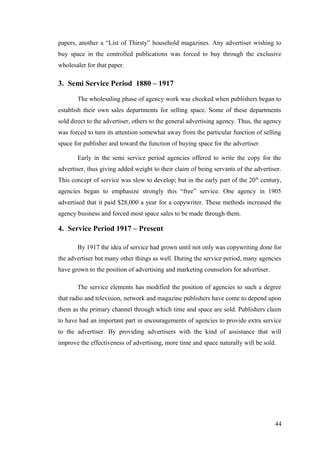
2. Wholesaling Period 1865 – 1880
George P. Rowell, who opened an agency in 1865, supplied the new
competitive tool. Rowell contracted with 100 newspapers to sell him a column of
space each week for a year. Throughout the wholesaling period, the agent continued
as a seller of space for publishers.
This took on different forms, one of which was the exclusive right to sell
space in certain publishers. Thus, one agency developed a controlled list of religious
43
papers, another a “List of Thirsty” household magazines. Any advertiser wishing to
buy space in the controlled publications was forced to buy through the exclusive
wholesaler for that paper.
3. Semi Service Period 1880 – 1917
The wholesaling phase of agency work was checked when publishers began to
establish their own sales departments for selling space. Some of these departments
sold direct to the advertiser, others to the general advertising agency. Thus, the agency
was forced to turn its attention somewhat away from the particular function of selling
space for publisher and toward the function of buying space for the advertiser.
Early in the semi service period agencies offered to write the copy for the
advertiser, thus giving added weight to their claim of being servants of the advertiser.
This concept of service was slow to develop; but in the early part of the 20th
century,
agencies began to emphasize strongly this “free” service. One agency in 1905
advertised that it paid $28,000 a year for a copywriter. These methods increased the
agency business and forced most space sales to be made through them.
4. Service Period 1917 – Present
By 1917 the idea of service had grown until not only was copywriting done for
the advertiser but many other things as well. During the service period, many agencies
have grown to the position of advertising and marketing counselors for advertiser.
The service elements has modified the position of agencies to such a degree
that radio and television, network and magazine publishers have come to depend upon
them as the primary channel through which time and space are sold. Publishers claim
to have had an important part in encouragements of agencies to provide extra service
to the advertiser. By providing advertisers with the kind of assistance that will
improve the effectiveness of advertising, more time and space naturally will be sold.
44
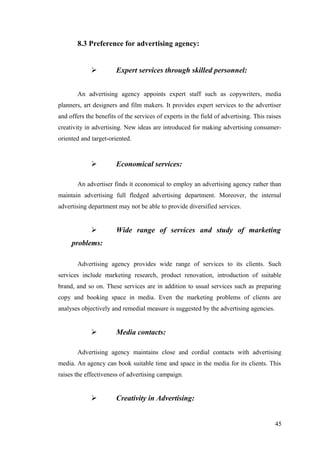
8.3 Preference for advertising agency:
 Expert services through skilled personnel:
An advertising agency appoints expert staff such as copywriters, media
planners, art designers and film makers. It provides expert services to the advertiser
and offers the benefits of the services of experts in the field of advertising. This raises
creativity in advertising. New ideas are introduced for making advertising consumer-
oriented and target-oriented.
 Economical services:
An advertiser finds it economical to employ an advertising agency rather than
maintain advertising full fledged advertising department. Moreover, the internal
advertising department may not be able to provide diversified services.
 Wide range of services and study of marketing
problems:
Advertising agency provides wide range of services to its clients. Such
services include marketing research, product renovation, introduction of suitable
brand, and so on. These services are in addition to usual services such as preparing
copy and booking space in media. Even the marketing problems of clients are
analyses objectively and remedial measure is suggested by the advertising agencies.
 Media contacts:
Advertising agency maintains close and cordial contacts with advertising
media. An agency can book suitable time and space in the media for its clients. This
raises the effectiveness of advertising campaign.
 Creativity in Advertising:
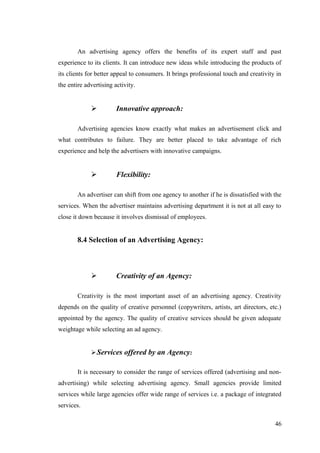
45
An advertising agency offers the benefits of its expert staff and past
experience to its clients. It can introduce new ideas while introducing the products of
its clients for better appeal to consumers. It brings professional touch and creativity in
the entire advertising activity.
 Innovative approach:
Advertising agencies know exactly what makes an advertisement click and
what contributes to failure. They are better placed to take advantage of rich
experience and help the advertisers with innovative campaigns.
 Flexibility:
An advertiser can shift from one agency to another if he is dissatisfied with the
services. When the advertiser maintains advertising department it is not at all easy to
close it down because it involves dismissal of employees.
8.4 Selection of an Advertising Agency:
 Creativity of an Agency:
Creativity is the most important asset of an advertising agency. Creativity
depends on the quality of creative personnel (copywriters, artists, art directors, etc.)
appointed by the agency. The quality of creative services should be given adequate
weightage while selecting an ad agency.
Services offered by an Agency:
It is necessary to consider the range of services offered (advertising and non-
advertising) while selecting advertising agency. Small agencies provide limited
services while large agencies offer wide range of services i.e. a package of integrated
services.
46
 Location of an agency:
Location of an agency is important for effective, quick and efficient flow of
communication with the agency. The agency which is operating in the city where the
advertiser had its head office should be convenient. The agency can also follow the
client easily.
 Size of Agency:
Advertising large size agency normally offers better quality services. Such
agency is financially stable with adequate staff. Small agencies may not offer wide
variety of services. Naturally advertising large agency is always preferable.
 Initiative and involvement:
Advertising agency takes keen interest and initiative in the work of its clients.
The agency which studies the problems of the advertiser and offers suitable guidelines
is also useful for the advertiser. There should be complete involvement of the agency
in the client’s business.
Market standing of the agency:
The market standing and past record of an advertising agency should be taken
into account while selecting an agency. The agency which provides prompt service
and also maintains coordinal relations is always preferable.
Work Environment
Ad agencies are based within office settings. Accounts Executives, Account
Planers, Media Executives, Art Directors and Copywriters spend most of their
working time in agency office. Account
Executives have to travel extensively, visiting clients and suppliers. While
other staff, travel occasionally to attend meetings with clients, or visit locations during
film production. Ad agencies are very busy places and often work is on till late hours.
47
In 2004, workers in the industry averaged 33.8 hours per week, a little higher than the
national average of 33.7.
Most employees in advertising and public relations services work in
comfortable offices operating in a teamwork environment; however, long hours,
including evenings and weekends, are common. There are fewer opportunities for
part-time work than in many other industries; in 2004, 14 percent of advertising and
public relations employees worked part time, compared with 16 percent of all
workers.
Work in advertising and public relations is fast-paced and exciting, but it also
can be stressful. Being creative on a tight schedule can be emotionally draining. Some
workers, such as lobbyists, consultants, and public relations writers, frequently must
meet deadlines and consequently may work long hours at times. Workers, whose
services are billed hourly, such as advertising consultants and public relations
specialists, are often under pressure to manage their time carefully. In addition,
frequent meetings with clients and media representatives may involve substantial
travel.
Most firms encourage employees to attend employer-paid time-management
classes, which help reduce the stress sometimes associated with working under strict
time constraints. Also, with today’s hectic lifestyle, many firms in this industry offer
or provide health facilities or clubs to help employees maintain good health.
Personal Characterstics
The creative people need a good visual ability, languageartistic skill. Copywriter
requires literary ability but an interest in commercial success which comes from
understanding what motives the target audience is important. Writers must be able to
work, to a strict brief, within restricted space and in limited time. Advertising must
follow legal requirements and rules hence considerable creative self-discipline is
needed. A feeling for words, economy of style and imagination is needed.
The copywriter works with the art director, and the creative director. The work
can be very frustrating particularly when an idea is rejected by the art director and
amendments made by the creative director and the client. This can often restrict the
48
imaginative capacity of the copywriter. The openness to stand criticism is absolutely
essential.
Media Executives, Planners and Executive directors with others in an
integrated team. They should be able to interplant a great deal of information. Media
buyers spend most of their time negotiating over the telephone to buy space or time.
Attention to detail is needed for keeping to the budget allocated.
Regulation
There have been increasing efforts to protect the public interest by regulating
the content and the reach of advertising. Some examples are the ban on television
tobacco advertising imposed in many countries. The general aim of such codes is to
ensure that any advertising is legal, decent, honest and truthful. Some self-regulatory
organizations are funded by the industry, but remain independent, with the intent of
upholding the standards or codes.
In India there is Advertising Agency’s Association of India (AAAI) that
supervises the affairs of the industry. There is a body called Advertising Standards
Council of India (ASCI), which looks at issues pertaining to regulation of
advertising.The advertising of controversial products such as cigarettes and condoms
is subject to government regulation in many countries. For instance, the tobacco
industry is required by law in India and Pakistan to display statutory warnings
cautioning consumers about the health hazards of their products.
Some potential ETHICAL ISSUES often come under scrutiny form moral or
ethical perspective and border on being regulated are mentioned here. The idea is to
be more aware and sensitive to them looking at advertising.
• Untruthful and misleading claims made in the ads.
• Misrepresentation of facts or situations in the name of creative license.
• Obscenity and misuse of sex advertising.

• Advertising inducing children
• Advertising of products that are commonly assumed to have harmful effects
like alcohol, cigarette, drugs, weapons, etc.
49
• Surrogate advertising with hinted or hidden message.
• Media issues like use of billboards and other outdoor advertising (for traffic &
safety reasons)
• Copyright, trademark and issues of making unfair competitive claims.
• Civil rights or rights of privacy or citizens
•
Copyright
Copyright is a set of exclusive rights regulating the use of a
particular expression of an idea or information. At its most general, it is
literally "the right to copy" an original creation. In most cases, these rights are
of limited duration.
Copyright may subsist in a wide range of creative, intellectual, or artistic
forms or "works". These include poems, plays, and other literary works, movies,
choreographic works, musical compositions, audio recordings, paintings, drawings,
sculptures, photographs, software, radio and television broadcasts of live and other
performances, and, in some jurisdictions, industrial designs. Copyright law covers
only the particular form or manner in which ideas or information have been
manifested, the "form of material expression". It is not designed or intended to cover
the actual idea, concepts, facts, styles, or techniques which may be embodied in or
represented by the copyright work.
Several exclusive rights typically attach to the holder of a copyright:
• to produce copies or reproductions of the work and to sell those copies
(including, typically, electronic copies)
• to import or export the work
• to create derivative works (works that adapt the original work)
• to perform or display the work publicly
• to sell or assign these rights to others
50
*CHAPTER 9*
9.1 Advertising Process
When preparing your search proposal, you should take into account that the
“lead-in” time needed to place an ad can vary anywhere from days to months
depending on the publication. You should plan to have your ad approved and an
estimate of the cost done at least one month prior to the date when you want the ad to
be published. The advertising process for professional staff and faculty positions
involves five basic steps:
1. Writing an Ad
2. Getting Approval for the Text of the Ad
3. Estimating the Cost of the Ad
4. Placing Ads & Posting Announcements
5. Paying for Ads
Typical work flow in agency
STAGE WORK PERFORMED AT STAGE
Briefing Stage
• Briefing from the client
• Internal briefing to the creative and media
• Any research briefing if required
Creation Stage
• Ad campaign and media plan development
• Internal review and finalization
• Presentation to client and approvals
• Any pre-testing if required
Production Stage
• Budget and estimate approvals
• Production of film, press ads, collaterals
• Media Scheduling and media booking
• All release approvals for creative & media
Post Production Stage
• Material dispatch to media
• Media release monitoring
• Any post-testing if required
• Billing and collection
51
9.2 Types of advertising agencies
Ad agencies come in all sizes, from small one- or two-person shops to large
multi-national, multi-agency conglomerates such as Omnicom Group, WPP Group,
Interpublic Group of Companies and Havas.
Some agencies specialize in particular types of advertising, such as print ads
or television commercials. Other agencies, especially larger ones, produce work for
many types of media. Lately, Search Engine Marketing (SEM) and Search Engine
Optimization (SEO) firms have been classified by some as 'agencies' due to the fact
that they are creating media and implementing media purchases of text based (or
image based in some instances of search marketing) ads. This relatively young
industry has been slow to adopt the term 'agency' however with the creation of ads
(either text or image) and media purchases they do qualify technically as an
'advertising agency' as well as recent studies suggest that both SEO and SEM are set
to outpace magazine spending in the next 3-5 years.
Not all advertising is created by agencies. Companies that create and plan their
own advertising are said to do their work in house. Today selection of ad-agency is
very difficult. The advertiser should make list of all possible agencies that can serve
his purpose and the agency best qualified to provide required and effective services
are selected. Some advertiser may select more than one advertising agency to handle
effectively the various product lines.
Following are major types of advertising agencies that are currently serving
the advertising industry.
Full Service Agencies
A full service ad agency is one that provides a range of marketing services. A
full services agency provides services that are directly related to advertising such as
copywriting, artwork, production of ads, media planning etc. It also provides such
services in respect of pricing, distribution, packaging, product design etc.
Modular agencies
52
A modular agency is a full service agency that sells its services on a piece
meal basis. Thus an advertiser may commission an agency’s creative department to
develop an ad campaign while obtaining other agency services elsewhere. Or, an
advertiser may hire an agencies media department to plan and execute a program for
advertising that another agency has developed. Fees are charged for actual work
undertaken.
In House agencies
Those companies, which prefer to have closer control over advertising, have
their own in-house agency. This type is owned completely by the advertiser. It
performs almost all functions that an outside advertising agency would perform and
that’s why some people refer to it as full-service advertising department of the
advertiser. However, the difference between an in-house agency and an advertising
department is that the in-house agency can undertake to serve several other clients, if
the owner so desires, but an advertising department solely undertakes that work of its
owner and not of outside clients. Secondly an advertising department may not be
equipped the personnel and facilities, which an in-house agency would posses. In-
house agency not only provides control over advertising schedule and costs, but also
offers convenience for its owner, because it is just available in the same building as
that of the head office of advertiser.
Such in-house agency also benefits the owner as it can bring revenue through
agency commission that are offered by the media and by way of fees that are collected
from outside parties for undertaking their advertising work. Such revenue increases
the funds and profits of the company. There is another version of in-house agency
whereby advertiser handles the total agency functions by buying service unit to buy
time, space and place the ads. Such an In-house agency is an administrative center
(under the direction of an advertising director) that gathers and directs varying outside
for its operation.
53
Creative Boutiques
These are shop agencies that provides only creative functions and not full-
service. The specialized creative functions include copy writing, artwork and
production of ads, they charge a fee or percentage of full service agencies, and as such
most of them convert into a full service agency or merge with other agencies to
provide a wide range of services.
Mega agencies
A significant of 1980’s is the development of mega agency. Agencies
worldwide merge with each other serve their clients in much better way. It was in
1986, Saachi & Saachi, a London based agency who started the movement and at
present it is the third largest agency network in the world.
The Specialists Agency
There are some agencies who undertake advertising work only in certain areas.
there are agencies that specialize only in financial services or only in publicity or only
in point-of-purchase material etc. for instance Soubhagya advertising agency
concentrate on specialized in financial advertising.
9.3 The functions of an advertising agency:
• To accelerate economic growth and create public awareness
• To provide a total, professional, experienced service which is very personal in
its nature
• To take the advertiser's message and convert it into an effective and
memorable communication
54
The Benefits of Using an Advertising Agency
• Added Expertise
• Media Knowledge and Unbiased Advice
• Easier Administration
• Media Buying
• Quality Control
• Information
• Fending off the media
• And when things go wrong
• Cost Saving
• Time Saving
55
*CHAPTER 10*
10.1 Advertising Agency's Role
Suppose you are a company with a product. It may be a totally new product.
As a company with a product or service to sell, designing and making that item is
only part of the battle. People are not going to beat a path to your door. You have to
seek a channel of communication.
Ad agency need to consider, for example:
• For whom is the product or service designed?
• Who would use it?
• Who is the "target group"?
• What's special about the product? In what way is it distinct? Unique?
Different?
• What's its "position" in relation to other similar products?
• What do you want to convey to the public about your product?
• How should your company contact the public?
• What medium should it use? Radio? TV? Newspapers? Magazines?
Billboards? Bus/subway ads? Direct mail? etc.
• How extensive a region should your company try to cover?
• How often?
Communication and marketing decisions involve specialized expertise. Many
companies that design and produce products or offer services lack these specific
capabilities. This is where advertising agencies fit in. Advertising agencies exist to
help companies to communicate with the public, Market the company's product.
The process of advertising involves considerable specialized knowledge and expertise
• about people - their interests, preferences, needs, wants, lifestyles,
expectations
• about media - their reach, their effectiveness, their specific appeal
56
Company with a
product or service
Ad Agency Media Public
• about the company and its product – and about competing companies and
their products
•
10.2 Services offered by ad agency
Total Advertising Services
Strategic planning, creative development and media services for advertising,
particularly in television, newspapers, magazines and radio; providing the best
creative designed to capture the imagination of consumers
Marketing Services
Provision of a number of advertising related services, including sales
promotion, market research, PR and event marketing.
E-Solution Services
e-solution services, including system integration services, e-business
consulting and customer relationship management (CRM), Search Engine Marketing
(SEM) and Search Engine Optimization (SEO) and e-promotions using the Internet
and mobile.
Content Business
Sales of sponsorship, broadcasting and other rights, and the production and
marketing of such media / content as sporting events, films, TV programs, animated
content, music and other forms of entertainment.
Integrated Media Services
Bringing value to both clients and media-related companies by offering a wide
range of media solution services
57
Sales Promotion
Providing comprehensive sales promotion planning designed to complement
mass media and other activities
Event Marketing
Assisting clients by providing dynamic vehicles for their messages in the form
of on-the-spot interactive communications
Integrated Branding Services
Assuring clients the highest quality of branding services for their communication
needs
10.3 Agency Personnel
Production Team
Ad agencies may have their production team which includes Photographers,
Printers, Typesetters, Television Producers, etc. but since the work is very diverse
most ad agencies coordinate with freelancers or established production units for task
to be completed. Production workers are concerned with all the technical process of
turning the final copy and art work into a real ad for print, TV, radio.
Storyboard artist
Storyboard artist is a profession specialize in creating storyboards for
advertising agencies and film productions. A storyboard artist is able to visualize any
stories using quick sketches on paper at any moment. Quick pencil drawings and
marker renderings are two most common traditional techniques, nowadays Flash,
Photoshop and other storyboard applications are gradually taking over, digital camera
is one of the latest techniques in creating storyboards.
Storyboard artist is also known as illustrator or visualizer, they are mostly
freelance. Art directors or film directors are the most likely type of peoples that would
58
contact storyboard artists and the deadline is always tight, overnight working is very
common.
Most used storyboard applications are the Corel Painter and the Adobe
Photoshop, some storyboard artists nowadays begin and finish their work on
computers using drawing software and digital pencils like Wacom (Graphics tablet),
in this way they save effort and most important time which always has the first
periority for a storyboard.
Graphic designer
Graphic design is a form of visual
communication using text and/or images to present
information, or promote a message. The art of graphic
design embraces a range of cognitive skills and crafts
including typography, image development and page
layout. Graphic design is applied in communication
design and fine art. Like other forms of communication,
graphic design often refers to both the process
(designing) by which the communication is created, and
the products (designs) such as creative solutions,
imagery and multimedia compositions. Graphic design is
traditionally applied to static media, such as books,
magazines and brochures. Additionally, since the advent of computers, graphic design
is utilized in electronic media - often referred to as interactive design, or multimedia
design.
There are varying degrees of graphic design. Graphic designer involvement
may range from verbally communicated ideas, to visual rough drafts, to final
production. In commercial art, client edits, technical preparation and mass production
are usually required, but usually not considered to be within the scope of graphic
design unless the client is also a graphic designer.
Although the term 'graphic designer' was first coined in the 20th century, the
story of graphic design spans the history of marks of humankind from the magic of
59
the caves of Lascaux to the dazzling neons of Ginza. After all, they share the same
elements, theories, principles, practices and languages, and sometimes the same
benefactor or client. In advertising art the ultimate objective is the sale of goods and
services. In graphic design, "the essence is to give order to information, form to ideas,
expression and feeling to artifacts that document human experience. ”Fine art refers to
arts that are 'concerned with beauty'..."
Advertising interns
Advertising interns are typically university juniors and seniors who are
genuinely interested in and have an aptitude for advertising. Internships at advertising
agencies most commonly fall into one of six areas of expertise: account services,
creative, interactive, media, public relations and traffic.
An internship program in account services usually involves fundamental work
within account management as well as offering exposure to other facets of the agency.
The primary responsibility of this position is to assist account managers. Functions of
the account management intern may include:
• Research and analysis: Gathering information regarding industry, competition,
customer product or service; as well as presenting findings in verbal/written
form with recommendations
• Involvement in internal meetings and, when appropriate, client meetings
• Assisting account services in the management of creative projects
Interns often take part in the internal creative process, as is illustrated in this
agency intern website, where these interns were charged with creating and managing
a website as well as developing an advertising campaign. Hands on projects such as
this one help interns learn how strategy and well-developed marketing is essential to a
sound advertising and communications plan.
During their internship, the intern will experience the development of an ad,
brochure and broadcast or communications project from beginning to end. During the
internship, the intern should be exposed to as much as possible within the agency and
advertising process.
60
10.4 Impact of technology on advertising
In the mid 1980s, the arrival of desktop publishing and the introduction of
software applications introduced a generation of designers to computer image
manipulation and 3D image creation that had previously been unachievable.
Computer graphic design enabled designers to instantly see the effects of layout or
typography changes without using any ink in the process. Computers are now
considered to be an indispensable tool used in the advertising and graphic design
industry. Computers and software applications are generally seen, by creative
professionals, as more effective production tools than the traditional methods.
Computers may or may not enhance the creative process of graphic design,
depending on which process best stimulates the creativity of the designer. Rapid
production from the computer allows many designers to explore multiple ideas
quickly with more detail than what could be achieved by traditional hand-rendering or
paste-up on paper, moving the designer through the creative process more quickly.
New ideas may come in the form of exploring software features that would not have
been considered without the software. However, some professional designers may
explore ideas on paper to avoid creating within the limits of the computer
configuration, enabling them to think outside the box; the box being the computer.
Some creative graphic design ideas are initiated and developed to near completion in
the mind, before either traditional methods or the computer is used.
A graphic designer may also use sketches to explore multiple or complex ideas
quickly without the potential distractions of technical difficulties from software
malfunctions or software learning. Hand rendered comps may be used to get approval
of a graphic design idea before investing what would be too much time to produce on
a computer if rejected. Thumbnail sketches or rough drafts on paper may then be
used to rapidly refine and produce the idea on the computer in a hybrid process. The
traditional-design/computer-production hybrid process may be used for freeing ones
creativity in page layout or image development as well. Traditional graphic designers
may employ computer-savvy production artists to produce their ideas from sketches,
without needing to learn the computer skills themselves.
61
The use of computers in design is sometimes referred to as CAD (computer
aided design), the same abbreviation of computer aided drafting and a homophone of
the acronym Computer Aided Design & Drafting (CADD) which is the use of
computers in engineering designs for mechanical products and associated with
computer aided production of these products known as CAM (Computer Aided
Manufacturing). This makes no distinction between graphic design and technical
drawing. Due to this common misunderstanding, CAD is rarely used to describe
computer use in graphic design. The more common term used to describe computer
use in graphic design is DTP (desktop publishing). However, DTP is often
oversimplified to the narrower scope of graphic design known as page layout and
publishing technology.
10.5 Famous advertising agencies in world
• BBH (Bartle, Bogle & Hegarty) -- famous for Audi, Levi's, Johnnie Walker,
British Airways.
• Crispin Porter + Bogusky --famous for Subservient Chicken, works with
Burger King, Virgin Atlantic Airways, Volkswagen
• Wieden + Kennedy -- famous for remaining an independent agency; as well
as Nike "Just Do It", ESPN "This Is Sports center", Coke, EA, Starbucks,
ESPN, Honda UK.
• JWT (formerly J. Walter. Thompson) -- works with Kelloggs, Unilever,
Diageo.
• Leo Burnett -- works with Procter & Gamble, Kelloggs, McDonald's,
Marlboro, Hallmark, Heinz. Famous for creating characters such as Tony the
Tiger, Snap Crackle & Pop, the Jolly Green Giant, the Marlboro Man, and
Charlie the Tuna.
• The Martin Agency -- UPS, GEICO, NASCAR, Miller (Lite, MGD), Hanes,
and others
• N.W. Ayer & Son -- the first ad agency in the United States, coined "When it
rains it pours" (Morton Salt), "A diamond is forever" (De Beers), "Reach out
62
and touch someone" (AT&T), "Be all you can be" (United States Army), and
others
• Ogilvy & Mather -- famous for the Rolls-Royce print ad with the headline
"At 60 miles an hour the loudest noise in this new Rolls-Royce comes from
the electric clock", among other ads
• Saatchi and Saatchi -- most famous for working with the Conservative Party
especially during the 1979 general election (Maurice and Charles Saatchi later
left and set-up M&C Saatchi)
• TBWAChiatDay -- works with Apple Computer (including the "Think
Different" campaign), adidas, and Sony Playstation. Responsible for creating
the fcuk brand and (in the UK) Wonderbra advertising.
63
*CHAPTER 11*
Ogilvy & Mather India
Address
Trade Centre, Third Floor, Senapati Bapat Marg, Lower Parel,
Mumbai:400013
Tel: (0091 22) 491 3877, 44360360 Fax: (0091 22) 491 3838,, 44344370
Capitalised billings :Rs7425.78million
Television billings :Rs1852.73million
Overview
Founded in 1928, we were the first advertising agency in India. 76 years
hence, we continue to relentlessly pursue our passion for building and nurturing,
enduring brands. Over the years we have helped create some of India's most
successful brands like Asian Paints, Cadbury, Fevicol among them, and in recent
times- Perfetti, Hutch, Close Up and many more.
A power brand in itself, Ogilvy & Mather is acknowledged as the leading
communications agency in the country today. Our defining quality is our firm belief
in the value of brands and the important role they play in consumers' lives. The
business of building brands is conducted through a proprietary way of thinking and
working; what we call 360 Degree Brand Stewardship.
As pioneers of integrated communication initiatives in the country, we
consistently deliver on our overall promise of 360 Degree Stewardship through our
business units that encompass Ogilvy & Mather Advertising, OgilvyOne, Ogilvy
Activation and Ogilvy Public Relations. One hallmark of Ogilvy's brand-building
capability is the balance of global and local brands. Our local clients keep us in tune
with local market nuances, which is integral to the success of our multinational
accounts.
64
Network
We are part of Ogilvy & Mather Worldwide, one of the
largest marketing communication networks in the world. The network services more
Fortune Global 500 companies in five or more countries than any other agency.
As Brand Stewards, we combine local know-how with a worldwide network,
to leverage the brands of our multinational clients. We create powerful campaigns that
address local market needs while reinforcing the same universal brand identity. The
hallmark of our brand-building capabilities is our balance of global and local brands.
Our local clients keep us in tune with local market nuances, which is critical for the
success of our multinational accounts.
Ogilvy is a part of the WPP group, one of the world's leading
communications services groups. Major brands include J. Walter Thompson, Ogilvy
& Mather, Young & Rubicam, MindShare, Mediaedge:cia, Millward Brown,
OgilvyOne, Wunderman, Hill & Knowlton, Ogilvy Public Relations, Burson-
Marsteller, Grey Global Group, Cohn & Wolfe, CommonHealth, Enterprise IG and
Landor, among others. Their specialist skills include advertising, media investment
management, information, insight & consultancy, public relations & public affairs,
branding & identity, healthcare, communications, direct, promotion & relationship
marketing and specialist communications.
Key people
Piyush Pandey
Executive Chairman &
National Creative Director
India & South Asia
65
S. N. Rane
Co-executive Chariman & COO
India & South Asia
Pratap Bose
CEO Ogilvy & Mather, India
Managing Director South Asia, Kinetic
President – Ogilvy Activation
Services offered
• Television promotion
• Print ad
• Websites & Web banners
• Email marketing
• Public relation
• Radio
• Direct marketing
• Promotion
• Telemarketing
• Outdoor
• Packaging
Major Clients
• IDBI Mutual Fund (Mutual fund);
• SBI Mutual Fund(Mutual Fund);
• TTK Textiles (Tantex/Textile);
• J K Tyres (Tyres);
• Pantaloon Fashion India Ltd. (Garments);
• Levers,
66
• Asian Paints,
• Cadbury,
• Pidilite Industries Ltd. (Fevicol)
• Louis Philippe (corporate);
• UTI (MIP'97/Financial);
• TVS Suzuki (corporate):
• Tata Telservices (corporate),
• Tata Communications Ltd (corporate);
• Hindustan Lever Ltd (Brooke Bond, Lipton - tea and health);
• Discovery Channel Inc (Discovery Channel - television channel);
• ITC Ltd (corporate);
• MIRC Electronics Ltd (Onida - television);
• The Chase Manhattan Bank (corporate);
• Birla 3M Ltd (Scotch Brite - cleaning aid);
• J M Morgan Stanley (J M Morgan Stanley - investment bank);
• Hero Honda Motors Ltd (bikes);
• United Television (television media);
• Castrol India Ltd (Castrol - lubricants);
• Hutchison Max Telecom Ltd (Max Touch - cellular operator);
• TELCO (Tata Safari, Sierra, Sumo - sports utility vehicle)
Some of the most famous Ads made by Ogilvy & Mather for Asian Paints
Asian Paints mascot Gattu Wah Sunil Babu, Badhiya hai’
67
Dil se sune toh har rang kuch kehta hai "Chhodiye yeh ajeeb bahaane aur Asian
Paints se bahari deewaron ko sajaaiye.
Bas ek baar aur saalon ki chhuti”
Source:The Gale Group,Inc.
Research Date:9.27.2012
Advertising Agency Statistics Data
U.S. advertising agency annual revenue $48 Billion
Total number employed in the advertising industry 462,300
Average nonsupervisory worker salary $39,000
Agency Revenue by Category
Advertising 33 %
Direct Marketing and Customer Relation Management 17 %
Digital 14 %
Public Relations 11 %
Promotion 9 %
68
Media 7 %
Other Billings 9 %
Largest Advertising Agencies
Omnicom Group Inc. $11.7 Billion
WPP Group PLC. $13.8 Billion
The Interpublic Group of Companies, Inc. $6 Billion
Young & Rubicam Brands $1.2 Billion
J. Walter Thompson, (JWT) $1.3 Billion
Interesting Advertising Statistics
Coca-Cola spent $11,000 on advertising in 1893; by 1928, its ad budget had grown to
$5 million.
Campbell’s Soup spent $4,000 on advertising in 1899 and $2.5 million in 1928.
Wrigley started advertising its chewing gum in 1920 with only $32; 10 years later its ad
budget had reached $3 million
69
*CHAPTER 12
12.1 Large vs. Small Agencies
A distinction may some times be drawn between ‘large’ and ‘small’ agencies.
Jefkins has enumerated possible advantages and disadvantages of large and small
agencies. While there can be no sharp dividing line between them, the point made
by him may serve as useful guidelines.
Advantages
Large Ad Agencies Small Ad Agencies
1. Better professional facilities
generally
2. Better studio facilities
3. Market research and media
buying facilities
4. Wider contacts and international
links
5. Attraction of best brains
1. Personal touch
2. Speech of production
3. Close-knit team giving individual
attention
4. Flexibility
5. Awareness of client’s problems
6. Enthusiasm
7. Greater accessibility because of
shorter chain of command
Disadvantages
Large Ad Agencies Small Ad Agencies
1. Move impersonal
2. Certain lack of individual
attention
3. Failure to appreciate client’s
problems sympathetically
4. Risk of client being ‘lost’ in large
agency
5. High costs
6. Lack of coordination between
departments.
1. Lack of the latest and best
technical facilities
2. Certain lack of experience in
more sophisticated advertising
3. A small agency might tend to be
dominated by a large account
4. Fever staff might result in fever
ideas
70
12.2 Workforce for AD agency
Similar to other industries, the field of advertising was traditionally dominated
by large, public corporations, many a collection of independent agencies. However,
most professionals who worked in the industry were employed at small agencies. In
fact, the average firm had only 11 employees, and nearly four out of every five
agencies employed fewer than 10 people. Advertising agencies varied greatly in size
and scope of activities. Workers in smaller agencies might be responsible for a variety
of tasks, while those in larger agencies would find their job duties to be more
narrowly defined.
The advertising industry was highly competitive in terms of entry. Most entry-
level applicants had earned at least a bachelor's degree, and many had participated in
internships or gained some kind of previous advertising work experience. Managers,
executives, sales people, and administrative support workers accounted for 9 out of
every 10 jobs in the industry.
12.3 Future
Advertising is a growing industry that offers great scope for creative people.
Each year new markets open up and communication channels become more
sophisticated, reaching out to many more people, through different media. As more
and more multinationals are coming to India to capture the unexplored huge consumer
market, the demand for advertising professionals is bound to increase. According to
an estimate, the Indian advertising agency will need over 6000 trained professionals
every year. With the country's vast rural market also becoming the focus of
advertising, the industry's turnover is bound to multiply thereby creating a huge
demand for 'ad' professionals.
With the dawn of the Internet have come many new advertising opportunities.
Popup, Flash banner, advergaming, and email advertisements (the last often being a
form of spam) abound. Each year, greater sums are paid to obtain a commercial spot
during the Super Bowl. Companies attempt to make these commercials sufficiently
entertaining that members of the public will actually want to watch them.
71
Particularly since the rise of "entertaining" advertising, some people may like
an advert enough that they wish to watch it later or show a friend. In general, the
advertising community has not yet made this easy, although some have used the
Internet to widely distribute their adverts to anyone wishing to see or hear them.
Another significant trend to note for the future of advertising is the growing
importance of niche or targeted ads. Also brought about by the Internet and the theory
of The Long Tail, advertisers will have an increasing ability to reach narrow
audiences. In the past, the most efficient way to deliver a message was to blanket the
largest mass market audience possible. However, usage tracking, customer profiles
and the growing popularity of niche content brought about by everything from blogs
to social networking sites, provides advertisers with audiences that are smaller but
much better defined, leading to ads that are more relevant to viewers and more
effective for companies marketing products.
12.4 Outlook
Competition for many jobs will be keen because the glamour of the
advertising and public relations services industry traditionally attracts many more
jobseekers than there are job openings. Employment in the industry is projected to
grow 22 percent over the 2004–14 period, compared with 14 percent for all industries
combined. New jobs will be created as the economy expands and generates more
products and services to advertise. Increased demand for advertising and public
relations services also will stem from growth in the number and types of media outlets
used to reach consumers, creating opportunities for people skilled in preparing
material for presentation on the Internet.
On the other hand, employment growth may be tempered by the increased use
of more efficient non-print media advertising, such as Internet or radio, which could
replace some workers. Employment also may be adversely affected if legislation,
aimed at protecting public health and safety, further restricts advertising for specific
products such as alcoholic beverages and tobacco. In addition to new jobs created
over the 2004-14 period, job openings also will arise as workers transfer to other
industries or leave the workforce
72
CONCLUSION
In today’s world which is fast moving & dynamic, people’s wants, need and
desires are changing; it’s very important to know them and give them what they want.
This is the main objective of advertising where ad agency plays major role in market
research, making of creative, launching it in the market, taking the feedback of
consumer and making any product famous and acceptable among consumers. Ad
agencies are playing an important role in shaping present and future of not just
selected brand but of entire company.
There is no one -- sure-fire -- best way to advertise your product or service. It
is important to explore the various advertising media and select those which will most
effectively convey your message to your customers in a cost-efficient manner.
Always remember, advertising is an investment in the future of your business.
On doing advertising detailed research study on the topic, I can now conclude
that creative advertising plays an indispensable part in the success achievement of any
business or organization. Creativity plays advertising vital role in modeling,
manipulation and creation of great advertising.
Creative Advertisements also create awareness among the consumers through
advertisings, environment conservation, health and safety, etc. Many companies allot
their advertising work to the Advertising agencies that use their expertise in creating
creative advertisings. Each and every employee in the agency participates and
provides best of their expert knowledge in bringing out advertising “great
advertising”. The use of punch line, the words, the colours, the endorser, the cultural
theme, the sound, etc. are the essential parameters that go advertising long way in
deciding the creativeness of advertising.
The use of correct form of media also indicates the creativity of advertising.
Where products are small in size and low budgets are allocated towards the
advertisements than the use of vocals through radio can be used or if the target is
larger than advertising picture with the related information can be placed in the
73
newspapers. Where the budgets are high and the targets to be covered are in huge
number and of high incomes then use of TV would be advertising better option as it
creates excitement and advertising demonstration of the product/ service is possible.
74
BIBLIOGRAPHY.
BOOKS
• ADVERTISING ---- N.G. KALE- M.AHMED.
• BLOOD, BRAIN AND BEER. ---- DAVID OGILV
• ADVERTISING MANAGEMENT Concepts and Cases
by Manendra Mohan
• Advertising Management
by B. S. Rathor
• OGILVY ON ADVERTISING
by David Ogilvy
• 4 Ps Business & Marketing
WEBLIOGRAPHY.
• WWW.ADWISEINDIA.COM
• WWW.ADVERTISING-IN-INDIA.COM
• WWW.ECONOMIST.COM
• WWW.AGENCYFAGS.COM
• WWW.OGILVY.COM
• WWW.AGENCYFAQS.COM
• WWW.AAAINDIA.COM
75

209770395 study-analysis-of-advertising

  • 1.
    Get Homework/Assignment Done Homeworkping.com HomeworkHelp https://www.homeworkping.com/ Research Paper help https://www.homeworkping.com/ Online Tutoring https://www.homeworkping.com/ click here for freelancing tutoring sites ADVERTISING. *CHAPTER 1* 1.1 Origin of advertising The origin of advertising does not lie in the modern industrial age, but it has its roots in the remote past. Thousand of years ago most people were engaged in hunting, farming, or handicraft related activities. They used to barter products among themselves. Distribution was limited to how far the vendor could walk and distribute, advertising was limited to how loud they could shout. Perhaps the earliest form of advertising was simply the trader shouting out the fact that he existed and naming what he had to sell in the local market place. As an instrument of marketing, advertising was an effective through multiple sales people reaching many people at one time. Then it had used the media as a tool. The American marketing association defines advertising as “any paid form of non-personal presentation and promotion of ideas, goods or services by an identified sponsor”. 1
  • 2.
    Advertising doesn’t changethe physical properties of the product but than also it is the most compulsory expense for creating demand for the product. 1.2 Impact of advertising Advertising plays an important role in today’s competitive business world. It provides benefits to Manufacturers, Retailers, Customers, Salesman and Society as well. 2
  • 3.
     Introduces aNew Product: Advertising is used to introduce a new product in the market. It helps to compete with establish brands and, thereby, ensures the survival and success of new product.  Creates Demand for Product: Advertising creates demand for the product. Advertising spread information about the product or services and makes consumers aware about it through various mass media which makes positive effect on the mind of the people and create demand for the product.  Expand Market: It helps in expanding local markets, to national level and even to international level. Trading at national and international level is impossible without advertising  Assists Personal Selling: Advertising reaches a prospect before a salesman could. The prospect is well informed through advertising. Makes the salesman’s job easier.  Building Brand Image: The purpose of repeat advertisings is to make people more brands conscious. Once good brand image is developed, buyers generally become brand loyal. Money spent on advertising is a long term investment to build brand and company image. Reduces the cost of goods: Advertising generates more demand, which leads to large scale production and distribution. This results in economies in large scale which in turn reduces cost of goods.  Persuades prospects: 3
  • 4.
    Every competitor makessuperior claims of his product. Therefore, a prospect needs to persuade to buy products. So, the role of Advertising is not only to inform but also to persuade.  Employment: Advertising provides employment in the field of advertising to copywriters, models, etc. It provides indirect employment in society due to large scale production and distribution. 1.3 Role of advertising in marketing mix. Marketing mix refers to advertising combination of four elements of marketing useful for large-scale marketing. Such elements are: Production, Price, Place, and Promotion (4 Ps). According to W.J. Stanton “Marketing mix is the term used to describe the combination of the four inputs which constitute the core of advertising company’s marketing system: the product, the price structure, the promotional activities and the distribution system” Advertising and elements of marketing mix:  Advertising and product: Product is the core element in the marketing mix. The market demand finally depends on the popularity and utility of the product. Popularity again depends on the Quality, benefits and uses of the product. It is necessary to give publicity to physical and other features of the product. Such information needs to be communicated to the prospects through advertising.  Advertising and price: Buyers are always sensitive about the market price. They shift from one product to the other due to quality or price. Price charged should be reasonable. This is necessary for the support and co-operation of consumers. 4
  • 5.
     Advertising andPlace: Place relates to physical distribution which is possible through various channels of distribution. Advertiser has to decide whether to adopt direct or indirect channels of also useful for large-scale distribution. Advertising plays a crucial role to ensure smooth distribution of goods and keep the consumers well-informed. Advertising and Promotion: Promotion is perhaps the most important element in the marketing mix. Companies introduce sales promotion campaigns for capturing market. Price discounts and schemes like buy one, get one free are also offered as sales promotion. Various sales promotion techniques are introduced at the consumer and dealer levels. Window display, provision of after sales services and coordinal public relations also facilitate sales promotion. Massive advertising is useful to support the sales promotion campaigns. 1.4 AIDA Formula in Advertising The AIDA formula in advertising was suggested by E.K. Strong in his book “the psychology of selling.” This formula suggests the steps in the process of advertising. The term AIDA is a short form derived from the four words: A à ATTENTION I à INTEREST D à DESIRE A à ACTION  A = Attracting Attention: It involves attention element of an advertisement which ‘catches the eye’ and attract attention. A person is likely to be attracted to advertisements which concerns him and will be useful for him. In order to attract the attention of reader, it is necessary to provide relevant information. 5
  • 6.
  • 7.
     I =Moving Interest: This is the second step to consumer’s response. It is called “from eye to mind” or “from attention to interest”. As attention should be favorable, interest also should be favorable. All good advertisements start with consumer’s point of interest. An advertiser’s approach should be to establish with the consumer, who is advertising prospective buyer for the advertised product  D = Creating Desire: The main job of advertising is the transformation of an interest into advertising desire in the consumer’s mind for possessing that product. Some methods for creating advertising desire which turn product interest into a buying desire. à Present benefits that the consumer will gain. à How to use or operate the product? à Show the troubles that can be avoided by product purchase. à Use prestige, pleasure and social approval angles.  A = Securing Action: This is the last stage in response to the advertisements. It prompts action and turns prospects into buyers of the product. It is very important stage because it decides the success and failure of advertisement. Complete information including price of the product, quantity, etc., should be given to help the person to make a purchase decision. Similarly, expected action can be secured by adopting various techniques such as, gifts, samples, installment facilities, free demonstration etc. by using phrases “Don’t delay”, “Buy now”, “sale”, “Limited Stock”…etc. action is generated. 7
  • 8.
    *CHAPTER 2* ADVERTISING CAMPAIGN: 2.1What does it mean? Planning Advertising Campaign is not common in the case of all manufacturing companies particularly companies marketing consumer item and facing cut – Throat market competition. Advertising Campaign has been defined as series of Advertisement having the same thing and published within specific period. Though the campaign is conveyed through different media, it has a single theme and its unified approach. All though advertisement are depended but they are deliberately made similar to one another. The physical continuity is indicated by similarity of visual and orals. Introduction of advertising campaign need long term planning with specific objective, budgetary provision and arrangement for extensive advertising with advertisement specific period. Involvement of various marketing executive is also essential for the introduction of such advertising campaign. During the campaign period, series of advertisements with identical message are published through different media in order to have positive impact on the people. The purpose of advertising campaign is to solve marketing problems with the help of extensive advertising. It may be treated as outcome of overall marketing strategy. Advertising efforts through well planned campaign gives better results than regular advertising on advertisement small scale. This is because buyers are forgetful of erratically appearing advertisements. However, repeated advertisements on the same theme give better response from the consumers. Coverage:- 1. Advertising Campaign may be organized at the national, regional or local levels. 2. Sometimes, they may be necessary for facing market competition. 8
  • 9.
    3. Direct mail,radio, TV and press are used for the execution of advertising campaign. 4. Advertising campaigns are costly due to increasing media rates. 2.2 Requirement of advertising campaign: Advertising campaign is always desirable because: 1. Consumers are forgetful. 2. Consumers get confused with advertising messages. 3. Consumers sometime overlook advertisements. 4. New prospects emerge over advertisement period of time. 5. A part of advertising effort goes waste because some buyers are not real prospects when advertisement appears. 6. Continuity in message as reminder. 2.3 Factor influencing planning of an advertising campaign: 1. The organization: The position of the company undertaking advertisement campaign needs proper consideration while planning advertising campaign. The production capacity of the organization, its financial position, the sales force available, he product to be marketed are some factors which need proper consideration. 2. Advertising budget: Planning of advertising campaign depend on the budget provision made by the company for such campaign. For advertising, agency, the main consideration is how much I campaign, media used, frequency of advertisements in media, etc depend on the budget provided for the campaign. 3. The product: Product or service is the base of entire advertising campaign. Such product may be consumer or industrial, direct usable or durable, high or low priced and finally 9
  • 10.
    facing high orlow market competition. The planning of advertising campaign should be as per the features of the product. 4. Consumers: While planning ad campaign, it is important to take in to account composition of consumers, their buying habits, purchasing power, location etc. This will help the advertiser to select suitable advertising theme, media and frequency of advertisements. 5. Language: Most of the ads are initially conceived in English. Hindi and regional languages are better understood by the people. Bilingual advertising will be more effective. 6. Competitors: Advertisement is normally influenced by the extent of market competition and the strong and weak points of competitors. Experts can plan the campaign properly after studying the position of market competition and the policies of competitors. 7. The media: Advertising campaign is influenced by the media available for advertising purpose. It is necessary to select media which are suitable for the product, target consumers, budget allocation and so on. 8. Sales promotion efforts: Advertising campaign should be properly adjusted with the plans of other departments of the company. It should be adjusted with the production schedule and the sales promotion plan prepared by the sales department. 9. Identification of Current Problems: Advertising campaign is basically for dealing with the current marketing problems of the company. The possible problems may be: sales are reducing, merits of the product are not brought to the notice of target consumers, the product fails to face market competition effectively, etc. it is necessary to give attention to such current problems while planning advertising campaign. 10
  • 11.
    10. Government Regulations: Inour country, government exercises control over media. Advertisement numbers of restrictions have been imposed by the government. In order to plan an effective advertising campaign it is desirable that the advertiser is well-informed about government regulations and controls in various media. 11. Advertising Objectives: An advertising campaign is well executed when its advertising objective is well defined. The campaign must use such headlines, slogans, illustrations which help to achieve the advertising objectives. 2.4 Procedure for planning advertising campaign: Planning advertising campaign is advertisement’s lengthy process but is essential for successful execution of the campaign. Large companies prefer to hand over the entire work of planning advertising campaign and its execution to advertising agencies. During the planning process, the agency has to do lot of research and finalize various details of the advertising campaign. In general, the following broad steps are involved in the process of planning of advertising campaign: 1. Review of Company’s Marketing Position: A company which desires to introduce advertising campaign may appoint an advertising agency for planning and execution of advertising campaign. In this case, a joint meeting of executives of the company and advertising agency is arranged to review the present marketing position of the company, with reference to:  The product.  The Consumers.  The Market Analysis.  The Competitive situation. In addition, special marketing problems faced by the company will be reviewed. This type of joint study prepares faced background for planning advertising campaign 11
  • 12.
    which is likelyto give promising results. Detailed discussion on such items guides the agency experts in planning the advertising campaign. 2. Defining target market: While planning advertising campaign, it is important to workout who are the potential buyers and where are they located. The common criteria used to segment target markets are demographic, geographical, psychographic etc. 3. Determining the objectives of Advertising Campaign: The objectives of advertising campaign need to be decided before finalizing other details. The objectives guide the entire planning process. The objectives of advertising campaign include:  Sales promotion,  Attracting customers of competitors,  Developing consumers loyalty,  Motivating dealers to take active interest in the sales promotion,  Making the brand image popular and  Motivating target customers to buy regularly and in larger quantities. 4. Budget allocation: Budget allocation is advertising limiting factor in the advertising campaign. The selection of advertising media, frequency of the advertising message, attractiveness in advertising, etc. depend on the budget provided. The advertiser will provide substantial budget, if he feels that such campaign is likely to give substantial benefits. 5. Deciding the Theme/Message: For advertising campaign, the advertising theme should be decided. Theme denotes the central idea around which advertising message will be given so as to make the theme known and popular among the consumers. Advertising campaign relating to 12
  • 13.
    soaps, detergent powders,cosmetics, cold drinks, tooth pastes, etc. is based on certain novel theme. Thus, the message to be communicated should be decided during the planning process of advertising campaign. 6. Co-ordination with other marketing activities: Advertising campaign is for the whole organization and not for the advertising department alone. Naturally, proper co-ordination between advertising campaign, production programmed, sales and finance department is necessary for the successful execution of the advertising campaign. 7. Media selection: It is necessary to decide the media to be used for communicating the message. Along with the media selection, the media schedule for actual advertising should be decided for the convenience of media owner and also expected effect of repletion of advertisement. In addition, the language to be used for communicating the message should be decided. 8. Media schedule: The advertising agency in consultation with the advertiser has to prepare a schedule for each media and insertion of each advertisement in the media. Media schedule will include time and frequency of each advertising in the selected media. 9. Execution of Advertising Campaign: After the planning of advertising campaign, the next step is the execution of advertising plan in actual practice. This includes, a. Preparation of advertising copy, b. Arrangements with media for publication, c. Booking time and space in media etc. It is also possible to introduce the campaign on advertising small scale in the test market and thereafter at the regional or national level. 10. Monitoring of the Advertising campaign: 13
  • 14.
    Proper supervision onthe execution of advertising campaign is necessary in order to make it successful. It deficiencies are noticed suitable remedial steps should be taken so as to have orderly execution of the whole campaign. By conducting post campaign tests, it is possible to know the effectiveness of advertising campaign. 14
  • 15.
    *CHAPTER 3* CREATIVITY INADVERTISING “Creativity is seeing something new when you look at something old; it is all heart of civilization and is the driving force of revolution.” - David Ogilvy. It is an accepted fact that there should be an element of creativity in an advertisement. This creativity is something new, unique, extreme attractive and appealing to the consumers. In fact, advertising itself is advertisement creative process. It is the outcome of long term planning and hard work on the part of the copy writer or artist who prepares the final copy of the advertisement. This is natural as creative ideas do not come over night. They are required to be developed through systematic thinking process. 3.1 Facts of creativity in advertising Creative advertising needs to imaginative, intelligent, sharp, to the point and extremely catchy. It must motive people to purchase advertisement product. The message and appeal made should be able to make positive impact on the consumers. According to Albert Wesley, “Creativity is the ability to develop new useful ideas that produce desired results.” Creativity should focus the attention of the reader on the product and he must feel the urge to have that product for same benefit. This suggests that creative 15
  • 16.
    advertising should beable to create demand for the product when it is introduced for the first time. Significance of creativity in advertising: In their attempt to win their customers, a number of Advertising campaign during 2001 failed to cash creativity in advertising. Every promotional campaign was offered gold. Some offered gold coins, while others offered kilos of gold. These campaigns were all running simultaneously. No matter what product the customer bought, he would be sure of the gold offer. Such campaigns failed to generate brand loyalty. A good promotion is one that ensures repeated purchases by customers. Creativity makes advertisement popular among the consumers and motivates them to purchase advertisement specific product. The advertising message is received well by the target audience for follow-up action. Naturally, creative advertising facilities sales promotion. 3.2 Impact of Creative advertising: It creates quick demand for a newly introduced product. It creates awareness about the product in the mind of prospects. Creative advertising creates desire and motivates consumers to purchase the product. Creative advertising quickly draws the attention of people towards the strong points of the product and promotes its sale. Many products such as colour TV, Computers, Washing machine, etc. get popular support from consumers due to their advertising. Creative advertising makes consumers conscious of their needs. 3.3 Process of creativity The creativity process has interested all people in the field of advertising. Creativity process depends on imagination of copywriters and artists. The raw 16
  • 17.
    material for creativityprocess is information. The creativity process must include factual information about the company, the product, competition and target audience. Fact-finding is the basis of creativity process. Steps to be follow in Creativity process: 1. Define the Problem: Introduction of creativity in an advertisement should be treated as a problem which is to be solved by finding out good idea and its effective execution. For this, various alternative solutions are available. Such solutions may be:  Developing rational support in the proposed advertisement.  Overcoming consumer resistance to the product.  Securing popularity to the brand name of the product.  Demonstrating special benefit in advertisement unique manner.  Indicating utility of the product to target consumers. 2. Detailed study of the problem: Developing creative advertisement needs long period. For this, which of the alternative solutions is convenient should be studied constantly. After selecting one specific alternative, the whole attention should be concentrated on that alternative so as to develop advertisement new creative advertisement. Detailed study of the product, market environment, advertising by the competitors, etc. is required to be made in order to select one area in which creativity can be introduced effectively. 3. Verification of new idea: After deciding the manner in which creativity is to be introduced, the same idea should be given more attention for the verification of its use in the final advertisement. For this, various questions can be raised by the copy writer and artists to find out the effectiveness of the idea accepted for introducing creativity. It is also possible to prepare copy of the advertisement as per the new idea for collecting reactions from limited audience. This will gave a little wider exposure to the new idea and its verification will get better validity. 17
  • 18.
    4. Concrete follow-upactions: Follow-up actions are rather easy to introduce once the idea to be used for raising creativity is finalized. This idea selected will be treated as the “focus” point and the follow-up actions will be taken using “focus” point of the base. The advertiser himself may decide the idea to be used for creativity purpose. He may hand over the idea to the advertising agency for follow-up actions. The entire responsibility of creativity in advertising may be given to an advertising agency which will develop new idea and take follow-up steps after consulting the advertiser. 3.4 Creative strategy Apparently put by David Ogilvy “We must sell or else” – a simple word “perish” can be added to complete the statement. This sentence emphasizes the need for selling one’s product or service or idea, which is not possible unless there is some creative strategy behind it. Advertising is an art and hence it is creative. It should trigger advertisement dream and aspiration in the mind of consumer. Creative strategy is smooth and free from crowding. It provides advertisement theme to every advertising campaign. Creativity in advertising must be discipline creativity. By translating ideas and impressions into pleasant advertising message, each advertising man gains personal satisfaction and creates enjoyment for those who come in contact with the results. The act of using creative strategy is not so simple. Creative does not just happen. It requires hard work and advertisement keen mind. Although all persons are gifted with some degree of creative ability but some are more superior in this respect. Creative strategy is used in conceiving, writing, designing and producing advertising messages. 18
  • 19.
    Aspects of Creativestrategy: 1. Advertising objective: Although the function of marketing is to sell, the purpose of advertising is to help the selling process through communication with prospective customers. Most advertisements inform as well as persuade. Some are designed to help established attitudes and buying behaviors. Others try to reinforce or change existing shopping habits, brand images and usage patterns. The advertising objective expresses the desired positioning of the product or service advertised by describing the image the advertiser desired to communicate to consumers. 2. Target audience: It is importance to accurate description of the demographic and psychographic composition of target audience for whom the advertisement is being created. Quantitative data such as age, sex, marital status, occupation income, education, residence etc. must be supplemented by information about consumer attitude relating to advertised products, competitors as well as the type of creative claims being considered for the message. Similarly, information on media, shopping and buying habits and on product usage must also be gathered. 3. Creative promises: Next comes advertisement statement of the exact product value that the advertiser will communicate to potential consumers. The main creative message should centre on brand advantage to the target audience. 4. Supportive claim: In order to maintain credibility for his promise the advertiser must use factual information. No promise would be accepted or believed by the target audience unless it Spells out the specific gains consumers would get by purchasing the product service. 19
  • 20.
    5. Creative style: Everycopy must describe the mood of the forthcoming advertisement or commercial such as cheerful, dramatic or business like. Creative message give distinct personalities that are expressed through copy (printed or spoken words) and through graphics and aural effects (printed, visual, sound and music effects) 20
  • 21.
    *CHAPTER 4* INNOVATION INADVERTISING In AXN the show “30 second of fame” which is the reality show of America where the amateur performer got the stage for 30 seconds to performs what they wanted. The half hour program was an endless and almost uninterrupted series of 30 second, solo and group performance ranging from dance to singing to any activity. They have to show all their possibilities creativity to impress the audiences; otherwise they are out of the show. Voting right is given to the audiences for selecting or rejecting them. This is similar to today’s day to days advertising, which also has limited time to impress their targeted consumer and its success or failure is in the hand of the customer. Therefore to attract the customer toward the product it is necessary that the advertising should be creative. Today advertising is not stick to heavy television alone, I had seen how ads and brands are popular all around us. Notice how any space from taxis to school bags, painted trains, sweat-shirts, glasses at bars, lunch-boxes, credit card bills, cutlery, postcard, trees and back-lit vans are being decorated with colorful advertising messages these days? Venues like malls, multiplexes, campuses, railways stations, restaurants, etc. are also offering a host of creative advertising hang-outs. This is the rapid world of innovative media vehicles, which is long on imagination and sure to grab eyeballs. Take motor-bike brand Royal Enfield. It cornered elevators on the public places and flanked each lift with pictures of rival bikes. As people leave the lift, they see larger than life Royal Enfield cut-out before them. The message is that the Roadside Romeos please make ways for divine one. It is just a part of the innovative media vehicles, look out the Fa Fresh Zone which targeted multiplexes down south. Fa dispensers let scented air flow through the air-conditioning pipe in the “cooling areas.” Meanwhile, rival Rexona has put up painted people on sliding doors move, we get the illusion that people are actually 21
  • 22.
    turning away fromus, thanks to body odour. The trick to building a fun brand is to devise fun ways of speaking to the consumer. The Rexona deodorant sliding doors innovation was a truly creative exercise. Cellular operator Airtel has branded charging booths in metros, where user can go and charge their handsets. Smirnoff brands itself around glasses at bars, while Lipton took up its own special place on credit card bills. When everyone’s at it, why should Pepsi or Coke be far behind? Both the brands offer plenty of free merchandise like sweats shirts, bags, wristbands, etc. at their sponsored events, concerts, and certain fast food outlets where they also brand everything from foot mats to tablemats. We can call these advertising vehicles fantastic or imaginative. Point is everyone is doing it. More and more marketing budgets are being moved from mass media to targeted, direct response media such as creativity in advertising or interactive marketing. The more integrated the customer get, the more integrated the brands needs to become. Also, media fragmentation makes it more and more difficult to effectively deliver mass message, so brands have no other logical choice than to get interactive. Nerolac has run “touch and feel” counter in various malls and multiplexes, which also gives free Nerolac merchandise like mugs, bags and cutlery. McDonald advertising on the attractive and branded glasses, with string attached, For home delivery … call the McDonalds number.” Interestingly, so-called staid categories like bank can also get some zing with innovative branding. Shoe boxes branded with SBI logos and the pitch line: “Car loans from SBI- No more battered shoes”. Creativity in advertising generates activity and results quickly. Ads can be hung on trees or in rural setting too. Idea cellular has been branding dhabas on the Delhi-Agra and Delhi–Chandigarh highways and allowing passer by to charge their mobile phones via charging outlets. The brand has also imprinted its logo on articles such as diaries, bags, coffee mugs, cutlery, trolleys and key-chain. Beside this logic is that the consumers reach a point, where they get tired of regular every day advertising, something that’s clichéd and predictable. Conventional media starts getting on their nerves. Again, expect mirror on market places where people can catch their reflection…..courtesy Asahi mirrors. 22
  • 23.
    These efforts comeat a soft price, but add a lot of life and fizz to the brand. Ultimately all of advertising and brand building is about passion and it should fall in unique ways and it can be shown in the following case:- Airtel plays a street smart. A busy crowd going about its daily business in a provincial town. Suddenly, someone on the mobile phone goes … hallo aloo ka aloo ka …is laaloo ka nahin aaloo ka daam kya hai… idhar ka bhav? Kya paav…yeh signal bakwaas hai. Now, someone else from the crowd begins to talk to his girlfriend about his marriage. Loud enough for others to hear. Another call the doctors for help. Then these people on the, scattered in the crowd, start to walk to an unspecified spot and make a circle. When the group gets together, and each enacts its part, the chorus concludes the play with a song about the benefit of a having an Airtel mobile. This play was organized by Airtel in three rural towns situated close to hugli, lucknow and pune. Though VSNL is already popular with the rural elite, Airtel has exposed the weakness of the competitor and its benefit. Art of placing customer thrill over product Bajaj auto test-marketed its pro-biking centre in Pune last year. Neoteric infomatique has launched Xplore, the first digital experience lounge in the country. It does not sell products but only lets consumer’s experience product of its clients. 23
  • 24.
    Hey, monster! Leavethem kids alone Creating a connect between Pepsodent and hygiene among kids, Mudra’s Kidstuff Promo & Events held a school-contact programme for the Hindustan Lever’s toothpaste brand, Pepsodent. Germs were referred to as bhoot (monster). The promo was organized across 25 cities and 1565 school in the country. Era in washing powder advertisings Now, see how the washing powder advertising has changed from the previous to current period. A signal of washing powder ads was flash when the Surf Lalitaji campaign was started and it was too famous. It built a real, middle-class housewife figure, who was price sensitive but also value aware when it came to choosing Surf over Nirma. Nirma at that time was giving a simple ad with the symbol of the girl, who is happy with her colorful & neat dress. But in Surf, Lalitaji was street smart, as she understood the difference between “buying cheap” and “buying value”. Lalitaji was perhaps India’s first advertising, created icon reflecting the real consumer. Real emotion soon became the stock-in-trade. Rin built on envy as a real human emotion with “Bhala uski kameez mere kameez se safed kaise?” theme which connected with consumers in the early 1980s to create an iconic brand. Wheel detergent built on this theme by re-positioning Nirma and its type as destroyers with “door ho ja meri najaron se; mien ne maangi safai aur tu ne di haathon ki jalan!” Then Nirma had come with jingle advertising, which creates a boom in sale of the product. Surf also started to give its product a different name, Surf excel, with a new punch 24
  • 25.
    line “Surf excelhain na”. There were also many new product came like Sasa, Ghadi, Eco-friendly, Ariel etc. but because of lack of competitive advertising they fail to succeed in the market. Introduction of tide in the advertising market creates a fear for all other washing powder. Nirma had also renewed its advertising but with the same jingle. Surf tried to compare its product with Tide but failed. Tide had used the ‘Shekhar suman’ that’s time favourite (because of ‘Movers and Shaker’) and tried to give advertising of door to door Challenge, which again proved successful. Their after Surf excel include the reality of Indian in the ad i.e. ‘sirf do bucket paani’, ‘paani ki bachat’, etc. Tide then used the interactive medium of film, e.g. Baghban, Prem (south film), etc. Now Surf excel and Rin are using kids in their advertising, and are also successful. Tide is using bets formula in the advertising. These three are touching a big height because of flexibility & innovation in their advertising. 4.1 ONLINE ADVERTISING Online advertising blazes a new trail. It is fast making deep inroads into Europe, where the growth was sluggish. Online advertising already account for some 40% of total advertising worldwide. They accounted for 56% of online advertising spending in Britain last year. Internets advertisings already make up abut 10% of British advertising spending. Let’s see some creative online advertising by different company. Adidas online The alternate reality offered by Adidas comes in the forms of The Impossible Team, a free online soccer game styled after the popular new generation of multiplayer games that have millions of real people around the world simultaneously competing against one another across the Internet. For advertisers, a major attraction 25
  • 26.
    of the massivemultiplayer online game, in which interaction among players is integral to winning, is that it holds the full attention of players over long period of time. Ticket to the final World Cup games will be awarded to top players of the game in some countries. The cost of investing in the game is much cheaper than a television ad- especially during the World Cup-and it has other unique advantage. 4.2 CINEMAS AS A TOOL OF ADVERTISING A year ago when I entered a movie hall, I strolled past movie posters and headed straight to the food counter. Now when I step into hall, I literally have to watch my step. There is a DHL cutout there; a Hero Honda bike parked there, a promotion for Brylcreem, hall seats sporting the Signature whisky brand, poster of Airtel advertising telling viewers to download the Fanna songs, Nestle milk on the break fast table in the movie Fanna….. Whether it is the hall premises, intervals breaks during films, or the film itself, advertisers see merit in the medium. Compared with TV, advertisings on the big screen escape the clutter and the TV remote that that dishonestly jumps to another programme the minutes TV serial breaks for a commercial. Cinema is an opportunity to grab attention of the captive audience. Though, the cinema’s reach is lower than TV, in terms of impact it is around “five times higher”. And with the multiplex experience emerging as an alternative form of entertainment, reach is going to get better. Currently, there are 100-120 Cineplex’s. According to the Yes Bank report dated 2005, by the end of 2006, 135 multiplexes will house more than 1.6 lakh seats spread across over 500 screens. In fact, India’s largest cinema exhibition company, PVR Cinemas, recently opened the biggest multiplex in the Mumbai with 6 screens and 1851 seats. Besides, the moviegoer population is on the rise. Most frequent cinemagoers belong to the age group of 15 to 34. The urban population belonging to this age group is estimated to increase by 30% and the money they are expected to spend on films is 26
  • 27.
    likely to beRs 138 million in 2011. Also, with the emergence of multiplex culture, cinema is going to be the key medium to reach out to the youth. While Dilwale dulhaniya le jayenge is estimated to have collected Rs 20 crore abroad in 1994-95, Rang de basanti collected Rs 24 crore abroad in just six weeks. Marketers are viewing movies has a great merchandise opportunity. Raymond has just tied-up with Warner Brother to market the complete range of Superman merchandise in India. Pantaloon has an arrangement with Krrish. Aamir khan productions and indiatimes.com had tied up with Archies to market products associated with Lagaan. Maruti’s Swift was launched in Bunty aur babli. Clearly, with the many uses of cinema, soon it would become a fairground for brands. MARKETER + FILM MAKER =WINNING UNION The moment a brand is placed in a movie, both stands to benefit-much more than ever before. The director of KRRISH, Rakesh Roshan, was able to cover 20% of the cost of the movie through in-film brand placements and merchandise. Animation characters are a popular group that marketers could profit from in the future as viewers tune out during usual commercial breaks. Giving that filmy glint to Tanishq jewellery collection The range of jewellery was promoted as the ‘Tanishq-Paheli collection’. The idea was to use the association with the movie to the Tanishq brand. The movie turned to be a hit; the cash registers at Tanishq outlets kept pace with the box office collection of Paheli. 27
  • 28.
    *CHAPTER 5* INFLUENCE OFFAMILY IN ADVERTISING The Indian family is changing in real and advertising settings. The patriarchal order is shifting: approval of elders is no longer priority. The emphasis now is on youth, and there is freedom from old family ties and rituals. The standard family advertising may have husband, wife, two children (always a boy and a girl) and usually the happy grandpa on a swing alongside a prancing dog, things are changing. They seem nuclear family, more single women and men, and even within families, there are younger childless working couples. Now let’s see how Advertising agency used the different people of family in the advertisings 5.1 Changing role of woman in advertising There was a time when ladies in advertisings are being shown as a props and objects. Ladies were shown slaving over her husband’s shirt, or cooking delicious food or soothing her child’s forehead? They always showed as a good and so boring. But now ladies are used as assertive and arrogant. Importance of ladies in the advertisings is increasing day by day. Ladies are put in advertisings where they are not required at all like in the advertisings of shaving cream, man’s clothes, gent’s watch, etc. but than also they are put because of change in the perception of the people. 28
  • 29.
    In fact inadvertisings nowadays women are given more importance than man. Aishwarya “giving it back” to the guys, and in fact, whistling better than them. Chased out of a girls hostel for wanting to be fair and handsome. There are girls out there in marriage market who treat a man like a dog on a leash, her husband talk when she say talk and walk when she say to walk. So don’t let it happen to you, do register at jeevansaathi.com. If she wins an innocent bet, she may go to the extent of getting the men to roll out endless papads, so be careful before shooting mouth off on some inconsequential detail about SBI. The Ariel husband obliged us by washing the sheet. The advertisings of prestige cooker with a punch line “jo biwi se kare pyaar woh prestige ko kaise kare inkaar”. At last it can be said that “why should boys have all fun?” 5.2 Kids rock the advertising world Kids had plays a great role in the advertising right from the Polio advertising on the Doordarshan. Kids with a cutesy cap on backwards with spiky hair cut are always there behind a creative advertising. Their naughty antics and lack of respectful interaction with the elders in the advertisings show their growing influence and changing role within the family circle. If parents tells the kids that buying a 1500Rs football is not just possible for a middleclass people than they tell to their family ‘Nothing is Impossible’. Complain about their dirty clothes they tell ‘Daag Achche Hain’. The Alpenlibe cream fills advertising has a child making people laugh by imitating his father’s antic in public. Holi or no holi, if they want Alpenlibe, they will go to any uncle and put out their hand. In the soap advertising lifebuoy they give us guidance how they are safe in the dirt. They play hide and seek with Amitabh and shows that their clothes are whiter than him because of Rin. They show that at such age also they are saving their money in the piggy bank and for security they deposit it in the Bank of India. They can even throw our mobile if their photo is capture without permission. If he is sad then he 29
  • 30.
    might left outthe house and then only Jalebi of Dhara oil can make him happy. They know how to tell their taste with the colour of wall. So don’t treat these kids as a weak because they are now taller, sharper and stronger. 5.3 Men’s role in advertising Men are getting more different role in the advertisings. The origin of men in Indian advertising was as a hardworking man with hardworking brand. Clad in his banyaan the Indian men ploughed the fields and then washed himself with his Lifebuoy soap and didn’t about how he really look. Now, we often see a softer, metro- boy within the family fold. Now, Men are in a Lux bath tub with rose petals. There was a time when male was a dominant in an advertising. But now female has a more value in advertising. Only bollywood and cricket star are given a more important. Now, Male are used as a supplementary to female. But there are some advertisings in which men are compulsorily required, like bike, shaving cream, creams for men, matrimonial advertisings, etc. there importance in advertising is less as compare to ladies, but then also it can be said that without them the advertising is incomplete. Please don’t ask any male any question, who knows when they will scold you and say ‘Doobaara mat poochna’. 5.4 Animation in advertisings Nowadays animations in advertisings are increased due to its favourable response from the viewers side and are cheaper as compare to brand advertising. JERRY ‘ALL OUT’ the TOM As the Tom & Jerry show is one of the famous show in the cartoon network, it was the great idea to use it in advertising. All Out had done the same, but was ineffective to produce it in a right manner. There was proper starting but not so was the ending of the advertising. Children always had habit to see the Jerry to win at the last or Tom & Jerry becomes friend, but this was also not shown. In spite of all this negative point it’s sales has been increased after the advertising has been introduced. 30
  • 31.
    Energizer Talk about goingand going. Energizer’s drum-beating rabbit has been the brand’s icon, on and off, for 17 years (since 1989). Question asked: ‘how long wills this battery last?’ Answer: ‘so long that one commercial can’t show it.’ It was one of the longest running and most recognized campaign. The fuzzy icon for Energizer Batteries has been banging his drum and twirling his stick through over 115 commercials since 1989. This sunglass-wearing pink bunny has been ranked among the top 5 advertising icons of all time and can still be seen, 13 year later. 31
  • 32.
    *CHAPTER 6* 6.1 Creativityin rural advertising The advertising agencies have to adapt different strategies to advertise it’s product in rural areas. Because the people in the rural areas have different languages, values, cultures, tradition, etc. many companies failed in rural market because they had adopted the same strategy in the rural as urban. Villages are too scattered. A single communication to target the rural rich scattered all over is impractical. With every district, language and culture change and so, does the challenge of connecting with them. There are much advertising which are created by taking in view of the rural people. Like the one that shows a truck driver and his assistant Rajpal yadav. Or, eSys laptop advertising where a farmer’s assistant uses a laptop to find out the international rates of chilies, or the Voltas advertising, where an air conditioner cools off the sweat of a farmer. Rural makes perfect sense since 70% of India’s population resides in rural. The communication should touch the heart of the consumer, that’s it. The language and emotion is understood and felt by everyone. Here are the examples of the different company which had advertised it’s product in special way in rural areas Mortein kills the ravana Bihar has a very low mass media reach 42%. Local player Maxo dominated the mosquito repellant market with 51.3% whereas Mortein, the number 1 national brand has only 28% shares. Mortein had to get the better off Maxo by connecting with the consumer using what would attract the locals. The route was to break traditional media formats in the most traditional part of people’s lives – The Sonepur Mela. In a market dominated by low priced, 32
  • 33.
    unorganized local players,Mortein strategically choose its higher end “ten hours” variant to demonstrate it powerful protection platform. Sonepur Fair is the largest cattle fair in Asia. More than 1 million people visit the mela every year. The month – long fair also coincides with Dussehra. They chose an adaptation of the great Indian epic- Ramayana, which is enacted at the Dussehra Fair. Ramayan is a classic story of the victory of god (Lord Ram) over evil (Ravana). This fitted in well with brand platform of the Strength of the Mortein (the savior) over Mosquitoes (the evil). A 50 feet high image of louie (the king of pests) was created. For the entire month, a huge publicity stunt was done in the form of a ‘Rath Yatra’ (chariot procession) taken through the mela. On the D-day (Dussehra), Mortein hexagonal coil (the protector against the menace of pests) shot lasers to burn down the effigy of Louie, in the same way that the image of Ravana is burnt by the arrows of Rama in Ramayana. This year, in place of the traditional Ravana, Louis the Mosquitoes was the cynosure of all eyes. An emotional chord was established through the use of an epic legend with more than the one million people who visited the fair. The support media of radio, poster, cinema and Rath Yatra kept the momentum going, paving the way for the grand finale of the burning of the Louie Ravana image. The value share of Mortein 10-hour coil in Bihar showed a huge jump post the activity. The usage of this innovation targeted medium ensured a growth of 49%, moving its share from 28% in September2005 to average 46% during December 2005-2006. Maxo dropped to 40% in the same period. The halo effect also resulted in 8% increase in share value of other Mortein variant. The positive brand connect generated among the audience was, of course, immense, and well continued to reap benefit for the brand to the brand long - term. 33
  • 34.
    Glucon-D joins theOlympic The challenges with this innovation was to reach out to key markets of Bihar and Punjab, areas that are media-dark and Hindi speaking, where the best way to relate to the consumer is on the ground. They tapped the consumer in the summer, a time when their body needs glucose most. Since the aerated soft drink market is growing, encouraging people to drink glucose was the main aim of their innovation. To do this, in Punjab they tied with the annual kila Raipur rural Olympics. Glucon D come in has a co-sponsor of the event and participated by refreshing the 4500 athletes and 400000 viewers. Relay, the sport and CEM practice of SMG (Stardoms Media Vest Group) handle the entire project. The insight was simple-Punjabis enjoys their sports and love to sweat it out, so with Glucon D, they tried to show them that they too understood the value of their energy. Also, co-sponsorship of kila Raipur games is relatively unexplored by other brands, this created a singular connect with the rural folk to whom he games are very important. In Bihar, apart from creating awareness about the goodness of the Glucose, the main issue was an increase in of poor look-alike of Glucon D in the market that was being bought by people. Thus, they tied up with the Rotary International to provide mobiles pyaoos (drinking water station) that not only serves water to the passer bys, but also Glucon D. 34
  • 35.
    This helped toshow the difference the real and fakes, while also giving them a taste of glucose. Initiated in four towns and based on the success in the first month, the pyaoos were extended to others. With a trusted organization like Rotary International, They had more credibility then any marketing organization could have given them on- ground. Through these innovations, in both Punjab and Bihar, more then 4 lakh people had sampled the genuine Glucon D. Finally, to make people aware of the summer heat and the importance of glucose, they had used soap-actress Smiti Irani who, in a non-commercial way encouraged people to drink glucose. Since people tend to trust soap-actors more and ADVERTISING less, she had tout the message without emphasizing the brand name. An effort that had begun during April/May, it had created awareness about the importance of glucose in the summer, while also creating a connect with Glucon D. OTHER ASPECT OF ADVERTISING There are many other aspects of advertising which enhances its creativeness which includes brand icon, colours, creativity on particular occasion, modes of advertising the agency uses, its audio, etc. let see some of these in brief with example. 6.2 CREATIVE AUDIO ADVERTISING I had seen many advertisings on the media like TV, internet, etc which are the combination of the visual + audio or only visual advertisings. Visual advertising has good action on our mind because we can see the overall procedure and can understand it better and faster than the audio advertisings. But there are such advertisings in the radio and as well as in the television which were successful due to the effective audio work i.e. jingle or signature tune. For example:- 1. BAJAJ TWO WHEELERS- Buland Bharat Ki Buland Tasveer…Hamaara Bajaj 2. National Integration- Mile Sur Mera Tumhara 3. Zandu Balm- Zandu Balm, Zandu Balm, Pida Haari Balm. 35
  • 36.
    4. Pan Parag-Pan Parag, Pan Masala, Pan Parag. 5. Lijjat Papad- Karram Kurram, Majedar Lijjatar, Saat Swaad Mein Lijjat, Lijjat Papad. 6. Nerolac- Jab Ghar Ki Raunak Badhani Ho 7. Nirma- Doodh Si……Washing Powder Nirma, Nirma. 8. Titan- Signature tune 9. Airtel- Signature tune. 10. Cadbury’s Dairy Milk-Kya Swaad Hai Zindagi Mein 11. Operation flood- Doodh Doodh Doodh. Giving importance to the jingle many company prefer to have the same for their product also. The Close-up advertising with the Sehgal voice was given a huge feedback to the company. After the success of the Airtel signature tune the Reliance communication had also advertise its product with the signature tune. Normally in rural areas people remember the advertisings which has jingle in it and hence buy the same. Because of the increasing importance of jingle and signature tunes many company had not changed their jingle and signature tunes for many year. 6.3 COLOURS IN ADVERTISING The advertisings agency had also focus on the colour theme. It had a psychological effect on the mind of the viewers. Every colour had its own meaning in itself and viewers too agree with it. From childhood we are taught that white is a colour of peace, saffron is a colour of sacrifice, red is a colour of violence or anger, etc. and we adopt it in our day to day life. Nowadays, advertisings are also using the colour theme. Pepsi had come with the campaign of blue and it had compare it with the Indian cricket team, because our Indian team’s dressing colour is also blue and Pepsi had also launch its product in blue colour. It was to symbolize the Pepsi as a cool guy’s drink and with a tag line ‘Men in blue just keep looking cute’. Blue is the colour which is famous and the most liked by the Indian male and female. Pink is the colour famous among the female, therefore ‘Scooty Pep Pink’ the lady scooty had come with the theme of “pink se panga nahin lene ka’. 36
  • 37.
    Let’s talk aboutthe black colour which is more popular in the advertisings market. In the west, black is the most elegant way to present beauty products. Products that thrive on their ‘Black’ advertising positioning here include the Bajaj Pulsar Black (fear the black), HSBC Advantage Fund- which strides on “Man in Black’. Shopper’s Stop and the ICICI Pru have both use black in branding and advertisings. Then, there are brands that use dark-overtones in their advertisings, whether it’s Samsonite, Mont Blanc or the truly mysterious Nakshatra. Products like anti-dandruff shampoos and shoe polish (Cherry Blossom) intrinsically need black. The Onida Devil wears black clothes, in order to add that rare mix of mystery and poise. Bajaj used Fear the Black positioning, in order to convey personality and an adventurous spirit. The liquor clients that have truly embraced the hue in branding be Old Black Orange, Vintage Black Label Beer, Johnny Walker Black label, AC Black, etc. Therefore it can be said, ‘yes, Black rules on the advertising highway’. 6.4 CREATIVITY ON THE PARTICULAR DAY India is at number one position for having most number of holidays occasion because of its culture. On an average there is 6 to 7 occasion of different cultured person and also there are other activities like friendship day, April fool day, world aids day, father and mother days, making friend day, etc. on which holiday is not given but it is celebrated all over the India. On these particular days there are number of product and services are advertised in a simple way. But some of them add creativity in their advertising for attracting more customers towards their product and service For example:  GO AIR airline’s advertisement on 1st April 2006, wishing April fool day to all those still flying other airlines and continuing its explanation that, why not fly an airline with a 96% on-time record, state-of-the-art A320aircraft and impeccable services. So much so that, we at Go Air, 37
  • 38.
    challenges you tofind a better flight at a better fare. And if you are still flying any other airline, don’t be a fool. Just fly smart. Fly Go Air. 38
  • 39.
    *CHAPTER 7* WHY ISTHE PERFECT ADVERTISING NEEDED? After doing the study on advertising, I think that the perfect advertising is the advertising which should atleast contains the following things after planning and doing research on the customer preference:- 1. Jingle and signature tune: - Jingles are like a song therefore it is more likeable by Indians. It is easy to remember the product which has jingle in its advertising and it sounds nice. Most of advertisings that have signature tunes are successful in the market so it is useful. And also signature tunes are now used as a ring tones which makes other people also aware about the product. (Jingle-Cadbury and signature tune-Airtel) 2. Use different modes of advertising: - Using different modes of advertising makes chances of aware of products in a large scale. Modes like online, TV serials and show, billboards, standard newspaper, magazines, word of mouth, etc give a desired publicity to a product. More use of modes may increase initial cost but it gives good return to new product. 3. Location:- If advertising has to be made within the home than its condition should well enough because its reflect the company image. Its environment should look comfortable. If the advertising has to shoots at outdoor then city or foreign frames is a good option because it gives advertising a rich business culture and in many country it is cheap to do advertising because of tax break (Bangkok, Prague, Dubai, etc). 4. Advertising in sports:- The FIFA and the Cricket are the medium through which the millions of people are connected to the advertising. The advertising shown at the time of India and Australia match has a same effect as the advertising shown during FIFA. In India cricket is 39
  • 40.
    much liked ascompared to other sports so it is to be used for promotion. (Ford fiesta- MOM, Nike, etc. 5. Brand ambassador:- Shahrukh, Amitabh, Aishwarya, Aamir, Sachin, Dravid, Sania, Dhoni and John are the brand ambassadors who are popular and make the product sale through their advertising. The personality other than this had not make good effect on their own. The survey by TAM Media says that this above mentioned personality has a good effect not only on men but also on women and kids. In the Promo Survey 2006, which analysed buying behaviour, said 52% of respondents or consumers think that celebrities make brands popular. 40% changed their buying behaviour based on the celebrity endorsement. 52% customers believe that a brand should always have a brand ambassador. 6. Innovation in advertising:- Advertising should also be published through innovative media like outdoor campaign, advertisings in the serials and show (Kit Kat), use of that product in a movie (Virudh-Calcium Sandoz, Bournvita-Koi mil gaya, Motorola-Don, etc), streets play (Airtel), give advertising on the another product (‘rang de basanti’ printed on the coke bottles), advertise through SMS or Free Promos, neon, etc because it attract the target people at cheaper cost. 7. Different advertising for rural areas:- Rural people are more attentive towards the advertisings which are non-traditional. The word of mouth particularly by the main person in that particular area is one of the best methods in rural areas. Many company had use different strategies for expanding their market in rural (Mortein, Asian paints, Fevicol, Cadbury, etc) 8. Animation or icon:- Animation in advertisings has given a positive response to an advertising industry. Many advertising with an animation character or icon are known on the basis of animation character or icon (Eveready- ‘billi chaap’, Energizer-‘bunny’, Scrat in Horlicks etc.) 40
  • 41.
    9. Colour theme:- Aparticular colour should be used as a theme for the product so that whenever a person see that colour he get a click in his mind about the product feature (scooty - pink, bike-black fear, etc.). 10. Different advertisings for different regions:- The advertising shown in south and west should be with their culture and with rocking sound, whereas the advertising in north and east should be of soft theme. In south their local hero should be used and in north and west bollywood star should be used and in east tellywood star should be taken. 41
  • 42.
    *CHAPTER 8* ADVERTISING AGENCY. 8.1What advertising agency represent? An independent business organization. Composed of creative people. Who develop, prepare and place ads in advertising media; For seller seeking to find customers for their goods and services. Advertising agency offers specialized services to its clients by charging certain fees. An advertiser prefers to transfer the entire responsibility of advertising to such agency rather than looking after all details regarding the entire advertising work. Advertising agency is a service organization. Large companies prefer to use the services of such skilled, professional agencies for extensive and effective advertising. Similarly, large majority of advertisements and effective advertising. In fact, advertising agencies represent the core of the advertising profession. The agency has writers, artists, media experts, researchers, television producers, account executives and other experts. Agency specialists works together to analyse the clients business and prescribe advertising course of action to keep the business healthy. The American association of Advertising Agencies, (AAAA) defines advertising agency as “An independent business organization, composed of creative and business people, who develop, prepare and place advertising in advertising media for sellers seeking too find customers for their goods and services.” 42
  • 43.
    8.2 History ofAD agency 1. Period of early growth 1841 - 1865. The first advertising agency on record in the US was Olney B. Palmer. In 1841, Palmer organized a newspaper advertising and subscription agency. By 1849 he had established offices in the cities of New York, Boston, Baltimore and Philadelphia. At this early fate, there were no directions of newspapers and no published rates for space to be sold to advertisers. Palmer acted as an informatory agent in these matters to prospective advertisers. In essence, he served as a salesman of space for publishers and they in turn, gave him a commission of 25% of such sales. The publishers found these methods of selling more effective than trying to sell direct and advertisers, wishing to reach more than one territory found value in such service. Completion increased, and the usual price cutting occurred. Success seemed to depend upon one’s ability to bargain with the publisher and advertiser. The natural result of this policy was a general reduction in profits to the agency; this led to a search for new competitive tools which would return a profit. 2. Wholesaling Period 1865 – 1880 George P. Rowell, who opened an agency in 1865, supplied the new competitive tool. Rowell contracted with 100 newspapers to sell him a column of space each week for a year. Throughout the wholesaling period, the agent continued as a seller of space for publishers. This took on different forms, one of which was the exclusive right to sell space in certain publishers. Thus, one agency developed a controlled list of religious 43
  • 44.
    papers, another a“List of Thirsty” household magazines. Any advertiser wishing to buy space in the controlled publications was forced to buy through the exclusive wholesaler for that paper. 3. Semi Service Period 1880 – 1917 The wholesaling phase of agency work was checked when publishers began to establish their own sales departments for selling space. Some of these departments sold direct to the advertiser, others to the general advertising agency. Thus, the agency was forced to turn its attention somewhat away from the particular function of selling space for publisher and toward the function of buying space for the advertiser. Early in the semi service period agencies offered to write the copy for the advertiser, thus giving added weight to their claim of being servants of the advertiser. This concept of service was slow to develop; but in the early part of the 20th century, agencies began to emphasize strongly this “free” service. One agency in 1905 advertised that it paid $28,000 a year for a copywriter. These methods increased the agency business and forced most space sales to be made through them. 4. Service Period 1917 – Present By 1917 the idea of service had grown until not only was copywriting done for the advertiser but many other things as well. During the service period, many agencies have grown to the position of advertising and marketing counselors for advertiser. The service elements has modified the position of agencies to such a degree that radio and television, network and magazine publishers have come to depend upon them as the primary channel through which time and space are sold. Publishers claim to have had an important part in encouragements of agencies to provide extra service to the advertiser. By providing advertisers with the kind of assistance that will improve the effectiveness of advertising, more time and space naturally will be sold. 44
  • 45.
    8.3 Preference foradvertising agency:  Expert services through skilled personnel: An advertising agency appoints expert staff such as copywriters, media planners, art designers and film makers. It provides expert services to the advertiser and offers the benefits of the services of experts in the field of advertising. This raises creativity in advertising. New ideas are introduced for making advertising consumer- oriented and target-oriented.  Economical services: An advertiser finds it economical to employ an advertising agency rather than maintain advertising full fledged advertising department. Moreover, the internal advertising department may not be able to provide diversified services.  Wide range of services and study of marketing problems: Advertising agency provides wide range of services to its clients. Such services include marketing research, product renovation, introduction of suitable brand, and so on. These services are in addition to usual services such as preparing copy and booking space in media. Even the marketing problems of clients are analyses objectively and remedial measure is suggested by the advertising agencies.  Media contacts: Advertising agency maintains close and cordial contacts with advertising media. An agency can book suitable time and space in the media for its clients. This raises the effectiveness of advertising campaign.  Creativity in Advertising: 45
  • 46.
    An advertising agencyoffers the benefits of its expert staff and past experience to its clients. It can introduce new ideas while introducing the products of its clients for better appeal to consumers. It brings professional touch and creativity in the entire advertising activity.  Innovative approach: Advertising agencies know exactly what makes an advertisement click and what contributes to failure. They are better placed to take advantage of rich experience and help the advertisers with innovative campaigns.  Flexibility: An advertiser can shift from one agency to another if he is dissatisfied with the services. When the advertiser maintains advertising department it is not at all easy to close it down because it involves dismissal of employees. 8.4 Selection of an Advertising Agency:  Creativity of an Agency: Creativity is the most important asset of an advertising agency. Creativity depends on the quality of creative personnel (copywriters, artists, art directors, etc.) appointed by the agency. The quality of creative services should be given adequate weightage while selecting an ad agency. Services offered by an Agency: It is necessary to consider the range of services offered (advertising and non- advertising) while selecting advertising agency. Small agencies provide limited services while large agencies offer wide range of services i.e. a package of integrated services. 46
  • 47.
     Location ofan agency: Location of an agency is important for effective, quick and efficient flow of communication with the agency. The agency which is operating in the city where the advertiser had its head office should be convenient. The agency can also follow the client easily.  Size of Agency: Advertising large size agency normally offers better quality services. Such agency is financially stable with adequate staff. Small agencies may not offer wide variety of services. Naturally advertising large agency is always preferable.  Initiative and involvement: Advertising agency takes keen interest and initiative in the work of its clients. The agency which studies the problems of the advertiser and offers suitable guidelines is also useful for the advertiser. There should be complete involvement of the agency in the client’s business. Market standing of the agency: The market standing and past record of an advertising agency should be taken into account while selecting an agency. The agency which provides prompt service and also maintains coordinal relations is always preferable. Work Environment Ad agencies are based within office settings. Accounts Executives, Account Planers, Media Executives, Art Directors and Copywriters spend most of their working time in agency office. Account Executives have to travel extensively, visiting clients and suppliers. While other staff, travel occasionally to attend meetings with clients, or visit locations during film production. Ad agencies are very busy places and often work is on till late hours. 47
  • 48.
    In 2004, workersin the industry averaged 33.8 hours per week, a little higher than the national average of 33.7. Most employees in advertising and public relations services work in comfortable offices operating in a teamwork environment; however, long hours, including evenings and weekends, are common. There are fewer opportunities for part-time work than in many other industries; in 2004, 14 percent of advertising and public relations employees worked part time, compared with 16 percent of all workers. Work in advertising and public relations is fast-paced and exciting, but it also can be stressful. Being creative on a tight schedule can be emotionally draining. Some workers, such as lobbyists, consultants, and public relations writers, frequently must meet deadlines and consequently may work long hours at times. Workers, whose services are billed hourly, such as advertising consultants and public relations specialists, are often under pressure to manage their time carefully. In addition, frequent meetings with clients and media representatives may involve substantial travel. Most firms encourage employees to attend employer-paid time-management classes, which help reduce the stress sometimes associated with working under strict time constraints. Also, with today’s hectic lifestyle, many firms in this industry offer or provide health facilities or clubs to help employees maintain good health. Personal Characterstics The creative people need a good visual ability, languageartistic skill. Copywriter requires literary ability but an interest in commercial success which comes from understanding what motives the target audience is important. Writers must be able to work, to a strict brief, within restricted space and in limited time. Advertising must follow legal requirements and rules hence considerable creative self-discipline is needed. A feeling for words, economy of style and imagination is needed. The copywriter works with the art director, and the creative director. The work can be very frustrating particularly when an idea is rejected by the art director and amendments made by the creative director and the client. This can often restrict the 48
  • 49.
    imaginative capacity ofthe copywriter. The openness to stand criticism is absolutely essential. Media Executives, Planners and Executive directors with others in an integrated team. They should be able to interplant a great deal of information. Media buyers spend most of their time negotiating over the telephone to buy space or time. Attention to detail is needed for keeping to the budget allocated. Regulation There have been increasing efforts to protect the public interest by regulating the content and the reach of advertising. Some examples are the ban on television tobacco advertising imposed in many countries. The general aim of such codes is to ensure that any advertising is legal, decent, honest and truthful. Some self-regulatory organizations are funded by the industry, but remain independent, with the intent of upholding the standards or codes. In India there is Advertising Agency’s Association of India (AAAI) that supervises the affairs of the industry. There is a body called Advertising Standards Council of India (ASCI), which looks at issues pertaining to regulation of advertising.The advertising of controversial products such as cigarettes and condoms is subject to government regulation in many countries. For instance, the tobacco industry is required by law in India and Pakistan to display statutory warnings cautioning consumers about the health hazards of their products. Some potential ETHICAL ISSUES often come under scrutiny form moral or ethical perspective and border on being regulated are mentioned here. The idea is to be more aware and sensitive to them looking at advertising. • Untruthful and misleading claims made in the ads. • Misrepresentation of facts or situations in the name of creative license. • Obscenity and misuse of sex advertising. • Advertising inducing children • Advertising of products that are commonly assumed to have harmful effects like alcohol, cigarette, drugs, weapons, etc. 49
  • 50.
    • Surrogate advertisingwith hinted or hidden message. • Media issues like use of billboards and other outdoor advertising (for traffic & safety reasons) • Copyright, trademark and issues of making unfair competitive claims. • Civil rights or rights of privacy or citizens • Copyright Copyright is a set of exclusive rights regulating the use of a particular expression of an idea or information. At its most general, it is literally "the right to copy" an original creation. In most cases, these rights are of limited duration. Copyright may subsist in a wide range of creative, intellectual, or artistic forms or "works". These include poems, plays, and other literary works, movies, choreographic works, musical compositions, audio recordings, paintings, drawings, sculptures, photographs, software, radio and television broadcasts of live and other performances, and, in some jurisdictions, industrial designs. Copyright law covers only the particular form or manner in which ideas or information have been manifested, the "form of material expression". It is not designed or intended to cover the actual idea, concepts, facts, styles, or techniques which may be embodied in or represented by the copyright work. Several exclusive rights typically attach to the holder of a copyright: • to produce copies or reproductions of the work and to sell those copies (including, typically, electronic copies) • to import or export the work • to create derivative works (works that adapt the original work) • to perform or display the work publicly • to sell or assign these rights to others 50
  • 51.
    *CHAPTER 9* 9.1 AdvertisingProcess When preparing your search proposal, you should take into account that the “lead-in” time needed to place an ad can vary anywhere from days to months depending on the publication. You should plan to have your ad approved and an estimate of the cost done at least one month prior to the date when you want the ad to be published. The advertising process for professional staff and faculty positions involves five basic steps: 1. Writing an Ad 2. Getting Approval for the Text of the Ad 3. Estimating the Cost of the Ad 4. Placing Ads & Posting Announcements 5. Paying for Ads Typical work flow in agency STAGE WORK PERFORMED AT STAGE Briefing Stage • Briefing from the client • Internal briefing to the creative and media • Any research briefing if required Creation Stage • Ad campaign and media plan development • Internal review and finalization • Presentation to client and approvals • Any pre-testing if required Production Stage • Budget and estimate approvals • Production of film, press ads, collaterals • Media Scheduling and media booking • All release approvals for creative & media Post Production Stage • Material dispatch to media • Media release monitoring • Any post-testing if required • Billing and collection 51
  • 52.
    9.2 Types ofadvertising agencies Ad agencies come in all sizes, from small one- or two-person shops to large multi-national, multi-agency conglomerates such as Omnicom Group, WPP Group, Interpublic Group of Companies and Havas. Some agencies specialize in particular types of advertising, such as print ads or television commercials. Other agencies, especially larger ones, produce work for many types of media. Lately, Search Engine Marketing (SEM) and Search Engine Optimization (SEO) firms have been classified by some as 'agencies' due to the fact that they are creating media and implementing media purchases of text based (or image based in some instances of search marketing) ads. This relatively young industry has been slow to adopt the term 'agency' however with the creation of ads (either text or image) and media purchases they do qualify technically as an 'advertising agency' as well as recent studies suggest that both SEO and SEM are set to outpace magazine spending in the next 3-5 years. Not all advertising is created by agencies. Companies that create and plan their own advertising are said to do their work in house. Today selection of ad-agency is very difficult. The advertiser should make list of all possible agencies that can serve his purpose and the agency best qualified to provide required and effective services are selected. Some advertiser may select more than one advertising agency to handle effectively the various product lines. Following are major types of advertising agencies that are currently serving the advertising industry. Full Service Agencies A full service ad agency is one that provides a range of marketing services. A full services agency provides services that are directly related to advertising such as copywriting, artwork, production of ads, media planning etc. It also provides such services in respect of pricing, distribution, packaging, product design etc. Modular agencies 52
  • 53.
    A modular agencyis a full service agency that sells its services on a piece meal basis. Thus an advertiser may commission an agency’s creative department to develop an ad campaign while obtaining other agency services elsewhere. Or, an advertiser may hire an agencies media department to plan and execute a program for advertising that another agency has developed. Fees are charged for actual work undertaken. In House agencies Those companies, which prefer to have closer control over advertising, have their own in-house agency. This type is owned completely by the advertiser. It performs almost all functions that an outside advertising agency would perform and that’s why some people refer to it as full-service advertising department of the advertiser. However, the difference between an in-house agency and an advertising department is that the in-house agency can undertake to serve several other clients, if the owner so desires, but an advertising department solely undertakes that work of its owner and not of outside clients. Secondly an advertising department may not be equipped the personnel and facilities, which an in-house agency would posses. In- house agency not only provides control over advertising schedule and costs, but also offers convenience for its owner, because it is just available in the same building as that of the head office of advertiser. Such in-house agency also benefits the owner as it can bring revenue through agency commission that are offered by the media and by way of fees that are collected from outside parties for undertaking their advertising work. Such revenue increases the funds and profits of the company. There is another version of in-house agency whereby advertiser handles the total agency functions by buying service unit to buy time, space and place the ads. Such an In-house agency is an administrative center (under the direction of an advertising director) that gathers and directs varying outside for its operation. 53
  • 54.
    Creative Boutiques These areshop agencies that provides only creative functions and not full- service. The specialized creative functions include copy writing, artwork and production of ads, they charge a fee or percentage of full service agencies, and as such most of them convert into a full service agency or merge with other agencies to provide a wide range of services. Mega agencies A significant of 1980’s is the development of mega agency. Agencies worldwide merge with each other serve their clients in much better way. It was in 1986, Saachi & Saachi, a London based agency who started the movement and at present it is the third largest agency network in the world. The Specialists Agency There are some agencies who undertake advertising work only in certain areas. there are agencies that specialize only in financial services or only in publicity or only in point-of-purchase material etc. for instance Soubhagya advertising agency concentrate on specialized in financial advertising. 9.3 The functions of an advertising agency: • To accelerate economic growth and create public awareness • To provide a total, professional, experienced service which is very personal in its nature • To take the advertiser's message and convert it into an effective and memorable communication 54
  • 55.
    The Benefits ofUsing an Advertising Agency • Added Expertise • Media Knowledge and Unbiased Advice • Easier Administration • Media Buying • Quality Control • Information • Fending off the media • And when things go wrong • Cost Saving • Time Saving 55
  • 56.
    *CHAPTER 10* 10.1 AdvertisingAgency's Role Suppose you are a company with a product. It may be a totally new product. As a company with a product or service to sell, designing and making that item is only part of the battle. People are not going to beat a path to your door. You have to seek a channel of communication. Ad agency need to consider, for example: • For whom is the product or service designed? • Who would use it? • Who is the "target group"? • What's special about the product? In what way is it distinct? Unique? Different? • What's its "position" in relation to other similar products? • What do you want to convey to the public about your product? • How should your company contact the public? • What medium should it use? Radio? TV? Newspapers? Magazines? Billboards? Bus/subway ads? Direct mail? etc. • How extensive a region should your company try to cover? • How often? Communication and marketing decisions involve specialized expertise. Many companies that design and produce products or offer services lack these specific capabilities. This is where advertising agencies fit in. Advertising agencies exist to help companies to communicate with the public, Market the company's product. The process of advertising involves considerable specialized knowledge and expertise • about people - their interests, preferences, needs, wants, lifestyles, expectations • about media - their reach, their effectiveness, their specific appeal 56 Company with a product or service Ad Agency Media Public
  • 57.
    • about thecompany and its product – and about competing companies and their products • 10.2 Services offered by ad agency Total Advertising Services Strategic planning, creative development and media services for advertising, particularly in television, newspapers, magazines and radio; providing the best creative designed to capture the imagination of consumers Marketing Services Provision of a number of advertising related services, including sales promotion, market research, PR and event marketing. E-Solution Services e-solution services, including system integration services, e-business consulting and customer relationship management (CRM), Search Engine Marketing (SEM) and Search Engine Optimization (SEO) and e-promotions using the Internet and mobile. Content Business Sales of sponsorship, broadcasting and other rights, and the production and marketing of such media / content as sporting events, films, TV programs, animated content, music and other forms of entertainment. Integrated Media Services Bringing value to both clients and media-related companies by offering a wide range of media solution services 57
  • 58.
    Sales Promotion Providing comprehensivesales promotion planning designed to complement mass media and other activities Event Marketing Assisting clients by providing dynamic vehicles for their messages in the form of on-the-spot interactive communications Integrated Branding Services Assuring clients the highest quality of branding services for their communication needs 10.3 Agency Personnel Production Team Ad agencies may have their production team which includes Photographers, Printers, Typesetters, Television Producers, etc. but since the work is very diverse most ad agencies coordinate with freelancers or established production units for task to be completed. Production workers are concerned with all the technical process of turning the final copy and art work into a real ad for print, TV, radio. Storyboard artist Storyboard artist is a profession specialize in creating storyboards for advertising agencies and film productions. A storyboard artist is able to visualize any stories using quick sketches on paper at any moment. Quick pencil drawings and marker renderings are two most common traditional techniques, nowadays Flash, Photoshop and other storyboard applications are gradually taking over, digital camera is one of the latest techniques in creating storyboards. Storyboard artist is also known as illustrator or visualizer, they are mostly freelance. Art directors or film directors are the most likely type of peoples that would 58
  • 59.
    contact storyboard artistsand the deadline is always tight, overnight working is very common. Most used storyboard applications are the Corel Painter and the Adobe Photoshop, some storyboard artists nowadays begin and finish their work on computers using drawing software and digital pencils like Wacom (Graphics tablet), in this way they save effort and most important time which always has the first periority for a storyboard. Graphic designer Graphic design is a form of visual communication using text and/or images to present information, or promote a message. The art of graphic design embraces a range of cognitive skills and crafts including typography, image development and page layout. Graphic design is applied in communication design and fine art. Like other forms of communication, graphic design often refers to both the process (designing) by which the communication is created, and the products (designs) such as creative solutions, imagery and multimedia compositions. Graphic design is traditionally applied to static media, such as books, magazines and brochures. Additionally, since the advent of computers, graphic design is utilized in electronic media - often referred to as interactive design, or multimedia design. There are varying degrees of graphic design. Graphic designer involvement may range from verbally communicated ideas, to visual rough drafts, to final production. In commercial art, client edits, technical preparation and mass production are usually required, but usually not considered to be within the scope of graphic design unless the client is also a graphic designer. Although the term 'graphic designer' was first coined in the 20th century, the story of graphic design spans the history of marks of humankind from the magic of 59
  • 60.
    the caves ofLascaux to the dazzling neons of Ginza. After all, they share the same elements, theories, principles, practices and languages, and sometimes the same benefactor or client. In advertising art the ultimate objective is the sale of goods and services. In graphic design, "the essence is to give order to information, form to ideas, expression and feeling to artifacts that document human experience. ”Fine art refers to arts that are 'concerned with beauty'..." Advertising interns Advertising interns are typically university juniors and seniors who are genuinely interested in and have an aptitude for advertising. Internships at advertising agencies most commonly fall into one of six areas of expertise: account services, creative, interactive, media, public relations and traffic. An internship program in account services usually involves fundamental work within account management as well as offering exposure to other facets of the agency. The primary responsibility of this position is to assist account managers. Functions of the account management intern may include: • Research and analysis: Gathering information regarding industry, competition, customer product or service; as well as presenting findings in verbal/written form with recommendations • Involvement in internal meetings and, when appropriate, client meetings • Assisting account services in the management of creative projects Interns often take part in the internal creative process, as is illustrated in this agency intern website, where these interns were charged with creating and managing a website as well as developing an advertising campaign. Hands on projects such as this one help interns learn how strategy and well-developed marketing is essential to a sound advertising and communications plan. During their internship, the intern will experience the development of an ad, brochure and broadcast or communications project from beginning to end. During the internship, the intern should be exposed to as much as possible within the agency and advertising process. 60
  • 61.
    10.4 Impact oftechnology on advertising In the mid 1980s, the arrival of desktop publishing and the introduction of software applications introduced a generation of designers to computer image manipulation and 3D image creation that had previously been unachievable. Computer graphic design enabled designers to instantly see the effects of layout or typography changes without using any ink in the process. Computers are now considered to be an indispensable tool used in the advertising and graphic design industry. Computers and software applications are generally seen, by creative professionals, as more effective production tools than the traditional methods. Computers may or may not enhance the creative process of graphic design, depending on which process best stimulates the creativity of the designer. Rapid production from the computer allows many designers to explore multiple ideas quickly with more detail than what could be achieved by traditional hand-rendering or paste-up on paper, moving the designer through the creative process more quickly. New ideas may come in the form of exploring software features that would not have been considered without the software. However, some professional designers may explore ideas on paper to avoid creating within the limits of the computer configuration, enabling them to think outside the box; the box being the computer. Some creative graphic design ideas are initiated and developed to near completion in the mind, before either traditional methods or the computer is used. A graphic designer may also use sketches to explore multiple or complex ideas quickly without the potential distractions of technical difficulties from software malfunctions or software learning. Hand rendered comps may be used to get approval of a graphic design idea before investing what would be too much time to produce on a computer if rejected. Thumbnail sketches or rough drafts on paper may then be used to rapidly refine and produce the idea on the computer in a hybrid process. The traditional-design/computer-production hybrid process may be used for freeing ones creativity in page layout or image development as well. Traditional graphic designers may employ computer-savvy production artists to produce their ideas from sketches, without needing to learn the computer skills themselves. 61
  • 62.
    The use ofcomputers in design is sometimes referred to as CAD (computer aided design), the same abbreviation of computer aided drafting and a homophone of the acronym Computer Aided Design & Drafting (CADD) which is the use of computers in engineering designs for mechanical products and associated with computer aided production of these products known as CAM (Computer Aided Manufacturing). This makes no distinction between graphic design and technical drawing. Due to this common misunderstanding, CAD is rarely used to describe computer use in graphic design. The more common term used to describe computer use in graphic design is DTP (desktop publishing). However, DTP is often oversimplified to the narrower scope of graphic design known as page layout and publishing technology. 10.5 Famous advertising agencies in world • BBH (Bartle, Bogle & Hegarty) -- famous for Audi, Levi's, Johnnie Walker, British Airways. • Crispin Porter + Bogusky --famous for Subservient Chicken, works with Burger King, Virgin Atlantic Airways, Volkswagen • Wieden + Kennedy -- famous for remaining an independent agency; as well as Nike "Just Do It", ESPN "This Is Sports center", Coke, EA, Starbucks, ESPN, Honda UK. • JWT (formerly J. Walter. Thompson) -- works with Kelloggs, Unilever, Diageo. • Leo Burnett -- works with Procter & Gamble, Kelloggs, McDonald's, Marlboro, Hallmark, Heinz. Famous for creating characters such as Tony the Tiger, Snap Crackle & Pop, the Jolly Green Giant, the Marlboro Man, and Charlie the Tuna. • The Martin Agency -- UPS, GEICO, NASCAR, Miller (Lite, MGD), Hanes, and others • N.W. Ayer & Son -- the first ad agency in the United States, coined "When it rains it pours" (Morton Salt), "A diamond is forever" (De Beers), "Reach out 62
  • 63.
    and touch someone"(AT&T), "Be all you can be" (United States Army), and others • Ogilvy & Mather -- famous for the Rolls-Royce print ad with the headline "At 60 miles an hour the loudest noise in this new Rolls-Royce comes from the electric clock", among other ads • Saatchi and Saatchi -- most famous for working with the Conservative Party especially during the 1979 general election (Maurice and Charles Saatchi later left and set-up M&C Saatchi) • TBWAChiatDay -- works with Apple Computer (including the "Think Different" campaign), adidas, and Sony Playstation. Responsible for creating the fcuk brand and (in the UK) Wonderbra advertising. 63
  • 64.
    *CHAPTER 11* Ogilvy &Mather India Address Trade Centre, Third Floor, Senapati Bapat Marg, Lower Parel, Mumbai:400013 Tel: (0091 22) 491 3877, 44360360 Fax: (0091 22) 491 3838,, 44344370 Capitalised billings :Rs7425.78million Television billings :Rs1852.73million Overview Founded in 1928, we were the first advertising agency in India. 76 years hence, we continue to relentlessly pursue our passion for building and nurturing, enduring brands. Over the years we have helped create some of India's most successful brands like Asian Paints, Cadbury, Fevicol among them, and in recent times- Perfetti, Hutch, Close Up and many more. A power brand in itself, Ogilvy & Mather is acknowledged as the leading communications agency in the country today. Our defining quality is our firm belief in the value of brands and the important role they play in consumers' lives. The business of building brands is conducted through a proprietary way of thinking and working; what we call 360 Degree Brand Stewardship. As pioneers of integrated communication initiatives in the country, we consistently deliver on our overall promise of 360 Degree Stewardship through our business units that encompass Ogilvy & Mather Advertising, OgilvyOne, Ogilvy Activation and Ogilvy Public Relations. One hallmark of Ogilvy's brand-building capability is the balance of global and local brands. Our local clients keep us in tune with local market nuances, which is integral to the success of our multinational accounts. 64
  • 65.
    Network We are partof Ogilvy & Mather Worldwide, one of the largest marketing communication networks in the world. The network services more Fortune Global 500 companies in five or more countries than any other agency. As Brand Stewards, we combine local know-how with a worldwide network, to leverage the brands of our multinational clients. We create powerful campaigns that address local market needs while reinforcing the same universal brand identity. The hallmark of our brand-building capabilities is our balance of global and local brands. Our local clients keep us in tune with local market nuances, which is critical for the success of our multinational accounts. Ogilvy is a part of the WPP group, one of the world's leading communications services groups. Major brands include J. Walter Thompson, Ogilvy & Mather, Young & Rubicam, MindShare, Mediaedge:cia, Millward Brown, OgilvyOne, Wunderman, Hill & Knowlton, Ogilvy Public Relations, Burson- Marsteller, Grey Global Group, Cohn & Wolfe, CommonHealth, Enterprise IG and Landor, among others. Their specialist skills include advertising, media investment management, information, insight & consultancy, public relations & public affairs, branding & identity, healthcare, communications, direct, promotion & relationship marketing and specialist communications. Key people Piyush Pandey Executive Chairman & National Creative Director India & South Asia 65
  • 66.
    S. N. Rane Co-executiveChariman & COO India & South Asia Pratap Bose CEO Ogilvy & Mather, India Managing Director South Asia, Kinetic President – Ogilvy Activation Services offered • Television promotion • Print ad • Websites & Web banners • Email marketing • Public relation • Radio • Direct marketing • Promotion • Telemarketing • Outdoor • Packaging Major Clients • IDBI Mutual Fund (Mutual fund); • SBI Mutual Fund(Mutual Fund); • TTK Textiles (Tantex/Textile); • J K Tyres (Tyres); • Pantaloon Fashion India Ltd. (Garments); • Levers, 66
  • 67.
    • Asian Paints, •Cadbury, • Pidilite Industries Ltd. (Fevicol) • Louis Philippe (corporate); • UTI (MIP'97/Financial); • TVS Suzuki (corporate): • Tata Telservices (corporate), • Tata Communications Ltd (corporate); • Hindustan Lever Ltd (Brooke Bond, Lipton - tea and health); • Discovery Channel Inc (Discovery Channel - television channel); • ITC Ltd (corporate); • MIRC Electronics Ltd (Onida - television); • The Chase Manhattan Bank (corporate); • Birla 3M Ltd (Scotch Brite - cleaning aid); • J M Morgan Stanley (J M Morgan Stanley - investment bank); • Hero Honda Motors Ltd (bikes); • United Television (television media); • Castrol India Ltd (Castrol - lubricants); • Hutchison Max Telecom Ltd (Max Touch - cellular operator); • TELCO (Tata Safari, Sierra, Sumo - sports utility vehicle) Some of the most famous Ads made by Ogilvy & Mather for Asian Paints Asian Paints mascot Gattu Wah Sunil Babu, Badhiya hai’ 67
  • 68.
    Dil se sunetoh har rang kuch kehta hai "Chhodiye yeh ajeeb bahaane aur Asian Paints se bahari deewaron ko sajaaiye. Bas ek baar aur saalon ki chhuti” Source:The Gale Group,Inc. Research Date:9.27.2012 Advertising Agency Statistics Data U.S. advertising agency annual revenue $48 Billion Total number employed in the advertising industry 462,300 Average nonsupervisory worker salary $39,000 Agency Revenue by Category Advertising 33 % Direct Marketing and Customer Relation Management 17 % Digital 14 % Public Relations 11 % Promotion 9 % 68
  • 69.
    Media 7 % OtherBillings 9 % Largest Advertising Agencies Omnicom Group Inc. $11.7 Billion WPP Group PLC. $13.8 Billion The Interpublic Group of Companies, Inc. $6 Billion Young & Rubicam Brands $1.2 Billion J. Walter Thompson, (JWT) $1.3 Billion Interesting Advertising Statistics Coca-Cola spent $11,000 on advertising in 1893; by 1928, its ad budget had grown to $5 million. Campbell’s Soup spent $4,000 on advertising in 1899 and $2.5 million in 1928. Wrigley started advertising its chewing gum in 1920 with only $32; 10 years later its ad budget had reached $3 million 69
  • 70.
    *CHAPTER 12 12.1 Largevs. Small Agencies A distinction may some times be drawn between ‘large’ and ‘small’ agencies. Jefkins has enumerated possible advantages and disadvantages of large and small agencies. While there can be no sharp dividing line between them, the point made by him may serve as useful guidelines. Advantages Large Ad Agencies Small Ad Agencies 1. Better professional facilities generally 2. Better studio facilities 3. Market research and media buying facilities 4. Wider contacts and international links 5. Attraction of best brains 1. Personal touch 2. Speech of production 3. Close-knit team giving individual attention 4. Flexibility 5. Awareness of client’s problems 6. Enthusiasm 7. Greater accessibility because of shorter chain of command Disadvantages Large Ad Agencies Small Ad Agencies 1. Move impersonal 2. Certain lack of individual attention 3. Failure to appreciate client’s problems sympathetically 4. Risk of client being ‘lost’ in large agency 5. High costs 6. Lack of coordination between departments. 1. Lack of the latest and best technical facilities 2. Certain lack of experience in more sophisticated advertising 3. A small agency might tend to be dominated by a large account 4. Fever staff might result in fever ideas 70
  • 71.
    12.2 Workforce forAD agency Similar to other industries, the field of advertising was traditionally dominated by large, public corporations, many a collection of independent agencies. However, most professionals who worked in the industry were employed at small agencies. In fact, the average firm had only 11 employees, and nearly four out of every five agencies employed fewer than 10 people. Advertising agencies varied greatly in size and scope of activities. Workers in smaller agencies might be responsible for a variety of tasks, while those in larger agencies would find their job duties to be more narrowly defined. The advertising industry was highly competitive in terms of entry. Most entry- level applicants had earned at least a bachelor's degree, and many had participated in internships or gained some kind of previous advertising work experience. Managers, executives, sales people, and administrative support workers accounted for 9 out of every 10 jobs in the industry. 12.3 Future Advertising is a growing industry that offers great scope for creative people. Each year new markets open up and communication channels become more sophisticated, reaching out to many more people, through different media. As more and more multinationals are coming to India to capture the unexplored huge consumer market, the demand for advertising professionals is bound to increase. According to an estimate, the Indian advertising agency will need over 6000 trained professionals every year. With the country's vast rural market also becoming the focus of advertising, the industry's turnover is bound to multiply thereby creating a huge demand for 'ad' professionals. With the dawn of the Internet have come many new advertising opportunities. Popup, Flash banner, advergaming, and email advertisements (the last often being a form of spam) abound. Each year, greater sums are paid to obtain a commercial spot during the Super Bowl. Companies attempt to make these commercials sufficiently entertaining that members of the public will actually want to watch them. 71
  • 72.
    Particularly since therise of "entertaining" advertising, some people may like an advert enough that they wish to watch it later or show a friend. In general, the advertising community has not yet made this easy, although some have used the Internet to widely distribute their adverts to anyone wishing to see or hear them. Another significant trend to note for the future of advertising is the growing importance of niche or targeted ads. Also brought about by the Internet and the theory of The Long Tail, advertisers will have an increasing ability to reach narrow audiences. In the past, the most efficient way to deliver a message was to blanket the largest mass market audience possible. However, usage tracking, customer profiles and the growing popularity of niche content brought about by everything from blogs to social networking sites, provides advertisers with audiences that are smaller but much better defined, leading to ads that are more relevant to viewers and more effective for companies marketing products. 12.4 Outlook Competition for many jobs will be keen because the glamour of the advertising and public relations services industry traditionally attracts many more jobseekers than there are job openings. Employment in the industry is projected to grow 22 percent over the 2004–14 period, compared with 14 percent for all industries combined. New jobs will be created as the economy expands and generates more products and services to advertise. Increased demand for advertising and public relations services also will stem from growth in the number and types of media outlets used to reach consumers, creating opportunities for people skilled in preparing material for presentation on the Internet. On the other hand, employment growth may be tempered by the increased use of more efficient non-print media advertising, such as Internet or radio, which could replace some workers. Employment also may be adversely affected if legislation, aimed at protecting public health and safety, further restricts advertising for specific products such as alcoholic beverages and tobacco. In addition to new jobs created over the 2004-14 period, job openings also will arise as workers transfer to other industries or leave the workforce 72
  • 73.
    CONCLUSION In today’s worldwhich is fast moving & dynamic, people’s wants, need and desires are changing; it’s very important to know them and give them what they want. This is the main objective of advertising where ad agency plays major role in market research, making of creative, launching it in the market, taking the feedback of consumer and making any product famous and acceptable among consumers. Ad agencies are playing an important role in shaping present and future of not just selected brand but of entire company. There is no one -- sure-fire -- best way to advertise your product or service. It is important to explore the various advertising media and select those which will most effectively convey your message to your customers in a cost-efficient manner. Always remember, advertising is an investment in the future of your business. On doing advertising detailed research study on the topic, I can now conclude that creative advertising plays an indispensable part in the success achievement of any business or organization. Creativity plays advertising vital role in modeling, manipulation and creation of great advertising. Creative Advertisements also create awareness among the consumers through advertisings, environment conservation, health and safety, etc. Many companies allot their advertising work to the Advertising agencies that use their expertise in creating creative advertisings. Each and every employee in the agency participates and provides best of their expert knowledge in bringing out advertising “great advertising”. The use of punch line, the words, the colours, the endorser, the cultural theme, the sound, etc. are the essential parameters that go advertising long way in deciding the creativeness of advertising. The use of correct form of media also indicates the creativity of advertising. Where products are small in size and low budgets are allocated towards the advertisements than the use of vocals through radio can be used or if the target is larger than advertising picture with the related information can be placed in the 73
  • 74.
    newspapers. Where thebudgets are high and the targets to be covered are in huge number and of high incomes then use of TV would be advertising better option as it creates excitement and advertising demonstration of the product/ service is possible. 74
  • 75.
    BIBLIOGRAPHY. BOOKS • ADVERTISING ----N.G. KALE- M.AHMED. • BLOOD, BRAIN AND BEER. ---- DAVID OGILV • ADVERTISING MANAGEMENT Concepts and Cases by Manendra Mohan • Advertising Management by B. S. Rathor • OGILVY ON ADVERTISING by David Ogilvy • 4 Ps Business & Marketing WEBLIOGRAPHY. • WWW.ADWISEINDIA.COM • WWW.ADVERTISING-IN-INDIA.COM • WWW.ECONOMIST.COM • WWW.AGENCYFAGS.COM • WWW.OGILVY.COM • WWW.AGENCYFAQS.COM • WWW.AAAINDIA.COM 75