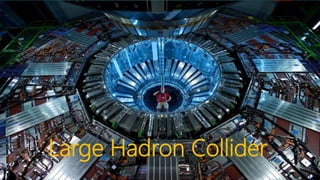
Large Hadron Collider
Background
 The Large Hadron Collider (LHC) is the world's largest and most powerful
particle collider, most complex experimental facility ever built, and the
largest single machine in the world.
 It was built by the European Organization for Nuclear Research (CERN)
between 1998 and 2008 in collaboration with over 10,000 scientists and
engineers from over 100 countries, as well as hundreds of universities and
laboratories.
 It lies in a tunnel 27 kilometres (17 mi) in circumference, as deep as 175
metres (574 ft) beneath the France–Switzerland border near Geneva,
Switzerland
Background
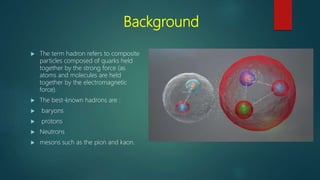
 The term hadron refers to composite
particles composed of quarks held
together by the strong force (as
atoms and molecules are held
together by the electromagnetic
force).
 The best-known hadrons are :
 baryons
 protons
 Neutrons
 mesons such as the pion and kaon.
Background
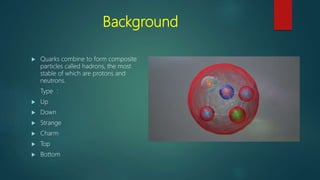
 Quarks combine to form composite
particles called hadrons, the most
stable of which are protons and
neutrons.
Type :
 Up
 Down
 Strange
 Charm
 Top
 Bottom
Background
 A collider is a type of a particle accelerator with two directed beams of
particles. In particle physics, colliders are used as a research tool:
 they accelerate particles to very high kinetic energies and let them impact
other particles.
 Analysis of the byproducts of these collisions gives scientists good evidence of
the structure of the subatomic world and the laws of nature governing it.
 Many of these byproducts are produced only by high-energy collisions, and
they decay after very short periods of time. Thus many of them are hard or
nearly impossible to study in other ways
Purpose
 Physicists hope that the LHC will help answer some of the fundamental open
questions in physics, concerning the basic laws governing the interactions
and forces among the elementary objects, the deep structure of space and
time, and in particular the inter-relation between quantum mechanics and
general relativity, where current theories and knowledge are unclear or
break down altogether.
 Data is also needed from high-energy particle experiments to suggest which
versions of current scientific models are more likely to be correct – in
particular to choose between the Standard Model and Higgsless models
and to validate their predictions and allow further theoretical development.
Issues possibly to be explored by LHC
collisions include:
 Are the masses of elementary particles actually generated by the Higgs
mechanism via electroweak symmetry breaking? It was expected that the
collider experiments will either demonstrate or rule out the existence of the
elusive Higgs boson, thereby allowing physicists to consider whether the
Standard Model or its Higgsless alternatives are more likely to be correct.The
experiments found a particle that appears to be the Higgs boson, strong
evidence that the Standard Model has the correct mechanism of giving mass to
the elementary particles.
 Is supersymmetry, an extension of the Standard Model and Poincaré symmetry,
realized in nature, implying that all known particles have supersymmetric
partners?
 Are there extra dimensions,as predicted by various models based on string
theory, and can we detect them?
 What is the nature of the dark matter that appears to account for 27% of the
mass-energy of the universe?
Design
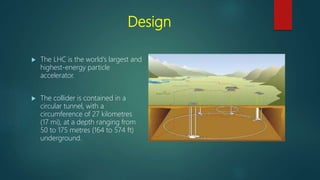
 The LHC is the world's largest and
highest-energy particle
accelerator.
 The collider is contained in a
circular tunnel, with a
circumference of 27 kilometres
(17 mi), at a depth ranging from
50 to 175 metres (164 to 574 ft)
underground.
Design
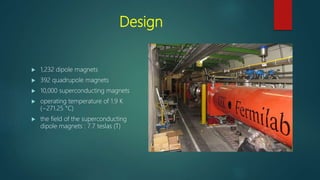
 1,232 dipole magnets
 392 quadrupole magnets
 10,000 superconducting magnets
 operating temperature of 1.9 K
(−271.25 °C)
 the field of the superconducting
dipole magnets : 7.7 teslas (T)
Detectors
 ATLAS
 Compact Muon Solenoid (CMS),
 ALICE
 LHCb
 TOTEM,
 MoEDAL and
 LHCf,
Detectors
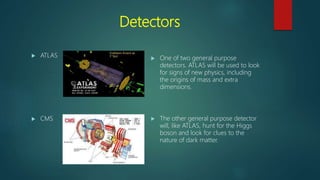
 ATLAS
 CMS
 One of two general purpose
detectors. ATLAS will be used to look
for signs of new physics, including
the origins of mass and extra
dimensions.
 The other general purpose detector
will, like ATLAS, hunt for the Higgs
boson and look for clues to the
nature of dark matter.
Detectors
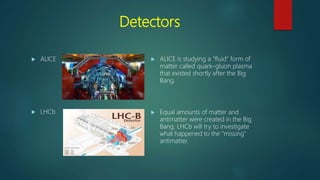
 ALICE
 LHCb
 ALICE is studying a "fluid" form of
matter called quark–gluon plasma
that existed shortly after the Big
Bang.
 Equal amounts of matter and
antimatter were created in the Big
Bang. LHCb will try to investigate
what happened to the "missing"
antimatter.
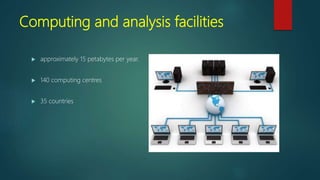
Computing and analysis facilities
 approximately 15 petabytes per year.
 140 computing centres
 35 countries
First run of LHC
 The first beam was circulated through the collider on the morning of 10
September 2008.[41] CERN successfully fired the protons around the
tunnel in stages, three kilometres at a time. The particles were fired in a
clockwise direction into the accelerator and successfully steered around it
at 10:28 local time.
 The LHC successfully completed its major test: after a series of trial runs,
two white dots flashed on a computer screen showing the protons
travelled the full length of the collider. It took less than one hour to guide
the stream of particles around its inaugural circuit.CERN next successfully
sent a beam of protons in an anticlockwise direction, taking slightly
longer at one and a half hours due to a problem with the cryogenics,
with the full circuit being completed at 14:59.
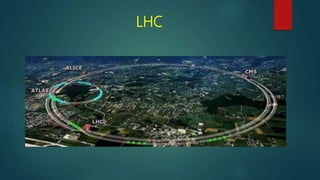
LHC
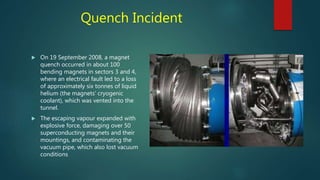
Quench Incident
 On 19 September 2008, a magnet
quench occurred in about 100
bending magnets in sectors 3 and 4,
where an electrical fault led to a loss
of approximately six tonnes of liquid
helium (the magnets' cryogenic
coolant), which was vented into the
tunnel.
 The escaping vapour expanded with
explosive force, damaging over 50
superconducting magnets and their
mountings, and contaminating the
vacuum pipe, which also lost vacuum
conditions
Operational Runs
 On 20 November 2009, low-energy beams circulated in the tunnel for
the first time since the incident
 July 2012 discovery of the Higgs boson.
 Till 2014 LHC was shut down for upgrades.
 On 13 July 2015, the LHCb collaboration at CERN reported results
consistent with pentaquark states in the decay of bottom Lambda
baryons
What is Higgs Boson?
 After the Big Bang ,for only next
trillionth of a second, a field
existed.
 Peter Higgs in 1964 gave a theory
that this field is higgs field
 Any particle in contact with this
field was said to be Higgs Boson
Particle.
How to confirm Higgs Boson
 In order to confirm the higgs
Boson,the energy same as that of Big
Bang ,should be used.
 Thus ,Large Hadron Collider was
used that used an amount of 14TeV.
 This particle is main element that
makes mass in any other element.
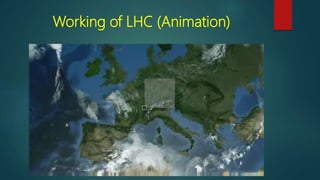
Working of LHC (Animation)
Latest Discoveries
 Each of the five particles were found
to be excited states of Omega-c-
zero, a particle with three quarks.
These particle states are named,
according to the standard
convention,
 Ωc(3000)0
 Ωc(3050)0
 Ωc(3066)0
 Ωc(3090)0
 Ωc(3119)0
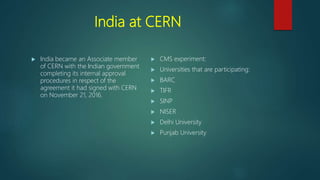
India at CERN
 India became an Associate member
of CERN with the Indian government
completing its internal approval
procedures in respect of the
agreement it had signed with CERN
on November 21, 2016.
 CMS experiment:
 Universities that are participating:
 BARC
 TIFR
 SINP
 NISER
 Delhi University
 Punjab University
Future Scope
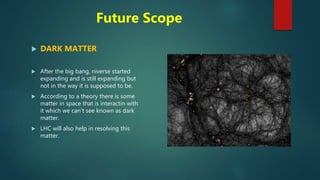
 DARK MATTER
 After the big bang, niverse started
expanding and is still expanding but
not in the way it is supposed to be.
 According to a theory there is some
matter in space that is interactin with
it which we can’t see known as dark
matter.
 LHC will also help in resolving this
matter.
Future Scope
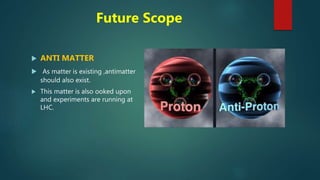
 ANTI MATTER
 As matter is existing ,antimatter
should also exist.
 This matter is also ooked upon
and experiments are running at
LHC.
Future Scope
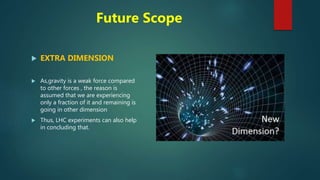
 EXTRA DIMENSION
 As,gravity is a weak force compared
to other forces , the reason is
assumed that we are experiencing
only a fraction of it and remaining is
going in other dimension
 Thus, LHC experiments can also help
in concluding that.
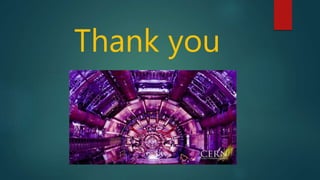
Thank you

Large Hadron Collider(LHC) PPT

  • 1.
  • 2.
    Background  The LargeHadron Collider (LHC) is the world's largest and most powerful particle collider, most complex experimental facility ever built, and the largest single machine in the world.  It was built by the European Organization for Nuclear Research (CERN) between 1998 and 2008 in collaboration with over 10,000 scientists and engineers from over 100 countries, as well as hundreds of universities and laboratories.  It lies in a tunnel 27 kilometres (17 mi) in circumference, as deep as 175 metres (574 ft) beneath the France–Switzerland border near Geneva, Switzerland
  • 3.
    Background  The termhadron refers to composite particles composed of quarks held together by the strong force (as atoms and molecules are held together by the electromagnetic force).  The best-known hadrons are :  baryons  protons  Neutrons  mesons such as the pion and kaon.
  • 4.
    Background  Quarks combineto form composite particles called hadrons, the most stable of which are protons and neutrons. Type :  Up  Down  Strange  Charm  Top  Bottom
  • 5.
    Background  A collideris a type of a particle accelerator with two directed beams of particles. In particle physics, colliders are used as a research tool:  they accelerate particles to very high kinetic energies and let them impact other particles.  Analysis of the byproducts of these collisions gives scientists good evidence of the structure of the subatomic world and the laws of nature governing it.  Many of these byproducts are produced only by high-energy collisions, and they decay after very short periods of time. Thus many of them are hard or nearly impossible to study in other ways
  • 6.
    Purpose  Physicists hopethat the LHC will help answer some of the fundamental open questions in physics, concerning the basic laws governing the interactions and forces among the elementary objects, the deep structure of space and time, and in particular the inter-relation between quantum mechanics and general relativity, where current theories and knowledge are unclear or break down altogether.  Data is also needed from high-energy particle experiments to suggest which versions of current scientific models are more likely to be correct – in particular to choose between the Standard Model and Higgsless models and to validate their predictions and allow further theoretical development.
  • 7.
    Issues possibly tobe explored by LHC collisions include:  Are the masses of elementary particles actually generated by the Higgs mechanism via electroweak symmetry breaking? It was expected that the collider experiments will either demonstrate or rule out the existence of the elusive Higgs boson, thereby allowing physicists to consider whether the Standard Model or its Higgsless alternatives are more likely to be correct.The experiments found a particle that appears to be the Higgs boson, strong evidence that the Standard Model has the correct mechanism of giving mass to the elementary particles.  Is supersymmetry, an extension of the Standard Model and Poincaré symmetry, realized in nature, implying that all known particles have supersymmetric partners?  Are there extra dimensions,as predicted by various models based on string theory, and can we detect them?  What is the nature of the dark matter that appears to account for 27% of the mass-energy of the universe?
  • 8.
    Design  The LHCis the world's largest and highest-energy particle accelerator.  The collider is contained in a circular tunnel, with a circumference of 27 kilometres (17 mi), at a depth ranging from 50 to 175 metres (164 to 574 ft) underground.
  • 9.
    Design  1,232 dipolemagnets  392 quadrupole magnets  10,000 superconducting magnets  operating temperature of 1.9 K (−271.25 °C)  the field of the superconducting dipole magnets : 7.7 teslas (T)
  • 10.
    Detectors  ATLAS  CompactMuon Solenoid (CMS),  ALICE  LHCb  TOTEM,  MoEDAL and  LHCf,
  • 11.
    Detectors  ATLAS  CMS One of two general purpose detectors. ATLAS will be used to look for signs of new physics, including the origins of mass and extra dimensions.  The other general purpose detector will, like ATLAS, hunt for the Higgs boson and look for clues to the nature of dark matter.
  • 12.
    Detectors  ALICE  LHCb ALICE is studying a "fluid" form of matter called quark–gluon plasma that existed shortly after the Big Bang.  Equal amounts of matter and antimatter were created in the Big Bang. LHCb will try to investigate what happened to the "missing" antimatter.
  • 13.
    Computing and analysisfacilities  approximately 15 petabytes per year.  140 computing centres  35 countries
  • 14.
    First run ofLHC  The first beam was circulated through the collider on the morning of 10 September 2008.[41] CERN successfully fired the protons around the tunnel in stages, three kilometres at a time. The particles were fired in a clockwise direction into the accelerator and successfully steered around it at 10:28 local time.  The LHC successfully completed its major test: after a series of trial runs, two white dots flashed on a computer screen showing the protons travelled the full length of the collider. It took less than one hour to guide the stream of particles around its inaugural circuit.CERN next successfully sent a beam of protons in an anticlockwise direction, taking slightly longer at one and a half hours due to a problem with the cryogenics, with the full circuit being completed at 14:59.
  • 15.
  • 16.
    Quench Incident  On19 September 2008, a magnet quench occurred in about 100 bending magnets in sectors 3 and 4, where an electrical fault led to a loss of approximately six tonnes of liquid helium (the magnets' cryogenic coolant), which was vented into the tunnel.  The escaping vapour expanded with explosive force, damaging over 50 superconducting magnets and their mountings, and contaminating the vacuum pipe, which also lost vacuum conditions
  • 17.
    Operational Runs  On20 November 2009, low-energy beams circulated in the tunnel for the first time since the incident  July 2012 discovery of the Higgs boson.  Till 2014 LHC was shut down for upgrades.  On 13 July 2015, the LHCb collaboration at CERN reported results consistent with pentaquark states in the decay of bottom Lambda baryons
  • 18.
    What is HiggsBoson?  After the Big Bang ,for only next trillionth of a second, a field existed.  Peter Higgs in 1964 gave a theory that this field is higgs field  Any particle in contact with this field was said to be Higgs Boson Particle.
  • 19.
    How to confirmHiggs Boson  In order to confirm the higgs Boson,the energy same as that of Big Bang ,should be used.  Thus ,Large Hadron Collider was used that used an amount of 14TeV.  This particle is main element that makes mass in any other element.
  • 20.
    Working of LHC(Animation)
  • 21.
    Latest Discoveries  Eachof the five particles were found to be excited states of Omega-c- zero, a particle with three quarks. These particle states are named, according to the standard convention,  Ωc(3000)0  Ωc(3050)0  Ωc(3066)0  Ωc(3090)0  Ωc(3119)0
  • 22.
    India at CERN India became an Associate member of CERN with the Indian government completing its internal approval procedures in respect of the agreement it had signed with CERN on November 21, 2016.  CMS experiment:  Universities that are participating:  BARC  TIFR  SINP  NISER  Delhi University  Punjab University
  • 23.
    Future Scope  DARKMATTER  After the big bang, niverse started expanding and is still expanding but not in the way it is supposed to be.  According to a theory there is some matter in space that is interactin with it which we can’t see known as dark matter.  LHC will also help in resolving this matter.
  • 24.
    Future Scope  ANTIMATTER  As matter is existing ,antimatter should also exist.  This matter is also ooked upon and experiments are running at LHC.
  • 25.
    Future Scope  EXTRADIMENSION  As,gravity is a weak force compared to other forces , the reason is assumed that we are experiencing only a fraction of it and remaining is going in other dimension  Thus, LHC experiments can also help in concluding that.
  • 26.