Shifting the Cost of Service
Common Support Options
Many companies offer a combination of the following resources.
• Issue avoidance
• Product/software update
• Self-Help
• Social Media
• Community Forum
• Chat
• Email
• Phone
• Video Conference
• In-Person
• Field Service / Engineering Engagement / Concession
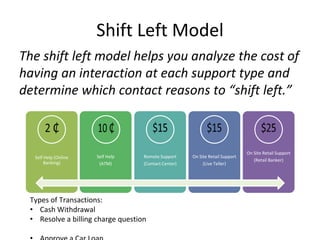
Shift Left Model
The shift left model helps you analyze the cost of
having an interaction at each support type and
determine which contact reasons to “shift left.”
Self Help (Online
Banking)
Self Help
(ATM)
Remote Support
(Contact Center)
On Site Retail Support
(Live Teller)
On Site Retail Support
(Retail Banker)
Types of Transactions:
• Cash Withdrawal
• Resolve a billing charge question
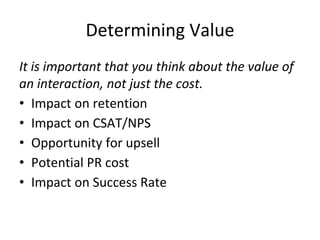
Determining Value
It is important that you think about the value of
an interaction, not just the cost.
• Impact on retention
• Impact on CSAT/NPS
• Opportunity for upsell
• Potential PR cost
• Impact on Success Rate
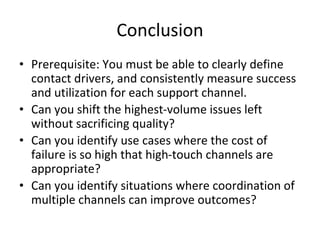
Conclusion
• Prerequisite: You must be able to clearly define
contact drivers, and consistently measure success
and utilization for each support channel.
• Can you shift the highest-volume issues left
without sacrificing quality?
• Can you identify use cases where the cost of
failure is so high that high-touch channels are
appropriate?
• Can you identify situations where coordination of
multiple channels can improve outcomes?
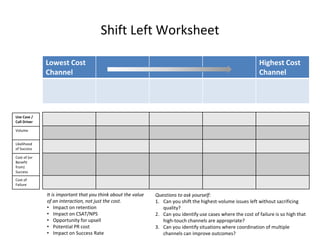
Shift Left Worksheet
Lowest Cost
Channel
Highest Cost
Channel
Use Case /
Call Driver
Volume
Likelihood
of Success
Cost of (or
Benefit
from)
Success
Cost of
Failure
It is important that you think about the value
of an interaction, not just the cost.
• Impact on retention
• Impact on CSAT/NPS
• Opportunity for upsell
• Potential PR cost
• Impact on Success Rate
Questions to ask yourself:
1. Can you shift the highest-volume issues left without sacrificing
quality?
2. Can you identify use cases where the cost of failure is so high that
high-touch channels are appropriate?
3. Can you identify situations where coordination of multiple
channels can improve outcomes?
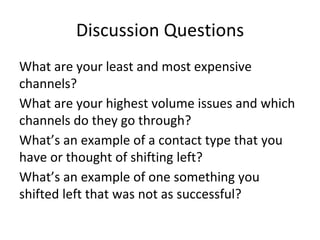
Discussion Questions
What are your least and most expensive
channels?
What are your highest volume issues and which
channels do they go through?
What’s an example of a contact type that you
have or thought of shifting left?
What’s an example of one something you
shifted left that was not as successful?

Shift left v31

  • 1.
  • 2.
    Common Support Options Manycompanies offer a combination of the following resources. • Issue avoidance • Product/software update • Self-Help • Social Media • Community Forum • Chat • Email • Phone • Video Conference • In-Person • Field Service / Engineering Engagement / Concession
  • 3.
    Shift Left Model Theshift left model helps you analyze the cost of having an interaction at each support type and determine which contact reasons to “shift left.” Self Help (Online Banking) Self Help (ATM) Remote Support (Contact Center) On Site Retail Support (Live Teller) On Site Retail Support (Retail Banker) Types of Transactions: • Cash Withdrawal • Resolve a billing charge question
  • 4.
    Determining Value It isimportant that you think about the value of an interaction, not just the cost. • Impact on retention • Impact on CSAT/NPS • Opportunity for upsell • Potential PR cost • Impact on Success Rate
  • 5.
    Conclusion • Prerequisite: Youmust be able to clearly define contact drivers, and consistently measure success and utilization for each support channel. • Can you shift the highest-volume issues left without sacrificing quality? • Can you identify use cases where the cost of failure is so high that high-touch channels are appropriate? • Can you identify situations where coordination of multiple channels can improve outcomes?
  • 6.
    Shift Left Worksheet LowestCost Channel Highest Cost Channel Use Case / Call Driver Volume Likelihood of Success Cost of (or Benefit from) Success Cost of Failure It is important that you think about the value of an interaction, not just the cost. • Impact on retention • Impact on CSAT/NPS • Opportunity for upsell • Potential PR cost • Impact on Success Rate Questions to ask yourself: 1. Can you shift the highest-volume issues left without sacrificing quality? 2. Can you identify use cases where the cost of failure is so high that high-touch channels are appropriate? 3. Can you identify situations where coordination of multiple channels can improve outcomes?
  • 7.
    Discussion Questions What areyour least and most expensive channels? What are your highest volume issues and which channels do they go through? What’s an example of a contact type that you have or thought of shifting left? What’s an example of one something you shifted left that was not as successful?