ELECTROCARDIOGRAMs
(ECGs)
ECG paper
• Vertical dark lines- 5mm apart
• Vertical light lines- 1mm apart
• Horizontal dark lines-5mm apart
• Horizontal light lines- 1mm apart
• Large square- 5 X 5 mm
• Small square- 1 X 1 mm
LEAD PLACEMENT
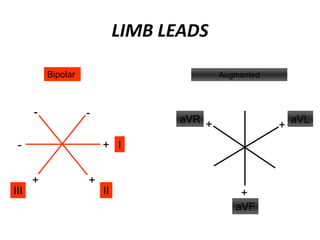
• Limb Leads - 6 in all
- I, II, III, aVL, aVR, aVF
• Chest leads - 6 in all
-V1,V2,V3,V4,V5,V6
Standard 12-lead ECG:
LIMB LEADS
aVL
aVR
Augmented
+
aVF
+
+
III II
I
Bipolar
+
-
+
-
-
+
CHEST LEADS
• V1- 4th intercostal space right to
sternal border
•V2- 4th intercostal space left to sternal
border
•V3- between V2 and V4
•V4- midclavicular line 5th intercostal
space
•V5- anterior axillary line
•V6-midaxillary line
Interpretation steps
Calibration should be 10mm
Paper speed should be 25mm/sec
Calculate HR and heart rhythm
Measure PR, QRS, QT, ST intervals
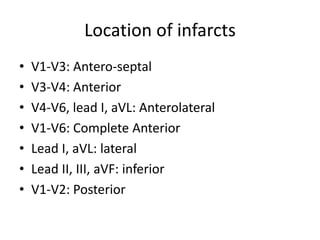
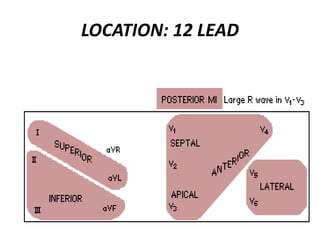
Location of infarcts
• V1-V3: Antero-septal
• V3-V4: Anterior
• V4-V6, lead I, aVL: Anterolateral
• V1-V6: Complete Anterior
• Lead I, aVL: lateral
• Lead II, III, aVF: inferior
• V1-V2: Posterior
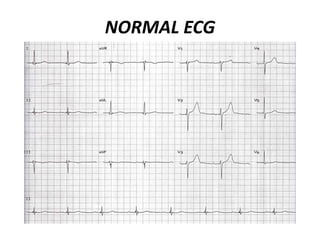
NORMAL ECG
PROCESS
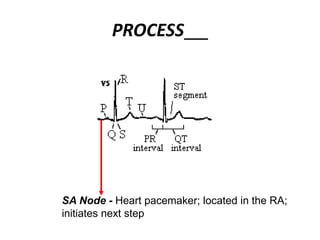
SA Node - Heart pacemaker; located in the RA;
initiates next step
PROCESS
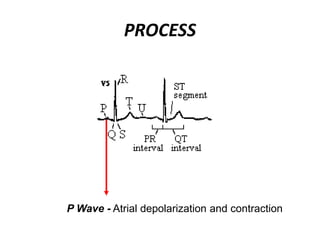
P Wave - Atrial depolarization and contraction
PROCESS
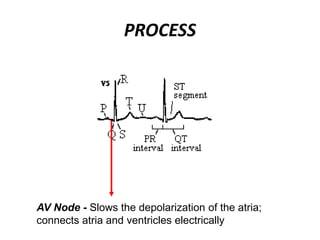
AV Node - Slows the depolarization of the atria;
connects atria and ventricles electrically
PROCESS
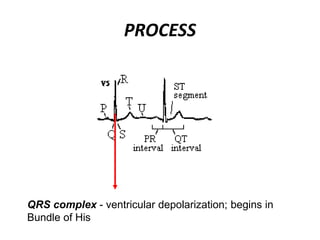
QRS complex - ventricular depolarization; begins in
Bundle of His
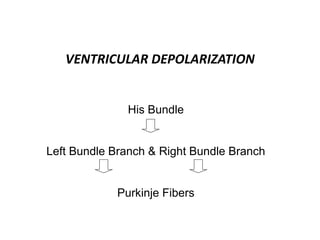
VENTRICULAR DEPOLARIZATION
His Bundle
Left Bundle Branch & Right Bundle Branch
Purkinje Fibers
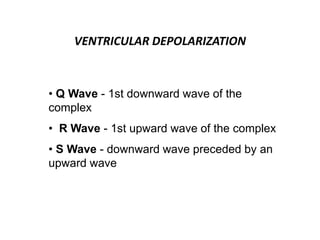
VENTRICULAR DEPOLARIZATION
• Q Wave - 1st downward wave of the
complex
• R Wave - 1st upward wave of the complex
• S Wave - downward wave preceded by an
upward wave
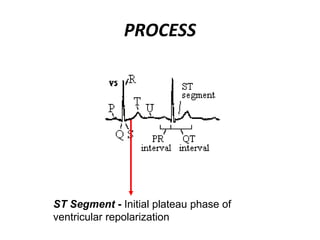
PROCESS
ST Segment - Initial plateau phase of
ventricular repolarization
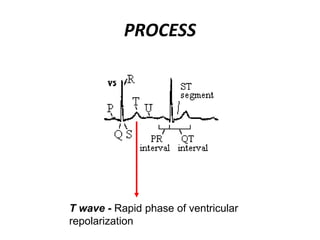
PROCESS
T wave - Rapid phase of ventricular
repolarization
RHYTHM
Normal sinus rhythm:
• Each P wave is followed by a QRS
• Regular or irregular
RATE
• P wave rate 60 - 100 bpm with <10% variation - Normal
• Rate < 60 bpm = Sinus Bradycardia
- Results from:
- Excessive vagal stimulation
- SA nodal ischemia (Inferior MI)
• Rate > 100 bpm = Sinus Tachycardia
- Results from:
- Pain / anxiety
- CHF
- Volume depletion
- Pericarditis
- Chronotropic Drugs (Dopamine)
RATE
Methods:
300/ # of small boxes between RR
P WAVE
Normal:
• Height < 2.5 mm in lead II
• Width < 0.11 s in lead II
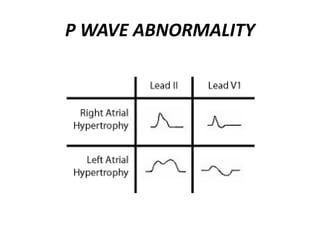
P WAVE ABNORMALITY
P WAVE ABNORMALITIES
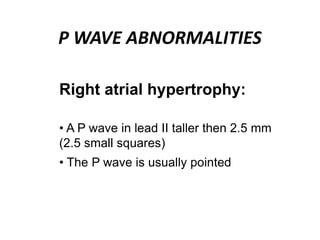
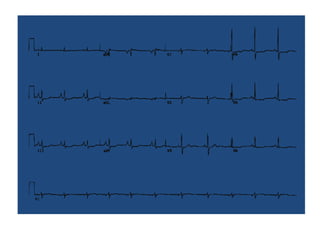
Right atrial hypertrophy:
• A P wave in lead II taller then 2.5 mm
(2.5 small squares)
• The P wave is usually pointed
P WAVE ABNORMALITIES
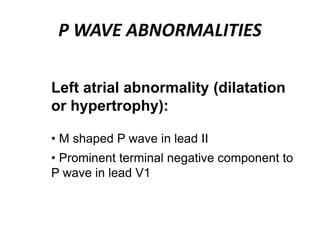
Left atrial abnormality (dilatation
or hypertrophy):
• M shaped P wave in lead II
• Prominent terminal negative component to
P wave in lead V1
PR INTERVAL
Normal PR interval:
• 0.12 to 0.20 s (3 - 5 small squares)
PR INTERVAL ABNORMALITIES
Shorter PR interval:
• Wolf-Parkinson-White syndrome
- Short PR interval, less than 3 small squares
(120 ms)
- Slurred upstroke to the QRS indicating pre-
excitation (delta wave)
- Broad QRS
- Secondary ST and T wave changes
PR INTERVAL ABNORMALITIES
Long PR interval (will cover later):
• AV blocks
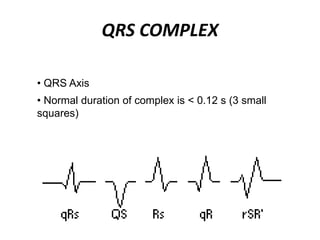
QRS COMPLEX
• QRS Axis
• Normal duration of complex is < 0.12 s (3 small
squares)
WIDE QRS COMPLEX
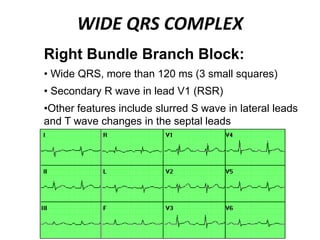
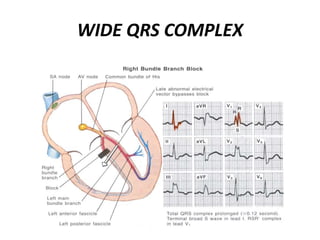
Right Bundle Branch Block:
• Wide QRS, more than 120 ms (3 small squares)
• Secondary R wave in lead V1 (RSR)
•Other features include slurred S wave in lateral leads
and T wave changes in the septal leads
WIDE QRS COMPLEX
WIDE QRS COMPLEX
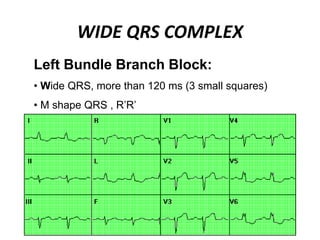
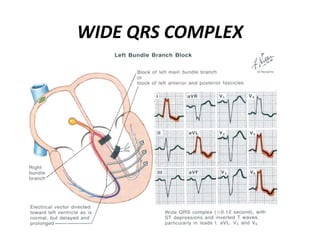
Left Bundle Branch Block:
• Wide QRS, more than 120 ms (3 small squares)
• M shape QRS , R’R’
WIDE QRS COMPLEX
WIDE QRS
- Small or absent P waves
- Atrial fibrillation
- Wide QRS
- Shortened or absent ST segment
- Wide, tall and tented T waves
- Ventricular fibrillation
Hyperkalemia:
• Changes that can be seen:
WIDE QRS
Ventricular rhythm (will cover later):
PATHOLOGICAL Q WAVES
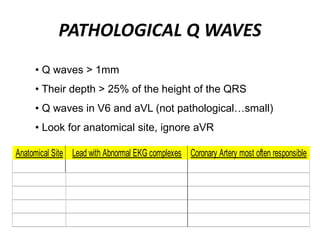
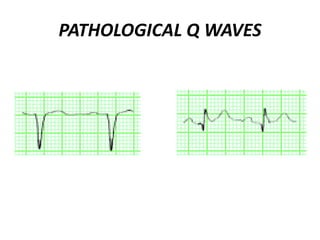
• Q waves > 1mm
• Their depth > 25% of the height of the QRS
• Q waves in V6 and aVL (not pathological…small)
• Look for anatomical site, ignore aVR
Anatomical Site Lead with Abnormal EKG complexes Coronary Artery most often responsible
Inferior II, III, aVf RCA
Antero Septal V1-V2 LAD
Antero Apical V3-V4 LAD (distal)
Antero Lateral V5-V6, I, aVL CFX
Posterior V1-V2 (Tall R, Not Q) RCA
PATHOLOGICAL Q WAVES
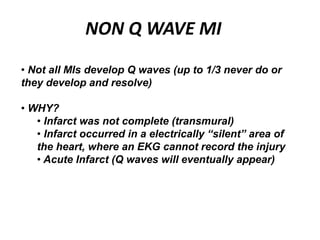
NON Q WAVE MI
• Not all MIs develop Q waves (up to 1/3 never do or
they develop and resolve)
• WHY?
• Infarct was not complete (transmural)
• Infarct occurred in a electrically “silent” area of
the heart, where an EKG cannot record the injury
• Acute Infarct (Q waves will eventually appear)
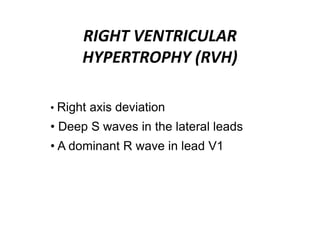
RIGHT VENTRICULAR
HYPERTROPHY (RVH)
• Right axis deviation
• Deep S waves in the lateral leads
• A dominant R wave in lead V1
LEFT VENTRICULAR HYPERTROPHY
(LVH)
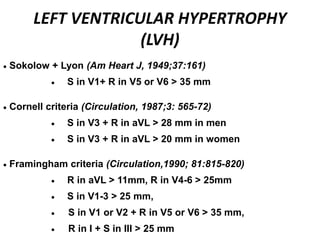
 Sokolow + Lyon (Am Heart J, 1949;37:161)
 S in V1+ R in V5 or V6 > 35 mm
 Cornell criteria (Circulation, 1987;3: 565-72)
 S in V3 + R in aVL > 28 mm in men
 S in V3 + R in aVL > 20 mm in women
 Framingham criteria (Circulation,1990; 81:815-820)
 R in aVL > 11mm, R in V4-6 > 25mm
 S in V1-3 > 25 mm,
 S in V1 or V2 + R in V5 or V6 > 35 mm,
 R in I + S in III > 25 mm
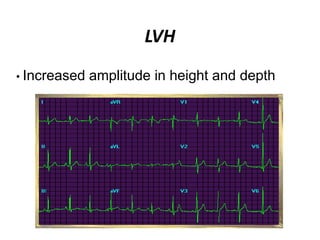
LVH
• Increased amplitude in height and depth
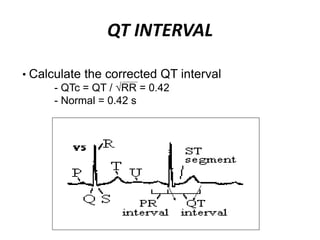
QT INTERVAL
• Calculate the corrected QT interval
- QTc = QT / RR = 0.42
- Normal = 0.42 s
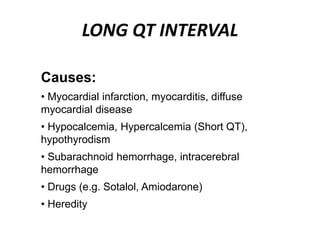
LONG QT INTERVAL
Causes:
• Myocardial infarction, myocarditis, diffuse
myocardial disease
• Hypocalcemia, Hypercalcemia (Short QT),
hypothyrodism
• Subarachnoid hemorrhage, intracerebral
hemorrhage
• Drugs (e.g. Sotalol, Amiodarone)
• Heredity
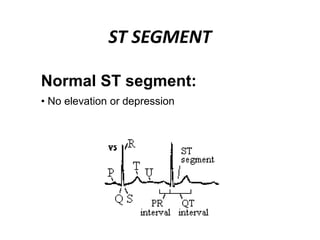
ST SEGMENT
Normal ST segment:
• No elevation or depression
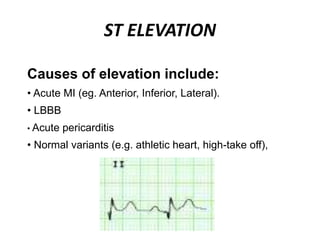
ST ELEVATION
Causes of elevation include:
• Acute MI (eg. Anterior, Inferior, Lateral).
• LBBB
• Acute pericarditis
• Normal variants (e.g. athletic heart, high-take off),
ACUTE MI
• ST elevation in leads where MI occurs
• Look for reciprocal changes
(e.g. Ant MI look for ST depression in inferior leads)
Anatomical Site Lead with Abnormal EKG complexes Coronary Artery most often responsible
Inferior II, III, aVf RCA
Antero Septal V1-V2 LAD
Antero Apical V3-V4 LAD (distal)
Antero Lateral V5-V6, I, aVL CFX
Posterior V1-V2 (Tall R, Not Q) RCA
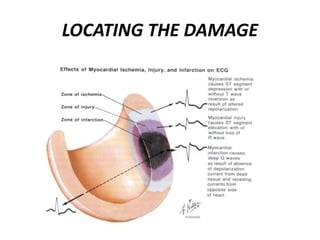
LOCATING THE DAMAGE
LOCATION: 12 LEAD
ST DEPRESSION
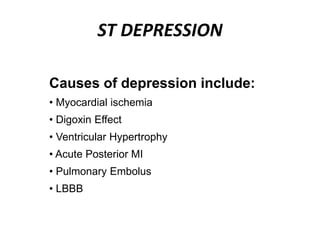
Causes of depression include:
• Myocardial ischemia
• Digoxin Effect
• Ventricular Hypertrophy
• Acute Posterior MI
• Pulmonary Embolus
• LBBB
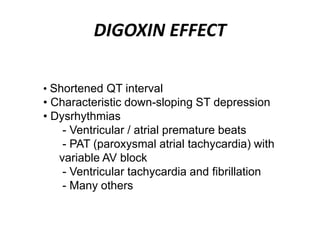
DIGOXIN EFFECT
• Shortened QT interval
• Characteristic down-sloping ST depression
• Dysrhythmias
- Ventricular / atrial premature beats
- PAT (paroxysmal atrial tachycardia) with
variable AV block
- Ventricular tachycardia and fibrillation
- Many others
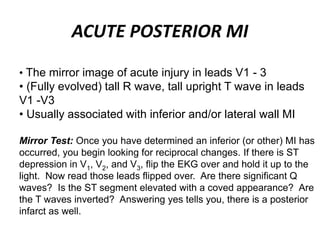
ACUTE POSTERIOR MI
• The mirror image of acute injury in leads V1 - 3
• (Fully evolved) tall R wave, tall upright T wave in leads
V1 -V3
• Usually associated with inferior and/or lateral wall MI
Mirror Test: Once you have determined an inferior (or other) MI has
occurred, you begin looking for reciprocal changes. If there is ST
depression in V1, V2, and V3, flip the EKG over and hold it up to the
light. Now read those leads flipped over. Are there significant Q
waves? Is the ST segment elevated with a coved appearance? Are
the T waves inverted? Answering yes tells you, there is a posterior
infarct as well.
ST DEPRESSION
In diagnosis with ischemia:
• Looking for at least 1mm (1 square)
• This can be
1. Upsloping
2. Horizontal (can be combined w/ 1 or 3)
3. Downsloping
T WAVES
• Repolarization of the ventricles is signaled by
the T wave
TALL T WAVES
Causes:
• Hyperkalemia
• Hyperacute MI
• LBBB
SMALL, FLATTENED OR INVERTED T
WAVES
Causes are plenty:
• Ischemia, age, race, hyperventilation, anxiety
• LVH, drugs, pericarditis, I-V conduction delay (RBBB),
• Electrolyte disturbances
• The most important thing to consider is INVERTED T waves
associated with Ischemia
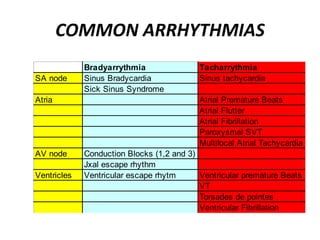
COMMON ARRHYTHMIAS
Location Bradyarrythmia Tacharrythmia
SA node Sinus Bradycardia Sinus tachycardia
Sick Sinus Syndrome
Atria Atrial Premature Beats
Atrial Flutter
Atrial Fibrillation
Paroxysmal SVT
Multifocal Atrial Tachycardia
AV node Conduction Blocks (1,2 and 3)
Jxal escape rhythm
Ventricles Ventricular escape rhytm Ventricular premature Beats
VT
Torsades de pointes
Ventricular Fibrillation
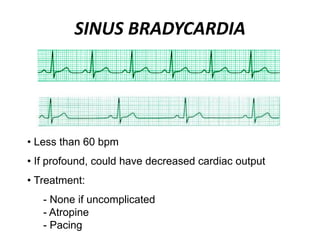
SINUS BRADYCARDIA
• Less than 60 bpm
• If profound, could have decreased cardiac output
• Treatment:
- None if uncomplicated
- Atropine
- Pacing
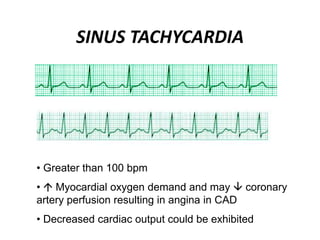
SINUS TACHYCARDIA
• Greater than 100 bpm
•  Myocardial oxygen demand and may  coronary
artery perfusion resulting in angina in CAD
• Decreased cardiac output could be exhibited
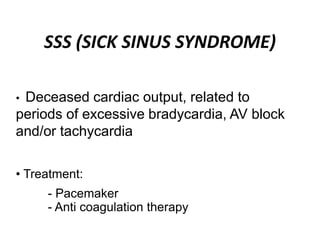
SSS (SICK SINUS SYNDROME)
• Deceased cardiac output, related to
periods of excessive bradycardia, AV block
and/or tachycardia
• Treatment:
- Pacemaker
- Anti coagulation therapy
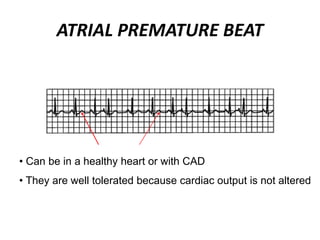
ATRIAL PREMATURE BEAT
• Can be in a healthy heart or with CAD
• They are well tolerated because cardiac output is not altered
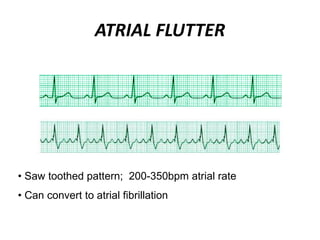
ATRIAL FLUTTER
• Saw toothed pattern; 200-350bpm atrial rate
• Can convert to atrial fibrillation
ATRIAL FLUTTER (CONT’D)
• People can feel flutter sensation… if short lived then no
complication; however, with an increased ventricular rate,
people can experience decreased cardiac output.
• Treatment:
- Veramapril, vagal stimulation
- Digoxin (perhaps in combo with other drugs)
- Cardioversion or pacing
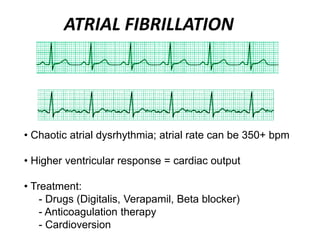
ATRIAL FIBRILLATION
• Chaotic atrial dysrhythmia; atrial rate can be 350+ bpm
• Higher ventricular response = cardiac output
• Treatment:
- Drugs (Digitalis, Verapamil, Beta blocker)
- Anticoagulation therapy
- Cardioversion
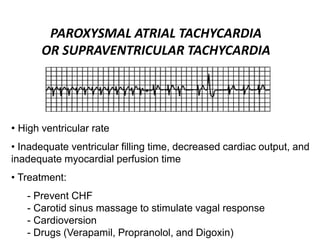
PAROXYSMAL ATRIAL TACHYCARDIA
OR SUPRAVENTRICULAR TACHYCARDIA
• High ventricular rate
• Inadequate ventricular filling time, decreased cardiac output, and
inadequate myocardial perfusion time
• Treatment:
- Prevent CHF
- Carotid sinus massage to stimulate vagal response
- Cardioversion
- Drugs (Verapamil, Propranolol, and Digoxin)
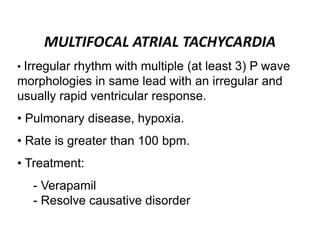
MULTIFOCAL ATRIAL TACHYCARDIA
• Irregular rhythm with multiple (at least 3) P wave
morphologies in same lead with an irregular and
usually rapid ventricular response.
• Pulmonary disease, hypoxia.
• Rate is greater than 100 bpm.
• Treatment:
- Verapamil
- Resolve causative disorder
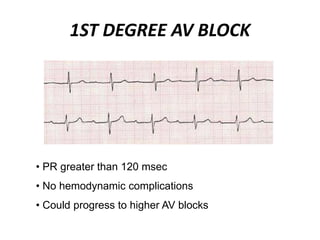
1ST DEGREE AV BLOCK
• PR greater than 120 msec
• No hemodynamic complications
• Could progress to higher AV blocks
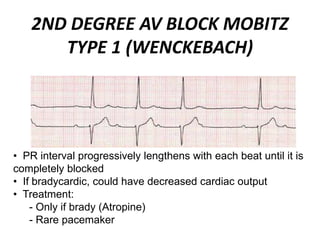
2ND DEGREE AV BLOCK MOBITZ
TYPE 1 (WENCKEBACH)
• PR interval progressively lengthens with each beat until it is
completely blocked
• If bradycardic, could have decreased cardiac output
• Treatment:
- Only if brady (Atropine)
- Rare pacemaker
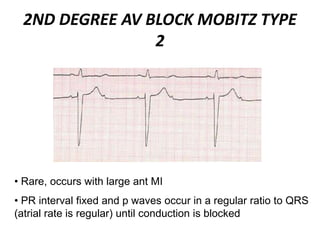
2ND DEGREE AV BLOCK MOBITZ TYPE
2
• Rare, occurs with large ant MI
• PR interval fixed and p waves occur in a regular ratio to QRS
(atrial rate is regular) until conduction is blocked
• Symptoms of decreased cardiac output occur with
slowing ventricular rate
- Could progress to complete block
• Treatment:
- Atropine initially
- Permanent pacemaker
2ND DEGREE AV BLOCK MOBITZ
TYPE 2 (CONT’D)
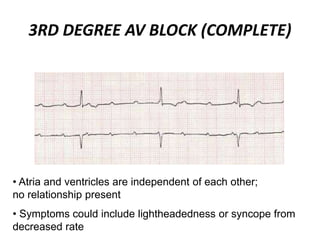
3RD DEGREE AV BLOCK (COMPLETE)
• Atria and ventricles are independent of each other;
no relationship present
• Symptoms could include lightheadedness or syncope from
decreased rate
3RD DEGREE AV BLOCK (COMPLETE)
(CONT’D)
• Decreased cardiac output, compromised
coronary perfusion
• Treatment:
- Emergency
- Atropine
- Pacemaker
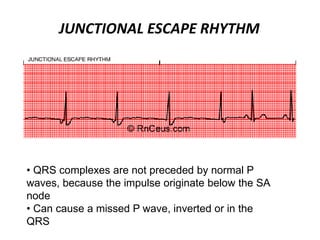
JUNCTIONAL ESCAPE RHYTHM
• QRS complexes are not preceded by normal P
waves, because the impulse originate below the SA
node
• Can cause a missed P wave, inverted or in the
QRS
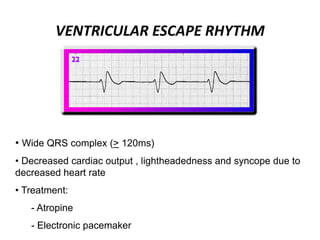
VENTRICULAR ESCAPE RHYTHM
• Wide QRS complex (> 120ms)
• Decreased cardiac output , lightheadedness and syncope due to
decreased heart rate
• Treatment:
- Atropine
- Electronic pacemaker
PREMATURE VENTRICULAR CONTRACTION
(PVC)
• Occasional PVC’s have minimal consequences
• Increased frequency or multifocal PVCs can lead to
ventricular tachycardia
• Make sure it does not progress to more PVCs
• Couplet is 2 PVCs in a row
• Triplet is 3 PVCs in a row
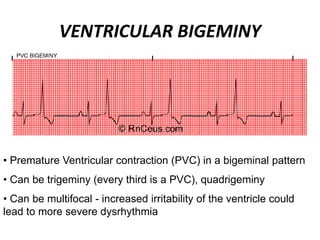
VENTRICULAR BIGEMINY
• Premature Ventricular contraction (PVC) in a bigeminal pattern
• Can be trigeminy (every third is a PVC), quadrigeminy
• Can be multifocal - increased irritability of the ventricle could
lead to more severe dysrhythmia
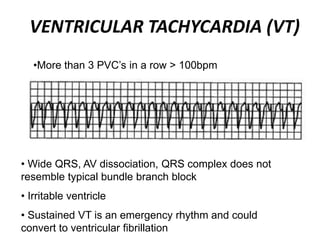
VENTRICULAR TACHYCARDIA (VT)
•More than 3 PVC’s in a row > 100bpm
• Wide QRS, AV dissociation, QRS complex does not
resemble typical bundle branch block
• Irritable ventricle
• Sustained VT is an emergency rhythm and could
convert to ventricular fibrillation
VT
• Decreased cardiac output , irritable ventricle
• Treatment:
- Cardioversion
- Lidocaine or Procainamide to get NSR
- Emergent care
- Long term care: ICD (implantable
cardioverter defibrillator)
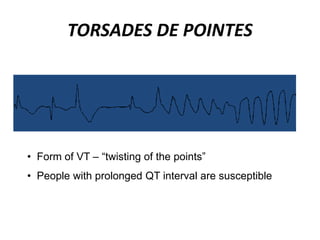
TORSADES DE POINTES
• Form of VT – “twisting of the points”
• People with prolonged QT interval are susceptible
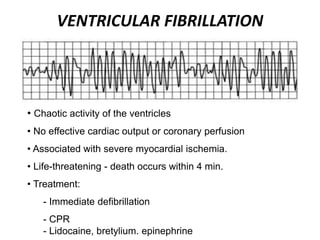
VENTRICULAR FIBRILLATION
• Chaotic activity of the ventricles
• No effective cardiac output or coronary perfusion
• Associated with severe myocardial ischemia.
• Life-threatening - death occurs within 4 min.
• Treatment:
- Immediate defibrillation
- CPR
- Lidocaine, bretylium. epinephrine
SINUS ARREST
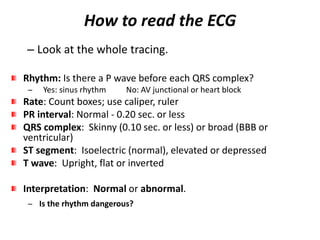
How to read the ECG
– Look at the whole tracing.
Rhythm: Is there a P wave before each QRS complex?
− Yes: sinus rhythm No: AV junctional or heart block
Rate: Count boxes; use caliper, ruler
PR interval: Normal - 0.20 sec. or less
QRS complex: Skinny (0.10 sec. or less) or broad (BBB or
ventricular)
ST segment: Isoelectric (normal), elevated or depressed
T wave: Upright, flat or inverted
Interpretation: Normal or abnormal.
− Is the rhythm dangerous?

ECG.ppt

  • 1.
  • 2.
    ECG paper • Verticaldark lines- 5mm apart • Vertical light lines- 1mm apart • Horizontal dark lines-5mm apart • Horizontal light lines- 1mm apart • Large square- 5 X 5 mm • Small square- 1 X 1 mm
  • 3.
    LEAD PLACEMENT • LimbLeads - 6 in all - I, II, III, aVL, aVR, aVF • Chest leads - 6 in all -V1,V2,V3,V4,V5,V6 Standard 12-lead ECG:
  • 4.
  • 5.
    CHEST LEADS • V1-4th intercostal space right to sternal border •V2- 4th intercostal space left to sternal border •V3- between V2 and V4 •V4- midclavicular line 5th intercostal space •V5- anterior axillary line •V6-midaxillary line
  • 6.
    Interpretation steps Calibration shouldbe 10mm Paper speed should be 25mm/sec Calculate HR and heart rhythm Measure PR, QRS, QT, ST intervals
  • 7.
    Location of infarcts •V1-V3: Antero-septal • V3-V4: Anterior • V4-V6, lead I, aVL: Anterolateral • V1-V6: Complete Anterior • Lead I, aVL: lateral • Lead II, III, aVF: inferior • V1-V2: Posterior
  • 8.
  • 9.
    PROCESS SA Node -Heart pacemaker; located in the RA; initiates next step
  • 10.
    PROCESS P Wave -Atrial depolarization and contraction
  • 11.
    PROCESS AV Node -Slows the depolarization of the atria; connects atria and ventricles electrically
  • 12.
    PROCESS QRS complex -ventricular depolarization; begins in Bundle of His
  • 13.
    VENTRICULAR DEPOLARIZATION His Bundle LeftBundle Branch & Right Bundle Branch Purkinje Fibers
  • 14.
    VENTRICULAR DEPOLARIZATION • QWave - 1st downward wave of the complex • R Wave - 1st upward wave of the complex • S Wave - downward wave preceded by an upward wave
  • 15.
    PROCESS ST Segment -Initial plateau phase of ventricular repolarization
  • 16.
    PROCESS T wave -Rapid phase of ventricular repolarization
  • 17.
    RHYTHM Normal sinus rhythm: •Each P wave is followed by a QRS • Regular or irregular
  • 18.
    RATE • P waverate 60 - 100 bpm with <10% variation - Normal • Rate < 60 bpm = Sinus Bradycardia - Results from: - Excessive vagal stimulation - SA nodal ischemia (Inferior MI) • Rate > 100 bpm = Sinus Tachycardia - Results from: - Pain / anxiety - CHF - Volume depletion - Pericarditis - Chronotropic Drugs (Dopamine)
  • 19.
    RATE Methods: 300/ # ofsmall boxes between RR
  • 20.
    P WAVE Normal: • Height< 2.5 mm in lead II • Width < 0.11 s in lead II
  • 21.
  • 22.
    P WAVE ABNORMALITIES Rightatrial hypertrophy: • A P wave in lead II taller then 2.5 mm (2.5 small squares) • The P wave is usually pointed
  • 24.
    P WAVE ABNORMALITIES Leftatrial abnormality (dilatation or hypertrophy): • M shaped P wave in lead II • Prominent terminal negative component to P wave in lead V1
  • 25.
    PR INTERVAL Normal PRinterval: • 0.12 to 0.20 s (3 - 5 small squares)
  • 26.
    PR INTERVAL ABNORMALITIES ShorterPR interval: • Wolf-Parkinson-White syndrome - Short PR interval, less than 3 small squares (120 ms) - Slurred upstroke to the QRS indicating pre- excitation (delta wave) - Broad QRS - Secondary ST and T wave changes
  • 27.
    PR INTERVAL ABNORMALITIES LongPR interval (will cover later): • AV blocks
  • 28.
    QRS COMPLEX • QRSAxis • Normal duration of complex is < 0.12 s (3 small squares)
  • 29.
    WIDE QRS COMPLEX RightBundle Branch Block: • Wide QRS, more than 120 ms (3 small squares) • Secondary R wave in lead V1 (RSR) •Other features include slurred S wave in lateral leads and T wave changes in the septal leads
  • 30.
  • 31.
    WIDE QRS COMPLEX LeftBundle Branch Block: • Wide QRS, more than 120 ms (3 small squares) • M shape QRS , R’R’
  • 32.
  • 33.
    WIDE QRS - Smallor absent P waves - Atrial fibrillation - Wide QRS - Shortened or absent ST segment - Wide, tall and tented T waves - Ventricular fibrillation Hyperkalemia: • Changes that can be seen:
  • 34.
    WIDE QRS Ventricular rhythm(will cover later):
  • 35.
    PATHOLOGICAL Q WAVES •Q waves > 1mm • Their depth > 25% of the height of the QRS • Q waves in V6 and aVL (not pathological…small) • Look for anatomical site, ignore aVR Anatomical Site Lead with Abnormal EKG complexes Coronary Artery most often responsible Inferior II, III, aVf RCA Antero Septal V1-V2 LAD Antero Apical V3-V4 LAD (distal) Antero Lateral V5-V6, I, aVL CFX Posterior V1-V2 (Tall R, Not Q) RCA
  • 36.
  • 37.
    NON Q WAVEMI • Not all MIs develop Q waves (up to 1/3 never do or they develop and resolve) • WHY? • Infarct was not complete (transmural) • Infarct occurred in a electrically “silent” area of the heart, where an EKG cannot record the injury • Acute Infarct (Q waves will eventually appear)
  • 38.
    RIGHT VENTRICULAR HYPERTROPHY (RVH) •Right axis deviation • Deep S waves in the lateral leads • A dominant R wave in lead V1
  • 39.
    LEFT VENTRICULAR HYPERTROPHY (LVH) Sokolow + Lyon (Am Heart J, 1949;37:161)  S in V1+ R in V5 or V6 > 35 mm  Cornell criteria (Circulation, 1987;3: 565-72)  S in V3 + R in aVL > 28 mm in men  S in V3 + R in aVL > 20 mm in women  Framingham criteria (Circulation,1990; 81:815-820)  R in aVL > 11mm, R in V4-6 > 25mm  S in V1-3 > 25 mm,  S in V1 or V2 + R in V5 or V6 > 35 mm,  R in I + S in III > 25 mm
  • 40.
    LVH • Increased amplitudein height and depth
  • 41.
    QT INTERVAL • Calculatethe corrected QT interval - QTc = QT / RR = 0.42 - Normal = 0.42 s
  • 42.
    LONG QT INTERVAL Causes: •Myocardial infarction, myocarditis, diffuse myocardial disease • Hypocalcemia, Hypercalcemia (Short QT), hypothyrodism • Subarachnoid hemorrhage, intracerebral hemorrhage • Drugs (e.g. Sotalol, Amiodarone) • Heredity
  • 43.
    ST SEGMENT Normal STsegment: • No elevation or depression
  • 44.
    ST ELEVATION Causes ofelevation include: • Acute MI (eg. Anterior, Inferior, Lateral). • LBBB • Acute pericarditis • Normal variants (e.g. athletic heart, high-take off),
  • 45.
    ACUTE MI • STelevation in leads where MI occurs • Look for reciprocal changes (e.g. Ant MI look for ST depression in inferior leads) Anatomical Site Lead with Abnormal EKG complexes Coronary Artery most often responsible Inferior II, III, aVf RCA Antero Septal V1-V2 LAD Antero Apical V3-V4 LAD (distal) Antero Lateral V5-V6, I, aVL CFX Posterior V1-V2 (Tall R, Not Q) RCA
  • 46.
  • 47.
  • 48.
    ST DEPRESSION Causes ofdepression include: • Myocardial ischemia • Digoxin Effect • Ventricular Hypertrophy • Acute Posterior MI • Pulmonary Embolus • LBBB
  • 49.
    DIGOXIN EFFECT • ShortenedQT interval • Characteristic down-sloping ST depression • Dysrhythmias - Ventricular / atrial premature beats - PAT (paroxysmal atrial tachycardia) with variable AV block - Ventricular tachycardia and fibrillation - Many others
  • 50.
    ACUTE POSTERIOR MI •The mirror image of acute injury in leads V1 - 3 • (Fully evolved) tall R wave, tall upright T wave in leads V1 -V3 • Usually associated with inferior and/or lateral wall MI Mirror Test: Once you have determined an inferior (or other) MI has occurred, you begin looking for reciprocal changes. If there is ST depression in V1, V2, and V3, flip the EKG over and hold it up to the light. Now read those leads flipped over. Are there significant Q waves? Is the ST segment elevated with a coved appearance? Are the T waves inverted? Answering yes tells you, there is a posterior infarct as well.
  • 51.
    ST DEPRESSION In diagnosiswith ischemia: • Looking for at least 1mm (1 square) • This can be 1. Upsloping 2. Horizontal (can be combined w/ 1 or 3) 3. Downsloping
  • 52.
    T WAVES • Repolarizationof the ventricles is signaled by the T wave
  • 53.
    TALL T WAVES Causes: •Hyperkalemia • Hyperacute MI • LBBB
  • 54.
    SMALL, FLATTENED ORINVERTED T WAVES Causes are plenty: • Ischemia, age, race, hyperventilation, anxiety • LVH, drugs, pericarditis, I-V conduction delay (RBBB), • Electrolyte disturbances • The most important thing to consider is INVERTED T waves associated with Ischemia
  • 55.
    COMMON ARRHYTHMIAS Location BradyarrythmiaTacharrythmia SA node Sinus Bradycardia Sinus tachycardia Sick Sinus Syndrome Atria Atrial Premature Beats Atrial Flutter Atrial Fibrillation Paroxysmal SVT Multifocal Atrial Tachycardia AV node Conduction Blocks (1,2 and 3) Jxal escape rhythm Ventricles Ventricular escape rhytm Ventricular premature Beats VT Torsades de pointes Ventricular Fibrillation
  • 56.
    SINUS BRADYCARDIA • Lessthan 60 bpm • If profound, could have decreased cardiac output • Treatment: - None if uncomplicated - Atropine - Pacing
  • 57.
    SINUS TACHYCARDIA • Greaterthan 100 bpm •  Myocardial oxygen demand and may  coronary artery perfusion resulting in angina in CAD • Decreased cardiac output could be exhibited
  • 58.
    SSS (SICK SINUSSYNDROME) • Deceased cardiac output, related to periods of excessive bradycardia, AV block and/or tachycardia • Treatment: - Pacemaker - Anti coagulation therapy
  • 59.
    ATRIAL PREMATURE BEAT •Can be in a healthy heart or with CAD • They are well tolerated because cardiac output is not altered
  • 60.
    ATRIAL FLUTTER • Sawtoothed pattern; 200-350bpm atrial rate • Can convert to atrial fibrillation
  • 61.
    ATRIAL FLUTTER (CONT’D) •People can feel flutter sensation… if short lived then no complication; however, with an increased ventricular rate, people can experience decreased cardiac output. • Treatment: - Veramapril, vagal stimulation - Digoxin (perhaps in combo with other drugs) - Cardioversion or pacing
  • 62.
    ATRIAL FIBRILLATION • Chaoticatrial dysrhythmia; atrial rate can be 350+ bpm • Higher ventricular response = cardiac output • Treatment: - Drugs (Digitalis, Verapamil, Beta blocker) - Anticoagulation therapy - Cardioversion
  • 63.
    PAROXYSMAL ATRIAL TACHYCARDIA ORSUPRAVENTRICULAR TACHYCARDIA • High ventricular rate • Inadequate ventricular filling time, decreased cardiac output, and inadequate myocardial perfusion time • Treatment: - Prevent CHF - Carotid sinus massage to stimulate vagal response - Cardioversion - Drugs (Verapamil, Propranolol, and Digoxin)
  • 64.
    MULTIFOCAL ATRIAL TACHYCARDIA •Irregular rhythm with multiple (at least 3) P wave morphologies in same lead with an irregular and usually rapid ventricular response. • Pulmonary disease, hypoxia. • Rate is greater than 100 bpm. • Treatment: - Verapamil - Resolve causative disorder
  • 65.
    1ST DEGREE AVBLOCK • PR greater than 120 msec • No hemodynamic complications • Could progress to higher AV blocks
  • 66.
    2ND DEGREE AVBLOCK MOBITZ TYPE 1 (WENCKEBACH) • PR interval progressively lengthens with each beat until it is completely blocked • If bradycardic, could have decreased cardiac output • Treatment: - Only if brady (Atropine) - Rare pacemaker
  • 67.
    2ND DEGREE AVBLOCK MOBITZ TYPE 2 • Rare, occurs with large ant MI • PR interval fixed and p waves occur in a regular ratio to QRS (atrial rate is regular) until conduction is blocked
  • 68.
    • Symptoms ofdecreased cardiac output occur with slowing ventricular rate - Could progress to complete block • Treatment: - Atropine initially - Permanent pacemaker 2ND DEGREE AV BLOCK MOBITZ TYPE 2 (CONT’D)
  • 69.
    3RD DEGREE AVBLOCK (COMPLETE) • Atria and ventricles are independent of each other; no relationship present • Symptoms could include lightheadedness or syncope from decreased rate
  • 70.
    3RD DEGREE AVBLOCK (COMPLETE) (CONT’D) • Decreased cardiac output, compromised coronary perfusion • Treatment: - Emergency - Atropine - Pacemaker
  • 71.
    JUNCTIONAL ESCAPE RHYTHM •QRS complexes are not preceded by normal P waves, because the impulse originate below the SA node • Can cause a missed P wave, inverted or in the QRS
  • 72.
    VENTRICULAR ESCAPE RHYTHM •Wide QRS complex (> 120ms) • Decreased cardiac output , lightheadedness and syncope due to decreased heart rate • Treatment: - Atropine - Electronic pacemaker
  • 73.
    PREMATURE VENTRICULAR CONTRACTION (PVC) •Occasional PVC’s have minimal consequences • Increased frequency or multifocal PVCs can lead to ventricular tachycardia • Make sure it does not progress to more PVCs • Couplet is 2 PVCs in a row • Triplet is 3 PVCs in a row
  • 74.
    VENTRICULAR BIGEMINY • PrematureVentricular contraction (PVC) in a bigeminal pattern • Can be trigeminy (every third is a PVC), quadrigeminy • Can be multifocal - increased irritability of the ventricle could lead to more severe dysrhythmia
  • 75.
    VENTRICULAR TACHYCARDIA (VT) •Morethan 3 PVC’s in a row > 100bpm • Wide QRS, AV dissociation, QRS complex does not resemble typical bundle branch block • Irritable ventricle • Sustained VT is an emergency rhythm and could convert to ventricular fibrillation
  • 76.
    VT • Decreased cardiacoutput , irritable ventricle • Treatment: - Cardioversion - Lidocaine or Procainamide to get NSR - Emergent care - Long term care: ICD (implantable cardioverter defibrillator)
  • 77.
    TORSADES DE POINTES •Form of VT – “twisting of the points” • People with prolonged QT interval are susceptible
  • 78.
    VENTRICULAR FIBRILLATION • Chaoticactivity of the ventricles • No effective cardiac output or coronary perfusion • Associated with severe myocardial ischemia. • Life-threatening - death occurs within 4 min. • Treatment: - Immediate defibrillation - CPR - Lidocaine, bretylium. epinephrine
  • 79.
  • 80.
    How to readthe ECG – Look at the whole tracing. Rhythm: Is there a P wave before each QRS complex? − Yes: sinus rhythm No: AV junctional or heart block Rate: Count boxes; use caliper, ruler PR interval: Normal - 0.20 sec. or less QRS complex: Skinny (0.10 sec. or less) or broad (BBB or ventricular) ST segment: Isoelectric (normal), elevated or depressed T wave: Upright, flat or inverted Interpretation: Normal or abnormal. − Is the rhythm dangerous?