Healthcare Process Improvement:
Six Strategies for Organizationwide Transformation
Health Catalyst Editors
© 2021 Health Catalyst
Proprietary. Feel free to share but we would appreciate a Health Catalyst citation.
Healthcare Process Improvement
Healthcare process improvement is one
of the essential drivers of a transform-
ation strategy that aims to improve the
quality of care while lowering costs.
Healthcare processes comprise
hospital admissions and discharge and
billing, emergency department (ED)
operations, patient transfers to different
facilities, medication administration,
patient flow, and more.
© 2021 Health Catalyst
Proprietary. Feel free to share but we would appreciate a Health Catalyst citation.
Six Strategies for Healthcare Process Improvement
that Drive Better Care at Lower Costs
Six strategies to drive better care at lower cost through healthcare process
improvement demonstrate the impact of efficient, effective processes and the
vital role of a data– and analytics-based methodology and culture committed
to advancing care.
1. Transform the Delivery of Care in the Emergency Department
2. Adopt Six Lean Methodologies for Healthcare Improvement
3. Improve Hospital Patient Flow with Machine Learning
4. Prevent Medication Errors
5. Reduce Unwanted Variation in Healthcare
6. Prioritize Process Measures over Outcome Measures
© 2021 Health Catalyst
Proprietary. Feel free to share but we would appreciate a Health Catalyst citation.
Six Strategies for Healthcare Process Improvement
that Drive Better Care at Lower Costs
#1: Transform the Delivery of Care in the Emergency Department
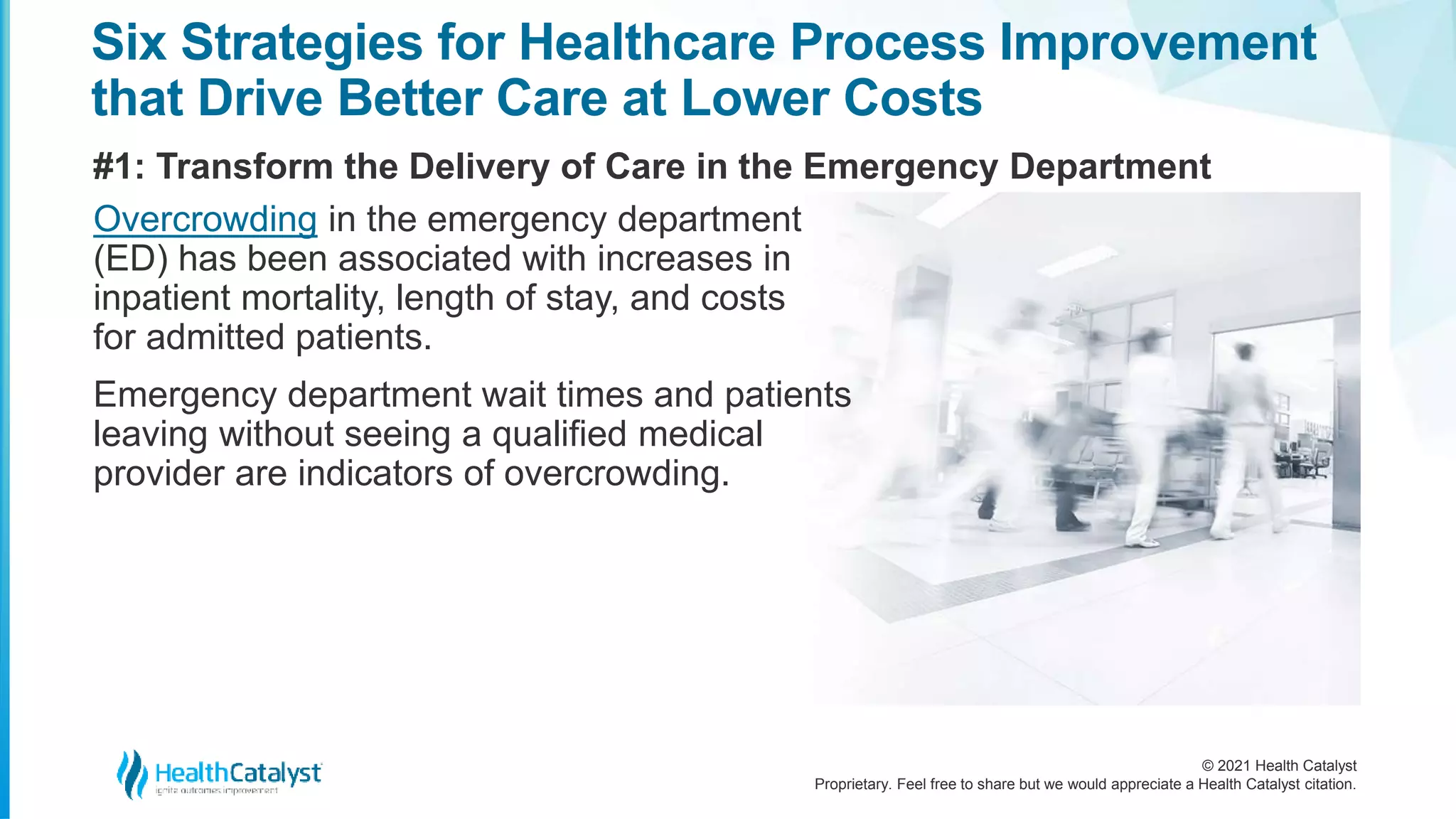
Overcrowding in the emergency department
(ED) has been associated with increases in
inpatient mortality, length of stay, and costs
for admitted patients.
Emergency department wait times and patients
leaving without seeing a qualified medical
provider are indicators of overcrowding.
© 2021 Health Catalyst
Proprietary. Feel free to share but we would appreciate a Health Catalyst citation.
Six Strategies for Healthcare Process Improvement
that Drive Better Care at Lower Costs
#1: Transform the Delivery of Care in the Emergency Department
A data-driven approach addresses common
drivers of ED overcrowding and guides the
redesign or emergency care delivery:
 A four-step approach to redesigning
the delivery of emergency care
 Understanding ED performance
 Revising high-impact workflows
 Revising staffing patterns
 Setting leadership expectations
 Improving the patient experience
© 2021 Health Catalyst
Proprietary. Feel free to share but we would appreciate a Health Catalyst citation.
Six Strategies for Healthcare Process Improvement
that Drive Better Care at Lower Costs
#2: Adopt Six Lean Methodologies for Healthcare Improvement
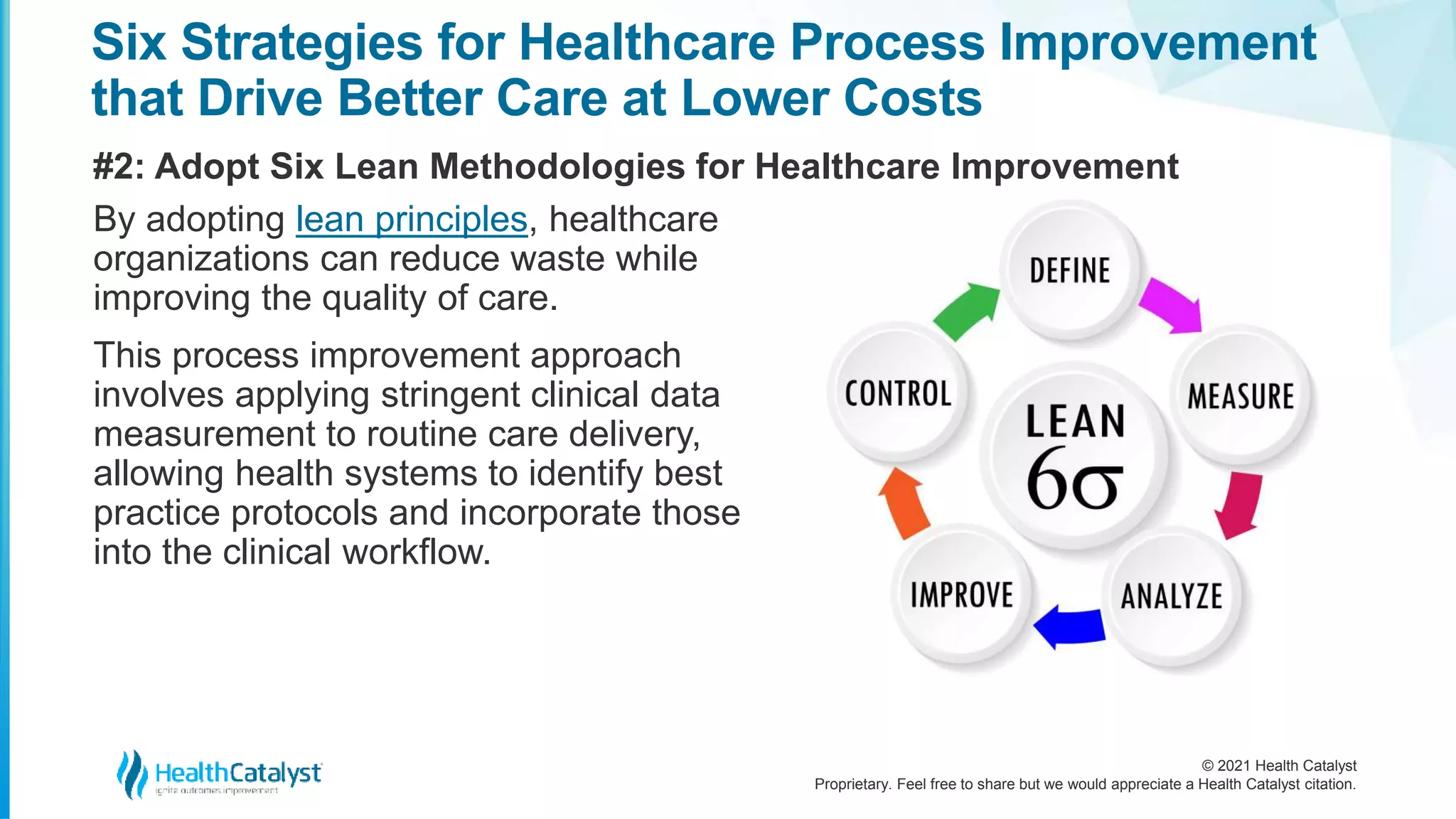
By adopting lean principles, healthcare
organizations can reduce waste while
improving the quality of care.
This process improvement approach
involves applying stringent clinical data
measurement to routine care delivery,
allowing health systems to identify best
practice protocols and incorporate those
into the clinical workflow.
© 2021 Health Catalyst
Proprietary. Feel free to share but we would appreciate a Health Catalyst citation.
Six Strategies for Healthcare Process Improvement
that Drive Better Care at Lower Costs
#2: Adopt Six Lean Methodologies for Healthcare Improvement
When teams use data from these best practices
through a continuous-learning loop, they enable
protocol updates and improvement throughout
the organization—ultimately reducing waste,
lowering costs, and improving access to care.
© 2021 Health Catalyst
Proprietary. Feel free to share but we would appreciate a Health Catalyst citation.
Six Strategies for Healthcare Process Improvement
that Drive Better Care at Lower Costs
#3: Improve Hospital Patient Flow with Machine Learning
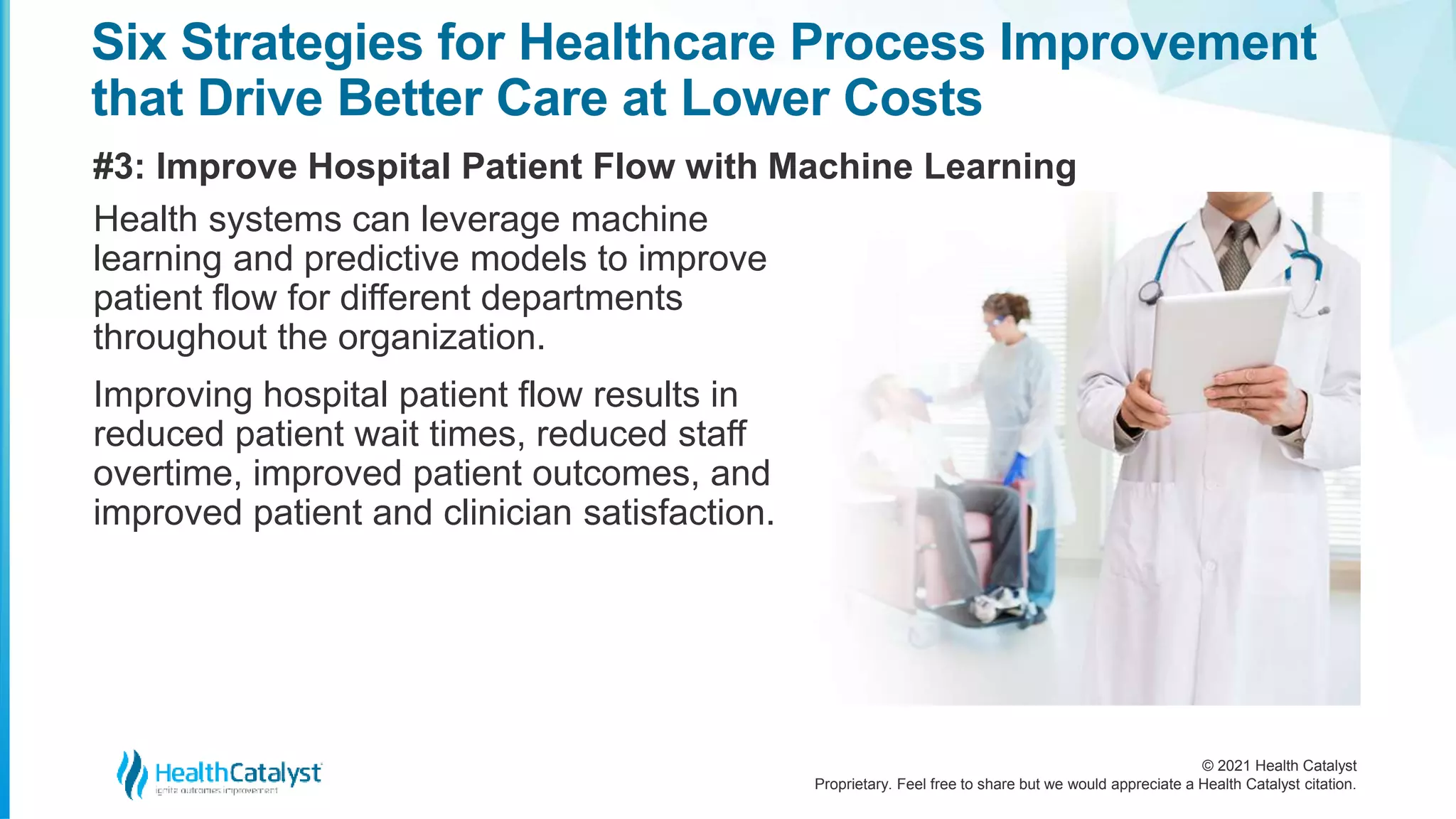
Health systems can leverage machine
learning and predictive models to improve
patient flow for different departments
throughout the organization.
Improving hospital patient flow results in
reduced patient wait times, reduced staff
overtime, improved patient outcomes, and
improved patient and clinician satisfaction.
© 2021 Health Catalyst
Proprietary. Feel free to share but we would appreciate a Health Catalyst citation.
Six Strategies for Healthcare Process Improvement
that Drive Better Care at Lower Costs
#3: Improve Hospital Patient Flow with Machine Learning
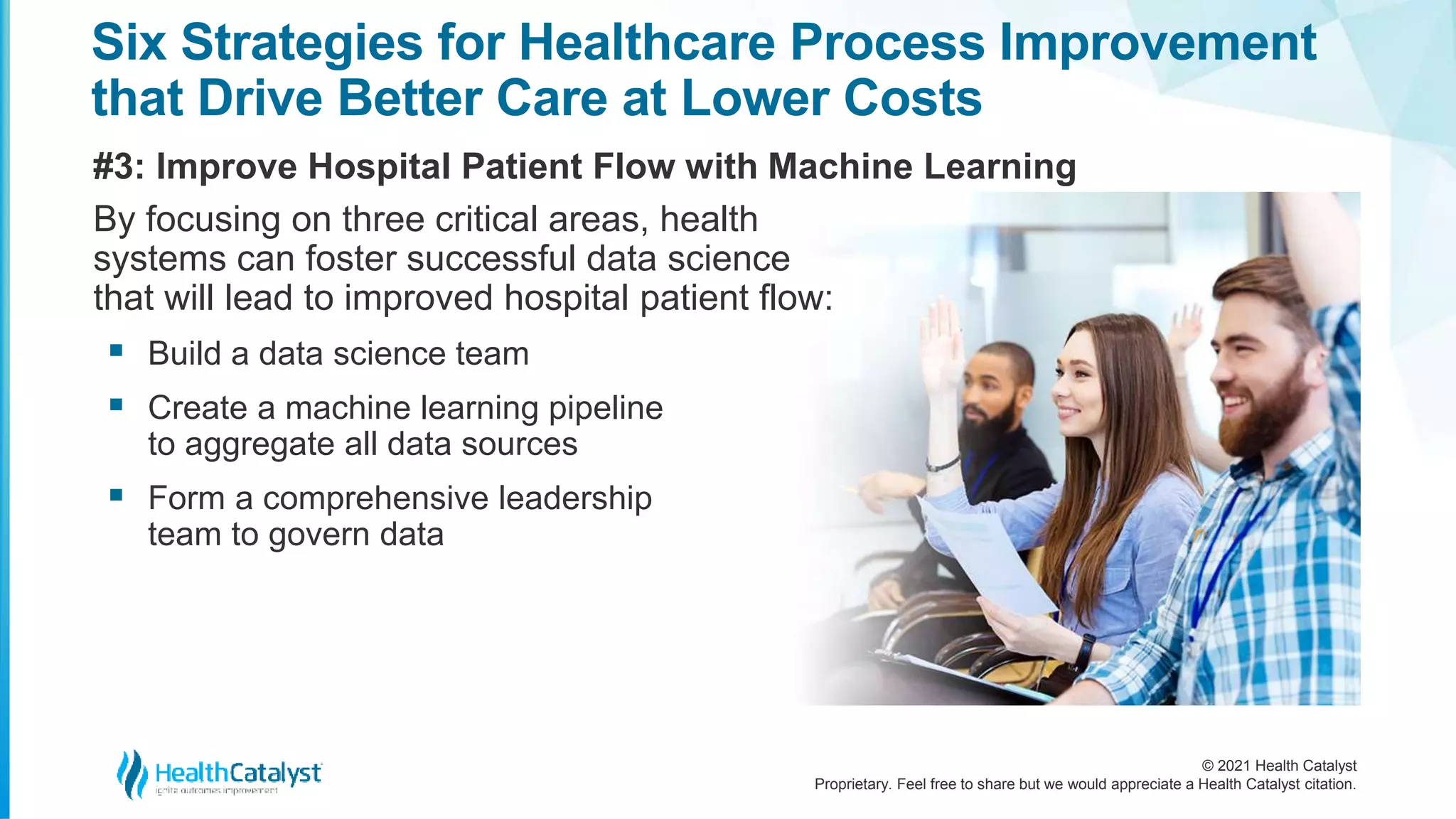
By focusing on three critical areas, health
systems can foster successful data science
that will lead to improved hospital patient flow:
 Build a data science team
 Create a machine learning pipeline
to aggregate all data sources
 Form a comprehensive leadership
team to govern data
© 2021 Health Catalyst
Proprietary. Feel free to share but we would appreciate a Health Catalyst citation.
Six Strategies for Healthcare Process Improvement
that Drive Better Care at Lower Costs
#4: Prevent Medication Errors
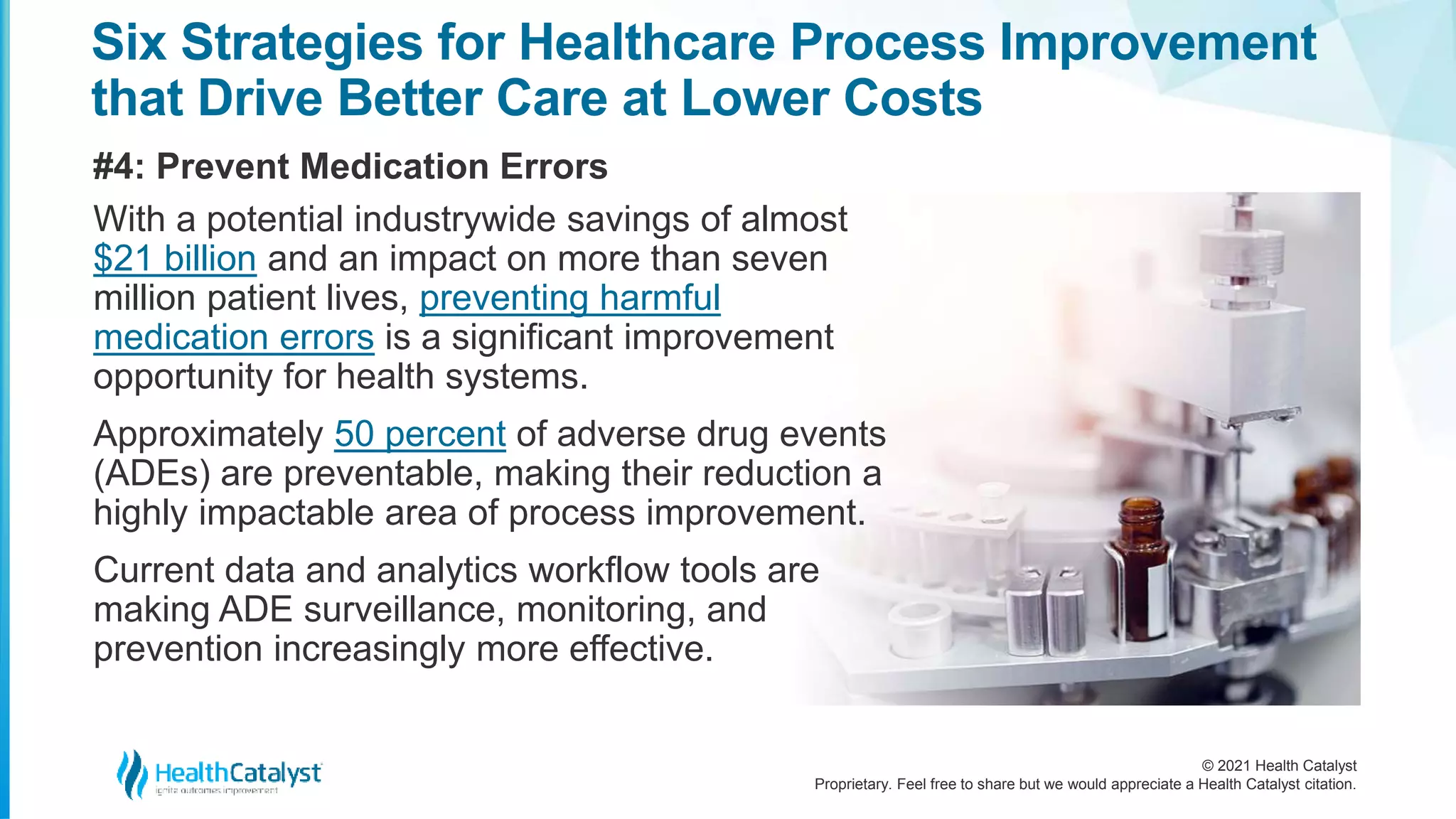
With a potential industrywide savings of almost
$21 billion and an impact on more than seven
million patient lives, preventing harmful
medication errors is a significant improvement
opportunity for health systems.
Approximately 50 percent of adverse drug events
(ADEs) are preventable, making their reduction a
highly impactable area of process improvement.
Current data and analytics workflow tools are
making ADE surveillance, monitoring, and
prevention increasingly more effective.
© 2021 Health Catalyst
Proprietary. Feel free to share but we would appreciate a Health Catalyst citation.
Six Strategies for Healthcare Process Improvement
that Drive Better Care at Lower Costs
#5: Reduce Unwanted Variation in Healthcare
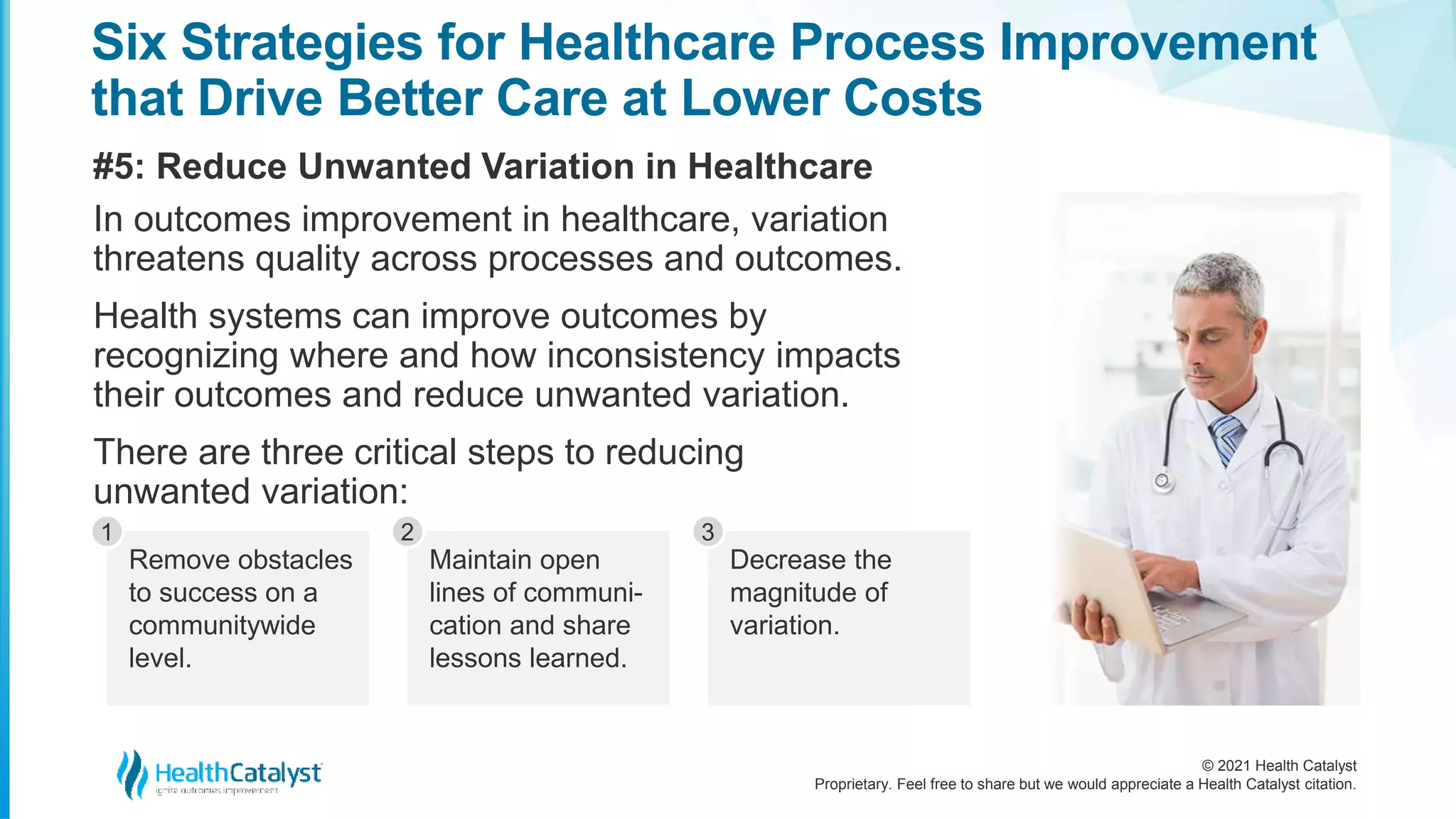
In outcomes improvement in healthcare, variation
threatens quality across processes and outcomes.
Health systems can improve outcomes by
recognizing where and how inconsistency impacts
their outcomes and reduce unwanted variation.
There are three critical steps to reducing
unwanted variation:
Remove obstacles
to success on a
communitywide
level.
1
Maintain open
lines of communi-
cation and share
lessons learned.
2
Decrease the
magnitude of
variation.
3
© 2021 Health Catalyst
Proprietary. Feel free to share but we would appreciate a Health Catalyst citation.
Six Strategies for Healthcare Process Improvement
that Drive Better Care at Lower Costs
#6: Prioritize Process Measures over Outcome Measures
The healthcare industry tends to prioritize
outcome measures, but outcome measures
alone won’t help organizations reach their goals
of better quality and reduced costs.
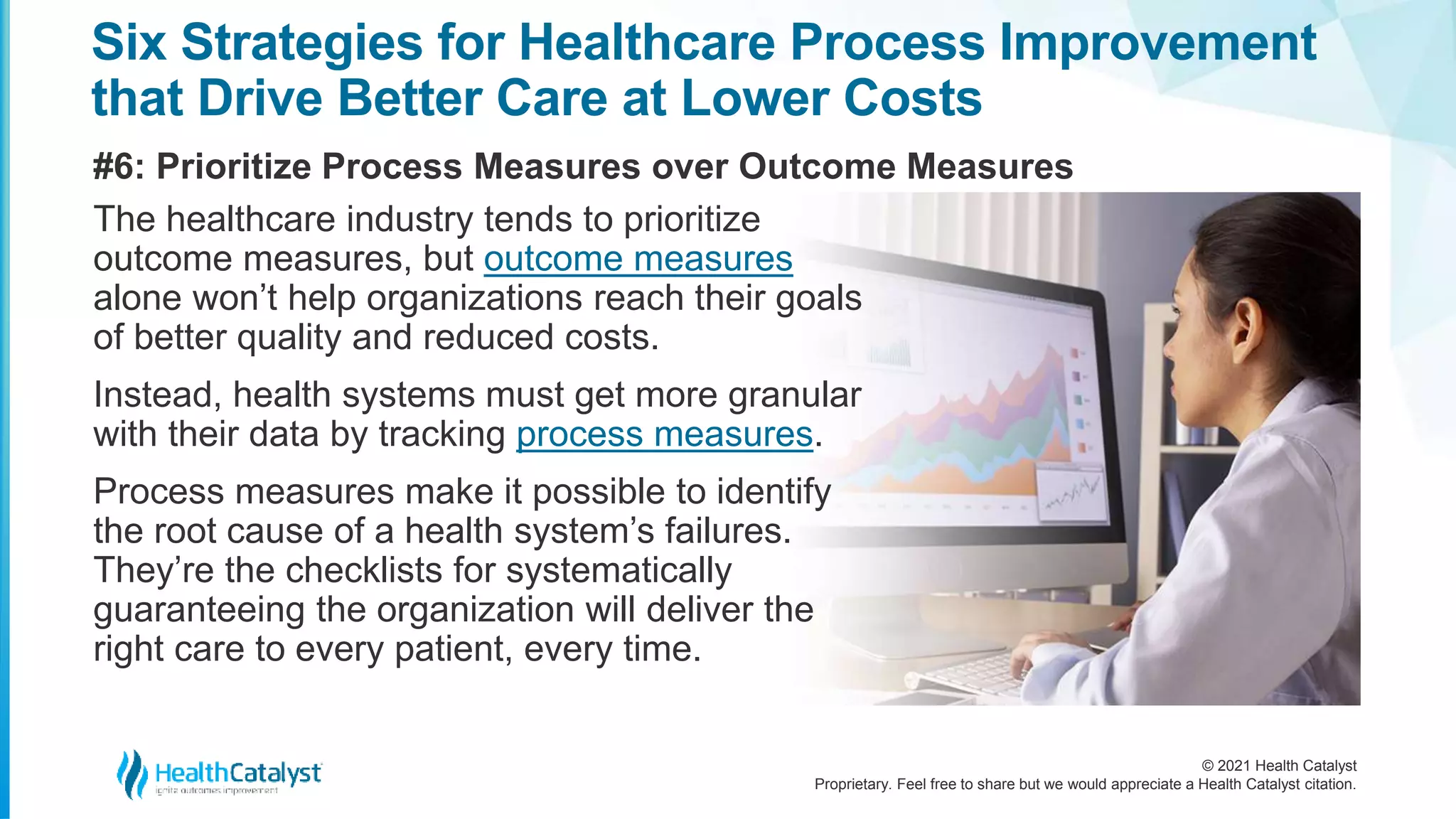
Instead, health systems must get more granular
with their data by tracking process measures.
Process measures make it possible to identify
the root cause of a health system’s failures.
They’re the checklists for systematically
guaranteeing the organization will deliver the
right care to every patient, every time.
© 2021 Health Catalyst
Proprietary. Feel free to share but we would appreciate a Health Catalyst citation.
Improved Processes Mean Improved Care
Process improvement is an ongoing priority
for healthcare leadership as the driver of all
health system activities and outcomes.
While the industry continues to navigate
the unknowns of COVID-19 response
and recovery, advancing the processes
organizations can control is paramount
to meeting pandemic and non-pandemic
healthcare needs.
© 2021 Health Catalyst
Proprietary. Feel free to share but we would appreciate a Health Catalyst citation.
Improved Processes Mean Improved Care
Insights on successful strategies, advanced
analytics tools, and proven skillsets can
guide process improvement leaders as
they continually aim for better outcomes,
patient experience, and lower costs.
© 2021 Health Catalyst
Proprietary. Feel free to share but we would appreciate a Health Catalyst citation.
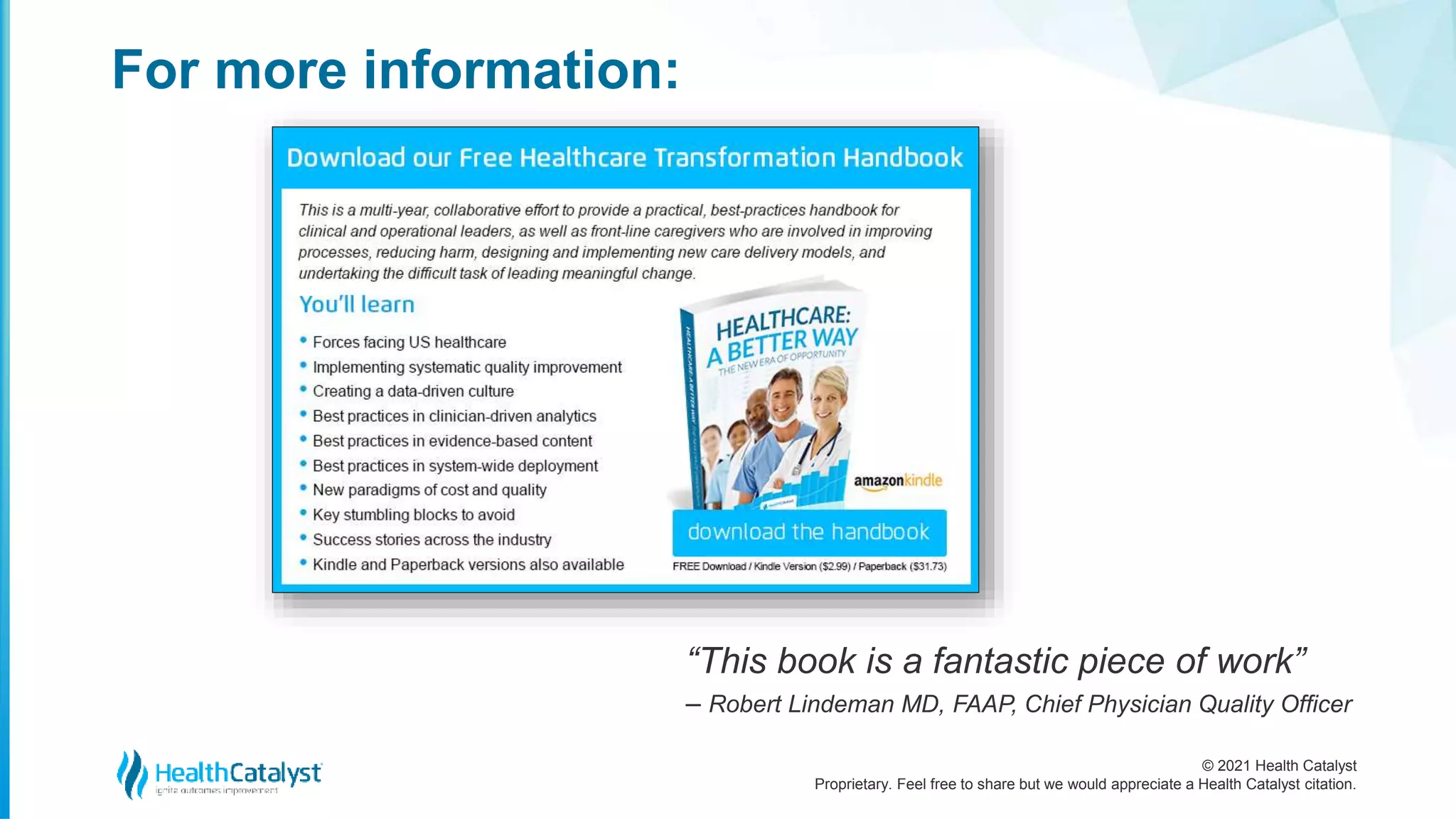
For more information:
“This book is a fantastic piece of work”
– Robert Lindeman MD, FAAP, Chief Physician Quality Officer
© 2021 Health Catalyst
Proprietary. Feel free to share but we would appreciate a Health Catalyst citation.
More about this topic
Link to original article for a more in-depth discussion.
Healthcare Process Improvement: Six Strategies for Organizationwide Transformation
A Sustainable Healthcare Emergency Management Framework: COVID-19 and Beyond
Holly Rimmasch, Chief Clinical Officer; Ed Corbett, MD, Medical Officer;
Anne Marie Bickmore, Senior VP, Company Operations
Healthcare Trends During COVID-19: Top Five Areas to Watch
Holly Rimmasch, Chief Clinical Officer; Ed Corbett, MD, Medical Officer
Using Improvement Science in Healthcare to Create True Change
Heather Schoonover, MN, ARNP-CNS, PHCNS-BC, FCNS, VP
Healthcare Analytics Platform: DOS Delivers the 7 Essential Components
Imran Qureshi, Chief Software Development Officer
AI-Assisted Decision Making: Healthcare’s Next Frontier
Health Catalyst Editors
The Digitization of Healthcare: Why the Right Approach Matters and Five Steps to Get There
Health Catalyst Editors
© 2021 Health Catalyst
Proprietary. Feel free to share but we would appreciate a Health Catalyst citation.
Other Clinical Quality Improvement Resources
Click to read additional information at www.healthcatalyst.com
Health Catalyst is a mission-driven data warehousing, analytics and outcomes-improvement
company that helps healthcare organizations of all sizes improve clinical, financial, and operational
outcomes needed to improve population health and accountable care. Our proven enterprise data
warehouse (EDW) and analytics platform helps improve quality, add efficiency and lower costs in
support of more than 65 million patients for organizations ranging from the largest US health system
to forward-thinking physician practices.
Health Catalyst was recently named as the leader in the enterprise healthcare BI market in
improvement by KLAS, and has received numerous best-place-to work awards including Modern
Healthcare in 2013, 2014, and 2015, as well as other recognitions such as “Best Place to work for
Millenials, and a “Best Perks for Women.”

Healthcare Process Improvement: Six Strategies for Organizationwide Transformation

  • 1.
    Healthcare Process Improvement: SixStrategies for Organizationwide Transformation Health Catalyst Editors
  • 2.
    © 2021 HealthCatalyst Proprietary. Feel free to share but we would appreciate a Health Catalyst citation. Healthcare Process Improvement Healthcare process improvement is one of the essential drivers of a transform- ation strategy that aims to improve the quality of care while lowering costs. Healthcare processes comprise hospital admissions and discharge and billing, emergency department (ED) operations, patient transfers to different facilities, medication administration, patient flow, and more.
  • 3.
    © 2021 HealthCatalyst Proprietary. Feel free to share but we would appreciate a Health Catalyst citation. Six Strategies for Healthcare Process Improvement that Drive Better Care at Lower Costs Six strategies to drive better care at lower cost through healthcare process improvement demonstrate the impact of efficient, effective processes and the vital role of a data– and analytics-based methodology and culture committed to advancing care. 1. Transform the Delivery of Care in the Emergency Department 2. Adopt Six Lean Methodologies for Healthcare Improvement 3. Improve Hospital Patient Flow with Machine Learning 4. Prevent Medication Errors 5. Reduce Unwanted Variation in Healthcare 6. Prioritize Process Measures over Outcome Measures
  • 4.
    © 2021 HealthCatalyst Proprietary. Feel free to share but we would appreciate a Health Catalyst citation. Six Strategies for Healthcare Process Improvement that Drive Better Care at Lower Costs #1: Transform the Delivery of Care in the Emergency Department Overcrowding in the emergency department (ED) has been associated with increases in inpatient mortality, length of stay, and costs for admitted patients. Emergency department wait times and patients leaving without seeing a qualified medical provider are indicators of overcrowding.
  • 5.
    © 2021 HealthCatalyst Proprietary. Feel free to share but we would appreciate a Health Catalyst citation. Six Strategies for Healthcare Process Improvement that Drive Better Care at Lower Costs #1: Transform the Delivery of Care in the Emergency Department A data-driven approach addresses common drivers of ED overcrowding and guides the redesign or emergency care delivery:  A four-step approach to redesigning the delivery of emergency care  Understanding ED performance  Revising high-impact workflows  Revising staffing patterns  Setting leadership expectations  Improving the patient experience
  • 6.
    © 2021 HealthCatalyst Proprietary. Feel free to share but we would appreciate a Health Catalyst citation. Six Strategies for Healthcare Process Improvement that Drive Better Care at Lower Costs #2: Adopt Six Lean Methodologies for Healthcare Improvement By adopting lean principles, healthcare organizations can reduce waste while improving the quality of care. This process improvement approach involves applying stringent clinical data measurement to routine care delivery, allowing health systems to identify best practice protocols and incorporate those into the clinical workflow.
  • 7.
    © 2021 HealthCatalyst Proprietary. Feel free to share but we would appreciate a Health Catalyst citation. Six Strategies for Healthcare Process Improvement that Drive Better Care at Lower Costs #2: Adopt Six Lean Methodologies for Healthcare Improvement When teams use data from these best practices through a continuous-learning loop, they enable protocol updates and improvement throughout the organization—ultimately reducing waste, lowering costs, and improving access to care.
  • 8.
    © 2021 HealthCatalyst Proprietary. Feel free to share but we would appreciate a Health Catalyst citation. Six Strategies for Healthcare Process Improvement that Drive Better Care at Lower Costs #3: Improve Hospital Patient Flow with Machine Learning Health systems can leverage machine learning and predictive models to improve patient flow for different departments throughout the organization. Improving hospital patient flow results in reduced patient wait times, reduced staff overtime, improved patient outcomes, and improved patient and clinician satisfaction.
  • 9.
    © 2021 HealthCatalyst Proprietary. Feel free to share but we would appreciate a Health Catalyst citation. Six Strategies for Healthcare Process Improvement that Drive Better Care at Lower Costs #3: Improve Hospital Patient Flow with Machine Learning By focusing on three critical areas, health systems can foster successful data science that will lead to improved hospital patient flow:  Build a data science team  Create a machine learning pipeline to aggregate all data sources  Form a comprehensive leadership team to govern data
  • 10.
    © 2021 HealthCatalyst Proprietary. Feel free to share but we would appreciate a Health Catalyst citation. Six Strategies for Healthcare Process Improvement that Drive Better Care at Lower Costs #4: Prevent Medication Errors With a potential industrywide savings of almost $21 billion and an impact on more than seven million patient lives, preventing harmful medication errors is a significant improvement opportunity for health systems. Approximately 50 percent of adverse drug events (ADEs) are preventable, making their reduction a highly impactable area of process improvement. Current data and analytics workflow tools are making ADE surveillance, monitoring, and prevention increasingly more effective.
  • 11.
    © 2021 HealthCatalyst Proprietary. Feel free to share but we would appreciate a Health Catalyst citation. Six Strategies for Healthcare Process Improvement that Drive Better Care at Lower Costs #5: Reduce Unwanted Variation in Healthcare In outcomes improvement in healthcare, variation threatens quality across processes and outcomes. Health systems can improve outcomes by recognizing where and how inconsistency impacts their outcomes and reduce unwanted variation. There are three critical steps to reducing unwanted variation: Remove obstacles to success on a communitywide level. 1 Maintain open lines of communi- cation and share lessons learned. 2 Decrease the magnitude of variation. 3
  • 12.
    © 2021 HealthCatalyst Proprietary. Feel free to share but we would appreciate a Health Catalyst citation. Six Strategies for Healthcare Process Improvement that Drive Better Care at Lower Costs #6: Prioritize Process Measures over Outcome Measures The healthcare industry tends to prioritize outcome measures, but outcome measures alone won’t help organizations reach their goals of better quality and reduced costs. Instead, health systems must get more granular with their data by tracking process measures. Process measures make it possible to identify the root cause of a health system’s failures. They’re the checklists for systematically guaranteeing the organization will deliver the right care to every patient, every time.
  • 13.
    © 2021 HealthCatalyst Proprietary. Feel free to share but we would appreciate a Health Catalyst citation. Improved Processes Mean Improved Care Process improvement is an ongoing priority for healthcare leadership as the driver of all health system activities and outcomes. While the industry continues to navigate the unknowns of COVID-19 response and recovery, advancing the processes organizations can control is paramount to meeting pandemic and non-pandemic healthcare needs.
  • 14.
    © 2021 HealthCatalyst Proprietary. Feel free to share but we would appreciate a Health Catalyst citation. Improved Processes Mean Improved Care Insights on successful strategies, advanced analytics tools, and proven skillsets can guide process improvement leaders as they continually aim for better outcomes, patient experience, and lower costs.
  • 15.
    © 2021 HealthCatalyst Proprietary. Feel free to share but we would appreciate a Health Catalyst citation. For more information: “This book is a fantastic piece of work” – Robert Lindeman MD, FAAP, Chief Physician Quality Officer
  • 16.
    © 2021 HealthCatalyst Proprietary. Feel free to share but we would appreciate a Health Catalyst citation. More about this topic Link to original article for a more in-depth discussion. Healthcare Process Improvement: Six Strategies for Organizationwide Transformation A Sustainable Healthcare Emergency Management Framework: COVID-19 and Beyond Holly Rimmasch, Chief Clinical Officer; Ed Corbett, MD, Medical Officer; Anne Marie Bickmore, Senior VP, Company Operations Healthcare Trends During COVID-19: Top Five Areas to Watch Holly Rimmasch, Chief Clinical Officer; Ed Corbett, MD, Medical Officer Using Improvement Science in Healthcare to Create True Change Heather Schoonover, MN, ARNP-CNS, PHCNS-BC, FCNS, VP Healthcare Analytics Platform: DOS Delivers the 7 Essential Components Imran Qureshi, Chief Software Development Officer AI-Assisted Decision Making: Healthcare’s Next Frontier Health Catalyst Editors The Digitization of Healthcare: Why the Right Approach Matters and Five Steps to Get There Health Catalyst Editors
  • 17.
    © 2021 HealthCatalyst Proprietary. Feel free to share but we would appreciate a Health Catalyst citation. Other Clinical Quality Improvement Resources Click to read additional information at www.healthcatalyst.com Health Catalyst is a mission-driven data warehousing, analytics and outcomes-improvement company that helps healthcare organizations of all sizes improve clinical, financial, and operational outcomes needed to improve population health and accountable care. Our proven enterprise data warehouse (EDW) and analytics platform helps improve quality, add efficiency and lower costs in support of more than 65 million patients for organizations ranging from the largest US health system to forward-thinking physician practices. Health Catalyst was recently named as the leader in the enterprise healthcare BI market in improvement by KLAS, and has received numerous best-place-to work awards including Modern Healthcare in 2013, 2014, and 2015, as well as other recognitions such as “Best Place to work for Millenials, and a “Best Perks for Women.”