Chapter 8: Artificial Intelligence BBC
B Y : E r H a r i P r a s a d G h i m i r e Page 1
Introduction to artificial intelligence (AI):
It is the science and engineering of making intelligent machines, especially intelligent computer
programs.It isrelated to the similar task of using computers to understand human intelligence, but AI
does not have to confine itself to methods that are biologically observable.
Researchinto the areas of learning,of language andof sensory perception(sense understanding) have
beenaided scientists in building intelligent machines. One of the most challenging approaches facing
expertsisbuildingsystemsthatmimicthe behaviorof the humanbrain,made up of billions of neurons,
and arguablythe mostcomplex matterinthe universe.ForAI purpose,natural languages such LISP (List
processing) and PROLOG (Programming Logic).
Application area of AI:
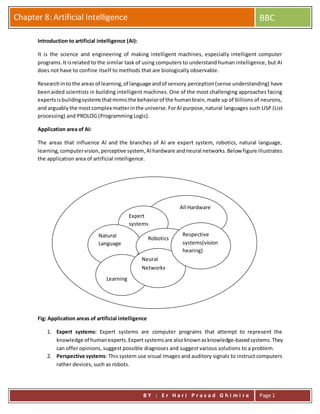
The areas that influence AI and the branches of AI are expert system, robotics, natural language,
learning,computervision, perceptive system, AIhardware andneural networks.Below figure illustrates
the application area of artificial intelligence.
Fig: Application areas of artificial intelligence
1. Expert systems: Expert systems are computer programs that attempt to represent the
knowledge of humanexperts.Expert systemsare alsoknownasknowledge-basedsystems.They
can offer opinions, suggest possible diagnoses and suggest various solutions to a problem.
2. Perspective systems: This system use visual Images and auditory signals to instruct computers
rather devices, such as robots.
All Hardware
Expert
systems
Natural
Language
Robotics
Learning
Neural
Networks
Respective
systems(vision
hearing)
Chapter 8: Artificial Intelligence BBC
B Y : E r H a r i P r a s a d G h i m i r e Page 2
3. Computer vision:Computer vision is to provide computers with the ability to recognize and
identify objects and the context to which they belong.
4. Natural language processing: It enables users to communicate with the computer in human
language.
5. Learning: It isthe processof takingnknowledge fromenvironment like as aided hardware and
instruction coded by the programmer.
6. AI hardware: It includes the physical device that aid in AI application.
7. Robotics: It consistsof computer-controlled devices that mimic the motor activities of human.
8. Neural networks: These are highlysimplifiedmodelsof the human nervous system that exhibit
abilities such as learning, generalization and abstraction. These abilities enable the models to
learn human-like behavior.
Ethical aspects of AI:
The ethicsArtificial Intelligence (AI) is addresses a number of moral and legal issues which arise if
researchers are able to build machines with intellectual capabilities that will challenge human
beings.It may bring unexpected consequences, Danger and potential misuse of the technology. It
alsoconsidersthe wayin which AI may be used to benefit humanity. These concerns are similar to
those that arise forany sufficiently powerful technology and(forthose issues) the ethics of artificial
intelligence is a part of a greater importance.
AI alsomaybring unintendedconsequencesasithasthe potentialityto disrupt existing society and
introduce newdangersanddissatisfaction.Therefore,before AI gets in to full swing the concerned
have to think seriously so that implementation AI will not be used to harm anybody.

Introduction to artificial intelligence

  • 1.
    Chapter 8: ArtificialIntelligence BBC B Y : E r H a r i P r a s a d G h i m i r e Page 1 Introduction to artificial intelligence (AI): It is the science and engineering of making intelligent machines, especially intelligent computer programs.It isrelated to the similar task of using computers to understand human intelligence, but AI does not have to confine itself to methods that are biologically observable. Researchinto the areas of learning,of language andof sensory perception(sense understanding) have beenaided scientists in building intelligent machines. One of the most challenging approaches facing expertsisbuildingsystemsthatmimicthe behaviorof the humanbrain,made up of billions of neurons, and arguablythe mostcomplex matterinthe universe.ForAI purpose,natural languages such LISP (List processing) and PROLOG (Programming Logic). Application area of AI: The areas that influence AI and the branches of AI are expert system, robotics, natural language, learning,computervision, perceptive system, AIhardware andneural networks.Below figure illustrates the application area of artificial intelligence. Fig: Application areas of artificial intelligence 1. Expert systems: Expert systems are computer programs that attempt to represent the knowledge of humanexperts.Expert systemsare alsoknownasknowledge-basedsystems.They can offer opinions, suggest possible diagnoses and suggest various solutions to a problem. 2. Perspective systems: This system use visual Images and auditory signals to instruct computers rather devices, such as robots. All Hardware Expert systems Natural Language Robotics Learning Neural Networks Respective systems(vision hearing)
  • 2.
    Chapter 8: ArtificialIntelligence BBC B Y : E r H a r i P r a s a d G h i m i r e Page 2 3. Computer vision:Computer vision is to provide computers with the ability to recognize and identify objects and the context to which they belong. 4. Natural language processing: It enables users to communicate with the computer in human language. 5. Learning: It isthe processof takingnknowledge fromenvironment like as aided hardware and instruction coded by the programmer. 6. AI hardware: It includes the physical device that aid in AI application. 7. Robotics: It consistsof computer-controlled devices that mimic the motor activities of human. 8. Neural networks: These are highlysimplifiedmodelsof the human nervous system that exhibit abilities such as learning, generalization and abstraction. These abilities enable the models to learn human-like behavior. Ethical aspects of AI: The ethicsArtificial Intelligence (AI) is addresses a number of moral and legal issues which arise if researchers are able to build machines with intellectual capabilities that will challenge human beings.It may bring unexpected consequences, Danger and potential misuse of the technology. It alsoconsidersthe wayin which AI may be used to benefit humanity. These concerns are similar to those that arise forany sufficiently powerful technology and(forthose issues) the ethics of artificial intelligence is a part of a greater importance. AI alsomaybring unintendedconsequencesasithasthe potentialityto disrupt existing society and introduce newdangersanddissatisfaction.Therefore,before AI gets in to full swing the concerned have to think seriously so that implementation AI will not be used to harm anybody.