What is a Scientific Theory? 
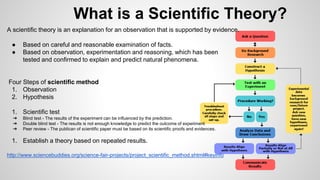
A scientific theory is an explanation for an observation that is supported by evidence. 
● Based on careful and reasonable examination of facts. 
● Based on observation, experimentation and reasoning, which has been 
tested and confirmed to explain and predict natural phenomena. 
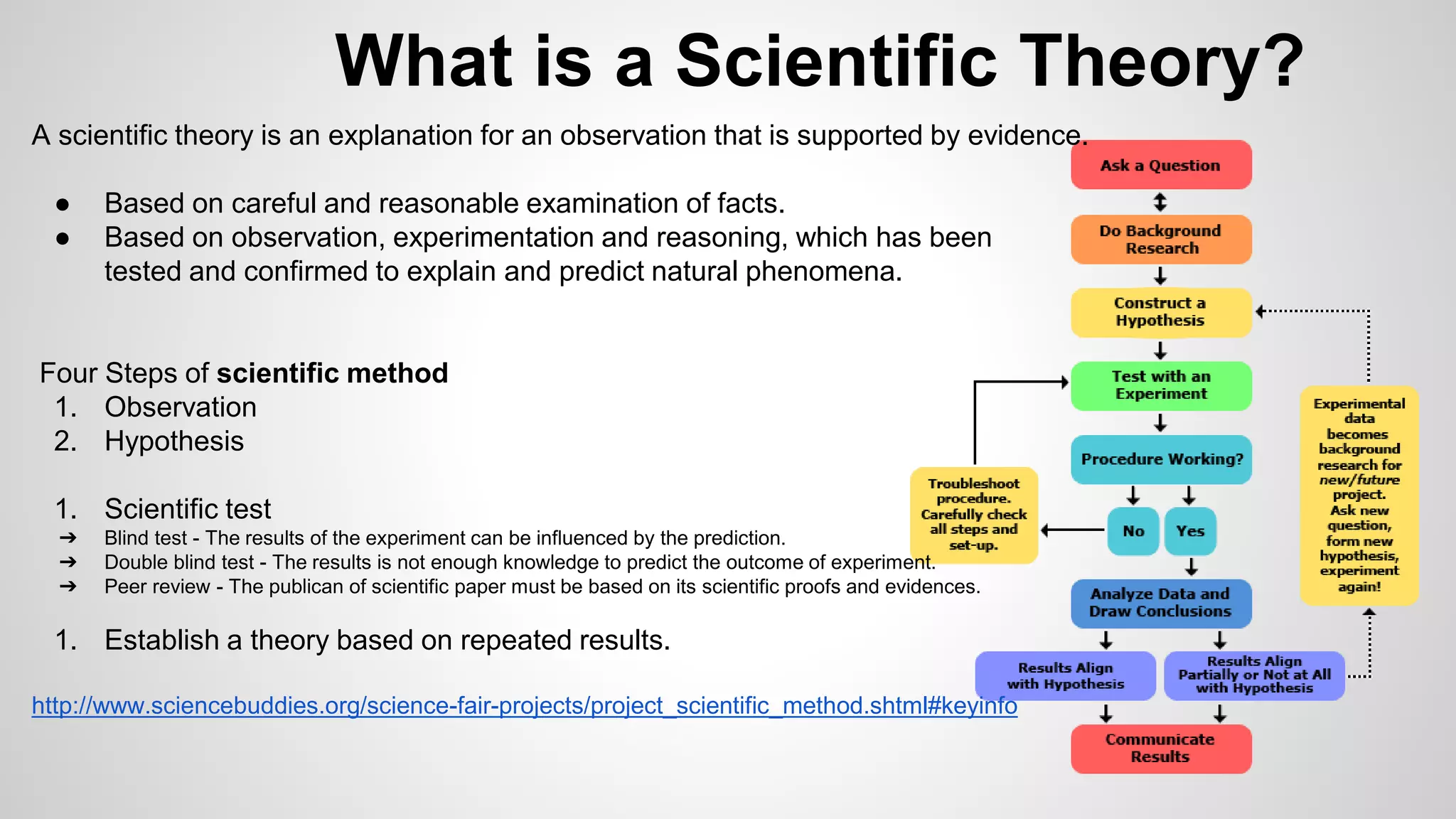
Four Steps of scientific method 
1. Observation 
2. Hypothesis 
1. Scientific test 
➔ Blind test - The results of the experiment can be influenced by the prediction. 
➔ Double blind test - The results is not enough knowledge to predict the outcome of experiment. 
➔ Peer review - The publican of scientific paper must be based on its scientific proofs and evidences. 
1. Establish a theory based on repeated results. 
http://www.sciencebuddies.org/science-fair-projects/project_scientific_method.shtml#keyinfo
Scientific Method 
❖ The observations are made visually (naked eye), a microscope, a telescope or anything that detect the natural 
phenomena. It is something happening leads to a hypothesis which we will try to prove a theory through 
scientific test. 
❖ If the experiment does not support the hypothesis, the hypothesis must be changed or rejected. 
‘‘The development of theories is a key element of the scientific method as they are used to make predictions about the 
world; if these predictions fail, the theory is revised.’’ ¹ 
Example of scientific theory: Cell theory 
● All living organisms come from cells 
● Originated from other cells 
● Contain hereditary information (DNA) 
● All energy flow occurs in the cell 
‘‘Development of this theory during the mid 17th century was made 
possible by advances in microscopy. The theory says that new cells are formed from other 
existing cells, and that the cell is a fundamental unit of structure, function and organization in 
all living organisms.’’ ² 
https://www.youtube.com/watch?v=9obZ4qLFr5o
History / Timeline 
● In 1595 - Jansen credited with 1st compound microscope. 
● In 1665 - The cell was first discovered by Robert Hooke using a primitive compound microscope. However, he 
only saw the dead cell walls of plant cells. And discovered a multitude of tiny pores that he named ‘’cells’’. 
● In 1674 - Anton van Leeuwenhoek was the first man to witness a live cell under a microscope. 
Among these was the first protozoa and bacteria discovered. 
● In 1833 - Robert Brown, an English botanist, discovered the nucleus in plant cells. 
● In 1838 - Schleiden and Schwann proposed cell theory. Matthias Jakob Schwann, a German 
botanist, was the first to recognize that all plant tissues are composed of cells. While Theodor Schwann, a 
German botanist reached the conclusion that not only plants but animal tissue is composed of cells. 
● In 1840 - Albrecht von Kolliker discovered that eggs and sperm are also cells. 
● In 1855 - Rudolph Virchow stated that all living things come from other living things. ‘The phrase Omnis cellula e 
cellula, indicating the importance of cell division in the creation of new cells.’ ⁵
References 
¹ http://rationalwiki.org/wiki/Scientific_theory 
² http://www.princeton.edu/~achaney/tmve/wiki100k/docs/Cell_theory.html 
³ http://en.wikipedia.org/wiki/Cell_theory - figure 1 
⁴ http://science.howstuffworks.com/innovation/scientific-experiments/scientific-method4.htm - figure 2 
⁵ http://www.biologyreference.com/Gr-Hi/History-of-Biology-Cell-Theory-and-Cell-Structure.html
Limitation of Science 
Scientific theory is a process of developing an explanation of a question in the natural world by - Testing, Investigating 
and collecting data that will either support or refute our original idea of what’s going on. 
A non-scientific question does not use a systematic collection of evidence or try to find answers to questions, such as 
beliefs. It is answered through our personal opinions which depend on one’s perception of the world according to 
personal experiences that might or might not be factual. 
1. Questions that science has answered. There are evidences to prove it through multiple scientific tests. 
● Cell theory - In 1858, Rudolf Virchow completed the classical cell theory. 
http://www.saylor.org/site/wp-content/uploads/2010/11/Wiki-Cell-Theory.pdf 
● Oxygen theory of combustion - In 1770s, Antoine Lavoisier concluded that oxygen combined with substances as 
they burned. 
http://www.chemistryexplained.com/Kr-Ma/Lavoisier-Antoine.html 
● Newton’s Laws of Motion - In 1686, Isaac Newton discovered the theories and presented his three laws of motion. 
http://www.grc.nasa.gov/WWW/k-12/airplane/newton.html
2. There are some questions science is currently being addressed. 
● What is the Universe made of ? 
● Are we alone in the Universe? 
● Why do we dream? 
● What makes us human? 
http://www.theguardian.com/science/2013/sep/01/20-big-questions-in-science 
These questions do not have enough evidence to prove it. 
3. However, science has limitations. 
There are some areas for which science can never answer. 
➔ Value 
➔ Morality 
➔ Supernatural 
We cannot measure ‘infinite’’ but we can only answer questions within the range of what we can measure. 
● Does God exist? 
● What is the purpose of my life? 
● What is life? 
http://www.changinglivesonline.org/questions-and-answers/item/889-what-are-the-limitations-of-science?.html
Resistance to new scientific theories 
To accept new scientific theories can challenge the traditional interpretation of matters that previously relied on faith and religion 
for answers. ² 
★ No new theory is accepted without thorough testing. And it will be re-evaluated every time new data comes in. 
Resistance to science has important implications for our society. People are always more comfortable with what they know. 
A new scientific theory that opposes conventional wisdom will not be accepted simply because it’s different than what people 
have always believed. 
However, the truth is that common people don’t understand much science, and distrust it when it is different or does not make 
sense. 
➔ Vaccination¹ 
Advantages - offers protection against many serious diseases. 
However, some people used to think the MMR (measles, mumps or rubella) vaccine could cause autism in children, 
- people does not risk letting their child have the vaccine 
Disadvantages - The disease begin to spread more easily and number of cases will be increased. 
● An individual’s decision or idea can make big implications for society.
Global warming ³ 
- 97% of scientists accept that climate change is almost certainly being caused by human activities. 
- Scientists says that the Earth is more resistant to climate changes. 
- People argue that the economic damage caused by cutting down on the emission of greenhouse gases will be 
far more damaging to humans than any of the effects of global warming. 
- A change in emissions and carbon production could results in a loss of jobs. 
Theories are supported by multiple lines of evidence throughout the test. However, Science is always a work in 
progress so it takes time to accept new theory. ⁴ 
➔ A well-supported theory may be accepted by scientist, even if the theory has some problem. 
➔ Theory change is a community process of feedback, experiment, observation and communication. 
Often a new theory will face resistance from other scientist who depend on the older models. There are also the 
members of the general public who have an emotional commitment to the older models. Because one person may be 
willing to accept a new explanation but resist change when people act as a group. 
¹http://www.bbc.co.uk/schools/gcsebitesize/science/21c/keeping_healthy/antibiotics_drug_testingrev1.shtml 
²http://norighttobelieve.wordpress.com/2011/02/17/resistance-to-science-and-what-we-can-do-about-it/ 
³http://science.howstuffworks.com/environmental/green-science/global-warming7.htm 
⁴http://undsci.berkeley.edu/article/0_0_0/howscienceworks_20

Unit 5 scientific theory - P1, M1 and D1

  • 1.
    What is aScientific Theory? A scientific theory is an explanation for an observation that is supported by evidence. ● Based on careful and reasonable examination of facts. ● Based on observation, experimentation and reasoning, which has been tested and confirmed to explain and predict natural phenomena. Four Steps of scientific method 1. Observation 2. Hypothesis 1. Scientific test ➔ Blind test - The results of the experiment can be influenced by the prediction. ➔ Double blind test - The results is not enough knowledge to predict the outcome of experiment. ➔ Peer review - The publican of scientific paper must be based on its scientific proofs and evidences. 1. Establish a theory based on repeated results. http://www.sciencebuddies.org/science-fair-projects/project_scientific_method.shtml#keyinfo
  • 2.
    Scientific Method ❖The observations are made visually (naked eye), a microscope, a telescope or anything that detect the natural phenomena. It is something happening leads to a hypothesis which we will try to prove a theory through scientific test. ❖ If the experiment does not support the hypothesis, the hypothesis must be changed or rejected. ‘‘The development of theories is a key element of the scientific method as they are used to make predictions about the world; if these predictions fail, the theory is revised.’’ ¹ Example of scientific theory: Cell theory ● All living organisms come from cells ● Originated from other cells ● Contain hereditary information (DNA) ● All energy flow occurs in the cell ‘‘Development of this theory during the mid 17th century was made possible by advances in microscopy. The theory says that new cells are formed from other existing cells, and that the cell is a fundamental unit of structure, function and organization in all living organisms.’’ ² https://www.youtube.com/watch?v=9obZ4qLFr5o
  • 3.
    History / Timeline ● In 1595 - Jansen credited with 1st compound microscope. ● In 1665 - The cell was first discovered by Robert Hooke using a primitive compound microscope. However, he only saw the dead cell walls of plant cells. And discovered a multitude of tiny pores that he named ‘’cells’’. ● In 1674 - Anton van Leeuwenhoek was the first man to witness a live cell under a microscope. Among these was the first protozoa and bacteria discovered. ● In 1833 - Robert Brown, an English botanist, discovered the nucleus in plant cells. ● In 1838 - Schleiden and Schwann proposed cell theory. Matthias Jakob Schwann, a German botanist, was the first to recognize that all plant tissues are composed of cells. While Theodor Schwann, a German botanist reached the conclusion that not only plants but animal tissue is composed of cells. ● In 1840 - Albrecht von Kolliker discovered that eggs and sperm are also cells. ● In 1855 - Rudolph Virchow stated that all living things come from other living things. ‘The phrase Omnis cellula e cellula, indicating the importance of cell division in the creation of new cells.’ ⁵
  • 4.
    References ¹ http://rationalwiki.org/wiki/Scientific_theory ² http://www.princeton.edu/~achaney/tmve/wiki100k/docs/Cell_theory.html ³ http://en.wikipedia.org/wiki/Cell_theory - figure 1 ⁴ http://science.howstuffworks.com/innovation/scientific-experiments/scientific-method4.htm - figure 2 ⁵ http://www.biologyreference.com/Gr-Hi/History-of-Biology-Cell-Theory-and-Cell-Structure.html
  • 5.
    Limitation of Science Scientific theory is a process of developing an explanation of a question in the natural world by - Testing, Investigating and collecting data that will either support or refute our original idea of what’s going on. A non-scientific question does not use a systematic collection of evidence or try to find answers to questions, such as beliefs. It is answered through our personal opinions which depend on one’s perception of the world according to personal experiences that might or might not be factual. 1. Questions that science has answered. There are evidences to prove it through multiple scientific tests. ● Cell theory - In 1858, Rudolf Virchow completed the classical cell theory. http://www.saylor.org/site/wp-content/uploads/2010/11/Wiki-Cell-Theory.pdf ● Oxygen theory of combustion - In 1770s, Antoine Lavoisier concluded that oxygen combined with substances as they burned. http://www.chemistryexplained.com/Kr-Ma/Lavoisier-Antoine.html ● Newton’s Laws of Motion - In 1686, Isaac Newton discovered the theories and presented his three laws of motion. http://www.grc.nasa.gov/WWW/k-12/airplane/newton.html
  • 6.
    2. There aresome questions science is currently being addressed. ● What is the Universe made of ? ● Are we alone in the Universe? ● Why do we dream? ● What makes us human? http://www.theguardian.com/science/2013/sep/01/20-big-questions-in-science These questions do not have enough evidence to prove it. 3. However, science has limitations. There are some areas for which science can never answer. ➔ Value ➔ Morality ➔ Supernatural We cannot measure ‘infinite’’ but we can only answer questions within the range of what we can measure. ● Does God exist? ● What is the purpose of my life? ● What is life? http://www.changinglivesonline.org/questions-and-answers/item/889-what-are-the-limitations-of-science?.html
  • 7.
    Resistance to newscientific theories To accept new scientific theories can challenge the traditional interpretation of matters that previously relied on faith and religion for answers. ² ★ No new theory is accepted without thorough testing. And it will be re-evaluated every time new data comes in. Resistance to science has important implications for our society. People are always more comfortable with what they know. A new scientific theory that opposes conventional wisdom will not be accepted simply because it’s different than what people have always believed. However, the truth is that common people don’t understand much science, and distrust it when it is different or does not make sense. ➔ Vaccination¹ Advantages - offers protection against many serious diseases. However, some people used to think the MMR (measles, mumps or rubella) vaccine could cause autism in children, - people does not risk letting their child have the vaccine Disadvantages - The disease begin to spread more easily and number of cases will be increased. ● An individual’s decision or idea can make big implications for society.
  • 8.
    Global warming ³ - 97% of scientists accept that climate change is almost certainly being caused by human activities. - Scientists says that the Earth is more resistant to climate changes. - People argue that the economic damage caused by cutting down on the emission of greenhouse gases will be far more damaging to humans than any of the effects of global warming. - A change in emissions and carbon production could results in a loss of jobs. Theories are supported by multiple lines of evidence throughout the test. However, Science is always a work in progress so it takes time to accept new theory. ⁴ ➔ A well-supported theory may be accepted by scientist, even if the theory has some problem. ➔ Theory change is a community process of feedback, experiment, observation and communication. Often a new theory will face resistance from other scientist who depend on the older models. There are also the members of the general public who have an emotional commitment to the older models. Because one person may be willing to accept a new explanation but resist change when people act as a group. ¹http://www.bbc.co.uk/schools/gcsebitesize/science/21c/keeping_healthy/antibiotics_drug_testingrev1.shtml ²http://norighttobelieve.wordpress.com/2011/02/17/resistance-to-science-and-what-we-can-do-about-it/ ³http://science.howstuffworks.com/environmental/green-science/global-warming7.htm ⁴http://undsci.berkeley.edu/article/0_0_0/howscienceworks_20