Crisis and Issues Management trust insight execution
The Crisis Crucible:  We’ve Been There Denny’s W.R. Grace Sega Mitsubishi Motors Reebok Product Recall
Crisis Defined A crisis is an event, or a series of events that could: Cause injury or death Do significant harm to the environment Profoundly interrupt business operations Cause deep damage to the reputation of the company, its brands, or its people Change minds
The Consequences of Crisis Loss of life Overwhelms business environment Rips away privacy Disrupts decision-making Isolates management Invites regulatory oversight Drives down stock value Lowers productivity  Invites media, community, NGO scrutiny  Begs political attacks and prosecution Tarnishes brand/corporate reputation Lowers employee morale
Creating an Effective Crisis Strategy Actively brainstorm and monitor potentially challenging issues Monitoring  helps organizations identify and track issues that have  the potential to impact its reputation and/or business operations on a  global as well as regional basis. Change minds Combine solid issues management with effective crisis planning to enable organizations to be in better control   Crisis Management  is a discipline to diminish likelihood of crisis;  plan for response; move quickly and effectively in crisis situations.   Strive to manage issues effectively before they turn into crises Issues Management  positions organizations to respond even  more responsibly and effectively to prevent a crisis from  developing.
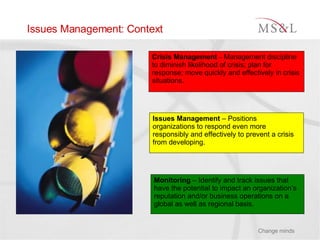
Issues Management: Context Crisis Management  –  Management discipline to diminish likelihood of crisis; plan for response; move quickly and effectively in crisis situations.   Issues Management  – Positions organizations to respond even more responsibly and effectively to prevent a crisis from developing. Monitoring  – Identify and track issues that have the potential to impact an organization’s reputation and/or business operations on a global as well as regional basis.
Issues Management Components: Issues Management Core Team (Communications, Legal, Operations, Human Resources, etc.)  Issues mapping  Potential issues identified Likelihood crossed against severity Scenario planning For issues in “most likely, most severe” part of issues map Media and Internet monitoring  Rapid response protocol Employee feedback mechanisms Issues briefing book Key audience outreach
Sample Issues High-Profile Litigation Product Recalls Attacks on Corporate Reputation Labor Organizing – Strikes Corporate Campaigns Interest Group Targeting  Adverse Legislation Government Investigations/Law Enforcement Actions Project Approvals Mergers/Acquisitions
Crisis Management: It’s Not Spin Crisis management is an organizational discipline that seeks to successfully resolve crisis situations by: Adhering to core values Following a prescribed but flexible plan of action Utilizing all appropriate resources, including senior management, trained staff and outside support where appropriate Placing communications and operational responsiveness on an equal plane
Key Objectives In Any Crisis Situation Protect life, property, and the environment Operate safely Do nothing that could intensify or spread crisis Make decisions quickly Position the organization as responsible, trustworthy and caring with key audiences; demonstrate concern Be an authoritative, reliable source of accurate information for key audiences and the news media Distribute information to internal audiences at the same time it is released to the news media Articulate and reinforce core values, as well as the steps being taken to mitigate the situation and prevent a reoccurrence
Crisis Plan Written as a tool for trained responders to rely upon in a crisis Incorporates graphics and step-by-step instructions for each crisis situation Checklists Specific roles and responsibilities Contact information
Effective Crisis Planning Should … Diminish the likelihood of crises Mitigate existing risks Plan for worst case scenarios Develop a user-friendly crisis plan Train a top notch response team Develop exercises to ensure response procedures are top of mind Provide opportunities for strategic counsel Maximize opportunities in times of crisis

MS&L Issues & Crisis

  • 1.
    Crisis and IssuesManagement trust insight execution
  • 2.
    The Crisis Crucible: We’ve Been There Denny’s W.R. Grace Sega Mitsubishi Motors Reebok Product Recall
  • 3.
    Crisis Defined Acrisis is an event, or a series of events that could: Cause injury or death Do significant harm to the environment Profoundly interrupt business operations Cause deep damage to the reputation of the company, its brands, or its people Change minds
  • 4.
    The Consequences ofCrisis Loss of life Overwhelms business environment Rips away privacy Disrupts decision-making Isolates management Invites regulatory oversight Drives down stock value Lowers productivity Invites media, community, NGO scrutiny Begs political attacks and prosecution Tarnishes brand/corporate reputation Lowers employee morale
  • 5.
    Creating an EffectiveCrisis Strategy Actively brainstorm and monitor potentially challenging issues Monitoring helps organizations identify and track issues that have the potential to impact its reputation and/or business operations on a global as well as regional basis. Change minds Combine solid issues management with effective crisis planning to enable organizations to be in better control Crisis Management is a discipline to diminish likelihood of crisis; plan for response; move quickly and effectively in crisis situations. Strive to manage issues effectively before they turn into crises Issues Management positions organizations to respond even more responsibly and effectively to prevent a crisis from developing.
  • 6.
    Issues Management: ContextCrisis Management – Management discipline to diminish likelihood of crisis; plan for response; move quickly and effectively in crisis situations. Issues Management – Positions organizations to respond even more responsibly and effectively to prevent a crisis from developing. Monitoring – Identify and track issues that have the potential to impact an organization’s reputation and/or business operations on a global as well as regional basis.
  • 7.
    Issues Management Components:Issues Management Core Team (Communications, Legal, Operations, Human Resources, etc.) Issues mapping Potential issues identified Likelihood crossed against severity Scenario planning For issues in “most likely, most severe” part of issues map Media and Internet monitoring Rapid response protocol Employee feedback mechanisms Issues briefing book Key audience outreach
  • 8.
    Sample Issues High-ProfileLitigation Product Recalls Attacks on Corporate Reputation Labor Organizing – Strikes Corporate Campaigns Interest Group Targeting Adverse Legislation Government Investigations/Law Enforcement Actions Project Approvals Mergers/Acquisitions
  • 9.
    Crisis Management: It’sNot Spin Crisis management is an organizational discipline that seeks to successfully resolve crisis situations by: Adhering to core values Following a prescribed but flexible plan of action Utilizing all appropriate resources, including senior management, trained staff and outside support where appropriate Placing communications and operational responsiveness on an equal plane
  • 10.
    Key Objectives InAny Crisis Situation Protect life, property, and the environment Operate safely Do nothing that could intensify or spread crisis Make decisions quickly Position the organization as responsible, trustworthy and caring with key audiences; demonstrate concern Be an authoritative, reliable source of accurate information for key audiences and the news media Distribute information to internal audiences at the same time it is released to the news media Articulate and reinforce core values, as well as the steps being taken to mitigate the situation and prevent a reoccurrence
  • 11.
    Crisis Plan Writtenas a tool for trained responders to rely upon in a crisis Incorporates graphics and step-by-step instructions for each crisis situation Checklists Specific roles and responsibilities Contact information
  • 12.
    Effective Crisis PlanningShould … Diminish the likelihood of crises Mitigate existing risks Plan for worst case scenarios Develop a user-friendly crisis plan Train a top notch response team Develop exercises to ensure response procedures are top of mind Provide opportunities for strategic counsel Maximize opportunities in times of crisis