Test Suite Minimization
A Concept Analysis Inspired Greedy
Algorithm for Test Suite
Minimization
http://llvm.org/pubs/2005-09-PASTE-GreedySuiteMinimization.pdf
Motivation
• Large softwares typically have large number of
tests and their complete runs take several hours
• For minimal changes a complex software
undergoes daily, a lot of these tests are only
testing what’s already tested
• These tests are run in nightly release process, for
pre-check in requirements and check-ins
consuming time, energy and dollars
Problem
• How do we know which tests to run given a
software change?
– Test coverage information for each tests can
answer this question
• But we can do better. Do we need to run all
the tests according to the test coverage?
– But this problem is hard. NP-hard.
Problem in an example
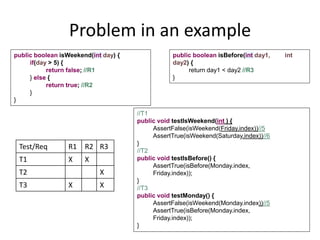
public boolean isWeekend(int day) {
if(day > 5) {
return false; //R1
} else {
return true; //R2
}
}
Test/Req R1 R2 R3
T1 X X
T2 X
T3 X X
//T1
public void testIsWeekend(int ) {
AssertFalse(isWeekend(Friday.index))//5
AssertTrue(isWeekend(Saturday.index))//6
}
//T2
public void testIsBefore() {
AssertTrue(isBefore(Monday.index,
Friday.index));
}
//T3
public void testMonday() {
AssertFalse(isWeekend(Monday.index))//5
AssertTrue(isBefore(Monday.index,
Friday.index));
}
public boolean isBefore(int day1, int
day2) {
return day1 < day2 //R3
}
Problem in an example
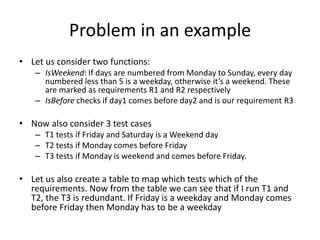
• Let us consider two functions:
– IsWeekend: If days are numbered from Monday to Sunday, every day
numbered less than 5 is a weekday, otherwise it’s a weekend. These
are marked as requirements R1 and R2 respectively
– IsBefore checks if day1 comes before day2 and is our requirement R3
• Now also consider 3 test cases
– T1 tests if Friday and Saturday is a Weekend day
– T2 tests if Monday comes before Friday
– T3 tests if Monday is weekend and comes before Friday.
• Let us also create a table to map which tests which of the
requirements. Now from the table we can see that if I run T1 and
T2, the T3 is redundant. If Friday is a weekday and Monday comes
before Friday then Monday has to be a weekday
Problem Definition
• Given a test-requirement matrix where
– A test tests all the requirements listed against it
– A requirement may be satisfied by any test listed
against it
• Find the minimum number of tests which can
test all the requirements
Outline
• Problem is NP Hard – Reducible from Set
Cover
• Heuristics used to solve this problem
– Greedy
– HGS Algorithm
• Delayed Greedy Algorithm using Concept
Analysis (this algorithm)
NP Hard
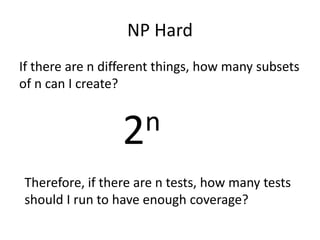
If there are n different things, how many subsets
of n can I create?
2n
Therefore, if there are n tests, how many tests
should I run to have enough coverage?
Convention
• In the following slides, circles denote
requirements and the rectangles denote tests
– Rectangles span multiple circles. This implies that
a test can test multiple requirements
• A requirement can be completely tested by
any test in which it appears.
• Red rectangles represent selected tests
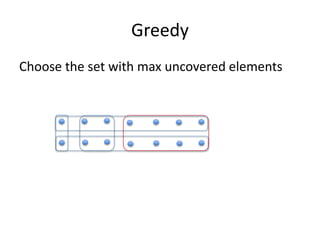
Greedy Algorithm
• Assuming the given requirements and tests,
Greedy algorithm tries to pick the smallest set
of test cases
• To achieve this, Greedy algorithm choses a
test case which covers the maximum number
of requirements. It then removes the covered
requirements and test from consideration
• The algorithm ends when no requirements are
left
Greedy
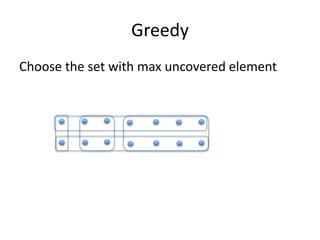
Choose the set with max uncovered element
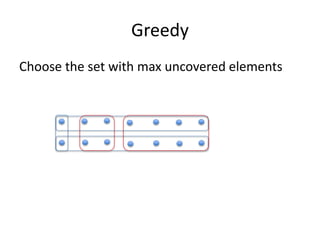
Greedy
Choose the set with max uncovered elements
Greedy
Choose the set with max uncovered elements
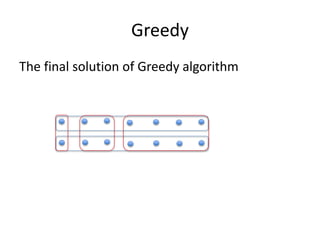
Greedy
The final solution of Greedy algorithm
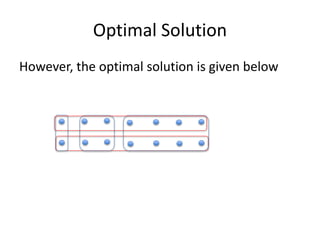
Optimal Solution
However, the optimal solution is given below
Problem with Greedy?
• The algorithm missed the optimal solution.
Why?
• Choice about picking the first set was made
too early!
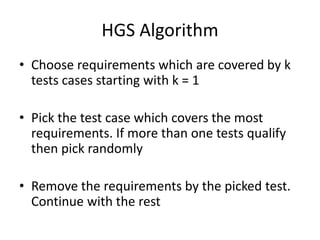
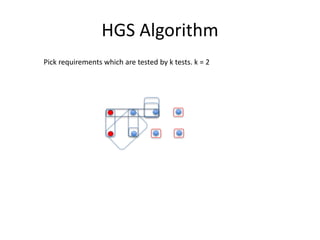
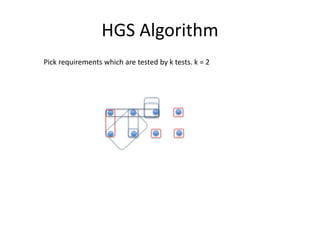
HGS Algorithm
• Choose requirements which are covered by k
tests cases starting with k = 1
• Pick the test case which covers the most
requirements. If more than one tests qualify
then pick randomly
• Remove the requirements by the picked test.
Continue with the rest
HGS Algorithm
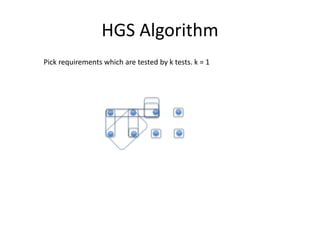
Pick requirements which are tested by k tests. k = 1
HGS Algorithm
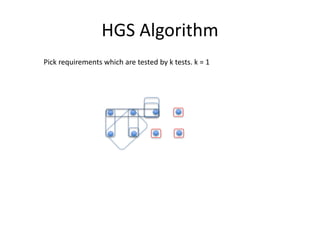
Pick requirements which are tested by k tests. k = 1
HGS Algorithm
Pick requirements which are tested by k tests. k = 2
HGS Algorithm
Pick requirements which are tested by k tests. k = 2
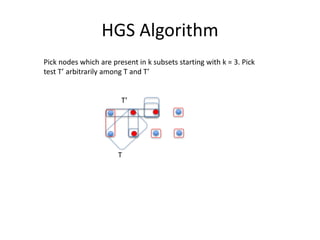
HGS Algorithm
Pick nodes which are present in k subsets starting with k = 3. Pick
test T’ arbitrarily among T and T’
T
T’
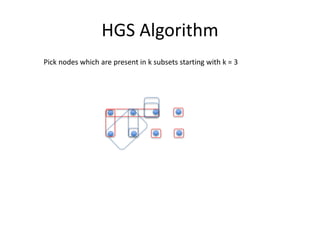
HGS Algorithm
Pick nodes which are present in k subsets starting with k = 3
HGS Algorithm
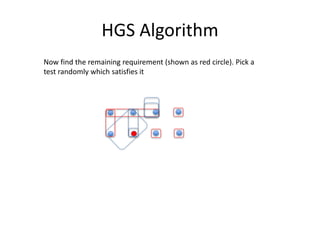
Now find the remaining requirement (shown as red circle). Pick a
test randomly which satisfies it
HGS Algorithm
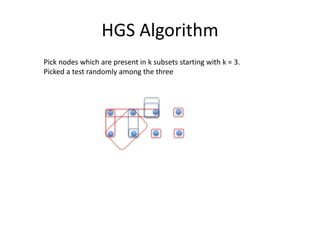
Pick nodes which are present in k subsets starting with k = 3.
Picked a test randomly among the three
HGS Algorithm
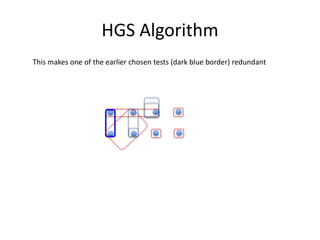
This makes one of the earlier chosen tests (dark blue border) redundant
Problem with HGS?
Implications could not be derived while making
choices
Problems with other Heuristics
• Choice about picking the first set was made
too early
• Implications could not be derived
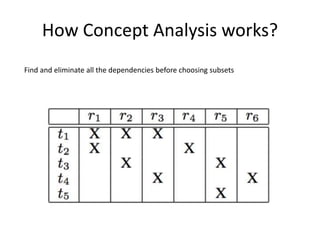
How Concept Analysis works?
Find and eliminate all the dependencies before choosing subsets
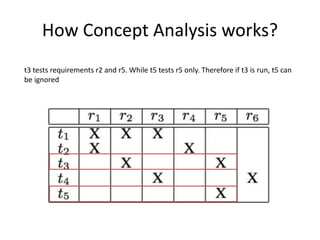
How Concept Analysis works?
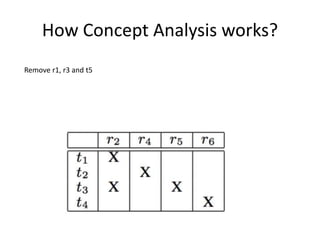
t3 tests requirements r2 and r5. While t5 tests r5 only. Therefore if t3 is run, t5 can
be ignored
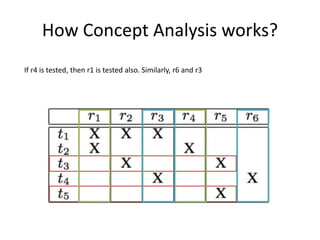
How Concept Analysis works?
If r4 is tested, then r1 is tested also. Similarly, r6 and r3
How Concept Analysis works?
Remove r1, r3 and t5
How Concept Analysis works?
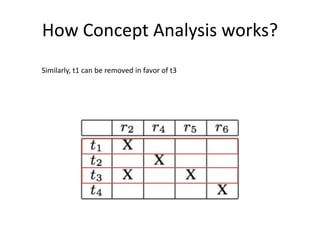
Similarly, t1 can be removed in favor of t3
How Concept Analysis works?
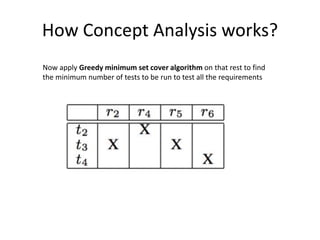
Now apply Greedy minimum set cover algorithm on that rest to find
the minimum number of tests to be run to test all the requirements
How Concept Analysis works?
• Minimization of test-requirement matrix to
remove redundancies
• Delayed sub-set selection to avoid picking sub-
optimal tests
• Delayed Greedy algorithm performs at least
as well as the Greedy algorithm
Concept Analysis - Details
• Lattice
• Concepts
• Lattice of Concepts
• Labels
• Strong concept
• Algorithm
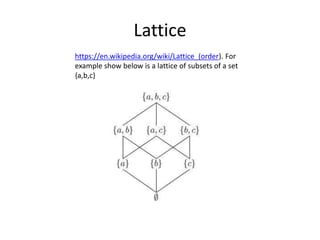
Lattice
https://en.wikipedia.org/wiki/Lattice_(order). For
example show below is a lattice of subsets of a set
{a,b,c}
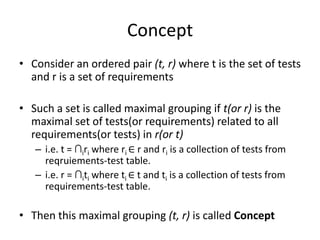
Concept
• Consider an ordered pair (t, r) where t is the set of tests
and r is a set of requirements
• Such a set is called maximal grouping if t(or r) is the
maximal set of tests(or requirements) related to all
requirements(or tests) in r(or t)
– i.e. t = ∩iri where ri ∈ r and ri is a collection of tests from
reqruiements-test table.
– i.e. r = ∩iti where ti ∈ t and ti is a collection of tests from
requirements-test table.
• Then this maximal grouping (t, r) is called Concept
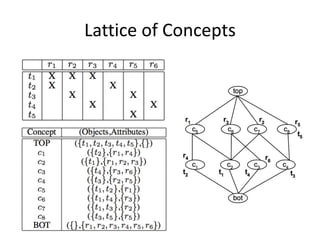
Lattice of Concepts
Lattice of Concepts
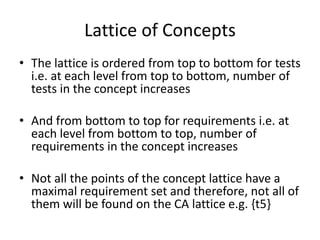
• The lattice is ordered from top to bottom for tests
i.e. at each level from top to bottom, number of
tests in the concept increases
• And from bottom to top for requirements i.e. at
each level from bottom to top, number of
requirements in the concept increases
• Not all the points of the concept lattice have a
maximal requirement set and therefore, not all of
them will be found on the CA lattice e.g. {t5}
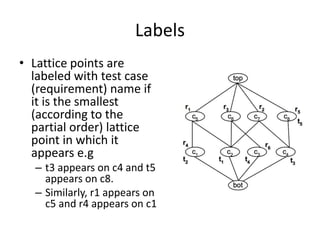
Labels
• Lattice points are
labeled with test case
(requirement) name if
it is the smallest
(according to the
partial order) lattice
point in which it
appears e.g
– t3 appears on c4 and t5
appears on c8.
– Similarly, r1 appears on
c5 and r4 appears on c1
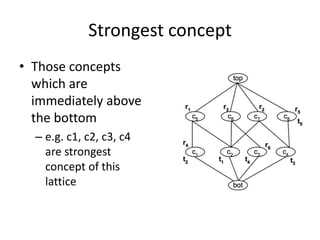
Strongest concept
• Those concepts
which are
immediately above
the bottom
– e.g. c1, c2, c3, c4
are strongest
concept of this
lattice
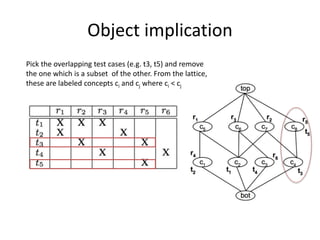
Object implication
Pick the overlapping test cases (e.g. t3, t5) and remove
the one which is a subset of the other. From the lattice,
these are labeled concepts ci and cj where ci < cj
Attribute Implication
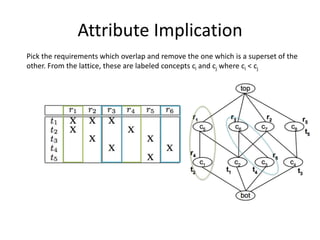
Pick the requirements which overlap and remove the one which is a superset of the
other. From the lattice, these are labeled concepts ci and cj where ci < cj
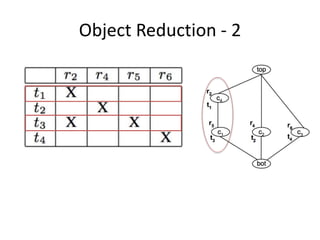
Object Reduction - 2
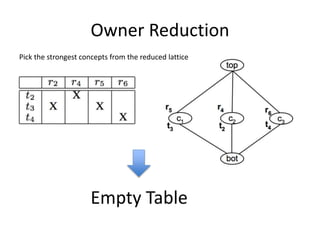
Owner Reduction
Empty Table
Pick the strongest concepts from the reduced lattice
Delayed Greedy Algorithm
• Repeat until table is empty
– Repeat until table changes
• Object Implication
• Attribute Implication
• Owner Reduction and choose strongest concepts
– One step of Greedy
Experiments
• No such requirement-test matrix exists for
most softwares. How can this approach be
tested?
• Requirements: Branches and def-use pairs
(using LLVM)
• Tests: Identify tests which hit these
requirements
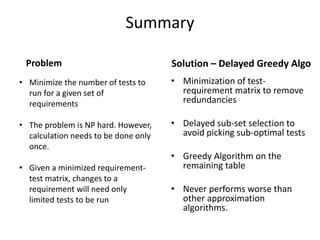
Summary
• Minimization of test-
requirement matrix to remove
redundancies
• Delayed sub-set selection to
avoid picking sub-optimal tests
• Greedy Algorithm on the
remaining table
• Never performs worse than
other approximation
algorithms.
• Minimize the number of tests to
run for a given set of
requirements
• The problem is NP hard. However,
calculation needs to be done only
once.
• Given a minimized requirement-
test matrix, changes to a
requirement will need only
limited tests to be run
Problem Solution – Delayed Greedy Algo

Test suite minimization

  • 1.
    Test Suite Minimization AConcept Analysis Inspired Greedy Algorithm for Test Suite Minimization http://llvm.org/pubs/2005-09-PASTE-GreedySuiteMinimization.pdf
  • 2.
    Motivation • Large softwarestypically have large number of tests and their complete runs take several hours • For minimal changes a complex software undergoes daily, a lot of these tests are only testing what’s already tested • These tests are run in nightly release process, for pre-check in requirements and check-ins consuming time, energy and dollars
  • 3.
    Problem • How dowe know which tests to run given a software change? – Test coverage information for each tests can answer this question • But we can do better. Do we need to run all the tests according to the test coverage? – But this problem is hard. NP-hard.
  • 4.
    Problem in anexample public boolean isWeekend(int day) { if(day > 5) { return false; //R1 } else { return true; //R2 } } Test/Req R1 R2 R3 T1 X X T2 X T3 X X //T1 public void testIsWeekend(int ) { AssertFalse(isWeekend(Friday.index))//5 AssertTrue(isWeekend(Saturday.index))//6 } //T2 public void testIsBefore() { AssertTrue(isBefore(Monday.index, Friday.index)); } //T3 public void testMonday() { AssertFalse(isWeekend(Monday.index))//5 AssertTrue(isBefore(Monday.index, Friday.index)); } public boolean isBefore(int day1, int day2) { return day1 < day2 //R3 }
  • 5.
    Problem in anexample • Let us consider two functions: – IsWeekend: If days are numbered from Monday to Sunday, every day numbered less than 5 is a weekday, otherwise it’s a weekend. These are marked as requirements R1 and R2 respectively – IsBefore checks if day1 comes before day2 and is our requirement R3 • Now also consider 3 test cases – T1 tests if Friday and Saturday is a Weekend day – T2 tests if Monday comes before Friday – T3 tests if Monday is weekend and comes before Friday. • Let us also create a table to map which tests which of the requirements. Now from the table we can see that if I run T1 and T2, the T3 is redundant. If Friday is a weekday and Monday comes before Friday then Monday has to be a weekday
  • 6.
    Problem Definition • Givena test-requirement matrix where – A test tests all the requirements listed against it – A requirement may be satisfied by any test listed against it • Find the minimum number of tests which can test all the requirements
  • 7.
    Outline • Problem isNP Hard – Reducible from Set Cover • Heuristics used to solve this problem – Greedy – HGS Algorithm • Delayed Greedy Algorithm using Concept Analysis (this algorithm)
  • 8.
    NP Hard If thereare n different things, how many subsets of n can I create? 2n Therefore, if there are n tests, how many tests should I run to have enough coverage?
  • 9.
    Convention • In thefollowing slides, circles denote requirements and the rectangles denote tests – Rectangles span multiple circles. This implies that a test can test multiple requirements • A requirement can be completely tested by any test in which it appears. • Red rectangles represent selected tests
  • 10.
    Greedy Algorithm • Assumingthe given requirements and tests, Greedy algorithm tries to pick the smallest set of test cases • To achieve this, Greedy algorithm choses a test case which covers the maximum number of requirements. It then removes the covered requirements and test from consideration • The algorithm ends when no requirements are left
  • 11.
    Greedy Choose the setwith max uncovered element
  • 12.
    Greedy Choose the setwith max uncovered elements
  • 13.
    Greedy Choose the setwith max uncovered elements
  • 14.
    Greedy The final solutionof Greedy algorithm
  • 15.
    Optimal Solution However, theoptimal solution is given below
  • 16.
    Problem with Greedy? •The algorithm missed the optimal solution. Why? • Choice about picking the first set was made too early!
  • 17.
    HGS Algorithm • Chooserequirements which are covered by k tests cases starting with k = 1 • Pick the test case which covers the most requirements. If more than one tests qualify then pick randomly • Remove the requirements by the picked test. Continue with the rest
  • 18.
    HGS Algorithm Pick requirementswhich are tested by k tests. k = 1
  • 19.
    HGS Algorithm Pick requirementswhich are tested by k tests. k = 1
  • 20.
    HGS Algorithm Pick requirementswhich are tested by k tests. k = 2
  • 21.
    HGS Algorithm Pick requirementswhich are tested by k tests. k = 2
  • 22.
    HGS Algorithm Pick nodeswhich are present in k subsets starting with k = 3. Pick test T’ arbitrarily among T and T’ T T’
  • 23.
    HGS Algorithm Pick nodeswhich are present in k subsets starting with k = 3
  • 24.
    HGS Algorithm Now findthe remaining requirement (shown as red circle). Pick a test randomly which satisfies it
  • 25.
    HGS Algorithm Pick nodeswhich are present in k subsets starting with k = 3. Picked a test randomly among the three
  • 26.
    HGS Algorithm This makesone of the earlier chosen tests (dark blue border) redundant
  • 27.
    Problem with HGS? Implicationscould not be derived while making choices
  • 28.
    Problems with otherHeuristics • Choice about picking the first set was made too early • Implications could not be derived
  • 29.
    How Concept Analysisworks? Find and eliminate all the dependencies before choosing subsets
  • 30.
    How Concept Analysisworks? t3 tests requirements r2 and r5. While t5 tests r5 only. Therefore if t3 is run, t5 can be ignored
  • 31.
    How Concept Analysisworks? If r4 is tested, then r1 is tested also. Similarly, r6 and r3
  • 32.
    How Concept Analysisworks? Remove r1, r3 and t5
  • 33.
    How Concept Analysisworks? Similarly, t1 can be removed in favor of t3
  • 34.
    How Concept Analysisworks? Now apply Greedy minimum set cover algorithm on that rest to find the minimum number of tests to be run to test all the requirements
  • 35.
    How Concept Analysisworks? • Minimization of test-requirement matrix to remove redundancies • Delayed sub-set selection to avoid picking sub- optimal tests • Delayed Greedy algorithm performs at least as well as the Greedy algorithm
  • 36.
    Concept Analysis -Details • Lattice • Concepts • Lattice of Concepts • Labels • Strong concept • Algorithm
  • 37.
  • 38.
    Concept • Consider anordered pair (t, r) where t is the set of tests and r is a set of requirements • Such a set is called maximal grouping if t(or r) is the maximal set of tests(or requirements) related to all requirements(or tests) in r(or t) – i.e. t = ∩iri where ri ∈ r and ri is a collection of tests from reqruiements-test table. – i.e. r = ∩iti where ti ∈ t and ti is a collection of tests from requirements-test table. • Then this maximal grouping (t, r) is called Concept
  • 39.
  • 40.
    Lattice of Concepts •The lattice is ordered from top to bottom for tests i.e. at each level from top to bottom, number of tests in the concept increases • And from bottom to top for requirements i.e. at each level from bottom to top, number of requirements in the concept increases • Not all the points of the concept lattice have a maximal requirement set and therefore, not all of them will be found on the CA lattice e.g. {t5}
  • 41.
    Labels • Lattice pointsare labeled with test case (requirement) name if it is the smallest (according to the partial order) lattice point in which it appears e.g – t3 appears on c4 and t5 appears on c8. – Similarly, r1 appears on c5 and r4 appears on c1
  • 42.
    Strongest concept • Thoseconcepts which are immediately above the bottom – e.g. c1, c2, c3, c4 are strongest concept of this lattice
  • 43.
    Object implication Pick theoverlapping test cases (e.g. t3, t5) and remove the one which is a subset of the other. From the lattice, these are labeled concepts ci and cj where ci < cj
  • 44.
    Attribute Implication Pick therequirements which overlap and remove the one which is a superset of the other. From the lattice, these are labeled concepts ci and cj where ci < cj
  • 45.
  • 46.
    Owner Reduction Empty Table Pickthe strongest concepts from the reduced lattice
  • 47.
    Delayed Greedy Algorithm •Repeat until table is empty – Repeat until table changes • Object Implication • Attribute Implication • Owner Reduction and choose strongest concepts – One step of Greedy
  • 48.
    Experiments • No suchrequirement-test matrix exists for most softwares. How can this approach be tested? • Requirements: Branches and def-use pairs (using LLVM) • Tests: Identify tests which hit these requirements
  • 49.
    Summary • Minimization oftest- requirement matrix to remove redundancies • Delayed sub-set selection to avoid picking sub-optimal tests • Greedy Algorithm on the remaining table • Never performs worse than other approximation algorithms. • Minimize the number of tests to run for a given set of requirements • The problem is NP hard. However, calculation needs to be done only once. • Given a minimized requirement- test matrix, changes to a requirement will need only limited tests to be run Problem Solution – Delayed Greedy Algo

Editor's Notes

  • #14 Dots are the requirements and the rectangles are the tests
  • #15 Dots are the requirements and the rectangles are the tests
  • #16 Dots are the requirements and the rectangles are the tests
  • #19 Circles are requirements and rectangles are tests. Each requirement may be tested by more than one tests. The Algorithm finds the requirements which can only be tested by 1 test i.e. k = 1
  • #21 Dots are requirements and rectangles are tests. Each requirement may be testable by more than one tests. The Algorithm finds the requirements which can only be tested by 1 test i.e. k = 2
  • #22 Dots are requirements and rectangles are tests. Each requirement may be testable by more than one tests. The Algorithm finds the requirements which can only be tested by 1 test i.e. k = 2
  • #23 Dots are requirements and rectangles are tests. Each requirement may be testable by more than one tests. The Algorithm finds the requirements which can only be tested by 1 test i.e. k = 3. Pick those test case which can test most number of requirements
  • #24 Dots are requirements and rectangles are tests. Each requirement may be testable by more than one tests. The Algorithm finds the requirements which can only be tested by 1 test i.e. k = 3. Pick those test case which can test most number of requirements
  • #25 Pick an arbitrary test for the requirements which are left
  • #30 Make sure audience knows that this table means that requirement can be completely tested by any of the test cases.
  • #45 Again emphasize that running one test is enough to test the a requirement
  • #47 t3, r2, r5. This lattice cannot be reduced.