Crypto 101 and
a bit more
@Greenido
Sep 2022
“Bitcoin gives us, for the first time, a way for one
Internet user to transfer a unique piece of digital
property to another Internet user, such that the
transfer is guaranteed to be safe and secure,
everyone knows that the transfer has taken
place, and nobody can challenge the legitimacy
of the transfer. The consequences of this
breakthrough are hard to overstate.”
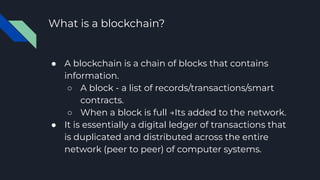
What is a blockchain?
● A blockchain is a chain of blocks that contains
information.
○ A block - a list of records/transactions/smart
contracts.
○ When a block is full →Its added to the network.
● It is essentially a digital ledger of transactions that
is duplicated and distributed across the entire
network (peer to peer) of computer systems.
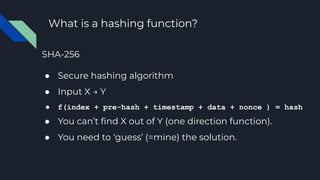
What is a hashing function?
SHA-256
● Secure hashing algorithm
● Input X → Y
● f(index + pre-hash + timestamp + data + nonce ) = hash
● You can’t find X out of Y (one direction function).
● You need to ‘guess’ (=mine) the solution.
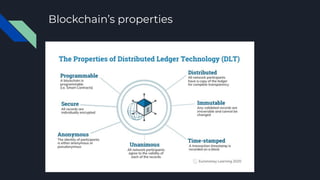
Blockchain’s properties
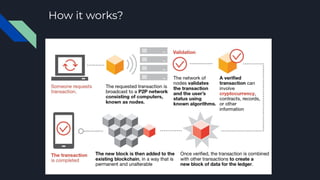
How it works?
Immutable
Immutability means that the blockchain is a permanent and
unalterable network.
A collection of nodes:
● Every node in the network has a copy of the digital ledger.
● To add a transaction every node checks the validity of the
transaction and if the majority of the nodes think that it is a
valid transaction then it is added to the network.
● Without the approval of a majority of nodes no one can add any
transaction blocks to the ledger.
● Any validated records are irreversible and cannot be changed.
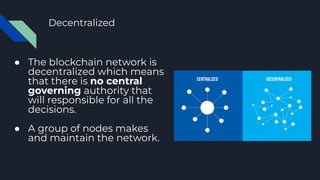
Decentralized
● The blockchain network is
decentralized which means
that there is no central
governing authority that
will responsible for all the
decisions.
● A group of nodes makes
and maintain the network.
Secure
● All the records in the blockchain are individually encrypted.
This adds another layer of security
● No central authority - BUT no one can update or delete
data on the network.
● Every information on the blockchain is hashed
cryptographically which means that every piece of data has
a unique identity on the network.
● All the blocks contain a unique hash of their own and the
hash of the previous block.
● The blocks are cryptographically linked with each other.
Consensus
● Every blockchain has a consensus to help the network
to make quick and unbiased decisions.
● Consensus is a decision-making algorithm for the
group of nodes active on the network to reach an
agreement.
● Nodes might not trust each other but they can trust
the algorithm.
Unanimous
● Most the network participants agree to the validity of the
records before they can be added to the network.
● When a node wants to add a block to the network → It must
get majority voting otherwise the block cannot be added to
the network.
● Every record is updated simultaneously and the updations
propagate quickly in the network.
● It is not possible to make any change without consent from
the majority of nodes in the network.
Demo!
blockchaindemo.io
How Is Blockchain Used?
Cryptocurrency
○ Solana, Bitcoin, Ethereum and many
more.
○ When people buy, exchange or spend
cryptocurrency → transactions are
recorded on a blockchain.
How Is Blockchain Used?
Banking
● blockchain is being used to process transactions
in fiat currency, like dollars and euros.
● This is faster than sending money through a
bank or other financial institution.
● The transactions verified quickly and processed
outside of normal business hours.
How Is Blockchain Used?
Asset Transfers
● Record and transfer the ownership of different unique assets.
● Digital assets like NFTs (= a representation of ownership of
digital art and videos).
● To process the ownership of real-life assets, like the deed to
real estate and vehicles.
○ The two sides of a party would first use the blockchain to
verify that one owns the property and the other has the
money to buy.
○ They could complete and record the sale on the
blockchain.
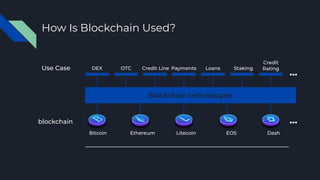
OTC
Ethereum
Blockchain technologies
Bitcoin EOS
Litecoin Dash
DEX
Credit
Rating
Credit Line Payments Loans Staking
Use Case
blockchain
How Is Blockchain Used?
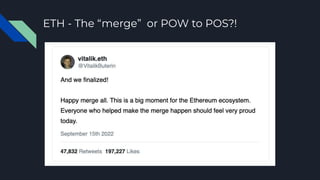
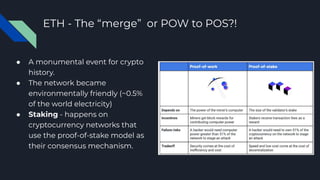
ETH - The “merge” or POW to POS?!
● A monumental event for crypto
history.
● The network became
environmentally friendly (~0.5%
of the world electricity)
● Staking - happens on
cryptocurrency networks that
use the proof-of-stake model as
their consensus mechanism.
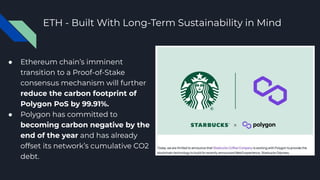
ETH - Built With Long-Term Sustainability in Mind
● Ethereum chain’s imminent
transition to a Proof-of-Stake
consensus mechanism will further
reduce the carbon footprint of
Polygon PoS by 99.91%.
● Polygon has committed to
becoming carbon negative by the
end of the year and has already
offset its network’s cumulative CO2
debt.
Thank you!
Q&A
@Greenido
Sep 2022

Crypto 101 and a bit more [Sep-2022]

  • 1.
    Crypto 101 and abit more @Greenido Sep 2022
  • 2.
    “Bitcoin gives us,for the first time, a way for one Internet user to transfer a unique piece of digital property to another Internet user, such that the transfer is guaranteed to be safe and secure, everyone knows that the transfer has taken place, and nobody can challenge the legitimacy of the transfer. The consequences of this breakthrough are hard to overstate.”
  • 3.
    What is ablockchain? ● A blockchain is a chain of blocks that contains information. ○ A block - a list of records/transactions/smart contracts. ○ When a block is full →Its added to the network. ● It is essentially a digital ledger of transactions that is duplicated and distributed across the entire network (peer to peer) of computer systems.
  • 4.
    What is ahashing function? SHA-256 ● Secure hashing algorithm ● Input X → Y ● f(index + pre-hash + timestamp + data + nonce ) = hash ● You can’t find X out of Y (one direction function). ● You need to ‘guess’ (=mine) the solution.
  • 5.
  • 6.
  • 7.
    Immutable Immutability means thatthe blockchain is a permanent and unalterable network. A collection of nodes: ● Every node in the network has a copy of the digital ledger. ● To add a transaction every node checks the validity of the transaction and if the majority of the nodes think that it is a valid transaction then it is added to the network. ● Without the approval of a majority of nodes no one can add any transaction blocks to the ledger. ● Any validated records are irreversible and cannot be changed.
  • 8.
    Decentralized ● The blockchainnetwork is decentralized which means that there is no central governing authority that will responsible for all the decisions. ● A group of nodes makes and maintain the network.
  • 9.
    Secure ● All therecords in the blockchain are individually encrypted. This adds another layer of security ● No central authority - BUT no one can update or delete data on the network. ● Every information on the blockchain is hashed cryptographically which means that every piece of data has a unique identity on the network. ● All the blocks contain a unique hash of their own and the hash of the previous block. ● The blocks are cryptographically linked with each other.
  • 10.
    Consensus ● Every blockchainhas a consensus to help the network to make quick and unbiased decisions. ● Consensus is a decision-making algorithm for the group of nodes active on the network to reach an agreement. ● Nodes might not trust each other but they can trust the algorithm.
  • 11.
    Unanimous ● Most thenetwork participants agree to the validity of the records before they can be added to the network. ● When a node wants to add a block to the network → It must get majority voting otherwise the block cannot be added to the network. ● Every record is updated simultaneously and the updations propagate quickly in the network. ● It is not possible to make any change without consent from the majority of nodes in the network.
  • 12.
  • 13.
    How Is BlockchainUsed? Cryptocurrency ○ Solana, Bitcoin, Ethereum and many more. ○ When people buy, exchange or spend cryptocurrency → transactions are recorded on a blockchain.
  • 14.
    How Is BlockchainUsed? Banking ● blockchain is being used to process transactions in fiat currency, like dollars and euros. ● This is faster than sending money through a bank or other financial institution. ● The transactions verified quickly and processed outside of normal business hours.
  • 15.
    How Is BlockchainUsed? Asset Transfers ● Record and transfer the ownership of different unique assets. ● Digital assets like NFTs (= a representation of ownership of digital art and videos). ● To process the ownership of real-life assets, like the deed to real estate and vehicles. ○ The two sides of a party would first use the blockchain to verify that one owns the property and the other has the money to buy. ○ They could complete and record the sale on the blockchain.
  • 16.
    OTC Ethereum Blockchain technologies Bitcoin EOS LitecoinDash DEX Credit Rating Credit Line Payments Loans Staking Use Case blockchain How Is Blockchain Used?
  • 17.
    ETH - The“merge” or POW to POS?!
  • 18.
    ETH - The“merge” or POW to POS?! ● A monumental event for crypto history. ● The network became environmentally friendly (~0.5% of the world electricity) ● Staking - happens on cryptocurrency networks that use the proof-of-stake model as their consensus mechanism.
  • 19.
    ETH - BuiltWith Long-Term Sustainability in Mind ● Ethereum chain’s imminent transition to a Proof-of-Stake consensus mechanism will further reduce the carbon footprint of Polygon PoS by 99.91%. ● Polygon has committed to becoming carbon negative by the end of the year and has already offset its network’s cumulative CO2 debt.
  • 20.