University Library
October 2013
Planning your literature
search
www.le.ac.uk/library
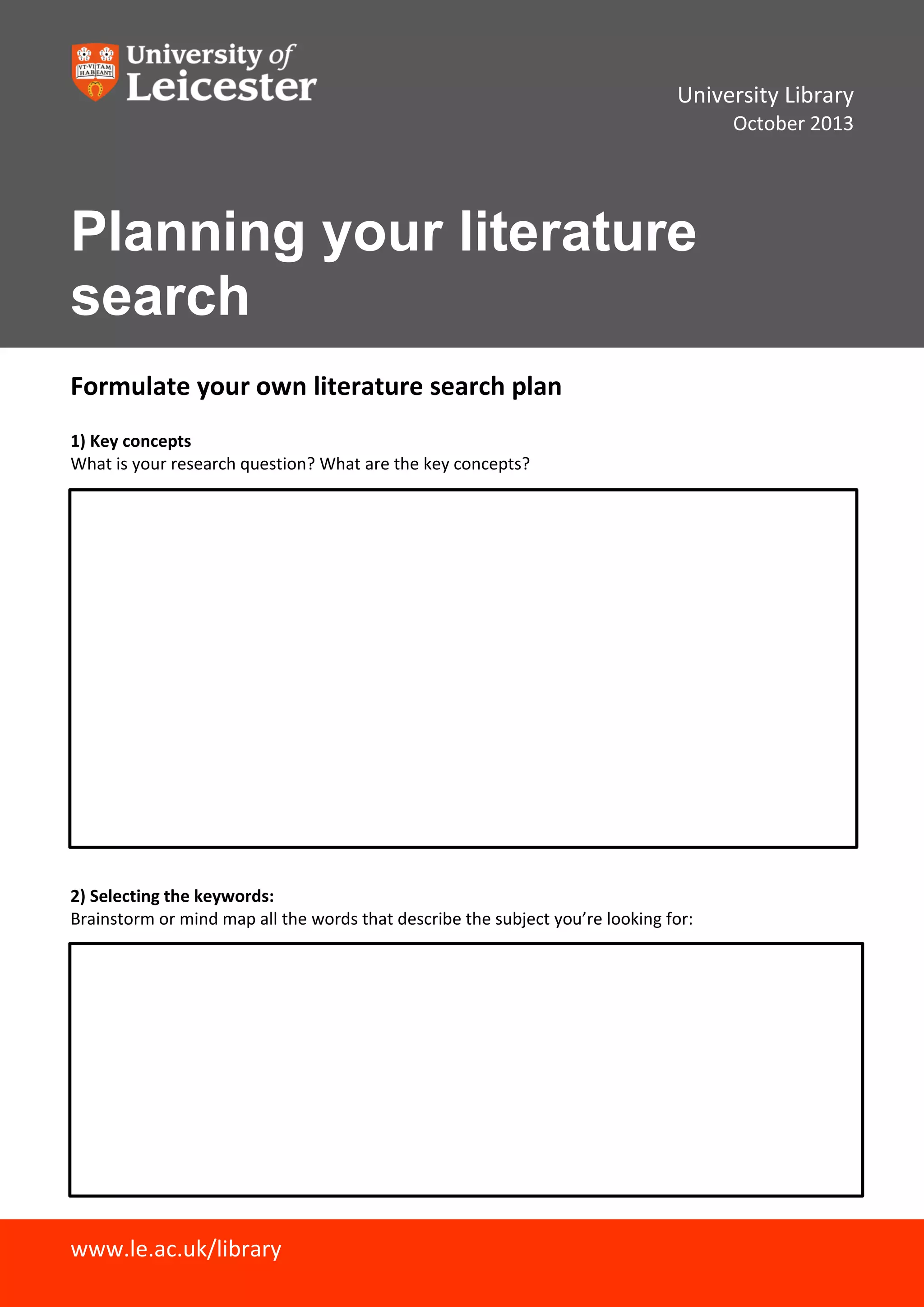
Formulate your own literature search plan
1) Key concepts
What is your research question? What are the key concepts?
2) Selecting the keywords:
Brainstorm or mind map all the words that describe the subject you’re looking for:
2 UNIVERSITY OF LEICESTER · LIBRARY
www.le.ac.uk/library
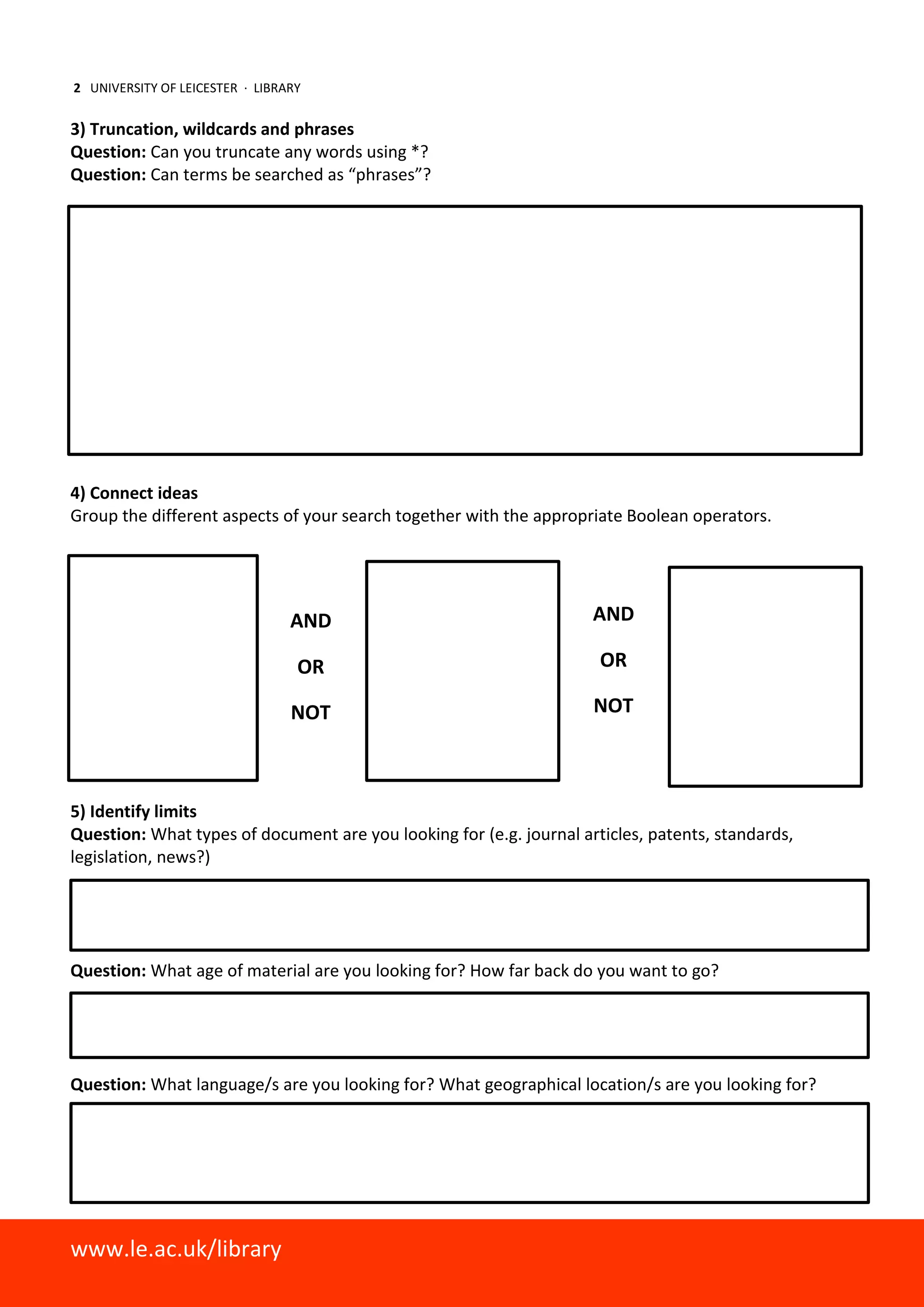
3) Truncation, wildcards and phrases
Question: Can you truncate any words using *?
Question: Can terms be searched as “phrases”?
4) Connect ideas
Group the different aspects of your search together with the appropriate Boolean operators.
5) Identify limits
Question: What types of document are you looking for (e.g. journal articles, patents, standards,
legislation, news?)
Question: What age of material are you looking for? How far back do you want to go?
Question: What language/s are you looking for? What geographical location/s are you looking for?
AND
OR
NOT
AND
OR
NOT
3 UNIVERSITY OF LEICESTER · LIBRARY
www.le.ac.uk/library
Question: Any other limits? E.g. human, animal, age of research participants?
6) What resources and databases do you need to search?
Further Help with literature searching:
Training sessions available for PhD students:
 Planning your literature search
 Conducting your literature search
The library’s Research Services team are available to help:
• E: libstem@le.ac.uk (Science & Medicine)
• E: liblass@le.ac.uk (Arts & Social Sciences)
• Visit the Graduate School Reading Room on weekday afternoons, 2-4pm
Adapted, with permission, from materials produced by Loughborough University.

Literature search planning template

  • 1.
    University Library October 2013 Planningyour literature search www.le.ac.uk/library Formulate your own literature search plan 1) Key concepts What is your research question? What are the key concepts? 2) Selecting the keywords: Brainstorm or mind map all the words that describe the subject you’re looking for:
  • 2.
    2 UNIVERSITY OFLEICESTER · LIBRARY www.le.ac.uk/library 3) Truncation, wildcards and phrases Question: Can you truncate any words using *? Question: Can terms be searched as “phrases”? 4) Connect ideas Group the different aspects of your search together with the appropriate Boolean operators. 5) Identify limits Question: What types of document are you looking for (e.g. journal articles, patents, standards, legislation, news?) Question: What age of material are you looking for? How far back do you want to go? Question: What language/s are you looking for? What geographical location/s are you looking for? AND OR NOT AND OR NOT
  • 3.
    3 UNIVERSITY OFLEICESTER · LIBRARY www.le.ac.uk/library Question: Any other limits? E.g. human, animal, age of research participants? 6) What resources and databases do you need to search? Further Help with literature searching: Training sessions available for PhD students:  Planning your literature search  Conducting your literature search The library’s Research Services team are available to help: • E: libstem@le.ac.uk (Science & Medicine) • E: liblass@le.ac.uk (Arts & Social Sciences) • Visit the Graduate School Reading Room on weekday afternoons, 2-4pm Adapted, with permission, from materials produced by Loughborough University.