William Blake
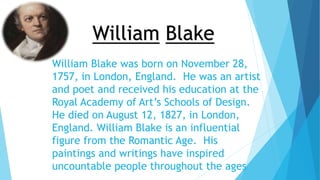
William Blake was born on November 28,
1757, in London, England. He was an artist
and poet and received his education at the
Royal Academy of Art’s Schools of Design.
He died on August 12, 1827, in London,
England. William Blake is an influential
figure from the Romantic Age. His
paintings and writings have inspired
uncountable people throughout the ages
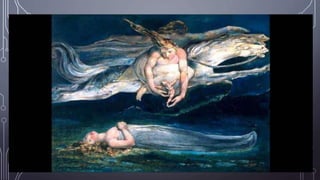
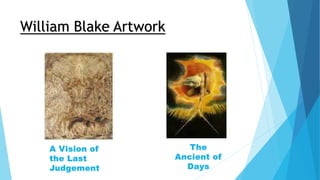
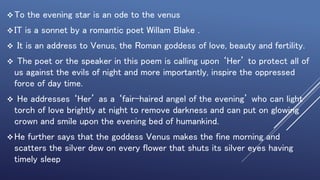
William Blake Artwork
INTRODUCTIO
N
To the evening star is an ode to the venus
IT is a sonnet by a romantic poet Willam Blake .
 It is an address to Venus, the Roman goddess of love, beauty and fertility.
 The poet or the speaker in this poem is calling upon ‘Her’ to protect all of
us against the evils of night and more importantly, inspire the oppressed
force of day time.
 He addresses ‘Her’ as a ‘fair-haired angel of the evening’ who can light
torch of love brightly at night to remove darkness and can put on glowing
crown and smile upon the evening bed of humankind.
He further says that the goddess Venus makes the fine morning and
scatters the silver dew on every flower that shuts its silver eyes having
timely sleep
 Finally, he maintains that the wolf rages and the lion glares at night in
darkness which are the emblems of evils; therefore, he requests to
protect all the humankind against them covering by its sacred dew as
done by the warm clothes.
 Blake describes, in a very elegant way, how lovely the evening star is.
The wolf is his symbol for the night; it has a grey fur, and has an affinity
with the dark, the night. The lion, with a golden fur, is a symbol for the
glorious morning; the lion glares through the dun forest means as much as
the morning breaks through.Secondly, assonance, consonance and
alliteration within the poem will be dealt with.
MEANING OF
THE POEM
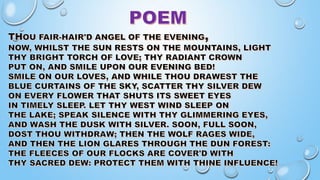
Fair haired angel(Venus) of the evening(evening star),While the sun is starting to rest
on the mountains , Rekindle the shining torch of love and wear your Radiant Crown ,
and bless our(other people and himself) resting bed(earth)!Smile on the ones we love
may it be relatives or lovers , And while you draw the blue curtain(the blueish sky),
scatter your silver dew(blessing in the form of a liquid in this case)on almost every
flower that closes its eyes(petals of flower) in order to obtain calm and sleep.
Command the west wind* to calm down and not destroy the floral beauty of the
forest. Command silence and order in the forest through your beautiful and
glimmering(shining) eyes. Paint the curtain(sky) with silver(stars and moon) so that
their light reaches us and protects us. I know you will withdraw(leave) soon and when
you do the dangers of the night(dangerous beasts, wild animals, thieves and robbers)
will thrive. The wolf will howl in pleasure and the lion will pensively stare at a flock of
sheep planning to attack... I pray you(Venus), let the sprinkled dew(blessing) cover the
flocks of sheep(fleece is the wool of sheep) and protect them through it.
ANALYSI
S
 In this poem, Blake is expressing the idea that stars bring peace and guidance to people
during the normally forbidding night.
 Blake uses anastrophes to directly address the star. For example, Blake urges the star to
"smile upon our evening beds." This anastrophe brings about a romantic and soothing
essence to the poem and shows Blake's belief that the star is able to turn the dark night into
a calm and dreamy situation.
 Blake uses another anastrophe in the ninth line of the poem, begging the star to "wash the
dusk with silver.“
 Blake also uses metaphors to compare the star to a "fair-haired angel." This metaphor is
used to express the shining star as a beautiful goddess who watches over the people during
the dark night.
 Blake also calls the star a bright torch of love, which brings about a radiant and heroic
quality to the star.
The wolf is his symbol for the night; it has a grey fur, and has an affinity
with the dark, the night. The lion, with a golden fur, is a symbol for the
glorious morning; the lion glares through the dun forest means as much
as the morning breaks through.Secondly, assonance, consonance and
alliteration within the poem will be dealt with.
The schemes on the pages attached will help explain why assonance,
consonance and alliteration are that important. The first scheme is about
alliteration with the vowel ‘t’. Important is that lines 4, 7, 10 and 13 have
no alliteration with ‘t’. If you divide the 14 lines in the form of a
Shakespearean sonnet; then there can be found that there is always one
line in a stanza that has no alliteration, and, odd enough, this is
respectively the last line, the penultimate line, the second and the first
line.
 There are three major considerations to be taken from “The Evening Star
 One is the theme of pastoral simplicity It is in the last two lines that the speaker
appeals to God for the first time, recognizing his inferiority and potential impotence
when it comes to protecting his flock from the fall of grace.
 The second is political entrapment. Again, the speaker knows that it is during night,
when Venus’s “radiant crown” holds the power to put an end to all of daytime’s rules
(change the color of the sky, put the flowers to sleep, calm the wind). Alas, the
excitement and bliss of the unencumbered will “soon withdraw,” and just as in man’s
law-abiding society, the force of opposition governs all of Blake’s inhibitions
 Lastly is sexual desire. The speaker here is simply looking for any excuse, any
blessing, to act upon his primitive desire to mate with the opposite sex. Knowing an
appeal to reason, religion, and God is out of the question; he turns to nighttime’s
nature queen in hopes for approval.
 Blake wrote this poem to possibly show the huge effect nature has on one's everyday
life. For example, without the star, the night would be dark and forbidding. However,
the star make the night beautiful, peaceful and romantic.
 He also goes further to show how nature even can protect our fragile lives. He claims
that the star protects people from the violent lion and wolf lurking in the forest. Blake
also expresses the innocence of nature.
 He tells the flowers to "shut its sweet eyes", which also brings about a non-
threatening tone to the poem. In To the Evening Star, Blake successfully show how all
the elements of nature can come together to create a beautiful, perfect situation. For
example, the star shines brightly, the lake reflects the light, and the wind gently
blows.These three actions come together to produce a beautiful scenery which many
humans take advantage of every night.
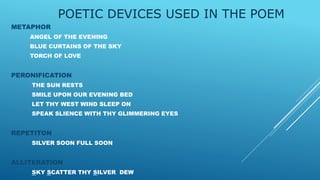
POETIC DEVICES USED IN THE POEM
METAPHOR
ANGEL OF THE EVENING
BLUE CURTAINS OF THE SKY
TORCH OF LOVE
PERONIFICATION
THE SUN RESTS
SMILE UPON OUR EVENING BED
LET THY WEST WIND SLEEP ON
SPEAK SLIENCE WITH THY GLIMMERING EYES
REPETITON
SILVER SOON FULL SOON
ALLITERATION
SKY SCATTER THY SILVER DEW
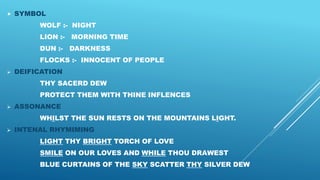
 SYMBOL
WOLF :- NIGHT
LION :- MORNING TIME
DUN :- DARKNESS
FLOCKS :- INNOCENT OF PEOPLE
 DEIFICATION
THY SACERD DEW
PROTECT THEM WITH THINE INFLENCES
 ASSONANCE
WHILST THE SUN RESTS ON THE MOUNTAINS LIGHT.
 INTENAL RHYMIMING
LIGHT THY BRIGHT TORCH OF LOVE
SMILE ON OUR LOVES AND WHILE THOU DRAWEST
BLUE CURTAINS OF THE SKY SCATTER THY SILVER DEW
SUMMARY
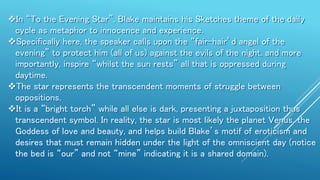
In “To the Evening Star”, Blake maintains his Sketches theme of the daily
cycle as metaphor to innocence and experience.
Specifically here, the speaker calls upon the “fair-hair’d angel of the
evening” to protect him (all of us) against the evils of the night, and more
importantly, inspire “whilst the sun rests” all that is oppressed during
daytime.
The star represents the transcendent moments of struggle between
oppositions.
It is a “bright torch” while all else is dark, presenting a juxtaposition thus
transcendent symbol. In reality, the star is most likely the planet Venus, the
Goddess of love and beauty, and helps build Blake’s motif of eroticism and
desires that must remain hidden under the light of the omniscient day (notice
the bed is “our” and not “mine” indicating it is a shared domain).
The speaker is beckoning Venus to bless the bed (some argue a bridal bed,
although there is very little evidence elsewhere to support such notion) and
to “smile on [their] love.”
But Venus cries “tears of dew” as she herself is aware of humankind’s
fallen state on earth where sexual creativeness operates in a real of
dangerous passions symbolized by savage beasts (the wolf and the lion).
Again we have a struggle of opposites here, this time symbolized through
predator and prey that further builds up Blake’s theme of the cyclic and
dialectic nature of the universe in which we live.
 The speaker is young (as Blake himself was at the time) and his frustration
between these opposing forces is placed on the table to deal with: youth and
age, tyrant and slave, day and night, male and female, predatory and prey.
THE END

To the evening star poem analysis

  • 4.
    William Blake William Blakewas born on November 28, 1757, in London, England. He was an artist and poet and received his education at the Royal Academy of Art’s Schools of Design. He died on August 12, 1827, in London, England. William Blake is an influential figure from the Romantic Age. His paintings and writings have inspired uncountable people throughout the ages
  • 5.
  • 6.
  • 7.
    To the eveningstar is an ode to the venus IT is a sonnet by a romantic poet Willam Blake .  It is an address to Venus, the Roman goddess of love, beauty and fertility.  The poet or the speaker in this poem is calling upon ‘Her’ to protect all of us against the evils of night and more importantly, inspire the oppressed force of day time.  He addresses ‘Her’ as a ‘fair-haired angel of the evening’ who can light torch of love brightly at night to remove darkness and can put on glowing crown and smile upon the evening bed of humankind. He further says that the goddess Venus makes the fine morning and scatters the silver dew on every flower that shuts its silver eyes having timely sleep
  • 8.
     Finally, hemaintains that the wolf rages and the lion glares at night in darkness which are the emblems of evils; therefore, he requests to protect all the humankind against them covering by its sacred dew as done by the warm clothes.  Blake describes, in a very elegant way, how lovely the evening star is. The wolf is his symbol for the night; it has a grey fur, and has an affinity with the dark, the night. The lion, with a golden fur, is a symbol for the glorious morning; the lion glares through the dun forest means as much as the morning breaks through.Secondly, assonance, consonance and alliteration within the poem will be dealt with.
  • 9.
  • 10.
    Fair haired angel(Venus)of the evening(evening star),While the sun is starting to rest on the mountains , Rekindle the shining torch of love and wear your Radiant Crown , and bless our(other people and himself) resting bed(earth)!Smile on the ones we love may it be relatives or lovers , And while you draw the blue curtain(the blueish sky), scatter your silver dew(blessing in the form of a liquid in this case)on almost every flower that closes its eyes(petals of flower) in order to obtain calm and sleep. Command the west wind* to calm down and not destroy the floral beauty of the forest. Command silence and order in the forest through your beautiful and glimmering(shining) eyes. Paint the curtain(sky) with silver(stars and moon) so that their light reaches us and protects us. I know you will withdraw(leave) soon and when you do the dangers of the night(dangerous beasts, wild animals, thieves and robbers) will thrive. The wolf will howl in pleasure and the lion will pensively stare at a flock of sheep planning to attack... I pray you(Venus), let the sprinkled dew(blessing) cover the flocks of sheep(fleece is the wool of sheep) and protect them through it.
  • 11.
  • 12.
     In thispoem, Blake is expressing the idea that stars bring peace and guidance to people during the normally forbidding night.  Blake uses anastrophes to directly address the star. For example, Blake urges the star to "smile upon our evening beds." This anastrophe brings about a romantic and soothing essence to the poem and shows Blake's belief that the star is able to turn the dark night into a calm and dreamy situation.  Blake uses another anastrophe in the ninth line of the poem, begging the star to "wash the dusk with silver.“  Blake also uses metaphors to compare the star to a "fair-haired angel." This metaphor is used to express the shining star as a beautiful goddess who watches over the people during the dark night.  Blake also calls the star a bright torch of love, which brings about a radiant and heroic quality to the star.
  • 13.
    The wolf ishis symbol for the night; it has a grey fur, and has an affinity with the dark, the night. The lion, with a golden fur, is a symbol for the glorious morning; the lion glares through the dun forest means as much as the morning breaks through.Secondly, assonance, consonance and alliteration within the poem will be dealt with. The schemes on the pages attached will help explain why assonance, consonance and alliteration are that important. The first scheme is about alliteration with the vowel ‘t’. Important is that lines 4, 7, 10 and 13 have no alliteration with ‘t’. If you divide the 14 lines in the form of a Shakespearean sonnet; then there can be found that there is always one line in a stanza that has no alliteration, and, odd enough, this is respectively the last line, the penultimate line, the second and the first line.
  • 14.
     There arethree major considerations to be taken from “The Evening Star  One is the theme of pastoral simplicity It is in the last two lines that the speaker appeals to God for the first time, recognizing his inferiority and potential impotence when it comes to protecting his flock from the fall of grace.  The second is political entrapment. Again, the speaker knows that it is during night, when Venus’s “radiant crown” holds the power to put an end to all of daytime’s rules (change the color of the sky, put the flowers to sleep, calm the wind). Alas, the excitement and bliss of the unencumbered will “soon withdraw,” and just as in man’s law-abiding society, the force of opposition governs all of Blake’s inhibitions  Lastly is sexual desire. The speaker here is simply looking for any excuse, any blessing, to act upon his primitive desire to mate with the opposite sex. Knowing an appeal to reason, religion, and God is out of the question; he turns to nighttime’s nature queen in hopes for approval.
  • 15.
     Blake wrotethis poem to possibly show the huge effect nature has on one's everyday life. For example, without the star, the night would be dark and forbidding. However, the star make the night beautiful, peaceful and romantic.  He also goes further to show how nature even can protect our fragile lives. He claims that the star protects people from the violent lion and wolf lurking in the forest. Blake also expresses the innocence of nature.  He tells the flowers to "shut its sweet eyes", which also brings about a non- threatening tone to the poem. In To the Evening Star, Blake successfully show how all the elements of nature can come together to create a beautiful, perfect situation. For example, the star shines brightly, the lake reflects the light, and the wind gently blows.These three actions come together to produce a beautiful scenery which many humans take advantage of every night.
  • 16.
    POETIC DEVICES USEDIN THE POEM METAPHOR ANGEL OF THE EVENING BLUE CURTAINS OF THE SKY TORCH OF LOVE PERONIFICATION THE SUN RESTS SMILE UPON OUR EVENING BED LET THY WEST WIND SLEEP ON SPEAK SLIENCE WITH THY GLIMMERING EYES REPETITON SILVER SOON FULL SOON ALLITERATION SKY SCATTER THY SILVER DEW
  • 17.
     SYMBOL WOLF :-NIGHT LION :- MORNING TIME DUN :- DARKNESS FLOCKS :- INNOCENT OF PEOPLE  DEIFICATION THY SACERD DEW PROTECT THEM WITH THINE INFLENCES  ASSONANCE WHILST THE SUN RESTS ON THE MOUNTAINS LIGHT.  INTENAL RHYMIMING LIGHT THY BRIGHT TORCH OF LOVE SMILE ON OUR LOVES AND WHILE THOU DRAWEST BLUE CURTAINS OF THE SKY SCATTER THY SILVER DEW
  • 18.
  • 19.
    In “To theEvening Star”, Blake maintains his Sketches theme of the daily cycle as metaphor to innocence and experience. Specifically here, the speaker calls upon the “fair-hair’d angel of the evening” to protect him (all of us) against the evils of the night, and more importantly, inspire “whilst the sun rests” all that is oppressed during daytime. The star represents the transcendent moments of struggle between oppositions. It is a “bright torch” while all else is dark, presenting a juxtaposition thus transcendent symbol. In reality, the star is most likely the planet Venus, the Goddess of love and beauty, and helps build Blake’s motif of eroticism and desires that must remain hidden under the light of the omniscient day (notice the bed is “our” and not “mine” indicating it is a shared domain).
  • 20.
    The speaker isbeckoning Venus to bless the bed (some argue a bridal bed, although there is very little evidence elsewhere to support such notion) and to “smile on [their] love.” But Venus cries “tears of dew” as she herself is aware of humankind’s fallen state on earth where sexual creativeness operates in a real of dangerous passions symbolized by savage beasts (the wolf and the lion). Again we have a struggle of opposites here, this time symbolized through predator and prey that further builds up Blake’s theme of the cyclic and dialectic nature of the universe in which we live.  The speaker is young (as Blake himself was at the time) and his frustration between these opposing forces is placed on the table to deal with: youth and age, tyrant and slave, day and night, male and female, predatory and prey.
  • 21.