INDUSTRIES
 Subject Teacher- Mrs Muniya
           Kamble
  Made By GHANASHYAM
BULLETS
 Secondary   activities or manufacturing
  change raw materials into products of
  more value to people.
 Industry refers to an economic activity
  that is concerned with production of
  goods, extraction of minerals or the
  provision of services.
 Industries may be agro , mineral , marine
  and forest based depending on the type of
  raw materials they use.
BULLETS
 Agro  based industries use plant and
  animal based products as their raw
  materials. Food processing, vegetable oil,
  cotton textile, dairy products and leather
  industries are examples of agro-based
  industries.
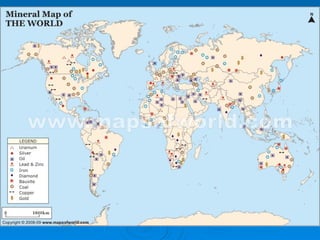
 Mineral based industries are primary
  industries that use mineral ores as their
  raw materials. The products of these
  industries feed other industries.
BULLETS
 Marine  based industries use products
  from the sea and oceans as raw materials.
  Industries processing sea food or
  manufacturing fish oil are some examples.
 Forest based industries utilise forest
  produce as raw materials. The industries
  associated with forests are pulp and
  paper, pharmaceuticals, furniture and
  buildings.
BULLETS
 Industries can be classified into private
  sector, state owned or public sector, joint
  sector and cooperative sector.
 Private sector industries are owned and
  operated by individuals or a group of
  individuals.
 The public sector industries are owned
  and operated by the government, such as
  Hindustan Aeronautics Limited and Steel
  Authority of India Limited.
BULLETS
 Joint sector industries are owned and
  operated by the state and individuals or a
  group of individuals. Maruti Udyog Limited
  is an example of joint sector industry.
 Co-operative sector industries are owned
  and operated by the producers or
  suppliers of raw materials, workers or
  both. Anand Milk Union Limited and
  Sudha Dairy are a success stories of a co-
  operative venture.
SUDHA DAIRY
BULLETS
 The  factors affecting the location of
  industries are the availability of raw
  material, land, water, labour, power,
  capital, transport and market.
 An industrial system consists of inputs,
  processes and outputs. The inputs are the
  raw materials, labour and costs of land,
  transport, power and other infrastructure.
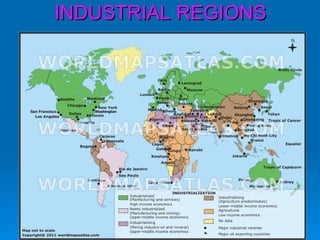
INDUSTRIAL REGIONS
BULLETS
 Industrial regions emerge when a number
  of industries locate close to each other
  and share the benefits of their closeness.
 India has several industrial regions like
  Mumbai-Pune cluster, Bangalore-Tamil
  Nadu region, Hugli region, Ahmedabad-
  Baroda region, Chottanagpur industrial
  belt, Vishakhapatnam-Guntur belt,
  Gurgaon-Delhi-Meerut region and the
  Kollam-Thiruvanathapuram industrial
  cluster.
UNION CARBIDE
BULLETS
 The  world’s major industries are the iron
  and steel industry, the textile industry and
  the information technology industry.
 The countries in which iron and steel
  industry is located are Germany, USA,
  China, Japan and Russia.
 Textile industry is concentrated in India,
  Hong Kong, South Korea, Japan and
  Taiwan.
BULLETS
 The  major hubs of Information technology
  industry are the Silicon valley of Central
  California and the Bangalore region of
  India.
 Like other industries iron and steel
  industry too comprises various inputs,
  processes and outputs. This is a feeder
  industry whose products are used as raw
  material for other industries.
STEEL INDUSTRY
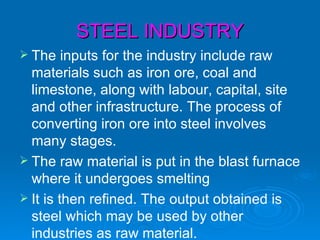
 The    inputs for the industry include raw
  materials such as iron ore, coal and
  limestone, along with labour, capital, site
  and other infrastructure. The process of
  converting iron ore into steel involves
  many stages.
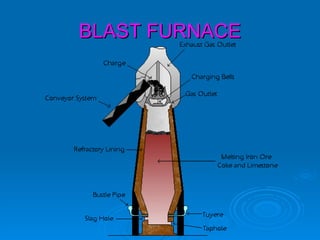
 The raw material is put in the blast furnace
  where it undergoes smelting
 It is then refined. The output obtained is
  steel which may be used by other
  industries as raw material.
BLAST FURNACE
BULLETS
 Steel  is tough and it can easily be shaped,
  cut, or made into wire. Special alloys of
  steel can be made by adding small
  amounts of other metals such as
  aluminium, nickel, and copper. Alloys give
  steel unusual hardness, toughness, or
  ability to resist rust.
 Before 1800 A.D. iron and steel industry
  was located where raw materials, power
  supply and running water were easily
  available.
BULLETS
A   the important steel producing centres
  such as Bhilai, Durgapur, Burnpur,
  Jamshedpur, Rourkela, Bokaro are
  situated in a region that spreads over four
  states — West Bengal, Jharkhand, Orissa
  and Chhattisgarh.
 Bhadravati and Vijay Nagar in Karnataka,
  Vishakhapatnam in Andhra Pradesh,
  Salem in Tamil Nadu are other important
  steel centres utilising local resources.
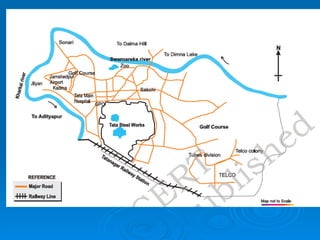
TATA STEEL INDUSTRY
 Before 1947, there was only one iron and
 steel plant in the country – Tata Iron and
 Steel Company Limited (TISCO). It was
 privately owned. After Independence, the
 government took the initiative and set up
 several iron and steel plants. TISCO was
 started in 1907 at Sakchi, near the
 confluence of the rivers Subarnarekha and
 Kharkai in Jharkhand. Geographically,
 Jamshedpur is the most conveniently
 situated iron and steel centre in the
 country.
Pittsburgh
 Pittsburgh  It is an important steel city of
 the United States of America. The steel
 industry at Pittsburghenjoys locational
 advantages. Some of the raw material
 such as coal is available locally, while the
 iron ore comes from the iron mines at
 Minnesota, about 1500 km from
 Pittsburgh. Between these mines and
 Pittsburgh is one of the world’s best routes
 for shipping ore cheaply – the famous
 Great Lakes waterway.
BULLETS
 The  textile industry can be divided on the
  basis of raw materials used in them.
  Fibres are the raw material of textile
  industry.
 Fibres can be natural or man-made.
  Natural fibres are obtained from wool, silk,
  cotton, linen and jute. Man made fibres
  include nylon, polyester, acrylic and rayon.
BULLETS
 The  cotton textile industry is one of the
  oldest industries in the world. Till the
  industrial revolution in the 18th century,
  cotton cloth was made using hand
  spinning techniques (wheels) and looms.
 Today India, China, Japan and USA are
  the important producers of cotton textiles.
 The Muslins of Dhaka, Chintzes of
  Masulipatnam, Calicos of Calicut and
  Gold-wrought cotton pieces of Burhanpur,
  Surat and Vadodara were known
  worldwide for their quality and design.
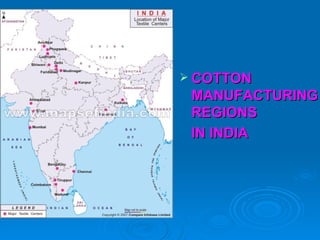
 COTTON
 MANUFACTURING
 REGIONS
 IN INDIA
INFORMATION TECHNOLOGY
 The   information technology industry
  deals in the storage, processing and
  distribution of information. Today, this
  industry has become global. This is due to
  a series of technological, political, and
  socio-economic events.
 There are other emerging information
  technology hubs in metropolitan centres of
  India such as Mumbai,New Delhi,
  Hyderabad and Chennai. Other cities such
  as Gurgaon, Pune, Thiruvanthapuram,
  Kochi and Chandigarh are also important
  centres of the IT industry.
A VIEW OF IT INDUSTRY
Industries

Industries

  • 1.
    INDUSTRIES Subject Teacher-Mrs Muniya Kamble Made By GHANASHYAM
  • 2.
    BULLETS  Secondary activities or manufacturing change raw materials into products of more value to people.  Industry refers to an economic activity that is concerned with production of goods, extraction of minerals or the provision of services.  Industries may be agro , mineral , marine and forest based depending on the type of raw materials they use.
  • 3.
    BULLETS  Agro based industries use plant and animal based products as their raw materials. Food processing, vegetable oil, cotton textile, dairy products and leather industries are examples of agro-based industries.  Mineral based industries are primary industries that use mineral ores as their raw materials. The products of these industries feed other industries.
  • 4.
    BULLETS  Marine based industries use products from the sea and oceans as raw materials. Industries processing sea food or manufacturing fish oil are some examples.  Forest based industries utilise forest produce as raw materials. The industries associated with forests are pulp and paper, pharmaceuticals, furniture and buildings.
  • 5.
    BULLETS  Industries canbe classified into private sector, state owned or public sector, joint sector and cooperative sector.  Private sector industries are owned and operated by individuals or a group of individuals.  The public sector industries are owned and operated by the government, such as Hindustan Aeronautics Limited and Steel Authority of India Limited.
  • 6.
    BULLETS  Joint sectorindustries are owned and operated by the state and individuals or a group of individuals. Maruti Udyog Limited is an example of joint sector industry.  Co-operative sector industries are owned and operated by the producers or suppliers of raw materials, workers or both. Anand Milk Union Limited and Sudha Dairy are a success stories of a co- operative venture.
  • 7.
  • 8.
    BULLETS  The factors affecting the location of industries are the availability of raw material, land, water, labour, power, capital, transport and market.  An industrial system consists of inputs, processes and outputs. The inputs are the raw materials, labour and costs of land, transport, power and other infrastructure.
  • 9.
  • 10.
    BULLETS  Industrial regionsemerge when a number of industries locate close to each other and share the benefits of their closeness.  India has several industrial regions like Mumbai-Pune cluster, Bangalore-Tamil Nadu region, Hugli region, Ahmedabad- Baroda region, Chottanagpur industrial belt, Vishakhapatnam-Guntur belt, Gurgaon-Delhi-Meerut region and the Kollam-Thiruvanathapuram industrial cluster.
  • 11.
  • 12.
    BULLETS  The world’s major industries are the iron and steel industry, the textile industry and the information technology industry.  The countries in which iron and steel industry is located are Germany, USA, China, Japan and Russia.  Textile industry is concentrated in India, Hong Kong, South Korea, Japan and Taiwan.
  • 13.
    BULLETS  The major hubs of Information technology industry are the Silicon valley of Central California and the Bangalore region of India.  Like other industries iron and steel industry too comprises various inputs, processes and outputs. This is a feeder industry whose products are used as raw material for other industries.
  • 14.
    STEEL INDUSTRY  The inputs for the industry include raw materials such as iron ore, coal and limestone, along with labour, capital, site and other infrastructure. The process of converting iron ore into steel involves many stages.  The raw material is put in the blast furnace where it undergoes smelting  It is then refined. The output obtained is steel which may be used by other industries as raw material.
  • 15.
  • 17.
    BULLETS  Steel is tough and it can easily be shaped, cut, or made into wire. Special alloys of steel can be made by adding small amounts of other metals such as aluminium, nickel, and copper. Alloys give steel unusual hardness, toughness, or ability to resist rust.  Before 1800 A.D. iron and steel industry was located where raw materials, power supply and running water were easily available.
  • 18.
    BULLETS A the important steel producing centres such as Bhilai, Durgapur, Burnpur, Jamshedpur, Rourkela, Bokaro are situated in a region that spreads over four states — West Bengal, Jharkhand, Orissa and Chhattisgarh.  Bhadravati and Vijay Nagar in Karnataka, Vishakhapatnam in Andhra Pradesh, Salem in Tamil Nadu are other important steel centres utilising local resources.
  • 19.
    TATA STEEL INDUSTRY Before 1947, there was only one iron and steel plant in the country – Tata Iron and Steel Company Limited (TISCO). It was privately owned. After Independence, the government took the initiative and set up several iron and steel plants. TISCO was started in 1907 at Sakchi, near the confluence of the rivers Subarnarekha and Kharkai in Jharkhand. Geographically, Jamshedpur is the most conveniently situated iron and steel centre in the country.
  • 21.
    Pittsburgh  Pittsburgh It is an important steel city of the United States of America. The steel industry at Pittsburghenjoys locational advantages. Some of the raw material such as coal is available locally, while the iron ore comes from the iron mines at Minnesota, about 1500 km from Pittsburgh. Between these mines and Pittsburgh is one of the world’s best routes for shipping ore cheaply – the famous Great Lakes waterway.
  • 22.
    BULLETS  The textile industry can be divided on the basis of raw materials used in them. Fibres are the raw material of textile industry.  Fibres can be natural or man-made. Natural fibres are obtained from wool, silk, cotton, linen and jute. Man made fibres include nylon, polyester, acrylic and rayon.
  • 23.
    BULLETS  The cotton textile industry is one of the oldest industries in the world. Till the industrial revolution in the 18th century, cotton cloth was made using hand spinning techniques (wheels) and looms.  Today India, China, Japan and USA are the important producers of cotton textiles.  The Muslins of Dhaka, Chintzes of Masulipatnam, Calicos of Calicut and Gold-wrought cotton pieces of Burhanpur, Surat and Vadodara were known worldwide for their quality and design.
  • 24.
     COTTON MANUFACTURING REGIONS IN INDIA
  • 25.
    INFORMATION TECHNOLOGY  The information technology industry deals in the storage, processing and distribution of information. Today, this industry has become global. This is due to a series of technological, political, and socio-economic events.  There are other emerging information technology hubs in metropolitan centres of India such as Mumbai,New Delhi, Hyderabad and Chennai. Other cities such as Gurgaon, Pune, Thiruvanthapuram, Kochi and Chandigarh are also important centres of the IT industry.
  • 26.
    A VIEW OFIT INDUSTRY