CoBI Workshop, 17th IEEE Conference on Business Informatics 13th -
16th July 2015
Capability Patterns as the Enablers for
Model-based Development of Business
Context-aware Applications
Janis Stirna, Jelena Zdravkovic, Martin
Henkel, Jānis Kampars
Outline
• Problem statement
• Our proposal
• Meta-models
• Architectural overview of CDD
• Usage example
• Conclusions & future work
2
Problem statement
• The need to adapt according to various
situations in which business applications
are used (e.g. context)
• Model Driven Development (MDD) mostly
relies on the models defined on a relatively
low abstraction level
• Enterprise Modeling (EM) models are
complex, not matching the dynamics of the
organizational change
3
Our proposal
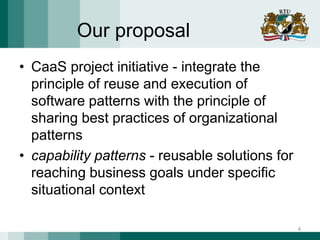
• CaaS project initiative - integrate the
principle of reuse and execution of
software patterns with the principle of
sharing best practices of organizational
patterns
• capability patterns - reusable solutions for
reaching business goals under specific
situational context
4
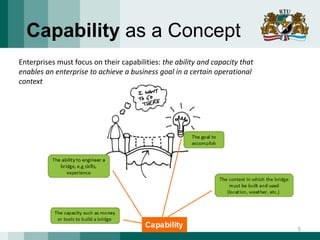
Capability as a Concept
Enterprises must focus on their capabilities: the ability and capacity that
enables an enterprise to achieve a business goal in a certain operational
context
5
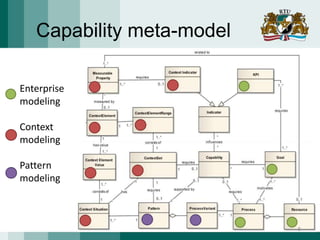
Capability meta-model
Enterprise
modeling
Context
modeling
Pattern
modeling
6
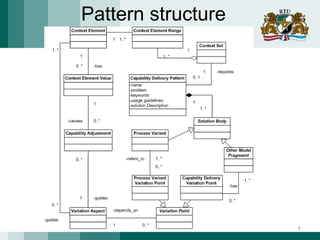
Pattern structure
7
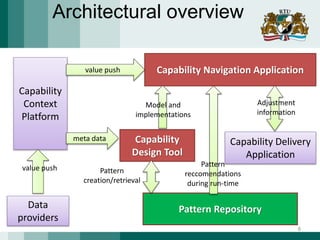
Architectural overview
Capability Navigation Application
Capability
Design Tool
Capability
Context
Platform
Data
providers
value push
Capability Delivery
Application
meta data
Model and
implementations
Adjustment
information
Pattern Repository
Pattern
reccomendations
during run-time
value push Pattern
creation/retrieval
8
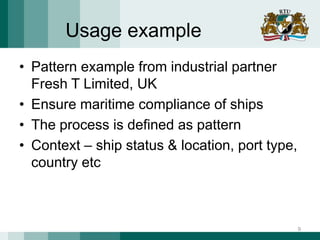
Usage example
• Pattern example from industrial partner
Fresh T Limited, UK
• Ensure maritime compliance of ships
• The process is defined as pattern
• Context – ship status & location, port type,
country etc
9
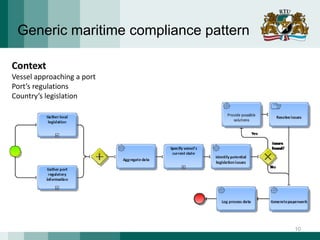
Generic maritime compliance pattern
Context
Vessel approaching a port
Port’s regulations
Country’s legislation
10
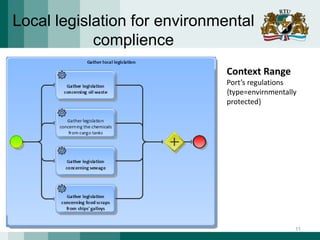
Local legislation for environmental
complience
Context Range
Port’s regulations
{type=envirnmentally
protected}
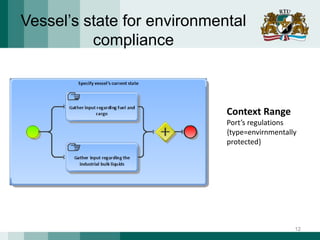
11
Vessel’s state for environmental
compliance
Context Range
Port’s regulations
{type=envirnmentally
protected}
12
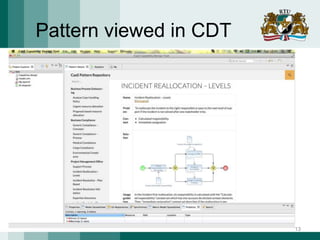
Pattern viewed in CDT
13
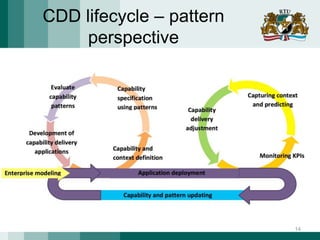
CDD lifecycle – pattern
perspective
14
Conclusion & future work
• Identified ways of using patterns for
supporting Capability Driven Development
– Integrate patterns in the CDD lifecycle
– Designing capability delivery from reusable model
fragments
– Meta-model used to represent patterns
• Development of the next version for the
pattern repository
– Better integration with CDT
– Integration with CNA
– Web service API
15

Capability Patterns as the Enablers for Model-based Development of Business Context-aware Applications

  • 1.
    CoBI Workshop, 17thIEEE Conference on Business Informatics 13th - 16th July 2015 Capability Patterns as the Enablers for Model-based Development of Business Context-aware Applications Janis Stirna, Jelena Zdravkovic, Martin Henkel, Jānis Kampars
  • 2.
    Outline • Problem statement •Our proposal • Meta-models • Architectural overview of CDD • Usage example • Conclusions & future work 2
  • 3.
    Problem statement • Theneed to adapt according to various situations in which business applications are used (e.g. context) • Model Driven Development (MDD) mostly relies on the models defined on a relatively low abstraction level • Enterprise Modeling (EM) models are complex, not matching the dynamics of the organizational change 3
  • 4.
    Our proposal • CaaSproject initiative - integrate the principle of reuse and execution of software patterns with the principle of sharing best practices of organizational patterns • capability patterns - reusable solutions for reaching business goals under specific situational context 4
  • 5.
    Capability as aConcept Enterprises must focus on their capabilities: the ability and capacity that enables an enterprise to achieve a business goal in a certain operational context 5
  • 6.
  • 7.
  • 8.
    Architectural overview Capability NavigationApplication Capability Design Tool Capability Context Platform Data providers value push Capability Delivery Application meta data Model and implementations Adjustment information Pattern Repository Pattern reccomendations during run-time value push Pattern creation/retrieval 8
  • 9.
    Usage example • Patternexample from industrial partner Fresh T Limited, UK • Ensure maritime compliance of ships • The process is defined as pattern • Context – ship status & location, port type, country etc 9
  • 10.
    Generic maritime compliancepattern Context Vessel approaching a port Port’s regulations Country’s legislation 10
  • 11.
    Local legislation forenvironmental complience Context Range Port’s regulations {type=envirnmentally protected} 11
  • 12.
    Vessel’s state forenvironmental compliance Context Range Port’s regulations {type=envirnmentally protected} 12
  • 13.
  • 14.
    CDD lifecycle –pattern perspective 14
  • 15.
    Conclusion & futurework • Identified ways of using patterns for supporting Capability Driven Development – Integrate patterns in the CDD lifecycle – Designing capability delivery from reusable model fragments – Meta-model used to represent patterns • Development of the next version for the pattern repository – Better integration with CDT – Integration with CNA – Web service API 15

Editor's Notes

  • #7 The theoretical and methodological foundation for pattern use in capability-oriented software applications is provided by the core capability meta-model (CMM) in Figure 1, and in details presented in [12]. CMM is developed on the basis of requirements from the industrial project partners, and related research on capabilities.