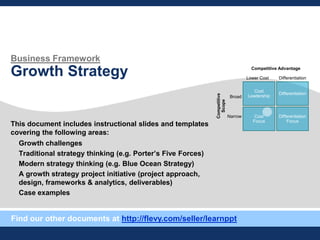
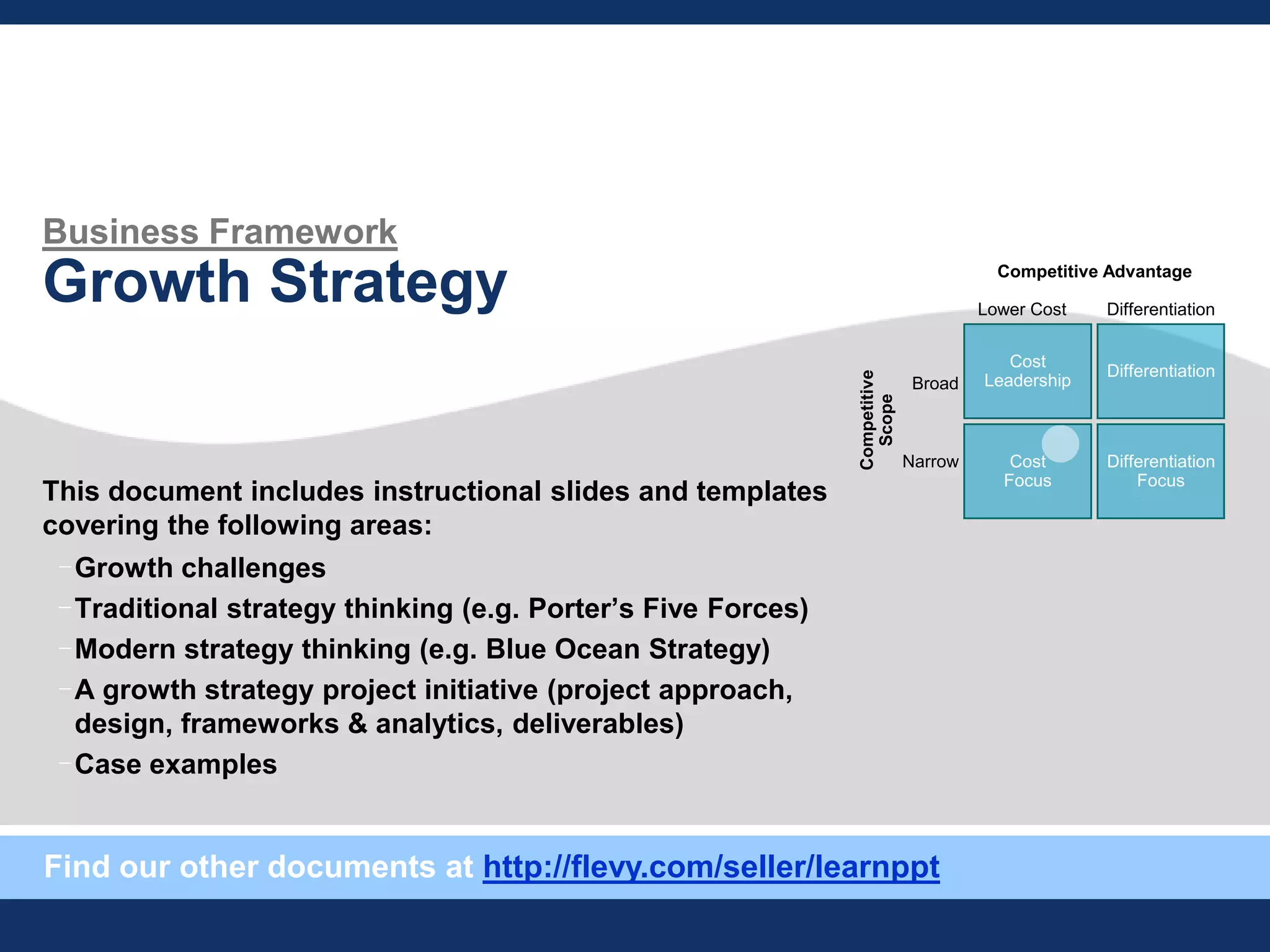
Business Framework
Growth Strategy
This document includes instructional slides and templates
covering the following areas:
-Growth challenges
-Traditional strategy thinking (e.g. Porter’s Five Forces)
-Modern strategy thinking (e.g. Blue Ocean Strategy)
-A growth strategy project initiative (project approach,
design, frameworks & analytics, deliverables)
-Case examples
Competitive Advantage
Lower Cost Differentiation
Cost
Leadership
Differentiation
Cost
Focus
Differentiation
Focus
Competitive
Scope
Broad
Narrow
Find our other documents at http://flevy.com/seller/learnppt
3
Contents
• Growth Challenge
• Traditional Strategy Thinking
- Porter‘s Five Forces
• Modern Strategy Thinking
- Blue Ocean Strategy
- Blue Ocean Examples
• Growth Strategy Project
- Project Approach
- Project Design
- Analytics & Frameworks
- Deliverables
5
Few breakthrough growth
offerings identified
Focus is on existing markets
and demand (e.g., line
extensions, substitutes)
Current
Situation
Strategic
Issues
Create customer value
(Value Innovation)
Growth at the expense of
profitability
Benefit trade-offs are not
made (e.g., the right mix of
attributes)
Pricing and cost structure
are driven by competition
Align value proposition
with operations/organization
Lack of execution follow-
through for growth
initiatives
Effectively execute
strategy
Consumers are increasingly
sophisticated and hard to
please
The
Resolution
Metrics and rewards based
on current operations
Lack of committed financial
resources
Organizational structure is
not in line with new business
Opportunities are defined by
internal/operational
capabilities
Structure and processes to
develop and manage growth
do not exist
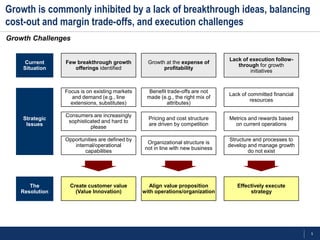
Growth is commonly inhibited by a lack of breakthrough ideas, balancing
cost-out and margin trade-offs, and execution challenges
Growth Challenges
7
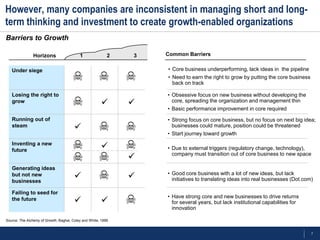
However, many companies are inconsistent in managing short and long-
term thinking and investment to create growth-enabled organizations
Source: The Alchemy of Growth, Baghai, Coley and White, 1999.
Horizons 1 2 3 Common Barriers
Under siege
Losing the right to
grow  
Running out of
steam 
Inventing a new
future


Generating ideas
but not new
businesses
 
Failing to seed for
the future  
• Core business underperforming, lack ideas in the pipeline
• Need to earn the right to grow by putting the core business
back on track
• Obsessive focus on new business without developing the
core, spreading the organization and management thin
• Basic performance improvement in core required
• Strong focus on core business, but no focus on next big idea;
businesses could mature, position could be threatened
• Start journey toward growth
• Due to external triggers (regulatory change, technology),
company must transition out of core business to new space
• Good core business with a lot of new ideas, but lack
initiatives to translating ideas into real businesses (Dot.com)
• Have strong core and new businesses to drive returns
for several years, but lack institutional capabilities for
innovation
Barriers to Growth
9
Contents
• Growth Challenge
• Traditional Strategy Thinking
- Porter‘s Five Forces
• Modern Strategy Thinking
- Blue Ocean Strategy
- Blue Ocean Examples
• Growth Strategy Project
- Project Approach
- Project Design
- Analytics & Frameworks
- Deliverables
11
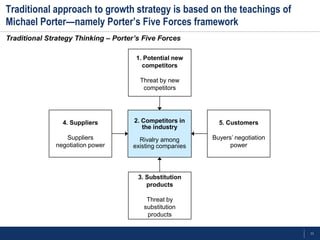
Traditional approach to growth strategy is based on the teachings of
Michael Porter—namely Porter’s Five Forces framework
4. Suppliers
Suppliers
negotiation power
2. Competitors in
the industry
Rivalry among
existing companies
1. Potential new
competitors
Threat by new
competitors
3. Substitution
products
Threat by
substitution
products
5. Customers
Buyers‘ negotiation
power
Traditional Strategy Thinking – Porter’s Five Forces
13
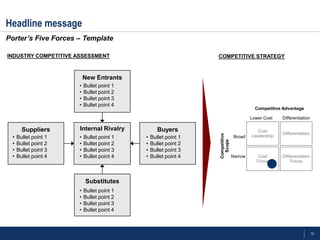
Headline message
Porter’s Five Forces – Template
Suppliers Internal Rivalry
New Entrants
Substitutes
Buyers
• Bullet point 1
• Bullet point 2
• Bullet point 3
• Bullet point 4
• Bullet point 1
• Bullet point 2
• Bullet point 3
• Bullet point 4
• Bullet point 1
• Bullet point 2
• Bullet point 3
• Bullet point 4
• Bullet point 1
• Bullet point 2
• Bullet point 3
• Bullet point 4
• Bullet point 1
• Bullet point 2
• Bullet point 3
• Bullet point 4
Competitive Advantage
Lower Cost Differentiation
Cost
Leadership
Differentiation
Cost
Focus
Differentiation
Focus
Competitive
Scope
Broad
Narrow
INDUSTRY COMPETITIVE ASSESSMENT COMPETITIVE STRATEGY
15
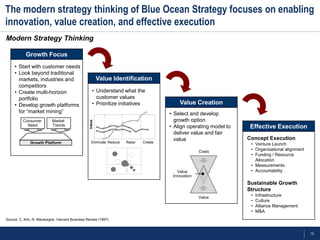
The modern strategy thinking of Blue Ocean Strategy focuses on enabling
innovation, value creation, and effective execution
Growth Focus
Source: C. Kim, R. Mauborgne, Harvard Business Review (1997).
Value Identification
Value Creation
Effective Execution
• Start with customer needs
• Look beyond traditional
markets, industries and
competitors
• Create multi-horizon
portfolio
• Develop growth platforms
for ―market mining‖
• Understand what the
customer values
• Prioritize initiatives
Growth Platform
Consumer
Need
Market
Trends
Value
• Select and develop
growth option
• Align operating model to
deliver value and fair
value Concept Execution
• Venture Launch
• Organizational alignment
• Funding / Resource
Allocation
• Measurements
• Accountability
Sustainable Growth
Structure
• Infrastructure
• Culture
• Alliance Management
• M&A
Modern Strategy Thinking
Eliminate Reduce Raise Create
Costs
Value
Value
Innovation
17
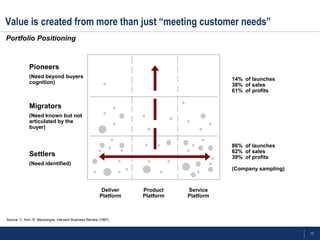
Pioneers
(Need beyond buyers
cognition)
14% of launches
38% of sales
61% of profits
86% of launches
62% of sales
39% of profits
(Company sampling)
Source: C. Kim, R. Mauborgne, Harvard Business Review (1997)
Deliver
Platform
Product
Platform
Service
Platform
Value is created from more than just “meeting customer needs”
Portfolio Positioning
Migrators
(Need known but not
articulated by the
buyer)
Settlers
(Need identified)
19
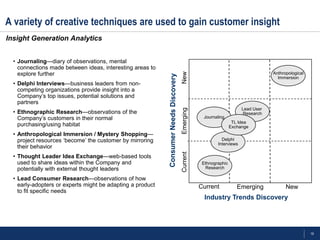
• Journaling—diary of observations, mental
connections made between ideas, interesting areas to
explore further
• Delphi Interviews—business leaders from non-
competing organizations provide insight into a
Company‘s top issues, potential solutions and
partners
• Ethnographic Research—observations of the
Company‘s customers in their normal
purchasing/using habitat
• Anthropological Immersion / Mystery Shopping—
project resources ‗become‘ the customer by mirroring
their behavior
• Thought Leader Idea Exchange—web-based tools
used to share ideas within the Company and
potentially with external thought leaders
• Lead Consumer Research—observations of how
early-adopters or experts might be adapting a product
to fit specific needs
Industry Trends Discovery
Current Emerging New
Anthropological
Immersion
Ethnographic
Research
Lead User
Research
Delphi
Interviews
Journaling
TL Idea
Exchange
A variety of creative techniques are used to gain customer insight
Insight Generation Analytics
21
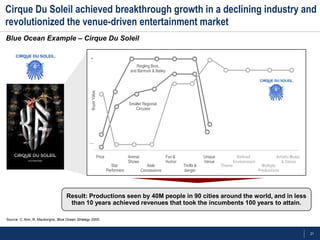
Cirque Du Soleil achieved breakthrough growth in a declining industry and
revolutionized the venue-driven entertainment market
Source: C. Kim, R. Mauborgne, Blue Ocean Strategy 2005.
Result: Productions seen by 40M people in 90 cities around the world, and in less
than 10 years achieved revenues that took the incumbents 100 years to attain.
Price
Star
Performers
Animal
Shows
Aisle
Concessions
Fun &
Humor
Thrills &
danger
Unique
Venue
Theme
Refined
Environment
Multiple
Productions
Artistic Music
& Dance
BuyerValue
__
+
Ringling Bros.
and Barmum & Bailey
Smaller Regional
Circuses
Blue Ocean Example – Cirque Du Soleil
23
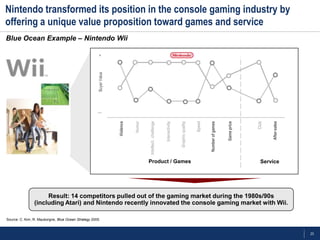
Nintendo transformed its position in the console gaming industry by
offering a unique value proposition toward games and service
Source: C. Kim, R. Mauborgne, Blue Ocean Strategy 2005.
Result: 14 competitors pulled out of the gaming market during the 1980s/90s
(including Atari) and Nintendo recently innovated the console gaming market with Wii.
Violence
Humor
Intellect.challenge
Interactivity
Graphicquality
Speed
Numberofgames
Gameprice
Club
After-sales
Product / Games Service
BuyerValue
__
+
Blue Ocean Example – Nintendo Wii
25
Contents
• Growth Challenge
• Traditional Strategy Thinking
- Porter‘s Five Forces
• Modern Strategy Thinking
- Blue Ocean Strategy
- Blue Ocean Examples
• Growth Strategy Project
- Project Approach
- Project Design
- Analytics & Frameworks
- Deliverables
27
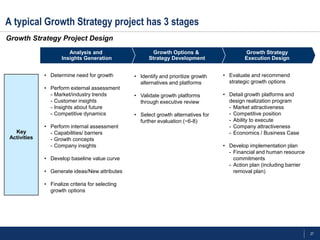
A typical Growth Strategy project has 3 stages
• Determine need for growth
• Perform external assessment
- Market/industry trends
- Customer insights
- Insights about future
- Competitive dynamics
• Perform internal assessment
- Capabilities/ barriers
- Growth concepts
- Company insights
• Develop baseline value curve
• Generate ideas/New attributes
• Finalize criteria for selecting
growth options
• Evaluate and recommend
strategic growth options
• Detail growth platforms and
design realization program
- Market attractiveness
- Competitive position
- Ability to execute
- Company attractiveness
- Economics / Business Case
• Develop implementation plan
- Financial and human resource
commitments
- Action plan (including barrier
removal plan)
• Identify and prioritize growth
alternatives and platforms
• Validate growth platforms
through executive review
• Select growth alternatives for
further evaluation (~6-8)
Growth Strategy Project Design
Key
Activities
Growth Strategy
Execution Design
Growth Options &
Strategy Development
Analysis and
Insights Generation
29
• Growth Mission: Articulation of the direction that Client will pursue to reach
growth objectives
• Growth Platforms: Outline of areas or categories that will provide the focus
for growth initiatives
• Breakthrough Offerings: Identification of at least one new breakthrough
product/service that fits within identified platforms
• Go-to-Market / Product and Market Strategy: Description of service
offerings, pricing, channel and sales model
• Financial and Human Investment Decisions: Outline of investments that
will be made to support growth initiatives
• Growth Goals/Value Proposition: Articulation of the bold goals that Client
expects based on the expected value proposition from growth initiatives
• Barrier Removal Plan: Outline of necessary changes to existing
organization processes that would serve to ―incubate‖ overall growth
• Opportunity scans for M&A and pre-deal strategy formulation
Some project deliverables could include…
Growth Strategy Project – Deliverables

Growth Strategy

  • 1.
    Business Framework Growth Strategy Thisdocument includes instructional slides and templates covering the following areas: -Growth challenges -Traditional strategy thinking (e.g. Porter’s Five Forces) -Modern strategy thinking (e.g. Blue Ocean Strategy) -A growth strategy project initiative (project approach, design, frameworks & analytics, deliverables) -Case examples Competitive Advantage Lower Cost Differentiation Cost Leadership Differentiation Cost Focus Differentiation Focus Competitive Scope Broad Narrow Find our other documents at http://flevy.com/seller/learnppt
  • 2.
    3 Contents • Growth Challenge •Traditional Strategy Thinking - Porter‘s Five Forces • Modern Strategy Thinking - Blue Ocean Strategy - Blue Ocean Examples • Growth Strategy Project - Project Approach - Project Design - Analytics & Frameworks - Deliverables
  • 3.
    5 Few breakthrough growth offeringsidentified Focus is on existing markets and demand (e.g., line extensions, substitutes) Current Situation Strategic Issues Create customer value (Value Innovation) Growth at the expense of profitability Benefit trade-offs are not made (e.g., the right mix of attributes) Pricing and cost structure are driven by competition Align value proposition with operations/organization Lack of execution follow- through for growth initiatives Effectively execute strategy Consumers are increasingly sophisticated and hard to please The Resolution Metrics and rewards based on current operations Lack of committed financial resources Organizational structure is not in line with new business Opportunities are defined by internal/operational capabilities Structure and processes to develop and manage growth do not exist Growth is commonly inhibited by a lack of breakthrough ideas, balancing cost-out and margin trade-offs, and execution challenges Growth Challenges
  • 4.
    7 However, many companiesare inconsistent in managing short and long- term thinking and investment to create growth-enabled organizations Source: The Alchemy of Growth, Baghai, Coley and White, 1999. Horizons 1 2 3 Common Barriers Under siege Losing the right to grow   Running out of steam  Inventing a new future   Generating ideas but not new businesses   Failing to seed for the future   • Core business underperforming, lack ideas in the pipeline • Need to earn the right to grow by putting the core business back on track • Obsessive focus on new business without developing the core, spreading the organization and management thin • Basic performance improvement in core required • Strong focus on core business, but no focus on next big idea; businesses could mature, position could be threatened • Start journey toward growth • Due to external triggers (regulatory change, technology), company must transition out of core business to new space • Good core business with a lot of new ideas, but lack initiatives to translating ideas into real businesses (Dot.com) • Have strong core and new businesses to drive returns for several years, but lack institutional capabilities for innovation Barriers to Growth
  • 5.
    9 Contents • Growth Challenge •Traditional Strategy Thinking - Porter‘s Five Forces • Modern Strategy Thinking - Blue Ocean Strategy - Blue Ocean Examples • Growth Strategy Project - Project Approach - Project Design - Analytics & Frameworks - Deliverables
  • 6.
    11 Traditional approach togrowth strategy is based on the teachings of Michael Porter—namely Porter’s Five Forces framework 4. Suppliers Suppliers negotiation power 2. Competitors in the industry Rivalry among existing companies 1. Potential new competitors Threat by new competitors 3. Substitution products Threat by substitution products 5. Customers Buyers‘ negotiation power Traditional Strategy Thinking – Porter’s Five Forces
  • 7.
    13 Headline message Porter’s FiveForces – Template Suppliers Internal Rivalry New Entrants Substitutes Buyers • Bullet point 1 • Bullet point 2 • Bullet point 3 • Bullet point 4 • Bullet point 1 • Bullet point 2 • Bullet point 3 • Bullet point 4 • Bullet point 1 • Bullet point 2 • Bullet point 3 • Bullet point 4 • Bullet point 1 • Bullet point 2 • Bullet point 3 • Bullet point 4 • Bullet point 1 • Bullet point 2 • Bullet point 3 • Bullet point 4 Competitive Advantage Lower Cost Differentiation Cost Leadership Differentiation Cost Focus Differentiation Focus Competitive Scope Broad Narrow INDUSTRY COMPETITIVE ASSESSMENT COMPETITIVE STRATEGY
  • 8.
    15 The modern strategythinking of Blue Ocean Strategy focuses on enabling innovation, value creation, and effective execution Growth Focus Source: C. Kim, R. Mauborgne, Harvard Business Review (1997). Value Identification Value Creation Effective Execution • Start with customer needs • Look beyond traditional markets, industries and competitors • Create multi-horizon portfolio • Develop growth platforms for ―market mining‖ • Understand what the customer values • Prioritize initiatives Growth Platform Consumer Need Market Trends Value • Select and develop growth option • Align operating model to deliver value and fair value Concept Execution • Venture Launch • Organizational alignment • Funding / Resource Allocation • Measurements • Accountability Sustainable Growth Structure • Infrastructure • Culture • Alliance Management • M&A Modern Strategy Thinking Eliminate Reduce Raise Create Costs Value Value Innovation
  • 9.
    17 Pioneers (Need beyond buyers cognition) 14%of launches 38% of sales 61% of profits 86% of launches 62% of sales 39% of profits (Company sampling) Source: C. Kim, R. Mauborgne, Harvard Business Review (1997) Deliver Platform Product Platform Service Platform Value is created from more than just “meeting customer needs” Portfolio Positioning Migrators (Need known but not articulated by the buyer) Settlers (Need identified)
  • 10.
    19 • Journaling—diary ofobservations, mental connections made between ideas, interesting areas to explore further • Delphi Interviews—business leaders from non- competing organizations provide insight into a Company‘s top issues, potential solutions and partners • Ethnographic Research—observations of the Company‘s customers in their normal purchasing/using habitat • Anthropological Immersion / Mystery Shopping— project resources ‗become‘ the customer by mirroring their behavior • Thought Leader Idea Exchange—web-based tools used to share ideas within the Company and potentially with external thought leaders • Lead Consumer Research—observations of how early-adopters or experts might be adapting a product to fit specific needs Industry Trends Discovery Current Emerging New Anthropological Immersion Ethnographic Research Lead User Research Delphi Interviews Journaling TL Idea Exchange A variety of creative techniques are used to gain customer insight Insight Generation Analytics
  • 11.
    21 Cirque Du Soleilachieved breakthrough growth in a declining industry and revolutionized the venue-driven entertainment market Source: C. Kim, R. Mauborgne, Blue Ocean Strategy 2005. Result: Productions seen by 40M people in 90 cities around the world, and in less than 10 years achieved revenues that took the incumbents 100 years to attain. Price Star Performers Animal Shows Aisle Concessions Fun & Humor Thrills & danger Unique Venue Theme Refined Environment Multiple Productions Artistic Music & Dance BuyerValue __ + Ringling Bros. and Barmum & Bailey Smaller Regional Circuses Blue Ocean Example – Cirque Du Soleil
  • 12.
    23 Nintendo transformed itsposition in the console gaming industry by offering a unique value proposition toward games and service Source: C. Kim, R. Mauborgne, Blue Ocean Strategy 2005. Result: 14 competitors pulled out of the gaming market during the 1980s/90s (including Atari) and Nintendo recently innovated the console gaming market with Wii. Violence Humor Intellect.challenge Interactivity Graphicquality Speed Numberofgames Gameprice Club After-sales Product / Games Service BuyerValue __ + Blue Ocean Example – Nintendo Wii
  • 13.
    25 Contents • Growth Challenge •Traditional Strategy Thinking - Porter‘s Five Forces • Modern Strategy Thinking - Blue Ocean Strategy - Blue Ocean Examples • Growth Strategy Project - Project Approach - Project Design - Analytics & Frameworks - Deliverables
  • 14.
    27 A typical GrowthStrategy project has 3 stages • Determine need for growth • Perform external assessment - Market/industry trends - Customer insights - Insights about future - Competitive dynamics • Perform internal assessment - Capabilities/ barriers - Growth concepts - Company insights • Develop baseline value curve • Generate ideas/New attributes • Finalize criteria for selecting growth options • Evaluate and recommend strategic growth options • Detail growth platforms and design realization program - Market attractiveness - Competitive position - Ability to execute - Company attractiveness - Economics / Business Case • Develop implementation plan - Financial and human resource commitments - Action plan (including barrier removal plan) • Identify and prioritize growth alternatives and platforms • Validate growth platforms through executive review • Select growth alternatives for further evaluation (~6-8) Growth Strategy Project Design Key Activities Growth Strategy Execution Design Growth Options & Strategy Development Analysis and Insights Generation
  • 15.
    29 • Growth Mission:Articulation of the direction that Client will pursue to reach growth objectives • Growth Platforms: Outline of areas or categories that will provide the focus for growth initiatives • Breakthrough Offerings: Identification of at least one new breakthrough product/service that fits within identified platforms • Go-to-Market / Product and Market Strategy: Description of service offerings, pricing, channel and sales model • Financial and Human Investment Decisions: Outline of investments that will be made to support growth initiatives • Growth Goals/Value Proposition: Articulation of the bold goals that Client expects based on the expected value proposition from growth initiatives • Barrier Removal Plan: Outline of necessary changes to existing organization processes that would serve to ―incubate‖ overall growth • Opportunity scans for M&A and pre-deal strategy formulation Some project deliverables could include… Growth Strategy Project – Deliverables