Grammar
& Simple
Present
By: Prof. Carlos F. Barba Alférez
Nouns
What is a Noun?
A noun is a part of speech that denotes a person, animal,
place, thing, or idea. The English word noun has its roots in
the Latin word nomen, which means “name.” Every language
has words that are nouns. As you read the following
explanations, think about some words that might fit into each
category.
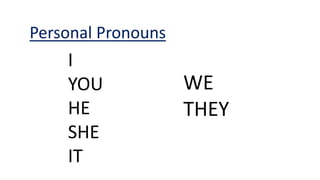
Personal Pronouns
I
YOU
HE
SHE
IT
WE
THEY
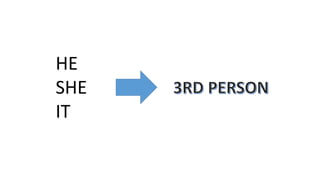
HE
SHE
IT
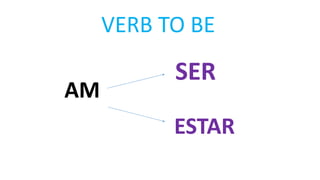
VERB TO BE
AM
SER
ESTAR
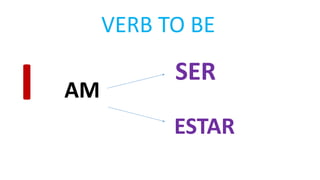
VERB TO BE
AM
SER
ESTAR
I
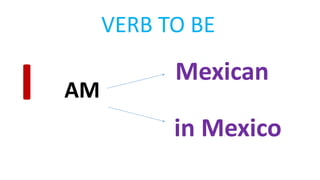
VERB TO BE
AM
Mexican
in Mexico
I
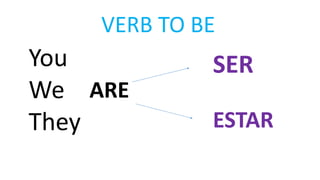
VERB TO BE
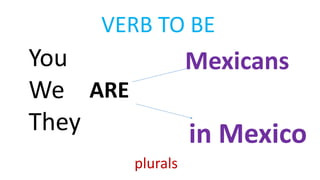
ARE
SER
ESTAR
You
We
They
VERB TO BE
ARE
Mexicans
in Mexico
You
We
They
plurals
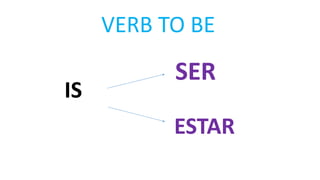
VERB TO BE
IS
SER
ESTAR
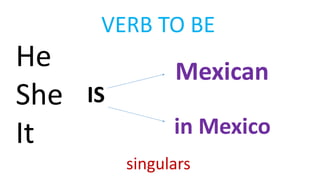
VERB TO BE
IS
Mexican
in Mexico
He
She
It
singulars
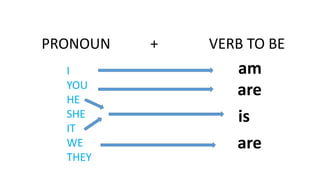
PRONOUN + VERB TO BE
I
YOU
HE
SHE
IT
WE
THEY
am
are
is
are
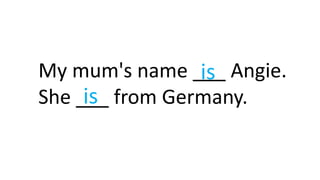
My mum's name ___ Angie.
She ___ from Germany.is
is
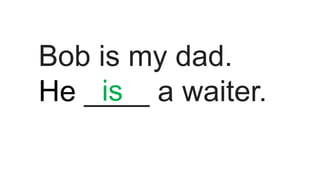
Bob is my dad.
He ____ a waiter.is
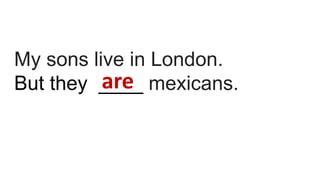
My sons live in London.
But they ____ mexicans.are
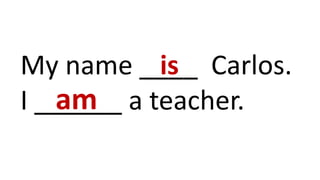
My name ____ Carlos.
I ______ a teacher.
is
am
1. For repeated
or regular actions
in the present
time period.
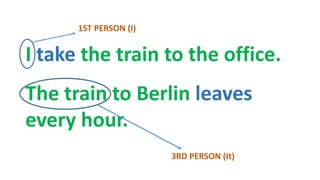
I take the train to the office.
The train to Berlin leaves
every hour.
3RD PERSON (It)
1ST PERSON (I)
2. For facts.
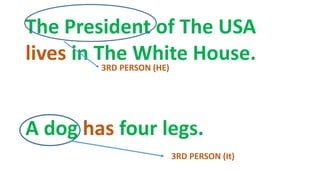
The President of The USA
lives in The White House.
A dog has four legs.
3RD PERSON (It)
3RD PERSON (HE)
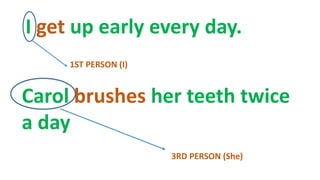
For habits.
I get up early every day.
Carol brushes her teeth twice
a day
3RD PERSON (She)
1ST PERSON (I)
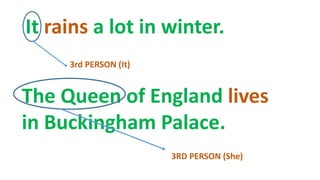
For things that
are always /
generally true.
It rains a lot in winter.
The Queen of England lives
in Buckingham Palace.
3RD PERSON (She)
3rd PERSON (It)
Verb Conjugation &
Spelling
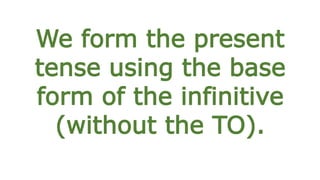
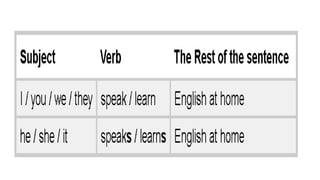
We form the present
tense using the base
form of the infinitive
(without the TO).
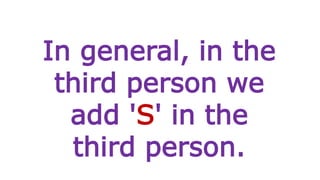
In general, in the
third person we
add 'S' in the
third person.
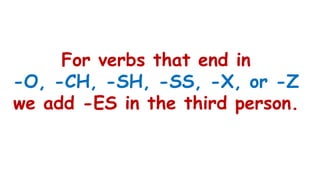
For verbs that end in
-O, -CH, -SH, -SS, -X, or -Z
we add -ES in the third person.
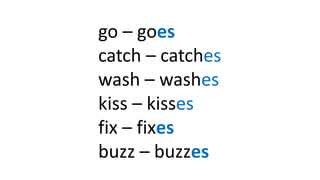
go – goes
catch – catches
wash – washes
kiss – kisses
fix – fixes
buzz – buzzes
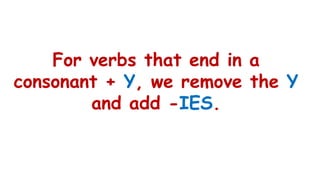
For verbs that end in a
consonant + Y, we remove the Y
and add -IES.
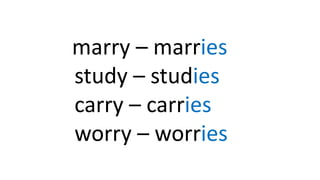
marry – marries
study – studies
carry – carries
worry – worries
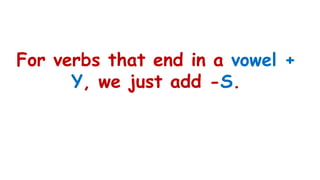
For verbs that end in a vowel +
Y, we just add -S.
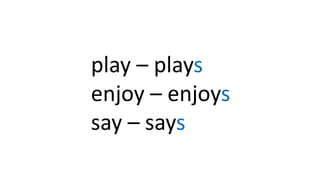
play – plays
enjoy – enjoys
say – says
Negative
Sentences in
the Simple
Present Tense
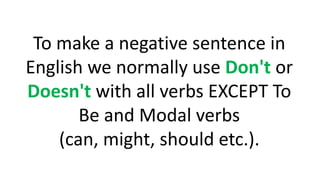
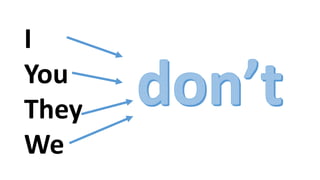
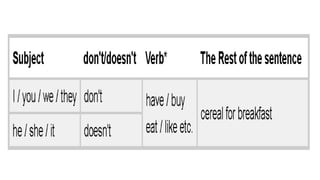
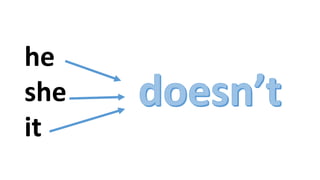
To make a negative sentence in
English we normally use Don't or
Doesn't with all verbs EXCEPT To
Be and Modal verbs
(can, might, should etc.).
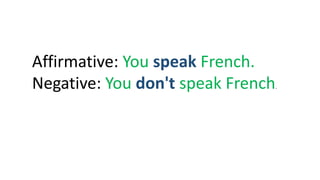
Affirmative: You speak French.
Negative: You don't speak French.
I
You
They
We
he
she
it
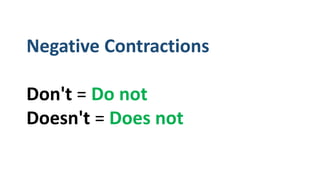
Negative Contractions
Don't = Do not
Doesn't = Does not
Word Order of
Negative Sentences
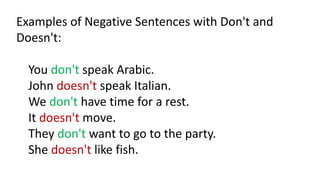
Examples of Negative Sentences with Don't and
Doesn't:
You don't speak Arabic.
John doesn't speak Italian.
We don't have time for a rest.
It doesn't move.
They don't want to go to the party.
She doesn't like fish.
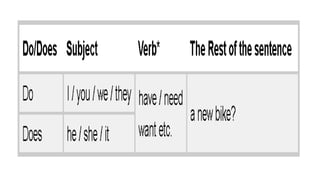
Questions in the Simple
Present Tense
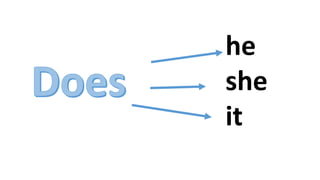
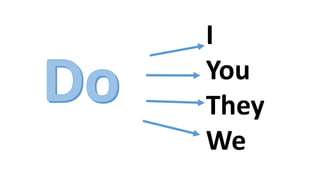
he
she
it
I
You
They
We
ROOTS
SPEECH

Simple present presentation