How Do Adults Learn?
The Big Picture….outcomes
Refresh knowledge and encourage CPD:
• Inside the brain – mysteries of learning
• How we remember and forget
• Making learning stick
• Dominance
• Styles
• Pyramid
• Attention span
• Accelerated Learning
Link to your training experiences
1. Three things you could do to enhance the
delegate’s learning?
2. Two things you could do that would reduce
the delegate’s learning?
Brain Quiz…..
Brain numbers answers: 18, 100,000, 75, 25, 100 billion, 300+
1. Number of ? miles of blood vessels
2. Your brain is ? % water
3. It uses ? % of your energy
4. Number of neurons ?
5. Speed ? mph info. passes around your brain
5. It stopped growing at ? age but is constantly rewiring itself
6. When is your brain more active? Awake or asleep?
7. Always creates true memories?
8. Your brain can not feel any pain?
9. When you’re asleep it creates a hormone to paralyse you?
10. Japanese researches may soon be able to put your
thoughts and dreams onto a screen?
Brain Development
* higher order
thinking
* problem-
solving
* understand
meaning
* emotions
* long term
memory
* basic survival
The effect of stress and emotions
on the brain…?
Stress:
• Causes the brain to go Reptilian…
• Blocks the Neo-Cortex and Limbic Systems
Emotions:
• The on/off switch to accessing higher learning
• Produces creativity….or anxiety
Memory - welcome to the Neuron…..
You have 100,000,000,000 of them in your
brain
Memory
Three levels of memory
1. Sensory:
Holds information for a few seconds or less
2. Short-term:
Hold information up to a minute
Q: How many items can ST remember at any
one time?
Let’s test it…….
Memory
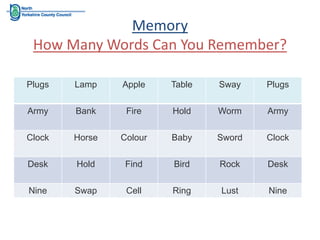
How Many Words Can You Remember?
Plugs Lamp Apple Table Sway Plugs
Army Bank Fire Hold Worm Army
Clock Horse Colour Baby Sword Clock
Desk Hold Find Bird Rock Desk
Nine Swap Cell Ring Lust Nine
Memory
3. Long-term:
• Capacity to hold information is
immeasurably large
• Information can be retained indefinitely
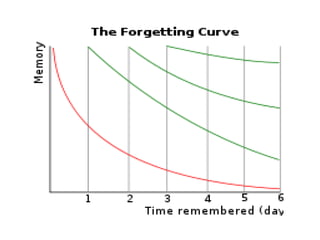
Forgetting Curve
Making Learning Memorable
• Demonstration
• Reading
• Teach others
• Lecture
• Discussion
• Audio-visual
• Practice doing
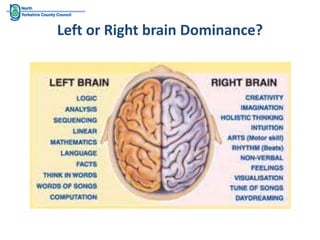
5%
facts
feelings
maths
tune of songs
arts
imagination
Left or Right brain Dominance?
Learning Styles
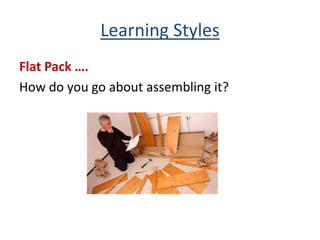
Flat Pack ….
How do you go about assembling it?
Learning Styles
Visual Learners:
• Think in terms of pictures
• Visual tools effective;
• Handouts, text, slides, graphs etc
Auditory Learners:
• Learn best by listening or speaking
• Lectures, discussions, reading aloud etc
Learning Styles
Kinaesthetic Learners (tactile):
• Learn best through touching, feeling and
experiencing that which they are trying to
learn
• They remember best by writing or physically
manipulating the information
Your Attention Span
Question:
How long is the average delegates attention span?
15-20 minutes…..
In a session, when is learning at the best:
Start, middle, end ?
BEM
What are the Implications for training?
Chunking
• Break up the session into 15-20 minute mini-
sessions
• Separate the mini sessions by something
active or different (ie review learning) lasting
only 2-5 minutes
• To refresh the attention span
Accelerated Learning Cycle

How do adults learn

  • 1.
  • 2.
    The Big Picture….outcomes Refreshknowledge and encourage CPD: • Inside the brain – mysteries of learning • How we remember and forget • Making learning stick • Dominance • Styles • Pyramid • Attention span • Accelerated Learning
  • 3.
    Link to yourtraining experiences 1. Three things you could do to enhance the delegate’s learning? 2. Two things you could do that would reduce the delegate’s learning?
  • 4.
    Brain Quiz….. Brain numbersanswers: 18, 100,000, 75, 25, 100 billion, 300+ 1. Number of ? miles of blood vessels 2. Your brain is ? % water 3. It uses ? % of your energy 4. Number of neurons ? 5. Speed ? mph info. passes around your brain 5. It stopped growing at ? age but is constantly rewiring itself 6. When is your brain more active? Awake or asleep? 7. Always creates true memories? 8. Your brain can not feel any pain? 9. When you’re asleep it creates a hormone to paralyse you? 10. Japanese researches may soon be able to put your thoughts and dreams onto a screen?
  • 5.
    Brain Development * higherorder thinking * problem- solving * understand meaning * emotions * long term memory * basic survival
  • 6.
    The effect ofstress and emotions on the brain…? Stress: • Causes the brain to go Reptilian… • Blocks the Neo-Cortex and Limbic Systems Emotions: • The on/off switch to accessing higher learning • Produces creativity….or anxiety
  • 7.
    Memory - welcometo the Neuron….. You have 100,000,000,000 of them in your brain
  • 8.
    Memory Three levels ofmemory 1. Sensory: Holds information for a few seconds or less 2. Short-term: Hold information up to a minute Q: How many items can ST remember at any one time? Let’s test it…….
  • 9.
    Memory How Many WordsCan You Remember? Plugs Lamp Apple Table Sway Plugs Army Bank Fire Hold Worm Army Clock Horse Colour Baby Sword Clock Desk Hold Find Bird Rock Desk Nine Swap Cell Ring Lust Nine
  • 10.
    Memory 3. Long-term: • Capacityto hold information is immeasurably large • Information can be retained indefinitely
  • 11.
  • 13.
    Making Learning Memorable •Demonstration • Reading • Teach others • Lecture • Discussion • Audio-visual • Practice doing 5%
  • 14.
  • 15.
    Left or Rightbrain Dominance?
  • 16.
    Learning Styles Flat Pack…. How do you go about assembling it?
  • 17.
    Learning Styles Visual Learners: •Think in terms of pictures • Visual tools effective; • Handouts, text, slides, graphs etc Auditory Learners: • Learn best by listening or speaking • Lectures, discussions, reading aloud etc
  • 18.
    Learning Styles Kinaesthetic Learners(tactile): • Learn best through touching, feeling and experiencing that which they are trying to learn • They remember best by writing or physically manipulating the information
  • 19.
    Your Attention Span Question: Howlong is the average delegates attention span? 15-20 minutes….. In a session, when is learning at the best: Start, middle, end ? BEM What are the Implications for training?
  • 20.
    Chunking • Break upthe session into 15-20 minute mini- sessions • Separate the mini sessions by something active or different (ie review learning) lasting only 2-5 minutes • To refresh the attention span
  • 21.