Waleed Th. Aletreby
A quality improvement process that seeks to
improve patient care and outcomes thorough
systematic review of care, against explicit criteria
and the implementation of change.
 That is to say the performance is being reviewed
(audited) to make sure that what should be done
is being done.
 And if not, it provides a framework for
improvements to be made.
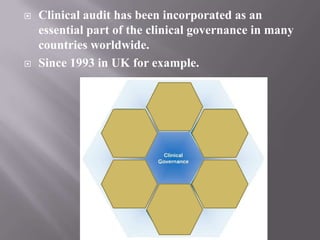
 Clinical audit has been incorporated as an
essential part of the clinical governance in many
countries worldwide.
 Since 1993 in UK for example.
Clinical auditing as part of the clinical governance has
many advantages and benefits to the organization:
 To identify whether standards are being met, and evidence
from research are being used in practice.
 To identify baselines for development of standards.
 To reduce clinical risk.
 To ensure cost effective use of resources, and effectiveness
of a service.
 To highlight problems, and help in the solution.
 To improve team working and communication.
 To improve patient care and outcomes.
 One of first ever clinical audits was undertaken
by Florence Nightingale during the Crimean War of
1853-1855.
 She and her team of 38 nurses applied strict sanitary
routines and standards of hygiene to the hospital and
equipment.
 Kept meticulous records of the mortality rates
among the hospital patients.
 Following these changes the mortality rates fell
from 40% to 2%.
Is Clinical Audit A research ?
Research asks:
Are we singing the right song?
Audit asks:
Are we singing this song right?
Choose Topic
In this stage the audit team will identify a
problem, or an area of healthcare service
that is to be compared to standards.
 Standards and guidelines exist, and there is
conclusive evidence about effective clinical
practice.
 Problems have been encountered in practice.
 There have been recommendations or complains
from the patients or public.
 There is high volume, high risk, or high cost.
 There is clear potential of improvement of service.
1. The structure: resources and personnel available to
enable healthcare professionals to perform their jobs
(eg. Skills – provision of equipment).
2. The process: focuses on the amount, type, and
appropriateness of clinical care (eg. Quality of CPR
– antibiotics prescription).
3. The outcome: focuses on the result of an
intervention (eg. Patient satisfaction – pain relief).
Choose Topic
Decisions regarding the overall purpose of the audit, either as what
should happen as a result of the audit, or what question you want the
audit to answer, should be written as a series of statements or tasks that
the audit will focus on. Collectively, these form the audit criteria.
 A criterion is a measurable outcome of care. For
example, ‘Patients in the ICU should receive GIT
bleeding prophylaxis’.
 A standard is the threshold of the expected
compliance for each criterion (these are usually
expressed as a percentage). For the above example
an appropriate standard would be: ‘GIT bleeding
prophylaxis received in 90% of cases’.
 The audit team should start by collecting
available standards and guidelines
concerning the topic of the audit, from
the best available and most updated
sources, and agree on them among
themselves.
 Then they should formulate the
standards as a series of statements or
tasks that the audit will concentrate on.
 Those statements will be the criteria of
the audit.
S
M
A
R
T
Clear, not vague
Objectively
Realistic
To the topic
As well as Theoretically sound
Choose Topic
•Data collection sheets or
questioners developed by the
audit team.
•The type of collected data
taken in consideration.
Choose Topic
•Simple Statistical analysis
based on the type of data
collected.
•Graphical presentation
•Clinical Audit Facilitator.
 Analysis stage, whereby the results of the data
collection are compared with criteria and standards.
 The end stage of analysis is concluding how well
the standards were met and, if applicable,
identifying reasons why the standards weren't met in
all cases.
 These reasons might be agreed to be acceptable, i.e.
could be added to the exception criteria for the
standard in future, or will suggest a focus for
improvement measures.
 In theory, any case where the standard was not met
in 100% of cases suggests a potential for
improvement in care.
 In practice, where standard results were close to
100%, it might be agreed that any further
improvement will be difficult to obtain.
 And that other standards, with results further away
from 100%, are the priority targets for action.
 This decision will depend on the topic area, in some
‘life or death’ type cases, it will be important to
achieve 100%, in other areas a much lower result
might still be considered acceptable.
Choose Topic
 Conclude if standards were met, and if not,
because of what.
 What needs to be done about that?
 Is the solution practical?
 Was the standard itself applicable ? (perhaps
exclusion criteria should be added).
Share your results…
 Once the results of the audit have been published
and discussed, it is time to formulate and action
plan, that should include;
o What needs to be done or changed.
o Who is going to do it.
o When it is going to be done.
o How it will be done.
o Involve higher authorities.
Choose Topic
 After an agreed time frame, the audit should be
repeated.
 The same methods and data analysis are used to
ensure comparability.
 The re-audit should demonstrate that the changes
have been implemented and that improvements have
been made.
 This stage is critical to the successful outcome of
the audit process as it verifies whether the changes
implemented have had an effect.
So, are
you…
Or ,are
you…
Thank you all.
Can’t wait to get started…

Clinical audit presentation

  • 1.
  • 3.
    A quality improvementprocess that seeks to improve patient care and outcomes thorough systematic review of care, against explicit criteria and the implementation of change.
  • 4.
     That isto say the performance is being reviewed (audited) to make sure that what should be done is being done.  And if not, it provides a framework for improvements to be made.
  • 6.
     Clinical audithas been incorporated as an essential part of the clinical governance in many countries worldwide.  Since 1993 in UK for example.
  • 7.
    Clinical auditing aspart of the clinical governance has many advantages and benefits to the organization:  To identify whether standards are being met, and evidence from research are being used in practice.  To identify baselines for development of standards.  To reduce clinical risk.  To ensure cost effective use of resources, and effectiveness of a service.  To highlight problems, and help in the solution.  To improve team working and communication.  To improve patient care and outcomes.
  • 9.
     One offirst ever clinical audits was undertaken by Florence Nightingale during the Crimean War of 1853-1855.  She and her team of 38 nurses applied strict sanitary routines and standards of hygiene to the hospital and equipment.  Kept meticulous records of the mortality rates among the hospital patients.  Following these changes the mortality rates fell from 40% to 2%.
  • 10.
    Is Clinical AuditA research ?
  • 12.
    Research asks: Are wesinging the right song? Audit asks: Are we singing this song right?
  • 14.
    Choose Topic In thisstage the audit team will identify a problem, or an area of healthcare service that is to be compared to standards.
  • 15.
     Standards andguidelines exist, and there is conclusive evidence about effective clinical practice.  Problems have been encountered in practice.  There have been recommendations or complains from the patients or public.  There is high volume, high risk, or high cost.  There is clear potential of improvement of service.
  • 16.
    1. The structure:resources and personnel available to enable healthcare professionals to perform their jobs (eg. Skills – provision of equipment). 2. The process: focuses on the amount, type, and appropriateness of clinical care (eg. Quality of CPR – antibiotics prescription). 3. The outcome: focuses on the result of an intervention (eg. Patient satisfaction – pain relief).
  • 17.
    Choose Topic Decisions regardingthe overall purpose of the audit, either as what should happen as a result of the audit, or what question you want the audit to answer, should be written as a series of statements or tasks that the audit will focus on. Collectively, these form the audit criteria.
  • 18.
     A criterionis a measurable outcome of care. For example, ‘Patients in the ICU should receive GIT bleeding prophylaxis’.  A standard is the threshold of the expected compliance for each criterion (these are usually expressed as a percentage). For the above example an appropriate standard would be: ‘GIT bleeding prophylaxis received in 90% of cases’.
  • 19.
     The auditteam should start by collecting available standards and guidelines concerning the topic of the audit, from the best available and most updated sources, and agree on them among themselves.  Then they should formulate the standards as a series of statements or tasks that the audit will concentrate on.  Those statements will be the criteria of the audit.
  • 20.
    S M A R T Clear, not vague Objectively Realistic Tothe topic As well as Theoretically sound
  • 21.
    Choose Topic •Data collectionsheets or questioners developed by the audit team. •The type of collected data taken in consideration.
  • 22.
    Choose Topic •Simple Statisticalanalysis based on the type of data collected. •Graphical presentation •Clinical Audit Facilitator.
  • 23.
     Analysis stage,whereby the results of the data collection are compared with criteria and standards.  The end stage of analysis is concluding how well the standards were met and, if applicable, identifying reasons why the standards weren't met in all cases.  These reasons might be agreed to be acceptable, i.e. could be added to the exception criteria for the standard in future, or will suggest a focus for improvement measures.
  • 24.
     In theory,any case where the standard was not met in 100% of cases suggests a potential for improvement in care.  In practice, where standard results were close to 100%, it might be agreed that any further improvement will be difficult to obtain.  And that other standards, with results further away from 100%, are the priority targets for action.  This decision will depend on the topic area, in some ‘life or death’ type cases, it will be important to achieve 100%, in other areas a much lower result might still be considered acceptable.
  • 25.
  • 26.
     Conclude ifstandards were met, and if not, because of what.  What needs to be done about that?  Is the solution practical?  Was the standard itself applicable ? (perhaps exclusion criteria should be added). Share your results…
  • 27.
     Once theresults of the audit have been published and discussed, it is time to formulate and action plan, that should include; o What needs to be done or changed. o Who is going to do it. o When it is going to be done. o How it will be done. o Involve higher authorities.
  • 28.
  • 29.
     After anagreed time frame, the audit should be repeated.  The same methods and data analysis are used to ensure comparability.  The re-audit should demonstrate that the changes have been implemented and that improvements have been made.  This stage is critical to the successful outcome of the audit process as it verifies whether the changes implemented have had an effect.
  • 30.
  • 40.
    Thank you all. Can’twait to get started…