WHAT WIKIDATA
TEACHES US
ABOUT
KNOWLEDGE
ENGINEERING
Elena Simperl
King’s College London, UK
@esimperl
PFIA 2021
June 30 2021
OVERVIEW
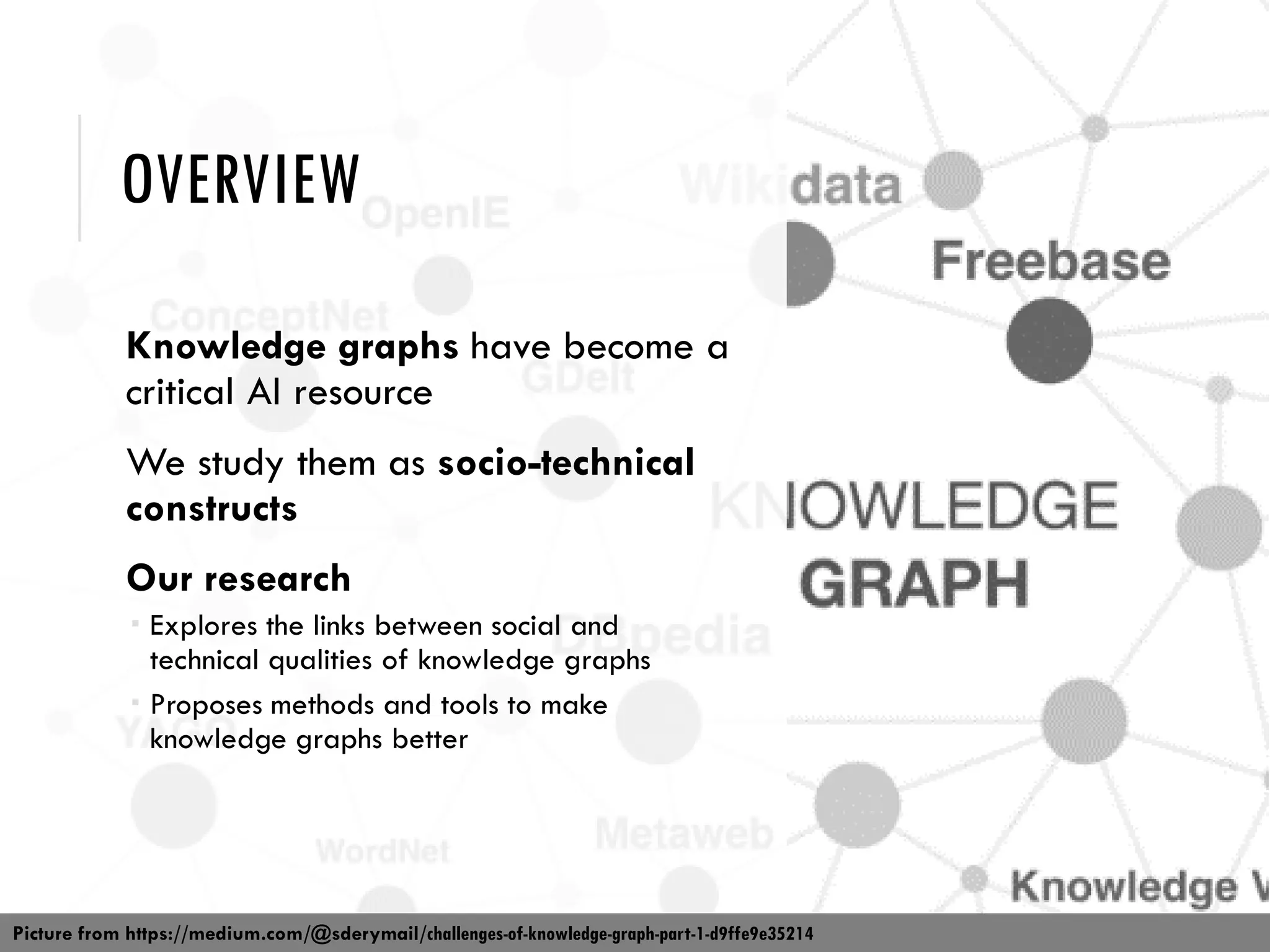
Knowledge graphs have become a
critical AI resource
We study them as socio-technical
constructs
Our research
 Explores the links between social and
technical qualities of knowledge graphs
 Proposes methods and tools to make
knowledge graphs better
Picture from https://medium.com/@sderymail/challenges-of-knowledge-graph-part-1-d9ffe9e35214
WIKIDATA
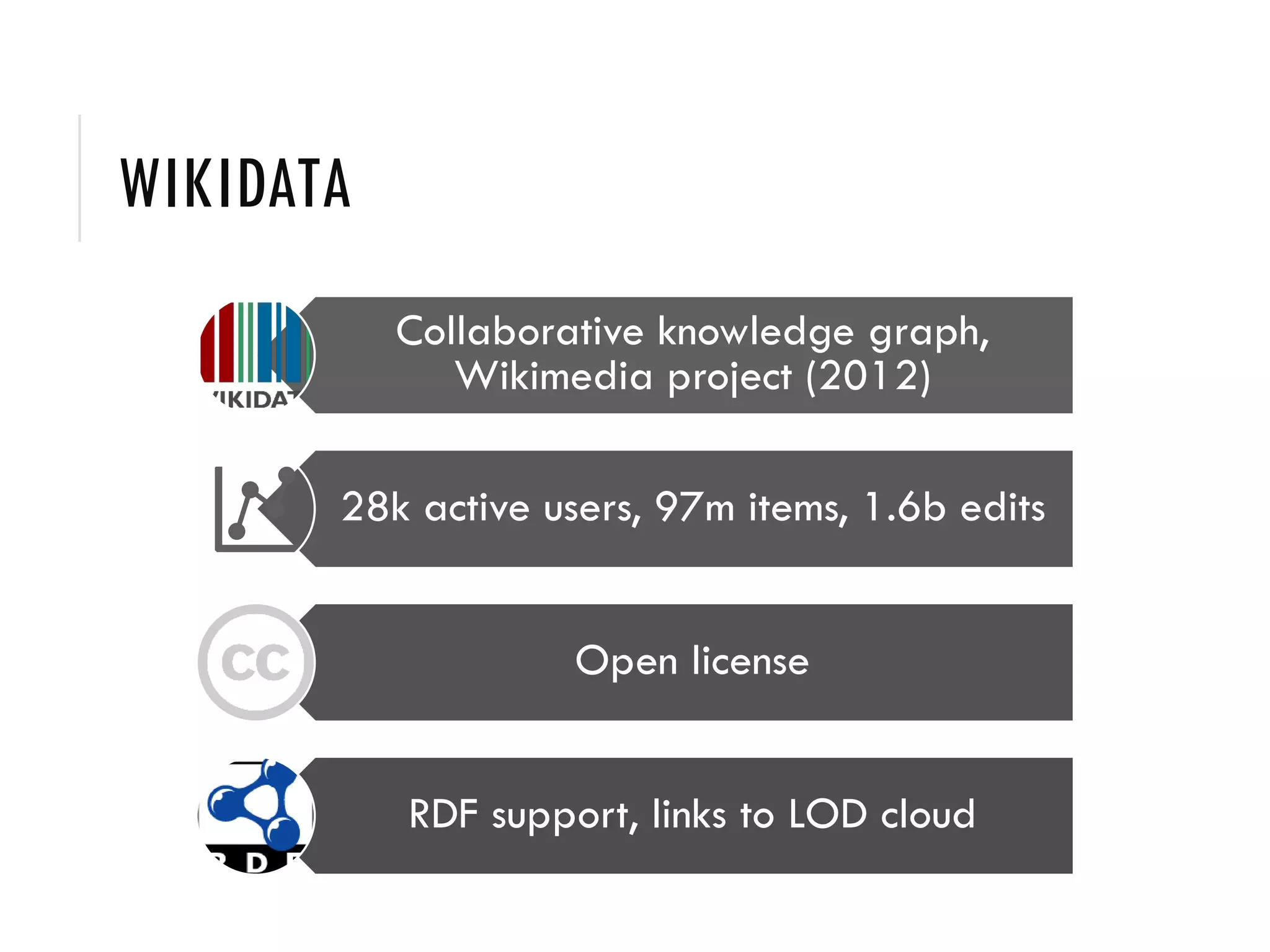
Collaborative knowledge graph,
Wikimedia project (2012)
28k active users, 97m items, 1.6b edits
Open license
RDF support, links to LOD cloud
THE KNOWLEDGE GRAPH
STATEMENTS, ITEMS, PROPERTIES
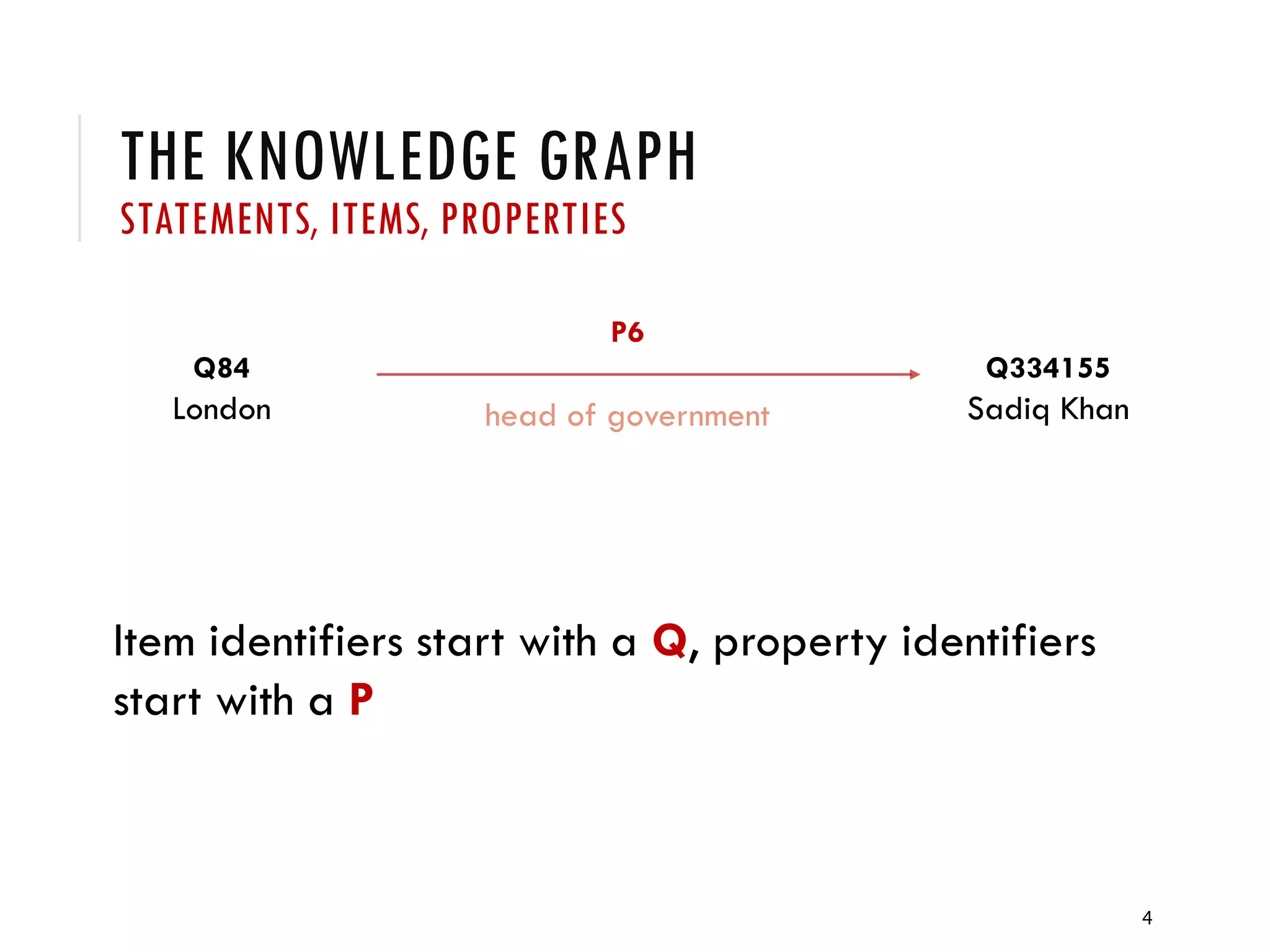
Item identifiers start with a Q, property identifiers
start with a P
4
Q84
London
Q334155
Sadiq Khan
P6
head of government
THE KNOWLEDGE GRAPH
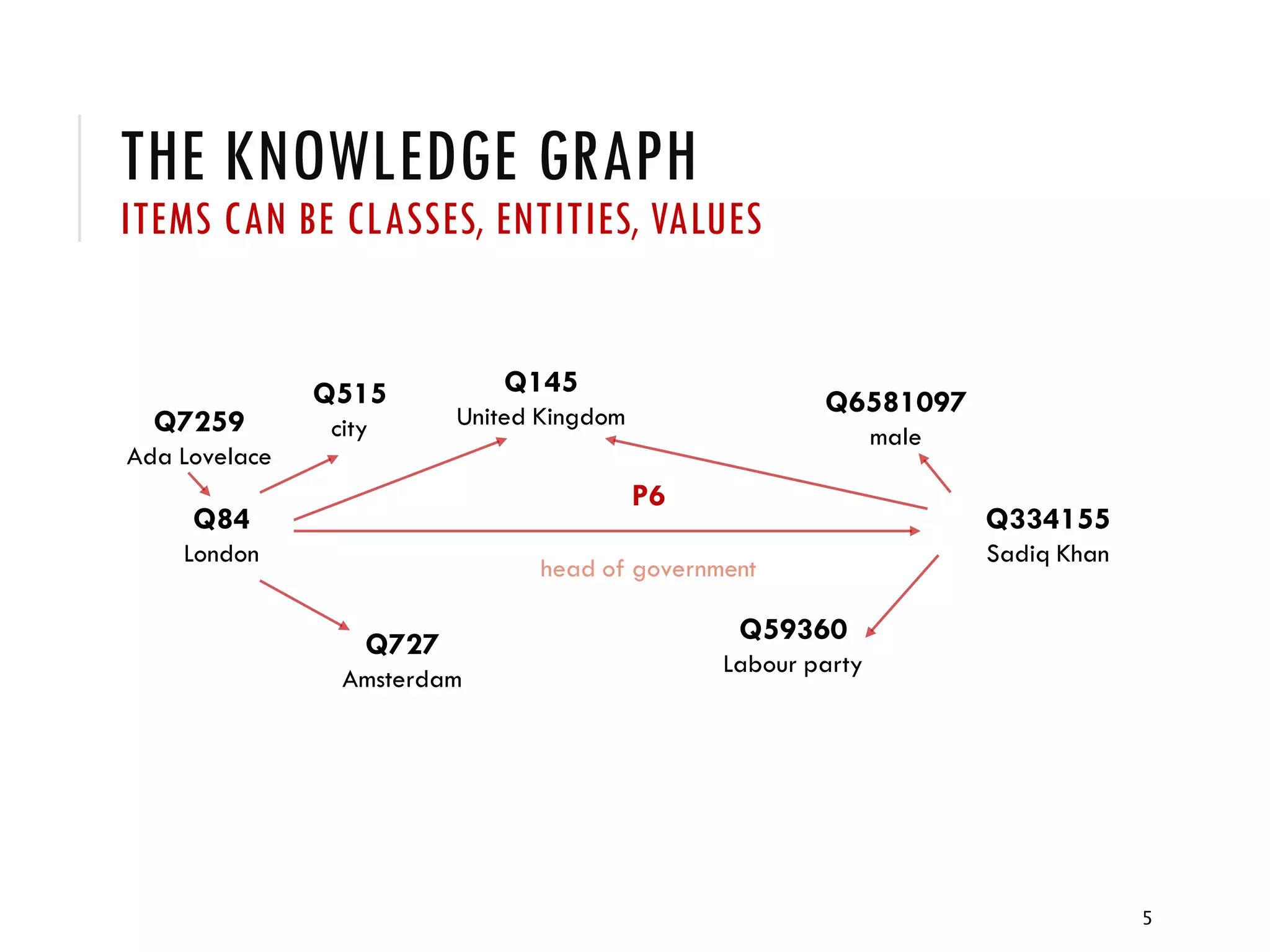
ITEMS CAN BE CLASSES, ENTITIES, VALUES
5
Q7259
Ada Lovelace
Q84
London
Q334155
Sadiq Khan
P6
head of government
Q727
Amsterdam
Q515
city
Q6581097
male
Q59360
Labour party
Q145
United Kingdom
THE KNOWLEDGE GRAPH
STATEMENTS IN CONTEXT
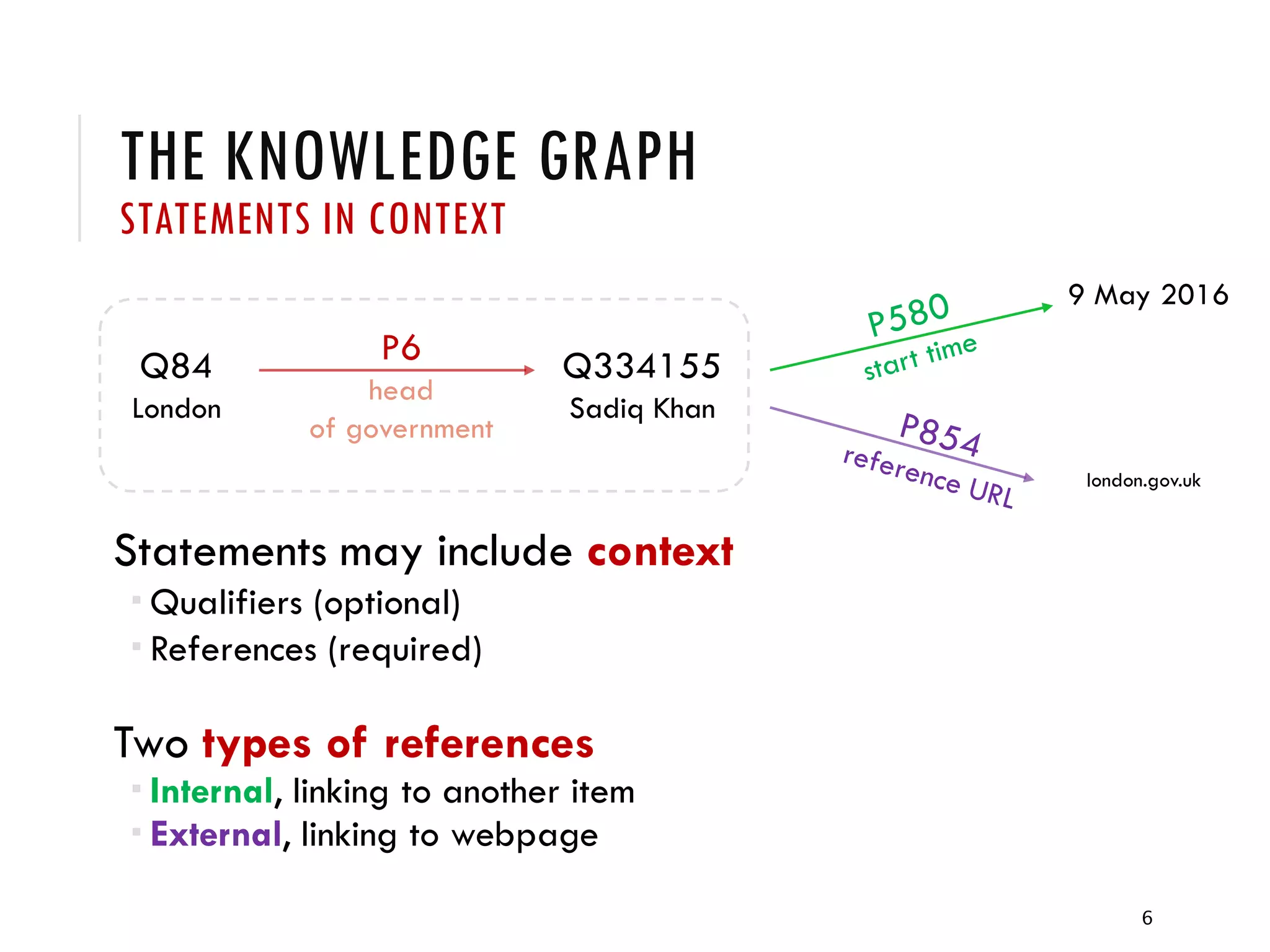
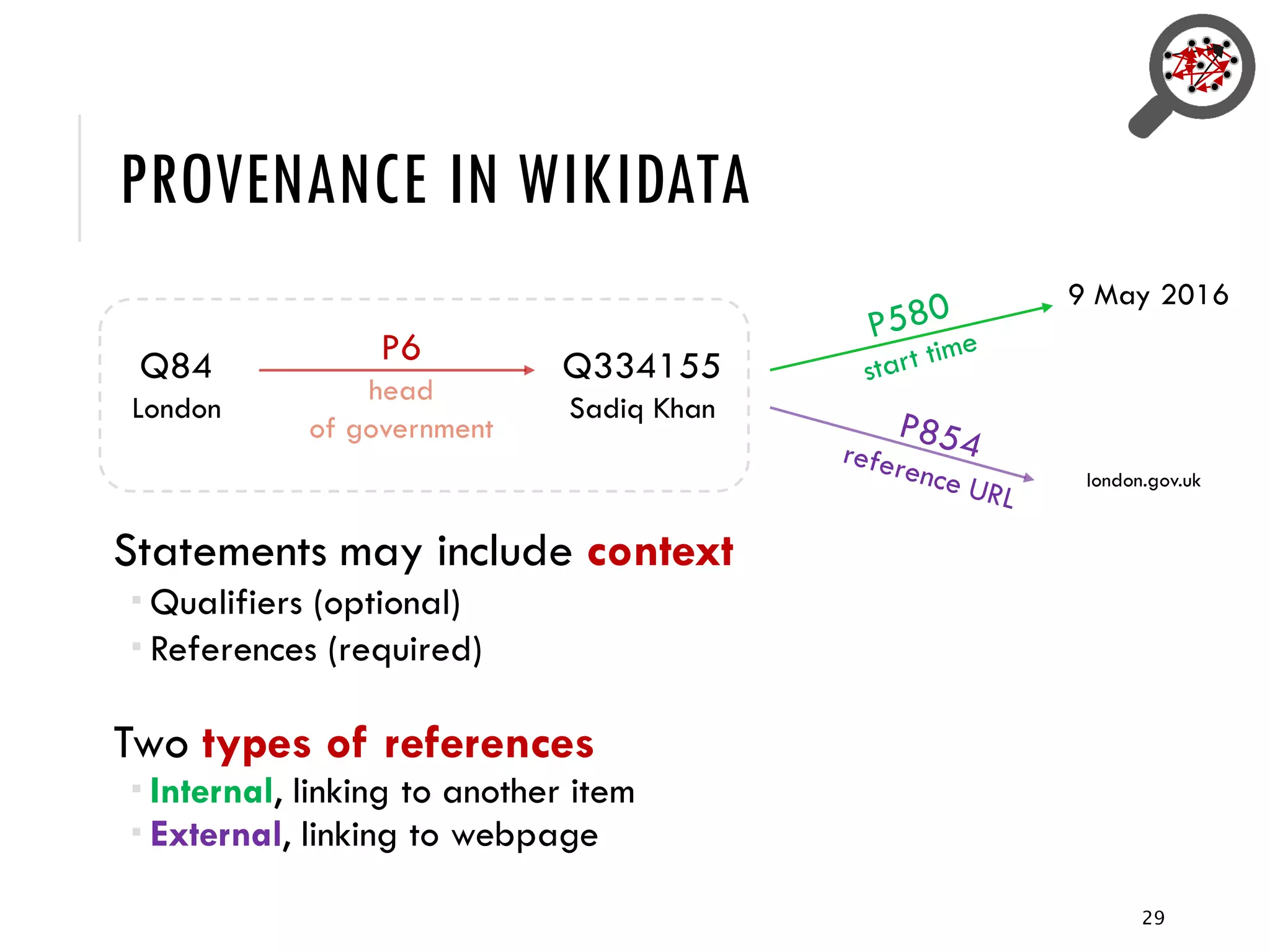
Statements may include context
 Qualifiers (optional)
 References (required)
Two types of references
 Internal, linking to another item
 External, linking to webpage
6
Q84
London
Q334155
Sadiq Khan
P6
head
of government
9 May 2016
london.gov.uk
THE KNOWLEDGE GRAPH
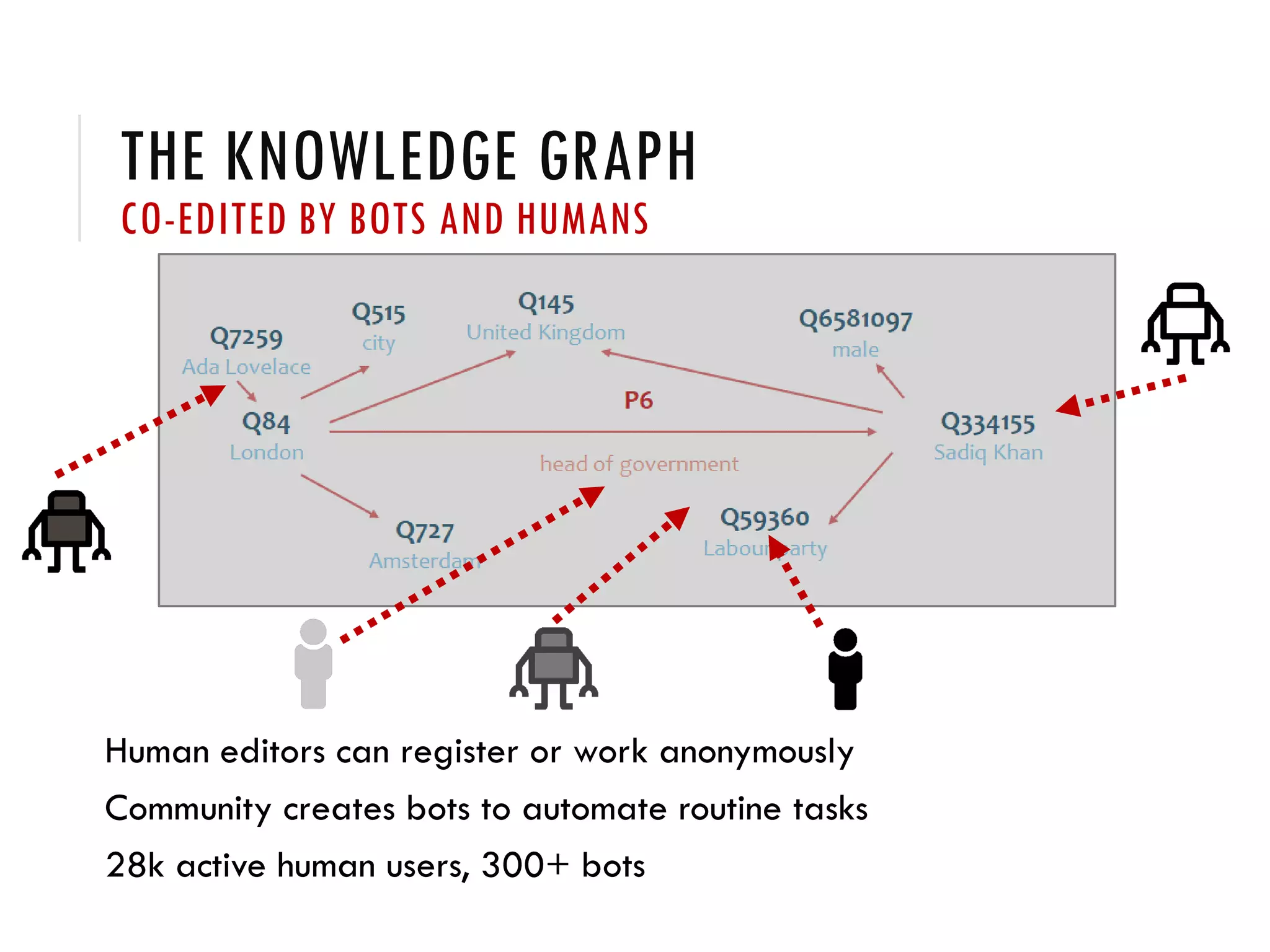
CO-EDITED BY BOTS AND HUMANS
Human editors can register or work anonymously
Community creates bots to automate routine tasks
28k active human users, 300+ bots
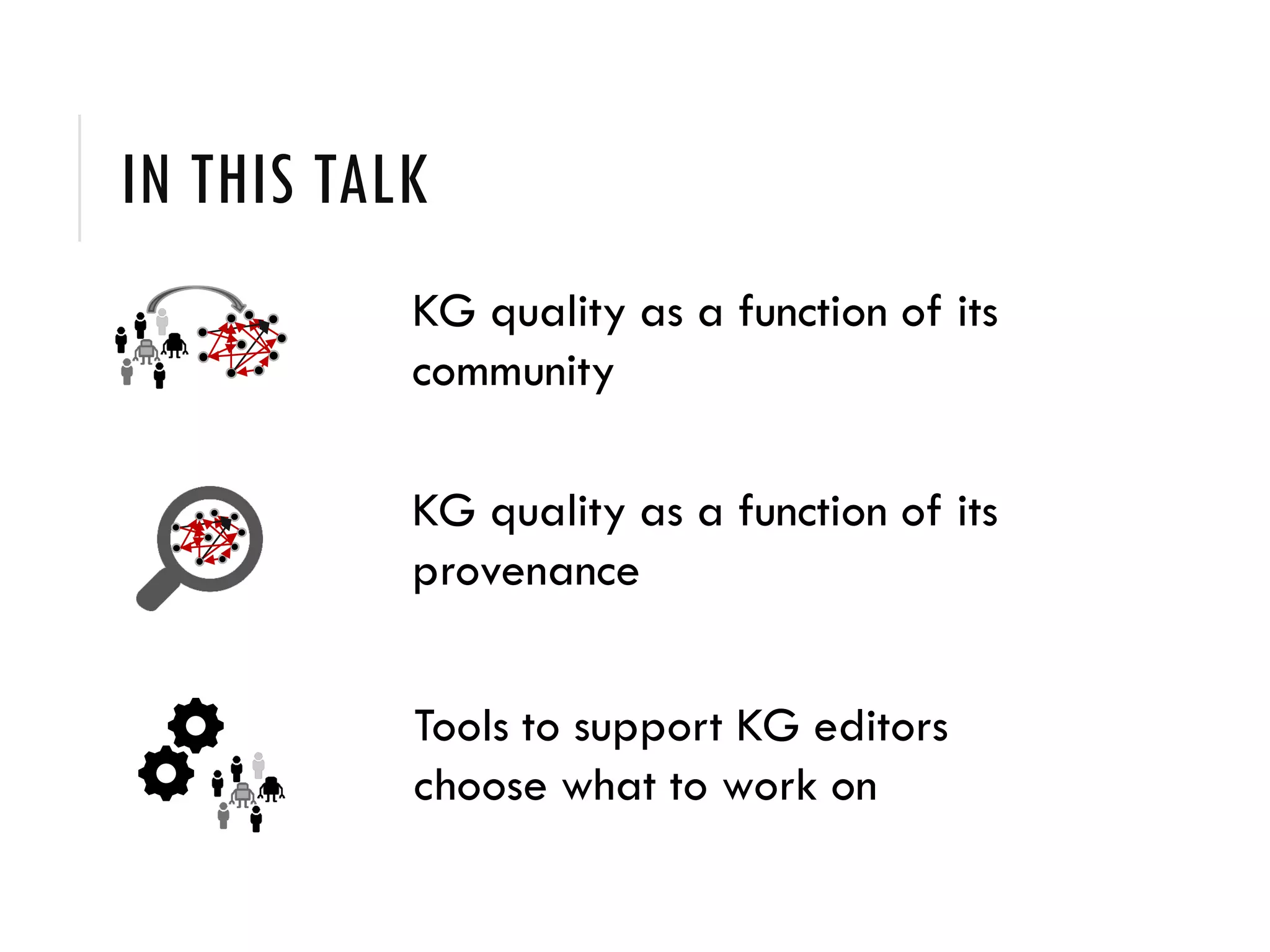
IN THIS TALK
KG quality as a function of its
community
KG quality as a function of its
provenance
Tools to support KG editors
choose what to work on
‘ONTOLOGIES ARE US’
Piscopo, A., Phethean, C., & Simperl, E. (2017). What Makes a
Good Collaborative Knowledge Graph: Group Composition and
Quality in Wikidata. International Conference on Social
Informatics, 305-322, Springer.
Piscopo, A., & Simperl, E. (2018). Who Models the World?:
Collaborative Ontology Creation and User Roles in
Wikidata. Proceedings of the ACM on Human-Computer
Interaction, 2(CSCW), 141.
BACKGROUND
Editors have varied tenure and interests
Their profile and editing behaviour impact
outcomes
 Group composition has varied effects
 Tenure and interest diversity can increase outcome
quality and group productivity
 Different editors groups focus on different types of
activities
Chen, J., Ren, Y., Riedl, J.: The effects of diversity on group productivity and member withdrawal in online volunteer groups. In: Proceedings of the 28th international
conference on human factors in computing systems - CHI ’10. p. 821. ACM Press, New York, USA (2010)
STUDY 1: ITEM QUALITY
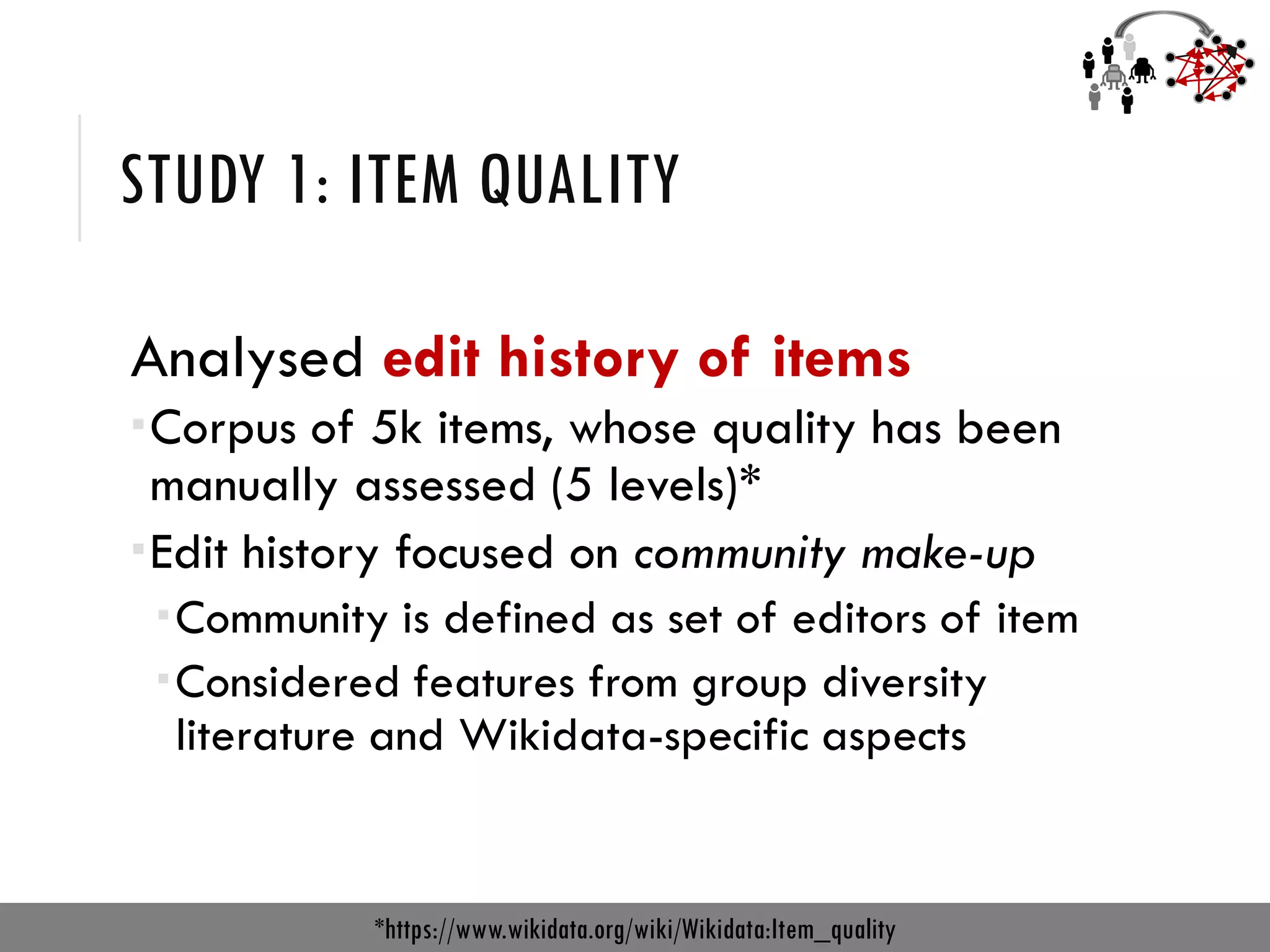
Analysed edit history of items
Corpus of 5k items, whose quality has been
manually assessed (5 levels)*
Edit history focused on community make-up
Community is defined as set of editors of item
Considered features from group diversity
literature and Wikidata-specific aspects
*https://www.wikidata.org/wiki/Wikidata:Item_quality
RESEARCH HYPOTHESES
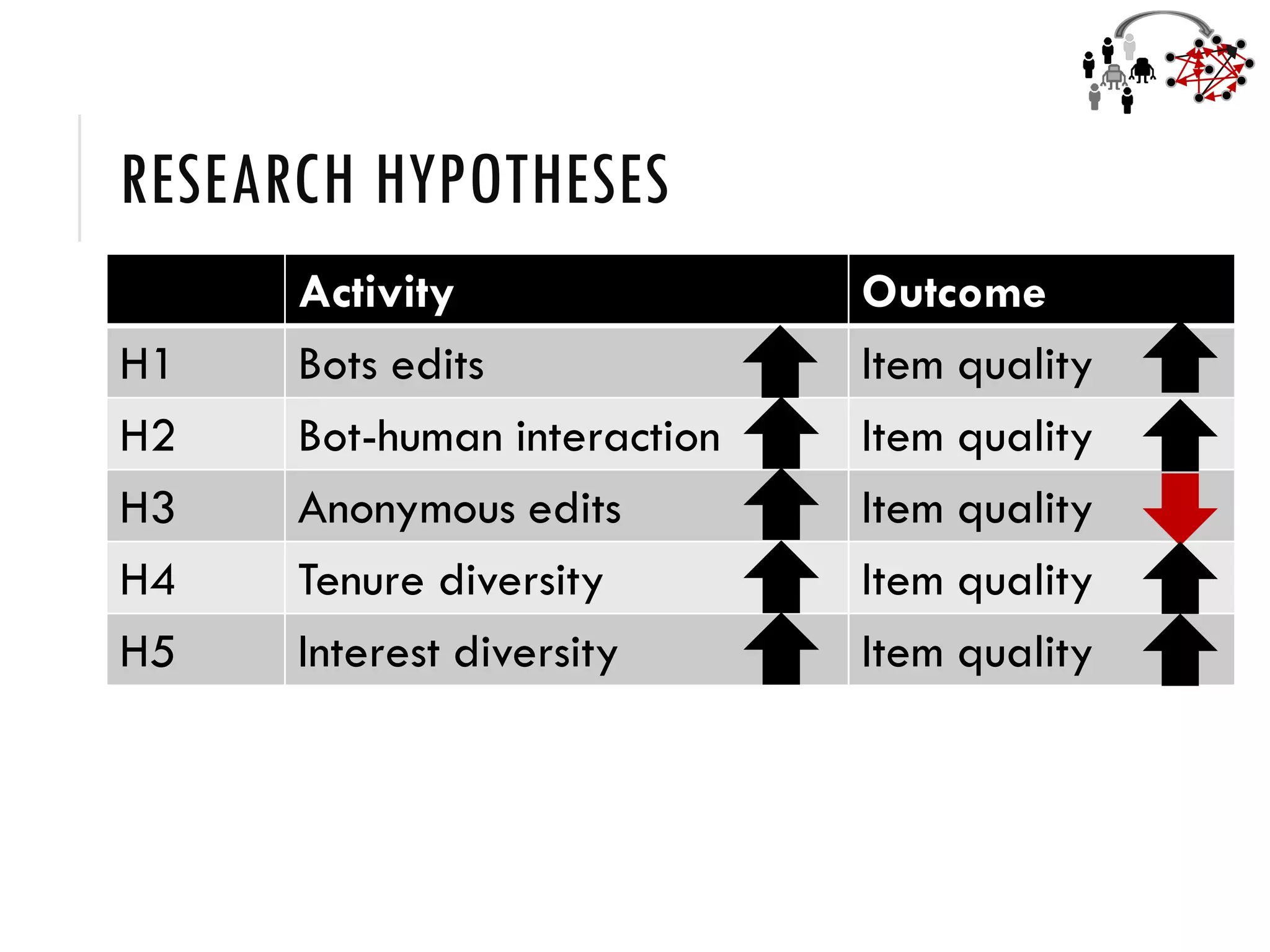
Activity Outcome
H1 Bots edits Item quality
H2 Bot-human interaction Item quality
H3 Anonymous edits Item quality
H4 Tenure diversity Item quality
H5 Interest diversity Item quality
DATA AND METHODS
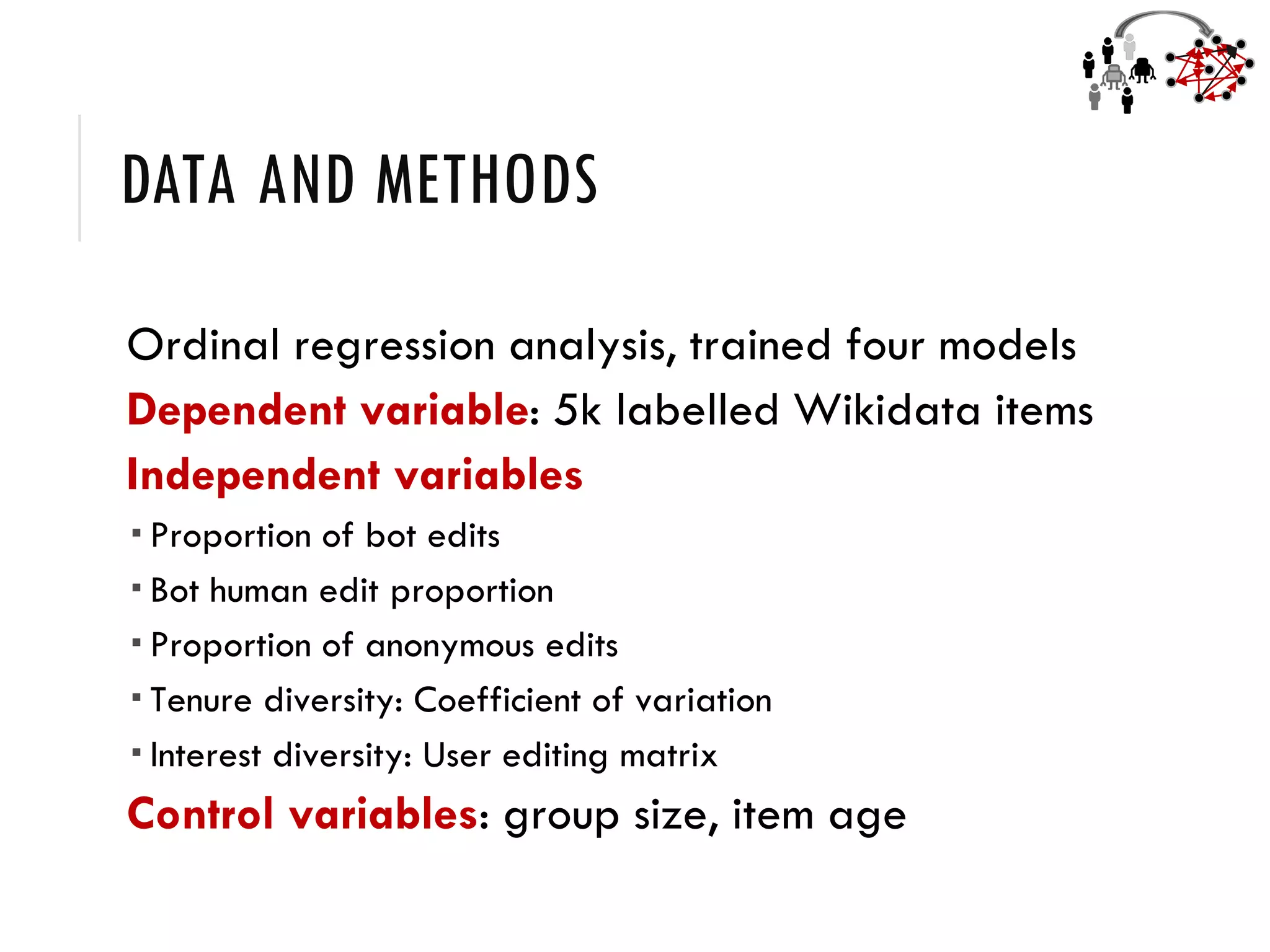
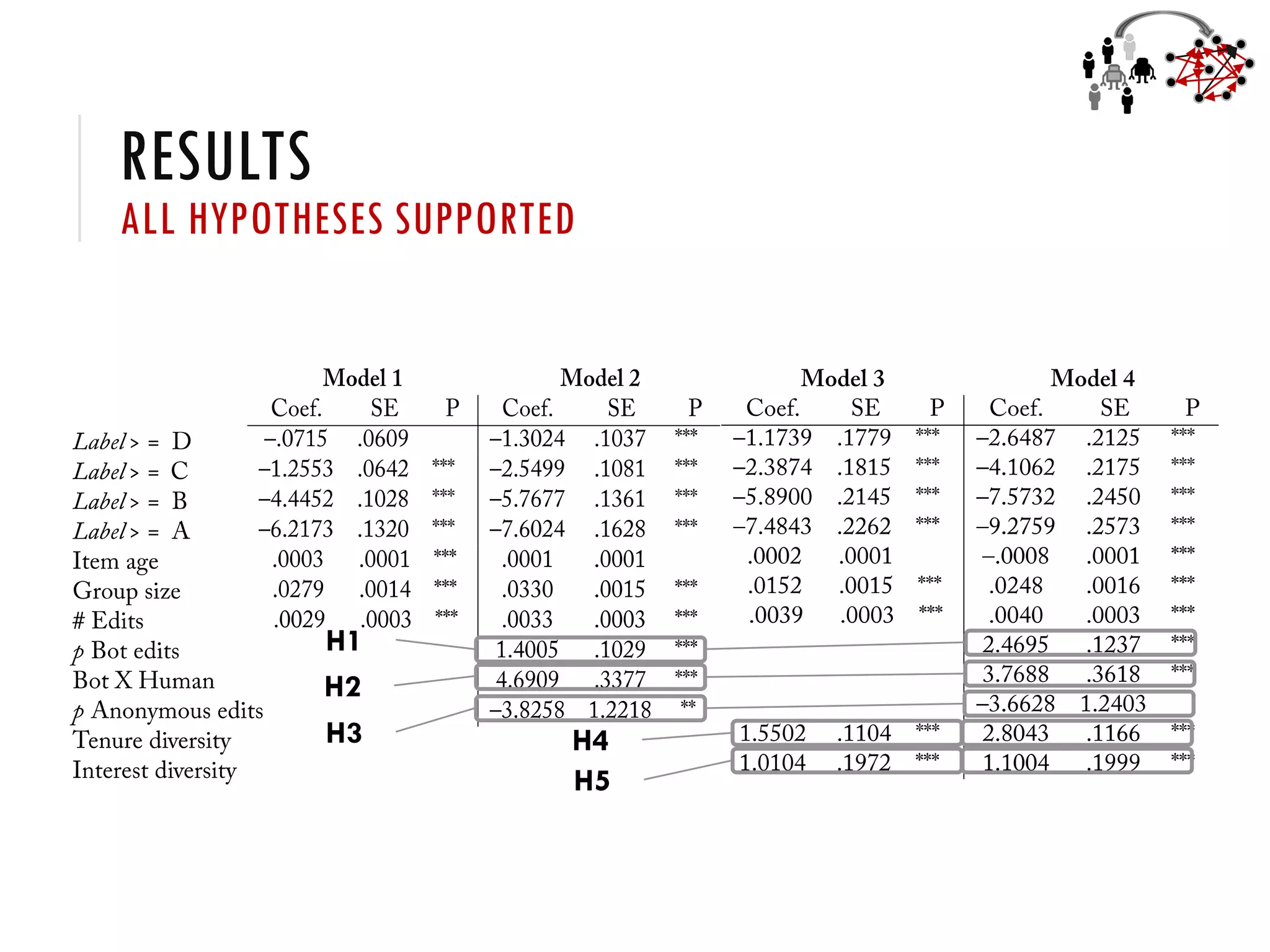
Ordinal regression analysis, trained four models
Dependent variable: 5k labelled Wikidata items
Independent variables
 Proportion of bot edits
 Bot human edit proportion
 Proportion of anonymous edits
 Tenure diversity: Coefficient of variation
 Interest diversity: User editing matrix
Control variables: group size, item age
RESULTS
ALL HYPOTHESES SUPPORTED
H1
H2
H3 H4
H5
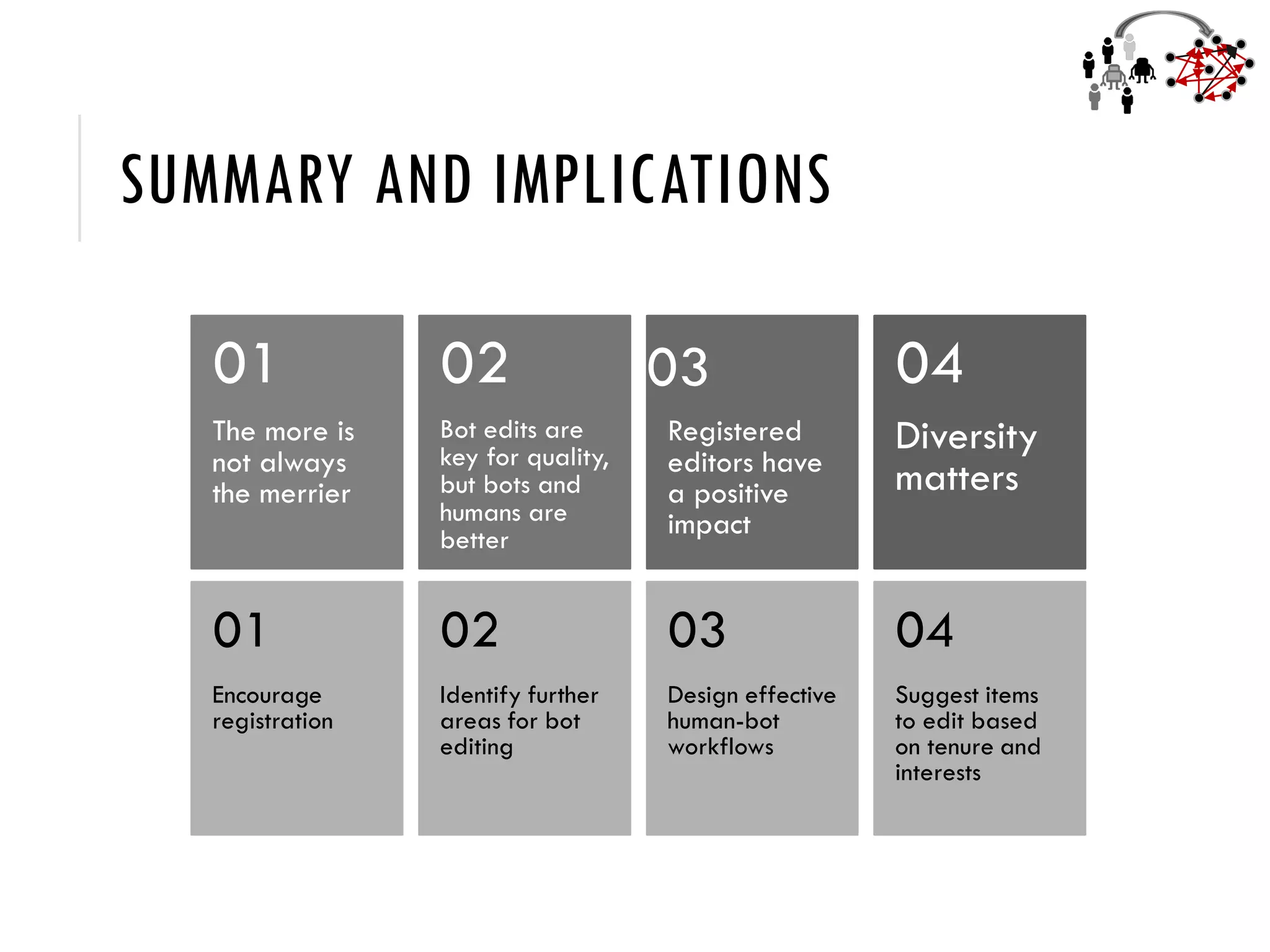
SUMMARY AND IMPLICATIONS
The more is
not always
the merrier
01
Bot edits are
key for quality,
but bots and
humans are
better
02
Registered
editors have
a positive
impact
Diversity
matters
04
Encourage
registration
01
Identify further
areas for bot
editing
02
Design effective
human-bot
workflows
03
Suggest items
to edit based
on tenure and
interests
04
03
ONGOING WORK:
PREDICTING WIKIDATA
QUALITY
Analysing how
the community
awards quality
labels to items
Developing
robust machine
learning models
Spotting unknown
biases
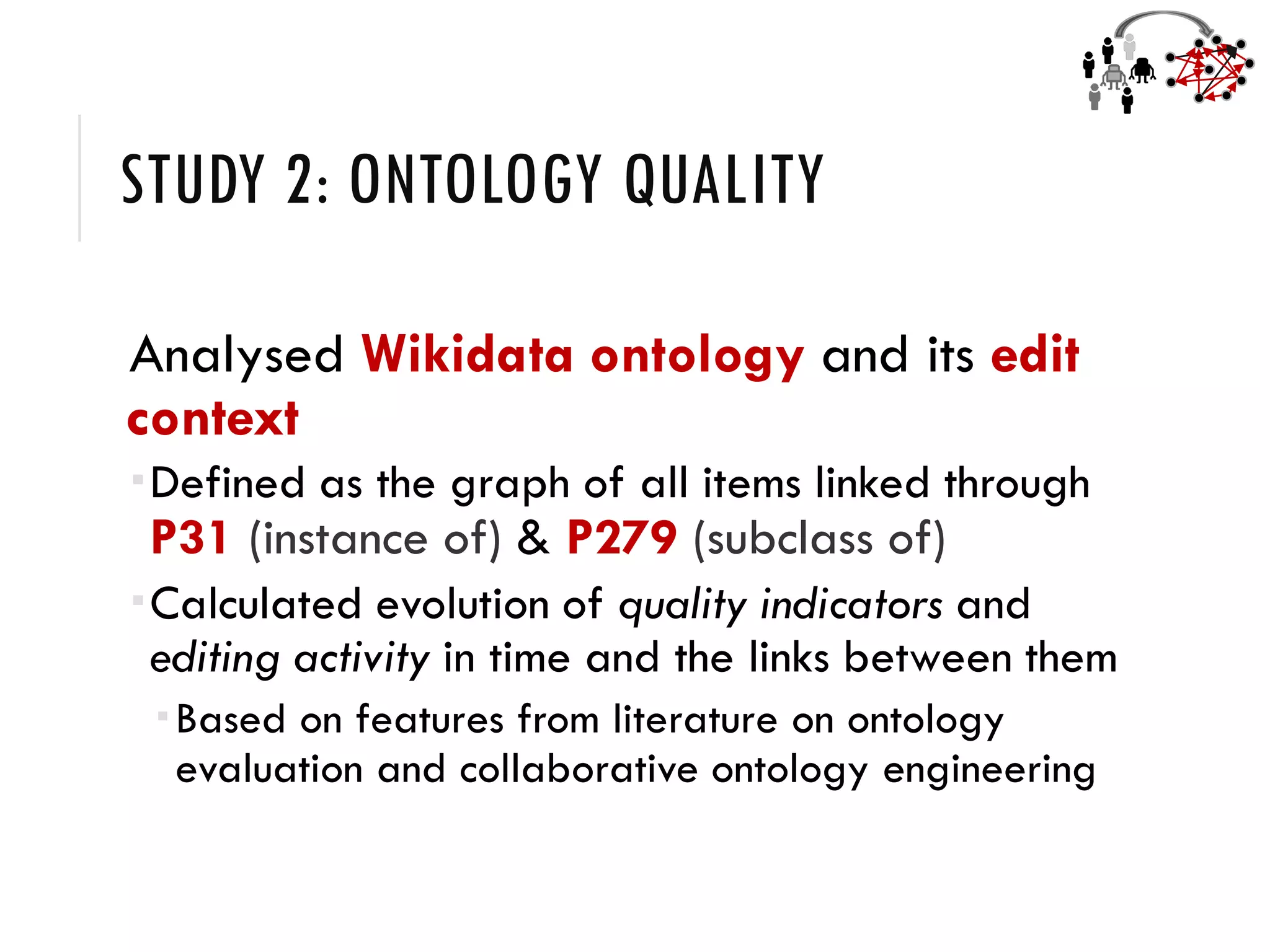
STUDY 2: ONTOLOGY QUALITY
Analysed Wikidata ontology and its edit
context
Defined as the graph of all items linked through
P31 (instance of) & P279 (subclass of)
Calculated evolution of quality indicators and
editing activity in time and the links between them
Based on features from literature on ontology
evaluation and collaborative ontology engineering
DATA AND METHODS
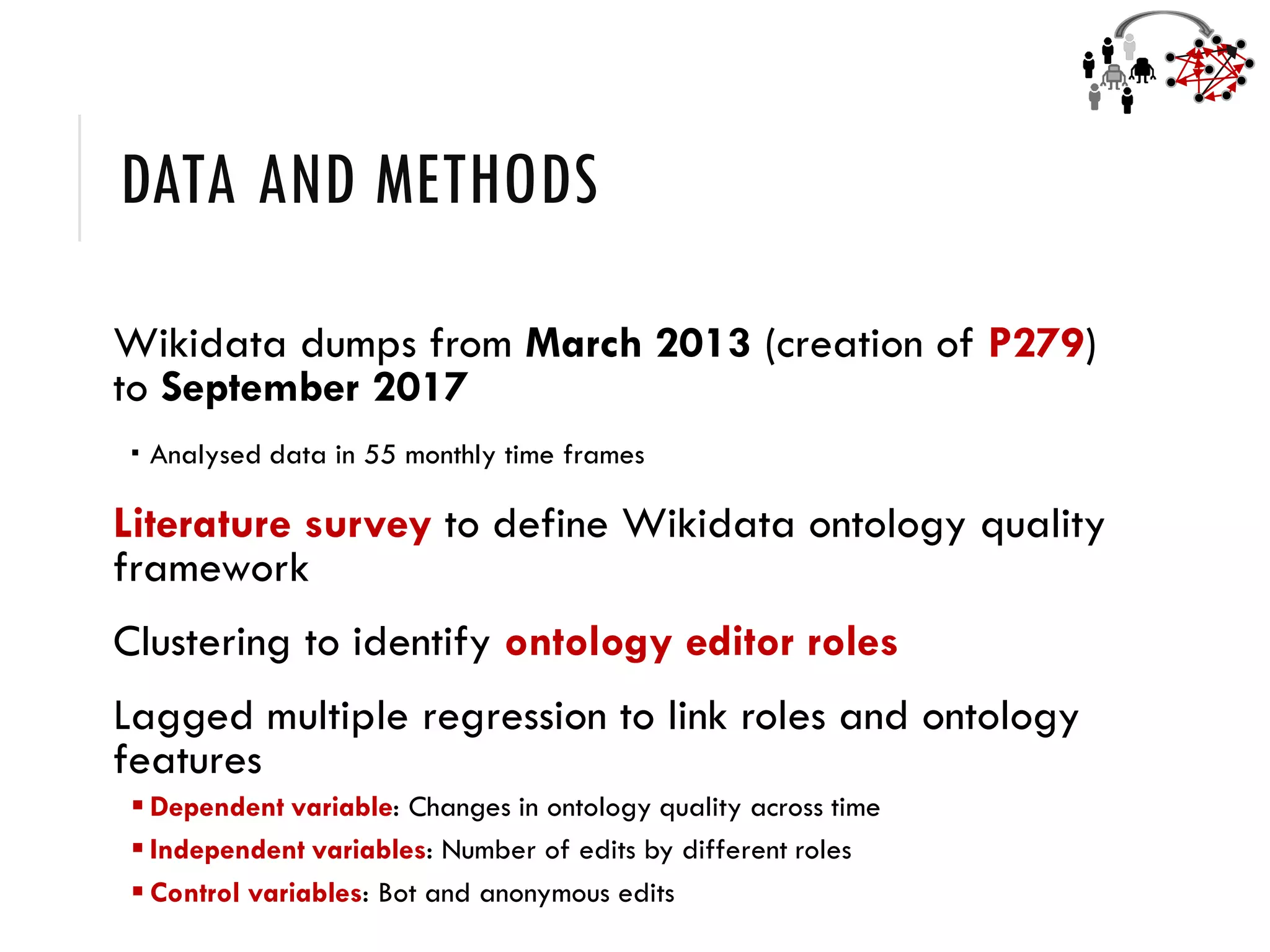
Wikidata dumps from March 2013 (creation of P279)
to September 2017
 Analysed data in 55 monthly time frames
Literature survey to define Wikidata ontology quality
framework
Clustering to identify ontology editor roles
Lagged multiple regression to link roles and ontology
features
 Dependent variable: Changes in ontology quality across time
 Independent variables: Number of edits by different roles
 Control variables: Bot and anonymous edits
ONTOLOGY QUALITY: INDICATORS
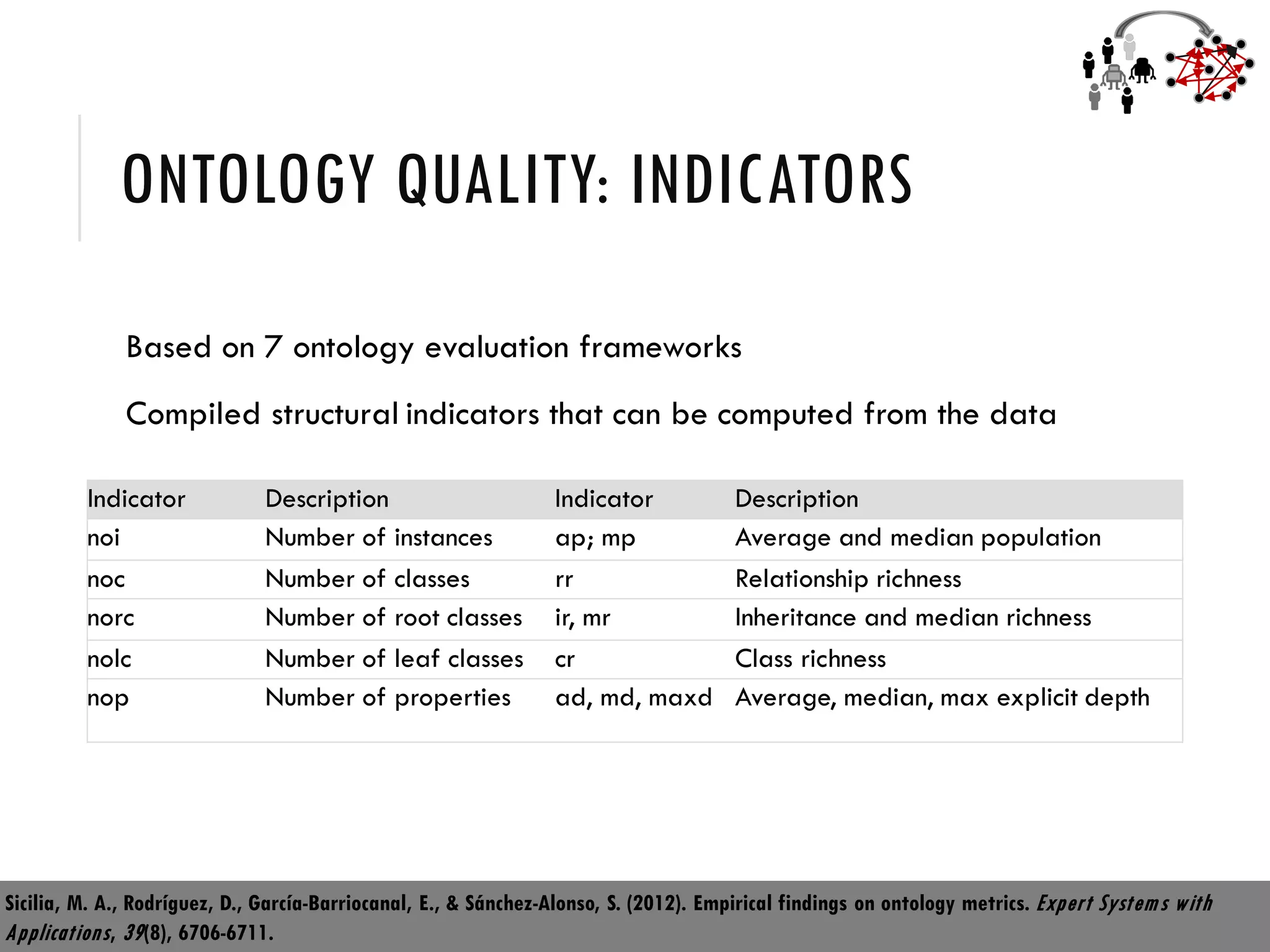
Based on 7 ontology evaluation frameworks
Compiled structural indicators that can be computed from the data
19
Indicator Description Indicator Description
noi Number of instances ap; mp Average and median population
noc Number of classes rr Relationship richness
norc Number of root classes ir, mr Inheritance and median richness
nolc Number of leaf classes cr Class richness
nop Number of properties ad, md, maxd Average, median, max explicit depth
Sicilia, M. A., Rodríguez, D., García-Barriocanal, E., & Sánchez-Alonso, S. (2012). Empirical findings on ontology metrics. Expert Systems with
Applications, 39(8), 6706-6711.
ONTOLOGY QUALITY: RESULTS
LARGE ONTOLOGY, UNEVEN QUALITY
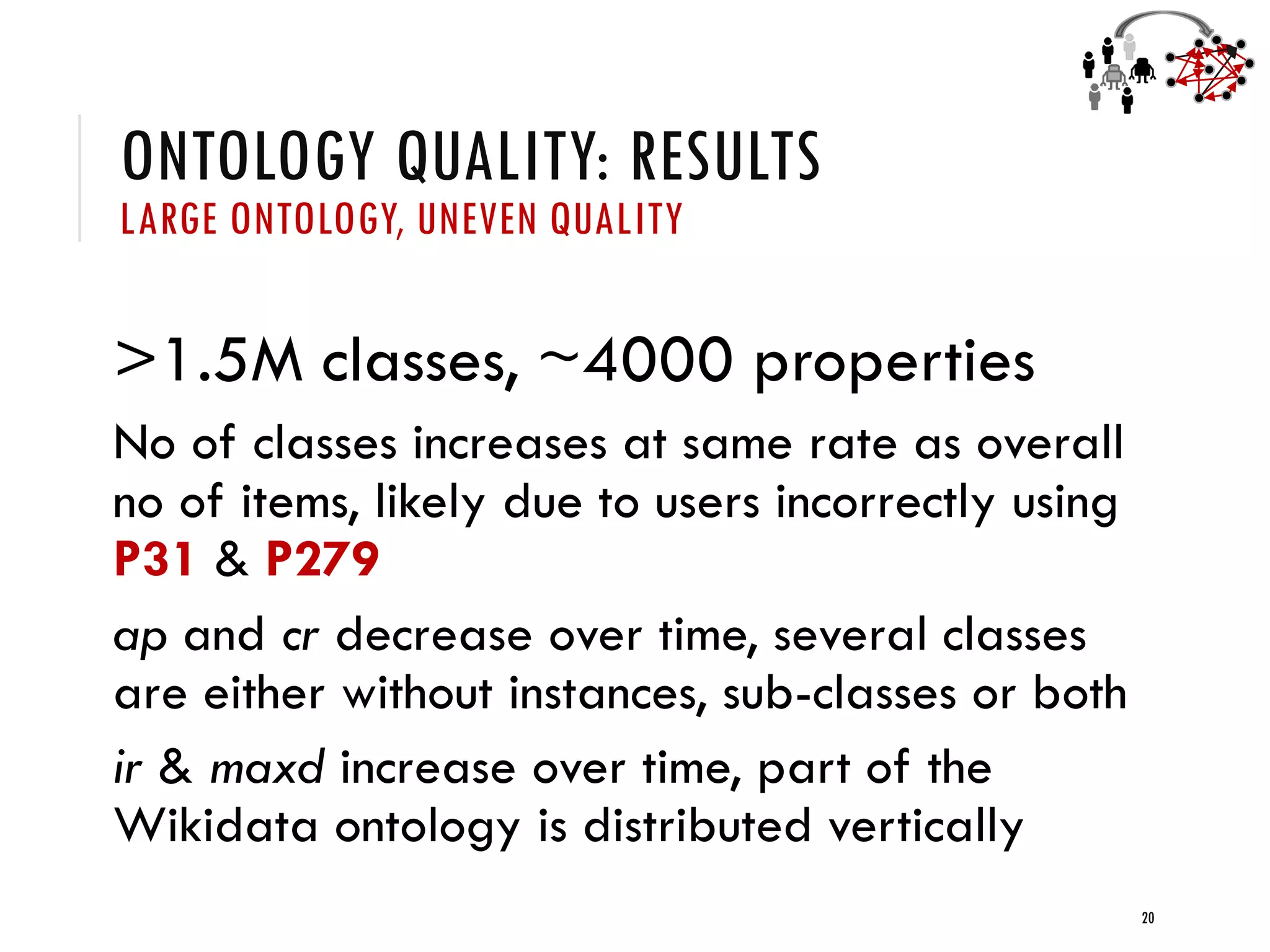
>1.5M classes, ~4000 properties
No of classes increases at same rate as overall
no of items, likely due to users incorrectly using
P31 & P279
ap and cr decrease over time, several classes
are either without instances, sub-classes or both
ir & maxd increase over time, part of the
Wikidata ontology is distributed vertically
20
EDITOR ROLES: METHODS
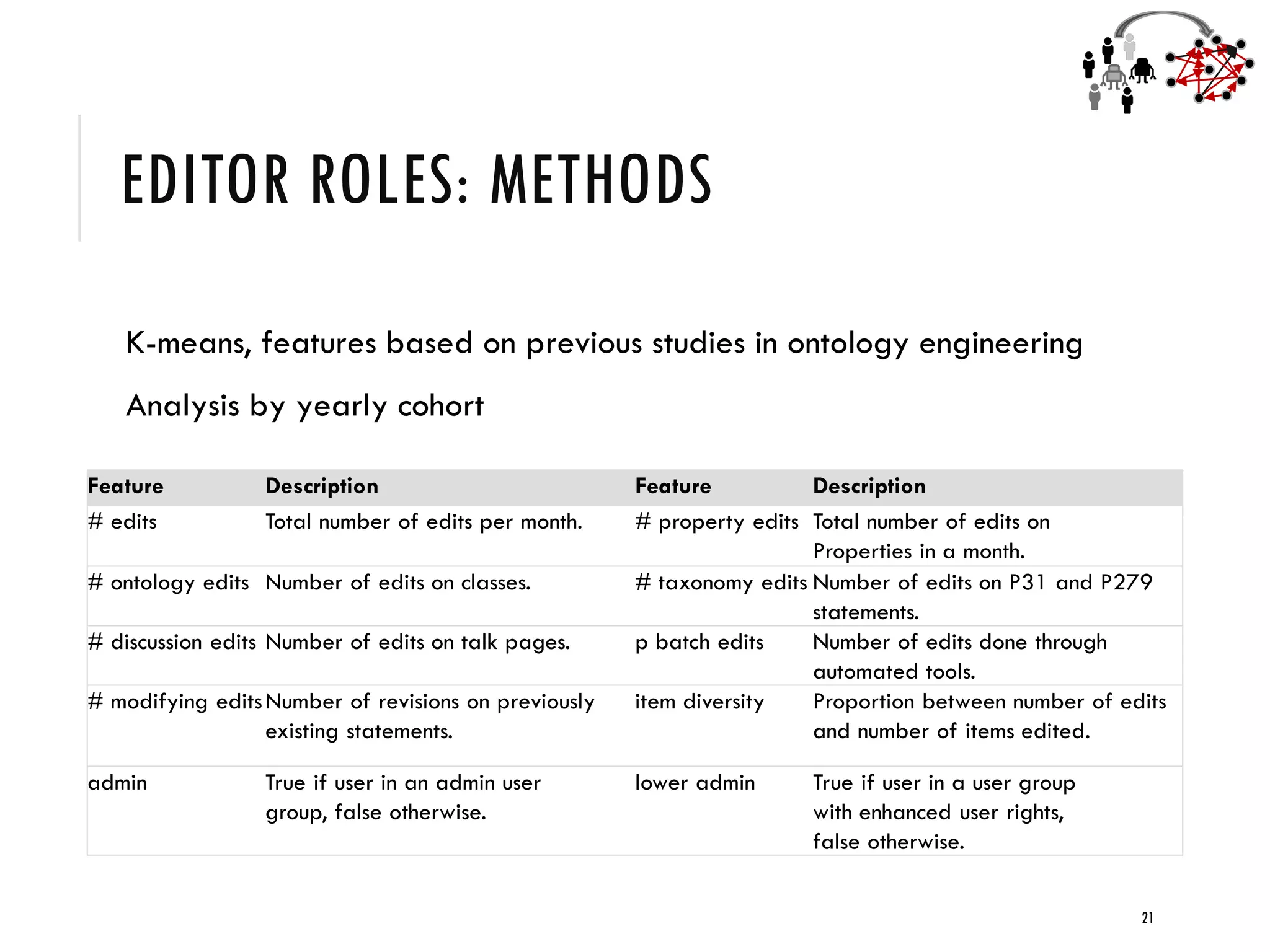
K-means, features based on previous studies in ontology engineering
Analysis by yearly cohort
21
Feature Description Feature Description
# edits Total number of edits per month. # property edits Total number of edits on
Properties in a month.
# ontology edits Number of edits on classes. # taxonomy edits Number of edits on P31 and P279
statements.
# discussion edits Number of edits on talk pages. p batch edits Number of edits done through
automated tools.
# modifying editsNumber of revisions on previously
existing statements.
item diversity Proportion between number of edits
and number of items edited.
admin True if user in an admin user
group, false otherwise.
lower admin True if user in a user group
with enhanced user rights,
false otherwise.
EDITOR ROLES: RESULTS
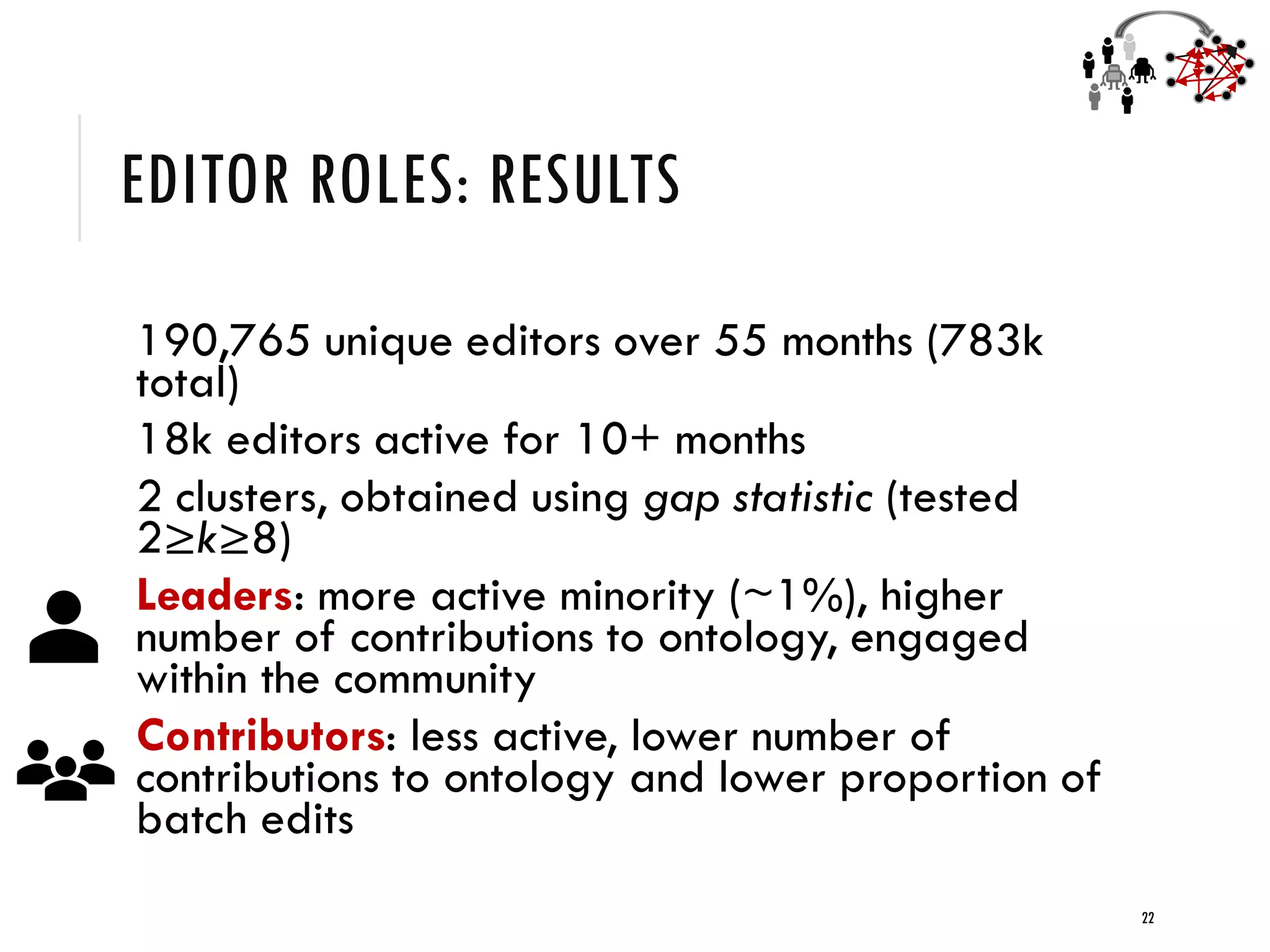
190,765 unique editors over 55 months (783k
total)
18k editors active for 10+ months
2 clusters, obtained using gap statistic (tested
2≥k≥8)
Leaders: more active minority (~1%), higher
number of contributions to ontology, engaged
within the community
Contributors: less active, lower number of
contributions to ontology and lower proportion of
batch edits
22
EDITOR ROLES: RESULTS
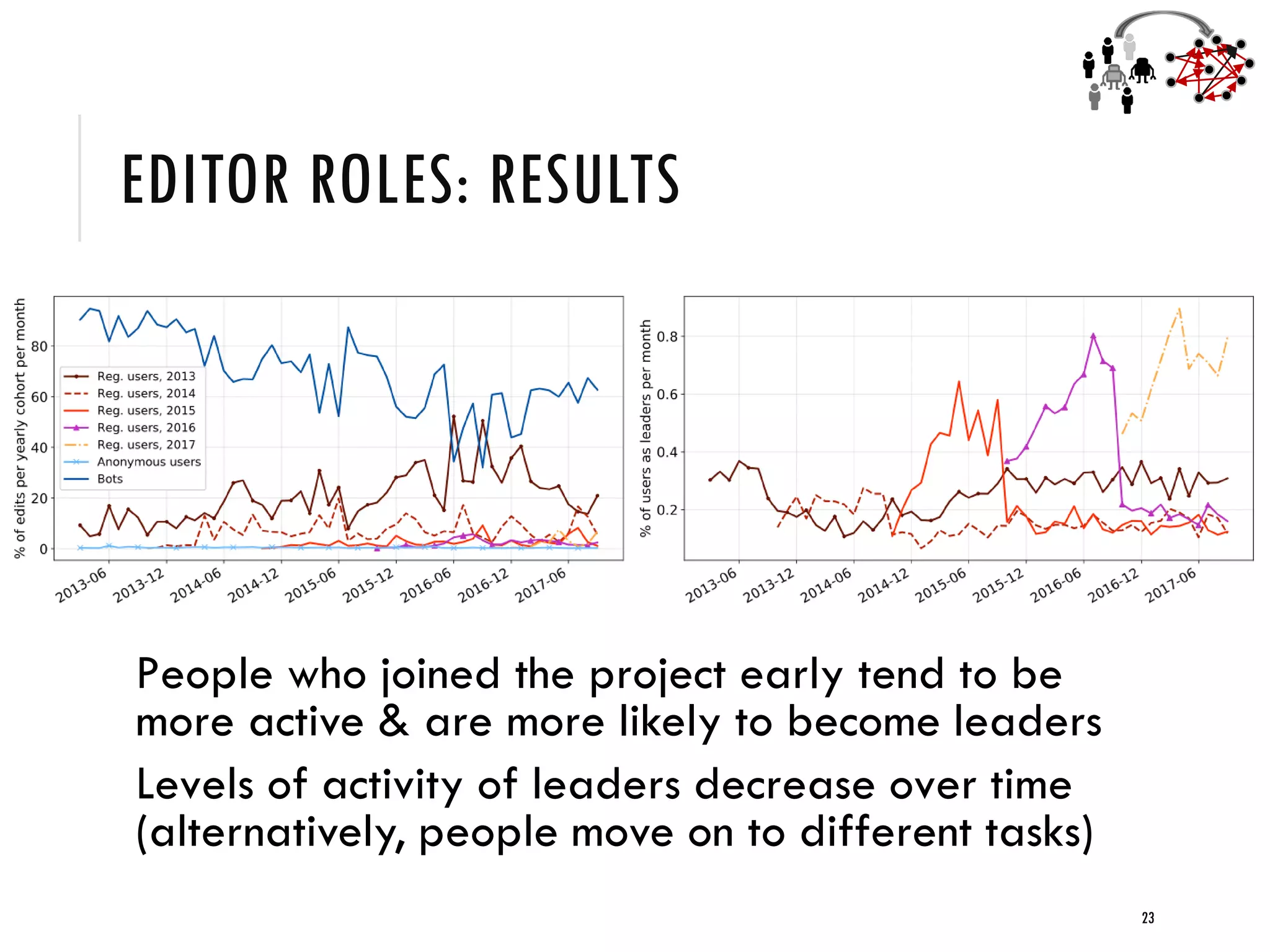
People who joined the project early tend to be
more active & are more likely to become leaders
Levels of activity of leaders decrease over time
(alternatively, people move on to different tasks)
23
RESEARCH HYPOTHESES
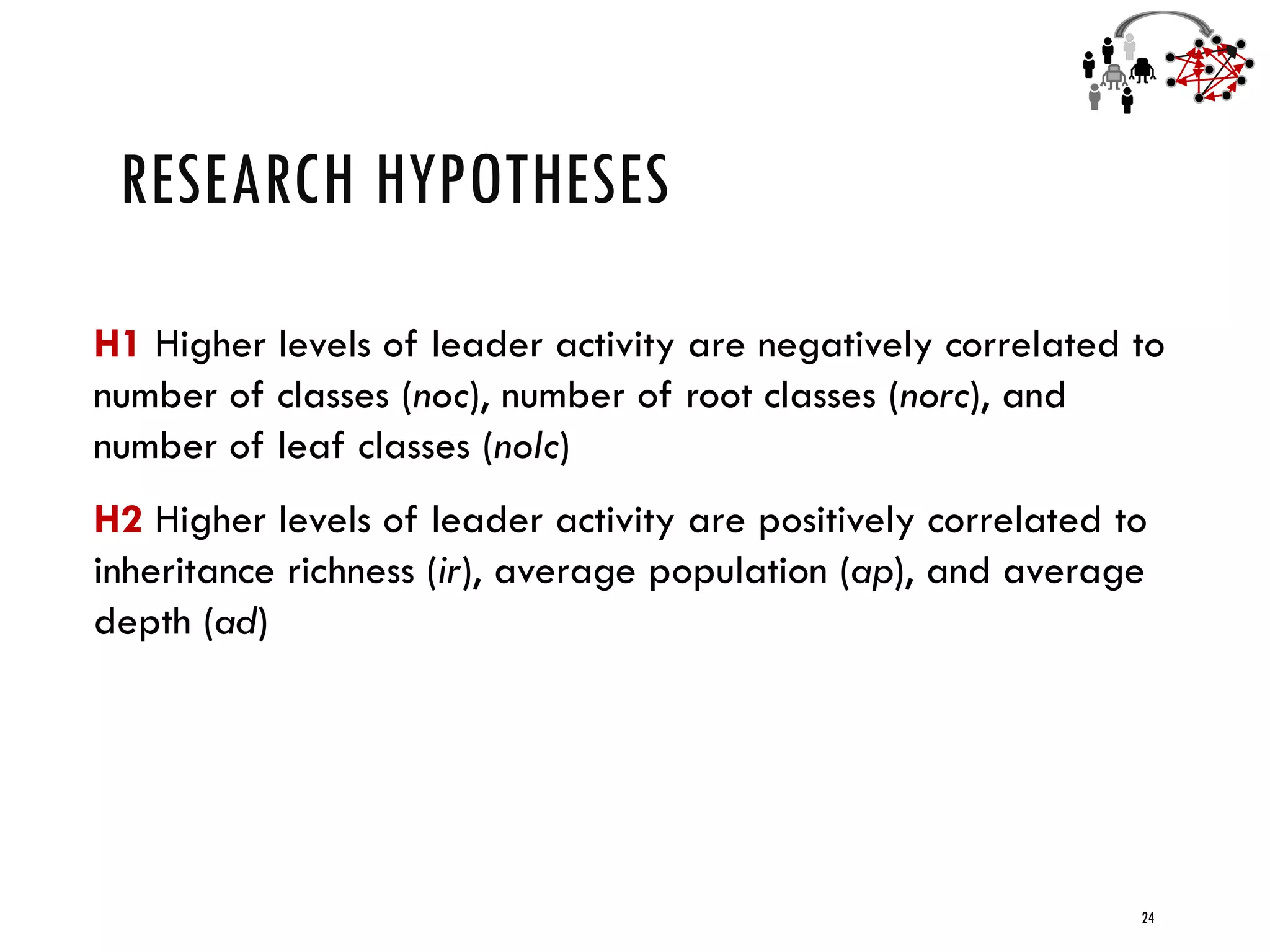
H1 Higher levels of leader activity are negatively correlated to
number of classes (noc), number of root classes (norc), and
number of leaf classes (nolc)
H2 Higher levels of leader activity are positively correlated to
inheritance richness (ir), average population (ap), and average
depth (ad)
24
ROLES & ONTOLOGY: RESULTS
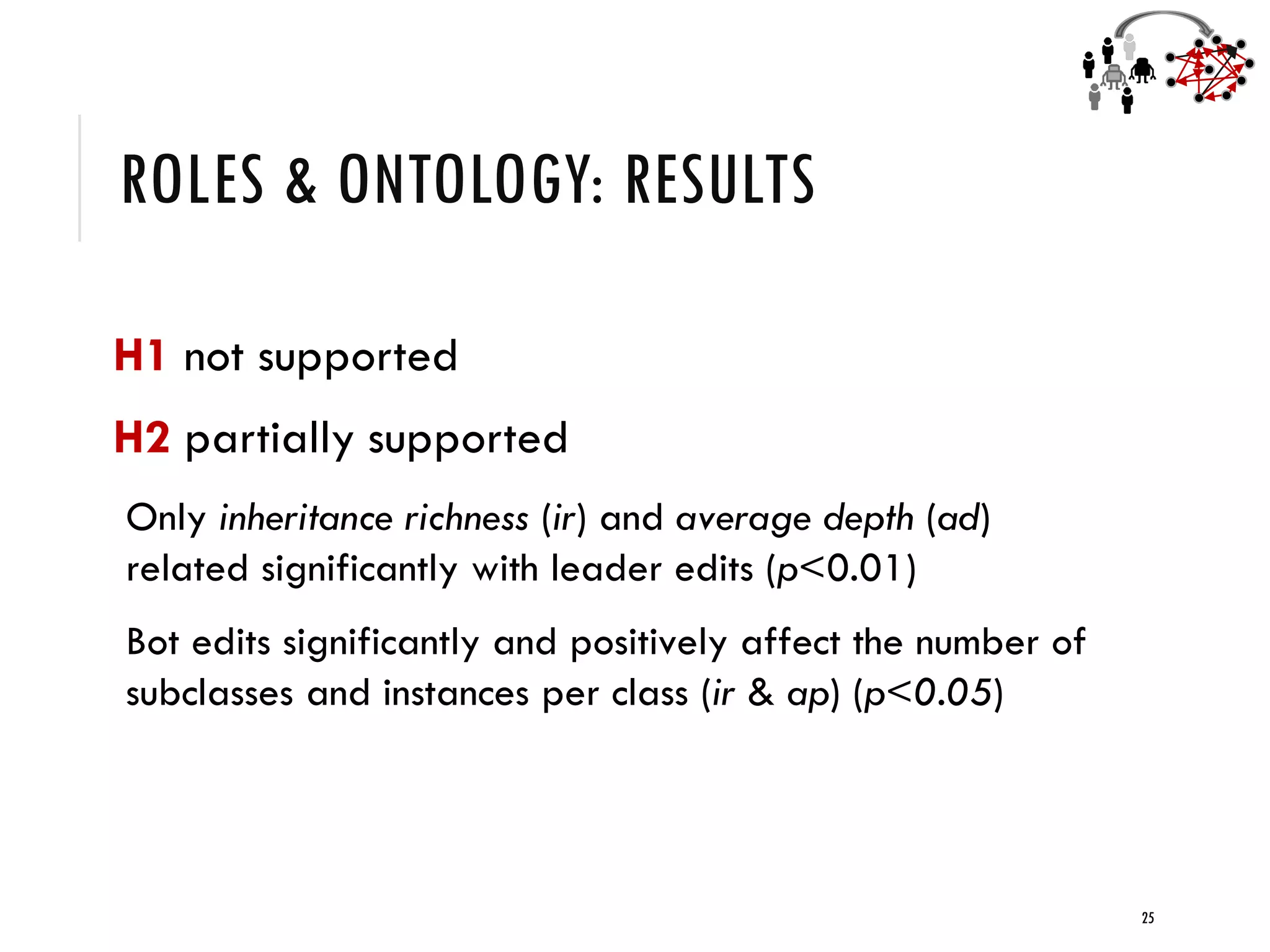
H1 not supported
H2 partially supported
Only inheritance richness (ir) and average depth (ad)
related significantly with leader edits (p<0.01)
Bot edits significantly and positively affect the number of
subclasses and instances per class (ir & ap) (p<0.05)
25
SUMMARY AND IMPLICATIONS
Creating ontologies still a challenging task
Size of ontology renders existing automatic quality
assessment methods unfeasible
Broader curation efforts needed: large number of empty
classes
Editor roles less well articulated than in other ontology
engineering projects
Possible decline in motivation after several months
ONGOING WORK
The role of discussions in
Wikidata
Studying participation
pathways to observe
learning effects
Wikidata ontology as a
network of ShEx
schemas
THE CONTENT IS AS
GOOD AS ITS
REFERENCES
Amaral, G., Piscopo, A., Kaffee, L. A., Odinaldo, R., &
Simperl, E. (2020). Assessing the quality of sources in
Wikidata across languages: a hybrid approach. To
appear in ACM TDIQ
28
PROVENANCE IN WIKIDATA
Statements may include context
 Qualifiers (optional)
 References (required)
Two types of references
 Internal, linking to another item
 External, linking to webpage
29
Q84
London
Q334155
Sadiq Khan
P6
head
of government
9 May 2016
london.gov.uk
THE ROLE OF PROVENANCE
Wikidata aims to become a hub of references
Provenance increases trust in Wikidata
Lack of provenance hinders downstream reuse
Quality of references underexplored
Hartig, O. (2009). Provenance Information in the Web of Data. LDOW, 538.
STUDY 3
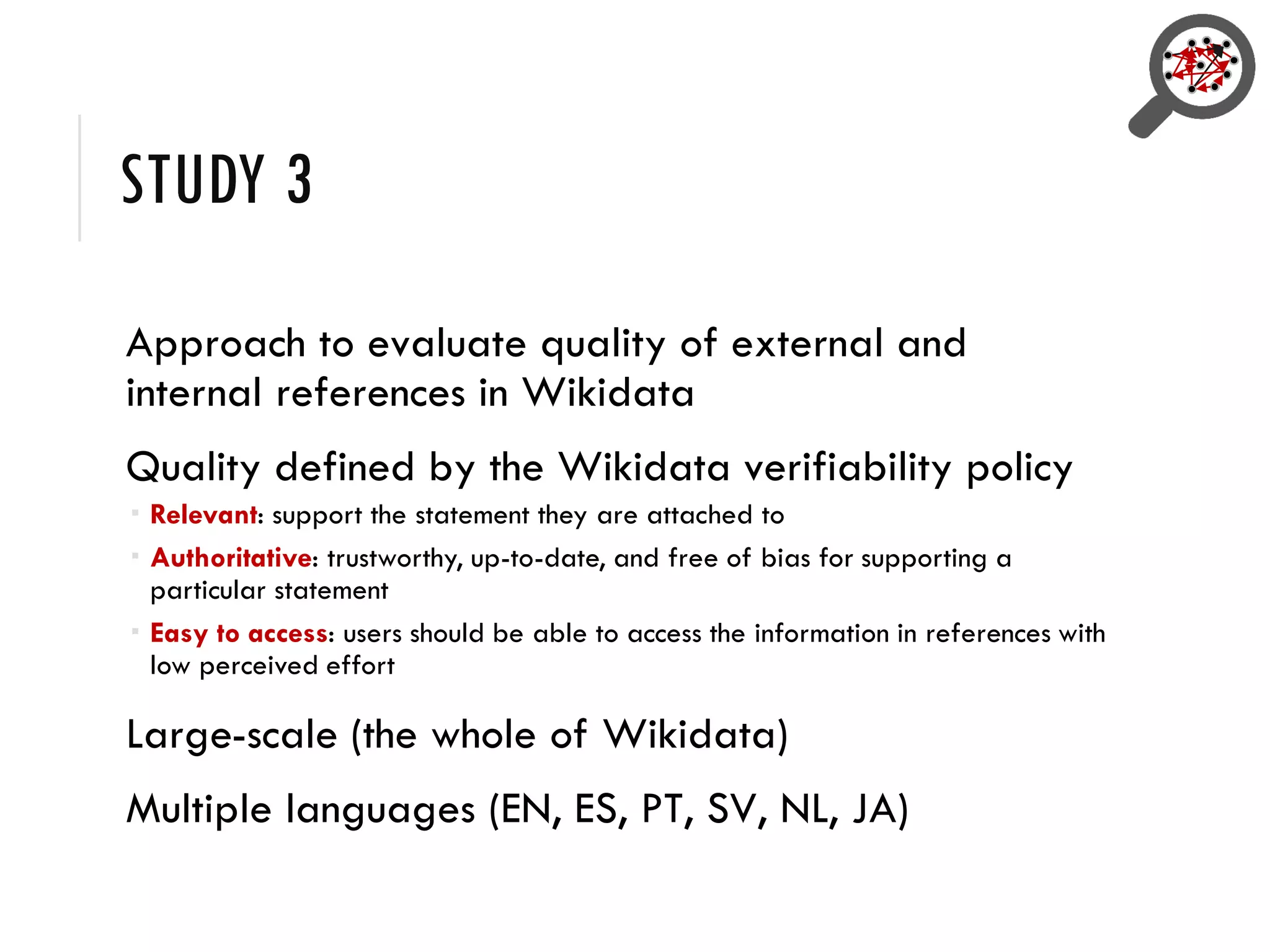
Approach to evaluate quality of external and
internal references in Wikidata
Quality defined by the Wikidata verifiability policy
 Relevant: support the statement they are attached to
 Authoritative: trustworthy, up-to-date, and free of bias for supporting a
particular statement
 Easy to access: users should be able to access the information in references with
low perceived effort
Large-scale (the whole of Wikidata)
Multiple languages (EN, ES, PT, SV, NL, JA)
RESEARCH QUESTIONS
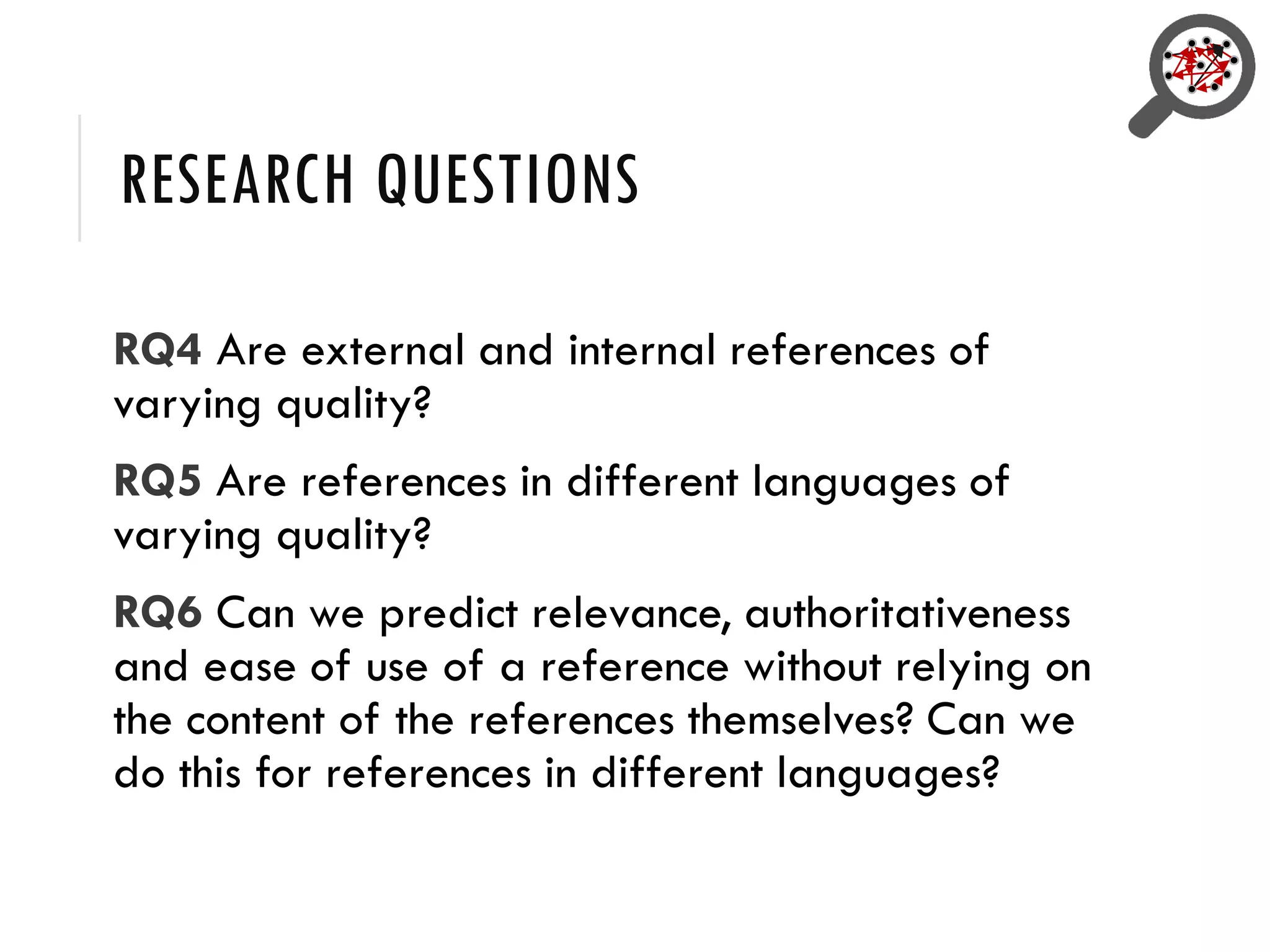
RQ1 How easy it is to access sources?
RQ2 How authoritative are sources?
 According to existing guidance, do they match the
author and publisher types from the Wikidata policy?
RQ3 Are sources relevant to claims?
RESEARCH QUESTIONS
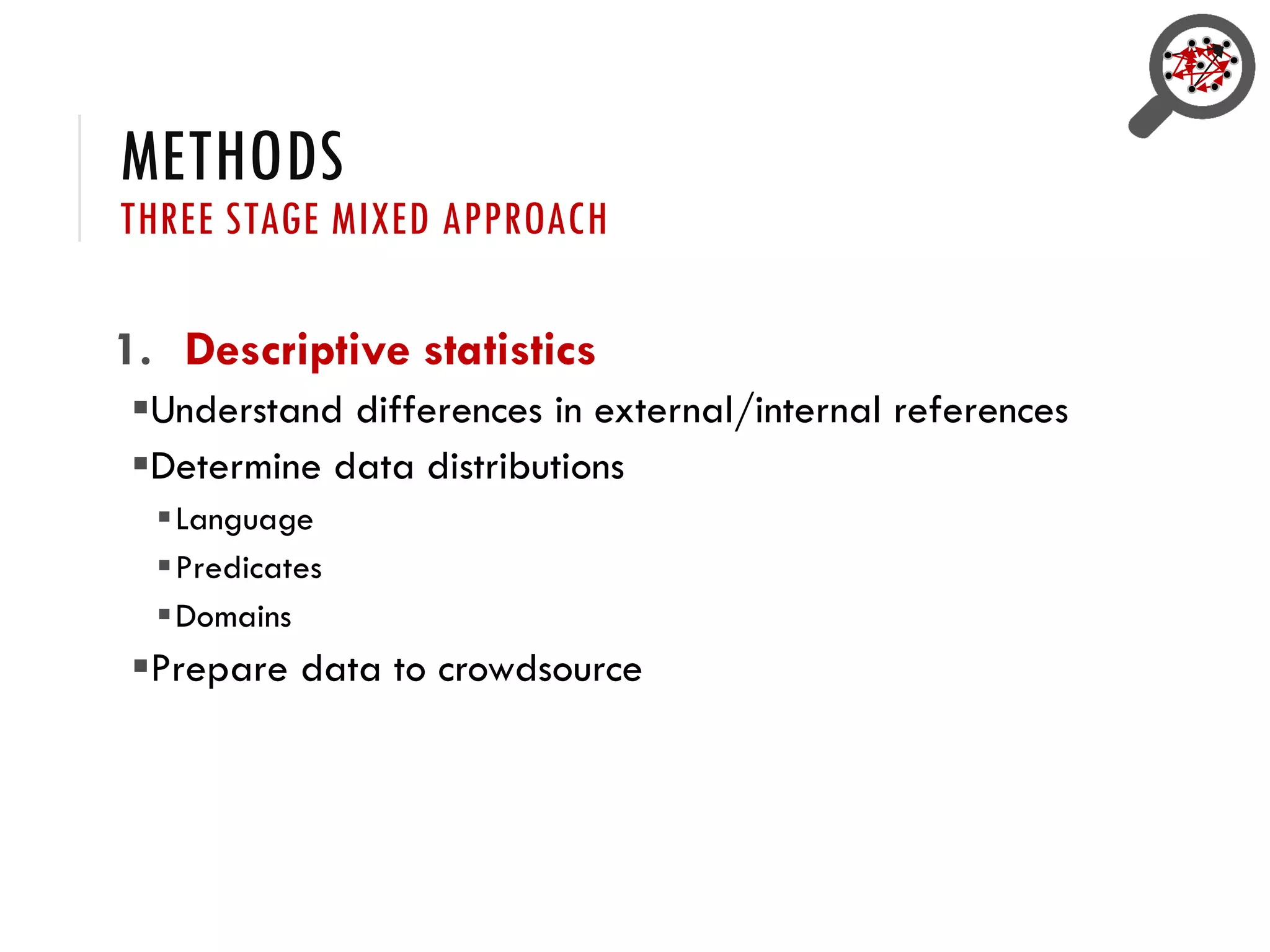
RQ4 Are external and internal references of
varying quality?
RQ5 Are references in different languages of
varying quality?
RQ6 Can we predict relevance, authoritativeness
and ease of use of a reference without relying on
the content of the references themselves? Can we
do this for references in different languages?
METHODS
THREE STAGE MIXED APPROACH
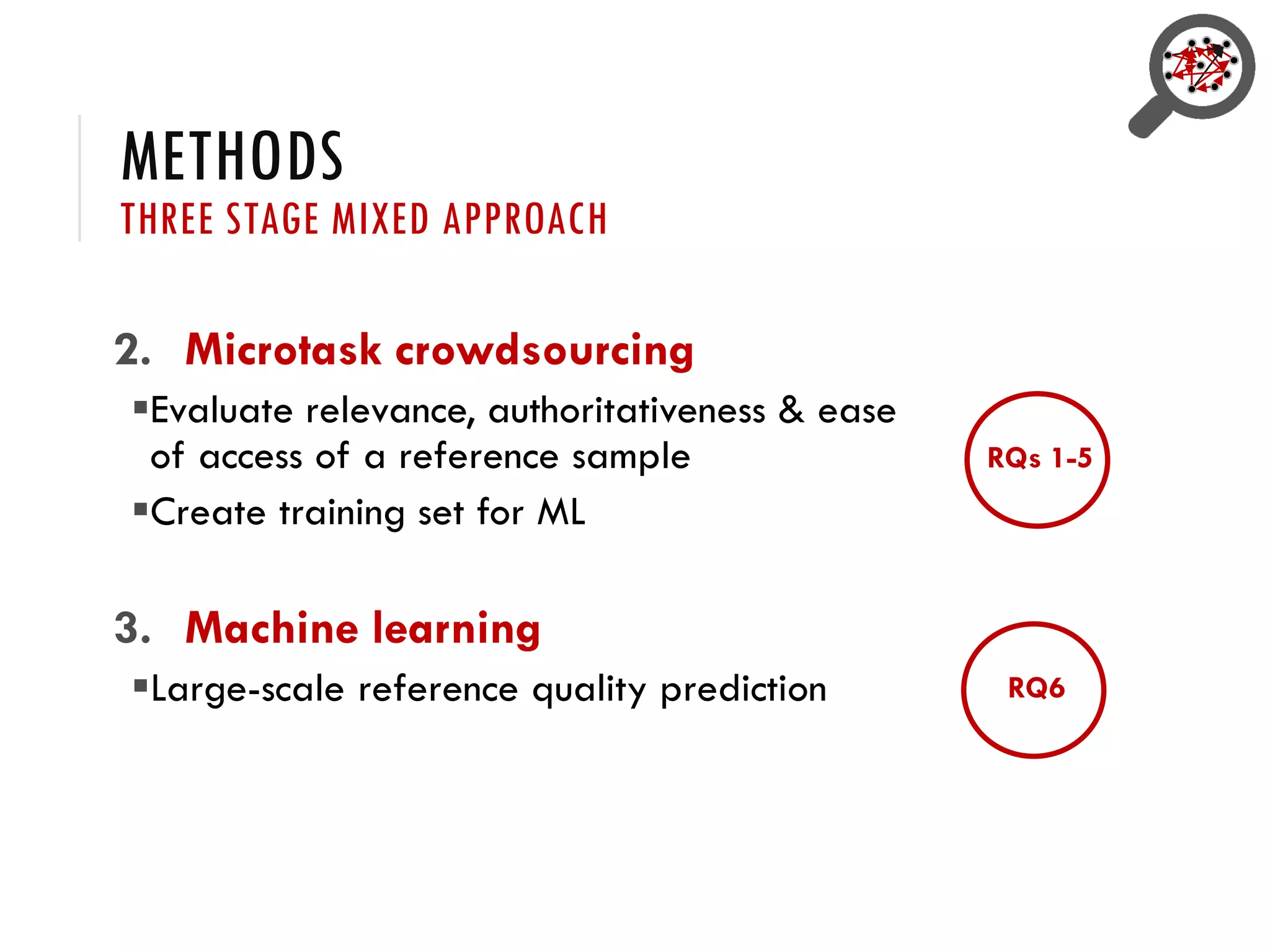
1. Descriptive statistics
Understand differences in external/internal references
Determine data distributions
Language
Predicates
Domains
Prepare data to crowdsource
METHODS
THREE STAGE MIXED APPROACH
2. Microtask crowdsourcing
Evaluate relevance, authoritativeness & ease
of access of a reference sample
Create training set for ML
3. Machine learning
Large-scale reference quality prediction
RQs 1-5
RQ6
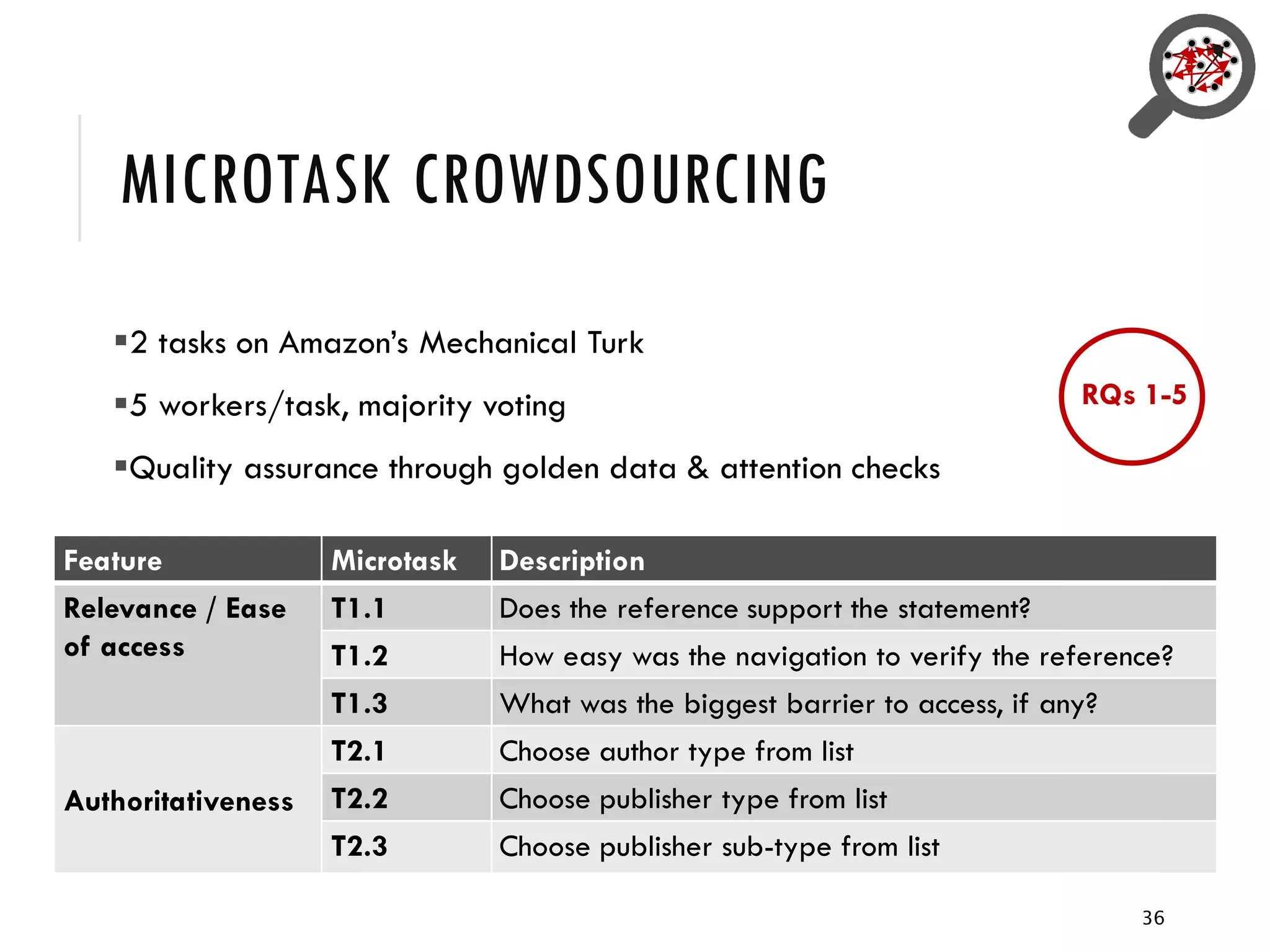
MICROTASK CROWDSOURCING
2 tasks on Amazon’s Mechanical Turk
5 workers/task, majority voting
Quality assurance through golden data & attention checks
36
Feature Microtask Description
Relevance / Ease
of access
T1.1 Does the reference support the statement?
T1.2 How easy was the navigation to verify the reference?
T1.3 What was the biggest barrier to access, if any?
Authoritativeness
T2.1 Choose author type from list
T2.2 Choose publisher type from list
T2.3 Choose publisher sub-type from list
RQs 1-5
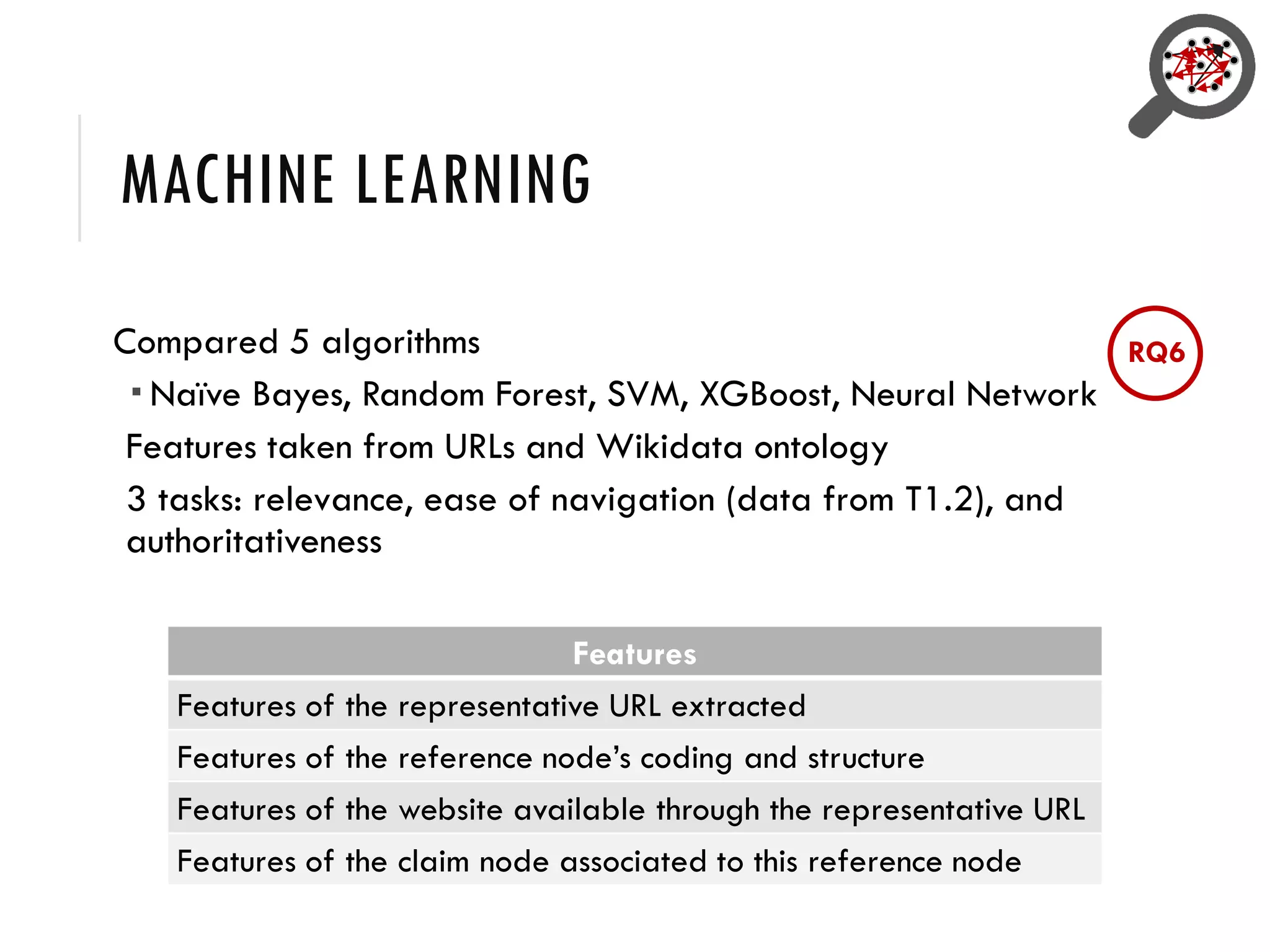
MACHINE LEARNING
Compared 5 algorithms
 Naïve Bayes, Random Forest, SVM, XGBoost, Neural Network
Features taken from URLs and Wikidata ontology
3 tasks: relevance, ease of navigation (data from T1.2), and
authoritativeness
RQ6
Features
Features of the representative URL extracted
Features of the reference node’s coding and structure
Features of the website available through the representative URL
Features of the claim node associated to this reference node
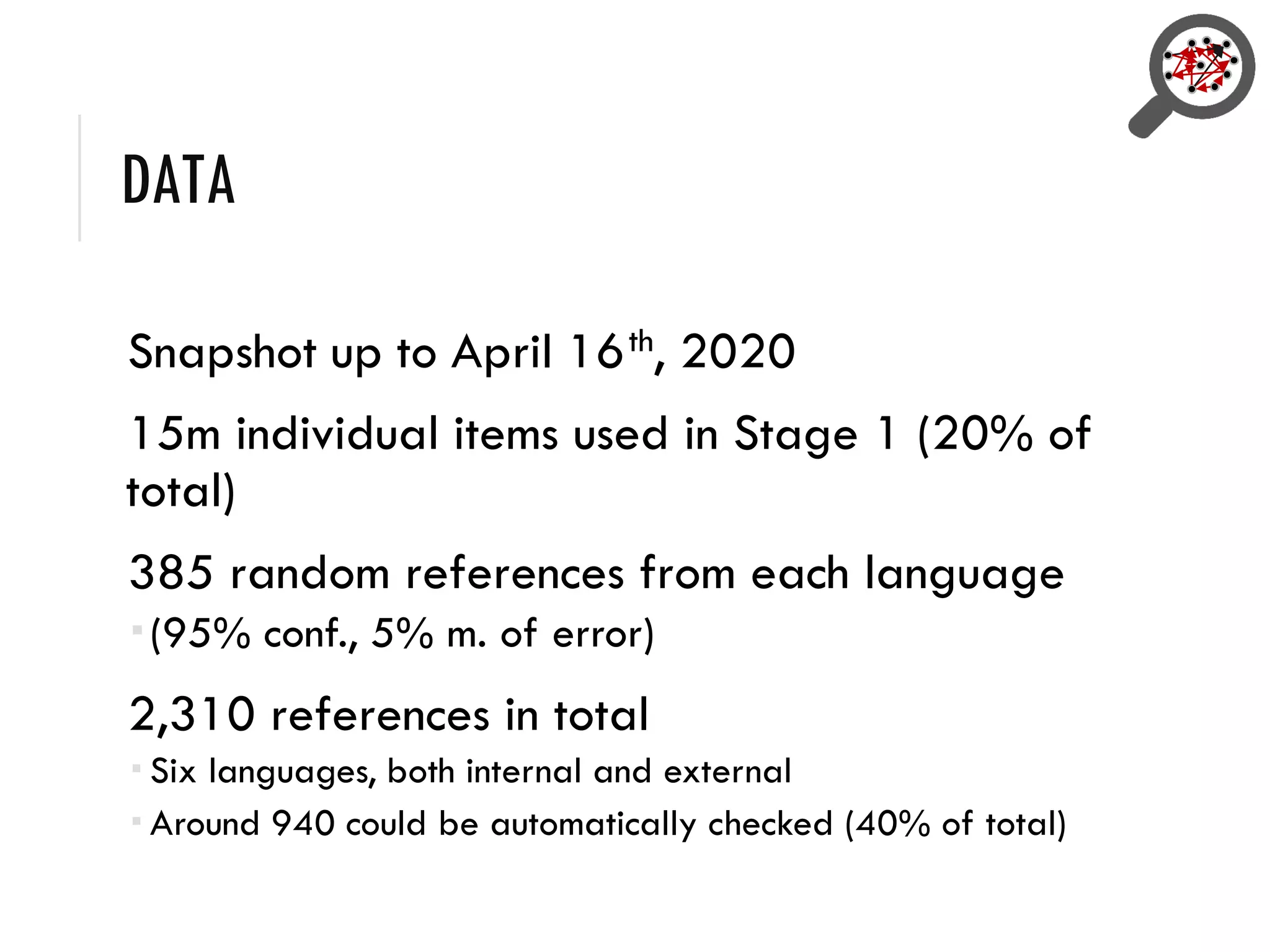
DATA
Snapshot up to April 16th, 2020
15m individual items used in Stage 1 (20% of
total)
385 random references from each language
(95% conf., 5% m. of error)
2,310 references in total
 Six languages, both internal and external
 Around 940 could be automatically checked (40% of total)
RESULTS: CROWDSOURCING
CROWDSOURCING WORKS
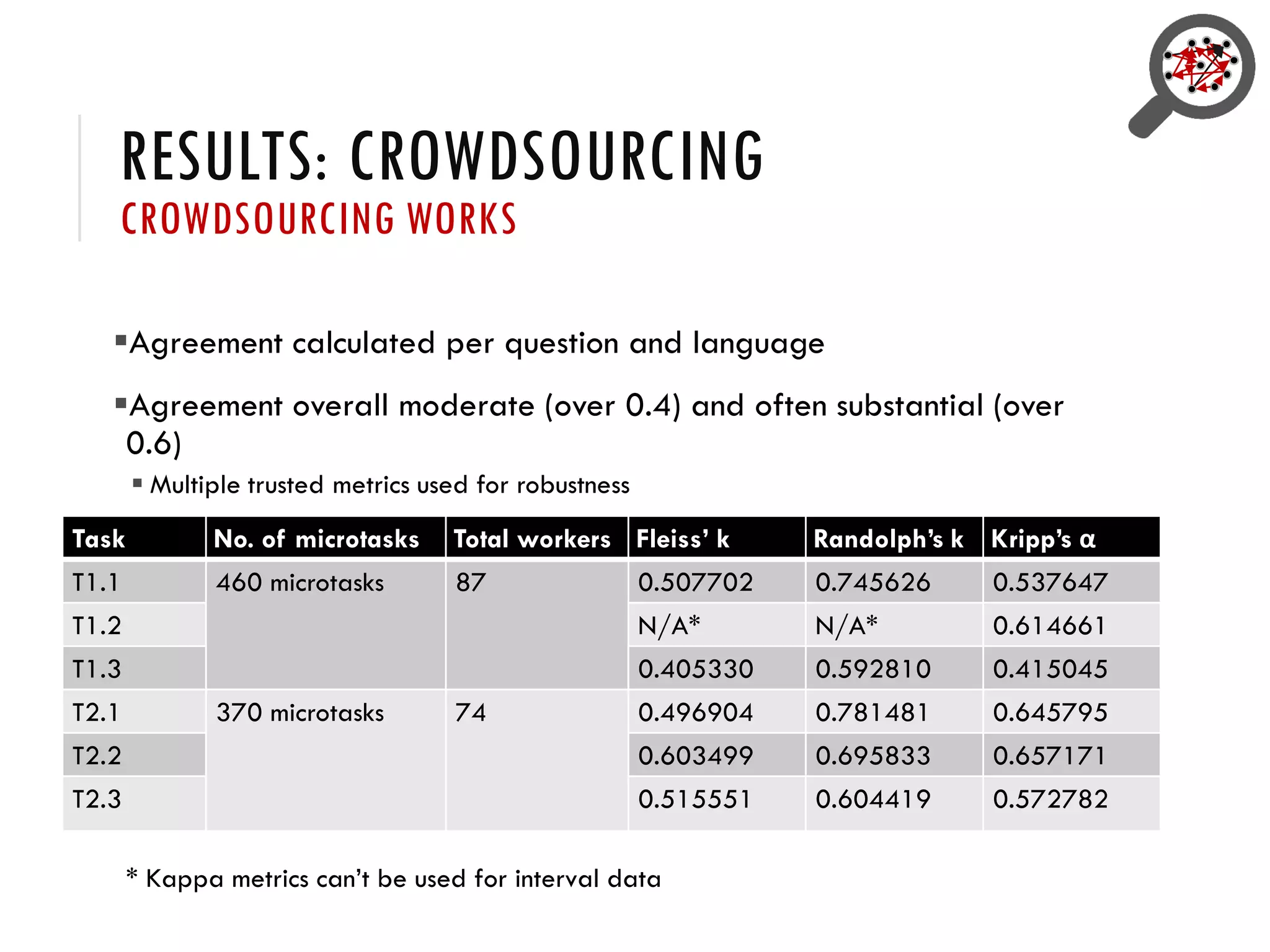
Agreement calculated per question and language
Agreement overall moderate (over 0.4) and often substantial (over
0.6)
 Multiple trusted metrics used for robustness
* Kappa metrics can’t be used for interval data
Task No. of microtasks Total workers Fleiss’ k Randolph’s k Kripp’s α
T1.1 460 microtasks 87 0.507702 0.745626 0.537647
T1.2 N/A* N/A* 0.614661
T1.3 0.405330 0.592810 0.415045
T2.1 370 microtasks 74 0.496904 0.781481 0.645795
T2.2 0.603499 0.695833 0.657171
T2.3 0.515551 0.604419 0.572782
RESULTS: CROWDSOURCING
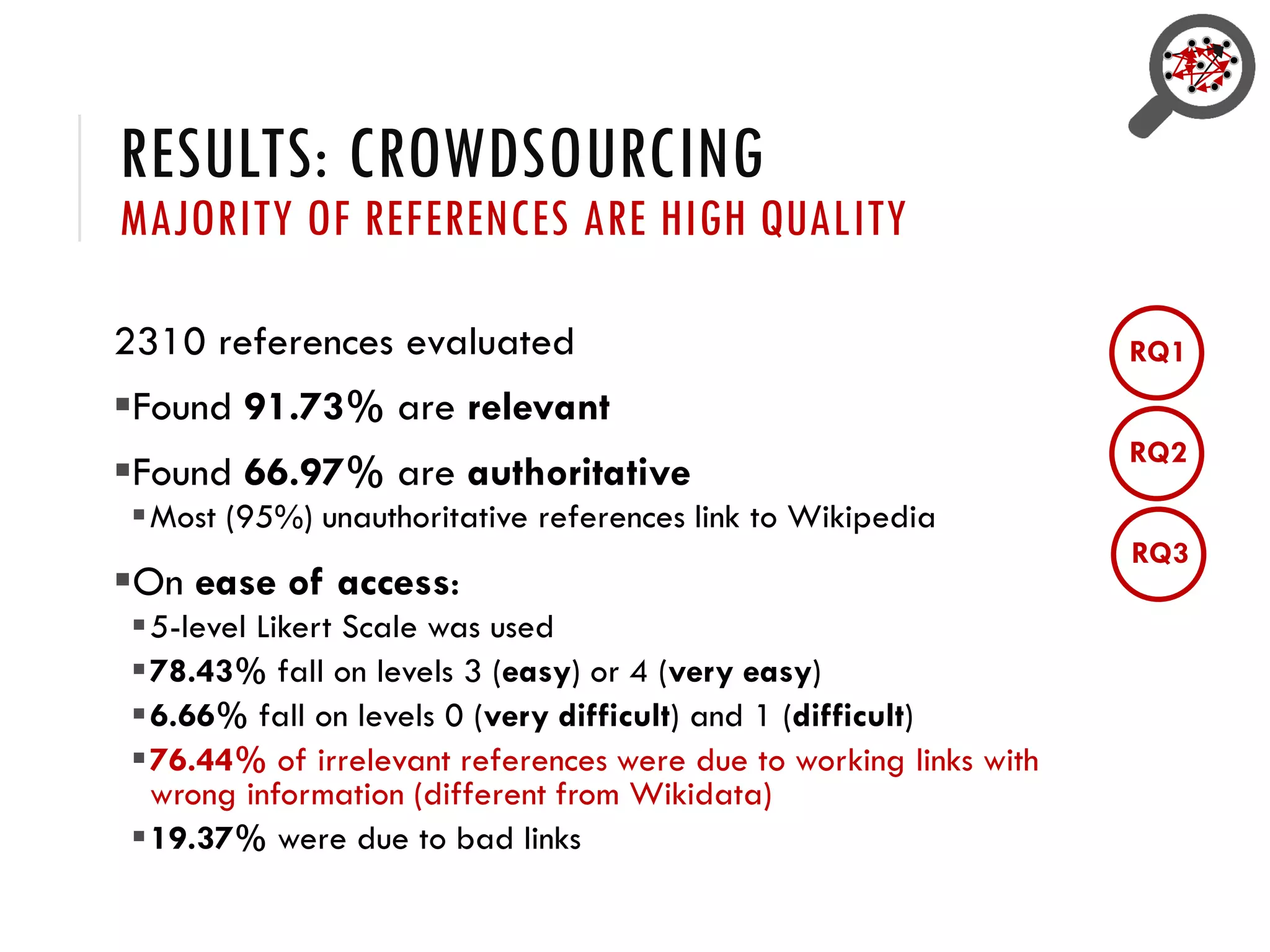
MAJORITY OF REFERENCES ARE HIGH QUALITY
2310 references evaluated
Found 91.73% are relevant
Found 66.97% are authoritative
Most (95%) unauthoritative references link to Wikipedia
On ease of access:
5-level Likert Scale was used
78.43% fall on levels 3 (easy) or 4 (very easy)
6.66% fall on levels 0 (very difficult) and 1 (difficult)
76.44% of irrelevant references were due to working links with
wrong information (different from Wikidata)
19.37% were due to bad links
RQ1
RQ2
RQ3
RESULTS: CROWDSOURCING
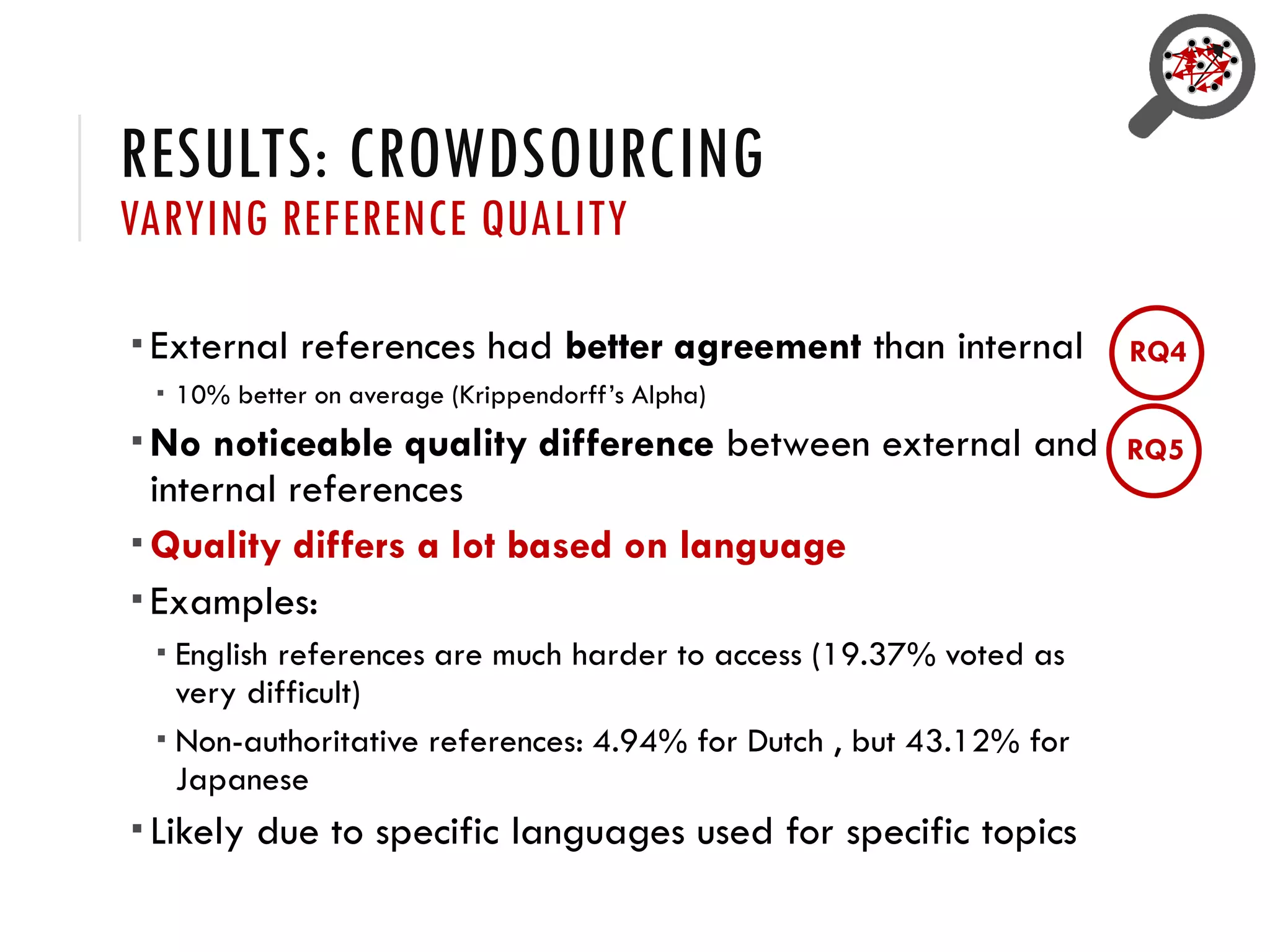
VARYING REFERENCE QUALITY
RQ4
 External references had better agreement than internal
 10% better on average (Krippendorff’s Alpha)
 No noticeable quality difference between external and
internal references
 Quality differs a lot based on language
 Examples:
 English references are much harder to access (19.37% voted as
very difficult)
 Non-authoritative references: 4.94% for Dutch , but 43.12% for
Japanese
 Likely due to specific languages used for specific topics
RQ5
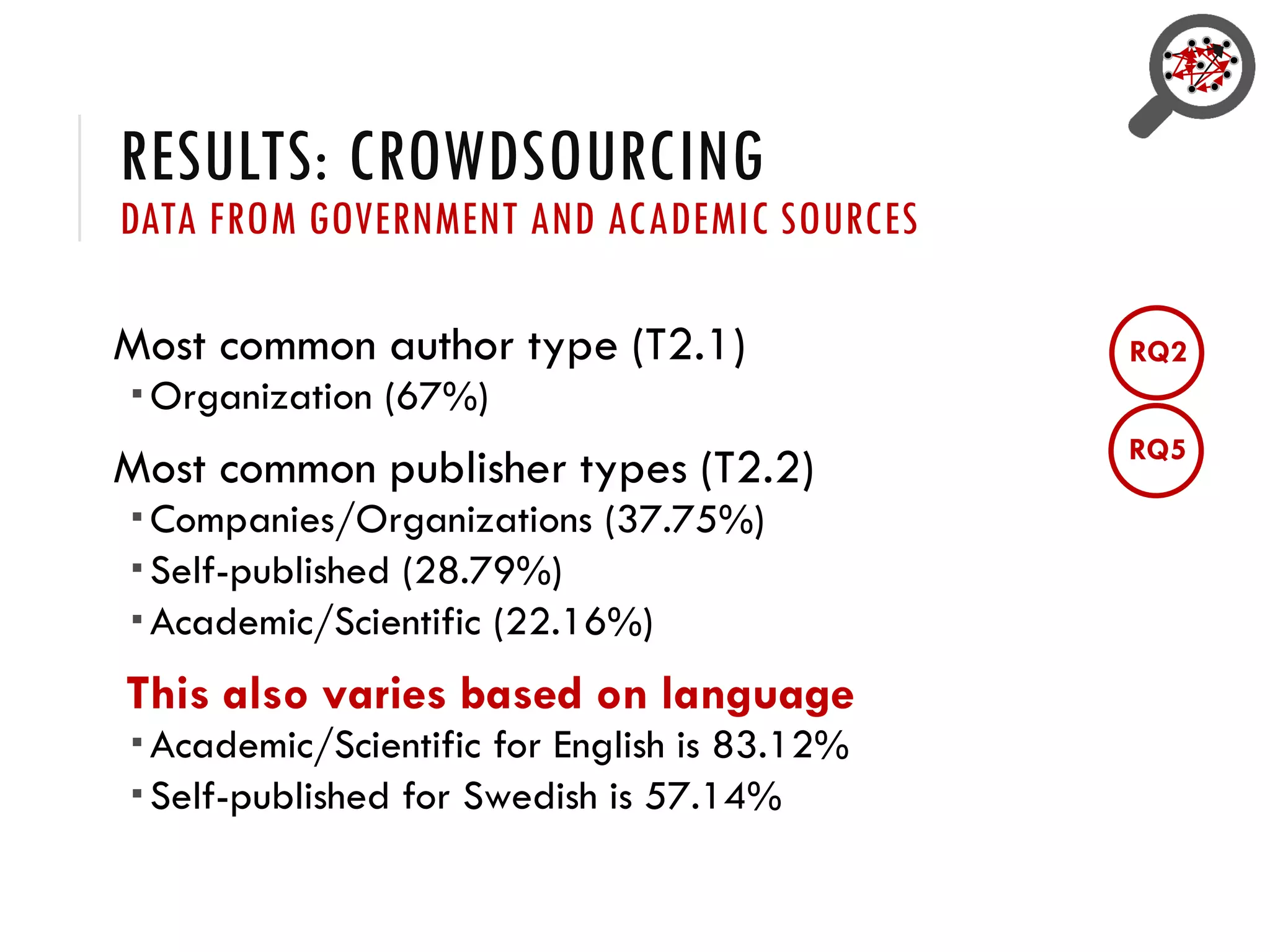
RESULTS: CROWDSOURCING
DATA FROM GOVERNMENT AND ACADEMIC SOURCES
Most common author type (T2.1)
 Organization (67%)
Most common publisher types (T2.2)
 Companies/Organizations (37.75%)
 Self-published (28.79%)
 Academic/Scientific (22.16%)
This also varies based on language
 Academic/Scientific for English is 83.12%
 Self-published for Swedish is 57.14%
RQ2
RQ5
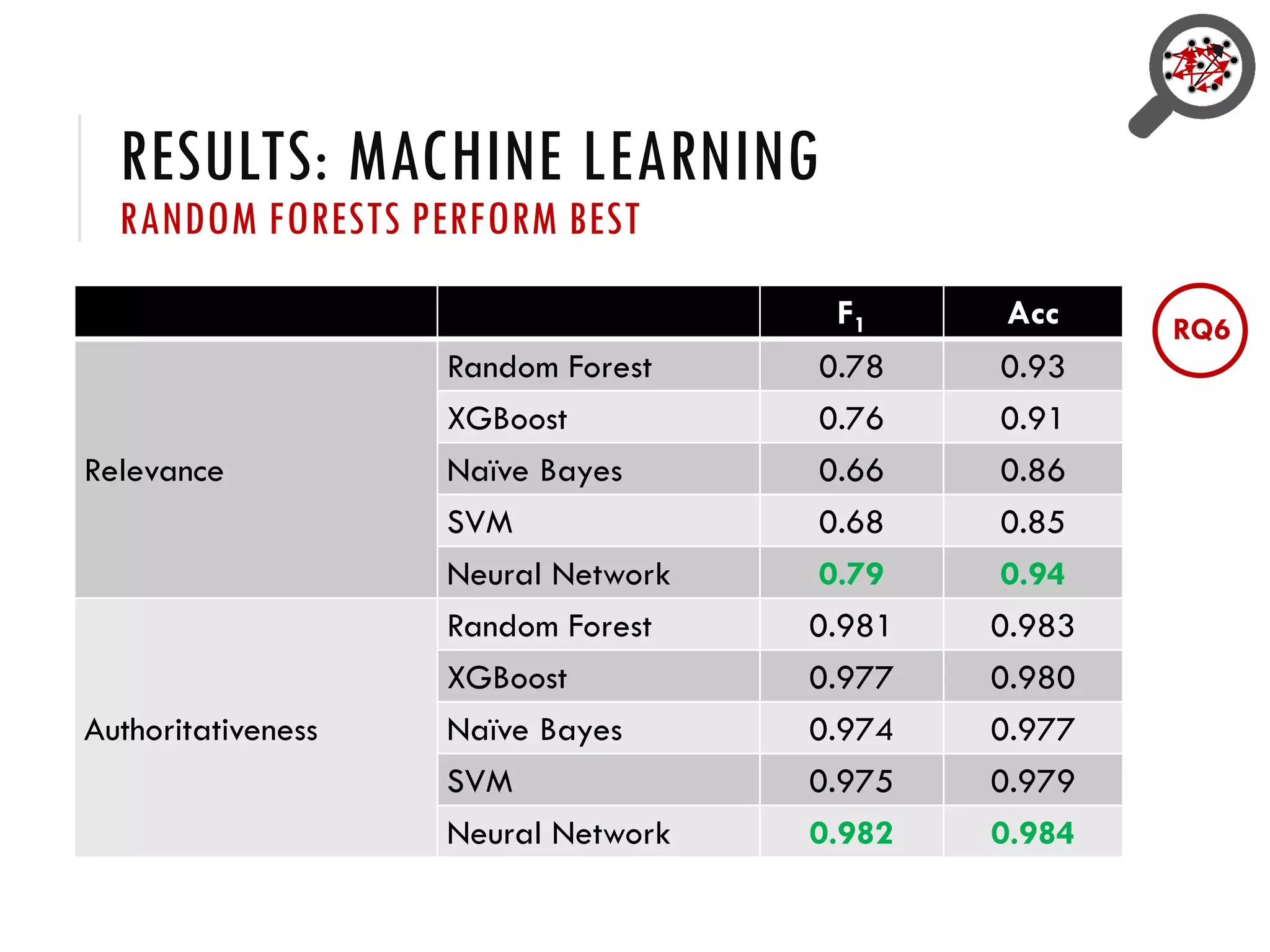
RESULTS: MACHINE LEARNING
RANDOM FORESTS PERFORM BEST
F1 Acc
Relevance
Random Forest 0.78 0.93
XGBoost 0.76 0.91
Naïve Bayes 0.66 0.86
SVM 0.68 0.85
Neural Network 0.79 0.94
Authoritativeness
Random Forest 0.981 0.983
XGBoost 0.977 0.980
Naïve Bayes 0.974 0.977
SVM 0.975 0.979
Neural Network 0.982 0.984
RQ6
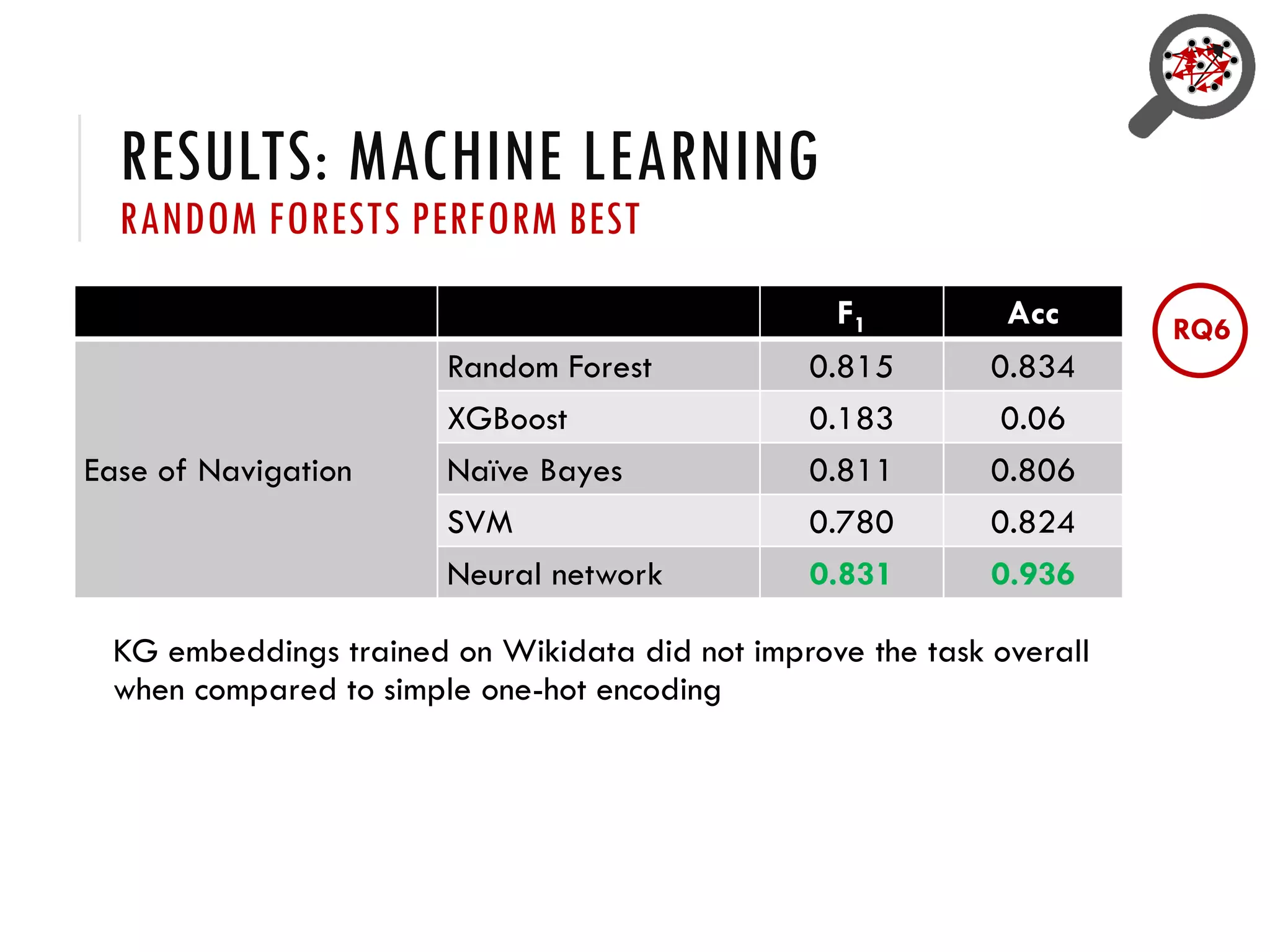
RESULTS: MACHINE LEARNING
RANDOM FORESTS PERFORM BEST
F1 Acc
Ease of Navigation
Random Forest 0.815 0.834
XGBoost 0.183 0.06
Naïve Bayes 0.811 0.806
SVM 0.780 0.824
Neural network 0.831 0.936
RQ6
KG embeddings trained on Wikidata did not improve the task overall
when compared to simple one-hot encoding
CONCLUSIONS
Crowdsourcing + ML works
Many external sources are high-quality
Bad references are mainly working links with bad
information
External references were much clearer to workers
There are topical biases in different languages,
leading quality to vary by language
ONGOING WORK
Editor study to
understand how
references are
chosen
Automatic claim
verification
ENCOURAGING EDITOR
DIVERSITY
Alghamdi, K., Shi, M. & Simperl, E. (2021). Learning to
recommend items to Wikidata editors. To appear at
ISWC.
OVERVIEW
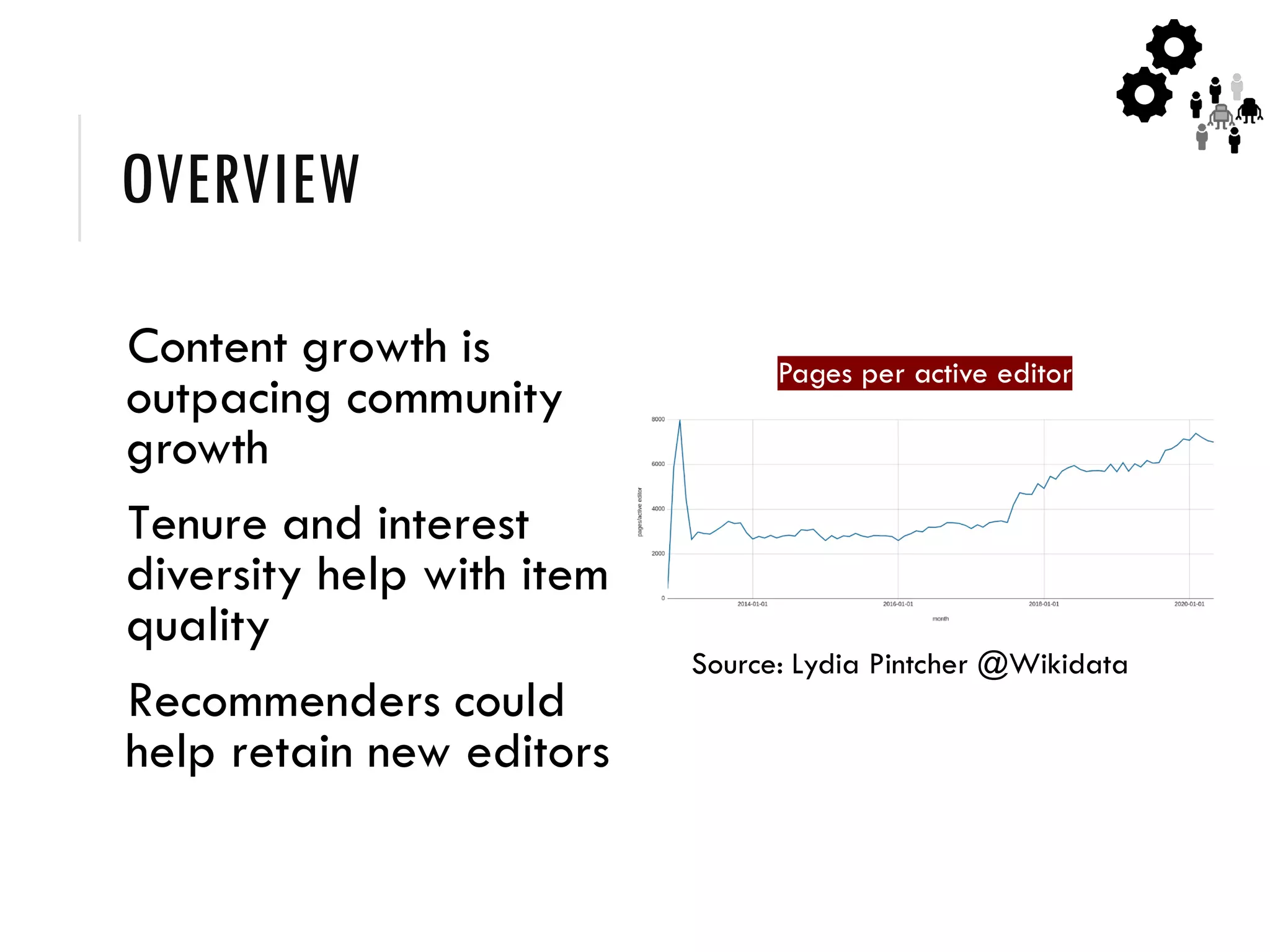
Content growth is
outpacing community
growth
Tenure and interest
diversity help with item
quality
Recommenders could
help retain new editors
Source: Lydia Pintcher @Wikidata
Pages per active editor
DATASETS
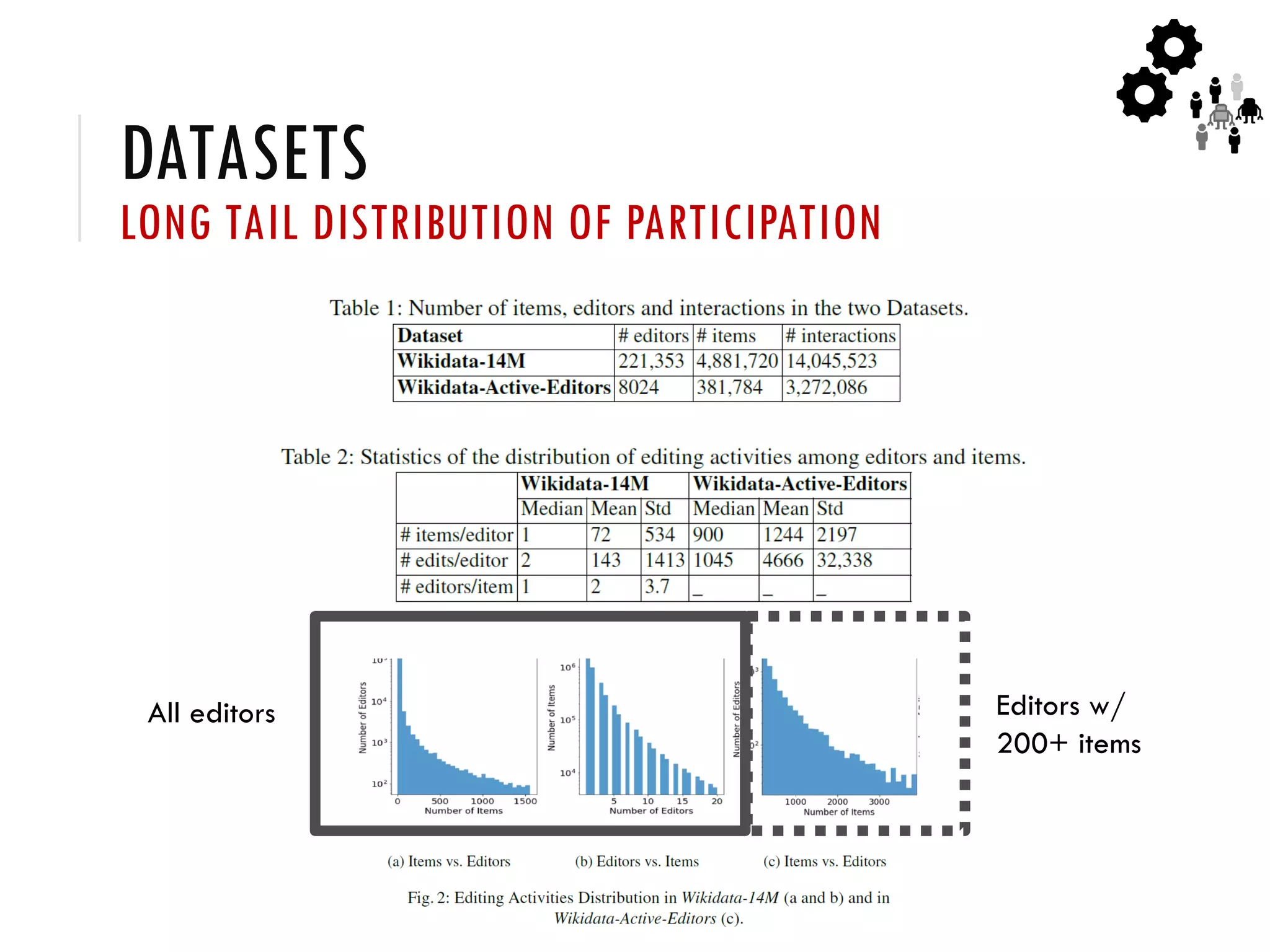
LONG TAIL DISTRIBUTION OF PARTICIPATION
All editors Editors w/
200+ items
WIKIDATAREC
MODEL
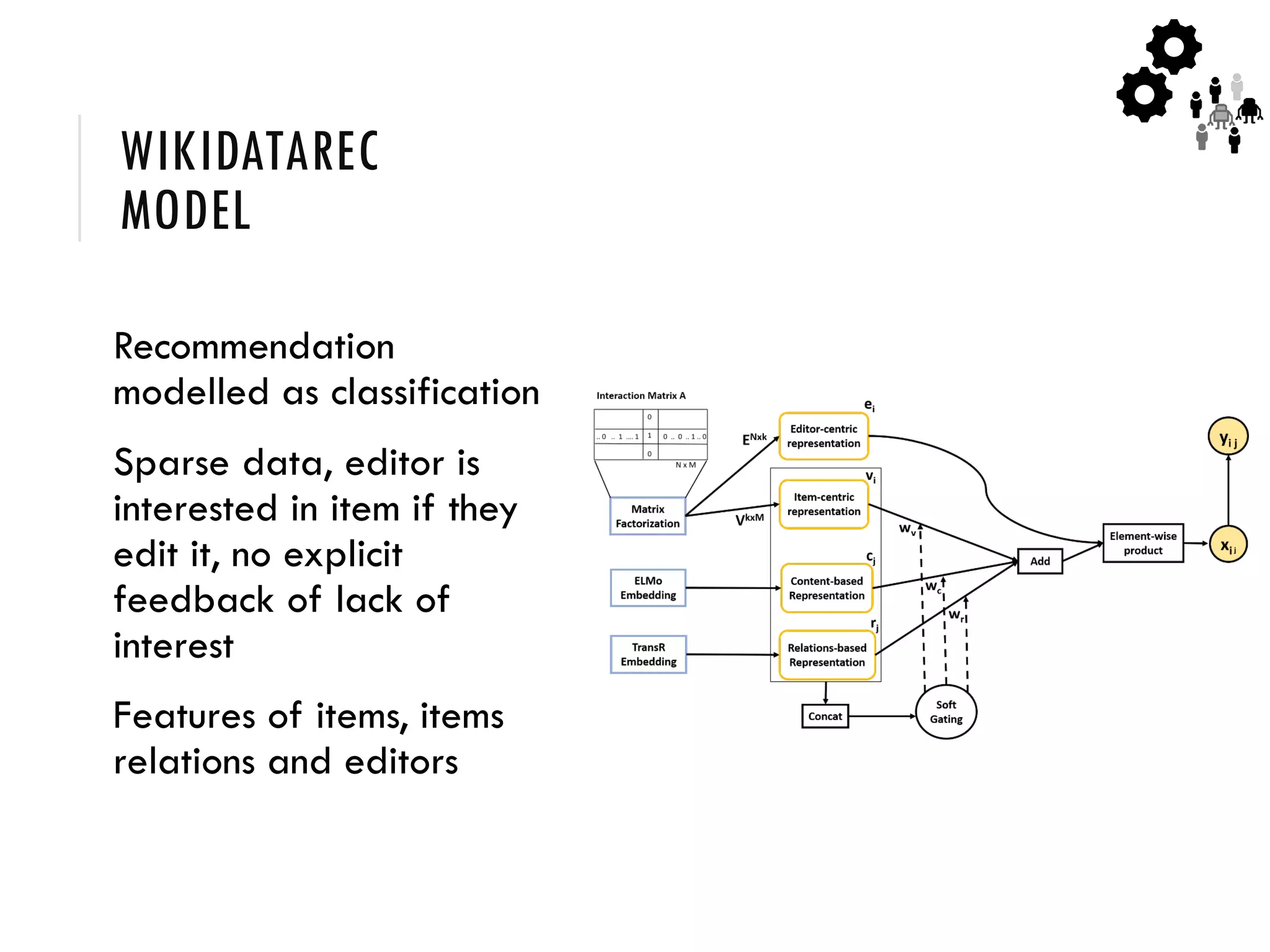
Recommendation
modelled as classification
Sparse data, editor is
interested in item if they
edit it, no explicit
feedback of lack of
interest
Features of items, items
relations and editors
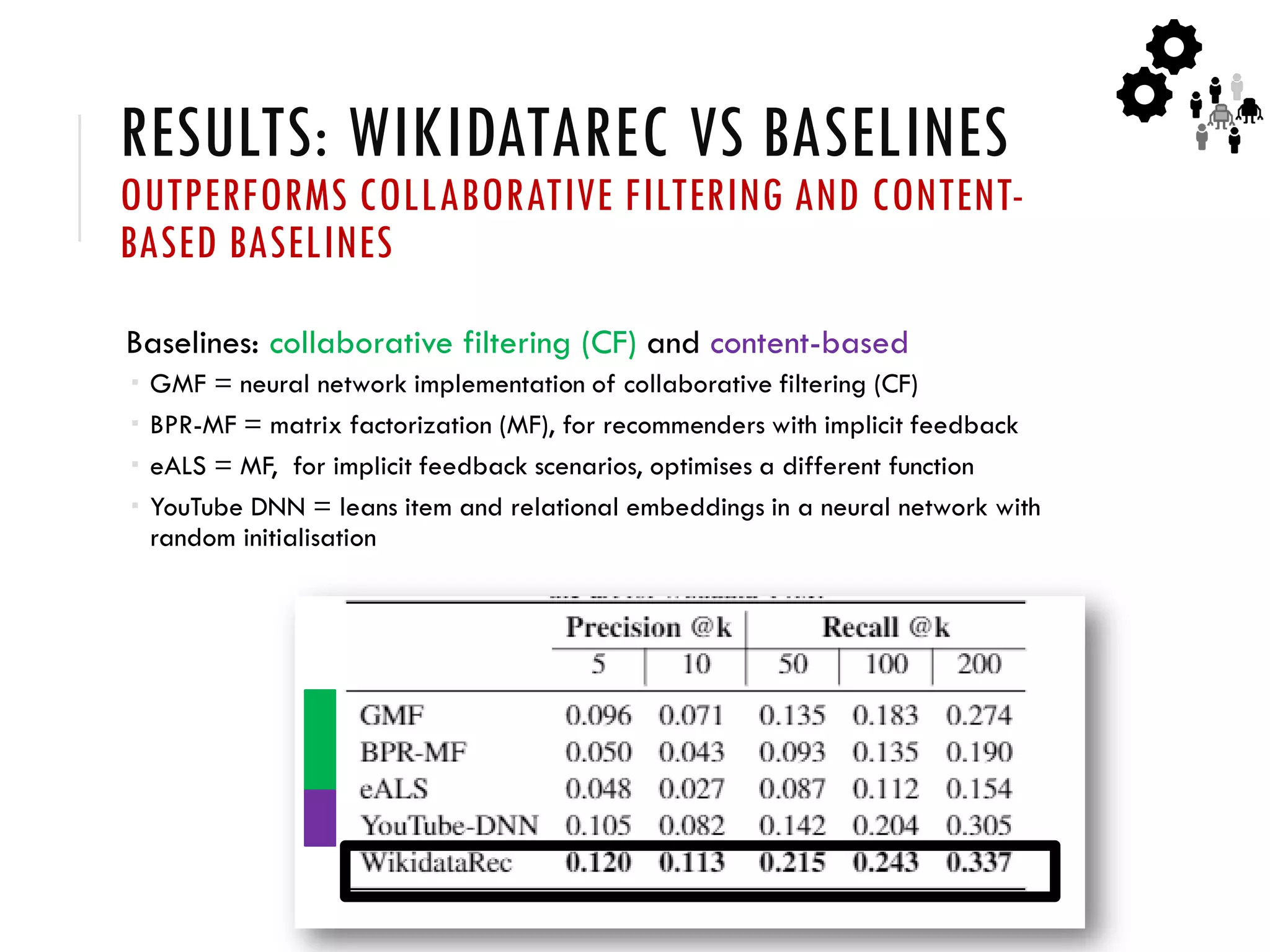
RESULTS: WIKIDATAREC VS BASELINES
OUTPERFORMS COLLABORATIVE FILTERING AND CONTENT-
BASED BASELINES
Baselines: collaborative filtering (CF) and content-based
 GMF = neural network implementation of collaborative filtering (CF)
 BPR-MF = matrix factorization (MF), for recommenders with implicit feedback
 eALS = MF, for implicit feedback scenarios, optimises a different function
 YouTube DNN = leans item and relational embeddings in a neural network with
random initialisation
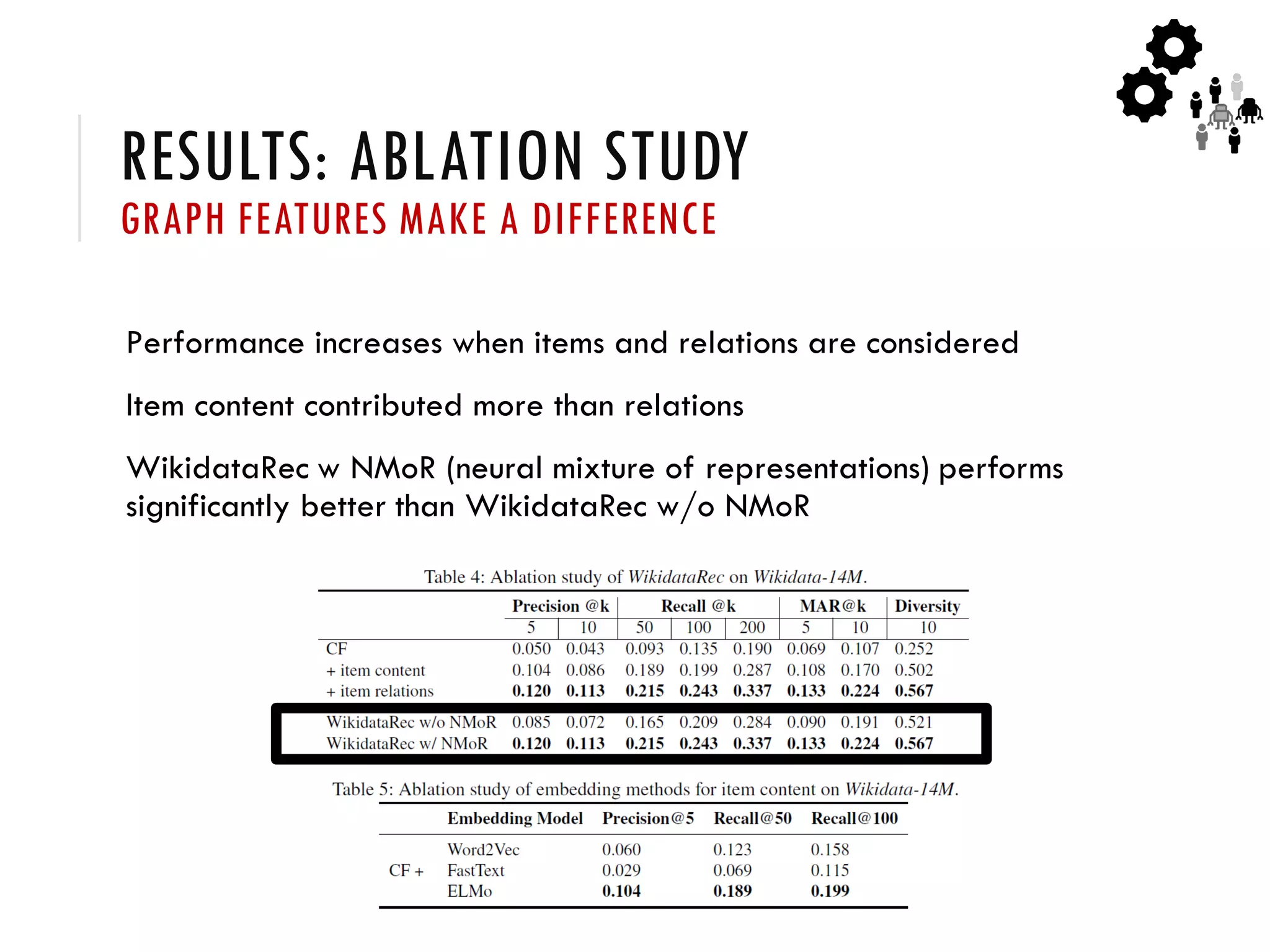
RESULTS: ABLATION STUDY
GRAPH FEATURES MAKE A DIFFERENCE
Performance increases when items and relations are considered
Item content contributed more than relations
WikidataRec w NMoR (neural mixture of representations) performs
significantly better than WikidataRec w/o NMoR
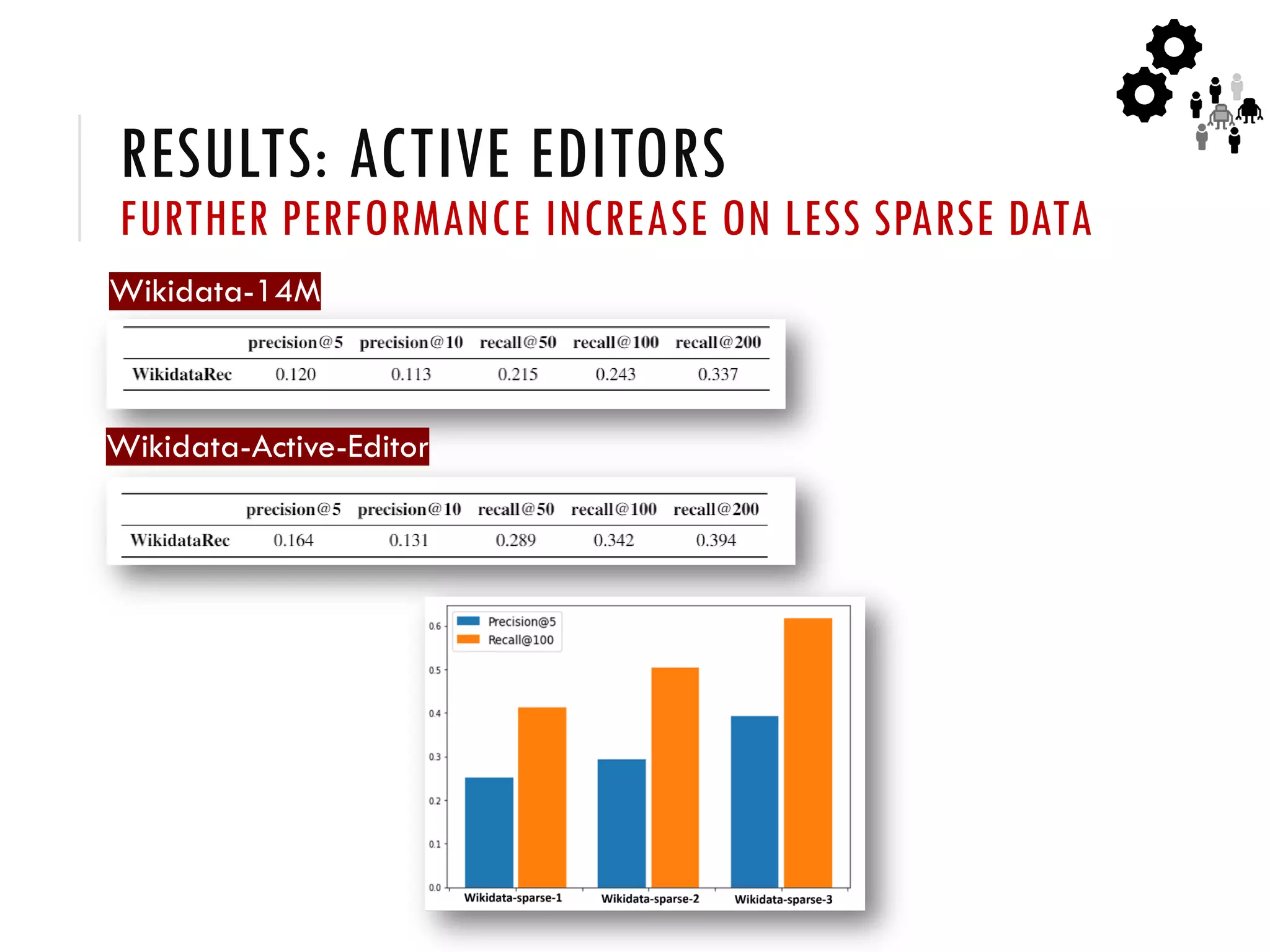
RESULTS: ACTIVE EDITORS
FURTHER PERFORMANCE INCREASE ON LESS SPARSE DATA
Wikidata-14M
Wikidata-Active-Editor
CONCLUSIONS AND FUTURE WORK
WikidataRec shows recommendations are
technically feasible, even on sparser data
Evaluation on topics rather than items
should yield better results
Ongoing editor study to understand
practices and needs, followed by online
evaluation
WHAT WIKIDATA
TEACHES US ABOUT
KNOWLEDGE
ENGINEERING
Wikidata logs are a
huge source of
observational data in
knowledge engineering
Sociotechnical methods
improve on purely
technical ones to address
community growth and
diversity, content
reliability
Many cross-disciplinary
methods e.g. psychology,
sociology, neurosciences
underexplored
WHAT
WIKIDATA
TEACHES US
ABOUT
KNOWLEDGE
ENGINEERING
• Piscopo, A., Phethean, C., & Simperl, E. (2017). What
Makes a Good Collaborative Knowledge Graph:
Group Composition and Quality in Wikidata.
International Conference on Social Informatics, 305-
322, Springer.
• Piscopo, A., & Simperl, E. (2018). Who Models the
World?: Collaborative Ontology Creation and User
Roles in Wikidata. Proceedings of the ACM on
Human-Computer Interaction, 2(CSCW), 141.
• Amaral, G., Piscopo, A., Kaffee, L. A., Odinaldo, R., &
Simperl, E. (2020). Assessing the quality of sources in
Wikidata across languages: a hybrid approach. To
appear in ACM TDIQ
• Alghamdi, K., Shi, M. & Simperl, E. (2021). Learning
to recommend items to Wikidata editors. To appear
at ISWC.

What Wikidata teaches us about knowledge engineering

  • 1.
    WHAT WIKIDATA TEACHES US ABOUT KNOWLEDGE ENGINEERING ElenaSimperl King’s College London, UK @esimperl PFIA 2021 June 30 2021
  • 2.
    OVERVIEW Knowledge graphs havebecome a critical AI resource We study them as socio-technical constructs Our research  Explores the links between social and technical qualities of knowledge graphs  Proposes methods and tools to make knowledge graphs better Picture from https://medium.com/@sderymail/challenges-of-knowledge-graph-part-1-d9ffe9e35214
  • 3.
    WIKIDATA Collaborative knowledge graph, Wikimediaproject (2012) 28k active users, 97m items, 1.6b edits Open license RDF support, links to LOD cloud
  • 4.
    THE KNOWLEDGE GRAPH STATEMENTS,ITEMS, PROPERTIES Item identifiers start with a Q, property identifiers start with a P 4 Q84 London Q334155 Sadiq Khan P6 head of government
  • 5.
    THE KNOWLEDGE GRAPH ITEMSCAN BE CLASSES, ENTITIES, VALUES 5 Q7259 Ada Lovelace Q84 London Q334155 Sadiq Khan P6 head of government Q727 Amsterdam Q515 city Q6581097 male Q59360 Labour party Q145 United Kingdom
  • 6.
    THE KNOWLEDGE GRAPH STATEMENTSIN CONTEXT Statements may include context  Qualifiers (optional)  References (required) Two types of references  Internal, linking to another item  External, linking to webpage 6 Q84 London Q334155 Sadiq Khan P6 head of government 9 May 2016 london.gov.uk
  • 7.
    THE KNOWLEDGE GRAPH CO-EDITEDBY BOTS AND HUMANS Human editors can register or work anonymously Community creates bots to automate routine tasks 28k active human users, 300+ bots
  • 8.
    IN THIS TALK KGquality as a function of its community KG quality as a function of its provenance Tools to support KG editors choose what to work on
  • 9.
    ‘ONTOLOGIES ARE US’ Piscopo,A., Phethean, C., & Simperl, E. (2017). What Makes a Good Collaborative Knowledge Graph: Group Composition and Quality in Wikidata. International Conference on Social Informatics, 305-322, Springer. Piscopo, A., & Simperl, E. (2018). Who Models the World?: Collaborative Ontology Creation and User Roles in Wikidata. Proceedings of the ACM on Human-Computer Interaction, 2(CSCW), 141.
  • 10.
    BACKGROUND Editors have variedtenure and interests Their profile and editing behaviour impact outcomes  Group composition has varied effects  Tenure and interest diversity can increase outcome quality and group productivity  Different editors groups focus on different types of activities Chen, J., Ren, Y., Riedl, J.: The effects of diversity on group productivity and member withdrawal in online volunteer groups. In: Proceedings of the 28th international conference on human factors in computing systems - CHI ’10. p. 821. ACM Press, New York, USA (2010)
  • 11.
    STUDY 1: ITEMQUALITY Analysed edit history of items Corpus of 5k items, whose quality has been manually assessed (5 levels)* Edit history focused on community make-up Community is defined as set of editors of item Considered features from group diversity literature and Wikidata-specific aspects *https://www.wikidata.org/wiki/Wikidata:Item_quality
  • 12.
    RESEARCH HYPOTHESES Activity Outcome H1Bots edits Item quality H2 Bot-human interaction Item quality H3 Anonymous edits Item quality H4 Tenure diversity Item quality H5 Interest diversity Item quality
  • 13.
    DATA AND METHODS Ordinalregression analysis, trained four models Dependent variable: 5k labelled Wikidata items Independent variables  Proportion of bot edits  Bot human edit proportion  Proportion of anonymous edits  Tenure diversity: Coefficient of variation  Interest diversity: User editing matrix Control variables: group size, item age
  • 14.
  • 15.
    SUMMARY AND IMPLICATIONS Themore is not always the merrier 01 Bot edits are key for quality, but bots and humans are better 02 Registered editors have a positive impact Diversity matters 04 Encourage registration 01 Identify further areas for bot editing 02 Design effective human-bot workflows 03 Suggest items to edit based on tenure and interests 04 03
  • 16.
    ONGOING WORK: PREDICTING WIKIDATA QUALITY Analysinghow the community awards quality labels to items Developing robust machine learning models Spotting unknown biases
  • 17.
    STUDY 2: ONTOLOGYQUALITY Analysed Wikidata ontology and its edit context Defined as the graph of all items linked through P31 (instance of) & P279 (subclass of) Calculated evolution of quality indicators and editing activity in time and the links between them Based on features from literature on ontology evaluation and collaborative ontology engineering
  • 18.
    DATA AND METHODS Wikidatadumps from March 2013 (creation of P279) to September 2017  Analysed data in 55 monthly time frames Literature survey to define Wikidata ontology quality framework Clustering to identify ontology editor roles Lagged multiple regression to link roles and ontology features  Dependent variable: Changes in ontology quality across time  Independent variables: Number of edits by different roles  Control variables: Bot and anonymous edits
  • 19.
    ONTOLOGY QUALITY: INDICATORS Basedon 7 ontology evaluation frameworks Compiled structural indicators that can be computed from the data 19 Indicator Description Indicator Description noi Number of instances ap; mp Average and median population noc Number of classes rr Relationship richness norc Number of root classes ir, mr Inheritance and median richness nolc Number of leaf classes cr Class richness nop Number of properties ad, md, maxd Average, median, max explicit depth Sicilia, M. A., Rodríguez, D., García-Barriocanal, E., & Sánchez-Alonso, S. (2012). Empirical findings on ontology metrics. Expert Systems with Applications, 39(8), 6706-6711.
  • 20.
    ONTOLOGY QUALITY: RESULTS LARGEONTOLOGY, UNEVEN QUALITY >1.5M classes, ~4000 properties No of classes increases at same rate as overall no of items, likely due to users incorrectly using P31 & P279 ap and cr decrease over time, several classes are either without instances, sub-classes or both ir & maxd increase over time, part of the Wikidata ontology is distributed vertically 20
  • 21.
    EDITOR ROLES: METHODS K-means,features based on previous studies in ontology engineering Analysis by yearly cohort 21 Feature Description Feature Description # edits Total number of edits per month. # property edits Total number of edits on Properties in a month. # ontology edits Number of edits on classes. # taxonomy edits Number of edits on P31 and P279 statements. # discussion edits Number of edits on talk pages. p batch edits Number of edits done through automated tools. # modifying editsNumber of revisions on previously existing statements. item diversity Proportion between number of edits and number of items edited. admin True if user in an admin user group, false otherwise. lower admin True if user in a user group with enhanced user rights, false otherwise.
  • 22.
    EDITOR ROLES: RESULTS 190,765unique editors over 55 months (783k total) 18k editors active for 10+ months 2 clusters, obtained using gap statistic (tested 2≥k≥8) Leaders: more active minority (~1%), higher number of contributions to ontology, engaged within the community Contributors: less active, lower number of contributions to ontology and lower proportion of batch edits 22
  • 23.
    EDITOR ROLES: RESULTS Peoplewho joined the project early tend to be more active & are more likely to become leaders Levels of activity of leaders decrease over time (alternatively, people move on to different tasks) 23
  • 24.
    RESEARCH HYPOTHESES H1 Higherlevels of leader activity are negatively correlated to number of classes (noc), number of root classes (norc), and number of leaf classes (nolc) H2 Higher levels of leader activity are positively correlated to inheritance richness (ir), average population (ap), and average depth (ad) 24
  • 25.
    ROLES & ONTOLOGY:RESULTS H1 not supported H2 partially supported Only inheritance richness (ir) and average depth (ad) related significantly with leader edits (p<0.01) Bot edits significantly and positively affect the number of subclasses and instances per class (ir & ap) (p<0.05) 25
  • 26.
    SUMMARY AND IMPLICATIONS Creatingontologies still a challenging task Size of ontology renders existing automatic quality assessment methods unfeasible Broader curation efforts needed: large number of empty classes Editor roles less well articulated than in other ontology engineering projects Possible decline in motivation after several months
  • 27.
    ONGOING WORK The roleof discussions in Wikidata Studying participation pathways to observe learning effects Wikidata ontology as a network of ShEx schemas
  • 28.
    THE CONTENT ISAS GOOD AS ITS REFERENCES Amaral, G., Piscopo, A., Kaffee, L. A., Odinaldo, R., & Simperl, E. (2020). Assessing the quality of sources in Wikidata across languages: a hybrid approach. To appear in ACM TDIQ 28
  • 29.
    PROVENANCE IN WIKIDATA Statementsmay include context  Qualifiers (optional)  References (required) Two types of references  Internal, linking to another item  External, linking to webpage 29 Q84 London Q334155 Sadiq Khan P6 head of government 9 May 2016 london.gov.uk
  • 30.
    THE ROLE OFPROVENANCE Wikidata aims to become a hub of references Provenance increases trust in Wikidata Lack of provenance hinders downstream reuse Quality of references underexplored Hartig, O. (2009). Provenance Information in the Web of Data. LDOW, 538.
  • 31.
    STUDY 3 Approach toevaluate quality of external and internal references in Wikidata Quality defined by the Wikidata verifiability policy  Relevant: support the statement they are attached to  Authoritative: trustworthy, up-to-date, and free of bias for supporting a particular statement  Easy to access: users should be able to access the information in references with low perceived effort Large-scale (the whole of Wikidata) Multiple languages (EN, ES, PT, SV, NL, JA)
  • 32.
    RESEARCH QUESTIONS RQ1 Howeasy it is to access sources? RQ2 How authoritative are sources?  According to existing guidance, do they match the author and publisher types from the Wikidata policy? RQ3 Are sources relevant to claims?
  • 33.
    RESEARCH QUESTIONS RQ4 Areexternal and internal references of varying quality? RQ5 Are references in different languages of varying quality? RQ6 Can we predict relevance, authoritativeness and ease of use of a reference without relying on the content of the references themselves? Can we do this for references in different languages?
  • 34.
    METHODS THREE STAGE MIXEDAPPROACH 1. Descriptive statistics Understand differences in external/internal references Determine data distributions Language Predicates Domains Prepare data to crowdsource
  • 35.
    METHODS THREE STAGE MIXEDAPPROACH 2. Microtask crowdsourcing Evaluate relevance, authoritativeness & ease of access of a reference sample Create training set for ML 3. Machine learning Large-scale reference quality prediction RQs 1-5 RQ6
  • 36.
    MICROTASK CROWDSOURCING 2 taskson Amazon’s Mechanical Turk 5 workers/task, majority voting Quality assurance through golden data & attention checks 36 Feature Microtask Description Relevance / Ease of access T1.1 Does the reference support the statement? T1.2 How easy was the navigation to verify the reference? T1.3 What was the biggest barrier to access, if any? Authoritativeness T2.1 Choose author type from list T2.2 Choose publisher type from list T2.3 Choose publisher sub-type from list RQs 1-5
  • 37.
    MACHINE LEARNING Compared 5algorithms  Naïve Bayes, Random Forest, SVM, XGBoost, Neural Network Features taken from URLs and Wikidata ontology 3 tasks: relevance, ease of navigation (data from T1.2), and authoritativeness RQ6 Features Features of the representative URL extracted Features of the reference node’s coding and structure Features of the website available through the representative URL Features of the claim node associated to this reference node
  • 38.
    DATA Snapshot up toApril 16th, 2020 15m individual items used in Stage 1 (20% of total) 385 random references from each language (95% conf., 5% m. of error) 2,310 references in total  Six languages, both internal and external  Around 940 could be automatically checked (40% of total)
  • 39.
    RESULTS: CROWDSOURCING CROWDSOURCING WORKS Agreementcalculated per question and language Agreement overall moderate (over 0.4) and often substantial (over 0.6)  Multiple trusted metrics used for robustness * Kappa metrics can’t be used for interval data Task No. of microtasks Total workers Fleiss’ k Randolph’s k Kripp’s α T1.1 460 microtasks 87 0.507702 0.745626 0.537647 T1.2 N/A* N/A* 0.614661 T1.3 0.405330 0.592810 0.415045 T2.1 370 microtasks 74 0.496904 0.781481 0.645795 T2.2 0.603499 0.695833 0.657171 T2.3 0.515551 0.604419 0.572782
  • 40.
    RESULTS: CROWDSOURCING MAJORITY OFREFERENCES ARE HIGH QUALITY 2310 references evaluated Found 91.73% are relevant Found 66.97% are authoritative Most (95%) unauthoritative references link to Wikipedia On ease of access: 5-level Likert Scale was used 78.43% fall on levels 3 (easy) or 4 (very easy) 6.66% fall on levels 0 (very difficult) and 1 (difficult) 76.44% of irrelevant references were due to working links with wrong information (different from Wikidata) 19.37% were due to bad links RQ1 RQ2 RQ3
  • 41.
    RESULTS: CROWDSOURCING VARYING REFERENCEQUALITY RQ4  External references had better agreement than internal  10% better on average (Krippendorff’s Alpha)  No noticeable quality difference between external and internal references  Quality differs a lot based on language  Examples:  English references are much harder to access (19.37% voted as very difficult)  Non-authoritative references: 4.94% for Dutch , but 43.12% for Japanese  Likely due to specific languages used for specific topics RQ5
  • 42.
    RESULTS: CROWDSOURCING DATA FROMGOVERNMENT AND ACADEMIC SOURCES Most common author type (T2.1)  Organization (67%) Most common publisher types (T2.2)  Companies/Organizations (37.75%)  Self-published (28.79%)  Academic/Scientific (22.16%) This also varies based on language  Academic/Scientific for English is 83.12%  Self-published for Swedish is 57.14% RQ2 RQ5
  • 43.
    RESULTS: MACHINE LEARNING RANDOMFORESTS PERFORM BEST F1 Acc Relevance Random Forest 0.78 0.93 XGBoost 0.76 0.91 Naïve Bayes 0.66 0.86 SVM 0.68 0.85 Neural Network 0.79 0.94 Authoritativeness Random Forest 0.981 0.983 XGBoost 0.977 0.980 Naïve Bayes 0.974 0.977 SVM 0.975 0.979 Neural Network 0.982 0.984 RQ6
  • 44.
    RESULTS: MACHINE LEARNING RANDOMFORESTS PERFORM BEST F1 Acc Ease of Navigation Random Forest 0.815 0.834 XGBoost 0.183 0.06 Naïve Bayes 0.811 0.806 SVM 0.780 0.824 Neural network 0.831 0.936 RQ6 KG embeddings trained on Wikidata did not improve the task overall when compared to simple one-hot encoding
  • 45.
    CONCLUSIONS Crowdsourcing + MLworks Many external sources are high-quality Bad references are mainly working links with bad information External references were much clearer to workers There are topical biases in different languages, leading quality to vary by language
  • 46.
    ONGOING WORK Editor studyto understand how references are chosen Automatic claim verification
  • 47.
    ENCOURAGING EDITOR DIVERSITY Alghamdi, K.,Shi, M. & Simperl, E. (2021). Learning to recommend items to Wikidata editors. To appear at ISWC.
  • 48.
    OVERVIEW Content growth is outpacingcommunity growth Tenure and interest diversity help with item quality Recommenders could help retain new editors Source: Lydia Pintcher @Wikidata Pages per active editor
  • 49.
    DATASETS LONG TAIL DISTRIBUTIONOF PARTICIPATION All editors Editors w/ 200+ items
  • 50.
    WIKIDATAREC MODEL Recommendation modelled as classification Sparsedata, editor is interested in item if they edit it, no explicit feedback of lack of interest Features of items, items relations and editors
  • 51.
    RESULTS: WIKIDATAREC VSBASELINES OUTPERFORMS COLLABORATIVE FILTERING AND CONTENT- BASED BASELINES Baselines: collaborative filtering (CF) and content-based  GMF = neural network implementation of collaborative filtering (CF)  BPR-MF = matrix factorization (MF), for recommenders with implicit feedback  eALS = MF, for implicit feedback scenarios, optimises a different function  YouTube DNN = leans item and relational embeddings in a neural network with random initialisation
  • 52.
    RESULTS: ABLATION STUDY GRAPHFEATURES MAKE A DIFFERENCE Performance increases when items and relations are considered Item content contributed more than relations WikidataRec w NMoR (neural mixture of representations) performs significantly better than WikidataRec w/o NMoR
  • 53.
    RESULTS: ACTIVE EDITORS FURTHERPERFORMANCE INCREASE ON LESS SPARSE DATA Wikidata-14M Wikidata-Active-Editor
  • 54.
    CONCLUSIONS AND FUTUREWORK WikidataRec shows recommendations are technically feasible, even on sparser data Evaluation on topics rather than items should yield better results Ongoing editor study to understand practices and needs, followed by online evaluation
  • 55.
    WHAT WIKIDATA TEACHES USABOUT KNOWLEDGE ENGINEERING Wikidata logs are a huge source of observational data in knowledge engineering Sociotechnical methods improve on purely technical ones to address community growth and diversity, content reliability Many cross-disciplinary methods e.g. psychology, sociology, neurosciences underexplored
  • 56.
    WHAT WIKIDATA TEACHES US ABOUT KNOWLEDGE ENGINEERING • Piscopo,A., Phethean, C., & Simperl, E. (2017). What Makes a Good Collaborative Knowledge Graph: Group Composition and Quality in Wikidata. International Conference on Social Informatics, 305- 322, Springer. • Piscopo, A., & Simperl, E. (2018). Who Models the World?: Collaborative Ontology Creation and User Roles in Wikidata. Proceedings of the ACM on Human-Computer Interaction, 2(CSCW), 141. • Amaral, G., Piscopo, A., Kaffee, L. A., Odinaldo, R., & Simperl, E. (2020). Assessing the quality of sources in Wikidata across languages: a hybrid approach. To appear in ACM TDIQ • Alghamdi, K., Shi, M. & Simperl, E. (2021). Learning to recommend items to Wikidata editors. To appear at ISWC.