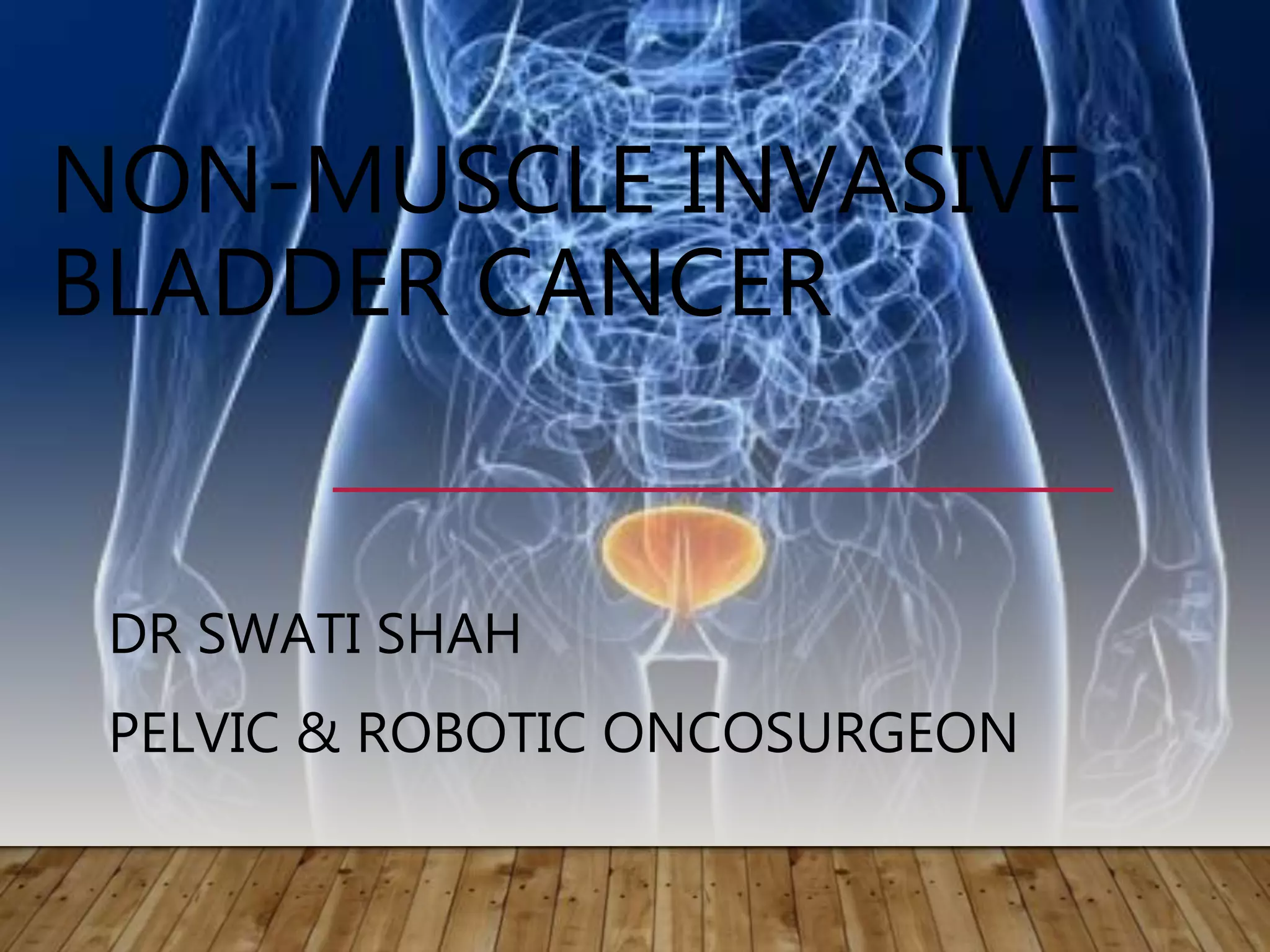
NON-MUSCLE INVASIVE
BLADDER CANCER
DR SWATI SHAH
PELVIC & ROBOTIC ONCOSURGEON
INTRODUCTION
• 7th M/C cancer in men and 17th M/C in women
• Bladder cancer is the second M/C urological malignancy after prostate
cancer in males.
• Highest incidence rates- Europe, North America
• Cumulative risk of development of Ca UB and death- 1.9% and 0.5%
at 75 yrs
• M/C histologic type- TCC
• Median age at diagnosis- 73 yrs for men and 74 yrs for women
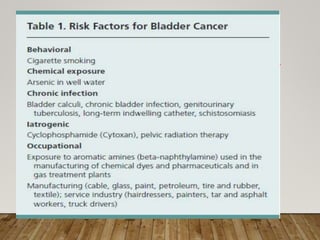
• It is tobacco related cancer, commonly associated with CAD
INTRODUCTION
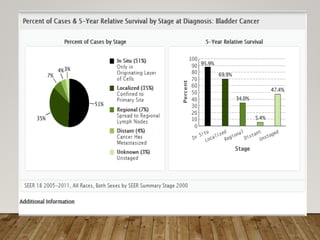
• Tumors not invading muscularis propria
• Relatively benign
• 70%- noninvasive at presentation
• 70%- Ta
• 20%-T1
• 10%-CIS
• Characterstic symptom- Painless Gross Hematuria (13-
35%)
• Microscopic hematuria- 0.5-11%
• 80% CIS- Irritative voiding symptoms
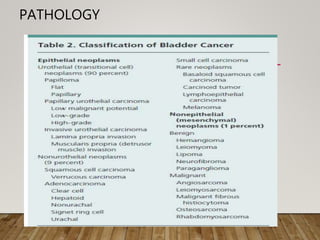
PATHOLOGY
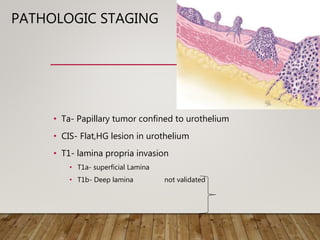
PATHOLOGIC STAGING
• Ta- Papillary tumor confined to urothelium
• CIS- Flat,HG lesion in urothelium
• T1- lamina propria invasion
• T1a- superficial Lamina
• T1b- Deep lamina not validated
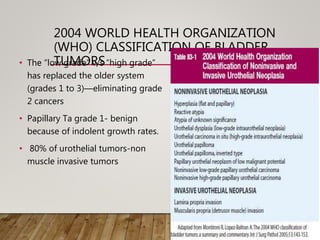
2004 WORLD HEALTH ORGANIZATION
(WHO) CLASSIFICATION OF BLADDER
TUMORS
• The “low grade” v/s “high grade”
has replaced the older system
(grades 1 to 3)—eliminating grade
2 cancers
• Papillary Ta grade 1- benign
because of indolent growth rates.
• 80% of urothelial tumors-non
muscle invasive tumors
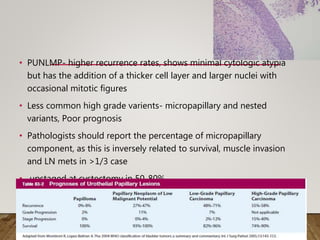
• PUNLMP- higher recurrence rates, shows minimal cytologic atypia
but has the addition of a thicker cell layer and larger nuclei with
occasional mitotic figures
• Less common high grade varients- micropapillary and nested
variants, Poor prognosis
• Pathologists should report the percentage of micropapillary
component, as this is inversely related to survival, muscle invasion
and LN mets in >1/3 case
• upstaged at cystectomy in 50-80%
•
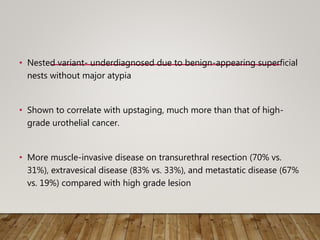
• Nested variant- underdiagnosed due to benign-appearing superficial
nests without major atypia
• Shown to correlate with upstaging, much more than that of high-
grade urothelial cancer.
• More muscle-invasive disease on transurethral resection (70% vs.
31%), extravesical disease (83% vs. 33%), and metastatic disease (67%
vs. 19%) compared with high grade lesion
TUMOR BIOLOGY
• Low-grade Ta lesions
• 50% to 70% recurrence rate
• Progress to invasive-5%
• High grade T1 lesions
• recurrence > 80% of cases
• progression 50% of patients within 3 years
• Biologic behavior – Grade dependant
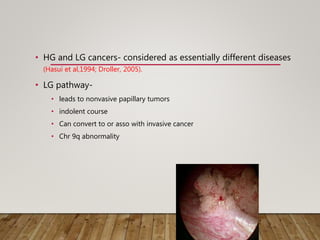
• HG and LG cancers- considered as essentially different diseases
(Hasui et al,1994; Droller, 2005).
• LG pathway-
• leads to nonvasive papillary tumors
• indolent course
• Can convert to or asso with invasive cancer
• Chr 9q abnormality
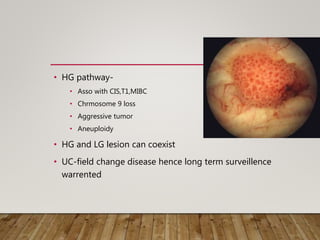
• HG pathway-
• Asso with CIS,T1,MIBC
• Chrmosome 9 loss
• Aggressive tumor
• Aneuploidy
• HG and LG lesion can coexist
• UC-field change disease hence long term surveillence
warrented
PROGNOSIS
• Tumor size
• Multiplicity
• Papillary v/s Sessile histology
• LVI
• Status of remaining urothelium
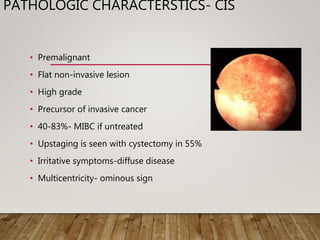
PATHOLOGIC CHARACTERSTICS- CIS
• Premalignant
• Flat non-invasive lesion
• High grade
• Precursor of invasive cancer
• 40-83%- MIBC if untreated
• Upstaging is seen with cystectomy in 55%
• Irritative symptoms-diffuse disease
• Multicentricity- ominous sign
T1 TUMORS
• Paillary/Nodular/Sessile
• Muscularis mucosae invasion- increased risk of
recurrence and progression
• Hydronephrosis- muscle invasion
• 33% upstaging on cystectomy
CLINICAL FEATURE
• Painless Profuse hematuria-85%
• Incidence of Ca UB in pt with gross hematuria is 20%.
• Symptoms of bladder irritation (frequency and urgency)- more in CIS
• Obstructive symptoms- if the tumor is located near the urethra or
bladder neck
• flank pain caused by ureteral obstruction, or with abdominal, pelvic,
or bone pain- in advanced cases
DIAGNOSIS- URINE CYTOLOGY
• used to identify high-grade tumors and monitor patients for
persistent or recurrent disease following treatment
• Noninvasive method
• High specificity (95 to 100 percent), but a low sensitivity (66 to
79 percent)
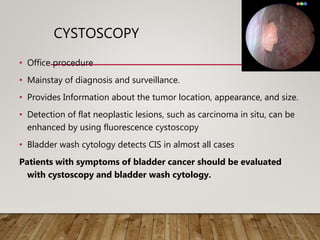
CYSTOSCOPY
• Office procedure
• Mainstay of diagnosis and surveillance.
• Provides Information about the tumor location, appearance, and size.
• Detection of flat neoplastic lesions, such as carcinoma in situ, can be
enhanced by using fluorescence cystoscopy
• Bladder wash cytology detects CIS in almost all cases
Patients with symptoms of bladder cancer should be evaluated
with cystoscopy and bladder wash cytology.
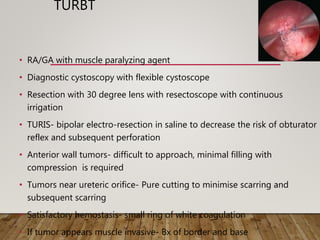
TURBT
• RA/GA with muscle paralyzing agent
• Diagnostic cystoscopy with flexible cystoscope
• Resection with 30 degree lens with resectoscope with continuous
irrigation
• TURIS- bipolar electro-resection in saline to decrease the risk of obturator
reflex and subsequent perforation
• Anterior wall tumors- difficult to approach, minimal filling with
compression is required
• Tumors near ureteric orifice- Pure cutting to minimise scarring and
subsequent scarring
• Satisfactory hemostasis- small ring of white coagulation
• If tumor appears muscle invasive- Bx of border and base
COMPLICATION
• Perforation-<5%
• Extraperitoneal- more common, managed with
prolonged catheterisation
• Intraperitoneal- more with tumors at dome, requires
operative repair
• TUR syndrome
• Ureteric obstruction
REPEAT TURBT
• Incomplete removal due to excessive volume,anatomic
inaccessibility, perforation or medical instability
• Evaluation of T1 tumor
• High grade Ta tumors
• Absence of muscle in Bx sample
2nd TURBT within 6 wk- Residual tumor in 26-83%
ROLE OF RANDOM BIOPSY
• Controversial
• Not indicated in low risk patients
• Usually done in pt with multiple tumors and positive
cytology (Fujimoto et al 2003)
PERIOPERATIVE INTRAVESICAL
CHEMOTHERAPY
• High risk of recurrence and progression
• Multifocal CIS
• CIS associated with ta or T1 tumors
• Any G3 tumor
• Multifocal tumors
• Those whose tumors rapidly recur following TURBT of the initial bladder tumor.
PERIOPERATIVE INTRAVESICAL
CHEMOTHERAPY
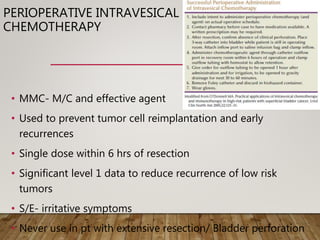
• MMC- M/C and effective agent
• Used to prevent tumor cell reimplantation and early
recurrences
• Single dose within 6 hrs of resection
• Significant level 1 data to reduce recurrence of low risk
tumors
• S/E- irritative symptoms
• Never use in pt with extensive resection/ Bladder perforation
LASER THERAPY
• Allows minimal invasive ablation of tumors upto 2.5
cm
• Nd:YAG- best for Ca UB (5mm)
• Coagulation and protein denaturation using 90 degree
noncontact beam
• Power <35W and Temp<60degree c minimise risk of
holoow viscus perforation
• More expensive, No tissue for HPE
• Less bleeding , No obturator reflex
FLUORESCENCE CYSTOSCOPY
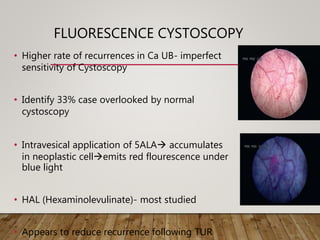
• Higher rate of recurrences in Ca UB- imperfect
sensitivity of Cystoscopy
• Identify 33% case overlooked by normal
cystoscopy
• Intravesical application of 5ALA accumulates
in neoplastic cellemits red flourescence under
blue light
• HAL (Hexaminolevulinate)- most studied
• Appears to reduce recurrence following TUR
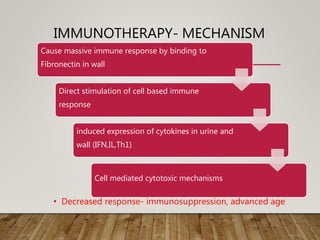
IMMUNOTHERAPY- MECHANISM
• Decreased response- immunosuppression, advanced age
Cause massive immune response by binding to
Fibronectin in wall
Direct stimulation of cell based immune
response
induced expression of cytokines in urine and
wall (IFN,IL,Th1)
Cell mediated cytotoxic mechanisms
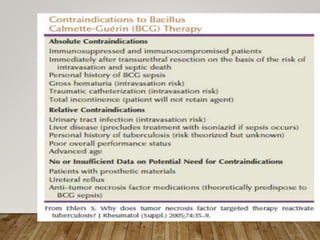
BACILLUS CALMETTE-GUÉRIN
• an attenuated mycobacterium
• developed as a vaccine for tuberculosis
• demonstrated antitumor activity in several different cancers
including UC
• success with intravesical regimen shown by Brosman (1982)
• is stored in cold and reconstituted from a lyophilized powder.
• reconstituted with 50 mL of saline
• administered through a urethral catheter under gravity drainage
soon to avoid aggregation
• Treatment begun 2 to 4 weeks after tumor resection
• Traumatic catheterization- delayed for several days to week
according to extent of injury
• Retain the solution for at least 2 hours
BCG TREATMENT OF CARCINOMA IN SITU
• Tumor-free response rate- as high as 84% (Brosman, 1982;
DeJager et al, 1991; Hudson and Herr, 1995; Lamm et al,
2000a, 2000b, 2000c).
• 50% had a durable response for a median period of 4 yr.
• Over a 10-year period, approximately 30% of patients remain free of
tumor progression or recurrence
• Close follow-up mandatory as majority of recurrences occur within
the first 5 years
• In study with more than 600 patients, there was a 68% CR rate to BCG
and a 49% complete response rate to chemotherapy. (O’Donnell,
2007).
BCG TREATMENT OF RESIDUAL
TUMOR
• can effectively treat residual papillary lesions
• should not be used as a substitute for surgical
resection
• 60% response by residual tumor with intravesical BCG
alone
BCG PROPHYLAXIS TO PREVENT RECURRENCE
• decreased recurrence by 30% with 6-wk course of BCG after
recovery from TURBT
• Patients receiving maintenance BCG-decreased rate of recurrence
compared with those receiving induction therapy alone (Han and
Pan, 2006).
• Efficacy for HG T1- recurrence 16-40%, progression 4-40% (Hurle et
al 1999)
• Tumor multiplicity and associated CIS - increased risk of progression
OPTIMUM BCG TREATMENT SCHEDULE
• 6-wk induction alone insufficient to obtain an optimal
response in many patients and that shows maintenance
therapy is requisite (Lamm et al, 2000a, 2000b, 2000c; Palou et al, 2001).
• The average additional response to a second induction
course -25% in those patients with prophylaxis and 30% in
CIS patients
• SWOG trial reported the most significant impact of
maintenance therapy
• Estimated median recurrence-free survival was 76.8 months in the
maintenance arm and 35.7 months in the control arm (P = .0001).
• Shorter maintenance schedule and reduced dosage has been
devised (Lamm et al 2000)
• The optimal treatment schedule should be as described in the
SWOG study or monthly remains unclear
• Optimal duration of a monthly maintenance schedule, if chosen, is
unknown (O’Donnell 2005)
INTERFERON
• Glycoproteins produced in response to antigenic stimuli.
• Multiple antitumor activities
• most active in doses of at least 100 MU
• optimal dose and administration schedule have yet to be
determined
• More expensive and less effective than BCG or intravesical
chemotherapy
• Several trials investigated the combination of BCG and interferon
• suggested the potential superiority of the combination or the
possibility of decreasing the dosage of BCG (reduce S/E)
• patients who failed BCG alone within 12 months had a poor
response to combination therapy.
• Of the nonresponders to combination BCG/interferon, the majority
of patients failed with recurrence within 4 months of initial
treatment (Grossman et al, 2008).
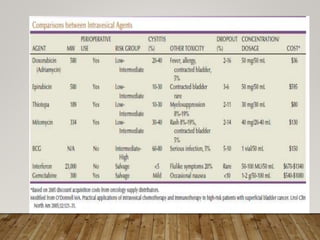
INTRAVESICAL CHEMOTHERAPY
• Role of chemotherapy in the adjuvant setting is less clear
• SWOG comparison of doxorubicin and BCG showed a 15%
progression rate in BCG patients compared with a 37% in
chemotherapy patients
• Recently, intravesical gemcitabine shown activity in NMBC in
intermediate risk and high risk patients
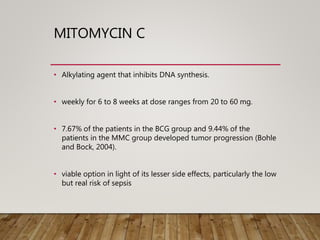
MITOMYCIN C
• Alkylating agent that inhibits DNA synthesis.
• weekly for 6 to 8 weeks at dose ranges from 20 to 60 mg.
• 7.67% of the patients in the BCG group and 9.44% of the
patients in the MMC group developed tumor progression (Bohle
and Bock, 2004).
• viable option in light of its lesser side effects, particularly the low
but real risk of sepsis
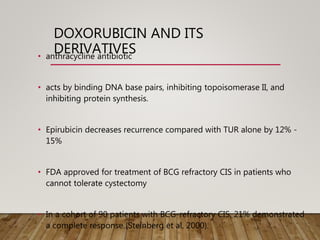
DOXORUBICIN AND ITS
DERIVATIVES
• anthracycline antibiotic
• acts by binding DNA base pairs, inhibiting topoisomerase II, and
inhibiting protein synthesis.
• Epirubicin decreases recurrence compared with TUR alone by 12% -
15%
• FDA approved for treatment of BCG refractory CIS in patients who
cannot tolerate cystectomy
• In a cohort of 90 patients with BCG-refractory CIS, 21% demonstrated
a complete response (Steinberg et al, 2000).
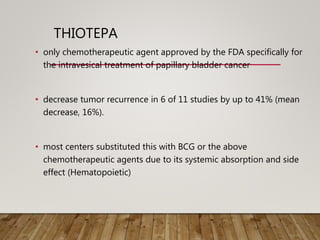
THIOTEPA
• only chemotherapeutic agent approved by the FDA specifically for
the intravesical treatment of papillary bladder cancer
• decrease tumor recurrence in 6 of 11 studies by up to 41% (mean
decrease, 16%).
• most centers substituted this with BCG or the above
chemotherapeutic agents due to its systemic absorption and side
effect (Hematopoietic)
NEWER AGENTS
• Gemcitabine-
• Wkly/twice wkly X 6-8 wks
• Modest activity in BCG refractory cases
• 39-70% reduction of recurrences in phase II studies
• Minimal systemic absorption
• Taxanes- limited in preclinical studies
COMBINATION CHEMOTHERAPY
• No clear advantage with sequential therapy, combination
chemotherapy, or chemotherapy and BCG regimens using any of the
combinations explored to date (Rintala et al, 1995, 1996; Witjes et al,
1998; Nieder et al, 2005).
MANAGEMENT OF REFRACTORY HG DISEASE
• BCG failure- Recurrent or persistent disease after an
initial 6-wk BCG
• BCG refractory- nonimproving or worsening disease
despite BCG
• BCG resistant- recurrence or persistence of lesser
degree, stage, or grade after an initial course, which
then resolves with further BCG
• should be strongly considered for immediate cystectomy if young
and in generally good health (Herr and Dalbagni, 2003).
• Intravesical treatment- reserved for patients refusing or too ill to
undergo cystectomy, or investigational protocols
• The necessity of biopsy to determine BCG response is unclear
• Initial Rx with chemotherapy- course of BCG
• Patients who have failed BCG- a second course of BCG (30% to 50%
response )
• who cannot tolerate BCG- salvage chemotherapy (risk of failure and
progression is high.)
• Further courses of BCG or chemotherapy beyond two are not
recommended (80% failure rate)
• The combination of IFN-α with BCG is expensive and not superior to
BCG alone in primary therapy, so it has been used mostly for BCG
failures
ROLE OF “EARLY” CYSTECTOMY
• Provides most accurate pathologic staging option
• strongly considered
• High grade NMBC and invading deeply into lamina propria
• exhibit extensive lymphovascular invasion
• associated with diffuse CIS
• Diverticular location
• Distal ureters or prostatic urethral involvement
• Refractory to initial therapy
• Large or anatomically inaccessible to removal endoscopically.
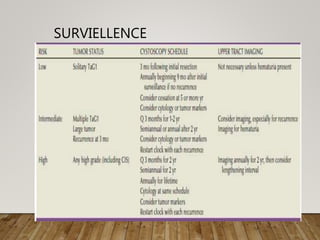
SURVIELLENCE
SUMMARY
• Low grade single papillary lesion- TUR + single instillation of
CT (MMC)
• Re-resection after 2-6 wks in HG T1 lesion (upstage 1/3 cases)
• Post TUR- Cystoscopy 3mth X 2 yrs then 6M X 2 yrs and then
annually
• Cytologic test should be added in HG lesions
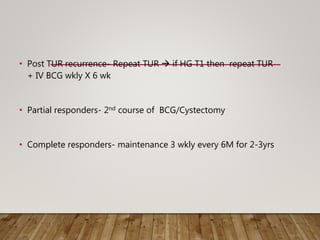
• Post TUR recurrence- Repeat TUR  if HG T1 then repeat TUR
+ IV BCG wkly X 6 wk
• Partial responders- 2nd course of BCG/Cystectomy
• Complete responders- maintenance 3 wkly every 6M for 2-3yrs
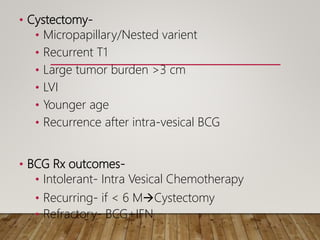
• Cystectomy-
• Micropapillary/Nested varient
• Recurrent T1
• Large tumor burden >3 cm
• LVI
• Younger age
• Recurrence after intra-vesical BCG
• BCG Rx outcomes-
• Intolerant- Intra Vesical Chemotherapy
• Recurring- if < 6 MCystectomy
• Refractory- BCG+IFN
Non muscle invasive bladder cancer

Non muscle invasive bladder cancer

  • 1.
    NON-MUSCLE INVASIVE BLADDER CANCER DRSWATI SHAH PELVIC & ROBOTIC ONCOSURGEON
  • 2.
    INTRODUCTION • 7th M/Ccancer in men and 17th M/C in women • Bladder cancer is the second M/C urological malignancy after prostate cancer in males. • Highest incidence rates- Europe, North America • Cumulative risk of development of Ca UB and death- 1.9% and 0.5% at 75 yrs • M/C histologic type- TCC • Median age at diagnosis- 73 yrs for men and 74 yrs for women • It is tobacco related cancer, commonly associated with CAD
  • 3.
    INTRODUCTION • Tumors notinvading muscularis propria • Relatively benign • 70%- noninvasive at presentation • 70%- Ta • 20%-T1 • 10%-CIS • Characterstic symptom- Painless Gross Hematuria (13- 35%) • Microscopic hematuria- 0.5-11% • 80% CIS- Irritative voiding symptoms
  • 7.
  • 8.
    PATHOLOGIC STAGING • Ta-Papillary tumor confined to urothelium • CIS- Flat,HG lesion in urothelium • T1- lamina propria invasion • T1a- superficial Lamina • T1b- Deep lamina not validated
  • 9.
    2004 WORLD HEALTHORGANIZATION (WHO) CLASSIFICATION OF BLADDER TUMORS • The “low grade” v/s “high grade” has replaced the older system (grades 1 to 3)—eliminating grade 2 cancers • Papillary Ta grade 1- benign because of indolent growth rates. • 80% of urothelial tumors-non muscle invasive tumors
  • 10.
    • PUNLMP- higherrecurrence rates, shows minimal cytologic atypia but has the addition of a thicker cell layer and larger nuclei with occasional mitotic figures • Less common high grade varients- micropapillary and nested variants, Poor prognosis • Pathologists should report the percentage of micropapillary component, as this is inversely related to survival, muscle invasion and LN mets in >1/3 case • upstaged at cystectomy in 50-80% •
  • 11.
    • Nested variant-underdiagnosed due to benign-appearing superficial nests without major atypia • Shown to correlate with upstaging, much more than that of high- grade urothelial cancer. • More muscle-invasive disease on transurethral resection (70% vs. 31%), extravesical disease (83% vs. 33%), and metastatic disease (67% vs. 19%) compared with high grade lesion
  • 12.
    TUMOR BIOLOGY • Low-gradeTa lesions • 50% to 70% recurrence rate • Progress to invasive-5% • High grade T1 lesions • recurrence > 80% of cases • progression 50% of patients within 3 years • Biologic behavior – Grade dependant
  • 13.
    • HG andLG cancers- considered as essentially different diseases (Hasui et al,1994; Droller, 2005). • LG pathway- • leads to nonvasive papillary tumors • indolent course • Can convert to or asso with invasive cancer • Chr 9q abnormality
  • 14.
    • HG pathway- •Asso with CIS,T1,MIBC • Chrmosome 9 loss • Aggressive tumor • Aneuploidy • HG and LG lesion can coexist • UC-field change disease hence long term surveillence warrented
  • 15.
    PROGNOSIS • Tumor size •Multiplicity • Papillary v/s Sessile histology • LVI • Status of remaining urothelium
  • 16.
    PATHOLOGIC CHARACTERSTICS- CIS •Premalignant • Flat non-invasive lesion • High grade • Precursor of invasive cancer • 40-83%- MIBC if untreated • Upstaging is seen with cystectomy in 55% • Irritative symptoms-diffuse disease • Multicentricity- ominous sign
  • 17.
    T1 TUMORS • Paillary/Nodular/Sessile •Muscularis mucosae invasion- increased risk of recurrence and progression • Hydronephrosis- muscle invasion • 33% upstaging on cystectomy
  • 18.
    CLINICAL FEATURE • PainlessProfuse hematuria-85% • Incidence of Ca UB in pt with gross hematuria is 20%. • Symptoms of bladder irritation (frequency and urgency)- more in CIS • Obstructive symptoms- if the tumor is located near the urethra or bladder neck • flank pain caused by ureteral obstruction, or with abdominal, pelvic, or bone pain- in advanced cases
  • 19.
    DIAGNOSIS- URINE CYTOLOGY •used to identify high-grade tumors and monitor patients for persistent or recurrent disease following treatment • Noninvasive method • High specificity (95 to 100 percent), but a low sensitivity (66 to 79 percent)
  • 20.
    CYSTOSCOPY • Office procedure •Mainstay of diagnosis and surveillance. • Provides Information about the tumor location, appearance, and size. • Detection of flat neoplastic lesions, such as carcinoma in situ, can be enhanced by using fluorescence cystoscopy • Bladder wash cytology detects CIS in almost all cases Patients with symptoms of bladder cancer should be evaluated with cystoscopy and bladder wash cytology.
  • 21.
    TURBT • RA/GA withmuscle paralyzing agent • Diagnostic cystoscopy with flexible cystoscope • Resection with 30 degree lens with resectoscope with continuous irrigation • TURIS- bipolar electro-resection in saline to decrease the risk of obturator reflex and subsequent perforation • Anterior wall tumors- difficult to approach, minimal filling with compression is required • Tumors near ureteric orifice- Pure cutting to minimise scarring and subsequent scarring • Satisfactory hemostasis- small ring of white coagulation • If tumor appears muscle invasive- Bx of border and base
  • 22.
    COMPLICATION • Perforation-<5% • Extraperitoneal-more common, managed with prolonged catheterisation • Intraperitoneal- more with tumors at dome, requires operative repair • TUR syndrome • Ureteric obstruction
  • 23.
    REPEAT TURBT • Incompleteremoval due to excessive volume,anatomic inaccessibility, perforation or medical instability • Evaluation of T1 tumor • High grade Ta tumors • Absence of muscle in Bx sample 2nd TURBT within 6 wk- Residual tumor in 26-83%
  • 24.
    ROLE OF RANDOMBIOPSY • Controversial • Not indicated in low risk patients • Usually done in pt with multiple tumors and positive cytology (Fujimoto et al 2003)
  • 25.
    PERIOPERATIVE INTRAVESICAL CHEMOTHERAPY • Highrisk of recurrence and progression • Multifocal CIS • CIS associated with ta or T1 tumors • Any G3 tumor • Multifocal tumors • Those whose tumors rapidly recur following TURBT of the initial bladder tumor.
  • 26.
    PERIOPERATIVE INTRAVESICAL CHEMOTHERAPY • MMC-M/C and effective agent • Used to prevent tumor cell reimplantation and early recurrences • Single dose within 6 hrs of resection • Significant level 1 data to reduce recurrence of low risk tumors • S/E- irritative symptoms • Never use in pt with extensive resection/ Bladder perforation
  • 27.
    LASER THERAPY • Allowsminimal invasive ablation of tumors upto 2.5 cm • Nd:YAG- best for Ca UB (5mm) • Coagulation and protein denaturation using 90 degree noncontact beam • Power <35W and Temp<60degree c minimise risk of holoow viscus perforation • More expensive, No tissue for HPE • Less bleeding , No obturator reflex
  • 28.
    FLUORESCENCE CYSTOSCOPY • Higherrate of recurrences in Ca UB- imperfect sensitivity of Cystoscopy • Identify 33% case overlooked by normal cystoscopy • Intravesical application of 5ALA accumulates in neoplastic cellemits red flourescence under blue light • HAL (Hexaminolevulinate)- most studied • Appears to reduce recurrence following TUR
  • 29.
    IMMUNOTHERAPY- MECHANISM • Decreasedresponse- immunosuppression, advanced age Cause massive immune response by binding to Fibronectin in wall Direct stimulation of cell based immune response induced expression of cytokines in urine and wall (IFN,IL,Th1) Cell mediated cytotoxic mechanisms
  • 30.
    BACILLUS CALMETTE-GUÉRIN • anattenuated mycobacterium • developed as a vaccine for tuberculosis • demonstrated antitumor activity in several different cancers including UC • success with intravesical regimen shown by Brosman (1982) • is stored in cold and reconstituted from a lyophilized powder.
  • 31.
    • reconstituted with50 mL of saline • administered through a urethral catheter under gravity drainage soon to avoid aggregation • Treatment begun 2 to 4 weeks after tumor resection • Traumatic catheterization- delayed for several days to week according to extent of injury • Retain the solution for at least 2 hours
  • 32.
    BCG TREATMENT OFCARCINOMA IN SITU • Tumor-free response rate- as high as 84% (Brosman, 1982; DeJager et al, 1991; Hudson and Herr, 1995; Lamm et al, 2000a, 2000b, 2000c). • 50% had a durable response for a median period of 4 yr. • Over a 10-year period, approximately 30% of patients remain free of tumor progression or recurrence • Close follow-up mandatory as majority of recurrences occur within the first 5 years • In study with more than 600 patients, there was a 68% CR rate to BCG and a 49% complete response rate to chemotherapy. (O’Donnell, 2007).
  • 33.
    BCG TREATMENT OFRESIDUAL TUMOR • can effectively treat residual papillary lesions • should not be used as a substitute for surgical resection • 60% response by residual tumor with intravesical BCG alone
  • 34.
    BCG PROPHYLAXIS TOPREVENT RECURRENCE • decreased recurrence by 30% with 6-wk course of BCG after recovery from TURBT • Patients receiving maintenance BCG-decreased rate of recurrence compared with those receiving induction therapy alone (Han and Pan, 2006). • Efficacy for HG T1- recurrence 16-40%, progression 4-40% (Hurle et al 1999) • Tumor multiplicity and associated CIS - increased risk of progression
  • 35.
    OPTIMUM BCG TREATMENTSCHEDULE • 6-wk induction alone insufficient to obtain an optimal response in many patients and that shows maintenance therapy is requisite (Lamm et al, 2000a, 2000b, 2000c; Palou et al, 2001). • The average additional response to a second induction course -25% in those patients with prophylaxis and 30% in CIS patients • SWOG trial reported the most significant impact of maintenance therapy
  • 36.
    • Estimated medianrecurrence-free survival was 76.8 months in the maintenance arm and 35.7 months in the control arm (P = .0001). • Shorter maintenance schedule and reduced dosage has been devised (Lamm et al 2000) • The optimal treatment schedule should be as described in the SWOG study or monthly remains unclear • Optimal duration of a monthly maintenance schedule, if chosen, is unknown (O’Donnell 2005)
  • 39.
    INTERFERON • Glycoproteins producedin response to antigenic stimuli. • Multiple antitumor activities • most active in doses of at least 100 MU • optimal dose and administration schedule have yet to be determined • More expensive and less effective than BCG or intravesical chemotherapy
  • 40.
    • Several trialsinvestigated the combination of BCG and interferon • suggested the potential superiority of the combination or the possibility of decreasing the dosage of BCG (reduce S/E) • patients who failed BCG alone within 12 months had a poor response to combination therapy. • Of the nonresponders to combination BCG/interferon, the majority of patients failed with recurrence within 4 months of initial treatment (Grossman et al, 2008).
  • 41.
    INTRAVESICAL CHEMOTHERAPY • Roleof chemotherapy in the adjuvant setting is less clear • SWOG comparison of doxorubicin and BCG showed a 15% progression rate in BCG patients compared with a 37% in chemotherapy patients • Recently, intravesical gemcitabine shown activity in NMBC in intermediate risk and high risk patients
  • 43.
    MITOMYCIN C • Alkylatingagent that inhibits DNA synthesis. • weekly for 6 to 8 weeks at dose ranges from 20 to 60 mg. • 7.67% of the patients in the BCG group and 9.44% of the patients in the MMC group developed tumor progression (Bohle and Bock, 2004). • viable option in light of its lesser side effects, particularly the low but real risk of sepsis
  • 44.
    DOXORUBICIN AND ITS DERIVATIVES •anthracycline antibiotic • acts by binding DNA base pairs, inhibiting topoisomerase II, and inhibiting protein synthesis. • Epirubicin decreases recurrence compared with TUR alone by 12% - 15% • FDA approved for treatment of BCG refractory CIS in patients who cannot tolerate cystectomy • In a cohort of 90 patients with BCG-refractory CIS, 21% demonstrated a complete response (Steinberg et al, 2000).
  • 45.
    THIOTEPA • only chemotherapeuticagent approved by the FDA specifically for the intravesical treatment of papillary bladder cancer • decrease tumor recurrence in 6 of 11 studies by up to 41% (mean decrease, 16%). • most centers substituted this with BCG or the above chemotherapeutic agents due to its systemic absorption and side effect (Hematopoietic)
  • 46.
    NEWER AGENTS • Gemcitabine- •Wkly/twice wkly X 6-8 wks • Modest activity in BCG refractory cases • 39-70% reduction of recurrences in phase II studies • Minimal systemic absorption • Taxanes- limited in preclinical studies
  • 47.
    COMBINATION CHEMOTHERAPY • Noclear advantage with sequential therapy, combination chemotherapy, or chemotherapy and BCG regimens using any of the combinations explored to date (Rintala et al, 1995, 1996; Witjes et al, 1998; Nieder et al, 2005).
  • 48.
    MANAGEMENT OF REFRACTORYHG DISEASE • BCG failure- Recurrent or persistent disease after an initial 6-wk BCG • BCG refractory- nonimproving or worsening disease despite BCG • BCG resistant- recurrence or persistence of lesser degree, stage, or grade after an initial course, which then resolves with further BCG
  • 49.
    • should bestrongly considered for immediate cystectomy if young and in generally good health (Herr and Dalbagni, 2003). • Intravesical treatment- reserved for patients refusing or too ill to undergo cystectomy, or investigational protocols • The necessity of biopsy to determine BCG response is unclear
  • 50.
    • Initial Rxwith chemotherapy- course of BCG • Patients who have failed BCG- a second course of BCG (30% to 50% response ) • who cannot tolerate BCG- salvage chemotherapy (risk of failure and progression is high.) • Further courses of BCG or chemotherapy beyond two are not recommended (80% failure rate) • The combination of IFN-α with BCG is expensive and not superior to BCG alone in primary therapy, so it has been used mostly for BCG failures
  • 51.
    ROLE OF “EARLY”CYSTECTOMY • Provides most accurate pathologic staging option • strongly considered • High grade NMBC and invading deeply into lamina propria • exhibit extensive lymphovascular invasion • associated with diffuse CIS • Diverticular location • Distal ureters or prostatic urethral involvement • Refractory to initial therapy • Large or anatomically inaccessible to removal endoscopically.
  • 52.
  • 53.
    SUMMARY • Low gradesingle papillary lesion- TUR + single instillation of CT (MMC) • Re-resection after 2-6 wks in HG T1 lesion (upstage 1/3 cases) • Post TUR- Cystoscopy 3mth X 2 yrs then 6M X 2 yrs and then annually • Cytologic test should be added in HG lesions
  • 54.
    • Post TURrecurrence- Repeat TUR  if HG T1 then repeat TUR + IV BCG wkly X 6 wk • Partial responders- 2nd course of BCG/Cystectomy • Complete responders- maintenance 3 wkly every 6M for 2-3yrs
  • 55.
    • Cystectomy- • Micropapillary/Nestedvarient • Recurrent T1 • Large tumor burden >3 cm • LVI • Younger age • Recurrence after intra-vesical BCG • BCG Rx outcomes- • Intolerant- Intra Vesical Chemotherapy • Recurring- if < 6 MCystectomy • Refractory- BCG+IFN