Dr David Parsons
David Parsons - May 31st 2013
 MusicXML files are the standard format for
sharing interactive sheet music
 More than 160 applications include MusicXML
support
◦ Including Cubase, Sibelius and Myriad
David Parsons - May 31st 2013
 “I feel that MIDI is an outdated standard for
music education. I believe that MusicXML is
the proper standard for music education
…import/export with notation accuracy is a
world of hurt with MIDI and much improved
with MusicXML”
 Christopher J. Russell, Ph.D. - Technology in Music
Education Blog, May 2012
David Parsons - May 31st 2013
 XML
◦ eXtensible Markup Langauge
 XML is
◦ Semi-structured
◦ Self describing
◦ Fundamental to the web, web services, RSS feeds
etc.
◦ Provides a common way for any two applications to
communicate with one another
 XML is a meta language – you can create your
own languages from it
David Parsons - May 31st 2013
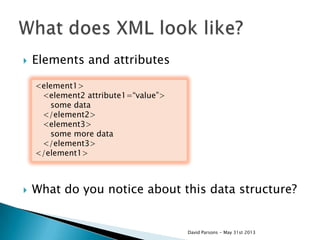
 Elements and attributes
 What do you notice about this data structure?
<element1>
<element2 attribute1=“value”>
some data
</element2>
<element3>
some more data
</element3>
</element1>
David Parsons - May 31st 2013
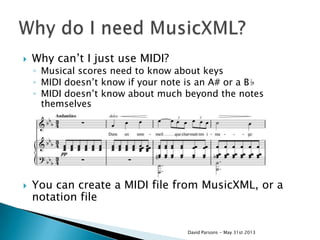
 Why can‟t I just use MIDI?
◦ Musical scores need to know about keys
◦ MIDI doesn‟t know if your note is an A# or a B♭
◦ MIDI doesn‟t know about much beyond the notes
themselves
 You can create a MIDI file from MusicXML, or a
notation file
David Parsons - May 31st 2013
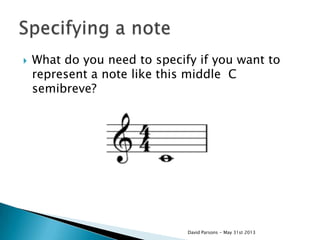
 What do you need to specify if you want to
represent a note like this middle C
semibreve?
David Parsons - May 31st 2013
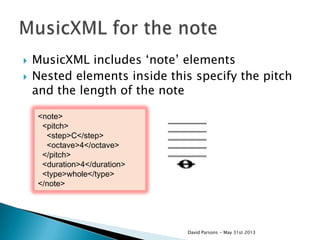
 MusicXML includes „note‟ elements
 Nested elements inside this specify the pitch
and the length of the note
<note>
<pitch>
<step>C</step>
<octave>4</octave>
</pitch>
<duration>4</duration>
<type>whole</type>
</note>
David Parsons - May 31st 2013
the key the clef
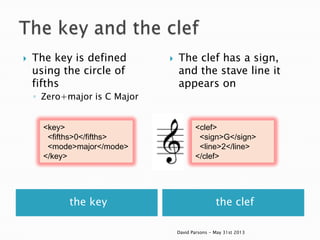
 The key is defined
using the circle of
fifths
◦ Zero+major is C Major
 The clef has a sign,
and the stave line it
appears on
<key>
<fifths>0</fifths>
<mode>major</mode>
</key>
<clef>
<sign>G</sign>
<line>2</line>
</clef>
David Parsons - May 31st 2013
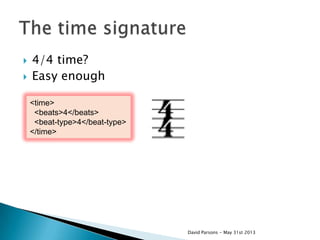
 4/4 time?
 Easy enough
David Parsons - May 31st 2013
<time>
<beats>4</beats>
<beat-type>4</beat-type>
</time>
 These are typically used for metadata
◦ Not the actual music data, but things that tell us
about it
 Here‟s an example:
◦ Each musical part is given a unique id
 so we can refer to it from other elements
◦ Each measure needs a number
 we are in the first measure of the first part
David Parsons - May 31st 2013
<part id="P1">
<measure number="1">
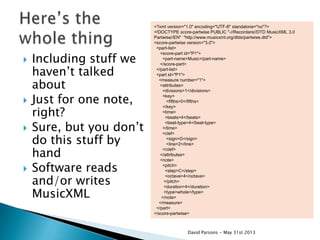
 Including stuff we
haven‟t talked
about
 Just for one note,
right?
 Sure, but you don‟t
do this stuff by
hand
 Software reads
and/or writes
MusicXML
<?xml version="1.0" encoding="UTF-8" standalone="no"?>
<!DOCTYPE score-partwise PUBLIC "-//Recordare//DTD MusicXML 3.0
Partwise//EN" "http://www.musicxml.org/dtds/partwise.dtd">
<score-partwise version="3.0">
<part-list>
<score-part id="P1">
<part-name>Music</part-name>
</score-part>
</part-list>
<part id="P1">
<measure number="1">
<attributes>
<divisions>1</divisions>
<key>
<fifths>0</fifths>
</key>
<time>
<beats>4</beats>
<beat-type>4</beat-type>
</time>
<clef>
<sign>G</sign>
<line>2</line>
</clef>
</attributes>
<note>
<pitch>
<step>C</step>
<octave>4</octave>
</pitch>
<duration>4</duration>
<type>whole</type>
</note>
</measure>
</part>
</score-partwise>
David Parsons - May 31st 2013
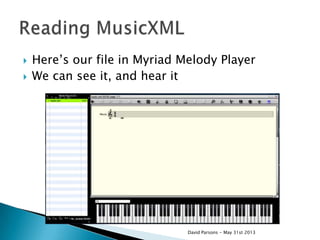
 Here‟s our file in Myriad Melody Player
 We can see it, and hear it
David Parsons - May 31st 2013
 Understand how different applications
communicate musical data
 Use MusicXML to transfer data between them
 Write software that can generate MusicXML
◦ so you music can be scored
◦ e.g. write a mobile composition app that streams
MusicXML to the cloud)
 Write software that can read MusicXML
◦ so you can present it how you like
◦ e.g. create sound driven animations in HTML 5
David Parsons - May 31st 2013
 You could utilise any or all of the following…
 Technologies for processing XML
◦ XPath / XSLT / XQuery
◦ SAX (serial access) parsers
◦ DOM (document object model) parsers
 XML data Streams
◦ File streaming
◦ Web services
 Tools that understand MusicXML
◦ e.g. Java Music Specification Language
David Parsons - May 31st 2013

An Introduction to MusicXML

  • 1.
    Dr David Parsons DavidParsons - May 31st 2013
  • 2.
     MusicXML filesare the standard format for sharing interactive sheet music  More than 160 applications include MusicXML support ◦ Including Cubase, Sibelius and Myriad David Parsons - May 31st 2013
  • 3.
     “I feelthat MIDI is an outdated standard for music education. I believe that MusicXML is the proper standard for music education …import/export with notation accuracy is a world of hurt with MIDI and much improved with MusicXML”  Christopher J. Russell, Ph.D. - Technology in Music Education Blog, May 2012 David Parsons - May 31st 2013
  • 4.
     XML ◦ eXtensibleMarkup Langauge  XML is ◦ Semi-structured ◦ Self describing ◦ Fundamental to the web, web services, RSS feeds etc. ◦ Provides a common way for any two applications to communicate with one another  XML is a meta language – you can create your own languages from it David Parsons - May 31st 2013
  • 5.
     Elements andattributes  What do you notice about this data structure? <element1> <element2 attribute1=“value”> some data </element2> <element3> some more data </element3> </element1> David Parsons - May 31st 2013
  • 6.
     Why can‟tI just use MIDI? ◦ Musical scores need to know about keys ◦ MIDI doesn‟t know if your note is an A# or a B♭ ◦ MIDI doesn‟t know about much beyond the notes themselves  You can create a MIDI file from MusicXML, or a notation file David Parsons - May 31st 2013
  • 7.
     What doyou need to specify if you want to represent a note like this middle C semibreve? David Parsons - May 31st 2013
  • 8.
     MusicXML includes„note‟ elements  Nested elements inside this specify the pitch and the length of the note <note> <pitch> <step>C</step> <octave>4</octave> </pitch> <duration>4</duration> <type>whole</type> </note> David Parsons - May 31st 2013
  • 9.
    the key theclef  The key is defined using the circle of fifths ◦ Zero+major is C Major  The clef has a sign, and the stave line it appears on <key> <fifths>0</fifths> <mode>major</mode> </key> <clef> <sign>G</sign> <line>2</line> </clef> David Parsons - May 31st 2013
  • 10.
     4/4 time? Easy enough David Parsons - May 31st 2013 <time> <beats>4</beats> <beat-type>4</beat-type> </time>
  • 11.
     These aretypically used for metadata ◦ Not the actual music data, but things that tell us about it  Here‟s an example: ◦ Each musical part is given a unique id  so we can refer to it from other elements ◦ Each measure needs a number  we are in the first measure of the first part David Parsons - May 31st 2013 <part id="P1"> <measure number="1">
  • 12.
     Including stuffwe haven‟t talked about  Just for one note, right?  Sure, but you don‟t do this stuff by hand  Software reads and/or writes MusicXML <?xml version="1.0" encoding="UTF-8" standalone="no"?> <!DOCTYPE score-partwise PUBLIC "-//Recordare//DTD MusicXML 3.0 Partwise//EN" "http://www.musicxml.org/dtds/partwise.dtd"> <score-partwise version="3.0"> <part-list> <score-part id="P1"> <part-name>Music</part-name> </score-part> </part-list> <part id="P1"> <measure number="1"> <attributes> <divisions>1</divisions> <key> <fifths>0</fifths> </key> <time> <beats>4</beats> <beat-type>4</beat-type> </time> <clef> <sign>G</sign> <line>2</line> </clef> </attributes> <note> <pitch> <step>C</step> <octave>4</octave> </pitch> <duration>4</duration> <type>whole</type> </note> </measure> </part> </score-partwise> David Parsons - May 31st 2013
  • 13.
     Here‟s ourfile in Myriad Melody Player  We can see it, and hear it David Parsons - May 31st 2013
  • 14.
     Understand howdifferent applications communicate musical data  Use MusicXML to transfer data between them  Write software that can generate MusicXML ◦ so you music can be scored ◦ e.g. write a mobile composition app that streams MusicXML to the cloud)  Write software that can read MusicXML ◦ so you can present it how you like ◦ e.g. create sound driven animations in HTML 5 David Parsons - May 31st 2013
  • 15.
     You couldutilise any or all of the following…  Technologies for processing XML ◦ XPath / XSLT / XQuery ◦ SAX (serial access) parsers ◦ DOM (document object model) parsers  XML data Streams ◦ File streaming ◦ Web services  Tools that understand MusicXML ◦ e.g. Java Music Specification Language David Parsons - May 31st 2013