Standard Music Font Layout
Music Encoding Conference
23 May 2013
Daniel Spreadbury
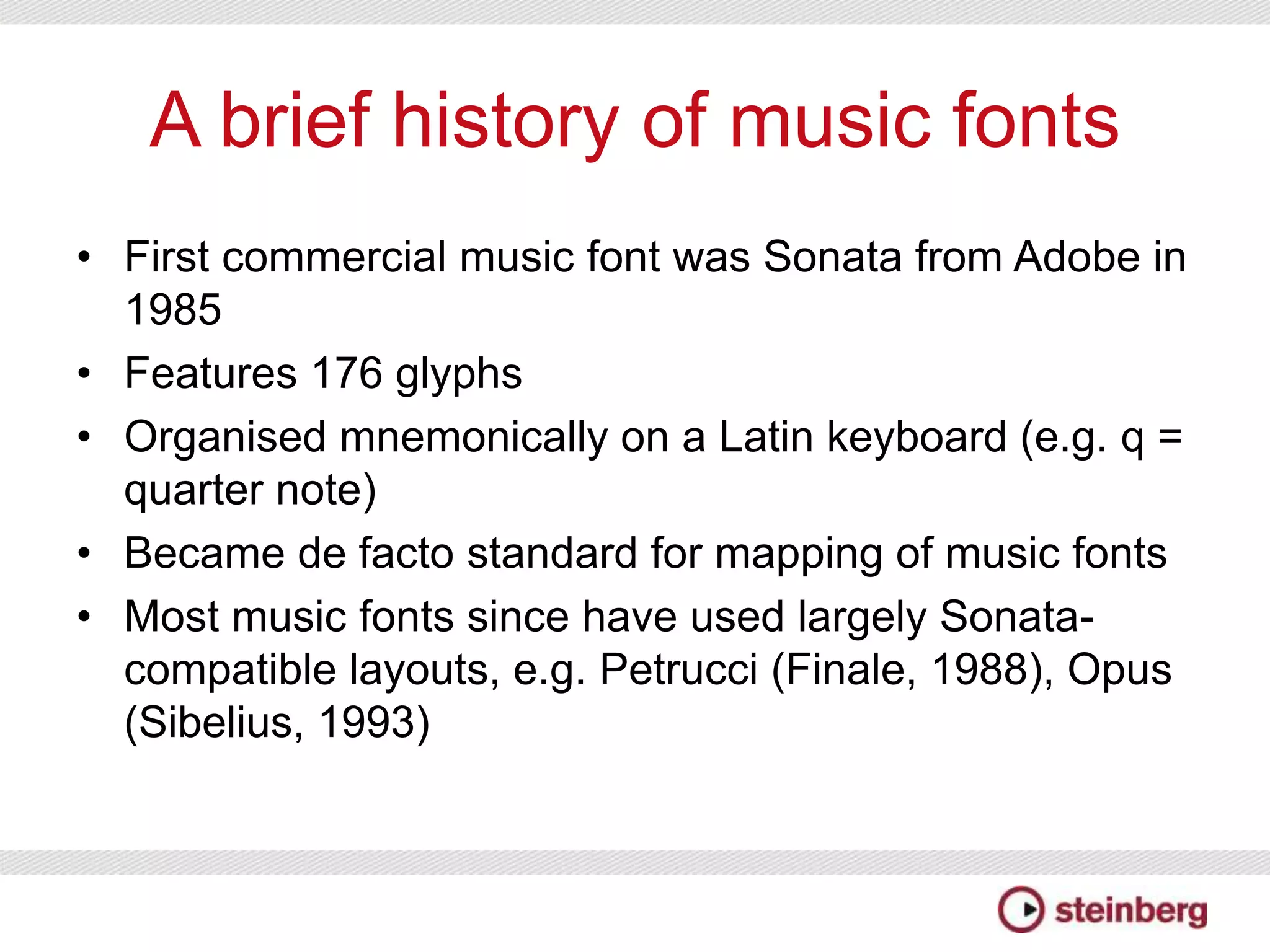
A brief history of music fonts
• First commercial music font was Sonata from Adobe in
1985
• Features 176 glyphs
• Organised mnemonically on a Latin keyboard (e.g. q =
quarter note)
• Became de facto standard for mapping of music fonts
• Most music fonts since have used largely Sonata-
compatible layouts, e.g. Petrucci (Finale, 1988), Opus
(Sibelius, 1993)
A brief history of music fonts
• Perry Roland proposed range of musical
symbols for Unicode in 1998
• Range was approved, with 220 glyphs
• To date, no font has completely implemented
the range
• Only commercial font with a partial
implementation is Adobe Sonata Std,
OpenType update to original Sonata font
Problems to be solved
• Sonata’s 170 glyphs are insufficient for the
breadth of symbols used in CMN
• No agreement on how to expand beyond
Sonata’s initial set, hence rapid
divergence…
Sonata: a standard?
Sonata
Sonata: a standard?
Petrucci
Sonata: a standard?
Opus
Sonata: a standard?
Sonata, compared with Opus and Petrucci (all agree; S & P agree; O & P agree)
Problems to be solved
• Existing Unicode Musical Symbols range
is also insufficiently broad
• Some scoring applications cannot in any
case access code points beyond Unicode
Plane 0
• Lack of a real standard makes sharing
music fonts between applications difficult
So… what is SMuFL?
• A standard way of mapping musical
symbols to the Private Use Area of the
Basic Multilingual Plane in Unicode
• A set of technical guidelines for how music
fonts should be built
Goals
• Extensible
Provide a framework that makes it
convenient for additional characters to be
added
• Build a community
Draw on scholarly expertise to minimise
errors and omissions
Goals
• Open license
Remove any impediments to font
developers and application vendors
adopting SMuFL
• Practical and useful
Designed with real-world use in mind
Non-goals
• Not currently targeting ratification by the Unicode
Consortium
– What to do with the existing Musical Symbols range?
– Some characters are duplicated from other ranges for
convenience; unlikely to be accepted by the
Consortium
• Not targeting use in text-based applications
– Although many characters could be usefully used, it’s
impractical for end users to type characters from the
PUA anyway
What’s included
• 59 discrete sub-ranges of symbols
• 808 symbols and counting!
• Includes all 220 glyphs from the Unicode
Musical Symbols range
• Room for expansion by leaving empty
code points between ranges
What’s included
Methodology
• Started with Unicode Musical Symbols range
• Reviewed existing fonts (Sonata, Opus, Petrucci,
Emmentaler, etc.) and categorised additional sub-ranges and
symbols
• Reviewed the standard music notation texts (Gould, Read,
Stone, etc.)
• Reviewed specialist literature (e.g. Ghent conference for
percussion, Salzedo for harp, handbells, accordion, function
symbols, etc.)
• Shared proposals with small group of expert music engravers
and editors
Open license
• Released under MIT license
• Steinberg retains copyright, but free for
anybody to use, modify, create derivative
versions, sell, etc.
• ...but we hope to build a community
focused around contributing to
development of SMuFL rather than to see
efforts splinter
Next steps
• Establish a governance model to manage
proposed changes and additions
• Fill any identified gaps
• Define mappings for common music fonts to
SMuFL to determine coverage in existing
fonts
• Encourage the development of further
SMuFL-compliant fonts
Bravura
Bravura
• The first SMuFL-compliant font
• Includes all SMuFL characters, and (almost) all
Unicode Musical Symbols characters
• Released under the SIL Open Font License
– Free to use, bundle, embed, create derivative
versions, etc.
– Only licensing restrictions are that the font cannot be
sold on its own; derivative versions cannot use the
same name; and derivative versions must be
released under the same licensing terms
More information
www.smufl.org
More information
• Please join the mailing lists!
• Pre-release version of Bravura can be
downloaded from www.smufl.org/fonts
Thank you!
d.spreadbury@steinberg.de

Standard Music Font Layout

  • 1.
    Standard Music FontLayout Music Encoding Conference 23 May 2013 Daniel Spreadbury
  • 2.
    A brief historyof music fonts • First commercial music font was Sonata from Adobe in 1985 • Features 176 glyphs • Organised mnemonically on a Latin keyboard (e.g. q = quarter note) • Became de facto standard for mapping of music fonts • Most music fonts since have used largely Sonata- compatible layouts, e.g. Petrucci (Finale, 1988), Opus (Sibelius, 1993)
  • 3.
    A brief historyof music fonts • Perry Roland proposed range of musical symbols for Unicode in 1998 • Range was approved, with 220 glyphs • To date, no font has completely implemented the range • Only commercial font with a partial implementation is Adobe Sonata Std, OpenType update to original Sonata font
  • 4.
    Problems to besolved • Sonata’s 170 glyphs are insufficient for the breadth of symbols used in CMN • No agreement on how to expand beyond Sonata’s initial set, hence rapid divergence…
  • 5.
  • 6.
  • 7.
  • 8.
    Sonata: a standard? Sonata,compared with Opus and Petrucci (all agree; S & P agree; O & P agree)
  • 9.
    Problems to besolved • Existing Unicode Musical Symbols range is also insufficiently broad • Some scoring applications cannot in any case access code points beyond Unicode Plane 0 • Lack of a real standard makes sharing music fonts between applications difficult
  • 10.
    So… what isSMuFL? • A standard way of mapping musical symbols to the Private Use Area of the Basic Multilingual Plane in Unicode • A set of technical guidelines for how music fonts should be built
  • 11.
    Goals • Extensible Provide aframework that makes it convenient for additional characters to be added • Build a community Draw on scholarly expertise to minimise errors and omissions
  • 12.
    Goals • Open license Removeany impediments to font developers and application vendors adopting SMuFL • Practical and useful Designed with real-world use in mind
  • 13.
    Non-goals • Not currentlytargeting ratification by the Unicode Consortium – What to do with the existing Musical Symbols range? – Some characters are duplicated from other ranges for convenience; unlikely to be accepted by the Consortium • Not targeting use in text-based applications – Although many characters could be usefully used, it’s impractical for end users to type characters from the PUA anyway
  • 14.
    What’s included • 59discrete sub-ranges of symbols • 808 symbols and counting! • Includes all 220 glyphs from the Unicode Musical Symbols range • Room for expansion by leaving empty code points between ranges
  • 15.
  • 16.
    Methodology • Started withUnicode Musical Symbols range • Reviewed existing fonts (Sonata, Opus, Petrucci, Emmentaler, etc.) and categorised additional sub-ranges and symbols • Reviewed the standard music notation texts (Gould, Read, Stone, etc.) • Reviewed specialist literature (e.g. Ghent conference for percussion, Salzedo for harp, handbells, accordion, function symbols, etc.) • Shared proposals with small group of expert music engravers and editors
  • 17.
    Open license • Releasedunder MIT license • Steinberg retains copyright, but free for anybody to use, modify, create derivative versions, sell, etc. • ...but we hope to build a community focused around contributing to development of SMuFL rather than to see efforts splinter
  • 18.
    Next steps • Establisha governance model to manage proposed changes and additions • Fill any identified gaps • Define mappings for common music fonts to SMuFL to determine coverage in existing fonts • Encourage the development of further SMuFL-compliant fonts
  • 19.
  • 20.
    Bravura • The firstSMuFL-compliant font • Includes all SMuFL characters, and (almost) all Unicode Musical Symbols characters • Released under the SIL Open Font License – Free to use, bundle, embed, create derivative versions, etc. – Only licensing restrictions are that the font cannot be sold on its own; derivative versions cannot use the same name; and derivative versions must be released under the same licensing terms
  • 21.
  • 22.
    More information • Pleasejoin the mailing lists! • Pre-release version of Bravura can be downloaded from www.smufl.org/fonts
  • 23.