Identifying and tracking research
resources using RRIDs: a practical
approach
Anita Bandrowski, Ph.D.
Center for Research in Biological Systems, UCSD
orcid.org/0000-0002-5497-0243
abandrowski@ucsd.edu
Monitoring the scientific “food chain”
• Research resources,
e.g, antibodies,
organisms, cell lines,
tools, are the
“ingredients” of
scientific studies
The problem
• In the age of global search, we should be able
to easily answer two questions wherever
science is done and communicated:
• What resources were used to produce the
results of this study?
• What other studies have used these
resources?
Why?
• For rigor and
reproducibility
• To track impact
• To aggregate data
• To monitor the health of
the scientific food chain
Why can’t we do that now?
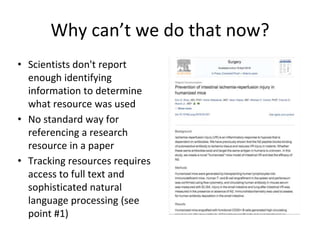
• Scientists don't report
enough identifying
information to determine
what resource was used
• No standard way for
referencing a research
resource in a paper
• Tracking resources requires
access to full text and
sophisticated natural
language processing (see
point #1)
How common is this?
Papers are
currently poor at
identifying the
simplest part of
the paper, the
materials used
Vasilevsky 2013
Can this be fixed?
Of course it can!
How: Include a unique identifier for each research entity whenever
it is used
We call this identifier the RRID: Research Resource Identifier
F1000 doi: 10.12688/f1000research.6555.2, Journal of Comparative Neurology (doi: 10.1002/cne.23913),
Brain and Behavior (doi: 10.1002/brb3.417) and NeuroInformatics (doi: 10.1007/s12021-015-9284-3).
Resource Identification Initiative
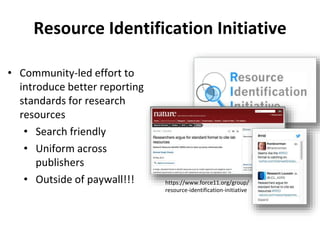
• Community-led effort to
introduce better reporting
standards for research
resources
• Search friendly
• Uniform across
publishers
• Outside of paywall!!! https://www.force11.org/group/
resource-identification-initiative
dkNET created the necessary infrastructure
to support RRIDs
• The RRID project takes advantage of NIH
investment into community databases
• NIDDK and NIF funded the means to easily
aggregate these databases to create a single
resource identification portal
• dkNET is providing pipelines and services
around RRIDs
Use of RRID’s across journals is increasing
Current Progress: Paper published in participating journal
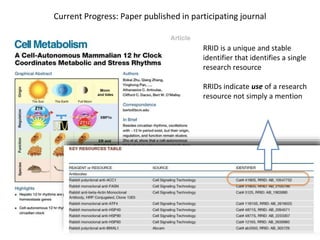
RRID is a unique and stable
identifier that identifies a single
research resource
RRIDs indicate use of a research
resource not simply a mention
How do authors find RRID’s
• The accession numbers come
from individual databases that
are the authority for that
resource, e.g., the Antibody
Registry
• dkNET makes it easy to find
these RRIDs by providing a
single search portal
• Over 25 different
databases are searched
using dkNET technologies
Resource IDs from dkNET aggregated databases
What can you do with an RRID?
• Resource identification
• Resource tracking and data aggregation
• Monitor the health of the scientific food chain
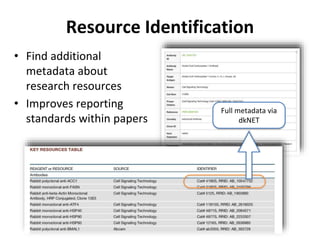
Resource Identification
• Find additional
metadata about
research resources
• Improves reporting
standards within papers
Full metadata via
dkNET
SciBot reads a
paper and
brings back
information as
an annotation,
display is in
Hypothes.is
SciBot: App for automatically resolving RRIDs
as an overlay to articles
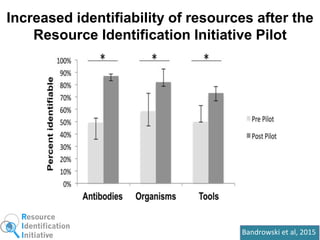
Increased identifiability of resources after the
Resource Identification Initiative Pilot
Bandrowski et al, 2015
Resource tracking and data aggregation:
what other studies used this resource?
• Allows easy tracking of use in
the literature
• Track impact of funding
decisions
• Aggregate data across
experiments for individual
organisms; cell lines
• Troubleshoot experiments
• Communicate problems
with research resources
Search for RRID in Google Scholar brings
back a set of papers that used this resource
RRID data fills in the
data in the RRID
resolver
Which other papers
used this antibody?
Data about
this paper is
in
Hypothes.is
Annotated data is used in several applications
Monitoring the health of the scientific food
chain
• dkNET + RRID gives
us for the first time
a means to
disseminate
information about
the performance of
research resources
New Authentication of
Key Biological Resources
Guidelines are already
affecting most NIH
applications (May 2016
deadline)
Problematic cell line annotated
Easily identify papers that have published
with a particular resource and notify
readers that a problem has been reports
Know before you go
• dkNET + RRIDs can alert
researchers and
reviewers about known
problems with a given
resource, before the
study is done or enters
into the literature
RRID data fills in the
data in the RRID
resolver
Which other papers
used this antibody?
Data about this
paper is in
Hypothes.is
dkNET provides automated services for
tracking research resource use via RRIDs
Monitoring the scientific food chain
New Authentication of
Key Biological Resources
Guidelines are already
affecting most NIH
applications (May 2016
deadline)
• dkNET and the RRID ecosystem allow
for the first time a means to
disseminate information about
problematic research resources
before, during and after they enter
the biomedical literature
• Alert:
• Researchers when they are searching
for a resource
• Researchers when they are preparing
their validation sections for an NIH
proposal
• Reviewers and editors when
manuscripts are submitted or
reviewed
• Journals after articles are published
• Readers of articles when they see a
research resource mentioned
dkNET provides RRID Resource Services
• dkNET updates data sources
so that researchers are
provided new information on
resources and are informed
of problematic resources
• dkNET can assist grant
submitters in creating an
authentication plan.
Now: Resource reports
Future: Add your own
validation data
dkNET Resource Authentication Service
“Is the cell line, I’m using a known
problematic cell line?”
Delivering JIT information to readers via
the SciBot App
Summary
• The RRID system is a simple yet powerful means for
identifying and tracking use of research resources across
biomedicine
• All NIH-supported stock centers are now part of the RRID
system
• Adoption has continued to grow across biomedical journals
• It is easily extensible
• Widespread adoption supports the creation of tools and
services
• NIH plays a critical role in spurring further use of RRIDs

Identifying and tracking research resources using RRIDs: a practical approach

  • 1.
    Identifying and trackingresearch resources using RRIDs: a practical approach Anita Bandrowski, Ph.D. Center for Research in Biological Systems, UCSD orcid.org/0000-0002-5497-0243 abandrowski@ucsd.edu
  • 2.
    Monitoring the scientific“food chain” • Research resources, e.g, antibodies, organisms, cell lines, tools, are the “ingredients” of scientific studies
  • 3.
    The problem • Inthe age of global search, we should be able to easily answer two questions wherever science is done and communicated: • What resources were used to produce the results of this study? • What other studies have used these resources?
  • 4.
    Why? • For rigorand reproducibility • To track impact • To aggregate data • To monitor the health of the scientific food chain
  • 5.
    Why can’t wedo that now? • Scientists don't report enough identifying information to determine what resource was used • No standard way for referencing a research resource in a paper • Tracking resources requires access to full text and sophisticated natural language processing (see point #1)
  • 8.
    How common isthis? Papers are currently poor at identifying the simplest part of the paper, the materials used Vasilevsky 2013
  • 9.
    Can this befixed? Of course it can! How: Include a unique identifier for each research entity whenever it is used We call this identifier the RRID: Research Resource Identifier F1000 doi: 10.12688/f1000research.6555.2, Journal of Comparative Neurology (doi: 10.1002/cne.23913), Brain and Behavior (doi: 10.1002/brb3.417) and NeuroInformatics (doi: 10.1007/s12021-015-9284-3).
  • 10.
    Resource Identification Initiative •Community-led effort to introduce better reporting standards for research resources • Search friendly • Uniform across publishers • Outside of paywall!!! https://www.force11.org/group/ resource-identification-initiative
  • 11.
    dkNET created thenecessary infrastructure to support RRIDs • The RRID project takes advantage of NIH investment into community databases • NIDDK and NIF funded the means to easily aggregate these databases to create a single resource identification portal • dkNET is providing pipelines and services around RRIDs
  • 12.
    Use of RRID’sacross journals is increasing
  • 13.
    Current Progress: Paperpublished in participating journal RRID is a unique and stable identifier that identifies a single research resource RRIDs indicate use of a research resource not simply a mention
  • 14.
    How do authorsfind RRID’s • The accession numbers come from individual databases that are the authority for that resource, e.g., the Antibody Registry • dkNET makes it easy to find these RRIDs by providing a single search portal • Over 25 different databases are searched using dkNET technologies Resource IDs from dkNET aggregated databases
  • 15.
    What can youdo with an RRID? • Resource identification • Resource tracking and data aggregation • Monitor the health of the scientific food chain
  • 16.
    Resource Identification • Findadditional metadata about research resources • Improves reporting standards within papers Full metadata via dkNET
  • 17.
    SciBot reads a paperand brings back information as an annotation, display is in Hypothes.is SciBot: App for automatically resolving RRIDs as an overlay to articles
  • 18.
    Increased identifiability ofresources after the Resource Identification Initiative Pilot Bandrowski et al, 2015
  • 19.
    Resource tracking anddata aggregation: what other studies used this resource? • Allows easy tracking of use in the literature • Track impact of funding decisions • Aggregate data across experiments for individual organisms; cell lines • Troubleshoot experiments • Communicate problems with research resources Search for RRID in Google Scholar brings back a set of papers that used this resource
  • 20.
    RRID data fillsin the data in the RRID resolver Which other papers used this antibody? Data about this paper is in Hypothes.is Annotated data is used in several applications
  • 21.
    Monitoring the healthof the scientific food chain • dkNET + RRID gives us for the first time a means to disseminate information about the performance of research resources New Authentication of Key Biological Resources Guidelines are already affecting most NIH applications (May 2016 deadline)
  • 22.
    Problematic cell lineannotated Easily identify papers that have published with a particular resource and notify readers that a problem has been reports
  • 23.
    Know before yougo • dkNET + RRIDs can alert researchers and reviewers about known problems with a given resource, before the study is done or enters into the literature
  • 24.
    RRID data fillsin the data in the RRID resolver Which other papers used this antibody? Data about this paper is in Hypothes.is dkNET provides automated services for tracking research resource use via RRIDs
  • 25.
    Monitoring the scientificfood chain New Authentication of Key Biological Resources Guidelines are already affecting most NIH applications (May 2016 deadline) • dkNET and the RRID ecosystem allow for the first time a means to disseminate information about problematic research resources before, during and after they enter the biomedical literature • Alert: • Researchers when they are searching for a resource • Researchers when they are preparing their validation sections for an NIH proposal • Reviewers and editors when manuscripts are submitted or reviewed • Journals after articles are published • Readers of articles when they see a research resource mentioned
  • 26.
    dkNET provides RRIDResource Services • dkNET updates data sources so that researchers are provided new information on resources and are informed of problematic resources • dkNET can assist grant submitters in creating an authentication plan. Now: Resource reports Future: Add your own validation data
  • 27.
    dkNET Resource AuthenticationService “Is the cell line, I’m using a known problematic cell line?”
  • 28.
    Delivering JIT informationto readers via the SciBot App
  • 29.
    Summary • The RRIDsystem is a simple yet powerful means for identifying and tracking use of research resources across biomedicine • All NIH-supported stock centers are now part of the RRID system • Adoption has continued to grow across biomedical journals • It is easily extensible • Widespread adoption supports the creation of tools and services • NIH plays a critical role in spurring further use of RRIDs