2011 Diversity forumMonday August 22, 2011Human Rights CommissionPresentation by Catriona Scannell and Elli Nagai-RotheStructural Discrimination
Structural DiscriminationStructural (often referred to as systemic)discrimination occurs when an entire network of rulesand practices disadvantages less empowered groupswhile serving at the same time to advantage thedominant group.*State Services Commission
Project PhasesSecondary source research and literature reviewInterviews and in-person meetings, inter-agency workshopsPresentation of discussion paper at 2011 Diversity ForumFurther feedback and discussion Report – April 2012Ongoing conversations
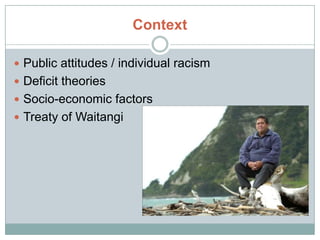
ContextPublic attitudes / individual racismDeficit theoriesSocio-economic factorsTreaty of Waitangi
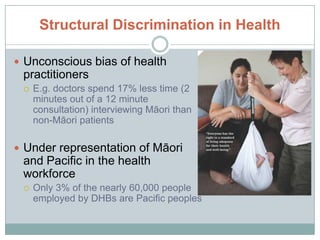
Structural Discrimination in HealthUnconscious bias of health practitioners
E.g. doctors spend 17% less time (2 minutes out of a 12 minute consultation) interviewing Māori than non-Māori patients
Under representation of Māori and Pacific in the health workforce
Only 3% of the nearly 60,000 people employed by DHBs are Pacific peoplesStructural Discrimination in EducationEducational achievement disparities“One size fits all” approach within mainstream schoolsImportance of policy and practice that is culturally appropriate and culturally responsive Structural Discrimination in Justice“This is utterly unacceptable. Is it systemic bias? Is it the result of long term cultural disadvantage? It’s probably both” Judge Andrew Becroft (2011)
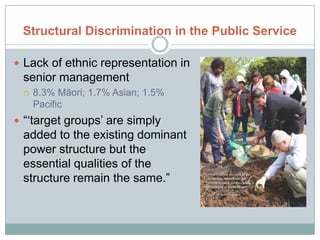
Nature (values) and practice (bias) of the justice system perpetuates structural discriminationStructural Discrimination in the Public Service Lack of ethnic representation in senior management 8.3% Māori; 1.7% Asian; 1.5% Pacific “‘target groups’ are simply added to the existing dominant power structure but the essential qualities of the structure remain the same.”
Structural Discrimination in the Economic SystemUnemployment, income disparities
Access to qualifications  for Māori and Pacific
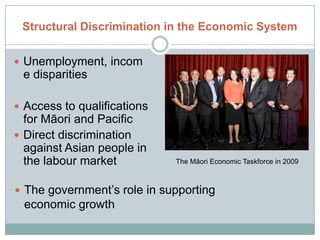
Direct discrimination against Asian people in the labour market The Māori Economic Taskforce in 2009The government’s role in supporting economic growth Common Elements of Structural Discrimination Entrenched inequalities Cumulative effect within systemsBiased practice Universal provision of public services assumes everyone has equal access to servicesInaction or absence of initiatives
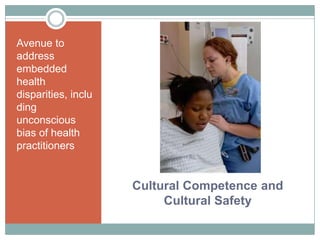
Cultural Competence and Cultural SafetyAvenue to address embedded health disparities, including unconscious bias of health practitioners
Te Kotahitanga Focuses on culturally responsive teaching pedagogy, critical teacher self-reflection and power-sharing“Power imbalances need to be examined by educators at all levels in terms of their own cultural assumptions and a consideration of how they might be participants in the systematic marginalization of students in their classrooms, their schools and the wider system.” Russell Bishop
Neighbourhood Policing Counties ManukauPreventative and proactive focusReliant on constructive relationships with communities and government
Rangatahi Courts and Pasifika Youth CourtRangatahi Courts first launched May 2008, there are now 7 and one Pasifika Youth Court in Mangare“to make justice what  it should be – a partnership between the courts and the community, each dependent on each other “
Māori Focus Units First established 1997, evaluation report published 2009“Participants in a culturally-enhanced cognitive-behavioural programme do indeed demonstrate change in terms of criminal thinking”
NZ Police Ethnic Strategy towards 2010One of the first ethnic strategies developed by a NZ government agency Won Institute of Public Administration Award for Excellence in recognising ethnic diversity, 2011
Whānau Ora Asks agencies to “commit to a new way of working with whānau”Has the potential to “revitalise the whānau”

Structural discrimination

  • 1.
    2011 Diversity forumMondayAugust 22, 2011Human Rights CommissionPresentation by Catriona Scannell and Elli Nagai-RotheStructural Discrimination
  • 2.
    Structural DiscriminationStructural (oftenreferred to as systemic)discrimination occurs when an entire network of rulesand practices disadvantages less empowered groupswhile serving at the same time to advantage thedominant group.*State Services Commission
  • 3.
    Project PhasesSecondary sourceresearch and literature reviewInterviews and in-person meetings, inter-agency workshopsPresentation of discussion paper at 2011 Diversity ForumFurther feedback and discussion Report – April 2012Ongoing conversations
  • 4.
    ContextPublic attitudes /individual racismDeficit theoriesSocio-economic factorsTreaty of Waitangi
  • 5.
    Structural Discrimination inHealthUnconscious bias of health practitioners
  • 6.
    E.g. doctors spend17% less time (2 minutes out of a 12 minute consultation) interviewing Māori than non-Māori patients
  • 7.
    Under representation ofMāori and Pacific in the health workforce
  • 8.
    Only 3% ofthe nearly 60,000 people employed by DHBs are Pacific peoplesStructural Discrimination in EducationEducational achievement disparities“One size fits all” approach within mainstream schoolsImportance of policy and practice that is culturally appropriate and culturally responsive Structural Discrimination in Justice“This is utterly unacceptable. Is it systemic bias? Is it the result of long term cultural disadvantage? It’s probably both” Judge Andrew Becroft (2011)
  • 9.
    Nature (values) andpractice (bias) of the justice system perpetuates structural discriminationStructural Discrimination in the Public Service Lack of ethnic representation in senior management 8.3% Māori; 1.7% Asian; 1.5% Pacific “‘target groups’ are simply added to the existing dominant power structure but the essential qualities of the structure remain the same.”
  • 10.
    Structural Discrimination inthe Economic SystemUnemployment, income disparities
  • 11.
    Access to qualifications for Māori and Pacific
  • 12.
    Direct discrimination againstAsian people in the labour market The Māori Economic Taskforce in 2009The government’s role in supporting economic growth Common Elements of Structural Discrimination Entrenched inequalities Cumulative effect within systemsBiased practice Universal provision of public services assumes everyone has equal access to servicesInaction or absence of initiatives
  • 13.
    Cultural Competence andCultural SafetyAvenue to address embedded health disparities, including unconscious bias of health practitioners
  • 14.
    Te Kotahitanga Focuseson culturally responsive teaching pedagogy, critical teacher self-reflection and power-sharing“Power imbalances need to be examined by educators at all levels in terms of their own cultural assumptions and a consideration of how they might be participants in the systematic marginalization of students in their classrooms, their schools and the wider system.” Russell Bishop
  • 15.
    Neighbourhood Policing CountiesManukauPreventative and proactive focusReliant on constructive relationships with communities and government
  • 16.
    Rangatahi Courts andPasifika Youth CourtRangatahi Courts first launched May 2008, there are now 7 and one Pasifika Youth Court in Mangare“to make justice what it should be – a partnership between the courts and the community, each dependent on each other “
  • 17.
    Māori Focus UnitsFirst established 1997, evaluation report published 2009“Participants in a culturally-enhanced cognitive-behavioural programme do indeed demonstrate change in terms of criminal thinking”
  • 18.
    NZ Police EthnicStrategy towards 2010One of the first ethnic strategies developed by a NZ government agency Won Institute of Public Administration Award for Excellence in recognising ethnic diversity, 2011
  • 19.
    Whānau Ora Asksagencies to “commit to a new way of working with whānau”Has the potential to “revitalise the whānau”

Editor's Notes

  • #2 Project goals: identify structural barriers to racial equality, and initiatives that address barriers. Facilitate discussion between government agencies. We look at 5 systems: Health, Education, Justice, the economic and public service system. Enables us to look at ‘systemic issues’, interplay of components within systems and interactions between systems.The discussion paper is not intended as a comprehensive piece of research, but as a tool to prompt discussion. Look forward to discussion with you after this presentation, and after we’ve heard from our panel.
  • #3 We acknowledge that structural discrimination impacts groups based on a variety of social dimensions (including physical ability, ethnicity and sexual orientation). However, we focus specifically on the impacts of structural discrimination on the basis of ethnicity.
  • #5 These contextual factors form an important piece of this discussion because they contribute to and exacerbate the impacts of structural discrimination. The existence of individual and collective racist attitudes should not be forgotten in the discussion of structural discrimination, because as we have heard, “attitudes inform and shape how systems are made.” Individual acts of bias and racism are often easier to identify than entrenched, less visible forms of racism within institutional policies and practices. Therefore, we believe structural discrimination is an under-addressed area that needs to be tackled.The cause of persistent ethnic inequalities is still sometimes attributed in popular discourse to deficit theories. However, such theories ignore the structural factors within dominant culture systems that give rise to ethnic disparitiesImportant to note the role that inequitable social and economic factors play in perpetuating ethnic inequalities, also connected to structural discrimination Important to discuss the Treaty of Waitangi in relation to structural discrimination, as such systemic barriers stand against Treaty principles of partnership and equal rights
  • #6 Persistent ethnic disparities in health are well documented, large body of research outlining these disparitiesLiterature on health outcomes provides consistent evidence that some doctors treat patients differently based on ethnicity. Many health professionals may be unaware of biased attitudes, and unaware that these attitudes can be translated into practiceWhen patients and healthcare professionals are of the same ethnicity, there are better health outcomes for patients--higher rates of visits and increased engagement
  • #7 Persistent and significant educational achievement disparities Manifestation we heard in our interviews is the “one size fits all” approach in the education system where the one size to fit all is based on the cultural values of the dominant group. Race-neutral policies thus do not acknowledge the Pakeha frame of reference, and dominant culture world views and practices at the foundation of the education system.To address structurally biased systems, need to develop culturally responsive practices and policies. Include the use of cultural frameworks that acknowledge and legitimize Maori and Pacific students, how they engage and make sense of the world as different from Pākehā students.Evidence has shown that where schools had developed initiatives specific to Māori and Pacific needs and cultural ways of being, these schools were more actually more effective in building better relationships and enhancing student achievement
  • #8 Most stark indicator of inequality in justice is Maori imprisonment. The prison population continually has around 50% Maori.We look at the nature of the system. That is, the values the justice system is based on, and to what extent Maori and Pacific notions of justice are part of the system. We look at practice within the system, and evidence of bias at every point in the justice system – from policing to sentencing. Although the effects of bias may be small when other factors (e.g. Offending history) are discounted, the high rate of imprisonment suggests this bias may have a cumulative effect.
  • #9 We look at diversity of the public service, and find ethnic disparity particularly in senior management. This may be in part symptomatic of lack of genuine commitment to diversity.While there have been some initiatives to increase thinking about Maori, Pacific, and ethnic groups in policy development, there is yet to be a comprehensive, whole of government approach.
  • #10 Disparity in unemployment rates: disproportionately high for Maori, Pacific and Asian peoples. Maori and Pacific people overrepresented in lower skilled occupations, Asian people overrepresented in semi-skilled occupations. Maori and Pacific people overrepresented as welfare recipients. For Maori and Pacific people, we look at access to qualifications as a barrier to gaining higher-skilled employment. Addressing barriers to gaining qualifications, in turn, is hoped to prevent the burden of employment shortages falling disproportionately with Maori and Pacific people in future. For Asian people, a barrier to higher-skilled employment is direct discrimination in the labour market. Economic growth is needed to provide more higher-skill employment opportunities. To achieve that, it’s important to make use of all resources including sub-economies of ethnic groups. We ask whether the government is doing enough here.
  • #11 Identify elements of structural discrimination that occur in the same way in different systems We’ve suggested some common elements as a starting point, but interested in your thoughts on what the common elements are. Ultimately want to refine this list, to produce tool to identify structural discrimination.To explain these points a little further: Inequalities exist across systems. While social/economic factors contribute to inequalities, they alone to do not explain inequalities Cumulative effect can be seen e.g. where barriers to early childhood education contribute to lower levels of educational achievement at subsequent levels of education An example of biased practice is biased policing Universal provision of public services ignores barriers that some people face in accessing services We also consider the absence of initiatives may be a form of structural discrimination
  • #12 Highlight several examples of promising initiatives to address structural discrimination within each of the five systems. Some of the examples we discuss have been quite recently implemented, so there has not been sufficient evaluation to offer conclusive evidence of their impact. We offer these initiatives as promising examples and caution you to avoid oversimplifying them as “one-stop” solutions to systemic bias. Unfortunately, there really is no “silver bullet” solution to this complex and nuanced issue. One avenue to address embedded health disparities, including unconscious bias of health practitioners is through cultural competence and cultural safety initiatives. Many sectors have implemented such initiatives, but the health field has a particularly notable history of discussion about avenues to address institutional racism and structural discrimination Health outcomes for Māori and Pacific people can be improved when health professionals are supported to develop greater cultural competence and awareness of their own attitudes and biases towards people who are culturally different from themselves.Such measures can assist in addressing embedded health disparities.
  • #13 Professional development programme designed for secondary school teachers. Launched in 2001 by the Ministry of Education, the programme was developed in response to persistent levels of underachievement among Māori students in mainstream schoolsFocus of programme on culturally responsive teaching pedagogy within classrooms, putting emphasis on critical teacher self-reflection and creating classrooms where students’ cultural identities are affirmedResults of the programme have shown educational improvement for Māori students, but also for Pacific, Asian and new migrant studentsSuccess factors:Tailoring the programme to the specific needs of Māori students. Making the programme visible at all levels of the school (classrooms, principals, school leadership teams)Effective and ongoing communication and engagement with parents and whanauSustainability depends on reaching a “tipping point” where schools adopt TK principles—changing “this is the way we do things around here.”
  • #14 Launched in September 2010, still very new, full impacts not yet knownPreventative and proactive focus, based on a shift toward prevention of crime, instead of reaction to crimeSmall teams of Police are a visible presence in neighbourhoods, developing long term relationships with community membersSuccess factors: Ensuring diversity in the police force, as a tool to build relationships with local communities through shared language and culture; Building strong community relationships and partnerships with other government agencies
  • #15 First Rangatahi Court 2008 – understand the 8th will be opened this month. Also one Pasifika Youth Court in Mangere The Courts locate part of the youth court process in cultural settings, incorporating traditional protocol and whanau/community engagement. Reliance on partnership with the community – quote on screen from Judge Andrew Becroft illustrates that
  • #16 Initiative be the Department of Corrections to reduce re-offending. Units within the prison grounds where offenders learn tikanga Maori and te reo Maori, have contact with local iwi, participate in prisoner-staff forums for decision making. Has been running since 1997, with an evaluation report published in 2009. Evaluation report was important in that it showed the programme had achieved change in criminal thinking. Based on that report, there have been refinements to the programme with increased service delivery from Maori contractors
  • #17 One of the first by a NZ govt agency, builds on their Maori and Pacific strategies Increased recruitment of ethnic police staff, engagement with ethnic communities strengthened by greater understanding of language and culture, and providing ethnic communities a voice at decision-making table through Ethnic Advisory Boards The next Police Ethnic strategy is currently under development
  • #18 Very new programme, but we’ve heard it has great potential. Ties government services together, to make them more accessible for families in need. Also provides more communicative governance structure – governance board has govt agency Chief Executives and community leaders. As well as national governance board there are regional leadership groups to ensure engagement with communities within each region
  • #19 Particularly effective to have both a “top down” and “bottom up” commitment from within the agency/organisationPartnership in the development and implementation of effective interventions Targeted programmes to address the specific needs and cultural ways of being for Maori, Pacific and ethnic communities as opposed to race-neutral policiesEvaluation to measure the impact of initiatives and to identify areas for improvement and effective practice. Look forward to your feedback and to an engaging discussion on this topic.