Chapter 3
         Sentencing:
         To Punish or to Reform?


McGraw-Hill/Irwin              © 2013 McGraw-Hill Companies. All Rights Reserved.
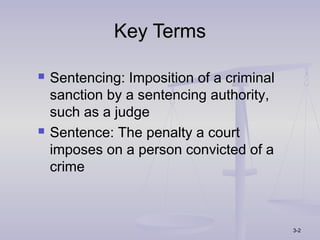
Key Terms

   Sentencing: Imposition of a criminal
    sanction by a sentencing authority,
    such as a judge
   Sentence: The penalty a court
    imposes on a person convicted of a
    crime


                                           3-2
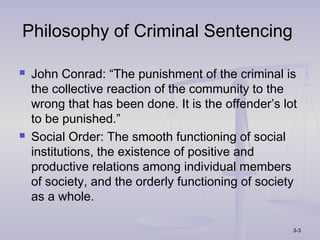
Philosophy of Criminal Sentencing

   John Conrad: “The punishment of the criminal is
    the collective reaction of the community to the
    wrong that has been done. It is the offender’s lot
    to be punished.”
   Social Order: The smooth functioning of social
    institutions, the existence of positive and
    productive relations among individual members
    of society, and the orderly functioning of society
    as a whole.

                                                     3-3
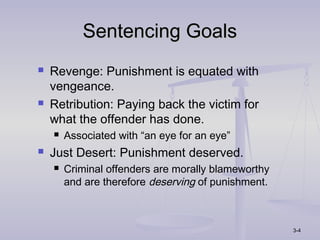
Sentencing Goals
   Revenge: Punishment is equated with
    vengeance.
   Retribution: Paying back the victim for
    what the offender has done.
       Associated with “an eye for an eye”
   Just Desert: Punishment deserved.
       Criminal offenders are morally blameworthy
        and are therefore deserving of punishment.


                                                     3-4
Sentencing Goals - Continued
   Deterrence: The discouragement or prevention
    of crimes through the fear of punishment.
      Specific deterrence: the deterrence of the

       individual being punished from committing
       additional crimes.
      General deterrence: the use of the example of

       individual punishment to dissuade others from
       committing crimes.


                                                  3-5
Sentencing Goals - Continued
   Incapacitation: The use of imprisonment or
    other means to reduce an offender’s
    capability to commit future offenses.


                                            3-6
Sentencing Goals - Continued
    Rehabilitation or reformation: the
     changing of criminal lifestyles into law-
     abiding ones by “correcting” the behavior
     of offenders through treatment,
     education, and training.
       Reintegration: the process of making

        the offender a productive member of
        the community.


                                                 3-7
Sentencing Goals - Continued
   Restoration: the process of returning to
    their previous condition all those involved
    in or affected by crime.

       Includes victims, offenders, and society.
       Restorative justice: A systematic
        response to wrongdoing that
        emphasizes healing the wounds of
        victims, offenders, and communities
        caused or revealed by crime.


                                                    3-8
Sentencing Goals - Continued
   Victim Impact Statement: A description of the
    harm and suffering that a crime has caused
    victims and survivors.

   Advocates of restorative justice believe not only
    that the victim should be restored by the justice
    process but also that the offender and society
    should participate in the restoration process.


                                                    3-9
Sentencing Options

   Fines or other monetary sanctions
   Probation
   Alternative or intermediate sanctions
   Incarceration
   Death Penalty


                                            3-10
Restitution
   Payments made by a criminal offender
    to his or her victim (or the court which
    then turns them over to the victim) as
    compensation for the harm caused by
    the offense.


                                               3-11
Types of Sentences
   Mandatory Sentence: sentences required
    by law under certain circumstances.
   Consecutive Sentences: sentences
    served one after the other.
   Concurrent Sentences: sentences served
    simultaneously.


                                             3-12
Sentencing Models
   Flat Sentences: specify a given amount of time
    to be served in custody.
       Allows little or no variation from the time specified
       Common in the 19th Century
   Indeterminate Sentence: specifies a fixed
    minimum and a maximum length. (e.g. 5 to 15)
       The parole board determines the actual time of release.
       Good time: the amount of time prison authorities deduct
        from a sentence for good behavior or other reasons.
   Determinate Sentence: specifies a fixed term of
    incarceration.
       Can be reduced by good time

                                                                  3-13
Sentencing Models – Continued
    Guideline Sentencing
        Voluntary/Advisory Sentencing
         Guidelines: recommended sentencing
         policies that are not required by law
        Presumptive Sentencing Guidelines
        Federal Sentencing Guidelines
        The legal environment and sentencing
         guidelines (next slide)


                                                 3-14
The Legal Environment and
  Sentencing Guidelines
   Nichols v. U.S.
   United States v. Watts
   Edwards v. U.S.
   U.S. v. Cotton
   Apprendi v. New Jersey
   Blakely v. Washington
   U.S. v. Booker and U.S. v. Fanfan


                                        3-15
Sentencing Models – Continued

    Mandatory Minimum Sentencing: The
     imposition of sentences required by statute
     for those convicted of a particular crime or
     a particular crime under special
     circumstances (e.g., robbery with a firearm
     or selling drugs to a minor within 1,000
     feet of a school), or for those with a
     particular type of criminal history.


                                                    3-16
Sentencing Enhancement
   Habitual Offender Statute
       A law that (1) allows a person’s criminal
        history to be considered at sentencing or
        (2) makes it possible for a person
        convicted of a given offense and
        previously convicted of another specified
        offense to receive a more severe penalty
        than that for the current offense alone.
   Three-Strikes Laws
       Ewing v. California


                                                    3-17
Three Strike Laws
   During the 1990s, 26 states and the
    federal government enacted new habitual
    offenders’ laws that fell into the three-
    strike category.
   Rationale behind the laws were mandatory
    sentences have two goals – deterrence
    and incapacitation.


                                           3-18
Issues in Sentencing
   Proportionality: the severity of punishment should
    match the seriousness of the crime.
   Equity: similar crimes and similar offenders should
    be treated alike.
   Social Debt: the severity of punishment should take
    into account the offender’s prior criminal behavior.
   Racial and Ethnic Disparities: Legislation and
    Sentencing
   Truth in Sentencing: Requires offenders to serve a
    substantial portion of their sentence.

                                                       3-19
Broader Issues
   Guideline-based determinate sentencing
    and restorative justice appear to be
    inherently at odds with each other.
   A hybrid system of “restorative sentencing
    guidelines” has been suggested to resolve
    the problem.
   Under the hybrid system the guidelines
    would not apply to lower severity offenders.


                                                   3-20

Ppt chapter 3

  • 1.
    Chapter 3 Sentencing: To Punish or to Reform? McGraw-Hill/Irwin © 2013 McGraw-Hill Companies. All Rights Reserved.
  • 2.
    Key Terms  Sentencing: Imposition of a criminal sanction by a sentencing authority, such as a judge  Sentence: The penalty a court imposes on a person convicted of a crime 3-2
  • 3.
    Philosophy of CriminalSentencing  John Conrad: “The punishment of the criminal is the collective reaction of the community to the wrong that has been done. It is the offender’s lot to be punished.”  Social Order: The smooth functioning of social institutions, the existence of positive and productive relations among individual members of society, and the orderly functioning of society as a whole. 3-3
  • 4.
    Sentencing Goals  Revenge: Punishment is equated with vengeance.  Retribution: Paying back the victim for what the offender has done.  Associated with “an eye for an eye”  Just Desert: Punishment deserved.  Criminal offenders are morally blameworthy and are therefore deserving of punishment. 3-4
  • 5.
    Sentencing Goals -Continued  Deterrence: The discouragement or prevention of crimes through the fear of punishment.  Specific deterrence: the deterrence of the individual being punished from committing additional crimes.  General deterrence: the use of the example of individual punishment to dissuade others from committing crimes. 3-5
  • 6.
    Sentencing Goals -Continued  Incapacitation: The use of imprisonment or other means to reduce an offender’s capability to commit future offenses. 3-6
  • 7.
    Sentencing Goals -Continued  Rehabilitation or reformation: the changing of criminal lifestyles into law- abiding ones by “correcting” the behavior of offenders through treatment, education, and training.  Reintegration: the process of making the offender a productive member of the community. 3-7
  • 8.
    Sentencing Goals -Continued  Restoration: the process of returning to their previous condition all those involved in or affected by crime.  Includes victims, offenders, and society.  Restorative justice: A systematic response to wrongdoing that emphasizes healing the wounds of victims, offenders, and communities caused or revealed by crime. 3-8
  • 9.
    Sentencing Goals -Continued  Victim Impact Statement: A description of the harm and suffering that a crime has caused victims and survivors.  Advocates of restorative justice believe not only that the victim should be restored by the justice process but also that the offender and society should participate in the restoration process. 3-9
  • 10.
    Sentencing Options  Fines or other monetary sanctions  Probation  Alternative or intermediate sanctions  Incarceration  Death Penalty 3-10
  • 11.
    Restitution  Payments made by a criminal offender to his or her victim (or the court which then turns them over to the victim) as compensation for the harm caused by the offense. 3-11
  • 12.
    Types of Sentences  Mandatory Sentence: sentences required by law under certain circumstances.  Consecutive Sentences: sentences served one after the other.  Concurrent Sentences: sentences served simultaneously. 3-12
  • 13.
    Sentencing Models  Flat Sentences: specify a given amount of time to be served in custody.  Allows little or no variation from the time specified  Common in the 19th Century  Indeterminate Sentence: specifies a fixed minimum and a maximum length. (e.g. 5 to 15)  The parole board determines the actual time of release.  Good time: the amount of time prison authorities deduct from a sentence for good behavior or other reasons.  Determinate Sentence: specifies a fixed term of incarceration.  Can be reduced by good time 3-13
  • 14.
    Sentencing Models –Continued  Guideline Sentencing  Voluntary/Advisory Sentencing Guidelines: recommended sentencing policies that are not required by law  Presumptive Sentencing Guidelines  Federal Sentencing Guidelines  The legal environment and sentencing guidelines (next slide) 3-14
  • 15.
    The Legal Environmentand Sentencing Guidelines  Nichols v. U.S.  United States v. Watts  Edwards v. U.S.  U.S. v. Cotton  Apprendi v. New Jersey  Blakely v. Washington  U.S. v. Booker and U.S. v. Fanfan 3-15
  • 16.
    Sentencing Models –Continued  Mandatory Minimum Sentencing: The imposition of sentences required by statute for those convicted of a particular crime or a particular crime under special circumstances (e.g., robbery with a firearm or selling drugs to a minor within 1,000 feet of a school), or for those with a particular type of criminal history. 3-16
  • 17.
    Sentencing Enhancement  Habitual Offender Statute  A law that (1) allows a person’s criminal history to be considered at sentencing or (2) makes it possible for a person convicted of a given offense and previously convicted of another specified offense to receive a more severe penalty than that for the current offense alone.  Three-Strikes Laws  Ewing v. California 3-17
  • 18.
    Three Strike Laws  During the 1990s, 26 states and the federal government enacted new habitual offenders’ laws that fell into the three- strike category.  Rationale behind the laws were mandatory sentences have two goals – deterrence and incapacitation. 3-18
  • 19.
    Issues in Sentencing  Proportionality: the severity of punishment should match the seriousness of the crime.  Equity: similar crimes and similar offenders should be treated alike.  Social Debt: the severity of punishment should take into account the offender’s prior criminal behavior.  Racial and Ethnic Disparities: Legislation and Sentencing  Truth in Sentencing: Requires offenders to serve a substantial portion of their sentence. 3-19
  • 20.
    Broader Issues  Guideline-based determinate sentencing and restorative justice appear to be inherently at odds with each other.  A hybrid system of “restorative sentencing guidelines” has been suggested to resolve the problem.  Under the hybrid system the guidelines would not apply to lower severity offenders. 3-20