Introduction to
Systems Engineering
Awareness Seminar
SESGE-AEIS/INCOSE
Escuela Politécnica Superior
Universidad Carlos III de Madrid
Leganés ( Madrid) , Spain, 29th May 2019
Bernardo A. Delicado
Bernardo.Delicado@incose.org
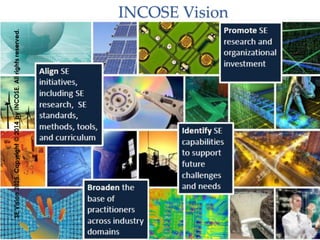
INCOSE Vision
About the instructor
3
Contents
4
• What is a system?
• What is systems thinking?
• What is systems engineering (SE)?
• Why is it important ?
• Background and history
• What are the Technical SE Process and the Vee-
Model approach?
• What is the System Life Cycle?
• Requirements, Architecture, Verification,
Validation and Testing
• Applied standards (ISO15288: 2015), techniques
and SE management.
• Trends
Contents
5
• What is a system?
• What is systems thinking?
• What is systems engineering (SE)?
• Why is it important ?
• Background and history
• What is the Technical SE Process and the Vee-
Model approach?
• What is the System Life Cycle?
• Requirements, Architecture, Verification,
Validation and Testing
• Applied standards (ISO15288: 2015), techniques
and SE management.
• Trends
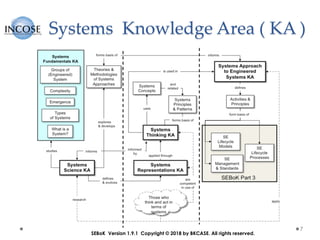
Systems Knowledge Area ( KA )
7
SEBoK Version 1.9.1 Copyright © 2018 by BKCASE. All rights reserved.
Seeing Systems
8
Seeing the world in a particular
way, because how you see
things affects the way you
approach situations or undertake
specific tasks.
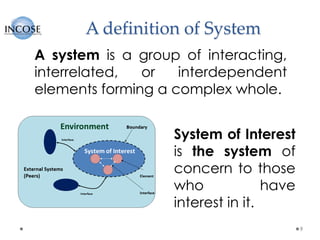
A definition of System
9
System of Interest
is the system of
concern to those
who have
interest in it.
A system is a group of interacting,
interrelated, or interdependent
elements forming a complex whole.
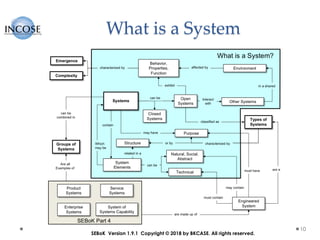
What is a System
10
SEBoK Version 1.9.1 Copyright © 2018 by BKCASE. All rights reserved.
Contents
11
• What is a system?
• What is systems thinking?
• What is systems engineering (SE)?
• Why is it important ?
• Background and history
• What are the Technical SE Process and the Vee-
Model approach?
• What is the System Life Cycle?
• Requirements, Architecture, Verification,
Validation and Testing
• Applied standards (ISO15288: 2015) and
techniques.
• Trends
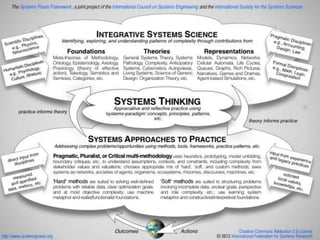
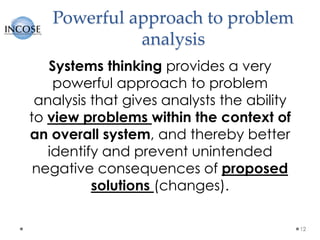
Powerful approach to problem
analysis
12
Systems thinking provides a very
powerful approach to problem
analysis that gives analysts the ability
to view problems within the context of
an overall system, and thereby better
identify and prevent unintended
negative consequences of proposed
solutions (changes).
Systems Thinking
13
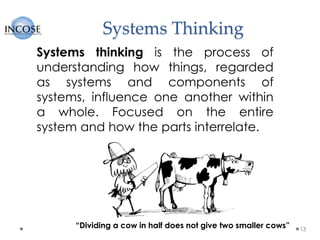
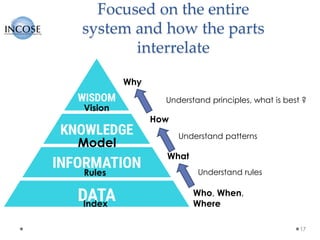
Systems thinking is the process of
understanding how things, regarded
as systems and components of
systems, influence one another within
a whole. Focused on the entire
system and how the parts interrelate.
“Dividing a cow in half does not give two smaller cows”
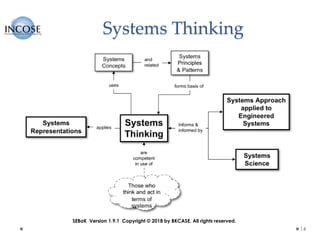
Systems Thinking
14
SEBoK Version 1.9.1 Copyright © 2018 by BKCASE. All rights reserved.
A broader view of the world
15
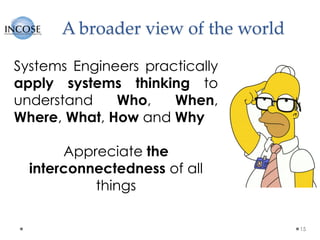
Systems Engineers practically
apply systems thinking to
understand Who, When,
Where, What, How and Why
Appreciate the
interconnectedness of all
things
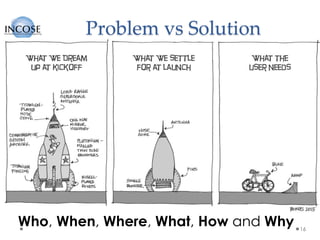
Problem vs Solution
16
Who, When, Where, What, How and Why
Focused on the entire
system and how the parts
interrelate
17
Who, When,
Where
What
How
Why
Index
Rules
Model
Vision
Understand principles, what is best ?
Understand patterns
Understand rules
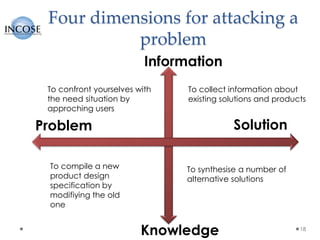
Four dimensions for attacking a
problem
18
Information
Knowledge
SolutionProblem
To collect information about
existing solutions and products
To confront yourselves with
the need situation by
approching users
To compile a new
product design
specification by
modifiying the old
one
To synthesise a number of
alternative solutions
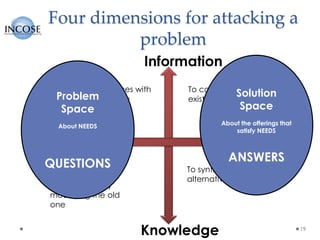
Four dimensions for attacking a
problem
19
Information
Knowledge
SolutionProblem
To collect information about
existing solutions and products
To confront yourselves with
the need situation by
approching users
To compile a new
product design
specification by
modifiying the old
one
To synthesise a number of
alternative solutions
Problem
Space
About NEEDS
QUESTIONS
Solution
Space
About the offerings that
satisfy NEEDS
ANSWERS
Full creativity of the team
20
It is very difficult for people describing
requirements to avoid jumping to solutions
instead of describing needs.
This constrains the team in realizing the optimal
solution and fails to employ the full creativity of
the team.
Contents
21
• What is a system?
• What is systems thinking?
• What is systems engineering (SE)?
• Why is it important ?
• Background and history
• What are the Technical SE Process and the Vee-
Model approach?
• What is the System Life Cycle?
• Requirements, Architecture, Verification,
Validation and Testing
• Applied standards (ISO15288: 2015), techniques
and SE management.
• Trends
Common Misconception
22
Systems Engineering (SE) is a narrow branch of
engineering associated with computers, software,
and information technology (IT).
Clarification
• SE is a very broad , overarching, and generally applicable
engineering discipline. Many types of systems are
developed using SE. These include biomedical systems,
space vehicle systems, weapon systems, transportation
systems, and so on.
• SE involves the coordination of work performed by
engineers from all other engineering disciplines (electrical,
mechanical, computer, software, etc.) as required to
complete the engineering work on the project/program.
J. Stein,“ Systems, Systems Engineering, and INCOSE: A Five Minute 50,000 Foot Overview”, INCOSE IW , Torrance, CA
January 24-25,2015
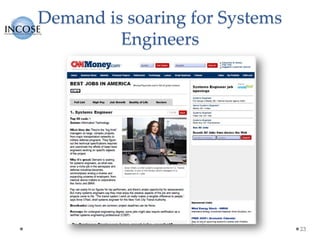
Demand is soaring for Systems
Engineers
23
Definition of SE
24
Systems Engineering is an interdisciplinary approach
and means to enable the realization of successful
systems. It focusses on defining customer needs and
required functionality early in the development cycle,
documenting requirements, and then proceeding with
design synthesis and system validation while considering
the complete problem: operations, cost and schedule,
performance, training and support, test, manufacturing,
and disposal.
Systems Engineering (SE) considers both the business
and technical needs of all customers with the goal of
providing a quality product that meets the user needs.”
( INCOSE SE Handbook )
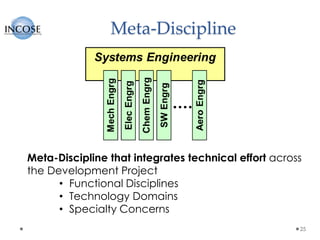
Meta-Discipline
25
Meta-Discipline that integrates technical effort across
the Development Project
• Functional Disciplines
• Technology Domains
• Specialty Concerns
Contents
26
• What is a system?
• What is systems thinking?
• What is systems engineering (SE)?
• Why is it important ?
• Background and history
• What is the Technical SE Process and Vee-Model
approach?
• What is the System Life Cycle?
• Requirements, Architecture, Verification,
Validation and Testing
• Applied standards (ISO15288: 2015), techniques
and SE management.
• Trends
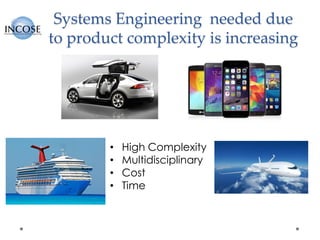
Systems Engineering needed due
to product complexity is increasing
• High Complexity
• Multidisciplinary
• Cost
• Time
Procesosde Ingeniería de Sistemas
Personas
con competencias
Organización
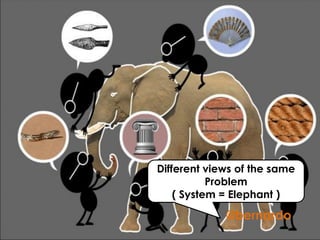
Different views of the same
Problem
( System = Elephant )
@bernardo
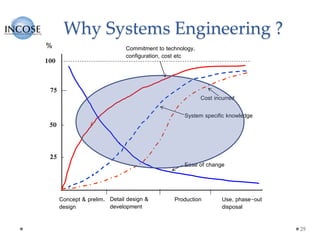
Why Systems Engineering ?
29
%
100
50
75
25
Commitment to technology,
configuration, cost etc
System specific knowledge
Cost incurred
Ease of change
Concept & prelim.
design
Detail design &
development
Production Use, phase-out
disposal
Contents
30
• What is a system?
• What is systems thinking?
• What is systems engineering (SE)?
• Why is it important ?
• Background and history
• What are the Technical SE Process and Vee-
Model approach?
• What is the System Life Cycle?
• Requirements, Architecture, Verification,
Validation and Testing
• Applied standards (ISO15288: 2015) and
techniques.
• Trends
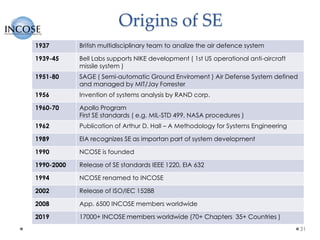
Origins of SE
31
1937 British multidisciplinary team to analize the air defence system
1939-45 Bell Labs supports NIKE development ( 1st US operational anti-aircraft
missile system )
1951-80 SAGE ( Semi-automatic Ground Enviroment ) Air Defense System defined
and managed by MIT/Jay Forrester
1956 Invention of systems analysis by RAND corp.
1960-70 Apollo Program
First SE standards ( e.g. MIL-STD 499, NASA procedures )
1962 Publication of Arthur D. Hall – A Methodology for Systems Engineering
1989 EIA recognizes SE as importan part of system development
1990 NCOSE is founded
1990-2000 Release of SE standards IEEE 1220, EIA 632
1994 NCOSE renamed to INCOSE
2002 Release of ISO/IEC 15288
2008 App. 6500 INCOSE members worldwide
2019 17000+ INCOSE members worldwide (70+ Chapters 35+ Countries )
Contents
32
• What is a system?
• What is systems thinking?
• What is systems engineering (SE)?
• Why is it important ?
• Background and history
• What are the Technical SE Process and the Vee-
Model approach?
• What is the System Life Cycle?
• Requirements, Architecture, Verification,
Validation and Testing
• Applied standards (ISO15288: 2015), techniques
and SE management.
• Trends
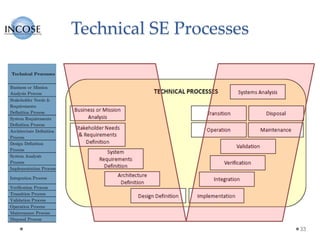
Technical SE Processes
33
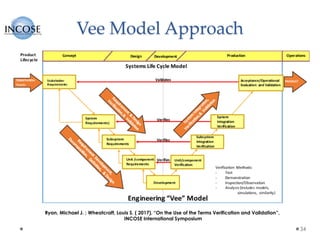
Vee Model Approach
34
Ryan, Michael J. ; Wheatcraft, Louis S. ( 2017), “On the Use of the Terms Verification and Validation”,
INCOSE International Symposium
Contents
35
• What is a system?
• What is systems thinking?
• What is systems engineering (SE)?
• Why is it important ?
• Background and history
• What are the Technical SE Process and the Vee-
Model approach?
• What is the System Life Cycle?
• Requirements, Architecture, Verification,
Validation and Testing
• Applied standards (ISO15288: 2015), techniques
and SE management.
• Trends
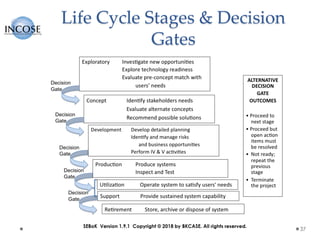
Life Cycle
36
Life Cycle is the evolution of a system, product,
service, project or other human-made entity from
conception through retirement.
(ISO/IEC/IEEE 15288 : 2015)
A life cycle for a system generally consists of a
series of stages regulated by a set of
management decisions which confirm that the
system is mature enough to leave one stage and
enter another.
( SEBoK Version 1.9.1 2018 )
Life Cycle Stages & Decision
Gates
37
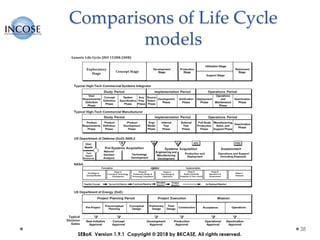
Comparisons of Life Cycle
models
38
Contents
39
• What is a system?
• What is systems thinking?
• What is systems engineering (SE)?
• Why is it important ?
• Background and history
• What are the Technical SE Process and the Vee-
Model approach?
• What is the System Life Cycle?
• Requirements, Architecture, Verification,
Validation and Testing
• Applied standards (ISO15288: 2015), techniques
and SE management.
• Trends
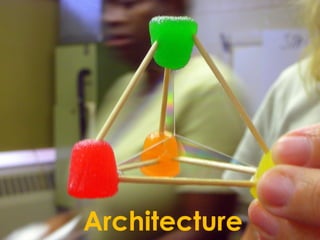
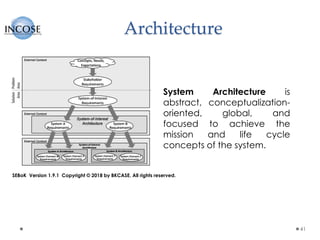
40
System Architecture is abstract,
conceptualization-oriented, global, and
focused to achieve the mission and life
cycle concepts of the system.
Architecture
Architecture
41
System Architecture is
abstract, conceptualization-
oriented, global, and
focused to achieve the
mission and life cycle
concepts of the system.
SEBoK Version 1.9.1 Copyright © 2018 by BKCASE. All rights reserved.
Architecture Model
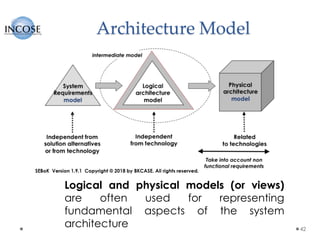
42
Logical and physical models (or views)
are often used for representing
fundamental aspects of the system
architecture
Requirement
43
A requirement is “a statement that
identifies a system, product or process
characteristic or constraint, which is
unambiguous, clear, unique, consistent,
stand‐alone (not grouped), and
verifiable, and is deemed necessary for
stakeholder acceptability.”
(INCOSE Systems Engineering Handbook)
System Requirements
44
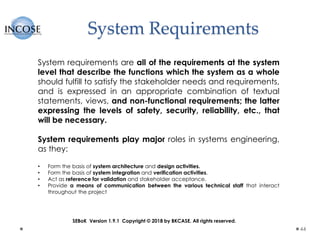
System requirements are all of the requirements at the system
level that describe the functions which the system as a whole
should fulfill to satisfy the stakeholder needs and requirements,
and is expressed in an appropriate combination of textual
statements, views, and non-functional requirements; the latter
expressing the levels of safety, security, reliability, etc., that
will be necessary.
System requirements play major roles in systems engineering,
as they:
• Form the basis of system architecture and design activities.
• Form the basis of system integration and verification activities.
• Act as reference for validation and stakeholder acceptance.
• Provide a means of communication between the various technical staff that interact
throughout the project
SEBoK Version 1.9.1 Copyright © 2018 by BKCASE. All rights reserved.
V & V
45
Verification ensures you built the
system right
Validation ensures you built the
right system
V&V in Requirements, Design, System
( INCOSE SE Handbook )
V & V Requirements
46
Requirement Verification: ensuring the
requirement meets the rules and characteristics
defined for writing a good requirement. The focus is
on the wording and structure of the requirement.
Requirement Validation: confirmation that the
requirements and requirement set is an agreed‐to
transformation that clearly communicates the stakeholder
needs and expectations in a language understood by
the developers.
Ryan, Michael J. ; Wheatcraft, Louis S. ( 2017), “On the Use of the Terms Verification and Validation”,
INCOSE International Symposium
V & V System
47
System Verification: a process done after
design and build or coding, ensuring the
designed and built or coded system meets its
requirements. The focus is on the built or
coded system and how well it meets the
agreed to requirement set that drove the design
and fabrication.
Methods used for system verification include: test,
demonstration, inspection, or analysis.
“Did we build the thing right?”
Ryan, Michael J. ; Wheatcraft, Louis S. ( 2017), “On the Use of the Terms Verification and Validation”,
INCOSE International Symposium
V & V System
48
System Validation: a process that occurs
after system verification that confirms the
designed, built, and verified system meets
its intended purpose in its operational
environment.
The focus is on the completed system and how
well it meets stakeholder expectations (needs) that
were defined during the scope definition phase
that should have occurred at the beginning of
the project.
“Did we build the right thing?”
Ryan, Michael J. ; Wheatcraft, Louis S. ( 2017), “On the Use of the Terms Verification and Validation”,
INCOSE International Symposium
Contents
49
• What is a system?
• What is systems thinking?
• What is systems engineering (SE)?
• Why is it important ?
• Background and history
• What are the Technical SE Process and the Vee-
Model approach?
• What is the System Life Cycle?
• Requirements, Architecture, Verification,
Validation and Testing
• Applied standards (ISO15288: 2015), techniques
and SE management.
• Trends
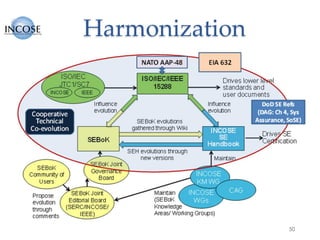
Harmonization
50
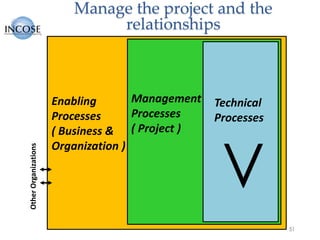
51
Technical
Processes
Management
Processes
( Project )
Enabling
Processes
( Business &
Organization )
OtherOrganizations
V
Manage the project and the
relationships
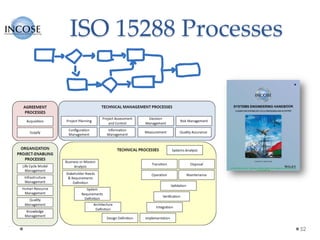
ISO 15288 Processes
52
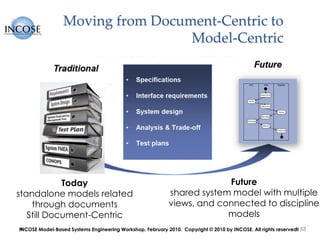
Moving from Document-Centric to
Model-Centric
53INCOSE Model-Based Systems Engineering Workshop, February 2010. Copyright © 2010 by INCOSE. All rights reserved.
Today
standalone models related
through documents
Still Document-Centric
Future
shared system model with multiple
views, and connected to discipline
models
What is Model-Based Systems
Engineering ( MBSE ) ?
54
MBSE is the formalized application of system modelling
techniques to support the product development.
It includes analysis of the system context, the development
of system requirements, design of the system architecture
and continuous system validation applied to all systems
engineering activities.
Improved:
• Product quality
• Management of product complexity
• Communication of designs and
stakeholders
• Knowledge capture and re-use
55
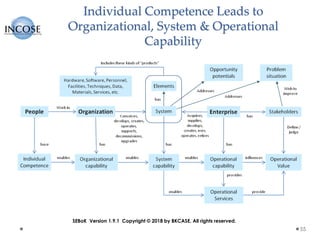
Individual Competence Leads to
Organizational, System & Operational
Capability
SEBoK Version 1.9.1 Copyright © 2018 by BKCASE. All rights reserved.
Contents
56
• What is a system?
• What is systems thinking?
• What is systems engineering (SE)?
• Why is it important ?
• Background and history
• What are the Technical SE Process and the Vee-
Model approach?
• What is the System Life Cycle?
• Requirements, Architecture, Verification,
Validation and Testing
• Applied standards (ISO15288: 2015), techniques
and SE management.
• Trends
57
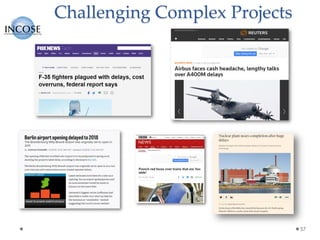
Challenging Complex Projects
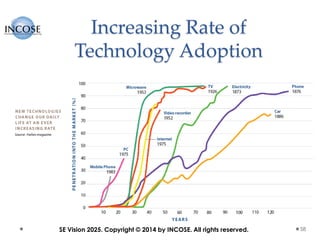
Increasing Rate of
Technology Adoption
58SE Vision 2025. Copyright © 2014 by INCOSE. All rights reserved.
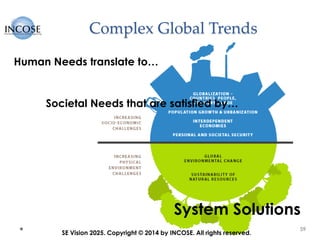
Complex Global Trends
59
SE Vision 2025. Copyright © 2014 by INCOSE. All rights reserved.
Human Needs translate to…
Societal Needs that are satisfied by…
System Solutions
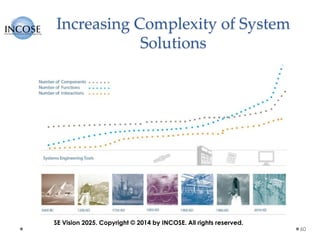
60
SE Vision 2025. Copyright © 2014 by INCOSE. All rights reserved.
Increasing Complexity of System
Solutions
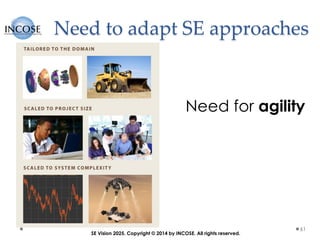
Need to adapt SE approaches
61
SE Vision 2025. Copyright © 2014 by INCOSE. All rights reserved.
Need for agility
Creating Systems that work
1. Debate, define, revise and pursue the purpose /
need
2. Think holistically
3. Follow a systematic procedure
4. Be creative
5. Take account of the people
6. Manage the project and the relationships
62
UK Royal Academy of Engineering (2007 ) “Creating systems
that work: Principles of engineering systems for the 21st century”
Creating Systems that work
1. Debate, define, revise and pursue the purpose /
need Life cycle phases and long-term view
2. Think holistically systems thinking
3. Follow a systematic procedure SE processes
4. Be creative divergent thinking
5. Take account of the people multidisciplinary
integration
6. Manage the project and the relationships
management
63
UK Royal Academy of Engineering (2007 ) “Creating systems
that work: Principles of engineering systems for the 21st century”
64
Come and join INCOSE
Professionals, students and
young graduates are welcome
Thank You

Introduction to Systems Engineering

  • 1.
    Introduction to Systems Engineering AwarenessSeminar SESGE-AEIS/INCOSE Escuela Politécnica Superior Universidad Carlos III de Madrid Leganés ( Madrid) , Spain, 29th May 2019 Bernardo A. Delicado Bernardo.Delicado@incose.org
  • 2.
  • 3.
  • 4.
    Contents 4 • What isa system? • What is systems thinking? • What is systems engineering (SE)? • Why is it important ? • Background and history • What are the Technical SE Process and the Vee- Model approach? • What is the System Life Cycle? • Requirements, Architecture, Verification, Validation and Testing • Applied standards (ISO15288: 2015), techniques and SE management. • Trends
  • 5.
    Contents 5 • What isa system? • What is systems thinking? • What is systems engineering (SE)? • Why is it important ? • Background and history • What is the Technical SE Process and the Vee- Model approach? • What is the System Life Cycle? • Requirements, Architecture, Verification, Validation and Testing • Applied standards (ISO15288: 2015), techniques and SE management. • Trends
  • 7.
    Systems Knowledge Area( KA ) 7 SEBoK Version 1.9.1 Copyright © 2018 by BKCASE. All rights reserved.
  • 8.
    Seeing Systems 8 Seeing theworld in a particular way, because how you see things affects the way you approach situations or undertake specific tasks.
  • 9.
    A definition ofSystem 9 System of Interest is the system of concern to those who have interest in it. A system is a group of interacting, interrelated, or interdependent elements forming a complex whole.
  • 10.
    What is aSystem 10 SEBoK Version 1.9.1 Copyright © 2018 by BKCASE. All rights reserved.
  • 11.
    Contents 11 • What isa system? • What is systems thinking? • What is systems engineering (SE)? • Why is it important ? • Background and history • What are the Technical SE Process and the Vee- Model approach? • What is the System Life Cycle? • Requirements, Architecture, Verification, Validation and Testing • Applied standards (ISO15288: 2015) and techniques. • Trends
  • 12.
    Powerful approach toproblem analysis 12 Systems thinking provides a very powerful approach to problem analysis that gives analysts the ability to view problems within the context of an overall system, and thereby better identify and prevent unintended negative consequences of proposed solutions (changes).
  • 13.
    Systems Thinking 13 Systems thinkingis the process of understanding how things, regarded as systems and components of systems, influence one another within a whole. Focused on the entire system and how the parts interrelate. “Dividing a cow in half does not give two smaller cows”
  • 14.
    Systems Thinking 14 SEBoK Version1.9.1 Copyright © 2018 by BKCASE. All rights reserved.
  • 15.
    A broader viewof the world 15 Systems Engineers practically apply systems thinking to understand Who, When, Where, What, How and Why Appreciate the interconnectedness of all things
  • 16.
    Problem vs Solution 16 Who,When, Where, What, How and Why
  • 17.
    Focused on theentire system and how the parts interrelate 17 Who, When, Where What How Why Index Rules Model Vision Understand principles, what is best ? Understand patterns Understand rules
  • 18.
    Four dimensions forattacking a problem 18 Information Knowledge SolutionProblem To collect information about existing solutions and products To confront yourselves with the need situation by approching users To compile a new product design specification by modifiying the old one To synthesise a number of alternative solutions
  • 19.
    Four dimensions forattacking a problem 19 Information Knowledge SolutionProblem To collect information about existing solutions and products To confront yourselves with the need situation by approching users To compile a new product design specification by modifiying the old one To synthesise a number of alternative solutions Problem Space About NEEDS QUESTIONS Solution Space About the offerings that satisfy NEEDS ANSWERS
  • 20.
    Full creativity ofthe team 20 It is very difficult for people describing requirements to avoid jumping to solutions instead of describing needs. This constrains the team in realizing the optimal solution and fails to employ the full creativity of the team.
  • 21.
    Contents 21 • What isa system? • What is systems thinking? • What is systems engineering (SE)? • Why is it important ? • Background and history • What are the Technical SE Process and the Vee- Model approach? • What is the System Life Cycle? • Requirements, Architecture, Verification, Validation and Testing • Applied standards (ISO15288: 2015), techniques and SE management. • Trends
  • 22.
    Common Misconception 22 Systems Engineering(SE) is a narrow branch of engineering associated with computers, software, and information technology (IT). Clarification • SE is a very broad , overarching, and generally applicable engineering discipline. Many types of systems are developed using SE. These include biomedical systems, space vehicle systems, weapon systems, transportation systems, and so on. • SE involves the coordination of work performed by engineers from all other engineering disciplines (electrical, mechanical, computer, software, etc.) as required to complete the engineering work on the project/program. J. Stein,“ Systems, Systems Engineering, and INCOSE: A Five Minute 50,000 Foot Overview”, INCOSE IW , Torrance, CA January 24-25,2015
  • 23.
    Demand is soaringfor Systems Engineers 23
  • 24.
    Definition of SE 24 SystemsEngineering is an interdisciplinary approach and means to enable the realization of successful systems. It focusses on defining customer needs and required functionality early in the development cycle, documenting requirements, and then proceeding with design synthesis and system validation while considering the complete problem: operations, cost and schedule, performance, training and support, test, manufacturing, and disposal. Systems Engineering (SE) considers both the business and technical needs of all customers with the goal of providing a quality product that meets the user needs.” ( INCOSE SE Handbook )
  • 25.
    Meta-Discipline 25 Meta-Discipline that integratestechnical effort across the Development Project • Functional Disciplines • Technology Domains • Specialty Concerns
  • 26.
    Contents 26 • What isa system? • What is systems thinking? • What is systems engineering (SE)? • Why is it important ? • Background and history • What is the Technical SE Process and Vee-Model approach? • What is the System Life Cycle? • Requirements, Architecture, Verification, Validation and Testing • Applied standards (ISO15288: 2015), techniques and SE management. • Trends
  • 27.
    Systems Engineering neededdue to product complexity is increasing • High Complexity • Multidisciplinary • Cost • Time
  • 28.
    Procesosde Ingeniería deSistemas Personas con competencias Organización Different views of the same Problem ( System = Elephant ) @bernardo
  • 29.
    Why Systems Engineering? 29 % 100 50 75 25 Commitment to technology, configuration, cost etc System specific knowledge Cost incurred Ease of change Concept & prelim. design Detail design & development Production Use, phase-out disposal
  • 30.
    Contents 30 • What isa system? • What is systems thinking? • What is systems engineering (SE)? • Why is it important ? • Background and history • What are the Technical SE Process and Vee- Model approach? • What is the System Life Cycle? • Requirements, Architecture, Verification, Validation and Testing • Applied standards (ISO15288: 2015) and techniques. • Trends
  • 31.
    Origins of SE 31 1937British multidisciplinary team to analize the air defence system 1939-45 Bell Labs supports NIKE development ( 1st US operational anti-aircraft missile system ) 1951-80 SAGE ( Semi-automatic Ground Enviroment ) Air Defense System defined and managed by MIT/Jay Forrester 1956 Invention of systems analysis by RAND corp. 1960-70 Apollo Program First SE standards ( e.g. MIL-STD 499, NASA procedures ) 1962 Publication of Arthur D. Hall – A Methodology for Systems Engineering 1989 EIA recognizes SE as importan part of system development 1990 NCOSE is founded 1990-2000 Release of SE standards IEEE 1220, EIA 632 1994 NCOSE renamed to INCOSE 2002 Release of ISO/IEC 15288 2008 App. 6500 INCOSE members worldwide 2019 17000+ INCOSE members worldwide (70+ Chapters 35+ Countries )
  • 32.
    Contents 32 • What isa system? • What is systems thinking? • What is systems engineering (SE)? • Why is it important ? • Background and history • What are the Technical SE Process and the Vee- Model approach? • What is the System Life Cycle? • Requirements, Architecture, Verification, Validation and Testing • Applied standards (ISO15288: 2015), techniques and SE management. • Trends
  • 33.
  • 34.
    Vee Model Approach 34 Ryan,Michael J. ; Wheatcraft, Louis S. ( 2017), “On the Use of the Terms Verification and Validation”, INCOSE International Symposium
  • 35.
    Contents 35 • What isa system? • What is systems thinking? • What is systems engineering (SE)? • Why is it important ? • Background and history • What are the Technical SE Process and the Vee- Model approach? • What is the System Life Cycle? • Requirements, Architecture, Verification, Validation and Testing • Applied standards (ISO15288: 2015), techniques and SE management. • Trends
  • 36.
    Life Cycle 36 Life Cycleis the evolution of a system, product, service, project or other human-made entity from conception through retirement. (ISO/IEC/IEEE 15288 : 2015) A life cycle for a system generally consists of a series of stages regulated by a set of management decisions which confirm that the system is mature enough to leave one stage and enter another. ( SEBoK Version 1.9.1 2018 )
  • 37.
    Life Cycle Stages& Decision Gates 37
  • 38.
    Comparisons of LifeCycle models 38
  • 39.
    Contents 39 • What isa system? • What is systems thinking? • What is systems engineering (SE)? • Why is it important ? • Background and history • What are the Technical SE Process and the Vee- Model approach? • What is the System Life Cycle? • Requirements, Architecture, Verification, Validation and Testing • Applied standards (ISO15288: 2015), techniques and SE management. • Trends
  • 40.
    40 System Architecture isabstract, conceptualization-oriented, global, and focused to achieve the mission and life cycle concepts of the system. Architecture
  • 41.
    Architecture 41 System Architecture is abstract,conceptualization- oriented, global, and focused to achieve the mission and life cycle concepts of the system. SEBoK Version 1.9.1 Copyright © 2018 by BKCASE. All rights reserved.
  • 42.
    Architecture Model 42 Logical andphysical models (or views) are often used for representing fundamental aspects of the system architecture
  • 43.
    Requirement 43 A requirement is“a statement that identifies a system, product or process characteristic or constraint, which is unambiguous, clear, unique, consistent, stand‐alone (not grouped), and verifiable, and is deemed necessary for stakeholder acceptability.” (INCOSE Systems Engineering Handbook)
  • 44.
    System Requirements 44 System requirementsare all of the requirements at the system level that describe the functions which the system as a whole should fulfill to satisfy the stakeholder needs and requirements, and is expressed in an appropriate combination of textual statements, views, and non-functional requirements; the latter expressing the levels of safety, security, reliability, etc., that will be necessary. System requirements play major roles in systems engineering, as they: • Form the basis of system architecture and design activities. • Form the basis of system integration and verification activities. • Act as reference for validation and stakeholder acceptance. • Provide a means of communication between the various technical staff that interact throughout the project SEBoK Version 1.9.1 Copyright © 2018 by BKCASE. All rights reserved.
  • 45.
    V & V 45 Verificationensures you built the system right Validation ensures you built the right system V&V in Requirements, Design, System ( INCOSE SE Handbook )
  • 46.
    V & VRequirements 46 Requirement Verification: ensuring the requirement meets the rules and characteristics defined for writing a good requirement. The focus is on the wording and structure of the requirement. Requirement Validation: confirmation that the requirements and requirement set is an agreed‐to transformation that clearly communicates the stakeholder needs and expectations in a language understood by the developers. Ryan, Michael J. ; Wheatcraft, Louis S. ( 2017), “On the Use of the Terms Verification and Validation”, INCOSE International Symposium
  • 47.
    V & VSystem 47 System Verification: a process done after design and build or coding, ensuring the designed and built or coded system meets its requirements. The focus is on the built or coded system and how well it meets the agreed to requirement set that drove the design and fabrication. Methods used for system verification include: test, demonstration, inspection, or analysis. “Did we build the thing right?” Ryan, Michael J. ; Wheatcraft, Louis S. ( 2017), “On the Use of the Terms Verification and Validation”, INCOSE International Symposium
  • 48.
    V & VSystem 48 System Validation: a process that occurs after system verification that confirms the designed, built, and verified system meets its intended purpose in its operational environment. The focus is on the completed system and how well it meets stakeholder expectations (needs) that were defined during the scope definition phase that should have occurred at the beginning of the project. “Did we build the right thing?” Ryan, Michael J. ; Wheatcraft, Louis S. ( 2017), “On the Use of the Terms Verification and Validation”, INCOSE International Symposium
  • 49.
    Contents 49 • What isa system? • What is systems thinking? • What is systems engineering (SE)? • Why is it important ? • Background and history • What are the Technical SE Process and the Vee- Model approach? • What is the System Life Cycle? • Requirements, Architecture, Verification, Validation and Testing • Applied standards (ISO15288: 2015), techniques and SE management. • Trends
  • 50.
  • 51.
    51 Technical Processes Management Processes ( Project ) Enabling Processes (Business & Organization ) OtherOrganizations V Manage the project and the relationships
  • 52.
  • 53.
    Moving from Document-Centricto Model-Centric 53INCOSE Model-Based Systems Engineering Workshop, February 2010. Copyright © 2010 by INCOSE. All rights reserved. Today standalone models related through documents Still Document-Centric Future shared system model with multiple views, and connected to discipline models
  • 54.
    What is Model-BasedSystems Engineering ( MBSE ) ? 54 MBSE is the formalized application of system modelling techniques to support the product development. It includes analysis of the system context, the development of system requirements, design of the system architecture and continuous system validation applied to all systems engineering activities. Improved: • Product quality • Management of product complexity • Communication of designs and stakeholders • Knowledge capture and re-use
  • 55.
    55 Individual Competence Leadsto Organizational, System & Operational Capability SEBoK Version 1.9.1 Copyright © 2018 by BKCASE. All rights reserved.
  • 56.
    Contents 56 • What isa system? • What is systems thinking? • What is systems engineering (SE)? • Why is it important ? • Background and history • What are the Technical SE Process and the Vee- Model approach? • What is the System Life Cycle? • Requirements, Architecture, Verification, Validation and Testing • Applied standards (ISO15288: 2015), techniques and SE management. • Trends
  • 57.
  • 58.
    Increasing Rate of TechnologyAdoption 58SE Vision 2025. Copyright © 2014 by INCOSE. All rights reserved.
  • 59.
    Complex Global Trends 59 SEVision 2025. Copyright © 2014 by INCOSE. All rights reserved. Human Needs translate to… Societal Needs that are satisfied by… System Solutions
  • 60.
    60 SE Vision 2025.Copyright © 2014 by INCOSE. All rights reserved. Increasing Complexity of System Solutions
  • 61.
    Need to adaptSE approaches 61 SE Vision 2025. Copyright © 2014 by INCOSE. All rights reserved. Need for agility
  • 62.
    Creating Systems thatwork 1. Debate, define, revise and pursue the purpose / need 2. Think holistically 3. Follow a systematic procedure 4. Be creative 5. Take account of the people 6. Manage the project and the relationships 62 UK Royal Academy of Engineering (2007 ) “Creating systems that work: Principles of engineering systems for the 21st century”
  • 63.
    Creating Systems thatwork 1. Debate, define, revise and pursue the purpose / need Life cycle phases and long-term view 2. Think holistically systems thinking 3. Follow a systematic procedure SE processes 4. Be creative divergent thinking 5. Take account of the people multidisciplinary integration 6. Manage the project and the relationships management 63 UK Royal Academy of Engineering (2007 ) “Creating systems that work: Principles of engineering systems for the 21st century”
  • 64.
    64 Come and joinINCOSE Professionals, students and young graduates are welcome
  • 65.