An Architecture for
Autonomy
Dave Adsit
Lead Architect @ Pluralsight
Thanks to our Sponsors!PartnersMarqueePremierPrize
Monolith
A single massive stone or rock
CRAFTSMANSHIP
• Domain driven design
• DevOps mindset
• Team ownership of quality
Pride in
Workmanship
• Paired programming
• Acceptance test driven development
• Continuous Integration
Professional
Practices
• Automate build and test process
• Push button deploy / rollback
• Reduce lead time
Continuous
Delivery
OUR CHALLENGE
• Increase product usage capacity
• Increase development capacity
Growth!
H. L. Mencken
"For every complex problem there is an answer that is clear,
simple, and wrong."
OUR SOLUTION
F. A. Hayek
"The curious task of economics is to demonstrate to men how
little they really know about what they imagine they can

design."
OUR SOLUTION
A Principled Approach
• Engineering Excellence: Security &
Reliability
• Data Availability & Integrity
• Amazing User Experiences
• Innovation & Speed to Market
Strategic Goals
• Autonomous teams
• Cross functional teams
• Think 10x
• Cloud infrastructure
• Instrumentation and System Visibility
• Smaller codebases
Architectural
Principles
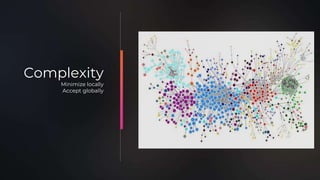
Complexity
Minimize locally
Accept globally
OUR SOLUTION
Bounded Contexts
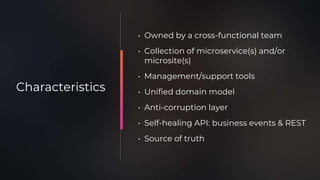
• Owned by a cross-functional team
• Collection of microservice(s) and/or
microsite(s)
• Management/support tools
• Unified domain model
• Anti-corruption layer
• Self-healing API: business events & REST
• Source of truth
Characteristics
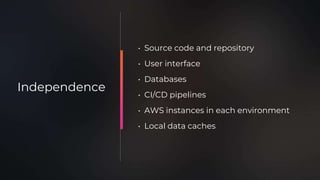
• Source code and repository
• User interface
• Databases
• CI/CD pipelines
• AWS instances in each environment
• Local data caches
Independence
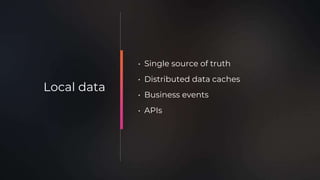
• Single source of truth
• Distributed data caches
• Business events
• APIs
Local data
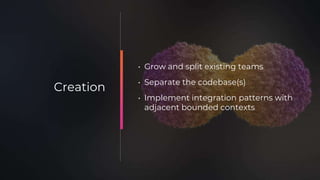
• Grow and split existing teams
• Separate the codebase(s)
• Implement integration patterns with
adjacent bounded contexts
Creation
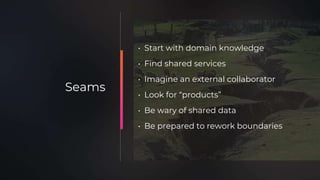
• Start with domain knowledge
• Find shared services
• Imagine an external collaborator
• Look for “products”
• Be wary of shared data
• Be prepared to rework boundaries
Seams
OUR SOLUTION
Integrating the many
components of the system
• Deploy independently
• Favor asynchronous integration
• AMQP + JSON when asynchronous
• HTTP + JSON when synchronous
• Web components
Loose coupling
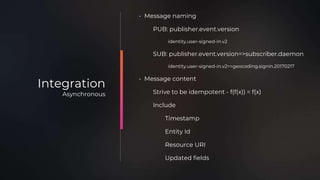
• Message naming
PUB: publisher.event.version
identity.user-signed-in.v2
SUB: publisher.event.version=>subscriber.daemon
identity.user-signed-in.v2=>geocoding.signin.20170217
• Message content
Strive to be idempotent - f(f(x)) = f(x)
Include
Timestamp
Entity Id
Resource URI
Updated fields
Integration
Asynchronous
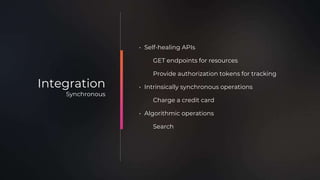
• Self-healing APIs
GET endpoints for resources
Provide authorization tokens for tracking
• Intrinsically synchronous operations
Charge a credit card
• Algorithmic operations
Search
Integration
Synchronous
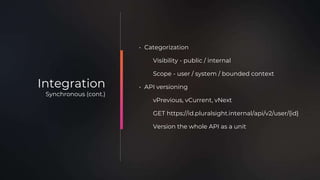
• Categorization
Visibility - public / internal
Scope - user / system / bounded context
• API versioning
vPrevious, vCurrent, vNext
GET https://id.pluralsight.internal/api/v2/user/{id}
Version the whole API as a unit
Integration
Synchronous (cont.)
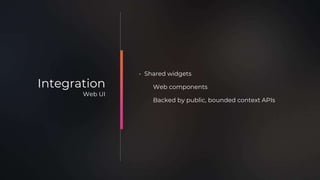
• Shared widgets
Web components
Backed by public, bounded context APIs
Integration
Web UI
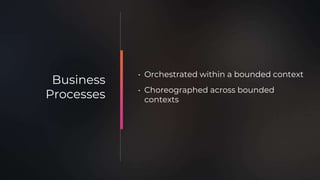
• Orchestrated within a bounded context
• Choreographed across bounded
contexts
Business
Processes
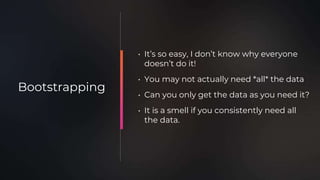
• It’s so easy, I don’t know why everyone
doesn’t do it!
• You may not actually need *all* the data
• Can you only get the data as you need it?
• It is a smell if you consistently need all
the data.
Bootstrapping
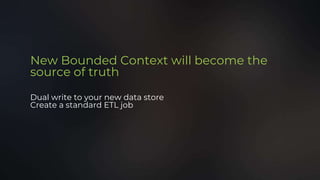
New Bounded Context will become the
source of truth
Dual write to your new data store
Create a standard ETL job
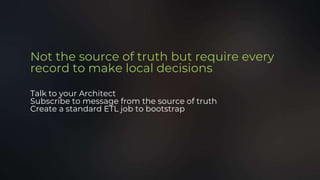
Not the source of truth but require every
record to make local decisions
Talk to your Architect
Subscribe to message from the source of truth
Create a standard ETL job to bootstrap
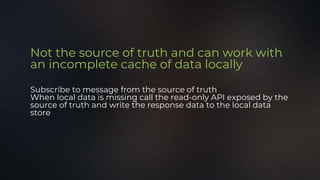
Not the source of truth and can work with
an incomplete cache of data locally
Subscribe to message from the source of truth
When local data is missing call the read-only API exposed by the
source of truth and write the response data to the local data
store
OUR SOLUTION
Bounded Contexts
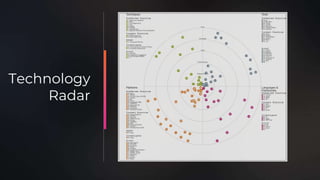
Technology
Radar
WHAT ABOUT AUTONOMY?
Subsidiarity
Matters ought to be handled by the smallest, lowest or least
centralized competent authority
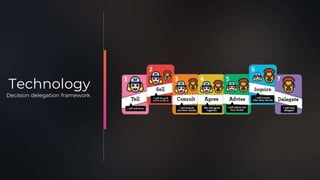
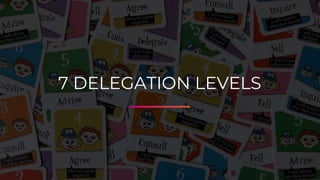
7 DELEGATION LEVELS
Technology
Decision delegation framework
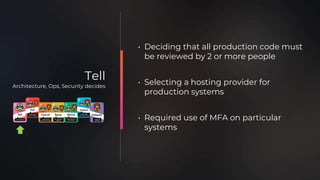
• Deciding that all production code must
be reviewed by 2 or more people
• Selecting a hosting provider for
production systems
• Required use of MFA on particular
systems
Tell
Architecture, Ops, Security decides
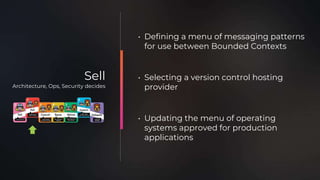
• Defining a menu of messaging patterns
for use between Bounded Contexts
• Selecting a version control hosting
provider
• Updating the menu of operating
systems approved for production
applications
Sell
Architecture, Ops, Security decides
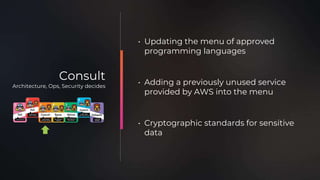
• Updating the menu of approved
programming languages
• Adding a previously unused service
provided by AWS into the menu
• Cryptographic standards for sensitive
data
Consult
Architecture, Ops, Security decides
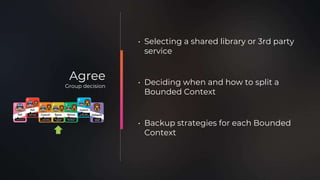
• Selecting a shared library or 3rd party
service
• Deciding when and how to split a
Bounded Context
• Backup strategies for each Bounded
Context
Agree
Group decision
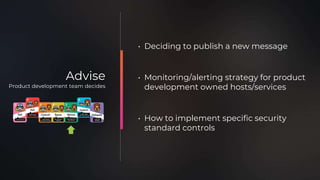
• Deciding to publish a new message
• Monitoring/alerting strategy for product
development owned hosts/services
• How to implement specific security
standard controls
Advise
Product development team decides
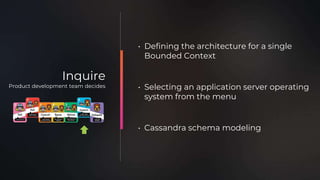
• Defining the architecture for a single
Bounded Context
• Selecting an application server operating
system from the menu
• Cassandra schema modeling
Inquire
Product development team decides
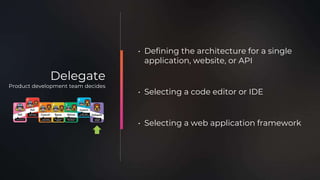
• Defining the architecture for a single
application, website, or API
• Selecting a code editor or IDE
• Selecting a web application framework
Delegate
Product development team decides
EXECUTE
With increased clarity
around decision making
OUR SOLUTION
Limitations and downsides
Questions?

An Architecture for Autonomy

  • 1.
    An Architecture for Autonomy DaveAdsit Lead Architect @ Pluralsight
  • 2.
    Thanks to ourSponsors!PartnersMarqueePremierPrize
  • 3.
  • 4.
  • 5.
    • Domain drivendesign • DevOps mindset • Team ownership of quality Pride in Workmanship
  • 6.
    • Paired programming •Acceptance test driven development • Continuous Integration Professional Practices
  • 7.
    • Automate buildand test process • Push button deploy / rollback • Reduce lead time Continuous Delivery
  • 8.
  • 9.
    • Increase productusage capacity • Increase development capacity Growth!
  • 10.
    H. L. Mencken "Forevery complex problem there is an answer that is clear, simple, and wrong."
  • 11.
  • 12.
    F. A. Hayek "Thecurious task of economics is to demonstrate to men how little they really know about what they imagine they can design."
  • 13.
  • 14.
    • Engineering Excellence:Security & Reliability • Data Availability & Integrity • Amazing User Experiences • Innovation & Speed to Market Strategic Goals
  • 15.
    • Autonomous teams •Cross functional teams • Think 10x • Cloud infrastructure • Instrumentation and System Visibility • Smaller codebases Architectural Principles
  • 16.
  • 17.
  • 18.
    • Owned bya cross-functional team • Collection of microservice(s) and/or microsite(s) • Management/support tools • Unified domain model • Anti-corruption layer • Self-healing API: business events & REST • Source of truth Characteristics
  • 19.
    • Source codeand repository • User interface • Databases • CI/CD pipelines • AWS instances in each environment • Local data caches Independence
  • 20.
    • Single sourceof truth • Distributed data caches • Business events • APIs Local data
  • 21.
    • Grow andsplit existing teams • Separate the codebase(s) • Implement integration patterns with adjacent bounded contexts Creation
  • 22.
    • Start withdomain knowledge • Find shared services • Imagine an external collaborator • Look for “products” • Be wary of shared data • Be prepared to rework boundaries Seams
  • 23.
    OUR SOLUTION Integrating themany components of the system
  • 24.
    • Deploy independently •Favor asynchronous integration • AMQP + JSON when asynchronous • HTTP + JSON when synchronous • Web components Loose coupling
  • 25.
    • Message naming PUB:publisher.event.version identity.user-signed-in.v2 SUB: publisher.event.version=>subscriber.daemon identity.user-signed-in.v2=>geocoding.signin.20170217 • Message content Strive to be idempotent - f(f(x)) = f(x) Include Timestamp Entity Id Resource URI Updated fields Integration Asynchronous
  • 26.
    • Self-healing APIs GETendpoints for resources Provide authorization tokens for tracking • Intrinsically synchronous operations Charge a credit card • Algorithmic operations Search Integration Synchronous
  • 27.
    • Categorization Visibility -public / internal Scope - user / system / bounded context • API versioning vPrevious, vCurrent, vNext GET https://id.pluralsight.internal/api/v2/user/{id} Version the whole API as a unit Integration Synchronous (cont.)
  • 28.
    • Shared widgets Webcomponents Backed by public, bounded context APIs Integration Web UI
  • 29.
    • Orchestrated withina bounded context • Choreographed across bounded contexts Business Processes
  • 30.
    • It’s soeasy, I don’t know why everyone doesn’t do it! • You may not actually need *all* the data • Can you only get the data as you need it? • It is a smell if you consistently need all the data. Bootstrapping
  • 31.
    New Bounded Contextwill become the source of truth Dual write to your new data store Create a standard ETL job
  • 32.
    Not the sourceof truth but require every record to make local decisions Talk to your Architect Subscribe to message from the source of truth Create a standard ETL job to bootstrap
  • 33.
    Not the sourceof truth and can work with an incomplete cache of data locally Subscribe to message from the source of truth When local data is missing call the read-only API exposed by the source of truth and write the response data to the local data store
  • 34.
  • 35.
  • 36.
  • 37.
    Subsidiarity Matters ought tobe handled by the smallest, lowest or least centralized competent authority
  • 38.
  • 39.
  • 40.
    • Deciding thatall production code must be reviewed by 2 or more people • Selecting a hosting provider for production systems • Required use of MFA on particular systems Tell Architecture, Ops, Security decides
  • 41.
    • Defining amenu of messaging patterns for use between Bounded Contexts • Selecting a version control hosting provider • Updating the menu of operating systems approved for production applications Sell Architecture, Ops, Security decides
  • 42.
    • Updating themenu of approved programming languages • Adding a previously unused service provided by AWS into the menu • Cryptographic standards for sensitive data Consult Architecture, Ops, Security decides
  • 43.
    • Selecting ashared library or 3rd party service • Deciding when and how to split a Bounded Context • Backup strategies for each Bounded Context Agree Group decision
  • 44.
    • Deciding topublish a new message • Monitoring/alerting strategy for product development owned hosts/services • How to implement specific security standard controls Advise Product development team decides
  • 45.
    • Defining thearchitecture for a single Bounded Context • Selecting an application server operating system from the menu • Cassandra schema modeling Inquire Product development team decides
  • 46.
    • Defining thearchitecture for a single application, website, or API • Selecting a code editor or IDE • Selecting a web application framework Delegate Product development team decides
  • 47.
  • 48.
  • 49.