LoRa and NB-IoT
Gagan Gupta, Darshan Patil
gagan@kth.se, darshan@kth.se
13 October 2016
OUTLINE
● Background
● Motivation
● LoRa
● NB-IoT
● Conclusion
Background
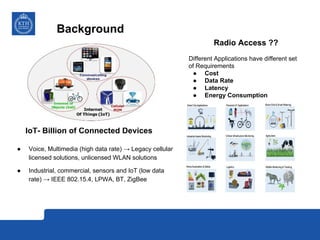
IoT- Billion of Connected Devices
Radio Access ??
Different Applications have different set
of Requirements
● Cost
● Data Rate
● Latency
● Energy Consumption
● Voice, Multimedia (high data rate) → Legacy cellular
licensed solutions, unlicensed WLAN solutions
● Industrial, commercial, sensors and IoT (low data
rate) → IEEE 802.15.4, LPWA, BT, ZigBee
Motivation
● IOT devices have requirements of wide area
connectivity for low power and low data rate
devices at economical cost
● Legacy cellular solutions- high throughput,
long range, but high power and costly
● WLAN 802.11 a-n- high throughput, short
range, moderate-high power and cost
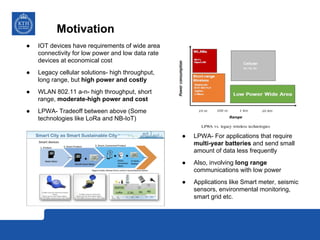
● LPWA- Tradeoff between above (Some
technologies like LoRa and NB-IoT)
● LPWA- For applications that require
multi-year batteries and send small
amount of data less frequently
● Also, involving long range
communications with low power
● Applications like Smart meter, seismic
sensors, environmental monitoring,
smart grid etc.
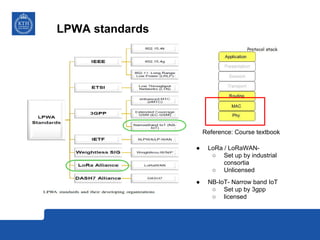
LPWA standards
● LoRa / LoRaWAN-
○ Set up by industrial
consortia
○ Unlicensed
● NB-IoT- Narrow band IoT
○ Set up by 3gpp
○ licensed
Reference: Course textbook
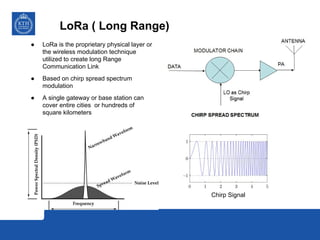
LoRa ( Long Range)
● LoRa is the proprietary physical layer or
the wireless modulation technique
utilized to create long Range
Communication Link
● Based on chirp spread spectrum
modulation
● A single gateway or base station can
cover entire cities or hundreds of
square kilometers
Chirp Signal
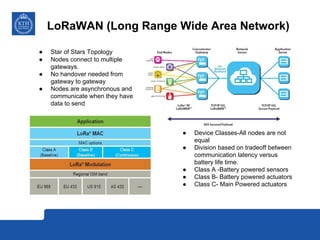
LoRaWAN (Long Range Wide Area Network)
● Star of Stars Topology
● Nodes connect to multiple
gateways.
● No handover needed from
gateway to gateway
● Nodes are asynchronous and
communicate when they have
data to send
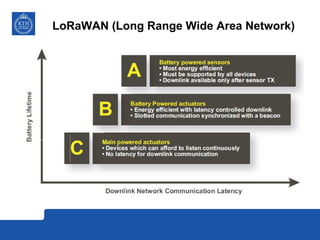
● Device Classes-All nodes are not
equal
● Division based on tradeoff between
communication latency versus
battery life time.
● Class A -Battery powered sensors
● Class B- Battery powered actuators
● Class C- Main Powered actuators
LoRaWAN (Long Range Wide Area Network)
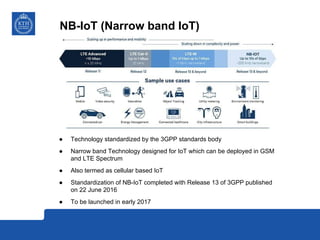
NB-IoT (Narrow band IoT)
● Technology standardized by the 3GPP standards body
● Narrow band Technology designed for IoT which can be deployed in GSM
and LTE Spectrum
● Also termed as cellular based IoT
● Standardization of NB-IoT completed with Release 13 of 3GPP published
on 22 June 2016
● To be launched in early 2017
NB-IoT (Narrow band IoT)
❖ Highest modulation scheme used- QPSK
❖ Minimal noise level inside a single narrowband
❖ Receiver does not require to add processing gain to decode
❖ Simple and inexpensive transceiver design
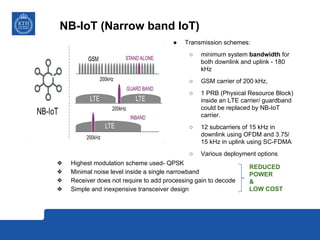
● Transmission schemes:
○ minimum system bandwidth for
both downlink and uplink - 180
kHz
○ GSM carrier of 200 kHz,
○ 1 PRB (Physical Resource Block)
inside an LTE carrier/ guardband
could be replaced by NB-IoT
carrier.
○ 12 subcarriers of 15 kHz in
downlink using OFDM and 3.75/
15 kHz in uplink using SC-FDMA
○ Various deployment options
REDUCED
POWER
&
LOW COST
NB-IoT (Narrow band IoT)
● To enable low-complexity UE implementation, NB-IoT allows only one HARQ
process in both downlink and uplink, and allows longer UE decoding time
● Asynchronous, adaptive HARQ procedure is adopted to support scheduling
flexibility.
● Physical Channel/ Resource mapping
○ Extensive reuse of current LTE
(Long Term Evolution)
specifications
○ Few changes to physical channels
used in LTE (detailed review)
● Random Access :
○ *Contention based algorithm
similar to LTE [*Source- A Primer
on 3GPP Narrowband Internet of
Things (NB-IoT)]
UE
N/W
1
2
3
4
1. Preamble
2. Response containing advance
command and scheduling of the uplink
resources for the UE to use
3. Identity to the network
4. Contention resolution message
NB-IoT (Narrow band IoT)
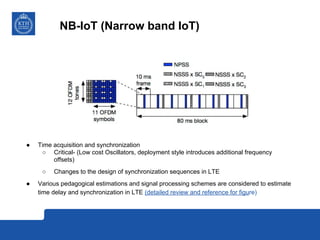
● Time acquisition and synchronization
○ Critical- (Low cost Oscillators, deployment style introduces additional frequency
offsets)
○ Changes to the design of synchronization sequences in LTE
● Various pedagogical estimations and signal processing schemes are considered to estimate
time delay and synchronization in LTE (detailed review and reference for figure)
NB-IoT (Narrow band IoT)
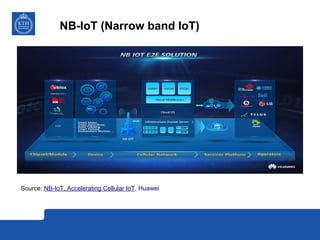
Source: NB-IoT, Accelerating Cellular IoT, Huawei
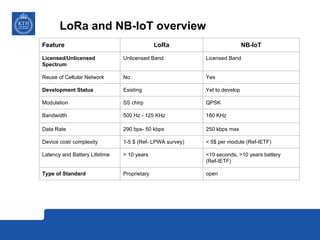
LoRa and NB-IoT overview
Feature LoRa NB-IoT
Licensed/Unlicensed
Spectrum
Unlicensed Band Licensed Band
Reuse of Cellular Network No Yes
Development Status Existing Yet to develop
Modulation SS chirp QPSK
Bandwidth 500 Hz - 125 KHz 180 KHz
Data Rate 290 bps- 50 kbps 250 kbps max
Device cost/ complexity 1-5 $ (Ref- LPWA survey) < 5$ per module (Ref-IETF)
Latency and Battery Lifetime > 10 years <10 seconds, >10 years battery
(Ref-IETF)
Type of Standard Proprietary open
Conclusion
● We have studied -
○ Why?
■ IoT is need of the time.
○ How it can be achieved?
■ LPWA standards like NB-IoT and LoRa were discussed and
compared.
○ What?
■ Is LoRa: Entirely new technology adapted to the need of IoT
platform
■ Is NB-IoT: Use of existing cellular infrastructure
References
NB-IOT:
Maximum-Likelihood Detection for Energy-Efficient Timing Acquisition in NB-IoT
https://arxiv.org/pdf/1608.02427.pdf
A Primer on 3GPP Narrowband Internet of Things (NB-IoT)
https://arxiv.org/pdf/1606.04171.pdf
NB-IoT by IETF
https://www.ietf.org/proceedings/96/slides/slides-96-lpwan-7.pdf
Thank You !!

LoRa and NB-IoT

  • 1.
    LoRa and NB-IoT GaganGupta, Darshan Patil gagan@kth.se, darshan@kth.se 13 October 2016
  • 2.
    OUTLINE ● Background ● Motivation ●LoRa ● NB-IoT ● Conclusion
  • 3.
    Background IoT- Billion ofConnected Devices Radio Access ?? Different Applications have different set of Requirements ● Cost ● Data Rate ● Latency ● Energy Consumption ● Voice, Multimedia (high data rate) → Legacy cellular licensed solutions, unlicensed WLAN solutions ● Industrial, commercial, sensors and IoT (low data rate) → IEEE 802.15.4, LPWA, BT, ZigBee
  • 4.
    Motivation ● IOT deviceshave requirements of wide area connectivity for low power and low data rate devices at economical cost ● Legacy cellular solutions- high throughput, long range, but high power and costly ● WLAN 802.11 a-n- high throughput, short range, moderate-high power and cost ● LPWA- Tradeoff between above (Some technologies like LoRa and NB-IoT) ● LPWA- For applications that require multi-year batteries and send small amount of data less frequently ● Also, involving long range communications with low power ● Applications like Smart meter, seismic sensors, environmental monitoring, smart grid etc.
  • 5.
    LPWA standards ● LoRa/ LoRaWAN- ○ Set up by industrial consortia ○ Unlicensed ● NB-IoT- Narrow band IoT ○ Set up by 3gpp ○ licensed Reference: Course textbook
  • 6.
    LoRa ( LongRange) ● LoRa is the proprietary physical layer or the wireless modulation technique utilized to create long Range Communication Link ● Based on chirp spread spectrum modulation ● A single gateway or base station can cover entire cities or hundreds of square kilometers Chirp Signal
  • 7.
    LoRaWAN (Long RangeWide Area Network) ● Star of Stars Topology ● Nodes connect to multiple gateways. ● No handover needed from gateway to gateway ● Nodes are asynchronous and communicate when they have data to send ● Device Classes-All nodes are not equal ● Division based on tradeoff between communication latency versus battery life time. ● Class A -Battery powered sensors ● Class B- Battery powered actuators ● Class C- Main Powered actuators
  • 8.
    LoRaWAN (Long RangeWide Area Network)
  • 9.
    NB-IoT (Narrow bandIoT) ● Technology standardized by the 3GPP standards body ● Narrow band Technology designed for IoT which can be deployed in GSM and LTE Spectrum ● Also termed as cellular based IoT ● Standardization of NB-IoT completed with Release 13 of 3GPP published on 22 June 2016 ● To be launched in early 2017
  • 10.
    NB-IoT (Narrow bandIoT) ❖ Highest modulation scheme used- QPSK ❖ Minimal noise level inside a single narrowband ❖ Receiver does not require to add processing gain to decode ❖ Simple and inexpensive transceiver design ● Transmission schemes: ○ minimum system bandwidth for both downlink and uplink - 180 kHz ○ GSM carrier of 200 kHz, ○ 1 PRB (Physical Resource Block) inside an LTE carrier/ guardband could be replaced by NB-IoT carrier. ○ 12 subcarriers of 15 kHz in downlink using OFDM and 3.75/ 15 kHz in uplink using SC-FDMA ○ Various deployment options REDUCED POWER & LOW COST
  • 11.
    NB-IoT (Narrow bandIoT) ● To enable low-complexity UE implementation, NB-IoT allows only one HARQ process in both downlink and uplink, and allows longer UE decoding time ● Asynchronous, adaptive HARQ procedure is adopted to support scheduling flexibility. ● Physical Channel/ Resource mapping ○ Extensive reuse of current LTE (Long Term Evolution) specifications ○ Few changes to physical channels used in LTE (detailed review) ● Random Access : ○ *Contention based algorithm similar to LTE [*Source- A Primer on 3GPP Narrowband Internet of Things (NB-IoT)] UE N/W 1 2 3 4 1. Preamble 2. Response containing advance command and scheduling of the uplink resources for the UE to use 3. Identity to the network 4. Contention resolution message
  • 12.
    NB-IoT (Narrow bandIoT) ● Time acquisition and synchronization ○ Critical- (Low cost Oscillators, deployment style introduces additional frequency offsets) ○ Changes to the design of synchronization sequences in LTE ● Various pedagogical estimations and signal processing schemes are considered to estimate time delay and synchronization in LTE (detailed review and reference for figure)
  • 13.
    NB-IoT (Narrow bandIoT) Source: NB-IoT, Accelerating Cellular IoT, Huawei
  • 14.
    LoRa and NB-IoToverview Feature LoRa NB-IoT Licensed/Unlicensed Spectrum Unlicensed Band Licensed Band Reuse of Cellular Network No Yes Development Status Existing Yet to develop Modulation SS chirp QPSK Bandwidth 500 Hz - 125 KHz 180 KHz Data Rate 290 bps- 50 kbps 250 kbps max Device cost/ complexity 1-5 $ (Ref- LPWA survey) < 5$ per module (Ref-IETF) Latency and Battery Lifetime > 10 years <10 seconds, >10 years battery (Ref-IETF) Type of Standard Proprietary open
  • 15.
    Conclusion ● We havestudied - ○ Why? ■ IoT is need of the time. ○ How it can be achieved? ■ LPWA standards like NB-IoT and LoRa were discussed and compared. ○ What? ■ Is LoRa: Entirely new technology adapted to the need of IoT platform ■ Is NB-IoT: Use of existing cellular infrastructure
  • 16.
    References NB-IOT: Maximum-Likelihood Detection forEnergy-Efficient Timing Acquisition in NB-IoT https://arxiv.org/pdf/1608.02427.pdf A Primer on 3GPP Narrowband Internet of Things (NB-IoT) https://arxiv.org/pdf/1606.04171.pdf NB-IoT by IETF https://www.ietf.org/proceedings/96/slides/slides-96-lpwan-7.pdf
  • 17.