RCM(Revenue Cycle Management)
Dan Wellisch
Chicago Technology For Value-Based Healthcare
2/28/2017
Patient Registration And Financial Counseling
• is the first step
• It encompasses Patient Scheduling, Insurance Eligibility Verification,
and Patient Demographic Entry in the below diagram.
• The Insurance Eligibility Verification verifies coverage for the specific treatment that
patient is going to get. This is important and it is best if the person in charge uses the closest
matching CPT codes as possible. This requires them to be familiar with Medical Coding and best
if they go through continuing education each year on new codes. Otherwise, what will happen??
• Can help underinsured get better insurance
• Can help uninsured get Medicaid, for example.
• Get payment from patient now!
• Why help to get insurance? Because it increases likelihood of getting paid.



ICD, CPT, and HCPCS Coding
• This is what a Medical Coder does.
• Medical Coders are adept at taking a narrative description or list of
what has been done to a patient and transcribing it to medical codes that
insurance software systems understand.
• So this is done after the patient gets his/her care. Services have been performed and its time
to prepare for submitting the claim to insurance.
• Although estimates of the right codes have been used by the patient scheduler/admin person, they
were just estimates used for Insurance Eligibility Verification.
• Now, we need to be accurate when we submit the claim. Any miscoding will cause delay in the AR
Followup & Denial Management & Appeals step.









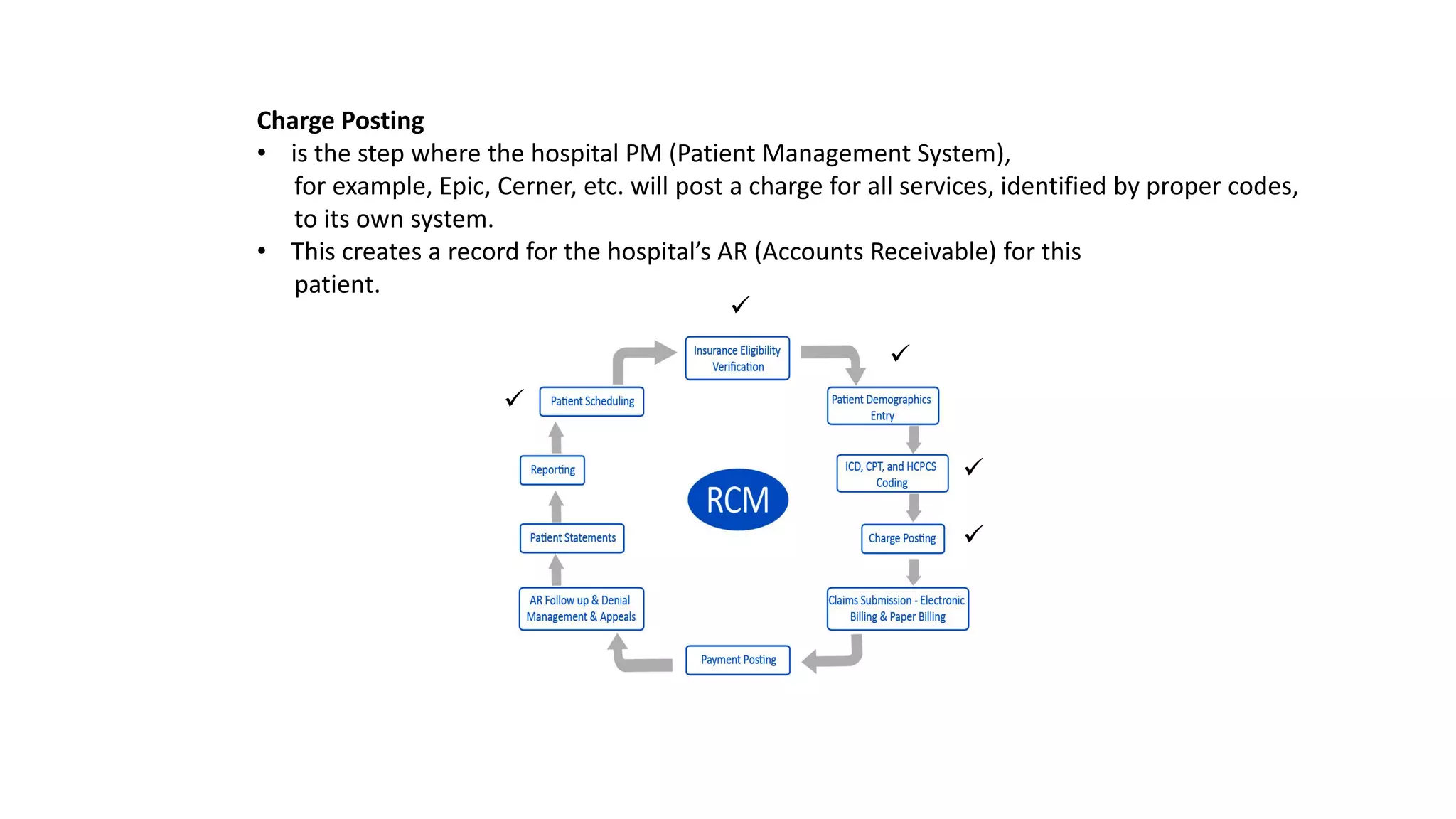
Charge Posting
• is the step where the hospital PM (Patient Management System),
for example, Epic, Cerner, etc. will post a charge for all services, identified by proper codes,
to its own system.
• This creates a record for the hospital’s AR (Accounts Receivable) for this
patient.






Claims Submission
• is the step where the hospital will submit claims to the insurance company
• It will execute this through either its own systems or that of a 3rd party.
• This is where it is important to have the correct codes for ICD procedures or
HCPCS (CPT) codes.
• If an EDI transaction is used, the EDI transaction type is the 837.






Payment Posting
• is the step where the hospital will receive payment from the insurance company (or government payers)
and/or patient.
• So, this step can happen at any time after a claim is submitted.
• Very often, partial payments are made by insurance companies (or government payers) and patients.
• If an insurance company (or government payer) makes a payment, it is through an 835 transaction.
• Is the payment correct? People need to monitor this. This can be done in house or by outsourcing.
Outside companies are adept at Contract Modeling where they can model the characteristics of an
insurance plan and determine how much should be paid for a procedure. Insurance companies cheat!

Outside vendors can audit between
submitted claims and payment posts to
detect insurance fraud. This is from the
perspective of insurance not paying what
they should according to the contract with
with the payer and patient.






AR Follow Up & Denial Management & Appeals
• This is the step where a good Revenue Cycle Management department or
outsourced company will have a very good AR Tracking system in place.
• But, it is important for this department or company to go after the highest yielding
claims.
• And go after these claims quickly. The older the claim gets, the harder it is to get the money. This
applies to both patients and insurance companies.
• In addition, if the payment made in the previous step was determined to be incorrect, then here is
where the insurance companies must be confronted.








Patient Statements
• As patient statements are sent out, the patient becomes notified of the
amount they still have left to pay.
• So, Payment Posting will occur sporadically.



• For Value-Based Reimbursement,
DRG coding becomes an important
part of this step.
• This exemplifies the shift from procedures
performed and paid for (Fee For Service) to
whole episodes paid for as a lump sum. The
DRG is the coding for that lump sum bundle
(e.g. in a bundled payment).
Patients who are not satisfied with their care
or facilities that underperform in their
efficiency will affect the reporting to the provider
at risk, e.g. the hospital.
This has an effect on payouts to participating providers
in the bundle if participating providers perform over or under.
It can also affect future business in a positive or negative way
for future hospital business.










Effect of Value Based Reimbursement on the Revenue Cycle
CMS will pay physicians
and hospitals extra incentives
for good performance or reduce payments
for bad performance.
http://revcycleintelligence.com/features/what-is-healthcare-revenue-cycle-
management
• Here is a good article with several references to other articles, if you would like to dig deeper.

Rcm (Revenue Cycle Management)

  • 1.
    RCM(Revenue Cycle Management) DanWellisch Chicago Technology For Value-Based Healthcare 2/28/2017
  • 3.
    Patient Registration AndFinancial Counseling • is the first step • It encompasses Patient Scheduling, Insurance Eligibility Verification, and Patient Demographic Entry in the below diagram. • The Insurance Eligibility Verification verifies coverage for the specific treatment that patient is going to get. This is important and it is best if the person in charge uses the closest matching CPT codes as possible. This requires them to be familiar with Medical Coding and best if they go through continuing education each year on new codes. Otherwise, what will happen?? • Can help underinsured get better insurance • Can help uninsured get Medicaid, for example. • Get payment from patient now! • Why help to get insurance? Because it increases likelihood of getting paid.   
  • 4.
    ICD, CPT, andHCPCS Coding • This is what a Medical Coder does. • Medical Coders are adept at taking a narrative description or list of what has been done to a patient and transcribing it to medical codes that insurance software systems understand. • So this is done after the patient gets his/her care. Services have been performed and its time to prepare for submitting the claim to insurance. • Although estimates of the right codes have been used by the patient scheduler/admin person, they were just estimates used for Insurance Eligibility Verification. • Now, we need to be accurate when we submit the claim. Any miscoding will cause delay in the AR Followup & Denial Management & Appeals step.    
  • 5.
         Charge Posting • isthe step where the hospital PM (Patient Management System), for example, Epic, Cerner, etc. will post a charge for all services, identified by proper codes, to its own system. • This creates a record for the hospital’s AR (Accounts Receivable) for this patient.
  • 6.
          Claims Submission • isthe step where the hospital will submit claims to the insurance company • It will execute this through either its own systems or that of a 3rd party. • This is where it is important to have the correct codes for ICD procedures or HCPCS (CPT) codes. • If an EDI transaction is used, the EDI transaction type is the 837.
  • 7.
          Payment Posting • isthe step where the hospital will receive payment from the insurance company (or government payers) and/or patient. • So, this step can happen at any time after a claim is submitted. • Very often, partial payments are made by insurance companies (or government payers) and patients. • If an insurance company (or government payer) makes a payment, it is through an 835 transaction. • Is the payment correct? People need to monitor this. This can be done in house or by outsourcing. Outside companies are adept at Contract Modeling where they can model the characteristics of an insurance plan and determine how much should be paid for a procedure. Insurance companies cheat!  Outside vendors can audit between submitted claims and payment posts to detect insurance fraud. This is from the perspective of insurance not paying what they should according to the contract with with the payer and patient.
  • 8.
          AR Follow Up& Denial Management & Appeals • This is the step where a good Revenue Cycle Management department or outsourced company will have a very good AR Tracking system in place. • But, it is important for this department or company to go after the highest yielding claims. • And go after these claims quickly. The older the claim gets, the harder it is to get the money. This applies to both patients and insurance companies. • In addition, if the payment made in the previous step was determined to be incorrect, then here is where the insurance companies must be confronted.  
  • 9.
          Patient Statements • Aspatient statements are sent out, the patient becomes notified of the amount they still have left to pay. • So, Payment Posting will occur sporadically.   
  • 10.
    • For Value-BasedReimbursement, DRG coding becomes an important part of this step. • This exemplifies the shift from procedures performed and paid for (Fee For Service) to whole episodes paid for as a lump sum. The DRG is the coding for that lump sum bundle (e.g. in a bundled payment). Patients who are not satisfied with their care or facilities that underperform in their efficiency will affect the reporting to the provider at risk, e.g. the hospital. This has an effect on payouts to participating providers in the bundle if participating providers perform over or under. It can also affect future business in a positive or negative way for future hospital business.           Effect of Value Based Reimbursement on the Revenue Cycle CMS will pay physicians and hospitals extra incentives for good performance or reduce payments for bad performance.
  • 11.
    http://revcycleintelligence.com/features/what-is-healthcare-revenue-cycle- management • Here isa good article with several references to other articles, if you would like to dig deeper.