Multimedia and Contiguity Scott Coleman Ed Tech 513 BSU
Objectives Users of this tutorial will be able to recognize the multimedia and contiguity principles and be able to distinguish between effective and less effective applications of the principles.
Multimedia Principle  Contents Definition of multimedia principle Why use the multimedia principle Application examples
The Multimedia Principle The multimedia principle instructs designers to use words and graphics together rather than words alone.
Why Use the Multimedia Principle? Using multimedia provides opportunity for learners to engage in active learning.  Active learning  happens when learners integrate the words and graphics into a coherent cognitive representation (Clark and Mayer, 2008 p.57)
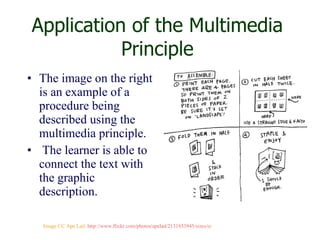
Application of the Multimedia Principle The image on the right is an example of a procedure being described using the multimedia principle. The learner is able to connect the text with the graphic description. Image CC Ape Lad  http://www.flickr.com/photos/apelad/2131853945/sizes/o/
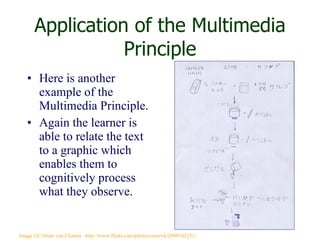
Here is another example of the Multimedia Principle. Again the learner is able to relate the text to a graphic which enables them to cognitively process what they observe. Application of the Multimedia Principle Image CC Omer van Cloeten  http://www.flickr.com/photos/omervk/2098163251/
Contiguity Principle  Contents Definition of contiguity principle Why use the contiguity principle Application examples
The Contiguity Principle The contiguity principle instructs designers to align words to corresponding graphics
Why Use the Contiguity Principle? Using the contiguity principle reduces the amount of extraneous processing thereby reducing the overall cognitive load.  This is done by visually connecting corresponding words and graphics (Clark and Mayer, 2008 p.93)
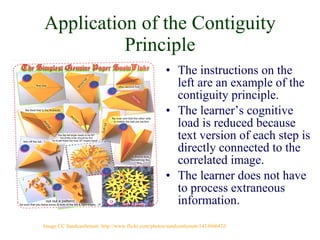
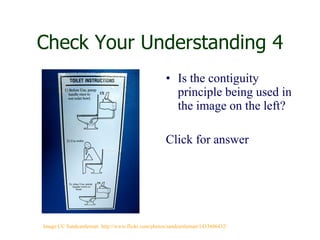
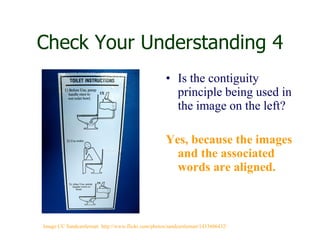
Application of the Contiguity Principle The instructions on the left are an example of the contiguity principle. The learner’s cognitive load is reduced because text version of each step is directly connected to the correlated image. The learner does not have to process extraneous information.  Image CC Sandcastlematt  http://www.flickr.com/photos/sandcastlematt/1433606432/
Check Your Understanding 1 The multimedia principle states that you should: Use graphics rather than words Align words to corresponding images Use words and graphics together Use neither words or graphics Click to see the answer
Check Your Understanding 1 The multimedia principle states that you should: Use graphics rather than words Use words rather than graphics Use words and graphics together Use neither words or graphics
Check Your Understanding 2 The contiguity principle states that you should: Place text on a different screen from images  Align words with their corresponding images Use words and graphics together Use a Creative Commons license for your work
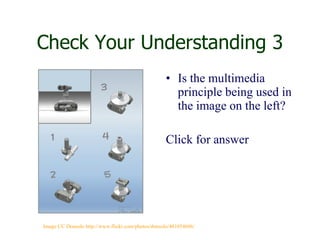
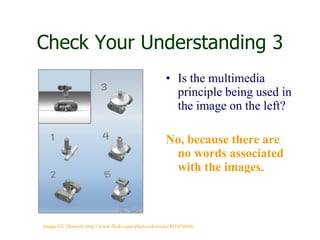
Check Your Understanding 3 Is the multimedia principle being used in the image on the left? Click for answer Image CC Donsolo http://www.flickr.com/photos/donsolo/481054606/
Check Your Understanding 3 Is the multimedia principle being used in the image on the left? No, because there are no words associated with the images. Image CC Donsolo http://www.flickr.com/photos/donsolo/481054606/
Check Your Understanding 4 Is the contiguity principle being used in the image on the left? Click for answer Image CC Sandcastlematt  http://www.flickr.com/photos/sandcastlematt/1433606432/
Check Your Understanding 4 Is the contiguity principle being used in the image on the left? Yes, because the images and the associated words are aligned. Image CC Sandcastlematt  http://www.flickr.com/photos/sandcastlematt/1433606432/
Works Cited Clark, R. C., & Mayer, R. E. (2007). E-Learning and the Science of Instruction (p. 476). John Wiley and Sons.

Multimedia and Contiguity

  • 1.
    Multimedia and ContiguityScott Coleman Ed Tech 513 BSU
  • 2.
    Objectives Users ofthis tutorial will be able to recognize the multimedia and contiguity principles and be able to distinguish between effective and less effective applications of the principles.
  • 3.
    Multimedia Principle Contents Definition of multimedia principle Why use the multimedia principle Application examples
  • 4.
    The Multimedia PrincipleThe multimedia principle instructs designers to use words and graphics together rather than words alone.
  • 5.
    Why Use theMultimedia Principle? Using multimedia provides opportunity for learners to engage in active learning. Active learning happens when learners integrate the words and graphics into a coherent cognitive representation (Clark and Mayer, 2008 p.57)
  • 6.
    Application of theMultimedia Principle The image on the right is an example of a procedure being described using the multimedia principle. The learner is able to connect the text with the graphic description. Image CC Ape Lad http://www.flickr.com/photos/apelad/2131853945/sizes/o/
  • 7.
    Here is anotherexample of the Multimedia Principle. Again the learner is able to relate the text to a graphic which enables them to cognitively process what they observe. Application of the Multimedia Principle Image CC Omer van Cloeten http://www.flickr.com/photos/omervk/2098163251/
  • 8.
    Contiguity Principle Contents Definition of contiguity principle Why use the contiguity principle Application examples
  • 9.
    The Contiguity PrincipleThe contiguity principle instructs designers to align words to corresponding graphics
  • 10.
    Why Use theContiguity Principle? Using the contiguity principle reduces the amount of extraneous processing thereby reducing the overall cognitive load. This is done by visually connecting corresponding words and graphics (Clark and Mayer, 2008 p.93)
  • 11.
    Application of theContiguity Principle The instructions on the left are an example of the contiguity principle. The learner’s cognitive load is reduced because text version of each step is directly connected to the correlated image. The learner does not have to process extraneous information. Image CC Sandcastlematt http://www.flickr.com/photos/sandcastlematt/1433606432/
  • 12.
    Check Your Understanding1 The multimedia principle states that you should: Use graphics rather than words Align words to corresponding images Use words and graphics together Use neither words or graphics Click to see the answer
  • 13.
    Check Your Understanding1 The multimedia principle states that you should: Use graphics rather than words Use words rather than graphics Use words and graphics together Use neither words or graphics
  • 14.
    Check Your Understanding2 The contiguity principle states that you should: Place text on a different screen from images Align words with their corresponding images Use words and graphics together Use a Creative Commons license for your work
  • 15.
    Check Your Understanding2 The contiguity principle states that you should: Place text on a different screen from images Align words with their corresponding images Use words and graphics together Use a Creative Commons license for your work
  • 16.
    Check Your Understanding3 Is the multimedia principle being used in the image on the left? Click for answer Image CC Donsolo http://www.flickr.com/photos/donsolo/481054606/
  • 17.
    Check Your Understanding3 Is the multimedia principle being used in the image on the left? No, because there are no words associated with the images. Image CC Donsolo http://www.flickr.com/photos/donsolo/481054606/
  • 18.
    Check Your Understanding4 Is the contiguity principle being used in the image on the left? Click for answer Image CC Sandcastlematt http://www.flickr.com/photos/sandcastlematt/1433606432/
  • 19.
    Check Your Understanding4 Is the contiguity principle being used in the image on the left? Yes, because the images and the associated words are aligned. Image CC Sandcastlematt http://www.flickr.com/photos/sandcastlematt/1433606432/
  • 20.
    Works Cited Clark,R. C., & Mayer, R. E. (2007). E-Learning and the Science of Instruction (p. 476). John Wiley and Sons.