

Connie Malamed
@elearningcoach
theelearningcoach.com
Topics
Skip ahead if you see something of interest!
• Explanation defined
• Explanations and our cognitive architecture
• Advantages of using visuals in explanations and learning
• Process for visualizing
• Benefits of using stories to explain and teach
• Best story structure
• Visual language of the comic format as it relates to explanations
• Other visual formats for explaining with stories
@elearningcoach
Professional Explainer
My new Twitter profile tells you how much time I spend explaining.
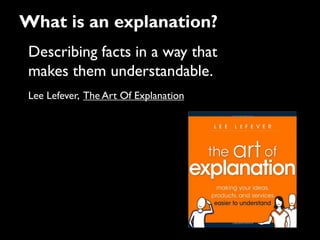
Describing facts in a way that
makes them understandable.
Lee Lefever, The Art Of Explanation
What is an explanation?
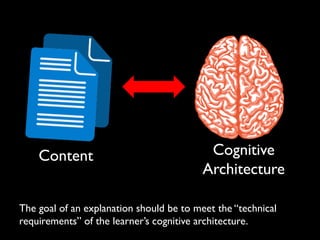
Content Cognitive
Architecture
The goal of an explanation should be to meet the “technical
requirements” of the learner’s cognitive architecture.
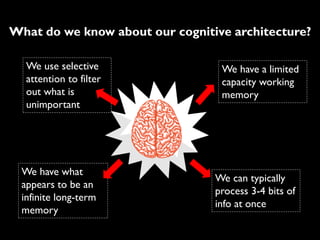
What do we know about our cognitive architecture?
We use selective
attention to filter
out what is
unimportant
We have a limited
capacity working
memory
We can typically
process 3-4 bits of
info at once
We have what
appears to be an
infinite long-term
memory
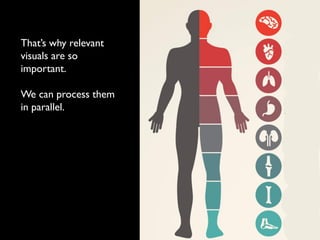
That’s why relevant
visuals are so
important.
We can process them
in parallel.
They offload working
memory.
Relevant visuals can aid
comprehension,
retention and recall.
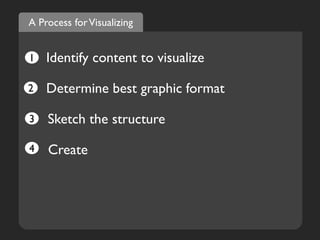
Identify content to visualize1
Determine best graphic format2
Sketch the structure3
Create4
A Process forVisualizing
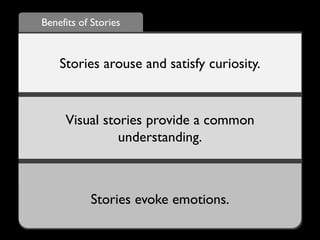
Benefits of Stories
Stories arouse and satisfy curiosity.
Visual stories provide a common
understanding.
Stories evoke emotions.
Benefits of Stories
Stories arouse and satisfy curiosity.
Some research shows that dopamine, a
neurotransmitter associated with reward-motivated behavior,
plays a part in the desire to satisfy curiosity.
Benefits of Stories
Visual stories provide a common understanding.
Unlike reading a book, with a visual story, everyone sees the
same image, providing a common understanding.
Benefits of Stories
Stories evoke emotions.
It is well known that arousing emotions is an important way to
connect with an audience.
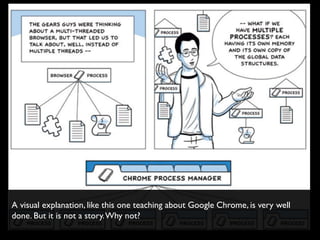
A visual explanation, like this one teaching about Google Chrome, is very well
done. But it is not a story.Why not?
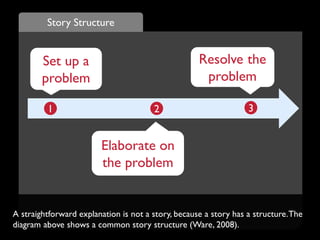
Set up a
problem
1
Elaborate on
the problem
2
Resolve the
problem
3
Story Structure
A straightforward explanation is not a story, because a story has a structure.The
diagram above shows a common story structure (Ware, 2008).
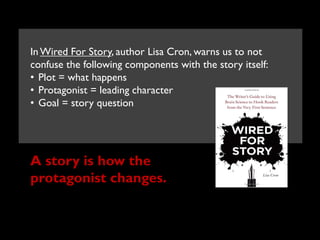
InWired For Story, author Lisa Cron, warns us to not
confuse the following components with the story itself:
• Plot = what happens
• Protagonist = leading character
• Goal = story question
A story is how the
protagonist changes.
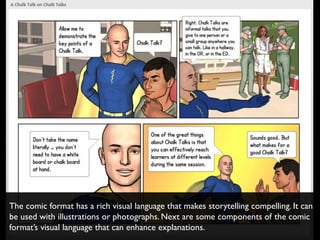
The comic format has a rich visual language that makes storytelling compelling. It can
be used with illustrations or photographs. Next are some components of the comic
format’s visual language that can enhance explanations.
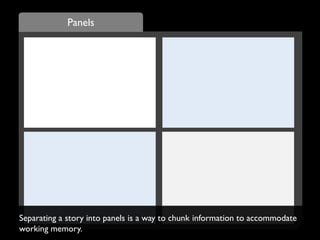
Panels
Separating a story into panels is a way to chunk information to accommodate
working memory.
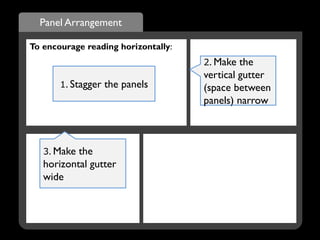
Panel Arrangement
To encourage reading horizontally:
2. Make the
vertical gutter
(space between
panels) narrow
3. Make the
horizontal gutter
wide
1. Stagger the panels
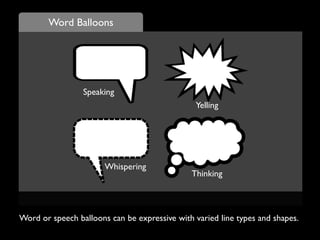
Word Balloons
Speaking
Yelling
Whispering
Thinking
Word or speech balloons can be expressive with varied line types and shapes.
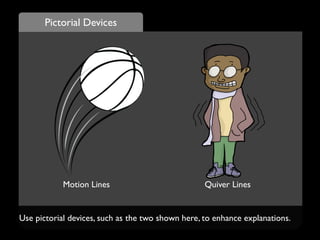
Pictorial Devices
Motion Lines Quiver Lines
Use pictorial devices, such as the two shown here, to enhance explanations.
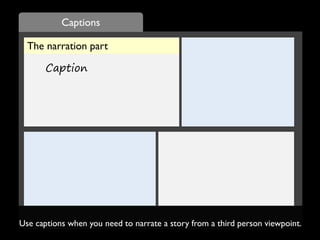
The narration part
Caption
Captions
Use captions when you need to narrate a story from a third person viewpoint.
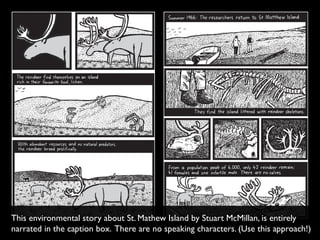
This environmental story about St. Mathew Island by Stuart McMillan, is entirely
narrated in the caption box. There are no speaking characters. (Use this approach!)
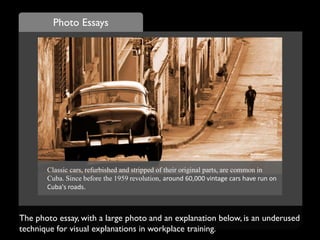
Photo Essays
The photo essay, with a large photo and an explanation below, is an underused
technique for visual explanations in workplace training.
Classic cars, refurbished and stripped of their original parts, are common in
Cuba. Since before the 1959 revolution, around 60,000 vintage cars have run on
Cuba's roads.
If you want to learn more about visual design for learning, getVisual
Design Solutions. Click to see it in Amazon.
Visual Design Solutions
ThankYou
Connie Malamed
@elearningcoach
theelearningcoach.com

Visual Explanations for Storytelling

  • 1.
  • 2.
    Topics Skip ahead ifyou see something of interest! • Explanation defined • Explanations and our cognitive architecture • Advantages of using visuals in explanations and learning • Process for visualizing • Benefits of using stories to explain and teach • Best story structure • Visual language of the comic format as it relates to explanations • Other visual formats for explaining with stories
  • 3.
    @elearningcoach Professional Explainer My newTwitter profile tells you how much time I spend explaining.
  • 4.
    Describing facts ina way that makes them understandable. Lee Lefever, The Art Of Explanation What is an explanation?
  • 5.
    Content Cognitive Architecture The goalof an explanation should be to meet the “technical requirements” of the learner’s cognitive architecture.
  • 6.
    What do weknow about our cognitive architecture?
  • 7.
    What do weknow about our cognitive architecture? We use selective attention to filter out what is unimportant We have a limited capacity working memory We can typically process 3-4 bits of info at once We have what appears to be an infinite long-term memory
  • 8.
    That’s why relevant visualsare so important. We can process them in parallel.
  • 9.
  • 10.
    Relevant visuals canaid comprehension, retention and recall.
  • 11.
    Identify content tovisualize1 Determine best graphic format2 Sketch the structure3 Create4 A Process forVisualizing
  • 13.
    Benefits of Stories Storiesarouse and satisfy curiosity. Visual stories provide a common understanding. Stories evoke emotions.
  • 14.
    Benefits of Stories Storiesarouse and satisfy curiosity. Some research shows that dopamine, a neurotransmitter associated with reward-motivated behavior, plays a part in the desire to satisfy curiosity.
  • 15.
    Benefits of Stories Visualstories provide a common understanding. Unlike reading a book, with a visual story, everyone sees the same image, providing a common understanding.
  • 16.
    Benefits of Stories Storiesevoke emotions. It is well known that arousing emotions is an important way to connect with an audience.
  • 17.
    A visual explanation,like this one teaching about Google Chrome, is very well done. But it is not a story.Why not?
  • 18.
    Set up a problem 1 Elaborateon the problem 2 Resolve the problem 3 Story Structure A straightforward explanation is not a story, because a story has a structure.The diagram above shows a common story structure (Ware, 2008).
  • 19.
    InWired For Story,author Lisa Cron, warns us to not confuse the following components with the story itself: • Plot = what happens • Protagonist = leading character • Goal = story question A story is how the protagonist changes.
  • 20.
    The comic formathas a rich visual language that makes storytelling compelling. It can be used with illustrations or photographs. Next are some components of the comic format’s visual language that can enhance explanations.
  • 21.
    Panels Separating a storyinto panels is a way to chunk information to accommodate working memory.
  • 22.
    Panel Arrangement To encouragereading horizontally: 2. Make the vertical gutter (space between panels) narrow 3. Make the horizontal gutter wide 1. Stagger the panels
  • 23.
    Word Balloons Speaking Yelling Whispering Thinking Word orspeech balloons can be expressive with varied line types and shapes.
  • 24.
    Pictorial Devices Motion LinesQuiver Lines Use pictorial devices, such as the two shown here, to enhance explanations.
  • 25.
    The narration part Caption Captions Usecaptions when you need to narrate a story from a third person viewpoint.
  • 26.
    This environmental storyabout St. Mathew Island by Stuart McMillan, is entirely narrated in the caption box. There are no speaking characters. (Use this approach!)
  • 27.
    Photo Essays The photoessay, with a large photo and an explanation below, is an underused technique for visual explanations in workplace training. Classic cars, refurbished and stripped of their original parts, are common in Cuba. Since before the 1959 revolution, around 60,000 vintage cars have run on Cuba's roads.
  • 28.
    If you wantto learn more about visual design for learning, getVisual Design Solutions. Click to see it in Amazon. Visual Design Solutions
  • 29.