Netflix Cloud Architecture1
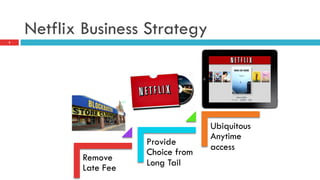
Netflix Business Strategy
2
Remove
Late Fee
Provide
Choice from
Long Tail
Ubiquitous
Anytime
access
Incumbents in 1997
¨  Blockbuster, Hollywood
Videos, Movie Gallery
¤  Rented DVDs out from
prime locations
¤  Kept inventory of about
2000 titles with 3 to 4
copies of each
¤  Mostly expensive DVDs
with new movies and some
long time hits
¨  New movies typically
release to big screen and
then release via DVD
¨  DVDs rent while its new
¨  DVD availability window
is relatively small
¨  Charged late fee to
maximize turns
3
Must impose steep rental fees and steeper late fees
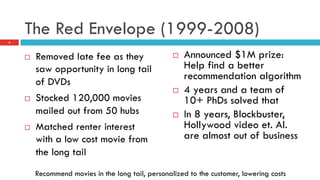
The Red Envelope (1999-2008)
¨  Removed late fee as they
saw opportunity in long tail
of DVDs
¨  Stocked 120,000 movies
mailed out from 50 hubs
¨  Matched renter interest
with a low cost movie from
the long tail
¨  Announced $1M prize:
Help find a better
recommendation algorithm
¨  4 years and a team of
10+ PhDs solved that
¨  In 8 years, Blockbuster,
Hollywood video et. Al.
are almost out of business
4
Recommend movies in the long tail, personalized to the customer, lowering costs
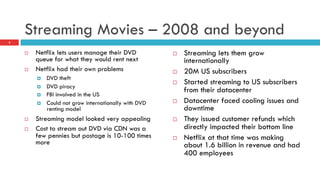
Streaming Movies – 2008 and beyond
¨  Netflix lets users manage their DVD
queue for what they would rent next
¨  Netflix had their own problems
¤  DVD theft
¤  DVD piracy
¤  FBI involved in the US
¤  Could not grow internationally with DVD
renting model
¨  Streaming model looked very appealing
¨  Cost to stream out DVD via CDN was a
few pennies but postage is 10-100 times
more
¨  Streaming lets them grow
internationally
¨  20M US subscribers
¨  Started streaming to US subscribers
from their datacenter
¨  Datacenter faced cooling issues and
downtime
¨  They issued customer refunds which
directly impacted their bottom line
¨  Netflix at that time was making
about 1.6 billion in revenue and had
400 employees
5
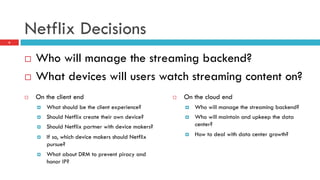
Netflix Decisions
6
¨  Who will manage the streaming backend?
¨  What devices will users watch streaming content on?
¨  On the client end
¤  What should be the client experience?
¤  Should Netflix create their own device?
¤  Should Netflix partner with device makers?
¤  If so, which device makers should Netflix
pursue?
¤  What about DRM to prevent piracy and
honor IP?
¨  On the cloud end
¤  Who will manage the streaming backend?
¤  Who will maintain and upkeep the data
center?
¤  How to deal with data center growth?
7
Take a break from PowerPoint.
Class discusses the case.
On the Client End8
Decided against creating own device
9
¨  HDMI ports on household TVs were already
occupied by a variety of devices
¨  Introducing one more Netflix device wasn’t the best
Partnerships with Device makers
10
¨  Grew subscribers 2008-2010 by partnering with
device makers
¤  Game Consoles
n  Xbox 360, Wii, PS3
¤  Mobile Devices
n  Apple iPad, iPhone, iPod Touch, Windows Phone 7
n  Android was not in this list until late 2011 (DRM concerns)
On the Cloud End11
Netflix Cloud Story
12
¨  Circa 2008, Netflix had a single data center
¤  Single point of failure (SPOF)
¤  Approaching the limits on
n  Cooling
n  Power
n  Physical space
n  Network traffic capacity
Netflix Cloud Story
13
¨  Strategic choices included:
¤  Build more data centers
n  Manage more data centers
¤  Outsource capacity planning and scale out
n  Focus on core competency
Netflix Cloud Story
14
¨  Winning Choice:
¤ Outsource capacity planning and scale out
n Leverage a leading IAAS provider
n  Amazon Web Services
¨  In	
  two	
  years,	
  from	
  start	
  of	
  outsourcing,	
  Netflix	
  served	
  over	
  90%	
  traffic	
  out	
  of	
  AWS	
  
¨  This	
  excluded	
  video	
  streaming	
  traffic	
  which	
  came	
  from	
  CDNs	
  
How Netflix Uses AWS
15
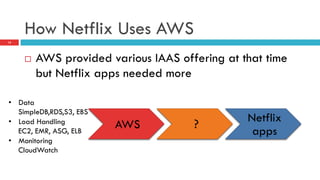
¨  AWS provided various IAAS offering at that time
but Netflix apps needed more
•  Data
SimpleDB,RDS,S3, EBS
•  Load Handling
EC2, EMR, ASG, ELB
•  Monitoring
CloudWatch
AWS ?	
  
Netflix
apps
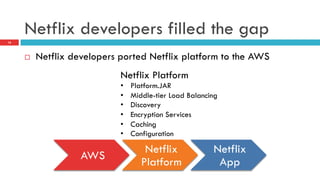
Netflix developers filled the gap
16
¨  Netflix developers ported Netflix platform to the AWS
AWS
Netflix
Platform
Netflix
App
Netflix Platform
•  Platform.JAR
•  Middle-tier Load Balancing
•  Discovery
•  Encryption Services
•  Caching
•  Configuration
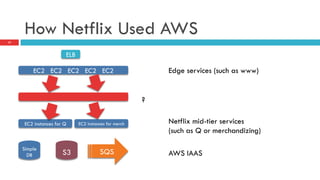
How Netflix Used AWS
17
ELB
EC2 EC2 EC2 EC2 EC2
EC2 instances for Q EC2 instances for merch
Simple
DB S3 SQS
Edge services (such as www)
Netflix mid-tier services
(such as Q or merchandizing)
AWS IAAS
?
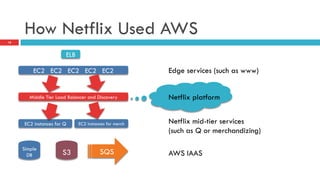
How Netflix Used AWS
18
ELB
EC2 EC2 EC2 EC2 EC2
Middle Tier Load Balancer and Discovery
EC2 instances for Q EC2 instances for merch
Simple
DB S3 SQS
Edge services (such as www)
Netflix mid-tier services
(such as Q or merchandizing)
AWS IAAS
Netflix platform
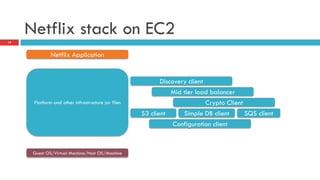
Netflix stack on EC2
19
Netflix Application
Platform and other infrastructure jar files
Guest OS/Virtual Machine/Host OS/Machine
Discovery client
Mid tier load balancer
Crypto Client
S3 client Simple DB client SQS client
Configuration client
Persistent Data: Simple DB
20
¨  Moved large transactional dataset to Simple DB
¤  Rental history info: Everything that any one has watched
on Netflix (including streaming and DVD rentals)
¨  Netflix uses Simple DB to manage
¤  Thousands of domains
¤  Over 1Tera byte of online transaction data
¤  Billions of rows of data
Persistent Storage: S3
21
¨  Simple key-value store organized as objects in buckets
¤  Each AWS account can create multiple buckets
¤  Each bucket can hold unlimited number of objects
¨  Netflix uses S3 to store data that does not fit into
Simple DB
¤  Logs from streaming devices
¤  Files used in movie encoding
¤  Truncated tail of rental history
Data Replication: Item Replicator
22
¨  IR: Item Replicator: Netflix homegrown solution
¨  Keeps data in sync between Data Center and Cloud
¤  Replication is mostly unidirectional
n  Data Center to the Cloud
Netflix Migration to Cloud
23
¨  Netflix case is just one example.
¨  There are several cases of businesses in a variety of
industry that are migrating to the cloud
Questions24
25

Netflix cloud architecture...continued

  • 1.
  • 2.
    Netflix Business Strategy 2 Remove LateFee Provide Choice from Long Tail Ubiquitous Anytime access
  • 3.
    Incumbents in 1997 ¨ Blockbuster, Hollywood Videos, Movie Gallery ¤  Rented DVDs out from prime locations ¤  Kept inventory of about 2000 titles with 3 to 4 copies of each ¤  Mostly expensive DVDs with new movies and some long time hits ¨  New movies typically release to big screen and then release via DVD ¨  DVDs rent while its new ¨  DVD availability window is relatively small ¨  Charged late fee to maximize turns 3 Must impose steep rental fees and steeper late fees
  • 4.
    The Red Envelope(1999-2008) ¨  Removed late fee as they saw opportunity in long tail of DVDs ¨  Stocked 120,000 movies mailed out from 50 hubs ¨  Matched renter interest with a low cost movie from the long tail ¨  Announced $1M prize: Help find a better recommendation algorithm ¨  4 years and a team of 10+ PhDs solved that ¨  In 8 years, Blockbuster, Hollywood video et. Al. are almost out of business 4 Recommend movies in the long tail, personalized to the customer, lowering costs
  • 5.
    Streaming Movies –2008 and beyond ¨  Netflix lets users manage their DVD queue for what they would rent next ¨  Netflix had their own problems ¤  DVD theft ¤  DVD piracy ¤  FBI involved in the US ¤  Could not grow internationally with DVD renting model ¨  Streaming model looked very appealing ¨  Cost to stream out DVD via CDN was a few pennies but postage is 10-100 times more ¨  Streaming lets them grow internationally ¨  20M US subscribers ¨  Started streaming to US subscribers from their datacenter ¨  Datacenter faced cooling issues and downtime ¨  They issued customer refunds which directly impacted their bottom line ¨  Netflix at that time was making about 1.6 billion in revenue and had 400 employees 5
  • 6.
    Netflix Decisions 6 ¨  Whowill manage the streaming backend? ¨  What devices will users watch streaming content on? ¨  On the client end ¤  What should be the client experience? ¤  Should Netflix create their own device? ¤  Should Netflix partner with device makers? ¤  If so, which device makers should Netflix pursue? ¤  What about DRM to prevent piracy and honor IP? ¨  On the cloud end ¤  Who will manage the streaming backend? ¤  Who will maintain and upkeep the data center? ¤  How to deal with data center growth?
  • 7.
    7 Take a breakfrom PowerPoint. Class discusses the case.
  • 8.
  • 9.
    Decided against creatingown device 9 ¨  HDMI ports on household TVs were already occupied by a variety of devices ¨  Introducing one more Netflix device wasn’t the best
  • 10.
    Partnerships with Devicemakers 10 ¨  Grew subscribers 2008-2010 by partnering with device makers ¤  Game Consoles n  Xbox 360, Wii, PS3 ¤  Mobile Devices n  Apple iPad, iPhone, iPod Touch, Windows Phone 7 n  Android was not in this list until late 2011 (DRM concerns)
  • 11.
  • 12.
    Netflix Cloud Story 12 ¨ Circa 2008, Netflix had a single data center ¤  Single point of failure (SPOF) ¤  Approaching the limits on n  Cooling n  Power n  Physical space n  Network traffic capacity
  • 13.
    Netflix Cloud Story 13 ¨ Strategic choices included: ¤  Build more data centers n  Manage more data centers ¤  Outsource capacity planning and scale out n  Focus on core competency
  • 14.
    Netflix Cloud Story 14 ¨ Winning Choice: ¤ Outsource capacity planning and scale out n Leverage a leading IAAS provider n  Amazon Web Services ¨  In  two  years,  from  start  of  outsourcing,  Netflix  served  over  90%  traffic  out  of  AWS   ¨  This  excluded  video  streaming  traffic  which  came  from  CDNs  
  • 15.
    How Netflix UsesAWS 15 ¨  AWS provided various IAAS offering at that time but Netflix apps needed more •  Data SimpleDB,RDS,S3, EBS •  Load Handling EC2, EMR, ASG, ELB •  Monitoring CloudWatch AWS ?   Netflix apps
  • 16.
    Netflix developers filledthe gap 16 ¨  Netflix developers ported Netflix platform to the AWS AWS Netflix Platform Netflix App Netflix Platform •  Platform.JAR •  Middle-tier Load Balancing •  Discovery •  Encryption Services •  Caching •  Configuration
  • 17.
    How Netflix UsedAWS 17 ELB EC2 EC2 EC2 EC2 EC2 EC2 instances for Q EC2 instances for merch Simple DB S3 SQS Edge services (such as www) Netflix mid-tier services (such as Q or merchandizing) AWS IAAS ?
  • 18.
    How Netflix UsedAWS 18 ELB EC2 EC2 EC2 EC2 EC2 Middle Tier Load Balancer and Discovery EC2 instances for Q EC2 instances for merch Simple DB S3 SQS Edge services (such as www) Netflix mid-tier services (such as Q or merchandizing) AWS IAAS Netflix platform
  • 19.
    Netflix stack onEC2 19 Netflix Application Platform and other infrastructure jar files Guest OS/Virtual Machine/Host OS/Machine Discovery client Mid tier load balancer Crypto Client S3 client Simple DB client SQS client Configuration client
  • 20.
    Persistent Data: SimpleDB 20 ¨  Moved large transactional dataset to Simple DB ¤  Rental history info: Everything that any one has watched on Netflix (including streaming and DVD rentals) ¨  Netflix uses Simple DB to manage ¤  Thousands of domains ¤  Over 1Tera byte of online transaction data ¤  Billions of rows of data
  • 21.
    Persistent Storage: S3 21 ¨ Simple key-value store organized as objects in buckets ¤  Each AWS account can create multiple buckets ¤  Each bucket can hold unlimited number of objects ¨  Netflix uses S3 to store data that does not fit into Simple DB ¤  Logs from streaming devices ¤  Files used in movie encoding ¤  Truncated tail of rental history
  • 22.
    Data Replication: ItemReplicator 22 ¨  IR: Item Replicator: Netflix homegrown solution ¨  Keeps data in sync between Data Center and Cloud ¤  Replication is mostly unidirectional n  Data Center to the Cloud
  • 23.
    Netflix Migration toCloud 23 ¨  Netflix case is just one example. ¨  There are several cases of businesses in a variety of industry that are migrating to the cloud
  • 24.
  • 25.