SESSION ID:SESSION ID:
#RSAC
Lisa Young
Developing Useful Metrics
GRC-F03
Vice President, Service Delivery
Axio Global
Lyoung@Axio.com
David Tobar
Senior Cybersecurity Engineer
SEI/CERT Carnegie Mellon University
Dtobar@cert.org
#RSAC
Notices
Copyright 2016 Carnegie Mellon University
This material is based upon work funded and supported by the Department of Defense under Contract No. FA8721-05-C-0003
with Carnegie Mellon University for the operation of the Software Engineering Institute, a federally funded research and
development center.
Any opinions, findings and conclusions or recommendations expressed in this material are those of the author(s) and do not
necessarily reflect the views of the United States Department of Defense.
NO WARRANTY. THIS CARNEGIE MELLON UNIVERSITY AND SOFTWARE ENGINEERING INSTITUTE MATERIAL IS FURNISHED ON AN
“AS-IS” BASIS. CARNEGIE MELLON UNIVERSITY MAKES NO WARRANTIES OF ANY KIND, EITHER EXPRESSED OR IMPLIED, AS TO ANY
MATTER INCLUDING, BUT NOT LIMITED TO, WARRANTY OF FITNESS FOR PURPOSE OR MERCHANTABILITY, EXCLUSIVITY, OR
RESULTS OBTAINED FROM USE OF THE MATERIAL. CARNEGIE MELLON UNIVERSITY DOES NOT MAKE ANY WARRANTY OF ANY
KIND WITH RESPECT TO FREEDOM FROM PATENT, TRADEMARK, OR COPYRIGHT INFRINGEMENT.
[Distribution Statement A] This material has been approved for public release and unlimited distribution. Please see Copyright
notice for non-US Government use and distribution.
This material may be reproduced in its entirety, without modification, and freely distributed in written or electronic form without
requesting formal permission. Permission is required for any other use. Requests for permission should be directed to the
Software Engineering Institute at permission@sei.cmu.edu.
DM-0003301
#RSAC
GRC-F03
3
This session
does not cover specific technical security metrics
does cover the importance of metrics tied to things that matter to the business
Why you might want to stay for this session - if you are interested in
determining what to measure in support of business objectives
identifying risks and gaps in your current measurement processes
a process for developing metrics that will help you do these things
#RSAC
Why do you want to measure?
#RSAC
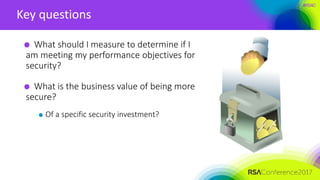
Key questions
What should I measure to determine if I
am meeting my performance objectives for
security?
What is the business value of being more
secure?
Of a specific security investment?
#RSAC
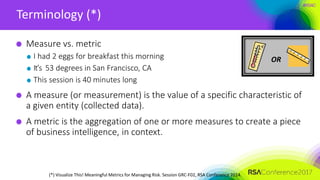
Terminology (*)
Measure vs. metric
I had 2 eggs for breakfast this morning
It’s 53 degrees in San Francisco, CA
This session is 40 minutes long
A measure (or measurement) is the value of a specific characteristic of
a given entity (collected data).
A metric is the aggregation of one or more measures to create a piece
of business intelligence, in context.
OR
(*) Visualize This! Meaningful Metrics for Managing Risk. Session GRC-F02, RSA Conference 2014.
#RSAC
So what? Why do you care?
If I had this metric: (*)
What decisions would it inform?
What actions would I take based on it?
What behaviors would it affect?
What would improvement look like?
What would its value be in comparison to other metrics?
(*) informed by Douglas Hubbard, How to Measure Anything, John Wiley & Sons, 2010
#RSAC
Why measure?
Speak to decision makers in their language
Demonstrate that the security program has
measurable business value
Justify new investments; make improvements
Use trends to help predict future events
Demonstrate that control objectives are (and
continue to be) met
Answer key questions
#RSAC
Deriving Metrics from Objectives
- GQIM
#RSAC
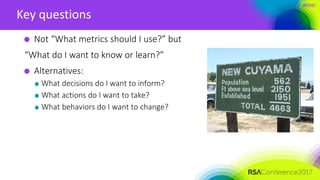
Key questions
Not “What metrics should I use?” but
“What do I want to know or learn?”
Alternatives:
What decisions do I want to inform?
What actions do I want to take?
What behaviors do I want to change?
#RSAC
Purpose
Use a defined, repeatable process to derive meaningful metrics that
directly support achievement of business objectives and:
demonstrate the business value of each metric (and justify the cost for its
collection and reporting)
defend such metrics in comparison to others
add metrics, update metrics, and retire metrics as business objectives change
ultimately, inform business decisions, take appropriate action, and change
behaviors
#RSAC
Key takeaways
Understand a 5-step process for deriving metrics from business or
program objectives
Be able to apply this process to your objectives
Identify at least one metric that you can use immediately
Be able to better communicate with business leaders in their language
Assess the utility of current metrics
#RSAC
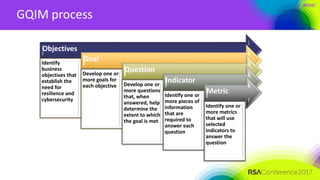
GQIM process
Objectives
Identify
business
objectives that
establish the
need for
resilience and
cybersecurity
Goal
Develop one or
more goals for
each objective
Question
Develop one or
more questions
that, when
answered, help
determine the
extent to which
the goal is met
Indicator
Identify one or
more pieces of
information
that are
required to
answer each
question
Metric
Identify one or
more metrics
that will use
selected
indicators to
answer the
question
#RSAC
Objectives to Goals
#RSAC
Process
State a business or program objective
Define one or more goals that are required to achieve the stated
objective
Goal: the end toward which effort is directed
Fewer are better
Essential (high leverage/high payoff) vs. complete coverage
— Judgment informed by stakeholder review
#RSAC
Objectives to Goals
What are meaningful actions to take to achieve the objective?
Which actions are most important?
2-3 that are essential, high leverage, high payoff
Carry forward and refine key terms from the objective in the goals
Ask “If I achieve this goal, will I be able to demonstrate
substantive progress in achieving the objective?”
#RSAC
Objective to Goals – Incident Management example
Objective Goal
Mitigate the risks of business
disruption and loss resulting from
cybersecurity incidents (with
impact threshold > [x])
Operate a cybersecurity incident
center that detects, responds to,
and reports security incidents in
accordance with established
standards and guidelines.
• enterprise and operational unit
levels
Others?
#RSAC
Goals to Questions
#RSAC
Goals to Questions -1
What are meaningful questions to answer to determine if the goal is
being achieved?
Requires subject matter expertise
Which questions are most important?
Carry forward and refine key terms from the goal in the question
Ask “If I answer this question, will I be able to demonstrate
substantive progress in achieving the goal?”
#RSAC
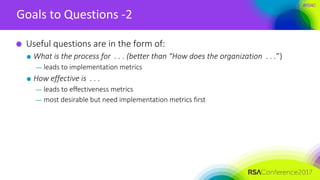
Goals to Questions -2
Useful questions are in the form of:
What is the process for . . . (better than “How does the organization . . .”)
— leads to implementation metrics
How effective is . . .
— leads to effectiveness metrics
— most desirable but need implementation metrics first
#RSAC
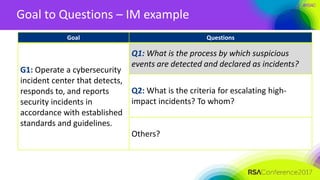
Goal to Questions – IM example
Goal Questions
G1: Operate a cybersecurity
incident center that detects,
responds to, and reports
security incidents in
accordance with established
standards and guidelines.
Q1: What is the process by which suspicious
events are detected and declared as incidents?
Q2: What is the criteria for escalating high-
impact incidents? To whom?
Others?
#RSAC
Questions to Indicators
#RSAC
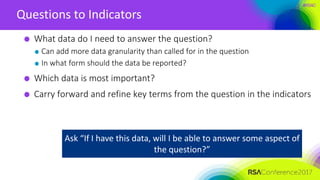
Questions to Indicators
What data do I need to answer the question?
Can add more data granularity than called for in the question
In what form should the data be reported?
Which data is most important?
Carry forward and refine key terms from the question in the indicators
Ask “If I have this data, will I be able to answer some aspect of
the question?”
#RSAC
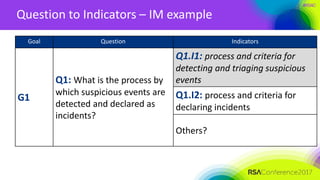
Goal Question Indicators
G1
Q1: What is the process by
which suspicious events are
detected and declared as
incidents?
Q1.I1: process and criteria for
detecting and triaging suspicious
events
Q1.I2: process and criteria for
declaring incidents
Others?
Question to Indicators – IM example
#RSAC
Indicators to Metrics
#RSAC
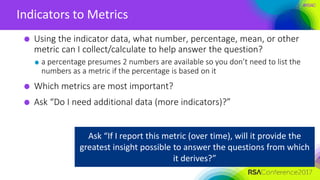
Indicators to Metrics
Using the indicator data, what number, percentage, mean, or other
metric can I collect/calculate to help answer the question?
a percentage presumes 2 numbers are available so you don’t need to list the
numbers as a metric if the percentage is based on it
Which metrics are most important?
Ask “Do I need additional data (more indicators)?”
Ask “If I report this metric (over time), will it provide the
greatest insight possible to answer the questions from which
it derives?”
#RSAC
Using this method to validate
your current questions or metrics
#RSAC
What if I only have a Metric? - 1
“We’ve always reported the number of machines with patches out of
date.”
How are you using this metric today?
“What question will this metric answer?”
This metric answers the following question: “How many machines are currently
out of date?
#RSAC
What if I only have a Metric? - 2
Answering this question will demonstrate substantive progress in
achieving what goal?
The goal answered by this question is “Keep machines up to date through
patching.”
Will this goal demonstrate progress againstan existing strategic business or
program objective?
By measuring the actual time between patch release and patch
application, you are able to measure your organization’s ability to
improve patch capability.
#RSAC
Using GQIM to restate
Strategic Business Objective: Mitigate the risk of successful software exploits by
minimizing out-of-date software systems.
Goal: Improve my organization’s process for patch management
Question: How effective is my patch management process?
Indicators: Increased efficiencies in the patch management process
Metrics: Actual time between patch release and patch application.
s
#RSAC
What if all I have is a Question? - 1
“I’m always asked if my users have the proper level of system access.”
How are you answering this question today?
If the answer to this question is yes, what is the goal I am trying to achieve?
— Goal: Ensure all users have the proper level of system access for their job
responsibilities.
#RSAC
What if all I have is a Question? - 2
What is the strategic business objective tied to this goal?
Strategic business objective: Mitigate insider threats by ensuring appropriate
levels of system access for all users.
What data would I need to answer the question: “Do all users have
appropriate system access?”
Inventory of IT systems with required security and access attributes
Current list of users with approved security attributes
An ability to compare IT systems access and users list
#RSAC
Using GQIM to Restate
Strategic Business Objective: Mitigate insider threats by ensuring appropriate levels of
system access for all users.
Goal: Ensure all users have the proper level of system access for their job responsibilities.
Question: Do all users have appropriate system access?
Indicators:
Inventory of IT systems with security and access attributes
Current list of users with approved security attributes
An ability to compare IT systems access and users list
Metrics: (more user centric)
Time (min, max, med) to add a new system to inventory
Time (min, max, med) to remove access when violation is discovered
“Age” Time (min, max, med) of security and access attributes
#RSAC
Barriers and challenges
What current barriers do you face in establishing, managing, and/or
executing a measurement program?
What challenges do you face in identifying meaningful metrics within
your organization?
Have you identified some new/updated approaches for tackling
these?
#RSAC
Getting started
#RSAC
Approach
State a business objective
Ideally your business objective supports a stated strategic objective
Ensure that [business unit, service, product, supply chain, technology, data
center] is …
— available to meet a specified customer or revenue growth objective
— unavailable for no more than some stated period of time, number of transactions,
other units of measure
— fully compliant with [law, regulation, standard] so as not to incur penalties
#RSAC
To get started
Identify sponsors and key stakeholders
Define security objectives and key questions
Determine information that informs
these
What information do you already have?
What information do you need to collect?
What is the value of collecting additional information?
Define and vet a small number of key metrics
Collect, analyze, report, refine
Leverage an existing measurement program
#RSAC
Questions
Lisa Young
Email: Lyoung@axio.com
Vice President, Service Delivery
Axio Global
David Tobar
Email: DTobar@cert.org
Senior Cybersecurity Engineer
Carnegie Mellon University
SEI/CERT
#RSAC
CERT | Software Engineering Institute | Carnegie Mellon
Software Engineering Institute (SEI)
Federally funded research and development center
based at Carnegie Mellon University
Basic and applied research in partnership with
government and private organizations
CERT – Anticipating and solving our nation’s
cybersecurity challenges
Largest technical program at SEI
Focused on information security, digital investigation
and forensics, insider threat, operational risk,
vulnerability analysis, network situational
awareness, metrics, and governance

Developing useful metrics

  • 1.
    SESSION ID:SESSION ID: #RSAC LisaYoung Developing Useful Metrics GRC-F03 Vice President, Service Delivery Axio Global Lyoung@Axio.com David Tobar Senior Cybersecurity Engineer SEI/CERT Carnegie Mellon University Dtobar@cert.org
  • 2.
    #RSAC Notices Copyright 2016 CarnegieMellon University This material is based upon work funded and supported by the Department of Defense under Contract No. FA8721-05-C-0003 with Carnegie Mellon University for the operation of the Software Engineering Institute, a federally funded research and development center. Any opinions, findings and conclusions or recommendations expressed in this material are those of the author(s) and do not necessarily reflect the views of the United States Department of Defense. NO WARRANTY. THIS CARNEGIE MELLON UNIVERSITY AND SOFTWARE ENGINEERING INSTITUTE MATERIAL IS FURNISHED ON AN “AS-IS” BASIS. CARNEGIE MELLON UNIVERSITY MAKES NO WARRANTIES OF ANY KIND, EITHER EXPRESSED OR IMPLIED, AS TO ANY MATTER INCLUDING, BUT NOT LIMITED TO, WARRANTY OF FITNESS FOR PURPOSE OR MERCHANTABILITY, EXCLUSIVITY, OR RESULTS OBTAINED FROM USE OF THE MATERIAL. CARNEGIE MELLON UNIVERSITY DOES NOT MAKE ANY WARRANTY OF ANY KIND WITH RESPECT TO FREEDOM FROM PATENT, TRADEMARK, OR COPYRIGHT INFRINGEMENT. [Distribution Statement A] This material has been approved for public release and unlimited distribution. Please see Copyright notice for non-US Government use and distribution. This material may be reproduced in its entirety, without modification, and freely distributed in written or electronic form without requesting formal permission. Permission is required for any other use. Requests for permission should be directed to the Software Engineering Institute at permission@sei.cmu.edu. DM-0003301
  • 3.
    #RSAC GRC-F03 3 This session does notcover specific technical security metrics does cover the importance of metrics tied to things that matter to the business Why you might want to stay for this session - if you are interested in determining what to measure in support of business objectives identifying risks and gaps in your current measurement processes a process for developing metrics that will help you do these things
  • 4.
    #RSAC Why do youwant to measure?
  • 5.
    #RSAC Key questions What shouldI measure to determine if I am meeting my performance objectives for security? What is the business value of being more secure? Of a specific security investment?
  • 6.
    #RSAC Terminology (*) Measure vs.metric I had 2 eggs for breakfast this morning It’s 53 degrees in San Francisco, CA This session is 40 minutes long A measure (or measurement) is the value of a specific characteristic of a given entity (collected data). A metric is the aggregation of one or more measures to create a piece of business intelligence, in context. OR (*) Visualize This! Meaningful Metrics for Managing Risk. Session GRC-F02, RSA Conference 2014.
  • 7.
    #RSAC So what? Whydo you care? If I had this metric: (*) What decisions would it inform? What actions would I take based on it? What behaviors would it affect? What would improvement look like? What would its value be in comparison to other metrics? (*) informed by Douglas Hubbard, How to Measure Anything, John Wiley & Sons, 2010
  • 8.
    #RSAC Why measure? Speak todecision makers in their language Demonstrate that the security program has measurable business value Justify new investments; make improvements Use trends to help predict future events Demonstrate that control objectives are (and continue to be) met Answer key questions
  • 9.
    #RSAC Deriving Metrics fromObjectives - GQIM
  • 10.
    #RSAC Key questions Not “Whatmetrics should I use?” but “What do I want to know or learn?” Alternatives: What decisions do I want to inform? What actions do I want to take? What behaviors do I want to change?
  • 11.
    #RSAC Purpose Use a defined,repeatable process to derive meaningful metrics that directly support achievement of business objectives and: demonstrate the business value of each metric (and justify the cost for its collection and reporting) defend such metrics in comparison to others add metrics, update metrics, and retire metrics as business objectives change ultimately, inform business decisions, take appropriate action, and change behaviors
  • 12.
    #RSAC Key takeaways Understand a5-step process for deriving metrics from business or program objectives Be able to apply this process to your objectives Identify at least one metric that you can use immediately Be able to better communicate with business leaders in their language Assess the utility of current metrics
  • 13.
    #RSAC GQIM process Objectives Identify business objectives that establishthe need for resilience and cybersecurity Goal Develop one or more goals for each objective Question Develop one or more questions that, when answered, help determine the extent to which the goal is met Indicator Identify one or more pieces of information that are required to answer each question Metric Identify one or more metrics that will use selected indicators to answer the question
  • 14.
  • 15.
    #RSAC Process State a businessor program objective Define one or more goals that are required to achieve the stated objective Goal: the end toward which effort is directed Fewer are better Essential (high leverage/high payoff) vs. complete coverage — Judgment informed by stakeholder review
  • 16.
    #RSAC Objectives to Goals Whatare meaningful actions to take to achieve the objective? Which actions are most important? 2-3 that are essential, high leverage, high payoff Carry forward and refine key terms from the objective in the goals Ask “If I achieve this goal, will I be able to demonstrate substantive progress in achieving the objective?”
  • 17.
    #RSAC Objective to Goals– Incident Management example Objective Goal Mitigate the risks of business disruption and loss resulting from cybersecurity incidents (with impact threshold > [x]) Operate a cybersecurity incident center that detects, responds to, and reports security incidents in accordance with established standards and guidelines. • enterprise and operational unit levels Others?
  • 18.
  • 19.
    #RSAC Goals to Questions-1 What are meaningful questions to answer to determine if the goal is being achieved? Requires subject matter expertise Which questions are most important? Carry forward and refine key terms from the goal in the question Ask “If I answer this question, will I be able to demonstrate substantive progress in achieving the goal?”
  • 20.
    #RSAC Goals to Questions-2 Useful questions are in the form of: What is the process for . . . (better than “How does the organization . . .”) — leads to implementation metrics How effective is . . . — leads to effectiveness metrics — most desirable but need implementation metrics first
  • 21.
    #RSAC Goal to Questions– IM example Goal Questions G1: Operate a cybersecurity incident center that detects, responds to, and reports security incidents in accordance with established standards and guidelines. Q1: What is the process by which suspicious events are detected and declared as incidents? Q2: What is the criteria for escalating high- impact incidents? To whom? Others?
  • 22.
  • 23.
    #RSAC Questions to Indicators Whatdata do I need to answer the question? Can add more data granularity than called for in the question In what form should the data be reported? Which data is most important? Carry forward and refine key terms from the question in the indicators Ask “If I have this data, will I be able to answer some aspect of the question?”
  • 24.
    #RSAC Goal Question Indicators G1 Q1:What is the process by which suspicious events are detected and declared as incidents? Q1.I1: process and criteria for detecting and triaging suspicious events Q1.I2: process and criteria for declaring incidents Others? Question to Indicators – IM example
  • 25.
  • 26.
    #RSAC Indicators to Metrics Usingthe indicator data, what number, percentage, mean, or other metric can I collect/calculate to help answer the question? a percentage presumes 2 numbers are available so you don’t need to list the numbers as a metric if the percentage is based on it Which metrics are most important? Ask “Do I need additional data (more indicators)?” Ask “If I report this metric (over time), will it provide the greatest insight possible to answer the questions from which it derives?”
  • 27.
    #RSAC Using this methodto validate your current questions or metrics
  • 28.
    #RSAC What if Ionly have a Metric? - 1 “We’ve always reported the number of machines with patches out of date.” How are you using this metric today? “What question will this metric answer?” This metric answers the following question: “How many machines are currently out of date?
  • 29.
    #RSAC What if Ionly have a Metric? - 2 Answering this question will demonstrate substantive progress in achieving what goal? The goal answered by this question is “Keep machines up to date through patching.” Will this goal demonstrate progress againstan existing strategic business or program objective? By measuring the actual time between patch release and patch application, you are able to measure your organization’s ability to improve patch capability.
  • 30.
    #RSAC Using GQIM torestate Strategic Business Objective: Mitigate the risk of successful software exploits by minimizing out-of-date software systems. Goal: Improve my organization’s process for patch management Question: How effective is my patch management process? Indicators: Increased efficiencies in the patch management process Metrics: Actual time between patch release and patch application. s
  • 31.
    #RSAC What if allI have is a Question? - 1 “I’m always asked if my users have the proper level of system access.” How are you answering this question today? If the answer to this question is yes, what is the goal I am trying to achieve? — Goal: Ensure all users have the proper level of system access for their job responsibilities.
  • 32.
    #RSAC What if allI have is a Question? - 2 What is the strategic business objective tied to this goal? Strategic business objective: Mitigate insider threats by ensuring appropriate levels of system access for all users. What data would I need to answer the question: “Do all users have appropriate system access?” Inventory of IT systems with required security and access attributes Current list of users with approved security attributes An ability to compare IT systems access and users list
  • 33.
    #RSAC Using GQIM toRestate Strategic Business Objective: Mitigate insider threats by ensuring appropriate levels of system access for all users. Goal: Ensure all users have the proper level of system access for their job responsibilities. Question: Do all users have appropriate system access? Indicators: Inventory of IT systems with security and access attributes Current list of users with approved security attributes An ability to compare IT systems access and users list Metrics: (more user centric) Time (min, max, med) to add a new system to inventory Time (min, max, med) to remove access when violation is discovered “Age” Time (min, max, med) of security and access attributes
  • 34.
    #RSAC Barriers and challenges Whatcurrent barriers do you face in establishing, managing, and/or executing a measurement program? What challenges do you face in identifying meaningful metrics within your organization? Have you identified some new/updated approaches for tackling these?
  • 35.
  • 36.
    #RSAC Approach State a businessobjective Ideally your business objective supports a stated strategic objective Ensure that [business unit, service, product, supply chain, technology, data center] is … — available to meet a specified customer or revenue growth objective — unavailable for no more than some stated period of time, number of transactions, other units of measure — fully compliant with [law, regulation, standard] so as not to incur penalties
  • 37.
    #RSAC To get started Identifysponsors and key stakeholders Define security objectives and key questions Determine information that informs these What information do you already have? What information do you need to collect? What is the value of collecting additional information? Define and vet a small number of key metrics Collect, analyze, report, refine Leverage an existing measurement program
  • 38.
    #RSAC Questions Lisa Young Email: Lyoung@axio.com VicePresident, Service Delivery Axio Global David Tobar Email: DTobar@cert.org Senior Cybersecurity Engineer Carnegie Mellon University SEI/CERT
  • 39.
    #RSAC CERT | SoftwareEngineering Institute | Carnegie Mellon Software Engineering Institute (SEI) Federally funded research and development center based at Carnegie Mellon University Basic and applied research in partnership with government and private organizations CERT – Anticipating and solving our nation’s cybersecurity challenges Largest technical program at SEI Focused on information security, digital investigation and forensics, insider threat, operational risk, vulnerability analysis, network situational awareness, metrics, and governance