All rights reserved. ©2020
ANGELA: HTTP Adaptive Streaming
and Edge Computing Simulator
1
The 10th IFIP/IEEE International Conference on Performance Evaluation and Modeling
in Wired and Wireless Networks (PEMWN)
November 23-25, 2021
Jesús Aguilar Armijo, Christian Timmerer, and Hermann Hellwagner
Christian Doppler laboratory ATHENA | Alpen-Adria-Universität Klagenfurt | Austria
jesus.aguilar@aau.at | https://athena.itec.aau.at/
All rights reserved. ©2020
● Introduction
● Motivation
● ANGELA Architecture
● Metrics and evaluation
● Contributions
● Q & A
Table of
content
All rights reserved. ©2020
2
All rights reserved. ©2020
● Video streaming traffic today represents a significant fraction of
mobile network traffic. The two main reasons for this growth are the
improved capabilities of mobile devices and the emergence of HTTP
Adaptive Streaming (HAS)
● Multi-access Edge Computing (MEC) brings storage and
computing power to the edge of the network, i.e., closer to the end
user. MEC offers key capabilities such as storage, computing power,
location awareness, proximity, low latency, and real-time Radio
Access Network (RAN) information
● Video streaming can leverage MEC advantages to improve
content delivery by deploying edge computing mechanisms that
assist video streaming:
○ User awareness, player metrics and radio information available
to perform better adaptation decisions
○ Computing power to run algorithms
○ Machine learning support
Introduction
All rights reserved. ©2020
3
All rights reserved. ©2020
● What makes ANGELA different from other simulators:
○ The radio layer in mobile networks involves complex processes that affect the final throughput
available to users. Network simulators that want to achieve an accurate radio should implement
them
○ ANGELA import and uses radio layer data over time for each client from a dataset or from a
NS-3 simulation, reducing drastically the simulation time without losing accuracy
○ Create a simulator that focus on edge computing mechanisms:
■ Easy access to (1) radio metrics using Radio Network Information Service (RNIS), (2) player
metrics reported by the clients using the HTTP POST protocol and (3) all clients’ requests.
■ Simple deployment in Python, including support for machine learning techniques
○ Focus on video streaming process, not radio layer
○ ABR algorithms located at different points of the network (client, edge node or video server)
○ Realistic content provisioning, using video datasets or creating customized dataset (defining
codec, bitrate ladder, media delivery format, segment duration among other characteristics)
Motivation
All rights reserved. ©2020
4
All rights reserved. ©2020
● Written in Python
● Lightweight
● Can be executed on Linux, Windows and Mac OS
ANGELA Architecture
All rights reserved. ©2020
5
All rights reserved. ©2020
● There are two options regarding content provisioning in ANGELA:
○ Perform the segmentation and encoding of a selected multimedia content to create a custom
dataset we want to test. We can choose different features such as:
■ Video
■ Codec
■ Bitrate ladder
■ Media delivery format
■ Segment duration
○ Import an external multimedia dataset
● Input: Multimedia content + segmentation and
Encoding parameters or select video dataset
● Output: Segments
Content provisioning module
All rights reserved. ©2020
6
All rights reserved. ©2020
● ANGELA has two alternatives to simulate the radio layer:
○ Import radio link information from a real traces dataset
■ It offers realistic radio metrics and low simulation time
○ Import radio metrics from the ns-3 simulator
■ Create the custom scenario once in ns-3, then import
the radio metrics over time to ANGELA
● ANGELA reads the network traces over time for each user:
ANGELA can use different parameters from the network dataset,
such as downlink throughput on a per-second basis or the
modulation and coding scheme (MCS) to calculate the delivery
times between different network entities.
● Input: Ns-3 parameters + network topology or select radio datasets
● Output: Radio metrics over time per user
Radio module
All rights reserved. ©2020
7
All rights reserved. ©2020
● The network module is in charge of simulating the video streaming session, i.e., transmitting the video
segments through the network according to the HAS policies
● Configuration:
○ General parameters: Number of users, segment prefetching policies, premium/basic users
○ Radio parameters: Dataset and mobility pattern or ns-3 scenario, bandwidth, scheduling algorithm
and MIMO scheme
○ Video parameters: Multimedia content and encoding+segmentation parameters or select video
dataset
○ HAS parameters: ABR algorithm + its parameters
● Input:
○ Radio metrics from Radio module
○ Segments from Content Provisioning Module
○ Simulation parameters
● Output:
○ Video session metadata to QoE Evaluation Module
○ Evaluation metrics
Network module
All rights reserved. ©2020
8
All rights reserved. ©2020
● Main architecture:
○ Video server: Stores the video dataset with all the segments in different qualities. It receives
segment requests from the edge nodes and serves the segments
○ Edge computing node: Receives the segment requests from the users and forwards them to the
server. It also receives the segments from the server and serves them to the users.
Edge mechanisms that support HAS are deployed and executed here
○ Base station: The base station manages the radio layer, assigning the throughput to the users
○ Users: The users consume and request the multimedia
content according to their ABR algorithms
Network module
All rights reserved. ©2020
9
All rights reserved. ©2020
● The QoE evaluation module is in charge of providing quality metrics of the video streaming session
for each user
● It follows ITU P.1203 recommendation. This recommendation describes model algorithms to
determine the session quality of video streaming
● It considers the main factors that impact the final QoE of the user: bitrate, display properties,
segment switches, and the number of stalls and their duration
● Input: This module is connected to the network module to receive the required video session metadata
● Output: Per-second quality score, the stalling behavior, and the final QoE score
QoE evaluation module
All rights reserved. ©2020
10
All rights reserved. ©2020
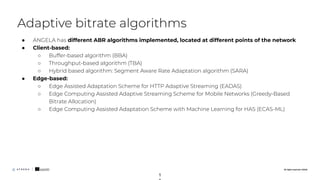
● ANGELA has different ABR algorithms implemented, located at different points of the network
● Client-based:
○ Buffer-based algorithm (BBA)
○ Throughput-based algorithm (TBA)
○ Hybrid based algorithm: Segment Aware Rate Adaptation algorithm (SARA)
● Edge-based:
○ Edge Assisted Adaptation Scheme for HTTP Adaptive Streaming (EADAS)
○ Edge Computing Assisted Adaptive Streaming Scheme for Mobile Networks (Greedy-Based
Bitrate Allocation)
○ Edge Computing Assisted Adaptation Scheme with Machine Learning for HAS (ECAS-ML)
Adaptive bitrate algorithms
All rights reserved. ©2020
1
All rights reserved. ©2020
● ANGELA provides a wide variety of metrics to evaluate the performance of the video streaming
session
● The flexibility of the testbed allows the implementation of new demanded metrics easily
● These metrics can be presented in different formats: per-user or averaged over a group of users,
average values, or values over time represented graphically
● We show the evaluation capabilities of ANGELA by means of an example simulation that evaluates
three different client-based ABR algorithms: TBA, BBA, SARA and EADAS
Metrics and evaluation
All rights reserved. ©2020
12
All rights reserved. ©2020
● Performing this simulation in ANGELA took 2.1 seconds. We replicate the experiment in ns-3,
performing two simulations using the OnOffApplication. In the first one, we use a point-to-point
topology for the radio layer, and the simulation took 5.633 seconds. In the second one, we use the LTE
model, and the simulation took 764 seconds
Metrics and evaluation
All rights reserved. ©2020
13
All rights reserved. ©2020
● The content provisioning module of ANGELA enables creating customized multimedia datasets with
different configurations later used in the simulation. Furthermore, ANGELA can simulate video
streaming sessions using state-of-the-art multimedia datasets in a simple way
● ANGELA can use real radio traces from state-of-the art datasets, resulting in a more accurate radio
layer simulation
● ANGELA simulation focuses on HAS, ABR algorithms, and edge computing mechanisms. It also
supports machine learning techniques. ANGELA is lightweight, providing lower simulation time than
other state-of-the-art simulators that focus on the radio layer
● ANGELA supports ABR algorithms deployed in different locations, e.g., at the client’s device or at the
edge computing node
● ANGELA offers adequate performance metrics to evaluate the video streaming session and enables
the simple implementation of more metrics on-demand. Moreover, the QoE evaluation module of
ANGELA provides the overall quality score, stalling behavior, or per-second quality score at the end of
the simulation according to the ITU-T P.1203 QoE evaluation model
● ANGELA is not yet publicly available but we have plans to release it in the future. ANGELA was used in
the evaluation of two accepted papers: EADAS (LCN’21) and ECAS-ML (MMM’22)
Contributions
All rights reserved. ©2020
14
Thank you
Q&A
All rights reserved. ©2020
15

PEMWN'21 - ANGELA

  • 1.
    All rights reserved.©2020 All rights reserved. ©2020 ANGELA: HTTP Adaptive Streaming and Edge Computing Simulator 1 The 10th IFIP/IEEE International Conference on Performance Evaluation and Modeling in Wired and Wireless Networks (PEMWN) November 23-25, 2021 Jesús Aguilar Armijo, Christian Timmerer, and Hermann Hellwagner Christian Doppler laboratory ATHENA | Alpen-Adria-Universität Klagenfurt | Austria jesus.aguilar@aau.at | https://athena.itec.aau.at/
  • 2.
    All rights reserved.©2020 ● Introduction ● Motivation ● ANGELA Architecture ● Metrics and evaluation ● Contributions ● Q & A Table of content All rights reserved. ©2020 2
  • 3.
    All rights reserved.©2020 ● Video streaming traffic today represents a significant fraction of mobile network traffic. The two main reasons for this growth are the improved capabilities of mobile devices and the emergence of HTTP Adaptive Streaming (HAS) ● Multi-access Edge Computing (MEC) brings storage and computing power to the edge of the network, i.e., closer to the end user. MEC offers key capabilities such as storage, computing power, location awareness, proximity, low latency, and real-time Radio Access Network (RAN) information ● Video streaming can leverage MEC advantages to improve content delivery by deploying edge computing mechanisms that assist video streaming: ○ User awareness, player metrics and radio information available to perform better adaptation decisions ○ Computing power to run algorithms ○ Machine learning support Introduction All rights reserved. ©2020 3
  • 4.
    All rights reserved.©2020 ● What makes ANGELA different from other simulators: ○ The radio layer in mobile networks involves complex processes that affect the final throughput available to users. Network simulators that want to achieve an accurate radio should implement them ○ ANGELA import and uses radio layer data over time for each client from a dataset or from a NS-3 simulation, reducing drastically the simulation time without losing accuracy ○ Create a simulator that focus on edge computing mechanisms: ■ Easy access to (1) radio metrics using Radio Network Information Service (RNIS), (2) player metrics reported by the clients using the HTTP POST protocol and (3) all clients’ requests. ■ Simple deployment in Python, including support for machine learning techniques ○ Focus on video streaming process, not radio layer ○ ABR algorithms located at different points of the network (client, edge node or video server) ○ Realistic content provisioning, using video datasets or creating customized dataset (defining codec, bitrate ladder, media delivery format, segment duration among other characteristics) Motivation All rights reserved. ©2020 4
  • 5.
    All rights reserved.©2020 ● Written in Python ● Lightweight ● Can be executed on Linux, Windows and Mac OS ANGELA Architecture All rights reserved. ©2020 5
  • 6.
    All rights reserved.©2020 ● There are two options regarding content provisioning in ANGELA: ○ Perform the segmentation and encoding of a selected multimedia content to create a custom dataset we want to test. We can choose different features such as: ■ Video ■ Codec ■ Bitrate ladder ■ Media delivery format ■ Segment duration ○ Import an external multimedia dataset ● Input: Multimedia content + segmentation and Encoding parameters or select video dataset ● Output: Segments Content provisioning module All rights reserved. ©2020 6
  • 7.
    All rights reserved.©2020 ● ANGELA has two alternatives to simulate the radio layer: ○ Import radio link information from a real traces dataset ■ It offers realistic radio metrics and low simulation time ○ Import radio metrics from the ns-3 simulator ■ Create the custom scenario once in ns-3, then import the radio metrics over time to ANGELA ● ANGELA reads the network traces over time for each user: ANGELA can use different parameters from the network dataset, such as downlink throughput on a per-second basis or the modulation and coding scheme (MCS) to calculate the delivery times between different network entities. ● Input: Ns-3 parameters + network topology or select radio datasets ● Output: Radio metrics over time per user Radio module All rights reserved. ©2020 7
  • 8.
    All rights reserved.©2020 ● The network module is in charge of simulating the video streaming session, i.e., transmitting the video segments through the network according to the HAS policies ● Configuration: ○ General parameters: Number of users, segment prefetching policies, premium/basic users ○ Radio parameters: Dataset and mobility pattern or ns-3 scenario, bandwidth, scheduling algorithm and MIMO scheme ○ Video parameters: Multimedia content and encoding+segmentation parameters or select video dataset ○ HAS parameters: ABR algorithm + its parameters ● Input: ○ Radio metrics from Radio module ○ Segments from Content Provisioning Module ○ Simulation parameters ● Output: ○ Video session metadata to QoE Evaluation Module ○ Evaluation metrics Network module All rights reserved. ©2020 8
  • 9.
    All rights reserved.©2020 ● Main architecture: ○ Video server: Stores the video dataset with all the segments in different qualities. It receives segment requests from the edge nodes and serves the segments ○ Edge computing node: Receives the segment requests from the users and forwards them to the server. It also receives the segments from the server and serves them to the users. Edge mechanisms that support HAS are deployed and executed here ○ Base station: The base station manages the radio layer, assigning the throughput to the users ○ Users: The users consume and request the multimedia content according to their ABR algorithms Network module All rights reserved. ©2020 9
  • 10.
    All rights reserved.©2020 ● The QoE evaluation module is in charge of providing quality metrics of the video streaming session for each user ● It follows ITU P.1203 recommendation. This recommendation describes model algorithms to determine the session quality of video streaming ● It considers the main factors that impact the final QoE of the user: bitrate, display properties, segment switches, and the number of stalls and their duration ● Input: This module is connected to the network module to receive the required video session metadata ● Output: Per-second quality score, the stalling behavior, and the final QoE score QoE evaluation module All rights reserved. ©2020 10
  • 11.
    All rights reserved.©2020 ● ANGELA has different ABR algorithms implemented, located at different points of the network ● Client-based: ○ Buffer-based algorithm (BBA) ○ Throughput-based algorithm (TBA) ○ Hybrid based algorithm: Segment Aware Rate Adaptation algorithm (SARA) ● Edge-based: ○ Edge Assisted Adaptation Scheme for HTTP Adaptive Streaming (EADAS) ○ Edge Computing Assisted Adaptive Streaming Scheme for Mobile Networks (Greedy-Based Bitrate Allocation) ○ Edge Computing Assisted Adaptation Scheme with Machine Learning for HAS (ECAS-ML) Adaptive bitrate algorithms All rights reserved. ©2020 1
  • 12.
    All rights reserved.©2020 ● ANGELA provides a wide variety of metrics to evaluate the performance of the video streaming session ● The flexibility of the testbed allows the implementation of new demanded metrics easily ● These metrics can be presented in different formats: per-user or averaged over a group of users, average values, or values over time represented graphically ● We show the evaluation capabilities of ANGELA by means of an example simulation that evaluates three different client-based ABR algorithms: TBA, BBA, SARA and EADAS Metrics and evaluation All rights reserved. ©2020 12
  • 13.
    All rights reserved.©2020 ● Performing this simulation in ANGELA took 2.1 seconds. We replicate the experiment in ns-3, performing two simulations using the OnOffApplication. In the first one, we use a point-to-point topology for the radio layer, and the simulation took 5.633 seconds. In the second one, we use the LTE model, and the simulation took 764 seconds Metrics and evaluation All rights reserved. ©2020 13
  • 14.
    All rights reserved.©2020 ● The content provisioning module of ANGELA enables creating customized multimedia datasets with different configurations later used in the simulation. Furthermore, ANGELA can simulate video streaming sessions using state-of-the-art multimedia datasets in a simple way ● ANGELA can use real radio traces from state-of-the art datasets, resulting in a more accurate radio layer simulation ● ANGELA simulation focuses on HAS, ABR algorithms, and edge computing mechanisms. It also supports machine learning techniques. ANGELA is lightweight, providing lower simulation time than other state-of-the-art simulators that focus on the radio layer ● ANGELA supports ABR algorithms deployed in different locations, e.g., at the client’s device or at the edge computing node ● ANGELA offers adequate performance metrics to evaluate the video streaming session and enables the simple implementation of more metrics on-demand. Moreover, the QoE evaluation module of ANGELA provides the overall quality score, stalling behavior, or per-second quality score at the end of the simulation according to the ITU-T P.1203 QoE evaluation model ● ANGELA is not yet publicly available but we have plans to release it in the future. ANGELA was used in the evaluation of two accepted papers: EADAS (LCN’21) and ECAS-ML (MMM’22) Contributions All rights reserved. ©2020 14
  • 15.
    Thank you Q&A All rightsreserved. ©2020 15