
Master’s Project Idea Catherine Harrell Learning, Design and Technology March 4, 2010
Learning Problem Target Audience Description of the product Assessment plans Challenges
Learning Problem Target Audience Description of the product Assessment plans Challenges Science requires  system understanding : how do parts fit together to make a whole? Textbooks aren’t well suited for communicating how a system works. Many students are  memorizing  instead of  visualizing . Secondary problem:  Girls  are poorly represented in the sciences.
Learning Problem Target Audience Description of the product Assessment plans Challenges
Learning Problem Target Audience Description of the product Assessment plans Challenges High school girls  enrolled in a biology course Needs: Better ways to learn about systems Resources for studying / homework Incentive to learn science in the first place
Learning Problem Target Audience Description of the product Assessment plans Challenges
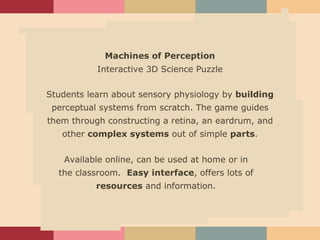
Learning Problem Target Audience Description of the product Assessment plans Challenges Machines of Perception Interactive 3D Science Puzzle Students learn about sensory physiology by  building  perceptual systems from scratch. The game guides them through constructing a retina, an eardrum, and other  complex systems  out of simple  parts . Available online, can be used at home or in the classroom.  Easy   interface , offers lots of  resources  and information.
Learning Problem Target Audience Description of the product Assessment plans Challenges
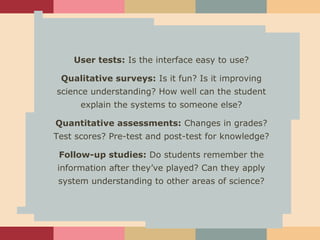
Learning Problem Target Audience Description of the product Assessment plans Challenges User tests:  Is the interface easy to use? Qualitative surveys:  Is it fun? Is it improving science understanding? How well can the student explain the systems to someone else? Quantitative assessments:  Changes in grades? Test scores? Pre-test and post-test for knowledge? Follow-up studies:  Do students remember the information after they’ve played? Can they apply system understanding to other areas of science?
Learning Problem Target Audience Description of the product Assessment plans Challenges
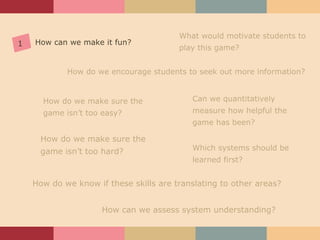
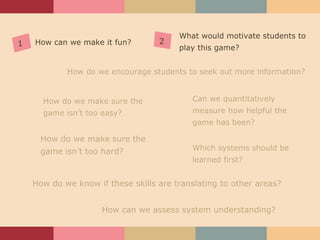
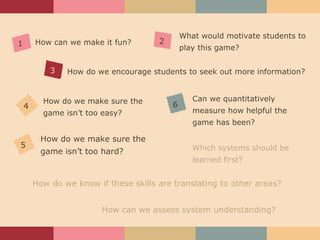
How can we assess system understanding? How do we make sure the game isn’t too hard? How do we make sure the game isn’t too easy? Which systems should be learned first? What would motivate students to play this game? Can we quantitatively measure how helpful the game has been? How can we make it fun? How do we know if these skills are translating to other areas? How do we encourage students to seek out more information? 1 3
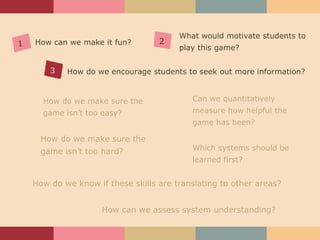
How can we assess system understanding? How do we make sure the game isn’t too hard? How do we make sure the game isn’t too easy? Which systems should be learned first? What would motivate students to play this game? Can we quantitatively measure how helpful the game has been? How can we make it fun? How do we know if these skills are translating to other areas? How do we encourage students to seek out more information? 1 2 3
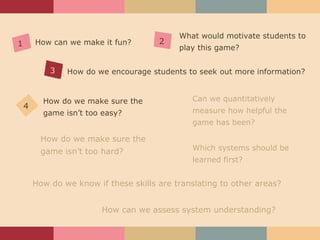
How can we assess system understanding? How do we make sure the game isn’t too hard? How do we make sure the game isn’t too easy? Which systems should be learned first? What would motivate students to play this game? Can we quantitatively measure how helpful the game has been? How can we make it fun? How do we know if these skills are translating to other areas? How do we encourage students to seek out more information? 1 2 3 4
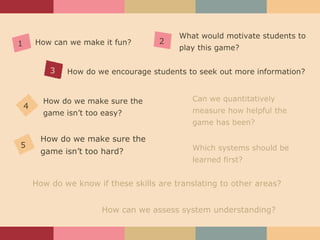
How can we assess system understanding? How do we make sure the game isn’t too hard? How do we make sure the game isn’t too easy? Which systems should be learned first? What would motivate students to play this game? Can we quantitatively measure how helpful the game has been? How can we make it fun? How do we know if these skills are translating to other areas? How do we encourage students to seek out more information? 1 2 3 4 5
How can we assess system understanding? How do we make sure the game isn’t too hard? How do we make sure the game isn’t too easy? Which systems should be learned first? What would motivate students to play this game? Can we quantitatively measure how helpful the game has been? How can we make it fun? How do we know if these skills are translating to other areas? How do we encourage students to seek out more information? 1 2 3 4 6 5
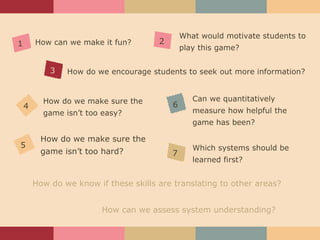
How can we assess system understanding? How do we make sure the game isn’t too hard? How do we make sure the game isn’t too easy? Which systems should be learned first? What would motivate students to play this game? Can we quantitatively measure how helpful the game has been? How can we make it fun? How do we know if these skills are translating to other areas? How do we encourage students to seek out more information? 1 2 3 4 6 5 7
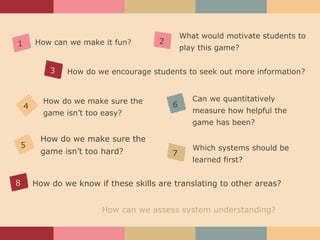
How can we assess system understanding? How do we make sure the game isn’t too hard? How do we make sure the game isn’t too easy? Which systems should be learned first? What would motivate students to play this game? Can we quantitatively measure how helpful the game has been? How can we make it fun? How do we know if these skills are translating to other areas? How do we encourage students to seek out more information? 1 2 3 4 6 5 7 8
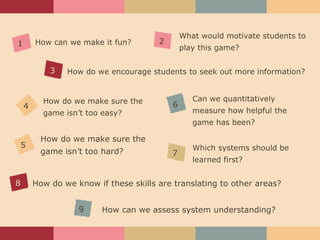
How can we assess system understanding? How do we make sure the game isn’t too hard? How do we make sure the game isn’t too easy? Which systems should be learned first? What would motivate students to play this game? Can we quantitatively measure how helpful the game has been? How can we make it fun? How do we know if these skills are translating to other areas? How do we encourage students to seek out more information? 1 2 3 4 6 5 7 9 8
Learning Problem Target Audience Description of the product Assessment plans Challenges

Master's Project Idea Presentation

  • 1.
    Master’s Project IdeaCatherine Harrell Learning, Design and Technology March 4, 2010
  • 2.
    Learning Problem TargetAudience Description of the product Assessment plans Challenges
  • 3.
    Learning Problem TargetAudience Description of the product Assessment plans Challenges
  • 4.
    Learning Problem TargetAudience Description of the product Assessment plans Challenges Science requires system understanding : how do parts fit together to make a whole? Textbooks aren’t well suited for communicating how a system works. Many students are memorizing instead of visualizing . Secondary problem: Girls are poorly represented in the sciences.
  • 5.
    Learning Problem TargetAudience Description of the product Assessment plans Challenges
  • 6.
    Learning Problem TargetAudience Description of the product Assessment plans Challenges
  • 7.
    Learning Problem TargetAudience Description of the product Assessment plans Challenges High school girls enrolled in a biology course Needs: Better ways to learn about systems Resources for studying / homework Incentive to learn science in the first place
  • 8.
    Learning Problem TargetAudience Description of the product Assessment plans Challenges
  • 9.
    Learning Problem TargetAudience Description of the product Assessment plans Challenges
  • 10.
    Learning Problem TargetAudience Description of the product Assessment plans Challenges Machines of Perception Interactive 3D Science Puzzle Students learn about sensory physiology by building perceptual systems from scratch. The game guides them through constructing a retina, an eardrum, and other complex systems out of simple parts . Available online, can be used at home or in the classroom. Easy interface , offers lots of resources and information.
  • 11.
    Learning Problem TargetAudience Description of the product Assessment plans Challenges
  • 12.
    Learning Problem TargetAudience Description of the product Assessment plans Challenges
  • 13.
    Learning Problem TargetAudience Description of the product Assessment plans Challenges User tests: Is the interface easy to use? Qualitative surveys: Is it fun? Is it improving science understanding? How well can the student explain the systems to someone else? Quantitative assessments: Changes in grades? Test scores? Pre-test and post-test for knowledge? Follow-up studies: Do students remember the information after they’ve played? Can they apply system understanding to other areas of science?
  • 14.
    Learning Problem TargetAudience Description of the product Assessment plans Challenges
  • 15.
    Learning Problem TargetAudience Description of the product Assessment plans Challenges
  • 16.
    How can weassess system understanding? How do we make sure the game isn’t too hard? How do we make sure the game isn’t too easy? Which systems should be learned first? What would motivate students to play this game? Can we quantitatively measure how helpful the game has been? How can we make it fun? How do we know if these skills are translating to other areas? How do we encourage students to seek out more information? 1 3
  • 17.
    How can weassess system understanding? How do we make sure the game isn’t too hard? How do we make sure the game isn’t too easy? Which systems should be learned first? What would motivate students to play this game? Can we quantitatively measure how helpful the game has been? How can we make it fun? How do we know if these skills are translating to other areas? How do we encourage students to seek out more information? 1 2 3
  • 18.
    How can weassess system understanding? How do we make sure the game isn’t too hard? How do we make sure the game isn’t too easy? Which systems should be learned first? What would motivate students to play this game? Can we quantitatively measure how helpful the game has been? How can we make it fun? How do we know if these skills are translating to other areas? How do we encourage students to seek out more information? 1 2 3
  • 19.
    How can weassess system understanding? How do we make sure the game isn’t too hard? How do we make sure the game isn’t too easy? Which systems should be learned first? What would motivate students to play this game? Can we quantitatively measure how helpful the game has been? How can we make it fun? How do we know if these skills are translating to other areas? How do we encourage students to seek out more information? 1 2 3 4
  • 20.
    How can weassess system understanding? How do we make sure the game isn’t too hard? How do we make sure the game isn’t too easy? Which systems should be learned first? What would motivate students to play this game? Can we quantitatively measure how helpful the game has been? How can we make it fun? How do we know if these skills are translating to other areas? How do we encourage students to seek out more information? 1 2 3 4 5
  • 21.
    How can weassess system understanding? How do we make sure the game isn’t too hard? How do we make sure the game isn’t too easy? Which systems should be learned first? What would motivate students to play this game? Can we quantitatively measure how helpful the game has been? How can we make it fun? How do we know if these skills are translating to other areas? How do we encourage students to seek out more information? 1 2 3 4 6 5
  • 22.
    How can weassess system understanding? How do we make sure the game isn’t too hard? How do we make sure the game isn’t too easy? Which systems should be learned first? What would motivate students to play this game? Can we quantitatively measure how helpful the game has been? How can we make it fun? How do we know if these skills are translating to other areas? How do we encourage students to seek out more information? 1 2 3 4 6 5 7
  • 23.
    How can weassess system understanding? How do we make sure the game isn’t too hard? How do we make sure the game isn’t too easy? Which systems should be learned first? What would motivate students to play this game? Can we quantitatively measure how helpful the game has been? How can we make it fun? How do we know if these skills are translating to other areas? How do we encourage students to seek out more information? 1 2 3 4 6 5 7 8
  • 24.
    How can weassess system understanding? How do we make sure the game isn’t too hard? How do we make sure the game isn’t too easy? Which systems should be learned first? What would motivate students to play this game? Can we quantitatively measure how helpful the game has been? How can we make it fun? How do we know if these skills are translating to other areas? How do we encourage students to seek out more information? 1 2 3 4 6 5 7 9 8
  • 25.
    Learning Problem TargetAudience Description of the product Assessment plans Challenges