A Suspected Derivative Morphology for
pheophytin (脫鎂葉綠素) and
the Enhanced Hydrogen Decomposition It Caused
Jyun-Lin Huang,2 Wen-Bing Lai,2 Chungpin Liao,1,2,* Li-Shen Yeh2
(黃均霖) (賴玟柄) (廖重賓) (葉立紳)
1Graduate School of Electro-Optic and Materials Science,
National Formosa University (NFU), Huwei, Taiwan 632, ROC.
2Advanced Research & Business Laboratory (ARBL),
Taichung, Taiwan 407, ROC.
*Corresponding Author: cpliao@alum.mit.edu and Speaker
2016/8/16 1CCL Group
2016/8/16 2CCL Group
Outline
• What’s the role of pheophytin (pheo) in photosynthesis?
• What might be pheo’s other structure-related roles?  things we
bumped into in the original low-power chlorophyll battery
• A conjectured derivative morphology and associated
proton conduction path within pheophytins (pheo’s)
• Experimental evidence in pheo-catalyzed decomposition of
hydrogen gas
• Summary and conclusions
• Porphyrin-ring family and their uses
• Spectral comparison among: 1st-principle quantum simulation,
measurement on ethanol-extracted pheo, and existing literature
2016/8/16 CCL Group 3
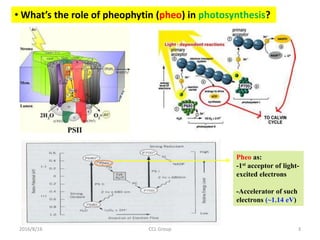
• What’s the role of pheophytin (pheo) in photosynthesis?
Pheo as:
-1st acceptor of light-
excited electrons
-Accelerator of such
electrons (~1.14 eV)
2016/8/16 CCL Group 4
• Background and motivation
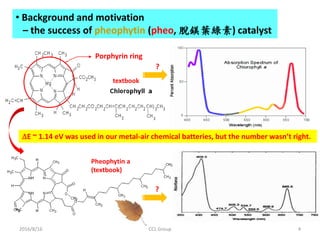
– the success of pheophytin (pheo, 脫鎂葉綠素) catalyst
Pheophytin a
(textbook)
textbook
Porphyrin ring
E ~ 1.14 eV was used in our metal-air chemical batteries, but the number wasn’t right.
?
?
2016/8/16 5CCL Group
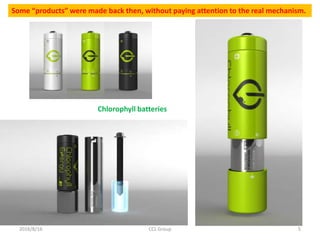
Chlorophyll batteries
Some “products” were made back then, without paying attention to the real mechanism.
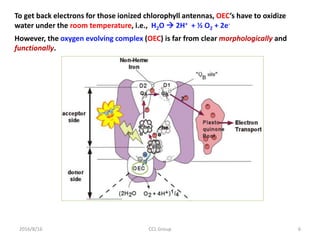
However, the oxygen evolving complex (OEC) is far from clear morphologically and
functionally.
To get back electrons for those ionized chlorophyll antennas, OEC’s have to oxidize
water under the room temperature, i.e., H2O  2H+ + ½ O2 + 2e-
2016/8/16 6CCL Group
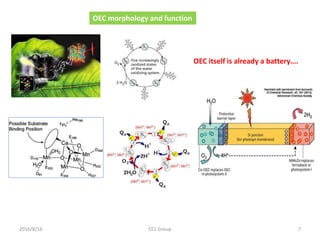
OEC morphology and function
OEC itself is already a battery….
2016/8/16 7CCL Group
2016/8/16 CCL Group 8
• What might be pheo’s other structure-related roles?  things we
bumped into in the original low-power chlorophyll battery
The original low-power chlorophyll (葉綠素) battery demonstrated that electricity can be
extracted from wetted chlorophyll powder which apparently had pre-stored the optical
energy from sun.
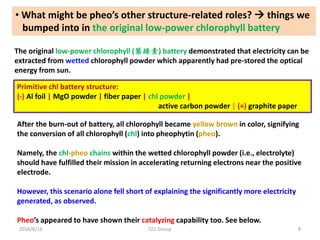
Primitive chl battery structure:
(-) Al foil | MgO powder | fiber paper | chl powder |
active carbon powder | (+) graphite paper
After the burn-out of battery, all chlorophyll became yellow brown in color, signifying
the conversion of all chlorophyll (chl) into pheophytin (pheo).
Namely, the chl-pheo chains within the wetted chlorophyll powder (i.e., electrolyte)
should have fulfilled their mission in accelerating returning electrons near the positive
electrode.
However, this scenario alone fell short of explaining the significantly more electricity
generated, as observed.
Pheo’s appeared to have shown their catalyzing capability too. See below.
2016/8/16 9CCL Group
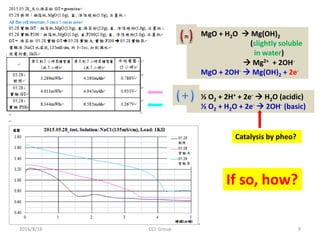
MgO + H2O  Mg(OH)2
(slightly soluble
in water)
 Mg2+ + 2OH-
MgO + 2OH-  Mg(OH)2 + 2e-
½ O2 + 2H+ + 2e-  H2O (acidic)
½ O2 + H2O + 2e-  2OH- (basic)
Catalysis by pheo?
If so, how?
2016/8/16 CCL Group 10
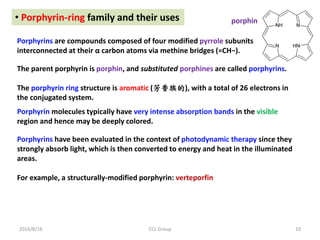
• Porphyrin-ring family and their uses
Porphyrins are compounds composed of four modified pyrrole subunits
interconnected at their α carbon atoms via methine bridges (=CH−).
The parent porphyrin is porphin, and substituted porphines are called porphyrins.
The porphyrin ring structure is aromatic (芳香族的), with a total of 26 electrons in
the conjugated system.
Porphyrin molecules typically have very intense absorption bands in the visible
region and hence may be deeply colored.
Porphyrins have been evaluated in the context of photodynamic therapy since they
strongly absorb light, which is then converted to energy and heat in the illuminated
areas.
For example, a structurally-modified porphyrin: verteporfin
porphin
2016/8/16 CCL Group 11
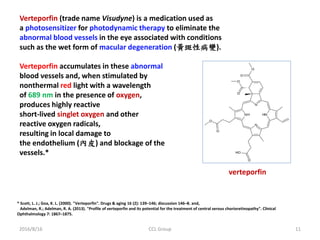
Verteporfin (trade name Visudyne) is a medication used as
a photosensitizer for photodynamic therapy to eliminate the
abnormal blood vessels in the eye associated with conditions
such as the wet form of macular degeneration (黃斑性病變).
* Scott, L. J.; Goa, K. L. (2000). "Verteporfin". Drugs & aging 16 (2): 139–146; discussion 146–8. and,
Adelman, R.; Adelman, R. A. (2013). "Profile of verteporfin and its potential for the treatment of central serous chorioretinopathy". Clinical
Ophthalmology 7: 1867–1875.
Verteporfin accumulates in these abnormal
blood vessels and, when stimulated by
nonthermal red light with a wavelength
of 689 nm in the presence of oxygen,
produces highly reactive
short-lived singlet oxygen and other
reactive oxygen radicals,
resulting in local damage to
the endothelium (內皮) and blockage of the
vessels.*
verteporfin
2016/8/16 CCL Group 12
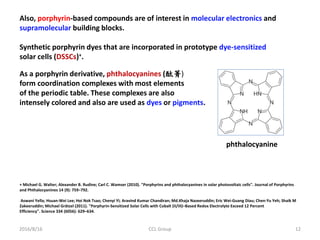
Also, porphyrin-based compounds are of interest in molecular electronics and
supramolecular building blocks.
Synthetic porphyrin dyes that are incorporated in prototype dye-sensitized
solar cells (DSSCs)+.
As a porphyrin derivative, phthalocyanines (酞菁)
form coordination complexes with most elements
of the periodic table. These complexes are also
intensely colored and also are used as dyes or pigments.
phthalocyanine
+ Michael G. Walter; Alexander B. Rudine; Carl C. Wamser (2010). "Porphyrins and phthalocyanines in solar photovoltaic cells". Journal of Porphyrins
and Phthalocyanines 14 (9): 759–792.
Aswani Yella; Hsuan-Wei Lee; Hoi Nok Tsao; Chenyi Yi; Aravind Kumar Chandiran; Md.Khaja Nazeeruddin; Eric Wei-Guang Diau; Chen-Yu Yeh; Shaik M
Zakeeruddin; Michael Grätzel (2011). "Porphyrin-Sensitized Solar Cells with Cobalt (II/III)–Based Redox Electrolyte Exceed 12 Percent
Efficiency". Science 334 (6056): 629–634.
2016/8/16 CCL Group 13
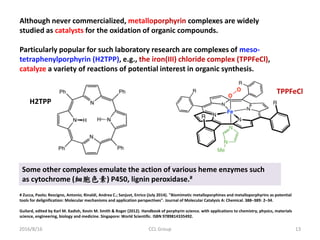
Although never commercialized, metalloporphyrin complexes are widely
studied as catalysts for the oxidation of organic compounds.
Particularly popular for such laboratory research are complexes of meso-
tetraphenylporphyrin (H2TPP), e.g., the iron(III) chloride complex (TPPFeCl),
catalyze a variety of reactions of potential interest in organic synthesis.
H2TPP
TPPFeCl
Some other complexes emulate the action of various heme enzymes such
as cytochrome (細胞色素) P450, lignin peroxidase.#
# Zucca, Paolo; Rescigno, Antonio; Rinaldi, Andrea C.; Sanjust, Enrico (July 2014). "Biomimetic metalloporphines and metalloporphyrins as potential
tools for delignification: Molecular mechanisms and application perspectives". Journal of Molecular Catalysis A: Chemical. 388–389: 2–34.
Guilard, edited by Karl M. Kadish, Kevin M. Smith & Roger (2012). Handbook of porphyrin science. with applications to chemistry, physics, materials
science, engineering, biology and medicine. Singapore: World Scientific. ISBN 9789814335492.
2016/8/16 CCL Group 14
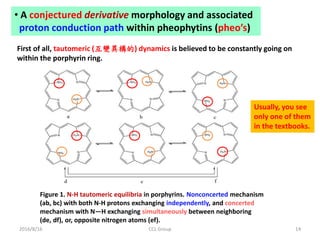
Figure 1. N-H tautomeric equilibria in porphyrins. Nonconcerted mechanism
(ab, bc) with both N-H protons exchanging independently, and concerted
mechanism with N—H exchanging simultaneously between neighboring
(de, df), or, opposite nitrogen atoms (ef).
• A conjectured derivative morphology and associated
proton conduction path within pheophytins (pheo’s)
First of all, tautomeric (互變異構的) dynamics is believed to be constantly going on
within the porphyrin ring.
Usually, you see
only one of them
in the textbooks.
2016/8/16 CCL Group 15
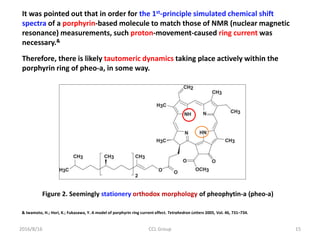
Figure 2. Seemingly stationery orthodox morphology of pheophytin-a (pheo-a)
It was pointed out that in order for the 1st-principle simulated chemical shift
spectra of a porphyrin-based molecule to match those of NMR (nuclear magnetic
resonance) measurements, such proton-movement-caused ring current was
necessary.&
Therefore, there is likely tautomeric dynamics taking place actively within the
porphyrin ring of pheo-a, in some way.
& Iwamoto, H.; Hori, K.; Fukazawa, Y. A model of porphyrin ring current effect. Tetrahedron Letters 2005, Vol. 46, 731–734.
2016/8/16 CCL Group 16
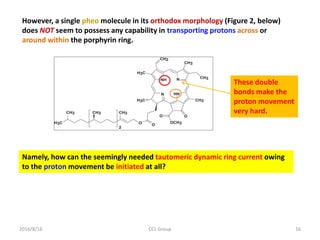
However, a single pheo molecule in its orthodox morphology (Figure 2, below)
does NOT seem to possess any capability in transporting protons across or
around within the porphyrin ring.
Namely, how can the seemingly needed tautomeric dynamic ring current owing
to the proton movement be initiated at all?
These double
bonds make the
proton movement
very hard.
2016/8/16 CCL Group 17
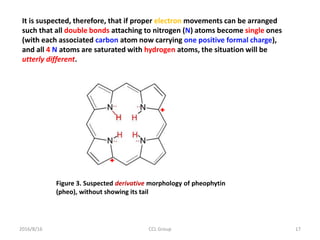
Figure 3. Suspected derivative morphology of pheophytin
(pheo), without showing its tail
It is suspected, therefore, that if proper electron movements can be arranged
such that all double bonds attaching to nitrogen (N) atoms become single ones
(with each associated carbon atom now carrying one positive formal charge),
and all 4 N atoms are saturated with hydrogen atoms, the situation will be
utterly different.
2016/8/16 CCL Group 18
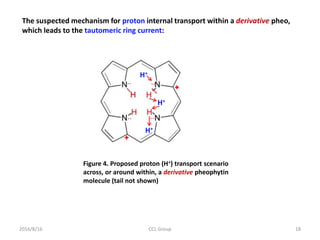
Figure 4. Proposed proton (H+) transport scenario
across, or around within, a derivative pheophytin
molecule (tail not shown)
The suspected mechanism for proton internal transport within a derivative pheo,
which leads to the tautomeric ring current:
H+
H+
H+
2016/8/16 CCL Group 19
Q: Can most existing spectra for standard (orthodox)
pheo be actually those of “derivative” pheo instead?
2016/8/16 CCL Group 20
Figure 5. Spectral comparison among (a) standard morphology plus 2 free protons
simulation, (b) derivative morphology with 4 N-H bonds in porphyrin ring simulation,
(c) measurement on ethanol-extracted pheo, and (d) existing data in literature
[courtesy of Milenković S. M. et al. (2012)]
• Spectral comparison among: 1st-principle quantum simulation,
measurement on ethanol-extracted pheo, and existing literature
Standard pheo
simulation
Derivative
pheo simulation
To our dismay, the
wiggly features
were not complete
still.
More structures?
Even different
weighting percent?
2016/8/16 CCL Group 21
1st-principle QM simulated spectrum of orthodox morphology of pheo does NOT
show the key little features as demonstrated by measurements, existent data, and
simulated derivative morphology.
Can existing textbooks or literatures about pheo morphology
be rigorously in error? If so, so what?
What can molecular geometry optimization reveal to us further?
More importantly:
Can such derivative morphologies facilitate hydrogen oxidation reaction (i.e.,
Orienting and splitting of H2 molecule, ionization of H atoms, as a catalyst for HOR)?
What about conducting energy simulations and a battery-related experiment?
2016/8/16 CCL Group 22
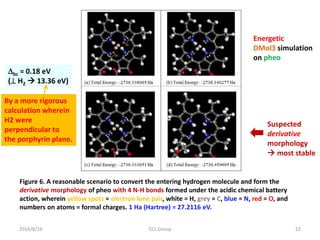
Figure 6. A reasonable scenario to convert the entering hydrogen molecule and form the
derivative morphology of pheo with 4 N-H bonds formed under the acidic chemical battery
action, wherein yellow spots = electron lone pair, white = H, grey = C, blue = N, red = O, and
numbers on atoms = formal charges. 1 Ha (Hartree) = 27.2116 eV.
Suspected
derivative
morphology
 most stable
Energetic
DMol3 simulation
on pheo
bc = 0.18 eV
( H2  13.36 eV)
By a more rigorous
calculation wherein
H2 were
perpendicular to
the porphyrin plane.
2016/8/16 CCL Group 23
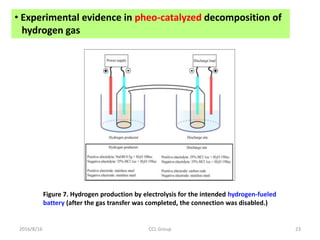
Figure 7. Hydrogen production by electrolysis for the intended hydrogen-fueled
battery (after the gas transfer was completed, the connection was disabled.)
• Experimental evidence in pheo-catalyzed decomposition of
hydrogen gas
2016/8/16 CCL Group 24
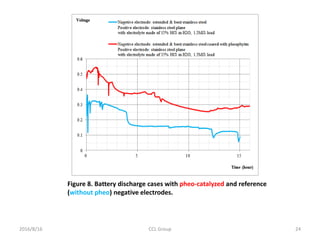
Figure 8. Battery discharge cases with pheo-catalyzed and reference
(without pheo) negative electrodes.
2016/8/16 CCL Group 25
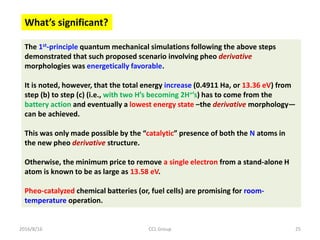
The 1st-principle quantum mechanical simulations following the above steps
demonstrated that such proposed scenario involving pheo derivative
morphologies was energetically favorable.
It is noted, however, that the total energy increase (0.4911 Ha, or 13.36 eV) from
step (b) to step (c) (i.e., with two H’s becoming 2H+’s) has to come from the
battery action and eventually a lowest energy state –the derivative morphology—
can be achieved.
This was only made possible by the “catalytic” presence of both the N atoms in
the new pheo derivative structure.
Otherwise, the minimum price to remove a single electron from a stand-alone H
atom is known to be as large as 13.58 eV.
Pheo-catalyzed chemical batteries (or, fuel cells) are promising for room-
temperature operation.
What’s significant?
2016/8/16 CCL Group 26
0
1
2
3
4
5
6
0 1 2 3 4 5 6 7 8 9 10 11 12 13 14 15 16 17 18 19 20 21 22 23 24 25
H2molenumberinthecontainer(mmol)
Time(Hr)
Hydrogen gas adsorption experiments
paper
paper with P
paper with P200
Reference Group_P Group_P200
H2 mole number after 55-min
electrolysis (mmol)
5.25392 5.05739 4.8768
H2 mole number after 24 hr. 5.23208 3.93935 3.7819
Adsorbed hydrogen amount
(mmol)
0.02184 1.11804
(22.11%)
1.0949
(22.45%)
Further related evidence: hydrogen adsorption by pheo
Though invisible for
the real situation,
this extra info
may serve as an
indirect evidence.
2016/8/16 CCL Group 27
• Summary and conclusions
It was conjectured that a derivative form of pheophytin had existed all along
which may provide the internal proton conductive path to account for the
observed NMR spectral features.
Then, such derivative form was suspected to facilitate its role as a general
catalyst, particularly to hydrogen gas decomposition.
Results from spectral analyses, quantum simulations, and chemical battery
experiments all pointed to the viability of such a conjecture.
Pheo-catalyzed H2 fuel cell can be a new possibility.
H2 storage in pheo can be a new fuel transport alternative after proper tailoring
of pheo structures.

A Suspected Derivative Morphology for pheophytin (脫鎂葉綠素) and the Enhanced Hydrogen Decomposition It Caused

  • 1.
    A Suspected DerivativeMorphology for pheophytin (脫鎂葉綠素) and the Enhanced Hydrogen Decomposition It Caused Jyun-Lin Huang,2 Wen-Bing Lai,2 Chungpin Liao,1,2,* Li-Shen Yeh2 (黃均霖) (賴玟柄) (廖重賓) (葉立紳) 1Graduate School of Electro-Optic and Materials Science, National Formosa University (NFU), Huwei, Taiwan 632, ROC. 2Advanced Research & Business Laboratory (ARBL), Taichung, Taiwan 407, ROC. *Corresponding Author: cpliao@alum.mit.edu and Speaker 2016/8/16 1CCL Group
  • 2.
    2016/8/16 2CCL Group Outline •What’s the role of pheophytin (pheo) in photosynthesis? • What might be pheo’s other structure-related roles?  things we bumped into in the original low-power chlorophyll battery • A conjectured derivative morphology and associated proton conduction path within pheophytins (pheo’s) • Experimental evidence in pheo-catalyzed decomposition of hydrogen gas • Summary and conclusions • Porphyrin-ring family and their uses • Spectral comparison among: 1st-principle quantum simulation, measurement on ethanol-extracted pheo, and existing literature
  • 3.
    2016/8/16 CCL Group3 • What’s the role of pheophytin (pheo) in photosynthesis? Pheo as: -1st acceptor of light- excited electrons -Accelerator of such electrons (~1.14 eV)
  • 4.
    2016/8/16 CCL Group4 • Background and motivation – the success of pheophytin (pheo, 脫鎂葉綠素) catalyst Pheophytin a (textbook) textbook Porphyrin ring E ~ 1.14 eV was used in our metal-air chemical batteries, but the number wasn’t right. ? ?
  • 5.
    2016/8/16 5CCL Group Chlorophyllbatteries Some “products” were made back then, without paying attention to the real mechanism.
  • 6.
    However, the oxygenevolving complex (OEC) is far from clear morphologically and functionally. To get back electrons for those ionized chlorophyll antennas, OEC’s have to oxidize water under the room temperature, i.e., H2O  2H+ + ½ O2 + 2e- 2016/8/16 6CCL Group
  • 7.
    OEC morphology andfunction OEC itself is already a battery…. 2016/8/16 7CCL Group
  • 8.
    2016/8/16 CCL Group8 • What might be pheo’s other structure-related roles?  things we bumped into in the original low-power chlorophyll battery The original low-power chlorophyll (葉綠素) battery demonstrated that electricity can be extracted from wetted chlorophyll powder which apparently had pre-stored the optical energy from sun. Primitive chl battery structure: (-) Al foil | MgO powder | fiber paper | chl powder | active carbon powder | (+) graphite paper After the burn-out of battery, all chlorophyll became yellow brown in color, signifying the conversion of all chlorophyll (chl) into pheophytin (pheo). Namely, the chl-pheo chains within the wetted chlorophyll powder (i.e., electrolyte) should have fulfilled their mission in accelerating returning electrons near the positive electrode. However, this scenario alone fell short of explaining the significantly more electricity generated, as observed. Pheo’s appeared to have shown their catalyzing capability too. See below.
  • 9.
    2016/8/16 9CCL Group MgO+ H2O  Mg(OH)2 (slightly soluble in water)  Mg2+ + 2OH- MgO + 2OH-  Mg(OH)2 + 2e- ½ O2 + 2H+ + 2e-  H2O (acidic) ½ O2 + H2O + 2e-  2OH- (basic) Catalysis by pheo? If so, how?
  • 10.
    2016/8/16 CCL Group10 • Porphyrin-ring family and their uses Porphyrins are compounds composed of four modified pyrrole subunits interconnected at their α carbon atoms via methine bridges (=CH−). The parent porphyrin is porphin, and substituted porphines are called porphyrins. The porphyrin ring structure is aromatic (芳香族的), with a total of 26 electrons in the conjugated system. Porphyrin molecules typically have very intense absorption bands in the visible region and hence may be deeply colored. Porphyrins have been evaluated in the context of photodynamic therapy since they strongly absorb light, which is then converted to energy and heat in the illuminated areas. For example, a structurally-modified porphyrin: verteporfin porphin
  • 11.
    2016/8/16 CCL Group11 Verteporfin (trade name Visudyne) is a medication used as a photosensitizer for photodynamic therapy to eliminate the abnormal blood vessels in the eye associated with conditions such as the wet form of macular degeneration (黃斑性病變). * Scott, L. J.; Goa, K. L. (2000). "Verteporfin". Drugs & aging 16 (2): 139–146; discussion 146–8. and, Adelman, R.; Adelman, R. A. (2013). "Profile of verteporfin and its potential for the treatment of central serous chorioretinopathy". Clinical Ophthalmology 7: 1867–1875. Verteporfin accumulates in these abnormal blood vessels and, when stimulated by nonthermal red light with a wavelength of 689 nm in the presence of oxygen, produces highly reactive short-lived singlet oxygen and other reactive oxygen radicals, resulting in local damage to the endothelium (內皮) and blockage of the vessels.* verteporfin
  • 12.
    2016/8/16 CCL Group12 Also, porphyrin-based compounds are of interest in molecular electronics and supramolecular building blocks. Synthetic porphyrin dyes that are incorporated in prototype dye-sensitized solar cells (DSSCs)+. As a porphyrin derivative, phthalocyanines (酞菁) form coordination complexes with most elements of the periodic table. These complexes are also intensely colored and also are used as dyes or pigments. phthalocyanine + Michael G. Walter; Alexander B. Rudine; Carl C. Wamser (2010). "Porphyrins and phthalocyanines in solar photovoltaic cells". Journal of Porphyrins and Phthalocyanines 14 (9): 759–792. Aswani Yella; Hsuan-Wei Lee; Hoi Nok Tsao; Chenyi Yi; Aravind Kumar Chandiran; Md.Khaja Nazeeruddin; Eric Wei-Guang Diau; Chen-Yu Yeh; Shaik M Zakeeruddin; Michael Grätzel (2011). "Porphyrin-Sensitized Solar Cells with Cobalt (II/III)–Based Redox Electrolyte Exceed 12 Percent Efficiency". Science 334 (6056): 629–634.
  • 13.
    2016/8/16 CCL Group13 Although never commercialized, metalloporphyrin complexes are widely studied as catalysts for the oxidation of organic compounds. Particularly popular for such laboratory research are complexes of meso- tetraphenylporphyrin (H2TPP), e.g., the iron(III) chloride complex (TPPFeCl), catalyze a variety of reactions of potential interest in organic synthesis. H2TPP TPPFeCl Some other complexes emulate the action of various heme enzymes such as cytochrome (細胞色素) P450, lignin peroxidase.# # Zucca, Paolo; Rescigno, Antonio; Rinaldi, Andrea C.; Sanjust, Enrico (July 2014). "Biomimetic metalloporphines and metalloporphyrins as potential tools for delignification: Molecular mechanisms and application perspectives". Journal of Molecular Catalysis A: Chemical. 388–389: 2–34. Guilard, edited by Karl M. Kadish, Kevin M. Smith & Roger (2012). Handbook of porphyrin science. with applications to chemistry, physics, materials science, engineering, biology and medicine. Singapore: World Scientific. ISBN 9789814335492.
  • 14.
    2016/8/16 CCL Group14 Figure 1. N-H tautomeric equilibria in porphyrins. Nonconcerted mechanism (ab, bc) with both N-H protons exchanging independently, and concerted mechanism with N—H exchanging simultaneously between neighboring (de, df), or, opposite nitrogen atoms (ef). • A conjectured derivative morphology and associated proton conduction path within pheophytins (pheo’s) First of all, tautomeric (互變異構的) dynamics is believed to be constantly going on within the porphyrin ring. Usually, you see only one of them in the textbooks.
  • 15.
    2016/8/16 CCL Group15 Figure 2. Seemingly stationery orthodox morphology of pheophytin-a (pheo-a) It was pointed out that in order for the 1st-principle simulated chemical shift spectra of a porphyrin-based molecule to match those of NMR (nuclear magnetic resonance) measurements, such proton-movement-caused ring current was necessary.& Therefore, there is likely tautomeric dynamics taking place actively within the porphyrin ring of pheo-a, in some way. & Iwamoto, H.; Hori, K.; Fukazawa, Y. A model of porphyrin ring current effect. Tetrahedron Letters 2005, Vol. 46, 731–734.
  • 16.
    2016/8/16 CCL Group16 However, a single pheo molecule in its orthodox morphology (Figure 2, below) does NOT seem to possess any capability in transporting protons across or around within the porphyrin ring. Namely, how can the seemingly needed tautomeric dynamic ring current owing to the proton movement be initiated at all? These double bonds make the proton movement very hard.
  • 17.
    2016/8/16 CCL Group17 Figure 3. Suspected derivative morphology of pheophytin (pheo), without showing its tail It is suspected, therefore, that if proper electron movements can be arranged such that all double bonds attaching to nitrogen (N) atoms become single ones (with each associated carbon atom now carrying one positive formal charge), and all 4 N atoms are saturated with hydrogen atoms, the situation will be utterly different.
  • 18.
    2016/8/16 CCL Group18 Figure 4. Proposed proton (H+) transport scenario across, or around within, a derivative pheophytin molecule (tail not shown) The suspected mechanism for proton internal transport within a derivative pheo, which leads to the tautomeric ring current: H+ H+ H+
  • 19.
    2016/8/16 CCL Group19 Q: Can most existing spectra for standard (orthodox) pheo be actually those of “derivative” pheo instead?
  • 20.
    2016/8/16 CCL Group20 Figure 5. Spectral comparison among (a) standard morphology plus 2 free protons simulation, (b) derivative morphology with 4 N-H bonds in porphyrin ring simulation, (c) measurement on ethanol-extracted pheo, and (d) existing data in literature [courtesy of Milenković S. M. et al. (2012)] • Spectral comparison among: 1st-principle quantum simulation, measurement on ethanol-extracted pheo, and existing literature Standard pheo simulation Derivative pheo simulation To our dismay, the wiggly features were not complete still. More structures? Even different weighting percent?
  • 21.
    2016/8/16 CCL Group21 1st-principle QM simulated spectrum of orthodox morphology of pheo does NOT show the key little features as demonstrated by measurements, existent data, and simulated derivative morphology. Can existing textbooks or literatures about pheo morphology be rigorously in error? If so, so what? What can molecular geometry optimization reveal to us further? More importantly: Can such derivative morphologies facilitate hydrogen oxidation reaction (i.e., Orienting and splitting of H2 molecule, ionization of H atoms, as a catalyst for HOR)? What about conducting energy simulations and a battery-related experiment?
  • 22.
    2016/8/16 CCL Group22 Figure 6. A reasonable scenario to convert the entering hydrogen molecule and form the derivative morphology of pheo with 4 N-H bonds formed under the acidic chemical battery action, wherein yellow spots = electron lone pair, white = H, grey = C, blue = N, red = O, and numbers on atoms = formal charges. 1 Ha (Hartree) = 27.2116 eV. Suspected derivative morphology  most stable Energetic DMol3 simulation on pheo bc = 0.18 eV ( H2  13.36 eV) By a more rigorous calculation wherein H2 were perpendicular to the porphyrin plane.
  • 23.
    2016/8/16 CCL Group23 Figure 7. Hydrogen production by electrolysis for the intended hydrogen-fueled battery (after the gas transfer was completed, the connection was disabled.) • Experimental evidence in pheo-catalyzed decomposition of hydrogen gas
  • 24.
    2016/8/16 CCL Group24 Figure 8. Battery discharge cases with pheo-catalyzed and reference (without pheo) negative electrodes.
  • 25.
    2016/8/16 CCL Group25 The 1st-principle quantum mechanical simulations following the above steps demonstrated that such proposed scenario involving pheo derivative morphologies was energetically favorable. It is noted, however, that the total energy increase (0.4911 Ha, or 13.36 eV) from step (b) to step (c) (i.e., with two H’s becoming 2H+’s) has to come from the battery action and eventually a lowest energy state –the derivative morphology— can be achieved. This was only made possible by the “catalytic” presence of both the N atoms in the new pheo derivative structure. Otherwise, the minimum price to remove a single electron from a stand-alone H atom is known to be as large as 13.58 eV. Pheo-catalyzed chemical batteries (or, fuel cells) are promising for room- temperature operation. What’s significant?
  • 26.
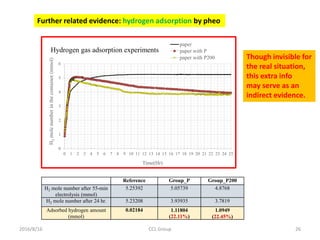
    2016/8/16 CCL Group26 0 1 2 3 4 5 6 0 1 2 3 4 5 6 7 8 9 10 11 12 13 14 15 16 17 18 19 20 21 22 23 24 25 H2molenumberinthecontainer(mmol) Time(Hr) Hydrogen gas adsorption experiments paper paper with P paper with P200 Reference Group_P Group_P200 H2 mole number after 55-min electrolysis (mmol) 5.25392 5.05739 4.8768 H2 mole number after 24 hr. 5.23208 3.93935 3.7819 Adsorbed hydrogen amount (mmol) 0.02184 1.11804 (22.11%) 1.0949 (22.45%) Further related evidence: hydrogen adsorption by pheo Though invisible for the real situation, this extra info may serve as an indirect evidence.
  • 27.
    2016/8/16 CCL Group27 • Summary and conclusions It was conjectured that a derivative form of pheophytin had existed all along which may provide the internal proton conductive path to account for the observed NMR spectral features. Then, such derivative form was suspected to facilitate its role as a general catalyst, particularly to hydrogen gas decomposition. Results from spectral analyses, quantum simulations, and chemical battery experiments all pointed to the viability of such a conjecture. Pheo-catalyzed H2 fuel cell can be a new possibility. H2 storage in pheo can be a new fuel transport alternative after proper tailoring of pheo structures.

Editor's Notes

  • #3 This study is more related to the pheo structure, instead of the photosynthesis.
  • #5 4 pyrrols  porphyrin ring; Each N can have only 3 bonds. Mg is bonded to only two N atoms, while only under the Van der Waals force influence of the other two N atoms. Note the tautomerism of porphyrin ring. The known absorption spectra may not correspond to the morphologies shown, as will be elaborated in this afternoon’s talk.
  • #15 ab, bc: one H at a time de: counter-clockwise rotation, df: clockwise rotation, ef: jump across simultaneously
  • #17 Note the double bonds connecting to N atoms in the orthodox morphology, which make the transport of protons hard.
  • #21 The obtained (b) is still unlike the realistic (c) and (d), maybe due to having not included all tautomeric possibilities in proper proportions.
  • #23 Note the energy needed to strip the two electrons from H atoms. Note the action zone features: porphyrin ring, N atoms, nearby H bond.