Managing and Using Information Systems:
A Strategic Approach – Fifth Edition
Strategic Use of
Information Resources
Keri Pearlson and Carol Saunders
PearlsonandSaunders–5thEd.–Chapter2
2-2
Learning Objectives
• List the identifying factors of the eras of information usage.
• Know what makes an information resource valuable.
• Explain how information resources are used strategically in context
of the 5-forces model.
• Understand how information resources can be used to alter the
value chain.
• Explain the importance of strategic alliances.
• Know the risks of information resources.
(c) 2013 John Wiley & Sons, Inc.
PearlsonandSaunders–5thEd.–Chapter2
2-3
Real World Example
• Zara aligns its information system strategy with its business
strategy.
• The system links demand to manufacturing and distribution.
• Customers visit up to 17 times per year to check on new items that
may have arrived.
• Limited products lead customers to immediately purchase products
they like.
• Zara’s business strategy leads to a loyal and satisfied customer base.
(c) 2013 John Wiley & Sons, Inc.
PearlsonandSaunders–5thEd.–Chapter2
2-4
Real World Example (Cont.)
• The POS system sends daily updates to Zara’s headquarters.
• Managers report to designers what sold and what customers wanted
but could not find.
• The information is used to determine inventory management.
• New designs can be ordered twice a week.
• The entire process is automated so that new designs and products
can be created quickly.
• Zara uses its information resources to sustain its advantages over
competitors.
(c) 2013 John Wiley & Sons, Inc.
PearlsonandSaunders–5thEd.–Chapter2
2-5
Evolution Of Information Resources
• IS strategy from the 1960s to the 1990s was driven by internal
organizational needs such as:
o Lowering existing transaction costs.
o Providing support for managers by collecting and distributing
information.
o Redesigning business processes.
• In the 2010 era IS strategy was driven by social IT platforms and
new capabilities.
o A new evolution of applications, processes, and strategic
opportunities.
(c) 2013 John Wiley & Sons, Inc.
PearlsonandSaunders–5thEd.–Chapter2
Figure 2.1 – Mission statements of computer companies.
Era I
1960s
Era II
1970s
Era III
1980s
Era IV
1990s
Era V
2000+
Era VI
2010+
Primary
role of IT
Efficiency
Automate
existing
paper-based
processes
Effectiveness
Solve
problems
and create
opportunities
Strategic
Increase
individual
and group
effectiveness
Strategic
Transform
industry/
organization
Value
creation
Create
collaborative
partnerships
Value
extension
Create
community
and social
business
Justify IT
expenditures
ROI Increasing
productivity
and better
decision
quality
Competitive
position
Competitive
position
Adding value Creating
relationships
Target of
systems
Organization Organization/
group
Individual
manager/
group
Business
processes
ecosystem
Customer/
supplier
ecosystem
Customer/
employee/
supplier
ecosystem
Information
models
Application
specific
Data driven User driven Business
driven
Knowledge
driven
People
driven
(or
relationship
driven)
© John Wiley & Sons
(c) 2013 John Wiley & Sons, Inc.
PearlsonandSaunders–5thEd.–Chapter2
Era I
1960s
Era II
1970s
Era III
1980s
Era IV
1990s
Era V
2000+
Era VI
2010+
Dominant
technology
Mainframe,
“centralized
intelligence”
Minicomputer,
mostly
“centralized
intelligence”
Microcomputer,
“decentralized
intelligence”
Client
Server,
“distributed
intelligence”
Internet,
global
“ubiquitous
intelligence”
Social
platforms,
social
networks,
mobile,
cloud
Basis of
value
Scarcity Scarcity Scarcity Plentitude Plentitude Plentitude
Underlying
economics
Economics
of
information
bundled with
economics of
things
Economics
of
information
bundled with
economics of
things
Economics
of
information
bundled with
economics of
things
Economics of
information
separated
from
economics of
things
Economics of
information
separated
from
economics of
things
Economics of
relationships
bundled with
economics of
information
© John Wiley & Sons
(c) 2013 John Wiley & Sons, Inc.
Figure 2.1 – Mission statements of computer companies (Cont.).
PearlsonandSaunders–5thEd.–Chapter2
2-8
• IS:
o Helps firms address their internal and external circumstances.
o Enables managers to identify and use information resources strategically.
o Enables firms to gain advantage over the competition.
• Firms draw on modern and innovative applications.
The Strategic Role for IS – Value Creation
(c) 2013 John Wiley & Sons, Inc.
PearlsonandSaunders–5thEd.–Chapter2
2-9
Information Resources as Strategic Tools
• Managers need to combine all of the firm’s available resources.
o Internal resources:
• Financial, production, human, and information resources.
o External resources:
• The Internet and various global opportunities.
• Information resources are the available data, technology,
people, and processes available to perform business processes and
tasks.
(c) 2013 John Wiley & Sons, Inc.
PearlsonandSaunders–5thEd.–Chapter2
2-10
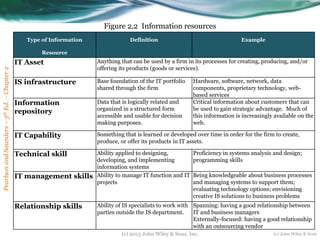
Information Resources
• Information resources can be either assets or capabilities.
o IT assets are anything tangible or intangible that can be used by
a firm in its processes for creating, producing, and/or offering its
products, goods, or services (e.g., IT infrastructure).
o IT capability is something that is learned or developed over time
for the firm to create, produce, or offer its products.
(c) 2013 John Wiley & Sons, Inc.
PearlsonandSaunders–5thEd.–Chapter2
2-11
IT Assets
• IS infrastructure:
o Includes data, technology, people, and processes.
o Provides the foundation for delivery of a firm’s products or services.
• Information repository:
o Logically-related data that is captured, organized, and retrievable
by the firm.
o Designed to improve the firm’s efficiency.
(c) 2013 John Wiley & Sons, Inc.
PearlsonandSaunders–5thEd.–Chapter2
2-12
IT Assets (Cont.)
• Web 2.0 space includes resources used but not owned by the firm
(e.g., eBay, Facebook, LinkedIn, etc.).
o Available as a service such as Internet-based software (Software as
a Service, or SAAS).
o Managers can manage customer information with an externally
based IT resource.
o Managers can find expertise or an entire network of individuals
ready to participate in the innovation processes with relatively
little capital or expense (e.g., Facebook, LinkedIn).
(c) 2013 John Wiley & Sons, Inc.
PearlsonandSaunders–5thEd.–Chapter2
2-13
Categories of IT Capabilities
• Technical skills - applied to designing, developing, and
implementing IS.
• IT management skills - critical for managing IT function and IT
projects.
• Relationship skills - can be either externally-focused or span
across departments.
• Committing and developing information resources requires
substantial financial resources.
(c) 2013 John Wiley & Sons, Inc.
PearlsonandSaunders–5thEd.–Chapter2
Figure 2.2 Information resources
Type of Information
Resource
Definition Example
IT Asset Anything that can be used by a firm in its processes for creating, producing, and/or
offering its products (goods or services).
IS infrastructure Base foundation of the IT portfolio
shared through the firm
Hardware, software, network, data
components, proprietary technology, web-
based services
Information
repository
Data that is logically related and
organized in a structured form
accessible and usable for decision
making purposes.
Critical information about customers that can
be used to gain strategic advantage. Much of
this information is increasingly available on the
web.
IT Capability Something that is learned or developed over time in order for the firm to create,
produce, or offer its products in IT assets.
Technical skill Ability applied to designing,
developing, and implementing
information systems
Proficiency in systems analysis and design;
programming skills
IT management skills Ability to manage IT function and IT
projects
Being knowledgeable about business processes
and managing systems to support them;
evaluating technology options; envisioning
creative IS solutions to business problems
Relationship skills Ability of IS specialists to work with
parties outside the IS department.
Spanning: having a good relationship between
IT and business managers
Externally-focused: having a good relationship
with an outsourcing vendor
(c) 2013 John Wiley & Sons, Inc. (c) John Wiley & Sons
PearlsonandSaunders–5thEd.–Chapter2
2-15
Advantages of Information Resource
• Information resource value:
o Eras I through III – value was derived from scarcity, reflected in the
cost to produce the information.
o Era IV – value was derived from plenitude.
o Network effects: the value of a network node to a person or
organization increases when others join the network (e.g., e-mail).
o Rather than use production costs to guide the determination of price,
information products might be priced to reflect their value to the
buyer.
(c) 2013 John Wiley & Sons, Inc.
PearlsonandSaunders–5thEd.–Chapter2
2-16
Advantages of Information Resource
(Cont.)
• Information resource appropriation:
o Determining where a resource’s value lies and how it can be improved
in a firm’s favor.
o The attributes of information resources that impact the value make it
possible to create and sustain competitive advantage (e.g., Zara).
• Information resource distribution across firms:
o Early adopters may experience a competitive advantage from using an
information resource.
o The experience gained may lead to inequities between firms.
o Different experiences with a resource create value and a strategic
advantage.
(c) 2013 John Wiley & Sons, Inc.
PearlsonandSaunders–5thEd.–Chapter2
2-17
Advantages of Information Resource
(Cont.)
o The value of information mushrooms under conditions of information
asymmetries.
o Possessor of information may use it against, or sell it to, companies or
individuals who are not otherwise able to access the information.
• Mobility of Information resource:
o Reliance on the individual skills of the IT professional.
o Risky as key individuals leave the firm, taking their experience with them.
o Development of unique knowledge-sharing processes and creation of an
organizational memory.
(c) 2013 John Wiley & Sons, Inc.
PearlsonandSaunders–5thEd.–Chapter2
2-18
Advantages of Information Resource
(Cont.)
• Debriefing with team members at the conclusion of each project.
• Using social technologies to record interactions and activity streams.
• Information resources become obsolete and lose value over time.
• Understanding the nature of the information resources at hand is a
prerequisite to using them effectively.
• Aligning IS strategy with business strategy enables the general
manager to maximize profit potential.
(c) 2013 John Wiley & Sons, Inc.
PearlsonandSaunders–5thEd.–Chapter2
2-19
Information Resources Strategy
• Managers confront elements that influence the competitive
environment.
• Slim tolerance for error.
• Managers must take multiple views of the strategic landscape:
o First view – Porter’s five competitive forces model.
o Second view – Porter’s value chain.
o Third view – types of IS resources needed to gain competitive advantage.
(c) 2013 John Wiley & Sons, Inc.
PearlsonandSaunders–5thEd.–Chapter2
2-20
Using Information Resources to Influence
Competitive Forces
• Porter’s five forces model shows the major forces that shape the competitive
environment of the firm (Figure 2.3 and 2.4).
o Threat of New Entrants: new firms that may enter a company’s market.
o Bargaining Power of Buyers: the ability of buyers to use their market
power to decrease a firm’s competitive position.
o Bargaining Power of Suppliers: the ability of suppliers of a product or
service to lower a firm’s competitive position.
o Threat of Substitutes: providers of equivalent or superior alternative
products.
o Industry Competitors: current competitors for the same product.
(c) 2013 John Wiley & Sons, Inc.
PearlsonandSaunders–5thEd.–Chapter2
2-21
Figure 2.3 Five competitive forces with potential strategic use of
information resources.
(c) 2013 John Wiley & Sons, Inc.
Sources: Adapted from M. Porter, Competitive Strategy (New York: The Free Press, 1998); and Lynda M. Applegate, F. Warren McFarlan, and James K. McKenney,
Corporate Information Systems Management: The Issues Facing Senior Executives, 4th ed. (Homewood, IL: Richard D. Irwin, 1996)
PearlsonandSaunders–5thEd.–Chapter2
2-22
Competitive Force IT Influence on Competitive Force
Threat of New
Entrants
Zara’s IT supports its tightly-knit group of designers, market specialists, production managers,
and production planners. New entrants are unlikely to provide IT to support relationships that
have been built over time. Further, it has a rich information repository about customers that
would be hard to replicate.
Bargaining Power
of Buyers
With its constant infusion of new products, buyers are drawn to Zara stores. Zara boasts more
than 11,000 new designs a year, whereas competitors typically offer only 2,000 – 4,000.
Further, because of the low inventory that the Zara stores stock, the regulars buy products they
like when they see them because they are likely to be gone the next time they visit the store. More
recently Zara has employed laser technology to measure 10,000 women volunteers so that it can
add the measurements of “real” customers into its information repositories. This means that the
new products will be more likely to fit Zara customers.
Bargaining Power
of Suppliers
Its computer-controlled cutting machine cuts up to 1,000 layers at a time. It then sends the cut
materials to suppliers who sew the pieces together. The suppliers’ work is relatively simple, and
many suppliers can do the sewing. Thus, the pool of suppliers is expanded, and Zara has greater
flexibility in choosing the sewing companies. Further, because Zara dyes 50% of the fabric in its
plant, it is less dependent on suppliers and can respond more quickly to mid-season changes in
customer color preferences.
Threat of
Substitute
Products
Industry competitors long marketed the desire for durable, classic lines. Zara focuses on meeting
customer preferences for trendy, low-cost fashion. It has the highest sales per square foot of any
of its competitors. It does so with virtually no advertising, and only 10% of stock is unsold. It
keeps its inventory levels very low and offers new products at an amazing pace for the industry
(e.g., 15 days from idea to shelves). Zara has extremely efficient manufacturing and distribution
operations.
Industrial
Competitors
Zara offers extremely fashionable lines that are only expected to last for approximately 10 wears.
It offers trendy, appealing apparel at a hard-to-beat price.
Figure 2.4 Application of five competitive forces model for Zara.
(c) 2013 John Wiley & Sons, Inc.
© John Wiley & Sons, Inc.
PearlsonandSaunders–5thEd.–Chapter2
2-23
Porter’s Value Chain Model
• Addresses the activities that create, deliver, and support a
company’s products or services (see Figure 2.5).
• Two broad categories:
o Primary activities – relate directly to the value created in a
product or service.
o Support activities – make it possible for the primary activities
to exist and remain coordinated.
(c) 2013 John Wiley & Sons, Inc.
PearlsonandSaunders–5thEd.–Chapter2
2-24
Figure 2.5 Value chain of the firm.
(c) 2013 John Wiley & Sons, Inc.
Source: Adapted from Michael Porter and Victor Millar, “How Information Gives You Competitive Advantage,” Harvard Business Review
(July-August 1985), reprint no. 85415.
PearlsonandSaunders–5thEd.–Chapter2
2-25
Resources to Attain Competitive
Advantage
• A resource is considered valuable when it enables the firm to become
more efficient or effective.
• A resource is rare when other firms do not possess it.
o Stakes or resources required just to be in the business (e.g., banks and
ATMs).
o Initially rare and valuable resources were the communities many
companies implemented using social IT.
o These communities were a valuable resource for the firms that
sponsored them, and only a few existed.
(c) 2013 John Wiley & Sons, Inc.
PearlsonandSaunders–5thEd.–Chapter2
2-26
Resources to Sustain Competitive
Advantage
• Many firms that invested in systems learned that gaining a
competitive advantage does not automatically mean that you can
sustain it over the long term.
• Need to continue to innovate and to protect against resource
imitation, substitution, or transfer.
• Technical knowledge, especially relating to the firm’s operation; a
gung-ho company culture; and managerial experience in the firm’s
environment is less easy to obtain and is considered harder to
transfer to other firms.
(c) 2013 John Wiley & Sons, Inc.
PearlsonandSaunders–5thEd.–Chapter2
Figure 2.8 - Information resources at Zara, by attribute.
VALUE CREATION VALUE SUSTAINABILITY
Value Rarity Imitation Substitution Transfer
Information Asset
IT Infrastructure M M H M H
Information Repository H M M L M
Information Capability
Technical Skills M L M M M
IT Management Skills H H L L M
Relationship Skills
Externally-focused H M L M L-M
Spanning H H L L L
Note: L = low; M = medium; H = high
Adapted from Wade, M and Hulland, J. “The Resource-Based View and Information Systems Research: Review, Extension and
Suggestions for Future Research,,” MIS Quarterly, 28(1), pp. 107-142.
(c) 2013 John Wiley & Sons, Inc.
PearlsonandSaunders–5thEd.–Chapter2
2-28
Strategic Alliances
• An interorganizational relationship that affords a strategic advantage to
one or more companies in the relationship.
o E.g., The alliance between Zynga and Facebook benefited Zynga with revenue
resulting from its gamers in Facebook’s community.
• IS can be the platform upon which a strategic alliance functions.
o E.g., The alliance between Delta and e-Travel helped Delta reduce agency
reservation fees and offered e-Travel new corporate leads.
• Linking value chains through SCM is another way firms build an IT-
facilitated strategic alliance.
(c) 2013 John Wiley & Sons, Inc.
PearlsonandSaunders–5thEd.–Chapter2
2-29
Types of Strategic Alliances
• Co-opetition: a new strategy whereby companies cooperate and
compete at the same time with other companies in their value net.
o Creates the best possible outcome for businesses by optimally combining
competition and cooperation.
• Value net includes a company, its competitors, complementors,
customers, and suppliers and the interactions among all of them.
• Complementor: a company whose products or services are used in
conjunction with a particular product or service to make a more useful
set for the customer.
(c) 2013 John Wiley & Sons, Inc.
PearlsonandSaunders–5thEd.–Chapter2
2-30
Potential Risks
• There are many potential risks that a firm faces when attempting to use
IT to outpace their competition.
• Awakening a sleeping giant – a large competitor with deeper
pockets may be nudged into implementing IS with even better features
(i.e FedEx and UPS).
• Demonstrating bad timing – sometimes customers are not ready to
use the technology designed to gain strategic advantage (e.g., GRiDPAD
in 1989 and iPad in 2010).
(c) 2013 John Wiley & Sons, Inc.
PearlsonandSaunders–5thEd.–Chapter2
2-31
Potential Risks (Cont.)
• Implementing IS poorly – information systems that fail because
they are poorly implemented (e.g., Virgin America, Hershey Foods, and
Austin Energy).
• Failing to deliver what users want – systems that don’t meet the
firm’s target market likely to fail (e.g., Netflix).
• Web-based alternative removes advantages – consider risk of
losing any advantage obtained by an information resource that later
becomes available as a service on the web (e.g., Clear Channel
Communications).
• Running afoul of the law – using IS strategically may promote
litigation (e.g., American Airlines, Google).
(c) 2013 John Wiley & Sons, Inc.
PearlsonandSaunders–5thEd.–Chapter2
2-32
Co-creating IT and Business Strategy
• Information is increasingly a more prominent core component of the
products or services offered by firms.
• IT strategy is business strategy; they cannot be created without each
other.
• Some companies’ main product is information (financial services).
• FedEx cannot function without IT even though they are primarily a
package-delivering company.
(c) 2013 John Wiley & Sons, Inc.

Sit chapter 2

  • 1.
    Managing and UsingInformation Systems: A Strategic Approach – Fifth Edition Strategic Use of Information Resources Keri Pearlson and Carol Saunders
  • 2.
    PearlsonandSaunders–5thEd.–Chapter2 2-2 Learning Objectives • Listthe identifying factors of the eras of information usage. • Know what makes an information resource valuable. • Explain how information resources are used strategically in context of the 5-forces model. • Understand how information resources can be used to alter the value chain. • Explain the importance of strategic alliances. • Know the risks of information resources. (c) 2013 John Wiley & Sons, Inc.
  • 3.
    PearlsonandSaunders–5thEd.–Chapter2 2-3 Real World Example •Zara aligns its information system strategy with its business strategy. • The system links demand to manufacturing and distribution. • Customers visit up to 17 times per year to check on new items that may have arrived. • Limited products lead customers to immediately purchase products they like. • Zara’s business strategy leads to a loyal and satisfied customer base. (c) 2013 John Wiley & Sons, Inc.
  • 4.
    PearlsonandSaunders–5thEd.–Chapter2 2-4 Real World Example(Cont.) • The POS system sends daily updates to Zara’s headquarters. • Managers report to designers what sold and what customers wanted but could not find. • The information is used to determine inventory management. • New designs can be ordered twice a week. • The entire process is automated so that new designs and products can be created quickly. • Zara uses its information resources to sustain its advantages over competitors. (c) 2013 John Wiley & Sons, Inc.
  • 5.
    PearlsonandSaunders–5thEd.–Chapter2 2-5 Evolution Of InformationResources • IS strategy from the 1960s to the 1990s was driven by internal organizational needs such as: o Lowering existing transaction costs. o Providing support for managers by collecting and distributing information. o Redesigning business processes. • In the 2010 era IS strategy was driven by social IT platforms and new capabilities. o A new evolution of applications, processes, and strategic opportunities. (c) 2013 John Wiley & Sons, Inc.
  • 6.
    PearlsonandSaunders–5thEd.–Chapter2 Figure 2.1 –Mission statements of computer companies. Era I 1960s Era II 1970s Era III 1980s Era IV 1990s Era V 2000+ Era VI 2010+ Primary role of IT Efficiency Automate existing paper-based processes Effectiveness Solve problems and create opportunities Strategic Increase individual and group effectiveness Strategic Transform industry/ organization Value creation Create collaborative partnerships Value extension Create community and social business Justify IT expenditures ROI Increasing productivity and better decision quality Competitive position Competitive position Adding value Creating relationships Target of systems Organization Organization/ group Individual manager/ group Business processes ecosystem Customer/ supplier ecosystem Customer/ employee/ supplier ecosystem Information models Application specific Data driven User driven Business driven Knowledge driven People driven (or relationship driven) © John Wiley & Sons (c) 2013 John Wiley & Sons, Inc.
  • 7.
    PearlsonandSaunders–5thEd.–Chapter2 Era I 1960s Era II 1970s EraIII 1980s Era IV 1990s Era V 2000+ Era VI 2010+ Dominant technology Mainframe, “centralized intelligence” Minicomputer, mostly “centralized intelligence” Microcomputer, “decentralized intelligence” Client Server, “distributed intelligence” Internet, global “ubiquitous intelligence” Social platforms, social networks, mobile, cloud Basis of value Scarcity Scarcity Scarcity Plentitude Plentitude Plentitude Underlying economics Economics of information bundled with economics of things Economics of information bundled with economics of things Economics of information bundled with economics of things Economics of information separated from economics of things Economics of information separated from economics of things Economics of relationships bundled with economics of information © John Wiley & Sons (c) 2013 John Wiley & Sons, Inc. Figure 2.1 – Mission statements of computer companies (Cont.).
  • 8.
    PearlsonandSaunders–5thEd.–Chapter2 2-8 • IS: o Helpsfirms address their internal and external circumstances. o Enables managers to identify and use information resources strategically. o Enables firms to gain advantage over the competition. • Firms draw on modern and innovative applications. The Strategic Role for IS – Value Creation (c) 2013 John Wiley & Sons, Inc.
  • 9.
    PearlsonandSaunders–5thEd.–Chapter2 2-9 Information Resources asStrategic Tools • Managers need to combine all of the firm’s available resources. o Internal resources: • Financial, production, human, and information resources. o External resources: • The Internet and various global opportunities. • Information resources are the available data, technology, people, and processes available to perform business processes and tasks. (c) 2013 John Wiley & Sons, Inc.
  • 10.
    PearlsonandSaunders–5thEd.–Chapter2 2-10 Information Resources • Informationresources can be either assets or capabilities. o IT assets are anything tangible or intangible that can be used by a firm in its processes for creating, producing, and/or offering its products, goods, or services (e.g., IT infrastructure). o IT capability is something that is learned or developed over time for the firm to create, produce, or offer its products. (c) 2013 John Wiley & Sons, Inc.
  • 11.
    PearlsonandSaunders–5thEd.–Chapter2 2-11 IT Assets • ISinfrastructure: o Includes data, technology, people, and processes. o Provides the foundation for delivery of a firm’s products or services. • Information repository: o Logically-related data that is captured, organized, and retrievable by the firm. o Designed to improve the firm’s efficiency. (c) 2013 John Wiley & Sons, Inc.
  • 12.
    PearlsonandSaunders–5thEd.–Chapter2 2-12 IT Assets (Cont.) •Web 2.0 space includes resources used but not owned by the firm (e.g., eBay, Facebook, LinkedIn, etc.). o Available as a service such as Internet-based software (Software as a Service, or SAAS). o Managers can manage customer information with an externally based IT resource. o Managers can find expertise or an entire network of individuals ready to participate in the innovation processes with relatively little capital or expense (e.g., Facebook, LinkedIn). (c) 2013 John Wiley & Sons, Inc.
  • 13.
    PearlsonandSaunders–5thEd.–Chapter2 2-13 Categories of ITCapabilities • Technical skills - applied to designing, developing, and implementing IS. • IT management skills - critical for managing IT function and IT projects. • Relationship skills - can be either externally-focused or span across departments. • Committing and developing information resources requires substantial financial resources. (c) 2013 John Wiley & Sons, Inc.
  • 14.
    PearlsonandSaunders–5thEd.–Chapter2 Figure 2.2 Informationresources Type of Information Resource Definition Example IT Asset Anything that can be used by a firm in its processes for creating, producing, and/or offering its products (goods or services). IS infrastructure Base foundation of the IT portfolio shared through the firm Hardware, software, network, data components, proprietary technology, web- based services Information repository Data that is logically related and organized in a structured form accessible and usable for decision making purposes. Critical information about customers that can be used to gain strategic advantage. Much of this information is increasingly available on the web. IT Capability Something that is learned or developed over time in order for the firm to create, produce, or offer its products in IT assets. Technical skill Ability applied to designing, developing, and implementing information systems Proficiency in systems analysis and design; programming skills IT management skills Ability to manage IT function and IT projects Being knowledgeable about business processes and managing systems to support them; evaluating technology options; envisioning creative IS solutions to business problems Relationship skills Ability of IS specialists to work with parties outside the IS department. Spanning: having a good relationship between IT and business managers Externally-focused: having a good relationship with an outsourcing vendor (c) 2013 John Wiley & Sons, Inc. (c) John Wiley & Sons
  • 15.
    PearlsonandSaunders–5thEd.–Chapter2 2-15 Advantages of InformationResource • Information resource value: o Eras I through III – value was derived from scarcity, reflected in the cost to produce the information. o Era IV – value was derived from plenitude. o Network effects: the value of a network node to a person or organization increases when others join the network (e.g., e-mail). o Rather than use production costs to guide the determination of price, information products might be priced to reflect their value to the buyer. (c) 2013 John Wiley & Sons, Inc.
  • 16.
    PearlsonandSaunders–5thEd.–Chapter2 2-16 Advantages of InformationResource (Cont.) • Information resource appropriation: o Determining where a resource’s value lies and how it can be improved in a firm’s favor. o The attributes of information resources that impact the value make it possible to create and sustain competitive advantage (e.g., Zara). • Information resource distribution across firms: o Early adopters may experience a competitive advantage from using an information resource. o The experience gained may lead to inequities between firms. o Different experiences with a resource create value and a strategic advantage. (c) 2013 John Wiley & Sons, Inc.
  • 17.
    PearlsonandSaunders–5thEd.–Chapter2 2-17 Advantages of InformationResource (Cont.) o The value of information mushrooms under conditions of information asymmetries. o Possessor of information may use it against, or sell it to, companies or individuals who are not otherwise able to access the information. • Mobility of Information resource: o Reliance on the individual skills of the IT professional. o Risky as key individuals leave the firm, taking their experience with them. o Development of unique knowledge-sharing processes and creation of an organizational memory. (c) 2013 John Wiley & Sons, Inc.
  • 18.
    PearlsonandSaunders–5thEd.–Chapter2 2-18 Advantages of InformationResource (Cont.) • Debriefing with team members at the conclusion of each project. • Using social technologies to record interactions and activity streams. • Information resources become obsolete and lose value over time. • Understanding the nature of the information resources at hand is a prerequisite to using them effectively. • Aligning IS strategy with business strategy enables the general manager to maximize profit potential. (c) 2013 John Wiley & Sons, Inc.
  • 19.
    PearlsonandSaunders–5thEd.–Chapter2 2-19 Information Resources Strategy •Managers confront elements that influence the competitive environment. • Slim tolerance for error. • Managers must take multiple views of the strategic landscape: o First view – Porter’s five competitive forces model. o Second view – Porter’s value chain. o Third view – types of IS resources needed to gain competitive advantage. (c) 2013 John Wiley & Sons, Inc.
  • 20.
    PearlsonandSaunders–5thEd.–Chapter2 2-20 Using Information Resourcesto Influence Competitive Forces • Porter’s five forces model shows the major forces that shape the competitive environment of the firm (Figure 2.3 and 2.4). o Threat of New Entrants: new firms that may enter a company’s market. o Bargaining Power of Buyers: the ability of buyers to use their market power to decrease a firm’s competitive position. o Bargaining Power of Suppliers: the ability of suppliers of a product or service to lower a firm’s competitive position. o Threat of Substitutes: providers of equivalent or superior alternative products. o Industry Competitors: current competitors for the same product. (c) 2013 John Wiley & Sons, Inc.
  • 21.
    PearlsonandSaunders–5thEd.–Chapter2 2-21 Figure 2.3 Fivecompetitive forces with potential strategic use of information resources. (c) 2013 John Wiley & Sons, Inc. Sources: Adapted from M. Porter, Competitive Strategy (New York: The Free Press, 1998); and Lynda M. Applegate, F. Warren McFarlan, and James K. McKenney, Corporate Information Systems Management: The Issues Facing Senior Executives, 4th ed. (Homewood, IL: Richard D. Irwin, 1996)
  • 22.
    PearlsonandSaunders–5thEd.–Chapter2 2-22 Competitive Force ITInfluence on Competitive Force Threat of New Entrants Zara’s IT supports its tightly-knit group of designers, market specialists, production managers, and production planners. New entrants are unlikely to provide IT to support relationships that have been built over time. Further, it has a rich information repository about customers that would be hard to replicate. Bargaining Power of Buyers With its constant infusion of new products, buyers are drawn to Zara stores. Zara boasts more than 11,000 new designs a year, whereas competitors typically offer only 2,000 – 4,000. Further, because of the low inventory that the Zara stores stock, the regulars buy products they like when they see them because they are likely to be gone the next time they visit the store. More recently Zara has employed laser technology to measure 10,000 women volunteers so that it can add the measurements of “real” customers into its information repositories. This means that the new products will be more likely to fit Zara customers. Bargaining Power of Suppliers Its computer-controlled cutting machine cuts up to 1,000 layers at a time. It then sends the cut materials to suppliers who sew the pieces together. The suppliers’ work is relatively simple, and many suppliers can do the sewing. Thus, the pool of suppliers is expanded, and Zara has greater flexibility in choosing the sewing companies. Further, because Zara dyes 50% of the fabric in its plant, it is less dependent on suppliers and can respond more quickly to mid-season changes in customer color preferences. Threat of Substitute Products Industry competitors long marketed the desire for durable, classic lines. Zara focuses on meeting customer preferences for trendy, low-cost fashion. It has the highest sales per square foot of any of its competitors. It does so with virtually no advertising, and only 10% of stock is unsold. It keeps its inventory levels very low and offers new products at an amazing pace for the industry (e.g., 15 days from idea to shelves). Zara has extremely efficient manufacturing and distribution operations. Industrial Competitors Zara offers extremely fashionable lines that are only expected to last for approximately 10 wears. It offers trendy, appealing apparel at a hard-to-beat price. Figure 2.4 Application of five competitive forces model for Zara. (c) 2013 John Wiley & Sons, Inc. © John Wiley & Sons, Inc.
  • 23.
    PearlsonandSaunders–5thEd.–Chapter2 2-23 Porter’s Value ChainModel • Addresses the activities that create, deliver, and support a company’s products or services (see Figure 2.5). • Two broad categories: o Primary activities – relate directly to the value created in a product or service. o Support activities – make it possible for the primary activities to exist and remain coordinated. (c) 2013 John Wiley & Sons, Inc.
  • 24.
    PearlsonandSaunders–5thEd.–Chapter2 2-24 Figure 2.5 Valuechain of the firm. (c) 2013 John Wiley & Sons, Inc. Source: Adapted from Michael Porter and Victor Millar, “How Information Gives You Competitive Advantage,” Harvard Business Review (July-August 1985), reprint no. 85415.
  • 25.
    PearlsonandSaunders–5thEd.–Chapter2 2-25 Resources to AttainCompetitive Advantage • A resource is considered valuable when it enables the firm to become more efficient or effective. • A resource is rare when other firms do not possess it. o Stakes or resources required just to be in the business (e.g., banks and ATMs). o Initially rare and valuable resources were the communities many companies implemented using social IT. o These communities were a valuable resource for the firms that sponsored them, and only a few existed. (c) 2013 John Wiley & Sons, Inc.
  • 26.
    PearlsonandSaunders–5thEd.–Chapter2 2-26 Resources to SustainCompetitive Advantage • Many firms that invested in systems learned that gaining a competitive advantage does not automatically mean that you can sustain it over the long term. • Need to continue to innovate and to protect against resource imitation, substitution, or transfer. • Technical knowledge, especially relating to the firm’s operation; a gung-ho company culture; and managerial experience in the firm’s environment is less easy to obtain and is considered harder to transfer to other firms. (c) 2013 John Wiley & Sons, Inc.
  • 27.
    PearlsonandSaunders–5thEd.–Chapter2 Figure 2.8 -Information resources at Zara, by attribute. VALUE CREATION VALUE SUSTAINABILITY Value Rarity Imitation Substitution Transfer Information Asset IT Infrastructure M M H M H Information Repository H M M L M Information Capability Technical Skills M L M M M IT Management Skills H H L L M Relationship Skills Externally-focused H M L M L-M Spanning H H L L L Note: L = low; M = medium; H = high Adapted from Wade, M and Hulland, J. “The Resource-Based View and Information Systems Research: Review, Extension and Suggestions for Future Research,,” MIS Quarterly, 28(1), pp. 107-142. (c) 2013 John Wiley & Sons, Inc.
  • 28.
    PearlsonandSaunders–5thEd.–Chapter2 2-28 Strategic Alliances • Aninterorganizational relationship that affords a strategic advantage to one or more companies in the relationship. o E.g., The alliance between Zynga and Facebook benefited Zynga with revenue resulting from its gamers in Facebook’s community. • IS can be the platform upon which a strategic alliance functions. o E.g., The alliance between Delta and e-Travel helped Delta reduce agency reservation fees and offered e-Travel new corporate leads. • Linking value chains through SCM is another way firms build an IT- facilitated strategic alliance. (c) 2013 John Wiley & Sons, Inc.
  • 29.
    PearlsonandSaunders–5thEd.–Chapter2 2-29 Types of StrategicAlliances • Co-opetition: a new strategy whereby companies cooperate and compete at the same time with other companies in their value net. o Creates the best possible outcome for businesses by optimally combining competition and cooperation. • Value net includes a company, its competitors, complementors, customers, and suppliers and the interactions among all of them. • Complementor: a company whose products or services are used in conjunction with a particular product or service to make a more useful set for the customer. (c) 2013 John Wiley & Sons, Inc.
  • 30.
    PearlsonandSaunders–5thEd.–Chapter2 2-30 Potential Risks • Thereare many potential risks that a firm faces when attempting to use IT to outpace their competition. • Awakening a sleeping giant – a large competitor with deeper pockets may be nudged into implementing IS with even better features (i.e FedEx and UPS). • Demonstrating bad timing – sometimes customers are not ready to use the technology designed to gain strategic advantage (e.g., GRiDPAD in 1989 and iPad in 2010). (c) 2013 John Wiley & Sons, Inc.
  • 31.
    PearlsonandSaunders–5thEd.–Chapter2 2-31 Potential Risks (Cont.) •Implementing IS poorly – information systems that fail because they are poorly implemented (e.g., Virgin America, Hershey Foods, and Austin Energy). • Failing to deliver what users want – systems that don’t meet the firm’s target market likely to fail (e.g., Netflix). • Web-based alternative removes advantages – consider risk of losing any advantage obtained by an information resource that later becomes available as a service on the web (e.g., Clear Channel Communications). • Running afoul of the law – using IS strategically may promote litigation (e.g., American Airlines, Google). (c) 2013 John Wiley & Sons, Inc.
  • 32.
    PearlsonandSaunders–5thEd.–Chapter2 2-32 Co-creating IT andBusiness Strategy • Information is increasingly a more prominent core component of the products or services offered by firms. • IT strategy is business strategy; they cannot be created without each other. • Some companies’ main product is information (financial services). • FedEx cannot function without IT even though they are primarily a package-delivering company. (c) 2013 John Wiley & Sons, Inc.

Editor's Notes

  • #6 The strategic role for IS is to help organizations address its internal and external circumstances. As competitors built similar systems, organizations lost any advantages they held from their IS, and competition within a given industry once again was driven by forces that existed prior to the new technology.
  • #9 Adopt modern applications to overcome new competitors.
  • #10 Information resources are more than just the infrastructure.
  • #11 An IT capability makes it possible for a firm to use its IT assets effectively.
  • #12 Some information repositories are filled with internally-oriented information designed to improve the firm’s efficiency. Other repositories tap the external environment and contain significant knowledge about the industry, the competitors, and the customers.
  • #13 Web 2.0 - additional information resources are often available as a service, rather than as a system to be procured and implemented internally.
  • #14 IT management skills require: Understanding of business processes. Ability to oversee the development and maintenance of systems to support these processes effectively. Ability to plan and work with the business units in undertaking change. Relationship skills: Ability to respond to the firm’s market and to work with customers and suppliers. The relationship between a firm’s IS managers and its business managers is a spanning relationship skill and includes the ability of IS to manage partnerships with the business units. Relationship skills develop over time and require mutual respect and trust.
  • #16 Eras I through III – Information, like diamonds, gold, and MBA degrees, was more valuable because it was found in limited quantities. Era IV – The networked economy. An e-mail account has no value without another e-mail account that could receive the e-mail. As e-mail accounts become relatively ubiquitous, the value of having an e-mail account increases as its potential for use increases. Further, copying additional people on an e-mail is done at a very low cost (virtually zero). As the cost of producing an additional copy of an information product within a network becomes trivial, the value of that network increases.
  • #17 For example, at Zara, the speed of information sharing is the source of the value to the firm. Information from the retail shops is quickly sent and analyzed by designers to identify future products. For example, a manager who has mastered the value from internal wikis may find uses for them that give his or her firm a momentary advantage. However in the longer term, these resources become more common and others are able to gain similar benefits. But the experience gained when using the information resource may cause inequities between firms.
  • #19 At Zara, customer information is compiled centrally, so any one store’s experience, while valuable, is not likely to provide the same information as the consolidated information seen by the designers who analyze data from thousands of stores. A general manager must understand the rate of decline of value, as well as factors that may speed or slow it. For example, in a database of customer information, how long, on average, is the current address of each customer valid? What events in the economy might change their purchasing pattern and reduce the forecasting capability of the current information? Are the trends derived from analyzing past sales valid to predict future sales patterns?
  • #20 Information resources: Should be directed strategically to alter the competitive forces to benefit the firm’s position in the industry. Should be directed at altering the value-creating or value-supporting activities of the firm. We extend this view further to consider the value chain of an entire industry to identify opportunities for the organization to gain competitive advantage.
  • #24 For example, more efficient IS for repairing a product may increase the possible number of repairs per week, but the customer does not receive any value unless his or her product is repaired, which requires that the spare parts to be available. If information resources are focused too narrowly on a specific activity, then the expected value increase may not be realized, as other parts of the chain are not adjusted.
  • #25 Primary activities relate directly to the value created in a product or service, whereas support activities make it possible for the primary activities to exist and remain coordinated. Each activity may affect how other activities are performed, suggesting that information resources should not be applied in isolation.
  • #26 For example, banks and ATMs. ATMs are very valuable to the banks in terms of their operations. A bank’s customers expect it to provide ATMs in many convenient locations. However, because many other banks also have ATMs, they are not a rare resource, and they do not offer a strategic advantage.
  • #27 Some IT management skills are general enough in nature to make them easier to transfer and imitate relationship skills.
  • #29 Technology can help produce the product developed by the alliance, share information resources across the partners’ existing value systems, or facilitate communication and coordination among the partners.
  • #30 Goodyear is a complementor to Ford and GM. Amazon is a complementor to Apple.