Enhancing Independence and
Person Centred Practice –
A Pathway to Implementing
Consumer Directed Care
Better Practice Conference
Australian Aged Care Quality Agency
Carrie Hayter,
Managing Director
Carrie Hayter Consulting
27 August 2015,
Sydney, Australia
28 August 2015 © Carrie Hayter Consulting 1
About Carrie Hayter Consulting
28 August 2015
Nothing about me without me
Personalising Care
– Translating Research into Practice
– A Handbook for community care services , Empowering People, enhancing
independence, enriching lives with Alt Beatty Consulting for NSW Government
– Strategic Planning, Research and Evaluation
– Education, coaching and mentoring
– Person Centred Practice and Thinking (managers and support workers)
– Cultural Diversity and Cultural Competence
– Ageing and Sexuality (managers)
– Ageing and Sexuality (frontline workers)
– Implementing Consumer Directed Care (Managers and Support Workers)
– Living Life my Way (Service Users)
© Carrie Hayter Consulting 2
Presentation Outline
• Personalisation
– Narratives and Research
• Challenges & Opportunities
– Moving from person-centred to ‘consumer’
directed or person directed supports
– Adaptive Leadership Framework
• Questions and Practical Steps
28 August 2015 © Carrie Hayter Consulting 3
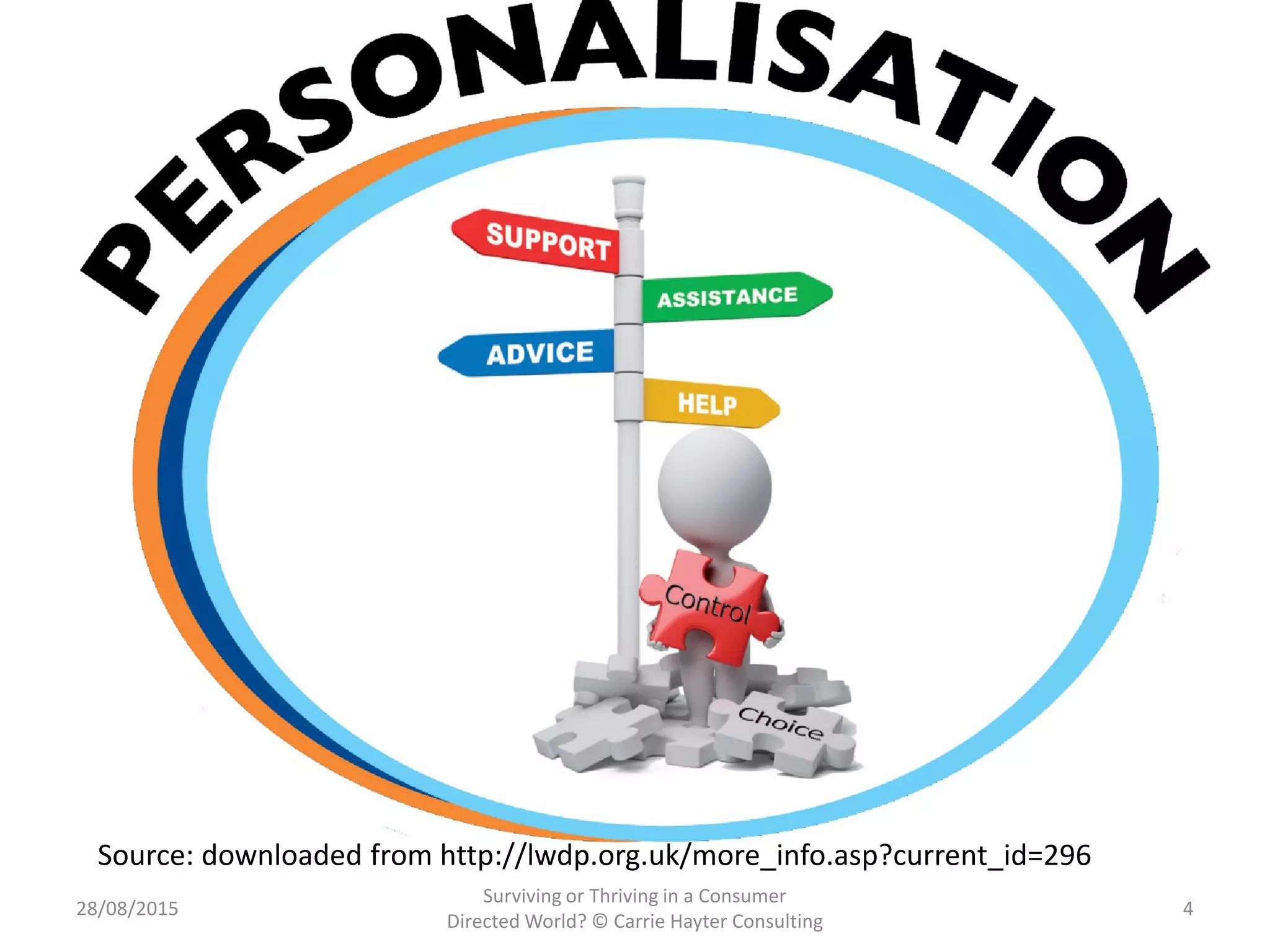
Source: downloaded from http://lwdp.org.uk/more_info.asp?current_id=296
28/08/2015
Surviving or Thriving in a Consumer
Directed World? © Carrie Hayter Consulting
4
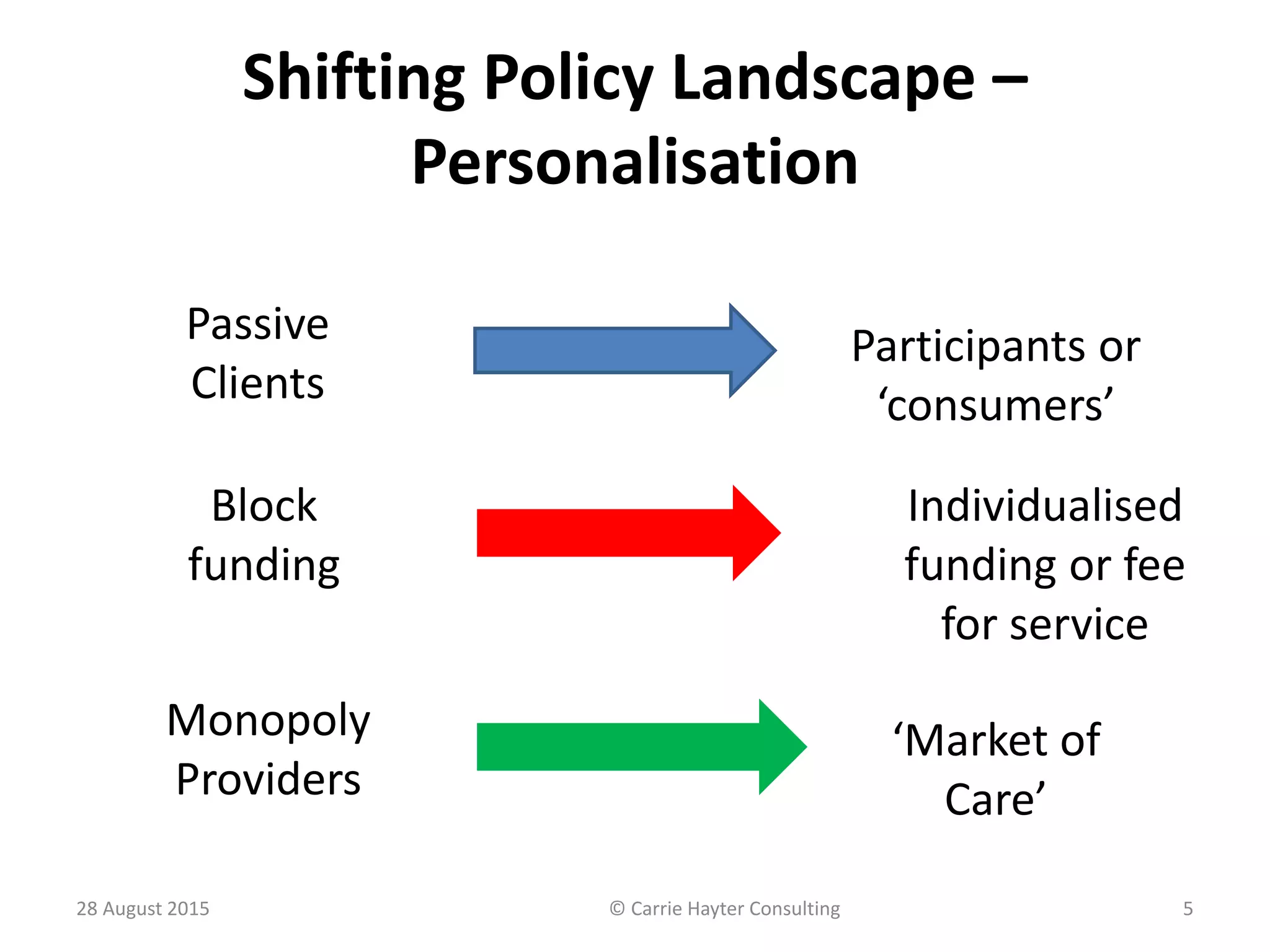
Shifting Policy Landscape –
Personalisation
Passive
Clients
Participants or
‘consumers’
Block
funding
Individualised
funding or fee
for service
Monopoly
Providers
‘Market of
Care’
28 August 2015 © Carrie Hayter Consulting 5
28 August 2015 © Carrie Hayter Consulting 6
28 August 2015 © Carrie Hayter Consulting 7
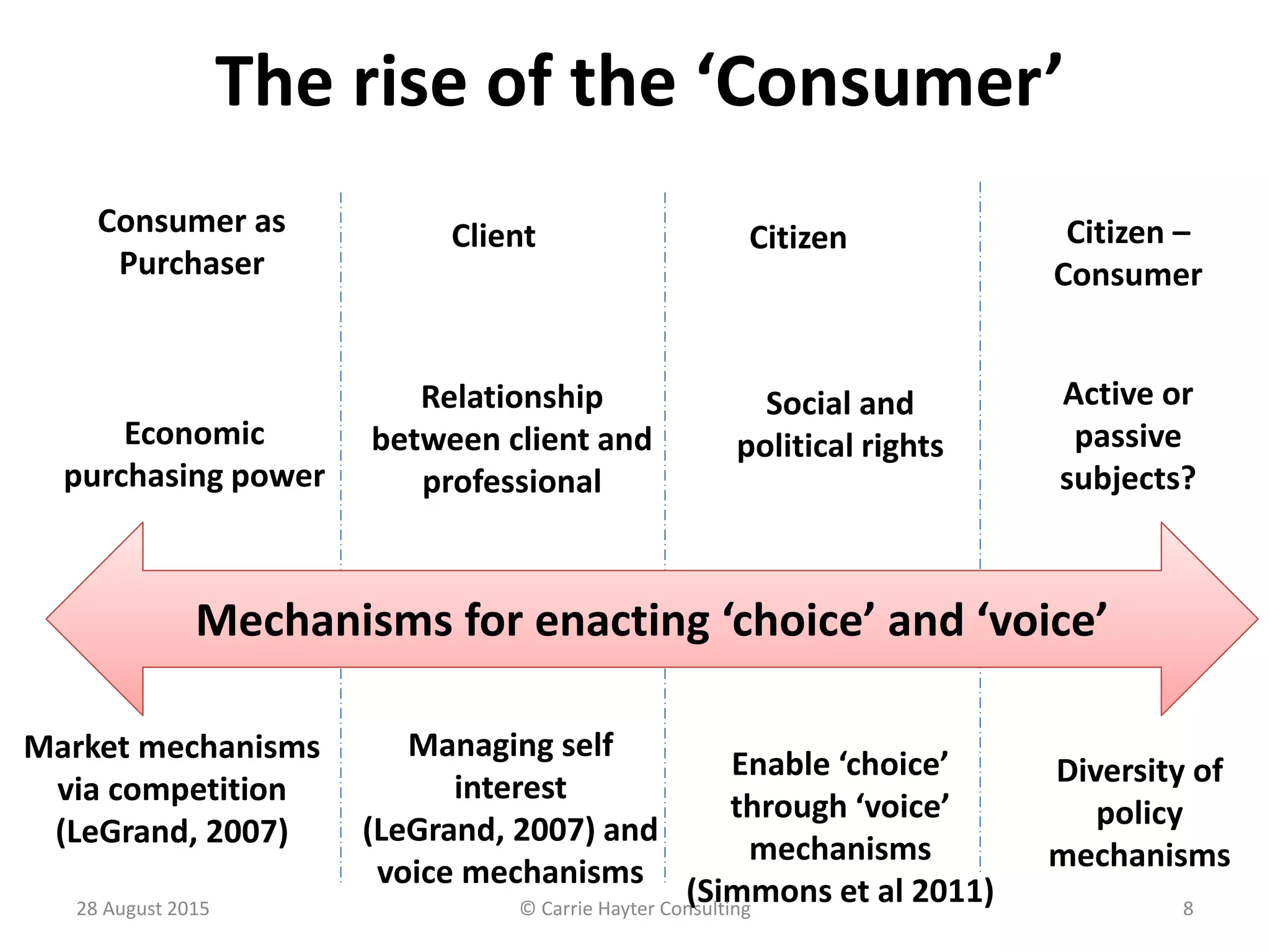
The rise of the ‘Consumer’
Consumer as
Purchaser
Citizen
Social and
political rightsEconomic
purchasing power
Relationship
between client and
professional
Client Citizen –
Consumer
Active or
passive
subjects?
Mechanisms for enacting ‘choice’ and ‘voice’Mechanisms for enacting ‘choice’ and ‘voice’
Market mechanisms
via competition
(LeGrand, 2007)
Managing self
interest
(LeGrand, 2007) and
voice mechanisms
Enable ‘choice’
through ‘voice’
mechanisms
(Simmons et al 2011)
Diversity of
policy
mechanisms
28 August 2015 © Carrie Hayter Consulting 8
28 August 2015 © Carrie Hayter Consulting 9
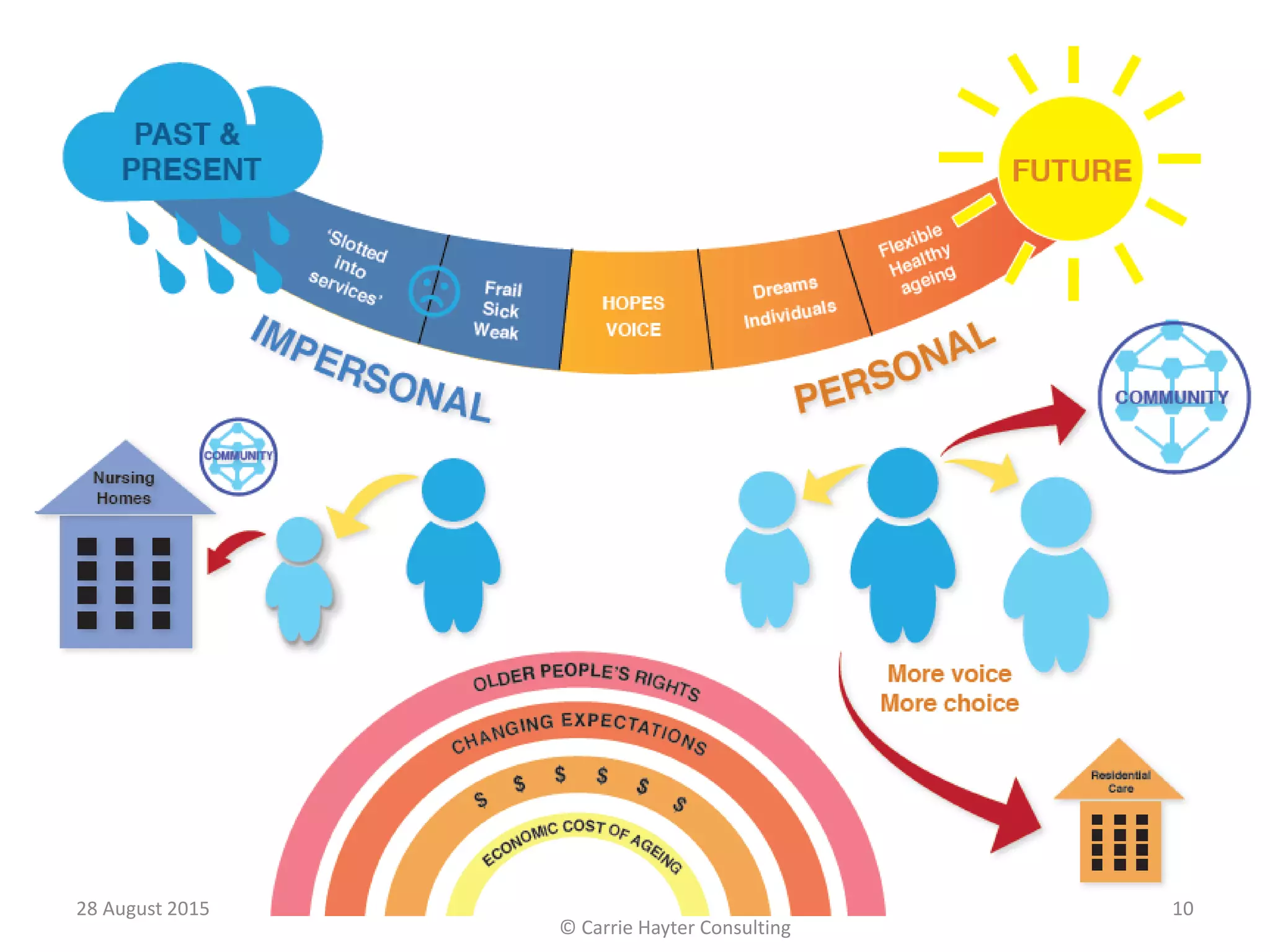
1028 August 2015
© Carrie Hayter Consulting
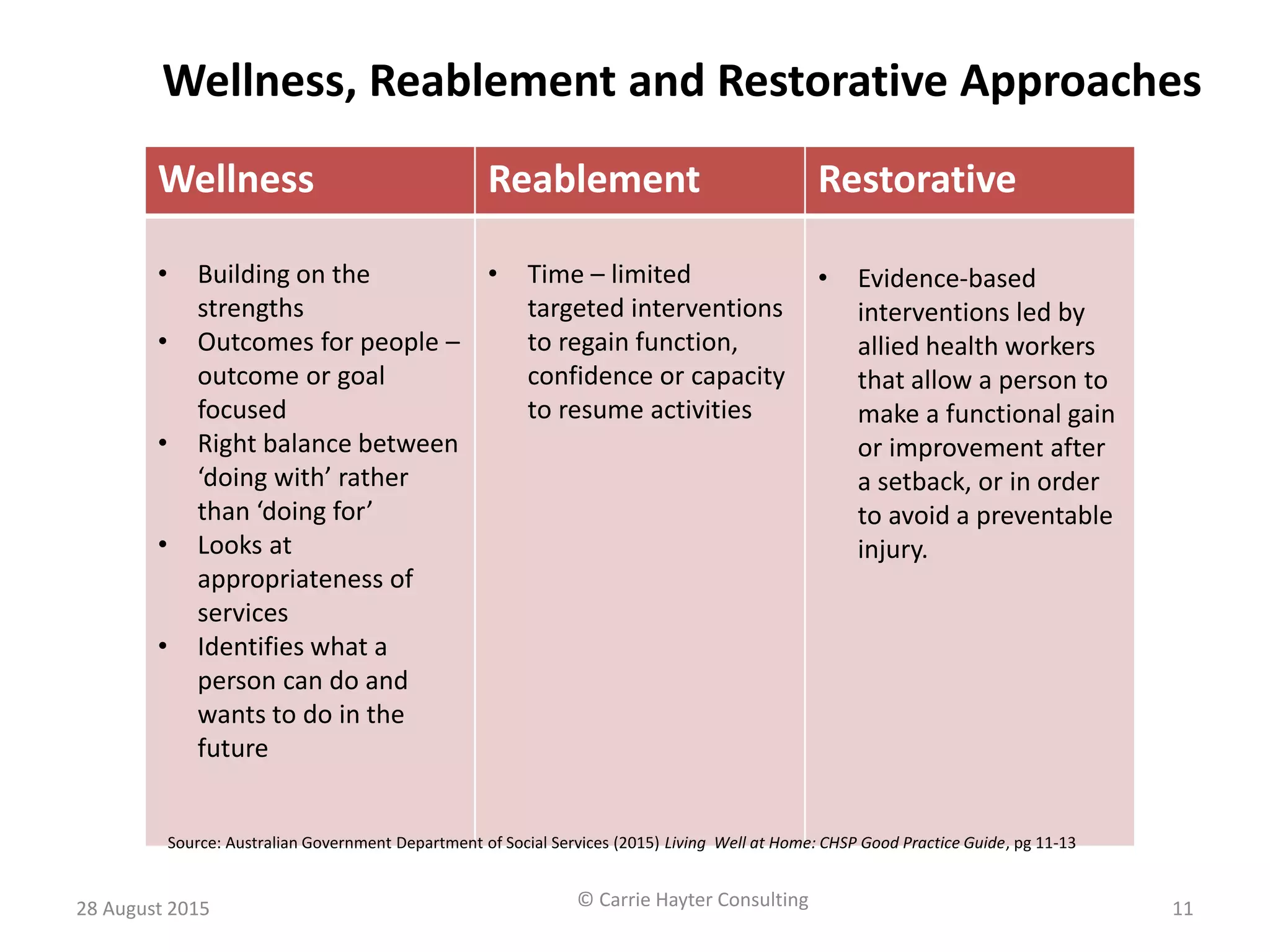
28 August 2015 © Carrie Hayter Consulting 11
Wellness Reablement Restorative
• Building on the
strengths
• Outcomes for people –
outcome or goal
focused
• Right balance between
‘doing with’ rather
than ‘doing for’
• Looks at
appropriateness of
services
• Identifies what a
person can do and
wants to do in the
future
• Time – limited
targeted interventions
to regain function,
confidence or capacity
to resume activities
• Evidence-based
interventions led by
allied health workers
that allow a person to
make a functional gain
or improvement after
a setback, or in order
to avoid a preventable
injury.
Wellness, Reablement and Restorative Approaches
Source: Australian Government Department of Social Services (2015) Living Well at Home: CHSP Good Practice Guide, pg 11-13
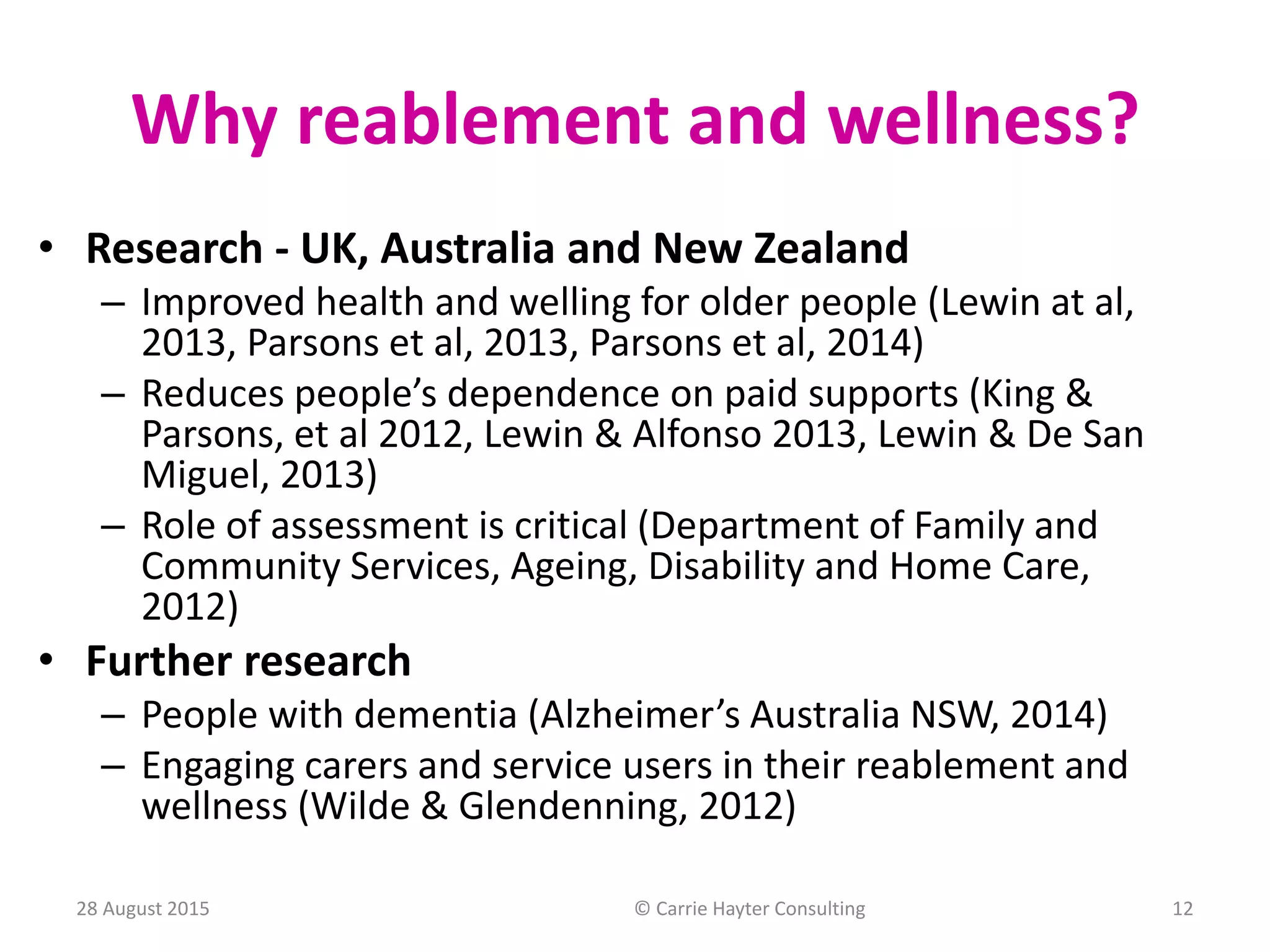
Why reablement and wellness?
• Research - UK, Australia and New Zealand
– Improved health and welling for older people (Lewin at al,
2013, Parsons et al, 2013, Parsons et al, 2014)
– Reduces people’s dependence on paid supports (King &
Parsons, et al 2012, Lewin & Alfonso 2013, Lewin & De San
Miguel, 2013)
– Role of assessment is critical (Department of Family and
Community Services, Ageing, Disability and Home Care,
2012)
• Further research
– People with dementia (Alzheimer’s Australia NSW, 2014)
– Engaging carers and service users in their reablement and
wellness (Wilde & Glendenning, 2012)
28 August 2015 © Carrie Hayter Consulting 12
Personalisation Narratives
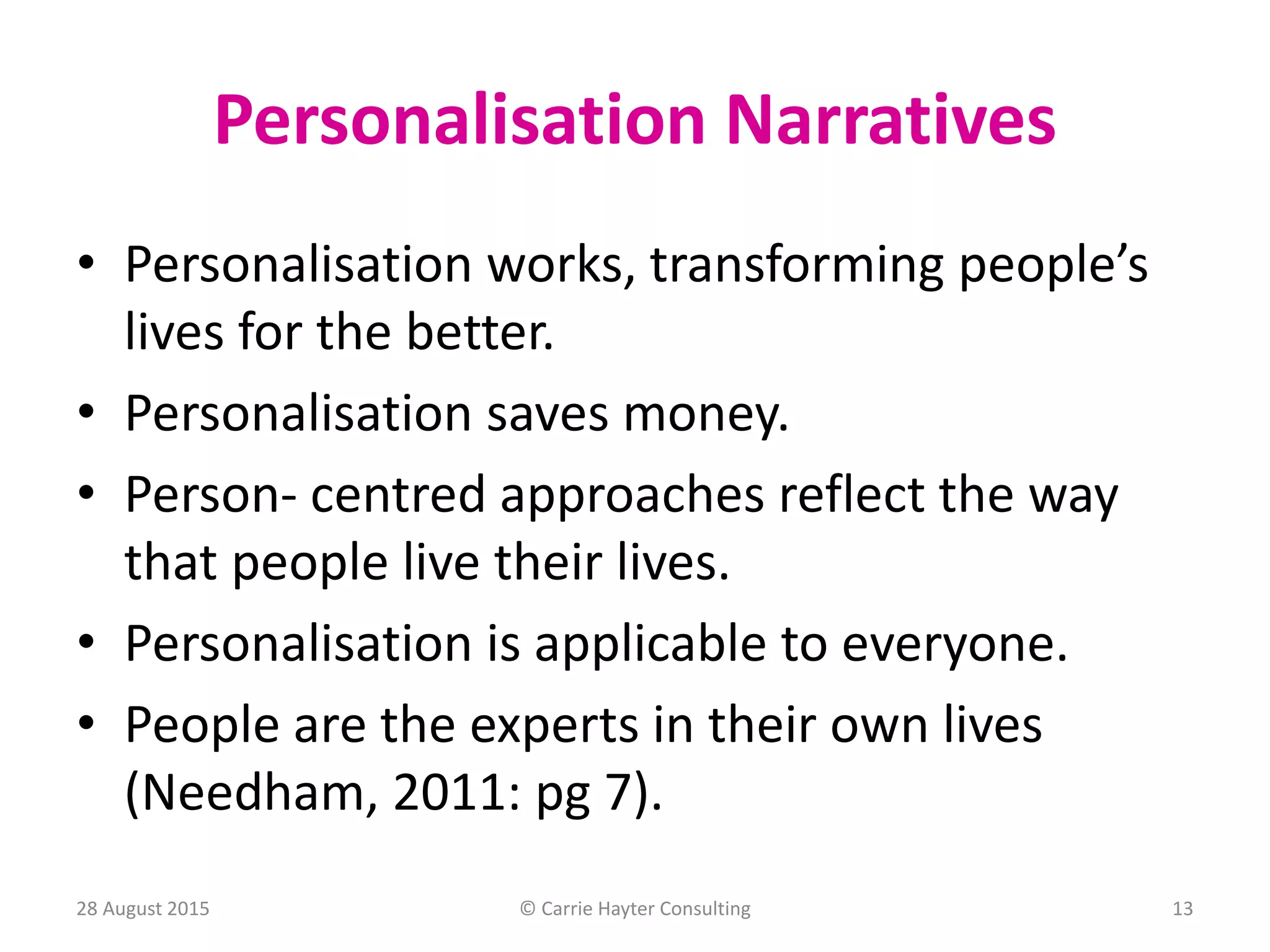
• Personalisation works, transforming people’s
lives for the better.
• Personalisation saves money.
• Person- centred approaches reflect the way
that people live their lives.
• Personalisation is applicable to everyone.
• People are the experts in their own lives
(Needham, 2011: pg 7).
28 August 2015 © Carrie Hayter Consulting 13
Personalisation and Carers
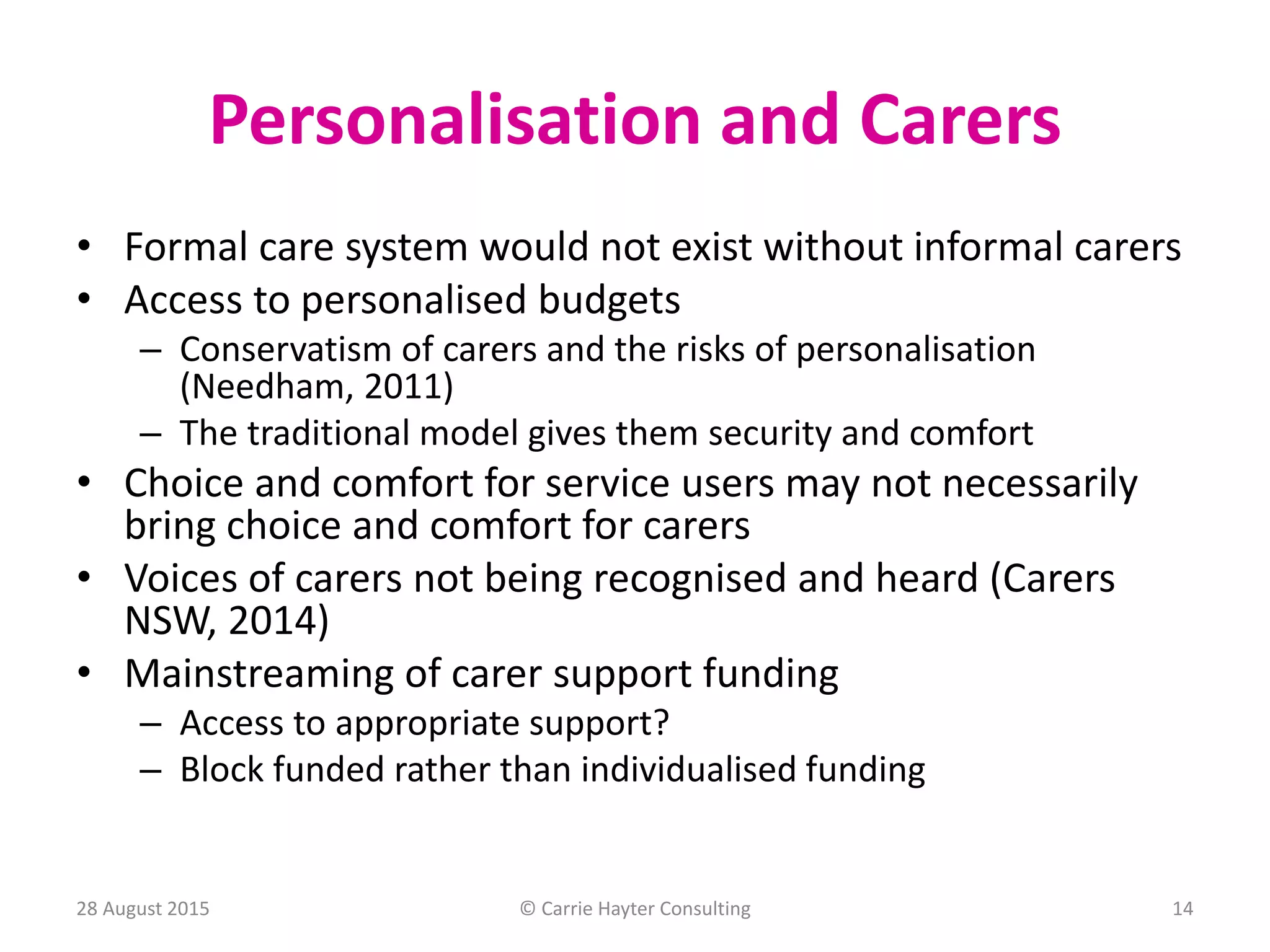
• Formal care system would not exist without informal carers
• Access to personalised budgets
– Conservatism of carers and the risks of personalisation
(Needham, 2011)
– The traditional model gives them security and comfort
• Choice and comfort for service users may not necessarily
bring choice and comfort for carers
• Voices of carers not being recognised and heard (Carers
NSW, 2014)
• Mainstreaming of carer support funding
– Access to appropriate support?
– Block funded rather than individualised funding
28 August 2015 © Carrie Hayter Consulting 14
28 August 2015
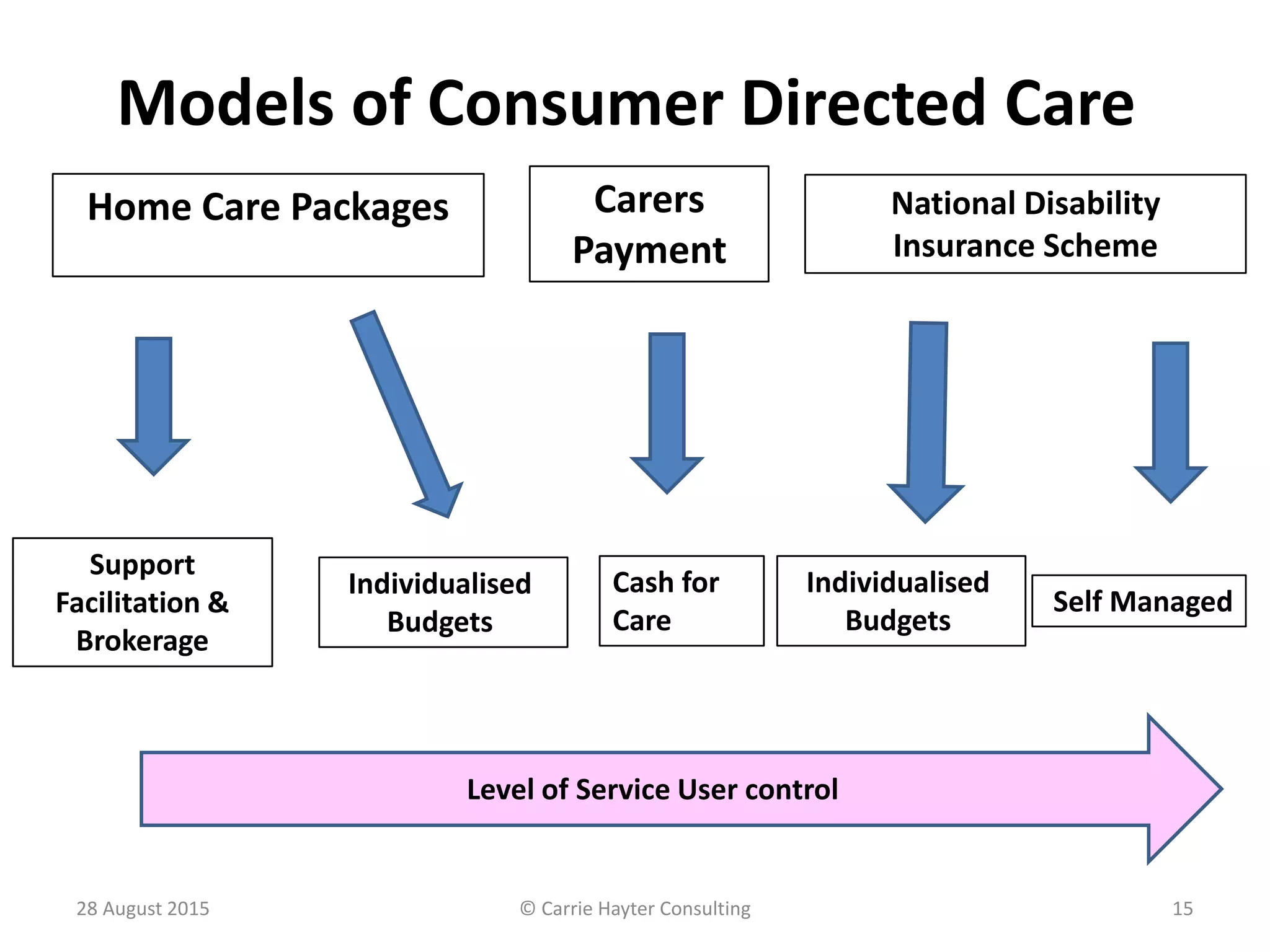
Models of Consumer Directed Care
Support
Facilitation &
Brokerage
Individualised
Budgets
Cash for
Care
Self Managed
Home Care Packages National Disability
Insurance Scheme
Level of Service User control
© Carrie Hayter Consulting 15
Carers
Payment
Individualised
Budgets
28 August 2015 © Carrie Hayter Consulting 16
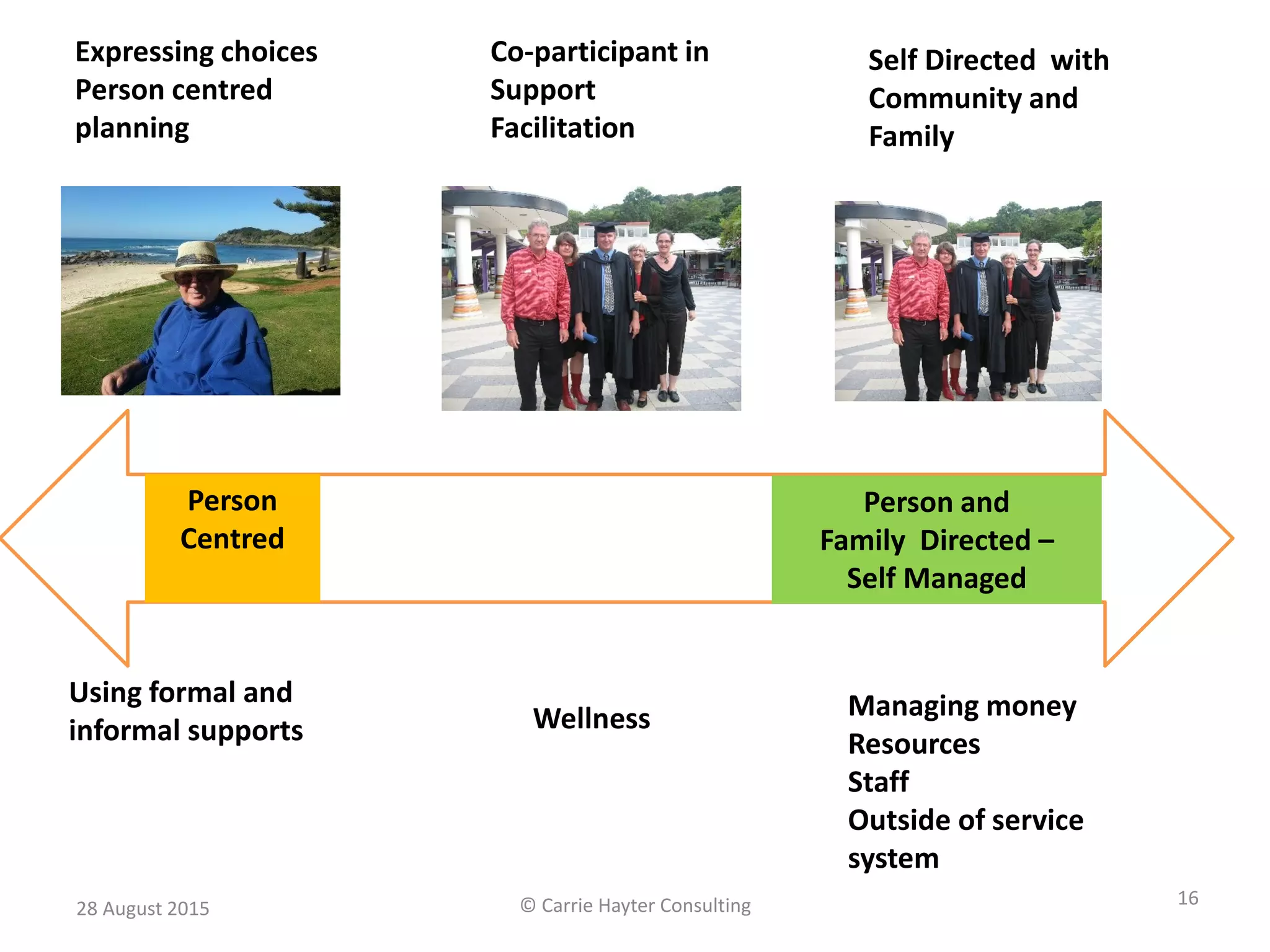
Expressing choices
Person centred
planning
Self Directed with
Community and
Family
Using formal and
informal supports
Managing money
Resources
Staff
Outside of service
system
Co-participant in
Support
Facilitation
Person
Centred
Person and
Family Directed –
Self Managed
Wellness
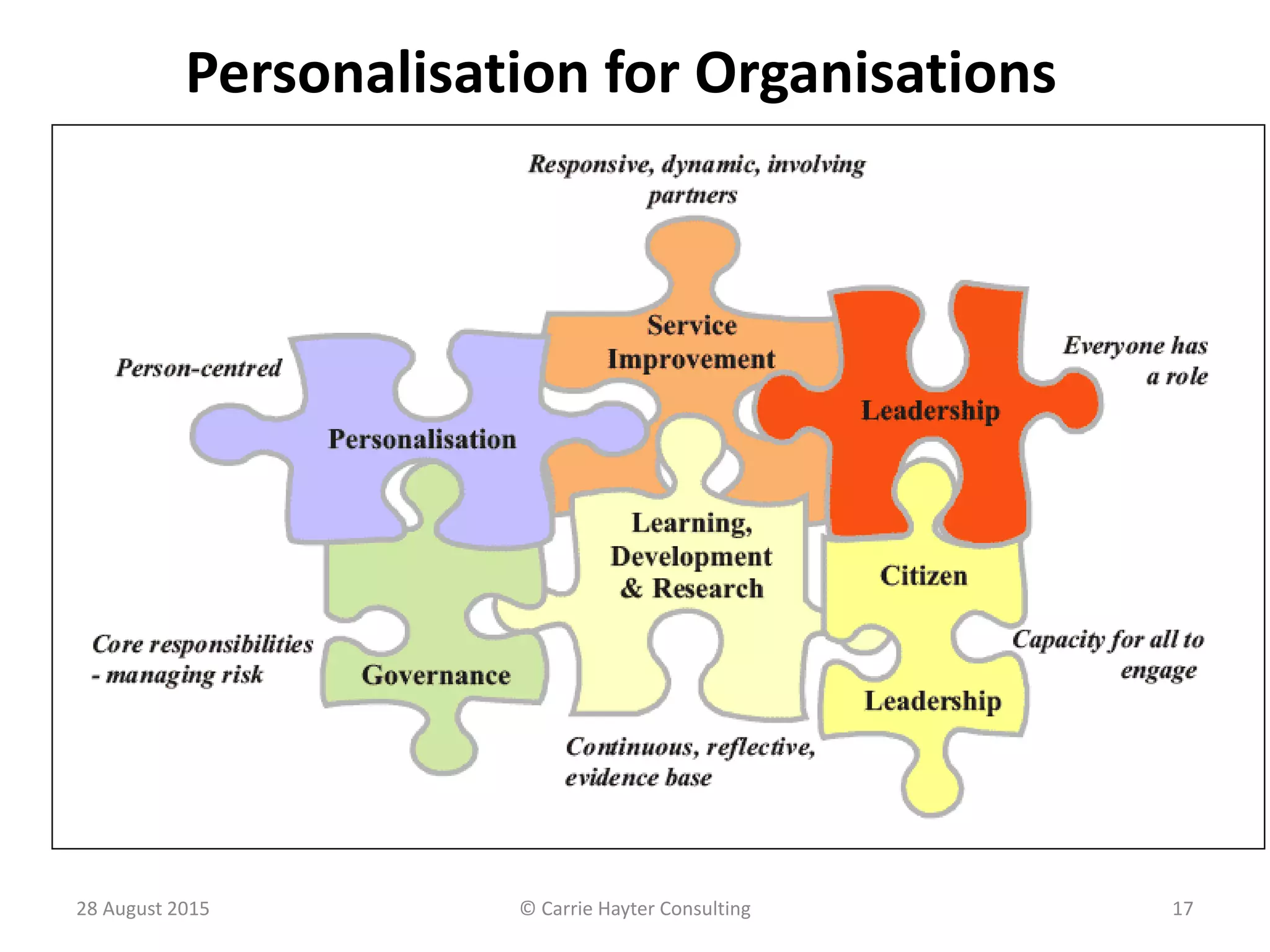
Personalisation for Organisations
28 August 2015 © Carrie Hayter Consulting 17
28 August 2015
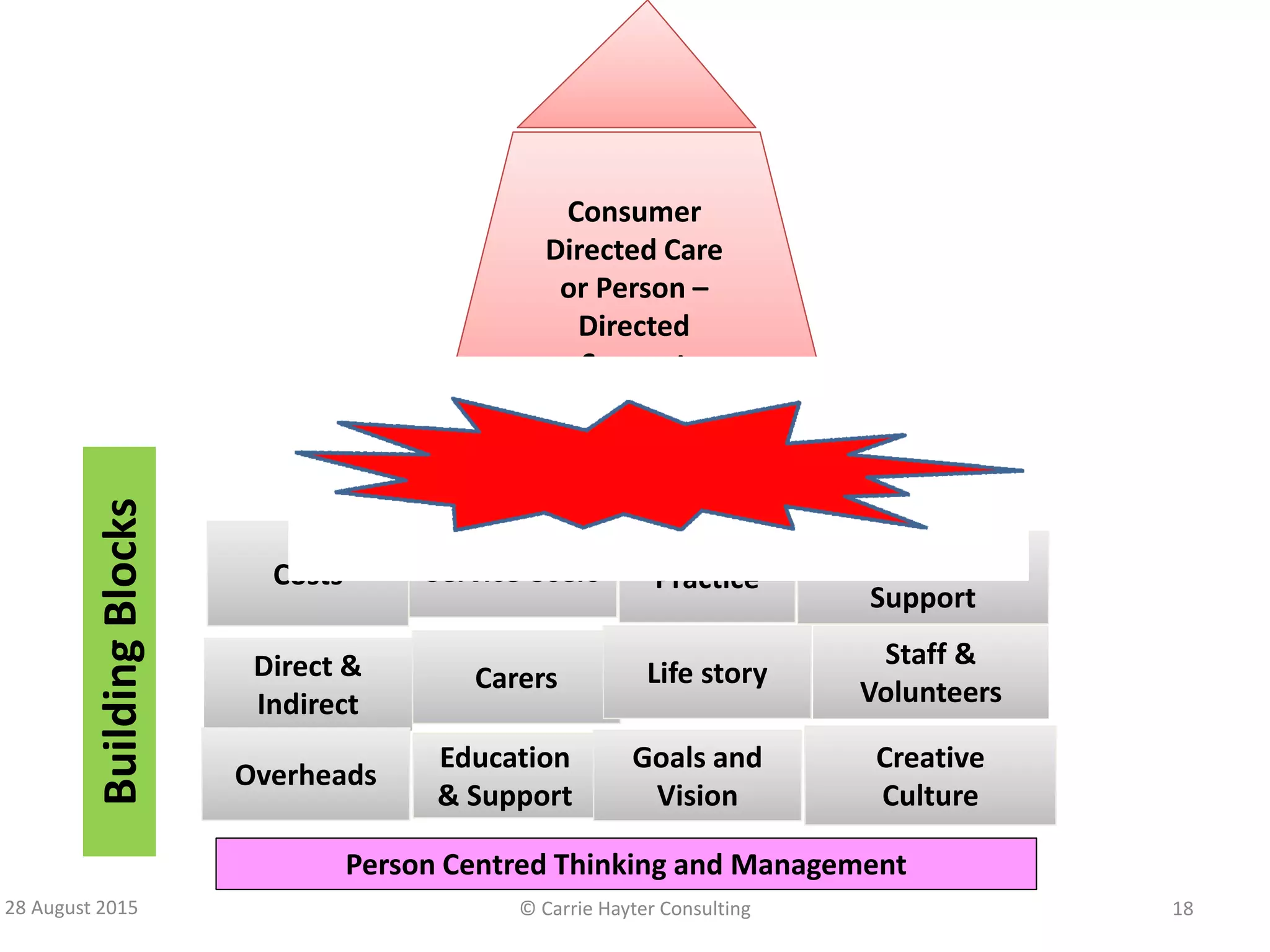
Service UsersService Users PracticePractice
Staff &
Volunteers
Staff &
Volunteers
CostsCosts
Direct &
Indirect
Direct &
Indirect
CarersCarers Life storyLife story
OverheadsOverheads
Training &
Support
Training &
Support
Education
& Support
Education
& Support
Goals and
Vision
Goals and
Vision
Creative
Culture
Creative
Culture
Person Centred Thinking and Management
Consumer
Directed Care
or Person –
Directed
Support
BuildingBlocks
© Carrie Hayter Consulting 18
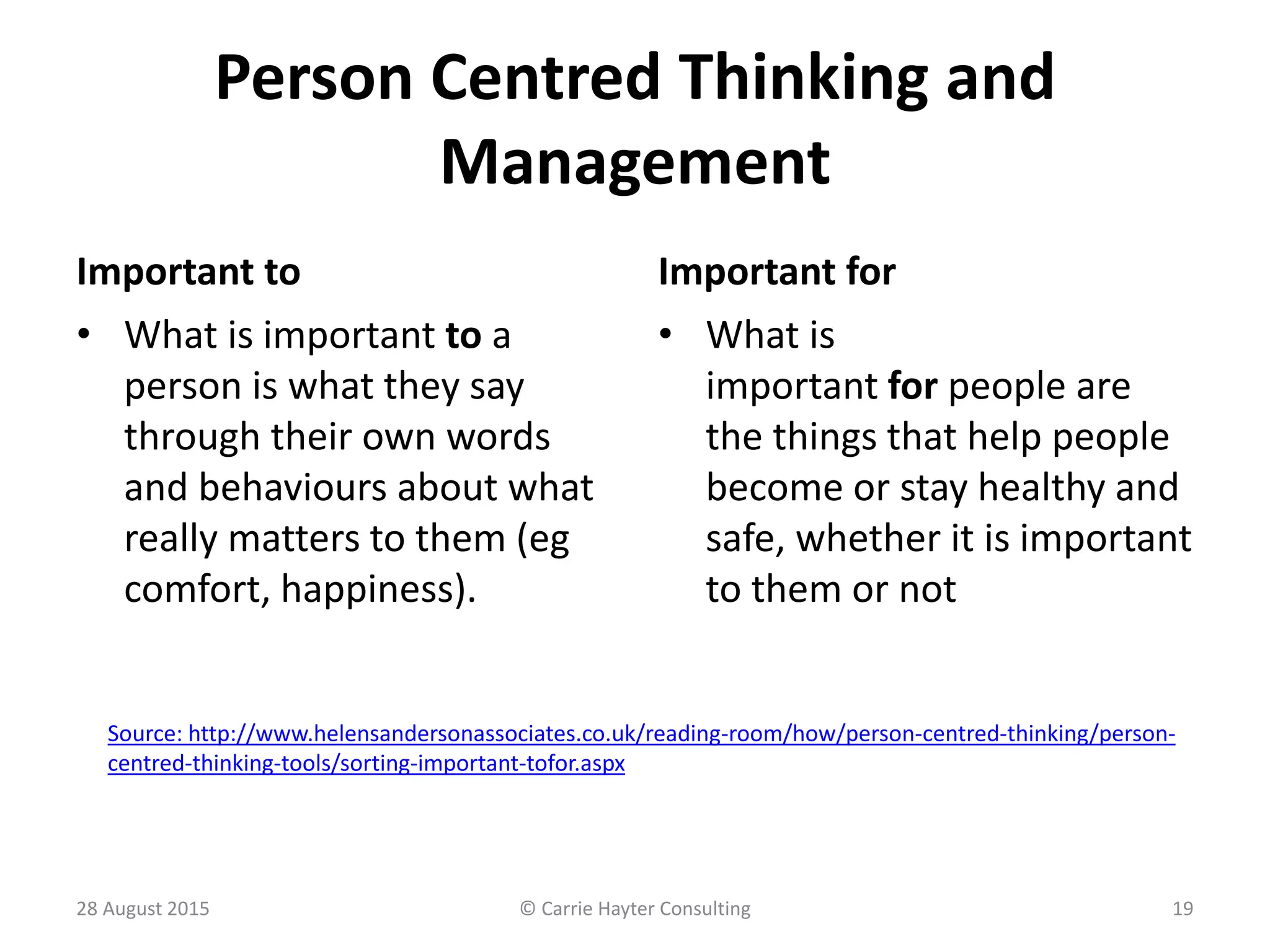
Person Centred Thinking and
Management
Important to Important for
• What is
important for people are
the things that help people
become or stay healthy and
safe, whether it is important
to them or not
28 August 2015 © Carrie Hayter Consulting 19
• What is important to a
person is what they say
through their own words
and behaviours about what
really matters to them (eg
comfort, happiness).
Source: http://www.helensandersonassociates.co.uk/reading-room/how/person-centred-thinking/person-
centred-thinking-tools/sorting-important-tofor.aspx
28 August 2015 © Carrie Hayter Consulting 20
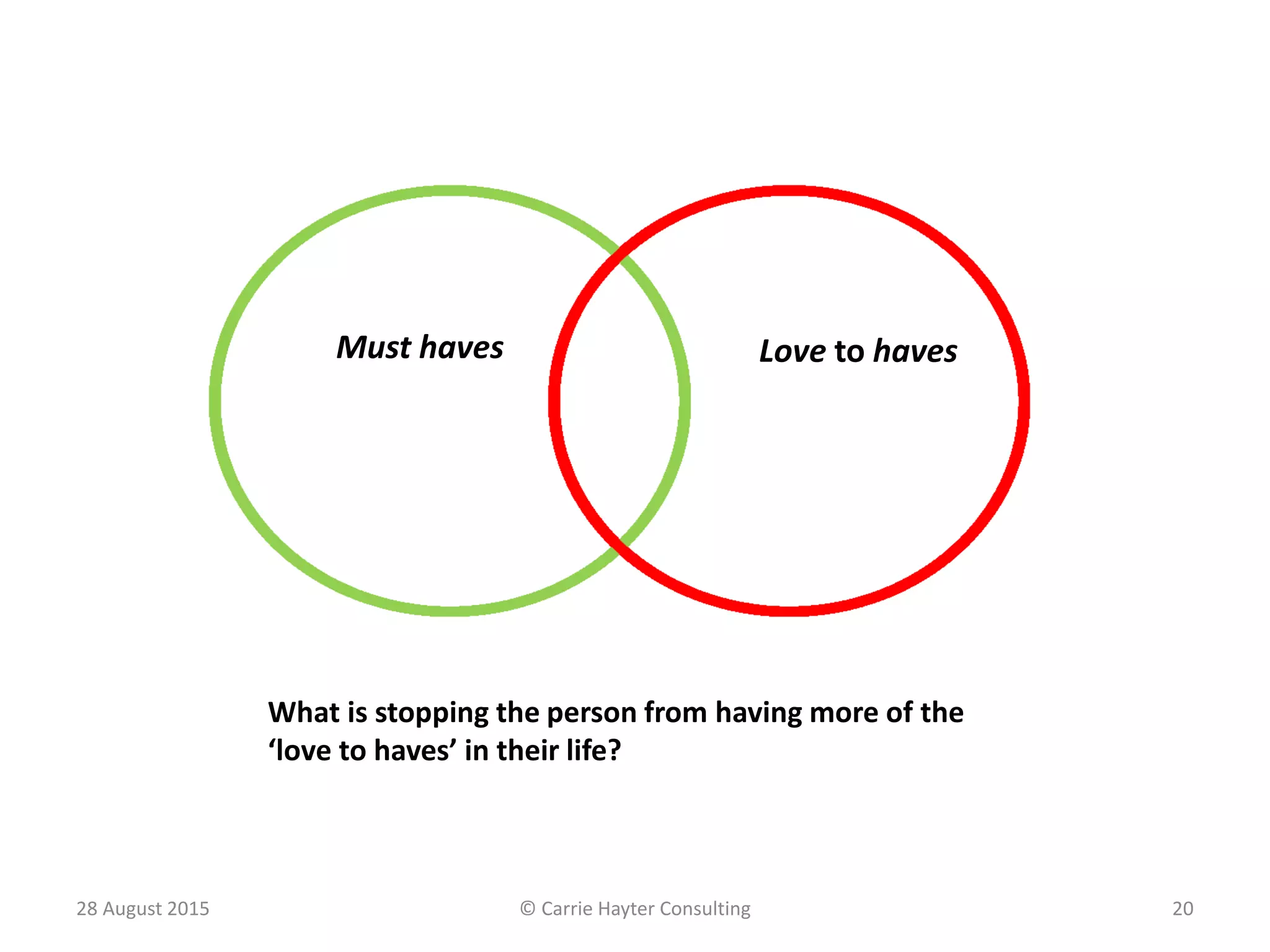
Must haves Love to haves
What is stopping the person from having more of the
‘love to haves’ in their life?
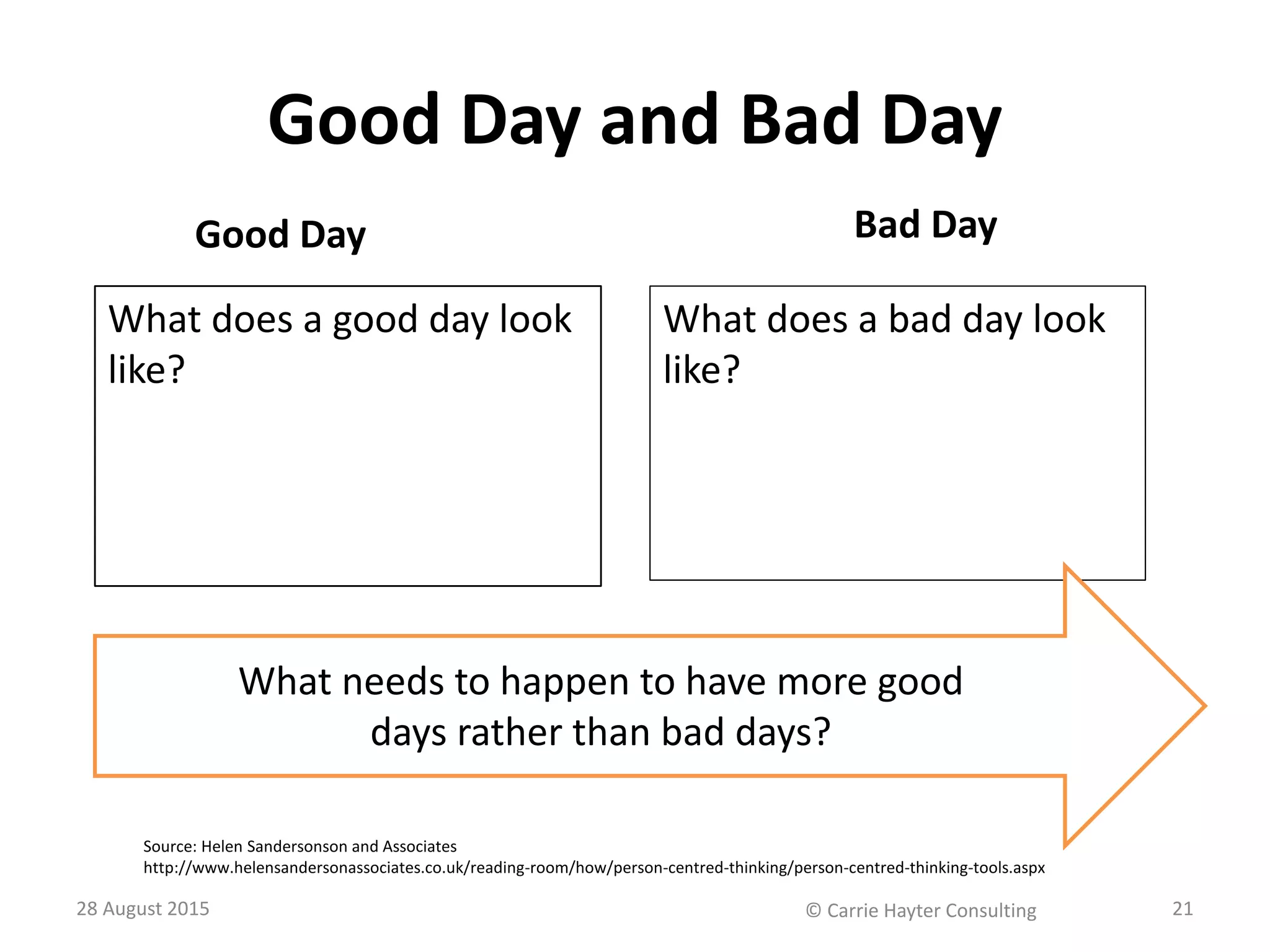
Good Day and Bad Day
Good Day Bad Day
What does a bad day look
like?
28 August 2015 © Carrie Hayter Consulting 21
What does a good day look
like?
What needs to happen to have more good
days rather than bad days?
Source: Helen Sandersonson and Associates
http://www.helensandersonassociates.co.uk/reading-room/how/person-centred-thinking/person-centred-thinking-tools.aspx
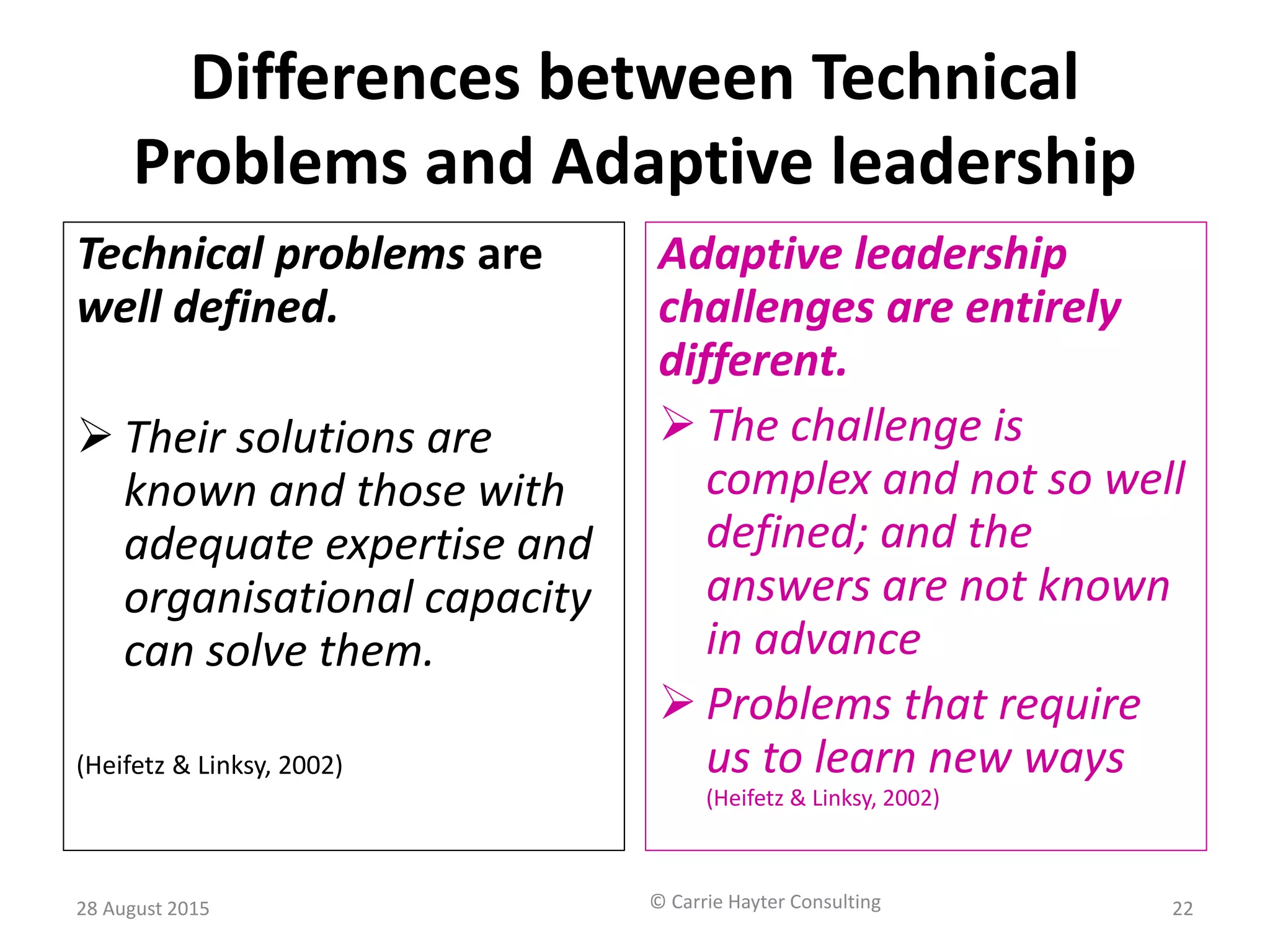
Differences between Technical
Problems and Adaptive leadership
Technical problems are
well defined.
 Their solutions are
known and those with
adequate expertise and
organisational capacity
can solve them.
(Heifetz & Linksy, 2002)
Adaptive leadership
challenges are entirely
different.
 The challenge is
complex and not so well
defined; and the
answers are not known
in advance
 Problems that require
us to learn new ways
(Heifetz & Linksy, 2002)
28 August 2015 © Carrie Hayter Consulting 22
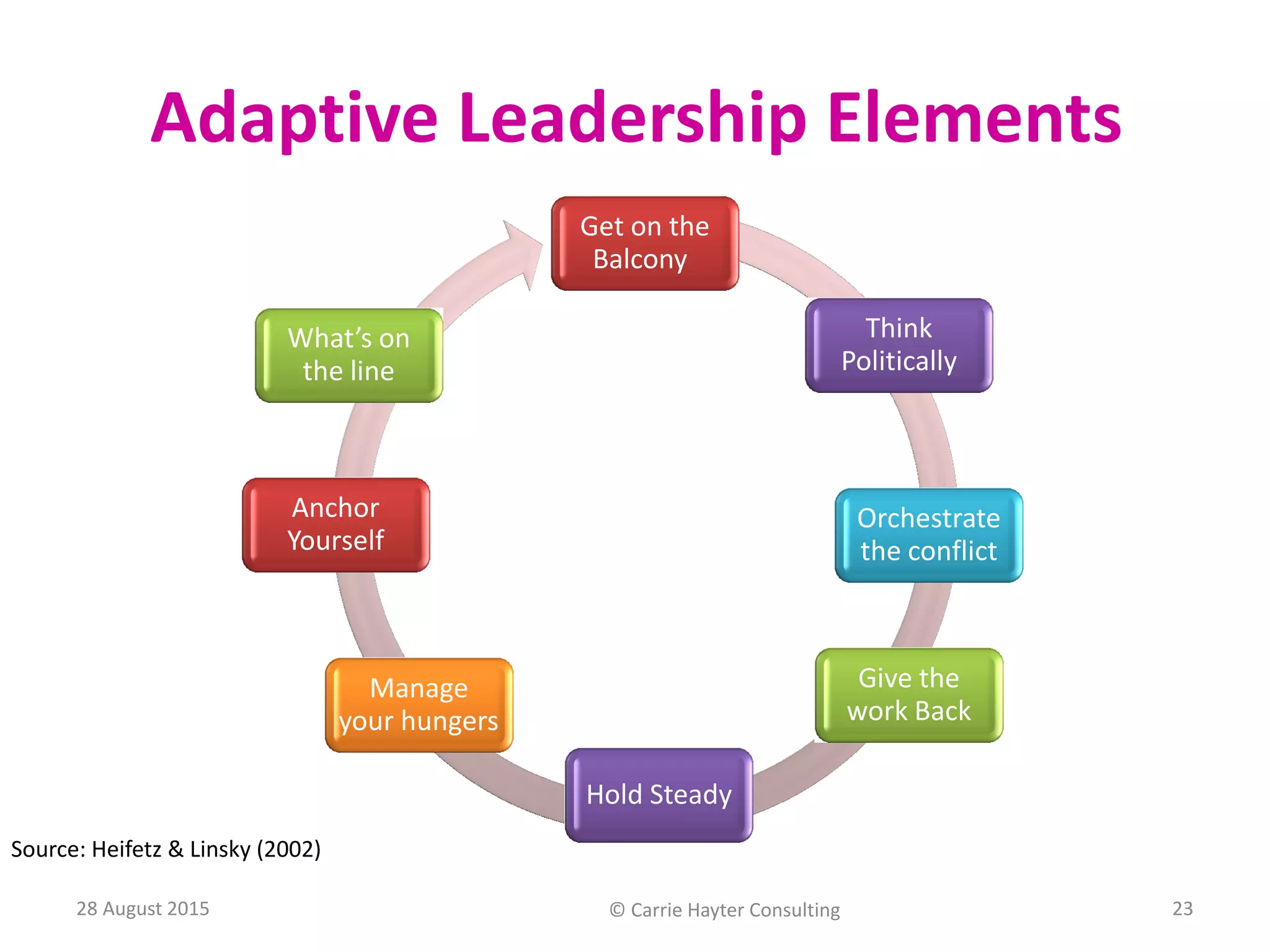
Get on the
Balcony
Give the
work Back
Think
Politically
Orchestrate
the conflict
Manage
your hungers
Anchor
Yourself
What’s on
the line
Hold Steady
Adaptive Leadership Elements
Source: Heifetz & Linsky (2002)
28 August 2015 © Carrie Hayter Consulting 23
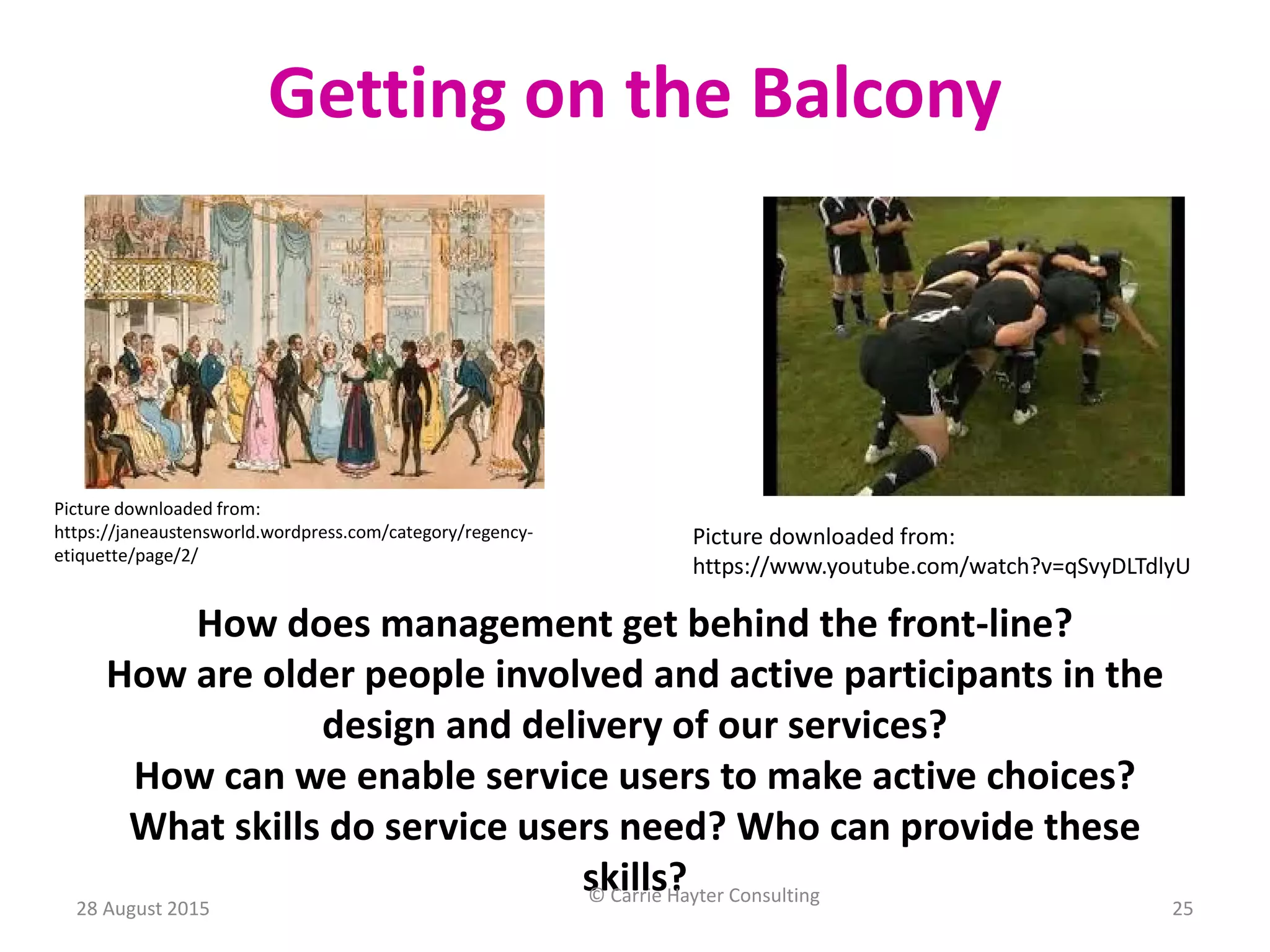
Picture downloaded from:
https://janeaustensworld.wordpress.com/category/regency-
etiquette/page/2/
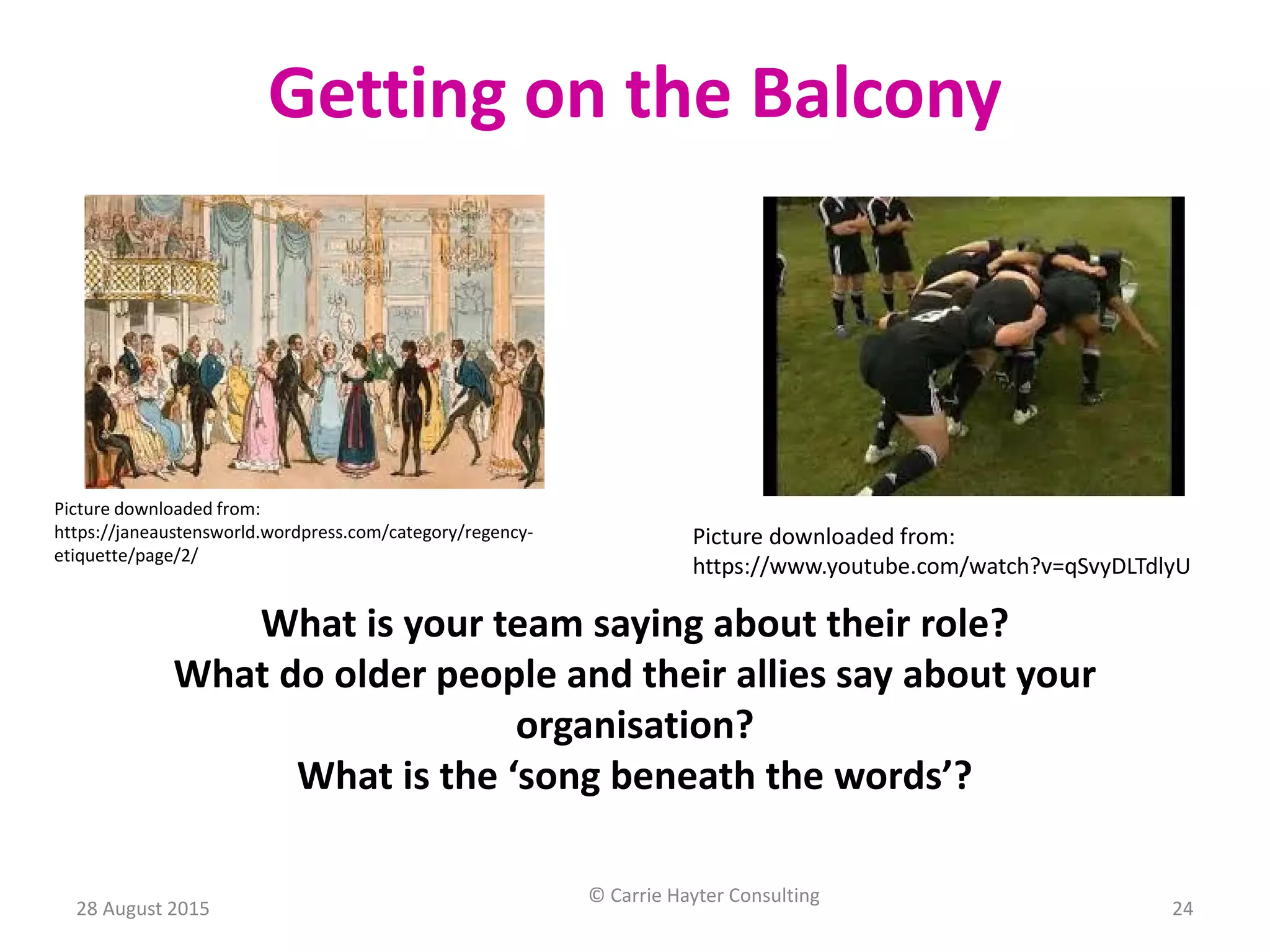
Getting on the Balcony
Picture downloaded from:
https://www.youtube.com/watch?v=qSvyDLTdlyU
What is your team saying about their role?
What do older people and their allies say about your
organisation?
What is the ‘song beneath the words’?
28 August 2015
© Carrie Hayter Consulting
24
Picture downloaded from:
https://janeaustensworld.wordpress.com/category/regency-
etiquette/page/2/
Getting on the Balcony
Picture downloaded from:
https://www.youtube.com/watch?v=qSvyDLTdlyU
How does management get behind the front-line?
How are older people involved and active participants in the
design and delivery of our services?
How can we enable service users to make active choices?
What skills do service users need? Who can provide these
skills?
28 August 2015
© Carrie Hayter Consulting
25
Think Politically
1. Find Partners
2. Keep the Opposition Close
3. Accept Responsibility for
your piece of the mess
4. Acknowledge their losses
and accept casualties
5. Model the behaviour
(Heifetz & Linksy, 2002)Picture downloaded from: www.twitter.com
What can we learn from other people or oganisations on
their journey?
What might be the losses or casualties?
How does our organisation support people across the care
system?
28 August 2015 © Carrie Hayter Consulting 26
28 August 2015 © Carrie Hayter Consulting 27
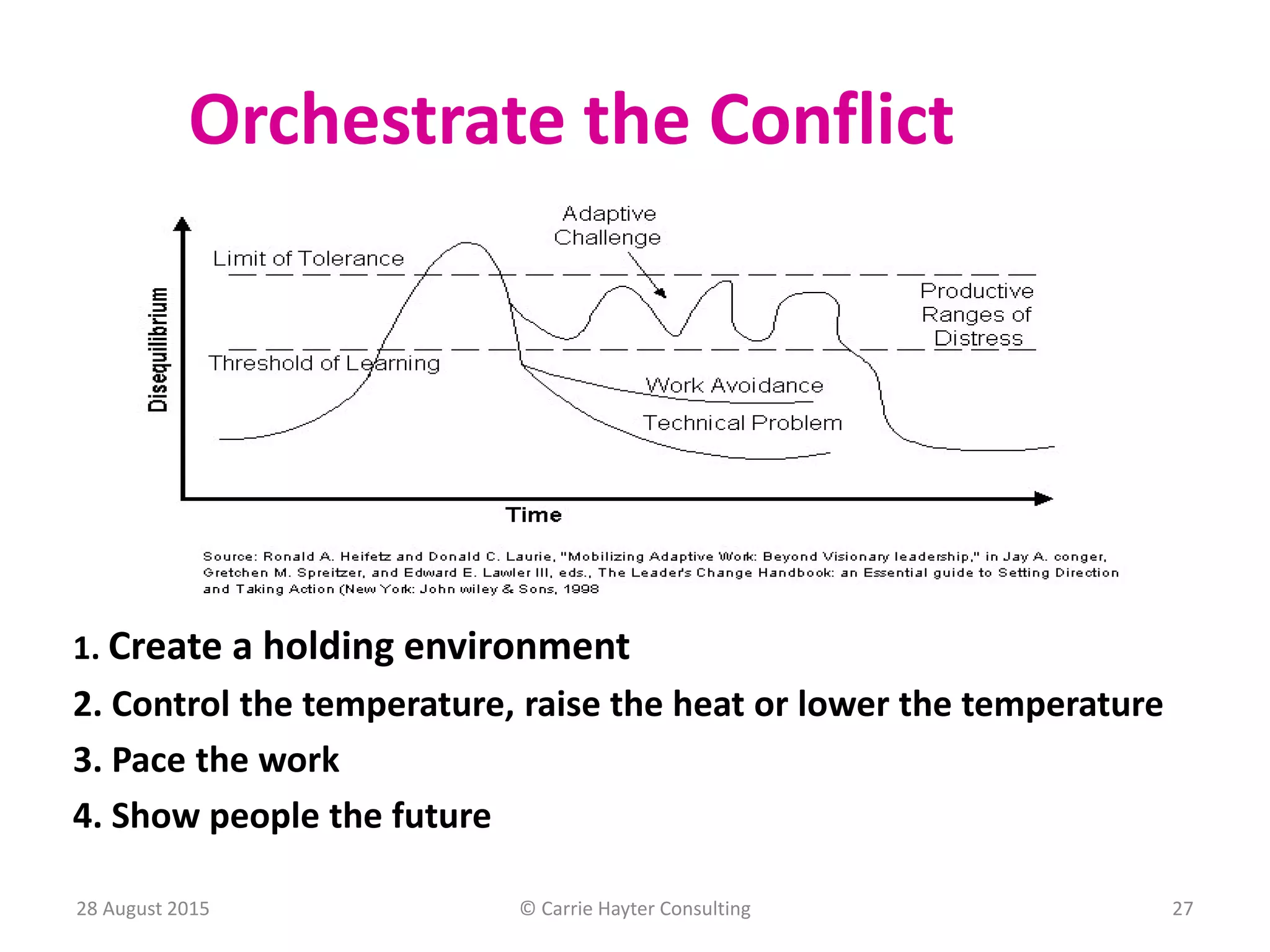
Orchestrate the Conflict
1. Create a holding environment
2. Control the temperature, raise the heat or lower the temperature
3. Pace the work
4. Show people the future
28 August 2015 © Carrie Hayter Consulting 28
Orchestrate the Conflict
• Co-production or Co-design
• Working with people for planning and designing or
co-producing services
– Challenging how staff work and governance
structures
– http://www.ndti.org.uk/uploads/files/Personalis
ation_-_dont_just_do_it_coproduce_it.pd
– http://homecaretoday.org.au/
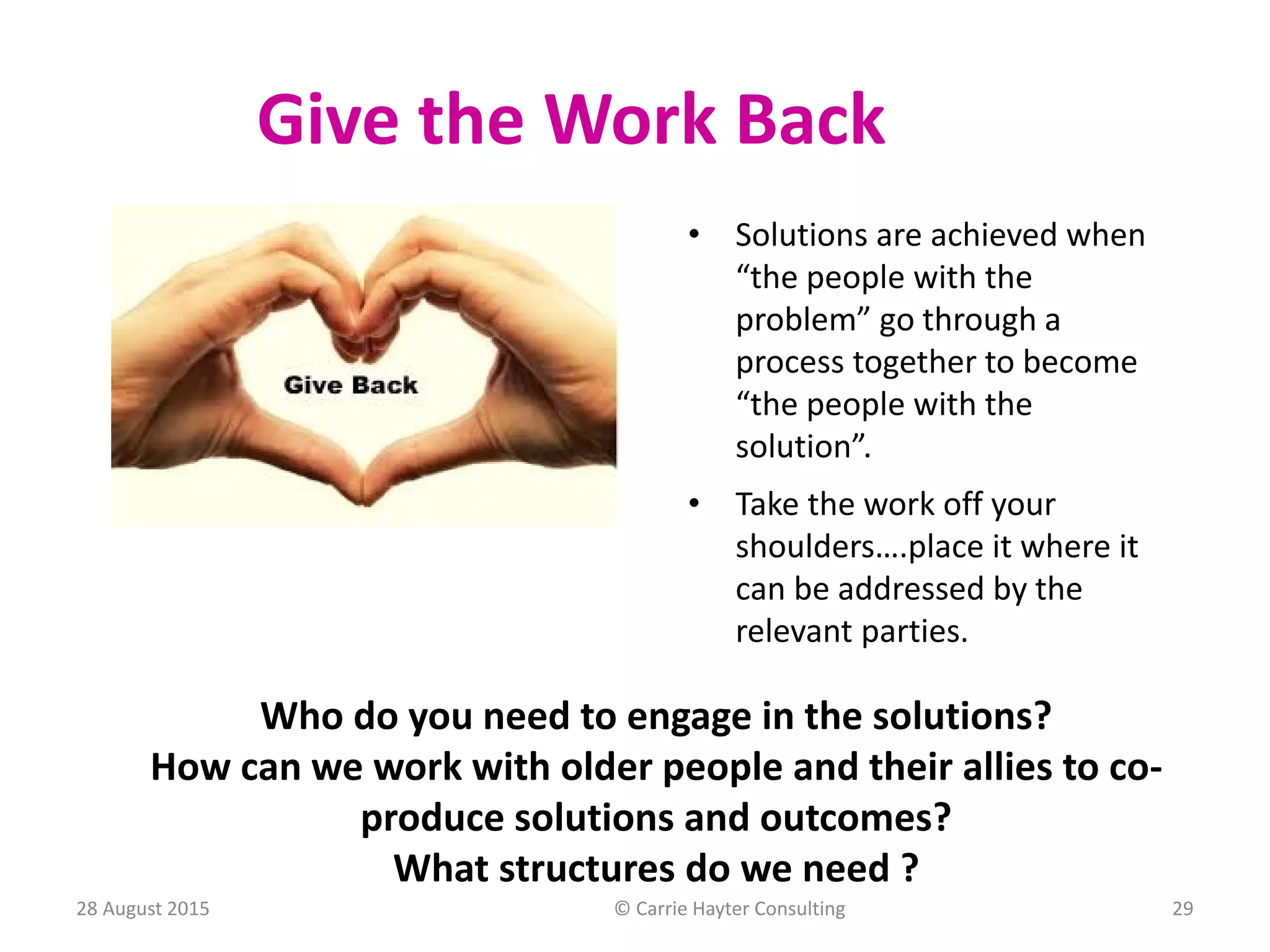
Give the Work Back
• Solutions are achieved when
“the people with the
problem” go through a
process together to become
“the people with the
solution”.
• Take the work off your
shoulders….place it where it
can be addressed by the
relevant parties.
Who do you need to engage in the solutions?
How can we work with older people and their allies to co-
produce solutions and outcomes?
What structures do we need ?
28 August 2015 © Carrie Hayter Consulting 29
Anchor Yourself
• Don’t confuse one’s self
with one’s professional
role
• Identify a truly trustworthy
confidant who can really
tell you what you NEED to
hear
• Find a sanctuary for
retreat, rejuvenation and
personal reflection
30
Who are your confidants?
How can they support you?
How do you look after yourself?
28 August 2015 © Carrie Hayter Consulting
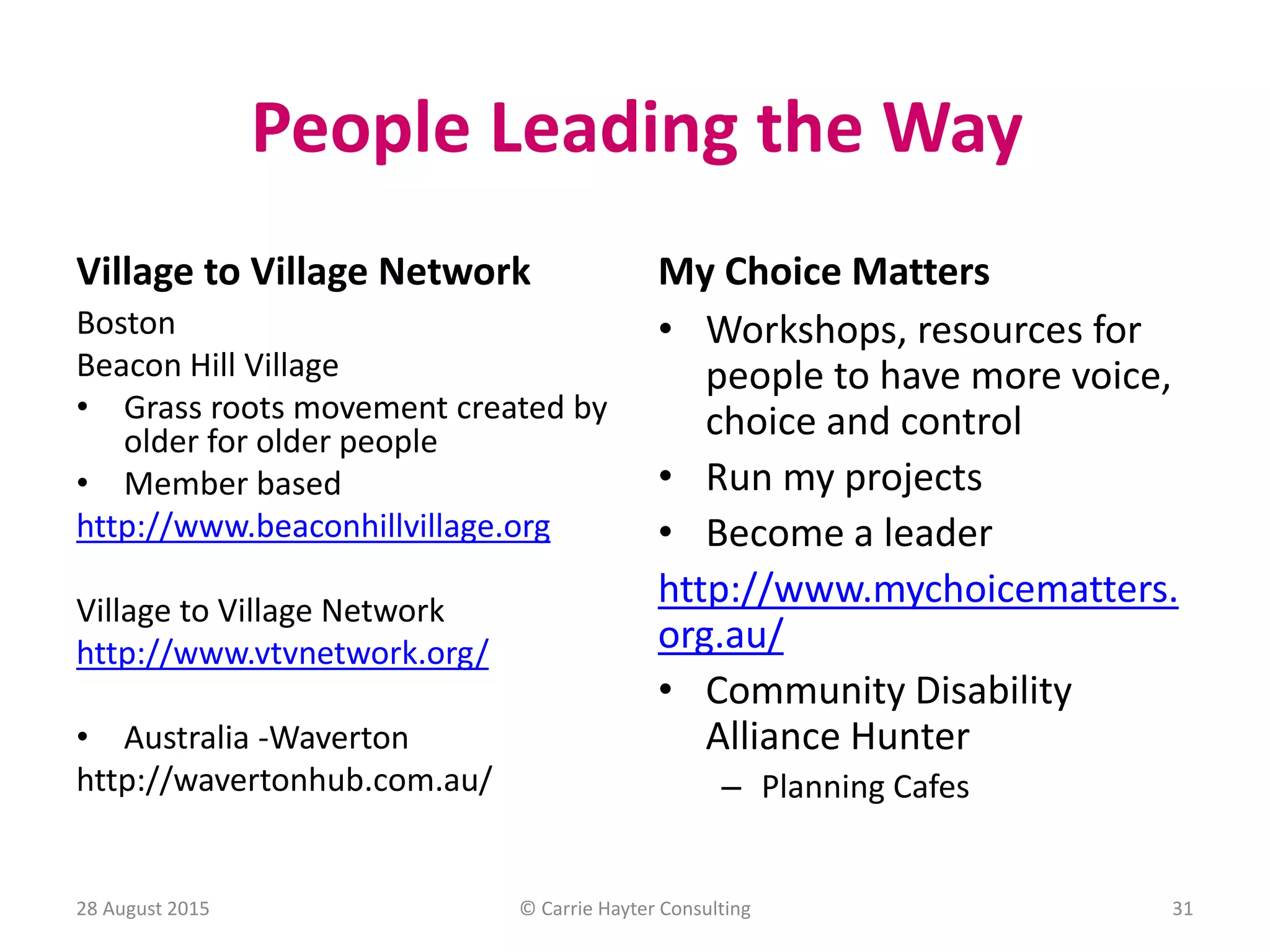
People Leading the Way
Village to Village Network
Boston
Beacon Hill Village
• Grass roots movement created by
older for older people
• Member based
http://www.beaconhillvillage.org
Village to Village Network
http://www.vtvnetwork.org/
• Australia -Waverton
http://wavertonhub.com.au/
My Choice Matters
• Workshops, resources for
people to have more voice,
choice and control
• Run my projects
• Become a leader
http://www.mychoicematters.
org.au/
• Community Disability
Alliance Hunter
– Planning Cafes
3128 August 2015 © Carrie Hayter Consulting
A Call to Action
28 August 2015 © Carrie Hayter Consulting 32
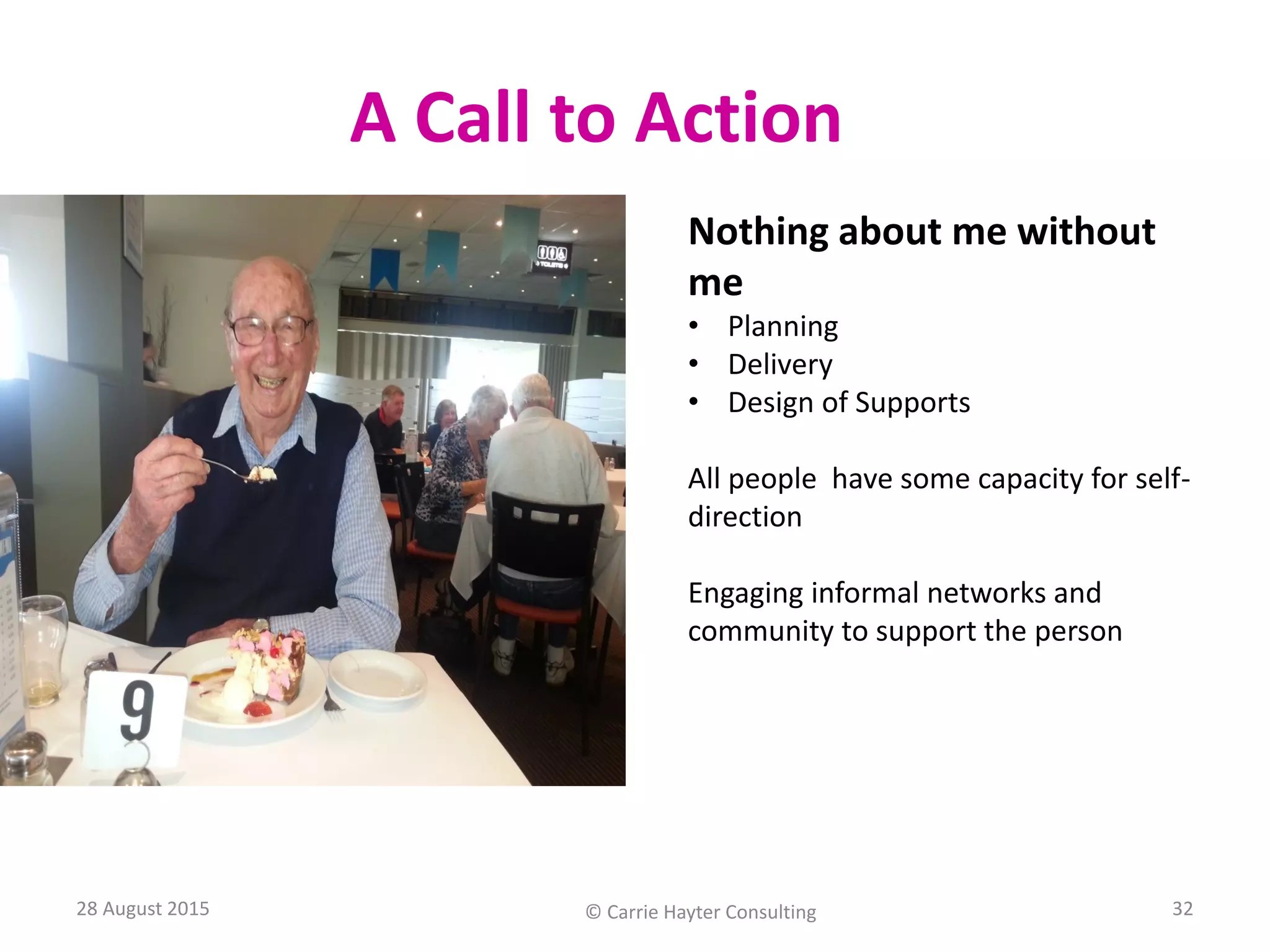
Nothing about me without
me
• Planning
• Delivery
• Design of Supports
All people have some capacity for self-
direction
Engaging informal networks and
community to support the person
References and Resources
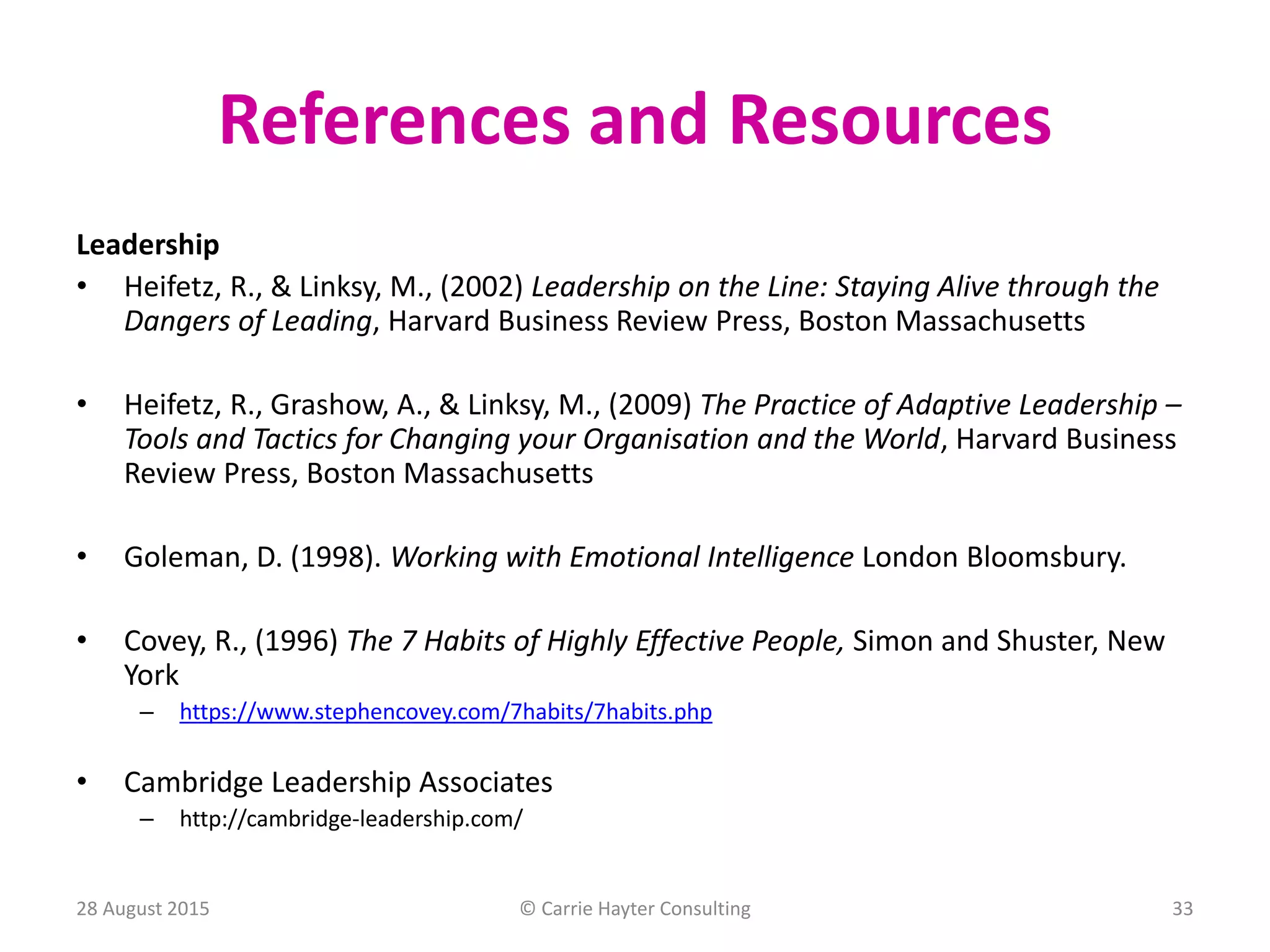
Leadership
• Heifetz, R., & Linksy, M., (2002) Leadership on the Line: Staying Alive through the
Dangers of Leading, Harvard Business Review Press, Boston Massachusetts
• Heifetz, R., Grashow, A., & Linksy, M., (2009) The Practice of Adaptive Leadership –
Tools and Tactics for Changing your Organisation and the World, Harvard Business
Review Press, Boston Massachusetts
• Goleman, D. (1998). Working with Emotional Intelligence London Bloomsbury.
• Covey, R., (1996) The 7 Habits of Highly Effective People, Simon and Shuster, New
York
– https://www.stephencovey.com/7habits/7habits.php
• Cambridge Leadership Associates
– http://cambridge-leadership.com/
28 August 2015 © Carrie Hayter Consulting 33
References and Resources
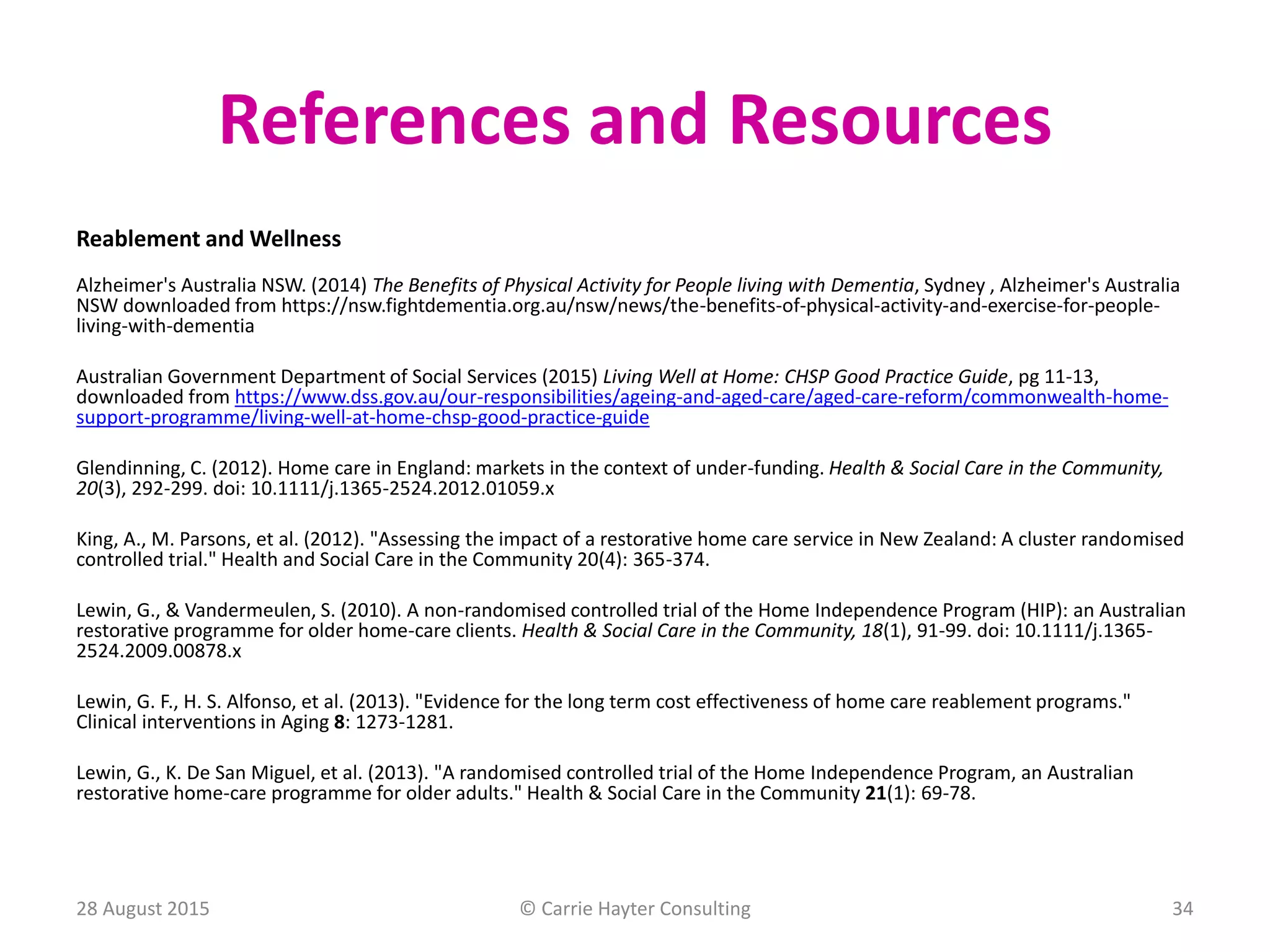
Reablement and Wellness
Alzheimer's Australia NSW. (2014) The Benefits of Physical Activity for People living with Dementia, Sydney , Alzheimer's Australia
NSW downloaded from https://nsw.fightdementia.org.au/nsw/news/the-benefits-of-physical-activity-and-exercise-for-people-
living-with-dementia
Australian Government Department of Social Services (2015) Living Well at Home: CHSP Good Practice Guide, pg 11-13,
downloaded from https://www.dss.gov.au/our-responsibilities/ageing-and-aged-care/aged-care-reform/commonwealth-home-
support-programme/living-well-at-home-chsp-good-practice-guide
Glendinning, C. (2012). Home care in England: markets in the context of under-funding. Health & Social Care in the Community,
20(3), 292-299. doi: 10.1111/j.1365-2524.2012.01059.x
King, A., M. Parsons, et al. (2012). "Assessing the impact of a restorative home care service in New Zealand: A cluster randomised
controlled trial." Health and Social Care in the Community 20(4): 365-374.
Lewin, G., & Vandermeulen, S. (2010). A non-randomised controlled trial of the Home Independence Program (HIP): an Australian
restorative programme for older home-care clients. Health & Social Care in the Community, 18(1), 91-99. doi: 10.1111/j.1365-
2524.2009.00878.x
Lewin, G. F., H. S. Alfonso, et al. (2013). "Evidence for the long term cost effectiveness of home care reablement programs."
Clinical interventions in Aging 8: 1273-1281.
Lewin, G., K. De San Miguel, et al. (2013). "A randomised controlled trial of the Home Independence Program, an Australian
restorative home-care programme for older adults." Health & Social Care in the Community 21(1): 69-78.
28 August 2015 © Carrie Hayter Consulting 34
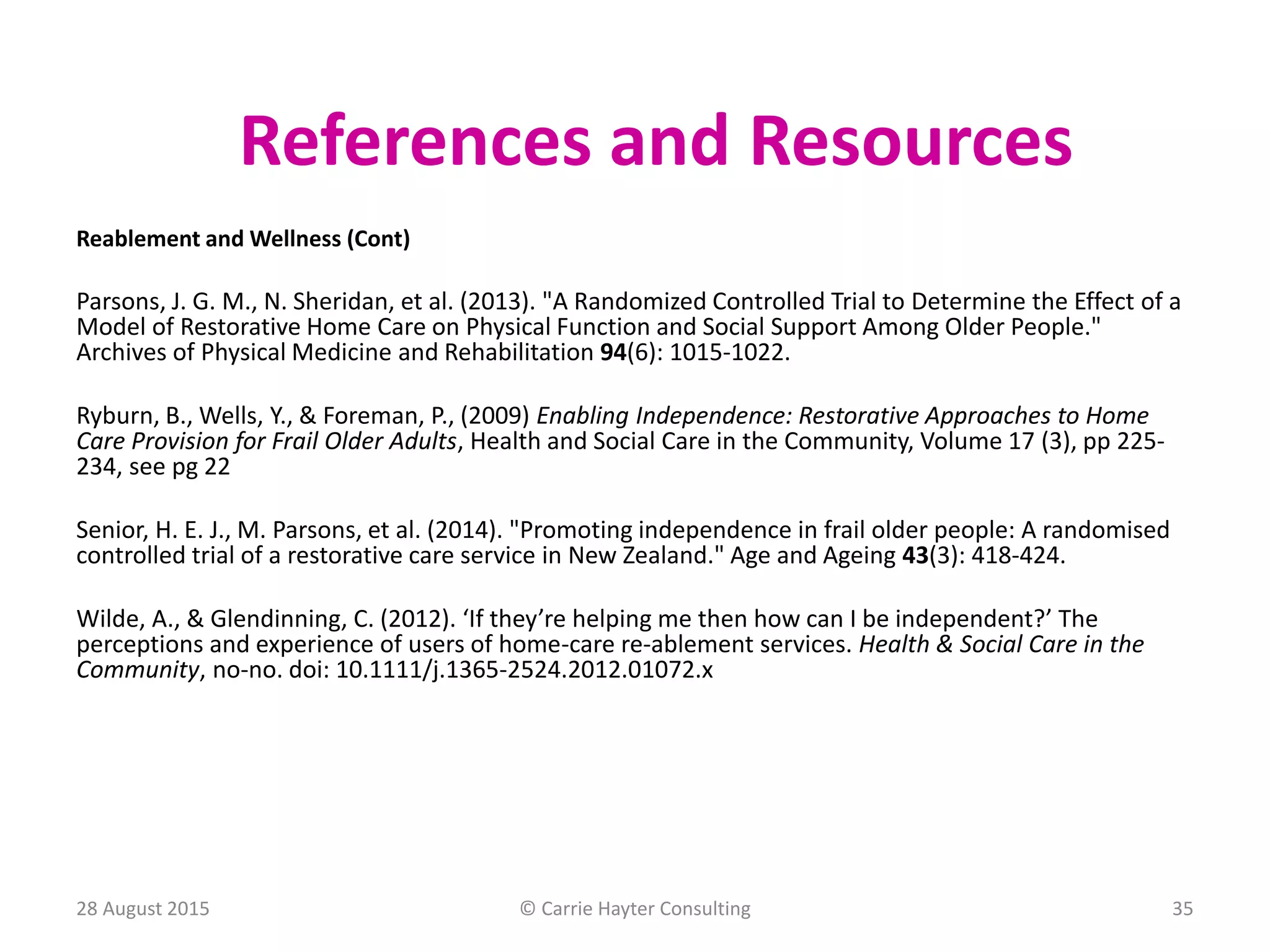
Reablement and Wellness (Cont)
Parsons, J. G. M., N. Sheridan, et al. (2013). "A Randomized Controlled Trial to Determine the Effect of a
Model of Restorative Home Care on Physical Function and Social Support Among Older People."
Archives of Physical Medicine and Rehabilitation 94(6): 1015-1022.
Ryburn, B., Wells, Y., & Foreman, P., (2009) Enabling Independence: Restorative Approaches to Home
Care Provision for Frail Older Adults, Health and Social Care in the Community, Volume 17 (3), pp 225-
234, see pg 22
Senior, H. E. J., M. Parsons, et al. (2014). "Promoting independence in frail older people: A randomised
controlled trial of a restorative care service in New Zealand." Age and Ageing 43(3): 418-424.
Wilde, A., & Glendinning, C. (2012). ‘If they’re helping me then how can I be independent?’ The
perceptions and experience of users of home-care re-ablement services. Health & Social Care in the
Community, no-no. doi: 10.1111/j.1365-2524.2012.01072.x
References and Resources
28 August 2015 © Carrie Hayter Consulting 35
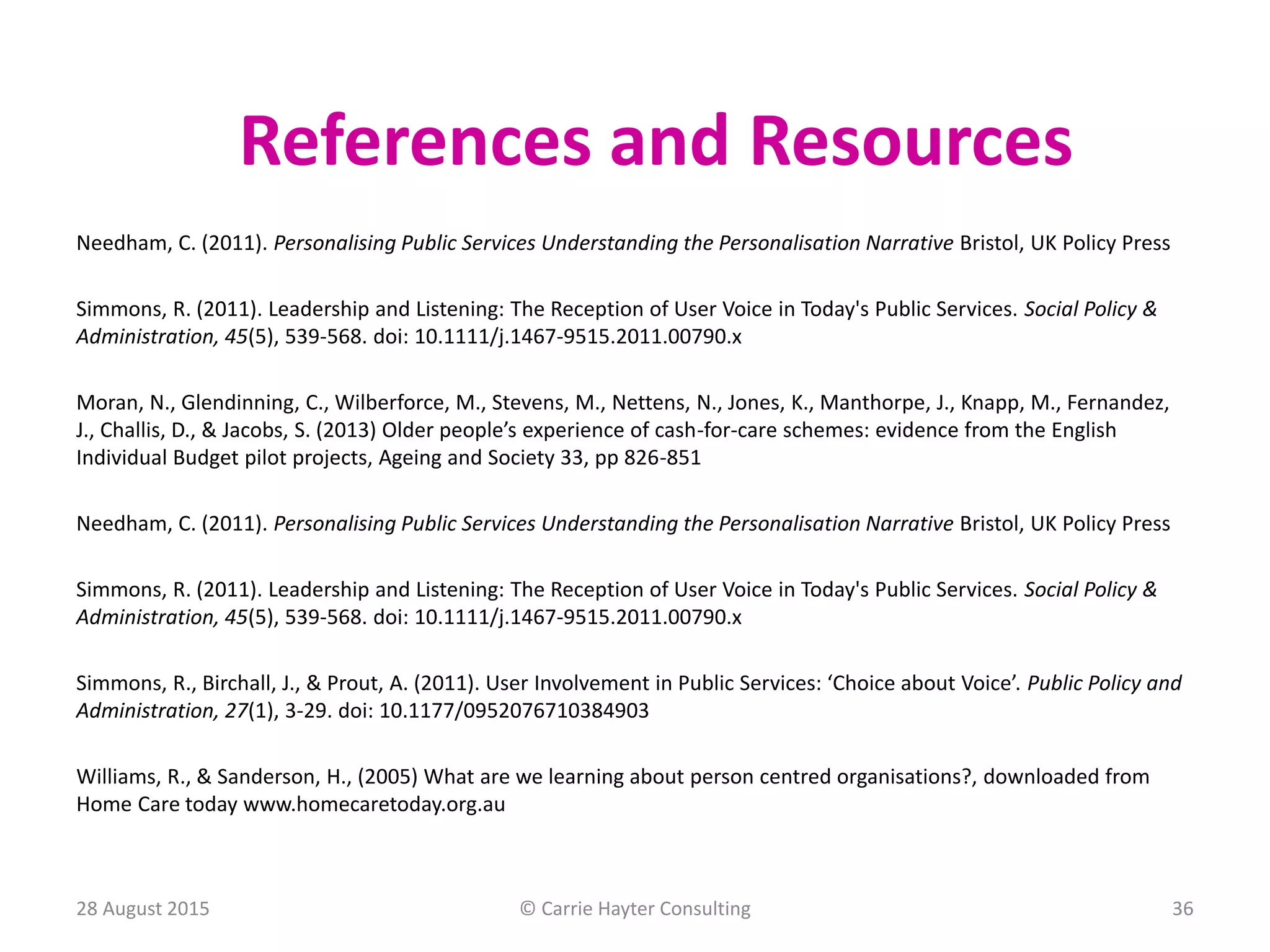
Needham, C. (2011). Personalising Public Services Understanding the Personalisation Narrative Bristol, UK Policy Press
Simmons, R. (2011). Leadership and Listening: The Reception of User Voice in Today's Public Services. Social Policy &
Administration, 45(5), 539-568. doi: 10.1111/j.1467-9515.2011.00790.x
Moran, N., Glendinning, C., Wilberforce, M., Stevens, M., Nettens, N., Jones, K., Manthorpe, J., Knapp, M., Fernandez,
J., Challis, D., & Jacobs, S. (2013) Older people’s experience of cash-for-care schemes: evidence from the English
Individual Budget pilot projects, Ageing and Society 33, pp 826-851
Needham, C. (2011). Personalising Public Services Understanding the Personalisation Narrative Bristol, UK Policy Press
Simmons, R. (2011). Leadership and Listening: The Reception of User Voice in Today's Public Services. Social Policy &
Administration, 45(5), 539-568. doi: 10.1111/j.1467-9515.2011.00790.x
Simmons, R., Birchall, J., & Prout, A. (2011). User Involvement in Public Services: ‘Choice about Voice’. Public Policy and
Administration, 27(1), 3-29. doi: 10.1177/0952076710384903
Williams, R., & Sanderson, H., (2005) What are we learning about person centred organisations?, downloaded from
Home Care today www.homecaretoday.org.au
References and Resources
28 August 2015 © Carrie Hayter Consulting 36
More Information
Carrie Hayter
Email: Carriehayter@gmail.com
Twitter@carriehayter
Slideshare: Carrie Hayter
www.carriehayter.com
Linked in http://au.linkedin.com/pub/carrie-
hayter/34/536/517/
28 August 2015 © Carrie Hayter Consulting 37

Enhancing independence and person centred practice - A Pathway to implementing Consumer Directed Care

  • 1.
    Enhancing Independence and PersonCentred Practice – A Pathway to Implementing Consumer Directed Care Better Practice Conference Australian Aged Care Quality Agency Carrie Hayter, Managing Director Carrie Hayter Consulting 27 August 2015, Sydney, Australia 28 August 2015 © Carrie Hayter Consulting 1
  • 2.
    About Carrie HayterConsulting 28 August 2015 Nothing about me without me Personalising Care – Translating Research into Practice – A Handbook for community care services , Empowering People, enhancing independence, enriching lives with Alt Beatty Consulting for NSW Government – Strategic Planning, Research and Evaluation – Education, coaching and mentoring – Person Centred Practice and Thinking (managers and support workers) – Cultural Diversity and Cultural Competence – Ageing and Sexuality (managers) – Ageing and Sexuality (frontline workers) – Implementing Consumer Directed Care (Managers and Support Workers) – Living Life my Way (Service Users) © Carrie Hayter Consulting 2
  • 3.
    Presentation Outline • Personalisation –Narratives and Research • Challenges & Opportunities – Moving from person-centred to ‘consumer’ directed or person directed supports – Adaptive Leadership Framework • Questions and Practical Steps 28 August 2015 © Carrie Hayter Consulting 3
  • 4.
    Source: downloaded fromhttp://lwdp.org.uk/more_info.asp?current_id=296 28/08/2015 Surviving or Thriving in a Consumer Directed World? © Carrie Hayter Consulting 4
  • 5.
    Shifting Policy Landscape– Personalisation Passive Clients Participants or ‘consumers’ Block funding Individualised funding or fee for service Monopoly Providers ‘Market of Care’ 28 August 2015 © Carrie Hayter Consulting 5
  • 6.
    28 August 2015© Carrie Hayter Consulting 6
  • 7.
    28 August 2015© Carrie Hayter Consulting 7
  • 8.
    The rise ofthe ‘Consumer’ Consumer as Purchaser Citizen Social and political rightsEconomic purchasing power Relationship between client and professional Client Citizen – Consumer Active or passive subjects? Mechanisms for enacting ‘choice’ and ‘voice’Mechanisms for enacting ‘choice’ and ‘voice’ Market mechanisms via competition (LeGrand, 2007) Managing self interest (LeGrand, 2007) and voice mechanisms Enable ‘choice’ through ‘voice’ mechanisms (Simmons et al 2011) Diversity of policy mechanisms 28 August 2015 © Carrie Hayter Consulting 8
  • 9.
    28 August 2015© Carrie Hayter Consulting 9
  • 10.
    1028 August 2015 ©Carrie Hayter Consulting
  • 11.
    28 August 2015© Carrie Hayter Consulting 11 Wellness Reablement Restorative • Building on the strengths • Outcomes for people – outcome or goal focused • Right balance between ‘doing with’ rather than ‘doing for’ • Looks at appropriateness of services • Identifies what a person can do and wants to do in the future • Time – limited targeted interventions to regain function, confidence or capacity to resume activities • Evidence-based interventions led by allied health workers that allow a person to make a functional gain or improvement after a setback, or in order to avoid a preventable injury. Wellness, Reablement and Restorative Approaches Source: Australian Government Department of Social Services (2015) Living Well at Home: CHSP Good Practice Guide, pg 11-13
  • 12.
    Why reablement andwellness? • Research - UK, Australia and New Zealand – Improved health and welling for older people (Lewin at al, 2013, Parsons et al, 2013, Parsons et al, 2014) – Reduces people’s dependence on paid supports (King & Parsons, et al 2012, Lewin & Alfonso 2013, Lewin & De San Miguel, 2013) – Role of assessment is critical (Department of Family and Community Services, Ageing, Disability and Home Care, 2012) • Further research – People with dementia (Alzheimer’s Australia NSW, 2014) – Engaging carers and service users in their reablement and wellness (Wilde & Glendenning, 2012) 28 August 2015 © Carrie Hayter Consulting 12
  • 13.
    Personalisation Narratives • Personalisationworks, transforming people’s lives for the better. • Personalisation saves money. • Person- centred approaches reflect the way that people live their lives. • Personalisation is applicable to everyone. • People are the experts in their own lives (Needham, 2011: pg 7). 28 August 2015 © Carrie Hayter Consulting 13
  • 14.
    Personalisation and Carers •Formal care system would not exist without informal carers • Access to personalised budgets – Conservatism of carers and the risks of personalisation (Needham, 2011) – The traditional model gives them security and comfort • Choice and comfort for service users may not necessarily bring choice and comfort for carers • Voices of carers not being recognised and heard (Carers NSW, 2014) • Mainstreaming of carer support funding – Access to appropriate support? – Block funded rather than individualised funding 28 August 2015 © Carrie Hayter Consulting 14
  • 15.
    28 August 2015 Modelsof Consumer Directed Care Support Facilitation & Brokerage Individualised Budgets Cash for Care Self Managed Home Care Packages National Disability Insurance Scheme Level of Service User control © Carrie Hayter Consulting 15 Carers Payment Individualised Budgets
  • 16.
    28 August 2015© Carrie Hayter Consulting 16 Expressing choices Person centred planning Self Directed with Community and Family Using formal and informal supports Managing money Resources Staff Outside of service system Co-participant in Support Facilitation Person Centred Person and Family Directed – Self Managed Wellness
  • 17.
    Personalisation for Organisations 28August 2015 © Carrie Hayter Consulting 17
  • 18.
    28 August 2015 ServiceUsersService Users PracticePractice Staff & Volunteers Staff & Volunteers CostsCosts Direct & Indirect Direct & Indirect CarersCarers Life storyLife story OverheadsOverheads Training & Support Training & Support Education & Support Education & Support Goals and Vision Goals and Vision Creative Culture Creative Culture Person Centred Thinking and Management Consumer Directed Care or Person – Directed Support BuildingBlocks © Carrie Hayter Consulting 18
  • 19.
    Person Centred Thinkingand Management Important to Important for • What is important for people are the things that help people become or stay healthy and safe, whether it is important to them or not 28 August 2015 © Carrie Hayter Consulting 19 • What is important to a person is what they say through their own words and behaviours about what really matters to them (eg comfort, happiness). Source: http://www.helensandersonassociates.co.uk/reading-room/how/person-centred-thinking/person- centred-thinking-tools/sorting-important-tofor.aspx
  • 20.
    28 August 2015© Carrie Hayter Consulting 20 Must haves Love to haves What is stopping the person from having more of the ‘love to haves’ in their life?
  • 21.
    Good Day andBad Day Good Day Bad Day What does a bad day look like? 28 August 2015 © Carrie Hayter Consulting 21 What does a good day look like? What needs to happen to have more good days rather than bad days? Source: Helen Sandersonson and Associates http://www.helensandersonassociates.co.uk/reading-room/how/person-centred-thinking/person-centred-thinking-tools.aspx
  • 22.
    Differences between Technical Problemsand Adaptive leadership Technical problems are well defined.  Their solutions are known and those with adequate expertise and organisational capacity can solve them. (Heifetz & Linksy, 2002) Adaptive leadership challenges are entirely different.  The challenge is complex and not so well defined; and the answers are not known in advance  Problems that require us to learn new ways (Heifetz & Linksy, 2002) 28 August 2015 © Carrie Hayter Consulting 22
  • 23.
    Get on the Balcony Givethe work Back Think Politically Orchestrate the conflict Manage your hungers Anchor Yourself What’s on the line Hold Steady Adaptive Leadership Elements Source: Heifetz & Linsky (2002) 28 August 2015 © Carrie Hayter Consulting 23
  • 24.
    Picture downloaded from: https://janeaustensworld.wordpress.com/category/regency- etiquette/page/2/ Gettingon the Balcony Picture downloaded from: https://www.youtube.com/watch?v=qSvyDLTdlyU What is your team saying about their role? What do older people and their allies say about your organisation? What is the ‘song beneath the words’? 28 August 2015 © Carrie Hayter Consulting 24
  • 25.
    Picture downloaded from: https://janeaustensworld.wordpress.com/category/regency- etiquette/page/2/ Gettingon the Balcony Picture downloaded from: https://www.youtube.com/watch?v=qSvyDLTdlyU How does management get behind the front-line? How are older people involved and active participants in the design and delivery of our services? How can we enable service users to make active choices? What skills do service users need? Who can provide these skills? 28 August 2015 © Carrie Hayter Consulting 25
  • 26.
    Think Politically 1. FindPartners 2. Keep the Opposition Close 3. Accept Responsibility for your piece of the mess 4. Acknowledge their losses and accept casualties 5. Model the behaviour (Heifetz & Linksy, 2002)Picture downloaded from: www.twitter.com What can we learn from other people or oganisations on their journey? What might be the losses or casualties? How does our organisation support people across the care system? 28 August 2015 © Carrie Hayter Consulting 26
  • 27.
    28 August 2015© Carrie Hayter Consulting 27 Orchestrate the Conflict 1. Create a holding environment 2. Control the temperature, raise the heat or lower the temperature 3. Pace the work 4. Show people the future
  • 28.
    28 August 2015© Carrie Hayter Consulting 28 Orchestrate the Conflict • Co-production or Co-design • Working with people for planning and designing or co-producing services – Challenging how staff work and governance structures – http://www.ndti.org.uk/uploads/files/Personalis ation_-_dont_just_do_it_coproduce_it.pd – http://homecaretoday.org.au/
  • 29.
    Give the WorkBack • Solutions are achieved when “the people with the problem” go through a process together to become “the people with the solution”. • Take the work off your shoulders….place it where it can be addressed by the relevant parties. Who do you need to engage in the solutions? How can we work with older people and their allies to co- produce solutions and outcomes? What structures do we need ? 28 August 2015 © Carrie Hayter Consulting 29
  • 30.
    Anchor Yourself • Don’tconfuse one’s self with one’s professional role • Identify a truly trustworthy confidant who can really tell you what you NEED to hear • Find a sanctuary for retreat, rejuvenation and personal reflection 30 Who are your confidants? How can they support you? How do you look after yourself? 28 August 2015 © Carrie Hayter Consulting
  • 31.
    People Leading theWay Village to Village Network Boston Beacon Hill Village • Grass roots movement created by older for older people • Member based http://www.beaconhillvillage.org Village to Village Network http://www.vtvnetwork.org/ • Australia -Waverton http://wavertonhub.com.au/ My Choice Matters • Workshops, resources for people to have more voice, choice and control • Run my projects • Become a leader http://www.mychoicematters. org.au/ • Community Disability Alliance Hunter – Planning Cafes 3128 August 2015 © Carrie Hayter Consulting
  • 32.
    A Call toAction 28 August 2015 © Carrie Hayter Consulting 32 Nothing about me without me • Planning • Delivery • Design of Supports All people have some capacity for self- direction Engaging informal networks and community to support the person
  • 33.
    References and Resources Leadership •Heifetz, R., & Linksy, M., (2002) Leadership on the Line: Staying Alive through the Dangers of Leading, Harvard Business Review Press, Boston Massachusetts • Heifetz, R., Grashow, A., & Linksy, M., (2009) The Practice of Adaptive Leadership – Tools and Tactics for Changing your Organisation and the World, Harvard Business Review Press, Boston Massachusetts • Goleman, D. (1998). Working with Emotional Intelligence London Bloomsbury. • Covey, R., (1996) The 7 Habits of Highly Effective People, Simon and Shuster, New York – https://www.stephencovey.com/7habits/7habits.php • Cambridge Leadership Associates – http://cambridge-leadership.com/ 28 August 2015 © Carrie Hayter Consulting 33
  • 34.
    References and Resources Reablementand Wellness Alzheimer's Australia NSW. (2014) The Benefits of Physical Activity for People living with Dementia, Sydney , Alzheimer's Australia NSW downloaded from https://nsw.fightdementia.org.au/nsw/news/the-benefits-of-physical-activity-and-exercise-for-people- living-with-dementia Australian Government Department of Social Services (2015) Living Well at Home: CHSP Good Practice Guide, pg 11-13, downloaded from https://www.dss.gov.au/our-responsibilities/ageing-and-aged-care/aged-care-reform/commonwealth-home- support-programme/living-well-at-home-chsp-good-practice-guide Glendinning, C. (2012). Home care in England: markets in the context of under-funding. Health & Social Care in the Community, 20(3), 292-299. doi: 10.1111/j.1365-2524.2012.01059.x King, A., M. Parsons, et al. (2012). "Assessing the impact of a restorative home care service in New Zealand: A cluster randomised controlled trial." Health and Social Care in the Community 20(4): 365-374. Lewin, G., & Vandermeulen, S. (2010). A non-randomised controlled trial of the Home Independence Program (HIP): an Australian restorative programme for older home-care clients. Health & Social Care in the Community, 18(1), 91-99. doi: 10.1111/j.1365- 2524.2009.00878.x Lewin, G. F., H. S. Alfonso, et al. (2013). "Evidence for the long term cost effectiveness of home care reablement programs." Clinical interventions in Aging 8: 1273-1281. Lewin, G., K. De San Miguel, et al. (2013). "A randomised controlled trial of the Home Independence Program, an Australian restorative home-care programme for older adults." Health & Social Care in the Community 21(1): 69-78. 28 August 2015 © Carrie Hayter Consulting 34
  • 35.
    Reablement and Wellness(Cont) Parsons, J. G. M., N. Sheridan, et al. (2013). "A Randomized Controlled Trial to Determine the Effect of a Model of Restorative Home Care on Physical Function and Social Support Among Older People." Archives of Physical Medicine and Rehabilitation 94(6): 1015-1022. Ryburn, B., Wells, Y., & Foreman, P., (2009) Enabling Independence: Restorative Approaches to Home Care Provision for Frail Older Adults, Health and Social Care in the Community, Volume 17 (3), pp 225- 234, see pg 22 Senior, H. E. J., M. Parsons, et al. (2014). "Promoting independence in frail older people: A randomised controlled trial of a restorative care service in New Zealand." Age and Ageing 43(3): 418-424. Wilde, A., & Glendinning, C. (2012). ‘If they’re helping me then how can I be independent?’ The perceptions and experience of users of home-care re-ablement services. Health & Social Care in the Community, no-no. doi: 10.1111/j.1365-2524.2012.01072.x References and Resources 28 August 2015 © Carrie Hayter Consulting 35
  • 36.
    Needham, C. (2011).Personalising Public Services Understanding the Personalisation Narrative Bristol, UK Policy Press Simmons, R. (2011). Leadership and Listening: The Reception of User Voice in Today's Public Services. Social Policy & Administration, 45(5), 539-568. doi: 10.1111/j.1467-9515.2011.00790.x Moran, N., Glendinning, C., Wilberforce, M., Stevens, M., Nettens, N., Jones, K., Manthorpe, J., Knapp, M., Fernandez, J., Challis, D., & Jacobs, S. (2013) Older people’s experience of cash-for-care schemes: evidence from the English Individual Budget pilot projects, Ageing and Society 33, pp 826-851 Needham, C. (2011). Personalising Public Services Understanding the Personalisation Narrative Bristol, UK Policy Press Simmons, R. (2011). Leadership and Listening: The Reception of User Voice in Today's Public Services. Social Policy & Administration, 45(5), 539-568. doi: 10.1111/j.1467-9515.2011.00790.x Simmons, R., Birchall, J., & Prout, A. (2011). User Involvement in Public Services: ‘Choice about Voice’. Public Policy and Administration, 27(1), 3-29. doi: 10.1177/0952076710384903 Williams, R., & Sanderson, H., (2005) What are we learning about person centred organisations?, downloaded from Home Care today www.homecaretoday.org.au References and Resources 28 August 2015 © Carrie Hayter Consulting 36
  • 37.
    More Information Carrie Hayter Email:Carriehayter@gmail.com Twitter@carriehayter Slideshare: Carrie Hayter www.carriehayter.com Linked in http://au.linkedin.com/pub/carrie- hayter/34/536/517/ 28 August 2015 © Carrie Hayter Consulting 37